RD Sharma Class 9 Solutions Chapter 19 Surface Areas and Volume of a Circular Cylinder Ex 19.1

RD Sharma Class 9 Solutions Chapter 19 Surface Areas and Volume of a Circular Cylinder Ex 19.1

These Solutions are part of RD Sharma Class 9 Solutions. Here we have given RD Sharma Class 9 Solutions Chapter 19 Surface Areas and Volume of a Circular Cylinder Ex 19.1

Other Exercises

Question 1.
Curved surface area of a right circular cylinder is 4.4 m2. If the radius of the base of the cylinder is 0.7 m, find its height. [NCERT]
Solution:
Curved surface area of a cylinder = 4.4 m2
Radius (r) = 0.7 m
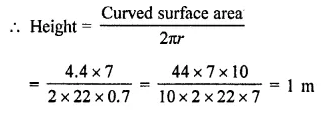
RD Sharma Class 9 Solutions Chapter 19 Surface Areas and Volume of a Circular Cylinder Ex 19.1 Q1.1

Question 2.
In a hot water heating system, there is a cylindrical pipe of length 28 m and diameter 5 cm. Find the total radiating surface in the system. [NCERT]
Solution:
Diameter of the pipe = 5 cm
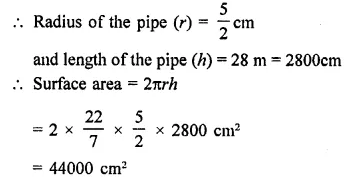
RD Sharma Class 9 Solutions Chapter 19 Surface Areas and Volume of a Circular Cylinder Ex 19.1 Q2.1

Question 3.
A cylindrical pillar is 50 cm in diameter and 3.5 m in height. Find the cost of painting the curved surface of the pillar at the rate of 12.50 per m2. [NCERT]
Solution:
Diameter of cylindrical pillar = 50 cm
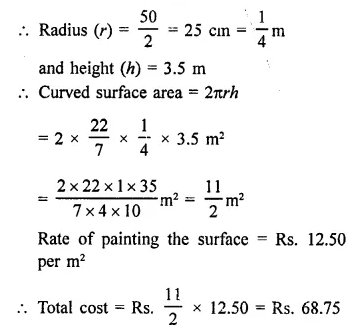
RD Sharma Class 9 Solutions Chapter 19 Surface Areas and Volume of a Circular Cylinder Ex 19.1 Q3.1

Question 4.
It is required to make a closed cylindrical tank of height 1 m and base diameter 140 cm from a metal sheet. How many square metres of the sheet are required for the same? [NCERT]
Solution:
Height of cylinder (h) = 1 m = 100 cm
Diameter of box = 140 cm
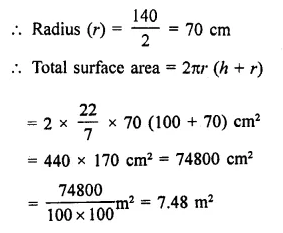
RD Sharma Class 9 Solutions Chapter 19 Surface Areas and Volume of a Circular Cylinder Ex 19.1 Q4.1

Question 5.
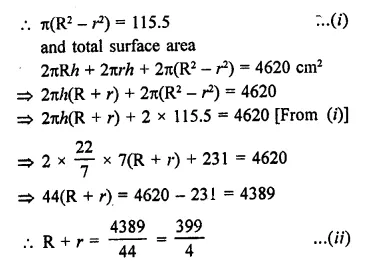
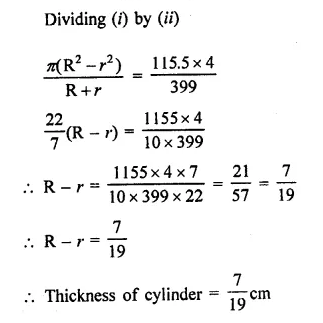
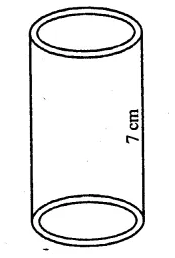
The total surface area of a hollow cylinder which is open from both sides is 4620 sq. cm, area of base ring is 115.5 sq. cm and height 7 cm. Find the thickness of the cylinder.
Solution:
Total surface area of a hollow cylinder open from both sides = 4620 cm2
Area of base of ring = 115.5 cm2
Height (h) = 7 cm
Let outer radius (R) = R
and inner radius = r
RD Sharma Class 9 Solutions Chapter 19 Surface Areas and Volume of a Circular Cylinder Ex 19.1 Q5.1
RD Sharma Class 9 Solutions Chapter 19 Surface Areas and Volume of a Circular Cylinder Ex 19.1 Q5.2
RD Sharma Class 9 Solutions Chapter 19 Surface Areas and Volume of a Circular Cylinder Ex 19.1 Q5.3

Question 6.
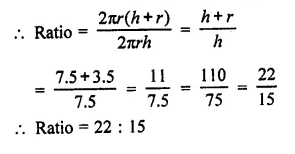
Find the ratio between the total surface area of a cylinder to its curved surface area, given that its height and radius are 7.5 cm and 3.5 cm.
Solution:
Radius of the cylinder (r) = 3.5 cm
and height (h) = 7.5 cm
Total surface area = 2πr (h + r)
and curved surface area = 2πrh
RD Sharma Class 9 Solutions Chapter 19 Surface Areas and Volume of a Circular Cylinder Ex 19.1 Q6.1

Question 7.
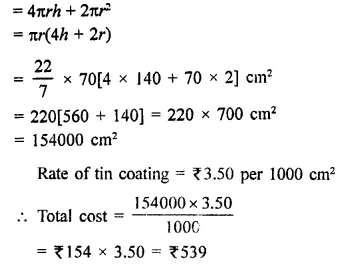
A cylindrical vessel, without lid, has to be tin-coated on its both sides. If the radius of the base is 70 cm and its height is 1.4 m, calculate the cost of tin-coating at the rate of ₹3.50 per 1000 cm2.
Solution:
Radius of the base of a cylindrical vessel (r) = 70 cm
and height (h) = 1.4 m = 140 cm
Total surface area (excluding upper lid) on both sides = 2πrh x 2 + πr2 x 2
RD Sharma Class 9 Solutions Chapter 19 Surface Areas and Volume of a Circular Cylinder Ex 19.1 Q7.1

Question 8.
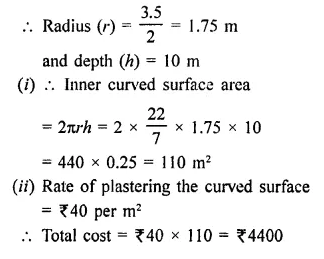
The inner diameter of a circular well is 3.5 m. It is 10 m deep. Find:
(i) inner curved surface area.
(ii) the cost of plastering this curved surface at the rate of ₹40 per m2. [NCERT]
Solution:
Inner diameter of a well = 3.5 m
RD Sharma Class 9 Solutions Chapter 19 Surface Areas and Volume of a Circular Cylinder Ex 19.1 Q8.1

Question 9.
The students of a Vidyalaya were asked to participate s a competition for making and decorating pen holders in the shape of a cylinder with a base, using cardboard. Each pen holder was to be of radius 3 cm and height 10.5 cm. The Vidyalaya was to supply the competitors with cardboard. If there were 35 competitors, how much cardboard was required to be bought for the competition? [NCERT]
Solution:
Radius of cylinderical pen holder (r) = 3 cm
Height (h) = 10.5 cm
∴ Surface area of the pen holder
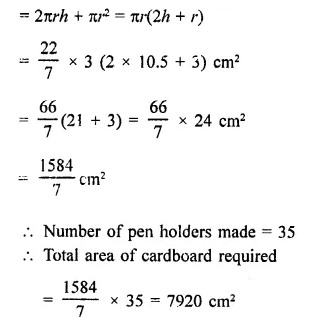
RD Sharma Class 9 Solutions Chapter 19 Surface Areas and Volume of a Circular Cylinder Ex 19.1 Q9.1

Question 10.
The diameter of roller 1.5 m long is 84 cm. If it takes 100 revolutions to level a play¬ground, find the cost of levelling this ground at the rate of 50 paise per square metre.
Solution:
Diameter of a roller = 1.5 m
∴ Radius = \(\frac { 1.5 }{ 2 }\) = 0.75 m = 75 cm
and length (h) = 84 cm
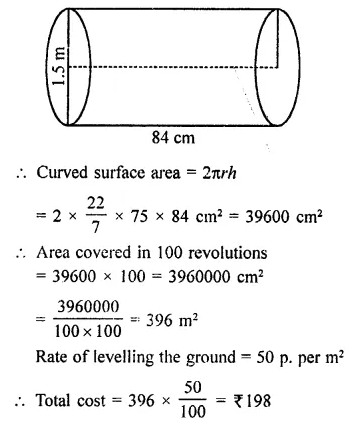
RD Sharma Class 9 Solutions Chapter 19 Surface Areas and Volume of a Circular Cylinder Ex 19.1 Q10.1

Question 11.
Twenty cylindrical pillars of the Parliament House are to be cleaned. If the diameter of each pillar is 0.50 m and height is 4 m. What will be the cost of cleaning them at the rate of ₹2.50 per square metre? [NCERT]
Solution:
Number of pillars = 20
Diameter of one pillar = 0.50 m
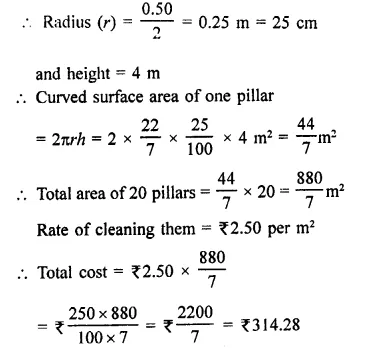
RD Sharma Class 9 Solutions Chapter 19 Surface Areas and Volume of a Circular Cylinder Ex 19.1 Q11.1

Question 12.
A solid cylinder has total surface area of 462 cm2. Its curved surface area is one- third of its total surface area. Find the radius and height of the cylinder.
Solution:
Total surface of solid cylinder = 462 cm2
Curved surface area = \(\frac { 1 }{ 3 }\) of total surface area
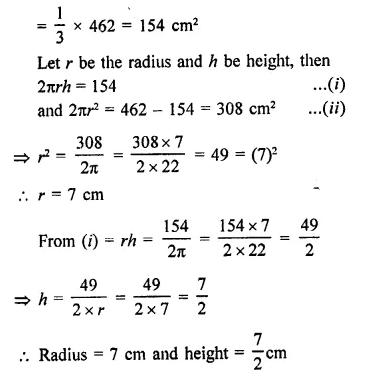
RD Sharma Class 9 Solutions Chapter 19 Surface Areas and Volume of a Circular Cylinder Ex 19.1 Q12.1

Question 13.
The total surface area of a hollow metal cylinder, open at both ends of external radius 8 cm and height 10 cm is 338 π cm2. Taking r to be inner radius, obtain an equation in r and use it to obtain the thickness of the metal in the cylinder.
Solution:
Total surface area of a hollow metal cylinder = 338π cm2
Let R be the outer radius, r be inner radius and h be the height of the cylinder of the cylinder
∴ 2πRh + 2πrh + 2πR2 – 2πr2 = 338π
R = 8 cm, h = 10 cm
⇒ 2πh (R + r) + 2π(R2 – r2) = 338π
⇒ Dividing by 2π , we get
⇒ h(R + r) + (R2 – r2) = 169
⇒ 10(8 + r) + (8 + r) (8 – r) = 169
⇒ 80 + 10r + 64 – r2 = 169
⇒ 10r – r2 + 144 – 169 = 0
⇒ r2 – 10r + 25 = 0
⇒ (r-5)2 = 0
⇒ r = 5
∴ Thickness of the metal = R – r = 8 – 5 = 3 cm

Question 14.
Find the lateral curved surface area of a cylinderical petrol storage tank that is 4.2m in diameter and 4.5 m high. How much steel was actually used, if \(\frac { 1 }{ 12 }\) of steel actually used was wasted in making the closed tank? [NCERT]
Solution:
Diameter of a cylinderical tank = 4.2 m
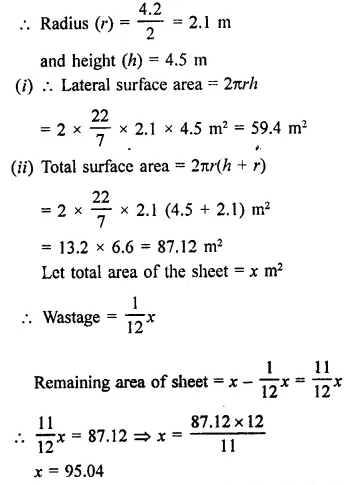
RD Sharma Class 9 Solutions Chapter 19 Surface Areas and Volume of a Circular Cylinder Ex 19.1 Q14.1
RD Sharma Class 9 Solutions Chapter 19 Surface Areas and Volume of a Circular Cylinder Ex 19.1 Q14.2


Hope given RD Sharma Class 9 Solutions Chapter 19 Surface Areas and Volume of a Circular Cylinder Ex 19.1 are helpful to complete your math homework.

If you have any doubts, please comment below. Learn Insta try to provide online math tutoring for you.
RS Aggarwal Class 8 Solutions Chapter 14 Polygons Ex 14B

RS Aggarwal Class 8 Solutions Chapter 14 Polygons Ex 14B

These Solutions are part of RS Aggarwal Solutions Class 8. Here we have given RS Aggarwal Solutions Class 8 Chapter 14 Polygons Ex 14B.

Other Exercises

Question 1.
Solution:
In a pentagon, no. of diagonals
\(=\frac { n\left( n-3 \right) }{ 2 }\)
\(=\frac { 5\left( 5-3 \right) }{ 2 }\)
\( =\frac { 5\times 2 }{ 2 } \)
= 5 (a)

Question 2.
Solution:
In a hexagon, no. of diagonals
\(=\frac { n\left( n-3 \right) }{ 2 }\)
\(=\frac { 6\left( 6-3 \right) }{ 2 }\)
\( =\frac { 6\times 3 }{ 2 } \)
= 9 (c)

Question 3.
Solution:
In an octagon, no. of diagonals
\(=\frac { n\left( n-3 \right) }{ 2 }\)
\(=\frac { 8\left( 8-3 \right) }{ 2 }\)
\( =\frac { 8\times 5 }{ 2 } \)
= 20 (d)

Question 4.
Solution:
In a polygon of 12 sides, no. of diagonals
\(=\frac { n\left( n-3 \right) }{ 2 }\)
\(=\frac { 12\left( 12-3 \right) }{ 2 }\)
\( =\frac { 12\times 9 }{ 2 } \)
= 54 (c)

Question 5.
Solution:
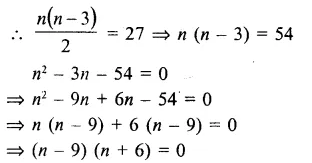
A polygon has 27 diagonal
RS Aggarwal Class 8 Solutions Chapter 14 Polygons Ex 14B 5.1
Either n – 9 = 0, then n = 9
or n + 6 = 0, then n = – 6 but it is not possible being negative
No. of sides = 9 (c)

Question 6.
Solution:
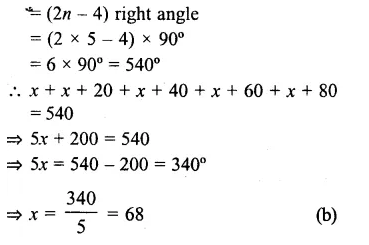
Angles of a pentagon are x°, (x + 20)°, (x + 40)°, (x + 60°) and (x + 80)°
But sum of angle of a pentagon
RS Aggarwal Class 8 Solutions Chapter 14 Polygons Ex 14B 6.1

Question 7.
Solution:
Measure of each exterior angle = 40°
No. of sides = \(\frac { { 360 }^{ o } }{ 40 }\)9 sides (b)

Question 8.
Solution:
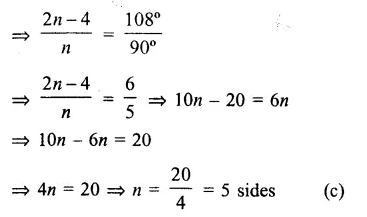
Each interior angle of a polygon = 108°
RS Aggarwal Class 8 Solutions Chapter 14 Polygons Ex 14B 8.1

Question 9.
Solution:
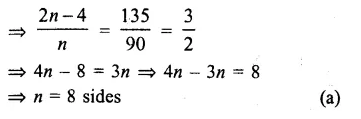
Each interior angle = 135°
RS Aggarwal Class 8 Solutions Chapter 14 Polygons Ex 14B 9.1

Question 10.
Solution:
Let each exterior angle = x, then
Each interior angles = 3n
But sum of angle = 180°
x + 3x = 180°
=>4x = 180°
=> x = 45°
No. of sides = \(\frac { { 360 }^{ o } }{ 45 } \)
= 8 sides (b)

Question 11.
Solution:
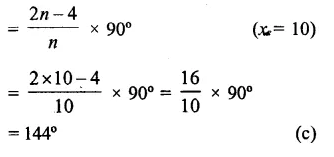
Each interior angles of decagon
RS Aggarwal Class 8 Solutions Chapter 14 Polygons Ex 14B 11.1

Question 12.
Solution:
Sum of all interior angles of a hexagon
= (2n – 4) x right angle
= (2 x 6 – 4) right angle
= 8 right angles (b)

Question 13.
Solution:
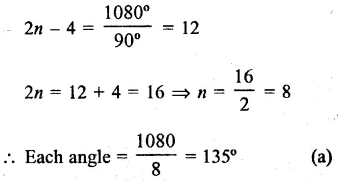
Sum of all interior angles of polygon = 1080°
Let n be the number of sides, then
(2n – 4) x 90°= 1080°
RS Aggarwal Class 8 Solutions Chapter 14 Polygons Ex 14B 13.1

Question 14.
Solution:
Difference between each interior and exterior angle = 108°
Then each interior angle = x + 108°
x + x + 108°= 180°
(Sum of both angles = 180°)
=> 2x = 180° – 108° = 72°
x = \(\\ \frac { 72 }{ 2 } \)
= 36°
No. of sides = \( \frac { { 360 }^{ o } }{ { 36 }^{ o } } \)
= 10 (d)

Hope given RS Aggarwal Solutions Class 8 Chapter 14 Polygons Ex 14B are helpful to complete your math homework.

If you have any doubts, please comment below. Learn Insta try to provide online math tutoring for you.
HOTS Questions for Class 9 Science Chapter 11 Work, Power and Energy

HOTS Questions for Class 9 Science Chapter 11 Work, Power and Energy

These Solutions are part of HOTS Questions for Class 9 Science. Here we have given HOTS Questions for Class 9 Science Chapter 11 Work, Power and Energy

Question 1.
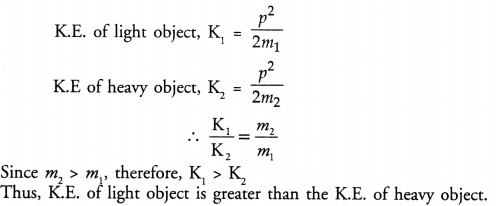
A light and a heavy object have the same momentum. What is the ratio of their kinetic energy ?
(CBSE 2011, 2012)
Answer:
HOTS Questions for Class 9 Science Chapter 11 Work, Power and Energy image - 1

More Resources

Question 2.
Can any object have mechanical energy even if its momentum is zero ? Explain.
(NCERT Question Bank, CBSE 2011)
Answer:
HOTS Questions for Class 9 Science Chapter 11 Work, Power and Energy image - 2
p = 0, then mechanical energy of the object = mgh = P.E.
Thus, a stationary object at a height h above the surface of earth has mechanical energy even if its momentum is zero.

Question 3.
Can any object have momentum even if its mechanical energy is zero ? Explain.
(NCERT Question Bank ; CBSE 2011)
Answer:
Mechanical energy = K.E. + P.E.
Since mechanical energy is zero, so both K.E. and P.E are zero. Kinetic energy is zero means velocity of the object is zero. Hence, momentum of the object is also zero.

Question 4.
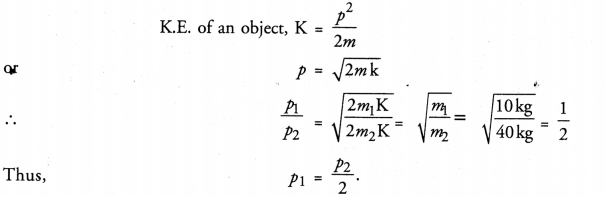
Compare the momentum of two objects of mass 10 kg and 40 kg respectively but having same kinetic energy.
Answer:
HOTS Questions for Class 9 Science Chapter 11 Work, Power and Energy image - 3

Question 5.
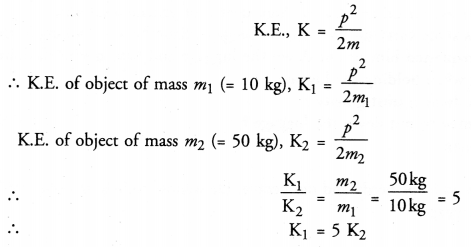
Compare the kinetic energies of two objects of masses 10 kg and 50 kg respectively but having same momentum. (CBSE 2015)
Answer:
HOTS Questions for Class 9 Science Chapter 11 Work, Power and Energy image - 4

Hope given HOTS Questions for Class 9 Science Chapter 11 Work, Power and Energy are helpful to complete your science homework.

If you have any doubts, please comment below. Learn Insta try to provide online science tutoring for you.

RD Sharma Class 9 Solutions Chapter 18 Surface Areas and Volume of a Cuboid and Cube MCQS

RD Sharma Class 9 Solutions Chapter 18 Surface Areas and Volume of a Cuboid and Cube MCQS

These Solutions are part of RD Sharma Class 9 Solutions. Here we have given RD Sharma Class 9 Solutions Chapter 18 Surface Areas and Volume of a Cuboid and Cube MCQS

Other Exercises

Mark correct alternative in each of the following:
Question 1.
The length of the longest rod that can be fitted in a cubical vessel of edge 10 cm long, is
(a) 10 cm
(b) 10\(\sqrt { 2 } \) cm
(c) 10\(\sqrt { 3 } \) cm
(d) 20 cm
Solution:
Edge of cuboid (a) = 10 cm
∴ Longest edge = \(\sqrt { 3 } \) a cm
= \(\sqrt { 3 } \) x 10 = 10\(\sqrt { 3 } \) cm (c)

Question 2.
Three equal cubes are placed adjacently in a row. The ratio of the total surface area of the resulting cuboid to that of the sum of the surface areas of three cubes, is
(a) 7 : 9
(b) 49 : 81
(c) 9 : 7
(d) 27 : 23
Solution:
Let a be the side of three equal cubes
∴ Surface area of 3 cubes
= 3 x 6a2 = 18a2
and length of so formed cuboid = 3a
Breadth = a
and height = a
∴ Surface area = 2(lb + bh + hl)
= 2[3a x a + a x a+a x 3a] = 2[3a2 + a2 + 3a2] = 2 x 7a2 = 14a2
∴ Ratio in the surface areas of cuboid and three cubes = 14a2 : 18a2= 7:9 (a)

Question 3.
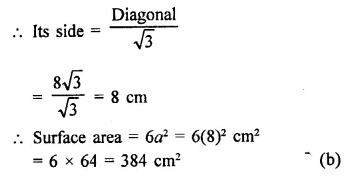
If the length of a diagonal of a cube is 8 \(\sqrt { 3 } \) cm, then its surface area is
(a) 512 cm2
(b) 384 cm2
(c) 192 cm2
(d) 768 cm2
Solution:
Length of the diagonal of cube = 8 \(\sqrt { 3 } \) cm
RD Sharma Class 9 Solutions Chapter 18 Surface Areas and Volume of a Cuboid and Cube MCQS Q3.1

Question 4.
If the volumes of two cubes are in the ratio 8:1, then the ratio of their edges is
(a) 8 : 1
(b) 2\(\sqrt { 2 } \) : 1
(c) 2 : 1
(d) none of these
Solution:
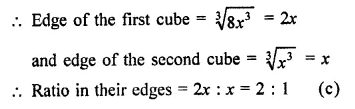
Let volume of first cube = 8x3
and of second cube = x3
RD Sharma Class 9 Solutions Chapter 18 Surface Areas and Volume of a Cuboid and Cube MCQS Q4.1

Question 5.
The volume of a cube whose surface area is 96 cm2, is
(a) 16\(\sqrt { 2 } \) cm3
(b) 32 cm3
(c) 64 cm3
(d) 216 cm3
Solution:
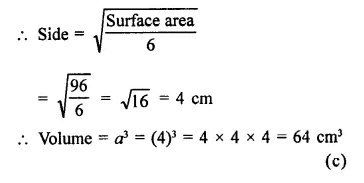
Surface area of a cube = 96 cm2
RD Sharma Class 9 Solutions Chapter 18 Surface Areas and Volume of a Cuboid and Cube MCQS Q5.1

Question 6.
The length, width and height of a rectangular solid are in the ratio of 3 : 2 : 1. If the volume of the box is 48 cm3, the total surface area of the box is
(a) 27 cm2
(b) 32 cm2
(c) 44 cm2
(d) 88 cm2
Solution:
Ratio in the dimensions of a cuboid =3 : 2 : 1
Let length = 3x
Breadth = 2x
and height = x
Then volume = lbh = 3x x 2x x x = 6×3
∴ 6x3 = 48 ⇒ x3= \(\frac { 48 }{ 6 }\) = 8 = (2)3
∴ x = 2
∴ Length (l) = 3 x 2 = 6 cm
Breadth (b) = 2 x 2 = 4 cm
Height (h) = 1 x 2 = 2 cm
Now surface area = 2[lb + bh + hl]
= 2[6 x 4 + 4 x 2 + 2 x 6] cm2
= 2[24 + 8-+ 12] = 2 x 44 cm2
= 88 cm2 (d)

Question 7.
If the areas of the adjacent faces of a rectangular block are in the ratio 2:3:4 and its volume is 9000 cm3, then the length of the shortest edge is
(a) 30 cm
(b) 20 cm
(c) 15 cm
(d) 10 cm
Solution:
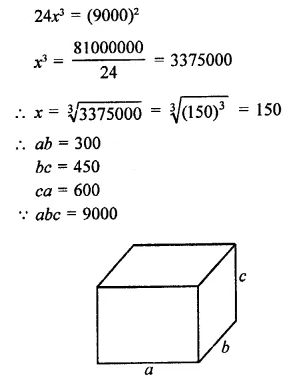
Ratio in the areas of three adjacent faces of a cuboid = 2 : 3 : 4
Volume = 9000 cm3
Let the area of faces be 2x, 3x, Ax and
Let a, b, and c be the dimensions of the cuboid, then
∴ 2x = ab, 3x = be, 4x = ca
∴ ab x be x ca = 2x x 3x x 4x
a2b2c2 = 24 x 3
But volume = abc = 9000 cm3
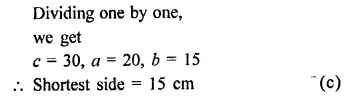
RD Sharma Class 9 Solutions Chapter 18 Surface Areas and Volume of a Cuboid and Cube MCQS Q7.1
RD Sharma Class 9 Solutions Chapter 18 Surface Areas and Volume of a Cuboid and Cube MCQS Q7.2

Question 8.
If each edge of a cube, of volume V, is doubled, then the volume of the new cube is
(a) 2V
(b) 4V
(c) 6V
(d) 8V
Solution:
Let a be the edge of a cube whose Volume = V
∴ a3 = V
By doubling the edge, we get 2a
Then volume = (2a)3 = 8a3
∴ Volume of new cube = 8a3 = 8V (d)

Question 9.
If each edge of a cuboid of surface area S is doubled, then surface area of the new cuboid is
(a) 2S
(b) 4S
(c) 6S
(d) 8S
Solution:
Let each edge of a cube = a
Then surface area = 6a2
∴ S = 6a2
Now doubling the edge, we get
New edge of a new cube = 2a
∴ Surface area = 6(2a)2
= 6 x 4a2 = 24a2
= 4 x 6a2 = 4S (b)

Question 10.
The area of the floor of a room is 15 m2. If its height is 4 m, then the volume of the air contained in the room is
(a) 60 dm3
(b) 600 dm3
(c) 6000 dm3
(d) 60000 dm3
Solution:
Area of a floor of a room = 15 m2
Height (h) = 4 m
∴ Volume of air in the room = Floor area x Height
= 15 m2 x 4 m = 60 m3
= 60 x 10 x 10 x 10 dm2 = 60000 dm2 (d)

Question 11.
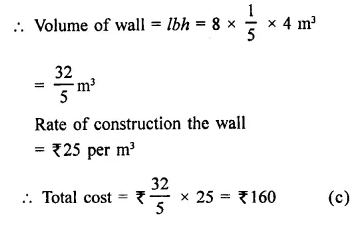
The cost of constructing a wall 8 m long, 4 m high and 20 cm thick at the rate of ₹25 per m3 is
(a) ₹16
(b) ₹80
(c) ₹160
(d) ₹320
Solution:
Length of wall (l) = 8 m
Breadth (b) = 20 cm = \(\frac { 1 }{ 5 }\) m
Height (h) = 4 m
RD Sharma Class 9 Solutions Chapter 18 Surface Areas and Volume of a Cuboid and Cube MCQS Q11.1

Question 12.
10 cubic metres clay in uniformaly spread on a land of area 10 acres. The rise in the level of the ground is
(a) 1 cm
(b) 10 cm
(c) 100 cm
(d) 1000 cm
Solution:
Volume of clay = 10 m3
Area of land = 10 acres
= 10 x 100 = 1000 m2
∴ Rise of level by spreading the clay
RD Sharma Class 9 Solutions Chapter 18 Surface Areas and Volume of a Cuboid and Cube MCQS Q12.1

Question 13.
Volume of a cuboid is 12 cm3. The volume (in cm3) of a cuboid whose sides are double of the above cuboid is
(a) 24
(b) 48
(c) 72
(d) 96
Solution:
Volume of cuboid = 12 cm3
By doubling the sides of the cuboid the
volume will be = 12 cm3 x 2 x 2 x 2
= 96 cm3 (d)

Question 14.
If the sum of all the edges of a cube is 36 cm, then the volume (in cm3) of that cube is
(a) 9
(b) 27
(c) 219
(d) 729
Solution:
Sum of all edges of a cube = 36 cm
No. of edge of a cube are 12
∴ Length of its one edge = \(\frac { 36 }{ 12 }\) = 3 cm
Then volume = (edge)3 = (3)3 cm3
= 27 cm3 (b)

Question 15.
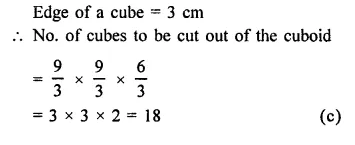
The number of cubes of side 3 cm that can be cut from a cuboid of dimensions 9 cm x 9 cm x 6 cm, is
(a) 9
(b) 10
(c) 18
(d) 20
Solution:
Dimensions of a cuboid = 9 cm x 9 cm x 6 cm
RD Sharma Class 9 Solutions Chapter 18 Surface Areas and Volume of a Cuboid and Cube MCQS Q15.1

Question 16.
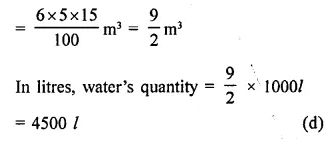
On a particular day, the rain fall recorded in a terrace 6 m long and 5 m broad is 15 cm. The quantity of water collected in the terrace is
(a) 300 litres
(b) 450 litres
(c) 3000 litres
(d) 4500 litres
Solution:
Dimension of a terrace = 6mx5m
Level of rain on it = 15 cm
∴ Volume of water collected on it
RD Sharma Class 9 Solutions Chapter 18 Surface Areas and Volume of a Cuboid and Cube MCQS Q16.1

Question 17.
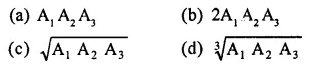
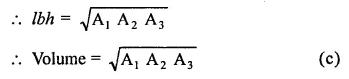
If A1, A2 and A3 denote the areas of three adjacent faces of a cuboid, then its volume is
RD Sharma Class 9 Solutions Chapter 18 Surface Areas and Volume of a Cuboid and Cube MCQS Q17.1
Solution:
Let l, b, h be the dimensions of the cuboid
∴ A1= lb, A2 = bh, A3 = hl
∴ A1 A2 A3 = lb.bh.hl = l2b2h2
RD Sharma Class 9 Solutions Chapter 18 Surface Areas and Volume of a Cuboid and Cube MCQS Q17.2

Question 18.
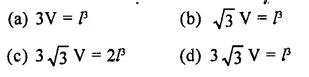
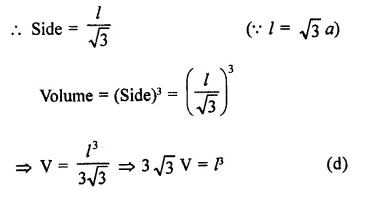
If l is the length of a diagonal of a cube of volume V, then
RD Sharma Class 9 Solutions Chapter 18 Surface Areas and Volume of a Cuboid and Cube MCQS Q18.1
Solution:
Volume of a cube = V
and longest diagonal = l
RD Sharma Class 9 Solutions Chapter 18 Surface Areas and Volume of a Cuboid and Cube MCQS Q18.2

Question 19.
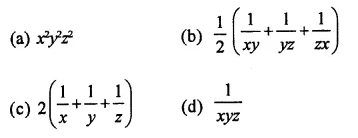
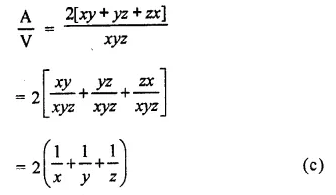
If V is the volume of a cuboid of dimensions x, y, z and A is its surface area, then \(\frac { A }{ V }\)
RD Sharma Class 9 Solutions Chapter 18 Surface Areas and Volume of a Cuboid and Cube MCQS Q19.1
Solution:
A is surface area, V is volume and x, y and z are the dimensions
Then V = xyz
A = 2[xy + yz + zx]
RD Sharma Class 9 Solutions Chapter 18 Surface Areas and Volume of a Cuboid and Cube MCQS Q19.2

Question 20.
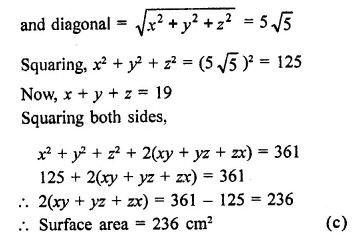
The sum of the length, breadth and depth of a cuboid is 19 cm and its diagonal is 5\(\sqrt { 5 } \) cm. Its surface area is
(a) 361 cm2
(b) 125 cm2
(c) 236 cm2
(d) 486 cm2
Solution:
Let x, y, z be the dimensions of a cuboid,
then x + y + z = 19 cm
RD Sharma Class 9 Solutions Chapter 18 Surface Areas and Volume of a Cuboid and Cube MCQS Q20.1

Question 21.
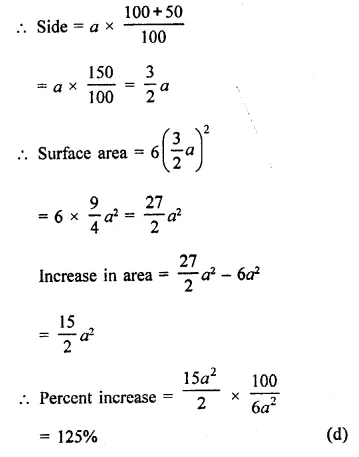
If each edge of a cube is increased by 50%, the percentage increase in its surface area is
(a) 50%
(b) 75%
(c) 100%
(d) 125%
Solution:
Let in first case, edge of a cube = a
Then surface area = 6a2
In second case, increase in side = 50%
RD Sharma Class 9 Solutions Chapter 18 Surface Areas and Volume of a Cuboid and Cube MCQS Q21.1

Question 22.
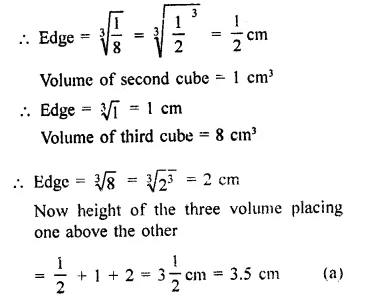
A cube whose volume is 1/8 cubic centimeter is placed on top of a cube whose volume is. 1 cm3. The two ,cubes are then placed on top of a third cube whose volume is 8 cm3. The height of the stacked cubes is
(a) 3.5 cm
(b) 3 cm
(c) 7 cm
(d) none of these
Solution:
Volume of first cube = \(\frac { 1 }{ 2 }\) cm3
RD Sharma Class 9 Solutions Chapter 18 Surface Areas and Volume of a Cuboid and Cube MCQS Q22.1

Hope given RD Sharma Class 9 Solutions Chapter 18 Surface Areas and Volume of a Cuboid and Cube MCQS are helpful to complete your math homework.

If you have any doubts, please comment below. Learn Insta try to provide online math tutoring for you.
Value Based Questions in Science for Class 9 Chapter 11 Work, Power and Energy

Value Based Questions in Science for Class 9 Chapter 11 Work, Power and Energy

These Solutions are part of Value Based Questions in Science for Class 9. Here we have given Value Based Questions in Science for Class 9 Chapter 11 Work, Power and Energy

VALUE BASED QUESTIONS

Question 1.
Akshit is a student of class IX. He was waiting for a bus on a bus stand. He saw an old man trying to keep his box on the roof of a bus but was unable to do so. Akshit picked up his box and placed the box on the roof of the bus. The old man thanked Akshit.
Answer the following questions based on the above paragraph.

  1. Is the work done by Akshit while placing the box on the roof of the bus positive or negative ?
  2. Is the work done by gravity on the box is positive or negative ?
  3. What values are shown by Akshit ?

Answer:

  1. Positive,
  2. Negative,
  3. Akshit is helpful. He believes in helping old people. He has dignity of labour.

More Resources

Question 2.
Rajiv is a student of class IX. He bought a toy gun from the market. The bullets used in gun were made of rubber. His mother asked Rajiv not to fire bullets on the window panes. Rajiv went to a park and fired bullets on a displaying screen made of plastic. Rajiv’s friend Rohan objected the action of Rajiv. Rajiv started quarelling with Rohan.
Answer the following questions based on above paragraph.

  1. Name the type of energy stored in the spring of gun.
  2. Name the type of energy of a moving bullet.
  3. What values are shown by Rohan ?
  4. Comment on the attitude of Rajiv.

Answer:

  1. Elastic potential energy,
  2. Kinetic energy.
  3. According to Rohan, one must not destroy or disfigure the public or private property. It is sin and crime.
  4. Rajiv’s attitude is undesirable. He has no right to destroy the public property. He must be ashamed of his action.

Question 3.
Ramesh was walking on a road in the morning. He found that an old mail was lying on a road side. Ramesh touched the body of the old man. His body was very cold. Ramesh rubbed the hands and feet of the old man. The old man opened his eye. Ramesh helped the old man to reach his home.
Answer the following questions based on above paragraph.

  1. Why hands become warm, when rubbed ?
  2. What values are shown by Ramesh ?

Answer:

  1. When hands are rubbed against each other, mechanical energy is converted into heat energy. Therefore, hands become warm.
  2. Ramesh is helpful, feels concerned for others. He has high degree of general awareness.

Question 4.
An old man was standing on a bus stand carrying a very heavy luggage. Saurabh was looking at the old man and finding him uncomfortable, requested him to put down the luggage and helped him in doing so.
(a) Did the old man do any work while holding the luggage ?
(b) What is the equation for work done against gravity ?
(c) Why did Saurabh ask the old man to put down the luggage ? (CBSE 2015)
Answer:
(a) No work is done by the old man.
(b) W = mgh
(c) Saurabh is a good boy. He always helps needy and old people. He wanted to help the old man and hence asked him to put down the luggage.

Hope given Value Based Questions in Science for Class 9 Chapter 11 Work, Power and Energy are helpful to complete your science homework.

If you have any doubts, please comment below. Learn Insta try to provide online science tutoring for you.