RD Sharma Class 9 Solutions Chapter 13 Linear Equations in Two Variables Ex 13.3

RD Sharma Class 9 Solutions Chapter 13 Linear Equations in Two Variables Ex 13.3

These Solutions are part of RD Sharma Class 9 Solutions. Here we have given RD Sharma Class 9 Solutions Chapter 13 Linear Equations in Two Variables Ex 13.3

Other Exercises

Question 1.
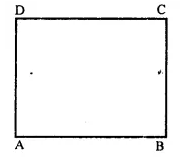
In a parallelogram ABCD, determine the sum of angles ZC and ZD.
Solution:
In a ||gm ABCD,
∠C + ∠D = 180°
(Sum of consecutive angles)
RD Sharma Class 9 Solutions Chapter 13 Linear Equations in Two Variables Ex 13.3 Q1.1

Question 2.
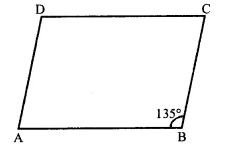
In a parallelogram ABCD, if ∠B = 135°, determine the measures of its other angles.
Solution:
In a ||gm ABCD, ∠B = 135°
RD Sharma Class 9 Solutions Chapter 13 Linear Equations in Two Variables Ex 13.3 Q2.1
∴ ∠D = ∠B = 135° (Opposite angles of a ||gm)
But ∠A + ∠B = 180° (Sum of consecutive angles)
⇒ ∠B + 135° = 180°
∴ ∠A = 180° – 135° = 45°
But∠C = ∠B = 45° (Opposite angles of a ||gm)
∴ Angles are 45°, 135°, 45°, 135°.

Question 3.
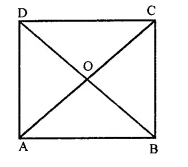
ABCD is a square, AC and BD intersect at O. State the measure of ∠AOB.
Solution:
In a square ABCD,
Diagonal AC and BD intersect each other at O
∵ Diagonals of a square bisect each other at right angle
∵∠AOB = 90°
RD Sharma Class 9 Solutions Chapter 13 Linear Equations in Two Variables Ex 13.3 Q3.1

Question 4.
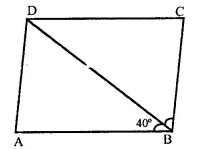
ABCD is a rectangle with ∠ABD = 40°. Determine ∠DBC.
Solution:
In rectangle ABCD,
RD Sharma Class 9 Solutions Chapter 13 Linear Equations in Two Variables Ex 13.3 Q4.1
∠B = 90°, BD is its diagonal
But ∠ABD = 40°
and ∠ABD + ∠DBC = 90°
⇒ 40° + ∠DBC = 90°
⇒ ∠DBC = 90° – 40° = 50°
Hence ∠DBC = 50°

Question 5.
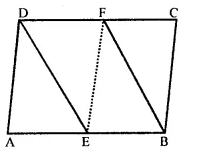
The sides AB and CD of a parallelogram ABCD are bisected at E and F. Prove that EBFD is a parallelogram.
Solution:
Given : In ||gm ABCD, E and F are the mid points of the side AB and CD respectively
DE and BF are joined
To prove : EBFD is a ||gm
Construction : Join EF
RD Sharma Class 9 Solutions Chapter 13 Linear Equations in Two Variables Ex 13.3 Q5.1
Proof : ∵ ABCD is a ||gm
∴ AB = CD and AB || CD
(Opposite sides of a ||gm are equal and parallel)
∴ EB || DF and EB = DF (∵ E and F are mid points of AB and CD)
∴ EBFD is a ||gm.

Question 6.
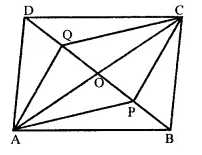
P and Q are the points of trisection of the diagonal BD of the parallelogram ABCD. Prove that CQ is parallel to AP. Prove also that AC bisects PQ.
Solution:
Given : In ||gm, ABCD. P and Q are the points of trisection of the diagonal BD
RD Sharma Class 9 Solutions Chapter 13 Linear Equations in Two Variables Ex 13.3 Q6.1
To prove : (i) CQ || AP
AC bisects PQ
Proof: ∵ Diagonals of a parallelogram bisect each other
∴ AO = OC and BO = OD
∴ P and Q are point of trisection of BD
∴ BP = PQ = QD …(i)
∵ BO = OD and BP = QD …(ii)
Subtracting, (ii) from (i) we get
OB – BP = OD – QD
⇒ OP = OQ
In quadrilateral APCQ,
OA = OC and OP = OQ (proved)
Diagonals AC and PQ bisect each other at O
∴ APCQ is a parallelogram
Hence AP || CQ.

Question 7.
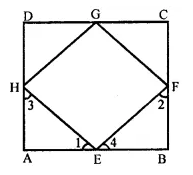
ABCD is a square. E, F, G and H are points on AB, BC, CD and DA respectively, such that AE = BF = CG = DH. Prove that EFGH is a square.
Solution:
Given : In square ABCD
E, F, G and H are the points on AB, BC, CD and DA respectively such that AE = BF = CG = DH
To prove : EFGH is a square
Proof : E, F, G and H are points on the sides AB, BC, CA and DA respectively such that
AE = BF = CG = DH = x (suppose)
Then BE = CF = DG = AH = y (suppose)
Now in ∆AEH and ∆BFE
RD Sharma Class 9 Solutions Chapter 13 Linear Equations in Two Variables Ex 13.3 Q7.1
AE = BF (given)
∠A = ∠B (each 90°)
AH = BE (proved)
∴ ∆AEH ≅ ∆BFE (SAS criterion)
∴ ∠1 = ∠2 and ∠3 = ∠4 (c.p.c.t.)
But ∠1 + ∠3 = 90° and ∠2 + ∠4 = 90° (∠A = ∠B = 90°)
⇒ ∠1 + ∠2 + ∠3 + ∠4 = 90° + 90° = 180°
⇒ ∠1 + ∠4 + ∠1 + ∠4 = 180°
⇒ 2(∠1 + ∠4) = 180°
⇒ ∠1 + ∠4 = \(\frac { { 180 }^{ \circ } }{ 2 }\)  = 90°
∴ ∠HEF = 180° – 90° = 90°
Similarly, we can prove that
∠F = ∠G = ∠H = 90°
Since sides of quad. EFGH is are equal and each angle is of 90°
∴ EFGH is a square.

Question 8.
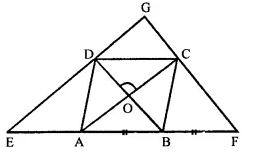
ABCD is a rhombus, EABF is a straight line such that EA = AB = BF. Prove that ED and FC when produced meet at right angles.
Solution:
Given : ABCD is a rhombus, EABF is a straight line such that
EA = AB = BF
ED and FC are joined
Which meet at G on producing
RD Sharma Class 9 Solutions Chapter 13 Linear Equations in Two Variables Ex 13.3 Q8.1
To prove: ∠EGF = 90°
Proof : ∵ Diagonals of a rhombus bisect
each other at right angles
AO = OC, BO = OD
∠AOD = ∠COD = 90°
and ∠AOB = ∠BOC = 90°
In ∆BDE,
A and O are the mid-points of BE and BD respectively.
∴ AO || ED
Similarly, OC || DG
In ∆ CFA, B and O are the mid-points of AF and AC respectively
∴ OB || CF and OD || GC
Now in quad. DOCG
OC || DG and OD || CG
∴ DOCG is a parallelogram.
∴ ∠DGC = ∠DOC (opposite angles of ||gm)
∴ ∠DGC = 90° (∵ ∠DOC = 90°)
Hence proved.

Question 9.
ABCD is a parallelogram, AD is produced to E so that DE = DC = AD and EC produced meets AB produced in F. Prove that BF = BC.
Solution:
Given : In ||gm ABCD,
AB is produced to E so that
DE = DA and EC produced meets AB produced in F.
To prove : BF = BC
Proof: In ∆ACE,
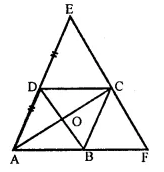
RD Sharma Class 9 Solutions Chapter 13 Linear Equations in Two Variables Ex 13.3 Q9.1
O and D are the mid points of sides AC and AE
∴ DO || EC and DB || FC
⇒ BD || EF
∴ AB = BF
But AB = DC (Opposite sides of ||gm)
∴ DC = BF
Now in ∆EDC and ∆CBF,
DC = BF (proved)
∠EDC = ∠CBF
(∵∠EDC = ∠DAB corresponding angles)
∠DAB = ∠CBF (corresponding angles)
∠ECD = ∠CFB (corresponding angles)
∴ AEDC ≅ ACBF (ASA criterion)
∴ DE = BC (c.p.c.t.)
⇒ DC = BC
⇒ AB = BC
⇒ BF = BC (∵AB = BF proved)
Hence proved.

Hope given RD Sharma Class 9 Solutions Chapter 13 Linear Equations in Two Variables Ex 13.3 are helpful to complete your math homework.

If you have any doubts, please comment below. Learn Insta try to provide online math tutoring for you.
RS Aggarwal Class 8 Solutions Chapter 3 Squares and Square Roots Ex 3G

RS Aggarwal Class 8 Solutions Chapter 3 Squares and Square Roots Ex 3G

These Solutions are part of RS Aggarwal Solutions Class 8. Here we have given RS Aggarwal Solutions Class 8 Chapter 3 Squares and Square Roots Ex 3G.

Other Exercises

Evaluate:

Question 1.
Solution:
\(\sqrt { \frac { 16 }{ 81 } } \)
= \(\frac { \sqrt { 16 } }{ \sqrt { 81 } } \)
= \(\sqrt { \frac { 4X4 }{ 9X9 } } \)
= \(\\ \frac { 4 }{ 9 } \)

Worksheets for Class 8 Maths

Question 2.
Solution:
\(\sqrt { \frac { 64 }{ 225 } } \)
= \(\frac { \sqrt { 64 } }{ \sqrt { 225 } } \)
= \(\sqrt { \frac { 8X8 }{ 15X15 } } \)
= \(\\ \frac { 8 }{ 15 } \)

Question 3.
Solution:
\(\sqrt { \frac { 121 }{ 256 } } \)
= \(\frac { \sqrt { 121 } }{ \sqrt { 256 } } \)
= \(\sqrt { \frac { 11X11 }{ 16X16 } } \)
= \(\\ \frac { 11 }{ 16 } \)

Question 4.
Solution:
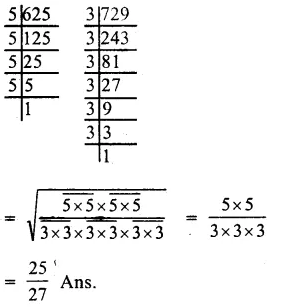
\(\sqrt { \frac { 625 }{ 729 } } \)
RS Aggarwal Class 8 Solutions Chapter 3 Squares and Square Roots Ex 3G Q4.1

Question 5.
Solution:
\(\sqrt { 3\frac { 13 }{ 36 } } \)
= \(\sqrt { \frac { 3X36+13 }{ 36 } } \)
= \(\sqrt { \frac { 108+13 }{ 36 } } \)
= \(\sqrt { \frac { 121 }{ 36 } } \)
= \(\sqrt { \frac { 11X11 }{ 6X6 } } \)
= \(\\ \frac { 11 }{ 6 } \)

Question 6.
Solution:
\(\sqrt { 4\frac { 73 }{ 324 } } \)
= \(\sqrt { \frac { 4X324+73 }{ 324 } } \)
= \(\sqrt { \frac { 1296+73 }{ 324 } } \)
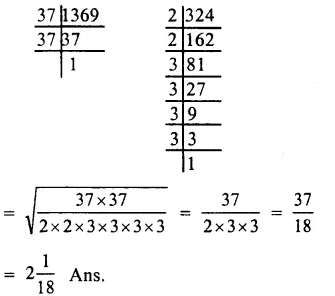
= \(\sqrt { \frac { 1369 }{ 324 } } \)
RS Aggarwal Class 8 Solutions Chapter 3 Squares and Square Roots Ex 3G Q6.1

Question 7.
Solution:
\(\sqrt { 3\frac { 33 }{ 289 } } \)
= \(\sqrt { \frac { 3X289+33 }{ 289 } } \)
= \(\sqrt { \frac { 867+33 }{ 289 } } \)
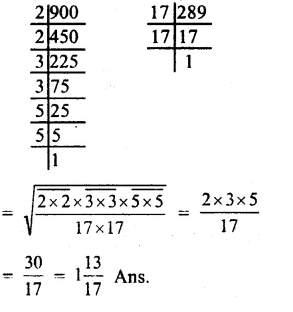
= \(\sqrt { \frac { 900 }{ 289 } } \)
RS Aggarwal Class 8 Solutions Chapter 3 Squares and Square Roots Ex 3G Q7.1

Question 8.
Solution:
\(\frac { \sqrt { 80 } }{ \sqrt { 405 } } \)
= \(\sqrt { \frac { 80 }{ 405 } } \)
= \(\sqrt { \frac { 16 }{ 81 } } \)
= \(\frac { \sqrt { 16 } }{ \sqrt { 81 } } \)
= \(\\ \frac { 4 }{ 9 } \)

Question 9.
Solution:
\(\frac { \sqrt { 1183 } }{ \sqrt { 2023 } } \)
= \(\sqrt { \frac { 1183 }{ 2023 } } \)
= \(\sqrt { \frac { 1183\div 7 }{ 2023\div 7 } } \)
= \(\frac { \sqrt { 169 } }{ \sqrt { 289 } } \)
= \(\frac { \sqrt { 13X13 } }{ \sqrt { 17X17 } } \)
= \(\\ \frac { 13 }{ 17 } \)

Question 10.
Solution:
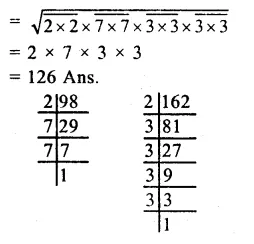
\(\sqrt { 95 } \times \sqrt { 162 } \)
= \(\sqrt { 98\times 162 }\)
= \(\sqrt { 2\times 7\times 7\times 2\times 3\times 3\times 3\times 3 } \)
RS Aggarwal Class 8 Solutions Chapter 3 Squares and Square Roots Ex 3G Q10.1

Hope given RS Aggarwal Solutions Class 8 Chapter 3 Squares and Square Roots Ex 3G are helpful to complete your math homework.

If you have any doubts, please comment below. Learn Insta try to provide online math tutoring for you.
Value Based Questions in Science for Class 9 Chapter 7 Diversity in Living Organisms

Value Based Questions in Science for Class 9 Chapter 7 Diversity in Living Organisms

These Solutions are part of Value Based Questions in Science for Class 9. Here we have given Value Based Questions in Science for Class 9 Chapter 7 Diversity in Living Organisms

Question 1.
“Raman lives in a coastal village. He is son of a fisherman. Whenever any unwanted animal comes in the net, instead of killing it, he puts back the same in the sea.” Answer the following questions based on above information

  1. What would have happened, had he killed those animals ?
  2. Give one reason to justify that Raman’s action is environment friendly.
  3. How can you contribute in the preservation of flora and fauna around you ? Mention any two steps.
    (Sample Paper 2012—13)

Answer:

  1. Killing of unwanted animals would have contributed to disturbing ecological balance.
  2. Raman is helping in conserving biodiversity.
    1. Spreading awareness about importance of biodiversity amongst classmates, family members and community members.
    2. Nonuse of products derived from wild animals.
    3. By becoming member of PETA (People for Ethical Treatment of Animals) and developing empathy and love for all living organisms.

More Resources

Question 2.
Seeing a bat flying over the roof of her house, Saira asked her papa

  1. What is this night flying bird ?
  2. How does it see during night ?
  3. What does it eat and how does it obtain the same ? What would be reply of her papa ?

Answer:

  1. Bat is not a bird. It is a mammal that has patagia in the fore limbs to function as wings and help in flight.
  2. Bat does not require sharp vision for its flight. It flies through écholocation or sending echo waves that are interpreted to know the obstacles. Bat, therefore, “sees through its ears.”
  3. Bat feeds on small flying insects. The insects are located through sound waves produced by them. Feeding on insects functions as biocontrol method on the population of night flying insects. It is rule of nature and keeps ecological balance.

Question 3.
On a rainy day, Raghav found small brownish worm like animals crawling slowly over the ground of his school. On close examination he found that the animal has faintly segmented body.

  1. What is the possible identity of the animal ?
  2. Why is it seen only in the rainy season ?
  3. What is its ecological importance ?

Answer:

  1. The identity of the crawling animal is earthworm.
  2. It lives in burrows inside the soil. In rainy season, the burrows get filled up with rain water. So the earthworms come out of them.
  3. Earthworm feeds on decaying fallen leaves and other organic remains. It pulverises the same. The worm castings are good source of soil nutrients. Earthworm is called farmer’s friend as it ploughs the soil by its burrowing habit and converts organic remains into manure.

Question 4.
While on a visit to hill station, Shaurya found extensive mat-like growth of very small erect green leafy plants over the wet rocks. The plants possess knobbed stalks over their tips.

  1. What are the plants seen by Shaurya ?
  2. What is the name of knobbed stalks.
  3. What is the reason of abundant growth of the plants.
  4. Write down about the impact of the plants on the rocks.

Answer:

  1. Shaurya saw moss plants growing on wet rocks.
  2. The knobbed stalks present over tips of moss plants are sporophytes. The knobbed structures are capsules that bear spores.
  3. Moss plant has a high reproductive potential through spores and fragmentation of filamentous protenema that develops from them.
  4. By their extensive growth moss plants trap soil particles, corrode rock surface and develop cracks in them. This builds up soil that results in growth of first herbaceous plants and then larger plants like shrubs and trees. The phenomenon is called ecological succession.

Hope given Value Based Questions in Science for Class 9 Chapter 7 Diversity in Living Organisms are helpful to complete your science homework.

If you have any doubts, please comment below. Learn Insta try to provide online science tutoring for you.

RS Aggarwal Class 8 Solutions Chapter 3 Squares and Square Roots Ex 3F

RS Aggarwal Class 8 Solutions Chapter 3 Squares and Square Roots Ex 3F

These Solutions are part of RS Aggarwal Solutions Class 8. Here we have given RS Aggarwal Solutions Class 8 Chapter 3 Squares and Square Roots Ex 3F.

Other Exercises

Evaluate:

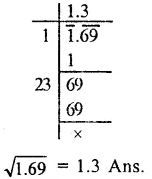
Question 1.
Solution:
RS Aggarwal Class 8 Solutions Chapter 3 Squares and Square Roots Ex 3F Q1.1

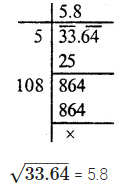
Question 2.
Solution:
RS Aggarwal Class 8 Solutions Chapter 3 Squares and Square Roots Ex 3F Q2.1
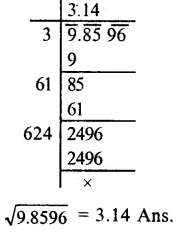
\(\sqrt { 33.64 } \) = 5.8

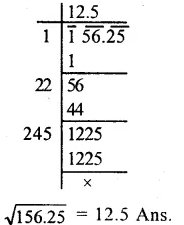
Question 3.
Solution:
RS Aggarwal Class 8 Solutions Chapter 3 Squares and Square Roots Ex 3F Q3.1

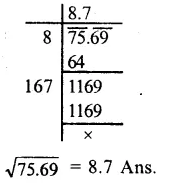
Question 4.
Solution:
RS Aggarwal Class 8 Solutions Chapter 3 Squares and Square Roots Ex 3F Q4.1

Question 5.
Solution:
RS Aggarwal Class 8 Solutions Chapter 3 Squares and Square Roots Ex 3F Q5.1

Question 6.
Solution:
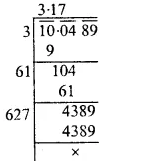
RS Aggarwal Class 8 Solutions Chapter 3 Squares and Square Roots Ex 3F Q6.1
\(\sqrt { 10.0489 } \) = 3.17

Question 7.
Solution:
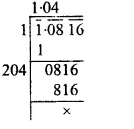
RS Aggarwal Class 8 Solutions Chapter 3 Squares and Square Roots Ex 3F Q7.1
\(\sqrt { 1.0816 } \) = 1.04

Question 8.
Solution:
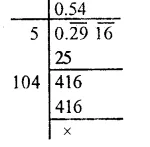
RS Aggarwal Class 8 Solutions Chapter 3 Squares and Square Roots Ex 3F Q8.1
\(\sqrt { 0.2916 } \) = 0.54

Question 9.
Solution:
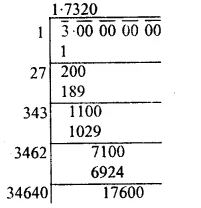
\(\sqrt { 3 } \) = 1.73
RS Aggarwal Class 8 Solutions Chapter 3 Squares and Square Roots Ex 3F Q9.1

Question 10.
Solution:
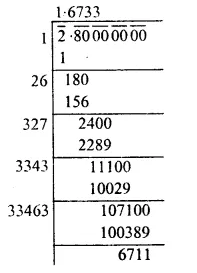
\(\sqrt { 2.8 } \) = 1.6733 = 1.67
RS Aggarwal Class 8 Solutions Chapter 3 Squares and Square Roots Ex 3F Q10.1

Question 11.
Solution:
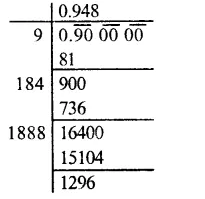
\(\sqrt { 0.9 } \) = 0.948
= 0.95
RS Aggarwal Class 8 Solutions Chapter 3 Squares and Square Roots Ex 3F Q11.1

Question 12.
Solution:
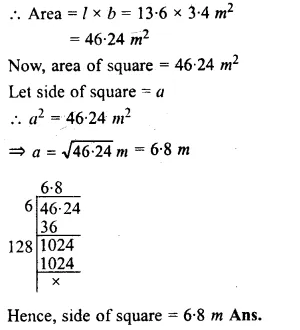
Length of rectangle (l) = 13.6 m
and width (b) = 3.4 m
RS Aggarwal Class 8 Solutions Chapter 3 Squares and Square Roots Ex 3F Q12.1

Hope given RS Aggarwal Solutions Class 8 Chapter 3 Squares and Square Roots Ex 3F are helpful to complete your math homework.

If you have any doubts, please comment below. Learn Insta try to provide online math tutoring for you.
HOTS Questions for Class 9 Science Chapter 7 Diversity in Living Organisms

HOTS Questions for Class 9 Science Chapter 7 Diversity in Living Organisms

These Solutions are part of HOTS Questions for Class 9 Science. Here we have given HOTS Questions for Class 9 Science Chapter 7 Diversity in Living Organisms

Question 1.
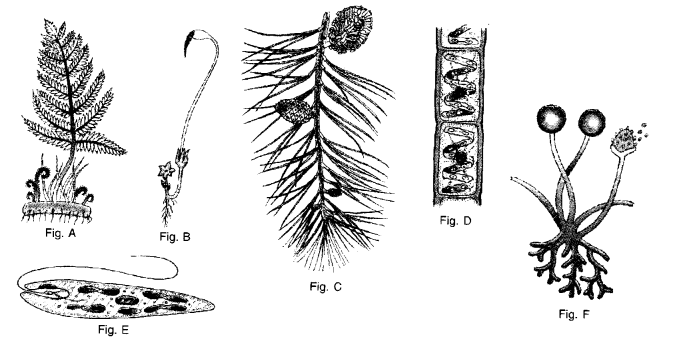
(a) Identify figures A to F.
HOTS Questions for Class 9 Science Chapter 7 Diversity in Living Organisms image - 1
(b) Which one of them is unicellular and eukaryotic organism ?
(c) Which one of them shows

  1. Heterotrophic nutrition
  2. Mixotrophic nutrition ?

(d) Which one of them is non-vascular embryophyte ?
(e) In which of them, xylem lacks vessels while phloem is devoid of companion cells ?
(f) In which of them endosperm is halpoid ?
(g) Which of them is commonly called

  1. Bread Mould
  2. Male Shield Fern ?

Answer:
(a) Identification.
A-Fern (Male Shield Fern, Dryopteris)
B-Moss (Funaria).
C—Pinus.
D—Spirogyra.
E—Euglena.
F-Rhizopus.
(b) Unicellular Eukaryotic Organism. Euglena.
(c)

  1. Heterotrophic Nutrition. Rhizopus.
  2. Mixotrophic Nutrition. Euglena.

(d) Non-vascular Embryophyte. Moss (Funaria)
(e) Xylem without Vessels and Phloem without Companion Cells. Pinus.
(f) Haploid Endosperm. Pinus
(g)

  1. Bread Mould._Rhizopus.
  2. Male Shield Fern. Dryopteris.

More Resources

Question 2.
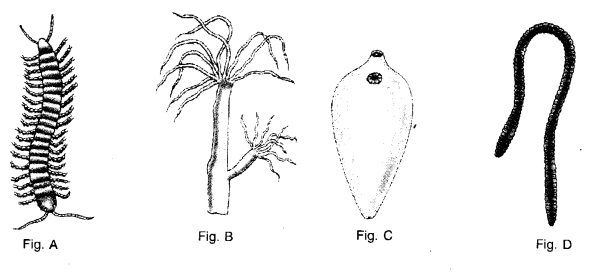
(a) Identify figure A to D.
HOTS Questions for Class 9 Science Chapter 7 Diversity in Living Organisms image - 2
(b) Which one belongs to

  1. Platyhelminthes
  2. Arthropoda
  3. Annelida ?

(c) Which one of them has

  1. Tissue level organisation
  2. Primitive organ level organisation ?

(d) Which one of them has

  1. Flame cells as exretory organs
  2. Nephridia as excretory organs ?

(e) Which one of them has poison claw ?
(f) Which one of them is

  1. Diploblastic
  2. Triploblastic ?

Answer:
(a) Identification.
A-Centipede.
B-Hydra.
C-Liverfluke {Fasciola).
D- Earthworm {Pheretima posthuma).
(b)

  1. Plathyhelminthes—Liverfluke (Fasciola)
  2. Arthropoda-Centipede (Scolopendra).
  3. Annelida-Earthworm {Pheretima posthuma).

(c)

  1. Tissue Level Organisation. Hydra.
  2. Primitive Organ Level Organisation. Liverfluke (Fasciola)

(d)

  1. Flame Cells. Liverfluke (Fasciola)
  2. Nephridia. Earthworm {Pheretima posthuma)

(e) Poison Claw. Centipede {Scolopendra)
(f)

  1. Diploblastic. Hydra.
  2. Triploblastic. Liverfluke {Fasciola), Centipede (Scolopendra), Earthworm {Pheretima posthuma).

Question 3.
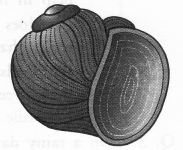
(a) Identify the figure and write down the phylum to which it belongs.
(b) Which type of
HOTS Questions for Class 9 Science Chapter 7 Diversity in Living Organisms image - 3

  1. Locomotory organ is present in it.

Circulatory system is present in it.
(c) Which type of symmetry is present ?
Answer:
(a) Identification. Pila (Apple Snail). Phylum. Mollusca.
(b)

  1. Locomotory Organ. Foot,
  2. Circulatory System. Open (Haemocoel).

(c) Symmetry. Asymmetry due to torsion (spirally coiled).

Question 4.
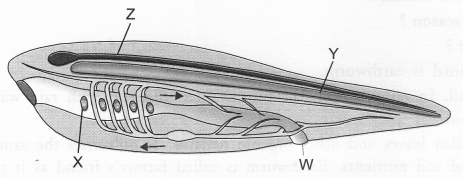
(a) Label W, X, Y and Z.
HOTS Questions for Class 9 Science Chapter 7 Diversity in Living Organisms image - 4
(b) Identify the above diagram.
(c) Name the phylum in which notochord is present.
(d) Name the subphylum in which notochord is present throughout life.
Answer:
(a) W-Anus.
X-Gill slits.
Y-Notochord.
Z-Nerve cord.
(b) Identification. Basic characteristics of chordates.
(c) Phylum with Notochord. Chordata.
(d) Subphylum with Notochord throughout Life. Cephalochordata.

Hope given HOTS Questions for Class 9 Science Chapter 7 Diversity in Living Organisms are helpful to complete your science homework.

If you have any doubts, please comment below. Learn Insta try to provide online science tutoring for you.