RS Aggarwal Class 8 Solutions Chapter 4 Cubes and Cube Roots Ex 4C

RS Aggarwal Class 8 Solutions Chapter 4 Cubes and Cube Roots Ex 4C

These Solutions are part of RS Aggarwal Solutions Class 8. Here we have given RS Aggarwal Solutions Class 8 Chapter 4 Cubes and Cube Roots Ex 4C.

Other Exercises

Evaluate:

Question 1.
Solution:
\(\sqrt [ 3 ]{ 64 } \)
= \(\sqrt [ 3 ]{ 4X4X4 } \)
= \(\sqrt [ 3 ]{ { 4 }^{ 3 } } \)
= 4

Question 2.
Solution:
\(\sqrt [ 3 ]{ 343 } \)
= \(\sqrt [ 3 ]{ 7X7X7 } \)
= \(\sqrt [ 3 ]{ { 7 }^{ 3 } } \)
= 7

Question 3.
Solution:
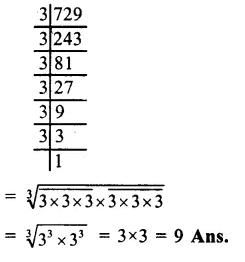
\(\sqrt [ 3 ]{ 729 } \)
RS Aggarwal Class 8 Solutions Chapter 4 Cubes and Cube Roots Ex 4C Q3.1

Question 4.
Solution:
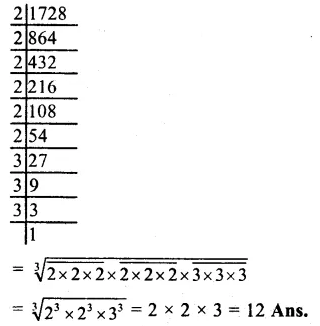
\(\sqrt [ 3 ]{ 1728 } \)
RS Aggarwal Class 8 Solutions Chapter 4 Cubes and Cube Roots Ex 4C Q4.1

Question 5.
Solution:
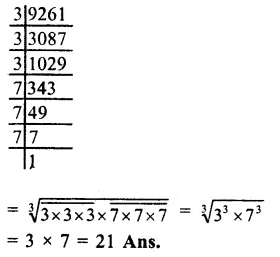
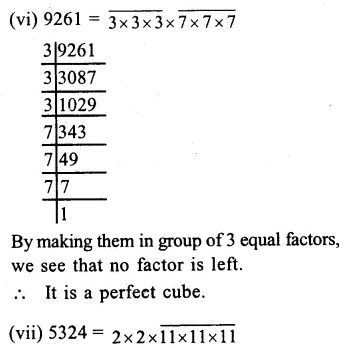
\(\sqrt [ 3 ]{ 9261 } \)
RS Aggarwal Class 8 Solutions Chapter 4 Cubes and Cube Roots Ex 4C Q5.1

Question 6.
Solution:
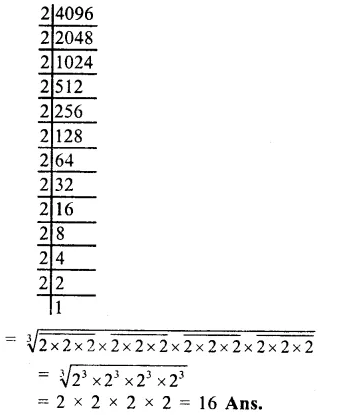
\(\sqrt [ 3 ]{ 4096 } \)
RS Aggarwal Class 8 Solutions Chapter 4 Cubes and Cube Roots Ex 4C Q6.1

Question 7.
Solution:
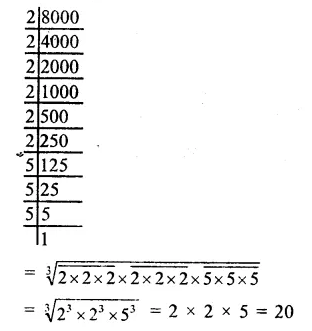
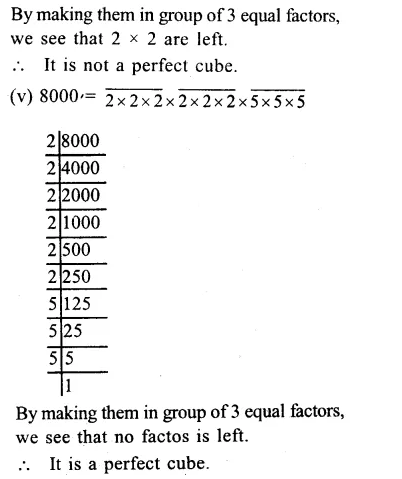
\(\sqrt [ 3 ]{ 8000 } \)
RS Aggarwal Class 8 Solutions Chapter 4 Cubes and Cube Roots Ex 4C Q7.1

Question 8.
Solution:
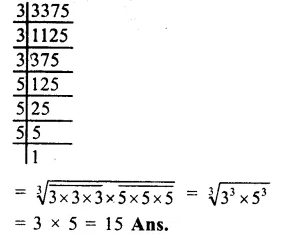
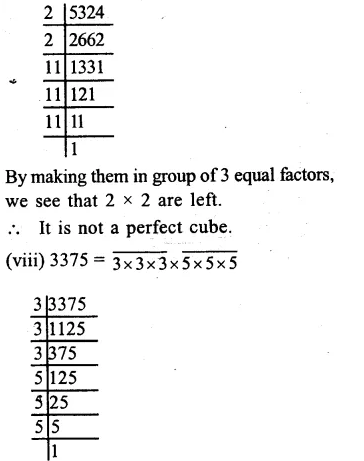
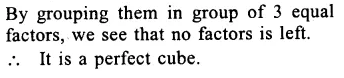
\(\sqrt [ 3 ]{ 3375 } \)
RS Aggarwal Class 8 Solutions Chapter 4 Cubes and Cube Roots Ex 4C Q8.1

Question 9.
Solution:
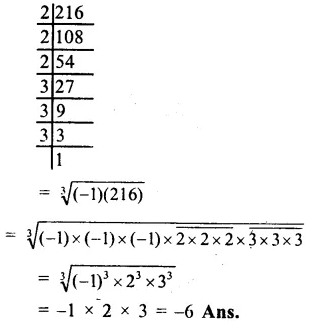
\(\sqrt [ 3 ]{ -216 } \)
RS Aggarwal Class 8 Solutions Chapter 4 Cubes and Cube Roots Ex 4C Q9.1

Question 10.
Solution:
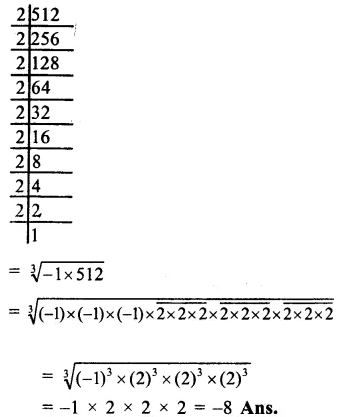
\(\sqrt [ 3 ]{ -512 } \)
RS Aggarwal Class 8 Solutions Chapter 4 Cubes and Cube Roots Ex 4C Q10.1

Question 11.
Solution:
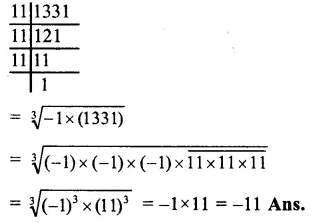
\(\sqrt [ 3 ]{ -1331 } \)
RS Aggarwal Class 8 Solutions Chapter 4 Cubes and Cube Roots Ex 4C Q11.1

Question 12.
Solution:
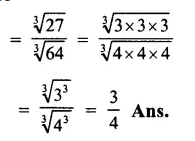
\(\sqrt [ 3 ]{ \frac { 27 }{ 64 } } \)
RS Aggarwal Class 8 Solutions Chapter 4 Cubes and Cube Roots Ex 4C Q12.1

Question 13.
Solution:
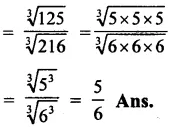
\(\sqrt [ 3 ]{ \frac { 125 }{ 216 } } \)
RS Aggarwal Class 8 Solutions Chapter 4 Cubes and Cube Roots Ex 4C Q13.1

Question 14.
Solution:
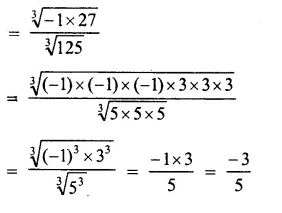
\(\sqrt [ 3 ]{ \frac { -27 }{ 125 } } \)
RS Aggarwal Class 8 Solutions Chapter 4 Cubes and Cube Roots Ex 4C Q14.1

Question 15.
Solution:
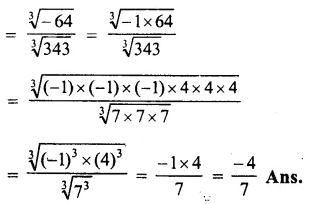
\(\sqrt [ 3 ]{ \frac { -64 }{ 343 } } \)
RS Aggarwal Class 8 Solutions Chapter 4 Cubes and Cube Roots Ex 4C Q15.1

Question 16.
Solution:
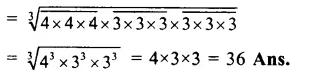
\(\sqrt [ 3 ]{ 64\times 729 }\)
RS Aggarwal Class 8 Solutions Chapter 4 Cubes and Cube Roots Ex 4C Q16.1

Question 17.
Solution:
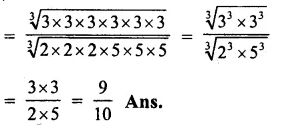
\(\sqrt [ 3 ]{ \frac { 729 }{ 1000 } } \)
RS Aggarwal Class 8 Solutions Chapter 4 Cubes and Cube Roots Ex 4C Q17.1

Question 18.
Solution:
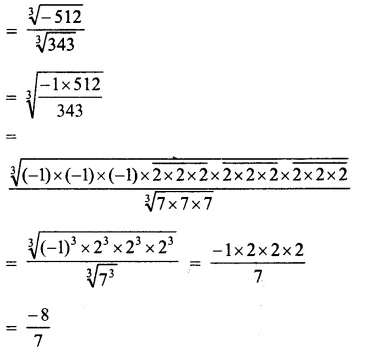
\(\sqrt [ 3 ]{ \frac { -512 }{ 343 } } \)
RS Aggarwal Class 8 Solutions Chapter 4 Cubes and Cube Roots Ex 4C Q18.1

Hope given RS Aggarwal Solutions Class 8 Chapter 4 Cubes and Cube Roots Ex 4C are helpful to complete your math homework.

If you have any doubts, please comment below. Learn Insta try to provide online math tutoring for you.

RS Aggarwal Class 8 Solutions Chapter 4 Cubes and Cube Roots Ex 4B

RS Aggarwal Class 8 Solutions Chapter 4 Cubes and Cube Roots Ex 4B

These Solutions are part of RS Aggarwal Solutions Class 8. Here we have given RS Aggarwal Solutions Class 8 Chapter 4 Cubes and Cube Roots Ex 4B.

Other Exercises

Find the value of each of the following using the short-cut method :

Question 1.
Solution:
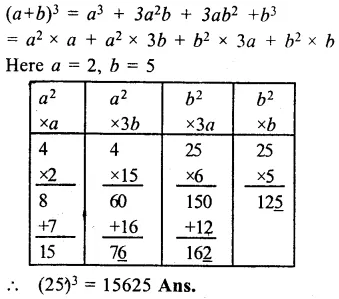
(25)³ = We know that short-cut method for finding the cube of any two digit number is as given.
RS Aggarwal Class 8 Solutions Chapter 4 Cubes and Cube Roots Ex 4B Q1.1

Question 2.
Solution:
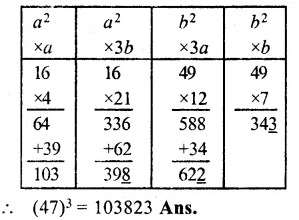
(47)³ = Here a = 4, b = 7
RS Aggarwal Class 8 Solutions Chapter 4 Cubes and Cube Roots Ex 4B Q2.1

Question 3.
Solution:
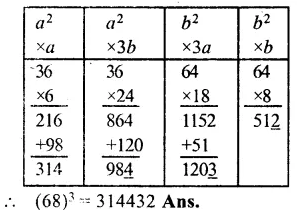
(68)³ = Here a = 6, b = 8
RS Aggarwal Class 8 Solutions Chapter 4 Cubes and Cube Roots Ex 4B Q3.1

Question 4.
Solution:
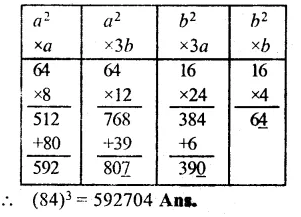
(84)³ Here a = 8, b = 4
RS Aggarwal Class 8 Solutions Chapter 4 Cubes and Cube Roots Ex 4B Q4.1

Hope given RS Aggarwal Solutions Class 8 Chapter 4 Cubes and Cube Roots Ex 4B are helpful to complete your math homework.

If you have any doubts, please comment below. Learn Insta try to provide online math tutoring for you.

RD Sharma Class 9 Solutions Chapter 13 Linear Equations in Two Variables Ex 13.4

RD Sharma Class 9 Solutions Chapter 13 Linear Equations in Two Variables Ex 13.4

These Solutions are part of RD Sharma Class 9 Solutions. Here we have given RD Sharma Class 9 Solutions Chapter 13 Linear Equations in Two Variables Ex 13.4

Other Exercises

Question 1.
In a ∆ABC, D, E and F are respectively, the mid-points of BC, CA and AB. If the lengths of side AB, BC and CA are 7cm, 8cm and 9cm, respectively, find the perimeter of ∆DEF.
Solution:
In ∆ABC, D, E and F are the mid-points of sides,
BC, CA, AB respectively
AB = 7cm, BC = 8cm and CA = 9cm
∵ D and E are the mid points of BC and CA
∴ DE || AB and DE =\(\frac { 1 }{ 2 }\) AB =\(\frac { 1 }{ 2 }\) x 7 = 3.5cm
Similarly,
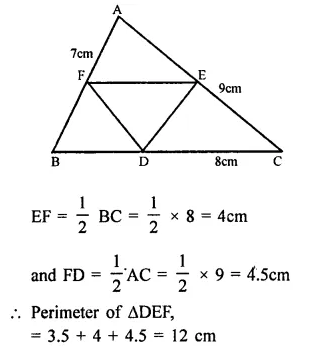
RD Sharma Class 9 Solutions Chapter 13 Linear Equations in Two Variables Ex 13.4 Q1.1

Question 2.
In a triangle ∠ABC, ∠A = 50°, ∠B = 60° and ∠C = 70°. Find the measures of the angles of the triangle formed by joining the mid-points of the sides of this triangle.
Solution:
In ∆ABC,
∠A = 50°, ∠B = 60° and ∠C = 70°
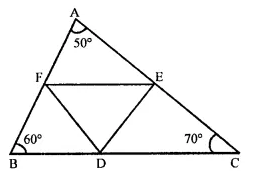
RD Sharma Class 9 Solutions Chapter 13 Linear Equations in Two Variables Ex 13.4 Q2.1
D, E and F are the mid points of sides BC, CA and AB respectively
DE, EF and ED are joined
∵ D, E and F are the mid points of sides BC, CA and AB respectively
∴ EF || BC
DE || AB and FD || AC
∴ BDEF and CDEF are parallelogram
∴ ∠B = ∠E = 60° and ∠C = ∠F = 70°
Then ∠A = ∠D = 50°
Hence ∠D = 50°, ∠E = 60° and ∠F = 70°

Question 3.
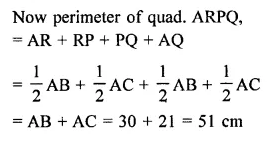
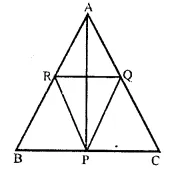
In a triangle, P, Q and R are the mid-points of sides BC, CA and AB respectively. If AC = 21 cm, BC = 29cm and AB = 30cm, find the perimeter of the quadrilateral ARPQ.
Solution:
P, Q, R are the mid points of sides BC, CA and AB respectively
AC = 21 cm, BC = 29 cm and AB = 30°
∵ P, Q, R and the mid points of sides BC, CA and AB respectively.
∴ PQ || AB and PQ = \(\frac { 1 }{ 2 }\) AB
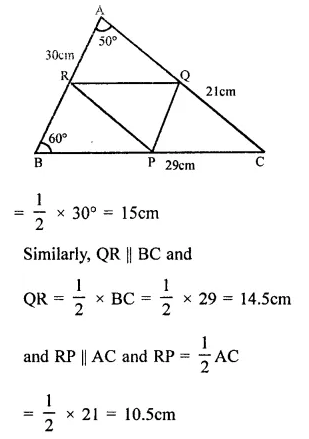
RD Sharma Class 9 Solutions Chapter 13 Linear Equations in Two Variables Ex 13.4 Q3.1
RD Sharma Class 9 Solutions Chapter 13 Linear Equations in Two Variables Ex 13.4 Q3.2

Question 4.
In a ∆ABC median AD is produced to X such that AD = DX. Prove that ABXC is a parallelogram.
Solution:
Given : In ∆ABC, AD is median and AD is produced to X such that DX = AD
To prove : ABXC is a parallelogram
Construction : Join BX and CX
Proof : In ∆ABD and ∆CDX
AD = DX (Given)
BD = DC (D is mid points)
∠ADB = ∠CDX (Vertically opposite angles)
∴ ∆ABD ≅ ∆CDX (SAS criterian)
∴ AB = CX (c.p.c.t.)
and ∠ABD = ∠DCX
But these are alternate angles
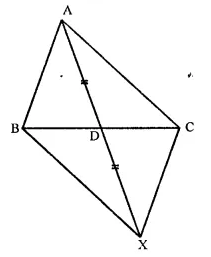
RD Sharma Class 9 Solutions Chapter 13 Linear Equations in Two Variables Ex 13.4 Q4.1
∴ AB || CX and AB = CX
∴ ABXC is a parallelogram.

Question 5.
In a ∆ABC, E and F are the mid-points of AC and AB respectively. The altitude AP to BC intersects FE at Q. Prove that AQ = QP.
Solution:
Given : In ∆ABC, E and F are the mid-points of AC and AB respectively.
EF are joined.
AP ⊥ BC is drawn which intersects EF at Q and meets BC at P.
To prove: AQ = QP
proof : In ∆ABC
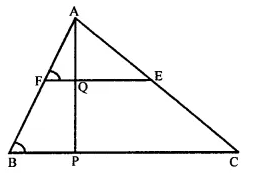
RD Sharma Class 9 Solutions Chapter 13 Linear Equations in Two Variables Ex 13.4 Q5.1
E and F are the mid points of AC and AB
∴ EF || BC and EF = \(\frac { 1 }{ 2 }\)BC
∴ ∠F = ∠B
In ∆ABP,
F is mid point of AB and Q is the mid point of FE or FQ || BC
∴ Q is mid point of AP,
∴ AQ = QP

Question 6.
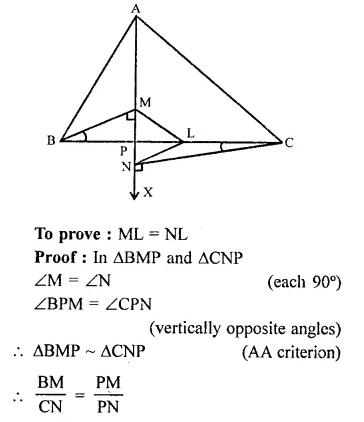
In a ∆ABC, BM and CN are perpendiculars from B and C respectively on any line passing through A. If L is the mid-point of BC, prove that ML NL.
Solution:
In ∆ABC,
BM and CN are perpendicular on a line drawn from A. L is the mid point of BC. ML and NL are joined.
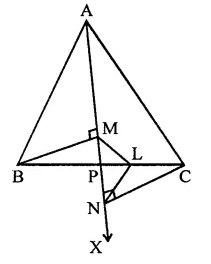
RD Sharma Class 9 Solutions Chapter 13 Linear Equations in Two Variables Ex 13.4 Q6.1
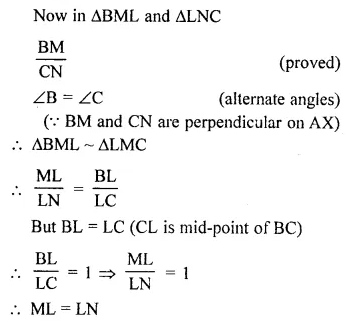
RD Sharma Class 9 Solutions Chapter 13 Linear Equations in Two Variables Ex 13.4 Q6.2
RD Sharma Class 9 Solutions Chapter 13 Linear Equations in Two Variables Ex 13.4 Q6.3

Question 7.
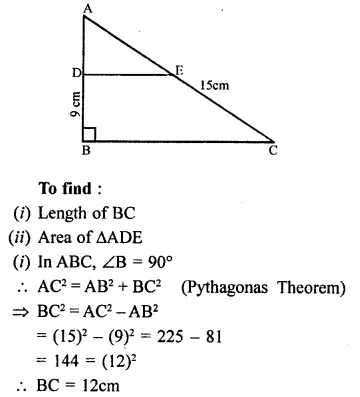
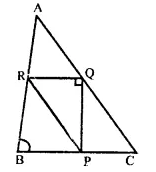
In the figure triangle ABC is right-angled at B. Given that AB = 9cm. AC = 15cm and D, E are the mid points of the sides AB and AC respectively, calculate.
(i) The length of BC
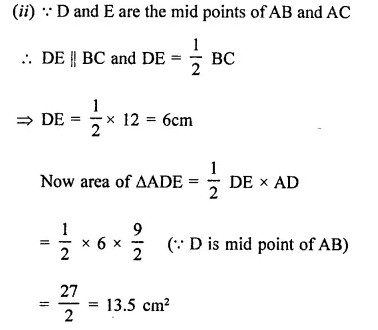
(ii) The area of ∆ADC
Solution:
In ∆ABC, ∠B = 90°
AC =15 cm, AB = 9cm
D and E are the mid points of sides AB and AC respectively and D, E are joined.
RD Sharma Class 9 Solutions Chapter 13 Linear Equations in Two Variables Ex 13.4 Q7.1
RD Sharma Class 9 Solutions Chapter 13 Linear Equations in Two Variables Ex 13.4 Q7.2

Question 8.
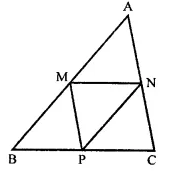
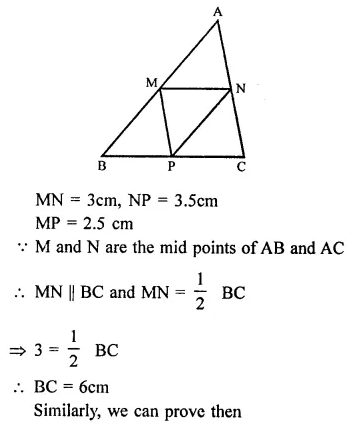
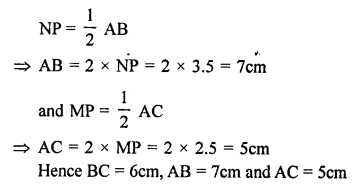
In the figure, M, N and P are the mid points of AB, AC and BC respectively. If MN = 3 cm, NP = 3.5cm and MP = 2.5cm, calculate BC, AB and AC.
RD Sharma Class 9 Solutions Chapter 13 Linear Equations in Two Variables Ex 13.4 Q8.1
Solution:
In ∆ABC,
M, N and P are the mid points of side, AB, AC and BC respectively.
RD Sharma Class 9 Solutions Chapter 13 Linear Equations in Two Variables Ex 13.4 Q8.2
RD Sharma Class 9 Solutions Chapter 13 Linear Equations in Two Variables Ex 13.4 Q8.3

Question 9.
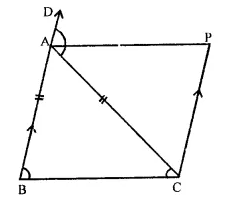
In the figure, AB = AC and CP || BA and AP is the bisector of exterior ∠CAD of ∆ABC. Prove that (i) ∠PAC = ∠BCA (ii) ABCP is a parallelogram.
Solution:
Given : In ABC, AB = AC
RD Sharma Class 9 Solutions Chapter 13 Linear Equations in Two Variables Ex 13.4 Q9.1
nd CP || BA, AP is the bisector of exterior ∠CAD of ∆ABC
To prove :
(i) ∠PAC = ∠BCA
(ii) ABCP is a ||gm
Proof : (i) In ∆ABC,
∵ AB =AC
∴ ∠C = ∠B (Angles opposite to equal sides) and ext.
∠CAD = ∠B + ∠C
= ∠C + ∠C = 2∠C ….(i)
∵ AP is the bisector of ∠CAD
∴ 2∠PAC = ∠CAD …(ii)
From (i) and (ii)
∠C = 2∠PAC
∠C = ∠CAD or ∠BCA = ∠PAC
Hence ∠PAC = ∠BCA
(ii) But there are alternate angles,
∴ AD || BC
But BA || CP
∴ ABCP is a ||gm.

Question 10.
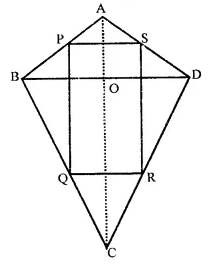
ABCD is a kite having AB = AD and BC = CD. Prove that the figure formed by joining the mid-points of the sides, in order, is a rectangle.
Solution:
Given : In fne figure, ABCD is a kite in which AB = AD and BC = CD.
P, Q, R and S are the mid points of the sides AB, BC, CD and DA respectively.
To prove : PQRS is a rectangle.
Construction : Join AC and BD.
RD Sharma Class 9 Solutions Chapter 13 Linear Equations in Two Variables Ex 13.4 Q10.1
Proof: In ∆ABD,
P and S are mid points of AB and AD
∴ PS || BD and PS = \(\frac { 1 }{ 2 }\) BD …(i)
Similarly in ∆BCD,
Q and R the mid points of BC and CD
∴ QR || BD and
QR = \(\frac { 1 }{ 2 }\) BD …(ii)
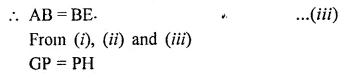
∴ Similarly, we can prove that PQ || SR and PQ = SR …(iii)
From (i) and (ii) and (iii)
PQRS is a parallelogram,
∵ AC and BD intersect each other at right angles.
∴ PQRS is a rectangle.

Question 11.
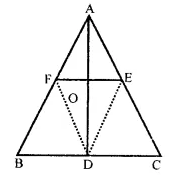
Let ABC be an isosceles triangle in which AB = AC. If D, E, F be the mid-points of the sides BC, CA and AB respectively, show that the segment AD and EF bisect each other at right angles.
Solution:
In ∆ABC, AB = AC
D, E and F are the mid points of the sides BC, CA and AB respectively,
AD and EF are joined intersecting at O
To prove : AD and EF bisect each other at right angles.
Construction : Join DE and DF.
RD Sharma Class 9 Solutions Chapter 13 Linear Equations in Two Variables Ex 13.4 Q11.1
Proof : ∵ D, E and F are the mid-points of
the sides BC, CA and AB respectively
∴ AFDE is a ||gm
∴ AF = DE and AE = DF
But AF = AE
(∵ E and F are mid-points of equal sides AB and AC)
∴ AF = DF = DE = AE
∴AFDE is a rhombus
∵ The diagonals of a rhombus bisect each other at right angle.
∴ AO = OD and EO = OF
Hence, AD and EF bisect each other at right angles.

Question 12.
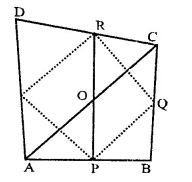
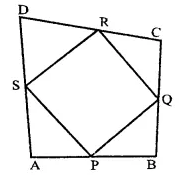
Show that the line segments joining the mid points of the opposite sides of a quadrilateral bisect each other.
Solution:
Given : In quad. ABCD,
P, Q, R and S are the mid points of sides AB, BC, CD and DA respectively.
PR and QS to intersect each other at O
To prove : PO = OR and QO = OS
Construction: Join PQ, QR, RS and SP and also join AC.
Proof: In ∆ABC
P and Q are mid-points of AB and BC
∴ PQ || AC and PQ = \(\frac { 1 }{ 2 }\) AC …(i)
Similarly is ∆ADC,
S and R are the mid-points of AD and CD
∴ SR || AC and SR = \(\frac { 1 }{ 2 }\) AC ..(ii)
RD Sharma Class 9 Solutions Chapter 13 Linear Equations in Two Variables Ex 13.4 Q12.1
from (i) and (ii)
PQ = SQ and PQ || SR
PQRS is a ||gm (∵ opposite sides are equal area parallel)
But the diagonals of a ||gm bisect each other.
∴ PR and QS bisect each other.

Question 13.
Fill in the blanks to make the following statements correct :
(i) The triangle formed by joining the mid-points of the sides of an isosceles triangle is …
(ii) The triangle formed by joining the mid-points of the sides of a right triangle is …
(iii) The figure formed by joining the mid-points of consecutive sides of a quadrilateral is …
Solution:
(i) The triangle formed by joining the mid-points of the sides of an isosceles triangle is an isosceles triangle.
RD Sharma Class 9 Solutions Chapter 13 Linear Equations in Two Variables Ex 13.4 Q13.1
(ii) The triangle formed by joining the mid-points of the sides of a right triangle is right triangle.
RD Sharma Class 9 Solutions Chapter 13 Linear Equations in Two Variables Ex 13.4 Q13.2
(iii) The figure formed by joining the mid-points of consecutive sides of a quadrilateral is a parallelogram.
RD Sharma Class 9 Solutions Chapter 13 Linear Equations in Two Variables Ex 13.4 Q13.3

Question 14.
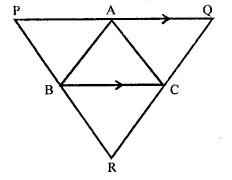
ABC is a triangle and through A, B, C lines are drawn parallel to BC, CA and AB respectively intersecting at P, Q and R. Prove that the perimeter of ∆PQR is double the perimeter of ∆ABC.
Solution:
Given : In ∆ABC,
Through A, B and C, lines are drawn parallel to BC, CA and AB respectively meeting at P, Q and R.
RD Sharma Class 9 Solutions Chapter 13 Linear Equations in Two Variables Ex 13.4 Q14.1
To prove : Perimeter of ∆PQR = 2 x perimeter of ∆ABC
Proof : ∵ PQ || BC and QR || AB
∴ ABCQ is a ||gm
∴ BC = AQ
Similarly, BCAP is a ||gm
∴ BC = AP …(i)
∴ AQ = AP = BL
⇒ PQ = 2BC
Similarly, we can prove that
QR = 2AB and PR = 2AC
Now perimeter of ∆PQR.
= PQ + QR + PR = 2AB + 2BC + 2AC
= 2(AB + BC + AC)
= 2 perimeter of ∆ABC.
Hence proved

Question 15.
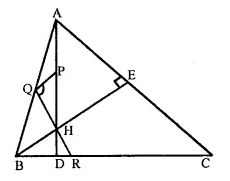
In the figure, BE ⊥ AC. AD is any line from A to BC intersecting BE in H. P, Q and R are respectively the mid-points of AH, AB and BC. Prove that PQR = 90°.
Solution:
Given: In ∆ABC, BE ⊥ AC
AD is any line from A to BC meeting BC in D and intersecting BE in H. P, Q and R are respectively mid points of AH, AB and BC. PQ and QR are joined B.
RD Sharma Class 9 Solutions Chapter 13 Linear Equations in Two Variables Ex 13.4 Q15.1
To prove : ∠PQR = 90°
Proof: In ∆ABC,
Q and R the mid points of AB and BC 1
∴ QR || AC and QR = \(\frac { 1 }{ 2 }\) AC
Similarly, in ∆ABH,
Q and P are the mid points of AB and AH
∴ QP || BH or QP || BE
But AC ⊥ BE
∴ QP ⊥ QR
∴ ∠PQR = 90°

Question 16.
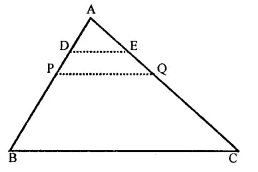
ABC is a triangle. D is a point on AB such that AD = \(\frac { 1 }{ 4 }\) AB and E is a point on AC such that AE = \(\frac { 1 }{ 4 }\) AC. Prove that DE = \(\frac { 1 }{ 4 }\) BC.
Solution:
Given : In ∆ABC,
D is a point on AB such that
AD = \(\frac { 1 }{ 4 }\) AB and E is a point on AC such 1
that AE = \(\frac { 1 }{ 4 }\) AC
DE is joined.
RD Sharma Class 9 Solutions Chapter 13 Linear Equations in Two Variables Ex 13.4 Q16.1
To prove : DE = \(\frac { 1 }{ 4 }\) BC
Construction : Take P and Q the mid points of AB and AC and join them
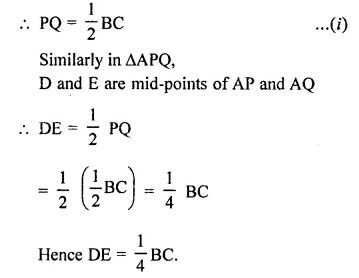
Proof: In ∆ABC,
∵ P and Q are the mid-points of AB and AC
RD Sharma Class 9 Solutions Chapter 13 Linear Equations in Two Variables Ex 13.4 Q16.2

Question 17.
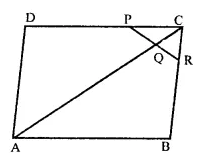
In the figure, ABCD is a parallelogram in which P is the mid-point of DC and Q is a point on AC such that CQ = \(\frac { 1 }{ 4 }\) AC. If PQ produced meets BC at R, prove that R is a mid-point of BC.
RD Sharma Class 9 Solutions Chapter 13 Linear Equations in Two Variables Ex 13.4 Q17.1
Solution:
Given : In ||gm ABCD,
P is the mid-point of DC and Q is a point on AC such that CQ = \(\frac { 1 }{ 4 }\) AC. PQ is produced meets BC at R.
RD Sharma Class 9 Solutions Chapter 13 Linear Equations in Two Variables Ex 13.4 Q17.2
To prove : R is mid point of BC
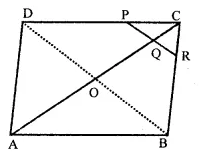
Construction : Join BD
Proof : ∵ In ||gm ABCD,
∵ Diagonal AC and BD bisect each other at O
∴ AO = OC = \(\frac { 1 }{ 2 }\) AC …(i)
In ∆OCD,
P and Q the mid-points of CD and CO
∴ PQ || OD and PQ = \(\frac { 1 }{ 2 }\) OD
In ∆BCD,
P is mid-poiht of DC and PQ || OD (Proved above)
Or PR || BD
∴ R is mid-point BC.

Question 18.
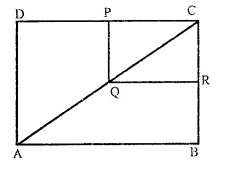
In the figure, ABCD and PQRC are rectangles and Q is the mid-point of AC.
Prove that (i) DP = PC (ii) PR = \(\frac { 1 }{ 2 }\) AC.
RD Sharma Class 9 Solutions Chapter 13 Linear Equations in Two Variables Ex 13.4 Q18.1
Solution:
Given : ABCD are PQRC are rectangles and Q is the mid-point of AC.
To prove : (i) DP = PC (ii) PR = \(\frac { 1 }{ 2 }\) AC
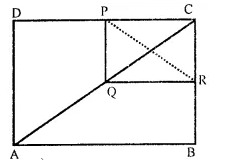
Construction : Join diagonal AC which passes through Q and join PR.
RD Sharma Class 9 Solutions Chapter 13 Linear Equations in Two Variables Ex 13.4 Q18.2
Proof : (i) In ∆ACD,
Q is mid-point of AC and QP || AD (Sides of rectangles)
∴ P is mid-point of CD
∴ DP = PC
(ii) ∵PR and QC are the diagonals of rectangle PQRC
∴ PR = QC
But Q is the mid-point of AC
∴ QC = \(\frac { 1 }{ 2 }\) AC
Hence PR = \(\frac { 1 }{ 2 }\) AC

Question 19.
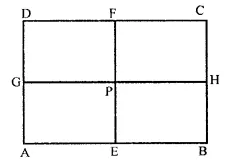
ABCD is a parallelogram, E and F are the mid points AB and CD respectively. GFI is any line intersecting AD, EF and BC at Q P and H respectively. Prove that GP = PH.
Solution:
Given : In ||gm ABCD,
E and F are mid-points of AB and CD
GH is any line intersecting AD, EF and BC at GP and H respectively
RD Sharma Class 9 Solutions Chapter 13 Linear Equations in Two Variables Ex 13.4 Q19.1
To prove : GP = PH
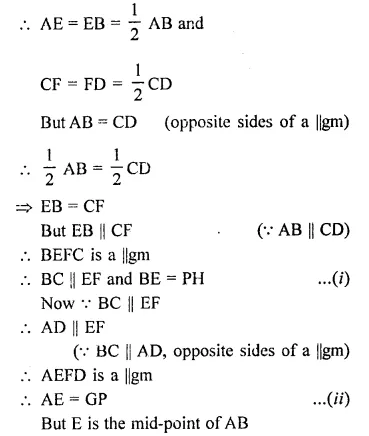
Proof: ∵ E and F are the mid-points of AB and CD
RD Sharma Class 9 Solutions Chapter 13 Linear Equations in Two Variables Ex 13.4 Q19.2
RD Sharma Class 9 Solutions Chapter 13 Linear Equations in Two Variables Ex 13.4 Q19.3

Question 20.
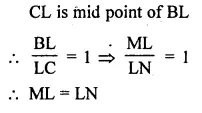
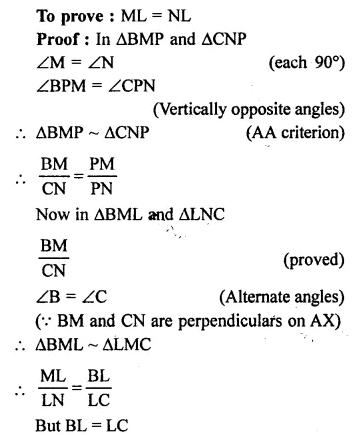
BM and CN are perpendiculars to a line passing, through the vertex A of a triangle ABC. If L is the mid-point of BC, prove that LM = LN.
Solution:
In ∆ABC,
BM and CN are perpendicular on a line drawn from A.
L is the mid point of BC.
ML and NL are joined.
RD Sharma Class 9 Solutions Chapter 13 Linear Equations in Two Variables Ex 13.4 Q20.1
RD Sharma Class 9 Solutions Chapter 13 Linear Equations in Two Variables Ex 13.4 Q20.2

Hope given RD Sharma Class 9 Solutions Chapter 13 Linear Equations in Two Variables Ex 13.4 are helpful to complete your math homework.

If you have any doubts, please comment below. Learn Insta try to provide online math tutoring for you.

RS Aggarwal Class 8 Solutions Chapter 4 Cubes and Cube Roots Ex 4A

RS Aggarwal Class 8 Solutions Chapter 4 Cubes and Cube Roots Ex 4A

These Solutions are part of RS Aggarwal Solutions Class 8. Here we have given RS Aggarwal Solutions Class 8 Chapter 4 Cubes and Cube Roots Ex 4A.

Other Exercises

Question 1.
Solution:
(i) (8)³ = 8 x 8 x 8 = 512
(ii) (15)³ = 15 x 15 x 15 = 3375
(iii) (21)³ = 21 x 21 x 21 = 9261
(iv) (60)³ = 60 x 60 x 60 = 216000 Ans.

Question 2.
Solution:
(i)(1.2)³= 1.2 x 1.2 x 1.2 = 1.728
(ii) (3.5)³ = 3.5 x 3.5 x 3.5 = 42.875
(iii) (0.8)³ = 0.8 x 0.8 x 0.8 = 0.512
(iv) (0.05)³ = 0.05 x 0.05 x 0.05 = 0.000125

Question 3.
Solution:
RS Aggarwal Class 8 Solutions Chapter 4 Cubes and Cube Roots Ex 4A Q3.1

Question 4.
Solution:
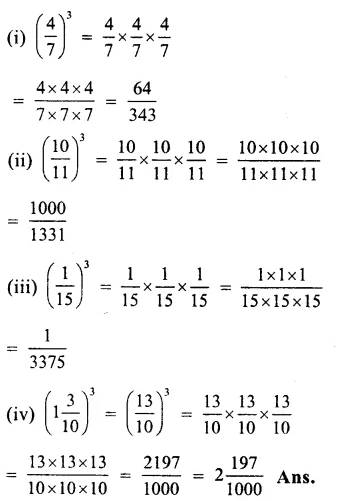
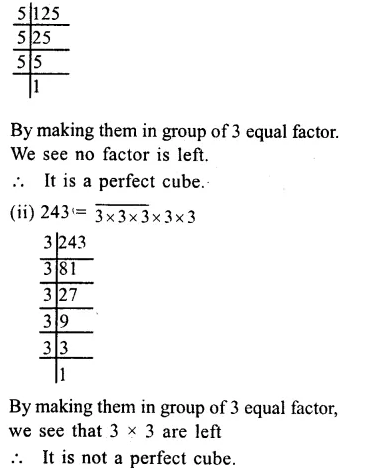
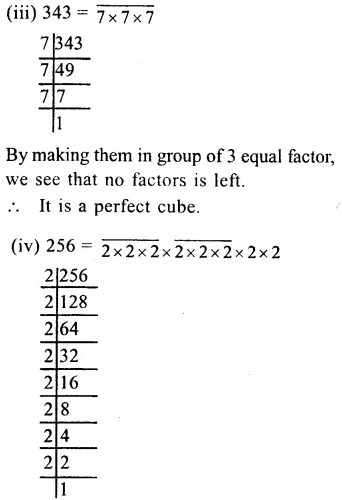
(i) 125
= \(\overline { 5\times 5\times 5 } ={ \left( 5 \right) }^{ 3 }\)
RS Aggarwal Class 8 Solutions Chapter 4 Cubes and Cube Roots Ex 4A Q4.1
RS Aggarwal Class 8 Solutions Chapter 4 Cubes and Cube Roots Ex 4A Q4.2
RS Aggarwal Class 8 Solutions Chapter 4 Cubes and Cube Roots Ex 4A Q4.3
RS Aggarwal Class 8 Solutions Chapter 4 Cubes and Cube Roots Ex 4A Q4.4
RS Aggarwal Class 8 Solutions Chapter 4 Cubes and Cube Roots Ex 4A Q4.5
RS Aggarwal Class 8 Solutions Chapter 4 Cubes and Cube Roots Ex 4A Q4.6

Question 5.
Solution:
We know that cube of an even number is also even.
216, 1000 and 512 are the cubes of even numbers as these are all even numbers. Ans.

Question 6.
Solution:
We know that cube of an odd number is also odd.
125, 343 and 9261 are the cubes of odd natural numbers as these are also odd numbers. Ans.

Question 7.
Solution:
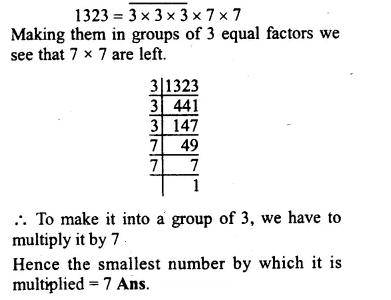
Factorising 1323 into prime factors,
RS Aggarwal Class 8 Solutions Chapter 4 Cubes and Cube Roots Ex 4A Q7.1

Question 8.
Solution:
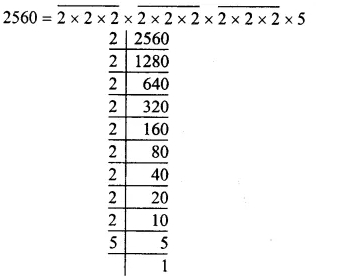
Factorising 2560 into prime factors.
RS Aggarwal Class 8 Solutions Chapter 4 Cubes and Cube Roots Ex 4A Q8.1
Making them in groups of 3 equal factors, we are left 5
To make it into a group of 3, we have to multiply it by 5 x 5 i.e. by 25.
Hence, the smallest number by which it is multiplied = 25 Ans.

Question 9.
Solution:
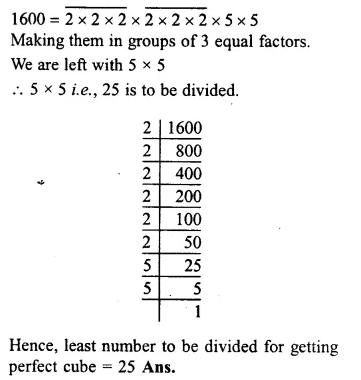
Factorising 1600 into prime factors
RS Aggarwal Class 8 Solutions Chapter 4 Cubes and Cube Roots Ex 4A Q9.1

Question 10.
Solution:
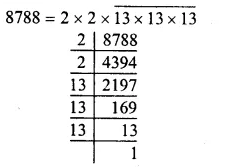
Factorising 8788 into prime factors
RS Aggarwal Class 8 Solutions Chapter 4 Cubes and Cube Roots Ex 4A Q10.1
Making them in groups of 3 equal factors, we are left with 2 x 2
2 x 2 i.e. 4 is to be divided.
Hence least number to be divided for getting perfect cube = 4 Ans.


Hope given RS Aggarwal Solutions Class 8 Chapter 4 Cubes and Cube Roots Ex 4A are helpful to complete your math homework.

If you have any doubts, please comment below. Learn Insta try to provide online math tutoring for you.
RS Aggarwal Class 8 Solutions Chapter 3 Squares and Square Roots Ex 3H

RS Aggarwal Class 8 Solutions Chapter 3 Squares and Square Roots Ex 3H

These Solutions are part of RS Aggarwal Solutions Class 8. Here we have given RS Aggarwal Solutions Class 8 Chapter 3 Squares and Square Roots Ex 3H.

Other Exercises

Question 1.
Solution:
5478 as it has 8 at in the end (c)

Question 2.
Solution:
2222 as it has 2 in the end (d)

Question 3.
Solution:
1843 as it has 3 in the end (a)

Question 4.
Solution:
4787 as it has 7 in the end (b)

Question 5.
Solution:
81000 as it has an odd number of zeros at its end (c)

Question 6.
Solution:
8, as the number with 8, in the end, cannot be a perfect square. (d)

Question 7.
Solution:
The square of a proper fraction is smaller than the given fraction. (b)

Question 8.
Solution:
1 + 3 + 5 + 7 + … to n terms when n is an odd is equal to n² (c)
Sum of first n odd natural numbers is n²

Question 9.
Solution:
Answer = (d)
(8)² + (15)²
= 64 + 225
= 289 = (17)²

Question 10.
Solution:
Answer = (c)
RS Aggarwal Class 8 Solutions Chapter 3 Squares and Square Roots Ex 3H Q10.1
7 must be subtracted

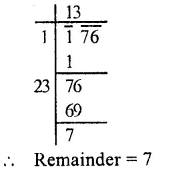
Question 11.
Solution:
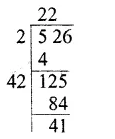
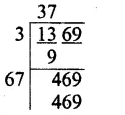
Finding the square root of 526 by division method
RS Aggarwal Class 8 Solutions Chapter 3 Squares and Square Roots Ex 3H Q11.1
We get remainder = 41
Now (22)² = 484 and (23)² = 529
The least number to be added = 529 – 526 = 3 (a)

Question 12.
Solution:
Finding the square root of 15370 by division method
We get remainder = 261
Now (123)² = 15129
and (124)² = 15376
The least number to be added
= 15376 – 15370 = 6 (b)

Question 13.
Solution:
Answer = (d)
RS Aggarwal Class 8 Solutions Chapter 3 Squares and Square Roots Ex 3H Q13.1

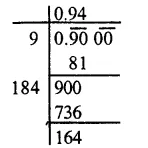
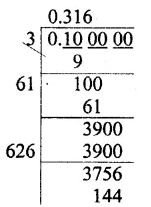
Question 14.
Solution:
√0.1 = 0.316 (c)
RS Aggarwal Class 8 Solutions Chapter 3 Squares and Square Roots Ex 3H Q14.1

Question 15.
Solution:
Answer = (b)
\(\sqrt { 0.9\times 1.6 } \)
= \(\sqrt { 1.44 } \)
= \(\sqrt { 1.2\times 1.2 } \)
= 1.2

Question 16.
Solution:
Answer = (c)
RS Aggarwal Class 8 Solutions Chapter 3 Squares and Square Roots Ex 3H Q16.1

Question 17.
Solution:
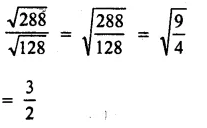
\(\sqrt { 2\frac { 1 }{ 4 } } \)
= \(\sqrt { \frac { 9 }{ 4 } } =\frac { 3 }{ 2 } \)
= \(1\frac { 1 }{ 2 } \) (b)

Question 18.
Solution:
We know that the square on an even number is also an even number. 196 is the square of an even number (a)

Question 19.
Solution:
We know that the square of an odd number is also an odd number
RS Aggarwal Class 8 Solutions Chapter 3 Squares and Square Roots Ex 3H Q19.1
1369 is an odd number

Hope given RS Aggarwal Solutions Class 8 Chapter 3 Squares and Square Roots Ex 3H are helpful to complete your math homework.

If you have any doubts, please comment below. Learn Insta try to provide online math tutoring for you.