RS Aggarwal Class 8 Solutions Chapter 14 Polygons Ex 14A

RS Aggarwal Class 8 Solutions Chapter 14 Polygons Ex 14A

These Solutions are part of RS Aggarwal Solutions Class 8. Here we have given RS Aggarwal Solutions Class 8 Chapter 14 Polygons Ex 14A.

Other Exercises

Question 1.
Solution:
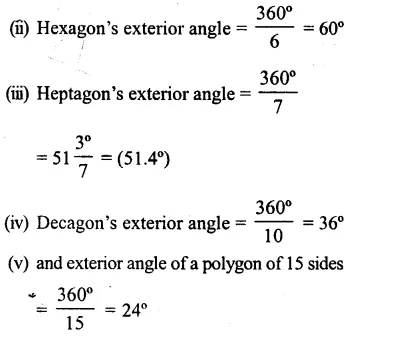
We know that sum of exterior angles of a polygon is 360°
Then,
(i) Pentagon’s exterior angle = \(\frac { { 360 }^{ o } }{ 5 } \)
= 72°
RS Aggarwal Class 8 Solutions Chapter 14 Polygons Ex 14A 1.1

Question 2.
Solution:
Each exterior angle a n sided polygon = 50°
No of sides = \(\frac { { 360 }^{ o } }{ 50 } \)
= \(7\frac { 1 }{ 5 } \)
Which is not possible to have \(7\frac { 1 }{ 5 } \) sides
Which is not a whole number

You can also Download NCERT Solutions for Class 8 English to help you to revise complete Syllabus and score more marks in your examinations.

Question 3.
Solution:
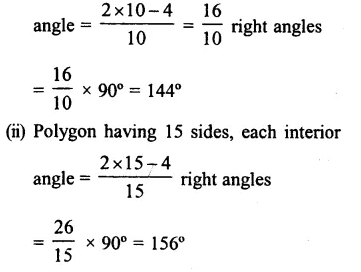
We know that each interior angle of a regular polygon of n sides = \(\\ \frac { 2n-4 }{ n } \) right angle
(i) Polygon having 10 sides, each interior
RS Aggarwal Class 8 Solutions Chapter 14 Polygons Ex 14A 3.1

Question 4.
Solution:
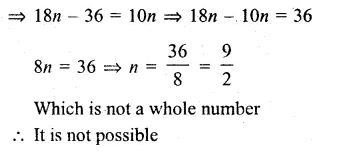
Let interior angle of a polygon having n sides = 100°
\(\\ \frac { 2n-4 }{ n } \) x 90° = 100°
=>\(\\ \frac { 2n-4 }{ n } \)
= \(\\ \frac { 100 }{ 90 } \)
= \(\\ \frac { 10 }{ 9 } \)
RS Aggarwal Class 8 Solutions Chapter 14 Polygons Ex 14A 4.1

Question 5.
Solution:
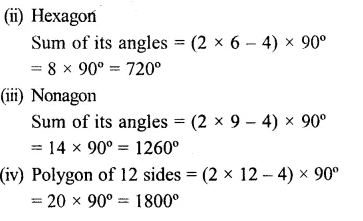
We know that sum of all interior angles = 2n – 4 right angles
(i) Pentagon
Sum of its angles = (2 x 5 – 4) x 90°
= 6 x 90° = 540°
RS Aggarwal Class 8 Solutions Chapter 14 Polygons Ex 14A 5.1

Question 6.
Solution:
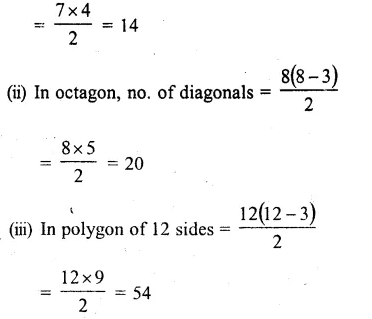
We know that number of diagonal of polygon having n sides = \(\frac { n\left( n-3 \right) }{ 2 } \)
(i) In heptagon, no of diagonals = \(\frac { 7\left( 7-3 \right) }{ 2 } \)
RS Aggarwal Class 8 Solutions Chapter 14 Polygons Ex 14A 6.1

Question 7.
Solution:
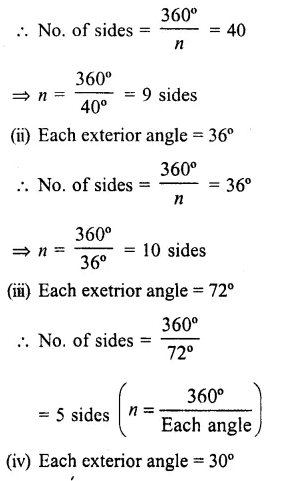
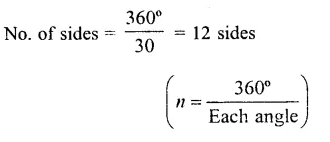
We know that each exterior angle
= \( \frac { { 360 }^{ o } }{ n } \)
Where n sides are of polygon
(i) Each exterior angle = 40°
RS Aggarwal Class 8 Solutions Chapter 14 Polygons Ex 14A 7.1
RS Aggarwal Class 8 Solutions Chapter 14 Polygons Ex 14A 7.2

Question 8.
Solution:
We know that sum of all exterior angle of a polygon – 360°
Exterior ∠A + ∠B + ∠C + ∠D = 360°
=> 115° + x + 90° + 50° = 360°
=> 255° + x + 360°
=> x = 360° – 255°
=> x = 105°

Question 9.
Solution:
In the given figure polygon is of 5 sides and each interior angle is x
\(x=\frac { 2x-4 }{ n } \times { 90 }^{ o }=\frac { 2\times 5-4 }{ 5 } \times { 90 }^{ o } \)
= \(=\frac { 6 }{ 5 } \times { 90 }^{ o } \)
= 108°


Hope given RS Aggarwal Solutions Class 8 Chapter 14 Polygons Ex 14A are helpful to complete your math homework.

If you have any doubts, please comment below. Learn Insta try to provide online math tutoring for you.

NCERT Solutions for Class 9 Science Chapter 11 Work, Power and Energy

NCERT Solutions for Class 9 Science Chapter 11 Work, Power and Energy

These Solutions are part of NCERT Solutions for Class 9 Science. Here we have given NCERT Solutions for Class 9 Science Chapter 11 Work, Power and Energy. LearnInsta.com provides you the Free PDF download of NCERT Solutions for Class 9 Science (Physics) Chapter 11 – Work and Energy solved by Expert Teachers as per NCERT (CBSE) Book guidelines. All Chapter 11 – Work and Energy Exercise Questions with Solutions to help you to revise complete Syllabus and Score More marks.

More Resources

NCERT TEXT BOOK QUESTIONS

IN TEXT QUESTIONS

Question 1.
A force of 7 N acts on an object. The displacement is say 8 m in the direction of the force. Let us take it that the force acts on the object through the displacement. What is the work done in this case ?
(CBSE 2011)
Answer:
Here, Force, F = 7 N
Displacement, S = 8 m
Work done = F x S = 7 x 8 = 56 J.

Question 2.
When do we say that work is done ? (CBSE 2012)
Answer:
Work is done, when force acts on an object and the object is displaced from its initial position.

Question 3.
Write an expression for the work done when a force is acting on an object in the direction of its displacement.
Answer:
W = FS

Question 4.
Define 1 J of work. (CBSE 2012)

                                           Or

Define SI unit of work. (CBSE Sample Paper 2010 ; CBSE 2011, 2012)
Answer:
Work is said to be 1 J if 1N force displaces an object through 1 metre in its own direction.

Question 5. 
A pair of bullocks exerts a force of 140 N on a plough. The field being ploughed is 15 m long. How much work is done in ploughing the length of the field ? (CBSE 2010)
Answer:
Here, Force, F = 140 N
Displacement, S = 15 m
Work done = F x S = 140 x 15 = 2100 J.

Question 6.
What is the kinetic energy of an object ? (CBSE 2011, 2012, 2014, 2015)
Answer:
The energy possessed by an object by virtue of its motion is known as the kinetic energy of the object.

Question 7.
Write an expression for the kinetic energy of an object.
Answer:
K.E. of an object = 1/2 mv2 , where m is the mass of the object and v is the speed of the object.

Question 8.
The kinetic energy of an object of mass m moving with a velocity of 5 m s-1 is 25 J. What will be its kinetic energy when its velocity is doubled ? What will be its kinetic energy when its velocity is increased
(CBSE 2010, 2012)
Answer:
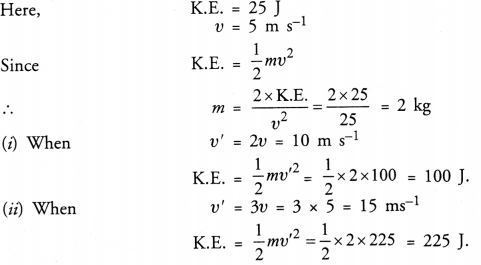
NCERT Solutions for Class 9 Science Chapter 11 Work, Power and Energy image - 1

Question 9.
What is power ?
Answer:
Power is defined as the rate of doing work.

Question 10.
Define 1 Watt of power.
Define SI unit of power.
Answer:
Power of an agent is said to be 1 watt if it does 1 joule work in 1 second.

Question 11.
A lamp consumes 1000 J of electrical energy in 10 s. What is its power ?
Answer:
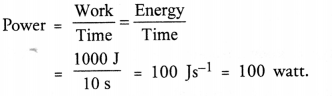
NCERT Solutions for Class 9 Science Chapter 11 Work, Power and Energy image - 2

Question 12.
Define average power.
Answer:
Average power is defined as the ratio of total work done by an agent to the total time taken.

NCERT CHAPTER END EXERCISE

Question 1.
Look at the activities listed below. Reason out whether or not work is done in the light of your understanding of the term ‘work.’
(a) Suma is swimming in a pond.
(b) A donkey is carrying a load on its back.
(c) A wind mill is lilting water from a well.
(d) A great plant is carrying out photosynthesis.
(e) An engine is pulling a train.
(f) Food grains are getting dried in the sun.
(g) A sailboat is moving due to wind energy.
Answer:
(a) Work is done (Reaction (Force) of water on Suma during swimming displaces Suma in the forward direction).
(b) No work is done (Force of gravity acting on the load is perpendicular to the displacement of the load).
(c) Work is done (Force displaces water in the upward direction).
(d) No work is done (There is no force and no displacement during photosynthesis).
(e) Work is done (Force displaces the train.)
(f) No work is done (There is no external force and no displacement of the grains.)
(g) Work is done (Force acting on the sail boat displaces the boat).

Question 2.
An object thrown at a certain angle to the ground moves in a curved path and falls back to the ground.
The initial and the final points of the path of the object lie on the same horizontal line. What is the work done by the force of gravity on the object ? (CBSE 2011, 2012)
Answer:
Work done by the force of gravity on the object = mgh
Here, h = difference in height of the initial and final positions of the object.
Since, initial and final positions of the object are at the same level, so h = 0.
∴ Work done = mg x 0 = 0.

Question 3.
A battery lights a bulb. Describe the energy change involved in the process. (CBSE 2012)
Answer:
The chemical energy of the battery changes into electrical energy which is then converted into light energy and heat energy.

Question 4.
Certain force acting on a 20 kg mass changes its velocity from 5 m s-1 to 2 m s-1. Calculate the work done by the force. (CBSE 2011, 2012)
Answer:
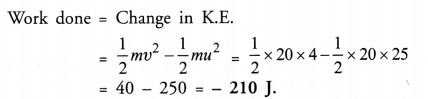
NCERT Solutions for Class 9 Science Chapter 11 Work, Power and Energy image - 3

Question 5.
A mass of 10 kg is at a point A on a table. It is moved to a point B which is at a distance of 2 m from A.
If the line joining A and B is horizontal, what is the work done on the object by the gravitational force ? Explain your answer. (CBSE 2012)
Answer:
Work done by the gravitational force = mgh
Since h = 0 (because both points A and B are at the same height.)
Work done = 0.

Question 6.
The potential energy of a freely falling object decreases progressively. Does this violate the law of conservation of energy ? Why ? (CBSE 2011)
Answer:
No, As the potential energy of a freely falling object decreases, the object acquires more and more speed. So the kinetic energy of the object increases at the cost of its potential energy. However, total energy of the object remains the same at every point.

Question 7.
What are the various energy transformations that occur when you are riding a bicycle ?
Answer:
Our muscular energy is converted into the kinetic energy of the bicycle.

Question 8.
Does the transfer of energy takes place when you push a huge rock with all your might and fail to move it ? Where is the energy you spend going ?
Answer:
When we push a huge rock, the rock also exerts a huge force on us. The muscular energy spent by us is used to oppose the huge force acting on us due to the rock.

Question 9.
A certain household has consumed 250 units of energy during a month. How much energy is this in joules ?
Answer:
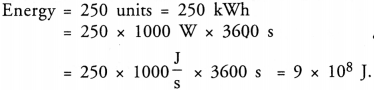
NCERT Solutions for Class 9 Science Chapter 11 Work, Power and Energy image - 4

Question 10.
An object of mass 40 kg is raised to a height of 5 m above the ground. What is its potential energy ? If the object is allowed to fall, find its kinetic energy when it is half-way down. (CBSE 2011)
Answer:

  1. Potential energy = mgh
    = 40 kg x 10 m s-2 x 5 m = 2000 J.
  2. According to the law of conservation of energy :
    K.E. when it is half-way down = P.E. when it is half-way down

    NCERT Solutions for Class 9 Science Chapter 11 Work, Power and Energy image - 5

Question 11.
What is the work done by the force of gravity on a satellite moving round the earth ? Justify your answer. (CBSE 2012)
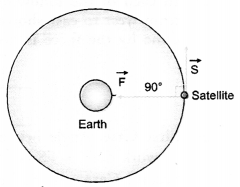
NCERT Solutions for Class 9 Science Chapter 11 Work, Power and Energy image - 6
Answer:
The force of gravity acting on a satellite moves the satellite in a circular path. Since, the force of gravity acts at right angle to the displacement of the satellite (Figure), so work done,
W = FS cos 90° = 0

Question 12.
Can there be displacement of an object in the absence of any force acting on it ?
Answer:
Yes, When an object moves with a constant velocity, then no force acts on the object. However, the object is displaced from one position to another position.

Question 13.
A person holds a bundle of hay over his head for 30 minutes and gets tired. Has he done some work or not? Justify your answer. (CBSE 2011, 2012)
Answer:
Work = Force x Displacement.
Since the person is at rest, so displacement = 0.
Hence no work is done by the person.

Question 14.
An electric heater is rated 1500 W. How much energy does it use in 10 hours ? (CBSE 2011, 2012)
Answer:
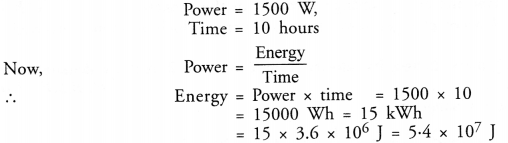
NCERT Solutions for Class 9 Science Chapter 11 Work, Power and Energy image - 7

Question 15.
Illustrate the law of conservation of energy by discussing the energy changes which occur when we draw a pendulum bob to one side and allow it to oscillate. Why does the bob eventually come to rest ? What happens to its energy eventually ? Is it a violation of the law of conservation of energy ?
Answer:
For part

  1. Consider a simple pendulum suspended from a rigid support at S. Let OS be the undisturbed position of the pendulum. Now, let the pendulum be displaced to position A where it is at rest (Figure 9).
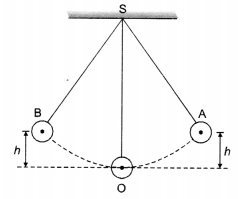
    NCERT Solutions for Class 9 Science Chapter 11 Work, Power and Energy image - 8
    At position A, the pendulum has potential energy (mgh). When the pendulum is released from position A, it begins to move towards position O. The speed of the bob of the pendulum increases and its height decreases. So potential energy of the pendulum is changed into its kinetic energy. At position O, whole of the potential energy of the pendulum is converted to its kinetic energy.
  2. When the bob of a simple pendulum oscillates in air, the air friction opposes its motion. The kinetic energy of the oscillating bob is used to overcome the air friction which tries to oppose the motion of the bob of the pendulum. As the oscillating bob strikes the air molecules, the kinetic energy of the bob of the pendulum is converted into heat energy. This heat energy is transferred to the atmosphere. In other words, the kinetic energy of the bob of the pendulum is converted into heat energy with the passage of time. Ultimately, the entire kinetic energy of the bob is converted into heat energy and hence the oscillating bob comes to rest. In this case, the law of conservation of energy is not violated as one form of energy is converted into another form of energy.

Question 16.
An object of mass m is moving with a constant velocity v. How much work should be done on the object in order to bring the object to rest ? (CBSE 2012)
Answer:
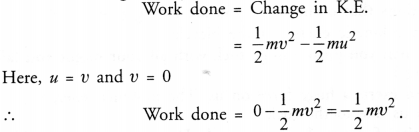
NCERT Solutions for Class 9 Science Chapter 11 Work, Power and Energy image - 9

Question 17.
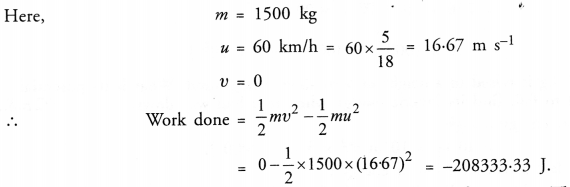
Calculate the work required to be done to stop a car of 1500 kg moving at a velocity of 60 km/h. (CBSE 2011, 2016)
Answer:
NCERT Solutions for Class 9 Science Chapter 11 Work, Power and Energy image - 10

Question 18.
In each of the following, a force F is acting on an object of mass, m. The direction of displacement is from west to east shown by the longer arrow. Observe the diagrams carefully and state whether the work done by the force is negative, positive or zero. (CBSE 2011)

NCERT Solutions for Class 9 Science Chapter 11 Work, Power and Energy image - 11
Answer:
First Case: Angle between force and displacement, 0 = 90°
∴ work done = FS cos 6 = FS cos 90° = 0
Second Case: Angle between force and displacement, 0 = 0°
work done = FS cos 9 = FS cos 0° = FS ( positive work) (∴ cos 0° = 1)
Third Case: Angie between force and displacement, 9 = 180°
work done = FS cos 9 = FS cos 180° = -FS ( negative work) (∴ cos 180° = -1)

Question 19.
Soni says that the acceleration in an object could be zero even when several forces are acting on it. Do you agree with him ? Why ?
Answer:
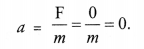
Yes, If the sum of several forces acting on an object is zero, then net force acting on it is zero. Hence,
NCERT Solutions for Class 9 Science Chapter 11 Work, Power and Energy image - 12

Question 20.
Find the energy in kWh consumed in 10 hours by four devices of power 500 W each.
Answer:
Total power, P = 500 W x 4 = 2000 W
Time, t = 10 h
Energy consumed = Power x Time
= 2000 W x 10 h = 20,000 Wh = 20 kWh.

Question 21.
A freely falling object eventually stops on reaching the ground. What happens to its kinetic energy ?
(CBSE 2011)
Answer:
Kinetic energy is converted into sound energy and heat energy.

NCERT Solutions for Class 9 Science Chapter 11 – Work and Energy

Hope given NCERT Solutions for Class 9 Science Chapter 11 are helpful to complete your science homework.

If you have any doubts, please comment below. Learn Insta try to provide online science tutoring for you.

RS Aggarwal Class 8 Solutions Chapter 13 Time and Work Ex 13B

RS Aggarwal Class 8 Solutions Chapter 13 Time and Work Ex 13B

These Solutions are part of RS Aggarwal Solutions Class 8. Here we have given RS Aggarwal Solutions Class 8 Chapter 13 Time and Work Ex 13B.

Other Exercises

Question 1.
Solution:
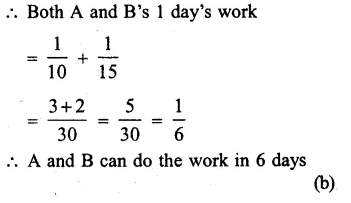
A’s 1 day’s work = \(\\ \frac { 1 }{ 10 } \)
B’s 1 day’s work = \(\\ \frac { 1 }{ 15 } \)
RS Aggarwal Class 8 Solutions Chapter 13 Time and Work Ex 13B 1.1

Question 2.
Solution:
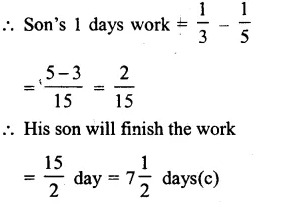
A man’s 1 day work = \(\\ \frac { 1 }{ 5 } \)
Man and his son’s 1 days work = \(\\ \frac { 1 }{ 3 } \)
RS Aggarwal Class 8 Solutions Chapter 13 Time and Work Ex 13B 2.1

Question 3.
Solution:
A’s 1 day’s work = \(\\ \frac { 1 }{ 16 } \)
B’s 1 day’s work = \(\\ \frac { 1 }{ 12 } \)
RS Aggarwal Class 8 Solutions Chapter 13 Time and Work Ex 13B 3.1

Question 4.
Solution:
Let B can do a work in = x days
Then A can do the work
RS Aggarwal Class 8 Solutions Chapter 13 Time and Work Ex 13B 4.1

Question 5.
Solution:
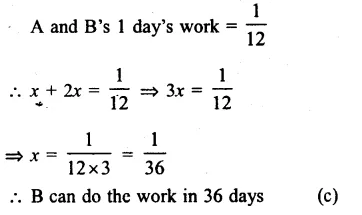
Let B’s 1 day’s work = x
Then A’s 1 day’s work = 2x
RS Aggarwal Class 8 Solutions Chapter 13 Time and Work Ex 13B 5.1

Question 6.
Solution:
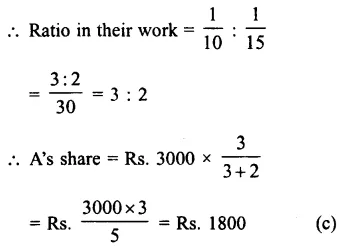
Total wages = Rs. 3000
A’s 1 day’s work = \(\\ \frac { 1 }{ 10 } \)
B’s 1 day’s work = \(\\ \frac { 1 }{ 15 } \)
RS Aggarwal Class 8 Solutions Chapter 13 Time and Work Ex 13B 6.1

Question 7.
Solution:
Ratio in the rates of working of A and B = 3:4
Ratio in time = \(\\ \frac { 1 }{ 3 } \) : \(\\ \frac { 1 }{ 4 } \)
= \(\\ \frac { 4:3 }{ 12 } \)
= 4 : 3 (c)

Question 8.
Solution:
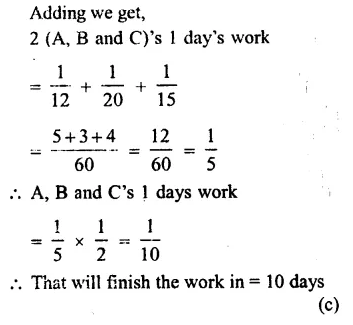
A and B’s 1 day’s wok = \(\\ \frac { 1 }{ 12 } \)
B and C’s 1 day’s work = \(\\ \frac { 1 }{ 20 } \)
C and A’s 1 day’s work = \(\\ \frac { 1 }{ 15 } \)
RS Aggarwal Class 8 Solutions Chapter 13 Time and Work Ex 13B 8.1

Question 9.
Solution:
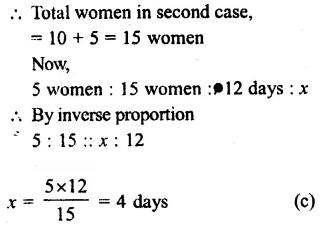
3 men = 5 women
1 man = \(\\ \frac { 5 }{ 3 } \) women 5
6 men = \(\\ \frac { 5 }{ 3 } \) x 6 = 10 women
RS Aggarwal Class 8 Solutions Chapter 13 Time and Work Ex 13B 9.1

Question 10.
Solution:
A’s 1 day’s work = \(\\ \frac { 1 }{ 15 } \)
Then B’s 1 day’s work = \(\\ \frac { 1 }{ 10 } \) x \(\\ \frac { 100+50 }{ 100 } \)
= \(\\ \frac { 1 }{ 15 } \) x \(\\ \frac { 150 }{ 100 } \)
= \(\\ \frac { 1 }{ 10 } \)
B will finish the work in = 10 days (a)

Question 11.
Solution:
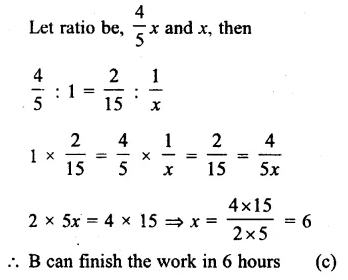
A’s 1 hour’s work = \(\\ \frac { 2 }{ 15 } \)
A and B’s ratio in work = \(\\ \frac { 100-20 }{ 100 } \) : 1
= \(\\ \frac { 80 }{ 100 } \) : 1
= \(\\ \frac { 4 }{ 5 } \) : 1
RS Aggarwal Class 8 Solutions Chapter 13 Time and Work Ex 13B 11.1

Question 12.
Solution:
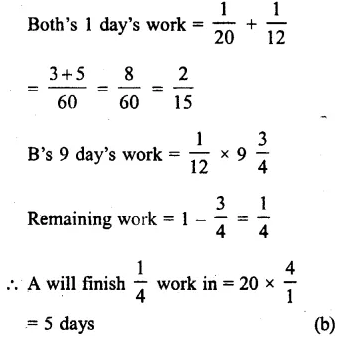
A’s 1 day’s work = \(\\ \frac { 1 }{ 20 } \)
B’s 1 day’s work = \(\\ \frac { 1 }{ 12 } \)
RS Aggarwal Class 8 Solutions Chapter 13 Time and Work Ex 13B 12.1

Question 13.
Solution:
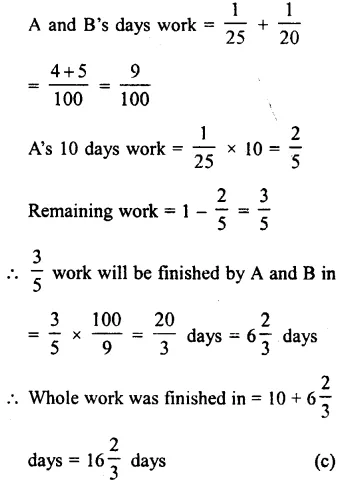
A’s 1 days work = \(\\ \frac { 1 }{ 25 } \)
B’s 1 days work = \(\\ \frac { 1 }{ 20 } \)
RS Aggarwal Class 8 Solutions Chapter 13 Time and Work Ex 13B 13.1

Question 14.
Solution:
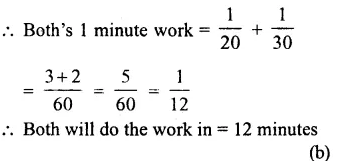
First pipe 1 minutes work = \(\\ \frac { 1 }{ 20 } \)
Second pipe 1 minutes work = \(\\ \frac { 1 }{ 30 } \)
RS Aggarwal Class 8 Solutions Chapter 13 Time and Work Ex 13B 14.1

Question 15.
Solution:
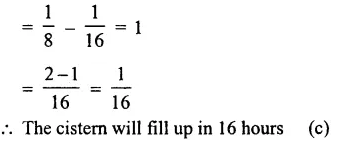
First tap’s 1 hours work to fill = \(\\ \frac { 1 }{ 8 } \)
Second tap’s 1 hours work to empty = \(\\ \frac { 1 }{ 16 } \)
Both 1 hour can fill the cistern
RS Aggarwal Class 8 Solutions Chapter 13 Time and Work Ex 13B 15.1

Question 16.
Solution:
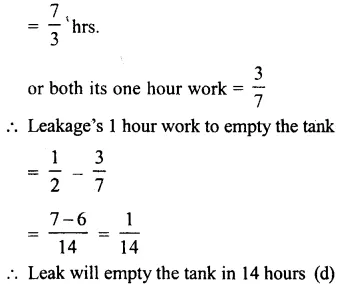
First pump’s 1 hr work to fill = \(\\ \frac { 1 }{ 2 } \)
Due to leakage, tank is filled in \(2\frac { 1 }{ 3 } \) hour
RS Aggarwal Class 8 Solutions Chapter 13 Time and Work Ex 13B 16.1

Question 17.
Solution:
Answer = (b)
First inlet pipe’s 1 hour work = \(\\ \frac { 1 }{ 10 } \)
Second inlet pipe’s 1 hour work = \(\\ \frac { 1 }{ 12 } \)
RS Aggarwal Class 8 Solutions Chapter 13 Time and Work Ex 13B 17.1

Hope given RS Aggarwal Solutions Class 8 Chapter 13 Time and Work Ex 13B are helpful to complete your math homework.

If you have any doubts, please comment below. Learn Insta try to provide online math tutoring for you.
RD Sharma Class 9 Solutions Chapter 18 Surface Areas and Volume of a Cuboid and Cube VSAQS

RD Sharma Class 9 Solutions Chapter 18 Surface Areas and Volume of a Cuboid and Cube VSAQS

These Solutions are part of RD Sharma Class 9 Solutions. Here we have given RD Sharma Class 9 Solutions Chapter 18 Surface Areas and Volume of a Cuboid and Cube VSAQS

Other Exercises

Question 1.
If two cubes of side 6 cm are joined face to face, then find the volume of the resulting cuboid.
Solution:
Side of a cube = 6 cm
∴ By joining two such cubes, the length of so
formed cuboid (l) = 6 x 2 = 12 cm
Breadth (b) = 6 cm
Height (h) = 6 cm
∴ Volume = lbh = 12 x 6 x 6 cm3
= 432 cm3

Question 2.
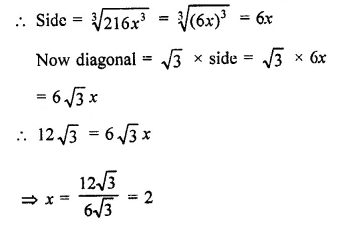
Three cubes of metal whose edges are in the ratio 3 : 4 : 5, are melted down into a single cube whose diagonals is 12 \(\sqrt { 3 } \) cm. Find the edges of three cubes.
Solution:
Ratio in the sides of three cubes = 3 : 4 : 5
Let side of first cube = 3x
and side of second cube = 4x
and side of third cube = 5x
∴ Sum of volume of three cubes
= (3x)3 + (4x)3 + (5x)3
= 27x3 + 64x3 + 125x3 = 216x3
∴ Volume of the cube formed Jby melting these three cubes = 216x3
RD Sharma Class 9 Solutions Chapter 18 Surface Areas and Volume of a Cuboid and Cube VSAQS Q2.1
∴ Side of first cube = 3x = 3 x 2 = 6 cm
Side of second cube = 4x = 4×2 = 8 cm
and side of third cube = 5.r = 5 x 2 = 10 cm

Question 3.
If the perimeter of each face of a cube is 32 cm, find its lateral surface area. Note that four faces which meet the base of a cube are called its lateral faces.
Solution:
Perimeter of each face of a cube = 32 cm
∴ Length of edge = \(\frac { 32 }{ 4 }\) = 8 cm
and lateral surface area of the cube = 4 x (side)2
= 4 x 8 x 8 = 256 cm2

Question 4.
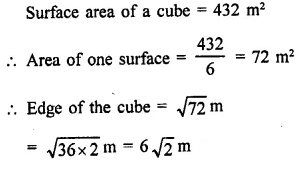
Find the edge of a cube whose surface area is 432 m2.
Solution:
RD Sharma Class 9 Solutions Chapter 18 Surface Areas and Volume of a Cuboid and Cube VSAQS Q4.1

Question 5.
A cuboid has total surface area of 372 cm2 and its lateral surface area is 180 cm2, find the area of its base.
Solution:
Total surface area of a cuboid = 372 cm2
and lateral surface area = 180 cm2
∴ Area of base and roof = 372 – 180 = 192 cm2
and area of base = \(\frac { 192 }{ 2 }\) = 96 cm2

Question 6.
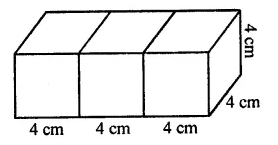
Three cubes of each side 4 cm are joined end to end. Find the surface area of the resulting cuboid.
Solution:
By joining three cubes of side 4 cm each, end is end, we get a cuboid
Length of cuboid = 4 x 3 = 12 cm
Breadth = 4 cm
and height = 4 cm
RD Sharma Class 9 Solutions Chapter 18 Surface Areas and Volume of a Cuboid and Cube VSAQS Q6.1
∴ Surface area = 2(lb + bh + hl)
= 2[12 x4+4×4 + 4x 12] cm2
= 2[48 + 16 + 48] cm2
= 2 x 112 = 224 cm2

Question 7.
The surface area of a cuboid is 1300 cm2. If its breadth is 10 cm and height is 20 cm, find its length.
Solution:
Surface area of a cuboid = 1300 cm2
Breadth (b) = 10 cm
and height (h) = 20 cm
Let l be the length, then
= 2 (lb + bh + hl) = 1300
lb+ bh + hl = \(\frac { 1300 }{ 2 }\) = 650
l x 10 + 10 x 20 + 20 x l = 650
10l + 20l + 200 = 650
⇒ 30l = 650 – 200 = 450
⇒ l = \(\frac { 450 }{ 30 }\) = 15
∴ Length of cuboid = 15 cm

Hope given RD Sharma Class 9 Solutions Chapter 18 Surface Areas and Volume of a Cuboid and Cube VSAQS are helpful to complete your math homework.

If you have any doubts, please comment below. Learn Insta try to provide online math tutoring for you.
RD Sharma Class 9 Solutions Chapter 18 Surface Areas and Volume of a Cuboid and Cube Ex 18.2

RD Sharma Class 9 Solutions Chapter 18 Surface Areas and Volume of a Cuboid and Cube Ex 18.2

These Solutions are part of RD Sharma Class 9 Solutions. Here we have given RD Sharma Class 9 Solutions Chapter 18 Surface Areas and Volume of a Cuboid and Cube Ex 18.2

Other Exercises

Question 1.
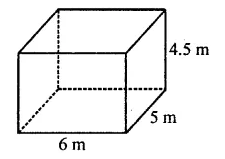
A cuboidal water tank is 6 m long, 5 m wide and 4.5 m deep. How many litres of water can it hold? [NCERT]
Solution:
Length of water tank (l) = 6 m
Breadth (b) = 5 m
and depth (h) = 4.5 m
RD Sharma Class 9 Solutions Chapter 18 Surface Areas and Volume of a Cuboid and Cube Ex 18.2 Q1.1
∴ Volume of water in it = lbh
= 6 x 5 x 4.5 m3 = 135 m3
Capacity of water in litres = 135 x 1000 litres (1 m3 = 1000 l)
= 135000 litres

Question 2.
A cubical vessel is 10 m long and 8 m wide. How high must it be made to hold 380 cubic metres of a liquid? [NCERT]
Solution:
Length of vessal (l) = 10 m
Breadth (b) = 8 m
Volume = 380 m3
RD Sharma Class 9 Solutions Chapter 18 Surface Areas and Volume of a Cuboid and Cube Ex 18.2 Q2.1

Question 3.
Find the cost of digging a cuboidal pit 8 m long, 6 m broad and 3 m deep at the rate of ₹30 per m3. [NCERT]
Solution:
Length of pit (l) = 8m
Width (b) = 6 m
and depth (h) = 3 m
∴ Volume of earth digout = lbh
= 8 x 6 x 3 = 144 m3
Cost of digging the pit at the rate of ₹30 per m3
= 144 x 30 = ₹4320

Question 4.
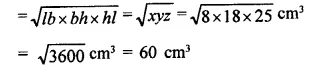
If the areas of three adjacent faces of a cuboid are 8 cm2, 18 cm2 and 25 cm2. Find the volume of the cuboid.
Solution:
Let x, y, z be the three adjacent faces of the cuboid, then
x = 8 cm2, y = 18 cm2, z = 25 cm2
and let l, b, h are the dimensions of the cuboid, then
x = lb = 8 cm2
y = bh = 18 cm2
z = hl = 25 cm2
∴ Volume = lbh
RD Sharma Class 9 Solutions Chapter 18 Surface Areas and Volume of a Cuboid and Cube Ex 18.2 Q4.1

Question 5.
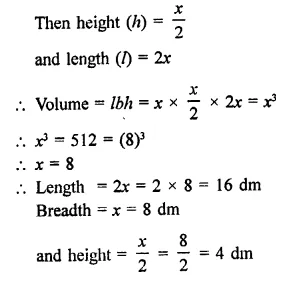
The breadth of a room is twice its height, one half of its length and the volume of the room is 512 cu. dm. Find its dimensions.
Solution:
Let breadth of a room (b) = x
RD Sharma Class 9 Solutions Chapter 18 Surface Areas and Volume of a Cuboid and Cube Ex 18.2 Q5.1

Question 6.
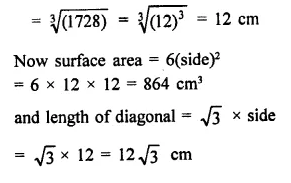
Three metal cubes with edges 6 cm, 8 cm and 10 cm respectively are melted together and formed into a single cube. Find the volume, surface area and diagonal of the new cube.
Solution:
Edge of first cube = 6 cm
Edge of second cube = 8 cm
and edge of third cube = 10 cm
∴ Volume of 3 cubes = (6)3 + (8)3 + (10)3 cm3
= 216 + 512 + 1000 cm3
= 1728 cm3
∴ Edge of so formed cube
RD Sharma Class 9 Solutions Chapter 18 Surface Areas and Volume of a Cuboid and Cube Ex 18.2 Q6.1

Question 7.
Two cubes, each of volume 512 cm3 are joined end to end. Find the surface area of the resulting cuboid.
Solution:
Volume of each volume = 512 cm3
∴ Side (edge) = \(\sqrt [ 3 ]{ 512 }\)
=\(\sqrt [ 3 ]{ { 8 }^{ 3 } }\)  = 8 cm
Now by joining two cubes, then Length of so formed cuboid (l)
= 8 + 8 = 16 cm
Breadth (b) = 8 cm
and height (h) = 8 cm
∴ Surface area = 2(lb + bh + hl)
= 2[16 x 8 + 8 x 8 + 8 x 16] cm2
= 2[128 + 64 + 128] cm2
= 2 x 320 = 640 cm2

Question 8.
A metal cube of edge 12 cm is melted and formed into three smaller cubes. If the edges of the two smaller cubes are 6 cm and 8 cm, find the edge of the third smaller cube.
Solution:
Edge of metal cube = 12 cm
∴ Its volume = (Edge)3 = (12)3 cm33
= 1728 cm3
It is melted and form 3 cubes
Edge of one smaller cube = 6 cm
and edge of second smaller cube = 8 cm
∴ Volume of two smaller cubes = (6)3 + (8)3 cm3
= 216 + 512 cm3 = 728 cm3
∴ Volume of third smaller cube = 1728 – 728 = 1000 cm3
∴ Edge of the third cube = \(\sqrt [ 3 ]{ 1000 }\)
= \(\sqrt [ 3 ]{ (10)3 }\)  cm = 10 cm

Question 9.
The dimensions of a cinema hall are 100 m, 50 m and 18 m. How many persons can sit in the hall, if each person requires 150 m3 of air?
Solution:
Length of cinema hall (l) = 100 m
Breadth (b) = 50 m
and height (h) = 18 m
∴ Volume of air in it = lbh
= 100 x 50 x 18 m= 90000 m3
Air required for one person = 150 m3
∴ Number of persons in the hall = \(\frac { 90000 }{ 150 }\) = 600 persons

Question 10.
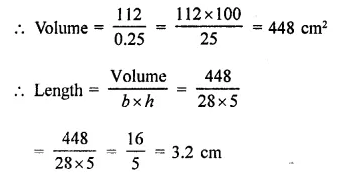
Given that 1 cubic cm of marble weighs 0.25 kg, the weight of marble block 28 cm in width and 5 cm thick is 112 kg. Find the length of the block.
Solution:
Weight of 1 cm3 = 0.25 kg
Breadth of the block (b) = 28 cm
Thickness (h) = 5 cm
and total weight of the block = 112 kg
RD Sharma Class 9 Solutions Chapter 18 Surface Areas and Volume of a Cuboid and Cube Ex 18.2 Q10.1

Question 11.
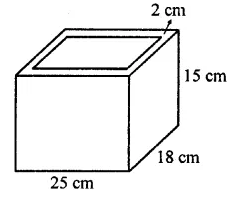
A box with lid is made of 2 cm thick wood. Its external length, breadth and height are 25 cm, 18 cm and 15 cm respectively. How much cubic cm of a liquid can be placed in it? Also, find the volume of the wood used in it.
Solution:
Outer length of the closed wooden box (l) = 25 cm
Breadth (b) = 18 cm
and height (h) = 15 cm
Width of wood = 2 cm
RD Sharma Class 9 Solutions Chapter 18 Surface Areas and Volume of a Cuboid and Cube Ex 18.2 Q11.1
∴ Inner length = 25 – 2×2 = 25- 4 = 21cm
Breadth =18- 2×2 = 18-4 = 14 cm
and height =15- 2×2 = 15- 4=11 cm
Now outer volume = 25 x 18 x 15 cm3 = 6750 cm3
and inner volume = 21 x 14 x 11 cm3 = 3234 cm3
(i) Inner volume = 3234 cm3
(ii) Volume of wood = 6750 – 3234 = 3516 cm3

Question 12.
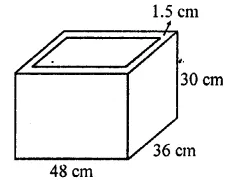
The external dimensions of a closed wooden box are 48 cm, 36 cm, 30 cm. The box is made of 1.5 cm thick wood. How many bricks of size 6 cm x 3 cm x 0.75 cm can be put in this box?
Solution:
External length of a closed wooden box (L) = 48 cm
Width (B) = 36 cm
and height (H) = 30 cm
Thickness of wood = 1.5 cm
RD Sharma Class 9 Solutions Chapter 18 Surface Areas and Volume of a Cuboid and Cube Ex 18.2 Q12.1
∴ Internal length (l) = 48 – 2 x 1.5 cm = 48 – 3 = 45 cm
Width (b) = 36 – 2 x 1.5 cm
= 36 – 3 = 33 cm
and height (h) = 30 – 2 x 1.5 cm
= 30 – 3 = 27 cm
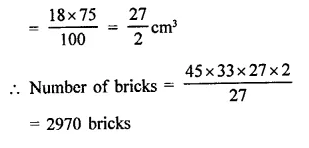
Now volume of internal box
= lbh = 45 x 33 x 27 cm3
Volume of one bricks = 6 x 3 x 0.75 cm3
RD Sharma Class 9 Solutions Chapter 18 Surface Areas and Volume of a Cuboid and Cube Ex 18.2 Q12.2

Question 13.
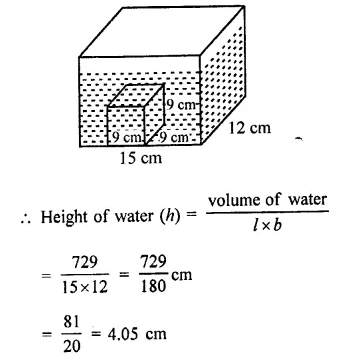
A cube of 9 cm edge is immersed completely in a rectangular vessel containing water. If the dimensions of the base are 15 cm and 12 cm, find the rise in water level in the vessel.
Solution:
Edge of a cube = 9 cm
Volume of cube = (9)3 cm3
= 729 cm3
Now length of vessel (l) = 15 cm
and breadth (b) = 12 cm
RD Sharma Class 9 Solutions Chapter 18 Surface Areas and Volume of a Cuboid and Cube Ex 18.2 Q13.1

Question 14.
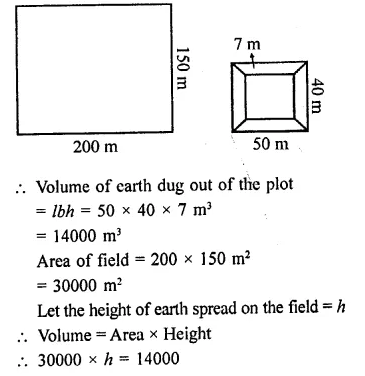
A field is 200 m long and 150 m broad. There is a plot, 50 m long and 40 m broad, near the field. The plot is dug 7 m deep and the earth taken out is spread evenly on the field. By how many metres is the level of the field raised? Give the answer to the second place of decimal.
Solution:
Length of a field (l) = 200 m
Breadth (b) = 150 m
Length of plot = 50 m
and breadth = 40 m
Depth of plot = 7 m
RD Sharma Class 9 Solutions Chapter 18 Surface Areas and Volume of a Cuboid and Cube Ex 18.2 Q14.1
RD Sharma Class 9 Solutions Chapter 18 Surface Areas and Volume of a Cuboid and Cube Ex 18.2 Q14.2

Question 15.
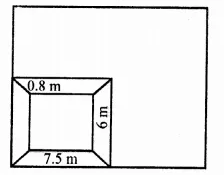
A field is in the form of a rectangle of length 18 m and width 15 m. A pit, 7.5 m long, 6 m broad and 0.8 m deep, is dug in a comer of the field and the earth taken out is spread- over the remaining area of the field. Find out the extent to which the level of the field has been raised.
Solution:
Length of a field (L) = 18m
and width (B) = 15 m
Length of pit (l) = 7.5 m
Breadth (b) = 6 m
and depth (h) = 0.8 m
RD Sharma Class 9 Solutions Chapter 18 Surface Areas and Volume of a Cuboid and Cube Ex 18.2 Q15.1
∴ Volume of earth dugout = lbh
= 7.5 x 6 x 0.8 m3
= 45 x 0.8 = \(\frac { 45 x 4 }{ 5 }\) = 36 m3
Total area of the field = L x B
= 18 x 15 = 270 m2
and area of pit = lb = 7.5 x 6 = 45 m2
∴ Remaining area of the field excluding pit
= 270 – 45 = 225 m2
Let by spreading the earth on the remaining part of the field, the height = h
= 225 x h = 36
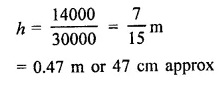
⇒ h = \(\frac { 36 }{ 225 }\) = \(\frac { 4 }{ 25 }\)= 0.16 m = 16 cm
∴ Level of field raised = 16 cm

Question 16.
A village having a population of 4000 requires 150 litres of water per head per day. It has a tank measuring 20 m x 15m x 6 m. For how many days will the water of this tank last? [NCERT]
Solution:
Population of a village = 4000
Water required per head per day = 150 litres
∴ Total water required = 4000 x 150 litres = 600000 litres
Dimensions of a tank = 20mx 15mx6m
∴ Volume of tank = 20 x 15 x 6 m3 = 1800 m3
Capacity of water in litres = 1800 x 1000 litres (1 m3 = 1000 litres)
= 1800000 litres
The water will last for = \(\frac { 1800000 }{ 600000 }\) = 3 days

Question 17.
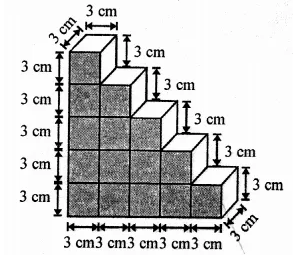
A child playing with building blocks, which are of the shape of the cubes, has built a structure as shown in the figure. If the edge of each cube is 3 cm, find the volume of the structure built by the child. [NCERT]
RD Sharma Class 9 Solutions Chapter 18 Surface Areas and Volume of a Cuboid and Cube Ex 18.2 Q17.1
Solution:
No. of cubes at the given structure = 1+ 2 + 3+ 4 + 5 = 15
Edge of one cube = 3 cm
∴ Volume of one cube = (3)3 = 3 x 3 x 3 cm3 = 27 cm3
∴Volume of the structure = 27 x 15 cm3 = 405 cm3

Question 18.
A godown measures 40 m x 25 m x 10 m. Find the maximum number of wooden crates each measuring 1.5 m x 1.25 m x 0.5 m that can be stored in the godown. [NCERT]
Solution:
Length of godown (L) = 40 m
Breadth (B) = 25 m
and height (H) = 10 m
∴ Volume of godown = LBH
= 40 x 25 x 10 = 10000 m3
Dimension of one wooden crates = 1.5 m x 1.25 m x 0.5 m
∴Volume of one crate = 1.5 x 1.25 x 0.5 m3 = 0.9375 m3
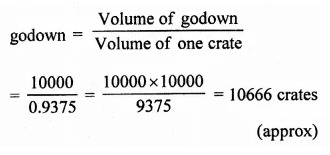
∴ Number of crates to be stored in the
RD Sharma Class 9 Solutions Chapter 18 Surface Areas and Volume of a Cuboid and Cube Ex 18.2 Q18.1

Question 19.
A wall of length 10 m was to be built across an open ground. The height of the wall is 4 m and thickness of the wall is 24 cm. If this wall is to be built up with bricks whose dimensions are 24 cm x 12 cm x 8 cm, how many bricks would be required? [NCERT]
Solution:
Length of wall (L) = 10 m = 1000 cm
Height (H) = 4 m = 400 cm
Thickness (B) = 24 cm = 24 cm
∴ Volume of wall = LBH = 1000 x 24 x 400 cm3 = 9600000 cm3
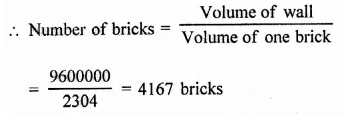
Dimensions of one brick = 24 cm x 12 cm x 8 cm = 2304 cm3
RD Sharma Class 9 Solutions Chapter 18 Surface Areas and Volume of a Cuboid and Cube Ex 18.2 Q19.1

Question 20.
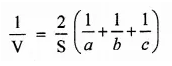
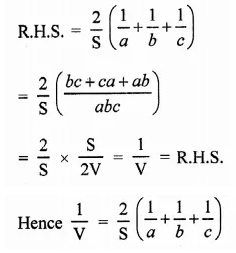
If V is the volume of a cuboid of dimensions a, b, c and S is its surface area, then prove that
RD Sharma Class 9 Solutions Chapter 18 Surface Areas and Volume of a Cuboid and Cube Ex 18.2 Q20.1
Solution:
a, b, c are the dimensions of a cuboid S is the surface area and V is the volume
∴ V = abc and S = 2(lb + bc + ca)
RD Sharma Class 9 Solutions Chapter 18 Surface Areas and Volume of a Cuboid and Cube Ex 18.2 Q20.2

Question 21.
The areas of three adjacent faces of a cuboid are x, y and z. If the volume is V, prove that V= xyz.
Solution:
Let a, b, c are the dimensions of a cuboid then,
x = ab, y = bc, z = ca
and V = abc
Now L.H.S. = V2
= (abc)= a2b2c2
= ab.bc.ca = xyz = R.H.S.
Hence V2 = xyz

Question 22.
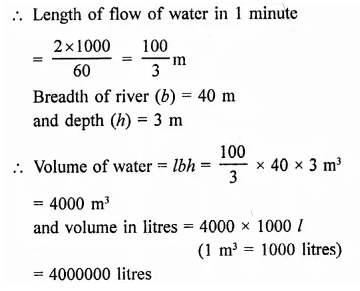
A river 3 m deep and 40 m wide is flowing at the rate of 2 km per hour. How much water will fall into the sea in a minute? [NCERT]
Solution:
Speed of water in a river = 2 km/hr
RD Sharma Class 9 Solutions Chapter 18 Surface Areas and Volume of a Cuboid and Cube Ex 18.2 Q22.1

Question 23.
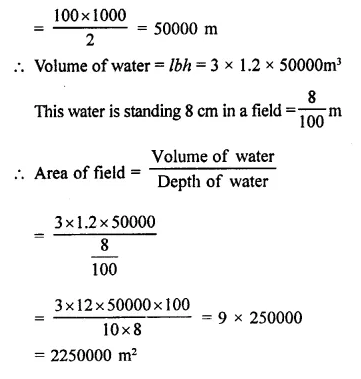
Water in a canal 30 dm wide and 12 dm deep, is flowing with a velocity of 100 km per hour. How much area will it irrigate in 30 minutes if 8 cm of standing water is desired?
Solution:
Width of canal (b) = 30 dm = 3 m
Depth (h) = 12 dm = 1.2 m
Speed of water = 100 km/hr
Length of water flow in 30 minutes = \(\frac { 1 }{ 2 }\) hr
RD Sharma Class 9 Solutions Chapter 18 Surface Areas and Volume of a Cuboid and Cube Ex 18.2 Q23.1

Question 24.
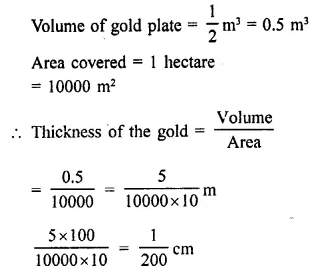
Half cubic metre of gold-sheet is extended by hammering so as to cover an area of 1 hectare. Find the thickness of the gold- sheet.
Solution:
RD Sharma Class 9 Solutions Chapter 18 Surface Areas and Volume of a Cuboid and Cube Ex 18.2 Q24.1

Question 25.
How many cubic centimetres of iron are there in an open box whose external dimensions are 36 cm, 25 cm and 16.5 cm, the iron being 1.5 cm thick throughout? If 1 cubic cm of iron weighs 15 g, find the weight of the empty box in kg.
Solution:
External length of open box (L) = 36 cm
Breadth (B) = 25 cm
and Height (H) = 16.5 cm
Width of iron sheet used = 1.5 cm
∴ Inner length (l) = 36 – 1.5 x 2 = 36 – 3 = 33 cm
Breadth (b) = 25 – 2 x 1.5 = 25 – 3 = 22 cm
and Height (h) = 16.5 – 1.5 = 15 cm
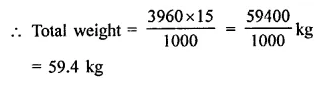
∴ Volume of the iron used = Outer volume – Inner volume
= 36 x 25 x 16.5 – 33 x 22 x 15
= 14850 – 10890 = 3960 cm3
Weight of 1 cm3 = 15 g
RD Sharma Class 9 Solutions Chapter 18 Surface Areas and Volume of a Cuboid and Cube Ex 18.2 Q25.1

Question 26.
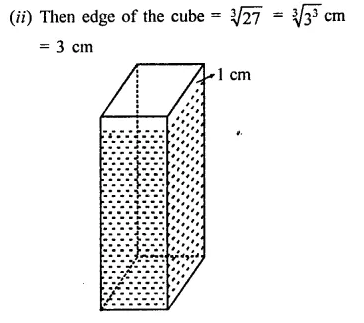
A rectangular container, whose base is a square of side 5 cm, stands on a horizontal table, and holds water upto 1 cm from the top. When a cube is placed in the water it is completely submerged, the water rises to the top and 2 cubic cm of water overflows. Calculate the volume of the cube and also the length of its edge.
Solution:
Base of the container = 5 cm x 5 cm
Level of water upto 1 cm from the top After placing a cube in it, the water rises to the top and 2 cubic cm of water overflows,
(i) ∴ Volume of water = 5 x 5 x 1 + 2 = 25 + 2 = 27 cm3
∴ Volume of cube = 27 cm3
RD Sharma Class 9 Solutions Chapter 18 Surface Areas and Volume of a Cuboid and Cube Ex 18.2 Q26.1

Question 27.
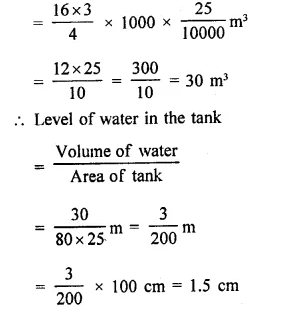
A rectangular tank is 80 m long and 25 m broad. Water-flows into it through a pipe whose cross-section is 25 cm2, at the rate of 16 km per hour. How much the level of the water rises in the tank in 45 minutes.
Solution:
Length of tank (l) = 80 m
Breadth (b) = 25 m
Area of cross section of the month of pipe = 25 cm2
and speed of water-flow =16 km/h
∴ Volume of water is 45 minutes
RD Sharma Class 9 Solutions Chapter 18 Surface Areas and Volume of a Cuboid and Cube Ex 18.2 Q27.1

Question 28.
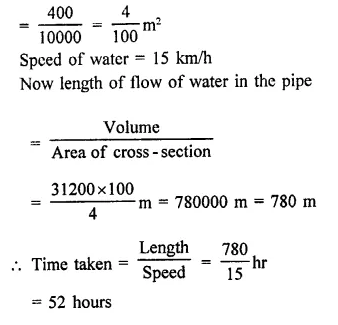
Water in a rectangular reservoir having base 80 m by 60 m is 6.5 m deep. In what time can the water be emptied by a pipe of which the cross-section is a square of side 20 cm, if the water runs through the pipe at the rate of 15 km/hr.
Solution:
Length of reservoir (l) = 80 m
Breadth (b) = 60 m
and depth (h) = 6.5 m
∴ Volume of water in it = lbh = 80 x 60 x 6.5 m3 = 31200 m3
Area of cross-section of the month of pipe = 20 x 20 = 400 cm2
RD Sharma Class 9 Solutions Chapter 18 Surface Areas and Volume of a Cuboid and Cube Ex 18.2 Q28.1

Hope given RD Sharma Class 9 Solutions Chapter 18 Surface Areas and Volume of a Cuboid and Cube Ex 18.2 are helpful to complete your math homework.

If you have any doubts, please comment below. Learn Insta try to provide online math tutoring for you.