RD Sharma Class 8 Solutions Chapter 23 Data Handling I Ex 23.1

RD Sharma Class 8 Solutions Chapter 23 Data Handling I (Classification and Tabulation of Data) Ex 23.1

These Solutions are part of RD Sharma Class 8 Solutions. Here we have given RD Sharma Class 8 Solutions Chapter 23 Data Handling I Ex 23.1

Other Exercises

Question 1.
Define the following terms :
(i) Observations
(ii) Raw data
(iii) Frequency of an observation
(iv) Frequency distribution
(v) Discrete frequency distribution
(vi) Grouped frequency distribution
(vii) Class-interval
(viii) Class-size
(ix) Class limits
(x) True class limits
Solution:
(i) Observations : Each entry in the given data is called an observation. ‘
(ii) Raw data: A collection of observations by an observer, is called raw data.
(iii) Frequency of an observation : The number of times an observation occurs in the given data is called its frequency.
(iv) Frequency distribution : The presentations of given data in order of magnitude ascending or descending, is called the frequency distribution.
(v) Discrete frequency distribution: When the given data is represented by tally marks after arranging it in an order. This kind of distribution is called discrete frequency distribution.
(vi) Grouped frequency distribution: If the number of data is large, and the difference between the greatest and the smallest observation is large, then we represent then in groups or classes. Such representation of data is called grouped frequency distribution.
(vii) Class intervals: The difference between the upper limit and lower limit of a class is called class interval.
(viii) Class-size : Class intervals are also called the class size. Each size of the same intervals
(ix) Class limits : Every class has two limits : upper limit and lower limit.
(x) True class limits or Exclusive limits : When the upper limit of one is the lower limit of the next interval then these are call true class limits.

Question 2.
The final marks in mathematics of 30 students are as follows :
53, 61, 48, 60, 78, 68, 55, 100, 67, 90, 75, 88,77,37,84,58,60,48,62,56,44,58,52,64, 98, 59, 70, 39, 50, 60
(i) Arrange these marks in the ascending order, 30 to 39 one group, 40 to 49 second group etc.
Now answer the following:
(ii) What is the highest score ?
(iii) What is the lowest score ?
(iv) What is the range ?
(v) If 40 is the pass mark how many have failed ?
(vi) How many have scored 75 or more ?
(vii) Which observations between 50 and 60 have not actually appeared ?
(viii) How many have scored less than 50 ?
Solution:
(i) Arranging the given data in ascending order.
30 to 39 : 37,39
40 to 49 : 44, 48, 48
50 to 59 : 50, 52, 53, 55, 56, 58, 58, 59
60 to 69 : 60, 60, 60, 61, 62, 64, 67, 68
70 to 79 : 70, 75, 77, 78
80 to 89 : 84, 88
90 to 99 : 90, 98
100 to 109 : 100
(ii) Highest score is 100
(iii) Lowest score is 37
(iv) Range is 100 – 37 = 63
(v) If 40 is pass marks then number of failed candidates will be = 2
(vi) Number of students who scored 75 or more = 8
(vii) Between 50 and 60, the observations 51, 54, 57 do not appear.
(viii) Number of students who scored less than 50 = 5

Question 3.
The weights of new born babies (in kg) in a hospital on a particular day are as follows:
2.3, 2.2, 2.1, 2.7, 2.6,3.0, 2.5, 2.9, 2-8,3.1, 2.5, 2.8, 2.7, 2.9, 2.4.
(i) Rearrange the weights in descending order.
(ii) Determine the highest weight:
(iii) Determine the lowest weight.
(iv) Determine the range.
(v) How many babies were born on that day?
(vi) How many babies weigh below 2.5 kg ?
(vii) How many babies weigh more than 2.8 kg ?
(viii) How many babies weigh 2.8 kg ?
Solution:
(i) Arranging the given weights in descending order.
3.1, 3.0, 2.9, 2.9, 2.8, 2.8, 2.7, 2.7, 2.6, 2.5, 2.5, 2.4, 2.3, 2.2, 2.1
(ii) Highest weight = 3.1 kg
(iii) Lowest weight = 2.1 kg
(iv) Range : 3.1 – 2.1 = 1 kg.
(v) Number of babies born on that day = 15
(vi) Number of babies having weight below 2.5 kg = 4
(vii) Number of babies having weight more than 2.8 kg = 4
(viii) Number of babies weigh 2.8 kg = 2

Question 4.
Following data gives the number of children in 41 families:
1,2,6,5,1,5,1,3,2,6,2,3,4,2,0,0,4,4, 3, 2, 2, 0, 0,1, 2, 2, 4,3, 2,1, 0, 5,1, 2,4, 3, 4, 1, 6, 2, 2.
Represent it in the form of a frequency distribution.
Solution:
Frequency distribution table
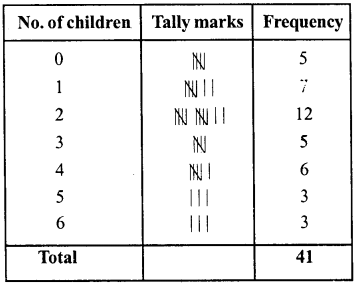
RD Sharma Class 8 Solutions Chapter 23 Data Handling I Ex 23.1 1

Question 5.
Prepare a frequency table of the following scores obtained by 50 students in a test:
42, 51, 21, 42, 37. 37, 42, 49, 38, 52, 7, 33, 17, 44, 39, 7, 14, 27, 39, 42, 42, 62, 37, 39, 67, 51, 53, 53, 59, 41, 29, 38, 27, 31, 54,19, 53, 51, 22, 61, 42, 39, 59, 47, 33, 34, 16, 37, 57, 43
Solution:
Frequency distribution table
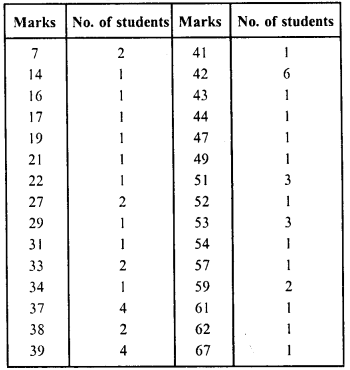
RD Sharma Class 8 Solutions Chapter 23 Data Handling I Ex 23.1 2

Question 6.
A die was thrown 25 times and following scores were obtained:
1,5,2,4,3,6,1,4,2,5,1,6,2,6,3,5,4,1, 3, 2, 3, 6,1, 5, 2
Prepare a frequency table of the scores.
Solution:
Frequency distribution table
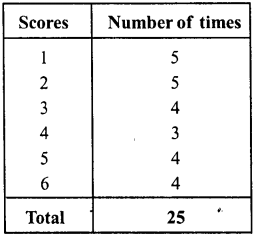
RD Sharma Class 8 Solutions Chapter 23 Data Handling I Ex 23.1 3

Question 7.
In a study of number of accidents per day, the observations for 30 days were obtained as follows:
6,3,5,6,4,3, 2,5,4,2,4,2,1,2, 2,0,5,4,6,1,6,0, 5, 3, 6,1, 5, 5, 2, 6
Prepare a frequency distribution table.
Solution:
Frequency distribution table
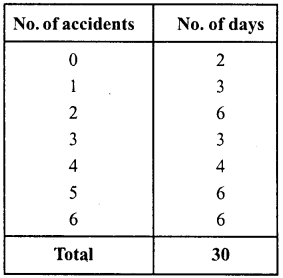
RD Sharma Class 8 Solutions Chapter 23 Data Handling I Ex 23.1 4

Question 8.
Prepare a frequency table of the following ages (in years) of 30 students of class VIII in your school:
13,14,13,12,14,13,14,15,13,14,13,14, 16,12,14,13,14,15,16,13,14,13,12,17,13, 12,13,13,13,14
Solution:
Frequency distribution table
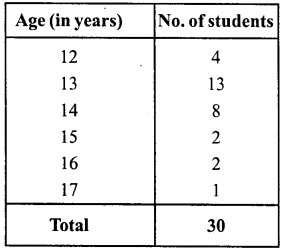
RD Sharma Class 8 Solutions Chapter 23 Data Handling I Ex 23.1 5

Question 9.
Following figures relate to the weekly wages (in Rs) of 15 workers in a factory :
300,250,200,250,200,150,350,200,250, 200,150, 300,150, 200, 250 Prepare a frequency table.
(i) What is the range in wages (in Rs) ?
(ii) How many workers are getting Rs 350 ?
(iii) How many workers are getting the minimum wages ?
Solution:
Frequency distribution table
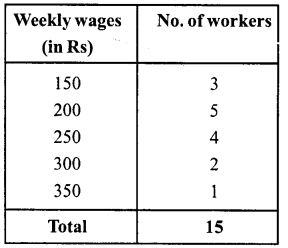
RD Sharma Class 8 Solutions Chapter 23 Data Handling I Ex 23.1 6
(i) Range = 350- 150 = 200
(ii) Number of workers getting Rs 350 = 1
(iii) Number of workers getting minimum wages = 3

Question 10.
Construct a frequency distribution table for the following marks obtained by 25 students in a history test in class Vin of a school:
9,17,12, 20,9,18, 25,17,19,9,12,9,12, 18, 17,19, 20, 25, 9,12,17,19, 19, 20, 9
(i) What is the range of marks ?
(ii) What is the highest mark ?
(iii) Which mark is occurring more frequently ?
Solution:
Frequency distribution table
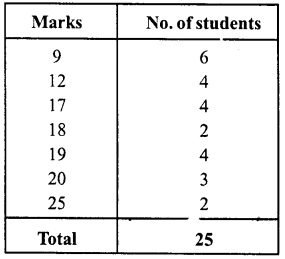
RD Sharma Class 8 Solutions Chapter 23 Data Handling I Ex 23.1 7
(i) Range = 25 – 9 = 16
(ii) Highest marks = 25
(iii) Marks occurring more frequently = 9


Hope given RD Sharma Class 8 Solutions Chapter 23 Data Handling I Ex 23.1 are helpful to complete your math homework.

If you have any doubts, please comment below. Learn Insta try to provide online math tutoring for you.

RD Sharma Class 8 Solutions Chapter 24 Data Handling II Ex 24.1

RD Sharma Class 8 Solutions Chapter 24 Data Handling II (Graphical Representation of Data as Histograms) Ex 24.1

These Solutions are part of RD Sharma Class 8 Solutions. Here we have given RD Sharma Class 8 Solutions Chapter 24 Data Handling II Ex 24.1

Question 1.
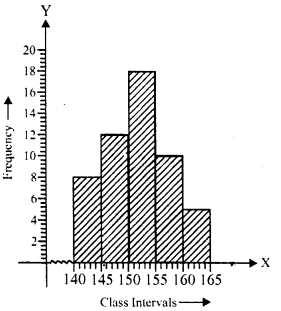
Given below is the frequency distribution of the heights of 50 students of a class :
RD Sharma Class 8 Solutions Chapter 24 Data Handling II Ex 24.1 1
Draw a histogram representing the above data.
Solution:
We represent class intervals along x-axis and frequency along y-axis. Taking suitable intervals along x-axis and y-axis we construct the rectangles as shown in the figure. This is the required histogram.
RD Sharma Class 8 Solutions Chapter 24 Data Handling II Ex 24.1 2

Question 2.
Draw a histogram of the following data :
RD Sharma Class 8 Solutions Chapter 24 Data Handling II Ex 24.1 3
Solution:
We represent class-intervals along x-axis and frequency along y-axis. Taking suitable intervals along x-axis andy-axis, we construct rectangles as shown in the figure. This is the required histogram.
RD Sharma Class 8 Solutions Chapter 24 Data Handling II Ex 24.1 4

Question 3.
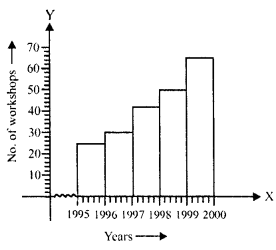
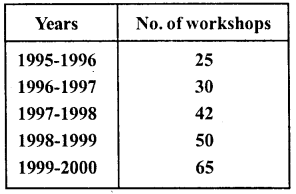
Number of workshops organized by a school in different areas during the last five years is as follows :
RD Sharma Class 8 Solutions Chapter 24 Data Handling II Ex 24.1 5
Draw a histogram representing the above data.
Solution:
We represent years along x-axis and number of workshops along y-axis. Taking suitable intervals, we construct rectangles as shown in the figure. This is the required histogram.
RD Sharma Class 8 Solutions Chapter 24 Data Handling II Ex 24.1 6
RD Sharma Class 8 Solutions Chapter 24 Data Handling II Ex 24.1 7

Question 4.
In a hypothetical sample of 20 people the amounts of money with them were found to be as follows :
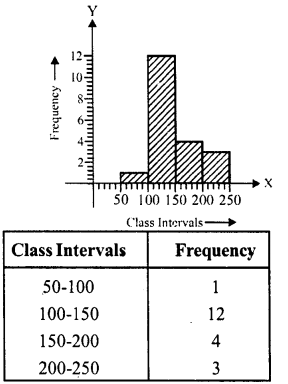
114, 108,100, 98, 101,109,117,119, 126, 131, 136, 143, 156, 169, 182, 195, 207, 219, 235, 118.
Draw the histogram of the frequency distribution (taking one of the class intervals as 50-100).
Solution:
Highest sample = 235
Lowest sample = 98
Range = 235-98 = 137
Now frequency distribution table will be as under:
RD Sharma Class 8 Solutions Chapter 24 Data Handling II Ex 24.1 8
We represent class intervals along x-axis and frequency along j’-axis. Taking suitable intervals, we construct a rectangles as shown in the figure. This is the required histogram.

Question 5.
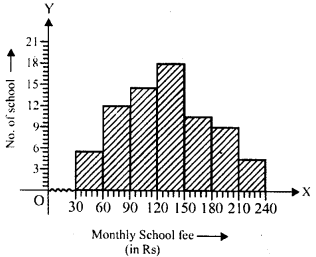
Construct a histogram for the following data:
RD Sharma Class 8 Solutions Chapter 24 Data Handling II Ex 24.1 9
Solution:
We represent monthly school fee (in Rs) along x-axis and number of schools along y-axis. Taking suitable intervals, we construct rectangles as shown in the figure. This is the required histogram.
RD Sharma Class 8 Solutions Chapter 24 Data Handling II Ex 24.1 10

Question 6.
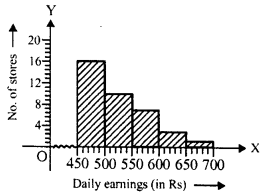
Draw a histogram for the daily earnings of 30 drug stores in the following table :
RD Sharma Class 8 Solutions Chapter 24 Data Handling II Ex 24.1 11
Solution:
We represent daily earnings (in Rs) along x-axis and number of stores along y-axis. Taking suitable intervals, we construct rectangles as shown in the figure. This is the required histogram.
RD Sharma Class 8 Solutions Chapter 24 Data Handling II Ex 24.1 12

Question 7.
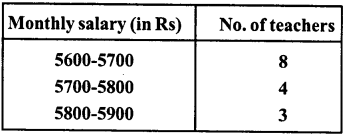
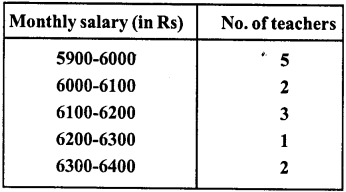
Draw a histogram to represent the following data:
RD Sharma Class 8 Solutions Chapter 24 Data Handling II Ex 24.1 13
RD Sharma Class 8 Solutions Chapter 24 Data Handling II Ex 24.1 14
Solution:
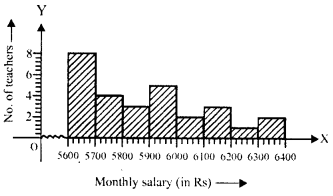
We represent monthly salary (in Rs) along x-axis and number of teachers along y-axis. Taking suitable intervals we construct rectangles as shown in the figure. This is the required histogram
RD Sharma Class 8 Solutions Chapter 24 Data Handling II Ex 24.1 15

Question 8.
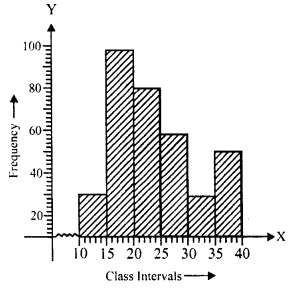
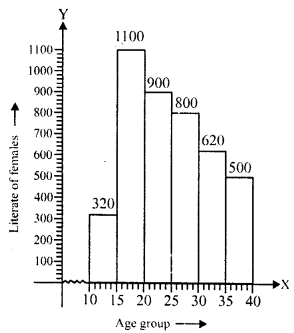
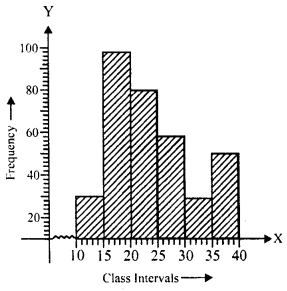
The following histogram shows the number of literate females in the age group of 10 to 40 years in a town :
(i) Write the age group in which the number of literate female is highest.
(ii) What is the class width ?
RD Sharma Class 8 Solutions Chapter 24 Data Handling II Ex 24.1 16
(iii) What is the lowest frequency ?
(iv) What are the class marks of the classes ?
(v) In which age group literate females are least ?
Solution:
(i) The age group in which the number of literate females is 15-20.
(ii) The class width is 5.
(iii) Lowest frequency is 320.
(iv) The class marks of the classes are
\(\frac { 10+15 }{ 2 }\) = \(\frac { 25 }{ 2 }\) =12.5, similarly other class marks will be 17.5,22.5,27.5,32.5,37.5
(v) The least literate females is in the class 10-15

Question 9.
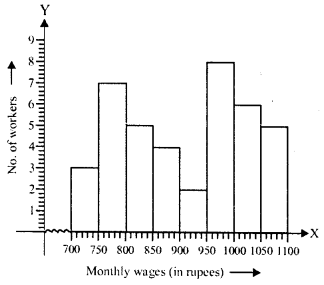
The following histogram shows the monthly wages (in Rs) of workers in a factory:
RD Sharma Class 8 Solutions Chapter 24 Data Handling II Ex 24.1 17
(i) In which wage-group largest number of workers are being kept ? What is their number ?
(ii) What wages are the least number of workers getting ? What is the number of such workers ?
(iii) What is the total number of workers ?
(iv) What is the factory size ?
Solution:
(i) The largest number of workers are in wage group 950-1000 and is 8.
(ii) The least number of workers are in the wage group 900-950 and is 2.
(iii) Total number of workers is 40 (3 + 7 + 5 + 4 + 2 + 8 + 6 + 5)
(iv) The factory size is 50.

Question 10.
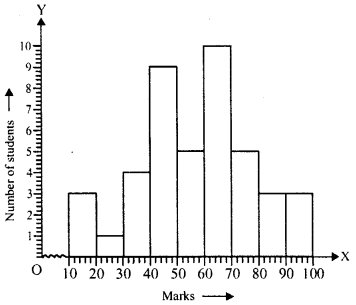
Below is the histogram depicting marks obtained by 43 students of a class :
(i) Write the number of students getting highest marks.
(ii) What is the class size ?
RD Sharma Class 8 Solutions Chapter 24 Data Handling II Ex 24.1 18
Solution:
(i) The number of students getting highest marks is 3.
(ii) The class size is 10.

Question 11.
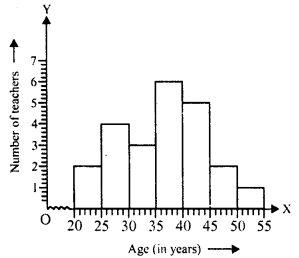
The following histogram shows the frequency distribution of the ages of 22 teachers in a school:
RD Sharma Class 8 Solutions Chapter 24 Data Handling II Ex 24.1 19
(i) What is the number of eldest and youngest teachers in the school ?
(ii) Which age group teachers are more in the school and which least ?
(iii) What is the size of the classes ?
(iv) What are the class marks of the classes?
Solution:
(i) The number of eldest teacher is 1 and the number of youngest teacher is 2.
(ii) The teachers in age group 35-40 is most.
(iii) Size of classes is 5.
(iv) Class marks of class 20-25 is \(\frac { 20+25 }{ 2 }\)= \(\frac { 45 }{ 2 }\) = 22.5
and similarly others will be 27.5, 32.5, 37.5, 42.5, 47.5, 52.5.

Question 12.
The weekly wages of 30 workers in a factory are given:
830,835,890,810,835,836,869,845,898, 890, 820, 860, 832, 833, 855, 845, 804, 808, 812, 840, 885, 835, 835, 836, 878, 840, 868, 890, 806, 840
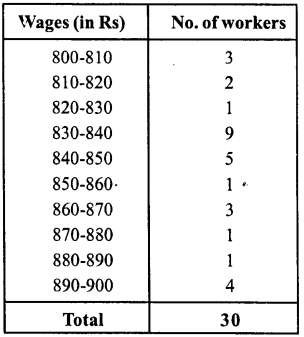
Mark a frequency table with intervals as 800-810,810-820 and so on, using tally marks.
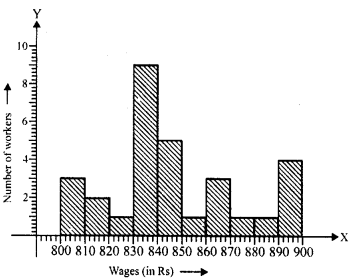
Also, draw a histogram and answer the following questions:
(i) Which group has the maximum number of workers ?
(ii) How many workers earn Rs 850 and more ?
(iii) How many workers earn less than Rs 850?
Solution:
The frequency table will be as given below:
RD Sharma Class 8 Solutions Chapter 24 Data Handling II Ex 24.1 20
We represent wages (in Rs) along x-axis and number of workers along y-axis. Taking suitable intervals, we construct rectangles as shown in the figure. This is the required histogram.
(i) Maximum workers are in the wage group 830-840.
(ii) Number of workers getting Rs 850 and more are 1 + 3 + 1 + 1 + 4 = 10.
(iii) Number of workers getting less than Rs 850 are 3 + 2 + 1 + 9 + 5 = 20
RD Sharma Class 8 Solutions Chapter 24 Data Handling II Ex 24.1 21

Hope given RD Sharma Class 8 Solutions Chapter 24 Data Handling II Ex 24.1 are helpful to complete your math homework.

If you have any doubts, please comment below. Learn Insta try to provide online math tutoring for you.

RS Aggarwal Class 6 Solutions Chapter 2 Factors and Multiples Ex 2E

RS Aggarwal Class 6 Solutions Chapter 2 Factors and Multiples Ex 2E

These Solutions are part of RS Aggarwal Solutions Class 6. Here we have given RS Aggarwal Solutions Class 6 Chapter 2 Factors and Multiples Ex 2E.

Other Exercises

Find the L.C.M. of the numbers given below:

Question 1.
Solution:
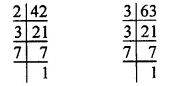
We have
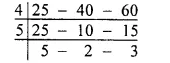
RS Aggarwal Class 6 Solutions Chapter 2 Factors and Multiples Ex 2E 1.1
42 = 2 x 3 x 7
63 = 3 x 3 x 7
= 32 x 7
∴ L.C.M. of 42 and 63 = 2 x 32 x 7
= 2 x 9 x 7
= 18 x 7
= 126

Question 2.
Solution:
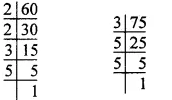
We have
RS Aggarwal Class 6 Solutions Chapter 2 Factors and Multiples Ex 2E 2.1
So, 60 = 2 x 2 x 3 x 5
= 22 x 3 x 5
75 = 3 x 5 x 5 = 3 x 52
∴L.C.M. of 60 and 75 = 22 x 3 x 52
= 4 x 3 x 25
= 4 x 75 = 300

Question 3.
Solution:
We have
RS Aggarwal Class 6 Solutions Chapter 2 Factors and Multiples Ex 2E 3.1
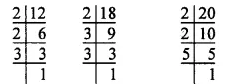
So, 12 = 2 x 2 x 3 = 22 x 3
18 = 2 x 3 x 3 = 2 x 32
20 = 2 x 2 x 5 = 22 x 5
∴L.C.M. of 12, 18 and 20 = 22 x 32 x 5
=4 x 9 x 5
= 20 x 9
= 180

Question 4.
Solution:
We have
RS Aggarwal Class 6 Solutions Chapter 2 Factors and Multiples Ex 2E 4.1
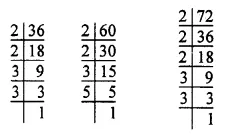
36 = 2 x 2 x 3 x 3 = 22 x 32
60 = 2 x 2 x 3 x 5 = 22 x 3 x 5
72 = 2 x 2 x 2 x 3 x 3 = 23 x 32
∴ L.C.M. of 36, 60 and 72 = 23 x 32 x 5
=8 x 9 x 5
= 40 x 9
= 360

Question 5.
Solution:
We have
RS Aggarwal Class 6 Solutions Chapter 2 Factors and Multiples Ex 2E 5.1
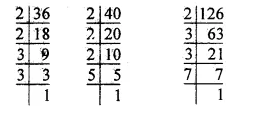
36 = 2 x 2 x 3 x 3 = 22 x 32
40 = 2 x 2 x 2 x 5 = 23 x 5
126 = 2 x 3 x 3 x 7 = 2 x 32 x 7
∴ L.C.M. of 36, 40 and 126 .
= 23 x 32 x 5 x 7
= 8 x 9 x 5 x 7
= 72 x 35
= 2520

Question 6.
Solution:
RS Aggarwal Class 6 Solutions Chapter 2 Factors and Multiples Ex 2E 6.1
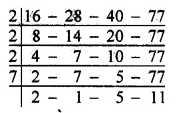
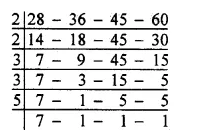
∴ L.C.M. of given numbers
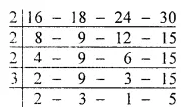
= 2 x 2 x 2 x 7 x 2 x 5 x 11
= 8 x 14 x 55
= 112 x 55 = 6160

Question 7.
Solution:
RS Aggarwal Class 6 Solutions Chapter 2 Factors and Multiples Ex 2E 7.1
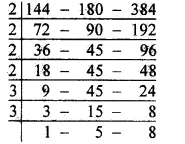
∴L.C.M. of given numbers = 2 x 2 x 3 x 3 x 5 x 7
= 36 x 35
= 1260

Question 8.
Solution:
RS Aggarwal Class 6 Solutions Chapter 2 Factors and Multiples Ex 2E 8.1
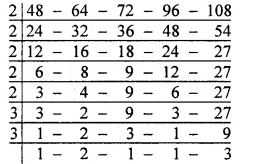
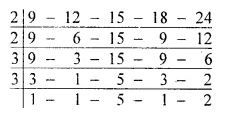
∴L.C.M. of given numbers
= 2 x 2 x 2 x 2 x 3 x 3 x 5 x 8
= 16 x 9 x 40
= 144 x 40
= 5760

Question 9.
Solution:
RS Aggarwal Class 6 Solutions Chapter 2 Factors and Multiples Ex 2E 9.1
∴L.C.M. of given numbers = 2 x 2 x 2 x 2 x 2 x 3 x 3 x 2 x 3
= 32 x 54
= 1728

Find the H.C.F. and L.C.M. of :

Question 10.
Solution:
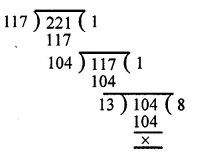
First we find the H.C.F. of the given numbers as under :
RS Aggarwal Class 6 Solutions Chapter 2 Factors and Multiples Ex 2E 10.1
∴ H.C.F. of 117 and 221 = 13
Now L.C.M. = \(\frac { product\quad of\quad numbers }{ their\quad H.C.F } \)
= \(\frac { 117\times 221 }{ 13 } \)
= 9 x 221 = 1989
∴ H.C.F. = 13 and L.C.M. = 1989

Question 11.
Solution:
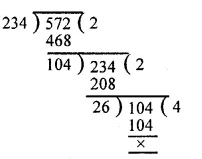
First we find the H.C.F. of 234 and 572 as under :
RS Aggarwal Class 6 Solutions Chapter 2 Factors and Multiples Ex 2E 11.1
H.C.F. of 234 and 572 = 26
Now L.C.M. = \(\frac { product\quad of\quad numbers }{ their\quad H.C.F } \)
= \(\frac { 234\times 572 }{ 26 } \)
= 9 x 572
= 5148

Question 12.
Solution:
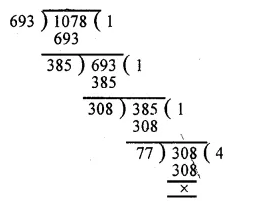
First we find the H.C.F. of 693 and 1078 as under :
RS Aggarwal Class 6 Solutions Chapter 2 Factors and Multiples Ex 2E 12.1
H.C.F. of 693 and 1078 = 77 Product of numbers
Now L.C.M. = \(\frac { product\quad of\quad numbers }{ their\quad H.C.F } \)
= \(\frac { 693\times 1078 }{ 77 } \)
= 9 x 1078
= 9702
H.C.F. = 77 and L.C.M. = 9702

Question 13.
Solution:
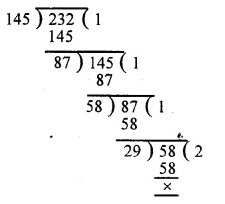
First we find the H.C.F. of 145 and 232 as under :
RS Aggarwal Class 6 Solutions Chapter 2 Factors and Multiples Ex 2E 13.1
H.C.F. of 145 and 232 = 29
Now L.C.M. = \(\frac { product\quad of\quad numbers }{ their\quad H.C.F } \)
= \(\frac { 145\times 232 }{ 29 } \)
= 5 x 232 = 1160
H.C.F. = 29 and L.C.M. = 1160

Question 14.
Solution:
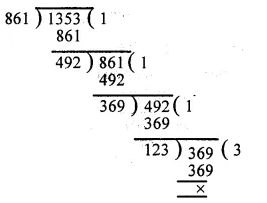
First we find the H.C.F. of 861 and 1353 as under :
RS Aggarwal Class 6 Solutions Chapter 2 Factors and Multiples Ex 2E 14.1
H.C.F. of 861 and 1353 = 123
Now L.C.M. = \(\frac { product\quad of\quad numbers }{ their\quad H.C.F } \)
= \(\frac { 861\times 1353 }{ 123 } \)
= 7 x 1353 = 9471
H.C.F. = 123 and L.C.M. = 9471

Question 15.
Solution:
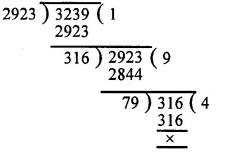
First we find the H.C.F. of 2923 and 3239 as under :
RS Aggarwal Class 6 Solutions Chapter 2 Factors and Multiples Ex 2E 15.1
H.C.F. of 2923 and 3239 = 79
Now L.C.M. = \(\frac { product\quad of\quad numbers }{ their\quad H.C.F } \)
= \(\frac { 2923\times 3239 }{ 79 } \)
= 37 x 3239= 119843
H.C.F. = 79 and L.C.M. = 119843

Question 16.
Solution:
We have
RS Aggarwal Class 6 Solutions Chapter 2 Factors and Multiples Ex 2E 16.1
RS Aggarwal Class 6 Solutions Chapter 2 Factors and Multiples Ex 2E 16.2
RS Aggarwal Class 6 Solutions Chapter 2 Factors and Multiples Ex 2E 16.3

Question 17.
Solution:
We know that
L.C.M = \(\frac { product\quad of\quad the\quad number }{ their\quad H.C.F } \)
= \(\\ \frac { 2160 }{ 12 } \)
= 180

Question 18.
Solution:
We know that
L.C.M = \(\frac { product\quad of\quad the\quad number }{ their\quad H.C.F } \)
= \(\\ \frac { 2560 }{ 320 } \)
= 8

Question 19.
Solution:
We know that
One number x The other number
= H.C.F. x L.C.M.
.’. The other number
= \(\\ \frac { H.C.F\times L.C.M }{ One\quad number } \)
= \(\\ \frac { 145\times 2175 }{ 725 } \)
= \(\\ \frac { 2175 }{ 5 } \)
= 435
Required number = 435

Question 20.
Solution:
We know that
One number x The other number
= H.C.F. x L.C.M.
The other number
= \(\\ \frac { H.C.F\times L.C.M }{ One\quad number } \)
= \(\\ \frac { 131\times 8253 }{ 917 } \)
= \(\\ \frac { 8253 }{ 7 } \)
Required number = 1179

Question 21.
Solution:
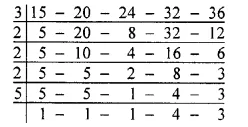
Required least number = L.C.M. of 15, 20, 24, 32 and 36
RS Aggarwal Class 6 Solutions Chapter 2 Factors and Multiples Ex 2E 21.1
L.C.M. = 3 x 2 x 2 x 2 x 5 x 4 x 3
= 24 x 60
= 1440
Hence, required least number = 1440

Question 22.
Solution:
Clearly, required least number = (L.C.M. of the given numbers + 9)
RS Aggarwal Class 6 Solutions Chapter 2 Factors and Multiples Ex 2E 22.1
L.C.M. of the given numbers
= 4 x 5 x 5 x 2 x 3
= 600
Required least number
= 600 + 9
= 609

Question 23.
Solution:
First we find the L.C.M. of the given numbers as under :
RS Aggarwal Class 6 Solutions Chapter 2 Factors and Multiples Ex 2E 23.1
L.C.M of the given numbers = 2 x 2 x 2 x 3 x 2 x 3 x 5
= 24 x 30 = 720
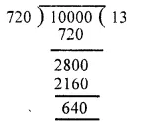
Now least number of five digits = 10000 Dividing 10000 by 720, we get
RS Aggarwal Class 6 Solutions Chapter 2 Factors and Multiples Ex 2E 23.2
Clearly if we add 80 to 640, it will become 720 which is exactly divisible by 720.
Required least number of five digits = 10000 + 80 = 10080

Question 24.
Solution:
The greatest number of five digits exactly divisible by the given numbers = The greatest number of five digits exactly divisible by the L.C.M. of given numbers.
Now
RS Aggarwal Class 6 Solutions Chapter 2 Factors and Multiples Ex 2E 24.1
L.C.M. of given numbers
= 2 x 2 x 3 x 3 x 5 x 2 = 360
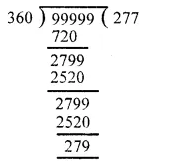
Now greatest number of five digits = 99999
Dividing 99999 by 360, we get
RS Aggarwal Class 6 Solutions Chapter 2 Factors and Multiples Ex 2E 24.2
Required greatest number of five digits
= 99999 – 279
= 99720

Question 25.
Solution:
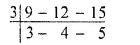
Three bells will again toll together after an interval of time which is exactly divisible by 9, 12, 15 minutes.
Required time = L.C.M. of 9, 12, 15 minutes
RS Aggarwal Class 6 Solutions Chapter 2 Factors and Multiples Ex 2E 25.1
L.C.M. of 9, 12, 15 minutes = 3 x 3 x 4 x 5 minutes
= 9 x 20 minutes
= 180 minutes
Required time = 180 minutes
= \(\\ \frac { 180 }{ 60 } \)
= 3 hours

Question 26.
Solution:
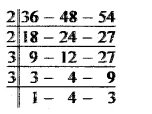
Required distance = L.C.M. of 36 cm, 48 cm and 54 cm
RS Aggarwal Class 6 Solutions Chapter 2 Factors and Multiples Ex 2E 26.1
L.C.M. of 36 cm, 48 cm. 54 cm
= 2 x 2 x 3 x 3 x 4 x 3 cm
= 36 x 12 cm
= 432 cm
= 4 m 32 cm
Required distance = 4 m 32 cm

Question 27.
Solution:
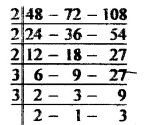
Required time = L.C.M. of 48 seconds, 72 seconds and 108 seconds
RS Aggarwal Class 6 Solutions Chapter 2 Factors and Multiples Ex 2E 27.1
L.C.M. of 48 sec., 72 sec. and 108 sec.
= 2 x 2 x 2 x 3 x 3 x 2 x 3 sec.
= 24 x 18 sec.
= 432 sec.
Required time = 432 sec.
= \(\\ \frac { 432 }{ 60 } \)
= 7 m in 12 sec

Question 28.
Solution:
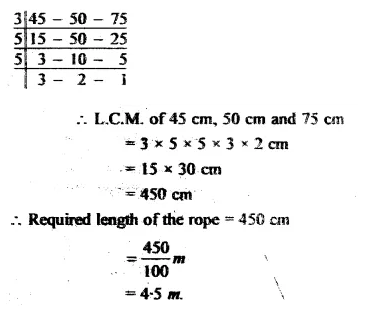
Lengths of three rods = 45 cm, 50 cm and 75 cm
Required least length of the rope = L.C.M. of 45 cm, 50 cm, 75 cm
We have
RS Aggarwal Class 6 Solutions Chapter 2 Factors and Multiples Ex 2E 28.1

Question 29.
Solution:
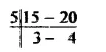
The time after which both the devices will beep together = L.C.M. of 15 minutes and 20 minutes
Now,
RS Aggarwal Class 6 Solutions Chapter 2 Factors and Multiples Ex 2E 29.1
L.C.M. of 15 minutes and 20 minutes
= 5 x 3 x 4
= 60 minutes
= 1 hour
Both the devices will beep together after 1 hour from 6 a.m.
Required time = 6 + 1
= 7 a.m.

Question 30.
Solution:
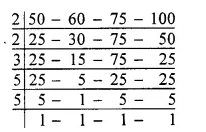
The circumferences of four wheels = 50 cm, 60 cm, 75 cm and 100 cm
Required least distance = L.C.M. of 50 cm, 60 cm, 75 cm and 100 cm Now,
RS Aggarwal Class 6 Solutions Chapter 2 Factors and Multiples Ex 2E 30.1
L.C.M. of 50 cm, 60 cm, 75 cm, 100 cm
= 2 x 2 x 3 x 5 x 5 cm
= 300 cm = 3 m
Required least distance = 3 m.

Hope given RS Aggarwal Solutions Class 6 Chapter 2 Factors and Multiples Ex 2E are helpful to complete your math homework.

If you have any doubts, please comment below. Learn Insta try to provide online math tutoring for you.
RD Sharma Class 8 Solutions Chapter 25 Data Handling III Ex 25.2

RD Sharma Class 8 Solutions Chapter 25 Data Handling III (Pictorial Representation of Data as Pie Charts or Circle Graphs) Ex 25.2

These Solutions are part of RD Sharma Class 8 Solutions. Here we have given RD Sharma Class 8 Solutions Chapter 25 Data Handling III Ex 25.2

Other Exercises

Question 1.
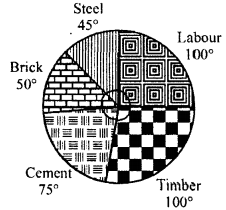
The pie-chart given in figure represents the expenditure on different items in constructing a flat in Delhi. If the expenditure incurred on cement is Rs 1,12,500, find the following:
RD Sharma Class 8 Solutions Chapter 25 Data Handling III Ex 25.2 1
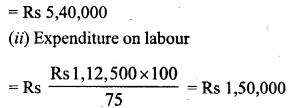
(i) Total cost of the flat,
(ii) Expenditure incurred on labour.
Solution:
Expenditure on cement = Rs 1,12,500
and its central angle = 75°
RD Sharma Class 8 Solutions Chapter 25 Data Handling III Ex 25.2 2
RD Sharma Class 8 Solutions Chapter 25 Data Handling III Ex 25.2 3

Question 2.
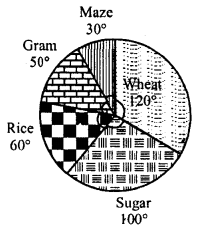
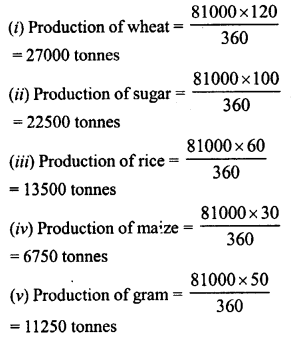
The pie-chart given in the figure shows the annual agricultural production of an Indian state. If the total production of all the commodities is 81000 tonnes, find the production (in tonnes) of:
RD Sharma Class 8 Solutions Chapter 25 Data Handling III Ex 25.2 4
(i) Wheat
(ii) Sugar
(iii) Rice
(iv) Maize
(v) Gram
Solution:
Total production = 81000 tonnes
RD Sharma Class 8 Solutions Chapter 25 Data Handling III Ex 25.2 5

Question 3.
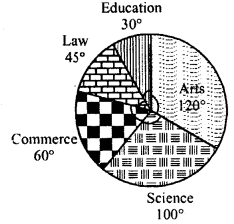
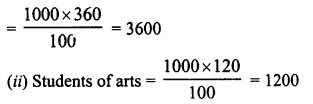
The following pie-chart shows the number of students admitted in different faculties of a college. If 1000 students are admitted in Science answer the following:
RD Sharma Class 8 Solutions Chapter 25 Data Handling III Ex 25.2 6

(i) What is the total number of students ?
(ii) What is the ratio of students in science and arts ?
Solution:
Students admitted in science = 1000
Central angle = 100°
(i) Total number of students
RD Sharma Class 8 Solutions Chapter 25 Data Handling III Ex 25.2 7
∴ Ratio in science and arts = 1000 : 1200 = 5:6

Question 4.
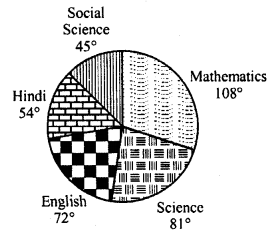
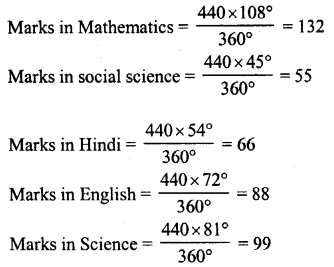
In the figure, the pie-chart shows the marks obtained by a student in an examination. If the student secures 440 marks in all, calculate his marks in each of the given subjects.
RD Sharma Class 8 Solutions Chapter 25 Data Handling III Ex 25.2 8
Solution:
Total marks secured by a student = 440
RD Sharma Class 8 Solutions Chapter 25 Data Handling III Ex 25.2 9

Question 5.
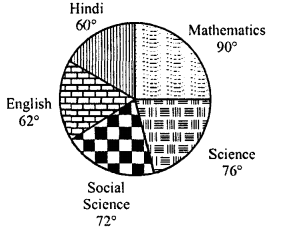
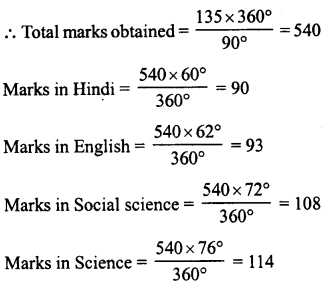
In the figure, the pie-charts shows the marks obtained by a student in various subjects. If the student scored 135 marks in mathematics, find the total marks in all the subjects. Also, find his score in individual subjects.
RD Sharma Class 8 Solutions Chapter 25 Data Handling III Ex 25.2 10
Solution:
Marks obtained in mathematics =135
Central angle = 90°
RD Sharma Class 8 Solutions Chapter 25 Data Handling III Ex 25.2 11

Question 6.
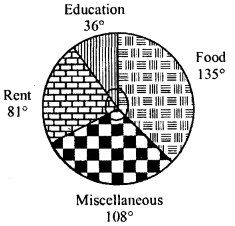
The following pie-chart shows the monthly expenditure of Shikha on various items. If she spends Rs 16,000 per month, answer the following questions:
RD Sharma Class 8 Solutions Chapter 25 Data Handling III Ex 25.2 12
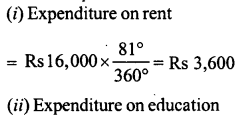
(i) How much does she spend on rent ?
(ii) How much does she spend on education ?
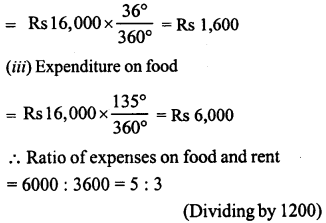
(iii) What is the ratio of expenses on food and rent ?
Solution:
Total expenditure per month = Rs 16,000
RD Sharma Class 8 Solutions Chapter 25 Data Handling III Ex 25.2 13
RD Sharma Class 8 Solutions Chapter 25 Data Handling III Ex 25.2 14

Question 7.
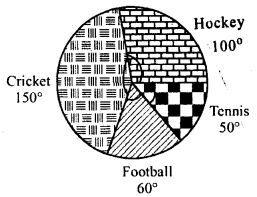
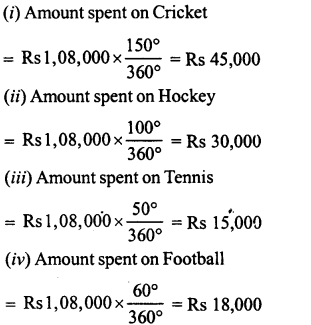
The pie-chart (as shown in the figure) represents the amount spent on different sports by a sports club in a year. If the total money spent by the club on sports is Rs 1,08,000, find the amount spent on each sport.
RD Sharma Class 8 Solutions Chapter 25 Data Handling III Ex 25.2 15
Solution:
total amount spent on sports = Rs 1,08,000
RD Sharma Class 8 Solutions Chapter 25 Data Handling III Ex 25.2 16

Hope given RD Sharma Class 8 Solutions Chapter 25 Data Handling III Ex 25.2 are helpful to complete your math homework.

If you have any doubts, please comment below. Learn Insta try to provide online math tutoring for you.
RS Aggarwal Class 6 Solutions Chapter 2 Factors and Multiples Ex 2D

RS Aggarwal Class 6 Solutions Chapter 2 Factors and Multiples Ex 2D

These Solutions are part of RS Aggarwal Solutions Class 6. Here we have given RS Aggarwal Solutions Class 6 Chapter 2 Factors and Multiples Ex 2D.
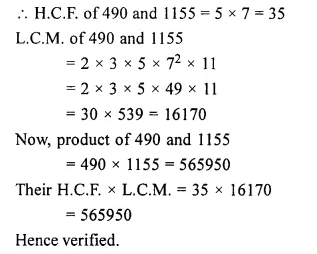
Other Exercises

Find the H.C.F. of the numbers in each of the following, using the prime factorization method :

Question 1.
Solution:
We have
RS Aggarwal Class 6 Solutions Chapter 2 Factors and Multiples Ex 2D 1.1
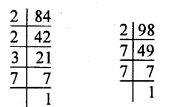
84 = 2 x 2 x 3 x 7
= 22 x 3 x 7
98 = 2 x 7 x 7 = 2 x 72
∴H.C.F. =2 x 7 = 14.

Question 2.
Solution:
We have
RS Aggarwal Class 6 Solutions Chapter 2 Factors and Multiples Ex 2D 2.1
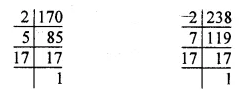
So, 170 = 2 x 5 x 17
238 = 2 x 7 x 17
∴ H.C.F. of 170 and 238 = 2 x 17 = 34

Question 3.
Solution:
We have
RS Aggarwal Class 6 Solutions Chapter 2 Factors and Multiples Ex 2D 3.1
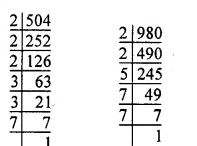
So, 504 = 2 x 2 x 2 x 3 x 3 x 7 = 23 x 32 x 7
980 = 2 x 2 x 5 x 7 x 7 = 22 x 5 x 72
∴ H.C.F. of 504 and 980 = 22 x 7
= 4 x 7 = 28.

Question 4.
Solution:
We have
RS Aggarwal Class 6 Solutions Chapter 2 Factors and Multiples Ex 2D 4.1
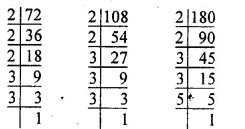
So, 72 = 2 x 2 x 2 x 3 x 3 = 23 x 32
108 = 2 x 2 x 3 x 3 x 3 = 22 x 33
180 = 2 x 2 x 3 x 3 x 5 = 22 x 32 x 5
∴ H.C.F. of 72, 108,
180 = 22 x 32
= 4 x 9 = 36

Question 5.
Solution:
We have
RS Aggarwal Class 6 Solutions Chapter 2 Factors and Multiples Ex 2D 5.1
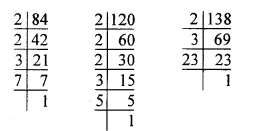
84 = 2 x 2 x 3 x 7 = 22 x 3 x 7
120 = 2 x 2 x 2 x 3 x 5 = 23 x 3 x 5
138 = 2 x 3 x 23
∴ H.C.F. of 84, 120 and 138 = 2 x 3 = 6

Question 6.
Solution:
We have
RS Aggarwal Class 6 Solutions Chapter 2 Factors and Multiples Ex 2D 6.1
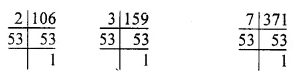
106 = 2 x 53
159 = 3 x 53
371 = 7 x 53
∴ H.C.F. of 106, 159, 371 = 53

Question 7.
Solution:
We have
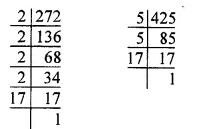
RS Aggarwal Class 6 Solutions Chapter 2 Factors and Multiples Ex 2D 7.1
272 = 2 x 2 x 2 x 2 x 17 = 24 x 17
425 = 5 x 5 x 17
= 52 x 17
∴ H.C.F. of 272 and 425 = 17.

Question 8.
Solution:
We have
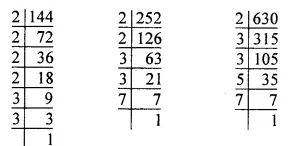
RS Aggarwal Class 6 Solutions Chapter 2 Factors and Multiples Ex 2D 8.1
So, 144 = 2 x 2 x 2 x 2 x 3 x 3 = 24 x 32
252 = 2 x 2 x 3 x 3 x 7 = 22 x 32 x 7
630 = 2 x 3 x 3 x 5 x 7 = 2 x 32 x 5 x 7
∴ H.C.F. of 144, 252 and 630 = 2 x 32
= 2 x 9 = 18.

Question 9.
Solution:
We have
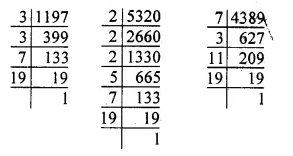
RS Aggarwal Class 6 Solutions Chapter 2 Factors and Multiples Ex 2D 9.1
So, 1197 = 3 x 3 x 7 x 19 = 32 x 7 x 19
5320 = 2 x 2 x 2 x 5 x 7 x 19 = 23 x 5 x 7 x 19
4389 = 7 x 3 x 11 x 19
∴ H.C.F. of 1197, 5320,
4389 = 7 x 19 = 133.

Find the H.C.F. of the numbers in each of the following using division method:

Question 10.
Solution:
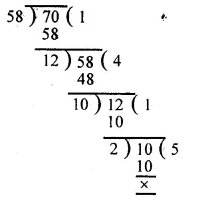
By division method, we have :
RS Aggarwal Class 6 Solutions Chapter 2 Factors and Multiples Ex 2D 10.1
∴ H.C.F. of 58 and 70 = 2.

Question 11.
Solution:
By division method, we have
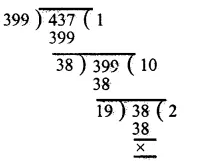
RS Aggarwal Class 6 Solutions Chapter 2 Factors and Multiples Ex 2D 11.1
∴ H.C.F. of 399 and 437 = 19

Question 12.
Solution:
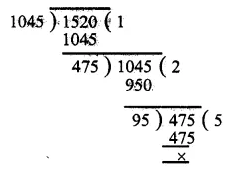
By division method, we have
RS Aggarwal Class 6 Solutions Chapter 2 Factors and Multiples Ex 2D 12.1
∴ H.C.F. of 1045 and 1520 = 95.

Question 13.
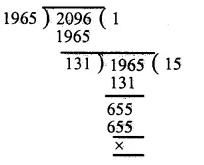
Solution:
By division method, we have
RS Aggarwal Class 6 Solutions Chapter 2 Factors and Multiples Ex 2D 13.1
∴ H.C.F. of 1965 and 2096 = 131

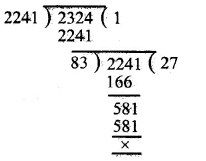
Question 14.
Solution:
By division method, we have
RS Aggarwal Class 6 Solutions Chapter 2 Factors and Multiples Ex 2D 14.1
∴ H.C.F. of 2241 and 2324 = 83.

Question 15.
Solution:
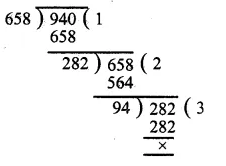
First, we find the H.C.F. of 658 and 940
RS Aggarwal Class 6 Solutions Chapter 2 Factors and Multiples Ex 2D 15.1
∴ H.C.F. of 658 and 940 is 94.
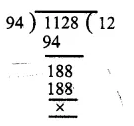
Now, we find the H.C.F. of 94 and 1128.
RS Aggarwal Class 6 Solutions Chapter 2 Factors and Multiples Ex 2D 15.2
∴ H.C.F. of 94 and 1128 = 94
Hence, H.C.F. of 658, 940 and 1128 = 94.

Question 16.
Solution:
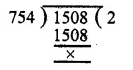
First, we find the H.C.F. of 754 and 1508
RS Aggarwal Class 6 Solutions Chapter 2 Factors and Multiples Ex 2D 16.1
∴ H.C.F. of 754 and 1508 is 754
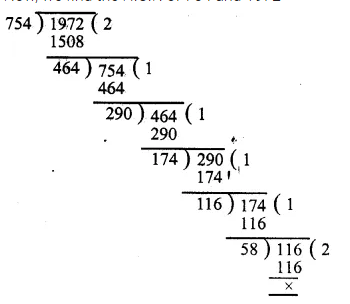
Now, we find the H.C.F. of 754 and 1972
RS Aggarwal Class 6 Solutions Chapter 2 Factors and Multiples Ex 2D 16.2
∴ H.C.F. of 754 and 1972 = 58
Hence, the H.C.F. of 754,1508 and 1972 = 58.

Question 17.
Solution:
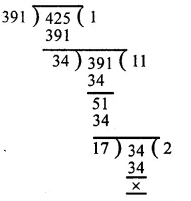
First, we find the H.C.F. of 391 and 425
RS Aggarwal Class 6 Solutions Chapter 2 Factors and Multiples Ex 2D 17.1
∴ H.C.F. of 391 and 425 is 17.
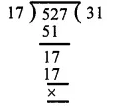
Now, we find the H.C.F. of 17 and 527
RS Aggarwal Class 6 Solutions Chapter 2 Factors and Multiples Ex 2D 17.2
∴ H.C.F. of 17 and 527 is 17 Hence, H.C.F. of 391, 425 and 527 = 17.

Question 18.
Solution:
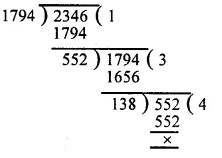
First, we find the H.C.F. of 1794 and 2346
RS Aggarwal Class 6 Solutions Chapter 2 Factors and Multiples Ex 2D 18.1
H.C.F. of 1794 and 2346 is 138.
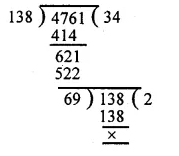
Now, we find the H.C.F. of 138 and 4761
RS Aggarwal Class 6 Solutions Chapter 2 Factors and Multiples Ex 2D 18.2
∴ H.C.F. of 138 and 4761 is 69.
Hence, the H.C.F. of 1794, 2346 and 4761 = 69.

Show that the following pairs are co-primes :

Question 19.
Solution:
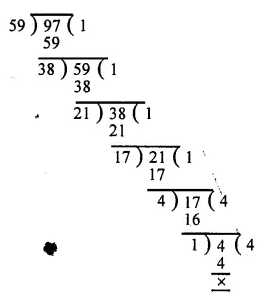
First, we find the H.C.F. of 59, 97.
RS Aggarwal Class 6 Solutions Chapter 2 Factors and Multiples Ex 2D 19.1
∴H.C.F. of 59 and 97 is 1.
Hence 59 and 97 are co-prime.

Question 20.
Solution:
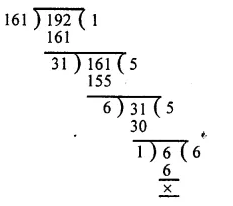
First, we find the H.C.F. of 161 and 192.
RS Aggarwal Class 6 Solutions Chapter 2 Factors and Multiples Ex 2D 20.1
∴ H.C.F. of 161 and 192 is 1.
Hence 161 and 192 are co-prime.

Question 21.
Solution:
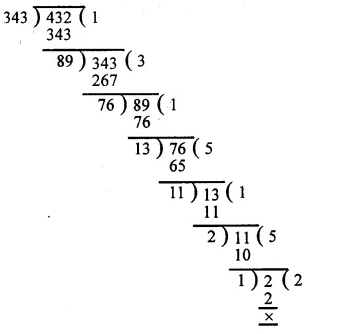
First, we find the H.C.F. of 343 and 432
RS Aggarwal Class 6 Solutions Chapter 2 Factors and Multiples Ex 2D 21.1
∴ H.C.F. of 343 and 432 is 1.
Hence 343 and 432 are co-prime.

Question 22.
Solution:
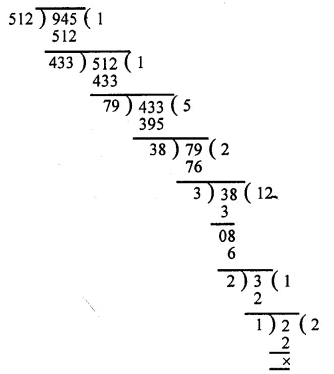
First, we find the H.C.F. of 512 and 945.
RS Aggarwal Class 6 Solutions Chapter 2 Factors and Multiples Ex 2D 22.1
∴ H.C.F. of 512 and 945 is 1.
Hence 512 and 945 are co-prime.

Question 23.
Solution:
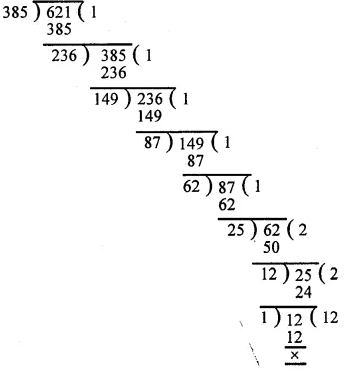
First, we find the H.C.F. of385 and 621
RS Aggarwal Class 6 Solutions Chapter 2 Factors and Multiples Ex 2D 23.1
∴ H.C.F. of 385 and 621 is 1.
Hence the numbers 385 and 621 are co-prime

Question 24.
Solution:
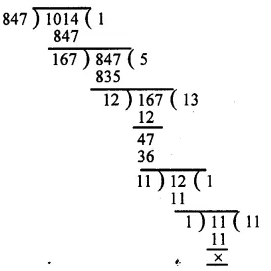
First, we find the H.C.F. of 847 and 1014.
RS Aggarwal Class 6 Solutions Chapter 2 Factors and Multiples Ex 2D 24.1
∴ H.C.F. of 847 and 1014 is 1.
Hence 847 and 1014 are co-prime.

Question 25.
Solution:
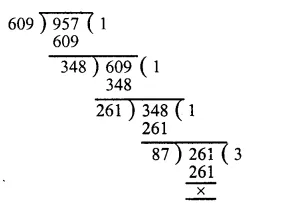
Clearly, we have to find the greatest number which divides (615 – 6) and (963 – 6) exactly.
So, the required number = H.C.F. of 615 – 6 = 609 and 963 – 6 = 957
RS Aggarwal Class 6 Solutions Chapter 2 Factors and Multiples Ex 2D 25.1
The required greatest number = 87.

Question 26.
Solution:
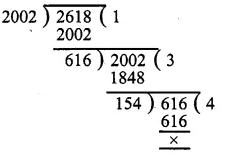
Clearly, we have to find the greatest number which divides 2011 – 9 = 2002 and 2623 – 5 = 2618.
So, the required greatest number = H.C.F. of 2002 and 2618
RS Aggarwal Class 6 Solutions Chapter 2 Factors and Multiples Ex 2D 26.1
∴ Required greatest number = 154.

Question 27.
Solution:
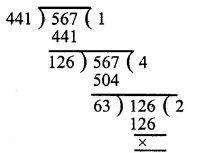
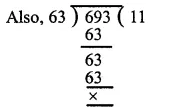
Clearly, we have to find the greatest number which divides (445 4), (572 – 5) and (699 – 6). So, the required number = H.C.F. of 441, 567 and 693. First we find the H.C.F. of 441 and 567
RS Aggarwal Class 6 Solutions Chapter 2 Factors and Multiples Ex 2D 27.1
∴ H.C.F. of 441 and 567 is 63
RS Aggarwal Class 6 Solutions Chapter 2 Factors and Multiples Ex 2D 27.2
So H.C.F. of 63 and 693 is 63
Hence the required number = 63.

Question 28.
Solution:
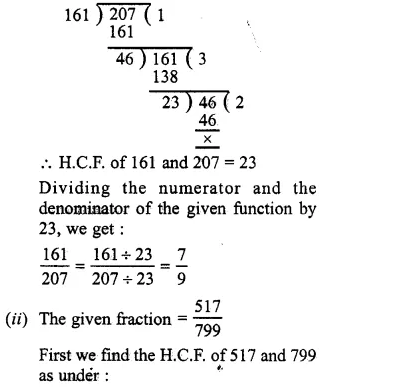
(i) The given fraction = \(\\ \frac { 161 }{ 207 } \)
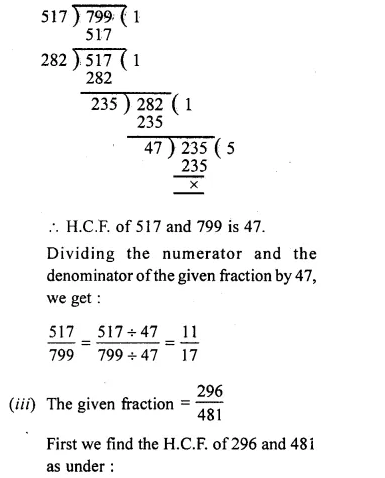
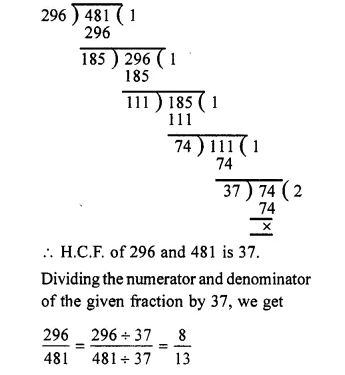
First we find the H.C.F. of 161 and 207
RS Aggarwal Class 6 Solutions Chapter 2 Factors and Multiples Ex 2D 28.1
RS Aggarwal Class 6 Solutions Chapter 2 Factors and Multiples Ex 2D 28.2
RS Aggarwal Class 6 Solutions Chapter 2 Factors and Multiples Ex 2D 28.3

Question 29.
Solution:
Lengths of three pieces of timber = 42 metres, 49 metres, 63 metres Greatest possible length of each plank = H.C.F. of 42 metres, 49 metres and 63 metres
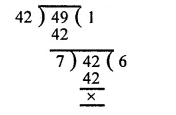
First we find the H.C.F. of 42 and 49
RS Aggarwal Class 6 Solutions Chapter 2 Factors and Multiples Ex 2D 29.1
∴ H.C.F. of 42 and 49 = 7
Now we find the H.C.F. of 7 and 63
RS Aggarwal Class 6 Solutions Chapter 2 Factors and Multiples Ex 2D 29.2
So, the H.C.F. of 7 and 63 is 7
∴ H.C.F. of 42 metres, 49 metres of 63 metres = 7 metres
Hence required possible length of each plank = 7 metres.

Question 30.
Solution:
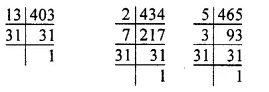
Quantity of milk in three different containers = 403 L, 434 L and 465 L Clearly, the maximum capacity of the required container = H.C.F. of 403 L, 434 L, 465 L, we have
RS Aggarwal Class 6 Solutions Chapter 2 Factors and Multiples Ex 2D 30.1
∴ 403 = 13 x 31
434 = 2 x 7 x 31
465 = 5 x 3 x 31
So the H.C.F. of 403 L, 434 L and 465 L = 31 L
Maximum capacity of the required container = 31 L.

Question 31.
Solution:
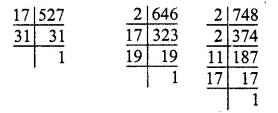
The given fruits = 527 apples, 646 pears and 748 oranges
Clearly, the greatest number of fruits in each heap = H.C.F. of 527, 646 and 748 we have
RS Aggarwal Class 6 Solutions Chapter 2 Factors and Multiples Ex 2D 31.1
∴ 527 = 17 x 31
646 = 2 x 17 x 19
748 = 2 x 2 x 11 x 17
So, the H.C.F. of 527, 646 and 748 = 17
∴ Required number of fruits in each heap = 17
Total number of fruits = 527 + 646 + 748 = 1921
Number of heaps = \(\frac { Total\quad number\quad of\quad fruits }{ Number\quad of\quad fruits\quad in\quad one\quad heap } \)
= \( \frac { 1921 }{ 17 } \)
=113

Question 32.
Solution:
The given lengths are :
7 metres = 7 x 100 cm
= 700 cm 3 metres 85 cm
= (3 x 100 + 85) cm
= 385 cm
12 metres 95 cm = (12 x 100 + 95) cm
= 1295 cm
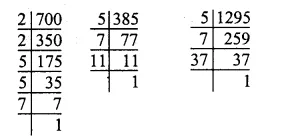
Clearly, the length of the required longest tape = H.C.F. of 700 cm, 385 cm and 1295 cm
We have
RS Aggarwal Class 6 Solutions Chapter 2 Factors and Multiples Ex 2D 32.1
So, 700 = 2 x 2 x 5 x 5 x 7
= 22 x 52 x 7
385 = 5 x 7 x 11
1295 = 5 x 7 x 37
∴ H.C.F. of 700, 385 and 1295 = 5 x 7 = 35
∴ The required length of the longest tape
= 35 cm.

Question 33.
Solution:
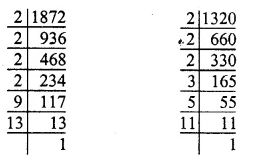
Length of the courtyard = 18 m 72 cm = (18 x 100 + 72) cm = 1872 cm
Breadth of the courtyard = 13 m 20 cm = (13 x 100 + 20) cm = 1320 cm
Greatest side of each of the square tiles = H.C.F. of 1872 cm and 1320 cm
Now
RS Aggarwal Class 6 Solutions Chapter 2 Factors and Multiples Ex 2D 33.1
1872 = 2 x 2 x 2 x 2 x 9 x 13
= 24 x 32 x 13
1320 = 2 x 2 x 2 x 3 x 5 x 11
= 23 x 3 x 5 x 11
So, the H.C.F. of 1872 and 1320
= 23 x 3 = 8 x 3 = 24
Greatest side of the square tile = 24 cm
Now Area of the courtyard = Length x Breadth = 1872 x 1320 cm2
Area of one square tile = Side x Side
= 24 x 24 cm2
∴ Least possible number of such tiles
= \(\frac { Area\quad of\quad the\quad courtyard }{ Area\quad of\quad the\quad tile } \)
= \( \frac { 1872\times 1320 }{ 24\times 24 } \)
= 78 x 55
= 4290

Question 34.
Solution:
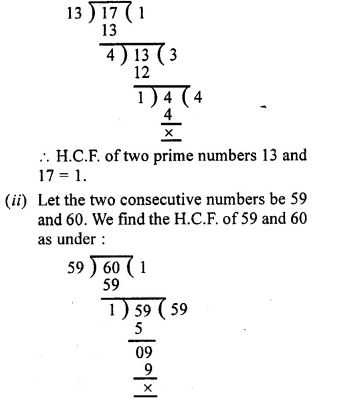
Let the two prime numbers be 13 and 17, we find the H.C.F. of 13 and 17 as under
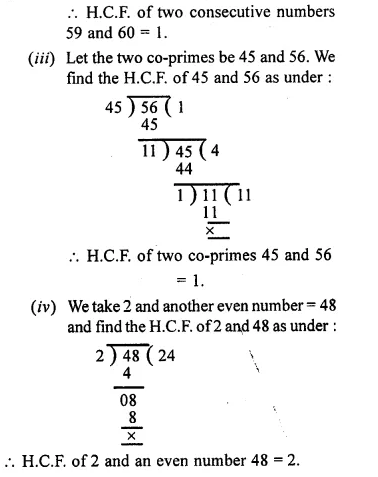
RS Aggarwal Class 6 Solutions Chapter 2 Factors and Multiples Ex 2D 34.1
RS Aggarwal Class 6 Solutions Chapter 2 Factors and Multiples Ex 2D 34.2

Hope given RS Aggarwal Solutions Class 6 Chapter 2 Factors and Multiples Ex 2D are helpful to complete your math homework.

If you have any doubts, please comment below. Learn Insta try to provide online math tutoring for you.