Materials: Metals and Non-Metals Class 8 Extra Questions and Answers Science Chapter 4

In this page, we are providing Materials: Metals and Non-Metals Class 8 Extra Questions and Answers Science Chapter 4 pdf download. NCERT Extra Questions for Class 8 Science Chapter 4 Materials: Metals and Non-Metals will help to score more marks in your CBSE Board Exams.

Class 8 Science Chapter 4 Extra Questions and Answers Materials: Metals and Non-Metals

Extra Questions for Class 8 Science Chapter 4 Materials: Metals and Non-Metals with Answers Solutions

Materials: Metals and Non-Metals Class 8 Extra Questions Very Short Answer Type

Question 1.
Name some common metals.
Answer:
Copper, aluminium, iron, silver, gold, etc.

Question 2.
Name some common non-metals.
Answer:
Hydrogen, oxygen, carbon, sulphur, phosphorus, etc.

Question 3.
Give examples of metalloids.
Answer:
Antimony, arsenic, silicon, boron, etc.

Question 4.
Name the property due to which metals shine.
Answer:
Lustre

Question 5.
Name two metals which are soft enough to be cut.
Answer:
Potassium and sodium

Question 6.
Name the property due to which metals can be beaten into thin sheets.
Answer:
Malleability

Question 7.
Which non-metal does conduct heat and electricity?
Answer:
Carbon

Question 8.
Name the property due to which metals can be drawn into wires.
Answer:
Ductility

Question 9.
Name the metal and non-metal which occur in liquid state.
Answer:
Mercury (metal), bromine (non-metal).

Question 10.
Due to which property a bell rings?
Answer:
Sonority

Question 11.
Generally, non-metals are non-lustrous. Name one non-metal which is lustrous.
Answer:
Iodine

Question 12.
State the property of non-metals due to which phosphorus is kept in water.
Answer:
Non-metals do not react with water.

Question 13.
Why some metals displace other metals from their solution?
Answer:
Because of being more reactive than the metals which they displace.

Question 14.
Which metal is used for wrapping food items?
Answer:
Aluminium

Question 15.
Which metal is more reactive: Iron or zinc?
Answer:
Zinc

Question 16.
Which metal is less reactive: Copper or zinc?
Answer:
Copper

Question 17.
Name one metal which does not react with dilute hydrochloric acid.
Answer:
Copper

Question 18.
Whose oxides are basic in nature: Metal or non-metal?
Answer:
Metal

Question 19.
Whose oxides are acidic: Metal or non-metal?
Answer:
Non-metal

Question 20.
Name two metals which do not react with oxygen even at high temperature.
Answer:
Gold and silver

Question 21.
Classify the following into metals and non-metals:
Copper, iron, graphite, sulphur, aluminium, oxygen
Answer:
Metals: Copper, iron, aluminium
Non-metals: Graphite, sulphur, oxygen

Question 22.
Name two physical properties of metals.
Answer:
Malleability and sonority

Question 23.
What happens when metals react with oxygen?
Answer:
Metal oxides are formed.

Question 24.
What happens when magnesium is burnt in air?
Answer:
Magnesium burns with a white dazzling flame and a white powdery magnesium oxide is formed.

Question 25.
What happens when metals react with water?
Answer:
Metals produce their hydroxides or oxides and hydrogen.

Materials: Metals and Non-Metals Class 8 Extra Questions Short Answer Type

Question 1.
What is a metal?
Answer:
Substances having characteristic properties like malleability, ductility, sonority, conductivity, lustre, – and solidness are called metals. For example, aluminium, copper, zinc, iron, etc.

Question 2.
What are non-metals?
Answer:
Substances which are soft and dull, i.e., non-lustrous, non-sonorous, non-ductile, non-malleable and poor conductor of heat and electricity are called non-metals. For example, oxygen, hydrogen, sulphur, etc.

Question 3.
Mention the physical properties of metals.
Answer:
Physical properties of metals are:

  • Malleable
  • Lustre
  • Sonorous
  • Ductile
  • Solid
  • Good conductor of heat and electricity

Question 4.
What are the physical properties of non-metals?
Answer:
The physical properties of non-metals are:

  • Non-malleable
  • Non-sonorous
  • Non-lustrous, i.e., dull in appearance
  • Non-ductile
  • Poor conductor of heat and electricity

Question 5.
Explain the term ‘malleability’ with suitable examples.
Answer:
Malleability is the property of metals due to which they can be beaten into thin sheets. For example, if we beat or hammer any metal like aluminium, zinc, iron, copper, etc., it become longer and larger but does not break. Thin sheets can be obtained by this process.

Question 6.
What is ductility? Explain with examples.
Answer:
Ductility is one of the properties of metals due to which they can be drawn into wires. For example, aluminium and copper are drawn into wires and used for electrical and different purposes.

Question 7.
Why aluminium is used for wrapping of food items?
Answer:
Aluminium is a metal and hence possesses malleability property. It can be beaten into thin sheets and can be folded into any shape. It is cheaper than other malleable metals and does not react with food items. That is why it is used as wrapping materials for food items.

Question 8.
Why metals are used in ringing bells?
Answer:
Metals have sonority. Due to this property, they can produce ringing sounds. That is why metals are used in ringing bells.

Question 9.
What are the differences between metals and non-metals? Explain on the basis of their physical properties.
Answer:

  • Metals are malleable and give thin sheets after hammering whereas non-metals are brittle and give no sheets.
  • Metals are ductile and can be drawn into wires whereas non-metals are non-ductile and can’t be drawn into wires.
  • Metals are sonorous and used in ringing bells whereas non-metals are non-sonorous and cannot be used in ringing bells.
  • Metals are good conductors of heat and electricity while non-metals are poor conductors.

Question 10.
What happen when a copper vessel is exposed to moist air for long? Also write the equation.
Answer:
When a copper vessel is exposed to moist air for long, it acquires a dull green coating. This green material is a mixture of copper hydroxide [Cu(OH)2] and copper carbonate (CuCO3). The reaction is as follows:Materials Metals and Non Metals Class 8 Extra Questions and Answers Science Chapter 4 .1

Question 11.
What happens when a magnesium ribbon is heated in presence of air?
Answer:
When a magnesium ribbon is heated in presence of air, it burns with a white dazzling flame and a white powdery magnesium oxide is formed.
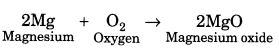
Materials Metals and Non Metals Class 8 Extra Questions and Answers Science Chapter 4.2

Question 12.
How do metals and non-metals react with water?
Answer:
Metals produce their hydroxides or oxides and hydrogen when they react with water. Sodium and potassium react with cold water along with the production of a large amount of heat. Magnesium react with boiling water and iron with steam. Gold, silver and platinum do not react with water. Non-metals do not react with water.

Question 13.
With the help of equations, explain the reaction of non-metals with oxygen.
Answer:
Non-metals react with oxygen to form acidic oxides. But most of the non-metals reacts with oxygen on ignition.
The equations follow as:
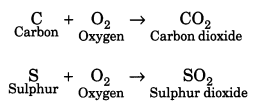
Materials Metals and Non Metals Class 8 Extra Questions and Answers Science Chapter 4.3

Question 14.
How do metals and non-metals react with acids?
Answer:
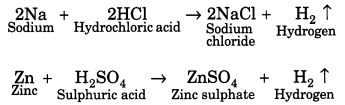
Metals react with acids to form respective salts along with evolution of hydrogen gas that burns with a pop sound. The equation are as follows:
Materials Metals and Non Metals Class 8 Extra Questions and Answers Science Chapter 4.4

There are some metals like copper, silver, gold and platinum that do not liberate hydrogen with acids. Generally, non-metals do not react with acids.

Question 15.
How do metals and non-metals react with bases?
Answer:
Most of the metals do not react with bases. However, some metals like aluminium, lead and zinc react with strong bases like sodium hydroxide (NaOH) to make complex salts and hydrogen.
Generally, non-metals do not react with bases. Sometimes some complex reactions take place between non-metals and bases.

Question 16.
What is a displacement reaction? Give one example.
Answer:
A chemical reaction in which a more reactive metal displaces a less reactive metal is called displacement , reaction. For example, when zinc (Zn) reacts with copper sulphate (CuSO2), zinc replaces copper being it more reactive than copper. The equation is

Materials Metals and Non Metals Class 8 Extra Questions and Answers Science Chapter 4.5

Materials: Metals and Non-Metals Class 8 Extra Questions Long Answer Type

Question 1.
Distinguish between metals and non-metals on the basis of their physical properties.
or
Compare the physical properties of metals and non-metals.
Answer:
Difference between metals and non-metals on the basis of their physical properties.

Physical PropertiesNon-metals 
1. MalleabilityMetals are malleable, i.e., they can be beaten into thin sheets. Exception: MercuryNon-metals are non- malleable. They are broken into pieces when hammered. Hence they are also called brittle.
2. SonorityMetals are sonorous, i.e., they pro­duce ringing sound when struck.Non-metals are non-sonorous.
3. DuctilityMetals are ductile, i.e., they can be drawn into wires.
Exception: Mercury
Non-metals are non-ductile.
4. LustreMetals are lustrous, i.e., they are shiny.Non-metals are non-lustrous, i.e., they are dull in appearance. Exception: Graphite and iodine.
5. Hardness or solidnessMetals are hard except sodium and potassium.Non-metals are soft except diamond.
6. ConductivityMetals are good conductor of heat and electricity.Non-metals are poor conductor of heat and electricity.
Exception: Graphite is a non-con­ductor of heat and electricity.
7. DensityMetals are of high density except lithium.Non-metals are of low density.
8. Melting and boiling points.Metals have high melting and boiling points.Non-metals have low melting and boiling points except graphite.

Question 2.
Distinguish between metals and non-metals on the basis of their chemical properties.
or
Compare between metals and non-metals on the basis of their chemical properties.
Answer:
Difference between metals and non-metals on the basis of their chemical properties.

Chemical PropertiesMetalsNon-metals
1. Reaction with oxygenMetals react with oxygen to form basic oxides which form bases when dissolve in water.Non-metals react with oxygen to form acidic oxides which form acids when dissolve in water.
2. Reaction with waterMetals react with water to form their oxides or hydroxides.Non-metals do not react with water.
3. Reaction with acids


Metals react with acids to produce respective salts along with evolution of hydrogen gas. Some metals like Cu, Ag, Au, etc., do not liberate hydrogen gas.Non-metals do not react with acids except sulphur which react with hot, concentrated acid.
4. Reaction with basesMost of the metals do not react with bases. However, some metals like Al, Pb, Zn react with strong bases like NaOH to form complex salts and hy­drogen gas.Generally, non-metals do not react with bases. Sometimes, some complex reactions take place between non­metals and bases.

Question 3.
Explain chemical properties of metals with examples.
Answer:
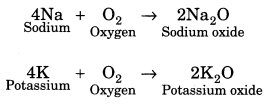
(i) Reaction with oxygen or air: Metals react with oxygen to form basic oxides.
Some metals like potassium and sodium react vigorously with oxygen. For example,
Materials Metals and Non Metals Class 8 Extra Questions and Answers Science Chapter 4.6
Some noble metals like gold, silver and platinum do not react with oxygen. Iron (Fe) and copper (Cu) get rusted when react in presence of oxygen and water (moist air).

(ii) Reaction with water: Metals react with water to form their oxides or hydroxides. Gold, silver and platinum do not react with water. Some metals like sodium, potassium react vigorously with water. For example,


Materials Metals and Non Metals Class 8 Extra Questions and Answers Science Chapter 4.7
Materials Metals and Non Metals Class 8 Extra Questions and Answers Science Chapter 4.8
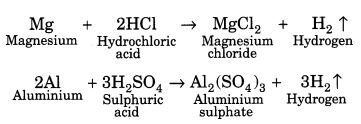
(iii) Reaction with acids: Metals react with acid to form their salts followed by evolution of hydrogen gas. For example,
Materials Metals and Non Metals Class 8 Extra Questions and Answers Science Chapter 4.9
Some metals like gold, copper, silver, etc., do not liberate hydrogen gas with acids.

(iv) Reaction with bases: Most of the metals do not react with bases. However some metals like aluminium, zinc and lead react with strong bases like sodium hydroxide to make complex salts and produce hydrogen.

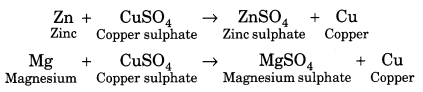
(v) Displacement reactions: More reactive metals displace less reactive metals. For example,
Materials Metals and Non Metals Class 8 Extra Questions and Answers Science Chapter 4.10
In the above reactions, zinc (Zn) and magnesium (Mg) are more reactive than copper (Cu), hence they replace copper from its solution.

Question 4.
Explain with suitable examples the chemical properties of non-metals.
Answer:
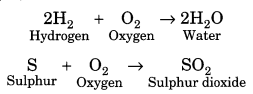
Reaction with oxygen: Non-metals react with oxygen to form acidic oxides. But most of them do this on ignition. For example,
Materials Metals and Non Metals Class 8 Extra Questions and Answers Science Chapter 4.11
They form negative ions and are good oxidising agents.
Reaction with water: Non-metals do not react with water.
Reaction with acids and bases: Generally, non-metals do not react with acids and bases. How¬ever, sometimes some complex reactions take place between non-metals and bases.

Question 5.
What are main uses of metals?
or
How are metals useful to us?
Answer:
Metals are very useful to us in many ways. For example,
(i) Due to their thermal and electrical conductivity, metals are use to make utensils, cooking vessels, wires and appliances. For example, copper and aluminium are mainly used for these purposes.

(ii) Metals like iron and steel are used in various tools, machinery, pipes, rods, sheets, doors, windows, construction works like bridges, roads, buildings, etc.

(iii) Aluminium is used as packaging and wrapping materials. It is also used in aircrafts and automobiles, etc.

(iv) Metals like gold, silver and platinum are used to make jewellery and other decorating items.

(v) Zinc is used in galvanisation and dry cell and chromium in electroplating.

(vi) Lead is used in making electrodes and batteries.

Question 6.
What are the main uses of non-metals?
or
How are non-metals useful to us?
Answer:
Like metals, non-metals also play an important role in our lives. They help us in many ways. For example,
(i) We breathe oxygen which is the basis of life of all living things including human beings. Without it, no living beings can exist alive on this earth.

(ii) CO2 which is a non-metal oxide is essential for plants to carry out photosynthesis.

(iii) Non-metals like nitrogen and phosphorus are used in fertilisers for better yield of plant. Phosphorus is used in manufacturing of matchsticks and fireworks.

(iv) Non-metal like iodine is used in the purple coloured solution applied on wounds. Sulphur is also used in preparing skin medicines and making ointment due to its fungicidal properties.

(v) Non-metal like chlorine is used in water purification process. Due to its bleaching properties it is used to make bleaching powder.

(vi) Carbon, a non-metal, is used in most of the fuels.

Question 7.
What is reactivity series? Suggest an activity to arrange sodium, magnesium and copper in the order of their decreasing reactivity.
Answer:
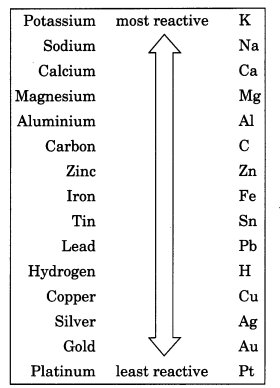
Reactivity series is an arrangement of metals in decreasing order of their reactivity from highest to lowest. The metals occupying the higher positions in the activity series are more reactive in displacing the other metals lying below it from the solutions of their salts.
Materials Metals and Non Metals Class 8 Extra Questions and Answers Science Chapter 4.12

The activity series is a useful guide for predicting the products of metal displacement reactions. For example, placing a strip of zinc metal in a copper (II) sulphate solution will produce metallic copper and zinc sulphate, since zinc is above copper on the series.

A trip of copper placed into a zinc sulphate solution will not produce an appreciable reaction, because copper is below zinc on the series and can’t displace zinc ions from solution.

Activity to arrange sodium, magnesium and copper in the order of their decreasing reactivity:
(i) Take a pinch of sodium with a forceps and place in a beaker containing water. You will notice that sodium reacts vigorously.

Materials Metals and Non Metals Class 8 Extra Questions and Answers Science Chapter 4.13
(ii) Take a small piece of magnesium ribbon and add warm water to it. Magnesium reacts with warm water to form magnesium oxide and hydrogen gas. Magnesium reacts very slowly with cold water.

Materials Metals and Non Metals Class 8 Extra Questions and Answers Science Chapter 4.14
(iii) Take small pieces of copper turnings and add warm water to it. It doesn’t react with warm water also.

Materials Metals and Non Metals Class 8 Extra Questions and Answers Science Chapter 4.15
Hence, increasing order of reactivity is Na > Mg> Cu.

Materials: Metals and Non-Metals Class 8 Extra Questions HOTS

Question 1.
Why does calcium float in water?
Answer:
The hydrogen gas formed on adding calcium to water sticks to the surface of calcium solid and make it float in water.

Question 2.
Zinc sulphate forms a colourless solution in water. Will you observe any colour on adding copper turning in it?
Answer:
No, because copper is less reactive than zinc and will not be able to displace zinc from its salt solution

Question 3.
A doctor prescribed a tablet to a patient suffering from iron deficiency. The tablet does not look like iron. Explain.
Answer:
The tablet is not made of iron metal, instead it contains a salt of iron.

Question 4.
Ram stored copper sulphate solution in a container made of iron. He observed certain changes after few hours. Can you tell what changes did he observed?
Answer:
Blue colour solution of copper sulphate has changed to green colour of ferrous sulphate. The iron container was found to be corroded from many places. A red powdery deposit of copper sulphate was found on the iron container.

Question 5.
Imagine that gold is reactive like copper. Will it be still wanted? Why or why not?
Answer:
If gold becomes reactive like copper then its use in ornaments will decline. This is because due to its increase reactivity it will lose its shine frequently which in turn will reduce its demand.

Materials: Metals and Non-Metals Class 8 Extra Questions Value Based (VBQs)

Question 1.
Gold is a very precious metal. Pure gold is very soft and is thus not suitable for making jewellery. It is alloyed with either silver or copper to make it hard. But some jewellers mix a large quantity of copper and silver in gold to earn more profit.

(a) What precautions should you take while purchasing gold jewellery?
(b) What standard you must see on gold ornaments?
(c) What value of shopkeeper’s are shown here?
Answer:
(a) We must see the carat of gold jewellery, current price and BIS hallmark on it.
(b) BIS hallmark.
(c) Some shopkeeper’s are greedy, mean, cheater and money minder.

Question 2.
Mercury is largely used in thermometers to measure the temperature. It is a very dangerous metal as its density is very high. If it get into the food chain, it leads to mercury poisoning.
(a) What two precautions you must take while handling equipments containing mercury?
(b) Why mercury is used in thermometers?
(c) Can you suggest other alternatives to mercury thermometers?
Answer:
(a)

  • We must handle the equipments carefully and firmly.
  • If there is a mercury spill, we must leave the area immediately and inform our parents or teachers.

(b) Mercury is a good conductor of heat. Hence, the slightest change in temperature i° otable when it is used in a thermometer.
(c) Digital thermometer and spirit thermometer.
Informal Letter Writing Topics for Class 6 Format, Samples

Informal Letter Writing Topics for Class 6Letter writing is an essential skill. Despite the prevalence of emails and text messages, everyone has to write letters at some point. Letters of complaint, job applications, thank you letters, letters requesting changes or – making suggestions – the list goes on and on. Encouraging children to write letters from an early age will improve their communication, social and handwriting skills, and teach them what they need to know about writing and structuring letters.
Children are expected to learn how to write letters, notes and messages. They have to be aware of different styles of writing, the use of formal and informal letters, and to select style and vocabulary appropriate to the intended reader.

This grammar section explains English Grammar in a clear and simple way. There are example sentences to show how the language is used. You can also visit the most accurate and elaborate NCERT Solutions for Class 6 English. Every question of the textbook has been answered here.

Informal Letter Writing Topics for Class 6 CBSE Format, Samples Pdf

There are two types of letter

Informal letters
These are letters to friends and relations, or people you know well.

  • Casual and light-hearted tone.
  • Lengthier than a formal letter.
  • Preferably I side of the page.

Structure:

  • The sender’s address should always appear on the top right-hand corner of the page.
  • Include telephone number and email if available
  • Greeting – There are several variations that can be used depending on how well you know the person: Dear Mary, Hi Mary, Greetings,
  • Complimentary close – short comment, for example, Love, Lots of love, With thanks, See you soon

Layout for an Informal letter

Sender’s address
Date
Dear ……….
  • You may have more than 2 paragraphs, Depending on who the recipient is you will you varying levels of informality.
  • It is generally accepted that in informal letters contracted forms can be used: can’t instead of can not: haven’t instead of have not etc.
  • You may also use a more colloquial language register – a chatty tone that you might use in speech/mild slang words.
  • Punctuation can be less formal: exclamation mark! used to signify shock or a joke; dashes – instead of commas; brackets used to separate additional ideas/references…!
Degree of intimacy with the recipient will determine the way you sign off: Best wishes/ kind regards / Yours truly / With love…

Informal Letter Writing Topics Solved Examples for Class 6 CBSE

Informal Letters (Personal)

Question 1.
Write a letter to your sister congratulating her on success in the examination
Answer:
Examination hall,
Ahmedabad
July 05, 20XX,

My Dear Sister,
I am very happy to know that you have passed the secondary school certificate (S.S.C) examination with credit. You got the first division in the examination. I congratulate you on your brilliant success. I am sending you the gift of a wrist watch. May you succeed in every sphere of life. With best wishes,

Yours affectionately
xyz

Question 2.
Write a letter to your mother about the test you have just taken.
Answer:
Examination hall,
Surat
January 03, 20XX,

My Dear Mother
How are you? By the grace of god, I am quite fine. I am sorry that I could not write you earlier. I was taking the second terms papers which ended yesterday. I did well in all the papers. I hope to get 90% marks. I also hope I will stand first in my class. It is possible if you pray for me.

Thank you.

Pay my regards to all at home.

Your loving
son
Raj

Question 3.
Write a letter to your father requesting him to send you some extra funds for payment of hostel dues.
Answer:
Examination hall,
Jaipur
March 11, 20XX,

My Dear Father,
I hope this letter of mine will find you in the best of your health. You will be happy to know that I stood first in my class getting 765 marks. I had to buy some helping books to my course and stationery. They have emptied my pocket. I have run short of money. I shall be grateful to you if you send me extra 1000 rupees for the payment of hostel dues. Pay my regards to all at home. Your loving son, Monish.

Question 4.
Write a letter to your friend thanking him for birthday present he sent for you.
Answer:
House no. 75
Bahubali enclave
Agra
April 14, 20XX

Dear Raghav,
I received your letter yesterday. I am glad to know that you are well. I have just received gift. Thank you very much for your birthday present. The wrist-watch you have sent is splendid. It is very kind of you to give me such a fine present. Hope you are well.

My best regards to your parents.

Yours ever
Hema

Question 5.
Write a letter to your father asking from money to pay the school fee and to buy new books.
Answer:
Flat no. 47
Laxmi nagar
New Delhi
April 14, 20XX

Dear Father,
I received your letter yesterday. I am glad to know that you are well. I need to buy some new books. I could pay my school fees for the last month. So I need rupees 1000. I shall be glad if you send me the said money. With best regards for you and mother.

Yours loving son
Sanjay

Question 6.
Write a letter to your friend inviting him to a picnic at city lake, Udaipur.
Answer:
209, Gandhi nagar
Udaipur
April 14, 20XX

Dear Rohit,
I received your letter yesterday. I am glad to know that you are well. You will be glad to hear that we are going to city lake on February 6 for a picnic. I invite you to join us. Our friends Jony and Rony also will go to city lake with us. City lake is a beautiful place. We shall boat in the Bay together. We shall eat, drink and enjoy together. I am waiting for you.

Yours loving son
Rohan

Question 7.
Write a letter to your friend telling him how you have spent the summer vacation.
Answer:
557, Vivek Vihar
New Delhi
April 14, 20XX

Dear Rajeev,
I have received your letter. You have wanted to know about the how, I have spent my last summer vacation. Now I am writing you about it. You know that education is the backbone of a nation. No nation can prosper without education. But it is a matter of sorrow that most of the people of our country are illiterate and ignorant. They do not know how to read and write.

They have no knowledge of health, family planning and scientific method of cultivation. So I and some of my friends have decided that we would remove illiteracy and ignorance from our village. Finally we implemented our plan and spent the whole vacation in teaching the illiterate villagers. It was an enlightening experience. Villagers thanked us with their kind gestures.

Yours ever
Sameer

Question 8.
Write a letter to your friend inviting him in a birthday party.
Answer:
78, Seema puri
New Delhi
April 14, 20XX

Dear Tanu,
You will be delighted to know that a birthday party has been arranged on the occasion of my 13th birthday at our residence at 6 pm. Only my cousins and a few friends will join the party. A mušical program has also been arranged. I shall be very glad if you take part in it with your camera. Please don’t forget to come. With best regards to you and your parents and younger.

Yours ever
Palak

Question 9.
Write a letter to your friend describing a picnic.
Answer:
486, Chanakya Puri
New Delhi
April 14, 20XX

Dear Renu,
Thank you for your letter. You wanted to know about the picnic that I enjoyed one week ago. Now I am giving you a short description about it. Only the students of our class and some teachers took part in it. We went to Lodhi garden. The place is very rich in natural scenery. We started our journey at 9 in the morning and reached there within an hour. We had a lot of fun there. We played games and ate plenty of food. We also enjoyed the scenery of nature. I personally enjoyed the bus journey to and from the spot. Really it was a very enjoyable and interesting picnic to me. I shall not forget this picnic. With best wishes and love.

Yours ever
Hema

Question 10.
Your father has sent a beautiful gift on your birthday from London. Write a letter to him expressing your feeling of love and admiration for him. You are Sushmita, living at D–7, Amar colony, Lajpat nagar, New Delhi.
Answer:
D-7, Amar Colony
Lajpat Nagar
New Delhi
15th May 20XX

Dear Father,
I received such a nice gift from you on my birthday. My joy knew no bounds. This book gives me a lot of knowledge of vocabulary. Although a good number of my friends and relatives attended the birthday party, yet I missed you all the time. My friends and relatives gifted me many things but your gift of a dictionary is unique in many aspects. This gift is a great source of joy for me. It will help me to cultivate the habit of reading good books. I shall preserve and treasure it throughout my life.

Yours lovingly
Sushmita

Question 11.
In about 100-125 words, write a letter to your friend congratulating him on his success in the examination.
Answer:
10, Prashant Vihar
New Delhi
2nd August 20XX

Dear Sumit,
Please accept my heartiest congratulations on your brilliant success at the Secondary School Examination Board. To secure a high first division is no mean achievement. Though degrees are not now so highly valued as in the past, even so your grand success commands respect. I am sure you will get into a good job in any line you choose. With regards,

Your friend
Prabhat.

Question 12.
In about 100–125 words, write a letter to your friend, inviting him to spend his holidays with you.
Answer:
41, Dwarka II
New Delhi
21st May 20XX

Dear Kailash,
I am very happy to get your nice letter after a long time. Everyone here had been waiting for news about you. Your college is going to close for Puja holidays. Father and I would like you to spend at least the first week of your holidays with us here. We will have a very nice time here.

Days and nights will not be too cold or too hot. We can play, study and walk together. We can enjoy life in full. We are sure you will be able to come. Mother sends you love. Everyone wishes you good luck at the examination. Please do come here.

With love,

Your friend
Suraj

Question 13.
Your friend has invited you to his birthday party. In about 100-125 words, write a letter to him thanking him for it.
Answer:
F-36, R.K. Puram I
New Delhi
2nd August 20XX

Dear Mona,
Thank you very much for kind invitation to your birthday party. My parents have given me consent to spend my day with you. So, wait for me about half-past ten. I will bring my flute and play for you in the garden. My camera will also be with me. You know I produced such wonderful tunes of my flute that charm all my listeners.

With love Your friend
Sima

Question 14.
Your uncle sent you a book for a birthday present. In about 100-125 words, write a letter to your uncle, thanking him for the gift.
Answer:
213, Sarvapriya Vihar
New Delhi
12th December 20XX

Dear Uncle,
Thank you ever so much for the book you have sent me. It was good of you to remember by birthday. You have sent me such an interesting book to read. I have often heard people talk about Kupfer’s Legends of Greece and Rome. I always liked to read it. Now I have it for my own. I feel very proud of it.

I am glad you did not send me an ordinary school – book, most of which are very dry. I began reading the book soon after I received the parcel. It was so exciting that I could not go bed until I finished it. I shall work hard at my English now so that I can read such books easily. Again thanking you for the nice present and the pleasure it has given me.

Your lovingly
Sneha.

Informal Letter Writing Topics Practice Examples for Class 6 CBSE

Informal Letters (Personal)

  • Write a letter to your friend inviting him/her to your birthday party
  • Write a letter to your friend thanking him/her for attending your birthday party
  • You are Sudeep living in school hostel at Surabhi Street, Yojna Nagar. Write a letter to your mother informing her about your performance in the recently held tests.
  • Write a letter to your brother thanking him for a birthday gift. You are living at 15/14, Malviya Nagar, New Delhi.
  • You are Shiv living at 18, Preet Vihar, Agra Cantt. Your uncle had an official holiday and invited you to show the Taj Mahal which you always wished to see. Write a letter to your friend telling him about your trip to this historical place.
  • Write a letter to your friend inviting him to spend Durga Pooja holidays with you.
  • On the basis of the picture given below, write a letter to your friend how you got an opportunity to witness a football match.
  • You visited a city hospital to see a sick friend. You were pained at the sight of the hospital ward that was ill – maintained. Write a letter to your friend expressing your feeling with the help of the visual here.

Types Of Sentences Exercises for Class 4 CBSE with Answers

Types Of Sentences Exercises for Class 4 CBSE with Answers

This grammar section explains English Grammar in a clear and simple way. There are example sentences to show how the language is used.

Types Of Sentences Exercises for Class 4 CBSE with Answers PDF

  • There are five types of sentences- Assertive or declarative. Negative, Interrogative, Imperative and Exclamatory.
  • The declarative or assertive sentence merely makes a statement. It ends with full stop(.).
  • The negative sentence expresses a negative statement, using not or never.
  • The interrogative sentence asks a question. It ends with question mark(?)
  • The imperative sentence expresses a command, order or request.
  • The exclamatory sentence expresses a sudden emotion. It ends with an exclamation mark.(!)

Presentation
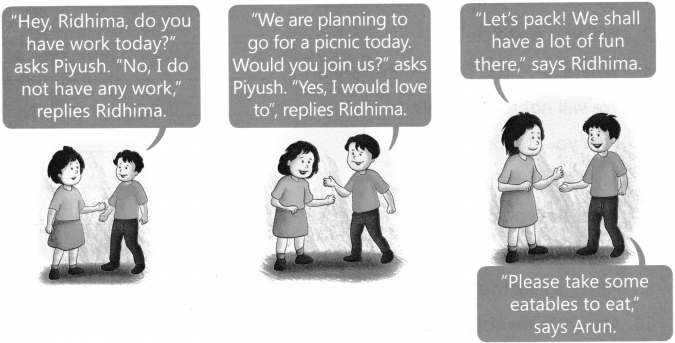
Read the picture story.
Types Of Sentences Exercises for Class 4 CBSE with Answers 1

A. Read the following sentences and state their kind.

1. Please leave your footwear outside. ____________
2. Will you wait here? ____________
3. Where have you been all this while? ____________
4. We will not tolerate this. ____________
5. I am your friend. ____________
6. My sister lives in Mexico. ____________
7. What did you do then? ____________
8. Please be more careful next time. ____________
9. Never speak to me like that again. ____________
10. Always remember what I told you. ____________

B. Punctuate the following sentences and write whether they are Declarative, Interrogative or Exclamatory.

1. Do you like chewing gum ____________
2. Drew dropped his book ____________
3. My teacher likes to read ____________
4. What is your address ____________
5. Who is your teacher ____________
6. What a beautiful day ____________
7. I love this book ____________
8. An island is surrounded by water ____________
9. You won ____________
10. Computers are a great way to learn ____________

C. Change the assertive sentences into exclamatory sentences.

1. It is a very nice bird.
Exclamatory: ____________

2. It was the most exciting match.
Exclamatory: ____________

3. They were the most wonderful examples.
Exclamatory: ____________

4. The rose is a very beautiful flower.
Exclamatory: ____________

5. Rohit is a clever boy.
Exclamatory : ____________

D. Do as directed

1. Make the sentence a question: There is a window. ____________
2. Make the sentence negative: You saw his sister. ____________
3. Make the sentence a question: There are tools. ____________
4. Make the sentence negative: I looked through the window. ____________
5. Make the sentence a question: There is change. ____________
6 . Make the sentence negative: I wanted to help. ____________

Sentences Exercises for Class 4 CBSE With Answers

Sentences Exercises for Class 4 CBSE With AnswersThis grammar section explains English Grammar in a clear and simple way. There are example sentences to show how the language is used.

Sentences Exercises for Class 4 CBSE With Answers PDF

  • A sentence is a group of words in correct order that makes sense.
  • Letters form words and words make the sentences.
  • A sentence always begins with a capital letter and mostly ends with a full stop.
  • A sentence always has two parts. They are called Naming part and Doing part.
  • Naming part tells us about people, places, animals and things which is also called Noun.
  • Doing part tells what a person, an animal or thing does which is also called Verb.
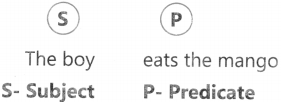
  • Naming part is called the subject of the sentence.
  • Doing part is called the predicate of the sentence.
  • The subject tells us who or what the sentence is about.
  • The rest of the sentence including verb is called Predicate.
    Example:
    Sentences Exercises for Class 4 CBSE With Answers
  • The subject and verb in a sentence must match even when the tense of the verb changes.
  • A singular subject must have singular verb.
    Example:
    I am a good student.
    Singular subject => singular verb
    In the above sentence, ‘I’ is a singular subject and ‘am’ is a singular verb.
  • A plural subject must have plural verb. Plural subject = > plural verbs
    Example:
    We are good students.
    In the above sentence, ‘we’ is a plural subject and ‘are’ is a plural verb.
  • The simple subject of a sentence, is the main word in the complete subject. It is always a noun or a pronoun.
    Example:
    Most birds can fly.
    Here ‘birds’ acts as a simple subject
  • The simple predicate is the complete verb with in the complete predicate.
    Example:
    Most birds can fly.
    Here, ‘fly’ acts as a simple predicate.

Sentences Exercises for Class 4 with Answers CBSE PDF

A. Add a subject in each sentence.
Example:

  • ____________ went to school.
    Answer:
    The students went to school.

1. ____________ walked to the assembly.
2. ____________ plays on the swings.
3. ____________ eats cereal in the morning.
4. ____________ sang happy birthday!

B. Add a predicate in each sentence.
Example:

  • The children at the park ____________
    Answer:
    The children at the park kicked the ball.

1. The student ____________
2. The soccer player ____________
3. My mother ____________
4. My friend ____________

C. Underline the complete subject of each sentence. Write the simple subject on the line provided.

1. My class went on a field trip to a play ____________
2. My aunt Sarah rode the bus to visit us ____________
3. The library books are due on Friday ____________
4. Can you tell me your name? ____________
5. The yellow, gold and brown leaves are falling from the trees ____________
6. The principal’s brown and white dog lets us read books to it ____________

D. Underline the complete predicate of each sentence. Write the simple predicate on the line provided.

1. The red cup belongs to my friend Mary ____________
2. Jessica tore the wrapping paper into tiny pieces ____________
3. The swimming pool at John’s house flooded last year. ____________
4. The clouds floated peacefully across the blue sky ____________
5. Do you see that red and yellow butterfly? ____________
6. Our team won the game by six points! ____________

Notice Writing Class 6 Format, Examples, Topics, Exercises

Notice Writing Class 6

A notice is a formal means of communication. The purpose of a notice is to announce or display information to a particular group of people. Notices are generally meant to be put up on specific display boards, whether in schools or in public places. Notices issued by the government appear in newspapers.

This grammar section explains English Grammar in a clear and simple way. There are example sentences to show how the language is used. You can also visit the most accurate and elaborate NCERT Solutions for Class 6 English. Every question of the textbook has been answered here.

Notice Writing Class 6 Format, Examples, Topics, Exercises

Format:
A notice should be written in the following format:

  1. Name of the issuing agency (school, etc)
  2. Subject and date of issue/release of the notice
  3. Event (what?)
  4. Date/time/duration (when?)
  5. Place/Venue (where?)
  6. Authorised signatory: Name and Signature
  7. Format:
    • Name of the Institution
    • Date
    • NOTICE
    • Body
    • Authorised Signatory

Name of organization/office issuing the notice

Date

Notice
Heading
Body of letter

Signature
Name
Designation

Points to Remember:

  • A well-written notice must inform the readers about the 5 Ws:
    • What is going to happen, (that is, the event)
    • Where it will take place
    • When it will take place (that is, the date and time)
    • Who can apply or is eligible for it
    • Whom to contact or apply to (that is, the issuing authority)
  • Only the most important points should be written.
  • One is free to add any relevant information not included in the question.
  • The sentences should be short and grammatically accurate.
  • They should be in the passive voice as far as possible.
  • The notice should be presented within a box.
  • The word limit for notice is 40-50 words (only the words in the body of the notice are counted).
  • Information given in a notice must be clear and should not cause any misunderstanding Or confusion.
  • A notice must be catchy and appealing – it should attract the reader’s attention at once.
  • Increase the visual appeal of your notice by using bold letters, catchy slogans, striking words, and phrases, etc.
  • Standard abbreviations are allowed.

Notice Writing Solved Examples for Class 6 CBSE

Question 1.
You are Raman Malik, the head boy of R.K. Inter College Shamli. Your school is organizing a tour to Sikkim. Write out a notice inviting students who want to join the tour. Put the notice in the box.
Answer:

R. K. Inter College, Shamli
Notice

7th July 20XX

Tour to Sikkim

All the students will be pleased to know that our school is organizing a five-day tour of Sikkim, as per details given below:

Classes – VI to IX
Date of departure – 22nd July 20XX
Date of arrival – 26th July 20XX

Those who are interested may deposit 3000 per head. The cost is inclusive of sightseeing, boarding and lodging at a 3-star hotel. Please do so by 12th July.

Raman Malik
Head Boy

Question 2.
You are Kiran, school captain of Oxford High School, Bahadurgarh. Write a notice informing the students about a Poem recitation competition to be held on 25th September.
Answer:

Oxford High School, Bahadurgarh
Notice

5th September 20XX

Poem Recitation Competition

All the students are hereby informed that a poem recitation competition will be held on 25th September 20XX in the school hall. Those who want to participate may submit their names to me by 18th September. For further information contact the undersigned.

Kiran School
Captain

Question 3.
You are Rajeev Kumar, the Cultural secretary of Laxman public school, Bhilai. Write a notice on behalf of your school inviting all grandparents of the students of your school to celebrate World Elders’ day.
Answer:

Laxman Public School, Bhilai
Notice

30th October 20XX .

Grandparent’s Day

All the students are hereby informed that our school is celebrating World Elders’ Day on 17th November. All students are requested to bring their gråndparents on that day at 5 pm in the school hall.

Rajeev Kumar
Cultural Secretary

Question 4.
You are Shyam Verma of class VI of Bal Bharti Public School, Dehradun. You have lost your library book which was issued to you, in the playground. Draft a notice for the school notice board, informing the student about it.
Answer:

Bal Bharti Public School, Dehradun
Notice

17th February 20XX

Lost! Lost! Lost!

All the students are hereby informed that I have lost my NCERT Math book issued from school library. It bears library stamp and has a blue cover on it. If found, please return to the undersigned.

Shyam Verma
VIII A

Question 5.
You are the Head Boy of the students council of St. Francis Sr. Secondary School, Agra. You have invited a visiting Russian Ballet Troupe to give a performance in your school on the occasion of its golden jubilee celebrations. Write a notice, informing the students about this event. Sign yourself as Rohit Gupta.
Answer:

St. Francis Sr. Secondary School, Agra.
Notice

30th August, 20XX

Russian Ballet Dance

All the students are hereby informed that a Russian Ballet Troupe will give a dance performance on the occasion of school’s Golden Jubilee celebrations on 10th September, 20XX at 4:00 pm in the assembly hall. The famous actor/dancer Mrs Hema Malini will be the Chief Guest for the evening. For more details contact the undersigned.

Rohit Gupta
(Head Boy Students’ Council)

Question 6.
Vaibhav Raj the Vice head boy of Bal Bharti Public School, Dehradun. Your school is organizing an interclass drawing and painting competition for classes V to VII. Draft a notice, words inviting students to participate.
Answer:

Bal Bharti Public School, Dehradun
Notice

5th July 20XX

Drawing and Painting Competition

This is to inform all the student of classes V to VII about the drawing and painting competition to be held in the school.

Date :15 July 20XX
Time : 10.00 to 12.00
Venue : Art Room
Prize : First – 52000, Second – 1500, Third – 1100

A certificate will be awarded to all participants. The drawing sheet will be provided by the school. Bring your own colour box, Pencil etc. For further details contact the undersigned.

Vaibhav Raj,
Vice Head Boy

Question 7.
You are Saroj Sharma of Kehar Singh Memorial Public School. Write a notice appealing students of your school to generously donate in cash and kind for the poor children of an orphanage.
Answer:

Kehar Singh Memorial Public school
Notice

20th January, 20XX

Help Make Someone Smile! Donate for a Noble Cause!

This is a humble request to all the student of the school to donate clothes, cash, toys, stationary, books and other utility items for the poor children of ‘Masoom Bharat’. The donation will be collected till 24th January, 20xx in the school auditorium. For further detail contact to the undersigned.

Saroj Sharma
Head Girl

Question 8.
You are the Secretary of cultural club of your school. The school is celebrating its Annual and Cultural day on the 25th of March. Draft a notice to be put on the notice board of your school informing the badge holders and house captains of a meeting you are conducting to take decision on some important matters pertaining to the success of the programme. The notice should not exceed 40 words.
Answer:

XYX Senior Sec. School, Delhi
Notice

5th Feb, 20XX

Annual Cultural Day

The School is celebrating its ‘Annual Cultural Day on 15th February. A meeting of badge holders and house captains will behold tomorrow at 2:15 pm. After school, hours to take decisions on some important matters regarding the conduct of the program and make it a grand success.

Secretary
Cultural Club

Question 9.
You are the student editor of Gandhi Memorial School, Delhi. Write out a notice in not more than 50 words inviting names of those who would like to give articles, stories, cartoons etc.
Answer:

Gandhi Memorial School, Delhi
Notice

5th April, 20XX

Inviting Articles for School Magazine

Abhivyakti (School magazine) is going to be published very soon. The student writers are advised to submit their own literary works – articles, stories, cartoons, poems, etc. – to the undersigned on or before 15th April, 20XX or contact Principal.

Shanti Mittal
Student Editor

Question 10.
You are Geetanjali Ahuja, the Head Girl of Blossoms Public School, Gurugram. Write a notice in about 50 words informing the students of classes. IX and X about an inter-class debate competition to be held in the school in the first week of April. Give the necessary details.
Answer:

Blossoms Public School, Gurugram
Notice

8th December, 20XX

Inter-Class Debate Competition

All the students of class IX and X are informed that our school will hold an ‘Inter-class Debate competition in the first week of December. The topics for debate are “Science – a bane or boon” and “coeducation”. Interested students are requested to contact our history teacher, Miss Sonam before 15th December. There will be attractive Prizes.’

Geetanjali Ahuja
The Head Girl

Notice Writing Practice Examples for Class 6 CBSE

1. As a secretary of adventure club of a progressive school, Sonipat. Write a notice for your school notice board informing about the educational tour to Rajasthan for students of IX to XII std.

2. Your school is going to celebrate Sports Day in the school premises. As a sports captain write a notice inviting names of interested students for various games. Mention dates of a selection of students. You are Rohit.

3. You are Sarika Gupta, Librarian of Tagore Public School, Raipur. Draft a notice for students and staff to return the library book before the session ending examination beginning next week.

4. You are Rohan, in charge of admission in SD Public School, New Delhi. Draft a notice about registration for admission to classes Ist to IXth for the school’s notice board.

5. As a Head Boy/ Girl draft a notice for your school notice board about an inter-house poetry recitation competition to be held in school. You are Parag/ Priyanka.