Changes Around Us Class 6 Extra Questions and Answers Science Chapter 6

In this page, we are providing Changes Around Us Class 6 Extra Questions and Answers Science Chapter 6 pdf download. NCERT Extra Questions for Class 6 Science Chapter 6 Changes Around Us with Answers will help to score more marks in your CBSE Board Exams.

Class 6 Science Chapter 6 Extra Questions and Answers Changes Around Us

Extra Questions for Class 6 Science Chapter 6 Changes Around Us with Answers Solutions

Changes Around Us Class 6 Extra Questions Very Short Answer Type

Question 1.
Give two examples of irreversible changes:
Answer:
(a) Milk to cheese
(b) Cooking of food.

Question 2.
Give two examples of slow changes:
Answer:
(i) Growing of plants
(ii) Ripening of fruits

Question 3.
Can you change the shape of a eraser after erasing?
Answer:
Yes

Question 4.
Give one example of change in size.
Answer:
Stretching of a spring.

Question 5.
What changes the direction of a body?
Answer:
Force

Question 6.
Are all changes reversible?
Answer:
No

Question 7.
What kind of change is breaking of wood-reversible or irreversible?
Answer:
Irreversible

Question 8.
Give an example of reversible change.
Answer:
Melting is an example of reversible change.

Question 9.
Growing of nails is an example of which type of change?
Answer:
Slow change

Question 10.
Name the process in which solid directly changes into vapour.
Answer:
Sublimation.

Question 11.
Water turns into which state when it becomes ice?
Answer:
Solid state

Question 12.
Give an example of natural change.
Answer:
Growth of a baby.

Question 13.
Rusting of an iron is which type of change?
Answer:
Irreversible change

Question 14.
When ice changes into water, which type of change occurs in it?
Answer:
Change of state

Question 15.
Give an example of physical change.
Answer:
Cooling of molten wax.

Question 16.
Give an example of chemical change.
Answer:
Burning of wax.

Changes Around Us Class 6 Extra Questions Short Answer Type

Question 1.
What is change?
Answer:
An alteration in the physical or chemical properties of a matter due to effect of some kind of energy is called change.

Question 2.
What are the different forms of changes noticed?
Answer:
The various type of changes noticed are:

  1. Change in shape
  2. Change in size
  3. Change in colour
  4. Change in state
  5. Change in direction

Question 3.
Define reversible change.
Answer:
The changes in which it is possible to get back to the original product again is called reversible change.

Question 4.
State the list of changes caused due to heating.
Answer:
The changes caused due to heating are:

  • Expansion
  • Change in state
  • Combustion

Question 5.
What is chemical change?
Answer:
The result which leads to the formation of new substance is called chemical change.

Question 6.
What do you mean by combustion?
Answer:
The property of a substance by which substance start burning on heating is called combustion.

Question 7.
Define evaporation.
Answer:
The process of conversion of liquids into its vapour state by heating is called evaporation.

Question 8.
What do you mean by expansion?
Answer:
Solids, liquids and gases occupy more space when they are heated. This is called expansion.

Question 9.
Define fast changes with two examples.
Answer:
The type of change which takes short time to complete is known as fast change. e.g.,
(i) Burning of forest.
(ii) Striking of a matchstick.

Question 10.
List the characteristics of physical change.
Answer:
Following are the characteristics of physical change:

  1. No new substances are formed.
  2. Properties of a substance doesn’t change.
  3. These changes are reversible.

Question 11.
List the characteristics of chemical change.
Answer:
Following are the characteristics of chemical change:

  1. Properties of products are different from reactants.
  2. Most of the chemical changes are irreversible.
  3. Loss or gain of energy occurs in a chemical change.

Question 12.
Define melting.
Answer:
The process by which solid substances melt and turn into liquid is known as melting.

Question 13.
Define contraction.
Answer:
It is the phenomenon in which a substance shrinks or changes its shape.

Question 14.
Why the stretching of a rubber band is reversible change?
Answer:
The stretching of a rubber band is a reversible change because after we leave the rubber, it gets back to its original position automatically.

Question 15.
Why the burning of paper is an irreversible change?
Answer:
Burning of paper is an irreversible change because after burning, the paper, it is not possible to get back the same paper which was burnt.

Changes Around Us Class 6 Extra Questions Long Answer Type

Question 1.
Distinguish between reversible and irreversible changes.
Answer:

Reversible changeIrreversible change
1. The type of change in which we can get the original substance back is known as reversible change.1. The type of change in which it is impossible to get back the original substance is known as irrevers­ible change.
2. A reversible change is a temporary change.2. An irreversible change is a permanent change.
3. Melting and folding are the examples of reversible changes.3. Burning and cooking of food are examples of irreversible changes.

Question 2.
Define physical and chemical changes. Give examples.
Answer:
(i) Physical change: Physical change is a temporary change in which chemical composition of the substance does not change and no new substance is formed. During a physical change, only the physical properties of a substance change. It is reversible change.

For example, the water changes from solid form to liquid form. It can be solidified again. The properties of water remains same in both the cases.

(ii) Chemical change: A chemical change is a permanent change in which not only the physical properties but chemical properties also changes. It is an irreversible change. For example formation of curd from milk, rusting of iron, etc.

Question 3.
Most physical changes are reversible. Give reasons with two examples.
Answer:
(i) Melting of ice: During this change, the water changes from its solid form to liquid form. It can be solidified again. The properties of water remains same in both cases hence it is a reversible change.
(ii) Glowing of an electric bulb: During this change, electricity is passed through the tungsten filament returns to its original shape and condition, hence totally reversible.

Question 4.
How does curd being set? Is this change reversible?
Answer:
A small quantity of curd is added to warm milk. The milk is stirred and is set aside undisturbed for a few hours at a warm place. In a few hours the milk changes into curd. Taste and texture of curd is different from milk. Curd formed from milk cannot be changed into milk again. So this is an irreversible change.

Question 5.
Give some examples from daily life where expansion of metal by heating is used. Explain.
Answer:
Fixing of a metal rim on wooden wheel and fixing of wooden handles in iron blade in agricultural tools are such examples.

The iron blade of these tools has a ring in which the wooden handle is fixed. Normally the ring is slightly smaller in size than the wooden handle. To fix the handle, the ring is heated and it becomes slightly larger in size (expands). Now, the handle easily fits into the ring. When the ring cools down, it contracts and fits tightly on to the handle.

Question 6.
Explain why the burning of paper is said to be an irreversible change whereas the boiling of water is known as reversible change.
Answer:
If we burn a piece of paper, it changes into ash and smoke. Now, we cannot combine the ash and smoke to form the original piece of paper. So, the burning of paper, is a change which cannot be, reversed. Hence the burning of paper is an irreversible change.

When we boil water by heating then it changes into steam. Now, if we cools the steam, then water is formed again. So changing of water into steam has been reversed by cooling. Thus, the boiling of water is reversible change.

Question 7.
When is a change said to have taken place in a material? Explain with an example.
Answer:
We have many things around us. All these things have certain properties such as state (liquid, solid, gas), position, shape, size, colour, temperature, composition, and structure, etc. When one or more properties of a thing become different, we say that it has changed or a change has taken place, changes involve different kind of alterations in the things around us.

When a change takes place, there may be a change in the state, position, colour, temperature, composition or structure of the material of the object. When an ice melts, it forms water. Ice is a solid whereas water is a liquid. So, the melting of ice involves a change in state (from solid to liquid state).

Question 8.
What is the difference between following changes:
(a) Rolling a roti from dough.
(b) Baking of a roti.
Answer:
(a) We can convert this rolled roti back into the ball of dough. This means that the rolling of roti out of dough is a change which can be reversed and also it is a physical change. So, the rolling out of dough is a reversible and physical change.

(b) Baked roti cannot be changed back into the original ball of dough. So, the baking of a roti is an example of change which cannot be reversed and also it is a chemical change. Thus it is an irreversible and chemical change.

Changes Around Us Class 6 Extra Questions HOTS

Question 1.
Categorise the following changes as reversible or irreversible also as chemical or physical changes.
Burning of candle, rusting of iron, fitting metal rim on cart, setting of POP, cutting of wood, boiling of water, cutting of fabrics, washing rice.
Answer:

Reversible changeIrreversible change
Fitting of metal rim on cart, boiling of water, washing rice.Burning of candle, rusting of iron, setting of POP, cutting of wood, cutting of fabrics.
Physical changeChemical change
Fitting metal rim on cart, cutting of wood, boiling of water, cutting of fabrics, washing rice.Burning of candle, rusting of iron, setting of POP.

Question 2.
Do you find any similarities in above question?
Answer:
Yes, from above answer we can conclude that most of the reversible changes are physical in nature and most of the irreversible changes are chemical in nature.

Question 3.z
List some changes around you which you think are desirable and undesirable to you.
Answer:
(i) Desirable changes: Ripening of fruits, cooking of food, growing of a baby, nice smell of incense stick on burning it.

(ii) Undesirable changes: Rusting of iron, falling of leaves, undesirable smell of rotting vegetables, smell of burning coal.

Changes Around Us Class 6 Extra Questions Value Based Question (VBQs)

Question 1.
Sarita, when entered her house, got a pleasant smell of incense stick burnt by her mother during puja. She went near to the place where incense stick was burning and observed that, the paper kept below it was burned from many places. She immediately suggest her mother to keep the burning incense stick on some metal plate onwards.
(a) What kind of change is burning of incense stick?
(b) Why the paper get burn?
(c) What values of Sarita are shown here?
Answer:
(a) Burning of incense stick is chemical and irreversible change.
(b) The paper got burned due to the falling of hot ashes of incense stick on it.
(c) Sarita is an intelligent, concerned, sensible and having future sight.

Question 2.
There was some construction work in Rahul’s house in the rainy season. A truck filled with cement bags came and labours started unloading the bags on a waterlogged road. Rahul when saw this, immediately stopped the labours and asked them to keep the bags inside the house in a dry place.
(a) What is a chemical change?
(b) What would have happened to the cement bags if kept in waterlogged roads?
(c) What values of Rahul is shown here?
Answer:
(a) A change in which the properties of a substance is changed with evolution or absorption of heat is called a chemical change.
(b) If the cement bags have been kept in waterlogged roads then the cement would have reacted with water to form a substance with other property and evolution of heat. Thus, the cement would have got wasted.
(c) Rahul is an intelligent, having scientific aptitude and economical thinker.

Coal and Petroleum Class 8 Extra Questions and Answers Science Chapter 5

In this page, we are providing Coal and Petroleum Class 8 Extra Questions and Answers Science Chapter 5 pdf download. NCERT Extra Questions for Class 8 Science Chapter 5 Coal and Petroleum will help to score more marks in your CBSE Board Exams.

Class 8 Science Chapter 5 Extra Questions and Answers Coal and Petroleum

Extra Questions for Class 8 Science Chapter 5 Coal and Petroleum with Answers Solutions

Coal and Petroleum Class 8 Extra Questions Very Short Answer Type

Question 1.
Name some renewable sources of energy.
Answer:
Water, wind, solar.

Question 2.
Give some examples of fossil fuels.
Answer:
Coal, petroleum, natural gas.

Question 3.
Name the elements present in coal.
Answer:
Carbon, oxygen and sulphur.

Question 4.
Which are the two main techniques of mining?
Answer:
Surface mining and underground mining.

Question 5.
List four varieties of coal.
Answer:
Peat, lignite, bituminous, anthracite.

Question 6.
Name the process of conversion of wood into coal.
Answer:
Carbonisation

Question 7.
Mention the temperature at which destructive distillation is done.
Answer:
1000°C

Question 8.
When the crude oil is referred to be ‘sweet’?
Answer:
If the sulphur content is low.

Question 9.
Name the process of conversion of kerogen into gaseous hydrocarbons.
Answer:
Catagenesis

Question 10.
Name the country which is the leading producer of petroleum.
Answer:
Saudi Arabia

Question 11.
Name the gas that occurs over petroleum in reservoirs deep inside the earth.
Answer:
Natural gas

Question 12.
Expand PCRA.
Answer:
Petroleum Conservation Research Association.

Question 13.
Name two fractions of petroleum which are used as fuel.
Answer:
Petrol and diesel

Question 14.
What kind of pollution is caused by the burning of fossil fuels?
Answer:
Air pollution

Question 15.
Write the full form of LPG.
Answer:
Liquefied Petroleum Gas.

Question 16.
Which gas is produced when coal is burnt in air?
Answer:
Carbon dioxide

Question 17.
Can we use all our natural resources forever?
Answer:
No

Question 18.
What is the purest form of carbon?
Answer:
Coke

Question 19.
Where and when was the first oil well drilled?
Answer:
Pennsylvania, USA in 1859.

Question 20.
Name the places where natural gas is found in our country.
Answer:
Tripura, Rajasthan, Krishna Godavari Delta, Maharashtra, etc.

Coal and Petroleum Class 8 Extra Questions Short Answer Type

Question 1.
What is fuel?
Answer:
Anything that burns to produce energy in an efficient manner is called a fuel.

Question 2.
Define fossil fuels. Give examples.
Answer:
Natural fuels that are made up by burial of living organisms under deep down the earth for over a long period of time, are called fossil fuels. For example, coal, petroleum, natural gas.

Question 3.
What is coal? Write its two uses.
Answer:
Coal is a hard, black combustible substance that mainly contains carbon.
Uses:

  • It is used as a fuel in homes and industry.
  • It is used as a fuel at Thermal Power Plants for generating electricity.

Question 4.
Give a brief description about peat.
Answer:
Peat is the most inferior and softest form of coal. Its carbon content is very low. It has a large amount of moisture and is not much suitable to be used as fuel. Its carbon content is 20 – 25%.

Question 5.
Name three constituents of petroleum and write their uses also.
Answer:
The three constituents of petroleum are:
(a) petrol
(b) paraffin wax
(c) diesel
Uses:
(a) Petrol: It is used as a motor fuel and for dry cleaning.
(b) Paraffin wax: It is used for making ointments, candles, vaseline, etc.
(c) Diesel: It is used as a fuel for heavy motor vehicles and electric generators.

Question 6.
Explain about coal tar.
Answer:
It is produced when the gases are evolved due to heating of coal in water. It is a black-coloured, thick, viscous liquid. It has a pungent smell. It is itself a mixture of many compounds. We can get benzene, toluene, napthalene, phenol, etc., from coal tar.

Question 7.
Name two products that you obtain from the destructive distillation of coal. What is the residue left in’ this process? Give one main use of this residue.
Answer:
The two important products obtained from the destructive distillation of coal are: Coal gas and coal tar. The residue left in this process is coke. Coke is used mainly as a reducing agent in the extraction of metals.

Question 8.
Where do we get coal and how is it formed?
Answer:
We get coal deep in the earth’s crust in coal mines. It is formed by the slow decomposition of dead trees and other vegetable matter buried deep under the earth’s crust under high pressure and temperature.

Question 9.
Define the term ‘petrochemicals’.
Answer:
Petrochemicals are the substances obtained from petroleum and natural gas. They are used in the manufacture of detergents, fibres, polythene, etc.

Question 10.
What is CNG? What are its uses?
Answer:
CNG is short form of Compressed Natural Gas. Natural gas is stored under high pressure as CNG. CNG is used for power generation. It is now being used as a fuel for transport vehicles because it is less polluting. It is a cleaner fuel.

Coal and Petroleum Class 8 Extra Questions Long Answer Type

Question 1.
Explain about the varieties of coal.
Answer:
Depending upon the amount of carbon content, coal may be of four types:

  • Peat: This is the most inferior and softest form of coal. Its carbon content is very low. It has a large amount of moisture and is not much suitable to be used as fuel.
  • Lignite: Lignite is comparatively harder than peat, but still is very soft. Its carbon content is more than that of peat.
  • Bituminous: Its carbon content is higher, as it is free from moisture and other impurities.
  • Anthracite: This is the highest grade coal. This is also known as hard coal. It has maximum amount of carbon. It produces a very little smoke.

Question 2.
The burning of fossil fuels causes air pollution. Explain.
Answer:
The burning of fossil fuels causes a lot of air pollution.

The burning of coal produces gases like carbon dioxide, carbon monoxide, sulphur dioxide, etc., which can lead to undesirable changes in climate due to increase greenhouse effect.

The major air pollutants produced by the burning of petrol in automobiles are carbon monoxide, sulphur dioxide, unbumt hydrocarbons, etc. These pollutants are harmful for human beings and living organisms which causes breathing problems and skin diseases.

Question 3.
Write a short note on petroleum.
Answer:
Petroleum is the liquid form of fuel. It is also known as crude oil and found trapped between the layers of impervious rocks under the ground. It is a natural resource, which formed by the dead plants and animals in the sea. It is a dark coloured viscous liquid and like all other oils, it is lighter than water. It is a mixture of different hydrocarbons. It undergoes fractional distillation to yield petrol, kerosene, diesel and other chemicals used in manufacture of plastics.

Question 4.
How is the energy useful to us? Explain.
Answer:
We need energy in almost every field of our life. Without energy our life is impossible.
Some of the uses of energy are:

  • We need energy of fuels to generate electricity and to run vehicles.
  • We need energy to run our electrical appliances like refrigerator, TV, radio, computer, etc.
  • We need energy at construction sites to construct houses, buildings, etc.
  • We need energy to cook our food and other domestic use.
  • We need energy (petrochemicals) for manufacturing fibres, plastics, paints, cosmetics, etc.
  • All the factories, industries, agricultural devices depend on power supply to run the machines.

Question 5.
List the steps to conserve the resources.
Answer:
As we know, we all are dependent on the resources. But we should keep in mind that resources are limited in nature. If we misuse it, our future generation will have no resources. This is an alarming situation.
We can take following steps:

  • We shbuld cook our food on low flame.
  • Devices that consume less energy like CFLs and LED lights should be preferred.
  • We should take care not to waste electricity.
  • We should cover our cooking vessels while cooking.
  • Instead of use of individual vehicles, use of public transport should be encouraged.
  • Solar or tidal energy should be developed and encouraged.
  • Dams should be use to generate electricity instead of burning coal or petroleum.
  • Public awareness programmes should be conducted.

Coal and Petroleum Class 8 Extra Questions HOTS

Question 1.
You are provided with a mixture of petroleum and water. How will you separate the two?
Answer:
Allow to stand the mixture of petroleum and water undisturbed for some time. The top layer will be consisted of petroleum which can be separated from water by decantation.

Question 2.
Differentiate between coke and coal.
Answer:

CokeCoal
(i) It is an amorphous form of carbon.(i) It is a non-crystalline form of carbon.
(ii) It is obtained by heating soft coal in absence or limited supply of air.(ii) It is obtained by the decay of vegetation which existed millions of years ago.

Question 3.
None of the fuels is clean fuel. Comment.
Answer:
On burning, every fuel releases atleast CO2 which causes greenhouse effect. Thus none of the fuels are clean.

Question 4.
Can forests help reduce the pollution caused by burning of fossil fuels? How?
Answer:
Not all, but yes it reduces some of the pollution like carbon dioxide emitted during burning of fossil fuels.

Question 5.
What other source of energy may be used to drive vehicles?
Answer:
Biodiesel, ethanol, solar energy.

Coal and Petroleum Class 8 Extra Questions Value Based (VBQs)

Question 1.
Radhey prefers to go to school by pooling car. On other occasions he like to opt for public transport rather than private transport. For short distances, he walks or uses bicycle.
(a) What are the benefits of carpooling?
(b) Which mean of transport do you think is best for short distances?
(c) How on our end we can reduce the consumption of fossil fuels?
(d) What values of Radhey are shown here?
Answer:
(a)

  • Cost effective
  • Reduces pollution
  • Reduces traffic on roads
  • Saves fossil fuels

(b) Bicycle
(c)

  • By reducing use of plastics as these are products of fossil fuels.
  • By consuming electrical energy judiciously as most of the electricity comes from burning coal.
  • By carpooling. As car uses petrol or diesel a form of fossil fuel.
  • Switching engine off at red lights.

(d) Radhey is eco-friendly, environmentally conscious and works judiciously.

Question 2.
There was an essay-writing competition on ‘How to Reduce your Carbon Footprint’ in Satish’s school. Satish enquired his best on this topic to his elders and searched internet. He got the first prize in the competition.
(a) What do you understand by the term ‘Carbon Footprint’?
(b) Suggest ways to reduce your carbon footprint.
(c) What values of Satish are shown here?
Answer:
(a) The total amount of greenhouse gases produced by an individual, organisation or event is known as ‘Carbon Footprint’.
(b)

  • Follow 3R’s, i.e., – reduce, reuse and recycle.
  • Use public transport and carpool.
  • Avoid traffic.
  • Plant trees.
  • Use energy efficient appliances.

(c) Satish is inquisitive, intelligent, hard working and sincere boy.

Number Systems Class 9 Extra Questions Maths Chapter 1 with Solutions Answers

Here we are providing Number Systems Class 9 Extra Questions Maths Chapter 1 with Answers Solutions, Extra Questions for Class 9 Maths was designed by subject expert teachers.

Extra Questions for Class 9 Maths Number Systems with Answers Solutions

Extra Questions for Class 9 Maths Chapter 1 Number Systems with Solutions Answers

Number Systems Class 9 Extra Questions Very Short Answer Type

Question 1.
Simplify: (√5 + √2)2.
Solution:
Here, (√5 + √22 = (√52 + 2√5√2 + (√2)2
= 5 + 2√10 + 2 = 7 + 2√10

Question 2.
Find the value of √(3)-2.
Solution:
Number Systems Class 9 Extra Questions Maths Chapter 1 with Solutions Answers 1

Question 3.
Identify a rational number among the following numbers :
2 + √2, 2√2, 0 and π
Solution:
O is a rational number.

Question 4.
Express 1.8181… in the form \(\frac{p}{q}\) where p and q are integers and q ≠ 0.
Solution:
Let x =1.8181… …(i)
100x = 181.8181… …(ii) [multiplying eqn. (i) by 100]
99x = 180 [subtracting (i) from (ii)]
x = \(\frac{180}{99}\)
Hence, 1.8181… = \(\frac{180}{99}\) = \(\frac{20}{11}\)

Question 5.
Simplify : √45 – 3√20 + 4√5
Solution:
√45 – 3√20 + 4√5 = 3√5 – 6√5 + 4√5 = √5.

Question 6.
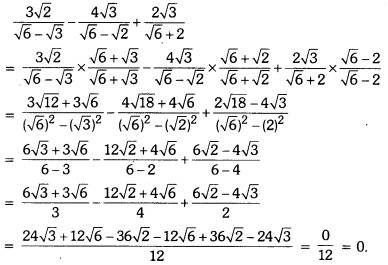
Find the value of’
Number Systems Class 9 Extra Questions Maths Chapter 1 with Solutions Answers 2
Solution:
Number Systems Class 9 Extra Questions Maths Chapter 1 with Solutions Answers 3

Question 7.
Find the value of
Number Systems Class 9 Extra Questions Maths Chapter 1 with Solutions Answers 4
Solution:
Number Systems Class 9 Extra Questions Maths Chapter 1 with Solutions Answers 5

Number Systems Class 9 Extra Questions Short Answer Type 1

Question 1.
Evaluate : (√5 + √22 + (√8 – √5)2
Solution:
(√5 + √2)2 + (√8 – √52 = 5 + 2 + 2√10 + 8 + 5 – 2√40
= 20 + 2√10 – 4√10 = 20 – 2√10

Question 2.
Express \(23 . \overline{43}\) in \(\frac{p}{q}\) form, where p, q are integers and q ≠ 0.
Solution:
Let x = \(23 . \overline{43}\)
or x = 23.4343…         ….(i)
100x = 2343.4343…    …(ii) [Multiplying eqn. (i) by 100]
99x = 2320 [Subtracting (i) from (ii)
⇒ x = \(\frac{2320}{99}\)
Hence, \(23 . \overline{43}\) = \(\frac{2320}{99}\)

Question 3.
Let ‘a’ be a non-zero rational number and ‘b’ be an irrational number. Is ‘ab’ necessarily an irrational ? Justify your answer with example.
Solution:
Yes, ‘ab’ is necessarily an irrational.
For example, let a = 2 (a rational number) and b = √2 (an irrational number)
If possible let ab = 2√2 is a rational number.
Now, \(\frac{ab}{a}\) = \(\frac{2 \sqrt{2}}{2}\) = √2 is a rational number.
[∵ The quotient of two non-zero rational number is a rational]
But this contradicts the fact that √2 is an irrational number.
Thus, our supposition is wrong.
Hence, ab is an irrational number.

Question 4.
Let x and y be a rational and irrational numbers. Is x + y necessarily an irrational number? Give an example in support of your answer.
Solution:
Yes, x + y is necessarily an irrational number.
For example, let x = 3 (a rational number) and y = √5 (an irrational number)
If possible let x + y = 3 + √5 be a rational number.
Consider \(\frac{p}{q}\) = 3 + √5, where p, q ∈ Z and q ≠ 0.
Squaring both sides, we have
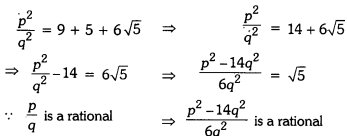
Number Systems Class 9 Extra Questions Maths Chapter 1 with Solutions Answers 6
∵ \(\frac{p}{q}\) is a rational
⇒ √5 is a rational
But this contradicts the fact that √5 is an irrational number.
Thus, our supposition is wrong.
Hence, x + y is an irrational number.

Number Systems Class 9 Extra Questions Short Answer Type 2

Question 1.
Represent √3 on the number line.
Solution:
Number Systems Class 9 Extra Questions Maths Chapter 1 with Solutions Answers 7
Number Systems Class 9 Extra Questions Maths Chapter 1 with Solutions Answers 8
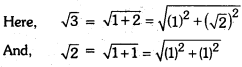
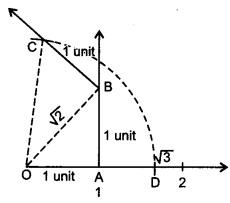
On the number line, take OA = 1 unit. Draw AB = 1 unit perpendicular to OA. Join OB.
Again, on OB, draw BC = 1 unit perpendicular to OB. Join OC.
By Pythagoras Theorem, we obtain OC = √3. Using
compasses, with centre O and radius OC, draw an arc, which intersects the number line at point
D. Thus, OD = √3 and D corresponds to √3.

Question 2.
Represent √3.2 on the number line.
Solution:
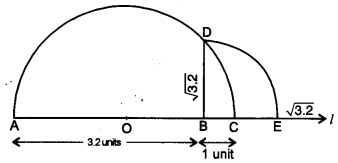
First of all draw a line of length 3.2 units such that AB = 3.2 units. Now, from point B, mark a distance of 1 unit. Let this point be ‘C’. Let ‘O’ be the mid-point of the distance AC. Now, draw a semicircle with centre ‘O’ and radius OC. Let us draw a line perpendicular to AC passing through the point ‘B’ and intersecting the semicircle at point ‘D’.
∴ The distance BD = √3.2
Number Systems Class 9 Extra Questions Maths Chapter 1 with Solutions Answers 9
Now, to represent √3.2 on the number line. Let us take the line BC as number line and point ‘B’ as zero, point ‘C’ as ‘1’ and so on. Draw an arc with centre B and radius BD, which intersects the number line at point ‘E’.
Then, the point ‘E’ represents √3.2.

Question 3.
Express 1.32 + 0.35 as a fraction in the simplest form.
Solution:
Let . x = 1.32 = 1.3222…..(i)

Multiplying eq. (i) by 10, we have
10x = 13.222…
Again, multiplying eq. (i) by 100, we have
100x = 132.222… …(iii)
Subtracting eq. (ii) from (iii), we have
100x – 10x = (132.222…) – (13.222…)
90x = 119
⇒ x = \(\frac{119}{90}\)
Again, y = 0.35 = 0.353535……
Multiply (iv) by 100, we have …(iv)
100y = 35.353535… (v)
Subtracting (iv) from (u), we have
100y – y = (35.353535…) – (0.353535…)
99y = 35
y = \(\frac{35}{99}\)
Number Systems Class 9 Extra Questions Maths Chapter 1 with Solutions Answers 10

Question 4.
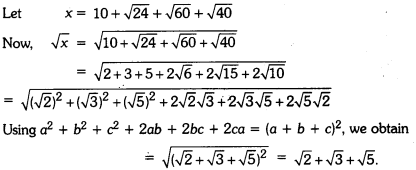
Find the square root of 10 + √24 + √60 + √40.
Solution:
Number Systems Class 9 Extra Questions Maths Chapter 1 with Solutions Answers 11

Question 5.
If x = 9 + 4√5, find the value of √x – \(\frac{1}{\sqrt{x}}\).
Solution:
Here,
x = 9 + 4√5
x = 5 + 4 + 2 x 2√5
x = (√52 + (22 + 2 x 2x √5).
x = (√5 + 2)2
√x = √5 + 2
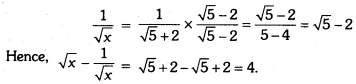
Now, \(\frac{1}{\sqrt{x}}\) = \(\frac{1}{\sqrt{5}+2}\)
Number Systems Class 9 Extra Questions Maths Chapter 1 with Solutions Answers 12

Question 6.
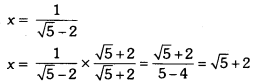
If x = \(\frac{1}{\sqrt{5}-2}\) , find the value of x3 – 32 – 5x + 3
Solution:
Number Systems Class 9 Extra Questions Maths Chapter 1 with Solutions Answers 13
∴ x – 2 = √5
Squaring both sides, we have
x2 – 4x + 4 = 5
x2 – 4x – 1 = 0 …(i)
Now, x3 – 32 – 5x + 3 = (x2 – 4x – 1) (x + 1) + 4
= 0 (x + 1) + 4 = 4 [using (i)]

Question 7.
Find ‘x’, if 2x-7 × 5x-4 = 1250.
Solution:
We have 2x-7 × 5x-4 = 1250
⇒ 2x-7 × 5x-4 = 2 5 × 5 × 5 × 5
⇒ 2x-7 × 5x-4 = 21 × 54
Equating the powers of 2 and 5 from both sides, we have
⇒ x – 7 = 1 and x – 4 = 4
⇒ x = 8 and x = 8
Hence, x = 8 is the required value.

Question 8.
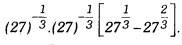
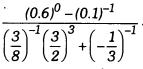
Evaluate:
Number Systems Class 9 Extra Questions Maths Chapter 1 with Solutions Answers 14
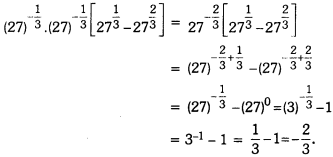
Solution:
Number Systems Class 9 Extra Questions Maths Chapter 1 with Solutions Answers 15

Number Systems Class 9 Extra Questions Long Answer Type

`Question 1.
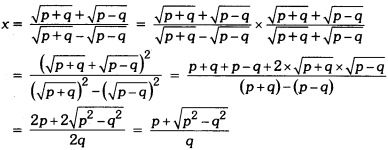
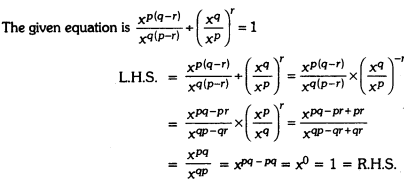
If x = \(\frac { \sqrt { p+q } +\sqrt { p-q } }{ \sqrt{p+q}-\sqrt{p-q} }\), then prove that q2 – 2px + 9 = 0.
Solution:
Number Systems Class 9 Extra Questions Maths Chapter 1 with Solutions Answers 16
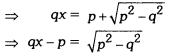
Number Systems Class 9 Extra Questions Maths Chapter 1 with Solutions Answers 17
Squaring both sides, we have
⇒ q2x2 + p2 – 2pqx = p2 – q2
⇒ q2x2 – 2pqx + q2 = 0
⇒ q(q2 – 2px + q) = 0
⇒ qx2 – 2px + q = 0 (∵ q ≠ 0)

Question 2.
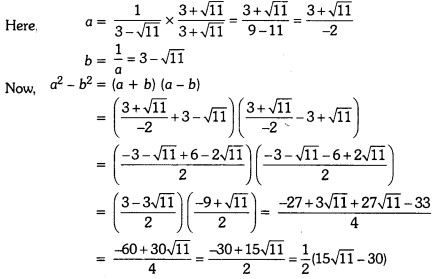
If a = \(\frac{1}{3-\sqrt{11}}\) and b = \(\frac{1}{a}\), then find a2 – b2
Solution:
Number Systems Class 9 Extra Questions Maths Chapter 1 with Solutions Answers 18

Question 3.
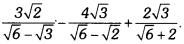
Simplify:
Number Systems Class 9 Extra Questions Maths Chapter 1 with Solutions Answers 1.1
Solution:
Number Systems Class 9 Extra Questions Maths Chapter 1 with Solutions Answers 1.2

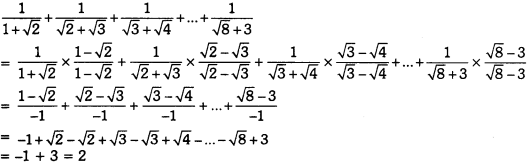
Question 4.
Prove that:
Number Systems Class 9 Extra Questions Maths Chapter 1 with Solutions Answers 21
Solution:
Number Systems Class 9 Extra Questions Maths Chapter 1 with Solutions Answers 22

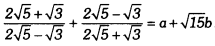
Question 5.
Find a and b, if
Number Systems Class 9 Extra Questions Maths Chapter 1 with Solutions Answers 23
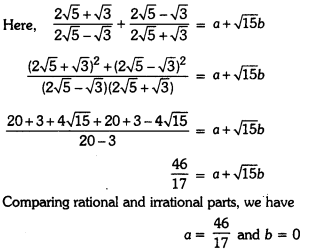
Solution:
Number Systems Class 9 Extra Questions Maths Chapter 1 with Solutions Answers 24

Number Systems Class 9 Extra Questions HOTS

Question 1.
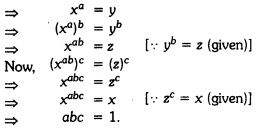
If xa = y, yb = z and zc = x, then prove that abc = 1.
Solution:
We have xa = y, yb = z and zc = x
Number Systems Class 9 Extra Questions Maths Chapter 1 with Solutions Answers 25

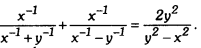
Question 2.
Prove that:
Number Systems Class 9 Extra Questions Maths Chapter 1 with Solutions Answers 26
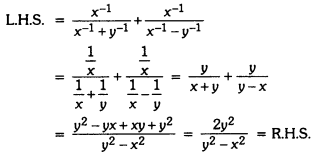
Solution:
Taking L.H.S., we have
Number Systems Class 9 Extra Questions Maths Chapter 1 with Solutions Answers 27

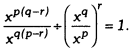
Question 3.
Show that:
Number Systems Class 9 Extra Questions Maths Chapter 1 with Solutions Answers 28
Solution:
Number Systems Class 9 Extra Questions Maths Chapter 1 with Solutions Answers 29

Number Systems Class 9 Extra Questions Value Based (VBQs)

Question 1.
Sudhir and Ashok participated in a long jump competition along a straight line marked as a number line. Both start the jumps one by one but in opposite directions. From ‘O’ Ashok jumps one unit towards the positive side while Sudhir jumps double in units as Ashok jumps, along negative side. After jumping 4 jumps each, at which point Ashok and Sudhir reached. What is the distance between their final positions ? Ashok argue that he is the winner since Sudhir is at negative side. Who do you think is winner and why? What is the value of the competition ?
Number Systems Class 9 Extra Questions Maths Chapter 1 with Solutions Answers 30
Solution:
After jumping four jumps each, Ashok reached at 4 in positive direction and Sudhir reached at -8 i.e., in negative direction. Distance between their final positions is 12 units. Here, distance covered by Sudhir is 8 units and distance covered by Ashok is 4 units. Thus, Sudhir is the winner. Competition inculcate spirit of performance.

Question 2.
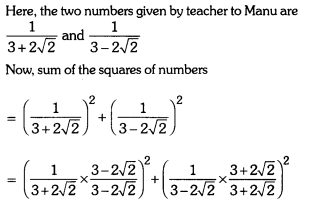
Manu went to his mathematics teacher and asked him “Sir, I want some chocolates to distribute among my classmates for my birthday but I have no money. Can you provide me some chocolates”. Teacher told Manu, I am giving you two numbers \(\frac{1}{3+2 \sqrt{2}}\) and \(\frac{1}{3-2 \sqrt{2}}\) and if you can find the value of sum of their squares, then I will provide you as many chocolates as the resulting value of sum of squares of given numbers. Find the number of chocolates. What value is depicted from this action?
Solution:
Number Systems Class 9 Extra Questions Maths Chapter 1 with Solutions Answers 31
= (3 – 2√2)2 + (3 + 2√22
= 9 + 8 – 2 × 3 × (2√2) + 9 + 8 + 2 × 3 × 2√2 = 34.
Hence, resulting value of sum of squares of numbers = number of chocolates = 34. By doing this, teacher motivates the students to use their knowledge and apply it in day to day life with caring and kindness.

Separation of Substances Class 6 Extra Questions and Answers Science Chapter 5

In this page, we are providing Separation of Substances Class 6 Extra Questions and Answers Science Chapter 5 pdf download. NCERT Extra Questions for Class 6 Science Chapter 5 Separation of Substances with Answers will help to score more marks in your CBSE Board Exams.

Class 6 Science Chapter 5 Extra Questions and Answers Separation of Substances

Extra Questions for Class 6 Science Chapter 5 Separation of Substances with Answers Solutions

Separation of Substances Class 6 Extra Questions Very Short Answer Type

Question 1.
What are the components of air?
Answer:
Oxygen, carbon dioxide, nitrogen, etc.

Question 2.
What are the components of milk?
Answer:
Milk-proteins, calcium, cream and water.

Question 3.
What are the types of mixture?
Answer:
Heterogeneous mixtures and homogeneous mixtures.

Question 4.
Name the process used to separate heavier and lighter components of a mixture.
Answer:
Winnowing

Question 5.
Mention one purpose of separating the constituents of a mixture.
Answer:
To remove the undesirable substances.

Question 6.
When handpicking is used?
Answer:
Handpicking is used to separate undesirable components having different shape, size, colour and are present in small amount.

Question 7.
Which type of separation process is used in cashewnut factories?
Answer:
Sieving

Question 8.
Name the process used to obtain salt from sea water.
Answer:
Evaporation

Question 9.
Write opposite of the process of condensation.
Answer:
Evaporation

Question 10.
What is effect of temperature on solubility?
Answer:
Solubility increases when temperature increases.

Question 11.
Name the process of obtaining clear water from muddy water in which alum is used.
Answer:
Loading

Question 12.
Which method is used to separate a mixture of tea leaves and iron filings?
Answer:
By magnet

Question 13.
Which gas dissolved in water helps aquatic animals to breathe?
Answer:
Oxygen gas

Question 14.
Name the method by which you can separate butter from milk.
Answer:
Centrifugation

Question 15.
Which liquid is called as universal solvent?
Answer:
Water

Question 16.
Name some materials that are used as filters.
Answer:
Cotton, ceramic, fine cloth, filter paper, etc.

Question 17.
Give one example of sieving used in everyday life.
Answer:
Separation of bran from flour.

Question 18.
Which substance is used for loading?
Answer
Alum

Question 19.
Which process is used to separate bacteria from water?
Answer:
Filtration by using bacteria proof filters.

Question 20.
Name the process of separating two immiscible liquids.
Answer:
Decantation

Separation of Substances Class 6 Extra Questions Short Answer Type

Question 1.
Why mixtures need to be separated?
Answer:
The main reason for separating the mixtures are:

  1. To remove undesirable substances.
  2. To get desirable substances.
  3. To obtain highly pure substances.

Question 2.
What is handpicking? When this method is used?
Answer:
The method in which the constituents are separated by simply picking them up by hand is called hand-picking. It is used when there is a difference in size, colour, shape of desirable and undesirable constituents.

Question 3.
What is evaporation? What is the significance of this process?
Answer:
The changing of liquid into vapours is called evaporation. The process of evaporation is used on a large scale to obtain common salt from sea water.

Question 4.
What is threshing?
Answer:
The process of separating grains from the stalks is called threshing.

Question 5.
What is the use of decantation?
Answer:
Decantation is used to separate insoluble solids from liquids. Two immiscible liquids are also separated by this process.

Question 6.
What is a mixture?
Answer:
When two or more than two substances are mixed together in any ratio then it is called a mixture.

Question 7.
What is decantation?
Answer:
Decantation is the process of separating insoluble solids from liquids. A suspension of solid particles in liquid is allowed to stand for some time. Solid particles settle down at the bottom. The clear water is then transferred into another beaker.

Question 8.
State one use of the method of winnowing.
Answer:
The method of winnowing is used to separate husk from various types of grain like wheat, rice, etc. Give one use of the handpicking method of separating mixtures in daily life. The method of handpicking is usually used to separate undesirable substances such as small pieces of stones from wheat, rice and pulses.

Question 9.
Define the term sedimentation.
Answer:
The process in which heavier, insoluble solid settles down in a solution is called sedimentation.

Separation of Substances Class 6 Extra Questions Long Answer Type

Question 1.
Elaborate the process of filtration.
Answer:
Filtration is the process of separating an insoluble solid from a liquid with the help of a filtering agent like filter paper, cloth, strainer, etc. During filtration, the solid insoluble substance is retained at the filter paper as residue while the liquid free from any suspended matter passes through the filter paper and is collected as filtrate.

There are certain soluble components infiltrate which can be separated by the process of evaporation followed by crystallization.

Question 2.
What is meant by saturated and unsaturated solution?
Answer:

  • Saturated solution: At any particular temperature, a solution that has dissolved as much solute as it is capable of dissolving, is said to be a saturated solution.
  • Unsaturated solution: A solution in which more quantity of solute can be dissolved without raising the temperature of the solution is called unsaturated solution.

Question 3.
What is the effect of temperature on a saturated solution?
Answer:
(i) When a saturated solution is heated to a higher temperature, then it becomes unsaturated because the solubility of solute increases with increase in temperature of the solution.
(ii) When a saturated solution is cooled to a lower temperature, then some of the dissolved solute separates out in the form of solid crystal because the solubility of solute decreases on cooling the solution.

Question 4.
What is the importance of centrifugation? How it is done?
Answer:
Centrifugation is the process of separating suspended particles from a liquid by rotating the liquid at a high speed.

The mixture is taken in a closed bottle and rotated at a high speed. The heavy particles settle at the bottom while light particles remains behind. The method is also used to separate cream from milk. Cream being lighter than milk, floats at the top of the mixture.

Question 5.
What is loading? How will you obtain clear water from muddy river water by the process of loading?
Answer:
The suspended small particles of muddy water are negatively charge which inhibit them to settle down due to repulsion. On adding alum to this muddy water, removes the negative charge from the particles. This particles forms clump easily, become heavier and settles down.

This process is called loading. Loading helps in purification of water from small suspended particles which do not settles down easily and quickly. The clear water after settling down of suspended particles is decanted in another container and is comparatively clearer.

Separation of Substances Class 6 Extra Questions HOTS

Question 1.
Rahul by mistake mixed sugar with salt. What method he must adopt to quickly separate this mixture?
Answer:
He must use the method of sieving for separating salt and sugar.

Question 2.
Can we separate the mixture of sugar and milk?
Answer:
No

Question 3.
Which method of separation will you adopt to separate a mixture of wheat flour, moong dal and chana?
Answer:
We will adopt the method of sieving followed by handpicking to separate the mixture. Sieving will separate wheat flour from moong dal and chana. Handpicking will separate moong dal from chana. Sieve with appropriate pores can also be used to separate moong dal from chana.

Question 4.
Suggest any two methods to separate suspended particles of mud from water.
Answer:
Loading with alum and centrifugation.

Question 5.
Is there any method through which we can separate different components of ink?
Answer:
Chromatography technique.

Separation of Substances Class 6 Extra Questions Value Based Question (VBQs)

Question 1.
Some shopkeepers mix many cheap and harmful substances in the food materials. This process is called adulteration. Anybody who are involved in such kind of illegal practices are liable for imprisonment.
(a) Why shopkeepers mix cheap and harmful substances in food materials?
(b) How will you separate impurities from grains and pulses?
(c) What values of shopkeepers are shown here?
Answer:
(a) Shopkeepers add these undesirable substances to increase the quantity of the food materials and thus their profit.
(b) Through handpicking.
(c) Shopkeepers observing such practices are greedy, self-centred, criminal-minded and soulless.

Question 2.
There were guests at Sonam’s house. Sonam thought of making lemonade for them. She dissolved sugar in chilled water and observe that sugar was taking long time to dissolve. Meanwhile, Sonam’s mother came and asked her to transfer the upper chilled water in another container and then add water at normal temperature to this sugar settled at bottom.
Sonam then found it easy to dissolve the sugar for lemonade.
(a) What is saturated solution?
(b) What is the effect of temperature on the capacity of water in dissolving substances?
(c) What will happen if we cool a supersaturated solution?
(d) What value of Sonam is shown here?
Answer:
(a) A saturated solution is the solution which cannot dissolve any more solute in it at a given temperature.
(b) With increase in temperature solubility of a substance increases in water and vice versa.
(c) When a supersaturated solution is cooled, it form crystals of the salt. This process is known as crystallization.
(d) Sonam is a good host, learner, helpful girl.

Interrogative Exercise for Class 4 CBSE with Answers

Interrogative Exercise for Class 4 CBSE with AnswersThis grammar section explains English Grammar in a clear and simple way. There are example sentences to show how the language is used.

Interrogative Exercise for Class 4 CBSE with Answers

  • A sentence that asks something is called asking sentences. They are called Questions.
  • Asking sentences always end in a question mark. (?)
  • Asking sentences begin with question words like What, Who, When, Where and Why.
  • Asking sentences may also be asked to get answers.
  • Sometimes we form a question, by changing the order of the sentence by placing the verb in the beginning of the sentence.

Interrogative Exercise for Class 4 with Answers CBSE PDF

A. Make questions for the following sentences.

1. He is washing the car.
____________________

2. You are going home.
____________________

3. I am reading a magazine.
____________________

4. She was sitting on the chair.
____________________

5. Anil was carrying a heavy box.
____________________

6. They were playing football.
____________________

7. You were working in the shop.
____________________

B. Make questions with question words.

1. Matthew is making a mistake. –
2. Linda is knocking at the door. –
3. They are flying to Rome. –
4. I’m making the new tree house at the moment. –
5. She is driving the car carefully. –