Getting to Know Plants Class 6 Extra Questions and Answers Science Chapter 7

In this page, we are providing Getting to Know Plants Class 6 Extra Questions and Answers Science Chapter 7 pdf download. NCERT Extra Questions for Class 6 Science Chapter 7 Getting to Know Plants with Answers will help to score more marks in your CBSE Board Exams.

Class 6 Science Chapter 7 Extra Questions and Answers Getting to Know Plants

Extra Questions for Class 6 Science Chapter 7 Getting to Know Plants with Answers Solutions

Getting to Know Plants Class 6 Extra Questions Very Short Answer Type

Question 1.
What are the plants having green tender stems called?
Answer:
Herbs

Question 2.
What type of root wheat plant have?
Answer:
Fibrous root

Question 3.
Name one plant which has reticulate venation?
Answer:
Marigold

Question 4.
Name the part of plant which produces food.
Answer:
Leaves

Question 5.
Name the part of a flower which becomes fruit after fertilization.
Answer:
Ovary

Question 6.
Name two types of roots found in plants.
Answer:

  • Taproot
  • Fibrous root

Question 7.
Name the process by which plant make their food.
Answer:
Photosynthesis

Question 8.
Name the green pigment present in the leaves of a plant.
Answer:
Chlorophyll

Question 9.
Name the parts of plant which grows under the ground.
Answer:
Root grows under the ground.

Question 10.
Name a plant which has weak stem.
Answer:
Climbers

Question 11.
Name the three types of plants.
Answer:
Herbs, shrubs and trees.

Question 12.
Which part of plant holds it upright?
Answer:
Stem

Question 13.
Name the tiny pores on the surface of a leaf.
Answer:
Stomata

Question 14.
What is the function of chlorophyll?
Answer:
Chlorophyll imparts green colour to the leaves.

Question 15.
Give one function of stem
Answer:
Stem helps in transportation of water and food in the plants.

Question 16.
Name some plants having taproot.
Answer:
Mango tree, turnip, carrot, beet, etc.

Question 17.
Give some examples of plants having fibrous roots.
Answer:
Millet, bamboo, sugar cane, sweet potato, etc.

Question 18.
What kind of stem do shrub have?
Answer:
Hard but not very thick.

Question 19.
What is the life span of shrubs?
Answer:
Many years but it is less than that of trees.

Question 20.
What kind of stem do herbs have?
Answer:
Soft and delicate stem.

Getting to Know Plants Class 6 Extra Questions Short Answer Type

Question 1.
What are herbs?
Answer:
Herbs are small plants having a soft and delicate stem.

Question 2.
What are shrubs?
Answer:
Shrubs are medium-sized plants with a hard and woody stem branching out near the base. Though stem of a shrub is hard but it is not very thick.

Question 3.
What is pistil?
Answer:
The pistil is the female part of a flower. It is also known as carpel.

Question 4.
Define taproot.
Answer:
A taproot is a straight tapering root which grows vertically down into the soil and gives out branches on all the sides.

Question 5.
What is root?
Answer:
Root is a part of a plant which is below the ground (in the soil). There are two types of roots:

  • Taproot
  • Fibrous root.

Question 6.
What are plants?
Answer:
Plants are living things. Each plant has many parts to perform different functions for its survival. The main parts of plant are root, stem, branches, leaves, flowers and fruits.

Question 7.
What are fibrous roots?
Answer:
Some plants do not have main root. They have a bunch of similar roots called fibrous roots.

Question 8.
Name the different parts of flowers.
Answer:
A flower consists of following parts:

  1. Pedicel
  2. Sepals
  3. Petals
  4. Stamens
  5. Carpel

Question 9.
Define pollination.
Answer:
Transfer of pollen grains from anther to stigma of a flower is known as pollination.

Question 10.
What is a tree?
Answer:
Trees are tall and big plants with a hard and thick woody stem.

Question 11.
What are creepers?
Answer:
A plant having thin, long, and weak stem which cannot stand upright and spreads in the ground are known as creepers.

Question 12.
What are climbers?
Answer:
A plant having thin, long and weak stem which cannot stand upright, but readily climbs up neighboring support or a tree is called climber.

Question 13.
What is the main difference between climbers and creepers?
Answer:
The main difference between climbers and creepers is that the climber plants have climbing organs like tendrils but the creeper plants have no such climbing organs.

Question 14.
What is a flower?
Answer:
Flowers are the most beautiful part of a plant. Different plants have different types of flowers. Flowers are of many sizes, shapes and colours.

Question 15.
Define parallel venation.
Answer:
The type of venation in which the veins in a leaf run parallel to one another on both sides of the midrib is called parallel venation. For example, paddy, maize, millet, etc.

Getting to Know Plants Class 6 Extra Questions Long Answer Type

Question 1.
What is root? List the main functions of root.
Answer:
Root is that part of a plant which is below the ground (in the soil). The main functions of roots are as follows:

  1. Root absorb water and nutrients from the soil which are needed by plant leaves to make food.
  2. Roots help in holding the soil together and thus prevents soil erosion.
  3. Roots help the plant to stand erect. This prevents the plant from being pulled out easily or blown away by the wind.
  4. Some plants have modified roots which store food for the plants like beetroot, radish, carrot.

Question 2.
What are the functions of flower?
Answer:

  1. A flower is the seat or organ of sexual reproduction and results in the formation of fruits and seeds. Seeds on germination give rise to new plants. A flower thus, results in multiplication of plants.
  2. It is the source of food for many insects.
  3. Flowering plants are grown in gardens and in homes because of the bright colour and fragrance of the flowers. Therefore, they beautify the surroundings and provide aesthetic value.

Question 3.
Explain the process of preparation of food in leaves.
Answer:
Leaves are the food factories of the plant. They make food for the plant by the process of photosynthesis. In photosynthesis, the green leaves of a plant combine carbon dioxide and water in the presence of sunlight and chlorophyll. This can be written as:
image 1

Question 4.
What are herbs, shrubs and trees? Give two examples of each.
Answer:

  1. Herbs: Herbs are small plants having a soft and delicate stem. Herbs do not have woody stem. They are non-woody plants. Herbs have a green and tender stem. They are short sized plants. Herbs have short life span. For example, tomato, cabbage.
  2. Shrubs: Shrubs are medium-sized plants with a hard and woody, branching out near the base. Shrubs tend to branch near ground level, so many branches are seen rising just above the ground giving them a bushy appearance. For example, lemon, tulsi, etc.
  3. Trees: Trees are tall and big plants with hard and thick woody stem. The trees have one main stem called trunk which usually gives out branches and leaves. For example, neem, mango, etc.

Question 5.
What is stem of a plant? State the various functions of the stem in a plant.
Answer:Stem is the part of plant which rises vertically up from the ground. The main functions of the stem of a plant are as follows:

  1. The stem holds the plants upright.
  2. The stem of a plant carries water and minerals from the roots to the leaves and other parts of the plants.
  3. The stem carries the prepared food from the leaves to other parts of the plant.
  4. The stem holds the leaves in such a way that the leaves are able to get plenty of sunlight for preparing food by photosynthesis.

Question 6.
What is leaf? What are its functions?
Answer:
The leaf is a thin, broad, flat and green part of a plant which is attached to the stem (or branch). The leaves of plants have three main functions:

  1. The leaves make food for the plant by photosynthesis.
  2. The leaves get rid of excess water from the plant through transpiration.
  3. The leaves carry out the process of respiration in plants.

Question 7.
Draw a labelled diagram of a flower.
Answer:
The main parts of a flower are sepals, petals, stamen and pistil.

Question 8.
What is a fruit?
Answer:
A fruit is that part of a plant that contains the seeds. Apples, oranges, plums, etc., are the example of fruits. The fruits and seeds are formed from flowers by the process of pollination and fertilization.

Question 9.
Differentiate between herbs and shrubs.
Answer:

                                             HerbsShrubs
1. Herbs are small plants having a soft and delicate stem.1. Shrubs are medium-sized plants with hard and woody stem.
2. Herbs do not grow more than one metre in height.2. Shrubs tend to branch near ground level.
3. They have a very short life span, e.g., tomato, cabbage, etc.3. They have life span shorter than that of trees but more than herbs, e.g., cotton, tulsi, etc.

Question 10.
Differentiate between taproot and fibrous root.
Answer:

TaprootFibrous root
1. Taproot has only one main and long root.1. Fibrous root do not have a main root.
2. Taproot goes deep in the soil.2. They do not go deep into the soil.
3. Taproots are found in plants which have reticu­late venation in their leaves.3. These are found in plants which have paral­lel venation in their leaves.

Getting to Know Plants Class 6 Extra Questions HOTS

Question 1.
Write the location of the following:
(i) Ovule
(ii) Pollen grains
(iii) Endosperm
Answer:
(i) Ovary
(ii) Anther
(iii) Seed

Question 2.
Write the name of plant parts which perform the following functions:
(i) Anchoring
(ii) Transportation
(iii) Preparing food
(iv) Reproduction
(v) Germination
Answer:
(i) Root
(ii) Stem
(iii) Leaves
(iv) Flower
(v) Seed

Question 3.
Which part of the flower is necessary for reproduction? Why?
Answer:
Stamen and pistil are necessary for reproduction as they produce male gamete and female gamete respectively. Petals helps in attracting insects for pollination as they are variously coloured whereas sepals protect the flower buds. Both petals and sepals are accessory parts of the flower.

Question 4.
What is the function of seed coat?
Answer:
Seed is surrounded by a tough covering called seed coat. It protects the seed from outer harsh environment.

Question 5.
What is the main difference between climbers and creepers?
Answer:
Climbers need support whereas creepers can grow along the ground. Climbers have tendrils for climbing but creepers do not have this structure.

Getting to Know Plants Class 6 Extra Questions Value Based Question (VBQs)

Question 1.
Rima kept some soaked gram seeds for sprouting. But she forgot about this. On fifth day she suddenly remembered and opened the container having seeds. She found that small leaves along with white sprouts have grown out of the seed.
(a) What does the white structure of sprout give rise to?
(b) What kind of root is found in gram plant?
(c) Why Rima found small leaves in the sprouts?
(d) What value of Rima is shown here?
Answer:
(a) White structure of the sprout give rise to root of the plant.
(b) Taproot.
(c) Rima kept the soaked gram seeds for many days so they germinated into young plants.
(d) Rima is careless, forgetful but at the same time she is a good observer.

Question 2.
Rakesh while walking in his terrace garden found many types of wasp wandering around the flowers. He thought that these insects are spoiling his flower and immediately took out the insect collecting net to get rid of them. On seeing this Rakesh’s elder brother stopped him from doing this and said that these wasps are flower’s friends.
(a) What do these wasps get from the flowers?
(b) Why Rakesh’s elder brother call these wasps as ‘flower’s friend’?
(c) What is pollination?
(d) What value of Rahul’s elder brother is shown here?
Answer:
(a) Wasps get pollen and nectar from the flowers.
(b) Wasps help in transfer of pollen grains from anther to stigma. Thus, it helps in pollination.
(c) Pollination is the transfer of pollen grains from anther to stigma of a flower.
(d) Rahul’s elder brother is eco-friendly, intelligent, empathy and helpful.

Question 3.
After learning about types of roots Amrita was too curious to see types of roots in different plants. She started uprooting plants from the garden. Shweta, her friend and classmate, on seeing this stopped her and told her that one can determine the kind of root by just seeing the leaves. We need not require to uproot the plants.
(a) What are the two types of roots?
(b) How leaves can determine the type of roots?
(c) What value of Shweta is shown here?
Answer:
(a) Two types of roots are taproot and fibrous root.
(b) The design made by veins in a leaf is called the leaf venation. The pattern of leaf venation determines the type of roots present in a plant. If the leaf have reticulate venation then it has taproot and if the leaf have parallel venation then it has fibrous root.
(c) Shweta is intelligent, eco-friendly and have scientific aptitude.
Punctuation Exercises for Class 4 CBSE With Answers

Punctuation Exercises for Class 4 CBSE With AnswersThis grammar section explains English Grammar in a clear and simple way. There are example sentences to show how the language is used.

Punctuation Exercises for Class 4 CBSE With Answers PDF

  • Punctuation marks are signs such as periods, commas and question marks.
  • We always use capital letters in the beginning of the sentence.
  • Use of Period We put a period at the end of a statement. It is also known as Full Stop.
  • Use of Question Mark (?): We use a question mark after a question.
  • Use of Commas (,): We put a comma between items in a list, after yes and no, before or after the name of the person we
  • are speaking to, before please and thank you, between the parts of a place name.
  • Use of Exclamation (!): We put exclamations to express sudden emotion. Exclamations end with an exclamation point. (!)
  • Use of Capital Letters: We use a capital letter to begin the names of people and places, after the initials in someone’s name, nationalities and languages also begin with a capital letter.

Punctuation Exercises for Grade 4 with Answers PDF

A. Read each sentence and add the correct punctuation mark(s). Then, write whether it is a statement, question or an exclamation. The first one has been done for you.

1. Are you feeling well today ? Question
2. Papa made homemade cookies _____ _____________
3. Hooray _____ Jimmy’s team won _____ _____________
4. When is your birthday _____ _____________
5. Is this your new television _____ _____________
6. Wow _____ Look at the fireworks _____ _____________
7. It rained all day long _____ _____________
8. Have you met my friend Julie _____ _____________
9. I want to have a bowl of soup for lunch _____ _____________
10. Can you make it to my birthday party _____ _____________
11. Ouch _____ _____________
12. Isn’t this a beautiful night _____ _____________
13. That is a very gentle pony _____ _____________
14. Happy New Year _____ _____________
15. Sara ate a slice of pizza for lunch _____ _____________

B. Unscramble the words to form a question and a statement. The first has been done for you. Remember to use punctuation wherever it is necessary.

1. my is favourite basketball sport
Question: Is basketball my favourite sport?
Statement: Basketball is my favourite sport.

2. holiday Christmas favourite is your
Question: __________________
Statement: __________________

3. those are ready cookies eat to
Question: __________________
Statement: __________________

4. the in yard there rabbit a is
Question: __________________
Statement: __________________.

5. very the hot is stove
Question: __________________
Statement: __________________

C. Read each sentence. Put commas in the correct places in each sentence.

1. Even though the paint was still wet I couldn’t resist touching it.
2. After the fire burned out I went inside the house.
3. In English class we read Old Man and the Sea Dracula and Beowulf.
4. I watched television took the dog for a walk and drove to the store to get milk.
5. William Shakespeare a famous playwright wrote Macbeth and Hamlet.

Has Have Had Exercise For Class 4 CBSE with Answers

Has Have Had Exercise For Class 4 CBSE with Answers

This grammar section explains English Grammar in a clear and simple way. There are example sentences to show how the language is used.

Has Have Had Exercise for Class 4 CBSE with Answers PDF

  • Has/Have/had use the past participle of the main verb.
  • While converting present perfect sentence into interrogative, we use has/ have before the subject or in the beginning of the sentence.
  • While converting past perfect sentences into interrogative, we use had before the subject or in the beginning of the sentence.

Presentation
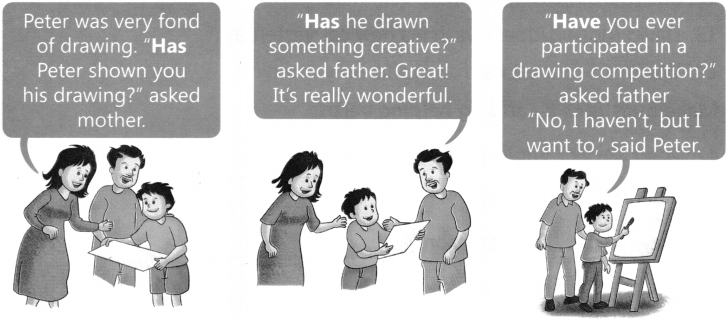
Read the picture Story.
Has Have Had Exercise For Class 4 CBSE with Answers 1

A. Answer the following questions as per the story.

1. What did mother ask the father? ___________________
2. What did father ask the mother? ___________________
3. What did father ask Peter? ___________________

B. Convert the interrogative sentences of the story into simple sentences.

1. Has Peter shown you his drawing? ___________________
2. Has he drawn something creative? ___________________
3. Have you ever participated in a drawing competition? ___________________

Has Have Had Exercise for Class 4 with Answers CBSE PDF

A. Write questions using Has/Have. The first one has been done for you.

1. they / finish / their homework – Have they finished their homework?
2. Suman / play / with / Rohit – ______________________________
3. the waiter / bring / the tea – ______________________________
4. Mita/pay / the bill – ______________________________
5. you / ever / write / a poem – ______________________________
6. you / correct / my mistakes – ______________________________
7. you / practice / speaking English – ______________________________
8. she / tidy up / her room – ______________________________
9. the boss / sign / the letter – ______________________________
10. Mary / shut / the door – ______________________________

B. Complete the questions using Had.

1. (what /you/say) ____________ before you opened the window?
2. (he/speak) ____________ to you before he called us?
3. (you/switch) ____________ off the lights before we left?
4. (you/take) ____________ the laundry inside when it started to rain?
5. (who/live) ____________ in that house before the Khans bought it?

Do Does Did Exercises for Class 4 CBSE with Answers

Do Does Did Exercises for Class 4 CBSE with AnswersThis grammar section explains English Grammar in a clear and simple way. There are example sentences to show how the language is used.

Interrogatives Do Does Did Exercises for Class 4 CBSE with Answers

  • We use Do/Does/Did for forming questions.
  • It converts the assertive sentences into interrogative.
  • Do/Does/Did are helping verbs.
  • Do/Does/Did are used where i s/a m/a re/was/we re are not used as helping verbs.
  • Do/Does is used in present tense to make Present Interrogative Sentence.
  • It always comes with the base form of the main verb.
  • Did is used in past tense to make Past Interrogative Sentence. It always comes with the base form of the verb.
  • Do/Does/Did is used in the beginning of the sentence while making questions.
  • Do ¡s used with I, We, They, You, Does is used with He, She, It.
  • Did is used with I, We, They, You.

Presentation
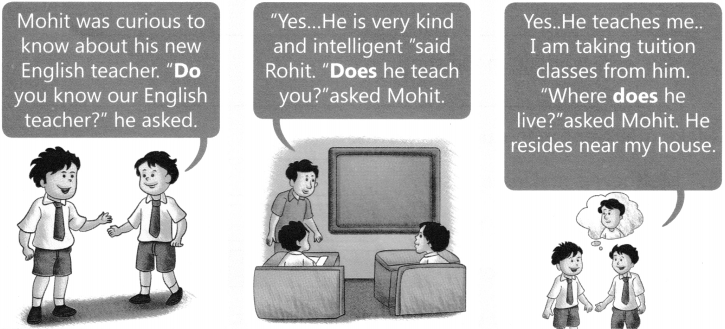
Read the picture story.
Do Does Did Exercises for Class 4 CBSE with Answers 1

A. Answer the following questions from the story above.

1. What did Mohit ask Rohit in the first para? __________
2. What did Mohit want to know about his English teacher? __________
3. What else did Mohit ask about the English teacher? __________

B. Rewrite the following interrogative sentences into assertive sentences from the story above.

1. Do you know your English teacher?
____________________

2. Does he teach you?
____________________

3. Where does he live?
____________________

Do Does Did Exercises with Answers for Class 4 CBSE PDF

A. Circle the helping verb (do, did or does) to complete the following sentences.
Example:
/ (do)/ did / does) wash my car on the weekend, do

1. We (do/did/does) create new inventions all the time.
2. He (do/did/does) cook for a living.
3. He (do/did/does) run every morning to stay in shape.
4. My parents (do/did/does) buy me all the materials for school.
5. He (do/did/does) cut wood for a living.
6. She (do/did/does) sew during class time.
7. I (do/did/does) watch the big game on television.
8. He (do/did/does) share a lot of information with me.
9. We (do/did/does) try our best last year.
10. The zebras (do/did/does) play with each other.
11. You (do/did/does) think you would get away with it.
12. She (do/did/does) compete very hard.
13. David (do/did/does) wash his new car yesterday.
14. We (do/did/does) eat fish in the early morning.

B. Make questions by adding helping verbs.

1. You/speak/English →
2. when / he / go / home →
3. they / clean / the bathroom →
4. where / she / ride / her bike →
5. Billy / work / in the supermarket →

C. Convert the following assertive sentences into interrogative.

1. Billy ate an apple.
2. The children played in the garden.
3. Laura came home at six o’clock.
4. The boy read a book.

Combustion and Flame Class 8 Extra Questions and Answers Science Chapter 6

In this page, we are providing Combustion and Flame Class 8 Extra Questions and Answers Science Chapter 6 pdf download. NCERT Extra Questions for Class 8 Science Chapter 6 Combustion and Flame with Answers will help to score more marks in your CBSE Board Exams.

Class 8 Science Chapter 6 Extra Questions and Answers Combustion and Flame

Extra Questions for Class 8 Science Chapter 6 Combustion and Flame with Answers Solutions

Combustion and Flame Class 8 Extra Questions Very Short Answer Type

Question 1.
Name the most common fuel used in homes.
Answer:
Liquefied Petroleum Gas. (LPG)

Question 2.
Name the most common fire extinguisher.
Answer:
Water

Question 3.
What are the states in which a fuel may exist?
Answer:
A fual may exist in solid, liquid or gaseous state.

Question 4.
ame any two combustible substances.
Answer:
Charcoal, wood

Question 5.
Does magnesium produce heat and light during its combustion?
Answer:
Yes, it does.

Question 6.
What acts as a fuel for our body?
Answer:
Food

Question 7.
Give two examples of non-combustible substances.
Answer:
Water, sand

Question 8.
How are heat and light produced in the sun?
Answer:
In the sun, heat and light are produced by nuclear reactions.

Question 9.
Where were matchsticks first used?
Answer:
Egypt

Question 10.
What are the three essential requirements for combustion?
Answer:
Fuel, air (to supply oxygen) and heat (to raise the temperature of the fuel beyond the ignition temperature).

Question 11.
What is the ignition temperature of phosphorus?
Answer:
25°C

Question 12.
What is the colour of an LPG flame?
Answer:
Blue

Question 13.
What type of process is combustion?
Answer:
A chemical process

Question 14.
Name an ideal fuel.
Answer:
Compressed Natural Gas (CNG)

Question 15.
What is the composition of the head of a matchstick?
Answer:
Antimony trisulphide and potassium chlorate.

Question 16.
Which part of a flame does a goldsmith blow for melting gold and silver?
Answer:
The goldsmith blows the outermost zone of a flame for melting gold and silver.

Question 17.
What is the unit for expressing the calorific value of a fuel?
Answer:
Kilojoules per kilogram (kJ/kg)

Question 18.
Comparing the calorific values of coal and petrol, state which fuel is better.
Answer:
The calorific value of coal is about 25,000 – 33,000 kJ/kg, whereas that of petrol is 45,000 kJ/kg. Hence, petrol is better tuel.

Question 19.
What is deforestation?
Answer:
The cutting down of trees on a large scale is termed as deforestation.

Question 20.
Give any two examples of carbon fuels.
Answer:
Coal, petroleum

Combustion and Flame Class 8 Extra Questions Short Answer Type

Question 1.
What does magnesium burn to form?
Answer:
Magnesium burns to form magnesium oxide and produces heat and light.

Question 2.
What does coal produce during its combustion?
Answer:
Coal produces carbon dioxide, heat and light during its combustion.

Question 3.
What is combustion?
Answer:
Combustion is a chemical process in which a substance reacts with oxygen to give off heat.

Question 4.
Define the ignition temperature of a fuel.
Answer:
The lowest temperature at which a fuel catches fire is called its ignition temperature.

Question 5.
How does a matchstick catch fire?
Answer:
By rubbing a matchstick against a rough surface (friction), it attains its ignition temperature and thus catches fire.

Question 6.
Why is sodium kept immersed in kerosene?
Answer:
Sodium has very low ignition temperature, i.e., it catches fire on coming in contact with air, so it is kept in kerosene.

Question 7.
What are combustible and non-combustible substances?
Answer:
Substances which undergo combustion are said to be combustible, whereas non-combustible substances are those which don’t burn.

Question 8.
What are inflammable substances? Give examples.
Answer:
The substances which have very low ignition temperature and can easily catch fire with a flame are called inflammable substances; e.g., LPG, petrol, alcohol, etc.

Question 9.
What is rapid combustion?
Answer:
When a substance burns instantly and produces a huge amount of heat and light, the combustion is called rapid combustion; e.g., the instant burning of LPG in a gas stove.

Question 10.
Define spontaneous combustion.
Answer:
A type of combustion in which the substance suddenly catches fire without the supply of heat or friction externally is called spontaneous combustion; e.g., forest fires.

Question 11.
Define explosion.
Answer:
A type of combustion during which a huge amount of heat and light is evolved with a boom, along with the production of gas, is known as explosion; e.g., the exploding of fireworks, i.e., crackers, etc.

Question 12.
What is flame?
Answer:
Flame is a region where the burning or combustion of gaseous substances take place.

Question 13.
Define fuel.
Answer:
Those substances which provide energy on burning are called ‘fuels’; e.g., coal, petroleum, LPG, etc.

Question 14.
Give two examples each of solid fuels, liquid fuels and gaseous fuels.
Answer:

  • Solid fuels – Wood, cow dung, etc.
  • Liquid fuels – Kerosene, petrol, etc.
  • Gaseous fuels – Hydrogen, methane, etc.

Question 15.
Give two examples of fuels that are used to generate electricity.
Answer:
Two examples of fuels that are used to generate electricity are petrochemicals and coal.

Question 16.
Define calorific value.
Answer:
The amount of heat produced on burning one kilogram of fuel completely is called its calorific value.

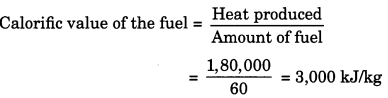
Question 17.
60 kg of fuel was completely burnt for an experiment. The amount of heat energy was found to be 1,80,000 kJ. Calculate the calorific value of the fuel.
Answer:
Amount of fuel burnt = 60 kg
Amount of heat produced = 1,80,000 kJ
Combustion and Flame Class 8 Extra Questions and Answers Science Chapter 6
∴ Calorific value of the fuel is 3,000 kJ/kg.

Question 18.
Define dark zone of a flame.
Answer:
The innermost zone of a flame around the wick is called its dark zone. It is the least hottest zone comparatively to other.

Question 19.
Name the colours of the flames of following substances:
Barium, arsenic, sodium, magnesium
Answer:

Name of the substanceColour of its flame
BariumPale/Apple green
ArsenicBlue
SodiumYellow
MagnesiumWhite

Question 20.
Mention any three characteristics of a good fuel.
Answer:
Any three characteristics of a good fuel are following:

  • It has high calorific value.
  • It is very easy to transport.
  • It is cheap, affordable and economic.

Question 21.
What is global warming?
Answer:
An increase in the average temperature of the earth’s atmosphere, especially a sustained increase that causes climatic changes, is termed as ‘global warming’.

Combustion and Flame Class 8 Extra Questions Long Answer Type

Question 1.
Why isn’t hydrogen gas used as a domestic or industrial fuel, although it has a very high calorific value? State three reasons for the answer.
Answer:
Although hydrogen gas has a very high calorific value, it is not used as a domestic or industrial fuel due to the following reasons:

  • It is expensive.
  • It burns with an explosion.
  • It is extremely inflammable, so it is risky to store and transport hydrogen.

Question 2.
Explain how water gets boiled in paper cup without burning it.
Answer:
When we heat the paper cup containing water, the heat given to it is rapidly transferred to water from the paper cup. The temperature of water goes on increasing until it attains its boiling point, and starts boiling. As, during this process, the heat is continuously being transferred to water; the paper cup does not attain its ignition temperature. Hence, it does not burn.

Question 3.
Why does a piece of paper burn with yellow flame? Give a reason.
Answer:
The inadequate supply of oxygen during the combustion of the piece of paper produces solid carbon particles that rise up in the flame. They become hot and glow to give off yellowish light. This makes the piece of paper burn with a yellowish flame.

Question 4.
It is observed at petrol pumps and airports, that hydrocarbon fire extinguishers are used, instead of soda-acid fire extinguisher. Give reasons why.
Answer:
At petrol pumps and airports, there is more probability of fire break out due to oil. In such situations, soda-acid fire extinguisher does not work as it contains water or uses water to take off fire by cooling down the place. Water being heavier than oil sinks to bottom and hence, fire does not get controlled. In such a case, hydrocarbon fire extinguisher is very useful, as it contains turkey red oil, which causes the foaming of carbon dioxide gas under pressure. The foam covers the surface of the burning substances and dispels the supply of air to control fire.

Question 5.
Explain complete combustion.
Answer:
This type of combustion involves complete burning of the combustible substance. No residue is left behind. Ash or smoke is not given off during or after this type of combustion. Mostly gases, such as hydrocarbons go through this form of combustion. On combustion, hydrocarbon produces carbon dioxide, water and heat.

Combustion and Flame Class 8 Extra Questions HOTS

Question 1.
There are three factors which supports burning. Fire extinguisher affects which factor?
Answer:
Fire extinguishers affect the supply of air.

Question 2.
Although wood has a very high calorific value, we still discourage its use as a fuel. Explain.
Answer:
Wood pollutes air very much and using wood as a fuel would also lead to deforestation on a large scale.
So we still discourage wood as a fuel.

Question 3.
Write in brief about the reasons of forest fires.
Answer:
Reasons of forest fires are:

  • lightning if strikes forest trees or areas may lead to forest fires.
  • human-caused fires.
  • during extreme heat of summer, at some places dry grass catches fire. From this grass, very soon, it spreads to the whole forest.
  • sparks from rock falls in a mountainous region can also be the reason of forest fires.
  • volcanic eruption can also cause forest fires.

Question 4.
Can the process of cellular respiration be called combustion? Why?
Answer:
Yes. Cellular respiration is a set of metabolic reactions and processes that breaks large molecules into smaller one with the release of heat. So, this is a slow combustion reaction.

Question 5.
If you hold a piece of iron wire with a pair of tongs inside a candle flame or a Bunsen burner flame, what will you observe? Will it produce a flame?
Answer:
We will observe that the iron wire will become red hot and start glowing but it will not produce a flame as it is non flammable object.

Combustion and Flame Class 8 Extra Questions Value Based (VBQs)

Question 1.
Sourav was heating oil to fry potato chips. The cooking oil all of a sudden caught fire. He took water to pour on the fire to extinguish it. But meanwhile his mother came and switched off the gas and covered the wok completely with a plate.
(a) Do you think pouring water to the burning oil would have worked? Why?
(b) Do you think what Sourav’s mother had done is right? Why?
(c) Can you suggest other ways in which we can stop fire due to burning oil?
(d) What values of Sourav and Sourav’s mother are shown here?
Answer:
(a) No. As oil being lighter than water will come up and spill all around resulting in a major accident.

(b) Sourav’s mother had done right because she cut off the heat and oxygen supply from the oil. The fire will ultimately extinguish if it doesn’t get the required supply of air.
(c)

  • By using excess of baking soda.
  • By using fire extinguisher.
  • By putting a completely wet towel on the pan to cut off the air supply.

(d) Sourav is immature in handling such situation but his mother is mature, wise with scientific tem-perament.

Question 2.
During a class discussion on ‘fuels for household’ Sarita suggested petrol. But her teacher said it is not a safe fuel for household activity and asked her to sit. Sarita wondered why petrol can’t be used as a fuel for household activity though its calorific value is high.
(a) Why petrol is not a safe fuel for household activity?
(b) What fuels do we use in our houses?
(cl What value of Sarita is shown here?
Answer:
(a) Petrol vapourises easily so it can lead to rapid combustion. Hence it is not safe as household fuel.
(b) We use LPG, kerosene and wax.
(c) Sarita has knowledge of fuel but she is little bit confused.