Class 8 History Chapter 6 Extra Questions and Answers Colonialism and the City

Colonialism and the City Class 8 Extra Questions and Answers Social Science History Chapter 6 CBSE Pdf free download are part of Extra Questions for Class 8 Social Science. Here we have given NCERT Extra Questions for Class 8 Social Science SST History Chapter 6 Colonialism and the City.

You can also practice NCERT Solutions for Class 8 History Chapter 6 Questions and Answers on LearnInsta.com.

Class 8 History Chapter 6 Extra Questions and Answers Colonialism and the City

Colonialism and the City Class 8 Extra Questions and Answer History Chapter 6 Very Short Answers Type

Question 1.
Which cities of Britain grew rapidly in 19th and 20th century?
Answer:
Industrial cities in Britain like Leeds and Manchester grew rapidly in 19th and 20th centuries.

Question 2.
Define urbanisation?
Answer:
Urbanisation means a process by which more and more people begin to reside in towns and cities.

Question 3.
Which Mughal emperor made the most splendid capital of all? Name the capital too.
Answer:
The most splendid capital of all was built by Shah Jahan and the name was Shahjahanabad.

Question 4.
When and how did the British get control of Delhi?
Answer:
In 1803, the British gained control of Delhi by defeating Marathas.

Question 5.
What is meant by cul – de – sacs?
Answer:
It means street with a dead end.

Question 6.
Which time period has been referred to as a period of the Delhi Renaissance?
Answer:
Period from 1830 – 1857 has been referred to as a period of Delhi Renaissance.

Question 7.
When was the Delhi College shut down?
Answer:
It was turned into a school and shut down in 1877.

Question 8.
Name the two architects called on to design New Delhi and its building.
Answer:
Two architects were Edward Lutyens and Herbert Baker.

Question 9.
How many years did New Delhi take to build?
Answer:
New Delhi took nearly 20 years to be built.

Question 10.
What did the census of 1931 reveal about New Delhi?
Answer:
It revealed that New Delhi had only about 3 persons per acre.

Question 11.
Name the most splendid capital built by Shahjahan in 1639.
Answer:
Shahjahanabad.

Question 12.
Under which Mughal Administration Delhi became centre for Sufi culture?
Answer:
Under Shahajahan.

Question 13.
In which years, Delhi became the capital of British India?
Answer:
In 1911.

Question 14.
Who all use to live in the walled city of Delhi?
Answer:
In Delhi British along with the wealthier Indians in the walled city.

Question 15.
In which year western wall of Shahjahanabad was broken to allow the expansion of the city?
Answer:
In 1870.

Question 16.
Who organised Delhi Darbar to acknowledge Queen Victoria as the empress of India?
Answer:
Lord Lytton in 1877 has organised it.

Question 17.
In how many years New Delhi was built.
Answer:
It took nearly 20 years.

Question 18.
Name the new colonies made in Delhi at the time of partition?
Answer:
Lajpat Nagar and Tilak Nagar.

Colonialism and the City Class 8 Extra Questions and Answer History Chapter 6 Short Answers Type

Question 1.
When and how was the Delhi Improvement Trust set up?
Answer:
The Delhi Improvement trust was set up in 1936, and it built areas like Daryaganj South for wealthy Indians. Houses were grouped around parks. Within the houses, space was divided according to new rules of privacy. Instead of spaces being shared by many families or groups, now different members of the same family had their own private spaces within the home.

Question 2.
Why were Havelis were subdivided and sold?
Answer:
Many Mughal admires were unable to maintain these large establishments under conditions of the British rule. Havelis, therefore, began to be subdivided and sold.

Question 3.
How did the large migration from Punjab change the social environment of Delhi?
Answer:
The large migration from Punjab changed the social environment of Delhi as the urban culture largely based on Urdu was overshadowed by new tastes and sensibilities, in food, dress and the arts.

Question 4.
When was the announcement for shifting capital of India to Delhi was done?
Answer:
In 1911, when king George V was crowned in England, a Durbar was held in Delhi to celebrate the occasion. The decision to shift the capital of India from Calcutta to Delhi was announced at this Durbar.

Question 5.
Define the terms Dargah, Khanqah and Idgah.
Answer:

  1. Dargah: The tomb of a Sufi saint.
  2. Khanqah: A Sufi lodge often used as a rest house for travellers and a place where people come to discuss spiritual matters, get the blessings of saint, and hear Sufi music.
  3. Idgah: It is a place where an open prayer of Muslims takes place. This place is primarily meant for id prayers.

Question 6.
What was condition of Delhi after the cruel partition?
Answer:
After the partition took place riots began when over 2/3rd Muslims migrated from Delhi and almost 44000 homes were abandoned on the other hand. Delhi became a city of refugees with nearly 500,000 people added to the population of Delhi. New colonies such as Lajpat Nagar and Tilak Nagar came up at this time.

Colonialism and the City Class 8 Extra Questions and Answer History Chapter 6 Long Answers Type

Question 1.
How did the British make Delhi forget its Mughal past?
Answer:
The British wanted Delhi to forget its Mughal past and for that, the area around the Fort was completely cleared of gardens, partitions and mosques. The British wanted a clean ground for the security reason.

Mosques, in particular, were either destroyed or put to other uses. The Zinat-al-Masjid was converted into a bakery. No worship was allowed in the Jama Masjid for 5 years. One-third of the city was demolished and its canals were filled up.

In 1870’s the western wall of Shahjahanabad were broken to establish the railway and to allow the city to expand beyond the walls. The British started living in sprawling Civil- Lines area that came up in the north, away from the Indians in the walled city. The Delhi College was turned into a school, and shut down in 1877.

Question 2.
Briefly Explain how did the Calcutta, Bombay and Madras Presidency become the centres of British power in the different regions of India.
Answer:
In the late 18th century, Calcutta, Bombay and Madras rose in importance as Presidency cities. They became the centres of British power in the different regions of India. At the same time, a host of smaller cities declined. Many towns manufacturing specialised goods declined due to a drop in the demand and for what they produced.

Old trading centres and ports could not survive when the trade moved to new centres. Similarly, earlier centres of regional power collapsed where local rulers were defeated by the British and new centres of administration emerged. This process is often described as de-urbanisation this is how the Presidency cities rose in importance.

Picture Based Questions Class 8 History Chapter 6 Colonialism and the City

Look at the picture given below and answer the following questions:
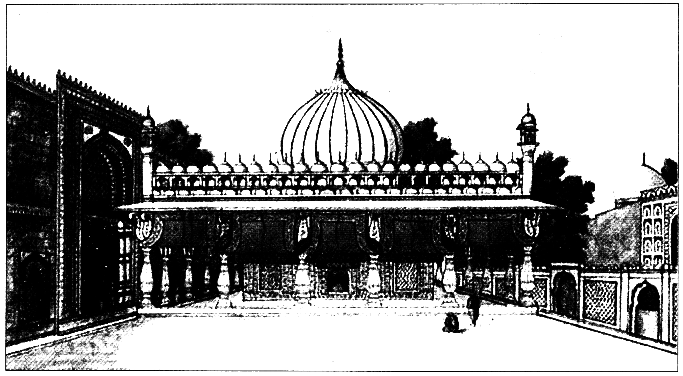
Class 8 History Chapter 6 Extra Questions and Answers Colonialism and the City

Question
1. Name the shrine shown in the picture.
2. Where the above-shown shrine located in India.
Answer:
1. The picture is Dargah of Hazrat Nizamuddin Auliya.
2. It is in Delhi.
Class 7 History Chapter 1 Extra Questions and Answers Tracing Changes Through A Thousand Years

Tracing Changes Through A Thousand Years Class 7 History Chapter 1 Extra Questions and Answers Social Science CBSE Pdf free download are part of Extra Questions for Class 7 Social Science. Here we have given NCERT Extra Questions for Class 7 Social Science SST History Chapter 1 Tracing Changes Through A Thousand Years.

You can also practice NCERT Solutions for Class 7 History Chapter 1 Questions and Answers on LearnInsta.com.

Class 7 History Chapter 1 Extra Questions and Answers Tracing Changes Through A Thousand Years

Tracing Changes Through A Thousand Years Class 7 Extra Questions and Answer History Chapter 1 Very Short Answers Type

Question 1.
What do you understand about the cartographer?
Answer:
The cartographer is a person who makes maps.

Question 2.
Who was Al-Idrisi?
Answer:
Al-Idrisi was an Arab geographer and was an Arabian.

Question 3.
What was made by Al-Idrisi?
Answer:
Al-Idrisi made a detail of the Indian subcontinent from his large map of the world in 1154 CE.

Question 4.
By whom was the term Hindustan used first of all?
Answer:
First of all, the term Hindustan was used by Minhaj-i-Siraj in 13th century. He was a Persian chronicler.

Question 5.
What did Minhaj-i-Siraj meant by the term ‘Hindustan’?
Answer:
He meant the areas of Punjab, Haryana and the lands between the Ganga and Yamuna. The term was used in a political sense for lands that were a part of the dominions of the Delhi Sultan but it never included south India.

Question 6.
What did Babur meant by Hindustan?
Answer:
Babur used Hindustan to describe the geography, the fauna and the culture of the inhabitants of the subcontinent.

Question 7.
Who used the word ‘Hind’ and when?
Answer:
Amir Khusrau used the word “Hind” in the 14th century.

Question 8.
From which language is the word ‘ajnabi’ related?
Answer:
Persian.

Question 9.
How did the scribes copy manuscripts in absence of Printing Press?
Answer:
By hand.

Question 10.
From which word ‘Rajput’ derived?
Answer:
The word ‘Rajput’ was derived from “Rajaputra”, the son of a ruler.

Question 11.
Name the language in which prashasti of Ghiyasuddin Balban has been written.
Answer:
In Sanskrit.

Question 12.
Which was the new religion that appeared in the subcontinent?
Answer:
The new religion which appeared in the subcontinent was Islam.

Question 13.
Give the name of the holy book of Islam.
Answer:
Quran.

Question 14.
Who brought Islam and when?
Answer:
In 7th century merchants of Arab brought teachings of Islam.

Question 15.
In how many periods was the history divided by the British historians?
Answer:
In the middle of the 19th century, British historians divided the history of India into three periods- Hindu, Muslim and British.

Tracing Changes Through A Thousand Years Class 7 Extra Questions and Answer History Chapter 1 Short Answers Type

Question 1.
Which were the sources used to learn the past?
Answer:
Historians used different types of sources to learn about the past depending upon the period of their study and the nature of their investigation such as on coins, inscriptions, architecture and textual record for information.

Question 2.
Why did people use the paper?
Answer:
Paper became cheaper and more widely available and hence people used it to write texts, chronicles of rulers, letters and teachings of saints, petitions and judicial records, and for registers of accounts and taxes.

Question 3.
How did the manuscripts of the same text become different from one another?
Answer:
In the absence of Printing Press, scribes copied manuscripts by hand. They also introduced small changes-a word, a sentence. These small differences grew over centuries of copying until manuscripts of the same text became substantially different from one another.

Question 4.
Why has study been a great challenge between 700 and 1750?
Answer:
The study of the thousand years between 700 and 1750 has been a huge challenge to historians largely because of the scale and variety of developments that occurred over the period.

Question 5.
What were the new technology and crops that came in subcontinent during the period?
Answer:
New technology like Persian wheel in irrigation, the spinning wheel in weaving and firearms in combat, new foods and beverages potatoes, corn, chillies, tea and coffee arrived in the subcontinent. All these innovations-new technologies and crops came along with people, who brought other ideas with them as well.

Question 6.
What do you understand about the Rajputs?
Answer:
The term Rajput was applied more generally to a group of warriors who claimed Kshatriya caste status. The term included not just rulers and chieftains but also soldiers and commanders who served in the armies of different monarchs all over the subcontinent.

Question 7.
Write the name of other groups who became politically important.
Answer:
Other group of people such as the Marathas, Sikhs, Jats, Ahoms and Kayasthas also used the opportunities of the age to become politically important.

Question 8.
Which factors forced many forest-dwellers to migrate?
Answer:
There was a gradual clearing of forests and the extension of agriculture throughout this period. This forced many forest-dwellers to migrate. Others started tilling the land and became peasants.

Tracing Changes Through A Thousand Years Class 7 Extra Questions and Answer History Chapter 1 Long Answers Type

Question 1.
Describe, how the new groups of peasants were important group.
Answer:
The new groups of peasants gradually began to be influenced by regional markets, chieftains, priests, monasteries and temples. They became part of large complex societies and were required to pay taxes and offer goods and services to local lords.

As a result, significant economic and social differences emerged amongst peasants. Some possessed more productive land, others also kept cattle, and some combined artisanal work with agricultural activity during the lean season.

Question 2.
How were the jatis classified in the society during the period 700-1750?
Answer:
As society became more differentiated, people were grouped into jatis or sub-castes and ranked on the basis of their backgrounds and their occupations. Ranks of jatis were not fixed permanently, and varied according to the power, influence and resources controlled by members of the jati. The status of the same jati could vary from area to area. Jatis framed their own rules and regulations to manage the conduct of their members.

Question 3.
What was written about Ghiyasuddin Balban in the Prashasti?
Answer:
A prashasti praising the Delhi Sultan Ghiyasuddin Balban explained that was the ruler of a vast empire that stretched from Bengal in the east to Ghazni in Afghanistan in the west and including all of south India. People of different regions-Gauda, Andhra, Kerala, Karnataka, Maharashtra and Gujarat apparently fled before his armies. Historians regard these as exaggerated claims.

Question 4.
What has been written by Amir Khusrau regarding the languages?
Answer:
Amir Khusrau noted (1318) that there was different language in every region of this land. In southern Karnataka, Sindhi, Lahori, Kashmiri, Dvarsamudri; in Andhra Pradesh-Telangani; in Gujarat-Gujari; In Tamil Nadu-Ma’bari; In Bengal-Gauri; in eastern UP-Awadhi; around Delhi-Hindawi. In contrast to these languages there was Sanskrit which did not belong to any region. It was an old language and ‘common people do not know it, only the Brahmanas do’.

Question 5.
What changes occurred in Hinduism during the period?
Answer:
During this period important changes occurred in what we call Hinduism today. These included the worship of new deities, the construction of temples by royalty and the growing importance of Brahmanas, the priests, as dominant groups in society.

The knowledge of Sanskrit texts earned the Brahmanas a lot of respect in society. One of the major developments of this period was the emergence of the idea of Bhakti.

Question 6.
Describe the variety of ways interpreted by the Islamic followers.
Answer:
Islam was interpreted in variety of ways by its followers. There were the Shia Muslims and Sunni Muslims. Shia who believed that the Prophet Muhammad’s son-in-law, Ali was the legitimate leader of the Muslim community while Sunni accepted the authority of the four Khalifas which also includes Ali as an one and last Khalifa.

Class 6 Civics Chapter 7 Extra Questions and Answers Urban Administration

Urban Administration Class 6 Civics Chapter 7 Extra Questions and Answers Social Science CBSE Pdf free download are part of Extra Questions for Class 6 Social Science. Here we have given NCERT Extra Questions for Class 6 Social Science SST Civics Chapter 7 Urban Administration.

You can also practice NCERT Solutions for Class 6 Civics Chapter 7 Questions and Answers on LearnInsta.com.

Class 6 Civics Chapter 7 Extra Questions and Answers Urban Administration

Urban Administration Class 6 Extra Questions and Answer Civics Chapter 7 Very Short Answers Type

Question 1.
What was the game played by Mala, Shankar, Jehangir and Rehana?
Answer:
They were playing cricket.

Question 2.
What had happened with Nirmala Mausi?
Answer:
When all were playing cricket, window glass of Nirmala Mausi had broken.

Question 3.
How was the window glass repaired?
Answer:
The children spent their pocket money to have it replaced.

Question 4.
Which body is responsible for local work in the urban areas?
Answer:
In the urban areas the Municipal Corporation is the body which is responsible for many work.

Question 5.
Who controls the diseases in urban areas?
Answer:
The Municipal Corporation is responsible for preventing the spread of diseases.

Question 6.
Who is responsible to run schools, hospitals and dispensaries in the urban areas?
Answer:The Municipal Corporation also runs schools, hospitals and dispensaries. They can also be run by the State Government as well as by the Central Government.

Question 7.
What is the Municipal Corporation in the smaller towns called?
Answer:
In the smaller towns it is called the Municipal Council.

Question 8.
What are the complicated decisions that affect the entire city?
Answer:
The complicated decisions that affect the entire city are taken by groups of councillors who form com-mittees to decide and debate on the issue.

Question 9.
Who should be contacted by the people when problems are within a ward?
Answer:
When the problems are within a ward then the people who live in the ward should contact their councillors.

Question 10.
Who implements the decisions taken by the councillors or committees of councillors?
Answer:
Decisions are implemented by the Commissioner and administrative staff.

Question 11.
Is the Commissioner appointed or elected?
Answer:
The Commissioner is appointed by the government.

Urban Administration Class 6 Extra Questions and Answer Civics Chapter 7 Short Answers Type

Question 1.
Make a list of work done by the Municipal Corporation?
Answer:
The Municipal Corporation is responsible for the following work:

  1. Arrangements for street lights
  2. Garbage collection
  3. Water supply
  4. Keeping the streets and the market clean
  5. Making gardens, parks and maintaining them

Question 2.
How are large urban areas managed?
Answer:
The city is divided into different wards and Ward Councillors get elected. The decisions like where a park or a new hospital should go are usually made by the Ward Councillors.

Question 3.
Write some names of departments that work under the Municipal Corporation?
Answer:
The Municipal Corporation has various departments such as water department, a department to look after gardens, another to look after roads.

Question 4.
Describe the community protest.
Answer:
Community protest is a group demonstration. Any such problem that concerns with the common people, protest is used to attract attention of the concerned authority. Peaceful protest is allowed in India.

Under the protest, a memorandum is given to the concerned department in which the problem of the area is raised and the request is made to resolve the problem. In this chapter too, Gangabai has demonstrated in front of the office of the Municipal Corporation about the problem of garbage deposited in its area.

Question 5.
Write responsibilities of the Councillors.
Answer:
Councilors’ responsibilities include:

  1. Strategic planning for the whole municipality and a sustainable future
  2. Determining the financial strategy and allocating resources via the council budget
  3. Representing residents
  4. Advocating a broad range of issues
  5. Liaising and coordinating with other levels of government, non-government, community groups and the private sector
  6. Overseeing the management of community assets
  7. Facilitating community participation.

Urban Administration Class 6 Extra Questions and Answer Civics Chapter 7 Long Answers Type

Question 1.
How does the Municipal Corporation get its money?
Answer:
Providing and running so many services require a lot of money. The Municipal Corporation collects this in different ways. People who own homes have to pay a property tax as well as taxes for water and other services.

There are also taxes for education and other amenities. If you own a hotel or shop then you have to pay a tax for this as well. Tax is also collected on movie tickets. A large amount of taxes are accumulated in the head of property tax.

Question 2.
What is Sub-Contracting and what is its impact?
Answer:
In the recent time, in order to save the money, the commissioners of several municipalities across the country had hired private contractors to collect and process garbage. This is called Sub-Contracting. This means that the work that was earlier being done by government workers is now being done by a private company.

Not only by the municipalities but also various institutes such as hospitals, schools, colleges, transport department and also many government departments have now hired workers on sub-contract basis to save money and to avoid their social obligation.

These contractual workers get paid less and their jobs are temporary. Collecting garbage is also a quite dangerous job and often these contractual workers do not have any access to safety measures and are not taken care of if they are injured while working.

Question 3.
Why did the plague scare occur in Surat in 1994?
Answer:
Surat was one of the dirtiest cities in India. Houses, hotels and restaurants would dump their garbage into the nearest drain or street which made it very difficult for sweepers to collect and transfer the garbage into selected dumps.

In addition to this, the Municipal Corporation did not collect the garbage as often as it should have and this led to the situation getting worse. Plague spread through the air and people who had the disease had to be isolated. In Surat several people lost their lives and about 3 lakh deserted the city.

Question 4.
Write functions of the Municipal Corporation.
Answer:
The functions of the Municipal Corporations are as under:

  1. Urban planning including town planning.
  2. Regulation of land-use and construction of buildings.
  3. Planning for economic and social development.
  4. Roads and bridges.
  5. Water supply for domestic, industrial and commercial purposes.
  6. Public health, sanitation conservancy and solid waste management.
  7. Fire services.
  8. Urban forestry, protection of the environment and promotion of ecological aspects.
  9. Safeguarding the interests of weaker sections of society, including handicapped and mentally retarded people.
  10. Slum improvement and up-gradation.
  11. Urban poverty alleviation.
  12. Provision of urban amenities and facilities such as parks, gardens, playgrounds.
  13. Promotion of cultural, educational and aesthetic aspects.
  14. Burials and burial grounds; cremations and cremation grounds.
  15. Vital statistics including registration of births and deaths.
  16. Public amenities including street lighting, parking, bus stops and public conveniences.
  17. Regulation of slaughterhouses.

Class 8 History Chapter 10 Extra Questions and Answers The Changing World of Visual Arts

The Changing World of Visual Arts Class 8 History Chapter 10 Extra Questions and Answers Social Science CBSE Pdf free download are part of Extra Questions for Class 8 Social Science. Here we have given NCERT Extra Questions for Class 8 Social Science SST History Chapter 10 The Changing World of Visual Arts.

You can also practice NCERT Solutions for Class 8 History Chapter 10 Questions and Answers on LearnInsta.com.

Class 8 History Chapter 10 Extra Questions and Answers The Changing World of Visual Arts

The Changing World of Visual Arts Class 8 Extra Questions and Answer History Chapter 10 Very Short Answers Type

Question 1.
What was the main focus of European artists about the British?
Answer:
The main focus of European artists about the British was to show the superiority of the British.

Question 2.
What is meant by portraits?
Answer:
The life size images that look lifelike and real.

Question 3.
Define the term convention.
Answer:
Convention is an accepted norm or style.

Question 4.
Who painted the potrait of Nawab Muhammad Ali Khan of Arcot?
Answer:
It was painted by George Willison.

Question 5.
When did Tipu Sultan of Mysore finally get defeated?
Answer:
He was finally defeated in 1799.

Question 6.
What does the imperial history paintings sought to create?
Answer:
It sought to create a public memory of imperial triumphs.

Question 7.
What do you understand by the term Mural?
Answer:
Mural is a wall painting done by the local artists.

Question 8.
What was the aftermath of establishment of the British power?
Answer:
With the establishment of the British power many of the local courts lost their influence and wealth.

Question 9.
By whom was the Damayanthi was painted?
Answer:
By Raja Ravi Varma.

Question 10.
Who was the nephew of Rabindranath Tagore?
Answer:
Abanindranath Tagore.

Question 11.
What is Mural?
Answer:
Mural is a wall painting.

Question 12.
Where is Clive street located?
Answer:
It is located in Calcutta.

Question 13.
From where does Mohammad Ali Khan belongs to?
Answer:
He belongs to Arcot.

Question 14.
Where does Tipu Sultan ruled?
Answer:
In Mysore.

Question 15.
By whom was the storming of seringpatnam painted?
Answer:
By Rober Kerr Porter.

Question 16.
Who was Samuel Bourne.
Answer:
He was a photographer.

Question 17.
When was Tipu Sultan defeated?
Answer:
He was defeated in 1799.

Question 18.
What is meant by life study?
Answer:
It is the study of human figure from living models where pose for the artists.

The Changing World of Visual Arts Class 8 Extra Questions and Answer History Chapter 10 Short Answers Type

Question 1.
What did the British want from images made by the local painters?
Answer:
The British wanted the images through which they could understand India, remember their life in India, and depict India to the western world.

Question 2.
Define the term perspective and how it was used by the local miniature artists at Murshidabad. Answer:
Perspective: The way that objects appear smaller when they are further away and the way parallel lines appear to meet each other at a point in the distance. Local miniature artists use perspective by using light and shades to make the figures look life like and real.

Question 3.
How were the cultural traditions resisted by Tipu Sultan?
Answer:
Tipu not only fought British on the battlefield but also resisted the cultural tradition by continuing to encourage the local traditions, he had his walls of the palace at Seringapatam covered with mural paintings done by local artists.

Question 4.
Briefly explain about the incidence after the Battle of Plassey.
Answer:
The British defeated Sirajuddaulah in the famous battle of Plassey and after his defeat Mir Jafar was installed as the nawab of Murshidabad. It was the victory won through the conspiracy and traitor Mir Jafar was awarded the title of Nawab.

Question 5.
Differentiate between colonial portraits and existing Indian style of painting.
Answer:
The existing Indian culture has the style and tradition of painting portraits in miniature.
But colonial portraits were life-size images that looked lifelike and real.

The Changing World of Visual Arts Class 8 Extra Questions and Answer History Chapter 10 Long Answers Type

Question 1.
What happened during the Battle of Plassey? How was the defeat of Sirajuddaulah shown in history painting produced hy Francis Hayman?
Answer:
The Battle of Plassey saw the defeat of Sirajuddaulah by the British. After the defeat of Sirajuddaulah in the Battle of Plassey the British installed Mir Jafar as the Nawab of Murshidabad. It was a victory won through conspiracy, and the traitor Mir Jafar was awarded the title of Nawab.

In the painting oy Francis Hayman in 1762 which was placed on public display in the Vauxhall Gardens in London, this act of aggression and conquest is not depicted. The picture shows Lord Clive being welcomed by Mir Jafar and his troops after the Battle of Plassey.

Question 2.
Who was Raja Ravi Varma? How did Ravi Varma’s mythological painting become the rage among Indian princes and art collectors?
Answer:
Raja Ravi Varma was one of the 1st artists who tried to create a style that was both modern and national. Ravi Varma belonged to the family of the Maharajas of Travancore in Kerala, and he was addressed as Raja. He mastered the western art of oil painting and realistic life study, but painted themes from Indian mythology.

He dramatised on canvas, scene after scene from the Ramayana and the Mahabharta, drawing on the theatrical performance of mythological stories that he witnessed during his tour of the Bombay Presidency.

From 1880’s Ravi Varma’s mythological paintings became the rage among Indian princes and art collectors, who filled their palace galleries with his works.

Picture Based Questions Class 8 History Chapter 10 The Changing World of Visual Arts

Look at the picture given below and answer the following questions:

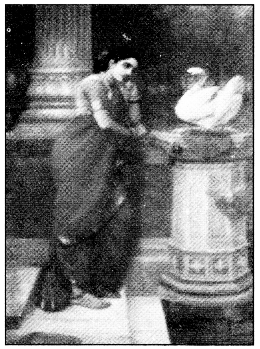
1. Who was the painter of the following painting?
Class 8 History Chapter 10 Extra Questions and Answers The Changing World of Visual Arts 1

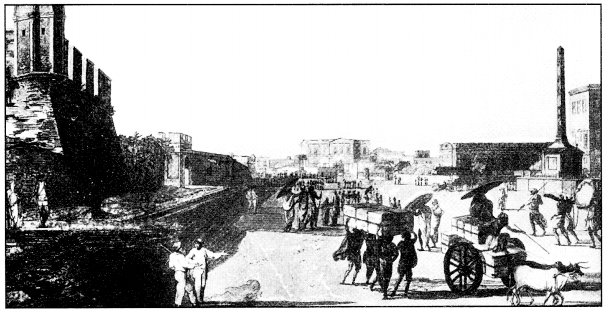
2. What does the pictures describes?
Class 8 History Chapter 10 Extra Questions and Answers The Changing World of Visual Arts 2

3. whom does the portrait belongs to.
Class 8 History Chapter 10 Extra Questions and Answers The Changing World of Visual Arts 3
Answer:

  1. Raja Ravi Varma.
  2. It describes about the Clive street in Calcutta draw by Thomas and William Daniell, 1786.
  3. Muhammad Ali Khan of Arcot.

Class 8 History Chapter 8 Extra Questions and Answers Civilising the Native, Educating the Nation

Civilising the Native, Educating the Nation Class 8 Extra Questions and Answers Social Science History Chapter 8 CBSE Pdf free download are part of Extra Questions for Class 8 Social Science. Here we have given NCERT Extra Questions for Class 8 Social Science SST History Chapter 8 Civilising the Native, Educating the Nation.

You can also practice NCERT Solutions for Class 8 History Chapter 8 Questions and Answers on LearnInsta.com.

Class 8 History Chapter 8 Extra Questions and Answers Civilising the Native, Educating the Nation

Civilising the Native, Educating the Nation Class 8 Extra Questions and Answer History Chapter 8 Very Short Answers Type

Question 1.
Define the term linguist.
Answer:
Linguist is someone who knows and studies several languages.

Question 2.
What was main aim behind establishing Hindu College in Benaras in 1791?
Answer:
Hindu College was established to encourage the study of ancient Sanskrit texts that would be useful for the administration of the country.

Question 3.
What is meant by an Orientalist?
Answer:
Orientalists were those who were having scholarly knowledge of the language and culture of Asia.

Question 4.
How did Thomas Babington Macaulay see India?
Answer:
He saw India as an uncivilized country that needed to be civilized.

Question 5.
Why was the English Education Act introduced and in which year?
Answer:
Following Macaulay’s minute, the English Education Act of 1835 was introduced.

Question 6.
Who toured the districts of Bengal and Bihar in 1830’s?
Answer:
In 1830’s William Adam, a Scottish missionary toured the districts of Bengal and Bihar.

Question 7.
When did the Company decide about improving the system of vernacular education?
Answer:
After 1854, the Company decided to improve the system of vernacular education.

Question 8.
Name the institution established by Rabindranath Tagore.
Answer:
‘Santiniketan’ was established by Rabindranath Tagore in 1901.

Question 9.
Who was William John.
Answer:
William Jones was appointed as Junior Judge at the supreme court of company.

Question 10.
Which languages were learnt by William Jones?
Answer:
Greek, Latin, French and English.

Question 11.
By whom was the Asiatic society of Bengal was setup?
Answer:
By William Jones.

Question 12.
From whom did William Johns learnt Sanskrit language?
Answer:
The Pandits.

Question 13.
In which year was Madarsa setup in Calcutta?
Answer:
In 1781.

Question 14.
When was the Hindu college Benaras was established?
Answer:
In 1791.

Question 15.
Who emphasized on teaching of English language in manner of civilizing, changing the taste values and cultures of the Indians?
Answer:
Lord Macaulay.

Question 16.
When was the English Education act introduced?
Answer:
In 1835.

Question 17.
Who was William Carey.
Answer:
William Carey was a Scottish missionary.

Civilising the Native, Educating the Nation Class 8 Extra Questions and Answer History Chapter 8 Short Answers Type

Question 1.
In what sense does Gandhiji and Tagore’s thoughts were similar and different about western education?
Answer:
In many senses Tagore’s and Gandhiji’s thoughts about western education were similar. There were several differences too. Gandhiji was highly critical of western education, civilisation and its worship of machines and technology.

But Tagore wanted to combine elements of modern western civilisation with the best within Indian tradition. Tagore emphasized on the needs to teach science and technology along with art, music and dance.

Question 2.
Why did Tagore hate going to school in his school days?
Answer:
He found school suffocating and oppressive. The school appeared like a prison to him as he could never do what he felt like doing. And the experience of Tagore’s school days in Calcutta shook his ideas of education. These were reasons why he hated going to school in his school days.

Question 3.
What did Mahatma Gandhi say about western education?
Answer:
Mahatma Gandhi said that western education focused on reading and writing rather than oral knowledge. It valued textbooks rather than practical knowledge. He argued that education ought to develop a person’s mind and soul. Literacy or simple learning to read and write by itself did not count as education.

Question 4.
What consequences were there of the new rules and routine over the earlier pathshala students who accepted the British rules?
Answer:
In the earlier system of Pathshala, students from poor peasant families had been able to go to pathshalas as the timetable was flexible before adoption of rules of the British government.

The discipline of the new system demanded regular attendance, even during harvest time when children of poor families had to work in the fields. Inability to attend school came to be seen as indiscipline, as evidence of the lack of desire to learn.

Question 5.
What did James Mill declare while attacking the orientalists?
Answer:
James Mill attacked the orientalists and declared that the British should not make efforts to teach what the natives wanted or respected, in order to please them. The aim of education ought to be to teach what was useful and practical. So Indians should be made familiar with the scientific and technical advancements that the west had made, rather than with the poetry and sacred literature of the orientals.

Civilising the Native, Educating the Nation Class 8 Extra Questions and Answer History Chapter 8 Long Answers Type

Question 1.
In view of Mahatma Gandhi, why was practical knowledge very much essential for development of person’s mind and soul?
Answer:
Mahatma Gandhi believed that western education focused on reading and writing rather than lived experiences and practical knowledge. He argued that education ought to develop a person’s mind and soul. Literacy – or simply learning to read and write by itself did not count as education.

People had to work with their hands, learn a craft, and know-how different things operated. This would develop their mind and their capacity to understand. This is why Mahatma Gandhi believed that practical knowledge was very much essential for development of person’s mind and soul.

Question 2.
Explain the William Adam’s report produced on the progress of education in vernacular schools.
Answer:
William Adam had been asked by the Company to report on the progress of education in vernacular schools. The report Adam produced was interesting.

Adam found that there were over 1 lakh pathshalas in Bengal and Bihar. These were small institutions with no more than 20 students each. But the total number of children being taught in these pathshalas was considerable over 20 lakh. These institutions were set up by wealthy people, or the local community. At times they were started by a teacher (guru).

The system of education was flexible. Adam discovered that this flexible system was suited to local needs. For instance, classes were not held during harvest time when rural children often worked in the fields. The pathshala started once again when the crops had been cut and stored. This meant that even children of peasant families could study.

Question 3.
Explain Wood’s Despatch. What was mentioned in its provision?
Answer:
In 1854, the Court of Directors of the East India Company in London sent an educational despatch to the Governor-General in India, issued by Charles Wood, the president of the Board of Control of the Company. It has come to be known as Wood’s Despatch.

  1. It emphasized once again on the practical benefits of system of European learning.
  2. One of the practical uses the Despatch pointed to was economic European learning.
  3. It said, it would enable Indians to recognize the advantages that flow from the expansion of trade and commerce.
  4. Wood’s Despatch argued that European learning would improve the moral character of Indians.
  5. It would make them truthful and honest and would supply the Company with civil servants who could be trusted and depended upon.
  6. The literature of East was believed to be full of errors and also couldn’t instill in the people a sense of duty and a commitment to work nor could it develop the skill required for administration.

Picture Based Questions Class 8 History Chapter 8 Civilising the Native, Educating the Nation

Look at the picture given below and answer the following questions:

Question:
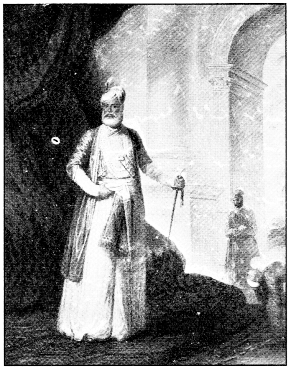
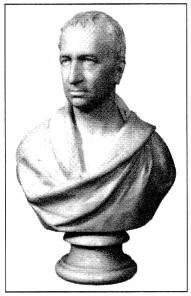
1. Who was Henry Thomas Cookbrooke?
Class 8 History Chapter 8 Extra Questions and Answers Civilising the Native, Educating the Nation 1

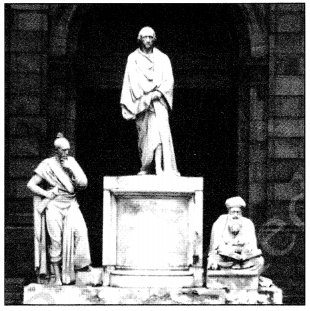
2. Whom does the monument belong to?
Class 8 History Chapter 8 Extra Questions and Answers Civilising the Native, Educating the Nation 2

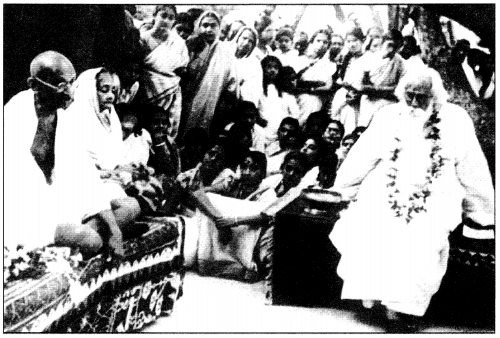
3. Along with whom is Mahatma Gandhi sitting with civilizing the “NATIVE” Educating the Nation.
Class 8 History Chapter 8 Extra Questions and Answers Civilising the Native, Educating the Nation 3

4. What does the picture shows?
Class 8 History Chapter 8 Extra Questions and Answers Civilising the Native, Educating the Nation 4
Answer:

  1. He was a scholar of Sanskrit and ancient sacred writings of Hinduism.
  2. Monument belongs to Warren Hastings.
  3. He is sitting with Kasturba Gandhi and Rabindranath Tagore.
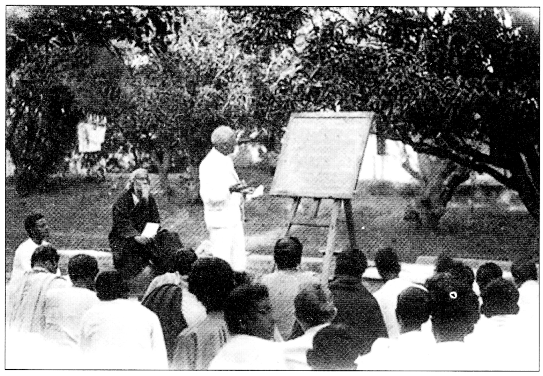
  4. The picture shows a class in progress in Santiniketan in the 1930’s.