MCQ Questions for Class 12 Geography Chapter 5 Land Resources and Agriculture with Answers

Check the below NCERT MCQ Questions for Class 12 Geography Chapter 5 Land Resources and Agriculture with Answers Pdf free download. MCQ Questions for Class 12 Geography with Answers were prepared based on the latest exam pattern. We have provided Land Resources and Agriculture Class 12 Geography MCQs Questions with Answers to help students understand the concept very well. https://mcqquestions.guru/mcq-questions-for-class-12-geography-chapter-5-part-b/

Land Resources and Agriculture Class 12 MCQs Questions with Answers

Land Resources And Agriculture Class 12 MCQ Question 1.
Which type of farming is known as Slash and Burn to farm?
(A) Primitive subsistence
(B) Intensive subsistence
(C) Plantation
(D) Commerical

Answer

Answer: (A) Primitive subsistence


MCQ On Land Resources Chapter 5 Class 12 Question 2.
India is the second-largest producer of which crop in the world?
(A) Tea
(B) Coffee
(C) Rice
(D) Cotton

Answer

Answer: (C) Rice


Agriculture Class 12 MCQ Geography Question 3.
Which state is the largest producer of Jowar in India?
(A) Punjab
(B) Maharashtra
(C) Karnataka
(D) Rajasthan

Answer

Answer: (B) Maharashtra


Land Resources MCQ Geography Chapter 5 Question 4.
India is the leading producer of which crop in the world?
(A) Jute
(B) Rice
(C) Tea
(D) Coffee

Answer

Answer: (C) Tea


Agriculture Class 12 MCQ Questions Chapter 5 Question 5.
Which crop was introduced in Baba Budan Hills?
(A) Tea
(B) Coffee
(C) Rice
(D) Cotton

Answer

Answer: (B) Coffee


MCQ On Agriculture Class 12 Chapter 5 Question 6.
Which is known as golden fiber?
(A) Cotton
(B) Silk
(C) Jute
(D) Wool

Answer

Answer: (C) Jute


Question 7.
Which one of the following is a rabi crop?
(A) Rice
(B) Millets
(C) Gram
(D) Cotton

Answer

Answer: (C) Gram


Question 8.
Which one of the following is a leguminous crop?
(A) Pulses
(B) Millets
(C) Jowar
(D) Sesamum

Answer

Answer: (A) Pulses


Question 9.
Which one of the following price is announced by the government in support of a crop?
(A) Maximum support price
(B) Minimum support price
(C) Moderate support price
(D) Influential support price

Answer

Answer: (B) Minimum support price


Question 10.
Cotton needs a frost-free period of
(A) 100 days
(B) 150 days
(C) 210 days
(D) 250 days

Answer

Answer: (C) 210 days


Question 11.
What is the total production of food grains in India?
(A) 70 million tonnes
(B) 100 million tonnes
(C) 150 million tonnes
(D) 250 million tonnes

Answer

Answer: (D) 250 million tonnes


Question 12.
Which state is the largest wheat producing state?
(A) Punjab
(B) Haryana
(C) Uttar Pradesh
(D) Rajasthan

Answer

Answer: (C) Uttar Pradesh


Question 13.
In which season Kharif crops are grown?
(A) Winter
(B) Summer
(C) Spring
(D) Autumn

Answer

Answer: (B) Summer


Question 14.
The net area sown in India is
(A) 77%
(B) 67%
(C) 45%
(D) 43%

Answer

Answer: (D) 43%


Question 15.
In India, cereals occupy how much-cropped area?
(A) 34%
(B) 44%
(C) 54%
(D) 64%

Answer

Answer: (C) 54%


Question 16.
Which one of the following is NOT a land-use category?
(A) Fallow land
(B) Marginal land
(C) Net Area Sown
(D) Culturable Wasteland

Answer

Answer: (B) Marginal land


Question 17.
Which one of the following is the main reason due to which share of the forest has shown an increase in the last forty years?
(A) Extensive and efficient efforts of afforestation
(B) Increase in community forest land
(C) Increase in the notified area allocated for forest growth
(D) Better peoples participation in managing forest area

Answer

Answer: (C) Increase in the notified area allocated for forest growth


Question 18.
Which one of the following is the main form of degradation in irrigated areas?
(A) Gully erosion
(B) Wind erosion
(C) Salinisation of soils
(D) Siltation of land

Answer

Answer: (C) Salinisation of soils


Question 19.
Which one of the following crops is not cultivated under dryland farming?
(A) Ragi
(B) Jowar
(C) Groundnut
(D) Sugarcane

Answer

Answer: (D) Sugarcane


Question 20.
In which of the following group of countries of the world, HYVs of wheat and rice were developed?
(A) Japan and Australia
(B) The U.S.A. and Japan
(C) Mexico and the Philippines
(D) Mexico and Singapore

Answer

Answer: (C) Mexico and the Philippines


We hope the given NCERT MCQ Questions for Class 12 Geography Chapter 5 Land Resources and Agriculture with Answers Pdf free download will help you. If you have any queries regarding CBSE Class 12 Geography Land Resources and Agriculture MCQs Multiple Choice Questions with Answers, drop a comment below and we will get back to you soon.

MCQ Questions for Class 12 Geography Chapter 4 Human Settlements

Human Settlements Class 12 MCQs Questions with Answers

Class 12 Geography Chapter 4 Human Settlement MCQ Question 1.

The sparsely located small settlements are called:

(A) town
(B) village
(C) catchment area
(D) town
Answer:
(B) village

Human Settlement Class 12 MCQ Question 2.

Larger settlements which are specialising in secondary and tertiary activities are known as:

(A) rural settlements
(B) urban settlements
(C) sub-urbans
(D) rented settlements
Answer:
(B) urban settlements

MCQ Questions for Class 12 Geography Chapter 4 Human Settlements

Explanation:
Urban settlement often has a large population size and high population density,

Human Settlement Class 12 MCQ Chapter 4 Question 3.

The clustered rural settlement is:

(A) closely built up houses
(B) scattered houses
(C) sparsely built up houses
(D) unplanned houses
Answer:
(A) closely built up houses

Explanation:
A clustered rural settlement is a rural settlement where a number of families live in close proximity to each other.

Human Settlements MCQ Chapter 4 Class 12 Question 7.

Urban centre with population of more than one lakh is called a:

(A) class I town
(B) class II town
(C) class III town
(D) class IV town
Answer:
(A) class I town

Explanation:
Class I town is grouped on the I basis their population in Census.

MCQ Questions for Class 12 Geography Chapter 4 Human Settlements

Ch 4 Human Settlement Class 12 MCQ Question 8.

A town containing military base is known as:

(A) defence town
(B) garrison town
(C) military town
(D) closed town
Answer:
(B) garrison town

Explanation:
Garrison town often applies to certain facilities that constitute a military base or fortified military headquarters.

MCQ Of Human Settlement Class 12 Question 9.

Towns and cities are generally classified on the basis of the …………. they perform.

(A) function
(B) size
(C) contribution
(D) None of the Above
Answer:
(A) function

Explanation:
No town performs a single function, rather they are classified on the basis of the dominant function they perform.

Class 12 Geography Human Settlement MCQ Question 10.

The towns that have developed in mineral rich areas are known as:

(A) mining towns
(B) tourist towns
(C) educational town
(D) administrative town
Answer:
(A) mining towns

Explanation:
Mining towns are usually created 1 around a mine or a quarry.

MCQ Questions for Class 12 Geography Chapter 4 Human Settlements

Human Settlements MCQ Chapter 4 Class 12 Question 11.

Varanasi, Mathura, Amritsar, Madurai, Puri are:

(A) mining towns
(B) commercial towns
(C) religious towns
(D) heritage town
Answer:
(C) religious towns

Explanation:
Holy city is a city which is important to the history or faith of a specific religion.

MCQ Of Human Settlement Class 12 Chapter 4 Question 12.

Nainital, Mussoorie, Shimla, Pachmarhi, Jodhpur are:

(A) transport towns
(B) tourist towns
(C) industrial towns
(D) educational town
Answer:
(B) tourist towns

Explanation:
Tourist town is an urban area where tourism or vacationing is the primary component of the local culture

MCQ Questions for Class 12 Geography Chapter 4 Human Settlements

Class 12 Human Settlement MCQ Chapter 4 Question 13.

Cluster of dwellings of any type or size where human beings live is known as :

(A) human settlement
(B) human development
(C) human displacement
(D) human cluster
Answer:
(A) human settlement

Explanation:
The complexity of a human settlement can range from a small number of dwellings grouped together to the largest of cities with surrounding urbanized areas.

Human Settlement MCQs Class 12 Chapter 4 Question 14.

Panna, Para, Palli, Nagla and Dhani are examples of:

(A) clustered settlement
(B) hamleted settlement
(C) compact settlement
(D) dispersed settlement
Answer:
(B) hamleted settlement

Explanation:
Some settlement is fragmented into several units and physically separated from each other is known as hamleted settlement.

Human Settlement Class 12 MCQs Question 15.

Uttarakhandand, Himachal Pradesh are example of:

(A) compact settlement
(B) isolated settlement
(C) rural settlement
(D) urban settlement
Answer:
(B) isolated settlement

Explanation:
Isolation settlement refers to areas either in the long distance away from cities where there is lack of facilities as well as opportunities such as transportation, market, training place , educational institutions.

MCQ Questions for Class 12 Geography Chapter 4 Human Settlements

MCQs Of Human Settlement Class 12 Question 16.

settlement is the kind of settlement that generally develops in the fertile plain and river valleys.

(A) Clustered rural settlement
(B) Clustered urban settlement
(C) Clustered grouped settlement
(D) None of the Above
Answer:
(A) Clustered rural settlement

Explanation:
The density of population in such areas is very high because of high productivity of the land.

Human Settlement MCQ Class 12 Question 17.

Name any modern town built by the British in modern style.

(A) Chandigarh
(B) Patna
(C) Mumbai
(D) Kochi
Answer:
(C) Mumbai

Human Settlements Class 12 MCQ Question 18.

Towns in India having historical background spanning over 2000 years are known as:

(A) Historical towns
(B) Cultural towns
(C) Administrative towns
(D) Social towns
Answer:
(A) Historical towns

Explanation:
Towns in India that have an historic or original core to it is known as historical town .

MCQ Questions for Class 12 Geography Chapter 4 Human Settlements

Human Settlements Ch 4 MCQ Class 12 Question 19.

Name the ‘urban agglomeration’ having the highest share of immigration population in India.

(A) Port Blair
(B) Mumbai
(C) Amritsar
(D) Chennai
Answer:
(B) Mumbai

Explanation:
An urban agglomeration is a continuous urban spread constituting a town and its adjoining outgrowths, or two or more physically contiguous towns together with or without outgrowths of such towns.

MCQ Questions for Class 12 Geography Chapter 4 Human Settlements

Question 20.

Arrange the following categories of towns in a sequence order according to their development in India.

(i) Ancient towns
(ii) Ultra-modern towns
(iii) Metropolitans
(iv) Modern towns Options:
(A) i, iv, iii, ii
(B) iv, i, iii, ii
(C) ii, iv, i, iii
(D) iii, ii, iv, i
Answer:
(A) i, iv, iii, ii

Question 21.

Arrange the following agglomeration in the sequence of their ranks i.e., 1st, 2nd, 3rd and 4th.

(i) Delhi
(ii) Chennai
(iii) Greater Mumbai
(iv) Kolkata Options:
(A) iii, iv, i, ii
(B) i, ii, iii, iv
(C) iv, ii, i, iii
(D) ii, i, iv, iii
Answer:
(A) iii, iv, i, ii

Explanation:
An urban agglomeration is identified and ranked according to its size, population, occupations and economic activities.

MCQ Questions for Class 12 Geography Chapter 4 Human Settlements

Question 22.

towns were typically small and crowded.

(A) Modern
(B) New
(C) Medieval
(D) Religious
Answer:
(C) Medieval

Explanation:
The streets of a medieval town were narrow and busy. These towns were small in size and cramped up.

Question 23.

Name the metropolitan city of Bihar.

(A) Bihar
(B) Muzzafarpur
(C) Gaya
(D) Patna
Answer:
(D) Patna

MCQ Questions for Class 12 Geography Chapter 4 Human Settlements

Question 24.

Name the metropolitan city of Karnataka State as per 2011 census.

(A) Karwar
(B) Bengaluru
(C) Hoobli
(D) Mangalore
Answer:
(B) Bengaluru

Explanation:
Bengaluru is the capital and the largest city of the Indian state of Karnataka. It has a population of more than 8 million and a metropolitan population.

Question 25.

What was the level of urbanisation in 2011 in India?

(A) 31.16%
(B) 32.26%
(C) 33.16%
(D) 33.26%
Answer:
(C) 33.16%

Explanation:
Urbanisation was highest in 2011. It was nearly 31.2%. Urbanisation refers to the movement of people and human settlements from rural areas to urban areas.

MCQ Questions for Class 12 Geography Chapter 4 Human Settlements

Question 26.

Ghaziabad, Rohtak, Gurugram and Faridabad are:

(A) Rural areas
(B) Satellite cities
(C) Urban cities
(D) None of the Above
Answer:
(B) Satellite cities

Explanation:
Satellite cities are smaller municipalities that are adjacent to a major city which is the core of a metropolitan .

Question 27.

How many mega cities are there in India?

(A) Two
(B) Three
(C) Five
(D) Six
Answer:
(C) Five

Explanation:
To qualify as an urban area must have a population of 10 million people.

Question 28.

The level of urbanisation is measured in terms of …………… of urban population to total population.

(A) Percentage
(B) Ratio
(C) Population
(D) None of the Above
Answer:
(A) Percentage

MCQ Questions for Class 12 Geography Chapter 4 Human Settlements

Question 29.

Raniganj, Jharia, Digboi, Ankleshwar, Singrauliare:

(A) Mining towns
(B) Social towns
(C) Garrison
(D) Religious towns
Answer:
(A) Mining towns

Explanation:
Mining communities or towns are usually created around a mine or a quarry.

Assertion and Reason Based MCQs

Directions:
In the following questions, A statement of Assertion (A) is followed by a statement of Reason (R). Mark the correct choice as:
(A) Both A and R are true and R is the correct explanation of A.
(B) Both A and R are true but R is NOT the correct explanation of A.
(C) A is true but R is false.
(D) A is false and R is true.

Question 1.

Assertion (A): People may erect houses and other structures and command some area or territory as their temporary support-base.
Reason (R): The process of settlement inherently involves grouping of people and apportioning of territory as their resource base.

Answer:
(D) A is false and R is true.

Explanation:
A house provides a sense of security and wellbeing, along with an economic standing in society. A house is not only a mere physical structure but also a symbol of power, authority and a host of other things that come along with it.

MCQ Questions for Class 12 Geography Chapter 4 Human Settlements

Question 2.

Assertion (A): Settlements vary in size and type.
Reason (R): They range from a hamlet metropolitan cities.

Answer:
(B) Both A and R are true but R is NOT the correct explanation of A.

Explanation:
Settlements can be small and sparsely spaced; they may also be large and closely spaced.

Question 3.

Assertion (A): In India compact village of a few hundred houses is a rather universal feature, particularly in the northern plains.
Reason (R): People live in compact village for security or defence reasons. In some areas scarcity of water has necessitated compact settlement for maximum utilisation of available water resources.

Answer:
(A) Both A and R are true and R is the correct explanation of A.

Explanation:
In this type of village the general living area is distinct and separated from the surrounding farms, barns and pastures.

Question 4.

Assertion (A): Unlike rural settlements, urban settlements are generally compact and larger in size. Reason (R): The settlement size is large and there is high density of population.

Answer:
(A) Both A and R are true and R is the correct explanation of A.t.

MCQ Questions for Class 12 Geography Chapter 4 Human Settlements

Explanation:
Most of the people living in urban settlements are engaged in secondary, tertiary and quaternary activities in these areas.

Question 5.

Assertion (A): Cities are functionally linked to rural areas around them.
Reason (R): Exchange of goods and services is performed sometimes directly and sometimes through a series of market towns and cities.

Answer:
(A) Both A and R are true and R is the correct explanation of A.

Explanation:
Urban areas rely on rural areas to meet their demands for food, water, wood, raw materials,similarly rural areas gain a lot from urban development, such as market, farm inputs, employment opportunities, etc. Cities are connected directly as well as indirectly with the villages and also with each other.

Question 6.

Assertion (A): Clustered village is a universal feature in the northern plains.
Reason (R): Clustered villages are found in areas of level and fertile land. Major portion of the population is landless; hence they are bound to live together.

Answer:
(A) Both A and R are true and R is the correct explanation of A.

Explanation:
A clustered settlement is a closely j built area of dwellings, wherever flat landis available.

MCQ Questions for Class 12 Geography Chapter 4 Human Settlements

Question 7.

Assertion (A): Total urban population has increased eleven-fold during the twentieth century.
Reason (R): Enlargement of urban centres and emergence of new towns have played a significant role in the growth of urban population and urbanisation in the country.

Answer:

(B) Both A and R are true but R is NOT the correct explanation of A.

Explanation:
The explosion of industrialization and manufacturing enterprises within a certain urban area gives rise to more employment opportunities — which is another factor of urbanization.

Question 8.

Assertion (A): Even specialised cities, as they grow into metropolises become multifunctional.
Reason (R): The functions do not get intertwined and the city can be categorised in a particular functional class.

Answer:
(C) A is true but R is false.

MCQ Questions for Class 12 Geography Chapter 4 Human Settlements

Explanation:
The functions change due to their dynamic nature. The functions get so intertwined that the city can not be categorised in a particular functional class.

Question 9.

Assertion (A): The objective of the Smart Cities Mission is to promote cities that provide core infrastructure, a clean and sustainable environment and give a decent quality of life to its citizens.
Reason (R): One of the features of Smart Cities is to apply smart solutions to infrastructure and services in order to make them better.

Answer:
(B) Both A and R are true but R is NOT the correct explanation of A.

Explanation:
The purpose of the Smart Cities Mission is to drive economic growth and improve the quality of life of people 1 by enabling local area development and 1 harnessing technology, especially technology 1 that leads to Smart outcomes.

I. Read the case study given below and answer the questions that follow:
The level of urbanisation is measured in terms of percentage of urban population to total population. The level of urbanisation in India in 2011 was 31.16 per cent, which is quite low in comparison to developed countries. Total urban population has increased eleven-fold during the twentieth century. Enlargement of urban centres and emergence of new towns have played a significant role in the growth of urban population and urbanisation in the country. But the growth rate of urbanisation has slowed down during last two decades.

Urban centre with population of more than one lakh is called a city or class I town. Cities accommodating population size between one to five million are called metropolitan cities and more than five million are mega cities. Majority of metropolitan and mega cities are urban agglomerations.

Question 1.

How much has the urban population increased during the 12th century?

(A) nine folds
(B) ten folds
(C) eleven folds
(D) twelve folds
Answer:
(C) eleven folds

MCQ Questions for Class 12 Geography Chapter 4 Human Settlements

Explanation:
Modernization and changes in the mode of living have lead to an increase in urban population.

Question 2.

What was the level of urbanisation recorded in India in 2011?

(A) 31.14 %
(B) 31.15%
(C) 31.16%
(D) 31.17%
Answer:
(C) 31.16%

Explanation:
The 2011 Census put the urban percentage of India as a whole at 31.16 percent, with census towns accounting for only 4.2 percentage points of the total.

Question 3.

Delhi, Mumbai and Chennai are examples of:

(A) Rural cities
(B) Metropolitan cities
(C) Transport cities
(D) None of the above
Answer:
(B) Metropolitan cities

Explanation:
A metropolitan area is a region house to a densely populated urban core and its less-populated surrounding territories, sharing industry, infrastructure, and housing.

MCQ Questions for Class 12 Geography Chapter 4 Human Settlements

Question 4.

An ……………. is a continuous urban spread constituting a town and its adjoining outgrowths.

(A) urban agglomeration
(B) metro
(C) sub growth
(D) All of the Above
Answer:
(A) urban agglomeration

Case-Based MCQs

I. Read the case study given below and answer the questions that follow:
The objective of the Smart Cities Mission is to promote cities that provide core infrastructure, a clean and sustainable environment and give a decent quality of life to its citizens. One of the features of Smart Cities is to apply smart solutions to infrastructure and services in order to make them better. For example, making areas less vulnerable to disasters, using fewer resources and providing cheaper services. The focus is on sustainable and inclusive development and the idea is to look at will act like a lighthouse to other aspiring cities.

Question 1.

What is the purpose of the Smart Cities Mission?

(A) Economic growth
(B) Improve the quality of life of people
(C) Provide good environment
(D) All of the Above
Answer:
(D) All of the Above

MCQ Questions for Class 12 Geography Chapter 4 Human Settlements

Question 2.

Name one Smart City in India?

(A) Kapurthala
(B) Agra
(C) Bhubaneswar
(D) Agra
Answer:
(C) Bhubaneswar

Explanation:
The main goal of a smart city is to optimise city functions and promote economic growth while also improving the quality of life for citizens by using smart technologies and data analysis.

Question 3.

When was the Smart Cities Mission launched?

(A) 2015
(B) 2016
(C) 2017
(D) 2018
Answer:
(A) 2015

Explanation:
National Smart Cities Mission is an urban renewal and retrofitting program by the Government of India with the mission to develop smart cities across the country.

MCQ Questions for Class 12 Geography Chapter 4 Human Settlements

Question 4.

What are the main features of the Smart Cities Mission?

(A) provide core infrastructure
(B) stop migration
(C) stop brain drain
(D) All of the Above
Answer:
(A) provide core infrastructure

Explanation:
The main features of the Smart Cities Mission is planning for ‘unplanned areas’ containing a range of compatible activities and land uses close to one another in order to make land use more efficient. Expand housing I I opportunities for all.

II. Read the case study given below and answer the questions that follow:
Towns flourished since prehistoric times in India. Even at the time of Indus valley civilisation, towns like Harappa and Mohenjodaro were in existence. The following period has witnessed evolution of towns. It continued with periodic ups and downs until the arrival of Europeans in India in the eighteenth century.

Ancient Towns:
There are number of towns in India having historical background spanning over 2000 years. Most of them developed as religious and cultural centres. Varanasi is one of the important towns among these. Prayagraj (Allahabad), Pataliputra (Patna), Madurai are some other examples of ancient towns in the country.

Medieval Towns:
About 100 of the existing towns have their roots in the medieval period. Most of them developed as headquarters of principalities and kingdoms. These are fort towns which came up on the ruins of ancient towns. Important among them are Delhi, Hyderabad, Jaipur, Lucknow, Agra and Nagpur.

Question 1.

Name one town that existed in the Indus Valley Civilisation.

(A) Harappa
(B) Madurai
(C) Amritsar
(D) Lahore
Answer:
(A) Harappa

Explanation:
Harappa is an archaeological site in Punjab, Pakistan, about 24 km west of Sahiwal.

MCQ Questions for Class 12 Geography Chapter 4 Human Settlements

Question 2.

Where did evolution of the first towns begin?

(A) Near agriculturally fertile areas
(B) Near borders
(C) Near rivers
(D) Both (A) and (C ) are correct
Answer:
(D) Both (A) and (C ) are correct

Explanation:
The evolution of the first towns began near rivers because of the fertile soil was found near these rivers. Access to water helped with farming and trade routes.

Question 3.

An example of ancient town is :

(A) Karwar
(B) Varanasi
(C) Vishakhapatnam
(D) Madras
Answer:
(B) Varanasi

Question 4.

towns came up on the ruins of ancient town.

(A) Fort
(B) War
(C) Transport
(D) Trade
Answer:
(A) Fort

Explanation:
A fort could provide shelter to the king and his armies against enemies and check the invaders from advancing further into the a kingdom.

MCQ Questions for Class 12 Geography Chapter 4 Human Settlements

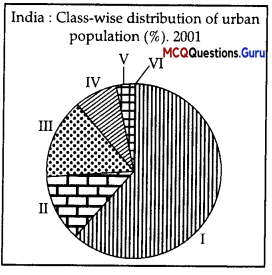
IV. Study the given graph carefully and answer the following questions.
MCQ Questions for Class 12 Geography Chapter 4 Human Settlements - 1

Question 1.

Which class of towns constitutes the minimum share in distribution of urban population?

(A) II
(B) III
(C) IV
(D) VI
Answer:
(D) VI

Explanation:
The distribution of urban population is less because of less urban development.

Question 2.

Which class of towns constitutes more than 50% share of the urban population?

(A) I
(B) III
(C) IV
(D) V
Answer:
(A) I

Explanation:
Urban centre with population of more than one lakh is called a city or class town.

Question 3.

Which two classes of towns are likely to have similar distribution of urban population?

(A) I and III
(B) II and III
(C) I and IV
(D) III and V
Answer:
(B) II and III

Explanation:
Class II towns has a population of 2 50,000 to 99,999.

MCQ Questions for Class 12 Geography Chapter 4 Human Settlements

Question 4.

If Class towns have a population size of 1,00,000 and more and Class III towns have a population size of 20,000 to 49,999, which of these is most likely to be the population size of Class V towns?

(A) 2,00,000 and more
(B) 75,000 to 99,999
(C) 50,000 to 74,999
(D) 5,000 to 9,999
Answer:
(D) 5,000 to 9,999

MCQ Questions for Class 12 Geography with Answers

MCQ Questions for Class 12 Geography Chapter 3 Human Development with Answers

Check the below NCERT MCQ Questions for Class 12 Geography Chapter 3 Human Development with Answers Pdf free download. MCQ Questions for Class 12 Geography with Answers were prepared based on the latest exam pattern. We have provided Human Development Class 12 Geography MCQs Questions with Answers to help students understand the concept very well. https://mcqquestions.guru/mcq-questions-for-class-12-geography-chapter-3-part-b/

Human Development Class 12 MCQs Questions with Answers

Class 12 Geography Chapter 3 Human Development MCQ Question 1.
When was the first Human Development Report published by the UNDP?
(A) 1970
(B) 1980
(C) 1990
(D) 1995

Answer

Answer: (C) 1990


Ch 3 Human Development Class 12 MCQ Question 2.
What is the average HDI value of India?
(A) 0.802
(B) 0.702
(C) 0.554
(D) 0.502

Answer

Answer: (C) 0.554


Human Development Chapter 3 Class 12 MCQ Question 3.
India has per capita income on prevailing prices:
(A) ₹ 15,813
(B) ₹ 17,813
(C) ₹ 18,813
(D) ₹ 20,813

Answer

Answer: (D) ₹ 20,813


MCQ Questions For Class 12 Geography Chapter 3 Human Development Question 4.
Which state has the highest percentage of people below the poverty line?
(A) Bihar
(B) Odisha
(C) Andhra Pradesh
(D) Assam

Answer

Answer: (B) Odisha


Class 12 Geography Chapter 3 Human Development MCQ Question 5.
The infant mortality rate in India per thousand is:
(A) 50
(B) 60
(C) 47
(D) 80

Answer

Answer: (C) 47


Geography Class 12 MCQ Chapter 3 Question 6.
In India, the death rate per thousand is:
(A) 6.55
(B) 8.10
(C) 7.48
(D) 9.11

Answer

Answer: (C) 7.48


Question 7.
Which state has the highest literacy rate?
(A) Goa
(B) Kerala
(C) Miwram
(D) Maharashtra

Answer

Answer: (B) Kerala


Question 8.
Which state has the lowest HDI value?
(A) Rajasthan
(B) Bihar
(C) Assam
(D) Madhya Pradesh

Answer

Answer: (B) Bihar


Question 9.
Who Is the author of the book ‘Small is beautiful’?
(A) Maithus
(B) Mahatma Gandhi
(C) Schumacher
(D) Brundtland

Answer

Answer: (C) Schumacher


Question 10.
Which one of the following is India’s rank in terms of Human Development Index among the countries of the world in 2005?
(A) 126
(B) 127
(C) 128
(D) 129

Answer

Answer: (A) 126


Question 11.
Which one of the following states of India has the highest rank in the Human Development Index?
(A) Tamil Nadu
(B) Punjab
(C) Kerala
(D) Haryana.

Answer

Answer: (C) Kerala


Question 12.
Which one of the following states of India has the lowest female literacy?
(A) Jammu and Kashmir
(B) Arunachal Pradesh
(C) Jharkhand
(D) Bihar.

Answer

Answer: (D) Bihar


Question 13.
Which one of the following states of India has the lowest female child sex ratio 0-6 years?
(A) Gujarat
(B) Haryana
(C) Punjab
(D) Himachal Pradesh.

Answer

Answer: (B) Haryana


Question 14.
Which one of the following Union Territories of India has the highest literacy rate?
(A) Lakshadweep
(B) Chandigarh
(C) Daman and Diu
(D) Andaman and the Nicobar Islands.

Answer

Answer: (A) Lakshadweep


We hope the given NCERT MCQ Questions for Class 12 Geography Chapter 3 Human Development with Answers Pdf free download will help you. If you have any queries regarding CBSE Class 12 Geography Human Development MCQs Multiple Choice Questions with Answers, drop a comment below and we will get back to you soon.

MCQ Questions for Class 12 Geography Chapter 2 Migration: Types, Causes and Consequences

Migration: Types, Causes and Consequences Class 12 MCQs Questions with Answers

Migration Class 12 MCQ Chapter 2 Question 1.

The term which is used to describe any influencing factor that motivates people to leave their place of residence or origin is known as :

(A) push factors
(B) pull factors
(C) loose factors
(D) pluck factors
Answer:
(A) push factors

MCQ Questions for Class 12 Geography Chapter 2 Migration: Types, Causes and Consequences

Explanation:
Push factors are conditions in migrants1 home countries that make it difficult or even impossible to live there.

Migration Types Causes And Consequences MCQ Class12 Question 2.

The term which is used to describe factors that attract people to a country, region, religion, organization, etc is known as :

(A) migration
(B) immigration
(C) pull factor
(D) emigration
Answer:
(C) pull factor

Explanation:
Pull Factors are positive aspects that attract people to move to a place.

MCQ Questions for Class 12 Geography Chapter 2 Migration: Types, Causes and Consequences

Migration MCQ Class 12 Chapter 2 Question 3.

Movement from one place to another, usually a response to change in temperature, food, occupation opportunities is known as

(A) migration
(B) immigration
(C) emigration
(D) journey
Answer:
(A) migration

Explanation:
Migration involves the movement of people from one place to another with intentions of settling, permanently or temporarily, at a new location.

Migration Types Causes And Consequences Class 12 MCQ Question 4.

predominate the rural-to-urban stream of inter-state migration due to economic reasons.

(A) Children
(B) Women
(C) Men
(D) Government
Answer:
(C) Men

MCQ Questions for Class 12 Geography Chapter 2 Migration: Types, Causes and Consequences

Explanation:
During the distribution of male and female migrants in different streams of intra-state and inter-state migration, females predominate the streams of short distance rural to rural migration in both types of migration.

Class 12 Geography Migration MCQ Chapter 2 Question 5.

The state which receives a very significant amount from their international migrants are :

(A) Goa
(B) Maharashtra
(C) Punjab
(D) erala
Answer:
(C) Punjab

Explanation:
The rate of out migration from rural areas to foreign countries is more in Punjab than other states.

MCQ Of Migration Class 12 Chapter 2 Question 6.

Migrants act as agents of:

(A) political change
(B) mental change
(C) social change
(D) historical change
Answer:
(C) social change

Explanation:
Migrants work as an agent of social change. They diffuse new ideas of science and technology, family planning, girl’s education, etc from one place to another place.

Migration MCQ Chapter 2 Class 12 Question 7.

Migration leads to intermixing of people from:

(A) diverse culture.
(B) same culture.
(C) opposite culture.
(D) All of the above.
Answer:
(A) diverse culture.

MCQ Questions for Class 12 Geography Chapter 2 Migration: Types, Causes and Consequences

Explanation:
People also bring different cultures with them which help to break the narrow considerations and broaden up the mental horizon of the people.

Class 12 Migration MCQ Chapter 2 Question 8.

Unregulated migration to the metropolitan cities of India has caused :

(A) overcrowding.
(B) isolation.
(C) positive growth.
(D) negative growth.
Answer:
(A) overcrowding.

Explanation:
People tend to move from place of low opportunity and low safety to the place of higher opportunity and better safety which leads to uneven distribution of population and overcrowding.

Migration Chapter 2 Class 12 Geography MCQ Question 9.

When was the actual migration recorded through Census?

(A) 1884
(B) 1883
(C) 1882
(D) 1881
Answer:
(D) 1881

Explanation:
It contains information about migration in the country. Actually migration was recorded beginning from the first Census of India conducted in 1881. This data were recorded on the basis of place of birth.

MCQ Questions for Class 12 Geography Chapter 2 Migration: Types, Causes and Consequences

Migration Class 12 Geography MCQ Question 10.

A continuous urban spread constituting a town and its adjoining outgrowths is known as :

(A) Urban growth
(B) Urban agglomeration
(C) Urban outgrowth
(D) Urban spread
Answer:
(B) Urban agglomeration

Explanation:
Urban agglomeration is an integrated urban area consisting of a core town together with its outgrowths.

MCQ Migration Class 12 Chapter 2 Question 11.

Who dominates the streams of short distance rural to rural migrations?

(A) Adolescence
(B) Males
(C) Females
(D) Old age group
Answer:
(C) Females

Explanation:
The main cause for female migration is marriage. About 65% for female move out from their parental house following their marriages.

Class 12 Geography Chapter 2 Migration MCQ Question 12.

……….. was the state, has the largest number of net out-migrants from the state.

(A) Punjab
(B) Uttar Pradesh
(C) Bihar
(D) West Bengal
Answer:
(B) Uttar Pradesh

Explanation:
In Uttar Pradesh, in most of the districts there is lack of employment opportunities therefore instead of migrating within or across the districts, people chose to migrate towards other states because many industrialised and urbanised states are very close to Uttar Pradesh.

MCQ Questions for Class 12 Geography Chapter 2 Migration: Types, Causes and Consequences

MCQ On Migration Class 12 Chapter 2 Question 13.

Migration boosts the population.

(A) working-age
(B) old-age
(C) adolescence
(D) None of the Above
Answer:
(A) working-age

Explanation:
Working age migrants arrive with skills and contribute to human capital development of receiving countries. Working age migrants also contribute to technological progress.

Migration Class 12th MCQ Chapter 2 Question 14.

A person who moves from one place to another, especially in order to find work or better living conditions is known as

(A) labourer
(B) migrant
(C) immigrant
(D) worker
Answer:
(B) migrant

MCQ Questions for Class 12 Geography Chapter 2 Migration: Types, Causes and Consequences

Question 15.

…………….. refers to money that is sent or transferred to another party, usually overseas.

(A) Remittance
(B) Emulation
(C) Denomination
(D) None of the Above
Answer:
(A) Remittance

Explanation:
Remittance is defined as money that is sent to pay for something.

MCQ Questions for Class 12 Geography Chapter 2 Migration: Types, Causes and Consequences

Question 16.

Migration leads to the of the population within a country.

(A) distribution
(B) redistribution
(C) disturbance
(D) turbulence
Answer:
(B) redistribution

Explanation:
Migration is an important determinant of population size as it changes not only the population size but also the population composition of urban and rural populations in terms of age composition.

Assertion and Reason Based MCQs

Directions:
In the following questions, A statement of Assertion (A) is followed by a statement of Reason (R). Mark the correct choice as:
(A) Both A and R are true and R is the correct explanation of A.
(B) Both A and R are true but R is NOT the correct explanation of A.
(C) A is true but R is false.
(D) A is false and R is true.

Question 1.

Assertion (A): Migration has been an integral part and a very important factor in redistributing population over time and space.
Reason (R): India has witnessed the waves of migrants coming to the country from Central and West Asia and also from Southeast Asia.

Answer:
(B) Both A and R are true but R is NOT the correct explanation of A.

Explanation:
The countries with high rates of youth emigration are losing persons from these age groups and tend to register low growth population rates, while the receiving countries gain young working and high reproductive people, which contribute to an increase in total population.

MCQ Questions for Class 12 Geography Chapter 2 Migration: Types, Causes and Consequences

Question 2.

Assertion (A): In the Census of India migration is enumerated on two bases: place of birth and place of residence.
Reason (R): In the Census of India reasons for migration from the place of last residence and duration of residence in place of enumeration are never asked.

Answer:
(C) A is true but R is false.

Explanation:
When a person is enumerated in census at a different place than his her place of birth, she he is considered a migrant. This may be due to marriage, which is the most common reason for migration among females – or for work, what is the case as generally among males, etc.

Question 3.

Assertion (A): Some states like Maharashtra, Delhi, Gujarat and Haryana attract migrants from other statessuch as Uttar Pradesh, Bihar, Rajasthan, etc.
Reason (R): Maharashtra occupied first place in migrants, followed by Delhi, Gujarat and Haryana.

Answer:
(B) Both A and R are true but R is NOT the correct explanation of A.

Explanation:
Migration primarily occurs due to disparities in regional development. The lack of employment opportunities in the rural areas and better employment prospects and infrastructure facilities in the urban areas motivate people to migrate to urban areas.

Question 4.

Assertion (A): People, generally are emotionally attached to their place of birth.
Reason (R): But millions of people leave their places of birth and residence.

Answer:
(B) Both A and R are true but R is NOT the correct explanation of A.

Explanation:
Birth place are generally close to people’s heart. They might have some deep emotions associated with the place of birth.

MCQ Questions for Class 12 Geography Chapter 2 Migration: Types, Causes and Consequences

Question 5.

Assertion (A): In India people migrate from rural to urban areas.
Reason (R): This is mainly due to poverty, high population pressure on the land, lack of basic infra structural facilities like health care, education, etc.

Answer:
(A) Both A and R are true and R is the correct explanation of A.

Explanation:
The shifting of rural populations to urban areas is mainly due to urban biases in terms of development and economic opportunities. It has been observed in India I that urban residents have a better standard of living, level of nutrition, and provision of 1 services than rural dwellers.

Question 6.

Assertion (A): People often migrate from and migrate to .
Reason (R): People tend to move from place of low opportunity and low safety to the place of higher opportunity and better safety.

Answer:
(A) Both A and R are true and R is the correct explanation of A.

Question 7.

Assertion (A): Migrants act as agents of social change.
Reason (R): Migration leads to intermixing of people from diverse cultures.

Answer:
(A) Both A and R are true and R is the correct explanation of A.

Explanation: The new ideas related to new technologies, family planning, girl’s education, etc. get diffused from urban to rural areas through migration.

MCQ Questions for Class 12 Geography Chapter 2 Migration: Types, Causes and Consequences

Question 8.

Assertion (A): Overcrowding of people due to rural-urban migration has put pressure on the existing social and physical infrastructure in the urban areas.
Reason (R): Due to over-exploitation of natural resources, cities are facing the acute problem of depletion of ground water, air pollution, disposal of sewage and management of solid wastes.

Answer:
(B) Both A and R are true but R is NOT the correct explanation of A.

Explanation:
Overcrowding of people due to rural-urban migration ultimately leads to unplanned growth of urban settlement and formation of slums shanty colonies.

Case-Based MCQs

I. Read the case study given below and answer the questions that follow:
During colonial period (British period) millions of the indentured labourers were sent to Mauritius, Caribbean islands (Trinidad, Tobago and Guyana), Fiji and South Africa by British from Uttar Pradesh and Bihar; to Reunion Island, Guadeloupe, Martinique and Surinam by French and Dutch and by Portuguese from Goa, Daman and Diu to Angola, Mozambique to work as plantation workers. All such migrations were covered under the time- bound contract known as Girmit Act (Indian Emigration Act). Flowever, the living conditions of these indentured labourers were not better than the slaves.

The second wave of migrants ventured out into the neighbouring countries in recent times as professionals, artisans, traders and factory workers, in search of economic opportunities to Thailand, Malaysia, Singapore, Indonesia, Brunei and African countries, etc. and the trend still continues. There was a steady outflow of India’s semi-skilled and skilled labour in the wake of the oil boom in West Asia in the 1970s.

There was also some outflow of entrepreneurs, store owners, professionals, businessmen to Western countries. Third wave of migrants was comprised of professionals like doctors, engineers (1960s onwards), software engineers, management consultants, financial experts, media persons (1980s onwards), and others migrated to countries such as USA, Canada, UK, Australia, New Zealand and Germany.

These professionals enjoy the distinction of being one of highly educated, the highest earning and prospering groups. After liberalisation, in the 90s education and knowledge-based Indian emigration has made Indian Diaspora one of the most powerful diasporas in the world. In all these countries, Indian diaspora has been playing an important role in the development of the respective countries.

MCQ Questions for Class 12 Geography Chapter 2 Migration: Types, Causes and Consequences

Question 1.

Under the provisions of which Act were the labourers emigrated from India to other European colonies?

(A) Girmit Act
(B) GirhitAct
(C) Indian Migration Act
(D) Indian Immigration Act
Answer:
(A) Girmit Act

Explanation:
Girmit derives from the word agreement’ under which more than one mil-lion Indian indentured labourers went to work on the plantations of the ‘King Sugar’ colonies around the globe in the nineteenth and early twentieth centuries. The Agreement stipulated the terms and conditions of service.

Question 2.

Who sent the Indian labourers from Goa to Mozambique?

(A) British
(B) French
(C) Dutch
(D) Portuguese
Answer:
(D) Portuguese

Question 3.

Which of these migrated from India during the second wave?

(A) Doctors
(B) Financial experts
(C) Artisans
(D) Software engineers
Answer:
(C) Artisans

Explanation:
During the second wave of migration there was a steady outflow of India’s skilled and semi-skilled labour.

MCQ Questions for Class 12 Geography Chapter 2 Migration: Types, Causes and Consequences

Question 4.

When did the knowledge-based Indian migrate from India?

(A) 1960s
(B) 1970s
(C) 1980s
(D) 1990s
Answer:
(D) 1990s

Explanation:
The knowledge based Indians migrated during the third wave of migration in search of better employment opportunities and better standards of living.

Question 1.

Which of these is not a part of Caribbean Islands?

(A) Trinidad
(B) Tobago
(C) Guyana
(D) Fiji
Answer:
(D) Fiji

Explanation:
The Fiji Islands are tropical islands.

MCQ Questions for Class 12 Geography Chapter 2 Migration: Types, Causes and Consequences

Question 2.

The living conditions of the indentured labourers resembled those of:

(A) Kings
(B) Tradesmen
(C) Slaves
(D) None of these
Answer:
(C) Slaves

Explanation:
The conditions at work were harsh, with long working hours and low wages. Given the weak physical condition of the labourers after the long voyage, this took its toll.

Question 3.

Which of these events happened in West Asia in 1970s?

(A) Oil boom
(B) Work boom
(C) Brain drain
(D) Imperialism
Answer:
Option (A) is correct.

MCQ Questions for Class 12 Geography Chapter 2 Migration: Types, Causes and Consequences

Explanation:
Oil boom in West Asia in 1970s lead to a steady outflow of India’s semi-skilled and skilled labour.

Question 4.

Which of these countries was a destination for migrants in the second wave?

(A) Australia
(B) Canada
(C) Singapore
(D) Germany
Answer:
(C) Singapore

Explanation:
The government-pro business environment, tax benefits, low tax rates and the ease of doing business are among the factors that contributed to attract people to live, work and setup business in Singapore in the second wave.

II. Read the case study given below and answer the questions that follow:
The major benefit for the source region is the remittance sent by migrants. Remittances from the international migrants are one of the major sources of foreign exchange. In 2002, India received US$ 11 billion as remittances from international migrants. Punjab, Kerala and Tamil Nadu receive very significant amount from their international migrants. The amount of remittances sent by the interna] migrants is very meagre as compared to international migrants, but it plays an important role in the growth of economy of the source area.

Remittances are mainly used for food, repayment of debts, treatment, marriages, children’s education, agricultural inputs, construction of houses, etc. For thousands of the poor villages of Bihar, Uttar Pradesh, Odisha, Andhra Pradesh, Himachal Pradesh, etc. remittance works as life blood for their economy. Migration from rural areas of Eastern Uttar Pradesh, Bihar, Madhya Pradesh and Odisha to the rural areas of Punjab, Haryana, Western Uttar Pradesh accounted for the success of their green revolution strategy for agricultural development.

Besides this, unregulated migration to the metropolitan cities of India has caused overcrowding. Development of slums in industrially developed states such as Maharashtra, Gujarat, Karnataka, Tamil Nadu and Delhi is a negative consequence of unregulated migration within the country.

MCQ Questions for Class 12 Geography Chapter 2 Migration: Types, Causes and Consequences

Question 1.

What is the major benefit that the source regions receive from the migrants?

(A) Medical aid
(B) Agricultural products
(C) Remittance
(D) Educational aid
Answer:
(C) Remittance

Explanation:
One of the main benefits of remit-tance flows is that they can stabilize household income, thereby improving living conditions and increasing well-being.

Question 2.

How much remittance did India receive in 2002 from international migrants?

(A) US$10 billion
(B) US$ 11 billion
(C) US$20 billion
(D) US$22 billion
Answer:
(B) US$ 11 billion

Question 3.

Give an example of uses of remittance.

(A) Repayment of debt
(B) Marriage
(C) Children’s education
(D) All of the Above
Answer:
(D) All of the Above

MCQ Questions for Class 12 Geography Chapter 2 Migration: Types, Causes and Consequences

Explanation:
Remittance are associated with increased household spending on health, education and small business.

Question 4.

Remittances appear to be responsive to income

(A) shortfalls
(B) boost
(C) outflow
(D) All of the Above
Answer:
(A) shortfalls

Explanation:
Remittances can reduce the depth and severity of poverty in developing countries.

III. Read the case study given below and answer the questions that follow:
The internal migration (within the country) and international migration (out of the country and into the country from other countries)are presented under the internal migrants. The stream was dominated by female migrants. Most of these were migrants related to marriage part from these streams of internal migration. India also experiences immigration from and emigration to the neighbouring countries. Indian Census 2011 has recorded that more than 5 million persons have migrated to India from other countries. Out of these, about 88.9 percent came from the neighbouring countries: Bangladesh followed by Nepal and Pakistan.

Question 1.

Internal migration refers to :

(A) Migration outside the country
(B) Migration outside the state
(C) Migration inside the country
(D) Migration inside the state
Answer:
(C) Migration inside the country

Explanation:
This type of human migration occurs within a country. Internal migration tends to be travel for education and for economic improvement or because of a natural disaster or civil disturbance.

MCQ Questions for Class 12 Geography Chapter 2 Migration: Types, Causes and Consequences

Question 2.

Internal migration is also known as :

(A) Domestic migration
(B) International migration
(C) Rural migration
(D) Urban migration
Answer:
(A) Domestic migration

Explanation:
Internal migration is also known j as domestic migration.

Question 3.

According to Indian Census 2011, more than million persons have migrated to India from other countries.

(A) 4
(B) 5
(C) 6
(D) 7
Answer:
(B) 5

Explanation:
Migration occurred mainly due to marriage, search for better opportunities and it for job suppose.

Question 4.

Out of the total migration, people migrated to India from Nepal, Bangladesh and Pakistan.

(A) 67%
(B) 79.9%
(C) 88.9 %
(D) None of the Above
Answer:
(B) 79.9%

Explanation:
Nepal, Bangladesh and Pakistan are less developed than India .Hence people migrate to India in search of employment, to avoid genocides, seek refuge from war; cross 1 across due to marriage.

MCQ Questions for Class 12 Geography Chapter 2 Migration: Types, Causes and Consequences

IV. Study the given graph showing causes of migration of male population in India carefully and answer the following questions:
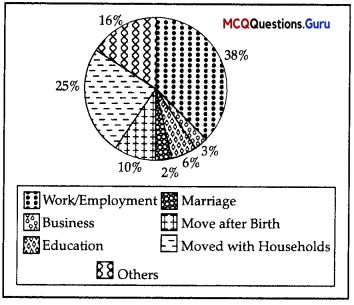
MCQ Questions for Class 12 Geography Chapter 2 MigrationTypes, Causes and Consequences - 1

Question 1.

What is the most common reason for male migration in India?

(A) Marriage
(B) Business
(C) Education
(D) Work/Employment
Answer:
(D) Work/Employment

Explanation:
Work and employment have remained the main cause for male migration. It constitutes 38% of total male migration. While it is only 2.3 per cent for the females.

Question 2.

What percentage of male population migrates with households?

(A) 2%
(B) 3%
(C) 25%
(D) 38%
Answer:
(C) 25%

Question 3.

What ratio of male students migrate for educational purposes?

(A) 6:100
(B) 10:100
(C) 2:100
(D) 25:100
Answer:
(A) 6:100

MCQ Questions for Class 12 Geography Chapter 2 Migration: Types, Causes and Consequences

Explanation:
Generally, male students seeking cross-border education migrate to countries with more developed education institutions than their own. This helps in improving their 1 future employment chances.

Question 4.

Which of these can be one of the reasons for male migration covered under the category ‘Others’?

(A) Better employment opportunities
(B) Family reasons
(C) Environmental degradation
(D) In pursuit of higher studies
Answer:
(C) Environmental degradation

Explanation:
There are several global environmental changes which may cause human migration. Climate change is, of course, a major factor. Sea level rise, changes in storm or cyclone frequency, changes in rainfall patterns, forest fires, droughts, frequent floods, earthquakes increases in temperature and ocean acidification may result in loss of homes or livelihoods.

V. Study the given graph showing causes of migration of male population in India carefully and answer
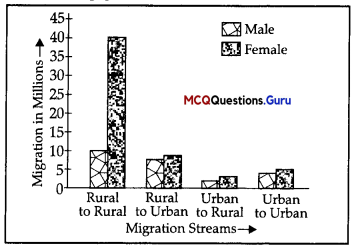
MCQ Questions for Class 12 Geography Chapter 2 MigrationTypes, Causes and Consequences - 2
Intra state migration by place of last residence indicating migration steams (Duration 0-9 year)

Question 1.

Which migration stream shows the highest number of migration both male and female categories?

(A) Rural to Urban
(B) Urban to Rural
(C) Rural to Rural
(D) Urban to Urban
Answer:
(C) Rural to Rural

Explanation:
Marriage, seasonality of work, lack of work etc. are some of the factors responsible for rural to rural migration.

MCQ Questions for Class 12 Geography Chapter 2 Migration: Types, Causes and Consequences

Question 2.

Why does female category show the highest migration in both the categories?

(A) Education
(B) Marriage
(C) Medical aids
(D) Employment
Answer:
(B) Marriage

Explanation:
As per 2011 Census 46% of the total migrants moved because of marriage and of these, 97% were women. As many as 20.58 crore women in India migrated for marriage. It is also highly gender-specific: the great majority of marriage migrants are women. A woman normally moves to her husband’s village on marriage and transfers her household registration. Very rarely the man moves to join his bride.

Question 3.

Female migrants dominates which stream of migration?

(A) Move with household
(B) Better opportunities
(C) Marriage
(D) All of the Above
Answer:
(D) All of the Above

Question 4.

Intra state migration means:

(A) Migration to another state
(B) Migration within the state
(C) Migration to another district
(D) None of the Above
Answer:
(B) Migration within the state

Explanation:
Intra state migration takes place between two parts of the same state.
OR

Question 1.

How many types of migration takes place in India?

(A) Rural to Rural
(B) Rural to Urban
(C) Urban to Urban
(D) All of the Above
Answer:
(D) All of the Above

MCQ Questions for Class 12 Geography Chapter 2 Migration: Types, Causes and Consequences

Explanation:
All the four types of migration occur in search of equal opportunities, social abundance and for personal benefits.

Question 2.

What is the common feature shown among all the migration streams?

(A) Dominance of rural migration
(B) Dominance of female migration
(C) Dominance of male migration
(D) Dominance of male and female migration
Answer:
(B) Dominance of female migration

Question 3.

In which stream is the number of female migrants the highest?

(A) Rural to urban
(B) Urban to rural
(C) Urban to urban
(D) Rural to rural
Answer:
(D) Rural to rural

Explanation:
Economic and social factors significantly influence female migration.

Question 4.
Give the main reason for Q. 3.
(A) Marriage
(B) Job transfer
(C) Medical facilities
(D) None of the Above
Answer:
(A) Marriage

MCQ Questions for Class 12 Geography Chapter 2 Migration: Types, Causes and Consequences

Explanation:
Marriage is the biggest reason why women migrate from one place to another frural to rural).

MCQ Questions for Class 12 Geography with Answers

MCQ Questions for Class 12 Geography Chapter 1 Population: Distribution, Density, Growth and Composition

International Trade Class 12 MCQs Questions with Answers

Population Distribution Density Growth And Composition MCQs Question 1.

The state with the highest population in India is :

(A) West Bengal
(B) Kerala
(C) Uttar Pradesh
(D) Kerala
Answer:
(C) Uttar Pradesh

Explanation:
The population of Uttar Pradesh continues to grow at a high rate. Because of that high growth rate and a substantial reduction in infant mortality in the 20th century, there has been a significant increase in the proportion of young adults and children.

MCQ Questions For Class 12 Geography Chapter 1 Population Question 2.

The first complete population Census was conducted in India in :

(A) 1882
(B) 1881
(C) 1883
(D) 1884
Answer:
(B) 1881

MCQ Questions for Class 12 Geography Chapter 1 Population: Distribution, Density, Growth and Composition

Population Class 12 MCQ Chapter 1 Question 3.

The state of India which has the lowest percentage of population below poverty line :

(A) Punjab
(B) Tamil Nadu
(C) Jammu & Kashmir
(D) Goa
Answer:
(C) Jammu & Kashmir

Explanation:
Goa has the least percentage of people living below poverty line at 5.09%.

Class 12 Geography Chapter 1 Population MCQ Question 4.

The number of farmers per unit area of farmland is known as :

(A) agricultural density of a population
(B) working density of a population
(C) industrial density of a population
(D) rural density of a population
Answer:
(A) agricultural density of a population

Explanation:
Agricultural density is a statistical measure of population density. Population growth, development, and stability of a population are indirectly determined with the help of agricultural density. The quality of land largely affects agricultural density.

MCQ Questions for Class 12 Geography Chapter 1 Population: Distribution, Density, Growth and Composition

Population MCQ Class 12 Chapter 1 Question 5.

The natural growth rate is analysed by assessing the:

(A) crude birth and death rate
(B) positive birth and death rate
(C) negative birth and death rate
(D) All of the Above
Answer:
(A) crude birth and death rate

Explanation:
The crude birth rate and crude death rate are both measured by the rate of births or deaths respectively among a population of 1,000.

Population Distribution Density Growth And Composition Class 12 MCQ Question 6.

The period from 1901 to 1921 is referred to as period of:

(A) stagnant or stationery phase of growth of India’s population.
(B) steady population growth.
(C) population explosion in India .
(D) None of the Above
Answer:
(A) stagnant or stationery phase of growth of India’s population.

Explanation:
In this period, growth rate was very low, even recording a negative growth rate during 1911-1921. Both the birth rate and death rate were high keeping the rate of increase in population low.

Class 12 Geography Population Distribution Density Growth And Composition MCQ Question 7.

The period of steady population growth was of: Ri

(A) 1921-1951
(B) 1911-1921
(C) 1901-1911
(D) –
Answer:
(A) 1921-1951

MCQ Questions for Class 12 Geography Chapter 1 Population: Distribution, Density, Growth and Composition

Explanation:
Observed medium rate of population growth and is referred to as the period of steady population growth. An overall improvement in health and sanitation throughout the country brought down the mortality rate.

Population Distribution, Density, Growth And Composition MCQ Class 12 Question 8.

Name the state of India having lowest density of population as per 2011 Census.

(A) Punjab
(B) Haryana
(C) Tamil Nadu
(D) Arunachal Pradesh
Answer:
(D) Arunachal Pradesh

Explanation:
The reason behind such low density is the difficult living conditions of the state because of the forests in a larger area of Arunachal Pradesh. About 51,540 sq. km. or 61.55% of the land area is recorded under forest. In comparison to other states, Arunachal Pradesh has the lowest population density in India.

Population Distribution Density And Growth MCQ Chapter 1 Question 9.

Arrange the states of India with highest to lowest population density,

(i) West Bengal
(i) Bihar
(iii) Uttar Pradesh
(iv) Maharastra
Options:
(A) i, ii, iii, iv
(B) ii, i, iii, iv
(C) iv, iii, ii, i
(D) ii, iv, i, iii
Answer:
(B) ii, i, iii, iv

Explanation:
A sharp increase in population density in Bihar is a direct result of unabated population growth. Majority of Maharashtra state has high dense forest area so low population density.

MCQ Questions for Class 12 Geography Chapter 1 Population: Distribution, Density, Growth and Composition

Population Density Growth And Composition MCQ Chapter 1 Question 10.

…………….. is the term which means the spread of people across the world.

(A) Population disturbance
(B) Population distribution
(C) Population counting
(D) None of the above
Answer:
(B) Population distribution

Explanation:
Population distribution means the pattern of where people live. World population distribution is uneven.

Population Distribution Density Growth And Composition MCQ Class 12 Question 11.

The ……………. density of population is the number of people per unit area of arable land.

(A) physiological
(B) psychological
(C) physical
(D) phishing
Answer:
(A) physiological

Explanation:
A higher physiological density suggests that the available agricultural land is being used by more and may reach its output limit sooner than a country that has a lower physiological density.

MCQ Questions for Class 12 Geography Chapter 1 Population: Distribution, Density, Growth and Composition

Population Distribution Density And Growth Class 12 MCQ Question 12.

Arrange the following phases in a sequence order according to their occurrence in Indian population:

(i) Population explosion
(ii) Stationary phase
(iii) Decreased growth
(iv) Steady growth
Options:
(A) i, iv, ii, iii
(B) iv, i, iii, ii
(C) ii, iv, i, iii
(D) iii, ii, iv, i
Answer:
(C) ii, iv, i, iii

MCQ Questions for Class 12 Geography Chapter 1 Population: Distribution, Density, Growth and Composition

Population Chapter 1 Class 12 MCQ Question 13.

In the post 1981 till present, the growth rate of country’s population remained ……………

(A) Stagnant
(B) High
(C) Low
(D) Constant
Answer:
(B) High

Explanation:
The increase in population has been due to decline in death rates.

Class 12 Geography Population MCQ Question 14.

……………… of population is the change in the number of people living in a particular area between two points of time.

(A) Growth
(B) Decline
(C) Stability
(D) Access
Answer:
(A) Growth

Question 15.

A continuous belt of states from west to east in the north-west, north, and north central parts of the country has relatively ……………… growth rate than the southern states.

(A) high
(B) low
(C) slow
(D) fast
Answer:
(A) high

MCQ Questions for Class 12 Geography Chapter 1 Population: Distribution, Density, Growth and Composition

Explanation:
This is due to the present of fertile 1 alluvial soil found in states from west to east in 1 the north-west, north, and north central parts of the country.

Question 16.

An important aspect of population growth in India is the growth of its

(A) Adolescent
(B) Toddlers
(C) Old age
(D) All of the Above
Answer:
(A) Adolescent

Explanation:
India has the largest adolescent population in the world. It constitutes one fifth of the total population.

Assertion and Reason Based MCQs

Directions:
In the following questions, A statement of Assertion (A) is followed by a statement of Reason (R). Mark the correct choice as:
(A) Both A and R are true and R is the correct explanation of A.
(B) Both A and R are true but R is NOT the correct explanation of A.
(C) A is true but R is false.
(D) A is false and R is true.

MCQ Questions for Class 12 Geography Chapter 1 Population: Distribution, Density, Growth and Composition

Question 1.

Assertion (A): Population data are collected through census operation held every 10 years in our country.
Reason (R): India has a highly even pattern of population distribution.

Answer:
(C) A is true but R is false.

Explanation:
The uneven spatial distribution of population in India suggests a close relationship between population and physical, social, economic and historical factors. As far as the physical factors are concerned it is clear that in terrain, climate and water largely determines the pattern of the population distribution, Among the socio- economic and historical factors of distribution of population important once are evolution of settled agriculture andagricultural development, pattern of human settlement, development of transport network, industrialization and urbanization.

Question 2.

Assertion (A): The phase (1901 -21) is known as a period of stagnant or stationary phase.
Reason (R): Both the birth rate and death rate were high keeping the rate of increase low.

Answer:
(A) Both A and R are true and R is the correct explanation of A.

Question 3.

Assertion (A): The decades 1921-1951 are referred to as the period of steady population growth.
Reason (R): Improvement in health and sanitation brought down the mortality rate.

Answer:
(A) Both A and R are true and R is the correct explanation of A.

Explanation:
The cause of this increased growth rate was not a rise in fertility but a decline in mortality that set in due to a better health facilities sanitation, education and overall development. These developments helped controlling epidemics likes plague, cholera and malaria. The combined effects was that the population started increasing steadily.

MCQ Questions for Class 12 Geography Chapter 1 Population: Distribution, Density, Growth and Composition

Question 4.

Assertion (A): The decades of 1951-1981 are the phase of population explosion.
Reason (R): The average annual Growth rate was as high as 2.2 per cent.

Answer:
(B) Both A and R are true but R is NOT the correct explanation of A.

Explanation:
Increase in population was caused by a rapid fall in mortality rate but a high fertility rate of population in the country. Increased international migration contributed to the high growth rate. Rapid fall in the mortality rate due to centralized planning process.

Question 5.

Assertion (A): India is the second most populous country after China with population of more than billion in 2001 A.D.
Reason (R): Majority of population consists of non-workers.

Answer:
(B) Both A and R are true but R is NOT the correct explanation of A.

Explanation:
The two main common causes leading to over population in India are: The birth rate is still higher than the death rate. The fertility rate due to the population policies and other measures has been falling but even then it is much higher compared to other countries. The annual growth rate of India’s population is 1.64 percent (2011).

Question 6.

Assertion (A): The people are very important component of a country.
Reason (R): A large population invariably puts pressure on its limited resources and is also responsible for many socio- economic problems in the country.

Answer:
(B) Both A and R are true but R is NOT the correct explanation of A.

Explanation:
Humans are the ultimate component of our society. Any country is just a piece of land without any human population. All the developments take place because the country is inhabited by people.

MCQ Questions for Class 12 Geography Chapter 1 Population: Distribution, Density, Growth and Composition

Case-Based MCQs

I. Read the case study given below and answer the questions that follow:
Growth of population is the change in the number of people living in a particular area between two points of time. Its rate is expressed in percentage. Population growth has two components namely; natural and induced. While the natural growth is analysed by assessing the crude birth and death rates, the induced components are explained by the volume of inward and outward movement of people in any given area.

The decadal and annual growth rates of population in India are both very high and steadily increasing over time. The annual growth rate of India’s population is 1.64 percent (2011). The growth rate of population in India over the last one century has been caused by annual birth rate and death rate and rate of migration and thereby shows different trends.

Question 1.

How is the growth of population expressed?

(A) Percentage
(B) Metrics
(C) Area
(D) Kelvin
Answer:
(A) Percentage

Explanation:
Calculating the population in percentage allows us to compare each demo-graphic’s proportion to the entire population, no matter what the size of said population.

Question 2.

…………….. refers to the difference between the number of live births and the number of deaths occurring in a year.

(A) Growth of population
(B) Natural growth rate
(C) Natural death rate
(D) Crude birth rate
Answer:
(B) Natural growth rate

MCQ Questions for Class 12 Geography Chapter 1 Population: Distribution, Density, Growth and Composition

Explanation:
Calculation of natural growth rate gives demographers an idea of how a certain country’s population is growing.

Question 3.

……………… gives an overview of the total population growth in a particular decade.

(A) Annual growth rate
(B) Decadal growth rate
(C) Induced growth rate
(D) Dense growth rate
Answer:
(B) Decadal growth rate

Explanation:
There are records that keep track of the increase and decrease in population. 1 And it is called “decadal” as a decade consists of a period of 10 years. Thus, the decadal growth rate gives an overview of the total population growth in a particular decade.

Question 4.

What was the annual growth rate of India as per 2011 Census?

(A) 1.64 percent
(B) 1.66 percent
(C) 1.65 percent
(D) 2.66 percent
Answer:
(D) 2.66 percent

Explanation:
According to the provisional reports released on 31 March 2011, the Indian j population increased to 1.21 billion with a decadal growth of 17.70%.

II. Read the case study given below and answer the questions that follow:
The National Youth Policy (NYP-2014) launched in February 2014 proposes a holistic ‘vision’ for the youth of India, which is “To empower the youth of the country to achieve their full potential, and through them enable India to find its rightful place in the community of nations”.

The NYP-2014 has defined ‘youth’ as persons in the age group of 15-29 years. The Government of India also formulated the National Policy for Skill Development and Entrepreneurship in 2015 to provide an umbrella framework to all skilling activities being carried out within the country, and to align these to common standards and links killing with demand centres.

MCQ Questions for Class 12 Geography Chapter 1 Population: Distribution, Density, Growth and Composition

Question 1.

When the NYP launched?

(A) 2013
(B) 2014
(C) 2015
(D) 2016
Answer:
(B) 2014

Explanation:
The government has launched the National Youth Policy (NYP 2014) to cater the needs of youth in India. It is a comprehensive g policy document that states the vision of the Government of India (GOI) for the youth of the country and also how this vision is sought to be realised by the government.

Question 2.

What was the main thrust of NYP?

(A) To stop child trafficking
(B) To encourage child labour
(C) Empower the youth in terms of their effective participation in decision making
(D) None of the Above
Answer:
(C) Empower the youth in terms of their effective participation in decision making

Explanation:
The main thrust of the policy is to empower the youth in terms of their effective participation in decision making and carrying J the responsibility to be a leader.

MCQ Questions for Class 12 Geography Chapter 1 Population: Distribution, Density, Growth and Composition

Question 3.

As per NYP which age group has been defined as ‘Youth’?

(A) 14-19 years
(B) 19-27 years
(C) 15 -29 years
(D) 13-30 years
Answer:
(C) 15 -29 years

Explanation:
In the current Policy Document, the youth age-group is defined as 15-29 years.

Question 4.

When did the Government of India formulate the National Policy for Skill Development and Entrepreneurship ?

(A) 2015
(B) 2016
(C) 2017
(D) 2018
Answer:
(A) 2015

Explanation:
The National Skill Development Mission was approved by the Union Cabinet on 01.07. 2015, and officially launched by the Hon’ble Prime Minister on 15.07. 2015 on the occasion of World Youth Skills Day.

MCQ Questions for Class 12 Geography with Answers