NCERT Solutions for Class 8 Maths Chapter 4 Practical Geometry Ex 4.5

NCERT Solutions for Class 8 Maths Chapter 4 Practical Geometry Ex 4.5 are part of NCERT Solutions for Class 8 Maths. Here we have given NCERT Solutions for Class 8 Maths Chapter 4 Practical Geometry Ex 4.5.

BoardCBSE
TextbookNCERT
ClassClass 8
SubjectMaths
ChapterChapter 4
Chapter NamePractical Geometry
ExerciseEx 4.5
Number of Questions Solved1
CategoryNCERT Solutions

NCERT Solutions for Class 8 Maths Chapter 4 Practical Geometry Ex 4.5

Question 1.
Draw the following:
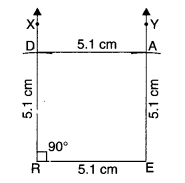
1. The square READ with RE = 5.1 cm.
2. A rhombus whose diagonals are 5.2 cm and 6.4 cm long.
3. A rectangle with adjacent sides of lengths 5 cm and 4 cm.
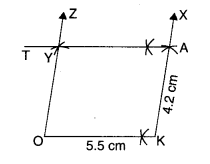
4. A parallelogram OKAY where OK = 5.5 cm and KA = 4.2 cm. Is it unique?
Solution.
1. Steps of Construction

  1. Draw RE = 5.1 cm.
  2. At R, draw a ray RX such that ∠ERX
    NCERT Solutions for Class 8 Maths Chapter 4 Practical Geometry Ex 4.5 1
  3. From ray RX, cut RD = 5.1 cm.
  4. At E, draw a ray EY such that ∠REY = 90°.
  5. From ray EY, cut EA = 5.1 cm.
  6. Join AD.

Then, READ is the required square.

2. Steps of Construction
[We know that the diagonals of a rhombus bisect each other at right angles. So in rhombus ABCD, the diagonals AC and BD will bisect each other at right angles.]

  1. Draw AC = 5.2 cm.
  2. Construct its perpendicular bisector. Let it intersect AC at O.
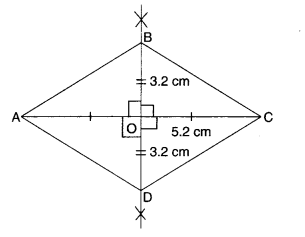
    NCERT Solutions for Class 8 Maths Chapter 4 Practical Geometry Ex 4.5 2
  3. Cut off \(\frac { 6.4 }{ 2 } \)= 3.2 cm lengths on either side of the bisector drawn in step 2, we get B and D.
  4. Join AB, BC, CD, and DA.

Then, ABCD is the required rhombus.

3. Steps of Construction
[We know that each angle of a rectangle is 90°. So, in rectangle PQRS,
∠P=∠Q=∠R=∠S= 90°.
Also, opposite sides of a rectangle are parallel.
So, in rectangle PQRS,
PQ || SR and PS || QR]

  1. Draw PQ = 5 cm.
  2. At Q, draw a ray QX such that ∠PQX = 90°.
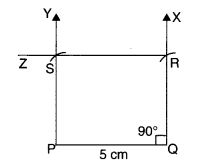
    NCERT Solutions for Class 8 Maths Chapter 4 Practical Geometry Ex 4.5 3
  3. From ray QX, cut QR = 4 cm.
  4. At P, draw a ray PY parallel to QR.
  5. At R, draw a ray RZ parallel to QP to meet the ray drawn in step 4 at S.

Then, PQRS is the required rectangle.

4. Steps of Construction
[We know that in a parallelogram, opposite sides are parallel and equal. So,
OK = YA and OK || YA;
KA = OY and KA || OY]

  1. Draw OK = 5.5 cm.
    NCERT Solutions for Class 8 Maths Chapter 4 Practical Geometry Ex 4.5 4
  2. At K, draw a ray KX at any suitable angle from OK.
  3. From ray KX, cut KA = 4.2 cm.
  4. A, draw a ray AT parallel to KO.
  5. At O, draw a ray OZ parallel to KA to cut the ray drawn in step 4 at Y.

Then, OKAY is the required parallelogram.
This is not unique.
Note: We can construct countless parallelograms with these dimensions by varying ∠OKA

We hope the NCERT Solutions for Class 8 Maths Chapter 4 Practical Geometry Ex 4.5 help you. If you have any query regarding NCERT Solutions for Class 8 Maths Chapter 4 Practical Geometry Ex 4.5, drop a comment below and we will get back to you at the earliest.
NCERT Solutions for Class 8 Maths Chapter 4 Practical Geometry Ex 4.4

NCERT Solutions for Class 8 Maths Chapter 4 Practical Geometry Ex 4.4 are part of NCERT Solutions for Class 8 Maths. Here we have given NCERT Solutions for Class 8 Maths Chapter 4 Practical Geometry Ex 4.4.

BoardCBSE
TextbookNCERT
ClassClass 8
SubjectMaths
ChapterChapter 4
Chapter NamePractical Geometry
ExerciseEx 4.4
Number of Questions Solved1
CategoryNCERT Solutions

NCERT Solutions for Class 8 Maths Chapter 4 Practical Geometry Ex 4.4

Question 1.
Construct the following quadrilaterals:
(i) Quadrilateral DEAR
DE = 4 cm
EA = 5 cm
AR = 4.5 cm
∠E = 60°
∠A = 90°

(ii) Quadrilateral TRUE
TR = 3.5 cm
RU = 3 cm
UE = 4 cm
∠R = 75°
∠U= 120°
Solution.
(i) Steps of Construction

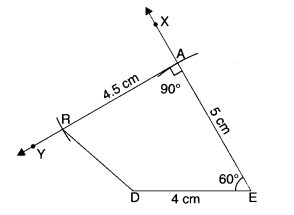
  1. Draw DE = 4 cm.
  2. At E, draw ray EX such that ∠DEX = 60°.
  3. From ray EX, cut EA = 5 cm.
    NCERT Solutions for Class 8 Maths Chapter 4 Practical Geometry Ex 4.4 1
  4. At A, draw ray AY such that ∠EAY = 90°.
  5. Cut AR = 4.5 cm from ray AY.
  6. Join RD.

Then, DEAR is the required quadrilateral.

(ii) Steps of Construction

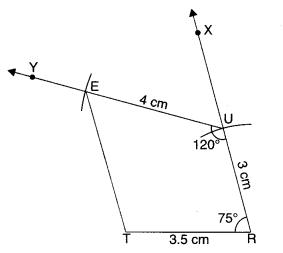
  1. Draw TR = 3.5 cm.
  2. At R, draw ray RX such that ∠TRX = 75°.
    NCERT Solutions for Class 8 Maths Chapter 4 Practical Geometry Ex 4.4 2
  3. Cut RU = 3 cm from ray RX.
  4. At U, draw ray UY such that ∠RUY = 120°.
  5. Cut UE = 4 cm from ray UY.
  6. Join ET.

Then, TRUE is the required quadrilateral.


We hope the NCERT Solutions for Class 8 Maths Chapter 4 Practical Geometry Ex 4.4 help you. If you have any query regarding NCERT Solutions for Class 8 Maths Chapter 4 Practical Geometry Ex 4.4, drop a comment below and we will get back to you at the earliest.
NCERT Solutions for Class 8 Maths Chapter 4 Practical Geometry Ex 4.3

NCERT Solutions for Class 8 Maths Chapter 4 Practical Geometry Ex 4.3 are part of NCERT Solutions for Class 8 Maths. Here we have given NCERT Solutions for Class 8 Maths Chapter 4 Practical Geometry Ex 4.3.

BoardCBSE
TextbookNCERT
ClassClass 8
SubjectMaths
ChapterChapter 4
Chapter NamePractical Geometry
ExerciseEx 4.3
Number of Questions Solved1
CategoryNCERT Solutions

NCERT Solutions for Class 8 Maths Chapter 4 Practical Geometry Ex 4.3

Question 1.
Construct the following quadrilaterals :
(i) Quadrilateral MORE
MO = 6 cm
OR = 4.5 cm
∠M = 60°
∠O = 105°
∠R = 105°

(ii) Quadrilateral PLAN
PL = 4 cm
LA = 6.5 cm
∠P = 90°
∠A = 110°
∠N – 85°.

(iii) Parallelogram HEAR
HE = 5 cm
EA = 6 cm
∠R = 85°

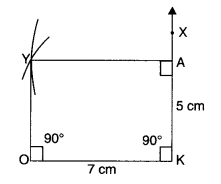
(iv) Rectangle OKAY
OK = 7 cm
KA = 5 cm.
Solution.
(i) Steps of Construction

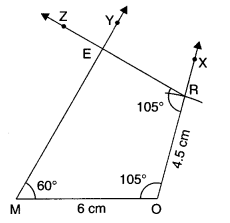
  1. Draw MO = 6 cm.
  2. At 0, draw ray OX such that Z MOX = 105°.
    NCERT Solutions for Class 8 Maths Chapter 4 Practical Geometry Ex 4.3 1
  3. Cut OR = 4.5 cm from ray OX.
  4. At M, draw ray MY such that ∠OMY = 60°.
  5. At R, draw ray RZ such that ∠ORZ = 105°.
  6. Let the rays MY and RZ meet at E.

Then, MORE is the required quadrilateral.

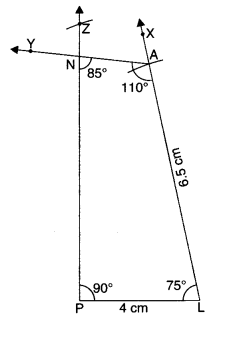
(ii) Steps of Construction

  1. Draw PL = 4 cm.
  2. At L, draw ray LX such that ∠PLX = 75°.
    NCERT Solutions for Class 8 Maths Chapter 4 Practical Geometry Ex 4.3 2
    By Angle-sum property of a quadrilateral,
    ∠P + ∠A + ∠N + ∠L = 360°
    ⇒ 90° + 110° + 85° + Z L = 360°
    ⇒ 285° + ∠ L = 360°
    ⇒ ∠L = 360° – 285°
    ⇒ ∠L = 75°.
  3. Cut LA = 6.5 cm from ray LX.
  4. At A, draw ray AY such that ∠LAY = 110°.
  5. At P, draw ray PZ such that ∠LPZ = 90°.
    Let the rays AY and PZ meet at N.

Then, PLAN is the required quadrilateral.

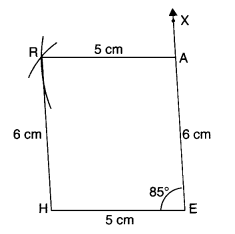
(iii) Steps of Construction

  1. Draw HE = 5 cm.
  2. At E, draw ray EX such that ∠HEX = 85°
    ∴ Opposite angles of a parallelogram are equal.
    ∵ ∠E = ∠R = 85°
  3. Cut EA = 6 cm from the ray EX.
    NCERT Solutions for Class 8 Maths Chapter 4 Practical Geometry Ex 4.3 3
  4. With A as centre and radius AR = 5 cm, draw an arc.
  5. With H as centre and radius HR = 6 cm; draw another arc to intersect the arc drawn in step 4 at R.
    ∴ opposite sides of a parallelogram are equal in length
    ∵ AR = EH = 5 cm
    and HR = EA = 6 cm
  6. Join AR and HR.

Then, HEAR is the required parallelogram.

(iv) Steps of Construction
[We know that each angle of a rectangle
is 90°.
∴ ∠O=∠K=∠A=∠Y= 90°.
Also, opposite sides of a rectangle are equal in length.
∴ OY = KA = 5 cm and AY = KO = 7 cm]

  1. Draw OK = 7 cm.
  2. At K, draw ray KX such that ∠OKX = 90°.
  3. Cut KA – 5 cm from ray KX.
    NCERT Solutions for Class 8 Maths Chapter 4 Practical Geometry Ex 4.3 4
  4. Taking A as centre and radius AY = 7 cm, draw an arc.
  5. Taking O as centre and radius OY = 5 cm, draw another arc to intersect the arc drawn in step 4 at Y.
  6. Join AY and OY.

Then OKAY is the required rectangle.


We hope the NCERT Solutions for Class 8 Maths Chapter 4 Practical Geometry Ex 4.3 help you. If you have any query regarding NCERT Solutions for Class 8 Maths Chapter 4 Practical Geometry Ex 4.3, drop a comment below and we will get back to you at the earliest.
NCERT Solutions for Class 8 Maths Chapter 4 Practical Geometry Ex 4.2

NCERT Solutions for Class 8 Maths Chapter 4 Practical Geometry Ex 4.2 are part of NCERT Solutions for Class 8 Maths. Here we have given NCERT Solutions for Class 8 Maths Chapter 4 Practical Geometry Ex 4.2.

BoardCBSE
TextbookNCERT
ClassClass 8
SubjectMaths
ChapterChapter 4
Chapter NamePractical Geometry
ExerciseEx 4.2
Number of Questions Solved1
CategoryNCERT Solutions

NCERT Solutions for Class 8 Maths Chapter 4 Practical Geometry Ex 4.2

Question 1.
Construct the following quadrilaterals:
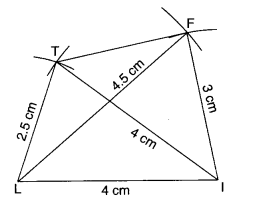
(i) Quadrilateral LIFT
LI = 4 cm
IF = 3 cm
TL = 2.5 cm
LF = 4.5 cm
IT = 4 cm

(ii) Quadrilateral GOLD
OL = 7.5 cm
GL = 6 cm
GD = 6 cm
LD = 5 cm
OD = 10 cm

(iii) Rhombus BEND
BN – 5.6 cm
DE = 6.5 cm
Solution.
(i) Steps of Construction

  1. Draw LI = 4 cm.
  2. With L as center and radius LT = 2.5 cm, draw an arc.
    NCERT Solutions for Class 8 Maths Chapter 4 Practical Geometry Ex 4.2 1
  3. With I as center and radius, IT = 4 cm, draw another arc to intersect the arc drawn in step 2 at T.
  4. With I as center and radius IF = 3 cm, draw an arc.
  5. With L as center and radius LF = 4.5 cm, draw another arc to intersect the arc drawn in step 4 at F.
  6. Join IF, FT, TL, LF and IT.

Then, LIFT is the required quadrilateral.

(ii) Steps of Construction

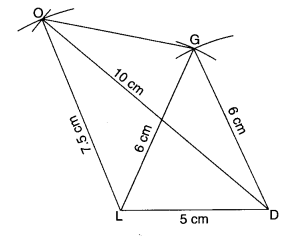
  1. Draw LD = 5 cm.
  2. With L as center and radius LG = 6 cm, draw an arc.
    NCERT Solutions for Class 8 Maths Chapter 4 Practical Geometry Ex 4.2 2
  3. With D as center and radius DG = 6 cm, draw another arc to intersect the arc drawn in step 2 at G.
  4. With L as center and radius LO = 7.5 cm, draw an arc.
  5. With D as center and radius DO = 10 cm, draw another arc to intersect the arc drawn in step 4 at O.
  6. Join DG, GO, OL, LG and DO.

Then GOLD is the required quadrilateral.

(iii) Steps of Construction

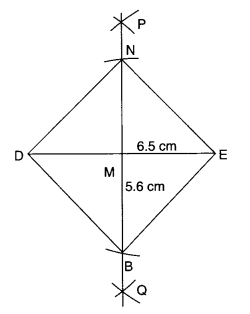
  1. Draw DE = 6.5 cm.
  2. Draw perpendicular bisector PQ of DE so as to intersect DE at M. Then M is the mid-point of DE.
  3. With M as centre and radius
    \(=\frac { 1 }{ 2 } \times \left( 5.6 \right) =2.8 cm\)
    opposite sides of DE to intersect MP at N and MQ at B.
    NCERT Solutions for Class 8 Maths Chapter 4 Practical Geometry Ex 4.2 3
  4. Join DN, NE, EB, and BD.

Then, BEND is the required rhombus.


We hope the NCERT Solutions for Class 8 Maths Chapter 4 Practical Geometry Ex 4.2 help you. If you have any query regarding NCERT Solutions for Class 8 Maths Chapter 4 Practical Geometry Ex 4.2, drop a comment below and we will get back to you at the earliest.
NCERT Solutions for Class 8 Maths Chapter 3 Understanding Quadrilaterals Ex 3.4

NCERT Solutions for Class 8 Maths Chapter 3 Understanding Quadrilaterals Ex 3.4 are part of NCERT Solutions for Class 8 Maths. Here we have given NCERT Solutions for Class 8 Maths Chapter 3 Understanding Quadrilaterals Ex 3.4.

BoardCBSE
TextbookNCERT
ClassClass 8
SubjectMaths
ChapterChapter 3
Chapter NameUnderstanding Quadrilaterals
ExerciseEx 3.4
Number of Questions Solved6
CategoryNCERT Solutions

NCERT Solutions for Class 8 Maths Chapter 3 Understanding Quadrilaterals Ex 3.4

Question 1.
State whether True or False :
(a) All rectangles are squares
(b) All rhombuses are parallelograms
(c) All squares are rhombuses and also rectangles
(d) All squares are not parallelograms
(e) All kites are rhombuses
(f) All rhombuses are kites
(g) All parallelograms are trapeziums
(h) All squares are trapeziums.
Solution.
(b), (c), (f), (g), (h) are true;
others are false.

Question 2.
Identify all the quadrilaterals that have.
(a) four sides of equal length
(b) four right angles
Solution.
(a) Rhombus; square
(b) Square; rectangle

Question 3.
Explain how a square is
(i) a quadrilateral
(ii)a parallelogram
(iii) a rhombus
(iv) a rectangle.
Solution.
(i) a quadrilateral
A square is 4 sided, so it is a quadrilateral.

(ii) a parallelogram
A square has its opposite sides parallel; so it is a parallelogram.

(iii) a rhombus
A square is a parallelogram with all the 4 sides equal, so it is a rhombus.

(iv) a rectangle
A square is a parallelogram with each angle a right angle; so it is a rectangle.

Question 4.
Name the quadrilaterals whose diagonals :
(i) bisect each other
(ii) are perpendicular bisectors of each other
(iii) are equal.
Solution.
(i) bisect each other
The names of the quadrilaterals whose diagonals bisect each other are parallelogram; rhombus; square; rectangle.

(ii) are perpendicular bisectors of each other
The names of the quadrilaterals whose diagonals are perpendicular bisectors of each other are rhombus; square.

(iii) are equal
The names of the quadrilaterals whose diagonals are equal are square; rectangle.

Question 5.
Explain why a rectangle is a convex quadrilateral.
Solution.
A rectangle is a convex quadrilateral because both of its diagonals lie wholly in its interior.

Question 6.
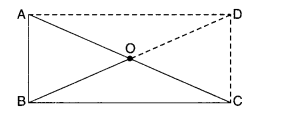
ABC is a right-angled triangle and O is the mid-point of the side opposite to the right angle. Explain why O is equidistant from A, B and C. (The dotted lines are drawn additionally to help you).
NCERT Solutions for Class 8 Maths Chapter 3 Understanding Quadrilaterals Ex 3.4 1
Solution.
Construction: Produce BO to D such that BO = OD. Join AD and CD.
Proof. AO = OC ∵ O is the mid-point of AC
BO = OD By construction
∴ Diagonals of quadrilateral ABCD bisect each other.
∴ Quadrilateral ABCD is a parallelogram.
Now, ∠ABC = 90° given
∴ ABCD is a rectangle.
Since the diagonals of a rectangle bisect each other, therefore,
O is the mid-point of AC and BD both. But AC = BD
∵ Diagonals of a rectangle are equal
∴ OA = OC =\(\frac { 1 }{ 2 } \)AC =\(\frac { 1 }{ 2 } \)BD = OB
⇒ OA = OB = OC.

We hope the NCERT Solutions for Class 8 Maths Chapter 3 Understanding Quadrilaterals Ex 3.4 help you. If you have any query regarding NCERT Solutions for Class 8 Maths Chapter 3 Understanding Quadrilaterals Ex 3.4, drop a comment below and we will get back to you at the earliest.