RS Aggarwal Class 8 Solutions Chapter 5 Playing with Numbers Ex 5D

RS Aggarwal Class 8 Solutions Chapter 5 Playing with Numbers Ex 5D

These Solutions are part of RS Aggarwal Solutions Class 8. Here we have given RS Aggarwal Solutions Class 8 Chapter 5 Playing with Numbers Ex 5D.

Other Exercises

Question 1.
Solution:
5×6 is exactly divisible by 3
Sum of its digits must be divisible by 3
5 + x + 6 = 11 + x is divisible by 3
Least value of x = 1 as 12 is divisible by 3 (b)

Question 2.
Solution:
64y8 is exactly divisible by 3 then the sum of its digits must be divisible by 3
6 + 4 + y + 8 or 18 + y is divisible by 3
Least value of y = 0
18 is divisible by 3 (a)

Question 3.
Solution:
7 x 8 is exactly divisible by 9
Sum of its digits must be divisible by 9
7 + x + 8 = 15 + x must be divisible by 9
Least value of x = 3 as 15 + 3 = 18 is divisible by 9 (c)

Question 4.
Solution:
37y4 is exactly divisible by 9
The sum of its digits must be divisible by
3 + 7 + y + 4 or 14 + y is divisible by 9
Least value of y = 4
As 14 + 4 = 18 is divisible by 9 (d)

Question 5.
Solution:
4xy7 is exactly divisible by 3
The sum of its digits must be divisible by 9
or 4 + x + y + 7 or 11 + (x + y) is divisible by 9
Least value of x + y = 7
as 11 + 7 = 18 is divisible by 9 (d)

Question 6.
Solution:
x7y5 is exactly divisible by 3
Sum of its digits must be divisible by 3
x + 7 + y + 512 + (x + y) is divisible by 3
Least value of x + y = 0 as
12 + 0 = 12 is divisible by 3 (b)

Question 7.
Solution:
x4y5z is exactly divisible by 9
The sum of its digits must be divisible by 9
x + 4 + y + 5 + z or 9 + (x + y + z) must be divisible by 9
Least value of x + y + z = 0 as 9 + 0 = 9 is divisible by 9 (d)

Question 8.
Solution:
A2B5 is exactly divisible by 9
Sum of its digits must be divisible by 9
A + 2 + B + 5 = 7 + A + B is divisible by 9
Least value of A + B = 2 as 7 + 2 = 9 is divisible by 9

Question 9.
Solution:
x27y is exactly divisible by 9
The sum of its digits must be divisible by 9
x + 2 + 7 + y = x + y + 9 is divisible by 9
Least value of x + y = 0 as 0 + 99 is exactly divisible by 9 (a)

Hope given RS Aggarwal Solutions Class 8 Chapter 5 Playing with Numbers Ex 5D are helpful to complete your math homework.

If you have any doubts, please comment below. Learn Insta try to provide online math tutoring for you.

RD Sharma Class 9 Solutions Chapter 14 Quadrilaterals Ex 14.2

RD Sharma Class 9 Solutions Chapter 14 Quadrilaterals Ex 14.2

These Solutions are part of RD Sharma Class 9 Solutions. Here we have given RD Sharma Class 9 Solutions Chapter 14 Quadrilaterals Ex 14.2

Other Exercises

Question 1.
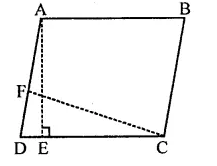
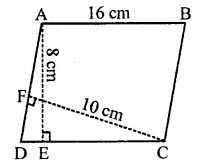
In the figure, ABCD is a parallelogram, AE ⊥ DC and CF ⊥ AD. If AB = 16 cm, AE = 8 cm and CF = 10 cm, find AD. [NCERT]
RD Sharma Class 9 Solutions Chapter 14 Quadrilaterals Ex 14.2 Q1.1
Solution:
In ||gm ABCD,
Base AB = 16 cm
and altitude AE = 8 cm
RD Sharma Class 9 Solutions Chapter 14 Quadrilaterals Ex 14.2 Q1.2
∴ Area = Base x Altitude
= AB x AE
= 16 x 8 = 128 cm2
Now area of ||gm ABCD = 128 cm2
Altitude CF = 10 cm
∴ Base AD = \(\frac { Area }{ Altitude }\) = \(\frac { 128 }{ 10 }\) = 12.8cm

Question 2.
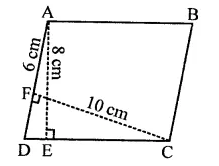
In Q. No. 1, if AD = 6 cm, CF = 10 cm, AE = 8 cm, find AB.
Solution:
Area of ||gm ABCD,
RD Sharma Class 9 Solutions Chapter 14 Quadrilaterals Ex 14.2 Q2.1
= Base x Altitude
= AD x CF
= 6 x 10 = 60 cm2
Again area of ||gm ABCD = 60 cm2
Altitude AE = 8 cm
∴ Base AB =\(\frac { Area }{ Altitude }\) = \(\frac { 60 }{ 8 }\) = \(\frac { 15 }{ 2 }\) cm = 7.5 cm

Question 3.
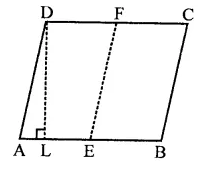
Let ABCD be a parallelogram of area 124 cm2. If E and F are the mid-points of sides AB and CD respectively, then find the area of parallelogram AEFD.
Solution:
Area of ||gm ABCD = 124 cm2
E and F are the mid points of sides AB and CD respectively. E, F are joined.
RD Sharma Class 9 Solutions Chapter 14 Quadrilaterals Ex 14.2 Q3.1
Draw DL ⊥ AB
Now area of ||gm ABCD = Base x Altitude
= AB x DL = 124 cm2
∵ E and F are mid points of sides AB and CD
∴ AEFD is a ||gm
Now area of ||gm AEFD = AE x DL
= \(\frac { 1 }{ 2 }\)AB x DL [∵ E is mid point of AB]
= \(\frac { 1 }{ 2 }\) x area of ||gm ABCD
= \(\frac { 1 }{ 2 }\) x 124 = 62 cm2

Question 4.
If ABCD is a parallelogram, then prove that ar(∆ABD) = ar(∆BCD) = ar(∆ABC) = ar(∆ACD) = \(\frac { 1 }{ 2 }\)ar( ||gm ABCD).
Solution:
Given : In ||gm ABCD, BD and AC are joined
RD Sharma Class 9 Solutions Chapter 14 Quadrilaterals Ex 14.2 Q4.1
To prove : ar(∆ABD) = ar(∆BCD) = ar(∆ABC) = ar(∆ACD) = \(\frac { 1 }{ 2 }\)ar(||gm ABCD)
Proof: ∵ Diagonals of a parallelogram bisect it into two triangles equal in area When BD is the diagonal, then
∴ ar(∆ABD) = ar(∆BCD) = \(\frac { 1 }{ 2 }\)ar(||gm ABCD) …(i)
Similarly, when AC is the diagonal, then
ar(∆ABC) = ar(∆ADC) = \(\frac { 1 }{ 2 }\)ar(||gm ABCD) …(ii)
From (i) and (ii),
ar(∆ABD) = ar(∆BCD) = ar(∆ABC) = ar(∆ACD) = \(\frac { 1 }{ 2 }\) ar(||gm ABCD)

Hope given RD Sharma Class 9 Solutions Chapter 14 Quadrilaterals Ex 14.2 are helpful to complete your math homework.

If you have any doubts, please comment below. Learn Insta try to provide online math tutoring for you.

RS Aggarwal Class 8 Solutions Chapter 5 Playing with Numbers Ex 5C

RS Aggarwal Class 8 Solutions Chapter 5 Playing with Numbers Ex 5C

These Solutions are part of RS Aggarwal Solutions Class 8. Here we have given RS Aggarwal Solutions Class 8 Chapter 5 Playing with Numbers Ex 5C.

Other Exercises

Replace A, B, C by suitable numerals.

Question 1.
Solution:
Here A can be as 6 + 7 = 13
Now 1 + 5 + 8 = 14
∴C = 1, B = 4, A = 6

Question 2.
Solution:
Here A can be 7, as 6+7 = 13
1 + B + 9 = 10 + B
∴B can be 7
∴10 + 7 = 17
1 + C + 6 = 7 + C
∴C can be 4
∴1 + 4 + 6 = 11
and 1 + 4 + 3 = 8
∴A = 7, B = 7, C = 4

Question 3.
Solution:
Here A + A + A = A
∴A can = 5
∴5 + 5 + 5 = 15
∴B = 1
Hence A = 5, B = 1

Question 4.
Solution:
6 – A = 3
1 + 5 – A = 3
5 – A = 3
∴A = 5 – 3 = 2
Now 2 – B = 7
=>12 – B = 7
∴B = 5
Hence A = 2, B = 5

Question 5.
Solution:
– 5 – A = 9 =>A = 5 – 9 or 15 – 9
= 6
∴A = 6
Now B – 1 – 8 = 5 =>B – 9 = 5
=>B = 5 + 9 = 14
∴B = 4
Now C – 1 – 2 = 2 =>C – 3 = 2
C = 2 + 3 = 5
∴A = 6, B = 4, C = 5

Question 6.
Solution:
B x 3 = B
∴B can be 5 or 0
∴5 x 3 = 15 => B = 5 or 3 x 0 =0
If B = 0, then A can be 5
∴3 x 5 = 15
∴A = 5 and C = 1
Hence A = 5, B = 0, C = 1

Question 7.
Solution:
RS Aggarwal Class 8 Solutions Chapter 5 Playing with Numbers Ex 5C 7.1
∴AB = B
=>A = 1
and A² + B² – 1 + B² + C
∴B² +1 = C
∴B² in one digit
If B = 3
∴3² + 1 = 9 + 1 = 10 = C
∴C = 0
B x 1 + 1 = B + 1 = 3 + 1
Hence A = 1, B = 3, C = 0

Question 8.
Solution:
Here we see that 6 x 9 = 54
∴A – 4 = 3 => A = 3 + 4 = 7
and 6 x 6 = 36
3B = 36 => B = 6
and C = 6
Hence A = 7, B = 6, C = 6

Question 9.
Solution:
Product of two numbers = 1 -digit number
and sum = 2-digit numbers
Let first number = x
and second number = y
∴x X y = 1-digit number
x + y = 2-digit number
By hit and hail, we sec that
1 x 9 = 9 which is I-digit number
and 1 + 9 = 10 which is 2-digit number

Question 10.
Solution:
By hit and trail method, we see that
1 + 2 + 3 = 6 and 1 x 2 x 3 = 6
1, 2 and 3 are the required whole numbers
whose sum and product is same

Question 11.
Solution:
In the given square, we have to interest the numbers from 1 to 9, such that the sum in each raw, column on diagonal to be 15
So, we complete it as given here

RS Aggarwal Class 8 Solutions Chapter 5 Playing with Numbers Ex 5C 11.1

Question 12.
Solution:
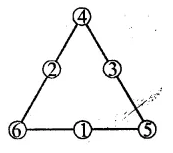
We shall complete the triangle by intersecting the numbers from 1 to 6 without repetition so that the sum in each side be 12
RS Aggarwal Class 8 Solutions Chapter 5 Playing with Numbers Ex 5C 12.1

Question 13.
Solution:
The given numbers are
a, b (a + b), (a + 2b), (2a + 3b), (3a + 5b), (5a + 8b), (8a + 13b), (13a + 21b), and (21a + 34b)
Sum of there numbers = 11 (5a + 8b)
= 11 x 7th number
Now taking a = 8, b = 13, then the 10 number be 8, 13, 21, 34, 55, 89, 144, 233, 377, 610
Whose 7th number = 144
By adding these 10 numbers, we get the
sum
= 8+ 13 + 21 + 34 + 55 + 89 + 144 + 233 + 377 + 610 = 1584 and 11 x 7th number =11 x 144 , = 1584
Which is same in each case

Question 14.
Solution:
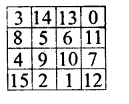
We see that in the magic box sum of 0 + 11 + 7 + 12 = 30
Now we shall complete this magic square, to get 30 as the sum in each row and column and also diagonal wise
RS Aggarwal Class 8 Solutions Chapter 5 Playing with Numbers Ex 5C 14.1

Hope given RS Aggarwal Solutions Class 8 Chapter 5 Playing with Numbers Ex 5C are helpful to complete your math homework.

If you have any doubts, please comment below. Learn Insta try to provide online math tutoring for you.

RD Sharma Class 9 Solutions Chapter 14 Quadrilaterals Ex 14.1

RD Sharma Class 9 Solutions Chapter 14 Quadrilaterals Ex 14.1

These Solutions are part of RD Sharma Class 9 Solutions. Here we have given RD Sharma Class 9 Solutions Chapter 14 Quadrilaterals Ex 14.1

Other Exercises

Question 1.
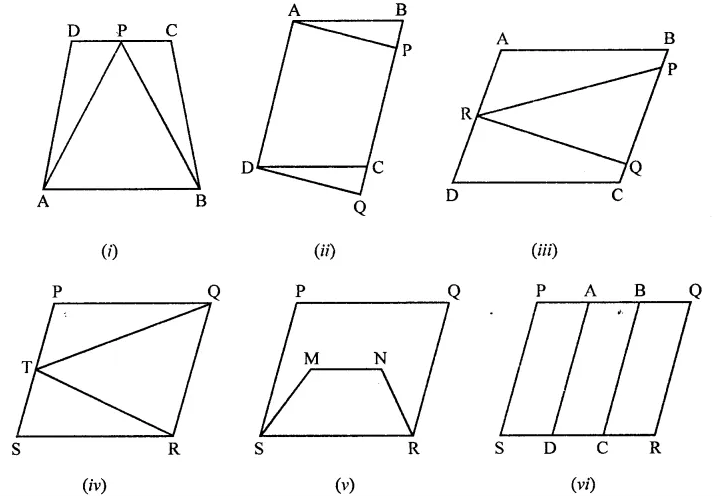
Which of the following figures lie on the same base and between the same parallels. In such a case, write the common base and two parallels: [NCERT]
RD Sharma Class 9 Solutions Chapter 14 Quadrilaterals Ex 14.1 Q1.1
Solution:
(i) ΔPCD and trapezium ABCD are on the same base CD and between the same parallels AB and DC.
(ii) Parallelograms ABCD and APQD are on the same base AD and between the same parallels AD and BQ.
(iii) Parallelogram ABCD and ΔPQR are between the same parallels AD and BC but they are not on the same base.
(iv) ΔQRT and parallelogram PQRS are on the same base QR and between the same parallels QR and PS.
(v) Parallelogram PQRS and trapezium SMNR on tire same base SR but they are not between the same parallels.
(vi) Parallelograms PQRS, AQRD, BCQR are between the same parallels. Also, parallelograms PQRS, BPSC, and APSD are between the same parallels.


Hope given RD Sharma Class 9 Solutions Chapter 14 Quadrilaterals Ex 14.1 are helpful to complete your math homework.

If you have any doubts, please comment below. Learn Insta try to provide online math tutoring for you.

RD Sharma Class 9 Solutions Chapter 13 Linear Equations in Two Variables MCQS

RD Sharma Class 9 Solutions Chapter 13 Linear Equations in Two Variables MCQS

These Solutions are part of RD Sharma Class 9 Solutions. Here we have given RD Sharma Class 9 Solutions Chapter 13 Linear Equations in Two Variables MCQS

Other Exercises

Mark the correct alternative in each of the following:
Question 1.
The opposite sides of a quadrilateral have
(a) no common point
(b) one common point
(c) two common points
(d) infinitely many common points
Solution:
The opposite sides of a quadrilateral have no common point. (a)

Question 2.
The consecutive sides of a quadrilateral have
(a) no common point
(b) one common point
(c) two common points
(d) infinitely many common points
Solution:
The consecutive sides of a quadrilateral have one common point. (b)

Question 3.
PQRS is a quadrilateral, PR and QS intersect each other at O. In which of the following cases, PQRS is a parallelogram?
(a) ∠P = 100°, ∠Q = 80°, ∠R = 100°
(b) ∠P = 85°, ∠Q = 85°, ∠R = 95°
(c) PQ = 7 cm, QR = 7 cm, RS = 8 cm, SP = 8 cm
(d) OP = 6.5 cm, OQ = 6.5 cm, OR = 5.2 cm, OS = 5.2 cm
Solution:
PQRS is a quadrilateral, PR and QS intersect each other at O. PQRS is a parallelogram if ∠P = 100°, ∠Q = 80°, ∠R = 100° (a)

Question 4.
Which of the following quadrilateral is not a rhombus?
(a) All four sides are equal
(b) Diagonals bisect each other
(c) Diagonals bisect opposite angles
(d) One angle between the diagonals is 60°
Solution:
A quadrilateral is not a rhombus if one angle between the diagonals is 60°. (d)

Question 5.
Diagonals necessarily bisect opposite angles in a
(a) rectangle
(b) parallelogram
(c) isosceles trapezium
(d) square
Solution:
Diagonals necessarily bisect opposite angles in a square. (d)

Question 6.
The two diagonals are equal in a
(a) parallelogram
(b) rhombus
(c) rectangle
(d) trapezium
Solution:
The two diagonals are equal in a rectangle. (c)

Question 7.
We get a rhombus by joining the mid-points of the sides of a
(a) parallelogram
(b) rhombus
(c) rectangle
(d) triangle
Solution:
We get a rhombus by joining the mid points of the sides of a rectangle. (c)

Question 8.
The bisectors of any two adjacent angles of a parallelogram intersect at
(a) 30°
(b) 45°
(c) 60°
(d) 90°
Solution:
The bisectors of any two adjacent angles of a parallelogram intersect at 90°. (d)

Question 9.
The bisectors of the angle of a parallelogram enclose a
(a) parallelogram
(b) rhombus
(c) rectangle
(d) square
Solution:
The bisectors of the angles of a parallelogram enclose a rectangle. (c)

Question 10.
The figure formed by joining the mid-points of the adjacent sides of a quadrilateral is a
(a) parallelogram
(b) rectangle
(c) square
(d) rhombus
Solution:
The figure formed by joining the mid-points of the adjacent sides of a quadrilateral is a parallelogram. (a)

Question 11.
The figure formed by joining the mid-points of the adjacent sides of a rectangle is a
(a) square
(b) rhombus
(c) trapezium
(d) none of these
Solution:
The figure formed by joining the mid-points of the adjacent sides of a rectangle is a rhombus. (b)

Question 12.
The figure formed by joining the mid-points of the adjacent sides of a rhombus is a
(a) square
(b) rectangle
(c) trapezium
(d) none of these
Solution:
The figure formed by the joining the mid-points of the adjacent sides of a rhombus is a rectangle. (b)

Question 13.
The figure formed by joining the mid-points of the adjacent sides of a square is a
(a) rhombus
(b) square
(c) rectangle
(d) parallelogram
Solution:
Tire figure formed by joining the mid-points of the adjacent sides of a square is a square. (b)

Question 14.
The figure formed by joining the mid-points of the adjacent sides of a parallelogram is a
(a) rectangle
(b) parallelogram
(b) rhombus
(d) square
Solution:
The figure formed by joining the mid-points of the adjacent sides of a parallelogram is a parallelogram. (b)

Question 15.
If one angle of a parallelogram is 24° less than twice the smallest angle, then the measure of the largest angle of the parallelogram is
(a) 176°
(b) 68°
(c) 112°
(d) 102°
Solution:
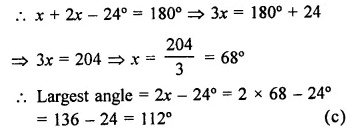
Let the smallest angle be x
The largest angle = 2x – 24°
But sum of two adjacent angles = 180°
RD Sharma Class 9 Solutions Chapter 13 Linear Equations in Two Variables MCQS Q15.1

Question 16.
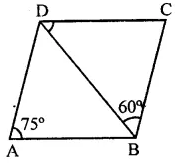
In a parallelogram ABCD, If ∠DAB = 75° and ∠DBC = 60°, then ∠BDC =
(a) 75°
(b) 60°
(c) 45°
(d) 55°
Solution:
In ||gm ABC,
RD Sharma Class 9 Solutions Chapter 13 Linear Equations in Two Variables MCQS Q16.1
∠A = 75°, ∠DBC = 60°
But ∠A + ∠B = 180° (Sum of two consecutive angles)
⇒ 75° + ∠B = 180°
⇒ ∠B = 180°- 75“= 105°
But ∠DBC = 60°
∴ ∠DBA = 105°-60° = 45°
But ∠BDC = ∠DBA (Alternate angles)
∴ ∠BDC = 45° (c)

Question 17.
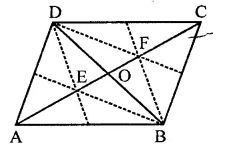
ABCD is a parallelogram and E and F are the centroids of triangles ABD and BCD respectively, then EF =
(a) AE
(b) BE
(c) CE
(d) DE
Solution:
In ||gm ABCD, BD is joined forming two triangles ABD and BCD
RD Sharma Class 9 Solutions Chapter 13 Linear Equations in Two Variables MCQS Q17.1
E and F are the centroid of ∆ABD and ∆BCD
Now E and F trisect AC
i.e. AE = EF = FC
∴ EF = AE (a)

Question 18.
ABCD is a parallelogram, M is the mid¬point of BD and BM bisects ∠B. Then, ∠AMB =
(a) 45°
(b) 60°
(c) 90°
(d) 75°
Solution:
In ||gm ABCD, M is mid-point of BD and
BM bisects ∠B
AM is joined
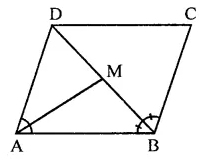
RD Sharma Class 9 Solutions Chapter 13 Linear Equations in Two Variables MCQS Q18.1
∴AM bisects ∠A
But ∠A + ∠B = 180° (Sum of two consecutive angles)
∴ ∠AMB = 90° (c)

Question 19.
If an angle of a parallelogram is two-third of its adjacent angle, the smallest angle of the parallelogram is
(a) 108°
(b) 54°
(c) 12°
(d) 81°
Solution:
Let adjacent angle of a ||gm = x
Then second angle = \(\frac { 2 }{ 3 }\) x
∴ x+ \(\frac { 2 }{ 3 }\) x= 180°
(Sum of two adjacent angles of a ||gm is 180°)
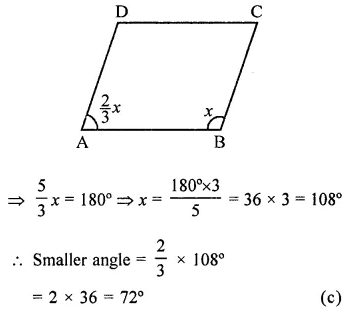
RD Sharma Class 9 Solutions Chapter 13 Linear Equations in Two Variables MCQS Q19.1

Question 20.
If the degree measures of the angles of quadrilateral are Ax, lx, 9x and 10JC, what is the sum of the measures of the smallest angle and largest angle?
(a) 140°
(b) 150°
(c) 168°
(d) 180°
Solution:
Sum of the angles of a quadrilateral = 360°
∴ 4x + 1x + 9x + 10x = 360°
⇒ 30x = 360°
⇒ x = \(\frac { { 360 }^{ \circ } }{ 30 }\)  = 12°
Now sum of smallest and largest angle = 4 x 12° + 10 x 12°
= 48° + 120° = 168° (c)

Question 21.
If the diagonals of a rhombus are 18 cm and 24 cm respectively, then its side is equal to
(a) 16 cm
(b) 15 cm
(c) 20 cm
(d) 17 cm
Solution:
Diagonals of a rhombus are 18 cm and 24 cm But diagonals of a rhombus bisect each other at right angles
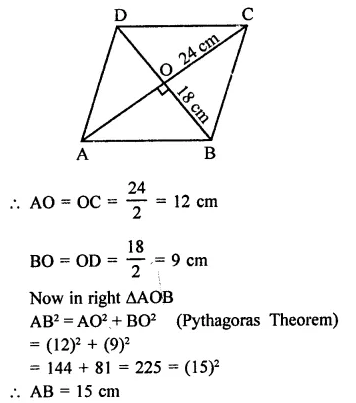
RD Sharma Class 9 Solutions Chapter 13 Linear Equations in Two Variables MCQS Q21.1
RD Sharma Class 9 Solutions Chapter 13 Linear Equations in Two Variables MCQS Q21.2

Question 22.
ABCD is a parallelogram in which diagonal AC bisects ∠BAD. If ∠BAC = 35°, then ∠ABC =
(a) 70°
(b) 110°
(c) 90°
(d) 120°
Solution:
In ||gm ABCD, AC is its diagonal which bisect ∠BAD
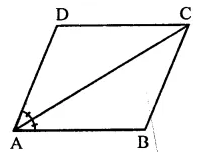
RD Sharma Class 9 Solutions Chapter 13 Linear Equations in Two Variables MCQS Q22.1
∠BAD = 35°
∴ ∠BAD = 2 x 35° = 70°
But ∠A + ∠B = 180° (Sum of consecutive angles)
⇒ 70° + ∠B = 180°⇒ ∠B = 180° – 70°
∴ ∠B = 110°
⇒ ABC = 110° (b)

Question 23.
In a rhombus ABCD, if ∠ACB = 40°, then ∠ADB =
(a) 70°
(b) 45°
(c) 50°
(d) 60°
Solution:
In rhombus ABCD, ∠ACB = 40°
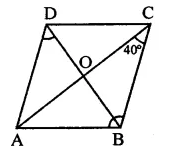
RD Sharma Class 9 Solutions Chapter 13 Linear Equations in Two Variables MCQS Q23.1
∴ ∠BCD = 2 x ∠ACB
= 2 x 40° = 80°
But ∠BCD + ∠ADC = 180° (Sum of consecutive angles of ||gm)
⇒ 80° + ∠ADC = 180°
⇒ ∠ADC = 180° – 80° = 100°
∴ ∠ADB = \(\frac { 1 }{ 2 }\)∠ADC = \(\frac { 1 }{ 2 }\)x 100° = 50° (c)

Question 24.
In ∆ABC, ∠A = 30°, ∠B = 40° and ∠C = 110°. The angles of the triangle formed by joining the mid-points of the sides of this triangle are
(a) 70°, 70°, 40°
(b) 60°, 40°, 80°
(c) 30°, 40°, 110°
(d) 60°, 70°, 50°
Solution:
In ∆ABC,
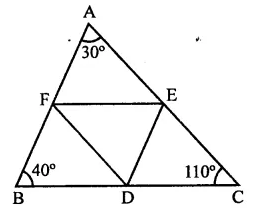
RD Sharma Class 9 Solutions Chapter 13 Linear Equations in Two Variables MCQS Q24.1
∠A = 30°, ∠B = 40°, ∠C = 110°
D, E and F are mid-points of the sides of the triangle. By joining them in order,
DEF is a triangle formed
Now BDEF, CDFE and AFDE are ||gms
∴ ∠A = ∠D = 30°
∠B = ∠E = 40°
∠C = ∠F= 110°
∴ Angles are 30°, 40°, 110° (c)

Question 25.
The diagonals of a parallelogram ABCD intersect at O. If ∠BOC = 90° and ∠BDC = 50°, then ∠OAB =
(a) 40°
(b) 50°
(c) 10°
(d) 90°
Solution:
In ||gm ABCD, diagonals AC and BD intersect each other at O
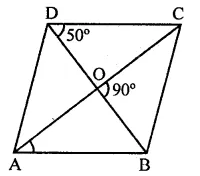
RD Sharma Class 9 Solutions Chapter 13 Linear Equations in Two Variables MCQS Q25.1
BOC = 90°, ∠BDC = 50°
∵ ∠BOC = 90°
∴ Diagonals of ||gm bisect each other at 90°
∴∠COD = 90°
In ∆COD,
∠OCD = 90° – 50° = 40°
But ∠OAB = ∠OCD (Alternate angles)
∴∠OAB = 40° (a)

Question 26.
ABCD is a trapezium in which AB || DC. M and N are the mid-points of AD and BC respectively. If AB = 12 cm, MN = 14 cm, then CD =
(a) 10 cm
(b) 12 cm
(c) 14 cm
(d) 16 cm
Solution:
In trapezium AB || DC
M and N are mid-points of sides AD and BC and MN are joined
AB = 12 cm, MN = 14 cm
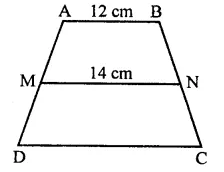
RD Sharma Class 9 Solutions Chapter 13 Linear Equations in Two Variables MCQS Q26.1
∵ MN = \(\frac { 1 }{ 2 }\)(AB + CD)
⇒ 2MN = AB + CD
⇒ 2 x 14 = 12 + CD
CD = 2 x 14 – 12 = 28 – 12 = 16 cm (d)

Question 27.
Diagonals of a quadrilateral ABCD bisect each other. If ∠A = 45°, then ∠B =
(a) 115°
(b) 120°
(c) 125°
(d) 135°
Solution:
Diagonals AC and BD of quadrilateral ABCD bisect each other at O
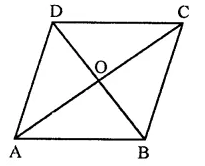
RD Sharma Class 9 Solutions Chapter 13 Linear Equations in Two Variables MCQS Q27.1
∴ AO = OC, BO = OD
∴ ABCD is a ||gm ∠A = 45°
But ∠A + ∠B = 180° (Sum of consecutive angles)
∴ ∠B = 180° – ∠A = 180° – 45°
= 135° (d)

Question 28.
P is the mid-point of side BC of a paralleogram ABCD such that ∠BAP = ∠DAP. If AD = 10 cm, then CD =
(a) 5 cm
(b) 6 cm
(c) 8 cm
(d) 10 cm
Solution:
In ||gm ABCD, P is mid-point of BC
AD = 10cm
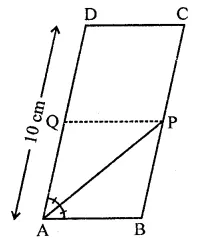
RD Sharma Class 9 Solutions Chapter 13 Linear Equations in Two Variables MCQS Q28.1
∠BAP = ∠DAP
Through P, draw PQ || AB
∴ ABPQ is rhombus
∴ AB = BP = AQ
= \(\frac { 1 }{ 2 }\) AB = \(\frac { 1 }{ 2 }\) x 10 = 5 cm
But CD = AB (Opposite sides of ||gm)
∴ CD = 5 cm (a)

Question 29.
In ∆ABC, E is the mid-point of median AD such that BE produced meets AC at E If AC = 10.5 cm, then AF =
(a) 3 cm
(b) 3.5 cm
(c) 2.5 cm
(d) 5 cm
Solution:
In ∆ABC, E is the mid-point of median AD
Such that BE produced meets AC at F
AC = 10.5 cm
Draw DG || AF
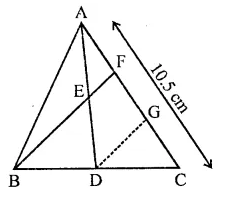
RD Sharma Class 9 Solutions Chapter 13 Linear Equations in Two Variables MCQS Q29.1
In ∆ADG
E is mid-point of AD and EF || DG
∴ F is mid-point of AG
⇒ AF = FG …(i)
In ∆BCF
D is mid-point of BC and DG || BF
∴ G is mid-point of FC
∴ FG = GC …(i)
From (i) and (ii)
AF = FG = GC = \(\frac { 1 }{ 3 }\) AC
But AC = 10.5 cm
∴ AF = \(\frac { 1 }{ 3 }\) AC = \(\frac { 1 }{ 3 }\) x 10.5 = 3.5 cm (b)

Question 30.
ABCD is a parallelogram and E is the mid-point of BC. DE and AB when produced meet at F. Then, AF =
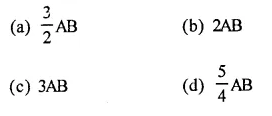
RD Sharma Class 9 Solutions Chapter 13 Linear Equations in Two Variables MCQS Q30.2
Solution:
In ||gm ABCD, E is mid-point of BC DE and AB are produced to meet at F
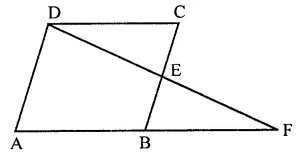
RD Sharma Class 9 Solutions Chapter 13 Linear Equations in Two Variables MCQS Q30.1
∵ E is mid point of BC
∴ BE = EC
In ∆BEF and ∆CDE
BE = EC
∠BEF = ∠CED (Vertically opposite angle)
and ∠EBF = ∠ECD (Alternate angles)
∴ ∆BEF ≅ ∆CDE (ASA criterian)
∴ DC = BF
But DC = AB
∴ AB = BF
AF = AB + BF = AB + AB
= 2AB (b)

Question 31.
In a quadrilateral ABCD, ∠A + ∠C is 2 times ∠B + ∠D. If ∠A = 140° and ∠D = 60°, then ∠B =
(a) 60°
(b) 80°
(c) 120°
(d) None of these
Solution:
In quadrilateral ABCD
⇒ ∠A + ∠C = 2(∠B + ∠D)
⇒ ∠A + ∠C = 2∠B + 2∠D
Adding 2∠A + 2∠C both sides
2∠A + 2∠C + ∠A + ∠C = 2∠A + 2∠B + 2∠C + 2∠D
⇒ 3∠A + 3∠C = 2(∠A + ∠B + ∠C + ∠D)
⇒ 3(∠A + ∠C) = 2 x 360° = 720°
∴ ∠A + ∠C = \(\frac { { 720 }^{ \circ } }{ 3 }\)  = 240°
⇒ 40° + ∠C = 240° (∵ ∠A = 40°)
∠C = 240° – 40° = 200°
Now 2(∠B + ∠D) = ∠A + ∠C = 240°
∠B + ∠D = \(\frac { { 240 }^{ \circ } }{ 2 }\)  = 120°
∴ ∠B = 60° = 120°
∴ ∠B = 60° (a)

Question 32.
The diagonals AC and BD of a rectangle ABCD intersect each other at P. If ∠ABD = 50°, then ∠DPC =
(a) 70°
(b) 90°
(c) 80°
(d) 100°
Solution:
In rectangle ABCD, diagonals AC and BD intersect each other at P
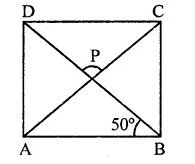
RD Sharma Class 9 Solutions Chapter 13 Linear Equations in Two Variables MCQS Q32.1
∠ABD = 50°
∴ ∠CAB = ∠ABD = 50° (∵ AP = BP)
Now in ∆APB
∠CAB + ∠ABD + ∠APB = 180° (Angles of a triangle)
⇒ ∠PAB + ∠PBA + ∠APB = 180°
⇒ 50° + 50° + ∠APB = 180°
⇒ ∠APB = 180° – 50° – 50° = 80°
But ∠DPC = ADB (Vertically opposite angles)
∴ ∠DPC = 80° (c)

Hope given RD Sharma Class 9 Solutions Chapter 13 Linear Equations in Two Variables MCQS are helpful to complete your math homework.

If you have any doubts, please comment below. Learn Insta try to provide online math tutoring for you.