RS Aggarwal Class 10 Solutions Chapter 3 Linear equations in two variables Ex 3A

RS Aggarwal Class 10 Solutions Chapter 3 Linear equations in two variables Ex 3A

These Solutions are part of RS Aggarwal Solutions Class 10. Here we have given RS Aggarwal Solutions Class 10 Chapter 3 Linear equations in two variables Ex 3A.

RS Aggarwal Solutions Class 10 Chapter 3

Solve each of the following systems of equations graphically.
Question 1.
Solution:
2x + 3y = 2 …..(i)
x – 2y = 8 …(ii)
From Eq. (i),
⇒ 2x = 2 – 3y
⇒x = \(\frac { 2 – 3y }{ 2 }\)
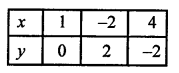
Giving some different values to y, we get corresponding values of x as given below:
RS Aggarwal Class 10 Solutions Chapter 3 Linear equations in two variables Ex 3A 1
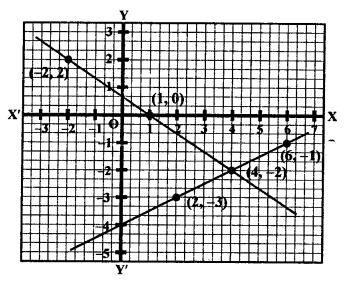
Now, plot the points (1, 0), (-2, 2) and (4, -2) on the graph and join them to get a line.
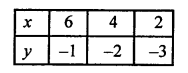
Similarly x – 2y = 8 ⇒ x = 8 + 2y
RS Aggarwal Class 10 Solutions Chapter 3 Linear equations in two variables Ex 3A 2
Now plot the points (6, -1), (4, -2) and (2, -3) on the graph and join them to get another line.
We see that these two lines intersect each other at point(4, -2).
x = 4, y = -2
RS Aggarwal Class 10 Solutions Chapter 3 Linear equations in two variables Ex 3A 3

Question 2.
Solution:
3x + 2y = 4
⇒ 3x = 4 – 2y
⇒ x = \(\frac { 4 – 2y }{ 3 }\)
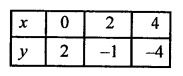
Giving some different values to y, we get corresponding values of x as given below:
RS Aggarwal Class 10 Solutions Chapter 3 Linear equations in two variables Ex 3A 4
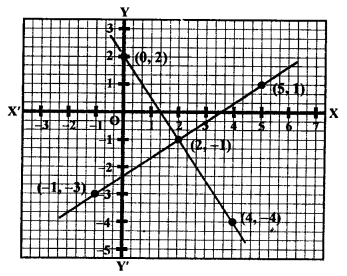
Now plot the points (0, 2), (2, -1) and (4, -4) on the graph and join them to get a line. Similarly,
2x – 3y = 7
2x = 3y+ 7
x = \(\frac { 3y+ 7 }{ 2 }\)
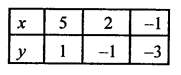
RS Aggarwal Class 10 Solutions Chapter 3 Linear equations in two variables Ex 3A 5
Now plot the points on the graph and join them to get another line.
We see that these two lines intersect each other at point (2, -1).
x = 2, y = -1
RS Aggarwal Class 10 Solutions Chapter 3 Linear equations in two variables Ex 3A 6

Question 3.
Solution:
2x + 3y = 8
⇒ 2x = 8 – 3y
x = \(\frac { 8 – 3y }{ 2 }\)
Now, giving some different values to y, we get corresponding values of x as given below
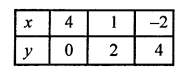
RS Aggarwal Class 10 Solutions Chapter 3 Linear equations in two variables Ex 3A 7
Now, we plot the points (4,0), (2,3) and (0, 6) on the graph and join them to get a line.
Similarly,
x – 2y + 3 = 0
x = 2y – 3
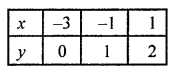
RS Aggarwal Class 10 Solutions Chapter 3 Linear equations in two variables Ex 3A 8
Now, plot the points (-3, 0), (-1, 1) and (1, 2) on the graph and join them to get another line.
We see that these two lines intersect each other at the point (1, 2).
x = 1, y = 2
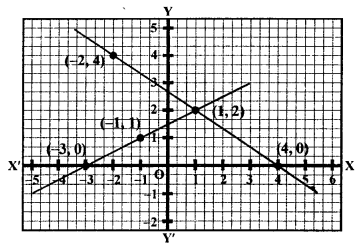
RS Aggarwal Class 10 Solutions Chapter 3 Linear equations in two variables Ex 3A 9

Question 4.
Solution:
2x – 5y + 4 = 0
⇒ 2x = 5y – 4
x = \(\frac { 5y – 4 }{ 2 }\)
Giving some different values to y, we get corresponding values of x as given below:
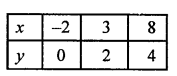
RS Aggarwal Class 10 Solutions Chapter 3 Linear equations in two variables Ex 3A 10
Now, plot the points (-2, 0) (3, 2) and (8,4) on the graph and join them to get a line.
Similarly,
2x + y – 8 = 0
⇒ y = 8 – 2x
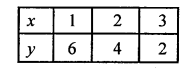
RS Aggarwal Class 10 Solutions Chapter 3 Linear equations in two variables Ex 3A 11
Plot the points (1, 6), (2, 1) and (3, 2) on the graph and join them to get another line.
We see that these two lines intersect each other at the point (3, 2).
x = 3, y = 2
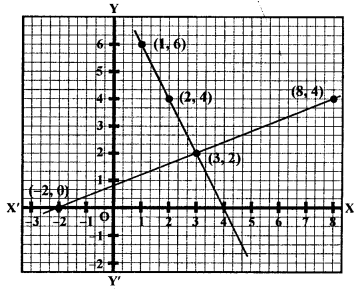
RS Aggarwal Class 10 Solutions Chapter 3 Linear equations in two variables Ex 3A 12

Question 5.
Solution:
3x + 2y = 12
⇒ 3x = 12 – 2y
x = \(\frac { 12 – 2y }{ 2 }\)
Giving some different values to y, we get corresponding the values of x as given below:
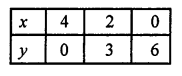
RS Aggarwal Class 10 Solutions Chapter 3 Linear equations in two variables Ex 3A 13
Now, we plot the points (4,0), (2,3) and (0, 6) on the graph and join them to get a line.
Similarly,
5x – 2y = 4
⇒ 5x = 4 + 2 y
⇒ x = \(\frac { 4 + 2 y }{ 5 }\)
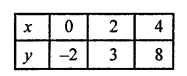
RS Aggarwal Class 10 Solutions Chapter 3 Linear equations in two variables Ex 3A 14
Plot the points (0, -2), (2, 3) and (4, 8) on the graph and join them to get another line.
We see that these two lines intersect each other at the point (2, 3).
x = 2, y = 3
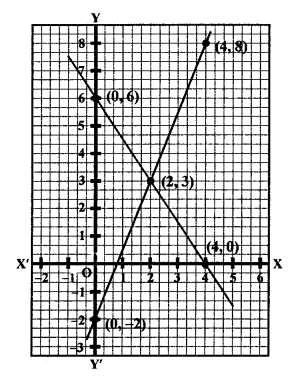
RS Aggarwal Class 10 Solutions Chapter 3 Linear equations in two variables Ex 3A 15

Question 6.
Solution:
3x + y + 1 = 0 ⇒y = -3x – 1
Giving some different values to x, we get corresponding values of y as given below:
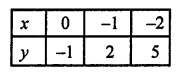
RS Aggarwal Class 10 Solutions Chapter 3 Linear equations in two variables Ex 3A 16
Now, plot the points (0, -1), (-1, 2) and (-2, 5) on the graph and join them to get a line.
Similarly,
2x – 3y + 8 = 0
2x = 3y – 8
x = \(\frac { 3y – 8 }{ 2 }\)
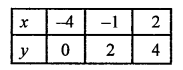
RS Aggarwal Class 10 Solutions Chapter 3 Linear equations in two variables Ex 3A 17
Now, plot the points (-4, 0), (-1, 2) and (2, 4) on the graph and join them to get another line.
We see that these two lines intersect each other at the points (-1, 2).
x = -1, y = 2
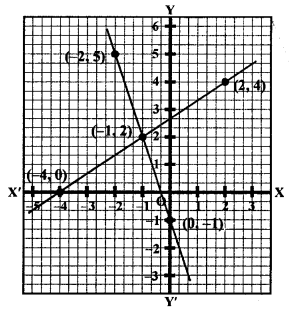
RS Aggarwal Class 10 Solutions Chapter 3 Linear equations in two variables Ex 3A 18

Question 7.
Solution:
2x + 3y + 5 = 0
2x = -3y – 5
x = \(\frac { -3y – 5 }{ 2 }\)
Giving some different values to y, we get corresponding values of x as given below:
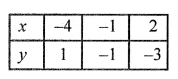
RS Aggarwal Class 10 Solutions Chapter 3 Linear equations in two variables Ex 3A 19
Now, plot the points (-4, 1), (-1, -1) and (2, -3) on the graph and join them to get a line. Similarly,
3x – 2y – 12 = 0
⇒ 3x = 2y + 12
x = \(\frac { 2y + 12 }{ 3 }\)
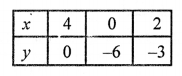
RS Aggarwal Class 10 Solutions Chapter 3 Linear equations in two variables Ex 3A 20
Plot the points (4, 0), (0, -6) and (2, -3) on the graph and join them to get another line.
We see that these two lines intersect each other at the point (2, -3).
x = 2, y = -3
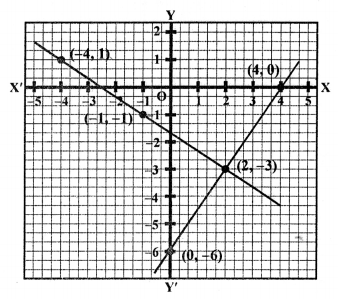
RS Aggarwal Class 10 Solutions Chapter 3 Linear equations in two variables Ex 3A 21

Question 8.
Solution:
2x – 3y + 13 = 0
⇒ 2x = 3y – 13
⇒ x = \(\frac { 3y – 13 }{ 2 }\)
Giving some different values to y, we get corresponding values of x as given below:
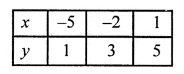
RS Aggarwal Class 10 Solutions Chapter 3 Linear equations in two variables Ex 3A 22
Now, plot the points (-5, 1), (-2, 3) and (1, 5) on the graph and join them to get a line.
Similarly,
3x – 2y + 12 = 0
3x = 2y – 12
x = \(\frac { 2y – 12 }{ 3 }\)
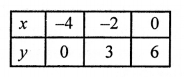
RS Aggarwal Class 10 Solutions Chapter 3 Linear equations in two variables Ex 3A 23
Now, plot the points (-4, 0), (-2, 3) and (0, 6) on the graph and join them to get another line.
We see that these lines intersect each other at the point (-2, 3).
x = -2, y = 3
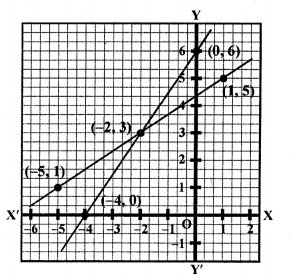
RS Aggarwal Class 10 Solutions Chapter 3 Linear equations in two variables Ex 3A 24

Question 9.
Solution:
2x + 3y – 4 = 0
⇒ 2x = 4 – 3y
⇒ x = \(\frac { 4 – 3y }{ 2 }\)
Giving some different values to y, we get corresponding values of x as given below:
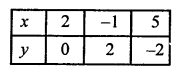
RS Aggarwal Class 10 Solutions Chapter 3 Linear equations in two variables Ex 3A 25
Plot the points (2, 0) (-1, 2) and (5, -2) on the graph and join them to get a line.
Similarly,
3x – y + 5 = 0
⇒ -y = -5 – 3x
⇒ y = 5 + 3x
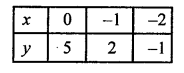
RS Aggarwal Class 10 Solutions Chapter 3 Linear equations in two variables Ex 3A 26
Plot the points (0, 5), (-1, 2) and (-2, -1) on the graph and join them to get another line.
We see that these two lines intersect each other at the point (-1, 2).
x = -1, y = 2
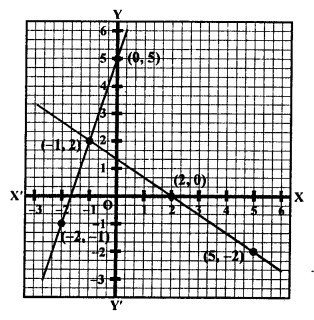
RS Aggarwal Class 10 Solutions Chapter 3 Linear equations in two variables Ex 3A 27

Question 10.
Solution:
x + 2y + 2 = 0
⇒ x = – (2y + 2)
Giving some different values to y, we get corresponding the values of x as given below:
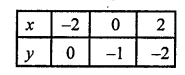
RS Aggarwal Class 10 Solutions Chapter 3 Linear equations in two variables Ex 3A 28
Plot the points (-2,0), (0, -1) and (2, -2) on the graph and join them to get a line.
Similarly,
3x + 2y – 2 = 0
⇒ 3x = 2 – 2y
x = \(\frac { 2 – 2y }{ 3 }\)
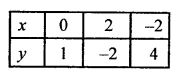
RS Aggarwal Class 10 Solutions Chapter 3 Linear equations in two variables Ex 3A 29
Plot the points (0, 1), (2, -2) and (-2, 4) on the graph and join them to get another line.
We see that these two lines intersect each other at the point (2, -2).
x = 2, y = -2
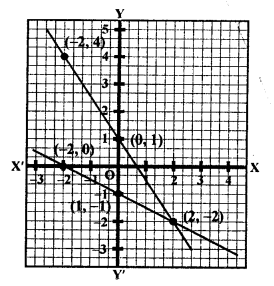
RS Aggarwal Class 10 Solutions Chapter 3 Linear equations in two variables Ex 3A 30

Solve each of the following given systems of equations graphically and find the vertices and area of the triangle formed by these lines and the x-axis:
Question 11.
Solution:
x – y + 3 = 0
⇒ x = y – 3
Giving some different value to y, we get corresponding values of x as given below:
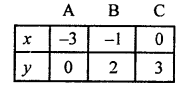
RS Aggarwal Class 10 Solutions Chapter 3 Linear equations in two variables Ex 3A 31
Plot the points (-3, 0), (-1, 2) and (0, 3) on the graph and join them to get a line.
Similarly,
2x + 3y – 4 = 0
⇒ 2x = 4 – 3y
x = \(\frac { 4 – 3y }{ 2 }\)
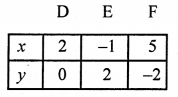
RS Aggarwal Class 10 Solutions Chapter 3 Linear equations in two variables Ex 3A 32
Plot the points (2, 0), (-1, 2) and (5, -2) on the graph and join them to get another line.
We see that these line intersect each other at (-1, 2) and x-axis at A (-3, 0) and D (2, 0).
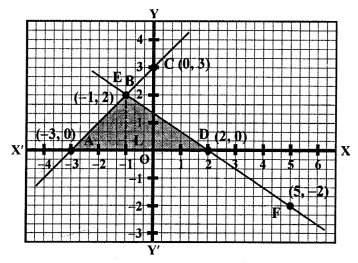
RS Aggarwal Class 10 Solutions Chapter 3 Linear equations in two variables Ex 3A 33
Area of ∆BAD = \(\frac { 1 }{ 2 }\) x base x altitude
= \(\frac { 1 }{ 2 }\) x AD x BL
= \(\frac { 1 }{ 2 }\) x 5 x 2 = 5 sq.units

Question 12.
Solution:
2x – 3y + 4 = 0
⇒ 2x = 3y – 4
x = \(\frac { 3y – 4 }{ 2 }\)
Giving some different values to y, we get corresponding value of x as given below:
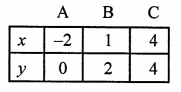
RS Aggarwal Class 10 Solutions Chapter 3 Linear equations in two variables Ex 3A 34
Plot the points (-2, 0), (1, 2) and (4, 4) on the graph and join them to get a line.
Similarly,
x + 2y – 5 = 0
x = 5 – 2y
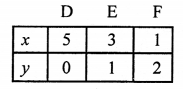
RS Aggarwal Class 10 Solutions Chapter 3 Linear equations in two variables Ex 3A 35
Now, plot the points (5, 0), (3, 1) and (1, 2) on the graph and join them to get another line.
We see that there two lines intersect each other at the point B (1, 2) and intersect x- axis at A (-2, 0) and D (5, 0) respectively.
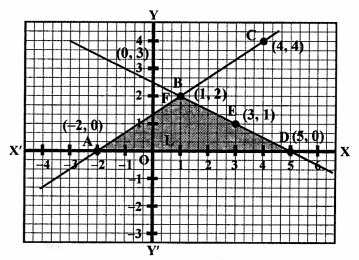
RS Aggarwal Class 10 Solutions Chapter 3 Linear equations in two variables Ex 3A 36
Now, area of ∆BAD = \(\frac { 1 }{ 2 }\) x base x altitude
= \(\frac { 1 }{ 2 }\) x AD x BL
= \(\frac { 1 }{ 2 }\) x 7 x 2
= 7 sq. units

Question 13.
Solution:
4x – 3y + 4 = 0
⇒ 4x = 3y – 4
x = \(\frac { 3y – 4 }{ 4 }\)
Giving some different values to y, we get corresponding value of x as given below:
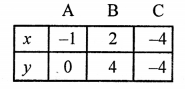
RS Aggarwal Class 10 Solutions Chapter 3 Linear equations in two variables Ex 3A 37
Plot the points (-1, 0), (2, 4) and (-4, -4) on the graph and join them, to get a line.
Similarly,
4x + 3y – 20 = 0
4x = 20 – 3y
x = \(\frac { 20 – 3y }{ 4 }\)
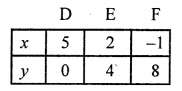
RS Aggarwal Class 10 Solutions Chapter 3 Linear equations in two variables Ex 3A 38
Plot the points (5, 0), (2, 4) and (-1, 8) on the graph and join them to get a line.
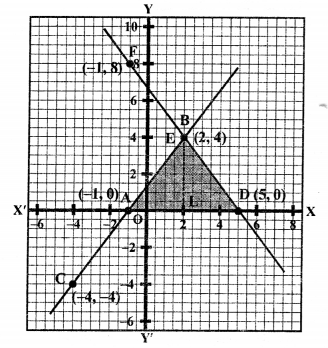
RS Aggarwal Class 10 Solutions Chapter 3 Linear equations in two variables Ex 3A 39
We see that these two lines intersect each other at the point B (2, 4) and intersect x-axis at A (-1, 0) and D (5, 0).
Area ∆BAD = \(\frac { 1 }{ 2 }\) x base x altitude
= \(\frac { 1 }{ 2 }\) x AD x BL
= \(\frac { 1 }{ 2 }\) x 6 x 4 = 12 sq. units

Question 14.
Solution:
x – y + 1 = 0 ⇒ x = y – 1
Giving some different values toy, we get the values of x as given below:
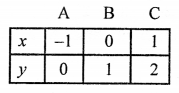
RS Aggarwal Class 10 Solutions Chapter 3 Linear equations in two variables Ex 3A 40
Plot the points (-1, 0), (0, 1) and (1, 2) on the graph and join them to get a line.
Similarly,
3x + 2y – 12 = 0
⇒ 3x = 12 – 2y
x = \(\frac { 12 – 2y }{ 3 }\)
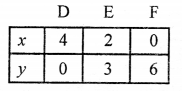
RS Aggarwal Class 10 Solutions Chapter 3 Linear equations in two variables Ex 3A 41
Plot the points (4, 0), (2, 3) and (0, 6) on the graph and join them to get another line.
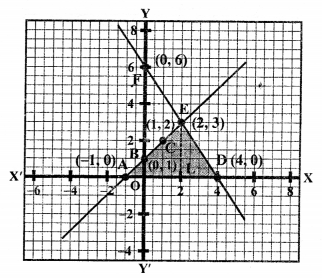
RS Aggarwal Class 10 Solutions Chapter 3 Linear equations in two variables Ex 3A 42
We see that these two lines intersect each ohter at the point E (2, 3) and intersect x- axis at A (-1, 0) and D (4, 0).
Area of ∆EAD = \(\frac { 1 }{ 2 }\) x base x altitude 1
= \(\frac { 1 }{ 2 }\) x AD x EL
= \(\frac { 1 }{ 2 }\) x 5 x 3
= \(\frac { 15 }{ 2 }\)
= 7.5 sq. units

Question 15.
Solution:
x – 2y + 2 = 0 ⇒ x = 2y – 2
Giving some different values to y, we get corresponding values of x as given below:
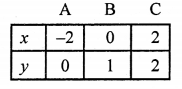
RS Aggarwal Class 10 Solutions Chapter 3 Linear equations in two variables Ex 3A 43
Plot the points (-2, 0), (0, 1), (2, 2) on the graph and join them to get a line.
Similarly,
2x + y – 6 = 0
⇒ y = 6 – 2x
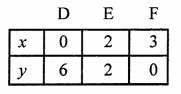
RS Aggarwal Class 10 Solutions Chapter 3 Linear equations in two variables Ex 3A 44
Plot the points on the graph and join them to get a line.
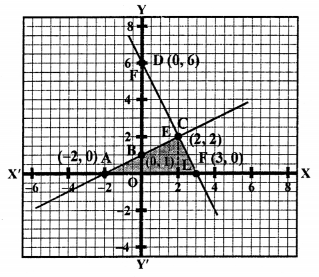
RS Aggarwal Class 10 Solutions Chapter 3 Linear equations in two variables Ex 3A 45
We see that these two lines intersect each other at the point C (2, 2) and intersect the x-axis at A (-2, 0) and F (3, 0).
Now, area of ∆CAF = \(\frac { 1 }{ 2 }\) x base x altitude
= \(\frac { 1 }{ 2 }\) x AF x CL
= \(\frac { 1 }{ 2 }\) x 5 x 2 = 5 sq. units

Solve each of the following given systems of equations graphically and find the vertices and area of the triangle formed by these lines and the y-axis:
Question 16.
Solution:
2x – 3y + 6 = 0
⇒ 2x = 3y – 6
x = \(\frac { 3y – 6 }{ 2 }\)
Giving some different values to y, we get corresponding values of x, as given below:
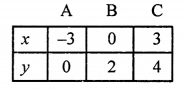
RS Aggarwal Class 10 Solutions Chapter 3 Linear equations in two variables Ex 3A 46
Now, plot the points (-3, 0), (0, 2), (3, 4) on the graph and join them to get a line.
Similarly,
2x + 3y – 18 = 0
2x = 18 – 3y
x = \(\frac { 18 – 3y }{ 2 }\)
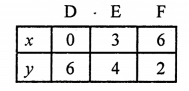
RS Aggarwal Class 10 Solutions Chapter 3 Linear equations in two variables Ex 3A 47
Plot the points (0, 6), (3, 4) and (6, 2) on the graph and join them to get a line.
We see that these two lines intersect each other at C (3, 4) and intersect y-axis at B (0, 2) and D (0, 6).
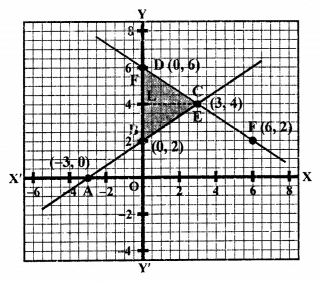
RS Aggarwal Class 10 Solutions Chapter 3 Linear equations in two variables Ex 3A 48
Now, area of ∆CBD = \(\frac { 1 }{ 2 }\) x base x altitude
= \(\frac { 1 }{ 2 }\) x BD x CL
= \(\frac { 1 }{ 2 }\) x 4 x 3 sq. units = 6 sq. units

Question 17.
Solution:
4x – y – 4 = 0
⇒ 4x = y + 4
x = \(\frac { y + 4 }{ 2 }\)
Giving some different values to y, we get corresponding values of x as given below:
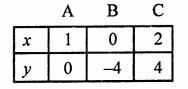
RS Aggarwal Class 10 Solutions Chapter 3 Linear equations in two variables Ex 3A 49
Plot the points (1, 0), (0, -4) and (2, 4) on the graph and join them to get a line.
Similarly,
3x + 2y – 14 = 0
2y = 14 – 3x
y = \(\frac { 14 – 3x }{ 2 }\)
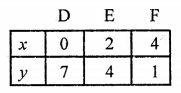
RS Aggarwal Class 10 Solutions Chapter 3 Linear equations in two variables Ex 3A 50
Now, plot the points (0, 7), (2, 4) and (4, 1) on the graph and join them to get another line.
We see that these two lines intersect each other at C (2, 4) and y-axis at B (0, -4) and D (0, 7) respectively.
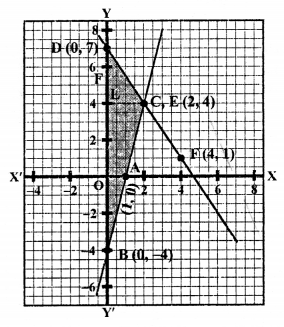
RS Aggarwal Class 10 Solutions Chapter 3 Linear equations in two variables Ex 3A 51
Area of ∆CBD = \(\frac { 1 }{ 2 }\) x base x altitude
= \(\frac { 1 }{ 2 }\) x BD x CL
= \(\frac { 1 }{ 2 }\) x 11 x 2 sq. units = 11 sq. units

Question 18.
Solution:
x – y – 5 = 0 ⇒ x = y + 5
Giving some different values to y, we get corresponding values of x as given below:
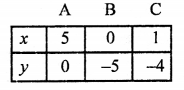
RS Aggarwal Class 10 Solutions Chapter 3 Linear equations in two variables Ex 3A 52
Plot the points (5, 0), (0, -5) and (1, -4) on the graph and join these to get a line.
Similarly,
3x + 5y – 15 = 0
3x = 15 – 5y
x = \(\frac { 15 – 5y }{ 3 }\)
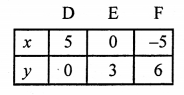
RS Aggarwal Class 10 Solutions Chapter 3 Linear equations in two variables Ex 3A 53
Plot the points (5, 0), (0, 3) and (-5, 6) on the graph and join them to get a line.
We see that these two lines intersect each other at A (5, 0) and y-axis at B (0, -5) and E (0, 3) respectively.
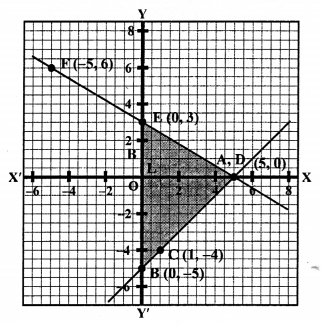
RS Aggarwal Class 10 Solutions Chapter 3 Linear equations in two variables Ex 3A 54
Now area of ∆ABE = \(\frac { 1 }{ 2 }\) x base x altitude
= \(\frac { 1 }{ 2 }\) x BE x AL
= \(\frac { 1 }{ 2 }\) x 8 x 5 sq. units = 20 sq. units

Question 19.
Solution:
2x – 5y + 4 = 0
⇒ 2x = 5y – 4
x = \(\frac { 5y – 4 }{ 2 }\)
Giving some different values to y, we get corresponding values of x as given below:
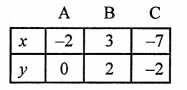
RS Aggarwal Class 10 Solutions Chapter 3 Linear equations in two variables Ex 3A 55
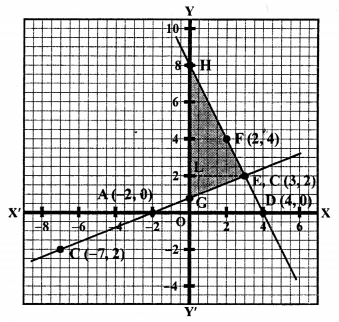
Plot the points (-2, 0), (3, 2) and (-7, -2) on the graph and join them to get a line.
Similarly,
2x + y – 8 = 0
2x = 8 – y
x = \(\frac { 8 – y }{ 2 }\)
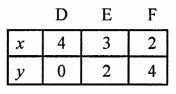
RS Aggarwal Class 10 Solutions Chapter 3 Linear equations in two variables Ex 3A 56
Plot the points (4, 0), (3, 2) and (2, 4) on the graph and join them to get a line.
We see that these two lines intersect each other at B (3, 2) and y-axis at G (0, 1) and H (0, 8) respectively.
RS Aggarwal Class 10 Solutions Chapter 3 Linear equations in two variables Ex 3A 57
Now area of ∆EGH = \(\frac { 1 }{ 2 }\) x base x altitude
= \(\frac { 1 }{ 2 }\) x GH x EL
= \(\frac { 1 }{ 2 }\) x 7 x 3 sq. units
= \(\frac { 21 }{ 2 }\) = 10.5 sq. units

Question 20.
Solution:
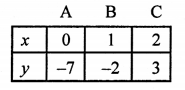
5x – y – 7 = 0 ⇒ y = 5x – 7
Giving some different values to x, we get corresponding values of y as given below:
RS Aggarwal Class 10 Solutions Chapter 3 Linear equations in two variables Ex 3A 58
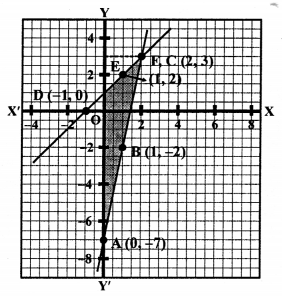
Plot the points (0, -7), (1, -2), (2, 3) on the graph and join them to get a line.
Similarly,
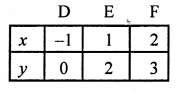
x – y + 1 = 0 ⇒ x = y – 1
RS Aggarwal Class 10 Solutions Chapter 3 Linear equations in two variables Ex 3A 59
Plot the points (-1, 0), (1, 2) and (2, 3) on the graph and join them to get a line.
RS Aggarwal Class 10 Solutions Chapter 3 Linear equations in two variables Ex 3A 60
We see that these two lines intersect each other at C (2, 3) and intersect y-axis at A (0, -7) and F (0, 1) respectively.
Now, area of ∆CAF = \(\frac { 1 }{ 2 }\) x base x altitude
= \(\frac { 1 }{ 2 }\) x AF x CL
= \(\frac { 1 }{ 2 }\) x 8 x 2 = 8 sq.units

Question 21.
Solution:
2x – 3y – 12 ⇒ 2x = 12 + 3y
x = \(\frac { 12 + 3y }{ 2 }\)
Giving some different values to y, we get corresponding values of x as given below:
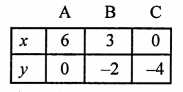
RS Aggarwal Class 10 Solutions Chapter 3 Linear equations in two variables Ex 3A 61
Plot the points (6, 0), (3, -2) and (0, -4) on the graph and join them to get a line.
Similarly,
x + 3y = 6 ⇒ x = 6 – 3y
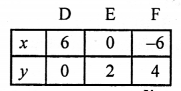
RS Aggarwal Class 10 Solutions Chapter 3 Linear equations in two variables Ex 3A 62
Plot the points (6, 0), (0, 2) and (-6, 4) on the graph and join them to get a line.
We see that these two lines intersect each other at the points A (6, 0) and intersect the y-axis at C (0, -4) and E (0, 2) respectively.
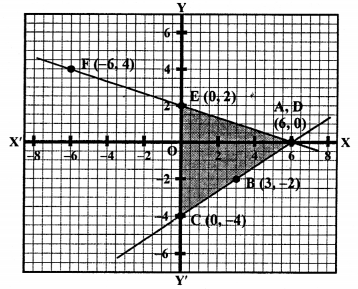
RS Aggarwal Class 10 Solutions Chapter 3 Linear equations in two variables Ex 3A 63
Now area of ∆ACE = \(\frac { 1 }{ 2 }\) x base x altitude
= \(\frac { 1 }{ 2 }\) x CE x AO
= \(\frac { 1 }{ 2 }\) x 6 x 6 sq. units = 18 sq.units

Show graphically that each of the following given systems of equations has infinitely many solutions:
Question 22.
Solution:
2x + 3y = 6
2x = 6 – 3y
x = \(\frac { 6 – 3y }{ 2 }\)
Giving some different values to y, we get the corresponding val ues of x as given below:
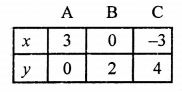
RS Aggarwal Class 10 Solutions Chapter 3 Linear equations in two variables Ex 3A 64
Plot the points (3, 0), (0, 2) and (-3, 4) on the graph and join them to get a line.
Similarly,
4x + 6y = 12
4x = 12 – 6y
x = \(\frac { 12 – 6y }{ 2 }\)
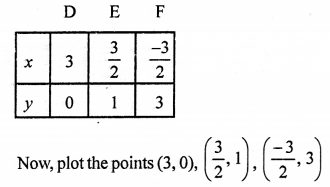
RS Aggarwal Class 10 Solutions Chapter 3 Linear equations in two variables Ex 3A 65
on the graph and join them to get a line.
We see that all the points lie on the same straight line.
This system has infinite many solutions.
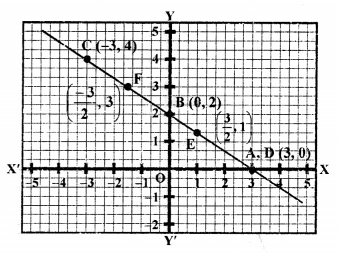
RS Aggarwal Class 10 Solutions Chapter 3 Linear equations in two variables Ex 3A 66

Question 23.
Solution:
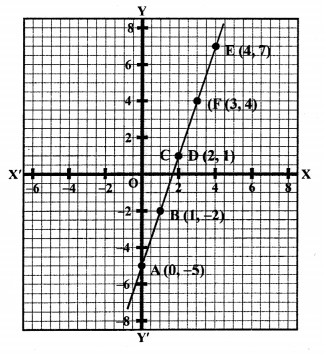
3x – y = 5
⇒ y = 3x – 5
Giving some different values to x, we get corresponding values of y as shown below:
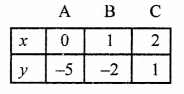
RS Aggarwal Class 10 Solutions Chapter 3 Linear equations in two variables Ex 3A 67
Now, plot the points (0, -5), (1, -2), (2, 1) on the graph and join them to get a line:
Similarly,
6x – 2y = 10
⇒ 6x = 10 + 2y
x = \(\frac { 10 + 2y }{ 6 }\)
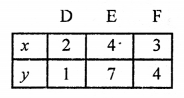
RS Aggarwal Class 10 Solutions Chapter 3 Linear equations in two variables Ex 3A 68
Plot the points (2, 1), (4, 7), (3, 4) on the graph and join them to get another line.
We see that these lines coincide each other.
This system has infinite many solutions.
RS Aggarwal Class 10 Solutions Chapter 3 Linear equations in two variables Ex 3A 69

Question 24.
Solution:
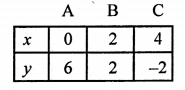
2x + y = 6
y = 6 – 2x
Giving some different values to x, we get corresponding values of y as given below:
RS Aggarwal Class 10 Solutions Chapter 3 Linear equations in two variables Ex 3A 70
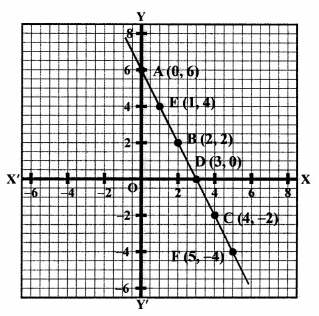
Plot the points (0, 6), (2, 2), (4, -2) on the graph and join them to get a line.
Similarly,
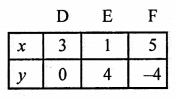
6x + 3y = 18
⇒ 6x = 18 – 3y
⇒ x = \(\frac { 18 – 3y }{ 2 }\)
RS Aggarwal Class 10 Solutions Chapter 3 Linear equations in two variables Ex 3A 71
Now, plot the points (3, 0), (1, 4) and (5, -4) on the graph and join them to get another line.
We see that these two lines coincide each other.
This system has infinitely many solutions
RS Aggarwal Class 10 Solutions Chapter 3 Linear equations in two variables Ex 3A 72

Question 25.
Solution:
x – 2y = 5 ⇒ x = 5 + 2y
Giving some different values to y, we get corresponding values of x as shown below:
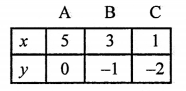
RS Aggarwal Class 10 Solutions Chapter 3 Linear equations in two variables Ex 3A 73
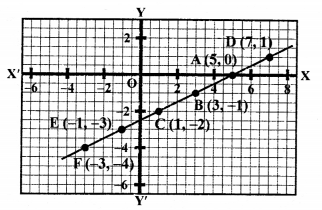
Plot the points (5, 0), (3, -1), (1, -2) on the graph and join them to get a line.
similarly,
3x – 6y = 15
⇒ 3x = 15 + 6y
x = \(\frac { 15 + 6y }{ 3 }\)
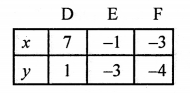
RS Aggarwal Class 10 Solutions Chapter 3 Linear equations in two variables Ex 3A 74
Plot the points (7, 1), (-1, -3) and (-3, -4) on the graph and join them to get another line.
We see that all the points lie on the same line.
Lines coincide each other.
Hence, the system has infinite many solutions.
RS Aggarwal Class 10 Solutions Chapter 3 Linear equations in two variables Ex 3A 75

Show graphically that each of the following given systems of equations is inconsistent, i.e., has no solution:
Question 26.
Solution:
x – 2y = 6 ⇒ x = 6 + 2y
Giving some different values to y, we get corresponding values of x as given below:
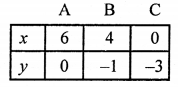
RS Aggarwal Class 10 Solutions Chapter 3 Linear equations in two variables Ex 3A 76
Plot the points (6, 0), (4, -1) and (0, -3) on the graph and join them to get a line.
Similarly,
3x – 6y = 0
⇒ 3x = 6y
⇒ x = 2y
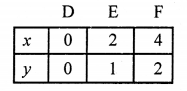
RS Aggarwal Class 10 Solutions Chapter 3 Linear equations in two variables Ex 3A 77
Plot the points (0, 0), (2, 1), (4, 2) on the graph and join them to get a line.
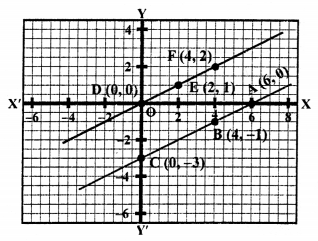
RS Aggarwal Class 10 Solutions Chapter 3 Linear equations in two variables Ex 3A 78
We see that these two lines are parallel i.e., do not intersect each other.
This system has no solution.

Question 27.
Solution:
2x + 3y = 4
⇒ 2x = 4 – 3y
⇒ x = \(\frac { 4 – 3y }{ 2 }\)
Giving some different values to y, we get corresponding values of x as given below:
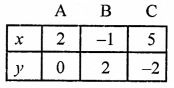
RS Aggarwal Class 10 Solutions Chapter 3 Linear equations in two variables Ex 3A 79
Plot the points (2, 0), (-1, 2) and (5, -2) on the graph and join them to get a line.
Similarly,
4x + 6y = 12 ⇒ 4x = 12 – 6y
x = \(\frac { 12 – 6y }{ 4 }\)
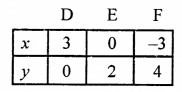
RS Aggarwal Class 10 Solutions Chapter 3 Linear equations in two variables Ex 3A 80
Plot the points (3, 0), (0, 2) and (-3, 4) on the graph and join them to get another line.
We see that two lines are parallel i.e., these do not intersect each other at any point.
Therefore the system has no solution.
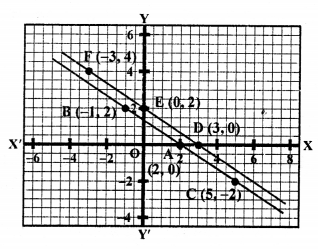
RS Aggarwal Class 10 Solutions Chapter 3 Linear equations in two variables Ex 3A 81

Question 28.
Solution:
2x + y = 6, y = 6 – 2x
Giving some different values to x, we get corresponding values ofy as given below:
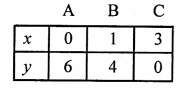
RS Aggarwal Class 10 Solutions Chapter 3 Linear equations in two variables Ex 3A 82
Plot the points (0, 6), (1, 4) and (3, 0) on the graph and join them to get a line.
Similarly,
6x + 3y = 20 ⇒ 6x = 20 – 3y
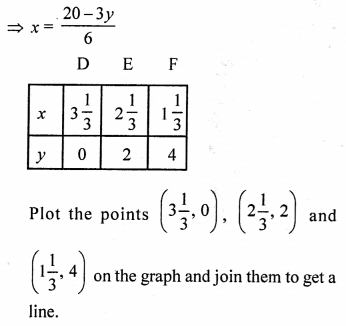
RS Aggarwal Class 10 Solutions Chapter 3 Linear equations in two variables Ex 3A 83
We see that these two lines are parallel and do not intersect each other.
Therefore this system has no solution.
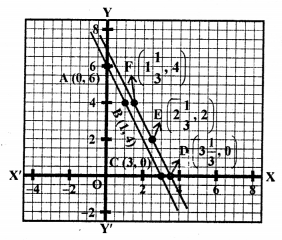
RS Aggarwal Class 10 Solutions Chapter 3 Linear equations in two variables Ex 3A 84

Question 29.
Solution:
2x + y = 2 ⇒ y = 2 – 2x
Giving some different values to x, we get corresponding values of y as given below:
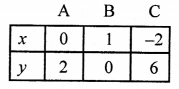
RS Aggarwal Class 10 Solutions Chapter 3 Linear equations in two variables Ex 3A 85
Plot the points (0, 2), (1, 0) and (-2, 6) on the graph and join them to get a line.
Similarly,
2x + y = 6 ⇒ y = 6 – 2x
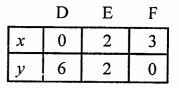
RS Aggarwal Class 10 Solutions Chapter 3 Linear equations in two variables Ex 3A 86
Plot the points (0, 6), (2, 2) and (3, 0) on the graph and join them to get another line.
ABFD is the trapezium whose vertices are A (0, 2), B (1, 0), F (3, 0), D (0, 6).
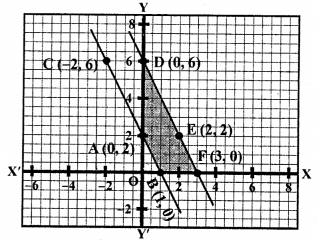
RS Aggarwal Class 10 Solutions Chapter 3 Linear equations in two variables Ex 3A 87
Area of trapezium ABFD = Area ∆DOF – Area ∆AOB
= \(\frac { 1 }{ 2 }\) (DO x OF) – \(\frac { 1 }{ 2 }\) (AO x OB)
= \(\frac { 1 }{ 2 }\) (6 x 3) – \(\frac { 1 }{ 2 }\) (2 x 1) sq.units
= 9 – 1 = 8 sq.units

Hope given RS Aggarwal Solutions Class 10 Chapter 3 Linear equations in two variables Ex 3A are helpful to complete your math homework.

If you have any doubts, please comment below. Learn Insta try to provide online math tutoring for you.

Karnataka SSLC Science Model Question Paper 2 Kannada Medium

Karnataka SSLC Science Model Question Paper 2 Kannada Medium is part of Karnataka SSLC Science Model Question Papers. Here we have given Karnataka SSLC Social Science Model Question Paper 2 Kannada Medium.

BoardKSEEB, Karnataka Board
TextbookKTBS, Karnataka
ClassSSLC Class 10
SubjectScience
Paper SetModel Paper 2
CategoryKarnataka Board Model Papers

Karnataka SSLC Science Model Question Paper 2 Kannada Medium

ಸಮಯ: 3 ಗಂಟೆಗಳು
ಗರಿಷ್ಠ ಅಂಕಗಳು: 80

I ಕೆಳಗಿನ ಪ್ರತಿಯೊಂದು ಪ್ರಶ್ನೆಗೂ ನಾಲ್ಕು ಆಯ್ಕೆಗಳನ್ನು ನೀಡಲಾಗಿದೆ. ಅತ್ಯಂತ ಸೂಕ್ತವಾದ ಆಯ್ಕೆಯನ್ನು ಆರಿಸಿ ಕ್ರಮಾಕ್ಷರದೊಂದಿಗೆ ಬರೆಯಿರಿ. [10 × 1 = 10]

Question 1.
ಕಬ್ಬಿಣದ ಮೊಳೆಯನ್ನು CuSO4 ದ್ರಾವಣಕ್ಕೆ ಸೇರಿಸಿದಾಗ ಉಂಟಾಗುವ ಬಣ್ಣದಲ್ಲಿನ ಬದಲಾವಣೆ
A) ನೀಲಿ
B) ಹಸಿರು
C) ಕೆಂಪು
D) ತಿಳಿಹಳದಿ

Question 2.
ಕೆಳಗಿನವುಗಳಲ್ಲಿ ವಿದ್ಯುತ್‌ವಾಹಕವಲ್ಲದ ಜಲೀಯ ದ್ರಾವಣ
A) ಆಸಿಟಿಕ್ ಆಮ್ಲ
B) ಈಥೈಲ್ ಅಸಿಟೇಟ್ ದ್ರಾವಣ
C) NaCl ದ್ರಾವಣ
D) ಎಥನಾಲ್

Question 3.
ಉಸಿರಾಟದಲ್ಲಿ ಗಾಳಿಯ ಚಲನೆಯ ಸರಿಯಾದ ಅನುಕ್ರಮಣಿಕೆ
A) ನಾಸಿಕರಂಧ್ರ → ಗಾಳಿ ಚೀಲಗಳು → ಶ್ವಾಸನಾಳ → ಬ್ರಾಂಕಸ್
B) ನಾಸಿಕರಂದ್ರ → ಶ್ವಾಸಕೋಶ → ಶ್ವಾಸನಳಿಕೆ → ಗಂಟಲು → ಆಲ್ವಿಯೋಲೆ
C) ನಾಸಿಕರಂದ್ರ → ಗಂಟಲು → ಶ್ವಾಸನಾಳ → ಶ್ವಾಸನಾಳದ ಕವಲು → ಆಲ್ವಿಯೋಲೈ
D) ನಾಸಿಕರಂದ್ರ → ಶ್ವಾಸನಾಳ → ಗಂಟಲು → ಆಲ್ವಿಯೋಲೈ → ಶ್ವಾಸನಾಳದ ಕವಲು

Question 4.
ಗೃಹಬಳಕೆಯ ವಿದ್ಯುತ್ ಉಪಕರಣಗಳ ರಕ್ಷಣೆಯಲ್ಲಿ ನಾವು ಇದನ್ನು ಬಳಸುತ್ತೇವೆ.
A) ಬಲ್ಸ್
B) ಸ್ವಿಚ್
C) ವಿದ್ಯುತ್ ಮೀಟರ್
D) ನ್ಯೂಸ್

Question 5.
ಅತಿ ಹೆಚ್ಚು ದ್ರವಣ ಬಿಂದು ಹೊಂದಿರುವುದು
A) ಮೆಥಾಲ್
B) ಸೋಡಿಯಂ ಕ್ಲೋರೈಡ್
C) ಬೋಮಿನ್
D) ಸೀಸಿಯಂ

Question 6.
ಆವರ್ತಕೋಷ್ಟಕದಲ್ಲಿ ‘X’ ಧಾತುವು 3ನೇ ಆವರ್ತದಲ್ಲಿದ್ದು ಅತ್ಯಂತ ಕಡಿಮೆ ಪರಮಾಣು ಗಾತ್ರವನ್ನು ಹೊಂದಿದೆ. ಹಾಗಾದರೆ ಅದು ಹೊಂದಿರುವ ಗುಣ,
A) ಲೋಹೀಯ ಗುಣ
B) ವಿದ್ಯುದ್ದನೀಯ
C) ಅಲೋಹೀಯ ಗುಣ
D) ಇಲೆಕ್ಟ್ರಾನ್ ದಾನಿ

Question 7.
ಬಿಡುಗಡೆಯಾದ ಅಂಡವನ್ನು ಸ್ವೀಕರಿಸುವ ಭಾಗ
A) ಫೆಲೋಪಿಯನ್ ನಾಳ
B) ಗರ್ಭಕೋಶ
C) ಯೋನಿ
D) ಅಂಡಾಶಯ

Question 8.
ವಸ್ತುವನ್ನು ಪೀನಮಸೂರದ F1 ನಲ್ಲಿಟ್ಟಾಗ ಪ್ರತಿಬಿಂಬದ ಗಾತ್ರವು.
A) ಚುಕ್ಕೆ ಗಾತ್ರದಷ್ಟು
B) ಚಿಕ್ಕದು
C) ಸಮಾನ ಗಾತ್ರ
D) ದೊಡ್ಡದು

Question 9.
ಕಣ್ಣಿನ ಮಸೂರ ತನ್ನ ಸ್ಥಿತಿಸ್ಥಾಪಕ ಗುಣ ಕಳೆದುಕೊಳ್ಳುವುದು ಮತ್ತು ಸಿಲಿಯಂ ಸ್ನಾಯುಗಳು ದುರ್ಬಲಗೊಂಡಾಗ ಉಂಟಾಗಬಹುದಾದ ಕಣ್ಣಿನ ದೋಷ.
A) ದೂರ ದೃಷ್ಟಿ
B) ಸಮೀಪದೃಷ್ಟಿ
C) ಪ್ರೆಸ್ ಬಯೋಪಿಯ
D) ಡಯಾಬಿಟಿಕ್ ರೆಟಿನೋಪತಿ

Question 10.
ಕೆಂಪು ರಕ್ತಕಣಗಳ ಆಕ್ಸಿಜನ್ ಸಾಗಾಣಿಕೆಯನ್ನು ಕಡಿಮೆ ಮಾಡುವ ಮಾಲಿನ್ಯಕಾರಕ
A) CO
B) CO2
C) SO2
D) NO2

II ಹೊಂದಿಸಿ ಬರೆಯಿರಿ. [4 × 1 = 4]

Question 11.
Karnataka SSLC Science Model Question Paper 2 Kannada Medium 11

III ಈ ಕೆಳಗಿನ ಪ್ರಶ್ನೆಗಳಿಗೆ ಉತ್ತರಿಸಿ. [7 × 1 = 7]

Question 12.
ಹಲ್ಲು ಉಜ್ಜಲು ಪ್ರತ್ಯಾಮ್ಲಯ ಪೇಸ್ಟನ್ನೇ ಬಳಸಬೇಕು. ಏಕೆ?

Question 13.
ಸ್ಪರ್ಶಾನುವರ್ತನೆಗೆ ಒಂದು ಉದಾಹರಣೆ ಕೊಡಿ.

Question 14.
ವಿದ್ಯುತ್ ಮೋಟಾರಿನ ತತ್ವವನ್ನು ತಿಳಿಸಿ.

Question 15.
ವಾಷಿಂಗ್ ಸೋಡವನ್ನು ಬಳಸಿ ಎಥನಾಲ್ ಮತ್ತು ಎಥನೋಯಿಕ್ ಆಮ್ಲಗಳನ್ನು ಹೇಗೆ ಪತ್ತೆ ಹಚ್ಚುವಿರಿ?

Question 16.
ಆನುವಂಶೀಯ ದಿಕ್ಕುತಿ ಎಂದರೇನು?

Question 17.
2m ಸಂಗಮದೂರವುಳ್ಳ ನಿಮ್ಮ ಮಸೂರದ ಸಾಮರ್ಥ್ಯವೆಷ್ಟು?

Question 18.
ಸೌರಕುಕ್ಕರಿಗೆ ಬಿಳಿಯ ಬಣ್ಣ ಬಳಿಯುವುದರಿಂದ ಉಂಟಾಗುವ ಪರಿಣಾಮವೇನು?

IV ಕೆಳಗಿನ ಪ್ರಶ್ನೆಗಳಿಗೆ ಉತ್ತರಿಸಿ. [16 × 2 = 32]

Question 19.
ಎಥನಾಲನ್ನು 443K ತಾಪಕ್ಕೆ ಕಾಸುವಾಗ H2SO4 ಏಕೆ ಬಳಸುತ್ತಾರೆ? ಸಮೀಕರಣ ಬರೆಯಿರಿ.

Question 20.
ವಾಷಿಂಗ್ ಸೋಡಾದ 2 ಅನ್ವಯಗಳನ್ನು ತಿಳಿಸಿ,
ಅಥವಾ
ಭೀಚಿಂಗ್ ಪುಡಿಯನ್ನು ಹೇಗೆ ತಯಾರಿಸುತ್ತಾರೆ? ಸಮೀಕರಣ ಬರೆಯಿರಿ.

Question 21.
ಲೋಹಗಳ ಕ್ರಿಯಾಶೀಲತೆಯ ಸರಣಿಯ ಅನ್ವಯಗಳೇನು?
ಅಥವಾ
Na, Al, Mg, Au, K, Pb, Zn, Ca, Fe ಗಳನ್ನು ಅವುಗಳ ಕ್ರಿಯಾಶೀಲತೆಯ ಏರಿಕೆಯ ಆಧಾರದಲ್ಲಿ ಜೋಡಿಸಿ.

Question 22.
ದಂಡಕಾಂತದ ಸುತ್ತಲಿನ ಕಾಂತೀಯ ಬಲರೇಖೆಗಳನ್ನು ತೋರಿಸುವ ಚಿತ್ರ ಬರೆಯಿರಿ. ಬಲರೇಖೆಗಳ ದಿಕ್ಕನ್ನು ಸೂಚಿಸಿ.

Question 23.
ಮಾನವರಲ್ಲಿ ಗ್ಲುಕೋಸ್ ವಿಭಜನೆಯ ವಿವಿಧ ಹಂತಗಳನ್ನು ತಿಳಿಸಿ.

Question 24:
ವಾಹಕದ ರೋಧವನ್ನು ಅವಲಂಬಿಸಿದ ಅಂಶಗಳಾವುವು?
ಅಥವಾ
ವಿದ್ಯುತ್ ಟೋಸ್ಟರ್ ಮತ್ತು ಇಸ್ತ್ರಿಪೆಟ್ಟಿಗೆಯ ಸುರುಳಿಗಳನ್ನು ಶುದ್ಧ ಲೋಹದ ಬದಲಿಗೆ ಮಿಶ್ರಲೋಹಗಳಿಂದ ತಯಾರಿಸಿರುತ್ತಾರೆ. ಏಕೆ?

Question 25.
ಜೈವಿಕ ಶಿಥಿಲೀಯವಲ್ಲದ ತ್ಯಾಜ್ಯಗಳು ಪರಿಸರದ ಮೇಲೆ ಬೀರುವ ಎರಡು ಪರಿಣಾಮಗಳನ್ನು ತಿಳಿಸಿ. ಇವುಗಳ ಸುರಕ್ಷಿತ ವಿಲೇವಾರಿಗೆ ಎರಡು ವಿಧಾನಗಳನ್ನು ತಿಳಿಸಿ.

Question 26.
ಪ್ರೊಪೇನೋಯಿಕ್ ಆಮ್ಲ ಮತ್ತು ಸೈಕೋ ಹೆಕ್ಟೇನ್‌ಗಳ ರಚನೆಯನ್ನು ಬರೆಯಿರಿ.

Question 27.
K, L, M, N ಮತ್ತು ಧಾತುಗಳ ಪರಮಾಣು ಸಂಖ್ಯೆ 7, 10, 12, 4 ಮತ್ತು 19 ಆದರೆ,

  1. ಅತ್ಯಂತ ಹೆಚ್ಚು ಪರಮಾಣು ಗಾತ್ರ ಹೊಂದಿರುವ ಧಾತು ಯಾವುದು?
  2. ಅತ್ಯಂತ ಕಡಿಮೆ ಕ್ರಿಯಾಶೀಲ ಧಾತು ಯಾವುದು? ಕಾರಣ ತಿಳಿಸಿ,

Question 28.
Karnataka SSLC Science Model Question Paper 2 Kannada Medium 28
ಚಿತ್ರದಲ್ಲಿ ತೋರಿಸಲಾದ A ಮತ್ತು B ಗಳನ್ನು ಗುರುತಿಸಿ, ಅವುಗಳ ಕಾರ್ಯವನ್ನು ತಿಳಿಸಿ.

Question 29.
ಮಗುವಿನ ಲಿಂಗ ನಿರ್ಧಾರದಲ್ಲಿ ತಂದೆಯ ಪಾತ್ರವೇನು? ವಿವರಿಸಿ

Question 30.
ನಿಮಗೆ 3 ವಿಧದ ದರ್ಪಣಗಳನ್ನು ನೀಡಿದೆ, ದರ್ಪಣಗಳನ್ನು ಸ್ಪರ್ಶಿಸದೇ 3 ವಿಧದ ದರ್ಪಣಗಳನ್ನು ಹೇಗೆ ಗುರುತಿಸುವಿರಿ?
ಅಥವಾ
ಅನುಕ್ರಮವಾಗಿ 1.44, 1.47, 1.33 ವಕ್ರೀಭವನ ಸೂಚ್ಯಂಕ ಹೊಂದಿರುವ ಸೀಮೆ ಎಣ್ಣೆ, ಟರ್ಪೆಂಟೈನ್ ಎಣ್ಣೆ ಮತ್ತು ನೀರುಇವುಗಳನ್ನು ನಿಮಗೆ ನೀಡಲಾಗಿದೆ. ಇವುಗಳಲ್ಲಿ ಯಾವುದರಲ್ಲಿ ಬೆಳಕು ಅತ್ಯಂತ ವೇಗವಾಗಿ ಚಲಿಸುತ್ತದೆ?

Question 31.
ಸೌರ ಸ್ಥಿರಾಂಕ ಎಂದರೇನು? ಇದರ ಮೌಲ್ಯವನ್ನು ತಿಳಿಸಿ.
ಅಥವಾ
ಸೌರಶಕ್ತಿಯು ಮಾಲಿನ್ಯದಿಂದ ಮುಕ್ತವೇ? ಏಕೆ?

Question 32.
ಮರುಬಳಕೆ ಮತ್ತು ಮರು ಚಕ್ರೀಕರಣ ವಿಧಾನಗಳಲ್ಲಿ ಯಾವುದು ಉತ್ತಮ? ಏಕೆ?
ಅಥವಾ
ಫೆಮಿಂಗನ ಬಲಗೈ ನಿಯಮವನ್ನು ತಿಳಿಸಿ. ಇದನ್ನು ಆಧರಿಸಿದ ಉಪಕರಣವನ್ನು ತಿಳಿಸಿ.

Question 33.
ಬಲಗೈ ಹೆಬ್ಬೆರಳು ನಿಯಮವನ್ನು ನಿರೂಪಿಸಿ ಅದರ ಅನ್ವಯವನ್ನು ತಿಳಿಸಿ.

Question 34.
ನಿಮ್ಮ ದರ್ಪಣದ F1 ಮತ್ತು 2F1 ಗಳ ನಡುವೆ ವಸ್ತುವನ್ನು ಇರಿಸಿದಾಗ ಉಂಟಾಗುವ ಪ್ರತಿಬಿಂಬವನ್ನು ರೇಖಾ ನಕ್ಷೆಯ ಮೂಲಕ ತೋರಿಸಿ,

V ಕೆಳಗಿನ ಪ್ರಶ್ನೆಗಳಿಗೆ ಉತ್ತರಿಸಿ. [5 x 3 = 15]

Question 35.
X ಎಂಬ ಲೋಹವು XSO4 ಎಂಬ ಲವಣವನ್ನು ಉಂಟುಮಾಡುತ್ತದೆ. ಈ ಲವಣದ ಜಲೀಯ ದ್ರಾವಣವು ಸೋಡಿಯಂ ಹೈಡ್ರಾಕ್ಸಿಡಿನೊಂದಿಗೆ ವರ್ತಿಸಿ ನೀಲಿ ಒತ್ತರ – Y ಯನ್ನು ಉಂಟುಮಾಡುತ್ತದೆ. X ಲೋಹವು ಆಕ್ಸಿಜನ್‌ನೊಂದಿಗೆ ಹೆಚ್ಚಿನ ತಾಪಡಲ್ಲಿ ವರ್ತಿಸಿ ಕಪ್ಪು ಬಣ್ಣದ 2 ಸಂಯುಕ್ತವನ್ನು ಉಂಟು ಮಾಡುತ್ತದೆ. ಸಮೀಕರಣಗಳೊಂದಿಗೆ X, Y, Z ಗಳನ್ನು ಗುರುತಿಸಿ.

Question 36.
ಕೆಳಗಿನವುಗಳು ಏನನ್ನು ಸಾಗಾಣಿಕೆ ಮಾಡುತ್ತವೆ?
a) ಕೈಲಂ
b) ಪ್ಲೋಯಂ
c) ಪುಪ್ಪುಸಕ ಅಭಿಧಮನಿ
d) ಪುಪ್ಪುಸಕ ಅಪಧಮನಿ
e) ಅಯೋರ್ಟಾ
f) ನೀಚ ಅಭಿಧಮನಿ.
ಅಥವಾ
ಮೂತ್ರ ಉತ್ಪಾದನೆಯ ಮುಖ್ಯ ಹಂತಗಳನ್ನು ತಿಳಿಸಿ.

Question 37.
R1, R2, R3, ಗಳೆಂಬ 3 ರೋಧಕಗಳನ್ನು ಸಮಾಂತರವಾಗಿ ಅಮೀಟರ್ ಮತ್ತು ವೋಲ್ಟಾಮೀಟರ್‌ಗಳೊಂದಿಗೆ ಸಂಪರ್ಕ ಹೊಂದಿರುವ ವಿದ್ಯುನ್ಮಂಡಲಕ್ಕೆ ಸಂಪರ್ಕಿಸಲಾಗಿದೆ. ಚಿತ್ರ ಬರೆದು ವಿದ್ಯುತ್ ಪ್ರವಾಹದ ದಿಕ್ಕನ್ನು ಗುರುತಿಸಿ,

Question 38.
a) ಮಂಡಲರು ತಮ್ಮ ಪ್ರಯೋಗಗಳಿಗೆ ಬಟಾಣಿ ಸಸ್ಯಗಳನ್ನೇ ಆರಿಸಲು ಕಾರಣವೇನು?
b) ಮೆಂಡಲರು ಆರಿಸಿಕೊಂಡ ಯಾವುದಾದರೂ ಎರಡು ವಿಭಿನ್ನ ಲಕ್ಷಣಗಳ ಜೋಡಿಯನ್ನು ಹೆಸರಿಸಿ,
c) ದ್ವಿತಳೀಕರಣದಲ್ಲಿ F2 ಪೀಳಿಗೆಯ ವ್ಯಕ್ತರೂಪ ಅನುಪಾತವನ್ನು ತಿಳಿಸಿ.

Question 39.
ಪೀನ ಮಸೂರದ ಪ್ರಧಾನ ಸಂಗಮ F1 ನಲ್ಲಿ ವಸ್ತುವನ್ನು ಇಟ್ಟಾಗ ಉಂಟಾಗುವ ಪ್ರತಿಬಿಂಬವನ್ನು ರೇಖಾ ಚಿತ್ರದ ಸಹಾಯದಿಂದ ತೋರಿಸಿ, ಪ್ರತಿಬಿಂಬದ ಸ್ವಭಾವವನ್ನು ತಿಳಿಸಿ.

VI ಕೆಳಗಿನ ಪ್ರಶ್ನೆಗಳಿಗೆ ಉತ್ತರಿಸಿ. [3 x 4 = 12]

Question 40.
ರಾಸಾಯನಿಕ ಗುಣಗಳ ಆಧಾರದಲ್ಲಿ ಲೋಹಗಳು ಮತ್ತು ಅಲೋಹಗಳ ನಡುವಣ 24 ವ್ಯತ್ಯಾಸಗಳನ್ನು ಪಟ್ಟಿಮಾಡಿ.

Question 41.
ಪರಾವರ್ತಿತ ಚಾಪದ ಚಿತ್ರ ಬರೆದು ಕೆಳಗಿನ ಭಾಗಗಳನ್ನು ಗುರುತಿಸಿ.
a) ಜ್ಞಾನೇಂದ್ರಿಯಗಳಿಂದ ಮಿದುಳು ಬಳ್ಳಿಗೆ ಮಾಹಿತಿ ರವಾನಿಸುವ ಭಾಗ
b) ಸಂಪರ್ಕ ಕಲ್ಪಿಸುವ ನ್ಯೂರಾನ್
c) ಕಾರ್ಯ ನಿರ್ವಾಹಕ
d) ಕ್ರಿಯಾವಾಹಿ ನರ

Question 42.
ದೂರದೃಷ್ಟಿಯಿಂದ ಬಳಲುತ್ತಿರುವ ವ್ಯಕ್ತಿಯ ಸಮೀಪ ದೃಷ್ಟಿ ಬಿಂದು 1 ಮೀಟರ್. ಈ ಸಮಸ್ಯೆಯನ್ನು ಪರಿಹರಿಸಲು ಯಾವ ಸಾಮರ್ಥ್ಯದ ಕನ್ನಡಕವನ್ನು ಬಳಸಬೇಕು? (ಸಾಮಾನ್ಯ ದೃಷ್ಟಿಯ ಸಮೀಪ ದೃಷ್ಟಿ ಬಿಂದು – 25cm) ಚಿತ್ರದ ಮೂಲಕ ಸಮಸ್ಯೆ ಮತ್ತು ಪರಿಹಾರವನ್ನು ವ್ಯಕ್ತಪಡಿಸಿ.


Answers

I
Answer 1:
B) ಹಸಿರು

Answer 2:
D) ಎಥನಾಲ್

Answer 3:
C) ನಾಸಿಕರಂದ್ರ → ಗಂಟಲು → ಶ್ವಾಸನಾಳ → ಶ್ವಾಸನಾಳದ ಕವಲು → ಆಲ್ವಿಯೋಲೈ

Answer 4:
D) ನ್ಯೂಸ್

Answer 5:
B) ಸೋಡಿಯಂ ಕ್ಲೋರೈಡ್

Answer 6:
C)ಅಲೋಹೀಯ ಗುಣ

Answer 7:
A) ಫೆಲೋಪಿಯನ್ ನಾಳ

Answer 8:
D) ದೊಡ್ಡದು

Answer 9:
C) ಪ್ರೆಸ್ ಬಯೋಪಿಯ

Answer 10:
A) CO

II
Answer 11:
Karnataka SSLC Science Model Question Paper 2 Kannada Medium ans 11

III
Answer 12:
ಹಲ್ಲುಗಳಲ್ಲಿ ಸೇರಿಕೊಂಡ ಬ್ಯಾಕ್ಟಿರಿಯಗಳು ಆಮೀಯ ವಸ್ತು ಸ್ರವಿಸಿ ಹಲ್ಲಿನ ಸವೆತಕ್ಕೆ ಕಾರಣವಾಗುತ್ತದೆ. ಅಮೀಯ ವಸ್ತುವನ್ನು ತಟಸ್ಥಗೊಳಿಸಲು ಪ್ರತ್ಯಾಮ್ಲಯ ಪೇಸ್ತನ್ನು ಬಳಸಬೇಕು.

Answer 13:
ಮುಟ್ಟಿದರೆ ಮುನಿ ಸಸ್ಯದ ಎಲೆಗಳನ್ನು ಮುಟ್ಟಿದಾಗ ಮುದುಡುತ್ತವೆ.

Answer 14:
ವಿದ್ಯುತ್ ಪ್ರವಾಹದ ಕಾಂತೀಯ ಪರಿಣಾಮ

Answer 15:
ವಾಷಿಂಗ್ಸೋಡವು ಎಥನಾಲ್ನೊಂದಿಗೆ ವರ್ತಿಸುವುದಿಲ್ಲ. ಎಥನೋಯಿಕ್ ಆಮ್ಲದೊಂದಿಗೆ ವಾಷಿಂಗ್ ಸೋಡ ವರ್ತಿಸಿ CO2 ಅನಿಲವನ್ನು ಬಿಡುಗಡೆ ಮಾಡುತ್ತದೆ.

Answer 16:
ಸಣ್ಣ ಸಮೂಹದಲ್ಲಿನ ನೈಸರ್ಗಿಕ ಅವಘಡಗಳು ಕೆಲವು ವಂಶವಾಹಿಗಳ ಪುನರಾವರ್ತನೆಯನ್ನು ಬದಲಾಯಿಸಿ ಹೊಂದಾಣಿಕೆ ಇಲ್ಲದ ವೈವಿಧ್ಯತೆಯನ್ನು ಒದಗಿಸುವುದನ್ನೇ ಅನುವಂಶೀಯ ದಿಕ್ಕುತಿ ಎನ್ನುವರು.

Answer 17:
\(P = \frac {1}{f} = \frac {1}{-2} = -0.5D\)

Answer 18:
ಸೌರಕುಕ್ಕರ್‌ಗೆ ಬಿಳಿಯ ಬಣ್ಣ ಬಳಿಯುವುದರಿಂದ ಆಹಾರ ಬೇಗನೆ ಬೇಯದು, ಏಕೆಂದರೆ ಕಪ್ಪು ಬಣ್ಣಕ್ಕಿಂತ ಬಿಳಿ ಬಣ್ಣದ ಉಷ್ಣ ಹೀರುವಿಕೆ ಸಾಮರ್ಥ್ಯ ಕಡಿಮೆ.

IV
Answer 19.
ಸಾರಯುಕ್ತ H2SO4 ನಿರ್ಜಲಕಾರಕವಾಗಿ ಕೆಲಸ ಮಾಡುತ್ತದೆ.
ಕಾಸಿದಾಗ CHOH
Karnataka SSLC Science Model Question Paper 2 Kannada Medium ans 19
Answer 20:

  1. ಗಾಜು, ಕಾಗದ, ಸಾಬೂನು ಕೈಗಾರಿಕೆಗಳಲ್ಲಿ ಬಳಸುತ್ತಾರೆ.
  2. ಬೋರಾಕ್ಸ್ ಮತ್ತು ಸ್ವಚ್ಚಕಾರಕಗಳ ತಯಾರಿಕೆಯಲ್ಲಿ ಬಳಸುತ್ತಾರೆ.

ಅಥವಾ
ಶುಷ್ಕ ಸುಣ್ಣದೊಂದಿಗೆ ಕ್ಲೋರಿನ್‌ನ ಪ್ರತಿವರ್ತನೆಯಿಂದ ಭೀಚಿಂಗ್ ಪುಡಿಯನ್ನು ತಯಾರಿಸುತ್ತಾರೆ.
Ca(OH)2 + Cl → CaOCl2 + H2O

Answer 21:

  1. ಕ್ರಿಯಾಶೀಲತೆಯ ಸರಣಿಯಿಂದ ಲೋಹೋದ್ದರಣ ಮಾಡುವುದು ಸುಲಭವಾಗುತ್ತದೆ.
  2. ಕ್ರಿಯಾಶೀಲತೆಯ ಸರಣಿಯ ಜ್ಞಾನದಿಂದ ಹೆಚ್ಚು ಕ್ರಿಯಾಶೀಲಧಾತು ಕಡಿಮೆ ಕ್ರಿಯಾಶೀಲ ಧಾತುವನ್ನು ಸ್ಥಾನಪಲ್ಲಟಗೊಳಿಸುವ ರಾಸಾಯನಿಕ ಕ್ರಿಯೆಯ ಸಾಧ್ಯತೆಯನ್ನು ತಿಳಿಯಬಹುದು.

ಅಥವಾ
Au < Pb < Fe < Zn < Al < Mg < Ca < Na < K

Answer 22:
Karnataka SSLC Science Model Question Paper 2 Kannada Medium ans 22

Answer 23:
Karnataka SSLC Science Model Question Paper 2 Kannada Medium ans 23

Answer 24:

  1. ವಾಹಕದ ಉದ್ದ
  2. ವಾಹಕದ ಅಡ್ಡಕೊಯ್ತ
  3. ವಸ್ತುವಿನ ಪ್ರಾಕೃತಿಕ ಗುಣ
  4. ತಾಪ

ಅಥವಾ
ಕಾರಣ;

  1. ಮಿಶ್ರಲೋಹಗಳ ರೋಧಶೀಲತೆ ಲೋಹಗಳಿಗಿಂತ ಹೆಚ್ಚು
  2. ಲೋಹಗಳಿಗಿಂತ ಹೆಚ್ಚಿನ ಕರಗುವ ಬಿಂದು ಹೊಂದಿರುತ್ತವೆ.

Answer 25:

  1. ಜೈವಿಕ ಶಿಥಿಲೀಯವಲ್ಲದ ತ್ಯಾಜ್ಯಗಳು ಪರಿಸರದಲ್ಲಿ ದೀರ್ಘಕಾಲದವರೆಗೆ ಸಂಗ್ರಹಗೊಳ್ಳುತ್ತವೆ ಮತ್ತು ಪರಿಸರ ಮಾಲಿನ್ಯವನ್ನು ಉಂಟುಮಾಡುತ್ತದೆ.
  2. ಪರಿಸರ ವ್ಯವಸ್ಥೆಯನ್ನು ಹಾಳುಮಾಡುತ್ತವೆ.

Answer 26:
Karnataka SSLC Science Model Question Paper 2 Kannada Medium ans 26

Answer 27:

  1. 0 – 19 – 2, 8, 8, 1 – 4 ಕವಚಗಳನ್ನು ಹೊಂದಿದೆ.
  2. L – 10 = 2, 8, – ಅಷ್ಟಕ ವಿನ್ಯಾಸ ಹೊಂದಿರುವುದರಿಂದ ರಾಸಾಯನಿಕವಾಗಿ ಜಡವಾಗಿದೆ.

Answer 28:
A – ಪರಾಗ ನಳಿಕೆ; ಇದು ಗಂಡು ಲಿಂಗಾಣುಗಳು ಅಂಡಾಶಯಕ್ಕೆ ತಲುಪಲು ಸಹಾಯಕಾರಿ.
B – ಅಂಡಾಶಯ; ಇದು ಹೆಣ್ಣು ಲಿಂಗಾಣುಗಳನ್ನು ಉತ್ಪತ್ತಿ ಮಾಡುತ್ತದೆ.

Answer 29:
ಮಗುವಿನ ಲಿಂಗ ನಿರ್ಧಾರದಲ್ಲಿ ತಂದೆಯ ಪಾತ್ರವೇ ಪ್ರಮುಖವಾಗಿದೆ. ತಾಯಿಯಲ್ಲಿ XX ಕ್ರೋಮೋಸೋಮ್‌ಗಳಿದ್ದು ತಂದೆಯಲ್ಲಿ XY ಕ್ರೋಮೋಸೋಮ್‌ಗಳಿವೆ. ಗರ್ಭಧಾರಣೆಯ ಸಂದರ್ಭದಲ್ಲಿ ತಂದೆಯಿಂದ X ವರ್ಣ ತಂತು ಬಂದಲ್ಲಿ ಮಗು ಹೆಣ್ಣಾಗುತ್ತದೆ. Y ಕ್ರೋಮೋಸೋಮ್ ಬಂದಲ್ಲಿ ಮಗುಗಂಡಾಗುತ್ತದೆ.

Answer 30:
ದರ್ಪಣದಲ್ಲಿ ಉಂಟಾಗುವ ಪ್ರತಿಬಿಂಬದ ಸ್ವಭಾವದಿಂದ ದರ್ಪಣಗಳನ್ನು ಸುಲಭವಾಗಿ ಗುರುತಿಸಬಹುದು.

  1. ಪ್ರತಿಬಿಂಬದ ಗಾತ್ರವು ವಸ್ತುವಿನಷ್ಟೇ ಇದ್ದಲ್ಲಿ ಅದು ಸಮತಲ ದರ್ಪಣ
  2. ನೇರ ಮತ್ತು ಚಿಕ್ಕದಾದ ಪ್ರತಿಬಿಂಬ ಉಂಟಾದರೆ ಅದು ಪೀನ ದರ್ಪಣ.
  3. ತಲೆಕೆಳಗಾದ ಹಾಗೂ ವಿವಿಧ ಗಾತ್ರದ ಪ್ರತಿಬಿಂಬ ಉಂಟಾದರೆ ಹಾಗೂ ದರ್ಪಣದ ಸಮೀಪಕ್ಕೆ ಹೋದಂತೆ ನೇರ ಮತ್ತು ದೊಡ್ಡದಾದ ಪ್ರತಿಬಿಂಬ ಉಂಟಾದಲ್ಲಿ ಅದನ್ನು ನಿಮ್ಮ ದರ್ಪಣವೆಂದು ಗುರುತಿಸಬಹುದು.

ಅಥವಾ
ನೀರಿನ ವಕ್ರೀಭವನ ಸೂಚ್ಯಂಕ 1.33 ಅತ್ಯಂತ ಕಡಿಮೆ ಏಕೀಭವನ ಸೂಚ್ಯಂಕ ಹೊಂದಿದೆ. ಆದ್ದರಿಂದ ನೀರಿನ ಮಾಧ್ಯಮದಲ್ಲಿ ಬೆಳಕು ಅತ್ಯಂತ ವೇಗವಾಗಿ ಚಲಿಸುತ್ತದೆ.

Answer 31:
ಪ್ರತಿ ಏಕಮಾನ ಕ್ಷೇತ್ರ ಪಡೆಯುವ ಸೌರಶಕ್ತಿಗೆ ಸೌರಸ್ಥಿರಾಂಕ ಎನ್ನುವರು. ಸೌರಸ್ಟಿರಾಂಕದ ಬೆಲೆ – 1.4J/s/m2 ಅಥವಾ 1.4kW/m2
ಅಥವಾ
ಸೌರಶಕ್ತಿಯ ಆಕರವೂ ಮಾಲಿನ್ಯದಿಂದ ಮುಕ್ತವಲ್ಲ. ಏಕೆಂದರೆಸೌರಕೋಶದಲ್ಲಿ ಬಳಸುವ ಸಿಲಿಕಾನ್ ಸಂಸ್ಕರಣೆ ಮಾಲಿನ್ಯವನ್ನುಂಟು ಮಾಡಬಹುದು.

Answer 32:
ಪರಿಸರ ಸಂರಕ್ಷಣೆಯ ದೃಷ್ಟಿಯಿಂದ ಮರುಬಳಕೆ ಅತ್ಯುತ್ತಮ. ಏಕೆಂದರೆ,

  1. ಶಕ್ತಿ ವ್ಯಯವಾಗುವುದಿಲ್ಲ.
  2. ಬಳಸಿದ ವಸ್ತುಗಳನ್ನು ಯಾವುದೇ ಸಂಸ್ಕರಣೆಗೆ ಒಳಪಡಿಸದೇ ಮತ್ತೆ ಮತ್ತೆ ಬಳಸಬಹುದು. ಉದಾ: ಪಾಲಿಥೀನ್ ಕೈ ಚೀಲ.

ಅಥವಾ

  1. ಬಲಗೈನ ಹೆಬ್ಬೆರಳು, ತೋರು ಬೆರಳು ಮತ್ತು ಮಧ್ಯದ ಬೆರಳುಗಳನ್ನು ಪರಸ್ಪರ ಲಂಬವಾಗಿರುವಂತೆ ಇರಿಸಿದಾಗ ತೋರುಬೆರಳು ಕಾಂತಕ್ಷೇತ್ರದ ನೇರವನ್ನು, ಹೆಬ್ಬೆರಳು ವಾಹಕದ ಚಲನೆಯ ನೇರವನ್ನು ಹಾಗೂ ಮಧ್ಯದ ಬೆರಳು ಪ್ರೇರಿತ ವಿದ್ಯುತ್ಪವಾಹದ ದಿಕ್ಕನ್ನು ಸೂಚಿಸುತ್ತದೆ.
  2. ವಿದ್ಯುತ್ ಮೋಟಾರು.

Answer 33:
ವಿದ್ಯುತ್ ಪ್ರವಹಿಸುತ್ತಿರುವ ನೇರವಾದ ವಾಹಕವನ್ನು ಬಲಗೈಯಲ್ಲಿ ಹಿಡಿದಾಗ ಹೆಬ್ಬೆರಳು ವಿದ್ಯುತ್ ಪ್ರವಾಹದ ದಿಕ್ಕನ್ನು ಸೂಚಿಸುತ್ತದೆ, ಕಾಂತಕ್ಷೇತ್ರದ ದಿಕ್ಕನ್ನು ಬೆರಳುಗಳು ಸೂಚಿಸುತ್ತವೆ.

Answer 34:
Karnataka SSLC Science Model Question Paper 2 Kannada Medium ans 34

Answer 35:
X – ತಾಮ್ರ
Y – Cu(OH)2
Karnataka SSLC Science Model Question Paper 2 Kannada Medium ans 35
Z – ತಾಮ್ರದ ಆಕ್ಸೆಡ್
2Cu + O2 + CuO ಕಪ್ಪು ಬಣ್ಣದ ತಾಮ್ರದ ಆಕ್ಸೆಡ್

Answer 36:
a) ಕೈಲಂ – ನೀರು, ಲವಣಗಳು
b) ಶ್ಲೋಯಂ – ಆಹಾರದಂತಹ ಸಾವಯವ ವಸ್ತುಗಳು
c) ಪುಪ್ಪುಸಕ ಅಭಿಧಮನಿ – ಆಕ್ಸಿಜನ್ ಸಹಿತ ರಕ್ತವನ್ನು ಶ್ವಾಸಕೋಶಗಳಿಂದ ಹೃದಯಕ್ಕೆ ತರುತ್ತದೆ.
d) ಪಪಸಕ ಅಪಧಮನಿ – ಆಕ್ಸಿಜನ್ ರಹಿತ ರಕ್ತವನ್ನು ಹೃದಯದಿಂದ ಶ್ವಾಸಕೋಶಗಳಿಗೆ ಸಾಗಿಸುತ್ತದೆ.
e) ಅಯೋರ್ಟಾ – ಹೃದಯದಿಂದ ಆಕ್ಸಿಜನ್ ಯುಕ್ತ ರಕ್ತವನ್ನು ದೇಹದ ಎಲ್ಲಾ ಭಾಗಗಳಿಗೆ ಒಯ್ಯುತ್ತದೆ.
f) ನೀಚ ಅಭಿಧಮನಿ – ದೇಹದ ಕೆಳಭಾಗದಿಂದ ಆಕ್ಸಿಜನ್ ರಹಿತ ರಕ್ತವನ್ನು ಹೃದಯಕ್ಕೆ ತರುತ್ತದೆ.
ಅಥವಾ
ನೆಫ್ರಾನ್ ಮೂತ್ರ ಉತ್ಪಾದಿಸುವ, ಮೂತ್ರ ಜನಕಾಂಗದ ಕಾರ್ಯಾತ್ಮಕ ಘಟಕವಾಗಿದೆ. ನೆಫ್ರಾನಿನ್ ಬೌಮನ್ನನ ಕೋಶದಲ್ಲಿ ರಕ್ತವು ಹೆಚ್ಚಿನ ಒತ್ತಡದಲ್ಲಿ ಸೋಸಲ್ಪಡುತ್ತದೆ. ಇದೇ ಗ್ಲಾಮೆರುಲಸ್‌ನ ಸೂಕ್ಷ ಸೋಸುವಿಕೆ, ನೆಫಾನ್ 3 ಹಂತಗಳಲ್ಲಿ ಮೂತ್ರ ಉತ್ಪಾದಿಸುತ್ತದೆ. ಸೋಸಲ್ಪಟ್ಟ ದ್ರವವು ನಿಕಟ ನಾಲಿಕೆ ನಾಳದ ಮೂಲಕ ಹೆಸ್ಲಿಯ ಕುಣಿಕೆಯತ್ತ ಚಲಿಸುವಾಗ ಗ್ಲುಕೋಸ್, ಅಮೈನೋ ಆಮ್ಲಗಳಂತಹ ಅವಶ್ಯಕ ವಸ್ತುಗಳು ಹೀರಲ್ಪಡುತ್ತವೆ ಈ ಹಂತಕ್ಕೆ ವ್ಯತ್ಯಸ್ಥ ಮರುಹೀರಿಕೆ ಎನ್ನುವರು. ಲೋಮನಾಳದಲ್ಲಿರುವ ಯೂರಿಯ ಮತ್ತು ತ್ಯಾಜ್ಯ ಮತ್ತು ದೂರದ ನಾಲಿಕೆ ನಾಳಕ್ಕೆ ಸ್ರವಿಸಲ್ಪಡುತ್ತದೆ. ಈ ಹಂತಕ್ಕೆ ನಳಿಕಾ ಸ್ರವಿಕೆ ಎನ್ನುವರು.
ಅಂತಿಮವಾಗಿ ಎಲ್ಲಾ ನೆಫ್ರಾನ್‌ಗಳಿಂದ ಸೋಸಲ್ಪಟ್ಟ ದ್ರವ ಮೂತ್ರಕೋಶಗಳಲ್ಲಿ ಸಂಗ್ರಹಗೊಳ್ಳುತ್ತದೆ.

Answer 37:
Karnataka SSLC Science Model Question Paper 2 Kannada Medium ans 37

Answer 38:
a) ಮೆಂಡಲರು ಬಟಾಣಿ ಸಸ್ಯ ಆಯ್ದುಕೊಳ್ಳಲು ಕಾರಣಗಳು

  1. ಸಂಕ್ಷಿಪ್ತ ಅವಧಿಯ ಜೀವನಚಕ್ರ
  2. ಸ್ವಕೀಯ ಮತ್ತು ಪರಕೀಯ ಪರಾಗಸ್ಪರ್ಶ ಮಾಡಬಹುದಾಗಿತ್ತು.

b) ಎರಡು ವಿಭಿನ್ನ ಲಕ್ಷಣಗಳು:

  1. ಗಿಡದ ಎತ್ತರ × ಗಿಡ್ಡ
  2. ಹೂವಿನ ಬಣ್ಣ = ನೇರಳೆ × ಬಿಳಿ
  3. ಬೀಜದ ಬಣ್ಣ = ಹಳದಿ × ಹಸಿರು

c) Fತಳಿ ಪೀಳಿಗೆಯ ವ್ಯಕ್ತ ಅನುಪಾತ 9 : 3 : 3 : 1

Answer 39:
ನಿಮ್ಮ ದರ್ಪಣ
Karnataka SSLC Science Model Question Paper 2 Kannada Medium ans 39

VI
Answer 40:
ಲೋಹಗಳು ಆಕ್ಸಿಜನ್‌ನೊಂದಿಗೆ ವರ್ತಿಸಿ, ಪ್ರತ್ಯಾಮ್ಲಯ ಆನ್ಲೈಡ್‌ಗಳನ್ನು ಉಂಟುಮಾಡುತ್ತದೆ.
4Na + 2O2 → 2Na2O
ಅಲೋಹಗಳು ಆಕ್ಸಿಜನ್‌ನೊಂದಿಗೆ ವರ್ತಿಸಿ ಆಮೀಯ ಆನ್ಲೈಡ್‌ಗಳನ್ನು ಉಂಟುಮಾಡುತ್ತವೆ.
S + O2 → SO2
ಲೋಹಗಳು ಸಾರರಿಕ್ತ ಆಮ್ಲಗಳೊಂದಿಗೆ ವರ್ತಿಸಿ ಹೈಡೋಜನ್ ಅನಿಲವನ್ನು ಬಿಡುಗಡೆ ಮಾಡುತ್ತವೆ.
Zn+ 2HCl → ZnCl2 + H2
ಅಲೋಹಗಳು ಸಾರರಿಕ್ ಆಮ್ಲಗಳೊಂದಿಗೆ ವರ್ತಿಸಿ ಹೈಡೋಜನ್ ಅನಿಲವನ್ನು ಬಿಡುಗಡೆ ಮಾಡುವುದಿಲ್ಲ.

Answer 41:
Karnataka SSLC Science Model Question Paper 2 Kannada Medium ans 41

Answer 42:
ಪೀನ ಮಸೂರವನ್ನು ಬಳಸಿ ಸಮಸ್ಯೆಯನ್ನು ಸರಿಪಡಿಸಬಹುದು.
v = 1, m = 100cm; u = -25cm
Karnataka SSLC Science Model Question Paper 2 Kannada Medium ans 42

We hope the given Karnataka SSLC Science Model Question Paper 2 Kannada Medium will help you. If you have any query regarding Karnataka SSLC Science Model Question Paper 2 Kannada Medium, drop a comment below and we will get back to you at the earliest.

Karnataka SSLC Science Model Question Paper 5

Karnataka SSLC Science Model Question Paper 5 part of Karnataka SSLC Science Model Question Papers. Here we have given Karnataka SSLC Science Model Question Paper 5.

BoardKSEEB, Karnataka Board
TextbookKTBS, Karnataka
ClassSSLC Class 10
SubjectScience
Paper SetModel Paper 5
CategoryKarnataka Board Model Papers

Karnataka SSLC Science Model Question Paper 5

Time: 3 Hrs.
Max. Marks : 80

I. Four alternatives sire provided for each question. Choose the most appropriate alternative and write it with its alphabet. 10 × 1 = 10

Question 1.
Name the S.I. unit of electric change.
a) Ohm
b) VOH
c) Coloumb
d) Ampere

Question 2.
The substance which is used in a solution for whitewashing is
a) CaO
b) Ca(OH)2
c) CaCO3
d) NaOH

Question 3.
Which of the following lenses would you prefer to use while reading small letters found in a dictionary ?
a) A convex lense of focal length 50 cm
b) A concave lens of focal length 50 cm
c) A convex lens of focal length 5 cm
d) A concave lens of focal length 50 cm

Question 4.
Identify the correct pair of homologous organs among the following.
a) Wings of butterfly and bird
b) The wings of a bat and wings of a bird,
c) The wings of a bird and an insect
d) Human forelimbs and bird wings

Question 5.
Observe the following chemical equations and identify the balanced equation.
a) Fe + H2O → Fe3O4 + H2
b) Fe3 + 4H2O → Fe3O4 + H2
c) 3Fe + 4H2O → Fe3O4 + 4H2
d) Fe3 + 4H2O → Fe3O4 + 4H2

Question 6.
The nature of the image formed by a convex mirror when the object is at infinity is
a) Virtual, errect and extremely diminished
b) A magnified and virtual
c) A diminished & virtual image
d) Virtual, Magnified and errect.

Question 7.
The correct order of binary fission in Amoeba is
Karnataka SSLC Science Model Question Paper 5 1
a) I II III IV V
b) I III II IV V
c) I IV III V II
d) I IV V II III

Question 8.
The PH value of the solution having highest hydrogen ion concentration is
a) 7.8
b) 1.0
c) 13.0
d) 1.4

Question 9.
The convexocencave lens among the following is
Karnataka SSLC Science Model Question Paper 5 2

Question 10.
Which of the following constitute a food chain ?
a) Grass, wheat and mango
b) Grass, goat and human
c) Goat, cow and elephant
d) Grass, fish and goat

Question 11.
Match the following:

AB
1. Phototropism(a)towards chemical responses
2. Geotropism(b) towards water
3. Chemotropism(c) Towards earth’s gravity
Hydrotropism(d) Towards light
e) Towards touuch of an object.

II. Answer the following:7 × 1 = 7

Question 12.
A thin lens has a focal length of -50cm. What is the power of lens and its nature ?

Question 13.
Why should fossil fuel be used with caution ?

Question 14.
When electricity is passed through an aqueous solution of sodium chloride, three products are obtained. Why is the process called chlor-alkali ?

Question 15.
A florist sprinkled a plant harmone to prevent wilting of leaves. Name the plant harmone he must have used.

Question 16.
Why are the traffic light signals of red colour ?

Question 17.
What is a chemical decomposition reaction ? Give examples.

Question 18.
Ventricles have thicker muscular walls than the atria, why ?

III. Answer the following questions: 16 × 2 = 32

Question 19.
An electric iron of resistance 20 Ω takes a current of 5A calculate the heat developed in 30 S.

Question 20.
Write any two differences between aerobic respiration and anaerobic respiration.
OR
How is oxygen and carbon dioxide transported in human beings ?

Question 21.
Draw the diagram of an illustration of the principle of electric generator and label the following parts.

  1. Slip rings
  2. Armature

Question 22.
Rahim, a student of class X lives in Delhi, he had an idea in his mind of setting up a thermal power plant in the nearby village. His friend Rohan suggested a solar cell panel to harness solar energy instead of thermal power plant.
Answer the following questions:

  1. Do you think that Rohan’s suggestion was appropriate? Justify your answer.
  2. Mention the quality Rohan displayed in his act.

Question 23.
What is Hypermetropia ? Name the lens used to correct Hypermetropia.

Question 24.
State Ohm’s law. Give its mathematical expression.
OR
What are the advantages of connecting electrical devices in parallel with the battery instead of connecting them in series ?

Question 25.
Draw the diagram of the electric circuit in which the resistors R1, R2 & R3 are connected in series including ammeter and voltmeter and mark the direction of current.

Question 26.
Draw a-labelled diagram of the arrangement of apparatus to show the electrolysis of water.

Question 27.
What is bleaching powder ? Explain the preparation of bleaching powder with the help of balanced chemical equation.

Question 28.
Draw the diagram showing the longitudinal section of a typical flower and label the parts.

Question 29.
What are sexually transmitted diseases ? Name an STD which damages the immune system of human body?

Question 30.
a) Arrange the metals in the decreasing order of reactivity with dilute hydrochloric acid. Mg. Zn, A1 and Fe. b) Hydrogen is not a metal but it has been assigned a place in the activity series of metals, why ?
OR
Give one most suitable word for the following statements.

  1. Metal oxides which show basic as well as acedic behaviour.
  2. Some metals produce a sound on striking a hard surface.

Question 31.
Write the balanced chemical equations for the chemical reactions given below,

  1. Magnesium reacts with dilute HNO3.
  2. Sodium reacts with water.

OR
A solution of copper sulphate was kept in an iron pot. After a few days, the iron pot was found to have a number of holes in it. Write the equation of the reaction that took place. Explain this reaction in terms of reactivity.

Question 32.
What are the practices that can protect our environment ?

Question 33.
What is an homologous series ? Write the general formula of

  1. alkenes and
  2. alkynes

OR
Draw the stuctures for the following compounds,

  1. Ethanoic acid
  2. Bromopentane

Question 34.
Draw the ray diagram showing the formation of the image, when the object is kept at the principle focus (F) of a concave mirror.

IV. Answer the following questions : 5 × 3 = 15

Question 35.
Draw the diagram showing the structure of a human alimentary canal and label the parts.

Question 36.
Name the type of mirror used in the following situations and support your answer with reason.
a) Head Lights of a car
b) Side or rear-view mirror of a vehicle
c) Solar furnace.
OR
Define absolute refractive index of a medium. The refractive index of diamond is 2.42. What is the meaning of this statement ? For which medium is refractive index is minimum ?

Question 37.
How has the traditional use of wind and water energy been modified for our convenience ?
OR
“We are looking for alternative sources of energy”, State three reasons for it.

Question 38.
Nitrogen (atomic number – 7) and phosphorous (atomic number 15) belong to group 15 of the periodic table write the electronic configuration of these two elements. Which of these will be more electronegative? Why?

Question 39.
Draw the diagram of the apparatus used for electrolytic refining of copper and label the parts.

V. Answer the following questions : 3 × 4 = 12

Question 40.
a) What are sex chromosomes ? Name the two types of sex chromosomes.
b) Which sex chromosomes are found in male and female human beings ?
State the chromosome responsible for the development of male child in human beings.
OR
a) How do Mendel’s experiments show that traits may be dominant or recessive ?
b) What is Darwin’s theory of evolution ?

Question 41.
a) Explain decomposition reaction with an example and chemical equation
b) Why is respiration considered as exothermic reaction ? Explain.

Question 42.
A coil of insulated copper wire is connected to a galvanometer as shown in the figure. What will happen if North pole of an bar magnet is
Karnataka SSLC Science Model Question Paper 5 3

  1. pushed into the coil ?
  2. Withdrawn from inside the coil ?
  3. held stationary inside the coil ?
  4. Name and state the phenomenon.

Answers

I.
Answer 1:
c) Coulomb

Answer 2:
a) CaO

Answer 3:
c) A Convex lens of focal length 5 cm.,

Answer 4:
d) Human forelimbs and bird wings.

Answer 5:
c) 3Fe + 4H2O → Fe3O4 + 4H2

Answer 6:
a) Virtual, errect and extremely diminished,

Answer 7:
b) I III II IV V

Answer 8:
b) 1.0

Answer 9:
Karnataka SSLC Science Model Question Paper 5 4

Answer 10:
b) Grass, goat and human

Answer 11:
l-(d),2-(c),3-(a),4-(b)

Answer 12:
Power of lens, \(P=\frac{1}{f(i n m)}\)
Karnataka SSLC Science Model Question Paper 5 5
Its nature is concave because its focal length is negative.

Answer 13:
It took millions of years for fossil fuels to be formed. So if all the fossil fuels are exhausted today, then it takes a long period of million of years to form again. So they should be used with care and caution.

Answer 14:
When sodium chloride is electrolysed, sodium is obtained at cathode which then reacts with water to give alkali and hydrogen. Thus alkali is the main product, on the other hand Chlorine is obtained at anode. So it is called chlor-alkali process.

Answer 15:
Cytokinins [because they induce cell elongation and delay aging they enhance chloroplast development in leaves].

Answer 16:
In the visible spectrum, the red colour has the largest wavelength. The red colour is least scattered by fog or dust particles. So we can observe red colour easily even in foggy and dusty conditions.

Answer 17:
The reaction in which a single reactant breaks down to give simpler products is called chemical decomposition reaction.
Karnataka SSLC Science Model Question Paper 5 6

Answer 18:
Because in ventricles, blood comes with pressure as compared to the atrium.

Answer 19:
Given I = 5A, R=20Ω , t=30 s
Heat developed H = ?
H = I2Rt = 52 × 20 × 30 = 25 × 20 × 30
H = 15000 J

Answer 20:

Aerobic respirationAnaerobic respiration
1. Aerobic respiration takes place in the presence of oxygen.1. Anaerobic respiration takes place in the absence of oxygen
2. In aerobic respiration complete oxidation of glucose takes place.2. The glucose molecule is incompletely broken down.
3. End products are CO2 and water.3. End products are ethyle alcohol [or lactic acid] and CO2
4. More energy is released.4. Little energy is released.

OR
a) Transport of Oxygen: In human beings the respiratory pigment called haemoglobin present in the red blood corpuscles carry oxygen to different tissues of the body. The respiratory pigment present in the blood takes up the oxygen from the air in the lungs and carry it to tissues which are deficient in oxygen.
b) Transport of carbon dioxide: Carbon dioxide is more soluble in water. Therefore it is mostly transported in dissolved form through blood plasma. Blood plasma transports carbon dioxide from the tissues to the lungs.

Answer 21:
Karnataka SSLC Science Model Question Paper 5 7

Answer 22:

  1. Rohan’s suggestion is more appropriate as setting up of thermal plant is more cumbersome and is likely to cause lots of pollution.
  2. Rohan displayed more maturity and practicality.

Answer 23:
Hypermetropia or long sightedness is a vision defect in which a person can see the distant objects clearly but cannot see the nearby objects clearly.
A hypermetropia is corrected by using a convex lens of suitable focal length.

Answer 24:
Ohm’s law states that the current (I) flowing through a conductor is directly proportional to the potential difference (v) applied across its ends, provided the temperature and other physical conditions remain unchanged.
Mathematical expression is V α I or V=RI
Where ‘R’ is the propertionality constant and is called resistance of the conductor.
OR
The advantages of connecting electrical devices in parallel with the battery are as follows.

  1. Each device gets the full battery voltage.
  2. The parallel circuit devides the current through the electrical devices. Each device gets proper current depending on its resistance.

Answer 25:
Karnataka SSLC Science Model Question Paper 5 8

Answer 26:
Karnataka SSLC Science Model Question Paper 5 9

Answer 27:
Calcium Oxychloride [CaOCl2] is called bleaching powder.
Preparation : This is prepared by passing chlorine gas over dry slaked lime for a long time. Equation : Ca(OH)2 + Cl2 → CaOCl2 + H2O

Answer 28:
Karnataka SSLC Science Model Question Paper 5 10

Answer 29:
The diseases which are transmitted from one person to another by the sexual act are called sexually transmitted diseases (STD). These include bacterial infections like gonorrhoea and syphilis and viral infections like warts and AIDS.

AIDS is the STD which damages the immune system of human body. It is caused by HIV
NOTE: [AIDS → Acquired Immuno Deficiency Syndrome]
[HIV → Human Immuno deficiency virus]

Answer 30:
a) Mg > Al > Zn > Fe
b) The reactivity of metals depends on the ease with which they can lose electrons. Hydrogen also loses one electron more easily than some other metals and forms positive ions. Therefore it also finds a place in the activity series of metals.
OR

  1. Amphoteric oxide,
  2. Sonorous

Answer 31:
i) Mg(s) + 2HNO3(aq) → Mg(NO3 )2 + H2(g)
ii) 2Na(s) + 2H2O → 2NaOH + H2(g)
OR
Iron is more reactive than copper and so iron displaces copper from copper sulphate solution. Since iron is being consumed, hole appear in the pot on the other hand, CU2++ ions in solution change into copper metal.
Equation : CuSO4 + Fe → FeSO4 + Cu
Reactivity:
\(\begin{array}{l}{F e_{(s)} \rightarrow F e_{(a q)}^{2+}+2 e^{-}} \\ {C u_{(a q)}^{2+}+2 e \rightarrow C u_{(S)}} \\ {F e_{(S)}+C u_{(a q)}^{2+} \rightarrow C u_{(S)}+F e^{2+}}\end{array}\)

Answer 32:
Practices that can protect our environment are

  1. Disposal of the wastes after separating them into biodegradable and non-biodegradable waste material.
  2. Use of unlead petrol and alternate sources of energy and keeping the automobile vehicle engines properly tune to avoid pollution.
  3. Installation of tall chumneys in factories. These may be fitted with removal of gaseous and particulate emissions devices.
  4. Use of smokeless fuels in homes and industries.
  5. Plantation of trees. They will help to absorb excess of CO2 and pollution.
  6. Do not burn any waste, especially plastics, as the smoke contains polluting gases.

Answer 33:
A homologous series is a group or family of compounds which contains the same functional group but have different chain lengths. These chains can be branched also. Thus, these have the same chemical properties but different physical properties that vary in a regular manner.
The general formula of

i) alkenes is CnH2n
ii) alkynes is CnH2n-2 Where n=2, 3, 4, etc,.
Organism
i) Ethanoic acid:
Karnataka SSLC Science Model Question Paper 5 11

ii) Bromopentane:
Karnataka SSLC Science Model Question Paper 5 12

Answer 34:
Karnataka SSLC Science Model Question Paper 5 13

Answer 35:
Karnataka SSLC Science Model Question Paper 5 14

Answer 36:
a) Concave mirrors are used as reflectors in headlights of cars. Because, when a bulb is located at the focus of the concave mirror, the light rays after reflection from the mirror travel over a large distance as a parallel beam of high intensity.
b) A Convex mirrors is used as a side or rear view mirror of a vehicle because it always forms an erect, virtual and diminished image and it has a wider field of view than a plane mirror of the same size.
c) Large concave mirrors are used to concentrate sunlight to produce heat in Solar furnaces.
OR
The refractive index of a medium for a light of given wavelength may be defined as the ratio of the speed of light in vaccum to its speed in that medium. It is denoted by n
Karnataka SSLC Science Model Question Paper 5 15
The refractive index of a medium with respect to vacuum is also called its absolute refractive index.
The refractive index of diamond is 2.42 means that the ratio of speed of light in air to that in diamond is 2.42.
Refractive index is minimum for vacuum i.e. (n=1)

Answer 37:
Water Energy: To use water energy for producing electricity, a large number of high rise dams are constructed on the suitable river spots to obstruct the flow of water and collect water in large reservoirs. The kinetic energy of the flowing water is converted into potential energy. Then the water from the high level in the dam is carried through pipes to the turbine at the bottom of the dam. Thus the potential energy of falling water is converted into electrical energy.

Wind Energy: Wind mill farms are constructed at places where wind flows for greater part of the year at a speed greater than 15 km/h. The kinetic energy of the wind is converted into rotatory motion of wind mill. Then the rotatory motion of the wind mill is used to turn the turbine of electric generator.
OR
Non conventional sources of energy means such sources which are not in routine use so far like solar- energy, geothermal energy etc,. As industrialization is growing and our living standards are improving our conventional sources of energy are depleting and so we have to tap new sources and develop and so we have to tap new sources and develop technology to capture and store energy from such sources.

Further most of the conventional sources of energy are causing air pollution, health hazards and environment imbalance.
Hence we are looking for alternative sources of energy.

Answer 38:
Electronic Configuration of
Nitrogen [at No. 15] is 1S2 2S2 2P3 or 2, 5
Phosphorus [at No. 15] 1S2, 2S2 2P6, 3S2 3P3 or 2,8, 5
Nitrogen will be more electronegative because outermost shell is nearer to nucleus and thus nucleus will attract electrons more strongly.

Answer 39:
Karnataka SSLC Science Model Question Paper 5 16

Answer 40:
a) The chromosomes which determines sex of a person are called sex chromosomes. These are two types of sex chromosomes. They are X chromosome and Y chromosome
b) A male has one X chromosome and one Y-Chromosome.
A female has two X chromosomes.
If a sperm carrying Y chromosome fertilises an egg which carries X-Chromosomes then the child born will be a male.
OR
a) When mendel cross pollinated pure tall pea plants with pure dwarf pea plant he got tall plants in F: generation. When mendel self pollinated Fj tall plants, he got both tall and dwarf plants in the ratio 3:1. This shows that dwarf character was present in Fj tall plants but it was not expressed and only trait of tallness was expressed. From this we may conclude that triats may be dominant or recessive. The traits which gets expressed in the presence of its contrasting form gets expressed in the presence of its contrasting form is called dominant trait and the trait which remains unexpressed in the presence of its contrasting form its called recessive trait.
b) Organism multiply in large numbers but the number of survivors is roughly constant. There is struggle for existance and due to acting upon by natural selection on variation there is survival of the fittest, which leads to the formation of new species.

Answer 41:
a) Decomposition Reaction :
The reaction in which a compound splits up into two or more simpler substances is called decomposition reaction [In most of the decomposition reactions heat is used. This is called thermal decomposition. Some times light electricity or catalyst is also used]
Eg.: Electrolytic decomposition :
Water decomposes when electricity is passed through it.
\(2{ H }_{ 2 }O\underrightarrow { electricity } 2{ H }_{ 2 }+{ O }_{ 2 }\)
b) During digestion food is broken down into simpler substances food like rice, potato and bread are made up of carohydrates. These carbohydrates are further broken down to glucose. Glucose during respiration (inhalation of oxygen) is oxidised with the liberation of energy as shown below.
Karnataka SSLC Science Model Question Paper 5 17

Answer 42:

  1. There is a momentary deflection in the needle of the galvanometer scy to right. This indicates the presence of a current in the coil AB.
  2. Now the galvanometer is deflected towards left showing that the current is now set up in the direction opposite to the first.
  3. When the magnet is held stationary inside the coil, tne deflection of the galvanometer drops to zero. This shows that no current is set up in the coil.
  4. This phenomenon is Electromagnetic induction. Hence the change in magnetic field lines associated with the coil is the cause of induced electric current in it. This phenomenon in which a changing magnetic field in coil induces a current in coil is called electromagnetic induction.

We hope the Karnataka SSLC Science Model Question Paper 5 help you. If you have any query regarding Karnataka SSLC Science Model Question Paper 5, drop a comment below and we will get back to you at the earliest.

CBSE Sample Papers for Class 10 Science in Hindi Medium Paper 4

CBSE Sample Papers for Class 10 Science in Hindi Medium Paper 4 is part of CBSE Sample Papers for Class 10 Science in Hindi Medium . Here we have given CBSE Sample Papers for Class 10 Science in Hindi Medium Paper 4

CBSE Sample Papers for Class 10 Science in Hindi Medium Paper 4

BoardCBSE
ClassX
SubjectScience
Sample Paper SetPaper 4
CategoryCBSE Sample Papers

Students who are going to appear for CBSE Class 10 Examinations are advised to practice the CBSE sample papers given here which is designed as per the latest Syllabus and marking scheme as prescribed by the CBSE is given here. Paper 4 of Solved CBSE Sample Papers for Class 10 Science in Hindi Medium is given below with free PDF download solutions.

समय : 3 घण्टे
पूर्णांक : 80

सामान्य निर्देश :

  • इस प्रश्न पत्र के दो भाग, A व B हैं। आप को दोनों भाग करने हैं।
  • सभी प्रश्न अनिवार्य हैं।
  • भाग A के सभी प्रश्न एक साथ करने हैं तथा भाग B के सभी प्रश्न एक साथ करने हैं।
  • भाग A के प्रश्न सं० 1 व 2 एक अंक के हैं। इनका उत्तर एक शब्द अथवा एक वाक्य में लिखना है।
  • प्रश्न सं० 3 से 5 तक दो अंक के हैं। इनका उत्तर 30 शब्दों में (प्रत्येक प्रश्न के लिए) लिखिए।
  • प्रश्न सं० 6 से 15 तक तीन अंक के हैं। इनमें से प्रत्येक प्रश्न का उत्तर 50 शब्दों में लिखिए।
  • प्रश्न सं० 16 से 21 तक पाँच अंक के हैं। इनमें से प्रत्येक प्रश्न का उत्तर 70 शब्दों में लिखिए।
  • भाग B के प्रश्न सं० 22 से 27 तक प्रयोगात्मक कौशल पर आधारित हैं। प्रत्येक प्रश्न दो अंक का है।

SECTION A

प्र०1.
किसी विद्युत उपकरण की विद्युत शक्ति (W), उसमें से प्रवाहित होने वाली विद्युत धारा (amp) तथा विभवांतर (Volt) में संबंध स्थापित कीजिए।

प्र०2.
जीन क्या है?

प्र०3.
मानवों के शुक्राणुओं और अण्डों के बीच प्रमुख अंतर क्या है? इस अंतरे का महत्त्वं लिखिए।

प्र०4.
निम्नलिखित का उत्तर कारण सहित लिखिए :
(a) सोडियम धातु को मिट्टी के तेल में क्यों रखा जाता है?
(b) जब नीले रंग के कॉपर सल्फेट के विलयन में जब कुछ मात्रा में एल्युमिनियम पाउडर डालते हैं। तो वह रंगहीन क्यों हो जाता है?

प्र०5.
घरेलू विद्युत परिपथों में विद्युत उपकरणों को समान्तर क्रम में क्यों लगाया जाता है? कोई दो कारण लिखिए।

प्र०6.
एक बर्तन में ठोस केल्शियम ऑक्साइड लेकर उसमें धीरे से जल डाला गया तो
(i) इस प्रयोग के दो प्रेक्षण लिखिए।
(ii) इस अभिक्रिया का संतुलित रासायनिक समीकरण लिखिए।
अथवा
निम्नलिखित अभिक्रियाओं के लिए संतुलित समीकरण लिखिए :
(a) तनु H2SO4 अम्ल की एल्युमिनियम पाउडर से अभिक्रिया।
(b) सोडियम कार्बोनेट की तनु HCl अम्ल के साथ अभिक्रिया।
(c) चूने के पानी में से CO2 गैस को गुज़ारना।

प्र०7.
किसी वृत्ताकार चालक कुण्डली में विद्युत प्रवाहित होने पर उसके चुबंकीय क्षेत्र के किसी बिंदु पर चुबंकीय प्रबलता का क्या प्रभाव होगा जब :
(i) उसमें प्रवाहित होने वाली विद्युत धारा की मात्रा बढ़ा दी जाए।
(ii) यदि कुण्डली से उस बिंदु की दूरी बढ़ा दी जाए।
(iii) यदि कुण्डली में चालक तार के लपेटे बढ़ा दिए जाएं।

प्र०8.
एक विद्युत बल्ब तथा एक चालक जिसका प्रतिरोध 4 ओम है, एक 6 वोल्ट की बैटरी के साथ श्रेणी क्रम में जुड़े हैं। यदि बल्ब में से 0.25A की विद्युत धारा प्रवाहित हो रही है तो उस बल्ब का प्रतिरोध ज्ञात कीजिए।

प्र०9.
निम्नलिखित की परिभाषा लिखिए।
(a) प्रतिवर्ती क्रिया
(b) अंतग्रंथन (सिनेप्स)
(c) प्रकाशानुवर्तन

प्र०10.
गांव में रामू की खेती की जमीन है। वह उस पर एक ईंटों का भट्ट्ठा लगाना चाहता है। उसका दोस्त श्याम उसे कहता है कि वह भट्ठा लगाने का अपना इरादा बदल दे क्योंकि भट्ठा लगाने से उसकी चिमनी से निकले धुएं से गांववालों के स्वास्थ्य पर बुरा प्रभाव पड़ेगा तथा इसका प्रभाव बाकी लोगों के खेतों से उत्पादित होने वाली फसलों पर भी पड़ेगा। रामू उसकी सलाह मान लेता है तथा अपना इरादा बदल लेता है।
(a) श्याम किस प्रकार की सोच रखता है?
(b) व्याख्या करें कि श्याम की इस सोच ने किस प्रकार गांववालों को नुकसान होने से बचाया।

प्र०11.
कार्बन यौगिकों की समजातीय श्रेणियाँ क्या हैं? ऐल्डिहाइडों की समजातीय श्रेणी के दो क्रमागत सदस्यों के आणिवक-सूत्र लिखिए। उल्लेख कीजिए कि इन यौगिकों का कौन-सा भाग इनके
(i) भौतिक और
(ii) रासायनिक गुणधर्मों का निर्धारण करता है।

प्र०12.
निम्नलिखित सारणी का अध्ययन कीजिए जिसमें छह तत्वों A, B, C, D, E और F की स्थितियाँ उनकी आधुनिक आवर्त सारणी में स्थितियों के अनुसार दर्शायी गई हैं
CBSE Sample Papers for Class 10 Science in Hindi Medium Paper 4 12
उपर्युक्त सारणी के आधार पर निम्नलिखित प्रश्नों के उत्तर दीजिए :
(i) उस तत्व का नाम लिखिए जो केवल सहसंयोजी यौगिक बनाता है।
(ii) उस तत्व का नाम लिखिए जिसकी संयोजकता तीन है और वह धातु है।
(iii) उस तत्व का नाम लिखिए जिसकी संयोजकता तीन है और वह अधातु है।
(iv) D और E में से किस तत्व का आकार बड़ा है और क्यों?
(v) तत्व C और F जिस परिवार के सदस्य हैं उनका सामान्य नाम क्या है?

प्र०13.
उपयुक्त उदाहरणों की सहायता से व्याख्या कीजिए कि कुछ लक्षण अगली पीढ़ी को क्यों नहीं दिए जा सकते हैं। इन लक्षणों को क्या कहते हैं?
अथवा
“ऐसा हो सकता है कि कोई लक्षण वंशानुगत हो जाए परन्तु व्यक्त न हो।” एक उपयुक्त उदाहरण की सहायता से इस कथन की पुष्टि कीजिए।

प्र०14.
कोई छात्र किसी दर्पण के ध्रुव से मोमबत्ती की ज्वाला को 15 सेमी दूरी पर रखकर उसके प्रतिबिम्ब को 60 सेमी दूरी पर स्थित पर्दे पर प्रक्षेपित करना चाहता है।
(i) दर्पण के उस प्रकार का नाम लिखिए जिसे उसे उपयोग करना चाहिए।
(ii) बनने वाले प्रतिबिम्ब का रैखिक आवर्धन ज्ञात कीजिए।
(iii) बिम्ब और उसके प्रतिबिम्ब के बीच की दूरी कितनी है?
(iv) इस प्रकरण में प्रतिबिम्ब बनना दर्शाने के लिए किरण आरेख खींचिए।

प्र०15.
श्वेत प्रकाश का एक पतला किरण-पुंज, PQ चित्र में दर्शाए अनुसार, काँच के किसी प्रिज्म ABC में से गुजरता है?
इस चित्र को अपनी उत्तर पुस्तिका पर खींचिए और पर्दे DE पर निर्गत पुंज जैसा दिखाई देगा उसका पथ खींचकर दर्शाइए।
(i) प्रेक्षण की जाने वाली परिघटना का नाम और उसका कारण लिखिए।
(ii) इसके अतिरिक्त प्रकृति में इसे परिघटना को आप और 3 कहाँ प्रेक्षण करते हैं?
(iii) इस प्रेक्षण के आधार पर श्वेत प्रकाश के अवयवों के बारे में जो निष्कर्ष निकाला जा सकता है उसका उल्लेख कीजिए।
CBSE Sample Papers for Class 10 Science in Hindi Medium Paper 4 15

प्र०16.
आपको एल्युमिनियम का एक बर्तन दिया है। आपको तनु HCl, तनु HNO3, ZnCl2 विलयन तथा जल (H2O) भी दिये गये हैं। इनमें से कौन-कौन से विलयन एल्युमिनियम के बर्तन में रखे जा सकते हैं? प्रत्येक में होने वाली अभिक्रिया के विषय में भी लिखिए।

प्र०17.
(a) दो एक जैसे 10 Ω के प्रतिरोधकों को 6 वोल्ट की बैटरी के साथ बारी-बारी से पहले श्रेणी क्रम में तथा फिर समान्तर क्रम में लगाया गया। दोनों स्थितियों में शक्ति का अनुपात ज्ञात करें।
(b) एक किलोवाट घण्टा (kWh) तथा ऊर्जा की S.I. इकाई के बीच संबंध स्थापित करें।

प्र०18.
(a) शाकाहारी तथा मांसाहारी प्राणियों की छोटी आंत की लंबाई की तुलना कीजिए।
(b) छोटी आंत की दो विशेषताएँ लिखिए जिसके कारण यह पचे हुए भोजन को अवशोषित कर पाती

प्र०19.
(a) मानव मादा जनन-तंत्र के काट दृश्य का आरेख खींचिए। उस भाग का नामांकन कीजिए जहाँ|
(i) अण्ड विकसित होते हैं।
(ii) निषेचन होता है;
(iii) निषेचित अण्ड आरोपित होता है।
(b) संक्षेप में उन परिवर्तनों का वर्णन कीजिए जो गर्भाशय में उस स्थिति में होते हैं
(i) जब वह युग्मनज ग्रहण करता है।
(ii) जब युग्मनज नहीं बनता।

प्र०20.
(a) गोलीय लेंसों से संबंधित निम्नलिखित पदों की व्याख्या कीजिए :
(i) प्रकाशिक केन्द्र
(ii) वक्रता-केन्द्र
(iii) मुख्य अक्ष
(iv) द्वारक
(v) मुख्य फोकस
(vi) फोकस दूरी
(b) किसी अभिसारी लेंस की फोकस दूरी 12 सेमी है। वह बिम्ब दूरी परिकलित कीजिए जिस पर किसी बिम्ब को रखने पर उसका प्रतिबिम्ब लेंस के दूसरी ओर लेंस से 48 सेमी दूर बनता है।

प्र०21.
(a) हम तत्वों का वर्गीकरण क्यों करते हैं?
(b) आवर्त सारणी का निर्माण करते समय मेंडेलीफ द्वारा अपनाए गए दो मापदंड क्या थे?
(c) मेंडेलीफ ने अपनी आवर्त सारणी में कुछ रिक्त स्थान क्यों छोड़ दिए थे?
(d) मेंडेलीफ की आवर्त सारणी में हीलियम, नियॉन तथा आर्गन जैसी उत्कृष्ट गैसों का उल्लेख क्यों नहीं किया गया था?
(e) क्या आप क्लोरीन के दो समस्थानिकों CI-35 तथा CI-37 को उनके परमाणु द्रव्यमान भिन्न होने के कारण भिन्न-भिन्न स्थानों पर रखना पसंद करेंगे अथवा रासायनिक गुण समान होने के कारण एक ही स्थान पर रखेंगे? अपने उत्तर की पुष्टि कीजिए।

SECTION B

प्र०22.
एक विद्यार्थी ने फेरस सल्फेट को एक परखनली में गर्म किया। गर्म करने पर उसमें से एक तीखी गंध वाली गैस उत्पन्न हुई तथा फेरस सल्फेट का रंग सफेद होने लगा।
(i) तीखी गंध वाली गैस का रासायनिक सूत्र लिखिए।
(ii) FeSO4 के क्रिस्टलों का रंग सफेद क्यों हो गया?
(iii) इसमें होने वाली अभिक्रिया किस प्रकार की है?

प्र०23.
एक विद्यार्थी ने पत्ती की झिल्ली की अस्थाई स्लाईड बनाकर देखा कि उसकी कोशिकाओं कुछ हरे रंग के बिन्दु हैं।
(i) इन हरे रंग के बिंदुओं का नाम लिखिए तथा उनमें उपस्थित रंगद्रव्यों का नाम लिखिए।
(ii) इन रंगीन कणों का क्या कार्य है?

प्र०24.
किसी विद्युत सैल में किसका मान कम होता है-उसके सिरों के बीच PD(विभवांतर) या उसकी वैद्युत गति बल (e.m.f)?

प्र०25.
एक परखनली में Na2CO3 के जलीय विलयन में जब एसिटिक अम्ल डालते हैं तो क्या होता है? निकलने वाली गैस की पहचान के लिए प्रयोग का समीकरण लिखें।

प्र०26.
जब एक प्रकाश किरण, एक कांच के स्लैब से गुजरती है, तो वह अपने पथ से कितनी बार विचलित होती है और क्यों?

प्र०27.
जब किशमिश के दानों को पानी में डालते हैं तो वे पानी को अवशोषित करते हैं क्यों? इस प्रक्रम को समझाएँ।

Answers

उत्तर 1-
शक्ति को विद्युत धारा तथा विभवांतर के गुणनफल के रूप में प्राप्त किया जा सकता है।
शक्ति (P) = विभवांतर (V) x विद्युतधारा (I)
P = V x I

उत्तर 2-
जीन डी०एन०ए० (DNA) की वह सूक्ष्मतम आनुवंशिक इकाई है जो गुणसूत्रों पर स्थित है। प्रत्येक जीन एक विशेष गुण को जनक से संतति तक ले जाता है।

उत्तर 3- शुक्राणु का आकार, अण्डे की तुलना में काफी छोटा होता है, तथा शुक्राण गतिशील होता है, जबकि अंडा (अण्ड कोशिका) गतिशील नहीं होता है। अण्डे में भ्रूण की प्रारम्भिक अवस्थाओं की वृद्धि के लिए भोजन भरा होता है, इसलिए इसका आकार शुक्राणु की तुलना में बड़ा होता है।
महत्त्व-शुक्राणु इसलिए गतिशील होते हैं कि उन्हें नर के शरीर से मादा के शरीर में निषेचन के लिए जाना होता है।

उत्तर 4-
(a) सोडियम धातु एक अति क्रियाशील धातु है। इसे खुली हवा में रखने पर यह वायु की ऑक्सीजन से क्रिया करके सोडियम ऑक्साइड में बदल जाती है। सोडियम धातु को इस अभिक्रिया से बचाने के लिए इसे | मिट्टी के तेल में रखा जाता है।
(b) जब एल्युमिनियम पाउडर को कॉपर सल्फेट विलयन में मिलाया जाता है तब एल्युमिनियम सल्फेट के रंगहीन विलयन के बनने के कारण कॉपर सल्फेट का नीला रंग धीरे-धीरे रंगहीन हो जाता है।
CBSE Sample Papers for Class 10 Science in Hindi Medium Paper 4 4
एल्युमिनियम (Al), कॉपर (Cu) से अधिक अभिक्रियाशील है इसलिए यह CuSO4 विलयन में से Cu विस्थापित कर देता है तथा रंगहीन Al2(SO4)3 बना देता है।

उत्तर 5-
घरेलू विद्युत परिपथों में विद्युत उपकरणों को समान्तर क्रम में लगाने के दो कारण :
(i) इस क्रम में यदि कोई उपकरण खराब होने के कारण, कार्य करना बंद कर देता है, तो बाकी उपकरण ठीक से चलते रहते हैं।
(ii) प्रत्येक उपकरण को इस क्रम में अपने प्रतिरोध के अनुसार विद्युत धारा प्राप्त होती रहती है।

उत्तर 6-
(i) इस प्रक्रम में काफी मात्रा में ऊष्मा उत्पन्न होती है जिससे बर्तन गर्म हो जाता है। बुदबुदाहट की तेज़ आवाज़ उत्पन्न होती है।
(ii)
CBSE Sample Papers for Class 10 Science in Hindi Medium Paper 4 6
अथवा
CBSE Sample Papers for Class 10 Science in Hindi Medium Paper 4 6.1

उत्तर 7-
(i) उस बिन्दु पर चुबंकीय क्षेत्र की प्रबलता अधिक हो जायेगी क्योंकि चुबंकीय क्षेत्र की प्रबलता विद्युतधारा के समानुपाती होती है।
(ii) बिंदु की दूरी बढ़ा देने पर चुबंकीय क्षेत्र की प्रबलता कम हो जायेगी क्योंकि चुबंकीय क्षेत्र की प्रबलता दूरी के व्युत्क्रमानुपाती होती है।
(iii) जब कुण्डली में लपेटे बढ़ा देते हैं तो उसमें से प्रवाहित होने वाली विद्युत धारा की मात्रा बढ़ जाती है। जिसके कारण चुबंकीय क्षेत्र की प्रबलता भी अधिक हो जायेगी।

उत्तर 8-
CBSE Sample Papers for Class 10 Science in Hindi Medium Paper 4 8
बल्ब :
प्रतिरोध, R1 = ?
प्रवाहित विद्युत धारा, I1 = 0.25A
अन्य चालक :
प्रतिरोध, R2 = 4Ω
प्रवाहित विद्युत धारा, I2 = ?
परिणामी प्रतिरोध, R = R1 + R2
∴विभवांतर, V = 6V
परिपथ में प्रवाहित विद्युत धारा, I = 0.25 A
∵I = I1 = I2 …[श्रृंखला संयोजन में
∴V = IR …[ओम के नियमानुसार
CBSE Sample Papers for Class 10 Science in Hindi Medium Paper 4 8.1
अब R1 + R2 = R
R1 + 4 = 24
∴R1 = 24 – 4 = 20 Ω

उत्तर 9-
(a) प्रतिवर्ती क्रिया-किसी बाहरी उद्दीपन के प्रति यदि अनुक्रिया तेजी से तथा बिना सोचे समझे होती है। तथा जो मस्तिष्क के एच्छिक नियंत्रण में नहीं होती, प्रतिवर्ती क्रिया कहलाती है। ये क्रियाएँ अधिकतर मेरुरज्जु द्वार नियंत्रित होती हैं। उदाहरण : गर्म प्लेट के छूने पर तत्काल हाथ का हट जाना या नुकीली वस्तु पर पैर पड़ जाने पर पैर का हट जाना।
(b) अंतर्ग्रथन (सिनेप्स)-निकटवर्ती तंत्रिका कोशिकाओं की जोड़ी के बीच अति सूक्ष्म रिक्त स्थान, जिसके पार तंत्रिका आवेगों को एक तंत्रिका कोशिका से अगली तंत्रिका कोशिका तक पहुँचाया जाता है, अंतर्ग्रथन कहलाता है।
(c) प्रकाशानुवर्तन-पौधे के प्ररोह (तने तथा पत्तियाँ) का प्रकाश की दिशा की ओर वृद्धि करना प्रकाशानुवर्तन कहलाता है। यह क्रिया ऑक्सिन नामक पादप हार्मोन द्वारा नियंत्रित होती है।

उत्तर 10-
(a) श्याम एक समझदार व सुलझा हुआ व्यक्ति है। वह पर्यावरण संरक्षण तथा अपने गांववालों के स्वास्थ्य व भलाई की सोच रखता है।
(b) (i) ईंटों के भट्ठे लगाने से धरती की उपजाऊ परत नष्ट हो जाएगी तथा वह ज़मीन गहरे बंजर खड्डों में परिवर्तित हो जायेगी।
(ii) भट्ठे में ईंटों को पकाने के लिए जीवाश्मी ईधन को जलाया जाता है जिसके धुएं से वातावरण दूषित होता है तथा लोगों को कई प्रकार की बीमारियाँ होने लगती हैं।
(iii) ईंटों के भट्ठे से बहुत अधिक मात्रा में राख निकलती है तथा यह राख वायु में मिलकर वायु प्रदूषण का कारण बनती है।
इन सभी कारणों के फलस्वरूप रामू श्याम की सलाह मानकर अपना इरादा बदल देता है।

उत्तर 11-
एक जैसे कार्बनिक यौगिकों का समूह, जिनके रासायनिक गुण काफी मिलते हैं, समजातीय श्रेणी कहलाते हैं।
एल्डिहाइडों के क्रमागत सदस्यों के आणिवक-सूत्र :
H–CHO
CH3-CHO
C2H5-CHO
(i) एल्डिहाइड समूह से जुड़ी कार्बन श्रृंखला, जैसे H-, CH3-, C2H5– इनके भौतिक गुणधर्मों का निर्धारण करती है।
(ii) प्रकार्यात्मक समूह से जुड़े सभी एल्डिहाइड, जैसे -CHO इनके रासायनिक गुणधर्मों का निर्धारण करते हैं।

उत्तर 12-
(i) E
(ii) D
(iii) B
(iv) तत्व ‘D’ का आकार बड़ा है क्योंकि किसी आवर्त में बाएँ से दाएँ जाने पर तत्वों के परमाणुओं का आकार छोटा होता जाता है। नाभिक में आवेश के बढ़ने से यह इलेक्ट्रॉनों को नाभिक की ओर खींचता है जिससे परमाणु का आकार घटता जाता है।
(v) उत्कृष्ट गैस समूह।

उत्तर 13-
वे लक्षण, जो जनन कोशिकाओं के जीनों में परिवर्तन नहीं ला पाते हैं, वे लक्षण अगली पीढ़ी में नहीं जा सकते हैं। ऐसे लक्षणों को उपार्जित लक्षण कहते हैं।
उदाहरण के लिए :
(i) यदि किसी झींगुर को काफी दिनों से पर्याप्त भोजन न मिल पाए और इस कारण उसका वज़न घट जाए तो वज़न का घटना एक उपार्जित लक्षण है।
(ii) चूहे की कटी हुई पूंछ एक उपार्जित लक्षण है।
अथवा
एक पीढ़ी से दूसरी पीढ़ी तक प्रभावी लग DNA द्वारा स्थानांतरित होते हैं। उपार्जित लक्षण DNA में नहीं आते हैं अतः ये अगली पीढ़ी में वंशानुगत नहीं होते।
उदाहरण-जब मटर के एक शुद्ध लम्बे पौधे को एक बौने पौधे से संकरण करवाते हैं तो F, पीढ़ी के पौधे केवल लम्बे दिखाई देते हैं जबकि बौनेपन का लक्षण भी वंशानुगत होता है। जब F, पीढ़ी के पौधों का पुनः संकरण करवाते हैं, तो F, पीढ़ी में बौने पौधे भी दिखाई देते हैं। इससे पता चलता है कि बौनेपन का लक्षण भी वंशानुगत हुआ है।
अतः कहा जा सकता है, “ऐसा हो सकता है कि कोई लक्षण वंशानुगत हो जाए परन्तु व्यक्त न हो।”

उत्तर 14-
(i) उसे अवतल दर्पण का उपयोग करना चाहिए।
(ii) u = -15 cm (u सदैव ऋणात्मक)
υ = -60 cm (वास्तविक स्थिति के लिए ν ऋणात्मक)
m = \(\frac { -v }{ u }\) => -4
(iii) बिम्ब तथा उसके प्रतिबिम्ब के बीच की दूरी = 45 सेमी
(iv) किरण आरेख :
CBSE Sample Papers for Class 10 Science in Hindi Medium Paper 4 14

उत्तर 15-
CBSE Sample Papers for Class 10 Science in Hindi Medium Paper 4 15
(i) प्रेक्षण की जाने वाली परिघटना का नाम प्रिज्म द्वारा श्वेत प्रकाश का विक्षेपण कहलाता है। इसका कारण यह है कि जब एक श्वेत प्रकाश किरणे एक प्रिज्म से गुजरती है तो यह सात अवयवी वर्गों में विक्षेपित हो जाती है।
(ii) इन्द्रधनुष का बनना प्रकृति में श्वेत प्रकाश के विक्षेपण का एक उदाहरण है।
(iii) इस प्रेक्षण के आधार पर श्वेत प्रकाश के अवयवों के विषय में यह निष्कर्ष निकलता है कि श्वेत प्रकाश सात रंगों की किरणों से मिलकर बनता है। ये रंग हैं-बैंगनी, जामुनी, नीला, हरा, पीला, नारंगी तथा लाल।

उत्तर 16-
(i) तनु HCl अम्ल को एल्युमिनियम के बर्तन में नहीं रखा जा सकता क्योंकि यह इस धातु से क्रिया कर एल्युमिनियम क्लोराइड बनाएगा जिससे हाइड्रोजन गैस निष्कासित होगी।
CBSE Sample Papers for Class 10 Science in Hindi Medium Paper 4 16
(ii) तनु HNO3 अम्ल Al धातु से अभिक्रिया करके उस पर Al2O3 की रक्षा परत बना देता है इसलिए तनु HNO3 अम्ल को एल्युमिनियम के बर्तन में रखा जा सकता है।
CBSE Sample Papers for Class 10 Science in Hindi Medium Paper 4 16.1
(iii) ZnCl2 को भी एल्युमिनियम के बर्तन में नहीं रखा जा सकता क्योंकि Al धातु Zn से अधिक क्रियाशील है इसलिए अधिक क्रियाशील Al कम क्रियाशील Zn को इस विलयन में से विस्थापित कर देगा।
CBSE Sample Papers for Class 10 Science in Hindi Medium Paper 4 16.2
(iv) Al धातु H2O से अभिक्रिया नहीं करता इसीलिए जल को एल्युमिनियम के बर्तन में रखा जा सकता है।

उत्तर 17-
CBSE Sample Papers for Class 10 Science in Hindi Medium Paper 4 17
(a) श्रेणी क्रम में, R = R1 + R2 = 10 + 10 = 20 Ω
CBSE Sample Papers for Class 10 Science in Hindi Medium Paper 4 17.1
CBSE Sample Papers for Class 10 Science in Hindi Medium Paper 4 17.2

उत्तर 18-
(a) छोटी आंत की लंबाई विभिन्न प्राणियों में उनके द्वारा खाए जाने वाले भोजन पर निर्भर करती है। उदाहरण के लिए, सेलुलोज़ एक कार्बोहाइड्रेट भोजन होता है जो शरीर में बहुत कठिनाई से पचता है। इसकी तुलना में मांस शरीर में आसानी से पच जाता है। शाकाहारी जीवों की छोटी आंत अधिक लंबी होती है क्योंकि उन्हें हरे पत्तियों के सेलुलोज़ को पचाने में अधिक समय लगता है। इनकी तुलना में मांसाहारी जीवों की
छोटी आंत कम लंबी होती है क्योंकि मांस को पचाने में उन्हें कम समय लगता है।
(b) छोटी आंत की दो विशेषताएँ ।
(i) छोटी आंत की भीतरी दीवार पर बहुत अधिक ऊंगलीनुमा संरचनाएँ होती है जिन्हें दीर्घरोम कहते हैं।
(ii) ये संरचनाएँ छोटी आंत का सतही क्षेत्र बढ़ा देती हैं जिसके कारण पचे हुए भोजन का अवशोषण जल्दी हो जाता है।

उत्तर 19-
(a) मानव मादा जनन-तंत्र के काट दृश्य का आरेख : अंडवाहिका
CBSE Sample Papers for Class 10 Science in Hindi Medium Paper 4 19
(i) अण्ड विकसित होते हैं-अण्डाशय।
(ii) निषेचन होता है-अण्डवाहिका।
(iii) निषेचित अण्ड आरोपित होता है-गर्भाशय।
(b) (i) जब गर्भाशय युग्मनज ग्रहण करता है तो इसकी परत मोटी होती जाती है भ्रूण के विकसित होने के लिए इसकी भित्ति पर एक संरचना बनती है जिसे प्लेसेंटा कहते हैं। इसी के माध्यम से भ्रूण
को विकसित होने के लिए ऑक्सीजन तथा भोजन प्राप्त होता है।
(ii) जब युग्मनज नहीं बनता तो गर्भाशय की परत टूटने लगती है तथा अण्डकोशिका ऋतुस्राव के समय गर्भाशय की टूटी परत के साथ योनिमार्ग से शरीर से बाहर निकल जाती है।

उत्तर 20-
(a) (i) प्रकाशिक केन्द्र-लेंस के केंद्रीय बिंदु को लेंस का प्रकाशिक केन्द्र कहते हैं।
(ii) वक्रता केन्द्र-लेंस के दो गोलीय पृष्ठ होते हैं। इनमें से प्रत्येक पृष्ठ एक गोले का भाग होता है। इन गोलों के केन्द्र लेंस के वक्रता केन्द्र कहलाते हैं।
(iii) मुख्य अक्ष-किसी लेंस के दोनों वक्रता केंद्रों से गुजरने वाली एक काल्पनिक सीधी रेखा लेंस का मुख्य अक्ष कहलाती है।
(iv) द्वारक-गोलीय लेंस की वृत्ताकार रूपरेखा का प्रभावी व्यास इसकी द्वारक कहलाता है।
(v) मुख्य फोकस-किसी लेंस के मुख्य अक्ष के समांतर जाने वाले प्रकाश किरणें लेंस से अपवर्तन के पश्चात जिस बिंदु पर मिलती है अथवा मिलती हुई प्रतीत होती है उस बिंदु को लेंस का मुख्य फोकस कहते हैं।
(vi) फोकस दूरी-किसी लेंस के मुख्य फोकस की प्रकाशिक केंद्र से दूरी लेंस की फोकस दूरी कहलाती है।
CBSE Sample Papers for Class 10 Science in Hindi Medium Paper 4 20
∴ लैंस से बिम्ब 16 सेमी दूरी पर रखा गया है।

उत्तर 21-
(a) हम तत्वों का वर्गीकरण उनके गुणों का अध्ययन आसानी से तथा एक क्रमबद्ध तरीके से करने के लिए करते हैं। इन तत्वों को खोजने के पश्चात् उनकी संपूर्ण जानकारी तथा गुण प्राप्त करने में कई मुश्किलों को सामना करना पड़ता था इसीलिए वैज्ञानिकों ने तत्वों के अध्ययन को सुगम बनाने के लिए तत्वों को वर्गीकरण किया।
(b) मेंडेलीफ द्वारा अपनाए गए दो मापदंड :
(i) परमाणु द्रव्यमान तथा
(ii) रासायनिक गुणधर्मों में समानता।
(c) मेंडेलीफ ने ये रिक्त स्थान इसलिए छोड़ दिए थे ताकि जब नए तत्व खोजे जाएँ तो वे अपने द्रव्यमान तथा गुणों के अनुसार ये रिक्त स्थान प्राप्त कर सकें।
(d) उत्कृष्ट गैसें, जैसे हीलियम, नियॉन तथा आर्गन, की खोज उस समय तक नहीं की गई थी क्योंकि ये अक्रिय गैस हैं तथा वायुमण्डल में इनकी मात्रा बहुत अल्प है। इनकी खोज के बाद इन अक्रिय गैसों को मेंडेलीफ की सारणी में बिना किसी परिवर्तन किए नए समूहों में रखा गया।
(e) क्लोरीन के समस्थानिक Cl-35 तथा Cl-37 को मेंडेलीफ की आवर्त सारणी में उनके परमाणु द्रव्यमान भिन्न होने के कारण अलग-अलग स्थान पर रखेंगे परंतु इनका रासायनिक गुणधर्म समान होने के कारण उन्हें एक ही स्थान पर रखेंगे। ये एक-दूसरे के प्रतिवादी हैं। अतः क्लोरीन के इन समस्थानिकों को मेंडेलीफ ने अपनी आवर्त सारणी में एक स्थान नहीं दिया।

उत्तर 22-
(i) तीखी गंध वाली गैसों का रासायनिक सूत्र :
SO2 (सल्फर डाइऑक्साइड) व SO3 (सल्फर ट्राईऑक्साइड)।
(ii) गर्म करने पर FeSO4 के क्रिस्टलीय जल अणु वाष्पित हो जाते हैं तथा सफेद रंग का चूर्ण में परिवर्तित हो जाते है।
(ii) यह एक तापीय विघटन अभिक्रिया है क्योंकि इस अभिक्रिया में एक पदार्थ को गर्म करने पर वह तीन | पदार्थों में विभाजित हो जाता है।
CBSE Sample Papers for Class 10 Science in Hindi Medium Paper 4 22

उत्तर 23-
(i) ये हरे रंग के बिंदु हरित लवक है तथा उनमें उपस्थित हरे रंग के रंगद्रव्य क्लोरोफिल हैं।
(ii) हरे रंग के क्लोरोफिल कण प्रकाश संश्लेषण क्रिया में सौर ऊर्जा को अवशोषित करते हैं।

उत्तर 24-
इन दोनों में से विद्युत सैल का PD (विभवांतर) का मान कम होता है क्योंकि उस सैल के e.m.f. का कुछ भाग उसके आंतरिक प्रतिरोध को समाप्त करने में प्रयोग हो जाता है।

उत्तर 25-
इस प्रक्रिया में CO2 गैस बुदबुदाहट के साथ उत्पन्न होती है।
CBSE Sample Papers for Class 10 Science in Hindi Medium Paper 4 25

उत्तर 26-
जब एक प्रकाश किरण एक कांच के स्लैब से गुजरती है तो वह अपने पथ से दो बार विचलित होती है
• पहली बार वायु से कांच में जाने पर वह विरल माध्यम से सघन माध्यम में जाती है और अभिलम्ब की ओर मुड़ जाती है।
• दूसरी बार जब वह कांच से वायु में वापिस आती है। यह सघन माध्यम से विरल माध्यम में जाती है। तो वह अभिलम्ब से दूर हो जाती है।

उत्तर 27-
किशमिश के दाने परसरण प्रक्रम के कारण जल को अवशोषित करते हैं। जल के अणु किशमिश के दानों की अर्धपरागम्य झिल्ली से बाहर से भीतर की ओर प्रवाहित होते हैं।

We hope the CBSE Sample Papers for Class 10 Science in Hindi Medium Paper 4 help you. If you have any query regarding CBSE Sample Papers for Class 10 Science in Hindi Medium Paper 4, drop a comment below and we will get back to you at the earliest.

CBSE Sample Papers for Class 10 Science in Hindi Medium Paper 3

CBSE Sample Papers for Class 10 Science in Hindi Medium Paper 3 is part of CBSE Sample Papers for Class 10 Science in Hindi Medium . Here we have given CBSE Sample Papers for Class 10 Science in Hindi Medium Paper 3

CBSE Sample Papers for Class 10 Science in Hindi Medium Paper 3

BoardCBSE
ClassX
SubjectScience
Sample Paper SetPaper 3
CategoryCBSE Sample Papers

Students who are going to appear for CBSE Class 10 Examinations are advised to practice the CBSE sample papers given here which is designed as per the latest Syllabus and marking scheme as prescribed by the CBSE is given here. Paper 3 of Solved CBSE Sample Papers for Class 10 Science in Hindi Medium is given below with free PDF download solutions.

समय : 3 घण्टे
पूर्णांक : 80

सामान्य निर्देश :

  • इस प्रश्न पत्र के दो भाग, A व B हैं। आप को दोनों भाग करने हैं।
  • सभी प्रश्न अनिवार्य हैं।
  • भाग A के सभी प्रश्न एक साथ करने हैं तथा भाग B के सभी प्रश्न एक साथ करने हैं।
  • भाग A के प्रश्न सं० 1 व 2 एक अंक के हैं। इनका उत्तर एक शब्द अथवा एक वाक्य में लिखना है।
  • प्रश्न सं० 3 से 5 तक दो अंक के हैं। इनका उत्तर 30 शब्दों में (प्रत्येक प्रश्न के लिए) लिखिए।
  • प्रश्न सं० 6 से 15 तक तीन अंक के हैं। इनमें से प्रत्येक प्रश्न का उत्तर 50 शब्दों में लिखिए।
  • प्रश्न सं० 16 से 21 तक पाँच अंक के हैं। इनमें से प्रत्येक प्रश्न का उत्तर 70 शब्दों में लिखिए।
  • भाग B के प्रश्न सं० 22 से 27 तक प्रयोगात्मक कौशल पर आधारित हैं। प्रत्येक प्रश्न दो अंक का है।

SECTION A

प्र०1.
एक चालक कुण्डलित तार में विद्युतधारा अभिप्रेरित करने की एक विधि लिखिए।

प्र०2.
तापीय विद्युत संयंत्र अधिकतर कोयले की खानों अथवा तेल के कुओं के नज़दीक ही क्यों लगाये जाते हैं? इसका कोई एक कारण लिखिए।

प्र०3.
धावन सोडा तथा प्लास्टर ऑफ पेरिस के अणुओं के साथ कितने जले के अणु जुड़े होते हैं? इन जल अणुओं को क्या नाम दिया गया है?

प्र०4.
तीन प्रतिरोधक, जिनका मान क्रमशः 10 Ω, 15 Ω तथा 5 Ω है, परस्पर समांतर क्रम में जुड़े हुए हैं। इनका परिणामी प्रतिरोध ज्ञात कीजिए।

प्र०5.
भारत सरकार पॉलिथीन की थैलियों को बंद क्यों करवाना चाहती है? इन थैलियों के बदले क्या उपयोग में लाना चाहिए, इसके लिए कोई दो सुझाव दीजिए। स्पष्ट कीजिए कि इनके प्रयोग को बंद करने से पर्यावरण कैसे ठीक होगा?

प्र०6.
(i) 25 वाट के बल्ब से प्रवाहित होने वाली विद्युतधारा का मान ज्ञात कीजिए, यदि यह बल्ब 250 वोल्ट पर जल रहा है?
(ii) विद्युत ताप उपकरणों में चालक तार मिश्र धातु से क्यों बनी होती है?

प्र०7.
धातु निष्कर्षण की परिभाषा लिखिए, तथा रिक्त स्थान भरें।
धातु निष्कर्षण के चार मुख्य चरण हैं :
(i) अयस्क का ………
(ii) अयस्क का उसके …….. में परिवर्तन होना।
(iii) ऑक्साइड अयस्क का ……..
(iv) धातु का ………

प्र०8.
नीचे दिए गए विद्युत परिपथ में A तथा B बिंदुओं के बीच प्रतिरोध ‘R’ ज्ञात कीजिए।
CBSE Sample Papers for Class 10 Science in Hindi Medium Paper 3 8
अथवा
(a) एक क्रियाकलाप द्वारा दर्शाएं कि एक छड़ चुबंक के ध्रुवों के पास उसका चुबंकीय क्षेत्र सबसे अधिक प्रबल होता है।
(b) एक छड़ चुबंक के
(i) भीतर व
(ii) बाहर, उसकी बल रेखाओं की दिशा लिखिए।

प्र०9.
निम्नलिखित का उत्तर कारण सहित लिखिए।
(a) धमनियों की दीवारें मोटी होती हैं?
(b) मछलियों के हृदय में रक्त एक चक्र में केवल एक ही बार जाता है।
(c) पौधों को कम ऊर्जा की आवश्यकता होती है।

प्र०10.
अभी जब सरकार ने एक विशेष क्षेत्र में एक नाभिक संयंत्र लगाने का विचार बनाया तो वहाँ के एक NGO (गैर सरकारी संस्था) तथा कुछ स्थानीय लोगों ने इसके विरूद्ध आवाज़ उठाई। उन लोगों ने सरकार से यह संयंत्र लगाने से पहले वहाँ के लोगों की सुरक्षा निश्चित करने की मांग उठाई जिसे पूरा करने का सरकार ने उन्हें भरोसा दिलाया।
(a) अब उत्तर दीजिए कि यह कदम वहाँ के स्थानीय लोगों के किस गुण को दर्शाता है?
(b) लोगों की ऐसी दो चिंताओं के विषय में लिखिए (जो कि नाभिकीय संयंत्र को लेकर थी) जिसके लिए वह सरकार से सुरक्षा की मांग कर रहे थे?

प्र०11.
कार्बन-यौगिकों में प्रकार्यात्मक समूह का अर्थ लिखिए।
(i) एथेनॉल में और
(ii) एथेनॉइक अम्ल में उपस्थित प्रकार्यात्मक समूह का नाम एवं उसकी संरचनो खींचिए।

प्र०12.
तत्वों के समूह की संयोजकता पर आधारित प्रत्येक की न्यायोचितता बताते हुए निम्नलिखित यौगिकों के सूत्र लिखिए :
(i) पहले समूह के तत्वों के ऑक्साइड,
(ii) तेरहवें समूह के तत्वों के हैलाइड, तथा
(iii) वह यौगिक जो दूसरे समूह के किसी तत्व तथा सोलहवें समूह के किसी तत्व के संयोजन से बनते है।
अथवा
(a) निम्नलिखित की परिभाषा लिखिए :
(i) संयोजकता;
(ii) परमाणु आकार
(b) आधुनिक आर्वत सारणी में किसी आवर्त में बाएं से दाएं जाने पर तत्वों की संयोजकता व उनके परमाणु आकार किस प्रकार बदलते हैं?

प्र०13.
(a) इसका प्रमाणे दीजिए कि पक्षियों का विकास सरीसृपों से हुआ है।
(b) कीटों, ऑक्टोपस, प्लैनेरिया और कशेरुकियों में भी आँख की संरचना होती है। क्या हम इन जीवों को इनकी आँखों के आधार पर एक साथ समूहित कर सकते हैं? अपने उत्तर की कारण सहित पुष्टि कीजिए।

प्र०14.
कोई गोलीय दर्पण 50 सेमी दूरी पर स्थित पर्दे पर -1 आवर्धन का प्रतिबिम्ब बनाता है।
(a) दर्पण की प्रकृति लिखिए।
(b) बिम्ब की प्रतिबिम्ब से दूरी ज्ञात कीजिए।
(c) दर्पण की फोकस दूरी कितनी है?
(d) इस प्रकरण में प्रतिबिम्ब बनना दर्शाने के लिए किरण आरेख खींचिए।

प्र०15.
कारण सहित व्याख्या कीजिए कि पृथ्वी के पृष्ठ से किसी प्रेक्षक को आकाश नीला क्यों दिखाई देता है? पृथ्वी की परिक्रमा कर रहे अन्तर्राष्ट्रीय अन्तरिक्ष स्टेशन में स्थित किसी अन्तरिक्ष यात्री को आकाश | कैसा प्रतीत होगा? अपने उत्तर की पुष्टि कारण सहित कीजिए।

प्र०16.
शुद्ध लोहा धातु नरम होती है तथा गर्म करने पर आसानी से खिंच जाती है।
(a) लोहे का यह गुण कैसे बदल जाता है।
(i) जब उसमें थोड़ी-सी मात्रा में कार्बन मिला देते हैं?
(ii) जब लोहे में निक्कल तथा क्रोमियम धातुओं को मिला देते हैं।
(b) एक मिश्र धातु जिसका उपयोग विद्युत फ्यूज़ बनाने में किया जाता है। उसका नाम लिखिए तथा उस मिश्र धातु को बनाने वाले तत्वों के नाम भी लिखिए।
(c) मिश्र धातु किसे कहते हैं? एक मिश्र धातु को कैसे बनाया जाता हैं?

प्र०17.
(a) AC तथा DC के कोई दो अंतर लिखिए।।
(b) एक व्यक्ति एक माइक्रोवेव जिसकी शक्ति 2kW है, को 220 V तथा 5 A विद्युत धारा के परिपथ पर चलाता है। इसका क्या परिणाम होगा, कारण सहित व्याख्या करें।
(c) AC तथा DC की आवर्ति लिखिए।

प्र०18.
मनुष्य के श्वसन तंत्र के चित्र को बनाकर, उस पर निम्नलिखित नामांकित करें :
(a) श्वासनली |
(b) कूपिका
(c) श्वसनिकाएँ
(d) कंठ
संक्षेप में गैसों के आदान-प्रदान में फेफड़े के कार्य लिखिए।

प्र०19.
कारण सहित व्याख्या कीजिए कि ऐसा क्यों है कि कार्बन न तो C4+ धनायन और न ही C4- ऋणायन बना सकता है, परन्तु सहसंयोजी यौगिक बनाता है। कारण सहित यह भी उल्लेख कीजिए कि सहसंयोजी यौगिक है।
(a) विद्युत के कुचालक क्यों होते हैं?
(b) कम गलनांक और क्वथनांक वाले क्यों होते हैं?

प्र०20.
(a) एकलिंगी तथा उभयलिंगी पुष्पों में प्रत्येक का एक-एक उदाहरण दीजिए।
(b) किसी पुष्प में निषेचन के पश्चात होने वाले परिवर्तनों का उल्लेख कीजिए।
(c) प्रत्येक नयी पीढ़ी दो संततियों की DNA प्रतिकृतियों का संयोजन होती है, फिर भी उसमें DNA की मात्रा नियत कैसे रहती है? स्पष्ट कीजिए।
अथवा
(a) मानव मादा जनन तंत्र के उस भाग का नाम लिखिए :
(i) जो अण्ड उत्पन्न करता है,
(ii) जहाँ अण्ड और शुक्राणु का संलयन होता है,
(iii) जहाँ युग्मनज ( निषेचित अण्ड) स्थापित होता है।
(b) संक्षेप में वर्णन कीजिए कि स्थापित होने के पश्चात युग्मज को क्या होता है।

प्र०21.
कोई छात्र किसी लेंस का उपयोग करके मोमबत्ती की ज्वाला के प्रतिबिम्ब को स्कूल-प्रयोगशाला की दीवार पर प्रक्षेपित करना चाहता है :
(a) उसे किस प्रकार का लेंस उपयोग करना चाहिए और क्यों?
(b) लेंस की फोकस दूरी ‘F’ के अनुसार मोमबत्ती को लेंस से कितनी दूरी पर रखना चाहिए कि दीवार पर मोमबत्ती का ।
(i) विवर्धित (बड़ा),
(ii) छोटा प्रतिबिम्ब बने।
(c) प्रत्येक प्रकरण में प्रतिबिम्ब बनना दर्शाने के लिए किरण आरेख खींचिए।

SECTION B

प्र०22.
नीचे दिये गये चित्रों में विद्युत धारा का मान एमीटर से तथा विभवांतर का मान वोल्टमीटर से ज्ञात कर, उनके आधार पर चालक को प्रतिरोध ज्ञात करें।
CBSE Sample Papers for Class 10 Science in Hindi Medium Paper 3 22

प्र०23.
दो प्रतिरोधक R1 = 10Ω तथा R2 = 10Ω को 20 वोल्ट की बैटरी से जोड़ा गया है, जैसा कि चित्रों में दिखाया गया, तीनों परिपथों में से किसमें अधिक मात्रा में विद्युत धारा प्रवाहित हो रही है, उसका मान ज्ञात कीजिए।
CBSE Sample Papers for Class 10 Science in Hindi Medium Paper 3 23

प्र०24.
कॉलम (A) के रसायनों का कॉलम (B) में दिये गये रसायन सूत्रों से मिलान कीजिए। कॉलम A
CBSE Sample Papers for Class 10 Science in Hindi Medium Paper 3 24

प्र०25.
आप क्या प्रेक्षण देखेंगे
जब Zn धातु को तनु HCl अम्ल वाली एक परखनली में डालते हैं तो निकलने वाली गैस की पहचान आप कैसे करेंगे? इस गैस का एक मुख्य उपयोग लिखिए।

प्र०26.
अमीबा में जनन क्रिया की स्लाइड देखने पर आप क्या विशेष बात देखते हैं? इस जनन विधि का क्या नाम है?

प्र०27.
अवतल दर्पण की फोकस दूरी ज्ञात करने के लिए बिम्ब की स्थिति प्रतिबिम्ब की स्थिति कहाँ पर देखी जाती है? प्रतिबिम्ब कहाँ प्राप्त करते हैं तथा इसकी प्रकृति कैसी है?

Answers

उत्तर 1-
चालक कुण्डलित तार में विद्युत धारा तब अभिप्रेरित होती है जब एक स्थिर चुबंक के चुबंकीय क्षेत्र में उस कुण्डलित तार को घुमाया जाता है।

उत्तर 2-
तापीय विद्युत संयंत्र अधिकतर कोयले की खानों तथा तेल के कुओं के निकट लगाए जाते हैं क्योंकि यदि संयंत्रों को इन स्थानों से दूर स्थापित किया तो इनके परिवहन में ही बहुत अधिक खर्च उठाना पड़ेगा।

उत्तर 3-
धावन सोडे के अणु के साथ 10 जल के अणु जुड़े होते हैं। (Na2CO3 10H2O)
प्लास्टर ऑफ पेरिस अणु के साथ औसतन ½ जल के अणु जुड़े होते हैं।
(CaSO4.½ H2O or 2CaSO4 H2O). इन्हें क्रिस्टलीय जल अणु भी कहते हैं।

उत्तर 4-
R1 = 10 Ω
R2 = 15 Ω
R3 = 5 Ω
यदि ‘R’ उनका परिणामी प्रतिरोध है, तो
CBSE Sample Papers for Class 10 Science in Hindi Medium Paper 3 4
CBSE Sample Papers for Class 10 Science in Hindi Medium Paper 3 4.1

उत्तर 5-
पॉलिथीन पदार्थ का जैवीय अपघटन नहीं होता अतः ये पदार्थ प्रकृति में अविषाक्त रूप से विघटित नहीं हो पाते। यदि पॉलिथीन की थैलियाँ जानवरों द्वारा खा ली जाएं तो यह उनकी आंतों में फंसकर उनकी मृत्यु को कारण बन सकती है। वर्षा के दिनों में ये थैलियाँ नालियों में बहकर सीवर को ब्लॉक कर देती हैं।
पॉलिथीन थैलियों के विकल्पों के लिए दो सुझाव :
(i) पॉलिथीन की थैलियों के बदले हमें घर के बने कपड़े या जूट से बने थैलों का उपयोग करना चाहिए।
(ii) ट्रेन में चाय देने के लिए प्लास्टिक कपों की जगह डिस्पोजेबल पेपर से बने कपों का उपयोग करना चाहिए।
(iii) दुकानदारों को भी पॉलिथीन थैलियों के स्थान पर पेपर से बने थैलों का प्रयोग करना चाहिए। पॉलीथीन व प्लास्टिक की बनी थैलियों को बंद करने पर पर्यावरण के प्रदूषण की समस्या पर कुछ नियंत्रण
हो पायेगा। इससे नालियों तथा नालों के पानी के बहाव में आने वाली रुकावटे भी कम होगी।

उत्तर 6-
(i) P = 25 वाट
V = 250 वोल्ट
I = ?
P = V x I
या I = \(\frac { P }{ V }\)
I = \(\frac { 25 }{ 250 }\) = 0.1 A
(ii) विद्युत ताप उपकरणों में चालक तार मिश्र धातु की बनी होती है क्योंकि इनकी गलनांक ताप उच्च होता है। इनकी प्रतिरोधकता उच्च होती है जिसके कारण विद्युत धारा गुजरने पर यह बहुत अधिक ऊष्मा उत्पन्न करते हैं।

उत्तर 7-
धातु के अयस्क से शुद्ध धातु को प्राप्त करने के लिए प्रयोग की गई सभी भौतिक तथा रासायनिक विधियों को धातु निष्कर्षण कहते हैं। धातु निष्कर्षण के चार मुख्य चरण हैं :
(i) अयस्क का सान्द्रण।
(ii) अयस्क को उसके धातु ऑक्साइड में परिवर्तन होना।
(iii) ऑक्साइड अयस्क का अपचयन।
(iv) धातु का परिष्करण (शुद्धीकरण)

उत्तर 8-
ऊपर प्रश्न में दिए गए प्रतिरोधों को हम इस विद्युत परिपथ की तरह दिखा सकते हैं :
CBSE Sample Papers for Class 10 Science in Hindi Medium Paper 3 8
अथवा
(a) एक छड़ चुबंक को ड्राईंग पेपर पर रखकर, उसके चारों तरफ उसकी परिधि पर पेंसिल से लाइन लगाकर एक दिक्सूचक की सहायता से, चुबंकीय बल रेखाएँ । खींचते हैं। जैसा कि इस क्रियाकलाप के चित्र से दिखाई । देता है कि ये बल रेखाएँ छड़ चुबंक के उत्तरी तथा दक्षिणी ध्रुव के पास अधिक संख्या में बनती हैं। इससे पता चलता । हैं कि ध्रुवों के पास चबंकीय क्षेत्र सबसे अधिक प्रबल दिक्सूचक होता है।
CBSE Sample Papers for Class 10 Science in Hindi Medium Paper 3 8.1
(b) (i) छड़ चुबंक के भीतर चुबंकीय बल रेखाएँ S ध्रुव से N ध्रुव की दिशा में जाती हैं।
(ii) छड़ चुबंक के बाहर चुबंकीय बल रेखाएँ N ध्रुव से S ध्रुव की दिशा में जाती है।
CBSE Sample Papers for Class 10 Science in Hindi Medium Paper 3 8.2

उत्तर 9-
(a) धमनियाँ हृदय से रक्त लेकर शरीर के अन्य भागों तक पहुँचाती हैं। धमनियों में हृदय से रक्त उच्च दाब | से डाला जाता है इसलिए इस उच्च दाब को सहने के लिए धमनियों की दीवारें मोटी होती हैं।
(b) मछलियों में हृदय के केवल दो कोष्ठक होते हैं-एक अलिंद तथा एक निलय। उनमें ऑक्सीकृत तथा अनॉक्सीकृत रक्त अलग-अलग नहीं किया जा सकता जिसके कारण उनके हृदय के माध्यम से रक्त हृदय में एक चक्र में केवल एक ही बार आता है।
(c) पौधे एक ही जगह पर स्थिर रहते हैं इसलिए उन्हें कम कार्य करने पड़ते है। उनकी कोशिकाओं को तीव्रता से पदार्थों की आपूर्ति करने की आवश्यकता नहीं होती जिसके कारण पौधों को कम ऊर्जा की आवश्यकता होती है।

उत्तर 10-
(a) यह कदम स्थानीय लोगों की सुरक्षा तथा स्वास्थ्य के प्रति चिंता व जागरूकता को दर्शाता है।
(b) सुरक्षा मांगने के पीछे लोगों की दो चिंताएँ :
(i) लोगों को जानकारी थी कि नाभिकीय संयत्र में उपयोग होने के बाद बचे हुए ईधन का सुरक्षित भण्डारण एक बड़ी समस्या होगी क्योंकि इस बचे हुए ईंधन से हानिकारक विकिरणें निकलती हैं।
(ii) कभी-कभी इन संयंत्रों में हानिकारक विकिरणों के रिसाव के कारण बड़ी दुर्घटनाएँ घटित हो जाती है। जिनका मनुष्यों तथा वातावरण पर हानिकारक प्रभाव होता है।

उत्तर 11-
प्रकार्यात्मक समूह-किसी कार्बन यौगिक के अणु में उपस्थित एक विशेष परमाणु या परमाणु समूह, जिस पर उस यौगिक के रासायनिक गुण निर्भर करते हैं, उस विशेष परमाणु या परमाणु समूह को उस यौगिक का प्रकार्यात्मक समूह कहते हैं।
CBSE Sample Papers for Class 10 Science in Hindi Medium Paper 3 11

उत्तर 12-
(i) पहले समूह के तत्वों के ऑक्साइड :
पहले समूह का तत्व = A संयोजकता = +1
ऑक्साइड = O संयोजकता = -2
∴ रासायनिक सूत्र :
CBSE Sample Papers for Class 10 Science in Hindi Medium Paper 3 12
(ii) तेरहवें समूह के तत्वों के हैलाइड :
माना तेरहवें समूह का तत्व = M संयोजकता = +3
माना हैलाइड तत्व = X संयोजकता = -1
∴ रासायनिक सूत्र :
CBSE Sample Papers for Class 10 Science in Hindi Medium Paper 3 12.1
(iii) वह यौगिक जो दूसरे समूह के किसी तत्व तथा सोलहवें समूह के किसी तत्व के संयोजन से बनते
माना दूसरे समूह की तत्व = X संयोजकता = +2
सोलहवें समूह का एक तत्व = Y संयोजकता = -2
∴ रासायनिक सूत्र :
CBSE Sample Papers for Class 10 Science in Hindi Medium Paper 3 12.2
अथवा
(a) (i) संयोजकता-किसी तत्व की दूसरे तत्वों के साथ यौगिक बनाने के लिए मिलने की क्षमता को उस तत्त्वे की संयोजकता कहते हैं।
• किसी भी तत्व की संयोजकता उसके परमाणु के सबसे बाहरी कोश में उपस्थित संयोजकता इलेक्ट्रॉनों की संख्या से निर्धारित होती है।
• संयोजकता एक संख्या है जो यह प्रदर्शित करती है कि जब कोई परमाणु इलेक्ट्रॉन प्राप्त करता है या खोता है या साझा करता है। जब वह अपने ही तत्व के परमाणु से या किसी अन्य परमाणु से आबंध बनाता है। (ii) परमाणु आकार-एक तत्व के एक स्वतंत्र परमाणु के केन्द्र से उसके सबसे बाहरी कोश तक की दूरी को उसका परमाणु साइज़ कहते हैं।
(b) आवर्त में बाएं से दाएं ओर जाने पर तत्वों की संयोजकता पहले 1 से 4 तक बढ़ती है तथा उसके बाद यह घटते हुए 0 (शून्य) तक आती है।
इसी प्रकार आवर्त में बाईं से दाईं ओर जाने पर परमाणु आकार घटता जाता है।

उत्तर 13-
(a) कुछ विशेष प्रकार के जीवाश्मों के अध्ययन से यह पाया गया है कि इन जीवाश्मों में कुछ गुण सरीसृप वर्ग के जीवों के तथा कुछ गुण पक्षियों के पाये गए हैं। उदाहरण के लिए, आर्कियोप्टेरिक्स जीव का जीवाश्म। आर्कियोप्टेरिक्स में पक्षी की तरह पंख वाले पर थे परंतु दांत एवं पूंछ जैसे गुण सरीसृप वाले पाए गए हैं, इसलिए हम कह सकते हैं कि पक्षियों का विकास सरीसृपों से हुआ है।
(b) हम इन जीवों को केवल उनमें आँख होने के आधार पर एक समूह में समूहित नहीं कर सकते हैं। क्योंकि इन सभी जीवों में कुछ अन्य मूल गुण एक-दूसरे से भिन्न हैं, जैसे प्लेनेरिया में हृदय आदि संरचना का न होना। कीटों में खुला रक्त परिवहन तंत्र होता है जबकि कशेरुकियों में बंद रक्त परिवहन तंत्र होता है।

उत्तर 14-
यदि आवर्धन, m = -1
υ = 50 cm
क्योंकि आवर्धन ऋणात्मक है इसका मतलब प्रतिबिंब वास्तविक तथा उलटा बनता है।
∴υ = -50 (वास्तविक प्रतिबिंब के लिए)
CBSE Sample Papers for Class 10 Science in Hindi Medium Paper 3 14

उत्तर 15-
जब सूर्य का प्रकाश वायुमण्डल से गुजरता है, तो वायु के सूक्ष्म कण लाल रंग की अपेक्षा नीले रंग (छोटी तरंगदैर्थ्य) को अधिक प्रबलता से प्रकीर्ण करते हैं। प्रकीर्णित हुआ नीला प्रकाश हमारे नेत्रों में प्रवेश करता है अतः स्वच्छ आकाश को रंग नीला दिखाई देता है। यदि पृथ्वी पर वायुमंडल न होता तो कोई प्रकीर्णन न हो पाता, तब आकाश काला प्रतीत होता।
पृथ्वी की परिक्रमा कर रहे अन्तर्राष्ट्रीय अन्तरिक्ष स्टेशन में स्थित किसी अन्तरिक्ष यात्री को आकाश काला प्रतीत होता है, क्योंकि ऊपर अन्तरिक्ष में वायुमंडल नहीं होता है, जिसके कारण, सूर्य के प्रकाश का प्रकीर्णन नहीं हो पाता है, इसलिए आकाश काला प्रतीत होता है।

उत्तर 16-
(a) (i) जब कार्बन की थोड़ी मात्रा को लोहे में मिलाया जाता है तो यह मिश्र धातु बन जाता है जिसे स्टील कहते हैं। यह स्टील कम लचीला तथा भंगुर होता है।
(ii) लोहे में निक्कल (Ni) तथा क्रोमियम (Cr) धातुओं को मिलाने पर यह एक मिश्र धातु बन जाता | है जिसे स्टेनलेस स्टील कहते है। इस धातु पर कभी जंग नहीं लगता। स्टेनलेस स्टील का उपयोग खाने के बरतन, चाकू, कैंची इत्यादि बनाने में किया जाता है।
(b) फ्यूज़ एक मिश्र धातु से बनाया जाता है। जिसका गलनांक ताप निम्न होता है। यह टिन तथा सीसे (लैड, Pb) से बनी हुई मिश्र धातु है जिसमें 63% टिन तथा 37% सीसा होता है।
(c) मिश्र धातु दो या दो से अधिक धातुओं अथवा एक धातु या एक अधातु का समांगी मिश्रण है। मिश्र धातु को बनाने की प्रक्रिया-किसी मिश्र धातु को बनाने के लिए पहले मूल धातु को गलित अवस्था में लाया जाता है एवं उसके बाद दूसरे तत्वों को एक निश्चित अनुपात में इसमें विलीन किया जाता है। फिर इसे कमरे के ताप पर ठंडा करके ठोस रूप दिया जाता है।

उत्तर 17-
(a)
CBSE Sample Papers for Class 10 Science in Hindi Medium Paper 3 17
(b) माइक्रोवेव की शक्ति, P = 2 kW = 2000 वाट विभवांतर, V = 220 वोल्ट ।
आवश्यक विद्युत धारा, I = ?
∴I = \(\frac { P }{ V }\) = \(\frac { 2000 }{ 220 }\) = 9A (लगभग)
माइक्रोवेव को 9A की आवश्यकता है परन्तु उसे 5 A विद्युत धारा के परिपथ पर चलाया जा रहा है इस कारण यह माइक्रोवेव ठीक से कार्य नहीं कर पाएगा तथा उसके परिपथ की फ्यूज़ तार जल्दी से पिघल कर टूट जाएगी।

उत्तर 18-
CBSE Sample Papers for Class 10 Science in Hindi Medium Paper 3 18
फेफड़ों का गैसों के आदान-प्रदान में कार्य-फेफडों की कृपिकाओं के चारों तरफ रक्त की केशिकाएँ होती। हैं। जब सांस भीतर ले जाने पर, फेफड़ों की कूपिकाओं में वायु भर जाती है तो इन कूपिकाओं से वायु की O2 गैस केशिकाओं द्वारा रक्त में चली जाती है तथा रक्त से CO2 गैस केशिकाओं से फेफड़ों में की जाती है। इसलिए अब फेफड़ों में अधिक मात्रा की CO2 गैस वाली वायु होती है, जिसे सांस छोड़ने की क्रिया से शरीर से नासद्वारों द्वारा बाहर निकाल दिया जाता है।

उत्तर 19-
कार्बन के सबसे बाहरी कोश में 4 इलेक्ट्रॉन होते हैं तथा उत्कृष्ट गैस विन्यास को प्राप्त करने के लिए। इसको 4 इलेक्ट्रॉन प्राप्त करने या खोने की आवश्यकता होती है।
कार्बन परमाणु से C4- ऋणायन बनने पर इसमें कुल 10 इलेक्ट्रॉन हो जाते हैं, जिन्हें नाभिक के छह प्रोटॉन संतुलित नहीं कर पाते। इसलिए इस प्रकार का ऋणायन नहीं बन पाता है।
कार्बन परमाणु को C4+ धनायन बनने के लिए 4 इलेक्ट्रॉन खोने पड़ते हैं। बाहरी कक्ष के इन 4 इलेक्ट्रॉनों को खोने के लिए अत्यधिक ऊर्जा की आवश्यकता होती है जो रासायनिक क्रियाओं में उपलब्ध नहीं हो पाती है। इसलिए यह C4+ धनायन नहीं बना पाता।
यही कारण है कि कार्बन परमाणु अपने परमाणुओं के साथ अथवा दूसरे तत्वों के परमाणुओं के साथ सहसंयोजी बंध बनाकर सहसंयोजी यौगिक बनाता है।
कारण सहित व्याख्या :
(a) सहसंयोजी यौगिक विद्युत के कुचालक होते हैं क्योंकि यह तरल अवस्था में अथवा जलीय विलयन के रूप में अपने आयनों के रूप में विघटित नहीं होते हैं।
(b) इन यौगिकों के अणुओं के बीच अधिक आकर्षण बल न होने के कारण इन यौगिकों का गलनांक और क्वथनांक ताप कम होता है।

उत्तर 20-
(a) पपीते के फूल एकलिंगी फूल हैं। गुड़हल के फूल उभयलिंगी है।
(b) निषेचन के पश्चात् युग्मनज अनेक भागों में विभाजित हो जाता है तथा बीजांड में भ्रूण विकसित होने | लगता है जो कि बीजों में परिवर्तित हो जाता है। अंडाशय बहुत शीघ्रता से वृद्धि करता है तथा परिपक्व होकर फल बन जाता है। बाह्यदल, पंखुड़ी, पुंकेसर, वर्तिका तथा वर्तिकाग्र प्रायः मुरझाकर गिर जाते हैं।
(c) मानव के शरीर के विशिष्ट अंगों में कुछ विशेष प्रकार की कोशिकाओं की परत होती है। जिनमें मनुष्य की कायिक कोशिकाओं की अपेक्षा गुणसूत्रों की संख्या भी आधी होती है तथा DNA की मात्रा भी आधी होती है। अतः जब दो भिन्न जीवों की यह युग्मक कोशिकाएँ युग्मनज बनाती हैं। तो नई संतति में गुणसूत्रों की संख्या एवं DNA की मात्रा पुन:स्थापित हो जाती है। यही कारण है। कि नई संतति में DNA की मात्रा नियत रहती है।
अथवा
(a) मानव मादा जनन तंत्र का भाग :
(i) जो अण्ड उत्पन्न करता है-अण्डाशय।
(ii) जहाँ अण्ड और शुक्राणु का संलयन होता है-अण्डवाहिका।
(iii) जहाँ युग्मनज (निषेचित अण्ड) स्थापित होता है-गर्भाशय।
(b) गर्भाशय में स्थापित होने के बाद युग्मनज भ्रूण के रूप में विकसित हो जाता है। भ्रूण को माँ के रुधिर से ही पोषण मिलता है इसके लिए एक विशेष संरचना होती है जिसे प्लेसेंटा कहते हैं। विकासशील भ्रूण द्वारा जो अपशिष्ट पदार्थ उत्पन्न होते हैं उनका निपटान भी प्लेसेंटा के द्वारा ही होता है।

उत्तर 21-
(a) उसे उत्तल लेंस का उपयोग करना चाहिए। क्योंकि केवल उत्तल लैंस द्वारा ही परदे अथवा दीवार पर, बिम्ब का वास्तविक प्रतिबिम्ब बन सकता है।
(b) & (c) (i) यदि मोमबत्ती को F तथा 2F के बीच रखा जाएगा तो प्रतिबिंब विवर्धित तथा वास्तविक बनेगा।
CBSE Sample Papers for Class 10 Science in Hindi Medium Paper 3 21
(ii) यदि मोमबत्ती को 2F से दूर रखा जाएगा तो प्रतिबिंब छोटा तथा वास्तविक बनेगा।
CBSE Sample Papers for Class 10 Science in Hindi Medium Paper 3 21.1

उत्तर 22-
I = 400 mA = \(\frac { 400 }{ 1000 }\) = 0.40 A, V = 8 वोल्ट
R (प्रतिरोध) = \(\frac { V }{ I }\) = \(\frac { 8X10 }{ 4 }\) = 20 Ω
CBSE Sample Papers for Class 10 Science in Hindi Medium Paper 3 22

उत्तर 23-
तीनों परिपथों में एक जैसी विद्युत धारा प्रवाहित होगी क्योंकि तीनों परिपथों में दोनों प्रतिरोधक श्रेणी क्रम में जुड़े हुए है।
R1 = 10 Ω
R2 = 10 SΩ
∴R = R1 + R2 = 10 + 10 = 20 Ω
V = 20 वोल्ट
∴I (विद्युत धारा) = \(\frac { V }{ R }\) = \(\frac { 20 }{ 20 }\) = 1A

उत्तर 24-
CBSE Sample Papers for Class 10 Science in Hindi Medium Paper 3 24

उत्तर 25-
परखनली से एक रंगहीन गैस निकलती है। जब परखनली के मुख पर एक जलती हुई माचिस की तीली लाते हैं तो यह गैस पॉप ध्वनि से तेज़ी से जल उठती है। निकलने वाली गैस H2 गैस है। H2 गैस का उपयोग एक ईंधन के रूप में किया जा सकता है।

उत्तर 26-
अमीबा की कोशिका को एक केन्द्रक क्रम से दो केन्द्रकों में विभाजित होता हुआ दिखाई देता है। अमीबा की इस जनन विधि को द्विखंडन विधि कहते हैं।

उत्तर 27-
एक अनंत दूरी पर रखी बड़ी वस्तु को, जो कि प्रयोगशाला की खिड़की से दिख रही है, बिम्ब के रूप में लेते हैं।
प्रतिबिम्ब दर्पण के F बिंदु पर बनता है। यह प्रतिबिम्ब परदे पर प्राप्त करते हैं।
प्रतिबिम्ब की प्रकृति-प्रतिबिम्ब वास्तविक व उलटा बनेगा।

We hope the CBSE Sample Papers for Class 10 Science in Hindi Medium Paper 3 help you. If you have any query regarding CBSE Sample Papers for Class 10 Science in Hindi Medium Paper 3, drop a comment below and we will get back to you at the earliest.