Interrogative Adverbs Exercises for Class 5 CBSE with Answers

Interrogative Adverbs Exercises for Class 5 CBSE with Answers
This grammar section explains English Grammar in a clear and simple way. There are example sentences to show how the language is used.

Interrogative Adverbs Exercises for Class 5 CBSE with Answers PDF

Fundamentals
Interrogative adverbs are used for asking questions.
Where, when and how ask about the place, time and manner of an event or an action. Why asks the reason for it.
They are usually used in the beginning of a sentence.

Presentation
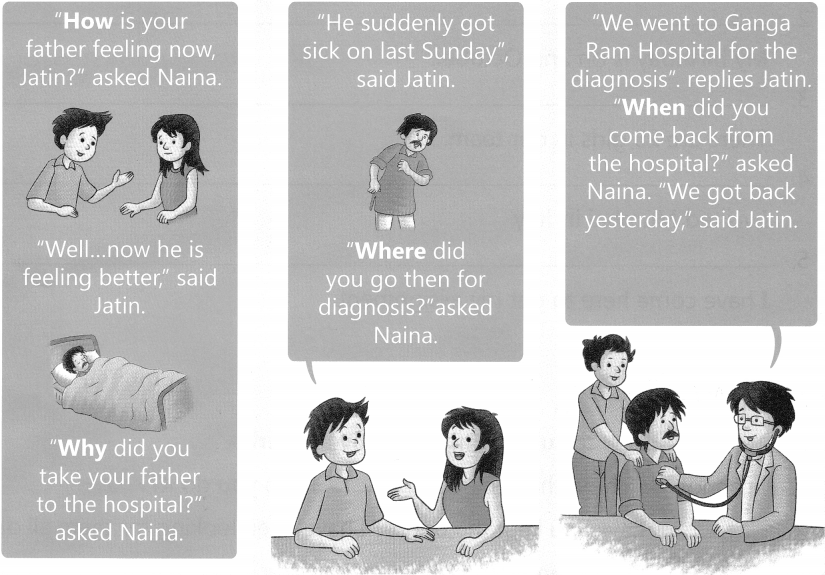
Read the picture story.
Interrogative Adverbs Exercises for Class 5 CBSE with Answers

A. Answer the following questions as per the story.

1. What did Naina ask first? ____________
2. What did she want to know next? ____________
3. What was Naina’s last question to Jatin? ____________

B. Fill in the blanks with suitable interrogative adverbs.

1. ____________ are you wasting my time?
2. ____________ will he go to Delhi?
3. ____________ will you learn manners?
4. ____________ did you fare in the examination?
5. ____________ do you blame me?
6. ____________ big is your house?

C. Form a question for each sentence below.

1. ________________________
I laugh at the clown.

2. ________________________
My birthday is on 2nd October.

3. ________________________
There are 23 girls in our team.

4. ________________________
I visited Mumbai in July.

5. ________________________
I have come here to get my assignment.

Interrogative Adverbs Exercises with Answers for Class 5 CBSE PDF

A. Fill in the blanks with suitable interrogative adverbs.

1. I cannot switch on this recorder, _____________ do you do it?
2. _____________ have you kept the books? I have been looking for them all day.
3. _____________ many questions did Sameer answer?
4. _____________ has John come so early? Nobody will come before evening.
5. _____________ important is the letter? Should I send it immediately?

B. Use ‘how’ below to complete each question.

1. _____________ will you stay here?
2. _____________ do you visit them?
3. _____________ Locus can you begin work?
4. _____________ students are there in the class?
5. _____________ does the committee meet?
6. _____________ did you arrive at the conclusion?
7. _____________ are you doing?
8. _____________ did you pay? can you go?
9. _____________ do you want?
10. _____________ was the experience?
11. _____________ did you do it?

C. Fill in the blanks with interrogative adverbs.

1. _____________ do you live?
2. _____________ will you visit Singapore again?
3. _____________ did you get this beautiful dress from?
4. _____________ have you solved this problem?
5. _____________ are you? is your father?
6. _____________ happened to your old car?

Surface Areas and Volumes Class 10 Extra Questions Maths Chapter 13 with Solutions Answers

Here we are providing Surface Areas and Volumes Class 10 Extra Questions Maths Chapter 13 with Answers Solutions, Extra Questions for Class 10 Maths was designed by subject expert teachers.

Extra Questions for Class 10 Maths Surface Areas and Volumes with Answers Solutions

Extra Questions for Class 10 Maths Chapter 13 Surface Areas and Volumes with Solutions Answers

Surface Areas and Volumes Class 10 Extra Questions Very Short Answer Type

Question 1.
What is the capacity of a cylindrical vessel with a hemispherical portion raised upward at the bottom?.
Solution:
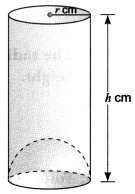
Surface Areas and Volumes Class 10 Extra Questions Maths Chapter 13 with Solutions Answers 1
Capacity of the given vessel
= capacity of cylinder – capacity of hemisphere
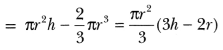
Surface Areas and Volumes Class 10 Extra Questions Maths Chapter 13 with Solutions Answers 2

Question 2.
A solid cone of radius r and height h is placed over a solid cylinder having same base radius and height as that of a cone. What is the total surface area of the combined solid?
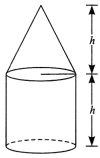
Surface Areas and Volumes Class 10 Extra Questions Maths Chapter 13 with Solutions Answers 3
Solution:
The total surface area of the combined solid in Fig.
= curved surface area of cone + curved surface area of cylinder + area of the base.

Surface Areas and Volumes Class 10 Extra Questions Maths Chapter 13 with Solutions Answers 4

Question 3.
Two identical solid hemispheres of equal base radius r сm are struck together along their bases. What will be the total surface area of the combination?
Solution:
The resultant solid will be a sphere of radius r whose total surface area is 4πr2.

Question 4.
A solid ball is exactly fitted inside the cubical box of side a. What is the volume of the ball?
Solution:
Diameter of the solid ball = edge of the cube = a

Surface Areas and Volumes Class 10 Extra Questions Maths Chapter 13 with Solutions Answers 5

Question 5.
If two cubes of edge 5 cm each are joined end to end, find the surface area of the resulting cuboid.
Solution:
Total length (l) = 5 + 5 = 10 cm
Breadth (b) = 5 cm, Height (h) = 5 cm
Surface Area = 2 (lb + bh + lh)
= 2(10 × 5 + 5 × 5 + 5 × 10) = 2 × 125 = 250 cm2

Question 6.
A solid piece of iron in the form of a cuboid of dimension 49 cm × 33 cm × 24 cm is melted to form a solid sphere. Find the radius of sphere.
Solution:
Volume of iron piece = Volume of the sphere formed
= 49 × 33 × 24 = \(\frac{4}{3}\) πr2
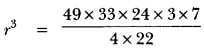
Surface Areas and Volumes Class 10 Extra Questions Maths Chapter 13 with Solutions Answers 6
r = 21 cm

Question 7.
A mason constructs a wall of dimensions 270 cm × 300 cm × 350 cm with the bricks each of size 22.5 cm × 11.25 cm × 8.75 cm and it is assumed that space is covered by the mortar. Find the number of bricks used to construct the wall.
Solution:
Space occupied with bricks = \(\frac{7}{8}\) × volume of the wall
= \(\frac{7}{8}\) × 270 × 300 × 350

Surface Areas and Volumes Class 10 Extra Questions Maths Chapter 13 with Solutions Answers 7

Question 8.
The radii of the ends of a frustum of a cone 40 cm high are 20 cm and 11 cm. Find its slant height.
Solution:

Surface Areas and Volumes Class 10 Extra Questions Maths Chapter 13 with Solutions Answers 8

Question 9.
Volume and surface area of a solid hemisphere are numerically equal. What is the diameter of hemisphere?
Solution:
As per question
Volume of hemisphere = Surface area of hemisphere
= \(\frac{2}{3}\)πr2 = 3πr2 = , units r = \(\frac{9}{2}\) units

Surface Areas and Volumes Class 10 Extra Questions Short Answer Type 1

Question 1.
A cone, a hemisphere and a cylinder stand on equal bases and have the same height. What is the ratio of their volumes?
Solution:
Volume of a cone: Volume of a hemisphere: Volume of a cylinder
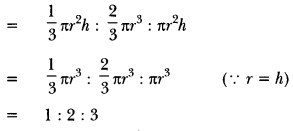
Surface Areas and Volumes Class 10 Extra Questions Maths Chapter 13 with Solutions Answers 9

Question 2.
What is the ratio of the volume of a cube to that of a sphere which will fit inside it?
Solution:
Let edge of the cube be ‘a’.
Then, diameter of the sphere that will fit inside the given cube = a
∴ Volume of the cube : Volume of the sphere

Surface Areas and Volumes Class 10 Extra Questions Maths Chapter 13 with Solutions Answers 10

Question 3.
The slant height of the frustum of a cone is 5 cm. If the difference between the radii of its two circular ends is 4 cm, find the height of the frustum.
Solution:
Let r and R be radii of the circular ends of the frustum of the cone.
Then, R – r = 4, l = 5
We know, l2 = (R – r)2 + h2
⇒ 52 = 42 + h2 or h2 = 25 – 16 = 9
⇒ h = 3 cm

Question 4.
If the slant height of the frustum of a cone is 10 cm and the perimeters of its circular base are 18 cm and 28 cm respectively. What is the curved surface area of the frustum?
Solution:
Let r and R be the radii of the two circular ends of the frustum of the cone.
Then, 2πr = 18 and 2πR = 28
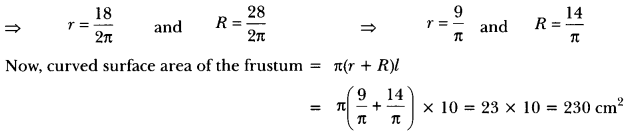
Surface Areas and Volumes Class 10 Extra Questions Maths Chapter 13 with Solutions Answers 11

Question 5.
The slant height of a frustum of a cone is 4 cm and the perimeters (circumference) of its circular ends are 18 cm and 6 cm. Find the curved surface area of the frustum.
Solution:
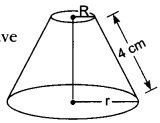
Surface Areas and Volumes Class 10 Extra Questions Maths Chapter 13 with Solutions Answers 12
We have, slant height, l = 4 cm
Let R and r be the radii of two circular ends respectively. Therefore, we have
⇒ 2πR = 18 = πR = 9
⇒ 2πr = 6 = πr = 3
∴ Curved surface area of the frustum = (πR + πr)l
= (9 + 3) × 4 = 12 × 4 = 48 cm2

Question 6.
A vessel is in the form of a hollow hemisphere mounted by a hollow 7 cm cylinder. The diameter of the hemisphere is 14 cm and the total height T of the vessel is 13 cm. Find the inner surface area of the vessel.
Solution:
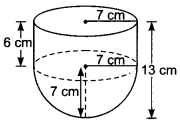
Surface Areas and Volumes Class 10 Extra Questions Maths Chapter 13 with Solutions Answers 13
Here, radius of hemisphere = radius of cylinder = r cm = 7 cm
and height of cylinder, h = (13 – 7) cm = 6 cm
Now, inner surface area of the vessel
= Curved surface area of the cylindrical part + Curved surface area of hemispherical part = (2πrh + 2πr2) = 2πr (h + r)
= 2 × \(\frac{22}{7}\) × 7 (6 + 7)
= 2 × 22 × 13 = 572 cm2

Question 7.
A solid is in the shape of a cone standing on a hemisphere with both their radii being equal to 1 cm and the height of the cone is equal to its radius. Find the volume of the solid in terms of T.
Solution:
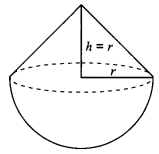
Surface Areas and Volumes Class 10 Extra Questions Maths Chapter 13 with Solutions Answers 14
We have,
Height
of cone is equal to its radius
i.e., h =r = 1 cm (Given)
Also, radius of hemisphere = r = 1 cm
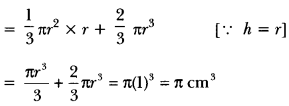
Now, Volume of the solid
= Volume of the cone + Volume of the hemisphere
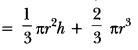
Surface Areas and Volumes Class 10 Extra Questions Maths Chapter 13 with Solutions Answers 15
Surface Areas and Volumes Class 10 Extra Questions Maths Chapter 13 with Solutions Answers 16

Question 8.
If the total surface area of a solid hemisphere is 462 cm2, find its volume. [Take π = \(\frac{22}{7}\)]
Solution:
Given, total surface area of solid hemisphere = 462 cm2
⇒ 3πr2 = 462 cm2
3 × \(\frac{22}{7}\) × r2 = 462
r2 = 49 ⇒ r = 7 cm
Volume of solid hemisphere = \(\frac{2}{3}\) πr3
= \(\frac{2}{3}\) × \(\frac{22}{7}\) × 7 × 7 × 7 = 718.67 cm3

Surface Areas and Volumes Class 10 Extra Questions Short Answer Type 2

Question 1.
Two cubes each of volume 64 cm3 are joined end to end. Find the surface area of the resulting cuboid.
Solution:
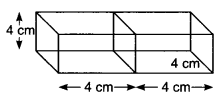
Surface Areas and Volumes Class 10 Extra Questions Maths Chapter 13 with Solutions Answers 17
Let the length of each edge of the cube of volume 64 cm3 be x cm.
Then, Volume = 64 cm3
⇒ x2 = 64
⇒ x2 = 43
⇒ x = 4 cm
4 cm The dimensions of cuboid so formed are
l = Length = (4 + 4) cm = 8 cm
b = Breadth = 4 cm and h = Height = 4 cm
∴ Surface area of the cuboid = 2 (lb + bh + lh)
= 2 (8 × 4 + 4 × 4 + 8 × 4)
= 2 (32 + 16 + 32)
= 160 cm2

Question 2.
A cubical block of side 7 cm is surmounted by a hemisphere. What is the greatest diameter the hemisphere can have? Find the surface area of the solid.
Solution:
The greatest diameter that a hemisphere can have = 7 cm = l
Radius of the hemisphere (R) = \(\frac{7}{2}\) cm
∴ Surface area of the solid after surmounting hemisphere
= 6l2 – πR2 + 2πR2 = 6l2 + πR2
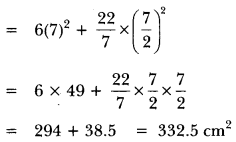
Surface Areas and Volumes Class 10 Extra Questions Maths Chapter 13 with Solutions Answers 18

Question 3.
The dimensions of a solid iron cuboid are 4.4 m × 2.6 m × 1.0 m. It is melted and recast into a hollow cylindrical pipe of 30 cm inner radius and thickness 5 cm. Find the length of the pipe.
Solution:
Let the length of pipe by h m.
Volume of cuboid = 4.4 × 2.6 × 1 m2
Inner and outer radii of cylindrical pipe are 30 cm, (30 + 5) cm = 35 cm
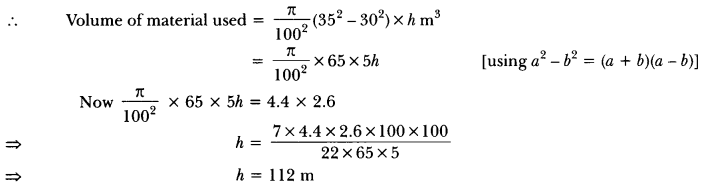
Surface Areas and Volumes Class 10 Extra Questions Maths Chapter 13 with Solutions Answers 19

Question 4.
A toy is in the form of a cone of radius 3.5 cm mounted on a hemisphere of same radius. The total height of the toy is 15.5 cm. Find the total surface area of the toy.
OR
A toy is in the form of a cone of radius 3.5 cm mounted on a hemisphere of same radius on its circular face. The total height of the toy is 15.5 cm. Find the total surface area of the toy.
Solution:
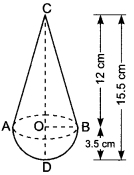
Surface Areas and Volumes Class 10 Extra Questions Maths Chapter 13 with Solutions Answers 20
We have,
CD = 15.5 cm and OB = OD = 3.5 cm
Let r be the radius of the base of cone and h be the height of conical part of the toy.
Then, r = OB = 3.5 cm
h = OC = CD – OD = (15.5 – 3.5) cm = 12 cm
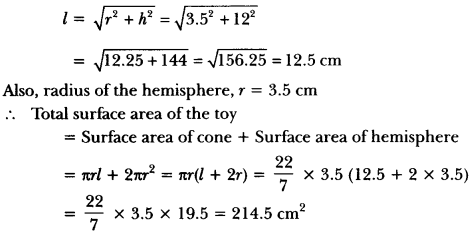
Surface Areas and Volumes Class 10 Extra Questions Maths Chapter 13 with Solutions Answers 21

Question 5.
A hemispherical depression is cut out from one face of a cubical wooden block such that the diameter l of the hemisphere is equal to the edge of the cube. Determine the surface area of the remaining solid.
Solution:
Here, we have
Edge of the cube = l = Diameter of the hemisphere
Therefore, radius of the hemisphere = \(\frac{l}{2}\)
∴ Surface area of the remaining solid after cutting out the hemispherical
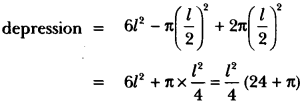
Surface Areas and Volumes Class 10 Extra Questions Maths Chapter 13 with Solutions Answers 22

Question 6.
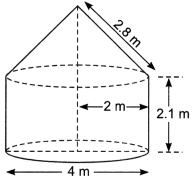
A tent is in the shape of a cylinder surmounted by a conical top. If the height and diameter of the cylindrical part are 2.1 m and 4 m respectively, and the slant height of the top is 2.8 m, find the area of the canvas used for making the tent. Also, find the cost of the canvas of the tent at the rate of 500 per m2. (Note that the base of the tent will not be covered with canvas).
Solution:
We have,
Radius of cylindrical base = \(\frac{4}{2}\) = 2 m
Height of cylindrical portion = 2.1 m
∴ Curved surface area of cylindrical portion = 2πrh
= 2 × \(\frac{22}{7}\) × 2 × 2.1 = 26.4 m2
Radius of conical base = 2 m
Slant height of conical portion = 2.8 m
∴ Curved surface area of conical portion = πrl
= \(\frac{22}{7}\) × 2 × 2.8 = 17.6m2
Now, total area of the canvas = (26.4 + 17.6)m2 = 44 m2
∴ Total cost of the canvas used = ₹500 × 44 = ₹22,000

Question 7.
A medicine capsule is in the shape of a cylinder with two hemispheres stuck to each of its ends (Fig). The length of the entire capsule is 14 mm and the diameter of the capsule is 5 mm. Find its surface area.
Surface Areas and Volumes Class 10 Extra Questions Maths Chapter 13 with Solutions Answers 23
Solution:
Let the radius and height of the cylinder be r сm and h cm respectively. Then,
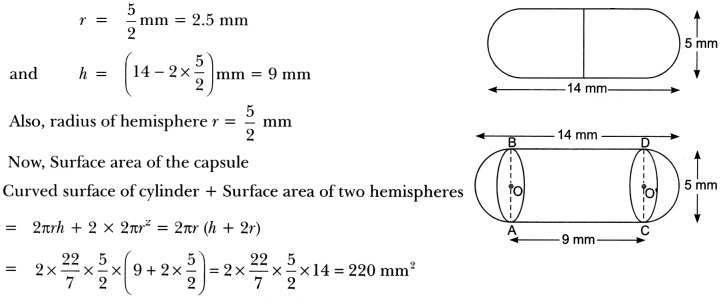
Surface Areas and Volumes Class 10 Extra Questions Maths Chapter 13 with Solutions Answers 24

Question 8.
A wooden article was made by scooping out a hemisphere from each end of a solid cylinder, as shown in Fig. If the height of the cylinder is 10 cm, and its base is of radius 3.5 cm, find the total surface area of the article.
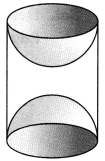
Surface Areas and Volumes Class 10 Extra Questions Maths Chapter 13 with Solutions Answers 25
Solution:
We have, r = 3.5 cm and h = 10 cm
Total surface area of the article
= Curved surface area of cylinder + 2 × Curved surface area of hemisphere
= 2πrh + 2 × 2πr2 = 2πr (h + 2r)
= 2 × \(\frac{22}{7}\) × 3.5 × (10 + 2 × 3.5)
= 2 × \(\frac{22}{7}\) × 3.5 × 17 = 374 cm2

Question 9.
Mayank made a bird-bath for his garden in the shape of a cylinder with a hemispherical depression at one end (Fig). The height of the cylinder is 1.45 m and its radius is 30 cm. 30 cm Find the total surface area of the bird-bath. [Take π = \(\frac{22}{7}\) ]
Solution:
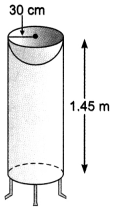
Surface Areas and Volumes Class 10 Extra Questions Maths Chapter 13 with Solutions Answers 26
Let h be height of the cylinder, and r be the common radius of the cylinder and hemisphere.
Then, the total surface area of the bird-bath
= Curved surface area of cylinder + Curved surface area of hemisphere
= 2πrh + 2πr2 = 2πr (h + 2r)
= 2 × \(\frac{22}{7}\) × 30 (145 + 30) cm2 = 33,000 cm2 = 3.3 m2

Question 10.
A juice seller was serving his customers using glasses as shown in Fig. 13.16. The inner diameter of the cylindrical glass was 5 cm, but the bottom of the glass had a hemispherical raised portion which reduced the capacity of the glass. If the height of a glass was 10 cm, find the apparent capacity of the glass and its actual capacity. (Use π = 3.14).
Solution:
Surface Areas and Volumes Class 10 Extra Questions Maths Chapter 13 with Solutions Answers 27
Since, the inner diameter of the glass = 5 cm and height = 10 cm,
the apparent capacity of the glass = πr2h
= (3.14 × 2.5 × 2.5 × 10) cm3 = 196.25 cm2
But the actual capacity of the glass is less by the volume of the hemisphere at the base of the glass.
i.e., it is less by \(\frac{2}{3}\) πr3
= \(\frac{2}{3}\) × 3.14 × 2.5 × 2.5 × 2.5 cm3
= 32.71 cm
So, the actual capacity of the glass
= Apparent capacity of glass – Volume of the hemisphere
= (196.25 – 32.71) cm3 = 163.54 cm3

Question 11.
Asphericalglassvesselhasacylindricalneck8cmlong, 2cmindiameter;the diameterofthespherical part is 8.5 cm. By measuring the amount of water it holds, a child finds its volume to be 345 cm3. Check whether she is correct, taking the above as the inside measurements, and π = 3.14.
Solution:
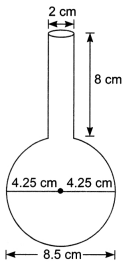
Surface Areas and Volumes Class 10 Extra Questions Maths Chapter 13 with Solutions Answers 28
We have,
Radius of cylindrical neck = 1 cm and height of cylindrical neck = 8 cm
Radius of spherical part = 4.25 cm
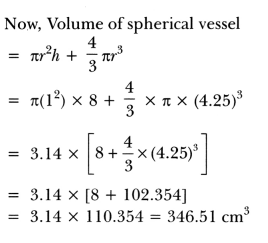
Surface Areas and Volumes Class 10 Extra Questions Maths Chapter 13 with Solutions Answers 29
∴ The answer found by the child is incorrect.
Hence, the correct answer is 346.51 cm”.

Question 12.
A metallic sphere of radius 4.2 cm is melted and recast into the shape of a cylinder of radius 6 cm. Find the height of the cylinder.
Solution:
We have,
Radius of sphere (r1) = 4.2 cm, Radius of cylinder (r2) = 6 cm
Let h cm be the height of cylinder.
Now, since sphere is melted and recast into cylinder
∴ Volume of sphere = Volume of cylinder
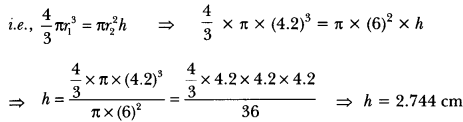
Surface Areas and Volumes Class 10 Extra Questions Maths Chapter 13 with Solutions Answers 30
Hence, height of the cylinder is 2.744 cm.

Question 13.
Metallic spheres of radii 6 cm, 8 cm and 10 cm, respectively, are melted to form a single solid sphere. Find the radius of the resulting sphere.
Solution:
Letr be the radius of resulting sphere.
We have,
Volume of resulting sphere = Sum of the volumes of three given spheres
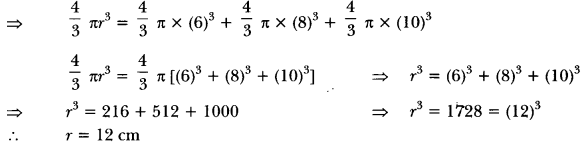
Surface Areas and Volumes Class 10 Extra Questions Maths Chapter 13 with Solutions Answers 31
Hence, the radius of the resulting sphere is 12 cm.

Question 14.
A 20 m deep well with diameter 7 m is dug and the earth from digging is evenly spread out to form a platform 22 m by 14 m. Find the height of the platform.
Solution:
Here, radius of cylindrical well =\(\frac{7}{2}\)m
Depth of cylindrical well = 20 m
Let H metre be the required height of the platform.
Now, the volume of the platform = Volume of the earth dugout from the cylindrical well
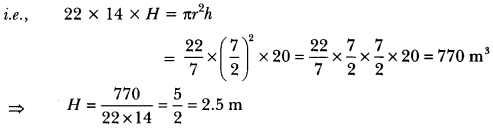
Surface Areas and Volumes Class 10 Extra Questions Maths Chapter 13 with Solutions Answers 32
∴ Height of the platform = 2.5 m

Question 15.
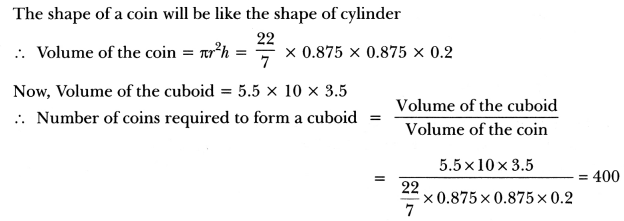
How many silver coins, 1.75 cm in diameter and of thickness 2 mm, must be melted to form a cuboid of dimensions 5.5 cm × 10 cm × 3.5 cm?
Solution:
We have,

Surface Areas and Volumes Class 10 Extra Questions Maths Chapter 13 with Solutions Answers 33
Surface Areas and Volumes Class 10 Extra Questions Maths Chapter 13 with Solutions Answers 34

Question 16.
A copper rod of diameter 1 cm and length 8 cm is drawn into a wire of length 18 m of uniform thickness. Find the thickness of the wire.
Solution:

Surface Areas and Volumes Class 10 Extra Questions Maths Chapter 13 with Solutions Answers 35
The length of the new wire of the same volume = 18 m = 1800 cm
If r is the radius (in cm) of cross-section of the wire, its volume = π × r2 × 1800 cm3
Therefore, π × r2 × 1800 = 2π
i.e., r2 = \(\frac{1}{900}\) i.e., r = \(\frac{1}{30}\)
So, the diameter of the cross section, i.e., the thickness of the wire is \(\frac{1}{15}\),
i.e., 0.67 mm (approx.).

Question 17.
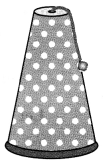
A drinking glass is in the shape of a frustum of a cone of height 14 cm. The diameters of its two circular, ends are 4 cm and 2 cm. Find the capacity of the glass.
Solution:
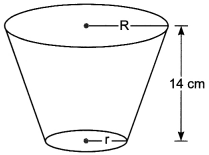
Surface Areas and Volumes Class 10 Extra Questions Maths Chapter 13 with Solutions Answers 36
We have, R = 2 cm, r = 1 cm, h = 14 cm
∴ Capacity of the glass = Volume of the frustum
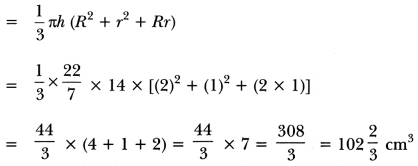
Surface Areas and Volumes Class 10 Extra Questions Maths Chapter 13 with Solutions Answers 37

Question 18.
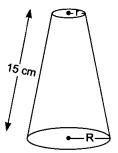
A fez, the cap used by the Turks, is shaped like the frustum of a cone (Fig). If its radius on the open side is 10 cm, radius at the upper base is 4 cm and its slant height is 15 cm, find the area of material used for making it.
Surface Areas and Volumes Class 10 Extra Questions Maths Chapter 13 with Solutions Answers 38
Solution:
We have,
R = 10 cm, r = 4 cm, l = 15 cm
∴ Area of the material used for making the fez
= Surface area of frustum + Area of top circular section
= π(R + r) l +πr2
= \(\frac{22}{7}\)(10 + 4) × 15 + \(\frac{22}{7}\) × 4 × 4
= \(\frac{22}{7}\) × 14 × 15 + \(\frac{22}{7}\) × 16
= \(\frac{22}{7}\) (210 + 16) = \(\frac{4972}{7}\) = 710 \(\frac{2}{7}\) cm2

Question 19.
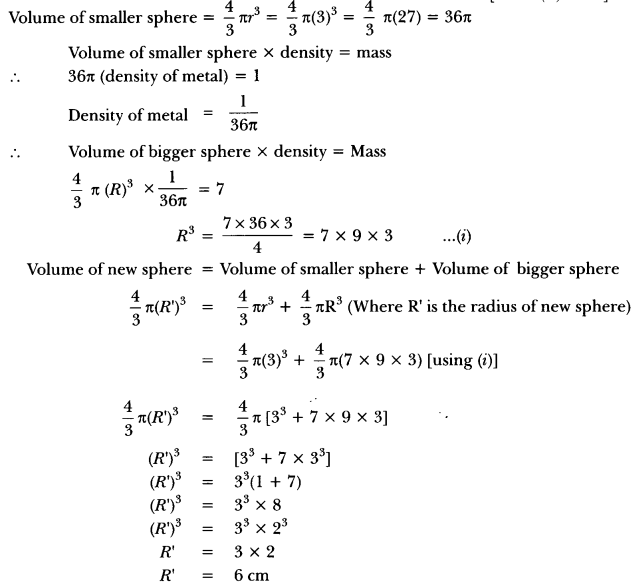
Two spheres of same metal weigh 1 kg and 7 kg. The radius of the smaller sphere is 3 cm. The two spheres are melted to form a single big sphere. Find the diameter of the new sphere.
Surface Areas and Volumes Class 10 Extra Questions Maths Chapter 13 with Solutions Answers 39
Solution:
Surface Areas and Volumes Class 10 Extra Questions Maths Chapter 13 with Solutions Answers 40
∴ Diameter of new sphere = 12 cm.

Question 20.
A farmer connects a pipe of internal diameter 20 cm from a canal into a cylindrical tank which is 10 m in diameter and 2 m deep. If the water flows through the pipe at the rate of 4 km per hour, in how much time will the tank be filled completely?
Solution:
Given, Diameter of tank = 10 m
Depth of tank (H) = 2 m
Internal diameter of pipe = 20 cm = \(\frac{2}{10}\) m
Rate of flow of water, ν = 4 km/h = 4,000 m/h
Internal radius of pipe, r =\(\frac{1}{10}\) m
Let ‘t be the time taken to fill the tank.
∴ Water flowing through pipe in t hours = Volume of tank
πr2 × υ × t = πR2H
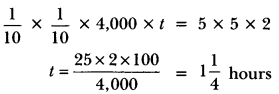
Surface Areas and Volumes Class 10 Extra Questions Maths Chapter 13 with Solutions Answers 41

Question 21.
The largest possible sphere is carved out of a wooden solid cube of side 7 cm. Find the volume 22 of the wood left. [Use π = \(\frac{22}{7}\) ]
Solution:
Diameter of sphere carved out = side of cube = 7 cm
So, r = 3.5 cm
Volume of cube = a3 = 73 = 343 cm3
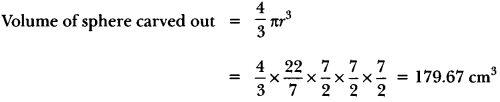
Surface Areas and Volumes Class 10 Extra Questions Maths Chapter 13 with Solutions Answers 42
Volume of wood left = 343 – 179.67 = 163.33 cm3

Question 22.
A hemispherical bowl of internal diameter 36 cm contains liquid. This liquid is filled into 72 cylindrical bottles of diameter 6 cm. Find the height of the each bottle, if 10% liquid is wasted in this transfer.
Solution:
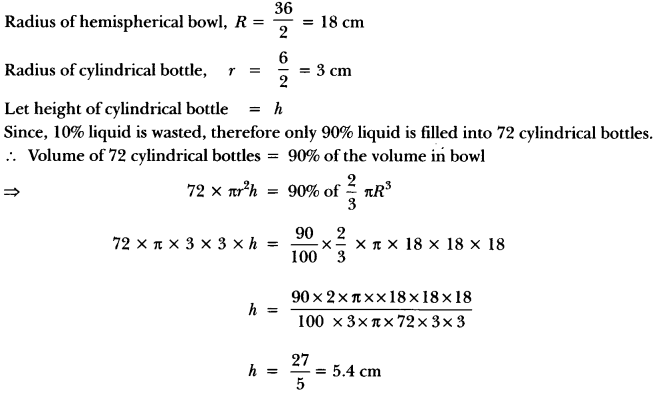
Surface Areas and Volumes Class 10 Extra Questions Maths Chapter 13 with Solutions Answers 43

Question 23.
A solid is composed of a cylinder with hemispherical ends. If the whole length of the solid is 100cm and the diameter of the hemispherical ends is 28cm. Find the cost of polishing the surface of the solid at the rate of 5 paise per sq.cm.
Solution:
We have
r = radius of cylinder = radius of hemispherical ends = \(\frac{28}{2}\) cm
h = height of the cylinder = 100 – 2 × 14 = 100 – 28 = 72 cm.
Total surface area
= Curved surface area of cylinder + 2 × Surface area of hemispherical ends = 2πrh + 2 × (2πr2)
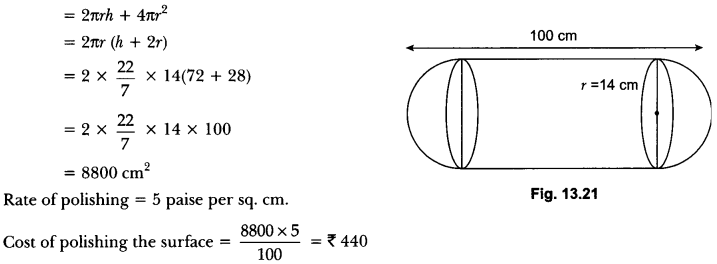
Surface Areas and Volumes Class 10 Extra Questions Maths Chapter 13 with Solutions Answers 44

Question 24.
A hemispherical tank, of diameter 3 m, is full of water. It is being emptied by a pipe at the rate of 3 \(\frac{4}{7}\) litre per second. How much time will it take to make the tank half empty? [Use π = \(\frac{22}{7}\)]
Solution:
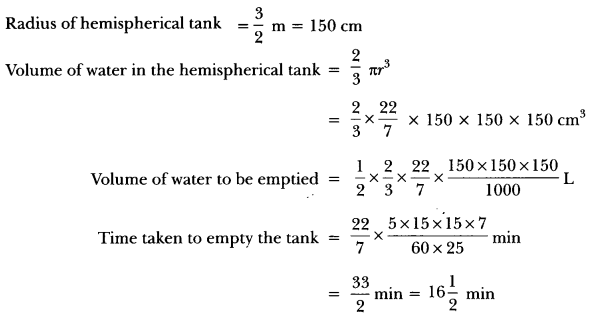
Surface Areas and Volumes Class 10 Extra Questions Maths Chapter 13 with Solutions Answers 45

Question 25.
The \(\frac{3}{4}\)th part of a conical vessel of internal radius 5 cm and height 24 cm is full of water. The water is emptied into a cylindrical vessel with internal radius 10 cm. Find the height of water in cylindrical vessel.
Solution:
Let the height of cylindrical vessel be h cm
According to question
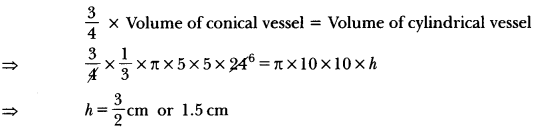
Surface Areas and Volumes Class 10 Extra Questions Maths Chapter 13 with Solutions Answers 46

Question 26.
A cylindrical tub, whose diameter is 12 cm and height 15 cm is full of ice cream. The whole ice cream is to be divided into 10 children in equal ice-cream cones, with conical base surmounted by hemispherical top. If the height of conical portion is twice the diameter of base, find the diameter of conical part of ice-cream cone.
Solution:
Volume of ice-cream in the cylinder = πr2h = (π(6)2 × 15) cm3
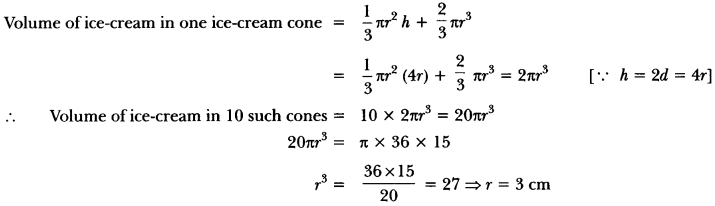
Surface Areas and Volumes Class 10 Extra Questions Maths Chapter 13 with Solutions Answers 47
Diameter of conical ice-cream cup = 6 cm

Question 27.
A conical vessel, with base radius 5 cm and height 24 cm, is full of water. This water is emptied into a cylindrical vessel of base radius 10 cm. Find the height to which the water will rise in the cylindrical vessel. [use π = \(\frac{22}{7}\)]
Solution:
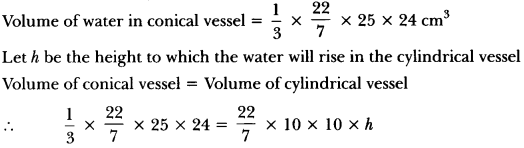
Surface Areas and Volumes Class 10 Extra Questions Maths Chapter 13 with Solutions Answers 48
⇒ h = 2 cm

Question 28.
The sum of the radius of base and height of a solid right circular cylinder is 37 cm. If the total surface area of the solid cylinder is 1628 sq. cm find the volume of the cylinder.
[Use π = \(\frac{22}{7}\)]
Solution:
Here
r + h = 37 and 2πr(r + h) = 1628
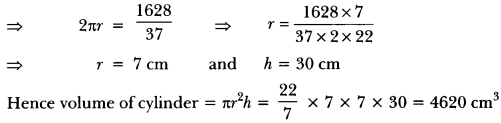
Surface Areas and Volumes Class 10 Extra Questions Maths Chapter 13 with Solutions Answers 49

Question 29.
A sphere of diameter 12 cm, is dropped in a right circular cylindrical vessel, partly filled with water. If the sphere is completely submerged in water, the water level in the cylindrical vessel rises by 3\(\frac{3}{9}\) cm. Find the diameter of the cylindrical vessel.
Solution:
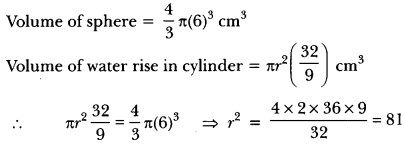
Surface Areas and Volumes Class 10 Extra Questions Maths Chapter 13 with Solutions Answers 50

Question 30.
Water is flowing at the rate of 5 km/hour through a pipe of diameter 14 cm into a rectangular tank of dimensions 50 m × 44 m. Find the time in which the level of water in the tank will rise by 7 cm.
Solution:
Let the time taken by pipe be t hours.
∵ Speed = 5 km/h
∴ Length in t hours = 5000 t m.
According to question
Volume of water flown through pipe = Volume of water in tank
πr2h = l × b × h

Surface Areas and Volumes Class 10 Extra Questions Maths Chapter 13 with Solutions Answers 51
⇒ t = 2
Hence required time is 2 hours.

Question 31.
The radius and height of a solid right circular cone are in the ratio of 5 : 12. If its volume is 314 cm3, find its total surface area. [Take π = 3.14]
Solution:
Given r : h = 5 : 12
Let r = 5x
⇒ h = 12x
Volume of cone = \(\frac{1}{3}\)π2h
314 = \(\frac{1}{3}\) × 3.14 (5x)2 × 12x
⇒ x3 = \(\frac{314 \times 3}{3.14 \times 25 \times 12}\)
⇒ x3 = 1
⇒ x = 1
So, the value of r = 5 cm and h = 12 cm
Now, l = \(\sqrt{(12)^{2}+(5)^{2}}\) = 13 cm
TSA of cone = πr(l + r) = 3.14 × 5 (13 + 5)
= 3.14 × 90 = 282.6 cm2

Question 32.
A wire of diameter 3 mm is wound about a cylinder whose height is 12 cm and radius 5 cm so as to cover the curved surface of the cylinder completely. Find the length of the wire.
Solution:
CSA of cylinder = 2π(5) × 12
= 120 πcm2
Let length of wire = h cm
Radius of wire = \(\frac{3}{20}\) cm
According to question
CSA of wire = CSA of cylinder
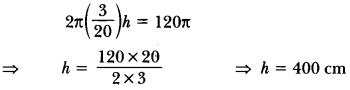
Surface Areas and Volumes Class 10 Extra Questions Maths Chapter 13 with Solutions Answers 52

Surface Areas and Volumes Class 10 Extra Questions Long Answer Type

Question 1.
From a solid cylinder whose height is 2.4 cm and diameter 1.4 cm, a conical cavity of the same height and same diameter is hollowed out. Find the total surface area of the remaining solid to the nearest cm?
OR
From a solid right circular cylinder of height 2.4 cm and radius 0:7 cm, a right circular cone of same height and same radius is cut out. Find the total surface area of the remaining solid.
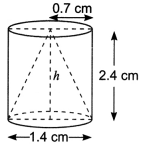
Surface Areas and Volumes Class 10 Extra Questions Maths Chapter 13 with Solutions Answers 53
Solution:
We have,
0.7 cm Radius of the cylinder = 1.4/2 = 0.7 cm
Height of the cylinder = 2.4 cm
Also, radius of the cone = 0.7 cm
and height of the cone = 2.4 cm

Surface Areas and Volumes Class 10 Extra Questions Maths Chapter 13 with Solutions Answers 54
∴ Total surface area of the remaining solid
= Curved surface area of cylinder + Curved surface area of the cone + Area of upper circular base of cylinder
= 2πrh + πrl + πr2 = πr(2h + l + r)
= \(\frac{22}{7}\) × 0.7 × [2 × 2.4 + 2.5 + 0.7]
= 22 × 0.1 × (4.8 + 2.5 + 0.7)
= 2.2 × 8.0 = 17.6 cm2 = 18 cm2

Question 2.
The decorative block shown in figure is made of two solids a cube and a hemisphere. The base of the block is a cube with edge 5 cm, and the hemisphere fixed on the top has a diameter of 4.2 cm. Find the total surface area of the block. (Use π = \(\frac{22}{7}\))
Solution:
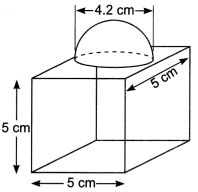
Surface Areas and Volumes Class 10 Extra Questions Maths Chapter 13 with Solutions Answers 55
The total surface area of the cube = 6 × (edge)2
= 6 × 5 × 5 cm2 = 150 cm
∴ Total surface area of the block
= Total surface area of cube – Base area of hemisphere + Curved surface area of hemisphere
= 150 – πr2 + 2πr2 = (150 + πr2) cm2

Surface Areas and Volumes Class 10 Extra Questions Maths Chapter 13 with Solutions Answers 56
cm2 = (150 + 13.86) cm2 = 163.86 cm

Question 3.
Rasheed got a playing top (lattu) as his birthday present, which surprisingly had no colour on it. He wanted to colour it with his crayons. The top is shaped like a cone surmounted by a hemisphere (Fig). The entire top is 5 cm in height and the diameter of the top is 3.5 cm. Find the area he has to colour. (Take π = \(\frac{22}{7}\)
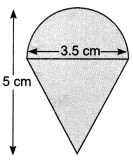
Surface Areas and Volumes Class 10 Extra Questions Maths Chapter 13 with Solutions Answers 57
Solution:
Total surface area of the top
= Curved surface area of hemisphere + Curved surface area of cone. Now, the curved surface area of hemisphere = 2πr2
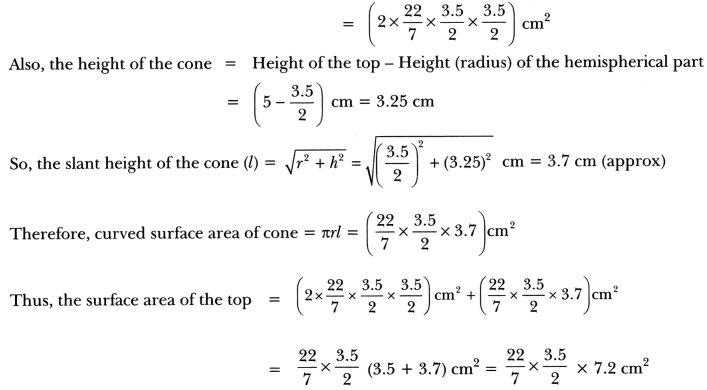
Surface Areas and Volumes Class 10 Extra Questions Maths Chapter 13 with Solutions Answers 58

Question 4.
A wooden toy rocket is in the shape of a cone mounted on a cylinder, in Fig. The height of the entire rocket is 26 cm, 6 cm while the height of the conical part is 6 cm. The base of the conical portion has a diameter of 5 cm, while the base diameter of the cylindrical portion is 3 cm. If the conical portion is to be painted orange and the cylindrical portion yellow, find the area of the rocket painted with each of these colours. (Take π = 3.14) 26 cm
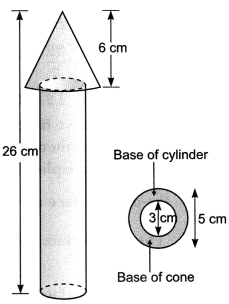
Surface Areas and Volumes Class 10 Extra Questions Maths Chapter 13 with Solutions Answers 59
Solution:
Denote radius, slant height and height of cone by r, l and h, respectively, and radius and height of cylinder by r’ and h’, respectively. Then r = 2.5 cm, h = 6 cm, r’ = 1.5 cm,
h’ = 26 – 6 = 20 and

Surface Areas and Volumes Class 10 Extra Questions Maths Chapter 13 with Solutions Answers 60
Here, the conical portion has its circular base resting on the base of the cylinder, but the base of the cone is larger than the base of the cylinder. So, a part of the base of the cone (a ring) is to be painted. So, the area to be painted orange
= Curved surface area of the cone + Base area of the cone – Base area of the cylinder
= πrl + πr2 – π(r’)2
= [(2.5 × 6.5) + (2.5)2 – (1.5)2] cm2
= π[20.25] cm2
= 3.14 × 20.25 cm2 = 63.585 cm2
Now, the area to be painted yellow
= Curved surface area of the cylinder + Area of one base of the cylinder
= 2πr’h’ + π(r’)2 = πr’ (2h’ + r’)
= (3.14 × 1.5) (2 × 20 + 1.5) cm2 = 4.71 × 41.5 cm2 = 195.465 cm2

Question 5.
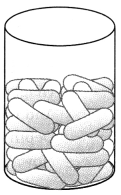
Rachel, an engineering student, was asked to make a model shaped like a cylinder with two cones attached at its two ends by using a thin aluminium sheet. The diameter of the model is 3 cm and its length is 12 cm. If each cone has a height of 2 cm, find the volume of air contained in the model that Rachel made. (Assume the outer and inner dimensions of the model to be nearly the same.)
Solution:
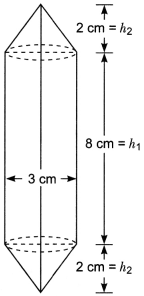
Surface Areas and Volumes Class 10 Extra Questions Maths Chapter 13 with Solutions Answers 61
Here, radius of cylindrical portion = \(\frac{3}{2}\)
Height of each cone = 2 cm
Height of cylindrical portion = 12 – 2 – 2 = 8 cm
Volume of the air contained in the model
= Volume of the cylindrical portion of the model + Volume of two conical K ends.
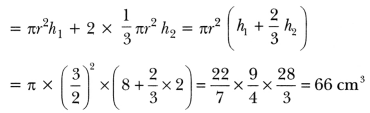
Surface Areas and Volumes Class 10 Extra Questions Maths Chapter 13 with Solutions Answers 62

Question 6.
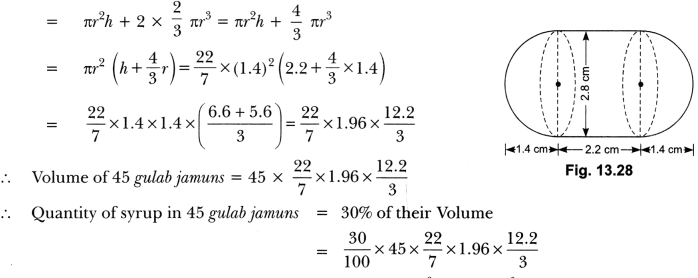
A gulab jamun, contains sugar syrup about 30% of its volume. Find approximately how much syrup would be found in 45 gulab jamuns, each shaped like a cylinder with two hemispherical ends with length 5 cm and diameter 2.8 cm (Fig).
Surface Areas and Volumes Class 10 Extra Questions Maths Chapter 13 with Solutions Answers 63
Solution:
We have,
Radius of cylindrical portion and hemispherical portion of a gulab jamun
2.8/2 = 1.4 cm
Length of cylindrical portion = 5 – 1.4 – 1.4 = 2.2 cm
Volume of one gulab jamun
= Volume of the cylindrical portion + Volume of the hemispherical ends
Surface Areas and Volumes Class 10 Extra Questions Maths Chapter 13 with Solutions Answers 64

Question 7.
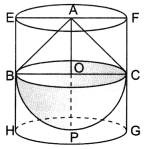
A solid toy is in the form of a hemisphere surmounted by a right circular cone. EF The height of the cone is 2 cm and the diameter of the base is 4 cm. Determine the volume of the toy. If a right circular cylinder circumscribes the toy, find the difference of the volumes of the cylinder and the toy. (Take π = 3.14)
Surface Areas and Volumes Class 10 Extra Questions Maths Chapter 13 with Solutions Answers 65
Solution:
Let BPC be the hemisphere and ABC be the cone standing on the base of the N
hemisphere (see Fig. 13.29).
The radius BO of the hemisphere (as well as of the cone) = 1/2 × 4 cm = 2 cm
Surface Areas and Volumes Class 10 Extra Questions Maths Chapter 13 with Solutions Answers 66
Now, let the right circular cylinder EFGH circumscribe the given solid. The radius of the base of the right circular cylinder = HP = BO = 2 cm and its height is
EH = AO + OP = (2 + 2) cm = 4 cm
So, the required volume
= Volume of the right circular cylinder – Volume of the toy
= (3.14 × 22 × 4 – 25.12) cm3 = 25.12 cm3
Hence, the required difference of the two volumes = 25.12 cm3

Question 8.
A pen stand made of wood is in the shape of a cuboid with four conical depressions to hold pens. The dimensions of the cuboid are 15 cm by 10 cm by 3.5 cm. The radius of each of the depressions is 0.5 cm and the depth is 1.4 cm. Find the volume of wood in the entire stand (Fig).
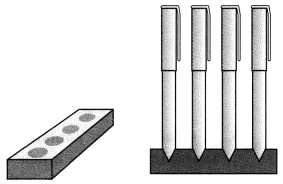
Surface Areas and Volumes Class 10 Extra Questions Maths Chapter 13 with Solutions Answers 67
Solution:
We have,
Length of cuboid = 1 = 15 cm
Breadth of cuboid = b = 10 cm
Height of cuboid = h = 3.5 cm
And radius of conical depression = 0.5 cm
Depth of conical depression = 1.4 cm
Now, Volume of wood in the entire pen stand
= Volume of cuboid – 4 × Volume of a conical depression

Surface Areas and Volumes Class 10 Extra Questions Maths Chapter 13 with Solutions Answers 68

Question 9.
A solid iron pole consists of a cylinder of height 220 cm and base diameter r = 8 cm 24 cm, which is surmounted by another cylinder of height 60 cm and radius 8 cm. Find the mass of the pole, given that 1 cm of iron has approximately 8 g mass. 60 cm (Use π = 3.14).
Solution:
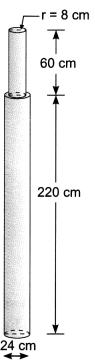
Surface Areas and Volumes Class 10 Extra Questions Maths Chapter 13 with Solutions Answers 69
Let r1 and h1 be the radius and height of longer cylinder, respectively, and r2, h2 be the respective radius and height of smaller cylinder mounted on the longer cylinder.
Then we have,
r1 = 12 cm, h1 = 220 cm
r2 = 8 cm, h2 = 60 cm
Now, Volume of solid iron pole
= Volume of the longer cylinder + Volume of smaller cylinder
= πr12h1 + πr22h2
= 3.14 R (12)2 × 220 + 3.14 R (8)2 × 60
= 3.14 × 144 × 220 + 3.14 × 64 × 60
= 99475.2 + 12057.6 = 111532.8 cm3
Hence, the mass of the pole =(111532.8 × 8) grams
= \(\frac{111532.8 \times 8}{1000} \mathrm{kg}\) = 892.2624 kg

Question 10.
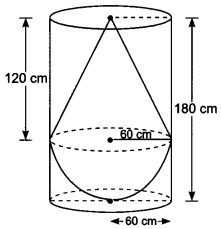
A solid consisting of a right circular cone of height 120 cm and radius 60 cm standing on a hemisphere of radius 60 cm is placed upright in a right circular cylinder full of water such that it touches the bottom. Find the volume of water left in the cylinder, if the radius of the cylinder is 60 cm and its height is 180 cm.
Solution:
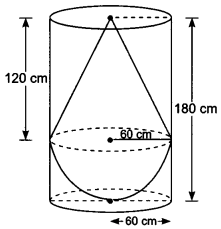
Surface Areas and Volumes Class 10 Extra Questions Maths Chapter 13 with Solutions Answers 1.1
We have,
Radius of cylinder = Radius of cone = Radius of hemisphere = 60 cm
∴ Height of cone = 120 cm
Height of cylindrical vessel = 120 + 60 = 180 cm
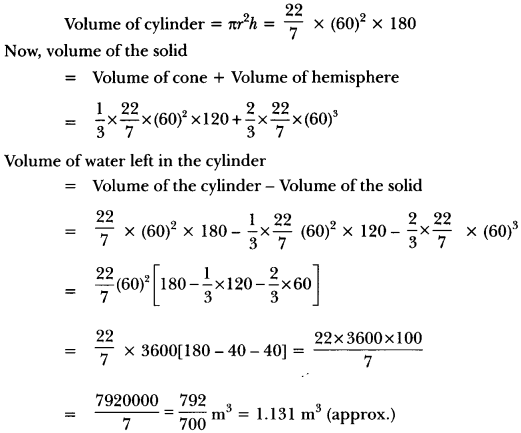
Surface Areas and Volumes Class 10 Extra Questions Maths Chapter 13 with Solutions Answers 1.2
Surface Areas and Volumes Class 10 Extra Questions Maths Chapter 13 with Solutions Answers 70

Question 11.
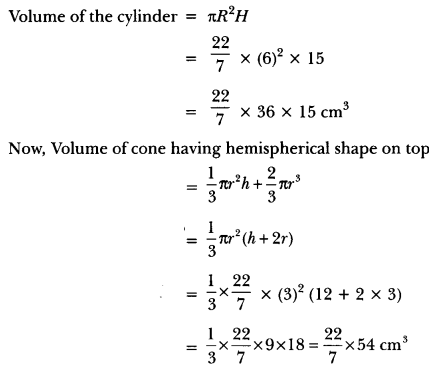
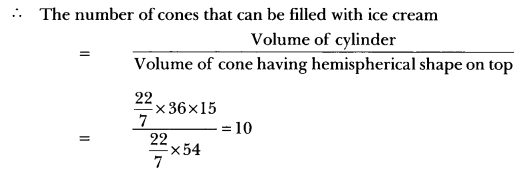
A container shaped like a right circular cylinder having diameter 12 cm and height 15 cm is full of ice cream. The ice cream is to be filled into cones of height 12 cm and & diameter 6 cm, having a hemispherical shape on the top. Find the number of such cones which can be filled with ice I cream.
Solution:
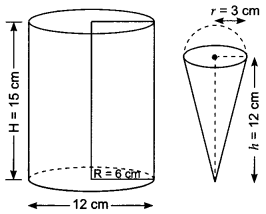
Surface Areas and Volumes Class 10 Extra Questions Maths Chapter 13 with Solutions Answers 71
Surface Areas and Volumes Class 10 Extra Questions Maths Chapter 13 with Solutions Answers 72
Surface Areas and Volumes Class 10 Extra Questions Maths Chapter 13 with Solutions Answers 73

Question 12.
A cylindrical bucket, 32 cm high and with radius of base 18 cm, is filled with sand. This bucket is emptied on the ground and a conical heap of sand is formed. If the height of the conical heap is 24 cm, find the radius and slant height of the heap.
OR
A girl empties a cylindrical bucket, full of sand, of base radius 18 cm and height 32 cm, on the floor to form a conical heap of sand . If the height of this conical heap is 24 cm, then find its slant height correct up to one place of decimal.
Solution:
We have,
Radius of cylindrical bucket = 18 cm
Height of cylindrical bucket = 32 cm
And height of conical heap = 24 cm
Let the radius of conical heap be r cm
Volume of the sand = Volume of the cylindrical bucket
= πr2h = π × (18)2 × 32
Now, Volume of conical heap = \(\frac{1}{3} \pi r^{2} h=\frac{1}{3} \pi r^{2} \times 24=8 \pi r^{2}\)
Here, volume of the conical heap will be equal to the volume of sand.
8πr² = π × (18)2 × 32
r2 = 18 × 18 × 4 = (18)2 × (2)2
r2 = (36)2 or r = 36 cm
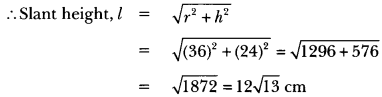
Surface Areas and Volumes Class 10 Extra Questions Maths Chapter 13 with Solutions Answers 74

Question 13.
Selvi’s house has an overhead tank in the shape of a cylinder. This is filled by pumping water from a sump (an underground tank) which is in the shape of a cuboid. The sump has dimensions 1.57 m × 1.44 m × 95 cm. The overhead tank has its radius 60 cm and height 95 cm. Find the height of the water left in the sump after the overhead tank has been completely filled with water from the sump which had been full. Compare the capacity of the tank with that of the sump. (Use π = 3.14)
Solution:
The volume of water in the overhead tank equals the volume of the water removed from the sump.
Now, the volume of water in the overhead tank (cylinder) = πr²h
= 3.14 × 0.6 × 0.6 × 0.95 m3
The volume of water in the sump when full = l × b × h = 1.57 × 1.44 × 0.95 m3
The volume of water left in the sump after filling the tank
= [(1.57 × 1.44 × 0.95) – (3.14 × 0.6 × 0.6 x 0.95)] m3
= 1.57 × 0.95[1.44 – 2 × 0.6 × 0.6]
= 1.57 × 0.95 × 0.72
So, the height of the water left in the sump
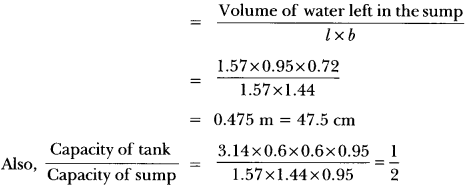
Surface Areas and Volumes Class 10 Extra Questions Maths Chapter 13 with Solutions Answers 75
Therefore, the capacity of the tank is half the capacity of the sump.

Question 14.
A container, opened from the top and made up of a metal sheet, is in the form of a frustum of a cone of height 16 cm with radii of its lower and upper ends as 8 cm and 20 cm, respectively. Find the cost of the milk which can completely fill the container, at the rate of ₹ 20 per litre. Also, find the cost of metal sheet used to make the container, if it costs ₹ 8 per 100 cm2 (Take π = 3.14)
Solution:
We have, R = 20 cm, r = 8 cm, h = 16 cm
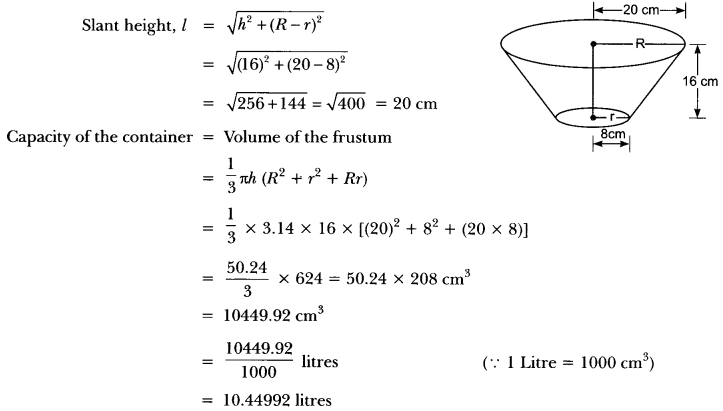
Surface Areas and Volumes Class 10 Extra Questions Maths Chapter 13 with Solutions Answers 76
Now, cost of milk to fill the container completely at the rate of ₹20 per litre
= ₹ 20 x 10.44992 = ₹ 208.9984 ₹ 209
Also, Surface area = πl(R + r) + πr2
= 3.14 × 20 × (20 + 8) + 3.14 × 8 × 8
= 3.14 [560 + 64] = 3.14 × 624 = 1959.36 cm2
∴ Total cost of metal sheet used to make the container at the rate of ₹ 8 per 100 cm2
= ₹ \(\frac{8}{100}\) × 1959.36 = ₹ 156.75.

Question 15.
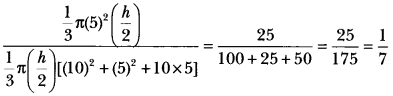
A metallic right circular cone 20 cm high whose vertical angle is 60° which is cut into two parts at the middle of its height by a plane parallel to its base. If the frustum so obtained be drawn into a wire of diameter 1/16 cm, find the length of the wire.
Solution:
Let VAB be the metallic right circular cone of height 20 cm.
Suppose this cone is cut by a plane parallel to its base at a point O’ such that VO’ = O’ O i.e., O’ is the mid point of VO. Let r1 andrą be the radii of circular ends of the frustrum ABB’A’. Now, in AVOA and VO’ A’, we have
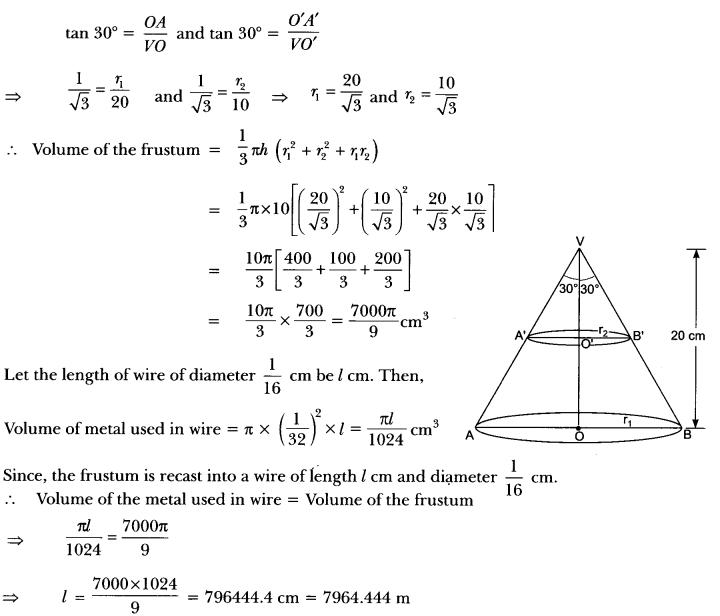
Surface Areas and Volumes Class 10 Extra Questions Maths Chapter 13 with Solutions Answers 77

Question 16.
In Fig, a cone of radius 10 cm is divided into two parts by drawing a plane through the mid-point of its axis, parallel to its base. Compare the volumes of the two parts.
Solution:
Let BC = r cm, DE = 10 cm
Since, B is the mid-point of AD and BC is parallel to DE, therefore C is the mid-point of AE.
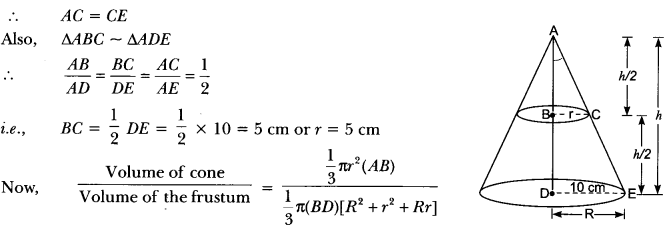
Surface Areas and Volumes Class 10 Extra Questions Maths Chapter 13 with Solutions Answers 78
Surface Areas and Volumes Class 10 Extra Questions Maths Chapter 13 with Solutions Answers 79

Question 17.
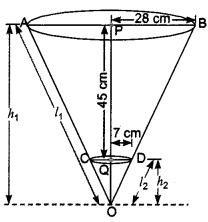
The radii of the ends of a frustum of a cone 45 cm, high are 28 cm and 7 cm (Fig). Find its volume, the curved surface area and the total surface area[ Take π = \(\frac{22}{7}\) ]
Solution:
Surface Areas and Volumes Class 10 Extra Questions Maths Chapter 13 with Solutions Answers 80
The frustum can be viewed as a difference of two right circular cones OAB and OCD (Fig. 13.37). Let the height (in cm) of the cone OAB be h1 and its slant height l1 ,i.e, OP = h1 and OA = OB = l1. Let h2 be the height of cone OCD and l2 its slant height.
We have, r1 = 28 cm, r2 = 7 cm
and the height of frustum (h) = 45 cm
Also, h1 = 45 + h2 …….. (i)
We first need to determine the respective heights h1 and h2 of the cone OAB and OCD.
Since the triangles OPB and OQD are similar, we have
\(\frac{h_{1}}{h_{2}}=\frac{28}{7}=\frac{4}{1}\) …….(ii)
From (i) and (ii), we get hy = 15 cm and h, = 60 cm.
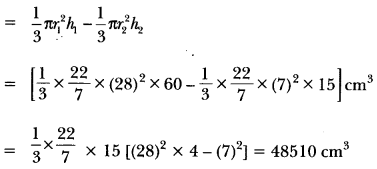
Now, the volume of the frustum = Volume of the cone OAB – Volume of the cone OCD
Surface Areas and Volumes Class 10 Extra Questions Maths Chapter 13 with Solutions Answers 81
The respective slant height l, and ly of the cones OCD and OAB are given by

Surface Areas and Volumes Class 10 Extra Questions Maths Chapter 13 with Solutions Answers 82
Thus, the curved surface area of the frustum = πr1l1 – πr2l2
= \(\frac{22}{7}\) (28)(66.20) – \(\frac{22}{7}\)(7) (16.55)
= \(\frac{22}{7}\) × 7 × 16.55(16 – 1) = 5461.5 cm2
Now, the total surface area of the frustum
= Curved surface area of frustum + πr12 + πr22
= 5461.5 cm2 + \(\frac{22}{7}\)2 cm2 + \(\frac{22}{7}\)(7)2 cm2
= 5461.5 cm2 + 2464 cm2 + 154 cm2
= 8079.5 cm2

Question 18.
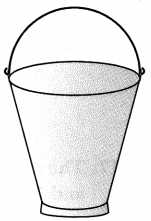
An open metal bucket is in the shape of a frustum of a cone, mounted on a hollow cylindrical base made of the same metallic sheet (Fig). The diameters of the two circular ends of the bucket are 45 cm and 25 cm, the total vertical height of the bucket is 40 cm and that of the cylindrical base is 6 cm. Find the area of the metallic sheet used to make the bucket, where we do not take into account the handle of the bucket. Also, find the volume of water the bucket can hold. [Take π = \(\frac{22}{7}\)]
Surface Areas and Volumes Class 10 Extra Questions Maths Chapter 13 with Solutions Answers 83
Solution:
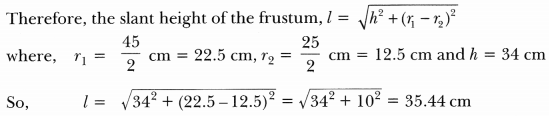
The total height of the bucket = 40 cm, which includes the height of the base.
So, the height of the frustum of the cone = (40 – 6) cm = 34 cm.
Surface Areas and Volumes Class 10 Extra Questions Maths Chapter 13 with Solutions Answers 84
Area of metallic sheet used
Curved surface area of frustum of cone + Area of circular base + Curved surface area of cylinder
= [π × 35.44 (22.5 + 12.5) + π × (12.5)2 + 21 × 12.5 × 6] cm2
= \(\frac{22}{7}\) (1240.4 + 156.25 + 150) cm2 = 4860.9 cm2
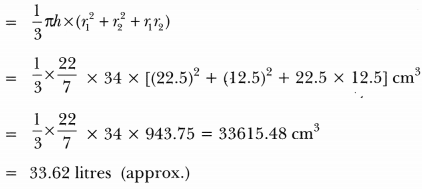
Now, the volume of water that the bucket can hold (also, known as the capacity of the bucket)
Surface Areas and Volumes Class 10 Extra Questions Maths Chapter 13 with Solutions Answers 85

Question 19.
150 spherical marbles, each of diameter 1.4 cm, are dropped in a cylindrical vessel of diameter 7 cm containing some water, which are completely immersed in water. Find the rise in the level of water in the vessel.
Solution:
Diameter of spherical balls = 1.4 cm
Radius of spherical balls, r = 0.7 cm
Diameter of cylinder = 7 cm
Radius of cylinder = 3.5 cm
No. of spherical balls = 150
Let the rise in water be h cm.
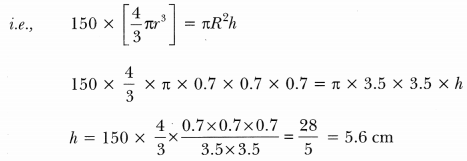
Now, 150 × volume of a spherical ball = Volume of cylinder with height h.
Surface Areas and Volumes Class 10 Extra Questions Maths Chapter 13 with Solutions Answers 86

Surface Areas and Volumes Class 10 Extra Questions HOTS

Question 1.
A well of diameter 3 m is dug 14 m deep. The earth taken out of it has been spread evenly all around it in the shape of a circular ring of width 4 m to form an embankment. Find the height of the embankment.
Solution:
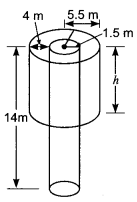
Surface Areas and Volumes Class 10 Extra Questions Maths Chapter 13 with Solutions Answers 87
Here, radius of the well = \(\frac{7}{2}\) = 1.5 m
1.5 m Depth of the well = 14 m
Width of the embankment = 4 m
∴ Radius of the embankment = 1.5 + 4 = 5.5 m
Let h be the height of the embankment.
∴ Volume of the embankment
= Volume of the well (cylinder)
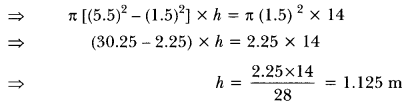
Surface Areas and Volumes Class 10 Extra Questions Maths Chapter 13 with Solutions Answers 88

Question 2.
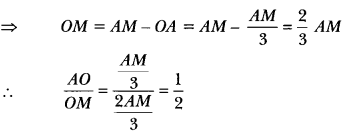
A hollow cone is cut by a plane parallel to the base at some height and the upper portion is removed. If the curved surface area of the remainder is of \(\frac{8}{9}\) the curved surface of the whole cone, find the ratio of the two parts into which the cone’s altitude is divided.
Solution:
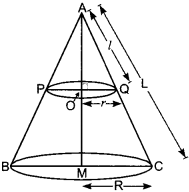
Surface Areas and Volumes Class 10 Extra Questions Maths Chapter 13 with Solutions Answers 89
In Fig, the smaller cone APQ has been cut off through the plane PQ || BC. Let r and R be the radii of the smaller and larger cone and l and L their slant heights respectively.
Here, in the adjoining figure
OQ = r, MC = R, AQ = l, AC = L.
Now, ∆AOQ ~ ∆AMC
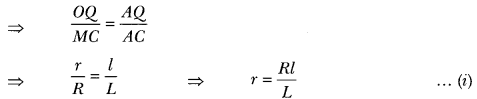
Surface Areas and Volumes Class 10 Extra Questions Maths Chapter 13 with Solutions Answers 90
Since, curved surface area of the remainder = \(\frac{8}{9}\) of the curved surface area of the whole cone,
therefore, we get,
CSA of smaller cone = \(\frac{1}{9}\) of the CSA of the whole cone
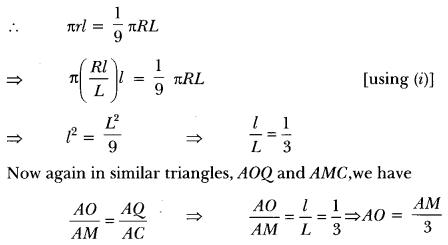
Surface Areas and Volumes Class 10 Extra Questions Maths Chapter 13 with Solutions Answers 91
Surface Areas and Volumes Class 10 Extra Questions Maths Chapter 13 with Solutions Answers 92
Hence, the required ratio of their heights = 1 : 2

Question 3.
The height of the cone is 30 cm. A small cone is cut off at the top by a plane parallel to the base. If its volume be \(\frac{1}{27}\) of the given cone, at what height above the base is the section made?
OR
The height of a cone is 30 cm. From its topside a small cone is cut by a plane parallel to its base. If volume of smaller cone is \(\frac{1}{27}\) of the given cone, then at what height it is cut from its base?
Solution:
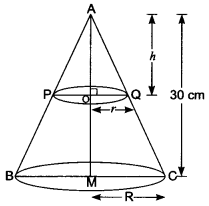
Surface Areas and Volumes Class 10 Extra Questions Maths Chapter 13 with Solutions Answers 93
Let the small cone APQ be cut off at the top by the plane PQ || BC
Let r and h be the radius and height of the smaller cone, respectively and also let the radius of larger cone = R
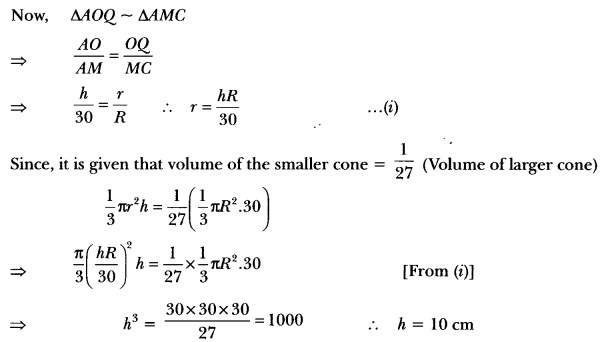
Surface Areas and Volumes Class 10 Extra Questions Maths Chapter 13 with Solutions Answers 94
Hence, the smaller cone has been cut off at a height of (30 – 10) cm = 20 cm from the base.

Question 4.
Water in a canal, 6 m wide and 1.5 m deep, is flowing with a speed of 10 km/h. How much area will it irrigate in 30 minutes, if 8 cm of standing water is needed?
Solution:
We have, width of the canal = 6 m
Depth of the canal = 1.5 m
Now, length of water flowing per hour = 10 km
∴ Length of water flowing in half hour = 5 km = 5,000 m
∴ Volume of water flow in 30 minutes = 1.5 × 6 × 5,000 = 45,000 m3
Here, standing water needed is 8 cm = 0.08 m

Surface Areas and Volumes Class 10 Extra Questions Maths Chapter 13 with Solutions Answers 95
= 562500 mo [1 hectare = 10000 m2]
= 56.25 hectares

Question 5.
A vessel is in the form of an inverted cone. Its height is 8 cm and the radius of its top, which is open, is 5 cm. It is filled with water up to the brim. When lead shots, each of which is a sphere of radius 0.5 cm are dropped into the vessel, one-fourth of the water flows out. Find 8 cm the number of lead shots dropped in the vessel.
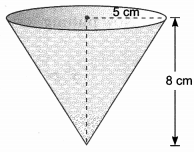
Surface Areas and Volumes Class 10 Extra Questions Maths Chapter 13 with Solutions Answers 96
Solution:
We have,
Height of conical vessel = h = 8 cm and its radius = r = 5 cm
Now, volume of cone = Volume of water in the cone
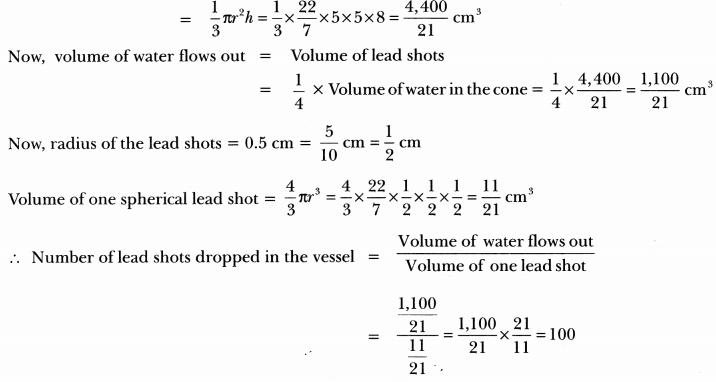
Surface Areas and Volumes Class 10 Extra Questions Maths Chapter 13 with Solutions Answers 97

Question 6.
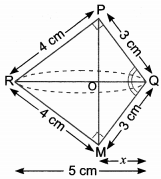
A right triangle with sides 3 cm and 4 cm is revolved around its hypotenuse. Find the volume of double cone thus generated. (Use π = 3.14).
Solution:
Surface Areas and Volumes Class 10 Extra Questions Maths Chapter 13 with Solutions Answers 98
In the given Fig, ∆PQR is a right triangle, where PQ = 3 cm, PR = 4 cm and QR = 5 cm.
(by Pythagoras Theorem)
Let OQ = x ⇒ OR = 5 – x and OP = y
Now in right angled-triangle POQ, we have
PQ2 = OQ2 + OP2
⇒ (3)2 = x2 + y2 = y2 = 9 – x2 …..(i)
Also from right angled triangle POR, we have
OP2 + OR2 = PR2
⇒ y2 + (5 – x)2 = (4)2
⇒ y2 = 16 – (5 – x)2 ….. (ii)
From (i) and (ii), we get
9 – x2 = 16 – (5 – x)2
⇒ 9 – x2 = 16 – (25 + x2 – 10x)
or 9 – x2 = – 9 – x2 + 10x
⇒ 10x = 18
⇒ x = \(\frac{9}{5}\)
∴ OR = 5 – x = 5 – \(\frac{9}{5}\) = \(\frac{16}{5}\)
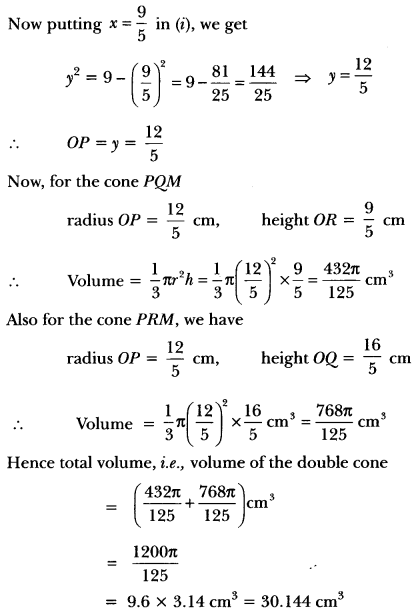
Surface Areas and Volumes Class 10 Extra Questions Maths Chapter 13 with Solutions Answers 99

Question 7.
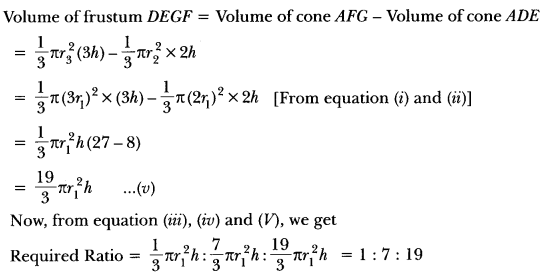
A right circular cone is divided into three parts by trisecting its height by two planes drawn parallel to the base. Show that the volumes of the three portions starting from the top are in the ratio 1 : 7 : 19.
Solution:
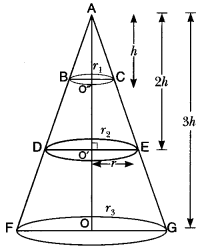
Surface Areas and Volumes Class 10 Extra Questions Maths Chapter 13 with Solutions Answers 100
From figure it is clear that
∆ACO” ~ ∆AEO’ [By AA similarity] and
∆ACO” ~ ∆AGO [By AA similarity]
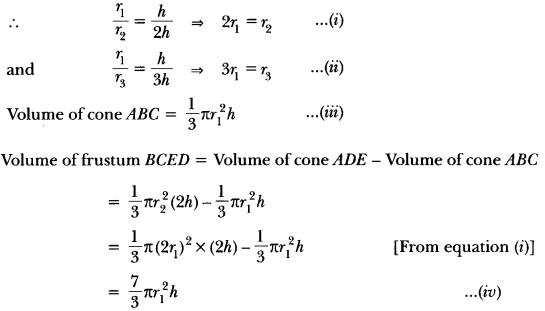
Surface Areas and Volumes Class 10 Extra Questions Maths Chapter 13 with Solutions Answers 101
Surface Areas and Volumes Class 10 Extra Questions Maths Chapter 13 with Solutions Answers 102

Light Reflection and Refraction Class 10 Extra Questions with Answers Science Chapter 10

In this page, we are providing Light Reflection and Refraction Class 10 Extra Questions and Answers Science Chapter 10 pdf download. NCERT Extra Questions for Class 10 Science Chapter 10 Light Reflection and Refraction with Answers will help to score more marks in your CBSE Board Exams.

Class 10 Science Chapter 10 Extra Questions and Answers Light Reflection and Refraction

Extra Questions for Class 10 Science Chapter 10 Light Reflection and Refraction with Answers Solutions

Extra Questions for Class 10 Science Chapter 10 Very Short Answer Type

Question 1.
Draw a schematic representation of different type of mirrors.
Answer:
Types of mirror:

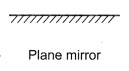
  1. Plane mirror
  2. Spherical mirror
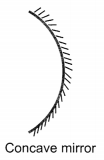
    (i) concave mirror
    (ii) convex mirror

Plane mirror:
Light Reflection and Refraction Class 10 Extra Questions with Answers Science Chapter 10, 1

(i) concave mirror
Light Reflection and Refraction Class 10 Extra Questions with Answers Science Chapter 10, 2

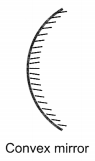
(ii) convex mirror
Light Reflection and Refraction Class 10 Extra Questions with Answers Science Chapter 10, 3

Question 2.
Define focal length.
Answer:
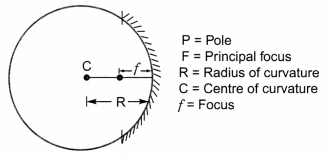
Focal length (f): The distance between the pole and principal focus (F) of a spherical mirror is called the focal length of the mirror. It is denoted by f.
f = \(\frac{R}{2}\)
Light Reflection and Refraction Class 10 Extra Questions with Answers Science Chapter 10, 4

Question 3.
Define one dioptre.
Answer:
1 dioptre is the power of a lens whose focal length is 1 metre. 1 D = 1 m-1

Question 4.
Define focus.
Answer:
Principal focus: A point on the principal axis of a spherical mirror where the rays of light parallel to the principal axis meet or appear to meet after reflection from the spherical mirror is called principal focus.

Question 5.
What is concave and convex mirror?
Answer:

  • Concave mirror: A spherical mirror, whose reflecting surface is curved inwards, that is it faces towards the centre of the sphere, is called a concave mirror.
  • Convex mirror: A spherical mirror whose reflecting surface is curved outwards, is called a convex mirror.

Question 6.
Define
1. Reflection of light
2. Beam of light
Answer:
(1) Reflection: When light falls on a surface and bounces back to the medium, the phenomena is called reflection.
(2) Beam: A beam is a bundle of rays, which originates from a common source and travels in the same direction.

Question 7.
Define light and write its properties.
Answer:
Light: It is a form of energy which produces the sensation of sight.

  • Light exhibits dual nature i.e., wave as well as particle nature.
  • It travels with speed of 3 × 10⁸ m/s in vacuum. However, speed is inversely proportional to optical density of medium.

Question 8.
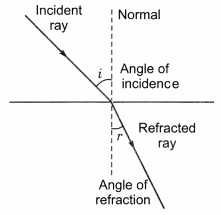
Draw a ray diagram showing the path of rays of light when it enters with oblique incidence (i) from air into water.
Answer:
Light Reflection and Refraction Class 10 Extra Questions with Answers Science Chapter 10, 5

Extra Questions for Class 10 Science Chapter 10 Short Answer Type I

Question 1.
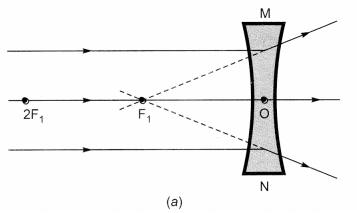
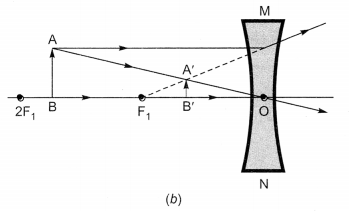
Draw the ray diagrams showing the image formation by a concave lens.
Answer:

Position of the objectPosition of the imageRelative size of the imageNature of the image
At infinityAt focus F1Highly diminished point sizedVirtual and erect
Between infinity and optical centre O of the lensBetween focus F and optical centre ODiminishedVirtual and erect

Light Reflection and Refraction Class 10 Extra Questions with Answers Science Chapter 10, 6
Light Reflection and Refraction Class 10 Extra Questions with Answers Science Chapter 10, 7
Nature, position and relative size of the image formed by a concave lens

Question 2.
Write lens formula and define magnification.
Answer:
Lens formula and magnification
\(\frac { 1 }{ v }-\frac { 1 }{ u }=\frac { 1 }{ f }\)
u = object distance
v = image distance
f = focal length

Magnification (m): Magnification is defined as the ratio of height of image and to height of the object.
Light Reflection and Refraction Class 10 Extra Questions with Answers Science Chapter 10, 8
h’ = height of image
h = height of object

Question 3.
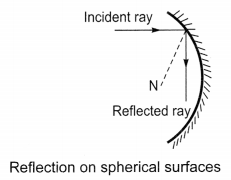
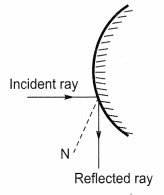
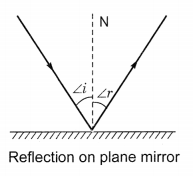
State laws of reflection.
Answer:
Laws:

  1. The angle of incidence is equal to the angle of reflection.
  2. The incident ray, the normal to the mirror at the point of incidence and reflected ray, all lie in the same plane.

These laws of reflection are applicable to all types of reflecting surfaces including spherical surfaces.
Light Reflection and Refraction Class 10 Extra Questions with Answers Science Chapter 10, 9
Light Reflection and Refraction Class 10 Extra Questions with Answers Science Chapter 10, 10
Light Reflection and Refraction Class 10 Extra Questions with Answers Science Chapter 10, 11

Question 4.
Write four difference between real and virtual image.
Answer:
Real image:

  1. When rays of light after reflection meets at a point real image is formed.
  2. Real image can be obtained on screen.
  3. Real image is formed in front of mirror.
  4. Real image is always inverted.

Virtual image:

  1. When rays of light do not actually meet but appear to meet at a point after reflection, virtual image is formed.
  2. Virtual image cannot be obtained on screen.
  3. Virtual image is formed behind the mirror.
  4. Virtual image is always erect.

Question 5.
If the speed of light in vacuum is 3 × 108 ms-1, find the speed of light in a medium of absolute refractive index 1.5.
Answer:
Light Reflection and Refraction Class 10 Extra Questions with Answers Science Chapter 10, 12
Here, v1 = 3 × 10⁸ m/s, n1 = 1, n2 = 1.5
v2 = \(\frac { 1 }{ 1.5 }\) × 3 × 10⁸
v2 = 2 × 10⁸ m/s

Question 6.
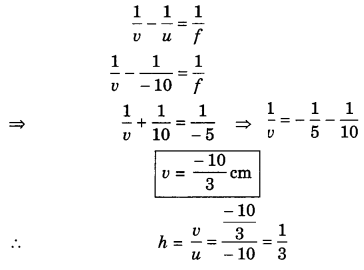
An object of height 6 cm is placed perpendicular to the principal axis of a concave lens of focal length 5 cm. Use lens formula to determine the position, size and nature of the image if the distance of the object from the lens is 10 cm.
Answer:
h = 6 cm, f = -5 cm, u = -10 cm
Light Reflection and Refraction Class 10 Extra Questions with Answers Science Chapter 10, 13
Image is diminished and erect.

Question 7.
Define refractive index and relative refractive index.
Answer:
1. Refractive index: The ratio of speed of light in vacuum (c) to the speed of light in any medium (v) is called refractive index of the medium.
Light Reflection and Refraction Class 10 Extra Questions with Answers Science Chapter 10, 14

2. Relative refractive index: The relative refractive index of a medium with respect to other medium is the ratio of the speed of light in the first medium with respect to the second medium.
Light Reflection and Refraction Class 10 Extra Questions with Answers Science Chapter 10, 15
Here, n21 = Relative refractive index of medium 2 with respect to medium 1 is
Light Reflection and Refraction Class 10 Extra Questions with Answers Science Chapter 10, 16
Here, n12 = Relative refractive index of medium 1 with respect to medium 2.

Question 8.
Write some illustrations of refraction.
Answer:
Some applications of refraction:

  1. Bottom of a tank or a pond containing water appears to be raised due to refraction.
  2. When a thick glass slab is placed over some printed matter the letters appear raised when viewed through the glass slab.
  3. When a pencil is partly immersed in water, it appears to be bent at the interface of air and water.
  4. A lemon kept in water in a glass tumbler appears to be bigger than its actual size, when viewed from the sides.

Question 9.
Name the type of mirror used in solar furnace. How is high temperature achieved by this device?  (CBSE 2012)
Answer:
Concave mirror is used in solar furnace. The solar furnace is placed at the focus of the large concave reflector. The concave reflector focus the Sim’s heat rays on the furnace and a high temperature is achieved.

Question 10.
The absolute refractive indices of glass and water are \(\frac{4}{3}\) and \(\frac{3}{2}\) respectively. If the speed of light in glass is 2 × 10⁸ ms-1, calculate the speed of light in (i) vacuum and (ii) water.  (CBSE2015)
Answer:
Given, µg= \(\frac{4}{3}\) and µw = \(\frac{3}{2}\)
Speed of light in glass = 2 × 10⁸ ms-1
(i) Speed of light in vacuum, c = µg × vg = \(\frac{4}{3}\) × 2 × 108 = 2.67 × 10⁸ ms-1
(ii) Speed of light in water,
Light Reflection and Refraction Class 10 Extra Questions with Answers Science Chapter 10, 17

Question 11.
A convex lens of focal length 25 cm and a concave lens of focal length 10 cm are placed in closed contact with each other. Calculate the lens power of the combination.
Answer:
Power of convex lens, P1 = \(\frac{1}{f_{1}}=\frac{1}{0.25}\) = 4D
Power of concave lens, P2 = \(\frac{1}{f_{2}}=\frac{1}{-0.1}\) = -10D
power of combination, P = P1 +P2 = 4D – 10D = -6D

Extra Questions for Class 10 Science Chapter 10 Short Answer Type II

Question 1.
Define power of a lens. What is its unit? One student uses a lens of focal length 50 cm and another of -50 cm. What is the nature of the lens and its power used by each of them? (NCERT Exemplar)
Answer:
Power of a lens: The power of a lens is defined as reciprocal of its focal length.
P = \(\frac{1}{f}\)
f= focal length (in metre)

The SI unit of power is ‘dioptre’. It is denoted by the letter D.
Here, f= 50 cm = 0.5 m
Power P = \(\frac{1}{f}=\frac{1}{0.5}\) = +2D

f = – 50 cm = -0.5 m
Power P = \(\frac{1}{f}=\frac{1}{-0.5}\) = -2D

Question 2.
Define lens. What is difference between convex and concave lens?
Answer:
Lens: A transparent medium bound by two surfaces, of which one or both surfaces are spherical, forms a lens:
Convex lens: A lens having two spherical surfaces, bulging outwards is called a double convex lens or convex lens.

  • It is thicker at the middle as compared to the edges.
  • Convex lens converges light.
    Hence, convex lens are called converging lens.

Concave lens: A double concave lens is bounded by two spherical surfaces curved inwards.

  • It is thicker at edges than in the middle.
  • Concave lens is diverging in nature.

Question 3.
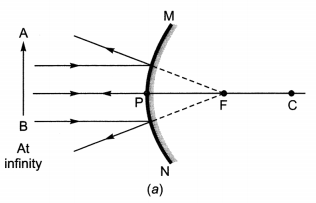
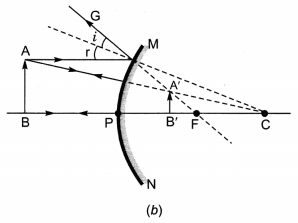
Draw ray diagrams showing the image formation by a convex mirror when an object is placed (NCERT Exemplar)
(a) at infinity
(b) at finite distance from the mirror
Answer:
Formation of image by convex mirror:

Position of the objectPosition of the imageRelative size of the imageNature of the image
At infinityAt focus F behind the mirrorHighly diminished, point sizedVirtual and erect
Between infinity and the pole P of the mirrorBetween P and F behind the mirrorDiminishedVirtual and erect

Ray diagram for image formation by convex mirror:
Light Reflection and Refraction Class 10 Extra Questions with Answers Science Chapter 10, 18
Light Reflection and Refraction Class 10 Extra Questions with Answers Science Chapter 10, 19

Question 4.
Write down the uses of concave and convex mirror.
Answer:
Uses of mirrors:
1. Uses of concave mirrors:

  • Concave mirrors are commonly used in torches, searchlights and vechicles headlights to get powerful beam of light.
  • It is used in shaving mirrors to see large image of the face.
  • Dentists use concave mirror to see large images of the teeth of patients.
  • Large concave mirrors are used to concentrate sunlight to produce heat in solar furnace.

2. Uses of convex mirrors

  • Convex mirrors are used as rear-view (wing) mirrors in vehicles.
  • Convex mirrors are used as street reflectors because they are able to spread light over a bigger area.

Question 5.
(i) “The refractive index of kerosene is 1.44.” What is meant by this statement?
(ii) A ray of light strikes a glass slab of an angle of incidence equal to 30°. Find the refractive index of glass such that the angle of refraction is 19.5°. (Take sin 19.5° = \(\frac{1}{3}\) and sin 30° = \(\frac{1}{2}\) ) (CBSE 2015)
Answer:
(i) Refractive index of any medium with respect to another indicated the extent to which binding of light takes place when it enters from the first medium to the given medium. The given value of refractive index also states that speed of light in kerosene is \(\frac{1}{1.44}\) times the speed of light in a vacuum.
(ii) Given, i = 30°, r = 19.5°
Light Reflection and Refraction Class 10 Extra Questions with Answers Science Chapter 10, 20

Extra Questions for Class 10 Science Chapter 10 Long Answer Type

Question 1.
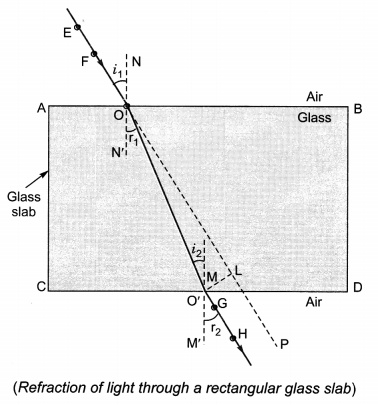
Write the laws of refraction. Explain the same with the help of ray diagram, when a ray of light passes through a rectangular glass slab. (NCERT Exemplar)
Answer:
Laws of refraction:

  • The incident ray, the refracted ray and the normal at the point of incidence, all lie in the same plane.
  • The ratio of sine of angle of incidence to the sine of angle of refraction is a constant, for the light of a given colour and for the given pair of media. This law is also known as Snell’s law of refraction.

If i is the angle of incidence and r is angle of refraction.
sin i / sin r = constant

Refraction through glass slab:

  • The ray of light enters from rarer to denser medium at point O that is from air to glass and bends towards the normal.
  • At ‘O’, the light ray enters from glass to air, that is, from a denser medium to a rarer medium. The light here bends away from normal.
  • The emergent ray is parallel to the incident ray. However the light ray shifts slightly sideward.
  • Refraction is due to change in speed of light when it enters from one medium to another.

Light Reflection and Refraction Class 10 Extra Questions with Answers Science Chapter 10, 21

Question 2.
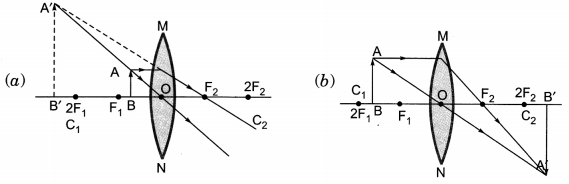
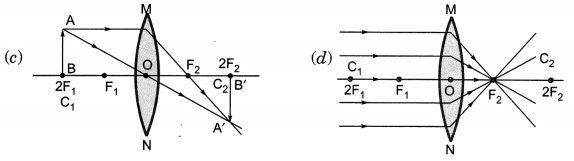
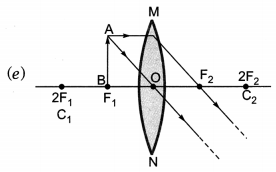
Draw ray diagrams showing the image formation by a convex lens when an object is placed (NCERT Exemplar)
(a) between optical centre and focus of the lens
(b) between focus and twice the focal length of the lens
(c) at twice the focal length of the lens
(d) at infinity
(e) at the focus of the lens
Answer:
Nature, position and relative size of the image formed by a convex lens for various positions of the object

Position of the objectPosition of the imageRelative size of the imageNature of the image
(a) Between optical centre O and focus F1On the same side of the lens as the objectEnlargedVirtual and erect
(b) Between F1 and 2F1Beyond 2F2EnlargedReal and inverted
(c) At 2F1At 2F2Same sizeReal and inverted
(d) At infinityAt focus F2Highly diminished, point-sizedReal and inverted
(e) At focus F1At infinityInfinitely large or highly enlargedReal and inverted

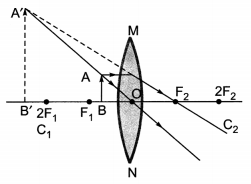
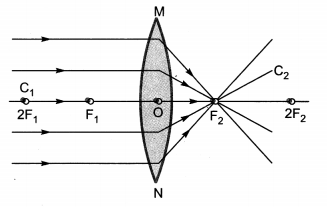
Ray diagram for the image formation by convex lens:
Light Reflection and Refraction Class 10 Extra Questions with Answers Science Chapter 10, 22
Light Reflection and Refraction Class 10 Extra Questions with Answers Science Chapter 10, 23
Light Reflection and Refraction Class 10 Extra Questions with Answers Science Chapter 10, 24
The position, size and the nature of the image formed by a convex lens for various positions of the object.

Question 3.
Draw ray diagrams showing the image formation by a concave mirror when an object is placed
(a) at the focus of the lens
(b) between focus and twice the focal length of the lens
(c) beyond twice the focal length of the lens
Answer:
Image formation by a concave mirror for different positions of the object

Position of the objectPosition of the imageSize of the imageNature of the image
(a) At FAt infinityHighly enlargedReal and inverted
(b) Between C and FBeyond CEnlargedReal and inverted
(c) Beyond CBetween F and CDiminishedReal and inverted

Question 4.
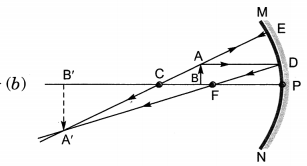
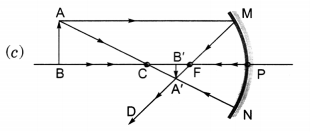
Draw ray diagram for the image formation by a concave mirror.
Answer:
Light Reflection and Refraction Class 10 Extra Questions with Answers Science Chapter 10, 25
Light Reflection and Refraction Class 10 Extra Questions with Answers Science Chapter 10, 26
Light Reflection and Refraction Class 10 Extra Questions with Answers Science Chapter 10, 27

Question 5.
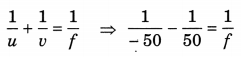
A spherical mirror produces an image of magnification -1 on a screen placed at a distance of 50 cm from the mirror.
(a) Write the type of mirror.
(b) Find the distance of the image from the object.
(c) What is the focal length of the mirror? (CBSE 2014)
Answer:
(a) Concave mirror
(b) m = -1, u = -50 cm,
Light Reflection and Refraction Class 10 Extra Questions with Answers Science Chapter 10, 28
∴ v = -50 cm
(c)
Light Reflection and Refraction Class 10 Extra Questions with Answers Science Chapter 10, 29
∴ f = -25 cm

Question 6.
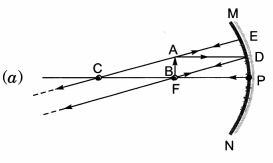
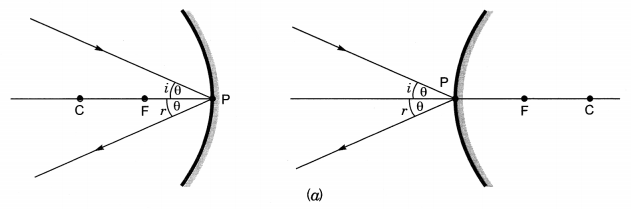
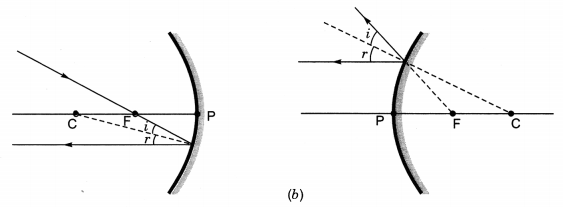
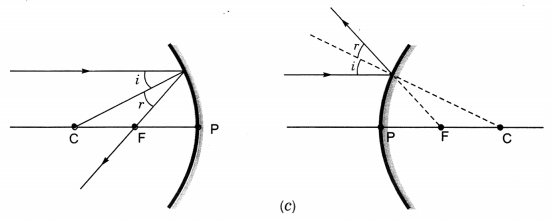
Draw a ray diagram to show the path of the reflected ray in each of the following cases. A ray of light incident on a convex mirror and concave mirror
(a) strikes at its pole making an angle θ with the principal axis.
(b) is directed towards its principal focus.
(c) is parallel to its principal axis.
Answer:
Light Reflection and Refraction Class 10 Extra Questions with Answers Science Chapter 10, 30
Light Reflection and Refraction Class 10 Extra Questions with Answers Science Chapter 10, 31
Light Reflection and Refraction Class 10 Extra Questions with Answers Science Chapter 10, 32

Light Reflection and Refraction HOTS Questions With Answers

Question 1.
The refractive indices of water and glass with respect to air are 4/3 and 3/2 respectively. If the speed of light in glass is 2 × 10⁸ ms-1, find the speed of light in (i) air, (ii) water.
Answer:
(i) Let v1 = speed of light in air,
v2 = speed of light in glass,
then, \(\frac{n_{2}}{n_{1}}\) = refractive index of glass with respect to air = \(\frac{3}{2}\)
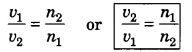
\(\frac{v_{1}}{v_{2}}=\frac{n_{2}}{n_{1}}\) , v2 = 2 × 10⁸ m/s
\(\frac{n_{1}}{n_{2}}\) = \(\frac{2}{3}\)
v1 = \(\frac{3}{2}\) × 2 × 10⁸ m/s = 3 × 10⁸ m/s

(ii) Let = speed of light in water,
v2 = speed of light in air,
then \(\frac{n_{2}}{n_{1}}\) = refractive index of water with respect to air
\(\frac{v_{1}}{v_{2}}=\frac{n_{2}}{n_{1}}\) Here, u2 = 3 × 10⁸ m/s
= \(\frac{n_{1}}{n_{2}}\) = \(\frac{4}{3}\)
v1 = \(\frac{3}{4}\) × 3 × 108 = 1.5 × 10⁸ m/s.

Question 2.
The image of a candle flame formed by a lens is obtained on a screen placed on the other side of the lens. If the image is three times the size of the flame and the distance between lens and image is 80 cm, at what distance should the candle be placed from the lens? What is the nature of the image at a distance of 80 cm and the lens? (NCERT Exemplar)
Answer:
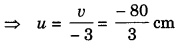
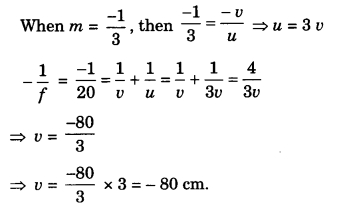
m = \(\frac{v}{u}\) = – 3,  v = +80 cm[m is negative since image is real (obtained on a screen)]
\(\frac{v}{u}\) = -3
Light Reflection and Refraction Class 10 Extra Questions with Answers Science Chapter 10, 33
Image is real (obtained on screen), inverted and enlarged. The lens is convex.

Question 3.
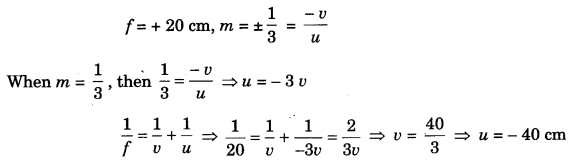
Size of image of an object by a mirror having a focal length of 20 cm is observed to be reduced to 1/3rd of its size. At what distance the object has been placed from the mirror? What is the nature of the image and the mirror?
Answer:
Light Reflection and Refraction Class 10 Extra Questions with Answers Science Chapter 10, 34
Therefore the mirror is convex and the image is virtual, erect, and diminished.
Light Reflection and Refraction Class 10 Extra Questions with Answers Science Chapter 10, 35
Therefore, the mirror is concave and the image is real, inverted and diminished.

Question 4.
A student focussed the image of a candle flame on a white screen using a convex lens. He noted down the position of the candle screen and the lens as under  (NCERT Exemplar)
Answer:
Position of candle = 12.0 cm
Position of convex lens = 50.0 cm
Position of the screen = 88.0 cm
(i) What is the focal length of the convex lens?
(ii) Where will the image be formed if he shifts the candle towards the lens at a position of 31.0 cm?
(iii) What will be the nature of the image formed if he further shifts the candle towards the lens?
(iv) Draw a ray diagram to show the formation of the image in case (iii) as said above.
Answer:
(i) Here, u = – 38 cm, v = 38 cm
Light Reflection and Refraction Class 10 Extra Questions with Answers Science Chapter 10, 36

(ii) u = – 19 cm
Light Reflection and Refraction Class 10 Extra Questions with Answers Science Chapter 10, 37
V = ∞

(iii) The object (candle) will be between the principal focus and optical centre. Hence image formed will be enlarged, virtual and erect.

(iv)
Light Reflection and Refraction Class 10 Extra Questions with Answers Science Chapter 10, 38

Question 5.
Identify the device used as a spherical mirror or lens in the following cases, when the image formed is virtual and erect in each case.
(a) Object is placed between device and its focus, image formed is enlarged and behind it.
(b) Object is placed between the focus and device, image formed is enlarged and on the same side as that of the object.
(c) Object is placed between infinity and device, image formed is diminished and between focus and optical centre on the same side as that of the object.
(d) Object is placed between infinity and device, image formed is diminished and between pole and focus, behind it.
Answer:
(a) Concave mirror
(b) Convex lens
(c) Concave lens
(d) Convex mirror

Question 6.
Sudha finds out that the sharp image of the window pane of her science laboratory is formed at a distance of 15 cm from the lens. She now tries to focus the building visible to her outside the window instead of the window pane without disturbing the lens. In which direction will she move the screen to obtain a sharp image of the building? What is the approximate focal length of this lens? (NCERT Exemplar)
Light Reflection and Refraction Class 10 Extra Questions with Answers Science Chapter 10, 39
Answer:
Sudha should move the screen towards the lens so as to obtain a clear image of the building. Here the object is at infinity and hence a sharp image of the object is formed at the principal focus (F1) of the lens. Hence, the approximate focal length of this lens will be 15 cm.

Extra Questions for Class 10 Science Chapter 10 Value Based Questions

Question 1.
Amit and Sumeet visited National Bal Bhawan on Environmental day. There they saw a concentrator type of solar cooker installed for Basic heating usage. Give the answers of the following questions:
(i) Type of mirror used in concentrating type solar cooker
(ii) Values shown by the organisation
Answer:
(i) Concave mirror
(ii) Organisation management is good and have a knowledge of conservation of energy

Question 2.
Ravi went to Manali during summer vacation. He saw a type of mirror was installed by road management to avoid accident.
Give the answers of following questions:
(i) Type of mirror used.
(ii) Values shown by road management
Answer:
(i) Convex mirror
(ii) Road management had displayed the correct use of knowledge as a convex mirror gives erect image and a wider field of view. The management had taken concern to avoid accidents.

Heredity and Evolution Class 10 Extra Questions with Answers Science Chapter 9

In this page, we are providing Heredity and Evolution Class 10 Extra Questions and Answers Science Chapter 9 pdf download. NCERT Extra Questions for Class 10 Science Chapter 9 Heredity and Evolution with Answers will help to score more marks in your CBSE Board Exams.

Class 10 Science Chapter 9 Extra Questions and Answers Heredity and Evolution

Extra Questions for Class 10 Science Chapter 9 Heredity and Evolution with Answers Solutions

Extra Questions for Class 10 Science Chapter 9 Very Short Answer Type

Question 1.
Define heredity.  [CBSE 2012]
Answer:
Transmission of characters/traits from parents to their offspring is called heredity.

Question 2.
Write the sex of the baby that inherits Y-chromosome from the father.  [CBSE 2013]
Answer:
The baby that inherits the Y-chromosome from the father will be a male.

Question 3.
Name the scientist who gave the theory of evolution.  [CBSE 2013]
Answer:
Charles Darwin.

Question 4.
Define species.  [CBSE 2013]
Answer:
Species is a group of organisms which can interbreed among themselves to produce fertile offsprings.

Question 5.
Define natural selection.  [CBSE 2012]
Answer:
The process of evolution of species where the characteristics of the organisms which enable them to survive and reproduce are passed on to their progeny is called natural selection.

Question 6.
Identify the analogous and homologous organs amongst the following – wings of an insect, wings of a bat, forelimbs of lizard, and forelimbs of bird.  [CBSE 2012]
Answer:
Analogous organs: Wings of an insect and wings of a bat.
Homologous organs: Forelimbs of lizard and forelimbs of bird.

Question 7.
Give an example where sex is determined by the environmental factors.  [CBSE 2012]
Answer:
In some snails and turtles, sex is determined by environmental factors.

Question 8.
Write one word for the formation of new species due to gradual change over long period of time.  [CBSE 2013]
Answer:
Speciation.

Extra Questions for Class 10 Science Chapter 9 Short Answer Type I

Question 1.
How can we say that change in genes can be brought about by change in DNA?  [CBSE 2013]
Answer:
Segment of DNA on a chromosome which carries information for the appearance of a particular character is called a gene. It helps in the inheritance of the character from one generation to another. So, we can say that changes in gene can be brought about by change in DNA.

Question 2.
In pea plant, round seed is dominant over wrinkled. If a cross is carried between these two plants, give answer to the following questions.
(a) Mention the genes for the traits of parents.
(b) State the trait of F1 hybrids.
(c) Write the ratio of F2 progeny obtained from this cross. What is the name of the cross?[CBSE 2011]
Answer:
(a) RR/rr
(b) The F1 hybrid will be Round (Rr).
(c) Phenotypic ratio = 3 : 1; Genotypic ratio = 1 : 2 : 1; The cross will be called as Monohybrid cross.

Question 3.
What do you understand by reproductive isolation?  [CBSE 2012]
Answer:
If the members of the two species are unable to reproduce themselves due to physical, behavioural, ecological, and temporal or development reasons, then the process is called as reproductive isolation.

Question 4.
Explain with the help of a suitable example where the colour change gives no survival advantage to a species. [CBSE 2013]
Answer:
In the illustration shown the colour of the red coloured beetles living in the green coloured bushes changes to blue colour, but still, it offers no advantage in the green colour bushes because the predators can easily spot the beetles. An elephant stumps on the bushes and kills most of the red beetles. The blue beetles survive merely by chance and not due to their body colour.

Heredity and Evolution Class 10 Extra Questions with Answers Science Chapter 9, 1

Question 5.
Distinguish between acquired and inherited traits with example of each.
Answer:
Inherited traits:

  • The traits which are passed on from the parents to their progeny by transfer of genes.
  • For example, Eye colour

Acquired traits:

  • The traits acquired by individual during its lifetime.
  • For example, Riding a bicycle, playing cricket, etc.

Question 6.
How can it be said that birds are closely related to reptiles?  [CBSE 2013]
Answer:
Reptiles like Dinosaurs had feathers to maintain their body temperature. The birds have adapted the feathers for flight. So, it can be said that the birds have evolved from the reptiles. Archaeopteryx is a fossil which forms a link between the birds and the reptiles.

Extra Questions for Class 10 Science Chapter 9 Short Answer Type II

Question 1.
Can you justify the statement that “Human males are responsible for determining the sex of the baby and not females”?  [CBSE 2012, 2013]
Answer:
The sex in human beings or the sex of the individual is largely genetically determined. A male cell has two types of sex chromosomes i.e., X – chromosome and Y – chromosome because of which male produces two types of sperms with genotype A + X and A + Y. Female cells have two X – chromosomes so the genotype of eggs produced by her is A + X. During fertilisation the chances are:

Heredity and Evolution Class 10 Extra Questions with Answers Science Chapter 9, 2

  • If a sperm carrying Y – chromosome fertilises the egg, then the child born will be a male i.e., AA + XY.
  • If a sperm carrying X – chromosome fertilises the egg then the child born will be a female i.e., AA + XX.

Thus we can infer that the sperm of the male determines the sex of the child.

Question 2.
“Red beetles live in a bush with green beetles. Eventually, the number of green beetles increases as compared to red beetles”.
(a) Give a reason for the increased number of green beetles.
(b) State two advantages of variations.  [CBSE 2012]
Answer:
(a) The crows are unable to spot the green coloured beetles in the green coloured bushes, so the number of green coloured beetles increases.

(b) Variations are advantageous as they:

  • Enable the survival of the organism under adverse conditions.
  • Leads to evolution.

Question 3.
Name the scientist who gave the ‘Theory of Natural Selection’. State and explain the theory briefly.  [CBSE 2013]
Answer:
The theory of evolution by natural selection, first formulated in Darwin’s book “On the Origin of Species” in 1859, is the process by which organisms change over time as a result of changes in heritable physical or behavioural traits. Changes that allow an organism to better adapt to its environment will help it survive and have more offspring.

The four steps in the process can be summarised as:

  1. Large numbers: The parent produces more offspring than that can survive.
  2. Competition: There is a limited amount of resources, so competition occurs among the offsprings and also with the other members of the population.
  3. Survival of the fittest: Only the members who have favourable variations survive the competition.
  4. Natural selection: The surviving members reproduce and pass on the variations to their progeny.

Question 4.
Define the term ‘Evolution’. “Evolution cannot be equated with progress”. Justify.  [CBSE 2013]
Answer:
The process by which the new types of organisms are formed from the pre-existing organisms through variations and modifications is called evolution.

Natural selection and genetic drift cause evolution but that does not mean that

  • One species is eliminated to form the new one, or
  • The new species is better than the older one. So, evolution should not be equated with progress as multiple branches are possible at each and every stage of evolution.

Example: Human beings have not evolved from chimpanzees. Both have evolved in their own separate ways from a common ancestor a long time ago.

Question 5.
“Our teeth and elephant’s tusks are homologous organs”. Justify this statement. What do the analogous organs indicate?  [CBSE 2012]
Answer:
Our teeth and elephant’s tusks are homologous organs because they have the same basic structure and origin but perform different functions.
Analogous organs are those organs which perform the same function but have different structure.

Question 6.
How and why did human race spread from Africa to other parts of the world? [CBSE 2013]
Answer:
Earliest members of human species (Homo sapiens) came from Africa. Some of our ancestors stayed back in Africa while others moved and spread across to West Asia, Central Asia, Eurasia, South Asia, and East Asia.

They moved from the islands of Indonesia and the Philippines to Australia, and some crossed the Bering land bridge to reach America. They did not go in a single line but went forwards and backwards, with groups sometimes separating from each other, sometimes coming back to mix with each other, even moving in and out of Africa.

Question 7.
Give reasons why acquired characters are not inherited.
Answer:
No change in the DNA of germ cells is produced by the acquired characters, so they cannot be inherited. Only those characters are inherited which have a gene for them.

Extra Questions for Class 10 Science Chapter 9 Long Answer Type

Question 1.
Demonstrate with an example that traits may be dominant or recessive. Write down Mendel’s law related to it. [CBSE 2013]
Answer:
The cross shown below demonstrates that the traits may be dominant or recessive.
Heredity and Evolution Class 10 Extra Questions with Answers Science Chapter 9, 3
The law related to it is the Mendel’s first law of inheritance i.e., Law of dominance, which states that:

  • Characters are controlled by discrete units called factors.
  • Factors occur in pairs.
  • In a dissimilar pair of factors one member of the pair dominates (dominant) the other (recessive).

Question 2.
In a monohybrid cross between tall pea plants denoted by TT and short pea plants denoted by tt, Preeti obtained only tall plants denoted by Tt in the F1 generation. However, in F2 generation she obtained both tall and short pea plants. Using the above information, explain the law of dominance.  [CBSE 2011]
Answer:
The cross shown below demonstrates that the traits may be dominant or recessive.
Heredity and Evolution Class 10 Extra Questions with Answers Science Chapter 9, 4
The law related to it is the Mendel’s first law of inheritance i.e., Law of dominance, which states that:

  • Characters are controlled by discrete units called factors.
  • Factors occur in pairs.
  • In a dissimilar pair of factors one member of the pair dominates (dominant) the other (recessive).

Question 3.
Define speciation. What are the factors which lead to speciation?  [CBSE 2013]
Answer:
The process of formation of new species from the existing species is called speciation.
The factors which lead to the formation of new species are:

(i) Reproductive Isolation:
(a) Allopatric speciation: Caused by the various types of barriers like mountain ranges, rivers, seas, etc. It leads to reproductive isolation between members of the species and this is also called geographical isolation.
(b) Sympatric speciation: It occurs when populations of a species that share the same habitat become reproductively isolated from each other.

(ii) Genetic Drift: It is caused by change in the frequency of a particular genes by accident or by chance alone.

(iii) Natural Selection: The process by which a group of organisms adopts to fit their environment in a better way.

(iv) Migration: When movement of a section of population to another place and population occurs.

(v) Mutation: Sudden changes in the sequence of DNA.

Question 4.
In a cross between plants with purple flowers and plants with white flowers, the FI had all white flowers. When F1 generation was self bred, the F2 generation gave rise to 100 individuals, 75 of which had white flowers. Make a cross and answer.
(а) What are the genotypes of F2 individual?
(b) What is the ratio of purple flowered plants in F2 generation?  [CBSE 2012]
Answer:
W = White.
w – Purple.
Heredity and Evolution Class 10 Extra Questions with Answers Science Chapter 9, 5
(a) Genotypes of F2 individuals are 1(WW) : 2(Ww) : 1(ww)
(b) Ratio of white to purple flowers = 3 : 1, i.e., 3 white : 1 purple

Question 5.
Does geographical isolation of individuals of a species lead to formation of a new species? Provide a suitable explanation.
Answer:
Yes, geographical isolation gradually leads to genetic drift. It leads to productive isolation between members of the species as it imposes limitations to sexual reproduction of the separated population.

Slowly new variations arise as the separated individuals reproduce among themselves. Accumulation of the variations which arise through a few generations may ultimately lead to the formation of a new species.

Question 6.
Bacteria have a similar body plan when compared with human beings. Does it mean that human beings are more evolved than bacteria. provide a suitable explanation.
Answer:
It depends on the perspective which we consider while assessing whether humans are more evolved than the bacteria because, if appearance of complexity is concurrent with evolution, then human beings are certainly more evolved than bacteria.

But if we take the toataliy of life characteristics into account, then it is hard to lable either organisms are evolved.

Question 7.
Give the basic features of the mechanism of inheritance.
Answer:
The basic features of the mechanism of inheritance are:

  • Characters are controlled by genes.
  • Genes are present on the chromosomes.
  • Each gene controls one character.
  • There may be two or more forms of the same gene.
  • One form of the gene may be dominant over the other.
  • Two forms of the gene whether similar or dissimilar are present in an individual.
  • The two forms of the gene separate at the time of gamete formation.
  • The two forms of the gene are brought together in the zygote.

Heredity and Evolution HOTS Questions With Answers

Question 1.
In a cross between plants with purple flowers and plants with white flowers, the F1 had all purple flowers. When F1 generation was self bred, the F2 generation gave rise to 100 individuals, 75 of which had purple flowers. Make a cross and answer.
(a) What are the genotypes of F2 individual?
(b) What is the ratio of purple flowered plants in F2 generation? [CBSE 2012]
Answer;
The cross is depicted as under:
W = White, w = purple
Heredity and Evolution Class 10 Extra Questions with Answers Science Chapter 9, 6
(a) The genotype of F2 individuals is
Heredity and Evolution Class 10 Extra Questions with Answers Science Chapter 9, 7

(b) Ratio of purple flowered plants in F2 generation is:
Heredity and Evolution Class 10 Extra Questions with Answers Science Chapter 9, 8

Question 2.
An elephant learns a trick at the circus. Will his offsprings also know the trick by birth? Support your answer with reasons.  [CBSE 2013]
Answer:
Learning a trick at the circus is not an inherited trait. It is an acquired trait which cannot be transferred into the progeny. So, his offsprings will not know the trick by birth.

Question 3.
Do genetic combination of mother’s play a significant role in determining the sex of a new born?
Answer:
No, because mothers have a pair of X-chromosomes. All children will inherit an “X’ chromosome from their mother regardless of whether they are boys or girls.

Question 4.
Mention three important features of fossils which help in the study of evolution.
Answer:
The features of fossils which help in the study of evolution are:

  1. They are modes of preservation of ancient species.
  2. They help in establishing evolutionary relationships among organisms and their ancestors.
  3. They help in establishing the time period in which organisms lived.

Question 5.
In human beings, the statistical probability of getting either a male or female child is 50 : 50. Give a suitable explanation.
Answer:
The type of sex chromosome contributed by the male gamete determines the sex of an infant. Since the ratio of male gametes containing X chromosome and those containing Y chromosome is 50 : 50, the statistical probability of male or a female infant is also 50 : 50.

Question 6.
A very small population of a species faces a greater threat of extinction than a larger population. Provide a suitable genetic explanation.
Answer:
Extensive inbreeding is imposed by fewer individuals in a species. This limits the appearance of variations and the species is put at a disadvantage if there are changes in the environment. Such individuals fail to cope up with the environmental changes and may become extinct.

Question 7.
A man who has four sons and one daughter believes that he produces more of sperms with Y as a chromosome. With suitable reasons, justify whether he is right or wrong in thinking this way.
Answer:
A man produces 50% sperms with Y chromosome and 50% with X chromosome whereas a female produces 100% ovum with X chromosome. So, it’s just a matter of chance which sperm fertilises the ovum. If sperm with Y chromosome fertilises the ovum the progeny will be son and if sperm with X chromosome fertilises the egg, then the progeny will be daughter. So, the man is not right in his thinking that he is producing more sperms having Y chromosome.

Question 8.
Akshat and his wife have attached earlobe (recessive trait) and are professional dancers. They told their colleagues that their offspring would also have attached earlobe and will be a good dancer. Is their notion right? Support your answer with suitable reasons.
Answer:
Attached earlobe or free earlobe is an inherited trait. Also, both parents have attached earlobe which is a recessive trait, so the progeny produced will have attached earlobe. But, the ability to dance or being a good dancer is an acquired trait which an individual acquires during its lifetime. So, there is no certainty that the offspring produced will be a good dancer or not. Therefore, the notion they perceive is not right.

Extra Questions for Class 10 Science Chapter 9 Value Based Questions

Question 1.
Ashima saw a female being blamed by the family members for producing a girl child. She approached them and told that the genetic basis of sex determination of human beings clearly indicates that only the female should not be blamed for producing a girl child. The family members agreed to her argument and felt sorry for their act.
Based on the above answer the following questions:
(а) What is the basis of sex determination in human beings?
(b) What are the chances of the birth of a boy or a girl during sexual reproduction in human beings?
(c) What values were shown by Ashima in dealing with the situation?
Answer:
(a) Sex in human beings is genetically determined by the sperm of the father. A male cell has two types of sex chromosomes i.e., X-chromosome and Y-chromosome because of which male produces two types of sperms with genotype A + X and A + Y. Female cells have two X-chromosomes so the genotype of eggs produced by her is A + X.

(b) During fertilisation the chances are:

  • If a sperm carrying Y-chromosome fertilises the egg, then the child born will be a male i.e., AA + XY.
  • If a sperm carrying X-chromosome fertilises the egg, then the child born will be a female i.e., AA + XX.

(c) Care for Others, Knowledge, Intelligent, Responsibility, scientific temperament.

Question 2.
Rohit’s father is a wrestler and has a robust body. He was also awarded as Mr. India when he was young. Rohit is the only child. As Rohit grew older, everyone expected him to have the same body built as his father. But he is thin. His friends tease him and he feels depressed by it.
(а) Is it true that a wrestler’s son should also have heavy muscles?
(b) What type of character is it: acquired or inherited?
(c) What are the values shown by Rohit’s friends?  [CBSE 2013]
Answer:
(a) No, it is not true that a wrestler’s son should also have heavy muscles.
(b) It is an acquired character.
(c) Rohit’s friend are careless and ignorant. They lack scientific attitude in relation to the above situation.

Adverb Exercises for Class 5 CBSE with Answers

Adverb Exercises for Class 5 CBSE with AnswersAn adverb is a word or phrase that modifies the meaning of a verb, an adjective or another adverb. Adverbs generally give information about the manner, place, time, frequency, degree, and reason of the action.

An adverb is a word or phrase which modifies a verb, an adjective or another adverb.

This grammar section explains English Grammar in a clear and simple way. There are example sentences to show how the language is used.

Adverb Exercises for Class 5 CBSE With Answers Pdf

Adverbs are words that modify a verb, and adjective or another adverb are known as adverbs:
Examples:

  • Neha sums quickly.
  • This is a very sweet mango.
  • Govind reads quite clearly.

Kinds of Adverbs:

  • Some adverbs tell us how something happens. Like-quickly, slowly, softly, terribly, neatly, carefully are some adverbs of manner.
  • Some adverbs answer the question where the action is done. Like-there, above and outside tell us where the action is done. These are called Adverbs of Place.
  • Some adverbs answer the question when the action takes place. They are called Adverbs of Time. Like Late, early, yesterday, tomorrow are some adverbs of time.
  • Some adverbs tell us how often or how frequently an action is done. They are called Adverbs of Frequency. Like-Twice, often, seldom, usually, everyday, never, always are some adverbs of frequency.
  • Some adverbs tell us how much or to what extent an action is done. They are called Adverbs of Degree. Like-Very, quite, almost, too, enough, just, extremely are some adverbs of degree.

Adverb Exercises For Class 8 With Answers CBSE PDF

A. Read the passage given below and underline the adverbs.
Gautam ran quickly. He had never been so frightened. He screamed loudly and ran towards the garden. He always went there whenever he was frightened. He was so glad to reach the garden. He saw beautiful flowers all around him. Soon he forgot that he was frightened and played happily in the garden.

B. Fill in the blanks with appropriate adverbs.

1. The soldiers fought __________ in the battle. (Manner)
2. She is an __________ kind woman. (Degree)
3. Mohan is __________ ready to help the needy. (Frequency)
4. I went to a circus __________ with my friends. (Time)
5. My uncle is __________these days. (Place)
6. I have never seen such a funny movie __________ (Time)
7. We all had to stand __________ till the rain stopped. (Place)
8. My father is feeling __________ relaxed after taking the medicine. (Degree)
9. The teacher taught the lesson __________ so that the students could be thorough with it. (Frequency)
10. Radhika spoke __________to her friend. (Manner)

C. Fill in the blanks with appropriate adverbs.

1. It was raining __________ so we decided to go out.
2. Mohan __________ tells a lie.
3. We all ate the food __________because we had been hungry for __________ days.
4. This little boy __________ greets everyone
5. The old woman could not walk __________ as he was __________ old.

D. Read the letter that Harshit wrote to his friend Kamal. Use the adverbs given in the box.
fast – never – very – yesterday – always – nervously – loudly – lovingly – encouraging – happily

Dear Kamal
Hope you are fine. I am (a) __________thankful for your (b) __________ words. I was awarded the ‘Best Student Scholarship’ at the Annual Function. I heard my name being announced (C) __________ as I walked (d) __________ to the stage, my heart was beating (e) __________ My parents waved (f) __________ at me. My teacher, who has (g) __________ motivated me smiled (h) __________ at me. I have (i) __________ been so happy in my life. (j) __________ I made everyone proud.

Do write how you feel about your friend.
With lots of love
Harshit

E. Select the appropriate word from the brackets after each sentence to fill in the blanks.

1. Radhika speaks ____________ (loudly, hardly)
2. You must work ____________ (seriously, already)
3. He looked ____________ after changing his clothes. (pretty, better)
4. There are ____________ players in the field. (no, any)
5. Ravi goes to the garden ____________ (daily, already)
6. Ashish is ____________ careless to pass the examination. (too, enough)
7. Jyoti has injured her foot so she is walking ____________ (sadly, slowly)
8. He has already shown you the book ____________ (always, twice)
9. I saw her at the bus stop ____________ (frequently, yesterday)
10. My aunt cooks ____________ (well, clearly)

F. Read the passage given below. There is one error in each line which has been underlined. Write the correct word in the space provided. The first one has been done as an example.

It had started raining greatly. heavily
Sandeep waited happily for the ____________
rain to stop. The phone rang one more. ____________
Manish had always called him ____________
earlier to ask ¡f the picnic had been ____________
cancelled. They all were full prepared ____________
and had waited excitement for the ____________
picnic. Sandeep’s parents would always allow ____________
him to go out in this weather. It was also more ____________
stormy. There were clouds there in the sky. ____________
He picked up the phone. It was Manish always ____________
this time. “Are we going?” “No,” said Sandeep sad ____________
“the picnic has been cancelled.” ____________

G. Select a suitable adverb from the box to complete the paragraph given below.

bravely, before, brightly, suddenly, quietly, clearly, smoothly, everywhere

The night was lit brightly by the moon. I laid (a) ____________ on my bed. I could see the clouds gliding (b) ____________ across the sky. There seemed to be peace ____________ I was about to sleep when (d) ____________ there was a painful cry. I heard it (e) ____________ I had never heard such a painful cry (f) ____________ I went to the window (g) ____________ to see what or who it was.