Electricity Class 10 Extra Questions with Answers Science Chapter 12

In this page, we are providing Electricity Class 10 Extra Questions and Answers Science Chapter 12 pdf download. NCERT Extra Questions for Class 10 Science Chapter 12 Electricity with Answers will help to score more marks in your CBSE Board Exams.

Class 10 Science Chapter 12 Extra Questions and Answers Electricity

Extra Questions for Class 10 Science Chapter 12 Electricity with Answers Solutions

Extra Questions for Class 10 Science Chapter 12 Very Short Answer Type

Question 1.
Define the following terms:
(a) potential difference
(b) 1 volt
(c) electric current
(d) one ampere.
Answer:
Potential difference: The potential difference between two points in an electric circuit is the work done to move a unit charge from one point to the other. It is given by:

Electricity Class 10 Extra Questions with Answers Science Chapter 12, 1

One volt/volt: The SI unit of potential difference is volt (V). One volt is the potential difference between two points in an electric circuit when one joule of work is done to move a charge of one coulomb from one point to the other.

Electric current: Electric current is the rate of flow of electric charges. It is denoted by I. It is given by:

Electricity Class 10 Extra Questions with Answers Science Chapter 12, 2

One ampere/ampere: The SI unit of electric current is ampere (A). One ampere is the electric current when one coulomb of charge flows through a conductor in one second.

Question 2.
What are resistors? Give some examples.
Answer:
Substances having comparatively high electrical resistance are called resistors. Some examples of resistors are alloys like nichrome, manganin, constantan, etc.

Question 3.
Keeping the potential difference constant, the resistance of a circuit is doubled. By how much does the current change?
Answer:
V = IR
\(\frac{V}{I}\) = R
Since the resistance and the current are inversely proportional, the current will become half.

Question 4.
How does the resistance of a wire change when:
(a) Its length is tripled?
(b) Its diameter is tripled?
(c) Its material is changed to one whose resistivity is three time?
Answer:
(a) The resistance is tripled.
(b) The resistance is reduced by 9 times.
(c) The resistance is tripled.

Question 5.
If a wire is increased to 4 times its original length, by what factor does the resistivity change?
answer:
Since the resistivity depends only on the material of the wire, and not its length, it will remain the same.

Question 6.
If the current passing through a conductor is doubled, what will be the change in the heat produced?
Answer:
Heat produced will increase by four times (H ∝ I2)

Question 7.
Name some devices which work on heating effect of electric current.
Answer:

  • Electric bulb
  • Electric iron
  • Electric geyser
  • Electric fuse

Question 8.
Why is an electric bulb filled with argon and nitrogen gas?
Answer:
An electric bulb is filled with argon and nitrogen gas because they do not react with the hot tungsten filament and hence, prolong the life of the filament of the electric bulb.

Question 9.
State the Joule’s law of heating.
Answer:
Joule’s law of heating states that the heat produced in a resistor is directly proportional to

  • Square of current (I2)
  • Resistance of the resistor (R) and
  • Time for which the current flows through the resistor.

H = I2Rt joules
From Ohm’s law, we get H = VIt joules = v2t/R joules

Question 10.
How is heating effect of electric current used in an electric bulb?
Answer:
Electric bulb works on the principle of heating effect of electric current. When electric current passes through a very thin, high resistance tungsten filament of an electric bulb, the filament becomes white hot and emits light.

Question 11.
Explain why, the filaments of electric bulbs are made of tungsten.
Answer:
The filaments of electric bulbs are made of tungsten because it has a very high resistance. Due to its high resistance, heat produced is high and it becomes white-hot emitting light. Also due to its high melting point (3380° C), it can be kept white hot without melting.

Question 12.
How much work is done in moving a charge of magnitude 3 C across two points having a potential difference of 12 V?
Answer:
Given : Q = 3 C, V = 12 V
To find: W
V = \(\frac{W}{Q}\)
W = VQ = 12 × 3 = 36 J

Question 13.
A current of 4 A flows through a 12V car headlight bulb for 10 minutes. How much energy transfer occurs during this time?
Answer:
Given : I = 4 A, V = 12 V, t = 10 min = 600 s
Energy transferred = VIt = 12 × 4 × 600 = 28800 J.

Question 14.
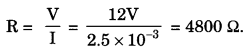
When a 12 V battery is connected across an unknown resistor, there is a current of 2.5 mA in the circuit. Find the value of the resistance of the resistor.
Answer:
Here, V = 12 V, I = 2.5 mA = 2.5 × 10⁻³ A
Resistance,
Electricity Class 10 Extra Questions with Answers Science Chapter 12, 3

Question 15.
An electric current of 4.0 A flows through a 12 Ω resistor. What is the rate at which heat energy is produced in the resistor?
Answer:
Given: I = 4 A, R = 12 Ω
Rate of production of heat energy, P = I2R = 42 × 12 = 192 W.

Question 16.
A heating element is marked 210 V, 630 W. What is the current drawn by the element when connected to a 210 V D.C. mains? What is the resistance of the element?
Answer:
Given, P = 630 W, V = 210V
Current drawn, I = \(\frac{P}{V}=\frac{630}{210}\) = 3A

Question 17.
Calculate the energy transferred by a 5 A current flowing through a resistor of 2 Ω for 30 minutes.
Answer:
Here, I = 5 A, R = 2 Ω, t = 30 min = 1800 s
Energy transferred = I2Rt = (5)2 × 2 × 1800 = 9 × 10⁴ J.

Question 18.
What does the slope of V – I graph at any point represent?
Answer:
Resistance.

Question 19.
What is the shape of the graph obtained by plotting potential difference applied across a conductor against the current flowing through it?
Answer:
Straight line.

Question 20.
Give reason why metals are good conductors, whereas non-metals are bad conductors of electricity.
Answer:

  • Metals contain free electrons which help in the conduction of electric charge and hence current
  • Resistivity of metals is higher

Question 21.
The electrical resistivity of silver is 1.60 × 10⁻⁶ Ω m. What will be the resistance of a silver wire of length 10 m and cross-sectional area 2 × 10⁻³ m2?
Answer:
Given: p = 1.60 × 10⁻⁶ Ω m, l = 10 m and A = 2 x 10⁻³ m2
Resistance,

Electricity Class 10 Extra Questions with Answers Science Chapter 12, 4

Question 22.
Why are copper and aluminium wires usually employed for electricity transmission?
Answer:
Copper and aluminium have low resistivities. When electricity is transmitted through copper and aluminium wires, the power losses in the form of heat are very small.

Extra Questions for Class 10 Science Chapter 12 Short Answer Type I

Question 1.
Sketch a circuit diagram of an electric circuit consisting of a cell, an electric bulb, an ammeter, a voltmeter and a plug key.
Answer:
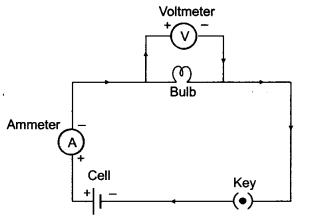
Electricity Class 10 Extra Questions with Answers Science Chapter 12, 5

Question 2.
Differentiate between Resistance and Resistivity.
Answer:
Resistance:

  1. It is the opposition provided by the atoms of a conductor to the flow of electrons.
  2. SI unit of resistance is Ω (Ohm).
  3. Resistance depends on length, area of cross section, material and temperature of conductor.

Resistivity:

  1. It is the resistance of the conductor of that substance of unit length and unit area of cross section.
  2. SI unit of Resistivity of Ωm (Ohm-meter).
  3. Resistivity of substance depends only on the material of substance.

Question 3.
Distinguish between resistances in series and resistances in parallel.
Answer:
Resistances in series:

  1. If a number of resistances are connected in such a way that the same current flows through each resistance, then the arrangement is called resistances in series.
  2. The current across each resistance is same.
  3. The equivalent resistance in series combination is greater than the individual resistances.
  4. This combination decreases the current.in the circuit.

Resistances in parallel:

  1. If a number of resistances are connected between two common points in such a way that the potential differences across each of them is the same, then the arrangement is called resistances in parallel.
  2. The voltage across each resistance is same.
  3. The equivalent resistance in parallel combination is smaller than each of the individual resistances.
  4. This combination increases the current in the circuit.

Question 4.
Nichrome wire is used for making the Ideating elements of electrical appliances like iron, geyser, etc. Give reasons.
Answer:
Nichrome wire is used for making the heating elements of electrical appliances like iron, geyser, etc. because:

  • Nichrome has a very high resistance due to which it produces a lot of heat on passing current.
  • It does not undergo oxidation easily even at high temperature due to which it can be kept red hot.

Question 5.
A copper wire of resistivity 2.6 × 10⁻³ Ωm, has a cross sectional area of 30 × 10-4 cm3. Calculate the length of this wire required to make a 10 Ω coil.
Answer:
Given: R = 10Ω, ρ = 2.6 × 10⁻⁸ Ωm,
To find: l = ?
Formula: R = ρ\(\frac{l}{A}\)
Solution: R = ρ\(\frac{l}{A}\)
∴ ρl = RA

Electricity Class 10 Extra Questions with Answers Science Chapter 12, 6

Question 6.
Two coils of resistance R1 = 3Ω and R2 = 9Ω are connected in series across a battery of potential difference 14 V. Draw the circuit diagram. Find the electrical energy consumed in 1 min in each resistance.
Answer:
Given: R1 = 3Ω, R2 = 9Ω
Rs = R1 + R2 = 9 + 3 = 12 Ω
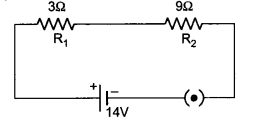
Electricity Class 10 Extra Questions with Answers Science Chapter 12, 7
Now, I = \(\frac{V}{R}=\frac{14}{12}\) = 1.167 Amp. [I in series remains constant.]
Electric energy consumed in R1
H1 = I2R1t = (1.167)2 × 3 × 60 = 245.14 J
Electric energy consumed in R2
H2 = I2R2t = 735.42J

Question 7.
State the relation between work, charge and potential difference for an electric circuit.
Calculate the potential difference between the two terminals of a battery if 100 joules of work is required to transfer 20 coulombs of charge from one terminal of the battery to the other.
Answer:
V = \(\frac{W}{Q}\)
Here,
V = Potential difference,
W = Work done,
Q = Electric charge
W = 100 J
Q = 20 C
V = \(\frac{W}{Q}=\frac{100}{20}\) = 5V

Question 8.
What is an electric circuit? Distinguish between an open and a closed circuit.
Answer:
Electric circuit: A continuous and closed path of electric current is called an electric circuit.
Open circuit: A discontinuous circuit through which no current can flow.
Closed circuit: A circuit without interruption, providing a continuous path through which a current can flow.

Extra Questions for Class 10 Science Chapter 12 Short Answer Type II

Question 1.
With the help of a diagram, derive the formula for the equivalent resistance of three resistances connected in series.
Answer:
(i) If a number of resistances are connected in such a way that the same current flows through each resistance, then the arrangement is called ‘Resistances in Series’.
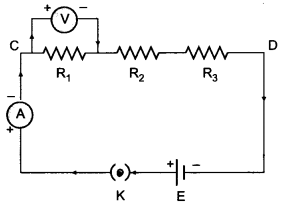
Electricity Class 10 Extra Questions with Answers Science Chapter 12, 8
(ii) Let R1, R2 and R3 be three resistances connected in a series combination and let R be their equivalent resistance.
Let V1, V2 and V3 be the potential difference across the resistances R1, R2 and R3 respectively. Let ‘V’ be the potential differences across the combination. Let ‘I’ be the current flowing through each resistance.

(iii) According to Ohm’s law,
V = IR
Hence, V1 = IR1; V2 = IR2; V3 = IR3
(iv) For series combination of resistances,
V = V1 + V2 + V3
IRs = IR1 + IR2 + IR3
IRs = I (R1 + R2 + R3)
Rs = R1 + R2 + R3
Hence, the equivalent resistance in series (Rs) is equal to the sum of the individual resistances.

Question 2.
With the help of a diagram, derive the formula for the equivalent resistance of three resistances connected in parallel.
1. If a number of resistances are connected between two common points in such a way that the potential difference across each resistance is same, then the arrangement is called ‘Resistances in Parallel’.

2. Let R1, R2 and R3 be the three resistances connected in parallel combination between points C and D and let Rp be their equivalent resistance.
Let I1, I2 and I3 be the currents flowing through resistances R1, R2 and R3 respectively.
Let I be the current flowing through the circuit and V be the potential difference of the cell.

3. According to Ohm’s law.
I = \(\frac{V}{R}\)
Therefore,
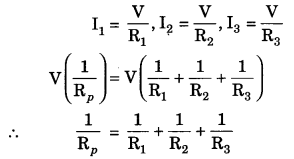
Electricity Class 10 Extra Questions with Answers Science Chapter 12, 9
Therefore, the reciprocal of the equivalent resistances in parallel combination is equal to the sum of the reciprocals of the individual resistances.

Question 3.
What is the better way of connecting lights and other electrical appliances in domestic wiring? Why?
Answer:
The better way of connecting lights and other electrical appliances in domestic wiring is parallel connection because of the following advantages:

  • In parallel circuit, if one appliance stops working due to some defect, then all other appliances keep working normally.
  • In parallel circuit, each electrical appliance has its own switch due to which it can be turned on or off, without affecting other appliances.
  • In parallel circuit, each electrical appliance gets the same voltage (220 V) as that of the power supply line.
  • In parallel circuit, the overall resistance of the domestic circuit is reduced due to which the current from the power supply is high.

Question 4.
An electric lamp, whose resistance is 20 Ω, and a conductor of 4 Ω resistance are connected to aft V battery (Fig.).
Calculate (a) the total resistance of the circuit, (b) the current through the circuit, and (c) the potential difference across the electric conductor.
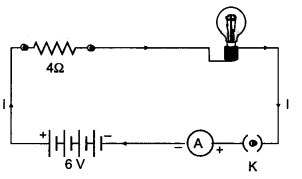
Electricity Class 10 Extra Questions with Answers Science Chapter 12, 10
Answer:
(a) Resistance of electric lamp, R1 = 20 W
Resistance of series conductor, R2 = 4 W
Total resistance in the circuit,
Rs = R1 + R2 = 20 Ω + 4 Ω = 24 Ω.

(b) Total potential difference, V = 6 V
By Ohm’s law, the current through the circuit is
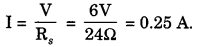
Electricity Class 10 Extra Questions with Answers Science Chapter 12, 11

(c) Potential difference across the electric lamp,
V1 = IR1 = 0.25 A × 20 Ω = 5 V.
Potential difference across the conductor is
V2 = IR2 = 0.25 A × 4 Ω = 1 V.

Question 5.
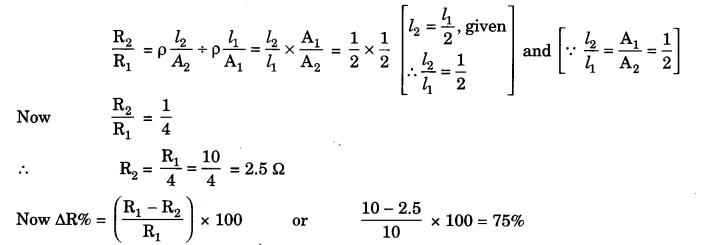
A wire has a resistance of 10Ω. It is melted and drawn into a wire of half of its length. Calculate the resistance of the new wire. What is the percentage change in its resistance?
Answer:
Given: R1 = 10 Ω, l2 = \(\frac{l_{1}}{2}\)
To find: (a) R2
(b) Percentage change in the resistance (ΔR%).
If volume of the wire remains same in both the cases.
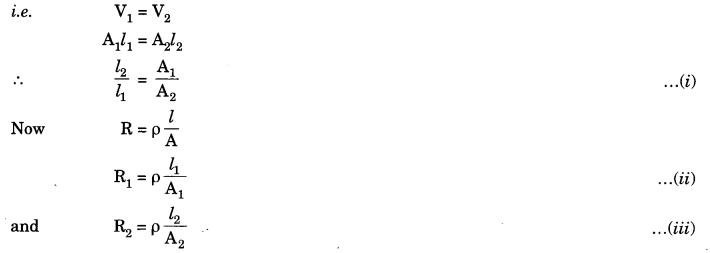
Electricity Class 10 Extra Questions with Answers Science Chapter 12, 12
Dividing eq. (iii) by (ii), we get
Electricity Class 10 Extra Questions with Answers Science Chapter 12, 13

Question 6.
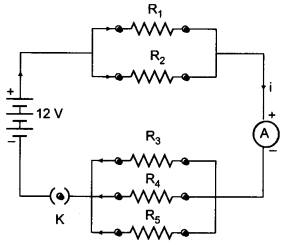
If, in Figure R1 = 10 ohms, R2 = 40 ohms, R3, = 30 ohms, R4 = 20 ohms, Rg = 60 ohms and a 12 volt battery is connected to the arrangement, calculate: (a) the total resistance and (b) the total current flowing in the circuit.
Electricity Class 10 Extra Questions with Answers Science Chapter 12, 14
Answer:
(a) Let R’ be the equivalent resistance of R1 and R2. Then,

Electricity Class 10 Extra Questions with Answers Science Chapter 12, 15
R’ = 8Ω
Let R” be the equivalent resistance of R3, R4 and R5. Then,

Electricity Class 10 Extra Questions with Answers Science Chapter 12, 16
R” = 10 Ω
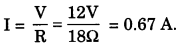
Total Resistance, R = R’ + R” = 8 + 10 = 18 Ω

(b) Current,
Electricity Class 10 Extra Questions with Answers Science Chapter 12, 17

Question 7.
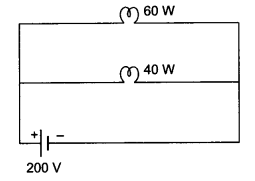
Two lamps, one rated 60 W at 220 V and other 40 W a 220 V, are connected in parallel to an electric supply at 220 V. [CBSE 2016]
(a) Draw the circuit diagram to show the connections.
(b) Calculate the current drawn from the electric supply.
(c) Calculate the total energy consumed by the two lamp together when they operate for one hour.
Answer:
(a) The required circuit diagram is shown below:
Electricity Class 10 Extra Questions with Answers Science Chapter 12, 18

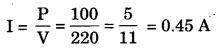
(b) Total power of the two lamps = 60 + 40 = 100 W
Applied Voltage, V = 220 V
Current drawn from the electric supply,
Electricity Class 10 Extra Questions with Answers Science Chapter 12, 19
(c) Total energy consumed by the lamp in one hour = 60W × 1h + 40W × 1h = 100 Wh = 0.1 kWh.

Question 8.
A household uses the following electric appliances:
(i) Refrigerator of rating 400 W for ten hours each day.
(ii) Two electric fans of rating 80 W each for twelve hours each day.
(iii) Six electric tubes of rating 18 W each for 6 hours each day.
Calculate the electricity bill of the household for the month of June if the cost per unit of electric energy is ₹ 3.00.
Answer:
Energy consumed by refrigerator of rating 400 W for ten hours each day
= P × t = 400 W × 10 Aw = \(\frac{400}{1000}\) kW × 10 h = 4.0 kWh
Energy consumed by two electric fans of rating 80 W each for twelve hours each day
= 2 × P × t = 2 × 80W × 12h = \(\frac{160}{1000}\) kW × 12 h = 1.92 kWh
Energy consumed by six electric tubes of rating 18 W each for 6 hours each day
= 6 × P × t = 6 × 18W × 6h = \(\frac{108}{1000}\) W × 6 h = 0.648 kWh
Total energy consumed in the month of June (30 days)
= (4.0 + 1.92 + 0.648) × 30 kWh = 6.568 × 30 = 197.04 kWh
Electricity bill for the month of June
= ₹ 197.04 × 3 = ₹ 591.12 = ₹ 591 (approx.)

Extra Questions for Class 10 Science Chapter 12 Long Answer Type

Question 1.
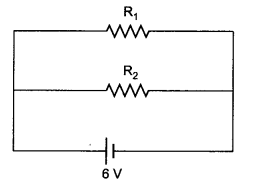
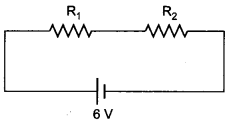
(a) Two resistors R1 and R2 may form (i) a series combination or (ii) a parallel combination, and the combination may be connected to a battery of six volts. In which combination will the potential difference across R1 and across R2 be the same and in which combination will the current through R1 and through R2 be the same?
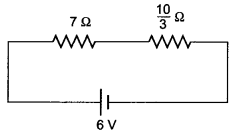
(b) For the circuit, shown in this diagram,
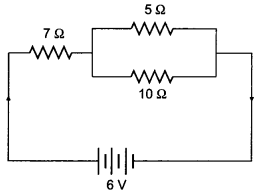
Electricity Class 10 Extra Questions with Answers Science Chapter 12, 20
Calculate
(i) the resultant resistance
(ii) the total current
(iii) the voltage across 7 Ω resistor
Answer:
(a)
Electricity Class 10 Extra Questions with Answers Science Chapter 12, 21
Electricity Class 10 Extra Questions with Answers Science Chapter 12, 22
In series combination, the current through R1 and R2 is same.
In parallel combination, the potential difference across R1 and R2 is same.

(b) (i) Here 5Ω and 10Ω resistors are connected in parallel.

Electricity Class 10 Extra Questions with Answers Science Chapter 12, 23
Now circuit becomes
Electricity Class 10 Extra Questions with Answers Science Chapter 12, 24
Equivalent resistance,
Req = \(\frac{10}{3}\)Ω + 7Ω = \(\frac{31}{3}\)Ω = 10.33Ω
(ii)

Electricity Class 10 Extra Questions with Answers Science Chapter 12, 25
(iii) Voltage across 7Ω resistor
V = IR ⇒ V = \(\frac{18}{31}\) × 7 = 4.06A

Question 2.
(a) List the factors on which the resistance of a conductor depends.
(b) A 4 kW heater is connected to a 220 V source of power. Calculate
(i) the electric current passing through the heater.
(ii) the resistance of the heater.
(iii) the electric energy consumed in 2 hour use of the heater.
Answer:
(a) Resistance of a conductor depends on
(i) length of conductor (l)
(ii) Area of cross-section (A)
(iii) Resistivity of material (ρ)
Relation of resistance is given by, R = ρ\(\frac{l}{A}\)

(b) Given, P = 4 kW = 4000 W and V = 220 V
(i) P = VI or I = \(\frac{P}{A}\)
Hence, I = \(\frac{4000}{220}\) = 18.18 A

(ii) V = IR or R = \(\frac{V}{I}\)
R = \(\frac{220}{18.18}\) = 12.1Ω

(iii) Energy consumed, E = P × t
E = 4000 W × 2h = 8000Wh = 8 kWh = 8 unit.

Question 3.
(a) State Ohm’s law.
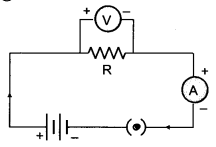
(b) Give the circuit diagram to establish relation between potential difference (V) and current (I) through a given wire.
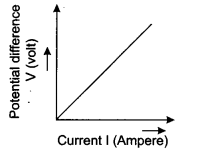
(c) Draw a graph between V and I.
Answer:
(a) Ohm’s law:
According to Ohm’s law, the potential difference, v, across the ends of a given metallic wire in an electric circuit is directly proportional to the current flowing through it, provided its temperature remains same.
V ∝ I ⇒ \(\frac{V}{I}\) = constant
\(\frac{V}{I}\) = R (R = constant) ⇒ V = IR
Here, R is constant for a given metallic wire at a given temperature and is called resistance.
V-I graph of Ohm’s law and its experimental setup:

(b) Circuit diagram
Electricity Class 10 Extra Questions with Answers Science Chapter 12, 26

(c) Variation of current with potential difference
Electricity Class 10 Extra Questions with Answers Science Chapter 12, 27

Electricity HOTS Questions With Answers

Question 1.
Two students perform experiments on series and parallel combinations of two given resistors R1 and R2 and plot the following V-I graphs.
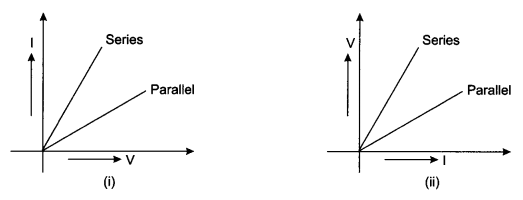
Electricity Class 10 Extra Questions with Answers Science Chapter 12, 28
Which of the graphs is (are) correctly labeled in terms of the words ‘Series and parallel’? justify your answer.
Answer:
In case of series combination, the effective resistance = R1 + R2 is more, hence slope of V – I graph will be more. It is otherwise in case of I – V graph. So, series and parallel are correctly marked in graph (ii).

Question 2.
You are given three resistors of 10 Ω, 10 Ω, 20 Ω to a battery of emf 2.5 V, a key, an ammeter and a voltmeter. Draw a circuit diagram showing the correct connections of given components such that the voltmeter gives a reading of 2.0 V.
Answer:
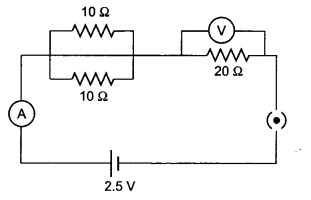
Electricity Class 10 Extra Questions with Answers Science Chapter 12, 29

Question 3.
The electrical resistivity of few material is given below in ohm-metre. Which of these materials can be used for making elements of a heating device.
A 6.84 × 10⁻⁸ Ωm
B 1.60 × 10⁻⁸ Ωm
C 1.00 × 10⁻⁴ Ωm
D 2.50 × 10¹² Ωm
E 4.40 × 10⁻⁵ Ωm
F 2.30 × 10¹⁷ Ωm
Answer:
A material having highest value of resistivity is used for making element of heating devices; therefore, material C will be used. D and F are insulators since they have very high values of resistivity.

Question 4.
Two electric bulbs A and B are marked 220 V, 60 W and 220 V, 100 W respectively. Which one of the two has greater resistance?
Answer:
The resistance of a bulb is given by the expression R = V2/P. For the voltage, the bulb having a smaller power has more resistance. Therefore, the 60W, 220 V bulb has a greater resistance.

Question 5.
A potential difference V is applied across a conductor of length l and diameter D. How is the resistance R of the conductor affected, when (i) V is halved (ii) l is halved and (iii) D is doubled. Justify your answer in each case.
Answer:
The table below gives the variation:

Electricity Class 10 Extra Questions with Answers Science Chapter 12, 30

Question 6.
The applied potential difference across a given resistor is altered so that the heat produced per second increases by a factor of 16. By what factor the applied potential difference change.
Answer:
The heat produced across a resistor is given by R = V2/P. It is proportional to the square of potential.
Therefore, if the heat becomes 16 times the voltage must have been increased 4 times.

Question 7.
The I – V graphs of two resistors, and their series combination, are shown below. Which one of these graphs represents the series combination of the other two? Give reasons for your answer.
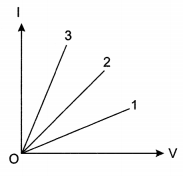
Electricity Class 10 Extra Questions with Answers Science Chapter 12, 31
Answer:
Draw a vertical line from any point on the V axis such as to cut the graphs 1, 2 and 3 at points P, Q and R as shown in the graph below.
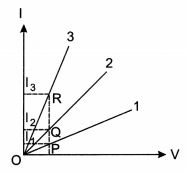
Electricity Class 10 Extra Questions with Answers Science Chapter 12, 32

For the same potential, the current in each is different (I1 < I2 < I3). Hence \(\frac{V}{I_{1}}\) will be greatest for graph 1.
Therefore, graph 1 represents the series combination of the other two resistances.

Question 8.
The values of current I flowing in a given resistor for the corresponding values of potential difference V across the resistor are given below:

I (amperes)0.51.02.03.04.0
V (volts)1.63.46.710.213.2

Plot a graph between V and I and calculate the resistance of the resistor.
Answer:
The graph between V and I for the given data is shown below:
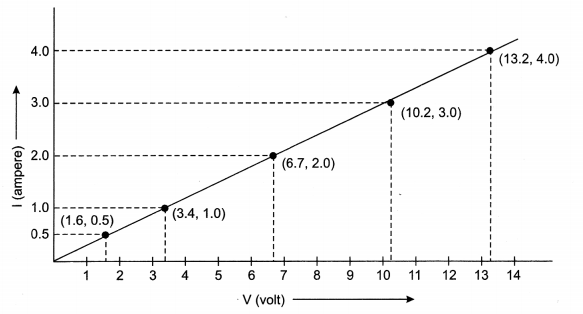
Electricity Class 10 Extra Questions with Answers Science Chapter 12, 33
Resistance of the resistor,
Electricity Class 10 Extra Questions with Answers Science Chapter 12, 34

Question 9.
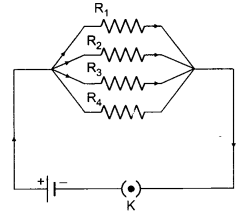
A piece of wire having resistance ‘R’ is cut into four equal parts.
(a) How does the resistance of each part compare with the original resistance?
(b) If the four parts are placed in parallel, how will be the resistance of the combination compare with the resistance of the original wire?
Answer:
(a) As R ∝ l, when the wire is cut into four equal pieces, the resistance of each part is \(\frac{R}{4}\)
(b) When they are connected in parallel.
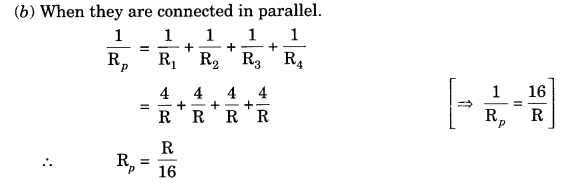
Electricity Class 10 Extra Questions with Answers Science Chapter 12, 35
Electricity Class 10 Extra Questions with Answers Science Chapter 12, 36

Question 10.
Two resistance when connected in parallel give resultant value of 2 Ω. When connected in series, the value becomes 9 Ω. Calculate the value of each resistance.
Answer:
Let R1 and R2 be the two resistances,
R1 + R2 = 9Ω  …….(1)
When connected in parallel
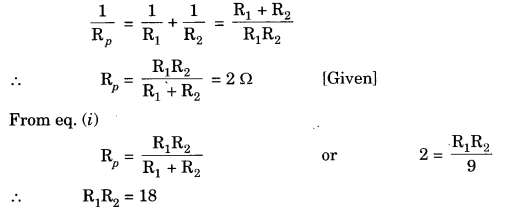
Electricity Class 10 Extra Questions with Answers Science Chapter 12, 37
Now (a – b)2 = (a + b)2 – 4ab
(R1 – R2)2 = (R1 + R2)2 – 4 R1R2 = 9 × 9 – 4 × 18
(R1 – R2)2 = 81 – 72 = 9 or R1 – R2 = 3
∴ R1 – R2 = 3  ………(2)
Solving eq. (i) and (ii), we gets
R1 + R2 = 9 or R1 – R2 = 3
2R1 = 12
∴ R1 = 6Ω
Putting the value of R1 in eq. (i), we get
R1 + R2 = 9 or R2 = 9 – R1 = 9 – 6
R2 = 3Ω

Question 11.
If length of a resistance wire become half and cross-section area becomes twice, then find the relation between old resistance and new resistance.
Answer:

Electricity Class 10 Extra Questions with Answers Science Chapter 12, 38
Dividing (ii) by (i), we get R’ = \(\frac{R}{4}\)
Resistance becomes one fourth.

Extra Questions for Class 10 Science Chapter 12 Value Based Questions

Question 1.
Raman always switched off lights, fans and electric gadgets when not in use. Her electricity bill had cut down to half.
(a) What is commercial unit of electric energy?
(b) Suggest any two methods of saving electricity,
(c) What values does Raman show?
Answer:
(a) The commercial unit of electric energy is kWh.
(b) Using LED’s and efficient devices.
(c) Self-discipline and responsible behavior.

Question 2.
Raghav wants to connect electrical devices in series with the battery. But his friend advised him to connect these devices in parallel.
(a) What are the advantages of connecting electrical devices in parallel instead of connecting them in series?
(b) Which value is shown by Shivam’s friend?
Answer:
(a) (i) Potential difference across each device remain same whereas in series connections, it gets distributed.
(ii) If one device is switched off, it does not affect the other device.

(b) Intelligent and helping.
Gerunds and Infinitives Exercises for Class 5 CBSE with Answers

Gerunds and Infinitives Exercises for Class 5 CBSE with AnswersThis grammar section explains English Grammar in a clear and simple way. There are example sentences to show how the language is used.

Gerunds and Infinitives Exercises for Class 5 CBSE with Answers

Fundamentals
A gerund is a verbal noun that is formed by adding – ing to the verb ‘pleasing, reading’. Gerund function as subject and object of another verb’in sentence.
Example:

  • I enjoy singing.
  • Swimming helps to build muscles.

A gerund can also be the object of a preposition.
Example:

  • Marry is tired of studying.

Infinitives are verbs that include the word ‘to’, as in ‘to go’, ‘to see’ and ‘to explain’. Infinitives function as nouns, adjectives or adverbs in sentences.
Examples:

  • She likes to dance in the morning
  • It is a sight to enjoy.
  • The saint sat to meditate.

Presentation
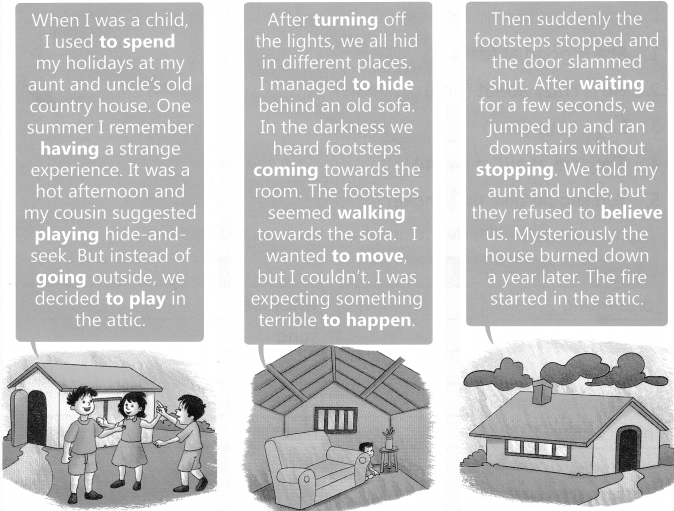
Read the picture story.
Gerunds and Infinitives Exercises for Class 5 CBSE with Answers

A. Answer the following questions as per the story.

1. Where did the narrator and his cousin decide to play?. __________
2. What had happened after turning off the lights? __________
3. How did the narrator’s aunt and uncle react at the end of the story? __________

B. Complete the sentences with the gerund form of the verbs in brackets.

1. (Cook) __________ is one of her hobbies.
2. (Cycle) __________ is fun.
3. (Get) __________ a good job is not easy.
4. (Find) __________ a parking space is quite difficult in this area.
5. (Drive) __________ becomes more and more expensive.

C. Complete the sentences with the gerund form of the verbs in brackets.

1. She is good at (dance) __________
2. He is crazy about (sing) __________
3. I don’t like (play) __________ cards.
4. They are afraid of (swim) __________ in the sea.
5. You should give up (smoke) __________

D. Write down the infinitive form of the verbs in the gaps.

verbinfinitive
presenting
spelled
watches
reads
hid
whispered
sung
hits
came
reaches

Gerunds and Infinitives Exercises with Answers for Class 5 CBSE PDF

A. Write the correct gerund form of these verbs.

VerbsGerunds
1.She likes (paint).
2.I can’t bear (listen) to loud music.
3.He enjoys (play) tennis.
4.Kavita dreams of (set) up her own business.
5.He is interested in (emigrate) to Canada.
6.Are you good at (dance).
7.She is crazy about (read) romantic poems.
8.I can’t help (laugh) when I watch Mr. Bean.
9.I can’t imagine (be) anywhere else but here.
10.You should give up (smoke).

 B. Fill in the blanks either using gerunds or infinitives. The first one has been done for you.

1. He is determined to win (win) that race.
2. He lay in bed __________ (plan) the days to come.
3. We went __________ (run) in the morning.
4. Her fear of spiders made __________ (travel) difficult
5. They don’t mind __________ (wait) outside.
6. The problem is __________ (get) there on time.
7. I am accustomed to __________ (take care) of myself.
8. I want him __________ (paint) the wall.
9. (be), or __________ (not be), that is the question.
10. This boy is known for __________ (break) the rules.

C. Use gerunds in the following sentences. The first one has been done for you.

1. Always check the oil, before you start the car.
Always check the oil, before starting the car.

2. To praise all alike is to praise none.
______________________________

3. I cannot go on to do nothing.
______________________________

4. To amass wealth ruins health.
______________________________

5. To see is to believe.
______________________________

6. To give is better than to receive.
______________________________

7. To talk like this is foolish.
______________________________

D. Look at the -ing word in each sentence. In the boxes write G if it is a gerund and P if it is a participle.

1. I wrote explaining the issues in great detail. __________
2. Look at that monkey scratching all over the body. __________
3. Writing poetry kept him busy during his leisure. __________
4. It has been raining for an hour now. __________
5. She had great difficulty in learning to read and write. __________
6. While he was speaking, the guests were listening with __________ great interest.

E. Put in the verbs in brackets in the Gerund or the to I love to hear the infinitive forms.

1. I can’t imagine Pawan __________ (go) by bike.
2. He agreed __________ (buy) a new car.
3. The question is easy __________ (answer).
4. The man asked me how __________ (get) to the airport.
5. I look forward to __________ (see) you at the weekend.
6. Are you thinking of __________ (visit) London?
7. We decided __________ (run) through the forest.
8. The teacher expected Sonali __________ (study) hard.
9. She doesn’t mind __________ (work) the night shift.
10. I learned __________ (ride) the bike at the age of 5.

Transitive and Intransitive Verbs Exercises for Class 5 CBSE with Answers

Transitive and Intransitive Verbs Exercises for Class 5 CBSE with Answers

This grammar section explains English Grammar in a clear and simple way. There are example sentences to show how the language is used.

Transitive and Intransitive Verbs Exercises for Class 5 CBSE with Answers PDF

Fundamentals
Verbs can be classified as transitive or intransitive. Transitive verbs have or need an object to make complete sense. Examples: She broke the window. (Here, the verb ‘broke’ needs the object ‘window’ to make complete sense.) She is going to the market. They will be arriving tomorrow.

Intransitive verbs do not need an object to make complete sense.
Examples:
She reads.
(Here, the verb ‘reads’ does not require any object to make complete sense.)
Grandmother was sleeping.
We will work.

Presentation
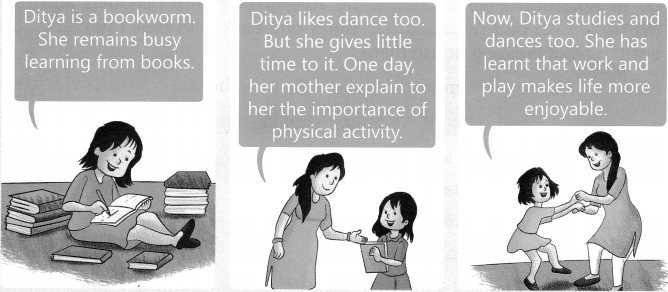
Read the picture story.
Transitive and Intransitive Verbs Exercises for Class 5 CBSE with Answers

A. Answer the following questions as per the story.

1. Who is a bookworm in the story? ___________
2. What does Ditya like to do? ___________
3. What does she learn at the end of the story? ___________

B. Write whether the verbs in the following sentences are Transitive or Intransitive verbs.

1. Ditya is a bookworm. ___________
2. Ditya likes dance. ___________
3. Ditya is learning from books. ___________
4. Ditya works and plays together now. ___________

Transitive and Intransitive Verbs Worksheets for Grade 5 with Answers CBSE PDF

A. Write whether each sentence contains a Transitive or Intransitive verb.
Example:

  • I sing. → Intransitive

1. We laughed. → __________
2. He opened the door. → __________
3. She crossed the street. → __________
4. We drove to India Gate. → __________
5. They talked. → __________
6. He rang the doorbell. → __________
7. I called my mother. → __________
8. You learned Spanish. → __________
9. She made spaghetti. → __________
10. You slept for three hours. → __________

B. Read the following sentences and underline the transitive verb and circle their objects. The first one has been done for you.

1. The driver stopped the car. The driver stopped the car
2. You must speak the truth. __________
3. The boy is flying a kite. __________
4. The woodcutter felled a huge tree. __________
5. The explosion sank the ship. __________

C. Underline the verbs in the following sentences. Say whether they are transitive (T) or intransitive (I). In case of transitive verbs, circle their objects.

1. The Ganga flows into the Bay of Bengal. __________
2. The sun rose. __________
3. Your hands are dirty. __________
4. She is reading her mail. __________
5. He has set his hair with gel. __________
6. Both my parents are chartered accountants. __________
7. This child is happy. __________
8. I slept. __________
9. He laughed loudly. __________
10. I coughed. __________
11. The cat will lick up all the milk. __________
12. The glass fell __________
13. My cat ran. __________
14. I am sure about the answer. __________
15. We worked the entire day. __________

D. Fill in the blanks with appropriate objects of the verbs, in the following sentences.

1. My brother has polished his __________
2. I bought a __________ for my sister.
3. The boy threw a __________ at the window.
4. Frustrated with the official’s call, Alok kicked the __________
5. The student guessed the __________ correctly.
6. My brother is good at both __________
7. He looked at the __________ on the first day of the term.
8. Books are lying __________
9. We staged a __________ on Parents’ Day.
10. His mother helped him __________

Verbs Exercises for Class 5 CBSE with Answers

Verbs Exercises for Class 5 CBSE with AnswersThis grammar section explains English Grammar in a clear and simple way. There are example sentences to show how the language is used.

Verbs Exercises for Class 5 CBSE with Answers PDF

  • Action, doing and being words are called verbs.
  • Verbs have forms called tenses that tell us when an action happens.
  • There are three forms of tenses. They are- Present Tense, Past tense, Future Tense.
  • The main verb shows the action or state of being in a sentence.
  • Is, am, are, has, have are the helpers of the Present tense. Was, were and had are the helpers of the Past tense. Will, Shall are the helpers of the Future tense.
  • All of them are called helping verbs. We add -d or-ed to Regular verbs refer to the past. For example: walk-walked, jump-jumped.
  • We change the spellings of Irregular verbs when we refer to the past. For example- sit-sat, come- came, stand-stood, go-went.

The Simple Present tense talks about things as they happen. We add s-or es to verbs in a sentence that comes with singular nouns. The Simple Past Tense talks about things that happened in the past. The simple past tense is usually made by adding ‘ed to the verb. The Simple Future Tense is used to talk about things that will happen in the future. We use either shall or will with the main verb.

Present Continuous Tense : We use the Present Continuous Tense when we refer to the actions that are happening in the present. We use is, am, are as helping verbs and add ing to the main verb.

Past Continuous Tense : We use Past Continuous Tense when we refer to the actions that were happening in the past. We use was and were’as helping verbs and add ing to the main verb.

Future Continuous Tense : We use this tense when we refer to actions that will be in progress at a certain point or at a certain time period in the future. Verb endings do not change in the future tense. We use the word ‘will’ or ‘going to’ to show that an action or fact pertains to the future.

  • [will be] [verb + “ing”]
  • [is/are + going to] [verb + “ing”]

The Present perfect tense shows action or state in the indefinite past. It is also used to show action begun in the past and continuing into the present. To make the present perfect tense, we use: -‘have”has’ + the past participle.

The Past perfect tense expresses an action taking place before a certain time in the past. To make the past perfect tense, we use: -had + the past participle form of verb. Make the past participle by adding ‘ed’ to regular verbs. The Future perfect tense indicates that somebody will have done something by a certain time in the future. We use: will have + past participle form of verb in this tense. The -ing form of verb is called present participle. It can be used in the continuous tenses. For ex, driving a car, walking to the park.

The -ed form of verb with has, have and had is called past participle.

Irregular verbs also have participle forms. For example: broken, driven, spoken, written. It can be used as an adjective. For example: cooked vegetables, feeling depressed We use modal verbs to say: that someone is able to do something, (can, could), that someone is allowed to do something, or (may, might), that someone has to do something (must).

Verbs Exercises for Class 5 with Answers CBSE PDF

A. Underline the main and helping verbs in the passage given below. The first one has been done for you.

Mr. Singh and the children went to the lake. They looked at the water. It was dirty. While they were walking around they saw garbage in the lake. “May be that is polluting the lake,” said Karan. “There is oil too on the water and oil pollutes water. This oil comes from boats on the lake.” “Why are people polluting the lake?” asked Ravi. “They are not the only ones who pollute it,” said Mr. Singh. “The people who own factories also pollute it. The children who were watching the lake looked worried and unhappy.

B. Fill in the blanks with Simple Present or Present Continuous form of the verb given in the bracket after each blank.

1. We (a) ______________ (go) to the Darjeeling for a picnic. It is a beautiful town which (b) ______________ (lie) at the foot of a mountain range and there is a stream which (c) ______________ (flow) near the town.

2. The farmer (a) ______________ (cut) the corn while the children (b). ______________ (play) in the shed that I (c) ______________ (see) at the end of the farm.

3. I (a) ______________ (love) music and these days I (b) ______________ (learn) to play the piano. Mrs. Singh (c) ______________ (teach) me very patiently.

4. She (a) ______________ (read) a lot of books and (b) ______________ (take) pride in it. Look! Even now she (c) ______________ (read) a story book.

5. We (a) ______________ (wait) for Pawan. We (b) ______________ (go) to see a movie that (c) ______________ (start) at 3 p.m.

C. Fill in the blanks with Simple Past or Past Continuous form of the verb given in the brackets after each blank.

1. He (a) ______________ (worry) because he (b) ______________ (know) that he (c) ______________ (be) late.
2. He (a) ______________ (eat) all the biscuits while his mother (b) ______________ (sleep). Then he quickly (c) ______________ (run) away.
3. The teacher (a) ______________ (punish) Heena. She (b) ______________ She (c) (promise) never to lie again.
4. We (a) ______________ (see) beautiful fishes, they were (b) ______________ (play) games with each other. They happily (c) ______________ (jump) in and out of the water.
5. The movie we (a) ______________ (see) yesterday was very (b) ______________ (frighten). I kept (c) ______________ (scream) throughout the movie.

D. Fill in the blanks with Simple Past, Past Continuous, Simple Present or Present Continuous form of the verb given in the bracket after each blank.

I was at Mr. Gupta’s toy shop this morning. I (a) ______________ (look) for a gift for Mohit. It (b) ______________ (be) his birthday today and he (c) ______________ (throw) a party in the evening. I (d) ______________ (see) a small green car in the shop. Since Mohit (e) ______________ (love) rocks, I (f) ______________ (decide) to buy it for him. I (g) ______________ (look) for Mr. Gupta when I (h) ______________ (see) a policeman in the shop. The policeman (i) ______________ (interview) people. I think something (j) ______________ (miss) from the shop and the police (k) ______________ (try) to find the thief.

E. Fill in the blanks with the Simple Past or Past Perfect form of the verb given in the brackets after each blank.

1. When I (a) ______________ (reach) the station, the train (b) ______________ (leave).
2. The boy (a) ______________ (decide) to free the bird but it (b) ______________ (die) two days ago.
3. He (a) ______________ (finish) all the work, when we (b) ______________ (reach) the office.
4. The teacher (a) ______________ (teach) the lesson when I (b) ______________ (join) the school.
5. The robbers (a) ______________ (escape) by the time the police (b) ______________ (arrive).

F. Fill in the blanks with the Simple Present or Present Perfect form of the verb given in the brackets after each blank.

1. This dress (a) ______________ (look) beautiful. I (b) ______________ (buy) it for you.
2. I(a) ______________ (play) daily and this (b) ______________ (be) the best match ever.
3. l(a) ______________ (love) ghost stories and I (b) ______________ (hear) many ever.
4. Although I (a) ______________ (know) him I (b) ______________ (forget) his name.
5. The shop (a) ______________ (give) little choice but I (b) ______________ (select) my gift.

G. Given below is a news report. Complete it by using the suitable form of the verb given after each blank.
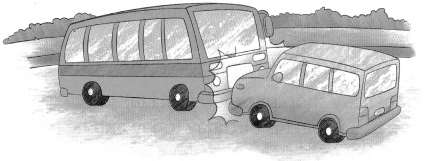
Truck Collides With School Bus
Verbs Exercises for Class 5 CBSE with Answers

In a tragic accident last evening, a truck (a) ______________ (collide) with a school bus on the National Highway. The accident is (b) ______________ (report) to (c) ______________ (occur) at 6 p.m. The school bus (d) ______________ (carry) forty children (e) ______________ (return) from a picnic. Thirty-three children (f) ______________ (admit), to a nearby hospital. The condition of ten is (g) ______________ (say) to be critical, while the others (h) ______________ (recover). No one (i) ______________ (know) the exact cause of the accident though it is suspected that the truck driver might (j) ______________ (fall) asleep while driving.

H. Fill in the blanks with suitable forms of the verbs given in the box.
punish – make – determine – work – happy – fail – appoint – praise

The whole class (a) ______________ by the Geography teacher. Sanchit is the only child who (b) ______________ his project. The others (c) ______________ to do their work. Sanchit is (d) ______________ he (e) ______________ all night to complete his project. He (f) ______________ to complete his work. The teacher (g) ______________ him and gave him three golden stars. She (h) ______________ him the monitor of the class.

I. Complete the following sentences by filling in the blanks with will/shall the verbs given in the box below.

be, get, meet, take, buy, go, look

1. Anil : “I hear you have won a lottery. What will you do with the prize?”
Sunil: I ______________ a new car

2. Riya: “Why don’t you try on your new dress?
Pooja: I don’t think it ______________ good on me.

3. ‘See you. I hope we ______________ again soon’.
4. ‘I will take you to airport today’.
‘No, thanks, Anjali ______________ me.

5. It’s raining. Don’t go out.
You ______________ wet.

6. Avni has invited me to her sister’s marriage.
But I don’t think I ______________ there.

7. I ______________ very thankful to you, sir.

J. Rewrite the following sentences in Future Continuous.

1. She (write) to you in a few days.
____________________________
2. I (not go) to town again this week.
____________________________
3. Mr. Trump (visit) India in March.
____________________________

K. Rewrite the following sentences in Future Perfect.

1. By the end of this year, my father (payoff) all his debts.
____________________________

2. By next July, he (write) his second novel.
____________________________

3. By the year 2100, human beings (travel) to Mars.
____________________________

L. Complete the following sentences with an appropriate participle.

1. His ___________ coat needs mending.
a. tattered
b. tattering

2. A ___________ stone gathers no moss.
a. rolling
b. rolled

3. A ___________ opportunity never returns.
a. lost
b. losing

4. He kept me ___________
a. waiting
b. waited

5. She looked ___________
a. worried
b. worrying

6. I saw the storm ___________
a. approaching o
b. approached

7. ___________ a noise, I turned around.
a. hearing
b. heard

8. Being ___________ he quit his job.
a. dissatisfied
b. dissatisfying

9. Being ___________ with work, I couldn’t meet them.
a. occupied
b. occupying

10. ___________ by his wife, he persevered.
a. Encouraged O
b. Encouraging O

M. Fill in the blanks with suitable modal verbs.

I wish I (i) ___________ be a scientist. How exciting it (ii) ___________ be to go to Antartica! I (iii) ___________ be able to play with penguins and seals. (iv) ___________ be I (v) ___________ bring one back with me!. I (vi) ___________ even think of building house there.

N. Fill in the blanks with appropriate modals given below.
will, might, would, should, may, can

1. Gandhiji ___________ spin everyday.
2. We ___________ pay taxes regularly.
3. ___________ you please keep quiet?
4. Eat so that you ___________ live.
5. ___________ I ask you a question please?
6. I ___________ be pleased to help you.

Adverb Phrases Exercises for Class 5 CBSE with Answers

Adverb Phrases Exercises for Class 5 CBSE with Answers

This grammar section explains English Grammar in a clear and simple way. There are example sentences to show how the language is used.

Adverb Phrases Exercises for Class 5 CBSE with Answers PDF

Fundamentals

  • An adverb phrase is a group of words that serves the same purpose as an adverb.
  • It starts with a preposition.
  • The adverbial phrase answers the same questions as a regular adverb: how/how much, when or where.

Look at the underlined adverbial phrases

  • Our friend drives on Mondays.
  • Sarita and Nancy will walk on the sidewalk.
  • The snake slithers through the tall grass.
  • He found his lucky penny in the morning.

Presentation
Read the picture story.
Adverb Phrases Exercises for Class 5 CBSE with Answers 6

A. Answer the following questions as per the story.

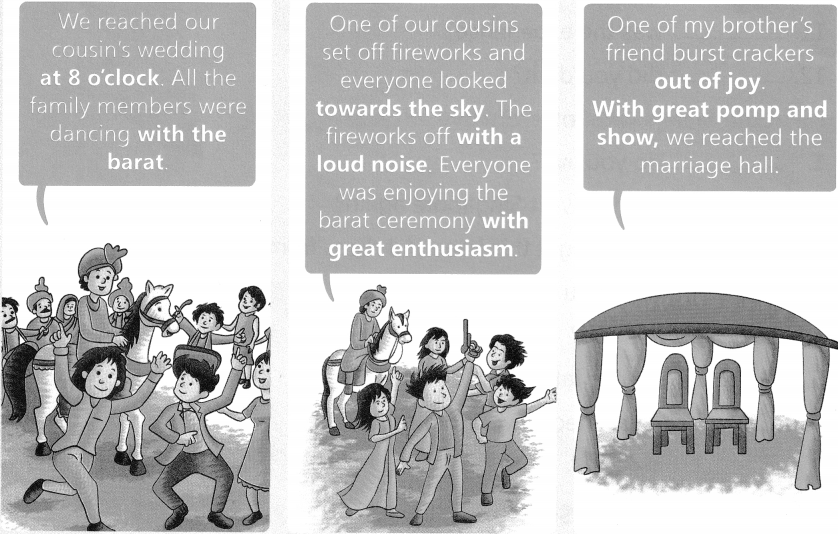
1. When did narrator’s family reach at the cousin’s wedding? _____________
2. Where did narrator’s cousin set off firework? _____________
3. How did everyone enjoy the barat ceremony? _____________

B. Underline the adverbial phrase. In the blank, write the question it answers.

1. We expect our grandparents to arrive in about an hour. _____________
2. My cousin watches television almost as much as you do. _____________
3. The weatherman says it will rain all day. _____________
4. Your brother plays soccer better than my brother does. _____________
5. The air is cold and fresh early in the morning. _____________
6. ‘Mom will pick us after school is over. _____________

C. Match the sentences to show what each underlined adverb phrase expresses.

1. Jyoti placed the chair next to the window.Adverb Phrases Exercises for Class 5 CBSE with Answers 1 Manner
2. Rajesh buys flowers for his wife every week.Adverb Phrases Exercises for Class 5 CBSE with Answers 2 Time
3. Surfing is a popular sport in the summer.Adverb Phrases Exercises for Class 5 CBSE with Answers 3 Purpose
4. It rained hard yesterday.Adverb Phrases Exercises for Class 5 CBSE with Answers 4 Place
5. I bought the glue to fix my broken lamp.Adverb Phrases Exercises for Class 5 CBSE with Answers 5 requency

Adverb Phrases Exercises with Answers Pdf for Class 5 CBSE PDF

A. Underline the adverb phrases in the following sentences.

1. She lives in a palatial home.
2. Is there water on the moon?
3. She ran into her room.
4. They chatted for a while.
5. She performed the task with great skill.
6. The desert stretched towards the North.
7. The gun went off with a loud noise.
8. The fishers went sailing over the sea.
9. He lay beside the heap of corn.
10. She whispered in his ear.

B. On each line provided, write a sentence using the given adverb phrase.

1. without leaving home ______________________
2. for more than two hours ______________________
3. according to the teacher ______________________
4. around ten o’clock ______________________
5. during the last century ______________________

C. Fill in the blanks using suitable adverbial phrase from the box.
Adverb Phrases Exercises for Class 5 CBSE with Answers 7

1. We hurried down the street _____________
2. She was born _____________
3. Gaurav fell asleep _____________
4. _____________ they meet and chat.
5. _____________, I would like to ask you to leave.
6. _____________, they will win the game.
7. He loves you _____________
8. Dolly ran out the door, _____________
9. You sold your car _____________