In this page, we are providing How do Organisms Reproduce Class 10 Extra Questions and Answers Science Chapter 8 pdf download. NCERT Extra Questions for Class 10 Science Chapter 8 How do Organisms Reproduce with Answers will help to score more marks in your CBSE Board Exams.
Class 10 Science Chapter 8 Extra Questions and Answers How do Organisms Reproduce
Extra Questions for Class 10 Science Chapter 8 How do Organisms Reproduce with Answers Solutions
Extra Questions for Class 10 Science Chapter 8 Very Short Answer Type
Question 1.
What is reproduction? [CBSE 2012, 2016]
Answer:
Reproduction is the process by which an organism produces its young ones for perpetuation of its race.
Question 2.
Mention two modes of reproduction. [CBSE 2013]
Answer:
The two modes of reproduction are-sexual reproduction and asexual reproduction.
Question 3.
Give one example for each of the following.
(а) Plants in which vegetative propagation occurs by grafting
(b) Plants in which vegetative propagation occurs by leaves [CBSE 2012]
Answer:
(a) Rose, grapes can be vegetatively propagated by grafting.
(b) Bryophyllum can be vegetatively propagated by leaves.
Question 4.
Name a plant that has lost the capacity to produce seed. How can it reproduce? [CBSE 2013]
Answer:
Banana. It can reproduce by vegetative propagation.
Question 5.
Name any two consequences of unsafe sex. [CBSE 2012]
Answer:
The two consequences of unsafe sex are:
- Transmission of sexually transmitted diseases
- Unwanted pregnancy
Question 6.
Name the hormone, the secretion of which is responsible for dramatic changes in appearance in girls when they approach 10-12 years of age. [CBSE 2008]
Answer:
Oestrogen
Question 7.
Mention the modes of reproduction used by
(a) Amoeba
(b) Planaria [CBSE 2009]
Answer:
(a) Amoeba – Binary fission
(b) Planaria – Regeneration
Question 8.
Name any two types of asexual reproduction. [CBSE 2009]
Answer:
- Fission
- budding
Question 9.
State the method used for growing rose plants. [CBSE 2009]
Answer:
Vegetative propagation
Question 10.
State which type of method is used for growing Jasmine plant. [CBSE 2009]
Answer:
Layering.
Extra Questions for Class 10 Science Chapter 8 Short Answer Type I
Question 1.
Write the full form of DNA. Where is it located? What does it consist of? [CBSE 2013]
Answer:
DNA = Deoxyribo Nucleic Acid. It is located in the nucleus of the cell. It consists of nucleotides which make nucleic acids.
Question 2.
Mention the information source for making proteins in the cell. What is the basic event in reproduction? [CBSE 2008, 2009]
Answer:
The information source for making proteins in the cell is deoxyribo nucleic acid (DNA). The basic event in reproduction is the replication of DNA and cell division.
Question 3.
How does the creation of variation in a species promote survival? [CBSE 2013]
Answer:
Creation of variation increases the probability or chances of survival of some members of the population under adverse conditions. This ensures the survival of the species under unfavourable conditions.
Question 4.
Protozoans reproduce by binary fission as well as multiple fission. Which process is better and why? Give your opinion. [CBSE 2011]
Answer:
Multiple fission is better than binary fission because it produces many daughter cells inside a protective structure called cyst which ensures their survival under adverse conditions.
Question 5.
Name the kind of organisms that reproduce by spore formation. How will an organism be benefitted if it reproduces through spores? [CBSE 2013]
Answer:
Rhizopus (Fungus) reproduces by spore formation. The organism is benefitted because the spores are covered by thick walls that protect them until they come in contact with a moist surface and begin to grow.
Question 6.
Compare the vegetative propagation in Bryophyllum and money plant. [CBSE 2011]
Answer:
Bryophyllum reproduces by the adventitious buds present on the margins of its leaves.
Money plant reproduces by stem cutting which can produce the whole plant when placed in moist soil.
Question 7.
List any two pubertal changes that appear in both boys and girls. [CBSE 2013]
Answer:
The two pubertal changes which appear in both boys and girls are:
- The skin becomes oily and pimples appear
- Pubic hairs appear
Question 8.
(a) Specify the events which occur in the reproductive system of a human female.
(i) if egg is fertilised
(ii) if egg is not fertilised.
(b) Mention the changes that take place in uterus in both the above events. [CBSE 2012]
Answer:
(a) (i) Pregnancy
(ii) Menstruation
(b) If the egg gets fertilised then the wall of the uterus becomes thick and spongy with a rich supply of blood vessels to receive the fertilised zygote.
If the egg does not get fertilised then the blood vessels in the wall of the uterus along with the spongy uterine tissue is shed in the form of blood and mucus through the vagina.
Question 9.
Prenatal sex determination has been prohibited by law, state two reasons. [CBSE 2011]
Answer:
Prenatal sex determination has been prohibited by law to:
- Check the female foeticide
- Prevent the decline in female sex ratio
Question 10.
How can pregnancy be prevented surgically? [CBSE 2012]
Answer:
The pregnancy can be prevented surgically by:
- Vasectomy: The vas deferens of male is blocked to prevent sperm transfer.
- Tubectomy: The fallopian tube of female is blocked to prevent egg to reach uterus.
Extra Questions for Class 10 Science Chapter 8 Short Answer Type II
Question 1.
Mention any three advantages of variation in individuals. [CBSE 2013]
Answer:
The advantages of variation are:
- Forms the basis of evolution
- Enables survival under adverse conditions
- Enables the organisms to adapt.
Question 2.
Identify among the following organisms, which reproduce by sexual and which by asexual methods?
Amoeba, Human beings, Whale, Hydra, Spirogyra, Dog [CBSE 2013]
Answer:
Sexual reproduction – Human beings, Whale, Dog
Asexual reproduction – Amoefea, Hydra, Spirogyra
Question 3.
How do the following plants reproduce?
(a) Potato
(b) Sweet Potato
(c) Ginger [CBSE 2013]
Answer:
(a) Potato by tuber
(b) Sweet Potato by root
(c) Ginger by rhizome.
Question 4.
Explain budding in Hydra with the help of diagrams only. [CBSE 2013]
Answer:
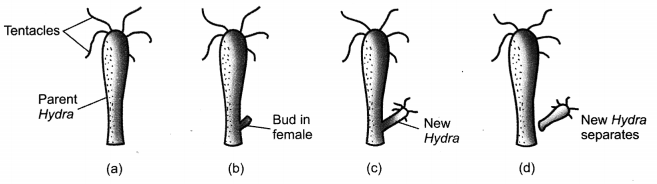
Question 5.
Differentiate between reproduction and regeneration. Name any two organisms which grow by regeneration. [CBSE 2012]
Answer:
Reproduction is the process by which an organism produces its young ones for perpetuation of its race. Some organisms have the ability to form new organisms from the pieces of its body which has been cut into different pieces. This process by which new organisms develop from the parts of an organism is called regeneration. Planaria and Hydra have the ability of regeneration.
Question 6.
Name the female reproductive part of a flower. Which part of a flower develops into a seed and a fruit? Where are the male germ cell and female gamete present in the flower? [CBSE 2011]
Answer:
Female reproductive part of a flower is carpel. Ovule develops into a seed and a fertilised ovary develops into fruit. Male germ cells are present in the pollen grain of a flower. Female gamete are present in the ovules located in ovary of a flower.
Question 7.
(a) Trace the path of sperms from where they are produced in human body to the exterior.
(b) Write the functions of secretions of prostate gland and seminal vesicle in humans. [CBSE 2013]
Answer:
Sperm comes out from testis into the vas deferens and pass through the urethra before ejaculation. The secretions of seminal vesicle and prostrate glands provide nutrition to the sperms and also facilitate their transport.
Question 8.
Name one sexually transmitted disease each caused due to bacterial infection and viral infection. How can these be prevented? [CBSE 2008]
Answer:
- Gonorrhoea caused by bacteria
- AIDS caused by HIV (Human immune deficiency virus)
They can be prevented by using condoms and safe sexual practices.
Question 9.
Name the organ where sperms are produced and name the hormone produced by it. Why do sperms have a tail but ovum does not have it? [CBSE 2013]
Answer:
Sperms are produced in the testes. The hormone produced by testes is testosterone. The sperms have a tail to enable them to swim and move towards the non-motile female gamete.
Question 10.
What is reproduction? Mention the importance of DNA copying in reproduction. [CBSE 2008]
Answer:
Reproduction is the process by which organisms produce their own kind. The DNA copying is important because:
- It ensures the transmission of characteristics from parents to their offsprings.
- Variations are created during DNA copying which increase the chances of survival of the species and in the evolution of new life forms.
Question 11.
Explain how, offspring and parents of organisms reproducing sexually have the same number of chromosomes. [NCERT Exemplar]
Answer;
The process of cell division called meiosis halves the number of chromosomes present in the cell of an organism. The gametes produced as a result of meiosis, fuse during sexual reproduction and restore the number of chromosomes in the offsprings of the individual.
Question 12.
Why does bread mould grow profusely on a moist slice of bread rather than on a dry slice of bread? [NCERT Exemplar]
Answer:
Moist slice of bread is able to provide both moisture and nutrients needed for the growth of the hyphae. Dry slice of bread is able to provide only the nutrients but not moisture, so the hyphae do not grow on the dry slice of bread.
Question 13.
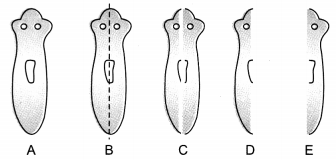
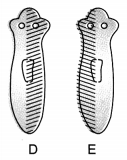
Would a Planaria cut vertically into two halves regenerate into two individuals? Complete Figure D and E by indicating the regenerated regions. [NCERT Exemplar]
Answer:
Yes, shaded part in Figures D and E represent the regenerated halves.
Question 14.
From the internet, gather information about the chromosome numbers of five animals and five plants. Correlate the number with the size of organism and answer the following questions.
(а) Do larger organisms have more number of chromosomes/cells?
(b) Can organism with fewer chromosomes reproduce more easily than organisms with more number of chromosomes?
(c) More the number of chromosomes/cells greater is the DNA content. Justify. [NCERT Exemplar]
Answer:
(a) No, there is no relationship between size of the organism and its chromosome number.
(b) No, process of reproduction follows a common pattern and is not dependent on the number of chromosomes.
(c) Yes, if there are more chromosomes in a cell, the quantity of DNA will also be more because the major component of the chromosome is DNA.
Question 15.
In tobacco plant, the male gametes have twenty four chromosomes. What is the number of chromosomes in the female gamete? What is the number of chromosomes in the zygote? [NCERT Exemplar]
Answer:
Number of chromosomes in female gamete is 24.
Number of chromosomes in zygote is 48.
Question 16.
How are general growth and sexual maturation different from each other? [NCERT Exemplar]
Answer:
General growth comprises of the different types of developmental process in the body like increase in height, weight gain, changes in shape and size of the body. Sexual maturation refers to the specific changes which occur at puberty like cracking of voice, new hair patterns, development of breast in female, etc.
Question 17.
Trace the path of sperm during ejaculation and mention the gland and their functions associated with the male reproductive system. [NCERT Exemplar]
Answer:
Sperm comes out from testis into the vas deferens and pass through the urethra before ejaculation. The secretions of seminal vesicle and prostate glands provide nutrition to the sperms and also facilitate their transport.
Question 18.
What changes are observed in the uterus if fertilisation does not occur? [NCERT Exemplar]
Answer:
If fertilisation does not occur then the thick and spongy lining of the uterus slowly breaks and comes out through the vagina in the form of blood and mucus.
Question 19.
What changes are observed in the uterus subsequent to implantation of young embryo? [NCERT Exemplar]
Answer:
After implantation, a special tissue called placenta develops which connects embryo to the uterine wall. Placenta provides nutrients and oxygen to the embryo which are obtained from the rich blood supply of the uterine wall.
Extra Questions for Class 10 Science Chapter 8 Long Answer Type
Question 1.
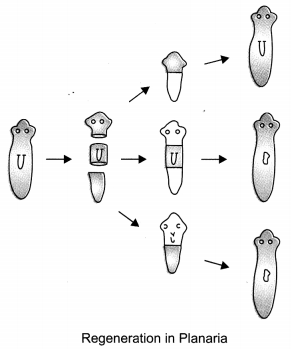
Why are budding, fragmentation and regeneration all considered as asexual types of reproduction? With neat diagrams explain the process of regeneration in Planaria. [NCERT Exemplar]
Answer:
They are considered as asexual types of reproduction as all of them involve a single parent and no fusion of gametes take place in them.
Question 2.
Write two points of difference between asexual and sexual types of reproduction. Describe why variations are observed in the offspring formed by sexual reproduction. [NCERT Exemplar]
Answer:
Asexual Reproduction:
- Single parent is involved.
- No fusion of gametes occur.
- Progeny is genetically identical to the parent.
For example, Fission in Amoeba
Sexual Reproduction:
- Two parents are involved.
- Fusion of gametes occurs.
- Variations occur in the progeny.
For example, Human beings
Fusion of gametes occurs during sexual reproduction. The gametes contain the same number of chromosomes but their DNA is not identical so variations arise among the offsprings.
Question 3.
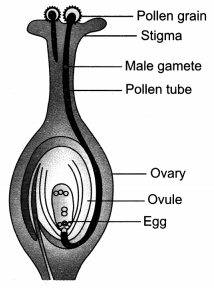
Distinguish between pollination and fertilisation. Mention the site and product of fertilisation in a flower. Draw a neat, labelled diagram of a pistil showing pollen tube growth and its entry into the ovule. [NCERT Exemplar]
Answer:
Pollination: The transfer of pollen grains from the anther to the stigma of a flower is called pollination.
Fertilisation: The process of fusion of male and female gametes to form a zygote is called fertilisation.
The site of fertilisation is ovule. The product of fertilisation is zygote.
Question 4.
Distinguish between a gamete and zygote. Explain their roles in sexual reproduction. [NCERT Exemplar]
Answer:
The sex cell or germ cell in sexual reproduction is called gametes. There are two types of gametes, male and female. A male and a female gamete fuse with each other during fertilisation to form a zygote.
The gametes possess characters of their parents in their DNA and their fusion brings characters of both parents into one zygote cell. Zygote is the first cell of the next generation which divides to form an embryo which subsequently grows into a new individual.
Question 5.
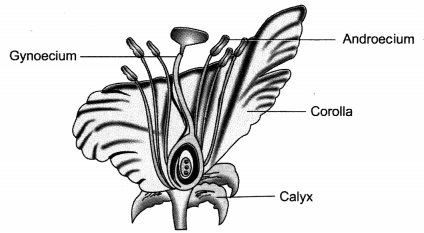
Draw the diagram of a flower and label the four whorls. Write the names of gamete producing organs in the flower. [NCERT Exemplar]
Answer:
Male gamete forming part – anther/stamen
Female gamete forming part – pistil/ovary/ovule
Question 6.
What is placenta? Mention its role during pregnancy. [NCERT Exemplar, CBSE 2017]
Answer:
A disc shaped special tissue connection between embryo and uterine wall is called placenta. It contains villi on the embryo’s side of the tissue which are surrounded by blood spaces on the mother’s side. Roles of placenta are:
- It provides a large surface area for glucose and oxygen to pass from mother to the embryo.
- Removes waste substances produced by the developing embryo.
Question 7.
What are various ways to avoid pregnancy? Elaborate any one method. [NCERT Exemplar]
Answer:
(a) Contraceptive methods are used to avoid pregnancy which are of the following types:
- Mechanical
- Drugs (as pills)
- Loop or copper T and
- Surgical method.
(b) Surgical Methods:
- Vasectomy: The vas deferens of male is blocked to prevent sperm transfer.
- Tubectomy: The fallopian tube of female is blocked to prevent egg to reach uterus.
- Copper-T or loop is placed in uterus to prevent pregnancy.
Question 8.
How does fertilisation take place? Fertilisation occurs once in a month. Comment. [NCERT Exemplar]
Answer:
- Sperm enters through the vaginal passage during sexual intercourse and moves upwards.
- Egg released from the ovary reaches the fallopian tube (oviduct).
- Sperm encounters egg in the oviduct and fertilisation takes place. Fallopian tube (oviduct) is the site of fertilisation.
- An egg is released once every month by the ovary as usually one ovum (egg) is released by an ovary during each cycle.
Question 9.
Reproduction is essentially a phenomenon that is not for survival of an individual but for the stability of a species. Justify. [NCERT Exemplar, CBSE 2017]
Answer:
- The energy needed for survival of the organisms is obtained by them from life processes such as nutrition and respiration.
- Reproduction needs a lot of energy.
- Genetic material is transferred from one generation to the next as a result of reproduction through DNA copying.
- DNA copying takes place with high constancy and considerable variations, that is, advantages to the species for stability in the changing environment.
Question 10.
Describe sexually transmitted diseases and mention the ways to prevent them. [NCERT Exemplar]
Answer:
Sexually transmitted diseases are infectious diseases transmitted during sexual contact. Various agents like bacteria and virus cause these diseases. For example, Gonorrhoea, syphilis, genital herpes, chlamydiasis, genital warts, trichomoniasis, hepatitis-B and HIV-AIDS are sexually transmitted diseases.
Principles to follow to prevent such infections:
- Avoid sex with unknown partners/multiple partners,
- Always use condoms during coitus.
- Use of mechanical barrier like condom prevents transmission of infection
- In case of doubt, go to a qualified doctor for early detection and get complete treatment if diagnosed with disease.
How do Organisms Reproduce HOTS Questions With Answers
Question 1.
Ravi took three bread slices and kept them in the following conditions:
(a) Slice 1 in a dried and dark place
(b) Slice 2 in moist and dark place
(c) Slice 3 in refrigerator under moist conditions
What would he observe in each of the above conditions? [CBSE 2013]
Answer:
(a) No spores will be formed in Slice 1 as moisture is not there.
(b) Fungal hyphae develop as white cottony mass and bear sporangia having spores in Slice 2 as they get both favourable conditions of moisture and darkness.
(c) No spores will be formed in Slice 3 as lower temperature in refrigerator is not favourable for their formation.
Question 2.
Small piece of root tissue was taken from the rose plant and placed in a nutrient medium. Each root tissue produced a new rose plant. Name the reproductive process involved. What type of genes will be possessed by the new rose plant? [CBSE 2012]
Answer:
The reproductive process involved is called as tissue culture. The new rose plant has the genes which are identical to the parent rose plant.
Question 3.
A student noticed that an organism by mistake was cut into parts. After sometime, both parts developed into new individuals.
(a) Name the mode of reproduction used by the organism.
(b) State the type of cells which carry this process.
(c) State two examples of organisms which multiply by this process. [CBSE 2013]
Answer:
(а) The mode of reproduction used by the organism is regeneration.
(b) It is carried out by specialised which can proliferate and make a large number of cells by cell division.
(c) Hydra and Planaria.
Question 4.
Explain why fertilisation is possible only if copulation takes place during the middle of menstrual cycle? [CBSE 2012]
Answer:
The release of ovum occurs around the middle of the menstrual cycle i.e., on 14th day. So, the chances of meeting of sperm and egg are increased during this period. Hence, if copulation takes place during the middle of menstrual cycle, the chances of fertilisation are more.
Question 5.
Name the plant hormones which help/promote
(i) Cell division
(ii) Growth of stem [CBSE 2009]
Answer:
(i) Cytokinins help in cell division.
(ii) Auxins help in the growth of the stem.
Extra Questions for Class 10 Science Chapter 8 Value Based Questions
Question 1.
Rohini’s parents received a proposal for her marriage from a boy living in U.K. Before everything could get finalised, Rohini asked her parents to ask the boy to get his blood test report.
(a) Do you think it was right on the part of Rohini’s parents to do so?
(b) What moral values did Rohini showed?
(c) Name two STD’s along with their causative organism. [CBSE 2013]
Answer:
(a) Yes, it was right on Rohini’s parents to do so because blood reports would be able to indicate whether the person has any disease, any sexually transmitted disease or is free of them.
(b) Rohini is intelligent, cautious, responsible and vigilant.
(c) Two sexually transmitted diseases are:
- AIDS caused by HIV
- Gonorrhoea caused by Neisseria gonorrhoea

 This grammar section explains English Grammar in a clear and simple way. There are example sentences to show how the language is used.
 The museum was __________ (quiet).
 This grammar section explains


 This grammar section explains
 This grammar section explains