Coordinate Geometry Class 9 Extra Questions Maths Chapter 3 with Solutions Answers

Here we are providing Coordinate Geometry Class 9 Extra Questions Maths Chapter 3 with Answers Solutions, Extra Questions for Class 9 Maths was designed by subject expert teachers.

Extra Questions for Class 9 Maths Coordinate Geometry with Answers Solutions

Extra Questions for Class 9 Maths Chapter 3 Coordinate Geometry with Solutions Answers

Coordinate Geometry Class 9 Extra Questions Very Short Answer Type

Question 1.
Write the signs convention of the coordinates of a point in the second quadrant.
Solution:
(-ve, +ve)

Question 2.
Write the value of ordinate of all the points lie on x-axis.
Solution:
0

Question 3.
Write the value of abscissa of all the points lie on y-axis.
Solution:
0

Question 4.
If in coordinates of a point B(3, -2), signs of both coordinates are interchanged, then it will lie in which quadrant ?
Solution:
When signs of both coordinates of B(3, -2) are interchanged, then coordinates of new point are B'(-3, 2) and it will lie in second quadrant.

Question 5.
Find distances of points C(-3, -2) and D(5, 2) from x-axis and y-axis.
Solution:
Distances of point C(-3, -2) from x-axis is 2 units in the negative direction and from y-axis is 3 units in the negative direction. Distances of point D(5, 2) from x-axis is 2 units and from y-axis is 5 units.

Question 6.
Find the values of x and y, if two ordered pairs (x – 3, – 6) and (4, x + y) are equal.
Solution:
Here, two ordered pairs are equal.
⇒ Their first components are equal and their second components are separately equal.
⇒ x – 3 = 4 and x + y = -6
⇒ x = 7 and 7 + y = -6 ⇒ y = – 13
Hence, x = 7 and y = – 13.

Question 7.
In which quadrant does the point (-1, 2) lie ?
Solution:
(-1, 2) lie in second quadrant.

Question 8.
Find the distance of the point (0, -5) from the origin.
Solution:
5 units.

Question 9.
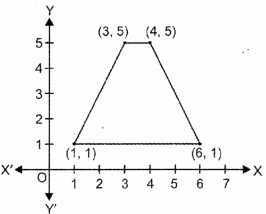
Write the shape of the quadrilateral formed by joining (1, 1), (6, 1), (4, 5) and (3, 5) on graph paper.
Solution:
Trapezium.
Coordinate Geometry Class 9 Extra Questions Maths Chapter 3 with Solutions Answers 1

Coordinate Geometry Class 9 Extra Questions Short Answer Type 1

Question 1.
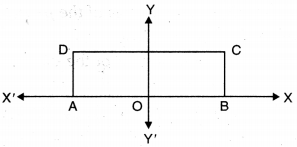
In the given figure, ABCD is a rectangle with length 6 cm and breadth 3 cm. O is the mid-point of AB. Find the coordinates of A, B, C and D.
Coordinate Geometry Class 9 Extra Questions Maths Chapter 3 with Solutions Answers 2
Solution:
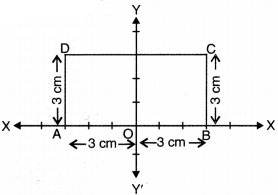
Coordinate Geometry Class 9 Extra Questions Maths Chapter 3 with Solutions Answers 3
We have taken 1 cm = 1 unit and origin O is the mid-point of AB
∴ OA = OB = 3 cm
and BC = AD = 3 cm
Thus, the coordinates of A are (-3, 0)
the coordinates of B are (3, 0)
the coordinates of C are (3, 3)
the coordinates of D are (-3, 3)

Question 2.
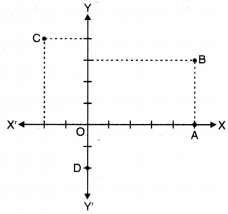
Write the coordinates of A, B, C and D from the figure given alongside.
Coordinate Geometry Class 9 Extra Questions Maths Chapter 3 with Solutions Answers 4
Solution:
Coordinates of the point A are (5, 0)
Coordinates of the point B are (5, 3)
Coordinates of the point C are (-2, 4)
Coordinates of the point D are (0, -2)

Question 3.
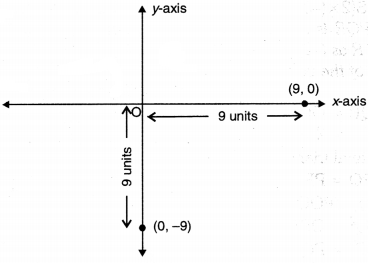
A point lies on x-axis at a distance of 9 units from y-axis. What are its coordinates? What will be the coordinates of a point, if it lies on y-axis at a distance of -9 units from x-axis ?
Solution:
As shown in graph, the coordinates of a point which lies on x-axis at a distance of 9 units from y-axis are (9, 0) and the coordinates of a point which lies at a distance of -9 units from x-axis are (0, -9).
Coordinate Geometry Class 9 Extra Questions Maths Chapter 3 with Solutions Answers 5

Question 4.
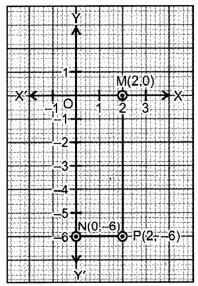
Plot the point P(2, -6) on a graph paper and from it draw PM and PN perpendiculars to x-axis and y-axis respectively. Write the coordinates of the points M and N.
Solution:
Coordinate Geometry Class 9 Extra Questions Maths Chapter 3 with Solutions Answers 6
As shown in graph, coordinates of M are (2, 0) and coordinates of N are (0, -6).

Coordinate Geometry Class 9 Extra Questions Short Answer Type 2

Question 1.
Without plotting the points indicate the quadrant in which they lie, if :
(i) ordinate is 5 and abscissa is – 3
(ii) abscissa is -5 and ordinate is – 3
(iii) abscissa is – 5 and ordinate is 3
(iv) ordinate is 5 and abscissa is 3
Solution:
(i) Clearly, point (-3, 5) lies in 2nd quadrant.
(ii) Clearly, point (-5, – 3) lies in 3rd quadrant.
(ii) Clearly, point (-5, 3) lies in 2nd quadrant.
(iv) Clearly, point (3, 5) lies in 1st quadrant.

Question 2.
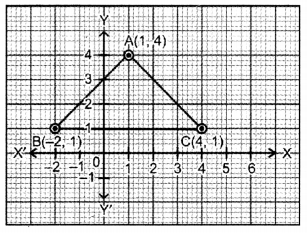
Plot the points A(1, 4), B(-2, 1) and C(4, 1). Name the figure so obtained on joining them in order and also, find its area.
Solution:
Coordinate Geometry Class 9 Extra Questions Maths Chapter 3 with Solutions Answers 7
Triangle.
Area of ∆ABC = \(\frac{1}{2}\) × BC × Height
= \(\frac{1}{2}\) × 6 × 3
= 9 sq. units

Question 3.
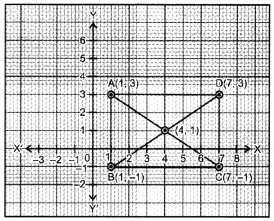
Plot the following points, join them in order and identify the figure thus formed : A(1, 3), B(1, -1), C(7, -1) and D(7, 3)
Write the coordinates of the point of intersection of the diagonals.
Solution:
Coordinate Geometry Class 9 Extra Questions Maths Chapter 3 with Solutions Answers 8
ABCD is a rectangle.
Point of intersection of the diagonals AC and BD is (4, 1).

Question 4.
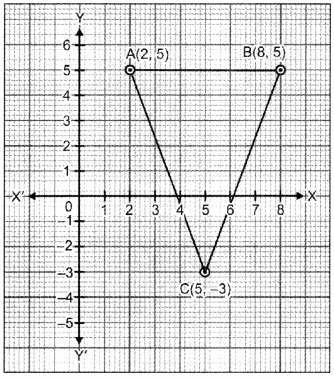
Plot the points A(2, 5), B(8,5) and C(5, -3) and join AB, BC and CA. What figure do you obtain ?
Solution:
Coordinate Geometry Class 9 Extra Questions Maths Chapter 3 with Solutions Answers 9
We obtain an isosceles triangle in which AC = BC.

Question 5.
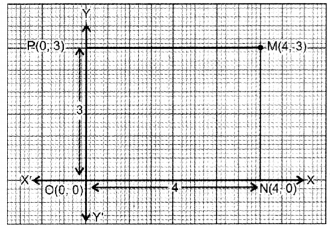
(i) Plot the points M(4, 3), N(4, 0), 0(0, 0), P(0, 3).
(ii) Name the figure obtained by joining MNOP.
(iii) Find the perimeter of the figure.
Solution:
(i)
Coordinate Geometry Class 9 Extra Questions Maths Chapter 3 with Solutions Answers 10
(ii) As shown in graph, the figure obtained by joining MNOP is rectangle.
(iii) Perimeter of rectangle MNOP = 2 (ON + OP) = 2 (4 + 3) = 2 × 7 = 14 units.

Question 6.
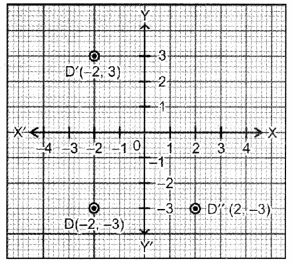
Plot D(-2, -3) on the graph paper. Also, plot reflections of D in x-axis and y-axis.
Solution:
Coordinate Geometry Class 9 Extra Questions Maths Chapter 3 with Solutions Answers 11
Reflection of D(-2, -3) in x-axis is D'(-2, 3) and reflection of D(-2, -3) in y-axis is D'(2, -3).

Question 7.
If the coordinates of a point M are (-2, 9) which can also be expressed as (1 + x, y) and y > 0, then find in which quadrant do the following points lie : Ply, x), Q(2, x), R(x, y − 1), S(2x, -3y).
Solution:
Here, M(-2, 9) can also be expressed as (1 + x, y2)
∴ (1 + x, y2) ⇔ (-2, 9) and y > 0
⇒ 1 + x = -2 and y2 = 9
⇒ x = -3 and y = √9 = 3 (∵ y > 0)
P (y, x) = P(3, -3), it lies in IV quadrant
Q(2, x) = Q(2, -3), also lies in IV quadrant
R(x2, y – 1) = R((-3)2, 3 – 1) = R(9, 2), it lies in I quadrant
S(2x, -3y) = S(2 × (-3), -3 × 3) = S(-6, -9), it lies in III quadrant

Question 8.
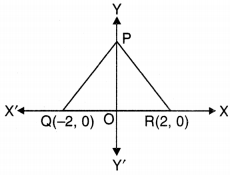
In the given figure, PQR is an equilateral triangle with coordinates of Q and R as (-2, 0) and (2, 0) respectively. Find the coordinates of the vertex P.
Solution:
Coordinate Geometry Class 9 Extra Questions Maths Chapter 3 with Solutions Answers 12
Here,
QR = OQ + OR.
= 2 + 2 = 4 units
∴ ∆PQR is an equilateral triangle.
∴ PQ = PR = QR = 4 units
In right-angled ∆OPQ, ∠POQ = 90°
∴ We have PQ2 = OP2 + OQ2
⇒ OP2 = PQ2 – OQ2
= 42 – 22 = 16 – 4 = 12
⇒ OP = √12 = 2√3 units
∴ The coordinates of P are (0, 2√3).

Coordinate Geometry Class 9 Extra Questions HOTS

Question 1.
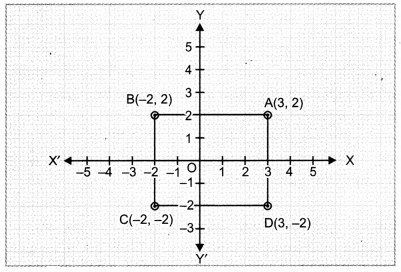
Plot the points A(3, 2), B(-2, 2), C(-2, -2) and D(3, -2) in the cartesian plane. Join these points and name the figure so formed.
Solution:
Coordinate Geometry Class 9 Extra Questions Maths Chapter 3 with Solutions Answers 13
Figure so formed is ABCD a rectangle.

Question 2.
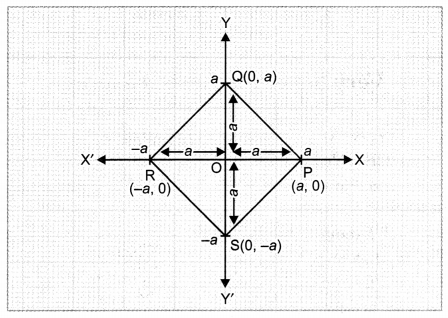
Write the coordinates of two points on X-axis and two points on Y-axis which are at equal distances from the origin. Connect all these points and make them as vertices of quadrilateral. Name the quadrilateral thus formed.
Solution:
Let a be the equal distance from origin on both axes. Now, the coordinates of two points on equal distance ‘a’on x-axis are Pla, 0) and R(-a, 0). Also, the coordinates of two points on equal distance ‘a’ on Y-axis are Q(0, a) and S(0, -a). Join all the four points on the graph. Now, PQRS, thus formed is a square.
Coordinate Geometry Class 9 Extra Questions Maths Chapter 3 with Solutions Answers 14

Coordinate Geometry Class 9 Extra Questions Value Based (VBQs)

Question 1.
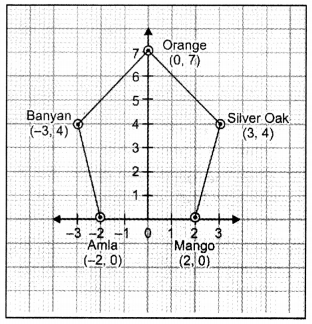
On environment day, class-9 students got five plants of mango, silver oak, orange, banyan and amla from soil department. Students planted the plants and noted their locations as (x, y).
Coordinate Geometry Class 9 Extra Questions Maths Chapter 3 with Solutions Answers 15
Plot the points (x, y) in the graph and join them in the given order. Name the figure you get. Which social act is being done by students of class-9 ?
Solution:
Coordinate Geometry Class 9 Extra Questions Maths Chapter 3 with Solutions Answers 16
The given trees (points) are Mango (2, 0), Silver Oak (3, 4), Orange (0,7), Banyan (-3, 4) and Amla (-2, 0). The location of these trees are Orange (0,7) shown in the graph.
On joining the points of mango, silver oak, orange, banyan and amla in order, the figure so formed is a regular pentagon.
Planting more trees helpful in reducing pollution and make the environment clean and green for the coming generations.

Force and Pressure Class 8 Extra Questions and Answers Science Chapter 11

In this page, we are providing Force and Pressure Class 8 Extra Questions and Answers Science Chapter 11 pdf download. NCERT Extra Questions for Class 8 Science Chapter 11 Force and Pressure with Answers will help to score more marks in your CBSE Board Exams.

Class 8 Science Chapter 11 Extra Questions and Answers Force and Pressure

Extra Questions for Class 8 Science Chapter 11 Force and Pressure with Answers Solutions

Force and Pressure Class 8 Extra Questions Very Short Answer Type

Question 1.
What is the name of the instrument used to measure atmospheric pressure?
Answer:
Barometer

Question 2.
Give two examples of contact force.
Answer:

  • Muscular force
  • Force of friction

Question 3.
Name the force exerted on a ball of dough to make a flat chapati.
Answer:
Muscular force

Question 4.
What kind of force is an electrostatic force?
Answer:
Non-contact force

Question 5.
Is the gravity a property of earth only?
Answer:
No

Question 6.
Name the force due to which every object falls on earth.
Answer:
Gravitational force

Question 7.
What do you mean by pressure?
Answer:
Force per unit area (Force/Area)

Question 8.
Do liquids and gases also exert pressure?
Answer:
Yes

Question 9.
What are the two states of motion?
Answer:

  • The state of rest.
  • The state of motion.

Question 10.
What kind of force is friction?
Answer:
Contact force

Question 11.
What type of force is gravitational force?
Answer:
Non-contact force

Question 12.
Is it true that force acting on an object can also change its shape?
Answer:
Yes, it is true.

Question 13.
While sieving grains, small pieces fall down. Which force pulls them down?
Answer:
Gravitational force

Question 14.
How can we change the speed and the direction of a moving body?
Answer:
By applying force.

Question 15.
What is the distance moved by an object in unit time called?
Answer:
Speed

Question 16.
Does force of gravity act on dust particles?
Answer:
Yes

Question 17.
Does the force of gravitation exist between two astronauts in space?
Answer:
Yes

Question 18.
What is a force?
Answer:
A push or pull on an object is called force.

Question 19.
What is the SI unit of pressure?
Answer:
Pascal (Pa)

Question 20.
At least how many objects are needed to apply a force?
Answer:
At least two objects are needed to apply a force.

Question 21.
Give one example of gravitational force.
Answer:
An apple falling from the tree to ground.

Question 22.
What is meant by atmospheric pressure?
Answer:
The weight of air acting per unit area is known as atmospheric pressure.

Question 23.
What do you mean by magnitude?
Answer:
The strength of a force is usually expressed by its magnitude.

Question 24.
What is muscular force?
Answer:
The force resulting due to the action of muscles is known as muscular force.

Question 25.
What is contact force?
Answer:
Force that can be applied only when it is in contact with an object is called contact force.

Question 26.
What do you mean by the term atmosphere?
Answer:
The envelope of air all around us is known as atmosphere.

Force and Pressure Class 8 Extra Questions Short Answer Type

Question 1.
Define pressure.
Answer:
The force acting per unit surface area is called pressure. SI unit of pressure is measured in Newton/ Metre2, which is equal to 1 Pascal (Pa).

Question 2.
How do fluids exert pressure?
Answer:
Fluids exert pressure in all directions. Fluids also exert pressure on the walls of the container that hold them.

Question 3.
A force of 100 N is applied on an area of 4 m2. Compute pressure being applied on the area.
Answer:
Given: Force = 100 N, Area = 4 m2

Force and Pressure Class 8 Extra Questions and Answers Science Chapter 11 .1

Question 4.
Which force is responsible for downward movement of a parachutes? Will he come down with the same speed without the parachute?
Answer:
Force of gravity is responsible for this downward movement. No, without parachute he will come down with a higher speed.

Question 5.
Two thermocol balls held close to each other move away from each other. When they are released, name the force which might be responsible for this phenomenon. Explain.
Answer:
Electrostatic force is responsible for this phenomenon. The two balls have similar charges, that’s why they move away due to repulsion between them.

Question 6.
How does an applied force changes the speed of an object?
Answer:
If the applied force is in the direction of motion, the speed of the object increases. But if the force applied in the direction opposite to the motion, then it decreases the speed of the object.

Question 7.
Name the forces acting on the car sticking to an electromagnet in a Junkyard. Which one of them is larger?
Answer:
Magnetic force (in the upward direction) and force of gravity or the weight of the car (downward). Magnetic force is larger than the force of gravity.

Question 8.
What is the similarity between electrostatic and magnetic forces?
Answer:

  • Both are non-contact forces.
  • Both are attractive as well as repulsive forces.

Question 9.
What are the effects of force on an object?
Answer:

  • Force can change the state of motion of an object.
  • Force changes the speed of a moving object.
  • Force can cause an object to turn or change direction.
  • Force can change the shape of an object.

Force and Pressure Class 8 Extra Questions Long Answer Type

Question 1.
What is force? State the difference between contact force and non-contact force. A push or pull on an object is called a force.
Answer:

Contact forceNon-contact force
Force that can be applied only when it is in contact with an object is called a contact force, e.g., muscular force, frictional forceThe force exerted on an object without touching it is known as non-contact force, e.g., gravitational force, magnetic force

Question 2.
Define the different types of forces.
Answer:
Force can act on a body from a distance or by being in contact with it. Depending on this, forces can be classified as contact and non-contact forces.
(a) Contact forces: When force is applied on an object by direct or indirect physical contact the applied force is called contact force. Muscular and frictional force are example of contact force.

  • Muscular force: The force resulting due to the action of muscles is known as the muscular force.
  • Frictional force: The force resisting the relative motion of solid surfaces, fluid layers, and material elements sliding against each other.

(b) Non-contact forces: When a force is applied to an object by another body that is not in direct contact with it is called non-contact force. Gravitational, magnetic and electrostatic force are example of non-contact force.

  • Gravitational force: The attractive force of the earth which acts upon all the objects is known as the force of gravity or just gravity.
  • Electrostatic force: The force exerted by a charged body on another charged or uncharged 1 body is known as electrostatic force.
  • Magnetic force: The force exerted between a magnet and other magnet or magnetic material is known as magnetic force.

Question 3.
Why it is easier to walk on soft sand if we have flat shoes rather than shoes with sharp heels (or pencil heels)?
Answer:
A flat shoe has a greater area in contact with the soft sand and exerts less pressure on the soft ground. Due to this the ‘flat’ shoes do not sink much in soft sand and it is easy to walk on it. On the other hand, a sharp heel has a small area in contact with the soft sand and exerts a greater pressure on the sand. Due to this, the sharp heels sink deep into soft sand making it difficult for the wearer to walk on it.

Question 4.
What is pressure? What is the relation of pressure with area on which it is applied?
Answer:
Force exerted on per unit area is called pressure. Pressure is related with area on which it is applied. When the area is increased the pressure exerted is less. But when the area on which pressure is exerted is decrease the pressure increases. So we can conclude that pressure increases with decrease in area.
List the characteristics of pressure exerted by a liquid.

  • Liquid exerts pressure in all directions.
  • Pressure in liquid does not depends on shape, size and surface area of the container.
  • Pressure increases with depth.
  • All points at the same level in a liquid are at the same pressure.
  • Pressure does not depend on the surface of the immersed object.

Force and Pressure Class 8 Extra Questions HOTS

Question 1.
We know that there is a huge amount of atmospheric pressure on us. But we do not experience its effect why?
Answer:
The pressure of air inside our body is same as that of the atmosphere. Therefore, we do not experience its effect

Question 2.
Why do sea divers wear specially designed suits?
Answer:
Since the pressure of liquid increases with the increasing depth of sea. Specially designed suits protect scuba divers from the huge pressure of the water underneath.Two persons are applying forces on two opposite sides of a moving cart. The cart still moves with the same speed in the same direction.

Question 3.
What do you infer about the magnitudes and direction of the forces applied?
Answer:
Both the persons are applying forces from opposite direction with equal magnitudes.

Question 4.
An archer shoots an arrow in the air horizontally. However, after moving some distance, the arrow falls to the ground. Name the initial force that sets the arrow in motion. Explain why the arrow ultimately falls down.
Answer:
The initial force is muscular force which sets the arrow in motion. The force of gravity that acts on the arrow in the downward direction brings it to the ground.

Question 5.
Two rods: A and B, having same weight and equal length have different thickness. Rod A is thinner while Rod B is thicker. They are held vertically on the surface of sand. Which one of them will sink more? Why?
Answer:
Rod A will go deeper as it has a smaller area of contact, therefore the same force produces more pres¬sure. In case of rod B the same force produces less pressure.

Question 6.
It is difficult to cut cloth using a pair of scissors with blunt blades. Explain.
Answer:
Blunt blades have larger area compared to the sharp-edged blades. Thus, the applied force produces a lower pressure in case of blunt blades, which makes it difficult to cut the cloth.

Question 7.
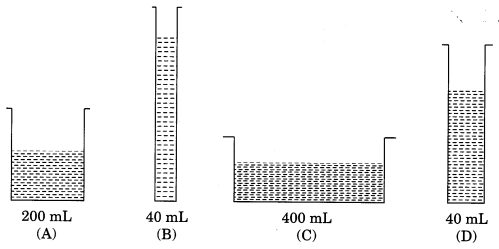
Observe the figures given below carefully.
Force and Pressure Class 8 Extra Questions and Answers Science Chapter 11 .2
Volume of water in each vessel is shown above. Arrange them in order of decreasing pressure at the base of each vessel. Explain the reason.
Answer:
Pressure of a liquid column depends upon the height of the liquid column and not on volume of the liquid. Decreasing order of pressure at the base of each vessel is B>D>A>C.

Force and Pressure Class 8 Extra Questions Value Based (VBQs)

Question 1.
On Lokesh’s birthday Shreya was given charge to amuse children with some little tricks. Shreya sticked balloons to the wall by just rubbing them in her clothes. She bent the water stream from a tap without touching it. She did so by bringing big balloon near to the flowing water. All children were very happy on seeing this little magic. Everybody praised Shreya.

(a) How do balloons stick to walls?
(b) How Shreya bent the water stream by bringing a big balloon near it and without touching it?
(c) What values of Shreya is shown here?
Answer:
(a) On rubbing the balloon with hair or clothes, it acquire negative charges. The negative charges are attracted to the positive charges on the wall and balloon sticks to the wall.
(b) Negative charge on the balloon attracts positive charge on water molecules. Thus, bent the water molecules.
(c) Shreya is dutiful, friendly with scientific aptitude.

Reaching the Age of Adolescence Class 8 Extra Questions and Answers Science Chapter 10

In this page, we are providing Reaching the Age of Adolescence Class 8 Extra Questions and Answers Science Chapter 10 pdf download. NCERT Extra Questions for Class 8 Science Chapter 10 Reaching the Age of Adolescence will help to score more marks in your CBSE Board Exams.

Class 8 Science Chapter 10 Extra Questions and Answers Reaching the Age of Adolescence

Extra Questions for Class 8 Science Chapter 10 Reaching the Age of Adolescence with Answers Solutions

Reaching the Age of Adolescence Class 8 Extra Questions Very Short Answer Type

Question 1.
What is Adam’s apple?
Answer:
The protruding part of the throat in males is called Adam’s apple.

Question 2.
Name the hormone in female that is produced by ovaries and helps in development of mammary glands.
Answer:
Estrogen

Question 3.
Whose height grow faster initially boys or girls?
Answer:
Girls

Question 4.
Name a gland which transports secretions through ducts.
Answer:
Sweat glands/salivary glands/ oil gland (any one).

Question 5.
What is puberty?
Answer:
The age at which boys and girls become capable of reproduction.

Question 6.
What are hormones?
Answer:
The chemical substances produced by endocrine glands are called hormones.

Question 7.
How long is a woman’s reproductive life lasts?
Answer:
Menarche to menopause.

Question 8.
Name the female hormone.
Answer:
Estrogen

Question 9.
Which gland is called master gland?
Answer:
Pituitary gland

Question 10.
What is a balanced diet?
Answer:
The meal that includes all nutrients is called a balanced diet.

Question 11.
What is menstruation?
Answer:
Extrusion of uterus lining and blood along with the unfertilised egg from the vagina is called menstruation.

Question 12.
What is menarche?
Answer:
The first menstrual flow begins at puberty and is termed as menarche.

Question 13.
What is menopause?
Answer:
Stoppage of menstruation is called menopause.

Question 14.
What causes goitre?
Answer:
Deficiency of thyroxine hormone.

Question 15.
Which gland secretes thyroxine?
Answer:
Thyroid gland

Question 16.
What are chromosomes?
Answer:
The thread-like structures in the nucleus are called chromosomes.

Question 17.
How many chromosomes are present in human cell?
Answer:
23 pairs or 46 chromosomes.

Question 18.
How many sex chromosomes are there in human cell?
Answer:
Two, i.e., one pair.

Question 19.
Which hormone is necessary for normal growth of a person?
Answer:
Growth hormone.

Question 20.
Which gland secretes insulin?
Answer:
Pancreas

Question 21.
What causes diabetes?
Answer:
Deficiency of insulin.

Question 22.
Name the chromosome present in a female.
Answer:
X chromosome

Question 23.
Name the chromosome present in a male.
Answer:
X and Y chromosomes

Question 24.
Which chromosome does the unfertilised egg contain?
Answer:
X chromosome

Question 25.
Which hormone balances the proportion of salts in the blood?
Answer:
Adrenaline

Question 26.
What decides the sex of an unborn child?
Answer:
Sex chromosome of father.

Question 27.
Name the glands other than the pituitary gland.
Answer:
Thyroid, pancreas and adrenals.

Question 28.
When does the puberty ends?
Answer:
Puberty ends when an adolescent reaches reproductive maturity.

Question 29.
Do the boys and girls undergo same physical changes at puberty?
Answer:
No

Question 30.
Why do we need to have a balanced diet?
Answer:
To keep the body healthy.

Reaching the Age of Adolescence Class 8 Extra Questions Short Answer Type

Question 1.
What is meant by adolescence?
Answer:
Growing up is a natural process. The period of life, when the body undergoes several changes leading to reproductive maturity, is cabled adolescence. The adolescence period is 11 to 19 years of age.

Question 2.
What is puberty?
Answer:
The period during which adolescent boys and girls attain sexual maturity and become capable of reproduction is called puberty. Puberty age of female is 10 to 12 years while male puberty age is 12 to 14 years.

Question 3.
What is vital change which marks puberty in boys and girls?
Answer:
During puberty, the human body undergoes several changes, but the most important changes which marks puberty is that boys and girls become capable of reproduction.

Question 4.
Why do boys have a hoarse voice at puberty?
Answer:
The voice box or larynx begins to grow at the onset of puberty. This growing voice box in boys can be seen as a protruding part of the throat called Adam’s apple. This leads to voice becoming hoarse.

Question 5.
How does the body shape change at puberty?
Answer:
Body shape changes differently in boys and girls at puberty. Boys have broader shoulders and wider chests. Their muscles grow more prominently than girls. In girls, the region below the waist becomes wider.

Question 6.
Why is adolescence also called teenage?
Answer:
Adolescence period is generally 11 to 19 years of age. Because the period covers the teens, i.e., 13 to 19 years of age, adolescents are also called teenagers.

Question 7.
Why do many young people have acne and pimples during adolescence?
Answer:
During puberty the secretion of sweat glands and sebaceous glands (oil glands) increases. It develops acne and pimples on the face of young boys and girls.

Question 8.
Why are endocrine glands also called ductless glands?
Answer:
Endocrine glands release hormones directly into the blood stream. So, they are termed as ductless glands. For example, pituitary, thyroid, pancreas, etc.

Question 9.
What are secondary sexual characters?
Answer:
At puberty, in girls, breasts begin to develop, the region below the waist become wider, voice become shriller. Boys begin to grow facial hair, i.e., moustache and beard. Boys also develop hair on their chest, the muscles of the body grow more prominently, develop larger voice box which can be seen as a protruding part of the throat called Adam’s apple. In both boys and girls, hair grows under the arms and in the pubic region. As these features distinguish the male from the female they are called secondary sexual characters.

Question 10.
Explain the development of sex organs in male and female.
Answer:
The male and the female sex organs develop completely at puberty. Male sex organ like testes and penis develop completely. The testes begin to produce the male gametes or sperm. Similarly in girls the ovaries enlarge and egg begins to mature. Ovaries start releasing matured eggs or ovum.

Question 11.
Why do changes occur in human body at puberty?
Answer:
The changes in human body at puberty occur due to release of hormones by different types of glands. Hormones are chemical substances secreted from endocrine glands or endocrine system. Male hormone or testosterone are responsible for changes in male whereas female hormone or estrogen are responsible for changes in female.

Question 12.
What is a pituitary gland?
Answer:
Different types of hormones are secreted by different types of glands. The product of all these hormones is under the control of another hormone secreted from an endocrine gland called pituitary gland.

Question 13.
How do hormones work in human body?
Answer:
Endocrine glands release hormones into the blood stream to reach a particular body part called target site. The target responds to the hormone. There are many endocrine glands or ductless glands in the body.

Question 14.
What are sex hormones? How do they work in the human body?
Answer:
Sex hormones help boys and girls develop sex organs to enable them for reproduction. These hormones lead them to reproductive maturity.

In girls, estrogen makes the breasts develop. Milk secreting glands or mammary glands develop inside the breasts. Ovaries begin to produce eggs. In boys, testosterone is released by testes. Testes begin to release sperms. Changes in boys is also seen due to this hormone.

Question 15.
What is menstruation?
Answer:
At puberty, in girls the ovaries get enlarged and start producing eggs (ovum). One egg matures and is released by one of the ovaries once in about 28 to 30 days. During this period, the wall of the uterus becomes thick so as to receive the egg. If the egg is fertilised then it begins to develop and results in pregnancy. If this egg is not fertilised, the released egg and thickened lining of the uterus along with its blood vessels are shed off causing bleeding in female which is called menstruation. It occurs once in about 28 to 30 days.

Question 16.
What are the changes in female at the onset of puberty?
Answer:
There are several changes in females at the onset of puberty. They are:

  • growth of hair in armpit and pubic region.
  • development of breasts and mammary glands.
  • ovaries get enlarged and begin producing eggs.
  • menstruation cycle starts; and
  • increased activity of sweat and sebaceous glands.

Question 17.
Explain the terms menarche and menopause.
Answer:
The first menstrual flow begins at puberty and is termed as menarche.
At 45 to 50 years of age, the menstrual cycle stops. Stoppage of menstruation is called menopause.

Question 18.
What happens when the egg is fertilised?
Answer:
When the egg is fertilised, it begins to divide and then gets embedded in the uterus for further development. Finally the fertilised egg develops into a foetus.

Question 19.
What are the changes in males at puberty?
Answer:
There are various changes in males at puberty.
They are:

  • sudden increase in height.
  • growth of hair at different parts of body like face, armpit and pubic region, development of moustache and beard.
  • development of Adam’s apple in throat, voice becomes hoarse.
  • shoulders become broader and chest wider.
  • growth of size of reproductive organs like penis, testes begin to produce sperms, etc.

Question 20.
What do you mean by reproductive health?
Answer:
The physical and mental well being of an individual is regarded as an individual’s health. To keep the body healthy, every human being, at any age, needs to have a balanced diet. The person must also observe personal hygiene and undertake adequate physical exercise. Thus, reproductive health refers to the diseases, disorders and conditions that affect the functioning of the male and female reproductive system during all stages of life.

Question 21.
What is the role of hormones in completing the life history of insects and frogs?
Answer:
Hormones play an important role in the completion of life cycle of insects and frogs. Metamorphosis in insects is controlled by insect hormones. In a frog, it is controlled by thyroxine, the hormone produced by thyroid gland. Thyroxine production requires the presence of iodine in water. Water in which iodine is not, present, the tadpoles cannot become adult.

Question 22.
Which hormone is released by pancreas? What is its function?
Answer:
Insulin is released by pancreatic gland. It regulates sugar metabolism. If insulin is deficient in the body, sugar level becomes high in blood causing diabetes.

Reaching the Age of Adolescence Class 8 Extra Questions Long Answer Type

Question 1.
What changes occur in human at puberty?
Answer:
There are various changes in human at puberty. They are as follows:
(i) Change in height: During puberty, there is sudden increase in height in boys and girls. Initially, girls grow faster in height than in boys. But both reach their maximum height at the age of 18 years.

(ii) Change in voice: Boys develop larger voice box or larynx to form protruding part of throat called Adam’s apple making their voice hoarse, girls have high pitched voice.

(iii) Change in body shape: In boys, shoulders broaden and muscles grow more prominently than in girls. In girls the region below the waist becomes wider.

(iv) Secretion of sweat and sebaceous glands (oil glands) in both boys and girls increases and acne or pimples grow on faces of many youths.

(v) Development of sex organs: In males, testes and penis develop completely. Testes begin producing sperms. In girls, ovaries are enlarged and begin to produce eggs. Both boys and girls reach reproductive maturity.

(vi) In girls, menstruation or periods starts.

(vii) All human beings attain mental, intellectual and emotional maturity at puberty.

(viii) Facial hair like moustache and beard are grown in boys. Hair are grown in armpit and pubic region in both boys
and girls. Breasts are developed in girls. These characters are called secondary sexual characters as they distinguish a male from a female.

Question 2.
Explain the reproductive phase of life in humans.
Answer:
Boys and girls become capable of reproduction at puberty because their testes and ovaries begin to release gametes, i.e., sperms and ova respectively. In girls, reproductive phase of life begins at puberty from 10 to 12 years of age and generally lasts till the age of 45 to 50 years. The ova begin to mature with the onset of puberty. The ovum matures and is released by one of the ovaries once in 28 to 30 days. During this period, the wall of the uterus becomes thick so as to receive the egg, in case it is fertilised and begins to develop. This results in pregnancy.

If fertilisation does not occur, the released egg, and the thickened lining of the uterus along with its blood vessels are shed off. This causes menstruation. It occurs once in about 28 to 30 days. The first menstrual flow begin at puberty and is termed as menarche. The menstruation stops at the age of 45 to 50. This stage is known as menopause. In male, the reproductive phase begins at puberty at the ages 14-15 and lasts as long as he is healthy.

Question 3.
Mention different types of glands, their functions and hormones secreted by them.
Answer:
There are different types of glands in our body and they secrete different types of hormones which control grotto, behaviour, development and reproduction. The following table shows different types of glands, hormones secreted by them and their functions:

S. No.Name of glandsHormones secretedFunctions
1.PituitarySeveral hormones including growth hormone, thyroid stimulating hormones, etc.(i) Produces thyroxine hormone and stimulate thyroid gland.
(ii)  Controls growth.
(iii)  Keeps a check on the activity of other glands.
2.drenalAdrenaline(i) Regulates blood pressure, breathing rate, heart beat, etc.
(ii)  Helps the body to adjust the stress condition.
3.ThyroidThyroxine(i)  Helps in controlling growth, respiration and metabolism.
(ii)  Prevents from goitre disease.
4.TestesMale hormone or testosteroneDevelops secondary sexual characters and con­trol releasing of sperms.
5.OvariesFemale hormone or estrogenDevelop secondary sexual character, maturation and release of ovum and helps in maintaining the growth of uterus during pregnancy.
6.PancreasInsulinControls sugar level and prevents from diabetes.

Question 4.
Explain sex determination in human.
Answer:
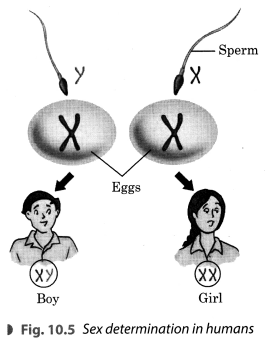
Sex determination of a baby is done at the time of fertilisation when a male gametes fuse with a female gamete. It depends on male partner whether the baby will be a male child or female child. The chances of child to be male or female actually depend on the chromsomes present in the fertilised eggs or ova. There are 23 pairs of chromosomes in the nuclei of all human beings out of which two are sex chromosomes named X and Y.
Force and Pressure Class 8 Extra Questions and Answers Science Chapter 11

A male has one X and one Y chromosome and a female has two X chromosomes. The gametes (egg and sperm) have only one set of chromosomes. The unfetilised egg always has one X chromosome. But sperms are of two kinds. One kind has an X chromosome, and the other kind has a Y chromosome.

When a sperm containing X chromosome fertilises the egg, the zygote would have two X chromosomes and develop into a female child. If the sperm contributes a Y chromosome to the egg (ovum) at fertilisation, the zygote would develop into a male child. Fig. 10.5 shows sex determination in humans.

Question 5.
Explain the term reproductive health. What should we do to maintain reproductive health?
Answer:
The state of physical, mental and social well being of an individual is regarded as an individual’s health. A healthy person is free from disease, tension and anxiety. Reproductive health refers to a state of physical, mental and social well-being in all matters relating to the reproductive system, at all stages of life.

We should take following measures to maintain reproductive health:

  • To have a balanced diet: As far as practicable, we should have a balanced diet, i.e., a diet containing proteins, vitamins, carbohydrates, fats and minerals. We can have our food which contain these nutrients.
  • To take physical exercise: We should take physical exercise like morning walk, running, etc., daily.
  • To maintain personal hygiene: We should maintain personal hygiene to stay fit and healthy. We should wash our body especially pubic region, armpit, etc., properly.
  • Avoid harmful drugs: We should avoid taking harmful drugs and alcohol.

Reaching the Age of Adolescence Class 8 Extra Questions HOTS

Question 1.
One day Seema’s uncle visited her place. Seema prepared dinner for him. When she was about to put rock salt on the salad, her uncle interrupted her and asked to put iodised salt instead of rock salt. He also advised her to prefer iodised salt instead of rock salt. Why do you think Seema’s uncle advised her to have iodised salt instead of rock salt?
Answer:
Deficiency of iodine causes goitre disease in our body. This is why Seema’s uncle advised her to have iodised salt.

Question 2.
It is said that height of a child depends upon the genes inherited from the parents. Are there factors other than genes that causes variation in height?
Answer:
Other factors like nutrition, release of growth hormones, exercises, diseases, etc., also have impact on the height of a growing child.

Question 3.
Is a woman responsible for the birth of a girl child? Explain.
Answer:
No, because a woman has eggs of only X chromosomes but a male has sperms of both X and Y chromosomes. It is the type of male chromosome (X or Y) which fuses with the egg and determine the sex of the foetus, i.e., whether it will be male (XY) or female (XX) child.

Question 4.
John and Radha were classmates since childhood. When Radha became eleven years old, she developed a little swelling on her neck. She visited the doctor who started medication for her. After a few years, John also developed a slight protrusion on his throat. He got worried and went to the doctor. But, the doctor assured him that it was a normal feature in boys while they are growing up. Can you think of any reasons for the difference in diagnoses?
Answer:
The swelling on the neck of Radha may be because of insufficient production of thyroxine which results in goitre. However slight protrusion in John’s throat may be due to enlargement of voice box, also known as Adam’s apple, in adolescent boys.

Question 5.
Why we should not take medicines or drugs unless prescribed by a doctor?
Answer:
Certain medicines have specific dosage levels and adverse side effects which if not followed may be proved lethal to us. Drugs can be addictive too and can ruin our health and happiness.

Reaching the Age of Adolescence Class 8 Extra Questions Value Based (VBQs)

Question 1.
Salma had a very soft and smooth skin during her childhood. As she entered adolescence, she developed pimples on her face, her body became taller compared to her face. She got worried of all of the sudden changes. Her mother explained that all these changes are normal and advised her to wash her face at regular intervals.

(a) Why Salma’s mother advised Salma to wash her face at regular intervals?
(b) What is the reason for appearance of pimples on her face?
(c) Why Salma experienced disproportionate growth of the body?
(d) What values do we get from this?
Answer:
(a) Regular face wash keeps the face clean and dry and helps to reduce the pimples.
(b) During adolescence, secretion of sweat glands and sebaceous glands increases leading to formation of acne and pimples.
(c) During adolescence, all parts of the body do not grow at the same rate. Sometimes the arms and legs or hands and feet of adolescents look oversized and out of proportion with the body.
(d) We must be self-aware, must take proper care and diet during the growing period, not get worried or lose our self-esteem.

Light Shadows and Reflection Class 6 Extra Questions and Answers Science Chapter 11

In this page, we are providing Light Shadows and Reflection Class 6 Extra Questions and Answers Science Chapter 11 pdf download. NCERT Extra Questions for Class 6 Science Chapter 11 Light Shadows and Reflection with Answers will help to score more marks in your CBSE Board Exams.

Class 6 Science Chapter 11 Extra Questions and Answers Light Shadows and Reflection

Extra Questions for Class 6 Science Chapter 11 Light Shadows and Reflection with Answers Solutions

Light Shadows and Reflection of Distances Class 6 Extra Questions Very Short Answer Type

Question 1.
What is light?
Answer:
Light is a form of energy which enables us to see.

Question 2.
What is a luminous object?
Answer:
An object having its own light is called a luminous object, e.g., torch, sun, etc.

Question 3.
What is a non-luminous body?
Answer:
An object which does not have its own light is called a non-luminous object, e.g., chair, moon, etc.

Question 4.
Name some luminous objects.
Answer:
Torch, bulb, sun, firefly and a burning candle.

Question 5.
Give four examples of non-luminous objects.
Answer:
Table, chair, blackboard and notebook.

Question 6.
Name four natural luminous bodies.
Answer:
The sun, firefly, stars and fire.

Question 7.
Name some artificial source of light.
Answer:
Candle, bulb, kerosene oil, lamp and torch.

Question 8.
What is a transparent object?
Answer:
An object which allow light to pass through it, is called transparent object, e.g., clear glass, water, etc.

Question 9.
What is a translucent object?
Answer:
An object which allows only a small part of light through it, is called translucent object, e.g., wax paper, fog, etc.

Question 10.
What is an opaque object?
Answer:
An object which does not allow light at all to pass through it, is called opaque object, e.g., wooden sheet, wall, etc.

Question 11.
Give four examples of transparent objects.
Answer:
Clear glass, clean water, cellophane paper and air.

Question 12.
Give four examples of translucent object.
Answer:
Frosted glass, wax paper, greased paper and butter paper.

Question 13.
Give four examples of opaque objects.
Answer:
Wood, metals, clay and black paper.

Question 14.
What is a shadow?
Answer:
The dark patch formed due to obstruction of light rays by an opaque object is called a shadow.

Question 15.
What information does a shadow give about an object?
Answer:
A shadow gives information about the shape of the object.

Question 16.
Does the colour of the object affect the colour of the shadow?
Answer:
No, the colour of the object does not affect the colour of the shadow.

Question 17.
When is a shadow formed?
Answer:
A shadow is formed when an opaque object is placed in the path of light.

Question 18.
Define a pinhole camera.
Answer:
A pinhole camera is a device which forms a photograph like image of a bright object on a screen.

Question 19.
On which property of light a pinhole camera does work?
Answer:
Rectilinear propagation of light.

Question 20.
How does light travel?
Answer:
Light travels in a straight line.

Question 21.
What type of images are formed by a pinhole camera?
Answer:
The images formed by a pinhole camera are upside down, i.e., inverted image.

Question 22.
What is mirror?
Answer:
A smooth, polished reflecting surface is called a mirror.

Question 23.
What type of image is formed by a plane mirror?
Answer:
Erect and laterally inverted image is formed by a plane mirror.

Question 24.
What is the size of the image formed by a plane mirror?
Answer:
The size of the image formed by a plane mirror is same as that of the object.

Question 25.
What is the colour of the image formed by a plane mirror?
Answer:
The colour of the image formed by a plane mirror is same as that of the object.

Question 26.
What is an eclipse?
Answer:
The phenomenon of formation of shadows of celestial bodies on one another is called an eclipse.

Question 27.
What is rectilinear propagation of light?
Answer:
The property due to which light travels in a straight line is called rectilinear propagation of light.

Question 28.
What is reflection?
Answer:
the phenomenon of bouncing back of light by a highly polished surface is called reflection.

Question 29.
What is an incident ray?
Answer:
The ray of light falling on the surface of the mirror is called an incident ray.

Question 30.
What is reflected ray?
Answer:
The ray of light returning back from the mirror is called a reflected ray.

Light Shadows and Reflection of Distances Class 6 Extra Questions Short Answer Type

Question 1.
What is light?
Answer:
Light is a form of energy which when falls on the object enables us to see them. It helps us to see the objects from which it comes or from which it is reflected.

Question 2.
Distinguish between luminous and non-luminous objects?
Answer:
The objects which have light of their own are called luminous objects such as torch, bulb, burning candle, etc., whereas non-luminous objects does not have light of their own and can be seen only when light falls on them such as table, wall, book, etc.

Question 3.
What is a shadow? How is it formed?
Answer:
The dark patch formed behind an opaque object is called a shadow. It is formed when light ray falling on the surface of the mirror (say an opaque object) is blocked by it.

Question 4.
What are the essential conditions for formation of shadows?
Answer:
A shadow is formed when

  1. there is a source of light.
  2. there is an opaque object in the way of light.
  3. the light ray falling on the opaque object is blocked by it.

Question 5.
Moon is a non-luminous body though it glows. Justify.
Answer:
Moon does not emit light of its own. So it is a non-luminous body. It glows due to reflection of sunlight by it.

Question 6.
What is a pinhole camera? What type of images is formed by it?
Answer:
A pinhole camera is a device which forms a photographic image of a bright object on a screen. The images formed by a pinhole camera are upside down (inverted images).

Question 7.
What is mirror? What type of images is formed by it?
Answer:
The glass sheet having a polished, shiny, smooth and reflective surface on the other side is called a mirror. The images formed by a mirror are erect and laterally inverted.

Question 8.
Why should we not look at the sun directly?
Answer:
The sun radiates ultraviolet radiations that could be extremely harmful for our eyes. This is why we should never see the sun with naked eyes.

Question 9.
What is natural pinhole camera? What type of images is formed by it?
Answer:
When sunlight falls in the leaves of a tree, the gaps between the leaves act as a natural pinhole camera. Afterwards rounded shaped images are formed on the earth. These are pinhole images of the sun.

Question 10.
What is lateral inversion?
Answer:
Lateral inversion means the apparent reversal of the mirror images when compared with the object. For example, right side of the object appear as left side in the image.

Question 11.
Write two differences between a shadow and an image.
Answer:
Images are formed by intersection of reflected rays whereas a shadows are formed when light does not reach behind the object. Images gives more information about the objects such as colour, structure, etc., whereas shadows do not provide such information.

Question 12.
Why is a silvered glass used as a mirror?
Answer:
A silvered glass has a smooth surface which helps in forming clear image. Silverness makes the surface shiny which helps in reducing the absorption of light falling on the mirror surface.

Question 13.
What is an eclipse? What are the two types of eclipse?
Answer:
The formation of shadows by celestial bodies on one another is called an eclipse. There are two types of eclipse.

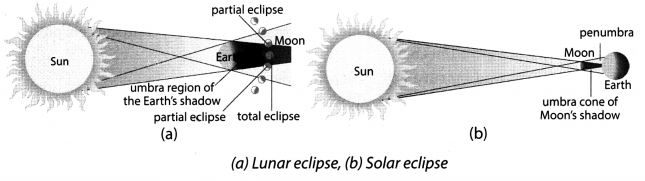
  1. When the moon comes in between the sun and the earth, the shadow of the moon falls on the earth. This is called solar eclipse.
  2. When the earth comes in between the sun and the moon, the shadow of the earth falls on the moon. This is called lunar eclipse.

Question 14.
What are incident ray and reflected ray?
Answer:
(a) A light ray falling on a smooth, shiny and polished surface (say a plane mirror) is called the incident ray.
(b) The light ray returning back in the same medium after striking a smooth, shiny and highly polished surface (say a plane mirror) is called reflected ray.

Light Shadows and Reflection of Distances Class 6 Extra Questions Long Answer Type

Question 1.
What are the different types of object based on their ability to pass the light? Give suitable examples of each objects.
Answer:
On the basis of ability to pass light through an object, objects are classified into three main groups, i.e.,
(a) transparent
(b) translucent and
(c) opaque.

(a) Transparent objects: Objects through which light can pass easily are called transparent objects, e.g., clean glass, clean water, clean air, etc.
(b) Translucent objects: Objects through which light can pass partially and through which we cannot see clearly are called translucent objects, e.g., greased paper, wax paper, butter paper, etc.
(c) Opaque objects: Objects through which light cannot pass at all and through which we cannot see are called opaque objects. Only opaque objects can make shadows, e.g., wall, blackboard, stone, etc.

Question 2.
What is a pinhole camera? How does it works? Explain its construction and image formation.
Answer:
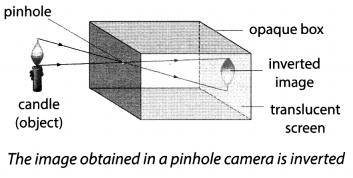
A pinhole camera is a device which casts a photographic image of a bright object on a screen. It works on the principle that light travels in a straight line.

A pinhole camera can be made with simple materials and can be used to obtain the image of sun and brightly lit objects. It consists of a box made of metal or a cardboard that has a fine hole in one face. A plate or any translucent sheet on the side opposite to the face containing the pinhole serves as a screen.

Light Shadows and Reflection Class 6 Extra Questions and Answers Science Chapter 11 1
Images formed by a pinhole camera are upside down, i.e., inverted images.

Question 3.
With the help of diagrams show solar and lunar eclipses.
Answer:
Light Shadows and Reflection Class 6 Extra Questions and Answers Science Chapter 11 2

Question 4.
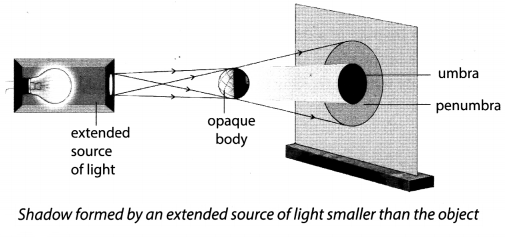
What is umbra and penumbra? With the help of a suitable diagram, show their formation.
Answer:
The inner region of a shadow which is completely dark is called umbra and the outer region surrounding the umbra which is a partially dark region is called penumbra. These two regions in shadows are formed when an opaque body is placed in front of an extended or slit source.
Light Shadows and Reflection Class 6 Extra Questions and Answers Science Chapter 11 3

Light Shadows and Reflection of Distances Class 6 Extra Questions HOTS

Question 1.
Why shadows are black in colour?
Answer:
Shadow is formed by an object by obstructing light so that it doesn’t reach a surface. The area in shadow appears black because there is no light falling on it.

Question 2.
Why we do not obtain upside-down image of the Sun through a pinhole camera?
Answer:
Shape of the Sun is round, so when we see the sun from any angle we get a circle only.

Question 3.
We consider moon as non-luminous body but still we can see things on a full moon night. Why?
Answer:
Moon does not have light of its own. Moon reflects the light of sun in the night. On dark nights a little illumination by moon enables us to see things around us.

Question 4.
Why lunar eclipse not occur every month?
Answer:
It do not occur every month because the Earth’s orbit around the sun is not in the same plane as the moon’s orbit around the earth.

Light Shadows and Reflection of Distances Class 6 Extra Questions Value Based (VBQs)

Question 1.
Parthiv’s grandmother looked a little worried today. She asked everybody to have their lunch after 3 p.m. When Parthiv asked the reason she said, “today is solar eclipse at 2:15 p.m.” Parthiv made her relaxed and said this is a natural phenomenon and nothing bad or unpleasant things are related to this. His grandmother listen him carefully.
(a) What is solar eclipse?
(b) Why do you think that some people believe that these eclipses will have some bad effect on them?
(c) Do you experienced such superstition in your life?
(d) What value of Parthiv is shown here?

Answer:
(a) When the earth, moon and sun are in a straight line, with moon in between, the shadow of moon falls on the earth and this is known as solar eclipse.
(b) Because these type of people are superstitious and doesn’t know the scientific reason behind this.
(c) Yes, many a times by my grandmother.
(d) Parthiv is an intelligent and mature boy with scientific aptitude.

Question 2.
Soumen’s teacher asked their class to make a pinhole camera by themselves. Soumen read the activity 5 given in his textbook on how to make a pinhole camera. But he was unable to get the image of a well lit object. He was very upset. His elder brother on observing his pinhole camera found that the hole made by him was quite large. He rectified Soumen’s mistake and helped him making another pinhole camera. Now, Soumen can see the image of the object.
(a) On which principle of light does a pinhole camera works?
(b) Why was Soumen unable to get the image of a well lit object?
(c) How does the formation of the image by a pinhole camera is affected by size of the hole?
(d) What values of Soumen is shown here?

Answer:
(a) Rectilinear propagation of light
(b) He made a larger hole instead of a fine hole.
(c) The finer will be the hole the sharper will be the image formation and vice versa.
(d) Soumen got upset easily without looking and inspecting the actual cause, he is bit careless in doing his activity.

Irregular Verbs List for Class 4 CBSE Format, Topics, Examples, Samples

Irregular Verbs List for Class 4 CBSE Format, Topics, Examples, SamplesThis grammar section explains English Grammar in a clear and simple way. There are example sentences to show how the language is used.

Irregular Verbs List for Class 4 CBSE Format, Topics, Examples, Samples PDF

Irregular Verbs List PDF

bewas/werebeen
bearboreborn
beatbeatbeaten
beginbeganbegun
bitebitbitten
blowblewblown
broadcastbroadcastbroadcast
breakbrokebroken
bringbroughtbrought
buildbuiltbuilt
burnburntburnt
buyboughtbought
cancouldcould
catchcaughtcaught
choosechosechosen
comecamecome
costcostcost
cutcutcut
dodiddone
drawdrewdrawn
dreamdreamtdreamt
drinkdrankdrunk
drivedrovedriven
eatateeaten
fallfellfallen
feedfedfed
feelfeltfelt
fightfoughtfought
findfoundfound
flyflewflown
forgetforgotforgotten
freezefrozefrozen
getgotgot
givegavegiven
gowentgone
growgrewgrown
hanghunghung
havehadhad
hearheardheard
hidehidhidden
hithithit
holdheldheld
hurthurthurt
keepkeptkept
knowknewknown