Exercise On Adjectives for Class 6 CBSE With Answers

Exercise On Adjectives for Class 6

An adjective is part of speech that describes, identifies, or quantifies a noun or a pronoun or the main function of an adjective is to modify a noun or a pronoun so that it will become more specific and interesting.

Examples of adjectives

  • They live in a beautiful house.
  • Lisa is wearing a sleeveless shirt today.
  • This soup is not edible.
  • She wore a beautiful dress.
  • He writes meaningless letters.
  • This soup is much nicer.

This grammar section explains English Grammar in a clear and simple way. There are example sentences to show how the language is used. You can also visit the most accurate and elaborate NCERT Solutions for Class 6 English. Every question of the textbook has been answered here.

Exercise On Adjectives for Class 6 CBSE With Answers Pdf

What are the Different kinds of Adjectives?
Exercise On Adjectives for Class 6 CBSE With Answers

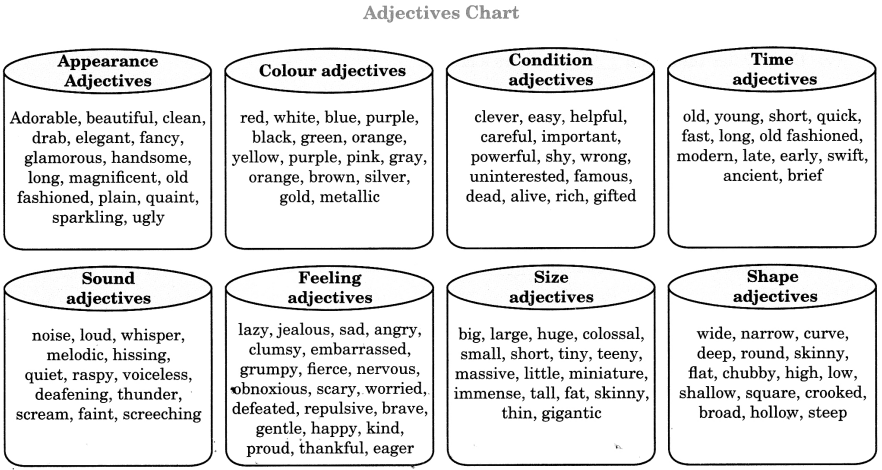
Here are some adjectives categorized in groups. Remember that adjectives can make a conversation or story much more interesting.

There are five types of adjectives. These are:

1. Descriptive Adjectives or Adjectives of Quality: Among the different kinds of adjectives, descriptive adjectives are probably the most common ones. They simply say something about the quality or the kind of the noun or pronoun they’re referring to.
Examples:

  • Erika is witty
  • She is tired
  • Adrian’s reflexes are amazing

2. Adjectives of Number or Adjectives of Quantity: As the name suggests, this kind of adjective answers the questions, “How many?” or “how much?”
Examples:

  • Twenty-one students failed the exam.
  • The plants need more water.

3. Demonstrative Adjectives: Demonstrative adjectives point out pronouns and nouns, and always come before the words they are referring to.
Examples:

  • I used to buy this kind of shirts.
  • When the old man tripped over that wire, he dropped a whole bag of groceries.

4. Possessive Adjectives: Obviously, this kind of adjectives shows ownership or possession. Aside frojn that, possessive adjectives always come before the noun.
Examples:

  • I can’t answer my seatwork because I don’t have a calculator.
  • Trisha sold his dog.

5. Interrogative Adjectives: Interrogative adjectives ask questions and are always followed by a noun.
Examples:

  • What movie are you watching?
  • Which plants should be placed over here?

Exercise Solved Examples On Adjectives for Class 6 CBSE

Question 1.
Tick the appropriate word in the following.
(i) The (later/latter) part of the film is boring.
(ii) (Every/Each) man wants to be rich.
(iii) Don’t leave the station till (farther/further) orders.
(iv) She is my (older/elder) sister.
(v) (All/whole) newspaper want to cover sensational issues.
(vi) Have you read (any/some) novel recently.
(vii) I have (a little/little) time. I can not visit her.
(viii) (a few/few) members were present, no decision could be made.
(ix) I have (some/any) good news for you.
(x) The former is a writer, the (later/latter) a fighter.
Answer:
(i) latter
(ii) Every
(iii) Further
(vi) any
(vii) little
(viii) a few

Question 2.
Fill in the blanks with the most suitable adjectives from the box..

straight tired hungry good dirty sickly noisy
old hot wealthy juicy heavy clever difficult
busy rich excellent cold long naughty

(i) The __________ girl answered all the questions correctly.
(ii) Can you please help me with the bag? It is very
(iii) The _________ man died in his sleep last night.
(iv) The test was __________ I don’t think that i’ll pass.
(y) Dennis is so __________ that even his parents cannot control him.
(vi) Can I have a _________ Drink, please?
(vii) His room was dark and _________
(viii) The children were hungry and _________
(ix) The _________ man donated generously.
(x) Can’t you draw a _________ line?
(xi) Mr. Ravindra scolded the _________ class.
(xii) Zarina is a weak and _________child.
(xiii) The Oranges are sweet and _________
(xiv) Ranjit Singh is a _________ player. He played well.
(xv) The ____ children ate greedily.
(xvi) This is a ________ street.
(xvii) He comes from a __________ family.
Answer:
(i) clever
(ii) heavy
(iii) old
(iv) difficult
(v) naughty
(vi) cold
(vii) dirty
(viii) tired
(ix) wealthy
(x) straight
(xi) noisy
(xii) good
(xiii) juicy
(xiv) excellent
(xv) hungry
(xvi) busy
(xvii) rich

Exercise Practice Examples On Adjectives for Class 6 CBSE

Question 1.
Circle the adjective that best describes the underlined noun.
(i) A (big/tasty) dog was chewing on a bone.
(ii) Isaac rode to school in a (tiny/yellow) bus
(iii) It was a very (cold/dented) day
(iv) Ann asked a (blue/strong) man to open her bottle.
(v) Brooke left her (warm/purple) jump rope or the playground.
(vi) Jaysa hurt her mouth on a (hot/sticky) piece of pizza
(vii) Deagen had to fix his (slippery/ broken) glasses
(viii) Autumn was excited to see the (cold/huge) elephant at the zoo.
(ix) Vikas was shy around the (beautiful/left) girl.
(x) The Empire State Building is a very (flat/tall) building

Question 2.
Fill in the blanks with suitable with suitable adjective form the box given below. (Each adjectives should be used once only)

Colourful Old huge each three
every tasty good honest bad

(i) This is not a very ____________ idea.
(ii) There were many ____________ flowers in the vase.
(iii) She liked ____________ of the two books.
(iv) The movie is about ____________ people.
(v) ____________ student must participate in the cultural activities.

Question 3.
Match the adjectives and opposites
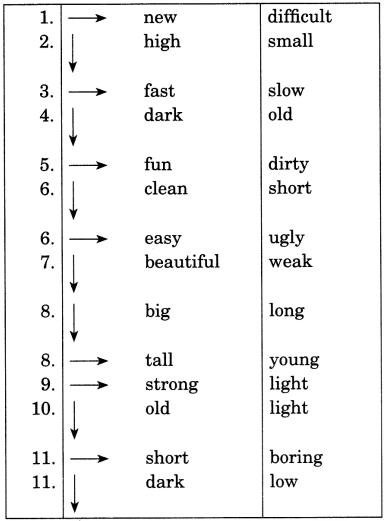
Exercise On Adjectives for Class 6 CBSE With Answers 1

Question 4.
Put the opposite into the crossword puzzle
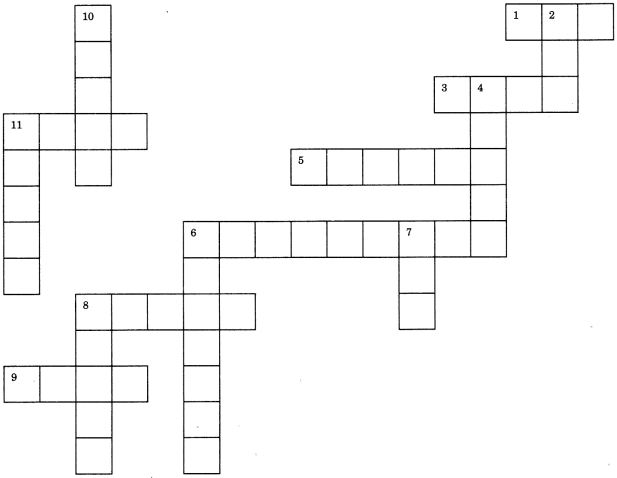
Exercise On Adjectives for Class 6 CBSE With Answers 2

Degrees of Adjective

An adjective is a word modifies (tells us more about) a noun or a pronoun.
Examples:
hot tea, old man, beautiful girl, white shirt, intelligent student, interesting story, handsome boy, huge room.

In the above examples, ‘hot, old, beautiful, white, intelligent’ are adjectives because they modify (give more information about) the attached nouns.

Every adjective has its three degrees.

  • Positive adjective
  • Comparative Adjective
  • Superlative Adjective

These three degrees of an adjectives express the intensity of adjectives in increasing order e.g. big – bigger, good – better – best.
1. A few adjectives change completely in the comparative and superlative forms. They are know as irregular adjectives.

Positive Comparative Superlative
far farther farthest
good better best
bad worse worst
many more most
little less least
late later/laster latest, last

2. If an adjective has more than two syllables, we form the comparative by using the adverb more/less and the superlative by using the adverb most/least. The adverbs are placed before the adjective.

Positive Comparative Superlative
Beautiful more beautiful most beautiful
interesting more interesting most interesting
pleasant more pleasant most planet
reliable more reliable most reliable
exciting less exciting least exciting

Adjectives with exactly two syllabus can be formed in either way.

3. Adjectives with two syllabus ending in y form the comparative and superlative degrees with the suffixes.

Positive Comparative Superlative
easy easier easiest
pretty prettier prettiest
holy holier holier
heavy heavier heaviest
happy happier happiest

Some adjectives only sound right with the suffixes.

Positive Comparative Superlative
narrow narrower narrowest
clever cleverer cleverest
large larger largest

Others only sound right with more and most.

Positive Comparative Superlative
afraid more afraid most afraid
active more active most active

4. If an adjective has one syllable (vowel sound), we form the comparative by adding the suffix ‘er’ and the
superlative by adding the suffix ‘est’ to the adjective.

Positive Comparative Superlative
high higher highest
light lighter lightest
big bigger biggest

Exercise Solved Examples On Degrees of Adjective for Class 6 CBSE

Question 1.
Choose the correct answer.
(i) He is ___________ than his neighbours. (rich, richer, richest)
(ii) The brides were much __________ than the grooms. (young, younger, youngest)
(iii) He is too ___________ to be taught. (intelligent, more intelligent, most intelligent)
(iv) He is ___________ than I thought him to be. (clever, cleverer, cleverest)
(y) When the old woman became , she began to move about. (stronger, more strong)
(vi) He is much ___________ now. (good, better, best)
(vii) The offer was too ___________ to be true. (good, better, best)
(viii) He fishes with ___________ success than I do. (great, greater, greatest)
(ix) Shakespeare is the ___________ playwright in English. (great, greater, greatest)
(x) The pain was _________ than he could bear. (much, more, most)
Ans.
(i) richer
(ii) younger
(iii) intelligent
(iv) cleverer
(y) stronger
(vi) better
(vii) good
(viii) greater
(ix) greatest
(x) more

Exercise Practice Examples On Degrees of Adjective for Class 6 CBSE

Question 1.
Fill in the blanks

Positive Comparative Superlative
Many __________ most
Happy __________ happiest
__________ more famous most famous
bad worse __________
fat fatter __________
__________ gayer gayest
wise__________ wisest
__________ thinner thinnest
good __________ best
far farther __________
ugly uglier __________
__________ more pleasant most pleasant
little __________ least
much more __________

Question 2.
Give comparative and superlative degree forms the following adjectives.
(i) Sharp
(ii) strong
(iii) Good
(iv) brave
(v) intelligent

Question 3.
Fill in the blanks with the correct word, from those given in bracket.
(j) Shruti is __________ than Prayag. (cleverer/cleverest)
(ii) This room is the __________ of all in this house. (bigger! biggest)
(iii) Who is the ___________ of all? (strong/strongest)
(iv) The second question is as ___________ as the first one. (long/longer)
(v) This bag is as as that bag. (heavy/heavier)

Question 4.
Fill the spaces with the correct from of adjectives.

PositiveComparativeSuperlative
noisy____________________
__________thicker__________
____________________cleanest
__________younger__________
clumsy____________________

Question 5.
Underline the adjective that makes each sentence correct.
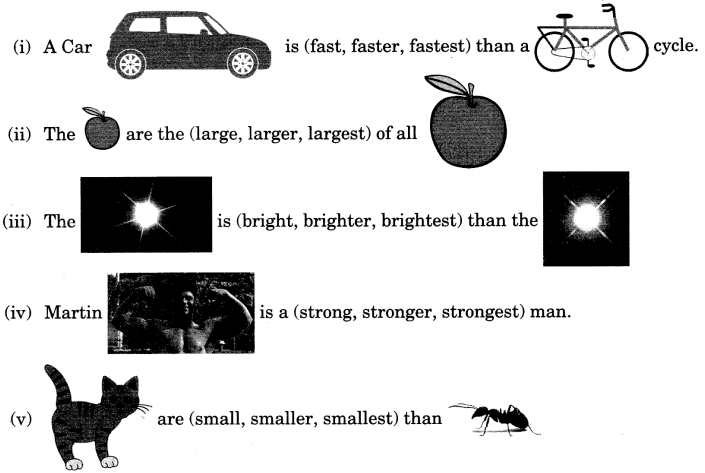
Exercise On Adjectives for Class 6 CBSE With Answers 3

Collective Nouns Exercises for Class 4 CBSE with Answers

This grammar section explains English Grammar in a clear and simple way. There are example sentences to show how the language is used.

Collective Nouns Exercises for Class 4 CBSE with Answers PDF

Fundamentals

  • Collective nouns—such as family, committee and class—name groups that are made up of individuals.
  • A collective noun may be either singular or plural, depending on how the group acts.
  • When the group acts together as one unit to do something, the group is considered singular.
  • When individuals within the group act differently or do different things at the same time, the collective noun is plural.
    Example:
    Singular : The team practices for the game on Friday.
    The jury eats lunch at the restaurant.
    Plural : The team change into their street clothes after the game.
    The jury often have different reactions to the case.

Presentation
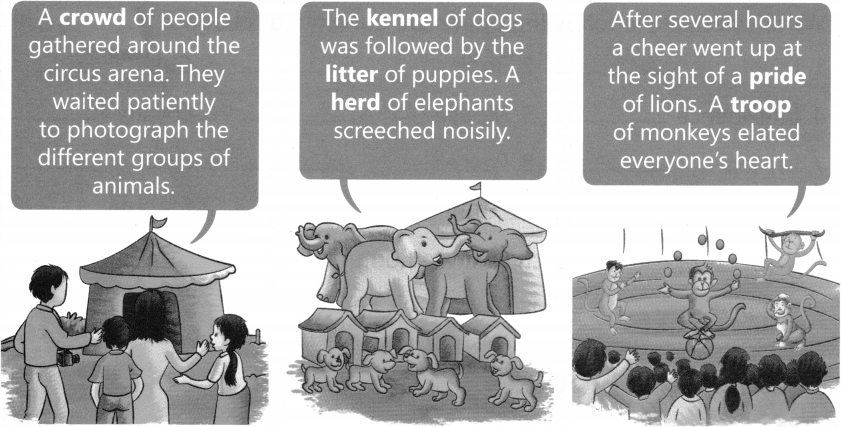
Read the picture story.

A. Answer the following questions as per the story.

1. Which group had gathered around the circus arena? ___________
2. Which group is followed by the kennel of dogs? ___________
3. Which group elated everyone’s heart? ___________

B. Write down collective nouns from the story above.

1. A group of puppies is called a ___________
2. A group of people is called a ___________
3. A group of monkey is called a ___________
4. A group of lions is called a ___________
5. A group of elephants is called a ___________

Collective Nouns Worksheet with Answers for Grade 4

A. Circle the collective noun in each sentence that is describing the subject or noun. The first one has been done for you.

1. Pulling with all their might, a team of oxen hauled rocks.
2. Schools of fish swam quickly up the cool, mountain stream.
3. Herds of elephants ate the trees bare.
4. Colonies of beavers built the dams to hold back the flowing water.
5. Packs of wolves ran through the pine forest.
6. Pods of dolphins leaped out of the ocean.
7. Hives of bees gathered sweet nectar.

B. Match the collective nouns with their groups by writing the letter in the answer column. The first one has been done for you.

Collective NounAnswerGroup or Unit
1. An agendaGA. of thieves stole the money.
2. A batteryB. of kittens meowed for food.
3. LittersC. of juicy grapes from the vines.
4. The herdD. of elephants stomped through the lush jungle.
5. We each picked a bunchE. of tests is hard work.
6. The gaggleF. of geese squawked loudly.
7. A bandG. of tasks was on my desk.

C. Write the matched pairs in a complete sentence. The first one has been done for you.

1. An agenda of tasks is on my desk.
2. ______________________
3. ______________________
4. ______________________
5. ______________________
6. ______________________
7. ______________________

D. Circle the collective noun that best fits in the sentence. The first one has been done for you.
1. The (classroom/herd) of students read the directions on the white board.
2. Sailing around the (flock/chain) of islands, the crew of sailors cheered.
3. Bears fish in the river as the (clouds/runs) of salmon swim upstream.
4. Slithering and hissing, the (pits/brigades) of snakes settled for sleep.
5. Running late, I ran up (flight/pod) of stairs in record time.
6. Looking up at the sky, I had a glimpse of the (packs/galaxies) of stars.
7. After the holidays, we had (colonies/heaps) of trash.

Chemical Effects of Electric Current Class 8 Extra Questions and Answers Science Chapter 14

In this page, we are providing Chemical Effects of Electric Current Class 8 Extra Questions and Answers Science Chapter 14 pdf download. NCERT Extra Questions for Class 8 Science Chapter 14 Chemical Effects of Electric Current with Answers will help to score more marks in your CBSE Board Exams.

Class 8 Science Chapter 14 Extra Questions and Answers Chemical Effects of Electric Current

Extra Questions for Class 8 Science Chapter 14 Chemical Effects of Electric Current with Answers Solutions

Chemical Effects of Electric Current Class 8 Extra Questions Very Short Answer Type

Question 1.
What are good conductors?
Answer:
The substances that conduct electricity through them are called good conductors.

Question 2.
What are insulators or poor conductors?
Answer:
The substances that do not conduct electricity through them are poor conductors or insulators.

Question 3.
Give four examples of conductors.
Answer:
Copper, iron, aluminium and brass.

Question 4.
Give four examples of insulators.
Answer:
Air, wood, rubber and plastic.

Question 5.
Name two metal objects which have a coating of another metal.
Answer:
Handlebars of bicycles, bathroom taps.

Question 6.
What do we get on electrolysis of acidified water?
Answer:
Hydrogen and oxygen gas.

Question 7.
Is air a bad or good conductor?
Answer:
A bad conductor.

Question 8.
Which metal is plated on handle bars of cycles and rim of wheels?
Answer:
Chromium

Question 9.
What is the full form of LED?
Answer:
Light Emitting Diode.

Question 10.
How do we check the electric current?
Answer:
We check the electric current by using a tester.

Question 11.
Which part of an atom is responsible for flow of current?
Answer:
Electron

Question 12.
Why do most liquids conduct electricity?
Answer:
Due to the presence of ions in them, most liquids conduct electricity.

Question 13.
An LED is more efficient device than a bulb. Why?
Answer:
LED is more efficient because it can glow even when a weak or less current flows through it.

Question 14.
Do lemon juice or vinegar conduct electricity?
Answer:
Yes, they conduct electricity.

Question 15.
How is conductivity of liquids tested?
Answer:
By using a tester.

Question 16.
Is water from taps, handpumps, wells and ponds a good conductor?
Answer:
Yes, water from these sources is a good conductor.

Question 17.
What makes distilled water a good conductor?
Answer:
Salts when mixed with distilled water make it a good conductor.

Question 18.
Why is a layer of zinc coated over iron?
Answer:
To prevent iron from corrosion and rust.

Question 19.
Will the solution of sugar in distilled water conduct electricity?
Answer:
No

Question 20.
Why is tin electroplated on iron to make cans used for storing food?
Answer:
Tin is less reactive than iron. Tin coating prevents food from coming in contact with iron and thus pre¬vents it from getting spoiled or corroded.

Question 21.
Why we ifse chromium electroplating on taps and bars of bicycle instead of silver and gold?
Answer:
Silver and gold are very expensive comparatively to chromium.

Question 22.
What type of effect of current do the deposits of metal on electrodes show?
Answer:
Chemical effect

Question 23.
What effect of current does electroplating show?
Answer:
Chemical effect

Question 24.
Which effect of current causes the bulb to glow?
Answer:
Heating effect

Question 25.
Which part of the bulb glows?
Answer:
Filament

Question 26.
Name the three effects of electric current.
Answer:
Heating, magnetic and chemical effect.

Question 27.
How can the magnetic effect of current be checked?
Answer:
By using magnetic compass.

Question 28.
What do we see when the compass needle is brought near a wire in which current is flowing?
Answer:
The needle deflects.

Question 29.
What is electroplating?
Answer:
Deposition of thin layer of a metal over other metal by electrolysis is called electroplating.

Chemical Effects of Electric Current Class 8 Extra Questions Short Answer Type

Question 1.
Define good conductors and poor conductors or insulators.
Answer:
The materials that conduct electricity through them are called good conductors whereas those that do not conduct electricity are called poor conductors or insulators. For example, copper, brass, aluminium, iron, etc., are conductors whereas rubber, plastic, wood, air, etc., are insulators.

Question 2.
How is the conductivity of liquids tested?
Answer:
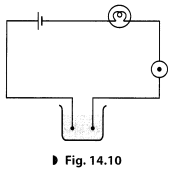
The free ends of the tester is dipped in the liquid. If the bulb glows, the liquid is said to be a conductor. If not, it is an insulator.

Question 3.
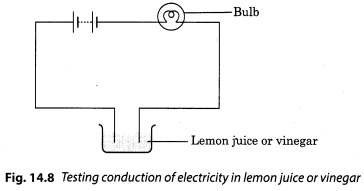
Show with the help of a diagram that lemon juice and vinegar are good conductors of electricity.
Answer:
When the ends of a tester is dipped in lemon juice or vinegar, the bulb glows. This process indicates that lemon juice and vinegar, both, are good conductors of electricity.
Chemical Effects of Electric Current Class 8 Extra Questions and Answers Science Chapter 14 1

Question 4.
What is an LED? Why is it preferred to other type of bulbs?
Answer:
The electric device which is used in the tester instead of bulb is an LED. Its full form is Light Emitting Diode. It is preferred to other bulbs as it can glow even when weak or less current flows through it.

Question 5.
Explain the conductivity of water.
or
Normal water conducts electricity while the pure or distilled water does not. Explain why?
Answer:
Normal water that we get from sources such as taps, handpumps, wells, ponds, etc., is not pure. It may contain several salts dissolved in it naturally. This water is thus good conductor of electricity. The pure or distilled water is free of salts and is a poor conductor.

Question 6.
Give an example of chemical effect of the electric current.
Answer:
The passage of an electric current through a conducting solution causes chemical reactions as a result,
bubbles of a gas are formed, or deposits of metal are seen on electrodes or changes in colour of solution , may occur. These are some of the chemical effects of electric current.

Question 7.
What is electroplating? What are its uses?
Answer:
The process of depositing a layer of any desired metal on another material by means of electricity is called electroplating.
Electroplating is a very useful process. This is used to make objects appear shiny and resistant to scratches. It prevents corrosion.

Question 8.
What happens when electric current is passed through the copper sulphate solution?
Answer:
When electric current is passed through the copper sulphate solution, copper sulphate dissociates into copper and sulphate. The free copper gets drawn to the electrode connected to the negative terminal of the battery and gets deposited on it.

Question 9.
How does a bulb glow in liquid? Explain.
Answer:
When the liquid between the two ends of a tester allows the electric current to pass through it, then the circuit of the tester becomes complete and the current flows in the circuit of liquid makes the bulb glow. But when the liquid does not allow the electric current to pass through it, then the circuit of the tester is incomplete and the bulb does not glow.

Question 10.
What is the magnetic effect of electricity? Explain.
Answer:
When electric current is passed through a coil or wire, it behaves like a magnet. This is known as mag¬netic effect of current. It depends on amount of current passing through the coil or wire.

Question 11.
Why is magnetic compass needed to test the conduction of electric current?
Answer:
Sometimes, when the current passing through a conductor is so small that filament of the bulb does not get heated up and the bulb does not glow. In this case, we need magnetic compass to test the conduction of current.

Question 12.
What happens when an electric current is passed through a cut potato for a considerable time?
Answer:
When an electric current is passed through a cut potato for a considerable time, greenish blue spot is formed around positive electrode. The chemical effect of the electric current is involved in this process.

Question 13.
Why is chromium used for electroplating? Why the objects have chromium plating are not made of chromium itself?
Answer:
Chromium has a shiny look. It does not get corroded and it resists scratches. Chromium is however expensive and it may not be economical to make the whole object out of it. So the object is made from a cheaper metal and only a coating of chromium is done over it.

Question 14.
Which metals, except chromium, are used for electroplating other metals?
Answer:
Jewellery makers electroplate silver and gold on ornaments of less expensive metals.
Tin cans, used for storing food, are made by electroplating tin onto iron. Tin is less reactive than iron. Hence, food is protected from getting spoilt. Iron used in bridges and automobiles is coated with zinc to protect them from corrosion and formation of rust. •

Question 15.
Current does not flow in a circuit if there is a gap between the two wires. Does it indicate that air is a poor conductor of electricity? Does air never conduct electricity? Explain.
Answer:
Air is a poor conductor of electricity if it is dry but in certain cases like during lightning and when air is moist, air may conduct electricity.

Chemical Effects of Electric Current Class 8 Extra Questions Long Answer Type

Question 1.
On what factors thickness of the electroplated items depend?
Answer:
Thickness of electroplated items depend upon:

  • The strength of the current passing through the circuit.
  • The concentration of the metal ion in the solution.
  • The duration of the time the article has been in the solution.

Question 2.
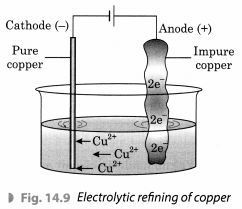
With the help of a suitable diagram, explain electrolytic refining of copper.
Answer:
To purify copper, a thin plate of pure copper and a thick rod of impure copper are used as electrodes in the acidified solution of CuS04. Pure copper is used as cathode and impure copper is used as anode. When electric current is passed through the copper sulphate solution, copper sulphate dissociates into copper and sulphate. The free copper gets drawn to the electrode connected to the negative terminal of the battery and gets deposited on it. From impure copper electrode, an equal amount of copper gets dissolved in the solution. Thus, the loss of copper from solution is restored and the process continues. The impurities are left behind at anode.

Question 3.
Does water conduct electricity? Show with the help of an activity.
or
Show the conductivity of water with the help of an activity.
Answer:
Normal or ordinary water is a good conductor of electricity while distilled water is a bad conductor or insulator. Ordinary water may contain small amount of mineral salts dissolved in it naturally; on the other hand, distilled water is free of salts.
Chemical Effects of Electric Current Class 8 Extra Questions and Answers Science Chapter 14 2
The following activity shows this fact:
About 50 mL of distilled water is taken in a clean and dry beaker. When the tester is dipped into the distilled water, the bulb does not glow which shows that distilled water is a bad conductor of electricity. But when a small amount of common salt is dissolved in distilled water and again tested the bulb glows which shows that distilled water when mixed with salts conduct electricity.

Question 4.
What is electroplating? On which effect of the electric current is it based? Why is it done?
Answer:
The process of depositing or coating a layer of any desired metal on the surface of other material by means of electricity is called electroplating. It is one of the most common applications of chemical effects of electric current.
Electroplating is a very useful process. It is widely used in industry for coating metal objects with a thin layer of a different metal. The layer of metal deposited has some desired property, which the metal of the object lacks. For example, chromium plating is done on many objects to make them shiny and at¬tractive.

Question 5.
What are the advantages and disadvantages of electroplating?
Answer:
Electroplating is a very useful process. It is widely used in industry for coating metal objects with a thin layer of different metal. The advantages and disadvantages of electroplating are:
Advantages:

  • It protects the metals from being corroded.
  • It prevents the rusting of metals.
  • It makes cheap and dull metals shiny and attractive.
  • It can make more reactive metals like iron less reactive.
  • Chromium coating on metals give lustre to objects.

Disadvantages

  • Pollutants from electroplating industries are very harmful. Some chemicals are very lethal for both human and animals.
  • It is an expensive process.

Chemical Effects of Electric Current Class 8 Extra Questions HOTS

Question 1.
Why electric fires are extinguished with either using C02 extinguisher or mud but not water?
Answer:
As water is a good conductor of electricity so it can cause electrocution. Hence, water is avoided in ex¬tinguishing electric fires.

Question 2.
Why do you think electroplated jewelleries are in demand?
Answer:
Electroplated jewelleries are in demand because firstly, they are as shiny and attractive as real jewelleries. They are light-weighted and cost effective. Secondly, one feels free to wear it because of the growing problem of snatching and theft.

Question 3.
Do distilled water conduct electricity? What will happen if we add sugar to it and then salt to it? Explain.
Answer:
No, distilled water do not conduct electricity. If we add sugar to distilled water, then also it will not conduct electricity because sugar do not dissociates into ions. But on adding salt, it will conduct electricity because aqueous salt solution is a good conductor of electricity.

Question 4.
Suppose you want to deposit silver on an iron spoon using silver nitrate as electrolyte. Which terminal of the battery you should connect the spoon? What material should the other electrode be made of?
Answer:
Silver ion is positively charge, so the spoon must be connected to negative terminal to deposit silver on it. The other electrode should be made of silver.

Question 5.
Why potato turns green on passing current? Around which terminal greenish patch is observed?
Answer:
Potato turns green due to chemical effect of current. Around positive terminal greenish patch in potato is observed.

Chemical Effects of Electric Current Class 8 Extra Questions Value Based (VBQs)

Question 1.
Yakub made an circuit as shown in the figure. He observed that the bulb did not glow but on bringing a compass needle near it shows deflection.
He was quite confused that if current is flowing through the circuit then why the bulb is not glowing. Meanwhile his friend Sourav arrived and suggested him to add one more cell in the circuit. The bulb, then started glowing.
(a) Define a circuit.
(b) What does the deflection of a compass needle shows?
(c) Why the bulb did not glow in the first case but glow in the second case?
(d) What value of Sourav is shown here?
Answer:
(a) Circuit is a closed path through which an electric current flows.
(b) Deflection of compass needle shows that the current is flowing in the circuit. It is magnetic effect of
current.

Chemical Effects of Electric Current Class 8 Extra Questions and Answers Science Chapter 14 3
(c) The current flowing through the circuit in first case was too low to make the bulb glow but on add-ing a cell in the second case makes the bulb glow.
(d) Sourav is an intelligent, helpful, analytical and with scientific aptitude.

Question 2.
While demonstrating an experiment to show whether the given liquid conduct electricity or not to class VIII students, teacher reminded everybody that one should not conduct experiment with the electric supply from the mains or a generator or an inverter. They should use electric cells for the activity.
(a) Do liquids conduct electricity?
(b) Why we should not use electric source from mains generator or an inverter?
(c) What values do we get from this?
Answer:
(a) Yes, liquids which are solutions of acids, bases and salts conduct electricity. Other liquids such as oil, alcohol, sugar solution and pure water do not conduct electricity.
(b) Current flowing from mains, generator or an inverter is very large. So to avoid the chances of elec-trocution and short-circuit we must use cells for experiments.
(c) We get awareness of not using main electric supply and precaution to be followed while doing experiment.

Water Class 6 Extra Questions and Answers Science Chapter 14

In this page, we are providing Water Class 6 Extra Questions and Answers Science Chapter 14 pdf download. NCERT Extra Questions for Class 6 Science Chapter 14 Water with Answers will help to score more marks in your CBSE Board Exams.

Class 6 Science Chapter 14 Extra Questions and Answers Water

Extra Questions for Class 6 Science Chapter 14 Water with Answers Solutions 

Water Class 6 Extra Questions Very Short Answer Type

Question 1.
Can you name some activities where water is used for recreation?
Answer:
River rafting, swimming, water games, water park, etc.

Question 2.
Name some sources of water.
Answer:
Hand pump, tube well, river, pond, lake, ocean, etc.

Question 3.
From where do lakes and ponds get their water?
Answer:
Rains

Question 4.
Name two main processes which transfer water present on the earth into water vapour continuously.
Answer:
Evaporation and transpiration.

Question 5.
What name is given to the process in which rainwater is made to percolate into the ground efficiently?
Answer:
Rainwater harvesting

Question 6.
What is the ultimate source of water?
Answer:
Rain

Question 7.
What are the different forms of precipitation?
Answer:
Rain, snow and dew.

Question 8.
What will happen if there is a continuous rain?
Answer:
This results into floods.

Question 9.
Name the process which is involved in the formation of dew?
Answer:
Condensation

Question 10.
Name the condition given to the extreme dryness in an area due to lack of rains for a long period.
Answer:
Drought

Question 11.
What is the main source of groundwater?
Answer:
Rainwater

Question 12.
List one use of water.
Answer:
Water is essential for the germination of seeds.

Question 13.
Name the term used for falling of water drops from sky.
Answer:
Precipitation

Question 14.
Name the states where roof top water harvesting is used to collect water.
Answer:
Tamil Nadu and Rajasthan.

Question 15.
What is the process of changing water into vapour called?
Answer:
Vapourization

Water Class 6 Extra Questions Short Answer Type

Question 1.
What is glacier?
Answer:
A glacier is a persistent body of dense ice that is constantly moving under its own weight. The rivers get their water from the melting of these glaciers.

Question 2.
Why is water important for us?
Answer:

  1. Water regulates body temperature by the process of respiration and evaporation.
  2. All metabolic reactions in the body take place in aqueous medium.
  3. It transports minerals and food materials in plant’s and animal’s body.

Question 3.
What is water cycle?
Answer:
Water constantly moves from the earth to the air and back again. The constant circulation of water is known as the water cycle.

Question 4.
What are the different ways by which water vapour is put into the atmosphere?
Answer:
Water in oceans, lakes and ponds get evaporated due to atmospheric heat. Factories and thermal power stations produce a lot of steam and put it into the atmosphere. Plants lose water through transpiration. Animals lose water through respiration, sweating and excretion. All this vapour accumulates in the atmosphere.

Question 5.
What is precipitation?
Answer:
When water drops come together in the air, it becomes heavy and begin to fall. Falling of water drops is called precipitation.

Question 6.
What are the two main techniques of rainwater harvesting?
Answer:
The two main techniques of rainwater harvesting are:

  • Roof-top rainwater harvesting
  • Rainwater harvesting from open spaces around buildings.

Question 7.
How does rainwater become saline?
Answer:
Water is a universal solvent because it dissolves a large number of substances. When rain falls, it dissolves common salts and many other substances and minerals present on the earth. The rainwater passes through different layers of earth, rocks, dissolves large amount of salt and other minerals. Thus it becomes salty.

Question 8.
Explain the roof-top rainwater harvesting.
Answer:
In this technique, the rainwater from the roof-top is collected in a storage tank with the help of pipes. Here it is filtered and then sent into a pit. The water in the pit seeps or percolates slowly into the ground to recharge the groundwater.

Question 9.
How does water cycle help in maintaining global climate?
Answer:
Water cycle plays an important role in the world climate. Ocean absorb vast quantities of heat and help in global warming. By absorbing heat, water evaporates and on condensation releases heat. This absorption and releasing of heat in the form of energy drives weather pattern in the short-term and regulate the climate for long time.

Water Class 6 Extra Questions Long Answer Type

Question 1.
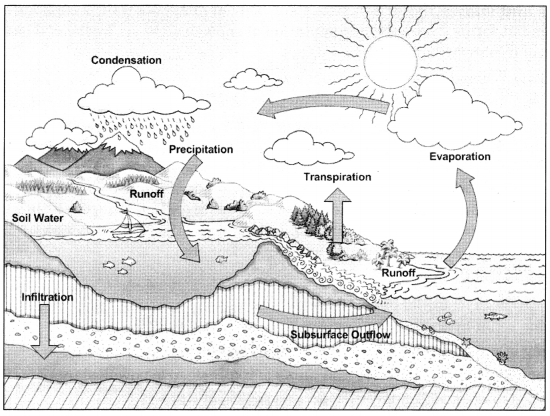
Explain the process of water cycle in nature with the help of suitable diagram.
Answer:
Water constantly moves from the earth to the air and back again. The constant circulation of water is known as the water cycle. The water in seas, rivers, lakes, ponds or streams evaporates because of the heat of the sun. Plants also give out large amounts of water from their leaves. The water vapour rises up. The air higher up in the atmosphere is cooler.

This cools the water vapour and its condenses to form tiny drop of water. These drops of water together form clouds. As the clouds get cooled further, the water drops become bigger and heavier. When they become too heavy, they fall on the earth as rain and fill the sources of water like river, ponds, streams, etc.
Water Class 6 Extra Questions and Answers Science Chapter 14 1
Question 2.
List the uses of water.
Answer:
Uses of water are:

  1. It is needed for drinking, bathing, washing, cleaning of vessels, toilets, flushing, etc.
  2. Our body contains about 70% of water. Hence, water is essential for our life.
  3. Water helps animals and plants to keep themselves cool.
  4. Water is required for irrigation.
  5. Water is used to generate electricity.
  6. Water is used for recreational activity.
  7. Water is habitat of many aquatic plants and animals.

Question 3.
Explain about the sources of water.
Answer:
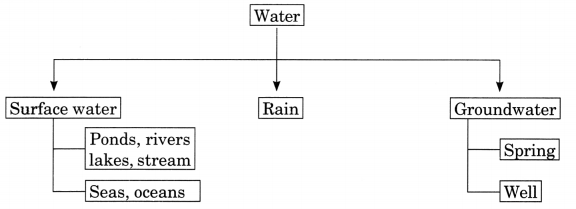
Sources of water can be classified as:
Water Class 6 Extra Questions and Answers Science Chapter 14 2
• Surface-water: Rivers, lakes, ponds, streams, oceans, etc., are surface water which is continually replenished by rainwater runoff and melting of glaciers. Most of the human activities, like drinking, washing, farming, etc., rely on freshwater supply. Two-third of Earth’s surface is covered with oceans and seas. Water from these sources are not fit for drinking or any other human activities. Surface water act as natural habitat for many plants and animals.

• Groundwater: Water present beneath Earth’s surface in soil pore spaces and in fractures of rock formations. It is stored there and moves slowly through geologic formation of soil, sand and rocks called aquifers. Groundwater is mainly replenished through seepage of rainwater and surface water.

• Rain: Rain is liquid water in form of droplets that have condensed from the atmospheric water vapour and then precipitated, i.e., become heavy enough to fall under gravity.

• Glaciers and snow: Glacier is a persistent body of dense ice that is constantly moving under its own weight. It forms where the accumulation of snow exceeds its melting. Glacial ice is the largest reservoir of freshwater on Earth.

Question 4.
What is drought? When does drought occur?
Answer:
Drought is a long period without rains leading to severe shortage of water in the region.
The soil continues to lose water by evaporation and transpiration. The water lost by soil is usually made up by rains. If, however, it does rain at all or the rainfall is very low for a long period, the loss of water from the soil is not made up and hence the soil becomes dry.

Due to lack of rains, the water level in the lakes and ponds also goes down and some of them may even dry up completely. In the absence of rains, no water seeps into the ground and hence the level of groundwater in wells, etc., falls drastically. Due to this groundwater also becomes scarce. In this way, a prolonged period of no rains or very low rains causes all around shortage of water leading to drought.

Question 5.
How is rain useful to us?
Answer:
Rainwater is useful to us in the following ways: ,

  1. Rains bring relief by cooling the environment after hot summer days.
  2. The sowing of many crops depends on the arrival of rains during monsoon.
  3. Rains provide water in the rivers and dams of hydroelectric power plants.
  4. Rains fill the lakes and ponds which acts as source of water.
  5. Rains are also responsible for recharging the groundwater and thus maintaining water table.

Water Class 6 Extra Questions HOTS

Question 1.
What are the factors affecting rate of evaporation?
Answer:
(a) Temperature: Higher is the temperature higher will be the rate of evaporation.
(b) Wind velocity: Higher is the wind velocity higher will be the rate of evaporation.
(c) Surface area: Larger is the surface area, i.e., exposed area, larger will be the rate of evaporation.
(d) Humidity: Humidity is the presence of moisture in air. Higher is the humidity, less will be the the rate of evaporation.

Question 2.
How does water kept under the shade of a tree also gets evaporated?
Answer:
Air around us gets heated from sunlight. This warm air provides heat for evaporation of water kept in
the shade.

Question 3.
What will happen if we are lost in a sea and drink lot of sea water to quench our thirst?
Answer:
The sea water is highly saline. Drinking this water will cause diarrhoea and loss of too much water from our body through frequent urination. Thus, will cause dehydration and ultimately death.

Question 4.
In what ways does water serves to sustain life?
Answer:
Water controls various biological processes like, transpiration, ingestion, excretion, digestion, etc. Moreover 70% of our body weight comprises of water.

Question 5.
Dissolve two spoons of common salt in half a cup of water. Now, if you want to get the salt back, what will you do?
Answer:
To get the salt back from its solution, the solution is heated in a container till all the water gets evaporated. The white powdery substance that is retained back is the salt

Water Class 6 Extra Questions Value Based (VBQs)

Question 1.
On a summer vacation, Ria went to her village to spent her holidays. After staying there for some days she realised the problem of shortage of water faced by the villagers. She along with her father went to the office of water supply department of her village and conveyed them the problem of water shortage.

The officer of water supply department assured Ria and her father that they will do something to overcome this shortage but the villagers must also adopt water conservation practices to use water judiciously. Ria thought to make villagers aware of water conservation practices with some interesting play so that they could understand its importance.
(a) Where did Ria went in her summer vacation?
(b) What did she observed there?
(c) What do mean by water conservation?
(d) What practices could help in conserving water?
(e) What values of Ria is shown here?

Answer:
(a) Ria went to her village in summer vacation.
(b) She observed water shortage there.
(c) Water conservation refers to strategies and activities made to manage fresh water as a sustainable resource to meet current and future human demand.
(d) (i) Use water judiciously.
(ii) Use water from washing machine, bathing and moping in watering plants or flushing toilets.
(iii) Check leaking pipes and get it’repaired.
(iv) Use high-efficiency toilets that use less water in a flush.
(v) Water the plants at night to reduce loss of water due to evaporation.
(e) Ria is an intelligent, responsible, understanding, sensible and innovative girl.

Question 2.
Whenever Sajia returns from school she empties her water bottle in the potted plant instead of throwing it in the sink. She always keep her eyes on her housemaid that the water after mopping the house must be used for watering the plants in the garden.
(a) Can you suggest any other use of the water left after mopping?
(b) What is the function of water in plants?
(c) What values of Sajia is shown here?
Answer:
(a) We can use the water after mopping in flushing the toilets.
(b) Water in plants help in transportation, maintaining turgidity, photosynthesis and cooling through transpiration.
(c) Sajia is eco-friendly, responsible and intelligent girl.

Concrete and Abstract Nouns Exercises for Class 4 CBSE with Answers

Concrete and Abstract Nouns Exercises for Class 4 CBSE with AnswersThis grammar section explains English Grammar in a clear and simple way. There are example sentences to show how the language is used.

Concrete and Abstract Nouns Exercises for Class 4 CBSE with Answers PDF

  • Nouns can be concrete or abstract.
  • Concrete nouns are “sense” nouns. You can see, hear, smell, taste, and/or touch them.
  • Concrete nouns are countable and uncountable.
  • Abstract nouns are ideas or concepts – things that you feel or think about but cannot touch.
  • Abstract nouns are uncountable.
  • Example: The lonely dog pushed at the fence, longing for freedom.
  • Dog and fence are concrete nouns. Freedom is an abstract noun.

Presentation
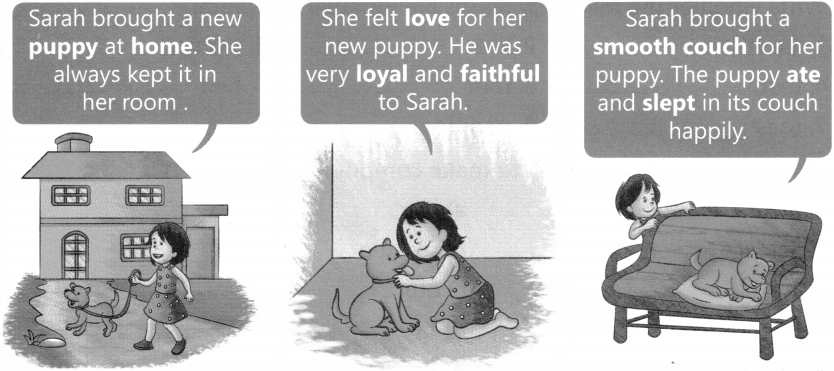
Read the picture story.
Concrete and Abstract Nouns Exercises for Class 4 CBSE with Answers

A. Answer the following questions as per the story.
1. What did Sarah bring at home? ___________
2. What did Sarah feel for her new puppy? ___________
3. What did the puppy do in its couch? ___________

B. Read the story again and list the concrete and abstract nouns in the table given below.

ConcreteAbstract
……………………………………………………
……………………………………………………
……………………………………………………
……………………………………………………
……………………………………………………
……………………………………………………
……………………………………………………
……………………………………………………
……………………………………………………
……………………………………………………
……………………………………………………
……………………………………………………

Concrete And Abstract Nouns Exercises with Answers Pdf for Grade 4 CBSE PDF

A. Write whether the words in bold are concrete nouns or abstract nouns.

1. He was given an award for his courage. ___________
2. The door slammed shut. ___________
3. She thought that happiness was the most important thing in life. ___________
4. He dropped his phone with a crash. ___________
5. Time is a great teacher. ___________
6. His art teacher applauded his creativity. ___________
7. She moved the chair into its place. ___________
8. He always made his bed before leaving for school. ___________

B. Write whether the following nouns are concrete or abstract.

1. Love ___________
2. Book ___________
3. Girl ___________
4. Intelligence ___________
5. Mouse ___________
6. Loyalty ___________
7. Laptop ___________
8. Peace ___________
9. Desk ___________
10. Trust ___________
11. Confidence ___________
12. Bottle ___________

C. Write the opposite for each abstract noun.

1. Happiness ___________
2. Love ___________
3. Beauty ___________
4. Kindness ___________