Pronouns Worksheet Exercises for Class 3 CBSE with Answers

Pronouns Worksheet Exercises for Class 3 CBSE with Answers 1

Definition of Pronoun:
A pronoun is a word that is used in place of a noun and does the work of a noun. A pronoun is a word that takes the place of a common noun or a proper noun.

This grammar section explains English Grammar in a clear and simple way. There are example sentences to show how the language is used.

Pronouns Worksheet Exercises for Class 3 CBSE with Answers PDF

A pronoun is a word that can be used to take the place of a noun. The noun to be replaced can be the name of a person, place, animal or thing. Personal, Reflexive, Emphasising, Demonstrative, Interrogative, Possessive are the different types of pronouns. Personal Pronouns: Pronouns that stands for a person or a thing are called Personal Pronouns. i.e. I, we, you, he, she, it and they are personal pronouns. The pronoun must agree in number with the noun that it replaces. If the noun is in the singular form, the pronoun must also be in the singular form. And, if it is in the plural form, the pronoun must also be in the plural form.

Examples:
Singular: The boy is playing with his puppet. He has a sock puppet.
Plural: The boys are playing with their puppets. They have puppets of various colours.

Fundamentals

  • Words that are used in place of nouns are called pronouns.
  • We use I, he, she, it, we, you, they so that we don’t have to repeat the
  • names of people, places or things again. . I, he, she, it, we, you, they are subject pronouns.
  • We use I, He, She, It in place of names to talk about only one person.
  • We use We, You, They in place of names to talk about more than one person.
  • This is used for nearby objects. That is used for objects that are far away. (one object) These is used for nearby objects.
  • Those is used for objects that are far. away. (more than one object) Me, us, you, him, her, it, them are also called pronouns.
  • These are object pronouns.
  • ‘Me’ introduces ‘l’ in a sentence.
  • ‘Us’ introduces ‘We’ in a sentence.
  • ‘Him’introduces ‘He’ in a sentence.
  • ‘Her’ introduces ‘She’ in a sentence.
  • ‘It’ introduces ‘object’ in a sentence.
  • ‘Them’ introduces ‘They’ in a sentence.

Pronouns Exercises for Class 3 with Answers CBSE PDF

A. Change the underlined word or words to a pronoun and rewrite each sentence.

1. Mala made dinner for the whole family. ______________________
2. Tina played ball with Ricky and Kayra. ______________________
3. Mr. Sharma went to the movies with Mrs. Sharma. ______________________
4. The house needs a fresh coat of paint. ______________________

B. Underline the pronouns in the sentences given below. Some sentences have more than one pronoun.

1. She went to the store with Anu.
2. Six of us had to squeeze in the tiny car.
3. Every Thursday, Kitty goes to Wal-Mart with them.
4. At the store, the cashier gave her some change.
5. When the sun comes up, he leaves for work.
6. I enjoyed seeing them on the playground.
7. Have you hung the painting on the wall yet?
8. If I eat all of these vegetables, mother will let me watch television.
9. We played with the puppy, then fed it a biscuit.
10. Have you seen the sandcastle we built?

C. Read each pair of sentences and underline the words from the first sentence that the pronoun replaces in the second sentence. The first one has been done for you.

1. John and I went to the movie theater. We bought somePronouns Worksheet Exercises for Class 3 CBSE with Answers 2popcorn ‘John and I’ replaced with ‘We’.
2. The magicianPronouns Worksheet Exercises for Class 3 CBSE with Answers 3cut a woman in half. Then, he pulled a rabbit from a hat ______________________
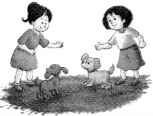
3. Mary and Tina played with the puppies. Pronouns Worksheet Exercises for Class 3 CBSE with Answers 4Mary tossed the ball to them. ______________________
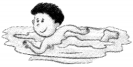
4. Pronouns Worksheet Exercises for Class 3 CBSE with Answers 5Rahul went swimming with Paul. They dove under water. After an hour, it ran out ______________________
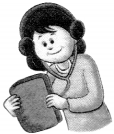
5. Suhani listened to music on her iPod. Pronouns Worksheet Exercises for Class 3 CBSE with Answers 6After an hour, it ran out of batteries. ______________________

More about Pronouns Exercises for Class 3 CBSE with Answers

Fundamentals

  • Some pronouns show that an action affects the person who performs the action.
  • They are called reflexive pronouns.
  • A reflexive pronoun is used when the object of a sentence is the same as the subject.
  • They either end in -self, in case of singular form, or -selves in case of plural form.
  • The singular reflexive pronouns are:- myself, yourself, himself, herself, itself.
  • Plural reflexive pronouns include: ourselves, yourselves, themselves.
  • A subject in a sentence is the noun that is performing the action.
  • The dog played. In this sentence dog is the subject. The object of a sentence receives the action.
  • The dog played with the ball. In this sentence, the ball is the object because it is receiving the action.

Pronouns Exercises for Class 3 Summary Table

Personal PronounReflexive Pronoun
Imyself
you (singular)yourself
you (plural)yourselves
hehimself
sheherself
ititself
weourselves
theythemselves

Presentation
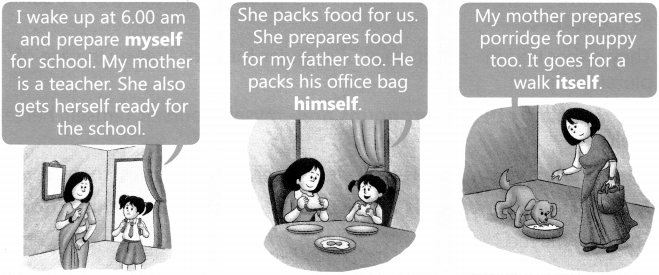
Read the picture story.
Pronouns Worksheet Exercises for Class 3 CBSE with Answers 7

A. Answer the following questions according to the story.

1. How does the father pack his office bag? ________________________
2. How does a puppy go for a walk? ________________________
3. What does the mother do? ________________________

B. Fill in each blank with the help of the story given above.

1. Which reflexive pronoun is used for the mother? ________________________
2. Which reflexive pronoun is used for the father? ________________________
3. Which reflexive pronoun is used for the puppy? ________________________

Pronouns Exercises for Class 3 CBSE with Answers PDF

A. Use the reflexive pronouns in the box given below to complete the sentences. Then underline the noun to which the pronoun is referring. The first one has been done for you.

myself – yourself – herself – himself – itself – ourselves – yourselves – themselves

1. Pawan and Maya did the project all by themselves
2. I wondered about that ________________________.
3. Aditya hurt ________________________ playing hockey
4. The calculator will turn ________________________ off when it is not being used.
5. Make sure you clean ________________________up before the party starts.
6. Naina dusted ________________________off before she got back on the horse.
7. You and I have to ask ________________________that question.
8. Do you boys think you can handle this ________________________?

B. Tick the correct pronoun.

1. Sameer, Tilak, and (I, myself) are headed to the camp.
2. Give the paperwork to (me, myself).
3. She accomplished that work all by (she, herself).
4. He just has to fix that (herself, himself).
5. I want him to do the job (he, himself).
6. I (me, myself) believe that too.
7. The players (theirselves, themselves) are willing to clean the field.
8. He gave (hisself, himself) a good lecture.

C. Complete the following sentences with correct reflexive pronouns.
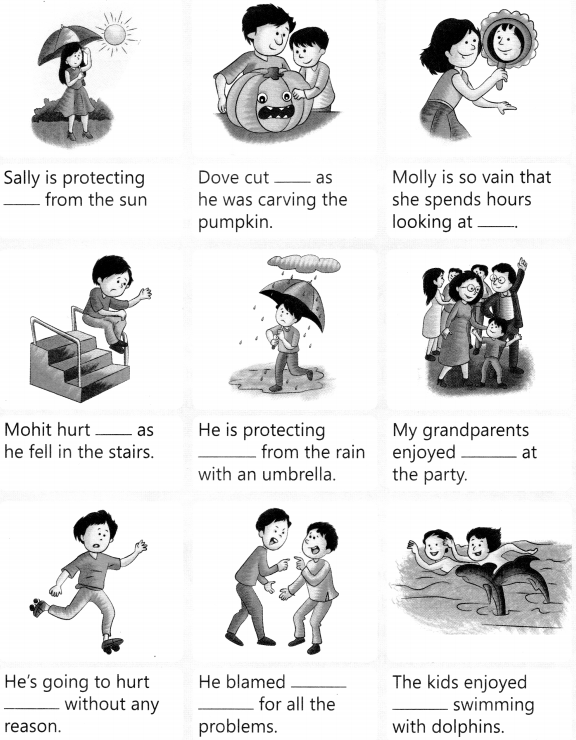
Pronouns Worksheet Exercises for Class 3 CBSE with Answers 8

Exercise On Adjectives for Class 7 CBSE With Answers

Exercise On Adjectives for Class 7

An adjective modifies a noun or a pronoun by describing, identifying or quantifying it.
Most often, an adjective precedes the noun or the pronoun which it modifies.
The duck–shaped balloon floated over the treetops.
The small boat foundered in the dark and stormy sea.
Sometimes, an adjective is placed after a being verb. In such cases the adjective is called an adjective complement or a predictive adjective.
Your behaviour was outrageous.
The dancer is very graceful.

This grammar section explains English Grammar in a clear and simple way. There are example sentences to show how the language is used. You can also visit the most accurate and elaborate NCERT Solutions for Class 7 English. Every question of the textbook has been answered here.

Exercise On Adjectives for Class 7 CBSE With Answers Pdf

Kinds of Adjective
Exercise On Adjectives for Class 7 CBSE With Answers

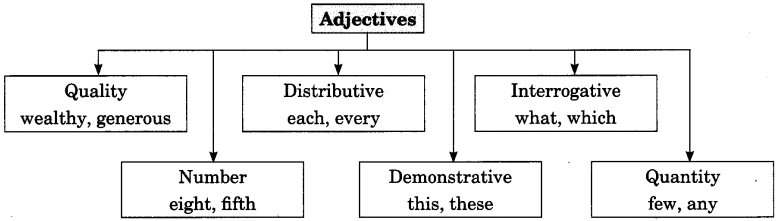
There are five types of adjectives. These are:
There are six kinds of Adjectives- Possessives, Demonstratives, Qualitative, Quantitative, Number and Interrogatives Possessive adjectives show that they belong to someone or something. My, our, your, his, her, its are possessive adjectives.

Demonstrative adjectives are the adjectives which point out specific things and people. This, That, These, Those are demonstrative adjectives.
Examples:

  • Give me those flowers.

Adjective of quality tells us the kind of a noun or a pronoun. It describes the characteristic of a noun or a pronoun.
Examples:

  • It is a tall tree.

Adjective of quantity describes the amount or quantity of something without knowing its exact number. Some, any, much, many, lots of, plenty of, a few, a little, all, few are adjectives of quantity.
Examples:

  • Give me little water.

Adjective of number tells how many people, places, animals or things are there.
For Examples:

  • Ayush has three cars.

Interrogative Adjectives are used to ask questions about a noun or in relation to a noun such as what, which, whose, how, why, etc.
For Examples:

  • Whose sister is she?

Order of Adjectives: Sometimes several adjectives are used to describe a noun or a pronoun. When you use two or more adjectives, the usual order is: size, quality, colour, origin, substance.
Examples:

  • a small green plastic box
    size colour substance
  • a stylish red Italian car
    quality colour origin

Here are more examples:

  • A large Indian temple
  • A colourful cotton shirt
  • A tall white stone building
  • A long Chinese silk robe

Adjectives of quality sometimes come before adjectives of size.
For Examples:

  • beautiful long hair
  • elegant short hair

But adjectives of size always come before the adjectives of colour.
For Examples:

  • beautiful long black hair
  • elegant short red hair

Adjective of substance comes after the adjective of colour.
For Examples:

  • a beautiful long black silk dress

Exercise Solved Examples On Adjectives for Class 7 CBSE

Question 1.
Pick out all the adjectives in the following sentences and say to which class each of them belongs.
(i) The car sustained heavy damage in the accident.
(ii) He has written several stories.
(iii) A dog is very faithful to its master.
(iv) Everyman has his duties.
(v) He is a man of few words.
(vi) Neither party is quite in the right.
(vii) Which color do you prefer?
(viii) The way was long, the wind was cold.
(ix) He calls me every day.
(x) I have not seen him in several days.
(xi) John won the second prize.
(xii) He was absent from the class.
(xiii) He died a glorious death.
(xiv) A small leak is enough to sink a great ship.
(XV) King Francis was a hearty king and loved a royal sport.
Answer:
(i) Heavy – adjective of quality.
(ii) Several – indefinite numeral adjective
(iii) Faithful – adjective of quality
(iv) Every – distributive numeral adjective
(v) Few – indefinite numeral adjective
(vi) Neither – distributive numeral adjective
(vii) Which – interrogative adjective.
(viii) Long – adjective of quality; cold – adjective of quality.
(ix) Every – distributive numeral adjective
(x) Several – indefinite numeral adjective
(xi) Second – definite numeral adjective
(xii) Absent – descriptive adjective
(xiii) Glorious – descriptive adjective
(xiv) Small – descriptive adjective; great – descriptive adjective
(xv) Hearty – adjective of quality; royal – adjective of quality

Exercise Practice Examples On Adjectives for Class 7 CBSE

1. Use the adjectives given in brackets in the appropriate comparative form.
(i) My writing is _________ (neat) than his.
(ii) Daughter are said to be _________ (loving) than sons.
(iii) My mother is, _________ (happy) since I stopped working night shifts.
(iv) His jokes are no _________ (funny) than his pranks.
(v) The film is definitely _________ (exciting) than the book.
(vi) There is nothing _________ (good) than a message to help one relax.
(vii) You need to be _________ (careful) in your work.
(viii) Is a blade _________ (sharp) than a knife?

2. Underline the adjective in the following sentences. Then rewrite the sentences using the adjectives attributively. The first one has been done as an example.
(i) The team is fantastic! It is a fantastic team.
(ii) The story is uplifting.
(iii) This painting is costly.
(iv) The day was depressing.
(v) The prank was funny.
(vi) Many refugees were homeless.
(vii) The kitten was brown and white.
(viii) The affair was very tragic.

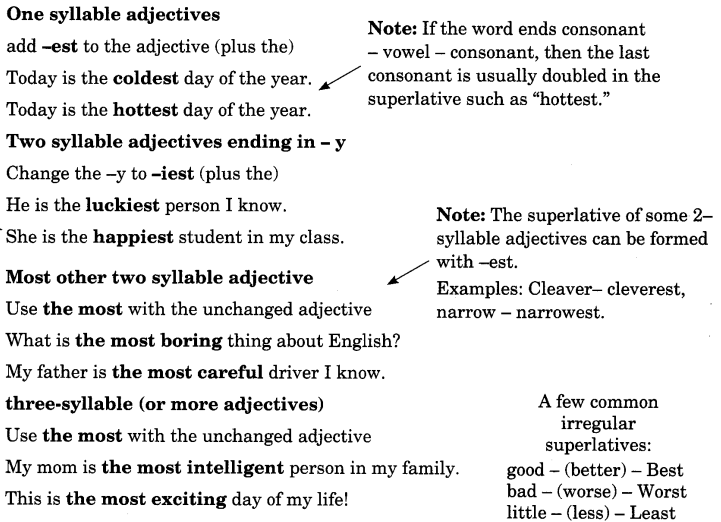
3. Fill in the blanks with the superlative forms of the adjectives in the box.
dry tall near bright small deep high difficult big long
(i) Where is the tallest building in the world? It is in Dubai.
(ii) Wow! This waterfall looks really high. Yes, it is the _________ waterfall in the world.
(iii) The script of this language has thousand of complex characters. Some people think it is the language in the world.
(iv) The capital of the _________ country in the world is Moscow.
(v) This planet is _________ to the Sun.
(vi) This place is a desert in Chile. It is the _________ place in the world.
(vii) What a tiny, cute bird! It is the _________ bird.
(viii) Arjuna was one of the heroes of the world’s _________ epic.
(ix) Today, the _________ star has lit up the night sky.
(x) The _________ location of the earth is in the Pacific Ocean.

Degrees of Adjective

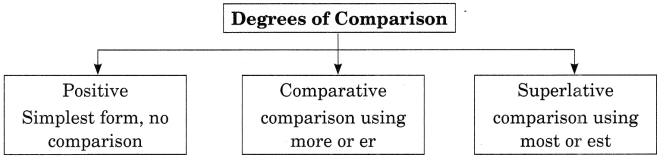
Adjectives of quality have three degrees of comparison – positive, comparative, and superlative. To describe only one person or thing we use a positive degree.

  • The Ganga is a long river.
  • Neha is short.

When we compare one person or thing with another, we use a comparative degree.

  • The Amazon is longer than the Ganga.
  • Amita is shorter than Neha.

When comparing more things using a comparative adjective, we use the conjunction than in the sentence. While comparing more than two things, we use the superlative degree.

  • The Nile is the longest river in the world.

Exercise On Adjectives for Class 7 CBSE With Answers

Rules of using Degrees of comparison

RulesExamples
We can use positive form to comparison by using “as adjective as”Mini is as wise as Mama.
An adjective in comparative degree are usually followed by “than”Tina more diligent than her brother.
Use “the” before superlative degree of adjective.She is the best student this class.
An adjective is superlative degree is usually followed by “of’ or “in”She is the biggest girl this school.
Study is the most important thing of life.
We can’t use double comparatives or superlatives.Incorrect: It is more darker here.

(used to compare 2 things)
“The elephant is bigger than the mouse”

One syllableTwo syllables ending in ‘y’ – change ‘y’ to ‘i’ and erTwo or more syllables
Form: +er thanForm: +ier thanForm: More… than
Bigger thanEasier thanmore beautiful than
Smaller thanBusier thanmore dangerous than
Nicer thanPrettier thanmore intelligent than
Taller thanHeavier thanmore understanding than
Shorter thanFunnier thanmore complex than
Stronger thanSmellier thanmore interesting than
Weaker thanHappier thanmore difficult than
Longer thanFriendlier thanmore frustrating than

Exercise On Adjectives for Class 7 CBSE With Answers

Exercise Solved Examples On Adjectives for Class 7 CBSE

Question 1.
Fill in the blanks with a comparative degree of adjective given in brackets.

  1. A bus is ________ than a car. (big)
  2. She is ________ than him. (clever)
  3. A car is ________ than a bicycle. (heavy)
  4. You are ________ than me. (tall)
  5. He is ________ than his brother. (handsome)
  6. Radhika’s voice is ________ than her mother. (sweet)

Answer:

  1. bigger
  2. cleverer
  3. heavier
  4. taller
  5. more handsome.
  6. sweeter

Question 2.
Fill in the blanks given below with a superlative degree of the adjective.

  1. Einstein was the ________ (intelligent) scientist in the world.
  2. He is the ________ (rich) man of the town.
  3. He is the ________ (brilliant) boy of his class.
  4. My room is the ________ (big) of all room in my house.
  5. Sara is the ________ (talkative) girl in his family.
  6. A train is the ________ (fast) vehicle.
  7. River Nile is the ________ (deep) river in the world.

Answer:

  1. most intelligent
  2. richest
  3. most brilliant
  4. biggest
  5. most talkative
  6. fastest
  7. deepest

Exercise Practice Examples On Adjectives for Class 7 CBSE

1. Use the correct word from the brackets to complete each sentence.

My mother is as (strong, stronger, strongest) as her mother.
____________________________________________________

Not everyone agrees that she is (pretty, prettier, prettiest) than her sister.
____________________________________________________

Can an elephant be (tall, taller, tallest) than a giraffe?
____________________________________________________

That has to be the (interesting, more interesting, most interesting) film I have seen.
____________________________________________________

2. Choose the appropriate word from the brackets to complete the sentence.

The supporters were (disappointing/disappointed) in the way the team played.
____________________________________________________

When did you get (interesting/interested) in politics?
____________________________________________________

What (attracting/attracted) me most to the job was the chance to travel.
____________________________________________________

The tennis match was quite (exciting/excited). We enjoyed it.
____________________________________________________

It’s sometimes (embarrassing/embarrassed) when you have to ask people for money.
____________________________________________________

Do you easily get (embarrassing/embarrassed)?
____________________________________________________

3. Compare the following picture using the three degrees of adjectives.

Thick ________ ________
tall ________ ________
fat ________ ________
big ________ ________
small ________ ________

Transportation in Animals and Plants Class 7 Extra Questions and Answers Science Chapter 11

In this page, we are providing Transportation in Animals and Plants Class 7 Extra Questions and Answers Science Chapter 11 pdf download. NCERT Extra Questions for Class 7 Science Chapter 11 Transportation in Animals and Plants with Answers will help to score more marks in your CBSE Board Exams.

Class 7 Science Chapter 11 Extra Questions and Answers Transportation in Animals and Plants

Extra Questions for Class 7 Science Chapter 11 Transportation in Animals and Plants with Answers Solutions

Transportation in Animals and Plants Class 7 Extra Questions Very Short Answer Type

Question 1.
What is blood?
Answer:
Blood is a fluid that is pumped through the body by the heart and contains plasma, blood cells and platelets.

Question 2.
What is plasma?
Answer:
Plasma is a straw-coloured watery fluid of the blood and lymph that contains no cells, but in which the blood cells (erythrocytes, leukocytes and thrombocytes) are suspended.

Question 3.
Define the RBC (red blood cell).
Answer:
Red blood cell is disc-shaped, biconcave cells with no nucleus. It contains haemoglobin to carry oxygen to different parts of the body.

Question 4.
What is platelet?
Answer:
Platelet is an irregular, disc-shaped particle in the blood that assists in blood clotting.

Question 5.
What is the function of arteries?
Answer:
Arteries carry oxygen-rich blood from the heart to all parts of the body.

Question 6.
What is the function of veins?
Answer:
Veins carry carbon dioxide-rich blood from all parts of the body to the heart.

Question 7.
What is capillary?
Answer:
Capillary is any of the thin-walled, minute blood vessel connecting arterioles with venules.

Question 8.
What is heart?
Answer:
Heart is the hollow muscular organ located behind the sternum and between the lungs. Its rhythmic contractions and relaxation pumps blood throughout the body.

Question 9.
How many types of blood vessels are there? Name them.
Answer:
There are three types of blood vessels:

  • arteries
  • veins
  • capillaries

Question 10.
Name the four chambers of the heart.
Answer:

  1. right atrium
  2. left atrium
  3. right ventricle
  4. left ventricle

Question 11.
Where is the human heart located?
Answer:
The heart is located in the chest cavity.

Question 12.
What is excretion?
Answer:
The process of removal of wastes produced in the cells of the living organisms is known as excretion.

Question 13.
Write the names of two vascular tissues present in the plants.
Answer:

  • Xylem
  • Phloem

Question 14.
Define transpiration.
Answer:
Transpiration is the process by which excess water in plants evaporates through the stomata of the leaves.

Question 15.
Write the composition of urine.
Answer:
Urine consists of 95% water, 2.5% urea and 2.5% other wastes.

Transportation in Animals and Plants Class 7 Extra Questions Short Answer Type

Question 1.
Differentiate between pulse and pulse rate.
Answer:

PulsePulse rate
It is the throbbing of heart due to the flow of blood in the arteries.It is the number of heartbeats per minute.

Question 2.
What is the use of a stethoscope? Explain its structure as well.
Answer:
Stethoscope is used by doctors to amplify the sound of the heart. It consists of two earpieces, a chest piece and a tube that joins these parts. With the help of this device, doctors can check out a disease by listening carefully to the heartbeat.

Question 3.
What is blood? What does it consists of?
Answer:
Blood is the fluid circulating through the heart, arteries, veins. It carries oxygen and nutrients to the cells of the body and removes waste materials and carbon dioxide from the body. Blood consists of the liquid, i.e., plasma, red blood cells (RBCs), white blood cells (WBCs) and platelets.

Question 4.
What are the functions of blood?
Answer:
The functions of blood are:

  • It transports oxygen to all parts of the body from the lungs.
  • It transports the digested food to all parts of the body from the small intestine.
  • It helps in removing waste products and carbon dioxide from the cells.

Question 5.
What do you mean by dialysis?
Answer:
If the kidneys of a person fail to function due to infection or injury, blood is filtered periodically by using an artificial kidney to eliminate the wastes from the blood. This process is called dialysis.

Question 6.
What kind of blood flows in the arteries and veins?
Answer:
Arteries carry oxygen-rich blood, whereas veins transport carbon dioxide-rich blood. Exceptionally, pulmonary artery carries carbon dioxide-rich blood (i.e., impure) and veins carry oxygen-rich blood (i.e., pure).

Question 7.
Explain the removal of urine from the body.
Answer:
After filtration, the urine reaches the urinary bladder by passing through ureter; it gets stored in the bladder. Whenever required, it gets eliminated through an opening called urethra.

Question 8.
Write the importance of heartbeat.
Answer:
The rhythmic contraction and relaxation constitute a heartbeat. Heartbeat helps in pumping the blood throughout the body.

Question 9.
How does the absorption of water and minerals take place in the plants?
Answer:
With the help of roots, plants absorb water and minerals. Roots contain root hair which are fine threadlike structures made of a single cell. Water and minerals from the soil enter root hair, pass through the secondary root and reach the vascular tissue, xylem. From xylem it is transported to all parts of the plant.

Question 10.
Why the heart has different chambers?
Answer:
Blood has to transport both oxygen and carbon dioxide. Hence the heart has different chambers to prevent mixing of oxygen-rich blood and carbon dioxide-rich blood with each other.

Question 11.
What is translocation. Where does it take place?
Answer:
Translocation is the process of transport of soluble products of photosynthesis from leaves to other parts. It occurs in phloem.

Question 12.
Explain the formation of urine.
Answer:
Blood contains nitrogenous wastes. These have to be removed from the body, since they are toxic and so are harmful for the body. The elimination is done by the kidneys.

Blood contains both useful and harmful substances. When it reaches the kidney, the filtration is done by its unit called nephron. The useful substances are absorbed back, whereas the harmful substances get eliminated as urine.

Question 13.
Where do plants store their waste products?
Answer:

  • Plants store their waste products like gums and resins in the old xylem.
  • Plants store wastes in vacuoles and leaves that fall off.

Question 14.
Write one function each of blood platelets and heart.
Answer:

  • Blood platelets: They help in clotting of blood.
  • Heart: It receives impure blood from veins, purifies it and then pumps the blood with sheer forces so that it could go to all parts of the body.

Transportation in Animals and Plants Class 7 Extra Questions Long Answer Type

Question 1.
Write the structures and functions of blood vessels.
Answer:
The structures and functions of blood vessels are given as follows:
Arteries:
Structure: Arteries have thick elastic wall because they carry blood from the heart at a high pressure to other parts of the body.
Function: They carry oxygen-rich blood from the heart to all parts of the body.

Veins:
Structure: They have thin walls comparatively to arteries because the blood flows with less pressure. Rather they have valves which prevents back flow of blood.
Function: They carry carbon dioxide-rich blood from all parts of the body to the heart.

Capillaries:
Structure: These are very thin blood vessels, having walls one cell thick.
Function: Across the thin wall of the capillaries, the exchange of gases and nutrients take place between the blood and the surrounding cells.

Question 2.
Explain the working of heart.
Answer:

  1. Deoxygenated blood from all parts of the body enters the right chamber of the heart called right artium or auricle through superior and inferior vena cava.
  2. As the atrium contracts deoxygenated blood flows from right atrium to right ventricle through tricupsid valve.
  3. When ventricle is full tricupsid valve shuts to prevent backflow of blood into atrium.
  4. The ventricle then contracts blood into pulmonary artery to reach the lungs where it get oxygenated.
  5. Oxygenated blood then returns to the left atrium of heart through pulmonary veins.
  6. As the atrium contracts, oxygenated blood flows from left atrium to left ventricle through mirtal valve.
  7. And when ventricle contracts, blood leaves the heart through aortic valve to the arteries. Arteries circulate blood throughout the body.

Question 3.
Draw a well labelled diagram of human heart.
Answer:
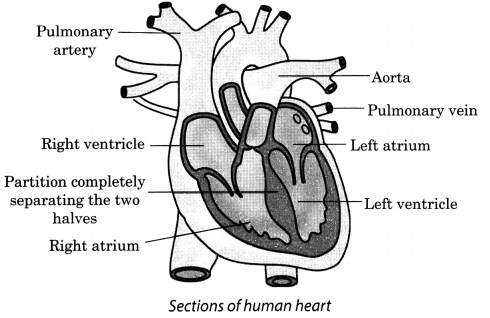
Transportation in Animals and Plants Class 7 Extra Questions and Answers Science Chapter 11 1

Question 4.
What are the various components of blood. Write function of each component.
Answer:
Blood has four main components, i.e., plasma, red blood cells, white blood cells and platelets. Function of various components are:

  1. Plasma: Plasma is the watery component of blood. It suspends other components of blood. It contain many important dissolved substances, such as protein, electrolytes, nutrients, gases and waste products. It maintain the exact pressure of the blood.
  2. Red blood cells: RBC contain haemoglobin protein, whose main function is to carry oxygen to all parts of the body and to bring carbon dioxide to the lungs.
  3. White blood cells: Main function of WBC is to fight against infections diseases and foreign invaders.
  4. Platelets: It helps in clotting of blood during injuries and thus, prevent excess loss of blood from our body.

Question 5.
Explain the excretion in birds, fishes, lizards, dogs and humans.
Answer:
The way of the elimination of waste products from the body of animals depends on the availability of water. Animals like birds and lizards excrete a white coloured, semi-solid product, known as uric acid. Aquatic animals (like fish) excrete the waste materials (i.e., ammonia) in the gaseous form which directly dissolve with water. Dogs and human beings excretes urea.

Question 6.
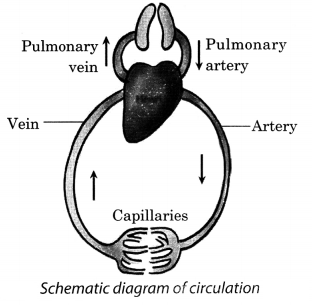
Explain human circulatory system with a well labelled diagram.
Answer:
Circulatory system is the life support system of our body that provides our body cells with nutrients and oxygen. It takes away waste product from the body cells. Our circulatory system comprises of the heart, blood, blood vessels and lungs.

  1. Blood is the fluid that carries oxygen and nutrients to various parts of the body and takes away wastes and carbon dioxide from the cell for elimination.
  2. Blood vessels comprises of arteries, veins and Capillaries. Arteries carry oxygen-rich blood from the heart to various parts of the body. Capillaries are single-walled vessels which exchange gases and nutrients from the cells.
  3. Veins carry carbon dioxide-rich blood from different parts of the body to the heart.
  4. Heart is a muscular organ with four chambers which pumps blood throughout the body. It pumps carbon dioxide-rich blood to the lungs for purification.
  5. When it receives oxygen-rich blood from the lungs it again pump this blood to arteries for transportation to various body parts.
  6. Lungs helps in exchange of gases between air we breathe in and the blood. It helps in elimination of carbon dioxide from blood and making it rich in oxygen content.
Transportation in Animals and Plants Class 7 Extra Questions and Answers Science Chapter 11 2

Transportation in Animals and Plants Class 7 Extra Questions HOTS

Question 1.
Which feature of heart does not allow mixing of oxygen-rich blood with carbon dioxide-rich blood?
Answer:
Heart is divided into four chambers and are protected with valves which prevent their backflow. Thus, these features prevent mixing of oxygen-rich blood with carbon-dioxide rich blood.

Question 2.
Why do doctor often holds our wrist when we go for a check up?
Answer:
Doctor holds our wrist to count our pulse rate and to check whether it is normal or not.

Question 3.
Why wall of right ventricle is thinner than that of the left ventricle?
Answer:
This is because the left ventricle has to pump blood all the way around the body, but the right ventricle only has to pump it to the lungs.

Question 4.
What will happen if oxygenated and deoxygenated blood gets mixed?
Answer:
Mixing of oxygenated blood with deoxygenated blood will lead to less oxygen supply to the cells. Under oxygen deficient condition, cells will not perform normally which may adversely affect the organism as a whole.

Question 5.
Does artery always carries oxygen-rich blood?
Answer:
No. Pulmonary artery carries carbon dioxide-rich blood from heart to the lungs.

Question 6.
Sponges and Hydra do not posses any circulatory system. How nutrients and oxygen is transported inside their body?
Answer:
The water in which sponges and Hydra live brings food and oxygen as it enters their bodies. The water also carries away waste material and carbon dioxide as it moves out. Thus, these animals do not need a circulatory system.

Question 7.
Water from soil moves inside the root cell but never comes out from root cell to soil. Why?
Answer:
Water always move from a region of its higher concentration to a region of its lower concentration. This process is called osmosis. Concentration of water is more in the soil compared to its concentration inside the root cell, so it move from soil to the root cell and not from root cell to the soil.

Transportation in Animals and Plants Class 7 Extra Questions Value Based (VBQs)

Question 1.
While learning to ride a bicycle Satish lost his balance and fell down. He got a cut on his knee and it started bleeding. His sister Sujata on seeing this asked him to put pressure on the area with a clean handkerchief. She immediately rushed to her home to call her parents.
(a) How does applying pressure to a bleeding wound help?
(b) When we get small bruises, bleeding stops automatically after some time. Why?
(c) What would be the colour of wounded area? Why?
(d) Which type of blood cells are responsible for clotting of blood?
(e) What value of Sujata is shown here?

Answer:
(a) By applying pressure to a bleeding wound, we constrict the blood vessels manually and prevents too much loss of blood from the wound.
(b) Bleeding stops automatically in small bruises after some time due to clotting of blood.
(c) Colour of wounded area will be dark red due to formation of clot.
(d) Blood platelets.
(e) Sujata is intelligent, swift in her action, helpful, etc.

Question 2.
Natasha does not drink enough water according to her age. When her teacher came to knew about this, she called her. She explained her that if she won’t drink sufficient water then she may face many health issues including uremia. She understood the importance of water and started drinking 8-10 glasses of water everyday.
(a) What is uremia?
(b) What are the other health issues related with drinking less water?
(c) What is the role of water in elimination of waste?
(d) What values of Natasha is shown here?

Answer:
(a) Uremia is a disease which is caused due to raised level of urea in the blood.
(b) Dehydration, stomachache, dry skin, headache, restlessness, etc.
(c) Water helps in elimination of nitrogenous waste and other salts through excretion and sweating.
(d) Natasha is obedient, sincere and mature enough to understand her teacher.

Pronoun Exercises for Class 7 CBSE With Answers

Pronoun Exercises for Class 7

A pronoun is a word that takes the place of a common noun or a proper noun. There are different kinds of pronouns.

Pronoun Exercises for Class 7 CBSE With Answers Pdf

This grammar section explains English Grammar in a clear and simple way. There are example sentences to show how the language is used. You can also visit the most accurate and elaborate NCERT Solutions for Class 7 English. Every question of the textbook has been answered here.

Pronouns are words we use to replace nouns in order to avoid their repetition. The noun that a pronoun replaces is called an antecedent. There are different kinds of pronouns.

Fundamentals:
A pronoun is a word used in place of a noun, which can be a person, place, animal or a thing. Personal, Reflexive, Demonstrative, Interrogative, Possessive are the different types of pronouns.

Personal Pronouns:
A pronoun is a word used in place of a noun, which can be a person, place, animal or a thing. The pronoun must agree in number with the noun that it replaces. If the noun is in the singular form, the pronoun must also be in the singular form, or if it is in plural form, the pronoun must also be in the plural form.
Examples:

  • Singular: The boy is playing with his puppet. He has a glove puppet.
  • Plural: The boys are playing with their puppets.
    They have puppets of various colours:

    • Personal Pronouns have three persons.
    • The person who is speaking is called the first person, i.e. I, my, me, we, our, us.
    • The one spoken to is called the second person, i.e. you, your, yours.
    • The one spoken about is called the third person, i.e. he, she, it, they, their, them.

The pronoun must agree with the noun in gender that it represents. If the noun is feminine, the pronoun too must be feminine. Likewise, if the noun is masculine, the pronoun must be also masculine.
Examples:

  • Masculine: Jyoti has a boyfriend. He comes across as a bit of a bore to her.
  • Feminine: Sunny’s sister loves to eat green vegetables. She eats it almost every day.
  • Neuter: We have an old kitchen table. It has a broken leg.

A reflexive pronoun is used when the object of a sentence is the same as the subject. They either end in -self, as in the singular form, or -selves as in the plural form.

The singular reflexive pronouns are: myself, yourself, himself, herself, itself.
Plural reflexive pronouns include: ourselves, yourselves, themselves.
Emphatic Pronouns: When words like myself, yourself, himself, itself, etc. are used for the sake of emphasis they are called emphatic pronouns.
Examples:

  • I myself wrote this poem.
  • They themselves admitted it.
  • The announcement was made by the Principal himself.

It is usually placed immediately after the noun or pronoun which they emphasize. Sometimes, they follow at a distance.
Examples::

  • He said to himself.

Demonstrative pronoun is used to point out specific person, place, thing or idea. This/that/these/those are demonstrative pronouns.
Examples::

  • Is this my chair?

Interrogative Pronoun introduces a question.
Examples:

  • Who, What, When, etc. Examples:: Who was Graham Bell?

Possessive pronouns are used to talk about things that belong to people. The words mine, yours, his, hers, ours and theirs are possessive pronouns. We do not use an apostrophe with possessive pronouns.
Examples:

  • This mobile is mine.
  • Have you lost yours, Pankaj?
  • This glass is mine and that one is his.
  • Sarika has lost her cat. Is this cat hers?

Here is a table to help you remember which possessive pronouns to use with singular and plural pronouns.

Singular Personal PronounsPossessive Pronouns
I, meMine
YouYours
He, himHis
She, herHers
Plural Personal PronounsPossessive Pronouns
We, usOurs
YouYours
They, themTheirs

Indefinite Pronouns:
An indefinite pronoun does not refer directly to any other word. Most indefinite pronouns express the idea of quantity. All, each, most, other, another, either, neither, several, any, everybody, nobody, some, anybody, everyone, none, somebody, anyone, few, no, one, someone, both, many, one, are some indefinite pronouns.

Relative Pronouns:
These are used to refer back to a noun or a pronoun in a sentence. Who, whom, whose, which, that are relative pronouns.
Examples::

  • My mother is a teacher. She writes stories for the children.
  • My mother is a teacher who writes stories for the children.

Distributive Pronouns:
Each, either and neither are called distributive pronouns because they refer to persons or things one at a time. Note that a distributive pronoun is always singular and as such it should be followed by a singular noun and verb.
Examples::

  • Each boy was given a prize.
  • Either road leads to the railway station.
  • Neither accusation is true
  • Each new day is different. (NOT Each new days are different.)
  • Either girl can do that. (NOT Either girls can do that.)
  • Neither answer is correct. (NOT Neither answers is correct.) (NOT Neither answers are correct.)
  • Each of, neither ©f and either of are followed by plural nouns and singular verbs. Each of the answers are correct. (NOT Each of the answer is correct.)
  • Neither of the girls can do that. (NOT Either of the girl can do that.)
  • Either and neither should be used only when talking about two persons or things.
  • When more than two persons or things are spoken of, any, no one or none should be used.
  • None of the three answers is correct. (NOT Neither of the three answers is correct.)
  • We invited several friends, but none came. (NOT … but neither came.)
  • You can take any of the three shirts. (NOT You can take either of the three shirts.)

Pronoun Exercises Solved Examples for Class 7 CBSE

Question 1.
Choose the correct word:
(i) I shall do it (myself, himself)
(ii) My book is better than (mine, her, yours)
(iii) She told (herself, me) a story.
(iv) Who is there? It is (I, me).
(v) Mind it. It is between you and (I, me).
(vi) (whose, which) picture do you prefer?
(vii) (either, each) of you can do it.
(viii) (whatever, whichever) you do, do it well.
(ix) Don’t leave it (what, whatever) happens.
(x) Your brother (who, whom) everybody likes is very expert.
Answer:
(i) myself
(ii) yours
(iii) me
(iv) me
(v) me
(vi) which
(vii) either
(viii) whatever
(ix) Whatever
(x) Who and whom both are correct.

Question 2.
Fill in suitable pronoun in the following.
(i). ________ are these boys?
(ii) ________ car broke down?
(iii) ________ caused the explosion?
(iv) ________ did you go with?
(v) ________ of these do you like?
(vi) Trees drop ________ leaves in autumn.
(vii) He can’t share ________
(viii) I did it ________
(ix) The noise ________ he made woke everybody up.
(x) The story is of a man ________ wife betrays him.
Answer:
(i) Who
(ii) Whose
(iii) What
(iv) Whom
(v) Which
(vi) their
(vii) anything
(viii) myself
(ix) that
(x) whose

Question 3.
Replace the underlined words with the appropriate pronouns in the box. Use capital letters when necessary.
she her he him it we us they them him
(i) I say Mr. Brown this morning and gave Mr. Brown my homework.
(ii) John likes computer games but he doesn’t play computer games very often.
(iii) Neil Armstrong was born in 1930. Neil Armstrong landed on the moon in 1969.
(iv) Penguins don’t live near the North Pole. Penguins live near the South Pole.
(v) My aunt lives in Toronto but my aunt often comes to visit my family and me.
(vi) If you have your ticket, you can give your ticket to that man over there.
(vii) First, my friend and I went shopping. Later, my friend and I went home.
(viii) Where was Sarah? I didn’t see Sarah at the party last week.
(ix) John is a really nice guy. I like John a lot.
(x) The planet Mars has two moons. The two moons are both very small.
(xi) I really liked the cake. Unfortunately, I didn’t have time to finish the cake.
(xii) Suzy and I paid for the meal but the waiter forget to bring Suzy and me the food.
Answer:
(i) him
(ii) them
(iii) he
(iv) they
(v) us
(vi) it
(vii) we
(viii) her
(ix) him
(x) they
(xi) it
(xii) us

Pronoun Exercises Practice Examples for Class 7 CBSE

Question 1.
Replace the underlined word/words in each sentence with correct pronoun.

1. Rajesh is five feet tall. Anu is only four and a half feet tall. Rajesh is taller than Anu.
________________________________________________________
2. Deepak saw Nitin. Deepak called Nitin. Then Deepak and Nitin walked together.
________________________________________________________
3. Jatin and his sister thought one of the gold fish was hungry, so Jatin and his sister fed the gold fish.
________________________________________________________
4. I met Amit and Esha. I had not seen Amit and Esha for a long time. I asked Amit if Amit was still single.
________________________________________________________
5. Deer have antlers. Deer must be very proud of their antlers.
________________________________________________________

Question 2.
Use the relative pronoun ‘who’ to join these sentences. The first one has been done for you.

1. The drunken man was arrested by the police. The drunken man punched me repeatedly.
The drunken man who punched me repeatedly was arrested by the police.

2. The man apologised to me. He stepped on my toes.
________________________________________________
3. She did most of the talking. She was the hostess.
________________________________________________
4. The fishermen were hailed as heroes. They caught a shark.
________________________________________________
5. The hunter was short-sighted. He saw a cheetah and thought it was a leopard.
________________________________________________

Noun Exercises for Class 7 CBSE With Answers

Noun Exercises for Class 7

Noun Exercises for Class 7 CBSE With Answers Pdf

Definition: A noun is a part of speech that is used to name a person, place, thing, quality, or action. Examples: Mango, girl, boy, cat, etc.

This grammar section explains English Grammar in a clear and simple way. There are example sentences to show how the language is used. You can also visit the most accurate and elaborate NCERT Solutions for Class 7 English. Every question of the textbook has been answered here.

Types of Noun

Common noun:

It does not name any particular person, place or a thing. It speaks in general about persons, places or things of the same kind.
Examples:

  • The boy kicked the ball.
  • The bag is lying under the table.

Proper noun:
It names a particular person, place or a thing.
Examples:

  • Virat Kohli lives in India.
  • Barack Obama lives in America.

Concrete noun:
A noun that denotes a material object rather than an abstract quality, state or action.
Examples:

  • Dog, building, tree

Abstract noun:
It names a feeling or a state of being which has no form or shape and which cannot be seen or touched, but whose existence we can recognise.
Examples:

  • A thing of beauty is a joy forever.
  • Perseverance leads to success.

Collective noun:
It names a group or a collection of people or things taken together and treated as one.
Examples:

  • Radhika gave me a bunch of flowers.
  • The pride of lions was asleep.

Countable noun:
A noun which can be counted is called a countable noun. So countable nouns can either be singular or plural. Some common nouns and collective nouns belong to this category.
Examples:

  • one girl, many girls, a herd of elephants

Uncountable noun:
A noun which cannot be counted is called an uncountable noun.
So it is neither singular nor plural. Some common nouns and abstract nouns belong to this category.
Examples:

  • some rice, much happiness

Gender Nouns:
The Gender of a noun indicates whether it is male or female.
For Examples::

  • boy, girl, hero, heroine, lion, lioness, etc.
  • A noun that denotes a male is called Masculine Gender.

Masculine nouns are the words for men, boys and male animals.
Examples::

  • Boy – Lion – Bull – Dog

A noun that denotes a female is called Feminine Gender. Feminine nouns are the words for women, girls and female animal.
Examples:

  • Book – Pen – Room Tree

Number Nouns:
There are two types of nouns on the basis of number: Singular Noun and Plural Noun

Singular Noun:
When we speak about one person and one thing, we use the noun in singular form. Single means one.
Examples:

  • a. A man is walking within the premises.
  • b. A group of cows is called a herd.
  • c. A monkey can climb trees faster than you.
  • d. Temple is the worshipping place of Hindus.
  • e. This table is made of wood.

In these sentences, the nouns- man, group, monkey, temple and table are in singular forms.

Plural Noun:
When we speak about more than one person or thing, we use the noun in plural form.
Examples:

  • a. Few women are standing in the temple.
  • b. The groups of cows, coming back to their sheds, are not milch cows.
  • c. These tables are made of plastic.
  • d. Children should be given proper guidance.
  • e. Keep the guns in a safe place.

In these sentences, the words women, groups, tables, children and guns are plural- nouns.

Possessive Case:
When a noun or a pronoun is used to show ownership or possession, authority, origin, kind etc., it is called Possessive Case.
Examples:

  • This is Rohit’s bike.

When the noun is Singular, the Possessive Case is formed by adding apostrophe S (‘S) at the end and when the noun is plural and end in ‘S’, we add apostrophe after ‘S’ (‘S).
Examples:

SingularPossessivePluralPossessive
BoyBoy’sBoysBoys’
BookBook’sBooksBooks’
GirlGirl’sGirlsGirls’
ManMan’sMenMen’s
OurOursWomenWomen’s
MyMineParentsParents’
YouYours
8080s’
20092009’s
ItIts
WhoWhose

Apostrophe or no apostrophe if the noun ends in ‘s’.
When a proper noun ends in s, the possessive form can be made either by adding an apostrophe and an ‘s’ or only an apostrophe.
Examples:

  • This is a portrait of the King Charles’s wife. / This is a portrait of the King Charles’ wife.
  • My uncle James’s factory was burnt down last night. / My uncle, James’ factory was burnt down last night.

Two possessive nouns one after the other
Sometimes, two possessive nouns appearing one after the other may be necessary to indicate double ownership.
Examples:

  • She is Rohit’s brother’s girlfriend.
  • This is Sonika’s father’s car.

Apostrophe indicates joint ownership
When two nouns are joint owners of something, only the second noun is in the possessive form i.e. an apostrophe and ‘s’ is added at the end of second noun.
Examples:

  • On that hill is Jack and Jill’s house. (The house belongs to both Jack and Jill.)
  • Sonali and Sonali’s mother are doctors.

Compound possessive nouns
If it is a hyphenated compound noun, add the apostrophe s (‘s) to the last word.
Examples:

  • My brother-in-law’s car hit a truck the other day.

Noun Exercises Solved Examples for Class 7 CBSE

Exercise – 1
Read the statement given below and tick the correct option:

Question 1.
They gazed across valley.
(a) across
(b) gazed
(c) they
(d) valley
Answer:
(d) valley

Question 2.
I believe in his honesty.
(a) believe
(b) honesty
(c) lin
(d) I
Answer:
(b) honesty

Question 3.
My family supports me.
(a) family
(b) My
(c) supports
(d) me
Answer:
(a) family

Question 4.
Taj Mahal is a sign of love.
(a) love
(b) Taj Mahal
(c) sign
(d) is
Answer:
(b) Taj Mahal

Question 5.
Moon shines at night.
(a) Moon
(b) shines
(c) at
(d) night
Answer:
(a) Moon

Question 6.
We need peace in our state.
(a) our state
(b) we
(c) peace
(d) need
Answer:
(c) peace

Question 7.
How many students in your class?
(a) class
(b) many
(c) students
(d) your
Answer:
(c) students

Question 8.
He was reading a newspaper.
(a) He
(b) reading
(c) a
(d) newspaper
Answer:
(d) newspaper

Question 9.
Honestly is best policy.
(a) policy
(b) honestly
(c) is
(d) best
Answer:
(b) honestly

Question 10.
Children broke window pane.
(a) Children
(b) broke
(c) window
(d) paiìe.
Answer:
(a) Children

Exercise – 2

Use capital letters for Proper Nouns in the following sentences.

1. ms brown told me that paris is the capital of france.
____________________________________
2. william Shakespeare was a famous English author.
____________________________________
3. ‘war and peace’ was written by leo tolstoy.
____________________________________
4. jack and jill had so much fun at disney park.
____________________________________

Exercise – 3
Identify which of the following are common noun, proper noun, collective noun and abstract noun.

Questions:
1. Always speak the truth.
2. Honesty is the best policy.
3. King Solomon was famous for his wisdom.
4. A committee of five was appointed.
5. He gave me a bunch of grapes.
6. London is on the river Thames.
7. Cleanliness is next to godliness.
8. Wisdom is better than riches.
9. I recognized his voice at once.
10. Our team is better than theirs.
Answer:
1. truth: abstract noun
2. honesty: abstract noun, policy: abstract noun
3. King: common noun, Solomon: proper noun, wisdom: abstract noun
4. committee: collective noun
5. a bunch: collective noun, grapes: common noun
6. London: proper noun, river: common noun, Thames: proper noun
7. cleanliness: abstract noun, godliness: abstract noun
8. wisdom: abstract noun, riches: abstract noun
9. voice: abstract noun
10. team: collective noun

Exercise – 4

Complete each sentence by choosing the correct word from the bracket

1. There is so (many, much) smoke coming out of the chimney.
_____________________________________________
2. Mrs. Dhawan keeps (plenty of, a large amount of) tropical fish in her pond.
_____________________________________________
3. Mr. Arora takes only a (little, few) minutes to shave.
_____________________________________________
4. The postman put (a great deal of, a lot of) letters into the bag.
_____________________________________________
5. He threw (much, some) stones at the monkeys.
_____________________________________________
6. She uses only (a few, a little) cooking oil in her cooking.
_____________________________________________
7. My hens lay (a large amount of, several) eggs every morning.
_____________________________________________

Internal Assessment
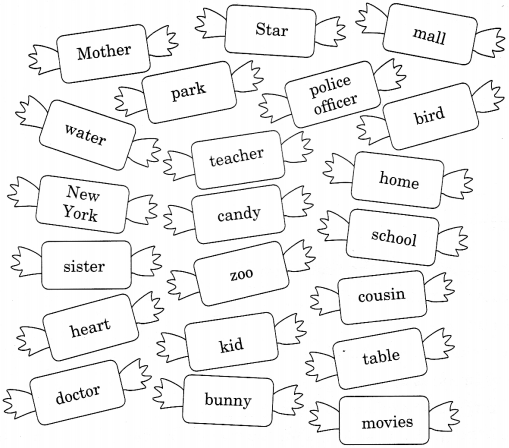
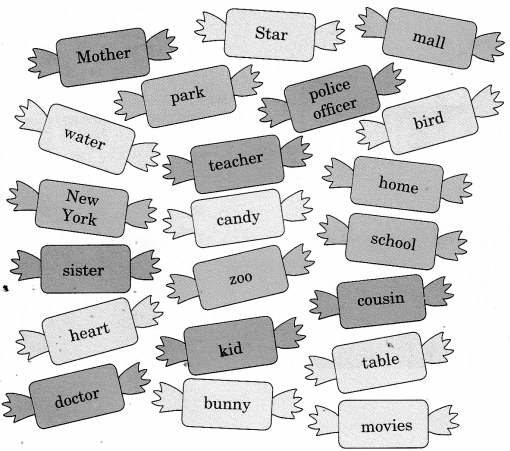
Read the noun on the candy. Use the colour code to color the candy.
Color code – person–red, place – purple, thing – pink.
Noun Exercises for Class 7 CBSE With Answers
Answer:
Noun Exercises for Class 7 CBSE With Answers

Noun Exercises Practice Examples for Class 7 CBSE

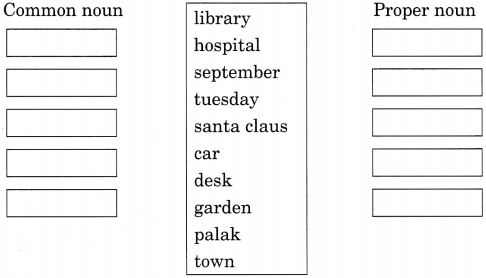
1. Write each noun in a box on the correct side. Remember to begin each proper noun with capital letters.
Noun Exercises for Class 7 CBSE With Answers

2. Write a sentences with each noun listed below.
(i) Pencil _________
(ii) Flower _________
(iii) Book _________
(iv) Garden _________
(v) Country _________

3. Common nouns Exercises: Name the professionals
(i) One who operates on sick people is a _________
(ii) One who cuts hair is a _________
(iii) One who makes chairs and tables is a _________
(iv) One who makes bread is a _________
(v) One who sells medicines and drugs is a _________

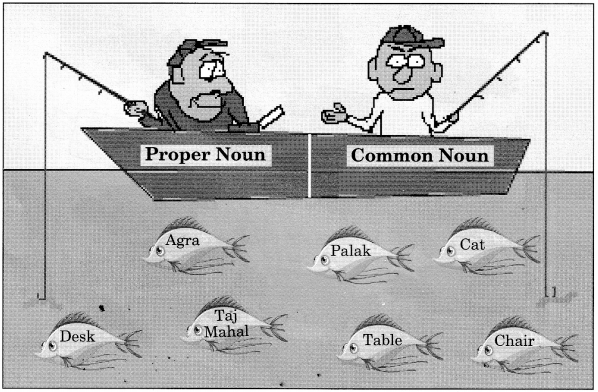
4. Two fisherman are fishing. One is looking for proper noun fishes and another is looking for common noun fishes. Can you help them?
Noun Exercises for Class 7 CBSE With Answers