Sentences Worksheet Exercises for Class 3 CBSE With Answers

Sentences Exercises for Class 3 CBSE With Answers

This grammar section explains English Grammar in a clear and simple way. There are example sentences to show how the language is used.

Sentences Worksheet Exercises for Class 3 CBSE With Answers PDF

  • A sentence is a group of words that makes sense.
  • Letters form words and words make sentences.
  • A sentence always begins with a capital letter and mostly ends with a full stop.
  • A sentence always has two parts- Naming and Doing parts.
  • The naming part that talks about people, places, animals and things with the help is known as Noun.
  • The doing part tells what a person, an animal or thing does which is also of verb.
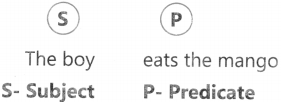
  • Naming part is called the subject of the sentence.
  • Doing part is called the predicate of the sentence.
  • The subject tells you who or what the sentence is about.
  • The rest of the sentence including the verb is called predicate.
    Sentences Exercises for Class 3 CBSE With Answers

Sentences Worksheet Exercises for Class 3 with Answers CBSE PDF

A. Underline the subject in each of these sentences.

1. The snake caught the frog.
2. She is eating an ice-cream.
3. The children are singing rhymes.
4. Basanti is wearing a sari.
5. I bought a jacket

B. Underline the predicate in each of these sentences.

1. I am knitting a sweater.
2. The school closes at 2 o’clock.
3. Whales live in the ocean.
4. Rani loved to eat chocolates.
5. We wrote interesting stories for children.

C. Choose a subject from the box to complete each sentence. The first one has been done for you.

A big spider – A buzzing bee – My notebook
A grey dolphin – My mother – My closet
The houseplant – The doctor – The space alien

1. A buzzing bee looked for nectar in the flower.
2. ____________ has lots of clothes in it.
3. ____________ checked my vision.
4. ____________ needs soil, water, and sunlight.
5. ____________ landed the UFO.
6. ____________ Jeapt out of the water.
7. ____________ was upset because I broke her favourite vase.
8. ____________ is filled with stories that I wrote.
9. ____________ spun a web in the doorway.

D. Choose a predicate from the box to complete each sentence. The first one has been done for you.

watered her flowers. – barked all night long. – drove me to school.
blew in the wind. – ate crickets. – cut the boy’s hair.
fixed the sink. – slept in her cradle. – flew the airplane.

1. The gardener watered her flowers.
2. The pilot _________
3. The little puppy _________
4. The barber _________
5. Reena’s baby sister _________
6. The flag _________
7. The lizard _________
8. The plumber _________
9. The bus driver _________

More about Sentences Worksheet Exercises for Class 3 CBSE With Answers

  • In a sentence, the verb must be in agreement with the subject.
  • A singular subject must have a singular verb.
    Example: I am a good student.
    Singular subject ⇒ singular verb
  • A plural subject must have a plural verb. Plural subject ⇒ plural verbs
    Example: We are good students.
  • The subject and the verb in a sentence must match even when the tense of the verb changes.

Presentation
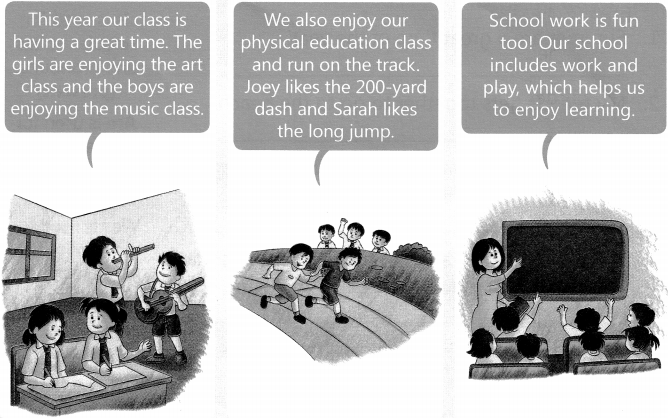
Read the picture story.
Sentences Exercises for Class 3 CBSE With Answers 1

A. Answer the following questions according to the story.

1. Which year is being talked about in the story? _________________
2. What are the boys and the girls enjoying? _________________
3. Why is the school work fun for the students? _________________

B. Match the following subjects with the correct verb from the story above.

  • Boys – is
  • Class – are
  • We – likes
  • Joey – enjoy

Sentences Worksheets for Grade 3 with Answers CBSE PDF

A. Correct the following sentences according to subject- verb agreement.

1. Summer are a great time of the year
_____________________________________________

2. My friends gets together to go to the beach,
_____________________________________________

3. Anna and Bobby brought the towels and Sam and Betsy brings the lunch.
_____________________________________________

4. The gulls fly down and eat the food crumbs that we throws to them.
_____________________________________________

5. We wears sun screen to be sure we don’t get burned.
_____________________________________________

6. Our parents comes along too, to drive us.
_____________________________________________

7. My mother always want to come along.
_____________________________________________

8. I wants summer to last forever.
_____________________________________________

B. Read the following sentences and choose the correct verb from the brackets.
Example:

  • John (is, ‘are) going to the mall after school today.
    Answer-
    is

1. They (are, is) going to the pizza restaurant after today’s game.
2. Jane (were, was) going to go with the team but she had chores to do.
3. Stephen (is, are) one of the best players on the team.
4. The coach (was, were) very excited that the team won the tournament.
5. They (is, are) one of the highest scoring teams in the league.
6. My best friend (were, was) there when I arrived.
7. Where (do, does) your parents live?

Conjunctions Worksheet Exercises for Class 3 CBSE with Answers

Conjunctions Exercises for Class 3 CBSE with Answers

A conjunction is a word that joins words, phrases and sentences. They are called linkers or connectors also. Words such as ‘and’, ‘but’ and ‘or’ are conjunctions.

This grammar section explains English Grammar in a clear and simple way. There are example sentences to show how the language is used.

Conjunctions Worksheet Exercises for Class 3 CBSE With Answers PDF

  • A word which joins the two sentences are called joining words.
  • Joining Words are called Conjunctions.
  • “And’, ‘Buť’, ‘Or’ are the words that join two parts of the sentences.
  • We use ‘And’ to join two sentences.
  • We use ‘But’ to join two different thoughts and ideas.
  • We use ‘Or’ to join sentences when there is choice.
  • It means that one of two things can happen.

Conjunctions Exercises with Answers for Grade 3 CBSE PDF

A. Combine each pair of sentences with the conjunction given in brackets to make a new sentence.

1. My pet goat will eat almost anything. He likes vegetables the most. (but)
_________________________________________

2. My family lives in the country. We have a lot of land. (and)
_________________________________________

3. We could go to the playground. We could go to the movies. (or)
_________________________________________

4. Matthew went to the beach. Matthew learned to surf. (and)
_________________________________________

5. Mary wanted to drive to the store. Her car wouldn’t start. (but)
_________________________________________
6. Do you want pancakes for breakfast? Would you rather have eggs? (or)
_________________________________________

7. I need to bring a calculator to school. I need to bring a ruler to school. (and)
_________________________________________

8. Some kids were afraid to dive into the pool. I wasn’t afraid. (but)
_________________________________________

And, But, Because, So for Class 3 with Answers CBSE PDF

Fundamentals

  • ‘And, But, Because and So’ are also called Conjunctions.
  • We use ‘Because’ and ‘So’ to define reasons in a sentence.

Presentation
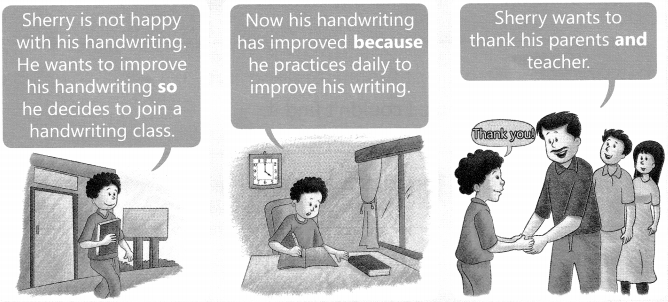
Read the picture story.

A. Answer the following questions.

1. What is Sherry not happy about? __________
2. Why does Sherry decide to join handwriting class? __________
3. What does Sherry do in the end of the story? __________

And, But, Because, So Worksheet for Class 3 with Answers CBSE PDF

A. Join the following pairs of sentences using and.

1. The cat saw the mouse. It decided to catch it.
_________________________________________

2. I bought an apple. I ate it.
_________________________________________

3. He told us a joke. We laughed.
_________________________________________

4. Mani opened his book. He did his homework.
_________________________________________

5. She switched off the lights. She went to sleep.
_________________________________________

B. Join the following pairs of sentences using but.

1. I looked for the book. I couldn’t find it.
_________________________________________

2. They were hungry. They didn’t eat anything.
_________________________________________

3. Seema was unwell. She went to school.
_________________________________________

4. We pushed the door hard. It didn’t open.
_________________________________________

5. He doesn’t like tea. He likes coffee.
_________________________________________

C. Join the following pairs of sentences using because.

1. They ate a lot. They were hungry.
_________________________________________

2. I didn’t go out. It was raining.
_________________________________________

3. The woman couldn’t walk. She was old.
_________________________________________

4. We couldn’t see anything. It was dark.
_________________________________________

5. He goes home every Saturday. It is a holiday.
_________________________________________

D. Join the following pairs of sentences using so.

1. It was getting late. I walked fast.
_________________________________________

2. I was thirty. I asked for a glass of water.
_________________________________________

3. The boy was blind. He couldn’t cross the road.
_________________________________________

4. Rina liked the red dress. She bought it.
_________________________________________

5. Gopal made a mistake. The teacher corrected him.
_________________________________________

Preposition Worksheet Exercises for Class 3 CBSE With Answers

Preposition Exercises for Class 3 CBSE With Answers

Definition: A preposition is a word placed before a noun or a pronoun to show in what relation the person or thing denoted by it stands in regard to something else.

This grammar section explains English Grammar in a clear and simple way. There are example sentences to show how the language is used.

Preposition Worksheet Exercises for Class 3 CBSE With Answers PDF

  • The words that show the relation between naming words and describing words are called Prepositions.
  • These where words are called prepositions.
  • Where Words tell us where something or someone is placed.
  • Across, around, between, in front of, next to, behind, over are some examples of where words.

Preposition Exercises with Answers for Class 3 CBSE PDF

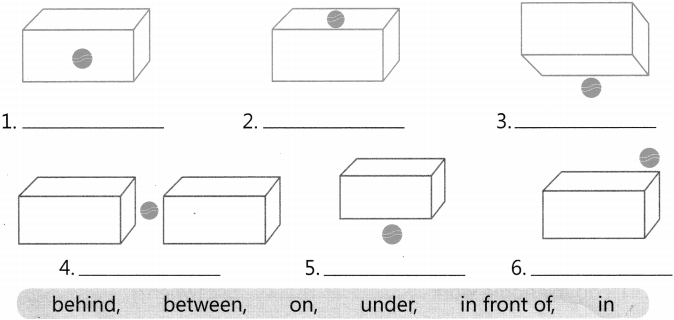
A. Look at the pictures and write where the ball is in each picture.
Preposition Exercises for Class 3 CBSE With Answers 1

B. Underline the preposition in each sentence.

1. Sherry walked across the street.
2. Pari wandered into the pet store.
3. Molly left before lunchtime.
4. Meena’s office is near the cafeteria.
5. Ankita fell asleep during class.
6. Anil sat on his new rocking chair.
7. Sahil drove around the block.
8. Under a warm blanket, Pradip rested.

More about Prepositions Exercises for Class 3 CBSE With Answers

Fundamentals
In, On and At are prepositions of time.

INOnAt
Month or Year.
E.g. in February, in 2010
1. Day
E.g. on Monday, on Republic Day, on my birthday
1. Time of clock
E.g. at 5 O’clock, at 7:30 PM
The particular time of day or month or year.
E.g. in the morning, in the evening, in the first week of July, in summer, in winter
2. Date
E.g. on 5th of March, March 5
2. Short and precise time
E.g. at noon, at sunset, at lunch time, at bed time, at the moment, at the same time

Some other prepositions of time

sincefrom a certain point of time (past till now)since 1980
forover a certain period of time (past till now)for 2 years
agoa certain time in the past2 years ago
beforeearlier than a certain point of timebefore 2004
totelling the timeten to si c 5*2’s
pasttelling the timeten past ssx (6:10)
to/till/ untilmarking the beginning and end of a period of timefrom Monday to/till Friday
till/untilin the sense of how long something is going to lastHe is on holiday until Friday.
byin the sense of at the latest up to a certain timeI will be back by 6 o’clock. By 11 o’clock, I had read five pages.

Presentation
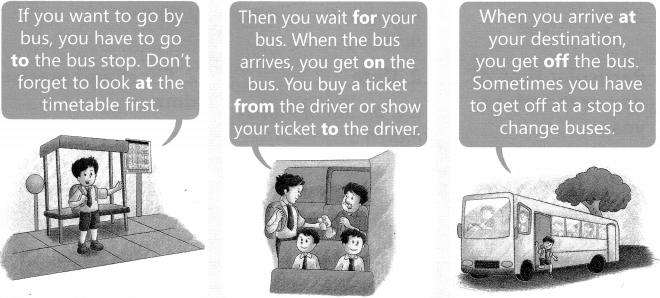
Read the picture story.
Preposition Exercises for Class 3 CBSE With Answers 2

A. Answer the following questions from the story above.

1. What do you do first at the bus top? _____________________
2. What do you do when the bus arrives? _____________________
3. What do we do sometimes at the bus stop? _____________________

Prepositions Exercises with Answers PDF for Class 3 CBSE

A. Fill in the correct prepositions.

1. Peter is playing tennis _____________________ Sunday.
2. My brother’s birthday is _____________________ the 5th of November.
3. My birthday is _____________________ May.
4. We are going to see my parents _____________________ the weekend.
5. _____________________ 1666, a great fire broke out in London.
6. I don’t like walking alone in the streets _____________________ night.
7. What are you doing _____________________ the afternoon?
8. My friend has been living in Canada _____________________ two years.

B. Choose the correct prepositions.

What are you doing ____________ (at/in/on) the weekend? I don’t know yet. I might go to the cinema ____________ (at/in/on) Saturday. That’s Interesting! I haven’t been to the cinema ____________ (for/since) so many years. We could go there together ____________ (at/in/ on) the afternoon. That would be great. But I would prefer to go there ____________ (at/in/on) the evening. I am visiting my grandma ____________ (at/in/on) Saturday. That’s okay. The film starts ____________ (at/in/on) eight o’clock. I can pick you up (at/in/on) half ____________ (to/past) seven. How long does the film last? It lasts ____________ (for/to/until) two hours and forty-five minutes. (before/by/from) eight ____________ (for/till) a quarter ____________ (to/by/at) eleven. That’s right. But I must rush home ____________ (after/before/now) the film. I have to be home ____________ (by/since/until) eleven o’clock.

Reproduction in Plants Class 7 Extra Questions and Answers Science Chapter 12

In this page, we are providing Reproduction in Plants Class 7 Extra Questions and Answers Science Chapter 12 pdf download. NCERT Extra Questions for Class 7 Science Chapter 12 Reproduction in Plants with Answers will help to score more marks in your CBSE Board Exams.

Class 7 Science Chapter 12 Extra Questions and Answers Reproduction in Plants

Extra Questions for Class 7 Science Chapter 12 Reproduction in Plants with Answers Solutions

Reproduction in Plants Class 7 Extra Questions Very Short Answer Type

Question 1.
Fungus, moss and fern reproduces by a common method of asexual reproduction. Name the method.
Answer:
Spore formation.

Question 2.
Boojho had the following parts of a rose plant-a leaf, roots, a branch, a flower, a bud and pollen grains. Which of them can be used to grow a new rose plant?
Answer:
A branch.

Question 3.
What is zygote?
Answer:
Zygote is a diploid cell formed from the fusion of male and male and female gametes.

Question 4.
By which method of asexual reproduction sweet potato reproduces?
Answer:
Vegetative propagation.

Question 5.
In the vegetative propagation, the new plants are exact copies of the parent cell. Why?
Answer:
Because they are produced from a single parent.

Question 6.
What are produced by plants as a result of sexual reproduction?
Answer:
Seeds.

Question 7.
Which type of reproduction produces a new plant which is exact copy of the parent plant?
Answer:
Vegetative propagation.

Question 8.
What is a bud?
Answer:
A small bulb-like projection coming out from the yeast cell is called a bud.

Question 9.
Which part of the seed germinate into a small seedling?
Answer:
Embryo.

Question 10.
How does a moss plant reproduce?
Answer:
By means of spores.

Question 11.
Which type of bodies are spores?
Answer:
Asexual reproductive bodies.

Question 12.
What type of flowers does Petunia have?
Answer:
Bisexual flowers.

Question 13.
Where is the egg-formed?
Answer:
In an ovule.

Question 14.
What is sexual reproduction?
Answer:
Reproduction in which both male and female gametes are involved is called sexual reproduction.

Question 15.
What produces male gamete?
Answer:
Pollen grain produces male gamete.

Question 16.
What protects pollen grains from drying up?
Answer:
A tough protective coat prevents them from drying up.

Question 17.
What are bisexual flowers?
Answer:
The flowers that contain both stamens and pistil are bisexual flowers.

Question 18.
What are unisexual flowers?
Answer:
The flowers which contain either only the pistil or only the stamens are called unisexual flowers.

Question 19.
Pollen grain can be carried away by wind or water. Why?
Answer:
They are light.

Question 20.
Name two fruits which are fleshy and juicy.
Answer:
Mango and apple.

Question 21.
Name two hard fruits.
Answer:
Almonds and walnuts

Question 22.
Name the agents of seed dispersal.
Answer:
Wind, water, animals and human beings.

Question 23.
How are seeds dispersed in the case of castor and balsam?
Answer:
When the fruits of castor and balsam burst with sudden jerks, the seeds are dispersed.

Question 24.
Name two plants in which seeds are dispersed by animals.
Answer:
Xanthium and Urena.

Reproduction in Plants Class 7 Extra Questions Short Answer Type

Question 1.
How many types of reproduction are there in plants? Explain.
Answer:
There are two types of reproduction in plants:

  1. Sexual reproduction
  2. Asexual reproduction

(i) Sexual reproduction; The mode of reproduction in which new plants are produced from seeds by involvement of both male and female gametes.
(ii) Asexual reproductions In this mode of reproduction, new plants are produced without seeds by involvement of single parent.

Question 2.
Explain vegetative propagation.
Answer:
It is a type of asexual reproduction i n which new plants are obtained from vegetative parts like roots, stems, leaves or buds of the parent plants. For example, sweet potato and Dahlia give rise to new plants by roots, roses by stems, etc.

Question 3.
How do cacti plants reproduce?
Answer:
Cacti plants produce new plants from any part which get detached from the main plant body. Each detached part grow into a new plant. This is a type of asexual reproduction.

Question 4.
Some plants reproduce by cutting. Explain.
or
How does new plant produce by cutting?
or
How does rose plants reproduce?
Answer:
Cutting is a process through which many plants are propagated through asexual reproduction. For example, rose plant is propagated through this process. A part of stem from the desired plant is cut. The cutting of the plant is buried in the soil. The cutting is watered every day. After some time the leaves and roots arise from the nodes of the cutting. With time the cutting develops into a new plant.

Question 5.
What is budding? Explain with an example.
Answer:
The process of formation of an additional outgrowth, as bud, which gets detached from the parent cell to produce new individual is called budding. For example, the yeast grows asexually by process of budding. The small bulb like projection coming out from the yeast cell is called bud. It gradually grows and gets detached from the parent cell and forms a new yeast cell. Sometimes, another bud arises from the bud forming a chain of buds.

Question 6.
What is fragmentation? Give an example.
Answer:
Fragmentation is one of the types of asexual reproduction. In this type, plants like Spirogyra, breaks up into two or more fragments or pieces. Each fragment develops into a new individual. When water and nutrients are available algae grow and multiply rapidly by fragmentation.

Question 7.
Explain reproduction through spore formation.
Answer:
Reproduction through spore formation is a type of asexual reproduction. Spores are small spherical bodies covered with a protective coat. The coat protects the spore from unfavourable conditions. The coat burst and spore germinate into new plants when the conditions are favourable. The fungi on a bread piece grow from spore which are present in the air. Plants such as moss and fern also reproduce by means of spores.

Question 8.
Define two types of flowers with examples.
Answer:
Flowers are the reproductive parts of a plant. There are two types of flowers-

  1. unisexual and
  2. bisexual flowers.

The flowers which contain either only the pistil or only the stamens are called unisexual flowers, e.g., corn and papaya. On the other hand, the flowers which contain both stamens and pistil are called bisexual flowers, e.g., mustard and rose.

Question 9.
What is pollination?
Answer:
The transfer of pollen grains from the anther to the stigma of a flower is called pollination. Pollen grains are light so they can be carried by wind or water. Insects visit flowers and carry away pollen on their bodies. These are the agents which help in pollination.

Reproduction in Plants Class 7 Extra Questions Long Answer Type

Question 1.
What is pollination? Explain self-pollination and cross-pollination with the help of a diagram.
or
What is pollination? Explain types of pollination.
Answer:
The transfer of a pollen from the anther to the stigma of a flower is called pollination.
There are two types of pollination:
(i) Self-pollination
(ii) Cross-pollination
When the pollen lands on the stigma of the same flower, it is called self-pollination [Fig. 12.13 (a)]. It takes place in a bisexual flower.

When the pollen of a flower lands on the stigma of another flower of the same plant, or that of a different plant of the same kind, it is called cross-pollination [Fig.12.13(b)]. It takes place in either unisexual or bisexual flowers. The petals of cross-pollinated flowers are generally brightly-coloured to attract insects towards it.
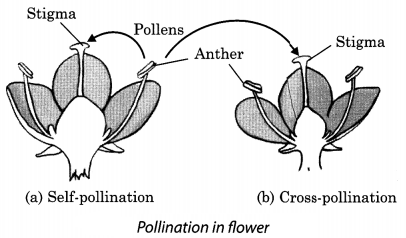
Reproduction in Plants Class 7 Extra Questions and Answers Science Chapter 12 1

Question 2.
What is vegetative propagation? Describe vegetative propagation through different parts of the plant.
Answer:
The type of asexual reproduction in which new plants are produced from vegetative parts such as roots, stems, leaves and buds is called vegetative propagation.
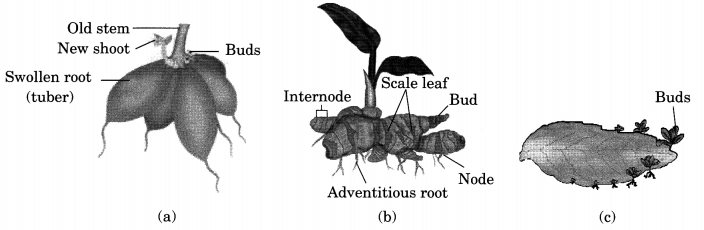
(i) Vegetative propagation by roots: The roots of some plants like sweet potato and Dahlia, etc., give rise to new plants [Fig. 12.14(a)]
(ii) Vegetative propagation by stems: In some plants like potato, ginger, etc., new plants grow from the stems of these plants. Potatoes have small ‘eyes’ or scars on them which germinates to give rise to new plants. Similarly small bud produce new plants in ginger and turmeric [Fig. 12.14(b)]
(iii) Vegetative propagation by leaves: In some plants, new plants grow from the margins of the leaves, e.g., in Byrophyllum small plantlets grow from the margins of the leaves. These plantlets when get detached from the leaves develops into an independent plant. [Fig. 12.14(c)]
Reproduction in Plants Class 7 Extra Questions and Answers Science Chapter 12 2

Question 3.
Explain the reproductive parts of a flower with a labelled diagram.
Answer:
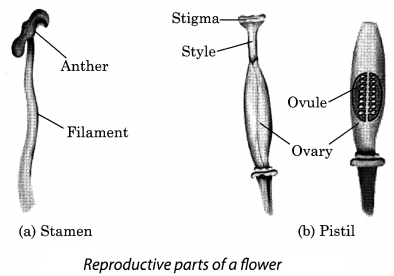
Flowers are the reproductive parts of a plant. The stamens are the male reproductive part and the pistil is the female reproductive part (Fig. 12.15). Anther contains pollen grains which produce male gametes. A pistil consists of stigma, style and ovary. The ovary contains one or more ovules. The female gamete or the egg is formed in an ovule. In sexual reproduction a male and a few female gamete fuse to form a zygote.
Reproduction in Plants Class 7 Extra Questions and Answers Science Chapter 12 3

Question 4.
Explain zygote formation or fertilisation with the help of a diagram.
Answer:
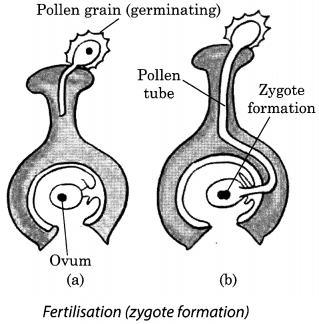
In sexual reproduction, a male and female gamete fuse to form a zygote. This process of fusion of gametes to form a zygote is called fertilisation (Fig. 12.16). The zygote develops into an embryo.
Reproduction in Plants Class 7 Extra Questions and Answers Science Chapter 12 4

Reproduction in Plants Class 7 Extra Questions HOTS

Question 1.
What are the advantages of vegetative propagation?
Answer:
Plants produced by vegetative propagation take less time to grow and bear flowers and fruits earlier than those produced from seeds. The new plants are exact copies of the parent plant, as they are produced from a single parent.

Question 2.
Which is more advantageous for plants-self-pollination or cross-pollination? Give reasons for your answer.
Answer:
Cross-pollination is more advantageous as it help the plant in having variation in offsprings, new varieties are formed, make plant to adapt to new changes in environmental conditions and diseases. It helps the plant to yield better.

Question 3.
What is brinjal, a vegetable or a fruit? Explain.
Answer:
Brinjal is actually fruit of the plant which we take or consume as vegetable. Brinjal develops from the fertilised ovary of the flower and contains many seeds.

Question 4.
Write how the following seeds are dispersed.
(a) Seeds with wings
(b) Small and light seeds.
(c) Seeds with spines/hooks
Answer:
(a) Dispersed by wind
(b) Dispersed by wind
(c) Dispersed by animals

Question 5.
How plants are benefitted by seed dispersal?
Answer:
Seed dispersal prevents compietition between the plant and its own seedlings for sunlight, water and minerals. It also enables plant to invade new habitats for wider distribution. Thus, seed dispersal provides suitable conditions for survival and growth of the plant.

Question 6.
What are the post fertilisation changes in a flower?
Answer:
After fertilisation, the ovary grows into a fruit and other parts of the flower fall off. The ripened ovary is called fruit. The seeds develop from the ovules. The seed contains an embryo, which is formed from zygote due to fusion of male and female gametes. The embryo develops into future plant on getting favourable conditions.

Reproduction in Plants Class 7 Extra Questions Value Based (VBQs)

Question 1.
Artificial propagation of plant is growing of new plantlets other than the natural mean. It includes, cutting, grafting, layering, etc. It is an easy process and is a faster way of propagation of many plants with desired characteristics. But with the increased practice of artificial propagation man is risking the existence of many native varieties of plants.
(a) What are the advantages of artificial propagation of plants?
(b) What are the disadvantages of artificial propagation of plants?
(c) What is native variety?
(d) Do you think there is any adverse affect of artificial propagation on the native varieties of plants?

Answer:
(a) Advantages of artificial propagation are:

  1. Plants take less time to produce flowers and fruits.
  2. Plants are exact copies of the parent plant.
  3. Plants take less space and energy to give productive yield.

(b) Disadvantages of artificial propagation are:

  1. Plants do not show much variation and lose their strength and health gradually.
  2. They are more prone to disease.
  3. As many plants are produced, it may result in overcrowding
  4. Some plants do not have strong root system which may collapse with time.

(c) Native variety of a plant is one that occurs naturally in a particular habitat or ecosystem or region.
(d) Yes. If the non-native varieties of plants are propagated on a large scale artificially can eliminate the existence of native variety of that plant due to competition for space and nutrition.

Question 2.
After a rainy season, while Mani was strolling in her garden, noticed many small plants of various fruits and flowers which were not present in her garden. She wondered where they had come from as nobody had planted them there. As Mani loves gardening she started cleaning the area around the small plants and taking care of them.
(a) How plants propagate through sexual mode of reproduction?
(b) What is an embryo?
(c) What do you think the plants grown in Mani’s garden had come from?
(d) How do seeds of some fruits like tomato, guava or brinjal propagate?
(e) What value of Mani is shown here?

Answer:
(a) Through seeds
(b) Embryo is a future plant, found deep inside the seed. It is formed from the development of zygote.
(c) Plants grown in Mani’s garden may have come from the seeds dispersed through various agents like animals, wind, water, etc. Which on getting favourable conditions have germinated into plants.
(d) Seeds of these fruits are generally propagated through animal faeces when they consume it.
(e) Mani is inquisitive, a good observer and nature lover.

Articles Worksheet Exercises for Class 3 CBSE with Answers

Articles Worksheet Exercises for Class 3 CBSE with Answers 1Articles are used to indicate the number of singular nouns (a, an) and to specify which noun is being talked about (the). A and an are indefinite articles. They are used to refer to a singular countable noun in general or for the first time.
Basic English Grammar rules can be tricky. In this article, we’ll get you started with the basics of sentence structure, punctuation, parts of speech, and more.

Worksheet Exercise on Articles for Class 3 CBSE with Answers PDF

There are two types of articles: the definite article (the) and the indefinite articles (a, an).

We usually use the indefinite article ‘a’ ‘an’, first to mention some person or thing. By doing that, we don’t have to be clear about which particular person or thing we are referring to. When we refer to the same person or the thing again, we use the definite article the to indicate the person or the thing already mentioned. There are times when we don’t have to use any one of the articles. Such a situation is called zero article,

Fundamentals

  • A and An are used to introduce a noun word.
  • We use A and An to talk about one person, animal or thing.
  • We use ‘A’ when the first letter of the noun is consonant.
  • We use ‘An’ when the first letter of the noun is a vowel.
  • ‘The’ is used before a special noun.
  • We use ‘A’ before words that begin with u and eu when they sound like ‘You’. Examples: a uniform, a eucalyptus etc.
  • We use ‘An’ before the silent ‘h’. Examples: an honest man, an hour etc.
  • ‘The’ is also used before a noun word that has been mentioned, introduced or discussed earlier.

Articles Exercises for Class 3 with Answers PDF

A. Circle the correct article in each sentence.

1. Dad wears a/an old pair of shoes to work in the yard.
2. I had a/an banana for lunch.
3. My family brought a/an blanket to the football game.
4. Alex had a/an birthday party for my grandfather.
5. She used a/an exit sign to help find her way out of the building.

B. Complete these passages by filling in A, An and The correctly.

1. ___________ tortoise and ___________ hare were neighbours. One day hare challenged. ___________ tortoise to ___________ race. Tortoise won ___________ race.

2. I have ___________ dog and ___________ parrot for pets ___________ dog is always quiet but ___________ parrot is noisy.

C. Write the correct article (a or an) for each noun.

1. ___________ eucalyptus
2. ___________ anniversary
3. ___________ rooster
4. ___________ egg kangaroo
5. ___________ apple
6. ___________ quarter
7. ___________ toothbrush spoon
8. ___________ afternoon
9. ___________ sini ni

More about Articles Exercises for Class 3 CBSE with Answers

Fundamentals

  • We use the before superlatives.
    Example:- Mt. Everest is the highest peak.
  • We use the before Ordinals.
    Example:- This is the first time I have seen the rocket.
    He came to visit me the next day.
  • We use the with a noun such as earth, moon, sky.
    Example:- The Earth revolves around the Sun.
  • We use the with the names of river, lakes, oceans and mountains.
    Example:- The Himalayas, The Pacific
  • We use the with the names of holy books and newspaper.
    Example:- The Tribune, The Ramayana
  • We use the with the names of well known buildings and monuments.
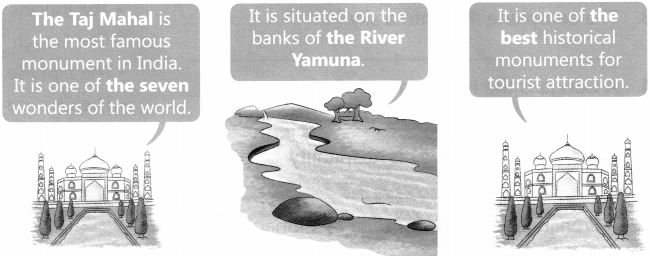
    Example: The White House, The Taj Mahal

Presentation
Read the picture story.
Articles Worksheet Exercises for Class 3 CBSE with Answers 2

Answer the following questions according to the story.

1. Which is the most famous monument in India? ____________
2. Which river lies next to the Taj Mahal? ____________
3. Name the title given to this historical place. ____________

Articles Paragraph Exercises with Answers PDF for Class 3 CBSE

A. Complete the story with ‘a’, ‘an’ or ‘the’.

Yesterday I was sitting in ____________ train when I saw ____________ strange man walking around the platform. He came into the carriage of ____________ train where I was sitting. He sat in the seat just opposite to me. On ____________ front page of ____________ newspaper, there was ____________ picture of bank robber. The words under ____________ picture were: ‘Wanted by the police’. It was ____________ same man!

B. There is a mistake in each of these sentences. Underline the mistake and rewrite the sentence correctly.

1. Sumit will meet us in a hour and a half.
________________________

2. A old man met a young woman.
________________________

3. The aeroplane flew into a sky.
________________________

4. A Ganga is the holiest river in India.
________________________

5. A Indian is known for his hospitality.
________________________

6. A French are famous for their fashionable clothes.
________________________

7. A Red Fort is situated in Delhi.
________________________

8. He travelled around a world.
________________________

9. He is as brave as the lion.
________________________

10. She is as wise as the owl.
________________________

C. Fill in the blanks with correct articles.

1. _____________ Koshi river originates in Himalayas and flows into _____________ Indian ocean.
2. Mohan was _____________ first to arrive and Mita was _____________ last.
3. _____________ boy who is wearing _____________ cap is _____________ best football player in _____________ school-team.
4. _____________ Moon is _____________ satellite of Earth while _____________ Sun is star.
5. I have read _____________ Mahabharat and _____________ Bible but I haven’t read _____________ Quoran.
6. _____________ Whitehouse is famous building in _____________ USA.
7. _____________ shirt which I wore yesterday was given to me by my sister.
8. I will go shopping tomorrow. I will buy cap, _____________ nice dress and _____________ pair of shoes.