Sentences Exercises for Class 7 CBSE With Answers

Sentences Exercises for Class 7

Sentences Exercises for Class 7 CBSE With Answers Pdf

When we speak or write we use words. We generally use these words in groups; as, Little Jack Horner sat in a corner.

A group of words like this, which makes complete sense, is called a Sentence.

This grammar section explains English Grammar in a clear and simple way. There are example sentences to show how the language is used. You can also visit the most accurate and elaborate NCERT Solutions for Class 7 English. Every question of the textbook has been answered here.

Types of Sentences

Sentences are divided into four categories: simple sentences, compound sentences, complex sentences and compound-complex sentences.

Simple Sentence DefinitionA simple sentence contains one independent clause.
ExamplesRavi rode his bike to school.
Who is your best friend?
She ate her lunch, took a walk, and went back to work.
Compound Sentences DefinitionA compound sentence contains two independent clauses. Coordinating conjunction (for, and, nor, but, or, yet, so) often links the two independent clauses and is preceded by a comma.
ExamplesShe wanted to go on vacation, so she saved up her money.
I like apples, but my sister loves bananas.
Umesh loves to read, and he also loves to hike.
Complex Sentences DefinitionA complex sentence contains one independent clause and one or more dependent clauses.
A complex sentence will include at least one subordinating conjunction.
ExamplesShe went to class even though she was sick.
As Jiwan was arriving to work, he realised he forgot his lunch.
While I enjoy classical music, I prefer rock and roll because I play drums.
Compound-Complex Sentences DefinitionA compound-complex sentence combines complex sentence and compound sentence forms. A compound-complex sentence contains one or more independent clauses and one or more dependent clauses.
ExamplesAlthough she felt guilty for missing her friend’s birthday, she took her out to dinner the next day, and they had a great time.
I try to eat healthy food, but because fast food is so convenient, I cannot maintain a healthy diet.
If he got the job, he would have to commute 50 miles to work, so he decided the job was not worth it.

Subject and Predicate

Every complete sentence consists of two parts: a subject and a predicate.
While making a sentence we mention a place or a thing and also say something about that person or thing. While the subject is what the sentence is about, the predicate talks about the subject.

Subject:
The part of the sentence which talks about the person or a thing is called the subject of the sentence. The subject of a sentence could be a noun, a pronoun or even an entire phrase or clause.

Predicate:
The part of the sentence which talks about the subject is called the predicate of the sentence. e.g.
(a) Joseph likes to play volleyball
Joseph is the subject of the sentence because the sentence is telling something about the liking of Joseph. And what is it telling? It says that Joseph. And what is it telling? It says that Joseph like to play volleyball. So, in this example the subject is ‘Joseph’ and the predicate is ‘likes to play volleyball.’

To determine the subject of the sentence, we first find the verb in the sentence and then ask ‘who?’ or ‘what?’ in the sentence.
In the above sentence, we first find the verb, the verb here is ‘play. So we first ask, who plays?
The answer will be, Joseph plays and this is how we determine that the subject is Joseph.

(b) The horse ran.
Here the verb is ran, so we first ask, “who ran? The answer is ‘horse’.
So, the subject is “The horse’ and the predicate is ‘ran’.

(c) The car is red.
Here the verb is ‘red’, so we first ask, “What is red? The answer is ‘car’.
So, the subject is “The car’ and the predicate is ‘red’.

Note: The subject usually comes before the sentence, but in exceptional cases, it comes at the end of the sentence.
E.g.

  • Here comes the train.

In the above sentences, the verb is ‘comes’, we first ask, “what comes? The answer is ‘train’.
So, the subject is ‘the train’ and the predicate is ‘here comes’.

The Clause
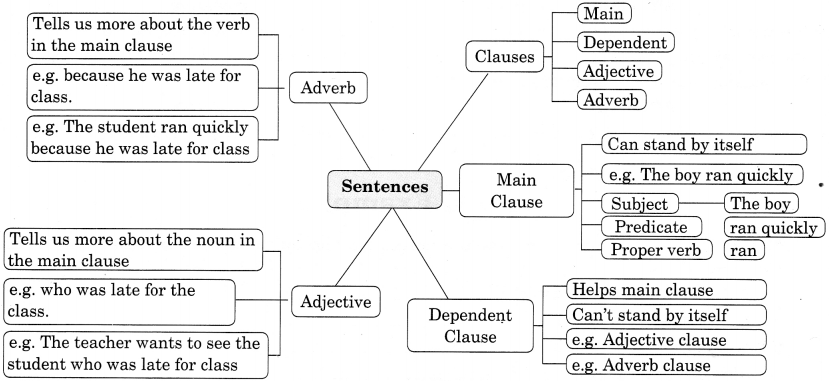
The clause is a group of words having its own subject and a predicate though it does not make a complete sense. It is rather a part of another sentence.
E.g.,

  • Because you are feeling well, you can go out today.

The bold part does not make a complete sentence. But since it has its own subject and predicate it is a clause on which the other clause ‘you can go out today’ depends.

More examples

  • I will wait for you, although I am hungry.
  • They do whatever they decide.

The Phrase
A group of words at the end of the sentence makes a sense, but not a complete sense, is known as a phrase. The phrase may have nouns or verbs, but it does not have a subject and predicate.

E.g.

  • Humpty Dumpty sat on a wall.
  • The sun rises in the East.
  • This is not the right way of doing things.

Types of Sentences

Declarative Sentence
Tells something.

  • Ends with a period. (.)

Interrogative Sentence

  • Asks a question.
  • Ends with a question mark. (?)

Exclamatory Sentence

  • Shows strong feeling.
  • Ends with a period. (!)

Imperative Sentences

  • Gives a command.
  • Ends with a period. (. or !)

Sentences Exercises for Class 7 CBSE With Answers

Transformation of Sentences

Affirmative to negative:

Rule 1: Only/alone/merely → Replaced by → None but (person)/nothing but (things)/not more than or not less than (number)
Examples:
Aff: Only God can help us. Neg: None but God can help us.
Aff: He has only a ball. Neg: He has nothing but a ball.
Aff: He has only ten rupees. Neg: He has not more than ten rupees.

Rule 2: Must → Replaced by → Cannot but/Cannot help + (v+ing).
Examples:
Aff: We must obey our parents.
Neg: We cannot but obey our parents/ We cannot help obeying our parents.

Rule 3: Both and → Replaced by → not only but also.
Examples:Aff: Both Deepak and Deepika were excited.
Neg: Not only Deepak but also Deepika were excited.

Rule 4: and (if join two words) → Replaced by → Not only but also.
Examples:
Aff: He was obedient and gentle.
Neg: He was not only obedient but also gentle.

Rule 5: Everyone/everybody/every person/ (every + common noun)/all →Replaced by → There is no + attached word + but.
Examples:
Aff: Every mother loves her child.
Neg: There is no mother but loves her child.

Rule 6: As soon as → Replaced by → No sooner had Than.
Examples:
Aff: As soon as the thief saw the police, he ran away.
Neg: No sooner had the thief saw the police he ran away.

Rule 7: Absolute Superlative degree → Replaced by → No other + attached word + so + positive form + as + subject
Examples:
Aff: Dhaka is the biggest city in Bangladesh.
Neg: No other city is as big as Dhaka in Bangladesh.

Rule 8: Sometimes affirmative sentences are changed into negative by using opposite words. Before the word, off course ‘not’ is used.
Examples:
Aff: I shall remember you.
Neg: I shall not forget you.

Rule 9: Always → Replaced by → Never.
Examples:
Aff: Raman always attends the class.
Neg: Raman never misses the class.

Rule 10: Too to → Replaced by → so that+ cannot/could not (in past).
Examples:
Aff: He is too weak to walk.
Neg: He is so weak that he cannot walk.

Rule 11: As as → Replaced by → Not less than.
Examples:
Aff: Simi was as wise as Rimi.
Neg: Simi was not less wise than Rimi.

Rule 12: Universal truths are changed by making them negative interrogative.
Examples:
Aff: The Sunsets in the west.
Neg: Doesn’t the Sunset in the west?

Rule 13: Sometimes → Replaced by → Not + always.
Examples:
Aff: Raman sometimes visits me.
Neg: Raman doesn’t always visit me.

Rule 14: Many → Replaced by → Not a few.
Examples:
Aff: I have many friends.
Neg: I do not have few friends.

Rule 15: A few → Replaced by → not many.
Examples:
Aff: Bangladesh has a few scholars.
Neg: Bangladesh doesn’t have many scholars.

Rule 16: Much → Replaced by → A little.
Examples:
Aff: He belongs much money.
Neg: He doesn’t belong a little money.

Rule 17: A little → Replaced by → not much.
Examples:
Aff: Danish has a little skill.
Neg: Danish doesn’t have much skill.

Assertive to Interrogative

Rule 1: If the sentence is in the affirmative you have to change it into negative interrogative. If it is in negative then you have to change it into bare interrogative.
Examples:
Ass: He was very gentle.
Int: Wasn’t he very gentle?
Aff: He is not a good person.
Int: Is he a good person?

Rule 2: No auxiliary verb in sentence → Change it by using → Do/does/did Or Don’t/doesn’t/didn’t.
Examples:
Ass: He plays football.
Int: Does he play football?
Ass: They did not play football yesterday.
Int: Did they play football yesterday?

Rule 3: Never → Replaced by → Ever.
Examples:
Ass: I never drink tea.
Int: Do I ever drink tea?

Rule 4: Everybody/everyone/AII → Replaced by →Who + Don’t/ Doesn’t/Didn’t
Examples:
Ass: Everybody wishes to be happy.
Int: Who doesn’t wish to be happy?

Rule 5: Every + noun → Replaced by → Is there any + noun+ Who don’t/doesn’t/didn’t.
Examples:
Ass: Every man wishes to be happy.
Int: Is there any man who doesn’t wish to be happy?

Rule 6: No body/ no one / None → Replaced by → Who.
Examples:
Ass: Nobody could count my love for you.
Int: Who could ever count my love for you?

Rule 7: There is no → Replaced by → Is there any/ Who(person)/ What(thing).
Examples:
Ass: There is no use of this law.
Int: What is the use of this law?
Ass: There is no man happier than Rohit.
Int: Who is happier than Rohit?

Rule 8: It Is no → Replaced by → Is there any/Why.
Examples:
Ass: It is no use of taking unfair means in the exam.
Int: Why take unfair means in the exam? Or Is there any use of this law?

Rule 9: It Doesn’t matter → Replaced by → what though/ Does it matter.
Examples:
Ass: It does not matter if you fail in the exam.
Int: What though if you fail in the exam?

Exclamatory to Assertive sentences

Rule 1: Subject and Verb of exclamatory sentences are to be used as the subject and verb of assertive sentence at the outset of the sentence.
How/what → Replaced by → Very (before adjective)/Great (before noun)
Examples:
How fortunate you are!
Ass: You are very fortunate.
Examples:
What a fool you are!
Ass: You are a great fool.

Rule 2: Sometimes the subject and verb may be eclipsed.
Examples:
What beautiful scenery!
Ass: It is very beautiful scenery.

What a pity!
Ass: It is a great pity.

Rule 3: Hurrah/ Bravo → Replace by → I/we rejoice that/ It is a matter of joy that.
Examples:
Hurrah! We have own the game.
Ass: It is a matter of joy that we have won the game.

Rule 4: Alas → Replace by → I/we Mourn that/ It is a matter of sorrow or grief that.
Examples:
Alas! He has failed.
Ass: We mourn that he has failed.

Rule 5: Had/were/If /Would that (at the outset) → Replaced by → I wish + subject again + were/ had+ rest part.
Examples:
Had I the wings of a bird!
Ass: I wish I had the wings of a bird.
Were I a bird!
Ass: I wish I were a bird.
If I were young again!
Ass: I wish I were young again.
Would that I could be a child!
Ass: I wish I could be a child.

Imperative to Assertive

Rule 1: Add subject + should in doing assertive.
Examples:
Do the work.
Ass: You should do the work.

Rule 2: Please/kindly → Replaced by →you are requested to.
Examples:
Please, help me.
Ass: You are requested to help me.

Rule 3: Do not → Replaced by → You should not.
Examples:
Do not run in the sun.
Ass: You should not run in the sun.

Rule 4: Never → Replaced by → you should never.
Examples:
Never tell a lie.
Ass: You should never tell a lie.

Rule 5: Let us → Replaced by → We should.
Examples:
Let us go out for a walk.
Ass: We should go out for a walk.

Rule 6: Let + noun/pronoun → Replaced by → Subject + might.
Examples:
Let him play football.
Ass: He might play football.

Change of degree

Rule 1: If the sentence has superlative degree, we can change it into comparative and positive degree.

To form comparative, use
subject +verb + adjective/adverb (comp, form) + Than any other + rest part To form positive, use-

No other + rest part after superlative Degree + verb + so/as + positive form of adj/adv + as + sub.
Examples:
Superlative Sumit is the tallest boy in the class.
Comparative: Sumit is taller than any other boy in the class.
Positive: No other boy in the class is as tall as Sumit.

Rule 2: If in superlative degree ‘One of the’ is transformed in this way:
Comparative: Sub+verb +comp. form +than most other+ Rest part.
Positive: Very few+ rest part after supr. Degree + verb + so/as + positive form of adj/adv + as + sub.
Examples:
Sup: Rohit was one of the greatest poets in Bangladesh.
Comp: Rohit was greater than most other poets in Bangladesh.
Pos: Very few poets in Bangladesh were as great as Rohit.
Note: Superlative: Of all/ of any Comparative: Than all other/than any other.
Positive: It does not exist.

Examples:
Sup: Mr. Khan is the oldest of all men in the village.
Com: Mr. Khan is older than all other men in the village.
Pos: No other man is as old as Mr. Khan.

Rule 3: Simple comparative is transformed into positive by using (not so + adj/adv+as)/ (so+adj/adv+as)if negative. Second noun or pronoun is used first.
Examples:
1. Com: Rina is wiser than Mina.
Pos: Mina is not so wise as Rina.
2. Com: Mina is not wiser than Rina.’
Pos: Rina is as wise as Mina.

Rule 4: No/not less — than is transformed into positive by using as +adj/adv+ as
Examples:
Com: Karim is not less meritorious than Suman.
Pos: Karim is as meritorious as Suman.

Types Of Sentences Exercises Solved Examples for Class 7 CBSE

Question 1.
Mention the kind of sentences (Assertive, Interrogative, Imperative, Optative or Exclamatory) in the blanks against it.
(i) Ah! What a kind morning it is! __________
(ii) Do you find it interesting. __________
(iii) Smoking is bad for health. __________
(iv) Always help the needy. __________
(v) Hello! I am Sania this side. __________
Answer:
(i) Exclamatory
(ii) Assertive
(iii) Assertive
(iv) Imperative
(v) Exclamation

Question 2.
Identify the type of sentence.
There are 4 types of sentences in English.
Declarative, Imperative, Interrogative, Exclamatory
(i) How well she sings!
(ii) What is your name?
(iii) Did I say anything to make you angry?
(iv) What is your name?
(v) Who told you this?
(vi) she is a successful writer.
(vii) It is raining cats and dogs.
(viii) I want to become a writer.
(ix) She does not eat meat or fish.
(x) Go at once.
Answer:
(i) Exclamatory,
(ii) Interrogative
(iii) Interrogative
(iv) Interrogative m!
(v) Interrogative
(vi) Declarative
(vii) Declarative
(viii) Declarative
(ix) Declarative
(x) Imperative.

Question 3.
Complete the following sentences by choosing appropriate phrases from the box given below. how to do it to my door in the east on a wall of gold
(i) The sun rises
(ii) I asked my friend to show me
(iii) My mother has a chain
(iv) There came a beggar
(v) Humpty Dumpty sat –
Answer:
(i) in the east
(ii) how to do it
(v) on a wall.
(iii) of gold
(iv) to my door

Types Of Sentences Exercises Practice Examples for Class 7 CBSE

1. Convert the following sentences into simple sentences.

Although he was eager to get married, his parents wanted him to wait.
Answer: _______________________

2. As I was fixing supper, there was a knock at the door.
Answer: _______________________

3. That night Kiran had a dream. It was more like a nightmare.
Answer: _______________________

4. I turned tail and fled away.
Answer: _______________________

5. When the mate dies she doesn’t take a new one.
Answer: _______________________

2. Convert the following sentences into compound sentences.

1. I received your kind letter. I thank you for it.
Answer: _______________________

2. Mother was tired. She announced her intention of going to bed.
Answer: _______________________

3. They’ll keep coming if you keep bothering them.
Answer: _______________________

4. Breathing exercises must be prescribed. They must be carried out under a doctor’s guidance.
Answer: _______________________

5. The journey was very long. I was afraid to take it.
Answer: _______________________

3. Convert the following sentences into complex sentences.

1. I finished the dishes. I went out.
Answer: _______________________

2. A man did this. He must have been very strong.
Answer: _______________________

3. I breathe all right. At least I think so.
Answer: _______________________

4. I won, managing to shock everybody.
Answer: _______________________

5. That night Kiran had a dream and it was more like a nightmare.
Answer: _______________________

Respiration in Organisms Class 7 Extra Questions and Answers Science Chapter 10

In this page, we are providing Respiration in Organisms Class 7 Extra Questions and Answers Science Chapter 10 pdf download. NCERT Extra Questions for Class 7 Science Chapter 10 Respiration in Organisms with Answers will help to score more marks in your CBSE Board Exams.

Class 7 Science Chapter 10 Extra Questions and Answers Respiration in Organisms

Extra Questions for Class 7 Science Chapter 10 Respiration in Organisms with Answers Solutions

Respiration in Organisms Class 7 Extra Questions Very Short Answer Type

Question 1.
Where does cellular respiration take place?
Answer:
Cellular respiration takes place in the cells of all organisms.

Question 2.
What is aerobic respiration?
Answer:
The process of breakdown of glucose with the use of oxygen is called aerobic respiration.

Question 3.
Define inhalation.
Answer:
The process of taking in of air rich in oxygen into the body is called inhalation.

Question 4.
Which gas do humans take in while breathing?
Answer:
Oxygen

Question 5.
Which gas do humans give out while breathing?
Answer:
Carbon dioxide

Question 6.
Define exhalation.
Answer:
The process of giving out of air rich in carbon dioxide is called exhalation.

Question 7.
Give one usage of yeast.
Answer:
Yeast is used for making alcoholic beverages like beer, wine, etc.

Question 8.
State aerobic respiration with the help of an equation.
Answer:
Respiration in Organisms Class 7 Extra Questions and Answers Science Chapter 10 1

Question 9.
State anaerobic respiration with the help of an equation.
Answer:
Respiration in Organisms Class 7 Extra Questions and Answers Science Chapter 10 2

Question 10.
When do our muscle cells respire anaerobically?
Answer:
When there is a temporary deficiency of oxygen in the muscle cells; they begin to respire anaerobically.

Question 11.
Give two therapies to release muscle cramps.
Answer:

  • Hot water bath
  • Gentle massage.

Question 12.
What are the functions of hair and mucus inside the nose?
Answer:
Hair and mucus present inside the nose prevent dust, dirt and germs from entering the respiratory system of our body.

Question 13.
Name the breathing organs of fish.
Answer:
Gills

Question 14.
Where are the lungs of human beings present?
Answer:
Chest cavity

Question 15.
Name one significant process of getting energy.
Answer:
Respiration

Respiration in Organisms Class 7 Extra Questions Short Answer Type

Question 1.
Define respiration.
Answer:
The process in living organisms involving the production of energy, typically with the intake of oxygen and release of carbon dioxide from the oxidation of complex organic substances is termed as respiration.

Question 2.
Define anaerobic respiration.
Answer:
The process of breakdown of glucose without the use of oxygen is termed as anaerobic respiration. In this process, glucose is used to get energy and carbon dioxide and alcohol are made as waste products.

Question 3.
What are yeasts?
Answer:
Yeasts are single-celled fungi that reproduce asexually by budding. They respire anaerobically and yield alcohol during the process. Hence, they are used in the making of alcoholic drinks, such as wine, beer, etc.

Question 4.
Why does anaerobic respiration take place in our muscles sometimes?
Answer:
During heavy physical work like cycling, running, jumping, etc., the demand of energy is high but the supply of oxygen is limited. Hence anaerobic respiration takes place in the muscle cells to fulfil the demand of energy.

Question 5.
What causes muscle cramps?
Answer:
Under anaerobic condition the partial breakdown of glucose produces lactic acid in the cells. The ac-cumulation of lactic acid causes muscles cramps.

Question 6.
What is breathing rate?
Answer:
The number of times a person breathes per minute is known as the breathing rate. A single breath means one inhalation and one exhalation; both take place alternatively.

Question 7.
Do we breathe only one gas at a time? If not, what amount of gases do we breathe respectively?
Answer:
No, we do not take in or give out only one gas at a time. The percentage of oxygen and carbon dioxide in inhaled and exhaled air are:
Respiration in Organisms Class 7 Extra Questions and Answers Science Chapter 10 3

Question 8.
Why do we feel hungry after physical activity?
Answer:
During physical activity the demand of energy in the body increases. For the fulfilment of this energy requirement, we breathe faster, as a result of which oxygen is supplied to the cells. Hence, the rate of breakdown of food increases and more energy is released. So we feel hungry.

Question 9.
Explain the respiratory system in cockroaches.
Answer:
A cockroach has small openings on the sides of its body, called spiracles. It also has a network of air tubes called tracheae for gas exchange. Oxygen rich air rushes through spiracles into the tracheal tubes, diffuses into the body tissue and reaches every cell of the body. Similarly, carbon dioxide from the cells goes into the tracheal tubes and moves out through spiracles.

Question 10.
What are the harmful effects of smoking?
Answer:
Smoking damages lungs. Smoking is also linked to cancer.

Respiration in Organisms Class 7 Extra Questions Long Answer Type

Question 1.
Describe the mechanism of breathing in human beings with a suitable diagram.
Answer:

  • During inhalation, diaphragm moves down and ribs move up and outwards this movement increases space in our chest cavity and air rushes into the lungs. The lungs get filled with air.
  • During exhalation, diaphragm moves up to its former position and ribs move down and inwards. The space in the chest cavity decreases and thus air from the lungs is forced to get out of the body through the air passage. This is known as exhalation.

Respiration in Organisms Class 7 Extra Questions and Answers Science Chapter 10 4

Question 2.
What are the differences between cellular respiration and breathing.
Answer:

Cellular respirationBreathing
(i) Energy is released.(i) Energy is not released.
(ii) It is a biochemical process.(ii) It is a physical process.
(iii) The production of carbon dioxide gas takes place.(iii) Carbon dioxide is given out and oxygen is taken in from the air.
(iv) It is an intracellular process.(iv) It is an extracellular process.

Question 3.
How does exchange of gases take place in fish? Draw a diagram of breathing organs in fish.
Answer:
Respiration in Organisms Class 7 Extra Questions and Answers Science Chapter 10 5
Fish have gills for respiration. Gills are feathery organs full of blood vessels. A fish breathes by taking water into its mouth and forcing it out through the gill passages. As water passes over the thin walls of the gills, dissolved oxygen moves into the blood and travels to the fish’s cells. Likewise carbon dioxide from the fish’s cells moves into the blood and is eliminated out through gills into the water.

Question 4.
Differentiate between photosynthesis and respiration.
Answer:

PhotosynthesisRespiration
(i) Only green plants carry out this process.(i) It takes place in all the animals and plants.
(ii) Oxygen is given out as waste material.(ii) Carbon dioxide is given out as waste mate­rial.
(iii) Conversion of light energy into chemical energy takes place.(iii) Breakdown of food takes place with the release of energy.
(iv) Carbohydrate is synthesised.(iv) Carbohydrate is broken down.
(v) It occurs only in presence of light.(v) It occurs in both light and dark.
(vi) Carbon dioxide is taken in this process.(vi) Carbon dioxide is liberated in this process.

Question 5.
Draw a well-labelled diagram
Answer:
Respiration in Organisms Class 7 Extra Questions and Answers Science Chapter 10 6

Question 6.
Describe the process of breathing in human beings.
Answer:
When we breathe in, air enters through nasal cavity. The hair and mucus present in the nasal cavity traps dust and other particles present in air. Air from nasal cavity then reaches the pharynx in the neck region and the larynx. Below the larynx is the trachea. The trachea divides into two bronchi, right and left, which leads to the lungs.

In the lungs, each bronchus branches into smaller tubes called bronchioles. At the end of the bronchioles, small rounded structures called air sacs or alveoli are present. Each alveolus is made up of a very thin membrane surrounded by blood vessels. Exchange of gases occur in air sacs through the process of diffusion.

In short passage of air from nose can be depicted as:
Nose ➝ Nasal cavity ➝ Pharynx ➝ Larynx ➝ Trachea ➝ Bronchi ➝ Bronchioles ➝ Alveoli (air sac)

Respiration in Organisms Class 7 Extra Questions HOTS

Question 1.
Why do we yawn, especially when we feel drowsy and sleepy?
Answer:
When we feel drowsy or sleepy our breathing rate slow down. The lungs do not get enough oxygen from air resulting in yawning. Yawning brings extra oxygen into the lungs.

Question 2.
Why do people often breathe out on the spectacles to clean them?
Answer:
The warm and moist exhaled air condenses on the surface of spectacles as water vapour. Thus, making spectacles wet helps, to clean them easily with the help of a cloth.

Question 3.
On a very cold morning Radhika was amused and wondered to see that the air coming out of her mouth looked like smoke. Help her to find the answer.
Answer:
On a cold day, when warm and moist air comes in contact with the cold air outside, it condenses into mist. This look like smoke.

Question 4.
Why do we feel relieved after a massage of the pain in the leg muscles due to cramps?
Answer:
Massage improves the circulation of blood leading to increased supply of oxygen in the muscle cells which helps in complete breakdown of lactic acid into C02 and water. Thus, help in relieving of the pain.

Question 5.
Pick the odd-one-out from each of the groups given below on the basis of respiratory organs. Give reason for your answer.

  1. cockroach, grasshopper, snail, ant
  2. lizard, cow, earthworm, snake
  3. crocodile, whale, dolphin, fish
  4. snake, tadpole, crow, goat

Answer:

  1. Snail; as other breathe through tracheae
  2. Earthworm; as other breathe through lungs
  3. Fish; as other have lungs for respiration
  4. Tadpole; as other breathe through lungs

Question 6.
What is difference between pores present in insects and leaves of a plant?
Answer:
Pores in insects are known as spiracles whereas pores in the leaves of a plant is known as stomata. The differences between these two pores are:

  1. Spiracles are present on the sides of insects’ body whereas stomata are present more on the lower surface of leaves and fewer on the upper surface of leaves.
  2. Spiracles lead to an extensive network of tracheal system which is absent in the leaves.
  3. Spiracles are fewer in number as compared to stomata.

Respiration in Organisms Class 7 Extra Questions Value Based (VBQs)

Question 1.
A food stall owner for preparing dough for making bhaturas, added a pinch of yeast and sugar to the dough. He kept the mixture in a warm place. After few minutes, the dough increases in volume.
(a) Why did the dough increase in volume?
(b) Do you think there is any change in smell and taste of dough?
(c) Why was sugar added to the dough?
(d) What would have happened if the dough was kept in the refrigerator, soon after it was prepared?
(e) Name some similar phenomenon we observe in making other food items?
(f) Can we use some previous dough of bhatura instead of yeast to leaven the dough?

Answer:
(a) The C02 released during respiration by the yeast gets trapped inside the dough and result in increase in volume.
(b) The smell and taste of dough will change to sour due to formation of alcohol and acid by yeast.
(c) Sugar acts as source of carbohydrate for yeast.
(d) The dough would not have increased in volume. In low temperatures, yeast would not multiply and respire. Thus, affecting the process of fermentation.
(e) We use the same phenomenon in making bakery items and idli and dosa.
(f) Yes, because previous dough will also have yeast to leaven the dough.

Modal Verbs Exercises for Class 4 CBSE with Answers

Modal Verbs Exercises for Class 4 CBSE with Answers

This grammar section explains English Grammar in a clear and simple way. There are example sentences to show how the language is used.

Modal Verbs Exercises for Class 4 CBSE with Answers PDF

  • We use modal verbs to say:
  • that someone is able to do something (can, could)
  • that someone is allowed to do something (may, might)
  • that someone has to do something (must)

The helping verbs are can, could, would, should, ought to, will, shall, may, might and must.

  • can and could- We use can and could to say that someone is able to do something.
  • will and would- We use will and would when you are asking someone to do something.
  • shall and should- We can use shall and should to ask for advice, offer something and suggest something. Shall express the future action.
  • must- We use must to talk about things that we have to do. First it expresses a strong belief. Second, it expresses an obligation.
  • may and might- We use may to ask if we are allowed to do something and to tell someone that they are allowed to do something.
  • ought to- We use ought to to make strong suggestions and talk about someone’s duty.

Presentation
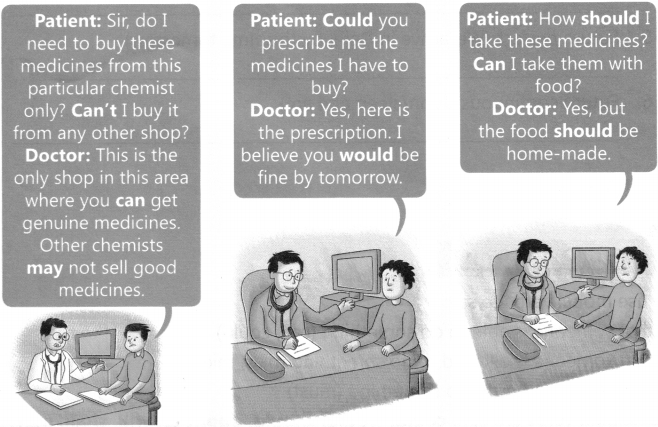
Read the picture story.
Modal Verbs Exercises for Class 4 CBSE with Answers

A. Answer the following questions as per the story.

1. Why can’t the patient buy the medicines from other chemists? __________
2. What would doctor prescribe? __________
3. How should patient take the medicine? __________

B. Complete the following with suitable modals.

1. Student: Madam, __________ I come in?
2. Teacher: Where were you? You __________ be in the class by this time.
3. Student: Sorry Madam. I __________ not get the bus on time.
4. Teacher: You __________ leave your home early.
5. Student: Kindly, forgive me this time. I __________ not be late in future. __________ I take my seat now?
7. Student: Madam, __________ you please check my home work?
8. Teacher: I __________ not check your homework at this time. I am teaching a lesson.

Modal Verbs Exercises with Answers for Class 4 CBSE PDF

A. Fill in the blanks using suitable Modals. The first one has been done for you.

1. We can win this match.
2. You __________ have good manners.
3. __________ he live long!
4. A cat __________ not chase a tiger.
5. They __________ finish this work in the evening.
6. We __________ obey our elders.
7. Who __________ arrange money at this time?
8. My uncle __________ speak five languages.
9. She told me that she __________ carry my books.
10. He said that he __________ go there if necessary.

B. Circle the correct auxiliary modal verb in each sentence.

1. When I grow up, I (may, might) become an engineer.
2. There is a small chance that we (may, might) go to the beach this weekend.
3. There is a good chance that we (might, may) have to postpone the meeting.
4. Mom thinks you (should, shall) clean your room.
5. Trains (shall, should) go faster.
6. I am feeling tired. I think I (wouid, will) go to sleep now.
7. I (will, would) like more milk with these cookies.
8. I did not think we (will, would) ever win the game.

Future Perfect Tense Exercises for Class 4 CBSE with Answers

Future Perfect Tense Exercises for Class 4 CBSE with AnswersThis grammar section explains English Grammar in a clear and simple way. There are example sentences to show how the language is used.

Future Perfect Tense Exercises for Class 4 CBSE with Answers PDF

  • Future perfect tense is used to say that somebody will have done something by a certain time in the future.
  • It is also used to describe a fact that is not yet true but which is expected to be true in future.
  • Will have + past participle form of the verb is used in this tense.

Presentation
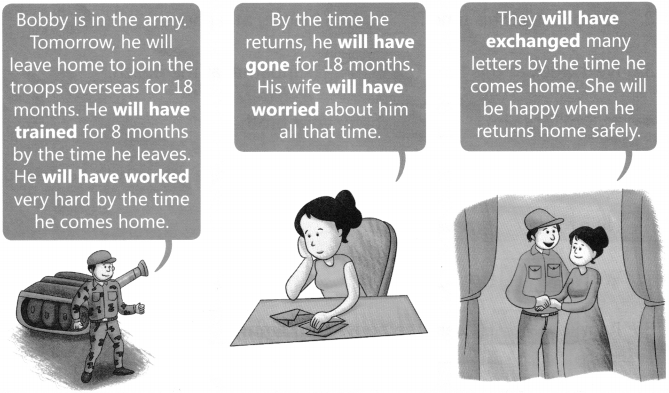
Read the picture story.
Future Perfect Tense Exercises for Class 4 CBSE with Answers

A. Answer the following questions as per the story.

1. For how many months will Bobby have trained by the time he leaves to go overseas? ___________
2. By the time he returns, for how long he will have gone? ___________
3. What will they have exchanged by the time Bobby comes home? ___________

B. Fill in the blanks with the right words from the box below.
he – have – to – about
written – army – safely – very

Bobby is in the ___________. Tomorrow, he will leave home ___________ join the troops overseas for 18 months. He will ___________ trained for 8 months by the time he leaves. He will have worked ___________ hard by the time he comes home. By the time ___________ returns, he will have gone for 18 months. His wife will have worried ___________ him all that time. They will have ___________ many letters by the time he comes home. She will be happy when he returns ___________.

Future Perfect Tense Exercises with Answers for Grade 6 CBSE PDF

A. Fill in the blanks using the verbs in the brackets such that the sentences are in Future Perfect Tense.

1. Anne ___________ her bike next week. (to repair)
2. We ___________ the washing by 8 o’clock. (to do)
3. She ___________ Paris by the end of next year. (to visit)
4. I ___________ this by 6 o’clock. (to finish)
5. Sam ___________ by next week. (to leave)
6. She ___________ this with her mother tonight. (to discuss)
7. The police ___________ the driver. (to arrest)
8. They ___________ their essay by tomorrow. (to write)
9. Pradeep ___________ the teams. (to manage)
10. If we can do that – then we ___________ our mission. (to fulfill)

B. Combine the following pairs and rewrite the sentences in future perfect tense.

1. The children will eat all the cake, (before their mother comes.)
____________________________________________

2. The fire will destroy the whole building, (before the firemen arrive)
____________________________________________

3. The patient will die. (before they reach the hospital)
____________________________________________

4. He will leave, (before you reach his place)
____________________________________________

5. We will pay back all our debts, (before we leave this city)
____________________________________________

C. Change the following sentences in future perfect tense.

1. She (to go) to Japan four times if she goes there again.
____________________________________________

2. If he wins another gold medal, he (to win) four in his entire career.
____________________________________________

3. Mohit (to climb) Mt. Fuji eight times by November 10.
____________________________________________

4. Rakhi and Mina (to eat) dinner by the time you get back from work.
____________________________________________

5. The baseball player (to hit) six homeruns if he hits another one tonight.
____________________________________________

6. I am sure you (to pay) your rent tomorrow by this time.
____________________________________________

7. Neena (to make) ten cakes if she makes two more.
____________________________________________

8. They (to swim) from England to Spain if they continue.
____________________________________________

Directions: Write the following sentences in future perfect tense using the words given in the brackets.

1. I do the laundry, (by noon tomorrow)
____________________________________________

2. We write a letter, (before father comes).
____________________________________________

D. Do as directed.

1. Future continuous (She/wait when we arrive)
____________________________________________

2. Future perfect (By next week I/finish this work)
____________________________________________

3. Future simple (I / come later)
____________________________________________

4. Future simple (It/rain tomorrow)
____________________________________________

5. Future perfect (We/arrive in Delhi by this time tomorrow)
____________________________________________

6. Future continuous (John/sleep at 4 am)
____________________________________________

Future Continuous Tense Exercises for Class 4 CBSE with Answers

Future Perfect Continuous Tense Worksheets With Answers for Class 4 CBSE PDFThis grammar section explains English Grammar in a clear and simple way. There are example sentences to show how the language is used.

Future Continuous Tense Exercises for Class 4 CBSE with Answers PDF

  • Actions that will be in progress at a certain point or at a certain time period in the future, are called Future Continuous Tense.
  • Verb endings do not change in the future tense. We only use the future tense.
  • Phrases “will” or “going” are used to show an action or fact pertains to the future.
    [will be] [verb + “ing”]
  • The verb “to be” has an irregular conjugation: I [am], he/she/it [is], you/ we/ they [are]

Presentation
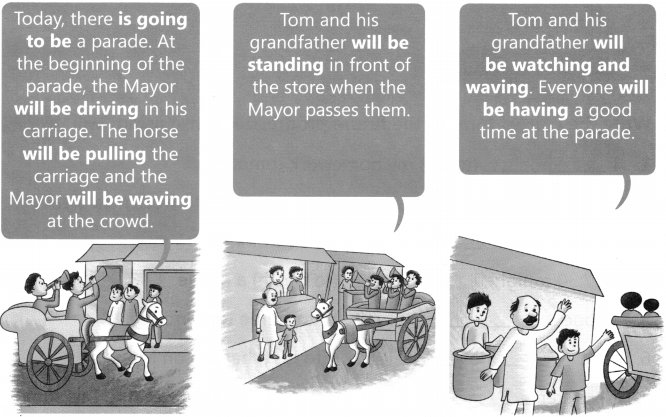
Read the picture story.
Future Perfect Continuous Tense Worksheets With Answers for Class 4 CBSE PDF 1

A. Answer the following questions as per the story.

1. What is going to happen at the beginning of the parade? ___________
2. What will the Mayor be doing? ___________
3. What will Tom and grandfather be doing when the Mayor passes them? ___________

B. Fill in the blanks with the right words from the word bank.

Today there is ___________ to be a parade. At the beginning of the parade, the Mayor is going to be ___________ by in his carriage. The horse will be pulling the carriage and the ___________ will be waving at the crowd.

Tom ___________ his grandfather will be standing in front of the store when the Mayor passes ___________ Tom and his grandfather will be watching and waving. Everyone will ___________ having a good time at a parade.

Future Continuous Tense Exercises with Answers CBSE for Class 4 PDF

A. Write the correct form of the future progressive tense using “will”.

1. I ___________ (to do) my homework tomorrow.
2. Weil, I guess we ___________ (to ride) the bus to work next week.
3. He ___________ (to eat) roast beef for dinner.
4. At 7: 30 tonight, I ___________ (to watch) a movie.
5. I hope it ___________ (to rain) at this time tomorrow.
6. Jane not ___________ (to quit) her job on Monday.
7. My sister probably ___________ (to go) to camp this summer.

B. Change the verb in the correct future continuous form.

1. He ___________ (wait) for quite some time.
2. Tomorrow at this time I ___________ (dance) at a party.
3. Next week at this time I ___________ (sunbathe) at the beach.
4. At 5 o’clock you ___________ (help) your brother.
5. This evening at 8 o’clock, she ___________ (watch) a movie with her friends.
6. Nitin ___________ (have) a hard time.
7. We ___________ (smile), and they ___________ (cry).
8. Rani ___________ (clean) the house, and Jimmy ___________ (wash) the dishes.
9. Tonight they ___________ (talk), ___________ (dance) and ___________ (have) a good time.
10. it ___________ (rain) tonight.