Triangles Class 9 Extra Questions Maths Chapter 7 with Solutions Answers

Here we are providing Triangles Class 9 Extra Questions Maths Chapter 7 with Answers Solutions, Extra Questions for Class 9 Maths was designed by subject expert teachers.

Extra Questions for Class 9 Maths Triangles with Answers Solutions

Extra Questions for Class 9 Maths Chapter 7 Triangles with Solutions Answers

Triangles Class 9 Extra Questions Very Short Answer Type

Question 1.
Find the measure of each exterior angle of an equilateral triangle.
Solution:
We know that each interior angle of an equilateral triangle is 60°.
∴ Each exterior angle = 180° – 60° = 120°

Question 2.
If in ∆ABC, ∠A = ∠B + ∠C, then write the shape of the given triangle.
Solution:
Here, ∠A = ∠B + ∠C
And in ∆ABC, by angle sum property, we have
∠A + ∠B + C = 180°
⇒ ∠A + ∠A = 180°
⇒ 2∠A = 180°
⇒ ∠A = 90°
Hence, the given triangle is a right triangle.

Question 3.
In ∆PQR, PQ = QR and ∠R = 50°, then find the measure of ∠Q.
Solution:
Here, in ∆PQR, PQ = QR
⇒ ∠R = ∠P = 50° (given)
Now, ∠P + ∠Q  + ∠R = 180°
50° + ∠Q + 50° = 180°
⇒ ∠Q = 180° – 50° – 50°
= 80°

Question 4.
If ∆SKY ≅ ∆MON by SSS congruence rule, then write three equalities of corresponding angles.
Solution:
Since ∆SKY ≅ ∆MON by SSS congruence rule, then three equalities of corresponding angles
are ∠S = ∠M, ∠K = ∠O and ∠Y = ∠N.

Question 5.
Is ∆ABC possible, if AB = 6 cm, BC = 4 cm and AC = 1.5 cm ?
Solution:
Since 4 + 1.5 = 5.5 ≠ 6
Thus, triangle is not possible.

Question 6.
In ∆MNO, if ∠N = 90°, then write the longest side.
Solution:
We know that, side opposite to the largest angle is longest.
∴ Longest side = MO.

Question 7.
In ∆ABC, if AB = AC and ∠B = 70°, find ∠A.
Solution:
Here, in ∆ABC AB = AC ∠C = ∠B [∠s opp. to equal sides of a ∆)
Now, ∠A + ∠B + ∠C = 180°
⇒ ∠A + 70° + 70° = 180° [∵ ∠B = 70°]
⇒ ∠A = 180° – 70° – 70° = 40°

Question 8.
In ∆ABC, if AD is a median, then show that AB + AC > 2AD.
Solution:
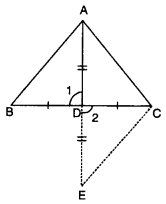
Triangles Class 9 Extra Questions Maths Chapter 7 with Solutions Answers 1
Produce AD to E, such that AD = DE.
In ∆ADB and ∆EDC, we have
BD = CD, AD = DE and ∠1 = ∠2
∆ADB ≅ ∆EDC
AB = CE
Now, in ∆AEC, we have
AC + CE > AE
AC + AB > AD + DE
AB + AC > 2AD [∵ AD = DE]

Triangles Class 9 Extra Questions Short Answer Type 1

Question 1.
In the given figure, AD = BC and BD = AC, prove that ∠DAB = ∠CBA.
Solution:
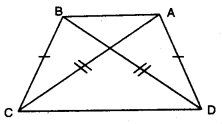
Triangles Class 9 Extra Questions Maths Chapter 7 with Solutions Answers 2
In ∆DAB and ∆CBA, we have
AD = BC [given]
BD = AC [given]
AB = AB [common]
∴ ∆DAB ≅ ∆CBA [by SSS congruence axiom]
Thus, ∠DAB =∠CBA [c.p.c.t.]

Question 2.
In the given figure, ∆ABD and ABCD are isosceles triangles on the same base BD. Prove that ∠ABC = ∠ADC.
Solution:
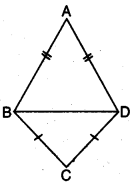
Triangles Class 9 Extra Questions Maths Chapter 7 with Solutions Answers 3
In ∆ABD, we have
AB = AD (given)
∠ABD = ∠ADB [angles opposite to equal sides are equal] …(i)
In ∆BCD, we have
CB = CD
⇒ ∠CBD = ∠CDB [angles opposite to equal sides are equal] … (ii)
Adding (i) and (ii), we have
∠ABD + ∠CBD = ∠ADB + ∠CDB
⇒ ∠ABC = ∠ADC

Question 3.
In the given figure, if ∠1 = ∠2 and ∠3 = ∠4, then prove that BC = CD.
Solution:
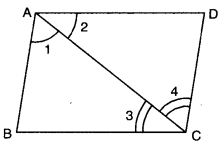
Triangles Class 9 Extra Questions Maths Chapter 7 with Solutions Answers 4
In ∆ABC and ACDA, we have
∠1 = ∠2 (given)
AC = AC [common]
∠3 = ∠4 [given]
So, by using ASA congruence axiom
∆ABC ≅ ∆CDA
Since corresponding parts of congruent triangles are equal
∴ BC = CD

Question 4.
In the given figure, ∠B < ∠A and ∠C < ∠D. Show that AD < BC.
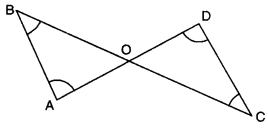
Triangles Class 9 Extra Questions Maths Chapter 7 with Solutions Answers 5
Solution:
Here, ∠B < ∠A
⇒ AO < BO …..(i)
and ∠C < ∠D
⇒ OD < CO …..(ii)
[∴ side opposite to greater angle is longer]
Adding (i) and (ii), we obtain
AO + OD < BO + CO
AD < BC

Question 5.
In the given figure, AC > AB and D is a point on AC such that AB = AD. Show that BC > CD.
Solution:
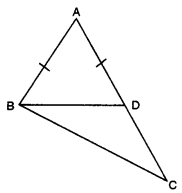
Triangles Class 9 Extra Questions Maths Chapter 7 with Solutions Answers 6
Here, in ∆ABD, AB = AD
∠ABD = ∠ADB
[∠s opp. to equal sides of a ∆]
In ∆BAD
ext. ∠BDC = ∠BAD + ∠ABD
⇒ ∠BDC > ∠ABD ….(ii)
Also, in ∆BDC .
ext. ∠ADB > ∠CBD …(iii)
From (ii) and (iii), we have
∠BDC > CD [∵ sides opp. to greater angle is larger]

Question 6.
In a triangle ABC, D is the mid-point of side AC such that BD = \(\frac{1}{2}\) AC. Show that ∠ABC is a right angle.
Solution:
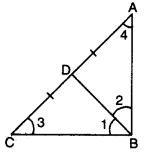
Triangles Class 9 Extra Questions Maths Chapter 7 with Solutions Answers 7
Here, in ∆ABC, D is the mid-point of AC.
⇒ AD = CD = \(\frac{1}{2}\)AC …(i)
Also, BD = \(\frac{1}{2}\)AC… (ii) [given]
From (i) and (ii), we obtain
AD = BD and CD = BD
⇒ ∠2 = ∠4 and ∠1 = ∠3 …..(iii)
In ∆ABC, we have
∠ABC + ∠ACB + ∠CAB = 180°
⇒ ∠1 + ∠2 + ∠3 + ∠4 = 180°
⇒ ∠1 + ∠2 + ∠1 + ∠2 = 180° [using (iii)]
⇒ 2(∠1 + ∠2) = 180°
⇒ ∠1 + ∠2 = 90°
Hence, ∠ABC = 90°

Triangles Class 9 Extra Questions Short Answer Type 2

Question 1.
ABC is an isosceles triangle with AB = AC. P and Q are points on AB and AC respectively such that AP = AQ. Prove that CP = BQ.
Solution:
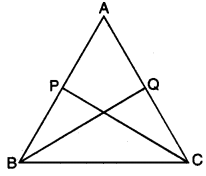
Triangles Class 9 Extra Questions Maths Chapter 7 with Solutions Answers 8
In ∆ABQ and ∆ACP, we have
AB = AC (given)
∠BAQ = ∠CAP [common]
AQ = AP (given)
∴ By SAS congruence criteria, we have
∆ABQ ≅ ∆ACP
CP = BQ

Question 2.
In the given figure, ∆ABC and ∆DBC are two isosceles triangles on the same base BC and vertices A and D are on the same side of BC, AD is extended to intersect BC at P. Show that : (i) ∆ABD ≅ ∆ACD (ii) ∆ABP ≅ ∆ACP
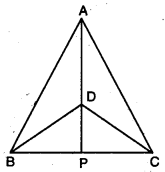
Triangles Class 9 Extra Questions Maths Chapter 7 with Solutions Answers 9
Solution:
(i) In ∆ABD and ∆ACD
AB = AC [given]
BD = CD [given]
AD = AD [common)]
∴ By SSS congruence axiom, we have
∆ABD ≅ ∆ACD
(ii) In ∆ABP and ∆ACP
AB = AC [given]
∠BAP = ∠CAP [c.p.cit. as ∆ABD ≅ ∆ACD]
AP = AP [common]
∴ By SAS congruence axiom, we have
∆ABP ≅ ∆ACP

Question 3.
In the given figure, it is given that AE = AD and BD = CE. Prove that ∆AEB ≅ ∆ADC.
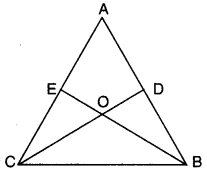
Triangles Class 9 Extra Questions Maths Chapter 7 with Solutions Answers 10
Solution:
We have AE = AD … (i)
and CE = BD … (ii)
On adding (i) and (ii),
we have AE + CE = AD + BD
⇒ AC = AB
Now, in ∆AEB and ∆ADC,
we have AE = AD [given]
AB = AC [proved above]
∠A = ∠A [common]
∴ By SAS congruence axiom, we have
∆AEB = ∆ADC

Question 4.
In the given figure, in ∆ABC, ∠B = 30°, ∠C = 65° and the bisector of ∠A meets BC in X. Arrange AX, BX and CX in ascending order of magnitude.
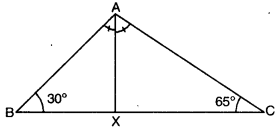
Triangles Class 9 Extra Questions Maths Chapter 7 with Solutions Answers 11
Solution:
Here, AX bisects ∠BAC.
∴ ∠BAX = ∠CAX = x (say)
Now, ∠A + ∠B + C = 180° [angle sum property of a triangle]
⇒ 2x + 30° + 65° = 180°
⇒ 2x + 95 = 180°
⇒ 2x = 180° – 95°
⇒ 2x = 85°
⇒ x = \(\frac{85^{\circ}}{2}\) = 42.59
In ∆ABX, we have x > 30°
BAX > ∠ABX
⇒ BX > AX (side opp. to larger angle is greater)
⇒ AX < BX
Also, in ∆ACX, we have 65° > x
⇒ ∠ACX > ∠CAX
⇒ AX > CX [side opp. to larger angle is greater]
⇒ CX > AX … (ii)
Hence, from (i) and (ii), we have
CX < AX < BX

Question 5.
In figure, ‘S’ is any point on the side QR of APQR. Prove that PQ + QR + RP > 2PS.
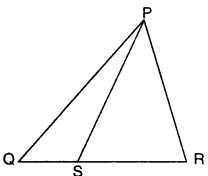
Triangles Class 9 Extra Questions Maths Chapter 7 with Solutions Answers 12
Solution:
In ∆PQS, we have
PQ + QS > PS …(i)
[∵ sum of any two sides of a triangle is greater than the third side]
In ∆PRS, we have
RP + RS > PS …(ii)
Adding (i) and (ii), we have
PQ + (QS + RS) + RP > 2PS
Hence, PQ + QR + RP > 2PS. [∵ QS + RS = QR]

Question 6.
If two isosceles triangles have a common base, prove that the line joining their vertices bisects them at right angles.
Solution:
Here, two triangles ABC and BDC having the common
base BC, such that AB = AC and DB = DC.
Now, in ∆ABD and ∆ACD
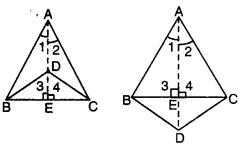
Triangles Class 9 Extra Questions Maths Chapter 7 with Solutions Answers 13
AB = AC [given]
BD = CD [given]
AD = AD [common]
∴ ΔABD ≅ ΔΑCD [by SSS congruence axiom]
⇒ ∠1 = ∠2 [c.p.c.t.]
Again, in ∆ABE and ∆ACE, we have
AB = AC [given]
∠1 = ∠2 [proved above]
AE = AE [common]
∆ABE = ∆ACE [by SAS congruence axiom]
BE = CE [c.p.c.t.]
and ∠3 = ∠4 [c.p.c.t.]
But ∠3 + ∠4 = 180° [a linear pair]
⇒ ∠3 = ∠4 = 90°
Hence, AD bisects BC at right angles.

Triangles Class 9 Extra Questions Long Answer Type

Question 1.
In the given figure, AP and DP are bisectors of two adjacent angles A and D of quadrilateral ABCD. Prove that 2 ∠APD = ∠B + 2C.
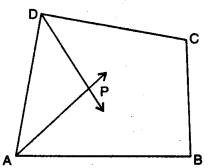
Triangles Class 9 Extra Questions Maths Chapter 7 with Solutions Answers 14
Solution:
Here, AP and DP are angle bisectors of ∠A and ∠D
∴ ∠DAP = \(\frac{1}{2}\)∠DAB and ∠ADP = \(\frac{1}{2}\)∠ADC ……(i)
In ∆APD, ∠APD + ∠DAP + ∠ADP = 180°
⇒ ∠APD + \(\frac{1}{2}\) ∠DAB + \(\frac{1}{2}\)∠ADC = 180°
⇒ ∠APD = 180° – \(\frac{1}{2}\)(∠DAB + ∠ADC)
⇒ 2∠APD = 360° – (∠DAB + ∠ADC) ……(ii)
Also, ∠A + ∠B + C + ∠D = 360°
∠B + 2C = 360° – (∠A + ∠D)
∠B + C = 360° – (∠DAB + ∠ADC) ……(iii)
From (ii) and (iii), we obtain
2∠APD = ∠B + ∠C

Question 2.
In figure, ABCD is a square and EF is parallel to diagonal BD and EM = FM. Prove that
(i) DF = BE (i) AM bisects ∠BAD.
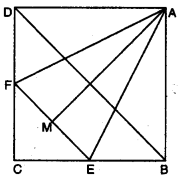
Triangles Class 9 Extra Questions Maths Chapter 7 with Solutions Answers 15
Solution:
(i) EF || BD = ∠1 = ∠2 and ∠3 = ∠4 [corresponding ∠s]
Also, ∠2 = ∠4
⇒ ∠1 = ∠3
⇒ CE = CF (sides opp. to equals ∠s of a ∆]
∴ DF = BE [∵ BC – CE = CD – CF)
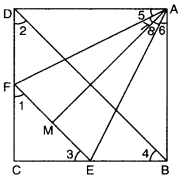
Triangles Class 9 Extra Questions Maths Chapter 7 with Solutions Answers 16
(ii) In ∆ADF and ∆ABE, we have
AD = AB [sides of a square]
DF = BE [proved above]
∠D = ∠B = 90°
⇒ ∆ADF ≅ ∆ABE [by SAS congruence axiom]
⇒ AF = AE and ∠5 = ∠6 … (i) [c.p.c.t.]
In ∆AMF and ∆AME
AF = AE [proved above]
AM = AM [common]
FM = EM (given)
∴ ∆AMF ≅ ∆AME [by SSS congruence axiom]
∴ ∠7 = ∠8 …(ii) [c.p.c.t.]
Adding (i) and (ii), we have
∠5 + ∠7 = ∠6 + ∠8
∠DAM = ∠BAM
∴ AM bisects ∠BAD.

Question 3.
In right triangle ABC, right-angled at C, M is the mid-point of hypotenuse AB. C is joined to M and produced to a point D such that DM = CM. Point D is joined to point B (see fig.). Show that : (i) ∆AMC ≅ ∆BMD (ii) ∠DBC = 90° (ii) ∆DBC ≅ ∆ACB (iv) CM = \(\frac{1}{2}\)AB
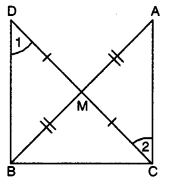
Triangles Class 9 Extra Questions Maths Chapter 7 with Solutions Answers 17
Solution:
Given : ∆ACB in which 4C = 90° and M is the mid-point of AB.
To Prove :
(i) ∆AMC ≅ ∆BMD
(ii) ∠DBC = 90°
(iii) ∆DBC ≅ ∆ACB
(iv) CM = \(\frac{1}{2}\)AB
Proof : Consider ∆AMC and ∆BMD,
we have AM = BM [given]
CM = DM [by construction]
∠AMC = ∠BMD [vertically opposite angles]
∴ ∆AMC ≅ ∆BMD [by SAS congruence axiom]
⇒ AC = DB …(i) [by c.p.c.t.]
and ∠1 = ∠2 [by c.p.c.t.]
But ∠1 and ∠2 are alternate angles.
⇒ BD || CA
Now, BD || CA and BC is transversal.
∴ ∠ACB + ∠CBD = 180°
⇒ 90° + CBD = 180°
⇒ ∠CBD = 90°
In ∆DBC and ∆ACB,
we have CB = BC [common]
DB = AC [using (i)]
∠CBD = ∠BCA
∴ ∆DBC ≅ ∆ACB
⇒ DC = AB
⇒ \(\frac{1}{2}\)AB = \(\frac{1}{2}\)DC
⇒ \(\frac{1}{2}\)AB = CM or CM = \(\frac{1}{2}\)AB (∵ CM = \(\frac{1}{2}\)DC)

Question 4.
In figure, ABC is an isosceles triangle with AB = AC. D is a point in the interior of ∆ABC such that ∠BCD = ∠CBD. Prove that AD bisects ∠BAC of ∆ABC.
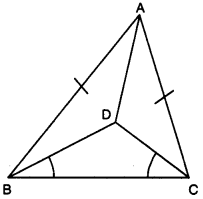
Triangles Class 9 Extra Questions Maths Chapter 7 with Solutions Answers 18
Solution:
In ∆BDC, we have ∠DBC = ∠DCB (given).
⇒ CD = BD (sides opp. to equal ∠s of ∆DBC)
Now, in ∆ABD and ∆ACD,
we have AB = AC [given]
BD = CD [proved above]
AD = AD [common]
∴ By using SSS congruence axiom, we obtain
∆ABD ≅ ∆ACD
⇒ ∠BAD = ∠CAD [c.p.ç.t.]
Hence, AD bisects ∠BAC of ∆ABC.

Question 5.
Prove that two triangles are congruent if any two angles and the included side of one triangle is equal to any two angles and the included side of the other triangle.
Solution:
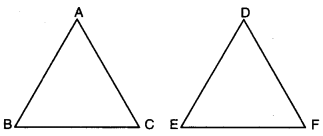
Triangles Class 9 Extra Questions Maths Chapter 7 with Solutions Answers 19
Given : Two As ABC and DEF in which
∠B = ∠E,
∠C = ∠F and BC = EF
To Prove : ∆ABC = ∆DEF
Proof : We have three possibilities
Case I. If AB = DE,
we have AB = DE,
∠B = ∠E and BC = EF.
So, by SAS congruence axiom, we have ∆ABC ≅ ∆DEF
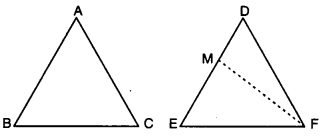
Triangles Class 9 Extra Questions Maths Chapter 7 with Solutions Answers 20
Case II. If AB < ED, then take a point Mon ED
such that EM = AB.
Join MF.
Now, in ∆ABC and ∆MEF,
we have
AB = ME, ∠B = ∠E and BC = EF.
So, by SAS congruence axiom,
we have ΔΑΒC ≅ ΔΜEF
⇒ ∠ACB = ∠MFE
But ∠ACB = ∠DFE
∴ ∠MFE = ∠DFE
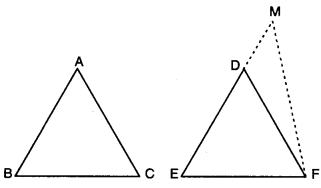
Triangles Class 9 Extra Questions Maths Chapter 7 with Solutions Answers 21
Which is possible only when FM coincides with B FD i.e., M coincides with D.
Thus, AB = DE
∴ In ∆ABC and ∆DEF, we have
AB = DE,
∠B = ∠E and BC = EF
So, by SAS congruence axiom, we have
∆ABC ≅ ∆DEF
Case III. When AB > ED
Take a point M on ED produced
such that EM = AB.
Join MF
Proceeding as in Case II, we can prove that
∆ABC = ∆DEF
Hence, in all cases, we have
∆ABC = ∆DEF.

Question 6.
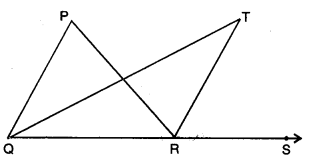
In the given figure, side QR is produced to the point S. If the bisectors of ∠PQR and ∠PRS meet at T,
prove that ∠QTR = \(\frac{1}{2}\) ∠QPR.
Triangles Class 9 Extra Questions Maths Chapter 7 with Solutions Answers 22
Solution:
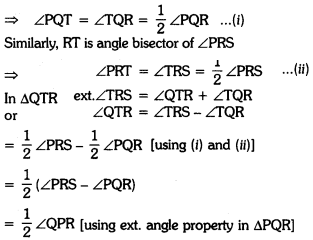
Here, QT is angle bisector of ∠PQR
Triangles Class 9 Extra Questions Maths Chapter 7 with Solutions Answers 23

Triangles Class 9 Extra Questions HOTS

Question 1.
Show that the difference of any two sides of a triangle is less than the third side.
Solution:
Triangles Class 9 Extra Questions Maths Chapter 7 with Solutions Answers 24
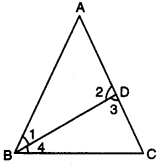
Consider a triangle ABC
To Prove :
(i) AC – AB < BC
(ii) BC – AC < AB
(iii) BC – AB < AC
Construction : Take a point D on AC
such that AD = AB.
Join BD.
Proof : In ∆ABD, we have ∠3 > ∠1 …(i)
[∵ exterior ∠ is greater than each of interior opposite angle in a ∆]
Similarly, in ∆BCD, we have
∠2 > ∠4 …..(ii) [∵ ext. ∠ is greater then interior opp. angle in a ∆]
In ∆ABD, we have
AD = AB [by construction]
∠1 = ∠2 …(iii) [angles opp. to equal sides are equal in a triangle]
From (i), (ii) and (iii), we have
⇒ ∠3 > ∠4 =
⇒ BC > CD
⇒ CD < BC
AC – AD < BC
AC – AB < BC [∵ AD = AB]
Hence, AC – AB < BC
Similarly, we can prove
BC – AC < AB
and BC – AB < AC

Question 2.
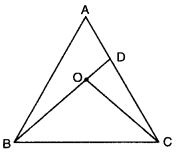
In the figure, O is the interior point of ∆ABC. BO meets AC at D. Show that OB + OC < AB + AC.
Triangles Class 9 Extra Questions Maths Chapter 7 with Solutions Answers 25
Solution:
In ∆ABD, AB + AD > BD …(i)
∵ The sum of any two sides of a triangle is greater than the third side. Also, we have
BD = BO + OD
AB + AD > BO + OD ….(ii)
Similarly, in ∆COD, we have
OD + DC > OC … (iii)
On adding (ii) and (iii), we have
AB + AD + OD + DC > BO + OD + OC
⇒ AB + AD + DC > BO + OC
⇒ AB + AC > OB + OC
or OB + OC < AB + AC
Hence, proved.

Triangles Class 9 Extra Questions Value Based (VBQs)

Question 1.
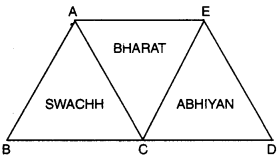
A campaign is started by volunteers of mathematical club to boost school and its surrounding under Swachh Bharat Abhiyan. They made their own logo for this campaign. What values are acquired by mathematical club ?
If it is given that ∆ABC ≅ ∆ECD, BC = AE.
Prove that ∆ABC ≅ ∆CEA.
Triangles Class 9 Extra Questions Maths Chapter 7 with Solutions Answers 26
Solution:
Here, it is given that
∆ABC ≅ ∆ECD
AB = CE [c.p.c.t.]
BC = CD [c.p.c.t.]
AC = ED [c.p.c.t.]
Now, in ∆ABC and ∆CEA
BC = AE [given]
AB = EC [proved above]
AC = AC [common]
∴ By using SSS congruence axiom, we have
∆ABC ≅ ∆CEA
Value : Cleanliness and social concerning.

Question 2.
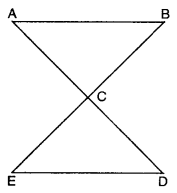
Rajiv, a good student and actively involved in applying knowledge A of mathematics in daily life. He asked his classmate Rahul to make triangle as shown by choosing one of the vertex as common. Rahul tried but not correctly. After sometime Rajiv hinted Rahul about congruency of triangle. Now, Rahul fixed vertex C as common vertex and locate point D, E such that AC = CD and BC = CE. Was the triangle made by Rahul is congruent ? Write the condition satisfying congruence.
What value is depicted by Rajiv’s action?
Triangles Class 9 Extra Questions Maths Chapter 7 with Solutions Answers 27
Solution:
In ∆ABC and ∆DEC, we have
AC = DC [by construction]
BC = EC [by construction]
∠ACB = ∠ECD [vert. opp. ∠s]
By using SAS congruence axiom, we have
∆ABC ≅ ∆DEC
Value : Cooperative learning, use of concept and friendly nature.
Punctuation Worksheet Exercises for Class 3 CBSE With Answers

Punctuation Exercises for Class 3 CBSE With Answers

This grammar section explains English Grammar in a clear and simple way. There are example sentences to show how the language is used.

Punctuation Worksheet Exercises for Class 3 CBSE With Answers PDF

  • Punctuation marks are signs such as periods, commas and question marks.
  • We always use capital letters after periods and question marks.
    Period (•)Commas( ‘ )Question Mark ( ? )
    You put a period at the end of a sentence. It is also known as Full Stop.Commas are used to show a brief pause.Use a question mark at the end of a question.
    I can swim.Good Morning, SirHow are you?

Punctuation Worksheet Exercises for Grade 3 with Answers PDF

A. Put the correct punctuation marks and rewrite the sentences.

1. What time is it
_______________________

2. Good Morning Did you sleep well
_______________________

3. It is a lovely day
_______________________

4. we went to paris for a holiday
_______________________

5. Is he coming today
_______________________

6. do you know how to speak English
_______________________

B. Unscramble the words to form a question and a statement. The first one has been done for you.

1. my is favourite basketball sport
Question: Is basketball my favourite sport?
Statement: Basketball is my favourite sport.

2. holiday Christmas favourite is my.
Question: _______________________
Statement: _______________________

3. those are ready cookies eat to
Question: _______________________
Statement: _______________________

4. the in yard there rabbit a is
Question: _______________________
Statement: _______________________

5. is very stove the hot
Question: _______________________
Statement: _______________________

Uses of Commas and Capital Letters Worksheet Exercises for Class 3 CBSE With Answers

Fundamentals
Uses of Commas

  • • We put commas between items in a list.
    You need paper, scissors and glue.
    She likes reading, swimming, playing basketball and going to the movies.
  • We put commas after yes and no.
    Do you like football?
    Yes, I like it very much.
  • We put commas before or after the name of the person we are speaking to.
    Hello, Mr. Carter.
    Miss Lee, Can I borrow a pencil?
  • We put commas before please and thank you.
    Could you pass me that pencil, please?
    I’ve had enough to eat, thank you.
  • We put commas between the parts of a place name.
    Chicago, Tower Bridge, London, Athens, Georgia, Washington DC

Uses of Capital Letters

  • Use a capital letter to begin the names of people and places.
    Dr. Raj, Uncle David, Mexico City, the Great Wall of China
  • Use capital letters for initials in someone’s name.
    T. K. Lee, J. K. Rowling
  • Nationalities and languages also begin with a capital letter.
    India, Hindu, English
  • Use a capital letter for the first letter in words and phrases that you use for saying Hello and Goodbye.

Presentation
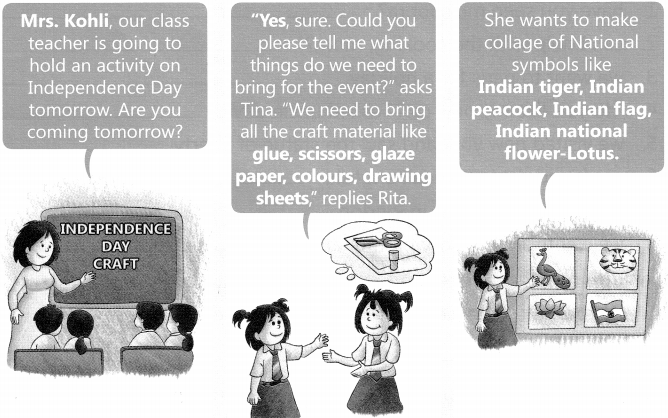
Read the picture story.
Punctuation Exercises for Class 3 CBSE With Answers

A. Answer the following questions from the story above.

1. Name the class teacher.
2. Name the essential items for collage making.
3. Name the national symbols.

B. Fill in the blanks to make your own lists. Use commas wherever necessary.

1. I will buy ____________ ____________ ____________ ____________ ____________ and ____________ for the craft activity.
2. ____________ ____________ ____________ are my best friends.
3. My favourite games are ____________ ____________
4. My family members include ____________ ____________
5. The subjects that I have to study in grade 3 are ____________

Commas and Capital Letters Worksheet Exercises for Class 3 CBSE With Answers CBSE PDF

A. Put capital letters in the correct places as you rewrite these sentences.

1. have you seen mr. chopra? ______________________
2. can I help with the cooking, mom? ______________________
3. we went to paris for a holiday. ______________________
4. “do you like my new car?” asked uncle david. ______________________
5. we visited new york and saw the statue of liberty. ______________________
6. my friend doesn’t speak english. ______________________
7. they spent christmas in london. ______________________
8. we went to the library on thursday. ______________________

B. Rewrite these sentences and put commas wherever necessary.

1. We bought tomatoes cauliflower onions and spinach.
__________________________________________________________________

2. Teachers parents students and the school authorities must maintain
__________________________________________________________________
a good relationship.
__________________________________________________________________

3. No that is not the way you do it Ganesh.
__________________________________________________________________

4. Sir may I use a pencil?
__________________________________________________________________

5. Well I think it is a beautiful day.
__________________________________________________________________

6. The room was small dark dirty and stinky.
__________________________________________________________________

Electric Current and Its Effects Class 7 Extra Questions and Answers Science Chapter 14

In this page, we are providing Electric Current and Its Effects Class 7 Extra Questions and Answers Science Chapter 14 pdf download. NCERT Extra Questions for Class 7 Science Chapter 14 Electric Current and Its Effects with Answers will help to score more marks in your CBSE Board Exams.

Class 7 Science Chapter 14 Extra Questions and Answers Electric Current and Its Effects

Extra Questions for Class 7 Science Chapter 14 Electric Current and Its Effects with Answers Solutions

Electric Current and Its Effects Class 7 Extra Questions Very Short Answer Type

Question 1.
What is a battery?
Answer:
When two or more cells are joined together, it is called a battery.

Question 2.
Name the effects of electric current.
Answer:

  • Heating effect
  • Magnetic effect
  • Chemical effect

Question 3.
What is a circuit diagram?
Answer:
It is a symbolic representation of an electric circuit.

Question 4.
Which property of a conducting wire is utilised in making electric fuse?
Answer:
Low melting point of the wire.

Question 5.
What happens if the filament of the bulb is broken?
Answer:
The circuit would be incomplete and the bulb does not glow even if the switch is in the ‘ON’ position.

Question 6.
What is the use of a cell holder?
Answer:
A cell holder is used to make battery of two or more cells.

Question 7.
How are the cells placed in the cell holder?
Answer:
The cells are placed in the cell holder such that the positive terminal of one cell is connected to the negative terminal of the next cell.

Question 8.
Give two examples of the heating effect of current.
Answer:
(i) Electric kettle
(ii) Hair dryers

Question 9.
Why should we buy electric appliances with the ISI mark?
Answer:
The ISI mark ensures that the appliance is safe and wastage of energy is minimum. So we should buy only electric appliances with the ISI mark.

Question 10.
Name the device used to protect damages to the circuit due to excessive flow of current.
Answer:
Electrical fuse or MCB.

Question 11.
What happens if by accident the current exceeds the safe limit?
Answer:
The wires may become overheated and may cause fire.

Question 12.
What is a fuse?
Answer:
A fuse is a safety device which prevents damages to electrical circuits and possible fires.

Question 13.
Who was the first person to notice the deflection of compass needle every time the current was passed through the wire?
Answer:
Hans Christian Oersted.

Question 14.
What do the doctors use to take out small pieces of magnetic material accidently fallen in the eye?
Answer:
Doctors use tiny electromagnets for this purpose.

Question 15.
Give one reason for short circuit.
Answer:
Direct touching of wires with each other.

Question 16.
Why is an electric fuse required in all electrical appliances?
Answer:
It is required to check excessive flow of electric current and save electrical appliances from further damage.

Question 17.
Why is it advisable not to touch a lighted electric bulb connected to the mains.
Answer:
Lighted electric bulb connected to the mains may be very hot and can burn our hand badly.

Electric Current and Its Effects Class 7 Extra Questions Short Answer Type

Question 1.
Define a battery. Explain the arrangement of cells in a battery.
Answer:
A battery is a combination of two or more cells in which cells are placed such that the positive terminal of one cell is connected to the negative terminal of the next cell. Many devices like torches, transistors, toys, TV remote controls, etc., use batteries. The cells are sometimes placed one after the other and sometimes side by side.

Question 2.
When does the current flow throughout the circuit? Explain.
Answer:
When the switch is in the ‘ON’ position, and the positive terminal of the battery is connected to the negative terminal of the battery through wires then the circuit is said to be closed and the electric current flows throughout the circuit.

Question 3.
How many types of circuit are there? Describe.
Answer:
There are two types of circuit

  1. closed circuit and
  2. open circuit.

(i) Closed-circuit: When the switch is in the ‘ON’ position and the circuit from the positive terminal of the battery to the negative terminal is complete then the circuit is said to be closed and the current flows throughout the circuit. Also the bulb glows in the closed circuit.
(ii) Open circuit: When the switch is in the ‘OFF’ position or the filament of the bulb is broken, the circuit is incomplete and it is said to be an open circuit. No current flows through any part of the circuit.

Question 4.
Why are wires of different materials and different lengths and thicknesses used?
Answer:
The amount of heat produced in a wire depends on its material, length and thickness. Thus for different requirements, the wires of different lengths and thickness and materials are used.

Question 5.
What type of wire is used for making electric fuses?
Answer:
Wires made of some special materials that melt quickly and break when large electric currents are passed through them are used for making electric fuses. For example, alloy of lead and tin.

Question 6.
What is an electromagnet?
Answer:
A coil that behaves like a magnet when electric current is passed through it and loses its magnetism when the supply of electricity is broken is called an electromagnet. It is a temporary magnet made by coiling wire around an iron core; when current flows in the coil the iron behaves as a magnet. Electromagnets can be made very strong and can lift heavy loads.

Electric Current and Its Effects Class 7 Extra Questions Long Answer Type

Question 1.
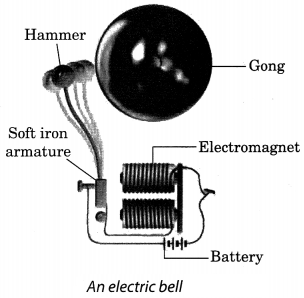
Explain the working of an electric bell with diagram.
Answer:
It consists of a coil of wire wound on an iron piece. The coil acts as an electromagnet. An iron strip with a hammer at one end is kept close to the electromagnet. There is a contact screw near the iron strip.

When the iron strip is in contact with the screw, the current flows through the coil which becomes an electromagnet. It, then, pulls the iron strip. In the process, the hammer at the end of the strip strikes the gong of the bell to produce a sound. However, when the electromagnet pulls the iron strip, it also breaks the circuit.

The current through the coil stops flowing and the coil is no longer behaves as an electromagnet. It no longer attracts the iron strip. The iron strip comes back to its original position and touches the contact screw again.

This completes the circuit. The current flows in the coil and the hammer strikes the gong again. This process is repeated in quick succession. The hammer strikes the gong every time the circuit is completed. This is how the bell rings.

Electric Current and Its Effects Class 7 Extra Questions and Answers Science Chapter 14 1

Question 2.
When does an electric short circuit occur? What harm can it do?
Answer:
When the plastic covering of both live wire and neutral wire removes due to wear and tear, these two wires come in contact with each other. Since, the resistance of neutral wire is very low, excessive current flow through the wire in a short time which heats the wire to a great extent. This can result in fires. Another reason of short circuiting is connection of many devices to a single socket. This can also lead to excessive flow of current.

Question 3.
What do you mean by overloading of an electric circuit? State two measures to avoid overloading.
Answer:
The current flowing in domestic wiring at a particular time depends on the power ratings of the appliances which are being used. When a number of appliances are switched on at the same time, they take out an extremely large amount of current. This is called ‘overloading the circuit’. Now due to an extremely large amount of current flowing through them, the copper wires of household get heated to a very high degree and a fire may be started.

Two measures to avoid overloading are following:

  • Too many appliances should not be connected to a single socket.
  • Many electrical appliances of high power rating should not be run at the same time.

Question 4.
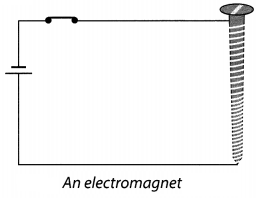
Explain construction of a simple electromagnet with a labelled diagram.
Answer:
An electromagnet act on the principle of magnetic effect of the current. The coil of wire wound around an iron bar behaves like a magnet when electric current flows through it. When electric current is switched off, the coil generally loses its magnetism.

To construct an electromagnet, take a big iron nail or a big iron screw. Take a long piece of insulated copper wire and wind quite a few turns around the nail. Connect the ends of the wire to the terminals of a battery through a switch as shown in Fig. 14.19.

Place some pins on or near the end of the nail. Now switch on the current. You will observe that pins cling to the nail. Now switch off the current. You will observe that pins no longer get attracted to the nail.

Electric Current and Its Effects Class 7 Extra Questions and Answers Science Chapter 14 2

Electric Current and Its Effects Class 7 Extra Questions HOTS

Question 1.
Why do birds do not get shock when they sit on high power live wire but we do?
Answer:
As bird sit on only one wire, the circuit remains incomplete so they do not get shock.

Question 2.
Why are compact fluorescent lamps (CFLs) preferred over electric bulbs?
Answer:
CFLs do not waste electricity as heat and thus consumes less energy whereas electric bulb along with light also give out heat.

Question 3.
Why are MCB preferred over electric fuses?
Answer:
Due to following reasons MCB are preferred over electric fuses:

  1. MCB is more sensitive to overcurrent than fuse.
  2. Restoration of electric supply is quick. Restoration can be done by just switching the operating knob to its ‘ON’ position
  3. Handling MCB is electrically more safe than fuse.

Question 4.
Can we use same fuse in a geyser and a television set or any other electrical appliances? Explain.
Answer:
No, different electrical appliances need different amount of current. A geyser generally takes more voltage of current in comparison to a television. Therefore the fuse in these will be of different ratings.

Question 5.
Why we must cover plug pin holes which are within the reach of children with cellotape or a plastic cover when not in use?
Answer:
Children are usually not aware of electrocution and they can put their fingers or other conducting material into the plug pin holes. To protect them from electric shock we must cover plug pin holes with cellotape or plastic cover.

Electric Current and Its Effects Class 7 Extra Questions Value Based (VBQs)

Question 1.
Rama saw her mother running microwave oven, electric cooker and mixer grinder from a single socket. She immediately rushed to her mother and reminded her of overloading and its consequences. Rama’s mother immediately turned off the switch and connected them one by one according to her need. She felt very happy for Rama for her presence of mind.
(a) What is overloading?
(b) What are the consequences of overloading?
(c) What role do MCB plays in case of overloading?
(d) What value of Rama is shown here?

Answer:
(a) When excessive amount of electric current passes through the wire, excessive heating take place, this is called overloading.
(b) Overloading can damage the circuit of house. It can also lead to fire.
(c) When there is overloading of current, MCB trips and switches off, which in turn cut off the supply of electricity and thus protect us from damages due to overloading of current.
(d) Rama is an intelligent, quick decision maker and helpful girl.

Question 2.
Class VII students thought to organise an campaign on ‘conserve energy’ in which they will include how to conserve electricity and what precautions one must take while handling electricity.
(a) Imagine that you are also participating in this campaign. What will you do to make it more effective and interesting?
(b) What precautions one must observe while working with the electricity.
(c) How can you conserve electricity?
(d) Do you think you also need to run an awareness campaign on certain problem or crisis related to your area. Why?

Answer:
(a) We can make it more effective and interesting by organising play and some cultural programmes.
(b) Following precautions must be observed while working with the electricity:

  1. Do not touch switches with wet hand.
  2. All appliances must be properly earthed.
  3. Wear rubber shoes and gloves before coming in contact with electrical wire during repair or replacement.
  4. Do not conduct experiment with main supply.

(c) Use CFL bulb or tubelights.

  1. Switch off lights, fans, TV, etc., when not needed.
  2. Always run AC in auto mode
  3. Install efficient electrical appliances which consume less current.

(d) Do it yourself.

Motion and Time Class 7 Extra Questions and Answers Science Chapter 13

In this page, we are providing Motion and Time Class 7 Extra Questions and Answers Science Chapter 13 pdf download. NCERT Extra Questions for Class 7 Science Chapter 13 Motion and Time with Answers will help to score more marks in your CBSE Board Exams.

Class 7 Science Chapter 13 Extra Questions and Answers Motion and Time

Extra Questions for Class 7 Science Chapter 13 Motion and Time with Answers Solutions

Motion and Time Class 7 Extra Questions Very Short Answer Type

Question 1.
What is the use of speedometer?
Answer:
Speedometer is a device which is used in vehicles to measure the distance covered by the vehicle.

Question 2.
What is uniform motion?
Answer:
Uniform motion is that type of motion in which body travels equal distances in equal intervals of time.

Question 3.
What is speed?
Answer:
The speed of an object is defined as the distance travelled by the object in unit time.

Question 4.
State the formula of average speed of an object.
Answer:
Average speed = \(\frac{\text { Total distance travelled }}{\text { Total time taken }}\)

Question 5.
Which unit of speed will you use to express the speed of an aeroplane?
Answer:
km/s

Question 6.
Which kind of motion is described by a freely falling body?
Answer:
Linear motion.

Question 7.
What is the name of the device which measures the speed of a moving vehicle?
Answer:
Odometer

Question 8.
If A covers a certain distance in 30 minutes and B covers the same distance in 45 minutes, then who is travelling in higher speed?
Answer:
A is taking less time to cover the same distance, so it is travelling in higher speed.

Question 9.
What is the relation between distance and speed?
Answer:
Distance = Speed × Time

Question 10.
On what the time period of a simple pendulum depends?
Answer:
The time period of a simple pendulum depends upon its length.

Motion and Time Class 7 Extra Questions Short Answer Type

Question 1.
Describe how we calculate time period of a simple pendulum.
Answer:
The time period of a simple pendulum is the time taken by it to travel from A to B and back to A. When the bob moves from one extreme position A to the other extreme position B and comes back to A, it completes one oscillation.
Motion and Time Class 7 Extra Questions and Answers Science Chapter 13 10
Question 2.
What is motion? Describe briefly.
Answer:
An object that is moving with respect to time and another body is said to be in motion. Motion is measured as the distance covered by an object in a specific interval of time.

Question 3.
Differentiate between slow and fast objects.
Answer:
An object which takes longer time to cover a certain distance is called slow whereas another object which takes a shorter time to cover the same distance is called fast.

Question 4.
Anshika takes 15 minutes from her house to reach her school on bicycle the distance between her house and the school.
Answer:
Time taken = 15 min.
Speed = 2 m/s
Distance = Speed × time
= 15 × 60 × 2 = 1800 m
Thus, the distance between Anshika’s house and her school is 1800 m.

Question 5.
Draw the distance-time graph to show a car moving with a constant speed.
Answer:
Motion and Time Class 7 Extra Questions and Answers Science Chapter 13 1

Question 6.
What are the factors on which time period of a pendulum depends?
Answer:
Following are the factors on which time period of a pendulum depends:

  • Length of the string of the pendulum.
  • Acceleration due to gravity.

Question 7.
State one factor which is common in all the clocks.
Answer:
All the clocks show periodic motion.

Motion and Time Class 7 Extra Questions Long Answer Type

Question 1.
State the difference between uniform motion and non-uniform motion.
Answer:

Non-uniform motionUniform motion
(i) If the speed of an object moving along a straight line keeps changing, then this type of motion is called non-uniform motion.(i) If the speed of an object moving along a straight line remains constant, then this type of motion is said to be uniform motion.
(ii) In this case, average speed is generally different from the actual speed.(ii) In this case, the average speed is same as the actual speed.
(iii) The distance-time graph for non-uniform motion is a curved line.(iii) The distance-time graph for uniform motion is a straight line.

Question 2.
Represent the following graphically:
(a) An object at rest
(b) An object moving with uniform speed
(c) An object moving with non-uniform speed
Answer:
Motion and Time Class 7 Extra Questions and Answers Science Chapter 13 9

Question 3.
The odometer of a car reads 24830 km at 1:25 PM, 24865 km at 2:05 PM and 25005 km at 3:15 PM. Calculate the speed of the car in km/h and m/s from 1:25 PM to 3:15 PM.
Answer:
D<sub>1</sub> = 24865 – 24830 = 35 km t<sub>1</sub> = 2:05 – 1:25 = 40 min
D<sub>2</sub> = 25005 – 24865 = 140 km t<sub>2</sub> = 3:15 – 2:05 = 50 min
Motion and Time Class 7 Extra Questions and Answers Science Chapter 13 2
Hence, speed of car is 116.7 km/h and 32.407 m/s.

Question 4.
Motion of A, B, C and D is plotted on a distance-time graph below. Study the graph and answer the following questions:
Motion and Time Class 7 Extra Questions and Answers Science Chapter 13 3
(a) Who is travelling fastest?
(b) Who is at rest?
(c) Who is moving in uniform motion?
(d) Who is accelerating with time?
(e) Who is moving slowest?
Answer:
(a) A
(b) C
(c) A
(d) B
(e) D

Question 5.
A scooter during its journey covers certain distances at different time intervals. Plot a graph by considering the following data and selecting a suitable scale. State whether the motion is uniform or nonuniform motion.

Distance (km)153045607590105
Time (min.)306090120150180210

Answer:
Motion and Time Class 7 Extra Questions and Answers Science Chapter 13 4
The distance-time graph is a straight line so the motion of the scooter is uniform motion.

Motion and Time Class 7  Extra Questions HOTS

Question 1.
Complete the data of the table given below with the help of the distance-time graph.

Distance (m)2?6?10?14
Time (s)?2?4?6?

Answer:
Motion and Time Class 7 Extra Questions and Answers Science Chapter 13 5
Hence, the data is

Distance (m)2468101214
Time (s)1234567

Question 2.
Starting from A, Somnath moves along a rectangular path ABCD as shown in Fig. 13.14. He takes 3 minutes to travel each side. Plot a distance-time graph and explain whether the motion is uniform or non-uniform. Find average speed of Somnath to move along the rectangular path.
Answer:
Motion and Time Class 7 Extra Questions and Answers Science Chapter 13 6
Motion and Time Class 7 Extra Questions and Answers Science Chapter 13 7
Motion and Time Class 7 Extra Questions and Answers Science Chapter 13 8
Since the distance covered per unit time for the entire distance is not the same, the motion is non-uniform motion.

Question 3.
The average age of students of class VII B is 12 years 4 months. Express the age in seconds.
Answer:
12 years 4 months = 12 × 365 + 4 × 30 = 4500 days
4500 days = 4500 × 24 × 60 × 60 = 388800000 s

Question 4.
Sitting in a classroom each student appears stationary to each other, whereas actually they are in motion. Explain.
Answer:
This is because of the earth in which we live is always in a state of motion around the sun and also along its axis.

Motion and Time Class 7 Extra Questions Value Based (VBQs)

Question 1.
Ritesh was riding a bicycle on the road, he said that the wheels of the bicycle are moving along a straight line. But his friend. Saket, who was also riding a bicycle said that the wheels of the bicycle are moving circular. They then decided rather than fighting among themselves it is better to ask their science teacher.
(a) Write some types of motion.
(b) What is rectilinear motion.
(c) What is rotatory or circular motion.
(d) Who among, Ritesh and Saket, is correct? Explain.
(e) What value of Ritesh and Saket is shown here?

Answer:
(a) Rectilinear motion, oscillatory motion, rotatory motion, random motion, etc.
(b) When the motion of a body is along a straight line, it is known as rectilinear motion.
(c) When a body moves about a fixed axis without changing its position, the body is said to have a rotatory motion.
(d) Ritesh and Saket, both are correct because wheels of the bicycle is showing both types of motion, i. e., rectilinear motion along the road as well as rotational or circular motion along a fixed axis.
(e) Ritesh and Saket both are intelligent and mature enough to not quarrel and inquisitive

Forming Questions Worksheet Exercises for Class 3 CBSE with Answers

Forming Questions Exercises for Class 3 CBSE with Answers

This grammar section explains English Grammar in a clear and simple way. There are example sentences to show how the language is used.

Forming Questions Worksheet Exercises for Class 3 CBSE with Answers PDF

  • Sometimes we form a question, by placing the verb at the beginning of the sentence. For example:-
    A. Foxes are clever animals.
    Are foxes clever animals?B. Saru is a member of the swimming club.
    Is Saru a member of the swimming club?

Presentation
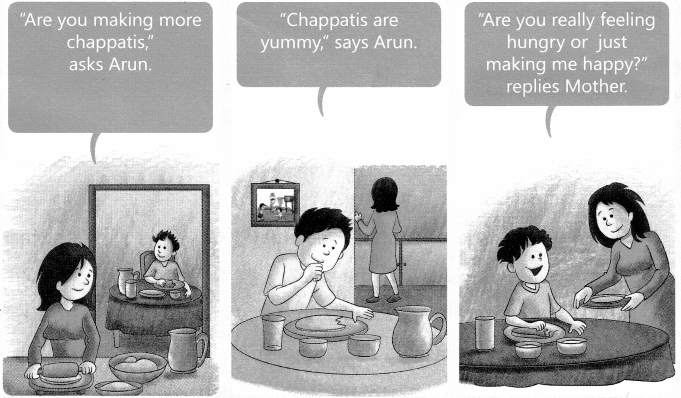
Read the picture story.
Forming Questions Exercises for Class 3 CBSE with Answers

A. Answer the following questions.

1. What did Arun ask his mother? _____________________
2. What did mother reply? _____________________
3. Give another word for ‘yummy’. _____________________

B. Write a question for each answer below. Remember to put (?) at the end of the sentence.

1. ______________________
Sarah is a good girl.

2. ______________________
I am a working lady.

3. ______________________
We are coming today.

4. ______________________
It was a great sight.

5. ______________________
Kitty is a greedy cat.

Forming Questions Worksheet Exercises for Class 3 with Answers CBSE PDF

A. Fill in the correct form (Is/Are/Was/ Were) of the verb.

1. ___________ you ___________ at a hotel in London last month? (to stay)
2. ___________ he ___________ to the CD? (to listen)
3. ___________ you ___________ shoes yesterday? (to wear)
4. ___________ Ben ___________ in the race? (to run)
5. ___________ your brother ___________ in the tent last night? (to sleep)
6. ___________ the students ___________ English? (to learn)
7. ___________ the children ___________ in the garden yesterday? (to play)
8. ___________ Jake ___________ a pizza? (to eat)
9. ___________ You ___________ to Mona? (to talk)
10. ___________ we ___________ a cake? (to bake)

B. Rearrange each group of words below to form a question.

1. today/is/dad/ill/? _________________
2. Tom/is /older/you/than/? _________________
3. Monu/was/bike/riding/a/? _________________
4. Am/I /fast/driving/? _________________
5. the/exam/going/I/am/to/pass? _________________