Forests: Our Lifeline Class 7 Notes Science Chapter 17

On this page, you will find Forests: Our Lifeline Class 7 Notes Science Chapter 17 Pdf free download. CBSE NCERT Class 7 Science Notes Chapter 17 Forests: Our Lifeline will seemingly help them to revise the important concepts in less time.

CBSE Class 7 Science Chapter 17 Notes Forests: Our Lifeline

Forests: Our Lifeline Class 7 Notes Understanding the Lesson

1. A large area of land covered mainly with trees and other plants is called a forest.

2. Forest is a system comprising various plants, animals and microorganisms.

3. The type of animals and kind of trees differ from forest to forest.

4. Forests are the habitat of a large number of different kinds of animals, birds, reptiles, etc.

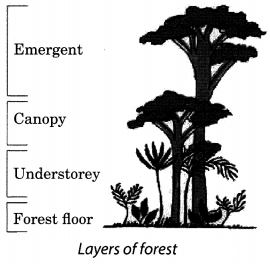
5. There are four layers of forest named as emergent layer, canopy, understorey and forest floor.

6. In a forest, trees form the uppermost layer, followed by shrubs. The herbs form the lowest layer of vegetation.

7. Based on the life span of plants and trees, they are classified as annuals, biennials and perennials. The organisms which make their own food from carbon dioxide and water in the presence of sunlight and chlorophyll are called producers.

8. The organisms which consume the food made by the producers are called consumers.

9. The organisms which derive their food items from the dead and decaying animals or plants are called decomposers.

10. Plants and animals in a forest depend on each other for many things.

11. In the forest, there is interaction between soil, water, air and living organisms.

Forests Our Lifeline Class 7 Notes Science Chapter 17

12. All plants and animals are linked together by the process of eating and being eaten. This is called a food chain. Many food chains are interlinked to form a food web.

13. Importance of forests are:

  • It help in replenishing groundwater.
  • It regulate climate, and help rainfall.
  • It purify the air and control air pollution.
  • It control floods.

14. Forests are also called green lungs because plants release oxygen during photosynthesis which helps in keeping the balance of carbon dioxide and oxygen in the atmosphere.

15. The forest harbours variety of plants, thus providing greater opportunities for food and habitat for the herbivores which in result increases the availability of food for carnivorous animals. That is why, forest is a dynamic living entity.

16. The cutting down of forest trees for personal as well as for commercial purpose is called

17. Deforestation can lead to soil erosion, water pollution, disruption in water cycle, drought, global warming, etc.

18. We must preserve our forest.

Class 7 Science Chapter 17 Notes Important Terms

Canopy: The branches of tall trees of the forest form overhanging covering like a roof over the other plants in a forest. This is called canopy.

Crown: The branchy part of the tree above the stem is known as the crown.

Decomposers: The organisms which derive their food from the dead and decaying animals or plants are called decomposers.

Deforestation: The cutting down of forest for personal or commercial purposes is called deforestation.

Humus: Microorganisms feed upon the dead plants and animal tissues and convert them into a dark coloured substance called humus.

Regeneration: Regeneration is the process of renewal, restoration and growth of new organisms or the existing organisms in an area.

Seed dispersal: The transportation of seeds from the place of their origin to faraway places through vari­ous agents is called seed dispersal.

Soil erosion: The phenomenon of washing away of the top fertile layer of soil by water, or wind is called soil erosion.

Understorey: Understorey is an underlying layer of vegetation, specifically, the vegetative layer an especially the trees and shrubs between the forest canopy and the ground cover.

Areas of Parallelograms and Triangles Class 9 Extra Questions Maths Chapter 9 with Solutions Answers

Here we are providing Areas of Parallelograms and Triangles Class 9 Extra Questions Maths Chapter 9 with Answers Solutions, Extra Questions for Class 9 Maths was designed by subject expert teachers.

Extra Questions for Class 9 Maths Areas of Parallelograms and Triangles with Answers Solutions

Extra Questions for Class 9 Maths Chapter 9 Areas of Parallelograms and Triangles with Solutions Answers

Areas of Parallelograms and Triangles Class 9 Extra Questions Very Short Answer Type

Question 1.
Two parallelograms are on equal bases and between the same parallels. Find the ratio of their areas.
Solution:
1:1 [∵ Two parallelograms on the equal bases and between the same parallels are equal in
area.]

Question 2.
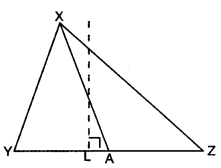
In ∆XYZ, XA is a median on side YZ. Find ratio of ar(∆XYA) : ar(∆XZA).
Areas of Parallelograms and Triangles Class 9 Extra Questions Maths Chapter 9 with Solutions Answers 1
Solution:
Here, XA is the median on side YZ.
∴ YA = AZ
Draw XL ⊥ YZ
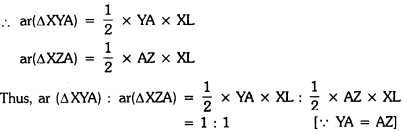
Areas of Parallelograms and Triangles Class 9 Extra Questions Maths Chapter 9 with Solutions Answers 2

Question 3.
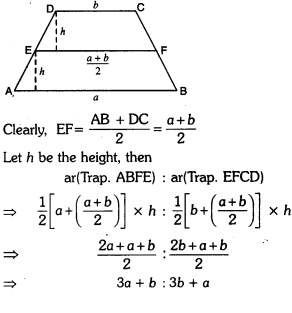
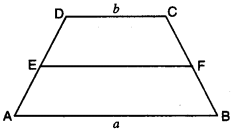
ABCD is a trapezium with parallel sides AB = a cm and DC = b cm (fig.). E and F are the mid-points of the non parallel sides. Find the ratio of ar(ABFE) and ar(EFCD).
Areas of Parallelograms and Triangles Class 9 Extra Questions Maths Chapter 9 with Solutions Answers 3
Solution:
Areas of Parallelograms and Triangles Class 9 Extra Questions Maths Chapter 9 with Solutions Answers 4

Question 4.
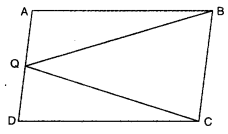
ABCD is a parallelogram and Q is any point on side AD. If ar(∆QBC) = 10 cm2, find ar(∆QAB) + ar(∆QDC).
Areas of Parallelograms and Triangles Class 9 Extra Questions Maths Chapter 9 with Solutions Answers 5
Solution:
Here, ∆QBC and parallelogram ABCD are on the same base BC and lie between the same parallels BC || AD.
∴ ar(||gm ABCD) = 2 ar(∆QBC) ar(∆QAB) + ar(∆QDC) + ar(∆QBC) = 2 ar(∆QBC)
ar(∆QAB) + ar(∆QDC) = ar(∆QBC)
Hence, ar(∆QAB) + ar(∆QDC) = 10 cm2 [∵ ar(∆QBC) = 10 cm2 (given)]

Question 5.
WXYZ is a parallelogram with XP ⊥ WZ and ZQ ⊥ WX. If WX = 8 cm, XP = 8 cm and ZQ = 2 cm, find YX.
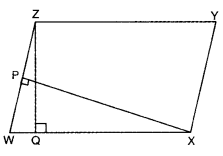
Areas of Parallelograms and Triangles Class 9 Extra Questions Maths Chapter 9 with Solutions Answers 6
Solution:
ar(||gm WXYZ) = ar(||gm WXYZ)
WX × ZQ = WZ × XP
8 × 2 = WZ × 8
⇒ WZ = 2 cm
Now, YX = WZ = 2 cm [∵ opposite sides of parallelogram are equal]

Question 6.
In figure, TR ⊥ PS, PQ || TR and PS || QR. If QR = 8 cm, PQ = 3 cm and SP = 12 cm, find ar(quad. PQRS).
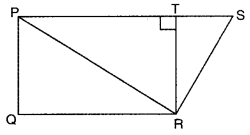
Areas of Parallelograms and Triangles Class 9 Extra Questions Maths Chapter 9 with Solutions Answers 7
Solution:
Here,
PS || QR [given]
∴ PQRS is a trapezium
Now, TR ⊥ PS and PQ || TR [given]
⇒ PQ ⊥ PS
∴ PQ = TR = 3 cm [given]
Now, ar(quad. PQRS) = \(\frac{1}{2}\) (PS + QR) × PQ = \(\frac{1}{2}\)(12 + 8) × 3 = 30 cm2

Question 7.
In the given figure, ABCD is a parallelogram and L is the mid-point of DC. If ar(quad. ABCL) is 72 cm, then find ar(∆ADC).
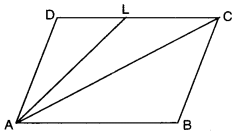
Areas of Parallelograms and Triangles Class 9 Extra Questions Maths Chapter 9 with Solutions Answers 8
Solution:
In ||gm ABCD, AC is the diagonal
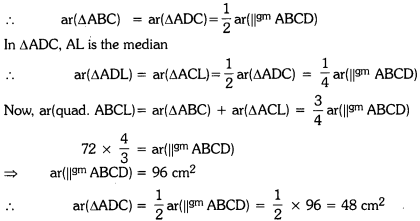
Areas of Parallelograms and Triangles Class 9 Extra Questions Maths Chapter 9 with Solutions Answers 9

Question 8.
In figure, TR ⊥ PS, PQ || TR and PS || QR. If QR = 8 cm, PQ = 3 cm and SP = 12 cm, find ar (PQRS).
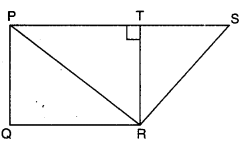
Areas of Parallelograms and Triangles Class 9 Extra Questions Maths Chapter 9 with Solutions Answers 10
Solution:
Here, PS || QR
∴ PQRS is a trapezium in which PQ = 3 cm, QR = 8 cm and SP = 12 cm
Now, TR I PS and PQ || TR
∴ PQRT is a rectangle [∵ PQ || TR, PT || QR and ∠PTR = 90°]
⇒ PQ = TR = 3 cm
Now, ar(PQRS) = \(\frac{1}{2}\)(PS + QR) × TR = \(\frac{1}{2}\)(12 + 8) × 3 = 30 cm2.

Areas of Parallelograms and Triangles Class 9 Extra Questions Short Answer Type 1

Question 1.
ABCD is a parallelogram and O is the point of intersection of its diagonals. If ar(A AOD) = 4 cm\(2\) find area of parallelogram ABCD.
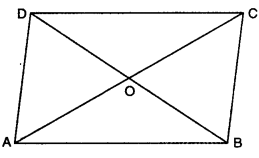
Areas of Parallelograms and Triangles Class 9 Extra Questions Maths Chapter 9 with Solutions Answers 11
Solution:
Here, ABCD is a parallelogram in which its diagonals AC and BD intersect each other in O.
∴ O is the mid-point of AC as well as BD.
Now, in ∆ADB, AO is its median
∴ ar(∆ADB) = 2 ar(∆AOD)
[∵ median divides a triangle into two triangles of equal areas]
So, ar(∆ADB) = 2 × 4 = 8 cm2
Now, ∆ADB and ||gm ABCD lie on the same base AB and lie between same parallels AB and CD
∴ ar(ABCD) = 2 ar(∆ADB).
= 2 × 8
= 16cm2

Question 2.
In the given figure of ∆XYZ, XA is a median and AB || YX. Show that YB is also a median.
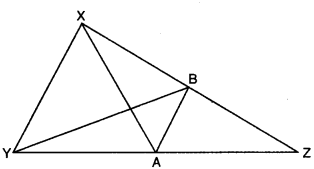
Areas of Parallelograms and Triangles Class 9 Extra Questions Maths Chapter 9 with Solutions Answers 12
Solution:
Here, in ∆XYZ, AB || YX and XA is a median.
∴ A is the mid-point of YZ. Now, AB is a line segment from mid-point of one side (YZ) and parallel to another side (AB || YX), therefore, it bisects the third side XZ.
⇒ B is the mid-point of XZ.
Hence, YB is also a median of ∆XYZ.

Question 3.
ABCD is a trapezium. Diagonals AC and BD intersect each other at O. Find the ratio ar (∆AOD) : ar (∆BOC).
Solution:
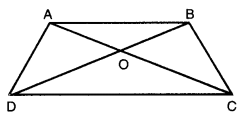
Areas of Parallelograms and Triangles Class 9 Extra Questions Maths Chapter 9 with Solutions Answers 13
Here, ABCD is a trapezium in which diagonals AC and BD intersect each other at O. ∆ADC and ABCD are on the same base DC and between the same ‘parallels i.e., AB || DC.
∴ ar(∆ADC) = ar(∆BCD)
⇒ ar(∆AOD) + ar(∆ODC)
= ar(ABOC) + ar(AODC)
⇒ ar(∆AOD) = ar(∆BOC)
⇒ \(\frac { ar(∆AOD) }{ ar(∆BOC) } \) = 1

Question 4.
ABCD is a parallelogram and BC is produced to a point Q such that AD = CQ (fig.). If AQ intersects DC at P, show that ar(∆BPC) = ar(∆DPQ).
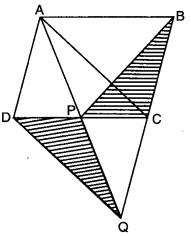
Areas of Parallelograms and Triangles Class 9 Extra Questions Maths Chapter 9 with Solutions Answers 14
Solution:
In ||gm ABCD,
ar(∆APC) = ar(∆BCP) …(i)
[∵ triangles on the same base and between the same parallels have equal area]
Similarly, ar(∆ADQ) = ar(∆ADC) i …(ii)
Now, ar(∆ADQ) – ar(∆ADP) = ar(∆ADC) – ar(∆ADP)
ar(∆DPQ) = ar(∆ACP) … (iii)
From (i) and (iii), we have
ar(∆BCP) = ar(∆DPQ)
or ar(∆BPC) = ar(∆DPQ)

Question 5.
In the figure, PQRS is a parallelogram with PQ = 8 cm and ar(∆PXQ) = 32 cm2. Find the altitude of gm PQRS and hence its area.
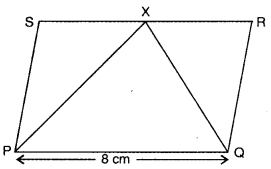
Areas of Parallelograms and Triangles Class 9 Extra Questions Maths Chapter 9 with Solutions Answers 15
Solution:
Since parallelogram PQRS and APXQ are on the same base PQ and lie between the same
parallels PQ || SR
∴ Altitude of the ∆PXQ and ||gm PQRS is same.
Now, \(\frac{1}{2}\)PQ × altitude = ar(∆PXQ)
⇒ \(\frac{1}{2}\) × 8 × altitude = 32
altitude = 8 cm
ar(||gm PQRS) = 2 ar(∆PXQ)
= 2 × 32 = 64 cm2
Hence, the altitude of parallelogram PQRS is 8 cm and its area is 64 cm2.

Question 6.
In ∆ABC. D and E are points on side BC such that CD = DE = EB. If ar(∆ABC) = 27 cm, find ar(∆ADE)
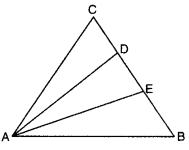
Areas of Parallelograms and Triangles Class 9 Extra Questions Maths Chapter 9 with Solutions Answers 16
Solution:
Since in ∆AEC, CD = DE, AD is a median.
∴ ar(∆ACD) = ar(∆ADE)
[∵ median divides a triangle into two triangles of equal areas]
Now, in ∆ABD, DE = EB, AE is a median
ar(∆ADE) = ar(∆AEB)… (ii)
From (i), (ii), we obtain
ar(∆ACD) = ar(∆ADE) = ar(∆AEB)\(\frac{1}{3}\)ar(∆ABC)
∴ ar(∆ADE) = \(\frac{1}{3}\) × 27 = 9 cm2

Areas of Parallelograms and Triangles Class 9 Extra Questions Short Answer Type 2

Question 1.
For the given figure, check whether the following statement is true or false. Also justify your answer. PQRS is a trapezium with PQ || SR, PS || RU and ST || RQ, then ar(PURS) = ar(TQRS)
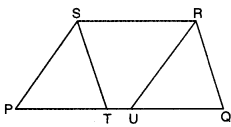
Areas of Parallelograms and Triangles Class 9 Extra Questions Maths Chapter 9 with Solutions Answers 17
Solution:
Since ST || RQ and SR || TQ [given]
⇒ STQR is a ||gm
Similarly, PS || UR and SR || PU [given]
⇒ PSRU is a ||gm
Also, similarly, ||gm STQR and ||gm PSRU lie on same base SR and between same parallels PQ and SR.
∴ ar(||gm STQR) = ar(||gm PSRU)
Hence, the given statement is true.

Question 2.
In the given figure, WXYZ is a quadrilateral with a point P on side WX. If ZY || WX, show that :
(i) ar(∆ZPY) = ar(∆ZXY)
(ii) ar(∆WZY) = ar(∆ZPY)
(iii) ar(∆ZWX) = ar(∆XWY)
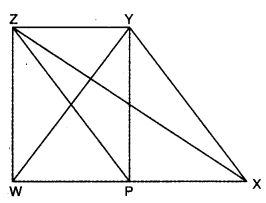
Areas of Parallelograms and Triangles Class 9 Extra Questions Maths Chapter 9 with Solutions Answers 18
Solution:
∆ZPY and ∆ZXY lie on same base ZY and between same parallels ZY and WX
∴ ar(∆ZPY) = ar(∆ZXY)
Again, (∆WZY) and (∆ZPY) lie on same base ZY and between same parallels ZY and WX
∴ ar(∆WZY) = ar(∆ZPY)
Also, ∆zwX and ∆XWY lie on same base XW and between same parallels ZY and WX
∴ ar(∆ZWX) = ar(∆XWY)

Question 3.
In ∆ABC ; D, E and F are mid-points of sides BC, AC and AB respectively. A line through C drawn parallel to DE meets FE produced to G. Show that ar(∆FDE) = ar(∆EGC).
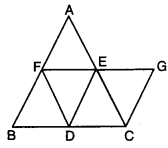
Areas of Parallelograms and Triangles Class 9 Extra Questions Maths Chapter 9 with Solutions Answers 19
Solution:
Here, in ∆ABC; D, E and F are the mid-points of sides BC, AC and AB respectively. A line through C is drawn parallel to DE meets FE produced at G.
Since a line segment drawn through the mid-points of two sides, is parallel to third side and is half of it.
∴ DE || AB, EF || BC and FD || AC
⇒ AEDF, EFDC and EFDB are parallelograms
Also, a diagonal of a parallelogram divides it into two congruent triangles
∴ ∆AFE ≅ ∆DEF
∆DEF ≅ ∆FDB and
∆DEF ≅ ∆EDC
∴ ar(∆FDE) ≅ ar(∆EDC) …(i)
Again, in quad. EGCD, we have
CG || DE and DC || EG [given]
∴ EGCD is a parallelogram .
∴ ∆EDC = ∆CGE
⇒ ar(AEDC) = ar(ACGE) … (ii)
From (i) and (ii), we obtain
ar(∆FDE) = ar(∆EGC)

Question 4.
In ∆PQR, A and B are points on side QR such that they trisect QR. Prove that ar(∆PQB) = 2ar(∆PBR).
Solution:
Here, in ∆PQR, A and B are points on side QR
such that QA = AB = BR.
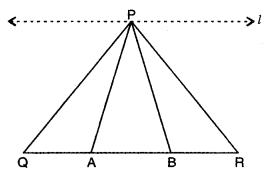
Areas of Parallelograms and Triangles Class 9 Extra Questions Maths Chapter 9 with Solutions Answers 20
Through P, draw a line / parallel to QR
Now, APQA, APAB and APBR on the equal bases
and between the same parallels l || QR
⇒ ar(∆PQA) = ar(∆PAB) = ar(∆PBR) …. (i)
Now, ar(∆PQB) = ar(∆PQA) + ar(∆PAB)
= 2ar(∆PQA)[using (i)]
= 2ar(∆PBR) [using (i)]

Question 5.
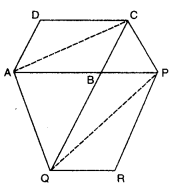
The side AB of a parallelogram ABCD is produced to any point P. A line through A and parallel to CP meets CB produced at Q, then parallelogram PBQR is completed (see figure). Show that ar(||gm ABCD) = ar(||gm PBQR).
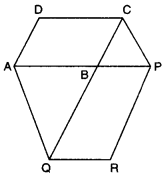
Areas of Parallelograms and Triangles Class 9 Extra Questions Maths Chapter 9 with Solutions Answers 21
Solution:
Areas of Parallelograms and Triangles Class 9 Extra Questions Maths Chapter 9 with Solutions Answers 22
Join AC and QP, also it is given that ∆Q || CP
∴ ∆ACQ and ∆APQ are on the same base ∆Q and lie between the same parallels ∆Q || CP.
∴ ar(∆ACQ) = ar(∆APQ)
or ar(∆ABC) + ar(∆ABQ) = ar(ABPQ) + ar(∆ABQ)
ar(∆ABC) = ar(ABPQ)
or \(\frac{1}{2}\)ar(||gm ABCD) = \(\frac{1}{2}\)ar (||gm PBQR)
or ar(||gm ABCD) = ar(||gm PBQR)

Areas of Parallelograms and Triangles Class 9 Extra Questions Long Answer Type

Question 1.
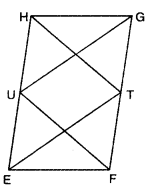
EFGH is a parallelogram and U and T are points on sides EH and GF respectively. If ar(∆EHT) = 16 cm, find ar(∆GUF).
Areas of Parallelograms and Triangles Class 9 Extra Questions Maths Chapter 9 with Solutions Answers 23
Solution:
∴ ar(∆EHT) = \(\frac{1}{2}\) ar(||gm EFGH) …..(i)
Similarly, ∆GUF and parallelogram EFGH are on the same base GF and lie between the same parallels GF and HE
∴ ar(∆GUF) = \(\frac{1}{2}\) ar(||gm EFGH) …..(ii)
From (i) and (ii), we have
ar(∆GUF) = ar(∆EHT)
= 16 cm2 [∵ ar(∆EHT) = 16 cmcm2] [given]

Question 2.
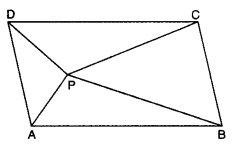
ABCD is a parallelogram and P is any point in its interior. Show that :
ar(∆APB) + ar(∆CPD) = ar(∆BPC) + ar(∆APD)
Areas of Parallelograms and Triangles Class 9 Extra Questions Maths Chapter 9 with Solutions Answers 24
Solution:
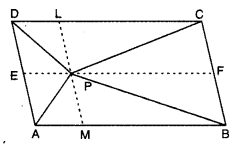
Through P, draw a line LM || DA and EF || AB
Since ∆APB and ||gm ABFE are on the same base AB and lie between the same parallels AB and EF.
∴ ar(∆APB) = \(\frac{1}{2}\) ar(||gm ABFE) … (i)
Areas of Parallelograms and Triangles Class 9 Extra Questions Maths Chapter 9 with Solutions Answers 25
Similarly, ACPD and parallelogram DCFE are on the same base DC and between the same parallels DC and EF.
∴ ar(∆CPD) = \(\frac{1}{2}\) ar(||gm DCFE) … (ii)
Adding (i) and (ii), we have
ar(∆APB) + ar(∆CPD) = \(\frac{1}{2}\) ar (||gm ABFE) + ar(||gm DCFE)
= \(\frac{1}{2}\) ar(|lgm ABCD) … (iii)
Since ∆APD and parallelogram ADLM are on the same base AB and between the same parallels AD and ML
∴ ar(∆APD) = \(\frac{1}{2}\) ar(||gm ADLM) …..(iv)
Similarly, ar(∆BPC) = \(\frac{1}{2}\) = arc||gm BCLM) ….(v)
Adding (iv) and (u), we have
ar(∆APD) + ar (∆BPC) = \(\frac{1}{2}\) ar(||gm ABCD) ….(vi)
From (iii) and (vi), we obtain
ar(∆APB) + ar(∆CPD) = ar(∆APD) + ar(ABPC)

Question 3.
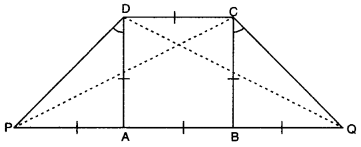
In the given figure, ABCD is a square. Side AB is produced to points P and Q in such a way that PA = AB = BQ. Prove that DQ = CP.
Areas of Parallelograms and Triangles Class 9 Extra Questions Maths Chapter 9 with Solutions Answers 26
Solution:
In ∆PAD, ∠A = 90° and DA = PA = AB
⇒ ∠ADP = ∠APD = \(\frac{90^{\circ}}{2}\) = 45°
Similarly, in ∆QBC, ∠B = 90° and BQ = BC = AB
⇒ ∠BCQ = ∠BQC = \(\frac{90^{\circ}}{2}\) = 45°
In ∆PAD and ∆QBC, we have
PA = BQ [given]
∠A = ∠B [each = 90°]
AD = BC [sides of a square]
⇒ ∠PAD ≅ ∆QBC [by SAS congruence rule]
⇒ PD = QC [c.p.c.t.]
Now, in APDC and ∆QCD
DC = DC [common]
PD = QC [prove above]
∠PDC = ∠QCD [each = 90° + 45° = 135°]
⇒ ∆PDC = ∆QCD [by SAS congruence rule]
⇒ PC = QD or DQ = CP

Areas of Parallelograms and Triangles Class 9 Extra Questions HOTS

Question 1.
In the given figure, PQRS, SRNM and PQNM are parallelograms, Show that :
ar(∆PSM) = ar(∆QRN).
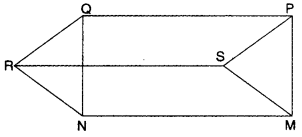
Areas of Parallelograms and Triangles Class 9 Extra Questions Maths Chapter 9 with Solutions Answers 27
Solution:
Since PQRS is a parallelogram.
∴ PS = QR and PS || QR
Since SRNM is also a parallelogram.
∴ SM = RN and SM || RN
Also, PQNM is a parallelogram
∴ PM || QM and PM = QM
Now, in APSM and ∆QRN
PS = QR
SM = RN
PM = QN
∆PSM ≅ ∆QRN [by SSS congruence axiom]
∴ ar (∆PSM) = ar (∆QRN) [congruent triangles have same areas)

Areas of Parallelograms and Triangles Class 9 Extra Questions Value Based (VBQs)

Question 1.
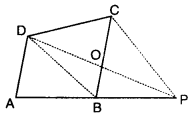
Naveen was having a plot in the shape of a quadrilateral. He decided to donate some portion of it to construct a home for orphan girls. Further he decided to buy a land in lieu of his donated portion of his plot so as to form a triangle.
(i) Explain how this proposal will be implemented?
(ii) Which mathematical concept is used in it?
(iii) What values are depicted by Naveen?
Solution:
Areas of Parallelograms and Triangles Class 9 Extra Questions Maths Chapter 9 with Solutions Answers 28
(i) Let ABCD be the plot and Naveen decided to donate some portion to construct a home for orphan girls from one corner say C of plot ABCD. Now, Naveen also purchases equal amount of land in lieu of land CDO, so that he may have triangular form of plot. BD is joined. Draw a line through C parallel to DB to meet AB produced in P.
Join DP to intersect BC at 0.
Now, ABCD and ABPD are on the same base and between same parallels CP || DB.
ar(∆BCD) = ar(∆BPD) ar(∆COD) + ar(∆DBO) = ar(∆BOP) + ar(∆DBO)
ar(ACOD) = ar(ABOP) ar(quad. ABCD)
= ar(quad. ABOD) + ar(∆COD)
= ar(quad. ABOD) + ar(∆BOP)
[∵ ar(ACOD) = ar(ABOP)] (proved above]
= ar(∆APD)
Hence, Naveen purchased the portion ABOP to meet his requirement.
(ii) Two triangles on the same base and between same parallels are equal in area.
(iii) We should help the orphan children.

Question 2.
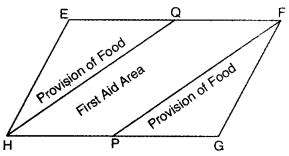
A flood relief camp was organized by state government for the people affected by the natural calamity near a city. Many school students volunteered to participate in the relief work. In the camp, the food items and first aid centre kits were arranged for the flood victims. The piece of land used for this purpose is shown in the figure.
(a) If EFGH is a parallelogram with P and Q as mid-points of sides GH and EF respectively, then show that area used for first aid is half of the total area.
(b) What can you say about the student volunteers working for the relief work?
Areas of Parallelograms and Triangles Class 9 Extra Questions Maths Chapter 9 with Solutions Answers 29
Solution:
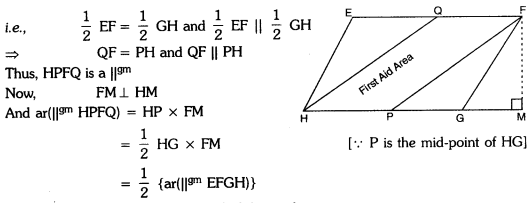
(a) Here, EFGH is a ||gm
∴ EF = GH and EF || GH
Areas of Parallelograms and Triangles Class 9 Extra Questions Maths Chapter 9 with Solutions Answers 30
Hence, area used for first aid is half of the total area.

(b) Students working for the noble cause show compassion towards the affected people. They also realize their social responsibility to work for helping the ones in need.

Gender of Nouns Worksheet Exercises for Class 3 CBSE with Answers

Gender of Nouns Exercises for Class 3 CBSE with Answers

Definition: A noun is a part of speech that is used to name a person, place, thing, quality, or action. Examples: Mango, girl, boy, cat, etc. Any name given to a person, thing, animal or place is called a noun. Nouns are words used to refer to objects, places and living things. Some nouns also refer to feelings and emotions.

This grammar section explains English Grammar in a clear and simple way. There are example sentences to show how the language is used.

Gender Of Nouns Worksheet Exercises for Class 3 CBSE With Answers PDF

Fundamentals
A noun that can either be male or female is called common gender. For example: child, student, friend, applicant, candidate, servant, member, baby, bird, guest, companion, friend, parent, president etc.
A noun that is neither a male nor a female is neuter gender. For example: chair, table, game, television, computer, almirah etc.

Presentation
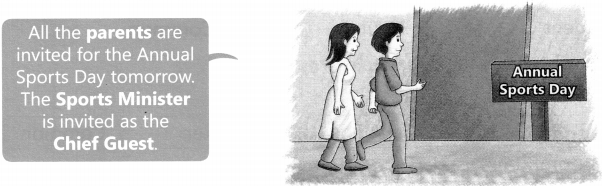
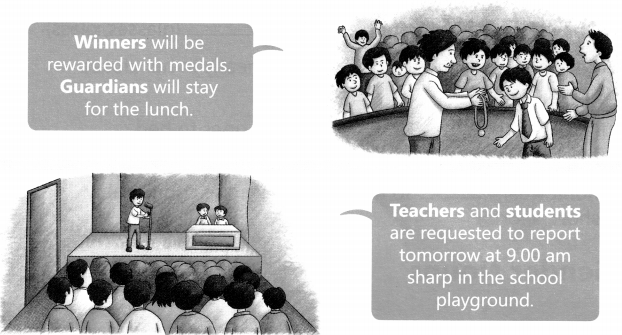
Read the picture story of the Sports Day.
Gender Of Nouns Exercises for Class 3 CBSE with Answers Gender Of Nouns Exercises for Class 3 CBSE with Answers

A. Answer the following questions according to the story.
1. Who is invited on the Annual Sports Day? ____________
2. Who will be honoured with medals? ____________
3. Who will stay for lunch? ____________
4. Who will report in the school playground? ____________

B. Tick the correct box.
Medal – Neuter ( ) Common ( )
Lunch – Neuter ( ) Common ( )
Teacher – Neuter ( ) Common ( )
Student – Neuter ( ) Common ( )

C. Identify the gender for the words given below.

1. Hunter
Masculine – Feminine – Neuter – Common

2. Computer
Masculine – Feminine – Neuter – Common

3. Friend
Masculine – Feminine – Neuter – Common

4. Policeman
Masculine – Feminine – Neuter – Common

5. Heroine
Masculine – Feminine – Neuter – Common

Nouns Gender Worksheet Exercises for Grade 3 With Answers CBSE Pdf

A. Write the feminine form of the following.

Husband ____________
Gentleman ____________
Emperor ____________
Horse ____________
Waiter ____________
Widower ____________
Nephew ____________
Peacock ____________
Lion ____________

B. Write the masculine form of the following.

Queen ____________
Actress ____________
Tigress ____________
Landlady ____________
Mistress ____________
Madam ____________
Wife ____________
Hostess ____________

C. Change the gender in the following sentences. A noun that The first one has been done for you.

1. She met that girl at the club.
He met that boy at the club.

2. This lady is rowing a boat.
________________________

3. He told his teacher the truth.
________________________

4. The cow ate the green grass.
________________________

5. A tiger is a savage animal.
________________________

Noun Worksheet Exercises for Class 3 CBSE With Answers

Noun Exercises for Class 3 CBSE With Answers

Definition: A noun is a part of speech that is used to name a person, place, thing, quality, or action. Examples: Mango, girl, boy, cat, etc. Any name given to a person, thing, animal or place is called a noun. Nouns are words used to refer to objects, places and living things. Some nouns also refer to feelings and emotions.

This grammar section explains English Grammar in a clear and simple way. There are example sentences to show how the language is used.

Noun Worksheet Exercises for Class 3 CBSE with Answers Pdf

  • Everything around us has a name.
  • Naming words are called nouns.
  • We use words for naming something or someone.
  • In simple words, the words that we use for naming people, places, animals and things are called nouns.
  • Nouns can be common and special. Names of a group or class of general people, place or thing are called common names.
  • They are also called as Common Nouns. For example: table, school, park, beach, city etc.
  • Special names name a specific person, place, or thing. They are also called proper nouns.
  • They always begin with capital letters. For example: Narendra Modi, January, India, River Ganga etc.
  • A name can be for one or for more than one thing or person. We can change one into many by adding the letter ‘s’.
  • Naming word for one person or thing is called singular noun.
  • Naming word for more than one thing or person is called plural nouns.
  • Names which can be counted are called countable nouns. For example: boy, girl, bird, apple.
  • Names that are countable can be singular or plural.
  • Names which cannot be counted are called uncountable nouns. For example: water, rice, oil, milk. Names that are uncountable are always singular
  • The naming words that we use for boys are called He names. For example: boy, man, king, nephew and uncle.
  • They are also called as Masculine nouns.
  • The naming words that we use for girls are called She names. For example: girl, woman, queen, niece and aunt.
  • They are also called as Feminine nouns.

Noun Worksheet Exercises for Class 3 With Answers CBSE Pdf

A. Tick (✓) the words that are noun and cross (✗) the words that are not. (Examples: Park noun✓, Run not a noun ✗)

1. big ____________
2. bird ____________
3. cookie ____________
4. monster ____________
5. chair ____________
6. sit ____________
7. pen ____________
8. sing ____________
9. milk ____________

B. Common and Proper Nouns
Determine whether each noun is a common noun or a proper noun.
If the noun is common, write ‘common noun’.
If the noun is proper, re-write the noun using correct capitalization.
Examples:

  • waterfall – common noun
    Niagara falls – Niagara Falls

1. march ____________
2. month ____________
3. day ____________
4. tuesday ____________
5. holiday ____________
6. christmas ____________
7. cereal ____________
8. cheery ____________
9. dr. mathur ____________

C. Identify uncountable nouns in each sentence.

1. Meera kept money in her piggy bank.
Uncountable Noun ________________________

2. Tanya played music on her radio.
Uncountable Noun ________________________

3. The rain pelted on the window.
Uncountable Noun ________________________

4. That road always has a lot of traffic.
Uncountable Noun ________________________

D. Identify the countable nouns in each sentence and write it on the line.

1. Dolly has five dollars.
Countable Noun ________________________

2. Mona wants to eat more donuts.
Countable Noun ________________________

3. Did you bring the books?
Countable Noun ________________________

4. The show will start soon.
Countable Noun ________________________

E. Fill in each blank with suitable Feminine nouns with the help of words given in the box.

aunt, queen, princess, girl, hostess, stewardess, gentleman

1. The host and the ____________ welcomed their guests.
2. The steward and the ____________ look after the passengers on the plane.
3. My uncle and ____________ lived in Delhi.
4. The king and the ____________ had two children, a boy and a ____________. The prince was eight and the ____________ was five.
5. Ladies and ____________, welcome to our party this evening.

Water: A Precious Resource Class 7 Notes Science Chapter 16

On this page, you will find Water: A Precious Resource Class 7 Notes Science Chapter 16 Pdf free download. CBSE NCERT Class 7 Science Notes Chapter 16 Water: A Precious Resource will seemingly help them to revise the important concepts in less time.

CBSE Class 7 Science Chapter 16 Notes Water: A Precious Resource

Water: A Precious Resource Class 7 Notes Understanding the Lesson

1. Water is the most important compound for all living things. There can be no life without it.

2. 22 March is celebrated as the world water day to attract the attention of everybody towards the importance of conserving water.

3. Water is an universal solvent.

4. 71% of earth surface is covered with water.

5. Three forms of water are solid, liquid and gas.

6. The water on the earth has been maintained for millions of years by various processes which make the water cycle.

7. The solid form of water, snow and ice, is present as ice caps at the poles of the earth, snow-covered mountains and glaciers.

8. Liquid water is present in oceans, lakes, rivers and even underground.

9. The gaseous form of water is the water vapour which is present in the air around us.

10. The rainwater or the water from other sources like ponds, lakes, etc., percolates under the ground and collects over the impermeable rocks. This water is called

11. The upper limit of underground water is called water table. The water table varies from place to place, and it may even change at a given place.

12. The process of seeping of water into the ground is called The groundwater gets charged by this process.

13. Aquifer is a water trap where groundwater is trapped between the layers of hard rock below water table.

14. Following are the causes of water shortage:

  • Increasing population
  • Rapid growth of industries
  • Growing irrigation requirements
  • Increasing agricultural activities
  • Mismanagement

15. The distribution of water is also quite uneven due to number of factors. There are some regions in our country may have floods while others may suffer droughts at the same time.

16. Water management should be done by following ways:

17. Unnecessary use of water and overdrawing of groundwater should be stopped.

18. Recharge of groundwater must be increased through various processes.

19. We should prevent the wastage of water during its supply through pipes, the leaking taps in buildings and other places.

20. Plants wilt and ultimately dry-up if they are not watered for few days.

Class 7 Science Chapter 16 Notes Important Terms

Aquifer: A water trap where groundwater is trapped between the layers of hard rock below water table.

Depletion: Depletion is reduction in number or quantity of something. Rapid growth of industries, increasing population, growing irrigation requirements and mismanagement are some of the causes for water depletion.

Drip irrigation: It is a technique of irrigation by using narrow tubings which deliver water drop by drop directly at the base of the plant.

Groundwater: The water that seeps into the earth, gets collected between the layers of rocks and found below the water table is called groundwater.

Infiltration: The process of seeping of water into the ground is called infiltration. The groundwater gets recharged by this process.

Water harvesting: The water harvesting simply involves collection of rainwater from surfaces that can be used to recharge the groundwater or storing it for later use.

Water table: The water present deep under the ground is known as groundwater and the upper limit of this layer is known as water table.