Plural Possessive Nouns Worksheet for Class 3 CBSE with Answers

Plural Possessive Nouns Worksheet for Class 3 CBSE with Answers 1

This grammar section explains English Grammar in a clear and simple way. There are example sentences to show how the language is used.

Plural Possessive Nouns Worksheet for Class 3 CBSE with Answers PDF

Fundamentals

  • Possessive nouns are used to show that something belongs to someone.
  • We add an apostrophe s (‘s) at the end of a noun to show possession.

We do the same if the noun already ends with ‘s’.

  • (Julius’s Slippers) The slippers belong to Julius.
  • (John’s book) The book belongs to John.

A noun that shows ownership of more than one person is a plural possessive noun.

  • (The doctors’ coats) The coats belong to the doctors.
  • (The girls’ restroom) The restroom belongs to the girls.

To make an irregular plural noun that does not end in ‘s’, add an apostrophe and ‘s’ at the end.

  • (The children’s toys) The toys belong to the children.

Presentation
Plural Possessive Nouns Worksheet for Class 3 CBSE with Answers 2
Plural Possessive Nouns Worksheet for Class 3 CBSE with Answers 3

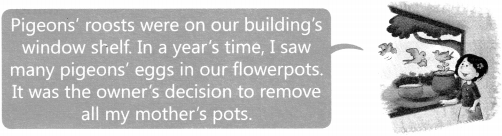
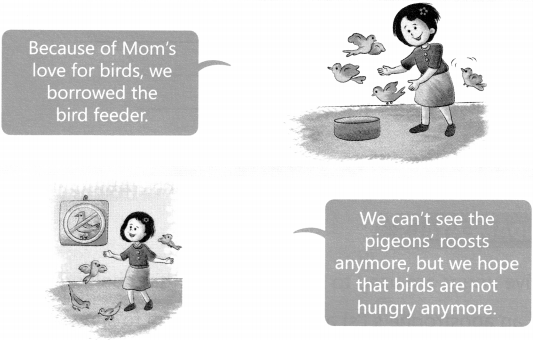
A. Answer the following questions according to the story.

1. Who loved birds? ____________
2. Where were the pigeons’ roosts? ____________
3. Whose eggs were in the flower pots? ____________

B. Write the possessive form of the nouns given in the brackets.

1. This is ____________ homework. (Mohan)
2. The ____________ pants are black. (boy)
3. The ____________ feathers are yellow. (bird)
4. This is ____________ jacket. (Nancy)
5. The ____________ toy is noisy. (dog)

Plural Possessive Nouns Worksheets with Answers for Class 3 CBSE PDF

A. Write the correct possessive nouns for the following sentences.
Example:
The ball belongs to the boys. ______ the boys’ ball ______

1. The car belongs to the man. ____________
2. The dinner belongs to the family. ____________
3. The books belong to the students. ____________
4. The candy belongs to Jyoti. ____________
5. The mess belongs to the dogs. ____________

B. Write plural possessive forms for the word given in the brackets.

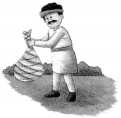
1. The water was filled with the ____________ nets. (fishermen) Plural Possessive Nouns Worksheet for Class 3 CBSE with Answers 4
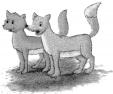
2. Everyone knew that the forest was the ____________ territory. (wolves) Plural Possessive Nouns Worksheet for Class 3 CBSE with Answers 5
3. The ____________ bedroom is painted blue. (boys) Plural Possessive Nouns Worksheet for Class 3 CBSE with Answers 6
4. The ____________ cribs were in perfect rows at the nursery. (babies) Plural Possessive Nouns Worksheet for Class 3 CBSE with Answers 7
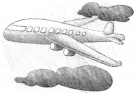
5. The ____________ wings were very big. (airplanes) Plural Possessive Nouns Worksheet for Class 3 CBSE with Answers 8

Why Do We Fall ill Class 9 Notes Science Chapter 13

Why Do We Fall ill Class 9 Notes

On this page, you will find why Do We Fall ill Class 9 Notes Science Chapter 13 Pdf free download. CBSE NCERT Class 9 Science Notes Chapter 13 Why Do We Fall ill will seemingly help them to revise the important concepts in less time.

CBSE Class 9 Science Chapter 13 Notes Why Do We Fall ill

Why Do We Fall ill Class 9 Notes Understanding the Lesson

1. Cells are basic unit of living organisms and a lot of activities and chemical reactions are taking place in the cells, so even though they look static they are in a dynamic state as a lot of activities are continuously going inside them.

2. Growth and repair of cells is a continuous process which occurs in living organisms.

3. Activities of all the organs in our body are occurring in a coordinated and interconnected way. For example, poisonous substances would accumulate in the body if the urine is not filtered properly by the kidneys. This in turn would affect the activities of the brain and it will not be able to think properly.

4. Food and energy is needed by all the tissues of a living body in order to function properly.

5. If the functioning of cells and tissues gets adversely affected it would result in lack of proper activity of the body.

6. ‘Health’ is defined as a state of physical, emotional, mental and social well being of a person.

7. The health of an individual depends on the surroundings or the environment of an individual. The environment includes the physical environment.

8. Social environment is also an important factor for health of an individual. Even our physical environment is decided by our social environment.

9. Personal hygiene, public cleanliness, social equality, harmony and good economic conditions are necessary for individual health.

10. Disease refers to any condition that disturbs the normal functioning of the living organism. It is a condition of disturbed ease when an individual feels uncomfortable. Being disease-free is a concept which applies to individual sufferer.

11. Even a disease free person can be considered as having a poor health if the person is unfit in terms of social and mental health. So, health is a concept which applies to societies and communities.

12. The functioning or the appearance of one or more systems of the body gets adversely affected when a person is suffering from a disease. These changes result in symptoms and signs of the disease.

13. Signs and Symptoms

  • Symptoms are the physical disturbances that indicate that something is wrong with the functioning of the body and that there may be a disease, but they don’t indicate what the disease is. For example, headache, cough, pus in wound, etc., are symptoms of a disease.
  • On the basis of the symptoms, physicians look for the signs of a disease. Signs give a more definite indication of the presence of a particular disease.

14. Types of Disease – Acute disease and chronic disease

  • The disease which lasts for only very short periods of time is called acute disease.
    For example: common cold
  • The disease which can last for a long time, even as much as a lifetime is called as chronic disease. They have a long-term effect on the health of a person.
    For example: elephantiasis

15. Causes of disease – Immediate and contributory

  • Immediate causes: These are the first level causes or the primary cause of the disease.
    Example: The various bacteria, virus, fungi, protozoans, etc., which cause infection in an organism.
  • Contributory causes: These are the second level of causes or the internal factors which result in a disease.
    For example: Pollutants in the atmosphere, inadequate diet, poor health, improper nourishment, lack of public services, poor economic condition, genetic abnormalities, etc.
  • The immediate cause of disease can be of two types: Infectious diseases and non-infectious dis¬eases.
  • Infectious diseases: These diseases are caused by infectious agents. These can spread from one person to another through some medium or by direct contact.
    Example: Pneumonia, common cold, tuberculosis, etc.
  • Non-infectious diseases: These do not spread from one person to another person in the community. They are caused due to internal factors.
    Example: Cancer, high blood pressure, diabetes, etc.
  • Infectious agents: The organisms (unicellular or multicellular) which cause infection are called as the infective agents.
    Example: virus, bacteria, worms, fungi, etc.

Examples of diseases caused by infectious agents

  • By viruses: Common cold, influenza, dengue fever and AIDS.
  • By bacteria: Typhoid, cholera, tuberculosis, anthrax, etc.
  • By fungi: Many common skin infections like ringworm disease.
  • By Protozoans: Malaria and kala-azar.
  • By worms: Intestinal worm infections, elephantiasis.

Antibiotic: Chemicals produced by certain microorganisms like bacteria and fungi which inhibit the growth of the other microorganisms are called as antibiotics.

Mode of action of antibiotic: Antibiotics usually block the important biochemical pathways of bacteria. Example: The antibiotic penicillin blocks the processes that help in synthesis of a cell wall in the bacteria. Due to this, the bacteria become unable to make cell walls to protect them and die easily. Human cells don’t make a cell wall, so penicillin does not affect them.

16. Antibiotics do not work against viruses:
Reason: Viruses do not use their own biochemical pathways for the synthesis of their cell wall. They have very few biochemical mechanisms. So, antibiotics do not work against viral infections.

17. Means of spread of diseases
Infectious diseases can spread from an infected person to a healthy person by various transmitting agents, so they are called as communicable diseases. These diseases can be spread through air, water, vectors and physical contact.

(i) By air: The little droplets thrown out by an infected person who sneezes or coughs can result in a new infection in a healthy person if the person breathes in the droplets released by the infected person. Example: common cold, pneumonia and tuberculosis.

(ii) By water: If the excreta from someone suffering from an infectious gut disease, such as cholera, get mixed with the drinking water used by people living nearby. The microbes will enter new hosts through the water they drink and cause disease in them.
Example: cholera.

(iii) By Sexual contact: Some diseases are transmitted by sexual contact from one partner to the other. Example: syphilis, AIDS, etc.
It is important to note that: AIDS does not spread by casual physical contacts like handshakes or hugs or sports, like wrestling. AIDS can spread in four ways, sexual contact, transfusion of AIDS infected blood, from an infected mother to her baby during pregnancy or through breast feeding.

(iv) By vectors: Many diseases are transmitted by animals from an infected person to a healthy person. These animals act as intermediaries and are called vectors. The most common example of vectors are mosquitoes. The females of many species of mosquitoes need highly nutritious food in the form of blood in order to be able to lay mature eggs.

18. Different species of microbes have evolved to affect different parts of the body. The selection is generally connected to their point of entry.

  • They usually go to the lungs if they enter from the air via the nose.
    Example: bacteria causing tuberculosis.
  • They can stay in the gut lining or go to the liver if they enter through the mouth. Example: bacteria which causes typhoid remains in the gut lining whereas the viruses that cause jaundice go to the liver.

19. Other ways are:

  • The AIDS causing virus HIV comes into the body via the sexual organs and then spreads to lymph nodes all over the body.
  • Malaria-causing microbes which enter through a mosquito bite go to the liver, and then to the red blood cells.
  • The virus causing Japanese encephalitis or brain fever enters through a mosquito bite and goes on to infect the brain.

20. The signs and symptoms of a disease depend on the tissue or organ which the microbe targets.

  • If the lungs are the targets, then symptoms will be cough and breathlessness.
  • If the liver is the target, there will be jaundice.
  • If the brain is the target, it will result in headache, vomiting, fits or unconsciousness.

21. Inflammation: An active immune system recruits many cells to the affected tissue to kill off the disease- causing microbes. This recruitment process is called inflammation. Local effects such as swelling and pain, and general effects such as fever are caused as a part of this process.

In AIDS, the virus called HIV goes to the immune system and damages its function. As a result, the body can no longer fight off even the minor infections. For example, a very small cold can become pneumonia or minor gut infection can produce major diarrhoea with blood loss. Ultimately, the immune system of the person becomes very weak and these and other infections kill people suffering from HIV-AIDS.

22. Principles of Treatment
There are two ways for treatment of infectious diseases:

  •  to reduce the effects of the disease: The main focus is to reduce the symptoms which are usually due to inflammation. For example, rest is taken to conserve energy, medicines are taken to bring down fever or to reduce pain or loose motions, etc.
  • to kill the cause of the disease: The main focus on this is to get rid of the disease causing microbe from the body. For example, medicines like antibiotics are taken to kill microbes.

23. Principles of Prevention
Prevention is better than cure because the methods which deal with getting rid of an infection have three limitations.

  • During treatment, the body functions of the person get damaged and may never recover completely.
  • The person suffering from a disease is likely to be dridden for some time as the treatment of a disease takes time.
  • The person suffering from an infectious disease can serve as the source of spread of infection to other people.

23. Ways of Prevention of disease are
(i) General ways: These focus on preventing exposure to the disease causing organisms. Public hygiene is important for the prevention of infectious diseases.
For example,

  • By providing living conditions that are not overcrowded, exposure to air-borne infections can be avoided.
  • By providing safe drinking water and treating water to kill microbes in it, the water-borne infections can be prevented.
  • By providing clean environment which do not allow spread of microbes/vectors, the vector-borne infections can be prevented.
  • For vector-borne infections, we can provide clean environments. This would not, for example, allow mosquito breeding.

(ii) Specific ways: These methods are adopted to make the immune system of the person strong by vaccination to create immunisation and taking proper and sufficient food for keeping the body healthy.

24. Vaccine: A modified suspension of disease causing microorganisms which have been weakened so that they are not able to cause disease but help to activate the immune system of the organism to produce antibodies against the disease causing organism. Edward Jenner developed the first vaccine against the smallpox disease. The process of inoculation of a vaccine in a person to develop immunity against a disease is called vaccination.

Class 9 Science Chapter 13 Notes Important Terms

Health: The state of physical, emotional, mental and social well being of an individual.

Disease: Any condition that causes disturbed ease in a person or disturbs the normal functioning of the body.

Acute disease: The disease which lasts for a short time.

Chronic disease: The disease which persists for a long time.

Infectious disease: A disease which can spread from one person to other. E.g., common cold

Non-infectious disease: A disease which cannot spread from one person to other. E.g., diabetes

Antibiotics: The chemicals secreted by some microbes like fungi and bacteria which are used to control the growth of bacteria or kill the bacteria.

Immunity: The ability of the body to fight against the disease causing organisms.

Vaccine: A biological preparation that provides immunity to a person against a disease.

Vector: The organism or the agent which helps in the transmission of a disease.

Inflammation: It is the process by which the white blood cells of our blood protect us from the infections by disease-causing organisms.

Symptom: The physical disturbances which indicate the presence of a disease.

Syndrome: Group of symptoms

AIDS: Acquired immunodeficiency syndrome

HIV: Human immuno-deficiency virus

Immunisation: The process by which a person is made immune to an infectious disease . administering a vaccine.

Kinds of Nouns Worksheet Exercises for Class 3 CBSE with Answers

Kinds of Nouns Worksheet Exercises for Class 3 CBSE with Answers 1
This grammar section explains English Grammar in a clear and simple way. There are example sentences to show how the language is used.

Kinds of Nouns Worksheet Exercises for Class 3 CBSE with Answers

Fundamentals

  • Nouns are of four kinds-Common, Proper, Collective and Abstract.
  • Common Nouns is a person, a place, an animal or a thing in general. For example: Boy, girl, city, river, animal and book.
  • Proper Noun is the special name given to the particular person, place, animal or thing. For example: Ram, Ganga, Teddy, India.
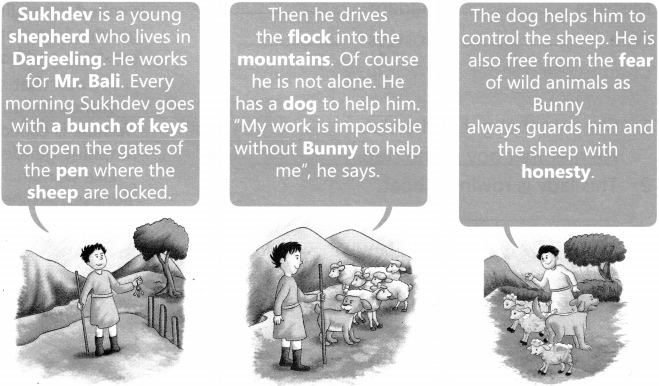
  • Collective nouns are used to denote a collection of common nouns. For example: A bunch of keys, a crowd of people, a team of players and a school of fish.
  • Abstract Noun is the name given to something we can feel but can’t touch or see. For example: Honesty, fear, happy, sad, beauty, kindness etc.

Presentation
Read the picture story of ‘A Shepherd Boy’.
Kinds of Nouns Worksheet Exercises for Class 3 CBSE with Answers 2

A. Answer the following questions according to the story.

1. What does Sukhdev take to open the gates of the pen? ____________
2. Who helps Sukhdev in guarding the sheep? ____________
3. Write down two qualities of Sukhdev as a Shepherd boy? ____________
4. Mention one quality of Bunny as a dog. ____________

B. Pick out the nouns from the story and write them under the correct heading.

Common NounProper NounCollective NounAbstract Noun
………………………………………….
………………………………………….
………………………………………….
………………………………………….
………………………………………….
………………………………………….
………………………………………….
………………………………………….
………………………………………….
………………………………………….
………………………………………….
………………………………………….
………………………………………….
………………………………………….
………………………………………….
………………………………………….
………………………………………….
………………………………………….
………………………………………….
………………………………………….
………………………………………….
………………………………………….
………………………………………….
………………………………………….

List of Collective Kinds of Nouns Worksheet Exercises for Class 3 with Examples

Collective Nouns for ThingsCollective Nouns for AnimalsCollective Nouns for Persons
A group of islandsA catch of fishA class of students
A galaxy of starsAn army of antsAn army of soldiers
A forest of treesA flight of birdsA choir of singers
A stack of woodA hive of beesA crew of sailors
A fleet of shipsA school of fishA band of musicians
A bowl of riceA flock of sheepAn audience of listeners
A pack of cardsA pack of wolvesA panel of experts
A pair of shoesA litter of puppiesA gang of laborers
A bouquet of flowersA murder of crowsA flock of tourists
A bunch of keysA kennel of dogsA board of directors

Kinds of Nouns Worksheet Exercises for Class 3 with Answers CBSE PDF

A. Complete the following passage with the help of collective nouns given in the box.
piece, bunch, basket, bunch, crowd, handful

Mom took Kajal, Aadi and Deepu to the zoo. The zoo was very busy.
A ____________ of people had gathered round the monkeys. One of the monkeys had a ____________ of bananas. Watching the monkey eat made the children feel hungry. Mom had a ____________ of fruits with her. She took a ____________ of grapes from it and gave it to the children. After eating the grapes, the children had a ____________ of toffees.

Aadi wanted to give one piece to a monkey, but the zookeeper gave Aadi a very useful ____________ of advice.

“Monkeys may look friendly, but sometimes they can be very fierce,” he said.

B. Underline the nouns in the following sentences and state their kind.

1. The book was lying on the table. ____________
2. Love begets love. ____________
3. We cannot live without water. ____________
4. The jury has given its verdict. ____________
5. The Hindus regard Krishna as an incarnation of Lord Vishnu. ____________
6. Alcohol is injurious to health. ____________
7. Smoking is a bad habit. ____________
8. Wild animals live in forests. ____________
9. The childhood of Pritam was full of misery. ____________
10. All the girls were singing. ____________
11. Gold is a precious metal. ____________
12. Rice is the staple food of South Indians. ____________
13. The Earth moves round the Sun. ____________
14. Mankind should love nature. ____________
15. We get wool from sheep. ____________

Singular and Plural Worksheet Exercises for Class 3 CBSE with Answers

Singular and Plural Exercises for Class 3 CBSE with Answers

This grammar section explains English Grammar in a clear and simple way. There are example sentences to show how the language is used.

Singular and Plural Worksheet Exercises for Class 3 CBSE with Answers

Fundamentals
The plural form of some nouns is the same as their singular form.

  • Singular – Plural
  • sheep – sheep (not sheeps)
  • deer – deer (not deers)
  • fish – fish (not fishes)
  • aircraft – aircraft (not aircrafts)
  • salmon – salmon (not salmons)

Some nouns are always plural.
trousers, glasses, shorts, spectacles, jeans,
goggles, pants, scissors, tights
binoculars, pajamas, pliers

Some nouns are usually plural.
shoes, chopsticks, sandals, gloves
slippers, clogs, boots, socks

Presentation
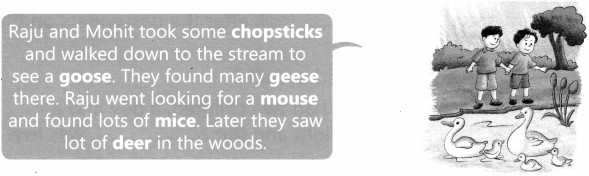
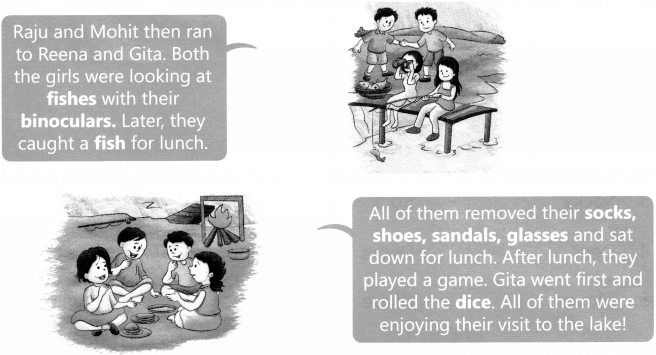
Read the picture story
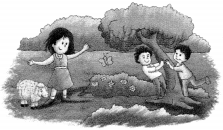
Raju and Mohit visited lake with Reena and Gita.
Singular and Plural Exercises for Class 3 CBSE with Answers 1
Singular and Plural Exercises for Class 3 CBSE with Answers 2
A. Answer the following questions from the story given above.

1. What did Raju and Mohit take along with them Focus before going to the stream? ____________
2. Which animal was found in the woods? ____________
3. What did the girls use to spot fishes in the lake? ____________
4. Who rolled the first dice? ____________

B. Choose the correct plural form and write it in the blanks.

1. Three (girls, girl) went on the bus. ____________
2. The (monkies, monkeys) chattered in the jungle. ____________
3. The (sheeps, sheep) are sheared each year. ____________
4. Six (women, woman) ran in the race. ____________
5. The (children, childs) were playing. ____________
6. Monu wears his (trouser, trousers). ____________
7. Anita loves to wear (goggle, goggles) in the sun. ____________

Singular and Plural Worksheet Exercises with Answers for Grade 3 CBSE PDF

A. Choose the correct plural forms given below.

1. Trouser ( )
Trousers ( )

2. Shoe ( )
Shoes ( )

3. Socks ( )
Sock ( )

4. Deer ( )
Deers ( )

5. Gloves ( )
Glove ( )

B. Look at the pictures and complete the sentences with the correct words from the list given below.
sheep – species – series – fish

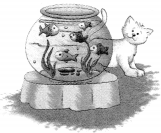
1. The cat wishes there were lots of ____________ look at! Singular and Plural Exercises for Class 3 CBSE with Answers 3
2. Sonu is watching three different ____________ on television. Singular and Plural Exercises for Class 3 CBSE with Answers 4
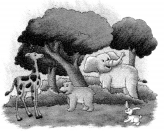
3. There are many different ____________ of plants and animals in the rain forest. Singular and Plural Exercises for Class 3 CBSE with Answers 5
4. There are lots of baby ____________ to play with in the spring. Singular and Plural Exercises for Class 3 CBSE with Answers 6

C. Use the plural nouns to complete the sentences given below.

1. Sahil cannot see without his ____________ (glasses, glass)
2. Meena hangs all her ____________ neatly in her closet. (dress, dresses)
3. Rahul wears his ____________ when he goes to bed. (pajamas, pajama)
4. Mohit wears ____________ so that he can exercise comfortably. (short, shorts)

Wastewater Story Class 7 Notes Science Chapter 18

On this page, you will find Wastewater Story Class 7 Notes Science Chapter 18 Pdf free download. CBSE NCERT Class 7 Science Notes Chapter 18 Wastewater Story will seemingly help them to revise the important concepts in less time.

CBSE Class 7 Science Chapter 18 Notes Wastewater Story

Forests: Our Lifeline Class 7 Notes Understanding the Lesson

1. Rich in lather, mixed with oil, black-brown water that goes down the drains from sinks, showers, toilets, laundries is dirty. This is called wastewater.

2. The suspended impurities in water are called contaminants.

3. The waste water released by homes, industries, hospitals and other users is called sewage.

4. ‘Cleaning of water’ is a process of removing pollutants before it enters a water body or is reused. This pro­cess is generally known as ‘sewage treatment’.

5. Sewage treatment plant is constructed to make wastewater or sewage reusable.

6. A complete network of sewers underlying the surface is planned to collect and send the wastewater for treatment. This is called sewerage system.

7. Treatment of wastewater involves physical, chemical and biological processes, which removes physical, chemical and biological matter that contaminates the wastewater.

8. The treated water from sewage treatment plant has a very low-level organic material and suspended matter. This is discharged into the water bodies by sometimes disinfecting with chlorine and ozone.

9. By-products of wastewater treatment are sludge and biogas.

10. Where underground sewerage systems and refuse disposal systems are not available, the low-cost on-site sanitation system can be adopted.

11. Open drain system is a breeding place for flies, mosquitoes and organisms which cause diseases.

12. We must realise our responsibility in maintaining the water sources in a healthy state. Adopting good sanitation practices should be our way of life.

Class 7 Science Chapter 18 Notes Important Terms

Aeration: It is the process in which air is pumped into clarified water to help bacteria grow.

Aerobic bacteria: Bacteria that require oxygen to live and grow are called aerobic bacteria.

Anaerobic bacteria: Bacteria that can survive without oxygen are called anaerobic bacteria.

Biogas: It is a gaseous fuel produced by the fermentation of manure, plant, or crop waste under anaerobic conditions which is used to generate electricity from waste matter.

Contaminants: There are harmful substances dissolved and suspended as impurities in water.

Sanitation: The proper disposal of sewage and garbage from the houses or nearby areas is called sanitation.

Sewage: Wastewater generated by homes, offices, hospitals, industries and other areas is called sewage.

Sewer: A network of big and small pipes to carry wastewater to treatment plant is called sewer.

Sewerage: It is the drainage system of sewer.

Sludge: Sludge is the residual, semi-solid material that is produced as a by-product during sewage treat­ment of industrial or municipal wastewater.

Wastewater: The water that is not fit for use is called ‘wastewater’.