Light Class 7 Notes Science Chapter 15

On this page, you will find Light Class 7 Notes Science Chapter 15 Pdf free download. CBSE NCERT Class 7 Science Notes Chapter 15 Light will seemingly help them to revise the important concepts in less time.

CBSE Class 7 Science Chapter 15 Notes Light

Light Class 7 Notes Understanding the Lesson

1. Light is a form of energy which enables us to see objects from which it comes or from which it is reflected.

2. The objects which emit light of their own are known as luminous objects, g., the sun, lamp, candle, etc.

3. The objects which do not emit light of their own are known as non-luminous objects, g., chair, table, window, etc.

4. Light always travels in a straight line and this property of light is called rectilinear propagation of light.

5. Light falls on the surface of an object and the object sends the light back. This process of sending back the rays of light which fall on the surface of an object is called reflection of light.

6. The ray of light which falls on an object is called incident ray and the ray of light which is sent back by an object is called reflected ray.

7. A highly polished surface which is smooth enough to reflect a good fraction of light incident on it is called mirror.

8. An optical appearance produced by light or other radiations from an object reflected in the mirror or re­fracted through a lens is called

9. The image which can be formed or obtained on the screen is called a real image.

10. The image which cannot be obtained on the screen is called a virtual image.

11. The image formed by a plane mirror is erect, virtual and of the same size as the object.

12. Those mirrors whose reflecting surfaces are spherical or curved are called spherical mirrors.

13. There are two types of spherical mirrors:

  • Concave mirror
  • Convex mirror

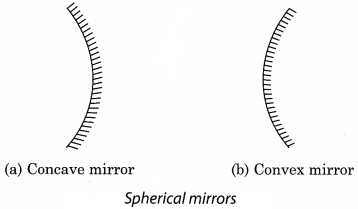
14. When the reflecting surface of the spherical mirror is curved inwards, then it is called concave mirror.

15. A concave mirror can form a real and inverted image. When the object is placed very close to the mirror, the image formed is virtual, erect and magnified.

Light Class 7 Notes Science Chapter 15

16. When the reflecting surface of the spherical mirror is curved outwards, then it is called convex mirror.

17. A convex mirror form erect, virtual, smaller size image of the object.

18. Lens is a piece of glass or transparent material with curved sides.

19. A lens that is thicker in the middle and thinner at the edges is called a convex lens. It is also known as magnifying glass.

20. A convex lens can form real and inverted image. When the object is placed very close to the lens, the image formed is virtual, erect and magnified.

21. A lens that is thinner in the middle and thicker at the edges is called a concave lens.

22. A concave lens always forms erect, virtual and smaller image than the object.

23. White light is composed of seven colours. These are red, orange, yellow, green, blue, indigo and violet (acronym: VIBGYOR).

Class 7 Science Chapter 15 Notes Important Terms

Concave lens: It is also known as diverging lens. It is thinner at the centre than at the edges. It diverges a beam of light on refraction through it. Concave lenses have a virtual focus.

Concave mirror: The type of mirror in which reflecting surface of the spherical mirror is curved inwards, is called concave mirror.

Convex lens: Convex lenses are thicker at the centre and thinner at the edges. It converges a parallel beam of light on refraction through it. It has real focus.

Convex mirror: The type of mirror whose reflecting surface of the spherical mirror is curved outwards, is called convex mirror.

Erect image: When the image formed have same direction as that of object, then the formed image is called erect image.

Magnified image: When the size of image is larger than the object, then it is called magnified image.

Magnifying glass: A magnifying glass is a convex lens that is used to produce a magnified image of an object.

Prism: Prism is a transparent glass pyramid, bounded by four triangular surface that separates white light into a spectrum of colours.

Rainbow: A band of seven colours formed in the sky in the direction opposite to the sun due to rain or presence of water droplets in the atmosphere.

Real image: The image which can be formed or obtained on the screen is known as real image.

Rearview mirror: Rearview mirror is a mirror in automobiles and other vehicles, designed to see a virtual, upright and diminished image of the traffic behind them. For rearview mirror, convex mirror is used.

Side mirror: The rearview mirror is used as side mirror in motor vehicles.

Spherical mirror: ’he mirrors which have curved surfaces are known as spherical mirrors.

Virtual image: The image that cannot be obtained on the screen is known as virtual image.

Electric Current and Its Effects Class 7 Notes Science Chapter 14

On this page, you will find Electric Current and Its Effects Class 7 Notes Science Chapter 14 Pdf free download. CBSE NCERT Class 7 Science Notes Chapter 14 Electric Current and Its Effects will seemingly help them to revise the important concepts in less time.

CBSE Class 7 Science Chapter 14 Notes Electric Current and Its Effects

Electric Current and Its Effects Class 7 Notes Understanding the Lesson

1. Electricity is an important source of energy in our day-to-day life.

2. An electric cell is a device which is used to generate electricity.

3. An electric cell has two terminals:

  • positive terminal
  • negative terminal.

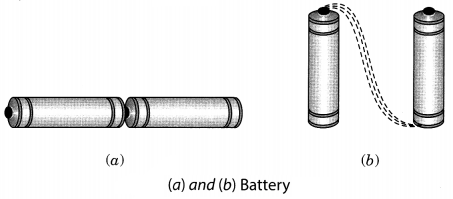
4. A combination of two or more cells in which the positive terminal of one cell is connected to the negative terminal of the next cell, is called a battery (Fig. 1).

Electric Current and Its Effects Class 7 Notes Science Chapter 14

5. An electric circuit is an arrangement of different components such as the electric cell, battery, switch, electric bulb and wire. It is the complete path from one terminal of the electric cell through the bulb and back to the other terminal of the electric cell.

6. It is convenient to represent electric components by symbols. Using these, an electric circuit can be repre­sented by a circuit diagram.

7. When an electric current flows through a wire, the wire gets heated. It is the heating effect of current.

8. In the bulb there is a thin wire called the filament, which glows when an electric current passes through it, due to heating effect of current.

9. Other appliances where the heating effect of the current is used are electric iron, heater, immersion heaters, geysers, hairdryers, etc.

10. The amount of heat produced in a wire depends upon its material, length and thickness.

11. Wires made from special materials melt quickly and break when large electric currents are passed through them. These wires are used for making electric fuses.

12. When electric current passes through a wire, it behaves, like a magnet. This is the magnetic effect of the electric current. In fact, electric current can be used to make magnets.

13. An electromagnet is an example of the magnetic effect of the electric current. It is used in many devices like electric bell, loudspeakers, telephone, etc.

14. An electric bell mainly consists of an electromagnet, a hammer and a gong.

15. We should conserve energy today to avoid energy crisis later.

Class 7 Science Chapter 14 Notes Important Terms

Battery: Battery is a combination of two or more cells in which the positive terminal of one cell is always joined to the negative terminal of other cell.

Electrical components: Electric components are basic devices which connect together to make an electric circuit. For example, switch, battery, bulb, etc.

Circuit diagram: A circuit diagram is a graphical representation of an electric circuit which is drawn using symbols of different electrical components.

Cell holders: Cell holders are two or more compartments which hold the cells to make a battery. Cells are placed in them properly, such that the positive terminal of one cell is connected to the negative terminal of the next cell.

Filament: Filament is a thin wire in the bulb which glows when an electric current passes through it.

Element: The coil of wire in an electric room heater or an electric heater is called an element.

Electric fuses: An electric fuse is a safety device which prevents damages to electric circuits and possible fires. It is made from some special materials which melt quickly when large electric currents are passed through them.

Heating effect of current: When a wire get hot when an electric current passes through it, is called the heating effect of current.

Magnetic effect of current: When an electric current passes through a wire, it behaves like a magnet. This is called the magnetic effect of current.

Electromagnet: The magnet made by using an electric current is called electromagnet. It consists of a coil of insulated wire wrapped around a piece of iron that is magnetized only when electric current is passed through the coil.

Electric bell: An electric bell is a device based on magnetic effect of current. It consists of an electromag­net, a hammer and a gong.

Motion and Time Class 7 Notes Science Chapter 13

On this page, you will find Motion and Time Class 7 Notes Science Chapter 13 Pdf free download. CBSE NCERT Class 7 Science Notes Chapter 13 Motion and Time will seemingly help them to revise the important concepts in less time.

CBSE Class 7 Science Chapter 13 Notes Motion and Time

Motion and Time Class 7 Notes Understanding the Lesson

1. The act or process of moving or of changing position or change of posture or a gesture is called motion.

2. Motion of objects are of two types-motion of some objects are slow while that of some others are fast.

3. Objects which take a longer time to cover a certain distance is called slow whereas another object which takes a shorter time to cover the same distance is said to be

4. The speed of an object is defined as the distance travelled by the object in unit time.

Speed = \(\frac{\text { Distance travelled }}{\text { Time taken }}\)

5. The SI unit of speed is metre per second (m/s).

6. If the speed of an object moving along a straight line keeps changing, its motion is said to be non-uniform motion.

7. If an object moving along a straight line with a constant speed, its motion is said to be in uniform motion.

8. The average speed of a body can be defined as the total distance travelled divided by the total time taken.                                                                                     ,

Thus, Average speed = \(\frac{\text { Total Distance travelled }}{\text { Total Time taken }}\)

9. A simple pendulum consists of a small metallic ball, called the bob, suspended from a rigid stand by a thread.

10. The time taken by the pendulum to complete one oscillation is called its time period.

11. Speedometer is an instrument on a vehicle’s dashboard which indicates the speed of the vehicle when it is running. It records the speed directly in km/h.

12. Odometer is an instrument for measuring the distance travelled by the vehicle. It records the distance travelled by the vehicle in kilometres.

13. The basic unit of time is second.

14. A graph is used to study the relation between two inter-dependent physical quantities.

15. The quantity in the graph that is made to alter at will is called independent variable and the other quantity which varies as a result of this change is known as dependent variable. The graph may be a straight or curved line.

16. The distance-time graph for the motion of an object moving with a constant speed is a straight line.

Class 7 Science Chapter 13 Notes Important Terms

Bar graph: A graph in which statistical data are represented in form of bars of different heights.

Graphs: A graph is a mathematical relation between two inter-dependent physical quantities.

Non-uniform motion: When a body covers unequal distances in equal intervals of time or equal distances in unequal intervals of time, then it is said to be in non-uniform motion.

Oscillatory motion: The to and fro motion of a simple pendulum about its mean position is called oscillatory motion.

Speed: The distance travelled per unit time is known as speed.

Speed = \(\frac{\text { Distance Covered }}{\text { Time taken }}\)

Time period: The time taken by a pendulum for one oscillation is called its time period.

Uniform motion: Uniform motion can be defined as the motion in which body travels equal distances in equal intervals of time.

Unit of time: The SI unit of time is second.

Quadrilaterals Class 9 Extra Questions Maths Chapter 8 with Solutions Answers

Here we are providing Quadrilaterals Class 9 Extra Questions Maths Chapter 8 with Answers Solutions, Extra Questions for Class 9 Maths was designed by subject expert teachers.

Extra Questions for Class 9 Maths Quadrilaterals with Answers Solutions

Extra Questions for Class 9 Maths Chapter 8 Quadrilaterals with Solutions Answers

Quadrilaterals Class 9 Extra Questions Very Short Answer Type

Question 1.
If one angle of a parallelogram is twice of its adjacent angle, find the angles of the parallelogram.
Solution:
Let the two adjacent angles be x and 2x.
In a parallelogram, sum of the adjacent angles are 180°
∴ x + 2x = 180°
⇒ 3x = 180°
⇒ x = 60°
Thus, the two adjacent angles are 120° and 60°. Hence, the angles of the parallelogram are 120°, 60°, 120° and 60°.

Question 2.
If the diagonals of a quadrilateral bisect each other at right angles, then name the
quadrilateral.
Solution:
Rhombus.

Question 3.
Three angles of a quadrilateral are equal and the fourth angle is equal to 144o. Find each of the equal angles of the quadrilateral.
Solution:
Let each equal angle of given quadrilateral be x.
We know that, sum of all interior angles of a quadrilateral is 360°
∴ x + x + x + 144° = 360°
3x = 360° – 144°
3x = 216°
x = 72°
Hence, each equal angle of the quadrilateral is of 72o measures.

Question 4.
If ABCD is a parallelogram, then what is the measure of ∠A – ∠C ?
Solution:
∠A – ∠C = 0° (opposite angles of parallelogram are equal]

Question 5.
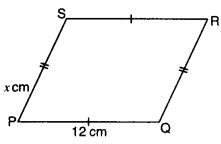
PQRS is a parallelogram, in which PQ = 12 cm and its perimeter is 40 cm. Find the length of each side of the parallelogram.
Solution:
Quadrilaterals Class 9 Extra Questions Maths Chapter 8 with Solutions Answers 1
Here, PQ = SR = 12 cm
Let PS = x and PS = QR
∴ x + 12 + x + 12 = Perimeter
2x + 24 = 40
2x = 16
x= 8
Hence, length of each side of the parallelogram is 12 cm, 8 cm, 12 cm and 8 cm.

Question 6.
Two consecutive angles of a parallelogram are (x + 60)° and (2x + 30)°. What special name can you give to this parallelogram?
Solution:
We know that consecutive interior angles of a parallelogram are supplementary.
∴ (x + 60° + (2x + 30)° = 180°
⇒ 3x° + 90° = 180°
⇒ 3x° = 90°
⇒ x° = 30°
Thus, two consecutive angles are (30 + 60)°, 12 x 30 + 30)”. i.e., 90° and 90°.
Hence, the special name of the given parallelogram is rectangle.

Question 7.
ONKA is a square with ∠KON = 45°. Determine ∠KOA.
Solution:
Since ONKA is a square
∴ ∠AON = 90°
We know that diagonal of a square bisects its ∠s
⇒ ∠AOK = ∠KON = 45°
Hence, ∠KOA = 45°

Question 8.
In quadrilateral PQRS, if ∠P = 60° and ∠Q : ∠R : ∠S = 2 : 3 : 7, then find the measure of ∠S.
Solution:
Let ∠Q = 2x, ∠R = 3x and ∠S = 7x
Now, ∠P + ∠Q + ∠R + ∠S = 360°
⇒ 60° + 2x + 3x + 7x = 360°
⇒ 12x = 300°
x = \(\frac{300^{\circ}}{12}\) = 25°
∠S = 7x = 7 x 25° = 175°

Quadrilaterals Class 9 Extra Questions Short Answer Type 1

Question 1.
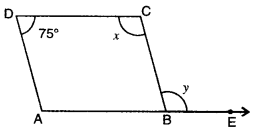
ABCD is a parallelogram in which ∠ADC = 75° and side AB is produced to point E as shown in the figure. Find x + y.
Solution:
Quadrilaterals Class 9 Extra Questions Maths Chapter 8 with Solutions Answers 2
Here, ∠C and ∠D are adjacent angles of the parallelogram.
∴ ∠C + ∠D = 180°
⇒ x + 75° = 180°
⇒ x = 105°
Also, y = x = 105° [alt. int. angles]
Thus, x + y = 105° + 105° = 210°

Question 2.
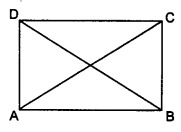
If the diagonals of a parallelogram are equal, then show that it is a rectangle.
Solution:
Quadrilaterals Class 9 Extra Questions Maths Chapter 8 with Solutions Answers 3
Given: A parallelogram ABCD, in which AC = BD.
To Prove: ΔBCD is a rectangle.
Proof : In ΔABC and ΔBAD
AB = AB (common]
AC = BD (given]
BC = AD(opp. sides of a ||gm]
⇒ ΔABC ≅ ΔBAD
[by SSS congruence axiom]
⇒ ∠ABC = ∠BAD (c.p.c.t.)
Also, ∠ABC + ∠BAD = 180° (co-interior angles)
∠ABC + ∠ABC = 180° [ ∵ ∠ABC = ∠BAD ]
2∠ABC = 180°
∠ABC = 1/2 x 180° = 90°
Hence, parallelogram ABCD is a rectangle.

Question 3.
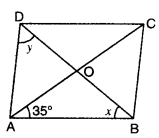
In the figure, ABCD is a rhombus, whose diagonals meet at O. Find the values of x and y.
Quadrilaterals Class 9 Extra Questions Maths Chapter 8 with Solutions Answers 4
Solution:
Since diagonals of a rhombus bisect each other at right angle.
In ∴ ΔAOB, we have
∠OAB + ∠x + 90° = 180°
∠x = 180° – 90° – 35°
= 55°
Also,
∠DAO = ∠BAO = 35°
∠y + ∠DAO + ∠BAO + ∠x = 180°
⇒ ∠y + 35° + 35° + 55° = 180°
⇒ ∠y = 180° – 125o = 55°
Hence, the values of x amd y are x = 55°, y = 55°.

Question 4.
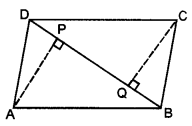
ABCD is a parallelogram and AP and CQ are perpendiculars from vertices A and C on diagonal BD (see fig.). Show that :
(i) ΔAPB = ΔCQD
(ii) AP = CQ
Solution:
Quadrilaterals Class 9 Extra Questions Maths Chapter 8 with Solutions Answers 5
Given : In ||gm ABCD, AP and CQ are perpendiculars from the
vertices A and C on the diagonal BD.
To Prove: (i) ΔAPB ≅ ΔCQD
(ii) AP = CQ
Proof : (i) In ΔAPB and ΔCQD
AB = DC (opp. sides of a ||gm ABCD]
∠APB = ∠DQC (each = 90°)
∠ABP = ∠CDQ (alt. int. ∠s]
⇒ ΔAPB ≅ ΔCQD[by AAS congruence axiom]
(ii) ⇒ AP = CQ [c.p.c.t.]

Quadrilaterals Class 9 Extra Questions Short Answer Type 2

Question 1.
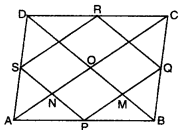
The diagonals of a quadrilateral ABCD are perpendicular to each other. Show that the quadrilateral formed by joining the mid-points of its sides is a rectangle.
Quadrilaterals Class 9 Extra Questions Maths Chapter 8 with Solutions Answers 6
Solution:
Given: A quadrilateral ABCD whose diagonals AC and BD are perpendicular to each other at O. P, Q, R and S are mid-points of side AB, BC, CD and DA respectively are joined are formed quadrilateral PQRS.
To Prove: PQRS is a rectangle.
Proof : In ∆ABC, P and Q are mid-points of AB and BC respectively.
∴ PQ || AC and PQ = \(\frac{1}{2}\) AC … (i) (mid-point theorem]
Further, in SACD, R and S are mid-points of CD and DA respectively.
SR || AC and SR = \(\frac{1}{2}\) AC … (ii) (mid-point theorem]
From (i) and (ii), we have PQ || SR and PQ = SR
Thus, one pair of opposite sides of quadrilateral PQRS are parallel and equal.
∴ PQRS is a parallelogram.
Since PQ|| AC PM || NO
In ∆ABD, P and S are mid-points of AB and AD respectively.
PS || BD (mid-point theorem]
⇒ PN || MO
∴ Opposite sides of quadrilateral PMON are parallel.
∴ PMON is a parallelogram.
∠ MPN = ∠ MON (opposite angles of ||gm are equal]
But ∠MON = 90° [given]
∴ ∠MPN = 90° ⇒ ∠QPS = 90°
Thus, PQRS is a parallelogram whose one angle is 90°
∴ PQRS is a rectangle.

Question 2.
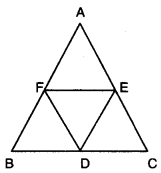
In the fig., D, E and F are, respectively the mid-points of sides BC, CA and AB of an equilateral triangle ABC. Prove that DEF is also an equilateral triangle.
Quadrilaterals Class 9 Extra Questions Maths Chapter 8 with Solutions Answers 7
Solution:
Since line segment joining the mid-points of two sides of a triangle is half of the third side.
Therefore, D and E are mid-points of BC and AC respectively.
⇒ DE = \(\frac{1}{2}\)AB …(i)
E and F are the mid-points of AC and AB respectively.
∴ EF = \(\frac{1}{2}\)BC … (ii)
F and D are the mid-points of AB and BC respectively.
∴ FD = \(\frac{1}{2}\) AC … (iii)
Now, SABC is an equilateral triangle.
⇒ AB = BC = CA
⇒ \(\frac{1}{2}\)AB = \(\frac{1}{2}\)BC = \(\frac{1}{2}\)CA
⇒ DE = EF = FD (using (i), (ii) and (iii)]
Hence, DEF is an equilateral triangle.

Question 3.
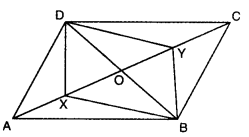
In quadrilateral ABCD of the given figure, X and Y are points on diagonal AC such that AX = CY and BXDY is a parallelogram. Show that ABCD is a parallelogram.
Quadrilaterals Class 9 Extra Questions Maths Chapter 8 with Solutions Answers 8
Solution:
Since BXDY is a parallelogram.
XO = YO
DO = BO
[∵ diagonals of a parallelogram bisect each other]
But AX = CY …. (iii) (given]
Adding (i) and (iii), we have
XO + AX = YO + CY
⇒ AO = CO …. (iv)
From (ii) and (iv), we have
AO = CO and DO = BO
Thus, ABCD is a parallelogram, because diagonals AC and BD bisect each other at O.

Question 4.
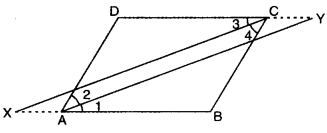
ABCD is a quadrilateral in which the bisectors of ∠A and ∠C meet DC produced at Y and BA produced at X respectively. Prove that
∠X +∠Y = \(\frac{1}{2}\)(∠A + ∠C)
Solution:
Quadrilaterals Class 9 Extra Questions Maths Chapter 8 with Solutions Answers 9
Here, ∠1 = ∠2 and ∠3 = ∠4
In ΔXBC, we have
∠X + ∠B + ∠4 = 180°
∠X + ∠B + \(\frac{1}{2}\)∠C = 180
In ΔADY, we have
∠2 + ∠D + ∠Y= 180°
\(\frac{1}{2}\) ∠A + ∠D + ∠Y = 180°
Adding (i) and (ii), we have
∠X + ∠Y + ∠B + ∠D + \(\frac{1}{2}\) ∠C + \(\frac{1}{2}\) ∠A = 360°
Also, in quadrilateral ABCD
∠A + ∠B + ∠C + ∠D = 360°
∠X + ∠Y + ∠B + ∠D + \(\frac{1}{2}\) ∠C + \(\frac{1}{2}\) ∠A = ∠A + ∠B + ∠C + ∠D
∠X + ∠Y = ∠A – \(\frac{1}{2}\) ∠A + \(\frac{1}{2}\) ∠C – \(\frac{1}{2}\) ∠C
∠X+ ∠Y = \(\frac{1}{2}\) (∠A + ∠C)

Quadrilaterals Class 9 Extra Questions Long Answer Type

Question 1.
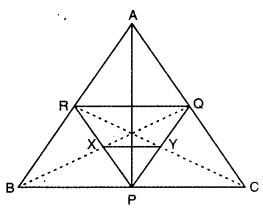
In the figure, P, Q and R are the mid-points of the sides BC, AC and AB of ΔABC. If BQ and PR intersect at X and CR and PQ intersect at Y, then show that XY = \(\frac{1}{4}\) BC.
Quadrilaterals Class 9 Extra Questions Maths Chapter 8 with Solutions Answers 10
Solution:
Here, in ΔABC, R and Q are the mid-points of AB and AC respectively.
∴ By using mid-point theorem, we have
RQ || BC and RQ = \(\frac{1}{2}\) BC
∴ RQ = BP = PC [∵ P is the mid-point of BC]
∴ RQ || BP and RQ || PC
In quadrilateral BPQR
RQ || BP, RQ = BP (proved above]
∴ BPQR is a parallelogram. [∵ one pair of opp. sides is parallel as well as equal]
∴ X is the mid-point of PR. [∵ diagonals of a ||gm bisect each other]
Now, in quadrilateral PCQR
RQ || PC and RQ = PC [proved above)
∴ PCQR is a parallelogram [∵ one pair of opp. sides is parallel as well as equal]
∴ Y is the mid-point of PQ [∵ diagonals of a ||gm bisect each other]
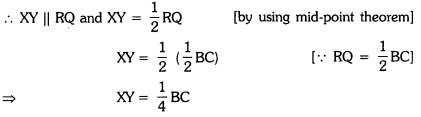
In ΔPQR
∴ X and Y are mid-points of PR and PQ respectively.
Quadrilaterals Class 9 Extra Questions Maths Chapter 8 with Solutions Answers 11

Question 2.
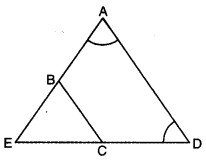
In the given figure, AE = DE and BC || AD. Prove that the points A, B, C and D are concyclic. Also, prove that the diagonals of the quadrilateral ABCD are equal.
Quadrilaterals Class 9 Extra Questions Maths Chapter 8 with Solutions Answers 12
Solution:
Since AE = DE
∠D = ∠A …. (i) [∵ ∠s opp. to equal sides of a Δ]
Again, BC || AD
∠EBC = ∠A …. (ii) (corresponding ∠s]
From (i) and (ii), we have
∠D = ∠EBC …. (iii)
But ∠EBC + ∠ABC = 180° (a linear pair]
∠D + ∠ABC = 180° (using (iii)]
Now, a pair of opposite angles of quadrilateral ABCD is supplementary
Thus, ABCD is a cyclic quadrilateral i.e., A, B, C and D’are concyclic. In ΔABD and ΔDCA
∠ABD = ∠ACD [∠s in the same segment for cyclic quad. ABCD]
∠BAD = ∠CDA [using (i)]
AD = AD (common]
So, by using AAS congruence axiom, we have
ΔABD ≅ ΔDCA
Hence, BD = CA [c.p.c.t.]

Question 3.
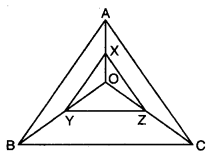
In ΔABC, AB = 8 cm, BC = 9 cm and AC = 10 cm. X, Y and Z are mid-points of AO, BO and CO respectively as shown in the figure. Find the lengths of the sides of ΔXYZ.
Quadrilaterals Class 9 Extra Questions Maths Chapter 8 with Solutions Answers 13
Solution:
Here, in ΔABC, AB = 8 cm, BC = 9 cm, AC = 10 cm.
In ΔAOB, X and Y are the mid-points of AO and BO.
∴ By using mid-point theorem, we have
XY = \(\frac{1}{2}\) AB = \(\frac{1}{2}\) x 8 cm = 4 cm
Similarly, in Δ𝜏BOC, Y and Z are the mid-points of BO and CO.
∴ By using mid-point theorem, we have
YZ = \(\frac{1}{2}\) BC = \(\frac{1}{2}\) x 9cm = 4.5 cm
And, in Δ𝜏COA, Z and X are the mid-points of CO and AO.
∴ ZX = \(\frac{1}{2}\) AC = \(\frac{1}{2}\) x 10 cm = 5 cm
Hence, the lengths of the sides of ΔXYZ are XY = 4 cm, YZ = 4.5 cm and ZX = 5 cm.

Question 4.
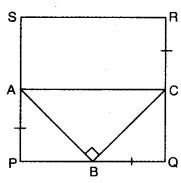
PQRS is a square and ∠ABC = 90° as shown in the figure. If AP = BQ = CR, then prove that ∠BAC = 45°
Quadrilaterals Class 9 Extra Questions Maths Chapter 8 with Solutions Answers 14
Solution:
Since PQRS is a square.
∴ PQ = QR … (I) [∵ sides of a square are equal]
Also, BQ = CR … (ii) [given]
Subtracting (ii) from (i), we obtain
PQ – BQ = QR – CR
⇒ PB = QC … (iii)
In Δ𝜏APB and Δ𝜏BQC
AP = BQ[given
∠APB = ∠BQC = 90°](each angle of a square is 90°)
PB = QC (using (iii)]

So, by using SAS congruence axiom, we have
ΔAPB ≅ ΔBQC
∴ AB = BC [c.p.c.t.]
Now, in ΔABC
AB = BC [proved above]
∴ ∠ACB = ∠BAC = x° (say) [∠s opp. to equal sides]
Also, ∠B + ∠ACB + ∠BAC = 180°
⇒ 90° + x + x = 180°
⇒ 2x° = 90°
x° = 45°
Hence, ∠BAC = 45°

Question 5.
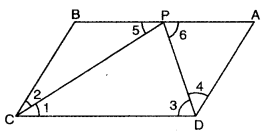
ABCD is a parallelogram. If the bisectors DP and CP of angles D and C meet at P on side AB, then show that P is the mid-point of side AB.
Solution:
Quadrilaterals Class 9 Extra Questions Maths Chapter 8 with Solutions Answers 15
Since DP and CP are angle bisectors of ∠D and ∠C respectively.
: ∠1 = ∠2 and ∠3 = ∠4
Now, AB || DC and CP is a transversal
∴ ∠5 = ∠1 [alt. int. ∠s]
But ∠1 = ∠2 [given]
∴ ∠5 = ∠2

Now, in ABCP, ∠5 = ∠2
⇒ BC = BP … (I) [sides opp. to equal ∠s of a A]
Again, AB || DC and DP is a transversal.
∴ ∠6= ∠3 (alt. int. Δs]
But ∠4 = ∠3 [given]
∴ ∠6 = ∠4
Now, in ΔADP, ∠6 = ∠4
⇒ DA = AP …. (ii) (sides opp. to equal ∠s of a A]
Also, BC = DA… (iii) (opp. sides of parallelogram)
From (i), (ii) and (iii), we have
BP = AP
Hence, P is the mid-point of side AB.

Question 6.
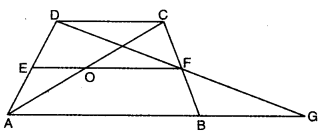
In the figure, ΔBCD is a trapezium in which AB || DC. E and F are the mid-points of AD and BC respectively. DF and AB are produced to meet at G. Also, AC and EF intersect at the point O. Show that :
(i) EO || AB
(ii) AO = CO
Quadrilaterals Class 9 Extra Questions Maths Chapter 8 with Solutions Answers 16
Solution:
Here, E and F are the mid-points of AD and BC respectively.
In ΔBFG and ΔCFD
BF = CF [given]
∠BFG = ∠CFD (vert. opp. ∠s]
∠BGF = ∠CDF (alt. int. ∠s, as AB || DC)
So, by using AAS congruence axiom, we have
ΔBFG ≅ ΔCFD
⇒ DF = FG [c.p.c.t.)
Now, in ΔAGD, E and F are the mid-points of AD and GD.
∴ By mid-point theorem, we have
EF || AG
or EO || AB
Also, in ΔADC, EO || DC
∴ EO is a line segment from mid-point of one side parallel to another side.
Thus, it bisects the third side.
Hence, AO = CO

Reproduction in Plants Class 7 Notes Science Chapter 12

On this page, you will find Reproduction in Plants Class 7 Notes Science Chapter 12 Pdf free download. CBSE NCERT Class 7 Science Notes Chapter 12 Reproduction in Plants will seemingly help them to revise the important concepts in less time.

CBSE Class 7 Science Chapter 12 Notes Reproduction in Plants

Reproduction in Plants Class 7 Notes Understanding the Lesson

1. The production of new individuals or young ones from their parents is known as

2. Most plants have roots, stems and These are called the vegetative parts of a plant. After a certain period of growth, most plants bear flowers.

3. There are two ways by which plants produce their offsprings; (i) asexual and (ii) sexual

4. There are several methods of asexual reproduction such as fragmentation, budding, spore formation and vegetative propagation.

5. When reproduction is through the vegetative parts of the plant, like stem, leaves or roots, it is known as vegetative propagation.

6. Artificial methods of vegetative propagation include layering, cutting and grafting.

7. Flowers are the reproductive parts of a plant.

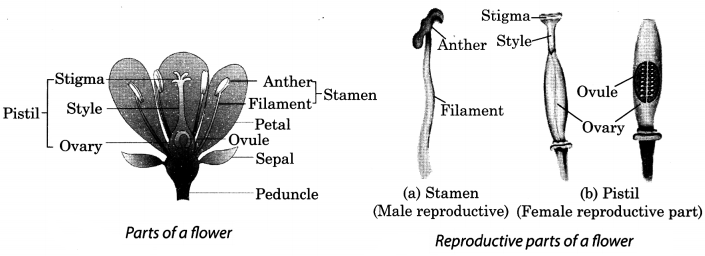
8. The stamens are the male reproductive part and the pistil is the female productive part of the flower.

Reproduction in Plants Class 7 Notes Science Chapter 12 1

7. A stamen consists of the anther and the filament. Anther contains pollen grains which produce male gam­etes.

8. A pistil consists of stigma, style and ovary. The ovary contains one or more ovules. The female gamete or the egg is formed in an ovule.

9. The flowers which contain either only the pistil or the only the stamens are unisexual flowers and those that contain both stamens and pistil are called bisexual flowers. For example, corn, papaya, etc., pro­duce unisexual flowers, whereas mustard, rose, etc. have bisexual flowers.

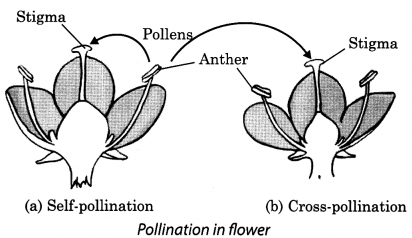
10. The transfer of pollen from the anther to the stigma of the flower is called It takes place with the help of wind, water and insects.

11. If the pollen lands on the stigma of the same flower, it is called self-pollination [Fig. 12.3(a)],

12. When the pollen of a flower lands on the stigma of another flower of the same plant, or that of different plant of the same kind, it is called cross-pollination [Fig. 3(b)].

Reproduction in Plants Class 7 Notes Science Chapter 12 2

13. The process of fusion of male and female gametes to form a zygote is called fertilisation.

14. The cell which results after fusion of the gametes is called a The zygote develops into an embryo.

15. Fruit is the mature ovary whereas ovules develops into a seed, which contains the developing embryo.

16. Seeds are dispersed to different places. That is why same kind of plants grow at different places in nature. Seed dispersal is aided by wind, water and animals.

17. Seed dispersal helps the plants in

  • preventing overcrowding,
  • avoiding competition for sunlight, water and minerals and
  • invading new habitats.

Class 7 Science Chapter 12 Notes Important Terms

Asexual reproduction: It is the type of reproduction in which new individuals are formed without the fusion of male and female gametes. For example, fragmentation, spore formation, cutting, layering, etc.

Budding: Budding is a form of asexual reproduction in which a new organism develops from an out­growth or bud due to cell division at one particular site.

Embryo: The zygote formed after fertilisation divides many times to form a multicellular structure called an embryo inside the seed. Embryo germinates to form a plant.

Fertilisation: The process of fusion of male and female gametes (to form a zygote) is called fertilisation.

Fragmentation: A type of asexual reproduction process, in which an organism breaks up into two or more fragments or pieces that can grow into new individuals is called fragmentation.

Gametes: The male and female reproductive cells are called gametes. In plants pollen grains produce male gametes and ovules produce female gametes.

Hypha: Any of the thread-like filamentous structure in fungus is called hypha.

Ovule: It is a structure inside the ovary which contains female gamete inside it.

Pollen grain: Pollen grain is male reproductive cells which produce male gametes.

Pollen tube: The tubular outgrowth from the pollen, grain that penetrates the ovule and releases male gametes there.

Pollination: The transfer of pollen from the anther to the stigma of a flower is called pollination.

Reproduction: It is the process by which new organisms are produced from their parents.

Seed dispersal: The spreading or transport of seed to different places is called seed dispersal.

Sexual reproduction: It is the type of reproduction in which new individuals are formed due to fusion of male and female gametes. For example, when plants reproduce with the help of seeds.

Spore: The spore is an asexual reproductive body which is covered by a hard protective coat to resist unfavourable conditions such as high temperature and low humidity.

Sporangium: It is an enclosure in which spores are formed.

Vegetative propagation: When new plants are formed from vegetative parts (roots, stems, leaves and buds) of the plants, it is known as vegetative propagation.

Zygote: In sexual reproduction, the cell form from the fusion of male and female gamete is called a zygote.