Simple Present Tense Worksheet Exercises for Class 3 CBSE with Answers

Simple Present Tense Worksheet Exercises for Class 3 CBSE with Answers 1
This grammar section explains English Grammar in a clear and simple way. There are example sentences to show how the language is used.

Simple Present Tense Worksheet Exercises for Class 3 CBSE with Answers PDF

Fundamentals

  • Verbs have forms called tenses that tell us when the action happens.
  • We use simple present tense to talk about the actions or events happening in the present.
  • If the action happens regularly we use the simple present tense.
  • The simple present tense is also used to state facts.
  • Add s or-es with singular nouns.

Presentation
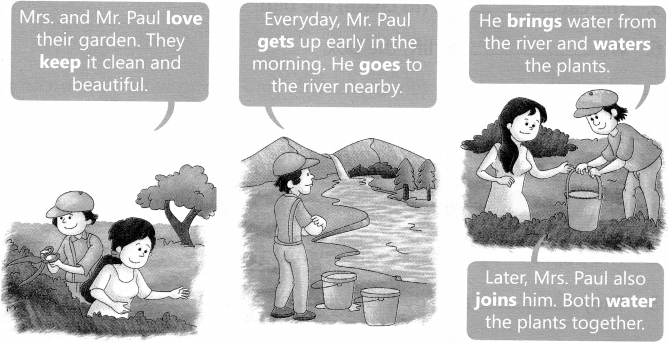
Read the picture story.
Simple Present Tense Worksheet Exercises for Class 3 CBSE with Answers 2

A. Answer the following questions according to the story.

1. What do Mrs. and Mr. Paul do in the garden? ___________________
2. Who goes to river nearby? ___________________
3. Who brings water from the river? ___________________

B. Fill in each blank with a verb from the story.

1. Mrs. and Mr. Paul ___________________ their garden.
2. Mr. Paul ___________________ up early everyday.
3. Mrs. Paul ___________________ the plants.

Simple Present Tense Worksheets for Grade 3 with Answers PDF

A. Tick the correct word.
1. Ram (love, loves) chocolates.
2. The girl (dance, dances) well.
3. The teacher (teach, teaches) us grammar.
4. The baby (cry, cries) for milk.
5. They (grow, grows) vegetables.
6. Birds (fly, flies) in the sky.

B. Write the correct form of the verbs in the following sentences.

1. She ___________ (drive) very well.
2. Water ___________ (boil) at 100 degrees.
3. I ___________ (work) hard.
4. My sister ___________ (speak) English.
5. They ___________ (open) the store at 8.00 am.
6. The box ___________ (contain) food.

C. Read the passage about Gopi’s morning routine.

I get up at 6 o’clock and brush my teeth. First of all I take a bath. Then, I take a cup of tea and some biscuits. I study my lessons and have a meal. I polish my shoes. I wear my uniform and comb my hair. I carry my lunch and leave for school.

Now tell Gopi’s Morning Routine in your words.
Gopi gets up at 6 o’clock. First of all he _________________________________________________________________________
Simple Present Tense Worksheet Exercises for Class 3 CBSE with Answers 3

The Living Organisms and Their Surroundings Class 6 Notes Science Chapter 9

On this page, you will find The Living Organisms and Their Surroundings Class 6 Notes Science Chapter 9 Pdf free download. CBSE NCERT Class 6 Science Notes Chapter 9 The Living Organisms and Their Surroundings will seemingly help them to revise the important concepts in less time.

CBSE Class 6 Science Chapter 9 Notes The Living Organisms and Their Surroundings

The Living Organisms and Their Surroundings Class 6 Notes Understanding the Lesson

1. Various types of things in the environment can be divided into two parts, e.g, living things and non­living things.

2. Animals, plants and microorganisms together constitute biotic components or living things.

3. Air, water, light, temperature, soil, etc., are abiotic components or non-living things.

4. The living things are called organims

5. Characteristics of living things are given below:

(a) Living things need food, air and water.
(b) Living things can grow.
(c) Living things respire.
(d) Living things excrete.
(e) Living things reproduce their own kind.
(f) Living things move.
(g) Living things respond to stimuli.

6. All the living things grow from a ‘single-cell’.

7. Animals move from one place to another

  • in search of food.
  • to protect themselves from their enemies.
  • to escape from natural calamities or natural hazards.

8. The movement of a part of the plant towards light is called

9. The change in surroundings to which living things respond are called

10. All living things take food. They use this food to obtain energy to grow, move, heal and stay alive.

11. The removal of waste substances from the body of living organism is called

12. The process by which living organisms produce new members of their species is called

13. All the living things start their life when they are born as babies or hatched from eggs.

14. The time period for which a living thing remains alive is called its lifespan.

15. The place or surroundings where a plant or animal lives is called their habitat.

16. There are two types of habitats:

(i) Terrestrial habitat
(ii) Aquatic habitat

17. Deserts, mountain and grassland are some terrestrial habitat.

18. Desert has a harsh environment with high temperature and low rainfall.

19. Desert animals live deep in burrows and come out only during the night to avoid intense heat.

20. Desert plants have deep roots and leaves reduced to spines.

21. Mountain region has very cold and windy climate.

22. Animals living in the mountain region have thick skin, fur, long hair to protect from snow.

23. Trees in mountain region are cone-shaped for easy sliding of snow falling on them.

24. Climate of forest or grassland is favourable for animals and plants living there. So it is densly populated.

25. Animals living in grassland have strong legs, long ears, and colour of their body similar to their surroundings to hide or mix up with them.

26. Aquatic habitat is broadly classified into saline water and freshwater.

27. Aquatic animals have streamlined body, gills or blowholes to survive and move in water.

28. Aquatic plants have reduced root system, hollow stem, floating leaves, etc.

29. There are different kinds of habitats having entirely different environmental conditions, such as temperature and amount of water.

30. The presence of specific body features or certain habits which enable a plant or animal to live in a particular habitat is called adaptation.

Class 6 Science Chapter 9 Notes Important Terms

Adaptation: The presence of specific body features or certain habits which enable a plant or an animals to live in a particular habitat is called adaptation.

Aquatic habitat: When organisms live in water, their place of living is known as aquatic habitat.

Biotic component: Living things of a habitat form its biotic component.

Excretion: The removal of nitrogenous waste substances from the body of a living being is called excretion.

Growth: Increase in size and total weight of the living organism is called growth.

Habitat: The place where an organism survives, flourish and reproduces is called habitat.

Living: These are the things which need water, air and nutrients for their survival.

Reproduction: The process of a living things to produce of its own kind is called reproduction.

Respiration: Respiration is a process in which air taken by an organism combines with the reserve food, undergoes oxidation and releases energy.

Stimulus: The factors like food, water, light, touch, gravitational force, etc., are stimuli to which plants and animals respond.

Verbs Worksheet Exercises for Class 3 CBSE with Answers

Verbs Worksheet Exercises for Class 3 CBSE with AnswersThis grammar section explains English Grammar in a clear and simple way. There are example sentences to show how the language is used.

Verbs Worksheet Exercises for Class 3 CBSE with Answers PDF

  • The words which show what someone or something does are called doing words. A doing word is called a verb.
  • Examples: Eat, sleep, dance, sing, run, fly, clap, touch, walk, play etc. are called verbs.
  • Is, Am, Are are different ways of saying be. They are called main verb when they are alone. I am a boy.
  • We use is and are to show actions taking place in present.
  • To talk about actions taking place in the present, or are still going on, we use a helping verb + doing word +ing.
    For example: She is reading a book.
  • Is it used with he, she, it. Am is used with I and Are is used with we, you, they.
  • Doing words also talk about something that has happened in the past. Here, verbs end with -ed or -d.
  • For example: walk- walked, sail- sailed, dance- danced, chase- chased
  • The verbs was and were are also forms of the verb be. We use was and were to show the events that happened in the past.
  • We use Was with he, she, it and Were with we, you, they.
  • We use has and have to show that a thing belongs to someone.
  • We use Have with I, we and they. Examples: I have. We have, They have
  • Has is used for singular nouns and pronouns. Have is used for plural nouns and pronouns.
  • Had is used to show that something belonged to someone or some other thing in the past.
  • We use Had for things that happened to people or affected them.

Verbs Worksheet for Grade 3 with Answers CBSE PDF

A. Underline the verb in each sentence.

1. We live in an apartment on the boulevard.
2. Some children learn very fast.
3. We go for swimming lessons on Sunday.
4. I like my new bike.
5. Babies sometimes sleep during the day.
6. My dad buys a newspaper every morning.

B. Complete the following sentences by writing ‘is’, ‘am’ or ‘are’ in the blanks.

1. The weather ___________ pleasant today.
2. All the children ___________ on the playground.
3. Boys! You ___________ always late for class.
4. You ___________ in the basketball team, too.
5. Nobody in my class ___________ interested in football.
6. This computer ___________ more expensive than that one.
7. Sally ___________ my best friend.
8. Mom and dad ___________ downstairs watching television.

C. Write “was’ or ‘were’ in the blanks in the following passage.

It ___________ a beautiful day and there ___________ n’t a cloud in the sky. Mom, dad and I ___________ in the garden. Dad ___________ in the vegetable garden planting some seeds and Mom and I ___________ busy with other jobs. The day ___________ hot and soon I ___________ feeling very tired. Mom and dad ___________ not tired at all. They went on working for a long time. I ___________ glad when it ___________ time to go inside and have a drink.

D. Fill in the blanks with is, am, or are along withing to complete the following sentences.

1. Hurry up! We ___________ for you. (wait)
2. That child ___________ bigger everyday. (get)
3. I ___________ for the shops to open. (wait)
4. I ___________ Jane tomorrow. (see)
5. My sister ___________ in Europe for the moment. (live)
6. His dad and brother ___________ (cycle) to the shops.
7. Two people ___________ (cook) dinner on the beach.
8. We ___________ (sit) in the classroom.

E. Add -ed to the following words.
Arrive ___________
Work ___________
Open ___________
Start ___________
Laugh ___________
Walk ___________

F. Fill in the following blanks with ‘has’ or ‘have’ and add -ed to the verb.

1. They ___________ (to clean) the house.
2. She ___________ (to close) the windows.
3. The man ___________ (to live) in London.
4. The policeman ___________ (to follow) the thief.
5. The cat ___________ (to chase) the bird.
6. We ___________ (to lift) the box.

G. Complete the following sentences with ‘had’ along with hints given in the box.
been – eaten – given – gone – had – known

1. We ___________ to the cinema before, (to be)
2. The pupils ___________ to the gym. (to go)
3. They ___________ already ___________ breakfast, (to eat)
4. Manju ___________ Gagan before the party, (to know)
5. Payal ___________ him the tip. (to give)

Body Movements Class 6 Notes Science Chapter 8

On this page, you will find Body Movements Class 6 Notes Science Chapter 8 Pdf free download. CBSE NCERT Class 6 Science Notes Chapter 8 Body Movements will seemingly help them to revise the important concepts in less time.

CBSE Class 6 Science Chapter 8 Notes Body Movements

Body Movements Class 6 Notes Understanding the Lesson

1. Bones and cartilages form the skeleton of our body. It gives the outer shape to our body and helps in movement. It also protects the inner organs.

2. Human beings and other animals show two types of body movements.

3. The movements of the body parts (g., mouth, head, backbone, etc.)

4. The movement of the whole body from one place to another (locomotion).

5. In human beings, the skeleton is inside the body, so it is called ‘endoskeleton’.

6. The X-ray images show the shape and number of bones in the various parts of our body.

7. There are 206 bones in human skeleton.

8. Cartilage is a firm but flexible material found at some places in the skeleton.

9. The place where two or more bones meet the skeleton is called a joint.

10. In the freely movable joints like elbow, shoulder, knee and hip joints, the ends of the bones joining the joint are held in place by a strong connective tissue which is called ‘ligament’.

11. The main types of joints in the human body are:

  • Hinge joint
  • Ball and socket joint
  • Pivot joint
  • Fixed joint

12. A hinge joint is a joint which allows movement in only one direction, e., forward -and backward, e.g., knee and elbow joints.

13. In the ball and socket joint, one end of the bone has a round shape like a ball which fits into a socket (hollow space) of the other bone. Such a joint allows movement in all directions, g., shoulder joint.

14. In a pivot joint, a cylindrical bone twines in a ring.

15. In some joints, the bones are held so tightly together that they cannot move at all. Such joints are called fixed joints.

16. Muscles are attached to the bones of our skeleton through strong fibres called

17. The bones are moved by alternate contractions and relaxations of two sets of muscles.

18. The human skeleton consists of skull, backbone, ribs, breastbones, shoulder bones, hip bones, arm bones and leg bones.

19. Ribs are attached to the upper part of the backbone forming a rib cage. There is a breastbone called ster­num in front of rib cage.

20. The shoulder bone consists of two bones – the collar bone and the shoulder blade.

21. The scientific name of collar bone is clavicle and that of shoulder bone is

22. The upper arm consists of a single bone called humerus.

23. The lower arm is from the elbow to the wrist. The lower arm is made up of two bones radius and

24. The upper leg consists of a single bone called

25. The lower leg consists of two bones tibia and fibula

26. There is a knee cap on the knee which is called

27. The bony part of our head is called The skull is made of 22 bony plates joined together.

28. The brain is made up of soft tissues which could be easily damaged without a hard covering.

29. The eyes are contained in two large cavities called ‘eye socket’ in front of the skull.

30. The scientific name of backbone is vertebral column.

31. The small bones which make up the backbone are called vertebra.

32. The chest bones are called ribs. There are 12 pairs of ribs in the chest of our body.

33. Heart, lungs and the liver lie inside the bony ribcage.

34. The hip bone form a large, basin-shaped frame at the lower end of the backbone, to which the legs are attached.

35. The hips bone has two sockets one each on the two sides of its lower part.

36. Our hand is made up of three parts – the wrist, the palm and the fingers.

37. The wrist consists of 8 small bones known as

38. The palm of the hand is composed of 5 longer bones called

39. The fingers are made up of jointed bones called phalanges.

40. Cockroaches and birds are the animals which have legs to walk, on the ground and wings to fly in the air.

41. The body of a cockroach is covered with hard and tough outer covering called ‘exoskeleton’.

42. A cockroach has six legs (three legs on each side of its body).

43. A cockroach has two pairs of wings attached to its breast by flight muscles.

44. Birds walk on the ground and also fly in the air.

45. Birds can fly because of their strong muscles and light bones which work together.

46. The body of an earthworm is soft and segmented having no bone.

47. An earthworm moves by stretching out its body in the front, keeping the hind end fixed to the ground. Then it fixes the front end and releases the hind end. It then shortens the body and pulls the hind end forward.

48. The streamlined body shape of the fish enables it to move through water with least resistance.

Class 6 Science Chapter 8 Notes Important Terms

Ball and socket joint: A joint in which rounded end of one bone fits into the cavity of the other bone is called ball and socket joint.

Backbone:
The backbone is a long hollow, rod-like structure running from the neck to the hips, inside our body. The scientific name of backbone is vertebral column.

Bristles: Hair like structures projecting out of the body of earthworms with which, it fixes itself with the ground.

Cartilage: It is the part of the skeleton that are not as hard as the bones but are tough and elastic.

Cavity: The bowl like part (hollow space) in the shoulder bone allows the rounded end of the arm bone to fit into it to form ball and socket joint.

Fixed joints: Some of the joints allow no movement. These are called fixed joints, e.g., joints in skull and upper jaw.

Gait of animals: The patterns of movement of limbs in animals during their locomotion over a solid surface is called gait of animals.

Hinge joint: Hinge joint is found in fingers, elbow and knee. It allows movement only in one direction. Muscle: Muscle is a soft tissue which is involved in the movement of bones.

Outer skeleton: Skeleton found outside the body is called outer skeleton, e.g., hair and nails in human. Pelvic bones: Bones in the hip region are called pelvic bones.

Pivotal joint: The joint where our neck joins the head is a pivotal joint.

Rib cage: Ribs join the chest bone and the backbone together to form a box. This is called rib cage.

Shoulder bones: The two bones of the shoulders, i.e., clavicle and scapula, are called shoulder bones.

Skeleton: The framework of the body i.e., made up of bones and cartilage is called skeleton.

Streamlined: The body shape where body tapers at both ends is called streamlined body, e.g., body of birds and fishes.

Adverb of Time Worksheet Exercises for Class 3 with Answers CBSE

Adverb of Time Worksheet Exercises for Class 3 with Answers CBSE

This grammar section explains English Grammar in a clear and simple way. There are example sentences to show how the language is used.

Adverb of Time Worksheet Exercises for Class 3 with Answers CBSE PDF

Fundamentals

  • Some adverbs tell us when an action takes place.
  • It tells the time of an action.
  • Late, early, yesterday, tomorrow are adverbs of time.

Presentation
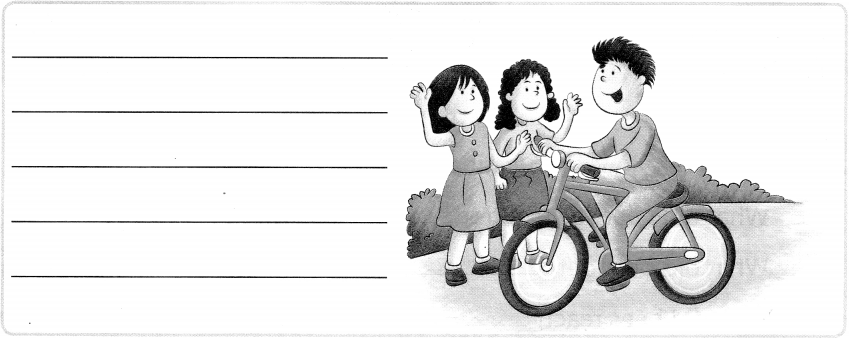
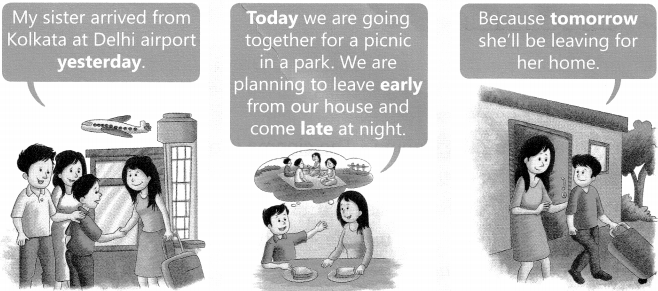
Read the picture story.
Adverb of Time Worksheet Exercises for Class 3 with Answers CBSE

A. Answer the following questions as per the story.

1. When did the sister arrive from Kolkata? ___________
2. When are they planning to leave and come? ___________
3. When will be the sister leaving for her home? ___________

B. Complete the following sentences using appropriate verbs or adverbs.

1. I saw him ___________
a. yesterday
b. tomorrow

2. I ___________ your father tomorrow.
a. see
b. am seeing

3. My plane ___________ tomorrow.
a. leaves
b. left

4. I haven’t seen her ___________ Monday.
a. since
b. for

5. I went there ___________
a. yesterday
b. tomorrow

Adverb of Time Worksheet for Class 3 with Answers CBSE PDF

A. Pick out adverbs from the following sentences. The first one has been done for you.

1. She will come soon. soon
2. The play will begin now. ___________
3. The boy came early. ___________
4. I will see him tomorrow. ___________
5. He has arrived today. ___________
6. The train will reach Delhi tomorrow. ___________
7. Your desire will be fulfilled soon. ___________
8. He also died soon after consuming it. ___________
9. Now let me bake a cake for my son. ___________
10. We should never fall into the hands of the moneylenders. ___________

B. Write whether the underlined adverb is describing when, where, or how an action happens.

1. Rohit quickly ate his lunch. ___________
2. Neil often reads books about vampires. ___________
3. Oliver immediately came to the rescue. ___________
4. When will you come here to visit us? ___________
5. Molly slowly walked to the barber shop. ___________
6. Sometimes Varun goes to the museum. ___________
7. Please speak clearly. ___________