Light Shadows and Reflection Class 6 Notes Science Chapter 11

On this page, you will find Light Shadows and Reflection Class 6 Notes Science Chapter 11 Pdf free download. CBSE NCERT Class 6 Science Notes Chapter 11 Light Shadows and Reflection will seemingly help them to revise the important concepts in less time.

CBSE Class 6 Science Chapter 11 Notes Light Shadows and Reflection

Light Shadows and Reflection Class 6 Notes Understanding the Lesson

1. Light is a form of energy. It enables us to see.

2. Light may be defined as an external physical cause that affects our eyes to produce the sensation of vision.

3. Light itself is not visible but in the presence of light other objects become visible.

4. There are some objects which have light of their own, g., torch, sun, etc. They are called luminous objects.

5. Objects which do not have light of their own are called non-luminous objects, g., chair, table, blackboard, etc. Such objects are visible only when light falls on it.

6. On the basis of passing of light through the objects, they are classified into three groups:

  • Transparent,
  • Translucent, and
  • Opaque.

7. Objects which allow the light to pass through them are called transparent We can see clearly through them, e.g., clean air, clean glass, clean water, cellophane paper, etc.

8. Objects which allow only a small amount of light to pass through them are called translucent We cannot see very clearly through them, e.g., wax paper, greased paper, butter paper, frosted glass, etc.

9. The objects which do not allow light to pass through them are called opaque We cannot see through them at all e.g., clay, wood, metal, stone, etc.

10. A shadow may be defined as the dark area caused by an opaque object when it prevents light from passing to the other side. It is only a dark region having no colour.

Light Shadows and Reflection Class 6 Notes Science Chapter 11 1

11. A shadow is formed only when light rays are blocked by an opaque object.

12. The shape of a shadow depends upon the shape of the object.

13. The size of the shadow depends upon the distance between that source of light and the opaque object. If the distance between the source of light and an opaque object is more, the size of the shadow decreases and vice-versa (Fig. 11.1).

Light Shadows and Reflection Class 6 Notes Science Chapter 11 2

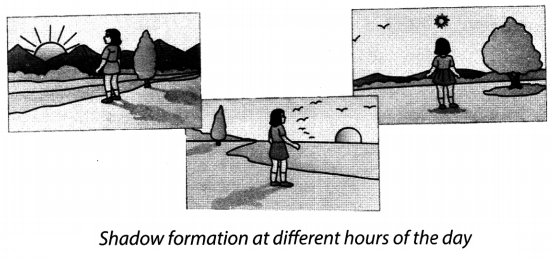
14. The shadow of an object is cast on the opposite side of the source of light.

15. The formation of shadow of one celestial body on the other is known as

16. When the moon comes in between the sun and the earth, the shadow of the moon falls on the earth. This phenomenon is known as solar eclipse.

17. When the earth comes in between the sun and the moon, the shadow of the earth falls on the moon. This is known as lunar eclipse.

18. A pinhole camera is a device which forms a photograph-like image of a bright object on a screen. It works on the principle that light travels in a straight line.

19. A pinhole camera can be made with simple materials and can be used to obtain the image of the sun and brightly lit objects.

20. Images formed by a pinhole camera are upside down. They are bright, real and inverted images.

21. There is an interesting pinhole camera in nature called a natural pinhole camera. When the sun rays falls on a tree, there are patches of sunlight of round shape seen on the ground. These circular shapes are, in fact, pinhole images of the sun. The gaps between the leaves, act as the pinholes.

22. Light always travels in a straight line. This is called rectilin­ear propagation of light.

23. The glass sheet which has a polished surface and the other surface remains shiny, smooth and reflective is called a mirror.

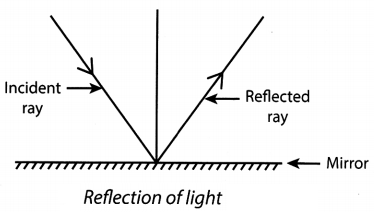
24. When a ray of light falls on a smooth polished surface of a mirror, it return back in the same medium. This phenomenon is called reflection of light. The ray of light that falls on a plane mirror is called incident ray and that returns back after reflection is called reflected ray. (Fig. 11.2).

Light Shadows and Reflection Class 6 Notes Science Chapter 11 3

25. The image formed by a plane mirror is exactly of same size and colour as that of the object. It is erect and laterally inverted.

Class 6 Science Chapter 11 Notes Important Terms

Luminous objects: Objects that give out or emit light of their own are called luminous objects, e. g., sun, torch, bulb, etc.

Non-luminous objects: Objects that do not have light of their own are called non-luminous objects. They are visible only when light falls on them, e.g., chair, book, blackboard, etc.

Transparent objects: The objects which allow the light to pass through them are called transparent objects, e.g., water, air, glass, etc.

Translucent objects: The objects through which light can pass partially and through which we cannot see anything clearly are called translucent objects, g., greased paper, butter paper, thin paper, oily paper, frosted glass, etc.

Opaque objects: The substances which do not allow the light to completely pass through them are called opaque objects; g., cement sheet, wall, book, etc.

Shadow: The dark patches formed on the other side of opaque objects, opposite to the light source, are called shadow of the objects.

Pinhole camera: It is a device which forms a photograph-like image of a bright object on a screen is called pinhole camera. It is based on the principle that light always travels in a straight line.

Rectilinear propagation of light: Light always travels in a straight line. This property of light is known as rectilinear propagation of light.

Mirror: A glass sheet having a polished surface at one side and a shiny, smooth and reflective surface on the other side is called mirror.

Reflection: The phenomenon due to which light bounces off or returns back from a highly polished surface is called reflection of light.

Reflected ray: The ray of light that bounces off or returns back after suffering reflection from a mirror is called reflected ray.

Incident ray: The ray of light that falls on a plane mirror is called incident ray.

Eclipse: The formation of shadow of one celestial body on another in space is called eclipse.

Circles Class 9 Extra Questions Maths Chapter 10 with Solutions Answers

Here we are providing Circles Class 9 Extra Questions Maths Chapter 10 with Answers Solutions, Extra Questions for Class 9 Maths was designed by subject expert teachers.

Extra Questions for Class 9 Maths Circles with Answers Solutions

Extra Questions for Class 9 Maths Chapter 10 Circles with Solutions Answers

Circles Class 9 Extra Questions Very Short Answer Type

Question 1.
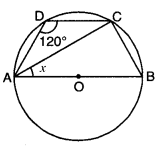
In the figure, O is the centre of a circle passing through points A, B, C and D and ∠ADC = 120°. Find the value of x.
Circles Class 9 Extra Questions Maths Chapter 10 with Solutions Answers 1
Solution:
Since ABCD is a cyclic quadrilateral
∠ADC + ∠ABC = 180°
[∴ opp. ∠s of a cyclic quad. are supplementary]
120° + ∠ABC = 180°
∠ABC = 180° – 120° = 60°
Now, ∠ACB = 90° [angle in a semicircle]
In rt. ∠ed ∆CB, ∠ACB = 90°
∠CAB + ∠ABC = 90°
x + 60° = 90°
x = 90° -60°
x = 30°

Question 2.
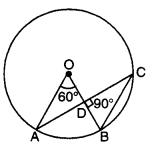
In the given figure, O is the centre of the circle, ∠AOB = 60° and CDB = 90°. Find ∠OBC.
Circles Class 9 Extra Questions Maths Chapter 10 with Solutions Answers 2
Solution:
Since angle subtended at the centre by an arc is double the angle
subtended at the remaining part of the circle.
∴ ∠ACB = \(\frac{1}{3}\) ∠AOB = \(\frac{1}{3}\) x 60° = 30°
Now, in ACBD, by using angle sum property, we have
∠CBD + ∠BDC + ∠DCB = 180°
∠CBO + 90° + ∠ACB = 180°
[∵ ∠CBO = ∠CBD and ∠ACB = ∠DCB are the same ∠s]
∠CBO + 90° + 30° = 180°
∠CBO = 180o – 90° – 30° = 60°
or ∠OBC = 60°

Question 3.
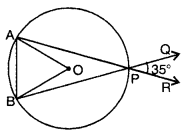
In the given figure, O is the centre of the circle with chords AP and BP being produced to R and Q respectively. If ∠QPR = 35°, find the measure of ∠AOB.
Circles Class 9 Extra Questions Maths Chapter 10 with Solutions Answers 3
Solution:
∠APB = ∠RPQ = 35° [vert. opp. ∠s]
Now, ∠AOB and ∠APB are angles subtended by an arc AB at centre and at the remaining part of the circle.
∴ ∠AOB = 2∠APB = 2 × 35° = 70°

Question 4.
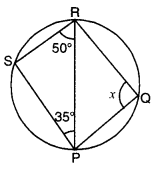
In the figure, PQRS is a cyclic quadrilateral. Find the value of x.
Circles Class 9 Extra Questions Maths Chapter 10 with Solutions Answers 4
Solution:
In ∆PRS, by using angle sum property, we have
∠PSR + ∠SRP + ∠RPS = 180°
∠PSR + 50° + 35o = 180°
∠PSR = 180° – 85o = 95°
Since PQRS is a cyclic quadrilateral
∴ ∠PSR + ∠PQR = 180°
[∵ opp. ∠s of a cyclic quad. are supplementary]
95° + x = 180°
x = 180° – 95°
x = 85°

Question 5.
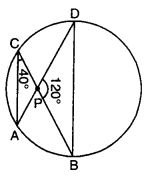
In the given figure, ∠ACP = 40° and BPD = 120°, then find ∠CBD.
Circles Class 9 Extra Questions Maths Chapter 10 with Solutions Answers 5
Solution:
∠BDP = ∠ACP = 40° [angle in same segment]
Now, in ∆BPD, we have
∠PBD + ∠BPD + ∠BDP = 180°
⇒ ∠PBD + 120° + 40° = 180°
⇒ ∠PBD = 180° – 160o = 20°
or ∠CBD = 20°

Question 6.
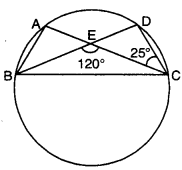
In the given figure, if ∠BEC = 120°, ∠DCE = 25°, then find ∠BAC.
Circles Class 9 Extra Questions Maths Chapter 10 with Solutions Answers 6
Solution:
∠BEC is exterior angle of ∆CDE.
∴ ∠CDE + ∠DCE = ∠BEC
⇒ ∠CDE + 25° = 120°
⇒ ∠CDE = 95°
Now, ∠BAC = ∠CDE [∵ angle in same segment are equal]
⇒ ∠BAC = 95°

Circles Class 9 Extra Questions Short Answer Type 1

Question 1.
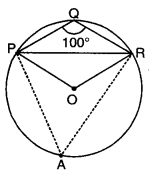
In the given figure, PQR = 100°, where P, Q and R are points on a circle with centre O. Find LOPR.
Circles Class 9 Extra Questions Maths Chapter 10 with Solutions Answers 7
Solution:
Take any point A on the circumcircle of the circle.
Join AP and AR.
∵ APQR is a cyclic quadrilateral.
∴ ∠PAR + ∠PQR = 180° [sum of opposite angles of a cyclic quad. is 180°]
∠PAR + 100° = 180°
⇒ Since ∠POR and ∠PAR are the angles subtended by an arc PR at the centre of the circle and circumcircle of the circle.
∠POR = 2∠PAR = 2 x 80° = 160°
∴ In APOR, we have OP = OR [radii of same circle]
∠OPR = ∠ORP [angles opposite to equal sides]
Now, ∠POR + ∠OPR + ∠ORP = 180°
⇒ 160° + ∠OPR + ∠OPR = 180°
⇒ 2∠OPR = 20°
⇒ ∠OPR = 10°

Question 2.
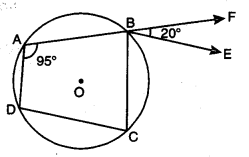
In figure, ABCD is a cyclic quadrilateral in which AB is extended to F and BE || DC. If ∠FBE = 20° and DAB = 95°, then find ∠ADC.
Circles Class 9 Extra Questions Maths Chapter 10 with Solutions Answers 8
Solution:
Sum of opposite angles of a cyclic quadrilateral is 180°
∴ ∠DAB + ∠BCD = 180°
⇒ 95° + ∠BCD = 180°
⇒ ∠BCD = 180° – 95° = 85°
∵ BE || DC
∴ ∠CBE = ∠BCD = 85°[alternate interior angles]
∴ ∠CBF = CBE + ∠FBE = 85° + 20° = 105°
Now, ∠ABC + 2CBF = 180° [linear pair]
and ∠ABC + ∠ADC = 180° [opposite angles of cyclic quad.]
Thus, ∠ABC + ∠ADC = ∠ABC + 2CBF
⇒ ∠ADC = CBF
⇒ ∠ADC = 105° [∵ CBF = 105°]

Question 3.
If the diagonals of a cyclic quadrilateral are diameters of the circle through the opposite vertices of the quadrilateral. Prove that the quadrilateral is a rectangle.
Solution:
Here, ABCD is a cyclic quadrilateral in which AC and BD are diameters.
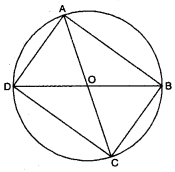
Circles Class 9 Extra Questions Maths Chapter 10 with Solutions Answers 9
Since AC is a diameter.
∴ ∠ABC = ∠ADC = 90°
[∵ angle of a semicircle = 90°]
Also, BD is a diameter
∴ ∠BAD = ∠BCD = 90° [∵ angle of a semicircle = 90°]
Now, all the angles of a cyclic quadrilateral ABCD are 90 each.
Hence, ABCD is a rectangle.

Question 4.
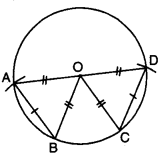
Equal chords of a circle subtends equal angles at the centre.
Circles Class 9 Extra Questions Maths Chapter 10 with Solutions Answers 10
Solution:
Given : In a circle C(O, r), chord AB = chord CD
To Prove : ∠AOB = ∠COD.
Proof : In ∆AOB and ∆COD
AO = CO (radii of same circle]
BO = DO [radii of same circle]
Chord AB = Chord CD (given]
⇒ ∆AOB = ACOD [by SSS congruence axiom]
⇒ ∠AOB = COD (c.p.c.t.]

Question 5.
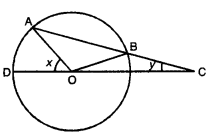
In the figure, chord AB of circle with centre O, is produced to Csuch that BC = OB. CO is joined and produced to meet the circle in D. If ∠ACD = y and ∠AOD = x, show that x = 3y.
Circles Class 9 Extra Questions Maths Chapter 10 with Solutions Answers 11
Solution:
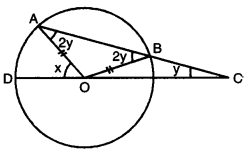
In AOBC, OB = BC
⇒ ∠BOC = ∠BCO = y [angles opp. to equal sides are equal]
Circles Class 9 Extra Questions Maths Chapter 10 with Solutions Answers 12
∠OBA is the exterior angle of ∆BOC
So, ∠ABO = 2y [ext. angle is equal to the sum of int. opp. angles]
Similarly, ∠AOD is the exterior angle of ∆AOC
∴ x = 2y + y = 3y

Question 6.
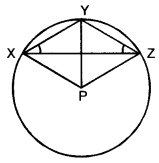
In the given figure, P is the centre of the circle. Prove that : ∠XPZ = 2(∠X∠Y + ∠YXZ).
Circles Class 9 Extra Questions Maths Chapter 10 with Solutions Answers 13
Solution:
Arc XY subtends ∠XPY at the centre P and ∠XZY in the remaining part of the circle.
∴ ∠XPY = 2 (∠X∠Y)
Similarly, arc YZ subtends ∠YPZ at the centre P and ∠YXZ in the remaining part of the circle.
∴ ∠YPZ = 2(∠YXZ) ….(ii)
Adding (i) and (ii), we have
∠XPY + ∠YPZ = 2 (∠XZY + ∠YXZ)
∠XP2 = 2 (∠XZY + ∠YXZ)

Circles Class 9 Extra Questions Short Answer Type 2

Question 1.
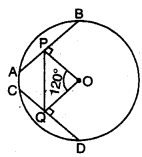
In the given figure, AB and CD are two equal chords of a circle with centre O. OP and OQ are perpendiculars on chords AB and CD respectively. If ∠POQ = 120°, find ∠ APQ.
Circles Class 9 Extra Questions Maths Chapter 10 with Solutions Answers 14
Solution: Since
AB = CD
∴ OP = OQ [∵ equal chords are equidistant from the centre]
∠OPQ = ∠OQP:
[by using isosceles triangle property, angles opp. to equal sides of a ∆]
In APOQ, by using angle sum property, we have
∠OPQ + ∠OQP + ∠POQ = 180°
⇒ ∠OPQ + ∠OPQ + 120° = 180°
⇒ 2∠0PQ = 60°
⇒ ∠OPO = 30°
Now, ∠APQ + ∠OPQ = 90°
⇒ ∠APQ + 30° = 90°
⇒ ∠APQ = 90° – 30o = 60°
Hence, ∠APQ = 60°

Question 2.
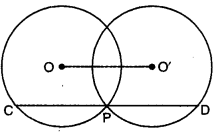
Two circles whose centres are O and O’ intersect at P. Through P, a line parallel to OO’, intersecting the circles at C and D is drawn as shown in the figure. Prove that CD = 2OO’.
Circles Class 9 Extra Questions Maths Chapter 10 with Solutions Answers 15
Solution:
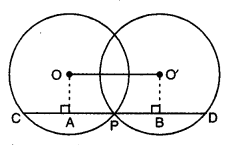
Draw OA ⊥ CD and O’B ⊥ CD
Now, OA ⊥ CD
OA ⊥ CP
CA = AP = \(\frac{1}{2}\)CP
CP = 2AP ….(i)
Circles Class 9 Extra Questions Maths Chapter 10 with Solutions Answers 16
Similarly, O’B ⊥ CD
O’B ⊥ PD
⇒ PB = BD = \(\frac{1}{2}\)PD
⇒ PD = 2PB
Also, CD = CP + PD
= 2AP + 2PB = 2(AP + PB) = 2AB
CD = 2OO’ [∵ OABO’ is a rectangle]

Question 3.
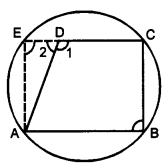
ABCD is a parallelogram. The circle through A, B and C intersects (produce if necessary) at E. Prove that AE = AD.
Solution:
Circles Class 9 Extra Questions Maths Chapter 10 with Solutions Answers 17
Given : ABCD is a parallelogram. Circle through A, B and C intersects CD produced in E.
To Prove: AE = AD
Proof : ABCE is a cyclic quadrilateral.
∴ ∠B + ∠E = 180° …(i)
ABCD is a parallelogram.
∴ ∠B = ∠1 … (ii)
Also, ∠1 + ∠2 = 180° [linear pair]
∠B + ∠2 = 180° …(iii) [using (ii)]
Now, from (i) and (iii), we have
∠B + ∠E = ∠B + ∠2
∠E = ∠2 In ∆DE, we have
∠E = ∠2
⇒ AD = AE [side opposite to equal angles of a A]

Question 4.
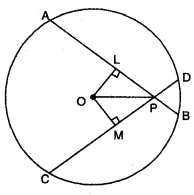
If two equal chords of a circle intersect within a circle, prove that the line segment joining the point of intersection to the centre makes equal angles with the chords.
Solution:
Circles Class 9 Extra Questions Maths Chapter 10 with Solutions Answers 18
Join OP, draw OL ⊥ AB and OM ⊥ CD.
Thus, L and M are the mid-points of AB and CD respectively. Also, equal chords are equidistant from the centre.
∴ OL = OM
Now, in right-angled As OLP and OMP
OL = OM
OP = OP [common]
∠OLP = ∠OMP [each = 90°]
So, by RHS congruence axiom, we have
∆OLP ≅ ∆OMP
Hence, ∠OPL = ∠OPM [c.p.c.t.]

Question 5.
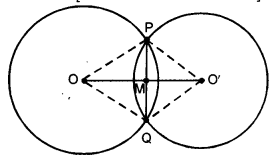
If two circles intersect in two points, prove that the line through their centres is the perpendicular bisector of the common chord.
Solution:
Circles Class 9 Extra Questions Maths Chapter 10 with Solutions Answers 19
Given : Two circles Clo, r) and C(O’, s)intersect at P and Q.
To Prove : OO’ is perpendicular bisector of the chord PQ.
Const. : Join OP, OQ, O’P and O’Q
Proof : In ∆OPO’ and ∆OQO’
OP = OQ [radii of same circle]
OᏢ = QQ [radii of same circle]
OO’ = OO [common]
⇒ ∆OPO’ ≅ ∆OQO’ [by SSS congruence axiom]
⇒ ∠POM = ∠QOM [c.p.c.t.]
Now, in ∆POM and ∆QOM
OP = OQ
(radii of same circle]
∠POM = ∠OOM [proved above]
OM = OM [common]
∆POM ≅ ∆QOM [by SAS congruence axiom]
PM = QM and ∠PMO = ∠QMO [c.p.c.t.]
Also, ∠PMO+ ∠QMO = 180° [linear pair]
⇒ ∠PMO = ∠QMO = 90°
Hence, OO’ is the perpendicular bisector of the chord PQ.

Circles Class 9 Extra Questions Long Answer Type

Question 1.
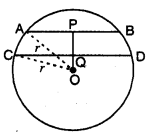
In the given figure, O is the centre of a circle of radius r сm, OP and OQ are perpendiculars to AB and CD respectively and PQ = 1cm. If AB || CD, AB = 6cm and CD = 8cm, determine r.
Circles Class 9 Extra Questions Maths Chapter 10 with Solutions Answers 20
Solution:
Since the perpendicular drawn from the centre of the circle to a chord bisects the chord. Therefore, P and Q are mid-points of AB and CD respectively.
Consequently, AP = BP = \(\frac{1}{2}\)AB = 3 cm
and CQ = QD = \(\frac{1}{2}\)CD = 4 cm
In right-angled AQAP, we have
OA2 = OP2 + AP2
r2 = OP2 + 32
r2 = OP2 + 9
In right-angled ∆OCQ, we have
OC2 = OQ2 + CQ2
r2 = OQ2 + 42
p2 = OQ2 + 16 … (ii)
From (i) and (ii), we have
OP2 + 9 = OQ2 + 16
OP2 – OQ2 = 16 – 9
x2 – (x – 1)2 = 16 -9 [where OP = x and PQ = 1 cm given]
x2 – y2 – 1 + 2x = 7
2x = 7 + 1
x = 4
⇒ OP = 4 cm
From (i), we have
r2 = (4)2 + 9
r2 = 16 + 9 = 25
r = 5 cm

Question 2.
In a circle of radius 5 cm, AB and AC are two chords such that AB = AC = 6 cm, as shown in the figure. Find the length of the chord BC.
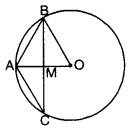
Circles Class 9 Extra Questions Maths Chapter 10 with Solutions Answers 21
Solution:
Here, OA = OB = 5 cm [radii]
AB = AC = 6 cm
∴ B and C are equidistant from A.
∴ AO is the perpendicular bisector of chord BC and it intersect BC in M.
Now, in rt. ∠ed ∆AMB, M = 90° ….(i)
∴ By using Pythagoras Theorem, we have
BM2 = AB2 – AM2
= 36 – AM2
Also, in rt. ∠ed ∆BMO, ∠M = 90°
∴ By using Pythagoras Theorem, we have
BM2 = BO2 – MO2 = 25 – (AO – AM)2
From (i) and (ii), we obtain
25 – (AO – AM)2 = 36 – AM\(\frac{1}{2}\)
25 – AOC – AM2 + 240 × AM = 36 – AM\(\frac{1}{2}\)
25 – 25 + 2 × 5 × AM = 36
10 AM = 36
AM = 3.6 cm
From (i), we have
BM2 = 36 – (3.6)2 = 36 – 12.96 = 23.04
BM = √23.04 = 4.8 cm
Thus, BC = 2 × BM
= 2 × 4.8 = 9.6 cm
Hence, the length of the chord BC is 9.6 cm.

Question 3.
In the given figure, AC is a diameter of the circle with centre O. Chord BD is perpendicular to AC. Write down the measures of angles a, b, c and d in terms of x.
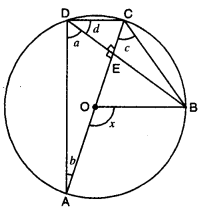
Circles Class 9 Extra Questions Maths Chapter 10 with Solutions Answers 22
Solution:
Here, AC is a diameter of the circle.
∴ ∠ADC = 90°
⇒ ∠a + ∠d = 90°
In right-angled ∆AED, ∠E = 90°
∴ ∠a + 2b = 90°
From (i) and (ii), we obtain
∠b = ∠d ….(iii)
Also, ∠a = ∠c … (iv)
[∠s subtended by the same segment are equal]
Now, ∠AOB and ∠ADB are angles subtended by an arc AB at the centre and at the remaining part of the circle.
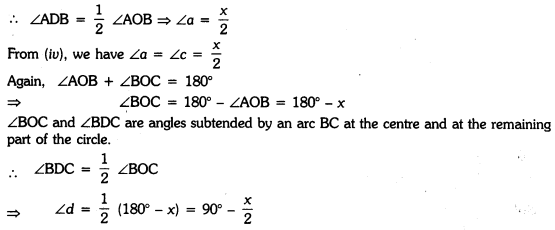
Circles Class 9 Extra Questions Maths Chapter 10 with Solutions Answers 23
Circles Class 9 Extra Questions Maths Chapter 10 with Solutions Answers 24

Question 4.
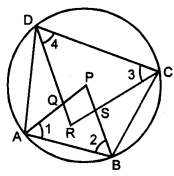
Show that the quadrilateral formed by angle bisectors of a cyclic quadrilateral is also cyclic.
Circles Class 9 Extra Questions Maths Chapter 10 with Solutions Answers 25
Solution:
Given : A cyclic quadrilateral ABCD in which AP, BP, CR and DR are the angle bisectors of ∠A, ∠B, 2C and ∠D respectively such that a quadrilateral PQRS is formed. To Prove: PQRS is a cyclic quadrilateral.
Proof : Since ABCD is a cyclic quadrilateral.
∴ ∠A + 2C = 180° and ∠B + ∠D = 180°
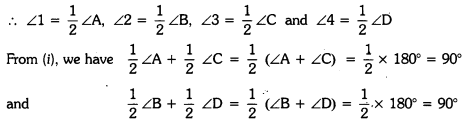
Also, AP, BP, CR and DR are the angle bisectors of ∠A, ∠B, ∠C and ∠D respectively.
Circles Class 9 Extra Questions Maths Chapter 10 with Solutions Answers 26
or ∠1 + ∠3 = 90°
and ∠2 + ∠4 = 90°
Now, in ∆APB, by angle sum property of a ∆
∠1 + ∠2 + ∠P = 180° … (iii)
Again, in ∆CRD, by angle sum property of a ∆
∠3 + ∠4 + ∠R = 180° …(iv)
Adding (iii) and (iv), we have
∠1 + ∠2 + ∠3 + ∠4 + ∠P + ∠R = 180° + 180°
90° + 90° + ∠P + ∠R = 360° [using (ii)]
∠P + ∠R= 360° – 180° = 180°
i.e., the sum of one pair of the opposite angles of quadrilateral PQRS is 180°.
Hence, the quadrilateral PQRS is a cyclic quadrilateral.

Circles Class 9 Extra Questions HOTS

Question 1.
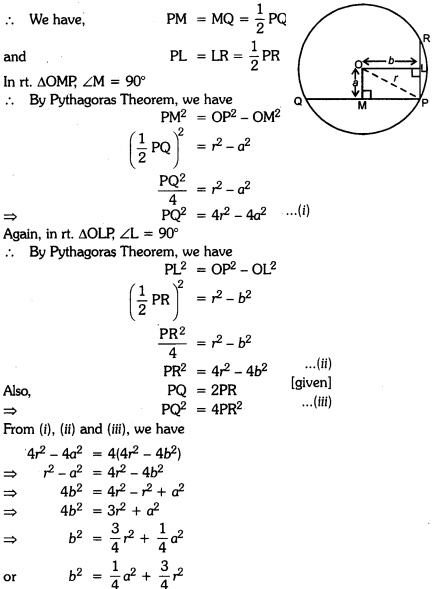
PQ and PR are the two chords of a circle of radius r. If the perpendiculars drawn from the centre of the circle to these chords are of lengths a and b, PQ = 2PR, then prove that:
\(b^{2}=\frac{a^{2}}{4}+\frac{3}{4} r^{2}\)
Solution:
In circle Clo, r), PQ and PR are two chords, draw OM I PQ, OL I PR, such that OM = a
and OL = b. Join OP. Since the perpendicular from the centre of the circle to the chord of the circle, bisects the chord.
Circles Class 9 Extra Questions Maths Chapter 10 with Solutions Answers 27

Question 2.
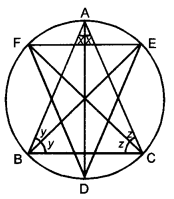
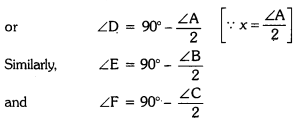
Bisectors of angles A, B and C of triangle ABC intersect its circumcircle at D, E and F respectively. Prove that the angles of the ∠DEF are 90° – \(\frac{\angle A}{2}\), 90° – \(\frac{\angle B}{2}\) and 90° – \(\frac{\angle C}{2}\) respectively.
Solution:
Circles Class 9 Extra Questions Maths Chapter 10 with Solutions Answers 28
Let ∠BAD = x, ∠ABE = y
and ∠ACF = 2, then
∠CAD = x, ∠CBE = y
and ∠BCF = 2 [AD, BE and CF is bisector of ∠A, ∠B and ∠C]
In ∆BC,
∠A + ∠B + ∠C = 180°
⇒ 2x + 2y + 2Z = 180°
or x + y + Z = 90° …(i)
Now, ∠ADE = ∠ABE
and ∠ADF = ∠ACF [angles in the same segment of a circle]
⇒ ∠ADE = y and ∠ADF = Z
⇒ ∠ADE + ∠ADF = y + Z
or ∠D = y + Z …(ii)
From (i) and (ii), we have
x + 2D = 90°
⇒ ∠D = 90° – x
Circles Class 9 Extra Questions Maths Chapter 10 with Solutions Answers 29

Circles Class 9 Extra Questions Value Based (VBQs)

Question 1.
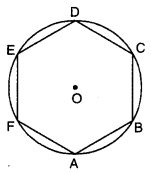
A small cottage industry employing people from a nearby slum area prepares round table cloths having six equal designs in the six segment formed by equal chords AB, BC, CD, DE, EF and FA. If O is the centre of round table cloth (see figure). Find ∠AOB, ∠AEB and ∠AFB. What value is depicted through this question ?
Circles Class 9 Extra Questions Maths Chapter 10 with Solutions Answers 30
Solution:
Since six equal designs in the six segment formed by equal chords AB, BC, CD, DE, EF and FA.
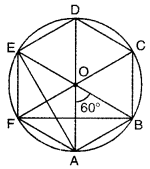
Therefore, we have six equilateral triangles as shown in the figure. Since ∆AOB, ∆BOC, ∆COD, ∆DOE, ∆EOF
∴ Each angle is equal to 60°.
Circles Class 9 Extra Questions Maths Chapter 10 with Solutions Answers 31
∠AOB = 60°
∠AOB, ∠AEB and ∠AFB are angles subtended by an arc AB at the FK centre and at the remaining part of the circle.

∴ ∠AEB = ∠AFB = \(\frac{1}{2}\) ∠AOB = \(\frac{1}{2}\) × 60° = 30°
Thus, ∠AEB = ∠AFB = 30°
Value depicted : By employing people from a slum area to prepare round table clothes reali∠e their social responsibility to work for helping the ones in need.

Question 2.
A circular park of radius 10 m is situated in a colony. Three students Ashok, Raman and Kanaihya are standing at equal distances on its circumference each having a toy telephone in his hands to talk each other about Honesty, Peace and Discipline.
(i) Find the length of the string of each phone.
(ii) Write the role of discipline in students’ life.
Solution:
(i) Let us assume A, B and C be the positions of three students Ashok, Raman and Kanaihya
respectively on the circumference of the circular park with centre O and radius 10 m. Since the centre of circle coincides with the centroid of the equilateral ∆ABC.
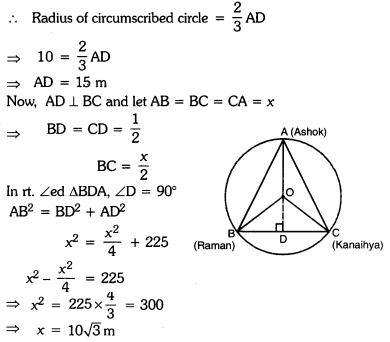
Circles Class 9 Extra Questions Maths Chapter 10 with Solutions Answers 32
Thus, the length of each string is 10√3 m.
(ii) In students’ life, discipline is necessary. It motivates as well as nurture the students to make him a responsible citizen.

Motion and Measurement of Distances Class 6 Notes Science Chapter 10

On this page, you will find Motion and Measurement of Distances Class 6 Notes Science Chapter 10 Pdf free download. CBSE NCERT Class 6 Science Notes Chapter 10 Motion and Measurement of Distances will seemingly help them to revise the important concepts in less time.

CBSE Class 6 Science Chapter 10 Notes Motion and Measurement of Distances

Motion and Measurement of Distances Class 6 Notes Understanding the Lesson

1. In prehistoric times, the humans did not have means of transport. They moved around on foot.

2. Invention of wheels made a great change in modes of transport.

3. Animals were used to pull vehicles that moved on wheels.

4. Until the beginning of the 19th century, people still depended on animal power to transport them from place to place.

5. The invention of steam engine introduced a new source of power.

6. In our day to day life, measurement of distance or length is a very common activity.

7. Measurement involves comparison of an unknown quantity with some known fixed quantity of the same kind. This known fixed quantity is called a

8. Each measurement consists of a number describing the numerical value of the measure and the unit in which the quantity is measured.

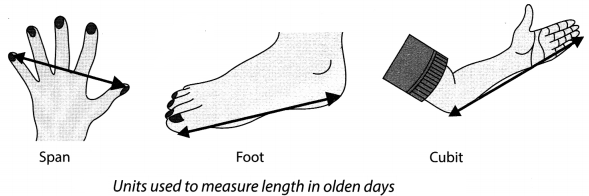
9. While measuring things, accuracy is needed. A variety of units can be used for this purpose.

Light Shadows and Reflection Class 6 Notes Science Chapter 11 1

10. A unit of measurement which has fixed value and which does not change from person to person or place to place, is called standard unit of measurement.

11. To make accurate measurement, we need a proper measuring device.

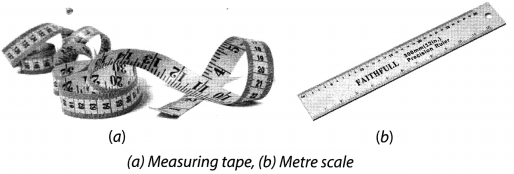
12. Some commonly used length-measuring devices are:

(a) Ruler or metre scale
(b) Measuring tape

Light Shadows and Reflection Class 6 Notes Science Chapter 11 2

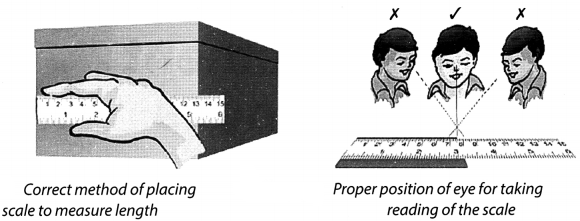
13. While measuring length using a metre scale or a ruler, we must follow carefully the steps given below:

(a) The ruler should be kept along the length of the object so that the zero mark on the ruler coincides with the one end of the object as shown in figure.
(b) While taking the measurement, the eyes should be correctly positioned.
Light Shadows and Reflection Class 6 Notes Science Chapter 11 3
(c) If the edge of the ruler is worn out or broken, the measurement should be taken from any other full mark of the ruler.

14. For measuring a curved line, a string and a ruler is used.

15. The string is placed along a curved line and its ends are marked on the string.

16. The length of the string between the marked point is measured using a ruler.

17. When we look around, we find that some objects are at rest and some are moving or in motion.

18. The motion of all the objects are not of the same type.

19. Some of the important types of motion are:

  • Rectilinear motion
  • Circular motion
  • Periodic motion

20. Some objects may have more than one type of motion at the same time.

Class 6 Science Chapter 10 Notes Important Terms

Circular motion: When a body moves in a circular path, its motion is known as circular motion.

Distance: Measurement of gap between two points in certain units is called distance.

Measurement: The comparison of some unknown quantity with a fixed known quantity of the same kind is called measurement.

Motion: The state of objects in which they are moving, e., they are changing their place with time is called motion.

Periodic motion: The motion which repeats itself after regular intervals of time, is called periodic motion.

Rectilinear motion: When a body moves along a straight-line path, it is called rectilinear motion.

SI units: A unit of measurement which has fixed value and it does not change from person to person or place to place is called SI units.

Units of measurement: The fixed quantity with the help of which comparison of some unknown quantity is done is called units of measurement.

Simple Future Tense Worksheet Exercises for Class 3 CBSE with Answers

Simple Future Tense Worksheet Exercises for Class 3 CBSE with Answers 1
This grammar section explains English Grammar in a clear and simple way. There are example sentences to show how the language is used.

Simple Future Tense Worksheet Exercises for Class 3 CBSE with Answers PDF

  • Verbs have forms called tenses that tell us when the action happens.
  • We use the simple future tense to talk about the actions or events that will happen in the future.
  • We can use either ‘shall’ or ‘will’ with the pronouns ‘I’ and ‘we’.
  • We use ‘will’ with the pronouns ‘you’, ‘he’, ‘she’, ‘it’ and ‘they’.

Presentation
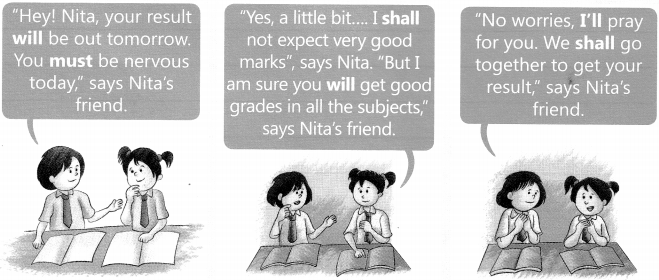
Read the picture story.
Simple Future Tense Worksheet Exercises for Class 3 CBSE with Answers 2

A. Answer the following questions from the story above.
1. Whose result will be out tomorrow?
_______________________________________________

2. Will Nita expect good marks in her result?
_______________________________________________

3. Who will pray for Nita’s result?
_______________________________________________

B. Fill in the blanks with verbs from the story above.

Nita and her friend are talking about Nita’s result. Nita’s result ____________ out tomorrow. She is feeling nervous too. She ____________ not expect good marks but her friend ____________ assure her that she would get good grades in all the subjects. “I ____________ go along with you to get your result,” says Nita’s friend.

Simple Future Tense Worksheets for Grade 3 with Answers PDF

A. Fill in the blanks with Will or Shall.

1. Amit ____________ fly to Paris next month.
2. I ____________ go to the movie tomorrow.
3. My parents ____________ visit my uncle next week.
4. The teacher ____________ teach history next time.
5. We ____________ play games in the playground.
6. Sahil ____________ speak Chinese.

B. Underline the verbs that show that something will happen ¡n the future.

1. She will look at her plans.
2. The team will win next time.
3. We will buy a nice present.
4. They will know the answer.
5. Mother will make some more tea.
6. They will take a taxi.

C. Unjumble the words to make sentences in simple future tense.

1. Tommorrow/grass/the/ Pawan/ will/cut
Pawan _____________________________________

2. his/to /take/ brother/Mohit/zoo/will/the/tomorrow
Mohit _____________________________________

3. The/ cat/mouse/will/eat/the
The cat _____________________________________

4. Girls/run/race/week/the/will/the/in/next/two
The two girls _____________________________________

Simple Past Tense Worksheet Exercises for Class 3 CBSE with Answers

Simple Past Tense Worksheet Exercises for Class 3 CBSE with Answers 1
This grammar section explains English Grammar in a clear and simple way. There are example sentences to show how the language is used.

Simple Past Tense Worksheet Exercises for Class 3 CBSE with Answers PDF

  • Verbs have forms called tenses that tell us when the action happens.
  • We use the simple past tense to talk about actions or events that happened in the past.
  • The simple past tense is usually made by adding ‘ed’ to the verb.
  • If a verb ends in e, we add’d’ to change it to simple past tense.
  • If a verb ends in y, we change the y to ‘i’ before adding ‘ed’.

Presentation
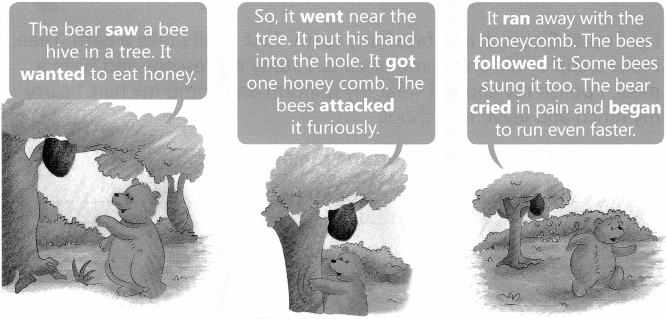
Read the picture story.
Simple Past Tense Worksheet Exercises for Class 3 CBSE with Answers 2

A. Answer the following questions as per the story.

1. What did bear see in a tree? ___________
2. What did bear get? ___________
3. How did bees react? ___________

B. Match the present form of verb with the past form of verb.
Simple Past Tense Worksheet Exercises for Class 3 CBSE with Answers 3

Simple Past Tense Worksheets for Grade 3 with Answers PDF

A. Rewrite the story using the past tense.
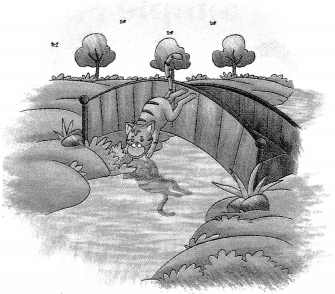
Kitty is a greedy cat. One day she find a large piece of cake. She want to eat it alone in some quiet and peaceful place. She run towards the forest with the cake in her mouth. She come to a bridge on the way. As she starts to cross the bridge, she look down at the clear water in the river. She see her own reflection in the water. She think to her herself that there is another cat there with a nice piece of cake! She wants to have that cake too. So, she jump into the river to snatch it from the other cat. Sadly, she loses her own piece of cake in the water. She comes out of the water with great difficulty and goes away feeling sad and angry.
Simple Past Tense Worksheet Exercises for Class 3 CBSE with Answers 4
_____________________________________________________________________________________________________________________
_____________________________________________________________________________________________________________________
_____________________________________________________________________________________________________________________
_____________________________________________________________________________________________________________________
_____________________________________________________________________________________________________________________
_____________________________________________________________________________________________________________________

B. Use the past form of the given words from the box to fill in the blanks.
wake – win – teach – sing – fall – dance – steal – hurt – carry – ring

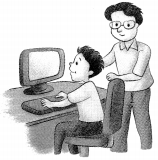
1. Dad ___________ me how to use the computer. Simple Past Tense Worksheet Exercises for Class 3 CBSE with Answers 5
2. The bell ___________ loudly.
3. Everyone ___________ and ___________ at the picnic.
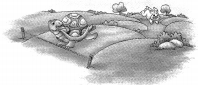
4. The tortoise ___________ the race.
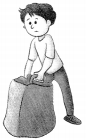
5. The player down and ___________ his leg. Simple Past Tense Worksheet Exercises for Class 3 CBSE with Answers 6
6. Somebody ___________ my purse in the market.
7. He ___________ a large bag. Simple Past Tense Worksheet Exercises for Class 3 CBSE with Answers 7
8. They ___________ up early.