Getting to Know Plants Class 6 Notes Science Chapter 7

On this page, you will find Getting to Know Plants Class 6 Notes Science Chapter 7 Pdf free download. CBSE NCERT Class 6 Science Notes Chapter 7 Getting to Know Plants will seemingly help them to revise the important concepts in less time.

CBSE Class 6 Science Chapter 7 Notes Getting to Know Plants

Getting to Know Plants Class 6 Notes Understanding the Lesson

1. Plants are living things, they grow in soil and remain fixed at a place with the help of roots.

2. Plant do not take food like animals but they make their own food by the process of photosynthesis.

3. Plants are of different shapes and sizes.

4. Most of the plants can be classified into three groups: herbs, shrubs and trees on the basis of certain characteristics.

5. Herbs are small plants having a soft and delicate stem. They have a very short life span. For example, tomato, grass, coriander, etc.

6. Shrubs are medium-sized plants with a hard and woody stem. They are bigger than herbs but smaller than trees.

7. The life span of shrubs is many years but it is less than that of trees. For example, tulsi, lemon, etc.

8. Trees are tall and big plants with a hard and thick woody stem called trunk. Branches in a tree appear higher upon the stem. For example, neem, mango, etc.

9. Shrubs and trees are both woody plants.

10. Climbers are plants having thin, long and weak stem which cannot stand upright but readily climbs up a neighbouring support. It has special organs called tendrils for climbing. For example, pea plant, bitter gourd, etc.

11. A plant having thin, long and weak stem which cannot stand upright and spreads on the ground is called a It grow along the ground or other surfaces by extending long shoots. For example, strawberry plant, money plant, etc.

12. Root is that part of plant which is below the ground (in the soil).

13. Roots are mainly of two types:

(i) Taproots
(ii) Fibrous roots

14. Taproot have a main root originated from the base of the stem. It has many smaller roots, called lateral roots, attached to the main root.

15. Fibrous root do not have any main root and all roots seem similar.

16. The stem is the part of the plant which rises vertically up from the ground. Stems of most of the plants are quite strong and can stand erect on their own.

17. The thick main stem of the tree is known as Most of the tree trunks are covered with a tough layer called ‘bark’.

18. The stem carries the prepared food from the leaves to other parts of the plants.

19. A leaf is thin, broad, flat and green part of a plant which is attached to the stem. It has tiny pores called stomata.

20. A leaf mainly consists of two parts-lamina and petiole.

21. The leaf contains a green coloured pigment called

22. Two kinds of venation is found on leaves:

(i) Reticulate venation
(ii) Parallel venation

23. Plants having leaves with reticulate venation have taproots while plants having leaves with parallel venation have fibrous roots.

24. are the most beautiful part of a plant. They vary in size, shape and colour.

25. The flower contains the reproductive organ.

26. Different parts of flower are pedicel, sepals, petals, stamens, carpel.

27. A fruit is that part of a plant that contains seeds. For example, apple, orange, etc.

Class 6 Science Chapter 6 Notes Important Terms

Climbers: A plant having thin, long and weak stem which cannot stand upright but, readily climbs up a neighbouring support (like a fence) or a tree is called a climber.

Conduct: To carry a substance from one place to other is called conduct.

Creeper: A plant having thin, long and weak stem which cannot stand upright and spreads on the ground is called a creeper.

Fibrous root: Some plants do not have a main root. They have a bunch of similar roots called fibrous roots.

Herbs: Herbs are small plants having a soft and delicate stem.

Lamina: The broad green part of the leaf is called lamina.

Lateral roots: Smaller roots which arise from main roots in the taproot system are called the lateral roots.

Midrib: The thick vein in the middle of the leaf is called the midrib.

Ovules: Small bead-like structures attached in the inner wall of the ovary are called ovules.

Parallel venation: In the leaves of grass, veins are parallel to one another. This is called parallel vena­tion.

Petals: Petals are variously coloured leaf-like structures present in the flowers.

Petiole: The part of leaf by which it is attached to the stem is called petioles.

Photosynthesis: A process by which green plants make their food from sunlight, carbon dioxide and water is called photosynthesis.

Pistil: The innermost, female reproductive part of a flower is called pistil.

Reticulate venation: When veins and veinlets form a net like design in both sides of midrib, the vena­tion is called reticulate venation.

Sepal: Sepal is the outer green part which protect the inner parts of flower when it is a bud.

Shrubs: Shrubs are medium-sized plants with a hard and woody stem branching out near the base.

Stamen: Stamen is the male reproductive part of a flower.

Taproot: The root system in which a single root arises from the base of the stem, with secondary and tertiary branches is called taproot system.

Transpiration: The loss of water in the form of vapours from the stomata in leaves is called transpira­tion.

Trees: Trees are tall and big plants with a hard and thick woody stem.

Veins: Threadlike structures in leaf are called veins.
Changes Around Us Class 6 Notes Science Chapter 6

On this page, you will find Changes Around Us Class 6 Notes Science Chapter 6 Pdf free download. CBSE NCERT Class 6 Science Notes Chapter 6 Changes Around Us will seemingly help them to revise the important concepts in less time.

CBSE Class 6 Science Chapter 6 Notes Changes Around Us

Changes Around Us Class 6 Notes Understanding the Lesson

1. An alteration in the physical or chemical properties of a matter due to the effect of some kind of energy is called a change.

2. The changes may affect the size, colour, shape and state of a body.

3. Example:
(i) Folding of paper-change in shape
(ii) Melting of ice-change in state

4. Almost everything in the surrounding undergoes some changes.

5. Effect of force, effect of heat, effect of reaction are the factors which make a thing to undergo a change.

6. Heating may cause the expansion of certain materials.

7. Changes can be classified into two types:
(i) Physical and chemical changes.
(ii) Reversible and irreversible changes.

8. A change in which property of a substance is not changed is called a physical change.

9. If a substance loses its identity during a change and gets converted into new substance with a new property, it is called a chemical change.

10. A change which can be reversed to its original state after removing its cause is called reversible change.

11. A change which cannot be reversed back to its original state, is termed as irreversible change.

Class 6 Science Chapter 6 Notes Important Terms

Changes: An alteration in the physical or chemical properties of a matter due to the effect of some kind of energy is called a change.

Contraction: A process in which an object becomes smaller or shrinks is called contraction.

Evaporation: The process in which liquid changes into vapour is called evaporation.

Expansion: The process in which an object becomes bigger in size is called expansion.

Melting: The process by which solid melts into liquid on heating is called melting.

Separation of Substances Class 6 Notes Science Chapter 5

On this page, you will find Separation of Substances Class 6 Notes Science Chapter 5 Pdf free download. CBSE NCERT Class 6 Science Notes Chapter 5 Separation of Substances will seemingly help them to revise the important concepts in less time.

CBSE Class 6 Science Chapter 5 Notes Separation of Substances

Separation of Substances Class 6 Notes Understanding the Lesson

1. A mixture is a substance that contains particles of two or more types of substances mixed together.

2. There are two types of mixtures: heterogeneous and homogeneous.

3. Mixture are needed to be separated

  • to remove undesirable substances.
  • to get desirable substances.
  • to obtain highly pure substances.

4. We have so many methods to separate the components of mixture.

5. Methods of separation may be classified into following groups:

  • Separation of solids from solids.
  • Separation of insoluble solids from liquids.
  • Separation of soluble solids from liquids.
  • Separation of two immiscible liquids.

6. Handpicking is the method in which the constituents are separated by simply picking them by hand.

7. In handpicking, the solid undesirable components that are less in quantity are picked up and separated.

8. The process of separating grains from the stalks is called threshing. Farmers beat the bundles of stalks attached to the grains with a stick. Animals like bullocks are allowed to crush the stalks and then the grains are separated from stalks.

9. Separation of stalks from grains is also done by machines called threshers.

Separation of Substances Class 6 Notes Science Chapter 5 1

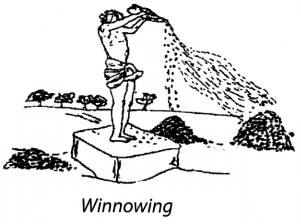
10. Winnowing is the method of separating the lighter components of a mixture from the heavier ones with the help of blowing air.

11. The mixture is made to fall from a height. Husk particles being light in weight are blown away by the wind.

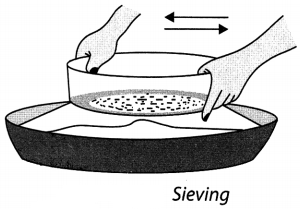
12. Sieving is the process of separating the bigger particles from the smaller ones with the help of sieve.

Separation of Substances Class 6 Notes Science Chapter 5 2

13. We choose a sieve having holes larger than the size of the particles of one component and smaller than other.

14. The mixture is shaken on the sieve so that the particles smaller than the holes of the sieve pass through the holes and fall down and the particles larger than its holes remain on it.

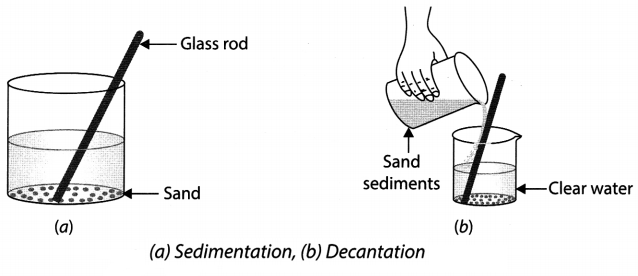
15. When the heavier component in a mixture settles after water is added to it, the process is called sedimentation.

16. The Process of separating a liquid (top layer) from settled solid (sediment) without disturbing it is called decantation.

Separation of Substances Class 6 Notes Science Chapter 5 3

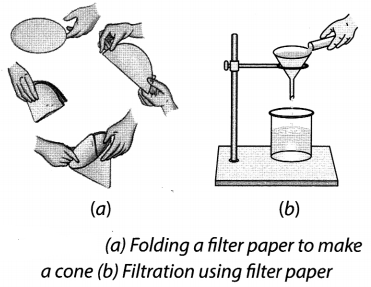
17. Filtration is the process of separating an insoluble solid from a liquid with the help of a filter paper or strainer.

18. We use filter paper or strainer for the process of filtration.

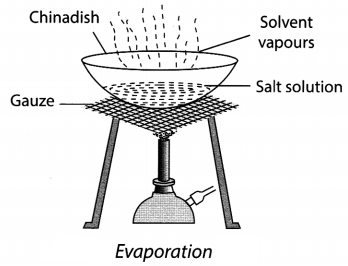
19. When a liquid is heated, it converts from liquid into vapour form. This is called evaporation.

20. Evaporation is a continuous process which takes place wherever water is present. This process is used to separate dissolved salt from water.

Separation of Substances Class 6 Notes Science Chapter 5 4

Separation of Substances Class 6 Notes Science Chapter 5 5

21. If during evaporation, heating is stopped just before the mixture completely dries up and we let it cool, crystals of the pure substance will be formed. This process is called crystallisation.

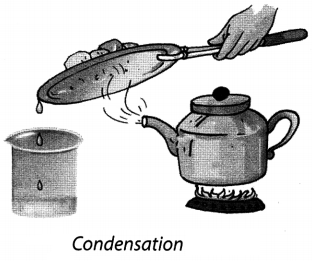
22. The process of conversion of water vapour into its liquid form is called condensation.

23. Condensation is reverse of evaporation.

24. A saturated solution is the solution which cannot dissolve any more solute in it at a given temperature.

Separation of Substances Class 6 Notes Science Chapter 5 6

25. The maximum amount of a solute that can be dissolved in a fixed amount of solvent at a particular temperature, is called solubility.

26. Sometimes, when more than two substances are mixed, one method of separation is not sufficient. We have to use more than one method.

27. Drinking water that reaches us also passes through many processes of purification.

Class 6 Science Chapter 5 Notes Important Terms

Churning: The process of agitation or stirring of a liquid to separate the lighter particles of a suspended solid from the liquid is called churning.

Condensation: The process of conversion of water vapour into its liquid form is called condensation.

Decantation: The process of separating a liquid (top layer) from a settled solid (sediment) without disturbing it is called decantation.

Evaporation: The process of removing water from a mixture either by heating on flame or direct sun­light is called evaporation.

Filtration: The process of separating an insoluble solid from a liquid with the help of a filter paper and funnel or strainer.

Handpicking: The method in which the constituents are separated by simply picking them up by hand, is called handpicking.

Saturated solution: A saturated solution is the solution which cannot dissolve any more solute in it at a given temperature.

Sedimentation: When the heavier component in a mixture settles after water is added to it, the process is called sedimentation.

Sieving: The process of separating the bigger particles from the smaller ones with the help of a sieve is called sieving.

Solution: A solution is a uniform mixture of two or more substances out of which any of its components cannot be identified separately.

Threshing: The process of separating grains from the stalks is called threshing.

Winnowing: The method of separating the lighter components of a mixture from the heavier ones with the help of blowing air is called winnowing.

Adverbs of Place Worksheet Exercises for Class 3 CBSE with Answers

Adverbs of Place Worksheet Exercises for Class 3 CBSE with Answers
This grammar section explains English Grammar in a clear and simple way. There are example sentences to show how the language is used.

Adverbs of Place Worksheet Exercises for Class 3 CBSE with Answers

Fundamentals

  • Some adverbs answer the question where the action takes place.
  • Here, there, above and outside tell us where the action takes place.
    Look at the examples.

    • She lives there.
    • I live here.
    • She looked at the wall above
    • They are playing outside.

Presentation
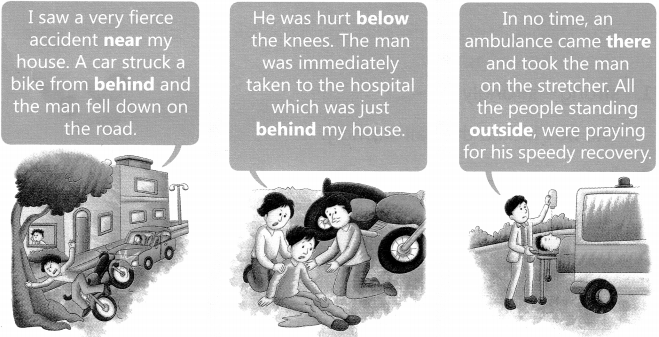
Read the picture story.
Adverbs of Place Worksheet Exercises for Class 3 CBSE with Answers 1

A. Answer the following questions from the story above.

1. Where did the accident take place? ___________
2. What happened to the man? ___________
3. What happened when the ambulance arrived? ___________

B. Fill in the blanks as per the story.

1. The man was hurt ___________ the knees.
2. The hospital was just ___________ the house.
3. An ambulance came ___________ in no time
4. The people were standing ___________.

Adverbs of Place Worksheet Exercises with Answers for Class CBSE PDF

A. Unjumble the words to make sentences. Don’t forget to put the adverbs (in italics) in correct order. (behind the verb or object). The first one has been done for you.

1. is / over there / the cinema – The cinema is over there.
2. inside / go / let’s – ___________
3. the kitchen / downstairs / is – ___________
4. playing / the kids / are / outside – ___________
5. she / not / been / here / has – ___________
6. the bathroom / is / upstairs – ___________
7. were / everywhere / we / for / looking / you – ___________
8. we / anywhere / you / find / couldn’t – ___________

B. Use the where words from the box to fill in the blanks.

1. Come ___________
2. Don’t go ___________
3. I searched her ___________
4. I saw the dark clouds ___________
5. Please come ___________
6. Get ___________

Sorting Materials Into Groups Class 6 Notes Science Chapter 4

On this page, you will find Sorting Materials Into Groups Class 6 Notes Science Chapter 4 Pdf free download. CBSE NCERT Class 6 Science Notes Chapter 4 Sorting Materials Into Groups will seemingly help them to revise the important concepts in less time.

CBSE Class 6 Science Chapter 4 Notes Sorting Materials Into Groups

Sorting Materials Into Groups Class 6 Notes Understanding the Lesson

1. There is a vast variety of objects everywhere.

2. All objects around us are made up of one or more materials.

3. Some of these objects are living and some are non-living.

4. Different things have different shapes, sizes and colours.

5. Things can be grouped in several groups on the basis of similarities in their properties.

6. The process of sorting and grouping things according to their chemical or physical properties is called classification.

7. Classification makes locating objects easier.

8. Anything that occupies space and has mass is called matter.

9. All materials/substances are made of matter.

10. Matter can be classified into three states:

  • Solid
  • Liquid
  • Gas

11. A substance which is made up of matter and is used for making objects is called material,

12. Materials may be of two types:

  • Man-made materials
  • Natural materials

13. It is the property of material that decides where and how to use it in the appropriate manner.

14. Properties may be of two types:

(a) Physical properties
(b) Chemical properties

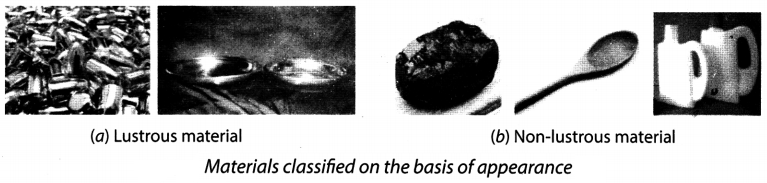
15. Appearance: Some materials (objects) may have shining appearance, while others may have dull appearance.

16. On the basis of their appearance, all the materials are classified into two groups:

(a) Materials having lustre.
(b) Materials not having lustre.

17. Materials which are shiny in appearance are called lustrous materials whereas materials lacking this shine are called non-lustrous materials.

Sorting Materials Into Groups Class 6 Notes Science Chapter 4 1

18. Hardness: Some substances are hard while some are soft. Those materials which cannot be easily compressed, cut, moulded or scratched, are called hard materials whereas those materials which can be easily compressed, cut, moulded or scratched are called soft materials.

19. Solubility:

  • Soluble: Substances that get dissolved in water are called soluble or miscible substances.
  • Insoluble: Substances which do not dissolve in water are called insoluble or immiscible substances.
  • Solubility of gases: Solubility of gases in water is very less.

20. Buoyancy: Some materials float on water while others sink.

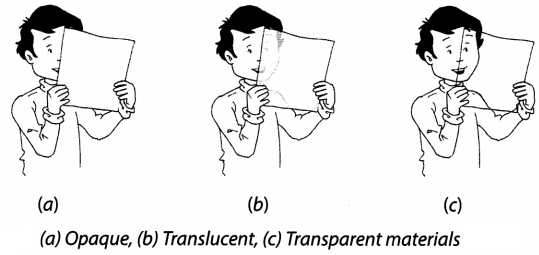
21. Transparency: The property of material due to which we can see through it clearly is called transparency.

  • Opaque: Materials through which we are not able to see are called opaque materials.
  • Translucent: Materials through which things are only partially visible are called translucent materials.

Sorting Materials Into Groups Class 6 Notes Science Chapter 4 2

22. Things are grouped together on the basis of similarities and differences in their properties and to study their properties.
Transparent: Materials through which things can be seen clearly are called transparent materials.

Class 6 Science Chapter 4 Notes Important Terms

Hard: Those materials which cannot be easily compressed, cut, moulded or scratched are called hard.

Insoluble: Those materials which do not dissolve in water are called insoluble.

Lustre: The natural shine present on the surface of certain materials is called lustre.

Material: A substance which is made up of matter and is used for making objects is called material.

Metals: Materials which show properties like lustre, malleability, ductility and a sonority are called metals.

Opaque: Those materials which do not allow the light to pass through them are called opaque.

Rough: Those materials which have uneven surface are called rough.

Soluble: Those materials which dissolves in water are called soluble.

Translucent: Those materials which partially allow light to pass through them are called translucent.

Transparent: Materials which allow light to pass through them are called transparent.