Fun with Magnets Class 6 Notes Science Chapter 13

On this page, you will find Fun with Magnets Class 6 Notes Science Chapter 13 Pdf free download. CBSE NCERT Class 6 Science Notes Chapter 13 Fun with Magnets will seemingly help them to revise the important concepts in less time.

CBSE Class 6 Science Chapter 13 Notes Fun with Magnets

Fun with Magnets Class 6 Notes Understanding the Lesson

1. Magnets are very useful materials.

2. The word magnet is derived from the old French word magnet which means lodestone.

3. The ore from which magnet is extracted is called magnetite.

4. Magnets are classified as-Natural magnets and Artificial magnets.

5. Magnetic materials are those which get attracted to magnets, e. g., iron, nickel and cobalt.

6. Non-magnetic materials are those that do not get attracted to magents, e. g., paper, wood, plastic, etc.

7. The ends of magnet are called poles. One is the north pole and the other is the south pole.

8. Attraction is maximum at the poles of a magnet.

9. Magnets are also used for finding directions.

10. A freely suspended magnet always comes to rest in the north-south direction.

11. The like poles of the magnets repel each other whereas unlike poles attract each other.

12. There are several methods of making magnets.

13. Rubbing a permanent magnet on an iron can make the iron a temporary magnet.

14 Temporary magnets lose their property of magnetism after a short period of time.

15. Permanent magnets do not lose their property of magnetism even after a long period of time.

16. The permanent magnets can also lose their magnetism and get demagnetized if hammered or heated or dropped from a height.

17. A magnet also loses its magnetism if it is not stored properly.

18. Bar magnets must always be stored in pairs with their opposite poles on the same side.

19. Magnets are used in ATM cards, credit cards, audio cassettes, floppy disks, generators, etc.

Class 6 Science Chapter 13 Notes Important Terms

Compass: A small glass containing as magnetized needle pivoted on a nail is called compass.

Magnet: A substance that has the property of attracting objects made of iron, cobalt and nickel is called magnet.

Magnetite: The ore of iron which has magnetic properties is called magnetite.

North pole: When suspended freely, one pole of the magnet always pointed towards north. This is known as north pole.

South pole: When suspended freely, the end of a magnet which points towards south is known as south pole.
Can and May Worksheet Exercises for Class 3 CBSE with Answers

Can and May Worksheet Exercises for Class 3 CBSE with Answers 1
This grammar section explains English Grammar in a clear and simple way. There are example sentences to show how the language is used.

Can and May Worksheet Exercises for Class 3 CBSE with Answers

Fundamentals

  • We use can to say that someone is able to do something.
  • We use may to ask if a person is allowed to do something and to tell someone that they are allowed to do something.
  • We use may to talk about things that are possible or likely.

Presentation
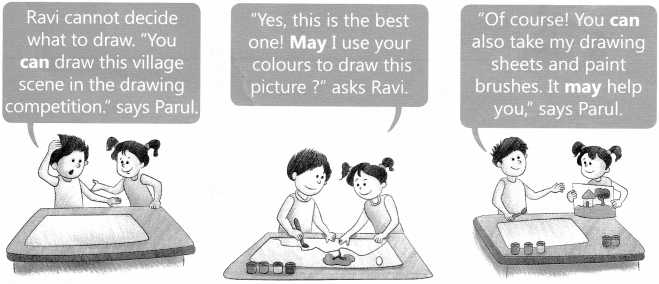
Read the picture story.
Can and May Worksheet Exercises for Class 3 CBSE with Answers 2

A, Answer the following questions as per the story,
1. What advice does Parul give to Ravi? ____________
2. What permission does Ravi take from Parul? ____________
3. What does Parul offer Ravi? ____________

B. Fill in the blanks using Can’ or May’.
1. My teacher ____________ recite 24 poems.
2. Amit and Sumit ____________ attend the private party.
3. Grandmother ____________ eat when she comes out of surgery.
4. My brother ____________ kick a football across the whole field.
5. My dad says I ____________ sleep at my friend’s house tonight.
6. My teacher said I ____________ participate in the show.
7. Your cousin Beenu ____________ whistle.

Can and May Worksheets with Answers for Class 3 CBSE PDF

A. Rewrite the following sentences using ‘can’.
1. Mohan was able to lift the heavy box.
____________________________________

2. I will not be able to help you next week.
____________________________________

3. They were able to walk long distances.
____________________________________

4. You are not able to do this easily.
____________________________________

B. Rewrite the following sentence using ‘may’.
1. It is possible for her to get the license.
____________________________________

2. It is possible for them to arrive soon.
____________________________________

3. It is possible for me to be absent tomorrow.
____________________________________

4. It is possible to rain today.
____________________________________

Past Continuous Tense Worksheet Exercises for Class 3 CBSE with Answers

Past Continuous Tense Worksheet Exercises for Class 3 CBSE with Answers 1
This grammar section explains English Grammar in a clear and simple way. There are example sentences to show how the language is used.

Past Continuous Tense Worksheet Exercises for Class 3 CBSE with Answers PDF

  • We use Past continuous tense when we talk about actions that happened in the past.
  • We use was and were as Helping verb.
  • We use+ing with the main verb.

Presentation
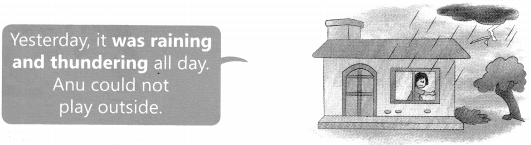
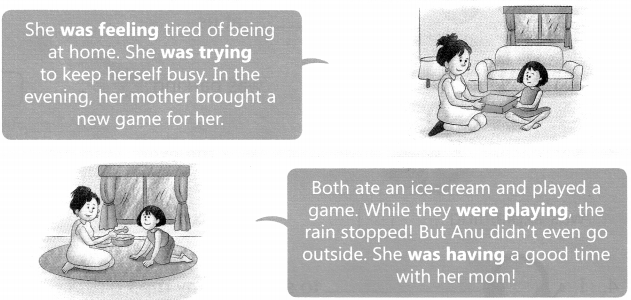
Read the picture story.
Past Continuous Tense Worksheet Exercises for Class 3 CBSE with Answers 2
Past Continuous Tense Worksheet Exercises for Class 3 CBSE with Answers 3

A. Answer the following questions.
1. Why wasn’t Anu playing outside? _________
2. What was Anu feeling the whole day? _________
3. At the end of the story, when the rain stopped, what was Anu doing? _________

B. Change each verb into past continuous tense.
1. Last week, I _________ (visit) my brother in France.
2. At 5 o’clock, she _________ (cook) dinner.
3. Mita _________ (studying) while Harish _________ (play).
4. She _________ (sing) while they _________ (eat).
5. I _________ (work) yesterday.

Past Continuous Tense Worksheets with Answers PDF for Grade 3 CBSE

A. Tick the right option.

1. The children Past Continuous Tense Worksheet Exercises for Class 3 CBSE with Answers 4 _________ outside.
were playing ( )
was playing ( )

2. The dog Past Continuous Tense Worksheet Exercises for Class 3 CBSE with Answers 5 _________ at Us.
were barking ( )
was barking ( )

3. My teacher Past Continuous Tense Worksheet Exercises for Class 3 CBSE with Answers 6 _________ the exercise to me.
was explaining ( )
were explaining ( )

4. I Past Continuous Tense Worksheet Exercises for Class 3 CBSE with Answers 7 _________ to songs on my mp3 player.
were listening ( )
was listening ( )

5. Those people Past Continuous Tense Worksheet Exercises for Class 3 CBSE with Answers 8 _________ towards the library.
were walking ( )
was walking ( )

6. The cook Past Continuous Tense Worksheet Exercises for Class 3 CBSE with Answers 9 _________ a tasty meal.
were preparing ( )
was preparing ( )

7. I Past Continuous Tense Worksheet Exercises for Class 3 CBSE with Answers 10 _________ to fix my computer.
were trying ( )
was trying ( )

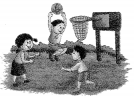
8. My friend and I Past Continuous Tense Worksheet Exercises for Class 3 CBSE with Answers 11 _________ basketball.
was playing ( )
were playing ( )

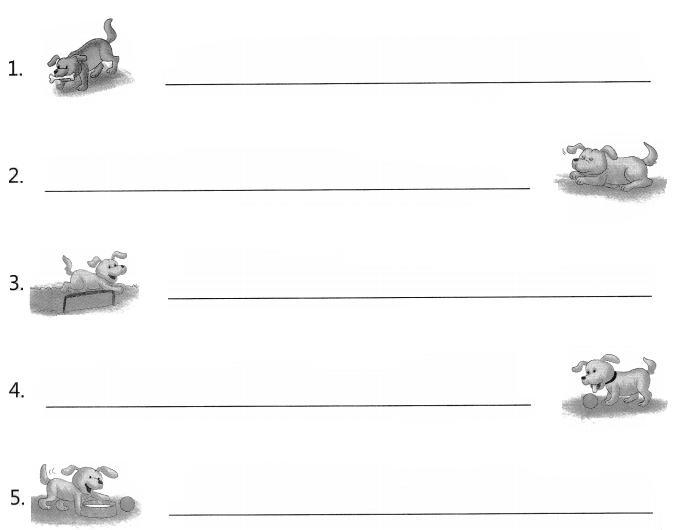
B. Make sentences using the past continuous tense to say what Brownie was doing yesterday with the help of pictures given below.
Past Continuous Tense Worksheet Exercises for Class 3 CBSE with Answers 12

Electricity and Circuits Class 6 Notes Science Chapter 12

On this page, you will find Electricity and Circuits Class 6 Notes Science Chapter 12 Pdf free download. CBSE NCERT Class 6 Science Notes Chapter 12 Electricity and Circuits will seemingly help them to revise the important concepts in less time.

CBSE Class 6 Science Chapter 12 Notes Electricity and Circuits

Electricity and Circuits Class 6 Notes Understanding the Lesson

1. Electricity is a form of energy. It has made our life comfortable and luxurious.

2. Electricity is useful in many ways such as lighting, heating, running various domestic appliances like electric fans, coolers, air conditioners, washing machines, computers, etc.

3. An electric cell is a device which produces a small amount of electricity. It has two terminals, one is positive (+ve) while the other is negative (-ve). It is the most common source of electricity used in various appliances such as radio, torch, remote, etc.

4. An electric cells is of two types:

  • Primary cell and
  • Secondary cell.

5. Primary cell: A cell which stops producing electricity when the chemicals are used up completely. It is ‘ used in a torch, clock, toy, etc.

6. Secondary cell: A cell that can be recharged using electricity. Once the chemicals inside such cells are used up, they are recharged and they start producing electricity. It is used in mobile phone, car batteries, laptops, etc.

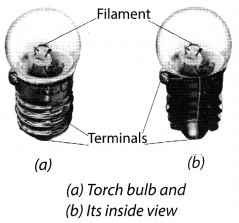
7. An electric bulb is a device that runs on electricity. It glows when | electric current passes through it. It has a filament that is connected to its terminals.

8. The thin wire in the bulb which emits light is called filament of the bulb. It is made up of tungsten metal. It has high resistance for current and has high melting point. It does not get oxidised even at very high temperature.

Electricity and Circuits Class 6 Notes Science Chapter 12 1

9. The combination of two or more than two cells is called battery.

10. An electric switch is a simple ‘on’ and ‘off device that allows or stops the flow of current, without disturbing its connections.

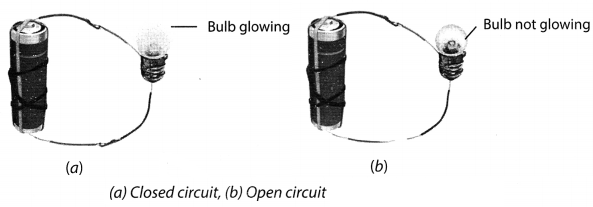
11. The path along which the electric current flows is called a circuit. It is the complete path, from one terminal of the cell (say positive) through the bulb and back to the other terminal (say negative). The circuit must be complete for an electric current to flow.

12. A circuit where connections are not intact is an incomplete circuit or open circuit whereas a circuit with all connections intact is a complete circuit or closed circuit.

Electricity and Circuits Class 6 Notes Science Chapter 12 2

13. The bulb with a broken filament is called a fused bulb. Such a bulb cannot give light.

14. The materials which allow the electric current to pass through them are called Most of the metals are conductors like gold, silver, copper, etc. Beside metals, moist air, salt solution, impure water are also conductors of electricity. Our body is also a good conductor of electricity.

Electricity and Circuits Class 6 Notes Science Chapter 12 3

15. The materials which do not allow electric current to flow through them are called insulators; e.g., mica, dry air, pure water, ebonite, glass, wood, etc.

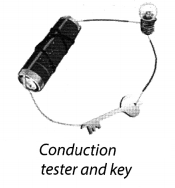
16. There is a device called conduction tester to test whether the given material is a conductor or insulator.

Class 6 Science Chapter 12 Notes Important Terms

Electricity: It is a form of energy which is carried through wires and is used to operate various machines.

Electric cell: It is a source of electricity used in most of the appliances of our daily use such as radio, remote, audio system, etc.

Battery: A combination of two or more electric cells is called battery.

Electric bulb: An electric bulb is one of the simplest electrical device that runs on electricity. It gives us light only when the filament inside it gets heated to a high temperature.

Filament: The thin metal wire of tungsten inside a bulb, which glows when an electric current is passed through it, due to heating effect.

Electric switch: An electric switch is a simple device which can allow or stop the flow of current.

Electric circuit: The complete closed path from one terminal of the electric cell through the bulb and back to the other terminal of the cell is known as electric circuit.

Conductors: The materials through which the electric current can pass are called conductors.

Insulators: The materials through which the electric current cannot pass are called insulators.

Terminals: The connecting points of an electric device are called terminals. One endpointis called as positive (+ve) terminal and the other one as negative (-ve) terminal.

Present Continuous Tense Worksheet Exercises for Class 3 CBSE with Answers

Present Continuous Tense Worksheet Exercises for Class 3 CBSE with Answers 1
This grammar section explains English Grammar in a clear and simple way. There are example sentences to show how the language is used.

Present Continuous Tense Worksheet Exercises for Class 3 CBSE with Answers PDF

  • We use Present continuous tense when actions are taking place in the present.
  • We use Is, Am, Are as Helping verb.
  • We use +ing with the Main verb.

Presentation
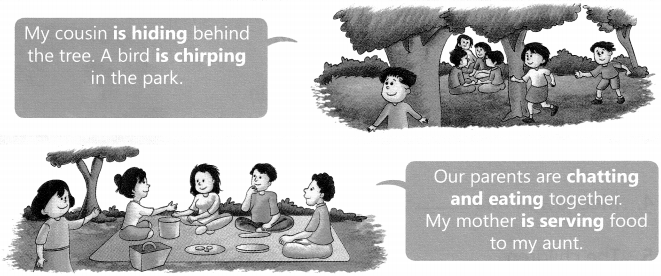
Read the picture story.
Present Continuous Tense Worksheet Exercises for Class 3 CBSE with Answers 2
Present Continuous Tense Worksheet Exercises for Class 3 CBSE with Answers 3

A. Answer the following questions as per the story,
1. What is the cousin doing?
2. What is the bird doing in the story?
3. What are the parents doing?

B. Match the verbs with its continuous forms.
Play – is eating
Eat – is playing
Hide – is hiding

Present Continuous Tense Worksheets for Grade 4 with Answers CBSE PDF

A. Tick the correct words in the brackets.
1. The man (am, is, are) wearing a cap.
2. Birds (am, is, are) sitting on treetops.
3. We (am, is, are) learning grammar. Present Continuous Tense Worksheet Exercises for Class 3 CBSE with Answers 4
4. People (am, is, are) walking in the streets.
5. A kite (am, is, are) flying high up in the sky.

B. Fill in the blanks with the present continuous tense.
1. I _________ _________ chocolates, (eat)
2. My friends _________ _________ me. (call)
3. It _________ _________ outside, (rain)
Present Continuous Tense Worksheet Exercises for Class 3 CBSE with Answers 5
4. Meena and Rita _________ _________ to school, (go)
5. The children _________ _________ noise, (make)
6. Ouch, you _________ _________ on my toe! (step)

Present Continuous Tense Worksheet Exercises for Class 3 CBSE with Answers 6