Naming Words Worksheet Exercises for Class 2 Examples with Answers CBSE

Naming Words Worksheet Exercises for Class 2 Examples with Answers CBSE 1
This grammar section explains English Grammar in a clear and simple way. There are example sentences to show how the language is used.

Naming Words Worksheet Exercises for Class 2 Examples with Answers CBSE PDF

  • Everything around us has a name,
  • The words that we use for naming people, places, animals and things are called naming words.
  • Names can be common and special.
  • Common names name a general person, place or thing of one group or class.
  • Special names name a specific person, place, or thing.
  • Special names always begin with capital letters.
  • A name can be for one or for more than one thing or person.
  • We can change one into many by adding the letter ‘s’.
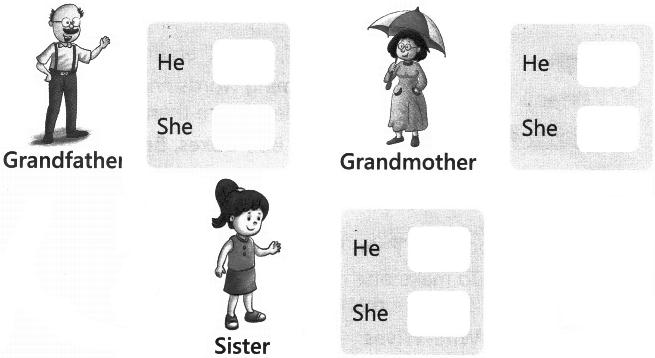
  • The naming words that we use for boys are called He names.
  • Example Boy, Man, King, Nephew and Uncle.
  • The naming words that we use for girls are called She names. Example Girl, Woman, Queen, Niece and Aunt.

Naming Words Worksheet for Class 2 with Answers CBSE PDF

A. Circle the naming words in the sentences given below. Above the name, write P for person, PL for place and T for thing.
a) Anil finished his book project at home. Naming Words Worksheet Exercises for Class 2 Examples with Answers CBSE 2

b) Uncle Sharma lives twelve hours away from Delhi. Naming Words Worksheet Exercises for Class 2 Examples with Answers CBSE 3

c) Grand-mother put the bowl of soup on the table. Naming Words Worksheet Exercises for Class 2 Examples with Answers CBSE 4

d) My brother saw the most incredible animals at the zoo. Naming Words Worksheet Exercises for Class 2 Examples with Answers CBSE 5
B. Read the naming words in the following box and write them under the correct box

DogTeacherComputerRestaurant
HospitalNursePencilCow
Police StationFatherLadybugEyeglasses
ChickenBarberToothbrushAmerica
Person
………………………………..
………………………………..
………………………………..
………………………………..
………………………………..
………………………………..
Place
………………………………..
………………………………..
………………………………..
………………………………..
………………………………..
………………………………..
Animal
………………………………..
………………………………..
………………………………..
………………………………..
………………………………..
………………………………..
Thing
………………………………..
………………………………..
………………………………..
………………………………..
………………………………..
………………………………..

C. Write whether the following naming words are common or special.
1. Mohan Sharma ____________________
2. Carpenter ____________________
3. Dog ____________________
4. Raju ____________________
5. Book ____________________
6. Subway Library ____________________
7. Jupiter ____________________
8. Pianet ____________________
9. Restaurant ____________________
10. Burger King ____________________

D. Add V or ‘es’ to these stars to make each word more than one.
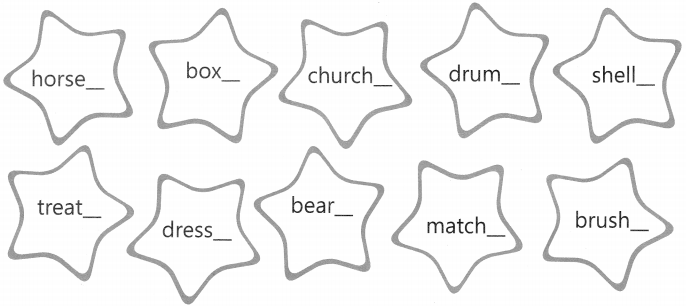
Naming Words Worksheet Exercises for Class 2 Examples with Answers CBSE 6

E. Tick the correct option.
Naming Words Worksheet Exercises for Class 2 Examples with Answers CBSE 7

F. Write 5 He names.
1. ____________________
2. ____________________
3. ____________________
4. ____________________
5. ____________________
G. Write 5 She names.
1. ____________________
2. ____________________
3. ____________________
4. ____________________
5. ____________________
Garbage In Garbage Out Class 6 Notes Science Chapter 16

On this page, you will find Garbage In Garbage Out Class 6 Notes Science Chapter 16 Pdf free download. CBSE NCERT Class 6 Science Notes Chapter 16 Garbage In Garbage Out will seemingly help them to revise the important concepts in less time.

CBSE Class 6 Science Chapter 16 Notes Garbage in Garbage Out

Garbage in Garbage Out Class 6 Notes Understanding the Lesson

1. The unwanted, unused, and useless things are called waste.

2. There are three main sources of waste – domestic, agricultural and industrial.

3. The three types of wastes are solid waste, liquid waste and gaseous waste.

4. The waste on the basis of their ability to get decomposed are categorized as biodegradable waste and non- biodegradable waste.

5. Waste than can be broken down into simpler compounds by the activity of organisms are known as biodegradable waste.

6. Waste that cannot be broken down easily into simpler compounds by the activity of organisms are known as non-biodegradable waste.

7. The process of collection, removal, processing and proper disposal of waste is known as waste management.

8. The collected waste is first segregated into biodegradable and non-biodegradable waste.

9. Biodegradable waste can be converted into compost.

10. The method of converting biodegradable waste into compost by the activity of redworms is known as vermicomposting.

11. Vermicompost can be used as manure as it is rich in humus and minerals.

12. Landfill s a low-lying area where garbage collected from a city or town is dumped. This area is later converted into a park or playground.

13. Nowadays, it is difficult to think without plastics. Most of the things around us are made of plastics.

14. Effect of excessive use of plastic bags on the environment are quite devastating. It is non-biodegradable, on burning produces harmful gases, choke soil pores and drains, can cause death of animals by blocking their intestine and releases poisonous substances if food items are kept in these.

15. We must generate very less waste and think before disposing waste.

16. We must recycle paper to get useful products and to save trees.

17. We must follow 3R’s-reduce, reuse and recycle to avoid problem of waste accumulation.

Class 6 Science Chapter 16 Notes Important Terms

Compost: A mixture of various decaying organic substances which is used to fertilise soil is known as compost.

Composting: The process of converting plants, animals and kitchen wastes into manure by rotting is known as composting.

Garbage: Domestic wastes, refuse, discarded rubbish, used plastic items and wrapping materials like polythene and plastic bags are called garbage.

Landfill: A landfill is a low-lying open area of ground where the garbage collected from a city may be dumped.

Recycling: The process of converting waste materials into reusable materials is known as recycling.

Vermicomposting: The process of making compost from kitchen wastes like peels of vegetables and fruits, tea leaf wastes, etc., by using redworms is known as vermicomposting.

Waste: Unwanted or unusable remains or by-products of materials or food is called waste.

Constructions Class 9 Extra Questions Maths Chapter 11 with Solutions Answers

Here we are providing Constructions Class 9 Extra Questions Maths Chapter 11 with Answers Solutions, Extra Questions for Class 9 Maths was designed by subject expert teachers.

Extra Questions for Class 9 Maths Constructions with Answers Solutions

Extra Questions for Class 9 Maths Chapter 11 Constructions with Solutions Answers

Constructions Class 9 Extra Questions Very Short Answer Type

Question 1.
Draw a line segment AB = 8 cm. Draw \(\frac{1}{3}\) part of it. Measure the length of \(\frac{1}{3}\) part of AB.
Solution:
Constructions Class 9 Extra Questions Maths Chapter 11 with Solutions Answers 1
Steps of Construction :

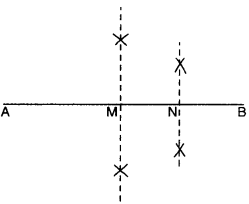
  1. Draw a line segment AB = 8 cm.
  2. Draw its perpendicular bisector and let it intersect AB in M.
  3. Draw the perpendicular bisector of MB and let it intersect AB in N. Thus, AN = \(\frac{1}{3}\) of AB = 6 cm.

Question 2.
Why we cannot construct a ∆ABC, if ∠A = 60°, AB = 6 cm and AC + BC = 5 cm but construction of ∆ABC is possible if ∠A = 60°, AB = 6 cm and AC – BC = 5 cm ?
Solution:
We know that, by triangle inequality property, construction of triangle is possible if sum of two sides of a triangle is greater than the third side. Here, AC + BC = 5 cm which is less than AB (6 cm) Thus, ∆ABC is not possible.
Also, by triangle inequality property, construction of triangle is possible, if difference of two sides of a triangle is less than the third side
Here, AC – BC = 5 cm, which is less than AB (6 cm)
Thus, ∆ABC is possible.

Question 3.
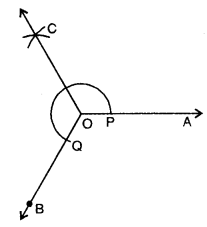
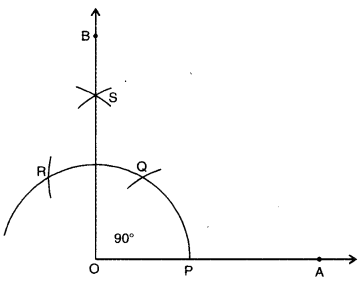
Construct an angle of 90° at the initial point of the given ray.
Solution:
Constructions Class 9 Extra Questions Maths Chapter 11 with Solutions Answers 2
Steps of Construction :

  1. Draw a ray OA.
  2. With O as centre and any convenient radius, draw an arc, cutting OA at P.
  3. With P as centre and same radius, draw an arc cutting the arc drawn in step 2 at Q.
  4. With Q as centre and the same radius as in steps 2 and 3, draw an arc, cutting the arc drawn in step 2 at R.
  5. With Q and R as centres and same radius, draw two arcs, cutting each other in S.
  6. Join OS and produce to B. Thus, ∠AOB is the required angle of 90°

Question 4.
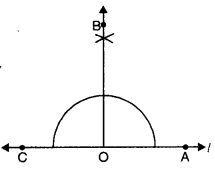
Draw a straight angle. Using compass bisect it. Name the angles obtained.
Solution:
Constructions Class 9 Extra Questions Maths Chapter 11 with Solutions Answers 3
Steps of Construction :

  1. Draw any straight angle (say ∠AOC).
  2. Bisect ∠AOC and join BO.
  3. ∠AOB is the required bisector of straight angle AOC.

Question 5.
Draw any reflex angle. Bisect it using compass. Name the angles so obtained.
Solution:
Constructions Class 9 Extra Questions Maths Chapter 11 with Solutions Answers 4
Steps of Construction :

  1. Let ∠AOB be any reflex angle.
  2. With O as centre and any convenient radius, draw an arc cutting OA in P and OB in Q.
  3. With P and Q as centres, draw two arcs of radius little more than half of it and let they intersect each other in C. Join OC. Thus, OC is the required bisector. Angles so obtained are ∠AOC and ∠COB.

Constructions Class 9 Extra Questions Short Answer Type 1 and 2

Question 1.
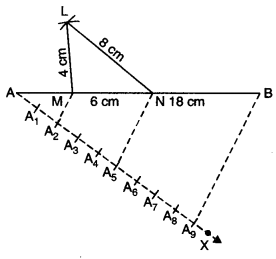
Construct a triangle whose sides are in the ratio 2 : 3 : 4 and whose perimeter is 18 cm.
Solution:
Constructions Class 9 Extra Questions Maths Chapter 11 with Solutions Answers 5
Steps of Construction :

  1. Draw a line segment AB =18 cm.
  2. At A, construct an acute angle ∠BAX (< 90°).
  3. Mark 9 points on AX, such that AA1 = A1A2 = A2A3 = A3A4 = A4A5 = A5A6
    = A6A7 = A7A8 = A8A9.
  4. Join A9B.
  5. From A2 and A5, draw A2M || A5N || A9B, intersecting AB in M and N respectively.
  6. With M as centre and radius AM, draw an arc.
  7. With N as centre and radius NB, draw another arc intersecting the previous arc at L.
  8. Join LM and LN. Thus, ∆LMN is the required triangle.

Question 2.
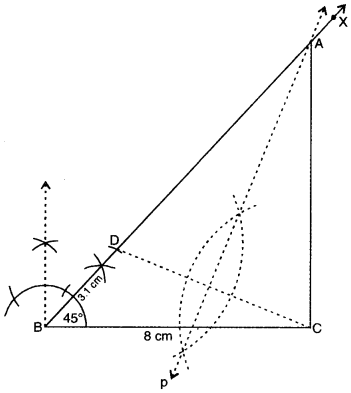
Construct a ∆ABC with BC = 8 cm, ∠B = 45° and AB – AC = 3.1 cm.
Solution:
Constructions Class 9 Extra Questions Maths Chapter 11 with Solutions Answers 6
Steps of Construction :

  1. Draw any line segment BC = 8 cm.
  2. At B, construct an angle ∠CBX = 45°.
  3. From BX, cut off BD = 3.1 cm.
  4. Join DC.
  5. Draw the perpendicular bisector ‘p’ of DC and let it intersect BX in A.
  6. Join AC. Thus, ∆ABC is the required triangle.

Question 3.
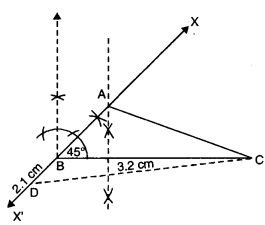
Construct a ∆ABC such that BC = 3.2 cm, ∠B = 45° and AC – AB = 2.1 cm.
Solution:
Constructions Class 9 Extra Questions Maths Chapter 11 with Solutions Answers 7
Steps of Construction :

  1. Draw a line segment BC = 3.2 cm.
  2. At B, construct an angle ∠CBX = 45° and produce it to point X’.
  3. Cut-off BD = 2.1 cm and join CD.
  4. Draw the perpendicular bisector of CD and let it intersect X’BX in A.
  5. Join AC. Thus, ∆ABC is the required triangle.

Question 4.
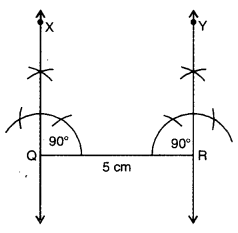
Draw a line segment QR = 5 cm. Construct perpendiculars at point Q and R to it. Name them as QX and RY respectively. Are they both parallel ?
Solution:
Constructions Class 9 Extra Questions Maths Chapter 11 with Solutions Answers 8
Steps of Construction :

  1. Draw a line segment QR = 5 cm.
  2. With Q as centre, construct an angle of 90° and let this line through Q is QX.
  3. With R as centre, construct an angle of 90° and let this line through R is RY. Yes, the perpendicular lines QX and RY are parallel.

Question 5.
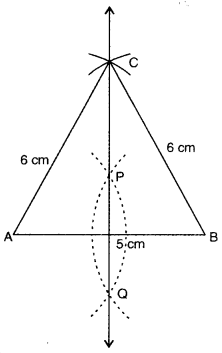
Construct an isosceles triangle whose two equal sides measure 6 cm each and whose base is 5 cm. Draw the perpendicular bisector of its base and show that it passes through the opposite vertex.
Solution:
Constructions Class 9 Extra Questions Maths Chapter 11 with Solutions Answers 14
Steps of Construction :

  1. Draw a line segment AB = 5 cm.
  2. With A and B as centres, draw two arcs of radius 6 cm and let they intersect each other in C.
  3. Join AC and BC to get ∆ABC.
  4. With A and B as centres, draw two arcs of radius little more than half of AB. Let they intersect each other in P and Q. Join PQ and produce, to pass through C.

Constructions Class 9 Extra Questions Long Answer Type

Question 1.
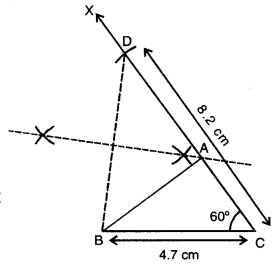
Construct a triangle ABC in which BC = 4.7 cm, AB + AC = 8.2 cm and ∠C = 60°.
Solution:
Constructions Class 9 Extra Questions Maths Chapter 11 with Solutions Answers 9
Given : In ∆ABC, BC = 4.7 cm, AB + AC = 8.2 cm and ∠C = 60°.
Required : To construct ∆ABC.
Steps of Construction :

  1. Draw BC = 4.7 cm.
  2. Draw
  3. From ray CX, cut off CD = 8.2 cm.
  4.  Join BD.
  5.  Draw the perpendicular bisector of BD meeting CD at A.
  6. Join AB to obtain the required triangle ABC.

Justification :
∵ A lies on the perpendicular bisector of BD, therefore, AB = AD
Now, CD = 8.2 cm
⇒ AC + AD = 8.2 cm
⇒ AC + AB = 8.2 cm.

Question 2.
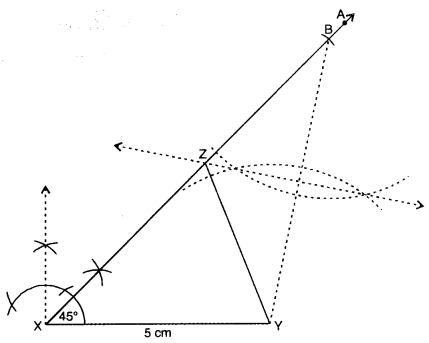
Construct ∆XYZ, if its perimeter is 14 cm, one side of length 5 cm and ∠X = 45°.
Solution:
Constructions Class 9 Extra Questions Maths Chapter 11 with Solutions Answers 10
Here, perimeter of ∆XYZ = 14 cm and one side XY = 5 cm
∴  YZ + XZ = 14 – 5 = 9 cm and ∠X = 45°.
Steps of Construction :

  1. Draw a line segment XY = 5 cm.
  2. Construct an ∠YXA = 45° with the help of compass and ruler.
  3. From ray XA, cut off XB = 9 cm.
  4. Join BY.
  5. Draw perpendicular bisector of BY and let it intersect XB in Z.
  6. Join ZY. Thus, ∆XYZ is the required triangle.

Question 3.
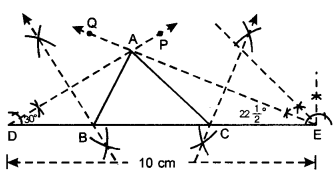
To construct a triangle, with perimeter 10 cm and base angles 60° and 45°.
Solution:
Constructions Class 9 Extra Questions Maths Chapter 11 with Solutions Answers 11
Given : In ∆ABC,
AB + BC + CA = 10 cm, ∠B = 60° and ∠C = 45°.
Required : To construct ∆ABC.
Steps of Construction :

  1. Draw DE = 10 cm.
  2. At D, construct ∠EDP= 5 of 60°= 30° and at E, construct DEQ = 1 of 45o = 22°
  3. Let DP and EQ meet at A.
  4. Draw perpendicular bisector of AD to meet DE at B.
  5. Draw perpendicular bisector of AE to meet DE at C.
  6. Join AB and AC. Thus, ABC is the required triangle.

Constructions Class 9 Extra Questions HOTS

Question 1.
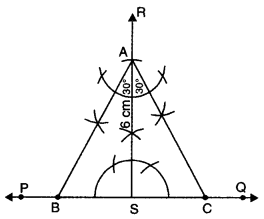
Construct an equilateral triangle whose altitude is 6 cm long.
Solution:
Constructions Class 9 Extra Questions Maths Chapter 11 with Solutions Answers 12
Steps of Construction :

  1. Draw a line PQ and take any point S on it.
  2. Construct the perpendicular SR on PQ.
  3. From SR, cut a line segment SA = 6 cm.
  4. At the initial point A of the line segment AS, construct ∠SAB = 30° and ∠SAC = 30°.
  5. The arms AB and AC of the angles ∠SAB and ∠SAC meet PQ in B and C respectively. Then, ∆ABC is the required equilateral triangle with altitude of length 6 cm.

Question 2.
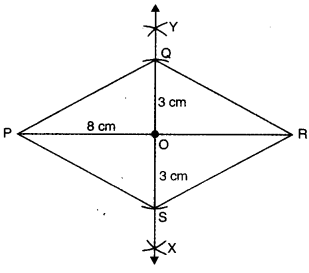
Construct a rhombus whose diagonals are 8 cm and 6 cm long. Measure the length of each side of the rhombus.
Solution:
Constructions Class 9 Extra Questions Maths Chapter 11 with Solutions Answers 13
Steps of Construction :

  1. Draw a line segment PR = 8 cm.
  2. Draw the perpendicular bisector XY of the line segment PR. Let O be the point of intersection of PR and XY, so that O is the 8 cm mid-point of PR.
  3. From OX, cut a line segment OS = 3 cm and from OY, cut a line segment OQ = 3 cm.
  4. Join PS, SR, RQ and QP, then PQRS is the required rhombus.
  5. Measure the length of segments PQ, QR, RS and SP, each is found to be 5 cm long.

Air Around Us Class 6 Notes Science Chapter 15

On this page, you will find Air Around Us Class 6 Notes Science Chapter 15 Pdf free download. CBSE NCERT Class 6 Science Notes Chapter 15 Air Around Us will seemingly help them to revise the important concepts in less time.

CBSE Class 6 Science Chapter 15 Notes Air Around Us

Air Around Us Class 6 Notes Understanding the Lesson

1. Moving air is called wind.

2. We can’t see air but we can feel it when,

  • the clothes hanging on a rope sway.
  • leaves and branches of trees rustle or flutters.
  • kite fly high up in the sky.
  • husk from grains or sawdust and sand can be separated by winnowing.

3. Air is a gaseous substance and thus we can compress it easily.

4. The important properties of air are:

  • Air is a colourless, tasteless and odourless gaseous substance.
  • Air occupies space.
  • Air dissolves in water.
  • Air can be compressed easily.
  • Air is present everywhere around us though we cannot see it.

5. Our earth is surrounded by a thin layer of air which extends up to many kilometres above the surface of the land is called

6. Air is a mixture of many gases. The major component of air is nitrogen gas. The second major component is oxygen gas.

7. Air also contains small amount of carbon dioxide gas, water vapour and some other gases like helium, argon, neon, etc.

8. Nitrogen is a colourless, tasteless, and odourless gas. It is slightly soluble in water and this gas is important for all living beings.

9. Oxygen is a colourless, tasteless and odourless gas. It is slightly soluble in water. This gas is essential for breathing (or respiration) and burning.

10. Carbon dioxide is a colourless and odourless gas. It is moderately soluble in water. Carbon dioxide is needed by plants to carry out photosynthesis. It extinguishes a burning fire.

11. Excess accumulation of carbon dioxide in a room may cause suffocation.

12. The presence of water vapour in the air is important for the water cycle in nature. Water vapour present in air rises high in the sky along with hot air, gets cooled, condenses to form clouds and then brings rain on the earth.

13. The dust particles are always present in air.

14. The sources for the dust particles are blowing of wind, traffic on the roads, dusting at home, etc.

15. Air should always be inhaled by nose instead of mouth because fine hair and mucous are present inside the nose to prevent dust particles from entering into our respiratory system.

16. Smoke is produced mainly by burning of fuels like wood, coal, kerosene, petrol and diesel, etc. It is always harmful.

17. Smoke is emitted through the exhaust pipes connected to the engines of vehicles, etc.

18. The animals living in water are called aquatic animals.

19. The plants living in water are called aquatic plants.

20. In the presence of sunlight, plants use carbon dioxide and water to make food by the process of photosyn­thesis and produce oxygen gas.

21. The animals and plants use oxygen from the air for respiration and give out carbon dioxide gas.

22. Air is useful for human beings in many ways:

  • Air is used for breathing purpose.
  • Air is used for burning fuels to make fire.
  • Air also helps in the dispersal of seeds and pollens of flowers of several plants.
  • Compressed air is used to fill tyres of various kinds of vehicles.

Class 6 Science Chapter 15 Notes Important Terms

Atmosphere: The envelope of air which surrounds the earth is known as atmosphere.

Carbon dioxide: Carbon dioxide is a colourless and odourless gas. Co2 is slightly soluble in water. It is the major component of air.

Oxygen: Oxygen is a colourless, tasteless and odourless gas. It is soluble in water. Oxygen gas is essential for breathing (or respiration).

Nitrogen: Nitrogen is the major component of air. It is a colourless, tasteless and odourless gas. Nitrogen is slightly soluble in water.

Smoke: Smoke consists of fine carbon particles and some gases. Smoke is produced by burning of fuels like wood, kerosene, petrol, diesel, etc. Smoke is always harmful.

Windmill: Windmill is a huge apparatus which is rotated by wind. It is used to draw water from tube wells, run flour mills and generate electricity.

Water Class 6 Notes Science Chapter 14

On this page, you will find Water Class 6 Notes Science Chapter 14 Pdf free download. CBSE NCERT Class 6 Science Notes Chapter 14 Water will seemingly help them to revise the important concepts in less time.

CBSE Class 6 Science Chapter 14 Notes Water

Water Class 6 Notes Understanding the Lesson

1. Water is one of the elixir of life.

2. Nearly 70 per cent of Earth’s surface is covered with water but only 2.5 per cent of it is fresh.

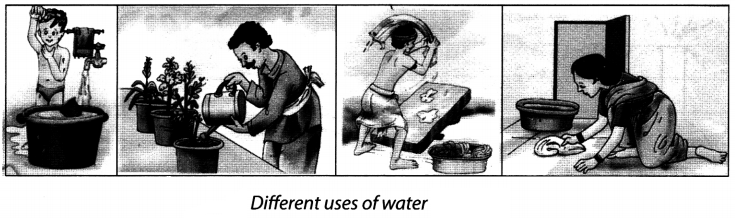
3. We need water for drinking, cooking food, washing utensils, brushing teeth, watering plants, etc.

Water Class 6 Notes Science Chapter 14 1

4. Flowing water is used for producing electricity in hydroelectric power plants.

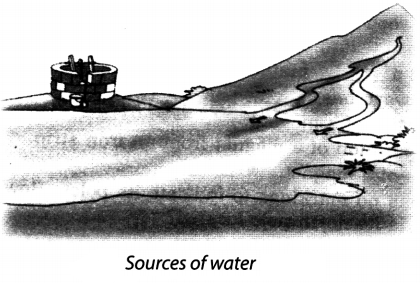
5. The place from where we get water is called a source of water.

6. The water which we use is obtained from sources such as rivers, lakes, ponds, wells and springs.

7. The two main sources of water on land are glaciers/snow mountains and rain.

8. The largest sources of water on earth are oceans.

9. Water is considered as a renewable resource on the earth.

Water Class 6 Notes Science Chapter 14 2

10. Being highly saline ocean water is not fit for drinking, other domestic purposes, agriculture or industrial uses.

11. The continuous circulation of water from earth’s surface to atmosphere, and from atmosphere back to earth is called water cycle in nature.

12. The process in which a liquid changes to its gaseous state in room temperature also is called evaporation.

13. The loss of water from plants as water vapour through the pores of their leaves is called transpiration.

14. When water vapours rises higher, it cools down, due to the lower temperature at higher altitudes, to form water droplets. This process is known as condensation. When these tiny droplets come together, form clouds.

15. The water which had escaped from the earth as vapour returns to the earth in form of

  • rain
  • snowfall
  • hail.

16. Most of the water that falls on the earth in the form of rain flows down to the oceans. Some of it percolates down into the soil and is available to us as groundwater, well water, tube well water, etc.

17. Process in which water passes through different layers of solid is called infiltration.

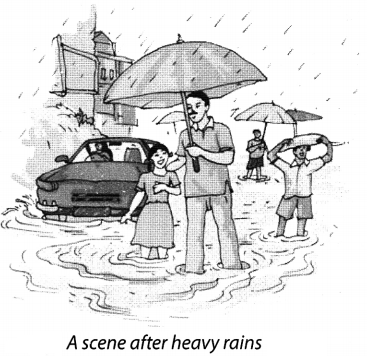
18. When it rains heavily for a long time, we get excess rainfall resulting in too much water all around. This causes floods.

19. A prolonged period of no rains or very low rains, all around, cause shortage of water leading to drought.

Water Class 6 Notes Science Chapter 14 3

20. It is very important that water should be used carefully. We should take care that water should not get wasted.

21. The various ways to conserve water or minimise the wastage of water at home are:

  • Turn off the tap immediately after use.
  • Take bath by filling water in a bucket.
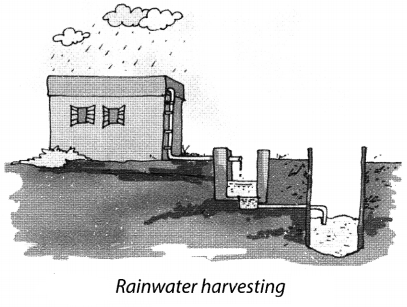
  • Do not use a full flush from the cistern in the toilet. Water harvesting is the activity of collection of rainwater directly by various means.

22. Harvested water can either be used immediately or it can be stored for later use.

Water Class 6 Notes Science Chapter 14 4

23. The two techniques of rainwater harvesting are:

  • Roof top rainwater harvesting.
  • Open Tank/Drain water harvesting.

Class 6 Science Chapter 14 Notes Important Terms

Cloud: The mass of tiny droplets formed by the condensation of water vapour which we see floating high in the atmosphere is called cloud.

Condensation: The changing of water vapour into water on cooling is called condensation.

Drought: An extended period of dryness is called drought.

Evaporation: The process of conversion of water into water vapour is called evaporation.

Flood: An overflow of a large amount of water beyond its normal limits especially over what is normally dry land is called flood.

Groundwater: The water which percolates through the upper layer of the earth’s surface and gets collected on the solid rocks beneath is called groundwater.

Hail: The frozen water from the clouds which falls on the earth in the form of small, round pieces of ice is called hail.

Ocean: The biggest body of water surrounding the 70 per cent of earth’s surface is called ocean.

Rainwater harvesting: The activity of collecting rainwater directly and store it in big tanks for later use is called rainwater harvesting.

Snow: The frozen or solid form of water is called snow.

Water vapour: The gaseous form of the water is called water vapour.

Water cycle: The continuous circulation of water from the earth’s surface to atmosphere and from the atmosphere back to the earth is called water cycle.