How Words Worksheet Exercises for Class 2 Examples with Answers CBSE

How Words Worksheet Exercises for Class 2 Examples with Answers CBSE 1
This grammar section explains English Grammar in a clear and simple way. There are example sentences to show how the language is used.

How Words Worksheet Exercises for Class 2 Examples with Answers CBSE

Fundamentals

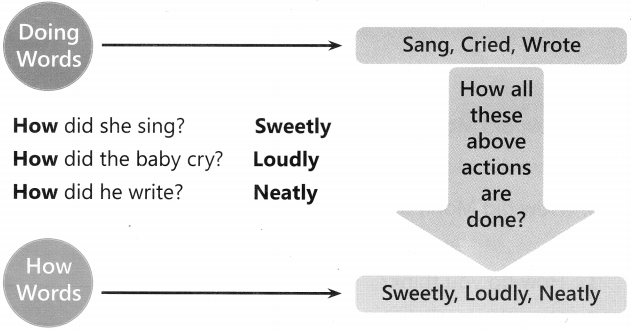
  • Words that tells us more about doing words are called How Words.
  • It shows how an action is done. Look at the examples given below.

Read the following sentences.

How Words Worksheet Exercises for Class 2 Examples with Answers CBSE 2

In the above examples
How Words Worksheet Exercises for Class 2 Examples with Answers CBSE 3

  • How Words end in-ly. Look at the examples.
    Slow – slowly, Loud – loudly, Brave – bravely, Sweet – sweetly, Sad – sadly, Quick – quickly,
    Bright – brightly, Kind – kindly, Right – rightly, Bad – badly, Wise- wisely, Happy – happily

Presentation
Read the picture story.
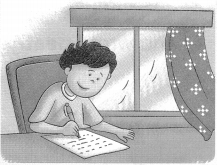
Mohit has participated in writing Olympiad enthusiastically. He practiced for this competition seriously.
How Words Worksheet Exercises for Class 2 Examples with Answers CBSE 4

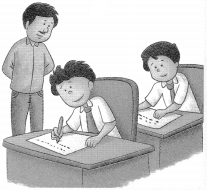
He practiced silently. During the competition he wrote slowly and neatly. He used his words artistically.
How Words Worksheet Exercises for Class 2 Examples with Answers CBSE 5

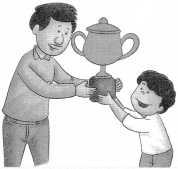
Humbly and Kindly, Judges announced the result with Mohit as the winner. Well Done!…. Mohit accepted his trophy happily.
How Words Worksheet Exercises for Class 2 Examples with Answers CBSE 6

A. Answer the following questions from the story above.
1. How did Mohit practice? _____________
2. How did Mohit write? _____________
3. How did Mohit accept the trophy? _____________

B. Describe the way you do things.
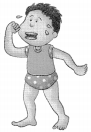
1. How do you think? _____________
2. How do you fight? _____________
3. How do you sing? _____________
4. How do you dance? _____________
5. How do you walk? _____________

How Words Worksheet Exercises with Answers PDF CBSE

A. Look at the pictures. Choose the correct ‘How’ Word from the box to fill in the blanks.
neatly, angrily, quickly, sadly, slowly heavily, happily, brightly, loudly, beautifully

1. Laugh ____________How Words Worksheet Exercises for Class 2 Examples with Answers CBSE 7
2. Run ____________How Words Worksheet Exercises for Class 2 Examples with Answers CBSE 8
3. Shout ____________How Words Worksheet Exercises for Class 2 Examples with Answers CBSE 9
4. Sun ____________How Words Worksheet Exercises for Class 2 Examples with Answers CBSE 10
5. Walk ____________How Words Worksheet Exercises for Class 2 Examples with Answers CBSE 11
6. Cry ____________How Words Worksheet Exercises for Class 2 Examples with Answers CBSE 12
7. Smile ____________ How Words Worksheet Exercises for Class 2 Examples with Answers CBSE 13
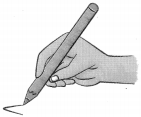
8. Write ____________How Words Worksheet Exercises for Class 2 Examples with Answers CBSE 14
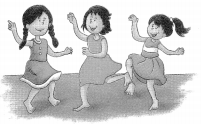
9. Dance ____________How Words Worksheet Exercises for Class 2 Examples with Answers CBSE 15

B. Tick the correct word.
1. She could hard/hardly walk after the accident.
2. I live near/nearly the supermarket.
3. We will go on a vacation short/shortly.
4. She is too short/shortly. She cannot be a model.
5. The quiz is easy/easily.

C. Make how words by adding -ly.
For example:

  • Slow – Slowly

1. Careful – _____________
2. Quick – _____________
3. Loud – _____________
4. Terrible – _____________
5. Weak – _____________
6. Happy – _____________

Heron’s Formula Class 9 Extra Questions Maths Chapter 12 with Solutions Answers

Here we are providing Heron’s Formula Class 9 Extra Questions Maths Chapter 12 with Answers Solutions, Extra Questions for Class 9 Maths was designed by subject expert teachers.

Extra Questions for Class 9 Maths Heron’s Formula with Answers Solutions

Extra Questions for Class 9 Maths Chapter 12 Heron’s Formula with Solutions Answers

Heron’s Formula Class 9 Extra Questions Very Short Answer Type

Question 1.
Find the area of an equilateral triangle having side 6 cm.
Solutioin:
Area of an equilateral triangle = \(\frac{\sqrt{3}}{4}\) × (side)2 = \(\frac{\sqrt{3}}{4}\) × 6 × 6 = 9√3 cm2

Question 2.
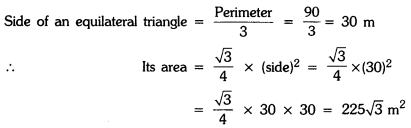
If the perimeter of an equilateral triangle is 90 m, then find its area.
Solutioin:
Heron’s Formula Class 9 Extra Questions Maths Chapter 12 with Solutions Answers 1

Question 3.
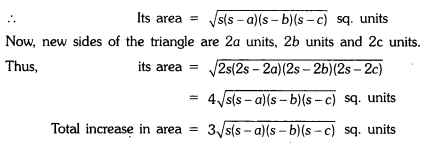
If every side of a triangle is doubled, then find the percent increase in area of triangle so formed.
Solutioin:
Let the sides of the given triangle be, a units, b units and c units.
Heron’s Formula Class 9 Extra Questions Maths Chapter 12 with Solutions Answers 2
Hence, percent increase = 300%

Question 4.
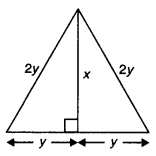
If the length of a median of an equilateral triangle is x cm, then find its area.
Solutioin:
Heron’s Formula Class 9 Extra Questions Maths Chapter 12 with Solutions Answers 3
Let each equal sides of given equilateral triangle be 2y2. We know that median is also perpendicular bisector.
∴ y2 + x2 = 4y2
⇒ x2 = 3y2
⇒ x = √3y
or
⇒ y = \(\frac{x}{\sqrt{3}}\)
Now, area of given triangle = \(\frac{1}{2}\)
× 2y × X = y × x = \(\frac{x}{\sqrt{3}}\)× x = \(\frac{x^{2}}{\sqrt{3}}\)

Heron’s Formula Class 9 Extra Questions Short Answer Type 2

Question 1.
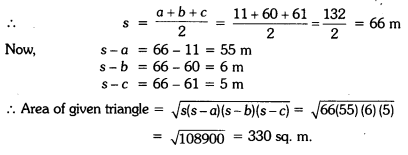
Find the area of a triangle whose sides are 11 m, 60 m and 61 m.
Solutioin:
Let a = 11 m, b = 60 m and c = 61 m :
Heron’s Formula Class 9 Extra Questions Maths Chapter 12 with Solutions Answers 4

Question 2.
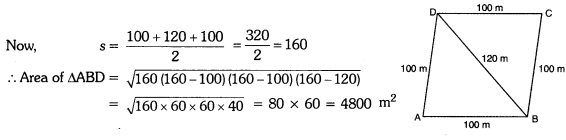
Suman has a piece of land, which is in the shape of a rhombus. She wants her two sons to work on the land and produce different crops. She divides the land in two equal parts by drawing a diagonal. If its perimeter is 400 m and one of the diagonals is of length 120 m, how much area each of them will get for his crops ?
Solutioin:
Here, perimeter of the rhombus is 400 m.
∴ Side of the rhombus = \(\frac{400}{4}\) = 100 m
Let diagonal BD = 120 m and this diagonal divides the rhombus ABCD into two equal parts.
Heron’s Formula Class 9 Extra Questions Maths Chapter 12 with Solutions Answers 5
Hence, area of land allotted to two sons for their crops is 4800 m2 each.

Question 3.
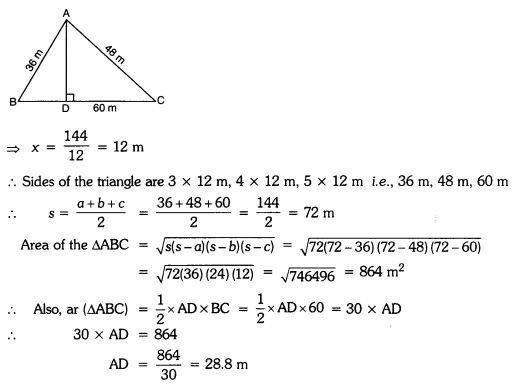
The perimeter of a triangular field is 144 m and its sides are in the ratio 3:4:5. Find the length of the perpendicular from the opposite vertex to the side whose length is 60 m.
Solutioin:
Let the sides of the triangle be 3x, 4x and 5x
∴ The perimeter of the triangular field = 144 m
⇒ 3x + 4x + 5x = 144
⇒ 12x = 144
Heron’s Formula Class 9 Extra Questions Maths Chapter 12 with Solutions Answers 6

Question 4.
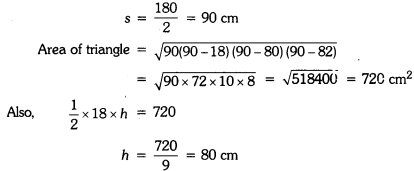
Find the area of the triangle whose perimeter is 180 cm and two of its sides are of lengths 80 cm and 18 cm. Also, calculate the altitude of the triangle corresponding to the shortest side.
Solutioin:
Perimeter of given triangle = 180 cm
Two sides are 18 cm and 80 cm
∴ Third side = 180 – 18 – 80 = 82 cm
Heron’s Formula Class 9 Extra Questions Maths Chapter 12 with Solutions Answers 7
Hence, area of triangle is 720 cm2 and altitude of the triangle corresponding to the shortest side is 80 cm.

Heron’s Formula Class 9 Extra Questions Long Answer Type

Question 1.
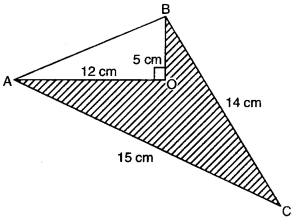
Calculate the area of the shaded region.
Heron’s Formula Class 9 Extra Questions Maths Chapter 12 with Solutions Answers 8
Solutioin:
Heron’s Formula Class 9 Extra Questions Maths Chapter 12 with Solutions Answers 9
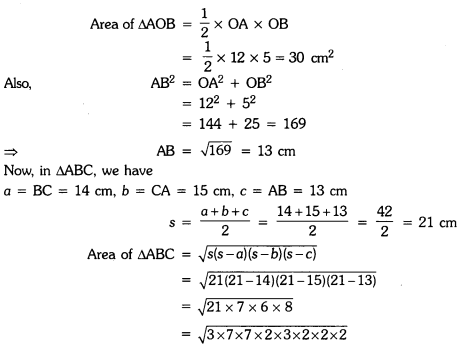
= 2 × 2 × 3 × 7 = 84 cm2
Area of shaded region = Area of ∆ABC – Area of ∆AOB
= 84 cm2 – 30 cm2 = 54 cm2

Question 2.
The sides of a triangular park are 8 m, 10 m and 6 m respectively. A small circular area of diameter 2 m is to be left out and the remaining area is to be used for growing roses. How much area is used for growing roses ? (use n = 3.14)
Solutioin:
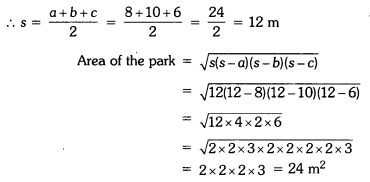
The sides of the triangular park are 8 m, 10 m and 6 m.
Heron’s Formula Class 9 Extra Questions Maths Chapter 12 with Solutions Answers 10
Radius of the circle = \(\frac{2}{2}\) = 1 m
Area of the circle = πr2 = 3.14 × 1 × 1 = 3.14 m2
∴ Area to be used for growing roses = Area of the park – area of the circle
= 24 – 3.14 = 20.86 m2

Heron’s Formula Class 9 Extra Questions HOTS

Question 1.
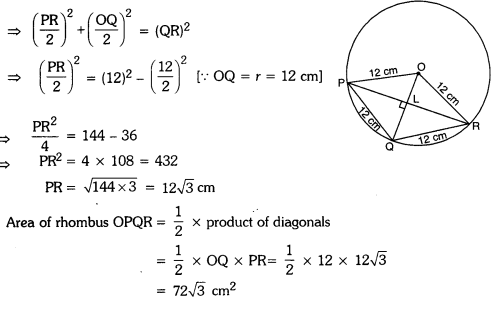
OPQR is a rhombus, whose three vertices P, Q and R lie on the circle with centre 0. If the radius of the circle is 12 cm, find the area of the rhombus.
Solutioin:
Since diagonals bisect each other at 90°.
∴ In right ∆QLR, (LR)2 + (LQ)2 = (QR)2
Heron’s Formula Class 9 Extra Questions Maths Chapter 12 with Solutions Answers 11

Question 2.
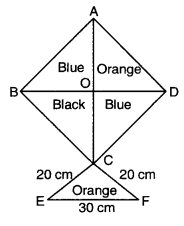
How much paper of each shade is needed to make a kite given in the figure, in which ABCD is a square with diagonal 60 cm?
Heron’s Formula Class 9 Extra Questions Maths Chapter 12 with Solutions Answers 12
Solutioin:
Since diagonals of a square are of equal length and bisect each other at right angles, therefore,
Area of ∆AOD = \(\frac{1}{2}\) × 30 × 30 = 450 cm2
Area of ∆AOD = Area of ∆DOC = Area of ∆BOC
= Area of ∆AOB = 450 cm2
[∵ ∆AOD = ∆AOB ≅ ∆BOC ≅ ∆COD, ∵ they2 have equal area]
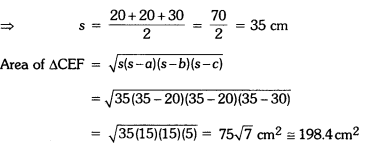
Now, area of ACEF (by Heron’s formula)
Here a = 20 cm, b = 20 cm and c = 30 cm

Heron’s Formula Class 9 Extra Questions Maths Chapter 12 with Solutions Answers 13

Now, area of orange shaded paper in kite
= Area of ∆AOD + Area of ∆CEF
= 450 cm2 + 198.4 cm2
= 648.4 cm2
Area of blue shaded paper in kite
= Area of ∆AOB + Area of ∆COD
= 450 cm2 + 450 cm2 = 900 cm2
Area of black shaded paper in kite = Area of ∆BOC = 450 cm2.

Heron’s Formula Class 9 Extra Questions Value Based (VBQs)

Question 1.
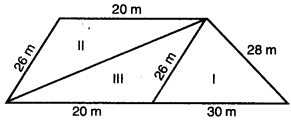
Sister Nivedita has trapezium shaped plot which she divided into three triangular portion for different purposes. I – for providing free education for orphan children, II – for providing dispensary for the needy villagers and III – for the library for villagers. Find the area of trapezium plot given in the figure. Which qualities of sister Nivedita are being depicted in question ?
Heron’s Formula Class 9 Extra Questions Maths Chapter 12 with Solutions Answers 14
Solutioin:
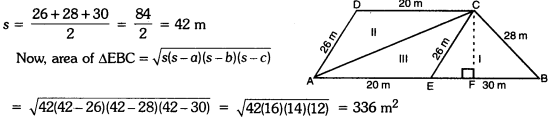
Here, ABCD is the trapezium with AB || DC.
Through C, Draw CF ⊥ AB
For – I: For area of ∆EBC
Heron’s Formula Class 9 Extra Questions Maths Chapter 12 with Solutions Answers 15
But, we know, Area of ∆EBC = \(\frac{1}{2}\)(base × height)
⇒ \(\frac{1}{2}\)1 × 30 × CF = 336
15 × CF = 336
⇒ CF = \(\frac{336}{15}\) = 22.4 m
Now, area of trapezium shaped plot = \(\frac{1}{2}\) (20 + 50)(22.4)
= 35 x 22.4 = 784 m2
Caring, kind, social, generous and visionary lady.

Question 2.
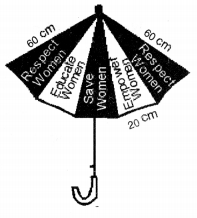
In an exhibition, an umbrella is made by stiching 10 triangular pieces of cloth with same message written on two triangular pieces. If each piece of cloth measures 60 cm, 60 cm and 20 cm, find how much cloth is required for each message.
Why we should respect women, educate women, save women and empower women ?
Heron’s Formula Class 9 Extra Questions Maths Chapter 12 with Solutions Answers 16
Solutioin:
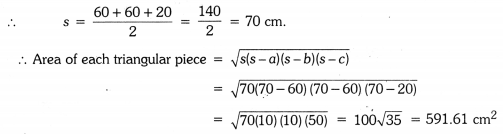
Here, each triangular piece is an isosceles triangle with sides 60 cm, 60 cm and 20 cm.
Heron’s Formula Class 9 Extra Questions Maths Chapter 12 with Solutions Answers 17
Now, there are 2 triangular pieces with same message.
∴ Total area of cloth for each message = 2 × 591.61 = 1183.22 cm2
We should respect women, educate women, save women and empower women to serve humanity and give them equal opportunity so far they deprived.

Doing Words Worksheet Exercises for Class 2 Examples with Answers CBSE

Doing Words Worksheet Exercises for Class 2 Examples with Answers CBSE 1
This grammar section explains English Grammar in a clear and simple way. There are example sentences to show how the language is used.

Doing Words Worksheet Exercises for Class 2 Examples with Answers CBSE PDF

  • The words which show what someone or something is doing are called action words.
  • Action words are also called doing words.
  • Examples: eat, sleep, dance, sing, run, fly, clap, touch, walk, play etc. Is, Am, Are are the different ways of saying be.
  • ‘Is’ is used with ‘he’, ‘she’ ‘it’, ‘Am’ is used with ‘I’ naming word and ‘Are’ is used with ‘we’, ‘you’, ‘they’. We use ‘Has’ and
  • ‘Have’ to show that a thing belongs to someone.
  • We use ‘Have’ with ‘T’, ‘we’ and ‘they’. Examples: I have, We have, They have.
  • ‘Has’ is used for one.
  • Have’ is used for more than one.

A. Fill in the blanks with Is/Am/Are.

1. My father ____________ a taxi driver.
2. She ____________ your music teacher.
3. My grandparents ____________ old.
4.1 ____________ hungry.
5. I and Tarun ____________ sick.
6. We ____________ good friends.
7. It ____________ cool in spring.
8. The apples ____________ red.
9. My school bag ____________ green.
10. Rita ____________ my friend.

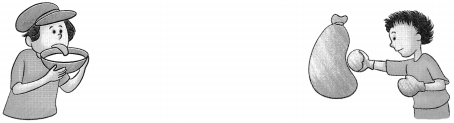
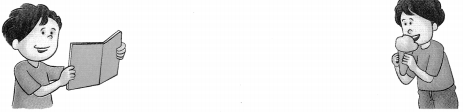
B. Look at the pictures and fill in the blanks with verbs given in the box.
punch, taste, walk, catch, see, hear, eat, smell
Doing Words Worksheet Exercises for Class 2 Examples with Answers CBSE 2
You ____________ with your tongue. You ____________ with your fist.

Doing Words Worksheet Exercises for Class 2 Examples with Answers CBSE 3
You ____________ with your hands. You ____________ with your nose.

Doing Words Worksheet Exercises for Class 2 Examples with Answers CBSE 4
You ____________ with your ears. You ____________ with your legs.
Doing Words Worksheet Exercises for Class 2 Examples with Answers CBSE 5
You ____________ with your eyes. You ____________ with your mouth.

C. Fill in the blanks with ‘has’ or ‘have’.

1. Sharks ____________ sharp teeth.
2. Insects ____________ six legs.
3. The parrot ____________ wings.
4. Birds ____________ feathers.

D. Tick the correct circle in each sentence.

1. AWhaleis ( ) A Whale are – a very big animal.
2. Your nails is ( ) Your nails are – too long.
3. The girls is ( ) The girls are – playing.
4. An apple is ( ) An apple are – good to eat.
5. Laxmi is ( ) Laxmi are – a tall girl.
6. Mita and Rita is ( ) Mita and Rita are – good friends.

Is Am Are Ing Worksheets for Grade 2 CBSE PDF

Fundamentals

  • To talk about actions in the present, or things that are still going on presently, we use a doing word +ing.
  • ‘Is’, ‘Am’, ‘are’ are used as helping words.

Presentation
Read the picture story.
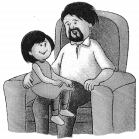
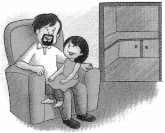
Nancy is visiting her grandparents. At this moment, she is sitting on her grandfather’s knee. She is listening to a story. She loves her grandfather’s stone.
Doing Words Worksheet Exercises for Class 2 Examples with Answers CBSE 6

Mr. Gopal is Nancy’s grandfather. He ¡s holding her hands. They are sitting in the living room. Right now, he ¡s telling her a story. They enjoy each other’s company.
Doing Words Worksheet Exercises for Class 2 Examples with Answers CBSE 7

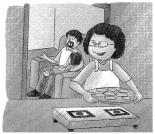
Mrs. Gopal is Nancy’s grandmother. She is standing in the kitchen and baking cookies for Nancy and her grandfather. She ¡s also listening to the story.
Doing Words Worksheet Exercises for Class 2 Examples with Answers CBSE 8

A. Answer the following questions.

1. Who is Nancy visiting today? _____________
2. Where are Mr. Gopal and his granddaughter sitting? _____________
3. What is Mrs. Gopal doing? _____________

B. Fill in each blank with the doing word +ing from the story above.

Visit _____________
Hold _____________
Listen _____________
Live _____________
Tell _____________
Stand _____________
Sit _____________
Bake _____________

Doing Words Worksheets for Grade 2 with Answers CBSE PDF

A. Add ‘ing’ to the following doing words.

Come _____________
Run _____________
Ask _____________
Sleep _____________
Catch _____________
Fall _____________
Write _____________
Jump _____________
Drop _____________
Bring _____________
Climb _____________

B. Fill in the blanks with the correct doing word and helping word.

1. They _____________ the roller-coaster ride. (enjoy)
2. Jiya _____________ her hair. (wash)
3. It _____________ dark. (get)
4. The dentist _____________ Suman’s teeth. (examine)
5. The train _____________ through the tunnel. (pass)

C. Match the pictures with the correct actions and tick the right box.

Doing Words Worksheet Exercises for Class 2 Examples with Answers CBSE 9
1. Friends are hugging. [ ]
Nancy is hanging posters. [ ]
The clown is performing. [ ]
Doing Words Worksheet Exercises for Class 2 Examples with Answers CBSE 10
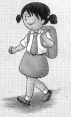
2. Lata is walking to school. [ ]
Payal is blowing a bubble. [ ]
A dog is hopping. [ ]
Doing Words Worksheet Exercises for Class 2 Examples with Answers CBSE 11
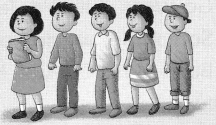
3. Rita ¡s standing in a queue. [ ]
Meena is listening to music. [ ]
The ball is hitting his head. [ ]
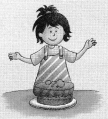
Doing Words Worksheet Exercises for Class 2 Examples with Answers CBSE 12
4. The ducks are quacking.
Rahul is collecting the leaves.
Bella is baking a yummy cake.

Doing Words Worksheet Exercises for Class 2 Examples with Answers CBSE 13
5. Han is tying his shoelaces. [ ]
Reena is painting a picture. [ ]
Rahul is kissing her mother. [ ]

Doing Words Worksheet Exercises for Class 2 Examples with Answers CBSE 14
6. Raju is shutting the door. [ ]
Sohan is rushing to work. [ ]
Mita is working hard. [ ]

More About the Doing Words for Class 2 CBSE PDF

Fundamentals

  • Doing words also talk about something that happened in the past.
  • Here doing words end with -ed or -d.
  • Walk- walked, Sail- sailed, Dance- danced, Chase- chased.
  • Sometimes we change the spelling of the doing word.
  • Sing-Sang, Fly-Flew, Sit-Sat, Write-Wrote
  • Sometimes we change the doing word completely.
  • Go-Went, Tell-Told, Teach-Taught, Buy-Bought, Eat-Ate, Do-Did Sometimes we do not change the doing word.
  • Burst-Burst, Cut-Cut, Hit-Hit

Presentation
Read the picture story.
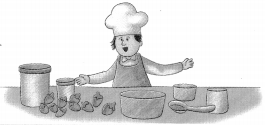
Last week, Bunny baked a cake for Lilly’s birthday party. Lilly wanted a strawberry cake with pink frosting.
Doing Words Worksheet Exercises for Class 2 Examples with Answers CBSE 15

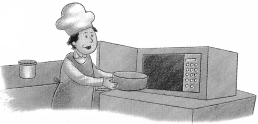
First, Bunny mixed the ingredients in a big bowl and baked the cake for 20 minutes. He prepared the pink frosting. Lastly, he wrote Lilly’s name on top with white frosting. Last he put seven candles on the cake.
Doing Words Worksheet Exercises for Class 2 Examples with Answers CBSE 16

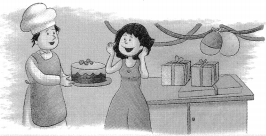
On Sunday, Bunny surprised Lilly with the strawberry cake. Lilly loved her cake! Lilly got many gifts on her birthday. But Lilly said that the cake was the best gift of them all!
Doing Words Worksheet Exercises for Class 2 Examples with Answers CBSE 17

A. Answer the following questions from the story above.

1. What did Bunny do for Lilly’s birthday party?
2. What did Bunny prepare?
3. What did Lilly like best among her birthday gifts?

B. Add -ed to the following doing words.

Bake _____________
Prepare _____________
Love _____________
Want _____________
Mix _____________
Surprise _____________

Doing Words Worksheet Exercises with Answers for Class 2 CBSE PDF

A. Complete each sentence by adding -ed to the doing words given in the brackets.

1. My dad (craft) _____________ a boat.
2. He (mow) _____________ the grass.
3. I (watch) _____________ television in the morning.
4. Sameer (pick) _____________ up the journal today.
5. We (serve) _____________ lunch at 12.30.
6. Grandma (bake) _____________ the best cookies.
7. He (paint) _____________ the house.
8. Sarika (cook) _____________ the breakfast.
9. Pawan (play) _____________ the piano at the concert.
10. I _____________ (open) my book yesterday.

B. Circle the doing word with -ed in the following passage.

I lived in a tent. I washed and bathed in a stream. I cooked my own food. I watched cute little rabbits playing near my tent. I walked through the forest. I climbed up to the top of a hill. There I collected some rare flowers. I dried them and pasted them in my flower book. I enjoyed a lot.

C. Change all the doing words to show that the things happened in the past. Rewrite the sentences in the blanks.

1. She wants to wear a new frock. _____________
2. Anju sings beautifully. _____________
3. They try to break into the house. _____________
4. We write in our notebooks. _____________
5. I go to the playground. _____________
6. We play hide and seek. _____________
7. He seems to be angry. _____________
8. You know the truth. _____________
9. Sanjay shouts for help. _____________
10. It starts raining heavily. _____________

Was Were Worksheets for Class 2 CBSE PDF

Fundamentals

  • The verbs was and were are also forms of the verb be.
  • We use was and were to show that the events/actions happened in the past.
  • We use Was with he, she and it.
  • We use Were with we, you, and they.
  • Past here stands for yesterday, last night, last week, last month, last year.

Presentation
Read the picture story.
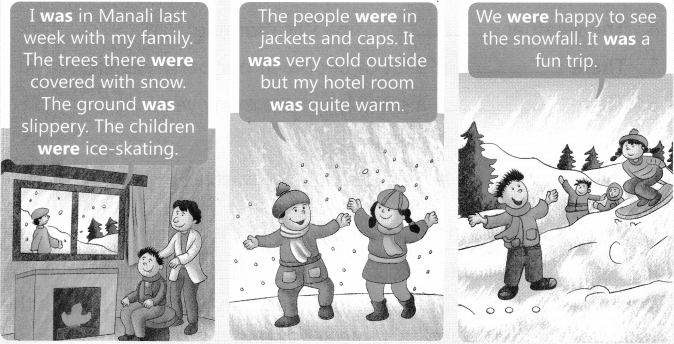
Doing Words Worksheet Exercises for Class 2 Examples with Answers CBSE 18

A. Answer the following questions from the story given above.

1. What did the children do in the snowfall? _____________
2. What did the people wear in Manali? _____________
3. Was the hotel room cold or warm? _____________

B. Fill in the blanks with ‘was’ or ‘were’.
a holiday yesterday. The school _____________ closed and the shops closed. We _____________ at home. It _____________ fun.

Was Were Worksheets With Answers for Class 2 CBSE PDF

A. Fill in the blanks with ‘was’ or ‘were’.

1. We _____________ the champions last year.
2. Where is Jatin? He _____________ here just now.
3. Mom and dad _____________ on vacation last week.
4. The weather _____________ fine this morning.
5. There _____________ a lot of people at our party yesterday.
6. There _____________ a small lake here many years ago.
7. He _____________ sick yesterday.
8. Don’t blame him. It _____________ my mistake.

B. Write was or were in the blank spaces in the following passage.

It _____________ a beautiful day and there _____________ not a cloud in the sky. Mom, dad and I _____________ in the garden. Dad _____________ in the vegetable garden planting some seeds and mom and I _____________ busy with other jobs. The sun _____________ hot and soon I _____________ feeling very tired. Mom and dad _____________ not tired at all. They went on working for a long time. I _____________ glad when it _____________ time to go inside and have a drink.

Had Worksheets for Class 2 CBSE PDF

Fundamentals

  • Had is also followed by naming words.
  • Had is used to show that something belonged to someone or some other thing in the past.
  • We use Had to say what we ate or drank.
  • We use Had for things that happened to people or affected them in the past.
  • We use had when we talking about wishes. I wish I had a new bike.

Presentation
Read the picture story.
Last night, Mona and Sonu danced in a competition. They had practiced for 6 months before they danced in the corn petition. They were very good.
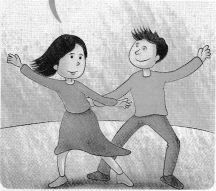
Doing Words Worksheet Exercises for Class 2 Examples with Answers CBSE 19

Mona and Sonu’s friends were ¡n the audience. Before that night, they had never seen Mona and Sonu’s dance.
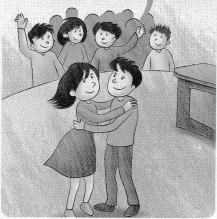
Doing Words Worksheet Exercises for Class 2 Examples with Answers CBSE 20

After everyone had danced, the judges announced the winners. Mona and Sonu won! They were the best dancers ¡n the competition. Mona was glad they had practiced a lot.
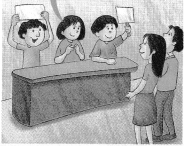
Doing Words Worksheet Exercises for Class 2 Examples with Answers CBSE 21

A. Answer the following questions.

1. What did Mona and Sonu do in the competition?
_______________________________________

2. Who were present in the audience?
_______________________________________

3. What did the judges announce at the end of the competition?
_______________________________________

Had Worksheets With Answers for Class 2 CBSE PDF

A. Use – ed and had to complete the following sentences.

1. When their mother _____________ (come) home last night, the children _____________ (eat) their dinner.
2. Yesterday I _____________ (see) a woman who _____________ (be) at school with my grandfather. Isn’t it strange?
3. It started to rain and I _____________ (remember) that I _____________ (forget) to close my bedroom window.
4. I _____________ (find) a book that I never _____________ (read).

B. Fill in the blanks using ‘Had’ and ‘-ed’ at the end of the doing verbs.

1. When I arrived at the cinema, the film _____________ (start).
2. She _____________ (live) in China before she went to Thailand.
3. After they _____________ (eat) the shellfish, they began to feel sick.
4. If you _____________ (listen) to me, you would have got the job.
5. After we _____________ (finish) dinner, we went out.


NCERT Class 7 Geography Chapter 10 Notes Life in the Deserts

On this page, you will find NCERT Class 7 Geography Chapter 10 Notes Pdf free download. CBSE Class 7 Social Science Notes Geography Chapter 10 SST Life in the Deserts will seemingly help them to revise the important concepts in less time.

Life in the Deserts Class 7 Notes Social Science Geography Chapter 10

CBSE Class 7 Geography Chapter 10 Notes Understanding The Lesson

1. It is very difficult to live on the places where there is no water.

2. Some places are very hot as fire while some are very cold as ice. These are the desert areas of the world.

3. Depending on the temperatures there can be hot desert or cold deserts.

4. The people inhabit these lands wherever little water is available to practice agriculture.

5. Sahara is the world’s largest desert. Sahara desert covers a large part of North Africa. It has an area of around 8.54 millions km.

6. The Sahara desert touches 11 countries. These are Algeria, Chad, Egypt, Libya, Mali, Mauritania, Morocco, Niger, Sudan, Tunisia and Western Sahara.

7. Besides the vast stretches of sands, there are also gravel plains and elevated plateaus with bare rocky surface. These rocky surfaces may be more than 2500m high at some places.

8. The climate of the Sahara desert is scorching hot and parch dry. It has a short rainy season. Days are unbelievable hot, it may be as high as 50°C while nights may be freezing cold with temperatures nearing 0°C

9. Cactus, date palms and acacia etc., are vegetation found in the Sahara desert. In some places there are oasis-green islands with date palms surrounding them.

10. Camels, hyenas, jackals, foxes, scorpions, many varieties of snakes and lizards are the prominent animal species living there.

11. Despite of harsh climate in the Sahara, it is inhabited by various groups of people who pursue different activities. Some nomadic tribes such as Bedounis and Tuaregs live here and rear goats, sheep, camels and horses.

12. The oasis in the Sahara and the Nile Valley in Egypt suppont the settled population. The people grow date palms, rice, wheat, barley and beans. Egyptian cotton, famous worldwide is grown in Egypt.

13. Besides the oil, other minerals of importance that are found in the area include iron, phosphorus, manganese and uranium.

14. Ladakh is a cold desert lying in the Great Himalayas, on the eastern side of Jammu and Kashmir. The Karakoram Range in the north and the Zanskar mountains in the south enclose it. River Indus and Gangri glacier are found in Ladakh.

15. Ladakh is made up of two words-“La” meaning ‘mountain pass’ and “Dak” meaning ‘country’.

16. The altitude (height) in Ladakh varies from about 3000 m in Kargil to more than 8,000m in the Karakoram. Due to its high altitude, the climate is extremely cold and dry. The day temperatures in summer are just above 0°C and the night temperatures well below-30°C. There is little rainfall, as low as 10 cm every year.

17. Due to high aridity in Ladakh, the vegetation is sparse. There are scanty patches of grasses and shrubs for animals to graze. Groves of Willows and poplars are seen in the valleys. Fruit trees such as apples, apricots and walnuts bloom and are found during the summers.

18. Animals like Robins, redstarts, Tibetan snow-cock, raven and hoopoe are found commonly. The animals of Ladakh are wild goats, wild sheep, yak and special kinds of dogs. Yak’s milk is used to make cheese and butter. The hair of the sheep and goat is used to make wollens.

19. In the summer season the people are busy cultivating barley, potatoes, peas, beans and turnip.

20. Leh, the capital of Ladakh is well-connected both by road and air. The National Highway 1A connects Leh to Kashmir Valley through the Zoji la Pass.

21. Tourism is a major activity with several tourists streaming in from within India and abroad. Visits to the gompas, treks to see the meadows and glaciers, witnessing ceremonies and festivities are important activities.

Notes of Geography Class 7 Chapter 10 Important Terms

Desert: A place of extreme hot or extreme cold.

Glaciers: A glacier is a persistent body of dense ice.

NCERT Class 7 Geography Chapter 9 Notes Life in the Temperate Grasslands

On this page, you will find NCERT Class 7 Geography Chapter 9 Notes Pdf free download. CBSE Class 7 Social Science Notes Geography Chapter 9 SST Life in the Temperate Grasslands will seemingly help them to revise the important concepts in less time.

Life in the Temperate Grasslands Class 7 Notes Social Science Geography Chapter 9

CBSE Class 7 Geography Chapter 9 Notes Understanding The Lesson

1. Forest can be defined as the place where trees are the main type of vegetation. Similarly, grassland can be defined as a region where grasses form the dominant type of plant life.

2. Grasslands make up almost a quarter of the total land surface.

3. The types of plants or grasses are dependent on the climate and soil. ‘

4. The world’s grasslands can be divided into two broad categories-temperate and tropical regions grasslands.

5. The temperate grasslands of North America are known as the Prairies. It is a region of flat, gently sloping or hilly land. Tallgrass, upto two metres high, dominates the landscape. Most part of prairies is treeless.

6. The prairies are bound by the Rocky Mountains in the West and the great lakes in the East. Prairies cover parts of United States of America and parts of Canada. In the USA, the area is drained by the tributaries of Mississippi and the Canadian prairies are drained by the tributaries of Saskatchewan Rivers.

7. The climate is of continental type with extreme temperatures. The summers are warm with temperatures of around 20°C, while in winter -20°C has been recorded in Winnipeg, Canada. In winters a thick blanket of snow covers this region.

8. The annual rainfall is moderate and is ideal for the growth of grass. A local wind “Chinook” blows here.

9. Prairies are practically tree-less. Where water is available, trees such as willows, alders and poplars grow.

10. Places that receive rainfall of over 50 cm, are suitable for farming as the soil is fertile. The major crop of this area is maize, other crops including potatoes, soybean, cotton and alfa-alfa are also grown.

11. Prairies are suitable for cattle rearing. Large cattle farms are called ‘ranches’. Bison or the American buffalo is the most important protected animal of this region. The other animals found in this region are rabbits, coyotes, gophers and prairie dog.

12. The people of the Prairies region are very hard-working. Two of the most developed countries in the world-the USA and Canada are located in this region. Scientific methods of cultivation and use of tractors, harvesters and combines have made North America a surplus food producer.

13. The Prairies are also known as the “Granaries of the world,” due to the huge surplus of wheat production.

14. In the Prairies region dairy farming is another major industry. Dairy farming and extensive agriculture both promote setting up of food processing industries.

15. Large mineral deposits particularly coal and iron are found in this region. A good network of roads, railways and canals in this region has made it the most industrialized region in the world.

16. The temperate grasslands of South Africa are called the velds. Velds are rolling plateaus with varying heights ranging from 600 m to 1100 m. It is bound by the Drakensburg Mountains on the east. To its west lies the Kalahari Desert. On the northeastern part, “height velds’ are located that attain a height of more than 1600m, in some places.

17. The tributaries of rivers Orange and Limpopo drain the region.

18. The velds have a mild climate due to the influence of the Indian Ocean. Winters are cold and dry. Temperatures vary between 5°C and 10°C July is the coldest mouth. Summers are short and warm.

19. The velds receive rainfall mainly in the summer months from November to February.

20. The vegetation cover is sparse. Grasses dominate the landscape. Red grass grows in bush velds. In the high velds acacia and maroola are seen to be growing.

21. The animals of the velds are primarily lions, leopards, cheetah and kudu.

22. In the velds region the main crops are maize, wheat, barley, oats and potato. Cash crops like tobacco, sugar cane and cotton are also grown.

23. In the velds regions, sheep rearing is the most important occupation of the people. Sheep has given rise to the wool industry in the velds. Merino sheep is a popular species and its wool is very warm.

24. Dairy farming is the next important occupation. Cattle are reared in the warmer and wetter regions and the dairy products like butter, cheese are produced for both domestic supply and also for export.

25. The velds have rich reserve of minerals. Iron and steel industry has developed where coal and iron are present. Gold and diamond mining are major occupations of people of this region.

26. Johannesburg is known for being the gold capital of the world. Kimberley is famous for its diamond mines. The mineral rich area has a well-developed network of transport.

Notes of Geography Class 7 Chapter 9 Important Terms

Grasslands: A region where grasses form as a dominant type of plant life.

Veld: The temperate grasslands of South Africa are called the velds.

Prairie: The word originated from Latin word priata which means meadow.

Ranches: Large cattle farms are called ‘ranches’

Cowboys: The men who look the ranches.

Bison: The American buffalo.

Chinook: A type of hot wind that blows in winter.