NCERT Class 6 Civics Chapter 2 Notes Diversity and Discrimination

On this page, you will find NCERT Class 6 Civics Chapter 2 Notes Pdf free download. CBSE Class 6 Social Science Notes Civics Chapter 2 SST Diversity and Discrimination will seemingly help them to revise the important concepts in less time.

Diversity and Discrimination Class 7 Notes Social Science Civics Chapter 2

CBSE Class 6 Civics Chapter 2 Notes Understanding the Lesson

1. The language, food, clothes etc., all of these are influenced both by the geography and history of the place where we live.

2. There are 8 major religions and 16000 languages and more than 100 dance forms in India.

3. We feel safe and secure with people who look, talk, dress and think like us.

4. People also form certain attitudes and opinions about others who are not like them.

5. To judge other people negatively or see them as inferior is prejudice.

6. We can be prejudiced about many things: people’s religious beliefs, the colour of their skin, the region they come from, the accent they speak in, the clothes they wear etc.

7. Sometimes our prejudice about others is so strong that we don’t want to associate with them, even act in ways that hurt them.

8. When we fix people into one image we create a stereotype. When people say that those who belong to a particular country, religion, sex, race or economic background are stingy, lazy, criminal or brave, they are using stereotypes.

9. A common stereotype about Muslims is that they are not interested in educating girls and therefore do not send girls to school. However, studies have now shown that poverty amongst Muslims is an important reason for dropping out of school.

10. Discrimination happens when people act on their prejudices or stereotypes.

11. Discrimination can take place because of several reasons such as religion, caste, work, language, region, status, culture, country etc.

12. More than 50% of all Indians live in villages. They care a little bit about their health. Most of the people of villages are backward and depend on agriculture for their livelihood. Rural families spend 12 to 14 hours in the fields in peak harvesting and plantation season.

13. Life in the city is easy. Most of them are very busy. They spend more time out of home and thus, spend very little time with family members.

14. Dalit is a term that people belonging to so called lower castes use to address themselves. They prefer this word to ‘untouchable’. Dalit means those who have been broken. The government refers to this group of people as Scheduled Castes (SC).

15. Dr Bhim Rao Ambedkar is considered the father of the Indian Constitution and is also the best known leader of the Dalits. Dr Ambedkar fought for the rights of the Dalit community.

16. Dalits, women, tribal and peasants fought against the inequalities along with from British rule

17. Many Dalits organized themselves to gain entry into temples, women demanded for right to education, peasants and tribals fought to release themselves from the grasp of the moneylenders.

18. Our leaders set out a vision and goals in the Constitution to ensure that all the people of India were con­sidered equal. This is seen as key-value that unites us all as Indians

Diversity and Discrimination Class 6 CBSE Notes Important Terms

Prejudice: Judge others as inferior or think about them negatively.

Stereotypes: When we fix people into one image, we create a stereotype.

Inequality: Not to be equal on the basis of social, economic conditions and less opportunities available to people.

Discrimination: It is an act of separating the person on the basis of religion, caste, work, language, region, creed etc.

Dalit: Those who are considered low and discriminated.

Untouchability: An act to be separated.

NCERT Class 6 Civics Chapter 1 Notes Understanding Diversity

On this page, you will find NCERT Class 6 Civics Chapter 1 Notes Pdf free download. CBSE Class 6 Social Science Notes Civics Chapter 1 SST Understanding Diversity will seemingly help them to revise the important concepts in less time.

Understanding Diversity Class 7 Notes Social Science Civics Chapter 1

CBSE Class 6 Civics Chapter 1 Notes Understanding the Lesson

1. Each and everyone is different from the others.

2. Difference may be on the basis of language, colour, height, food habits, clothes, living styles, customs, religions, regions, interest, culture, practices etc.

3. Some people may like to read the storybooks or history books, or science books or political science books, animal’s books or other subjects’ books etc., depending on their interest.

4. Likewise, India is a country of much diversity. We speak different languages, have various types of food, celebrate different festivals, and practice different religions. Except it, we do many things that are similar.

5. For a long time, people travelled from one place to another place for various reasons such as-trade, employment, droughts, wars, natural calamities etc.

6. Due to the migration of people from one place to other places, their languages, food, music, customs, traditions become a mix of the new and old culture and with it came something new and different.

7. Different cultural influences have helped to shape life and culture there. These regions became very diverse because of their unique histories.

8. Geographical areas also play a role in creating the diversity.

9. History and geography are often tied in the cultural life of a region.

10. India’s diversity has always been recognized as a source of its strength.

11. During the British rule, all men and women belonging from different regions, languages, religions, culture fought together.

12. British thought they could divide Indians because they were so different. But Indians showed how they could be different and yet be united in their battle against the British.

13. Songs and symbols that emerged during the freedom struggle serve as a constant reminder of our country’s rich tradition of respect for diversity.

14. India’s first Prime Minister Pt. Jawaharlal Nehru wrote a book “Discovery of India” which depicts the power of unity in diversities in India’s context.

Understanding Diversity Class 6 CBSE Notes Important Terms

Diversity: Different differences constitute diversity.

Unity: A strong bond with the people.

Culture: The customs, belief, art, way of life which shifted from one generation to the next.

Inequality: Differences between people.

Reported Speech Exercises for Class 9 CBSE With Answers

Reported Speech Exercises for Class 9

Reporting the words of the speaker in your own words is called reported speech.

Reported Speech Exercises for Class 9 CBSE With Answers

This grammar section explains English Grammar in a clear and simple way. There are example sentences to show how the language is used. You can also visit the most accurate and elaborate NCERT Solutions for Class 9 English. Every question of the textbook has been answered here.

Reported Speech Exercises for Class 9 CBSE With Answers Pdf

Type 1. Statements
Steps to be kept in mind for changing direct speech into indirect (statements).

Step 1. The reporting verb is changed as under.
(a) We ‘say’ something but we ‘tell’ somebody. Says to …………………………… tells.
(b) Says …………………………… says.
(c) Said to …………………………… told/asserted/stated/informed.
(d) Said …………………………… said.

Step 2. Inverted commas are dropped and the conjunction ‘that’ is used.

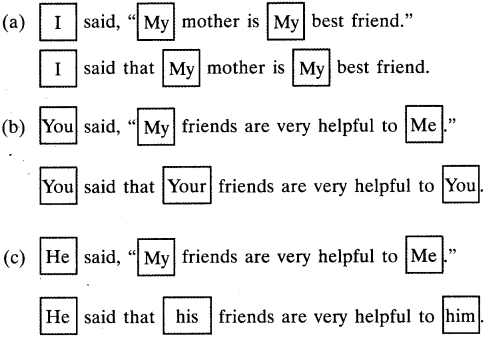
Step 3. Change of personal pronouns and possessives.
Changing I, my, me, mine; we, our, us, ours (First-person).
Reported Speech Exercises for Class 9 CBSE With Answers

Note. These words refer to the speaker. So they change according to who the speaker is.

Step 4. If the reporting verb is in the present or future tense, the tense of the reported speech does not change.
Meera says to Mini, “Your teacher has praised you.” Meera tells mini that her teacher has praised her.

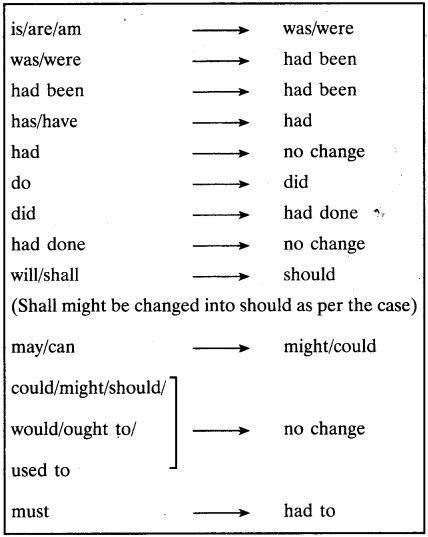
If the reporting verb is in the past tense, the tense of the reported speech gets changed into the corresponding past tense as under.
Reported Speech Exercises for Class 9 CBSE With Answers

Step 5. Words denoting nearness of time and place are generally changed into words denoting distance.

Direct speechIndirect speech
Nowthen
Thisthat
Thesethose
Herethose
jobefore
Yesterdaythe previous day
Tomorrowthe next day, the following day
Todaythat day
Tonightthat night

Note. There are two situations where even if the reporting verb is in the past tense, the verb of the reported speech remains unchanged.

1. If the reported speech expresses a universal truth or a habitual fact.

  • The teacher said, “Two and two make four.”
    The teacher said that two and two make four.
  • Ramesh said to the tourist, “Summers in India are usually very hot.”
    Ramesh informed the tourist that summers in India are usually very hot.

2. The reported speech describes a situation which still exists when the speech is reported.

  • The stationmaster said, “Due to heavy rains, the trains are running late”.
  • The stationmaster said that due to heavy rains, the trains are running late.

Type 2. Questions

A. If the reported speech is a question, the following changes are made.
The reporting verb is changed into ‘asked/required’.

Says asks A
Says to asks
Said asked
Said to asked

B. The inverted commas are removed and If/whether is used. The question mark is removed and a full stop is placed. No conjunction is used while reporting wh-questions. The direct form is changed to indirect question form. Place the subject before verb in the reported question.

  • I said to Meera, “When are your parents coming?”
    I asked Meera when her parents were coming.
  • Ramesh said to me, “Are you reading this book?”
    Ramesh asked me if/whether I was reading that book.
  • He said, “Will you come with me?”
    He asked if/whether I would go with him.

Type 3. Commands and Requests

If reporting commands and requests, the indirect speech is introduced by some verbs expressing commands or requests and the imperative mood is changed into the infinitive.

Step 1. The reporting say (said) is changed to order(ed)/request(ed)/advise(d)/command(ed)/ encourage(ed) /shout(ed)/forbid (forbade), proposed, etc.

Step 2. The verb of the reported speech is changed into an infinitive and inverted commas are removed.

Step 3. Do not is changed to ‘not to’.

  • He said to his sister, “Please speak slowly.”
    He requested his sister to speak slowly.
  • The teacher said, “Keep quiet.”
    The teacher ordered to keep quiet.
  • He said to me, “Don’t tease the animal.”
    He advised me not to tease the animal.
  • She said to me, “Let us go for a picnic”.
    She proposed (or suggested) to me that we should go for a picnic.

Type 4. Exclamations and wishes
Step 1. The reporting verb said is changed to exclaimed, wished, prayed, etc.
Step 2. The exclamatory form is changed into the statement form and the mark of exclamation is replaced by a full stop.
Step 3. The reporting verb is joined with reported speech with ‘that’.
Step 4. All interjections are omitted and suitable adverbs or other expressive words are used.

What! Oh! surprised
Alas! Ah! sadness, grief, pity
Hurrah! joy, happiness
Bravo! approval, cheered
  • They said, “Hurrah! We have won the match.”
    They exclaimed with joy that they had won the match.
  • She said, “Alas! He is no more.” A
    She exclaimed with sorrow that he was no more.
  • He said, “Good-bye friends.”
    He bade good-bye to his friends.

Reported Speech Solved Examples Exercises for Class 9 CBSE

Change the following from direct to indirect speech.

Type 1

Question 1.
The doctor said to me, “The climate of this city won’t suit you.”
Answer:
The doctor told me that the climate of that city wouldn’t suit me.

Question 2.
Priya says, “The Earth is round.”
Answer:
Priya says that the Earth is round.

Question 3.
My brother said to his friend, “I am very sleepy.”
Answer:
My brother told his friend that he was very sleepy.

Question 4.
She said, “I have passed the exams.” ‘
Answer:
She said that she had passed the exams.

Type 2

Question 5.
My friend said, “Have you ever been to London?”
Answer:
My friend asked me if I had ever been to London.

Question 6.
The policeman said to us, “Where are you going?”
Answer:
The policeman enquired where we were going.

Question 7.
My friend said to me, “Can you solve the problem?”
Answer:
My friend asked me if/whether I could solve the problem.

Question 8.
My mother said to the stranger, “What is the purpose of your coming?”
Answer:
My mother asked the stranger what was the purpose of his coming.

Type 3

Question 9.
The teacher said to the students, “Complete your work.” [
Answer:
The teacher ordered the students to complete their work. ,

Question 10.
The Principal said to the parents, “Please sit inside the hall.” |
Answer:
The Principal requested the parents to sit inside the hall. j

Question 11.
Sunil said to his friend, “Don’t forget to recharge your mobile.” i
Answer:
Sunil reminded his friend not to forget to recharge his mobile.

Question 12.
My sister said to me, “Consult a doctor regarding your eyesight.”
Answer:
My sister advised me to consult a doctor regarding my eyesight. |

Type 4

Question 13.
She said, “May God bless her with a child!”
Answer:
She said that God might bless her with a child!

Question 14.
He said, “What a terrible night it is!”
Answer:
He exclaimed that it was a terrible night.

Question 15.
He said, “Alas! I perish by the people I made.
Answer:
He confessed with regret that he was perished by the people he had made.

Question 16.
He said, “Alas! what a fool I am.
Answer:
He exclaimed with grief/regret that he was a great fool.

Change the narration of the following sentences from direct to indirect.

Question 17.
The saint said, “Go to the Himalayas for meditation.”
Answer:
The saint ordered to go to the Himalayas for meditation.

Question 18.
Sita said to Praveen, “I will return your money tomorrow.”
Answer:
Sita told Praveen that she would return his money the next day.

Question 19.
The news said, “A strong earthquake has hit Japan.”
Answer:
The news said that a strong earthquake has hit Japan. . ”

Question 20.
My uncle said to Sheela, “I have a surprise for you.”
Answer:
My uncle told Sheela that he had a surprise for her.

Question 21.
She said, “Do you want to stay abroad?”
Answer:
She asked if he wanted to stay abroad.

Question 22.
The Met Department announced, “It may rain tomorrow.”
Answer:
The Met. Department announced that it might rain the next day.

Question 23.
I/He said, “How I wish they would come”.
Answer:
He exclaimed that he wished they would come.

Question 24.
Ashu said to his friend, “Are you willing to share your books with me?”
Answer:
Ashu asked his friend if he was willing to share his books with him.

Question 25.
The Major said to the jawans, “Start marching left.”
Answer:
The major ordered the Jawans to start marching left.

Question 26.
Sheetal said to her mother, “Have you ever thought about yourself in life?”
Answer:
Sheetal asked her mother if she had ever thought about herself in life.

Read the following dialogues and report in indirect narration.

Question 27.
Mother : Where were you?
Daughter ‘ : I was on the terrace playing.
Mother : Please do not go without prior permission.
Daughter : This was the first time ever that I went on the terrace.
Mother : Remember, do not go there alone.
Answer:
Mother asked her daughter where she had been. The daughter replied that she had been on the terrace playing. The mother then requested her not to go without prior permission. The daughter apologised saying that that had been the first time ever that she had gone on the terrace. The mother warned her saying not to go there alone.

Question 28.
Master : How are you feeling now?
Worker : I am feeling batter but I am not completely fine.
Master : Do you need more rest?
Worker : It is okey. I will report tomorrow.
Answer:
Master asked his worker how was he feeling then. The worker replied that he was feeling better but was not completely fine. The master further asked him if he needed more rest. The worker replied that that was okey and that he would report the next day.

Question 29.
Rajesh : Where are you going, Rohan?
Rohan : I am going to the temple to offer flowers.
Rajesh : Do you worship everyday and go to the temple?
Rohan : Yes, I go to the temple everyday to worship Lord Shiva.
Answer:
Rajesh asked Rohan where was he going. Rohan replied that he was going to the temple to offer flowers. Rajesh then asked him if he worshipped every day and went to the temple. Rohan replied in the affirmative and said that he went to the temple every day to worship Lord Shivai

Question 30.
Teacher : I want all students to quietly do the work.
Students : Will you allow us to go for games after this?
Teacher : First, all of you have to finish your work.
Students : We promise that we will finish our work first.
Answer:
Teacher instructed the students that she wanted them to quietly do the work. The students asked if she would allow them to go for games after that. The teacher insisted that first, all of them had to finish their work. The students then promised her that they would finish their work first.

Question 31.
Father : Why did you go to the market today?
Son : I had to buy some material to do my project.
Father : Who gave you the project?
Son : My science teacher gave the project.
Father : Do you need any money for it?
Ans.
Father asked his son why had he gone to the market that day. Son replied that he had to buy some material to do his project. Father then asked him who had given the project. Son replied that his science teacher had given the project. Father then asked his son if he needed any money for that.

Question 32.
Customer : You have a variety of frozen stuff.
Shopkeeper : You can buy as much as you like.
Customer : Why don’t you keep fresh vegetables?
Shopkeeper : Things have become very expensive these days.
Customer : You should start keeping good stuff otherwise I shall stop buying from you.
Answer:
Customer told the shopkeeper that he had a variety of frozen stuff. Shopkeeper replied that he could buy as much as he liked. The customer then asked the shopkeeper why he didn’t keep fresh vegetables. The shopkeeper replied that things had become very expensive those days. The customer warned him that he should start keeping good stuff otherwise, he (customer) would stop buying from him.

Question 33.
Doctor : What did you eat yesterday?
Patient : I could hardly eat anything as I was having stomachache.
Doctor : Are you still having it?
Patient : At this moment, I am having fever and feeling weak.
Doctor : You most take rest.
Answer:
Doctor asked the patient what had he eaten the previous day. The patient repled that he could hardly eat anything as he had been having stomachache. Doctor then asked him if he was still having that. The patient replied that at that moment, he was having fever and was feeling weak. The doctor advised him to take rest.

Question 34.
Employee : Please grant me two weeks’ leave.
Boss : Why do you need it for such a long time?
Employee : I have to visit my ailing mother.
Boss : Okey, I shall grant you leave but do not overstay your leave.
Answer:
The employee requested his boss to grant him two weeks’ leave. The boss asked him why he needed leave for such a long time. The employee replied that he had to visit his ailing mother. The boss agreed to grant him leave but instructed him not to overstay his leave.

Question 35.
Kanika : Have you seen the animation film released recently?
Keshav : I am not allowed to watch films.
Kanika : How is this possible in present times?
Keshav : My parents are very strict.
Answer:
Kanika asked Keshav if he had seen the animation film released recently. Keshav replied that he was not allowed to watch films. Kanika further asked how that was possible in present times. Keshav informed that his parents were/are very strict.

Question 36.
Hameed : Did you visit the national museum?
Shano : How can I as there is nobody to accompany me?
Hameed : Do not worry.
Shano : I am not worrying but I am the only one who has not seen it.
Answer:
Hameed asked Shano if she had visited the national museum. Shano replied how she could as there was nobody to accompany her. Hameed told her not to worry. Shano replied taht she was not worrying but she was the only one who had not seen that.

Read the following dialogues and complete the report appropriately.

Question 37.
Preeti : Where did you spend your holidays?
Naman : I went to many hills stations. ‘
Preeti : Which one did you like the most?
Naman : Honestly speaking. I liked all as I am very fond of hills.
Preeti asked Naman (a) ………………………….. his holidays. Naman replied, (b) ………………………….. to many hill stations. Preeti then asked him (c) the most. Naman said that honestly speaking (d) ………………………….. of hills.
Answer:
(a) where he had spent his holidays.
(b) that he had gone to many hill stations.
(c) which one he had liked. „
(d) he liked all as he was very fond.

Question 38.
Archna : Do you know swimming?
Rudra : Yes, I do.
Archna : Can you teacher me how to swim?
Rudra : Yes, I will. Come to my swimming club tomorrow.
Archna asked Rudra (a) ………………………….. swimming. Rudra replied in the affirmative. Then, Archna further asked him (b) ………………………….. how to swim. Rudra replied that he (c) ………………………….. he also asked Archna (d) ………………………….. club (e) …………………………. .
Answer:
(a) if he knew
(b) if he could teach her
(c) would
(d) to go to his swimming
(e) the next day.

Question 39.
Father : How was the paper?
Son : It was easy. I could solve all the problems.
Father : Start preparing for the economics paper. You do not have much time left
Son : Yes father, I shall immediately start.
The father asked his son (a) ………………………….. Son replied that (b) ………………………….. He (c) ………………………….. all the problems. Father further advised him (d) ………………………….. economics paper. He (e) ………………………….. much time left. Son agreed with his father and said that he (f) ………………………….. start.
Answer:
(a) how the paper had been
(b) that had been easy
(c) could solve
(d) to start preparing for the
(e) did not have
(f) would immediately

Question 40.
Inspector : Were you sleeping when the robbers entered the bank?
Guard : No, Sir. The bank had closed and I had just gone to relieve myself.
Inspector : What did you see when you came back?
Guard : The iron grill lock was broken and the bank looked ransacked but the robbers could not take away anything as I had returned quickly.
Inspector : Yes, I can see that not much damage has been done but you have to be more careful in future.
Inspector asked the guard (a) ………………………….. entered the bank. Guard replied in the negative and said that the bank had been closed and (b) ………………………….. Inspector further asked him (c) ………………………….. The guard replied that (d) ………………………….. and the bank had looked ransacked, but the robbers (e) ………………………….. as he (f) ………………………….. Inspector said that he (g) ………………………….. but also warned him (h) …………………………. .
Answer:
(a) if he had been sleeping when the robbers had
(b) he had just gone to relieve himself
(c) what he had seen when he had come back
(d) the iron grill lock had been broken
(e) could not take away anything
(f) had returned quickly
(g) could see that not much damage had been done
(h) that he had to be more careful in future.

Question 41.
You have learnt how to report questions from direct to indirect speech. Here is a paragraph with direct speech questions. Read them carefully and report into indirect speech. Rewrite the paragraph in the space given below. [NCERT Workbook]

Once an old man asked a young boy, “Who do you think are the most intelligent people?” The young man said in return, “Who do you think so?” The old man said, “How can sons and daughters be intelligent without learning from their parents?” The young man said, “How did you as a parent learn?”

The old man said, “Why are you hijacking my question by asking me back?” The young man said, “Didn’t you know that you as a parent, now have learnt all the things an your own?” The old man said, “How do you say that we all learnt from others?” The young man said, “Why do you ask me about how to operate electronic gadget all the time?” The old man said, “Why can’t I ask you because I have paid for the gadget you use?”
Answer:
Once an old man asked a young boy who he thought were the most intelligent people. The young man asked why he thought so. The old man further asked how sons and daughters could be intelligent without learning from their parents. The young man asked how he had learnt as a parent. The old man asked why he was hijacking his questions by asking him back.

The young man said if he hadn’t known that he as a parent, then had learnt all the things on his own. The old man said how he learnt that they all learnt from others. The young man said why he asked him how to operate electronic gadget all the time. The old man replied why he couldn’t ask him because he had paid for the gadgets he used.


Subject Verb Agreement Exercises for Class 9 CBSE With Answers

Subject Verb Agreement Exercises for Class 9

When we construct a sentence its Verb and Subject must agree in Number and Person. Thus, if the subject is of the singular number, first-person, the verb must be of the singular number. If subject has plural number, third person, the verb must be of the plural number.

This grammar section explains English Grammar in a clear and simple way. There are example sentences to show how the language is used. You can also visit the most accurate and elaborate NCERT Solutions for Class 9 English. Every question of the textbook has been answered here.

Subject Verb Agreement Exercises for Class 9 CBSE With Answers Pdf

The subject and verb must agree in number and person.

  • A singular subject takes a singular verb, (verb + s/es)
  • A plural subject takes a plural verb, (bare infinitive)
  • Collective nouns such as crowd, congregation, family, group, etc. may take a singular or plural verb depending upon the sense.
  • If the collective noun refers to a single unit, the verb used is singular but if the noun refers to a collection of individuals, the verb used is plural.
  • Nouns plural in form and plural in meaning, for example, physics, athletics, mumps, and so on, take a singular verb.
  • Nouns plural in form but singular in meaning, for example, trousers, scissors, and so on, take a plural verb.
  • Nouns joined by and take a plural verb.
  • Nouns joined by ‘and’ but referring to the same person take a singular verb.
  • In subjects joined by or, nor, either, neither, the verb agrees with the subject nearest to the verb.
  • The title of a book/play takes a singular verb irrespective of form.
  • Words/phrases expressing periods of time, fractions, weights, measurements and amounts of money are regarded as singular and take a singular verbs.

Subject Verb Agreement Exercises Solved Examples for Class 9 CBSE

Question 1.
I sit by Kemmerich’s side. He ………………………. (sink) rapidly. Around us ………………………. (be) great commotion. A hospital train ………………………. (arrive) and the wounded who ………………………. (be) fit to be moved are being selected. The doctor ………………………., (pass) by Kemmerich’s bed without once looking at him. Kemmerich ………………………. (raise) himself on the pillows with his elbows.
Answer:

  • is sinking
  • is
  • has arrived
  • are
  • passes
  • raises

Question 2.
In each of the following sentences, there is an error. Find out the error and provide the correction. First one has been done as an example.

(i)Error Correction
areis
The quality of the apples are not good Many of them is rotten.(a)______________________________
Cause of worries are that the children(b)______________________________
does not know the fact.(c)______________________________

Answer:
(a) is – are
(b) are – is
(c) does – do

(ii)Error Correction
areis
Each century warm the earth.(a)______________________________
But in the last century, there have been a(b)______________________________
phenomenon increases in the earth’s temperature.(c)______________________________

Answer:
(a) warm warms
(b) have has
(c) increases – increase

Question 3.
Supply a verb in the blanks in agreement with its subject.
(a) No news ……………………. good news.
(b) The girl and the boy ……………………. disappeared.
(c) One-third of the town ……………………. flooded.
(d) “The Three Idiots” ……………………. directed by Raju Hirani.
(e) Bhagwan Das, the writer, and the poet, ……………………. passed away.
(f) Saffron, white and green ……………………. the colours of the Indian flag.
(g) Chicken and cheese ……………………. my favourite breakfast.
(h) The crew ……………………. forced to get off the plane.
(i) The ship, with its crew, ……………………. not traceable.
(j) Nobody agreed. There ……………………. many objections to the proposal.
Answer:
(a) is
(b) have/had
(c) was
(d) is
(e) has
(f) are
(g) is
(h) was/were
(i) was
(j) were

Question 4.
In each of the following sentences, there is an error. Find out the error and provide the correction. First one has been done as an example.

(i)Error Correction
areis
It was dark and cold in the garden.(a)______________________________
Rain is falling. A damp cutting wind(b)______________________________
were racing through the garden.(c)______________________________

Answer:
(a) were – was
(b) is – was
(c) were – was

(ii)Error Correction
areis
Most of us has experienced prejudice(a)______________________________
in some way during our life.(b)______________________________
It may has been name-calling or bullying.(c)______________________________

Answer:
(a) has – have
(b) life – lives
(c) has – have

Active And Passive Voice Exercises for Class 9 With Answers CBSE

Active And Passive Voice Exercises for Class 9

When to use Active Voice:
When the focus is on an agent, the sentence is used in active mode. Sentences in which the subject performs the action and the object receive it, are said to be in the Active Voice.

The sentences in which the subject receives the action, tIe object is placed in the position of the subject and the verb is in the passive form, are said to be in the passive voice.

This grammar section explains English Grammar in a clear and simple way. There are example sentences to show how the language is used. You can also visit the most accurate and elaborate NCERT Solutions for Class 9 English. Every question of the textbook has been answered here.

Active And Passive Voice Exercises for Class 9 With Answers CBSE Pdf

Voice refers to the form of a verb that indicates whether the doer of the action in a sentence is the subject or the object.

Change of voice involves three major changes:

  1. It changes the functions of the subject and the object.
  2. It changes the position of the subject and the object.
  3. It changes the form of the verb.

Remember:

  • The meaning of the sentence remains unchanged.
  • The tense of the verb remains unchanged.
  • The passive voice is used when the agent or doer is unknown or obvious.
  • Passive voice is used in journalistic, scientific, or legal writing.
  • In the active sentence, the focus is on the doer of the action. Therefore, it is in the Active Voice.
  • In the passive sentence, the focus is on the receiver of the action. Therefore, it is in the Passive Voice.

The Active Voice

The active voice is more direct than the passive.
Example:

  • The girl kicks the ball.
  • The subject (the girl) + an active verb (kicks) + an object (the ball).
  • Sentences in the active voice are generally clearer and more direct than those in the passive voice.

The Passive Voice

1. The passive voice calls attention to the receiver of the action rather than the performer.
Example:

  • The dog was hit by a stone.

2. The passive voice points out the receiver of the action when the performer is unknown or unimportant.
Example:

  • The signs will be posted.

3. It avoids calling attention to the performer of the action (known as the ‘institutional passive’).
Example:

  • The fines will be collected on Monday.
Active VoicePassive Voice
He flies a kite.
He is flying a kite.
He has flown a kite.
A kite is flown by him.
A kite is being flown by him.
A kite has been flown by him.
He flew a kite.
He was flying a kite.
He had flown a kite.
He will fly a kite.
A kite was flown by him.
A kite was being flown by him.
A kite had been flown by him.
A kite will be flown by him.

Active And Passive Voice Exercises Solved Examples for Class 9 CBSE

Change the voice of the following sentences from active to passive.

Question 1.
(a) I see the moon.
(b) You stitch clothes in that shop.
(c) She loves burgers.
(d) He visits us every day.
(e) I drank plenty of water.
(f) Did you hear the sound of a moving car?
(g) I liked reading.
(h) You have parked the car in the lane.
(i) I don’t like apples.
(j) She was celebrating her birthday with the senior citizens in the ashram.
(k) People are enjoying the match.
(l) Who has broken the cup?
(m) How did he manage the trick?
Answer:
(a) The moon is seen by me. ‘
(b) Clothes are stitched by you in that shop.
(c) Burgers are loved by her.
(d) We are visited by him every day.
(e) Plenty of water was drunk by me.
(f) Was the sound of a moving car heard by you?
(g) Reading was liked by me.
(h) The car has been parked by you in the lane.
(i) Apples are not liked by me. ‘
(j) Her birthday was being celebrated by her with the senior citizens in the ashram.
(k) The match is being enjoyed by the people.
(l) By whom has the cup been broken?
(m) How was the trick managed by him?

Present indefinite Tense

Question 2.
Change the voice of the following sentences from active to passive.
(a) They celebrate Holi every year.
(b) Mohan does not make excuses.
(c) Sheetal writes a letter.
(d) Mona does eat apples.
(e) Hari repairs watch.
(f) She washes clothes. ,
(g) Mohan reads a novel every day.
(h) Where do you throw the waste papers?
(i) They don’t follow the rules.
Answer:
(a) Holi is celebrated by them every year.
(b) Excuses are not made by Mohan.
(c) A letter is written by Sheetal.
(d) Apples are eaten by Mona.
(e) ‘Watches are repaired by Han.
(f) Clothes are washed by her.
(g) A novel is read by Mohan every day.
(h) Where are the waste papers thrown by you?
(i) Rules are not followed by them.

Question 3.
Change the voice of the following sentences from passive to active,
(a) Cars are repaired here by us.
(b) The sweets are distributed on Sunday by them.
(c) A meeting is held on every Sunday by them.
(d) My sister is always helped by Mona.
(e) Holi is celebrated by all.
(f) Rules of the school are always followed by students.
(g) Tea is prepared by her.
(h) Clothes are washed by us on every Sunday.
(i) My birthday is celebrated on 2 October.
(j) Is she always welcomed by them?
Answer:
(a) We repair cars here.
(b) They distribute sweets on Sunday.
(c) They hold a meeting on every Sunday.
(d) Mona always helps my sister.
(e) Everybody celebrates Hou.
(f) Students always follow rules of the school.
(g) She prepares the tea.
(h) We wash clothes on every Sunday.
(i) I celebrate my birthday on 2 October.
(j) Do they always welcome her? .

Question 4.
Change the voice of the following sentences from active to passive.
(a) Rohan is playing cricket.
(b) Ramesh is singing a song.
(c) Uma is writing a letter.
(d) They are watching TV.
(e) The workers are making a wall.
(f) The PWD is constructing this building.
(g) She is eating a banana.
(h) Are you reading this novel?
(i) When are they sending the gift?
(j) Who is chasing them?
Answer:
(a) Cricket is being played by Rohan.
(b) A song is being sung by Ramesh.
(c) A letter is being written by Urna.
(d) TV is being watched by them.
(e) A wall is being made by the workers.
(f) This building is being constructed by PWD.
(g) A banana is being eaten by her.
(h) Is this novel being read by you?
(i) When is the gift being sent by them?
(j) Who are they being chased by?

Question 5.
Change the voice of the following sentences from passive to active.
(a) I am being disturbed by you.
(b) He is not being teased by them.
(c) Are you being trained by him?
(d) Sixes after sixes are being hit by Viraat Kohli.
(e) A lot of time is being wasted by them.
(f) Wide balls are being bowled by Ishant Sharma.
(g) Are they being chased by anybody?
(h) Holi is being celebrated by all.
(i) A letter is being written to the President of India by them.
(j) Who is being given the charge by them?
Answer:
(a) You are- disturbing me.
(b) They are not teasing him.
(c) Is he training you?
(d) Virat Kohli is hitting sixes after sixes.
(e) They are wasting a lot of time.
(f) Ishant Sharma is bowling wide balls.
(g) Is anybody chasing them?
(h) All are celebrating Hou.
(i) They are writing a letter to the President of India.
(j) Who are they giving the charge to?

Present Perfect Tense

Question 6.
Change the voice of the following sentences from active to passive.
(a) They have bought school uniform.
(b) The doctors have operated upon him. A’
(c) Ali has made peace with his friends.
(d) Pratima has visited the doctor. .
(e) Measles has infected Parul.
(f) I have brought lots of sweets.
(g) She has finished her work.
(h) Mohan has invited Shobha.
(i) They have not prepared the project.
(j) Have they completed the task?
Answer:
(a) School uniform has been bought by them,
(b) He has been operated upon by the doctors.
(c) Peace has been made by Ali with his friends.
(d) The doctor has been visited by Pratima.
(e) Parul has been infected by measeis.
(f) Lots of sweets have been brought by me.
(g) Her work has been finished by her.
(h) Shobha has been invited by Mohan.
(j) The project has not been prepared by them.
(j) Has the task been completed by them?

Question 7.
Change the voice of the following sentences from passive to active.
(a) The violin has been played by me.
(b) Homework has been done by me.
(c) Lunch has been eaten by the children.
(d) The car has been cleaned by them.
(e) The shoes have been polished by me.
(f) Justice has been done to victims.
(g) This has been known to me for a long time.
(h) A beautiful dress has been purchased by me.
(I) Has a safari been experienced by you?
(j) The movie has been seen by them on Monday.
Answer:
Ans.
(a) I have played the violin.
(b) J have done homework.
(c) The children have eaten lunch.
(d) They have cleaned the car.
(e) I have polished the shoes.
(f) Victims have been done justice.
(g) I have known this for a long time.
(h) I have purchased a beautiful dress.
(j) Have you experienced a safari?
(j) They have seen the movie on Monday.

Question 8.
Change the voice of the following sentences from active to passive.
(a) I ate my dinner alone.
(b) I needed a break from work.
(c) Rina took the train.
(d) I used the subway, to cross the road. A’
(e) I saw them going towards the temple.
(f) Rani cleaned the entire floor.
(g) I planted these trees.
(h) She drank the whole glass of milk.
(i) He booked a seat for me last week.
(j) Why did you not help him?
Answer:
(a) Dinner was eaten by me alone.
(b) A break from work was needed by me.
(c) The train was taken by Rina.
(d) The subway was used by me to cross the road.
(e) They were seen by me going towards the temple.
(f) The entire floor was cleaned by Rani.
(g) These trees were planted by me.
(h) The whole glass of milk was drunk by her.
(i) A seat was booked for me last week by him.
(j) Why was he not helped by you?

Question 9.
Change the voice of the following sentences from passive to active.
(a) The plants were watered by the gardener.
(b) Dinner was eaten by me.
(c) The song was sung by me.
(d) The painting was made by him.
(e) He was praised by his father.
(f) Yoga was learnt by the students.
(g) The secret was known to my mother.
(h) The poem was written by Byron.
(i) I was shouted at by the neighbours.
(j) The facts were denied by the witnesses in the court.
Answer:
(a) Gardener watered the plants.
(b) I ate dinner.
(c) I sang the song.
(d) He made the painting.
(e) His father praised him.
(f) The students learnt Yoga.
(g) My mother knew the secret.
(h) Byron wrote the poem.
(i) The neighbours shouted at me.
(j) The witnesses denied the facts in the court.

Past Continuous Tense

Question 10.
Change the voice of the following sentences from active to passive.
(a) Vidit was taking all the prescribed medicines.
(b) The tourists were visiting the beautiful city.
(c) They were playing the match fairly.
(d) I was watching the match.
(e) Mother was cooking vegetables.
(f) I was enjoying the day.
(g) The birds were building a nest in the oak tree.
(h) I was riding the horse.
(i) Saina was playing golf.
(j) I was learning swimming.
Answer:
(a) All the prescribed medicines were being taken by Vidit.
(b) The beautiful city was being visited by tourists.
(c) The match was being played fairly by them.
(d) The match was being watched by me.
(e) Vegetables were being cooked by the mother.
(f) The day was being enjoyed by me.
(g) A nest was being built by the birds in the oak tree.
(h) The horse was being ridden by me.
(i) Golf was being played by Saina.
(j) Swimming was being learnt by me.

Question 11.
Change the voice of the following sentences from passive to active.
(a) Vidit was being praised by me.
(b) A meeting was being attended by father.
(c) I was being punished for talking in the class by the teacher.
(d) The peon was being called by the principal.
(e) He was being given a full account of the day by Naina.
(f) The orders of the class captain were being carried out by Raj at.
(g) Football was being played by the boys.
(h) Dinner was being eaten by aunt.
(i) Rahul was being called by me.
(j) By whom was the door being knocked at?
Answer:
(a) I was praising Vidit.
(b) Father was attending a meeting.
(c) The teacher was punishing me for talking in the class.
(d) The principal was calling the peon.’
(e) Naina was giving him a full account of the day.
(f) Rajat was carrying out the orders of the class captain.
(g) The boys were playing football.
(h) The aunt was eating dinner.
(i) I was calling Rahul.
(j) Who was knocking at the door?

Past Perfect Tense

Question 12.
Change the voice of the following sentences from active to passive.
(a) She had finished her homework.
(b) We had seen the eclipse.
(c) The group had created the noise.
(d) Ravi had played cricket.
(e) She had designed the dress.
(f) Shivangi had bought new furniture.
(g) The gardener had cut the grass.
(h) I had brought this gift for my uncle.
(i) Sam had paid a fine of t 500.
(j) I had visited the fair last weekend.
Answer:
(a) Her homework had been finished by her.
(b) The eclipse had been seen by us.
(c) The noise had been created by the group.
(d) Cricket had been played by Ravi.
(e) The dress had been designed by her.
(f) New furniture had been bought by Shivangi.
(g) The grass had been cut by the gardener.
(h) This gift had been brought by me for my uncle.
(i) A fine of? 500 had been paid by Sam.
(j) The fair had been visited by me last weekend.

Question 13.
Change the voice of the following sentences from passive to active.
(a) This work had been done by Tina.
(b) The attack had been planned by the terrorists.
(c) The sheets had been changed by the maid.
(d) The game had been played well by both the teams.
(e) The tax had been paid by Lata.
(f) The music had been stopped by an uncle.
(g) The bicycle had been ridden by me.
(h) The ground had been damaged by the rain.
(i) Dust had been cleaned by me.
(j) The pizza had been ordered by me.
Answer:
(a) Tina had done this work.
(b) The terrorists had planned the attack.
(c) The maid had changed the sheets.
(d) Both the teams had played the game well,
(e) Lata had paid the tax.
(f) Uncle had stopped the music.
(g) I had ridden the bicycle.
(h) The rain had damaged the ground.
(i) I had cleaned the dust.
(j) I had ordered the pizza.

Future Indefinite Tense

Question 14.
Change the voice of the following sentences from active to passive.
(a) Children will start the play soon.
(b) They will award her a trophy.
(c) Gulshan will bring home a cake for the party.
(d) The dog will learn manners soon.
(e) We will celebrate Christmas this year.
(f) We will donate our old clothes to poor people.
(g) We will receive gifts during the holidays.
(h) They will bring good news tomorrow.
(i) I will make eggs tonight.
(j) Mother will observe fast tomorrow.
Answer:
(a) Soon, the play will be started by children. Or The play will be started by children soon.
(b) A trophy will be awarded to her by them. She will be awarded a trophy.
(c) A cake will be brought home by Gulshan for the party.
(d) Manners will be learned by the dog soon.
(e) This year Christmas will be celebrated by us.
(f) Our old clothes will be donated to poor people.
(g) Gifts will be received by us during the holidays.
(h) Good news will be brought by them tomorrow.
(i) Eggs will be made by me tonight.
(j) Fast will be observed by the mother tomorrow.

Question 15.
Change the voice of the following sentences from passive to active.
(a) The festival of Diwali will be celebrated tomorrow.
(b) The shrine will be visited by us.
(c) You will be taught English by me./English will be taught to you by me.
(d) Your number will be remembered by me.
(e) French will be learned by me.
(f) The dinner will be cooked by my sister.
(g) Money will be distributed by people.
(h) The Gita will be read by the pandit.
(i) A taxi will be taken by tourist.
(j) The taxes will be paid by him on time.
Answer:
(a) Children will celebrate the festival of Diwali tomorrow.
(b) We will visit the shrine.
(c) I will teach you English.
(d) I will remember your number.
(e) I will learn French.
(f) My sister will cook the dinner.
(g) People will distribute the money.
(h) Good news will be brought by them tomorrow.
(i) The tourist will take the taxi.
(j) He will pay the taxes on time.

Future Perfect Tense

Question 16.
Change the voice of the following sentences from active to passive.
(a) I will have returned your book by tomorrow.
(b) They will have attended the function.
(c) The rabbit will have eaten the carrots by now.
(d) She will have brought the tickets for the train.
(e) They will have sent Tina home.
(f) They will have closed the shop.
(g) Sarita will have written the letter.
(h) The judge will have passed the judgment.
(i) She will have helped the children.
(j) Jughead will have eaten the cake.
Answer:
(a) By tomorrow, your book will have been returned by me.
Or
Your book will have been returned by me by tomorrow.
(b) The function will have been attended by them.
(c) The carrots shall have been eaten by the rabbit by now.
(d) The tickets for the train shall have been bought by her.
(e) Tina will have been sent home by them.
(f) The shop will have been close by them.
(g) The letter will have been written by Sarita.
(h) The judgment will have been passed by the judge.
(i) The children shall have been helped by her.
(j) The cake will have been eaten by Jughead.

Question 17.
Change the voice of the following sentences from passive to active.
(a) She will have been tired by the work.
(b) The letter will have been delivered by the postman.
(c) The criminal will have been caught by the police.
(d) The house will have been painted by the painters.
(e) Homework will have been completed by Shoma.
(f) The movie will have been seen by me before next Sunday.
(g) The chair will have been made by the carpenter.
(h) The furniture will have been polished by Kirti.
(i) A good job will have been done by me.
(j) The locket will have been found by us.
Answer:
(a) The work will have tired her.
(b) The postman will have delivered the letter.
(c) The police will have caught the criminal.
(d) The painters will have painted the house.
(e) Shoma will have completed the homework.
(f) I will have seen the movie before next Sunday,
(g) The carpenter will have made the chair.
(h) Kirti will have polished the furniture.
(i) I will have done a good job.
(j) I will have found the locket.

Question 18.
Read the following instructions for obtaining sugar from sugarcane. Complete the paragraph that follows. The first blank is filled for you.
(a) Crush the sugarcane to get the sugar cane juice.
(b) Then bleach the juice using chemicals.
(c) Concentrate the clear sugar cane juice by heating.
(d) Further, bleach these concentrated brown crystals of sugar to get white sugar.
The sugar cane is crushed to get the sugar cane juice. This juice (a) …………………… using chemicals. Then this clear juice (b) …………………… by heating. These concentrated brown crystals of sugar (c) …………………… to get white sugar.
Answer:
(a) is bleached by
(b) is concentrated
(c) are further bleached

Question 19.
Given below are some instructions to prepare fudge. Use these to complete the description of the process. The first one has been done as an example.
(a) Place sugar, milk, cocoa, and butter in a large saucepan.
(b) Bring them to a boil stirring all the time.
(c) When boiling hard, reduce the heat to low and boil for 5 minutes.
(d) Place the saucepan in cold water and beat with a wooden spoon until thick.
(e) Pour the mixture into a buttered dish.
Sugar, milk, cocoa, and butter are placed in a saucepan. They (a) …………………… When it boils, the heat (b) …………………… The saucepan (c) …………………… and the mixture is beaten with a wooden spoon until thick. Finally, the mixture is poured into a buttered dish.
Answer:
(a) are brought to a boil, stirring constantly
(b) is reduced to low and boiled for 5 minutes
(c) is placed in cold water.

Question 20.
Given below are some instructions for studying the effect of heat on ice. Complete the following paragraph which describes how ice melts and freezes. The first one has been done as an example.
(a) Take out a tray of ice.
(b) Heat it on an electric stove.
(c) Ice melts into clear water.
(d) leave it for some time.
(e) Place the tray back into the freezer.
(f) Notice how water again freezes to ice.
A tray of ice is taken from the refrigerator. If this tray of ice is kept on an electric stove, the-ice (a) …………………… to melt into clear water. It (b) …………………… for some time. The tray (c) …………………… in the freezer. It is noticed how water again freezes into ice.
Answer:
(a) begins
(b) is left outside
(c) is placed back

Question 21.
Fill in the blanks to complete the process of washing clothes in a machine. Use the passive form of the verbs given in brackets.
Dirty clothes are …………………… (take) for washing. Clothes are …………………… (separate) on the basis of texture, colour, etc., and …………………… (make) into piles. Each pile is …………………… (put) in the washing machine tub. Then the detergent powder is …………………… (add) and the required program is …………………… (set). Once the washing is over the clothes are …………………… (remove) from the tub and (hang) for drying.
Answer:
taken;
separated;
made;
put;
added;
set;
removed;
hanged

Question 22.
Expand the News Headlines into three to four sentences of a short article. Use* passive voice wherever it is required. [NCERT Workbook]

(a) Mumbai Flooded With Rain Water
Answer:
Yesterday Mumbai was hit by incessant rain. The city is flooded with rainwater now. Water is being pumped out from the roads. The residents are requested by the Municipal Corporation to remain indoors.

(b) The Fire Caused By Crackers
Answer:
Last night, the fire was caused in a building by the crackers. People were immediately rescued by the rescue team. Fire brigade was able to control the fire without any major damage. No lives were lost.

Question 23.
Look at the newspaper items below. Then use the information in the headlines to complete the paragraph.

(a) Up Elections To Begin In March
General Assembly electrons …………………… in march as per the notification of the election commission of India.

(b) School Boys Find Treasure
Boys of a Delhi school, who were on a picnic at Lodhi Garden ……………………

(c) Kala Shiksha Niketan Recognised As University
According to a press release by the Ministry of Education ……………………

(d) Heart Attacks Decline After Smoking Ban
A city ban on smoking at public places …………………… heart attacks.

(e) Us Cuts Long Wait For Visa Appointments
A long waiting time for visa appointments ……………………

(f) Storm Claims 20 Lives
Twenty …………………… that lashed West Bengal’s Midnapore district.

(g) Religious Schools Shut Down
A bomb threat …………………… in Jammu and Kashmir.
Answer:
(a) in UP will begin
(b) found a treasure in some bushes
(c) Kala Shiksha Niketan has been recognized as a university.
(d) has led to a decline in
(e) has been cut by the US
(f) people lost their lives in the storm
(g) caused religious schools to shut down