Alternative Centres of Power Class 12 Important Extra Questions Political Science Chapter 4

Here we are providing Class 12 Political Science Important Extra Questions and Answers Chapter 4 Alternative Centres of Power. Political Science Class 12 Important Questions are the best resource for students which helps in class 12 board exams.

Class 12 Political Science Chapter 4 Important Extra Questions Alternative Centres of Power

Alternative Centres of Power Important Extra Questions Very Short Answer Type

Question 1.
When was the ASEAN Regional Forum established? What was its main objective? (Imp.) C.B.S.E. 2013)
Answer:
ASEAN Regional Forum was established in 1967 by five countries of South-East Asia.
The objective of ASEAN:

  1. The main objective of ASEAN was to accelerate economic growth and through that social progress and cultural development.
  2. To promote regional peace and stability based on the rule of law and the principles of the United Nations Charter.

Question 2.
Write two achievements of ASEAN.
Answer:

  1. ASEAN economy is the fastest growing economy in the world.
  2. Scope of activities of ASEAN is very wide. It wants its members to excel and develop in all fields.

Question 3.
Mention any two steps taken by China to improve its economy. (C.B.S.E. 2010)
Answer:

  1. In 1978, China adopted the ‘Open Door’ policy in its economy.
  2. In 2001 China became a member of the World Trade Organisation and opened her economy to other countries of the world.

Question 4.
State any two features of j the European Union that make it an influential organisation: (Imp.) (C.B.S.E. 2014)
Answer:
There are two features of the European Union that make it an influential organisation:

  1. The European Union has economic, political, diplomatic and military influence.
  2. Britain and France hold permanent seats in the UN Security Council.

Question 5.
What do ASEAN and FTA stand for? (C.B.S.E. 2008)
Answer:

  • ASEAN stands for Association of South-East Asian Nations.
  • FTA stands for Free Trade Agreement.

Question 6.
Explain any two causes that led to the formation of the European Union. (Sample Paper)
Or
What led to the formation of the European Union? (C.B.S.E. 2009)
Answer:

  1. Under the Marshall Plan, an organisation of European Economic Cooperation was established in 1948 to channelise aid to the West European states.
  2. The disintegration of the Soviet Union in December 1991 encouraged Western European countries to move further for regional cooperation.

Alternative Centres of Power Important Extra Questions Very Short Answer Type (2 Marks)

Question 1.
Name any two founder member states of ASEAN. (C.B.S.E. 2014)
Answer:

  1. Indonesia
  2. Malaysia.

Question 2.
Why was ASEAN established (C.B.S.E. 2016)
Answer:
ASEAN was established to accelerate economic growth and through that social progress and cultural development.

Question 3.
What does the logo on the ASEAN flag symbolise? (C.B.S.E. 2016)
Answer:
The Logo on the ASEAN flag symbolises the ten Southeast Asian Countries bound together in friendship and solidarity. The circle symbolises the unity of ASEAN.

Question 4.
What is meant by ‘ASEAN Way’? (C.B.S.E. 2012 Outside Delhi)
Answer:
‘ASEAN Way’ is a form of interaction among ASEAN members that is informal and cooperative.

Question 5.
Under which plan did the U.S.A. extend financial support for reviving Europe’s economy after the Second World War? (Imp.)(C.B.S.E. 2014)
Answer:
Under the Marshall Plan, the USA extended financial support for reviving Europe’s economy after the Second World War.

Question 6.
What were the objectives of founding the European Union? (C.B.S.E. 2012)
Answer:
The main objective of founding the European Union was to establish an economic and political organisation of the European States.

Question 7.
Since the end of the Cold War, there have been significant changes in India-China relations. Identify anyone such change. (C.B.S.E. 2019)
Answer:
Since the end of the Cold War, India-China relations now have a strategic as well as an economic dimension.

Question 8.
Britain’s former Prime-minister, Margaret Thatcher kept the U.K. out of the European market. Highlight the reason behind this decision. (C.B.S.E. 2019)
Answer:
There is a deep-seated Euroskepticism in some parts of Europe about the European Union’s integrationist agenda. Therefor Margaret Thatcher kept the U.K. out of European Market.

Choose the correct answer:

Question 9.
The Council of Europe was established in:
(a) 1948 (b) 1949
(c) 1970 (d) 1994.
Answer:
(b) 1949

Question 10.
In January 2007 which of the following countries joined E.U.?
(a) Finland and Sweden
(b) Denmark and Ireland
(c) Bulgaria and Romania
(d) Germany and England.
Answer:
(c) Bulgaria and Romania

Question 11.
In which year Unification of Germany took place?
(a) October 1990 (b) January 1990
(c) October 2000 (d) January 1995.
Answer:
(a) October 1990

Question 12.
Informal, non-confrontationist and cooperative interaction among members of South East Asian Nations is also called (Sample Paper 2019-20)
Answer:
Informal, non-confrontationist and cooperative interaction among members of South East Asian Nations is also called ASEAN WAY’.

Alternative Centres of Power Important Extra Questions Short Answer Type

Question 1.
Mention any four common features of the European Union. (C.B.S.E. 2008)
Answer:
Following are the main features of the European Union:

  1. The European Union is the world’s largest economy with a GDP of more than $12 trillion in 2005.
  2. The European Union has its own flag, anthem, founding date and currency.
  3. Its currency, the Euro, can pose a threat to the dominance of the U.S. Dollar.
  4. The European Union has economic, political and diplomatic and military influence.
  5. Its economic power influences its closest neighbours as well as Asia and Africa.

Question 2.
In which four ways did the new economic policy of China benefit its: economy? (Imp.) C.B.S.E. 2016, 2017)
Answer:

  1. The Chinese economy, including both industry and agriculture, grew at a faster rate.
  2. China became a member of W.T.O. in 2001.
  3. China emerged as an economic superpower in Asia.
  4. China has become the most important destination for foreign direct investment anywhere in the world.

Question 3.
What was the main objective behind China’s adoption of the Soviet model of the economy? In which two ways was China benefitted by it? (C.B.S.E. 2017)
Answer:
Objective:

  1. The economic development of the country.
  2. To give a boost to employment.

Benefit:

  • The Chinese economy, including both industry and agriculture, grew at a faster rate.
  • China became a member of W.T.O. in 2001.
  • China emerged as an economic superpower in Asia.
  • China has become the most important destination for foreign direct investment anywhere in the world.

Question 4.
Mention any four significant: changes in Indo-China relations that j have taken place after the Cold War. • (Imp.) C.B.S.E. 2016)
Answer:
After the end of Cold-War there were following significant changes which took place in Indo-China relations:

  1. Both countries have improved their relation not only in politics but also in the economic field also. Their relations now have a strategic as well as economic dimension. India and China have adopted international economic institution like the “World Trade Organisation’.
  2. Both governments have agreed to contain conflicts and maintain ‘peace and tranquillity’ on borders.
  3. China and India have also signed agreements on cultural exchange and co-operation in science and technology. They mutually opened four border posts for trade.
  4. Since 1999, Indo-China trade is growing 30% per year.

Question 5.
What is meant by the ASEAN: Way? Mention any two of its objectives. (C.B.S.E. 2014)
Answer:
Meaning of ASEAN Way: The ASEAN Way is a form of interaction among ASEAN members that is informal and cooperative.

Objectives of ASEAN:

  • To accelerate the economic growth of the member countries.
  • To promote the social and cultural development of the region through co-operative programmes.

Question 6.
How has the European Union evolved over time from an economic union to an increasingly political one? (C.B.S.E. 20IS)
Answer:
European Union is a very strong organisation of European countries. European Union is also called the European Common Market or European Common Community. The European Union is the world’s largest economy with a GDP of more than $12 trillion in 2005. Within a short period of time, it became a very powerful economic and political organisation. It has its own parliament, own flag, anthem and its own currency. The E.U. also exercises political and diplomatic influence.

Question 7.
Describe the four major objectives of the ASEAN economic community. (C.B.S.E. 2017)
Answer:
Following are the major objectives of the ASEAN economic community.

  1. To encourage common production and common and collective Bazar (market) for the ASEAN countries.
  2. To help in the social and economic development of ASEAN economic community.
  3. To improve the present situation by solving the disputes of ASEAN countries.
  4. Encourage the free trade market for ASEAN countries.

Question 8.
Describe any four long-term implication of the conflict of 1962 between India and China. (C.B.S.E. 2017)
Answer:
Following are the long term implications of the conflict of 1962 between India and China.

  1. By waging war in 1962, China was able to capture thousands of miles of Indian territory, which is still under its possession.
  2. It ended the diplomatic relations between India and China from 1962-1976.
  3. No Indian Prime-minister made any tour to China till 1988.
  4. China too adopted a hostile attitude during the Indo Pak war, but relations started improving since the time of Indira Gandhi.

Question 9.
Explain any four steps taken by China that led to the rise of its economy. (C.B.S.E. 2018)
Or
What were the two major policy decisions taken by the Chinese leadership in the 1970s? (C.B.S.E. 2010)
Answer:

  1. China ended her political isolation and started making friendly relations with the capitalist countries. China was made a member of the U.N. with the support of U.S.A. In 1972, China established a relationship with the U.S.A.
  2. Prime Minister of China, Zhou Enlai proposed ‘four modernisation’ (agriculture, industry, science and technology and military) in 1973. The four modernisations era was associated with the rise to prominence of Deng Xiaoping.
  3. Deng Xiaoping announced the ‘Open Door’ policy and economic reforms in China.
  4. China followed the ‘Open Door’ policy rather than choosing the way of Shock Therapy.

Question 10.
Explain the New Economic Policy of China since 1978. (C.B.S.E. 2013)
Or
“China followed its own path in j introducing a market economy”. Justify this statement with four suitable arguments? (C.B.S.E. Sample paper 2018)
Answer

  1. In 1978, Deng Xiaoping adopted the ‘Open Door’ policy and economic reforms in China.
  2. China started privatisation in the agricultural sector in 1982.
  3. China started privatisation in the industrial sector in 1998.
  4. Trade barriers were removed from the Special Economic Zone where foreign investors could set up their enterprises.

Question 11.
Why does ASEAN still remain principally an economic association? (C.B.S.E. 2015)
Or
How far is it correct to describe ASEAN as an alternative Centre of power in the world? (C.B.S.E. Sample paper 2018)
Answer:
ASEAN still remain principally an economic association. ASEAN was established in 1967 by five countries of this region. This region is much smaller than other associations like EU, the US and Japan. The main objective of ASEAN was to accelerate economic growth. ASEAN is rapidly growing into a very important regional organisation. It is the basis of creating a common market and production within the region and boost social and economic development in the region.

It has created a Free-Trade Area for investment, labour and services. Its vision 2020 has defined an outward-looking role for ASEAN in the international community. In its vision 2020 ASEAN has hoped that it will become very strong in an economy that it will be able to play an important role in international affairs.

Question 12.
While the Chinese economy has improved dramatically, why has every Chinese not received the benefit of the reform? Give any four reasons. (C.B.S.E. 2016)
Or
Mention any four negative consequences on the people of China in spite of the improvement in the Chinese economy. (C.B.S.E. 2017)
Answer:

  1. Privatisation of industry and agriculture and the new economic policies helped the Chinese economy to break from stagnation but unemployment has risen in China. Nearly 100 million people are in search of jobs.
  2. Women employment and conditions of work are miserable.
  3. Privatisation of agriculture and industry have increased corruption and environmental degradation.
  4. It also increased economic inequality between rural and urban residents and coastal and inland provinces.

Question 13.
Describe India-China relations from 1947 to 1962. (C.B.S.E. 2016, 2017)
Answer:
India’s Policy of Contentment crossed limits when India gave its extra-territorial rights enjoyed in Tibet, to China by signing a trade-agreement on 29th April 1954. Both the countries at the time of agreement expressed their faith in the principles of Panchsheel. These principles were elaborated in 1953 at the Bandung Conference. The Chinese Prime Minister Chou-En-Lai visited India in 1954 and Pt. Nehru also went to China.

Chinese invasion over India: China attacked both the Western and Eastern sectors of the Indian Border on 20th Oct. 1962. The Chinese soldiers overpowered the military posts till Indian forces balanced themselves after this sudden attack China declared a unilateral ceasefire on 21st Nov. By waging a war. China was able to capture thousands of miles of Indian area which is still in its possession.

Question 14.
“China has been fastest growing economy since the reform first began there” justify. (C.B.S.E. 2017)
Answer:
In 1970 the Chinese leadership took major policy decisions i.e., China ended its political and economic isolation with the establishment of relations with the United States in 1972. Premier Zhou Enlai proposed the four modernization i.e., agriculture, industry, science and technology and military in 1973. By 1978, then-leader Deng Xiaoping adopted ‘Open Door Policy’ and economic reforms in China. China’s economic success since 1978 has been linked to its rise as a great power.

China followed its own path in introducing a market economy. The privatisation of agriculture in 1982 was followed by the privatisation of industry in 1998. Trade barriers were removed in Special Economic Zones (SEZs) where foreign investors could set up enterprises. Past-Mao China established an all-time global record in doubling per capita output between 1977 and 1987. According to the World Bank’s purchasing power parity (PPP) estimated, china with 1994 GDP of just under 8.3 trillion has become the second-largest economy in the world, after the United States.

Now China is growing as great power. In the economic sphere, China’s economy is growing very fast. It is projected to overtake the U.S. as the world’s largest economy by 2040.

Alternative Centres of Power Important Extra Questions Long Answer Type

Question 1.
‘The European Union has economic, political and diplomatic, and military influence’. Substantiate the statement. (C.B.S.E. Sample Q.P. 2017)
Or
Analyse any three factors responsible for the European Union to be a highly influential regional organisation. (C.B.S.E. 2015)
Answer:
European Union (EU) is a very strong regional organisation of European countries. It plays an important role in world politics. European Union is also called the European Common Market or European Common Community. Within a short period, it became a very powerful economic and political regional organisation. In fact, it has become a supranational organisation. European Union has its own parliament, own flag, anthem and its own currency. Headquarter of the European Union is in Brussels (Belgium). E.U.’s official languages include Bulgarian, Danish, Dutch, Italian, Romanian, Spanish, Polish, Swedish, etc. (total 23).

1. The E.U. as the biggest Economy. The E.U. is the world’s biggest economy with a GDP of more than $12 trillion in 2003, slightly larger than that of the United States. Its currency, the Euro is now in a position to pose a threat to the dominance of the U.S. dollar. Its share of world trade is three times larger than that of the United States allowing it to be more assertive in trade disputes with the U.S. and China. Due to its economic power, it exercises a great influence over its neighbours as well as over Asia and Africa. It also functions as an important bloc in the international economic organisation such as WTO.

2. The E.U. as Political and Diplomatic Influence. The E.U. also exercises political and diplomatic influence. France is permanent members of the Security Council of U.N. Several members of E.U. are non-permanent members of the Security Council. Thus, E.U. exercises a great influence on the policies of the U.N. as well as on the U.S.

3. The E.U. Military Influence. The E.U. combined armed forces are the second largest in the world.

Thus, E.U. is a supernational organisation and can intervene in the economic, political and social matters of the world.

Limitations of E.U:
However, there are certain limitations of E.U.
(a) European Union has failed to adopt a common constitution. Prime Minister Churchill’s dream of the United States of Europe could not become a reality.
(b) Common currency of E.U. is not adopted by all the member states.
(c) The member states also have their own foreign and defence policies which are sometimes at odds with each other. For example, Germany and France opposed the United States decision to invade Iraq.

On Dec. 13, 2007 head of states and government of the European Union member states signed the Lisbass Treaty which they hope can make decision-making more efficient. The Lisbass Treaty has provided far-reaching changes in E.U. institutions and decision-making mechanisms. It created the post of a long-term president of the European Council. E.U. member states had one year to ratify the treaty. It came into force as planned in January 2009.

Question 2.
Analyse the basis of the projection of China to overtake the U.S. as the world’s largest economy by 2040. (C.B.S.E. 2008 Delhi Set-I)
Or
Explain any six reasons for the rise of the Chinese economy. (C.B.S.E. 2019)
Answer:
After the disintegration of the Soviet Union in 1990, it looked, as if, the world has become unipolar. But in reality, it is not so. China is growing as a great power. In the economic sphere, China’s economy is growing very fast. It is projected to overtake the U.S. as the world’s largest economy by 2040.

After the inception of the People’s Republic of China in 1949, the Soviet model of planned and State-controlled economy was followed. But in 1970, the Chinese leadership took major policy decisions i.e., China ended its political and economic isolation with the establishment of relations with the United States. In 1972, Premier Zhou Enlai proposed the four modernisation i.e., agriculture, industry, science and technology and military in 1973. By 1978, then-leader Deng Xiaoping adopted the ‘Open Door Policy’ and economic reforms in China. China’s economic success since 1978 has been linked to its rise as a great power.

China followed its own path in introducing a market economy. The privatisation of agriculture in 1982 was followed by the privatisation of industry in 1998. Trade barriers were removed in Special Economic Zones (SEZs) where foreign investors could set up enterprises. Past-Mao China established an all-time global record in doubling per capita output between 1977 and 1987. According to the World Bank’s purchasing power parity (PPP) estimated, China with 1994, GDP of just under $ 8.3 trillion has become the second-largest economy in the world, after the United States.

According to a Rand study, China’s GDP will reach $11.3 trillion by the year 2010 as compared to $10.7 trillion for the United States. China has large foreign exchange reserves and in a position to make big investments in other countries. China is a member of the World Trade Organisation. The country plans to deepen its integration into the world economy and shape the future world economic order.

It is estimated that China’s economy would become the largest economy in the world by the end of 2040.

Question 3.
Evaluate any three major factors responsible for making the European Union a political force from; being an economic force. (C.B.S.E. 2016)
Or
Analyse any three major factors responsible for evolving the European V V Union from an economic union to a • political one. (C.B.S.E. 2017)
Or
How has the European Union evolved over time from an economic union to an increasingly political one? Explain. (C.B.S.E. 2019)
Answer:
European Union (EU) is a very strong regional organisation of European countries. It plays an important role in world politics. European Union is also called. European Common Market or European Common Community.

The two World Wars within a very short duration inflicted very heavy losses upon European countries. During six years of the Second World War, European countries suffered heavy economic, material and manpower losses. The Second World War shattered many of the assumptions and structures on which the European states had based their relations.

After the Second World War majority of the European leaders were convinced that their relations should be reconstructed. They were compelled to find out solutions from the European perspective and ultimately formed an organisation known as the European Union.

European Union is a very strong organisation of European countries. European Union is also called the European Common Market or European Common Community. The European Union is the world’s largest economy with a GDP of more than $12 trillion in 2005. Within a short period of time, it became a very powerful economic and political organisation. It has its own parliament, own flag, anthem and its own currency. The E.U. also exercises political and diplomatic influence.

Question 4.
Describe the aims and achievements of the Association of South East-Asian Nations (ASEAN).
Or
Assess the role of ASEAN as an Economic Association. (C.B.S.E. 2016)
Answer:
The Association of South-East Asian Nations (ASEAN) was established on August 8, 1967, in Bangkok. The Bangkok (Thailand) Declaration was signed by five original member countries of this region: Indonesia, Malaysia, Philippines, Singapore and Thailand. Brunei Darussalam joined the Association on January 8, 1984. On July 28, 1995, Vietnam became the seventh member of ASEAN. Laos and Myanmar were admitted into ASEAN on July 20, 1997.

Aims of ASEAN: Main aims of ASEAN are as follows:

  1. To accelerate the economic growth of the member countries.
  2. To promote the social and cultural development of the region through co-operative programmes.
  3. To safeguard the political and economic stability of the region against big power rivalry.
  4. To promote and strengthen collective self-reliance among the countries of South Asia.
  5. To strengthen co-operation with other developing countries.

Activities and Achievements of ASEAN: ASEAN was established as an economic Association of South East Asian Region in 1967 and even now it is an economic association. ASEAN summits were not held regularly. But the meetings of the ministers of member countries are held annually. ASEAN is not a military alliance. The communique issued at the end of the second summit held in 1977 declared that ASEAN was neither a military bloc nor did it have any desire to become one in future. At the second summit, the leaders stressed the desire to have peaceful and mutually beneficial relations with all countries of the region. They stressed in particular that they do not want to take a side in the Indo-China conflict.

The ASEAN includes about 8% of the world’s population and in 2003 it had a combined G.D.P. of about $8,700 billion. By 2003, ASEAN had several agreements and by these agreements, member countries promised to uphold peace, neutrality, cooperation, non-interference and respect for sovereign rights.

The ASEAN has focused on creating a Free Trade Area (F.T.A.) for investment, labour and service. The U.S. and China have already moved fast to negotiate FTAs with ASEAN. After joining of India and China as dialogue partners to ASEAN, the ASEAN had successfully challenged the economic and political power centres of the world.

On December 20, 2012, India and the 10 Asian nations resolved to strengthen bilateral cooperation to ensure maritime security and freedom of navigation in the disputed sea in accordance with the international law. India and ASEAN also finalised free trade agreement in services and investment.

At present, ASEAN is developing as an important and useful agency of regional co-operation for development among the member countries.

Question 5.
Examine the changing Indo-China relations. (Imp.) (C.B.S.E. 2009)
Answer:
India and China had cordial relations earlier, but China attacked India in 1962 and became hostile to India. China still occupies some territory of India. India is inclined to improve relations with China but the Chinese attitude remains inimical.

Indo-China relations during Nehru Era. (1947 to May 1965)

The policy of friendship towards China. India, since the beginning, adopted the policy of friendship towards Communist China. India first recognised China and then supported its induction in U.N.O.

India’s Policy of Contentment crossed limits when India gave its extra-territorial rights enjoyed in Tibet, to China by signing a trade-agreement on 29th April 1954. Both the countries at the time of agreement expressed their faith in the principles of Panchsheel. These principles were elaborated in 1953 at the Bandung Conference. The Chinese Prime Minister Chou-En-Lai visited India in 1954 and Pt. J.L. Nehru also went to China.

Chinese invasion over India. China attacked both the Western and Eastern sectors of the Indian Border on 20th Oct. 1962. The Chinese soldiers overpowered the military posts till Indian forces balanced themselves after this sudden attack. China declared a unilateral ceasefire on 21st November. By waging a war, China was able to capture thousands of miles of Indian area which is still in its possession.

Colombo Resolution and attitude of China. Ceylon, Burma, Cambodia, Indonesia, Egypt organised the Colombo Conference in December 1962 to facilitate Indo-China talks. Mrs Bhandarnaike brought this resolution to Delhi and Peking. This resolution was published on 19th January 1963.

Sino-Indian relations during Shastri Period. (May 1964 to January 1966). After the death of Pt. Nehru, Shri Lai Bahadur Shastri remained the PrimeMinister of India till 10th January 1966. Sino-Indian relations did not improve during this period. China adopted a hostile attitude during the Indo-Pak war in 1965. China fully supported Pakistan and declared India as an invader.

Problems of Bangladesh and Chinese attitude towards Indo-Pak war. The year 1971 was replete with problems for India. China disliked India’s co-operation in Bangladesh movement and it fully supported the dictators of Pakistan. China favoured Pakistan in the meetings of the Security Council during the Indo-Pak war and held India responsible for the invasion. China again threatened India but these threats proved hollow.

Indo-China relations remained tense till April 1976.

Indo-China relations from May 1976 to 1979: With the deaths of Chou-En-Lai, Chu Teh and Mao in 1976, Indo-China relations slightly improved. On 15 April 1976 Shri K.R. Narayanan was sent to Peking as an ambassador to China. China, too, sent its ambassador to India.

The external affairs minister, Mr A.B. Vajpayee reached Peking on February 12, 1979. India raised the border question at the first-ever ministerial dialogue with China since 1960. India and China agreed to maintain the existing tranquillity along their common borders.

Indo-China Relations from January 1980 to 1991: The Chinese Prime Minister Mr Hua Kuofeng told Prime Minister Indira Gandhi at Belgrade (Yugoslavia) on May 9, 1980, that his country was more than ready to improve its relations with India.

The three rounds of talks with China-First in Beijing in December 1981, second in Delhi in May,
1982 and third in January 1983-on the border dispute failed to make any progress. Two more rounds of talks took place between India and China between
1983 and 1985.

Indian Prime Minister Rajiv Gandhi visited China in 1988 and many misunderstandings were removed. A joint working group was formed.
The joint working groups have held six rounds of talk.

Visit of the Chinese President to India: On 28th Nov. 1996 Chinese President, Mr Jiang Zemin visited India on a four day State visit. Mr Jiang was the first Chinese head of the State who had visited India. Chinese President, Mr Jiang Zemin said, “My visit will further promote friendship between the two countries.” On 29th Nov. 1996 India and China signed a historic agreement pledging themselves not to attack each other or cross the Line of Control and reduce troops and armaments along the common border.

Post-Pokhran Sino-Indian Relation. India’s underground nuclear test, at Pokhran on May 11, 1998—after 24 years of its maiden nuclear test. On 14th June 1999 Indian External Affairs Minister Mr Jaswant Singh visited China. India and China decided to establish a security dialogue mechanism and decided to give new impetus to the decisions of the Joint Working Group. It was also decided to celebrate the 50th anniversary of the establishment of Indo-China diplomatic relations in an appropriate manner.

Visit of the Indian President to China. Indian President K.R. Naryanan visited China on May 28, 2000 (May 28 to June 3). India and China favoured a ‘fair and reasonable boundary dispute’ and decided to set up an Eminent Persons Group (EPG) to enhance over-all bilateral ties.

Chinese Leader Li Peng’s visit to India (Jan.2001). Chinese Leader Li Peng said, “The purpose of my visit is to enhance trust, boost friendship and strengthen co-operation.”

Visit of the Chinese Prime Minister to India: Chinese Premier Zhu Rongji visited India in January 2002. The two countries discussed a number of confidence-building measures.

Visit of the Indian Prime Minister to China: In June 2003, Prime Minister Atal Bihari Vajpayee visited China. During his visit, India and China signed the Cross Border Trade Agreement.

China’s stand on Sikkim: Sikkim has been an issue of conflict between India and China. But in May 2004 China put a step towards friendship and mutual trust. Beijing has for the first time officially stopped showing Sikkim as a separate country in Asia. This step of China has raised Indo-China relations to a qualitatively new plain.

Joint Indo-China Military Exercise: The first Indo-Chinese Joint Military Exercise began on December 21, 2007, and came to a conclusion on December 25, 2007, in Kunming (China). The focus of the exercise was on the anti-terrorism drill.

Visit of Indian P.M. to China: Indian Prime Minister Dr Manmohan Singh visited China on January 13, 2008. Indian Prime Minister and Chinese Premier signed a joint statement titled, ‘A Shared Vision for the 21st century’ on 14th Jan. 2008. The Shared Vision contains some new issues such are bilateral co-operation in civil nuclear energy, Chinese support for India’s desire to play a greater role in the United Nation Security Council, etc.

Improvement in Indo-China Relations: During these years of Indo-China relations the level of mutual trust between the two countries has been raised. Chinese Vice-Foreign Minister Wang Yi has said during an interview that “China-India relations are developing very well. Especially we have improved our mutual trust, which is important for bilateral relations”.

China’s stand on Arunachal Pradesh: Arunachal Pradesh is an integral part of India. But on November 11, 2008, Qin Gang, foreign ministry spokesman rejected India’s assertion that Arunachal Pradesh is its integral part and insisted that China never recognised the ‘illegal’ Mac Mohan line and that the status of the border state was never officially demarcated. But Prime Minister Dr Manmohan Singh rejected China’s claim and stated Arunachal is ‘Our land of the rising sun’.

Visit of Chinese Premier Wen Jiabao: Chinese Premier Wen Jiabao visited India on December 15, 2010. Premier Wen Jiabao declared that the world had enough space for India and China to prosper and pledged to promote ties between the two Asian giants. The two countries set a new bilateral trade target of $100 billion by 2015 and take measures to promote greater exports to China with a view to reducing India’s increasing trade deficit.

Prime Minister Manmohan Singh’s Meeting with Chinese P.M. Wen Jiabao on November 18, 2011, at Bali. A range of issues, including the situation along the line of actual control and trade were discussed. Prime Minister Manmohan Singh stated that India is committed to developing the ‘best of relations’ with China while the Chinese P.M. underlined that both countries should work ‘hand-in-hand’ to ensure that the 21st century belongs to Asia.

P.M. Manmohan Singh’s visit to China: On 23rd October 2013 India and China took a leap towards reducing tension across the border and promised to strengthen cooperation on trans-border rivers, even as New Delhi delayed pact for a liberalised visa regime. The Border Defence Cooperation Agreement was among the nine pacts that the two countries signed in Beijing.

Chinese President’s visit to India. In September 2014, Chinese President Xi Jinping visited India. During this visit, both countries signed 12 Agreements.

Indian P.M. visit to China. In May 2015, Indian Prime Minister Sh. Narendra Modi visited China. During this visit, both countries signed 24 important agreements.

In Oct 2016 Chinese President visited India to attend ‘BRICS’ Summit, similarly Indian Prime Minister Sh. Narendra Modi visited China in September 2017 to attend 9th ‘BRICS’ summit. During there visit, both leaders held bilateral meeting also and discuss some important bilateral issues.

In June 2018 Indian Prime Minister Sh. Narendra Modi visited China. During this visited both countries discuss bilateral and regional issues.

In Oct 2019 Chinese President visited India. During this visit, both countries discuss trade, regional security and terrorism.

Conclusion: The relations between the two countries should be based on complete equality and mutual respect in the spirit of the U.N. Charter. Both could learn from each other’s experience since the two countries were in need of rapid development.

Question 6.
Study the picture given below carefully and answer the following questions: (C.B.S.E. 2019)
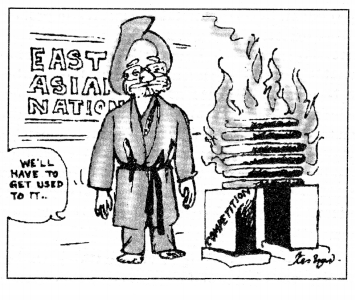
Political Science Class 12 Important Questions Chapter 4 Alternative Centres of Power img-1

(i) The given image refers to which policy of India since 1991?
Answer:
The given image refers to look east policy of India since 1991.

(ii) Explain the significance of this policy as shown in the image above.
Answer:
The significance of this policy is that the relation between India and ASEAN becomes very cordial. Through look East Policy, India get various advantages in ASEAN countries.

(iii) Evaluate India’s role in ASEAN.
Answer:
The role of India in ASEAN is very important. India emphasis on bilateral trade between India and ASEAN in ASEAN summit-level conference. India also encourages free trade goods and services system between India and ASEAN. India also criticises terrorism in ASEAN summit.

Note: The following questions are for the Visually Impaired Candidates only, in lieu of the above question.
(1) What is the full form of ASEAN?
Answer:
The full form of ASEAN is the Association of Southeast Asian Nations.

(2) Evaluate India’s role in ASEAN.
Answer:
For this, see Study the picture given below carefully and answer the following questions: (C.B.S.E. 2019)
(i) The given image refers to which policy of India since 1991?
Answer:
The given image refers to look east policy of India since 1991.

(ii) Explain the significance of this policy as shown in the image above.
Answer:
The significance of this policy is that the relation between India and ASEAN becomes very cordial. Through look East Policy, India get various advantages in ASEAN countries.

(iii) Evaluate India’s role in ASEAN.
Answer:
The role of India in ASEAN is very important. India emphasis on bilateral trade between India and ASEAN in ASEAN summit-level conference. India also encourages free trade goods and services system between India and ASEAN. India also criticises terrorism in ASEAN summit.

(3) What did the Chinese do to break from their economic stagnation?
Answer:
For this, see
Explain the New Economic Policy of China since 1978. (C.B.S.E. 2013)
Or
“China followed its own path in j introducing a market economy”. Justify this statement with four suitable arguments? (C.B.S.E. Sample paper 2018)
Answer
(i) In 1978, Deng Xiaoping adopted the ‘Open Door’ policy and economic reforms in China.
(ii) China started privatisation in the agricultural sector in 1982.
(iii) China started privatisation in the industrial sector in 1998.
(iv) Trade barriers were removed from the Special Economic Zone where foreign investors could set up their enterprises.

Question 7.
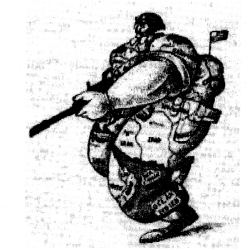
Study the cartoon given above carefully and answer the following questions: (C.B.S.E. 2019)
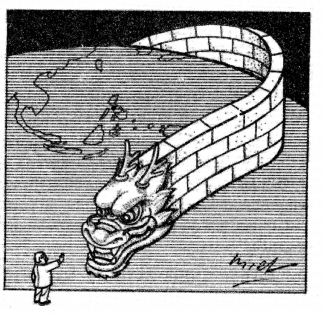
Political Science Class 12 Important Questions Chapter 4 Alternative Centres of Power img-2

(i) Which part of this cartoon is related to China?
Answer:
In this cartoon, Dragon is related to China.

(ii) Assess the strength of China on the basis of the cartoon.
Answer:
China is growing as a great power. It is the world’s projected to overtake the U.S. as the world’s largest economy by 2040. However, it is not suitable conditions for India.

(iii) “China may be the next superpower in the world.” Justify the statement with two arguments.
Answer:
(a) In the economic sphere, China’s economy is growing very fast.
(b) Military power of China is very strong.

Note: The following questions are for the Visually Impaired Candidates only in lieu of Above question
(1) In your opinion, where does China stand as an economic power?
Answer:
China stands 2nd in the world as an economic power.

(2) Assess any two conditions which make the United States of America, a superpower.
Answer:
(a) Economically U.S.A. is very strong.
(b) Military point of view the U.S.A. is very strong.

(3) “China may be the next superpower in the world.” Justify the statement with two arguments.
Answer:
For this, see point
(i) Which part of this cartoon is related to China?
Answer:
In this cartoon, Dragon is related to China.

(ii) Assess the strength of China on the basis of the cartoon.
Answer:
China is growing as a great power. It is the world’s projected to overtake the U.S. as the world’s largest economy by 2040. However, it is not suitable conditions for India.

(iii) “China may be the next superpower in the world.” Justify the statement with two arguments.
Answer:
(a) In the economic sphere, China’s economy is growing very fast.
(b) Military power of China is very strong.

Question 8.
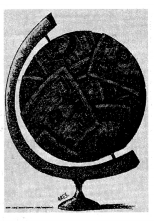
Study the cartoon given below carefully and answer the following questions: (C.B.S.E. 2018)
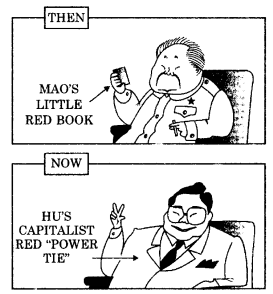
Political Science Class 12 Important Questions Chapter 4 Alternative Centres of Power img-3

(a) Which country does this cartoon refer to?
Answer:
This cartoon belongs to China

(b) Evaluate any two changes in the economic policies of this country form ‘then’ to ‘now’
Answer:
For this see:
Explain the New Economic Policy of China since 1978. (C.B.S.E. 2013)
Or
“China followed its own path in j introducing a market economy”. Justify this statement with four suitable arguments? (C.B.S.E. Sample paper 2018)
Answer

  1. In 1978, Deng Xiaoping adopted the ‘Open Door’ policy and economic reforms in China.
  2. China started privatisation in the agricultural sector in 1982.
  3. China started privatisation in the industrial sector in 1998.
  4. Trade barriers were removed from the Special Economic Zone where foreign investors could set up their enterprises.

(c) Assess any two outcomes of the latest changes that took place in this country.
Answer:

  1. The Chines economy including both industry and agriculture grew at a forte rate.
  2. China emerged as an economic superpower in Asia.

Note: The following questions are for visually impaired candidates only, in lieu above question

(20.1) What is the full form of ASEAN?
Answer:
The full form of ASEAN is the Association of South-East Asian Nations.

(20.2) State the main objective of the ASEAN.
Answer:
The main objective of ASEAN was to accelerate economic growth and through that social progress and cultural development.

(20.3) What does the ‘ASEAN Way’ mean?
Answer:
ASEAN way is a form of interaction among ASEAN members that is informal and cooperative.

Alternative Centres of Power Important Extra Questions HOTS

Question 1.
Mention two drawbacks of China’s new economic policy.
Answer:

  1. China has made great economic growth but the benefits of growth have not reached to the common man.
  2. Corruption in administration is increasing day-by-day.

Question 2.
Mention two features of the European Union.
Answer:

  1. In the contemporary world, it is the oldest regional organisation.
  2. European Union stands for democracy, world peace, human rights and friendly relations amongst the nations. It is opposed to war.

Question 3.
Write two aims of the European Union.
Answer:

  1. The main aim of the European Union was to establish an economic and political organisation of the European states.
  2. A common currency of all the member states shall be created.

Question 4.
Illustrate two major points of dispute with China.
Answer:

  1. A major dispute is a border dispute which involves the demarcation of the 4200 km. the long border at the foot of Himalayas.
  2. Chinese aggression on Indian border on October 20, 1962, and the continuing violations of our borders.

Question 5.
Write two weaknesses in the European Union.
Answer:

  1. European Union has failed to adopt a common constitution. Prime Minister Churchill’s dream of the United States of Europe could not become a reality.
  2. The common currency of the European Union is not adopted by all the member states.

Question 6.
What do you understand by ‘Marshall Plan’?
Answer:
For the reconstruction of the economics of Western Europe, America started a plan known as the ‘Marshall Plan’. The Communists and even France under De Gaulle considered this plan as a cover to establish U.S. dominance in Western Europe. All the sixteen non-communist European nations which received aid from the Marshall Plan formed an organisation for European Economic Co-operation on April 15, 1948.
Spatial Information Technology Class 12 Important Extra Questions Geography Chapter 6

Here we are providing Class 12 Geography Important Extra Questions and Answers Chapter 6 Spatial Information Technology. Geography Class 12 Important Questions are the best resource for students which helps in class 12 board exams.

Class 12 Geography Chapter 6 Important Extra Questions Spatial Information Technology

Spatial Information Technology Important Extra Questions Short Answer Type

Question 1.
What do you mean by a computer ? What are its characteristics ?
Answer:
Computer. The word ‘Computer’ has been derived from the English word ‘Compute’ meaning measuring. The modern age is computer age. Computer is an electronic device that processes information at high speed with accuracy. The most powerful computers can perform billions of calculations or arithmetic operations per second.

This device is capable of solving problems or manipulating data by accepting the same performing arithmetical operation (using arithmetical instructions, e.g., addition, subtraction, multiplication and division) or logical operations (using logical operators ‘and’, ‘or’, ‘not and’, etc.) of the data, and supplying the results of these operations.

In general, computer can process numbers, words, still pictures, moving pictures and sounds. The computer uses electronic current to carry information. To enable a computer to process information that is not numerical such as words, pictures or sounds, the information is digitised.

Main Characteristics of a Computer

  • Speed. A computer can work with high speed.
  • Storage capacity. Computer has a large storage capacity. Data can be stored with the help of Discard Tape.
  • Accuracy. Computer is important for its accuracy. Computer tries to remove any error if it occurs.
  • Variety of jobs. Computer is used for many works like storage of data, designing, games, etc.
  • Automation. Computer works like an automatic device and provides a detailed study.

Question 2.
Name the main parts of a computer. Describe the different units of hardware.
Answer:
Parts of Computer System
A computer system consists of two basic components:
1. Hardware
2. Software.

Hardware. It is the physical part of computer system and consists of electronic, magnetic and mechanical devices. A computer system has following main hardware units.

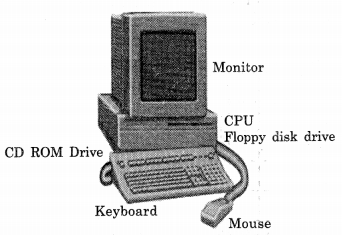
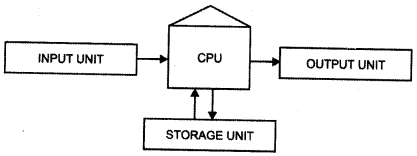
1. Central Processing Unit (CPU). It is the nerve centre of any digital computer system, it coordinates and controls the activities of all other units and performs all the arithmetical and logical processes to be applied to the data. CPU has three separate hardware sections: internal memory, arithmetic unit and a control section.

Chip (thin silicon wafer containing a large amount of integrated electronic circuitry) is the building block of a computer and performs various functions e.g., doing arithmetic operations, serving as the computer’s memory or controlling other chips.

2. Visual Display Unit (VDU) or Terminal. Like Television, display unit consist of a Cathode Ray Tube (CRT), which is used to display characters or graphics representing data read from the main memory of a computer.

3. Input/Output Devices. Input device like keyboard, is used to enter data and programs into the computer memory. Similarly, since all the data and programmes within a computer are stored as electrical impulses in a coded form, output devices like printers, plotters, etc., are employed to transcribe this data into information (e.g. characters, drawings or graphics) that can be used by human beings.
Geography Class 12 Important Questions Chapter 6 Spatial Information Technology 1
4. Storage Device. A computer consists of a number of storage devices like Hard disk, floppy, tape, Magneto Optical disk, Compact disk (CD), Cartridge, etc; which are used to store both data and program instructions. These devices vary in their capacity of data storage, from megabytes (MB) to gigabytes (GB).
Geography Class 12 Important Questions Chapter 6 Spatial Information Technology 2

Question 3.
What are the main advantages of using a computer ?
Answer:
(i) Computer is an electronic device that processes information with high speed and accuracy.

(ii) The most powerful computers can perform billions of calculations or arithmetic operations per second.

(iii) This device is capable of solving problems and manipulating data by accepting the same, performing arithmetical operations (using arithmetical instructions, e.g., addition, subtraction, multiplication and division) and supplies the results of these operations

(iv) In general, computer can process numbers, words, still pictures, moving pictures and sounds

(v) The computer uses electronic current to carry information

(vi) To enable a computer to process information that is not numerical—such as words, pictures, or sounds—the information is digitized.

Question 4.
What are the limitations of a computer ?
Answer:
It is necessary for us to know and understand what a computer cannot do.

  • A computer cannot do thinking for us.
  • Computers can only follow specific, logical steps based on the information we, humans enter
  • Thus, a computer can only act on the basis of information we put in it.
  • A computer does only what it is told, either by programs (a set of instructions) or by a human operator.

Question 5.
What are the main components of a computer ?
Answer:
A computer system consists of two basic components:
(a) Software
(b) Hardware

(a) Software. Software refers to all programs which can be used on’a particular computer system. It governs the operation of a computer system. It may be classified as:

  • Application software
  • System software.

(b) Hardware. It is the physical part of computer system and consists of electronic, magnetic and mechanical devices. A computer system has following main hardware units:

  • Central Processing Unit (CPU)
  • Visual Display Unit (VDU)
  • Input-output (I/O) devices
  • Storage devices.

Question 6.
Write a note on CPU.
Answer:
Central Processing Unit (CPU). It is the nerve centre of any digital computer system. It coordinates and controls the activities of all other units and performs all the arithmetical and logical process to be applied to the data. CPU has three separate hardware sections:

  • internal memory,
  • arithmetic unit and
  • a control section.

Chip (a thin silicon wafer containing a large amount of integrated electronic circuitry) is the building block of a computer and performs various functions, e.g., doing arithmetic operations, serving as the computer’s memory or controlling other chips.

Question 7.
What is storage device in a computer ?
Answer:
Storage Device. A computer consists of a number of storage devices like Hard disk, floppy, tape, Magneto-Optical disk, Compact disk (CD), Cartridge, etc.; which are used to store both data and program instructions. These devices vary in their capacity of data storage, from megabytes (MB) to gigabytes (GB).

Question 8.
Write a note on application software.
Answer:
Application Software
There are two types of application software :
(i) First type of Application Software relates to database management, business graphics and words processing, covering a broad range of functions used by most business houses and many individuals.

(ii) Second type of application software provides specific professional or technical applications for specific kinds of business. For example, software specifically designed to be used by medical doctors, dentists, architects and engineers performs very special tasks.
The categories of broad-range applications software meant for personal use and business include:

  • Accounting — general ledger, payroll, invoicing, etc.
  • Communications — electronic mail interaction with central office mainframe computers, connectivity with commercial data banks and other services offered by information utilities.
  • Database management – organising data files for central access, retrieval and update, compiling statistics, plot trends and market analysis.
  • Educational programs – learning through games, tutorials, simulations, etc.
  • Graphics — displaying colour graphics and charts, producing colour slides and other visual aids.
  • Programming — translating a problem from its physical environment to a language that a computer can understand and obey.

Question 9.
What is an operating system ?
Answer:
Operating System (OS). Software that controls the executions of computer programs and provides scheduling, debugging, Input / Output control, compilation, data management and related services. Popular types of operating system include DOS (Disk Operating System), UNIX and its variants, VMS (Virtual Memory System), Microsoft Windows, etc.

Question 10.
Write short notes on RAM and ROM.
Answer:

  • RAM (Random Access Memory). Memory into which data can be written and from which data can be read.
  • ROM (Read Only Memory). Memory containing information which is present and permanent and which cannot be written but can only be read by program routines.

Question 11.
Write a note on Geo-Referencing and Grand Control points.
Answer:
Geo-Coding of Geo-Referencing of Raster Image
Scanned raster images and satellite imageries are corrected for distortions by matching them with Ground Control Points (GCPs) occurring in an image. GCPs are features of known ground location that can be accurately located on the aerial photo or satellite imagery.

GCPs are located both in terms of their image coordinates (column and row numbers) on the distorted image and in terms of their ground coordinates (typically measured from map or established on the ground in terms of latitude and longitude with respect to a particular projection system, say UTM or Polyconic).

A least-square regression analysis is done to interrelate the geometrically correct (map) coordinates and distorted image coordinates. Then, image is wrapped to have correct geometrical relationship with its corresponding ground situation.

Question 12.
Write a note on Digital mapping.
Answer:
Digital fair mapping. Geo-coded raster image is used as a backdrop of draw point, features, line features and aerial features and annotate them with proper symbols and texts. Alternatively, the above features or the raster image may simply be digitized without using symbols to create cartographic database. The digital map may be subjected to automated cartographic processes, like generalisation, classification, etc.

Question 13.
What are the three basic elements of Cartography ?
Answer:
Cartography is undergoing dramatic changes driven primarily by technological developments in both computer and tele- communication fields.

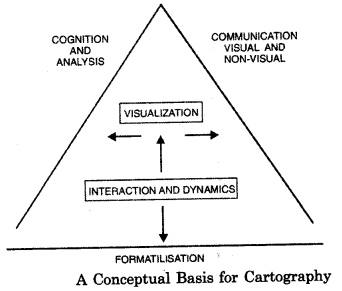
Modern cartography can be represented by a triangle whose arms signify three basic elements which go to give it a new significance.

  • Formailisation
  • Cognition and analysis, and
  • Communication.

‘Formailisation’ forms the base of the triangle; it represents the cartographic production aspects. Cognition and Analysis as well as Communication are the other two sides. Currently, cartography is facing challenges due to fast emerging developments in computer, multimedia and telecommunication fields.

Map designers have greater opportunities to utilise computer and multi-media for spatial data processing. Every year large number of new softwares are developed. Some of the main GIS and mapping software are: Apple, Arc/Info, Auto CAD and Maplnfo, GRAM and so on.
Geography Class 12 Important Questions Chapter 6 Spatial Information Technology 3

Question 14.
What is the importance of computer in Cartography ?
Answer:
Use of computer in cartography helps in the following ways:

  • Maps are made quickly.
  • Maps are made according to user’s needs.
  • Map construction is possible even if skilled cartographer is unavailable.
  • Map making has become less expensive.
  • Maps can be made more attractive.
  • Map reproduction has become faster.
  • Updating of the map can be done if data are in a digital form.

Effect of Space Technology
The space technology has changed mapping in many ways.

  • Softcopy images have replaced printed maps for many applications.
  • Production time has been reduced drastically.
  • For military intelligence and micro-planning for development needs, a timely, high resolution image of a designated site can be obtained in minutes by moving a nearby satellite into a new orbit.
  • Automation is also changing the quality as well as variety of spatial information that can be mapped.
  • Further, Geographic Information System (GIS) is expanding the role of spatial mapping and analysis in decision making.

Question 15.
Write a note on spatial information technology.
Answer:
Spatial Information Technology
Resource management of a region is performed by two methods:
(i) manual map overlay method
(ii) by computer technology using numerical spatial data sets or geo-based files.
Manual overlaying to transparent maps has its limitations. Only a few maps can be overlaid simultaneously for visual analysis. The computer- assisted technology requires information in digital form. In this approach, interrelation of resource features is performed through numerical transformations.

Thus, cartography gives new impetus to spatial data storage and exchange. Simultaneously, the combined use of Geographic Information System (GIS), and Digital Image Processing (DIP) provide better prospects of geographical monitoring and forecasting over a wider area within limited time-span. It would be easy to develop predictive modelling capabilities for effective public policies in years to come.

Question 16.
What are the elements of data structure ?
Answer:
Elements of Data Structure
Both graphic variable and text help in giving a good aesthetic look to the map. Information about the map is shown through the graphic variable and text.

The following six basic types of graphic variables are popular:

  • Size of Typology. Differences in size of the symbols (dots) and lines.
  • Lightness or (grey) value. The lighter shades show lower densities and deeper or darker shades show higher densities.
  • Grain or texture. In this method, black and white colour are mostly used. Changing the ratio of black and white colours shows the variation intensity of an element.
  • Colour Hue. Hue refers to various colours we perceive: red, green, blue and combinations.
  • Orientation. Differences in orientation refers to patterns and not to the line elements that form the base map.
  • Shape. The various symbols are included for identifying shape differences.

Question 17.
What do you mean by GPS and GIS ?
Answer:
Global Positioning System (GPS)
Global Positioning System (GPS), is an all-weather radio navigation system developed by US military in which individual receivers process data beamed down from satellites. It provides three-dimensional positions, 24-hours-per-day basis around the world.

The space satellite system consists of 24 satellites in a circular orbit and with an orbital period of 12 hours. The orbits are inclined to the equator at 55 degree. The satellites carry an atomic clock moving and generating stable signals. These signals carry information about time and position of satellites.

This provides latitude, longitude and altitude of any spatial unit. Thus, the GPS has been contributing greatly in the field of spatial mapping.

Geographic Information System (GIS)
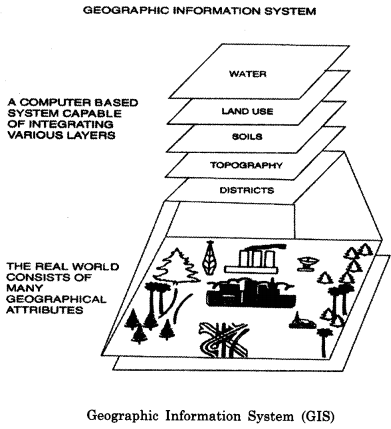
Many scholars defined GIS in various ways. Geographic Information System (GIS) is a database of a particular kind containing spatial information about various levels of observations. GIS can be considered as a tool to analyse resource and environmental information in a spatial context. Development of a GIS requires a clear understanding about its multi-level structure.

GIS can be defined as, “A powerful set of tools for collecting, storing, retrieving at will, transforming and displaying spatial data from the real world”.Thus, GIS is a computer-based system which provides easy access to stored geographical data, customised maps and selective database query. It is easily possible to show forestland, and for reference showing major roads and administrative boundaries in a database of land cover.

Question 18.
What is the application of GIS in Socio-economic planning ?
Answer:
Advantages of GIS
GIS provides an opportunity to interpret various geographical, topographic, socio-economic spatial data in relation to spatial analysis and modelling. The emphasis is on integration of conventional land based and remotely sensed data so as to develop comprehensive databases suitable for various levels of spatial planning. This can be used for development and planning.

In this way, GIS can play an effective role for decision support system of sustainable development and management of the natural resources. The environmental resources are a prime natural capital for human sustenance and development. Thus, development, utilisation and conservation of environment resources are the major priority sectors in the national planning process.

Question 19.
Compare Vector and Raster GIS.
Answer:
Types of GIS. Vector and Raster
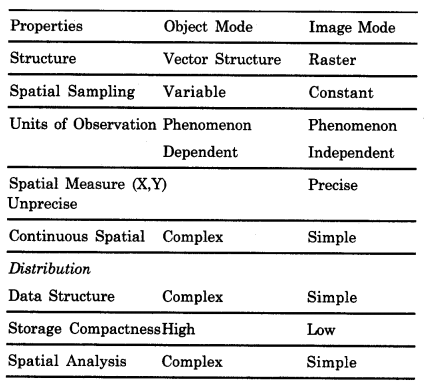
GIS analyses the attributes and their interactions within a region/space. There are two different types of GIS: vector or polygon; and raster or grid structure. Vector structure denotes spatial units of their features to be represented. Such units are of uniform size and shape and relative location within an area.

In the raster (image) data, spatial objects are made of contiguous cells sharing the same attribute within the regions. Attribute dimension is described as a set of grids in which the value assigned to each cell expresses its overall characteristics. The merits and demerits of the two GIS modes are given below:
Geography Class 12 Important Questions Chapter 6 Spatial Information Technology 4

Question 20.
Write a note on GIS application in Land use change Monitoring and Land suitability analysis.
Answer:
Application of GIS
Using GIS solves many problems such as land and forest cover change, water and air quality assessment, soil erosion risk analysis, natural hazard monitoring, selection of afforestation areas, land capability and suitability analysis, and data directory study. Worldwide experience has shown that remote sensing and GIS are very effective tools for resource management.

GIS can be used as decision support system identifying and integrating, monitoring and predicting natural hazards which are the major environment risks experienced in India. Integrated Watershed Management Plans that consequently result could help reduce the impacts of disasters that continuously threaten us.
Geography Class 12 Important Questions Chapter 6 Spatial Information Technology 5

(i) Land use Change Monitoring :
Land use is an important input in the geographical monitoring of rural as well as urban resources of a region. The general land cover classification can be derived from past changes in land use in general and forest cover in particular. Deforestation, for example, is a serious ecological problem in the Himalaya.

Forest maps of two time periods can provide information of forest cover changes. Satellite remote sensing can be effectively used for land use mapping and for monitoring forest degradation process in the country. Due to rapid change, the information collected by conventional methods becomes outdated.

(ii) Land Suitability Analysis for Socio-Economic Planning:
Land use suitability analysis helps in taking decision on different land related developments. The GIS analysis integrates various natural, anthropogenic and interactive factors to produce three types of maps:

(1) A map showing what land use will cause the least change in environmental processes.

(2) A map showing qualitative predictions of environmental impacts of proposed development. It also gives certain projects to be carried out and specific environmental actions to be controlled; and

(3) A map showing the best and least suitable locations for those actions. Land use planning in marginal regions like Himalayan region, Rajasthan desert requires such mapping. The analysis of land suitability for agriculture in highlands will produce information and maps related to soil erosion, slope, altitude, water availability and nutrient availability.

Field Surveys Class 12 Important Extra Questions Geography Chapter 5

Here we are providing Class 12 Geography Important Extra Questions and Answers Chapter 5 Field Surveys. Geography Class 12 Important Questions are the best resource for students which helps in class 12 board exams.

Class 12 Geography Chapter 5 Important Extra Questions Field Surveys

Field Surveys Important Extra Questions Short Answer Type

Question 1.
What do you understand by the term ‘Field Work’ ? Explain its necessity, importance and aim.
Answer:
Geography is a field oriented science. It is an areal science which studies the differences in natural, social, cultural and economic characteristics between different regions. This study is done with the help of maps. But a detailed and practical knowledge of an area can be obtained only by conducting a field-work and visiting the area. Field work provides permanent information. According to Prof. Fairgrieve, “Geography comes through the soles of one’s shoes.”

According to Prof. E.A. Freeman, “Geography is a matter of travel, a matter of seeing things with our own eyes.”

Field Work. Field work involves observing the area personally to collect and compile data regarding socio-economic conditions of the area. It is done by enquiring the people with the help of a specially prepared questionnaire.

Necessity. The published data of an area is sometimes not sufficient for geographical study. Therefore, the study of the different aspects of socioeconomic conditions can be done with the help of field work by which we can collect first hand information and data and analyse them by various methods. Therefore field work is necessary to understand the relation between man and his environment in an area.

Field work has two basic steps :

  • Collection of data
  • Processing of data.

Satellite images are important source of study in Geography, but field work is the important source of latest information.

Importance and objectives.

  • Field work helps to study the relation between physical and cultural aspects of the environment.
  • It helps to get the first hand information about the local Geography of an area.
  • It develops the qualities of team spirit and leadership among the students.
  • It provides an opportunity to interview the people about socio-economic conditions.
  • With the help of field work, a geographer can himself collect data and prepare the maps.
  • It provides a practical knowledge of an area.
  • Field work makes the geographical study of an area easy and interesting.

Question 2.
Describe the different stages involved in Field work.
Answer:
Field work involves different stages of work. It includes observation of the area; collection and compilation of data, representing it on maps with the help of cartographic techniques. This work is done systematically in different stages. Field work is divided into the following stages:

1. Preliminary Stage. In this stage, it is planned to conduct the field work.

  • The area is selected.
  • The topic is selected
  • A base map of the area is prepared
  • Many copies of the outline map are prepared
  • A topographical map of the area is obtained.

2. Operational Stages.

  • The area is personally visited by the surveyor.
  • A questionnaire related to the topic is prepared.
  • Latest data is collected.
  •  A sample survey is done where the number is large.
  • Detailed information of the area is obtained from the topographical map.

3. Tabulation Stage. The collected data is arranged in a tabular form. The average data is calculated to get the minimum number of data.

4. Mapping Stage. The data is shown by statistical diagrams. Cartographic techniques are used to prepare maps to obtain certain patterns and results.

5. Reporting Stage. At the end of the survey, a report is prepared. It includes a detailed description of the area. Some results are obtained on the basis of this survey. Some suggestions are made to meet the aims of the survey.

Question 3.
How is a questionnaire prepared ?
Answer:
A specially prepared questionnaire is used to collect data. People are interviewed with the help of this questionnaire. This questionnaire forms the basis of field work. The following techniques should be followed while preparing a questionnaire:
(i) A questionnaire should be prepared after visiting the area personally.
(ii) The main aim of the survey should always be kept in mind.
(iii) The questions should be short and direct.
(iv) The questions should be simple so that these can be answered easily.
(v) Questions should be related to field work.
(vi) Questions that may hurt the personal or religious feelings of the people should not be asked.

Precautions:
(i) The surveyor should establish good relations with the people to be interviewed.
(ii) Answers should be brief.
(iii) Every entry of the questionnaire should be filled immediately.
(iv) The surveyor should not impose his personal views.
(v) The surveyor should fix the time for interview with the respondent at their convenience.

Question 4.
What do you mean by Questionnaire ? Describe its types.
Answer:
Questionnaire : Questionnaire method involves putting previously framed questions to the selected persons. The questionnaire can be structured or unstructured. When a structured questionnaire is administered, there is no scope for manoeuvring on the part of the researcher. He has to mechanically put the questions and note down the answers. In un-structured questionnaires, the order in which questions are put can be changed according to the need of the surveyor. A map or sketch can be drawn while recording the answer. As a guide each question includes, in brackets, some remarks on how one should process the answers.

Type of Questionnaire. There are several types of questions. Which type should be administered depends on the nature of data required and the background of the people to whom the questionnaire is administered.

The different types of questions include :
(а) Simple choice questions
(b) Multiple choice questions
(c) Semantic scale questions
(d) Open ended questions.

(a) Simple Choice Questions
Simple choice questions can be answered in a Yes or No. For example, the response to the question: Do you practise agriculture? would be simple Yes or No. These questions are useful for collecting information related to occupation of the people.

(b) Multiple Choice Questions
In case of multiple choice questions, some answers are given, but only one of the answers is correct. Example : Why is the sugar factory in region ‘X’ located at place ‘A’ ? The probable answers are :

  • Availability of land
  • Availability of labour
  • Availability of capital
  • Access to the market.
  • Personal preference for residence of owner/ entrepreneur.
  • Any other reason.

Only one of the above answers mentioned is correct. But the answer will give an idea about the consideration that has been instrumental behind setting up of a factory.

3. Semantic Scale Questions
The degree of feeling of the respondent is noted down on a point scale. How strongly the respondent feels in favour or against the issue is to be noted down.

For example: How do you rate the anti-poverty programmes implemented by the government?

  • Very good
  • Good
  • Satisfactory
  • Bad
  • Very bad.

The rating answer of the respondent is noted down. This kind of information will give an idea about the public opinion regarding a policy or a programme.

4. Open Ended Questions
In this case, questions are administered and the answers as given by the respondents are recorded.
For example: What steps should the government undertake to eradicate poverty?
The answers will vary from person to person depending upon his personal, social and economic background.

Question 5.
How will you conduct the land use survey of a village ? Prepare a questionnaire to be used.
Answer:
Land Use Survey
1. Introduction. India is an agricultural country. So field work for land use studies is necessary for the development of agriculture in India. This survey is done by taking a village as a unit. It shows the main conditions, type of agriculture and different patterns of uses of land in an area.

2. Aims
(i) To know the land use of a cultivated area.
(ii) To show the types of land use on maps.
(iii) To know the crops grown.
(iv) To find out the different types of soils.
(v) To determine the irrigated area.

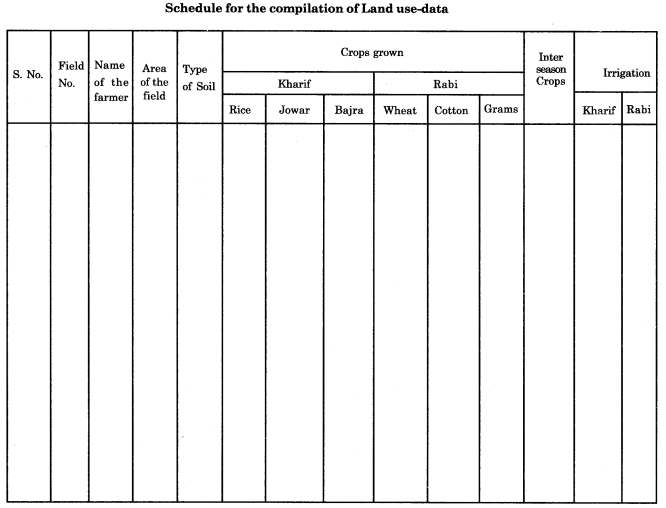
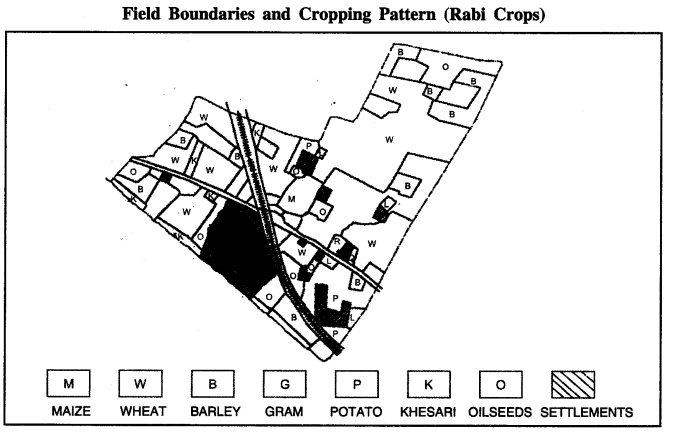
3. Method. A village, as a unit, is selected for this type of survey. A cadastral map of the village is obtained from the Patwari of the village. This map shows the numbers and boundaries of the fields. Some copies of this outline map are prepared. On this map, the location of the village is clearly marked.

The following information is obtained from the record of the Patwari of the village:

  • Total geographical area of the village.
  • Land not available for cultivation.
  • Other uncultivated area.
  • Net area sown.
  • Net area irrigated.
  • No. of fields.
  • The average size of fields.

Geography Class 12 Important Questions Chapter 5 Field Surveys 1

The data and time for interview with the farmer is fixed. A proper questionnaire is prepared to collect the required information. The fields are classified into different groups; each farmer is contacted personally.

Field Work. Every field is visited by the surveyor. The farmers who cultivate these fields are interviewed. The information regarding the general character of the field, the size of the farms, the types of crops, etc., is obtained from the farmers. This information is written in the questionnaire.

Rabi and Kharif crops are shown with the help of symbols or letters. The soils and land use is shown by colour or shading method. Different types of data is tabulated. Different maps are prepared using cartographic techniques.

4. Report. The maps and data are analysed to present a final report. The interpretation of maps helps to obtain certain conclusion, such as:

  • Pattern of land use
  • Types of soils
  • Net sown area
  • Intensity of cultivation.
  • Types of irrigation.
  • Steps to improve the land use.

Geography Class 12 Important Questions Chapter 5 Field Surveys 2

Question 6.
Describe the field-study of soil degradation, environmental pollution in Industrial areas and Urban areas.
Ans.
Environmental Pollution. Environmental pollution includes soil pollution, water pollution, air pollution and noise pollution.
1. Field study of Soil Pollution
(i) Causes of pollution and solid waste contamination can be ascertained through interaction with the residents of the area.

(ii) The polluting unit and its effect on the surroundings, the hardships of people and deterioration of soil in the adjoining area can be found out by talking to the people.

(iii) The field surveyors have to look at the solid waste management techniques used, the role of various stakeholders, the initiatives taken to solve the problem and progress made so far.

2. In Industrial areas. In Industrial areas fossil fuels cause environmental pollution. The effect on the health of local people can be found. The polluted areas have to be demarcated.

Questionnaire for Study of Pollution of Industrial areas

Sr.No.Name and Address of the factoryName of the productsNature of Fuel usedQuantity of Fuel usedNature of PollutantsEffect on The Environment
SmokeGasesLiquidsSolids
1.
2.
3.
4.
5.

3. Pollution by Transport. Various vehicles such as Buses, Cars, Trucks, Two-wheelers, etc., and the major source of pollution in urban areas.
Geography Class 12 Important Questions Chapter 5 Field Surveys 3

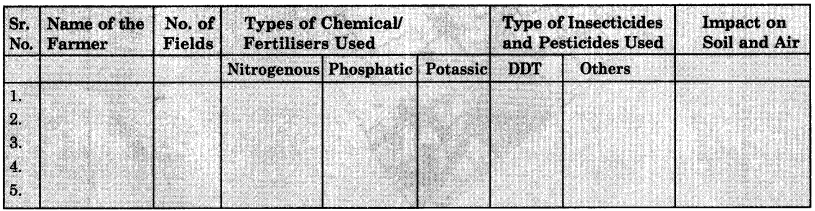
4. Pollution in Agricultural areas. A large number of chemicals, pesticides are used in agriculture to increase the yield and protect the crops.
Geography Class 12 Important Questions Chapter 5 Field Surveys 4

Question 7.
Describe the method and aims of field study of Poverty in a region.
Answer:
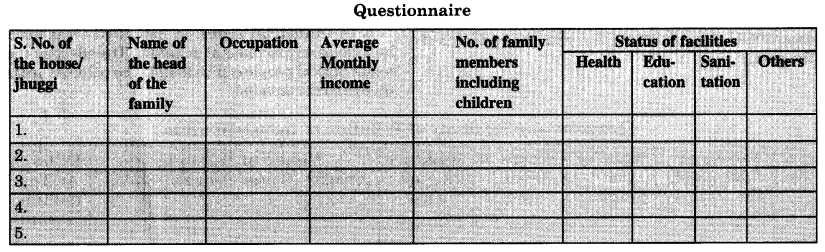
Field-Study of Poverty. Unemployment and lack of education are the main causes of poverty. A socio-economic study of poverty in a given area can be undertaken. It can be a study of each household in slum areas.

Measure of Poverty.

  • Information on average income
  • calorie intake
  • medical facilities available
  • occupation
  • The distribution of population
  • human habitations
  • food, clothing along with the social and cultural relations in the area between various income groups can be found out by carefully worded questionnaire.

Aims.

  • The initiative of the government, various poverty alleviation schedules, their impact on people in the area can also be ascertained by effective questionnaire.
  • To infer the poverty situation in an area.
  • To know the causes of poverty.

2nd PUC Basic Maths Question Bank Chapter 3 Probability 8

Graphical Representation of Data Class 12 Important Extra Questions Geography Chapter 3

Here we are providing Class 12 Geography Important Extra Questions and Answers Chapter 3 Graphical Representation of Data. Geography Class 12 Important Questions are the best resource for students which helps in class 12 board exams.

Class 12 Geography Chapter 3 Important Extra Questions Graphical Representation of Data

Graphical Representation of Data Important Extra Questions Short Answer Type

Question 1.
What are statistical diagrams ? Describe the different types of statistical diagrams.
Answer:
Statistical Diagrams. In geography, data is used to support maps. The data is given in tabular form. But certain diagrams drawn to show this data are called statistical diagrams. These diagrams give a visual impression to the mind. These are useful for contrasts and comparisons. Certain symbols and geometrical figures are used to draw these diagrams.

Types of statistical diagrams. The following are the main types of statistical diagrams :
(i) Bar graphs
(ii) Line graphs
(iii) Pie graphs
(iv) Rectangular diagrams.

(i) Bar graphs. In this diagram, the quantities are shown by bars of equal width. The length of bars is proportional to the quantities. A suitable scale is chosen to draw these bars. The scale depends upon the maximum figures, minimum figures and the size of the paper. These are easy to draw. These can be easily sub-divided.

Types of Bar Graphs.

  • Horizontal Bars. These are simple bars showing total value of only one element during different years.
  • Vertical Bars. Vertical columns drawn on the base line are called vertical bars or pillar diagrams.
  • Compound Bars. When a single bar showing total value is sub-divided to show more than one element, it is called a compound bar.
  • Percentage Bars. A single bar is drawn to represent 100 per cent. It is sub-divided to show different parts in percentage.

(ii) Line Graphs. When data is represented by graphs, it is known as line graph. It involves the drawing of smooth or curved lines. Each point is determined by two co-ordinates. Base line shows zero. The vertical scale (y-axis) shows quantities and the horizontal line (x-axis) shows time. When a line graph shows a continuous variable, the points are connected with a curve (such as temperature).

If it shows a non- continuous variation, the points are joined with short straight lines. Line graphs are notable for their accuracy. These are used for showing climatic data such as temperature, pressure, growth of population, agricultural production, etc.

(iii) Pie Graphs. It is also known as wheel diagram or coin diagram. A pie graph is a circle divided into different sectors. The basic underlying principle is that the area of the circle is proportional to the total quantity. The angle for each sector can be calculated by the following rule:
Angle for each Sector Angle for each Sector \(\frac{\text { Required quantity }}{\text { Total }} \times 360\)

[.’. A circle subtends an angle of 360° at its centre] It is effectively used for showing comparisons. These occupy less space and are useful for distribution maps.

4. Rectangular Diagrams. A rectangle is a two dimensional diagram. When rectangles are used to show the total quantity and its components, it is called a rectangular diagram. The area of each rectangle is proportional to quantity it represents. The length and breadth of each rectangle is calculated according to a scale. It is better to begin with the largest rectangle and other rectangles are drawn inside it. These occupy less space and are useful for comparisons.

Question 2.
What are the advantages and limitations of statistical diagrams ?
Answer:
Advantages

  • It is an effective and attractive method of showing data and distribution. It gives a visual impression to the mind at a glance.
  • It is easy to construct these diagrams.
  • These give comparison between different set of data.
  • It is easy to remember these for a long time.
  • These diagrams help in analysis of some elements.
  • A layman can easily understand these.
  •  It saves time.
  • These give a pattern of general picture.

Limitations

  • The data should be accurate.
  • These cannot substitute data.
  • Many elements can not be shown on one diagram.
  • When there is a great variation in maximum and minimum figures, these can not be drawn.
  • Sometimes these give wrong and distorted impressions.

Question 3.
Describe the precautions to be used for drawing bar diagrams.
Answer:
The following rules should be followed while constructing bar diagrams:

  • Scale. The scale should not be too large or too small. It depends upon the size of paper, maximum figures and minimum figures.
  • Length of Bars. The width of bars remains same, but the length of bars vary according to data.
  • Shade. Bars should be shaded after drawing.
  • Interval. Some interval is kept between the bars.
  • Order of Data. The figures should be arranged in an ascending order.
  • These should look attractive.
  • Title must be shown.
  • These should be simple.

Question 4.
Show the monthly maximum temperature of Hissar and Ambala with the help of line graphs.
Geography Class 12 Important Questions Chapter 3 Graphical Representation of Data 1
Scale. 5 lines on x-axis = 1 month 1 line on y-axis = 1°C
Answer.
Graph paper is used to show the temperature of the two towns. Draw x-axis and y-axis. Select a scale to show time. 5 lines on x-axis show one month. 1 line on y-axis shows 1°C temperature. Plot 12 points for different months and join these by a curve to show a line graph.

Question 5.
Show the following data by vertical bars. Population of India (1901 to 2011)
Answer:

Census YearPopulationCensus yearPopulation
190123,83,96,327196143.92.34,771
191125,20.93.390197154,81,59,652
192125,13,21,213198168,38,10,051
193127,89,77,238199184,39,30,86
194131.10.88,09020011,02,70,15,247
195136,10,88,09020111,21,01,93,422

Construction:
(i) Make round figure for population. Show the years on x-axis taking a suitable scale.
(ii) Draw vertical lines on ends of x-axis.
(iii) On the left hand side, select a scale of 1″:10 crores to show population.
(iv) Find out the height of bars for different years.
(v) Shade the bars.

Census yearPopulation (in crore)Height of Bars (inches)
190123.82.4″
1911  25.22.5″
192125.12.5″
193127.92.8″
194131.13.1″
195136.13.6″
196143.94.4″
197154.85.5″
1.98168.36.8″
199184.48.4″
2001102.710.3″
2011121.012.1″

Geography Class 12 Important Questions Chapter 3 Graphical Representation of Data 2

Question 6.
Show the following data by multiple bars. Sex-wise population and Total population of India (in crores)
Answer:

Census YearMaleFemaleTotal
197128.4126.4154.82
198135.3333.0068.33
199143.8840.7584.64
200153.1349.57102.70
201162.3758.64121.01

Geography Class 12 Important Questions Chapter 3 Graphical Representation of Data 18

Construction.
(i) On x-axis select a suitable scale. Draw three vertical bars each for a year.
(ii) On y-axis select a scale of 1″ = 10 crores of population and find out the height of different bars.
(iii) Shade the bars showing males, females and total population with different shades and show an index for these.

Question 7.
Show the following mean monthly rainfall data of Kolkata by Bar-diagrams.

JFMAMJJAS0ND
Rainfall
(cms.)
133514253030251331

Answer:
Method
Show the twelve months along the base line. Draw a vertical line to show the vertical scale showing rainfall in centimetres. (1 line = 1 cm. of Rainfall). Draw vertical bars and shade them black.
Geography Class 12 Important Questions Chapter 3 Graphical Representation of Data 19

Question 8.
Show the following data by Bar diagram:
INDIA—Metalled Roads

StateLength of Metalled Roads (in kms.)
1. Karnataka49,743
2. Madhya Pradesh45,756
3. U.P.45,361
4. Andhra Pradesh35,714
5. Tamil Nadu35,138
6. Punjab31,862

Answer:
Method
Draw a horizontal base line. Show a suitable scale on it keeping in mind the highest and the lowest figures. Select a scale 1 cm. = 10,000 kms. of metalled Road. Calculate the length of the bars representing different states. Draw horizontal bars of uniform width, parallel to the base line.
Geography Class 12 Important Questions Chapter 3 Graphical Representation of Data 3

Question 9.
Show the following data with the help of Compound Bars.
INDIA—Foreign trade (in Crores of Rupees)

YearExportImport      Total
1990-9132,55343,19875,751
1995-961.06,3531.22,6782,29,031
2000-012,03.5712,30,8734,34,444
2005-064,56,4186,60,40911,16,827
2010-1111,42,64916,83,46728,26,116

Geography Class 12 Important Questions Chapter 3 Graphical Representation of Data 4
Answer:
Method
Show the different years on horizontal base line (X-axis). Select a suitable scale i.e., 1 cm = ? 5000 crores. Draw a scale on the vertical line (Y-axis) on the left hand side of the base line. Calculate the height of each column according to the scale. Draw these vertical bars of equal width. Sub-divide each bar into two parts showing imports and exports. Draw an index to show the shades.

Question 10.
Show the following Data with the help of a line graph :
INDIA—-Growth of Population

YearPopulation (in Million)YearPopulation (in Million)
19012381961439
19112521971548
19212511981683
19312791991844                   :
19413192001102.8
19513612011121.0

Answer:
Method
Show the different years on the X-axis. Show a vertical scale on the left hand side selecting a scale of 1 cm. = 100 million people. Population of each year is plotted by determining the co-ordinates along X-axis and Y-axis. The points thus marked are joined by a straight line.
Geography Class 12 Important Questions Chapter 3 Graphical Representation of Data 5

Question 11.
Represent the following data of mean monthly temperature and rainfall of Mumbai with the help of compound line graph.
Answer:

JFMAMJJAS0ND
Temp. °C22.522.527283029282828272625
Rainfall (cms.)22XX45060362664X

Geography Class 12 Important Questions Chapter 3 Graphical Representation of Data 6

Method
When a line graph and a bar diagram are combined to show temperature and rainfall of a place together, it is known as a compound line graph. Draw a base line on a graph paper. Show different months on it with the help of a horizontal scale. Draw vertical line at both ends of the base line. These lines show the vertical scales for temperature and rainfall. 1 square shows 5°C temperature while 1 square shows 20 cm. rainfall. Plot the temperature curve. Show the rainfall with the help of bar diagrams.

Question 12.
Show the following data with the help of percentage and pie graphs.
Major Religious Communities in India (1991)

ReligionPercentage of total population
1. Hindus 82.41
2. Muslims11.67
3. Christians2.32
4. Sikhs 1.99
5. Others1.61
Total100.00

Method.
Draw a line 10 cm. long. Draw a simple bar of any suitable length. Show a scale of percentage on it (1 cm. = 10%). The bar shows total quantity of 100 per cent. Calculate the length of different religions according to the scale. Show the different religions with different shades.
Geography Class 12 Important Questions Chapter 3 Graphical Representation of Data 7

By Pie graphs. Pie graph is a circle broken down into sectors. For finding out the angle of each sector, the following rule is used.
Pie Diagram Showing Population by Religion in India, 1991
Geography Class 12 Important Questions Chapter 3 Graphical Representation of Data 8
\(\text { Angle }=\frac{\text { Required Quantity }}{\text { Total }} \times 100\)

In other words, the percentage figure is multiplied by 3.6° to get the angle. By this method, for Hindus the angle is 296.7°, for Muslims the angle is 42°, for Christians the angle is 8.4°, for Sikhs the angle is 7.1° and for others it is 5.8°.

Question 13.
Write a note on flow diagrams.
Answer:
Flow diagrams show the movement and intensity of different elements. These are based on two elements;
(i) Direction of movement
(ii) Intensity of movement.

For example.
(i) To show number of vehicles on Rail-Road Routes
(ii) Wheat, Steel, Cargo, etc.
(iii) Import – Export trades.

Merits-demerits. The comparative importance of all the routes are shown on one map. The towns where these routes converge, become important. The flow diagrams show the sphere of influence of nodal town.
Example. The following table shows the frequency of buses moving from Panipat to different stations.

Number of Buses moving from Panipat

To TownNumber of Buses
Kamal70
Delhi50
Rohtak20
Ambala90
Jind25

Geography Class 12 Important Questions Chapter 3 Graphical Representation of Data 9

(i) Show the location of all the towns on an outline map of Haryana.
(ii) Show the road routes.
(iii) Show the thickness of routes according to scale selected.
(iv) Show arrows for direction on all routes.
(v) Draw the scale also.

Question 14.
What are distribution maps? What are the requirements for preparing a dot map? Describe the merits and demerits of dot method.
Answer:
Distribution Maps. Distribution maps show the real distribution of different elements such as density of population, livestock, crops, minerals, etc. These show the variations in the value, amount or density of different elements. Different symbols or colours are used to draw these maps.

These maps help the geographer in the study of the economic geography. These help the geographer to study the cause and effect of any distribution and give a visual impression. Such maps are thus useful for educational purpose and are of two types:
Geography Class 12 Important Questions Chapter 3 Graphical Representation of Data 10

(i) Quantitative Maps. Such as dot maps, isopleths.
(ii) Qualitative Maps. Such as chorochromatic maps, colour method.
Dot Method. Dot is the simplest kind of symbol used for showing distribution maps. Dot of uniform size show the distribution of crops, population, livestock, etc. Each dot has a specific value. The number of dots is calculated for the total quantity shown on the map.

Requirements for preparing a dot map

  • An outline map of the region showing boundaries of administrative units.
  • Definite and detailed data of the element.
  • Relief map of the area.
  • A climatic map showing temperature and rainfall.
  • A soil map of the area.
  •  A topographical map showing urban and rural settlements.

Problems of Dot method
(i) Value of a dot. Scale of value of a dot should be carefully chosen. The selection of scale depends upon maximum figures, minimum figures and the size of the map. Dots should not be too many or too few.

(ii) Placing of dots. Dots should not be placed over negative areas such as marshes, deserts, etc. Dots should not merge together and should be placed at the centre of gravity of the area such as Urban Towns in case of population maps.

(iii) Size of dots. Dots should be round and of uniform size. The size of dots depends upon the size of the map and number of dots.

Merits
(i) This method is quantitative as well as qualitative.
(ii) In this method, waste land can be avoided.
(iii) This method gives a visual impression to the mind and is useful for educational purposes.
(iv) Pattern of dots faithfully reflect the distribution of an element.
(v) It is easily commensurable and can be transferred into a choropleth map or an isopleth map.

Demerits
(i) This method cannot be used for showing relations and percentages.
(ii) These show only one element on map.
(iii) These maps can not be used for scientific purposes.

Question 15.
What are choropleth maps ? Explain its principle, merits and demerits.
Answer:
Choropleth Maps. In this method, the distribution of an element is shown by different shades.
Geography Class 12 Important Questions Chapter 3 Graphical Representation of Data 11
Geography Class 12 Important Questions Chapter 3 Graphical Representation of Data 12

So it is also known as shading method. An index is shown in one corner of the map showing scheme of different shades.

Principle. Generally, black and white shading is used. This is somewhat similar to colour or tint method. The density of shading is proportional to the intensity of the value of the element. The lighter shades show’ the lower densities while the deeper shades show higher densities.
The depth of shading can be increased by enlarging the dots, thickening the lines or bringing the lines close together.

Problems
(i) Choice of administrative unit. Generally, data is based on administrative units which should be carefully selected.
(ii) Choice of interval. It is necessary to group data into categories. So we select an interval between these categories and it is called scale of densities. Too many categories can be confusing w’hereas too few can be uneffective.

Merits
(i) It is useful for average figures or percentages.
(ii) It is used for showing density of population, yields of crops, land use and ethnic group of population.
(iii) This method is somewhat similar to colour method and give a visual impression to the mind.
(iv) Choropleth maps are the chief tool of human geographer.

Demerits
(i) In this method, the distribution shown is uniform over the whole area and no account is taken of waste lands.
(ii) The boundaries of shading do not follow the exact line of variation.
(iii) These maps do not give absolute figures.

Question 16.
What are isopleths ? Name its different types. How are these prepared ? Describe their merits and demerits.
Answer:
Isopieths. Isopieths are imaginary lines of equal value, in the form of quantity, intensity and density. The word isos means equal and plethron means measure. Therefore, isopleths are lines of equal value. These lines connect all the places with similar values.

Types of isopleths. Different elements are shown by different types of isopleths.

  • Isobars. Isobars are lines joining the places of same pressure reduced to sea level.
  • Isotherms. Isotherms are lines joining the places of same temperature reduced to sea level.
  • Isohyets. Isohyets are the lines joining the places of same rainfall.
  • Contours. Contours are lines joining the places of same height above mean sea level.
  • Isonephs. Isonephs are lines joining the places of same cloudiness.
  • Others. Isobath, isohalines, isoseismal, isohets are other examples.

Drawing of Isopieths

  •  Draw an outline map of the area. Mark all the places on it.
  • Data should be available for all these places.
  • Select a suitable interval for the map according to maximum and minimum figures.
  • The selection of interval depends upon the rate of variation of an element. The isopieths show a mild rate of change when these are apart, but show a steep change when these are close.
  • Isopieths are drawn as smooth lines by joining the points with same values; otherwise, isopieths are interpolated proportionately between the values plotted on the map.
  • Sometimes, the area between two-isopieths are shaded.

Geography Class 12 Important Questions Chapter 3 Graphical Representation of Data 13

Merits
(i) Isopieths show accurately the values of rainfall, temperature, etc.
(ii) These show the actual values present at a place.
(iii) It is a scientific method of showing these elements.
(iv) Dot map and choropleth maps can be converted into isopleth maps.
(v) These maps are not related to administrative

Geography Class 12 Important Questions Chapter 3 Graphical Representation of Data 14
Geography Class 12 Important Questions Chapter 3 Graphical Representation of Data 15
Demerits
(i) The interpolation of isopleths is a difficult process.
(ii) If sufficient data is not available, isopleths cannot be drawn.
(iii) If isopleths show steep variation, these maps are not meaningful.
(iv) These fail to show the urban and rural population on the same map.

Uses
(i) These are useful for showing climatic data.
(ii) These are used to show ratios and percentages also.
(iii) These maps are used to show 7 population maps, density of population, livestock, yield per hectare, etc.
Geography Class 12 Important Questions Chapter 3 Graphical Representation of Data 16
Geography Class 12 Important Questions Chapter 3 Graphical Representation of Data 17

US Hegemony in World Politics Class 12 Important Extra Questions Political Science Chapter 3

Here we are providing Class 12 Political Science Important Extra Questions and Answers Chapter 3 US Hegemony in World Politics. Political Science Class 12 Important Questions are the best resource for students which helps in class 12 board exams.

Class 12 Political Science Chapter 3 Important Extra Questions US Hegemony in World Politics

U.S. Hegemony in World Politics Important Extra Questions Very Short Answer Type

Question 1.
What was the Gulf War of 1990? (C.B.S.E. 2009)
Or
What do you mean by the First Gulf War? (Imp.)
Answer:
On 2nd August 1990, Iraq invaded Kuwait. Immediately a meeting of the Security Council was held. U.N. Security Council condemned the invasion and demanded the withdrawal of Iraqi troops. The United Nations mandated the liberation of Kuwait by force. A massive coalition force of 660,000 troops from 34 countries fought against Iraq and defeated it. The U.N. operation was called ‘Operation Desert Storm.’ It is also known as the First Gulf War.

Question 2.
What is meant by ‘Hegemony’? (C.B.S.E. 2013)
Answer:
In international politics, countries, and groups of countries are constantly trying to capture and retain power. Power can be in the form of military domination, economic power, and cultural dominance. After the disintegration of the Soviet Union, U.S.A. dominated world politics. When there is only one centre of power in the international system, it is called hegemony.

Question 3.
What is meant by ‘Operation Enduring Freedom’? (Imp.) (C.B.S.E. 2013)
Or
What was ‘Operation Enduring Freedom’ launched by the United States of America? (C.B.S.E. 2014)
Answer:
On 11 September 2001 terrorists attacked World Trade Centre in New York and the Pentagon in Washington. Nineteen hijackers took control of four American commercial aircraft shortly after take-off and flew them into the important building of U.S. In response to that incident U.S.A. launched ‘Operation Enduring Freedom’ and attacked Al-Qaeda in Afghanistan.

Question 4.
How far is it correct to describe the ‘First Gulf War’ as the first act of US Hegemony in the post cold war period? (C.B.S.E. Sample Paper 2018)
Answer:

  1. An American General led the UN coalition in the first Gulf War.
  2. First Gulf War shows a vital technological and weapons gap between the U.S. and the Rest of the world.

Question 5.
The UN along with many other countries of the world refused to give their mandate to ‘Operation Iraqi Freedom’? Elucidate their stand. (C.B.S.E. Sample Paper 2018)
Answer:

  1. No traces of weapons of Mass destruction were found during the war.
  2. U.S. main aim was to control Iraqi oil fields.

Question 6.
Why was the operation Infinite Reach’ ordered by President Clinton? (Imp.) (C.B.S.E. 2012 Delhi)
Answer:
In 1998, there was a bombing at the U.S. embassies in Nairobi, Kenya and Dar-es-Salaam, Tanzania by Al-Qaeda, a terrorist organization. President Clinton ordered ‘Operation Infinite Reach’ in which Al-Qaeda terrorist targets in Sudan and Afghanistan were attacked. America did not bother about the U.N. sanction in this regard.

Question 7.
Write the four forms of power which reflect the U.S. hegemony. (C.B. S.E. 2012 Outside Delhi)
Answer:

  1. Hard power
  2. Structural power
  3. Soft power
  4. Cultural power.

Question 8.
How was the U.S. benefitted from the Soviet disintegration? (C.B.S.E. 2015)
Answer:

  1. The U.S.A. became the sole power or hegemon and no other country was in a position to challenge the supremacy of the U.S.A.
  2. An international organisation like U.N.O., I.M.F. World Bank are dominated by the U.S.A.

Question 9.
Match the following events in Column ‘A’ with their corresponding dates in Column ‘B’: (C.B.S.E. 2019)

Column ‘A’Column ‘B’
(a) World War II(i) 1990
(b) Kuwait Invasion(ii) 1992
(c) Presidency of Bill Clinton(iii) 1941
(d) Pearl Harbour(iv) 1945

Answer:
(a) 1945,
(b) 1990,
(c) 1992,
(d) 1941.

Question 10.
Find the correct sequence of the following events: (C.B.S.E. 2019)
(a) US invasion of Iraq under Operation Iraqi Freedom
(b) Bombing of the US Embassies in Nairobi, Kenya, and Tanzania
(c) Attack on North and South towers of the World Trade Organisation
(d) Iraq’s invasion of Kuwait
Answer:
(d) Iraq’s invasion of Kuwait
(b) Bombing of the US Embassies in Nairobi, Kenya, and Tanzania
(c) Attack on North and South towers of the World Trade Organisation
(a) US invasion of Iraq under Operation Iraqi Freedom

U.S. Hegemony in World Politics Important Extra Questions Very Short Answer Type (2 Marks)

Question 1.
When did the era of U.S. hegemony start? (C.B.S.E. 2010)
Answer:
The U.S. hegemony began in 1991 after the disintegration of the Soviet Union.

Question 2.
What is meant by U.S. hegemony in World Politics? (Imp.) (C.B.S.E. 2008 Comp. 2009 Delhi)
Answer:
U.S. hegemony means the dominant position of the U.S.A. in the world in military, political, economic as well as cultural fields.

Question 3.
Name the first business school which was established in the U.S.A. in 1881.
Answer:
The first business school’s name was ‘Wharton School’.

Question 4.
Which event does “9/11” refer to in the context of Contemporary World Politics? (Sample Paper)
Or
Which incident was related to 9/11?
Answer:
On 11 September 2001, nineteen hijackers hailing from Arab countries took control of four American commercial aircraft and flew them into the important building in U.S. President George W. Bush launched ‘Operations Enduring Freedom’ against Afghanistan to curb terrorism

Question 6.
What was the main objective of ‘Operation Desert Storm’?
Answer:
On 2nd August 1990, Iraq invaded Kuwait. The United Nations mandated the liberation of Kuwait by force. This was called Operation Desert Strom.

Question 7.
How did the U.S. respond to the 9/11 attacks? (Imp.) (C.BS.E. 2015)
Answer:
U.S. President George W. Bush launched ‘Operations Enduring Freedom’ against all those suspected to be behind the 9/11 attack to curb terrorism and to crush terrorists chiefly al-Qaeda and the Taliban regime in Afghanistan.

Question 8.
What does the word ‘Hegemony’ imply? (C.B.S.E. 2012 Delhi)
Or
What is meant by Hegemony? (C.B.S.E. 2015)
Answer:
Hegemony implies class ascendancy in the social, political, and particularly ideological spheres. Hard power hegemony relates to the supremacy of military power.

Question 9.
Explain hegemony as soft power. (Imp.) (C.B.S.E. 2015)
Answer:
Hegemony as a Soft Power implies class ascending into Social, Political, and particularly ideological sphere

Question 10.
Highlight any one main feature of the U.S. economy.
Answer:
The U.S. economy is based on a capitalist system.

Question 11.
Why was ‘Operation Desert “ Storm’ fought against Iraq?
Answer:
On 2 August 1990, Iraq invaded Kuwait. Immediately, a massive coalition force of 660,000 troops from 34 countries fought against Iraq and defeated it. This U.N. operation was called ‘Operation Desert Storm’.

Question 12.
What was the significance of operation Iraqi freedom’? (C.B.S.E. 2017)
Answer:
American Hegemony had been established after the operation Iraqi freedom.

Question 13.
How is 9/11 important in the context of U.S.A.? (C.B.S.E. 2009)
Or
What is meant by ‘9/11’ in the context of the U.S.A.? (C.B.S.E. 2013)
Answer:
Sept. 11, 2001, is important for the U.S.A. because on that day terrorists attacked World Trade Centre in New York and the Pentagon in Washington

Question 14.
What was the main reason for the beginning of the U.S. hegemony in 1991? (C.B.S.E. 2013)
Answer:
The main reason for the beginning of the U.S. hegemony in 1991 was the disintegration of the Soviet Union.

Question 15.
Define the ‘Bandwagon Strategy’. (C.B.S.E. 2013)
Answer:
‘Bandwagon Strategy’ means to take advantage of the opportunity that a hegemony creates. Under ‘Bandwagon Strategy’ it is not wise to oppose the hegemon power. It is good to extract benefits by operating within the hegemonic system.

Question 16.
What was the purpose of ‘Operation Iraqi Freedom’? (C.B.S.E. 2013)
Answer:
The purpose of Operation Iraqi Freedom was to prevent Iraq from developing weapons of mass destruction.

Question 17.
Which country in the world in having global dominance. (C.B.S.E. Sample Q.P. 2017)
Answer:
The United States of America.

Question 18.
Why the dropping of Atom bombs on Japan by the U.S. towards the end of the second world war widely criticized? (C.B.S.E. Sample Paper 2018)
Answer:
Dropping of bombs was not necessary because the U.S. itself knew that Japan was about to surrender.
Choose the correct answer:

Question 19.
Operation Iraqi Freedom was launched on:
(a) 21 April 2003 (b) 19 March 2004
(c) 23 March 2003 (d) 19 March 2003.
Answer:
(d) 19 March 2003.

Question 20.
Which one of the following statements related to the Iraq invasion by the US is incorrect? (C.B.S.E. 2019)
(a) More than forty other countries were involved in this invasion.
(b) The UN had given consent to invade Iraq.
(c) The invasion was to prevent Iraq from developing weapons of mass destruction.
(d) The US lost over 3000 military personnel in this war.
Answer:
(b) The UN had given consent to invade Iraq.

Question 21.
Which one of the following was a part of its global war on terrorism by the US.? (C.B.S.E. 2017)
(a) ‘Operation desert storm’
(b) Computer war
(c) ‘Operation enduring freedom’
(d) Videogame war
Answer:
(c) ‘Operation enduring freedom’

Question 22.
The strategy of staying as far removed from the dominant power as possible is also known as. (Sample Paper 2019-20)
Answer:
The strategy of staying as far removed from the dominant power as possible is also known as to hide.

U.S. Hegemony in World Politics Important Extra Questions Short Answer Type

Question 1.
Explain any two Constraints on the American hegemony. (C.B.S.E. 2019)
Answer:
The U.S. hegemony means that the U.S.A. is the sole superpower. The U.S.A. dominates the world in military, political, economic as well as the cultural field. Constraints on U.S. Hegemony: History tells us that empires decline because they decay from within. Similarly, the biggest constraint to American hegemony is from within. Broadly, the following are two constraints on American power

  • The first constraint is the institutional architecture of the American state itself. The American system is based on the division of powers between the three organs of the government, i.e., Legislature, Executive, and Judiciary. These organs put many restrictions on military powers.
  • The second constraint on American power is the open nature of American society and political culture.

Question 2.
Explain any two strategies to overcome hegemony. (Imp.) (C.B.S.E. 2014)
Answer:
These are the two strategies to overcome hegemony :

  • Bandwagon Strategy. ‘Bandwagon Strategy’ means to take advantage of the opportunity that hegemony creates. Under the ‘Bandwagon Strategy, it is not wise to oppose hegemony power. It is good to extract benefits by operating within the hegemonic system.
  • The policy of hiding. Another strategy open to states is to ‘hide’. This implies staying as far removed from the dominant power as possible.

Question 3.
Describe any four features of the U.S. hegemony as structural power. (C.B.S.E. 2019)
Answer:

  1. the U.S.A is providing global public goods very early.
  2. the U.S.A is a leading country in the field of computer and the internet.
  3. The U.S share of the world economy remains an enormous 28%.
  4. U.S.A. is also the leading country in the M.B.A. course.

Question 4.
Describe any four features of the U.S. hegemony as hard power. (C.B.S.E. 2019)
Answer:

  1. Through its military capabilities, the U.S.A. can reach any point of the world.
  2. the U.S.A spends more on its military than the next 12 power combined.
  3. the U.S.A spends a large chunk of the military Budget on military research and development.
  4. the U.S.A. destroys the enemy country while its own forces are sheltered to the maximum extent possible from the dangers of war.

Question 5.
Describe any four features of the U.S. hegemony as soft power. (C.B.S.E. 2019)
Answer:

  1. American cultural value is very attractive.
  2. American culture is the most powerful in the world.
  3. The American cultural power based on the ability to persuade rather than coerce.
  4. American blue jeans came to represent the aspirations of a good life.

U.S. Hegemony in World Politics Important Extra Questions Long Answer Types

Question 1.
Examine any three factors responsible for the U.S. Hegemony in world politics. (C.B.S.E. 2009, 2015)
Answer:
In world politics, the U.S.A. has the position of hegemony. Following factors are responsible for the U.S. hegemony in world politics.

  • After the end of the Cold War, there was no serious rival to the United States.
  • Mikhail Gorbachev, General Secretary of the Communist Party, introduced political and economic reforms in the political and economic system of the Soviet Union. These reforms are also responsible for the U.S. hegemony in world politics.
  • The sudden collapse of the Soviet Union is mainly responsible for the hegemony of U.S.A. After the disintegration of U.S.S.R., one superpower ceased to exist. On the other hand, the powers of another superpower (U.S.) enhanced. Thus, the U.S. hegemony began in 1991 after the Soviet Union disappeared from the international scene.

Question 2.
“The bedrock of contemporary U.S. power lies in the overwhelming superiority of its military power.” Justify the statement with any three suitable arguments. (C.B.S.E. 2017)
Answer:
In international politics, countries and group of countries are constantly trying to capture and retain power. Power can be in the form of military domination, economic power and cultural dominance. After the disintegration of the Soviet Union, U.S.A. dominated world politics. When there is only one centre of power in the international system, it is called hegemony.

The meaning of hegemony as a hard power relates to the relations, pattern and balance of military capability between states. The nation of hegemony as military domination is relevant to the current position and role of the U.S. in world politics.

The bedrock of contemporary U-S. the power lies in the overwhelming superiority of its military power. American military dominance today is both absolute and relative.1. In absolute terms, the U.S. today has military capabilities that can reach any point on the prevalent accurately, lethally and in no time, thereby crippling the opposite while its own forces are sheltered to the maximum extent possible from the dangers of war.
2. Moreover, America spends more on its military capability than the next 12 powers combined. A large part of the budget is spent on technology.
3. In fact, U.S. dominance is not just based as higher military spending, but in a qualitative gap, a technological chasm that no other power can at present conceivably span.

Question 3.
Examine the U.S. hegemony as a structural power. (C.B.S.E. 2017)
Answer:
With the sudden collapse of the Soviet Union in 1991, one superpower ceased to exist. While another superpower, i.e., the U.S. enhanced its position. Thus, the U.S. hegemony began in 1991 after the Soviet Union disappeared from the international scene.

The hegemony of the U.S. as a structural power:
(a) The basic idea of the U.S. hegemony as structural power is that an open world economy requires a hegemon or dominant power to support its creation and existence.
(b) The hegemon must possess both the ability and the desire to establish certain norms to sustain a global structure.
(c) The hegemon usually does this for its own advantage. It takes advantage of the openness of the world economy without paying the cost of maintaining its openers.
(d) Thus, hegemony in this second sense as economic superiority is reflected by the roles played by the U.S. in providing global public goods.
(e) The U.S. hegemony prevails in all parts of the world, almost in all sectors in the world economy and in all areas of technology.

Question 4.
Evaluate India’s changing relationship with the U.S.A. (Imp.) (C.B.S.E. 2009)
Answer:
The Indo-U.S. relationship has gone through many phases. There had been many ups and downs in their relationship. After the independence of India, America wanted India to join the American bloc. But India was not ready to accept the superiority of any other nation and Pt. Jawaharlal Nehru, the first Prime Minister of Independent India adopted the policy of non-alignment. This policy turned America against India. America did not appreciate some other policies of India such as Nuclear test, Indo-Soviet friendship treaty, etc.

On the other hand, India stands against American help to Pakistan as Pakistan is the root cause of terrorism in India. Thus, America and India disagree with each other’s approach but after a meeting between Prime Minister Indira Gandhi and President Reagan in October 1981, the administration of both the countries started to re-examine their policies and the process of normalisation kept on going on and on. After the Cold War, America and India adopted the policy of making a good relationship in the field of economic, political and military-strategic spheres. The steps that mark the process of normalisation of the relationship between India and the U.S. are given below:

1. In May 1994, Prime Minister Narasimha Rao visited the U.S.A. The American President Bill Clinton expressed satisfaction with his wide-ranging talks with Narasimha Rao and described the meeting productive. The American President extended full support to India in Economic reforms.

2. On 25 July 1999 U.S.A. asked Pakistan to pull out its forces from the areas of Kargil and immediately stop acts of terrorism in Jammu and Kashmir, showing for the first time Washington’s greater understanding of India’s concern of cross border militancy.

3. On October 26, 1999, India and the U.S.A. signed a joint declaration on energy co-operation and related environmental aspects, heralding a new dimension to multifaced bilateral relation.

4. On March 19, 2000, U.S. President Mr Bill Clinton visited India. It strengthened the relationship between the two largest democratic countries in the world. The Prime Minister of India Mr Atal Behari Vajpayee and American President Mr Bill Clinton signed the ‘Vision Document’ on the future of Indo- U.S. relations in the new Millenium. They also signed ‘Vision-2000’ for a lasting and dynamic partnership.

5. On September 23, 2001, President Bush lifted sanctions imposed on India in the wake of 1998 nuclear tests.

6. On October 17, 2001, the two countries signed a new bilateral treaty on Mutual Legal Assistance in Criminal Matters.

7. After 11, September 2001, terrorist attack on America; America has joined India in its fight against terrorism.

8. In January 2002, India and U.S.A. signed a defence pact.

9. In January 2004, both the countries agreed to increase co-operation on three issues-civilian nuclear programmes, the civilian space programme and high technology.

10. In June 2004, India’s Foreign Minister Mr Natwar Singh visited the U.S.A. to increase co-operation between the two countries. In November 2004, President George Bush was elected for his second term. India’s Prime Minister Dr Manmohan Singh, in his congratulatory message to him, has said, “Our shared vision and common values provide an endearing base for our relations. India and the United States together and in partnership based on trust and mutual confidence can make a positive difference on issues of global significance in this country.”Indo-U.S. Civil Nuclear Co-operation Agreement, 2008. The Indo-U.S. Civil Nuclear co-operation agreement consists of 22 pages and 17 articles. The agreement will remain in force for 40 years.

The purpose of the agreement is to enable full civil nuclear energy co-operation between India and the United States. This agreement would help to address the problem of energy deficit that has emerged as one of the primary constraints on accelerating India’s growth rate.

The agreement does not hinder India’s military nuclear programme and provides for uninterrupted supply of fuel. India-U.S. defence co¬operation received a big boost with India formalising a mega-deal with the U.S.A. for the supply of eight long-range Naval Reconnaissance aircraft. The agreement was signed on January 1, 2009.

In Nov. 2009, the Indian Prime Minister visited the U.S.A. During his visit, both countries said that they are committed to abolishing terrorism President Obama Visits (Nov. 2010). On November 6, 2010, American President Barack Obama visited India. Several landmark deals worth $ 10 billion were signed between Indian and American companies. President Obama said, “There is no reason why India cannot be our top trading partner. I am absolutely sure that the relationship between India and the U.S. is going to be one of the defining partnership of the 21st century.” President Obama backed India for United Nation Security Council seat. Bilateral Meeting between Prime Minister Dr Manmohan Singh and President Mr Obama.

Bilateral meeting between Indian Prime Minister and American President Obama took place on November 18, 2011, at Bali. Contending that there were ‘no irritants whatsoever’ in Indo-US ties, Prime Minister Dr Manmohan Singh told President Obama that India had gone ‘some way’ to ally the concern of U.S. firms by notifying rules for nuclear business and any specific grievance would be addressed within the four corners of Indian laws.

Prime Minister Manmohan Singh and American President Obama meet on September 28, 2013, at White House. The U.S. and India sought more intensive engagement on a gamut of issues, including defence, security, bilateral trade and efforts to dismantle terrorist safe havens and promote clean energy. Both leaders emphasised the need for more intensive defence cooperation. Defence trade between the two nations has reached nearly $9 billion. The U.S. and India sought expansion of cooperation to address 21st-century challenges in the areas of counter-terrorism, cyber, space and global health security. Indian Prime Minister Sh. Narendra Modi and American President Obama met in September 2014. During this meeting, both leaders discussed Terrorism, Trade and Civil Nuclear Agreement.

In Jan 2015 American President Mr Barack Obama visited India to attend the Republic Day Parade. During this visit, both countries signed an important agreement like Nuclear Deal and Clean Energy. In Sept 2015, the Indian Prime Minister visited the U.S.A. During this visit, P.M. Narendra Modi pressed for President Obama’s help in securing India’s membership of the international export control regimes “within our targeted time of frame” and also sought American support to complete the UN reform process ‘within’ a fixed time frame. In June 2016, and 2017 Indian Prime Minister visited the U.S.A. During this visit, both leaders discussed Terrorism, Trade, and nuclear energy etc.

In September 2019, the Indian Prime Minister visited U.S.A to attend U.N.O. conference. During this visit, on 22 Sept. 2019, U.S.A. President Donald Trump attends ‘Howdy Modi; Programme. On 24 Sept. 2019. During their joint press conference, both leaders show concern on Terrorism and climate change. This shows that both countries are doing their level best to maintain a healthy and lasting relationship.

Question 5.
Analyse the political impact of j H hegemony of the U.S. on the world. (C.B.S.E: 2015)
Answer:
Following are the political impact of the hegemony of the U.S. on the world:
1. On 2nd August 1990, Iraq invaded Kuwait. Immediately a meeting of Security Council was held. U.N. Security Council condemned the invasion and demanded the withdrawal of Iraqi troops. The United Nations mandated the liberation of Kuwait by force. A massive coalition force of 660,000 troops from 34 countries fought against Iraq and defeated it. The U.N. operation was called ‘Operation Desert Storm.’ It is also known as the First Gulf War.

2. In 1998, there was a bombing at the U.S. embassies in Nairobi, Kenya and Dar-es-Salaam, Tanzania by Al-Qaeda, a terrorist organisation. President Clinton ordered ‘Operation Infinite Reach’ in which Al-Qaeda terrorist targets in Sudan and Afghanistan were attacked. America did not bother about the U.N. sanction in this regard

3. USA dominating the International organisation like U.N.O., LM.F. and World Bank. On this basis, it influences the political and economic matters of other countries.

Question 6.
Analyse the three major different views within India about the type of relationship India should have with the United States of America. (C.B.S.E. 2016, 2017)
Answer:
It is very difficult to decide exactly what type of relationship India should have with the US. The debate rotates around the three possible strategies :
1. One group of Indian analysts opine that Indian should maintain its aloofness from Washington and focuses upon increasing its own national power.

2. Second thought of opinion advocate a strategy that India should take advantage of US hegemony and the mutual convergences to establish best relations. Opposing the US is a futile strategy and will only hurt India.

3. the Third group of analysis advocate that India should take the lead of developing nations and after some times this coalition would become more powerful and may succeed in weaning the hegemon away through its dominating style. Thus, India needs an appropriate foreign policy to deal with the US.

Question 7.
“Resistance is the only option available to overcome the U.S. hegemony”. Justify the statement by comparing it to other anti hegemony strategies. (CBSE 2017)
Answer:
It is true that resistance is the only option available to overcome the hegemony of U.S.A. other two anti hegemony strategies are known as “Bandwagon and Hide.”In world politics. the U.S.A. has the position of the hegemon. After the disintegration of the Soviet Union, no other country is in a position to challenge America’s authority and military power. Big and resourceful states like China, Russia, India and the European Union are not in a position to challenge U.S. hegemony and these countries are not unduly antagonising the U.S.A.

It is unrealistic to expect much smaller states to offer any resistance to the U.S. But it is possible that the resistance may come from a combination of Non-Governmental Organisations (NGOs), social movement and public opinion. Resistance can also start by intellectuals writers, artists and mass media. Due to globalisation, the whole world has become a ‘global village’. Thus, we are all neighbours of the village headman.

If the behaviour of the headman becomes intolerable then we have no other alternative except to resist against the headman because there is only one village or world where we have to live. In other words, resistance against U.S. hegemony will be the only option available.

Question 8.
Study the cartoon given below j carefully and answer the questions that follow : (Imp.) (C.B.S.E. 2015)Political Science Class 12 Important Questions Chapter 3 U.S. Hegemony ¡n World Politics im-1

(a) The mighty soldier with weapons represents which country?
Answer:
The mighty soldier with weapons represents the U.S.A.

(b) Why do the names of various countries appear on his uniform?
Answer:
The names of countries like Iraq, Iran and Afghanistan appear on his uniform as the U.S. has carried out various military operations in these countries.

(c) What important message does the cartoon convey to the world?
Answer:
The cartoon conveys the message that the U.S. has hegemony on the world politics. Though India and USA are having friendly relations, yet at the same time, friendly relations between India and Russia have achieved a new level of privileged strategic partnership.

Question 9.
Read the following cartoon and answer the following questions: (CBSE Sample Q.P. 2017)

Political Science Class 12 Important Questions Chapter 3 U.S. Hegemony ¡n World Politics im-1.png im-2
(а) What is the basic idea of this cartoon?
Answer:
The basic idea of this cartoon is that world converts into the American dollar.

(b) What does this cartoon say about the nature of hegemony?
Answer:
This cartoon says about the Nature of hegemony that the U.S.A. dominated world Politics through its dollar.

(c) Mention any two examples of its structural power.
Answer:

  • The basic idea of hegemony as a structural power is that an open world economy requires a hegemony or dominant power to support its creation and existence.
  • The hegemony must possess both the ability and the desire to establish certain norms for order and exist sustain and global structure.

Question 10.
Interpret the given picture and answer the following questions : (C.B.S.E. Sample Paper 2018)Political Science Class 12 Important Questions Chapter 3 U.S. Hegemony ¡n World Politics im.png img-3
(а) The US hegemony is being constrained in the current scenario. Justify with two suitable examples.
Answer:
1. China’s fastest-growing economy can constrain the U.S. hegemony.
2. Nowadays the world heading towards a multipolar world. This trend can also constrain the U.S. hegemony.

(b) Assess the steps taken by India to deal with US hegemony in the current scenario. 3
Answer:
It is very difficult to decide exactly what type of relationship India should have with the US. The debate rotates around the three possible strategies :
1. One group of Indian analysts opine that Indian should maintain its aloofness from Washington and focuses upon increasing its own national power.

2. Second thought of opinion advocate a strategy that India should take advantage of US hegemony and the mutual convergences to establish best relations. Opposing the US is a futile strategy and will only hurt India.

3. the Third group of analysis advocate that India should take the lead of developing nations and after some times this coalition would become more powerful and may succeed in weaning the hegemon away through its dominating style. Thus, India needs an appropriate foreign policy to deal with the US.

Note: The following questions are for the visually impaired students, in line of Q.No.10
(a) The present world order is different from the cold war period. Justify.
Answer:
The present world order is different forms of the Cold War period because during Cold War World was bipolar in nature, but after the disintegration of U.S.S.R in 1991, the world order becomes unipolar in nature.

(b) Assess the implications of the US Hegemony economic terms on the world.
Answer:

  • The U.S.A. Dominate the economic world organisations such as I.M.F. and World Bank.
  • The U.S.A. also dominate the U.N.O. Through its Economic power.

Question 11.
Describe any three operations (Military actions) launched by the US which provide and established its supremacy as hard power. (C.B.S.E. 2018)
Answer:
1. 1st Gulf War: On 2nd August 1990, Iraq invaded Kuwait, Immediately a meeting of Security Council was held. U.N. Security Council condemned the invasion and demanded the withdrawal of Iraqi troops. The United Nations mandated the liberation of Kuwait by force. A massive coalition force of 660,000 troops from 34 countries fought against Iraq and defeated it. The U.N. operation was called ‘Operation Desert Strom.’ It is also known as the First Gulf War.

2. Incident of 9/11: On 11 September 2001 terrorists attacked World Trade Centre in New York and the Pentagon in Washington. Nineteen hijackers took control of four American commercial aircraft shortly after take-off and few them into the important building of U.S. In response to that incident U.S.A. launched ‘Operation Enduring Freedom’ and attacked Al-Qaeda in Afghanistan.3. Second Gulf War: Another operation launched by the U.S. which proved and established its supremacy as a hard power was second Gulf War on 19 March 2003 the U.S. launched its invasion of Iraq under the code name of operation Iraqi freedom.

U.S. Hegemony in World Politics Important Extra Questions HOTS

Question 1.
Explain briefly two reasons for the First Gulf War.
Answer:

  • After the First World War, Kuwait fell under the British empire. Great Britain treated Kuwait and Iraq as separate countries known as Emirates. But Iraq never recognised the sovereignty of Kuwait.
  • Kuwait was allied with Iraq during the Iran-Iraq war of the 1980s. After the war, Iraq was heavily debted to Kuwait. But Iraq accused Kuwait of slant drilling into neighbouring Iraqi oil fields. Iraq wanted that debt to be cancelled.

Question 2.
What are the two causes of tension between India and the U.S.A.?
Answer:

  • India did not sign the Comprehensive Test Ban Treaty (CTBT). For this, the American attitude towards India is not positive.
  • Another cause of tension between the two countries is the military assistance by America to Pakistan since Pakistan uses its weapons against India.

Question 3.
What is Al-Qaeda?
Answer:
Al-Qaeda is a terrorist organisation and it is mainly dominated by Islamic fundamentalists. In 1998 Al-Qaeda was responsible for the bombing of the U.S. Embassies in Nairobi, Kenya and Dar-es-Salaam, Tanzania.Question 4.
Write two main features of the Indo-U.S. Civil Nuclear Co-operation Agreement.
Answer:

  • The agreement is between two states (India and the U.S.) possessing advanced nuclear technology, both parties having the same benefits and advantages.
  • The purpose of the agreement is to enable full civil nuclear energy co-operation between India and the United States.
  • The agreement grants prior consent to process nuclear material and its product.

Question 5.
How can NATO be a constraint in the exercise of the U.S. hegemony?
Answer:
North Atlantic Treaty Organisation (NATO) is perhaps the only international organisation which could possibly moderate the exercise of American power today. The United States has a great interest in keeping the alliance of democratic countries that follow the market economics alive and therefore, it is possible that its allies in the NATO will be able to moderate the exercise of U.S. hegemony.