Data Processing Class 12 Important Extra Questions Geography Chapter 2

Here we are providing Class 12 Geography Important Extra Questions and Answers Chapter 2 Data Processing. Geography Class 12 Important Questions are the best resource for students which helps in class 12 board exams.

Class 12 Geography Chapter 2 Important Extra Questions Data Processing

Data Processing Important Extra Questions Short Answer Type

Question 1.
What do you mean by ‘Measures of central tendency’ ?
Answer:
“Measures of Central Tendency is an important technique for statistical analysis. Sometimes, it becomes necessary to obtain a single representative value for the entire data. This value enables one to make comparisons between different types of data. As these  figures are average and lie in the middle of the values, it is known as ‘measures of central tendency.’ The summary values that are representative of the various distributions are known as measures of central tendency. The commonly used measures of central tendency are :

  • Arithmetic mean or the Average
  • Median
  • Mode.

Question 2.
What is a Mean ? What are its types ?
Answer:
Mean or average is a quotient of the sum of several quantities. It is a number that by and large represents a series of numbers. So, average can be taken as the central value or tendency of the population, in this case, all the students of your class.

Mean or average can be of three types :
1. Arithmetic
2. Geometric, and
3. Harmonic mean.

Question 3.
Define the term Arithmetic ‘mean’. How is it determined ?
Answer:
Mean
The most frequently used measure of central tendency is the mean or the average. The mean is simply the sum of all the values of a series divided by their number. Example. Suppose the monthly income of five agricultural labour families in a village is ₹ 100, ₹ 80, ₹ 120, ₹ 90 and ₹ 60. The mean monthly income of these families
\(\overline{\mathrm{X}}=\frac{100+80+120+90+60}{5}=\frac{450}{5}=₹ 90\)

Procedure:
(i) This is a simple measure of average.
(ii) Add all the values to get Σx
(iii) Divide it by the number of items (N)
\(\text { Mean }=\bar{x}=\frac{\Sigma x}{N}\)

(1) For Ungrouped data. Supposing there are ‘n’
agricultural labour families in a village and their income of the 1st, 2nd, 3rd and the nth family is Xj, X2, X3 Xn. The mean would be
\(\begin{aligned}
\overline{\mathrm{X}} &=\frac{\mathrm{X}_{1}+\mathrm{X}_{2}+\mathrm{X}_{3} \ldots \ldots \ldots . .+\mathrm{X}_{n}}{n}=\frac{\Sigma \mathrm{X}}{n} \\
\text { where } \overline{\mathrm{X}} &=\text { mean }
\end{aligned}\)
∑ X = the sum of all values
n = no. of items

(2) For Grouped data. In this case, the mean is calculated by the following two methods:
(i) Direct method
(ii) Short-cut method.
Example. Calculate the mean for the data given in the following table:

S. No.Land Holding (Acres)Number of Farmers
1.0 – 54
2.5 – 105
3.10 – 158
4.15 – 2010
5.20 – 253
Total30

Procedure.
(i) This is the simplest method where the frequency (l) of each item is given.
(ii) Find out the mid-value of each class interval. Multiply it by the frequency to find out f(X).
(iii) Add all the values of f(X) and divide it by the number of items.
\(\overline{\mathrm{X}}=\frac{\Sigma f(\mathrm{X})}{\mathrm{N}}\)
Solution:
(i) Direct Method

Land HoldingNumber of Farmers (f)Mid-Values (X)f(X)
0 – 52.54 x 2 – 5 = 10.0
5 – 1057.5            ‘5 x 7 – 5 = 37 – 5
10 – 10812.58 x 12 – 5= 1000
15 – 201017.510 x 17 – 5 = 175 0
20 – 25322-53 x 22 – 5 = 67 – 5
n=30∑f(x) = 3900
\(\text { Mean }=\overline{\mathrm{X}}=\frac{\Sigma f x}{n}=\frac{390}{30}=13 \text { acres. }\)

(ii) Short-cut Method

Procedure :
(i) Find out the mid-value (x) of each class interval.
(ii) Assume a mid-value as assumed Mean.
(iii) Find out the deviation of different values (dX) from the assumed Mean by subtracting the assumed average (A) from the mid-values (X).
(iv) Multiply (dx) by frequency (f) and add these
\(\overline{\mathrm{X}}=\mathrm{A}+\frac{\Sigma f d x}{\mathrm{~N}}\)
Assumed Mean = 12.5 acres.

Land HoldingsMid­ values (x)dx = X-ANumber of Farmers (f)f.dx
0 – 52.5-104-10
5 – 107.5-55-25
10 – 1512.5080
15 – 2017.551050
20 – 2522.510330
n = 30Σ.f.dx- 15
\(\begin{aligned}
\bar{X} &=A+\frac{\Sigma f d x}{n} \\
&=12 \cdot 5+\frac{15}{30}=13 \text { acres. }
\end{aligned}\)

Question 4.
Calculate the mean for the following data.
Answer:

Marks obtainedNo. of Students
0-105
10-2010
20-3040
30 – 4020
40 – 5025

Solution:
(i) Direct Method

Marks ObtainedMid-values (X)No. of Students (f)f.x.
0-10555×5 ~25
10-20151015 x 10 = 150
20-30254025 x 40= 1000
30 – 40352035 x 20 = 700
40 – 50452545 x 25 = 1125
n = 100∑fx = 3000
\(\begin{aligned}
\text { Mean } &=\overline{\mathrm{X}}=\frac{\Sigma f x}{n} \\
&=\frac{3000}{10}=30
\end{aligned}\)

(ii) Short-cut method :
Assumed Mean = 25

Marks ObtainedMid-values Xdx = X – ANo. of Students (f)f.dx
0 – 105-205-100
10 – 2015-1010-100
20 – 30250400
30 – 40351020200
40 – 50452025500
n = 100∑  fdx = 500
\(\begin{aligned}
\text { Mean }=\bar{X} &=A+\frac{\Sigma f d x}{n} \\
&=25+\frac{500}{100}=25+5=30 \text { marks. }
\end{aligned}\)

Question 5.
Calculate the mean from the given data of rainfall of a place.

Rainfall (Millimetres)No. of Days
30 – 355
35 – 406
40 – 4511
45 – 5018
50 – 5519
55 – 6015
60 – 6513
65 – 701
70-752

Solution:
(i) Direct Method :

RainfallMid­ values (x)No.of Days (f)f.x
30-3532.55162.5
35-4037.56225.0
40-4542.511467.5
45 – 5047.518855.0
50 – 5552.519997.5
55 — 6057.515862.5
60-6562.513812.5
65 – 7067.5167.5
70-7572.52145.0
n = 90∑ fx = 4595.0
\(\begin{aligned}
\text { Mean }=\overline{\mathrm{X}} &=\frac{\Sigma f x}{n} \\
&=\frac{4595}{90}=51.06 \mathrm{~mm} .
\end{aligned}\)

(ii) Short-cut method :
Geography Class 12 Important Questions Chapter 2 Migration Types, Causes and Consequences 1
Question 6.
The percentage of marks obtained by 50 students is given below. Calculate the Arithmetic mean.
Answer:
Percentage of Marks

59478746(L)91
6880655069
957796(H)9482
8491499274
8883798879
7694638257
8178877165
7562836980
7958675576
9363706356

Answer:
We calculate the A.M. in the following steps:
Step-1. The lowest (L) and highest (H) values are L = 46, H = 96
Step-2. Calculate the range (R) by deducting L from H
i.e. R = H – L
∴ R = 96 – 46 = 50

Step-3. Divide the range by the desired number of classes (N) to determine the class intervals (C.I.)
\(\begin{array}{l}
\mathrm{C.I.}=\frac{\mathrm{R}}{\mathrm{N}} \\
\text { C.I. }=\frac{50}{5}=10
\end{array}\)
taking N = 5*
The number of classes should neither be too small nor too large.

Step-4. Determine the class the limits (lower and upper boundaries) by adding C.I. as many times with L as the number of classes till the H value is obtained.
Thus, the lowest limit = 46 (Lowest value)
next limit = 46 + (1 x 10) = 56
next limit = 46 + (2 x 10) = 66
next limit = 46 + (3 x 10) = 76
next limit = 46 + (4 x 10) = 86
and the highest limit = 46 + (5 x 10)
= 96 (Highest value)
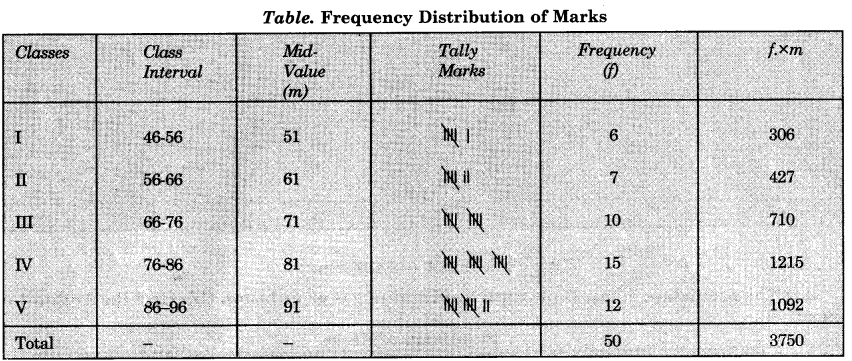
So, 1st class will be from 46 to 56 Ilnd class will be from 56 to 66 Illrd class will be from 66 to 76 IVth class will be from 76 to 86
Vth class will be from 86 to 96.

Step-5. Arrange the data in the frequency table with 5 classes by tally methods
Geography Class 12 Important Questions Chapter 2 Migration Types, Causes and Consequences 2

Step-6. Now the frequencies are multiplied by the respective mid-values and the products which are added to get
∑ f x m.

Step-7. The A.M. is calculated using
\(\begin{aligned}
\overline{\mathrm{X}} &=\frac{\Sigma f \times m}{\Sigma f} \\
\mathrm{A.M.} &=\frac{3750}{50}=75
\end{aligned}\)

Question 7.
Describe the merits and demerits of Arithmetic Mean.
Answer:
Merits of Arithmetic Mean.
1. Simplicity. It is the most simple of all the methods of central tendency and is easy to understand.
2. Representative Value. This is the representative value of all the values of a series.
3. Certain Value. It has a definite value and remains same all the time.
4. Stable Value. It has a stable value. The changes in the values of samples do not affect it.
5. Basis of Comparison. It can be used to compare the value of a series.
6. Fair Value. It gives a fair wholesome idea of all values.
7. Balanced Value. It balances the values of entire distribution.

Demerits of Arithmetic Mean
1. Effect of Extreme Values. The mean is affected by extreme values of the series because there is a wide gap. For example, the monthly salary of a company manager is ₹ 50,000/-. The monthly salary of the other three employees is ₹ 3500/-, ₹ 1500/-,₹ 1000/. The average salary will be:
\(\begin{array}{l}
=\frac{50000+3500+1500+1000}{4} \\
=\frac{56000}{4}=₹ 14000
\end{array}\)
This is not a representative value.
2. The Arithmetic mean is not present in the series.
3. Arithmetic mean sometimes gives a distorted picture.

Question 8.
What is Geometric Mean ? How is it calculated ?
Answer:
Geometric Mean (G.M.)
Geometric Mean (G.M.) is used to compute the rate of growth of any item.
The G.M. of n values, for example,
x1, x2, x3  ………………..  xn is defined as the nth root of the
product of these values.
So, we may express this mathematically as :
\(\text { G. M. }=\left(x_{1} \cdot x_{2} \cdot x_{3} \ldots x_{n}\right)^{\frac{1}{n}}\)
The G.M may be calculated using following example:
Growth rates of the economy in 4 years are given as 4%, 8%, 8% and 16% respectively.
\(\text { So G.M. }=(4 \times 8 \times 8 \times 16)^{1 / 4}\)
\(=(4096)^{\frac{1}{4}}\)

Uses of G.M.
G.M. is more suitable average if data are given in terms of ratios or in terms of change in which use of A.M. may lead to inconsistent results.

Question 9.
Define the term Median. How is it calculated ?
Answer:
Median. Median is used as a measure of central tendency. Median is the positional average. It is defined as the middle most value of variables. It is denoted as M. It is the mid-value of a series. Median is that value which divides a series into two equal parts. One- half includes the values which are more than the median while the second half includes the values which are less than the median. For example—40, 42, 38, 45, 50, 25, 55 has a median of 45.

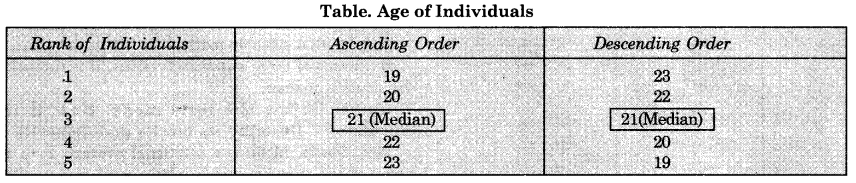
Example. Calculate the median when age of five individuals A,B, C, D and E are respectively 20, 21, 19, 23 and 22 years.
We determine the median in the following steps: Step-1. Arrange the data is ascending or descending order in a tabular format:
Geography Class 12 Important Questions Chapter 2 Migration Types, Causes and Consequences 3

Step – 2. The value of the middle number is the median.
Step – 3. The middle number is calculated by

Therefore, the value of 3rd number will be the median.
Median = 21 years
\(\mathrm{M}=\frac{n+1}{2} \text { th item }\)
Where n = 4 (even), \(\text { so } \frac{n+1}{2}=\frac{5+1}{2}=3\)
So, if we have say 4 members, 19, 20, 21 and 22, in this case we will add the values of 2nd and 3rd number and divide the total by 2 :
\(\frac{20+21}{2}=20.5 \text { years}\)

In that case Median = 20.5 years.
Uses of Median
1. Median is the middle most value, so the extreme values do not vitiate its representative character as in case of A.M.
2. The median is the centre of gravity for the entire distribution.
3. Use of median is however not very common. The Median (M) for a large number of distributions

Question 10.
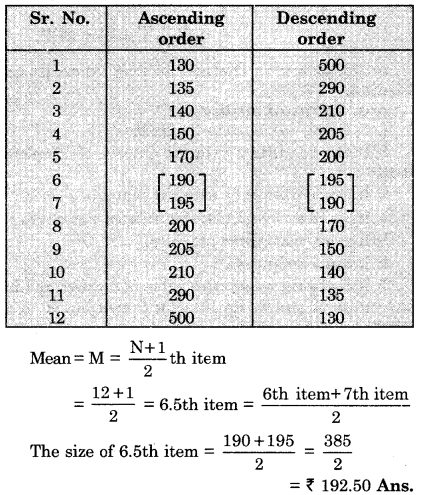
The monthly income of 12 households in a locality are ₹ 140,150,130,135,170,190, 500, 210, 205,195, 290, 200.
Find out the median income.
Answer:
(1) Arrange the income in an ascending order as :
130, 135, 140, 150, 170, 190, 195, 200, 205, 210, 290 and 500.
(2) Arrange the incomes in descending order as 500, 290. 210, 205, 200,195,190, 170, 150,140, 135 and 130
Geography Class 12 Important Questions Chapter 2 Data Processing 4

Question 11.
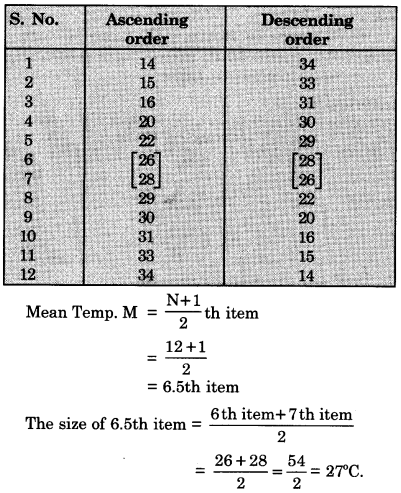
The following table gives the mean monthly temperatures of Delhi. Find out the median temperature of Delhi.

Sr. No.123456789101112
MonthJFMAMJJASOND
Temp. (°C)1416222$3334313029262015

Answer:
Arrange the figures in ascending order and descending order.
Geography Class 12 Important Questions Chapter 2 Data Processing 5
Question 12.
Describe the merits and demerits of Median.
Answer:
Merits of median :
1. It is easy to calculate the median.
2. It can be calculated in the absence of complete data.
3. It is not affected by extreme values of a series.
4. It can be easily calculated in an open ended series.
5. It can be calculated graphically.
6. It has a definite value.
7. It is the representative value of a series and in the centre of gravity for the entire distribution of a series.

We can determine the Mode in the following steps—

Demerits
1. It takes more time to arrange the series in ascending and descending order.
2. It does not depend on all the values of a series.
3. It is not an exact value as it does not consider the extreme values.
4. It is an approximate value when the values are even.
5. It is not a suitable method for irregular values.
6. In case of large number of values, it is difficult to calculate median.

Question 13.
Define the term mode. How is it calculated ? Describe its merits and demerits.
Answer:
Mode. Mode is a positional average. It is a value of the variable which occurs most frequently. Mode is a measure of central tendency and is the most frequently occurring value in a series. It is a typical value around which most of the items tend to cluster. It is the representative value of a series around which there is maximum concentration.

Inspection method to determine the mode. In this method, the value is determined which occurs mostly in a series. When the frequency of a discrete series increases or decreases regularly, the mode is clearly known.

Example :

Wages (₹)No. of workers
102
203
307
408
504
605

It is evident that the frequency of ₹ 40 is the maximum. Therefore, the mode is Z = ₹ 40.
Example. Determine the mode from the following distributions—
2, 10, 5, 7, 7, 9, 2, 7, 11, 17, 7, 8

SI. No./Type123456789101112
Ascending2257‘ 77789101117
Descending171110987777522

Step 1. Arrange the data in ascending and descending order in Table.
Step 2. In both the ascending and descending order value ‘7’ is occurring most frequently i.e. 4 times.
So the mode is 7.

Merits of Mode.
(i) It is easy to understand mode by inspection method
(ii) Extreme values do not affect mode
(iii) It is the representative value of a series
(iv) It can be calculated in the absence of complete data
(v) Mode can be used in certain types of distributions, in which values are whole numbers
(vi) It can be shown on a graph also.

Demerits of Mode
(i) It becomes uncertain value when two variables occur equal times
(ii) It is not based on all the variables
(iii) It sometimes gives a distorted picture.

Question 14.
What do you mean by measures of deviation ?
Answer:
Measures of Deviation
Deviation or Dispersion simply means scattering or variation of the variables about a central value.
We can take four alternative measures of deviation—

  • Range
  • Mean Deviation or Absolute Deviation
  • Standard Deviation
  • Quartile Deviation

Question 15.
What is range ? How is mean deviation calculated ?
Answer:
Range (R)
The range is the simplest of the measures of deviation. It is defined as the difference between the highest (H) and the lowest (L) values of a given set of measurements.
Range = Highest – Lowest
Geography Class 12 Important Questions Chapter 2 Data Processing 6

Step 3. So the mean deviation is
\(\frac{\Sigma|X-\bar{X}|}{N}=\frac{12}{5}\)

Question 16.
What do you mean by Standard Deviation and Quartile Deviation ?
Answer:
Standard Deviation
Another measure of deviation calculated using A.M.
\((\overline{\mathrm{X}})\) is Standard Deviation (σ) This is also known as Root Mean Square Deviation. This can be mathematically formulated as:
\((\sigma)=\sqrt{\left[\frac{\sum(\mathrm{X}-\overline{\mathrm{X}})^{2}}{\mathrm{~N}}\right]}\)

Example. Determine the range for the following percentage of marks obtained by 5 students 83, 96, 72, 46, 68 respectively.
Answer:
We determine the range in the following manner—
Step 1. Determine the highest (H) and lowest (L) values in this case H = 96 and L – 46.
Step 2. We calculate the range using formula R = H – L
(Range) R = 96 — 46 = 50%

Use of Range
A range is rather a crude measure of deviation because it does not indicate anything about the way the values are distributed within the range.

Mean Deviation Or Absolute Deviation
Mean Deviation (M.D.) is the absolute deviation (i.e. ignoring sign) from Mean \((\overline{\mathrm{X}})\)
We can mathematically put M.D. as—
\(\text { M.D. }=\frac{\Sigma|X-\bar{X}|}{N}\)
Where X = any value of population
\((\overline{\mathrm{X}})\) = The mean of population
N = Total number of population

Example.
Determine the Mean Deviation (M.D.) for the following population 6, 8, 4, 12, 5.
Answer:
We calculate the M.D. in the following steps:

Step 1. Calculate A.M. (X) as mentioned earlier.
\(\overline{\mathrm{X}} \text { (Arithmetic Mean) }=\frac{6+8+4+12+5}{5}=\frac{35}{5}=7\)

Step 2. Deduct the value of \((\overline{\mathrm{X}})\) from individual member in a tabular format. The square of the S.D. is known as ‘variance’.

Example. Calculate Standard Deviation of the following distribution of 6,8,4,2,5.
Answer:
We calculate the S.D. (σ) in the following steps:
Step 1. Determine the A.M \((\overline{\mathrm{X}})\)
\(\overline{\mathrm{X}}=\frac{6+8+4+2+5}{5}=5\)

Step 2. Determine the square deviations from A.M. in a tabular format as shown in table below.
\(\sigma=\sqrt{\frac{20}{5}}=\sqrt{4}=2\)
Geography Class 12 Important Questions Chapter 2 Data Processing 7

So the Standard Deviation of the above distribution is
σ = 2

Quartile Deviation

Median (M) divides the total distribution into two equal halves but quartiles divide the total distribution into 4 equal parts. This is called Partition value also. Any series has three Quartiles Q1, Q2 and Q3.

  1. The lower quartile (Q1) is such that 14th of the total distribution will be less than it and %th of the total distribution will be above this value.
  2. The middle Quartile (Q2) is such that 54 of the total distribution will be below it and 14 above it. Thus, middle quartile (Q2) is nothing but the median (Me).
  3. The upper quartile Q3 will divide the entire distribution in such a manner that %th will be less than this and 14th above it. The quartile deviation (Q.D.) is called as semi interquartile range which may be expressed as—
    \(\text { Q.D. }=\frac{\mathrm{Q}_{3}-\mathrm{Q}_{1}}{2}\)

Example Determine the Quartile Deviation for the following distribution
46, 32, 25, 50, 72, 35, 75, 65, 58
Answer:
We can determine the Q.D. in the following steps:
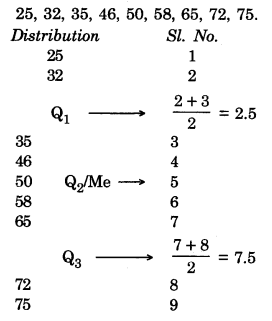
Step. 1. Arrange the distribution in ascending order and rank them serially as below:
Geography Class 12 Important Questions Chapter 2 Data Processing 8
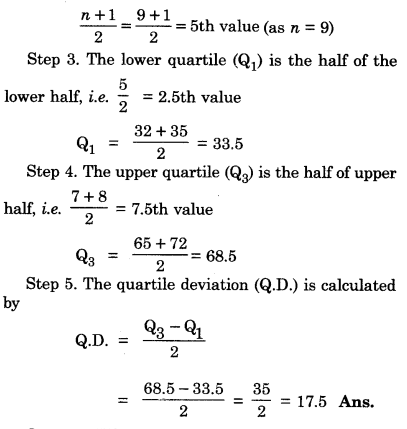
Step 2. The middle quartile (Q2) or the median (Me) is the middle most member, i.e.
Geography Class 12 Important Questions Chapter 2 Data Processing 9

Question 17.
What is Correlation ? How is correlation coefficient determined ?
Answer:
Correlation
A distribution of two sets of variables is known as bivariate distribution where these two variables are said to be correlated if the change of one variable results in a corresponding change in the other variable. The first variable causing a change of second variable is known as independent variable (X) and the other variable is known as dependent variable (Y).

As estimation of the strength and direction of the association between two variables is called simple or bivariate correlation. The most commonly used measures of correlation is known as Pearson’s product moment correlation co-efficient (r).

The value of r ranges between + 1 to – 1. Thus, when:

  • r = + 1. The correlation is perfect and positive.
  • r – 0. No correlation or Zero correlation.
  • r = – 1. The correlation is perfect and negative.

The product moment correlation co-efficient may be mathematically expressed as:
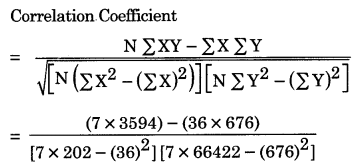
\(r=\frac{N \sum X Y-\sum X \sum Y}{\sqrt{\left[N \sum X^{2}-\left(\sum X\right)^{2}\right]\left[N \sum Y^{2}-\left(\sum Y\right)^{2}\right]}}\)

Where X is the independent variable
Y is the dependent variable
N is the total number of distribution.

Question 18.
Calculate the Pearson’s Correlation Coefficient from the following size of plots and selling prices:

Plot size (ha)1016192228
Price (₹)455575100 105

Answer:
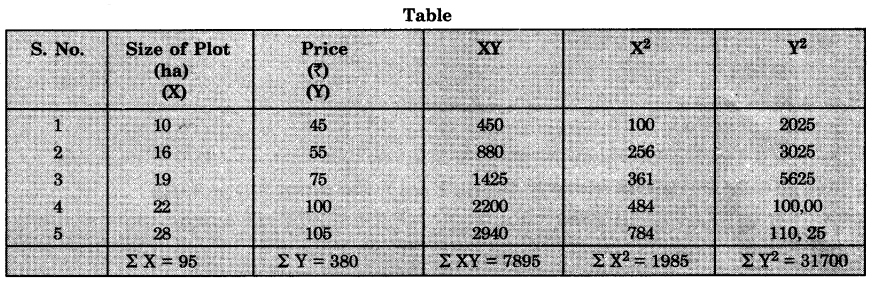
Step—I. Arrange the data sequentially in a proper table showing separately the two variables. Add them separately.
Geography Class 12 Important Questions Chapter 2 Data Processing 10

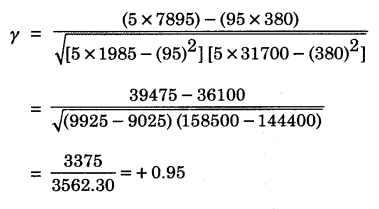
Step-2. Using formula we calculate Pearson’s Product moment correlation co-efficient. So it may be said that price of land is perfectly and positively correlated with the size of the land.
Geography Class 12 Important Questions Chapter 2 Data Processing 11

So it may be said that price of land is perfectly and positively correlated with the size of the land.

Question 19.
Compute the Standard Deviation from the following data
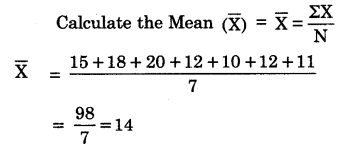
15, 18, 20, 12, 10, 9, 11.
Geography Class 12 Important Questions Chapter 2 Data Processing 13

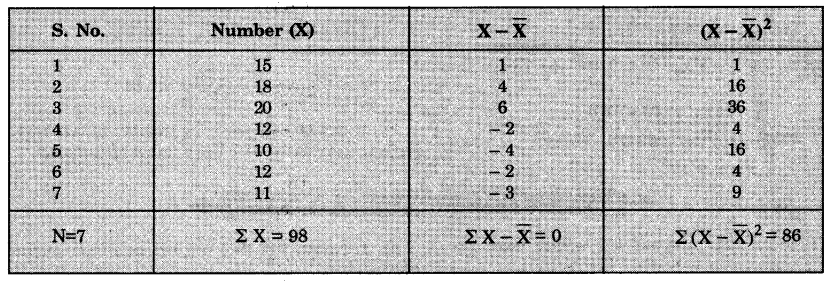
Find out the root deviation from the Table.
Geography Class 12 Important Questions Chapter 2 Data Processing 12
Standard Deviation (S.D.)
\(=\rho=\sqrt{\frac{\Sigma(\mathrm{X}-\overline{\mathrm{X}})^{2}}{\mathrm{~N}}}=\sqrt{\frac{86}{7}}=\sqrt{12.28}=3.5 \)

Question 20.
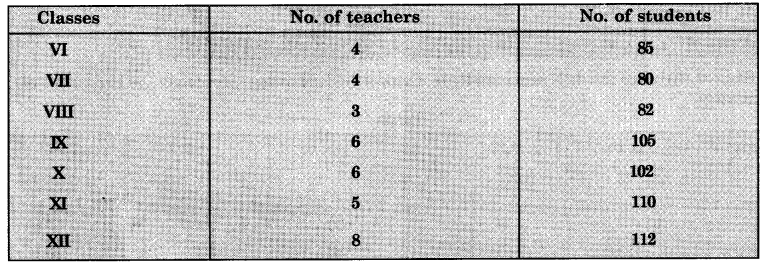
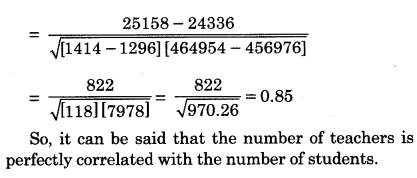
The table below shows the relation between teachers and students of a school. Find out the nature of correlation between the teachers and students.
Geography Class 12 Important Questions Chapter 2 Data Processing 14
Answer:
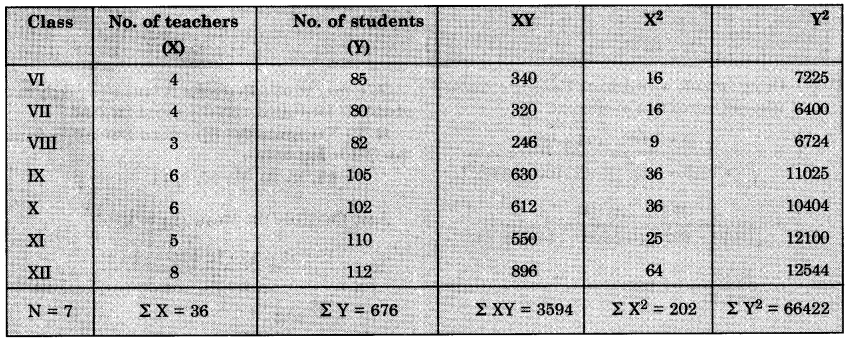
Show the two variables separately. Multiply X and Y. Find out the squares of each.
Geography Class 12 Important Questions Chapter 2 Data Processing 15
Geography Class 12 Important Questions Chapter 2 Data Processing 16
Geography Class 12 Important Questions Chapter 2 Data Processing 17

The End of Bipolarity Class 12 Important Extra Questions Political Science Chapter 2

Here we are providing Class 12 Political Science Important Extra Questions and Answers Chapter 2 The End of Bipolarity. Political Science Class 12 Important Questions are the best resource for students which helps in class 12 board exams.

Class 12 Political Science Chapter 2 Important Extra Questions The End of Bipolarity

The End of Bipolarity Important Extra Questions Very Short Answer Type

Question 1.
Mention any two reasons for the disintegration of the Soviet Union. (C.B.S.E. 2019)
Or
Why did the Soviet Union disintegrate? Highlight any two arguments in support of your Answer. (C.B.S.E. 2010)
Answer:
(i) Defective Leadership. Defective leadership was mainly responsible for the disintegration of the U.S.S.R.
(ii) Liberal Policy of Gorbachev. Due to the liberal policy, of Gorbachev, anti-Soviet Union forces became bold and they increased their strength.

Question 2.
Who was the last President of the Soviet Union and for how long? (C.B.S.E. 2019)
Answer:
Mikhail Gorbachev was the last President of the Soviet Union. He remains President from 1985 to 1991.

Question 3.
Name the republic that succeeded the Soviet Union after its disintegration. What was its position in the international domain? (C.B.S.E. 2019)
Answer:
Russia succeeded the Soviet Union after its disintegration. Russia inherited the U.S.S.R seat in the Security Council. It accepted all the U.S.S.R’s commitments and international treaties. Russia is the only nuclear state among Post Communist Countries.

Question 4.
Mention any two reforms initiated by Gorbachev. (C.B.S.E. 2019)
Answer:
Gorbachev initiated following two reforms:

1. Perestroika: It means restructuring.
2. Glasnost: It means openness.

Question 5.
Who encouraged the coup that took place in 1991 in the Soviet Union and Why? (C.B.S.E. 2019)
Answer:
Hardliners of the Communist Party encouraged the coup that took place in 1991 because they did not want the old-style rule of the Communist Party.

Question 6.
When did India sign the twenty- years ‘Treaty of Peace and Friendship’ with the Soviet Union? (Imp.) (C.B.S.E. 2012 Outside Delhi)
Answer:
India signed the twenty years ‘Treaty of Peace and Friendship’ with the Soviet Union in August 1971. This treaty assured India of Soviet’s support if the country faced any attack.

Question 7.
Mention any two characteristics of the Soviet Political System. (C.B.S.E. 2008, 2012 Delhi)
Or
Which were the two important y features of the Soviet System? (C.B.S.E. 2013)
Or
State any two features of the Soviet System. (Imp) (C.B.S.E. 2014)
Answer:

  1. The Soviet system was based on Communist principles.
  2. Soviet system of government was based on federalism.

Question 8.
What is meant by Shock Therapy? (C.B.S.E. 2009, 2014)
Answer:
The authoritarian socialist system existed in Communist countries. With the disintegration of the Soviet Union, the process of change from an authoritarian socialist system to a Democratic Socialist System started in the countries and this process of change is called Shock Therapy.

The End of Bipolarity Important Extra Questions Very Short Answer Type (2 Marks)

Question 1.
State any one special feature of Indo- Russian friendship. (C.B.S.E. 2017)
Answer:
Indo-Russian relations order is the co-existence of several powers in the internal system.

Question 2.
Highlight any one feature of the multi-polar world as visualized by both Russian and India. (C.B.S.E. 2017)
Answer:
Collective responsibility for security.

Question 3.
Highlight any one consequence of‘Shock Therapy5. (Imp.) (C.B.S.E. 2015)
Answer:
The old system of social welfare was systematically destroyed.

Question 4.
Highlight any one major distinction between the Soviet economy and the Capitalist economy. (C.B.S.E. 2015)
Answer:
According to the Soviet economy, the state should have full control over the means of production and the material resources of the country, while the Capitalist economy believes in delicensing and removing restrictions governing the private sector.

Question 5.
Highlight any one democratic value which the bureaucratic and Authoritarian Soviet system Lacked. (C.B.S.E. 2019)
Answer:
There is a lack of freedom of speech and impression in the Soviet system.

Question 6.
Why did Boris Yeltsin oppose the coup that took place in the Soviet Union in 1991? (C.B.S.E. 2019)
Answer:
Boris Yeltsin opposes the coup to protect the democracy and for the continuation of reforms.

Question 7.
Identify the event that took place in 1989 which led to the collapse of the ‘Second World5 and the end of the Cold War. (C.B.S.E. 2019)
Answer:
The fall of the Berlin Wall took place in 1989 which led to the collapse of the Second World and the end of the Cold War.

Question 8.
The Soviet economy was more developed than the rest of the world except for the U.S. after the end of the Second World War. Substantiate the statement with any one example. (C.B.S.E. 2019)
Answer:
The Soviet Union had a vast energy resource, including oil, iron and steel, machinery production.

Choose the correct Answer:
Question 9.
In which year Gorbachev became General Secretary of the Communist Party of U.S.S.R.?
(a) 1989 (b) 1990
(c) 1987 (d) 1985.
Answer:
(d) 1985.

Question 10.
Russia took over the U.S.S.R. seat in the U.N. in:
(a) December 1991 (b) November 1989
(c) December 1990 (d) October 1992.
Answer:
(a) December 1991

Question 11.
Which one of the following was NOT given primacy by the makers of the Soviet System? (C.B.S.E. 2016)
(a) Abolition of private property
(b) Society based on the principle of equality.
(c) No opposition party to be allowed.
(d) No state control over the economy.
Answer:
(d) No state control over the economy.

Question 12.
Correct the statement and rewrite: (Sample Paper 2019-20)

The first world was the communist countries and the third world was the capitalist countries.
Answer:
The first world was capitalist countries and the third world was Asian African countries.

The End of Bipolarity Important Extra Questions  Short Answer Type

Question 1.
Explain any four reasons for the disintegration of the U.S.S.R. (Imp.) (C.B.S.E. 2013)
Answer:
The following were the main defects of the Soviet System:

1. The Soviet system allowed only the Communist Party to exist in U.S.S.R. The Communist Party was regarded as ‘the Vanguard of the working people in their struggle to strengthen and develop the socialist system’. No other party was allowed to exist in the Soviet Union.

2. The Soviet system became very bureaucratic and authoritarian. The foes of socialism were ruthlessly dealt with. There was the dictatorship of the Communist Party.

3. In Soviet Union, stress was more on social and economic rights than on political rights. There was no freedom of speech and expression. Any opinion expressed against the ‘Party line’ was deemed to be a matter of treason and hence punished with severity.

4. In the Soviet system federalism was adopted but the Union Republic of the U.S.S.R. was completely under the control of the Communist Party. The Soviet federal structure was like a pyramid where the Communist Party was the apex and controlled the primary organs of the party at the base.

Question 2.
Write four main features of the Soviet Economic System.
Answer:
Soviet Economic System was totally different from Western Economic System.

  1. The planned economy was adopted in U.S.S.R. The economy of the state was managed on the basis of state plans for economic and social developments.
  2. In the Soviet Union, all economic activities were controlled by the state. All industries were nationalized.
  3. In the Soviet Union, there was no private economy and all means of production and distribution were owned and controlled by the state.
  4. The citizens were given the Right to work, Right to wages, and Right to rest and leisure.

Question 3.
Discuss India’s emerging relationship with Russia. (C.B.S.E. 2005 Set-II Outside Delhi)
Answer:
India’s relations with Russia are cordial and friendly. In Jan. 1993 a new treaty of friendship and co-operation was designed to guide the path of Indo-Russian relations in the next 20 years. In December 1994, the Russian Prime Minister visited India and during his visit, India and Russia signed 8 agreements covering such vital areas as defense, technology, and space exploration.

In June 1998, India and Russia signed Nuclear Pact. On June 29, 2000, India and Russia signed a number of agreements on Indo-Russian defense co-operation. On 2nd October 2000, President Putin visited India. India and Russia signed 10 agreements.

Russian President Putin visited India in January 2007. During his visit, nine Memorandums of Cooperation were signed between the two countries, in Dec. 2015 India P.M. Sh. Narendra Modi visited Russia and signed 16 agreements.

Question 4.
Describe any four consequences of Shock Therapy. (Imp.) (C.B.S.E. 2014)
Answer:
Most of the Communist countries changed from an authoritarian system to a democratic capitalist system. The process of transition from an authoritarian socialist system to a democratic capitalist system is called Shock Therapy. Following were the main features of Shock Therapy:

  1. Each of these countries had to make a total change from a socialist economy to a capitalist economy.
  2. Each of these countries had to adopt private ownership as a dominant pattern of ownership of property.
  3. All these countries had to privatize all state assets and establish corporate ownership patterns.
  4. Collective farming was replaced by capitalist (private) farming.

The End of Bipolarity Important Extra Questions Long Answer Type

Question 1.
What was the Soviet System? Assess any four features of the Soviet System. (Imp) (C.B.S.E. 2013)
Or
Describe any six features of the erstwhile Soviet system. (C.B. S. E. 2019)
Answer:
In October 1917 first Socialist Revolution took place in Russia. Bolshevik Revolution took place under the leadership of Lenin. The rule of the Czar was overthrown and a new government headed by Lenin was established. A new constitution was framed in 1918, again in 1924, and again in 1936. The system of government in the U.S.S.R. is generally known as the Soviet System of government. The Soviet system of economy was a planned economy and was managed on the basis of state flaws for economic and social development. The system of government in the U.S.S.R. is generally known as the Soviet System government. Following were the main features of the Soviet System of government:

1. The Soviet System was based on Communist Principles. Lenin and Stalin adjusted the communist philosophy to the needs of the country. Marxist philosophy was the guiding principle behind the Soviet Constitution.

2. The ‘Soviet’ system formed the basis of the political and constitutional organization of the U.S.S.R. The word ‘Soviet’ means a council consisting of the elected deputies or delegates or workers.

3. In the very first Article of the Stalin Constitution (1936), “The Union of Soviet Republic was described as a socialist state of workers and peasants.”

4. U.S.S.R. was a one-party state. The Communist Party occupied a pivotal position in the socio-political system of the Soviet Union. The Communist Party was the supreme guiding energy in the state. The Communist Party was the architect and defender of the socialist system in the U.S.S.R. as well as the guide and teacher of the people. No other party was allowed in the U.S.S.R.

5. Soviet System was based on the principle of ‘Democratic Centralism’. To quote Vyshinsky, “The Soviet Union State is built on the principle of democratic centralism sharply opposed to the bureaucratic centralism of the capitalist state.” This principle meant that all bodies of administration were elected and organised on democratic principles. The principle also meant that the lower body was responding to the higher body and the decision of the higher bodies was binding on the lower bodies.

6. The citizens of the U.S.S.R. were given a number of fundamental rights along with duties. Rights were given to the citizens with a view to strengthening the socialist system. In other words, rights must be in conformity with the interests of the working people.

Question 2.
Analyse any six factors which helped the Soviet Union in becoming a superpower after the Second World War. (C.B.S.E. 2010, 2012 Delhi)
Answer:
After the Second World War, the Soviet Union became a superpower and U.S.S.R. became a leader of the Socialist bloc. Following were the factors which helped the Soviet Union in becoming a superpower after the Second World War:

  1. In U.S.S.R. the economy was planned and completely controlled by the state.
  2. The Soviet Union had adequate natural resources.
  3. It had modern means of transport and telecommunication.
  4. Citizens of the Soviet Union enjoyed all basic needs for public life.
  5. It had a powerful and large army.
  6. It had nuclear weapons and the Soviet Union was a permanent member of U.N. Security Council.

Question 3.
Mention any six reasons responsible for the disintegration of the Soviet Union. (C.B.S.E. 2019)
Or
How did the Soviet Union suddenly disintegrate? Explain any six reasons. (C.B.S.E. 2016)
Or
Mention the limitations of USSR that led to its disintegration. (C.B.S.E. Sample Paper 2018)
Or
Why did the Soviet Union, the second most powerful country in the world, suddenly disintegrate? Explain any six reasons. (Imp.) (C.B.S.E. 2017, 2019)
Answer:
The following were the main reasons for the disintegration of the former Soviet Union:

1. The Soviet system allowed only the Communist Party to exist in U.S.S.R. The Communist Party was regarded as ‘The Vanguard of the working people in their struggle to strengthen and develop the socialist system.’ No other party was allowed to exist in the Soviet Union.

2. The Soviet system became bureaucratic and authoritarian. The foes of socialism were ruthlessly dealt with. There was the dictatorship of the Communist Party.

3. In the Soviet Union, stress was more on social and economic rights than on political rights. There was no freedom of speech and expression. Any opinion expressed against the ‘Party line’ was deemed to be a matter of treason and hence severe punishment was inflicted.

4. In the Soviet system, federalism was adopted but the Union Republic of U.S.S.R. was completely under the control of the Communist Party. The Soviet federal structure was like a pyramid where the Communist
Party was the apex and controlled the primary organs of the party at the base.

5. The Soviet Union lagged behind the west in technology, infrastructure, etc.

6. The Soviet Union failed in fulfilling the political and economic aspirations of the citizens.

Question 4.
Describe the role of Gorbachev j to reform the Soviet System and the j effects of these reforms on the U.S.S.R. j (Imp.) (C.B.S.E. 2015)
Answer:
Mikhail Gorbachev became the General Secretary of the General Party of the U.S.S.R. in 1985. He introduced political and economic reforms. Following factors forced Gorbachev to initiate reforms in the U.S.S.R.

  1. The Soviet Union lagged behind the west in technology, infrastructure, etc.
  2. The Soviet System was authoritarian. There was rampant corruption in the administration and people were alienated from the government. Citizens were not happy with the political system.
  3. Communist Party controlled the government and all institutions and was not responsible to the people. There was neither any opposition party nor any democratic values.
  4. The Soviet Union failed in fulfilling the political and economic aspirations of the citizens.
  5. The invasion of Afghanistan weakened the Soviet Union both economically and politically.

Gorbachev sought to reform this system. He introduced economic and political reform policies of Perestroika (restructuring) and glasnost (openness). These reforms were necessary to keep the Soviet Union abreast of information and technological revolutions.

Although power and privileges were declining, Gorbachev applied the policies into haste. As a result, it lost popular support. Due to this, the people of East European Countries started to protest against their own governments and Soviet control. This process was accompanied by a rapidly escalating crisis within the Soviet Union that has to end its disintegration.

As there was an internal struggle within the Soviet Union due to the rise of nationalism by the small states that were ethically diverse. It thus led to the disintegration of the Soviet Union and the collapse of the socialist system. The disintegration of the Soviet Union means the emergence of many newly independent countries All the 15 Union Republics of the U.S.S.R. has become independent states. Each country has its own political aspirations. Some of them, especially the Baltic and the East European States, joined the European Union and became members of the North Atlantic Treaty Organisation (NATO).

Question 5.
Examine India’s changing: relationship with Post-Communist Russia. (Imp.) (C.B.S.E. 2011, Delhi, 2012 Outside Delhi):
Answer:
After the disintegration of the U.S.S.R. in December 1991, Russia emerged as the legal successor state of the former superpower in world politics. Russian President Yeltsin assured the Indian Prime Minister P.V. Narasimha Rao that Russia’s relationship and co-operation with India would continue. In early 1992, India and Russia took the first firm step to rebuild economic relations. The decision to end Rupee trade and to switch over to hard currencies was taken. Russia also favoured strategic co-operation with India. Russia also decided to supply another three million tonnes of oil to India in 1993.

Visit of Russian President Boris Yeltsin. In the last week of January 1993, Russian President Boris Yeltsin visited India. President Yeltsin announced that Russia would support India in the United Nations’ Security Council on the Kashmir issue. India and Russia agreed to coordinate their activities and exchange information and experience to combat different manifestations of terrorism, organised crime and illegal arms trade. The signing of a new Treaty of Friendship and co-operation was designed to guide the path of Indo-Russian relations in the next 20 years.

P.M. Narasimha Rao’s visit to Russia. In June 1994, the then P.M. Narasimha Rao visited Russia. The visit produced two significant declarations and nine agreements. Both the countries denounced the efforts to weaken the unity of pluralisation of states through religious extremism.

Russian P.M.’s Visit to India. In December 1994 the Russian Prime Minister visited India and during his visit, India and Russia signed 8 agreements covering such vital areas as defence, technology and space exploration. Russia assured India that it has no desire to supply arms to Pakistan.

India, Russia Sign N-Pact. On 21st June 1998, in a far-reaching nuclear deal, India and Russia signed an accord for construction of two 1000 MW light-water nuclear power reactors at Kodaikanal in Tamil Nadu.

In March 2000, Vladimir Putin was elected as the President of Russia. On April 15, 2000, President Putin ratified an extradition treaty with India aimed at curbing terrorism. A senior Russian atomic energy official called for recognition of India and Pakistan as nuclear-weapon states. On June 28, 2000, India and Russia decided to set up a commission on Military- Technical Co-operation to impart greater impetus to defence ties and accelerate decision-making. India agreed to buy $ 1 billion worth of Russian arms. On June 29, 2000, India and Russia signed a number of agreements on Indo-Russian defence co-operation.

Russian President Vladimir Putin’s visit to India. On 2nd October 2000, President Putin visited India. India and Russia forged a strategic partnership that proposes structured co-operation in the fields of nuclear sciences, defence, space and fights against international terrorism, separatism, religious extremism, organised crime and illegal drug trafficking. India and Russia signed 10 agreements to enhance their bilateral ties in various fields. On October 4, 2000, a new era dawned in the Indo- Russian defence ties with the two countries signing multi-billion dollar agreements for sale of armaments. They also decided to set up an Inter-governmental Commission on defence and technical co-operation.

Accord on Terrorism. Prime Minister Atal Behari Vajpayee visited Moscow in November 2001. India and Russia signed the far-reaching Moscow Declaration on international terrorism declaring that the struggle against this scourge had become one of the priority tasks of the world community. The two sides reaffirmed the central role of the United Nations in the efforts of the international community in the struggle against terrorism.

Defence Agreement. On 20th January 2004, India and Russia signed the historic and their biggest ever defence deal of almost? 7,000 crore. The defence ministers said that the military and technical co-operation between India and Russia has reached a higher level.

Visit of Russian President (December 2004): Russian President Vladimir Putin visited India in Dec. 2004. India and Russia moved closer vowing to reconcile their positions on two contentious issues of Russian entry into the W.T.O. and New Delhi according to market economy status to Moscow. The two countries signed 10 agreements and Memorandum of Understanding to strengthen bilateral co-operation in banking, energy, space exploration, navigation and visa sectors. Russian President supported India’s candidature for a permanent seat in U.N. Security Council with Veto Power.

Visit of Indian Prime Minister to Moscow (December 2005). Indian Prime Minister Dr Manmohan Singh visited Moscow on December 6, 2005. Moscow agreed to help India in acquiring the latest nuclear energy generation technology to meet the country’s growing power requirements. India and Russia identified three key areas—nuclear energy, defence and trade and industry—to give special attention to while transforming their buyer-seller relationship into one that aims at joint planning and manufacture of high technology arms and armaments.

Russian Doctrine gives Top Priority to ties with India. Russia’s new foreign policy concept displayed on the Russian President’s website on July 15, 2008, says: “In deepening the strategic partnership with India, Russia pursues the principled policy towards stronger interaction on burning international problems and all-round strengthening of mutually beneficial relations in all spheres especially in achieving a substantial uplift in commercial and economic ties.” In December 2008, Prime Minister, Dr Manmohan Singh and Russian President Dmitry Medvedev signed an agreement concerning Uranium.

Russia will help India in setting up four additional nuclear plants at Kudankulam, where two plants are already functioning with Russian help.

Visit of Indian Prime Minister to Moscow (December 2009). Indian Prime Minister Dr Manmohan Singh visited Moscow in Dec. 2009. During his visit, both countries signed a Comprehensive Civil Nuclear Pact.

Visit of Russian President (December 2010). Russian President Dmitry Medvedev visited India on December 21, 2010. India and Russia demonstrated to the world why their relationship was so special. The two countries signed a record 29 deals, including one on joint designing and development of the Fifth Generation Fighter Aircraft (FGFA) and another for jointly undertaking projects in the oil and gas sector in India, Russia or a Third Country. The Russian President endorsed India’s candidature for a permanent UN Security Council seat and also promised to support India’s quest to become a member of the Nuclear Suppliers Group, MTCR and the Wassenaar Arrangement.

Visit of Russian President (December 2012). Russian President Vladimir Putin visited India in Dec. 2012. Setting aside their differences over civil nuclear co-operation, India and Russia signed two key defence deals worth about? 25,000 crore. The two countries also inked other agreements in fields, such as space, trade and investment, science and technology, education and culture, reinforcing the strong dynamos of their time tested friendship.

Visit of Indian Prime Minister to Russia (October 2013). On 21st October 2013, Prime Minister Manmohan Singh visited Russia. Prime Minister Manmohan Singh and Russian President Putin directed officials to resolve Kodaikalnal nuclear power plant issues. Both leaders observed that defence cooperation is a crucial element in the strategic partnership and decided to enhance cooperation in the field of rocket, missile, naval technologies and weapon systems.

The two leaders also discussed cooperation in the field of terrorism and looked at ways to enhance trade and investment among other subjects. The two leaders affirmed their commitment to the Agreement of Cooperation in the Use of Atomic Energy for peaceful purposes and the road map for the social construction of the Russian designed Nuclear Power Plants in India.

Visit of Russian President to India. In December 2014, Russian President Vladimir Putin visited India. During this visit, both countries signed 20 important agreements.

In Dec. 2015, Indian P.M. Sh. Narendra Modi visited Russia. During this visit, both countries signed 16 agreements.

In October 2016, Russian President to Vladimir Putin visited India. During this, both countries signed 16 agreement.

In June 2017 Indian Prime Minister Sh. Narendra Modi visited Russia. During this visit, both countries signed 5 important agreements.

In October 2018, Russian President visited India. During this visit, both countries signed 8 important agreements.

In September 2019, Indian Prime Minister Sh. Narendra Modi visited Russia. During this visit, both countries signed 15 agreements.

The friendly relations between India and Russia have achieved a new level of privileged strategic partnership.

Question 6.
Highlight any three positive and three negative features each of the Soviet System in the Soviet Union. (C.B.S.E. 2016)
Answer:
Positive Features:

  1. The planned economy was adopted in U.S.S.R. The economy of the state was managed on the basis of state plans for the economy and social developments.
  2. In the Soviet Union, all economic activities were controlled by the state. All industries were nationalised.
  3. In the Soviet Union, there was no private economy all means of production and distribution were owned and controlled by the state.

Negative Features:

  1. The Soviet system allowed only the Communist Party to exist in U.S.S.R. The Communist Party was regarded as ‘the Vanguard of the working people in their struggle to strengthen and develop the socialist system’. No other party was allowed to exist in the Soviet Union.
  2. The Soviet system became very bureaucratic and authoritarian. The foes of socialism were ruthlessly dealt with. There was the dictatorship of the Communist Party.
  3. In the Soviet Union, stress was more on social and economic rights than on political rights. There was no freedom of speech and expression. Any opinion expressed against the ‘Party line’ was deemed to be a matter of treason and hence punished with severity.

Question 7.
Highlight any three major consequences of ‘Shock Therapy’ in the Post Communist Regimes. (C.B.S.E. 2019)
Answer:
With the disintegration of the Soviet Union, there was a collapse of communism. After the collapse of communism, the process of change in these countries started from an authoritarian socialist system to a democratic capitalist system. The model of transition in Russia, Central Asia and East Europe that was influenced by the World Bank and the International Monetary Fund came to be known as ‘Shock Therapy’. Though the ‘Shock Therapy’ differs in intensity and speed amongst former communist countries, its direction and features were quite common.

Consequences of Shock Therapy: Following are the consequences of Shock Therapy.

  1. Each of these countries had to make a total change from a socialist economy to a capitalist economy.
  2. Each of these countries had to adopt private ownership as a dominate pattern of ownership of property.
  3. All these countries had to privatise of all state assets and establish corporate ownership patterns.
  4. Collective farming was replaced by capitalist (private) farming.

Question 8.
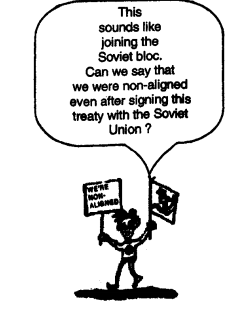
Look at the given cartoon and Answer: the following questions: (C.B.S.E. 2009)

Political Science Class 12 Important Questions Chapter 2 The End of Bipolarity

(a) The cartoon refers to which treaty?

Answer:
Indo-Soviet Treaty of Peace, Friendship and Cooperation, 1971.

(b) How can we say that we were non-aligned even after signing this treaty with the Soviet Union?
Answer:
Even after signing the treaty of peace, friendship and cooperation, India remained a non-aligned country.

(c) Why was this treaty signed?
Answer:
Indo-Soviet friendship was signed to counteract the rival forces of India such as Pakistan.

Question 9.
Give any three examples to show that most of the former Soviet Republic were prone to conflict and tension. (C.B.S.E. 2013)
Or
Describe the factors that make most of the former Soviet Republics prone to conflicts and threats. (C.B.S.E. 2015)
Answer:
The disintegration of the Soviet Union took place in 1991. There were 15 Union Republics (states) in the former U.S.S.R. Most of the former Soviet Republics were prone to conflicts and many Republics witnessed civil wars and insurgencies.

1. In Russia, Two Republics viz, Chechnya and Dagestan, witnessed violent secessionist movements. Moscow tried to suppress the movements. However, even indiscriminate military bombings failed to deter the aspirations for independence.
2. In Central Asia, Tajikistan witnessed a long- drawn Civil War that continued for a decade till 2001.
3. There were frequent conflicts in this region. Nagorno-Karabakh, in the province of Azerbaijan desire to secede and join Armenia.
4. The two provinces led to civil war in Georgia to attain independence. This hampered the life of the ordinary citizens creating hardships.
5. There were movements against the existing regimes in Ukraine, Kyrgyzstan and Georgia. Soviet Republics were fighting over issues such as river water, etc.
6. The Central Asian Republics are rich in hydrocarbon resources thus, this area has become economically demanding. As a result, it has become a bone of contention between the outside power, oil companies and the neighbouring countries.

Question 10.
Read the passage given below carefully and Answer the following questions: (C.B.S.E. 2016)

Each of these countries was required to make a total shift to a capitalist economy, which meant rooting out completely any structures evolved during this period. Above all, it meant that private ownership was to be the dominant pattern of ownership of property. Privatization of state assets and corporate ownership patterns were to be immediately brought in. Collective farms were to be replaced by private farming and capitalism in agriculture. This transition ruled out any alternate or third way’

(i) Name any two countries which were required to make a total shift.
Answer:
Russia, Kazakistan.

(ii) Why were the collective farms to be replaced by private farming?
Answer:
Collective farms to be replaced by private farming, because the disintegration of Soviet bloc, and therefore each country related to the Soviet bloc, was required to make a total shift to a capitalist economy.

(iii) Since the ‘third way’ had been ruled out, what were the only two ways of controlling the economy?
Answer:
State-controlled socialism and capitalism.

Question 11.
The value of the ruble declined dramatically. The rate of inflation was so high that people lost all their savings. The collective farm system disintegrated leaving people without food security, and the government j started to import food. The old trading structure broke down with no alternative in its place. The old system of social welfare was systematically destroyed. The withdrawal of government subsidies pushed large sections of the people into poverty.

Read the above passage carefully and answer the following questions: (C.B.S.E. 2016)
(i) What is meant by subsidy?
Answer:
The subsidy is government financial help for needy people. When government helps the applicants at the lower-rate from, the market price this help is given the name ‘Subsidy’. For example, the government of India gives subsidy on L.P.G. Cylinders. Its real price is? 600 to? 650, whereas the government make it available to the consumer only in? 425 or t 450. The remaining price of t 175 to 200 is given by the government and it is called Subsidy on L.P.G.

(ii) How did the disintegration of the collective farm system lead to the loss of food security?
Answer:
The collective farm system disintegrated leaving people without food security. Due to the shortage of food elements, the government was forced to import the food. The old trading structure broke down with no alternative in its place.

(iii) This passage is associated with which country? Why did the government start importing food?
Answer:
This passage is associated with formers Soviet Republics. When the collective farm. System disintegrated people had a scarcity of food, government subsidies pushed a large section of the people into poverty, the old system of social welfare collapsed, the government started importing of food.

Question 12.
Read the following passage and Answer: the following questions. (C.B.S.E. sample Q.P. 2017)

The Central Asian countries wanted to take advantage of their geographical location and continue their close ties with Russia and also to establish ties with the West, the US, China and others. Thus, the international system saw many new players emerge, each with its own identity, interests, and economic and political difficulties. It is to these issues that we now turn.

(a) Why did the Central Asian countries want to maintain ties with both Russia and the West?
Answer:
The central Asian countries wanted to talk advantage of their geographical location and continue their close ties with Russia and also established ties with the west, the US, China and others.

(b) Name the new players that emerged in the international system after the disintegration of U.S.S.R.
Answer:
Kazakhstan, Uzbekistan, Kyrgyzstan, Tajikistan, Turkmenistan, Azerbaijan, Armenia, and Georgia are the new player that emerged in the international system after the disintegration of U.S.S.R.

(c) Mention any two profound consequences of it on world politics.
Answer:

  1. A major consequence of the disintegration of U.S.S.R. was the end of the cold war.
  2. The disintegration of U.S.S.R. established the superiority of the capitalist system and the open market.

Question 13.
Read the following passage and Answer: the following questions: (C.B.S.E. 2019)

India has maintained good relations with all the post-communist countries. But the strongest relations are still those between Russia and India. India’s relations with Russia are an important aspect of India’s foreign policy. Indo-Russian relations are embedded in a history of trust and common interests and are matched by popular perception. Indian heroes from Raj Kapoor to Amitabh Bachchan are household names in Russia and many post¬Soviet countries. One can hear Hindi film songs all over the region, and India is part of the popular memory.
(i) What is meant by the post-communist countries?
Answer:
Post-communist countries mean those countries which were connected with U.S.S.R before its decentralisation. Armenia Azerbaijan, Moldova, Kazakhstan, Kyrgyzstan, Tajikistan, Turkmenistan and Uzbekistan were the countries allied with U.S.S.R or post-communist countries.

(ii) Explain any two factors responsible for strong relations between India and Russia.
Answer:
Following are the factors responsible for the strong relations between India and Russia:
(A) Soviet Union supported India’s position on the Kashmir issue in the UN. It also supported India during the war with Pakistan and issues of terrorism India also supported Soviet foreign policy in China and other places.
(B) The Soviet Union got a good economic market for trade in India. It gave aid and technical assistance for steel plants like Bhilai, Bokaro, Visakhapatnam etc. The Soviet Union accepted Indian currency for trade when India was short of foreign exchange.

(iii) How are India’s relations with Russia an important aspect of India’s foreign policy?
Answer:
India’s relations with Russia are an important aspect of India’s foreign policy. Indo-Russian relations are embedded in a history of trust and common interest. These relations are also matched by popular perceptions.

The End of Bipolarity Important Extra Questions HOTS

Question 1.
The soviet system was based on the Principle of Democratic Centralism. Explain.
Answer:
Soviet System was based on the principle of ‘Democratic Centralism’. To quote Vyshinsky, “The Soviet Union State is built on the principle of democratic centralism sharply opposed to the bureaucratic centralism of the capitalist state.” This principle meant that all bodies of administration were elected and organised on democratic principles. The principle also meant that the lower body was responding to the higher body and the decision of the higher bodies were binding on the lower bodies.

Question 2.
Mention the basic concepts on which the new economic strategy of Gorbachev was based.
Answer:
The new economic strategy of Gorbachev was based on the following concepts:
(a) Uskorenie
(b) Perestroika and
(c) Glasnost.

Question 3.
Explain the meaning of the term ‘Glasnost’.
Answer:
Glasnost means ‘openness’. According to Gorbachev, the condition of the country can never improve without having faith in the people and without people’s active participation in the creative function. Hence, he decided that there shall be no state interference in the economic field of industries for steel plants like Bhilai, Bokaro, Visakhapatnam etc. The Soviet Union accepted Indian currency for trade when India was short of foreign exchange.
(ii) India’s relations with Russia are an important aspect of India’s foreign policy. Indo-Russian relations are embedded in a history of trust and common interest. These relations are also matched by popular perceptions.

Question 4.
Briefly explain the emergence of new identities in world politics after the end of the Cold War.
Answer:
The end of the Cold War was mainly responsible for the emergence of several new entities in world politics such as Russia, Balkan States, Central Asian States, etc. These new entities required to adopt a new strategy on a ‘Unipolar’ World.

Question 5.
What was ‘Second World’?
Answer:
After the Second World War, the East European Countries that the Soviet army had liberated from the Fascist forces came under the control of U.S.S.R. These countries were called ‘Second World’ or the ‘Socialist bloc’. U.S.S.R. was the leader of the Second World.

Question 6.
Briefly explain the emergence of Balkan States after the end of the Cold War.
Answer:
The Balkans are sometimes referred to as the ‘Balkan Peninsula’ as they are adjoined by water on three sides. The end of the Cold War has seen the re-emergence of nationalism particularly in the Western parts of the Balkan Peninsula.


Data: Its Source and Compilation Class 12 Important Extra Questions Geography Chapter 1

Here we are providing Class 12 Geography Important Extra Questions and Answers Chapter 1 Data: Its Source and Compilation. Geography Class 12 Important Questions are the best resource for students which helps in class 12 board exams.

Class 12 Geography Chapter 1 Important Extra Questions Data: Its Source and Compilation

Data: Its Source and Compilation Important Extra Questions Short Answer Type

Question 1.
What are Geographic Data ?
Answer:
Geographic data constitute a set of information. It gives distribution and density of a phenomenon. There are many types of data. Since Geography deals with both natural and human phenomena, geographic data range from rocks of the earth surface to climate, crops, industries, animals and humans and all the attributes of each of them. Geographic data can be both qualitative or quantitative.

Question 2.
What are the main steps involved in data classification ?
Answer:
Data classification involves the following main steps :

  • Classifying data on the basis of time, region, quality, magnitude, etc.
  • Tabulating the data in the form of tables, without losing their accuracy.
  • Processing the data using suitable statistical techniques.

Question 3.
Describe the primary and secondary sources of data.
Answer:
Sources of Data: There are two main sources of geographic data: primary and secondary.
(i) Primary Data : Data collected directly from the field by counting a phenomena or interviewing people is called primary data. The main source of primary data is field investigation.

(ii) Secondary data : is not collected by the user directly, it is already published or available with some reliable sources. The user uses the data and derives his conclusions taking them as authentic.

Question 4.
What are the sources of data ?
Answer:
The main source of primary data is field investigation. There are numerous sources of secondary information. Each specialised agency gathers and publishes its own relevant data.

  • Census of India publishes population data
  • Agriculture department publishes agricultural data.
  • Water Resource department publishes water-related data.
  • In India maps are published by Survey of India (SOI) and National Atlas and Thematic Mapping Organization (NATMO). Survey of India publishes topographical maps on various scale while NATMO publishes thematic maps.

Question 5.
What is the importance of Diagrammatic representation of data ?
Answer:
Diagrammatic representation of data is another important characteristic of Geography. One can convert a huge table of data into graphs, charts, pie diagrams or maps and present its salient features visually. Such maps give visual representation of the distribution of selected phenomena or a set of phenomena in relation to each other.

Question 6.
Describe the main steps of data analysis.
Answer:
Data Analysis — Main Steps :
(1) Collection of Data is the first step in its utilisation. Care is taken to record data as accurately as possible. Because defective data leads to defective results.

(2) Data Classification involves editing, classification and organisation of the collected data to present the same in condensed forms. The sum total of computing, tabulating and statistically transforming relevant information in a suitable format is known as data analysis. The first step in this process is classification of the data according to some common characteristics.

Question  7.
What is meant by tabulation of data ?
Answer:
Tabulation of Data. The raw data is collected in an unclassified form. It is difficult to understand it and draw a conclusion from it. This data is presented in a systematic and arranged form. The principle method of presenting data is through tabular representation.

The purpose of a table is to simplify the presentation and to make comparisons easy. The data is presented in the shape of columns and rows. Columns are drawn vertically and the rows are drawn horizontally.

Main parts of a table. The main functional parts of a table are shown in the following format:

  • Table number. Table number is given for reference.
  • Title of the table. Title of the table is written to describe the contents of the table.
  • Head note. The head note gives detailed information of the data.
  • Sub-title. The sub-title includes sub-head and entries.
  • Body. It includes the data entries in cells.
  • Box-head. The box-head labels the data written in the columns.
  • Footnote. Some information is placed at the bottom of the table and is marked with (*).
  • Source note. The source of data is given at the bottom of the table.

Table Number —Title of the Table —Head-note

Sub-headMaster CaptionBox Head
Column HeadColumn HeadColumn Head
Sub-entriesCell
Cell
Cell
Cell
Cell
Cell
Cell
Cell
Body

Footnotes if, any; Sources

Question 8.
What do you mean by classification of data ? How is data classified ?
Answer:
Classification of data. The data is classified in different groups. It makes the data understandable. Classification is a process of arranging data into groups according to their common characteristics and putting them into different classes on the basis of their values. The data is arranged either in ascending order or descending order.

Example. Arrange the following data of marks obtained by some students, in ascending and descending order:

67 34 36 48 49 31 61 34 43 45 38 32 28 61 29 47 36 50 46 30 46 32 40 33 45 49 48 41 53 36 37 47 47 30 46 50 28 35 35     38 46 40 34 36 62 69 56 28 44 43 60
39.

Ascending order
28, 28, 28, 29, 30, 30, 30, 31, 32, 32, 33, 34, 34, 34, 35, 35, 36, 36, 36, 36, 37, 38, 38, 38, 41, 43, 43, 43, 44, 45, 45, 46, 46, 46, 46, 47, 47, 47, 48, 48, 49, 49, 50, 50, 50, 53, 60, 61, 61, 62, 67, 69.

Descending order
69, 67, 62, 61, 61, 60, 53, 50, 50, 50, 49, 49, 48, 48, 47, 47, 47, 46, 46, 46, 46, 45, 45, 44, 43, 43, 43, 41, 39, 38, 38, 37, 36, 36, 36, 36, 35, 35, 34, 34, 34, 33, 32, 32, 31, 30, 30, 30,
29, 28, 28, 28.

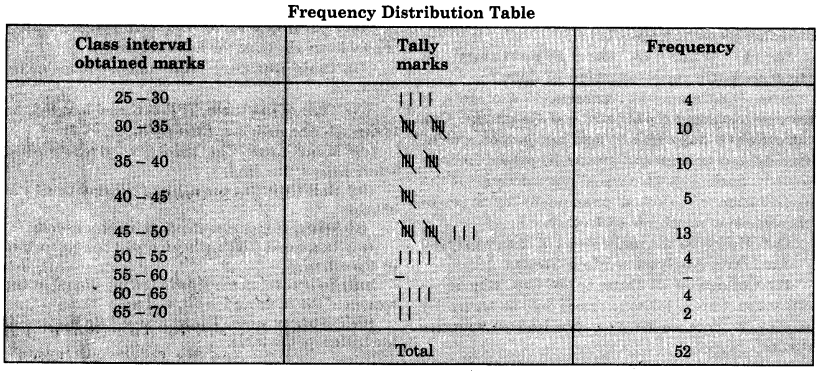
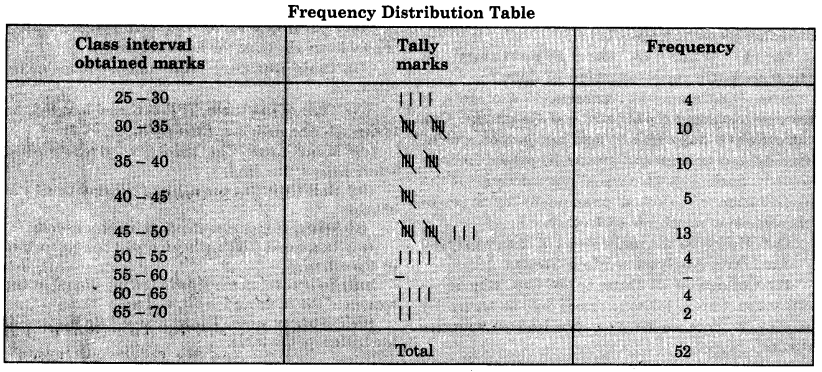
Frequency Distribution Table

Frequency Distribution Table is a summary table in which data is arranged in a compact and systematic form. The whole range of values is divided into different groups or classes. These values are shown by Tally Bars. The values are shown by vertical lines. Four lines are drawn as vertical lines and is crossed obliquely by the fifth line.

It is known as Tally Bar which shows value of five. When these Tally Bars are counted and written in numerical value, it is called frequency. The difference between the highest value and the lowest value is called Range. The difference between the lower limit and upper limit of a class is known as class interval.
Geography Class 12 Important Questions Chapter 1 Data Its Source and Compilation 1

Question 9.
Describe the different methods of classification of data.
Answer:
Methods of Classification. Data classification makes the complex data easy to understand and make conclusions. Data is grouped according to different variables.

(i) Simple Frequencies. When the data is classified on the basis of an element of geographical facts, such as population density state wise, it is expresed as f (The number) 2 f = N = Total.

(ii) Temporal Classification. When data is presented according to time. As population in 1951¬60, 1961-70, etc.

(iii) Individual Series. When each element is shown by different measure-marks of students.
Roll No. 1 2 3 4 5 6 ‘7 8 9 10 11 12 13 14 15 16 17 18 19 20
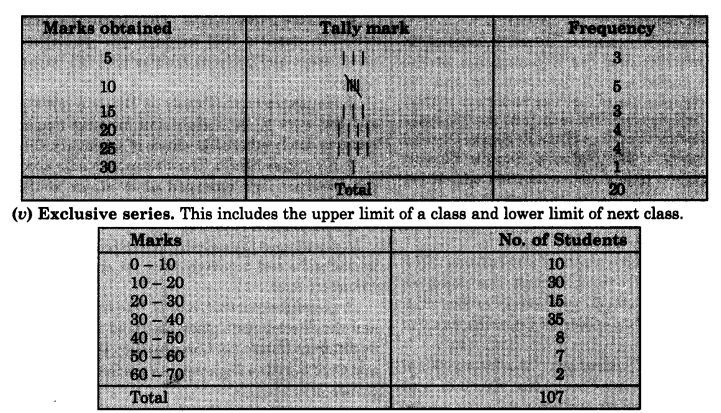
Marks 15 10 20 5 15 20 5 10 20 25 30 25 10 15 25 10 5 20 25 10.

(iv) Discrete series. This series shows definite measure of each unit.

Geography Class 12 Important Questions Chapter 1 Data Its Source and Compilation 2

Geography Class 12 Important Questions Chapter 1 Data Its Source and Compilation 1

Question 10.
Describe the primary and secondary sources of data.
Answer:
Sources of Data. The data are collected through the following ways. These are :
1. Primary sources, and
2. Secondary sources.
The data which are collected for the first time by an individual or a group of individuals, institution/ organisations are called Primary sources of the data. On the other hand, data collected from any published or unpublished sources are called Secondary sources.

Sources of Primay Data

1. Personal Observations. It refers to the collection of information by an individual or group of individuals through direct observations in the field.

2. Interview. In this method, the researcher gets direct information from the respondent through dialogues and conversations.

3. Other Methods. The data about the properties of soil and water are collected directly in the field by measuring their characteristics using soil kit and water quality kit. Similarly, field scientists collect data about the health of the crops and vegetation using transducers.
Secondary sources of data

Secondary sources of data consist of published and unpublished records which include government publications, documents and reports.

Published Sources
1. Government Publications. The publications of the various ministries and the departments of the Government of India, state governments and the District Bulletins are one of the most important sources of secondary information.

These include the Census of India published by the Office of the Registrar General of India, reports of the National Sample Survey, Weather Reports of Indian Meteorological Department, and Statistical Abstracts published by state governments, and the periodical reports published by different commissions.

2. Semi/Quasi-goverment Publications. The publications and reports of Urban Development Authorities and Municipal Corporations of various cities and towns, Zila Parishads (District Councils), etc., fall under this category.

3. International Publications. The international publications comprise yearbooks, reports and monographs published by different agencies of the United Nations such as United Nations Educational, Scientific and Cultural Organisation (UNESCO), United Nations Development Programme (UNDP), World Health Organisation (WHO), Food and Agricultural Organisation (FAO), etc.

4. Private Publications. The yearbooks, surveys, research reports and monographs published by newspapers and private organisations fall under this category.

5. Newspapers and Magazines. The daily newspapers and the weekly, fortnightly and monthly magazines serve as easily accessible source of secondary data.

6. Electronic Media. The electronic media specially the Internet has emerged as a major source of secondary data in recent times.

Unpublished Sources
1. Goverment Documents. The unpublished reports, monographs and documents are yet another source of secondary data.

2. Quasi-government records. The periodical reports and the development plans prepared and maintained by different Municipal Corporations, District Councils and Civil Services departments are included in Quasi¬government records.

3. Private Documents. These include unpublished reports and records of companies, trade unions, different political and apolitical organisations and resident welfare associations.

The Cold War Era Class 12 Important Extra Questions Political Science Chapter 1

Here we are providing Class 12 Political Science Important Extra Questions and Answers Chapter 1 The Cold War Era. Political Science Class 12 Important Questions are the best resource for students which helps in class 12 board exams.

Class 12 Political Science Chapter 1 Important Extra Questions The Cold War Era

The Cold War Era Important Extra Questions Very Short Answer Type

Question 1.
What is meant by the Cold War? (Imp.) (C.B.S.E. 2014)
Answer:
Cold War means the war of nerves. It is not an actual war but a war in which the rival States try through all means, short of an actual war, to gain supremacy at the cost of the other State. One State or bloc tries to gain power and prestige defeating the cause of the rival States.

Question 2.
List any four member countries of NATO. (C.B.S.E. 2014)
Answer:

  1. The U.S.A.
  2. Britain
  3. France
  4. Canada.

Question 3.
What is meant by the Cuban Missile Crisis? (Imp.) (C.B.S.E. 2016)
Answer:
Nikita Khrushchev, the leader of the U.S.S.R. placed nuclear missiles in Cuba The Soviet Union Missiles were a threat to the U.S.A. The US President John F. Kennedy and his advisors were determined to get Khrushchev to remove the missiles and nuclear weapons from Cuba. President Kennedy ordered American warships to intercept any Soviet Union ships heading to Cuba. A conflict between two big powers was imminent and this crisis was known as the Cuban Missile Crisis.

Question 4.
Which two ideologies were involved in a conflict during the Cold-War era and why? (C.B.S.E. 2016)
Answer:
After the Second World War, Cold War started between, U.S.A. (Capitalist) and U.S.S.R. (Communist). A Cold War is a state of tension between countries in which each side adopts policies designed to strengthen itself and weaken the other, a line falling short of actual war.

Question 5.
What constrained the superpower to go for a full-fledged war in spite of having nuclear weapons? (C.B.S.E. 2016)
Answer:
Nuclear weapons though dangerous and disastrous, yet. check the big-powers from using against each other. They know the effects of these weapons and for this reason, big power try to avoid wars so that they can save themselves as well as opponents from their devastating effects.

Question 6.
Mention any two of the agreements signed between the two superpowers starting in the 1960s. (C.B.S.E. 2016)
Or
Starting in the 1960s, the two super-powers signed which two significant agreements to control arms? (C.B.S.E. 2017)
Answer:
1. Partial Test Ban Treaty
2. N.P.T.

Question 7.
Name four founders of NAM and the countries they belonged to respectively. (C.B.S.E. 2016)
Answer:

Name of the founderCountry
1. Pt. Jawaharlal NehruIndia
2. Josip Broz TitoYugoslavia
3. Gamal Abdel NasserEgypt
4. SukarnoIndonesia

Question 8. What do you understand by NATO?
Or
Which organization came into existence in April 1949? (C.B.S.E. 2014)
Answer:
North Atlantic Treaty Organisation (NATO) was established in April 1949. It bound the U.S.A. to the defense of Western Europe. It also called the Atlantic Alliance or Western Alliance was an association of twelve states which declared that armed attack on any one of them would be regarded as an attack on all of them. NATO was a U.S. sponsored military alliance.

Question 9.
What is meant by Non-alignment? (C.B.S.E. 2014)
Answer:
The policy of non-alignment is an independent policy. A nation, by adopting it, can evade subordination of any power bloc and can easily form its opinion about any problem after thorough analysis. Non-alignment stands for a positive commitment to an independent foreign policy.

Question 10.
Mention any two major military features of the Cold War. (C.B.S.E. 2010, 16)
Answer:

  1. U.S.A. and U.S.S.R, both groups formed a military alliance during Cold War.
  2. U.S.A. and U.S.S.R, both are involved in military intervention in various countries.

Question 11.
What is meant by ‘Arenas of Cold War’? (C.B.S.E. 2014)
Answer:
Arenas of cold war mean the areas where crisis and war occurred or threatened to occur between the alliance system but did not cross certain limits. Arenas of the Cold War were Korea, Vietnam, and Afghanistan.

Question 12.
Mention the military alliances formed by the western Block. (C.B.S.E. Sample Q.P. 2017)
Answer:
(1) NATO
(2) CEATO
(3) CENTO

Question 13.
In which way did the policy of non¬alignment serve India’s interests? (C.B.S.E. 2017)
Answer:
The most important basic principles of India’s foreign policy is non-alignment as its base. A country with newly attained freedom could not interface in the international affairs. At the same time, India was facing manifold internal problems and could not afford to snap its relation with either of the two blocs. The basic principle of India’s foreign policy non-alignment, it safeguarding the national interests.

Question 14.
Why different arenas of the cold war did not convert into a hot war between the two alliances? (C.B.S.E. Sample Paper 2018)
Answer:
1. Both sides have enough capacity to retaliate against an attack and cause so many destructions.
2. Both sides exhibited restraint on their actions to prevent nuclear war.

Question 15.
Identify any one occasion/instance where the cold war between the two superpowers became a simple struggle for power by ignoring the ideological dimension. (C.B.S.E. Sample Papaer 2018)
Answer:
One such occasion/instance where the cold war between the two superpowers became a simple struggle for power by ignoring the ideological dimension when the U.S. first time openly supported the communist China of its opposite ideology in order to balance its power against the U.S.S.R.

Question 16.
Assess the main contribution of the Non- Aligned movement to the newly independent countries. (C.B.S.E. 2018)
Answer:
The main contribution to the Non-Aligned movement to the newly independent countries is to keep them away from the ‘Cold War’.

Question 17.
Why did Jawaharlal Nehru say that non-alignment was not a policy of ‘fleeing away’? (C.B.S.E. 2019)
Answer:
Jawaharlal Nehru says that non-alignment was not a policy of ‘fleeing away1 rather India was in favor of actively intervening in world matters to reduce Cold War Tension.

The Cold War Era Important Extra Questions Very Short Answer Type (2 Marks)

Question 1.
Mention the impact of the end of the Cold War. (C.B.S.E. 2010)
Answer:
After the end of the Cold War, the world became unilateral and U.S. hegemony began.

Question 2.
Why was the North Atlantic Treaty Organisation also called Western ) Alliance? (Imp.) (C.B.S.E. 2015)
Or
What is meant by Western Alliance? (C.B.S.E. 2018)
Or
What is meant by Western Alliance formed during the Cold War period? (C.B.S.E. 2019)
Answer:
North Atlantic Treaty Organisation was established in April 1949. NATO bound the U.S.A. to the deference of Western Europe. It also called the Atlantic or Western Alliance was an association of twelve states which declared that armed attack on any one of them would be regarded as an attack on all of them.

Question 3.
Why was the Warsaw Pact also called the ‘Eastern Alliance’? (C.B.S.E. 2015)
Answer:
Warsaw Pact was established in May 1955. It was bound to the Former U.S.S.R. for the defense of Eastern Europe. Therefore, it was called Eastern Alliance.

Question 4.
What is the full form of‘ SEATO’. (C.B.S.E. 2015)
Answer:
SEATO means-Southeast Asian Treaty Organisation.

Question 5.
Suggest one argument in ‘ support of the etab1iihment of NIEO in the world. (C.B.S.E. Sample Paper 2011)
Answer:
NIEO was established to develop the least developed countries of the third world, and lift them out of poverty.

Question 6.
Why is non-alignment not considered isolationism? (C.B.S.E. 2019)
Answer:
Non-alignment not considered isolationism because isolation means remaining aloof from world politics on the other hand non-aligned countries played an active role in mediating between the two rival countries or alliances.

Question 7.
How does non-alignment differ from neutrality? (C.B.S.E. 2019)
Answer:
Non-alignment differs from neutrality. Neutrality means a policy of staying out of the war, but non-aligned countries involved in wars for various reasons.

Question 8.
How did the Non-aligned countries play a role in reducing cold-war conflicts? (C.B.S.E. 2019)
Answer:
Non-alignment countries tried to prevent was between others and also tried to end ongoing wars.

Question 9.
Why did the New International Economic Order (NIEO) initiative fade away in the late 1980s? (C.B.S.E. 2019)
Answer:
The NIEO initiative fades away in the late 1980s, because of the strong opposition from developed countries.
Choose the correct answer:

Question 10.
Which of the following was not a member of NATO?
(a) The U.S.A.
(b) England
(c) France
(d) None of these.
Answer:
(d) None of these.

Question 11.
Which of the following was not a member of SEATO?
(a) U.S.S.R. (b) New Zealand
(c) Pakistan (d) Australia.
Answer:
(a) U.S.S.R.

Question 12.
Which of the following statements about the NIEO is false? (CBSE Sample Q.P. 2017)
(a) Give the LDCs control over their natural resources
(b) Obtain access to Western markets
(c) Reduce the cost of technology from the Western countries
(d) Provide the developed countries with a greater role in international economic institutions.
Answer:
(d) Provide the developed countries with a greater role in international economic institutions.

Question 13.
In 1945 the allied forces included the U.S___________U.S.S.R and ___________ (Sample Paper 2019-20)
Answer:
In 1945 the allied forces included the U.S., Britain, U.S.S.R, and France.

The Cold War Era Important Extra Questions Short Answer Type

Question 1.
Explain the meaning of the term Cold War.
Answer:
After the Second World War, the Cold War started between, U.S.A. and U.S.S.R. A cold war is a state of tension between countries in which each side adopts policies designed to strengthen itself and weaken the other, a line falling short of an actual war. The term ‘Cold War’ came into use for describing the situation in which war was not actually fought but a warlike hysteria or as Nehru described ‘a brain war, a nerve war and a propaganda war’ was kept in operation.

The Cold War has been a predominant factor in determining the conduct of international affairs in the Post-Second World War. It envisaged an area of neither peace nor war between the Soviet Union and its dozen allies on one hand and the United States and a score of its allies on the other hand. The western alliances led by the U.S.A. were committed to liberal democracy and capitalism while the Eastern bloc led by the U.S.S.R. was committed to the ideology of socialism and communalism.

Question 2.
Why did India distance itself from the two camps led by the U.S. and the Soviet Union? Explain. (C.B.S.E. 2015)
Answer:
1. First, India had to struggle against colonialism and imperialism. After getting freedom from imperialistic exploitations, faced the problem of economic reconstruction which could be accomplished in a peaceful atmosphere. So, India preferred not to join any group to avoid tension.

2. Secondly, India adopted the policy of non-alignment for peaceful co-existence for securing world peace and stability.

3. The policy of non-alignment was followed to elevate India’s prestige. If India gives it decision pertaining to international problems in a neutral way, both the power Blocs would respect its ideology, and the tension at the international level will lessen.

4. In order to preserve the hard-earned sovereignty, protect the territorial integrity and promote rapid economic development.

Question 3.
Mention two ways in which the non-alignment policy of India served its National interests. Also, write any two bases on which this policy was criticized. (C.B.S.E 2019)
Answer:
The policy of Non-aligned of India served its national interest in the way following ways:
1. Policy of Non-aligned help India to take a decision that served its National interests.
2. Due to the policy of Non-aligned India was able to balance one bloc against the other.

Criticism of Non-alignment: For this, See Question No. 4.

Question 4.
India’s policy of non-alignment has been criticised for being ‘In¬consistent’ and ‘Unprincipled’. Do you agree? Why? (C.B.S.E.2009)
Or
Why is the policy of non-alignment of India criticised? Explain any two reasons. (C.B.S.E. 2013)
Answer:
1. India’s policy of non-alignment has been criticised for being unprincipled. In the name of pursuing its national interest, it was said that India often refused to take a firm stand on critical international issues.

2. India’s Policy of Non-alignment has been also criticised for being inconsistent. India criticised other countries for joining alliances, and itself signed the treaty of Friendship in 1971 with U.S.S.R.

Question 5.
Explain the role played by India in maintaining Afro-Asian unity. (C.B.S.E. 2015)
Answer:
India is always ready to have friendly relations with other States of the world. India not only improved its friendly ties with Asian countries but with countries of the world also. India tries to unite Asian and African countries to strengthen economic and political relations. India believes that these countries can in unity oppose colonialism and create an atmosphere for the freedom of other Asian and African countries.

The Cold War Era Important Extra Questions Long Answer Type

Question 1.
Why was the end of the second world war considered to be the beginning of the Cold War? Explain. (C.B.S.E. 2016)
Discuss the meaning and causes of the origin of the Cold War.
Answer:
Introduction. The remarkable result of the Second World War was the end of the war-time alliance and co-operation among the Allies. The United States, Britain and France had entered the war in close collaboration with Soviet Russia against the Fascist powers. A close alliance was formed forgetting all ideological differences. In fact, the United States and the Soviet Union came very close to each other. But after the end of the war, the War-time co-operation and friendship among the Allies dried up.

Soviet Russia and the United States emerged as the only two nations worthy of the title of ‘big powers’. The other nations of the world began to move around them. This led to the division of the world into two blocs. Under the leadership of these two powers, the rival blocs competed with each other for world-leadership. The rivalry (opposition) between these two rival blocs has been termed ‘Cold War’ or a battle of nerves. It envisaged an era of neither peace nor war between the Soviet Union and its dozen allies on one hand and the United States and a score of its allies on the other hand.

The term ‘Cold War’ was used first of all by Bernard Baruch, an American statesman but was popularised by Prof. Lippman. The term came to be used for describing the situation in which war was not actually fought but a war type hysteria was created. Pt. Nehru described the Cold War as ‘a brain war, a nerve war and a propaganda war’.

Cold War means the war of the nerves. It is not an actual war. It is a war in which the rival States try through all means, short of actual war, to gain supremacy at the cost of the other. One state or bloc tries to gain power and prestige defeating the cause of the other.

Causes of the Origin of the Cold War

The following reasons are given for the Cold War which started between nations of the above two militant power blocs. These blocs began contesting for their success politically and economically with
a view to dominate all the other countries of the world.

1. Mutual distrust during the war. The Western countries on one hand and the Soviet bloc on the other, during the course of the Great War, emphasised their mutual distrust. The Western powers had no doubt sided with Soviet Russia in facing the Nazi attack against Moscow but their friendship could not continue after the end of the War.

The Russian Communists had, as at the very start of their Bolshevik Revolution in 1917, once again renewed their attitude of distrust and contempt against the Western powers. So also the Western powers could not forget the Soviet determination of eliminating the capitalist hold from the countries of the world, of propagating the scope of Russian Communist upsurge all over the world.

2. War strategy of Western countries aimed at containment of Russia even during War. Soviet Russia had in 1942 proposed to the Western powers to open a second front for fighting against the Nazis in Europe. But England and France did not accede to it. They came forward with their counter-resolution of utilizing the U.S. and British forces which were soon to march towards the North of Balkan Peninsula after defeating the Nazis there.

The intentional delay made by the Western allies in opening the Western front on the Baltic against Germany largely proved to Soviet Russia that the Western allies were keeping themselves in utmost alertness to check the expansion of the Soviet Union in the Eastern part of Europe.

3. Efforts at enlarging areas of influence. Soon after the Second World War, both the Soviet Union and the Western countries began to make efforts to enlarge their areas of influence. The Western allies on one hand, and the Soviet Union on the other, started their most effective endeavours of winning over to their own side the chief political parties of the various countries, who had since been engaged in their National Revolutions for emancipation from foreign domination.

4. Secret of atomic weapons disclosed by America to England but not to the Soviet Union. The last but the most important reason for gradual aggravation of Cold War between the Western powers and the Soviet bloc was that America gave the secret of atomic weapons to Great Britain and not to the Soviet Union.

All these reasons considerably widened the gulf of political differences between Soviet Russia and Western allies. The result of that was apparent in the growing jealousy and strained relations of the two power blocs. Their differences became conspicuous in the various international conferences and foreign policies of the States of the world. The allies which had taken up arms against Hitler in the preceding war now arrayed themselves into two camps rival to each other.

U.S.A, Great Britain and France got into one camp to oppose the U.S.S.R. They carried on propaganda against each other through the medium of newspapers, magazines and radio programmes. The world now stood divided between the two armed and militant power-blocs, one of which is the Anglo-American Bloc or the Free World promoting Capitalistic Democracy, popularly known as the Western Camp while the other came to be known by the term Soviet or Communist Democratic Camp or the Eastern Camp.

Question 2.
Read carefully the passage given below and answer the following questions: (C.B.S.E. 2015)

The Cold War was not simply a matter of power rivalries, military alliances, and of the balance of power. These were accompanied by a real ideological conflict as well, a difference over the best and most appropriate way of organizing political, economic and social life all over the world.
(i) Why is a war-like situation called Cold War?
Answer:
The war-like situation is called the Cold War because the term came to be used for describing the situation in which war was not actually fought but a war type hysteria was created. In other words, it refers to a series of propaganda wars, tensions, competitions, and confrontations between the United States and the Soviet Union and their allies.

(ii) Identify one military pact each signed by each of the two superpowers to balance the power rivalries.
Answer:
NATO was established by the U.S.A. and Warsaw Pact was established by the former U.S.S.R.

(iii) Differentiate between the ideologies represented by the rival blocs.
Answer:
The ideologies represented by the western alliance was led by the United States emphasised on liberal democracy and capitalism. While the eastern alliance was led by the Societ Union which followed the ideology of socialism and communism.

Question 3.
Describe the role played by India in keeping the Non-Aligned movement alive and relevant. (C.B.S.E. 2015)
Answer:
India is one of the founding fathers of NAM. India has always played an effective role in strengthening NAM. For the survival of NAM, India has played a vigorous and active role. Non-aligned continues to be a major principle of India’s foreign policy. Our Prime Ministers like Pt. Jawaharlal Nehru, Rajiv Gandhi, Smt. Indira Gandhi has always supported and strengthened the policies of NAM.

The Indian Stewardship during 1983-86, made the NAM more respectable than before. As the chairman of the NAM, India gave strength to the movement by promoting consensus on international issues and problems and by securing the interest of the non-aligned countries. Smt. Indira Gandhi provided dynamism and cohesion to the Non-Aligned Movement. From the early days of NAM to nowadays, India presented a significant initiative for mobilizing wider support for the NAM.

Role of India in every meeting of NAM assumes significance. It has played a key role in the survival of NAM. After the dissolution of the American bloc and Russian bloc, the critics of NAM started arguing about the existence of NAM. But India always supported NAM and during the meeting of the tenth Summit, our then Prime Minister Narasimha Rao asserted that a unipolar world cannot reduce the NAM to a mere bagatelle.

In his address to the meet, he gave a call for a new charter of the NAM for carving out a changed role in NAM. India played a leadership role in the deliberations and decisions of the tenth NAM Summit. During the eleventh NAM Summit, India continued to remain a major NAM exponent.

India continued its faith and support to NAM and has always tried to achieve the aims of NAM. Non-alignment continues to be a major principle of Indian foreign policy. In Feb. 1995, the then Minister of External Affairs Mr Pranab Mukherjee declared India’s full and continued faith in the NAM. In 1996, the short-lived B.J.P. government lost no time in starting India’s continued faith in NAM and its resolve to remain as an active participant in NAM.

In June 1996 the United Front government also announced its commitment to NAM. In April 1997 Prime Minister I.K. Gujral also committed the same. In 1998, the twelfth Non-aligned summit accepted India’s key proposals for a global summit on combating terrorism.

In July 2009, addressing the opening session of the 15th NAM Summit, the Indian Prime Minister described the Non-Aligned Movement as a moral force for the equitable transformation of a world going through the worst economic crisis in living memory. In August 2012, addressing the 16th NAM Summit then Indian Prime Minister Dr Manmohan Singh, strongly pitching for coordinated global actions against international terrorism and proliferation of weapons of mass destruction, asked NAM to take a lead in this and also take a stand based on universally accepted principles on Syria. In Sept. 2016, 17th, and in Oct 2018, addressing the 18th NAM summit, India, strongly criticized terrorism.

No doubt, India is a motivating spirit behind NAM. It has always supported NAM, its policies, and plans. Every political party that came to rule India bows before NAM and fully supports it. India has played and is still playing an appreciable role in the survival of NAM.

Question 4.
Suppose there had been no Cold N War, how would that situation have affected India’s Foreign Policy? (Imp.) (G.B.S.E. 2015)
Answer:
India’s foreign policy is based on four major principles i.e., the policy of Non-alignment, Panchsheel, opposition to imperialists and colonialists, and full faith in the principle of the United Nations. In case the Cold War had not taken place and there would have emerged several major powers at the end of Second World War, India’s foreign policy had been affected in the following way:

1. Effect on Policy of Non-alignment. India adopted the policy of non-alignment because, after Second World War, the world was divided into two blocs. Pt. Jawaharlal Nehru, the architect of India’s foreign policy, clearly pointed out that India could not afford to snap its relation with either of the two blocs. So, the policy of Non-alignment was adopted. If there had been no Cold War, there would have been no need of adopting the policy of Non-alignment.

2. Friendly Relations with All States. If there had been no bloc and no Cold War then India would have adopted more friendly relations with all the countries of the world.

3. No Kashmir Problem. Kashmir issue is a major problem between India and Pakistan and this problem became a pending issue due to the Cold War. This problem could have been solved by the United Nations if there had been no Cold War. Due to the Cold War, America always sided with Pakistan.

4. Active Participation in International Politics. If there had been no indifference in the attitude of Pakistan due to the Cold War, India would have more actively participated in International politics.

Question 5.
Explain any three reasons each for the ‘arms race’ as well as the ‘arms control’ during the Cold War. (C.B.S.E. 2019)
Answer:
Following are the main three reasons for the arm-race during the Cold War.
1. Both alliances wanted to keep maximum arms in comparison to each other.
2. Both alliances wanted to have maximum arms as they were afraid of each other.
3. Both alliances wanted to have maximum arms to have control over the opposite alliances.

Following are the three reasons for the arms-control between two alliances during Cold-War.
1. Both alliances realized that there can be any dangerous war in spite of keeping discipline and self-control.
2. Atomic war will cause a big loss to both alliances.
3. War equipment, armaments, and ammunition are costing sufficient to the economic resources of the nations.

Question 6.
What do you mean by this term ‘New International Economic Order’? What are the major themes and issues of the New International Economic Order?
Or
Highlight the circumstances with gave birth to the idea of the New International Economic Order (NIEO) explain any two factors that weekend this initiative. (C.B.S.E. 2017)
Answer:
Since early 1970’s the issue of New International Economic Order has been the frontal issue in international relations involving the developing countries (Third World) on one side and the developed countries (First Two Worlds) on the other side. Developing countries of the Third World made persistent demand for the establishment of the New International Economic Order (NIEO). While the South, again and again, makes a demand for NIEO, the North resists it. The Third World Countries regards the restructuring of the existing international economic order as the only way to get out of its present problems of poverty, scarcity, unemployment, under¬development and economic problems.

Meaning. New International Economic Order constitutes a framework for eliminating the existing era of an international economic system which is mostly catering to the needs and interest of the developed countries to the detriment of the under-developed Third World. The NIEO is based on the assumption that the prevalent international order perpetuates and aggravates international inequalities and that new relationship of interdependence should replace the older patterns of dependence and unequal exchange. NIEO stands for making the international system fairer, just, and equitable by adopting a code of conduct for the developed countries and by accepting the due rights of the ‘underdeveloped countries’. It stands for reducing the gap between the developed countries and the ‘underdeveloped countries’. It seeks to end the existing imbalances and inequalities in the economic relations between the underdeveloped and the developed world.

The NIEO aims at restructuring existing institution and establishing new organisations which will govern the flow of trade, technology and capital resources for the benefit of the whole world in general and the developing countries in particular. The NIEO is a historical attempt to redress some of the inequalities which have their roots in Colonialism. It seeks to secure an equitable and fairer distribution of world income and resources as that can enable both the developed world and the Third World to develop side by side. The NIEO is in many respects a world strategy for non-renewable resources. It seeks to establish a basis for pursuing the goal of economic justice through more equitable access to and distribution of the world’s rules and resources.

Major Themes and Issues of NIEO
The following are the major themes and issues of NIEO:
1. Restructuring of World Economic Relations. The major theme of NIEO is the urgent need for restructuring the world economic relation on a just and reasonable basis. NIEO is basically a demand for more efficient and equitable management of interdependence of the world economy.

2. Institutional Changes. The advocates of NIEO emphasise the restructuring of the existing rules and regulations governing the international economic relations and the formation of new institutions and systems of co-operation among nations.

3. End of Protectionism in International Economy and Trade. The concept of NIEO stands for eliminating the existing system of protectionist trade and policies which is designed by the developed countries to safeguard their interest in international economy and trade.

4Self-Reliance. A major theme of NIEO is self-reliance. The developing countries want to be self-reliant to achieve this objective. They want to achieve a new international economic order with a view of eliminating the existing partial and rich dominated international economic.

Two factors that weakened this initiative:

1. Strong opposition from the developed countries who acted as a united group against NIEO.
2. Non-aligned countries struggled to maintain their unity in the face of this opposition.

Question 7.
How did the two power blocs of the world form their own alliances to become superpowers? Explain with the help of examples. (C.B.S.E. 2019)
Answer:
The world during the Cold War was sharply divided between two blocs.

These two superpowers were keen on expanding their spheres of influence in different parts of the world. The smaller states as compare to big powers were more interested to link themselves to the superpower for their own interests, protection, weapons, economic aids etc. During the cold-war period, Europe too was divided into two groups. Most countries of Western Europe sided with the US and of eastern Europe sided with the Soviet Union and they are given the name Western and eastern alliances.

International alliances during the Cold War era were determined by the requirements of the superpowers and the calculations of the smaller states. In many cases, these superpowers used their military power to bring smaller countries into their respective alliances NATO, SEATO, and CENTO – military and mutual treaties or alliances were made by the United States of America, whereas the Soviet Union used its influence in eastern Europe known as the Warsaw Pact and also the Soviet Union and communist China made close relations with North Korea, Iraq, and North Vietnam, etc.

Question 8.
Explain the idea of the New International Economic Order (NIEO) for the development of Least Developed Countries (LDCs). Highlight any three reforms proposed by the United Nations Conference on Trade and Development in 1972 to improve the’ global trading system. (C.B.S.E. 2018)
Or
What is meant by New International Economic Order? Mention any four reforms of the global trading system proposed by UNCTAD in 1972. (C.B.S.E. 2015)
Answer:
Since the early 1970s, the issue of New International Economic Order has been the frontal issue in international relations involving the developing countries (Third world) on one side and the developed countries (First two worlds) on the other side. Developing countries of the third world made persistent demand for the establishment of the New International Economic Order (NIEO). While the South, again and again, makes a demand for

NIEO, the North resists it. The third world countries regard the restructuring of the existing international economic order as the only way to get out of the present problems of poverty, scarcity, unemployment, under-development and economic problems. NIEO stands for making the international system fairer, just and equitable by adopting a code of conduct for the developed countries and by accepting the due rights of the underdeveloped countries.

It seems to end the existing imbalance and inequalities in the economic relations between the underdeveloped and the developed world.

The NIEO aims at restructuring the existing institution and establishing new organisations which will govern the flow of trade, technology and capital resources for the benefit of the whole world in general and the developing countries in particular. The NIEO is a historical attempt to redress some of the inequalities which have their roots in colonialism.

The United Nations Conference on Trade and Development (UNCTAD) brought out a report in 1972 entitled towards a New Trade Policy for Development. The report proposed a reform of the global trading system as follows:

  1. The LDCs (Least Developed Countries) should be given control over their natural resources which are exploited by the developed countries.
  2. The LDCs should be given access to western markets, so that they can sell their products and therefore, make trade more useful for the poorer countries.
  3. Reduce the cost of technology from western countries.
  4. LDCs should be provided a greater role in international economic institutions.

Question 9.
Study the following passage carefully and answer the questions that: follow: (CBSE 2017)

The smaller states in the alliances used the link to the superpowers for their own purposes, they got the promise of protection, weapons and economic aid against their local rivals, mostly regional neighbours with whom they had rivalries. The alliance system led by the two superpowers, therefore, threatened to divide the entire world into two camps. This division happened first in Europe. Most countries of Western Europe sided with the US and those of Eastern Europe joined the Soviet camp. That is why these were also called the ‘western’ and the ‘eastern’ alliances.

(i) Name one organisation each related to the Western’ and the ‘Eastern’ alliances.
Answer:
Most of the countries of Western Europe that sided with the US are called Western or NATO and those of Eastern Europe join with the Soviet Union are known as WARSAW Pact.

(ii) Why were the smaller states interested in joining the super alliances?
Answer:
The smaller states in the alliances used the link to themselves with Super Powers for their own purposes. They got the promise of protection, weapons, and economic acids against their local rivals or regional neighbors with whom they and rivalries.

(iii) How did the ‘alliance system’ threaten to divide the world?
Answer:
Most of the countries of Western Europe sided with the US and of Eastern Europe joined the Soviet Camp. This divided the entire world into two groups. The alliance system led by the two superpowers threatened world peace and gave birth to the cold-war.

Question 10.
Read the given passage carefully and answer the following questions: (C.B.S.E. 20IS)

Non-alignment as a strategy evolved in the Cold War context With the disintegration of USSR and the end of Cold War in 1991 non-alignment, both, as an international movement and as the core of India’s foreign policy, lost some of its earlier relevance and effectiveness.
(i) Why did India adopt non¬alignment?
Answer:
India adopted non-alignment in order to secure the territorial integrity, and promote rapid economic development and advocate peaceful coexistence.

(ii) Explain any two reasons for the loss of its relevance by the Non-Aligned Movement.
Answer:
(a) Disintegration of USSR
(b) The end of the Cold War in 1991.

(iii) How far do you agree that the Non-aligned Movement has become an international movement?
Answer:
Non-Alignment has become an international movement as with the disintegration of USSR
and the end of the Cold War in 1991. In 1961, it has 25 members, whereas now the number is increased to 120. It tried to solve regional and international problems through discussions and solutions.

Question 11.
How far is it correct to say the international alliances during the Cold War era were determined by the requirements of the superpower and? the calculations of the smaller states? \ Explain. (C.B.S.E. 2016)
Answer:
The international alliances during the Cold War era were determined by the requirements of the superpower.
For examples:

  1. The smaller countries were helpful to the superpowers in gaining access to natural resources such as oil and minerals.
  2. The smaller countries were helpful for the superpowers in gaining access to territory, from where the superpowers could launch their weapons and troops.
  3. The superpowers could gain access to locations from where they could spy on each other.
  4. The smaller countries together could help pay for military expenses.

Thus, the smaller countries were helpful to the superpowers in gaining their personal benefits. For example:

  • The smaller countries got security from the superpowers against their local territorial opposing nations.
  • The smaller countries got weapons and economic-help from these superpowers also.

Question 12.
Name the five founder leaders of NAM along with the countries they belong to which three factors were the culmination of the non-aligned summit of 1961 in Belgrade? (C.B.S.E. 2019)
Answer:

Name of the leaderName of the Countries
1. Josip Broz Tito1. Yugoslavia
2. Pt. Jawaharlal Nehru2. India
3. Gamal Abdel Nasser3. Egypt
4. Sukarno4. Indonesia
5. Kwame Nkrumah5. Ghana

The first Non-aligned summit was held in Belgrade in 1961. The first NAM Summit was the culmination of the following three factors:

  • Increasing cold war tension and its widening arenas.
  • Many new decolonized African countries became members of NAM. By 1960, there were 16 New African members in the U.N.
  • Co-operation among five countries.

Question 13.
Read the following passage carefully and answer the questions that follow: (C.B.S.E. 2017)

In the event of a nuclear war, both sides will be so badly harmed that it will be impossible to declare one side or the other as the winner, even if one of them tries to attack and disable the nuclear weapons of its rival, the other would still be left with enough nuclear weapons to inflict unacceptable destruction. Both sides have the capacity to retaliate against an attack and to cause so much destruction that neither can afford to initiate war. Thus, the cold war – in spite of being an intense form of rivalry between great powers – remained a ‘cold’ and not hot or shooting war. The deterrence relationship prevents war but not the rivalry between powers.
(i) Why did intense rivalry between the super-powers remains a cold war only?
Answer:
Both sides have the capacity to retaliate against an attack. Both were having enough nuclear weapons to inflict disastrous destruction.

(ii) Why can’t a nuclear war between the two nuclear powers be decisive?
Answer:
In a nuclear war, both sides will be so badly harmed that it will be impossible to declare either as the winner. The nuclear weapons will inflict unacceptable destruction to both sides that neither can afford to initiate war.

(iii) Explain the logic of ‘deterrence’.
Answer:
In an event of a nuclear war, both sides will be badly harmed. Both sides have the capacity to retaliate against an attack and to cause so much destruction that neither can afford to initiate war. this ‘deterrence’ relationship prevents the war.

Question 14.
How did India play a crucial role in the Non-aligned Movement during the Cold War period? Explain. (C.B.S.E. 2017)
Or
Describe the crucial role played by India in the NAM during the cold war period. (C.B.S.E. Sample Paper 2018)
Answer:
India is one of the founding fathers of NAM. India has always played an effective role in strengthening NAM. For the survival of NAM, India has played a vigorous and active role. Non-aligned continues to be a major principle of India’s foreign policy. Our Prime Ministers like Pt. Jawaharlal Nehru, Rajiv Gandhi, Smt. Indira Gandhi has always supported and strengthened the policies of NAM.

The Indian Stewardship during 1983-86, made the NAM more respectable than before. As the chairman of the NAM, India gave strength to the movement by promoting consensus on international issues and problems and by securing the interest of the non-aligned countries. Smt. Indira Gandhi provided dynamism and cohesion to the Non-Aligned Movement. From the early days of NAM to nowadays, India presented a significant initiative for mobilizing wider support for the NAM.

Role of India in every meeting of NAM assumes significance. It has played a key role in the survival of NAM. After the dissolution of the American bloc and Russian bloc, the critics of NAM started arguing about the existence of NAM. But India always supported NAM and during the meeting of the tenth Summit, the then Prime Minister Narasimha Rao asserted that a unipolar world cannot reduce the NAM to a mere bagatelle. In his address to the meet, he gave a call for a new charter of the NAM for carving out a changed role in NAM. India played a leadership role in the deliberations and decisions of the tenth NAM Summit. During the eleventh NAM Summit, and there on India continued to remain a major NAM exponent.

India continued its faith and support to NAM and has always tried to achieve the aims of NAM. Non¬alignment continues to be a major principle of Indian foreign policy.

Question 15.
Read the passage given below carefully and answer the following questions (C.B.S.E. 2018)

The ‘Cuban Missile Crisis’ was a high point of what came to be known as the Cold War. The Cold War referred to the competitions, the tensions and a series of confrontations between the United States of America and the Soviet Union backed by their respective allies. Fortunately, however, it never escalated into a ‘hot war’.
(а) Explain the meaning of ‘hot war’.
Answer:
Hot war means a destructive war between the two rivals. Hot war or destructive war cause to death of hundred of living and loss of property.

(b) Why was the ‘Cuban Missile Crisis’ considered as the high point of the Cold War?
Answer:
The ‘Cuban Missile crisis’ considered as the high point of the war because this incident brought the U.S.A. and the U.S.S.R. to the edge of the Nuclear War.

(c) “Ideological conflict was also a cause of the Cold War.” How far do you agree with the statement?
Answer:
Yes, ideological conflict was also a cause of the cold war, because both countries try to expand their ideology in the world.

Question 16.
Read the passage given below carefully and answer the question that follows:

It is important to remember that India chose to involve other members of the non-aligned group in this mission of reducing tension. During the Cold War, India repeatedly tried to activate those regional and international organizations, which were not a part of alliances led by the US and the USSR. Nehru reposed great faith in ‘a genuine commonwealth of free and co-operating nations’ that would play a positive role in softening, if not ending, the Cold War’.
(i) Explain the meaning of the Cold War.
Answer:
For this, see S.A.T. Question No. 1.

(ii) Explain India’s response to the then-ongoing Cold War.
Answer:
For this, see Textbook Question No. 8.

(iii) Highlight any two features of India’s policy of Non-alignment. (C.B.S.E. 2019)
Answer:
(a) India was not a member of any bloc.
(b) India’s is non-aligned policy emphasis on cordial relations among developing countries.

Question 17.
Explain the formation and importance of NATO, Warsaw Pact and SEATO during the Cold War period. (C.B.S.E. 2019)
Answer:
1. NATO: North Atlantic Treaty Organisation (NATO) was established in April 1949. It bound the U.S.A. to the defense of Western Europe. It also called the Atlantic Alliance or Western Alliance was an association of twelve states which declared that armed attack on any one of them would be regarded as an attack on all of them. NATO was a U.S. sponsored military alliance and at present consists of 26 countries including the U.S.A. and European countries.

2. Warsaw Pact: The Warsaw Treaty Organisation came into existence nine days after West Germany’s entry as a full member into the NATO. The U.S.S.R. took the initiative in the establishment of Warsaw Pact which came into existence in May 1955. Warsaw Pact was a treaty of friendship, co-operation and mutual assistance. The treaty was signed for a period of 20 years. Its doors were open to all European states. The main aim of the Warsaw Pact was to counter the impact and influence of NATO.

3. SEATO: Southeast Asian Treaty Organisation (SEATO) was established in 1954. It was a military organization and its members are Australia, France, Britain, New Zealand, Pakistan, Thailand, and the U.S.A, etc. main aim of this organization to prevent the U.S.S.R is an expansion in this area.

Question 18.
Describe briefly the Cuban missile crisis. (C.B.S.E. 2019)
Answer:
Cuba was an ally of the Soviet Union. In April 1961, the leaders of U.S.S.R. were worried that the U.S.A. would invade Communist-ruled Cuba and overthrow Fidel Castro, the President of Cuba.

Nikita Khrushchev, the leader of U.S.S.R. placed nuclear missiles in Cuba. America was threatened by Soviet Union missiles and therefore President John F. Kennedy and his advisers were determined to get Khrushchev to remove the missiles and nuclear weapons from Cuba. President Kennedy ordered American warships to intercept any Soviet Union ships heading to Cuba. A conflict between two big powers was imminent and this crisis was known as Cuba Missile Crisis.

During the time the member states of OAS were readying their support for the naval quarantine, there took place an exchange of letters between President Kennedy and Khrushchev, Kennedy and U. Thant, the acting Secretary-General of the United Nations. Ultimately, the threat of a nuclear war was averted. In this crisis. President Kennedy and Soviet leader Khrushchev played an effective role.

The Cold War Era Important Extra Questions HOTS

Question 1.
Give reasons why the smaller States in alliances in the Cold War era, used the link to the superpowers.
Answer:
The smaller States in alliance used the link to with the superpowers for their own benefit. The smaller states got the promise of security and protection. They also got the promise of economic aid, weapons and support.

Question 2.
What is the Warsaw Pact?
Answer:
The Warsaw Treaty Organisation came into existence nine days after West Germany’s entry as a full member into the NATO. The U.S.S.R. took the initiative in the establishment of Warsaw Pact which came into existence in May 1955. Warsaw Pact was a treaty of friendship, co-operation and mutual assistance. The treaty was signed for a period of 20 years. Its doors were open to all European states. The main aim of the Warsaw Pact was to counter the impact and influence of NATO.

Question 3.
What was the result of the Second World War between the Allied Powers and Axis Powers?

Answer:
In the Second World War, Allied forces led by the U.S.A., U.S.S.R., Great Britain and France defeated Axis powers led by Germany, Italy and Japan.

Question 4.
Who was Pt. Jawaharlal Nehru?
Answer:
Pt. Jawaharlal Nehru (1889-1964) was the first Prime Minister of independent India. Pt. Nehru had full faith in the principles of Panchsheel. Pt. Jawaharlal Nehru advocated peaceful existence for securing international peace. He is known as the architect of India’s foreign policy. It was Pt. Jawaharlal Nehru who filled life and zeal to the movement of non-alignment.

Question 5.
Why did India not join either NATO or SEATO?
Answer:
India did not join either NATO or SEATO because India followed a policy of Non-alignment. India remained independent by not joining any group.

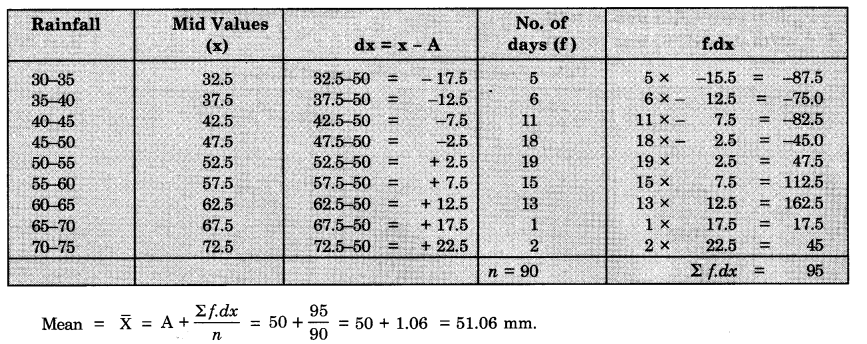
Geographical Perspective on Selected Issues and Problems Class 12 Important Extra Questions Geography Chapter 12

Here we are providing Class 12 Geography Important Extra Questions and Answers Chapter 12 Geographical Perspective on Selected Issues and Problems. Geography Class 12 Important Questions are the best resource for students which helps in class 12 board exams.

Class 12 Geography Chapter 12 Important Extra Questions Geographical Perspective on Selected Issues and Problems

Geographical Perspective on Selected Issues and Problems Important Extra Questions Very Short Answer Type

Question 1.
In which town, do vehicles emit most carbon-monoxide ?
Answer:
Delhi.

Question 2.
What is the volume of polluted water flowing in Ganga river daily ?
Answer:
87.3 crore litre.

Question 3.
How many leather tanneries are located along the Ganga hanks ?
Answer:
150.

Question 4.
Name two sources of Air Pollution.
Answer:
Volcanoes and industries.

Question 5.
Name a gas which depletes Ozone gas.
Answer:
CFC—Chlorofluorocarbon.

Question 6.
Classify pollution into three main types.
Answer:
Pollution can be classified into three categories on the basis of medium of transportation of the pollutants:

  • Air pollution
  • Water pollution
  • Land pollution.

Question 7.
What is the total number of two- wheelers in India.
Answer:
117 crores (2010-11).

Question 8.
What is Smog ?
Answer:
Smog is smoky fog in urban industrial cities when carbondioxide freezes over smoke.

Question 9.
Name the Anthropogenic sources of pollution.
Answer:
Industrial sources, urban source, agricultural sources, cultural sources.

Question 10.
Name the two polluted rivers of India.
Answer:
Ganga and Yamuna.

Question 11.
Name the cultural sources of pollution.
Answer:
Pilgrimages, religious fairs, tourism.

Question 12.
How much area is under land erosion in India ?
Answer:
13 crore hectares.

Question 13.
Which areas have become alkaline and saline and why ?
Answer:
Northern India due to over-irrigation.

Question 14.
Name the ill-effects of use of chemical fertilisers.
Answer:
It destroys the micro-organisms of the soils.

Question 15.
What is the cause of acid-rain? (C.B.S.E. 2014)
Answer:
Sulphur emitted from factories.

Question 16.
How can urban waste become a resource?
Answer:
When it is used for generating energy and compost.

Question 17.
Which type of pollution causes various diseases related to the respiratory system? (Sample Paper 1)
Answer:
Air pollution

Question 18.
Name the two cities of U.P. that are mainly responsible for pollutions the river Ganga. (C.B.S.E. 2011)
(Sample Paper 2)
Answer:
Kanpur and Varanasi.

Question 19.
Mention any two cultural activities responsible for water pollution in India. (C.B.S.E. 2009) (Sample Paper 2017-18)
Answer:
(i) Religious fairs
(ii) Tourism.

Question 20.
Which is the main source of water borne diseases in India? Name one water borne disease. (C.B.S.E. 2009)
Answer:
Contaminated water is the main source of water borne diseases. Hepatitis is a water borne disease.

Question 21.
Name the two states of India which have less than five percent of population below poverty line.
Answer:
Goa (4.40% poverty) and Andaman and Nicobar Islands (1% poverty) are the two states having less than 5% population below poverty line.

Question 22.
Why Swachh Bharat Mission is launched ?
Answer:
This is apart of the urban renewals mission by the government of India. SBM is launched to improve that quality of life in urban slums.

Geographical Perspective on Selected Issues and Problems Important Extra Questions Short Answer Type

uestion 1.
Mention three criterias used for identi¬fying pollution.
Answer:
(i) Disposal of Human wastes.
(ii) Damages caused by disposal wastes.
(iii) Effect of damage caused.

Question 2.
What is the difference between pollution and pollutants ?
Answer:
Pollution means degradation of air, land, water. It deteriorates our resources. Pollutants are matter causing degradation and pollution of ecosystem.

Question 3.
Give two examples of River pollution.
Answer:
Pollution of Rivers. With rapid urbanisation and industrialisation, huge quantities of waste water enter rivers. About 873 million litres per day (mid) of waste water drained into the Ganga before the Ganga Action Plan was initiated. The Sabarmati, a small river, alone receives 998 mid of dirty water from the city of Ahmedabad.

Question 4.
Explain any five objectives of ‘Namami Gange Programme’. (Outside Delhi 2019)
Answer:
Ganga river has national importance but this river needs cleaning by effectively controlling the pollution. The water of this river is polluted ‘Namami Gange Programme’ has launched by union government.

Objectives of Namami Gange Programme are:

  • Motive to develop sewerage treatment system in towns.
  • Objective of creating awarness in public to avoid adding pollutants in to the water of the river. People because of their own rituals do so.
  • Objective of development of Ganga Grams in the areas of Uttarakhand, U.P., Jharkhand, Bihar and W.B.
  • Industrial pollution from towns also a serious problem for the river. So monitoring of industrial effluents is also a major objective of the programme.
  • Domestic wastes from urban centres also a serious problem so cleaning of the surface of the river is also a good objective.

Question 5.
Mention any two source of land pollution in India. (C.B.S.E. 2013)
Answer:
(i) Human and animal excreta.
(ii) Use of pesticides and fertilisers.

Question 6.
Describe any three problems of slums in India. (C.B.S.E. 2014)
Answer:
(i) There is a lack of basic amenities like toilet, safe drinking water, electricity, etc., in slums.
(ii) People are prone to diseases and illness as they are malnourished.
(iii) Poverty makes people vulnerable to drug abuse, alcoholism, crime and exclusion from society.

Question 7.
Describe the effects of air pollution. (C.B.S.E. 2011)
Or
How is air pollution harmful ?
Or
Explain any three different cause’s of air pollution. (Outside Delhi 2019)
Or
“Air pollution is very harmful to flora, fauna and property. Explain any three values which can help in maintaining pollution free air to some extent. (C.B.S.E. Delhi 2017)
Answer:
Effects of air pollution. The air pollution modifies weather and climate, effects human health and biotic community.
(1) Chlorofluorocarbons (CFCs) cause depletion of ozone layer which enable ultraviolet rays of the sun to reach the earth and increase atmospheric temperature.

(2) Increased concentration of carbon dioxide and other gases in the atmosphere causes greenhouse effect raising the atmosphere temperature.

(3) Smoky fog over cities called as urban smog is caused by these gases. It proves very harmful to human health.

(4) Air pollution can also cause acid rains.

(5) Rainwater analysis of urban environment has indicated that pH value of the first rain after summer is always lower than the subsequent rains. Studies conducted by NEERI show that the minimum pH of 4.5 was in Kochi, while the average pH of all rains at all the urban agglomerations ranged from 6.2 to 7.6.

Question 8.
Name the Industrial wastes causing water pollution.
Answer:
Though water pollutants are also created from natural sources (erosion, landslides, decay and decomposition of plants and animals, etc.) pollutants from anthropogenic sources are the real causes of concern. They include industrial sources, urban source, agricultural source, cultural source, etc.

Industries produce several undesirable products including industrial wastes, polluted waste water, poisonous gases, chemical residuals, numerous heavy metals, dust, smoke, etc. Most of the industrial wastes are disposed off in running water. Consequently, poisonous elements reach the reservoirs, rivers and other water bodies which destroy the biosystem of these waters. Major water polluting industries are leather, pulp and paper, textiles and chemicals.

Question 9.
How is air pollution harmful ? Explain any three different causes of air pollution.
Answer:
Air pollution is harmful. Air pollution results into the spread of diseases related to lungs, skin and throat etc. Air pollution also causes acid rain which damages human health. The ozone layer is depleted by the chlorofluorocarbon and great shrinkage in the glacier.

Causes of air pollution:
(i) Natural Resources: Such as volcanic eruption, dust, strom, fires etc.

(ii) Factories: Factories cause smoke, ash.

(iii) Automobiles: Automobilies release carbon monoxide & lead in the atmosphere. Transport and farming are the main actions that have been directly linked to emissions. Forest fires and the burning of living, or recently living organisms, represent a further major sources of emission.

Question 10.
Name the diseases caused by air and water pollution. (C.B.S.E. 2014)
Answer:
Air pollution causes diseases of lungs, heart, nervous and circulatory systems. A study conducted in the ambient air of Kolkata (in 1994) concluded that three out of every ten persons in the city suffered from some kind of respiratory diseases that cough, bronchitis and allergic-rhinitis which were associated with concentrations of suspended particulate matter.

The diseases commonly caused due to contaminated water are diarrhoea, trachoma, intestinal worms, hepatitis, etc. Recent World Bank and World Health Organisation data shows that about one-fourth of the communicable diseases in India are water-borne.

Question 11.
Compare the water pollution in Ganga and Yamuna Rivers.
Answer:

Ganga RiverYamuna River
1. Polluted stretches
2. Nature of pollution
(a) Downstream of Kanpur.
(b) Downstream of Varanasi.
(c) Farrakka barrage to Allahabad.
1. Industrial pollution from towns like Kanpur.
2. Domestic wastes from urban centres.
3. Dumping of carcasses in the river.
(a) Delhi to confluence with Chambal.
(b) Mathura and Agra.
1. Extraction of water by Haryana and Uttar Pradesh for irrigation.
2. Agricultural run off resulting in high levels of micro-pollutants in the Yamuna.
3. Domestic and indus- trial waste of Delhi flowing into the river.

Question 12.
Write a note on Land Pollution.(C.B.S.E. 2011)
Ans.
Land Pollution. Land pollution encompasses the degradation and pollution of soil and vegetative cover. Deterioration in the quality of soil occurs because of

  • soil erosion
  • reduction in plant nutrients
  • decline in soil micro-organisms
  • lack of moisture
  • concentration of various harmful elements, etc.

Erosion is caused by natural and human factors. Deforestation, overgrazing and improper use of land also accelerates soil erosion. It is estimated that 130 million hectares of land is affected by erosion problems in the country. Shifting agriculture alone has affected about 30 million hectares.

Besides erosion, salinisation and flooding caused due to construction of dams, reservoirs, canals and tanks in geologically unsuitable areas, excessive use of canal irrigation and diversion of floodwater in areas of impervious rocks also reduce the potentiality of land. Because of over-irrigation, saline and alkaline areas have increased in the northern plains of the country.

Irrigation also changes the structure of the soil. Besides, use of chemical fertilisers, pesticides, insecticides and herbicides degrade the soil by destroying their natural- physical, chemical and biological properties. Chemical fertilisers destroy micro-organisms of the soil, which are agents of nitrogen conversion in the soil.

They increase sterility and reduce water-holding capacity of soil. They also leave their traces in crops, which act as slow poison for human beings. Similarly, organic phosphate compounds used to kill insects can stay for longer time in soils destroying micro-organism.

Geographical Perspective on Selected Issues and Problems Important Extra Questions Long Answer Type

Question 1.
Describe urbanisation in India and discuss its problems.
Answer:
Urbanisation. Many Geographers have defined urbanisation.

  • According to Griffith Taylor: Urbanisation is a shift of people from village to city.
  • According to G.T. Trewartha: The urbanisation process denotes an increase in the fraction of a population which is urban.

According to changing Political, Social and Economic conditions, the human settlements have been developing. Rural settlements were changed to urban settlements. Therefore urbanisation is a process in which rural settlement, change to urban settlements. According to E.E. Bergel, “The process of change of villages to towns is known as urbanisation. ”

Nature and Trends of Urbanisation in India
In India, urbanisation has not developed on a large scale. The size of urban population is large, India has the second largest urban population in the world, but the percentage of urban population is only 31.6%.

It is small as compared to urban population of 82.6% in USA, 91.7% in Japan, 74% in Russia, 89.3% in Australia and 86.3% in New Zealand. China has 51.8% urban population. During the last 100 years, the urban population is increasing in India. It has increased from 11% to 31.16% in 2011. The total urban population was 2-6 crores in 1901. It has increased 11 times now.

YearTotal Urban Population (million) % of TotalIncrease %
190125.811.0
191125.910.46.35
192128.111.38.22
193133.512.119.14
194144.114.131.97
195162.417.641.38
196179.018.226.41
1971109.120.238.23
1981159.723.346.02
1991212.825.736.02
2001285.327.731.33
2011377.131.1631.8

Problems of Slums and Urban waste : Many problems have arisen due to increasing population and urbanisation. The problems of slums and disposal of urban waste are the two main problems.

Slums: There is a shortage of space in towns. The increasing population creates housing problems. Multi-storeyed buildings are being constructed to solve it. Generally, push and pull factors force the people to migrate to towns.

These people move in search of employment. In towns, the housing facility is costlier. The people construct huts on the vacant land outside the towns. There is dense population in such slums. There is no facility for water-drainage and disposal of urban waste. People’s standard of living is very low. The administration has taken many steps to provide facilities to these areas, yet these slums suffer from many diseases.

According to 2001 census, data was collected regarding slums. This population is known as the slum population. About 4 crore 3 lakh people live in slums. This covers a population of 22.6% of towns, with the result 1/4 of urban population lives in slums. The maximum number of slums are found in Maharashtra and have a population of 1,06,40,000.

The maximum slum population in towns is found in Mumbai with a population of 48.8 per cent. Patna has only 0.25 percent slum population. Meghalaya has the highest percentage (41.33%) and Kerala has the lowest percentage (1.81%) of slum population.

Disposal of urban waste : Another problem in urban areas is the domestic sewage. This urban waste leads to water pollution. The urban waste, the animal waste and the industrial waste material is deposited in heaps over land due to which the land becomes unsuitable for other uses. This waste creates many health problems. The urban waste thrown in rivers and streams cause water pollution.

The waters of river Ganga and Yamuna have been polluted in this way. The towns located along the banks of these rivers use their water as drinking water. The polluted water affects animals living in rivers and spreads many diseases like Hepatitus, Typhoid, Dysentery, etc. which affects human health.

Question 2.
Write a note on Environmental pollution in India.
Answer:
Environment: Environment is the sum total of a set of surroundings that affect the development and life of organisms. It includes natural as well as cultural environment.

Environmental Pollution : Environmental pollution has become a serious problem for mankind. It is threatening the existence of mankind. The composition of air is being altered by undesirable chemical, physical and biological elements. It is known as air pollution.

Atmospheric pollution is as old as civilisation. The use of fire caused gases, smoke, ash. With the development of Industrialisation, the natural composition of the earth atmosphere is gradually degrading. It has damaged the environment. The atmospheric pollution has endangered the existing and future generations.

Pollutants : The common pollutants found in air are as follows:

  • Deposited matter like Soot, Smoke, tandust.
  • Gases like sulphur, Carbon-monoxide, Nitrogen oxide, Ammonia, Fluorine, etc.
  • Chemical Compounds : Like arenes, Phosgenes, detergents.
  • Metals like lead, Iron, zinc, mercury.
  • Sewage
  • Radio-active Substances.
  • Noise and heat.

Atmospheric Pollution. Atmosphere is of fundamental importance for our existence. Due to industrial revolution, the atmospheric pollution is increasing gradually. The effect of atmospheric pollution is not local but regional. The whole of atmosphere is affected. It has harmed ultra-violet shielding ozone layer. The addition of heat-trapping green house gases will cause a disaster.

Air-Pollution by Natural Agents : The volcanic eruptions, forest fires, natural decay of organic and in organic matter is causing air pollution. These cause smoke, ash, gases in atmosphere. These, reduce visibility. Smoke is injurious to health. Acid rain has changed the composition of air and water.

Human activities : The burning of fuels and chemicals is increasing the amount of carbon dioxide in atmosphere. It has increased by 25%. With the result, the average temperature of the earth is increasing. It has increased by 0.3°C to 0.7°C during the last century. Deforestation has also lead to increase in carbon dioxide. The increasing use of fuels in vehicles has increased the amount of sulphur dioxide, carbon monoxide and has created many respiratory diseases.

Atmosphere is of fundamental importance for human health. Most of the countries of the world have enacted laws to check air pollution. Only a healthy nation can utilize its natural resources.

Water pollution : Water is another indispensable source of our life. Pollution of water has caused far- reaching implications. It is a serious problem in metropolitans like Delhi, Kolkata and Mumbai. It not only affects the water of rivers, tanks and lakes; but also ocean water. The following factors affect water pollution:

  • Domestic sewage
  • Industrial wastes
  • Agricultural activities
  • Thermal pollution
  • Marine pollution.

Land Pollution: Land is one of the most important components of life support system. Land is degrading due to over use from centuries. Depletion of land is caused by :

  • Soil erosion
  • Pollutants.

Soil erosion is active on steep slopes and areas devoid of vegetation. Torrential rainfall also washes away fertile layer of soil. Ravines or gullies are caused. Deforestation, over grazing has also led to soil erosion. The effect of soil erosion is a serious problem in agricultural countries.

The accumulation of pollutants on land makes it unsuitable for other uses. The impact of soil erosion on ecological system is visible in Siwalik hills where the harm has been done by chos.

Question 3.
Describe the major problems I associated with urban water disposal in India. (C.B.S.E. 2011)
Answer:
Urban Waste Disposal Problems. The environmental problems of cities include water, air and noise pollution and disposal of toxic and hazardous wastes.

Problems. Lack of sewers or other means to dispose off human excretes safely and the inadequacy of garbage collection services adds to water pollution because many of the uncollected wastes are washed into streams. The dumping of industrial waste into rivers is a major cause of industrial waste into rivers is a major cause of water pollution. River pollution from city-based industries and untreated sewage leads to serious health problems downstream.

Increase in urban wastes.
Solid waste generation continues to increase in both absolute and per capita terms in cities. It is estimated that per capita waste generation increased from 375 gm/day to 490 gm/day during 1971-1997 in urban areas of the country. This increase along with the population increase has tremendously swollen up the figuers of total waste generation quantum. The amount of total wastes has increased from 14.9 Tonnes per day to 48. Tonnes per day.

III effects of urban waste : At the same time, the composition of solid waste changes from biodegradable organic material to plastic and other synethetic materials, which take much longer time to decompose. When this solid waste is not collected and disposed off efficiently and effectively, it attracts rodents and flies which spread diseases. It also pollutes and degrades land and water resources.

Table. India: Composition of Solid Wastes from Cities (in Percentage)

Year/Components        PaperPlasticsMetalsGlassRagsAsh and fine earthTotal
degradable
1971-73 (40 cities)4,140.690.600.403.8349.2041.24
1995 (23 cities)5.783.901.102.103.5040.3041.80

It is evident from the above Table that shares of plastics, glass and metals increased remarkably through time. Plastics recorded five-fold jump within twenty years. Most of these do not have a good recycling value and hence are disposed off by municipalities as part of the kitchen waste.

Harmful for Health.
Inability to collect solid waste is a serious problem. In metropolitan cities like Mumbai, Kolkata, Chennai, Bangalore, etc. about 90 per cent of the solid waste is collected. But in most of the cities and towns about 30 to 50 per cent of the waste generated are left uncollected which accumulate on streets, in open spaces between houses and in wasteland, contributing to serious health hazards.

It is remarkable that both formal and informal sectors are involved in collection of solid waste, yet the problem of urban waste disposal remains unsolved. These wastes should be treated as Resource and utilized for generating energy and comfort.

Effect on ground water. About 90 percent of the municipal water collected by the civic authorities is dumped in low-lying areas outside the city/town limit, without any provision for treatment. As a result, heavy metals find their way to the underground water rendering it unfit for drinking. Untreated wastes ferment slowly and release noxious biogas to the atmosphere, including methane (65 to 75 per cent) which is a green house gas and which has a global warming potential 34 times more than carbon dioxide.

Question 4.
Explain soil erosion, salinisation and water logging problems.
Answer:
1. Irrigation. Because of our irrigation, saline areas increased in northern planes of country. Irrigation also changes the structure of the soil.

2. Use of chemicals. Besides, use of chemical fertilisers, pesticides, insecticides and herbicides degrades the soil by destroying their natural, physical, chemical and biological properties.

3. Use of fertilisers. Chemical fertilisers destroy micro-organisms of the soil, which are agents of nitrogen conversion in the soil. They increase sterility and reduce water-holding capacity of the soil. They also leave their traces in crops, which act as slow poison for human beings.

4. Use of pesticides. Similarly, organic phosphate compounds used to kill insects can stay for longer time in soils destroying micro-organisms.

5. Industrial wastes. Improper disposal of industrial and urban wastes, and irrigation of agricultural fields with polluted urban sewage water near urban and industrial areas degrade the soil. The toxic chemical substances of industrial effluents and urban sew’age enter the soil mostly in their neighbourhoods and pollute them.

6. Pollutants emitted by chimneys. Besides gaseous and solid pollutants emitted by the factory chimneys are transported by winds. These pollutants containing toxic substances, are deposited on soils and pollute them.

7. Acid Rain. Sulphur emitted from factories cause acid rains which increases the acidity of the soils. Pollutant from cement factories like klins, coal mining and transport vehicles, thermal power plants, etc., also pollute the soils on a large scale.

Question 5.
Describe the air pollution caused by automobiles. Give examples for four metro- politons.
Answer:
The vehicles which use leaded fuel, account for about 95% of air borne lead pollution. The growth of number of motor vehicles in the last three decades has been almost 32 times. In 1997-98, there were 0.53 million buses, 2.53 million trucks, 28.24 million two- wheelers, 1.34 million auto rickshaws and 5.05 million cars, jeep and taxis.

Urban air quality has generally deteriorated throughout India. The reasons are absence of pollution abatement and rising number of motor vehicles that use leaded fuels. The annual mean concentration trends for the National Environmental Engineering Research Institute (NEERI) for some cities observed various atmospheric pollutants. From figures,
(1) it is clear that nitrogen dioxide concentraton trend is stabilising for Mumbai, Kolkata and Chennai
(2) sulphur dioxide concentrations are decreasing in Delhi but still increasing in Mumbai and Kolkata.
(3) Suspended Particulate Matter (SPM) concentrations have somewhat increased in all these cities.

CitySPM
Dioxide
Sulphur
nitrogen
Oxide ofHydrocarbons
monoxide
CarbonTotal
Delhi8.587.47105.38207.98542.51872
Mumbai4.663.3659.0290.17391.6549
Bengaluru2.181.4721.8565.42162.8254
Kolkata2.173.0445.5836.67156.87245

Table. India: Estimated Vehicular Emission Load in certain Metropolitan Cities
(Vehicular Pollution Load tonne per day)

Geographical Perspective on Selected Issues and Problems Important Extra Questions HOTS

Question 1.
‘Land Degradation is caused by human made processes are more harmful than natural processes in India.’ Analyse the statement with suitable examples. (C.B.S.E. 2009)
Answer:
Land degration caused by man-made processes amounts to 5.58% of the total rate of degradation. It is more than land degraded by natural sources (2.4%). Wastelands are formed due to shifting cultivation, planation crops, degraded forests and pastures, mining and industrial wastelands.

Question 2.
Why is the ‘Urban Waste Disposal’ a serious problem in India? Explain any three reasons. (Delhi 2019) (C.B.S.E. 2014)
Answer:
Urban waste disposal is a serious problem in India-

  • Solid waste cause health hazard and spread diseases like Typhoid, Diphtheria, Diarrhoea, Malaria, and Cholera.
  • The dumping of industrial waste into rivers leads to water pollution.
  • Untreated wastes ferment slowly and release toxic gases into the atmosphere including Methane.

Question 3.
Explain the reasons for the coming up of slums in developing countries like India with suitable examples.
(Sample Paper 2018-19)
Answer:
Slums are clusters of shanty structures. These are inhabited by those people who are forced to migrate from the rural areas to these urban centres in search of livelihood but are not able to afford proper housing due to high rents. They occupy environmentally incompatible and degraded areas. Developing countries like India face this problem at a large scale. For e.g., Dharavi, Asia is largest slum in a striking example of the same.