CBSE Sample Papers for Class 10 Maths Basic Set 2 with Solutions

Students can access the CBSE Sample Papers for Class 10 Maths Basic with Solutions and marking scheme Set 2 will help students in understanding the difficulty level of the exam.

CBSE Sample Papers for Class 10 Maths Basic Set 2 with Solutions

Time: 3 Hours
Maximum Marks: 80

General Instructions:

1. This question paper contains two parts, A and B.
2. Both Part A and Part B have internal choices.

Part-A:
1. It consists of two sections, I and II.
2. Section I has 16 questions of 1 mark each. Internal choice is provided in 5 questions.
3. Section II has 4 questions on case study. Each case study has 5 case-based sub-parts. An examinee is to attempt any 4 out of 5 sub-parts.

Part-B:
1. It consists of three sections III, IV and V.
2. In section III, Question Nos. 21 to 26 are Very Short Answer Type questions of 2 marks each.
3. In section IV, Question Nos. 27 to 33 are Short Answer Type questions of 3 marks each.
4. In section V, Question Nos. 34 to 36 are Long Answer Type questions of 5 marks each.
5. Internal choice is provided in 2 questions of 2 marks, 2 questions of 3 marks and 1 question of 5 marks.

Part – A
Section-I

Section I has 16 questions of 1 mark each. Internal choice is provided in 5 questions.

Question 1.
Express 156 as the product of primes.
Solution :
156 = 22 × 3 × 13

Question 2.
Write a quadratic polynomial, sum of whose zeroes is 2 and product is -8.
Solution :
Quadratic polynomial is given by x2 – (α + β)x + αβ = x2 – 2x – 8

Question 3.
Given that HCF (96, 404) is 4, find the LCM ( 96, 404).
OR
State the fundamental Theorem of Arithmetic.
Solution :
\(\mathrm{LCM}(96,404)=\frac{96 \times 404}{\mathrm{HCF}(96,404)}=\frac{96 \times 404}{4}=9696\)
OR
Every composite number can be expressed (factorized) as a product of primes, factorization is unique, apart from the order in which the factors occur.

Question 4.
On comparing the ratios of the coefficients, find out whether the pair of equations x-2y = 0 and 3x + 4y – 20 = 0 is consistent or inconsistent.
Solution :
x – 2y = 0
3x + 4y – 20 = 0
\(\frac{1}{3} \neq \frac{-2}{4}\)
As, \(\frac{a_{1}}{a_{2}} \neq \frac{b_{1}}{b_{2}}\) is one condition for consistency.
Therefore, the pair of equations is consistent.

Question 5.
If a and b are co-prime numbers, then find the HCF (a, b).
Solution :
1

Question 6.
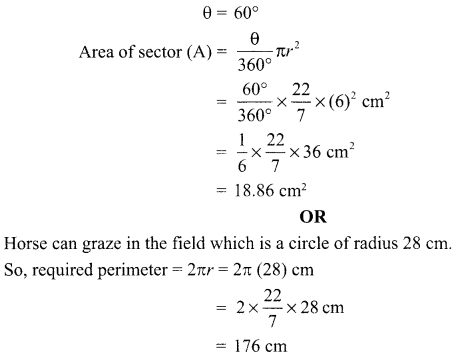
Find the area of a sector of a circle with radius 6 cm if angle of the sector is 60°. (Take π = 22/7).
OR
A horse is tied to a pole with 28 m long rope. Find the perimeter of the field where the horse can graze.
(Take π = 22/7)
Solution :
CBSE Sample Papers for Class 10 Maths Basic Set 2 with Solutions 12

Question 7.
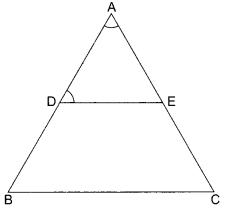
In the given fig. DE || BC, ∠ADE = 70° and ∠BAC = 50°, then angle ∠BCA = ……..
CBSE Sample Papers for Class 10 Maths Basic Set 2 with Solutions 1
OR
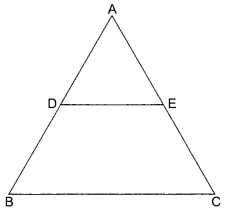
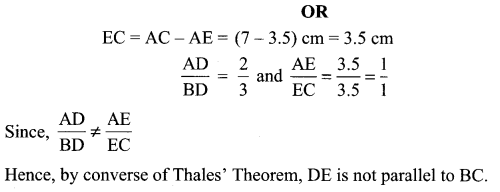
In the given figure, AD = 2 cm, BD = 3 cm, AE = 3.5 cm and AC = 7 cm. Is DE parallel to BC?
CBSE Sample Papers for Class 10 Maths Basic Set 2 with Solutions 2
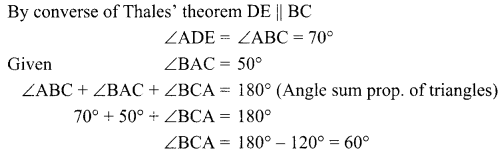
Solution :
CBSE Sample Papers for Class 10 Maths Basic Set 2 with Solutions 13
CBSE Sample Papers for Class 10 Maths Basic Set 2 with Solutions 14

Question 8.
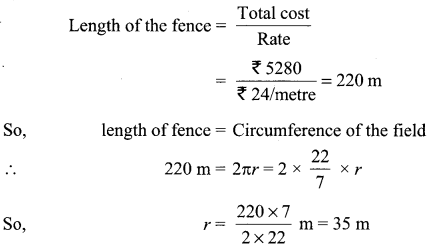
The cost of fencing a circular field at the rate of ₹ 24 per metre is ₹ 5280. Find the radius of the field.
Solution :
CBSE Sample Papers for Class 10 Maths Basic Set 2 with Solutions 15

Question 9.
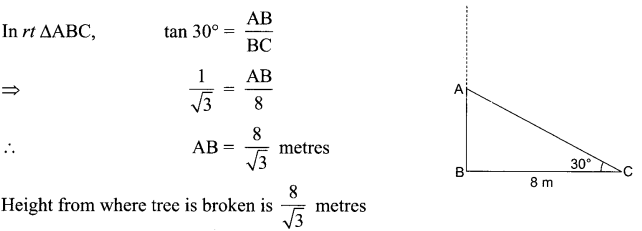
A tree breaks due to storm and the broken part bends so that the top of the tree touches the ground where it makes an angle 30°. The distance between the foot of the tree to the point where the top touches the ground is 8 m. Find the height of the tree from where it is broken.
Solution :
CBSE Sample Papers for Class 10 Maths Basic Set 2 with Solutions 21

Question 10.
If the perimeter and the area of a circle are numerically equal, then find the radius of the circle.
Solution :
Perimeter of circle = Area of circle
⇒ 2nr = nr2
⇒ r = 2 units

Question 11.
Write the empirical relationship among mean, median and mode.
Solution :
3 median = mode + 2 mean

Question 12.
To divide a line segment BC internally in the ratio 3 : 5, we draw a ray BX such that ZCBX is an acute angle. What will be the minimum number of points to be located at equal distances, on ray BX?
Solution :
8

Question 13.
For what values of p does the pair of equations 4x + py +8 =0 and 2x +2y +2 =0 has unique solution?
OR
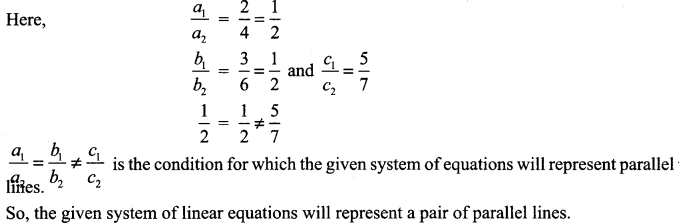
What type of straight lines will be represented by the system of equations 2x + 3y = 5 and 4x + 6y = 7?
Solution :
\(\frac{a_{1}}{a_{2}} \neq \frac{b_{1}}{b_{2}}\)  is the condition for the given pair of equations to have a unique solution.
\(\Rightarrow \frac{4}{2} \neq \frac{p}{2}\)
⇒ P ≠ 4
Therefore, for all real values of p except 4, the given pair of equations will have a unique solution.
CBSE Sample Papers for Class 10 Maths Basic Set 2 with Solutions 52

Question 14.
A bag contains 3 red balls and 5 black balls. A ball is drawn at random from the bag. What is the probability that the ball drawn is red?
OR
A die is thrown once. What is the probability of getting a prime number?
Solution :
No. of red balls = 3, No. black balls = 5
Total number of balls = 5 + 3 = 8
Probability of red balls \(=\frac{3}{8}\)
OR
Total no. of possible outcomes = 6
There are 3 prime numbers: 2, 3, 5.
So, probability of getting a prime number \(=\frac{3}{6}=\frac{1}{2}\)

Question 15.
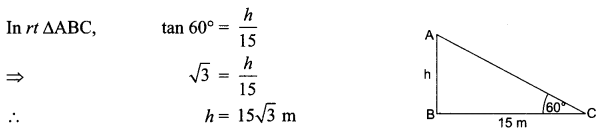
A tower stands vertically on the ground. From a point on the ground, which is 15m away from the foot of the tower, the angle of elevation of the top of the tower is found to be 60°. Find the height of the tower.
Solution :
CBSE Sample Papers for Class 10 Maths Basic Set 2 with Solutions 22

Question 16.
Probability of an event E + probability of the event E (not E) is,
Solution :
1

Section-II

Case study-based questions are compulsory. Attempt any 4 sub-parts from each question. Each sub-part carries 1 mark.

Case Study Based-1

Question 17.
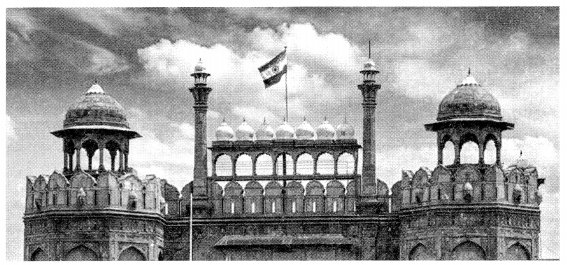
CBSE Sample Papers for Class 10 Maths Basic Set 2 with Solutions 3
Mathematics teacher of a school took her 10th standard students to show Red fort. It was a part of their Educational trip. The teacher had interest in history as well. She narrated the facts of Red fort to students. Then the teacher said in this monument one can find combination of solid figures. There are 2 pillars which are cylindrical in shape. Also 2 domes at the comers which are hemispherical.7 smaller domes are at the centre. Flag hoisting ceremony on Independence Day takes place near these domes.

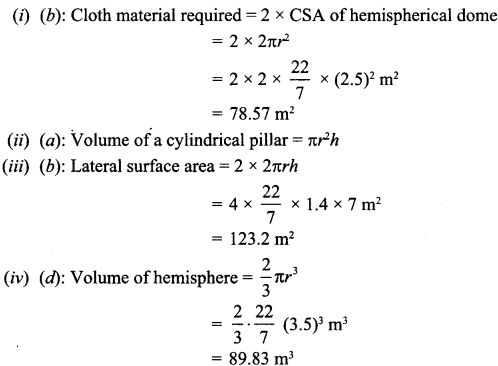
(i) How much cloth material will be required to cover 2 big domes each of radius 2.5 metres? (Take n = 22/7)
(a) 75 m²
(b) 78.57 m²
(c) 87.47 m²
(d) 25.8 m²

(ii) Write the formula to find the volume of a cylindrical pillar.
(a) nrh
(b) nr!
(c) nr(l + r)
(d) 2nr

(iii) Find the lateral surface area of two pillars if height of the pillar is 7m and radius of the base is 1.4 m. 1
(a) 112.3 cm²
(b) 123.2 m²
(c) 90 m²
(d) 345.2 cm²

(iv) How much is the volume of a hemisphere if the radius of the base is 3.5 m?
(a) 85.9 m³
(b) 80 m³
(c) 98 m³
(d) 89.83 m³

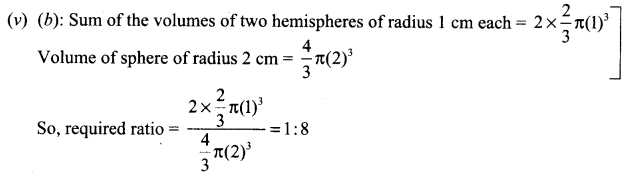
(v) What is the ratio of sum of volumes of two hemispheres of radius 1 cm each to the volume of a sphere of radius 2 cm?
(a) 1 : 1
(b) 1:8
(c) 8 : 1
(d) 1 : 16
Solution :
CBSE Sample Papers for Class 10 Maths Basic Set 2 with Solutions 23
CBSE Sample Papers for Class 10 Maths Basic Set 2 with Solutions 24

Case Study Based-2

Question 18.
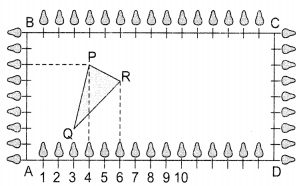
Class X students of a secondary school in Krishnagar have been allotted a rectangular plot of a land for gardening activity. Saplings of Gulmohar are planted on the boundary at a distance of lm from each other. There is a triangular grassy lawn in the plot as shown in the figure. The students are to sow seeds of flowering plants on the remaining area of the plot.
CBSE Sample Papers for Class 10 Maths Basic Set 2 with Solutions 4
Considering A as origin, answer question (i) to (v).

(i) Considering A as the origin, what are the coordinates of A?
(a) (0,1)
(b) (1,0)
(c) (0,0)
(d) (-1,-1)
Solution :
(c) (0,0)

(ii) What are the coordinates of P?
(a) (4, 6)
(b) (6, 4)
(c) (6,0)
(d) (7,4)
Solution :
(a) (4, 6)

(iii) What are the coordinates of R?
(a) (6, 5)
(b) (5, 6)
(c) (0, 16)
(d) (16, 1)
Solution :
(a) (6, 5)

(iv) What are the coordinates of D?
(a) (12,2)
(b) (-12, 6)
(c) (12, 3)
(d) (6, 10)
Solution :
(a) (12,2)

(v) What are the coordinates of P if D is taken as the origin?
(a) (12,2)
(b) (-12,6)
(c) (12,3)
(d) (6, 10)
Solution :
(b) (-12,6)

Case Study Based-3

Question 19.
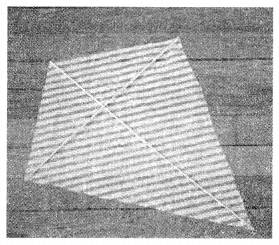
Rahul is studying in X Standard. He is making a kite to fly it on a Sunday. Few questions came to his mind while making the kite. Give answers to his questions by looking at the figure.
CBSE Sample Papers for Class 10 Maths Basic Set 2 with Solutions 5
(i) Rahul tied the sticks at what angles to each other?
(a) 30°
(b) 45°
(c) 90°
(d) 60°
Solution :
(c) 90°

(ii) Which is the correct similarity criteria applicable for smaller triangles at the upper part of this kite?
(a) RHS
(b) SAS
(c)  SSA
(d) AAS
Solution :
(b) SAS

(iii) Sides of two similar triangles are in the ratio 4:9. Corresponding medians of these triangles are in the ratio
(a) 2:3
(b) 4:9
(c) 81:16
(d) 16:81
Solution :
(b) 4:9

(iv) In a triangle, if the square of one side is equal to the sum of the squares of the other two sides, then the angle opposite to the first side is a right angle. This theorem is called as,
(a) Pythagoras theorem
(b) Thales theorem
(c) Converse of Thales theorem
(d) Converse of Pythagoras theorem
Solution :
(d) Converse of Pythagoras theorem

(v) What is the area of the kite, formed by two perpendicular sticks of length 6 cm and 8 cm?
(a) 48 cm2
(b) 14 cm3
(c) 24 cm2
(d)  96 cm2
Solition :
(a) 48 cm2

Case Study Based-4

Question 20.
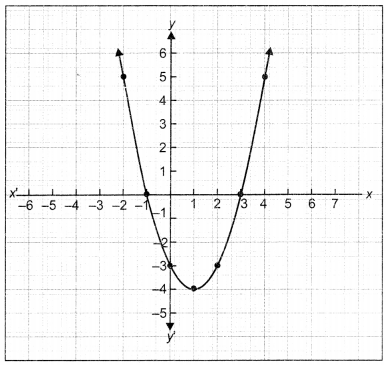
Due to heavy storm, an electric wire got bent as shown in the figure. It followed a mathematical shape. Answer the following questions below:
CBSE Sample Papers for Class 10 Maths Basic Set 2 with Solutions 6

(i) Name the shape in which the wire is bent.
(a) spiral
(b) ellipse
(c) linear
(d) parabola
Solution :
(d) parabola

(ii) How many zeroes are there for the polynomial (shape of the wire).
(a) 2
(b) 3
(c) 1
(d) 0
Solution :
(a) 2

(iii) The zeroes of the polynomial are
(a) -1,5
(b) -1,3
(c) 3,5
(d) -4,2
Solution :
(b) -1,3

(iv) What will be the expression of the polynomial?
(a) x2 + 2x – 3
(b) x2 – 2x + 3
(c) x2 – 2x – 3
(d) x2 + 2x + 3
Solution :
(c) x2 – 2x – 3

(v) What is the value of the polynomial if x =-1?
(a) 6
(b) -18
(c) 18
(d) 0
Solution :
(d) 0

Part-B
Section-III

All questions are compulsory. In case of internal choices, attempt anyone.

Question 21.
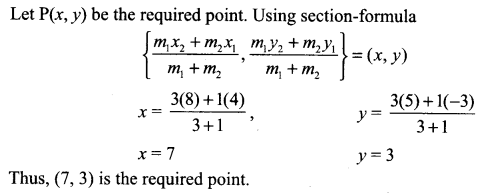
Find the coordinates of the point which divides the line segment joining the points (4, -3) and (8, 5) in the ratio 3 : 1 internally.
OR
Find a relation between x andy such that the point (x, y) is equidistant from the points (7, 1) and (3, 5).
Solution :
CBSE Sample Papers for Class 10 Maths Basic Set 2 with Solutions 25
OR
Let P(x,y) be equidistant from the points A(7, 1) and B(3, 5)
Give AP = BP. So. AP² = BP²
(x—7)2+(y— 1)2= (x—3)2+(v—5)2
x2 — 14x+49+y2—2y+ I = x2—6x+9+y2— 10y+25
x – y= 2

Question 22.
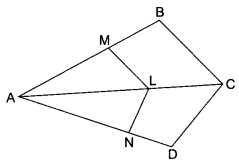
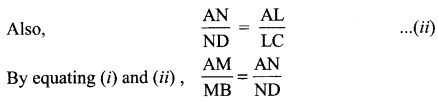
In the fig. if LM || CB and LN || CD, prove that \(\frac{\mathrm{AM}}{\mathrm{MB}}=\frac{\mathrm{AN}}{\mathrm{ND}}\)
CBSE Sample Papers for Class 10 Maths Basic Set 2 with Solutions 7
Solution :
CBSE Sample Papers for Class 10 Maths Basic Set 2 with Solutions 26
CBSE Sample Papers for Class 10 Maths Basic Set 2 with Solutions 27

Question 23.
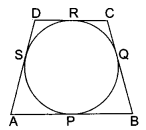
A quadrilateral ABCD is drawn to circumscribe a circle. Prove that AB + CD = AD + BC.
CBSE Sample Papers for Class 10 Maths Basic Set 2 with Solutions 8
Solution :
To prove: AB + CD = AD + BC
Proof: AS = AP (Length of tangents from an external point to a circle are equal)
BQ= BP
CQ = CR
DS = DR
AS + BQ + CQ + DS = AP + BP + CR + DR
(AS + DS) + (BQ + CQ) = (AP + BP) + (CR + DR)
AD + BC = AB + CD

Question 24.
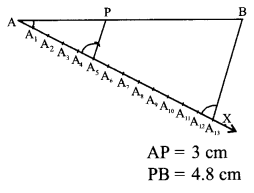
Draw a line segment of length 7.8 cm and divide it in the ratio 5:8. Measure the two parts.
Solution :
CBSE Sample Papers for Class 10 Maths Basic Set 2 with Solutions 28

Question 25.
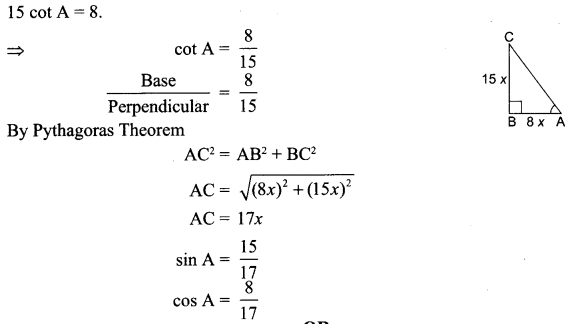
Given 15 cot A = 8, find sin A and sec A.
OR
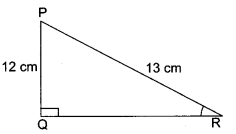
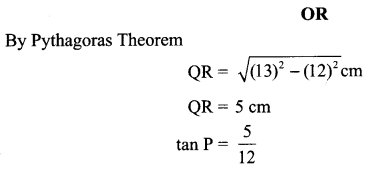
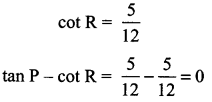
Find tan P – cot R
CBSE Sample Papers for Class 10 Maths Basic Set 2 with Solutions 9
Solution :
CBSE Sample Papers for Class 10 Maths Basic Set 2 with Solutions 29

CBSE Sample Papers for Class 10 Maths Basic Set 2 with Solutions 30
CBSE Sample Papers for Class 10 Maths Basic Set 2 with Solutions 31

Question 26.
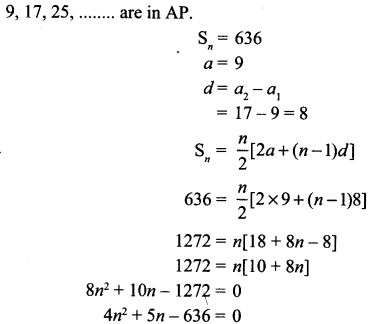
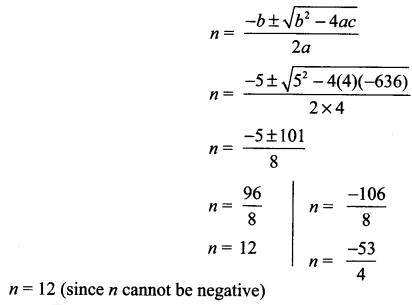
How many terms of the A.P: 9, 17, 25……… must be taken to give a supi 636?
Solution :
CBSE Sample Papers for Class 10 Maths Basic Set 2 with Solutions 32
CBSE Sample Papers for Class 10 Maths Basic Set 2 with Solutions 33

Section-IV

Question 27.
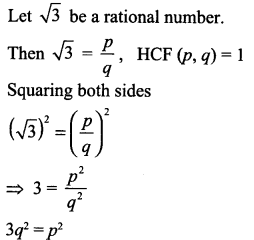
Prove that -√3 is an irrational number.
Solution :
CBSE Sample Papers for Class 10 Maths Basic Set 2 with Solutions 34
3 divides p2 ⇒ 3 divides p
3 is a factor of p
Take p = 3c
3q2 = (3c)2
3q2 = 9c2    ⇒   q2 = 3c2
3 divides g2 ⇒ 3 divides q
3 is a factor of 9
Therefore 3 is a common factor of p and q.
It is a contradiction to our assumption that \(\frac{p}{q}\) is rational.
Hence √3 is an irrational number.

Question 28.
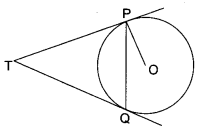
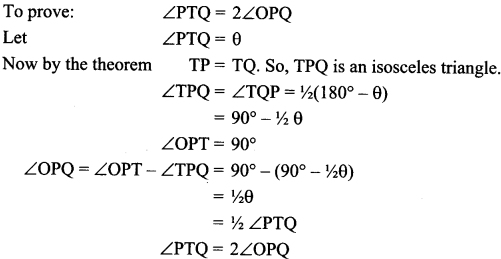
Two tangents TP and TQ are drawn to a circle with centre O from an external point T. Prove that ∠PTQ = 2∠OPQ.
CBSE Sample Papers for Class 10 Maths Basic Set 2 with Solutions 10
Solution :
CBSE Sample Papers for Class 10 Maths Basic Set 2 with Solutions 37

Question 29.
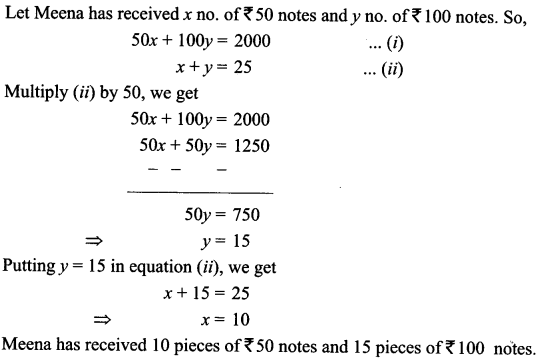
Meena went to a bank to withdraw ₹ 2,000. She asked the cashier to give her ₹ 50 and ₹  100 notes only. Meena got 25 notes in all. Find how many notes of ₹ 50 and ₹ 100 she received.
Solution :
CBSE Sample Papers for Class 10 Maths Basic Set 2 with Solutions 38

Question 30.
A box contains 90 discs which are numbered from 1 to 90. If one disc is drawn at random from the box, find the probability that it bears
(i) a two-digit number
(ii) a perfect square number.
(iii) a number divisible by 5. 3
OR
One card is drawn from a well-shuffled deck of 52 cards. Find the probability of getting (/’) A king of red colour.
(ii) A spade
(iii) The queen of diamond
Solution :
(i) 10,11,12,…, 90 are two digit numbers. Thereare81 numbers. So, probability of getting a two-digit number =
\(=\frac{81}{90}=\frac{9}{10}\)

(ii) 1, 4, 9, 16, 25, 36, 49, 64, 81 are perfect squares. So, probability of getting a perfect square number \(=\frac{9}{90}=\frac{1}{10}\)

(iii) 5, 10, 15,…, 90 are divisible by 5. There are 18 outcomes. So, probability of getting a number divisible by 5.
\(=\frac{18}{90}=\frac{1}{5}\)

OR

(i) Probability of getting “A king of red colour.”
P (King of red colour) \(=\frac{2}{52}=\frac{1}{26}\)

(ii) Probability of getting “A spade”
P (a spade) \(=\frac{13}{52}=\frac{1}{4}\)

(iii) Probability of getting “the queen of diamond” P (the queen of diamond)
P (the queen of diamond) \(=\frac{1}{52}\)

Question 31.
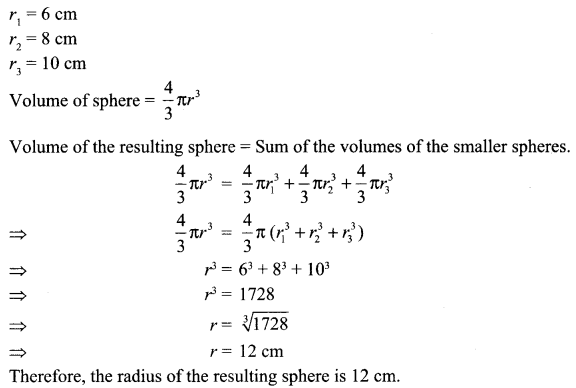
Metallic spheres of radii 6cm, 8cm and 10cm respectively are melted to form a solid sphere. Find the radius of the resulting sphere.
Solution :
CBSE Sample Papers for Class 10 Maths Basic Set 2 with Solutions 39

Question 32.
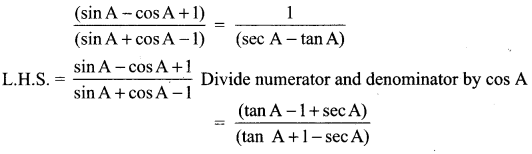
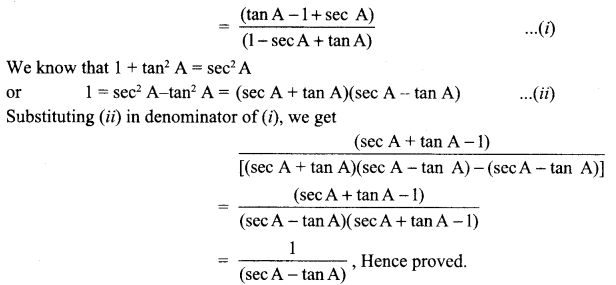
\(\text { Prove that } \frac{\sin A-\cos A+1}{\sin A+\cos A-1}=\frac{1}{\sec A-\tan A}\)
Solution :
CBSE Sample Papers for Class 10 Maths Basic Set 2 with Solutions 40
CBSE Sample Papers for Class 10 Maths Basic Set 2 with Solutions 41

Question 33.
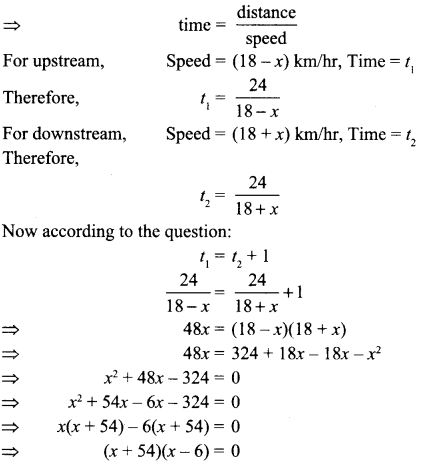
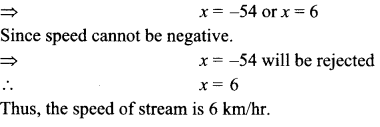
A motor boat whose speed in still water is 18 km/h, takes 1 hour more to go 24 km upstream than to return downstream to the same spot. Find the speed of the stream.
OR
Find two consecutive odd positive integers, sum of whose squares is 290.
Solution :
Given: Speed of boat = 18 km/hr,
Distance = 24 km
Let x be the speed of stream.
Let t1 and t2 be the time for upstream and downstream. As we know that,
CBSE Sample Papers for Class 10 Maths Basic Set 2 with Solutions 42
CBSE Sample Papers for Class 10 Maths Basic Set 2 with Solutions 43
CBSE Sample Papers for Class 10 Maths Basic Set 2 with Solutions 45
OR
Let one of the odd positive integer be x
then the other odd positive integer is x + 2
ATQ, x2 + (x+2)2 = 290
⇒  x2 + x2 + 4x + 4 = 290
⇒ 2 x 2 + 4x – 286 = 0
⇒ 2(x2 + 2x – 143) = 0
⇒ x2 + 2x – 143 = 0
⇒ x2 + 13x — 11x — 143 = 0
⇒ x(x + 13) — 11(x + 13) = 0
⇒ (x – 11)(x + 13) = 0
⇒  (x – 11)0,(x + 13) = 0
Therefore, x = 11 or  -13
According to question, x is a positive odd integer.
Hence, we take positive value of x
So, x = 11 and(x + 2)11 + 2 = 13
Therefore, the odd positive integers are 11 and 13.

Section-V

Question 34.
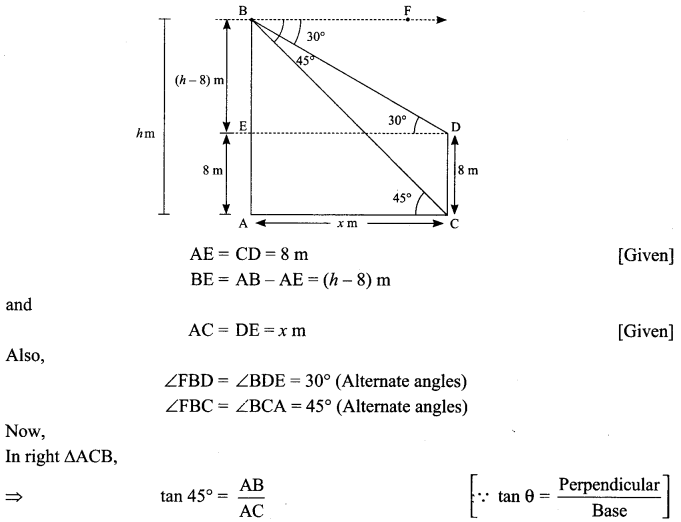
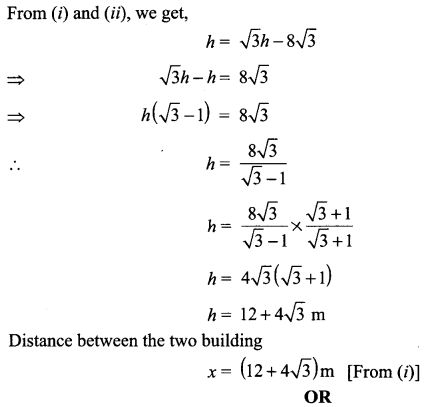
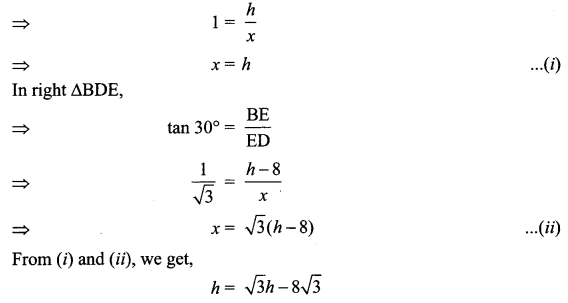
The angles of depression of the top and bottom of a 8m tall building from the top of a multistoried building are 30° and 45°, respectively. Find the height of the multi-storied building and the distance between the two buildings.
OR
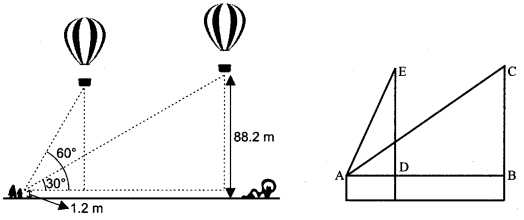
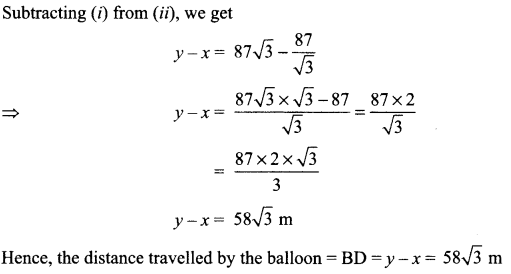
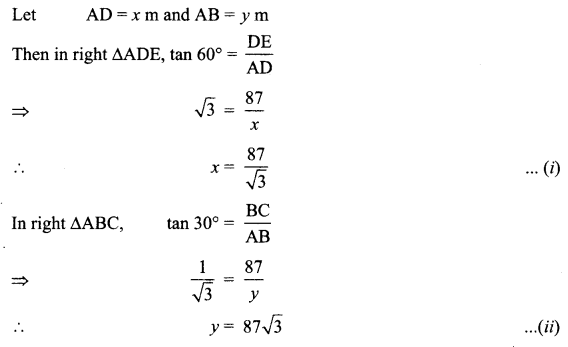
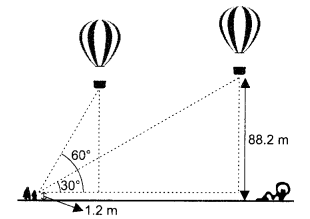
A 1.2 m tall girl spots a balloon moving with the wind in a horizontal line at a height 88.2 m from the ground. The angle of elevation of the balloon from the eyes of the girl at any instant is 60°. After sometime, the angle of elevation reduces 30°. Find the distance travelled by the balloon during the interval.
CBSE Sample Papers for Class 10 Maths Basic Set 2 with Solutions 11
Solution :
CBSE Sample Papers for Class 10 Maths Basic Set 2 with Solutions 53
CBSE Sample Papers for Class 10 Maths Basic Set 2 with Solutions 46
CBSE Sample Papers for Class 10 Maths Basic Set 2 with Solutions 47
CBSE Sample Papers for Class 10 Maths Basic Set 2 with Solutions 49
CBSE Sample Papers for Class 10 Maths Basic Set 2 with Solutions 48

Question 35.
The pth qth and rth terms of an A.P. are a, b and c Show that a(q – r) + b(r -p) + c(p – q) = + c(p – q) = 0                            Solution :
Let AB be the multi-storied building of height hm and CD the building at a distance xm.
Let A be the first term and D the common difference of A.P.
Tp = a = A + (p – 1)D(A – D) + pD …………(i)
Tq= b = A + (q – 1)D = (AD) + qD ……….(ii)
Tr = c = A + (r – 1)D(A – D) + rD ……………(iii)
Here we have got two unknowns A and D which are to be eliminated.
We multiply (i), (ii) and (iii) by q  – r, r  – p and p  – q respectively and add:
a(q – r) = (A – D)(q – r) + Dp(q – r)
b(r – p) (A – D)(r – p) + Dq(r – p)
c(p – q) – (A – D)(p – q) + Dr(p – q)
a(q  – r) + b(r  – p) + c(p – q)
= (A – D)[q – r + r – p + p – q] + D[p(q – r) + q(r – p) + r(p – q)]
= (A – D)(0) + D[pq — pr + qr — pq + rp  – rq)
= 0

Question 36.
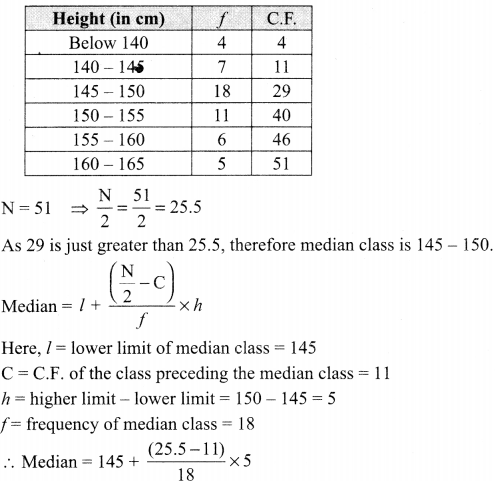
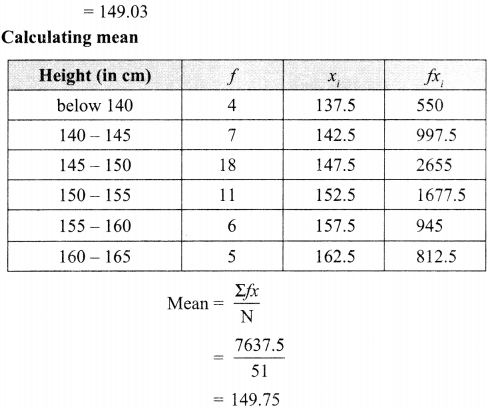
A survey regarding the heights (in cm) of 51 girls of class X of a school was conducted and the following data was obtained. Find the median height and the mean using the formulae.

Height (in cm)Number of Girls
Less than 1404
Less than 14511
Less than 15029
Less than 15540
Less than 16046
Less than 16551

Solution :
CBSE Sample Papers for Class 10 Maths Basic Set 2 with Solutions 50
CBSE Sample Papers for Class 10 Maths Basic Set 2 with Solutions 51

The Solid State Class 12 Important Extra Questions Chemistry Chapter 1

Here we are providing Class 12 Chemistry Important Extra Questions and Answers Chapter 1 The Solid State. Class 12 Chemistry Important Questions are the best resource for students which helps in Class 12 board exams.

Class 12 Chemistry Chapter 1 Important Extra Questions The Solid State

The Solid State Important Extra Questions Very Short Answer Type

Question 1.
A metal crystallises in a body centred cubic structure. If ‘a’ is the edge length of its unit cell, ‘r’ is the radius of the sphere. What is the relationship between ‘r’ and ‘a’? (CBSE Sample Paper 2017-18)
Answer:
r = \(\frac{\sqrt{3}}{4}\)a

Question 2.
If the radius of the octahedral void is ‘r’ and radius of the atoms in close packing is ‘R’. What is the relation between ‘r’ and ‘R’? (CBSE Sample Paper 2017-18)
Answer:
r = 0.414 R

Question 3.
How many octahedral voids are there in 1 mole of a compound having cubic closed packed structure? (CBSE Sample Paper 2007)
Answer:
4 mole

Question 4.
Write a feature which will distinguish a metallic solid from an ionic solid.
Answer:
Metallic solids are good conductors of heat and electricity whereas ionic solids are insulators in solid state but conductors in molten state and in aqueous solution.

Question 5.
Write a distinguishing feature of metallic solids.
Answer:
Metallic solids are good conductors of heat and electricity.

Question 6.
KF has ccp structure. Calculate the radius of the unit cell if the side of the cube or edge length is 400 pm. How many F ions and octahedral voids are there in the unit cell? (CBSE Sample Paper 2011)
Answer:
For ccp lattice,
r = \(\frac{a}{2 \sqrt{2}}=\frac{400}{2 \times 1.414}\) = 141.4 pm
There are four (4) F ions and four (4) octahedral voids per unit cell.

Question 7.
Which point defect in crystals lowers the density of a crystal?
Answer:
Schottky defect

Question 8.
What type of interactions hold the molecules together in a polar molecular solid?
Answer:
Dipole-dipole forces

Question 9.
Which stoichiometric defect in crystals increases the density of a solid? (CBSE Delhi 2012)
Answer:
Interstitial defect

Question 10.
What type of semiconductor is obtained when silicon is doped with arsenic? (C.B.S.E. 2010)
Answer:
n-type semiconductor

Question 11.
Define forbidden zone of an insulator. (C.B.S.E. Delhi 2008)
Answer:
The large energy gap between the filled valence band and the empty conduction band in an insulator is called forbidden zone.

Question 12.
How do metallic and ionic substances differ in conducting electricity? (C.B.S.E. 2009)
Answer:
Metallic solids conduct electricity in the solid state whereas ionic substances conduct electricity in molten state or in solution, or metallic substances conduct electricity through electrons while ionic substances conduct electricity through ions.

Question 13.
What is the coordination number of each type of ions in a rock salt type crystal structure? (C.B.S.E. Delhi 2008)
Answer:
C.N. of Na+ = 6, C.N. of Cl = 6.

Question 14.
What is meant by ‘doping’ in a semiconductor? (C.B.S.E. Delhi 2012)
Answer:
The process of introduction of small amounts of impurities in the lattice of the crystal is called doping.

Question 15.
How may the conductivity of an intrinsic semiconductor be increased? (C.B.S.E. Delhi 2012)
Answer:
The conductivity of an intrinsic semiconductor may be increased by adding an appropriate amount of suitable impurity. This process is called doping.

Question 16.
How many atoms constitute one unit cell of a face-centred cubic crystal? (C.B.S.E. Delhi 2013)
Answer:
Four

Question 17.
What type of magnetism is shown by a substance if magnetic moments of domains are arranged in the same direction? (C.B.S.E. Delhi 2016)
Answer:
Ferromagnetism

Question 18.
Out of NaCI and AgCI, which one shows Frenkel defect and why? (C.B.S.E. Delhi 2019)
Answer:
AgCI shows Frenkel defect. This is because of small size of Ag+ ions; these can fit into interstitial sites of Cl ions.

Question 19.
What type of stoichiometric defect is shown by ZnS and why? (C.B.S.E. Delhi 2019)
Answer:
Frenkel defect. This is caused due to the large difference in size of ions.

Question 20.
Why conductivity of silicon increases on doping with phosphorus? (CBSE Delhi 2019)
Answer:
When silicon is doped with phosphorus, an extra electron is introduced after forming four covalent bonds. This extra electron gets delocalised and serves to conduct electricity. Hence, conductivity increases.

The Solid State Important Extra Questions Short Answer Type

Question 1.
Calculate the number of unit cells in 8.1 g of aluminium if it crystallises in a face-centred cubic (fcc) structure. (Atomic mass of Al = 27 g mol-1).
Answer:
Moles of aluminium = \(\frac{8.1}{27}\) mol
No. of atoms of Al in 8.1 g = \(\frac{8.1}{27}\) × 6.022 × 10²³
No. of atoms in fee unit cell = 4
No. of unit cells = \(\frac{8.1}{27} \times \frac{6.022 \times 10^{23}}{4}\)
= 4.5 × 10²²

Question 2.
Tungsten crystallises in body centred cubic unit cell. If edge of the unit cell is 316.5 pm, what is the radius of the tungsten atom? (CBSE Sample Paper 2017-18)
Answer:
If a is the edge length of bcc unit cell, then radius of an atom,
r = \(\frac{\sqrt{3}}{4}\)a
Here, a = 316.5 pm
∴ r = \(\frac{\sqrt{3}}{4}\) × 316.5 pm = 137.04 pm

Question 3.
Silver metal crystallises with a face centred cubic lattice. The length of the unit cell is found to be 4.077 × 10⁻⁸ cm. Calculate atomic radius and density of silver. (Atomic mass of Ag = 108u, NA = 6.02 × 10²³). (C.B.S.E. Sample Paper 2012)
Answer:
Edge length of unit cell, a = 4.077 × 10⁻⁸ cm For fcc lattice, radius of an atom is related to edge length, a as:
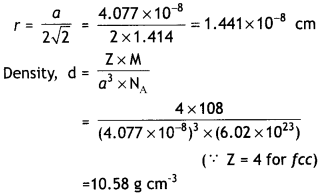
Class 12 Chemistry Important Questions Chapter 1 The Solid State 1

Question 4.
Analysis shows that FeO has a non- stoichiometric composition with molecular formula Fe0.950. Give reason.
Answer:
It shows metal deficiency defect. In FeO, some Fe2+ ions are replaced by Fe3+ ions. Three Fe2+ ions are replaced by two Fe3+ ions to maintain electrical neutrality.

Question 5.
Following is the schematic alignment of magnetic moments:

Class 12 Chemistry Important Questions Chapter 1 The Solid State 2
Identify the type of magnetism. What happens when these substances are heated? (CBSE Sample Paper 2017-18)
Answer:
Ferrimagnetism. These substances lose ferrimagnetism on heating and become paramagnetic.

Question 6.
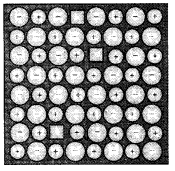
Identify the type of defect shown in the following figure:
What type of substances show this defect? (CBSE Sample Paper 2017-18)
Class 12 Chemistry Important Questions Chapter 1 The Solid State 3
Answer:
Schottky defect.
This type of defect is shown by ionic compounds in which
(i) the ions have high coordination number and
(ii) ions (cations and anions) are of almost similar sizes.

Question 7.
Classify each of the following as being either a p-type or n-type semiconductor:
(i) Ge doped with In.
(ii) Si doped with B. (CBSE Sample Paper 2011)
Answer:
(i) Ge belongs to group 14 and In belongs to group 13.
Therefore, an electron deficient hole is created and it is a p-type semiconductor.

(ii) B belongs to group 13 and Si belongs to group 14. Therefore, an electron deficient hole is created and it is a p-type semiconductor.

Question 8.
Give reason:
(a) Why is Frenkel defect found in AgCI?
(b) What is the difference between phosphorus doped and gallium doped silicon semiconductors? (CBSE Sample Paper 2011)
Answer:
(a) Due to small size of Ag+ ion, it can fit into interstitial sites.
(b) Phosphorus doped silicon is n-type semiconductor while gallium doped silicon is p-type semiconductor.

Question 9.
Why does LiCl acquire pink colour when heated in Li vapours? (CBSE Sample Paper 2011)
Answer:
On heating LiCl in Li vapours, the excess of Li atoms deposit on the surface of the crystal. The CT ions diffuse to the surface of the crystal and combine with Li atoms to form LiCl. The electrons produced by ionisation of Li atoms diffuse into the crystal and get trapped at anion vacancies called F-centres. These absorb energy from visible light and radiate pink colour.

Question 10.
Write a feature which will distinguish a metallic solid from an ionic solid. (C.B.S.E. Delhi 2010, 2012)
Answer:
Metallic solids are good conductors of heat and electricity whereas ionic solids are insulators in solid state but conductors in molten state and in aqueous solution.

Question 11.
Crystalline solids are anisotropic in nature. What does this statement mean? (C.B.S.E. Delhi 2011)
Answer:
This means that crystalline solids have different physical properties such as electrical resistance or refractive index in different directions. This is because of different arrangement of particles in different directions.

Question 12.
What are n-type semiconductors? (C.6.S.E. Delhi 2012)
Answer:
These are the semiconductors in which the current is carried by the electrons in the normal way. For example, germanium doped with impurity containing five valence electrons (e.g., P).

Question 13.
What is the formula of a compound in which the element Y forms hep lattice and atoms of X occupy 2/3rd of tetrahedral voids? (C.B.S.E. 2015)
Answer:
Atoms Y adopt hep arrangement and there are two tetrahedral sites per atom of Y. Since 2/3rd tetrahedral sites are occupied by atoms of X, then for each atom of Y, the number of X atoms will be = 2 × \(\frac{2}{3}=\frac{4}{3}\)
Formula of compound – X4/3Y or X4Y3

Question 14.
Define the following terms in relation to crystalline solids:
(i) Unit cell
(ii) Coordination number
Give one example in each case. (C.B.S.E. 2011)
Answer:
(i) Unit cell is the smallest portion of a crystal lattice which when repeated over and over again in different directions results in the entire lattice. For example, simple cubic unit cell.

(ii) The number of nearest neighbours in a packing is called coordination number. For example, in a body centred cubic structure, the coordination number is eight.

Question 15.
Account for the following:
(i) Schottky defects lower the density of related solids.
(ii) Conductivity of silicon increases on doping it with phosphorus. (C.B.S.E. 2013)
Answer:
(i) In Schottky defect, there are holes due to missing cations and anions. Due to the presence of holes in solid, the density decreases.

(ii) Pure silicon has a network lattice in which all the four valence electrons are bonded to four other atoms. Therefore, it is an insulator. However, when silicon is doped with phosphorus having five valence electrons, the impurity leads to excess of electrons after forming four covalent bonds like silicon. The extra electrons serve to conductivity and therefore, the conductivity of silicon doped with phosphorus increases.

Question 16.
(i) What type of non-stoichiometric point defect is responsible for the pink colour of LiCl?
Answer:
Metal excess defect due to anion vacancies filled by free electrons i.e. F-centres.

(ii) What type of stoichiometric defect is shown by NaCI?
Answer:
Schottky defect.

OR

How will you distinguish between the following pairs of terms:
(i) Tetrahedral and octahedral voids
Answer:
Tetrahedral void is surrounded by 4 constituent particles (atoms, molecules or ions). Octahedral void is surrounded by 6 constituent particles (atoms, molecules or ions).

(ii) Crystal lattice and unit cell? (C.B.S.E. 2014)
Answer:
A regular three dimensional arrangement of points in space is called crystal lattice.
The smallest repeating pattern in crystal lattice which when repeated in three dimensional space gives the entire lattice is called the unit cell.

Question 17.
The well known mineral fluorite is chemically calcium fluoride. It is known that in one unit cell of this mineral there are 4 Ca2+ ions and 8 F ions and that Ca2+ ions are arranged in a fcc lattice. The fluoride ions fill all the tetrahedral holes in the face centred cubic lattice of Ca2+ ions. The edge of the unit cell is 5.46 × 10⁻⁸ cm in length. The density of the solid is 3.18 g cm-3. Use this information to calculate Avogadro’s number. (Molar mass of CaF2 = 78.08 g mol”1) (C.B.S.E. Delhi 2010)
Answer:
Density, d = \(\frac{Z \times M}{a^{3} \times N_{A}}\)
d = 3.18 g cm-3, M = 78.08 g mol-1
a = 5.46 × 10⁻⁸ cm
Since the lattice is fcc, Z = 4
Substituting the values,
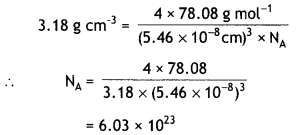
Class 12 Chemistry Important Questions Chapter 1 The Solid State 4

Question 18.
The density of copper metal is 8.95 g cm-3. If the radius of copper atom be 127.8 pm, is the copper unit cell simple cubic, body centred cubic or face centred cubic? (C.B.S.E. 2010, C.B.S.E. Delhi 2010) ZxM
Answer:
Density, d = \(\frac{Z \times M}{a^{3} \times N_{A}}\)
Assuming fcc lattice for copper
a = 2√2 r
= 2 × 1.414 × 127.8 × 10-10 cm
∴ a3 = (2 × 1.414 × 127.8 × 10-10 cm)3
= 4.721 × 10⁻²³ cm3
∴ d = \(\frac{4 \times 63.54}{4.721 \times 10^{-23} \times 6.02 \times 10^{23}}\)
= 8.94 g cm-3
Since the density is same as observed, the lattice is fcc lattice.

Question 19.
An element with density 10 g cm-3 forms a cubic unit cell with edge length of 3 × 10⁻⁸ cm. What is the nature of the cubic unit cell if the atomic mass of the element is 81 g mol-1? (C.B.S.E. 2015)
Answer:
Density, d = \(\frac{z \times M}{a^{3} \times N_{A}}\)
d = 10 g cm-3, M = 81 g mol-1
a3 = (3 × 10⁻⁸ cm)3
= 27 × 10-24 cm3
NA = 6.022 × 10²³
Therefore, 10 = \(\frac{Z \times 81}{\left(27 \times 10^{-24}\right) \times 6.022 \times 10^{23}}\)
Z = \(\frac{10 \times 27 \times 10^{-24} \times 6.022 \times 10^{23}}{81}\)
= 2.007
Nature of cubic unit cell = bcc

Question 20.
Aluminium crystallises in a fcc structure. Atomic radius of the metal is 125 pm. What is the length of the side of unit cell of the metal? (C.B.S.E. Delhi 2019C)
Answer:
For fcc,
r = \(\frac{a}{2 \sqrt{2}}\)
a = 2r × √2 = 2 × 125 pm × 1.414 = 353.5 pm

Question 21.
Answer the following:
(a) What is the formula of a compound in which element Y forms ccp lattice and atom X occupy \(\frac{1}{3}\)rd of tetrahedral voids?
(b) What type of non-stoichiometric point defect leads to colour in alkali metal halides? (C.B.S.E. Delhi 2019C)
Answer:
(a) X2Y3
(b) Metal excess defect due to anionic vacancies / F-centres.

Question 22.
(a) Atoms of element B form hep lattice and those of the element A occupy \(\frac{2}{3}\)rd of octahedral voids. What is the formula of the compound formed by the elements A and B?
(b) What type of stoichiometric defect is shown by ZnS and why? (C.B.S.E. Delhi 2019C)
Answer:
(a) A2B3
(b) Frenkel defect, due to small size of Zn2+ ion.

Question 23.
What happens when AgCl is doped with CdCl2? What is the name of this defect?
OR
What type of defect is shown by NaCl in
(a) stoichiometric defects, and
(b) non-stoichiometric defects? (C.B.S.E. Delhi 2019C)
Answer:
When CdCl2 is added to AgCl, it introduces impurity defect. The addition of one Cd2+ ion will replace two Ag+ ions to maintain electrical neutrality. One of the position of Ag+ ions will be occupied by Cd2+ ion and other will be left as a hole. Thus, cationic vacancies are produced. This is called impurity defect.
OR
(a) In stoichiometric defects: Schottky defect.
(b) In non-stoichiometric defects: Metal excess due to anionic vacancies.

The Solid State Important Extra Questions Long Answer Type

Question 1.
Copper crystallises with face centred cubic unit cell. If the radius of copper atom is 127.8 pm, calculate the density of copper metal. (Atomic mass of Cu = 63.55 u and Avogadro’s number, NA = 6.02 × 10²³ mol-1). (CBSE 2012)
Answer:
For a fcc unit cell, edge length (a) is related to radius of atom as:
r = \(\frac{a}{2 \sqrt{2}}\)
or a = 2√2.r = 2 × 1.414 × 127.8
= 361.42 pm
or = 361.42 × 10⁻¹⁰ cm
Since the lattice is fcc, the number of copper atoms per unit cell, Z = 4.
Density, d = \(\frac{Z \times M}{a^{3} \times N_{A}}\)
M = 63.55 u, NA = 6.02 × 10²³
∴ d = \(\frac{4 \times 63.55}{\left(361.42 \times 10^{-10}\right)^{3} \times\left(6.02 \times 10^{23}\right)}\)
= 8.94 g cm-3

Question 2.
An element crystallises in a fcc lattice with cell edge of 250 pm. Calculate its density if 300 g of this element contain 2 × 1024 atoms.
Answer:
Length of edge, a = 250 pm = 250 × 10-12 m
= 250 × 10-10 cm
Volume of unit cell = (250 × 10-10 cm)3
= 15.625 × 10⁻²⁴ cm3
Mass of unit cell = No. of atoms in unit cell × Mass of each atom
Since the element has fcc arrangement, the number of atoms per unit cell, Z = 4
Mass of an atom = \(\frac{300}{2 \times 10^{24}}\) g
∴ Mass of unit cell = \(\frac{300}{2 \times 10^{24}}\) x 4
= 6.0 × 10⁻²² g
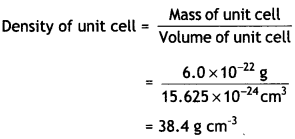
Class 12 Chemistry Important Questions Chapter 1 The Solid State 5

Question 3.
An element with molar mass 27 g mol-1 forms a cubic unit cell with edge length 4.05 × 10⁻⁸ cm. If its density is 2.7 g cm-3, what is the nature of the unit cell?
Answer:
Density of unit cell, d = \(\frac{\mathrm{Z} \times \mathrm{M}}{a^{3} \times \mathrm{N}_{\mathrm{A}}}\)
d = 2.7 g cm-3, a = 4.05 × 10⁻⁸ cm,
M = 27 g mol-1, NA = 6.022 × 10²³
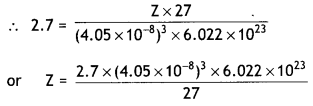
Class 12 Chemistry Important Questions Chapter 1 The Solid State 6
= 4.0
Since Z = 4, the unit cell is face centred cubic (fcc) unit cell.

Question 4.
An element with density 11.2 g cm-3 forms a fee lattice with edge length of 4 × 10⁻⁸ cm. Calculate the atomic mass of the element.
Answer:
Edge length of the unit cell
a = 4 × 10⁻⁸ cm
Density = 11.2 g cm-3
No. of atoms per unit cell in fcc lattice, Z = 4
Density, d = \(\frac{z \times M}{a^{3} \times N_{A}}\)
11.2 g cm-3 = \(\frac{4 \times M}{\left(4 \times 10^{-8} \mathrm{~cm}\right)^{3} \times\left(6.02 \times 10^{23} \mathrm{~mol}^{-1}\right)}\)
or M = \(\frac{\left(11.2 \mathrm{~g} \mathrm{~cm}^{-3}\right) \times\left(4 \times 10^{-8} \mathrm{~cm}\right)^{3} \times\left(6.02 \times 10^{23} \mathrm{~mol}^{-1}\right)}{4}\)
= 107.9 g mol-1
Atomic mass of element = 107.9 u.

Question 5.
The density of lead is 11.35 g cm-3 and the metal crystallises with fcc unit cell. Estimate the radius of lead atom. (At. Mass of lead = 207 g mol-1 and NA = 6.02 × 10²³ mol-1) (CBSE Delhi 2011)
Answer:
Let length of edge = a cm
Density = 11.35 g cm-3
No. of atoms per unit cell in fcc Lattice = 4
Atomic mass, M = 207 g mol-1
Density, d = \(\frac{Z \times M}{a^{3} \times N_{A}}\)
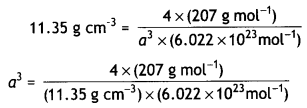
Class 12 Chemistry Important Questions Chapter 1 The Solid State 7
= 121.14 × 10⁻²⁴ cm3
Edge length, a = (121.14)1/3 × 10-8
= 4.948 × 10⁻⁸ cm
or = 4.948 × 10⁻¹⁰ m
or = 494.8 × 10⁻¹² m = 494.8 pm
Now, radius in fcc = \(\frac{a}{2 \sqrt{2}}\)
= \(\frac{494.8 \mathrm{pm}}{2 \times 1.414}\) = 174.96 pm

Question 6.
How can you determine the atomic mass of an unknown metal if you know its density and the dimension of its unit cell? Explain. (C.B.S.E. 2011)
Answer:
Consider a unit cell of edge a cm
Volume of unit cell = a3 cm3
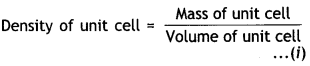
Class 12 Chemistry Important Questions Chapter 1 The Solid State 8
Mass of unit cell = No. of atoms in a unit cell × Mass of each atom = Z × m …… (ii)
Mass of an atom present in a unit cell
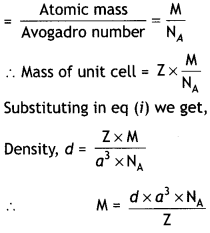
Class 12 Chemistry Important Questions Chapter 1 The Solid State 9
Knowing density (d), edge length (a), number of atoms per unit cell (Z) and Avogadro’s number (6.02 × 10²³), atomic mass can be calculated.

Question 7.
ZnO turns yellow on heating. Why? (C.B.S.E. 2016)
Answer:
When ZnO is heated, it loses oxygen as:

Class 12 Chemistry Important Questions Chapter 1 The Solid State 10
The Zn2+ ions are entrapped in the interstitial sites and electrons are entrapped in the neighbouring interstitial sites to maintain electrical neutrality. This results in metal excess defect. Due to the presence of free electrons in the interstitial sites the colour is yellow.

Question 8.
(a) What type of semiconductor is obtained when silicon is doped with boron?
Answer:
(a) When silicon is doped with boron having three valence electrons, the bonds formed create electron deficient sites called holes. Under the influence of applied electric field, one electron from neighbouring atom moves to fill the hole but creates another hole at its own place. Therefore, the electrical conductance is due to movement of positive holes. Therefore, this type of semi-conductor is called p-type semi-conductor.

(b) What type of magnetism is shown in the following alignment of magnetic moments?
↑    ↑    ↑    ↑   ↑   ↑    ↑
Answer:
Ferromagnetic.

(c) What type of point defect is produced when AgCI is doped with CdCl2? (C.B.S.E. Delhi 2013)
Answer:
CdCl2 on adding to AgCl introduces impurity defect. The addition of one Cd2+ ion will replace two Ag+ ions to maintain electrical neutrality. One of the positions of Ag+ will be occupied by Cd2+ ion and the other will be left as a hole. Thus, a hole is created similar to Schottky defect.

Question 9.
Account for the following:
(i) Schottky defects lower the density of related solids.
Answer:
In Schottky defect, there are holes due to missing cations and anions. Due to the presence of holes in solid, the density decreases.

(ii) Conductivity of silicon increases on doping it with phosphorus. (C.B.S.E. 2013)
Answer:
Pure silicon has a network lattice in which all the four valence electrons are bonded to four other atoms. Therefore, it is an insulator. However, when silicon is doped with phosphorus (s2p3) having five valence electrons, the impurity leads to excess of electrons after forming four covalent bonds like silicon. The extra electrons serve to conductivity and therefore, the conductivity of silicon doped with phosphorus increases.

Question 10.
Examine the given defective crystal
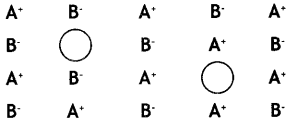
Class 12 Chemistry Important Questions Chapter 1 The Solid State 11
Answer the following questions:
(i) What type of stoichiometric defect is shown by the crystal?
Answer:
Schottky defect

(ii) How is the density of the crystal affected by this defect?
Answer:
Density of the crystal decreases.

(iii) What type of ionic substances show such defect? (C.B.S.E. Delhi 2014)
Answer:
Crystals having
(a) high coordination number and
(b) ions (cations and anions) of almost similar sizes. For example: KCl, KBr.

Question 11.
An element crystallises in a fcc lattice with edge length of 400 pm. The density of the element is 7 g cm-3. How many atoms are present in 280 g of the element? (C.B.S.E. 2016)
Answer:
Edge length, a = 400 pm
= 400 × 10-10 cm
Volume of unit cell = (400 × 10-10)3
= 64 × 10-24 cm-3
Mass of element = 280 g
Density = 7 g cm-3
Volume of 280 g of the element = \(\frac{280 \mathrm{~g}}{7 \mathrm{~g} \mathrm{~cm}^{-3}}\)
= 40 cm3
No. of unit cells in this volume
= \(\frac{40 \mathrm{~cm}^{3}}{64 \times 10^{-24} \mathrm{~cm}^{3}}\)
= 6.25 × 10²³ unit cells
Since the structure is fcc, number of atoms in a unit cell = 4
∴ No. of atoms in 280 g of element
= 4 × 6.25 × 1023
= 2.5 × 1024 atoms

Question 12.
An element crystallises in a fcc lattice with cell edge of 250 pm. Calculate the density of 300 g of this element containing 2 × 1024 atoms. (C.B.S.E. Delhi 2016)
Answer:
Length of edge, a = 250 pm = 250 × 10-10 cm
Volume of unit cell = (250 × 10-10)3
= 15.625 × 10⁻²⁴ cm3
Mass of unit cell = No. of atoms in unit cell × mass of each atom
Since the element has fcc arrangement, number of atoms per unit cell, Z = 4
Mass of an atom = \(\frac{300}{2 \times 10^{24}}\) = 1.50 × 10⁻²² g
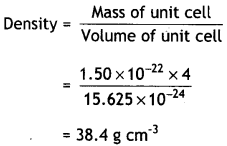
Class 12 Chemistry Important Questions Chapter 1 The Solid State 12

Question 13.
An element crystallises in fcc lattice with a cell edge of 300 pm. The density of the element is 10.8 g cm-3. Calculate the number of atoms in 108 g of the element. (C.B.S.E. Delhi 2019)
Answer:
Edge length of the unit cell = 300 pm
= 300 × 10-10 cm
Volume of unit cell = (300 × 10-10) 3
= 27 × 10-24 cm3
Mass of element = 108 g
Volume of 108 g element = \(\frac{108 \mathrm{~g}}{10.8 \mathrm{~g} \mathrm{~cm}^{-3}}\)
= 10 cm3
No. of unit cells = \(\frac{10}{27 \times 10^{-24}}\)
= 3.7 × 10²³ unit cells
Since the structure is fcc, number of atoms per unit cell = 4
Number of atom is 108 g = 3.7 × 1023 × 4
= 1.48 × 1024.

Question 14.
(a) An element crystallises in bcc lattice with a cell edge of 3 × 10⁻⁸ cm. The density of the element is 6.89 g cm-3. Calculate the molar mass of the element. (NA = 6.022 × 10²³ mol-1)
Answer:
Density of element, d = 6.89 gcm-3
Cell edge, a = 3 × 10⁻⁸ cm
Z = 2 (bcc)
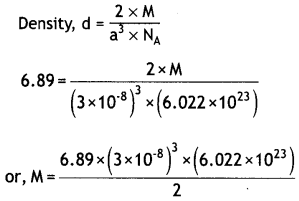
Class 12 Chemistry Important Questions Chapter 1 The Solid State 13

(b) What type of semiconductor is obtained when
(i) Ge is doped with In?
(ii) Si is doped with P? (C.B.S.E. 2019 Al)
Answer:
(i) p-type
(ii) n-type

Question 15.
(a) A compound is formed by two elements M and N. The element N forms ccp and M atoms occupy 1/3rd of tetrahedral voids. What is the formula of the compound?
(b) Which of the following lattices has the highest packing efficiency
(i) simple cubic
(ii) body centred cubic and
(iii) hexagonal close packed lattice?
(c) An element with molar mass 2.7 × 10⁻² kg mol-1 forms a cubic unit cell with edge length 405 pm. If the density is 2.7 × 10³ kg m-3. What is the nature of the cubic unit cell?
Answer:
(a) Since N forms ccp arrangement, it will have 4 atoms in a unit cell.
Number of N atoms in unit cell = 4
For each atom, there are two tetrahedral voids so that there are 8 tetrahedral voids per unit cell.
No. of M atoms = \(\frac{1}{3}\) × 8 = \(\frac{8}{3}\)
Formula = M8/3N4
or = M2 N3.

(b) The packing efficiencies are:
simple cubic = 52.4%
body centred cubic = 68%
hexagonal close packed = 74%
∴ Hexagonal close packed lattice has highest packing efficiency.

(c) Edge length = 405 pm = 405 × 10-12 m
Density of the cell = 2.7 × 10⁻³ kg m-3
Molar mass = 2.7 × 10⁻² kg mol-1
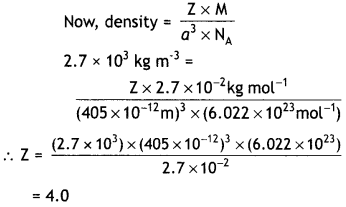
Class 12 Chemistry Important Questions Chapter 1 The Solid State 14
Since the unit cell contains 4 atoms, it is cubic close packed structure, ccp.

Question 16.
How will you distinguish between the following pair of terms:
(i) Hexagonal close packing and cubic close packing
(ii) Crystal lattice and unit cell.
(iii) Tetrahedral void and octahedral void.
Answer:
(i)

Hexagonal close packingcubic close packing
(i) In hcp, the spheres of the third layer are exactly aligned with those of the first layer. This arrangement is represented as AB AB …………… type.(i) In ccp, the spheres of the third layer are not aligned with those of the first layer or second layer. The layers of fourth layer are aligned with those of the first layer. This pattern is represented as ABC ABC ………
(ii) In hcp, the tetrahedral voids of the second layer may be covered by the spheres of the third layer.(ii) In ccp, the third layer may be placed above the second layer in a manner such that its spheres cover the octahedral voids.

(ii) The three dimensional arrangement of constituent particles of a substance (atoms, ions or molecules) is called crystal lattice.
The smallest repeating pattern in a crystal lattice which when repeated in three dimensions gives the crystal is called unit cell.

(iii) A void surrounded by four spheres is called a tetrahedral void while a void surrounded by six spheres is called an octahedral void.

Question 17.
(i) How many lattice points are there in one unit cell of each of the following lattice?
(a) face centred cubic
(b) face centred tetragonal
(c) body centred.
Answer:
(i) (a) In face centred cubic arrangement, number of lattice points are:
8 (at corners) + 6 (at face centres)
Lattice points per unit celt
= 8 × \(\frac{1}{8}\) + 6 × \(\frac{1}{2}\) = 4

(b) In face centred tetragonal, number of lattice points are:
= 8 (at corners) + 6 (at face centres) Lattice points per unit cell 1 1
= 8 × \(\frac{1}{8}\) + 6 × \(\frac{1}{2}\) = 4

(c) In body centred cubic arrangement number of lattice points are:
= 8 (at corners) + 1 (at body center) Lattice points per unit cell
= 8 × \(\frac{1}{8}\) + 1 = 2

(ii) Explain: (a) The basis of similarities and differences between metallic and ionic crystals.
(b) Ionic solids are hard and brittle.
Answer:
(a) Basis of similarities
1. Both ionic and metallic crystals have electrostatic forces of attraction. In ionic crystals, these are between the oppositely charged ions while in metals, these are among the valence electrons and the kernels. That is why both ionic and metallic crystals have high melting points.
2. In both cases, the bond is non- directional.

Basis of differences
1. In ionic crystals, the ions are not free to move and therefore, they do not conduct electricity in the solid state. They conduct electricity in the molten state or in their aqueous solution. However, in metals, the valence electrons are free to move and hence they conduct electricity in the solid state.
2. Ionic bond in ionic crystals is strong due to electrostatic forces of attraction. However, metallic bond may be weak or strong depending upon the number of valence electrons and the size of the kernels.

(b) Ionic crystals are hard because there are strong electrostatic forces of attraction among the oppositely charged ions. They are brittle because the ionic bond is non-directional.

Question 18.
(a) If the radius of the octahedral void is r and radius of the atoms in close packing is R. Derive relation between r and R.
Answer:
A sphere of radius r filling in an octahedral void of spheres of radius R is shown in figure.
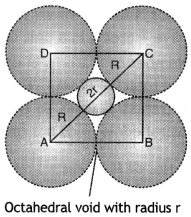
Class 12 Chemistry Important Questions Chapter 1 The Solid State 15
If the length of the unit cell is a cm, then
In right angled ∆ABC, AB = BC = a cm
The diagonal AC is:
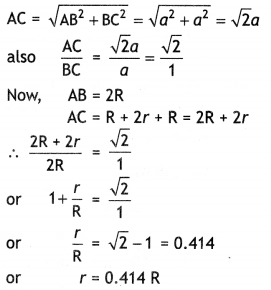
Class 12 Chemistry Important Questions Chapter 1 The Solid State 16
Thus, for an atom to occupy an octahedral void, its radius must be 0.414 times the radius of the sphere.

(b) Copper crystallises into a fcc lattice with edge length 3.61 × 10⁻⁸ cm. Show that the calculated density is in agreement with its measured value of 8.29 g cm-3.
Answer:
Density, d = \(\frac{Z \times M}{a^{3} \times N_{A}}\)
For fcc lattice, Z = 4
Atomic mass, M of copper = 63.5 g/mol-1
a = 3.61 × 10⁻⁸ cm
∴ p = \(\frac{4 \times 63.5}{\left(3.61 \times 10^{-8}\right)^{3} \times 6.022 \times 10^{23}}\)
= 8.96 g cm-3
This value is close to measured value.

Question 19.
What is a semiconductor? Describe the two main types of semiconductors and contrast their conduction mechanism.
Answer:
The substances whose conductance lies between that of conductors (metals) and insulators are called semiconductors. They have conductivity values ranging from 10-6 to 104-1m-1. Two main types of semiconductors are n-type and p-type.

(i) n-type semiconductors: These are the semiconductors in which the current is carried by the electrons in the normal way. For example, silicon and germanium belong to group 14 of the periodic table and have four valence electrons each. In their crystals, each atom forms four covalent bonds with its neighbours.

When it is doped with an element of group 15 such as P or As, which contains five valence electrons, they occupy some of the lattice sites in silicon or germanium crystal. Four of the five valence electrons are used in the formation of four covalent bonds with the four neighbouring Si atoms and the fifth electron is extra and becomes delocalised.

This delocalised electron will be able to conduct electricity and such type of conduction is called n-type conduction. Hence silicon or germanium doped with extra electron of impurity are called n-type semiconductors.

(ii) p-type semiconductors: These are the semiconductors in which current is carried by the movement of positive holes. For example, when Ge or Si are doped with electron deficient atoms such as Ga or In (of Group 13) containing three valence electrons, the atoms of Ga or In will replace Ge atoms.

Each In or Ga atom will use its three electrons for forming three covalent bonds with neighbouring Ge atoms and the place for fourth bond will remain missing and is called electron vacancy or hole. Such holes can move through the crystals like a positive charge giving rise to conductivity. This type of conduction is called p-type conduction. Hence, Si or Ge doped with electron deficient atoms as impurity are called p-type semiconductors.

Question 20.
Explain the following with suitable examples:
(a) Ferromagnetism
(b) Paramagnetism
(c) Ferrimagnetism
(d) Anti-ferromagnetism
(e) 12-16 and 13-15 group compounds.
Answer:
(a) Ferromagnetism: When there is spontaneous alignment of magnetic moments of domains in the same direction, we get ferromagnetism. These have strong magnetic effects and ordering of domains persists even when magnetic field is removed and – ferromagnetic substance becomes permanent magnet.

(b) Paramagnetism: The substances which have permanent magnetic dipoles and are attracted by the magnetic field are called paramagnetic substances. This property of attraction by the magnetic field is known as paramagnetism. The paramagnetic substance are atoms, molecules or ions having unpaired electrons. For example, O2, Cu2+, Fe2+, etc. They lose their magnetism in the absence of magnetic field.

(c) Ferrimagnetism: When the magnetic moments of the domains are aligned in parallel or anti-parallel directions in unequal numbers resulting in net magnetic moment, we get ferrimagnetism.

(d) Anti-ferromagnetism: It arises when the alignment of magnetic moments is in a compensatory way so that the resultant magnetic moment is zero (e.g., MnO).

(e) The solid binary compounds prepared by combining elements of group 12 and 16 are called 12-16 compounds. For example CdS, ZnS, etc. The compounds prepared by combining elements of group 13 and 15 are called 13-15 compounds. For example, AlP, GaAs, etc. These compounds are used as semiconductors.

Question 21.
Give the points of differences between Schottky defect and Frenkel defect ?
OR
Explain:
(i) Why is Frenkel defect not found in pure alkali metal halides ?
(ii) Zinc oxide is white but it turns yellow on heating.
(iii) CaCl2 will introduce Schottky defect when added to AgCl crystal.
Answer:
The important differences between Schottky and Frenkel defects are given ahead:

Schottky defectFrenkel defect
1. It is produced be cause of missing atoms or ions from their normal sites.1. It is produced when some atoms or ions leave their normal sites and occupy interstitial sites.
2. The presence of Schottky defect lowers the density of the crystal.2. It does not affect the density of the crystal.
3. It is generally exhibited by ionic solids having high coordination number and in which cations and anions are of equal size. e.g., NaCl, CsCl.3. It is generally exhibited by ionic solids having low coordination number and in which anions are larger in size than cation e.g., ZnS, AgCl.

OR
(i) Frenkel defect is not found in pure alkali metal halides because the ions cannot get into the interstitial sites due to their larger size.

(ii) When ZnO is heated it loses oxygen as:
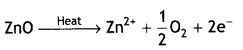
Class 12 Chemistry Important Questions Chapter 1 The Solid State 17
The Zn2+ ions are entrapped in the interstitial sites and electrons are entrapped in the neighbouring interstitial sites to maintain electrical neutrality. This results in metal excess defect. Due to the presence of free electrons in the interstitial sites the colour is yellow.

(iii) CaCl2 on adding to AgCl introduces impurity defect. The addition of one Ca2+ ion will replace two Ag+ ions to maintain electrical conductivity. One of the position of Ag+ will be occupied by Ca2+ ion and other will be left as a hole. Thus, a hole is created similar to Schottky defect.

Question 22.
What do you understand by a space lattice and a unit cell?
Answer:
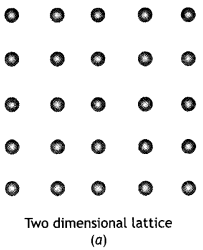
(a) Space lattice is a regular arrangement of the constituent particles (atoms, ions or molecules) of a crystalline solid in three dimentional space.

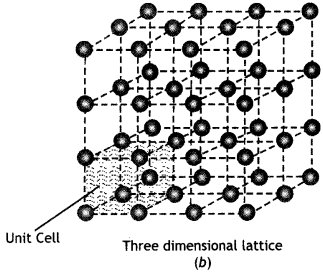
The positions which are occupied by atoms, ions or molecules in the crystal lattice are called lattice points or lattice sites. A two dimensional and a three dimensional space lattice is shown in Fig. 1 (a) and 1 (b) respectively.
Class 12 Chemistry Important Questions Chapter 1 The Solid State 18
Class 12 Chemistry Important Questions Chapter 1 The Solid State 19
Fig. 1. (a) Two dimensional and
(b) Three dimensional space lattice.

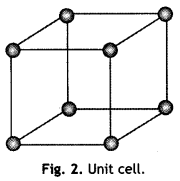
A unit cell is the smallest repeating unit in space lattice which when repeated over and over again results in the crystal of the given substance. The unit cell gives the shape of the entire crystal. The crystal may be considered to consist of an infinite number of unit cells. The unit cell in the above crystal lattice [Fig. 1 (b)] is shown in The complete crystal lattice can be obtained by extending the unit cell in all the three directions.
Class 12 Chemistry Important Questions Chapter 1 The Solid State 20

Question 23.
What are tetrahedral and octahedral holes (voids) in close packed stacks of spheres? Explain.
Answer:
Tetrahedral and octahedral holes. The close packed arrangement of spheres has two types of holes or voids:
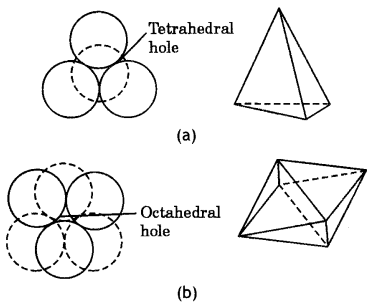
Tetrahedral holes: Tetrahedral hole Is produced when one sphere rests upon three other touching spheres. The space which is left between these touching spheres is called tetrahedral hole or tetrahedral site. The tetrahedral hole is shown in Fig. (a). It may be noted that in close packed arrangement (ccp or hcp), there are twice as many tetrahedral holes as there are spheres.

Octahedral hole.: This type of hole is formed at the centre of six spheres which form a regular octahedral. This is shown in Fig. (b). From the figure, it is clear that the octahedral hole is formed by two sets of equilateral triangles which point in opposite directions. It may be noted that there are same number of octahedral holes as the number of spheres.
Class 12 Chemistry Important Questions Chapter 1 The Solid State 21
Fig. (a) Tetrahedral hole (b) Octahedral hole.

Question 24.
(a) Why does table salt, NaCl, some times appear yellow in colour?
(b) Why is FeO(s) not formed in stoichiometric composition?
(c) Why does white ZnO (s) becomes yellow upon heating?
Answer:
(a) The yellow colour of sodium chloride crystals is due to metal excess defect. In this defect, the unpaired electrons get trapped in anion vacancies. These sites are called F-centres. The yellow colour results by excitation of these electrons when they absorb energy from the visible light falling on the crystals.

(b) In the crystals of FeO, some of the Fe2+ cations are replaced by Fe3+ ions. To balance the charge, three Fe2+ ions are replaced by two Fe3+ ions to make up for the loss of positive charge. As a result, there would be less amount of metal as compared to stoichiometric proportion.

(c) When ZnO is heated it loses oxygen as:

Class 12 Chemistry Important Questions Chapter 1 The Solid State 22
The Zn2+ ions are entrapped in the interstitial sites and electrons are entrapped in the neighbouring interstitial sites to maintain electrical neutrality. This results in metal excess defect and F-centres are created. Due to the presence of electrons in the interstitial voids, the colour is yellow.

Question 25.
(a) Explain why does conductivity of germanium crystals increase on doping with gallium.
(b) In a compound, nitrogen atoms (N) make cubic close packed lattice and metal atoms (M) occupy one-third of the tetrahedral voids present. Determine the formula of the compound formed by M and N?
(c) Under which situations can an amorphous substance change to crystalline form?
Answer:
(a) On doping germanium with gallium, some of the positions of lattice of germanium are occupied by gallium. Gallium atom has only three valence electrons. Therefore, fourth valency of nearby germanium atom is not satisfied and this site remains vacant. This place is deficient of electrons and is called electron hole or electron vacancy.

Electron from neighbouring atom moves to fill the gap, thereby creating a hole in its original position. Under the influence of electric field, electrons move towards positively charged plates through these holes and conduct electricity. The holes appear to move towards negatively charged plates. The movement of electrons (or electron holes) results in increase in conductivity of germanium.

(b) N atoms make up ccp arrangement and there are two tetrahedral sites per atom of N.
No. of N atoms per unit cell = 4
No. of tetrahedral sites = 4 × 2 = 8
No. of sites occupied by M = \(\frac{1}{3}\) × 8 = \(\frac{8}{3}\)
∴ No. of M atoms per unit cell = \(\frac{8}{3}\)
Formula M8/3N4 or M8N12 or M2N3

(c) On heating, amorphous solids become crystalline at some temperature. For example, some glass objects from ancient civilisations are found to become milky in appearance because of some crystallisation.

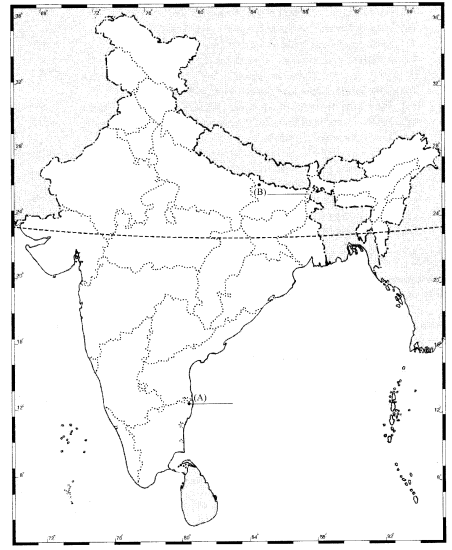
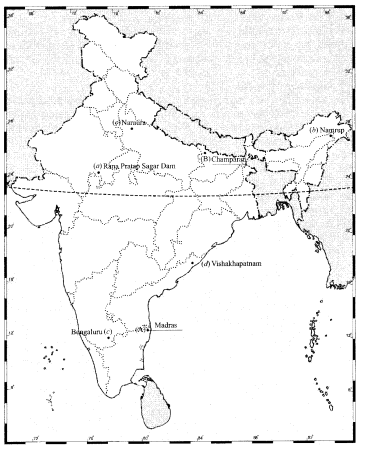
CBSE Sample Papers for Class 10 Social Science Set 5 for Practice

Students can access the CBSE Sample Papers for Class 10 Social Science with Solutions and marking scheme Set 5 will help students in understanding the difficulty level of the exam.

CBSE Sample Papers for Class 10 Social Science Set 5 for Practice

Time: 3 Hours
Maximum Marks: 80

General Instructions:

(i) Question paper comprises five Sections – A, B, C, D and E. There are 32 questions in the question paper. All questions are compulsory.
(ii) Section A – Question no. 1 to 16 are Objective Type Questions of 1 mark each.
(iii) Section B – Question no. 17 to 22 are short answer type questions, carrying 3 marks each. Answer to each question should not exceed 80 words.
(iv) Section C – Question no. 23 to 26 are source based questions, carrying 4 marks each.
(v) Section D – Question no. 27 to 31 are long answer type questions, carrying 5 marks each. Answer to each question should not exceed 120 words.
(vi) Section E – Question no. 32 is map based, carrying 5 marks with two parts, 32.1 from History (2 marks) and 32.2 from Geography (3 marks).
(vii) There is no overall choice in the question paper. However, an internal choice has been provided in few questions. Only one of the choices in such questions have to be attempted.
(viii) In addition to this, separate instructions are given with each section and question, wherever

Section-A

Question 1.
In which year was Treaty of Vienna signed?
(a) 1811
(b) 1810
(c) 1815
(d) 1812

Question 2.
When did the Jallianwala Bagh massacre take place?
(a) 1919
(b) 1921
(c) 1922
(d) 1928

Question 3.
Who was called the ‘Bismarck of Italy’?
(a) Mazzini
(b) Garibaldi
(c) Cavour
(d) Johann Gottfried Herder

Question 4.
Fill in the blank:
…………………. resources are formed on a region, but have not been utilised.
Or
…………………… in India has grown over the last three decades substantially.

Question 5.
Choose the correctly matched pair about different industries in India from the following
options.
(a) Automobile Industry – Odisha
(b) Cotton Textile Industry – Amritsar
(c) Iron and Steel Plant – Naraura
(d) Software Technology – Gandhinagar

Question 6.
Fill in the blank:
Maharashtra: Black soil, Karnataka: Laterite soil, ……………. : Arid soil
(a) Andhra Pradesh
(b) Rajasthan
(c) Kerala
(d) Assam

Question 7.
Identify the programme launched by the Government of India with the help of the following features.

  • A programme to transform India into digital empowered society
  • Launched by 1 July 2015 by the Prime Minister Narendra Modi
  • The menifesto concentrates on e-govemance

Question 8.
Why does jute loose its markets? Choose the appropriate reason from the following options:
(a) Its high cost
(b) Synthetic fibres captured the market
(c) It is very fragile
(d) Both (a) and (b)

Question 9.
…………….. recognises a party as National Party or State Party.
(a) The President of India
(b) The Prime Minister of India
(c) The Election Commission of India
(d) The Chief Election Commission

Question 10.
What is federalism?
Or
What is jurisdiction?

Question 11.
Democracy must be a rule of the poor. How?
Or
What is most distinctive feature about democracy?

Question 12.
Read the following data and find out the differences between literary rate of India as per census 2001 and 2011 respectively.

20012011
Persons64.83%74.04%
Males75.26%82.14%
Females53.67%65.14%

(a) Persons-6.88%, Males-9.21%, Females-53.67%
(b) Persons-9.21%, Males-6.88%, Females-11.87%
(c) Persons-74.4%, Males-82.14%, Females-65.46%
(d) Persons-1.21%, Males-9.19%, Females-11.47%

Question 13.
Read the information given below and select the correct option.

Megha has taken a loan of Rs. 5 lakhs from the bank to purchase a house. The annual interest rate on the loan is 12 per cent and the loan is to be repaid in 10 years in monthly instalments. Megha had to submit to the bank, documents showing her employment records and salary before the bank agreed to give her the loan. The bank retained as collateral the papers of the new house, which will be returned to Megha only when she repays the entire loan with interest.

Megha has taken loan from:
(a) formal sector
(b) informal sector
(c) primary sector
(d) secondary sector

Or

Most of the people like Megha take loan from formal sector. Which is the following statements about this sector is correct?
(a) It charges high interest on loan.
(b) It includes traders and employers.
(c) It saves people from debt-trap.
(d) It works under the supervision of the State Bank of India.

Question 14.
Where are most of the people employed?
(a) In primary sector
(b) In secondary sector
(c) In tertiary sector
(d) In quinary sector

Question 15.
Read the given statements in context of ‘liberalisation’ and choose the correct answer.
(a) Removing barriers or restrictions set by the government is called liberalisation.
(b) After Independence, the Indian government had put barriers to foreign trade and foreign investment.
(c) This was considered necessary to protect the consumers within the country from internal competition.
(d) With liberalisation of trade businesses are allowed to make decisions freely on import and export.

Question 16.
In the question given below, there are two statements marked as Assertion (A) and Reason
(R). Read the statements and choose the correct option:
Assertion (A): Different people having different developmental goals.
Reason (R): Different people having different life situations.
Options:
(a) Both A and R are true and R is the correct explanation of A.
(b) Both A and R are true but R is not the correct explanation of A.
(c) A is true but R is false.
(d) A is false but R is true.

Section-B

Question 17.
How can battles be fought with Satyagraha?

Question 18.
Describe the events of the French Revolution which had influenced the people belonging to
other parts of Europe.
Or
The Habsburg Empire was a patchwork of many different regions and peoples. Elucidate this statement.

Question 19.
What are the various forces of nature that contribute to the formation of soil? What is the
importance of soil?

Question 20.
Describe the role of citizens in a democracy.
Or
“A public expression of dissatisfaction with democracy shows the success of democratic project.” Justify the statement.

Question 21.
Why are transactions made in money? Explain with suitable examples.

Question 22.
What is the basic idea behind the SHGs for the poor? Explain in your own words.

Section-C

Question 23.
Read the source given below and answer the questions that follows. (4 × 1 = 4)

In 1815, representatives of the European powers – Britain, Russia, Prussia and Austria – who had collectively defeated Napoleon, met at Vienna to draw up a settlement for Europe. The Congress was hosted by the Austrian Chancellor Duke Metternich. The delegates drew up the Treaty of Vienna of 1815 with the object of undoing most of the changes that had come about in Europe during the Napoleonic wars. The Bourbon dynasty, which had been deposed during the French Revolution, was restored to power, and France lost the territories it had annexed under Napoleon.

A series of states were set up on the boundaries of France to prevent French expansion in future. Thus the kingdom of the Netherlands, which included Belgium, was set up in the north and Genoa was added to Piedmont in the south. Prussia was given important new territories on its western frontiers, while Austria was given control of northern Italy. But the German confederation of 39 states that had been set up by Napoleon was left untouched. In the east, Russia was given part of Poland while Prussia was given a portion of Saxony. The main intention was to restore the monarchies that had been overthrown by Napoleon, and create a new conservative order in Europe.

Answer the following MCQs by choosing the most appropriate option.

Question 23.1.
Which of the following revolutions is known as the first expression of nationalism?
(a) Russian Revolution
(b) French Revolution
(c) The Revolution of the Liberals
(d) Glorious Revolution

Question 23.2.
What was the purpose to convene the Vienna of Congress in 1815?
(a) To declare war against France
(b) To declare competition of German unification
(c) To begin the process of Italian unification.
(d) To restore conservation regime in Europe

Question 23.3.
How can you say that the Congress of Vienna ensured peace in Europe?
(a) Laying out a balance of power between all big powers in Europe
(b) Austria was not under Northern Italy
(c) By giving power to German confederation
(d) With the restoration of Bourbon dynasty

Question 23.4.
Which of the following groups of countries that collectively defeated Napoleon?
(a) Poland, Italy, France and Hungary
(b) Britain, Russia, Prussia and Austria
(c) Scotland, Sweden, Russia and Germany
(d) Germany, Hungary, Italy and Britain

Question 24.
Read the text given below and answer the following questions. (4 × 1 = 4)

Kandla in Kuchchh was the first port developed soon after Independence to ease the volume of trade on the Mumbai port, in the wake of loss of Karachi port to Pakistan after the Partition. Kandla also known as the Deendayal Port, is a tidal port. It caters to the convenient handling of exports and imports of highly productive granary and industrial belt stretching across the union territory of Jammu and Kashmir and states of Himachal Pradesh, Punjab, Haryana, Rajasthan and Gujarat. Mumbai is the biggest port with a spacious natural and well-sheltered harbour.
The Jawaharlal Nehru port was planned with a view to decongest the Mumbai port and serve as a hub port for this region. Marmagao port (Goa) is the premier iron ore exporting port of the country. This port accounts for about fifty per cent of India’s iron ore export. New Mangalore port, located in Karnataka caters to the export of iron ore concentrates from Kudremukh mines. Kochchi is the extreme south-western port, located at the entrance of a lagoon with a natural harbour.
Moving along the east coast, you would see the extreme south-eastern port of Tuticorin, in Tamil Nadu. This port has a natural harbour and rich hinterland. Thus, it has a flourishing trade handling of a large variety of cargoes to even our neighbouring countries like Sri Lanka, Maldives, etc. and the coastal regions of India. Chennai is one of the oldest artificial ports of the country. It is ranked next to Mumbai in terms of the volume of trade and cargo.

Vishakhapatnam is the deepest landlocked and well-protected port. This port was, originally, conceived as an outlet for iron ore exports. Paradwip port located in Odisha, specialises in the export of iron ore. Kolkata is an inland riverine port. This port serves a very large and rich hinterland of Ganga- Brahmaputra basin. Being a tidal port, it requires constant dredging of Hoogly. Haldia port was developed as a subsidiary port, in order to relieve growing pressure on the Kolkata port.

Answer the following MCQs by choosing the most appropriate option.
Question 24.1.
……………………. is the biggest port while Kandla is the tidal port in ………………..
(a) Kolkata; Vishakhapatnam
(b) Mumbai; Gujarat
(c) Tuticorin; Kolkata
(d) New Mangalore, Mumbai

Question 24.2.
Major ports handle about 95 per cent of India’s foreign trade. Identify which port
belongs to which state:

Ports

States

a. Tuticorin1. Kerala
b. Kochi (Kochchi)2. Tamil Nadu
c. Paradwip3. West Bengal
d. Haldia4. Odisha

Choose the correct option-
(a) a-2, b-1, c-4, d-3
(b) a-4, b-1, c-2, d-3
(c) a-3, b-4, c-2, d-1
(d) a-4, b-2, c-1, d-3

Question 24.3.
Why is Chennai port called an artificial port?
(a) It provides access to oceans.
(b) It facilitates people to catch fish and supplement their food needs.
(c) It provides links with other countries or far-off places.
(d) A wall has been built to faciliate the anchor of ships as there is no zigzag coastline.

Question 24.4.
Kandla is also known as
(a) Jawaharlal Nehru Port
(b) Bal Gangadhar Port
(c) Deendayal Port
(d) a deepest landlocked port

Question 25.
Read the given extract and answer the following questions. (4 × 1 = 4)

Power sharing arrangements can also be seen in the way political parties, pressure groups and movements control or influence those in power. In a democracy, the citizens must have freedom to choose among various contenders for power. In contemporary democracies, this takes the form of competition among different parties. Such competition ensures that power does not remain in one hand. In the long run, power is shared among different political parties that represent different ideologies and social groups.

Sometimes this kind of sharing can be direct, when two or more parties form an alliance to contest elections. If their alliance is elected, they form a coalition government and thus share power. In a democracy, we find interest groups such as those of traders, businessmen, industrialists, farmers and industrial workers. They also will have a share in governmental power, either through participation in governmental committees or bringing influence on the decision-making process.

Answer the following MCQs by choosing the most appropriate option.
Question 25.1.
Power sharing is essential for democracy because-
(a) it helps to reduce the possibility of conflicts between different organs of the government.
(b) it help to reduce the possibility of conflicts between different social groups.
(c) it fulfils the demands of different social groups.
(d) None of the above

Question 25.2.
Power sharing between different organs of the government is being referred to
(a) union government
(b) community government
(c) vertical division of powers
(d) horizontal distribution of powers

Question 25.3.
……………. is also called checks and balances.
(a) Horizontal distribution of powers
(b) Vertical distribution of powers
(c) Vertical division of powers
(d) Horizontal distribution of powers

Question 25.4.
Which of the following is not the benefits of power sharing?
(a) It reduces the possibility of conflicts between social groups.
(b) It ensures political stability in the long run.
(c) All political parties get their expected share.
(d) It upholds the spirit of democracy.

Question 26.
Read the source given below and answer the following questions. (4 × 1 = 4 )

“Recent evidence suggests that the groundwater is under serious threat of overuse in many parts of the country. About 300 districts have reported a water level decline of over 4 metres during the past 20 years. Nearly one-third of the country is overusing their groundwater reserves. In another 25 years, 60 per cent of the country would be doing the same if the present way of using this resource continues. Groundwater overuse is particularly found in the agriculturally prosperous regions of Punjab and Western U.P., hard rock plateau areas of central and south India, some coastal areas and the rapidly growing urban settlements.”

Answer the following MCQs by choosing the most appropriate option.

Question 26.1.
Groundwater is a
(a) renewable resource
(b) non-renewable resource
(c) reserve stock
(d) None of these

Question 26.2.
Why is groundwater overused?
(a) Due to overpopulation
(b) Due to industialisation
(c) Due to commercialisation of agriculture
(d) All of these

Question 26.3.
Development is possible without the overuse of resources. In this context choose the correct option which describes the importance of sustainable development.
(a) It helps in maintaining ecological balance.
(b) It promotes an efficient use of natural resources.
(c) It lays emphasis on quality of life.
(d) All of these

Question 26.4.
Which of the following is not a measure of sustainable development?
(a) Using natural resources properly and scientifically
(b) Reducing pollution or environmental degradation
(c) Preventing infectious diseases
(d) Adopting measures to check global warming

Section-D

Question 27.
What were the impact of the First World War on national movement in India?
Or
Why did the Non-Cooperation Movement gradually slowdown in the cities? Give reasons.

Question 28.
Explain some of the human activities which are mainly responsible for land degradation in
India.
Or
“The challenge of sustainable development requires control over industrial pollution.” Explain the statement with examples.

Question 29.
What major steps were taken towards decentralisation in 1992?

Question 30.
What are the various characteristics of democracy?

Question 31.
How can globalisation be made fairer? Explain.
Or
“There has been a big change in the three sectors of economic activities, but a similar shift has not taken place in the share of employment.” Explain the statement on the basis of facts.

Section-E

Map Skill Based Question

Question 32.1
Two places A and B have been marked on the given outline map of India. Identify and write their correct names on the lines drawn near them.
(A) The place where the Indian National Congress Session was held.
(B) The place connected to the calling off the Non-Cooperation Movement.

Question 32.2
On the same outline map of India locate and label any THREE of the following with suitable symbols.
(a) Paradwip Port
(b) Jamshedpur Iron and Steel Plant
(c) Chhatrapati Shivaji International Airport
(d) Chennai Software Technology Park
(e) Kakrapara Nuclear Power Plant
CBSE Sample Papers for Class 10 Social Science Set 2 with Solutions4

CBSE Sample Papers for Class 10 Social Science Set 4 for Practice

Students can access the CBSE Sample Papers for Class 10 Social Science with Solutions and marking scheme Set 4 will help students in understanding the difficulty level of the exam.

CBSE Sample Papers for Class 10 Social Science Set 4 for Practice

Time: 3 Hours
Maximum Marks: 80

General Instructions:

(i) Question paper comprises five Sections – A, B, C, D and E. There are 32 questions in the question paper. All questions are compulsory.
(ii) Section A – Question no. 1 to 16 are Objective Type Questions of 1 mark each.
(iii) Section B – Question no. 17 to 22 are short answer type questions, carrying 3 marks each. Answer to each question should not exceed 80 words.
(iv) Section C – Question no. 23 to 26 are source based questions, carrying 4 marks each.
(v) Section D – Question no. 27 to 31 are long answer type questions, carrying 5 marks each. Answer to each question should not exceed 120 words.
(vi) Section E – Question no. 32 is map based, carrying 5 marks with two parts, 32.1 from History (2 marks) and 32.2 from Geography (3 marks).
(vii) There is no overall choice in the question paper. However, an internal choice has been provided in few questions. Only one of the choices in such questions have to be attempted.
(viii) In addition to this, separate instructions are given with each section and question, wherever

Section-A

Question 1.
Identify the correct statement with regard to Johann Gottfried Herder is correct.
(a) He was a French philosopher.
(b) He was a German philosopher.
(c) He was an Italian philosopher.
(d) He was an Indian philosopher.

Question 2.
When was the Khilafat Committee founded?
(a) 1919
(b) 1920
(c) 1927
(d) 1922

Question 3.
The Non-Cooperation programme was adopted in the
(a) Lahore Session
(b) Nagpur Session
(c) Gujarat Session
(d) Second Round Table Conference

Question 4.
Fill in the blank:
Everything available in our …………….. which can be used to satisfy our needs.
Or
People employed in the ………………… activities manufacture the primary materials into finished goods.

Question 5.
Choose the correctly matched pair about the soils found in India from the following options:
(a) Alluvial soils – Himalayan river systems
(b) Arid soils – Tropical and sub-tropical climate
(c) Forest soils – Regur soils
(d) Laterite soils – Red to brown is colour

Question 6.
Fill in the blank:
Pulses: Leguminous crop, Watermelon: Zaid crop, ……………… : Rabi crop
(a) Maize
(b) Jowar
(c) Bajra
(d) Barley

Question 7.
Identify the important highways of India with the help of the following features.

  • Six-lane Super Highways
  • link Delhi-Kolkata-Chennai-Mumbai
  • are being implemented by the NHAI

Question 8.
On the basis of ownership industries are categorised as:
(a) large-scale and small-scale industries
(b) public sector, private sector, joint and cooperative sectors
(c) basic/key and consumer industries
(d) agro-based and mineral-based industries

Question 9.
More than …………….. parties are registered with the Election Commission of India. 1
(a) 800
(b) 900
(c) 750
(d) 650

Question 10.
Name the country who does not have federal system.
Or
What is the most distinctive feature of democracy?

Question 11.
What is a community government?
Or
What is partisanship?

Question 12.
Read the given data which gives an estimate of reserves of crude oil. Select the correct option which defines how it is essential for the development process of a country.

Region/CountryReserves (2017) (Thousand Million Barrels)Number of Years Reserves will last
Middle East

United States of America

World

808

50

1697

70

10.5

50.2


Source: BP Statistical Review of World Energy, June 2018
(a) If prices of crude oil increase this becomes a burden for all.
(b) Reserves of crude oil are going to last for 50 years and more.
(c) Middle East and USA may face energy crisis in future due to exhaustion of crude oil.
(d) Crude oil is a major source of energy for agriculture and industrial development.

Question 13.
Read the information given below and select the correct option.

Chinese manufacturers learn of an opportunity to export toys to India, where toys are sold at a high price. They start exporting plastic toys to India. Buyers in India now have the option of choosing between Indian and the Chinese toys. Because of the cheaper prices and new designs, Chinese toys become more popular in the Indian markets. Within a year, 70 to 80 percent of the toy shops have replaced Indian toys with Chinese toys.

Toys are now cheaper in the Indian markets than earlier. Let us see the effect of foreign trade through the . example of Chinese toys in the Indian markets. What is happening here? As a result of trade Chinese toys come into the Indian markets. In the competition between Indian and Chinese toys, Chinese toys prove better. Indian buyers have a greater choice of toys and at lower prices. For the Chinese toy makers, this provides an opportunity to expand business. The opposite is true for Indian toy makers. They face losses, as their toys are selling much less.

Removing barriers or restrictions set by the government on foreign trade and foreign investment is known as:
(a) Nationalisation
(b) Globalisation
(c) Liberalisation
(d) Taxation

Or

Trade barrier is a restriction set by the government to regulate the trade of the country. How will trade bander affect the Chinese producers? Choose the correct option.
(a) If there is trade barrier on the Chinese toys then the cost of the Chinese toys in the Indian market would be high and will not be able to flourish in the market.
(b) The Chinese producers have to stop selling their products to the Indian market and look for some other ventures.
(c) Both (a) and (b)
(d) None of these

Question 14.
Which among the following options is incorrect?
(a) Demand deposit shares the essential features of money.
(b) With demand deposit payments can be made without cash.
(c) Demand deposits are safe way of money transformation.
(d) Demand deposit facility is like cheque.

Question 15.
Read the given statements in context of ‘National development’ and choose the correct
option.
(a) It is measured by National Income.
(b) It is measured by Average Income and Per Capita Income.
(c) It is measured by Human Development Index.
(d) It is measured by Net Attendance Ratio.

Question 16.
In the question given below, there are two statements marked as Assertion (A) and Reason
(R). Read the statements and choose the correct option:
Assertion (A): Not every goods or service that is produced and sold needs to be counted to known the total production in each sector.
Reason (R): The value of final goods already includes the value of all the intermediate goods. Options:
(a) Both A and R are true and R is the correct explanation of A.
(b) Both A and R are true but R is not the correct explanation of A.
(c) A is true but R is false.
(d) A is false but R is true.

Section-B

Question 17.
Enumerate some features of the conservative regimes set up in Europe following the defeat of Napoleon in 1815.

Question 18.
What is meant by the idea of Satyagraha?
Or
Mention three reasons by which the rich peasant communities took active participation in the Civil Disobedience Movement.

Question 19.
Why is iron and steel industry called the basic industry? Explain any three reasons.

Question 20.
“Lack of internal democracy within parties is the major challenge to political parties all over the world.” Analyse the statement.
Or
Why were the linguistic states created? What are their advantages?

Question 21.
How is it that the average person in Punjab has more income than the average person in Kerala but it lags behind many other crucial areas? Explain.

Question 22.
Which three efforts should be made by any country to improve its HDI?

Section-C

Question 23.
Read the source given below and answer the questions that follows. (4 × 1 =4)

Economists began to think in terms of the national economy. They talked of how the nation could develop and what economic measures could help forge this nation together. ‘The aim of the zollverein is to bind the Germans economically into a nation. It will strengthen the nation materially as much by protecting its interests externally as by stimulating its internal productivity. It ought to awaken and raise national sentiment through a fusion of individual and provincial interests. The German people have realised that a free economic system is the only means to engender national feeling.’

Answer the following MCQs by choosing the most appropriate option.

Question 23.1.
What did experts discuss the national economy?
(a) Development of Germany
(b) Economic measurement that forges this nation together
(c) Both (a) and (b)
(d) Restoration of power after 1815

Question 23.2.
Identify the country which initiated the Zollverein from the following options.
(a) Austria
(b) Prussia
(c) Russia
(d) Switzerland

Question 23.3.
Highlight the role of Zollverein in arousing the sentiments of Nationalism amongst Germans from the following options.
(a) Zollverein made a unified economic territory.
(b) It consolidated the national sentiment through a fusion of individual and provincial
(c) It introduced a common currency for all.
(d) All of the above

Question 23.4.
From whose writing these sentences ‘The aim of the Zoilverein is …… .‘ have been quoted’?
(a) Friedrich List
(b) Ernst Renan
(c) Philip Veit
(d) Louis Bonaparte

Question 24.
Read the text given below and answer the following questions. (4 × 1 =4)

Plantation is also a type of commercial farming. In this type of farming, a single crop is grown on a large area. The plantation has an interface of agriculture and industry. Plantations cover large tracts of land, using capital intensive inputs, with the help of migrant labourers. All the produce is used as raw material in respective industries.

In India, tea, coffee, rubber, sugarcane, banana, etc., are important plantation crops. Tea in Assam and North Bengal coffee in Karnataka are some of the important plantation crops grown in these states. Since the production is mainly for market, a well developed network of transport and communication connecting the plantation areas, processing industries and markets plays an important role in the development of plantations.

Answer the following MCQs by choosing the most appropriate option.

Question 24.1.
Tea, coffee, banana, ……………. and rubber are major crops which comes under ………………
(a) bajra; shifting agriculture
(b) sugarcane; shifting agriculture
(c) sugarcane; plantation farming
(d) wheat; horticulture

Question 24.2.
In commercial farming, a single crop is grown on a large area. Identify which state the
following crops mainly belong to:

CropsStates
a. Sugarcane1. Assam
b. Tea2. Karnataka
c. Rubber3. Uttar Pradesh
d. Coffee4. Kerala

Choose the correct option.
(a) a-2, b -1, c-4, d-3
(b) a-3, b -1, c-4, d-2
(c) a-1, b -2, o-3, d-4
(d) a-4, b-2, c-1, d-3

Question 24.3.
Which commercial crops cultivable in laterite soils?
(a) Rubber and sugarcane
(b) Cotton and jute
(c) Barley and gram
(d) Tea and coffee

Question 24.4.
Which of the following statements is incorrect in context of plantation farming?
(a) It is practised in areas where population pressure on land is high.
(b) It has an interface of agriculture and industry.
(c) It requires well-developed network of transport and communication connecting the
plantation areas.
(d) None of these

Question 25.
Read the given extract and answer the following questions. (4 × 1 =4)

Party system is not something any country can choose. It evolves over a long time, depending on the nature of society, its social and regional divisions, its history of politics and its system of elections. These cannot be changed very quickly. Each country develops a party system that is conditioned by its special circumstances. For example, if India has evolved a multiparty system, it is because the social and geographical diversity in such a large country is not easily absorbed by two or even three parties. No system is ideal for all countries and all situations.

Answer the following MCQs by choosing the most appropriate option.

Question 25.1.
India has adopted a multi-party system because-
(a) this system keeps people informed about the political activities.
(b) this system allows a variety of interests and opinions to enjoy political representation.
(c) the second and geographical diversity in such a large country is not easily absorbed by two or even three parties.
(d) All of these

Question 25.2.
Each country develops a ……………. that is considered by its special circumstances.
(a) national party
(b) party system
(c) series of functions
(d) political system

Question 25.3.
Why is one party system not considered a good democratic system? Choose the correct option.
(a) It provides a political choice to the people.
(b) People are deprived of the right of electing representatives.
(c) It has no democratic option.
(d) Both (b) and (c)

Question 25.4.
We need at least two parties in a democratic set up because-
(a) it gives a fair chance to the two parties to compete in election to come in power.
(b) it gives a chance to take inspiration from country’s culture and values.
(c) it reduces a vast multitudes of opinions.
(d) it implements the policies by winning popular support through elections.

Question 26.
Read the source given below and answer the following questions. (4 × 1 =4)

Ford Motors, an American company, is one of the world’s largest automobile manufacturers with production spread over 26 countries of the world. Ford Motors came to India in 1995 and spent Rs. 1700 crore to set up a large plant near Chennai. This was done in collaboration with Mahindra and Mahindra, a major Indian manufacturer of jeeps and trucks. By the year 2017, Ford Motors was selling 88,000 cars in the Indian markets, while another 1,81,000 cars were exported from India to South Africa, Mexico, Brazil and United States of America. The company wants to develop Ford India as a component supplying base for its other plants across the globe.

Answer the following MCQs by choosing the most appropriate option.

Question 26.1.
The passage given above relates to which of the following options?
(a) National competition
(b) International competition
(c) Foreign investment
(d) Decreased employment

Question 26.2.
What is foreign investment?
(a) The money that is spent to buy assets such as land, buildings, machines and other equipments.
(b) Investment made by citizens or company of a nation
(c) Investment made by MNCs
(d) Both (b) and (c)

Question 26.3.
The appropriate reason for the attraction of foreign companies to invest in India is-
(a) global competition
(b) flexibility in labour law
(c) trade barrier
(d) international trade

Question 26.4.
Ford Motors can be termed as a MNC. By setting up their units in India, Ford Motors wants to-
(a) utilize the low-cost production benefits and a large market.
(b) produce different types of automobiles.
(c) be a large-scale exporter of cars.
(d) collaborate with a leading Indian Automobile company.

Secti0n-D

Question 27.
How did the Salt Satyagraha become an effective tool of resistance against British colonialism in India during 1930? Explain.
Or
“Nationalism spreads when people begin to believe that they are all part of the same nation.” Support the statement.

Question 28.
What is mass communication? Highlight the different types of mass communication and its
importance.
Or
“Roadways still have an edge over railways in India.” Support the statement with arguments.

Question 29.
Explain with examples the accommodative experience of Belgium for peace and harmony.

Question 30.
“Political parties are a necessary condition for a democracy.” Analyse the statement with examples.

Question 31.
What steps should be taken to create more employment? Explain.
Or
Why should the banks and cooperatives provide more loan facilities to the rural households in India. Give five reasons.

Section-E

Map Skill Based Question

Question 32.1
Two places A and B have been marked on the given outline map of India. Identify and write
their correct names on the lines drawn near them.
(A) The place where the Indian National Congress Session was held.
(B) The city related to Jallianwala Bagh incident.

Question 32.2
On the same outline map of India locate and label any THREE of the following with suitable
symbols.
(a) Salem Iron and Steel Plant (b) Thiruvananthapuram Software Technology Park
(c) Tungabhadra Dam (d) Surat Cotton Textile Industry
(e) Uttar Pradesh – a major sugarcane producing state
CBSE Sample Papers for Class 10 Social Science Set 2 with Solutions3


CBSE Sample Papers for Class 10 Social Science Set 2 with Solutions

Students can access the CBSE Sample Papers for Class 10 Social Science with Solutions and marking scheme Set 2 will help students in understanding the difficulty level of the exam.

CBSE Sample Papers for Class 10 Social Science Set 2 with Solutions

Time: 3 Hours
Maximum Marks: 80

General Instructions:

(i) Question paper comprises five Sections – A, B, C, D and E. There are 32 questions in the question paper. All questions are compulsory.
(ii) Section A – Question no. 1 to 16 are Objective Type Questions of 1 mark each.
(iii) Section B – Question no. 17 to 22 are short answer type questions, carrying 3 marks each. Answer to each question should not exceed 80 words.
(iv) Section C – Question no. 23 to 26 are source based questions, carrying 4 marks each.
(v) Section D – Question no. 27 to 31 are long answer type questions, carrying 5 marks each. Answer to each question should not exceed 120 words.
(vi) Section E – Question no. 32 is map based, carrying 5 marks with two parts, 32.1 from History (2 marks) and 32.2 from Geography (3 marks).
(vii) There is no overall choice in the question paper. However, an internal choice has been provided in few questions. Only one of the choices in such questions have to be attempted.
(viii) In addition to this, separate instructions are given with each section and question, wherever

Section-A

Question 1.
Identify the correct statement with regard to ‘The Act of Union -1707’ from the following
options.
(a) The British monarchy surrendered the power to English Parliament.
(b) The British Parliament seized power from Ireland.
(c) The formation of the ‘United Kingdom of Great Britain’.
(d) The British nation was formed as a result of a war with Scotland and Wales.
Answer:
(c) The formation of the ‘United Kingdom of Great Britain’.

Question 2.
Which of the following treaties recognized Greece as an independent nation?
(a) Treaty of Sevres
(b) Treaty of Versailles
(c) Treaty of Lausanne
(d) Treaty of Constantinople
Answer:
(d) Treaty of Constantinople

Question 3.
Which of the following was the reason for calling off ‘the Non-Cooperation Movement’ by Gandhiji?
(a) Pressure from the British Government
(b) Second Round Table Conference
(c) Gandhiji’s arrest
(d) Chauri-Chaura incident
Answer:
(d) Chauri-Chaura incident

Question 4.
Fill in the blank:
Business Processes Outsourcing (BPO) is an example of ………………. industry in India.
Or
Green Revolution has helped ………………. industry to expand in different parts of India.
Answer:
Information Technology
or
Fertilizer

Question 5.
Choose the correctly matched pair about the Primitive Cultivation in India from the following
options:
(a) Dahiya – Madhya Pradesh
(b) Kumari – Jharkhand
(c) Khil – Andhra Pradesh
(d) Koman – Karnataka
Answer:
(a) Dahiya – Madhya Pradesh

Question 6.
Fill in the blank:
Barley : Rabi crop, cotton: kharif, …………….: zaid crop
(a) Wheat
(b) Mustard
(c) Soyabean
(d) Cucumber
Answer:
(d) Cucumber

Question 7.
Identify the soil with the help of the following features.

  • Red to brown in colour
  • Sandy in texture and saline in nature
  • Lacks humus and moisture

Answer:
Arid Soil

Question 8.
A type of millet rich in iron, calcium, other micro nutrients and roughage is
(a) Bajra
(b) Rajma
(c) Jowar
(d) Ragi
Answer:
(d) Ragi

Question 9.
Population of Sri Lankan Tamils is concentrated in ………………. region of Sri Lanka.
(a) North and South
(b) North and East
(c) East and West
(d) South and East
Answer:
(b) North and East

Question 10.
Define Majoritarianism.
Or
Define Ethnicity.
Answer:
A belief that the majority community should be able to rule a country in whichever way it wants, by disregarding the wishes and needs of the minority.
Or
A social division based on shared culture/people belonging to same ethnic group believes in their common descent.

Question 11.
Which administrative authority legislates on Residuary subjects?
Or
Which administrative authority legislates on Union list?
Answer:
Union/Centre
or
Union/Centre

Question 12.
Read the given data and find out which country has most equitable distribution of income.
CBSE Sample Papers for Class 10 Social Science Set 2 with Solutions
(a) Country A
(b) Country B
(e) Country C
(d) Country D
Answer:
(a) Country A

Question 13.
Read the information given below and select the correct option.

Mohan is an agricultural labourer. There are several months in a year when he has no work and needs credit to meet his daily expenses. He depends upon his employer, the landowner for credit who charges an interest rate of 5 per cent per month. Mohan repays the money by working physically for the landowner on his farmland.

Over the years his debt will –
(a) Increase – because of increasing interest and non-payment of monthly amount
(b) Remain constant – as he is working for the employer but is repaying less
(c) Reduce – as amount equivalent to his salary is being counted as monthly repayment
(d) Be totally repaid – as he is repaying the debt in the form of physical labour

Or

Most of the agricultural labourers like Mohan depend upon loans from informal sector. Which of the following statements about this sector is correct-
(a) There are government bodies to supervise informal sector.
(b) Moneylenders ask for a reasonable rate of interest.
(c) Cost of informal loans to the borrower is quite high.
(d) Moneylenders use fair means to get their money back.
Answer:
(a) Increase – because of increasing interest and non-payment of monthly amount

or

(c) Cost of informal loans to the borrower is quite high.

Question 14.
Which one of the following options describe ‘Collateral’?
(a) Double coincidence of wants
(b) Certain products for barter
(c) Trade in barter
(d) Asset as guarantee for loan
Answer:
(d) Asset as guarantee for loan

Question 15.
Read the given statements in context of ‘globalization’ and choose the correct option.
(a) It is the only way for economic development of the country.
(b) Interlinks only production based activities in dispersed locations in the world.
(c) It has always given only positive results in all the countries.
(d) Leads to spread of technology, cultures and diseases from a region to another.
Answer:
(d) Leads to spread of technology, cultures and diseases from a region to another.

Question 16.
In the question given below, there are two statements marked as Assertion (A) and Reason (R). Read the statements and choose the correct option:
Assertion (A): Different people have different development goals.
Reason (R): People want freedom, equality, security and respect.
Options:
(a) Both A and R are true and R is the correct explanation of A.
(b) Both A and R are true but R is not the correct explanation of A.
(c) A is true but R is false.
(d) A is false but R is true.
Answer:
(a) Both A and R are true and R is the correct explanation of A.

Section-B

Question 17.
Why did Gandhiji start Non-Cooperation Movement? Explain.
Answer:

  • Against Rowlatt Act
  • Jallianwala Bagh incidence
  • Khilafat Andolan

Question 18.
Explain the measures and practices introduced by the French revolutionaries to create a sense of collective identity amongst the French people.
Or
“Like Germany, Italy too had a long history of political fragmentation”. Explain.
Answer:

  • The ideas of La Patrie (the fatherland) and Le Citoyen (the citizen) emphasized the notion of united community enjoying equal rights under a Constitution.
  • A new French flag, tricolour was chosen to replace the Royal Standard.
  • Estates General was elected by the body of active citizens and renamed the National Assembly.
  • New hymns were composed and martyrs commemorated all in the name of the nation.
  • A centralized system of administration was introduced, uniform laws were made for all citizens.
    [Any three points]

Or

  • Italians were scattered over several dynastic states.
  • Sardinia-Piedmont was ruled by an Italian princely house.
  • Italy was unified in 1861 and Victor Emmanuel II was proclaimed King of United Italy.
  • Giuseppe Mazzini had sought to put together a programme for a unitary Italian Republic.
  • The unification of Italy was a result of many wars. Through a tactful diplomatic alliance with France by the Chief Minister Cavour.
  • Garibaldi joined the fray.
    [To be evaluated as a whole]

Question 19.
Suggest and explain any three ways to protect land from degradation in various states of India.
Answer:

  • Afforestation
  • Proper management of grazing
  • Planting of shelter belts of plants
  • Stabilization of sand dunes by growing thorny bushes
  • Control of mining activities
  • Proper discharge and disposal of industrial effluents and wastes after treatment
  • Any other relevant point.
    [Any three points]

Question 20.
Describe any three steps taken by the government towards decentralization in the year 1992.
Or
Describe any three federal features of Indian democracy.
Answer:

  • The Constitution mandate to hold regular elections to local government bodies.
  • Reservation of seats in the elected bodies and the executive heads of these institutions for the Scheduled Castes, Scheduled Tribes and other Backward Classes.
  • Reservation of at least one third of all positions for women.
  • Creation of an independent institution called the State Election Commission in each state to conduct panchayat and municipal elections.
  • The state governments are required to share some powers and revenue with local government bodies.
    [Any three points]

Or

  • Division of powers between the centre and states.
  • There are three lists: Union List, State List, Concurrent List.
  • Residuary subjects
  • Control of union territories with Centre
    [Any three points]

Question 21.
Imagine yourself to be XYZ, a member of a women Self-Help Group. Analyse the ways through which your group provides loan to the members.
Answer:

  • Self Help Groups pool their savings.
  • A typical SHG has 15-20 members, usually belonging to one neighbourhood, who meet and save regularly.
  • Saving per member varies from ? 25 to ? 100 or more, depending on the ability of the people to save.
  • Members can take small loans from the group itself to meet their needs.
  • The group charges interest on these loans but this is still less than what the moneylender charges.
  • After a year or two, if the group is regular in savings, it becomes eligible for availing loan from the bank.
    [Any three points]

Question 22.
‘The issue of sustainability is important for development.’ Examine the statement.
Answer:

  • Sustainable development aims at fulfilling the needs of today without compromising the needs of the future generation.
  • Sustainability is the capability to use the resources judiciously and maintain the ecological balance.
  • It lays emphasis on environmental protection and check environmental degradation.
  • Any other relevant point.
    [Any three points]

Section-C

Question 23.
Read the source given below and answer the questions that follows. (4 × 1 = 4)

Following the defeat of Napoleon in 1815, European governments were driven by a spirit of conservatism. Conservatives believed that established, traditional institutions of state and society – like the monarchy, the Church, social hierarchies, property and the family – should be preserved. Most conservatives, however, did not propose a return to the society of pre-revolutionary days. Rather, they realised, from the changes initiated by Napoleon, that modernisation could in fact strengthen traditional institutions like the monarchy. It could make state power more effective and stronger.

A modern army, an efficient bureaucracy, a dynamic economy, the abolition of feudalism and serfdom could strengthen the autocratic monarchies of Europe. In 1815, representatives of the European powers who had collectively defeated Napoleon, met at Vienna to draw up a settlement for Europe. The Congress was hosted by the Austrian Chancellor Duke Metternich. The delegates drew up the Treaty of Vienna of 1815 with the object of undoing most of the changes that had come about in Europe during the Napoleonic wars. The Bourbon dynasty, which had been deposed during the French Revolution, was restored to power, and France lost the territories it had annexed under Napoleon. A series of states were set up on the boundaries of France to prevent French expansion in future.

Answer the following MCQs by choosing the most appropriate option.

Question 23.1.
Which of the following statements correctly describes about European conservative ideology?
(a) Preservation of believes introduced by Napoleon
(b) Preservation of two sects of Christianity
(c) Preservation of socialist ideology in economic sphere
(d) Preservation of traditionalist beliefs in state and society
Answer:
(d) Preservation of traditionalist beliefs in state and society

Question 23.2.
Identify the purpose to convene the Vienna of Congress in 1815 from the following options?
(a) To declare competition of German unification
(b) To restore conservative regime in Europe
(c) To declare war against France
(d) To start the process of Italian unification
Answer:
(b) To restore conservative regime in Europe

Question 23.3.
What did conservatives focus oh at the Congress of Vienna? Select the appropriate option.
(a) To re-establish peace and stability in Europe
(b) To establish socialism in Europe
(c) To introduce democracy in France
(d) To set up a new Parliament in Austria
Answer:
(a) To re-establish peace and stability in Europe

Question 23.4.
How did the Congress of Vienna ensure peace in Europe? Select the appropriate option.
(a) With the restoration of Bourbon Dynasty
(b) Austria was not given the control of Northern Italy
(c) Laying out a balance of power between all the great powers in Europe
(d) By giving power to the German confederation
Answer:
(c) Laying out a balance of power between all the great powers in Europe

Question 24.
Read the source given below and answer the following questions. (4 × 1 = 4)

Manufacturing industries not only help in modernising agriculture, which forms the backbone of our economy, they also reduce the heavy dependence of people on agricultural income by providing them jobs in secondary and tertiary sectors. Industrial development is a precondition for eradication of unemployment and poverty from our country. This was the main philosophy behind public sector industries and joint sector ventures in India. It was also aimed at bringing down regional disparities by establishing industries in tribal and backward areas.

Export of manufactured goods expands trade and commerce, and brings in much needed foreign exchange. Countries that transform their raw materials into a wide variety of finished goods of higher value are prosperous. India’s prosperity lies in increasing and diversifying its manufacturing industries as quickly as possible. Agriculture and industry are not exclusive of each other. They move hand in hand. For instance, the agro-industries in India have given a major boost to agriculture by raising its productivity.

Answer the following MCQs by choosing the most appropriate option.

Question 24.1.
Manufacturing industries fall in and agriculture in
(a) Primary; Secondary Sector
(b) Secondary; Tertiary Sector
(c) Primary; Tertiary Sector
(d) Secondary; Primary Sector
Answer:
(d) Secondary; Primary Sector

Question 24.2.
Manufacturing provides job opportunities to reduce dependence on agriculture. Identify which sector the following jobs belong to:

Jobs created or promoted by manufacturing industriesSector
a. Garment production1. Primary
b. Research & Development2. Tertiary
c. Banking3. Secondary
d. Mining4. Quaternary

Choose the correct option.
(a) a -1, b 2, c-3, d-4
(b) a-3, b-4, c-2, d -1
(c) a-2, b 3, e- 1, d-2
(d) a-4, b-2, c-1, d-3
Answer:
(b) a-3, b-4, c-2, d -1

Question 24.3.
Which of the following options does not help in modernising agriculture?
(a) Manufacturing farm equipment
(b) Providing unskilled labour force
(c) Supplying fertilizers and pesticides
(d) Producing tube well pumps and sprinklers
Answer:
(b) Providing unskilled labour force

Question 24.4.
In order to attract foreign manufacturing firms, a country needs to develop
(a) Agrarian facilities
(b) Cultivable lands
(c) Media facilities
(d) Infrastructure facilities
Answer:
(d) Infrastructure facilities

Question 25.
Read the given extract and answer the following questions. (4 × 1 = 4)

In a democracy, we are most concerned with ensuring that people will have the right to choose their rulers and people will have control over the rulers. Whenever possible and necessary, citizens should be able to participate in decision making, that affects them all. Therefore, the most basic outcome of democracy should be that it produces a government that is accountable to the citizens, and responsive to the needs and expectations of the citizens.

Some people think that democracy produces less effective government. It is, of course, true that non-democratic rulers are very quick and efficient in decision making and implementation, whereas, democracy is based on the idea of deliberation and negotiation. So, some delay is bound to take place. But, because it has followed procedures, its decisions may be both more acceptable to the people and more effective. Moreover, when citizens want to know if a decision was taken through the correct procedures, they can find this out. They have the right and the means to examine the process of decision making.

This is known as transparency. This factor is often missing from a non-democratic government. There is another aspect in which democratic government is certainly better than its alternatives: democratic government is legitimate government. It may be slow, less efficient, not always very responsive, or clean. But a democratic government is people’s own government.

Answer the following MCQs by choosing the most appropriate option.

Question 25.1.
People’s right to choose their own rulers is called as the –
(a) Right to Initiate
(b) Right to Plebiscite
(c) Right to Vote
(d) Right to Referendum
Answer:
(c) Right to Vote

Question 25.2.
Which of the following options helps in promoting transparency in the governance?
(a) Right to education
(b) Right to information
(c) Right against exploitation
(d) Right to speech and expression
Answer:
(b) Right to information

Question 25.3.
…………… make/s the government legitimate.
(a) Credibility of politicians
(b) People’s movements
(c) Free and fair elections
(d) Holding of powers
Answer:
(c) Free and fair elections

Question 25.4.
Decisions in a democracy are more acceptable to the people because they are –
(a) Taken swiftly and implemented quickly
(b) Taken by giving privileges to the people
(c) Taken through elites’ votes
(d) Taken after following due processes
Answer:
(d) Taken after following due processes

Question 26.
Read the source given below and answer the following questions. (4 × 1 = 4)

Ford Motors, an American company, is one of the world’s largest automobile manufacturers with production spread over 26 countries of the world. Ford Motors came to India in 1995 and spent Rs. 1700 crore to set up a large plant near Chennai. This was done in collaboration with Mahindra and Mahindra, a major Indian manufacturer of jeeps and trucks. By the year 2004, Ford Motors was selling 27,000 cars in the Indian markets, while 24,000 cars were exported from India to South Africa, Mexico and Brazil. The company wanted to develop Ford India as a component supplying base for its other plants across the globe.

Answer the following MCQs by choosing the most appropriate option.

Question 26.1.
The passage given above relates to which of the following options?
(a) Increased employment
(b) Foreign investment
(c) Foreign collaboration
(d) International competition
Answer:
(b) Foreign investment

Question 26.2.
According to the given passage, Ford Motors can be termed as a Multi-National Company
based on which of the following options?
(a) Production of different types of automobiles
(b) Largest automobile manufacturer in the world
(c) Because of large scale exports of cars across globe
(d) Industrial and commercial ventures across globe
Answer:
(d) Industrial and commercial ventures across globe

Question 26.3.
By setting up their production plants in India, Ford Motors wanted to-
(a) Collaborate with a leading Indian Automobile company
(b) Satisfy the demands of American, African and Indian markets
(c) Tap the benefits of low-cost production and a large market
(d) Take over small automobile manufacturing units in India
Answer:
(c) Tap the benefits of low-cost production and a large market

Question 26.4.
‘Ford Motors’ wish to develop Ford India as a component supplying base for its other plants across the globe is an evidence of-
(a) Promoting local industries of India
(b) Merging trade from different countries
(c) Supplying jobs to factory workers in India
(d) Interlinking of production across countries
Answer:
(d) Interlinking of production across countries

Section-D

Question 27.
How did people belonging to different communities, regions or language groups develop a sense of collective belonging in the nineteenth century India? Explain.
Or
Explain the meaning and notion of ‘Swaraj ’ as perceived by the plantation workers. How did they respond to the call of ‘the Non-Cooperation movement’?
Answer:

  • The identity of the nation is most often symbolised with the image of Bharat Mata.
  • Bankim Chandra Chattopadhyay wrote ‘Vande Mataram’ as a hymn to the motherland.
  • Novel Anandamath.
  • Moved by the Swadeshi movement, Abindranath Tagore painted Bharat Mata and portrayed as an ascetic figure; she is calm, composed, divine and spiritual.
  • Ideas of nationalism also developed through a movement to revive Indian folklore.
  • Icons and symbols in unifying people and inspiring in them a feeling of nationalism.
  • During the Swadeshi movement in Bengal, a tricolour flag (red, green and yellow) was designed.
  • Reinterpretation of history that to instill a sense of pride in the nation.
    [Any five points]

or
1. For plantation workers in Assam, Swaraj meant the right to move freely in and out of the confined space in which they were enclosed, and it meant retaining a link with the village from which they had come.

2.

  • Under the Inland Emigration Act of 1859, plantation workers were not permitted to
    leave the tea gardens without permission, and in fact they were rarely given such permission.
  • When they heard of the Non-Cooperation Movement, thousands of workers defied the authorities, left the plantations, and headed home.
  • They believed that Gandhi Raj was coming, and everyone would be given land in their own villages.
  • They, however, never reached their destination. Stranded on the way by a railway and
    steamer strike, they were caught by the police and brutally beaten up.

Question 28.
Describe the role of mass communication in India.
Or
Describe the benefits of Roadways.
Answer:

  • Mass communication provides entertainment.
  • Creates awareness among people about various national programmes and policies. It includes radio, television, newspapers, magazines, books and films.
  • All India Radio (Akashwani) broadcasts a variety of programmes in national, regional and local languages.
  • Doordarshan broadcasts programmes of entertainment, educational, sports, etc. for people of different age groups.
  • India publishes a large number of newspapers and periodicals annually.
  • Newspapers are published in about 100 languages and dialects to create awareness among people in different parts of the country.
  • India produces short films, video feature films and video short films.
  • Mass media creates awareness among people on various socio-economic and political issues.
  • Any other relevant point.
    [Any five points]

or

  • Roads need less capital than the railways.
  • Road transport provides door-to-door service,
  • The road transport provides flexible service to men and materials.
  • Road transport is useful in small distances.
  • Road transport is helpful in production of perishable goods as it facilitates the distribution of perishable goods from point of production to point of consumption.
  • Roads can negotiate higher gradients of slopes and as such can traverse mountains such as the Himalayas.
  • Any other relevant point.
    [Any five points]

Question 29.
Suggest and explain any five ways to reform political parties in India.
Answer:

  • A law should be made to regulate the internal affairs of political parties.
  • It should be made compulsory for political parties to maintain a register of its members.
  • It should be made mandatory for political parties to give a minimum number of tickets; about l/3rd to its women candidates.
  • There should be a quota for women in the decision-making bodies of the party.
  • There should be state funding of elections.
  • Vote casting should be made compulsory in each election.
  • Any other relevant point.
    [Any five points]

Question 30.
‘Power sharing is the essence of a democratic government.’ Examine the statement.
Answer:

  • Power is shared among different organs of government, such as the legislature, executive
    and judiciary also called as Horizontal power sharing. Example – India
  • Power can be shared among governments at different levels – a general government for
    the entire country and governments at the provincial or regional level. Example – India
    (Union Government and State Government)
  • Community government – Power may also be shared among different social groups such as the religious and linguistic groups. Example – Belgium
  • Power-sharing between political parties, pressure groups and movements – Such competition ensures that power does not remain in one hand.
  • In the long run, power is shared among different political parties that represent different ideologies and social groups.

Question 31.
‘Tertiary sector is playing a significant role in the development of Indian Economy’. Justify the statement.
Or
‘Public sector contributes to the economic development of India.’ Justify the statement.
Answer:

  • Basic services:
    Services such as hospitals, educational institutions, postal services, transport, banks, insurance companies, are in this group.
  • Development of primary and secondary sector:
    The development of agriculture and industry leads to the development of services such as transport, trade and storage.
  • Rise in income levels:
    As income levels rise, certain sections of people start demanding many more services like eating out, tourism, shopping, private hospitals, private schools *’ and professional training centres.
  • Rise in information technology: Over the past decade or so, certain new services, such as those based on information and communication technology have become important and essential.
  • Globalization: Due to globalization, people have become aware of new services and ‘ activities, and communication because of which the tertiary sector has gained importance.

or

  • It promotes rapid economic development through creation and expansion of infrastructure.
  • It creates employment opportunities.
  • It generates financial resources for development.
  • It ensures equality of income, wealth and thus, a balanced regional development.
  • It encourages development of small, medium and cottage industries.
  • It ensures easy availability of goods at moderate rates.
  • Contributes to community development, Human Development Index i.e. health and educational services.
  • Any other relevant point.
    [Any five points]

Section-E

Map Skill Based Question

Question 32.1
Two places A and B have been marked on the given outline map of India. Identify them and write their correct names on the lines drawn near them.
(A) Indian National Congress session at this place in 1927
(B) Mahatma Gandhi organized a Satyagraha Movement at this place for indigo planters

Question 32.2
On the same outline map of India locate and label any THREE of the following with suitable symbols.
(a) Rana Pratap Sagar Dam
(b) Namrup Thermal Plant
(c) Bengaluru Software Technology Park
(d) Vishakhapatnam Port
(e) Naraura Nuclear Power Plant
CBSE Sample Papers for Class 10 Social Science Set 2 with Solutions1
Answer:
CBSE Sample Papers for Class 10 Social Science Set 2 with Solutions2