CBSE Sample Papers for Class 10 Maths Basic Set 1 with Solutions

Students can access the CBSE Sample Papers for Class 10 Maths Basic with Solutions and marking scheme Set 1 will help students in understanding the difficulty level of the exam.

CBSE Sample Papers for Class 10 Maths Basic Set 1 with Solutions

Time: 3 Hours
Maximum Marks: 80

General Instructions:

1. This question paper contains two parts, A and B.
2. Both Part A and Part B have internal choices.

Part-A:
1. It consists of two sections, I and II.
2. Section I has 16 questions of 1 mark each. Internal choice is provided in 5 questions.
3. Section II has 4 questions on case study. Each case study has 5 case-based sub-parts. An examinee is to attempt any 4 out of 5 sub-parts.

Part-B:
1. It consists of three sections III, IV and V.
2. In section III, Question Nos. 21 to 26 are Very Short Answer Type questions of 2 marks each.
3. In section IV, Question Nos. 27 to 33 are Short Answer Type questions of 3 marks each.
4. In section V, Question Nos. 34 to 36 are Long Answer Type questions of 5 marks each.
5. Internal choice is provided in 2 questions of 2 marks, 2 questions of 3 marks and 1 question of 5 marks.

Part – A
Section-I

Section I has 16 questions of 1 mark each. Internal choice is provided in 5 questions.

Question 1.
Express 5005 as a product of its prime factors.
Solution :
5005 = 5 × 7 × 11 ×13
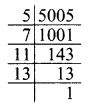
CBSE Sample Papers for Class 10 Maths Basic Set 1 with Solutions 1

Question 2.
Find the zeroes of the quadratic polynomial 6x2 – 3 – 7x
Solution :
Here, p (x) = 6x2 – 3 – 7x = 6x2 – 7x – 3
= 6x2 – 9x + 2x – 3 = 3x (2x – 3) + 1  (2x – 3) +1 (2x- 1)
(2x – 3) (3x + 1)
=\(6\left(x-\frac{3}{2}\right)\left[x-\left(-\frac{1}{3}\right)\right]\)
∴ Zeroes of p (x) are \(\frac{3}{2} \text { and }-\frac{1}{3}\)

Question 3.
H.C.F and L.C.M of two numbers is 9 and 459 respectively. If one of the two numbers is 27. Find the other number. If  \(\frac{241}{4000}=\frac{241}{2^{m} 5^{n}}\) find the values of m and n, where m and n are non negative integers. Hence write its decimal expansion without actual division.
Solution :
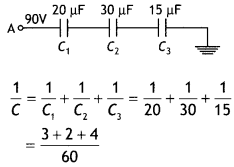
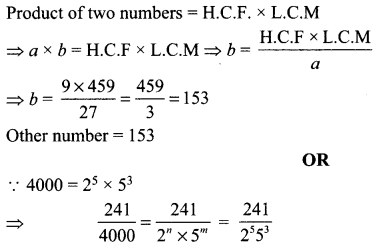
CBSE Sample Papers for Class 10 Maths Basic Set 1 with Solutions 2
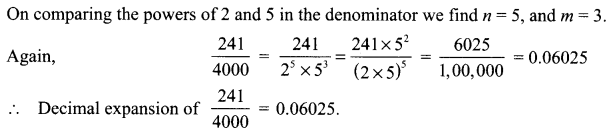
CBSE Sample Papers for Class 10 Maths Basic Set 1 with Solutions 3

Question 4.
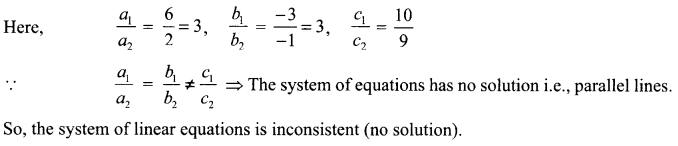
Find whether the pair of equations
6x – 3y + 10 = 0
and 2x-y + 9 = 0 are consistent or inconsistent.
Solution :
CBSE Sample Papers for Class 10 Maths Basic Set 1 with Solutions 4.

Question 5.
Two numbers are in the ratio 21 : 17. If their HCF is 5, find the numbers. 1
Solution :
Let numbers be 21x and 17 x So, common factors of 21 x and 17 x = x
Also, HCF = 5
⇒ x = 5
∴ Numbers are 21 x 5 and 17 x 5 i.e.: 105 and 85.

Question 6.
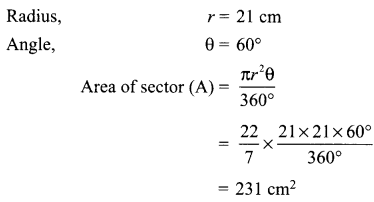
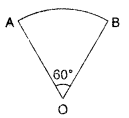
In a circle of radius 21 cm, an arc subtends an angle of 60° at the centre. Find the area of sector formed by the arc.      OR
A horse is tied to a peg at one comer of a square shaped grass field of side 15 m by means of a 5 m long rope. Find the area of that part of the field in which the horse can graze.
Solution :
CBSE Sample Papers for Class 10 Maths Basic Set 1 with Solutions 5

OR
Length of the rope = Radius, r = 5 m
Angle of sector = 90°
Area of the field that can graze
\(=\frac{\pi r^{2} \theta}{360^{\circ}}=\frac{22}{7} \times \frac{5 \times 5 \times 90^{\circ}}{360^{\circ}}\)
= 19.64 sq. m

Question 7.
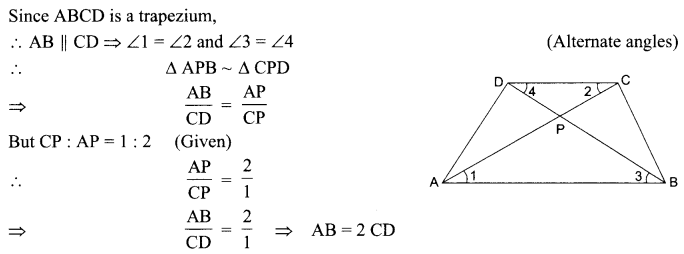
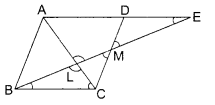
If one diagonal of a trapezium divides the other diagonal in the ratio 1 : 2. Prove that one of the parallel sides is double the other.
OR
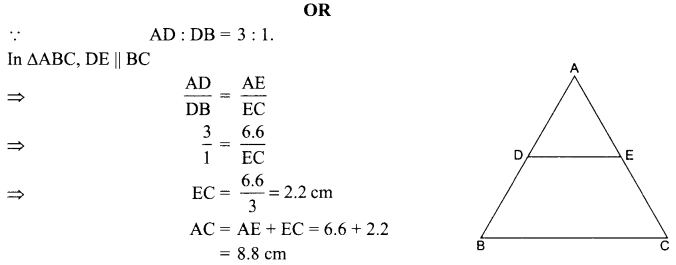
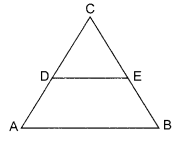
In ΔABC, D and E are points on sides AB and AC respectively such that DE || BC and AD : DB = 3:1. If EA = 6.6 cm then find AC.
Solution :
CBSE Sample Papers for Class 10 Maths Basic Set 1 with Solutions 6
CBSE Sample Papers for Class 10 Maths Basic Set 1 with Solutions 7

Question 8.
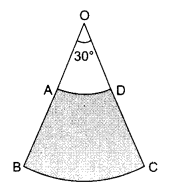
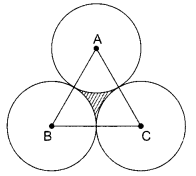
Two friends Mohan and Sohan drive a car. The shaded portion of the given figure represents an area swept by the wiper of the car. If OA = 7 cm and AB = 21 cm then Mohan said that area swept by the wiper is 192.5 cm2. Is he right? Explain.
Solution :
Let r = 7 cm be the radius of the sector OAD and R = 7 + 21=28cm be the radius of sector OBC.
The area swept by the wiper
CBSE Sample Papers for Class 10 Maths Basic Set 1 with Solutions 8
= Area of the shaded portion = Area of the sector OBC – Area of the sector OAD
\(=\pi \mathrm{R}^{2} \frac{\theta}{360^{\circ}}-\pi r^{2} \frac{\theta}{360^{\circ}}\)
CBSE Sample Papers for Class 10 Maths Basic Set 1 with Solutions 9

Question 9.
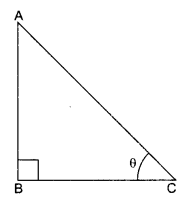
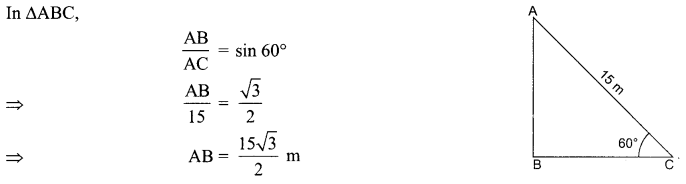
The ratio of the height of a tower and the length of its shadow on is the angle of elevation of the sun?
Solution :
Let
AB = height of the tower,
BC = length of the shadow and
∠ACB = θ = Angle of elevation of the sun
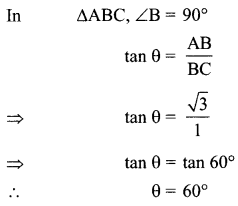
CBSE Sample Papers for Class 10 Maths Basic Set 1 with Solutions 10
CBSE Sample Papers for Class 10 Maths Basic Set 1 with Solutions 11

Question 10.
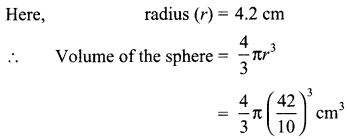
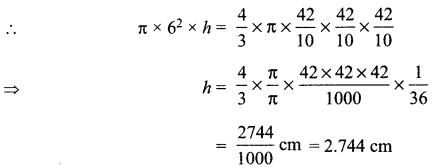
A metallic sphere of radius 4.2 cm is melted and recast into the shape of a cylinder of radius 6 cm. Find the height of the cylinder.
Solution :
CBSE Sample Papers for Class 10 Maths Basic Set 1 with Solutions 12

Let the height of the cylinder = h
Radius of the cylinder (R) = 6 cm
∴ Volume of the cylinder = πR2 h = n x (6)2 x h
Since, Volume of the cylinder = Volume of the sphere
CBSE Sample Papers for Class 10 Maths Basic Set 1 with Solutions 13

Question 11.
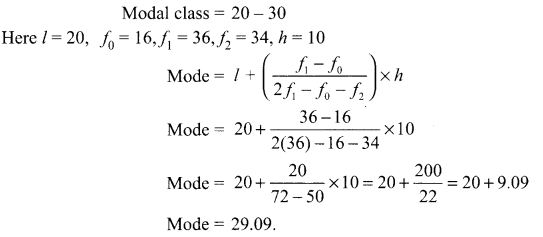
Find the mode for the frequency distribution table

Class0-1010-2020-3030-4040-50Total
Frequency81636346100

Solution :
The highest frequency is 36, which belongs to class 20 – 30.
So, it will be a modal class.
CBSE Sample Papers for Class 10 Maths Basic Set 1 with Solutions 14

Question 12.
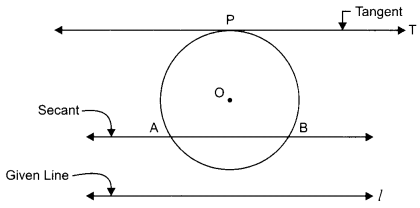
Draw a circle and two lines parallel to a given line such that one is a tangent and the other a secant to the circle.
Solution :
We have the required figure.
Here, l is the given line and a circle with centre O is drawn.
CBSE Sample Papers for Class 10 Maths Basic Set 1 with Solutions 15

The line PT is drawn which is parallel to l and tangent to the circle.
Also, AB is drawn parallel to line l and is a secant to the circle.

Question 13.
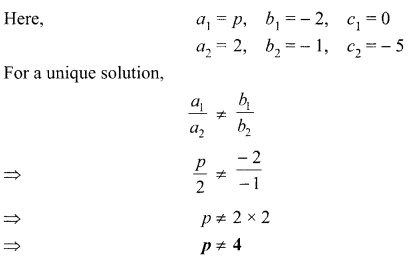
For what value of p, the pair of linear equations
px = 2y
2x – y + 5 = 0 has unique solution?
OR
For what value of k, does the given equation (k + 1 )x2 – 2(k – 1 )x + 1 = 0 have real and equal roots?
Solution :
We have:
px = 2y ⇒ px – 2y = 0
2x—y + 5=0 ⇒  2x-y = -5
CBSE Sample Papers for Class 10 Maths Basic Set 1 with Solutions 16

OR
(k + 1 )x2 – 2(k – 1) x + 1 = 0 ⇒ a = k + 1, b = -2(k – 1), c = 1
For equal roots, b2 – 4ac = 0 ⇒ [-2(k – 1)]2 – 4 x (k + 1) x 1=0
⇒ 4(k – 1)2 – 4{k + 1) = 0 ⇒ 4{k2 + 1 – 2k) -4k-4 = 0
⇒ 4k2 + 4 – 8k – 4k – 4 = 0 ⇒ 4k2-12k = 0 ⇒ 4k(k – 3) = 0
Either  4k = 0 ⇒ k = 0 or k- 3 = 0 = k = 3
Hence k= 0 or k = 3.

Question 14.
Two dice are thrown at the same time and the product of numbers appearing on them is noted. Find the probability that the product is a prime number.
OR
Two dice are thrown at the same time. Find the probability of getting different numbers on the dice.
Solution :
Now for the product of the numbers on the dice is a prime number can be in these possible ways—(1, 2), (2, 1), (1, 3), (3, 1), (5, 1), (1, 5)
So, number of possible ways = 6
∴ Required probability \(=\frac{6}{36}=\frac{1}{6}\)
OR
Since the two dice are thrown simultaneously.
Total number of outcomes = 6 x 6 = 36
Number of outcomes for getting same numbers on both dice = 6
⇒ P (same numbers) = \(\frac{6}{36}=\frac{1}{6}\)
Now, P (different numbers) + P (same numbers) = 1
⇒ P (different numbers) = 1 – P (same numbers)
\(=1-\frac{1}{6}=\frac{5}{6}\)

Question 15.
A ladder long just reaches the top of a vertical wall. If the ladder makes an angle of with the wall find the height of the wall
Solution :
CBSE Sample Papers for Class 10 Maths Basic Set 1 with Solutions 17

Question 16.
It is given that a group of 3 students, the probability of 2 students not having the same birthday is 0.992. What is the probability that the 2 students have the same birthday?
Solution :
We have P(E) + P(not E) = 1 ⇒ P(E) + 0.992 = 1
∴ P(E) = 1 – 0.992 = 0.008.

Section-II

Case study-based questions are compulsory. Attempt any 4 sub-parts from each question. Each sub-part carries 1 mark.

Case Study Based-1

Question 17.
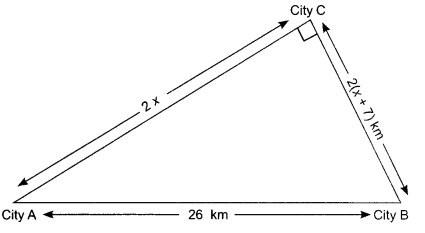
For going to city B from city A, there is a route via city C such that AC ⊥ CB, AC = 2x km and CB = 2(x + 7) km. It is proposed to construct a 26 km highway which is directly connect the two cities A and B. In solving such problem authority of the cities have some questions in his mind. Give answer to his following questions:
CBSE Sample Papers for Class 10 Maths Basic Set 1 with Solutions 18

(i) Which theorem will you use to solve this problem?
(a) Pythagoras theorem
(b) Basic proportionality theorem
(c) Factor theorem
(d) Fundamental Theorem of Arithmetic

(ii) What is the distance of AC?
(a) 15 km
(b) 18 km
(c) 10 km
(d) 20 km

(iii) What is the distance of BC?
(a) 12 km
(b) 10 km
(c) 20 km
(d) 24 km

(iv) Find how much distance will be saved in reaching city B from city A after the construction of the highway.
(a) 6 km
(b) 8 km
(c) 10 km
(d) 12 km

(v) If ∠A is supposed to be 30°, then ∠B = ?
(a) 30°
(b) 45°
(c) 60°
(d) 90°
Solution :
(i) (a): Pythagoras theorem

(ii) (c): 10 km
AC2 + BC2 = AB2 ⇒ (2x)2 + 22[x + 7]2 = (26)2
⇒ 4x2 + 4(x2 + 14x + 49) = 676
⇒  x2 + 1x – 60 = 0
⇒  (x + 12)(x – 5) = 0
x = -12 or 5(x = -12 neglected as distance cannot be negative).
AC = 2x = 2 x 5 = 10 km.

(iii) (d): 24 km
x = 5
BC = 2(x + 7)
= 2(5 + 7) = 24 km

(iv) (b): 8 km
AC + CB = 10+ 24 = 34 km  AB = 26 km
Difference = 34 km – 26 km = 8 km

(v) (c): 60°
AC ⊥ BC ⇒∠C = 90°
∴ ∠A + ∠B = 90°
⇒ 30° + ∠B = 90°
∠B = 90° – 30° = 60°

Case Study Based-2

Question 18.
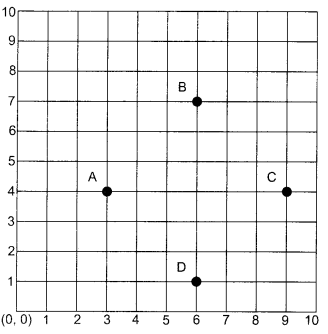
CBSE Sample Papers for Class 10 Maths Basic Set 1 with Solutions 19
In a classroom, 4 friends have decided to seat at the points A, B, C and D as shown in fig. Champa and Chameli walk into the class and after observing for a few minutes Champa asks Chameli some questions which are as follows:

(i) What is the coordinates of A and B?
(a) A(3, 4), B(6, 7)
(b) A(4,3), B(7,6)
(c) A(-3, -4), B(-6, -7)
(d) A( 3, -4), B(-6, -7)

(ii) What is the coordinate of C and D?
(a) C (4, 9), D(l, 6)
(b) C (9,4),D(6,1)
(c) C (-9, -4), D(-6, -1)
(d) C(9, -4). D(6, -1)

(iii) What is the distance between AB?
(a) 2
(b) 3
(c) \(2 \sqrt{3}\)
(d) \(3 \sqrt{2}\)

(iv) What is the distance between AC?
(a) 6
(b) 4
(c) 8
(d) 10

(v) What is the distance between BD?
(a) 4
(b) 6
(c) 8
(d) 10
Solution :
(i) (a): A(3, 4), B(6, 7)
(ii) (b): C(9, 4), D(6, 1)
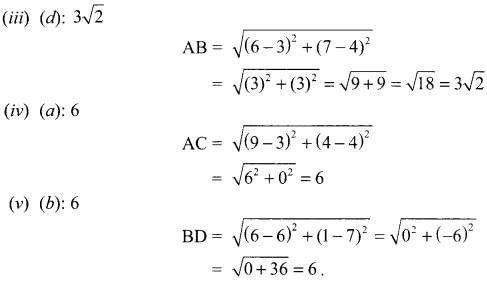
CBSE Sample Papers for Class 10 Maths Basic Set 1 with Solutions 20

Case Study Based-3

Question 19.
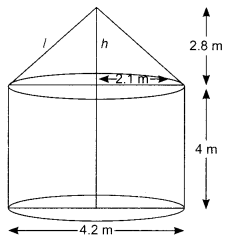
Due to sudden floods, some welfare associations jointly requested the government to get 100 tents fixed immediately and ordered to contribute 50% of the cost. If the lower part of each tent is of the form of a cylinder of diameter 4.2 m and height 4 m, and a conical upper part of same diameter and height 2.8 m. The canvas to be used costs ? 100 per sq. m. Find the amount that the associations will have to pay.
CBSE Sample Papers for Class 10 Maths Basic Set 1 with Solutions 21
(i) Find the formula to find the volume of the cylinder.
(a) \(\pi r^{2} h\)
(b) \(\pi r^{3} h \)
(c) \(\pi r^{2} h^{2} \)
(d) \(\frac{1}{3} \pi r^{2} h\)

(ii) What is the formula for the lateral surface of the conical portion of the tent?
(a) \(\frac{1}{3} \pi r^{2} h\)
(b) \(\pi r^{2} h\)
(c) \(πrl\)
(d) \(2πrh\)

(iii) What is the volume of the tent?
(a) 85.66 cu.m
(b) 100 cu.m
(c) 225.66 cu.m
(d) 125.66 cu.m

(iv) What is the curved surface area of the tent?
(a) 75.9 sq.m
(b) 85.6 sq.m
(c) 65.9 sq.m
(d) 95.9 sq.m

(v) What is the cost of canvas to be used to cover 100 such tents from all around?
(a) ₹  580,000
(b) ₹ 379,500
(c) ₹ 448,000
(d) ₹ 279,500
Solution :
(i) (a) : \(\pi r^{2} h\)
(ii) (c): πrl
(iii) (d): 125.66 cu.m
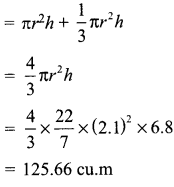
Volume of the tent = Volume of cylindrical portion of the tent + volume of conical portion of the tent.
CBSE Sample Papers for Class 10 Maths Basic Set 1 with Solutions 22

(iv)
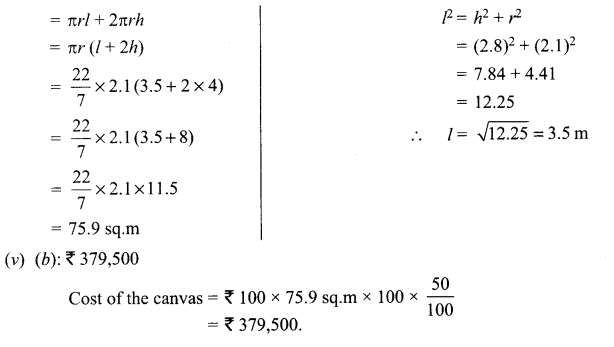
(a) Curved surface area of the tent
= Lateral surface area of conical portion + curve surface area of the cylindrical portion of the tent.
CBSE Sample Papers for Class 10 Maths Basic Set 1 with Solutions 23

Case Study Based-4

Question 20.
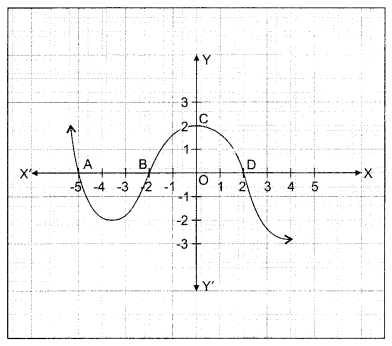
Due to heavy storm and rainfall, electric wire broke down on a chauraha and it disturbed the traffic. One piece of the wire is shown in the figure which followed some mathematical shape. Answer the following questions below:
CBSE Sample Papers for Class 10 Maths Basic Set 1 with Solutions 24
(i) Find the coordinates where does the graph cut the x-axis.
(a) (-5, 0), (-2, 0), (2, 0)
(b) (-5, 0), (-2, 0), (0, 2)
(c) (-2, 0), (0, 2), (2, 0)
(d)  (-5, 0), (0, 2), (2, 0)

(ii) Find number of zeroes of the graph y =f(x)
(a)  0
(b)  2
(c) 1
(d) 3

(iii) Find the zeroes of the graph y =f(x)
(a) -5, 0,    2
(b)  -5, -2, 2
(c) -2, 0, 2
(d) -5,   -2, 0

(iv) What will be the expression of the polynomial?
(a)  x3 +  5x2 – 4x – 20
(b) x3 +    5x2 + 4x – 20
(c)  x3 +   5x2 + 4x + 20
(d) x3 –     5x2 + 4x + 20

(v) What is the value of the polynomial if x = -5?
(a) -125
(b) 125
(c) 0
(d)  1
Solution :
(i) (a) : (-5, 0), (-2, 0), (2, 0)

(ii) (d) : 3
Since the graph v =f(x) crosses the x-axis at three different points. So, numbers of zeroes is 3.

(iii) (b): -5, -2, 2
Here graphy -fix) intersects the x-axis in (-5, 0), (-2, 0) and (2, 0). So, zeroes of f (x) are x-coordinate of these points.
∴ Zeroes of y(x) are -5, -2 and 2.

(iv) (a): x3 + 5x2 – 4x – 20
∵  Zeroes of f(x) are -5, -2 and 2.
So, factors of f(x) are (x + 5)(x + 2) and (x – 2)
∴ Expression of the polynomial
= (x + 5)(x + 2)(x – 2)
= x3 + 5x2 – 4x – 20.

(v) (c): 0
Put  x = -5 in /(x) = x3 + 5x2 – 4x – 20
⇒ A-5) = (-5)3 + 5(-5)2 – 4( 5) -20
= -125+ 125 + 20-20 = 0

Part-B
Section-III

All questions are compulsory. In case of internal choices, attempt anyone.

Question 21.
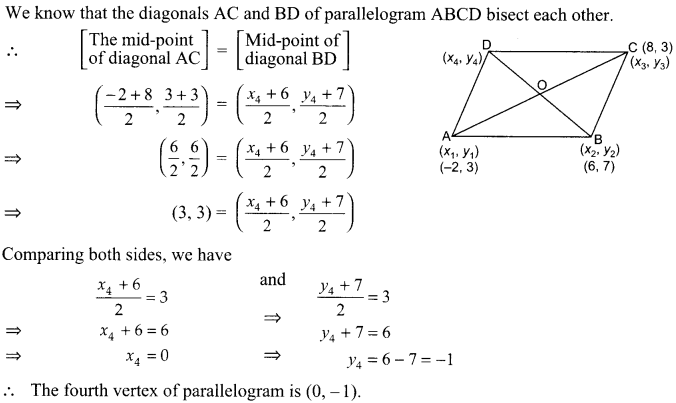
Find the fourth vertex D of a parallelogram ABCD whose three vertices are A(-2, 3), B(6, 7), and C(8, 3).
OR
If the distances of P(x,y) from the points A(3, 6) and B(-3,4) are equal, prove that 3x + y = 5.
Solution :
CBSE Sample Papers for Class 10 Maths Basic Set 1 with Solutions 25

Question 22.
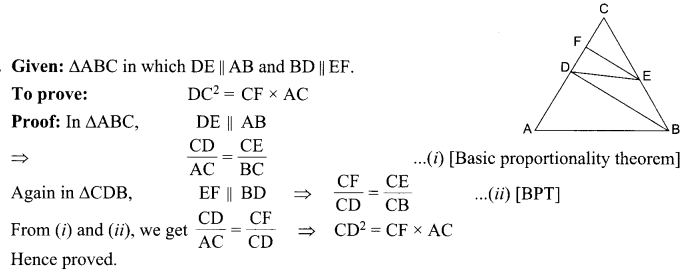
In the given figure, AB || DE and BD || EF. Prove that DC2 = CF x AC.
Solution :
CBSE Sample Papers for Class 10 Maths Basic Set 1 with Solutions 26

Question 23.
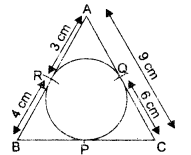
Prove that the parallelogram circumscribing a circle is a rhombus.
Solution :
Since ABCD is a ||gm
∴ AB = CD and AD = BC
∵  Tangents from an external point to a circle are equal,
∴ AP = AS
BP = BQ RC = QC DR = DS
⇒ (AP + PB) + (RC + DR) = (AS + DS) + (BQ + QC)
⇒ AB + CD = AD + BC
⇒  2 AB = 2 AD ⇒  AB = AD
i.e., ABCD is a rhombus.

Question 24.
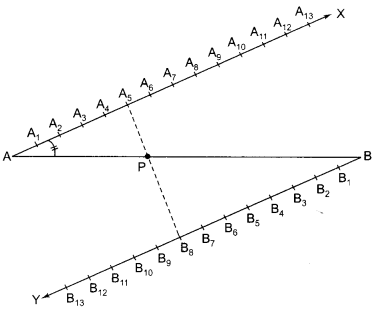
Draw a line segment of length 7.6 cm and divide it in the ratio 5 : 8. Measure the two parts.
Solution :
Steps:
(i) Draw AB = 7.6 cm.
(ii) Draw ray AX making any suitable angle with AB.
(iii) Draw ray BY parallel to ray AX by making alternate angles BAX and ABY equal.
(iv) Since 5 + 8=13, from AX cut thirteen equal segments AA1 A1A2, A2A3, …, a12a13.
(v) Also,from BY cut 13 equal segments (of the same size as taken in step (iv) BB1, B1B2, B2B3,…, B12B13.
CBSE Sample Papers for Class 10 Maths Basic Set 1 with Solutions 28
(vi) Join A5 with B8.
Line joining A5 and B8 cuts line segment AB at point P
∴ P is the required point such that AP : PB = 5 : 8.
On measuring we find: AP = 2.9 cm and BP = 4.7 cm

Question 25.
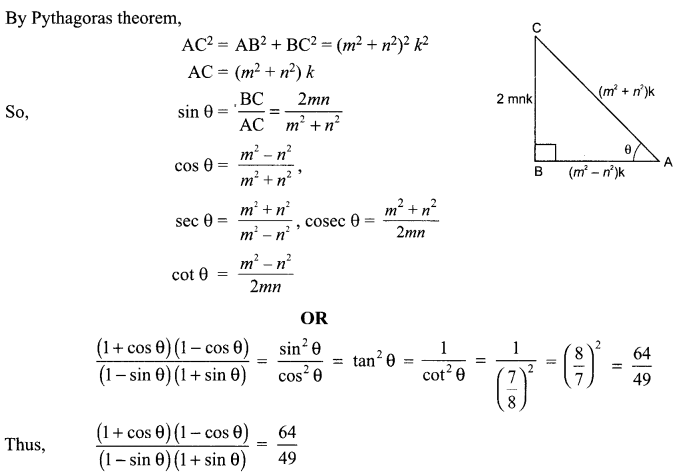
Find the value of other t-ratios if \(\tan \theta=\frac{2 m n}{m^{2}-n^{2}}\)
OR
If \(\cot \theta=\frac{7}{8}\) , then what is the value of \(\frac{(1+\cos \theta)(1-\cos \theta)}{(1-\sin \theta)(1+\sin \theta)}\)
Solution :
CBSE Sample Papers for Class 10 Maths Basic Set 1 with Solutions 29

Question 26.
Find the sum of the first 51 terms of an AP whose second term is 2 and fourth term is 8. 2
Solution :
Given, a2= 2 = a + d
and a4 = 8 = a + 2d
From (i) and (ii),
2 d – 6 ⇒ d = 3
and a = – 1
CBSE Sample Papers for Class 10 Maths Basic Set 1 with Solutions 30

Section – IV 

Question 27.
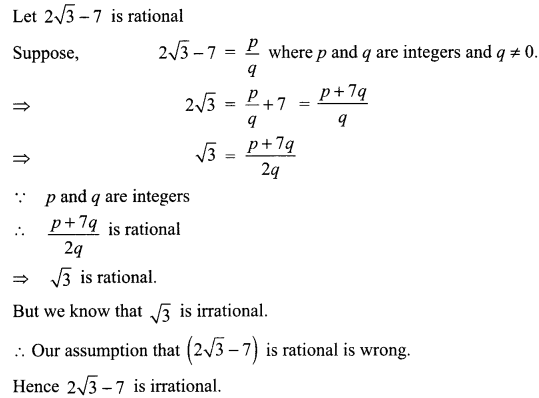
Prove that \(2 \sqrt{3}-7\) is an irrational.
Solution :
CBSE Sample Papers for Class 10 Maths Basic Set 1 with Solutions 31

Question 28.
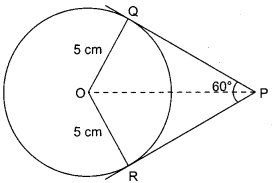
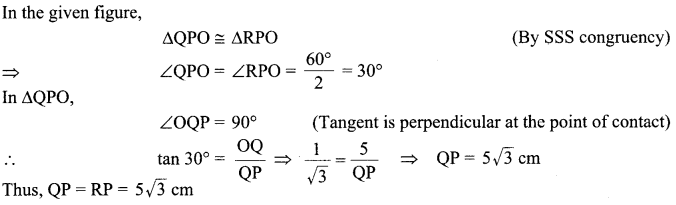
If two tangents inclined at an angle 60° are drawn to a circle of radius 5 cm, then find the length of each tangent.
CBSE Sample Papers for Class 10 Maths Basic Set 1 with Solutions 32
Solution :
CBSE Sample Papers for Class 10 Maths Basic Set 1 with Solutions 33

Question 29.
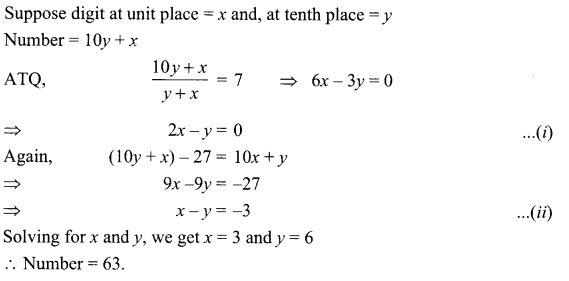
A number consists of two digits, where the number is divided by the sum of its digits, the quotient is 7. If 27 is subtracted from the number, the digits interchange their places, find the number.
Solution :
CBSE Sample Papers for Class 10 Maths Basic Set 1 with Solutions 34
Solving for x and y, we get x = 3 and y = 6
Number = 63.

Question 30.
A school has five houses, A, B, C, D and E. A class has 23 students, 4 from house A, 8 from house B, 5 from house C, 2 from house D and rest from house E. A single student is selected at random to be the class monitor. Find the probability that the selected student is not from A, B and C.
OR
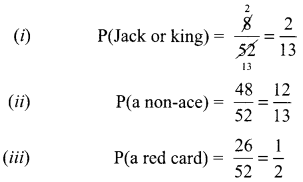
A card is drawn at random from a well-shuffled deck of playing cards. Find the probability that the card drawn is:
(i) a jack or a king
(ii) a non-ace
(in) a red card
Solution :
T(E) = 23
F(E) = not from A, B, C i.e. = 23 – (4 + 8 + 5)
F(E)= 23 – 17 = 6
\(P(F)=\frac{6}{23}\)
OR
CBSE Sample Papers for Class 10 Maths Basic Set 1 with Solutions 35

Question 31.
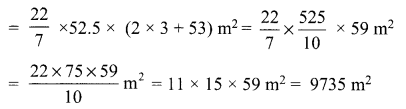
A circus tent is cylindrical to a height of 3 m and conical above it. If its base radius is 52.5 m and slant height of the conical portion is 53 m, find the area of the canvas needed to make the tent.                                                                          Solution :
For cylindrical part:
We have, radius (r) = 52.5 m
Curved Surface area = 2πrh

For the conical part:
Slant height (l) = 53 m
Radius (r) = 52.5 m
Curved surface area = nπl
Area of the canvas = 2nπh + πrl = πr (2h + l)
CBSE Sample Papers for Class 10 Maths Basic Set 1 with Solutions 36

Question 32.
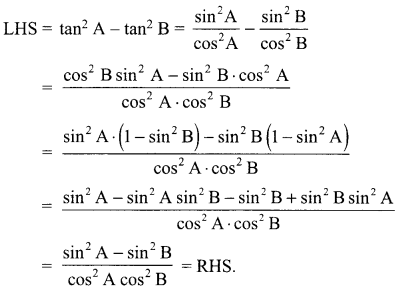
Prove that: tan2 A – tan2 B =\(\frac{\sin ^{2} A-\sin ^{2} B}{\cos ^{2} A \cdot \cos ^{2} B}\)
Solution :
CBSE Sample Papers for Class 10 Maths Basic Set 1 with Solutions 37

Question 33.
Find two numbers whose sum is 27 and product is 182.
OR
The two numbers differ by 2 and their product is 360. Find the numbers.
Solution :
Here, sum of the numbers is 27.
Let one of the numbers be x.
∴ Other number = 21 -x According to the condition,
Product of the numbers = 182 ⇒
⇒  x (27 – x) = 182
⇒ 27x – x2 = 182
⇒ -x2 + 27x – 182 = 0
⇒ x2 – 27x+ 182 = 0
⇒ x2 – 13x – 14x + 182 = 0 ∵ – 27 = (- 13) + (- 14) and (- 13) x (- 14)= 182
⇒ x(x- 13)- 14 (x- 13)= 0
Either x – 13 = 0 ⇒ x = 13
or x – 14 = 0 ⇒ x = 14
when first number is 13, then other number = 27-13 = 14
and when first number is 14 then other number is 27 – 14 = 13.
Thus, the required numbers are 13 and 14.
OR
Let the two numbers be x and x + 2 According to the questions,
x(x + 2) = 360
⇒ x2 + 2x = 360 ⇒ x2 + 2x – 360 = 0
Splitting the middle term, we get
x2 + 20x -18x – 360 = 0 ⇒ x(x + 20) – 18(x + 20) = 0
⇒(x + 20)(x — 18) = 0 ⇒ x = -20 or x = 18
When x = -20, x + 2 = -20 + 2 = -18
When x = 18,x + 2 = 18 + 2 = 20
Hence, the required numbers are -20, -18 or 18, 20.

Section-V

Question 34.
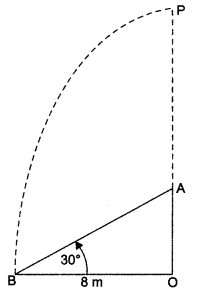
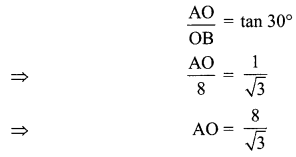
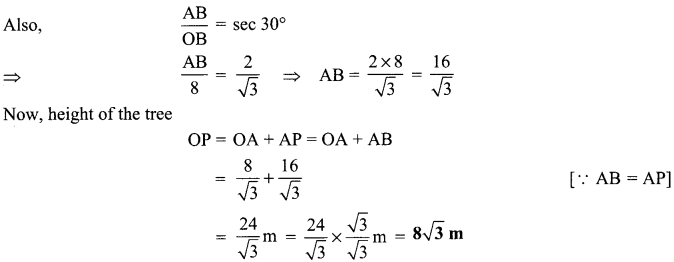
A tree breaks due to a storm and the broken part bends so that the top of the tree touches the ground making an angle 30° with it. The distance between the foot of the tree to the point where the top touches the ground is 8 Find the height of the tree.
OR
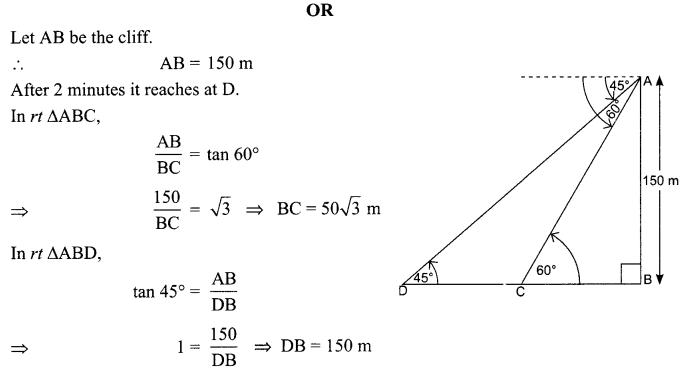
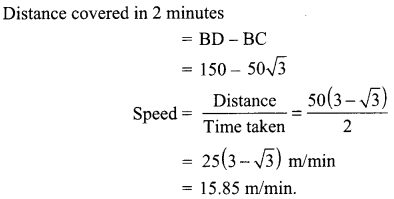
A moving boat is observed from the top of a 150 m high cliff moving away from the cliff. The angle of depression of the boat changes from 60° to 45° in 2 minutes. Find the speed of the boat in m/min.
Solution :
CBSE Sample Papers for Class 10 Maths Basic Set 1 with Solutions 38
Let the original height of the tree = OP.
It is broken at A and its top is touching the ground at B.
Now, in right Δ AOB, we have
CBSE Sample Papers for Class 10 Maths Basic Set 1 with Solutions 39
CBSE Sample Papers for Class 10 Maths Basic Set 1 with Solutions 40
CBSE Sample Papers for Class 10 Maths Basic Set 1 with Solutions 41
CBSE Sample Papers for Class 10 Maths Basic Set 1 with Solutions 42

Question 35.
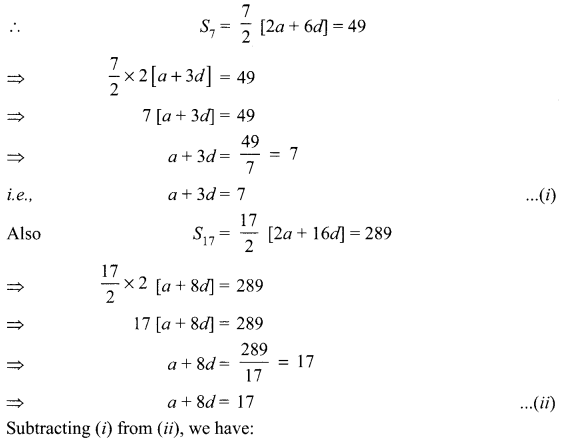
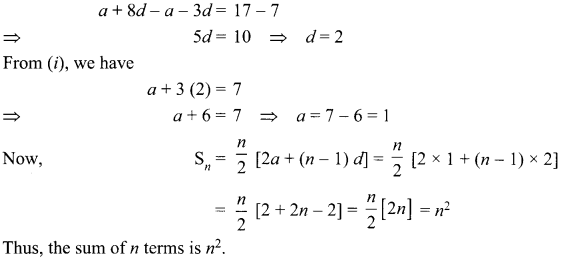
If the sum of first 7 terms of an A.P. is 49 and that of first 17 terms is 289, find the sum of n
Solution :
Let the first term = a and the common difference = d.
Using  \(S_{n}=\frac{n}{2}[2 a+(n-1) d]\)
CBSE Sample Papers for Class 10 Maths Basic Set 1 with Solutions 44

CBSE Sample Papers for Class 10 Maths Basic Set 1 with Solutions 45

Question 36.
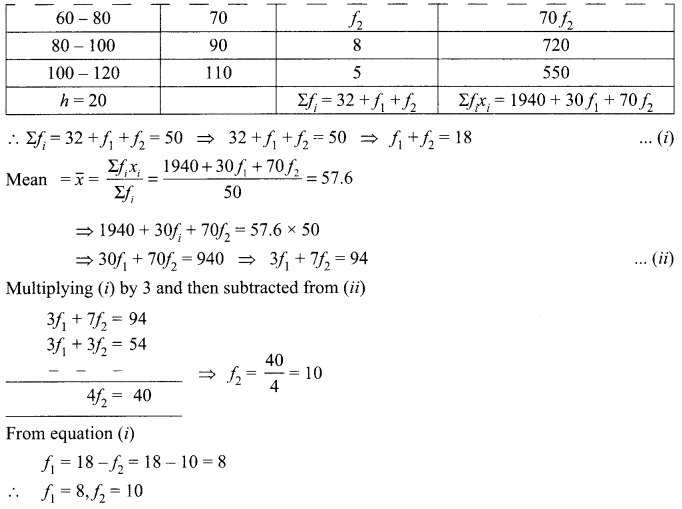
The mean of the following frequency distribution is 57.6. and the number of observations is 50. Find the missing frequencies f1 and f2.

Class0-2020-4040-6060-8080-100100-120
Frequency7f112f285

Solution :
CBSE Sample Papers for Class 10 Maths Basic Set 1 with Solutions 46
CBSE Sample Papers for Class 10 Maths Basic Set 1 with Solutions 47

CBSE Sample Papers for Class 10 Social Science Set 1 with Solutions

Students can access the CBSE Sample Papers for Class 10 Social Science with Solutions and marking scheme Set 1 will help students in understanding the difficulty level of the exam.

CBSE Sample Papers for Class 10 Social Science Set 1 with Solutions

Time: 3 Hours
Maximum Marks: 80

General Instructions:

(i) Question paper comprises five Sections – A, B, C, D and E. There are 32 questions in the question paper. All questions are compulsory.
(ii) Section A – Question no. 1 to 16 are Objective Type Questions of 1 mark each.
(iii) Section B – Question no. 17 to 22 are short answer type questions, carrying 3 marks each. Answer to each question should not exceed 80 words.
(iv) Section C – Question no. 23 to 26 are source based questions, carrying 4 marks each.
(v) Section D – Question no. 27 to 31 are long answer type questions, carrying 5 marks each. Answer to each question should not exceed 120 words.
(vi) Section E – Question no. 32 is map based, carrying 5 marks with two parts, 32.1 from History (2 marks) and 32.2 from Geography (3 marks).
(vii) There is no overall choice in the question paper. However, an internal choice has been provided in few questions. Only one of the choices in such questions have to be attempted.
(viii) In addition to this, separate instructions are given with each section and question, wherever

Section-A

Question 1.
Identify the correct statement about the liberal nationalists of Europe from the options given below.
(a) They emphasised the concept of government by the consent of the people.
(b) They criticized the glorification of science.
(c) They created a sense of collective heritage.
(d) They did not stood for the freedom of markets.
Answer:
(a) They emphasised the concept of government by the consent of the people.

Question 2.
What did Germania symbolise?
(a) French nation
(b) German nation
(c) British nation
(d) Greek nation
Answer:
(b) German nation

Question 3.
What does Satyagraha mean?
(a) Fight against injustice
(b) Complete independence
(c) Following the path of truth and non-violence
(d) All of these
Answer:
(c) Following the path of truth and non-violence

Question 4.
Fill in the blank:
India is the …………. largest producer of sugar in the world.
Or
Tourism in ………… has grown over the last three decades.
Answer:
second
Or
India

Question 5.
Choose the correctly matched pair about the ports of India from the following options:
(a) Kandla – Rajasthan
(b) Marmagao – Kerala
(c) Paradwip – Odisha
(d) Tuticorin – West Bengal
Answer:
(c) Paradwip – Odisha

Question 6.
Fill in the blank:
Tea and coffee: Laterite soils, Maize and pulses: Arid soils, …………….. : Black soils
(a) Rubber and coconut
(b) Barley and spices
(c) Cotton and jowar
(d) Wheat and cinchona
Answer:
(c) Cotton and jowar

Question 7.
Identify the crop with the help of the following features.

  • A tropical as well as a sub-tropical crop.
  • Grows well in hot and humid climate.
  • India is the second largest producer after Brazil.

Answer:
Sugarcane

Question 8.
The first jute mill was set up near Calcutta (now Kolkata) at Rishra in
(a) 1955
(b) 1947
(c) 1855
(d) 1856
Answer:
(c) 1855

Question 9.
The …………… is a national party.
(a) Aam Aadmi Party
(b) Rashtriya Janata Dal
(c) Samajwadi Party
(d) Bharatiya Janata Party
Answer:
(d) Bharatiya Janata Party

Question 10.
Which community was relatively rich and powerful in Belgium?
Or
Why is power sharing good?
Answer:
The minority French-speaking community was relatively rich and powerful in Belgium.
Or
Power sharing reduces the possibility of conflict between different social groups.

Question 11.
Why do parties sometimes launch movements?
Or
Which form of government is considered the best?
Answer:
Parties sometimes launch movements for the resolution of problems faced by people.
Or
Democracy is the most popular form of government in the contemporary set up.

Question 12.
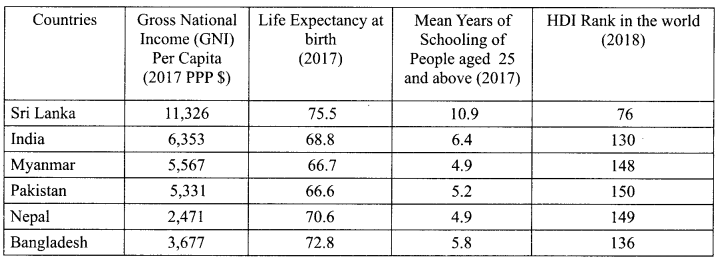
Read the given data and find out which country is at the top regarding GNI and HDI rank in
the world.
CBSE Sample Papers for Class 10 Social Science Set 1 with Solutions 1

Source: Human Development Report, 2018, United Nations Development Programme, New York
(a) Nepal
(b) India
(c) Pakistan
(d) Sri Lanka
Answer:
(d) Sri Lanka

Question 13.
Read the information given below and select the correct option.

Kanta works in an office. She attends her office from 9:30 a.m. to 5:30 p.m. She gets her salary regularly at the end of every month. In addition to the salary, she also gets provident fund as per the rule laid down by the government. She also gets medical and other allowances. Kanta does not go to office on Sundays. This is a paid holiday. When she joined work, she was given an appointment letter starting all the terms and conditions of work.
Like Kanta, people who work in the organised sector-
(a) do not worry about medical benefits and pensions
(b) do not get security of employment
(c) do not get overtime
(d) are not sure about their paid leaves, medical benefits, etc.

Or

Many people work in the unorganised sector. Which of the following statements about this sector is correct?
(a) It provides medical benefits.
(b) It ensures security of employment.
(c) It is one where the terms of employment are regular.
(d) Jobs are low paid and some kind of work is seasonal in nature.
Answer:
(a) do not worry about medical benefits and pensions

Or

(d) Jobs are low paid and some kind of work is seasonal in nature.

Question 14.
Who supervises the functioning of formal source of loans?
(a) Reserve Bank of India
(b) State Bank of India
(c) Central Bank of India
(d) Moneylenders
Answer:
(a) Reserve Bank of India

Question 15.
Read the following statements in context of the ‘foreign trade’ and choose the correct
option.
(a) Foreign trade implies exchange of goods and services across the countries.
(b) It helps to expand the size of market for producers.
(c) Producers and consumers can get commodities produced in any part of the world.
(d) All of the above
Answer:
(d) All of the above

Question 16.
In the question given below, there are two statements marked as Assertion (A) and Reason
(R) Read the statements and choose the correct option:
Assertion (A): MNCs have been attracted towards the Indian market.
Reason (R): The Government of India has allowed flexibility in labour laws.
Options:
(a) Both A and R are true and R is the correct explanation of A.
(b) Both A and R are true but R is not the correct explanation of A.
(c) A is true but R is false.
(d) A is false but R is true.
Answer:
(a) Both A and R are true and R is the correct explanation of A.

Section-B

Question 17.
Who had designed the ‘swaraj flag’ by 1921? Explain the main features of this ‘swaraj flag’.
Answer:
By 1921, Mahatma Gandhi had designed the ‘swaraj flag’.
During the Swadeshi movement in Bengal, a tricolour flag (red, green and yellow) was designed. It had eight lotuses representing eight provinces of British India and a crescent moon, representing Hindus and Muslims. In 1921, the Gandhiji’s designed swaraj flag was again a tricolour (red, green and white) and had a shining wheel at the centre, that representating the Gandhian ideal of self-help. Carrying the ‘swaraj flag’, holding it aloft, during marches became a symbol of defiance.

Question 18.
Describe the events of the French Revolution which had influenced the people belonging to
other parts of Europe.
Or
Why in the years after 1848, the autocrats of Central and Eastern Europe began to introduce the changes that had already taken place in Western Europe before 1815? Explain.
Answer:

  • When the news of the events in France reached the different cities of Europe, students and other members of educated middle-classes began setting up Jacobin clubs.
  • Their activities and campaigns prepared the way for the French armies which moved into Holland, Belgium, Switzerland and much of Italy in the 1790s.
  • With the outbreak of the revolutionary wars, the French armies began to carry the idea of nationalism abroad.

Or

  • Though conservative forces were able to suppress liberal movements in 1848, they could not restore the old order. Monarchs were beginning to realise that the cycles or revolution and repression could only be ended by granting concessions to the liberal-nationalist revolutionaries.
  • Hence, in the years after 1848, the autocratic monarchies of Central and Eastern Europe began to introduce the changes that had already taken place in Western Europe before 1815.
  • Thus, serfdom and bonded labour were abolished both in the Habsburg dominations and in Russia. The Habsburg rules ganted more autonomy to the Hungarians in 1867.

Question 19.
Classify industries according to their main role.
Answer:
According to their main role, industries are of two types:

  1. Basic or Key:
    Industries which supply their raw materials to manufacture other goods. Example: Iron and steel, copper smelting, aluminium smelting.
  2. Consumers:
    Industries produce goods for direct use by consumers. Example: Sugar, toothpaste, paper, sewing machines, etc.

Question 20.
What led to tensions between the Dutch-speaking and French-speaking communities in Belgium during the 1950s and 1960s? Where was this tension more acute, and why?
Or
What were the majoritarian measures taken in Sri Lanka to establish Sinhala supremacy?
Answer:

  • The minority French-speaking community in Belgium was relatively rich and powerful. This was resented by the Dutch-speaking community who got the benefit of economic development and education much later.
  • This led to tensions between the Dutch-speaking and French-speaking communities during the 1950s and 1960s.

This tension between the two communities was more acute in Brussels. It was so, because, the Dutch-speaking people constituted majority in the country, but minority in the capital, i.e. Brussels.

Or

When Sri Lanka emerged as an independent country in 1948, the leaders of the Sinhala community tried to dominate over the government by virtue of their majority. In order to establish their supremacy they took some ‘majoritarian measures’ which are given below:

  • In 1956, an Act was passed which declared Sinhala as the only official language, thus disregarding Tamil.
  • Preferences were given to Sinhala applicants for university positions and government jobs.
  • A new Constitution stipulated that the state shall protect and promote Buddhism. All these government measures, coming one after the other, gradually strained the relationship between the two communities.

Question 21.
Do you think the classification of economic activities into primary, secondary and tertiary is useful? Explain how?
Answer:
Yes, the classification of economic activities into primary, secondary and tertiary is very useful because of the following reasons:
(i) On account of the information it provides we come to know how and where the people of ,a country are employed.

(ii) It helps in ascertaining as to which sector of economic activity contributes more or less to the country’s GDP and per capita income.

(iii) If the tertiary sector is developing much faster than the primary sector, it implies that agriculture is depleting, and the government must take measures to rectify this. The knowledge that the agricultural profession is becoming unpopular or regressive can only come if we know which sector it belongs to. Hence, it is necessary to classify economic activities into these three basic sectors for smooth economic administration and development.

Question 22.
In recent years how our markets have been transformed? Explain with examples.
Answer:
Until the middle of the twentieth century, production was largely organised within countries.What crossed the boundaries of these countries were raw materials, food stuffs and finished goods. Trade was the main channel connecting distant countries. But with the emergence of multinational corporations (MNCs), things have been changed.

These MNCs are spreading their production and interacting with local producers in various countries across the globe. Foreign trade integrates markets. It creates an opportunity for the producers to reach beyond the domestic markets.

Producers can sell their produce not only in markets located within the country but can also compete in markets located in other countries. Similarly, for the buyers, import of goods produced in another country is one way of expanding the choice of goods beyond what is domestically produced.

Section-C

Question 23.
Read the source given below and answer the questions that follows. (4 x 1 = 4)

The first clear expression of nationalism came with the French Revolution in 1789. France, as you would remember, was a full-fledged territorial state in 1789 under the rule of an absolute monarch. The political and constitutional changes that came in the wake of the French Revolution led to the transfer of sovereignty from the monarchy to a body of French citizens. The revolution proclaimed that it was the people who would henceforth constitute the nation and shape its destiny. From the very beginning, the French revolutionaries introduced various measures and practices that could create a sense of collective identity amongst the French people. The ideas of lapatrie (the fatherland) and le citoyen (the citizen) emphasised the notion of a united community enjoying equal rights under a constitution.

A new French flag, the tricolour, was chosen to replace the former royal standard. The Estates General was elected by the body of active citizens and renamed the National Assembly. New hymns were composed, oaths taken and martyrs commemorated, all in the name of the nation. A centralised administrative system was put in place and it formulated uniform laws for all citizens within its territory. Internal customs duties and dues were abolished and a uniform system of weights and measures was adopted. Regional dialects were discouraged and French, as it was spoken and written in Paris, became the common language of the nation.

Answer the following MCQs by choosing the most appropriate option.

Question 23.1.
When did the French Revolution take place? (1)
(a) In 1889
(b) In 1789
(c) In 1788
(d) In 1751
Answer:
(b) In 1789

Question 23.2.
Identify the purpose of the French revolutionaries from the following options:
(a) To establish republic
(b) To provide equal rights for all
(c) To create a sense for collective responsibility
(d) All of these
Answer:
(d) All of these

Question 23.3.
What does the idea of la patrie mean?
(a) The fatherland
(b) The motherland
(c) The citizen
(d) The Constitution
Answer:
(a) The fatherland

Question 23.4.
Which of the following measures was not adopted by the French revolutionaries?
(a) Ideas of la patrie and le citoyen
(b) The tricolour French flag
(c) Hymns composed
(d) Regional dialects were encouraged
Answer:
(d) Regional dialects were encouraged

Question 24.
Read the text given below and answer the following questions. (4 x 1 = 4)

Planning is the widely accepted strategy for judicious use of resources. It has importance in a country like India, which has enormous diversity in the availability of resources. There are regions which are rich in certain types of resources but are deficient in some other resources. There are some regions which can be considered self sufficient in terms of the availability of resources and there are some regions which have acute shortage of some vital resources. For example, the states of Jharkhand, Chhattisgarh and Madhya Pradesh are rich in minerals and coal deposits.

Arunachal Pradesh has abundance of water resources but lacks in infrastructural development. The state of Rajasthan is very well endowed with solar and wind energy but lacks in water resources. The cold desert of Ladakh is relatively isolated from the rest of the country. It has very rich cultural heritage but it is deficient in water, infrastructure and some vital minerals. This calls for balanced resource planning at the national, state, regional and local levels.

Resource planning is a complex process which involves : (i) identification and inventory of resources across the regions of the country. This involves surveying, mapping and qualitative and quantitative estimation and measurement of the resources, (ii) Evolving a planning structure endowed with appropriate technology, skill and institutional set up for implementing resource development plans, (iii) Matching the resource development plans with overall national development plans.

Answer the following MCQs by choosing the most appropriate option.

Question 24.1.
…………… of is not …………… essential for a developed region.
(a) Availability; resources
(b) Valuation; resources
(c) Utilisation; resources
(d) Valuation; planning
Answer:
(b) Valuation; resources

Question 24.2.
There are some regions of India where availability of resources is sufficient, but in some regions, these are acute shortage of important resources. Identify which of the following belongs to:

Regions

Features

a. Jharkhand1. Endowed of solar energy
b. Rajasthan2. Abundance of water resources
c. Ladakh3. Coal deposits
d. Arunachal Pradesh4. Deficient in water resources

Choose the correct option:
(a) a – 2, b – 4, c – 1, d – 3
(b) a – 4, b – 2, c – 3, d -1
(c) a – 3, b – 1, c – 4, d – 2
(d) a – 2, b – 3, c – 1, d – 4
Answer:
(c) a – 3, b – 1, c – 4, d – 2

Question 24.3.
The state of Rajasthan lacks in
(a) Water resources
(b) Soil resources
(c) Biotic resources
(d) Potential resources
Answer:
(a) Water resources

Question 24.4.
Which of the following processes is involved in Resource Planning?
(a) Identification and inventory of resources across the regions of the country
(b) Evolving a planning structure with suitable technology
(c) Matching the resource development plans with overall national development plans
(d) All of the above
Answer:
(d) All of the above

Question 25.
Read the given extract and answer the following questions. (4 x 1 = 4)

The Constitution of India originally provided for a two-tier system of government, the Union Government or what we call the Central Government, representing the Union of India and the State governments. Later a third tier of federalism was added in the form of Panchayats and Municipalities. As in any federation, these difference tiers enjoy separate jurisdiction. The Constitution clearly provided a three-fold distribution of legislative powers between the Union Government and the State Governments. Thus, it contains three lists.

Answer the following MCQs by choosing the most appropriate option.

Question 25.1.
The Indian Constitution provides
(a) Two-tier system of government
(b) Three-tier system of government
(c) Four-tier system of government
(d) None of these
Answer:
(b) Three-tier system of government

Question 25.2.
What is the first-tier of government in India called?
(a) District Government
(b) Provincial Government
(c) Central Government Municipalities are set up in
(d) Community Government
Answer:
(c) Central Government Municipalities are set up in

Question 25.3.
Municipalities are set up in ……………….
(a) houses
(b) towns
(c) villages
(d) metropolitan cities
Answer:
(b) towns

Question 25.4.
Which government legislates on residuary subjects?
(a) State Government
(b) Local Government
(c) Community Government
(d) Union Government
Answer:
(d) Union Government

Question 26.
26. Read the source given below and answer the following questions. (4 x 1 = 4)

The value of final goods and services produced in each sector during a particular year provides the total production of the sector for that year. And the sum of production in the three sectors gives what is called the Gross Domestic Product (GDP) of a country. It is the value of all final goods and services produced within a country during a particular year. GDP shows how big the economy is. In India, the mammoth task of measuring GDP is undertaken by a central government ministry. This Ministry, with the help of various government departments of all the Indian states and union territories, collects information relating to total volume of goods and services and their prices and then estimates the GDP.

Answer the following MCQs by choosing the most appropriate answer. 

Question 26.1.
How is GDP calculated?
(a) The value of intermediate goods and services produced in each sector during a particular year and the sum of production in the three sectors.
(b) The value of intermediate goods and services produced in each sector during a particular year provides the approximate production of the sector for that year.
(c) The value of final goods and services produced in each sector during a particular year provides the total production of sector for that year, and the sum of production in the three sectors.
(d) The value of final goods and services produced in each sector during last three years provides the total production of the sector for that year.
Answer:
(c) The value of final goods and services produced in each sector during a particular year provides the total production of sector for that year, and the sum of production in the three sectors.

Question 26.2.
What do final goods and services mean?
(a) Production of goods and services
(b) Those goods and services that finally reach the consumers
(c) Those goods and services that are out of reach of consumers
(d) None of the above
Answer:
(b) Those goods and services that finally reach the consumers

Question 26.3.
In how many sectors does the sum of production give GDP of a country?
(a) Two
(b) Five
(c) Four
(d) Three
Answer:
(d) Three

Question 26.4.
Who is responsible for collecting data for the GDP in India?
(a) Central Government ministry
(b) State Government ministry
(c) Mayor
(d) None of these
Answer:
(a) Central Government ministry

Section-D

Question 27.
What steps did the French revolutionaries take to create a sense of collective identity among
the French people?
Or
Choose some examples to show the contribution of culture to the growth of nationalism in Europe.
Answer:
The first clear cut expression of nationalism came in France with the French Revolution. To make the Revolution a success it was very important to instill a sense of unity in every citizen. To achieve it, various measures and practices were followed:

  • A new French flag, the tricolour, was chosen to replace the former royal standard.
  • The Estate General was elected by the body of active citizens and renamed the National Assembly.
  • The ideas of la patrie (the fatherland) and le citoyen (the citizen) emphasised the nation of a united community enjoying equal rights under a Constitution.
  • New hymns were composed, oaths were taken and martyrs were commemorated, all in the name of the nation.
  • A centralised administrative system practising uniform laws for all citizens within its territory was set up.
  • Internal custom duties and dues were abolished and a uniform system of weights and measures was adopted.
  • Regional languages were discouraged and French was adopted as the common language of the nation.

Or

(i) Culture played a vital role in creating the idea of the nation, viz, art and poetry, stories and music helped to express and arouse nationalist feelings. Romantic artists and poets made deliberate efforts to create a sense of shared collective heritage, a common cultural past as the basis of a nation.

(ii) The German philosopher Johann Gottfried Herder stated that true German culture was to be discovered among the common people. It was through folk songs, folk poetry and folk dances that the true spirit of nation was popularised. So collecting and recording these forms of folk culture was essential to the project of nation-building.

The French painter Delacroix depicted an incident through his painting in which about 20,0 Greeks were assumed to have been killed by Turks. By dramatising the incident and focusing on the suffering of women and children Delacroix wanted to appeal to the emotions of the spectators and create sympathy for the Greeks.

Karol Kurpinski celebrated the national struggle through his operas and music, turning folk dances like the polonaise and mazurka into nationalist symbols.

(iii) Language played an important role in developing nationalist sentiments. Regional languages had always been an obstacle in the unification of a country. To overcome it, a common national language was adopted. The Polish language was forced out of schools and the Russian language was made obligatory everywhere.

(iv) In 1831, an armed rebellion against Russian rule took place but it was crushed. After the failure of this rebellion, members of the clergy in Poland began to use language as a weapon of national resistance. Polish became a common language in church gatherings and all religious instruction. As a result, several priests and bishops were put in jail by the Russian authorities as punishment for their refusal to preach in Russian. The use of Polish came to be seen as a symbol of the struggle against Russian dominance.

(v) Conservatives were able to suppress liberal movements in 1848.

Question 28.
What do you know about agriculture? Give its significance.
Or
Describe the types of farming practised in India.
Answer:
(i) Agriculture is a primary activity which produces most of the food that we consume. Two- thirds of India’s population is engaged in agricultural activities.

(ii) Agriculture has been in practice in India for thousands of years and continuous use of land without well-matched techno-institutional reforms have slowed the pace of agricultural development. Most of the farmers in large parts of the country still depend upon monsoon and natural fertility of soil. Also rapid growth in population put pressure on the agricultural production as more than 60 percent of India’s population depends on agriculture.

(iii) Agriculture in India produces raw materials for various industries, e.g., paper industry, textile industry, etc.

(iv) Agriculture contributes a lot to the national economy, employment and output. It provides employment and livelihood to about 63% of population. All other sectors of Indian economy heavily depend on agriculture for their growth.

Or

Two-thirds of India’s population is engaged in agricultural or farming activities. Different types of farming are in practice here:
(i) Primitive Subsistence Farming:
It is still practised in a few parts of India on small patches of land with the help of primitive tools like hoe, dao and digging sticks. It depends upon monsoon, natural fertility of the soil and suitability of other environmental conditions to the crops grown. It is also known as ‘Slash and Bum’ agriculture.

In this type of farming, farmers clear a patch of land and produce cereals and other food crops to sustain their family and when the soil fertility decreases, the farmers shift and clear a fresh patch of land for cultivation. It helps in allowing nature to reload the fertility of the soil through natural processes. Land productivity in this type of agriculture is low as the farmer does not use fertilisers or other modem inputs.

(ii) Intensive Subsistence Farming:
It is practised in areas where population pressure on land is high. High amount of biochemical inputs and irrigation are used for higher production. It is practised in West Bengal, Bihar, Uttar Pradesh. Farm size is small and uneconomical due to the division of land. The farmers take maximum output from the limited land.

(iii) Commercial Farming:
In such farming there is a use of higher doses of modem inputs, e.g. high yielding variety (HYV) seeds, chemical fertilisers, insecticides and pesticides in order to obtain higher productivity. The degree of commercialisation of agriculture varies from one region to another. For example, rice is a commercial crop in Haryana and Punjab, but in Odisha, it is a subsistence crop.

(iv), Plantation Farming: It is a type of commercial farming where single crop is grown on a large area. The plantation has an interface of agriculture and industry. The production is mainly for market and all the produce is used as raw material in respective industries. It requires well-developed network of transport and communication to connect the plantation areas, processing industries and markets together. In India, tea, coffee, mbber, sugarcane, bananas, etc. are important plantation crops. This type of farming is practised in Assam and North Bengal (tea), and Karnataka (coffee).

Question 29.
How does democracy produce an accountable, responsive and legitimate government?
Answer:
(i) Accountable Government:
Democracy refers to an accountable government because it is the government of the people, by the people and for the people. The representatives elected by the people are responsible to them. If the people are not happy with the government they can change the leaders in coming elections.

(ii) Responsive Government:
A citizen who wants to know if a decision was taken through the correct procedures can find this out. He has the right and the means to examine the process of decision-making. This type of transparency is not available in non-democratic government.

(iii) Legitimate Government:
There is one aspect in which democratic government is certainly better than its alternatives: democratic government is legitimate government. It may be slow, less efficient, not always very responsive or clean but a democratic government is people’s own government. So people wish to be ruled by representatives elected by them. They favour democracy as a government.

Question 30.
Give a comparative study of the ways in which the Belgian and Sri Lankan governments dealt with the problem of cultural diversities.
Or
What lessons do we leam from the principles of majoritarianism and accommodation followed in Sri Lanka and Belgium respectively?
Answer:
Sri Lanka is an island nation, just a few km off the southern coast of Tamil Nadu. It has about two crore people, about the same as in Haryana. Sri Lanka has a diverse population. Belgium is a small country in Europe, smaller in area than the state of Haryana. It has borders with France, the Netherlands, Germany and Luxembourg.

It has a population of a little over one crore, about half of the population of Haryana. The ethnic composition of Belgium is very complex. The Belgian leaders, in order to solve the problem of cultural diversities, adopted a compromising path. They amended their Constitution four times so as to work out an arrangement that would enable everyone to live together peacefully within the same country.

It was declared that no single community can make decisions unilaterally. Brussels has a separate government in which both the communities enjoy equal representation. These measures helped to avoid civic strife between the two communities and a possible division of the country on linguistic lines. Sri Lanka presents a different story.

The leaders of the majority community namely the Sinhala adopted a series of majoritarian measures to establish Sinhala supremacy. An Act was passed in 1956 which recognised Sinhala as the only official language, thus disregarding Tamil. The government followed preferential policies that favoured Sinhala applicants for university positions and government jobs.

These measures gradually increased the feeling of alienation among the Sri Lankan Tamils. Their relations with the Sinhala community got strained over time which finally resulted in civil war.

Or

Lessons learnt from Belgium:
In Belgium, the leaders realised that unity of the country could be maintained by respecting the feelings and interests of the different communities living in the country. So they worked on the principle of accommodation whereby mutually acceptable arrangement of sharing power were evolved. A possible division of the country on linguistic lines was also avoided.

Lessons from Sri Lanka:
In a country if a majority community learns to face its dominance over others and refuses to share power it can undermine the unity of the country.

Question 31.
“Different people can have different developmental goals.” Support the statement with examples.
Or
What does sustainability of development mean? How can sustainable development be achieved?
Answer:
The statement ‘different people have different goals of development’ is as because:

  • People come from different background.
  • Different people have different dreams of aspirations.
  • People set their goals according to the changing circumstances and the prevailing situations.
  • People may change the goal with the change in situation which could be contradictory to previous goal. For example, a person willing to go for higher education but will change his goal and go for employment because weak economic situation of the family.
  • People seek things that are most important for them i.e. things that can fulfill their aspiration or desires.
  • Examples:
    • Development for a farmer might be proper irrigation facilities.
    • For an urban youth, it may be employment.
    • For a landless labourer, it may be land.
    • For a girl, it might be mean of gender equality or more freedom.

Or

Sustainability of development means that development which is not only for the present time but is also for the future generations. Sustainability is the capacity to use the resources judiciously and maintain the ecological balance.

Sustainable development can be achieved through:
(i) Every generation wants to get the maximum benefits from the available resources but such a thing would be quite disastrous because the available resources shall be exhausted within a short time and the coming generations will be deprived of such resources.

(ii) Environmental degradation can be observed in different ways. Deforestation, falling levels of groundwater, soil erosion, water pollution, burning of fossil fuels, the hole in the ozone layer and combustion from automobiles causing extreme air pollution especially in urban areas are some of the examples of environmental degradation.

Sustainable development can be achieved by judicious use of both renewable and non-renewable resources and without disturbing the balance of environment keeping in mind the requirement for present and future generations.

Section-E

Map Skill Based Question

Question 32.1
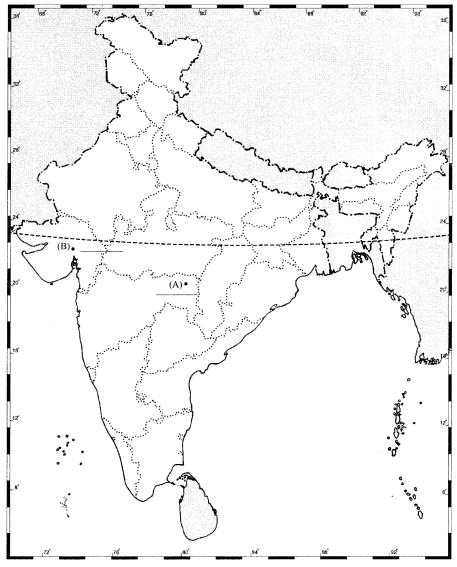
Two places A and B have been marked on the given outline map of India. Identify and write their correct names on the lines drawn near them.
(A) The place where the Indian National Congress Session was held.
(B) The place where cotton mill workers organised Satyagraha.

Question 32.2
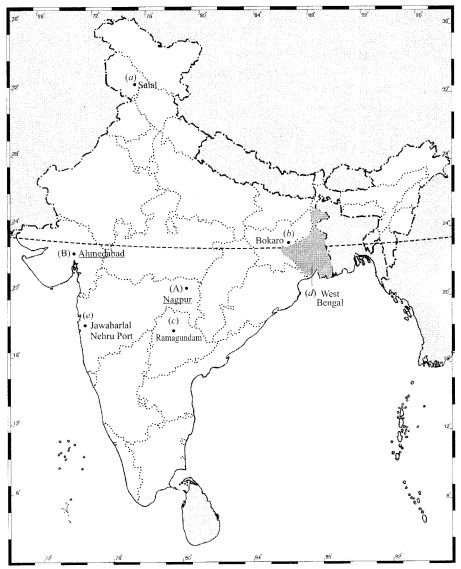
On the same outline map of India locate and label any THREE of the following with suitable symbols.
(a) Salal Dam
(b) Bokaro Iron and Steel Plant
(c) Ramagundam Thermal Power Plant
(d) West Bengal – the largest producer of rice
(e) Jawaharlal Nehru Port
CBSE Sample Papers for Class 10 Social Science Set 1 with Solutions 2
Answer:
CBSE Sample Papers for Class 10 Social Science Set 1 with Solutions 3


Electrostatic Potential and Capacitance Class 12 Important Extra Questions Physics Chapter 2

Here we are providing Class 12 Physics Important Extra Questions and Answers Chapter 2 Electrostatic Potential and Capacitance. Important Questions for Class 12 Physics with Answers are the best resource for students which helps in Class 12 board exams.

Class 12 Physics Chapter 2 Important Extra Questions Electrostatic Potential and Capacitance

Electrostatic Potential and Capacitance Important Extra Questions Very Short Answer Type

Question 1.
Express dielectric constant in terms of the capacitance of a capacitor.
Answer:
It is given by the expression K = \(\frac{c}{c_{0}}\) where C is the capacitance of the capacitor with dielectric and C0 is the capacitance without the dielectric.

Question 2.
On what factors does the capacitance of a parallel plate capacitor depend?
Answer:

  1. Area of plates,
  2. The separation between the plates and
  3. Nature of dielectric medium between the plates.

Question 3.
What is the ratio of electric field intensities at any two points between the plates of a capacitor?
Answer:
The ratio is one, as the electric field is the same at all points between the plates of a capacitor.

Question 4.
Write a relation between electric displacement vector D and electric field E.
Answer:
\(\vec{D}\) = ε0 \(\vec{E}\) + \(\vec{P}\)

Question 5.
Write the relation between dielectric constant (K) and electric susceptibility χe
Answer:
K = 1 + χe

Question 6.
A hollow metal sphere c radius 5 cm is charged such that the potential on its surface is 10 V. What is the potential at the center of the sphere? (CDSE AI 2011)
Answer:
10 V

Question 7.
What is the geometrical shape of equipotential surfaces due to a single isolated charge? (CBSE Delhi 2013)
Answer:
Concentric circles.

Question 8.
Draw the equipotential surfaces due to an isolated point charge. (CBSE Delhi 2019)
Answer:
These areas are shown.
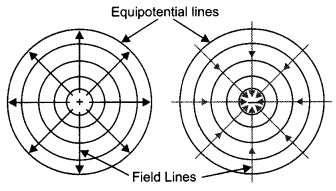
Class 12 Physics Important Questions Chapter 2 Electrostatic Potential and Capacitance 1
Question 9.
‘For any charge configuration, equipotential surface through a point is normal to the electric field’. Justify. (CBSE Delhi 2014)
Answer:
This is because work done in moving a charge on an equipotential surface is zero. This is possible only if the equipotential surface is perpendicular to the electric field.

Question 10.
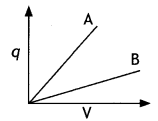
The given graph shows the variation of charge ‘q’ versus potential difference ‘V for two capacitors C1 and C2. Both the capacitors have the same plate separation but the plate area of C2 is greater than that of Cy Which line (A or B) corresponds to C1 and why? (CBSEAI 2014C)
Class 12 Physics Important Questions Chapter 2 Electrostatic Potential and Capacitance 2
Answer:
Since C = ε0 A/d, since the area for C2 is more, therefore capacitance of C2 is more. From the graph greater the slope greater is than the capacitance, therefore, graph A belongs to capacitor C2. While graph B belongs to capacitance Cv

Question 11.
Write a relation for polarisation P of dielectric material in the presence of an external electric field E . (CBSE AI 2015)
Answer:
P = χe ε0 \(\vec{E}\).

Question 12.
Why are electric field lines perpendicular at a point on an equipotential surface of a conductor? (CBSE AI 2015C)
Answer:
So that no net force acts on the charge on the equipotential surface and it remains stationary.

Question 13.
Why does a given capacitor store more charge at a given potential difference when a dielectric is filled in between the plates?
Answer:
Because the capacitance of the capacitor increases on filling the dielectric medium in between the plates.

Question 14.
Why is the electrostatic potential inside a charged conducting shell constant throughout the volume of the conductor? (CBSE AI 2019)
Answer:
We know that E = – \(\frac{d V}{d r}\)
Inside a conductor, the electric field is zero and no work is done in moving a charge inside a conductor. Therefore, V is constant.

Question 15.
Does the charge given to a metallic sphere depend on whether it is hollow or solid? (CBSE Delhi 2017)
Answer:
If the capacitance of the two spheres, solid and hollow, is the same, then they will hold the same quantity of charge.

Question 16.
Is the electric potential necessarily zero at a place where the electric field is zero?
Answer:
No, it is not necessary. The electric field inside a hollow metallic conductor is zero but the electric potential is not zero.

Question 17.
In a parallel plate capacitor, the potential difference of 102 V is maintained between the plates. What will be the electric field at points A and B as shown in the figure below?
Answer:
The electric field between the plates of a capacitor is uniform; therefore the electric field at points A and B will be the same.
Class 12 Physics Important Questions Chapter 2 Electrostatic Potential and Capacitance 3
Question 18.
If the plates of a charged capacitor are suddenly connected to each other by a wire, what will happen?
Answer:
The capacitor is discharged immediately.

Question 19.
Can you place a parallel plate capacitor of one farad capacity in your house?
Answer:
Ordinarily, it is not possible because the surface area of such a capacitor will be extra-large.

Question 20.
Is there any conductor which can be given almost unlimited charge?
Answer:
Yes, the earth.

Question 21.
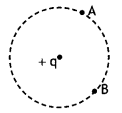
What would be the work done if a point charge + q is taken from a point A to a point B on the circumference of a circle drawn with another point charge + q at the center?
Class 12 Physics Important Questions Chapter 2 Electrostatic Potential and Capacitance 4
Answer:
Zero.

Question 22.
Sketch a graph to show how a charge Q, acquired by a capacitor of capacitance, C, varies with the increase in the potential difference between the plates.
Answer:
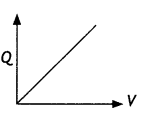
Class 12 Physics Important Questions Chapter 2 Electrostatic Potential and Capacitance 5
Question 23.
In a parallel plate capacitor, the capacitance increases from 4 μF to 80 μF, introducing a dielectric medium between the plates. What is the dielectric constant of the medium?
Answer:
The dielectric constant is given by
K = \(\frac{80}{4}\) = 20

Electrostatic Potential and Capacitance Important Extra Questions Short Answer Type

Question 1.
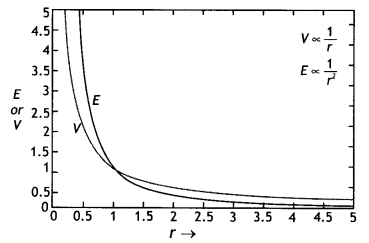
Draw a plot showing the variation of (i) electric field (E) and (ii) electric potential (V) with distance r due to a point charge Q. (CBSE Delhi 2012)
Answer:
The plot is as shown.
Class 12 Physics Important Questions Chapter 2 Electrostatic Potential and Capacitance 6
Question 2.
Two identical capacitors of 10 pF each are connected in turn (i) in series and (ii) in parallel across a 20 V battery. Calculate the potential difference across each capacitor in the first case and the charge acquired by each capacitor in the second case. (CBSE AI 2019)
Answer:
(i) Since the two capacitors have the same capacitance, therefore, the potential will be divided amongst them. Hence V = 10 V each
(ii) Since the capacitors are connected in parallel, therefore, potential difference = 20 V
Hence charge Q = CV = 10 × 20 = 200 pC

Question 3.
A point charge ‘q’ is placed at O as shown in the figure. Is VA – VB positive, negative, or zero, if ‘q’ is an (i) positive, (ii) negative charge? (CBSE Delhi 2011, 2016)

Class 12 Physics Important Questions Chapter 2 Electrostatic Potential and Capacitance 7
Answer:
If VA – VB = \(\frac{q}{4 \pi \varepsilon_{0}}\left(\frac{1}{\mathrm{OA}}-\frac{1}{\mathrm{OB}}\right)\)

As OA < OB
∴ If q is positive then VA– VB is positive and
if q is negative VA – VB is also negative.

Question 4.
The graph shows the variation of voltage V across the plates of two capacitors A and B versus charge Q stored on them. Which of the two capacitors has higher capacitance? Give a reason for your answer.
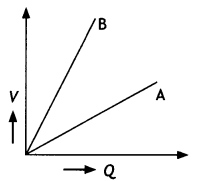
Class 12 Physics Important Questions Chapter 2 Electrostatic Potential and Capacitance 8
Answer:
Capacitor A has higher capacitance. We know that capacitance C = Q/V.

For capacitor A
\(c_{A}=\frac{Q}{V_{A}}\)

For capacitor B
\(c_{B}=\frac{Q}{V_{B}}\)

As VB > VA
∴ CB < CA
Thus capacitance of A is higher.

Question 5.
A test charge ‘q’ is moved without acceleration from A to C along the path from A to B and then from B to C in electric field E as shown in the figure,
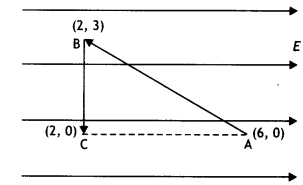
Class 12 Physics Important Questions Chapter 2 Electrostatic Potential and Capacitance 9
(i) Calculate the potential difference between A and C
Answer:
(i) dV = – E dr = – E (6 – 2) = – 4E

(ii) At which point (of the two) is the electric potential more and why? (CBSE AI 2012)
Answer:
Electric potential is more at point C as dV = – Edr, i.e. the electric potential decreases in the direction of the electric field.

Question 6.
A slab of material of dielectric constant K has the same area as that of the plates of a parallel plate capacitor but has the thickness d/2, where d is the separation between the plates. Find out the expression for its capacitance when the slab is inserted between the plates of the capacitor. (CBSE AI 2013)
Answer:
Given t = d/2, C = ?
We know that when a dielectric of thickness ‘t’ is inserted between the plates of a capacitor, its capacitance is given by
C = \(\frac{\varepsilon_{0} A}{d-t+\frac{t}{K}}\)

Hence we have
C = \(\frac{\varepsilon_{0} A}{d-\frac{d}{2}+\frac{d}{2 K}}=\frac{2 K \varepsilon_{0} A}{d(1+K)}\)

Question 7.
Two-point charges q and -2q are kept ‘d’ distance apart. Find the location of the point relative to charge ‘q’ at which potential due to this system of charges is zero. (CBSE Al 2014C)
Answer:
Let the potential be zero at point P at a distance x from charge q as shown
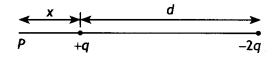
Class 12 Physics Important Questions Chapter 2 Electrostatic Potential and Capacitance 20

Now potential at point P is
V = \(\frac{k q}{x}+\frac{k(-2 q)}{d+x}\) = 0

Solving for x we have
x = d

Question 8.
Four-point charges Q, q, Q., and q are placed at the corners of a square of side ‘a’ as shown in the figure.
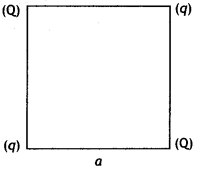
Class 12 Physics Important Questions Chapter 2 Electrostatic Potential and Capacitance 21
Find the potential energy of this system. (CBSEAI, Delhi 2018)
Answer:
The potential energy of the system
U = \(\frac{1}{4 \pi \varepsilon_{0}}\left(4 \frac{q Q}{a}+\frac{q^{2}}{a \sqrt{2}}+\frac{Q^{2}}{a \sqrt{2}}\right)\)

U = \(\frac{1}{4 \pi \varepsilon_{0} a}\left(4 q Q+\frac{q^{2}}{\sqrt{2}}+\frac{Q^{2}}{\sqrt{2}}\right)\)

Question 9.
Three-point charges q, -4q, and 2q are placed at the vertices of an equilateral triangle ABC of side T as shown in the figure. (CBSE Delhi 2018)
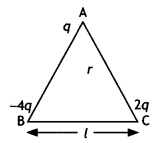
Class 12 Physics Important Questions Chapter 2 Electrostatic Potential and Capacitance 22
Find out the amount of the work done to separate the charges at infinite distance. (CBSE AI, Delhi 2018)
Answer:
Net potential energy of the system
= \(\frac{1}{4 \pi \varepsilon_{0}} \frac{q^{2}}{l}[-4+2-8]=\frac{5 q^{2}}{2 \pi \varepsilon_{0} l}\)

Electrostatic Potential and Capacitance Important Extra Questions Long Answer Type

Question 1.
Two-point charges 2 μC and —2 μC are placed at points A and B 6 cm apart.
(a) Draw the equipotential surfaces of the system.
Answer:
The diagram is as shown.
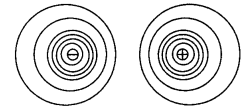
Class 12 Physics Important Questions Chapter 2 Electrostatic Potential and Capacitance 10
(b) Why do the equipotential surfaces get closer to each other near the point charges? (CBSEAI2O11C)
Answer:
We know that E = – dV/dr
Therefore, dr =- dV/E
Since near the charge, electric field E is large, dr will be less.

Question 2.
(a) Obtain the expressions for the resultant capacitance when the three capacitors C1, C2, and C3 are connected (i) in parallel and then (ii) in series.
Answer:
(i) Parallel combination of three capacitors.
Let three capacitors of capacitances C1, C2, and C3 be connected in parallel, and potential difference V be applied across A and B. If q be total charge flowing in the circuit and q1 q2 and q3 be charged flowing across C1, C2, and C3 respectively, then
q = q1+ q2 + q3
or q = C1v + C2V + C3V …(i)
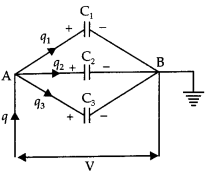
Class 12 Physics Important Questions Chapter 2 Electrostatic Potential and Capacitance 12

If CP is the capacitance of the arrangement in parallel, then
q = CPV

So equation (i) becomes
CPV = C1V + C2V + C3V
Or
CP = C1 + C2 + C3

(ii) Series combination of three capacitors Let three capacitors C1, C2, and C3 be connected in series. Let q charge be flowing through the circuit.
If V1, V2, and V3 be potential differences across the plates of the capacitor and V be the potential difference across the series combination, then
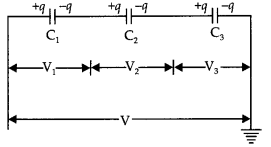
Class 12 Physics Important Questions Chapter 2 Electrostatic Potential and Capacitance 13
V = V1 + V2 + V3
Or
V = \(\frac{q}{C_{1}}+\frac{q}{C_{2}}+\frac{q}{C_{3}}\) … (i)

If Cs is the capacitance of series combination, then V = \(\frac{q}{\mathrm{C}_{\mathrm{s}}}\).

So the equation (i) becomes
\(\frac{q}{\mathrm{C}_{\mathrm{s}}}=\frac{q}{\mathrm{C}_{1}}+\frac{q}{\mathrm{C}_{2}}+\frac{q}{\mathrm{C}_{3}}\)
Or
\(\frac{1}{\mathrm{C}_{\mathrm{s}}}=\frac{1}{\mathrm{C}_{1}}+\frac{1}{\mathrm{C}_{2}}+\frac{1}{\mathrm{C}_{3}}\)

(b) In the circuit shown in the figure, the charge on the capacitor of 4 μF is 16 μC. Calculate the energy stored in the capacitor of 12 μF capacitance. (CBSE 2019C)
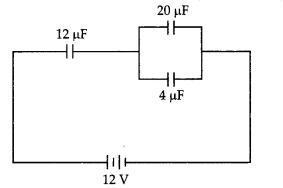
Class 12 Physics Important Questions Chapter 2 Electrostatic Potential and Capacitance 11
Answer:
Charge q across 4 μF Capacitor is 10 μc Potential difference across the capacitor of capacitance 4 μF will be
V= \(\frac{q}{C}=\frac{16 \mu C}{4 \mu F}=\frac{16 \times 10^{-6} \mathrm{C}}{4 \times 10^{-6} \mathrm{~F}}\)=4V

∴ Potential across 12 μF Capacitors
= 12V – 4V = 8V

Energy stored in the capacitors of capacitance C = 12 μF

U = \(\frac{1}{2}\) CV2 = \(\frac{1}{2}\) × 12 × 10-6 × 82 joule
= 384 × 10-6 J = 384 μJ

Question 3.
Two identical plane metallic surfaces A and B are kept parallel to each other in the air, separated by a distance of 1 cm as shown in the figure.
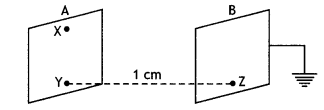
Class 12 Physics Important Questions Chapter 2 Electrostatic Potential and Capacitance 14
A is given a positive potential of 10 V and the outer surface of B is earthed.
(i) What is the magnitude and direction of the uniform electric field between Y and Z?
Answer:
The electric field between the plates is
E = \(\frac{V}{d}\) = 103 V m-1
directed from plate A at the higher potential to plate B at a lower potential, i.e. from Y to Z

(ii) What is the work done in moving a charge of 20 µC from X to Y?
Answer:
Since X and Y are on the same plate A, which is an equipotential surface, work done in moving a charge of 20 µC from X to Y on the equipotential surface is zero.

Question 4.
(i) Draw the equipotential surfaces corresponding to a uniform electric field in the z-direction.
Answer:
The equipotential surfaces are as shown.
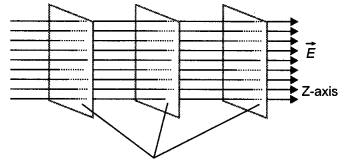
Class 12 Physics Important Questions Chapter 2 Electrostatic Potential and Capacitance 15
Equipotential surfaces

(ii) Derive an expression for the electric potential at any point along the axial line of an electric dipole. (CBSE Delhi 2019)
Answer:
Consider an electric dipole of length 2a and having charges +q and -q. Let us find the potential on the axial line at point P at a distance OP = x from the center of the dipole.
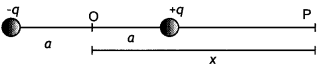
Class 12 Physics Important Questions Chapter 2 Electrostatic Potential and Capacitance 16

Now potential at point P is
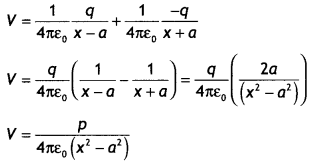
Class 12 Physics Important Questions Chapter 2 Electrostatic Potential and Capacitance 17
Question 5.
A network of four capacitors, each of capacitance 15 µF, is connected across a battery of 100 V, as shown in the figure. Find the net capacitance and the charge on the capacitor C4. (CBSE Al 2012C)
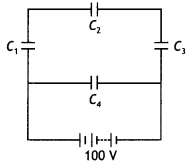
Class 12 Physics Important Questions Chapter 2 Electrostatic Potential and Capacitance 18
Answer:
Capacitors C1 C2 and C3 are in series, therefore their equivalent capacitance is
\(\frac{1}{C_{\mathrm{s}}}=\frac{1}{C_{1}}+\frac{1}{C_{2}}+\frac{1}{C_{3}}=\frac{1}{15}+\frac{1}{15}+\frac{1}{15}=\frac{3}{15}\)

Hence CS = 5 µF
Now CS and C4 are in parallel, hence
CP = CS + C4 = 5 + 15 = 20 µF

Now C4 is connected to 100 V, therefore charge on it is
Q = CV=15 × 10-6 × 100=15 × 10-4 C

Question 6.
A parallel plate capacitor of capacitance C is charged to a potential V. It is then connected to another uncharged capacitor having the same capacitance. Find out the ratio of the energy stored in the combined system to that stored initially in the single capacitor. (CBSE AI 2014)
Answer:
Ui = \(\frac{1}{2}\) CV2

When the capacitors are connected then the energy stored is
UF = \(\frac{1}{2}\left(C_{1}+C_{2}\right)\left(\frac{C_{1} V_{1}+C_{2} V_{2}}{C_{1}+C_{2}}\right)^{2}\)

Since C1 = C2 = C, and V2 = 0, we have
Uf = \(\frac{1}{2}(C+C)\left(\frac{C V}{C+C}\right)^{2}=\frac{1}{2}(2 C) \times \frac{V^{2}}{4}=\frac{1}{4} C V^{2}\)

Hence we have
\(\frac{U_{f}}{U_{i}}=\frac{1}{2}\)

Question 7.
An isolated air capacitor of capacitance C0 is charged to a potential V0. Now if a dielectric slab of dielectric constant K is inserted between its plates, completely filling the space between the plates, then how to do the following change, when the battery remains connected
(i) capacitance,
Answer:
When the battery remains connected, the potential on the capacitor does not change.
The capacitance of the capacitor becomes K times the original value, i.e. C = K C0.

(ii) charge
Answer:
Now new charge is Q = CV = K C0 V = K Q0.

(iii) the field between the plates
Answer:
The field between the plates becomes
E = \(\frac{V}{d}=\frac{V_{0}}{d}\) = E0, i.e. no change.

(iv) energy stored by the capacitor?
Answer:
The energy stored becomes
U = \(\frac{1}{2} C V^{2}=\frac{1}{2} K C_{0} V^{2}\) = KU0.

Question 8.
An isolated air capacitor of capacitance C0 is charged to a potential V0. Now if a dielectric slab of dielectric constant K is inserted between its plates, completely filling the space between the plates, then how to do the following change, when the battery is disconnected
(i) charge
Answer:
If battery is disconnected then charge remains same, Q = Q0

(ii) electric field between the plates,
Answer:
V = \(\frac{V_{0}}{K}\) ,
∴E = \(\frac{E_{0}}{K}\) ,

(iii) capacitance
C = KCO [∵ C = \(\frac{Q_{0}}{V}=\frac{Q_{0}}{V_{0} / K}=\frac{K Q_{0}}{V_{0}}\)]

(iv) energy stored by the capacitor
U = \(\frac{U_{0}}{K}\left[U=\frac{1}{2} C V^{2}=\frac{1}{2}\left(K C_{0}\right)\left(\frac{V_{0}}{K}\right)^{2}\right]\)

Question 9.
The figure shows two identical capacitors, C1 and C2, each of 1 µF capacitance connected to a battery of 6 V. Initially switch ‘S’ is closed. After some time ‘S’ is left open and dielectric slabs of dielectric constant K = 3 are inserted to fill completely the space between the plates of the two capacitors. How will (i) the charge and (II) potential difference between the plates of the capacitors be affected after the slabs are inserted? (CBSE Delhi 2011)
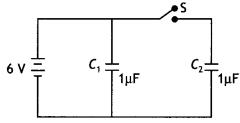
Class 12 Physics Important Questions Chapter 2 Electrostatic Potential and Capacitance 19
Answer:
When switch S is opened then capacitor C1 remains connected to the battery white capacitor C2 is disconnected. Thus for the two capacitors, we have

Physical quantityCapacitor C1Capacitor C2
ChargeBecomes K times, i.e. Q = CV = K C0V = 3 × 1 × 10-6 × 6 = 1.8 × 10⁻⁵ CRemains same Q = Q0  = CV = 1 × 10-6 × 6 = 6 × 10⁻⁶ C
Potential differenceRemains same V = V0 = 6 VBecomes 1/K times V =V0/K = 6/3 = 2V

Question 10.
A particle, having a charge +5 µC, is initially at rest at the point x = 30 cm on the x axis. The particle begins to move due to the presence of a charge Q that is kept fixed at the origin. Find the kinetic energy of the particle at the instant it has moved 15 cm from its initial position if (i) Q = +15 µC and (ii) Q = -15 µC (CBSE Sample Paper 2018-19)
Answer:
From energy conservation, Ui + Ki = Uf + Kf
kQq/ri + 0 = kQq/rf + Kf
Kf = kQq (1/ri — 1/rf)

When Q is +15 µC, q will move 15 cm away from it. Hence rf = 45 cm
Kf = 9 × 109 × 15 × 10-6 × 5 × 10-6 [1/(30 × 10-6) – 1/(45 × 10-2)] = 0.75 J

When Q is -15 µC, q will move 15 cm towards it. Hence rf = 15 cm Kf = 9 × 10⁹ × (-15 × 10-6) × 5 × 106 [1/(30 × 10-2) – 1/(15 × 10-2)] = 2.25 J

Question 11.
Two metal spheres, one of radius R and the other of radius 2R, both have same surface charge density σ. They are brought in contact and separated. What will be new surface charge densities on them? (NCERT Exemplar)
Answer:
Let the two spheres have charges Q1 and Q2 respectively. Since σ1 = σ2, before contact, we have
\(\frac{Q_{1}}{4 \pi R^{2}}=\frac{Q_{2}}{4 \pi(2 R)^{2}}\)
Or
Q2 = 4 Q1

After contact
Let q1 and q2 be the charges on them, then
q1 + q2 = Q1 + Q2= Q1 + 4Q1 = 5Q1 = 5(σ × 4πr²)

The two will exchange charge till their potentials are equal, therefore we have
\(\frac{q_{1}}{R}=\frac{q_{2}}{2 R}\)
Or
q2 = 2 q1

Therefore 3q1 = 5(σ × 4πr²)
Or
q1 = \(\frac{5}{3}\)(σ x 4πr²) and q2 = 2q1 = \(\frac{10}{3}\)5(σ x 4πr²)

Therefore
σ1 = \(\frac{q_{1}}{4 \pi R^{2}}=\frac{5}{3}\left(\frac{\sigma \times 4 \pi R^{2}}{4 \pi R^{2}}\right)=\frac{5 \sigma}{3}\)
And
σ2 = \(\frac{q_{2}}{4 \pi(2 R)^{2}}=\frac{10}{3}\left(\frac{\sigma \times 4 \pi R^{2}}{4 \pi(2 R)^{2}}\right)=\frac{5 \sigma}{6}\)

Question 12.
(a) Derive an expression for the capacitance of a parallel plate capacitor when the space between the plates is partially filled with a dielectric medium of dielectric constant ‘K’.
Answer:
Consider a parallel plate capacitor having each plate of area A and separated by a distance d. When there is a vacuum between the two plates, the capacitance of the parallel plate capacitor is given by
C0 = ε0 A/d.

Suppose that when the capacitor is connected to a battery, the electric field of strength E0 is produced between the two plates of the capacitor. Further, suppose that when a dielectric slab of thickness t (t < d) is introduced between the two plates of the capacitor as shown in the figure, the electric field reduces to E due to the polarisation of the dielectric. Therefore between the two plates of the capacitor, over a distance of t, the strength of the electric field is E, and over the remaining distance (d – f)
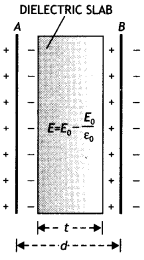
Class 12 Physics Important Questions Chapter 2 Electrostatic Potential and Capacitance 23
the strength is E0. If V is the potential between the plates of the capacitor, then

V = Et + E0(d – t)
Since E = E0/K where K is the dielectric constant, the above equation becomes

V = \(\frac{E_{0}}{K} t+E_{0}(d-t)=E_{0}\left(d-t+\frac{t}{K}\right)\)

The electric field between the plates of the capacitor is given by
E0 = σ / ε0 = Q/ A ε0

Hence the potential between the two plates becomes.
V = \(E_{0}\left(d-t+\frac{t}{K}\right)=\frac{Q}{\varepsilon_{0} A}\left(d-t+\frac{t}{K}\right)\)

Hence the capacitance of the parallel plate capacitor is given
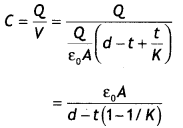
Class 12 Physics Important Questions Chapter 2 Electrostatic Potential and Capacitance 24

∴ clearly, C > C0. Therefore, capacitance increases in the presence of a dielectric medium.

(b) Explain why the capacitance decreases when the dielectric medium is removed from between the plates.
Answer:
On removing the dielectric, the capacitance will decrease.

Question 13.
(a) Obtain the expression for the energy stored per unit volume in a charged parallel plate capacitor.
(b) The electric field inside a parallel plate capacitor is E. Find the amount of work done in moving a charge q over a closed rectangular loop a b c d a. (CBSE Delhi 2014)
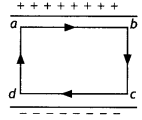
Class 12 Physics Important Questions Chapter 2 Electrostatic Potential and Capacitance 25
Answer:
(a) Suppose the capacitor is charged fully, its final charge is Q. and a final potential difference is V. These are related as Q = CV

Let q and V be the charge and potential difference, respectively.

At an intermediate stage during charging process q = CV. At this stage the small work done dW to transfer an additional charge dq is

dW = Vdq = \(\frac{q d q}{C}\)

The total work W needed to increase the capacitor’s charge q from zero to its final value Q is given by
W = \(\int_{0}^{w} d W=\int_{0}^{Q} \frac{q d q}{C}=\frac{1}{C} \int_{0}^{Q} q d q\)
Or
W = \(\frac{1}{C}\left|\frac{q^{2}}{2}\right|_{0}^{Q}=\frac{Q^{2}}{2 C}\)

This work is stored in the capacitor in the form of its electric potential energy. Hence,
U = \(\frac{Q^{2}}{2 C}\) … (1)

substituting Q = CV in equation (1) we have
U = \(\frac{1}{2}\) CV2

Energy density = Energy stored per unit volume
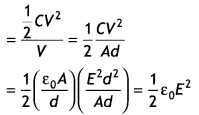
Class 12 Physics Important Questions Chapter 2 Electrostatic Potential and Capacitance 26

(b) Since the surface is an equipotential surface, work done is zero.

Question 14.
(a) Derive the expression for the capacitance of a parallel plate capacitor having plate area A and plate separation d.
Answer:
Suppose Q. is the charge on the capacitor, and c is the uniform surface charge density on each plate as shown in the figure. Therefore by Gauss’s theorem, the electric field between the plates of the capacitor (neglecting fringing of electric field at the edges) is given by
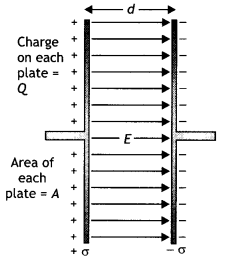
Class 12 Physics Important Questions Chapter 2 Electrostatic Potential and Capacitance 27
E = \(\frac{\sigma}{\varepsilon_{0}}=\frac{Q}{\varepsilon_{0} A}\) …. (1)

The field is uniform, and the distance between the plates is d, so the potential difference between the two plates is
V = Ed = \(\frac{1}{\varepsilon_{0}} \frac{Q d}{A}\) ….. (2)

Therefore by the definition of capacitance we have
C = \(\frac{Q}{V}=\frac{\varepsilon_{0} A}{d}\) …. (3)

This gives the capacitance of a parallel plate capacitor with a vacuum between plates.

(b) Two charged spherical conductors of radii R1 and R2 when connected by a conducting wire acquire charges q1 and q2 respectively. Find the ratio of their surface charge densities in terms of their radii. (CBSE Delhi 2014)
Answer:

The ratio of the surface charge densities is given by
\(\frac{\sigma_{1}}{\sigma_{2}}=\frac{q_{1}}{4 \pi R_{1}^{2}} \times \frac{4 \pi R_{2}^{2}}{q_{2}}\) ….(4)

Now when they are connected with a wire, their potentiaLs wilt be same: therefore, from the expression.
V = \(\frac{Q}{c}=\frac{Q}{R}\)

∵ C = 4πε0R for a spherical body
∴\(\frac{q_{1}}{q_{2}}=\frac{R_{1}}{R_{2}}\)

Substituting in equation (4) we have
\(\frac{\sigma_{1}}{\sigma_{2}}=\frac{R_{1}}{R_{1}^{2}} \times \frac{R_{2}^{2}}{R_{2}}=\frac{R_{2}}{R_{1}}\)

Question 15.
(a) Describe briefly the process of transferring the charge between the two plates of a parallel plate capacitor when connected to a battery. Derive an expression for the energy stored in a capacitor.
Answer:
The electrons are transferred to the positive terminal of the battery from the metallic plate connected to the positive terminal, leaving behind a positive charge on it. Similarly, the electrons move on to the second plate from the negative terminal, hence it gets negatively charged. This process continues till the potential difference between the two plates becomes equal to the potential of the battery.

Suppose the capacitor is charged fully; its final charge is Q and the final potential difference is V.
These are related as Q = CV

Let q and V be the charge and potential difference respectively, after some time during the charging of the capacitor, then q = CV. At this time, the small work done dW required to transfer an additional charge dq is given by

dW = Vdq = \(\frac{q d q}{C}\)

The total work W needed to increase the capacitor’s charge q from zero to its final value Q is given by
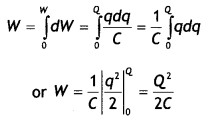
Class 12 Physics Important Questions Chapter 2 Electrostatic Potential and Capacitance 28

This work is stored in the capacitor in the form of its electric potential energy. Hence,
U = \(\frac{Q^{2}}{2 C}\) …(1)

Substituting Q= CVin equation (1) we have
U = \(\frac{1}{2}\) CV2

(b) A parallel plate capacitor is charged by a battery to a potential difference V. It is disconnected from the battery and then connected to another uncharged capacitor of the same capacitance. Calculate the ratio of the energy stored in the combination to the initial energy on the single capacitor. (CBSE Delhi 2019)
Answer:
The charge stored on the capacitor q = CV, when it is connected to the uncharged capacitor of same capacitance, sharing of charge, takes place between the two capacitors till the potential of both the capacitors becomes V/2.

Energy stored on the combination (U2)
= \(\frac{1}{2} C\left(\frac{V}{2}\right)^{2}+\frac{1}{2} C\left(\frac{V}{2}\right)^{2}=C\left(\frac{V}{2}\right)^{2}=\frac{C V^{2}}{4}\)

Energy stored on single capacitor before connecting
U1 = –\(\frac{1}{2}\) CV2

Ratio of energy stored in the combination to that in the single capacitor.
\(\frac{U_{2}}{U_{1}}=\frac{C V^{2} / 4}{C V^{2} / 2}=\frac{1}{2}\)

Question 16.
(a) Obtain the expression for the potential due to an electric dipole of dipole moment p at a point ‘x’ on the axial line.
(b) Two identical capacitors of plate dimensions l × b and plate separation d have dielectric slabs filled In between the space of the plates as shown In the figures.
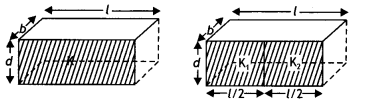
Class 12 Physics Important Questions Chapter 2 Electrostatic Potential and Capacitance 29
Obtain the relation between the dielectric constants K, K1, and K2. (CBSE Al 2013C)
Answer:
(a) Consider an electric dipole of length 2a and having charges + q and — q. Let us find the potential on the axial Une at point P at a distance OP = x from the center of the dipole.
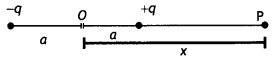
Class 12 Physics Important Questions Chapter 2 Electrostatic Potential and Capacitance 30
Now potential at point P is
Class 12 Physics Important Questions Chapter 2 Electrostatic Potential and Capacitance 31

(b) When there is no dieLectnc then
C = \(\frac{\varepsilon_{0} l b}{d}\)

For the first capacitor
C’ = \(\frac{K \varepsilon_{0} l b}{d}\) = KC

The second case is a case of two capacitors connected in paralleL, therefore
C1 = \(\frac{K_{1} \varepsilon_{0} l b}{2 d}\) and
C2 = \(\frac{K_{2} \varepsilon_{0} l b}{2 d}\)

These two are connected in parallel, therefore we have
C” = C1 + C2 = \(\frac{K_{1} \varepsilon_{0} l b}{2 d}\) + \(\frac{K_{2} \varepsilon_{0} l b}{2 d}\)
= C\(\left(\frac{K_{1}+K_{2}}{2}\right)\)

If the capacitance in each case be same, then C’ = C”

Hence K= \(\left(\frac{K_{1}+K_{2}}{2}\right)\)

Question 17.
(a) Explain using suitable diagrams the difference in the behavior of a
(i) conductor:
Answer:
The diagram is as shown.
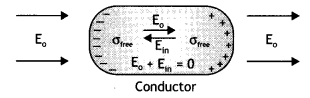
Class 12 Physics Important Questions Chapter 2 Electrostatic Potential and Capacitance 32
When a conductor is placed in an external electric field, the free charge carriers move and charge distribution in the conductor adjusts itself in such a way that the electric field due to induced charges opposes the external field within the conductor. This happens until in the static situation, the two fields cancel each other and the net electrostatic field in the conductor is zero.

(ii) dielectric In the presence of the external electric field. Define the term polarisation of a dielectric and write its relation with susceptibility.
Answer:
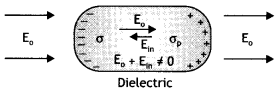
Class 12 Physics Important Questions Chapter 2 Electrostatic Potential and Capacitance 34
In a dielectric, this free movement of charges is not possible. It turns out that the external field induces dipole moment by stretching or re-orienting molecules of the dielectric. The collective effect of all the molecular dipole moments is that the net charges on the surface of the dielectric produce a field that opposes the external field. However, the opposing field so induced does not exactly cancel the external field. It only reduces it. The extent of the effect depends on the nature of the dielectric.

Dielectric polarization is defined as the dipole moment per unit volume of a dielectric. It is related to susceptibility as P = χeε0\(\vec{E}\)

(b) A thin metallic spherical shell of radius R carries a charge Q on its surface. A point charge is placed at its center C and another charge +2Q. outside the shell, at a distance r from the center as shown in the figure. Find (i) the force on the charge at the center of the shell and at the point A and
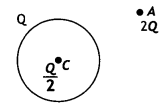
Class 12 Physics Important Questions Chapter 2 Electrostatic Potential and Capacitance 33
Answer:
(i) F = \(\frac{1}{4 \pi \varepsilon_{0}} \frac{Q^{2}}{2 R^{2}}\) and
F = \(\frac{1}{4 \pi \varepsilon_{0}} \frac{(Q+Q / 2) \times 2 Q}{r^{2}}\)

(ii) the electric flux through the shell. (CBSE Delhi 2015)
Answer:
Flux = \(\frac{Q}{2 \varepsilon_{0}}\)

Question 18.
(a) Define the SI unit of capacitance.
Answer:
The capacity of a capacitor is said to be one farad when a charge of 1 coulomb is required to raise the potential difference by 1 volt.

(b) Obtain the expression for the capacitance of a parallel plate capacitor.
Answer:
Let Q. be the charge on the capacitor, and o be the uniform surface charge density on each plate as shown in the figure.
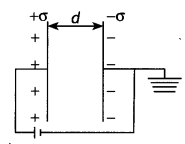
Class 12 Physics Important Questions Chapter 2 Electrostatic Potential and Capacitance 35
d = distance between plates of the capacitor.

Therefore by Gauss’ theorem, the electric field between the plates of the capacitor is given by
E = \(\frac{\sigma}{\varepsilon_{0}}=\frac{Q}{\varepsilon_{0} A}\)

The field is uniform, so the potential difference between the two plates is
V = Ed = \(\frac{1}{\varepsilon_{0}} \frac{Q d}{A}\)

Therefore, by the definition of capacitance we have
C = \(\frac{Q}{V}=\frac{\varepsilon_{0} A}{d}\)

This gives the capacitance of a parallel plate capacitor.

(c) Derive the expression of the effective capacitance of a series combination of n capacitance (CBSE Delhi 2016C)
Answer:
Capacitors in series. Capacitors are said to be connected in series if the second plate of one capacitor is connected to the first plate of the next and so on as shown in the figure.
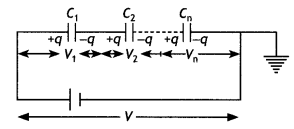
Class 12 Physics Important Questions Chapter 2 Electrostatic Potential and Capacitance 36
Resultant capacitance will be
\(\frac{1}{C}=\frac{1}{C_{1}}+\frac{1}{C_{2}}+\ldots \ldots \ldots \ldots=+\frac{1}{C_{n}}\)

Question 19.
A charge Q is distributed over the surfaces of two concentric hollow spheres of radii r and R (R >> r), such that their surface charge densities are equal. Derive the expression for the potential at the common center.
Or
Three concentric metallic shells A, B, and C of radii a, b, and c (a <b < C) have surface charge densities +a, -a, and + o respectively as shown. Obtain the expressions for the potential of three shells A, B, and C. If shells A and C are at the same potential, obtain the relation between a, b and c. (CBSE Al 2019)
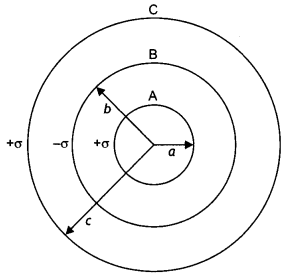
Class 12 Physics Important Questions Chapter 2 Electrostatic Potential and Capacitance 37
Answer:
Let the charges on the spheres be q, and q2 such that
Q=q1 + q2
= 4πσ(r² + R²)
Or
σ = \(\frac{Q}{4 \pi\left(r^{2}+R^{2}\right)}\)

Now potential at the common centre V=V1 + V2
V = \(\frac{1}{4 \pi \varepsilon_{0}}\left(\frac{q_{1}}{r}+\frac{q_{2}}{R}\right)\)
= \(\frac{1}{4 \pi \varepsilon_{0}}\left(\frac{4 \pi r^{2} \sigma}{r}+\frac{4 \pi R^{2} \sigma}{R}\right)\)

V = \(\frac{(r+R) \sigma}{\varepsilon_{0}}\)

Substituting for o, we have
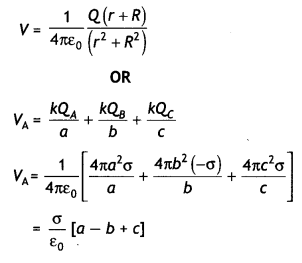
Class 12 Physics Important Questions Chapter 2 Electrostatic Potential and Capacitance 38
Class 12 Physics Important Questions Chapter 2 Electrostatic Potential and Capacitance 39

Numerical Problems :

Formulae for solving numerical problems

  • V = \(\frac{1}{4 \pi \varepsilon_{0}} \frac{q}{r}\) electric potential at a point.
  • Q = CV for a capacitor.
  • C = 4πε0R for a spherical conductor.
  • C =\(\frac{Q}{V}=\frac{\varepsilon_{0} A}{d}\) capacitance of a parallel plate capacitor with air as dielectric.
  • C = \(\frac{K \varepsilon_{0} A}{d}\) capacitance of a parallel plate capacitor with a dielectric.
  • For capacitors in senes \(\frac{1}{C_{s}}=\frac{1}{C_{1}}+\frac{1}{C_{2}}\) and for capacitors in parallel Cp = C1 + C2
  • U = \(\frac{1}{2} \frac{Q^{2}}{c}\) = \(\frac{1}{2}\)CV2 = \(\frac{1}{2}\)QV Energy stored in a capacitor.
  • Energy density u = \(\frac{1}{2}\) ε0E2
  • Capacitance of a parallel plate capacitor with a conducting slab of thickness t between plates is C = \(\frac{\varepsilon_{0} A}{d-t}\)
  • Capacitance of a capacitor with dielectric slab of thickness t << d , C = \(\frac{\varepsilon_{0} A}{d+t\left(\frac{1}{K}-1\right)}\)
  • Common potential V = \(\frac{C_{1} V_{1}+C_{2} V_{2}}{C_{1}+C_{2}}\)
  • Loss of energy when two conductors are combined, U1 – U2 = \(\frac{C_{1} C_{2}}{2\left(C_{1}+C_{2}\right)}\left(V_{1}-V_{2}\right)^{2}\)
  • If n small drops each having a charge Q, capacitance C, and potential V coalesce to form a big drop, then
  1. The charge on the big drop = nQ
  2. The capacitance of the big drop = n1/3 C
  3. Potential of the big drop = n2/3 V
  4. The potential energy of the big drop = n5/3 U

Question 1.
Electric field intensity at point B due to a point charge Q kept at point A is 24 N C-1 and the electric potential at point B due – to the same charge is 12 J C-1. Calculate the distance AB and also the magnitude of the charge Q.
Answer:
Given E = 24 N C-1 , V = 12 J C-1 , r = ? and Q = ?

Using the relation
E = \(\frac { V }{ r }\)
Or
\(\frac { V }{ E }\) = \(\frac { 12 }{ 24 }\) = 0.5 m

Also V = \(\frac{1}{4 \pi \varepsilon_{0}} \frac{Q}{r}\)

Therefore 12 = 9 × 10⁹ × \(\frac { Q }{ 0.5 }\) , solving for Q

we have Q = 6.67 × 10⁻¹⁰C

Question 2.
A capacitor of unknown capacitance is connected across a battery of V volts. The charge stored in it is 360 μC. When the potential across the capacitor is reduced by 120 V, the charge stored in it becomes 120 μC. Calculate:
(i) The potential V and the unknown capacitance C.
(ii) What will be the charge stored in the capacitor, if the voltage applied had increased by 120 V? (CBSE Delhi 2013)
Answer:
Given Q1 = 360 μC, Q2 = 120 μC,
V2 = (V- 120) volt, V1 = V

(i) We know that C = \(\frac { Q }{ V }\)

Since capacitance is same, we have
\(\frac{Q_{1}}{V_{1}}=\frac{Q_{2}}{V_{2}}\)
Or
\(\frac{360 \times 10^{-6}}{V}=\frac{120 \times 10^{-6}}{V-120}\)

Solving for V we have V= 180 volt

Also C = Q1/ V1 = 360 × 10-6 / 180 = 2 × 10⁻⁶ C = 2 pF

(ii) V= 180 + 120 = 300 V
Therefore Q = CV = 2 x 10-5 × 300 = 600 x 10-6 = 600 pC

Question 3.
Two identical capacitors of 12 pF each are connected in series across a 50 V battery. Calculate the electrostatic energy stored in the combination. If these were connected in parallel across the same battery, find out the value of the energy stored in this combination. (CBSE Al 2019)
Answer:
Given C = 12 pF = 12 × 10-12 F, V= 50 V,
In series
Cs = \(\frac{C_{1} C_{2}}{C_{1}+C_{2}}=\frac{12 \times 12}{12+12}\) = 6 pF

Hence energy stored
Us = \(\frac{1}{2}\) CsV2 = \(\frac{1}{2}\) × 6 × 10-12× (50)2
Us = 7.5 × 10⁻⁹ J

In parallel
CP = C1 + C2 = 12 + 12 = 24 pF
UP = \(\frac{1}{2}\) CPV2 = \(\frac{1}{2}\) × 24 × 10-12 × (50)2
UP = 3 × 10⁻⁸ J

Question 4.
The figure shows a network of three capacitors C1 = 2 μF; C2 = 6 μF and C3 = 3 μF connected across a battery of 10 V. If a charge of 6 μC is acquired by the capacitor C3, calculate the charge acquired by C1 (CBSE Al 2019)
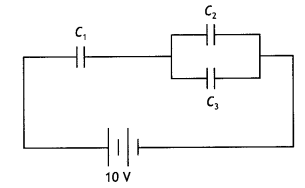
Class 12 Physics Important Questions Chapter 2 Electrostatic Potential and Capacitance 40
Answer:
Capacitors C2 and C3 are connected in parallel, therefore, the net capacitance of the combination.
C23 = (6 + 3) = 9 μF

Let V1, be the potential across C1 and V2 be the potential across C23
Now C1 = Q/V, or V1 = Q/C1 = Q/2

Also V2 = Q/9
But V = V1 + V2

Solving for Q we get
Q= 16.4 μC

Question 5.
(a) Find equivalent capacitance between A and B in the combination given below. Each capacitor is of 2 μF capacitance.
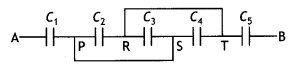
Class 12 Physics Important Questions Chapter 2 Electrostatic Potential and Capacitance 41
Answer:
This can be redrawn as
Class 12 Physics Important Questions Chapter 2 Electrostatic Potential and Capacitance 42

Like C2, C3 and C4 are in parallel,
C234 = C2 + C3 + C4 = 6 μF

Further, C1, C234 and C5 are in series
\(\frac{1}{C_{\text {net }}}=\frac{1}{2}+\frac{1}{6}+\frac{1}{2}=\frac{3+1+3}{6}=\frac{7}{6}\)
\(C_{\text {net }}=\frac{6}{7}\)μF

(b) If a DC source of 7 V is connected across AB, how much charge is drawn from the source and what is the energy stored in the network? (CBSE Delhi 2017)
Answer:
∴ Cnet = \(\frac { 6 }{ 7 }\) μF ,

q = Cnet V = \(\frac { 6 }{ 7 }\) × 10-6 × 7 = 10-6C

∴ Energy stored = \(\frac{1}{2}\)qV

= \(\frac{1}{2}\) × 6 × 10-6 × 7 = 21 × 10-6J

Question 6.
Two identical capacitors of 12 pF each are connected in series across a battery of 50 V. How much electrostatic energy is stored in the combination? If these were connected in parallel across the same battery, how much energy will be stored in the combination now? Also, find the charge drawn from the battery in each case. (CBSE Delhi 2017)
Answer:
(i) Net capacitance Cnet = \(\frac{C_{1} C_{2}}{C_{1}+C_{2}}\)
= \(\frac{12 \times 12}{12+12}\)pF = 6 pF

∴ Energy stored = \(\frac{1}{2}\)Cnet V2
= \(\frac{1}{2}\) × 6 × 10-12 × (50)2 = 75 × 10-10J
q = Chargedrawn = Cnet V=6 × 10-12 × 50 = 3 × 10⁻¹⁰ C

(ii) Cnet=12 + 12 = 24pF
∴ Energy stored = \(\frac{1}{2}\) Cnet V2
= \(\frac{1}{2}\) × 24 × 10-12 × (50)2
= 3 × 10⁻⁸J

Charge drawn, q = CnetV
= 24 × 10-12 × 50
= 1200 × 10-12
= 12 × 10-10 C

Question 7.
In the following arrangement of capacitors, the energy stored in the 6 μF capacitor is E. Find the value of the following. (Foreign 2016)
(a) Energy stored in 12 pF capacitor.
(b) Energy stored in 3 pF capacitor.
(c) Total energy drawn from the battery.
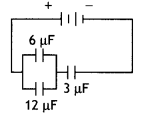
Class 12 Physics Important Questions Chapter 2 Electrostatic Potential and Capacitance 43
(a) Energy stored in 6 μ capacitor is E. Capacitors 6 μF and 12 μF are connected in parallel.
So, the voltage across 6 μF capacitor
= voltage across 12 μF capacitor
= V (say)

As E = \(\frac{1}{2}\) × 6 × V²
∴ V = \(\sqrt{\frac{E}{3}}\)

Similarly energy U’ stored in 12 pF capacitor
= \(\frac{1}{2}\) × 12 × V²
= \(\frac{1}{2}\) ×12 × \(\frac{E}{3}\) = 2E

U’ = 2 E

(b) Equivalent capacitance of 6 µF and 12 µF is 6 + 12 = 18 µF

Charge on 18 µF and 3 µF is same as they are in series as they are in series
∴ Q = CV= 18 × V

∴ Energy in 3 µF capacitor
U” = \(\frac{1}{2} \frac{Q^{2}}{C}=\frac{1}{2} \frac{(18 V)^{2}}{3}\)

U” = \(\frac{1}{2} \times \frac{18 \times 18}{3} \frac{E}{3}\)
U” = 18E

(c) Total energy drawn from battery U = E + 2E + 18E = 21E

Question 8.
Two parallel plate capacitors X and Y have the same area of plates and the same separation between them, X has air between the plates, while Y contains a dielectric medium of εr = 4.
(a) Calculate the capacitance of each capacitor if the equivalent capacitance of the combination is 4 μF.
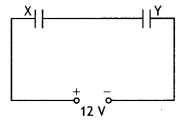
Class 12 Physics Important Questions Chapter 2 Electrostatic Potential and Capacitance 44

CX = \(\frac{\varepsilon_{0} A}{d}\) = C(say)
CY= 4\(\frac{\varepsilon_{0} A}{d}\) = 4C

EquivaLent capacitance = 4 μF
Ceq = \(\frac{C_{X} C_{Y}}{C_{X}+C_{Y}}\) = 4
= \(\frac{C \times 4 C}{C+4 C}\)
Or
= \(\frac{4C}{5}\) = 4

C = 5 μF
∴ CX = C = 5 μF and
CY = 4C = 20 μF

(b) Total charge, q = Ceq V = 4 × 12 = 48μC
CX and CY are in series. Hence, charge on both is 48 μC each.

∴ The potential difference across CX,
VX = \(\frac{q}{C_{X}}=\frac{48}{5}\) = 9.6 V0lt

The potential difference across CY,
VY = \(\frac{q}{C_{Y}}=\frac{48}{20}\) = 2.4 Volt

(c) UX=\(\frac{1}{2}\)CXVX² ; UY = \(\frac{1}{2}\)CYVy²

∴ \(\frac{U_{x}}{U_{Y}}=\frac{5 \times(9.6)^{2}}{20 \times(2.4)^{2}}\)
= \(\frac{1}{4} \times \frac{9.6 \times 9.6}{2.4 \times 2.4}\) = 4

\(\frac{U_{x}}{U_{r}}\) = 4

Question 9.
Find the ratio of the potential differences that must be applied across the parallel and series combination of two capacitors C1 and C2 with their capacitances in the ratio 1:2 so that the energy stored in these two cases becomes the same. (CBSE Al 2016)
Answer:
(i) Let C1 = C, ∴ C2 = 2C
For series combination equivalent capacitance is
\(C_{s}=\frac{C_{1} \times C_{2}}{C_{1}+C_{2}}=\frac{C \times 2 C}{3 C}=\frac{2}{3} C\) …. (1)
and energy stored,
\(U_{\mathrm{s}}=\frac{1}{2} C_{s} V_{\mathrm{s}}^{2}=\frac{1}{2} \times \frac{2}{3} C V_{\mathrm{s}}^{2}\) …. (2)

For parallel combination equivalent capacitance
Cp = C + 2C = 3C ….(3)
and energy stored
∴ \(U_{D}=\frac{1}{2} 3 C \times V_{p}^{2}\) …(4)

But Us = Up [Given]
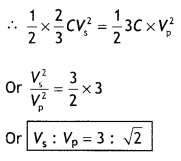
Class 12 Physics Important Questions Chapter 2 Electrostatic Potential and Capacitance 45

Question 10.
Calculate the potential difference and the energy stored in the capacitor C2 in the circuit shown in the figure. Given potential at A is 90 V, C1 = 20 μF, C2 = 30 μF, and C3= 15 μF. (CBSEAI 2015)
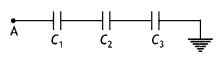
Class 12 Physics Important Questions Chapter 2 Electrostatic Potential and Capacitance 46
Answer:
Class 12 Physics Important Questions Chapter 2 Electrostatic Potential and Capacitance 47
C = \(\frac{60}{9}\) μF = \(\frac{20}{3}\) μF

The potential at A = 90V

∴ Charge on each capacitor
Q = C x V= \(\frac{20}{3}\) x 90 =600 μC.

∴ Charge on C2 = 600 μC

∴ V2 = \(\frac{Q}{C_{2}}=\frac{600}{30}\) ; V2 = 20 V

Energy stored in C2 = \(\frac{1}{2}\)C2V2²

U2 = \(\frac{1}{2}\) × 3o × 10-6 × 20 × 20
U2 = 6000 × 10-6J = 6 × 10⁻³J

CBSE Sample Papers for Class 10 Maths Standard Set 5 for Practice

Students can access the CBSE Sample Papers for Class 10 Maths Standard with Solutions and marking scheme Set 5 will help students in understanding the difficulty level of the exam.

CBSE Sample Papers for Class 10 Maths Standard Set 5 for Practice

Time: 3 Hours
Maximum Marks: 80

General Instructions:

1. This question paper contains two parts, A and B.
2. Both Part A and Part B have internal choices.

Part-A:
1. It consists of two sections, I and II.
2. Section I has 16 questions of 1 mark each. Internal choice is provided in 5 questions.
3. Section II has 4 questions on case study. Each case study has 5 case-based sub-parts. An examinee is to attempt any 4 out of 5 sub-parts.

Part-B:
1. It consists of three sections III, IV and V.
2. In section III, Question Nos. 21 to 26 are Very Short Answer Type questions of 2 marks each.
3. In section IV, Question Nos. 27 to 33 are Short Answer Type questions of 3 marks each.
4. In section V, Question Nos. 34 to 36 are Long Answer Type questions of 5 marks each.
5. Internal choice is provided in 2 questions of 2 marks, 2 questions of 3 marks and 1 question of 5 marks.

Part – A
Section-I

Section I has 16 questions of 1 mark each. Internal choice is provided in 5 questions.

Question 1.
Given that HCF (306, 657) = 9, find LCM (306, 657).
OR
Express 429 as a product of its prime factors.
Solution :
22338 08 429 = 3 x 11×13

Question 2.
If one zero of the polynomial x2 – 4x + 1 is 2 + √3 , write the other
Solution :
\(2-\sqrt{3}\)

Question 3.
State the type of the graph of the pair of linear equations: 3x – 5y =  11, 6x – 10y = 7
Solution :
Parallel lines

Question 4.
Find the value of k for which the given system has unique solution:
2x + 3y – 5 = 0, kx – 6y – 8 = 0.
Solution :
k≠- 4

Question 5.
Which term of AP: 92, 88, 84, 80 ………………. is 0?
OR
In an AP, if a = – 7.2, d= 3.6, an = 7.2, then find n.
Solution :
a24 OR n = 5

Question 6.
Find the whole number roots of the equation 2x2 – 7x + 6 = 0.
Solution :
2

Question 7.
Find the roots of x2 – 2x – (r2 – 1) = 0.
OR
If \(x=-\frac{1}{2}\)  is a solution of the quadratic equation 3x2 + 2kx -3 = 0, find the value of k.
Solution :
1 – r , r + 1 or \(-2 \frac{1}{4}\)

Question 8.
If tangents PA and PB from a point P to a circle with centre O are inclined to each other at an angle of 80°, then find ∠POA.
Solution :
50°

Question 9.
If the radii of two concentric circles are 6 cm and 10 cm, find the length of chord of the larger circle which is tangent to the other.
OR
From an external point P, tangents PA and PB are drawn to a circle with centre O. If ∠PAB = 50°, then find ∠AOB.
Solution :
16 cm OR 100°

Question 10.
Find the length of an altitude of an equilateral triangle of side 8 cm.
Solution :
\(4 \sqrt{3} \mathrm{~cm}\)

Question 11.
To divide a line segment AB in the ratio 5 : 6, a ray is drawn such that ∠B AX is an acute angle and points A1 , A2, A3, so on, are located at equal distances on the ray AX. Name the point to which B is joined.
Solution :
A11

Question 12.
If sin 0 = x and sec Q=y, then find the value of cot 0.
Solution :
\(\frac{1}{x y}\)

Question 13.
Find the value of \(\left(\sin ^{2} \theta+\frac{1}{1+\tan ^{2} \theta}\right)\)
Solution :
1

Question 14.
A man goes 12 m due west and then 9 m due north. How far is he from the starting point?
Solution :
15m

Question 15.
If α, β are the zeroes of a polynomial, such that α +β = 6 and αβ= 4, then write the polynomial.
Solution :
k(x2 – 6x + 4)

Question 16.
A single letter is selected at random from the ‘PROBABILITY’. Find the probability that it is a vowel.
OR
Two players, Sangeeta and Reshma, play a tennis match. It is known that the probability of winning the match by Sangeeta is 0.62. What is the probability of winning the match by Reshma?
Solution :
\(\frac{1}{x y}\)

Section-II

Case Study based questions are compulsory. Attempt any four sub-parts of each question. Each sub-part carries 1 mark.

Case Study Based-1

Question 17.
Adventure Camp
Adventure camps are the perfect place for children to practice decision-making for themselves without parents and teachers guiding their every move.

CBSE Sample Papers for Class 10 Maths Standard Set 5 for Practice 1

Some students of a school reached for adventure at Mukteshwar. At the camp, the waiters served some students with a welcome drink in a cylindrical glass and some students in a hemispherical cup whose dimensions are shown above.
After that they went for the jungle trek.

The jungle trek was enjoyable but tiring. As dusk fell, it was time to take shelter. Each group of four students was given a canvas of area 551 m2. Each group had to make a conical tent to accommodate all the four students. Assuming that all the stitching and wasting incurred while cutting, would amount to 1 m2, the students put the tents. The radius of the tent is 7 m.

Refer to Glass and Cup

(a) The volume of cylindrical cup is 1
(i) 295.75 cm3
(ii) 7415.5 cm3
(iii) 384.88 cm3
(iv) 404.25 cm3
Solution :
(iv) 404.25 cm3

(b) The volume of hemispherical cup is 1
(i) 179.67 cm3
(ii) 89.83 cm3
(iii) 172.25 cm3
(iv) 210.60 cm3
Solution :
(ii) 89.83 cm3

(c) Which container had more juice and by how much?
(i) Hemispherical cup, 195 cm3
(ii) Cylindrical glass, 207 cm3
(iii) Hemispherical cup, 280.85 cm3
(iv) Cylindrical glass, 314.42 cm3
Solution :
(iv) Cylindrical glass, 314.42 cm3

Refer to Tent

(d) The height of the conical tent prepared to accommodate 4 students is
(i) 18 m
(ii) 10 m
(iii) 24 m
(iv) 14 m
Solution :
(iii) 24 m

(e) How much space on the ground is occupied by each student in the conical tent?
(i) 54 m2
(ii) 38.5 m2
(iii) 86 m2
(iv) 24 m2
Solution :
(ii) 38.5 m2

Case Study Based-2

Question 18.
National Park
A national park is an area set aside by the government to preserve and protect the natural environment. The graph below shows a map of the National Park. The shaded areas indicate woods. The plain areas indicate meadows and fields without trees. Point O on the graph represents the location of the park’s supervisor’s office, and points P and Q are the ranger’s towers.

CBSE Sample Papers for Class 10 Maths Standard Set 5 for Practice 2

(a) What is the distance between the towers P(0, 7.5) and Q(-15, 15)?
(i) 7281.25 units
(ii) 7276 units
(iii) 9 units
(iv) 15-73 units
Solution :
(i) 7281.25 units

(b) The distance of the point S(5, 25) from x-axis is
(i) 5 units
(ii) 25 units
(iii) 1 unit
(iv) 20 units
Solution :
(ii) 25 units

(c) The point on x-axis (other than O) equidistant from the points R(Q, -5) and M(0, 5) is 1
(i) C
(ii) U
(iii) A
(iv) None of these.
Solution :
(ii) U

(d) There are two trees T1(-5, 7) and T2(-1, 3) in the park. The mid-point of the line segment joining both the trees is
(i) (-3,7)
(ii) (-3, 5)
(iii) (-1, 5)
(iv) (5,-3)
Solution :
(ii) (-3, 5)

(e) There is a circular pond in the park. The end points of a diameter of it are (-6, 3) and (6, 4). The coordinates of the centre of the pond is
(i) (8,-1)
(ii) (4, 7)
(iii) \(\left(0, \frac{7}{2}\right)\)
(iv) \(\left(4, \frac{7}{2}\right)\)
Solution :
(iii) \(\left(0, \frac{7}{2}\right)\)

Case Study Based-3

Question 19.
Females’ Literacy
The education of women helps to remove the social stigma that surrounds it. It is the key to eliminating social evils such as female infanticide, dowry, child marriage, harassment, etc. This will not just help the women of today but of the future generations who can live in a world where

The following distribution shows the number of literate females in the age group 0 to 60 years of a particular area.

Age (in years)0-1010-2020-3030-4040-5050-60
No. of literate females3501100900750600500

gender equality exists which ultimately raises the literacy rate.

The following distribution shows the number of literate females in the age group 0 to 60 years of a particular area.
(a) The class marks of class 40-50 is
(i) 70
(ii) 90
(iii) 10
(iv) 45
Solution :
(iv) 45

(b) The number of literate females whose ages are between 20 years and 50 years is ……
(i) 1350
(ii) 1650
(iii) 2000
(iv) 2250
Solution :
(iv) 2250

(c) The modal class of the above distribution is ……
(i) 0-10
(ii) 10-20
(iii) 20-30
(iv) 30-40
Solution :
(ii) 10-20

(d) The number of literate females whose ages are less than 40 years is ……
(i) 1450
(ii) 2350
(iii) 3100
(iv) 3700
Solution :
(iii) 3100

(e) The upper limit of modal class is …….
(i) 10
(ii) 20
(iii) 30
(iv) 60
Solution :
(ii) 20

Case Study Based-4

Question 20.
Energy Conservation
Energy conservation is the effect made to reduce the consumption of energy by using less of an energy service.
Some children of a school prepared posters on ‘Save Energy’ which are shown below.
CBSE Sample Papers for Class 10 Maths Standard Set 5 for Practice 3

Refer to Poster I

(a) If radius of the circle is 21 cm and angle subtended by arc at centre is 60°, the length of the arc is ………                    (i) 22 cm
(ii) 28 cm
(iii) 33 cm
(iv) None of these.
Solution :
(i) 22 cm

(b) The area of sector formed by the arc (radius = 21 cm and angle of sector = 60°) is ………..
(i) 124 cm2
(ii) 231cm2
(iii) 285 cm2
(iv) 310 cm2
Solution :
(ii) 231cm2

Refer to Poster II

(c) What is the radius of circular region if length of poster is 18 cm and breadth is 14 cm?
(i) 14 cm
(ii) 18 cm
(iii) 7 cm
(iv) 9 cm
Solution :
(iii) 7 cm

(d) What is the area of circular region if length of poster is 18 cm and breadth is 14 cm?
(i) 154 cm2
(ii) 172 cm2
(iii) 196 cm2
(iv) 216 cm2
Solution :
(i) 154 cm2

Refer to Poster III

(e) The area of poster if the length and breadth of it are 18 cm and 14 cm respectively, is
(i) 155 cm2
(ii) 175 cm2
(iii) 195 cm2
(iv) 205 cm2
Solution :
(ii) 175 cm2

Part-B
Section-II

All questions are compulsory. In case of internal choices, attempt any one.

Question 21.
The length, breadth, and height of a room are 8 m 25 cm, 6 m 75 cm and 4 m 50 cm respectively. Find the length of the longest rod that can measure the three dimensions of the room exactly.
Solution :
11m ,57m

Question 22.
The centre of a circle is (2a – 1, 7) and it passes through the point (-3, -1). If the diameter of the circle is 20 units, then find the value of a.
OR
If two vertices of an equilateral triangle are (3, 0) and (6, 0), find the third vertex.
Solution :
\(\alpha=-4,2 \mathrm{OR}\left(\frac{9}{2}, \frac{3 \sqrt{3}}{2}\right)\)

Question 23.
A solid is in the form of a right circular cylinder with hemispherical ends. The total height of the solid is 58 cm and the diameter of the cylinder is 28 cm. Find the total surface area of the solid.
Solution :
5104 cm2

Question 24.
Draw a circle of diameter 8 cm. From a point P, 7 cm away from its centre, construct a pair of tangents to the circle.

Question 25.
Find the value of 2 cot2 θ + 3 cosec2 θ – 3, if cos 0 =\(\frac{3}{5}\)
OR
Prove that: sec2 θ – cos2 θ = sin2 θ (sec2 θ + 1).
Solution :
\(\frac{45}{16}\)

Question 26.
A circle is touching the side BC of ΔABC at P and touching AB and AC produced at Q and R respectively. Prove that AQ = \(\frac{1}{2} (perimeter of ΔABC)\). If AQ = 5 cm, find the perimeter of ΔABC.
Solution :
10cm

Section-IV

Question 27.
LCM of two numbers is 45 times of their HCF. If one of the numbers is 125 and sum of their HCF and LCM is 1150, find the other number.
Solution :
225

Question 28.
Solve for x: \(\frac{x+1}{x-1}+\frac{x-2}{x+2}=4-\frac{2 x+3}{x-2} ; x \neq 1,-2,2\)
OR
The difference of two natural numbers is 3 and the difference of their reciprocals is \(\frac{3}{28}\). Find the numbers.
Solution :
\(\frac{6}{5}\) OR 4, 7

Question 29.
In the given figure, S and T trisect the side QR of a right triangle PQR. Prove that 8PT2 = 3PR2 + 5PS2.
CBSE Sample Papers for Class 10 Maths Standard Set 5 for Practice 4

Question 30.
Prove that in a right angled triangle, the square of the hypotenuse is equal to the sum of the squares of the other two sides.
OR
In the given figure, ΔABC and ΔXYZ are shown. If AB = 3 cm, BC = 6 cm, AC = 2y2 cm, ∠A = 80°,∠B = 60°, XY = 4√3 cm, YZ = 12 cm and XZ = 6 cm, then find the value of ∠Y.
CBSE Sample Papers for Class 10 Maths Standard Set 5 for Practice 5
Solution :
OR 40°

Question 31.
Find the value of x from the following data ii its mode is 65, where frequency 6, 8, x and 12 are in ascending order:

Class0-2020-4040-6060-8080-100100-120Mode
Frequency68X126565

Solution :
10

Question 32.
The angle of depression of the top and bottom of a tower as seen from the top of a 60√3 m high cliff are 45° and 60° respectively. Find the height of the tower.
Solution :
43.8m

Question 33.
For Uttarakhand flood victims, money donated by teachers of a school is shown in the following frequency distribution.

Money donated
(in ₹)
500-700700-900900-11001100-13001300-1500
Number of teachers431823

Solution :
Mean = ₹ 980; Median = ₹ 988.88

Section-V

Question 34.
A vertical tower stands on a horizontal plane and is surmounted by a flagstaff of height 5 m. From a point on the ground the angles of elevation of the top and bottom of the flagstaff are 60° and 30° respectively. Find the height of the tower and the distance of the point from base of the tower.       [Take √3 = 1.732]
OR
As observed from the top of a 100 m high lighthouse from the sea-level, the angles of depression of two ships are 30° and 45°. If one ship is exactly behind the other on the same side of the lighthouse, find the distance between the two ships.  [Take √3 = 1.732]
Solution :
2.5 m, 4.33 m OR 73.2 m

Question 35.
Given that the zeroes of the cubic polynomial x3 – 6x2 + 3x + 10 are of the form a, a + b, a + 2b for some real numbers a and b, find the values of a and b as well as the zeroes of the given polynomial.
Solution :
a = – 1, 5 ; b = 3, -3 ; -1, 2, 5

Question 36.
A part of monthly Hostel charge is fixed and the remaining depends on the number of days one has taken food in the mess. When Swati takes food for 20 days, she has to pay ₹ 3000 as hostel charges whereas, Mansi who takes food for 25 days pays ₹ 3500 as hostel charges. Find the fixed charges and the cost of food per day.
Solution :
₹ 1,000; ₹ 100

CBSE Sample Papers for Class 10 Maths Standard Set 4 for Practice

Students can access the CBSE Sample Papers for Class 10 Maths Standard with Solutions and marking scheme Set 4 will help students in understanding the difficulty level of the exam.

CBSE Sample Papers for Class 10 Maths Standard Set 4 for Practice

Time: 3 Hours
Maximum Marks: 80

General Instructions:

1. This question paper contains two parts, A and B.
2. Both Part A and Part B have internal choices.

Part-A:
1. It consists of two sections, I and II.
2. Section I has 16 questions of 1 mark each. Internal choice is provided in 5 questions.
3. Section II has 4 questions on case study. Each case study has 5 case-based sub-parts. An examinee is to attempt any 4 out of 5 sub-parts.

Part-B:
1. It consists of three sections III, IV and V.
2. In section III, Question Nos. 21 to 26 are Very Short Answer Type questions of 2 marks each.
3. In section IV, Question Nos. 27 to 33 are Short Answer Type questions of 3 marks each.
4. In section V, Question Nos. 34 to 36 are Long Answer Type questions of 5 marks each.
5. Internal choice is provided in 2 questions of 2 marks, 2 questions of 3 marks and 1 question of 5 marks.

Part – A
Section-I

Section I has 16 questions of 1 mark each. Internal choice is provided in 5 questions.

Question 1.
Find the distance between the lines 2x + 4 = 0 and x – 5 = 0.
OR
Find the distance of P (3, -2) from the y-axis.
Solution:
7 units OR 3 units

Question 2.
Find the value of k for which the given system has unique solution. 2x + 3y – 5 = 0, kx – 6y – 8 = 0
Solution:
k ≠ – 4

Question 3.
If cosec \(\theta=\frac{5}{3} \), then find the value of cos θ + tan θ.
Solution:
\(\frac{31}{20}\)

Question 4.
The given figure is a sector of circle of radius 10.5 cm. Find the perimeter of the sector.  [Take π = \(\frac{22}{7}\) ]
CBSE Sample Papers for Class 10 Maths Standard Set 4 for Practice 1
Solution:
32 cm

Question 5.
If in an equilateral triangle, the length of the median is √3 cm, then find the length of the side of equilateral triangle.
OR
In an equilateral triangle of side 3 √3 cm, find the length of the altitude.
Solution:
2 cm OR 4.5 cm

Question 6.
Find the nature of roots of ax2 + bx + c = 0, a > 0, b = 0, c > 0.
Solution:
no real roots

Question 7.
Is x = – 3 a solution of x2 + 6x + 9 = 0?
OR
What will be the nature of roots of quadratic equation 2x2 + 4x -7 = 0?
Solution:
Yes OR Real and unequal

Question 8.
In the given figure, ABC is circumscribing a circle. Find the length of BC.
CBSE Sample Papers for Class 10 Maths Standard Set 4 for Practice 2
Solution:
10cm

Question 9.
In the given figure, O is the centre of the circle, PA and PB are tangents to the circle. Find the measure of ∠AQB.
CBSE Sample Papers for Class 10 Maths Standard Set 4 for Practice 3
OR
In the given figure, PQ is a chord of a circle with centre O and PT is a tangent. If ∠QPT = 60°, find ∠PRQ.
CBSE Sample Papers for Class 10 Maths Standard Set 4 for Practice 4
Solution:
70° OR 120°

Question 10.
ΔABC is isosceles in which ∠C = 90°. If AC = 6 cm, then find AB2.
Solution:
72 cm2

Question 11.
To divide line segment AB in the ratio m : n, a ray AX is drawn so that ∠B AX is an acute angle and then points are marked on ray AX at equal distance. Find the minimum number of these points.
Solution:
m + n

Question 12.
If a, p are the zeroes of the polynomial 2y2 + 1y + 5, write the value of a + p 4- a,p.
Solution:
-1

Question 13.
Form a quadratic polynomial, the sum and product of whose zeroes are (-3) and 2 respectively.
Solution:
x2 + 3x + 2

Question 14.
For which values of k will the pair of equations kx + 3y = k – 3 and 12x + ky = k have no solution?
Solution:
k = – 6

Question 15.
Find the number of spherical lead shots each 4.2 cm in diameter can be obtained from a rectangular solid lead with dimensions 66 cm, 42 cm and 21 cm.
Solution:
1500

Question 16.
Find the probability of
(a) an impossible event.
(b) a sure event.
OR
Find the probability that a number selected at random from the number 1, 2, 3, …, 35 is a multiple of 7.
Solution:
(a) 0
(b) 1
OR
\(\frac{1}{7}\)

Section-ll

Case Study based questions are compulsory. Attempt any four sub-parts of each question. Each sub-part carries 1 mark.

Case Study Based-1

Question 17.
Traffic Lights

Traffic Lights (or traffic signals) are lights used to control movement of traffics. They are placed on roads at intersections and crossings. The different colours of light tell drivers what to do. The traffic lights at different road crossings change after every 48 sec, 72 sec and 108 sec respectively.
CBSE Sample Papers for Class 10 Maths Standard Set 4 for Practice 5

(a) 108 can be expressed as a product of its primes as ……….
(i) 23 x 32
(ii) 23 x 33
(iii) 22 x 32
(iv) 22 x 33
Solution:
(iv) 22 x 33

(b) The HCF of 48, 72, 108 is ………..
(i) 18
(ii) 16
(iii) 12
(iv) 10
Solution:
(iii) 12

(c) The LCM of 48, 72, 108 is ……….
(i) 520
(ii) 432
(iii) 396
(iv) 420
Solution:
(ii) 432

(d) If all the traffic lights change simultaneously at 8:20:00 hrs, they will again change simultaneously at
(i) 8 : 27 : 12 hrs
(ii) 8 : 32 : 24 hrs
(iii) 8 : 40 : 08 hrs
(iv) 8 : 24 : 24 hrs
Solution:
(i) 8 : 27 : 12 hrs

(e) The [HCF x LCM] for the numbers 48, 72, 108 is ……..
(i) 2472
(ii) 3680
(iii) 4090
(iv) 5184
Solution:
(iv) 5184

Case Study Based-2

Question 18.
Pollution —A Major Problem
One of the major serious problems that the world is facing today is the environmental pollution. Common types of pollution include light, noise, water and air pollution.
CBSE Sample Papers for Class 10 Maths Standard Set 4 for Practice 6

In a school, students thoughts of planting trees in and around the school to reduce noise pollution and air pollution.

Condition I: It was decided that the number of trees that each section of each class will plant be the same as the class in which they are studying, e.g. a section of class I will plant 1 tree a section of class II will plant 2 trees and so on a section of class XII will plant 12 trees. Condition II: It was decided that the number of trees that each section of each class will plant be the double of the class in which they are studying, e.g. a section of class I will plant 2 trees, a section of class II will plant 4 trees and so on a section of class XII will plant 24 trees.

Refer to Condition I

(a) The AP formed by sequence e. number of plants by students is ………
(i) 0, 1, 2, 3, …, 12
(ii) 1, 2, 3, 4, …, 12
(iii) 0, 1, 2, 3, …, 15
(iv) 1,2, 3, 4, …, 15
Solution:
(ii) 1, 2, 3, 4, …, 12

(b) If there are two sections of each class, how many trees will be planted by the students?
(i) 126
(ii) 152
(iii) 156
(iv) 184
Solution:
(iii) 156

(c) If there are three sections of each class, how many trees will be planted by the students?
(i) 234
(ii) 260
(iii) 310
(iv)   326
Solution:
(i) 234

Refer to Condition II

(d) If there are two sections of each class, how many trees will be planted by the students?
(i) 422
(ii) 312
(iii) 360
(iv) 540
Solution:
(ii) 312

(e) If there are three sections of each class, how many trees will be planted by the students?
(i) 468
(ii) 590
(iii) 710
(iv)  620
Solution:
(i) 468

Case Study Based-3

Question 19.
Student-Teacher Ratio

Student-teacher ratio expresses the relationship between the number of students enrolled in a school and the number of teachers in that school. It is important for a number of reasons. For example, it can be an indicator of the amount of individual attention any child is likely to receive, keeping in mind that not all class size are going to be the same.

The following distribution gives the state-wise student-teacher ratio in higher secondary schools of India (28 states and 7 UTs only).

Number of students per teacherNumber of States/ UTsNumber of students per teacherNumber of States/ UTs
15-20335-403
20-25840-450
25-30945-500
30-351050-552

(a) The mode of the above data is ………
(i) 25.5
(ii) 30.6
(iii) 35.2
(iv) 38.3
Solution:
(ii) 30.6

(b) The mean of the above data is ………….
(i) 29.2
(ii) 30.5
(iii) 38.3
(iv) 40.1
Solution:
(i) 29.2

(c) The modal class is ………..
(i) 20-25
(ii) 40 – 45
(iii) 30 -35
(iv) 50.55
Solution:
(iii) 30 -35

(d) The sum of class marks of 25-30 and 45-50 is
(i) 62
(ii)  70
(iii)  75
(iv) 85
Solution:
(iii)  75

(e) The sum of the upper and lower limits of modal class is
(i) 55
(ii) 65
(iii) 85
(iv) 75
Solution:
(ii) 65

Case Study Based-4

Question 20.
Skysails’ is that genre of engineering science that uses extensive utilization of wind energy to move a vessel in the sea water. The ‘Skysails’ technology allows the towing kite to gain a height of anything between 100 metres to 300 metres. The sailing kite is made in such a way that it can be raised to its proper elevation and then brought back with the help of a ‘telescopic mast’ that enables the kite to be raised properly and effectively.

CBSE Sample Papers for Class 10 Maths Standard Set 4 for Practice 7

(a) In the given figures, if sin 8 = cos (30 – 30°), where 0 and 30 – 30° are acute angles, then the value of 9 is ……
(i) 30°
(ii) 60°
(iii) 45°
(iv) None of these.
Solution:
(i) 30°

(b) What should be the length of the rope of the kite sail in order to pull the ship at the angle θ (calculated in part (a) and be at a vertical height of 200 m?
(i) 300 m
(ii) 400 m
(iii) 500 m
(iv) 600 m
Solution:
(ii) 400 m

(c) If BC = 15 m, θ = 30°, then AB is ………..
(i) \(2 \sqrt{3} \mathrm{~m}\)
(ii) 15 m
(iii) 24 m
(iv)\(5 \sqrt{3} \mathrm{~m}\)
Solution:
(iv)\(5 \sqrt{3} \mathrm{~m}\)

(d) Suppose AB = BC = 12 m, then 0 = ………
(i) 0°
(ii) 30°
(iii) 45°
(iv) 60°
Solution:
(iii) 45°

(e) Given that BC = 6 m and 0 = 45°. The values of AB and AC are respectively………..
(i) AB = 4 m, AC = \(4 \sqrt{2} \mathrm{~m}\)
(ii)  AB = 7 m, AC =\(7 \sqrt{5} \mathrm{~m}\)
(iii) AB = 9 m, AC = \(9 \sqrt{3} \mathrm{~m}\)
(iv) AB = 6 m, AC =\(6 \sqrt{2} \mathrm{~m}\)
Solution:
(iv) AB = 6 m, AC =\(6 \sqrt{2} \mathrm{~m}\)

Part-B
Section-III

All questions are compulsory. In case of internal choices, attempt any one.

Question 21.
Is 7 x 11 x 13 + 11 a composite number? Justify your answer.
Solution:
Yes

Question 22.
Check whether (1,2), (3, 4), (1, 4), (2, 8) are the vertices of a square.
OR
Determine if the points (1,5), (2, 3) and (-2, -11) are collinear.
Solution:
No OR No

Question 23.
Find all zeroes of the polynomial 2x3 + x2 – 6x – 3, if two of its zeroes are \(-\sqrt{3} \text { and } \sqrt{3}\)
Solution:
\(-\sqrt{3}, \sqrt{3},-\frac{1}{2}\)

Question 24.
Draw a line-segment PQ = 8.4 cm by using ruler and compass only. Find a point R on PQ such that \(\frac{3}{4}\)
Solution:
Point ‘R’ is 3.6 cm away from ‘P’.

Question 25.
If a cos θ – b sin θ = c, prove that a sin θ + b cos θ = \(\pm \sqrt{a^{2}+b^{2}-c^{2}}\)
OR
If sin θ+ sin2 θ=1, then prove that cos2 θ + cos4 θ = 1.

Question 26.
Prove that the lengths of tangents drawn from an external point to a circle are equal.

Section-IV

Question 27.
Point P divides the line segment joining the points A(2, 1) and B(5, -8) such that \(\frac{\mathrm{AP}}{\mathrm{AB}}=\frac{1}{3}\). If P lies on the line 2x -y + k O, find the value of k.
Solution:
-8

Question 28.
In the given figure. if LM || CB and LN || CD, prove that \(\frac{\mathrm{AM} {\mathrm{AB}}=\frac{\mathrm{AN}}{\mathrm{AD}}\)
CBSE Sample Papers for Class 10 Maths Standard Set 4 for Practice 8

OR
In the given figure, DE || AC and DF || AE. Prove that \(\frac{\mathrm{BF}}{\mathrm{FE}}=\frac{\mathrm{BE}}{\mathrm{EC}}\)
CBSE Sample Papers for Class 10 Maths Standard Set 4 for Practice 9

Question 29.
In the given figure, DE JI AC and DF  AE. Prove that \(\frac{\mathrm{BF}}{\mathrm{FE}}=\frac{\mathrm{BE}}{\mathrm{EC}}\)
CBSE Sample Papers for Class 10 Maths Standard Set 4 for Practice 10
Solution:
7.868 cm2

Question 30.
The area of an equilateral triangle is \(49 \sqrt{3} \mathrm{~cm}^{2}\). Taking each angular point as centre, a circle is described with radius equal to half the length of the side of the triangle as shown in figure. Find the area of the triangle not included in the circles.
CBSE Sample Papers for Class 10 Maths Standard Set 4 for Practice 11
In the given figure, prove that AD = BE if ∠A = ∠B and DE || AB.
CBSE Sample Papers for Class 10 Maths Standard Set 4 for Practice 12

Question 31.
The weight of tea in 70 packets are as follows:

Weight (in kg)200-201201-202202-203203-204204-205205-206
No. of packets122620426

Determine the modal weight.
Solution:
201.7 kg

Question 32.
Check whether the pair of equations 5x – y = 1 and are consistent. If so, solve them graphically.
Solution:
Consistent, x = 2, y = 3

Question 33.
Find the mean and median for the following data:

Class0-1010-2020-3030-1040-50Total
Frequency81636346100

Solution:
Mean = 26.4; Median = 27.2

Section-V

Question 34.
Two hoardings on cleanliness are kept on two poles of equal heights standing opposite to each other on either side of the road, which is 80 m wide. From a point between them on the road, the angle of elevation of the top of the poles are 60° and 30° respectively. Find the height of the pole and the distance of the point from the poles.
OR
A tree breaks down due to storm and the broken part bends so that the top of the tree touches the ground making an angle of 30° with it. The distance from the foot of the tree to the point where the top touches the ground is 8 metres. Find the height of the tree before it was broken.
Solution:
20√3 m; 20 m and 60 m OR 13.86 m

Question 35.
A well of diameter 3 m and 14 m deep is dug. The earth, taken out of it, has been evenly spread all around it in the shape of a circular ring of width 4 m to form an embankment. Find the height of the embankment.
Solution:
\(\frac{9}{8} \mathrm{~m}\)

Question 36.
A part of monthly expenditure of a family is constant and the remaining varies with the price of wheat. When the price of wheat is ₹ 800 per quintals, the total monthly expenditure is ₹ 5400 and when it is ₹ 1000 per quintal, the total monthly expenditure ₹ 6000. Find the total monthly expenditure of the family when the cost of wheat is ₹ 950 per quintal. Assuming the consumption of wheat to be the same.
Solution:
₹ 5850