CBSE Sample Papers for Class 10 English Set 2 with Solutions

Students can access the CBSE Sample Papers for Class 10 English with Solutions and marking scheme Set 2 will help students in understanding the difficulty level of the exam.

CBSE Sample Papers for Class 10 English Set 2 with Solutions

Time: 3 Hours
Maximum Marks: 80

General Instructions:

1. This paper is divided into two parts: A and B. All questions are compulsory.
2. Separate instructions are given with each section and question, wherever necessary. Read these instructions very carefully and follow them.
3. Do not exceed the prescribed word limit while answering the questions.

Part-A
Multiple Choice Questions (40 Marks)

Reading (20 Marks)

Question 1.
Read the passage given below. (10 Marks)

The choices we make on a daily basis – wearing a seatbelt, lifting heavy objects correctly or purposely staying out of any dangerous situation – can either ensure our safety or bring about potentially harmful circumstances.

You and I need to make a decision that we are going to get our lives in order. Exercising self-control, self-discipline and establishing boundaries and borders in our lives are some of the most important things we can do. A life without discipline is one that’s filled with carelessness. We can think it’s kind of exciting to live life on the edge.

We like the image of “Yeah! That’s me! Living on the edge! Woo-hoo!” It’s become a popular way to look at life. But if you see, even highways have lines, which provide margins for our safety while we’re driving. If we go over one side, we’ll go into the ditch. If we cross over the line in the middle, we could get killed. And we like those lines because they help to keep us safe. Sometimes we don’t even realise how lines help to keep us safe.

I’m not proud of this, but for the first 20 years of my life at work, I ignored my limits. I felt horrible, physically, most of the time. I used to tell myself “I know I have limits and that I’ve reached them, but I’m going to ignore them and see if or how long I can get by with it.” I ran to doctors, trying to make myself feel better through pills, vitamins, natural stuff and anything I could get my hands on. Some of the doctors would tell me, “It’s just stress.” That just made me mad. I thought stress meant you don’t like what you do or can’t handle life, and I love what I do. But I kept pushing myself, travelling, doing speaking engagements and so on – simply exhausting myself.

Finally, I understood I was living an unsustainable life and needed to make some changes in my outlook and lifestyle.
You and I don’t have to be like everyone else or keep up with anyone else. Each of us needs to be exactly the way we are, and we don’t have to apologise for it. We’re not all alike and we need to find a comfort zone in which we can enjoy our lives instead of making ourselves sick with an overload of stress and pressure.

On the basis of your understanding of the passage, answer any ten questions from the twelve that follow. (10 x 1 = 10)

(i) The reason why living on the edge has become popular, is because of the:
(a) constant need for something different
(b) population being much younger
(c) exhausting effort to make changes
(d) strong tendency to stay within our limits
Answer:
(a) constant need for something different

(ii) Choose the option that best captures the central idea of the passage from the given quotes.
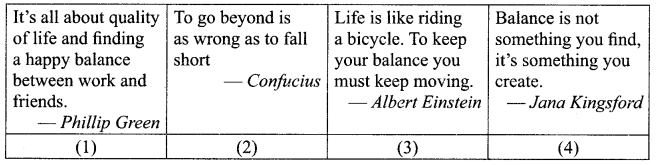
CBSE Sample Papers for Class 10 English Set 3 with Solutions 1
(a) Option (1)
(b) Option (2)
(c) Option (3)
(d) Option (4)
Answer:
(d) Option (4)

(iii) Which of the characteristics are apt about the writer in the following context: “I know I have limits and that I’ve reached them, but I’m going to ignore them and see if or how long I can get by with it.”?
1. Negligent
2. Indecisive
3. Spontaneous
4. Reckless
5. Purposeless
6. Patient
(a) 2 and 5
(b) 3 and 6
(c) 1 and 4
(d) 2 and 3
Answer:
(c) 1 and 4

(iv) Which of the following will be the most appropriate title for the passage?
(a) Much too soon
(b) Enough is enough
(c) How much is too much?
(d) Have enough to do?
Answer:
(c) How much is too much?

(v) The phrase “potentially harmful circumstances” refers to circumstances that can:
(a) certainly be dangerous
(b) be fairly dangerous
(c) be possibly dangerous
(d) seldom be dangerous
Answer:
(c) be possibly dangerous

(vi) Select the option that makes the correct use of “unsustainable”, as used in the passage, to fill in the blank space.
(a) In the long run, the ………………. officials followed emergency procedures.
(b) Emergency procedures were ………………… by the officials.
(c) Officials reported an ……………….. set of events during the emergency.
(d) Officials admit that the emergency system is ………………. in the longer run.
Answer:
(d) Officials admit that the emergency system is ………………. in the longer run.

(vii) The author attempts to …………………. the readers through this write-up.
(a) rebuke
(b) question
(c) offer aid to
(d) offer advice to
Answer:
(d) offer advice to

(viii) The author uses colloquial words such as “yeah” and “Woo-hoo!”. Which of the following is NOT a colloquial word?
(a) Hooked
(b) Guy
(c) Stuff
(d) Stress
Answer:
(d) Stress

(ix) What does the author mean when he says, “to get our lives in order”?
(a) To resume our lives
(b) To organise our lives
(c) To rebuild our lives
(d) To control our lives
Answer:
(b) To organise our lives

(x) Choose the option that correctly states the two meanings of ‘outlook’, as used in the passage.
1. A person’s evaluation of life
2. A person’s experiences in life
3. A person’s point of view towards life
4. A person’s regrets in life
5. A person’s general attitude to life
(a) (1) and (4)
(b) (2) and (3)
(c) (3) and (5)
(d) (4) and (5)
Answer:
(c) (3) and (5)

(xi) The author explains the importance of discipline and boundaries in our lives using the example of:
(a)road accidents
(b) traffic rules
(c) lines on the highway
(d) safe driving
Answer:
(c) lines on the highway

(xii) What is the message conveyed in the last paragraph of the passage?
(a) Love what you do
(b) Love yourself to love others
(c) Be the best version of yourself
(d) Be yourself
Answer:
(c) Be the best version of yourself

Question 2.
Read the passage given below: (10 Marks)

The UN’s 2017 International Year tells that sustainable tourism is an important tool for development, most importantly in poor communities and countries. Today sustainability – environmental, social, and economic – is increasingly recognised as the benchmark for all tourism business. As noted by the UN World Tourism Organisation, 57% of international tourist arrivals will be in emerging economies, by 2030. The various ‘Tourism Terms’ are defined as follows:

Category

Definition

EcotourismResponsible travel to natural areas that conserves the environment, socially and economically sustains the well-being of local people, and creates knowledge and understanding through interpretation and education of all involved (including staff, travellers, and community residents).
Ethical Tourism


Tourism in a destination where ethical issues are the key driver, e.g. social injustice, human rights, animal welfare, or the environment.
GeotourismTourism that sustains or enhances the geographical character of a place – its environment, heritage, aesthetics, culture, and well-being of its residents.
Pro-Poor TourismTourism that results in increased net benefit for the poor people in a destination.
Responsible TourismTourism that maximises the benefits to local communities, minimises negative social or environmental impacts, and helps local people conserve fragile cultures and habitats or species.
Sustainable TourismTourism that leads to the management of all resources in such a way that economic, social, and aesthetic needs can be fulfilled while maintaining cultural integrity, essential ecological processes, biological diversity, and life-support systems.

Based on data collected by a survey by Travel Bureau, the following market profile of an ecotourist was constructed:

Age:
35 – 54 years old, although age varied with activity and other factors such as cost.

Gender:
50% female and 50% male, although clear differences based on activity were found.

Education:
82% were college graduates, a shift in interest in ecotourism from those who have high levels of education to those with less education was also found, indicating an expansion into mainstream markets.

Household composition:
No major differences were found between general tourists and experienced ecotourists.**

Party composition:
A majority (60%) of experienced ecotourism respondents stated they prefer to travel as a couple, with only 15% stating they preferred to travel with their families, and 13% preferring to travel alone. (** experienced ecotourists = Tourists that had been on at least one “ecotourism” oriented trip.)

Trip duration:
The largest group of experienced ecotourists- (50%) preferred trips lasting 8-14 days.

Expenditure:
Experienced ecotourists were willing to spend more than general tourists, the largest group (26%).

Important elements of trip:
Experienced ecotourists top three responses were: (a) wilderness setting, (b) wildlife viewing, (c) hiking/trekking.

Motivations for taking next trip:
Experienced ecotourists top two responses were (a) enjoy scenery/nature, (b) new experiences/places.

On the basis of your understanding of the passage, answer any ten questions from the twelve that follow. (10 x 1 = 10)

(i) In the line “ ………………… recognised as the benchmark”, the word “benchmark” does not refer to:
(a) a basis for something
(b) the criterion required
(c) the ability to launch something new
(d) a standard point of reference
Answer:
(c) the ability to launch something new

(ii) The World Tourism Organisation of the UN, in an observation, shared that:
(a) emerging economies of the world will gain 57% of their annual profits from International tourists
(b) countries with upcoming economies shall see maximum tourist footfall from all over the world in the next decade
(c) a large number of international tourists in 2030 will be from developing countries
(d) barely any tourist in the next decade shall travel from an economically strong nation to a weak one
Answer:
(b) countries with upcoming economies shall see maximum tourist footfall from all over the world in the next decade

(iii) One of the elements that is important to ecotourists on trip is:
(a) wild and untouched surroundings
(b) cultural exchange
(c) car and bus rides
(d) fully furnished flats
Answer:
(a) wild and untouched surroundings

(iv) Choose the option that lists the correct answers for the following:
1. Asha Mathew, an NRI, loves animals and wishes to travel to places that safeguard their rights and inculcate awareness of their rights. What kind of tourist is she?
2. Gurdeep Singh from UK is an environmental scientist and has always chosen to travel to places that are examples of a symbiotic relationship between man and nature. What kind of tourist is he?
(a) (1) is an ecotourist and (2) is a geotourist
(b) (1) is an ethical tourist and (2) is a geotourist
(c) (1) is a sustainable tourist and (2) is a pro-poor tourist
(d) (1) is a geotourist and (2) is a responsible tourist
Answer:
(b) (1) is an ethical tourist and (2) is a geotourist

(v) Based on your understanding of the passage, choose the option that lists the inherent qualities of geotourism.
1. Showcases adventure sports
2. promotes landscape appreciations
3. promises luxurious travel
4. includes being environmentally responsible
5. believes in commercialising forests
6. f initiates donations for the underprivileged
(a) 1 and 2
(b) 5 and 6
(c) 2 and 4
(d) 3 and 5
Answer:
(c) 2 and 4

(vi) In the market profile of an ecotourist, the information on gender indicates that:
(a) female ecotourists were more than the male ecotourists
(b) the activity preferences were varied in females and males
(c) the choice of things to do on a trip were quite similar for both the genders
(d) male ecotourists were frequent travellers
Answer:
(b) the activity preferences were varied in females and males

(vii) The education aspect in the market profile of the ecotourist revealed that:
(a) mainstream market trends were popular with undergraduates
(b) ecotourists were only those who had basic education
(c) mainstream markets were popular tourist destinations for educated ecotourists
(d) ecotourism was no more limited to the small group of highly educated travellers
Answer:
(d) ecotourism was no more limited to the small group of highly educated travellers

(viii) According to the survey conducted by the Travel Bureau, the total percentage of experienced ecotourists who DID NOT prefer to travel alone was:
(a) 60%
(b) 75%
(c) 15%
(d) 13%
Answer:
(b) 75%

(ix) According to the survey, one of the most powerful driving forces leading experienced ecotourism to invest in new trips was:
(a) setting up work stations in new places
(b) the chance to go camping in the wild
(c) competing with other ecotourists as frequent travellers
(d) the opportunity to travel to new places
Answer:
(d) the opportunity to travel to new places

(x) Choose the option that lists statement that is NOT TRUE.
(a) Economically backward countries will benefit from sustainable tourism.
(b) The tourism business currently recognises sustainability as an important factor.
(c) Emerging economies will receive negligible international tourists in the near future.
(d) The sustainability factor in tourism is a significant means for development.
Answer:
(c) Emerging economies will receive negligible international tourists in the near future.

(xi) The survey clearly showed that the age range of ecotourists:
(a) remained the same for the choice of tourist attractions to visit
(b) changed with the monetary requirements for the trip
(c) fluctuated due to male-female ratio
(d) was constant across various features of the trip
Answer:
(b) changed with the monetary requirements for the trip

(xii) Who isn’t an experienced ecotourist?
(a) The person who has travelled as an ecotourist once earlier.
(b) The person who is yet to travel even once as an ecotourist.
(c) The person who is a regular ecotourism enthusiast and traveller.
(d) The person who is not regularly travelling on ecotourism trips.
Answer:
(b) The person who is yet to travel even once as an ecotourist.

Literature (10 Marks)

Question 3.
Read the extracts given below and attempt any one by answering the questions that follow. (5 x 1 = 5)

A. Suddenly she was startled by a voice. “Listen, child,” said the voice, “you shouldn’t stand like that. Sit down.”
Sitting down, she looked to see who had spoken. It was an elderly man who had honestly been concerned for her, but she was annoyed by his attention.
“There’s nobody here who’s a child,” she said haughtily. “I’ve paid my thirty paise like everyone else.”
The conductor chimed in. “Oh, sir, but this is a very grown-up madam. Do you think a mere girl could pay her own fare and travel to the city all alone?”
Valli shot an angry glance at the conductor and said, “I am not a madam. Please remember that. And you’ve not yet given me my ticket.”
“I’ll remember,” the conductor said, mimicking her tone. Everyone laughed, and gradually Valli too joined in the laughter.

(i)How did Valli feel when the elderly man expressed concern that she was standing?
(a) Rather shocked
(b) Somewhat happy
(c) Fairly displeased
(d) Quite embarrassed
Answer:
(c) Fairly displeased

(ii) Choose the option that lists the set of statements that are NOT TRUE according to the given extract.
1. Valli was travelling without a guardian.
2. The conductor was bullying Valli.
3. Valli was nervous in her interactions.
4. Valli was a child passenger.
5. Valli followed the elderly man’s advice.
6. Valli’s response to the elderly man was respectful.
7. It took Valli some time to participate in the jocular conversations.
(a) 2, 3 and 4
(b) 5, 6 and 7
(c) 3, 5 and 7
(d) 2, 3 and 6
Answer:
(d) 2, 3 and 6

(iii) Pick the option that correctly classifies fact/s (F) and opinion/s (O) of the students below.
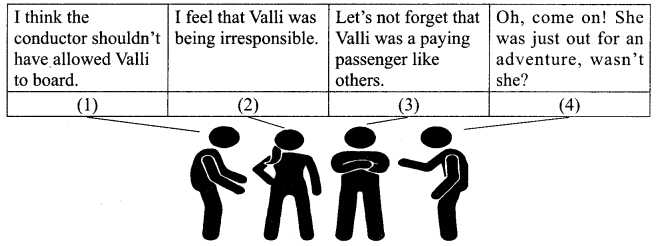
CBSE Sample Papers for Class 10 English Set 3 with Solutions 2
(a) F – 1, 2 and 0-3,4
(b) F – 2, 3,4 and 0-1
(c) F-2, 4 and 0-1, 3
(d) F – 3 and O – 1, 2, 4
Answer:
(d) F – 3 and O – 1, 2, 4

(iv) Which word does ‘chimed in’ NOT correspond to?
(a) Intervened
(b) Interrupted
(c) Intersected
(d) Interjected
Answer:
(c) Intersected

(v) Choose the characteristic displayed by the conductor when he addressed Valli and declared that she couldn’t be ‘a mere girl’.
(a) Encouragement
(b) Indulgence
(c) Embarrassment
(d) Authority
Answer:
(b) Indulgence

B. The baker or bread-seller of those days had a peculiar dress known as the kabai. It was a single piece long frock reaching down to the knees. In our childhood we saw bakers wearing shirt and trousers which were shorter than full-length ones and longer than half pants. Even today, anyone who wears a half pant which reaches just below the knees invites the comment that he is dressed like a pader

(i) Choose the answer that lists the correct option about the recording of the baker’s monthly accounts.
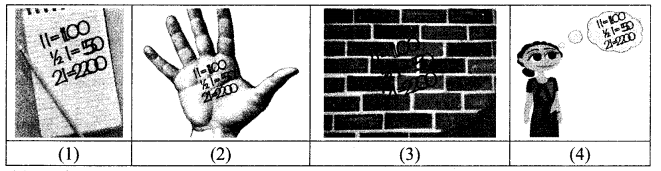
CBSE Sample Papers for Class 10 English Set 3 with Solutions 3
(a) Option (1)
(b) Option (2)
(c) Option (3)
(d) Option (4)
Answer:
(c) Option (3)

(ii) When the writer says, ‘Baking was indeed a profitable profession in the old days.’, he means that:
(a) baking isn’t as popular in Goa currently
(b) bakers have chosen to adopt other professions
(c) baking, as a job, isn’t as gainful as it used to be
(d) bakers’ goods were of a better quality in earlier times
Answer:
(c) baking, as a job, isn’t as gainful as it used to be

(iii) The statement that is TRUE about payment collection, according to the passage is:
(a) The baker received payment on a daily basis.
(b) The baker was paid for his services at the end of the month.
(c) The baker insisted that customers pay before the month-end.
(d) The baker chose to receive payment any day of the month.
Answer:
(b) The baker was paid for his services at the end of the month.

(iv) The kabai was a ‘peculiar’ outfit as it was:
(a) a tight-fitting apparel
(b) too colourful
(c) made of unsuitable materials
(d) a dress-like attire
Answer:
(d) a dress-like attire

(v) The extract uses the phrase, ‘invites (the) comments’. Which of the following expressions is incorrect with respect to the word ‘invites’?
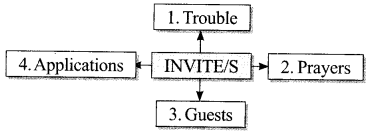
CBSE Sample Papers for Class 10 English Set 3 with Solutions 4
(a) Option (1)
(b) Option (2)
(c) Option (3)
(d) Option (4)
Answer:
(b) Option (2)

Question 4.
Read the extracts given below and attempt any one by answering the questions that follow. (5 × 1 = 5)

A. But he’s locked in a concrete cell,
His strength behind bars,
Stalking the length of his cage,
Ignoring visitors.
He hears the last voice at night,
The patrolling cars,
And stares with his brilliant eyes At the brilliant stars

(i)
The fact that the tiger is ‘stalking the length of his cage’ tells us that he is:
(a) restless
(b) reckless
(c) resilient
(d) reverent
Answer:
(a) restless

(ii) What is the rhyme scheme of the given stanzas?
(a) abcb; abcb
(b) abcb; abed
(c) abed; abed
(d) abed; abeb
Answer:
(d) abed; abeb

(iii) These stanzas bring out the contrast between:
(a) zoos and cities
(b) strength and weakness
(c) freedom and captivity
(d) visitors and patrolling cars
Answer:
(c) freedom and captivity

(iv) What is the caged tiger NOT likely to say to the visitors?
(a) “Stop staring”
(b) “Set me free”
(c) “Join me”
(d) “Go away”
Answer:
(c) “Join me”

(v) The tiger’s ‘brilliant eyes’ reveal that he:
(a) hopes to be free and in the wild, someday
(b) is looked after well and is nourished and healthy
(c) enjoys staring at the bright stars each night
(d) is well-rested and hence, wide-awake
Answer:
(a) hopes to be free and in the wild, someday

B. I saw it go
Merrily bouncing, down the street,and then
Merrily over – there it is in the water!
No use to say ‘O there are other balls’:
An ultimate shaking grief fixes the boy
As he stands rigid, trembling, staring down
All his young days into the harbour where
His ball went

(i) The poet uses the ball as a symbol of the boy’s:
(a) sense of adventure
(b) carefree childhood days
(c) ability to bounce back
(d) extended family
Answer:
(b) carefree childhood days

(ii) The poet feels that there is no point consoling the boy as:
(a) it would give him false hope
(b) he might demand for a new ball
(c) it might distress him further
(d) whatever he has lost is irretrievable
Answer:
(d) whatever he has lost is irretrievable

(iii) The word ‘harbour’ DOES NOT have a meaning similar to:
(a) port
(b) pier
(c) dock
(d) cargo
Answer:
(d) cargo

(iv) ‘Merrily over – there it is in the water! ’ The dash here is meant to convey:
(a) some familiar experience
(b) a feeling of excitement
(c) a sense of unexpected interruption
(d) some thoughtful moments
Answer:
(c) a sense of unexpected interruption

(v) The word that DOES NOT indicate a physical manifestation of sorrow in the boy, is:
(a) worthless
(b) shaking
(c) trembling
(d) rigid
Answer:
(a) worthless

Grammar (10 Marks)

Question 5.
Choose the correct options to fill in the blanks to complete the note about the Wangala Festival of Meghalaya. (3 × 1=3)

The Wangala (i) ……………. festival for the Garo in Meghalaya, Assam and Nagaland. It is a
postharvest festival (ii) ………………… the end of the agricultural year. It is popularly known as ‘The Hundred Drums’ festival. During the signature dance, the leading warrior (iii) ……………….. with synchronised dance steps and specific hand-head movements.
(i) (a) is important
(b) are on important
(c) was the important
(d) is on important
Answer:
(d) is on important

(ii) (a) being celebrated for marking
(b) celebrated to mark
(c) celebrated to marking
(d) being celebrated mark
Answer:
(b) celebrated to mark

(iii) (a) leads the youngsters
(b) is lead the youngsters
(c) was leading the youngsters
(d) had leads the youngsters
Answer:
(a) leads the youngsters

Question 6.
Choose the correct options to fill in the blanks to complete Venu’s narration. (3 × 1 =3)
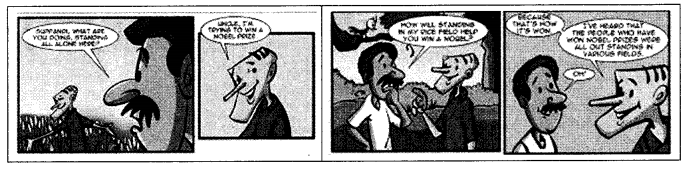
CBSE Sample Papers for Class 10 English Set 3 with Solutions 5
I saw Supanddi standing in the field. When I (i) ………………. doing there, he (ii) ……………. he
was trying to win a Nobel prize. I was confused and enquired how standing in the rice field
would help him do so. He stunned me by saying that he (iii) ……………….. won Nobel prizes
had all been outstanding in their fields!

(i) (a) exclaimed what he was
(b) told him what he was
(c) asked him what he was
(d) says to him about what
Answer:
(c) asked him what he was

(ii) (a) ordered that
(b) refused that
(c) questioned that
(d) replied that
Answer:
(d) replied that

(iii) (a) has heard that people who has
(b) was hearing that people who were
(c) had heard that people who had
(d) did hear that people who had
Answer:
(c) had heard that people who had

Question 7.
Fill in the blanks by choosing the correct options for any four of the six sentences given below. (4 × 1 = 4)

(i) You ……………. consult the Thesaurus if you need groups of synonyms for those words.
(a) had to
(b) need to
(c) used to
(d) might
Answer:
(d) might

(ii) Everybody …………………. keen to participate in the upcoming nukkad natak.
(a) are
(b) has
(c) is
(d) were
Answer:
(c) is

(iii) The good news is that ………………. volunteers dropped out this month than the last two.
(a) fewer
(b) less
(c) few
(d) a little
Answer:
(a) fewer

(iv) It was ………………. historic day for the organisation when ………………… honour was bestowed upon its employees.
(a) a; an
(b) an; the
(c) the; a
(d) an; a
Answer:
(a) a; an

(v) At this time tomorrow we ………………….. our project details to ma’am.
(a) are presenting
(b) shall be presenting
(c) have been presenting
(d) will have presenting
Answer:
(b) shall be presenting

(vi) The Komodo dragon ……………….. follow its prey till it eventually dies due to its venomous bite.
(a) must
(b) will
(c) could
(d) may
Answer:
(b) will

Part-B – Subjective Questions (40 Marks)

Writing (10 Marks)

Question 8.
Attempt any one of the following in 100-120 words. (5 Marks)

A. You are Tabassum/Tarun, a resident of Satya Nagar Colony, Bhubaneshwar, Orissa. You have noticed that some residents of your colony are repeatedly flouting quarantine rules laid out during the outbreak of the COVID-19 pandemic.
Write a letter to the SHO of the local Police Station, drawing attention towards the same. Explain how such acts impact the health of the community and request immediate intervention and strict action.
Answer:
(3 marks for content
2 marks for expression (1 mark – grammatical accuracy, appropriate words and spellings + 1 mark – cohesion via connecting ideas, logical progression & coherence through relevance of ideas.)
Suggestive Points:
Complaint about some residents not following the quarantine rules

  • There is an evident disregard to the rules of social distancing
  • people roaming without masks in the colony
  • no staying indoors
  • The Resident Welfare Association is not taking any steps to prevent such behaviour
  • Any other relevant point

Impact

  • Putting everyone’s life at risk through their casual behaviour
  • Aggravates mental stress
  • Any other relevant point

Appeal

  • Request to look into the matter at the earliest
  • Take immediate action
  • Any other relevant point

B.You are Vaijanthi/Vijay from Prakasham Nagar, Secunderabad, Andhra Pradesh. Write a letter to Book Haven Store, requesting home delivery of the books, stationery and art materials you had ordered telephonically. Share the reason for being unable to pick up the goods in person. Confirm your address details and a convenient time slot.
Answer:
Reference:
Reference to order placed telephonically for pick-up in person
Inform:

  • Inform about inability to pick in person, provide reason/s and forward request to deliver the goods at home
  • Give reason – Illness, family emergency, professional commitments, any other relevant reason

Request
Details
Present details of suitable time slot, conformation of address and phone number

Question 9.
Attempt any one of the following in 100-120 words. (5 Marks)

A. The chart below displays data about the number of digital devices purchased in Rishunagar across the years 2015-2019. Write a paragraph analyzing the given data.
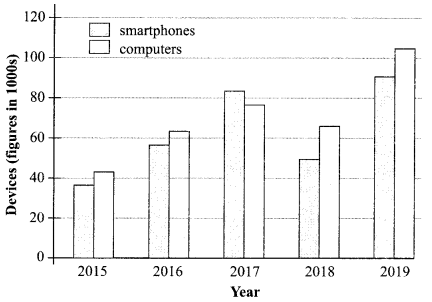
CBSE Sample Papers for Class 10 English Set 3 with Solutions 6
Answer:
[3 marks for content
2 marks for expression (1 mark – grammatical accuracy, appropriate words and spellings + 1 mark – cohesion via connecting ideas, logical progression & coherence through relevance of ideas and style)]
Competency applied for overall expression:

  • single paragraph
  • use of appropriate functional language required to show trend progression and comparison (more/less/increase/decrease/stable etc.) to achieve cohesion

Introductory sentence:

  • Paraphrase Q. information Identification of main trends
  • at least 4 clearly identified trends
    Note – focusing and extending one particular trend would be considered as one trend only.

Concluding line:
stating main inference from the data provided

B. Read the following excerpt from an article that appeared in the magazine section of a local daily:
The ban on single-use plastic is impractical. The purpose of articles like bags and packaging is ultimately to make human life easier. Plastic articles do this well, so they shouldn’t be banned. Write a paragraph to analyse the given argument.
You could think about what alternative explanations might weaken the given conclusion and include rationale / evidence that would strengthen / counter the given argument.
Answer:
Competency applied for overall expression:

  • single paragraph
  • use of appropriate functional language required to show comparison/contrast/emphasis etc. to achieve cohesion

Introductory sentence:
stating the given assumption in the question as the introduction

Arguments rationalizing against/in favour of assumption:
at least 2 clearly listed arguments countering/favouring the premise
Note – focusing and extending one particular trend would be considered as one trend only.

Concluding line:
reiterating main inference/position

Literature (30 Marks)

Question 10.
Answer any two questions in 20-30 words each, from (A) and (B) respectively. (4 × 2 = 8)
A. (any two) (2 × 2 = 4)
(i) How did Peggy justify her cruel behavior towards Wanda?
Answer:
1 mark for content
1 mark for expression (coherence and cohesion + accuracy)

  • she felt Wanda lied about her dresses – Wanda wasn’t ordinary as she had a funny name
  • she believed that she was just having fun and didn’t mean harm

(ii) Describe how Custard’s reaction was different from that of others, on seeing the pirate?
Answer:
Custard was always teased as being the cowardly one, by all others – When the pirate arrived, others ran away to hide – Custard was the only one who stood up to fight with him/who attacked him.

(iii) Who, according to Nelson Mandela, is a courageous man?
Answer:
not someone who doesn’t experience fear – someone who doesn’t give in to it – one who wins over fear

B. (any two) (2 × 2 = 4)
(i) Why did Oliver Lutkin’s mother laugh as she chased him and Bill away?
Answer:
she knew her son Lutkins was pretending to be Bill – the narrator’s predicament amused her

(ii) Why was it important for Mrs Pumphrey to be a little cruel in order to be kind towards Tricki?
Answer:
she was overfeeding Tricki; being overindulgent – she needed to cut down Tricki’s food intake to help him regain his health (be cruel to be kind)

(iii) List any one characteristic of Bholi’s teacher with reference to her first day at school. Give a reason for your answer.
Answer:
kind/encouraging/empathetic/assuring/any other relevant trait from the text – Reason from text required

Question 11.
Answer any two questions in 40-50 words each, from (A) and (B) respectively. (4 × 3 = 12)

A. (any two) (2 × 3 = 6)

(i) Annie writes that it was fortunate that Mr Keesing took the joke the right way. Why does she feel so?
Answer:
2 marks for content
1 mark for expression (coherence and cohesion + accuracy)
poem referred to the father swan who bit his three ducks because they quacked too much; allusion to Mr Keesing – Poem written to turn the joke around on Mr Keesing; metaphorically convey the value of talking – fortunate that Mr Keesing got the joke, else, the disciplinary action could have been severe.

(ii) The use of symbolism in the poem ‘Fire and Ice’ conveys the poet’s message effectively.
Expand with reference to the poem.
Answer:
poem discusses the way the world can end – Fire stands for greed/lust/human desire; Ice stands for hatred/coldness/human indifference; – world can end with either greed or indifference

(iii) Justify the poet’s allusion to Rapunzel in ‘Amanda’.
Answer:

  • it is justified as Rapunzel lived with a witch who would constantly keep a check on her and had several rules to be followed.
  • Amanda too, feels caged by the impositions – Amanda desires peace in isolation like Rapunzel had in her tower; clarifying she will not let her hair down for anyone

B. (any two) (2 × 3 = 6)

(i) Griffin’s brilliance as a man of science fades before his darker traits. Comment.
Answer:
Brilliant scientist (give example) – he was a lawless person, he was disliked by most people, was quick tempered, burnt the house of the landlord to take a revenge on him, stole money at priest’s house, (any other trait that reveals his darker side) – undoubtedly brilliant but his brilliance eclipsed by his negative traits.

(ii) Why do you think Mr Weiherer was pleased that Richard Ebright not only put in the nightly research hours towards butterflies, but also his other interests?
Answer:
Mr Weiherer was pleased that Ebright balanced academics as well as recreational pursuits (hobbies etc.); – Asa teacher, he wanted Ebright’s growth as a well-rounded personality.

(iii) What made Mme Forestier exclaim in astonishment, when she saw Matilda, years after the Minister’s ball?
Answer:
The change in Matilda’s physical appearance (comparison from what she was at the time of the minister’s ball, to current)

Question 12.
Answer any one of the following in 100-120 words. (5 Marks)

A. Natalya and Ivan argued about the ownership of Oxen Meadows and the superiority of their respective dogs in the play, The Proposal.
Imagine yourself as the playwright of the play. Based on your understanding of the personality traits of Natalya and Ivan, write a dialogue based on an imaginary event, showcasing another argument between them.
Answer:
[3 marks for content
2 marks for expression (1 mark – grammatical accuracy, appropriate words and spellings + 1 mark – cohesion via connecting ideas, logical progression & coherence through relevance of ideas.)]

Extrapolating via dialogue writing:
All relevant responses corresponding to the competencies listed for content and expression will be accepted.
Content:

  • Response (dialogues) need to be creatively composed to match the personality of the two characters from the play.
  • Language included, must correspond to that of an argument, and show an understanding of the common expressions/exclamations attributed to the characters in the play.

NOTE – Marks to be allotted for creation. No marks to be deducted for lack of appropriacy in the form or structure involved in a writing task. The response is to be treated as a literary creation.

Expression

  • Logical progression in developing the conversation – cohesion
  • Response relevance for overall sense according to the situation chosen – coherence
  • Accuracy in use of grammatical structures, vocabulary and spellings

B. Read the extracts given below and comment on the difference in the nature of help both the characters, of these two stories, received.

(i) Suddenly I came out of the clouds and saw two straight lines of lights in front of me. It was a runway! An airport! I was safe! I turned to look for my friend in the black aeroplane but the sky was empty. [The Black Aeroplane]

(ii) All through the night Lencho thought only of his one hope: the help of God.. .The following Sunday, at daybreak he began to write a letter.. .It was nothing less than a letter to God… The following Sunday Lencho came a bit earlier than usual to ask if there was a letter for him…. Lencho showed not the slightest surprise on seeing the money, such was his confidence. [A Letter to God]
Answer:

  1. Both need help
  2. In The Black Aeroplane, he is helped by a stranger in a black aeroplane in the storm, without lights
  3. steered through the dark clouds; was told there was no other aeroplane in the air other than his
  4. wasn’t clear who helped him
  5. open to interpretation
  6. help is not asked for but he receives it
  7. is thankful
  8. In A Letter to God – different nature of aid
  9. Lencho writes a letter to God asking for money; his conviction in God touches the postmaster
  10. postmaster raises money and sends it to him
  11. he asks for help
  12. the source of his aid is clearly revealed
  13. not satisfied

Question 13.
Answer any one of the following in 100-120 words. (5 Marks)

A. Hari Singh says- “He knew it but neither his lips nor his eyes showed anything.”
Anil successfully addressed the situation by not addressing it at all. Elaborate based on your reading of The Thief’s Story.
Answer:
3 marks for content
2 marks for expression (1 mark – grammatical accuracy, appropriate words and spellings + 1 mark – cohesion via connecting ideas, logical progression & coherence through relevance of ideas.)

  • despite knowing that the money had been taken (dampness of notes) Anil chose to remain quiet about the matter
  • pretended that all was normal – realised that Hari Singh’s honesty had prevailed over his temptation
  • wanted to reward him/encourage him
  • discussing the theft would have been counterproductive

B. Read the following quote by an American author, E. E. Hale.
“I am only one but, I am one. I cannot do everything but I can do something. And I will not let what I cannot do interfere with what I do.”
Bholi’s evolution from a ‘dumb cow’ to a ‘masterpiece’ supports the given quote. Justify.
Answer:
The evolution process supported by examples from the text:

  • dumb cow – people’s perception of her lack of sense, stammering which kept her quiet and submissive demeanour, most of the times
  • going to school – guidance of the teacher and education, overcame stammering, instilled confidence and a sense of self-esteem
  • did not succumb to the greedy demands of the prospective groom and spoke out

Conclusion:
This journey of Bholi’s growth clearly showcases the idea of being an individual and not being exploited by people or circumstances. Instead, evolves to being a person being proactive and contributing to the wellbeing of others around (which is exactly what she decides to do).
CBSE Sample Papers for Class 10 Maths Basic Set 4 for Practice

Students can access the CBSE Sample Papers for Class 10 Maths Basic with Solutions and marking scheme Set 4 will help students in understanding the difficulty level of the exam.

CBSE Sample Papers for Class 10 Maths Basic Set 4 for Practice

Time: 3 Hours
Maximum Marks: 80

General Instructions:

1. This question paper contains two parts, A and B.
2. Both Part A and Part B have internal choices.

Part-A:
1. It consists of two sections, I and II.
2. Section I has 16 questions of 1 mark each. Internal choice is provided in 5 questions.
3. Section II has 4 questions on case study. Each case study has 5 case-based sub-parts. An examinee is to attempt any 4 out of 5 sub-parts.

Part-B:
1. It consists of three sections III, IV and V.
2. In section III, Question Nos. 21 to 26 are Very Short Answer Type questions of 2 marks each.
3. In section IV, Question Nos. 27 to 33 are Short Answer Type questions of 3 marks each.
4. In section V, Question Nos. 34 to 36 are Long Answer Type questions of 5 marks each.
5. Internal choice is provided in 2 questions of 2 marks, 2 questions of 3 marks and 1 question of 5 marks.

Part – A
Section-I

Section I has 16 questions of 1 mark each. Internal choice is provided in 5 questions.

Question 1.
Find the value of k for which the system of equations kx + 4y = k – 4, 16x + ky = k have infinitely many solutions.
Solution :
K = 2

Question 2.
Find the perimeter of a triangle with vertices (0, 4), (0, 0) and (3, 0)
Solution :
8

Question 3.
Evaluate: sin 60° cos 30° + sin 30° cos 60°.
OR
Evaluate: 2 tan2 45° + cos2 30° – sin2 60°
Solution :
1 OR 2

Question 4.
Write the Value of \(\frac{1+\tan ^{2} \theta}{1+\cot ^{2} \theta}\)
Solution :
tan2 θ

Question 5.
Three solid spheres of diameter 6 cm, 8 cm and 10 cm are melted to form a single solid sphere. Find the diameter of the new sphere?
Solution :
12 Cm

Question 6.
In the given AP, find the missing term: 2,……. , 26.
OR
Which term of the A.P.: 121, 117, 113………… is the first negative terms?
Solution :
14 OR 32

Question 7.
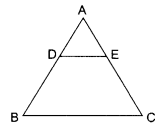
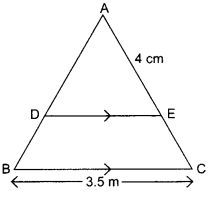
In ΔABC, DE is a line parallel to BC. If AC = 6.4 cm, AE = 4 cm. Find DE
CBSE Sample Papers for Class 10 Maths Basic Set 4 for Practice 1
OR
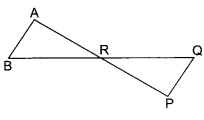
In the given figure, ΔABR ~ ΔPQR. If AR = 45 cm, AP = 72 cm and QR = 48 cm, then find BR
CBSE Sample Papers for Class 10 Maths Basic Set 4 for Practice 2
Solution :
2.115 cm OR  27 cm

Question 8.
Find the largest number which divides 70 and 125, leaving remainders 5 and 8 respectively.
Solution :
13

Question 9.
Find the nature of roots for the quadratic equation 2x2 – √5x +1 = 0. 1
Solution :
Not real

Question 10.
How many tangents can a circle have?
Solution :
Infinitely many

Question 11.
The graph of y =p(x) are given in figures below, for some polynomials p(x). Find the number of zeroes of p(x).
CBSE Sample Papers for Class 10 Maths Basic Set 4 for Practice 3
Solution :
1

Question 12.
If the height of a cone is equal to diameter of its base, find the volume of the cone.
Solution :
\(\frac{2}{3} \pi r^{3}\)

Question 13.
Find the value of x which satifies both the equations 4x -5 =y and 2x-y = 3, when v = -1.
OR
Write whether the following pair of linear equations is consistent or not? x +y = 14, x -y = 4
Solution :
1 OR Consistent

Question 14.
A man goes 12 m due east and then 5 m due north. Find his distance from the start in point.                                              OR
Find the angle of elevation of a point which is at a distance of 30 m from the base of a tower 10√3m high.
Solution :
13 m OR 30°

Question 15.
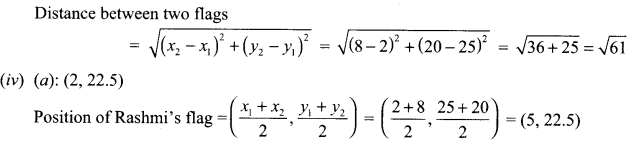
The mid-point of the line joining A (a, 2) and B(3, 6) is (2, b). Write the numerical values of a and b.
Solution :
a = 4 and b = 1

Question 16.
What is called the line drawn from the eye of an observer to the point in the object viewed by the observer?
Solution :
Line of sight

Section-II

Case Study Based-1

Case study-based questions are compulsory. Attempt any 4 sub-parts from each question. Each sub-part carries 1 mark.

Question 17.
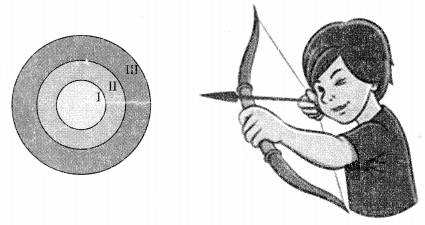
An archery target has three regions formed by three concentric circles as shown in the given figure.
CBSE Sample Papers for Class 10 Maths Basic Set 4 for Practice 4
If diameters of three concentric circles are in the ratio 1 : 2 : 3. Answers (i) to (v).

(i) Area of innermost (I) circle is
(a) πr+ 2
(b) πr
(c) m2
(d) 2 πr
Solution :
(c) m2

(ii) Area of region between first (I) and second (II) circle is
(a) 2πr
(b) πr2
(c) 3πr2
(d) 2πr2
Solution :
(c) 3πr2

(iii) Area of region between second (II) and third (III) circles is
(a) 5πr2
(b) 4πr2
(c) 3πr2
(d) 2π2
Solution :
(a) 5πr2

(iv) Ratio of circumferences of three concentric circles are
(a) 2:1:3
(b) 1:2:3
(c) 3:1:2
(d) 3:2:1
Solution :
(b) 1:2:3

(v) Circumference of outermost concentric circle is
(a) 2πr
(b) 2πr
(c) 4πr
(d) 6πr
Solution :
(d) 6πr

Case Study Based-2

Question 18.
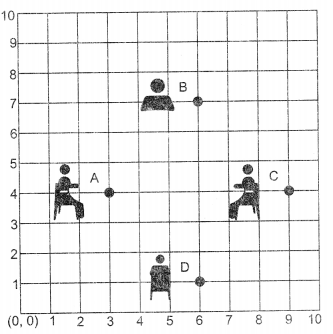
In a classroom, 4 friends are seated at the points A, B, C and D as shown is given fig. Rupa and Rupali walk into the class and after observing for a few minutes Rupa asks Rupali, “Don’t you think ABCD is a square? Rupali disagrees. Now answer (i) to (v) to show Rupa is correct.
CBSE Sample Papers for Class 10 Maths Basic Set 4 for Practice 5
(i) Coordinate of A is …..
(a) (4, 3)
(b) (3,0)
(c) (1,4)
(d) (3,4)
Solution :
(d) (3,4)

(ii) Coordinate of D is…………..
(a) (6, 1)
(b) (1,6)
(c) (2, 6)
(d) (6,2)
Solution :
(a) (6, 1)

(iii) Distance AB is …….
(a) 3+\(\sqrt{2}\)
(b) \(\sqrt{2}\)
(c) 2\(\sqrt{2}\)
(d) 3\(\sqrt{2}\)
Solution :
(d) 3\(\sqrt{2}\)

(iv) Diagonal AC is ………….
(a) 3
(b) 4
(c) 6
(d) 6
Solution :
(c) 6

(v) ABCD is a …………..
(a) rectangle
(b) square
(c) rhombus
(d) trapezium
Solution :
(b) square

Case Study Based-3

Question 19.
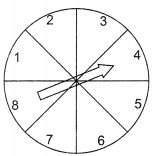
Five friends make up their minds to play a game by using a spinner. They put a spinner down on the ground and set around themselves to play. A spimier contains eight regions, numbered through 8, as shown in the figure, the arrow has an equally likely chance of landing on any of the eight regions. If the arrow lands on a line, the result is not…
CBSE Sample Papers for Class 10 Maths Basic Set 4 for Practice 6

(i) How many possible outcomes are in the sample spaces?
(a) 4
(b) 6
(c) 8
(d) 10
Solution :
(c) 8

(ii) What is the probability that the arrow lands on 4?
(a) \(\frac{1}{4}\)
(b) \(\frac{1}{6}\)
(c) \(\frac{1}{2}\)
(d) \(\frac{1}{8}\)
Solution :
(d) \(\frac{1}{8}\)

(iii) The set of possible outcomes for event A, in which the arrow lands on an even number is …..
(a) 2, 4, 6, 8
(b) 2, 4, 6, 10
(c) 2, 6, 8, 10
(d) 4, 6, 8 10
Solution :
(a) 2, 4, 6, 8

(iv) The probability that the arrow lands on an even number is ………….
(a) \(\frac{1}{4}\)
(b) \(\frac{1}{6}\)
(c)\(\frac{1}{8}\)
(d) \(\frac{1}{2}\)
Solution :
(d) \(\frac{1}{2}\)

(v) The probability that the arrow will point at any factor of 8 is …………
(a) \(\frac{1}{2}\)
(b) \(\frac{1}{4}\)
(c)\(\frac{1}{6}\)
(d) \(\frac{1}{8}\)
Solution :
(a) \(\frac{1}{2}\)

Case Study Based-4

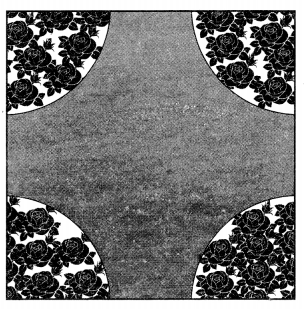
Question 20.
A square park has each side of 100 m. At each comer of the park, there is a flower bed in the form of a quadrant of radius 14 m as shown in given figure. Answer the question from (i) to (v):
CBSE Sample Papers for Class 10 Maths Basic Set 4 for Practice 7

(i) Area of each quadrant is
(a) 145 m2
(b) 154 m2
(c) 415 m2
(d) 514 m2
Solution :
(b) 154 m2

(ii) Area of 4 quadrants is …………
(a) 616 m2
(b) 166 m2
(c) 661 m2
(d) 510m2
Solution :
(a) 616 m2

(iii) Area of park with bed roses is …………
(a) 10,000 m2
(b) 1000 m2
(c) 100 m2
(d) 10 m2
Solution :
(a) 10,000 m2

(iv) Area of park without bed roses is …………
(a) 9834 m2
(b) 9384 m2
(c) 9483 m2
(d) 9348 m2
Solution :
(b) 9384 m2

(v) Angle of a quadrant is equal to …………
(a) 70°
(b) 80°
(c) 90°
(d) 45°
Solution :
(c) 90°

Part-B
Section-III

All questions are compulsory. In case of internal choices, attempt anyone.

Question 21.
Explain why 7 × 11×13 × 15 + 15 is a composite number.
OR
Prove that \(\frac{1}{2-\sqrt{5}}\) is an irrational number.
Solution :
It has more than two factors so it is composite

Question 22.
Find value of P for which the product of roots of the quadratic equation Px2 + 6x + 4P = 0 is equal to the sum of the roots.
Solution :
\(P=\frac{-3}{2}\)

Question 23.
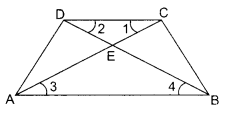
In the given figure,∠1 = ∠3, ∠2 = ∠4, DE = 4 units, CE = x + 1, AE = 2x + 4 and BE = 4x – 2. Find x.
CBSE Sample Papers for Class 10 Maths Basic Set 4 for Practice 8
Solution :
x = 3 units

Question 24.
Find a cubic polynomial with the sum, sum of the products of its zeroes taken two at a time,and product of its zeroes at 5, -6, and -20 respectively.
Solution :
x3 – 5x2 – 6x

Question 25.
If tan A = √2 -1, show that  \(\frac{\tan A}{1+\tan ^{2} A}=\frac{\sqrt{2}}{4}\)
OR
\(\text { If } \sec \theta=\frac{5}{4}, \text { verify that } \frac{\tan \theta}{1+\tan ^{2} \theta}=\frac{\sin \theta}{\sec \theta}\)

Question 26.
Find the median of the following frequency distribution:

C.I0-1010-2020-30           30-4040-5050-60
f5310642

Solution :
27

Section-IV

Question 27.
From a point T outside a circle of centre O, tangents TP and TQ are drawn to the circle. Prove that OT is the right bisector of the line segment PQ.

Question 28.
Show graphically that the system of equations x + 2y = 5; 3x + 6y = 15 have infinitely many solutions.

Question 29.
Prove that 3 √3 is an irrational number.

Question 30.
From the top of a tower 50 m high, the angle of depression of the top of a pole is 45° and from the foot of the pole, the angle of elevation of the top of the tower is 60°. Find the height of the pole if the pole and tower stand on the same plane.
OR
Two ships are there in the sea on either side of a lighthouse in such a way that the ships and the lighthouse are in the same straight line. The angles of depression of two ships as observed from the top of the lighthouse are 60° and 45°. If the height of the lighthouse is 200 m, find the distance between the two ships.
Solution :
21.16m OR 315.33 m

Question 31.
If \(\tan \theta=\frac{4}{3}\) ,find the value of  \(\frac{3 \sin \theta+2 \cos \theta}{3 \sin \theta-2 \cos \theta}\)
Solution :
3

Question 32.
If x = \(\frac{2}{3}\) and x = -3 are roots of the quadratic equations ax2 + 7x + b = 0, find the values of a and b.
Solution :
a = 3,b = – 3

Question 33.
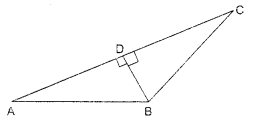
In the given figure, ABC is a triangle and BD ⊥ AC. Prove that AB2 + CD2 = AD2 + BC2.
CBSE Sample Papers for Class 10 Maths Basic Set 4 for Practice 9
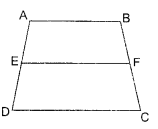
ABCD is a trapezium with AB || DC. E and F are points on non¬parallel sides AD and BC respectively such that EF is parallel to AB (see figure).Show that \(\frac{\mathrm{AE}}{\mathrm{ED}}=\frac{\mathrm{BF}}{\mathrm{FC}}\)
CBSE Sample Papers for Class 10 Maths Basic Set 4 for Practice 10

Section-V

Question 34.
The first and the last term of an AP are 8 and 350 respectively. If its common difference is 9, how many terms are there and what is their sum?
OR
In an AP the first term is 8 and nth term is 33 and sum to first n terms is 123. Find n and d, the common difference.
Solution :
n= 39, Sn =6981
5 n OR n = 6, d = 5 36

Question 35.
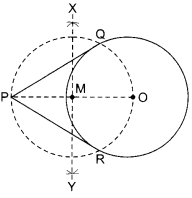
Draw a circle of radius 4 cm. From a point P, 9 cm away from the centre of the circle, draw two tangents to the circle. Also, measure the lengths of the tangents.

Question 36.
Take mean of the following distribution is 50. Find the value of x

Class interval0-2020-4040-6060-8080-100
Frequency343x – 464482(x-1)

Solution :
x = 20

Current Electricity Class 12 Important Extra Questions Physics Chapter 3

Here we are providing Class 12 Physics Important Extra Questions and Answers Chapter 3 Current Electricity. Important Questions for Class 12 Physics with Answers are the best resource for students which helps in Class 12 board exams.

Class 12 Physics Chapter 3 Important Extra Questions Current Electricity

Current Electricity Important Extra Questions Very Short Answer Type

Question 1.
A wire or resistivity ρ is stretched to double its length. What will be its new resistivity?
Answer:
The resistivity remains the same as it does not depend upon the length of the wire.

Question 2.
What is the effect of temperature on the relaxation time of electrons in a metal?
Answer:
The relaxation time of electrons decreases with the rise in temperature of the metal.

Question 3.
Which physical quantity does the voltage versus current graph for a metallic conductor depict? Give its SI unit.
Answer:
It represents resistance. It is measured in ohm.

Question 4.
Define drift velocity of electrons.
Answer:
The mean velocity acquired by electrons in a conductor when an external electric field is applied to it.

Question 5.
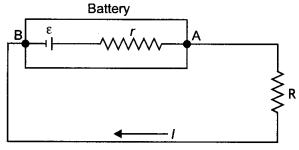
A resistance R is connected across a cell of emf ε and internal resistance r. A potentiometer now measures the potential difference between the terminals, of the cell as V., Write the expression for ‘r’ in terms of ε, V and R. (CBSE Delhi 2011)
Answer:
The required relation is r = \(\left(\frac{\varepsilon}{V}-1\right)\)R

Question 6.
How is the drift velocity in a conductor affected by the rise in temperature? (CBSE Delhi 2019)
Answer:
It decreases.

Question 7.
Two students A and B were asked to pick a resistor of 15 kΩ from a collection of carbon resistors. A picked a resistor with bands of colours brown, green, orange, while B chose a resistor with bands of black, green, red. Who picked the correct resistor? (CBSE AI 2013C)
Answer:
A

Question 8.
Define the term ‘Mobility’ of charge carriers in a conductor. Write its S.l. unit. (CBSE Delhi 2014, AI 2015)
Answer:
Mobility of charge carriers in a conductor is defined as the magnitude of their drift velocity per unit applied electric field. Its SI unit is m2 V-1 s-1.

Question 9.
How does the mobility of electrons in a conductor change, if the potential difference applied across the conductor is doubled, keeping the length and temperature of the conductor constant? (CBSE Delhi 2019)
Answer:
No change.

Question 10.
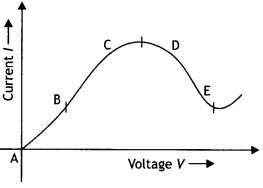
Graph showing the variation of current versus voltage for a material GaAs is shown in the figure. Identify the region of
(i) negative resistance (ii) where Ohm’s
Class 12 Physics Important Questions Chapter 3 Current Electricity 1
Answer:
(i) DE (ii) AB

Question 11.
Define mobility of a charge carrier. What is its relation with relaxation time? (CBSEAI 2016)
Answer:
It is defined as the drift velocity per unit electric field. The relation is μ = \(\frac{-e \tau}{m}\).

Question 12.
Nichrome and copper wires of the same length and same radius are connected in series. Current l is passed through them. Which wire gets heated up more? Justify your answer. (CBSEAI 2017)
Answer:
Nichrome, as it has more resistivity.

Question 13.
When a potential difference is applied across the ends of a conductor, how is the drift velocity of the electrons related to the relaxation time? (CBSE Delhi 2019)
Answer:
Drift velocity is directly proportional to the relaxation time.
Vd = \(\frac{e E}{m} \tau\)

Question 14.
Two bulbs are marked 60 W, 220 V and 100 W, 220 V. These are connected in parallel to 220 V mains. Which one out of the two will glow brighter?
Answer:
In parallel combination, the bulb having, more power glows more. Therefore the bulb marked 100 W, 220 V glows brighter.

Question 15.
A heater joined in parallel with a 60 W bulb is connected to the mains. If the 60 W bulb is replaced by a 100 W bulb, will the rate of heat produced by the heater be more, less or remain the same?
Answer:
The rate of heat produced in the heater will be the same as the two are connected in parallel.

Question 16.
Two conductors, one having resistance R and another 2R, are connected in turn across a dc source. If the rate of heat produced in the two conductors is Q1 and Q2 respectively, what is the value of Q1/ Q2?
Answer:
We know that Q = \(\frac{V^{2}}{R}\)t, therefore
\(\frac{Q_{1}}{Q_{2}}=\frac{R_{2}}{R_{1}}=\frac{2 R}{R}\) = 2

Question 17.
When electrons drift in metal from lower to higher potential, does it mean that all the free electrons of the metal are moving in the same direction? (CBSE Delhi 2012)
Answer:
No.

Question 18.
How does one explain the increase in resistivity of metal with an increase in temperature? (CBSE AI 2014C)
Answer:
With the increase in temperature, the average relaxation time decreases; this causes an increase in resistivity.

Question 19.
A carbon resistor is marked in red, yellow and orange bands. What is the approximate resistance of the resistor?
Answer:
24 × 103  ohm ± 20%

Question 20.
If potential difference V applied across a conductor is increased to 2 V, how will the drift velocity of the electrons change?
Answer:
The drift velocity is given by the expression Vd = \(\frac{e V}{m L}\)τ Therefore if the potential is doubled, drift velocity is also doubled.

Question 21.
What is the largest voltage you can safely put across a resistor marked 98 ohm – 0.5 W?
Answer:
Using the expression
V = \(\sqrt{P R}=\sqrt{0.5 \times 98}\) = 7 V

Question 22.
Two wires A and B are of the same metal, have the same area of cross-section and have their lengths in the ratio 2:1. What will be the ratio of currents flowing through them respectively, when the same potential difference is applied across the length of each of them?
Answer:
\(\frac{I_{\mathrm{A}}}{I_{\mathrm{B}}}=\frac{R_{\mathrm{B}}}{R_{\mathrm{A}}}=\frac{l_{\mathrm{A}}}{l_{\mathrm{B}}}=\frac{2}{1}\)

Question 23.
How does the heat produce in a resistor depend on its resistance when
(i) a constant current is passed through it
Answer:
For l = constant, heat produced H ∝ R

(ii) a constant potential difference is applied across its ends?
Answer:
For constant potential difference V, the heat produced, H ∝ \(\frac{1}{R}\)

Question 24.
Two wires of equal length, one of copper and the other of manganin have the same resistance. Which wire is thicker? (CBSE AI 2012)
Answer:
Manganin.

Question 25.
Two identical cells, each of emf E, having negligible internal resistance, are connected in parallel with each other across an external resistance R. What is the current through this resistance? (CBSE AI 2013)
Answer:
The current is l = E/R

Question 26.
Define temperature coefficient of resistivity. (CBSE Sample Paper 2018-2019)
Answer:
It is defined as the fractional change in resistivity per unit change in temperature.

Question 27.
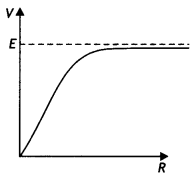
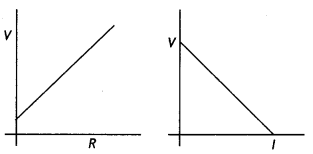
A cell of emf E and internal resistance r is connected across an external resistance R. Plot a graph showing the variation of P.D. across R, versus R. (NCERT Exemplar)
Answer:
The graph is as shown.
Class 12 Physics Important Questions Chapter 3 Current Electricity 2

Current Electricity Important Extra Questions Short Answer Type

Question 1.
Why is a potentiometer preferred over a voltmeter for determining the emf of a cell? (CBSE Delhi 2016C)
Answer:
The potentiometer is based on the null method or it does not draw any (net) current from the cell and measures emf However, the voltmeter draws some current from the cell when connected across it, hence measures terminal voltage.

Question 2.
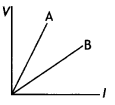
The figure shows the V – l graph for a parallel and series combination of two resistors A and B. Which line represents the parallel combination?
Class 12 Physics Important Questions Chapter 3 Current Electricity 3
Answer:
For the same potential, the current is less in series combination than parallel combination. Therefore from the graph, it is apparent that the same potential current is less in A. Therefore B represents the parallel combination.
As, R = \(\frac{V}{l}\)

The slope of B > Slope of A

Question 3.
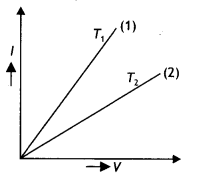
V – l graph for a given metallic wire at two temperatures is shown. Which of these is at a higher temperature?
Class 12 Physics Important Questions Chapter 3 Current Electricity 4
Answer:
At higher temperature resistance of a metallic wire is more or its conductance is low. Hence, graph (2) is at a higher temperature, i.e. T2 > T1.

Question 4.
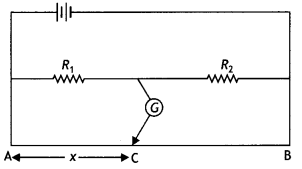
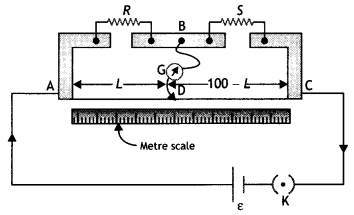
In an experiment on a metre bridge, if the balancing length AC is ‘x’, what would be its value, when the radius of the metre bridge wire AB is doubled? Justify your answer. (CBSE AI 2011C)
Class 12 Physics Important Questions Chapter 3 Current Electricity 5
Answer:
In a metre bridge, at the balance point we have
\(\frac{R_{1}}{R_{2}}=\frac{x}{100-x}\)

As R1 and R2 remain the same, x will also remain the same. It does not depend upon the diameter of the wire.

Question 5.
The emf of a cell is always greater than its terminal voltage. Why? Give reason. (CBSE Delhi 2013)
Answer:
When current passes through a cell, there is a drop in potential across it due to its internal resistance. This is called the lost volt. Thus terminal voltage is less than the emf of the cell.

Question 6.
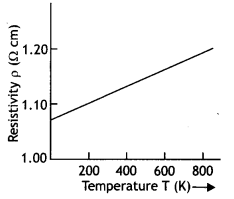
Draw a graph showing the variation of resistivity with temperature for nichrome. Which property of nichrome is used to make standard resistance coils? (CBSEAI 2013C)
Answer:
The graph is as shown.
Class 12 Physics Important Questions Chapter 3 Current Electricity 6
The property has a low-temperature coefficient of resistance.

Question 7.
Define the term ‘mobility’ for a charge carrier and state its SI unit.
Name the mobile charge carriers in
(i) an electrolyte,
(ii) a semiconductor and
(iii) an ionised gas. (CBSE Al 2015)
Answer:
Mobility is defined as the ratio of the drift velocity of the charge to the applied electric field.
(i) Anions and cations.
(ii) Electrons and holes
(iii) Free electrons.

Question 8.
Define the term current density of a metallic conductor. Deduce the relation connecting current density (J) and the conductivity (a) of the conductor, when an electric field E is applied to it. (CBSE AI 2015)
Answer:
Current density is defined as the current flowing per unit area of the conductor.

Mathematically current density is given by the expression J = \(\frac{l}{A}\)

But l = V/R and R = \(\frac{ρl}{A}\) = \(\frac{L}{σA}\). Substituting in the above relation, we have

J = \(\frac{l}{A}\) = \(\frac{V}{AL}\) × σA= \(\frac{V}{L}\) × σ = Eσ

Question 9.
(a) Define the terms ‘drift velocity’ and ‘relaxation time’ giving their physical significance.
Answer:
Drift Velocity: It is the average velocity of the free electrons with which they get drifted towards the positive terminal under the influence of the external field.

Significance: The net current flowing through any cross-section is controlled by drift velocity and there is no transport of charges in a direction perpendicular to the applied field. Relaxation Time (T): The average time between successive collisions of electrons or ions in a conductor is called the relaxation time.

Significance: It determines the drift velocity acquired by the electrons under the given applied electric force and also determines the electrical conductivity of a conductor at different temperatures.

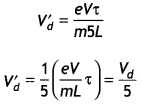
(b) A conductor of length L is connected across a dc source of emf E. If the conductor is replaced by another of the same material and area of cross-section but of length 5L, by what factor will the drift velocity change? (CBSE2019C)
Answer:
In the first case:
Vd= \(\frac{e V}{m L}\)τ

In the second case:
Class 12 Physics Important Questions Chapter 3 Current Electricity 7
Thus we find that the drift velocity becomes \(\frac{1}{5}\) of its original value.

Question 10.
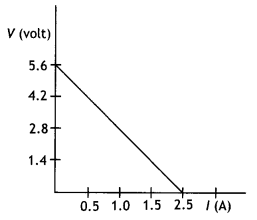
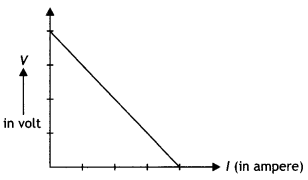
A cell of emf ‘E’ and internal resistance ‘r’ is connected across a variable resistor. ‘R’. Plot a graph showing the variation of terminal voltage ‘ V’ of the cell versus the current ‘l’. Using the plot, show how the emf of the cell and its internal resistance can be determined. (CBSE AI 2014)
Answer:
The graph is as shown.
Class 12 Physics Important Questions Chapter 3 Current Electricity 8
For l = 0,V= E
The internal resistance can be found by using the expression
V = E – lr

For V = 0
E = lr
r = E/l

Question 11.
Two electric bulbs P and Q have their resistances in the ratio of 1: 2. They are connected in series across a battery. Find the ratio of the power dissipation in these bulbs. (CBSE AI, Delhi 2018)
Answer:
Given \(\frac{R_{\mathrm{p}}}{R_{\mathrm{Q}}}\) = \(\frac{1}{2}\)

Power dissipated \(\frac{P_{\mathrm{p}}}{P_{\mathrm{Q}}}=\frac{I^{2} R_{\mathrm{p}}}{I^{2} R_{\mathrm{Q}}}=\frac{1}{2}\)

Question 12.
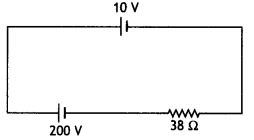
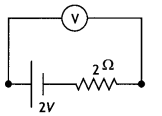
A 10 V cell of negligible Internal resistance Is connected In parallel across a battery of emf 200 V and Internal resIstance 38 š as shown in the figure. Find the value of current in the circuit. (CBSE AI, Delhi 2018)
Class 12 Physics Important Questions Chapter 3 Current Electricity 9
Answer:
Given ε1 = 10 V, r1 = 0, ε2 = 200 V, r2 = 38 Ω
The two cells send current in the opposite direction; therefore, net emf of the combination
E = 200 – 10 = 190V

Hence current in the circuit
l = \(\frac{E}{R}=\frac{190}{38}\) = 5 A

Question 13.
In a potentiometer arrangement for determining the emf of a cell, the balance point of the cell In an open circuit is 350 cm. When the resistance of 9 Ω Is used In the external circuit of the cell, the balance point shifts to 300 cm. Determine the internal resistance of the cell. (CBSE AI, Delhi 2018)
Answer:
Given L1 = 350 cm, L2 – 300 cm, R = 9 Ω, r = ? Using the expression
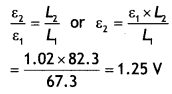
r = \(\left(\frac{L_{1}-L_{2}}{L_{2}}\right) R=\left(\frac{350-300}{300}\right)\) × 9 = 1.5 Ω

Question 14.
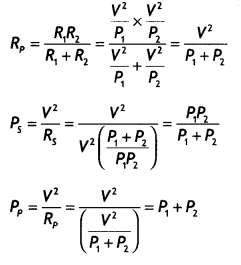
TWo bulbs are rated (P1 V) and (P2, V). If they are connected (i) in series and (ii) in parallel across a supply V, find the power dissipated in the two combinations in terms of P1 and P2. (CBSE Delhi 2019)
Answer:
Resistances of the two bulbs R1 = \(\frac{V^{2}}{P_{1}}\) and R2 = \(\frac{V^{2}}{P_{2}}\)

(i) Net resistance in series
Rs = R1 + R2 = \(\frac{V^{2}}{P_{1}}+\frac{V^{2}}{P_{2}}=V^{2}\left(\frac{P_{1}+P_{2}}{P_{1} P_{2}}\right)\)

(ii) Net resistance in parallel
Class 12 Physics Important Questions Chapter 3 Current Electricity 10
Question 15.
What is the advantage of using thick metallic strips to join wires in a potentiometer? (NCERT Exemplar)
Answer:
The metal strips have low resistance and need not be counted in the potentiometer Length l of the null point. One measures only their lengths along with the straight segments (of lengths 1 metre each). This is easily done with the help of centimetre rulings or metre ruler and leads to accurate measurements.

Question 16.
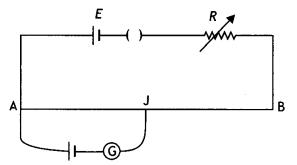
AB is a potentiometer wire (figure). If the value of R is increased, in which direction will the balance point J shift? (NCERT Exemplar)
Class 12 Physics Important Questions Chapter 3 Current Electricity 11
Answer:
If R is increased, the current through the wire will decrease. This will decrease the potential gradient across the potentiometer wire (k = V/L = lpRp/L). Hence more length of the wire will be required to balance the same cell. Therefore J will shift towards B.

Question 17.
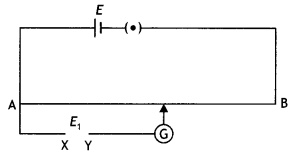
While doing an experiment with a potentiometer (figure) it was found that the deflection is one-sided and
(i) the deflection decreased while moving from one end A of the wire to the end B;
(ii) the deflection increased while the jockey was moved towards the end B.
(iii) Which terminal + or -ve of the cell E1 is connected at X in case (i) and how is E1 related to E?
(iv) Which terminal of the cell E1 is connected at X in case (ii)? (NCERT Exemplar)
Class 12 Physics Important Questions Chapter 3 Current Electricity 12
Answer:
(i) Positive terminal of E1 is connected at Xand E1 > E.
(ii) Negative terminal of E1 is connected at X.

Question 18.
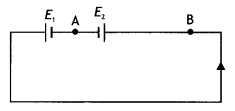
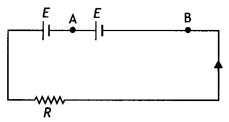
The circuit in the figure shows two cells connected in opposition to each other. Cell E1 is of emf 6 V and internal resistance 2 Ω; the cell E2 is of emf 4 V and internal resistance 8 Ω. Find the potential difference between the points A and B. (NCERT Exemplar)
Class 12 Physics Important Questions Chapter 3 Current Electricity 13
Answer:
The cells are connected in the opposite direction, therefore net emf in the circuit is
E = E1 – E2 = 6 – 4 = 2 V

Hence current in the circuit is
l = \(\frac{E}{R+r}\) = \(\frac{2}{10}\) = 0.2 A

P.D. across E1 = 6 – 0.2 × 2 = 5.6 V
P.D. across E2 = VAB = 4 + 0.2 × 8 = 5.6 V
Point B is at a higher potential than A

Current Electricity Important Extra Questions Long Answer Type

Question 1.
Explain the term ‘drift velocity’ of electrons in a conductor. Hence obtain the expression for the current through a conductor in terms of ‘drift velocity’. (CBSE AI 2013, 2013C)
Answer:
Drift velocity (Vd) is defined as the average velocity with which the free electrons get drifted inside a conductor under the effect of the electric field, opposite to the direction of the field.

Let n be the electrons per unit volume in the conductor. Here n is called the number density of electrons. Assume that all electrons move with the same drift velocity Vd. In a time interval dt, each electron moves a distance vdt. Now the volume of the cylinder covered by the electrons in time dt is
V = A vddt …(1)

and the number of electrons in this volume is
N = nV = nA vddt …(2)

If e is the charge on the electron, then charge flowing through the conductor in small time dt is
dQ = e(nA vddt) …(3)

Hence the current through the conductor is
l = \(\frac{dQ}{dt}\) = nAevd

Question 2.
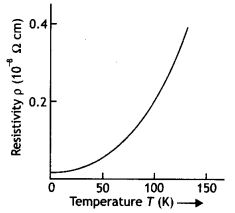
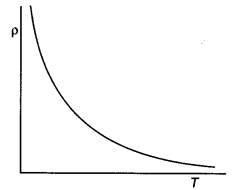
Draw a plot showing the variation of resistivity of an (i) conductor and (ii) semiconductor, with the increase in temperature.
How does one explain this behaviour in terms of the number density of charge carriers and the relaxation time? (CBSE Delhi 2014C)
Answer:
The plots are as shown.
Class 12 Physics Important Questions Chapter 3 Current Electricity 14
Class 12 Physics Important Questions Chapter 3 Current Electricity 15
With a rise in temperature the average relaxation time for a conductor decreases and resistivity increases, while for a semiconductor the number density of charge carriers increases, hence the resistivity decreases.

Question 3.
State the two Kirchhoff’s rules used in electric networks. How are these rules justified? (CBSE Delhi 2015)
Answer:
The two rules are

Kirchhoff’s junction rule: The algebraic sum of currents meeting at a junction is zero.
Kirchhoff’s loop rule: The algebraic sum of changes in potential around any closed loop involving resistors and cells in the loop is zero.

The two rules are justified as they are based on the law of conservation of charge and law of conservation of energy respectively.

Question 4.
(a) Deduce the relation between current l flowing through a conductor and drift velocity \(\vec{v}_{\mathrm{d}}\) of the electrons.
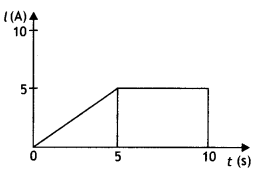
(b) Figure shows a plot of current ‘l’ flowing through the cross-section of a wire versus the time ‘t’. Use the plot to find the charge flowing in 10 s through the wire. (CBSE AI 2015C, 2016C)
Class 12 Physics Important Questions Chapter 3 Current Electricity 16
Answer:
Suppose there are n electrons per unit volume, where n is called the number density of electrons. Assume that all electrons move with the same drift velocity Vd. In a time interval dt, each electron moves a distance vddt. Now the volume of the cylinder covered by the electrons in time dt is
V = A vddt ….(1)

and the number of electrons in this volume is
N = nV=nA vddt …(2)

If e is the charge on the electron, then charge flowing through the conductor in small time dt is
dQ= e(nA vddt) …(3)

Hence the current through the conductor is
l = \(\frac{dQ}{dt}\) = vdenA

The area under the l – t curve gives the value of the charge
Q = 1/2 × 5 × 5 + (10 – 5) × 5 = 12.5 + 25
= 37.5 C

Question 5.
Answer the following:
(a) Why are the connections between the resistors in a metre bridge made of thick copper strips?
Answer:
The metal strips have low resistance;
hence their resistance does not come into play while calculating the unknown resistance.

(b) Why is it generally preferred to obtain the balance point in the middle of the metre bridge wire?
Answer:
It is done to reduce the index correction.

(c) Which material is used for the metre bridge wire and why? (CBSE Al 2014)
Answer:
Alloys are used due to their high resistivity.

Question 6.
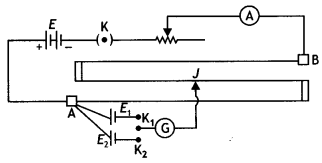
(a) State the underlying principle of a potentiometer. Why is it necessary to (i) use a long wire, (ii) have a uniform area of cross-section of the wire and (iii) use a driving cell whose emf is taken to be greater than the EMFs of the primary cells?
Answer:
Principle: It is based on the principle that if a wire of uniform area of cross-section carries a constant current, the potential drop across any portion of the wire is directly proportional to the length of that portion of the wire.

The diagram is as shown.
First, the key K is inserted. This brings the cell of emf E1 in the circuit. The jockey is moved on the wire to obtain a balance point, i.e. a point on the wire where the galvanometer gives zero deflection. Let the balancing length be L1. Therefore by the potentiometer principle, we have
E1 ∝ L1 …(1)

Now, the key K2 is inserted. This brings the cell of emf E2 into the circuit. The jockey is again moved on the wire to obtain the balance point. Let the balancing length be L2. Then by potentiometer principle, we have
E2 ∝ L2 …(2)
Class 12 Physics Important Questions Chapter 3 Current Electricity 37
Dividing equations (1) by (2) we have
\(\frac{E_{1}}{E_{2}}=\frac{L_{1}}{L_{2}}\) …. (3)

Knowing the values of L1 and L2, the EMFs can be compared.

  1. The least count of the potentiometer is given by k = V/l, where l is the length of the potentiometer wire. The larger the value of l, the smaller is the least count. Hence a long wire is used so that there is more accuracy.
  2. If the area of cross-section is not uniform, the value of the potential ‘ gradient will not be the same along
    the length of the wire.
  3. The balance point will be obtained on the wire.

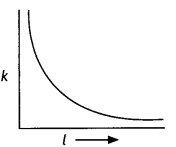
(b) In a potentiometer experiment, if the area of the cross-section of the wire increases uniformly from one end to the other, draw a graph showing how potential gradient would vary as the length of the wire increases from one end. (CBSE AI 2014C)
Answer:
k = \(\frac{V}{l}\) = \(\frac{lR}{l}\)

⇒ k ∝ \(\frac{1}{l}\)
Class 12 Physics Important Questions Chapter 3 Current Electricity 17

Question 7.
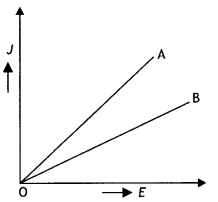
Plot a graph showing the variation of current density (j) versus the electric field (E) for two conductors of different materials. What information from this plot regarding the properties of the conducting material, can be obtained which can be used to select suitable materials for use in making (i) standard resistance and (ii) connecting wires in electric circuits?
Electron drift speed is estimated to be of the order of mm s-1. Yet large current of the order of few amperes can be set up in the wire. Explain briefly. (CBSEAI 2015)
Answer:
We know that J = σE
Therefore the graph between J and E will be a straight line passing through the origin.

This is as shown.
Class 12 Physics Important Questions Chapter 3 Current Electricity 18
The slope of the graph = conductivity (σ)

Hence materiaL with Less slope (smaller conductivity) is used for making standard resistors and materiaL with greater slope (higher conductivity) for making connecting wires.

A large current can be set up in the wire because the electron number density is enormous, 1029 m-3.

Question 8.
The reading of the (ideal) ammeter, In the circuit shown here, equals:
Class 12 Physics Important Questions Chapter 3 Current Electricity 19
(i) l when key K1 is closed but key K2 is open.
Answer:
(i) Current l when K2 is open
l = \(\frac{ε}{R+X}\)

(ii) l/2 when both keys K1 and K2 are closed.
Find the expression for the resistance of X In terms of the resistances of R and S. (CBSE Delhi 2016C)
Answer:
Let current be l when both K1 and K2 are closed
Class 12 Physics Important Questions Chapter 3 Current Electricity 20

Current through X
Class 12 Physics Important Questions Chapter 3 Current Electricity 21

Question 9.
Define the current sensitivity of a galvanometer. Write Its S.I. unit. The figure shows two circuits each having a galvanometer and a battery of 3 V. When the galvanometers in each arrangement do not show any deflection, obtain the ratio R1/R2. (CBSE AI 2013)
Class 12 Physics Important Questions Chapter 3 Current Electricity 22
Answer:
The current sensitivity of a galvanometer is defined as the deflection produced in the galvanometer per unit current passing through It. It is measured in div per ampere. In both cases the Wheatstone bridge is in the balanced state. Therefore we have
\(\frac{4}{R_{1}}=\frac{6}{9}\) Or R1 = 6 ohm

\(\frac{6}{12}=\frac{R_{2}}{8}\) Or R2 = 4 ohm

Therefore \(\frac{R_{1}}{R_{2}}=\frac{6}{4}=\frac{3}{2}\)

Question 10.
The following circuit shows the use of a potentiometer to measure the internal resistance of a cell, (i) When the key K is open, how does the balance point change, if the current from the driver cell decreases? (ii) When the key K is closed, how does the balance point change if R is increased, keeping the current from the driver cell constant?
Class 12 Physics Important Questions Chapter 3 Current Electricity 23
Answer:
(i) When the key K is open, a decrease in the current from the driver cell decreases the potential drop across the potentiometer wire. Therefore to balance the same emf again, more length of the wire will be required. Thus the balance point will shift towards point B.
(ii) When key K is closed and R is increased, it increases the terminal potential difference of the cell. Thus to balance the new terminal potential difference, more length of the wire will be required. Thus the balance point will shift towards point B.

Question 11.
(a) State, with the help of a circuit diagram, the working principle of a metre bridge. Obtain the expression used for determining the unknown resistance.
Answer:
(a) The experiment is based on the Wheatstone bridge principle.
Class 12 Physics Important Questions Chapter 3 Current Electricity 24
The connections are made as shown in the figure. A resistance R is introduced from the resistance box and the key K is closed. The jockey is moved on the wire to the point where there is no deflection in the galvanometer. In such case points, B and D are at the same potential. Point B is called the “null” point.

Let in this position AB = L cm and BC = (100 – L) cm. Therefore resistance of AB, i.e.
P ∝ L
and resistance of BC, i.e. Q ∝ (100 – L)

hence
\(\frac{P}{Q}=\frac{L}{100-L}\) …..(1)

In the balanced state by the Wheatstone bridge Principle we have
\(\frac{P}{Q}=\frac{R}{X}\) … (2)

Substituting equation (1) in equation (2) we have
\(\frac{R}{x}=\frac{L}{100-L}\) ….(3)

rewriting equation (3) we have
X = \(\left(\frac{100-L}{L}\right)\)R

(b) What happens if the galvanometer and cell are interchanged at the balance point of the bridge?
Answer:
There is no change in the position of the balance point if the galvanometer and the cell are interchanged.

(c) Why is it considered important to obtain the balance point near the mid-point of the wire? (CBSE Delhi 2011C)
Answer:
It is important to get the balance point near the mid-point of the wire because then the resistances in the four arms of the bridge are of the same order. The sensitivity of the bridge is maximum and the resistance is determined most accurately.

Question 12.
(a) Which material is used for potentiometer wire and why?
Answer:
The potentiometer wire is usually of constantan or manganin.
The material of the wire should have

  • high specific resistance and
  • low-temperature coefficient of resistance.

(b) How can the sensitivity of a potentiometer be increased? (CBSE Delhi 2011C)
Answer:
For greater sensitivity of the measurement, the fall of potential per cm should be less. The smaller the value of K, the greater will be the balancing length and the greater will be the accuracy of the measurement. For this, a wire of longer length should be taken or the current in the wire should be less.

Question 13.
Write two possible causes for one-sided deflection in a potentiometer experiment. (CBSE Delhi 2013)
Answer:

  1. The Emf of the auxiliary battery may be less than the emf of the test cell.
  2. The positive terminal of the test cell and the auxiliary cell may not be connected to the same point.

Question 14.
(a) Derive a relation between the internal resistance, emf and terminal potential difference of a cell from which current l is drawn. Draw V vs l graph for a cell and explain its significance.
Answer:
Consider the circuit shown.
Class 12 Physics Important Questions Chapter 3 Current Electricity 25
By Kirchhoff’s rules we have
E – lR – rl = 0
E – V – lr = 0
E = V + lr

The V-l graph is as shown.
Class 12 Physics Important Questions Chapter 3 Current Electricity 26
Significance of Graph: To find emf and internal resistance of the cell.

(b) A voltmeter of resistance 998 0 is connected across a cell of emf 2 V and internal resistance 2Q. Find the potential difference across the voltmeter and also across the terminals of the cell. Estimate the percentage error in the reading of the voltmeter.
Answer:
The diagram is as shown.
Class 12 Physics Important Questions Chapter 3 Current Electricity 27
V= E – lr
998 × l = 2 – 2l
1000 l = 2
l = 0.002 A

Therefore,
V= 0.002 × 998= 1.996 V

Percentage error
\(\frac{2-1.996}{2}\) × 100 = \(\frac{0.004}{2}\) = 0.2%

Question 15.
Two cells of the same emf E but internal resistance r1 and r2 are connected in series to an external resistor R (figure). What should be the value of R so that the potential difference across the terminals of the first cell becomes zero? (NCERT Exemplar)
Class 12 Physics Important Questions Chapter 3 Current Electricity 28
Answer:
Since the cells are connected in series,
total emf is
ET = E + E = 2E

Now current in the circuit Is
l = \(\frac{2 E}{R+r_{1}+r_{2}}\)

For terminal potential difference across the first cell to be zero we have
Class 12 Physics Important Questions Chapter 3 Current Electricity 29

Question 16.
Two cells of EMFs ε1 and ε2 and Internal resistances r1 and r2 respectively are connected in parallel. Obtain expressions for the equivalent
(i) resistance and
(ii) emf of the combination (CBSE Delhi 2018C, 2019C)
Answer:
Class 12 Physics Important Questions Chapter 3 Current Electricity 30
Class 12 Physics Important Questions Chapter 3 Current Electricity 31
Class 12 Physics Important Questions Chapter 3 Current Electricity 32

Question 17.
Using Kirchhoff’s rules, calculate the potential difference between B and D In the circuit diagram as shown in the figure. (CBSE Delhi 2018C)
Class 12 Physics Important Questions Chapter 3 Current Electricity 33
Answer:
Using Kirchhoff’s voLtage ruLe, we have:
For Loop DABD
l1 × 1 + (1) + (-2) + 2l1 + 2(l1 + l2) = 0
Or 5l1 + 2l2 = 1 …. (i)

For Loop DCBD
l2 × 3 + (3) + (-1) + l2 + 2(l1 + l2) = 0
Or 2l1 + 6 l2 = -2 …. (ii)
Class 12 Physics Important Questions Chapter 3 Current Electricity 34
Solving (i) and (ii), we get
l1 = \(\frac{5}{13}\)A

l2 = \(\frac{-6}{13}\)A

∴ Current through DB = l1 + l2 = \(\frac{-1}{13}\)A
∴ P.D. between B and D = 0.154 V

Question 18.
Define the term resistivity of a conductor. Give its SI unit. Show that the resistance R of a conductor Is given by \(\frac{m L}{n e^{2} A \tau}\)where the symbols have their usual meaning.
Answer:
The resistivity of a conductor is the resistance of the conductor of unit length and unit cross-sectional area.

Let Vd be the drift velocity of the electrons, then its relation with the electric field is
Vd = \(-\frac{e E}{m}\)τ …..(1)

Let V be the potential difference applied across the two ends of a conductor of length L and area of cross-section A, then
E = \(\frac{-V}{L}\) …..(2)

Substituting equation (1) in (2) we have
Vd = \(\frac{\mathrm{eV}}{\mathrm{mL}}\)τ ….(3)

Also l = neAVd ….(4)
Substituting equation (3) in equation (4),
we have

l = neA\(\left[\frac{e V}{m L} \tau\right]=\left[\frac{n e^{2} A \tau}{m L}\right]\)V ….(5)

Comparing with Ohm’s “Law”, i.e
l = \(\frac{V}{R}\) …. (6)

we have
R = \(\left[\frac{m L}{n e^{2} A \tau}\right]\) ….(7)

Question 19.
The given figure shows a network of resistances R1, R2, R3 and R4.
Class 12 Physics Important Questions Chapter 3 Current Electricity 35
Using Kirchhoff’s laws, establish the balance condition for the network. (CBSEAI 2015)
Answer:
Consider the diagram as shown below.
Class 12 Physics Important Questions Chapter 3 Current Electricity 36
Now applying Kirchhoff’s Loop rule to the closed Loop ABDA, we have
– l1R1 – lgG + (l – l1) R3 = 0 ….(1)

Again applying Kirchhoff’s Loop rule to closed-loop BCDB, we have
– (l1 – lg)R2 + (l – l1 + lg)R4 + lgG = 0 …(2)

The values of R1, R2, R3 and R4 are so adjusted that the galvanometer gives zero deflection. This means that both B and D will be at the same potential and hence no current will flow through the galvanometer,

i.e. lg = 0. In this situation, the Wheatstone bridge is said to be balanced. Putting lg = 0 in equations (1) and (2) we have
– l1R1 + (l – l1) R3 = 0
and
-l1R2 + (l – l1)R4 = 0 …(4)

Rewriting the above two equations we have
– l1R1 = (l – l1) R3 ….(5)
and
– l1R2 + (l – l1)R4 ….(6)

Dividing the above equations we have
\(\frac{R_{1}}{R_{2}}=\frac{R_{3}}{R_{4}}\) … (7)

The above expression gives the condition for the balance of a Wheatstone bridge.

Question 20.
Draw a circuit diagram of a potentiometer. State its working principle. Derive the necessary formula to describe how it is used to compare the EMFs of the two cells. (CBSE AI 2015C)
Answer:
PRINCIPLE: It is based on the principle that if a wire of uniform area of cross-section carries a constant current, the potential drop across any portion of the wire is directly proportional to the length of that portion of the wire.

The diagram is as shown.
First, the key K is inserted. This brings the cell of emf E1 into the circuit. The jockey is moved on the wire to obtain a balance point, i.e. a point on the wire where the galvanometer gives zero deflection. Let the balancing length be L1. Therefore by the potentiometer principle, we have
E1 ∝ L1 …(1)

Now, the key K2 is inserted. This brings the cell of emf E2 into the circuit. The jockey is again moved on the wire to obtain the balance point. Let the balancing length be L2. Then by potentiometer principle, we have
E2 ∝ L2 …(2)
Class 12 Physics Important Questions Chapter 3 Current Electricity 37
Dividing equations (1) by (2) we have
\(\frac{E_{1}}{E_{2}}=\frac{L_{1}}{L_{2}}\) …. (3)

Knowing the values of L1 and L2, the EMFs can be compared.

Question 21.
(i) Define the term ‘conductivity’ of a metallic wire. Write its SI unit.
Answer:
The property of a material that allows a flow of electrons between two points of the material when a potential difference is applied between these two points is called the conductivity of a wire. SI unit of conductivity: siemens per metre.
Class 12 Physics Important Questions Chapter 3 Current Electricity 38
(ii) Using the concept of free electrons in a conductor, derive the expression for the conductivity of a wire in terms of number density and relaxation time. Hence obtain the relation between current density and the applied electric field E. (CBSE At 2018, Delhi 2018)
Answer:
Drift velocity of electrons in a conductor is given as
Vd = eEτ/m …(1)

Small distance covered in time
Δt = VdΔt

Amount of charge passing through the area A in time Δt, q = lΔt
Δt = neAVdΔt
or l = neAVd …(2)
where
n → Number of free electrons per unit volume or number density

Now from equations (1) and (2), we get
l = ne2AτE/m …(3)

Since resistivity of a conductor is given as
ρ = m/ne2τ

Now, we know that the conductivity of a conductor is mathematically defined as the reciprocal of resistivity of the conductor. Thus,
σ = \(\frac{1}{ρ}\) …(4)

where σ = conductivity of the conductor. Thus, from equations (3) and (4), we get
σ = ne2τ/m ….(5)

Now, from equations (3) and (5), we have
lA = σE …(6)
and current density is given as
J = lA
Thus, J = σE

Question 22.
(a) You are required to select a carbon resistor of resistance of 56 kΩ ± 10% from a shopkeeper. What would be the sequence of colour bands required to code the desired resistor?
Answer:
Number 5 corresponds to green, No. 6 corresponds to blue, 103 corresponds to orange and 10% corresponds to silver.
∴ The sequence of Colours is
Green, blue, orange, silver

(b) Write two characteristic properties of the material of a metre bridge wire.
Answer:
Metre bridge wire must have

  • High resistivity
  • Low-temperature coefficient of resistivity

(c) What precautions do you take to minimise the error in finding the unknown resistance of the given wire? (CBSE2019C)
Answer:
To minimise the error in determining the resistance of a wire, the

  • The wire should be of uniform thickness
  • The balance point should be near the midpoint of the wire

Question 23.
The diagram below shows a potentiometer set-up. On touching the jockey near the end X of the potentiometer wire, the galvanometer pointer deflects to left. On touching the jockey near to end Y of the potentiometer, the galvanometer pointer again deflects to left but now by a larger amount. Identify the fault in the circuit and explain, using appropriate equations or otherwise, how it leads to such a one¬sided deflection. (CBSE Sample Paper 2018-19)
Class 12 Physics Important Questions Chapter 3 Current Electricity 39
Or
The following circuit was set up in a metre bridge experiment to determine the value X of unknown resistance.
Class 12 Physics Important Questions Chapter 3 Current Electricity 40
(i) Write the formula to be used for finding X from the observations. 39.5 cm from end A, when the resistor Y is 12.5 Ω. Determine the resistance of X. Why are the connections between resistors in a Wheatstone or metre bridge made of thick copper strips?
(ii) If the resistance R is increased, what will happen to balance length?
Answer:
The positive of E1 is not connected to terminal X.
In Loop XGNX,
E1 – VG + E = 0
VG = E1 + EXN
VG = E1 + kl

So, VG (or deflection) Will be maximum when l is maximum, i.e. when Jockey Is touched near the end Y. Also, VG (or deflection) Will, be minimum when l is minimum, i.e. when a jockey is touched near end X.
Or
(i) X = (100 – l) R/l
(ii) The balancing Length wilt increase.

Question 24.
(i) In a metre bridge as shown, the balance point is found to be at 39.5 cm from the end A, when the resistor Y is 12.5. Determine the resistance of X. Why are the connections between resistors In a Wheatstone or metre bridge made of thick copper strips?
(ii) Determine the balance point of the bridge above if X and Y are interchanged.
(iii) What happens if the galvanometer and cell are interchanged at the balance point of the bridge? Would the galvanometer show any current? (NCERT)
Class 12 Physics Important Questions Chapter 3 Current Electricity 41
Answer:
(i) Given L1 = 39.5 cm and L2 =100 – 39.5 = 60.5 cm, Y=12.5Q, X=?
Using the Wheatstone bridge principle we have
\(\frac{39.5}{60.5}=\frac{X}{12.5}\) or X = 8.2 Ω

The connections between resistors in a Wheatstone or metre bridge are made of thick copper strips to minimise the resistance of the connection which are not accounted for in the bridge formula.

(ii) If X and Y are interchanged, then
\(\frac{L}{(100-L)}=\frac{12.5}{8.2}\); solving for L we have
L = 60.4 cm from point A.

(iii) When the galvanometer and cell are interchanged, the condition for the balance of the bridge remains satisfied. Hence galvanometer will not show any current.

Question 25.
The figure below shows a potentiometer with a cell of 2.0 V and internal resistance of 0. 40 Ω maintaining a potential drop across the resistor wire AB. A standard cell that maintains a constant emf of 1.02 V (for very moderate currents up to a few mA) gives a balance point at 67.3 cm length of the wire. To ensure very low currents drawn from the standard cell, very high resistance of 600 kΩ is put in series with it, which is shorted close to the balance point. The standard cell is then replaced by a cell of unknown emf e and the balance point found similarly, turns out to be at 82.3 cm length of the wire.
1. What is the value of e?
2. What purpose does the high resistance of 600 kΩ have?
3. Is the balance point affected by this high resistance?
4. Is the balance point affected by internal resistance?
5. Would the method work in the above situation if the driver cell of the potentiometer had an emf of 1.0 V instead of 2.0 V?
6. Would the circuit work well for determining an extremely small emf, say of the order of a few mV (such as the typical emf of a thermo-couple)? If not, how will you modify the circuit?
Class 12 Physics Important Questions Chapter 3 Current Electricity 42
Answer:
1. Given ε1 = 1.02 V, L1 = 67.3 cm, L2 = 82.3 cm, ε2 = ?
By potentiometer principle we have
Class 12 Physics Important Questions Chapter 3 Current Electricity 43
2. This resistance reduces the current through the galvanometer when the movable contact (a jockey) is far away from the balance point. This, in turn, protects the galvanometer from the damage likely to be caused by the high current.
3. There is no effect of this resistance on the balance point.
4. There is no effect.
5. In case, the driving emf is smaller than the emf to be measured, the balance point cannot be found on the potentiometer wire.
6. In such a case, the balance point will be very close to the end giving a very large error in the measurement of e. If resistance is placed in series with the wire AB such that the potential drop across AB is only slightly larger than the emf to be measured, the balance point will be found on a larger length. This will make the error very small.

Numerical Problems:

Formulae for solving numerical problems.

  • The mobility of electrons is given by μ = \(\frac{V_{d}}{E}=\frac{e \tau}{m}\)
  • By Ohm’s law, l = \(\frac{V}{R}\) and J = σE
  • The current density is J = \(\frac{l}{A}\) = nevd
  • Theresistanceofawireis R = ρ\(\frac{L}{A}\) = \(\left[\frac{m L}{n e^{2} A \tau}\right]\)
  • The resistivity of a wire is ρ = \(\frac{m}{n e^{2} \tau}\)
  • The resistance of a wire at t°C is R = R0 (1 + αt)
  • In parallel combination \(\frac{1}{R_{p}}=\frac{1}{R_{1}}+\frac{1}{R_{2}}+\frac{1}{R_{3}}\)
  • In series combination Rs = R1 + R2 + R3 + ……..
  • Ratio of resistances in series and parallel \(\frac{R_{\mathrm{s}}}{R_{\mathrm{p}}}\) = n2
  • The Wheatstone bridge principle is \(\frac{P}{Q}=\frac{R}{S}\)
  • V = E – lr, where V is the terminal potential difference, E is emf and r is the internal resistance of the cell.
  • The internal resistance of a cell is r = \(\frac{(E-V) R}{V}=\frac{\left(L_{1}-L_{2}\right) R}{L_{2}}\)

Question 1.
A cell of emf ‘E’ and internal resistance ‘r’ is connected across a variable load resistor R. Draw the plots of the terminal voltage V versus (i) R and (ii) the current l.
It is found that when R = 4 Ω the current is 1 A and when R is increased to 9 Ω, the current reduces to 0.5 A. Find the values of the emf E and internal resistance r. (CBSE Delhi 2015)
Answer:
The plots are as shown
Class 12 Physics Important Questions Chapter 3 Current Electricity 44
Here l1 = 1.0 A, R1 =4 ohm, l2 = 0.5 A, R2 =9 ohm
Using the equation l = \(\frac{E}{(R+r)}\) Or E = l(R + r)

we have
1.0 × (4 + r) = 0.5 × (9 + r)

Solving the above equation for r we have r = 1 ohm
Also E = 0.5 (9 + 1) = 5 V

Question 2.
A wire of resistance R, length l and area of cross-section A is cut into two parts, having their lengths in the ratio 1:2. The shorter wire is now stretched till its length becomes equal to that of the longer wire. If they are now connected in parallel, find the net resistance of the combination. (CBSE Al 2019)
Answer:
Since the wires are cut in the ratio of 1:2 therefore,
Resistance of the shorter wire R1 = \(\frac{R}{3}\) and

Resistance of the longer wire R2 = \(\frac{2R}{3}\)

Since the shorter wire is stretched to make it equal to the longer wire therefore, it is stretched by n = 2 times its length. Hence New resistance of the shorter wire
Class 12 Physics Important Questions Chapter 3 Current Electricity 45
Question 3.
In the figure, a long uniform potentiometer wire AB is having a constant potential gradient along its length. The null points for the two primary cells of EMFs ε1 and ε2 connected in the manner shown are obtained at a distance of 120 cm and 300 cm from the end A. Find (i) ε12 and (ii) position of null point for the cell ε1. How is the sensitivity of a potentiometer increased? (CBSE Delhi 2012)
Class 12 Physics Important Questions Chapter 3 Current Electricity 46
Answer:
From the diagram we have
\(\frac{\varepsilon_{1}-\varepsilon_{2}}{\varepsilon_{1}+\varepsilon_{2}}=\frac{120}{300}=\frac{2}{5}\)
Or
1 – 5ε2 = 2ε1 + 2ε2

Solving we have
\(\frac{\varepsilon_{1}}{\varepsilon_{2}}=\frac{7}{3}\) ….(1)

Also let L be the balancing length for cell of emf ε1, then
\(\frac{\varepsilon_{1}}{\varepsilon_{1}+\varepsilon_{2}}=\frac{L}{300}\)

Using equation (1) we have
\(\frac{\varepsilon_{1}}{\varepsilon_{1}+\frac{3}{7} \varepsilon_{1}}=\frac{L}{300}\)

Solving for L we have L = 210 cm
The sensitivity of a potentiometer can be increased by increasing the length of the potentiometer wire.

Question 4.
The network PQRS, shown in the circuit diagram, has batteries of 4 V and 5 V and negligible internal resistance. A milli- ammeter of 20 Ω resistance is connected between P and R. Calculate the reading in the milliammeter. (CBSE AI 2012C)
Class 12 Physics Important Questions Chapter 3 Current Electricity 47
Answer:
Using Kirchhoff’s junction rule to distribute current we have
Class 12 Physics Important Questions Chapter 3 Current Electricity 48
Consider the loop SRPS, by Kirchhoff’s loop rule we have
200 l2 + 20 (l1 + l2 ) – 5 = 0 …(1)
Or
220 l2 + 20 l1 = 5 …(2)

Consider the loop PRQP, by Kirchhoff’s loop rule we have
– 60 l1 + 4 – 20 (l1 + l2) = 0 …(3)
80 l1 + 20 l2 =4 …(4)

Multiplying equation (2) by (4) we have
880 l2 + 80 l1 = 20 …(5)

Subtracting equation (4) from equation (5)
we have
860 l2 = 16 or l2 = 4/215 A

Substituting in equation (4) we have
l1 = \(\frac{39}{860}\)A

Therefore reading of the milliammeter is
l1+ l2 = \(\frac{4}{215}+\frac{39}{860}\) = 0.063 A = 63 mA

Question 5.
A set of ‘n’ identical resistors, each of resistance ‘R’ when connected in series have an effective resistance ‘X’. When they are connected in parallel, their effective resistance becomes ‘Y’. Find out the product of X and Y. (CBSEAI2019) Answer:
In series
Rs = R1 + R2 + R3 + ……
Rs = X = R + R + R + …. upto n
X=nR

In Parallel
Class 12 Physics Important Questions Chapter 3 Current Electricity 49

Question 6.
In the following circuit, a metre bridge is shown in its balanced state. The metre bridge wire has a resistance of 1 ohm per centimetre. Calculate the value of the unknown resistance X and the current drawn from the battery of negligible internal resistance.
Class 12 Physics Important Questions Chapter 3 Current Electricity 50
Answer:
Using the Wheatstone bridge principle we have
\(\frac{40}{60}=\frac{X}{3}\)
or X = 2 Ω

Now total resistance of the combination is
R = \(\frac{5 \times 100}{5+100}=\frac{500}{105}\) = 4.76 Ω

Current drawn is
l = V/R = 6/4.76 = 1.26 A

Question 7.
Calculate the electrical conductivity of the material of a conductor of length 3 m, area of cross-section 0.02 mm2 having a resistance of 2 ohms.
Answer:
Given L = 3 m,
A = 0.02 mm2 = 0.02 × 10⁻⁶ m2
R = 2 ohm.

Using the equation
R = \(\frac{ρL}{A}\)
Or
ρ = \(\frac{RA}{L}\)

σ = \(\frac{L}{AR}\) = \(\frac{3}{0.02 \times 10^{-6} \times 2}\) = 7.5 × 10⁷ Sm-1

Question 8.
A potential difference of 2 volts is applied between points A and B has shown in the network drawn in the figure. Calculate (i) equivalent resistance of the network across the points A and B and (ii) the magnitudes of currents in the arms AFCEB and AFDEB.
Class 12 Physics Important Questions Chapter 3 Current Electricity 51
Answer:
The circuit can be redrawn as shown below.
Class 12 Physics Important Questions Chapter 3 Current Electricity 52
As seen the circuit is a balanced Wheatstone bridge; therefore the resistance in the arm CD is superfluous.
(i) Resistance of arm FCE = 2 + 2 = 4 Ω
Resistance of arm FDE = 2 + 2 = 4 Ω
Hence net resistance of the circuit between A and B is
R = \(\frac{4 \times 4}{4+4}=\frac{16}{8}\) = 2 Ω

(ii) current in the arm AFCEB
l = V/R = 2/4 = 0.5 A

Current in the arm AFDEB
l = V/R = 2/4 = 0.5 A

Question 9.
A cell of emf E and internal resistance ‘r’ gives a current of 0.8 A with an external resistor of 24 ohms and a current of 0.5 A with an external resistor of 40 ohms.
Calculate
(i) emf E and
(ii) internal resistance ‘r’ of the cell.
Answer:
Given l1 = 0.8 A, R1 = 24 ohm l2 = 0.5 A, R2 = 40 ohm
Using the equation
E = l(R + r) we have
0.8 × (24 + r) = 0.5 × (40 + r)

Solving for r we have r = 2.67 ohm
Also E = 0.5( 40 + 2.67) = 21.3 V

Question 10.
In the circuit diagram of the metre bridge given below, the balance point is found to be at 40 cm from A. The resistance of X is unknown and Y is 10 ohms.
(i) Calculate the value of X;
(ii) if the positions of X and Y are interchanged in the bridge, find the position of the new balance point from A; and
(iii) if the galvanometer and the cell are interchanged at the balance point, would the galvanometer show any current.
Class 12 Physics Important Questions Chapter 3 Current Electricity 53
Answer:
(i) Using the Wheatstone bridge principle we have
\(\frac{40}{60}=\frac{X}{10}\)
Or
X = 6.67 Ω

(ii) If X and Y are interchanged then
\(\frac{L}{(100-L)}=\frac{10}{6.67}\) solving for L we have
L = 59.9cm

(iii) The ga(vanometer will not show any current.

Question 11.
The length of a potentiometer wire is 600 cm and it carries a current of 40 mA. For a cell of emf 2.0 V and internal resistance 10 ohms, the null point is found to be at 500 cm. If a voltmeter is connected across the cell, the balancing length is decreased by 10 cm. Find (i) the resistance of the whole wire, (ii) reading of the voltmeter and (iii) resistance of the voltmeter.
Answer:
Here total length of potentiometer wire L = 600 cm, current flowing
l = 40 mA = 0.04 A,
Emf of cell E = 2 V,

Internal resistance of cell r = 10 Ω, balancing length for cell l = 500 cm
(i) Since ε = kl
k = \(\frac{\varepsilon}{l}=\frac{2}{500}\) , V = kl

∴ V = \(\frac{2}{500}\) × 600 = 2.4 V

Therefore resistance of the potentiometer wire =\(\frac{V}{l}=\frac{2.4}{0.04}\) = 60 Ω.

(ii) With voltmeter connected across the cell, balancing Length
L’ = l – 10 = 500 – 10 = 490cm

Therefore, potential difference, i.e. reading of voltmeter,
= \(\frac{L^{\prime}}{L} \times V=\frac{490}{600}\) × 2.4 = 1.96 V

(iii) Let resistance of the voltmeter be R,
R = \(\frac{V}{l}=\frac{1.96}{0.04}\) = 49 Ω
R = 49 ohm

Question 12.
Find the value of the unknown resistance X in the following circuit, if no current flows through the section AO. Also, calculate the current drawn by the circuit from the battery of emf 6 V and negligible internal resistance.
Class 12 Physics Important Questions Chapter 3 Current Electricity 54
Answer:
If no current flows through the section AO, the given circuit is an example of a balanced Wheatstone bridge. The circuit can be redrawn as
Class 12 Physics Important Questions Chapter 3 Current Electricity 55
Then \(\frac{2}{4}=\frac{3}{X}\)
Or
X = \(\frac{3 \times 4}{2}\) = 6 Ω

Now 2 Ω and 4 Ω are in series and 3 Ω and 6 Ω are also in series; so the circuit becomes
Class 12 Physics Important Questions Chapter 3 Current Electricity 56
Hence total resistance of the circuit
R = 2.4 + \(\left(\frac{9 \times 6}{15}\right)\) = 6 Ω

Hence current drawn from the battery
l = V/R = 6/6 = 1 A

Question 13.
In the given circuit, calculate the value of current in a 4.5-ohm resistor and indicate its direction. Also, calculate the potential difference across each cell.
Class 12 Physics Important Questions Chapter 3 Current Electricity 57
Answer:
The effective resistance of 3 ohms and 6-ohm resistors in parallel is
R = \(\frac{3 \times 6}{3+6}\) =2Q

Hence the resistance of the entire circuit
R = 2 + 4.5 + 0.5 + 1 = 8 ohm

Effective emf of the circuit E = 8 – 4 = 4 V.

Therefore current through the circuit and hence through the 4.5-ohm resistor is
l = E/R = 4/8 = 0.5 A.

The direction of the current is from cell E2 towards cell E1.

The potential difference across 8 V battery
V = E – lr = 8 – 0.5 × 1 = 7.5 V

The potential difference across 4 V battery
V = E + lr = 4 + o.5 × 0.5 = 4.25 V

Question 14.
Potentiometer wire PQ of 1-metre length is connected to a standard cell E1. Another cell, E2 of emf 1.02 V, is connected as shown In the circuit diagram with a resistance ‘r’ and a switch, S. with the switch open, the null position is obtained at a distance of 51 cm from P.
Calculate (i) the potential gradient of the potentiometer wire and
(ii) the emf of the cell E1.
(iii) When switch S is closed, will the null point move towards P or towards Q? Give a reason for your answer.
Class 12 Physics Important Questions Chapter 3 Current Electricity 58
Answer:
Here E2 = 1.02V and with switch open L = 51 cm

(i) Potential gradient k = E/L
= 1.02 /51 = 0.02 V cm-1

(ii) As total length of potentiometer wire L = 1 m = 100 cm
Therefore E1 = kL = 0.02 × 100 = 2 V

(iii) When switch S is closed, the null point will remain unaffected because cell E2 is even now in an open circuit and no current is being drawn from it.

Question 15.
Three identical resistors when connected in series to a dc source dissipate a power of X watt. If these resistors are connected in parallel to the same dc source, what will be the power dissipation in this case?
Answer:
Given Ps = X, Rs = 3R, Rp = R/3

Power in series Ps = \(\frac{V^{2}}{R_{s}}\) or X = \(\frac{V^{2}}{3 R}\) or 3X = \(\frac{V^{2}}{R}\)

When resistors are connected In parallel, we have
Pp = \(\frac{V^{2}}{R_{p}}=\frac{V^{2}}{R / 3}=\frac{3 V^{2}}{R}\) = 3 × 3X = 9X

Question 16.
A heater coil is rated 100W, 200V. It is cut into two Identical parts. Both parts are connected In parallel, to the same source of 200 V. Calculate the energy liberated per second in the new combination.
Answer:
The resistance of the coil
R = \(\frac{V^{2}}{P}=\frac{(200)^{2}}{100}\) = 400 Ω

When the coil is cut into two equal halves, the resistance of each half becomes 200 ohms.

When these two parts are connected in parallel, the resultant resistance is
Rp = \(\frac{200 \times 200}{200+200}\) = 100 Ω

Now energy Liberated
H = \(\frac{V^{2}}{R_{\mathrm{p}}}=\frac{(200)^{2}}{100}\) = 400 Ω

Question 17.
AB is a 1 m long uniform wire of 10 Ω resistance. The other data are as shown in the circuit diagram given in the figure below. Calculate (i) potential gradient along with AB and (ii) length AO of the wire, when the galvanometer shows no deflection.
Class 12 Physics Important Questions Chapter 3 Current Electricity 59
Answer:
Emf of battery E1 = 2 V.
Resistance of potentiometer R = 10 Ω,
Resistance joined in series R1 = 15 Ω and
Length of potentiometer wire L = 1 m = 100 cm
(i) Potential gradient
k = \(\frac{E_{1} R}{\left(R+R_{1}\right) L}=\frac{2 \times 10}{(10+15) \times 100}\) = 0.008 Vcm-1

(ii) Current through 0.3 Ω resistance due
to cell E1, l = \(\frac{1.5}{1.2+0.3}\) = 1 A

Potential difference across 0.3 Ω resistance = l × 0.3 = l × 0.3 = 0.3 V

∴ Length AO = \(\frac{\text { Potential difference }}{\text { Potential gradient }}\) = 37.5 cm

Question 18.
In a potentiometer, a standard cell of emf 5V and of negligible resistance maintains a steady current through the potentiometer wire of length 5 m. Two primary cells of EMFs E1 and E2 are joined in series with (a) the same polarity and (b) opposite polarity. The combination Is connected through a galvanometer and a jockey to the potentiometer. The balancing lengths In the two cases are found to be 350 cm and 50 cm, respectively.
(i) Draw the necessary circuit diagram.
(ii) Find the value of the EMFs of the two cells.
Answer:
(i) The circuit diagram is as shown below.
Class 12 Physics Important Questions Chapter 3 Current Electricity 60
(ii) With cells E1 and E2 joined in series with the same polarity, the resultant emf
E = E1 + E2 and

Balancing Length L = 350 cm.
With celLs joined in series with opposite polarity, the resuLtant emf
E’ = E1 – E2 and

Balancing Length L = 50 cm.

Moreover, the potentiaL gradient

k = \(\frac{V}{L}=\frac{5 \mathrm{~V}}{5 \mathrm{~m}}=\frac{5 \mathrm{~V}}{500 \mathrm{~cm}}\) = 0.01 Vcm-1

Therefore
E1 + E2 = kL = 0.01 × 350 = 3.5 V and
E1 – E2 = kL = 0.01 × 50 = 0.5 V

Solving for the two EMFs we get E1 = 2V and E2 = 1.5 V

Question 19.
Using Kirchhoff’s rules, calculate the current through the 40 Q and 200 resistors in the following circuit:
Class 12 Physics Important Questions Chapter 3 Current Electricity 61
Or
What is the end error in a metre bridge? How is it overcome? The resistances in the two arms of the metre bridge are R = 5 Ω and S respectively. When the resistance S is shunted with equal resistance, the new balance length found to be 1.5 L1, where L1 is the initial balancing length. Calculate the value of S. (CBSE Delhi 2019)
Class 12 Physics Important Questions Chapter 3 Current Electricity 62
Answer:
The distribution of current is as shown
Class 12 Physics Important Questions Chapter 3 Current Electricity 63
In loop ABCDA
+ 80 – 20 l2 + 40 l1 = 0
4 = l2 – 2 l1

In loop DCFED
– 40 l1 – 10(l1 + l2) + 40 = 0
-50 l1 – 10 l2 + 40 = 0
5 l1 + l2 = 4

Solving these two equations
l1 = 0 A and
l2 = 4 A
Or
The end error, in a meter bridge, is the error arising due to
(i) Ends of the wire not coinciding with the 0 cm/100 cm mark on the meter scale.
(ii) Presence of contact resistance at the joints of the meter bridge wire with the metallic strips.

It can be reduced/overcome by finding balance length with two interchanged positions of R and S and taking the average value of ‘S’ from these two readings.

For a metre bridge, we have
\(\frac{R}{S}=\frac{L}{100-L}\)

For the two given conditions, we have
Class 12 Physics Important Questions Chapter 3 Current Electricity 64
Putting this value in equation (1) we have S = 10 Ω.

Question 20.
A 10 m long wire of uniform cross-section and 20-ohm resistance is used in a potentiometer. The wire is connected in series with a battery of 5 V along with an external resistance of 480 ohms. If an unknown emf E is balanced at 6.0 m length of the wire, calculate:
(i) the potential gradient of the potentiometer wire
(ii) the value of unknown emf E.
Answer:
Total resistance of the circuit
R = 20 + 480 = 500 ohm

Therefore current through the potentiometer
l = \(\frac{V}{R}=\frac{5}{500}\) = 0.01 A

Now potential drop across the potentiometer wire of 20 ohm = 20 × 0.01 = 0.2 V

(i) Potential gradient
\(\frac{V}{L}=\frac{0.2}{10}\) = 0.02 Vm-1

(ii) Unknown emf = balancing length × potential gradient = 6 × 0.02 = 0.12 V

Question 21.
In a potentiometer arrangement, a cell of emf 1.20 volt gives a balance point at 30 cm length of the wire. This cell is now replaced by another cell of unknown emf. If the ratio of the EMFs of the two cells is 1.5, calculate the difference in the balancing length of the potentiometer wire in the two cases.
Answer:
Given E1 = 1.20 V, L1 = 30 cm, E2 = ?,
E1/E2 = 1.5, L1 – L2 = ?

Now \(\frac{E_{1}}{E_{2}}=\frac{L_{1}}{L_{2}}\) or 1.5 = \(\frac{30}{L_{2}}\) or L2 = 20 cm

Therefore L1 – L2 = 30 – 20 = 10 cm

Question 22.
A uniform wire of resistance 12 Ω is cut into three pieces so that the ratio of the resistances R1: R2: R3 = 1: 2: 3 and the three pieces are connected to form a triangle across which a cell of emf 8 V and internal resistance 1 Ω is connected as shown. Calculate the current through each part of the circuit. (CBSE A! 2013C)
Class 12 Physics Important Questions Chapter 3 Current Electricity 65
Answer:
Value of the three resistances are
R1 = \(\frac{1}{6}\) × 12 = 2 Ω,
R2 = \(\frac{2}{6}\) × 12 = 4 Ω
and R3 = \(\frac{3}{6}\) × 12 = 6 Ω

Now R1 and R2 are connected in series, therefore we have
R = R1 + R2 = 2 + 4 = 6 Ω

Now R and R3 are connected in parallel, therefore net resistance
Rp = \(\frac{R R_{3}}{R+R_{3}}=\frac{6 \times 6}{6+6}\) = 3 Ω

Now Rp and the internal resistance of the cell are connected in series, therefore net resistance of the circuit is
RN = Rp + 1 = 3 + 1 = 4 Ω

Hence current in the circuit is
l = V/RN = 8/4 = 2 A

This is equally divided amongst R1, R2 and R3. Therefore current through all the three resistors is 1 A.

Question 23.
A battery of emf E and internal resistance r when connected across an external resistance of 12 ohms produces a current of 0.5 A. When connected across a resistance of 25 ohms it produces a current of 0.25 A. Determine the (i) emf and (ii) internal resistance of the cell. (CBSEAI2013C)
Answer:
Here l1 = 0.5 A, R1 =12 ohm, l2 = 0.25 A, R22 = 25 ohm

Using the equation l = \(\frac{E}{(R+r)}\) or E = l(R + r)

we have
0. 5 × (12 + 1) = 0.25 × (25 + r)

Solving the above equation for r we have
r = 1 ohm

Also E = 0.5 (12 + 1) = 6.5 V

Question 24.
The resistance of the platinum wire of a platinum resistance thermometer at the ice point is 5 Ω and at steam, the point is 5.23 Ω. When the thermometer is inserted into a hot bath, the resistance of the platinum wire is 5.795 Ω. Calculate the temperature of the bath. (NCERT)
Answer:
Ro = 5 Ω, R100 = 5.23 Ω, Rt = 5.795 Ω
Class 12 Physics Important Questions Chapter 3 Current Electricity 66

Question 25.
A battery of 10 V and negligible internal resistance is connected across the diagonally opposite corners of a cubical network consisting of 12 resistors each of resistance 1 Ω. Determine the equivalent resistance of the network and the current along each edge of the cube. (NCERT)
Class 12 Physics Important Questions Chapter 3 Current Electricity 67
Answer:
The distribution of current is as shown.

Next take a closed-loop, say, ABCC’EA and apply Kirchhoff’s second rule:
lR – (1/2)lR – lR + E = 0
where R is the resistance of each edge and E is the emf of the battery.
Thus E = 5lR/2

Now if R<sub>eq</sub> is the equivalent resistance, then
R = E/31 = 5lR/6l = 5/6 R

Now current in the circuit is 3l × 5/6 R = 10 or l = 4 A.

Hence the other currents can also be found.

Question 26.
Determine the current in each branch of the network shown. (NCERT)
Class 12 Physics Important Questions Chapter 3 Current Electricity 68
Answer:
Each branch of the network is assigned an unknown current to be determined by the application of Kirchhoff’s rules. To reduce the number of unknowns at the outset, the first rule of Kirchhoff is used at every junction to assign the unknown current in each branch. We then have three unknowns l1, l2 and l3 which can be found by applying the second rule of Kirchhoff to three different closed loops.

Kirchhoff’s second rule for the closed loop ADCA gives,
10 – 4(l1 – l2) + 2(l2 + l3 – l1) – l1 = 0 …(1)
that is, 7 l1 – 6l2 – 2l3 = 10

For the closed loop ABCA, we get
10 – 4l2 – 2 (l2 + l3) – l1 = 0 …(2)

That is, l1 + 6l2 + 2l3 = 10

For the closed loop BCDEB, we get
5 – 2(l2 + l3) – 2(l2 + l3– l1) = 0 ….(3)

That is 2 l1 – 4l2 – 4l3 = – 5

Equations (1), (2) and (3) are three simultaneous equations in three unknowns. These can be solved by the usual method to give
l1 = 2.5 A, l2 = 5/8 A, l3 = 15/8 A

The currents in the various branches of the network are
AB = 5/8 A, CA = 5/2 A, DEB = 15/8 A, AD = 15/8 A, CD = 0 A, BC = 5/2 A

Question 27.
In a metre bridge, the null point is found at a distance of 33.7 cm from A. If now resistance of 12 Ω is connected in parallel with 5, the null point occurs at 51.9 cm. Determine the values of R and S. (NCERT)
Answer:
From the first balance point we get
\(\frac{R}{S}=\frac{33.7}{66.3}\)

After S is connected in parallel with a resistance of 12 Ω, the resistance across the gap changes from S to Seq where and hence the new balance condition now gives
\(\frac{R}{S_{e q}}=\frac{51.9}{48.1}=\frac{R(S+12)}{12 S}\)

Substituting for R/S we have
\(\frac{51.9}{48.1}=\frac{(5+12)}{12} \times \frac{33.7}{66.3}\)
which gives S = 13.5 Ω and R = 6.86 Ω

Question 28.
In a potentiometer arrangement, a cell of emf 1.25 V gives a balance point at 35.0 cm length of the wire. If the cell is replaced by another cell and the balance point shifts to 63.0 cm, what is the emf of the second cell? (NCERT)
Answer:
Given ε1 = 1.25 V, L1 = 35.0 cm and L2 = 63.0 cm, ε2 = ?
ε2 = \(\frac{L_{2} \times \varepsilon_{1}}{L_{1}}=\frac{1.25 \times 63.0}{35.0}\) = 2.25 V

Question 29.
The figure below shows a potentiometer circuit for the comparison of two resistances. The balance point with a standard resistor R = 10.0 Ω is found to be 58.3 cm, while that with the unknown resistance X is 68.5 cm. Determine the value of X. What might you do if you failed to find a balance point with the given cell of emf ε? (NCERT)
Class 12 Physics Important Questions Chapter 3 Current Electricity 69
Answer:
Given R= 10.0 Ω, L1 = 58.3 cm, L2 = 68.5 cm, X = 1

Let k be the potential gradient along the wire AB, then
\(\frac{X}{R}=\frac{k L_{2}}{k L_{1}}\)
or
X = \(\frac{R \times L_{2}}{L_{1}}=\frac{10 \times 68.5}{58.3}\)
or
X= 11.75 Ω

If we fail to find a balance point with the given cell of emf e, it means the potential drop across R or X is greater than the potential drop across the potentiometer wire AB. Therefore to obtain the balance point on the wire, reduce the current in the circuit by putting a resistor in series with the circuit.

Question 30.
The figure below shows a 2.0 V potentiometer used for the determination of the internal resistance of a 1.5 V cell. The balance point of the cell in the open circuit is 76.3 cm. When a resistor of 9.5 Q is used in the external circuit of the cell, the balance point shifts to 64.8 cm length of the potentiometer wire. Determine the internal resistance of the cell. (NCERT)
Class 12 Physics Important Questions Chapter 3 Current Electricity 70
Answer:
Given 4 = 76.3 cm, ε = 1.5 V, R = 9.5 Ω, L2 = 64.8 cm
Internal resistance of a cell is given by the expression
r = \(\frac{\left(L_{1}-L_{2}\right) R}{L_{2}}\)
or
r = \(\frac{(76.3-64.8) \times 9.5}{64.8}\)
= 1.7 Ω

CBSE Sample Papers for Class 10 Social Science Set 3 with Solutions

Students can access the CBSE Sample Papers for Class 10 Social Science with Solutions and marking scheme Set 3 will help students in understanding the difficulty level of the exam.

CBSE Sample Papers for Class 10 Social Science Set 3 with Solutions

Time: 3 Hours
Maximum Marks: 80

General Instructions:

(i) Question paper comprises five Sections – A, B, C, D and E. There are 32 questions in the question paper. All questions are compulsory.
(ii) Section A – Question no. 1 to 16 are Objective Type Questions of 1 mark each.
(iii) Section B – Question no. 17 to 22 are short answer type questions, carrying 3 marks each. Answer to each question should not exceed 80 words.
(iv) Section C – Question no. 23 to 26 are source based questions, carrying 4 marks each.
(v) Section D – Question no. 27 to 31 are long answer type questions, carrying 5 marks each. Answer to each question should not exceed 120 words.
(vi) Section E – Question no. 32 is map based, carrying 5 marks with two parts, 32.1 from History (2 marks) and 32.2 from Geography (3 marks).
(vii) There is no overall choice in the question paper. However, an internal choice has been provided in few questions. Only one of the choices in such questions have to be attempted.
(viii) In addition to this, separate instructions are given with each section and question, wherever

Section-A

Question 1.
Why did Gandhiji decide to withdraw the Non-Cooperation Movement in 1922? 1
(a) Because violence occurred in Kheda and Gandhiji did not like it.
(b) Because violence occurred in Chauri Chaura and many other places, and Gandhiji was firm believer of ahimsa.
(c) Because people did not support the movement.
(d) Because violence occurred in Champaran and some other places, and Gandhiji was firm believer of ahimsa.
Answer:
(b) Because violence occurred in Champaran and some other places, and Gandhiji was firm believer of ahimsa.

Question 2.
Lala Lajpat Rai was assaulted by the British police during a peaceful demonstration against the which one of the following?
(a) Simon Commission
(b) Indian Commission
(c) Rowlatt Act
(d) Quit India Movement
Answer:
(a) Simon Commission

Question 3.
Leading the procession, way past the Statue of Liberty, the peoples of Germany were bearing
which of the following flags?
(a) Black
(b) Red
(c) Gold
(d) Black, red and gold
Answer:
(d) Black, red and gold

Question 4.
Fill in the blanks
……………. is the largest producer of raw jute and jute goods and stands at second place as an exporter after Bangladesh.
Or
The deepest, landlocked and well protected sea port is …………………..
Answer:
India
Or
Vishakhapatnam

Question 5.
Choose the correctly matched pair about the crops from the following options:
(a) Golden fibre – Jute
(b) Fibre crop – Rubber
(c) Food crop – Cotton
(d) Non-food crop – Silk
Answer:
(a) Golden fibre – Jute

Question 6.
Fill in the blank:
Biotic and Abiotic resources: on the basis of origin, Renewable and non-renewable resources:on the basis of exhaustibility, …………………… : on basis of the status of development
(a) National and International resources
(b) Potential and Developed resources
(c) Individual and Community owned resources
(d) Human resources
Answer:
(b) Potential and Developed resources

Question 7.
Identify the industry with the help of the following features.

  • Manufactures aircrafts, utensils and wires
  • Light and a good conductor of heat
  • Second most important metallurgical industry in India

Answer:
Aluminium Smelting

Question 8.
Aluminium Smelting
The oldest artificial sea port of India is
(a) Kolkata
(b) Mumbai
(c) Chennai
(d) Kandla
Answer:
(c) Chennai

Question 9.
Modem democracies maintain check and balance system. Identity the correct option based on the horizontal power sharing arrangement.
(a) Central government, state government, local bodies
(b) Legislative, executive, judiciary
(c) Among different social groups
(d) Among different pressure groups
Answer:
(b) Legislative, executive, judiciary

Question 10.
If federalism works only in big country then why did Belgium adopt it?
Or
What is decentralisation?
Answer:
Belgium decided to divide its power between the national government and the constituent states.
Or
When power is taken away from central and state governments and given to local government, it is called decentralisation.

Question 11.
State any one step taken in Belgium to rule out the problem of regional differences and cultural diversities.
Or
Which is a major caste group of Sri Lanka?
Answer:
Step taken by Belgium:
The Constitution prescribes that the number of Dutch and French speaking ministers shall be equal in the Central Government.
Or
Sinhala and Tamil is a major caste group of Sri Lanka.

Question 12.
12. Read the given table and find out in comparison to Kerala, which state has the highest infant mortality rate.
CBSE Sample Papers for Class 10 Social Science Set 3 with Solutions 1
Sources: Economic Survey, 2017-18 Vol. 2, Government of india: National Sample Survey
Organisaiion (Report No. 575)
(a) Haryana
(b) Bihar
(c) Both Haryana and Bihar
(d) None of these
Answer:
(b) Bihar

Question 13.
Read the information given below and select the correct option.

Until the middle of the twentieth century, production was largely organised within countries. What crosses the boundaries of these countries were raw material, foodstuff and finished products. Colonies such as India exported raw material and foodstuff and imported finished goods. Trade was the main channel connecting distant countries. This w’as before large companies connecting distant countries. This was before large companies called multinational corporations (MNCs) emerged on the scene.

Foreign trade creates an opportunity’ for the producers to reach beyond the domestic markets i.e., markets of their own countries. Producers can sell their produce not only in markets located within the country but can also compete in markets located in other countries of the world. Similarly, for the buyers, import of goods produced in another country is one way of expanding the choice of goods beyond what is domestically produced.

MNCs are a major force in connecting the countries of the world because-
(a) they can form and utilize the connections between national economics.
(b) they help in the integration of market and in flow of information.
(c) they may also outsource their production processes, often to lesser developed nations to reduce their costs.
(d) All of the above (d)
Answer:
(d) All of the above (d)

Or

Foreign trade creates an opportunity for the producers to reach beyond the domestic markets i.e., markets of their own countries. How does foreign trade become a main channel in connecting countries? Choose the correct option.
(a) Foreign trade creates an opportunity for the producers to reach beyond the domestic markets.
(b) Producers can sell their produce not only in market located within the country but also compete in markets located in other countries of the world.
(c) Impact of the goods produced in another country is also one of the way is expanding the choice of goods.
(d) All of the above
Answer:
(d) All of the above

Question 14.
How is Public sector different for Private sector? Choose the correct option from the following.
(a) In the public sector government owns most of the assets and provides all the services, whereas in private sector ownership of assets and delivery of services is in the hand of private individual or companies.
(b) In the public sector ownership of assets and delivery of services is in the hand of private individual or companies, whereas in the private sector government owns most of the assets and provides all the services.
(c) In the public sector government owns minimum assets and provides limited sendees, whereas in the private sector assets and delivery of services is the responsibility of private companies only.
(d) None of the above
Answer:
(a) In the public sector government owns most of the assets and provides all the services, whereas in private sector ownership of assets and delivery of services is in the hand of private individual or companies.

Question 15.
Suggest the way to create employment in rural areas from the options given below:
(a) Launching projects like irrigation facilities
(b) Building dams and developing infrastructural projects
(c) By opening services like cooperatives or banks
(d) All of the above
Answer:
(d) All of the above

Question 16.
In the question given below, there are two statements marked as Assertion (A) and Reason
(R). Read the statements and choose the correct option:
Assertion (A): Demand deposits offer an interesting facility of cheque.
Reason (R): Modern forms of money includes gold and silver coins.
Options:
(a) Both A and R are true and R is the correct explanation of A.
(b) Both A and R are true but R is not the correct explanation of A.
(c) A is true but R is false.
(d) A is false but R is true.
Answer:
(c) A is true but R is false.

Section-B

Question 17.
Give a brief description of Mahatma Gandhi’s Satyagraha Movements which he organised in various places after arriving in India from South Africa.
Answer:
After arriving in India, Mahatma Gandhi organised several Satyagraha movements in various places:

  • Champaran:
    In 1917, he travelled to Champaran in Bihar to inspire the peasants to struggle against the exploitative plantation system.
  • Kheda:
    In 1917, he organised a Satyagraha Movement in support of the Kheda peasants in Gujarat. These peasants were very much worried due to crop failure and a plague epidemic. Since they could not pay the revenue, they demanded relaxation in revenue collection.
  • Ahmedabad:
    In 1918, he went to Ahmedabad to organise Satyagraha movement among the workers of cotton mills.

Question 18.
Though conservative forces were able to suppress liberal movements in 1848, they could not restore the old order. How?
Or
“The Congress was reluctant to include the demands of industrial workers in its programme of struggle.” Analyse the reasons.
Answer:

  • Monarchs now began to realise that the cycles of revolution and repression would only be ended by granting concessions to the liberal-nationalist revolutionaries.
  • Therefore, in the years after 1848, the autocratic monarchies of Central and Eastern Europe began to introduce the changes that had already taken place in Western Europe before 1815.
  • Thus, the systems of serfdom and bonded labour were abolished both in the Habsburg dominions and in Russia.
  • The Habsburg rulers granted more autonomy to the Hungarians in 1867.

Or
The Congress was reluctant to include the demands of industrial workers in its programme of struggle because:

  • The industrial working classes did not participate in the Civil Disobedience Movement in large numbers, except in the Nagpur region.
  • As the industrialists came closer to the Congress, workers stayed aloof.
  • The Congress felt that by including workers’ demands as part of its programme of struggle it would alienate industrialists and divide the anti-imperial forces.

Question 19.
“Efficient means of transport are pre-requisites for fast development of the country.” Support the statement with examples.
Answer:

  • The pace of development of country depends upon the production of goods and services as well as their movement over space. Therefore, efficient means of transport are pre-requisite for national development.
  • Today, the world has been converted into a large village with the help of efficient and fast moving transport system.
  • The trades from local to international levels have added to the vitality of our economy with the help of dense and efficient network of transport in the country.
  • It has enriched our life and added substantially to growing amenities and facilities for the comforts of life.

Question 20.
Describe any three features of ‘federal government’.
Or
Describe any three features of ‘unitary government’.
Answer:
Feature of Federal Government:

  • Sharing of powers two or more levels of government
  • Each government has its own jurisdiction
  • Courts have the power to interpret the Constitution and the powers of different levels of government.
  • Sources of revenue for each level of government are clearly specified to ensure its financial autonomy.
  • The fundamental provisions of the Constitution can be changed with the consent of both, (vz) It has dual objectives to safeguard and promote unity of the country.
    (Any three)

Or
Features of Unitary Government:

  • Only one level of Government or the sub-units are subordinate to Central Government.
  • The Central Government can pass an order to provincial or the local government
  • State government has power of its own for which it is not answerable to the Central government.
  • Both these governments are separately answerable to the people.
    (Any three)

Question 21.
“Tertiary sector activities help in the development of the primary and secondary sectors.”
Evaluate the statement.
Answer:
The tertiary sector activities help in the development of the primary and secondary sectors because, these activities do not produce goods but they are an aid or a support for the production process. For example, goods that are produced in the primary or secondary sector would need to be transported by trucks or trains and then sold in wholesale and retail shops.

At times, it may be necessary to store these in godowns. We also may need to talk to others over telephone or send letters or borrow money from banks to help production and trade. Transport, storage, communication, banking, trade are some of the examples of tertiary activities.

Question 22.
“Primary sector was the most important sector of economic activity at initial stages of development.” Evaluate the statement.
Answer:
As the methods of farming changed and agriculture sector began to prosper, it produced much more food than before. Many people could now take up other activities. There were increasing number of craftpersons and traders. Buying and selling activities increased many times. Beside, there were also transporters, administrators, army, etc. However, at this stage, most of the goods produced were natural products from the primary sector and most people were also employmed in this sector.

But overtime and especially because new methods of manufacturing were introduced, factories came up and started expanding. In past 100 years, there has been a further shift from secondary to tertiary sector.

Therefore, we can say that primary sector was the most important sector of economic activity at initial stages of development.

Section-C

Question 23.
Read the source given below and answer the questions that follows. (4 × 1 = 4)

The movement started with middle-class participation in the cities. Thousands of students left government-controlled schools and colleges, headmasters and teachers resigned, and lawyers gave up their legal practices. The council elections were boycotted in most provinces except Madras, where the Justice Party, the party of the non-Brahmans. felt that entering the council was one way of gaining some power-something that usually only Brahmans had access to.

The effects of non-cooperation on the economic front were more dramatic. Foreign goods were boycotted, liquor shops picketed, and foreign cloth burnt in huge bonfires. The import of foreign cloth halved between 1921 and 1922, its value dropping from Rs. 102 crore toRs. 57 crore. In many places merchants and traders refused to trade in foreign goods or finance foreign trade. As the boycott movement spread, and people began discarding imported clothes and wearing only Indian ones, production of Indian textile mills and handlooms went up.

Answer the following MCQs by choosing the most appropriate option.

Question 23.1.
Which of the following statements correctly explains the role of ‘Justice Party’ in boycotting of council elections?
(a) Justice Party felt that entering the council was one way of gaining some power.
(b) Justice Party of Madras was not boycotted the council elections.
(c) The Party wanted power that usually only Brahmans had access to.
(d) All of the above
Answer:
(d) All of the above

Question 23.2.
Identify how was the effects of ‘Non-Cooperation on the economic front’ dramatic from the following options:
(a) Foreign goods were boycotted.
(b) Liquor shops were picketed.
(c) Foreign cloths were burnt in huge bonfires
(d) All of these
Answer:
(d) All of these

Question 23.3.
Which among the following is/are the effect of Boycott movement on foreign textile trade? Select the appropriate option.
(a) The import of foreign cloth halved.
(b) Merchants and traders refused to trade in foreign goods or finance foreign trade.
(c) Indian textile mills and handloom went up.
(d) All of these
Answer:
(d) All of these

Question 23.4.
Identify the form of demonstration by which people block the entrance to a shop, factory or office from the given options:
(a) Satyagraha
(h) Block Movement
(c) Picket
(d) Guerrilla Movement
Answer:
(c) Picket

Question 24.
Read the text given below and answer the following questions. (4 × 1 = 4)

Different persons can have different developmental goals and what may be development for one may not be development for the other. It may even be destructive for the other. Besides seeking more income, one-way or the other, people also seek, things like equal treatment, freedom, security, and respect of others. They resent discrimination. All these are important goals. In fact, in some cases, these may be more important than more income or more consumption because material goods are not all that you need to live.

Money, or material things one can busy with it, it one factor on which our live depends. But the quality of our life also depends on non-material things mentioned above. If it is not obvious to you, then just think of the role of your friends in your life. You may desire their friendship. Similarly, there are many things that are not easily measured but they mean a lot to our lives. These are often ignored.

However, it will be wrong to conclude that what cannot be measured is not important. Consider another example. If you get a job in a far off place, before accepting it you would try to consider many factors, apart from income, such as facilities for your family, working atmosphere, or opportunity to learn. In another case, a job may give you less pay but may offer regular employment that enhances your sense of security. Another job, however, may offer high pay but no job security and also leave no time for your family. This will reduce your sense of security and freedom.

Answer the following MCQs by choosing the most appropriate option.

Question 24.1.
Economic development applies to the ……………… development of a country where the people earn ……………… income and can satisfy all their needs.
(a) social; higher
(b) social; lower
(c) all round; higher
(d) political; average
Answer:
(c) all round; higher

Question 24.2.
Different people have different goals or aspirations. Identify which development goals/ aspirations the following people belong to:

Category of person

Development goals/Aspirations

a. Landless rural labourers1. More days of work and better wages
b. Prosperous farmers from Punjab2. Availability of other sources of irrigation
c. Farmers who depend only on rain for growing crops3. Assured a higher support prices for their crops
d. A rural woman from a land owning family4. Education of her child in English medium school by more earning from the land by giving it on rent


Choose the correct option.
(a) a-1, b-3, c-2, d-4
(b) a-3, b-4, c-1, d-2
(c) a-3, b-1, c-4, d-2
(d) a-4, b-2, c-1, d-3
Answer:
(a) a-1, b-3, c-2, d-4

Question 24.3.
Besides seeking more income what do people want?
(a) Security
(b) Freedom
(c) Equal treatment
(d) All of these
Answer:
(d) All of these

Question 24.4.
Which of the following is not an important goal of people’s life?
(a) Good education
(b) Blood donation
(c) High salaried job
(d) Facilities for going abroad
Answer:
(b) Blood donation

Question 25.
Read the extract and answer the following questions. (4 × 1 = 4)

Democracies that follow a federal system all over the world tend to have two kinds of political parties: parties that are present in only one of the federal units and parties that are present in several or all units of the federation. This is the case in India as well. There are some countrywide parties, which are called ‘national parties’. These parties have their units in various states. But by and large, all these units follow the same policies, programmes and strategy that is decided at the national level. Every party in the country has to register with the Election Commission.

While the Commission treats all parties equally, it offers some special facilities to large and established parties. These parties are given a unique symbol only the official candidates of that party can use that election symbol. Parties that get this privilege and some other special facilities are ‘recognised’ by the Election Commission for this purpose. That is why these parties are called, ‘recognised political parties’. The Election Commission has laid down detailed criteria of the proportion of votes and seats that a party must get in order to be a recognised party.

A party that secures at least six per cent of the total votes in an election to the Legislative Assembly of a State and wins at least two seats is recognised as a State party. A party that secures at least six per cent of the total votes in Lok Sabha elections or Assembly elections in four States and wins at least four seats in the Lok Sabha is recognised as a national party.

Answer the following MCQs by choosing the most appropriate option.

Question 25.1.
The most visible pillar of democracy is
(a) Adult Franchise
(b) Seats reservation
(c) Elections
(d) Political Parties
Answer:
(c) Elections

Question 25.2.
What do you know about Federal System?
(a) It is a system of government under which the power is divided between a central authority and its various constituent units.
(b) The various constituent units and the central authority run their administrative independently.
(c) These units and central authority do not interfere in the affairs of one another unnecessarily.
(d) All of the above
Answer:
(d) All of the above

Question 25.3.
The Party that secure at least …………………..percent the total votes in the Lok Sabha elections or Assemly elections in four states and wins at least four seats in the Lok Sabha is recognised as a national party.
(a) Four
(b) Six
(c) Five
(d) Seven
Answer:
(b) Six

Question 25.4.
Who issues a Model Code of Conduct for political parties?
(a) The Judiciary
(b) The Parliament
(c) The Press
(d) The Election Commission
Answer:
(d) The Election Commission

Question 26.
Read the extract given below and answer the following questions. (4 × 1 = 4)

Globalisation and greater competition among producers-both local and foreign producers- has been of advantage to consumers, particularly the well-off sections in the urban areas. There is greater choice before these consumers who now enjoy improved quality and lower prices for several products. As a result, these people today, enjoy much higher standards of living than was possible earlier.

Answer the following MCQs by choosing the most appropriate option.

Question 26.1.
It creates an opportunity for the producers to reach beyond the domestic markets. What does it refer to?
(a) Technology
(b) Investments
(c) Globalisation
(d) Trade Barriers
Answer:
(c) Globalisation

Question 26.2.
How is globalisation beneficial for consumers?
(a) Greater choice before the consumers and improved quality
(b) Lower prices for several products
(c) People enjoying higher standards of living than was possible earlier
(d) All of the above
Answer:
(d) All of the above

Question 26.3.
The negative impact of globalisation-
(a) Availability of variety of products led to higher standard of living.
(b) Rising competition has led to shutting down of many units.
(c) It has enabled some large Indian companies to emerge as MNCs.
(d) It increases foreign direct investment.
Answer:
(b) Rising competition has led to shutting down of many units.

Question 26.4.
Factors that helped in the process of globalisation are-
(a) Information and technology
(b) Liberalisation of foreign trade and foreign investment
(c) Both (a) and (b)
(d) Creating barriers and other restrictions
Answer:
(c) Both (a) and (b)

Section-D

Question 27.
How did ideas of national unity in early nineteenth century Europe allied to the ideology of liberalism? Explain.
Or
How did Greek war of independence moblilise nationalist feelings among the educated elite across Europe? Explain.
Answer:
Ideas of national unity in early nineteenth century Europe were closely allied to the ideology of liberalism. The term ‘liberalism’ derives from the Latin root liber, meaning free. For the new middle classes liberalism stood for freedom for the individual and equality of all before the law.

Politically, it emphasised the concept of government by consent. Since the French Revolution, liberalism had stood for the end of autocracy and clerical privileges, a constitution and representative government through parliament. Nineteenth-century liberals also stressed the inviolability of private property.

Yet, equality before the law did not necessarily stand for universal suffrage. Men without property and all women were excluded from political rights. Only for a brief period under the Jacobins did all adult males enjoy suffrage. However, the Napoleonic Code went back to limited suffrage and reduced women to the status of a minor, subject to the authority of fathers and husbands.

Throughout the nineteenth and early twentieth centuries women and non-propertied men organised opposition movements demanding equal political rights.
In the economic sphere, liberalism stood for the freedom of markets and the abolition of state- imposed restrictions on the movement of goods and capital. During the nineteenth century this was a strong demand of the emerging middle classes.

Such conditions were viewed as obstacles to economic exchange and growth by the new commercial classes, who argued for the creation of a unified economic territory allowing the unhindered movement of goods, people and capital. In 1834, a customs union or zollverein was formed at the initiative of Prussia and joined by most of the German states.

The union abolished tariff barriers and reduced the number of currencies from over thirty to two. The creation of a network of railways further stimulated mobility, harnessing economic interests to national unification. A wave of economic nationalism strengthened the wider nationalist sentiments growing at the time.
Or
Answer:
Greek war of independence mobilised nationalist feelings among the educated elite across Europe through:

  • Greece had been part of the Ottoman Empire since the fifteenth century.
  • The growth of revolutionary nationalism in Europe sparked off a struggle for independence amongst the Greeks which began in 1821.
  • Nationalists in Greece got support from other Greeks living in exile and also from many West Europeans who had sympathies for ancient Greek culture.
  • Poets and artists lauded Greece as the cradle of European civilisation and mobilised public opinion to support its struggle against a Muslim empire.
  • The English poet Lord Byron organised funds and later went to fight in the war, where he died of fever in 1824.
  • Finally, the Treaty of Constantinople of 1832 recognised Greece as an independent nation.

Question 28.
State any five features of plantation farming.
OR
Describe the geographical conditions required for the growth of rice.
Answer:

  • It is a type of commercial farming.
  • It is single crop farming practised on a large area.
  • Crops are mainly grown for the market.
  • It is both labour intensive and capital intensive.
  • It has an interface of agriculture and industry.
  • All the products are used as raw material in respective industries.
  • Examples of plantation crops are tea, coffee, rubber, sugarcane and banana.

Or

  • Rice is a Kharif crop which requires high temperature above 25°C.
  • It requires high humidity with annual rainfall above 100 cm.
  • In the areas of less rainfall, it grows with the help of irrigation.
  • It is grown in the plains of north and north-eastern India coastal areas and the deltaic regions where fertile alluvial soil is available.
  • Development of dense network of canal irrigation and tubewells have made it possible to grow rice in areas of less rainfall in Punjab and Haryana.

Question 29.
Describe the role of political parties in modem democracy.
Answer:
In a modem democracy political parties performed the following major functions:
(i) In most democracies, elections are fought mainly among the candidates put up by political parties. Parties select their candidates in different ways. In India top party leaders choose candidates for contesting elections.

(ii) Parties put forward different policies and programmes and the voters choose from them. In a democracy, a large number of similar opinions have to be grouped together to provide a direction in which policies can be formulated by the governments. A government is expected to base its policies on the line taken by the ruling party.

(iii) Parties play a decisive role in making laws for a country. Formally laws are debated and passed in the legislature. But since most of the members belong to a party, they go by the direction of the party leadership, irrespective of their personal opinions.

(iv) Parties form and run governments. Parties recruit leaders, train them and then make them ministers to run the government in the way they want.

(v) Those parties that lose in the elections play the role of opposition to the parties in power by voicing different views and criticising government for its failure or wrong policies.

(vi) Parties shape public opinion. They raise and highlight issues. Parties sometimes also launch movements for the resolution of problems faced by people. Often opinions in the society crystallise on the lines parties take.

(vii) Parties provide people access to government machinery and welfare schemes implemented by governments.

Question 30.
“Democracy plays an important role to accommodate social diversity.” Support the statement with examples.
Answer:
(i) No society can fully or permanently resolve conflicts among different groups. But we can certainly learn to respect these differences and we can also evolve mechanisms to negotiate the differences. Democracy is best suited to produce this outcome. Non-democratic regimes often turn a blind eye to or suppress internal social differences. Ability to handle social differences, divisions and conflicts is thus a definite plus point of democratic regimes.

(ii) Democracy continues to be democracy as long as all citizens have a chance to be part of majority at any point of time. If someone is debarred from being part of majority on the basis of birth then democracy is said to be concentrated in the hands of a few people.

(iii) It is necessary to understand that democracy is not simply a rule by majority opinion. The majority always needs to work with the minority so that government can function to represent the opinion of common people.

(iv) The rule of majority should not be ruled by majority on the basis of religion or race or linguistic group, etc. Rule by majority means that in case of every decision or in case of very election, different persons and groups may form a majority.
Thus, through the above points, can say that the democracy plays an important role to accommodate social diversity.

Question 31.
“Bank plays an important role in the economic development of the country.” Support the statement with examples.
Oo
“Credit sometimes pushes the borrower into a situation from which recovery is very painful.” Support the statement with examples.
Answer:
Banks play an important role in developing the economy of India:

  • They keep money of the people in its safe custody.
  • They give interest on the deposited money to the people.
  • They mediate between those who have surplus money and those who are in need of money.
  • They provide loan to large number of people at low interest rate.
  • They promote agricultural and industrial sector by providing loans.
  • They also provide funds to different organisations.

Or
In rural areas, the main demand for credit is for crop production. Crop production involves considerable costs on seeds, fertilisers, pesticides, water, electricity, repair of equipment, etc. There is a minimum stretch of three to four months between the time when the farmers buy these inputs and when they sell the crop. Farmers usually take crop loans at the beginning of the season and repay the loan after harvest. Repayment of the loan is crucialy dependent on the income from farming.

If the failure of the crop made loan repayment impossible, then farmers had to sell part of the land to repay the loan. Credit, instead of helping those farmers to improve their earnings, left them worse off and they came into the debt trap. In this case, credit pushes the borrower into a situation from which recovery is very painful.

In one situation credit helps to increase earnings and, therefore, the person/farmer is better off than before. In another situation, because of the crop failture, credit pushes the person into debt trap. To repay the loan farmers have to sell a portion of their land. They are now clearly much worse off than before. Whether credit would be useful or not, therefore, depends on the risks in the situation and whether there is some support in case of loss.

Thus, through the above situation or example, we can easily say that credit sometimes pushes the borrower into a situation from which recovery is very painful.

Section-E

Map Skill Based Question

Question 32.1
Two places A and B have been marked on the given outline map of India. Identify them and
write their correct names on the lines drawn near them.
(A) The place where the Indian National Congress Session was held.
(B) The place where the movement of Indigo planters was started.

Question 32.2
On the same outline map of India locate and label any THREE of the following with suitable symbols.
(a) Sardar Sarovar Dam
(b) Bhilai Iron and Steel Plant
(c) Pune Software Technology Park
(d) Kochi Sea Port
(e) Indore Cotton Textile Industry
CBSE Sample Papers for Class 10 Social Science Set 3 with Solutions 2
Answer:
CBSE Sample Papers for Class 10 Social Science Set 3 with Solutions 3

CBSE Sample Papers for Class 10 Maths Basic Set 3 with Solutions

Students can access the CBSE Sample Papers for Class 10 Maths Basic with Solutions and marking scheme Set 3 will help students in understanding the difficulty level of the exam.

CBSE Sample Papers for Class 10 Maths Basic Set 3 with Solutions

Time: 3 Hours
Maximum Marks: 80

General Instructions:

1. This question paper contains two parts, A and B.
2. Both Part A and Part B have internal choices.

Part-A:
1. It consists of two sections, I and II.
2. Section I has 16 questions of 1 mark each. Internal choice is provided in 5 questions.
3. Section II has 4 questions on case study. Each case study has 5 case-based sub-parts. An examinee is to attempt any 4 out of 5 sub-parts.

Part-B:
1. It consists of three sections III, IV and V.
2. In section III, Question Nos. 21 to 26 are Very Short Answer Type questions of 2 marks each.
3. In section IV, Question Nos. 27 to 33 are Short Answer Type questions of 3 marks each.
4. In section V, Question Nos. 34 to 36 are Long Answer Type questions of 5 marks each.
5. Internal choice is provided in 2 questions of 2 marks, 2 questions of 3 marks and 1 question of 5 marks.

Part – A
Section-I

Section I has 16 questions of 1 mark each. Internal choice is provided in 5 questions.

Question 1.
Express 225 as the product of prime numbers.
Solution :
CBSE Sample Papers for Class 10 Maths Basic Set 3 with Solutions 1
225 = 3 x 3 x 5 x 5
= 32 x 52

Question 2.
The sum and product of the zeroes of a quadratic polynomial are 3 and -10 respectively. The quadratic polynomial is Solution :
Let the zeroes of a quadratic polynomial be a and p.
Then  α + β = 3 and αβ =-10
So, required polynomial
p(x) = x2 – (a + p)x + ap = x2 – 3x – 10

Question 3.
HCF of 144 and 198 is 18, find the LCM of 144 and 198.
OR
Explain why 3 x 5 x 7 + 7 is a composite number.
Solution :
Let a = 144 and b = 198
Then a x b = HCF x LCM
⇒ 144 x 198= 18 x LCM
CBSE Sample Papers for Class 10 Maths Basic Set 3 with Solutions 2
OR
3 x 5 x 7 + 7= (15 + 1) x 7
= 16 x 7 = 112 = 2 x 2 x 2 x 2 x 7
= Product of prime factors
Hence, it is a composite number.

Question 4.
If the equations kx – 2y = 3 and 3x + y = 5 represent two intersecting lines at unique point, then find the value of k
Solution :
Lines kx -2y = 3 and 3x + y = 5 intersect at unique point.
\(\frac{a_{1}}{a_{2}} \neq \frac{b_{1}}{b_{2}} \Rightarrow \frac{k}{3} \neq \frac{-2}{1} \Rightarrow k \neq-6\)
∴ k has any real value except 6.

Question 5.
The decimal expansion of the rational number of \(\frac{43}{2^{4} 5^{3}}\) will terminate after how many places
Solution :
Here we have a rational number of the form \(\frac{p}{q}\) and the prime factorisation of q is of the form 2n5m,
Now, \(\frac{43}{2^{4} 5^{3}}=\frac{43 \times 5}{2^{4} 5^{4}}=\frac{215}{10^{4}}=0.0215\)
where n, m are non-negative integers, so decimal expansion of given rational number terminates.

Question 6.
The radius of a circle is 5 cm. Find the radius of the circle whose area is 49 times the area of the given circle.
OR
What is the angle subtended at the centre of a circle of radius 6 cm by an arc of length 6k cm.
Solution :
Area of the given circle = πr2 = 25π sq. cm.
Area of other circle = 49 x 25π sq. cm.
Let radius of this circle be R.
Then  πR2 = 49 x 25π
⇒ R2 = 72 × 52 = R = 7 x 5 = 35 cm.
OR
Here l = 6π, r = 6 cm, θ = ?
∵ \(l=\frac{\pi r \theta}{180^{\circ}} \Rightarrow 6 \pi=\frac{\pi \times 6 \times \theta}{180^{\circ}}\)
∴ θ = 180°

Question 7.
The angle of elevation of the top of a tower from a point 15 metres away from the base is 30°. Find the height of the tower
OR
Find the angle of depression from the top of 12 m tall tower of an object lying at a point 12 m away from the base of the tower.
Solution :
Let AB be the tower and C the point 15 m away from the base of the tower.
CBSE Sample Papers for Class 10 Maths Basic Set 3 with Solutions 3
OR
Let AB be the tower of 12 m height and B its base. Let C be a point 12 m away from base B of tower AB where an object is situated.
CBSE Sample Papers for Class 10 Maths Basic Set 3 with Solutions 4
CBSE Sample Papers for Class 10 Maths Basic Set 3 with Solutions 41
tan θ = 1
tan θ = tan 45° ⇒ θ = 45°
Thus, angle of depression = ∠EAC = ∠ACB = 45°

Question 8.
The areas of two circles are in the ratio 9 : 4, then what is the ratio of their circumferences?
Solution :
CBSE Sample Papers for Class 10 Maths Basic Set 3 with Solutions 5

Question 9.
The angle of elevation of the top of a tower from a point on the ground is 30°. If the height of the tower is 20 m, find the distance of the point from the foot of the tower.
Solution :
CBSE Sample Papers for Class 10 Maths Basic Set 3 with Solutions 6

Question 10.
A road which is 7 m wide surrounds a circular park whose circumference is 88 m. Find the radius of the park.
Solution :
CBSE Sample Papers for Class 10 Maths Basic Set 3 with Solutions 7

Question 11.
The median and mode respectively of a frequency distribution are 26 and 29. Then find its mean
Solution :
Median = 26
and Mode = 29
We know that 3 Median = Mode + 2 Mean
⇒ 3 x 26 = 29 + 2 Mean
⇒ 2 Mean = 78 – 29 = 49
Mean = 24.5

Question 12.
To divide line segment AB in the ratio m : n, we draw a ray AX so that ∠BAX is an acute angle and then mark points on ray AX at equal distance. What is the minimum number of these points on AX?
Solution :
m + n.

Question 13.
Find the value of k for which the given system has unique solution. 2x + 3y – 5 = 0, kx – 6y – 8 = 0
OR
If the pair of equations x sin 9 + y cos 0 = 1 and x + y = a/2 has infinitely many solutions, then what is the value of 0?
Solution :
For unique solution:
CBSE Sample Papers for Class 10 Maths Basic Set 3 with Solutions 8

Question 14.
Find the probability that a number selected at random from the numbers 1,2,3, of 4
OR
If a pair of dice is thrown once, then what is the probability of getting a sum of 8?
Solution :
Number of outcomes = 15 (i.e., 1, 2,…, 15)
Number of favourable outcomes = 3 (i.e., 4, 8, 12)
P(multiples of 4) \(\frac{3}{15}=\frac{1}{5}\)
OR
Number of outcomes = 36
Favourable outcomes = (2, 6), (3, 5), (4, 4), (5, 3) and (6, 2)
Number of favourable outcomes = 5
P(getting a sum of 8) \(=\frac{5}{36}\)

Question 15.
Find the angle of depression from the top of 12 m high tower of an object lying at a point 12 m away from the base of the tower.
Solution :
Let AB be the tower and C the point 12 m away from the base of the tower.
CBSE Sample Papers for Class 10 Maths Basic Set 3 with Solutions 9

Question 16.
Two different dice are thrown together, find the probability that the sum of the numbers appeared is less than 5. 1
Solution :
Number of outcomes = 36
Favourable outcomes = (1, 1), (1, 2), (1, 3), (2, 1), (2, 2), (3, 1)
Number of favourable outcomes = 6
\(\mathrm{P}(\mathrm{sum}<5)=\frac{6}{36}=\frac{1}{6}\)

Section – II

Case study-based questions are compulsory. Attempt any 4 sub-parts from each question. Each sub-part carries 1 mark.
Case Study Based-I

Question 17.
Students of class Xth standard managed to visit Qutub Minar on an educational trip. Their teacher narrated the facts of Qutub Minar.
CBSE Sample Papers for Class 10 Maths Basic Set 3 with Solutions 10

The teacher said that the monument is made of red sandstone and marble. with a 73-meters tall tapering tower of five stories with 14.3 metres base diametre. The students also saw iron pillar of Ashoka.

(i) What is the angle of elevation if they were standing at a distance of 73 metres away from the minar?
(a) 30°
(b) 45°
(c) 60°
(d) 0°

(ii) They want to see the tower at an angle of 60°. So, they want to know the distance where they should stand and hence find the distance.
(a) 30 m
(b) 35 m
(c) 42.14 m
(d) 45 m

(iii) Considering that the iron pillar is 3.5 metres tall and a radius of 14 cm.  What is the volume of cylindrical portion of the pillar?
(a) 205600 cu. cm
(b) 15560 cu.cm
(c) 244200 cu. cm
(d) 215600 cu.cm

(iv) Write the formula to find the curve surface of the cylindrical portion of the pillar.
(a) 2πrh
(b) πrh
(c) πr2h
(d) 2πr(r + h)

(v) What is the curved surface area of the pillar if it has its radius 14 cm and height 3.5 m?
(a) 20800 sq. cm
(b) 24600 sq. cm
(c) 35600 sq. cm
(d) 30800 sq. cm
Solution :
CBSE Sample Papers for Class 10 Maths Basic Set 3 with Solutions 11
(iv) (a): Curved surface area of a cylinder = 2itrh
(y) (d): Curved surface area = 2πrh
Here r = 14cm and h = 3.5m = 3.5 x 100cm 350 cm
CBSE Sample Papers for Class 10 Maths Basic Set 3 with Solutions 12

Case Study Based-2

Question 18.
To conduct sports day activities, in your rectangular-shaped school ground ABCD, lines have been drawn with chalk powder at a distance of 1 m each. 100 flower pots have been placed at a distance of 1 m from each other along AD, as shown in figure. Niharika runs \(\frac{1}{4} \mathrm{th}\) the distance AD on the 2nd line and posts a green flag. Preet runs \(\frac{1}{5} th \) the distance AD on the eighth line and posts a red flag. Rashmi is in between these two girls with blue flag.
CBSE Sample Papers for Class 10 Maths Basic Set 3 with Solutions 13

(i) Coordinates of Niharika are ……………
(a) (2,25)
(b) (25,2)
(c) (-2,25)
(d) (-25,2)

(ii) Coordinates of Preet are …………..
(a) (20, 8)
(b) (8, 20)
(c) (-20, 8)
(d) (-8, 20)

(iii) What is the distance between two flags?
(a) \(\sqrt{68}\)
(b)  \(\sqrt{71}\)
(c)  \(\sqrt{61}\)
(d) \(\sqrt{52}\)

(iv) Position of Rashmi’s flag is …………..
(a) (2,22.5)
(b) (22.5,2)
(c) (-2,22.5)
(d) (-22.5,2)

(v) If each flower pot costs ₹ 50. How much they have to pay for 100 pots?
(a) ₹  2000
(b) ₹  5000
(c) ₹ 3000
(d) ₹ 6000
Solution :
(i)  (a):(2,25)
Niharika runs \(\frac{1}{4} \text { th }\) the distance AD on 2nd line = \(\frac{1}{4} \text { th }\) x 100 = 25 4
So, coordinates of Niharika are (2, 25).

(ii) (b): (8, 20)
Preet runs \(\frac{1}{5} \text { th }\)distance AD on 8th line = \(\frac{1}{5} \text { th }\) x 100 = 20.
So Preet’s coordinate = (8,20).

(iii) (c):√61
Distance between two flags
CBSE Sample Papers for Class 10 Maths Basic Set 3 with Solutions 14
(v) (b): ₹ 5000.
Cost of one pot = ₹ 50
Cost of 100 pots = 100 x ₹ 50 = ₹ 5000

Case Study Based-3

Question 19.
A student of class X standard finds in a circular table cover with radius 32 cm, a design which is formed leaving an equilateral triangle ABC in the middle as shown in the figure. Some questions arises in his mind which he shares with you. Help him to solve these questions.
CBSE Sample Papers for Class 10 Maths Basic Set 3 with Solutions 15

(i) What is the area of the circular table?
(a) \(\frac{22528}{7} \mathrm{~cm}^{2}\)
(b) \(\frac{20528}{7} \mathrm{~cm}^{2}\)
(c) \(\frac{22028}{7} \mathrm{~cm}^{2}\)
(d) \(\frac{28022}{7} \mathrm{~cm}^{2}\)

(ii) What is the measure of angle subtended by each side of the equilateral triangle at the centre of the circle?
(a) 30°
(b) 60°
(c) 120°
(d) 90°

(iii) Each side of the equilateral triangle is:
(a) \(64 \sqrt{3} \mathrm{~cm}\)
(b) \(8 \sqrt{3} \mathrm{~cm}\)
(c) \(16 \sqrt{3} \mathrm{~cm}\)
(d) \(32 \sqrt{3} \mathrm{~cm}\)

(iv) What is the area of equilateral triangle?
(a) \(700 \sqrt{3} \mathrm{~cm}^{2}\)
(b) \(768 \sqrt{3} \mathrm{~cm}^{2}\)
(c) \(678 \sqrt{3} \mathrm{~cm}^{2}\)
(d) \(876 \sqrt{3} \mathrm{~cm}^{2}\)

(v) What is the area of the design?
(a) 1888 cm2
(b) 1688 cm2
(c) 1988 cm2
(d) 1588 cm2
Solution :
CBSE Sample Papers for Class 10 Maths Basic Set 3 with Solutions 16
CBSE Sample Papers for Class 10 Maths Basic Set 3 with Solutions 17

Case Study Based-4

Question 20.
A child was playing with a rope. He laid the rope on two straight lines which were perpendicular to each other. He marked the horizontal line from -3 to 3 and vertical line from -2 to 2. The rope forms some mathematical shape which can be answered below:
CBSE Sample Papers for Class 10 Maths Basic Set 3 with Solutions 18

(i) What is the name of the shape from A, B to C?
(a) parabola
(b) linear
(c) elliptical
(d) spiral

(ii) How many zeroes are there for the polynomical (shape of the rope)?
(a) 3
(b) 1
(c) 2
(d) 4

(iii) The zeroes of the polynomial are
(a) 3,-1,2
(b) -3, -1,1
(c) 3, 1,-2
(d) -3, 2, -2

(iv) What will be the expression of the polynomial?
(a) x3 + 3x1 – x – 3
(b) x2 – 3x2 + x + 3
(c) x3 + 3x2 + x + 3
(d) x3 + 3x2 + x – 3

(v) What is the degree of the polynomial so formed?
(a) 1
(b) 2
(c) 3
(d) 0
Solution :
(i) (a): parabola
(ii) (a) : The graph of the polynomial intersects the x-axis at three points.
So, the number of zeroes of the polynomial is 3.
(iii)
(b): -3,-1, 1
(a): x3 + 3x2 -x- 3
(c): 3

Section-III
Part-B

All questions are compulsory. In case of internal choices, attempt anyone.

Question 21.
If the point C(k, 4) divides the line segment joining two points A(2, 6) and B(5, 1) in ratio 2:3, what is the value of k
OR
What is the coordinates of the mid-point of the line segment joining (4, 3) and (-2, -1)?
Solution :
C(k, 4) divides the line segment joining two points A(2, 6) and B(5, 1) in ratio 2:3
CBSE Sample Papers for Class 10 Maths Basic Set 3 with Solutions 19

Let the points (4, 3) and (-2, -1) be denoted by A and B respectively.
CBSE Sample Papers for Class 10 Maths Basic Set 3 with Solutions 20
Let M be the mid-point of AB. Coordinates of M are \(\left(\frac{4+(-2)}{2}, \frac{3+(-1)}{2}\right), \text { i.e. }(1,1)\)
Thus, the coordinates of the mid-point of the line segment joining (4, 3) and (-2, -1) are (1,1).

Question 22.
In an obtuse AABC (ZB is obtuse), AD is perpendicular to CB produced. Then prove that AC2 = AB2 + BC2 + 2BC x BD.
Solution :
CBSE Sample Papers for Class 10 Maths Basic Set 3 with Solutions 21
Given: A AABC in which ZB is obtuse and AD ⊥ BC.
To prove: AC2 = AB2 + BC2 + 2BC x BD
Proof: In Δ ADC,
AC2 = AD2 + DC2 [Pythagoras Theorem]
AC2 = AD2 + (DB + BC)2
AC2 = AD2 + DB2 + BC2 + 2DB x BC
AC2 = AB2 + BC2 + 2DB x BC   [AD2 + DB2 = AB2]

Question 23.
In the given figure, a circle touches all the four sides of a quadrilateral ABCD in which AB = 6 cm, BC = 7 cm and CD = 4 cm. Find AD.
CBSE Sample Papers for Class 10 Maths Basic Set 3 with Solutions 22
Solution :
CBSE Sample Papers for Class 10 Maths Basic Set 3 with Solutions 23
Given: Circle touches all the four sides of a quadrilateral ABCD.
Also , AB = 6 cm, BC = 7 cm and CD = 4 cm
Here AP = AS [Tangents from same external point]
Let AP = AS = x
Similarly BP = BQ, CQ = CR, RD = DS
Since AP = x
⇒ BP= AB – AP = 6-x
Now, BP = BQ = 6- x
CQ = BC – BQ = 7 – (6 – x) = 1 +x
Now CQ = CR = 1 +x
RD = CD – CR = 4- (1+x) = 3- x
Now RD = DS = 3 – x = SD
AD = AS + SD
= x + 3 – x = 3
AD = 3 cm

Question 24.
Draw a circle of radius 4 cm. From a point 7 cm away from the centre of circle. Construct a pair of tangents to the circle.
Solution :
CBSE Sample Papers for Class 10 Maths Basic Set 3 with Solutions 24
Steps of construction:
1. Taking radius of 4 cm, draw a circle with centre O.
2. Draw a line segment OP = 7 cm.
3. Draw XY, the perpendicular bisector of OP. Let it intersects OP at M.
4. With M as centre and radius equal to MO or MP, draw a circle. Let it intersects the given circle at points Q and R.
5. Join PQ and PR.

Question 25.
Prove that prove that \(\sqrt{\frac{1-\sin \theta}{1+\sin \theta}}=\sec \theta-\tan \theta\)
OR
Prove that \(\frac{\tan ^{2} \theta}{1+\tan ^{2} \theta}+\frac{\cot ^{2} \theta}{1+\cot ^{2} \theta}=1\)
Sol.
CBSE Sample Papers for Class 10 Maths Basic Set 3 with Solutions 25

Question 26.
If 4 times the 4th term of an AP is equal to 18 times the 18th term, then find the 22nd term.
Solution :
Let a be the first term and d be the common difference of the AP.
Then its, 4th term = a + 3d
and its 18th term = a + 17d
We have
4(a + 3d) = 18(a+ 17d)
⇒ 4 a+ 12 d= 18a + 306d
⇒ 18a- 4a = 12d – 306d
⇒  14a = -294d
⇒ 14a + 294d= 0
⇒ 14(a + 21d) = 0
⇒ a + 21d= 0
⇒ a + (22 – 1)d = 0
So, 22nd term of AP = 0

Section-IV

Question 27.
Given that √3 is an irrational number, show that (5 + 2√3) is an irrational number.
Solution :
Suppose 5 + 2√3 is a rational number.
CBSE Sample Papers for Class 10 Maths Basic Set 3 with Solutions 26
Here \(\frac{1}{2}\left(\frac{p}{q}-5\right)\) is rational number but √3 is an irrational number (given). This contradicts our assumption.
So, 5 + 2√3is an irrational number.

Question 28.
A right triangle ABC, right angled at A, is circumscribing a circle. If AB = 6 cm and BC = 10 cm, find the radius of the circle.
Solution :
CBSE Sample Papers for Class 10 Maths Basic Set 3 with Solutions 27

Question 29.
Solve graphically: 2x + 3y = 2, x – 2y = 8
Solution :
We have
1x + 3y = 2
⇒ 3y= 2 – 2x
⇒ \(y=\frac{2-2 x}{3}\)

Tables of values

X1-24
y02-2

Plotting the value of above table and joining them by a straight line, we get a graph of 2x + 3y = 2.
Also, x – 2y = 8 ⇒ 2y = x – 8 ⇒ \(y=\frac{x-8}{2}\)

Table of values

X024
y-4-3-2

Plotting the values of above tables and joining them by a straight line, we get a graph of x – 2y = 8.
CBSE Sample Papers for Class 10 Maths Basic Set 3 with Solutions 28

The two graph lines intersect at (4, -2)
x = 4 and y= -2 are the solutions of the given system of equations.

Question 30.
A bag contains 5 red balls and some blue balls. If the probability of drawing a blue ball at random from the bag is three times that of a red ball, find the number of blue balls in the bag.
OR
Find the probability that 5 Sundays occur in the month of November of a randomly selected year.
Solution :
Let the number of blue balls in the bag = x.
CBSE Sample Papers for Class 10 Maths Basic Set 3 with Solutions 29
CBSE Sample Papers for Class 10 Maths Basic Set 3 with Solutions 30

OR
We know that November has 30 days, which means 4 weeks and 2 days.
Now, 4 weeks will contain 4 Sundays.
The remaining 2 days may be (Sunday, Monday), (Monday, Tuesday), (Tuesday, Wednesday), (Wednesday, Thursday), (Thursday, Friday), (Friday, Saturday) and (Saturday, Sunday).
Total number of possible outcomes = 7 Number of favourable outcomes = 2
∴ P(5 Sundays) = \(\frac{2}{7}\)

Question 31.
The rainwater from a roof 22 m x 20 m drains into a cylindrical vessel having diameter of base 2 m and height 3.5 m.
If the vessel is just full, find the rainfall in cm.
Solution :
Let L be the length and B the breadth of the roof.
Then, L = 22 m and B = 20 m. Let the rainfall in metres be x.
Then, the volume of rainwater drained from the roof into the cylindrical vessel
= LB x = 22 x 20 x x m3  ………… (i)
Let, r be the radius and h the height of the cylindrical vessel.
Then,
r= \(\frac{2}{2}m \)= 1 m and h = 3.5 m
The volume of the cylindrical vessel
CBSE Sample Papers for Class 10 Maths Basic Set 3 with Solutions 31

Question 32.
Prove that
CBSE Sample Papers for Class 10 Maths Basic Set 3 with Solutions 40
Solution :
CBSE Sample Papers for Class 10 Maths Basic Set 3 with Solutions 32

Question 33.
The difference of two natural numbers is 5 and the difference of their reciprocals is \(\frac{1}{10}\). Find the numbers.
OR
Find two consecutive odd natural numbers the sum of whose squares is 394.
Solution :
Let the smaller natural number be x.
Then greater natural number = x + 5
CBSE Sample Papers for Class 10 Maths Basic Set 3 with Solutions 33
Natural number cannot be negative.
So, x = 5 So, smaller number = 5 and
greater number = 10
OR
Let first odd natural number be (2x -1) then other consecutive odd natural number be (2x+ 1)
CBSE Sample Papers for Class 10 Maths Basic Set 3 with Solutions 34

Section-V

Question 34.
A girl of height 90 cm is walking away from the base of a lamp-post at a speed of 1.2 m/s. If the lamp is 3.6 m above the ground, find the length of her shadow after 4 seconds.
OR
In the given figure, ABC is a triangle in which AB = AC, D and E are points on the sides AB and AC respectively, such that AD = AE. Show that the points B, C, E and D are concylic.
CBSE Sample Papers for Class 10 Maths Basic Set 3 with Solutions 35
Solution :
Let AB be the lamp-post and CD be the girl after walking for 4 seconds away from the lamp-post. DE is the shadow of the girl.
Let DE = x cm.
BD = Distance covered by girl in 4 seconds = 1.2 x 4 = 4.8 m
CBSE Sample Papers for Class 10 Maths Basic Set 3 with Solutions 36
CBSE Sample Papers for Class 10 Maths Basic Set 3 with Solutions 37

Question 35.
Find the zeroes of the quadratic polynomial x2 + lx + 10, and verify the relationship between the zeroes and the coefficients.
Solution :
We have,
p(x) = x2 + 1x + 10
⇒ p(x) = x2 + 5x + 2x + 10
⇒ x(x + 5) + 2(x + 5)
⇒ (x + 5) (x + 2)
CBSE Sample Papers for Class 10 Maths Basic Set 3 with Solutions 38

Question 36.
Find the mean of the following data:

Classes0 – 2020 – 4040 – 6060 – 8080 – 100100­ – 120
Frequency203552443831

Solution :

Class intervalFrequency (fi)Class Mark (xi)fixi
0-202010200
20-4035301050
40-6052502600
60-8044703080
80-10038903420
100-120311103410
Total∑ fi = 220∑fixi – 13760

CBSE Sample Papers for Class 10 Maths Basic Set 3 with Solutions 39