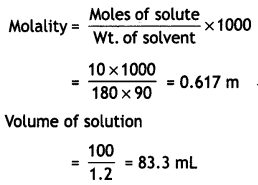
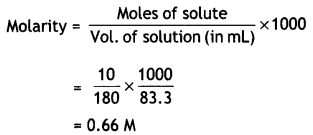
CBSE Sample Papers for Class 10 Hindi Course A Set 1 with Solutions

Students can access the CBSE Sample Papers for Class 10 Hindi with Solutions and marking scheme Course A Set 1 will help students in understanding the difficulty level of the exam.

CBSE Sample Papers for Class 10 Hindi Course A Set 1 with Solutions

निर्धारित समय : 3 घंटे
अधिकतम अंक : 80

सामान्य निर्देश:
(क) इस प्रश्न-पत्र के दो खंड हैं- ‘अ’ और ‘ब’।
(ख) खंड ‘अ’ में कुल 10 वस्तुपरक प्रश्न पूछे गए हैं। सभी प्रश्नों में उपप्रश्न दिए गए हैं। दिए गए निर्देशों का पालन करते हुए प्रश्नों के उत्तर दीजिए।
(ग) खंड ‘ब’ में कुल 7 वर्णनात्मक प्रश्न पूछे गए हैं। प्रश्नों में आंतरिक विकल्प दिए गए हैं। दिए गए निर्देशों का पालन करते हुए प्रश्नों के उत्तर दीजिए।

खंड ‘अ’- वस्तुपरक प्रश्न ( अंक 40)

अपठित गद्यांश (अंक 5)

प्रश्न 1.
निम्नलिखित गद्यांश को पढ़कर पूछे गए प्रश्नों के लिए सही विकल्प चुनकर लिखिए। (1 × 5 = 5)

विद्यार्थी-जीवन को मानव-जीवन की रीढ़ की हड्डी कहें तो कोई अतिशयोक्ति नहीं होगी। विद्यार्थी काल में बालक में जो संस्कार पड़ जाते हैं, जीवनभर वही संस्कार अमिट रहते हैं। इसीलिए यही काल आधारशिला कहा गया है। यदि यह नींव दृढ़ बन जाती है तो जीवन सुदृढ़ और सुखी बन जाता है। यदि इस काल में बालक कष्ट सहन कर लेता है, तो उसका स्वास्थ्य सुंदर बनता है। यदि मन लगाकर अध्ययन कर लेता है तो उसे ज्ञान मिलता है, उसका मानसिक विकास होता है। जिस वृक्ष को प्रारंभ से सुंदर सिंचन और खाद मिल जाती है, वह पुष्पित एवं पल्लवित होकर संसार को सौरभ देने लगता है। इसी प्रकार विद्यार्थी काल में जो बालक श्रम, अनुशासन एवं समय नियमन के साँचे में ढल जाता है, वह आदर्श विद्यार्थी बनकर सभ्य नागरिक बन जाता है। सभ्य नागरिक के लिए जिन-जिन गुणों की आवश्यकता है, उन गुणों के लिए विद्यार्थी काल ही तो सुंदर पाठशाला है। यहाँ पर अपने साथियों के बीच रहकर वे सभी गुण आ जाने आवश्यक हैं, जिनकी विद्यार्थी को अपने जीवन में आवश्यकता होती है।

(i) ‘संसार को सौरभ’ देने का अर्थ है
(क) संसार में सुगंध फैलाना
(ख) संसार में बेहतर बनना
(ग) संसार में पेड़ लगाना
(घ) संसार को सुगंधित द्रव्य देना
उत्तर-
(क) संसार में सुगंध फैलाना

(ii) गद्यांश में आदर्श विद्यार्थी के किन गुणों की चर्चा की गई है?
(क) नियमावली का पालन
(ख) ज्ञान-प्राप्ति हेतु ध्यान की आवश्यकता
(ग) नियमन
(घ) व्यायाम
उत्तर-
(ग) नियमन

(iii) गद्यांश के आधार पर कहा जा सकता है कि
(क) विद्यार्थी-जीवन में व्यक्ति अनेक गुणों को धारण कर लेता है।
(ख) विद्यार्थी जीवन के लिए सुंदर पाठशाला की आवश्यकता होती है।
(ग) कष्ट सहन करने से सेहत बनती है।
(घ) वृक्षों को सींचना पर्यावरण के लिए आश्वयक है।
उत्तर-
(क) विद्यार्थी-जीवन में व्यक्ति अनेक गुणों को धारण कर लेता है।

(iv) गद्यांश में ‘वृक्ष’ किसे कहा गया है?
(क) पेड़ को
(ख) विद्यार्थी को
(ग) जीवन को
(घ) समय को
उत्तर-
(ख) विद्यार्थी को

(v) मानव जीवन की रीढ़ की हड्डी विद्यार्थी-जीवन को क्यों माना जाता है?
(क) पूरा जीवन विद्यार्थी-जीवन पर चलता है।
(ख) जो संस्कार विद्यार्थी-जीवन में पड़ जाते हैं, वे संस्कार स्थायी हो जाते हैं।
(ग) विद्यार्थी-जीवन सुखी जीवन होता है।
(घ) विद्यार्थी जीवन में ज्ञान मिलता है।
उत्तर-
(ख) जो संस्कार विद्यार्थी-जीवन में पड़ जाते हैं, वे संस्कार स्थायी हो जाते हैं।

अथवा

विद्याभ्यासी पुरुष को साथियों का अभाव कभी नहीं रहता। उसकी कोठरी में सदा ऐसे लोगों का वास रहता है, जो अमर हैं। वे उसके प्रति सहानुभूति प्रकट करने और उसे समझाने के लिए सदा प्रस्तुत रहते हैं। कवि, दार्शनिक और विद्वान, जिन्होंने प्रकृति के रहस्यों का उद्घाटन किया है और बड़े-बड़े महात्मा, जिन्होंने आत्मा के गूढ़ रहस्यों की

थाह लगा ली है, सदा उसकी बातें सुनने और उसकी शंकाओं का समाधान करने के लिए उद्यत रहते हैं। बिना किसी उद्देश्य के सरसरी तौर पर पुस्तकों के पन्ने उलटते जाना अध्ययन नहीं है। लिखी हुई बातों को विचारपूर्वक पूर्णरूप से हृदय से ग्रहण करने का नाम अध्ययन है। प्रत्येक स्त्री-पुरुष को अपने पढ़ने का उद्देश्य स्थित कर लेना चाहिए। इसके लिए सबसे मुख्य बात यह है कि पढ़ना नियमपूर्वक हो अर्थात इसके लिए नित्य का समय उपयुक्त होता है।

(i) ‘विद्वान’ शब्द का विलोम है
(क) विदुषी
(ख) मूर्ख
(ग) मंदबुद्धि
(घ) इनमें से कोई नहीं
उत्तर
(क) विदुषी

(ii) कौन-सा शब्द ‘प्र’ उपसर्ग लगाकर नहीं बना है?
(क) प्रयुक्त
(ख) प्रसिद्ध
(ग) प्रश्न
(घ) प्रगति
उत्तर
(ग) प्रश्न

(iii) विद्याभ्यासी पुरुष के पास किसका वास रहता है?
(क) संबंधियों का
(ख) पुस्तकों का
(ग) गुरुजनों का
(घ) जो अमर होते हैं
उत्तर
(घ) जो अमर होते हैं

(iv) विद्या का अभ्यास करने वाले व्यक्तियों को साथियों की कमी महसूस नहीं होती है क्योंकि
(क) उन्हें साथी की आवश्यकता नहीं होती है
(ख) उन्हें मित्र बनाना अच्छा नहीं लगता है
(ग) पुस्तकें उनकी साथी होती है
(घ) उनके अनेक साथी होते हैं
उत्तर
(ग) पुस्तकें उनकी साथी होती है

(v) अध्ययन क्या है?
(क) बिना कारण के पुस्तकों के पन्ने पलटना
(ख) नियमपूर्वक पढ़ना
(ग) लिखी हुई बातों को विचारपूर्वक हृदय से ग्रहण करना
(घ) कुछ भी पढ़ लेना
उत्तर
(ग) लिखी हुई बातों को विचारपूर्वक हृदय से ग्रहण करना

अपठित पद्यांश (अंक 5)

प्रश्न 2.
निम्नलिखित पद्यांश को पढ़कर पूछे गए प्रश्नों के लिए सही विकल्प चुनकर लिखिए। (1 × 5 = 5)
प्लास्टिक सर्जरी के कुछ जमा थे विद्वान,
और चला रहे थे अपनी जबान।
पहला बोला
कि मैंने एक लँगड़ी को टाँग लगाई थी,
इस वर्ष ओलंपिक दौड़ में वही पहली आई थी,
दूसरा बोला कि
परसों ही मैंने एक लूले को लगाया है नया हाथ
और कल ही बॉक्सिंग में बॉक्सर को उसने दी मात। तीसरा बोला कि
तब से बहुत हूँ परेशान
जब से मैंने एक भेड़िए के होठों पर चिपकाई है आदमी की मुस्कान
वह हाथ जोड़े घर-घर में जा रहा है
और अगले चुनाव के लिए अपना वोट पटा रहा है।

(i) कविता की अंतिम पंक्तियों में किस पर व्यंग्य किया गया है?
(क) कविता की अंतिम पंक्तियों में खिलाड़ियों पर व्यंग्य किया गया है।
(ख) कविता की अंतिम पंक्तियों में सर्जरी के विशेषज्ञों पर व्यंग्य किया गया है।
(ग) कविता की अंतिम पंक्तियों में राजनेताओं पर व्यंग्य किया गया है।
(घ) कविता की अंतिम पंक्तियों में देश की व्यवस्था पर व्यंग्य किया गया है।
उत्तर
(ग) कविता की अंतिम पंक्तियों में राजनेताओं पर व्यंग्य किया गया है।

(ii) तीसरे सर्जन की परेशानी का कारण कौन है?
(क) तीसरे सर्जन की परेशानी का कारण अभिनेता है।
(ख) तीसरे सर्जन की परेशानी का कारण नेता है।
(ग) तीसरे सर्जन की परेशानी का कारण भेड़िया है।
(घ) ये सभी विकल्प सही हैं।
उत्तर
(ग) तीसरे सर्जन की परेशानी का कारण भेड़िया है।

(iii) पहले सर्जन ने क्या कारनामा कर दिखाया था?
(क) एक लूले का हाथ लगाया, जिसने बॉक्सिंग में बॉक्सर को हराया।
(ख) भेड़िए के होठों पर आदमी की मुस्कान चिपकाई।
(ग) एक लँगड़ी को टाँग लगाई जो ओलंपिक दौड़ में प्रथम आई।
(घ) ये सभी विकल्प सही हैं।
उत्तर
(ग) एक लँगड़ी को टाँग लगाई जो ओलंपिक दौड़ में प्रथम आई।

(iv) कवि ने किस प्रकार के आदमी को भेड़िया कहा है?
(क) कवि ने शिक्षाविद को भेड़िया कहा है।
(ख) कवि ने धर्म नेता को भेड़िया कहा है।
(ग) कवि ने राजनेता को भेड़िया कहा है।
(घ) कवि ने दोहरे आचरण वाले व्यक्ति को भेड़िया कहा है।
उत्तर
(ग) कवि ने राजनेता को भेड़िया कहा है।

(v) घर-घर में शब्द है
(क) रूढ़
(ख) यौगिक
(ग) युग्म
(घ) सार्थक
उत्तर
(ग) युग्म

अथवा

देश हमें देता है सब कुछ, हम भी तो कुछ देना सीखें सूरज हमें रोशनी देता हवा नया जीवन देती है। भूख मिटाने को हम सबको, धरती पर होती खेती है। औरों का भी हित हो जिसमें, हम ऐसा कुछ करना सीखें पथिकों को जलती दुपहर में पेड़ सदा देते हैं छाया खुशबू भरे फूल देते हैं, हमको नव फूलों की माला, त्यागी तरुओं के जीवन से हम भी तो कुछ देना सीखें। जो अनपढ़ है उन्हें पढ़ाएँ, जो चुप हैं उनको वाणी दें। हम मेहनत के दीप जलाकर, नया उजाला करना सीखें।

(i) कवि हमसे क्या अपेक्षा रखता है?
(क) कवि हमसे त्याग की अपेक्षा रखता है।
(ख) कभी हमसे परहित की अपेक्षा रखता है।
(ग) कभी हमसे परिश्रम की अपेक्षा रखता है।
(घ) ये सभी विकल्प सही हैं।
उत्तर
(घ) ये सभी विकल्प सही हैं।

(ii) कवि के अनुसार देश हमें क्या देता है?
(क) कवि के अनुसार देश हमें आश्चर्य देता है।
(ख) कवि के अनुसार देश हमें धन-धान्य देता है।
(ग) कवि के अनुसार देश हमें रोज़गार के अवसर देता है।
(घ) कवि के अनुसार देश हमें सब कुछ देता है।
उत्तर
(घ) कवि के अनुसार देश हमें सब कुछ देता है।

(iii) हम किससे देना सीख सकते हैं?
(क) हम देश और धरती से देना सीख सकते हैं।
(ख) हम सूरज और हवा से देना सीख सकते हैं।
(ग) हम वृक्षों और फूलों से देना सीख सकते हैं।
(घ) ये सभी विकल्प सही हैं।
उत्तर
(घ) ये सभी विकल्प सही हैं।

(iv) कवि ने त्यागी का संबोधन किसके लिए किया है?
(क) कवि ने त्यागी का संबोधन सूरज के लिए किया है।
(ख) कवि ने त्यागी का संबोधन धरती के लिए किया है।
(ग) कवि ने त्यागी का संबोधन वृक्षों के लिए किया है।
(घ) कवि ने त्यागी का संबोधन फूलों के लिए किया है।
उत्तर
(ग) कवि ने त्यागी का संबोधन वृक्षों के लिए किया है।

(v) कवि हमें क्या सीखने की प्रेरणा देता है?
(क) कवि हमें सबको कुछ देने की प्रेरणा देता है।
(ख) कवि हमें दूसरों के हित जीने की प्रेरणा देता है।
(ग) कभी हमें मेहनत करने की प्रेरणा देता है।
(घ) ये सभी विकल्प सही हैं।
उत्तर-
(घ) ये सभी विकल्प सही हैं।

व्यावहारिक व्याकरण (अंक 16)

प्रश्न 3.
निम्नलिखित प्रश्नों को पढ़कर किन्हीं चार प्रश्नों के उत्तर विकल्पों में से चुनकर लिखिए। (1 × 4 = 4)

(i) मजदूर मेहनत करता है, किंतु उसके लाभ से वंचित रहता है। किस प्रकार का वाक्य है? ।
(क) सरल वाक्य
(ख) मिश्र वाक्य
(ग) संयुक्त वाक्य
(घ) इनमें से कोई नहीं
उत्तर
(ख) मिश्र वाक्य

(ii) मिश्र वाक्य का चयन कीजिए
(क) सूरज पूर्व से निकलता है
(ख) हम भोजन कर रहे हैं
(ग) वह कौन-सा व्यक्ति है, जिसने महात्मा गांधी का नाम न सुना हो
(घ) वह बाज़ार गया औरा फल लाया।
उत्तर
(ग) वह कौन-सा व्यक्ति है, जिसने महात्मा गांधी का नाम न सुना हो

(iii) रेखांकित उपवाक्यों में से कौन-सा विशेषण उपवाक्य है?
(क) मैं कहता हूँ कि तुम भोपाल जाओ
(ख) लखनऊ उत्तर प्रदेश की राजधानी है जो कि एक ऐतिहासिक नगर है
(ग) मैं चाहता हूँ कि आप यहीं रहें।
(घ) जब मैं स्टेशन पहुँचा तभी ट्रेन आई
उत्तर
(ख) लखनऊ उत्तर प्रदेश की राजधानी है जो कि एक ऐतिहासिक नगर है

(iv) संयुक्त वाक्य का चयन कीजिए।
(क) परिश्रमी व्यक्ति ही सफलता प्राप्त करता है।
(ख) क्या मेरे बिना वह पढ़ नहीं सकता है?
(ग) जो परिश्रम करता है, वही आगे बढ़ता है।
(घ) मैं बजाता हूँ और वह गाता है।
उत्तर
(घ) मैं बजाता हूँ और वह गाता है।

(v) जब तक वह घर पहुंचा तब तक उसके पिता जा चुके थे।
(क) सरल वाक्य
(ख) मिश्र वाक्य
(ग) संयुक्त वाक्य
(घ) इनमें से कोई नहीं
उत्तर
(ख) मिश्र वाक्य

प्रश्न 4.
निम्नलिखित प्रश्नों को पढ़कर किन्हीं चार प्रश्नों के उत्तर विकल्पों में से चुनकर लिखिए। (1 × 4 = 4)

(i) पिता जी के द्वारा कार चलाई गई। वाच्य है
(क) कर्तृवाच्य
(ख) कर्मवाच्य
(ग) भाववाच्य
(घ) इनमें से कोई नहीं
उत्तर
(ख) कर्मवाच्य

(ii) भाववाच्य है
(क) मजदूरों ने ईंट नहीं उठाई।
(ख) मजदूरों से ईंट उठाई नहीं जाती।
(ग) मैं पढ़ नहीं सकती।
(घ) वह बेचारी रो भी नहीं सकती।
उत्तर
(ख) मजदूरों से ईंट उठाई नहीं जाती।

(iii) आज उसे जमानत मिल गई। वाच्य है
(क) कर्तृवाच्य
(ख) कर्मवाच्य
(ग) भाववाच्य
(घ) कोई नहीं
उत्तर
(क) कर्तृवाच्य

(iv) कर्मवाच्य है
(क) मित्र विपत्ति में मदद करते हैं।
(ख) मित्रों के द्वारा विपत्ति में मदद की जाती है।
(ग) बूढी माँ से चला नहीं जाता।
(घ) फैक्टरी बंद कर दी।
उत्तर
(ख) मित्रों के द्वारा विपत्ति में मदद की जाती है।

(v) निशा द्वारा अच्छी कविता लिखी गई। वाच्य है
(क) कर्तृवाक्य
(ख) कर्मवाक्य
(ग) भाववाक्य
(घ) इनमें से कोई नहीं
उत्तर
(ख) कर्मवाक्य

प्रश्न 5.
निम्नलिखित प्रश्नों को पढ़कर किन्हीं चार प्रश्नों के उत्तर विकल्पों में से चुनकर लिखिए। (1 × 4 = 4)

(i) ‘गीता पुस्तक पढ़ती है।’ रेखांकित का पद-परिचय है
(क) जातिवाचक संज्ञा, बहुवचन, पुल्लिंग, कर्म कारक
(ख) व्यक्तिवाचक संज्ञा, एकवचन, स्त्रीलिंग, कर्ता कारक
(ग) भाववाचक संज्ञा, एकवचन, स्त्रीलिंग, कर्म कारक
(घ) समूहवाचक संज्ञा, बहुवचन, पुल्लिंग, कर्ता कारक
उत्तर
(ख) व्यक्तिवाचक संज्ञा, एकवचन, स्त्रीलिंग, कर्ता कारक

(ii) ‘आज हमारी परीक्षा होनी है।’ में ‘आज’ का पद-परिचय है
(क) कालवाचक क्रियाविशेषण, ‘होनी है’ क्रिया की विशेषता बता रहा है।
(ख) स्थानवाचक क्रियाविशेषण, ‘होनी है’ क्रिया की विशेषता बता रहा है।
(ग) परिमाणवाचक क्रियाविशेषण, ‘होनी है’ क्रिया की विशेषता बता रहा है।
(घ) उपर्युक्त में से कोई नहीं।
उत्तर
(क) कालवाचक क्रियाविशेषण, ‘होनी है’ क्रिया की विशेषता बता रहा है।

(iii) ‘आज तुमने थोड़ा-सा ही दूध क्यों पीया?’ रेखांकित पद का पद-परिचय क्या है?
(क) निश्चित परिमाणवाचक विशेषण, एकवचन, पुल्लिंग, ‘दूध’ विशेष्य का विशेषण
(ख) अनिश्चित परिमाणवाचक विशेषण, एकवचन, पुल्लिंग, ‘दूध’ विशेष्य का विशेषण
(ग) संख्यावाचक विशेषण, स्त्रीलिंग, ‘दूध’ विशेष्य का विशेषण
(घ) इनमें से कोई भी नहीं।
उत्तर
(ख) अनिश्चित परिमाणवाचक विशेषण, एकवचन, पुल्लिंग, ‘दूध’ विशेष्य का विशेषण

(iv) ‘वे बहुत ईमानदार है।’ में ‘वे’ का पद-परिचय है
(क) निजवाचक सर्वनाम, बहुवचन, पुल्लिंग/स्त्रीलिंग, कर्ता कारक।
(ख) निश्चयवाचक सर्वनाम, एकवचन, पुल्लिंग/स्त्रीलिंग, कर्म कारक
(ग) अन्य पुरुषवाचक सर्वनाम, एकवचन, पुल्लिंग/स्त्रीलिंग, कर्ता कारक
(घ) अनिश्चयवाचक सर्वनाम, बहुवचन, पुल्लिंग/स्त्रीलिंग, करण कारक
उत्तर
(ग) अन्य पुरुषवाचक सर्वनाम, एकवचन, पुल्लिंग/स्त्रीलिंग, कर्ता कारक

(v) ‘रामू बाज़ार जाओ।’ में रेखांकित का पद-परिचय क्या है?
(क) सकर्मक क्रिया, वर्तमान काल, स्त्रीलिंग, एकवचन
(ख) अकर्मक क्रिया, वर्तमान काल, पुल्लिंग, एकवचन,
(ग) सकर्मक क्रिया, भूत काल, स्त्रीलिंग, बहुवचन
(घ) इनमें से कोई नहीं
उत्तर
(ख) अकर्मक क्रिया, वर्तमान काल, पुल्लिंग, एकवचन,

प्रश्न 6.
निम्नलिखित प्रश्नों को पढ़कर किन्हीं चार प्रश्नों के उत्तर विकल्पों में से चुनकर लिखिए। (1 × 4 = 4)
(i) उस काल मारे क्रोध के, तन काँपने उसका लगा। मानो हवा के ज़ोर से, सोता हुआ सागर जगा। इन पंक्तियों में कौन-सा रस है?
(क) वीर रस
(ख) रौद्र रस
(ग) अद्भुत रस
(घ) करुण रस
उत्तर
(क) वीर रस

(ii) प्रिय पति वह मेरा प्राण प्यारा कहाँ है? दुख-जलनिधि-डूबी सहारा कहाँ है? इन पंक्तियों में कौन-सा स्थायी ङ्के भाव है?
(क) विस्मय
(ख) रति
(ग) शोक
(घ) क्रोध
उत्तर
(ग) शोक

(iii) शृंगार रस का स्थायी भाव है?
(क) उत्साह
(ख) शोक
(ग) रति
(घ) भय
उत्तर
(ग) रति

(iv) क्रोध किस रस का स्थायी भाव है
(क) वीभत्स
(ख) भयानक
(ग) रौद्र
(घ) वीर रस
उत्तर
(ग) रौद्र

(v) करुण रस का उदाहरण है
(क) कहत, नटत, रीझत, खीझत, मिलत, खिलत, लजियात।
भरे भौन में करत हैं नैनन ही सौं बात।।

(ख) देखि सुदामा की दीन दसा करुना करि के करुनानिधि रोये।
पानी परात को हाथ छुयो नहिं, नैननि के जल सों पग धोये।।

(ग) श्रीकृष्ण के सुन वचन अर्जुन क्रोध से जलने लगे।
सब शोक अपना भूलकर करतल-युगल मलने लगे।।

(घ) नाक चढे सी-सी करै, जितै छबीली छैल।
फिरि फिरि भूलि वही गहै, प्यौ कंकरीली गैल।।

उत्तर
(ख) देखि सुदामा की दीन दसा करुना करि के करुनानिधि रोये।
पानी परात को हाथ छुयो नहिं, नैननि के जल सों पग धोये।।

पाठ्यपुस्तक (अंक 14)

प्रश्न 7.
निम्नलिखित गद्यांश को पढ़कर पूछे गए प्रश्नों के उत्तर विकल्पों से चुनकर लिखिए। (1 × 5 = 5)
फिर अकसर माँ की स्मृति में डूब जाते देखा है। उनकी माँ की चिट्ठियाँ अकसर उनके पास आती थीं। अपने अभिन्न मित्र डॉ. रघुवंश को वह उन चिट्ठियाँ को दिखाते थे। पिता और भाइयों के लिए बहुत लगाव मन में नहीं था। पिता व्यवसायी थे। एक भाई वहीं पादरी हो गया है। एक भाई काम करता है, उसका परिवार है। बहन सख्त और ज़िद्दी थी। बहुत देर से उसने शादी की। फ़ादर को एकाध बार उसकी शादी की चिंता व्यक्त करते उन दिनों देखा था। भारत में बस जाने के बाद दो या तीन बार अपने परिवार से मिलने भारत से बेल्जियम गए थे।

(i) कौन माँ की स्मृतियों में डूब जाते थे
(क) लेखक
(ख) फ़ादर बुल्के
(ग) दोनों
(घ) इनमें से कोई नहीं
उत्तर
(ख) फ़ादर बुल्के

(ii) फ़ादर के पिता क्या थे?
(क) वकील
(ख) पादरी
(ग) व्यवसायी
(घ) जज
उत्तर
(ग) व्यवसायी

(iii) फ़ादर को किसकी चिंता थी?
(क) पिता की
(ख) भाई की
(ग) बहन की
(घ) माँ की
उत्तर
(ग) बहन की

(iv) फादर का परिवार कहाँ रहता था?
(क) भारत में
(ख) बेल्जियम में
(ग) लंदन में
(घ) जर्मनी में
उत्तर
(ख) बेल्जियम में

(v) फ़ादर के अभिन्न मित्र कौन थे?
(क) लेखक
(ख) उनके भाई
(ग) रघुवंश
(घ) माँ
उत्तर
(ग) रघुवंश

प्रश्न 8.
निम्नलिखित प्रश्नों के उत्तर विकल्पों में से चुनकर लिखिए। (1 × 2 = 2)

(i) लेखक बालगोबिन भगत के किस गुण पर मुग्ध थे?
(क) सरलता
(ख) सहनशीलता
(ग) मधुर संगीत-गायन
(घ) इनमें से कोई नहीं
उत्तर
(ग) मधुर संगीत-गायन

(ii) हालदार साहब को कितने दिनों में कंपनी के काम से कस्बे से गुज़रना पड़ता था?
(क) चौदहवें दिन
(ख) पंद्रहवें दिन
(ग) हर ग्यारह दिन बाद
(घ) कुछ कह नहीं सकते
उत्तर
(ख) पंद्रहवें दिन

प्रश्न 9.
निम्नलिखित पद्यांश को पढ़कर पूछे गए प्रश्नों के उत्तर विकल्पों में से चुनकर लिखिए। (1 × 5 = 5)
ऊधौ, तुम हौ अति बड़भागी। अपरस रहत सनेह तगा तैं, नाहिन मन अनुरागी। पुरइनि पात रहत जल भीतर, ता रस देह न दागी। ज्यौं जल माहँ तेल की गागरि, बूंद न ताकौं लागी। प्रीति-नदी मैं पाउँ न बोरयौ, दृष्टि न रूप परागी। ‘सूरदास’ अबला हम भोरी, गुर चाँटी ज्यौं पागी।

(i) कमल के पत्ते की कौन-सी विशेषता कविता में बताई गई है?
(क) कमल का पत्ता सुंदर होता है।
(ख) कमल का पत्ता पानी में डूबा रहता है, लेकिन उस पर कोई दाग भी नहीं लगता है।
(ग) पहला और दूसरा उत्तर सही है।
(घ) दिए गए विकल्पों के सभी उत्तर गलत हैं।
उत्तर
(ख) कमल का पत्ता पानी में डूबा रहता है, लेकिन उस पर कोई दाग भी नहीं लगता है।

(ii) उद्धव के प्रेम विहीन रहने की तुलना किससे या किस-किससे की गई है?
(क) कमल के पत्ते और तेल की मटकी से की गई है।
(ख) केवल कमल के पत्ते से की गई है।
(ग) केवल तेल की मटकी से की गई है।
(घ) गुड़ की चींटी से की गई है।
उत्तर
(क) कमल के पत्ते और तेल की मटकी से की गई है।

(iii) गोपियों ने किसको अति बड़भागी कहा है?
(क) श्रीकृष्ण को
(ख) उद्धव को
(ग) जल से भरी मटकी को
(घ) गोपियों ने स्वयं को
उत्तर
(ख) उद्धव को

(iv) भोली भाली गोपियों और चींटियों में क्या समानता है?
(क) जिस तरह से चीटियाँ गुड़ से चिपटकर मुक्त नहीं होती हैं, उसी तरह से श्रीकृष्ण के प्रेम में गोपियाँ भी उनसे अलग नहीं हो सकती हैं।
(ख) जिस तरह से चीटियों को गुड़ पसंद है, वैसे ही गोपियों को मिठाइयाँ प्रिय हैं।
(ग) दोनों उत्तर सही है
(घ) कोई भी उत्तर सही नहीं है।
उत्तर
(क) जिस तरह से चीटियाँ गुड़ से चिपटकर मुक्त नहीं होती हैं, उसी तरह से श्रीकृष्ण के प्रेम में गोपियाँ भी उनसे अलग नहीं हो सकती हैं।

(v) ‘प्रीति-नदी मैं पाउँ न बोरयौ’ का अर्थ क्या है?
(क) प्रीति नदी यमुना नदी को कहा गया है।
(ख) प्रेम रूपी नदी में कभी पैर नहीं डुबोया अर्थात जिसने कभी प्रेम नहीं किया।
(ग) नदी में नहाने की बात हो रही है।
(घ) ऊपर दिए गए विकल्पों में से कोई नहीं।
उत्तर
(ख) प्रेम रूपी नदी में कभी पैर नहीं डुबोया अर्थात जिसने कभी प्रेम नहीं किया।

प्रश्न 10.
निम्नलिखित प्रश्नों के उत्तर विकल्पों में से चुनकर लिखिए। (1 × 2 = 2)
(i) परशुराम का स्वभाव कैसा है?
(क) उदार
(ख) शीतल
(ग) क्रोधी
(घ) चंचल
उत्तर
(ग) क्रोधी

(ii) ‘शाब्दिक-भ्रम’ किसे कहा गया है?
(क) दिन-रात को
(ख) वस्त्र और आभूषण को
(ग) सुख-दुख को
(घ) उपर्युक्त में से कोई नहीं
उत्तर
(ख) वस्त्र और आभूषण को

खंड ‘ब’- वर्णनात्मक प्रश्न (अंक 40)

पाठ्यपुस्तक एवं पूरक पाठ्यपुस्तक (अंक 20)

प्रश्न 11.
निम्नलिखित प्रश्नों के उत्तर लगभग 25-30 शब्दों में लिखिए। (2 × 4 = 8)
(क) सेनानी न होते हुए भी चश्मेवाले को लोग कैप्टन क्यों कहते थे?
(ख) बालगोबिन भगत ने अपने बेटे की मृत्यु पर अपनी भावनाएँ कैसे व्यक्त की?
(ग) फ़ादर की उपस्थिति ‘देवदार की छाया’ के समान क्यों लगती थी?
(घ) नवाब साहब खीरा खाने के अपने ढंग के माध्यम से क्या दिखाना चाहते थे?
उत्तर
(क) चश्मेवाला एक देशभक्त नागरिक था। उसके हृदय में देश के वीर जवानों के प्रति सम्मान था। इसलिए लोग उसे कैप्टन कहते थे। अर्थात कैप्टन एक देशप्रेमी था, नेताजी जैसे देशभक्त के लिए उसके कम में सम्मान की भावना थी।

(ख) बालगोबिन भगत ने अपने बेटे की मृत्यु पर उसे आँगन में चटाई पर लिटाकर एक सफ़ेद कपड़े से ढक दिया। उसके ऊपर फूल एवं तुलसीदल डाल दिए तथा कबीर के पद गाने लगे। उन्होंने अपनी पुत्रवधू को भी रोने की बजाए प्रसन्न होने के लिए कहा और समझाया कि आज तो आत्मा व परमात्मा का मिलन हुआ है, यह समय रोने का नहीं, उत्सव मनाने का है।

(ग) फ़ादर बुल्के मानवीय गुणों से परिपूर्ण थे। उनके हृदय में सबके लिए कल्याण की कामना थी। वे सभी को आशीर्वाद देते थे, सबकी झोली खुशियों से भर देते थे। जिस प्रकार देवदार का विशाल वृक्ष अपनी शीतलता से दूसरों के दुख हर लेता है, उसी प्रकार फादर अपने व्यवहार से सबका दिल जीत लेते थे।

(घ) नवाब साहब खीरे से सुगंध का रसास्वादन करके तृप्त होने के अपने विचित्र ढंग के माध्यम से अपनी रईसी और नवाबी का प्रदर्शन करना चाहते थे। वे लेखक को यह भी बताना चाह रहे थे कि नवाब जैसे रईस लोग खीरा जैसी साधारण-सी खाद्य वस्तु का आनंद इसी तरह लेते हैं। इसमें उनकी दिखावा करने की प्रवृत्ति दिख रही थी।

प्रश्न 12.
निम्नलिखित प्रश्नों के उत्तर लगभग 25-30 शब्दों में लिखिए। (2 × 3 = 6)
(क) बादलों से गर्जना का आह्वान कर कवि क्या कहना चाहता है? ‘उत्साह’ कविता के आधार पर बताइए।
(ख) ‘कन्यादान’ कविता में वस्त्र और आभूषणों को शाब्दिक-भ्रम क्यों कहा गया है?
(ग) ‘मरजादा न लही’ के माध्यम से कौन-सी मर्यादा न रहने की बात की जा रही है?
उत्तर
(क) कवि बादलों से गर्जना का आह्वान कर धरती और मानव की प्यास बुझाकर उन्हें तृप्त करने तथा अपनी गर्जना में छिपी क्रांति से एक परिवर्तन लाने की बात कहते हैं।

(ख) ‘कन्यादान’ कविता में वस्त्र और आभूषणों को शाब्दिक-भ्रम इसलिए कहा गया है, क्योंकि नववधू, इनके आकर्षण में फँसकर मुग्ध हो जाती है। इसी की आड़ में ससुराल वाले उसका शोषण करते हैं।

(ग) गोपियों ने अपने प्रेम को कभी किसी के सम्मुख प्रकट नहीं किया था। वे शांत भाव से श्रीकृष्ण के लौटने की प्रतीक्षा कर रही थीं। कोई भी उनके दुख को समझ नहीं पा रहा था। वे चुप्पी लगाए अपनी मर्यादा में लिपटी हुई इस वियोग को सहन कर रही थीं कि वे श्रीकृष्ण से प्रेम करती हैं। परंतु उद्धव के योग संदेश ने उनको उनकी
मर्यादा छोड़कर बोलने पर मजबूर कर दिया अर्थात जो बात सिर्फ वे ही जानती थीं, आज सबको पता चल जाएगा।

प्रश्न 13.
निम्नलिखित प्रश्नों में से किन्हीं दो प्रश्नों के उत्तर लगभग 40-50 शब्दों में लिखिए। (3 × 2 = 6)
(क) ‘माता का अँचल’ पाठ के आधार पर बताइए कि शिशु का नाम भोलानाथ कैसे पड़ा?
(ख) प्रकृति के उस अनंत और विराट स्वरूप को देखकर ‘साना-साना हाथ जोड़ि’ पाठ की लेखिका को कैसी अनुभूति होती है?
(ग) अखबार वाले सरकारी तंत्र की इच्छा के अनुकूल भी लिखते हैं और ऐसे कार्यों को छापने से बचते भी हैं जो उनको नहीं करना चाहिए? स्पष्ट कीजिए।
उत्तर
(क) शिशु का नाम तारकेश्वर नाथ था। तारकेश्वर के पिता शिवजी के भक्त थे। उसके पिता पूजा के बाद हमेशा उसके माथे पर भभूत और तिलक लगा देते थे, लंबी जटाएँ तो पहले से ही थीं। पिता जी उसे प्यार से भोलानाथ कहते थे। फिर सभी उसे तारकेश्वर नाथ न कहकर भोलानाथ कहकर पुकारने लगे। पिता के द्वारा तारकेश्वर नाथ को दी गई वेशभूषा, रूपरेखा, तथा माथे पर तिलक को देखकर उसका नाम भोलानाथ ही पड़ गया था।

(ख) हिमालय कहीं गहरे हरे रंग का मोटा कालीन ओढे, तो कहीं हलका पीलापन लिए, तो कहीं पलस्तर उखड़ी दीवार की तरह पथरीला लग रहा था। चारों ओर सुंदर नज़ारे मन को मोहित कर रहे थे। ऐसा लगता था कि किसी ने जादू की छड़ी घुमा दी हो। प्रकृति का कण-कण बादलों की एक मोटी चादर को लपेटे हुए था। आँखों और आत्मा को सुख देने वाले हर क्षण परिवर्तित हिमालय के नज़ारे लेखिका को अभिभूत कर रहे थे।

(ग) अखबार वाले सरकारी तंत्र की प्रशंसा में तो खूब रस लेकर छोटी-सी भी बात को छापते हैं, किंतु जिस कार्य से सरकार की पोल खुलती हो, उससे या तो बचते हैं या उसमें शब्दों की हेर-फेर कर अनर्थ को अर्थवान बना प्रस्तुत करते हैं। इसी प्रकार जिंदा नाक लगाने के शर्मनाक दिन कोई अख़बार इस घटना को यथार्थ छापकर या कोई लेख लिख अपनी साहसिक और ईमानदार छवि प्रस्तुत नहीं कर सका। इस तरह अख़बार की दुनिया का सरकार से अप्रत्यक्ष रूप से घनिष्ठ संबंध बना रहता है।

(ख) बालगोबिन भगत ने अपने बेटे की मृत्यु पर उसे आँगन में चटाई पर लिटाकर एक सफ़ेद कपड़े से ढक दिया। उसके ऊपर फूल एवं तुलसीदल डाल दिए तथा कबीर के पद गाने लगे। उन्होंने अपनी पुत्रवधू को भी रोने की बजाए प्रसन्न होने के लिए कहा और समझाया कि आज तो आत्मा व परमात्मा का मिलन हुआ है, यह समय रोने का नहीं, उत्सव मनाने का है।

(ग) फ़ादर बुल्के मानवीय गुणों से परिपूर्ण थे। उनके हृदय में सबके लिए कल्याण की कामना थी। वे सभी को आशीर्वाद देते थे, सबकी झोली खुशियों से भर देते थे। जिस प्रकार देवदार का विशाल वृक्ष अपनी शीतलता से दूसरों के दुख हर लेता है, उसी प्रकार फादर अपने व्यवहार से सबका दिल जीत लेते थे।

(घ) नवाब साहब खीरे से सुगंध का रसास्वादन करके तृप्त होने के अपने विचित्र ढंग के माध्यम से अपनी रईसी और नवाबी का प्रदर्शन करना चाहते थे। वे लेखक को यह भी बताना चाह रहे थे कि नवाब जैसे रईस लोग खीरा जैसी साधारण-सी खाद्य वस्तु का आनंद इसी तरह लेते हैं। इसमें उनकी दिखावा करने की प्रवृत्ति दिख रही थी।

लेखन (अंक 20)

प्रश्न 14.
निम्नलिखित में से किसी एक विषय पर दिए गए संकेत-बिंदुओं के आधार पर लगभग 80-100 शब्दों में अनुच्छेद लिखिए। (1 × 5 = 5)
(क) वन और पर्यावरण का संबंध संकेत-बिंदु-

  • वन प्रदूषण-निवारण में सहायक
  • वनों की उपयोगिता
  • वन-संरक्षण की आवश्यकता
  • वन संरक्षण के उपाय।

(ख) कोरोना- एक वैश्विक महामारी
संकेत-बिंदु-

  • क्या है महामारी
  • आधुनिक स्वास्थ्य सुविधाओं के उपरांत भी कोई उपचार नहीं
  • बचाव और सुझाव।

(ग) अभ्यास का महत्व
संकेत-बिंदु-

  • अभ्यास का महत्व
  • ऐतिहासिक लोगों के उदाहरण
  • प्रसिद्ध कहावत
  • निष्कर्ष।

उत्तर
(क) वन और पर्यावरण का संबंध वनों से भूमि का कटाव रोका जा सकता है। वनों से रेगिस्तान का फैलाव रुकता है, सूखा कम पड़ता है। इससे ध्वनि-प्रदूषण की भयंकर समस्या से भी काफी हद तक नियंत्रण पाया जा सकता है। वन ही नदियों, झरनों और अन्य प्राकृतिक जल-स्रोतों के भंडार हैं।

वनों से हमें लकड़ी, फल, फूल, खाद्य पदार्थ, गोंद तथा अन्य सामान प्राप्त होते हैं। आज भारत में दुर्भाग्य से केवल 23% वन बचे हैं। जैसे-जैसे उद्योगों को संख्या बढ़ रही है, शहरीकरण हो रहा है, वाहनों की संख्या बढ़ती जा रही है, वैसे-वैसे वनों की आवश्यकता और बढ़ती जा रही है। वन-संरक्षण एक कठिन एवं महत्वपूर्ण काम है।

इसमें हर व्यक्ति को अपनी ज़िम्मेदारी समझनी पड़ेगी और अपना योगदान देना होगा। अपने घर-मोहल्ले, नगर में अत्यधिक संख्या में वृक्षारोपण को बढ़ाकर इसको एक आंदोलन के रूप में आगे बढ़ाना होगा। तभी हम अपने पर्यावरण को स्वच्छ रख पाएँगे।

(ख) कोरोना- एक वैश्विक महामारी आज पूरे संसार में कोरोना वायरस का आतंक फैल चूका है। आज पूरे संसार में यह एक महामारी के रूप में आ चुका है। कोरोना वायरस कई तरह के विषाणुओं यानी वायरस का एक समूह है, यह अनेक तरह के प्राणियों में रोग उत्पन्न करने की क्षमता रखता है।

यह एक व्यक्ति से पचास लोगों तक रोग फैलाने की क्षमता रखता है। इस वायरस का अभी तक कोई इलाज नहीं निकल पाया है। विश्व भर के सभी वैज्ञानिक तेज गति से इसका वैक्सीन बनाने की प्रक्रिया में लगे हैं। आने वाले समय में संभावना है कि एक से डेढ़ वर्ष के अंदर इस वायरस का वैक्सीन आ जाए।

इस वायरस से बचने के लिए हमें अपना ध्यान खुद रखना होगा। बचाव के उपाय सामाजिक दूरी बनाए रखना, पर्याप्त सुरक्षा मानक अपनाना, साबुन से नियमित रूप से हाथ धोना, वायरस संक्रमित लोगों से दूर रहना आदि हैं। बहुत भीड़ वाली जगह में नहीं जाना, अपने घरों में रहना कुछ अन्य उपाय हैं। सरकार द्वारा बनाए नियमों का पालन करना होगा। बार-बार अपने हाथ धोने होंगे, अपने हाथ नाक, मुँह में नहीं लगाने होंगे।

(ग) अभ्यास का महत्त्व
यदि निरंतर अभ्यास किया जाए, तो असाध्य को भी साधा जा सकता है। ईश्वर ने सभी मनुष्यों को बुद्धि दी है। उस बुद्धि का इस्तेमाल तथा अभ्यास करके मनुष्य कुछ भी सीख सकता है। अर्जुन तथा एकलव्य ने निरंतर अभ्यास करके धनुर्विद्या में निपुणता प्राप्त की। उसी प्रकार वरदराज ने, जो कि एक मंदबुद्धि बालक था, निरंतर अभ्यास द्वारा विद्या प्राप्त की और ग्रंथों की रचना की। उन्हीं पर एक प्रसिद्ध कहावन बनीकरत-करत अभ्यास के, जड़मति होत सुजान।

रसरि आवत जात तें, सिल पर परत निसान।। यानी जिस प्रकार रस्सी की रगड़ से कठोर पत्थर पर भी निशान बन जाते हैं, उसी प्रकार निरंतर अभ्यास से मूर्ख व्यक्ति भी विद्वान बन सकता है। यदि विद्यार्थी प्रत्येक विषय का निरंतर अभ्यास करें, तो उन्हें कोई भी विषय कठिन नहीं लगेगा और वे सरलता से उस विषय में कुशलता प्राप्त कर सकेंगे।

प्रश्न 15.
ग्रीष्मावकाश में विद्यालय में नाट्य-प्रशिक्षण शिविर आयोजित करने का अनुरोध करते हुए विद्यालय की प्रधानाचार्या को एक पत्र लगभग 80-100 शब्दों में लिखिए। (1 × 5 = 5)
अथवा
वाद-विवाद प्रतियोगिता में प्रथम आने पर मित्र को 80-100 शब्दों में बधाई पत्र लिखिए।
उत्तर
परीक्षा भवन
चन्छ०ज० शहर
दिनांक : 25 अप्रैल, 20xx
प्रधानाचार्या महोदया
ट०ठ०ड० स्कूल
नई दिल्ली।
विषय : विद्यालय में नाट्य-प्रशिक्षण शिविर के आयोजन हेतु। मान्यवर मैं आपके विद्यालय में कक्षा दसवीं का छात्र हूँ। जून में विद्यालय में ग्रीष्मावकाश होगा। इस अवकाश में हम एक नाट्य-प्रशिक्षण शिविर का आयोजन करना चाहते हैं। विद्यालय में ग्रीष्मावकाश में ‘समर कैंप’ तो लग ही रहे हैं, परंतु मेरा आपसे अनुरोध है कि एक नाट्य-प्रशिक्षण शिविर का भी आयोजन किया जाए। ताकि योग्य विद्यार्थी अपनी कला को निखार सकें। नाट्य-प्रशिक्षण के विद्यार्थी भविष्य में एक अच्छा मंच संचालक व कलाकार बन सकते हैं। सी०बी०एस०ई० ने भी नाटक को भाषा की मुख्य गतिविधि में सम्मिलित किया है। अतः आपसे हम सबका अनुरोध है कि आप इस नाट्य-प्रशिक्षण शिविर का आयोजन कराने की अनुमति दे दें।
धन्यवाद।
प्रार्थी क०ख०ग०

अथवा

परीक्षा भवन
च०छ०ज० शहर
दिनांक : 11 मार्च, 20xx
प्रिय मित्र अनिल
नमस्कार।
कल ही तुम्हारी माता जी ने मुझे फोन पर बताया कि तुम वाद-विवाद प्रतियोगिता में प्रथम आए हो। मित्र, सबसे पहले मेरी हार्दिक बधाई स्वीकार करो। इस वाद-विवाद प्रतियोगिता के लिए तुमने कितनी मेहनत व अभ्यास किया होगा, तभी तो तुमने प्रतियोगिता में प्रथम स्थान प्राप्त किया। मैं तुम्हें बचपन से ही जानता हूँ कि तुम कितने मेहनती हो। एक बार अगर तुम ठान लेते हो, तो हमेशा विजयी होते हो। तुम्हारा निरंतर अभ्यास, अथक परिश्रम आज रंग ले आया। मुझे पूर्ण विश्वास है कि तुम ऐसे ही हमेशा सफलता प्राप्त करते रहोगे। तुम्हारे माता-पिता भी तुम पर गर्व महसूस कर रहे होंगे। पत्रोत्तर की प्रतीक्षा में।
तुम्हारा मित्र
क०ख०ग०

प्रश्न 16.
पर्यावरण विभाग की ओर से जल-संरक्षण का आग्रह करते हुए लगभग 25-50 शब्दों में एक विज्ञापन तैयार कीजिए। (1 × 5 = 5)
अथवा
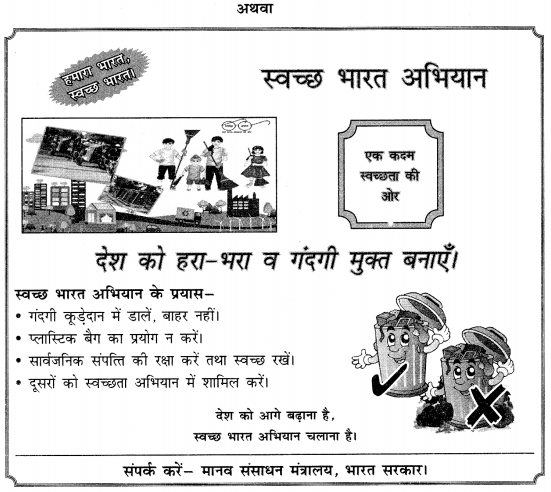
‘स्वच्छ भारत अभियान’ पर लगभग 25-50 शब्दों का एक विज्ञापन तैयार कीजिए।
उत्तर
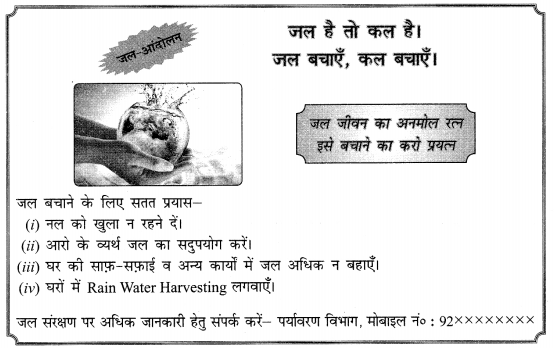
CBSE Sample Papers for Class 10 Hindi Course A Set 1 with Solutions 1
CBSE Sample Papers for Class 10 Hindi Course A Set 1 with Solutions 2

प्रश्न 17.
दीपावली हेतु नगर निगम की और से शुभकामना संदेश 30-40 शब्दों में लिखिए। (1 × 5 = 5)
अथवा
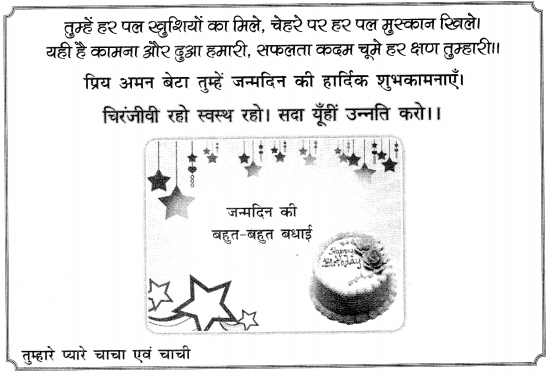
चाचा एवं चाची जी की और से अमन को जन्मदिवस हेतु शुभकामना संदेश 30-40 शब्दों में लिखिए।
उत्तर
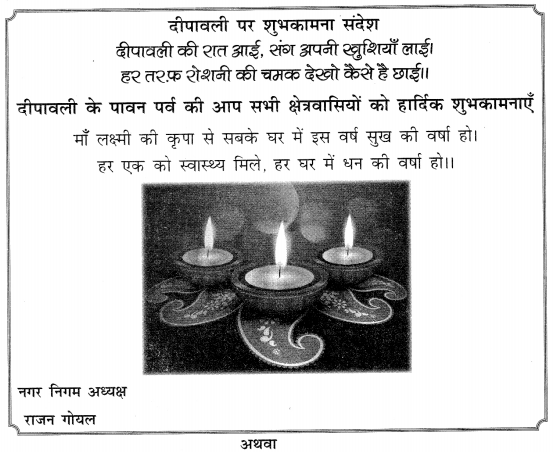
CBSE Sample Papers for Class 10 Hindi Course A Set 1 with Solutions 3
CBSE Sample Papers for Class 10 Hindi Course A Set 1 with Solutions 4

CBSE Sample Papers for Class 10 English Set 1 with Solutions

Students can access the CBSE Sample Papers for Class 10 English with Solutions and marking scheme Set 1 will help students in understanding the difficulty level of the exam.

CBSE Sample Papers for Class 10 English Set 1 with Solutions

Time: 3 Hours
Maximum Marks: 80

General Instructions:

1. This paper is divided into two parts: A and B. All questions are compulsory.
2. Separate instructions are given with each section and question, wherever necessary. Read these instructions very carefully and follow them.
3. Do not exceed the prescribed word limit while answering the questions.

Part-A
Multiple Choice Questions (40 Marks)

Reading (20 Marks)
Question 1.
Read the passage given below. (10 Marks)
1. “Why does humanity need Superman?”, wrote Lois Lane, the reporter from the Superman series. It’s a very relevant question in our context too. Why do we need superheroes? We are all enchanted by the action sequences in superhero movies, and also by how the superhero can always save the day – and with good reasons.

2. If you’re trying to guess what it is, you can forget about powers like super-strength, laser vision, or – our personal favourite – the ability to consume any type of matter in the universe. The underlying reason we’re so enamoured of them is quite possibly the best superhero power – the way they can inspire and motivate us. From the smallest boy and girl wonders, to the oldest Captains – each superhero has had their own lesson to impart unto all of us.

3. Whether it’s Batman saving Gotham city, Superman saving humanity, or our very own Krissh saving his fellow countrymen – we need superheroes because they give us the hope and strength we need to fight the injustice we encounter today. It’s like Batman once said, “Sometimes the truth isn’t good enough. Sometimes people deserve more. Sometimes people deserve to have their faith rewarded.”

4. Yes, it’s true that we need faith today, when we know a lot tends to go wrong, whether it is with regard to terrorism, or growing crime – people need the hope and strength they get from superheroes. That’s why we need superheroes, because of how they give us a sense of right, which helps us fight the injustice happening around us. It was best summarised by Superman when he said that “There is a superhero in all of us, we just need the courage to put on the cape,” and by Batman in the Dark Knight, when he said that “You either die a hero or live long enough to see yourself become the villain.”

5. So, every time we choose to see a superhero movie, it gives us a nudge to fight the unjust with our own ideas or capabilities. Every child and adult that watches superhero movies will be motivated to rise above the injustice happening in the real world. It’s not just about the power, but also the principle.

6. You and I can also be a superhero just by helping our neighbours, and by standing against what is wrong. Whether the situation is political or apolitical, injustice can be fought with thoughts of righteousness and courage.

7. From the day we are bom, we are told that power corrupts, and absolute power corrupts absolutely, but superheroes fan our subconscious desire for greatness. They also teach us that the greatest power is the integrity that keeps us from going down the wrong path. None of us will ever leap a tall building in a single bound, change the course of a mighty river, or bend steel with our bare hands but we can always return that lost wallet with its contents intact, tell the truth when it matters, stand our ground when it’s easier to walk away and unto others as we would want them to do unto us.

On the basis of your understanding of the passage, answer any ten questions from the twelve that follow. (10 × 1 = 10)
(i) Despite our age and status in life, few enigmatic qualities endear us to superheroes. Select the correct options from below:
1. Give our subconscious a desire for greatness
2. Have a lesson to bestow
3. Inspire and motivate us
4. Hive us hope to fight the bad
(a) 1 and 3
(b) 2 and 4
(c) 3 and 4
(d) 1, 2, 3 and 4
Answer:
(d) 1, 2, 3 and 4

(ii) Identify the sentence where the word “bestow” has been used incorrectly.
(a) He was ever ready to take blame on himself and bestow praise on others.
(b) During the ceremony, the Prime Minister will bestow medals of honor to the brave soldiers who rescued their comrades.
(c) The king will bestow a title and land to the man who saved the princess.
(d) If you want to avoid a misunderstanding, I bestow you to consider your words before speaking.
Answer:
(d) If you want to avoid a misunderstanding, I bestow you to consider your words before speaking.

(iii) “There is a superhero in all of us, we just need the courage to put on the cape.” By this, Superman is implying that:
(a) the cape is heavy and not everyone can bear it
(b) we all have special powers
(c) the ability to fight the unjust with our own ideas or capabilities is present in all of us
(d) society needs superheroes
Answer:
(c) the ability to fight the unjust with our own ideas or capabilities is present in all of us

(iv) According to the writer, how can a common man become a superhero?
1. Bend steel, change the course of rivers
2. Stand up against injustice, return that wallet intact
3. Help around the neighbourhood
(a) Only 1
(b) 2 and 3
(c) 1 and 3
(d) 1 and 2
Answer:
(b) 2 and 3

(v) A superpower common to all superheroes that endears them to us is:
(a) the ability to strategise.
(b) the ability to remain calm in the face of danger.
(c) the capability to motivate and inspire humans.
(d) the capability to lend a helping hand to humans.
Answer:
(c) the capability to motivate and inspire humans.

(vi) Choose the option that suits best as the title for the passage.
(a) Humans are superheroes
(b) Humanity needs Superheroes
(c) Superheroes are vital to humans’ lives
(d) Humans should help each other
Answer:
(b) Humanity needs Superheroes

(vii) What are the two things we need to fight injustice today?
(a) Superpower and superhero
(b) Truth and faith
(c) Hope and strength
(d) Hope and confidence
Answer:
(c) Hope and strength

(viii) Select the option that makes the correct use of “righteousness”, as used in the passage, to fill in the blank space.
(a) Both sides in the dispute adopted a tone of moral ……………….
(b) The newspaper reports are a ……………………. of gossip.
(c) She was confused about obligation and ……………………
(d) Cultural contexts bring ………………… in international relations.
Answer:
(a) Both sides in the dispute adopted a tone of moral ……………….

(ix) The author attempts to …………….. the readers to fight the unjust.
(a) motivate
(b) nudge
(c) rebuke
(d) put
Answer:
(b) nudge

(x) Pick the character which is not being used by the author.
(a) Batman
(b) Superman
(c) Spiderman
(d) Krissh
Answer:
(c) Spiderman

(xi) What is the central idea of the passage?
(a) Fight the injustice
(b) Superheroes are necessary
(c) Help your neighbours
(d) Save humanity
Answer:
(a) Fight the injustice

(xii) What are the two meanings of “encounter” as used in the passage?
1. Experience something unpleasant
2. To experience something unexpected
3. To affect something
4. To cover with a thin layer
(a) 1 and 2
(b) 2 and 4
(c) 3 and 4
(d) 2and 3
Answer:
(a) 1 and 2

Question 2.
Read the passage given below. (10 Marks)
A Survey Report
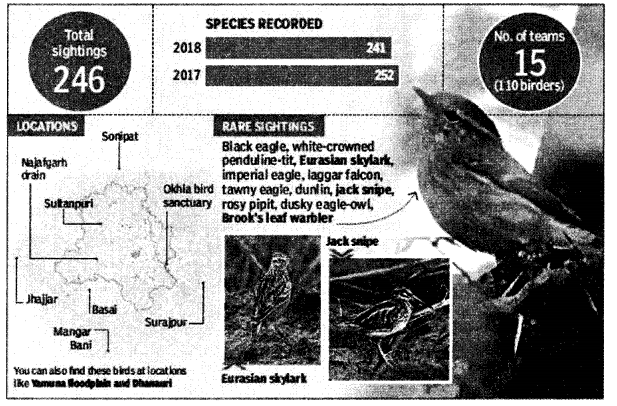
A total of 246 bird species were recorded during the Winter Bird Count 2019, a slight increase from last year’s count of 241. A team of over loo birds in 15 teams set out across different parts of the territory and the National Capital Region and logged a number of important and rare sightings in the region.
CBSE Sample Papers for Class 10 English Set 1 with Solutions 1
Of the 246 species recorded this year, over 100 were winter migrants. This year’s species sighting tally was less than the 252 recorded in 2017. The birding teams covered areas like the riverine belt of the Yamuna, including Okhla sanctuary and Wazirabad, wetlands of Gautam Buddha Nagar, including Surajpur and Dhanauri, the wetlands around Gurgoan, among them Sultanpur and Basai, Najafgarh drain up to Dhasna barrage, the Aravali belt towards Mangar Bani and the neighbouring districts of Sonipat and Jhajjar.

Kanwar B Singh, coordinator of the count, described the overall diversity recorded as good with some important sightings. Singh said the similar species count of the past few years signified that most wetlands were faring fairly well. “This annual event gives us a good idea of the nature of the regional birdlife, helps collect essential data on bird diversity in the region and boosts support for the environment and nature conservation, while popularising bird-watching as a healthy pastime,” said Singh.

The white-crowned penduline-tit – a tiny wintering bird – was spotted by Pradyumna Vidwansa in Chandu village near Gurgaon after a gap of several years. Arvind Yadav, whose team sighted a Eurasian skylark at Mandothi in Jhajjar, Haryana, informed that this was a rare sighting in Haryana and NCR. “Both the Eurasian skylark and the white crowned penduline-tit have been recorded for only the third time in this region,” he said.

The birders said a few hundred greater flamingo are currently at the Najafgarh jheel.
However, this number is fewer than the arrivals in the last few years. Among the rare or uncommon waders reported by birders were the dunlin, jack snipe and Eurasian curlew. The enumerators also revealed the raptor count was higher this year when compared with the recording of the last few years.

“Various teams reported resident and wintering raptors, including crested serpent eagle, booted eagle, imperial eagle, steppe eagle, tawny eagle, greater and Indian spotted eagles, long-legged and common buzzards, marsh Harrier, Eurasian sparrow hawk, osprey, common kestrel and red-necked laggar and peregrine falcons,” said Singh. “In addition, a black eagle, which is a magnificent forest eagle that is rarely seen around Delhi, was once again reported last Sunday by the team led by Tapas Misra and Tanweer Alam.”

The count in the forested areas of the Aravallis including Mangar Bani, returned species like the white-bellied drongo, sirkeer malkoha and cinerous tit. Meanwhile, the birding team noted the presence of Brook’s leaf warbler, Siberian stonechat, common kestrel and Isabelline shrike in NCR’s woodlands and grasslands.
(Source: Times of India)

On the basis of your understanding of the passage, answer any ten questions from the twelve that follow. (10 × 1 = 10)
(i) How many bird species were recorded as winter migrants this year?
(a) 246
(6)241
(c) 100
(d) over 500
Answer:
(c) 100

(ii) How many species of birds were recorded during the winter bird count in 2018?
(a) 246
(b) 241
(c) 412
(d) 252
Answer:
(b) 241

(iii) Which of the following areas was/were covered in survey by the birding teams?
(a) Wetlands of Gautam Buddha Nagar
(b) Surajpur
(c) Wetlands around Gurgaon
(d) All of these
Answer:
(d) All of these

(iv) Which of the following subgroups of birds have been reported in the news articles?
(a) Waders but not raptors
(b) Both waders and raptors
(c) Neither waders nor raptors
(d) Raptors but not waders
Answer:
(b) Both waders and raptors

(v) According to Kanwar B Singh, what was the situation of most of the wetlands?
(a) Excellent
(b) Bad
(c) Good
(d) Very good
Answer:
(c) Good

(vi) Conducting events such as bird counting are crucial as these help in:
(a) reporting exclusively on the number of waders in different parts of Delhi and NCR
(b) reporting exclusively on the number of raptors in different parts of Delhi and NCR
(c) collecting essential data on bird diversity and to conserve nature
(d) identifying the place where most number of bird species are spotted
Answer:
(c) collecting essential data on bird diversity and to conserve nature

(vii) For the last few years, the number of flamingoes is:
(a) increasing
(b) decreasing
(c) the same
(d) getting bigger
Answer:
(b) decreasing

(viii) Read the statements given below:
1. Spotted and counted birds at different spots in Delhi-NCR
2. Spotted rare birds in rural areas also
3. Did a phase wise count of the birds over a period of two winter months
4. Also spotted migrant birds
5. Were focusing only on wetlands and riverine belt
Which of the combination of statements hold true for the teams engaged with the winter bird count?
(a) 2, 4 and 5
(b) 1,2 and 4
(c) 1, 4 and 5
(d) 1,2 and 3
Answer:
(b) 1,2 and 4

(ix) Which among the following birds were reported as rare waders?
(a) Eurasian curlew
(b) Dunlin
(c) Jack snipe
(d) All of these
Answer:
(d) All of these

(x) Based on your understand of the passage, choose the option that lists the birds of prey.
1. Common kestrel, peregrine falcons, Eurasian sparrow hawk
2. Flamingo, parrot, pigeon, nightingale
3. Serpent eagle, long-legged buzzards, osprey
4. Woodpecker, heron, tailorbird, peafowl, black drongo
(a) 1 and 2
(b) 2 and 3
(c) 3 and 4
(d) 1 and 3
Answer:
(d) 1 and 3

(xi) Which of the statements related to the number and variety of species of birds being spotted is true?
(a) The number of species being sighted by the birders has increased gradually over the past three years and there have been rare sightings too.
(b) The number of species being sighted by the birders has decreased gradually over the past three years and there have not been any rare sightings.
(c) The number of species being sighted by the birders has increased gradually over the past three years and there have not been any rare sightings.
(d) There hasn’t been any specific trend in terms of number of species being sighted by the birders over the past three years but there have been rare sightings in the latest winter bird count.
Answer:
(d) There hasn’t been any specific trend in terms of number of species being sighted by the birders over the past three years but there have been rare sightings in the latest winter bird count.

(xii) Which of these birds are rare in NCR’?
(a) White-crowned penduline-tit
(b) Eurasian skylark
(c) Eagle
(d) Falcon
Answer:
(b) Eurasian skylark

Literature (10 Marks)
Question 3.
Read the extracts given below and attempt any one by answering the questions that follow. (5 × 1 = 5)
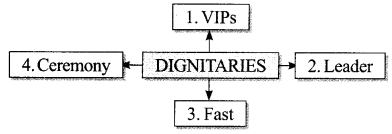
A. Tenth May dawned bright and clear. For the past few days I had been pleasantly besieged by dignitaries and world leaders who were coming to pay their respects before the inauguration. The inauguration would be the largest gathering ever of international leaders on South African soil. The ceremonies took place in the lovely sandstone amphitheatre formed by the Union Buildings in Pretoria. For decades this had been the seat of white supremacy, and now it was the site of rainbow gathering of different colours and nations for the installation of South Africa’s first democratic, non-racial government,

(i) Choose the option that lists the set of statements that are NOT TRUE according to the given extract.
1. On 10th May, Nelson Mandela sworn in as the first black Head of State, South Africa.
2. Before 10th May, the seat of President was occupied by the white.
3. A few international leaders came for the inauguration ceremony on 10th May.
4. ‘Bright and clear day’ refers to 10th May.
5. Anti-racist came to power without any hard struggle.
(a) 1 and 2
(b) 2 and 3
(c) 3 and 5
(d) 4 and 5
Answer:
(c) 3 and 5

(ii) Who among the following is the narrator of this extract?
(a) The white president of South Africa
(b) The black president of South Africa
(c) The president of United States of America
(d) A common man of South Africa
Answer:
(b) The black president of South Africa

(iii) Which word does ‘besieged’ NOT correspond to?
(a) Surrounded
(b) Crowd
(c) Requested
(d) Swarm
Answer:
(c) Requested

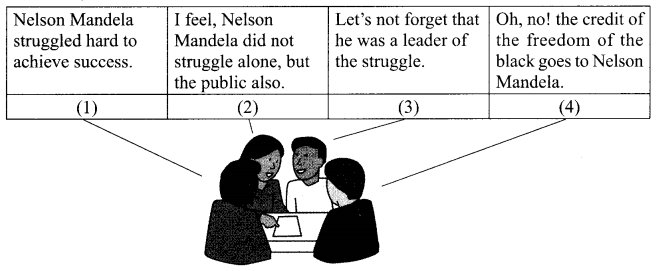
(iv) Pick the option that correctly classifies the facts (F) and opinions/s (O) of the students.
CBSE Sample Papers for Class 10 English Set 1 with Solutions 2
(a) F – 1, 2 and O – 3, 4
(b) F – 2, 3 and O – 3, 4
(c) F – 1, 3 and O – 2, 4
(d) F – 3, 4 and O – 1,2
Answer:
(c) F – 1, 3 and O – 2, 4

(v) The ceremony took place in a building made of:
(a) marble
(b) sandstone
(c) bricks
(d) wood
Answer:
(b) sandstone

B. “Ga, ga, ga,” he cried begging her to bring him some food. “Gaw-col-ah,” she screamed back derisively. But he kept calling plaintively, and after a minute or so he uttered a joyful scream. His mother had picked up a piece of the fish and was flying across to him with it. He leaned out eagerly, tapping the rock with his feet, trying to get nearer to her as she flew across. But when she was just opposite to him, she halted, her wings motionless, the piece of fish in her beak almost within reach of his beak.

(i) The young seagull cried begging his mother to bring him:
(a) some good news
(b) some support
(c) some leaves
(d) some food
Answer:
(d) some food

(ii) His mother had picked up:
(a) a twig
(b) a piece of nut
(c) a piece of fish
(d) a piece of straw
Answer:
(c) a piece of fish

(iii) What made the young seagull scream in joy?
CBSE Sample Papers for Class 10 English Set 1 with Solutions 3
(a) Option (1)
(b) Option (2)
(c) Option (3)
(d) Option (4)
Answer:
(b) Option (2)

(iv) Why did the seagull’s mother halt?
(a) She wanted the seagull to dive for the food
(b) She was in pain
(c) She saw a hunter
(d) She wanted the seagull to move back
Answer:
(a) She wanted the seagull to dive for the food

(v) The extract uses the phrase, ‘besieged by dignitaries’. Which of the following expressions is incorrect with respect to the word ‘dignitaries’ ?
CBSE Sample Papers for Class 10 English Set 1 with Solutions 4
(a) Option (1)
(b) Option (2)
(c) Option (3)
(d) Option (4)
Answer:
(c) Option (3)

Question 4.
Read the extracts given below and attempt any one by answering the questions that follow. (5× 1 = 5)
A. Now the name of the little black kitten was Ink
and the little grey mouse, she called him Blink,
And the little yellow dog was sharp as Mustard,
But the dragon was a coward, and she called him Custard.

Custard the dragon had big sharp teeth,
And spikes on top of him and scales underneath,
Mouth like a fireplace, chimney for a nose,
And realio, trulio, daggers on his toes.
(i) Belinda considered every pet animal to be brave except:
(a) kitten
(b) mouse
(c) dog
(d) dragon
Answer:
(d) dragon

(ii) What is the rhyme scheme of the given stanzas?
(a) abcb; bcbc
(b) abed; abed
(c) abbe; abbe
(d) aab ;ccdd
Answer:
(d) aab ;ccdd

(iii) Which part of dragon was compared to a fire place?
(a) Eyes
(b) Mouth
(c) Nose
(d) Ears
Answer:
(b) Mouth

(iv) The word that DOES NOT indicate the bravery of the dragon is
(a) courage
(b) fearlessness
(c) weakling
(d) boldness
Answer:
(c) weakling

(v) The dragon had scales which were bony plates to protect his:
(a) mouth
(b) felt
(c) nose
(d) skin
Answer:
(d) skin

B. Did you finish your homework, Amanda?
Did you tidy your room, Amanda?
I thought I told you to clean your shoes, Amanda!

(I am an orphan, roaming the street.
I pattern soft dust with my hushed, bare feet.
The silence is golden, the freedom is sweet.)
(i) Here, Amanada’s mother is inquiring Amanda whether she has:
(a) bathed or not
(b) had lunch or not
(c) trimmed her nails or not
(d) done her homework or not
Answer:
(d) done her homework or not

(ii) The second stanza is given in brackets to show that:
(a) the speaker is very sad
(b) the speaker does want to face her mother
(c) the speaker is different than the other stanza
(d) the speaker wants to live secretly
Answer:
(c) the speaker is different than the other stanza

(iii) What is the rhyme scheme of the given stanzas?
(a) aaa; bbb
(b) abc; abc
(c) abb; cdd
(cl) aab; cdd
Answer:
(a) aaa; bbb

(iv) At this point of time, Amanda imagines herself to be:
(a) a mermaid
(b) a princess
(c) an orphan
(d) a queen
Answer:
(c) an orphan

(v) Amanda wants to play in:
(a) a clean park
(b) a clean field
(c) a garden
(d) dust with her bare feet
Answer:
(d) dust with her bare feet

Grammar (10 Marks)
Question 5.
Choose the correct options to fill in the blanks to complete the note about India  – a great nation. (3 × 1 = 3)
Freedom (i) ………………. in India. Unity in diversity is the hallmark of this country. India (ii) …………… a country in her long history. She is a giver, not a taker. She (iii) …………….. the concept of zero to the world and several other things. Undoubtedly the list is endless and
unparalleled.
(i) (a) was worshipped
(b) is worshipped
(c) has worshipped
(d) will worship
Answer:
(b) is worshipped

(ii) (a) never invaded
(b) have never invaded
(c) has never invaded
(d) will never invade
Answer:
(c) has never invaded

(iii) (a) will give
(b) was given
(C) given
(d) gave
Answer:
(d) gave

Question 6.
Choose the correct options to fill in the blanks to complete Praveen’s narration. (3 x 1 =3)
CBSE Sample Papers for Class 10 English Set 1 with Solutions 5
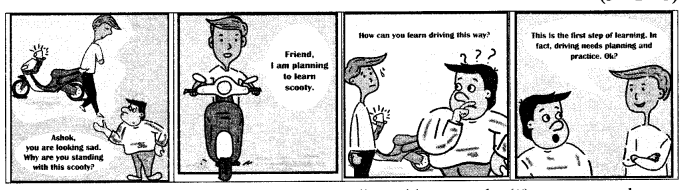
I found Ashok sad. ‘When I (i) ……………… standing with scooty, he (ii) …………… he was planning to learn scooty. I was surprised and made enquiry how he could learn driving that way. Immediately he silenced my by saying that (iii) …………….. the first step of learning. He
further added that in fact, driving needs planning and practice.
(i) (a) said to him about why
(b) asked him why he was
(c) explained why he was
(d) told him about why
Answer:
(b) asked him why he was

(ii) (a) questioned that
(b) refused that
(e) suggested that
(d) replied that
Answer:
(d) replied that

(iii) (a) this was
(b) this is
(c) it has been
(d) this may be
Answer:
(a) this was

Question 7.
Fill in the blanks by choosing the correct options for any four of the six sentences given below. (4 × 1=4)
(i) My father is very busy these days. But he ……………….. find some time for you.
(a) might
(b) has to
(c) must
(d) will
Answer:
(c) must

(ii) My friends as well as I …………….. students of Laxmi Bai College.
(a) have
(b) is
(c) was
(d) were
Answer:
(d) were

(iii) ……………….. the husband and wife are elected to the Assembly.
(a) Every
(b) Both
(c) All
(d) Each
Answer:
(b) Both

(iv) I am very badly in need of a job. I ………………… if you grant me the favour.
(a) shall obliged
(b) shall be obliging
(c) shall be highly oblige
(d) shall be highly obliged
Answer:
(d) shall be highly obliged

(v) On coming back to the city I shall inform you so that you ……………. resume delivering the
paper regularly.
(a) will
(b) may
(c) can
(d) should
Answer:
(b) may

(vi) He was badly beaten by the ruffian. He lay unconscious for ……………… hour and ………………… half.
(a) a, an
(b) the, a
(c) an, a
(d) much, a
Answer:
(c) an, a

Part-B – Subjective Questions (40 Marks)

Writing (10 Marks)
Question 8.
Attempt any one of the following in 100-120 words. (5 Marks)
A.You are Sujal/Sujata of Pragya Public School, Nagal, Punjab who had arranged a trip for fifty students of Nanital in summer vacations for ten days with ‘Mount Travels and Tourism’. The arrangements done by the travel agency were far below standard. The accommodation and food facilities were inferior in quality. Write a letter of complaint to the director of the agency to stop duping tourists with false promises as it tarnishes the image of locals. (100-120 words)
Answer:
Pragya Public School
Nagal, Punjab
23rd November, 20x x
The Director
Mount Travels and Tourism
Nagal, Punjab
Sub: Inferior quality of food and accommodation
Sir
I am constrained to express my displeasure and resentment at inferior arrangements made during our tour to Nanital in summer vacations. Our tour was for ten days and arrangement made by your agency was below standard. When we came back home, most of the students fell ill and now they are unable to attend classes. During our negotiation for tour, following promises were made:
(a) Stay in good hotels (b) Food at a good restaurant
As the above promises were not fulfilled, we stayed in a lodge and were forced to eat local food. Consequently most of the students fell ill.
Certainly we are cheated by your agency. You are requested that you should not dupe local people because it tarnishes our image.

Yours sincerely
Sujal

B. India is a highly populated country. People lack in maintaining proper sanitation and hygiene as a result they suffer from various diseases. India has a serious sanitation challenge; around 60 per cent of the world’s open defecation takes place in India. Poor sanitation causes health hazards including diarrhoea, particularly in children under 5 years of age, malnutrition and deficiencies in physical development and cognitive ability. You are Nitish/Nikita, head boy/girl of Anand Public School, Jaipur. Write a letter to the editor of a national daily, highlighting the problem and suggesting practical ways to ensure public sanitation and the right to dignity and privacy. (100¬120 words)
CBSE Sample Papers for Class 10 English Set 1 with Solutions 6
Answer:
Anand Public School
Jaipur
5th October, 20xx
The Editor
Rajasthan Patrika
Jaipur
Sub: Need for public sanitation .
Sir
Through the column of your esteemed daily I want to highlight the serious problem of sanitation. Everybody knows that India is a highly populated country. The people have no proper sanitation and hygiene facilities. Around 60 per cent of the world’s open defecation takes place in India. As a result, people suffer from various diseases. Diarrhoea, among various health hazards, is very common among the children of below five years of age. Poor sanitation also causes deficiencies in physical development and cognitive ability among people.
The government and the concerned authorities must take steps in this regard. They should put the public sanitation facilities at important places of villages, towns and cities. Besides, people should be made aware of diseases caused by open defecation. Sanitation should become our right to ensure dignity and privacy.

Yours faithfully
Nitish Head Boy

Question 9.
Attempt any one of the following in 100-120 words. (5 Marks)
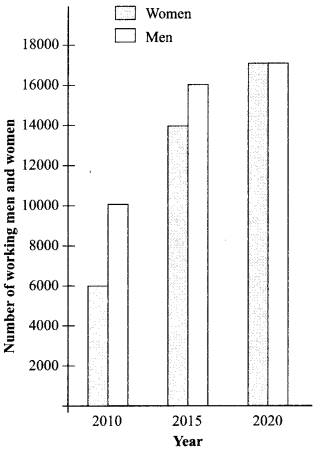
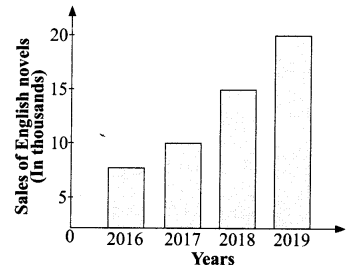
A. A comparative study took place to find the number of working men and women in India. Write an analytical paragraph in 100-120 words and compare where relevant.
CBSE Sample Papers for Class 10 English Set 1 with Solutions 7
Answer:
The bar chart indicates a comparative study between the number of working men and women in India since 2010 to 2020.
Initially, in the year 2010, the number of working women was low at 6000 which was comparatively less than the number of working men. However, in 2015, sharp rise can be seen in the number of working women and men.
Surprisingly, the year 2020 shows a significant change in the data and shows equal number of working men and women in the country.
Therefore, it is clear that there is no discrimination between the number of working men and women in India.

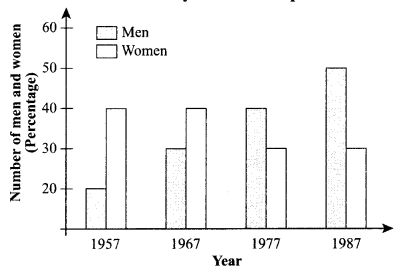
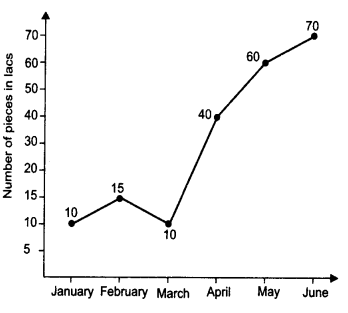
B. See the line graph given below. Write an analytical paragraph in 100-120 words and compare where relevant. This informs you about dropouts over forty years from college.
CBSE Sample Papers for Class 10 English Set 1 with Solutions 8
Answer:
The given bar chart shows men and women dropped out over forty years from college. There could be various reasons to that. Between 1957 and 1997, the change was significant for male category. 20% of men dropped out from college while women who dropped out where at 40% in the year 1957.

Between 1967 and 1977, things almost turned opposite. 30% of men dropped out in 1967 while 30% of women dropped out in 1977 which was less than 1967. Almost 50% of men dropped out from college in 1987 while the dropping rate for women declined at 30% in the last part, the dropout rate of men and women parallel against each other.

Literature (30 Marks) 
Question 10.
Answer any two questions in 20-30 words each, from (A) and (B) respectively. (4 × 2 = 8)
A. (any two) (2×2 = 4)
(i) Why does Anne feel that writing in a diary is really a strange experience?
Answer:
It must be remembered that Anne Frank was just a thirteen-year-old girl. She was in the hiding and cut off from the larger world. She was hesitant that no one would be interested in the musings of a young girl. She had never written anything before. So, it was naturally a strange experience for her.

(ii) What is the general rule of this ‘world of possessions’? Why is money ‘external’?
Answer:
Getting and losing is a natural cycle. Many more boys before him bought and lost their balls. This process will go on forever. However, no amount of money can buy back the same ball that has been lost forever. Money is external and has its own limitation. Wealth can’t compensate such emotional losses such as the loss of one’s childhood days.

(iii) What was the next problem after Valli had enough money?
Answer:
After she had saved enough money, Valli had her next problem. It was how to slip out of the house without her mother’s knowledge. She solved this problem easily. Every day after lunch her mother would nap from about one to four or so. She could easily venture out on her mission.

B. (any two) (2×2 = 4)
(i) What impression did the narrator (the lawyer) form of Bill when he met him for the first time?
Answer:
The narrator found the delivery man at the station as the only ‘agreeable sight’ in Ne Mullion. The man called himself Bill and he was a hack driver. He was about forty. He looked red-faced and cheerful. He looked thick in the middle. His working clothes were dirty and worn out. His manners were pleasant and friendly. The narrator was happy to meet such a man.

(ii) Why and where did Richard Ebright send the tagged butterflies?
Answer:
At the end of the book, The Travels of Monarch X, readers were invited to help study monarch butterflies’ migration. They were asked to tag butterflies for research by Dr Urquhart. Soon, Richard Ebright was attaching light adhesive tags to the wings of monarch butterflies. He used to send them to Dr Urquhart for his research work.

(iii) Was Bishamber a suitable bridegroom for Bholi? Give your opinion.
Answer:
No, Bishamber was not at all a suitable match for Bholi. No doubt, he was rich. He had a big shop, a house of his own and thousands of rupees in the bank. But he was mean, greedy and a worthless man. When he came to know of the pock-marks on Bholi’s face, he demanded a dowry of 5000 rupees to marry her. Even the turban of Ramlal at his feet couldn’t melt his heart. Bholi did the right thing to reject him.

Question 11.
Answer any two questions in 40-50 words each, from (A) and (B) respectively. (4 × 3 = 12)
A. (any two) (2 × 3 = 6)
(i) Why would you not agree with Lencho calling them ‘a bunch of crooks’?
Answer:
Lencho was not at all justified in calling them ‘a bunch of crooks’ because they helped
him by collecting money.

(ii) Who invites the comment – “he is dressed like a pader”? Why?
Answer:
Any person who wears a half-pant which reaches just below the knees, invites the comment that he is dressed like a pader. The reason is simple. He resembles a baker who is wearing such a funny dress.

(iii) What do you think was the speaker’s attitude towards Amanda?
Answer:
The speaker is concerned about Amanda and wants to instil good habits and behaviour in her. The speaker wants her to give up bad habits and be organised in life. The speaker constantly keeps instructing her with do’s and don’ts and doesn’t want Amanda to look gloomy.

B. (any two) (2 ×3 = 6)
(i) Hari Singh is both a thief and a human being. Explain.
Answer:
No doubt Hari is a thief as well as a good human being. Situations compel a person to become either beast or remain as a human being. Even goodness and nobility of a person changes anyone’s heart and mind.

(ii) Bholi’s heart was overflowing with a ‘new hope and a new life’. What does the phrase ‘the new hope and the new life’ mean?
Answer:
It means, ‘To serve her parents in old age and tp teach the students in the same school where she had learnt so much’.

(iii) How did Mr Loisel meet the demand of a suitable costume for his wife for going to the ball?
Answer:
Matilda refused to go to the ball without having a suitable costume for the occasion. Her husband asked her to wear the dress that she wore while going to the theatre. When Matilda reacted strongly, he asked how much a suitable costume would cost. She replied that it would cost 400 francs. Mr Loisel turned pale. He had saved 400 francs to buy a gun for him to shoot larks. But he bowed down and agreed to give 400 francs to have a pretty dress.

Question 12.
Answer any one of the following in 100-120 words. (5 Marks)
A. Simple moment proves to be very significant and saves rest of the day of the poet from being wasted. Explain on the basis of the poem ‘Dust of Snow’.
Answer:
In this poem, Robert Frost praises and describes different positions of nature. Here he touches different aspects of natural sights. There are many things in nature that are not considered auspicious like – crow and hemlock. Crow is not considered a good bird. Similarly, hemlock tree is a poisonous tree and that is why it is the symbol of sadness.

When the crow shakes off the dust of snow from the hemlock tree, it falls on the poet. Thus the poet’s mood changes due to this incident. Robert Frost, in this poem, represents the crow and hemlock tree as inauspicious. But when the crow shakes off the dust of snow from the hemlock tree, it falls on the poet. It changes his dejected mood and saves the day from being spoilt.

B. Why was the whole class ‘quaking in its boots’? Why were teachers the most unpredictable creatures on earth?
Answer:
It was the day of destiny for students. The reason was quite simple. In the forthcoming meeting the teachers were going to decide who would move up in the next class. They were also to decide who would be kept back in the same class. The entire class was ‘quaking in its boots’. Half the class was making bets. Two silly boys, C.N. and Jacques had staked their entire holiday savings on their bets.

One would encourage the other. Anne felt that there were so many dummies or worthless students in the class. She felt that a quarter of the class should be kept back. Anne also felt that teachers were the most unpredictable creatures on earth. They work according to their whims. Naturally, the girls and boys were worried. They waited for the verdict with their fingers crossed.

Question 13.
Answer any one of the following in 100-120 words. (5 Marks)
A. Mrs Pumphrey thought that her dog’s recovery was a triumph of surgery. Elaborate.
Answer:
Mrs Pumphrey was worried on noticing Tricki’s listlessness, bouts of vomiting and lack of interest in food. She could not bear to see him in pain. She called on Dr Herriot who advised hospitalisation for Tricki for a fortnight. The doctor knew that the chief cause of Tricki’s ailment was overfeeding.

He was confident that by restricting the dog’s diet he would be able to make him well again. Keeping a vigilant eye on him, the doctor served him plenty of water but no food for the first two days. Tricki regained perfect health within a span of few days. According to Mrs. Pumphrey, such quick and complete cure is usually possible only after surgery, so she thought that Tricki’s recovery was a triumph of surgery.

B. People should always try to live within their means. Aspiration have no limits but one should never forget the ground realities. Elaborate on the basis of the chapter, “The Necklace”.
Answer:
Matilda was a pretty young woman. But she was a day-dreamer. Although she was bom in a poor family, yet she dreamt to have costly dresses and jewellery. She wanted to be honoured and respected like the rich. One day her husband showed her an invitation from a minister.

She emotionally forced him to buy a new and costly dress for the ball. After this, she borrowed a diamond necklace from her friend, Forestier. She enjoyed the party heartily. She danced with enthusiasm. But she lost the necklace and in this way their problems started. To replace the necklace her husband had to borrow a substantial amount on a very high rate of interest. To repay that amount, they lived in a rented house. She did all the household work by herself. Mr Loisel worked extra to earn small wages.

Thus, it is correctly said that we should always live within one’s means. Our aspirations have no limits. But we should never forget the ground realities. If Matilda had knowledge of this fact, her life would not have changed into realities.

CBSE Sample Papers for Class 10 English Set 3 with Solutions

Students can access the CBSE Sample Papers for Class 10 English with Solutions and marking scheme Set 3 will help students in understanding the difficulty level of the exam.

CBSE Sample Papers for Class 10 English Set 3 with Solutions

Time: 3 Hours
Maximum Marks: 80

General Instructions:

1. This paper is divided into two parts: A and B. All questions are compulsory.
2. Separate instructions are given with each section and question, wherever necessary. Read these instructions very carefully and follow them.
3. Do not exceed the prescribed word limit while answering the questions.

Part-A
Multiple Choice Questions (40 Marks)

Reading (20 Marks)

Question 1.
Read the passage given below. (10 Marks)

1. Caged behind thick glass, the most famous dancer in the world can easily be missed in the National Museum, Delhi. The Dancing Girl of Mohenjo-daro is that rare artefact that even school children are familiar with. Our school textbooks also communicate the wealth of our 5000 year heritage of art. You have to be alert to her existence there, amid terracotta animals to rediscover this bronze image.

2. Most of us have seen her only in photographs or sketches, therefore, the impact of actually holding her is magnified a million times over. One discovers that the dancing girls has no feet. She is small, a little over 10 cm tall – the length of a human palm – but she surprises us with the power of great art – the ability to communicate across centuries.

3. A series of bangles – of shell or ivory or thin metal – clothe her left upper arm all the way down to her fingers. A necklace with three pendants bunched together and a few bangles above the elbow and wrist on the right hand display an almost modem art.

4. She speaks of the undaunted, ever hopeful human spirit. She reminds us that it is important to visit museums in our country to experience the impact that a work of art leaves on our senses, to find among all the riches one particular vision of beauty that speaks to us along.

On the basis of your understanding of the passage, answer any ten questions from the twelve that follow. (10 × 1 = 10)

(i) Why dancing girl can easily be missed in the National Museum?
(a) There are various statues in the museum
(b) It is very small
(c) It does not impress
(d) It is placed among old sketches
Answer:
(b) It is very small

(ii) Which information is not given in the passage?
(a) The girl is caged behind glass
(b) She is a rare artefact
(c) School books communicate the wealth of our heritage
(d) She cannot be rediscovered as she’s bronze
Answer:
(d) She cannot be rediscovered as she’s bronze

(iii) ‘Great Art’ has power because:
(a) it appeals to us despite a passage of time
(b) it is small and can be understood
(c) it’s seen in pictures and sketches
(d) it’s magnified a million times
Answer:
(a) it appeals to us despite a passage of time

(iv) Why is the Dancing Girl a surprising image?
(a) She has long feet
(b) She has small hands
(c) She has no feet
(d) She is made of iron
Answer:
(c) She has no feet

(v) During the Mohenjo-daro period, women liked:
(a) dancing
(b) travelling
(c) jewellery
(d) knitting
Answer:
(c) jewellery

(vi) According to the given passage, the art ………………..
(a) leaves impression on one’s senses
(b) gives us hope
(c) does not communicate
(d) speaks about textbooks
Answer:
(a) leaves impression on one’s senses

(vii) The passage attempts to ………………… the readers.
(a) provoke
(b) evoke
(c) rebuke
(d) warm
Answer:
(b) evoke

(viii) What are the two correct meanings of the word ‘existence’ used in the passage.
1. The state of being present
2. The state of being alive
3. The way of living
4. The way of creating
5. The way of experiencing
(a) 1 and 2
(b) 1 and 4
(c) 3 and 5
(d) 1 and 3
Answer:
(d) 1 and 3

(ix) What does ‘the ability to communicate across centuries’ mean?
(a) The art speaks across ages.
(b) The art is timeless.
(c) The art leaves impact on senses.
(d) The art has great power.
(b) The art is timeless.

(x) Select the option that makes the correct use of “impact”, as used in the passage, to fill in the blank space.
(a) His speech made a profound …………………… on the audience.
(b) The distressed people leave ……………………
(c) ………………. of press in democracy is very important.
(d) The press functions as the custodian of ……………………..
Answer:
(a) His speech made a profound …………………… on the audience.

(xi) The passage focuses on the ………………..
(a) series of bangles
(b) communicative art
(c) modem, life
(d) National Museum
Answer:
(b) communicative art

(xii) What is the apt heading for the last paragraph of the passage?
(a) The Dancing Girl
(b) The Art is Beautiful
(c) Visit Museums
(d) Human Spirit
Answer:
(b) The Art is Beautiful

Question 2.
Read the passage given below: (10 Marks)

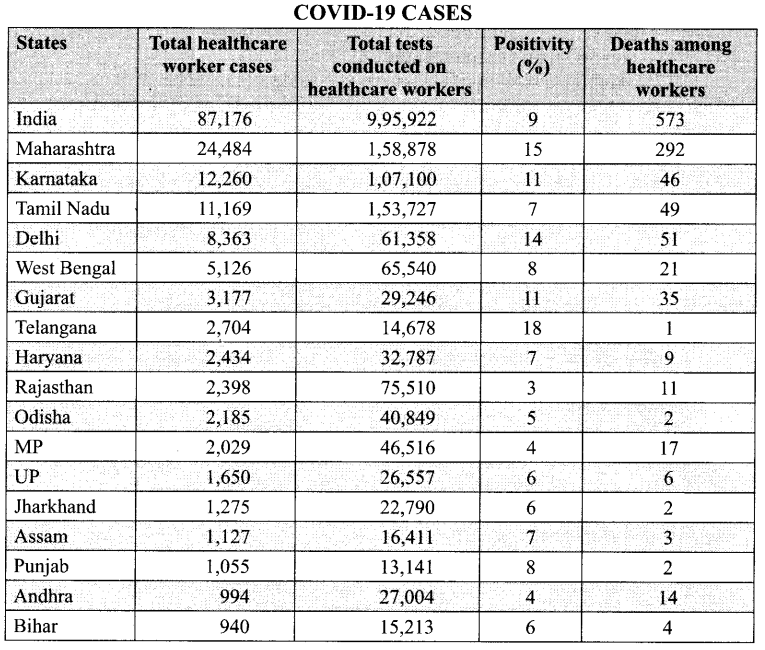
More than 87,000 healthcare workers have been infected with Covid-19, with just six states – Maharashtra, Karnataka, Tamil Nadu, Delhi, West Bengal and Gujarat – accounting for three-fourths (around 74%) of the case burden and over 86% of the 573 deaths due to the infection, official data showed.

Maharashtra alone, with the highest number of over 7.3 lakh confirmed Covid cases so far, accounts for around 28% of the infected healthcare workers and over 50% of the total deaths, according to the data.

While Maharashtra, Karnataka and Tamil Nadu had tested over one lakh healthcare workers each till August 28, Karnataka reported only 12,260 infected healthcare workers – almost half the burden in Maharashtra. Tamil Nadu reported 11,169 cases that included doctors, nurses and Asha workers. The three states together accounted for 55% of the total cases among health workers.

Risk to frontline workers can jeopardise India’s Covid fight – The three states also reported
the highest number of deaths in healthcare professionals, though with a wide gap between Maharashtra and the other two. While Maharashtra reported 292 deaths among healthcare workers, Karnataka and Tamil Nadu had 46 and 49 deaths, respectively.
CBSE Sample Papers for Class 10 English Set 3 with Solutions 1
A large number of infections and even deaths of healthcare workers in particular states is being viewed with concern by officials and public health experts, who say risks to frontline workers can jeopardise India’s fight against the pandemic.

The issue, discussed in a review meeting headed by the cabinet secretary on Thursday, saw the Centre cautioning states about the need to protect a crucial resource. The possible factors responsible for high infections, officials said, were lax infection control in hospitals and the need for stringent containment measures in areas where health professionals reside to safeguard them. Despite the high number of cases, the government has received only 143 claims since April under the ₹ 50 lakh Covid-19 insurance scheme for healthcare workers engaged in Covid mitigation activities.

Official sources said the wide gap between the number of deaths and claims could be because all the casualties may not be eligible under the scheme. Besides, the claims are a bit slow in coming as families of the dead take time to apply and do the required paperwork.
‘Solidarity with health workers cannot be met with mere words of encouragement but by concerted efforts to strengthen the health workforce. Safety net for their families should be provided including a term insurance cover of over ₹ 2 crore, with the government as sole guarantee,’ said Giridhar Babu, epidemiologist at the Public Health Foundation of India.

‘Protecting healthcare workers is of paramount importance to make sure we have a large enough force to take care of patients who need their services.’ said Dr H Sudarshan Ballal, chairman, Manipal Hospitals, who said such workers may be at risk because of a large number of asymptomatic patients and lack of proper use of PPEs.
(Source: The Times of India/Health Ministry)

On the basis of your understanding of the passage, answer any ten questions from the twelve that follow. (10 × 1 = 10)

(i) In the line “………….. risks to frontline workers”, the term ‘frontline workers’ does not refer to:
(a) healthcare workers
(b) police
(c) cleanliness workers
(d) teachers
Answer:
(d) teachers

(ii) How many health workers have been infected with COVID-19 in Maharashtra as per the graph?
(a) 11,169
(b) 12,260
(c) 8,363
(d) 24,484
Answer:
(d) 24,484

(iii) How many healthcare workers have died in Rajasthan due to COVID-19 infection?
(a) 292
(b) 21
(c) 11
(d) 17
Answer:
(c) 11

(iv) Which state of India is on the top in terms of confirmed COVID-19 cases?
(a) Karnataka
(b) Tamil Nadu
(c) Delhi
(d) Maharashtra
Answer:
(d) Maharashtra

(v) Based on your understanding of the passage, choose the option that lists the factors responsible for high infection in healthcare professionals.
1. Careless infection control in hospital
2. Due to negligency by health care professionals
3. Lack of stringest containment measure
4. Due to the lack of healthcare professionals
(a) 1 & 2
(b) 2 & 3
(c) 1 & 3
(d) 2 & 4
Answer:
(c) 1 & 3

(vi) What percentage of total healthcare workers confirmed COVID-19 cases of India does Maharashtra have healthcare workers infected with COVID-19?
(a) About 20%
(b) About 35%
(c) About 40%
(d) About 28%
Answer:
(d) About 28%

(vii) Healthcare workers’ refers to:
(a) doctors
(b) nurses
(c) Asha workers
(d) All of these
Answer:
(d) All of these

(viii) On how many healthcare workers COVID-19 tests have been conducted in Punjab?
(a) 1,127
(b) 994
(c) 13,141
(d) 2,029
Answer:
(c) 13,141

(ix) How many healthcare workers infected with COVID-19 are there in Karnataka till August 2020?
(a) 11,169
(b) 12,260
(c) 1,07,100
(d) 15,213
Answer:
(b) 12,260

(x) How many claims has the government received since April 2020 under the ₹ 50 lakh COVID-19 insurance scheme for healthcare workers engaged in COVID-19 alleviation activities?
(a) 49 claims
(b) 51 claims
(c) 46 claims
(d) 143 claims
Answer:
(d) 143 claims

(xi) How many healthcare workers died in Karnataka due to COVID-19 infection?
(a) 46
(b) 49
(c) 35
(d) 14
Answer:
(a) 46

(xii) Choose the option that lists statement that is NOT TRUE.
(a) Maharashtra is the worst suffer of Covid-19.
(b) Karnataka has less number of Covid-19 cases as compared to Maharashtra and Tamil Nadu.
(c) The deaths of healthcare workers are disregarded by officials.
(d) Most of the families of deceased healthcare workers received ? 50 lakh under Covid-19 insurance scheme.
Answer:
(c) The deaths of healthcare workers are disregarded by officials.

Literature (10 Marks)
Question 3.
Read the extracts given below and attempt any one by answering the questions that follow. (5 × 1 = 5)
A. “Now were really gong to get some water, woman.” The woman who was preparing supper, “Yes, God willing”. The older boys were working in the field, while the smaller ones were playing near the house until the woman called to them all, “Come for dinner.” It was during the meal that, just as Lencho had predicated, big drops of rain began to fall. In the North-east huge mountains of clouds could be seen approaching. The air was fresh and sweet. The man went out for no other reason than to have the pleasure of feeling the rain on his body and when he returned he exclaimed: “These aren’t raindrops falling from the sky, they are new coins. The big drops are ten cent pieces and the little ones are fives.”

(i) How did Lencho feel when he told his wife that they were going to have a rain shower?
(a) Nervous
(b) Confident
(c) Annoyed
(d) Doubtful
Answer:
(b) Confident

(ii) Choose the option that lists the set of statements that are NOT TRUE according to the given extract.
1. Lencho had unwavering faith in God.
2. He required rain water for irrigation of his field.
3. He had some other source of irrigation also.
4. His wife did not agree with his statement.
5. Rain did not fall at all.
6. He referred to drizzles as coins.
(a) 1, 3 and 5
(b) 2, 4 and 6
(c) 3,4 and 5
(d) 4, 5 and 6
Answer:
(c) 3,4 and 5

(iii) Pick the option that correctly classifies fact/s (F) and opinion/s (O) of the students below.
CBSE Sample Papers for Class 10 English Set 3 with Solutions 2
(a) F – 1, 2 and O- 3, 4
(b) F – 1, 3 and O – 2, 4
(c) F – 2,3andO – 1,4
(d) F – 3,4andO – 1,2
Answer:
(b) F – 1, 3 and O – 2, 4

(iv) Which word does ‘exclaimed’ NOT correspond to?
(a) Cried out
(b) Spoke with strong emotion
(c) Sudden statement
(d) Spoke calmly
Answer:
(d) Spoke calmly

(v) Lencho went out to take pleasure in:
(a) looking at beautiful scene of rainfall
(b) looking at the cloudy weather
(c) feeling droplets on his body
(d) looking at his children play
Answer:
(c) feeling droplets on his body

B. The next day Tuesday, Wanda was not in school, either. And nobody noticed her absence again. But on Wednesday, Peggie and Maddie, who sat down front with other children who got good marks and who didn’t track in a whole lot or mud, did notice that Wanda wasn’t there. Peggy was the most popular girl in school. She was pretty, she had many pretty clothes and her hair was curly. Maddie was her closest friend. The reason Peggy and Maddie noticed Wanda’s absence was because Wanda had made them late to school. They had waited and waited for Wanda, to have some fun with her, and she just hadn’t come. They often waited for Wanda Petronski – to have fun with her.

(i) Choose the answer that lists the correct option about Wanda.
1. Wanda claimed that she had more than one hundred dresses.
2. Peggy and Maddie loved Wanda very much.
3. Peggy and Maddie often teased Wanda.
4. Peggy and Maddie did not notice Wanda’s absence on Wednesday.
(a) Option (1)
(b) Option (2)
(c) Option (3)
(d) Option (4)
Answer:
(c) Option (3)

(ii) Peggie and Maddie waited for Wanda to:
(a) take some help from her
(b) appreciate Wanda’s skills in drawing
(c) ask where she was the previous day
(d) to make fun of her
Answer:
(d) to make fun of her

(iii) The statement that is NOT TRUE about Wanda is:
(a) Her name was indeed strange
(b) She was poor
(c) She indeed had one hundred dresses
(d) She used to wear a faded blue dress
Answer:
(c) She indeed had one hundred dresses

(iv) Which one of these statements is NOT TRUE about Peggy?
(a) She was a famous girl in the school
(b) She wore good and tidy clothes
(c) She sat with the weak students
(d) She was a good friend of Maddie
Answer:
(c) She sat with the weak students

(v) Which of the following expressions is incorrect with respect to the word ‘popular’?
CBSE Sample Papers for Class 10 English Set 3 with Solutions 3
(a) Option (1)
(b) Option (2)
(c) Option (3)
(d) Option (4)
Answer:
(d) Option (4)

Question 4.
Read the extracts given below and attempt any one by answering the questions that follow. (5 x 1 = 5)
A. The way a crow
Shook down on me
The dust of snow
From a hemlock tree
Has given my heart
A change of mood
And saved some part
Of a day I had rued.

(i) At this moment, the poet is in a:
(a) jolly mood
(b) sad mood
(c) irritated mood
(d) excited mood
Answer:
(b) sad mood

(ii) The poet is walking by a:
(a) cottage
(b) river
(c) hill
(d) tree
Answer:
(d) tree

(iii) Hemlock tree is regarded as a/an:
(a) lucky tree
(b) auspicious tree
(c) poisonous tree
(d) sweet tree
Answer:
(c) poisonous tree

(iv) What is the rhyme scheme of the given stanzas?
(a) abcb; abab
(b) abbc; acbc
(c) abab; cdcd
(d) aaab; cccd
Answer:
(c) abab; cdcd

(v) The falling of dust of snow on the poet:
(a) upset his mood
(b) lifted his mood
(c) irritated him
(d) non of these
Answer:
(b) lifted his mood

B. Some say the world will end in fire
Some say in ice
From what I’ve tasted of desire
I hold with those who favour fire.

But if it had to perish twice,
I think I know enough of hate
To say that for destruction ice
Is also great.
And would suffice.

(i) The poet expresses the profound idea that the world would end by:
(a) ice
(b) fire
(c) either ice or fire
(d) neither ice nor fire
Answer:
(c) either ice or fire

(ii) The poet stands with those who say that the world would end by:
(a) desire
(b) fire
(c) heat
(d) cold
Answer:
(b) fire

(iii) According to the poet, what would be as competent as fire in ending the world?
(a) Hatred
(b) Cold
(c) Heat
(d) Ice
Answer:
(d) Ice

(iv) The world ‘perish’ DOES NOT have a meaning similar to:
(a) die
(b) come to an end
(c) sustain
(d) vanish
Answer:
(c) sustain

(v) The word that DOES NOT cause the destruction of the world is:
(a) fire
(b) ice
(c) human desire
(d) suffice
Answer:
(d) suffice

Grammar (10 Marks)
Question 5.
Choose the correct options to fill in the blanks to complete the note about tourism. (3 × 1=3)
Tourism of today (i) ……………. what it was fifty years back. A crucial role (ii) …………………
motivation in this process of change. In fact, motivation considerably affects its various
components. Motivations not only (iii) …………… but critically analyse the future needs of
tourism also.

(i) (a) was no longer
(b) will be longer
(c) is no longer
(d) shall be no longer
Answer:
(c) is no longer

(ii) (a) was played
(b) was played with
(c) will by played by
(d) is played by
Answer:
(d) is played by

(iii) (a) determine tourists behaviour
(b) determines tourists behaviour
(c) is determined tourists behaviour
(d) will determine tourists
Answer:
(a) determine tourists behaviour

Question 6.
Choose the correct options to fill in the blanks to complete Riya’s narration. (3 x 1 = 3)
I saw Rohit deeply thinking in the room. When I (i) ……………………. busy at, he (ii) ………………….. he was trying some new ideas. I became hopeless and enquired how playing with toys would make him a scientist. He surprised me by saying that he (iii) …………………….. scientists now had been deep thinkers in the beginning.
CBSE Sample Papers for Class 10 English Set 3 with Solutions 4

(i) (a) tell him what was
(b) replied him what is
(c) asked him what he was
(d) said to him about what
Answer:
(c) asked him what he was

(ii) (a) replied that
(b) obeyed that
(c) enquired that
(d) refused that
Answer:
(a) replied that

(iii) (a) knew that those who is
(b) had knew that those who were
(c) knows that those who are
(d) knew that those who are
Answer:
(d) knew that those who are

Question 7.
Fill in the blanks by choosing the correct options for any four of the six sentences given below. (4 x 1 = 4)

(i) The principal ……………… grant you concession in fee.
(a) will
(b) can
(c) could
(d) used to
Answer:
(b) can

(ii) Neither Mukesh nor his brother ……………….. the school regularly.
(a) attends
(b) attend
(c) attending
(d) have attend
Answer:
(a) attends

(iii) As I was intelligent, I had ……………… trouble.
(a) few
(b) little
(c) much
(d) less
Answer:
(d) less

(iv) At this time tomorrow we ……………… in an aeroplane.
(a) shall be flying
(b) shall fly
(c) will fly
(d) may flying
Answer:
(a) shall be flying

(v) After the release of Covid-19 vaccine, our economy ………………… get a boom.
(a) should
(b) will
(c) may
(d) shall
Answer:
(c) may

(vi) I drank …………….. milk kept in the glass and went out for play.
(a) a little
(b) the little
(c) little
(d) few
Answer:
(b) the little

Part-B – Subjective Questions (40 Marks)

Writing (10 Marks)
Question 8.
Attempt any one of the following in 100-120 words. (5 Marks)
A. You are Ram Mehar of 32, Beedan Pura, Karol Bagh, Delhi. Last week, you bought a mobile phone from ‘The Mobile Junction’, 20L, Nehru Place, New Delhi. The mobile phone developed a problem within a few days of its purchase. Write a complaint letter to the dealer giving details of the nature of the problem and asking him/her to rectify the defect or replace the phone.
Answer:
32, Beedan Pura
Karol Bagh, New Delhi
26 March 20xx
The Mobile Junction
20L, Nehru Place, New Delhi
Sub: Defective Mobile Phone
Sir
I am a resident of Beedan Pura, Karol Bagh, New Delhi. I purchased a Samsung mobile phone from The Mobile Junction on 19th March, 20xx, vide cash memo No. 190319/18.1 am sorry to say that the mobile phone developed a problem within a few days of its purchase. The sound system is quite irritating and jarring. The camera doesn’t give a clear and deep impression. I feel cheated to have such a defective mobile phone after spending more than fifteen thousand rupees. It is quite unfortunate that even after sending two reminders, you have shown no urgency to rectify the defects or replace the defective mobile set at the earliest. I hope you will do the needful within a week. I am sure you will not compel me to knock the doors of the Consumer Court for the redress of the wrong.

Yours sincerely
Ram Mehar

B. You are Maya/Mohan, 48, Court Road, Saket, New Delhi. You had been to a tourist spot and were disappointed at the way the place was being maintained. Write a letter to the Minister, Department of Tourism, Delhi on how places of tourist interest should be made tourist friendly. Take ideas from the notes given below:
Notes:

  • utter neglect
  • preserve the national heritage
  • encroachment and vandalism
  • poor maintenance
  • no security and safety
  • make it tourist friendly

Answer:
48, Court Road
Saket
New Delhi
20 April 20xx
The Minister Department of Tourism
Government of Delhi
New Delhi
Sub: Poor maintenance of tourist spots Sir/Madam
I want to highlight the utter neglect and the poor maintenance of our tourist spots in Delhi. The Archaeological Department of India and the concerned authorities must take immediate steps to preserve our national heritage from degradation, encroachments and vandalism.

Last Sunday, the visit to the Tughlaqabad Fort in South Delhi disappointed me beyond words. No doubt, the exterior, the outerwalls of the fort have been given a face-lift. The situation inside speaks of utter neglect and poor maintenance. The ruins are now shelter for druggists, gamblers and all kinds of anti-social elements. There is no security and safety for a few tourists who venture to visit the place. Most parts of the fort have been encroached by the greedy property dealers and musclemen of the area. The Tughlaqabad Fort is a very important heritage site of historical value. The complex has the grave of Ghasuddin Tughlaq and many other buildings raised during the time of Mohammad-bin-Tughlaq.

This place of immense historical value and a great tourist spot, needs immediate attention and protective steps. The place must be cleared off the illegal encroachments without any further delay. Even pathways, lawns and lights need immediate attention. Security of tourists, especially of women and foreign tourists must be ensured to attract tourists in large numbers. The place must be made tourist friendly. I hope the necessary steps will be taken immediately by the concerned authorities in this regard.

Yours faithfully
Maya /Mohan

Question 9.
Attempt any one of the following in 100-120 words. (5 Marks)
A. The sales of English Novels by Sagar Bookseller is represented in the bar graph given below. Study the bar graph and express your views in a paragraph of 100-120 words analysing the sales achieved during the period 2016-19.
CBSE Sample Papers for Class 10 English Set 3 with Solutions 5
Answer:
The bar graph given above shows the sales of English novels by Sagar Bookseller during the period 2016-19. In 2016, the bookseller sold about eight thousand copies of English novels. In 2017, about 10 thousand copies of English novels were sold by the seller. So the seller sold about two thousand additional copies of the novels as compared to the previous year.

In 2018, we can see a big jump in the sales of the novels as compared to the previous year – around five thousand. The bookseller sold about 20 thousand copies of the novels in 2019.
To sum up, we can say that the number of people purchasing and reading English novel as their hobby has been increasing every year.

B. The line-graph chart given below breaks down the sales history of the famous Lifebuoy brand in soap in the first six months of the year, from January to June. Write an analytic paragraph after selecting and reporting the main features. Make comparisons where necessary.
CBSE Sample Papers for Class 10 English Set 3 with Solutions 6
Answer:
The line-graph chart given above illustrates the sales history of one of the most popular and prestigious Lifebuoy brands of soap in the first six months of the year. The general trend that emerges out is quite simple. The first three months of winter exhibit rather a subdued sale. On the other hand, the months of summer show quite a brisk sale. The month of January is the coldest month of the year in India.

So, the number of bathers is significantly reduced. With the reduced number of bathers, the use of soap is also reduced proportionally. Hence, the sale of ‘Lifebuoy’ brand of soap is at its lowest, only 10 lac pieces in January. Things improve and the numbers show a considerable rise of 50 per cent in February.

Then again a slump is seen and the sales in March slip back to the numbers in January. The severity of winter is almost over in April. Frequent bathing leads to a dramatic rise in the sale of ‘Lifebuoy This demand goes on rising. 40 lac pieces of Lifebuoy were sold in April. The number rose steadily to 60 lac in May and the sales reached at its peak in the hottest month of the year, June.

The sales in June touched the unprecedented figure of 70 lacs. It will not be out of place to conclude that sales of soap depends up to a considerable extent on the weather. The summer months exhibit greater demand and brisker sales numbers.

Literature (30 Marks)

Question 10.
Answer any two questions in 20-30 words each, from (A) and (B) respectively. (4 x 2 = 8)
A. (any two) (2 x 2 = 4)
(i) “The sight of the food maddened him.” What does this suggest? (His First Flight)
Answer:
The seagull was quite hungry and yearned for food. When he saw a piece of fish in the beak of his mother, the sight was quite tempting for him. He was maddened at the sight of the food and suddenly dived at the fish forgetting that he didn’t know how to fly. It
compelled the young seagull to finally fly into space.

(ii) Why does the poet not offer the boy money to buy another ball?
Answer:
The poet wants the boy to understand the nature of loss. He has to understand what it means to lose something. Gain and loss are the two sides of the same coin. The boy has to learn how to move forward forgetting everything about the losses he has suffered in the past.

(iii) Describe the possible descent of the people of Coorg.
Answer:
The people of Coorg, their rituals and traditions are quite different from the Hindu mainstream. According to one story, a part of the Alexander’s army travelling the coast, settled here as their return became impractical. So, they are believed to be of Greek origin. The Coorgi dress, a long, black coat with an embroidered waist-belt resembles the Kuffia worn by the Arabs. So, some think that they are of Arabic origin.

B. (any two) (2 x 2 = 4)
(i) Do you think it a significant detail in the story that Anil is a struggling writer? Does this
explain his behaviour in any way?
Answer:
Anil doesn’t have a regular income. He is a struggling writer who writes for magazines. Anil can’t afford to pay Hari Singh regularly. But he allows Hari Singh to stay with him and promises to teach him to write complete sentences. When he receives a substantial amount of money, he gives him a fifty-rupee note and promises to pay him regularly.

(ii) Why didn’t Matilda like to visit her rich friend?
Answer:
Matilda or Mrs Loisel always dreamt of things that were beyond her means. She dreamt of a grand house, costly dishes, good dresses and jewels. She was disillusioned that she couldn’t get them. When she visited her rich friend, she really suffered because she became intensely conscious of her poverty in the presence of her fortunate and rich friend. She suffered so much when she returned to her modest and miserable surroundings.

(iii) Was Ramlal happy to send Bholi to school? If not, why did he send her there?
Answer:
No girl in the family had ever gone to school. Bholi’s mother believed if they sent their daughters to school, then no one would marry them. But an unexpected thing happened. The Tehsildar who inaugurated the first girl school in the village asked Ramlal to set an example before the villagers. He must send his daughters to school. Ramlal couldn’t afford to disobey the Tehsildar. So, Bholi was sent to school.

Question 11.
Answer any two questions in 40-50 words each, from (A) and (B) respectively. (4 x 3 = 12)
A. (any two) (2 x 3 = 6)
(i) Why did Lencho compare the rain drops with new coins? Explain briefly.
Answer:
Lencho had been impatiently waiting for the rain. The earth needed a downpour immediately. At least, a shower was necessary to save the crops. Fortunately for Lencho, in the north-east huge mountains of clouds could be seen approaching. Big drops of rain began to fall. Every drop was precious for the fields and the crops. The bigger drops were worth ten cent pieces and the little ones were fives.

(ii) Why is the poet so much impressed with animals?
Answer:
Animals possess all the noble virtues that are necessary for an ideal living. They are contented and never complain about their fate. They are independent and don’t show unnecessary respect for their ancestors or to their fellow beings. They are not selfish and don’t suffer from the mania of possessing and owning things. So, the poet is highly impressed with animals.

(iii) What did Kisa Gotami realise about the fate of mankind?
Answer:
Kisa found no house where some beloved had not died. She understood that death is common to all. So she was being selfish in her grief. She thought only of her grief. Life and death is a normal process. Death is certain. No one can escape it.

B. (any two) (2 x 3 = 6)
(i) Why does Mrs Pumphrey think the dog’s recovery is “A triumph of surgery”?
Answer:
Tricki is in a miserable condition. He has become hugely fat, loses his appetite, vomits
quite often and lays motionless panting on the carpet. Saving such a dog is nothing less than a miracle for the mistress of Tricki. Naturally, she gratefully thanks the doctor and calls his feat “A triumph of Surgery!”

(ii) How did the narrator’s boss react to his failure in tracing Oliver Lutkins?
Answer:
The narrator couldn’t trace Oliver Lutkins in New Mullion. The people in the company were upset. The case was coming up in the court. The narrator felt himself a ‘shameful, useless fool.’ He felt his promising legal career coming to an end before it had begun. The chief almost ‘murdered’ him. He hinted that he might do well at digging trenches. He was ordered back to New Mullion with a man who had worked with Oliver Lutkins.

(iii) Describe two accidents that had disfigured Bholi and made her a backward child.
Answer:
At birth, Bholi was very fair and pretty. When she was two years old, she had an attack of small pox. Her entire body was permanently disfigured with deep pock-marks. When she was just ten months old, she fell off her cot. Perhaps a part of her brain was damaged. It made her a backward child. She learnt speaking at the age of five and stammered while speaking.

Question 12.
Answer any one of the following in 100-120 words. (5 Marks)
A. Do you think Valli enjoyed her first bus ride? Give examples from the lesson to support your answer.
Answer:
It was Valli’s first bus ride. Naturally, she was full of excitement and enthusiasm. She devoured everything with her eyes. She stood up on the seat to have a full view of things outside. The bus was going along the bank of a canal. Beyond it, there were palms, grasslands and distant mountains. On the other side, there was a deep ditch. And then acres upon acres of green field stretched out as far as the eye could see.

The bus went past the railway station, the bright looking shops. Suddenly, Valli clapped her hands with glee. She saw a young cow with her raised tail in the air running very fast just in the middle of the road. The driver sounded his horn loudly again and again. But the more he honked, more frightened the cow became. Faster it galloped—always right in front of the bus. This was very funny to Valli. She laughed and laughed until there were tears in her eyes.

B. What do you think about Anne’s talent for writing essays which she wrote convincingly, when punished by the teacher?
Answer:
In my opinion, Anne was very talented in writing essays. She won over her maths teacher, Mr Keesing, who was angry with her as she was very talkative. He assigned her extra homework, an essay on the topic ‘AChatterbox’. She wrote on the topic convincingly to prove the necessity of talking.

She wrote that talking is a student’s trait. She also wrote that she would try her level best to keep it under control but could not guarantee success. This made Mr Keesing laugh instead of being angry and he assigned her a second essay on ‘An Incorrigible Chatterbox’. Anne finished that essay also with a sense of humour.

Mr Keesing then assigned Anne a third essay entitled ‘Quack, Quack, Quack, said Mistress Chatterbox’. Anne convincingly wrote as a poem of a mother duck and a father swan with three baby ducklings, who were bitten to death by the father because they quacked too much. This completely convinced Mr Keesing.

Question 13.
Answer any one of the following in 100-120 words. (5 Marks)
A. ‘He was the most trusting person I had ever met.’ Justify this statement of Hari Singh about his benefactor, Anil. Did he breach Anil’s trust?
Answer:
After his first introduction, Hari Singh understood Anil’s nature and his character rather well. He lied that he knew how to cook. Still, Anil allowed Hari to work for him. Even at the age of 15, Hari Singh was an experienced and successful hand. He knew all the tricks of his trade.

He made one rupee every day from buying the day’s supplies. Anil knew it but didn’t mind. Anil was really a trusting person. He had given Hari a key to the door and he could come and go as he pleased. But it was ‘so difficult to rob him’. It is easy to rob a greedy man. It was difficult to rob a careless and trusting man like Anil. Sometimes, he didn’t even notice that he had been robbed. That took all the pleasure out of Hari Singh’s work.

Anil was no fool. He knew all about the theft, when and how it was committed. Neither his lips nor eyes showed that he saw Hari placing the money back under the mattress. Trust begets trust. Ultimately, the boy-thief realised that the only person who could help him was the man whom he had robbed a few hours ago. Naturally, Anil was the most trusting man Hari Singh had ever met in his life. Anil forgot the breach of his trust but rewarded Hari by giving a fifty-rupee-note and promising to pay him regularly.

B. “Griffin was rather a lawless person.” Comment.
Answer:
Griffin was, no doubt, a brilliant scientist. He did wonderful experiments and achieved success in making the human body invisible. It was absolutely a great discovery. However, Griffin misused the discovery. He didn’t use it for the welfare of the people or humanity in general. Rather he used it for his petty benefits attained through illegal activities.

He openly challenged the established laws and tried to create chaos, confusion and lawlessness through his activities. Invisibility gave him an excuse to become lawless and an anarchist.

When his landlord wanted to eject him, he became so revengeful that he set his house on fire. He forcefully robbed a shopkeeper and ran away with all the money he found with him. He became a homeless wanderer making illegal entries in a London store and a shop in Drury Lane. He decamped with articles he needed for his use without paying for them. Griffin’s burglary at the clergyman’s house is a shameful act of lawlessness on the part of an eccentric scientist. He used his invisibility only to trouble, frighten, beat and rob innocent persons.

CBSE Sample Papers for Class 10 Maths Basic Set 5 for Practice

tudents can access the CBSE Sample Papers for Class 10 Maths Basic with Solutions and marking scheme Set 5 will help students in understanding the difficulty level of the exam.

CBSE Sample Papers for Class 10 Maths Basic Set 5 for Practice

Time: 3 Hours
Maximum Marks: 80

General Instructions:

1. This question paper contains two parts, A and B.
2. Both Part A and Part B have internal choices.

Part-A:
1. It consists of two sections, I and II.
2. Section I has 16 questions of 1 mark each. Internal choice is provided in 5 questions.
3. Section II has 4 questions on case study. Each case study has 5 case-based sub-parts. An examinee is to attempt any 4 out of 5 sub-parts.

Part-B:
1. It consists of three sections III, IV and V.
2. In section III, Question Nos. 21 to 26 are Very Short Answer Type questions of 2 marks each.
3. In section IV, Question Nos. 27 to 33 are Short Answer Type questions of 3 marks each.
4. In section V, Question Nos. 34 to 36 are Long Answer Type questions of 5 marks each.
5. Internal choice is provided in 2 questions of 2 marks, 2 questions of 3 marks and 1 question of 5 marks.

Part – A
Section-I

Section I has 16 questions of 1 mark each. Internal choice is provided in 5 questions.

Question 1.
Find the common solution of ax + by = c and y-axis.
Solution :
\(\left(0, \frac{c}{b}\right)\)

Question 2.
If P\(\mathrm{P}\left(\frac{a}{3}, 4\right)\) is the mid-point of the line segment joining the points
Q(-6, 5) and R(-2, 3), then what is the value of a?
Solution :
a = – 2

Question 3.
In the given AP, find the missing terms:……….
OR
What will be the value of a8 – a4 for the following A.P. 9, 14 ……….  254
Solution :
18 , 8 OR 20

Question 4.
Find the value of \(\frac{\sin \theta}{\sqrt{1-\sin ^{2} \theta}}\)
Solution :
tan θ

Question 5.
Find the value of k for which the given system has unique solution. 2x + 3y – 5 = 0, kx-6y- 8 = 0
Solution :
k ≠ -4

Question 6.
If \(\sec \theta=\frac{25}{7}\) then find tan θ
OR
If \(\cos \theta=\frac{3}{5}, \text { then find } \frac{\sin \theta-\cot \theta}{2 \tan \theta}\)
Solution :
\(\frac{24}{7} \text { OR } \frac{3}{160}\)

Question 7.
In the given figure, AB is a chord of the circle and ∠ACB = 50°. If AT is the tangent to the circle at the point A, then find the value of ∠BAT.
CBSE Sample Papers for Class 10 Maths Basic Set 5 for Practice 1
To divide a line segment AB in the ratio 4 : 5, first a ray AX is drawn making ∠BAX an acute angle and then points A1 A2, A3,… at equal distances are marked on the ray AX. At what point is point B joined?
Solution :
50° OR A9

Question 8.
Write a rational number between \(\sqrt{2} \text { and } \sqrt{3}\) ?
Solution :
1.666………..

Question 9.
Find the roots of quadratic equation x2 – 7 x = 0.
Solution :
0,7

Question 10.
If one zero of the quadratic polynomial x2 – 5x – 6 is 6, then find its other zero.
Solution :
-1

Question 11.
If xi are the mid-points of the class intervals of grouped data, fi are the corresponding frequencies and \(\bar{x}\) is the mean, then find the value of \(\Sigma\left(f_{i} x_{i}-\bar{x}\right)\)
Solution :
0

Question 12.
Find the arithmetic mean of 1, 2, 3,…. n
Solution :
\(\frac{n+1}{2}\)

Question 13.
Two dice are thrown simultaneously. Find the probability of obtaining a total score of 5?
OR
A die is thrown once. What is the probability of getting a number greater than 4?
Solution :
\(\frac{1}{9} \text { OR } \frac{1}{3}\)

Question 14.
Find the class mark of classes 10-25 and 35-55.
OR
Find the value of x, if the mode of the following data is 25.
15, 20, 25, 18, 14, 15, 25, 15, 18, 16, 20, 25, 20, x, 18
Solution :
17.5,45 OR 25

Question 15.
Find the value of p if the lines represented by the equations 3x – y – 5 = 0 and 6x – 2y -p = 0 are parallel.
Solution :
All real valuex of ‘p’ except ’10’

Question 16.
In ΔABC, AB = 6√3 cm, AC = 12 cm and BC = 6 cm, then find ∠B
Solution :
90°

Section-II

Case Study Based-1

Case study-based questions are compulsory. Attempt any 4 sub-parts from each question. Each sub-part carries 1 mark.

Question 17.
A boy goes to the market v/ith his mom. He sees a toy and wants to buy it. This toy is in the form of a cone mounted on a hemisphere of common base of radius 7 cm. The total height of the toy is 31 cm. Now answer questions (I) to (v).
CBSE Sample Papers for Class 10 Maths Basic Set 5 for Practice 2

(i) What is the curved surface area of hemisphere?
(a) 309 cm2
(b) 308 cm2
(c) 803 cm 2
(d) 903 cm2
Solution :
(b) 308 cm2

(ii) Write the formula to find curved surface area of cone?
(a) πrl
(b) πl
(c) πr(l + r)
(d) 2πr
Solution :
(a) πrl

(iii) Slant height of a cone is ………
(a) 26 cm
(b) 25 cm
(c) 52 cm
(d) 62 cm
Solution :
(b) 25 cm

(iv) What is the curved surface area of cone?
(a) 505 cm2
(b) 55 cm2
(c) 550 cm2
(d) 555 cm2
Solution :
(c) 550 cm2

(v) Find the total surface area of the toy.
(a) 858 cm2
(b)885 cm2
(c) 588 cm2
(d) 855 cm2
Solution :
(a) 858 cm2

Case Study Based-2

Question 18.
To conduct sports day activities, in your rectangular shaped school ground ABCD, lines have been drawn with chalk powder at a distance of 1 m each. 100 flower pots have been placed at a distance of 1 m from each other along AD, as shown in figure given below. Niharika runs \(\frac{1}{4} \text { th }\) the distance AD on the 2nd line and posts a green flag. Preet runs \(\frac{1}{5} \mathrm{th}\) the distance.
AD on the eighth line and posts a red flag.
CBSE Sample Papers for Class 10 Maths Basic Set 5 for Practice 3
Answer questions (i) to (v)

(i) Write the coordinates of point N.
(a) (1,25)
(b) (2,25)
(c) (4, 25)
(d) (3,25)
Solution :
(b) (2,25)

(ii) Write the coordinates of point P.
(a) (2, 80)
(b) (8,2)
(c) (8,20)
(d) (2, 8)
Solution :
(c) (8,20)

(iii) What is the distance between green and red flags?
(a) \(\sqrt{63} \mathrm{~m}\)
(b) \(\sqrt{26} \mathrm{~m}\)
(c) \(\sqrt{62} \mathrm{~m}\)
(d) \(\sqrt{61} \mathrm{~m}\)
Solution :
(d) \(\sqrt{61} \mathrm{~m}\)

(iv) What is the coordinates of R?
(a) (5,22)
(b) (5,22.5)
(c) (22.5, 5)
(d) (22,5)
Solution :
(b) (5,22.5)

(v) Distance between Niharika and Rashmi is ……….
(a) 3.90 m
(b) 4.01 m
(c) 3.06 m
(d) 5.10 m
Solution :
(a) 3.90 m

Case Study Based-3

Question 19.
Some students of class-Xth get together and decide to form a design by combining different mathematical shapes. First of all they select a triangle ABC with AB = 3 cm, AC = 4 cm and ∠B AC = 90°. They draw semicircles on sides AB, AC and BC but they have some doubts which they want to clarify with you. So, answer their questions given below:
CBSE Sample Papers for Class 10 Maths Basic Set 5 for Practice 4

(i) The length of side BC is ………
(a) 5 cm
(b) 25 cm
(c) 9 cm
(d) 16 cm
Solution :
(a) 5 cm

(ii) Area of semicircle on side AB is ……….
(a) \(\frac{3}{2} \pi \mathrm{cm}^{2}\)
(b) \(\frac{9}{8} \pi \mathrm{cm}^{2}\)
(c) 9 π cm2
(d) 4 π cm2
Solution :
(b) \(\frac{9}{8} \pi \mathrm{cm}^{2}\)

(iii) Area of semicircle on side AC is ……..
(a) 4 π cm2
(b) 2 π cm2
(c) 9 π cm2
(d) 16 π cm2
Solution :
(b) 2 π cm2

(iv) Area of given figure is ………
(a) \(\left(\frac{9}{4} \pi+6\right) \mathrm{cm}^{2}\)
(b) \(\left(\frac{16 \pi}{9}+6\right) \mathrm{cm}^{2}\)
(c) \(\left(\frac{25 \pi}{8}+6\right) \mathrm{cm}^{2}\)
(d) \(\left(\frac{4 \pi}{25}+6\right) \mathrm{cm}^{2}\)
Solution :
(c) \(\left(\frac{25 \pi}{8}+6\right) \mathrm{cm}^{2}\)

(v) Find the area of the shaded region.
(a) 6 cm2
(b) 8 cm2
(c) 10 cm2
(d) 12 cm2
Solution :
(a) 6 cm2

Case Study Based-4

Question 20.
A human chain is to be formed in concentric form of radius 56 m and 63 m at India Gate. But the organiser has some problems, he wants you to solve his problems. Give answer to his questions by using information given in the question :
CBSE Sample Papers for Class 10 Maths Basic Set 5 for Practice 5

(i) The circumference of circular chain of radius 56 m is
(a) 352 m
(b) 176 m
(c) 704 m
(d) 88 m
Solution :
(a) 352 m

(ii) The area covered by circular chain of radius 56 m is
(a) 5544 m2
(b) 3850 m2
(c) 9856 m2
(d) 12474 m2
Solution :
(c) 9856 m2

(iii) If each person is given two metres of space to stand, find how many persons can be accomodated in the chain of radius 56 m.
(a) 126 persons
(b) 176 persons
(c) 156 persons
(d) 186 persons
Solution :
(b) 176 persons

(iv) He wants to include one more concentric circle with a radius of 63 m, the circumference of the new circle will be
(a) 156 m
(b) 396 m
(c) 176 m
(d) 288 m
Solution :
(b) 396 m

(v) How many more persons can he accomodate on the new circle:
(a) 198 persons
(b) 156 persons
(c) 176 persons
(d) 186 persons
Solution :
(a) 198 persons

Part-B
Section-III

All questions are compulsory. In case of internal choices, attempt anyone.

Question 21.
Find the median of the following distribution:

X101214161820
fi356443

If the mean of the following distribution is 54, find the value of P.

Class0-2020-4040-6060-8080-100
Frequency7P10913

Solution :
14.8 OR 11

Question 22.
State fundamental theorem of Arithmetic and hence find the unique factorization of 120.
Solution :
2 x 2 x 2 x 3 x 5

Question 23.
In the given figure ∠M = ∠N = 46°, express x in terms of a, b and c, where a, b and c are lengths of LM, MN and NK respectively.
CBSE Sample Papers for Class 10 Maths Basic Set 5 for Practice 6
Solution :
\(x=\frac{a c}{b+c}\)

Question 24.
If \(x=\frac{2}{3}\) and x = – 3 are roots of the quadratic equation ax2 + 7x + b = O. Find the value of a and b.
Solution :
a = 3,b = -6

Question 25.
If A = 30°, verity that tan 2A \(=\frac{2 \tan A}{1-\tan ^{2} A}\)
OR
Prove that: tan2 30° + tan2 45° + tan2 60° = \(\frac{13}{3}\)

Question 26.
1000 tickets of a lottery were sold and there are 5 prizes on these tickets. If John has purchased one lottery ticket, what is the probability of winning a prize?
Solution :
\(\frac{1}{200}\)

Section – IV

Question 27.
Prove that 5 – 2/3 is irrational.

Question 28.
In the given figure, AB || DE and BD || EF. Prove that DC2 = CF x AC.
CBSE Sample Papers for Class 10 Maths Basic Set 5 for Practice 7

Question 29.
In the given figure, AP and BP are tangents to a circle with centre O, such that AP = 5 cm and ∠APB = 60°. Find the length of chord AB.
CBSE Sample Papers for Class 10 Maths Basic Set 5 for Practice 8
Solution :
5cm

Question 30.
The eighth term of an AP is half its second term and the eleventh term exceeds one-third of its fourth term by 1. Find the 15th term.                                                                      OR
The sum of three numbers of an AP is 27 and their product is 405. Find the numbers.
Solution :
3 OR 3,9,15 or 15,9,3

Question 31.
If a tower is 30 m height, casts a shadow 10√3 along on the ground. Find the angle of elevation of the Sun.
Solution :
60°

Question 32.
Check whether the pair of equations 3x +y – 2 = 0, 2x – 3y – 5 = 0 is consistent. If so, solve them graphically.
Solution :
Consistent, X= 1,y = -1

Question 33.
Draw a pair of tangents to a circle of radius 4 cm, which are inclined to each other at an angle of 60°.                              OR
Draw a line segment of length 8 cm and divide it in the ratio 2:3.
Solution :
OR 7cm

Section-V

Question 34.
A vertical tower stands on a horizontal plane and is surmounted by a flagstaff of height 5 m. From a point on the ground the angles of elevation of the top and bottom of the flagstaff are 60° and 30° Find the height of the tower and the distance of the point from base of the tower. [Take √3 = 1.732]
OR
A tree breaks down due to storm and the broken part bends, so that the top of the tree touches the ground making an angle of 30° with it. The distance from the foot of the tree to the point where the top touches the ground is 8 metres. Find the height of the tree before it was broken.
Solution :
2.5m, 4.33m OR 13.86

Question 35.
The roots a and P of the quadratic equation x2 – 5x + 3(k – 1) = 0 are such that a – p = 11. Find k.
Solution :
K=-7

Question 36.
In the given figure, ABC is a triangle in which AB = AC, D and E are points on the sides AB and AC respectively, such that AD = AE. Show that the points B, C, E and D are concylic.
CBSE Sample Papers for Class 10 Maths Basic Set 5 for Practice 9

Solutions Class 12 Important Extra Questions Chemistry Chapter 2

Here we are providing Class 12 Chemistry Important Extra Questions and Answers Chapter 2 Solutions. Class 12 Chemistry Important Questions are the best resource for students which helps in Class 12 board exams.

Class 12 Chemistry Chapter 2 Important Extra Questions Solutions

Solutions Important Extra Questions Very Short Answer Type

Question 1.
What is meant by reverse osmosis? (CBSE 2011)
Answer:
The direction of osmosis can be reversed if a pressure larger than the osmotic pressure is applied to the solution side through the semi-permeable membrane.

Question 2.
Define an ideal solution and write one of its characteristics. (CBSE Delhi 2014)
Answer:
An ideal solution may be defined as the solution which obeys Raoult’s law exactly over the entire range of temperature and pressure. For ideal solution

  • Heat of mixing is zero
  • Volume change of mixing is zero.

Question 3.
(i) Write the colligative property which is used to find the molecular mass of macromolecules.
(ii) In non-ideal solution, what type of deviation shows the formation of minimum boiling azeotropes? (CBSE Delhi 2016)
Answer:
(i) Osmotic pressure
(ii) Minimum boiling azeotropes show positive deviation from Raoult’s law.

Question 4.
What is the relation between normality and molarity of a given solution of sulphuric acid?
Answer:
Normality = 2 × Molarity.

Question 5.
Given below is the sketch of a plant for carrying out a process.
Class 12 Chemistry Important Questions Chapter 2 Solution 1
(i) Name the process occurring in the above plant.
(ii) To which container does the net flow of solvent take place?
(iii) Name one SPM which can be used in this plant.
(iv) Give one practical use of the plant. (CBSE Sample Paper 2007)
Answer:
(i) Reverse osmosis
(ii) To fresh water container
(iii) Film of cellulose acetate
(iv) This can be used as a desalination plant to meet potable water requirements.

Question 6.
A and B liquids on mixing produce a warm solution. Which type of deviation from Raoult’s law is there? (CBSE Sample Paper 2011)
Answer:
Negative deviation.

Question 7.
Define ebullioscopic constant. (CBSE AI 2011)
Answer:
Ebullioscopic constant is the elevation in boiling point of a solution containing 1 mole of solute dissolved in 1000 g of the solvent.

Question 8.
What are isotonic solutions?
Answer:
The solutions having same osmotic pressure at the same temperature are called isotonic solutions. These have equimolar concentrations at same temperature.

Question 9.
Some liquids on mixing form ‘azeotropes’. What are ‘azeotropes’?
Answer:
The solutions (liquid mixtures) which boil at constant temperature and can distil unchanged in composition are called azeotropes or azeotropic mixtures.

Question 10.
Define‘colligative properties’
Answer:
Colligative properties are those properties of solutions which depend only on the number of solute particles and not on the nature of the solute.

Question 11.
Define ‘Molality (m)’.
Answer:
Molality is the number of moles of solute dissolved per 1000 g (or 1 kg) of the solvent.

Question 12.
Define ‘Ideal solution’.
Answer:
The solutions which obey Raoult’s law over the entire range of concentration are called ideal solutions.

Question 13.
Define ‘Abnormal molar mass’.
Answer:
Molar mass of a substance, calculated based on its colligative properties, may not be correct if the solute particles undergo dissociation or association in the solution. Molar mass thus calculated is called abnormal molar mass.

Solutions Important Extra Questions Short Answer Type

Question 1.
State Raoult’s law for a solution containing volatile components. Write two characteristics of the solution which obeys Raoult’s law at all concentrations. (CBSE Delhi 2019)
Answer:
Raoult’s law states that at a given temperature, the partial vapour pressure of any volatile component of a solution is equal to the product of the vapour pressure of the pure component and its mole fraction in the solution.

  • No heat is evolved or absorbed when these components are mixed to form a solution.
  • Volume of the solution is exactly same as the sum of the volumes of the components.

Question 2.
Define the terms ‘osmosis’ and ‘osmotic pressure’. What is the advantage of using osmotic pressure as compared to other colligative properties for the determination of molar masses of solutes in solutions? (CBSE 2010)
Answer:
The flow of solvent from solution of low concentration to higher concentration through a semipermeable membrane is called osmosis.
The excess pressure which must be applied to a solution to prevent the passage of solvent through a semi-permeable membrane is called osmotic pressure. Osmotic pressure measurement is preferred over all other colligative properties because
1. even in dilute solutions, the osmotic pressure values are appreciably high and can be measured accurately.
2. osmotic pressure can be measured at room temperature. On the other hand, elevation in boiling point is measured at high temperature where the solute may decompose. The depression in freezing point is measured at low temperatures.

Question 3.
State the following:
(i) Raoult’s law in its general form in reference to solutions.
(ii) Henry’s law about partial pressure of a gas in a mixture. (CBSE 2011)
Answer:
(i) For a solution of volatile liquids, at a given temperature, the partial vapour pressure of each component in solution is equal to the product of vapour pressure of the pure component and its mole fraction.

(ii) Henry’s law states that the mass of a gas dissolved per unit volume of the solvent at a constant temperature is directly proportional to the pressure of the gas in equilibrium with the solution.

Question 4.
The experimentally determined molar mass for what type of substances is always lower than the true value when water is used as solvent? Explain. Give one example of such a substance and one example of a substance which does not show a large variation from the true value. (CBSE Sample Paper 2019)
Answer:
Ionic compounds when dissolved in water dissociate into cations and anions. When there is dissociation of solute into ions, in dilute solutions, the number of particles increases if we ignore the interionic interactions.

As the value of the colligative properties depends on the number of particles of the solute, the experimentally observed value of colligative property will be higher than the true value. Therefore the experimentally determined molar mass is always lower than the true value.

If we dissolve KCl in water, the experimentally determined molar mass is always lower than the true value. Glucose (non-electrolyte) does not show a large variation from the true value.

Question 5.
What mass of ethylene glycol (molar mass = 62.0 g mol-1) must be added to 5.50 kg of water to lower the freezing point of water from 0 to – 10.0°0 (kf for water = 1.86 K kg mol-1). (CBSE 2010)
Answer:
ΔTf = \(\frac{\mathrm{K}_{f} \times 1000 \times \mathrm{w}_{\mathrm{B}}}{\mathrm{w}_{\mathrm{A}} \times \mathrm{M}_{\mathrm{B}}}\)
Kf = 1.86 K kg mol-1, wA = 5.50 kg = 5500 g
WB = ?
MB = 62.0 g/mol, ΔTf = 0 – (- 10) = 10°C
10 = \(\frac{1.86 \times 1000 \times w_{B}}{5500 \times 62}\)
WB = \(\frac{10 \times 5500 \times 62}{1.86 \times 1000}\) = 1833.3 g = 1.833 kg

Question 6.
15.0 g of an unknown molecular material was dissolved in 450 g of water. The resulting solution was found to freeze at – 0.34°C. What is the molar mass of this material? (kf for water = 1.86 K kg mol-1) (CBSE Delhi 2012)
Answer:
Molecular mass, MB is
MB = \(\frac{\mathrm{K}_{f} \times \mathrm{w}_{\mathrm{B}} \times 1000}{\mathrm{w}_{\mathrm{A}} \times \Delta \mathrm{T}_{f}}\)
ΔTf = 0 – (- 0.34) = 0.34°,
Kf = 1.86 K Kg mol-1, wB = 15.0 g, WA = 450 g
MB = \(\frac{1.86 \times 15.0 \times 1000}{450 \times 0.34}\) = 182.3 g/mol

Question 7.
State Henry’s law and write its two applications. (CBSE Delhi 2019)
Answer:
Henry’s law states that the mole fraction of the gas in the solution is directly proportional to the partial pressure of the gas over the solution.
P = KH.X
Applications of Henry’s law

  • In the production of carbonated beverages.
  • In deep sea diving (scuba diving)

Question 8.
A solution of glycerol (C3H8O3) in water was prepared by dissolving some glycerol in 500 g of water. This solution has a boiling point of 100.42°C while pure water boils at 100°C. What mass of glycerol was dissolved to make the solution?
(Kb for water = 0.512 K kg mol-1)         (CBSE Delhi 2012, CBSE AI 2012)
Answer:
Elevation in boiling point
Tb = \(\frac{\mathrm{K}_{b} \times 1000 \times \mathrm{w}_{\mathrm{B}}}{\mathrm{w}_{\mathrm{A}} \times \mathrm{M}_{\mathrm{B}}}\)
ΔTb = 100.42 – 100 = 0.42°, wA = 500 g
wA = ?, Kb = 0.512 k Kg mol-1
MB = 3 × 12 + 8 × 1 + 3 × 16 = 92 g/mol
0.42 = \(\frac{0.512 \times 1000 \times w_{B}}{92 \times 500}\)
or wB = \(\frac{0.42 \times 500 \times 92}{0.512 \times 1000}\)
= 37.33 g
Mass of glycerol to be added = 37.33 g

Question 9.
A solution prepared by dissolving 1.25 g of oil of winter green (methyl salicylate) in 99.0 g of benzene has a boiling point of 80.31°C. Determine the molar mass of this compound. (B.P. of pure benzene = 80.10°C and Kb for benzene = 2.53 °C kg mol-1) (CBSE Delhi 2010)
Answer:
Class 12 Chemistry Important Questions Chapter 2 Solution 2
kb = 2.53°C kg mol-1
wA = 99.0 g, wB = 1.25 g
MB = \(\frac{2.53 \times 1000 \times 1.25}{0.21 \times 99.0}\)
= 152.1 g mol-1

Question 10.
18 g of glucose, C6H12O6 (molar mass = 180 g mol-1), is dissolved in 1 kg of water in a sauce pan. At what temperature will this solution boil?
(Kb for water = 0.52 K kg mol-1, boiling point of pure water = 373.15 K). (CBSE Delhi 2013)
Answer:
ΔTb = \(\frac{\mathrm{K}_{b} \times 1000 \times \mathrm{w}_{\mathrm{B}}}{\mathrm{w}_{\mathrm{A}} \times \mathrm{M}_{\mathrm{B}}}\)
wB = 18 g, wA = 1000 g, MB = 180 g/mol,
Kb = 0.52 K kg mol-1
∴ ΔTb = \(\frac{0.52 \times 1000 \times 18}{1000 \times 180}\) = 0.052 K
Boiling point of solution
= 373.15 + 0.052 = 373.202 K.

Question 11.
A solution containing 15 g urea (molar mass = 60 g mol-1) per litre of solution in water has the same osmotic pressure (isotonic) as a solution of glucose (molar mass = 180 g mol-1) in water. Calculate the mass of glucose present in one litre of its solution. (CBSE Al 2014)
Answer:
For isotonic solutions,
π (urea) = π (glucose)
Class 12 Chemistry Important Questions Chapter 2 Solution 3

Question 12.
A 1.00 molal solution of trichloroacetic acid (CCl3COOH) is heated to its boiling point. The solution has the boiling point of 100.18°C. Determine the van’t Hoff factor for trichloroacetic acid (Kb for water = 0.512 K kg mol-1). (CBSE Delhi 2012)
Answer:
Observed boiling point elevation,
ΔTb = 100.18 – 100.0 = 0.18°C
Molality of solution = 1.00 m
Calculated boiling point elevation,
ΔTb(calc.) = Kb × m
= 0.512 × 1 = 0.512
van’t Hoff factor,
Class 12 Chemistry Important Questions Chapter 2 Solution 4

Question 13.
Blood cells are isotonic with 0.9% sodium chloride solution. What happens if we place blood cells in a solution containing
(i) 1.2% sodium chloride solution?
(ii) 0.4% sodium chloride solution? (CBSE AI 2016)
Answer:
(i) 1.2% sodium chloride solution is hypertonic with respect to 0.9% sodium chloride solution or blood cells. When blood cells are placed in this solution, water flows out of the cells and they shrink due to loss of water by osmosis.

(ii) 0.4% sodium chloride solution is hypotonic with respect to 0.9% sodium chloride solution or blood cells. When blood cells are placed in this solution, water flows into the cells and they swell.

Question 14.
1.00 g of non-electrolyte solute dissolved in 50 g of benzene lowered the freezing point of benzene by 0.40 K. Find the molar mass of the solute.
(Kf for benzene = 5.12 K kg mol-1). (CBSE AI 2013)
Answer:
Class 12 Chemistry Important Questions Chapter 2 Solution 5

Question 15.
(a) Out of 0.1 molal aqueous solution of glucose and 0.1 molal aqueous solution of KCI, which one will have higher boiling point and why?
Answer:
(a) 0.1 m KCI solution will have higher boiling point. This is because KCl dissociates in water to give two ions (K+ and Cl) whereas glucose does not dissociate. Therefore, number of solute particles is greater in 0.1 m KCl as compared to 0.1 m glucose.

(b) Predict whether van’t Hoff factor
(i) is less than one or greater than one in the following:
(i) CH3COOH dissolved in water
(ii) CH3COOH dissolved in benzene (CBSE AI 2019)
Answer:
(i) i > 1 because CH3COOH dissociates in water.
(ii) i < 1 because CH3COOH associates in benzene.

Question 16.
Urea forms an ideal solution in water. Determine the vapour pressure of an aqueous solution containing 10% by mass of urea at 40°C. (Vapour pressure of water at 40°C = 55.3 mm of Hg) (CBSE AI 2006)
Answer:
wA = 90 g. wB = 10 g
Class 12 Chemistry Important Questions Chapter 2 Solution 6
55.3 – pA = 1.84
∴ pA = 53.46 mm Hg

Question 17.
A solution of chloroform and acetone is an example of maximum boiling azeotrope. Why? (CBSE Sample Paper 2012)
Answer:
The solution of chloroform and acetone has lower vapour pressure than ideal solution because of stronger interactions between chloroform and acetone molecules. As a result, total vapour pressure becomes less than the corresponding ideal solution of same composition (i.e. negative deviations). Therefore, the boiling points of solutions are increased and form maximum boiling azeotropes.

Question 18.
A solution of glucose (C6H12O6) in water is labelled as 10% by weight. What would be the molality of the solution? (CBSEAI 2013)
Answer:
10% by weight means that 10 g of glucose is present in 100 g of solution.
Mass of solvent = 100 – 10 = 90 g 10
Moles of glucose = \(\frac{10}{180}\) = 0.0556 moles
Molality = \(\frac{0.0556}{90}\) × 1000
= 0.618 m.

Question 19.
What is meant by positive deviations from Raoult’s law? Give an example. What is the sign of Δmix H for positive deviation?
OR
Define azeotropes. What type of azeotrope is formed by positive deviation from Raoult’s law? Give an example. (Delhi 2015)
Answer:
When the observed vapour pressure of a liquid solution is higher than the value expected from Raoult’s law, it is called positive deviation from Raoult’s law.
Ptotal > P°A XA + P°B XB
for the two components A and B.
Example: Ethyl alcohol and cyclohexane
ΔHmix is positive.
OR
Liquid mixtures which boil at constant temperature and can distil unchanged in composition are called azeotropes.
The mixture which shows positive deviation from Raoult’s law forms minimum boiling azeotrope.
Example: A mixture of ethanol and water containing 95.4% ethanol forms minimum boiling azeotrope.

Question 20.
Write two differences between an ideal solution and a non-ideal solution. (CBSE Delhi 2019)
Answer:

Ideal solutionNon-ideal solution
(i) Each component of solution obeys Raoult’s Law at all temperatures and concentrations.(i) Their components do not obey Raoult’s law.
(ii) There is no enthalpy change on mixing.
Δmixing H = 0
(ii) There is enthalpy change on mixing.
Δmixing H ≠ 0

Question 21.
Define an ideal solution and write one of its characteristics. (CBSE 2014)
Answer:
An ideal solution may be defined as the solution which obeys Raoult’s law exactly over the entire range of temperature and pressure. For ideal solution

  • Heat of mixing is zero
  • Volume change of mixing is zero.

Question 22.
State Henry’s law. What is the effect of temperature on the solubility of a gas in a liquid? (CBSE 2014)
Answer:
Henry’s law states that the mass of a gas dissolved per unit volume of the solvent at a constant temperature is directly proportional to the pressure of the gas in equilibrium with the solution.

The solubility of a gas decreases with increase in temperature. However, it may be noted that there are certain gases like hydrogen and inert gases whose solubility increases slightly with increase in temperature especially in non-aqueous solvents such as alcohols, acetone, etc.

Question 23.
State Raoult’s law for the solution containing volatile components. What is the similarity between Raoult’s law and Henry’s law? (CBSE 2014)
Answer:
Raoult’s law states that at a given temperature for a solution of volatile liquids, the partial vapour pressure of each component in solution is equal to the product of the vapour pressure of pure component and its mole fraction.
Similarity between Raoult’s law and Henry’s law

  • Both Raoult’s law and Henry’s law apply to volatile component in solution. .
  • Both laws state that the vapour pressure of one component is proportional to the mole fraction of that component.

Solutions Important Extra Questions Long Answer Type

Question 1.
Calculate the freezing point of a solution containing 0.5 g KCI (Molar mass = 74.5 g/ mol) dissolved in 100 g water, assuming KCI to be 92% ionised. Kf of water = 1.86 K kg / mol. (CBSE Sample Paper 2019)
Answer:
Let us consider one mole of KCI whose degree of dissociation is α. The dissociation of KCI can be represented as:
KCI → K+ + Cl
1 – α       α      α
Total number of moles after dissociation
= 1 – α + α + α
= 1 + α
Hence i = \(\frac{1+\alpha}{1}\)
If the solute dissolves in the solvent giving n ions, then here n = 2
i = 1 + (n -1) α
= 1 + (2 – 1) α = 1 + α
Now, ∆Tf = i Kfm
= (1 + 0.92) × 1.86 × \(\frac{0.5 \times 1000}{74.5 \times 100}\)
∆Tf = 0.24
∆Tf = T°f – T’f = 0 – 0.24
T’f = -0.24°C

Question 2.
State Henry’s law. Why do gases always tend to be less soluble in liquids as the temperature is raised?
OR
State Raoult’s taw for the solution containing volatile components. Write two differences between an ideal solution and a non-ideal solution. (CBSE Delhi 2015)
Answer:
Henry’s law states that the mass of a gas dissolved per unit volume of the solvent is directly proportional to the pressure of the gas in equilibrium with the solution.

If m is the mass of the gas dissolved in a unit volume of the solvent and p is the pressure of the gas in equilibrium with the solution, then
m ∝ p
or m = K.p
(where K is the proportionality constant) or “partial pressure of the gas in its vapour phase (p) is directly proportional to the mole fraction of the gas (x) in the solution”.
P = KH.X
The dissolution of a gas in a liquid is exothermic process. Therefore, in accordance with Le Chatelier’s principle, with increase in temperature, the equilibrium shifts in the backward direction. As a result, solubility decreases with increase in temperature.
OR
Raoult’s law states that for a solution of volatile liquids, the partial vapour pressure of each component in solution is equal to the product of the vapour pressure of the pure component and its mole fraction. For a binary solution of two components A and B,
PA = PA° × XA
PB = PB° × XB
Differences between ideal and non-ideal solutions

Ideal solution Non-ideal solution

Ideal solutionNon-ideal solution
1. It obeys Raoult’s law over the entire range of concentration of solution.1. It does not obey Raoult’s law.
2. Solute-solvent interactions are nearly same as in pure solvent.2. Solute-solvent interactions are not same as solute-solute or solvent-solvent interactions.

Question 3.
Calculate the amount of KCI which must be added to 1 kg of water so that the freezing point is depressed by 2 K. (Kf for water = 1.86 K kg mol-1) (CBSE Delhi 2012)
Answer:
ΔTf = 2 K
KCl ⇌ K+ + Cl
i = 2
Kf = 1.86 K kg mol-1
wA = 1 kg = 1000 g
MB = (39 + 35.5) = 74.5 g
wB = ?
Class 12 Chemistry Important Questions Chapter 2 Solution 7

Question 4.
What mass of NaCl must be dissolved in 65.0 g of water to lower the freezing point of water by 7.50°C? The freezing point depression constant (Kf) for water is 1.86°C/m. Assume van’t Hoff factor for NaCl is 1.87 (Molar mass of NaCI = 58.5 g mol-1). (CBSE 2011)
Answer:
Lowering in freezing point,
ΔTf = 7.50°C
Kf = 1.86 °C/m,
Mass of water, WA = 65.0 g
Molar mass of NaCl, MB = 58.5 g
Mass of NaCl, WB = ?
van’t Hoff factor, i = 1.87
Class 12 Chemistry Important Questions Chapter 2 Solution 8

Question 5.
Determine the osmotic pressure of a solution prepared by dissolving 2.5 × 10⁻² g of K2SO4 in 2 L of water at 25°C, assuming that it is completely dissociated. (CBSE Delhi 2013)
(R = 0.0821 L atm K-1 mol-1, Molar mass of K2SO4 = 174 g mol-1)
Answer:
Since K2SO4 dissociates completely,
K2SO4 → 2K+ + SO42-
One mole of K2SO4 will give 3 mole particles and therefore, the value of ‘i’ is 3.
Osmotic pressure, π = iCRT
= i\(\frac{\mathrm{W}_{\mathrm{B}}}{\mathrm{M}_{\mathrm{B}} \times \mathrm{V}}\)RT
WB = 2.5 × 10⁻² g, V = 2.0 L, MB = 174 g/mol
R = 0.821 L atm mol-1 K-1
∴ π = \(\frac{3 \times 2.5 \times 10^{-2} \times 0.0821 \times 298}{174 \times 2.0}\)
= 5.27 × 10⁻³ atm

Question 6.
Calculate the mass of compound (molar mass = 256 g mol-1) to be dissolved in 75 g of benzene to lower its freezing point by 0.48 K (Kf = 5.12 K kg mol-1). (CBSE Delhi 2014)
Answer:
ΔTf = 0.48 K, Kf = 5.12 K kg mol-1
M = 256 g mol-1, wA = 75g, wB = ?
Class 12 Chemistry Important Questions Chapter 2 Solution 9

Question 7.
3.9 g of benzoic acid dissolved in 49 g of benzene shows a depression in freezing point of 1.62 K. Calculate the van’t Hoff factor and predict the nature of solute (associated or dissociated).
(Given: Molar mass of benzoic acid = 122 g mol-1, Kf for benzene = 4.9 K kg mol-1) (CBSE Delhi 2015)
Answer:
ΔTf = i Kf × m
= \(\frac{i \times K_{f} \times W_{2} \times 1000}{M_{2} \times W_{1}}\)
W2 = 3.9 g, W1 = 49 g, ΔTf = 1.62 K,
M2 = 122 g mol-1
Kf = 4.9 K kg mol-1
1.62 = \(\frac{i \times 4.9 \times 3.9 \times 1000}{122 \times 49}\)
or i = \(\frac{1.62 \times 122 \times 49}{4.9 \times 3.9 \times 1000}\) = 0.506
Since i is less than 1, the solute is associated.

Question 8.
A solution of glucose (molar mass = 180 g mol-1) in water is labelled as 10% by mass. What would be the molality and molarity of the solution? (Density of solution = 1.2 g mL-1) (Delhi Al 2014)
Answer:
10% (by mass) solution of glucose means that 10 g of glucose is present in 100 g of solution or in 90 g of water.

(i) Calculation of molality
Mass of glucose = 10 g
Moles of glucose = \(\frac{10}{180}\) = 0.0556
(Molar mass of glucose = 180 g/mol)
Mass of water = 90 g
Class 12 Chemistry Important Questions Chapter 2 Solution 10
= \(\frac{0.0556}{90}\) × 1000
= 0.618 m

(ii) Calculation of molarity
Moles of glucose = 0.0556 Mass
Class 12 Chemistry Important Questions Chapter 2 Solution 11

Question 9.
A 4% solution (w/w) of sucrose (M = 342 g mol-1) in water has a freezing point of 271.15 K. Calculate the freezing point of 5% glucose (M = 180 g mol-1) in water. (Given: Freezing point of pure water = 273.15 K)
Answer:
For Sucrose solution,
WB = 4 g, WA = 100 – 4 = 96 g,
ΔTf = 273.15 – 271.5 = 2°C
Class 12 Chemistry Important Questions Chapter 2 Solution 12
Freezing point of solution = 273.15 – 4.8
= 268.35 K

Question 10.
What would be the molar mass of a compound if 6.21 g of it dissolved in 24.0 g of chloroform form a solution that has a boiling point of 68.04°C. The boiling point of pure chloroform is 61.7°C and the boiling point elevation constant, Kb, for chloroform is 3.63 °C/m. (CBSE Delhi 2011)
Answer:
Elevation in boiling point,
ΔTb = 68.04 – 61.7 = 6.34 °C
Mass of substance,
wB = 6.21 g,
Mass of chloroform,
wA = 24.0g
Kb = 3.63 °C/m
Class 12 Chemistry Important Questions Chapter 2 Solution 13

Question 11.
Two elements A and B form compounds having molecular formula AB2 and AB4. When dissolved in 20 g of benzene, 1 g of AB2 lowers the freezing point by 2.3 K, whereas 1.0 g of AB4 lowers it by 1.3 K. The molar depression constant for benzene is 5.1 K kg mol-1. Calculate the atomic mass of A and B. (Delhi Al 2004)
Answer:
Let us first calculate molar masses of AB2 and AB4.
For AB2 compound
MB = \(\frac{\mathrm{K}_{f} \times \mathrm{W}_{\mathrm{B}} \times 1000}{\mathrm{w}_{\mathrm{A}} \times \Delta \mathrm{T}_{f}}\)
ΔTf = 2.3 K, wB = 1.0 g,
wA = 20.0 g
Kf = 5.1 K kg mol-1
MAB2 = \(\frac{5.1 \times 1.0 \times 1000}{20.0 \times 2.3}\)
∴ MAB2 = 110.87
For AB4 compound
ΔTf= 1.3 K, wB = 1.0 g,
wA = 20.0 g
MAB4 = \(\frac{5.1 \times 1.0 \times 1000}{20.0 \times 1.3}\)
∴ MAB4 = 196.15
Let a be the atomic mass of A and b be the atomic mass of B, then
MAB2 = a + 2b = 110.87 …… (i)
MAB4 = a + 4b = 196.15 ……. (ii)
Subtracting eqn. (ii) from eqn. (i)
– 2b = – 85.28
∴ b = 42.64
Substituting the value of b in eqn (i)
a + 2 × 42.64 = 110.87
a = 110.87 – 85.28 = 25.59
Atomic mass of A = 25.59 g
Atomic mass of B = 42.64 g

Question 12.
A solution prepared by dissolving 8.95 mg of a gene fragment in 35.0 mL of water has an osmotic pressure of 0.335 torr at 25°C. Assuming the gene fragment is a non-electrolyte, determine its molar mass. (CBSE Delhi 2011, Delhi Al 2011)
Answer:
Mass of gene fragment = 8.95 mg
= 8.95 × 10⁻³ g
Volume of water = 35.0 mL
= 35.0 × 10⁻³ L
Osmotic pressure,
π = 0.335 torr
= 0.335/760 atm
Temperature = 25°C
= 273 + 25 = 298 K
Class 12 Chemistry Important Questions Chapter 2 Solution 14
= 14193.3 g mol-1 or
1.42 × 1o4g mol-1.

Question 13.
Calculate the boiling point of solution when 2 g of Na2SO4 (M = 142 g mol-1) was dissolved in 50 g of water, assuming Na2SO4 undergoes complete ionization. (Kb for water = 0.52 K kg mol-1) [Delhi Al 2016)
Answer:
ΔTb = \(\frac{i \times K_{b} \times w_{B} \times 1000}{M_{B} \times w_{A}}\)
Weight of solute, wB = 2 g
Molar mass = 142 g mol-1
Weight of solvent = 50 g
Kb = 0.52 K kg mol-1
Na2SO4 undergoes complete ionisation as:
Na2SO4 ⇌ 2Na+ + SO42-
One mole of Na2SO4 gives 3 mole particles and therefore,
i = 3
∴ ΔTb = \(\frac{3 \times 0.52 \times 2 \times 1000}{142 \times 50}\) = 0.439
Boiling point of solution = 373 + 0.439
= 373.439 K

Question 14.
Calculate the amount of CaCl2 (molar mass = 111 g mol-1) which must be added to 500 g of water to lower its freezing point by 2 K, assuming CaCl2 is completely dissociated, (Kf for water = 1.86 K kg mol-1) (Delhi Al 2015)
Answer:
CaCl2 undergoes complete dissociation as:
CaCl2 → Ca2+ + 2Cl
One mole of CaCl2 will give 3 mole particles and therefore, the value of T will be equal to 3.
ΔTf = i Kf × m
= \(\frac{i \times K_{f} \times w_{B} \times 100}{M_{B} \times W_{A}}\)
Kf = 1.86 K kg mol-1, wA = 500 g, wB = ?, ΔTf = 2 K, i = 3, MB = 111 g mol-1
2 = \(\frac{3 \times 1.86 \times w_{B} \times 1000}{111 \times 500}\)
∴ WB = \(\frac{2 \times 111 \times 500}{3 \times 1.86 \times 1000}\) = 19.89 g

Question 15.
A solution 0.1 M of Na2SO4 is dissolved to the extent of 95%. What would be its osmotic pressure at 27°C? (R = 0.0821 L atm K-1 mol-1) (CBSE AI 2019)
Answer:
Na2SO4 ⇌ 2Na+ + SO42-
n = 3
If α is the degree of dissociation, then
α = \(\frac{i-1}{n-1}\)
0.95 = \(\frac{i-1}{3-1}\)
0.95 × 2 = i – 1 or i = 1.90 + 1 = 2.90
π = iCRT
= 2.90 × 0.1 × 0.0821 × 300
= 7.143 atm

Question 16.
(i) Out of 1 M glucose and 2 M glucose, which one has a higher boiling point and why?
(ii) What happens when the external pressure applied becomes more than the osmotic pressure of solution? (Delhi Al 2016)
Answer:
(i) The elevation in boiling point is a colligative property and depends upon the number of moles of solute added. Higher the concentration of solute added, higher will be the elevation in boiling point. Thus, 2M glucose solution has higher boiling point than 1 M glucose solution.

(ii) When the external pressure applied becomes more than the osmotic pressure of the solution, then the solvent molecules from the solution pass through the semipermeable membrane to the solvent side. This process is called reverse osmosis.

Question 17.
Which of the following solutions has higher freezing point?
0.05 M Al2(SO4)3, 0.1 M K3[Fe(CN)6] Justify. (CBSE Sample Paper 2017-18)
Answer:
0.05 M Al2(SO4)3 has higher freezing point.
ΔTf ∝ i × concentration
For 0.05 M Al2(SO4)3 i = 5
ΔTf ∝ 5 × 0.05 = 0.25 moles of ions
For 0.1 M K3[Fe(CN)6], i = 4
ΔTf ∝ 4 × 0.1 = 0.40 moles of ions
∴ Depression in freezing point for 0.05 M Al2(SO4)3 will be less and hence freezing point will be higher.

Question 18.
A 10% solution (by mass) of sucrose in water has freezing point of 269.15 K. Calculate the freezing point of 10% glucose in water, if freezing point of pure water is 273.15 K. Given: (Molar mass of sucrose = 342 g mol-1) (Molar mass of glucose = 180 g mol-1) (CBSE AI 2017, CBSE Delhi 2017)
Answer:
For sucrose solution,
Kf = \(\frac{\Delta T_{f} \times w_{A} \times M_{B}}{w_{B} \times 1000}\)
ΔTf = 273.15 – 269.15 = 4.0 k, wB = 10 g
WA = 100 – 10 = 90 g
kf = \(\frac{4.0 \times 90 \times 342}{10 \times 1000}\) = 12.31 km-1
For glucose solution,
wB = 10 g, wA = 100 – 10 = 90 g
MB = 180 g
ΔTf = \(\frac{12.31 \times 10 \times 1000}{90 \times 180}\) = 7.6 k
Freezing point of glucose solution
= 273.15 – 7.6
= 265.55 K

Question 19.
30 g of urea (M = 60 g mol-1) is dissolved in 846 g of water. Calculate the vapour pressure of water for this solution if vapour pressure of pure water at 298 K is 23.8 mm Hg. (CBSE Al 2017)
Answer:
Class 12 Chemistry Important Questions Chapter 2 Solution 15

Question 20.
The vapour pressures of pure liquids A and B are 450 mm and 700 mm of Hg respectively at 350 K. Calculate the composition of liquid mixture if total vapour pressure is 600 mm of Hg. Also find the composition of the mixture in vapour phase.
(CBSE Sample Paper 2010)
Answer:
Let mole fraction of liquid A in solution = xA
Mole fraction of liquid B in solution, xB = 1 – xA
P = PA°XA + PB°XB or = PA°XA + PB°(1 – xA)
p = 600 mm Hg
600 = 450 xA + 700 (1 – xA)
Solving, XA = \(\frac{100}{250}\) = 0.4
Mole fraction of liquid A = 0.4
Mole fraction of liquid B = 1 – 0.4 = 0.6
Calculation of composition of vapour phase
pA = PA°XA = 450 mm × 0.4 = 180 mm
pB = PB°XB = 700 × 0.6 = 420 mm
Ptotal = pA + pB = 180 + 420 = 600 mm
Class 12 Chemistry Important Questions Chapter 2 Solution 16

Question 21.
Calculate the boiling point of a solution prepared by adding 15.00 g of NaCl to
250.0 g of water. (Kb for water = 0.512 K kg mol-1, molar mass of NaCl = 58.44 g) (CBSE Delhi 2011)
Answer:
ΔTb = \(\frac{\mathrm{iK}_{\mathrm{b}} \times 1000 \times \mathrm{W}_{2}}{\mathrm{~W}_{1} \times \mathrm{M}_{2}}\)
NaCl dissociates as:
NaCl → Na+ + Cl
∴ i = 2
W2 = 15.0 g, W1 = 250.0 g, M2 = 58.44 g mol-1
∴ Kb = 0.512 K kg mol-1
∴ ΔTb = \(\frac{2 \times 0.512 \times 1000 \times 15.0}{250.0 \times 58.44}\)
∴ Boiling point of solution = 100 + 1.05
= 101.5°C

Question 22.
(i) Define the following terms:
(a) Mole fraction
(b) van’t Hoff factor
(ii) 100 mg of a protein is dissolved in enough water to make 10.0 mL of a solution. If this solution has an osmotic pressure of 13.3 mm Hg at 25°C, what is the molar mass of protein? (R = 0.0821 L atm. mol-1 K-1 and 760 mm Hg = 1 atm.) (CBSE Delhi 2010)
Answer:
(i) (a) Mole fraction is the ratio of number of moles of one component to the total number of motes In a mixture. For example, in a binary mixture containing n1 and n2 moles of two components, Mole fraction of one component,
x1 = \(\frac{n_{1}}{n_{1}+n_{2}}\)
Mote fraction of second component,
x2 = \(\frac{n_{2}}{n_{1}+n_{2}}\)
(b) van’t Hoff factor is the ratio of the normal molar mass to the observed or abnormal molar mass of a solute in a solution due to association or dissociation.
Class 12 Chemistry Important Questions Chapter 2 Solution 17

(ii) Osmotic pressure,
Class 12 Chemistry Important Questions Chapter 2 Solution 19

Question 23.
(i) Differentiate between molarity and molality of a solution. How does a change in temperature influence their values?
(ii) Calculate the freezing point of an aqueous solution contaning 10.50 g of MgBr2 in 200 g of water (Molar mass of MgBr2 = 184 g mol-1, = for water = 1.86 K kg mol-1). (CBSE Delhi 2011)
Answer:
(i) Molality is the number of moles of solute per 1000 g of solvent, whereas molarity is the number of moles of solute per 1000 ml of the solution. Molality is represented as m, whereas molarity is represented as M.

Molarity changes with change in temperature because of change in volume. On the other hand, there is no effect of temperature on the molality of the solution.

(if) Moles of MgBr2
= \(\frac{10.50}{184}\)
= 0.0571 mol
Mass of water = 200 g
Molality = \(\frac{0.0571}{200}\) × 1000
= 0.2855 m
MgBr2 ionises as:
MgBr2 → Mg2+ + 2Br
Assuming complete dissociation of MgBr2,
i = 3
Freezing point depression
ΔTf = i × Kf × m
= 3 × 1.86 × 0.2855
= 1.59
Freezing point = 0 – 1.59°C
= – 1.59°C

Question 24.
(i) Define the terms osmosis and osmotic pressure. Is the osmotic pressure of a solution a colligative property? Explain.
(ii) Calculate the boiling point of a solution prepared by adding 15.00 g of NaCl to 250.0 g of water. (Kb for water = 0.512 K kg mol-1, molar mass of NaCl = 58.44 g mol-1) (CBSE Delhi 2011)
Answer:
(i) Osmosis is the flow of solvent from solution of lower concentration to higher concentration through a semi- permeable membrane.

Osmotic pressure is the excess pressure which must be applied to a solution to prevent the passage of solvent through a semipermeable memberane.

It has been found experimentally that for n moles of the solute dissolved in V litres of the solution, the osmotic pressure (π) at temperature T is
πV = nRT
where R is a gas constant.
or π = \(\frac{n}{V}\) RT
= C RT
where C is the molar concentration of the solution.
For a solution at given tempeature, both R and T are constant so that
π ∝ C
Thus, osmotic pressure depends upon the molar concentration of solution and therefore, is a colligative property.

(ii) ΔTb = \(\frac{i \mathrm{~K}_{b} \times 1000 \times \mathrm{W}_{2}}{\mathrm{~W}_{1} \times \mathrm{M}_{2}}\)
NaCl dissociates as:
NaCl → Na+ + Cl
∴ i = 2
W2 = 15.0 g, W1 = 250.0 g,
M2 = 58.44 g mol-1
Kb = 0.512 K kg mol-1 .
∴ ΔTb = \(\frac{2 \times 0.512 \times 1000 \times 15.0}{250.0 \times 58.44}\)
= 1.05°C
∴ Boiling point of solution = 100 + 1.05
= 101.5°C

Question 25.
(a) A 5% solution (by mass) of cane sugar in water has a freezing point of 271 K. Calculate the freezing point of 5% solution (by mass) of glucose in water. The freezing point of pure water is 273.15 K.
(b) Why is osmotic pressure of 1 M KCl higher than 1 M urea solution?
(c) What type of liquids form ideal solutions?
OR
(a) 1.0 g of a non-electrolyte solute dissolved in 50 g of benzene lowered the freezing point of benzene by 0.40 K. The freezing point depression constant of benzene is 5.12 K kg mol-1. Find the molar mass of the solute.
(b) What is the significance of Henry’s law constant, KH?
(c) What leads to anoxia? (CBSE 2019C)
Answer:
(a)
Class 12 Chemistry Important Questions Chapter 2 Solution 19
(b) On dissolving in water KCl dissociates into K+ and Cl ions but urea does not dissociate into ions.

(c) Ideal solutions: An ideal solution may be defined as the solution which obeys Raoult’s law exactly over the entire range of concentration.
Such solutions are formed by mixing the two components which are identical in molecular size, in structure and have almost identical intermolecular forces. In these solutions, the intermolecular interactions between the components (A – B attractions) are of same magnitude as the intermolecular interactions in pure components (A – A and B – B attractions).

The ideal solutions have also the following characteristics:
1. Heat change on mixing is zero. Since there is no change in magnitude of the attractive forces in the two components present, the heat change on mixing, i.e. ΔmixingH in such solutions must be zero.

(ii) Volume change on mixing is zero. In ideal solutions, the volume of the solution is the sum of the volumes of the components before mixing, i.e. there is no change in volume on mixing or ΔmixingV is zero.

For example, when we mix 100 cm3 of benzene with 100 cm3 of toluene, the volume of the solution is found to be exactly 200 cm3. Therefore, there is no change in volume on mixing, i.e. ΔmixingV = 0. It has been noticed that the solutions generally tend to become ideal when they are dilute.

Examples of ideal solutions: In fact, ideal solutions are quite rare but some solutions are nearly ideal in behaviour at least when they are very dilute. A few examples of ideal solutions are:

  • Benzene and toluene
  • n-hexane and n-heptane
  • Bromoethane and iodoethane
  • Chlorobenzene and bromobenzene.

OR

(a)
Class 12 Chemistry Important Questions Chapter 2 Solution 20

(b) (i) Henry’s law constant, KH depends upon the nature of the gas.
(ii) Higher the value of KH at a particular pressure, the lower is the solubility of the gas in the liquid. (∵ x = \(\frac{1}{\mathrm{~K}_{\mathrm{H}}}\) . p)

(iii) The value of KH increases with increase in temperature indicating that the solubility of gases decreases with increase of temperature. This is the reason that aquatic species are more comfortable in cold water rather than warm water.

(c) At high altitudes, the partial pressure of oxygen is less than that at the ground level. This leads to low concentration of oxygen in the blood and the tissues of the people living at high altitudes. As a result of low oxygen in the blood, the people become weak and unable to think clearly. These are the symptoms of a condition known as anoxia.

Question 26.
(i) State Raoutt’s law for a solution containing volatile components. How does Raoult’s law become a special case of Henry’s law?
(ii) 1.00 g of non-electrolyte solute dissolved in 50 g of benzene lowered the freezing point of benzene by 0.40 K. Find the molar mass of the solute. (Kf for benzene = 512 K kg mol-1)
OR
(i) Define the following terms:
(a) Ideal solution
(b) Azeotrope
(c) Osmotic pressure
(ii) A solution of glucose (C6H12O6) in
water is labelled as 10% by weight. What would be the molality of the solution? (CBSE 2013)
(Molar mass of glucose = 180 g mol-1)
Answer:
(i) Raoult’s law states that at a given temperature, for a solution of volatile liquids, the partial pressure of each component in solution is equal to the product of the vapour pressure of the pure component and its mole fraction. For example, for a binary solution of two volatile liquids A and B having mole fractions xA and xB,
PA = P°A XA and PB = P°B XB
where pA and pB are the vapour pressures of the components in solutions and P°A and P°B are vapour pressure of pure components.
According to Henry’s law for a gas dissolved in a liquid, the pressure of the gas is directly proportional to mole fraction, i.e.
p = KHx
where KH is a proportionality constant known as Henry’s constant.
But Raoult’s law states that
p = p°x
∴ KH = p°
This means that Raoult’s law is a special case of Henry’s law.

(ii) Molar mass of solute,
MB = \(\frac{K_{f} \times W_{B} \times 1000}{W_{A} \times \Delta T_{f}}\)
WB = 1.0g
WA = 50.0 g,
ΔTf = 0.40 K
Kf = 5.12 K kg mol-1
MB = \(\frac{5.12 \times 1.0 \times 1000}{50 \times 0.40}\)
= 256 g/mol

OR

(i) (a) Ideal solution. A solution which obeys Raoult’s law exactly over the entire range of concentration is called ideal solution.

(b) Azeotrope. The solutions or liquid mixtures which boil at constant temperature and can distil unchanged in composition are called azeotropes.

(c) Osmotic pressure. The excess pressure which must be applied to a solution to prevent the passage of solvent into it through a semipermeable membrane is called osmotic pressure.

(ii) 10% by weight means that 10 g of glucose is present in 100 g of solution.
Mass of solvent = 100 – 10 = 90 g
Moles of glucose = \(\frac{10}{180}\) = 0.0556
Molality = \(\frac{0.0556}{90}\) × 1000
= 0.618 m

Question 27.
(i) Define the following terms:
(a) Molarity
(b) Molal elevation constant (Kb)
(ii) A solution containing 15 g urea
(molar mass = 60 g mol-1) per litre of solution in water has the same osmotic pressure (isotonic) as a solution of glucose (molar mass = 180 g mol-1) in water. Calculate the mass of glucose present in one litre of its solution. (CBSE 2014)
OR
(i) What type of deviation is shown by a mixture of ethanol and acetone? Give reason.
(ii) A solution of glucose (molar mass = 180 g mol-1) in water is labelled as 10% (by mass). What would be the molality and molarity of the solution?
(Density of solution = 1.2 g mL-1)
Answer:
(i) (a) Molarity is defined as number of moles of solute dissolved per litre of solution.
Class 12 Chemistry Important Questions Chapter 2 Solution 21
Its unit is mol L-1 or M.

(b) Molal elevation constant Kb is the elevation in boiling point for 1 molal solution.
(ii) For isotonic solutions,
π (urea) = π (glucose)
Class 12 Chemistry Important Questions Chapter 2 Solution 22

OR

(i) Mixture of ethanol and acetone shows positive deviations from Raoult’s law. This is because in ethanol, the molecules are held together due to hydrogen bonding as:
Class 12 Chemistry Important Questions Chapter 2 Solution 23
When acetone is added to ethanol, there are weaker interactions between acetone and ethanol than ethanol-ethanol interactions. Some molecules of acetone occupy spaces between ethanol molecules and consequently, some hydrogen bonds in alcohol molecules break and attractive forces between ethanol molecules are weakened.

Therefore, the escaping tendency of ethanol and acetone molecules from solution increases. Thus, the vapour pressure of the solution is greater than the vapour pressure as expected according to Raoult’s law.

(ii) WB = 10 g, wt. of solvent = 90 g
MB = 180 g mol-1
Class 12 Chemistry Important Questions Chapter 2 Solution 24
Class 12 Chemistry Important Questions Chapter 2 Solution 25

Question 28.
(i) Calculate the freezing point of solution when 1.9 g of MgCl2 (M = 95 g mol-1) was dissolved in 50 g of water, assuming MgCl2 undergoes complete ionisation.
(Kf for water = 1.86 K kg mol-1)
(ii) (a) Out of 1 M glucose and 2 M glucose, which one has a higher boiling point and why?
(b) What happens when the external pressure applied becomes more than the osmotic pressure of solution? (CBSE Delhi 2016)
OR
(i) When 2.56 g of sulphur was dissolved in 100 g of CS2, the freezing point lowered by 0.383 K. Calculate the formula of sulphur (Sx).
(Kf for CS2 = 3.83 K kg mol-1, Atomic mass of sulphur = 32 g mol-1)
(ii) Blood cells are isotonic with 0.9% sodium chloride solution. What happens if we place blood cells in a solution containing
(a) 1.2% sodium chloride solution?
(b) 0.4% sodium chloride solution?
Answer:
(i) ΔTf = \(\frac{i \mathrm{~K}_{f} \times \mathrm{w}_{\mathrm{B}} \times 1000}{M_{\mathrm{B}} \times \mathrm{w}_{\mathrm{A}}}\)
wB = 1.9 g, wA = 50 g, MB = 95 g mol-1
Kf = 1.86 K kg mol-1
MgCl2 ⇌ Mg2+ + 2Cl
i = 3
ΔTf = \(\frac{3 \times 1.86 \times 1.9 \times 1000}{95 \times 50}\)
= 2.232 K
Freezing point of solution
= 273 – 2.232 = 270.768 K

(ii) (a) The elevation in boiling point is a colligative property and depends upon the number of moles of solute added. Higher the concentration of solute added, higher will be the elevation in boiling point. Thus, 2 M glucose solution has higher boiling point than 1 M glucose solution.

(b) When the external pressure applied becomes more than the osmotic pressure of the solution, then the solvent molecules from the solution pass through the semipermeable membrane to the solvent side. This process is called reverse osmosis.
OR
(i) MB = \(\frac{\mathrm{K}_{f} \times 1000 \times \mathrm{W}_{\mathrm{B}}}{\mathrm{W}_{\mathrm{A}} \times \Delta \mathrm{T}_{f}}\)
WB = 2.56 g, WA = 100 g, ΔTf = 0.383 Kf = 3.83 K kg mol-1
Let the molecular formula of sulphur
= Sx
32 × x = 256
x = \(\frac{256}{32}\) = 8
∴ Molecular formula = S8

(ii) (a) 1.2% sodium chloride solution is hypertonic with respect to 0.9% sodium chloride solution or blood cells. When red blood cells are placed in this solution, water flows out of the cell and they shrink due to loss of water by osmosis.

(b) 0.4% sodium chloride solution is hypertonic with respect to 0.9% sodium chloride solution or blood cells. When red blood cells are placed in this solution, water flows into the cells and they swell.

Question 29.
A 4% solutioin (w/w) of sucrose (M = 342 g mol-1) in water has a freezing point of 271.15 K. Calculate the freezing point of 5% glucose (M = 180 g mol-1) in water.
(Given: Freezing point of pure water = 273.15 K)
Answer:
In case of sucrose:
ΔTf = (273.15 – 271.15) K = 2.00 K
Molar mass of sucrose (C12H22O11)
= (12 × 12) + (22 × 1) + (11 × 16) = 342 g mol-1
4% solution (w/w) of sucrose in water means 4 g of cane sugar in (100 – 4) g = 96 g of water.
Number of moles in 4 g sucrose in water
= 4/342 mol or 0.01169 mol
Therefore, molality of the solution,
m = 0.011696 mol / 0.096 kg
Or
m = 0.1217 mol kg-1
Now applying the relation,
ΔTf = Kf × m
⇒ Kf = ΔTf / m
⇒ 2.00 K/0.1217 mol kg-1
= 16.4338 K kg mol-1
Molar mass of glucose (C6H12O6) = (6 × 12) + (12 × 1) + (6 × 16) = 180 g mol-1
5% glucose in water means 5 g of glucose is present in (100 – 5) g = 95 g of water.
∴ Number of moles of glucose = 5/180 mol
= 0.0278 mol
Therefore, molality of the solution, m = 0.0278 mol / 0.095 kg
= 0.2926 mol kg-1
Applying the relation, ΔTf = Kf × m
ΔTf = (16.4338 K kg mol-1) × (0.2926 mol kg-1 )
= 4.81 K (approx.)
Hence, the freezing point of 5% glucose solution is (273.15 – 4.81) K = 268.34 K.