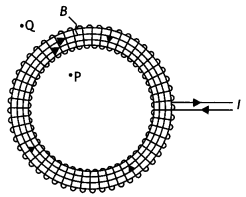
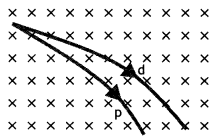
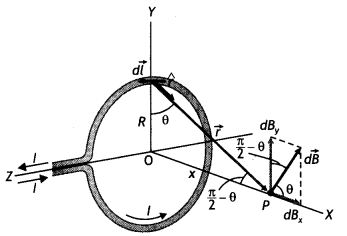
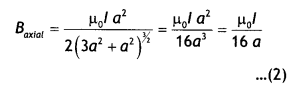
Moving Charges and Magnetism Class 12 Important Extra Questions Physics Chapter 4

Here we are providing Class 12 Physics Important Extra Questions and Answers Chapter 4 Moving Charges and Magnetism. Important Questions for Class 12 Physics with Answers are the best resource for students which helps in Class 12 board exams.

Class 12 Physics Chapter 4 Important Extra Questions Moving Charges and Magnetism

Moving Charges and Magnetism Important Extra Questions Very Short Answer Type

Question 1.
Under what condition is the force acting on a charge moving through a uniform magnetic field minimum?
Answer:
When the charge moves parallel to the direction of the magnetic field.

Question 2.
What Is the nature of the magnetic field in a moving coil galvanometer?
Answer:
Radial magnetic field.

Question 3.
State two properties of the material of the wire used for suspension of the coil in a moving coil galvanometer.
Answer:

  1. High tensile strength.
  2. SmalL vaLue of torque per unit twist.

Question 4.
Write one condition under which an electric charge does not experience a force in a magnetic field.
Answer:
When it moves parallel to the direction of the magnetic field.

Question 5.
Mention the two characteristic properties of the material suitable for making the core of a transformer. (CBSE AI 2012)
Answer:

  1. Low retentivity
  2. High permeability

Question 6.
Write the expression, in a vector form, for the Lorentz magnetic force due to a charge moving with velocity \(\vec{V}\) in a magnetic field \(\vec{B}\). What is the direction of the magnetic force? (CBSE Delhi 2014)
Answer:
The expresion is \(\vec{F}\) = q(\(\vec{V}\) × \(\vec{B}\)). The force is perpendicular to both the velcoity and the magentic field vector.

Question 7.
Write the condition under which an electron will move undeflected in the presence of crossed electric and magnetic fields. (CBSE Al 2014C)
Answer:
An electron moves perpendicular to both fields.

Question 8.
What can be the cause of the helical motion of a charged particle? (CBSE Al 2016)
Answer:
The charge enters the magnetic field at any angle except 0°, 180°, and 90°.

Question 9.
Write the underlying principle of a moving coil galvanometer. (CBSE Delhi 2016)
Answer:
A current-carrying loop placed in a magnetic field experiences a torque.

Question 10.
A proton and an electron traveling along parallel paths enter a region of the uniform magnetic field, acting perpendicular to their paths. Which of them will move in a circular path with a higher frequency? (CBSEAI and Delhi 2018)
Answer:
The frequency of revolution is given by
v = \(\frac{B q}{2 \pi m}\) ⇒ v ∝ \(\frac{1}{m}\) .

As for me < mp
therefore ve >vp

Question 11.
Two protons of equal kinetic energies enter a region of the uniform magnetic field. The first proton enters normal to the field direction while the second enters at 30° to the field direction. Name the trajectories followed by them. (CBSEAI and Delhi 2018C)
Answer:
Normal: circular
At an angle of 30°, it will follow a helical path.

Question 12.
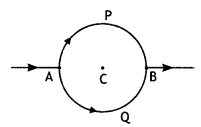
Consider the circuit shown here where APB and AQB are semi-circles. What will be the magnetic field at the center C of the circular loop?
Class 12 Physics Important Questions Chapter 4 Moving Charges and Magnetism 1
Answer:
Zero, because magnetic fields due to APB and AQB are equal in magnitudes but opposite in directions.

Question 13.
Which one of the following will have a minimum frequency of revolution,
when projected with the same velocity v perpendicular to the magnetic field B: (i) α – particle and (ii) β – particle.
Answer:
Frequency of revolution v = \(\frac{q B}{2 \pi m}\) and \(\frac{q}{m}\) of α – particle is less, hence α – particle will have minimum frequency of revolution.

Question 14.
An ammeter and a milli-ammeter are converted from the same galvanometer. Out of the two, which current-measuring instrument has higher resistance?
Answer:
A milli-ammeter has higher resistance.

Question 15.
Equal currents I and I are flowing through two infinitely long parallel wires. What will be the magnetic field at a point mid-way when the currents are flowing in the same direction?
Answer:
Zero, because fields due to two wires will be equal but opposite.

Question 16.
The figure shows a circular loop carrying current l. Show the direction of the magnetic field with the help of lines of
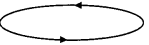
Class 12 Physics Important Questions Chapter 4 Moving Charges and Magnetism 2
Answer:
The magnetic field lines are as shown
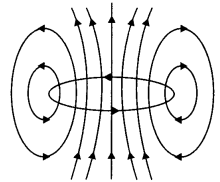
Class 12 Physics Important Questions Chapter 4 Moving Charges and Magnetism 3
Question 17.
An electron is moving with velocity v along the axis of a long straight solenoid carrying current I. What will be the force acting on the electron due to the magnetic field of the solenoid?
Answer:
Zero, as a force on a charged particle moving in a magnetic field, is F= Bqv sin θ
Here both v and B are along the axis of – solenoid, so θ = 0° between them. Hence F= qvB sin θ = 0.

Moving Charges and Magnetism Important Extra Questions Short Answer Type

Question 1.
A charged particle having a charge q is moving with a speed of v along the X-axis. It enters a region of space where the electric field is \(\overrightarrow{\boldsymbol{E}}(\boldsymbol{E} \hat{\boldsymbol{j}})\) and a magnetic field \(\vec{B}\) are both present. The particle, on emerging from the region, is observed to be moving, along the X-axis only. Obtain an expression for the magnitude of \(\vec{B}\) in terms of v and E. Give the direction of \(\vec{B}\).
Answer:
Since the particle continues to move along the X-axis, therefore, the magnetic force acting on it should be completely balanced by the electric force. Since the electric force acts along the Y-axis, therefore, the magnetic force must be along the Z-axis.
Thus is equilibrium q E = B q v or v = E/B

Question 2.
A stream of electrons traveling with speed v m s-1 at right angles to a uniform magnetic field ‘B’ is reflected in a circular path of radius ‘r’ . Prove that \(\frac{e}{m}=\frac{v}{r B}\)
Answer:
Let a stream of electrons be traveling with speed v at right angles to a uniform magnetic field B then force due to magnetic field provides the required centripetal force which deflects the electron beam along a circular path of radius ‘r’ such that
Bev = \(\frac{m v^{2}}{r}\)
or
\(\frac{e}{m}=\frac{v}{r B}\)
where e = electronic charge and m = mass of the electron.

Question 3.
Which one of the two, an ammeter or a milliammeter, has a higher resistance and why?
Answer:
The shunt resistance connected to convert a galvanometer into an ammeter or a milliammeter is given by the expression S = \(\frac{I_{g} G}{I-l_{g}}\) where S is shunt resistance, G galvanometer resistance, l total current through G and S, and lg galvanometer current. In the case of milliammeter, l is small.

Therefore Smilliammeter > Sammeter . Hence the resistance of a milliammeter is greater than that of an ammeter.

Question 4.
A straight wire of length L carrying a current l stays suspended horizontally in mid-air in a region where there is a uniform magnetic field \(\vec{B}\). The linear mass density of the wire is l. Obtain the magnitude and direction of the magnetic field.
Answer:
The magnetic force acting on the straight wire balances the weight of the wire.
Therefore, in equilibrium we have Mg = BIL, here M = L l, therefore we have L l g = BlL or B = l/ l g
This field acts vertically upwards.

Question 5.
In the figure below, the straight wire AB Is fixed while the loop Is free to move under the influence of the electric currents flowing in them. In which direction does the loop begin to move? Give a reason for your answer.
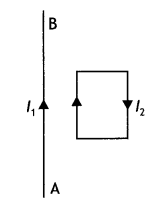
Class 12 Physics Important Questions Chapter 4 Moving Charges and Magnetism 4
Answer:
The loop moves towards the straight wire AB. In the loop in the side nearer to the wire AB current l2 is in the same direction as l1 and hence attractive force acts. However, on the side farther away from the wire AB current l2 is in the opposite direction and the force is repulsive. But as the magnitude of attractive force is greater than the repulsive force, the net force is attractive in nature and hence, the loop moves towards the wire AB.

Question 6.
A coil of ‘N’ turns and radius ‘R’ carries a current ‘l’. It is unwound and rewound to make a square coil of side ‘a’ having the same number of turns (N). Keeping the current ‘l’ same, find the ratio of the magnetic moments of the square coil and the circular coil. (CBSE Delhi 2013C)
Answer:
The magnetic moment of a current loop is given by the relation M = nlA
For the circular loop Mc = NlπR² …(1)

Now when the coil is unwound and rewound to make a square coil, then
2 πR = 4a or a = πR/2

Hence magnetic moment of the square coil is
Ms = Nl a² = Nl (πR/2)² = Nl π²R²/4 …(2)

From (1) and (2) we have
\(\frac{M_{S}}{M_{C}}=\frac{N l \pi^{2} R^{2} / 4}{N l \pi R^{2}}=\frac{\pi}{4}\)

Question 7.
Write the expression for Lorentz magnetic force on a particle of charge ‘q’ moving with velocity v in a magnetic field B. Show that no work is done by this force on the charged particle. (CBSE Al 2011)
Answer:
The expression is \(\vec{F}\) = q(\(\vec{v}\) × \(\vec{B}\)). This force always acts perpendicular to the direction of motion of the charged particle. Therefore the angle between \(\vec{F}\) and \(\vec{r}\) is 90°. Hence work done is W = \(\vec{F}\). r = Fr cos 90° = 0

Question 8.
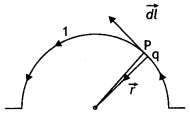
(a) State Biot-Savart law in vector form expressing the magnetic field due to an element \(\vec{dl}\) carrying current l at a distance \(\vec{r}\) from the element.
Answer:
It states that for a small current element dl the magnetic field at a distance r is given by
\(\overrightarrow{d B}=\frac{\mu_{0}}{4 \pi} \frac{I \overline{(d L} \times \hat{r})}{r^{2}}\).

(b) Write the expression for the magnitude of the magnetic field at the center of a circular loop of radius r carrying a steady current l. Draw the field lines due to the current loop. (CBSE Al 2014C)
Answer:
The magnetic field at the center of a circular loop is given by
B = \(\frac{\mu_{0} l}{2 r}\)

The field lines are as shown.
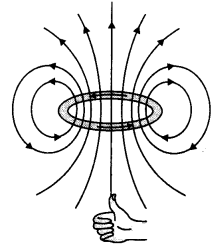
Class 12 Physics Important Questions Chapter 4 Moving Charges and Magnetism 5
Question 9.
Draw the magnetic field lines due to current passing through a long solenoid. Use Ampere’s circuital law, to obtain the expression for the magnetic field due to the current l in a long solenoid having n number of turns per unit length. (CBSE Delhi 2014C)
Answer:
The diagram is as shown.
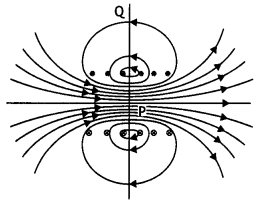
Class 12 Physics Important Questions Chapter 4 Moving Charges and Magnetism 6
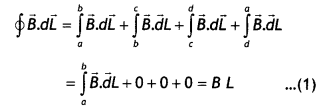
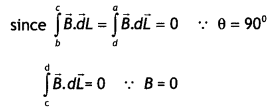
Consider a rectangular path abed of length L as shown in the figure below. Let us apply Ampere’s circuital law to this rectangular path so that we have
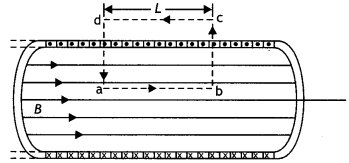
Class 12 Physics Important Questions Chapter 4 Moving Charges and Magnetism 23
Class 12 Physics Important Questions Chapter 4 Moving Charges and Magnetism 24
Class 12 Physics Important Questions Chapter 4 Moving Charges and Magnetism 25
But by Ampere’s circuital law we have
\(\oint \vec{B} \cdot \vec{d} L\) = μ0Nl = μ0(nL)l …(2)

From equations (1) and (2) we have
BL = μ0nLl
or
B = μ0 n l

But n = N/L, therefore we have
B = μ0 \(\frac{N l}{L}\)

This gives the value of a magnetic field inside a solenoid.

Question 10.
(a) Why do we use a shunt to convert a galvanometer into an ammeter?
Answer:
Since an ammeter is an instrument used to measure the current in the circuit, so it has to be connected in series in the circuit to measure the whole current. Hence its resistance must below. A low shunt resistance makes it suitable for measuring current.

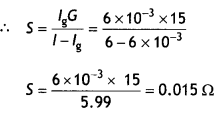
(b) A galvanometer of resistance 15 Ω shows a full-scale deflection on the meter scale for a current of 6 mA. Calculate the value of the shunt resistance required to convert the galvanometer into an ammeter of range 0-6 A. (CBSE 2019C)
Answer:
Given G = 15 Ω, lg = 6 mA = 6 × 10⁻³ A, l = 6 A, S = ?
Class 12 Physics Important Questions Chapter 4 Moving Charges and Magnetism 7
Question 11.
An electron beam projected along + X-axis experiences a force due to a magnetic field along the + Y-axis. What is the direction of the magnetic field?
Answer:
The direction of the magnetic field is along  Z-axis. This is because the direction of motion, the magnetic field, and the force are perpendicular to one other as an electron carries a negative charge.

Question 12.
A current is set up in a long copper pipe. Is there a magnetic field
(i) inside,
Answer:
There is no magnetic field inside the pipe.

(ii) outside the pipe?
Answer:
There is a magnetic field outside the pipe.

Question 13.
Which one of the following will experience a maximum force, when projected with the same velocity V perpendicular to the magnetic field (i) alpha particle and (ii) beta particle?
Answer:
The force experienced by a charged particle is given by the expression F = B q v. Since an alpha particle has a moving charge than the beta particle, therefore the alpha particle will experience more force.

Question 14.
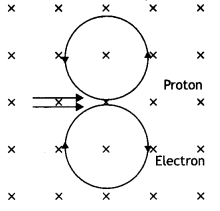
An electron and a proton moving parallel to each other in the same direction with equal momenta enter into a uniform magnetic field which is at right angles to their velocities. Trace their trajectories in the magnetic field.
Answer:
Because both electron and proton have the same charge and momentum, therefore they will describe circles of equal radii as shown.
Class 12 Physics Important Questions Chapter 4 Moving Charges and Magnetism 8
Question 15.
Is the steady electric current the only source of the magnetic field? Justify your answer. (CBSE Delhi 2013C)
Answer:
No, the magnetic field is also produced by alternating current.

Question 16.
A deuteron and an alpha particle having the same momentum is in turn allowed to pass through a magnetic field B, acting normal to the direction of motion of the particles. Calculate the ratio of the radii of the circular paths described by them. (CBSE Delhi 2019)
Answer:
Pd = Pα
Now r = \(\frac{mv}{Bq}\) ⇒ r ∝ \(\frac{1}{q}\)

Therefore, \(\frac{r_{d}}{r_{\alpha}}=\frac{q_{\alpha}}{q_{d}}=\frac{2 e}{e}\) = 2

Question 17.
Two wires of equal length are bent in the form of two loops. One of the loops is square-shaped and the other is circular. These are suspended in a uniform magnetic field and the same current is passed through them. Which loop will experience a greater torque? Give reasons.
Answer:
Torque experienced by a current-carrying loop placed in a uniform magnetic field is given by the expression τ = BlnA. In other words, torque is directly proportional to the area of the loop. Since a circular wire has more area than a square wire for the same dimension, therefore the circular wire experiences more torque than the square wire.

Question 18.
Which one of the following will have a minimum frequency of revolution, when projected with the same velocity v perpendicular to the magnetic field B: (i) alpha particle and (ii) beta particle?
Answer:
The frequency of revolution of a charged particle in a magnetic field is given by Bq
v = \(\frac{Bq}{2πm}\).

The ratio of q/m for an alpha particle is less than that for a beta particle; therefore, the alpha particle will have a minimum frequency of revolution.

Question 19.
Using the concept of force between two infinitely long parallel current-carrying conductors, define one ampere of current. (CBSE AI 2014)
Answer:
One ampere is that much current which when flowing through each of the two infinitely long straight conductors held 1 meter apart in space, produce a force of F= 2 × 10⁻⁷ N per meter of their length.

Question 20.
(a) Write the expression for the force \(\vec{F}\) , acting on a charged particle of charge ‘q’, moving with a velocity v in the presence of both electric field \(\vec{E}\) and magnetic field \(\vec{B}\) . Obtain the condition under which the particle moves undeflected through the fields.
Answer:
(a) The required expression is \(\vec{F}=q \vec{E}+q(\vec{v} \times \vec{B})\)

The particle will move undeflected if the force acting on it due to the electric field balances the force acting on it due to the magnetic field. Thus qE = Bqv or v=E/B

(b) A rectangular loop of size l × b carrying a steady current I is placed in a uniform magnetic field \(\vec{B}\) . Prove that the torque τ acting on the loop is given by \(\vec{τ}\) = \(\vec{m}\) × \(\vec{B}\) , where m is the magnetic moment of the loop. (CBSE AI 2012, Delhi 2013)
Answer:
The figure below shows a rectangular loop of wire with length ‘a’ and breadth ‘b’. A line perpendicular to the plane of the loop (i.e. a normal to the plane) makes an angle Φ with the direction of the magnetic field B, and the loop carries a current / as shown. Let the forces acting on the various sides of the loop be \(\vec{F}_{1}\), \(\vec{F}_{2}\), \(\vec{F}_{3}\) and \(\vec{F}_{4}\) as shown.

It follows from the expression for the force experienced by a conductor in a magnetic field that force on arm AB is
\(\vec{F}_{1}=I(\overrightarrow{\mathrm{AB}} \times \vec{B})\) …(1)
(in the plane of the paper and is directed upwards as shown).

The force on arm CD is given by \(\vec{F}_{2}=l(\overrightarrow{\mathrm{CD}} \times \vec{B})\) …(2)
(in the plane of the paper and is directed downwards as shown.)

Since these two forces are equal and opposite and have the same line of action therefore they cancel out each other’s effect and their resultant effect on the coil is zero.

Now the force on arm BC is
\(\vec{F}_{3}=l(\overrightarrow{\mathrm{BC}} \times \vec{B})\) …(3)
(acts perpendicular to the plane of the paper and is directed outwards as shown) Finally the force on arm DA is
\(\vec{F}_{4}=I(\overrightarrow{\mathrm{DA}} \times \vec{B})\) …(4)
(acts perpendicular to the plane of the paper and is directed inwards as shown in figure).

Both forces F3 and F4 make an angle of 90° with the direction of the magnetic field. Therefore, in magnitude, these forces are given by
F3 = F4 = laB sin90° = laB …(5)

The lines of action of both these forces are perpendicular to the plane of the paper. The two forces F3 and F4 lie along different lines and each give rise to a torque about the X-axis. The two torques produce a resultant torque in + X direction. The arm of the couple (perpendicular distance between the lines of action of the two forces) from the figure below is given by
An arm of couple = b Sin Φ …(6)

Therefore, by the definition of torque we have
Torque = either force × arm of couple Using equations (5) and (6) we have
Torque = l B a × b Sin Φ
But a b = A, area of the coil, therefore τ = l B A Sin Φ
Class 12 Physics Important Questions Chapter 4 Moving Charges and Magnetism 48
Question 21.
Show that a force that does no work must be a velocity-dependent force. (NCERT Exemplar)
Answer:
We know that work is the dot product of force and displacement, therefore
dW = \(\vec{F} \cdot d \vec{l}\) = 0
Or
dW = \(\vec{F}\) .\(\vec{v}\)dt = 0
Or
\(\vec{F} \cdot \vec{v}\) = 0

Thus F must be velocity dependent which implies that the angle between F and v is 90°. If v changes direction then the direction of F should also change so that the above condition is satisfied.

Question 22.
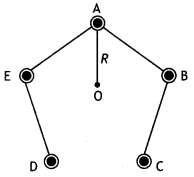
Five long wires A, B, C, D, and E, each carrying current l is arranged to form edges of a pentagonal prism as shown in the figure. Each carries current out of the plane of the paper.
(a) What will be magnetic induction at a point on axis 0? Axis is at a distance R from each wire.
(b) What will be the field if the current in one of the wires (say A) is switched off?
(c) What if the current in one of the wires (say) A is reversed? (NCERT Exemplar)
Class 12 Physics Important Questions Chapter 4 Moving Charges and Magnetism 9
Answer:
(a) Zero Mn I
(b) \(\frac{\mu_{0}}{2 \pi} \frac{1}{R}\) perpendicular to AO towards left
(c) \(\frac{\mu_{0}}{\pi} \frac{1}{R}\) perpendicular to AO towards left

Moving Charges and Magnetism Important Extra Questions Long Answer Type

Question 1.
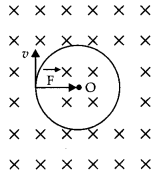
(a) A particle of charge ‘q’ and mass ‘m’, moving with velocity \(\vec{v}\) is subjected to a uniform magnetic field \(\vec{B}\) perpendicular to its velocity. Show that the particle describes a circular path. Obtain an expression for the radius of the circular path of the particle.
Answer:
Let a charged particle of charge q and mass m be moving with velocity \(\vec{v}\) right angle to the field (i.e. in the plane of the paper), then magnetic force \(\vec{F}\) acting on the charge q will be
\(\vec{F}=q(\vec{v} \times \vec{B})\)
or
F = qvB sin 90°
or
F = qvB … (1)
Class 12 Physics Important Questions Chapter 4 Moving Charges and Magnetism 10
As this forces fact at a right angle to the velocity V of the charged particle, the slot is unable to change the velocity but can make the charged particle move In a circular path.

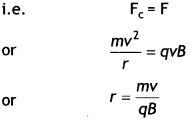
If r is the radius of the circle, then the centripetal force required by the charged particle will be
\(F_{c}=\frac{m v^{2}}{r}\)

This centripetal force Is provided by the magnetic force acting on the charged particle.
Class 12 Physics Important Questions Chapter 4 Moving Charges and Magnetism 11
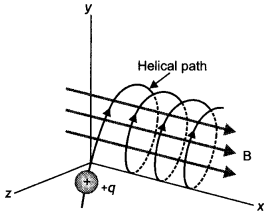
(b) Explain, how its path will be affected if the velocity \(\vec{v}\) makes an angle (θ ≠ 90°) with the direction of the magnetic field. (CBSE 2019C)
Answer:
If (θ ≠ 90°), the velocity \(\vec{v}\) of the moving charge can be resolved into two components v cos θ, in the direction of the magnetic field and make it v sin θ, in the direction perpendicular to the magnetic field. The charged particle under the combined effect of the two components of velocities wilt cover linear as well as a circular path, i.e. helical path whose axis is parallel to the magnetic field.

Question 2.
(a) Obtain the conditions under which an electron does not suffer any deflection while passing through a magnetic field.
Answer:
No deflection suffered by the electron if it moves parallel or anti-parallel to the magnetic field.

(b) Two protons P and Q moving with the same speed pass through the magnetic fields \(\vec{B}_{1}\) and \(\vec{B}_{2}\) respectively, at right angles to the field directions. If \(\left|\vec{B}_{2}\right|>\left|\vec{B}_{1}\right|\), which of the two protons will describe the circular path of smaller radius? Explain. (CBSEAI 2019)
Answer:
The radius of the circular path traveled by a charged particle in a magnetic field is given by
r = \(\frac{mv}{Bq}\)

Therefore, \(\frac{r_{1}}{r_{2}}=\frac{B_{2}}{B_{1}}\)

As \(\left|\vec{B}_{2}\right|>\left|\vec{B}_{1}\right|\) therefore, r2 < r1

Question 3.
A straight wire of length L is bent into a semi-circular loop. Use Biot-Savart law to deduce an expression for the magnetic field at its center due to the current l passing through it. (CBSE Delhi 2011C)
Answer:
Consider a straight wire of length L. Let it be bent into a semicircular arc of radius r as shown,
Class 12 Physics Important Questions Chapter 4 Moving Charges and Magnetism 12
Then πr = L or r = L/π

Let a current I be passed through it. Divide the semi-circular loop into a large number of elements; consider one such element PQ of length dl. Then the small magnetic field cfB produced at the point O is

dB = \(\frac{\mu_{0}}{4 \pi} \frac{l d l \sin 90^{\circ}}{r^{2}}=\frac{\mu_{0}}{4 \pi} \frac{l d l}{r^{2}}\) outwards at point O.

Therefore total magnetic field at point O is
B = \(\int_{0}^{\pi r} \frac{\mu_{0}}{4 \pi} \frac{l d l}{r^{2}}=\frac{\mu_{0} l}{4 r}=\frac{\mu_{0} l \pi}{4 L}\)

Question 4.
A circular coil of N turns and radius R carries a current l. It is unwound and rewound to make another coil of radius R/2, current l remaining the same. Calculate the ratio of the magnetic moments of the new coil and the original coil. (CBSE AI 2012)
Answer:
The magnetic moment of a current-carrying coil is given by
M = n lA = n l πR²

When the coil is unwound and wound into another coil of radius R/2, the number of turns will double, i.e. n = 2
Therefore, n1 = 1, n2 = 2, R1 = R, R2 = R/2, hence

Therefore \(\frac{M_{2}}{M_{1}}=\frac{n_{2} / \pi R_{2}^{2}}{n_{1} / \pi R_{1}^{2}}=\frac{2}{4}=\frac{1}{2}\)

Question 5.
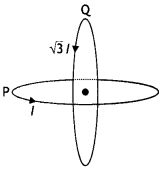
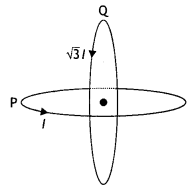
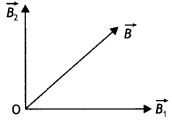
Two identical coils P and Q each of radius R are lying in perpendicular planes such that they have a common center. Find the magnitude and direction of the magnetic field at the common center when they carry currents equal to l and \(\sqrt{3}\) l respectively. (CBSE Al 2019)
Class 12 Physics Important Questions Chapter 4 Moving Charges and Magnetism 13
Answer:
Magnetic field at the common centre due to coil P
\(B_{1}=\frac{\mu_{o} l}{2 R}\)

Magnetic field at the common centre due to coil Q
\(B_{2}=\frac{\mu_{0} \sqrt{3} l}{2 R}\)
Class 12 Physics Important Questions Chapter 4 Moving Charges and Magnetism 14
The two fields are mutually perpendicular, therefore, the resultant field at the common centre is
B = \(\sqrt{B_{1}^{2}+B_{2}^{2}}=\sqrt{\left(\frac{\mu_{o} l}{2 R}\right)^{2}+\left(\frac{\mu_{0} \sqrt{3} 1}{2 R}\right)^{2}}\)
= \(\frac{\mu_{o} l}{R}\)

Let the resultant field make an angle θ with magnetic field B<sub>2</sub> as shown
tan θ = \(\frac{B_{1}}{B_{2}}=\frac{1}{\sqrt{3}}\) ⇒ θ = 30°

Question 6.
Find the condition under which the charged particles moving with different speeds in the presence of electric and magnetic field vectors can be used to select charged particles of a particular speed. (CBSE A! 2017)
Answer:
Consider crossed electric and magnetic fields. Let the particle enter perpendicular to both these fields. Due to this, the electric and magnetic forces are in opposite directions. Suppose, we adjust the value of E and B such that the magnitudes of the two forces are equal. Then, the total force on the charge is zero and the charge will move in the fields undeflected.

This happens when, or qE = qvB or v = E/B

This condition can be used to select charged particles of a particular velocity out of a beam containing charges moving at different speeds (irrespective of their charge and mass). The crossed E and B fields, therefore, serve as a velocity selector. Only particles with speed E/B pass undeflected through the region of crossed fields.

Question 7.
(a) Define the SI unit of current in terms of the force between two parallel current-carrying conductors.
Answer:
One ampere is that much current which when flowing through each of the two infinitely long straight conductors held 1 meter apart in space, produces a force of F = 2 × 10⁻⁷ N per meter of their length.

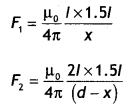
(b) Two long straight parallel conductors carrying steady currents la and lb along the same direction are separated by a distance d. How does one explain the force of attraction between them? If a third conductor carrying a current l in the opposite direction is placed just in the middle of these conductors, find the resultant force acting on the third conductor. (CBSE AI, Delhi 2018C)
Answer:
The magnetic field produced by one current applies a force on the other current-carrying conductor. By Fleming’s left-hand rule the forces acting on each due to other is directed towards each other. This shows attraction.

Force on C conductor due to conductor A
Fca = \(\frac{\mu_{0} l_{a} l_{c}}{\pi d}\) repulsive

Force on C conductor due to conductor B
Fcb = \(\frac{\mu_{0} l_{b} l_{c}}{\pi d}\)

\(F_{\mathrm{ac}}-F_{\mathrm{bc}}=\frac{\mu_{0} l_{\mathrm{c}}}{\pi d}\left(l_{a}-l_{b}\right)\)

Question 8.
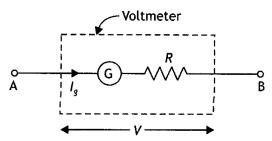
ExplaIn how will you convert a galvanometer into a voltmeter to read a maximum potential of ‘V’ volt. Can one use a voltmeter to measure the emf of a cell? Justify your answer.
Answer:
Suppose a galvanometer having resistance G is to be converted into a voltmeter, which can measure the potential difference from O to V volt. Let a high resistance R be joined in senes with the galvanometer for this purpose. Its value is so chosen that when the galvanometer with the resistance is connected between two points having a potential difference of V volt, the gaLvanometer gives full-scale deflection. It is clear from the figure below that
V = lg (R + G)
or
R = \(\frac{v}{l_{g}}\) – G
Class 12 Physics Important Questions Chapter 4 Moving Charges and Magnetism 15
On connecting the above high resistance in series with a galvanometer, the galvanometer is converted into a voltmeter of range V volt.

A voltmeter cannot measure the emf of the cell as it draws current from the cell while measuring the potential differences.

Question 9.
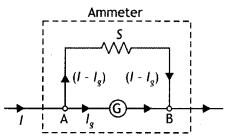
Explain how will you convert a galvanometer into an ammeter to read a maximum current of ‘l’ ampere. An ammeter is always connected in series with a circuit. Why? (CBSE AI 2019)
Answer:
Suppose a galvanometer of resistance G is to be converted into an ammeter having range 0 to l ampere. Let lg be the current,
Class 12 Physics Important Questions Chapter 4 Moving Charges and Magnetism 16
which gives full-scale deflection in the galvanometer. Suppose S is the appropriate shunt required for this purpose, i.e. when shunt S Is used, current ‘g passes through the galvanometer and the remaining (l – lg) passes through the shunt as shown in the figure below. Since the shunt and the galvanometer are connected In parallel therefore the potential differences across both wilL be the same. Hence
lg G = (l – lg) S ….(1)

S = \(\frac{l_{s} G}{l-l_{s}}\) ….(2)

An ammeter is used to measure current; therefore, it is connected in senes so that the entire current passes through it. Moreover, an ammeter is a low resistance device.

Question 10.
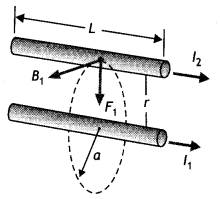
A steady current (l1) flows through a long straight wire. Another wlrè carrying steady current (l2) In the same direction is kept close and parallel to the first wire. Show with the help of a diagram how the magnetic field due to the current l1 exerts a magnetic force on the second wire. Write the expression for this force. (CBSE AI 2011)
Answer:
The diagram is as shown below.
Class 12 Physics Important Questions Chapter 4 Moving Charges and Magnetism 17
Magnetic field B1 is produced by the wire carrying current l1 on a wire carrying current l2. Thus the second current-carrying wire is placed in the magnetic field produced by the first as a result it experiences a force is given by F = \(\frac{\mu_{0} l_{1} l_{2}}{2 \pi r}\) per unit length.

Question 11.
(a) State Ampere’s circuital law expressing it in the integral form.
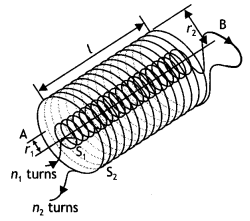
(b) Two long coaxial insulated solenoids S1 and S2 of equal lengths are wound one over the other as shown in the figure. A steady current ‘l’ flows through the inner solenoid S1 to the other end B, which is connected to the outer solenoid S2 through which the same current ‘l’ flows in the opposite direction so as to come out at end A. If n1 and n2 are the numbers of turns per unit length, find the magnitude and direction of the net magnetic field at a point
(i) inside on the axis and
(ii) outside the combined system. (CBSE Delhi 2014)
Class 12 Physics Important Questions Chapter 4 Moving Charges and Magnetism 18
Answer:
(a) The line integral of B around any closed path equals µol, where l is the total steady current passing through any surface bounded by the closed path.” Mathematically
\(\oint \vec{B} \cdot \overrightarrow{d L}=\mu_{0} I\)

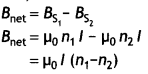
(b) (i) The magnetic field due to a current-carrying solenoid:
B = µon l

where n = number of turns per unit length
l = current through the solenoid

Now, the magnetic field due to solenoid S1 will be in the upward direction and the magnetic field due to S2 will be in the downward direction (by right-hand screw rule).
Class 12 Physics Important Questions Chapter 4 Moving Charges and Magnetism 19
In the upward direction

(ii) The magnetic field is zero outside a solenoid.

Question 12.
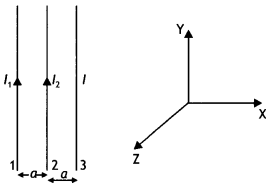
Three long straight parallel wires are kept as shown in the Figure. The wire (3) carries a current l
Class 12 Physics Important Questions Chapter 4 Moving Charges and Magnetism 20
(i) The direction of flow of current l in wire (3) is such that the net force, on a wire (1), due to the other two wires, is zero.
(ii) By reversing the direction of l, the net force on the wire (2), due to the other two wires, becomes zero. What will be the direction of current l, in the two cases? Also obtain the relation between the magnitudes of currents l1, l2, and l. (CBSE Delhi 2016C)
Answer:
Case 1: The direction of flow of current in the wire (3) will be opposite to the direction of flow of current in the wire (1), i.e. downwards.
Also \(\frac{\mu_{0} l_{1} l}{2 \pi(2 a)}=\frac{\mu_{0} l_{1} l_{2}}{2 \pi a}\)
or
l = 2l2

Case 2: The direction of flow of current in wire (3) will be same as the direction of flow of current in wire (1), i.e. upwards. For zero force on wire (2) we have
\(\frac{\mu_{0} l_{1} l_{2}}{2 \pi a}=\frac{\mu_{0} l l_{2}}{2 \pi a}\)
or
l = l1
Therefore l = l1 = 2 l2

Question 13.
Show mathematically that the cyclotron frequency does not depend upon the speed of the particle.
Answer:
Due to the presence of the perpendicular magnetic field the particle moves in a circle of radius r given by
r = \(\frac{m v}{q B}\) ….(1)

The path of the particles in the dees is a semicircle and the time the particle spends in each dees is length of the semi circular path velocity
t = \(\frac{\text { length of the semi circular path }}{\text { velocity }}\)
= \(\frac{\pi r}{v}=\frac{\pi m}{B q}\) …(2)

using equation (1)
The above time is independent of the radius of the path and the velocity of the charged particle. Now the time period of the cyclotron is twice the time spent by the particle in each dee. Thus

T = 2t = \(\frac{2 \pi m}{B q}\) …(3)

Hence cyclotron frequency or the magnetic resonance frequency is given by
v = \(\frac{1}{T}=\frac{B q}{2 \pi m}\) …(4)

which is independent of the speed of the particle.

Question 14.
State the principle of a cyclotron. Show that the time period of revolution of particles in a cyclotron is independent of their speeds. Why is this property necessary for the operation of a cyclotron? (CBSE Al 2016)
Answer:
Principle of cyclotron: It is based on the principle that the positive ions can be accelerated to high energies with a comparatively smaller alternating potential difference by making them cross the electric field again and again, by making use of a strong magnetic field.

The necessary centripetal force required by charged particle to revolve in a circular path in magnetic field is provided by force due to magnetic field, i.e.
\(\frac{m v^{2}}{r}\) = Bqv
or
v = \(\frac{\text { Bqr }}{m}\)

So, the frequency of revolution is then given by
T = \(\frac{2 \pi r}{v}=2 \pi r \times \frac{m}{B q r}=\frac{2 \pi m}{B q}\)

It is clear from the expression that T is Independent of speed.

If this condition is not met the charged particle will very soon go out of step with the applied electricity and will not be accelerated.

Question 15.
(a) Write the expression for the magnetic force acting on a charged particle moving with velocity v in the presence of magnetic field B.
Answer:
\(\vec{F}\) = q\((\vec{v} \times \vec{B})\)

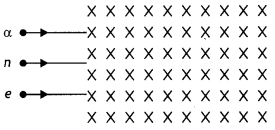
(b) A neutron, an electron and an alpha particle moving with equal velocities enter a uniform magnetic field going into the plane of the paper as shown. Trace their paths in the field and justify your answer. (CBSE Delhi 2016)
Class 12 Physics Important Questions Chapter 4 Moving Charges and Magnetism 21
Answer:
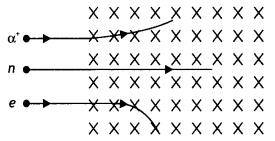
The path area is shown.
Class 12 Physics Important Questions Chapter 4 Moving Charges and Magnetism 22
The radius of the circular path traveled by each particle is given by the expression
r = \(\frac{m v}{B q}\) since B and v is the same therefore

we have r ∝ \(\frac{m}{q}\). Since neutron does not have a charge therefore it passes straight without deflection. The ratio m/q for an alpha particle is greater for an alpha particle therefore its path will be less curved.

Also by Fleming’s left-hand rule the alpha particle and the electron will experience a force in the direction as shown.

Question 16.
A long solenoid of length ‘L’ having N turns carries a current l. Deduce the expression for the magnetic field in the interior of the solenoid. (CBSE AI 2011C)
Answer:
Consider a rectangular path abed of length L as shown in the figure below. Let us apply Ampere’s circuital law to this rectangular path so that we have
Class 12 Physics Important Questions Chapter 4 Moving Charges and Magnetism 23
Class 12 Physics Important Questions Chapter 4 Moving Charges and Magnetism 24
Class 12 Physics Important Questions Chapter 4 Moving Charges and Magnetism 25
But by Ampere’s circuital law we have
\(\oint \vec{B} \cdot \vec{d} L\) = μ0Nl = μ0(nL)l …(2)

From equations (1) and (2) we have
BL = μ0nLl
or
B = μ0 n l

But n = N/L, therefore we have
B = μ0 \(\frac{N l}{L}\)

This gives the value of a magnetic field inside a solenoid.

Question 17.
Using Biot-Savart’s law, derive an expression for the magnetic field intensity at the center of a current-carrying circular coil.
Answer:
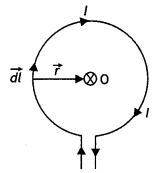
Consider a circular loop of radius r carrying a current l and having a center at O as shown in the figure below.
Class 12 Physics Important Questions Chapter 4 Moving Charges and Magnetism 26
Consider a small current element dL on the loop. Then by Biot-Savart’s law the magnitude of the magnetic field at the center of the loop due to the current element we have
dB = \(\frac{\mu_{0}}{4 \pi} \frac{l d L \sin \theta}{r^{2}}\) …(1)

In this case, the angle between the current element dL and the radius vector is 90° therefore equation (1) can be written as
dB = \(\frac{\mu_{0}}{4 \pi} \frac{l d L}{r^{2}}\) ….(2)

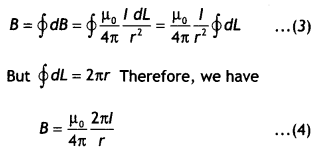
The circular loop can be considered to be consisting of such small elements placed side by side, and then the magnetic intensities of these elements will be in the same direction. Thus, the net intensity of B at the center of the loop is given by
Class 12 Physics Important Questions Chapter 4 Moving Charges and Magnetism 27
Question 18.
A charged particle q is moving in the presence of a magnetic field B which is inclined to an angle 300 with the direction of the motion of the particle. Draw the trajectory followed by the particle In the presence of the field and explain how the particle describes this path. (CBSE Delhi 2019)
Answer:
Two components of velocity vector V are responsible for the helical motion. Force on the charged particle due to the component normal to the magnetic field acts perpendicular to the velocity and the magnetic field and makes the particle follow a circular path. The component of velocity which is along the magnetic field does not cause any force on the particle, hence the particle continues to move in a straight line path due to this component so, the resultant path will be helical.

The path is as shown.
Class 12 Physics Important Questions Chapter 4 Moving Charges and Magnetism 28
Question 19.
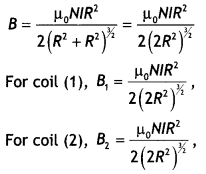
Two parallel coaxial circular costs of equal radius ‘R’ and an equal number of turns ‘N’, carry equal currents ‘I’ in the same direction and are separated by a distance ‘2R’. Find the magnitude and direction of the net magnetic field produced at the mid-point of the line joining their centers.
Answer:
The magnetic field at a distance R from a circular coil is given by the expression
Class 12 Physics Important Questions Chapter 4 Moving Charges and Magnetism 29
Both are directed in the same direction, therefore the resultant magnetic field at the center is
B = \(\frac{\mu_{0} N l R^{2}}{\left(2 R^{2}\right)^{1 / 2}}\)

Question 20.
(a) State Biot-Savart’s law. Using this law, derive the expression for the magnetic field due to a current-carrying circular loop of radius ‘R’, at a point which is at a distance ‘x’ from Its center along the axis of the loop.
Answer:
It states that for a small current element the small magnetic field is given by the expression Biot-Savart’s law for a small current element \(\overrightarrow{d B}=\frac{\mu_{0}}{4 \pi} \frac{I \overline{(d L} \times \hat{r})}{r^{2}}\).

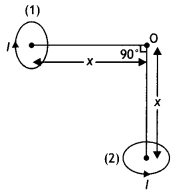
(b) Two small identical circular loops, marked (1) and (2), carrying equal currents, are placed with the geometrical axes perpendicular to each other as shown in the figure. Find the magnitude and direction of the net magnetic field produced at point O.
Class 12 Physics Important Questions Chapter 4 Moving Charges and Magnetism 30
Answer:
The magnetic field at O due to the circular loop 1 is B1 = \(\frac{\mu_{0} l R^{2}}{2\left(x^{2}+R^{2}\right)^{1 / 2}}\) directed towards left.

The magnetic field at O due to the circular loop is B1 = \(\frac{\mu_{0} l R^{2}}{2\left(x^{2}+R^{2}\right)^{1 / 2}}\) directed upwards.

The net magnetic field is therefore
B = \(\sqrt{B_{1}^{2}+B_{2}^{2}}=\sqrt{2} B_{1}=\frac{\mu_{0} l R^{2}}{\sqrt{2}\left(x^{2}+R^{2}\right)^{3 / 2}}\)

The direction of the net magnetic field is 45° with the axis of the loop as shown in the figure below.
Class 12 Physics Important Questions Chapter 4 Moving Charges and Magnetism 31

Question 21.
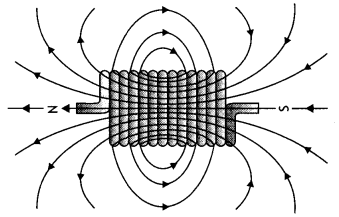
Derive an expression for the magnetic field along the axis of an air-cored solenoid, using Ampere’s circuital law. Sketch the magnetic field lines for a finite solenoid. Explain why the field at the exterior mid-point Is weak while at the interior it is uniform and strong.
Answer:
A solenoid is a coil of wire with a Length, which is Large as compared with its diameter.

Consider an ideaL soLenoid carrying current l and having n turns per unit length.
(a) Consider a rectangular path abed of length L as shown in the figure below. Let us apply Ampere’s circuital law to this rectangular path so that we have
Class 12 Physics Important Questions Chapter 4 Moving Charges and Magnetism 23
Class 12 Physics Important Questions Chapter 4 Moving Charges and Magnetism 24
Class 12 Physics Important Questions Chapter 4 Moving Charges and Magnetism 25
But by Ampere’s circuital law we have
\(\oint \vec{B} \cdot \vec{d} L\) = μ0Nl = μ0(nL)l …(2)

From equations (1) and (2) we have
BL = μ0nLl
or
B = μ0 n l

But n = N/L, therefore we have
B = μ0 \(\frac{N l}{L}\)

This gives the value of a magnetic field inside a solenoid.

(b) The sketch Is as shown below.
Class 12 Physics Important Questions Chapter 4 Moving Charges and Magnetism 32
The magnetic field gets added inside the solenoid whereas it is not added outside the solenoid.

Question 22.
(a)Using Ampere’s circuital law, obtain the expression for the magnetic field due to a long solenoid at a point inside the solenoid on its axis.
Answer:
Consider a rectangular path abed of length L as shown in the figure below. Let us apply Ampere’s circuital law to this rectangular path so that we have
Class 12 Physics Important Questions Chapter 4 Moving Charges and Magnetism 23
Class 12 Physics Important Questions Chapter 4 Moving Charges and Magnetism 24
Class 12 Physics Important Questions Chapter 4 Moving Charges and Magnetism 25
But by Ampere’s circuital law we have
\(\oint \vec{B} \cdot \vec{d} L\) = μ0Nl = μ0(nL)l …(2)

From equations (1) and (2) we have
BL = μ0nLl
or
B = μ0 n l

But n = N/L, therefore we have
B = μ0 \(\frac{N l}{L}\)

This gives the value of a magnetic field inside a solenoid.

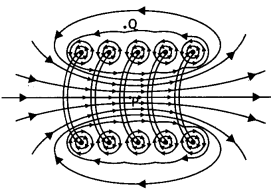
(b) In what respect is a toroid different from a solenoid? Draw and compare the pattern of the magnetic field lines in the two cases.
Answer:
(b) In a toroid magnetic field is uniform whereas in a solenoid it is different at the two ends and the center.
The magnetic field lines around the two are as shown.
Class 12 Physics Important Questions Chapter 4 Moving Charges and Magnetism 33
Class 12 Physics Important Questions Chapter 4 Moving Charges and Magnetism 34
(c) How is the magnetic field inside a given solenoid made strong? (CBSE Al 2011)
Answer:
(i) By inserting a ferromagnetic substance inside the solenoid.
(ii) By increasing the amount of current through the solenoid.

Question 23.
(a) Explain, giving reasons, the basic difference in converting a galvanometer into
(i) a voltmeter
Answer:
A voltmeter is always connected in parallel with the section of the circuit whose potential difference has to be measured. Further, it must draw a small current, otherwise, the voltage measurement will disturb the original setup by an amount that is very large. Thus a large resistance is connected to the galvanometer in series so as to minimize this effect.

(ii) an ammeter
Answer:
An ammeter measures current and is to be connected in series in a circuit. A galvanometer has a large resistance, therefore a shunt is connected to it in order to decrease its resistance such that the current in the circuit is not altered.

(b) Two long straight parallel conductors carrying steady currents l1 and l2 are separated by a distanced’. Explain briefly, with the help of a suitable diagram, how the magnetic field due to one conductor acts on the other. Hence deduce the expression for the force acting between the two conductors. Mention the nature of this force. (CBSE At 2012)
Answer:

Consider two long, straight parallel wires separated by a distance ‘a’ and carrying currents l1 and l2 in the same direction as shown. We can easily determine the force on one wire due to the magnetic field set-up by the other wire. Wire 2, which carries a current l2, sets up a magnetic field B2 at the position of wire 1.
Class 12 Physics Important Questions Chapter 4 Moving Charges and Magnetism 40
The direction of B2 is perpendicular to the wire, as shown in figure. Now the magnetic force on length L of wire 1 is
\(\vec{F}_{1}=l_{1}\left(\vec{L} \times \vec{B}_{2}\right)\)

Since L is perpendicular to B2, the magnitude of F, is given by F1 = l1 L B2 …(1)
But the field due to wire 2 is given by the relation
B2 = \(\frac{\mu_{0} l_{2}}{2 \pi a}\) ….(2)

Therefore, from equations 1 and 2 we have
F1= l1 L B2 = l1 L\(\left(\frac{\mu_{0} l_{2}}{2 \pi a}\right)=\frac{L \mu_{0} l_{1} l_{2}}{2 \pi a}\)

We can rewrite it in terms of force per unit length as
\(\frac{F_{1}}{L}=\frac{\mu_{0} l_{1} l_{2}}{2 \pi a}\) ….(3)

The direction of F1 is downward, towards wire 2, since \(\vec{L} \times \vec{B}\) is downwards. If one considers the field set up at wire 2 due to wire 1, the force F2 is found to be equal and opposite to F1 which is in accordance with Newton’s third law of motion. When the currents are in opposite directions, the forces are reversed and the wires repel each other. Hence we find that the force per unit length of wire between two parallel current-carrying wires is given by
F = \(\frac{\mu_{0} l_{1} l_{2}}{2 \pi a}\)

Therefore, two conductors carrying current in the same direction attract each other whereas two conductors carrying current in the opposite directions repel each other.

The above expression can be used to define ampere, the SI unit of current.
Let l1 = l2 = 1 ampere, a = 1 m then F = 2 × 10⁻⁷ Nm-1

Thus we have
One ampere is that much current which when flowing through each of the two infinitely long straight conductors held 1 meter apart in space, produce a force of F = 2 × 10⁻⁷ N per meter of their length.

Question 24.
(a) State the underlying principle of a moving coil galvanometer.
Answer:
A current-carrying coil placed in a magnetic field experiences a torque.

(b) Give two reasons to explain why a galvanometer cannot as such be used to measure the value of the current in a given circuit.
Answer:

  1. A galvanometer is a very sensitive device; it gives a full-scale deflection for a current of the order of a few pA.
  2. The resistance of the galvanometer is not very small, hence it will change the value of current in the circuit branch when connected in series in that branch.

(c) Define the terms:
(i) voltage sensitivity and
(ii) current sensitivity of a galvanometer. (CBSE Delhi 2019)
Answer:

  • Voltage sensitivity: Voltage sensitivity is defined as the deflection per unit potential difference applied.
  • Current sensitivity: It is defined as the deflection per unit current.

Question 25.
(a) State Biot-Savart law. Deduce the expression for the magnetic field due to a circular current carrying loop at a point lying on its axis.
Answer:
It states that for a small current element the small magnetic field is given by the expression Biot-Savart’s law for a small current element \(\overrightarrow{d B}=\frac{\mu_{0}}{4 \pi} \frac{I \overline{(d L} \times \hat{r})}{r^{2}}\).

(b) Two long parallel wires carry currents l1 and l1 flowing in the same direction. When a third current-carrying wire is placed parallel and coplanar in between the two, find the condition when the third wire would experience no force due to these two wires. (CBSE AI 2012C)
Answer:
Two current-carrying wires carrying current in the same direction attract and those carrying current in the opposite direction repel. The current in the third wire at the center should be opposite to the current in the two wires.

The conditions should be

  • The center wire should carry current in the opposite direction to the two wires and
  • The center wire should be closer to the wire carrying lesser current.

Question 26.
(a) Derive the expression for the torque on a rectangular current-carrying loop suspended in a uniform magnetic field.
Answer:
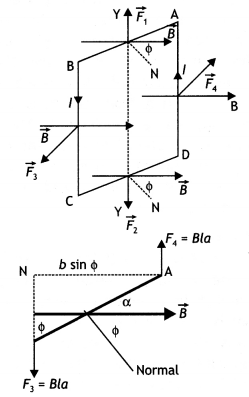
The figure below shows a rectangular loop of wire with length ‘a’ and breadth ‘b’. A line perpendicular to the plane of the loop (i.e. a normal to the plane) makes an angle Φ with the direction of the magnetic field B, and the loop carries a current / as shown. Let the forces acting on the various sides of the loop be \(\vec{F}_{1}\), \(\vec{F}_{2}\), \(\vec{F}_{3}\) and \(\vec{F}_{4}\) as shown.

It follows from the expression for the force experienced by a conductor in a magnetic field that force on arm AB is
\(\vec{F}_{1}=I(\overrightarrow{\mathrm{AB}} \times \vec{B})\) …(1)
(in the plane of the paper and is directed upwards as shown).

The force on arm CD is given by \(\vec{F}_{2}=l(\overrightarrow{\mathrm{CD}} \times \vec{B})\) …(2)
(in the plane of the paper and is directed downwards as shown.)

Since these two forces are equal and opposite and have the same line of action therefore they cancel out each other’s effect and their resultant effect on the coil is zero.

Now the force on arm BC is
\(\vec{F}_{3}=l(\overrightarrow{\mathrm{BC}} \times \vec{B})\) …(3)
(acts perpendicular to the plane of the paper and is directed outwards as shown) Finally the force on arm DA is
\(\vec{F}_{4}=I(\overrightarrow{\mathrm{DA}} \times \vec{B})\) …(4)
(acts perpendicular to the plane of the paper and is directed inwards as shown in figure).

Both forces F<sub>3</sub> and F4 make an angle of 90° with the direction of the magnetic field. Therefore, in magnitude, these forces are given by
F3 = F4 = l a B sin90° = l a B …(5)

The lines of action of both these forces are perpendicular to the plane of the paper. The two forces F3 and F4 lie along different lines and each give rise to a torque about the X-axis. The two torques produce a resultant torque in the + X direction. The arm of the couple (perpendicular distance between the lines of action of the two forces) from the figure below is given by
The arm of couple = b Sin Φ …(6)

Therefore, by the definition of torque we have
Torque = either force × arm of couple Using equations (5) and (6) we have
Torque = l B a × b Sin Φ
But a b = A, area of the coil, therefore τ = l B A Sin Φ
Class 12 Physics Important Questions Chapter 4 Moving Charges and Magnetism 48
(b) A proton and a deuteron having equal momenta enter in a region of the uniform magnetic field at a right angle to the direction of the field. Depict their trajectories in the field. (CBSE Delhi 2013)
Answer:
The radius of the curved path which will be followed by the two particles is given by the expression r = \(\frac{m v}{B q}\)

As md > mp it will follow the path of a bigger radius.
Class 12 Physics Important Questions Chapter 4 Moving Charges and Magnetism 35

Question 27.
State Biot-Savart law, expressing it in the vector form. Use it to obtain the expression for the magnetic field at an axial point, distance ‘d’ from the center of a circular coil of radius ‘a’ carrying current ‘l’. Also, find the ratio of the magnitudes of the magnetic field of this coil at the center and at an axial point for which d = a \(\sqrt{3}\) (CBSE Delhi 2013C)
Answer:
(a) It states that the magnetic field due to a current element dl at a distance r from it is given by the expression

dB = \(\frac{\mu_{0}}{4 \pi} \frac{l d l \sin \theta}{r^{2}}\). In vector form it is written as
\(\overrightarrow{d B}=k_{m} \frac{l mid \overrightarrow{d L} \times \hat{r}}{r^{2}}\)

Consider a circular loop of wire of radius R located in the YZ plane and carrying a steady current / as shown in the figure below. Let us calculate the magnetic field at an axial point P a distance x from the center of the loop. From the figure it is clear that any element dL is perpendicular to r, furthermore, all the elements around the loop are at the same distance r from P, where r2 = X2 + R2. Hence by Biot-Savart’s law, the magnetic field at point P due to the current element dL is given by
Class 12 Physics Important Questions Chapter 4 Moving Charges and Magnetism 44
Class 12 Physics Important Questions Chapter 4 Moving Charges and Magnetism 45
The direction of the magnetic field dB due to the eLement dL is perpendicular to the plane formed by r and dL as shown in the figure above. The vector dB can be resolved into components dB aLong the X-axis and dB which is perpendicular to the X-axis. When the components perpendicular to the X-axis are assumed over the whole loop, the result is zero. That is, by symmetry any element on one side of the loop will set up a perpendicular component that cancels the component setup by an element diametrically opposite it. Therefore, it is obvious that the resultant magnetic field at P will be along the X-axis. This result can be obtained by integrating the components dBx = dB cos θ.
Therefore, we have
Class 12 Physics Important Questions Chapter 4 Moving Charges and Magnetism 46
where the integral is to be taken over the entire loop since θ,x and R are constants for all elements of the loop and since
cos θ = \(\frac{R}{\sqrt{x^{2}+R^{2}}}\)

B = \(\frac{\mu_{0} l R}{4 \pi\left(x^{2}+R^{2}\right)^{3 / 2}} \oint d L=\frac{\mu_{0} l R^{2}}{2\left(x^{2}+R^{2}\right)^{1 / 2}}\)

To find the magnetic field at the centre of the loop setting x = O in equation the above equation we have B = \(\frac{\mu_{0} l}{2 R}\)

Now magnetic field at the centre of a circular coil is
\(B_{C}=\frac{\mu_{0} l}{2 a}\) …(1)

Also magnetic field on the axial line when
d = a\(\sqrt{3}\) is
Class 12 Physics Important Questions Chapter 4 Moving Charges and Magnetism 36
From (1) and (2) we have
\(\frac{B_{C}}{B_{\text {axial }}}=\frac{\mu_{0} l}{2 a} \times \frac{16 a}{\mu_{0} l}\) = 8

Question 28.
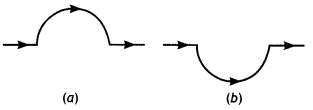
A straight wire carrying a current of 12 A is bent into a semi-circular arc of radius 2.0 cm as shown in figure (a) Consider the magnetic field B at the center of the arc
(a) What is the magnetic field due to the straight segments?
(b) In what way the contribution to B from the semicircle differs from that of a circular loop and in what way does it resemble?
(c) Would your answer be different if the wire were bent into a semi-circular arc of the same radius but in the opposite way as shown in figure (b)? (NCERT)
Class 12 Physics Important Questions Chapter 4 Moving Charges and Magnetism 37
Answer:
(a) dl and r for each element of the straight segments are parallel. Therefore \(d \vec{L} \times \hat{r}\) =0. Straight segments do not contribute to the magnetic field at the center of the semicircular arc.

(b) For all segments of the semicircular arc \(d \vec{L} \times \hat{r}\) are all parallel to, each other (into the plane of the paper). All such contributions add up in magnitude. Hence the direction of B for a semicircular arc is given by the right-hand rule and magnitude is half that of a circular loop. Thus
B = \(\frac{1}{2} \frac{\mu_{0} l}{2 r}=\frac{4 \pi \times 10^{-7} \times 12}{4 \times 2 \times 10^{-2}}\) = 9 × 10⁻⁴ T normal to the plane of the paper going into it.

(c) Same magnitude of B but opposite in direction to that in (b)

Question 29.
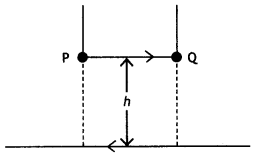
A long straight wire carrying a current of 25 A rests on a table as shown in the figure. Another wire PQ of length 1 m, mass 2.5 g carries the same current but in the opposite direction. The wire PQ is free to slide up and down. To what height will PQ rise? (NCERT Exemplar)
Class 12 Physics Important Questions Chapter 4 Moving Charges and Magnetism 38
Answer:
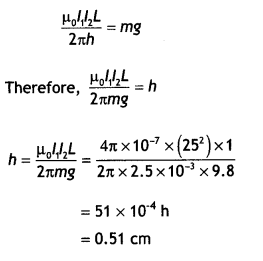
Given l1 = l1 = 25 A, L = 1 m, m = 2.5 g = 2.5 × 10⁻³ kg
The repulsive force between PQ and the wire on the table will balance the weight of wire PQ. Let this happen when PQ is at a height h above the wire, then
F = mg
Class 12 Physics Important Questions Chapter 4 Moving Charges and Magnetism 39
Question 30.
Two straight parallel conductors carry steady currents l1 and l2 separated by a distance d. if currents are flowing in the same direction, show how the magnetic field set-up in one produces an attractive force on the other. Obtain the expression for force. Hence define one ampere. (CBSE Delhi 2016)
Answer:
Consider two long, straight parallel wires separated by a distance ‘a’ and carrying currents l1 and l2 in the same direction as shown. We can easily determine the force on one wire due to the magnetic field set-up by the other wire. Wire 2, which carries a current l2, sets up a magnetic field B2 at the position of wire 1.
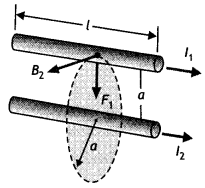
Class 12 Physics Important Questions Chapter 4 Moving Charges and Magnetism 40
The direction of B2 is perpendicular to the wire, as shown in figure. Now the magnetic force on length L of wire 1 is
\(\vec{F}_{1}=l_{1}\left(\vec{L} \times \vec{B}_{2}\right)\)

Since L is perpendicular to B2, the magnitude of F, is given by F1 = l1 L B2 …(1)
But the field due to wire 2 is given by the relation
B2 = \(\frac{\mu_{0} l_{2}}{2 \pi a}\) ….(2)

Therefore, from equations 1 and 2 we have
F1= l1 L B2 = l1 L\(\left(\frac{\mu_{0} l_{2}}{2 \pi a}\right)=\frac{L \mu_{0} l_{1} l_{2}}{2 \pi a}\)

We can rewrite it in terms of force per unit length as
\(\frac{F_{1}}{L}=\frac{\mu_{0} l_{1} l_{2}}{2 \pi a}\) ….(3)

The direction of F1 is downward, towards wire 2, since \(\vec{L} \times \vec{B}\) is downwards. If one considers the field set up at wire 2 due to wire 1, the force F2 is found to be equal and opposite to F1 which is in accordance with Newton’s third law of motion. When the currents are in opposite directions, the forces are reversed and the wires repel each other. Hence we find that the force per unit length of wire between two parallel current-carrying wires is given by
F = \(\frac{\mu_{0} l_{1} l_{2}}{2 \pi a}\)

Therefore, two conductors carrying current in the same direction attract each other whereas two conductors carrying current in the opposite directions repel each other.

The above expression can be used to define ampere, the SI unit of current.
Let l1 = l2 = 1 ampere, a = 1 m then F = 2 × 10⁻⁷ Nm-1

Thus we have
One ampere is that much current which when flowing through each of the two infinitely long straight conductors held 1 meter apart in space, produce a force of F = 2 × 10⁻⁷ N per meter of their length.

Question 31.
(a) In a moving coil galvanometer, why is the magnetic field required to be radial?
Answer:
The radial field is always normal to the surface of the coil in all positions of the coil, i.e. θ = 0. The radial field ensures a linear relation between 0 and l in a moving coil galvanometer.

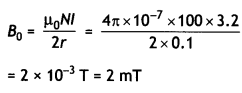
(b) A 100 turn closely wound circular coil of radius 10 cm carries a current of 3.2 A.
Calculate (i) the magnetic field at the centre of the coil, and
(ii) its magnetic moment. (CBSE2019C)
Answer:
Here N = 100, r = 10 cm = 0.1 m,
l = 3.2 A, B = ?, p = ?
(i) At the centre of the coil
Class 12 Physics Important Questions Chapter 4 Moving Charges and Magnetism 41
(ii)Magnetic moment
p = NIA
= 100 × 3.2 × π × (0.1 )2 ≃ 10 Am2

Question 32.
State Ampere’s circuital law. Use this law to find a magnetic field due to a straight infinite current-carrying wire. How are the magnetic field lines different from the electrostatic field lines? (CBSE Al 2016)
Answer:
Statement: “The line integral of B around any closed path equals μ0 l, where l is the total steady current passing through any surface bounded by the closed path.”

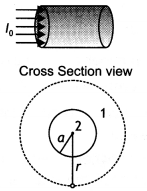
Consider a long circular wire of radius ‘a’ carrying a steady current (dc) that is uniformly distributed along the cross-section of the wire as shown in the figure. Let us calculate the magnetic field in the regions r ≥ a and r < a. In region 1 let us choose a circular path of radius r centered at the wire. From symmetry, we find that B is perpendicular to dL at every point on the circular path.
Class 12 Physics Important Questions Chapter 4 Moving Charges and Magnetism 42
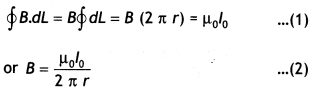
Since total current linked with the circular path is l0, therefore by Ampere’s law we have
Class 12 Physics Important Questions Chapter 4 Moving Charges and Magnetism 43

for r ≥ a
Magnetic field lines form closed loops while electrostatics field lines do not.

Question 33.
(a) State Biot-Savart law in vector form.
Answer:
It states that for a small current element the small magnetic field is given by the expression Biot-Savart’s law for a small current element \(\overrightarrow{d B}=\frac{\mu_{0}}{4 \pi} \frac{I \overline{(d L} \times \hat{r})}{r^{2}}\).

(b) Deduce the expression for the magnetic field at a point on the axis of a current-carrying circular loop of radius ‘R’, distant V from the center, hence write the magnetic field at the center of a loop. (CBSE AI 2015, Delhi 2018C)
Answer:
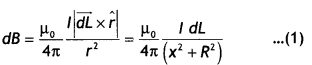
Consider a circular loop of wire of radius R located in the YZ plane and carrying a steady current / as shown in the figure below. Let us calculate the magnetic field at an axial point P a distance x from the center of the loop. From the figure it is clear that any element dL is perpendicular to r, furthermore, all the elements around the loop are at the same distance r from P, where r2 = X2 + R2. Hence by Biot-Savart’s law, the magnetic field at point P due to the current element dL is given by
Class 12 Physics Important Questions Chapter 4 Moving Charges and Magnetism 44
Class 12 Physics Important Questions Chapter 4 Moving Charges and Magnetism 45
The direction of the magnetic field dB due to the element dL is perpendicular to the plane formed by r and dL as shown in the figure above. The vector dB can be resolved into components dB along the X-axis and dB which is perpendicular to the X-axis. When the components perpendicular to the X-axis are assumed over the whole loop, the result is zero. That is, by symmetry any element on one side of the loop will set up a perpendicular component that cancels the component setup by an element diametrically opposite it. Therefore, it is obvious that the resultant magnetic field at P will be along the X-axis. This result can be obtained by integrating the components dBx = dB cos θ.
Therefore, we have

Class 12 Physics Important Questions Chapter 4 Moving Charges and Magnetism 46
where the integral is to be taken over the entire loop since θ,x and R are constants for all elements of the loop and since
cos θ = \(\frac{R}{\sqrt{x^{2}+R^{2}}}\)

B = \(\frac{\mu_{0} l R}{4 \pi\left(x^{2}+R^{2}\right)^{3 / 2}} \oint d L=\frac{\mu_{0} l R^{2}}{2\left(x^{2}+R^{2}\right)^{1 / 2}}\)

To find the magnetic field at the centre of the loop setting x = O in equation the above equation we have B = \(\frac{\mu_{0} l}{2 R}\)

Question 34.
Derive an expression for the maximum force experienced by a straight conductor of length 1, carrying current I and kept in a uniform magnetic field, B.
Answer:
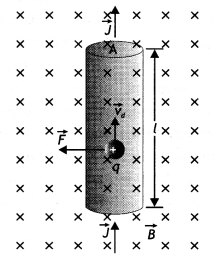
Consider a straight segment of a conducting wire; with length L and cross-section at area A, the current is from bottom to top as shown In the figure below. The wire is in a uniform magnetic field B perpendicular to the plane of the diagram and directed into the plane. Let us assume that the moving charges are positive.

The drift velocity is upward, perpendicular to B. The average force experienced by each charge is
\(\vec{f}=q\left(\vec{v}_{d} \times \vec{B}\right)\) …..(1)

Directed to the left as shown in the figure
Class 12 Physics Important Questions Chapter 4 Moving Charges and Magnetism 47
Since \(\vec{V}_{d}\) and \(\vec{B}\) are perpendicular, the magnitude of the force is given by
f = q vd B …(2)

Let n be the number density of charges, i.e. number of charges per unit volume. A segment of the conductor with length L has volume V = A L and contains a number of charges N given by
N = n A L …(3)

Now the total force F on all the charges moving in this segment is
F = N f = (n A L) q vd B = (n q vd A) (L B)

But n q vd A = l, therefore the above equation becomes
F = B l L …(4)

Question 35.
Derive an expression for the torque on a rectangular coil of area A, carrying a current l and placed in a magnetic field B, the angle between the direction of 8 and the vector perpendicular to the plane of the coil is θ. (CBSE Delhi 2019)
Answer:
The figure below shows a rectangular loop of wire with length ‘a’ and breadth ‘b’. A line perpendicular to the plane of the loop (i.e. a normal to the plane) makes an angle Φ with the direction of the magnetic field B, and the loop carries a current / as shown. Let the forces acting on the various sides of the loop be \(\vec{F}_{1}\), \(\vec{F}_{2}\), \(\vec{F}_{3}\) and \(\vec{F}_{4}\) as shown.

It follows from the expression for the force experienced by a conductor in a magnetic field that force on arm AB is
\(\vec{F}_{1}=I(\overrightarrow{\mathrm{AB}} \times \vec{B})\) …(1)
(in the plane of the paper and is directed upwards as shown).

The force on arm CD is given by \(\vec{F}_{2}=l(\overrightarrow{\mathrm{CD}} \times \vec{B})\) …(2)
(in the plane of the paper and is directed downwards as shown.)

Since these two forces are equal and opposite and have the same line of action therefore they cancel out each other’s effect and their resultant effect on the coil is zero.

Now the force on arm BC is
\(\vec{F}_{3}=l(\overrightarrow{\mathrm{BC}} \times \vec{B})\) …(3)
(acts perpendicular to the plane of the paper and is directed outwards as shown) Finally the force on arm DA is
\(\vec{F}_{4}=I(\overrightarrow{\mathrm{DA}} \times \vec{B})\) …(4)
(acts perpendicular to the plane of the paper and is directed inwards as shown in figure).

Both forces F3 and F4 make an angle of 90° with the direction of the magnetic field. Therefore, in magnitude, these forces are given by
F3 = F4 = l a B sin90° = l a B …(5)

The lines of action of both these forces are perpendicular to the plane of the paper. The two forces F3 and F4 lie along different lines and each give rise to a torque about the X-axis. The two torques produce a resultant torque in the + X direction. The arm of the couple (perpendicular distance between the lines of action of the two forces) from the figure below is given by
The arm of couple = b Sin Φ …(6)

Therefore, by the definition of torque we have
Torque = either force × arm of couple Using equations (5) and (6) we have
Torque = l B a × b Sin Φ
But a b = A, area of the coil, therefore τ = l B A Sin Φ
Class 12 Physics Important Questions Chapter 4 Moving Charges and Magnetism 48
Question 36.
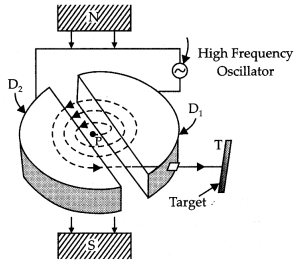
Draw a schematic sketch of a cyclotron. State its working principle and write its two uses. (CBSE 2019C)
Answer:
Cyclotron
Class 12 Physics Important Questions Chapter 4 Moving Charges and Magnetism 49
Working Principle: It is based on the principle that a positively charged particle can acquire very large energy with the small alternating potential difference if the particle is made to cross again and again the electric field produced by alternating potential difference applied and a strong perpendicular magnetic field is applied.

Uses:
(a) It is used to accelerate positively charged particles to very high energies.
(b) Cyclotrons are a source of high-energy beams for nuclear physics experiments.

Question 37.
(a) Draw a schematic sketch of a moving coil galvanometer and describe briefly its working.
Answer:
Principle: It is based on the principle that the positive ions can be accelerated to high energies with a comparatively smaller alternating potential difference by making them cross the electric field again and again, by making use of a strong magnetic field.
Class 12 Physics Important Questions Chapter 4 Moving Charges and Magnetism 51
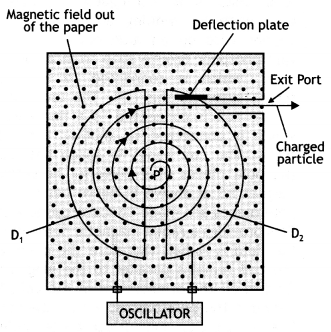
Construction: It consists of two D-shaped, hollow metal dees D1 and D2. The dees are placed with a small gap in between them. The dees are connected to a source of high frequency alternating potential difference. The dees are evacuated in order to minimize energy losses resulting from collisions between the ions and air molecules. The whole apparatus is placed between the poles of an electromagnet as shown in the figure below. The magnetic field is perpendicular to the plane of the dees.

Working: In a cyclotron, particles of mass m and charge q move inside an evacuated chamber in a uniform magnetic field B that is perpendicular to the plane of their paths. The alternating potential difference applied between the hollow electrodes D1 and D2 create an electric field in the gap between them which changes precisely twice in each revolution so that the particles get a push each time they cross the gap.

The pushes increase their speed and kinetic energy, boosting them into paths of larger radius. The electric field increases the speed and the magnetic field makes the particles move in circular paths. Due to the presence of the perpendicular magnetic field the particle moves in a circle of radius r given by
r = \(\frac{m v}{q B}\) …(1)

The path of the particles in the dees is a semicircle and the time the particle spends in each dee is semi-circular
τ = \(\frac{\text { length of the semi-circular path }}{\text { velocity }}=\frac{\pi r}{v}=\frac{\pi m}{B q}\) by using equation (1)

The above time is independent of the radius of the path and the velocity of the charged particle. Hence the charged particle spends the same time in each dee and encounters a dee of opposite polarity whenever it comes into the gap between the dees and thus is continuously accelerated.

(b) “Increasing the current sensitivity of a galvanometer does not necessarily increase the voltage sensitivity.” Justify’ this statement. (CBSE Delhi 2014C)
Answer:
Voltage and current sensitivities are related as VS = \(\frac{CS}{R}\) .

An increase in current sensitivity may lead to an increase in the resistance of the coil. Thus the factor CS/R may not be affected.

Question 38.
Explain with the help of a labeled diagram the underlying principle, construction, and working of a moving coil galvanometer.
Answer:
It is an instrument used to detect weak currents in a circuit.

Principle: It is based on the principle that, whenever a loop carrying current is placed in a magnetic field, it experiences a torque, which tends to rotate it.

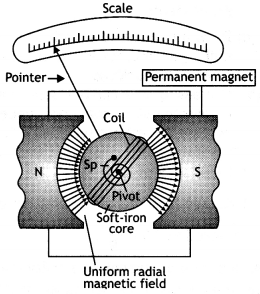
Construction: It consists of a rectangular or circular coil made by winding a fine insulated copper wire on an aluminum frame. A thin phosphor bronze strip from a torsion head, which is connected to a terminal screw, suspends this coil. The lower end of the coil is connected to a fine spring which is connected to another terminal screw. The coil hangs in space between the pole pieces of a powerful horseshoe magnet NS as shown in the figure below. The pole pieces are made concave cylindrical.

This provides a radial magnetic field. Since the field is radial, therefore the plane of the coil remains parallel to the magnetic field in all the orientations of the coil. In between the pole pieces, within the coil, lies a soft iron cylindrical piece called ‘core’. The core does not touch the coil anywhere. The whole arrangement is enclosed in a non-magnetic box to protect it from air currents. Three leveling screws are provided at the base.
Class 12 Physics Important Questions Chapter 4 Moving Charges and Magnetism 50
Question 39.
Explain with the help of a labeled diagram the underlying principle, construction, and working of a cyclotron. (CBSE Delhi 2019)
Answer:
Principle: It is based on the principle that the positive ions can be accelerated to high energies with a comparatively smaller alternating potential difference by making them cross the electric field again and again, by making use of a strong magnetic field.
Class 12 Physics Important Questions Chapter 4 Moving Charges and Magnetism 51
Construction: It consists of two D-shaped, hollow metal dees D1 and D2. The dees are placed with a small gap in between them. The dees are connected to a source of high frequency alternating potential difference. The dees are evacuated in order to minimize energy losses resulting from collisions between the ions and air molecules. The whole apparatus is placed between the poles of an electromagnet as shown in the figure below. The magnetic field is perpendicular to the plane of the dees.

Working: In a cyclotron, particles of mass m and charge q move inside an evacuated chamber in a uniform magnetic field B that is perpendicular to the plane of their paths. The alternating potential difference applied between the hollow electrodes D1 and D2 create an electric field in the gap between them which changes precisely twice in each revolution so that the particles get a push each time they cross the gap. The pushes increase their speed and kinetic energy, boosting them into paths of larger radius. The electric field increases the speed and the magnetic field makes the particles move in circular paths. Due to the presence of the perpendicular magnetic field the particle moves in a circle of radius r given by
r = \(\frac{m v}{q B}\) …(1)

The path of the particles in the dees is a semicircle and the time the particle spends in each dee is semi-circular
τ = \(\frac{\text { length of the semi-circular path }}{\text { velocity }}=\frac{\pi r}{v}=\frac{\pi m}{B q}\) by using equation (1)

The above time is independent of the radius of the path and the velocity of the charged particle. Hence the charged particle spends the same time in each dee and encounters a dee of opposite polarity whenever it comes into the gap between the dees and thus is continuously accelerated.

Question 40.
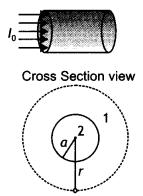
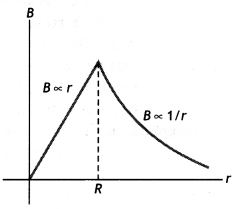
The figure below shows a long straight wire of circular cross-section (radius a) carrying steady current l. The current is uniformly distributed across this cross-section. Calculate the magnetic field in the region r < a and r > a. Draw a graph showing the variation of a magnetic field for the above two cases.
Class 12 Physics Important Questions Chapter 4 Moving Charges and Magnetism 52
Answer:
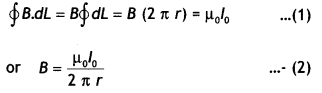
Consider a long circular wire of radius ‘a’ carrying a steady current (dc) that is uniformly distributed along the cross-section of the wire as shown in the figure. Let us calculate the magnetic field in the regions r ≥ a and r < a. In region 1 let us choose a circular path of radius r centered at the wire. From symmetry, we find that B is perpendicular to dL at every point on the circular path. Since total current linked with the circular path 1 is l0, therefore by Ampere’s law we have
Class 12 Physics Important Questions Chapter 4 Moving Charges and Magnetism 53
for r ≥ a

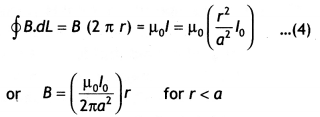
Now consider the interior of the wire, i.e. region 2 where r < a. In this, the current l enclosed by the path is less than l<sub>0</sub>. Since the current is assumed to be uniform over the area of the wire,
Therefore

Class 12 Physics Important Questions Chapter 4 Moving Charges and Magnetism 54

Now applying Ampere’s circuital rule to region 2 we have
Class 12 Physics Important Questions Chapter 4 Moving Charges and Magnetism 55
The magnetic field versus r for this system is as shown in the figure below.
Class 12 Physics Important Questions Chapter 4 Moving Charges and Magnetism 56
Question 41.
Draw the magnetic field lines due to a circular loop of area \(\vec{A}\) carrying current I. Show that it acts as a bar magnet of magnetic moment \(\vec{m}=I \vec{A}\). (CBSE Al 2015)
Answer:
The magnetic field lines are as shown
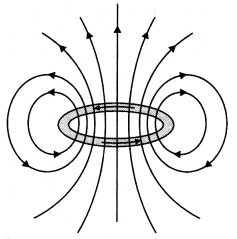
Class 12 Physics Important Questions Chapter 4 Moving Charges and Magnetism 57
Magnetic field due to circular loop on its axis at far off points
B = \(\frac{\mu_{0}}{4 \pi} \frac{2 I A}{X^{3}}\)

Magnetic field due to a bar magnet at its axial point is
B = \(\frac{\mu_{0}}{4 \pi} \frac{2 m}{x^{3}}\)

Comparing the above two we have m = IA

Question 42.
(a) State Ampere’s circuital law. Use this law to obtain the expression for the magnetic field inside an air-cored toroid of average radius ‘r, having ‘n’ turns per unit length and carrying a steady current.
(b) An observer to the left of a solenoid of N turns each of cross-section area ‘A’ observes that a steady current I in it flows in the clockwise direction. Depict the magnetic field lines due to the solenoid specifying its polarity and show that it acts as a bar magnet of magnetic moment m = NIA. (CBSE Delhi 2015)
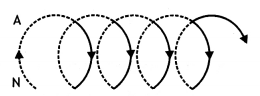
Class 12 Physics Important Questions Chapter 4 Moving Charges and Magnetism 58
Answer:
(a) “The line integral of 8 around any closed path equal μ0l, where l is the total steady current passing through any surface bounded by the closed path.” Consider a toroidal solenoid. Let N be the number of turns and l be the current passed through it. For a solenoid whose coils are closely spaced, the field inside the solenoid is tangent to the dotted circular path as shown in the figure and is the same at all points lying on the dotted line.
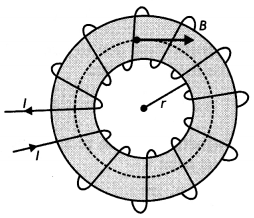
Class 12 Physics Important Questions Chapter 4 Moving Charges and Magnetism 59
Therefore we have
\(\oint \vec{B} \cdot d \vec{L}\) = B ∮dL = B (2 π r) …(1)

By Ampere’s circuital law we have ∮\(\overrightarrow{\mathbf{B}} \cdot d \vec{L}\) = μ0Nl …(2)

From equations 1 and 2 we have
B (2 π r) = μ0NI
or
B = \(\frac{\mu_{0} N I}{2 \pi r}\) but
\(\frac{N}{2 \pi r}\) = n

i. e. number of turns per unit length Therefore we have B = μ0 n I

This gives the field inside a toroidal solenoid.

(b) The magnetic field lines and the polarity of the solenoid is as shown.
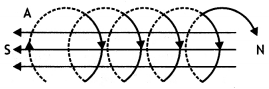
Class 12 Physics Important Questions Chapter 4 Moving Charges and Magnetism 60
Magnetic field due to the coil on its axis at far off points
B = \(\frac{\mu_{0}}{4 \pi} \frac{2 N I A}{x^{3}}\)

Magnetic field due to a bar magnet at its axial point is
B = \(\frac{\mu_{0}}{4 \pi} \frac{2 m}{x^{3}}\)

Comparing the above two we have m = NIA

Question 43.
(a) Use Biot-Savart law to derive the expression for the magnetic field due to a circular coil of radius R having N turns at a point on the axis at a distance ‘x’ from its center.
Draw the magnetic field lines due to this coil.
(b) A current l enters a uniform loop of radius R at point M and flows out at point N as shown in the figure. Obtain the net magnetic field at the center of the loop. (CBSE Delhi 2015C)
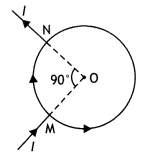
Class 12 Physics Important Questions Chapter 4 Moving Charges and Magnetism 61
Answer:
(a) According to Biot-Savart law:
The magnitude of magnetic field d \(\vec{B}\) , is due to a current element d \(\vec{l}\), is proportional to current l and element length, dl.

inversely proportional to the square of the distance r.

Its direction is perpendicular to the plane containing d \(\vec{l}\) and \(\vec{r}\) .

In vector notation,
\(\overrightarrow{d B}=\frac{\mu_{0}}{4 \pi}, \frac{d \vec{l} \times \vec{r}}{r^{3}}\)

Using Biot-Savart law, obtain the expression for the magnetic field due to a circular coil of radius r, carrying a current I at a point on its axis distant x from the centre of the coil. (CBSE Delhi 2018C)
Answer:
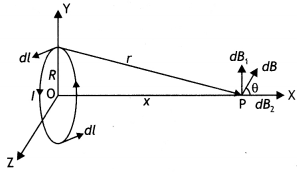
Class 12 Physics Important Questions Chapter 4 Moving Charges and Magnetism 69
we have \(\overrightarrow{d B}=\frac{\mu_{0}}{4 \pi} I \frac{|d \vec{i} \times \vec{r}|}{r^{3}}\)
r² = x² + R²

∴ dB = \(\frac{\mu_{0} I}{4 \pi} \frac{d l}{\left(X^{2}+R^{2}\right)^{3 / 2}}\)
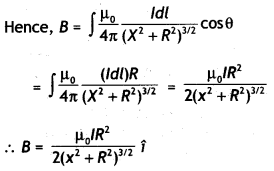
Class 12 Physics Important Questions Chapter 4 Moving Charges and Magnetism 70
The magnetic fieLd Lines are as shown.
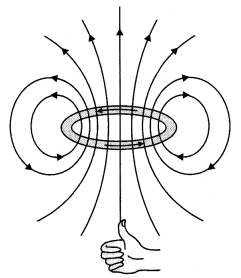
Class 12 Physics Important Questions Chapter 4 Moving Charges and Magnetism 62
(b) At point O, the net magnetic field is the sum of fields due to two current segments carrying currents /1 and l2. If the potential difference between points A and B be V, then
V = I1 R1 = I2R2
where R, is the resistance of segment subtending an angle 90° at O and R2 is the resistance of segment subtending an angle (360° – 90°) at O.
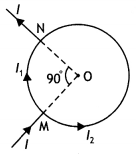
Class 12 Physics Important Questions Chapter 4 Moving Charges and Magnetism 63
Now R1 = \(\frac{\pi / 2}{2 \pi} R=\frac{R}{4}\)
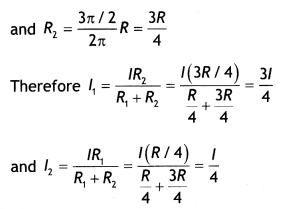
Class 12 Physics Important Questions Chapter 4 Moving Charges and Magnetism 64
Now field B1, at O due to smaller segment is

Class 12 Physics Important Questions Chapter 4 Moving Charges and Magnetism 65
directed inwards.

Now field B2 at 0 due to larger segment is

Class 12 Physics Important Questions Chapter 4 Moving Charges and Magnetism 66
directed outwards

Hence net magnetic field in the center is
B1 – B2 = \(\frac{3 \mu_{0} I}{32 r}-\frac{3 \mu_{0} I}{32 r}\) = 0

(ii) The velocity of the particle inside a cyclotron is given by v = \(\frac{B q r}{m}\) , which again depends upon the q/m ratio. The q/m ratio of an a particle is less than that of a proton, therefore a proton will come out with higher velocity.

Question 44.
(a) Define the SI unit of current in terms of the force between two parallel current-carrying conductors.
(b) Two long straight parallel conductors carrying steady currents la and lb along the same direction are separated by a distance d. How does one explain the force of attraction between them? If a third conductor carrying a current lc in the opposite direction is placed just in the middle of these conductors, find the resultant force acting on the third conductor. (CBSE Delhi 2018C)
Answer:
(a) The ampere is the value of that steady current which, when maintained in each of the two very long, straight, parallel conductors of negligible cross¬section, and placed one meter apart in vacuum, would produce on each of these conductors a force equal to 2 × 10⁻⁷ newton per meter of length.
(b) The wire (ii) experiences a force due to the magnetic field caused by the current flowing in wire (i).
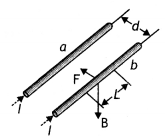
Class 12 Physics Important Questions Chapter 4 Moving Charges and Magnetism 67
The magnetic field at any point on the wire (b) due to the current in the wire (a) is perpendicular to the plane of two wires and pointing inwards and hence force on it will be towards wire (a). Similarly, the force on the wire (a) will be towards wire (b). Hence two wires carrying currents in the same direction attract each other.
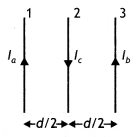
Class 12 Physics Important Questions Chapter 4 Moving Charges and Magnetism 68
Force on wire (3) due to wire (1)
\(\frac{\mu_{0} l_{a} l_{c}}{2 \pi\left(\frac{d}{2}\right)}\) towards right

Force on wire 3 due to wire 2
\(\frac{\mu_{0} l_{b} l_{c}}{2 \pi\left(\frac{d}{2}\right)}\) towards Left

Net force on wire 3
\(\frac{\mu_{0} I_{c}}{\pi d}\left[I_{a}-I_{b}\right]\) towards right nd °

Also accept
\(\frac{\mu_{0} I_{c}}{\pi d}\left[I_{b}-I_{a}\right]\) towards left

Question 45.
(a) State Biot-Savart law and express it in the vector form.
Answer:
(a) According to Biot-Savart law:
The magnitude of magnetic field d \(\vec{B}\) , is due to a current element d \(\vec{l}\), is proportional to current l and element length, dl.

inversely proportional to the square of the distance r.

Its direction is perpendicular to the plane containing d \(\vec{l}\) and \(\vec{r}\) .

In vector notation,
\(\overrightarrow{d B}=\frac{\mu_{0}}{4 \pi}, \frac{d \vec{l} \times \vec{r}}{r^{3}}\)

(b) Using Biot-Savart law, obtain the expression for the magnetic field due to a circular coil of radius r, carrying a current I at a point on its axis distant x from the centre of the coil. (CBSE Delhi 2018C)
Answer:
Class 12 Physics Important Questions Chapter 4 Moving Charges and Magnetism 69
we have \(\overrightarrow{d B}=\frac{\mu_{0}}{4 \pi} I \frac{|d \vec{i} \times \vec{r}|}{r^{3}}\)
r² = x² + R²

∴ dB = \(\frac{\mu_{0} I}{4 \pi} \frac{d l}{\left(X^{2}+R^{2}\right)^{3 / 2}}\)

Class 12 Physics Important Questions Chapter 4 Moving Charges and Magnetism 70
Question 46.
Derive an expression for the velocity y0 of a positive ion passing undeflected through a region where crossed uniform electric field E and magnetic field B are simultaneously present. Draw and justify the trajectory of identical positive ions whose velocity has a magnitude less than \(\left|v_{c}\right|\).
OR
A particle of mass m and charge q is in motion at speed Y parallel to a long straight conductor carrying current I as shown below.
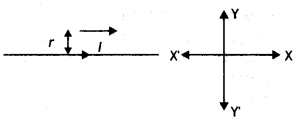
Class 12 Physics Important Questions Chapter 4 Moving Charges and Magnetism 71
Find the magnitude and direction of the electric field required so that the particle goes undefeated. (CBSE Sample Paper 2018-19)
Answer:
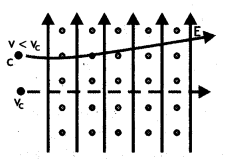
Class 12 Physics Important Questions Chapter 4 Moving Charges and Magnetism 72
If the ion passes undeflected, therefore the magnetic and electric forces acting on the ion must be equal and opposite.
Therefore
qE = Bqvc
vc = \(\frac{E}{B}\)

The trajectory would be as shown. Justification: For positive ions with speed v < vc. Force due to electric field wilt remains the same as It does not depend upon Vc.

But force due to the magnetic field will become Less than the initial value. This unbalances the two, electric and magnetic, forces hence, the ion will experience a net electric force. This will accelerate the ion along the direction of the electric field. Since initiaL velocity is perpendicular to E, the trajectory would be parabolic.
OR
For the charged particle to move undeflected

Electric force = magnetic force
qE = Bq v
or
E=Bv

Now magnetic field at a distance r from the long straight conductor is
B = \(\frac{\mu_{0} I}{2 \pi r}\)

This magnetic force Will act towards the wire.

Hence electric field is

E = \(\frac{\mu_{0} l v}{2 \pi r}\)

This electric field should act away from the wire.
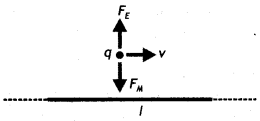
Class 12 Physics Important Questions Chapter 4 Moving Charges and Magnetism 73
Numerical Problems:

Formulae for solving numerical problems

  • Magnetic field due to a small current element dB = \(\frac{\mu_{0}}{4 \pi} \frac{l mid d L \sin \theta}{r^{2}}\)
  • Magnetic field due to an infinitely long straight conductor B = \(\frac{\mu_{0}}{4 \pi} \frac{2l}{a}\)
  • Magnetic field at the centre of a circular coil B = \(\frac{\mu_{0}}{4 \pi} \frac{2 \pi l}{r}\)
  • Force on a charge moving in a magnetic field F = Bq v Sin θ
  • The magnetic field inside a solenoid B = µ0 n I
  • Force on a current-carrying conductor placed in a magnetic field F = BIL Sin θ
  • Force between two current carrying conductors \(\frac{F_{1}}{L}=\frac{\mu_{0} l_{1} l_{2}}{2 \pi a}\)
  • Torque on a current loop τ = BI n A sin θ
  • Current in a galvanometer l = \(\frac{C}{n B A}\) sin θ
  • Shunt required S = \(\frac{l_{8} G}{l-I_{g}}\)
  • Resistance required R = \(\frac{v}{l_{g}}\) – G
  • Radius of a charged particle in a magnetic field r = \(\frac{m v}{B q}=\frac{\sqrt{2 m E}}{B q}\)

Question 1.
A proton and an alpha particle having the same kinetic energy are in turn allowed to pass through a uniform magnetic field perpendicular to their direction of motion. Compare the radii of the paths of the proton and the alpha particle.
Answer:
Given Eα = Ep, mα = 4 mp, qα = 2qp, B is same for both. Now the radius of the path followed is given by the expression
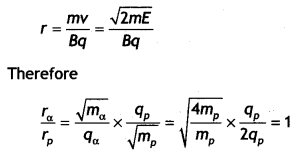
Class 12 Physics Important Questions Chapter 4 Moving Charges and Magnetism 74
Question 2.
A circular coil of 30 turns and radius 8.0 cm carrying a current of 6.0 A is suspended vertically in a uniform horizontal magnetic field of magnitude 1.0 T. The field lines make an angle of 60° with the normal to the coil. Calculate the magnitude of the counter-torque that must be applied to prevent the coil from turning.
Answer:
Given n = 30, r = 8.0 cm = 8 × 10⁻² m,
l = 6.0 A, B = 1.0 T, θ = 60°, τ = ?
Using the formula for torque
τ = BlnA

we have τ = Blnπr² sin θ
τ = 1 × 6 × 30 × 3.14 × (8 × 10-2)2 × sin 60°
= 3.1 N m

Question 3.
How can a moving coil galvanometer be converted into an ammeter? To increase the current sensitivity of a moving coil galvanometer by 50%, its resistance is increased so that the new resistance becomes twice its initial resistance. By what factor does its voltage sensitivity change?
Answer:
Voltage sensitivity
= \(\frac{\alpha}{V}=\frac{\alpha}{I R}=\frac{\text { current sensitivity }}{R}\)

When the current sensitivity increases by 50 % resistance becomes 2R.

New voltage sensitivity
= \(\frac{1+0.5}{2}\) = 0.75

Hence the voltage sensitivity decreases and becomes 75% of its original value.

Question 4.
A long straight conductor PQ carrying a current of 75 A is fixed horizontally. Another long conductor XY is kept parallel to PQ at a distance of 5 mm, in air. Conductor XY is free to move and carries a current l. Calculate the magnitude and direction of current l for which the magnetic repulsion just balances the weight of conductor XY (Mass per unit length for conductor XY is 10-2 kg m-1.)
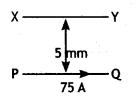
Class 12 Physics Important Questions Chapter 4 Moving Charges and Magnetism 75
Answer:
Given l1 = 75 A, r = 5 mm = 5 × 10⁻³ m, l2 = ? mass per unit length = 10-2kg m-1.

The force between the two wires should be repulsive and should balance the weight of the wire XY. Thus the current in wire XY will be opposite to that in wire PQ.

The force between the two current-carrying conductors is given by
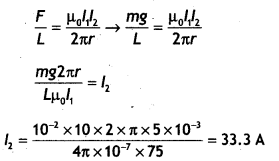
Class 12 Physics Important Questions Chapter 4 Moving Charges and Magnetism 76
Question 5.
A galvanometer has a resistance of 30 Ω. It gives full-scale deflection with a current of 2 mA. Calculate the value of the resistance needed to convert it into an ammeter of range 0-0.3 A.
Answer:
Given G = 30 Ω, lg = 2 mA= 2 × 10⁻³ A, S = ?, I = 0.3 A
Using the formula S = \(\frac{I_{g} G}{I-I_{g}}\)

we have
S = \(\frac{I_{g} G}{I-I_{g}}\) = \(\frac{30 \times 2 \times 10^{-3}}{0.3-2 \times 10^{-3}}\) = 0.20 Ω

Question 6.
An infinitely long straight current-carrying wire produces a magnetic field 8, at a point distant ‘a’ from it. What must be the radius of a circular loop, so that, for the same current through it, the magnetic field at (i) its center equals B/2 and (ii) an axial point, distant equal to the radius of the loop, equals B?
Answer:
The magnetic field at a distance ‘a’ from an infinitely long straight conductor is
B = \(\frac{\mu_{0} I}{2 \pi a}\)

(i) Given Bc = B/2. Let r be the radius of the circular coil for which the magnetic field is B/2.

Magnetic field at the centre of a circular coil is \(B=\frac{\mu_{0} I}{2 \pi a}\) Therefore
\(\frac{\mu_{0} l}{2 r}=\frac{1}{2} \times \frac{\mu_{0} l}{2 \pi a}\) or r = 2 π a

(ii) Magnetic field at the axial line of a loop is
B = \(\frac{\mu_{0} l R^{2}}{2\left(x^{2}+R^{2}\right)^{1 / 2}}\)

Here x = R radius of the loop.
Therefore \(\frac{\mu_{0} I}{2 \pi a}=\frac{\mu_{0} I R^{2}}{2\left(R^{2}+R^{2}\right)^{3 / 2}}\)

solving for R we have R = \(\frac{\pi a}{\sqrt{8}}\)

Question 7.
Calculate the value of resistance needed to convert a galvanometer of resistance 120 ft, which gives a full-scale deflection for a current of 5 mA, into a voltmeter of 0 – 50 V range.
Answer:
Given G = 120 Ω, lg = 5 × 10⁻³A, V= 50 V, R =?

Using the relation R = \(\frac{v}{l_{g}}\) – G we have
R = \(\frac{50}{5 \times 10^{-3}}\) -120 = 9880 Ω

Question 8.
Two infinitely long straight wires A1 and A2 carrying currents l1 and l2 flowing in the same directions are kept distance apart. Where should a third straight wire A3 carrying current 1.5 l be placed between A1 and A2 so that it experiences no net force due to A1 and A2? Does the net force act on A3 depend on the current flowing through it? (CBSE Delhi 2019)
Answer:
The diagram is as shown.
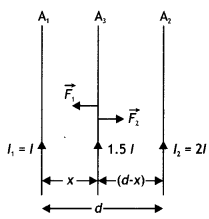
Class 12 Physics Important Questions Chapter 4 Moving Charges and Magnetism 77
Class 12 Physics Important Questions Chapter 4 Moving Charges and Magnetism 78
If no force is experienced by the conductor A3, then
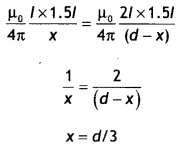
Class 12 Physics Important Questions Chapter 4 Moving Charges and Magnetism 79
The net force on A3 does not depend upon the current flowing through it.

Question 9.
An ammeter of resistance 0.80 Ω can measure current up to 1.0 A.
(a) What must be the value of shunt resistance to enable the ammeter to measure current up to 5.0 A?
Answer:
Given G = 0.80 Ω, /g = 1.0 A, l = 5.0 A, S = ?, R<sub>A</sub> = ?
(a) Using the expression
S = \(\frac{I_{g} G}{I-I_{0}}=\frac{1 \times 0.8}{5-1}=\frac{0.8}{4}\) = 0.2 Ω

(b) What is the combined resistance of the ammeter and the shunt? (CBSE Delhi 2013)
Answer:
Now RA = \(\frac{G S}{G+S}=\frac{0.8 \times 0.2}{0.8+0.2}\) = 0.016 Ω

Question 10.
A wire AB is carrying a steady current of 12 A and is lying on the table. Another wire CD carrying 5A is held directly above AB at a height of 1 mm. Find the mass per unit length of the wire CD so that it remains suspended at its position when left free. Give the direction of the current flowing in CD with respect to that in AB. (Take the value of g = 10 m s-2) (CBSE AI 2013)
Answer:
Given l1 = 12 A, r = 1 mm = 1 × 10⁻³ m, l2 = 5 A, mass per unit length = ?

The force between the two wires should be repulsive and should balance the weight of the wire CD. Thus the current in wire CD will be opposite to that in wire AB.

The force between the two current¬carrying conductors is given by
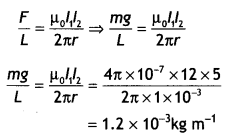
Class 12 Physics Important Questions Chapter 4 Moving Charges and Magnetism 80

Question 11.
A square loop of side 20 cm carrying a current of I A is kept near an infinitely long straight wire carrying a current of 2 A in the same plane as shown in the figure.
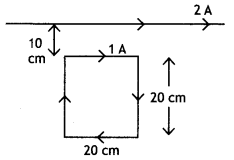
Class 12 Physics Important Questions Chapter 4 Moving Charges and Magnetism 81
Calculate the magnitude and direction of the net force exerted on the loop due to the current carrying conductor. (CBSEAI 2015C)
Answer:
Here, PQ = 20 cm = 20 × 10-2 m,
PS = 20 cm = 10 × 10-2 m

Distance of PQ from AB,
r1 = 10 cm = 10 × 10-2 m

Distance of RS from AB,
r2 = (10 + 20) = 30 cm = 30 × 10-2 m
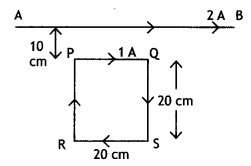
Class 12 Physics Important Questions Chapter 4 Moving Charges and Magnetism 82
Current through long wire AB, l1 = 2 A
Current through rectangular loop, l2 = 1 A

Force on the arm PQ,

F1 = \(\frac{\mu_{0} I_{1} I_{2}}{2 \pi a}\) × length PQ

F2 = \(\frac{2 \times 10^{-7} \times 2 \times 1 \times 20 \times 10^{-2}}{10 \times 10^{-2}}\) = 8 × 10⁻⁷ N
= 8 × 10⁻⁷ N (towards AB)

Force on the arm RS,
F1 = \(\frac{\mu_{0} I_{1} I_{2}}{2 \pi a}\) × length RS

F2 = \(\frac{2 \times 10^{-7} \times 2 \times 1 \times 20 \times 10^{-2}}{30 \times 10^{-2}}\) =2.66 × 10-7

= 2.66 × 10⁻⁷ N (away from AB)

Effective force on the Loop,
F= F1 – F2
=8 × 10⁻⁷ – 2.66 × 10-7
= 5.34 × 10⁻⁷ N (towards AB)

Question 12.
A square-shaped plane coil of area 100 cm2 of 200 turns carries a steady current of 5A. It is placed in a uniform magnetic field of 0.2 T acting perpendicular to the plane of the coil. Calculate the torque on the coil when its plane makes an angle. of 60° with the direction of the field. In which orientation will the coil be in stable equilibrium? (CBSE Al 2015C)
Answer:
Given A= 10-2 m², n = 200, l = 5 A, θ = 60°, B = 0.2 T, τ = ?
Using the expression τ = B I n A sin θ we have
τ = 0.2 × 5 × 200 × 10-2 × sin 60° = 20 Nm
Stable equilibrium, when the magnetic field is in the direction of the coil.

Question 13.
A straight wire of mass 200 g and length 1.5 m carries a current of 2 A. It is suspended in mid-air by a uniform horizontal magnetic field B (figure). What is the magnitude of the magnetic field? (NCERT)
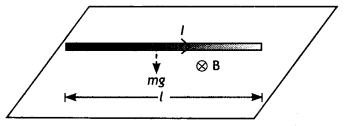
Class 12 Physics Important Questions Chapter 4 Moving Charges and Magnetism 83
Answer:
For the wire to be suspended in mid-air, it must experience an upward force F of magnitude F = B I L to balance its weight W= mg
Therefore, BI L = mg
B = \(\frac{m g}{1 L}=\frac{0.2 \times 9.8}{2 \times 1.5}\) = 0.65 T

Question 14.
A cyclotron’s oscillator frequency is 10 MHz. What should be the operating magnetic field for accelerating proto is? If the radius of its dees is 60 cm what is the kinetic energy (in m MeV) of the proton beam produced by the accelerator (e =1.60 × 10⁻¹⁹ C, mp = 1.67 × 10⁻²⁷ kg, 1 MeV = 1.6 × 10⁻¹³ J) (NCERT)
Answer:
The oscillator frequency should be the same as the proton’s cyclotron frequency, i.e. 10 MHz = 107 Hz.
Therefore
B = \(\frac{2 \pi m v}{q}\)

= \(\frac{2 \times 3.14 \times 1.67 \times 10^{-27} \times 10^{7}}{1.6 \times 10^{-19}}\) = 0.66 T

Final velocity of protons is
V = r × 2πv = 0.6 × 6.3 × 107 = 3.78 × 10⁷ m s-1.

E = 1/2mv² = 1.67 × 10-27 × 14.3 × 1014 / (2 × 1.6 × 10-13) = 7 MeV

Question 15.
A solenoid of length 0.5 m has a radius of 1 cm and is made up of 500 turns. Does it carry a current of 5 A. What is the magnitude of the magnetic field inside the solenoid? (NCERT)
Answer:
Given n = 500/0.5 = 1000 turns per unit length. l = 5 A
The length L = 0.5 m and radius r = 0.01 m. Thus, L/a = 50,
Hence we have
B = μonl = 4π x 10-7 × 1000 × 5 = 6.28 × 10⁻³ T

Question 16.
A circular coil of wire consisting of 100 turns, each of a radius 8.0 cm, carries a current of 0.40 A. What is the magnitude of the magnetic field B at the center of the coil? (NCERT)
Answer:
Given n = 100, r = 8.0 cm = 8.0 × 10⁻² m,
l = 0.40 A,B = ?

Using the expression B = \(\frac{\mu_{0} n l}{2 r}\)
we have
B = \(\frac{\mu_{0} n l}{2 r}=\frac{4 \pi \times 10^{-7} \times 100 \times 0.40}{2 \times 8.0 \times 10^{-2}}\)

Question 17.
A horizontal overhead power line carries a current of 90 Ain the east to west direction. What is the magnitude and direction of the magnetic field due to the current 1.5 m below the line? (NCERT)
Answer:
Given l = 90 A, r = 1.5 m, B = ?
Using the expression B = \(\frac{\mu_{0} l}{2 \pi r}\) we have

B = \(\frac{\mu_{0} l}{2 \pi r}=\frac{4 \pi \times 10^{-7} \times 90}{2 \times \pi \times 1.5}\) = 1.2 × 10⁻⁵ T
The magnetic field will be towards the south.

Question 18.
A square coil of side 10 cm consists of 20 turns and carries a current of 12 A The coil is suspended vertically and the normal to the plane of the coil makes an angle of 30° with the direction of a uniform horizontal magnetic field of magnitude 0.80 T. What is the magnitude of torque experienced by the coil? (NCERT)
Answer:
Given L= 10 cm=0.1 m, A = (0.1)² = 0.01 m², n = 20 , l = 12 A, θ = 30°, B = 0.80T, τ = ?

Using the expression τ = B l n A sin θ we have
τ = 0.80 × 12 × 20 × 0.01 × sin 30° = 0.96 Nm

Question 19.
A straight horizontal conducting rod of length 0.45 m and mass 60 g is suspended by two vertical wires at its ends. A current of 5.0 A is set up in the rod through the wires.
(i) What magnetic field should be set up normally to the conductor in order that the tension in the wires is zero?
(ii) What will be the total tension in the wires if the direction of the current is reversed keeping the magnetic field the same as before? (Ignore the mass of the wires.) g = 9.8 ms-2 (NCERT)
Answer:
Given L = 0.45 m, m = 60 g, I = 5.0 A, B = ?
(i) The tension in the wires will be zero if the weight of the rod is balanced by the force on it due to the magnetic field.
Therefore we have
B I L = mg
B = \(\frac{m g}{I L}=\frac{0.06 \times 9.8}{5.0 \times 0.45}\) = 0.26 T

Thus a horizontal magnetic field of magnitude 0.26 T normal to the conductor should be applied in such a direction that Fleming’s left-hand rule gives a magnetic force in the upward direction.

(ii) The tension will become twice the weight of the wire i.e.,
T = B / L + mg = mg + mg = 2 mg
Or
T= 2 × 0.06 × 9.8 = 1.176 N

Question 20.
A galvanometer coil has a resistance of 12 ohms and the meter shows full-scale deflection for a current of 3 mA. How will you convert the meter into a voltmeter of range 0 to 18 V? (NCERT)(CBSE 2019C)
V= 18 V, R = ?
We will connect a resistance R = \(\left(\frac{V}{l_{g}}-G\right)\) in series with the galvanometer.

Therefore R = \(\frac{18}{3 \times 10^{-3}}\) – 12 = 5988 Ω

Question 21.
A galvanometer coil has a resistance of 15 ohms and the meter shows full-scale deflection for a current of 4 mA. How will you convert the meter into an ammeter of range 0 to 6A? (NCERT)
Answer:
Given G = 15 Ω, lg = 4 mA = 4 × 10⁻³ A, l = 6 A, S = ?

We will connect a resistance S = \(\frac{l_{s} G}{l-l_{s}}\) in parallel with the galvanometer.
Therefore S = \(\frac{4 \times 10^{-3} \times 15}{6-\left(4 \times 10^{-3}\right)}\) = 0.01 Ω
Or
S = 10 mΩ
CBSE Sample Papers for Class 10 Hindi Course A Set 2 with Solutions

Students can access the CBSE Sample Papers for Class 10 Hindi with Solutions and marking scheme Course A Set 2 will help students in understanding the difficulty level of the exam.

CBSE Sample Papers for Class 10 Hindi Course A Set 2 with Solutions

निर्धारित समय : 3 घंटे
अधिकतम अंक : 80

सामान्य निर्देश:
(क) इस प्रश्न-पत्र के दो खंड हैं- ‘अ’ और ‘ब’।
(ख) खंड ‘अ’ में कुल 10 वस्तुपरक प्रश्न पूछे गए हैं। सभी प्रश्नों में उपप्रश्न दिए गए हैं। दिए गए निर्देशों का पालन करते हुए प्रश्नों के उत्तर दीजिए।
(ग) खंड ‘ब’ में कुल 7 वर्णनात्मक प्रश्न पूछे गए हैं। प्रश्नों में आंतरिक विकल्प दिए गए हैं। दिए गए निर्देशों का पालन करते हुए प्रश्नों के उत्तर दीजिए।

खंड ‘अ’- वस्तुपरक प्रश्न ( अंक 40)

अपठित गद्यांश (अंक 5)

प्रश्न 1.
गद्यांश को ध्यानपूर्वक पढ़िए और उस पर आधारित प्रश्नों के उत्तर सही विकल्प चुनकर दीजिए। (1 × 5 = 5)
उत्तर-
उन्नीसवीं शताब्दी से पहले, मानव और पशु दोनों की आबादी भोजन की उपलब्धता तथा प्राकृतिक विपदाओं आदि के कारण सीमित रहती थी। कालांतर में जब औद्योगिक क्रांति के कारण मानव सभ्यता की समृद्धि में भारी वृद्धि हुई तब उसके परिणामस्वरूप कई पश्चिमी देश ऐसी बाधाओं से लगभग अनिवार्य रूप से मुक्त हो गए। इससे वैज्ञानिकों ने अंदाजा लगाया कि अब मानव जनसंख्या विस्फोटक रूप से बढ़ सकती है।

परंतु इन देशों में परिवारों का औसत आकार घटने लगा था और जल्दी ही समृद्धि और प्रजनन के बीच एक उलटा संबंध प्रकाश में आ गया था। जीवविज्ञानियों ने मानव समाज की तुलना जानवरों की दुनिया से कर इस संबंध को समझाने की कोशिश की और कहा कि ऐसे जानवर जिनके अधिक बच्चे होते हैं, वे अधिकतर प्रतिकूल वातावरण में रहते हैं और ये वातावरण प्रायः उनके लिए प्राकृतिक खतरों से भरे रहते हैं।

चूँकि इनकी संतानों के जीवित रहने की संभावना कम होती है, इसलिए कई संतानें पैदा करने से यह संभावना बढ़ जाती है कि उनमें से कम से कम एक या दो जीवित रहेंगी। इसके विपरीत, जिन जानवरों के बच्चे कम होते हैं, वे स्थिर और अनुकूल वातावरण में रहते हैं। ठीक इसी प्रकार यदि समृद्ध वातावरण में रहने वाले लोग केवल कुछ ही बच्चे पैदा करते हैं, तो उनके ये कम बच्चे उन बच्चों को पछाड़ देंगे, जिनके परिवार इतने समृद्ध नहीं थे तथा इनकी आपस की प्रतिस्पर्धा भी कम होगी। इस सिद्धांत के आलोचकों का तर्क है कि पशु और मानव व्यवहार की तुलना नहीं की जा सकती है।

वे इसके बजाए यह तर्क देते हैं कि सामाजिक दृष्टिकोण में परिवर्तन इस घटना को समझाने के लिए पर्याप्त हैं। श्रम-आश्रित परिवारों में बच्चों की बड़ी संख्या एक वरदान के समान होती है। वे जल्दी काम कर परिवार की आय बढ़ाते हैं। जैसे-जैसे समाज समृद्ध होता जाता है, वैसे-वैसे बच्चे जीवन के लगभग पहले 25-30 सालों तक शिक्षा ग्रहण करते हैं। जीवन के प्रारंभिक वर्षों में उर्वरता अधिक होती है तथा देर से विवाह के कारण संतानों की संख्या कम हो जाने की संभावना बनी रहती है।

(i) निम्नलिखित में से कौन-सा ऊपर लिखित पाठ्यांश का प्राथमिक उद्देश्य है?
(क) मानव परिवारों के आकार के संबंध में दिए उस स्पष्टीकरण की आलोचना जो पूरी तरह से जानवरों की दुनिया से ली गई टिप्पणियों पर आधारित है।
(ख) औद्योगिक क्रांति के बाद अपेक्षित जनसंख्या विस्फोट न होने के कारणों की विवेचना।
(ग) औद्योगिक क्रांति से पहले और बाद में पर्यावरणीय प्रतिबंधों और सामाजिक दृष्टिकोणों से परिवार का आकार कैसे प्रभावित हुआ, का अंतर्संबंध दर्शाना।
(घ) परिवार का आकार बढ़ी हुई समृद्धि के साथ घटता है। इस तथ्य को समझने के लिए दो वैकल्पिक सिद्धांत प्रस्तुत करना।
उत्तर-
(घ) परिवार का आकार बढ़ी हुई समृद्धि के साथ घटता है। इस तथ्य को समझने के लिए दो वैकल्पिक सिद्धांत प्रस्तुत करना।

(ii) पाठ्यांश के अनुसार निम्नलिखित में से कौन-सा जनसंख्या विस्फोट के विषय में सत्य है?
(क) पश्चिमी देशों में इसलिए नहीं हुआ, क्योंकि औद्योगीकरण से प्राप्त समृद्धि ने परिवारों को बच्चों की शिक्षा की विस्तारित अवधि को वहन करने का सामर्थ्य प्रदान किया था।
(ख) यह घटना विश्व के उन क्षेत्रों तक सीमित है, जहाँ औद्योगिक क्रांति नहीं हुई है।
(ग) श्रम आधारित अर्थव्यवस्था में केवल उद्योग के आधार पर ही परिवार का आकार निर्भर रहता है।
(घ) इसकी भविष्यवाणी पश्चिमी देशों में औद्योगिक क्रांति के समय जीवित कुछ लोगों द्वारा की गई थी।
उत्तर-
(घ) इसकी भविष्यवाणी पश्चिमी देशों में औद्योगिक क्रांति के समय जीवित कुछ लोगों द्वारा की गई थी।

(iii) अंतिम अनुच्छेद निम्नलिखित में से कौन-सा कार्य करता है?
(क) यह पहले अनुच्छेद में वर्णित घटना के लिए एक वैकल्पिक स्पष्टीकरण प्रस्तुत करता है।
(ख) यह दूसरे अनुच्छेद में प्रस्तुत स्पष्टीकरण की आलोचना करता है।
(ग) यह वर्णन करता है कि समाज के समृद्ध होने के साथ सामाजिक दृष्टिकोण कैसे बदलते हैं।
(घ) यह दूसरे अनुच्छेद में प्रस्तुत घटना की व्याख्या करता है।
उत्तर-
(क) यह पहले अनुच्छेद में वर्णित घटना के लिए एक वैकल्पिक स्पष्टीकरण प्रस्तुत करता है।

(iv) पाठ्यांश में निम्नलिखित में से किसका उल्लेख औद्योगिक देशों में औसत परिवार का आकार हाल ही में गिरने के एक संभावित कारण के रूप में नहीं किया गया है।
(क) शिक्षा की विस्तारित अवधि।
(ख) पहले की अपेक्षा देरी से विवाह करना।
(ग) बदला हुआ सामाजिक दृष्टिकोण।
(घ) औद्योगिक अर्थव्यवस्थाओं में मजदूरों की बढ़ती माँग।
उत्तर-
(घ) औद्योगिक अर्थव्यवस्थाओं में मजदूरों की बढ़ती माँग।

(v) पाठ्यांश में दी गई कौन-सी जानकारी बताती है कि निम्नलिखित में से किस जानवर के कई बच्चे होने की संभावना है?
(क) एक विशाल शाकाहारी जो घास के मैदानों में रहता है और अपनी संतानों की भरसक सुरक्षा करता है।
(ख) एक सर्वभक्षी, जिसकी आबादी कई छोटे द्वीपों तक सीमित है और जिसे मानव अतिक्रमण से खतरा है।
(ग) एक मांसाहारी जिसका कोई प्राकृतिक शिकारी नहीं है, लेकिन उसे भोजन की आपूर्ति बनाए रखने के लिए लंबी दूरी तय करनी पड़ती है।
(घ) एक ऐसा जीव जो मैदानों और झीलों में कई प्राणियों का शिकार बनता है।
उत्तर-
(घ) एक ऐसा जीव जो मैदानों और झीलों में कई प्राणियों का शिकार बनता है।

अथवा

विज्ञान-शिक्षण के पक्षधरों ने कल्पना की थी कि शिक्षा में इसकी शुरुआत पारंपरिकता, कृत्रिमता और पिछड़ेपन को दूर करेगी। यह सोच पुराने समय से चली आ रही- ‘तथ्य प्रचुर पाठ्यचर्या’, जिसके अंतर्गत-आलोचना, चुनौती, सृजनात्मकता व विवेचनात्मकता का अभाव था, आदि के कारण पैदा हो रही थी। मानवतावादियों ने सोचा था कि वैज्ञानिक पद्धति मध्यकालीन मतवाद के अंधविश्वासों को जड़ से मिटा देगी।

किंतु हमारे शिक्षकों ने रासायनिक प्रतिक्रियाओं की समझ को भी प्रेमचंद की कहानियों की तरह केवल पढ़ा व रटाकर उन्हें नीरस बना दिया। शिक्षा में विज्ञान-शिक्षण सम्मिलित करने के लिए यह तर्क दिया गया था कि इससे बच्चे विज्ञान की खोजों से परिचित हो सकेंगे तथा अपने वास्तविक जीवन में घट रही घटनाओं के बारे में कुछ सीखेंगे। वे वैज्ञानिक विधि का अध्ययन कर तार्किक रूप से कैसे सोचना है, के कौशल में पारंगत होंगे।

इन उद्देश्यों में से केवल पहले ही में एक सीमित सफलता मिली है। दूसरे व तीसरे में व्यावहारिक रूप से बच्चे कुछ भी नहीं प्राप्त कर पा रहे हैं। अधिकतर बच्चों से भौतिकी और रसायन विज्ञान के तथ्यों के बारे में कुछ जानने की उम्मीद की जा सकती है, लेकिन वे शायद ही जानते हों कि उनका कंप्यूटर अथवा कार का इंजन कैसे कार्य करता है अथवा क्यों उनकी माता जी सब्जी पकाने के लिए उसे छोटे टुकड़ों में काटती हैं।

जबकि वैज्ञानिक पद्धति में रुचि रखने वाले किसी भी उज्ज्वल लड़के को ये बातें सहज रूप से ही ज्ञात हो जाती हैं। वैज्ञानिक पद्धति की शिक्षा अधिकांश विद्यालयों में भली प्रकार से नहीं दी जा रही है। दरअसल, शिक्षकों ने अपनी सुविधा और परीक्षा-केंद्रित सोच के कारण, यह सुनिश्चित कर लिया है कि छात्र वैज्ञानिक पद्धति न सीखकर ठीक इसका उल्टा सीखें, अर्थात वे जो बताएँ, उस पर आँख मूंदकर विश्वास करें और पूछे जाने पर उसे जस का तस परीक्षा में लिख दें।

वैज्ञानिक पद्धति को आत्मसात करने के लिए लंबे व्यक्तिगत अनुभव तथा परिश्रम व धैर्य पर आधारित वैज्ञानिक मूल्यों की आवश्यकता होती है, और जब तक इसे संभव बनाने के लिए शैक्षिक या सामाजिक

प्रणलियों को बदल नहीं दिया जाता है, वैज्ञानिक तकनीक में सक्षम केवल कुछ बच्चे ही सामने आएँगे तथा इन तकनीकों को आगे विकसित करने वालों की संख्या इसका भी अंश मात्र ही होगी।

(i) लेखक का तात्पर्य है कि शिक्षकों ने?
(क) अपने सीमित ज्ञान के कारण विज्ञान पढ़ाने में रुचि नहीं ली है।
(ख) विज्ञान शिक्षा को लागू करने के प्रयासों को विफल किया है।
(ग) बच्चों को अनुभव आधारित ज्ञान प्राप्त करने के लिए प्रेरित किया है।
(घ) मानतावादियों का समर्थन करते हुए कार्य किया है।
उत्तर-
(ख) विज्ञान शिक्षा को लागू करने के प्रयासों को विफल किया है।

(ii) स्कूल शिक्षा में विज्ञान शिक्षण के प्रति लेखक का क्या रवैया है?
(क) तटस्थ
(ख) सकारात्मक
(ग) व्यंग्यात्मक
(घ) नकारात्मक
उत्तर-
(घ) नकारात्मक

(iii) उपर्युक्त पाठ्यांश निम्नलिखित में से किस दशक में लिखा गया होगा?
(क) 1950-60
(ख) 1970-80
(ग) 1980-90
(घ) 2000-10
उत्तर-
(क) 1950-60

(iv) लेखक वैज्ञानिक पद्धति को लागू करने में विफलता के लिए निम्नलिखित किस कारक को सबसे अधिक ज़िम्मेदार ठहराता है?
(क) शिक्षक
(ख) परीक्षा के तरीके
(ग) प्रत्यक्ष अनुभव की कमी
(घ) सामाजिक और शिक्षा प्रणाली
उत्तर-
(ग) प्रत्यक्ष अनुभव की कमी

(v) यदि लेखक वर्तमान समय में आकर विज्ञान शिक्षण का प्रभाव सुनिश्चित करना चाहे तो निम्नलिखित में से किस प्रश्न के उत्तर में दिलचस्पी लेगा?
(क) क्या छात्र दुनिया के बारे में अधिक जानते हैं?
(ख) क्या छात्र प्रयोगशालाओं में अधिक समय बिताते हैं?
(ग) क्या छात्र अपने ज्ञान को तार्किक रूप से लागू कर सकते हैं?
(घ) क्या पाठ्यपुस्तकों में तथ्याधारित सामग्री बढ़ी है?
उत्तर-
(ग) क्या छात्र अपने ज्ञान को तार्किक रूप से लागू कर सकते हैं?

अपठित पद्यांश (अंक 5)

प्रश्न  2.
पद्यांश को ध्यानपूर्वक पढ़िए और उस पर आधारित प्रश्नों के उत्तर सही विकल्प चुनकर दीजिए। (1 × 5 = 5)
CBSE Sample Papers for Class 10 Hindi Course A Set 2 with Solutions 2

(i) काव्यांश आपके अनुसार किस विषय पर लिखा गया है?
(क) गाँव के बच्चों में कुपोषण की समस्या।
(ख) गाँव के बच्चों में चेतना ज्ञान का अभाव।
(ग) गाँवों में चिकित्सा सुविधाओं का अभाव।
(घ) गाँव के बच्चों की दयनीय दशा का वर्णन।
उत्तर-
(घ) गाँव के बच्चों की दयनीय दशा का वर्णन।

(ii) दूसरे पद में कवि कह रहा है कि?
(क) गाँव में विज्ञान की शिक्षा नहीं दी जा रही है।
(ख) गाँव में शिशु जन्म हेतु पर्याप्त दाइयाँ नहीं हैं।
(ग) गाँव में बच्चे स्वास्थ्य के प्रति सजग रहकर शारीरिक व्यायाम कर रहे हैं। ङ्के
(घ) गाँव में बच्चे अपने मित्रों के साथ धूल में कुश्ती जैसे खेल खेल रहे हैं।
उत्तर-
(ख) गाँव में शिशु जन्म हेतु पर्याप्त दाइयाँ नहीं हैं।

(iii) गाँव के बच्चों की स्थिति कैसी है?
(क) कुपोषित, खिन्न तथा अशिक्षित है।
(ख) क्षीणकाय, किंतु कुल के मान का ध्यान करने वाले हैं।
(ग) प्राकृतिक वातावरण में रहते हुए स्फूर्ति से भरे हुए हैं।
(घ) पशुओं की तरह बलिष्ठ परंतु असहाय व मूक हैं।
उत्तर-
(क) कुपोषित, खिन्न तथा अशिक्षित है।

(iv) काव्यांश में कवि का रवैया कैसा प्रतीत होता है?
(क) वे बच्चों की दशा के विषय में व्यंग्य कर मनोरंजन करना चाह रहे हैं।
(ख) वे बच्चों की दशा की ओर लोगों का ध्यान आकर्षित करना चाहते हैं।
(ग) वे तटस्थ रहकर बच्चों की शारीरिक व मानसिक दशा का वर्णन कर रहे हैं।
(घ) वे बच्चों की शारीरिक व मानसिक दशा से संतुष्ट प्रतीत होते हैं।
उत्तर-
(ख) वे बच्चों की दशा की ओर लोगों का ध्यान आकर्षित करना चाहते हैं।

(v) तृण-तरुओं से उग-बढ़ ……….., इस पंक्ति का अर्थ है?
(क) घास-फूस की तरह हल्के हैं, इसलिए तिनकों की तरह उड़ रहे हैं।
(ख) पौधों तथा घास की तरह बिना कुछ खाए-पिए बढ़ रहे हैं।
(ग) घास तथा पौधों की तरह पैदा हो रहे हैं तथा मर रहे हैं।
(घ) प्राकृतिक वातावरण में घास व पौधों की तरह फल-फूल रहे हैं।
उत्तर-
(ग) घास तथा पौधों की तरह पैदा हो रहे हैं तथा मर रहे हैं।

अथवा

CBSE Sample Papers for Class 10 Hindi Course A Set 2 with Solutions 1

(i) दिए काव्यांश का क्या उदेदश्य प्रतीत होता है?
(क) आत्मविश्वास जगाने हेतु दृष्टांत प्रस्तुति।
(ख) हर हाल में कार्य करने की प्रेरणा
(ग) जागृति व उत्साहित करने हेतु प्रेरणा।
(घ) जीवन-दर्शन के विषय में प्रोत्साहन।
उत्तर-
(ख) हर हाल में कार्य करने की प्रेरणा

(ii) तू मोती के द्वीप स्वप्न में रहा खोजता-पंक्ति का क्या भाव है?
(क) मोतियों के समान आँसुओं को स्वप्न में आने वाले सुंदर द्वीपों पर नष्ट नहीं करना चाहिए।
(ख) मोती के द्वीप खोजने के लिए सागर में दूर-दूर जाकर कष्टदायी विचरण करना होगा।
(ग) जीवन संसाधनों के लिए यथार्थ में रहकर प्रयत्न करना होगा।
(घ) यदि ऐसा होगा तो जीवन शिला-सा जम जाएगा।
उत्तर-
(ग) जीवन संसाधनों के लिए यथार्थ में रहकर प्रयत्न करना होगा।

(iii) तुझसे हो यदि अग्नि स्नात-पंक्ति का क्या अर्थ है?
(क) यदि तुम जीवन की कष्टतम परिस्थिति झेल लोगे तो जीवन तुम्हारे बलिदान की प्रशंसा करेगा।
(ख) यदि तुम आग के दरिया में डूबकर जाने को तैयार हो तो जीवन-मरण के बंधन से मुक्त हो सकोगे।
(ग) जीवन-प्रलय के महोत्सव में आग लगाने वाला ही सफलतम वीर कहलाएगा।
(घ) यदि तुम जीवन में बलिदान करोगे तो जग सदा तुम्हारे जीवन की सराहना करेगा।
उत्तर-
यदि तुम जीवन की कष्टतम परिस्थिति झेल लोगे तो जीवन तुम्हारे बलिदान की प्रशंसा करेगा।

(iv) समय को गतिशील करने के लिए क्या आवश्यक है?
(क) समय का सदुपयोग कर मानव-कल्याण में लगे रहना
(ख) तुच्छ कार्यों में संलग्न न रहकर समय नष्ट होने से बचाना।
(ग) अपने हाल की परवाह न करते हुए सकारात्मक भाव से कार्य करते रहना।
(घ) ‘टाल मटोल-समय का चोर’ कथनानुसार स्वस्ति (शुभ) कार्य करने में टाल-मटोल न करना।
उत्तर-
(ग) अपने हाल की परवाह न करते हुए सकारात्मक भाव से कार्य करते रहना।

(v) काव्यांश के अनुसार ‘फूलों की ओट व सुरभि के घेरे’ व्यक्ति के जीवन में क्या कार्य कर सकते हैं?
(क) वे व्यक्ति के जीवन को अपनी सुगंध से शांत व एकाग्र कर सकते हैं।
(ख) वे अपने औषधीय गुणों से व्यक्ति का जीवन व्याधिमुक्त कर सकते हैं।
(ग) वे उसे लक्ष्य-प्राप्ति के मार्ग से विचलित कर सकते हैं।
(घ) फूल उर्वरता व समृद्धि के प्रतीक हैं। वे जीवन में ईश्वर के प्रति निकटता लाने में सहायक हो सकते हैं।
उत्तर-
(ग) वे उसे लक्ष्य-प्राप्ति के मार्ग से विचलित कर सकते हैं।

व्यावहारिक व्याकरण (अंक 16)

प्रश्न 3.
निम्नलिखित पाँच भागों में से किन्हीं चार भागों के उत्तर दीजिए। (1 × 4 = 4)
(i) ‘हर्षिता बहुत विनम्र है और सर्वत्र सम्मान प्राप्त करती है।’ रचना के आधार पर वाक्य-भेद है?
(क) सरल वाक्य
(ख) मिश्र वाक्य
(ग) संयुक्त वाक्य
(घ) साधारण वाक्य
उत्तर-
(ग) संयुक्त वाक्य

(ii) निम्नलिखित में मिश्र वाक्य है?
(क) मैंने एक वृद्ध की सहायता की।
(ख) जो विद्यार्थी परिश्रमी होता है, वह अवश्य सफल होता है।
(ग) अध्यापिका ने अवनि की प्रशंसा की तथा उसका उत्साह बढ़ाया।
(घ) नवाब साहब ने संगति के लिए उत्साह नहीं दिखाया।
उत्तर-
(ख) जो विद्यार्थी परिश्रमी होता है, वह अवश्य सफल होता है।

(iii) ‘प्रयश बाजार गया। वहाँ से सेब लाया।’ इस वाक्य का संयुक्त वाक्य में रूपांतरण होगा?
(क) प्रयश बाज़ार गया और वहाँ से सेब लाया।
(ख) प्रयश सेब लाया जब वह बाज़ार गया।
(ग) प्रयश बाज़ार जाकर सेब लाया।
(घ) जब प्रयश बाज़ार गया तो वहाँ से सेब लाया।
उत्तर-
(क) प्रयश बाज़ार गया और वहाँ से सेब लाया।

(iv) ‘जो वीर होते हैं, वे रणभूमि में अपनी वीरता का प्रदर्शन करते है।’ रेखांकित उपवाक्य का भेद है?
(क) संज्ञा आश्रित उपवाक्य
(ख) सर्वनाम आश्रित उपवाक्य
(ग) क्रियाविशेषण आश्रित उपवाक्य
(घ) विशेषण आश्रित उपवाक्य
उत्तर-
(घ) विशेषण आश्रित उपवाक्य

(v) निम्नलिखित में सरल वाक्य है?
(क) प्रात:काल हुआ और सूरज की किरणें चमक उठीं।
(ख) जब प्रात:काल हुआ, सूरज की किरणें चमक उठीं।
(ग) प्रात:काल होते ही सूरज की किरणें चमक उठीं।
(घ) जैसे ही प्रात:काल हुआ सूरज की किरणें चमक उठीं।
उत्तर-
(ग) प्रात:काल होते ही सूरज की किरणें चमक उठीं।

प्रश्न 4.
निम्नलिखित पाँच भागों में से किन्हीं चार भागों के उत्तर दीजिए। (1 × 4 = 4)

(i) इस वाक्य का वाच्य लिखिए- ‘अशोक ने विश्व को शांति का संदेश दिया।’
(क) कर्म वाच्य
(ख) भाव वाच्य
(ग) कर्तृ वाच्य
(घ) करण वाच्य
उत्तर-
(ग) कर्तृ वाच्य

(ii) ‘हम इस खुले मैदान में दौड़ सकते है।’ उपर्युक्त वाक्य को भाव वाच्य में बदलिए।
(क) हम दौड़ सकते हैं, इस खुले मैदान में।
(ख) हम इस खुले मैदान में दौड़ सकेंगे।
(ग) हमसे इस खुले मैदान में दौड़ा जाएगा।
(घ) हमसे इस खुले मैदान में दौड़ा जा सकता है।
उत्तर-
(घ) हमसे इस खुले मैदान में दौड़ा जा सकता है।

(iii) ‘सुमन जल्दी नहीं उठती।’ प्रस्तुत वाक्य को भाव वाच्य में बदलिए।
(क) सुमन जल्दी नहीं उठ पाती।
(ख) सुमन जल्दी से नहीं उठ सकेगी।
(ग) सुमन जल्दी नहीं उठ पाएगी।
(घ) सुमन से जल्दी नहीं उठा जाता।
उत्तर-
(घ) सुमन से जल्दी नहीं उठा जाता।

(iv) निम्नलिखित वाक्यों में से कर्तृ वाच्य वाला वाक्य छाँटिए
(क) अरविंद द्वारा कल पत्र लिखा जाएगा।
(ख) बच्चों द्वारा नमस्कार किया गया।
(ग) सरकार द्वारा लोक कलाकारों का सम्मान किया गया।
(घ) नेताजी ने देश के लिए अपना सब कुछ त्याग दिया।
उत्तर-
(घ) नेताजी ने देश के लिए अपना सब कुछ त्याग दिया।

(v) निम्नलिखित में से कौन-सा भाव वाच्य का सही विकल्प नहीं है?
(क) मुझसे अब देखा नहीं जाता।
(ख) आइए चला जाए।
(ग) हमें धोखा दिया जा रहा है।
(घ) राधा से बोला नहीं जाता।
उत्तर-
(ग) हमें धोखा दिया जा रहा है।

प्रश्न 5.
निम्नलिखित पाँच भागों में से किन्हीं चार भागों के उत्तर दीजिए। (1 × 4 = 4)

(i) सूरदास ने सूरसागर की रचना की।’- रेखांकित पद का परिचय है?
(क) जातिवाचक संज्ञा, एकवचन, पुल्लिंग, कर्ता कारक।
(ख) व्यक्तिवाचक संज्ञा, एकवचन, पुल्लिंग, संबंध कारक।
(ग) व्यक्तिवाचक संज्ञा, एकवचन, पुल्लिंग, कर्ता कारक
(घ) जातिवाचक संज्ञा, एकवचन, पुल्लिंग, कर्ता कारक।
उत्तर-
(ग) व्यक्तिवाचक संज्ञा, एकवचन, पुल्लिंग, कर्ता कारक

(ii) ‘वह नित्य घूमने जाता है।’- रेखांकित पद का परिचय है?
(क) गुणवाचक विशेषण, एकवचन, पुल्लिंग, ‘घूमने जाता है’ क्रिया की विशेषता।
(ख) रीतिवाचक क्रियाविशेषण, एकवचन, पुल्लिंग, ‘घूमने जाता है’ क्रिया की विशेषता।
(ग) अव्यय, स्थानवाचक क्रियाविशेषण, ‘घूमने जाता है’ क्रिया की विशेषता।
(घ) अव्यय, कालवाचक क्रियाविशेषण, ‘घूमने जाता है’ क्रिया की विशेषता।
उत्तर-
(घ) अव्यय, कालवाचक क्रियाविशेषण, ‘घूमने जाता है’ क्रिया की विशेषता।

(iii) ‘तालाब में कमल खिलते हैं।’- रेखांकित पद का परिचय है?
(क) सकर्मक क्रिया, बहुवचन, पुल्लिंग, वर्तमान काल, कर्तृ वाच्य।
(ख) अकर्मक क्रिया, बहुवचन, पुल्लिंग, वर्तमान काल, कर्तृ वाच्य।
(ग) सकर्मक क्रिया, एकवचन, पुल्लिंग, वर्तमान काल, कर्तृ वाच्य।
(घ) अकर्मक क्रिया, एकवचन, स्त्रीलिंग, वर्तमान काल, कर्तृवाच्य।
उत्तर-
(ख) अकर्मक क्रिया, बहुवचन, पुल्लिंग, वर्तमान काल, कर्तृ वाच्य।

(iv) ‘रंग-बिरंगे फूल देखकर मन प्रसन्न हो गया।’- रेखांकित पद का परिचय है?
(क) संख्यावाचक विशेषण, एकवचन, पुल्लिंग, ‘फूल’ विशेष्य का विशेषण।
(ख) गुणवाचक विशेषण, बहुवचन, पुल्लिंग, ‘फूल’ विशेष्य का विशेषण।
(ग) गुणवाचक विशेषण, एकवचन, पुल्लिंग, ‘फूल’ विशेष्य का विशेषण।
(घ) गुणवाचक विशेषण, एकवचन, स्त्रीलिंग, ‘फूल’ विशेष्य का विशेषण।
उत्तर-
(ख) गुणवाचक विशेषण, बहुवचन, पुल्लिंग, ‘फूल’ विशेष्य का विशेषण।

(v) ‘प्रधानाचार्य ने आपको बुलाया है।’- रेखांकित पद का परिचय है?
(क) मध्यम पुरुषवाचक सर्वनाम, स्त्रीलिंग, बहुवचन, कर्ता कारक।
(ख) निजवाचक सर्वनाम, पुल्लिंग, एकवचन, कर्ता कारक।
(ग) मध्यम पुरुषवाचक सर्वनाम, स्त्रीलिंग/पुल्लिंग, एकवचन, कर्म कारक।
(घ) उत्तम पुरुषवाचक सर्वनाम, स्त्रीलिंग/पुल्लिंग, एकवचन, कर्म कारक।
उत्तर-
(ग) मध्यम पुरुषवाचक सर्वनाम, स्त्रीलिंग/पुल्लिंग, एकवचन, कर्म कारक।

प्रश्न 6.
निम्नलिखित पाँच भागों में से किन्हीं चार भागों के उत्तर दीजिए। (1 × 4 = 4)
(i) भय की अधिकता में किस रस की निष्पत्ति होती है?
(क) वीर रस
(ख) करुण रस
(ग) भयानक रस
(घ) रौद्र रस
उत्तर-
(ग) भयानक रस

(ii) ‘निर्वेद’ किस रस का स्थायी भाव है?
(क) शांत रस
(ख) करुण रस
(ग) हास्य रस
(घ) शृंगार रस
उत्तर-
(क) शांत रस

(iii) ‘तनकर भाला यूँ बोल उठा राणा मुझको विश्राम न दे मुझको वैरी से ह्रदय-क्षोभ तू तनिक मुझे आराम न दे।’ उपर्युक्त काव्य पंक्तियों में निहित रस है?
(क) वीर रस
(ख) शांत रस
(ग) करुण रस
(घ) रौद्र रस
उत्तर-
(क) वीर रस

(iv) किस रस को ‘रसराज’ भी कहा जाता है?
(क) शांत रस।
(ख) करुण रस।
(ग) हास्य रस।
(घ) शृंगार रस
उत्तर-
(घ) शृंगार रस

(v) ‘वीभत्स रस’ का स्थायी भाव है?
(क) उत्साह
(ख) शोक
(ग) जुगुप्सा
(घ) हास
उत्तर-
(ग) जुगुप्सा

पाठ्यपुस्तक (अंक 14)

प्रश्न 7.
निम्नलिखित गद्यांश को पढ़कर प्रश्नों के सर्वाधिक उपयुक्त विकल्पों का चयन कीजिए। (1 x 5=5)
खेतीबारी करते, परिवार रखते भी, बालगोबिन भगत साधु थे- साधु की सब परिभाषाओं में खरे उतरनेवाले। कबीर को ‘साहब’ मानते थे, उन्हीं के गीतों को गाते, उन्हीं के आदेशों पर चलते। कभी झूठ नहीं बोलते, खरा व्यवहार रखते। किसी से भी दो-टूक बात करने में संकोच नहीं करते, न किसी से खामखाह झगड़ा मोल लेते। किसी की चीज़ नहीं छूते, न बिना पूछे व्यवहार में लाते। इस नियम को कभी-कभी इतनी बारीकी तक ले जाते कि लोगों को कुतूहल होता!- कभी वह दूसरे के खेत में शौच के लिए भी नहीं बैठते! वह गृहस्थ थे; लेकिन उनकी सब चीज़ ‘साहब’ की थी। जो कुछ खेत में पैदा होता, सिर पर लादकर पहले उसे ‘साहब’ के दरबार में ले जाते- जो उनके घर से चार कोस दूर पर था-एक कबीरपंथी मठ से मतलब! वह दरबार में ‘भेंट’ रूप रख लिया जाता। ‘प्रसाद’ रूप में जो उन्हें मिलता, उसे घर लाते और उसी से गुज़र चलाते!

(i) लेखक ने बालगोबिन भगत को साधु क्यों कहा है?
(क) वे साधु के समान दिखते थे।
(ख) वे मोह-माया से दूर थे।
(ग) वे सच्चे साधुओं जैसा ही उत्तम आचार-विचार रखते थे।
(घ) वे किसी से झगड़ा नहीं करते थे।
उत्तर-
(ग) वे सच्चे साधुओं जैसा ही उत्तम आचार-विचार रखते थे।

(ii) बालगोबिन भगत का कौन-सा कार्य-व्यवहार लोगों के आश्चर्य का विषय था?
(क) जीवन के सिद्धांतों और आदर्शों का गहराई से अपने आचरण में पालन करना।
(ख) गीत गाते रहना।
(ग) किसी से झगड़ा न करना।
(घ) अपना काम स्वयं करना।
उत्तर-
(क) जीवन के सिद्धांतों और आदर्शों का गहराई से अपने आचरण में पालन करना।

(iii) बालगोबिन भगत कबीर के आदर्शों पर चलते थे क्योंकि?
(क) कबीर भगवान का रूप थे।
(ख) वे कबीर की विचारधारा से प्रभावित थे।
(ग) कबीर उनके गाँव के मुखिया थे।
(घ) कबीर उनके मित्र थे।
उत्तर-
(ख) वे कबीर की विचारधारा से प्रभावित थे।

(iv) बालगोबिन भगत के खेत में जो कुछ पैदा होता, उसे वे सर्वप्रथम किसे भेंट कर देते?
(क) गरीबों को
(ख) मंदिर में
(ग) घर में
(घ) कबीरपंथी मठ में
उत्तर-
(घ) कबीरपंथी मठ में

(v) ‘वह गृहस्थ थे; लेकिन उनकी सब चीज़ ‘साहब’ की थी।’ यहाँ ‘साहब’ से क्या आशय है?
(क) गुरु
(ख) मुखिया
(ग) कबीर
(घ) भगवान
उत्तर-
(ग) कबीर

प्रश्न 8.
निम्नलिखित प्रश्नों के उत्तर सही विकल्प चुनकर लिखिए। (1 x 2 = 2 )
(i) ‘नेताजी का चश्मा’ कहानी में कैप्टन कौन था?
(क) हालदार साहब
(ख) पानवाला
(ग) चश्मे बेचनेवाला
(घ) अध्यापक
उत्तर-
(ग) चश्मे बेचनेवाला

(ii) फ़ादर कामिल बुल्के का हिंदी प्रेम किस प्रसंग से प्रकट होता है?
(क) उन्होंने प्रामाणिक अंग्रेज़ी-हिंदी शब्दकोश तैयार किया।
(ख) भारत आकर पढ़ना।
(ग) ‘परिमल’ के सदस्यों से गहरा लगाव।
(घ) भारतीय संस्कृति के अभिन्न अंग थे।
उत्तर-
(क) उन्होंने प्रामाणिक अंग्रेज़ी-हिंदी शब्दकोश तैयार किया।

प्रश्न 9.
निम्नलिखित पद्यांश को पढ़कर प्रश्नों के सर्वाधिक उपर्युक्त विकल्पों का चयन कीजिए। (1 x 5 = 5)
हमारे हरि हारिल की लकरी। ङ्केमन क्रम बचन नंद-नंदन उर, यह दृढ़ करि पारी) जागत सोवत स्वप्न दिवस-निसि, कान्ह-कान्ह जकरी। सुनत जोग लागत है ऐसौ, ज्यौं करुई ककरी। सु तौ ब्याधि हमकौ लै आए, देखी सुनी न करी। यह तौ ‘सूर’ तिनहिं लै सौंपौ, जिनके मन चकरी।।

(i) गोपियों ने अपनी तुलना हारिल के पक्षी से क्यों की है?
(क) हारिल पक्षी सदैव लकड़ी लिए उड़ता है।
(ख) गोपियों को हारिल पक्षी पसंद है।
(ग) श्रीकृष्ण के प्रति अपने एकनिष्ठ प्रेम के कारण
(घ) श्रीकृष्ण के प्रति अपनी नाराज़गी के कारण
उत्तर-
(ग) श्रीकृष्ण के प्रति अपने एकनिष्ठ प्रेम के कारण

(ii) ‘नंद-नंदन विशेषण किसके लिए प्रयुक्त हुआ है?
(क) श्रीकृष्ण के लिए
(ख) गोपियों के लिए
(ग) उद्धव के लिए
(घ) नंद के लिए
उत्तर-
(क) श्रीकृष्ण के लिए

(iii) गोपियाँ किसे व्याधि कह रही हैं?
(क) उद्धव की बातों को
(ख) उद्धव के योग ज्ञान को
(ग) श्रीकृष्ण के विरह को
(घ) श्रीकृष्ण के प्रेम को
उत्तर-
(ख) उद्धव के योग ज्ञान को

(iv) गोपियों को योग-साधना कैसी लगती है?
(क) हारिल की लकड़ी की तरह
(ख) हारिल पक्षी के समान
(ग) जिसे कभी न देखा हो
(घ) कड़वी ककड़ी के समान
उत्तर-
(घ) कड़वी ककड़ी के समान

(v) गोपियाँ योग का संदेश किनके लिए उपर्युक्त समझती हैं?
(क) जो श्रीकृष्ण से प्रेम नहीं करते
(ख) जिनका मन स्थिर नहीं है
(ग) जिनका मन स्थिर है।
(घ) श्रीकृष्ण के लिए
उत्तर-
(ख) जिनका मन स्थिर नहीं है

प्रश्न 10.
निम्नलिखित में से निर्देशानुसार विकल्पों का चयन कीजिए। (1 x 2 = 2)
(i) क्रोधित होते हुए भी परशुराम जी ने लक्ष्मण का वध क्यों नहीं किया?
(क) लक्ष्मण ने शिव-धनुष भंग नहीं किया था
(ख) लक्ष्मण को कम आयु का बालक जानकर
(ग) सभा में सब उपस्थित थे
(घ) वे ब्राह्मण थे
उत्तर-
(ख) लक्ष्मण को कम आयु का बालक जानकर

(ii) ‘कन्यादान’ कविता में स्त्री जीवन के बंधन किसे कहा गया है?
(क) समाज को
(ख) अशिक्षा को
(ग) अत्याचारों को
(घ) वस्त्रों-आभूषणों को
उत्तर-
(घ) वस्त्रों-आभूषणों को

खंड ‘ब’- वर्णनात्मक प्रश्न (अंक 40)

पाठ्यपुस्तक एवं पूरक पाठ्यपुस्तक (अंक 20)

प्रश्न 11.
निम्नलिखित प्रश्नों के उत्तर लगभग 25-30 शब्दों में लिखिए। (2 x 4 = 8)
(क) हालदार साहब कैप्टन को देखकर अवाक क्यों रह गए? ‘नेताजी का चश्मा’ पाठ के आधार पर लिखिए।
(ख) बालगोबिन भगत जी अपनी पतोहू को उत्सव मनाने को क्यों कहते हैं?
(ग) ‘लखनवी अंदाज़’ पाठ के आधार पर बताइए कि लेखक ने खीरा खाने से मना क्यों किया?
(घ) फादर कामिल बुल्के एक संन्यासी थे, परंतु पारंपरिक अर्थ में हम उन्हें संन्यासी क्यों नहीं कह सकते?
उत्तर-
(क) हालदार साहब की कल्पना थी कि कैप्टन प्रभावशाली व्यक्तित्व का स्वामी होगा, पर उनकी कल्पना के विपरीत कैप्टन अत्यंत बूढा, कमज़ोर और लँगड़ा आदमी था। ऐसा निर्धन, बूढ़ा तथा कमज़ोर-सा व्यक्ति भी देशभक्ति से ओत-प्रोत हो सकता है, यह देखकर हालदार साहब अवाक रह गए।

(ख) भगत जी का मानना था कि आत्मा परमात्मा का अंश है। वह सदा परमात्मा से मिलने के लिए तड़पती है, जब व्यक्ति मरता है, तो आत्मा परमात्मा से मिल जाती है, उसकी तड़पन समाप्त हो जाती है, इसलिए भगत जी अपनी पतोहू को उत्सव मनाने की बात कह रहे थे।

(ग) लेखक कुछ समय पहले नवाब साहब द्वारा रखे गए खीरे खाने के आमंत्रण को ठुकरा चुके थे, अतः अब आत्मसम्मान निभाना आवश्यक समझने के कारण उन्होंने खीरा खाने से इनकार कर दिया।

(घ) लेखक ने फ़ादर कामिल बुल्के की उपस्थिति को देवदार की छाया के सदृश्य इसलिए कहा है, क्योंकि फ़ादर का विशाल व्यक्तित्व मिलने वालों को शांति, सुकून, आशीर्वाद, प्यार एवं अपनत्व से भर देता था।

प्रश्न 12.
निम्नलिखित प्रश्नों के उत्तर लगभग 25-30 शब्दों में लिखिए। (2 x 3 = 6)
(क) ‘मनुष्यता’ कविता और ‘अब कहाँ दूसरे के दुख से दुखी होने वाले’ पाठ का केंद्रीय भाव एक ही है। सिद्ध कीजिए।
(ख) ‘अट नहीं रही है’ कविता के आधार पर फागुन में उमड़े प्राकृतिक सौंदर्य का वर्णन अपने शब्दों में कीजिए।
(ग) धनुष भंग करने वाली सभा में एकत्रित जन ‘हाय-हाय’ क्यों पुकारने लगे थे? राम-लक्ष्मण-परशुराम संवाद’ पाठ के आधार पर अपने विचार लिखिए।
उत्तर-
(क) कवि ‘निराला’ ने ‘नवजीवन वाले’ बादलों के लिए प्रयोग किया है। बादलों की विशेषता है कि तप्त धरती के ताप को शांत कर प्रकृति को नया जीवन देते हैं। प्रकृति की प्रफुल्लता के साथ-साथ इनके द्वारा पशु-पक्षी, मानव सभी में नवीन उत्साह का संचार होता है।

(ख) फागुन मास में चारों ओर प्राकृतिक सौंदर्य और उल्लास दिखाई पड़ता है। सरसों के पीले फूलों की चादर बिछ जाती है। लताएँ और डालियाँ रंग-बिरंगे फूलों से सज जाती हैं। पर्यावरण स्वयं प्रफुल्लित हो उठता है।

(ग) सभा में परशुराम और लक्ष्मण के मध्य बहुत तीखी नोक-झोंक हो गई। परशुराम तो स्वभाव से क्रोधी थे ही। लक्ष्मण ने बालक होने पर भी अपने व्यंग्य-वचनों से उनके क्रोध को भड़का दिया। लक्ष्मण द्वारा बहुत तीखे कटाक्ष करने पर सभा में एकत्रित लोग ‘हाय-हाय’ कहने लगे।

प्रश्न 13.
निम्नलिखित प्रश्नों में से किन्हीं दो प्रश्नों के उत्तर लगभग 40-50 शब्दों में लिखिए। (3 x 2 =6)
(क) ‘माता का अँचल’ पाठ के आधार पर बताइए कि तत्कालीन व वर्तमान समय में बच्चों की खेल-सामग्रियों में क्या परिवर्तन आए हैं? बच्चों के खेलों में हुए परिवर्तनों का उनके मूल्यों पर कितना प्रभाव पड़ा है?
(ख) सरकारी तंत्र में जॉर्ज पंचम की नाक लगाने को लेकर जो चिंता और बदहवासी दिखाई देती है, वह उनकी किस मानसिकता को दर्शाती है? स्पष्ट कीजिए।
(ग) ‘साना-साना हाथ जोड़ि’ पाठ में कहा गया है कि ‘कटाओ’ पर किसी दुकान का न होना वरदान है, ऐसा क्यों? भारत के अन्य प्राकृतिक स्थानों को वरदान बनाने में युवा नागरिक की क्या भूमिका हो सकती है?
उत्तर-
(क) ‘माता का अँचल’ पाठ में भोलानाथ और उसके साथियों के खेल सामूहिक रूप से मिल-जुलकर खेले जाते थे। उनके खेलने की सामग्री बच्चों द्वारा स्वयं निर्मित की जाती थी। घर की अनुपयोगी वस्तु ही उनके खेल की सामग्री बनती थी, जबकि आज प्लास्टिक के खिलौने और इलेक्ट्रॉनिक खिलौनों का प्रचलन है।

खेल-सामग्री में आए अंतर ने बच्चों के नैतिक मूल्यों को भी प्रभावित किया है। वर्तमान समय में बच्चों द्वारा जो खेल खेले जाते हैं, उन्होंने बच्चों को एकाकी बना दिया है। उनमें सहयोग, सहभागिता, सामाजिकता जैसे गुण धीरे-धीरे समाप्त होते जा रहे हैं।

(ख) सरकारी तंत्र में जॉर्ज पंचम की नाक लगाने को लेकर जो चिंता और बदहवासी दिखाई देती है, वह उनकी गुलाम मानसिकता को दर्शाती है। उनके मन में आज भी अंग्रेज़ों की गुलामी और स्वामीभक्ति बसी हुई है। उन्हें अंग्रेज़ों के मान-सम्मान की चिंता अपने मान-सम्मान से अधिक है। इस तरह सरकारी तंत्र अपनी मानसिक गुलामी और चाटुकारिता को दर्शाता है।

(ग) ‘कटाओ’ पर किसी दुकान का न होना उसके लिए वरदान है। यदि इस स्थान पर दुकानें होती तो व्यापारिक गतिविधियाँ बढ़ जातीं, वाहनों का आवागमन बढ़ता, जिससे प्रदूषण तथा तापमान बढ़ जाता। भारत के अन्य प्राकृतिक स्थानों को वरदान बनाने में युवा नागरिक की भूमिका-वहाँ स्वच्छता का विशेष ध्यान रखें, सार्वजनिक वाहनों का प्रयोग करें, वृक्षों को न काटें, नदियों के जल को दूषित न करें, प्राकृतिक संसाधनों का दुरुपयोग न करें, लोगों को पर्यावरण के विषय में जागरूक करें।

लेखन (अंक 20)

प्रश्न 14.
निम्नलिखित में से किसी एक विषय पर दिए गए संकेत-बिन्दुओं के आधार पर लगभग 80-100 शब्दों में एक अनुच्छेद लिखिए। (5 x 1 =5)
(क) परीक्षा से पहले मेरी मनोदशा
संकेत-बिंदु-

  • परीक्षा नाम से भय
  • पर्याप्त तैयारी
  • प्रश्न-पत्र देखकर भय दूर हुआ।

उत्तर-
भूमिका – 1 अंक

(ख) कोरोना वायरस
संकेत-बिंदु-

  • कोरोना का संक्रमण
  • बचाव के उपाय
  • लॉकडाउन के सकारात्मक प्रभाव।

उत्तर-
विषयवस्तु – 3 अंक

(ग) जंक फूड
संकेत-बिंदु-

  • जंक फूड क्या होता है?
  • युवा पीढ़ी और जंक फूड
  • जंक फूड खाने के दुष्परिणाम।

उत्तर-
भाषा – 1 अंक

प्रश्न 15.
एक दैनिक समाचार-पत्र के संपादक को अपनी कविता प्रकाशित करवाने का अनुरोध करते हुए एक पत्र 80-100
शब्दों में लिखिए। (5 x 1 = 5)
अथवा
छात्रावास में रहने वाले अपने छोटे भाई को एक पत्र 80-100 शब्दों में लिखकर प्रातःकाल नियमित रूप से योग एवं प्राणायाम का अभ्यास करने के लिए प्रेरित कीजिए।
उत्तर-

  • आरंभ और अंत की औपचारिकताएँ – 1 अंक
  • विषय वस्तु – 3 अंक
  • भाषा – 1 अंक

प्रश्न 16.
पर्यावरण विभाग की ओर से जल-संरक्षण का आग्रह करते हुए एक विज्ञापन लगभग 25-50 शब्दों में तैयार कीजिए। (5 x 1 =5)
अथवा
‘रोशनी’ मोमबत्ती बनाने वाली कंपनी के लिए एक विज्ञापन लगभग 25-50 शब्दों में तैयार कीजिए।
उत्तर-

  • विषयवस्तु – 2 अंक
  • प्रस्तुति – 2 अंक

प्रश्न 17.
अपनी छोटी बहन के जन्मदिवस पर उसे एक बधाई संदेश 30-40 शब्दों में लिखिए। (5 x 1 = 5)
अथवा
“शिक्षक दिवस’ के अवसर पर अपने हिंदी शिक्षक के लिए एक भावपूर्ण संदेश 30-40 शब्दों में लिखिए।
उत्तर-

  • रचनात्मक प्रस्तुति – 2 अंक
  • विषयवस्तु – 2 अंक
  • भाषा – 1 अंक

CBSE Sample Papers for Class 10 English Set 4 with Practice

Students can access the CBSE Sample Papers for Class 10 English with Solutions and marking scheme Set 4 will help students in understanding the difficulty level of the exam.

CBSE Sample Papers for Class 10 English Set 4 with Practice

Time: 3 Hours
Maximum Marks: 80

General Instructions:

1. This paper is divided into two parts: A and B. All questions are compulsory.
2. Separate instructions are given with each section and question, wherever necessary. Read these instructions very carefully and follow them.
3. Do not exceed the prescribed word limit while answering the questions.

Part-A
Multiple Choice Questions (40 Marks)

Reading (20 Marks)

Question 1.
Read the passage given below. (10 Marks)
1. I was the last child of a small-time government servant, in a family of five brothers. My very earliest memory of my father is as that of a district employment officer in Koraput, Orissa. It was and remains as back of beyond as you can imagine. There was no electricity; no primary school nearby and water did not flow out of a tap. As a result, I did not go to school until the age of eight; I was home-schooled.

2. My father used to get transferred every year. The family belongings fit into the back of a jeep, so the family moved from place to place; without any trouble, my mother would set up an establishment and get us going. Raised by a widow who had come as refugee from the then East Bengal, she was matriculate when she married my father. My parents set the foundation of my life and the value system which makes me what I am today and largely defines what success means to me.

3. My father had been given a jeep by the government. There was no garage in the office, so the jeep was parked in our house. My father refused to use it to commute to the office. He told us that the jeep was an expensive resource given by the government; it was not ‘his jeep’ but the government’s. Insisting that he would use it only to tour the interiors, he would walk to his office on normal days. He also made sure that we sat in the jeep only when it was stationary.

4. That was our early childhood lesson in governance, a lesson that corporate managers learn the hard way. Indeed, some never do.

5. The jeep’s driver was treated with respect like any other member of my father’s office. As small children, we were taught not to call him by his name. We had to use the suffix ‘dada’ whenever we were to refer to him in public or in private. When I grew up to own a car, a driver by the name of Raju was appointed. I repeated the lesson to my two small daughters. They have, as a result, grown up to call Raju, ‘Raju Uncle’ – very different from many of their friends who refer to their family drivers as ‘my driver’.

6. When I hear that term from a school or college-going person, I cringe. To me, the lesson was significant: You treat small people with more respect than big people. It is more important to respect your subordinates than your superiors.

On the basis of your understanding of the passage, answer any ten questions from the twelve that follow. (10 × 1 = 10)
(i) The narrator did not go to school until the age of eight because:
(a) there was no electricity in his village
(b) there was no primary school nearby his home
(c) water did not flow out of a tap
(d) All of these
Answer:
(d) All of these

(ii) The narrator’s family moved from place to place every year because:
(a) they did not get as good school as he desired
(b) they did not get as good home as he desired
(c) of lack of drinking water
(d) his father used to get transferred every year
Answer:
(d) his father used to get transferred every year

(iii) The narrator’s father parked the jeep of his office in his own house as:
(a) he has too much spare space in his house
(b) it was the order of his senior
(c) he needed that car even in his house
(d) there was no garage in the office
Answer:
(b) it was the order of his senior

(iv) According to the narrator’s father, the jeep given by government is:
(a) a luxurious resource
(b) a cheap resource
(c) a cause for dullness
(d) an expensive resource
Answer:
(d) an expensive resource

(v) ‘As small children, we were taught not to call him by his name.’ Here ‘his name’ refers to:
(a) the narrator’s name
(b) the narrator’s father’s name
(c) the narrator’s teacher’s name
(d) the driver of the narrator’s father
Answer:
(d) the driver of the narrator’s father

(vi) Choose the option that best captures the central idea of the passage.
(a) The corporate sector
(b) The life of a government employee
(c) The hurdles in the life of a government employee
(d) The life of a servant
Answer:
(b) The life of a government employee

(vii) Which of the characteristics are apt about the writer in the following context: “We had to use the suffix ‘dada’ whenever we were to refer to him in public or in private.”
1. Soft-hearted
2. Kind
3. Disciplined
4. Timid
5. Obedient
6. Patient
(a) 1 and 4
(b) 3 and 5
(c) 4 and 5
(d) 3 and 6
Answer:
(b) 3 and 5

(viii) Select the option that makes the correct use of ‘significant’, as used in the passage.
(a) The results of the experiment are not statistically …………………..
(b) The application forms have now been ………………….
(c) The number of people are ……………… increased.
(d) The food was ………………. better like her words.
Answer:
(a) The results of the experiment are not statistically …………………..

(ix) Choose the option that correctly states the two meanings of ‘commute’.
1. To travel regularly by bus etc. to work
2. Connected with studying things
3. To force somebody to do something
4. To replace one punishment with another
(a) 1 and 3
(b) 1 and 4
(c) 2 and 4
(d) 3 and 4
Answer:
(b) 1 and 4

(x) The author explains the importance of discipline and kindness using the example of:
(a) the government job of his father
(b) his home-schooling
(c) his life
(d) the life of a driver
Answer:
(a) the government job of his father

(xi) What is the message conveyed in the last paragraph of the passage?
(a) Respect others
(b) Be generous
(c) Be kind to everyone
(d) Respect your subordinates
Answer:
(d) Respect your subordinates

(xii) The narrator learnt a lesson that:
(a) big people should be treated with more respect than small people
(b) small people should be treated with more respect than big people
(c) Both (a) and (b)
(d) Neither (a) nor (b)
Answer:
(b) small people should be treated with more respect than big people

Question 2.
Read the passage given below. (10 Marks)
The epidemic of drug abuse in young generation has assumed alarming dimensions in India. Changing cultural values, increasing economic stress and dwindling supportive bonds are leading to initiation of drug abuse.

Drug addiction causes immense human distress and the illegal production and distribution of drugs have spawned crime and violence worldwide. June 26 is celebrated as international day against Drug Abuse. It is an exercise undertaken by the world community to sensitize the people in general and the youth in particular to the menace of drugs.

The pattern of drug abuse in India has undergone changes over the years. Use of drugs like charas, ganja, and opium was a tradition in some places of India, where they were mainly used for ritualistic purposes.

According to a UN report, one million heroin addicts are registered in India, and unofficially there are as many as five million. Inhalation of heroin alone has given way to intravenous drug use that too in combination with other sedatives and painkillers. This has increased the intensity of the effect, hastened the process of addiction and complicated the process of recovery.

A large number of people commit suicide due to drug/alcohol/addiction. Drug abuse is a complex phenomenon, which has various social, cultural, biological, geographical, historical and economic aspects. The disintegration of the old joint family system, absence of parental love and care in modem families where both parents are working, decline of old religious and moral values etc. lead to a rise in the number of drug addicts who take drugs to escape hard realities of life.

Drug abuse is primarily due to the nature of the drug abused, the personality of the individual and the addict’s immediate environment. The processes of industrialisation, urbanisation and migration have led to loosening of the traditional methods of social control rendering individual vulnerable to the stresses and strains of modem life. Drug abuse caused a detrimental impact on the society.

It has led to increase in the crime rate. According to the World Health Organisation report 2002, 8.9% of the total burden of disease is due to use of psychoactive substances. Adolescent drug abuse is one of the major areas of concern in adolescent and young people’s behaviour. It is estimated that in India, by the time most boys reach ninth grade, about 40% of them have tried at least one of the substance of abuse nature.
CBSE Sample Papers for Class 10 English Set 4 with Practice 1
On the basis of your understanding of the passage, answer any ten questions from the twelve that follow. (10 × 1 = 10)
(i) What are the factors that cause drug abuse in young generation?
(a) Changing cultural values
(b) Increasing economic stress
(c) Dwindling supportive bonds
(d) All of these
Answer:
(d) All of these

(ii) What is/are the adverse impact(s) of drug addiction?
(a) Enormous human distress
(b) Illegal production of drugs
(c) Illegal distribution of drugs
(d) All of these
Answer:
(d) All of these

(iii) According to the graph, how many people out of one crore committed suicide due to drug addiction in Maharashtra in 2019?
(a) Nearly 142
(b) Nearly 122
(c) Nearly 132
(d) Nearly 112
Answer:
(b) Nearly 122

(iv) According to a UN report, how many heroin addicts are registered in India?
(a) One lakh
(b) Ten lakh
(c) One crore
(d) Ten crore
Answer:
(b) Ten lakh

(v) Based on your understanding of the passage, choose the option that lists the causes of the rise in the number of drug addicts.
1. Disintegration of joint family system
2. Absence of parental love
3. Decline of old religious and moral values
4. Absence of enough money
5. Stress in modem life
(a) 1,2 and 4
(b) 2, 3 and 5
(c) 2, 3 and 4
(d) 1,2 and 3
Answer:
(d) 1,2 and 3

(vi) As per the graph, how many people out of one crore committed suicide due to drug addiction in Mizoram in 2019?
(a) Nearly 76
(b) Nearly 52
(c) Nearly 45
(d) Nearly 17
Answer:
(c) Nearly 45

(vii) In the line “………………… drugs have spawned crime,” the word ‘spawned’ DOES NOT refer to:
(a) give a rise to something
(b) follow an old ritual
(c) provoke someone/something
(d) trigger a particular action or situation
Answer:
(b) follow an old ritual

(viii) As per the WHO, what percentage of the total burden of disease is due to the use of drugs?
(a) 10%
(b) 5.6%
(c) 8.9%
(d) 10.2%
Answer:
(c) 8.9%

(ix) Choose the option that lists the correct answers for the following:
1. Peter, a seventeen-year-old student believes that drugs can help to improve his focus in school. What kind of a person is Peter?
2. Mr Paul is a sports-person. He often consumes drugs to boost his performance. What kind of a person is Mr Paul?
(a) 1 is a drug addict and 2 is not a drug addict
(b) 1 is not a drug addict and 2 is also not a drug addict
(c) 1 is a drug addict and 2 may/may not be a drug addict
(d) 1 may/may not be a drug addict and 2 often consumes drugs
Answer:
(d) 1 may/may not be a drug addict and 2 often consumes drugs

(x) How many people, as per the graph, out of one crore committed suicide due to drug addiction in Punjab in 2019?
(a) About 53
(b) About 17
(c) About 46
(d) About 30
Answer:
(b) About 17

(xi) Use of which of these drugs was a tradition in some places of India?
(a) Charas
(b) Ganja
(c) Opium
(d) All of these
Answer:
(d) All of these

(xii) Choose the option that lists statement that is NOT TRUE.
(a) Drugs are consumed to escape hard realities of life.
(b) Drug abuse is a major concern in young people’s behaviour.
(c) Around one million heroin addicts are unofficially registered in India,
(d) Drug addiction encourages suicide.
Answer:
(c) Around one million heroin addicts are unofficially registered in India,

Literature (10 Marks)
Question 3.
Read the extracts given below and attempt any one by answering the questions that follow. (5 × 1 = 5)
A. Coorg, or Kodagu, the smallest district of Karnataka, is home to evergreen rainforests, spices and coffee plantations. Evergreen rainforests cover thirty percent of this district. During the monsoons, it pours enough to keep many visitors away. The season of joy commences from September and continues till March. The weather is perfect, with some showers thrown in for good measure. The air breathes of invigorating coffee. Coffee estates and colonial bungalows stand tucked under tree canopies in prime corners.
(i) What is Coorg famous for?
(a) Plantations of coffee
(b) Plantations of spices
(c) Hill station
(d) All of these
Answer:
(d) All of these

(ii) Choose the option that lists the set of statements that are NOT TRUE according to the given extract.
1. Coorg is a desert area.
2. There are abundant rainforests in Coorg.
3. The suitable time to visit Coorg is from September to March.
4. Coorg is one of the biggest districts of Karnataka.
5. The air at Coorg is filled with fragrance.
(a) 1 and 2
(b) 3 and 4
(c) 1 and 4
(d) 2 and 4
Answer:
(c) 1 and 4

(iii) The air at Coorg is filled with strong fragrances due to:
(a) abundant spice plantation
(b) abundant coffee plantation
(c) hilly area
(d) no pollution
Answer:
(b) abundant coffee plantation

(iv) Which word does ‘tucked’ NOT correspond to?
(a) Sticked
(b) Thrusted
(c) Drawn
(d) Inserted
Answer:
(c) Drawn

(v) Pick the option that correctly classifies fact/s (F) and opinion/s (O) of the students below.
CBSE Sample Papers for Class 10 English Set 4 with Practice 2
(a) F- 1,2 and 0-3,4
(b) F – 2, 3 and 0-1,4
(c) F- 1,4 and 0-2, 3
(d) F – 3, 4 and O – 1, 2
Answer:
(b) F – 2, 3 and 0-1,4

B. He stretched out his hand towards me. There was a fifty-rupee note between his fingers. My heart sank. I thought I had been discovered.
“I made some money yesterday,” he explained. “Now you’ll be paid regularly.”
My spirits rose. But when I took the note, I saw it was still wet from the night’s rain.
(i) Anil had in his hand a:
(a) a fifty rupee note
(b) a twenty rupee note
(c) a ten rupee not
(d) a five rupee note
Answer:
(a) a fifty rupee note

(ii) ‘My heart sank’ says Hari Singh. He thought:
(a) he would have to make the meal again
(b) his theft had been discovered
(c) he would have to go out in the rain to buy vegetables
(d) he would be sent off
Answer:
(b) his theft had been discovered

(iii) Why did he come back to Anil?
(a) He wanted to return the money
(b) It was raining heavily outside
(c) He had missed the 10:30 Lucknow Express
(d) He did not want to break Anil’s trust
Answer:
(d) He did not want to break Anil’s trust

(iv) What opportunity he would have lost if he had left Anil forever?
(a) To cook good
(b) To watch wrestling
(c) To make money from daily shopping
(d) To become an educated man
Answer:
(d) To become an educated man

(v) The extract uses the phrase, ‘heart sank’. Which of these expressions is incorrect with respect to the word ‘heart’ ?
CBSE Sample Papers for Class 10 English Set 4 with Practice 2
(a) Option 1
(b) Option 2
(c) Option 3
(d) Option 4
Answer:
(d) Option 4

Question 4.
Read the extracts given below and attempt any one by answering the questions that follow. (5 × 1 = 5)
A. Not one is dissatisfied, not one is demented with the mania of owning things,
Not one kneels to another, nor to his kind that lived thousands of years ago,
Not one is respectable or unhappy over the whole earth
So they show their relations to me and I accept them
They bring me tokens of myself, they evince them plainly in their possession.
(i) According to the poet, animals:
(a) are not satisfied like humans
(b) are satisfied with whatever they have
(c) run behind world things
(d) fight with one another for worldly things
Answer:
(b) are satisfied with whatever they have

(ii) Here the poet says that he has never seen any animals:
(a) showing devotion to anyone
(b) bowing down in front of the person
(c) showing devotion towards God
(d) All of these
Answer:
(d) All of these

(iii) In showing relations with other animals, animals are:
(a) very dishonest
(b) very honest
(c) very cruel
(d) very selfish
Answer:
(b) very honest

(iv) The poet of the poem to which this stanza belongs, is:
(a) Robert Frost
(b) Carl Sandburg
(c) William Butter Yeats
(d) Walt Whitman
Answer:
(d) Walt Whitman

(v) ‘They bring me tokens of myself. ’ Which poetic device is used in this line?
(a) Repetition
(b) Assonance
(c) Metaphor
(d) Anaphora
Answer:
(c) Metaphor

B. Suddenly, suddenly they heard a nasty sound,
And Mustard growled, and they all looked around.
Meowch! cried Ink, and ooh! cried Belinda,
For there was a pirate, climbing in the winda.

But up jumped Custard, snorting like an engine,
Clashed his tails like irons in a dungeon,
With a clatter and a clank and a jangling squirm
He went at the pirate like a robin at a worm.
(i) Suddenly they heard a sound of someone:
(a) talking with each other
(b) singing a song
(c) laughing
(d) entering the house
Answer:
(d) entering the house

(ii) What is the rhyme scheme of the given stanza?
(a) abed; abed
(b) aaab; aaab
(c) aebe; aebe
(d) aabb; aabb
Answer:
(d) aabb; aabb

(iii) What were their reactions upon seeing the pirate?
(a) The dog barked at him
(b) The kitten meowed to him
(c) Both (a) and (b)
(d) Neither (a) nor (b)
Answer:
(c) Both (a) and (b)

(iv) Belinda cried ‘ooh!’ because:
(a) she was scared of the pirate
(b) ink cried ‘Meowch!’
(c) all of her pet animals were scared of the pirate
(d) a pirate was climbing the window
Answer:
(c) all of her pet animals were scared of the pirate

(v) The word ‘nasty’ DOES NOT have a meaning similar to:
(a) disgusting
(b) awful
(c) unpleasant
(d) agreeable
Answer:
(d) agreeable

Grammar (10 Marks)
Question 5.
Choose the correct options to fill in the blanks to complete the note about fortune. (3 × 1=3)
It is generally believed that fortune (i) ……………… a big role in the life of an individual. If he
is favoured by the goddess of destiny, he may have all the good things in life. But if fortune
frowns upon him, he (ii) ……………….. completely. However, you should not forget that without studying hard you (iii) ……………. with success.
(i) (a) have played
(b) has play
(c) plays
(d) is playing
Answer:
(c) plays

(ii) (a) may be destroy
(b) may destroy
(c) may be destroyed
(d) mayn’t be destroyed
Answer:
(c) may be destroyed

(iii) (a) will crown
(b) will be crowned
(c) will be crowning
(d) will crowned
Answer:
(b) will be crowned

Question 6.
Choose the correct options to fill in the blanks to complete the doctor’s narration.(3 × 1 = 3)
CBSE Sample Papers for Class 10 English Set 4 with Practice 4
I found a Covid-19 patient waiting in the clinic. I (i) ……………….. sitting there. The Covid-19 patient(ii) …………………… suffering from high fever and having a running nose. I said that he thought he was Covid-19 affected. He shocked me by saying that he had developed the same symptoms. He further (iii) ……………….. afraid of him.
(i) (a) ask him that why
(b) asked him why he was
(c) told him why he is
(d) questioned him why he is
Answer:
(b) asked him why he was

(ii) (a) suggest that he has been
(b) obeyed that he had been
(c) replied that he had been
(d) refused that he had been
Answer:
(c) replied that he had been

(iii) (a) enquired if I was
(b) enquired if he is
(c) ask whether I was
(d) added if he was
Answer:
(a) enquired if I was

Question 7.
Fill in the blanks by choosing the correct options for any four of the six sentences given below. (4 × 1 = 4)
(i) He who ……………… solution of the problem will lead the team.
(a) bring
(b) brings
(c) shall bring
(d) have bring
Answer:
(b) brings

(ii) The Indian team is very strong. It ……………. win the match.
(a) ought to
(b) may
(c) can
(d) will
Answer:
(a) ought to

(iii) Ravi had to put in …………….. hard work to come out with flying colours in the board examination.
(a) few
(b) several
(c) much
(d) many
Answer:
(c) much

(iv) When one of the candidates ……………… caught copying, the others became cautious.
(a) is
(b) was
(c) were
(d) are
Answer:
(c) were

(v) Nobody ………………. ask him about his intentions.
(a) dare
(b) dares
(c) daring
(d) dared
Answer:
(d) dared

(vi) One goes to …………….. university to receive education so that he could become good citizen.
(a) a, the
(b) the, a
(c) a, a
(d) the, the
Answer:
(b) the, a

Part-B – Subjective Questions (40 Marks)

Writing (10 Marks)
Question 8.
Attempt any one of the following in 100-120 words. (5 Marks)
A. Write a letter to the Editor of a local newspaper complaining about employing minor children both boys and girls as full domestic help is a common feature, also advocating the need to stop such practice which deprives the children of their basic rights. You are Kunwar/Shubhangi, B-36, Mayur Vihar, Phase-II, Delhi.

B. You are Sakshi/Saksham, a customer of Excitel Broadband. Write a letter to the Customer Care Department, Excite! regarding the poor service of internet connection. You are a resident of 485, Ram Nagar, Shahdara.

Question 9.
Attempt any one of the following in 100-120 words. (5 Marks)
A. Read the table given below that describes postal charges among five main cities of India, Kanpur, Mumbai, Kolkata, Delhi and Lucknow. Write a critical and analytic description in a paragraph of 100-120 words. Compare and contrast them wherever possible.
CBSE Sample Papers for Class 10 English Set 4 with Practice 5

B. The given report presented by Times News Network illustrates the average salaries of India Inc. to its employees for 2020. Summarise by writing an analytic paragraph (100-120 words) highlighting the main features and details. Compare wherever relevant.
CBSE Sample Papers for Class 10 English Set 4 with Practice 6

Literature (30 Marks)
Question 10.
Answer any two questions in 20-30 words each, from (A) and (B) respectively. (4 × 2 = 8)
A. (any two) (2 × 2 = 4)
(i) After achieving political emancipation, what does Mandela want to do in South Africa?

(ii) How have humans dropped those ‘tokens’ which are plainly in the ‘possession’ of animals?

(iii) Why is Chubukov surprised at Lomov’s wearing of a formal dress when he comes to meet him?

B. (any two) (2 × 2 = 4)
(i) How did Griffin succeed in becoming invisible? What was the result of his experiments?

(ii) How did Mr and Mrs Loisel replace the lost necklace and return it to Mme Forestier?

(iii) How did Ramlal react after the ceremony ended with the departure of the bridegroom alone?

Question 11.
Answer any two questions in 40-50 words each, from (A) and (B) respectively. (4 × 3 = 12)
A. (any two) (2 × 3 = 6)
(i) Who received Lencho’s letter? Why did he answer it?

(ii) How did the young seagull’s mother teach him flying?

(iii) What is the story about the origin of the people of Coorg?

B. (any two) (2 × 3 = 6)
(i) Why was it difficult for Hari to rob Anil?

(ii) How did Hari Singh forget about his education in the excitement of his theft? What did he think about it in the end?

(iii) How did Richard Ebright excite the scientific world at the age of twenty two?

Question 12.
Answer any one of the following in 100-120 words. (5 Marks)
A. Do you agree that Anne Frank was far more intelligent, mature and witty than her age? Give a reasoned answer.

B. Mention two contrasting views regarding the end of the world as forecasted in the poem “Fire and Ice”.

Question 13.
Answer any one of the following in 100-120 words. (5 Marks)
A. The course of the Loisel’s life changed due to the necklace. Comment.

B. Anil’s large-heartedness transforms Hari Singh completely. Comment.

CBSE Sample Papers for Class 10 English Set 5 with Practice

Students can access the CBSE Sample Papers for Class 10 English with Solutions and marking scheme Set 5 will help students in understanding the difficulty level of the exam.

CBSE Sample Papers for Class 10 English Set 5 with Practice

Time: 3 Hours
Maximum Marks: 80

General Instructions:

1. This paper is divided into two parts: A and B. All questions are compulsory.
2. Separate instructions are given with each section and question, wherever necessary. Read these instructions very carefully and follow them.
3. Do not exceed the prescribed word limit while answering the questions.

Part-A
Multiple Choice Questions (40 Marks)

Reading (20 Marks)
Question 1.
Read the passage given below. (10 Marks)
1. One day Gandhiji and Vallabhbhai Patel were talking in the Yeravda jail when Gandhiji remarked, “At times even a dead snake can be of use.” And he related the following story to illustrate his point: Once a snake entered the house of an old woman. The old woman was frightened and cried out for help. Hearing her, the neighbours rushed up and killed the snake. Then they returned to their homes. Instead of throwing the dead snake far away, the old woman flung it onto her roof.

2. Sometime later a kite flying overhead spotted the dead snake. In its beak, the kite had a pearl necklace which it had picked up from somewhere. It dropped the necklace and flew away with the dead snake. When the old woman saw a bright, shining object on her roof she pulled it down with a pole. Finding that it was a pearl necklace she danced with joy!

3. One day a bania found a snake in his house. He could not find anyone to kill it for him and had not the courage to kill it himself. Besides, he hated killing any living creature. So, he covered the snake with a pot and let it there.

4. As luck would have it, that night some thieves broke into the bania’s house. They entered the kitchen and saw the overturned pot. “Ah”, they thought, “the bania has hidden something valuable here.” As they lifted the pot, the snake struck. Having come with the object of stealing, they barely left with their lives.

5. Once he came out of jail, Gandhiji went from city to city, village to village collecting funds for the Charkha Sangh. During one of his tours, he addressed a meeting in Orissa.

6. After his speech a poor old woman got up. She was bent with age, her hair was grey and her clothes were in tatters. The volunteers tried to stop her, but she fought her way to the place where Gandhiji was sitting. “I must see him,” she insisted, and going up to Gandhiji, she touched his feet.

7. Then from the folds of her sari, she brought out a copper coin and placed it at his feet. Gandhiji picked up the copper coin and put it away carefully.

8. The Charkha Sangh funds were under the charge of Jamnalal Bajaj. He asked Gandhi for the coin but Gandhi refused.

On the basis of your understanding of the passage, answer any ten questions from the twelve that follow. (10 × 1 = 10)
(i) The old woman was frightened and cried out for help:
(a) on seeing a snake
(b) out of joy
(c) to disturb others
(d) None of these
Answer:
(a) on seeing a snake

(ii) The bania could not kill the snake because:
(a) he was kind to living creatures
(b) he could not find anyone
(c) he had no courage to kill it himself
(d) All of these
Answer:
(d) All of these

(iii) The thieves thought the bania had hidden something valuable:
(a) under the stone
(b) in the box
(c) under the pot
(d) in the hole
Answer:
(c) under the pot

(iv) What did the old woman give to Gandhiji?
(a) Copper coin
(b) Sari
(c) Shawl
(d) Charkha
Answer:
(a) Copper coin

(v) What is the synonym of the word ‘denied’ in para 8?
(a) Asked
(b) Charge
(c) Refused
(d) Funds
Answer:
(c) Refused

(vi) Where did the old woman throw the dead snake?
(a) In the field
(b) In the well
(c) On the roof
(d) On the tree
Answer:
(c) On the roof

(vii) What expresses best the meaning of ‘at times even a dead snake can be of use’?
(a) Even useless things can be used sometimes
(b) Dead snakes are of use
(c) Dead animals are useful
(d) Things are useful when they are dead
Answer:
(a) Even useless things can be used sometimes

(viii) What is the line that best sums up paragraph 2?
(a) People are greedy
(b) Greed is good
(c) Everything falls into place
(d) Everything has its use
Answer:
(c) Everything falls into place

(ix) What are the two correct meanings of the word ‘illustrate’?
1. To use pictures etc in a book
2. To draw a clear image
3. To paint clearly
4. To make meaning of something clear using examples
(a) 1 and 2
(b) 1 and 3
(c) 1 and 4
(d) 2 and 4
Answer:
(c) 1 and 4

(x) Select the option that makes the correct use of ‘address’ as used in the passage, to fill in
the blanks.
(a) The parliament speaker has right to ………………. the audience sitting there.
(b) Could you please write the correct …………………. and mail?
(c) You cannot leave behind luggage and ………………
(d) His letter is now ………………… to have been a mistake.
Answer:
(a) The parliament speaker has right to ………………. the audience sitting there.

(xi) The kite did not know the value of …………….. and dropped it.
(a) snake
(b) pearl
(c) pot
(d) clothes
Answer:
(b) pearl

(xii) The old woman wanted to touch Gandhiji’s feet:
(a) to pay him respect
(b) to rebuke him
(c) to greet him
(d) to give him a coin
Answer:
(a) to pay him respect

Question 2.
Read the passage given below: (10 Marks)
1. Man suffers from a distorted complex. He always considers animals as inferior beings only fit for exploitation. Man has been using domestic and wild animals for his selfish ends. Many animal lovers joined together to form the ‘Society for Prevention of Cruelty to Animals’.

2. The society has been working for the well-being and welfare of animals for many years. Its main aim is to change the attitude and thinking of people towards animals. It is quite sad that animals continue to be ill-treated, tortured and killed according to the whims of the people. About 15% of the people entertain the belief that animals are man’s slaves. They use, misuse and torture them accordingly. About 50% of the people exploit animals for selfish ends.
CBSE Sample Papers for Class 10 English Set 5 with Practice 1

3. Horses and oxen are used for transport, carrying loads and in agricultural activities. Dogs, cats and many birds are domesticated for fun, entertainment and convenience. Wild animals like elephants, tigers, lions and deer are victims of poaching and killing. Animals are forced to do acrobatic feats in circus shows. Unfortunately, about 35% of people don’t think about the animals at all. They are totally indifferent to them.

4. The Government and the animal lovers must work together to bring a change in the attitude of the people. Animals should not be killed and poached for fun, furs or financial gains. They should be treated with kindness, care and sympathy. Cruelty towards animals must be legally punished.
On the basis of your understanding of the passage, answer any ten questions from the twelve that follow. (10 × 1 =10)
(i) In the line “………..-fit for exploitation”, the word ‘exploitation’ does not refer to:
(a) abuse
(b) ill-treatment
(c) oppression
(d) utilisation
Answer:
(d) utilisation

(ii) Based on your understanding of the passage, choose the option that lists the abuses of animals.
1. Used for transport
2. Used for carrying loads
3. Acrobatic feats in circus
4. Poaching
5. Agricultural activities
6. Domesticated for fun
(a) 1 and 2
(b) 2 and 6
(c) 5and 6
(d) 3and 4
Answer:
(d) 3and 4

(iii) Man always considers animals as:
(a) superior beings
(b) inferior beings
(c) powerful beings
(d) All of these
Answer:
(b) inferior beings

(iv) Man considers animals fit for:
(a) exploitation
(b) working hard
(c) helping man
(d) None of these
Answer:
(a) exploitation

(v) To serve his purpose, man has always been using:
(a) domestic animals
(b) wild animals
(c) Both (a) and (b)
(d) Neither (a) nor (b)
Answer:
(c) Both (a) and (b)

(vi) For many years, ‘Society for Prevention of Cruelty to Animals’ has been working for:
(a) destruction of animals
(b) exploitation of animals
(c) the welfare of animals
(d) All of these
Answer:
(c) the welfare of animals

(vii) ‘ Society for Prevention of Cruelty to Animals ’ aims to change the attitude of man towards:
(a) other people
(b) animals
(c) plants
(d) society
Answer:
(b) animals

(viii) It is very disappointing that animals are still:
(a) ill-treated
(b) tortured
(c) killed
(d) All of these
Answer:
(d) All of these

(ix) For what activities do people use horses and oxen?
(a) Carrying loads
(b) Transport
(c) Agricultural activities
(d) All of these
Answer:
(d) All of these

(x) For fun, entertainment and convenience, man domesticates:
(a) birds
(b) cats
(c) dogs
(d) All of these
Answer:
(d) All of these

(xi) Which of these animals is/are victims of poaching and killing?
(a) Lions
(b) Tigers
(c) Elephants
(d) All of these
Answer:
(d) All of these

(xii) Choose the option that lists statement that is NOT TRUE.
(a) Animals must not be exploited by man
(b) Animals should be treated well
(c) Animals should be killed only for food
(d) Animals can be used in circus to earn one’s livelihood
Answer:
(c) Animals should be killed only for food

Literature (10 Marks)
Question 3.
Read the extracts given below and attempt any one by answering the questions that follow. (5 × 1 = 5)
A. Even when each of his brothers and his little sister, whose wings were far shorter than his own, ran to the brink, flapped their wings, and flew away, he failed to muster up courage to take that plunge which appeared to him so desperate. His father and mother had come around calling to him shrilly, upbraiding him, threatening to let him starve on his ledge unless he flew away. But for the life of him he could not move.
(i) The young seagull’s brothers and his sister had:
(a) beautiful wings than him
(b) longer wings than him
(c) stronger wings than him
(d) shorter wings than him
Answer:
(d) shorter wings than him

(ii) His parents, brother and sister regularly:
(a) supported him
(b) chided him
(c) scolded and threatened him
(d) accompanied him
Answer:
(c) scolded and threatened him

(iii) Who threatened the young seagull to starve on the ledge?
(a) His brother
(b) His sister
(c) His parents
(d) His mother
Answer:
(c) His parents

(iv) What could happen to him if he tried flying?
(a) He could fall into the sea
(b) He could fall over the rock
(c) He could fall on the ledge
(d) He could not get food
Answer:
(a) He could fall into the sea

(v) The extract uses the phrase, ‘flew away’. Which of these expressions is incorrect with
respect to the word ‘flew’?
CBSE Sample Papers for Class 10 English Set 5 with Practice 2
(a) Option 1
(b) Option 2
(c) Option 3
(d) Option 4
Answer:
(d) Option 4

B. “I am sure that none of the boys and girls in Room Thirteen would purposely and deliberately hurt anyone’s feelings because his or her name happened to be a long, unfamiliar one.” “I prefer to think that what was said was said in thoughtlessness. I know that all of you feel the way I do, that this is a very unfortunate thing to have happened – unfortunate and sad, both. And I want you all to think about it.”
(i) What was said was said in:
(a) a thoughtful manner
(b) a casual manner
(c) in a deliberate manner
(d) thoughtlessness manner
Answer:
(d) thoughtlessness manner

(ii) None of the boys and girls:
(a) did it happily
(b) listened to the letter
(c) knew Peggy and Maddie
(d) did it purposely and deliberately
Answer:
(d) did it purposely and deliberately

(iii) Who is ‘I’ here?
(a) Wanda’s father
(b) Miss Mason
(c) Maddie
(d) Peggy
Answer:
(b) Miss Mason

(iv) What unfortunate thing had happened?
(a) Wanda had left the school
(b) Peggy had left the school
(c) Maddie had left the school
(d) None of these
Answer:
(a) Wanda had left the school

(v) Which word does ‘thoughtlessness’ NOT correspond to?
(a) Inconsiderate
(b) Careful
(c) Uncaring
(d) Insensitive
Answer:
(b) Careful

Question 4.
Read the extracts given below and attempt any one by answering the questions that follow. (5 × 1 = 5)
A. He stalks in his vivid stripes
The few steps of his cage,
On pads of velvet quiet,
In his quiet rage.

He should be lurking in shadow,
Sliding through long grass
Near the water hole
Where plump deer pass.
(i) The tiger is able to take only a few steps because:
(a) the cage is too small
(b) the forest is too small
(c) he is too weak to walk more
(d) he is afraid of the visitors
Answer:
(a) the cage is too small

(ii) What is the rhyme scheme of the given stanzas?
(a) aabb; aabb
(b) abcb; abed
(c) abcb, abcb
(d) abca; abca
Answer:
(c) abcb, abcb

(iii) One cannot hear the sound of the tiger’s footsteps because:
(a) he was unable to move anywhere
(b) he has very soft feet like velvet
(c) no one goes around him
(d) he was moving in the cage
Answer:
(b) he has very soft feet like velvet

(iv) According to the extract, if the tiger were free, he would have hidden himself behind:
CBSE Sample Papers for Class 10 English Set 5 with Practice 3
(a) option (1)
(b) option (2)
(c) option (3)
(d) option (4)
Answer:
(b) option (2)

(v) What is the tiger in the cage NOT able to do?
(a) Take sound sleep
(b) Move a long distance
(c) Catch his prey
(d) Sit properly
Answer:
(c) Catch his prey

B. What is the boy now, who has lost his ball
What, what is he to do? I saw it go
Merrily bouncing, down the street, and then
Merrily over – there it is in the water!

No use to say ‘O there are other balls’;
An ultimate shaking grief fixes the boy’
As he stands rigid, trembling, staring down
All his young days into the harbour where
His ball went.
(i) The poet wants to know about the boy’s:
(a) background
(b) reaction
(c) mood
(d) attitude
Answer:
(b) reaction

(ii) The poet says that the ball was jumping up and down:
(a) in the river
(b) in the street
(c) in boy’s hands
(d) on the roof
Answer:
(b) in the street

(iii) Pick the option that correctly classifies facts (F) and opinions (O) of the students below:
CBSE Sample Papers for Class 10 English Set 5 with Practice 4
(a) F-1,2 and O – 3,4
(b) F-2,3 and O-1,4
(e) F-1,4 and O-2,3
(d) F-1,3 and O-2,4
Answer:
(b)F-2,3 and O-1,4

(iv) The boy is completely surrounded by:
(a) joy
(b) sorrow
(c) zeal
(d) difficulties
Answer:
(b) sorrow

(v) The lost ball reminds the boy of his:
(a) sweet memories
(b) childhood days
(c) friends
(d) relatives
Answer:
(a) sweet memories

Grammar (10 Marks)
Question 5.
Choose the correct options to fill in the blanks to complete the note about punctuality. (3 × 1 = 3)
Punctuality is of great importance. It is truly underestimated and (i) ………………. utmost importance. When we become punctual, the rest things (ii) …………….. our reach. We learn discipline and (iii) …………….. respect of others.
(i) (a) is given
(b) may given
(c) must give
(d) must be given
Answer:
(d) must be given

(ii) (a) should fall into
(b) can fall into
(c) falls into
(d) does fall into
Answer:
(b) can fall into

(iii) (a) have earn
(b) has earned
(c) earn
(d) does earn
Answer:
(c) earn

Question 6.
Choose the correct options to fill in the blanks to complete the librarian’s narration. (3 × 1 = 3)
CBSE Sample Papers for Class 10 English Set 5 with Practice 5
I found Mayank sitting on a chair. I(i) ……………. the book. On hearing this, he (ii) ………………. out of station for a week. When I (iii) ……………… at once, he politely said that he worshipped library.
(i) (a) asked him why he hadn’t timely returned
(b) ask him that why he didn’t timely return
(c) told him that why he didn’t timely return
(d) said that why he hadn’t timely return
Answer:
(a) asked him why he hadn’t timely returned

(ii) (a) informed that he had
(b) told that he will
(c) said that he is
(d) replied that he was
Answer:
(d) replied that he was

(iii) (a) asked to return
(b) advised to return
(c) ordered to be returned
(d) said to be return
Answer:
(b) advised to return

Question 7.
Fill in the blanks by choosing the correct options for any four of the six sentences given below. (4 × 1 = 4)
(i) Connaught Place …………………. get smog towers in ten months.
(a) will
(b) can
(c) shall
(d) might
Answer:
(c) shall

(ii) I who ……………… your friend, will assist and protect you.
(a) are
(b) is
(c) am
(d) have
Answer:
(c) am

(iii) There were ……………… than fifty students in the class.
(a) few
(b) no fewer
(c) less
(d) no less
Answer:
(b) no fewer

(iv) I ………………… appear in the Senior Secondary Examination next near.
(a) should
(b) will
(c) shall
(d) may
Answer:
(b) will

(v) Rani Lakshmi Bai is one of the best heroines that ………………… ever been born in India.
(a) has
(b) is
(c) have
(d) are
Answer:
(c) have

(vi) Draw ……………….. map of India on …………………….  black board.
(a) a, the
(b) an, a
(c) an, the
(d) the, a
Answer:
(a) a, the

Part-B – Subjective Questions (40 Marks)

Writing (10 Marks)
Question 8.
Attempt any one of the following in 100-120 words. (5 Marks)
A. Write a letter seeking detailed enquiries from the General Manager, Holiday Inn, Kanpur for conducting the wedding reception of your younger brother at the hotel. Make specific enquiries about the catering cost per head, service and decoration charges. You can also ask for the advance amount to be paid. You are Krishna/Kamini of Kanpur.

B. You are Arjun Kapoor, resident of 43/9, Shyam Enclave, Delhi. You visited Manali with your family during the summer vacation. You had two double suites at Lake View Resort. Your stay at the hotel fell far short of the description in the brochure. Write a letter of complaint to the Customer Service Department to refund for your hotel stay.

Question 9.
Attempt any one of the following in 100-120 words. (5 Marks)
A. In the graph given below we get a shocking picture of deaths in the USA due to Corona Virus that showed a constant upward trend in the month of April 2020. Write an analytic paragraph describing the general trend and other details after analysing the graph.
Increase in Corona Virus Death Cases in USA from April 10 to May 2, 2020
CBSE Sample Papers for Class 10 English Set 5 with Practice 6

B. The following pie chart represents the distribution of the overseas tourists and their age profile respectively. Study the chart carefully and write an analytic paragraph (120-150 words) giving the general trends and other necessary details. Don’ forget to compare the segments where relevant.
CBSE Sample Papers for Class 10 English Set 5 with Practice 7

Literature (30 Marks)
Question 10.
Answer any two questions in 20-30 words each, from (A) and (B) respectively. (4 × 2 = 8)
A. (any two) (2 × 2 = 4)
(i) Did Lencho try to find out who had sent the money to him? Why/Why not?

(ii) What was the tiny wish that crept into Valli’s head?

(iii) What did Kisa Gotami do when her only son died? What did her neighbours think about her?

B. (any two) (2 × 2 = 4)
(i) What excuses did Mrs Pumphrey give for not following Dr Herriot’s advice? What was the effect of the ignorance?

(ii) Why did the narrator feel that Bill’s helpfulness for him was not entirely of brotherly love?

(iii) Do you think Mr Loisel had an enjoyable evening at the ball? Give reasons for you answer.

Question 11.
Answer any two questions in 40-50 words each, from (A) and (B) respectively. (4 × 3 = 12)
A. (any two) (2 × 3 = 6)
(i) How did Mandela’s understanding of freedom change with age and experience?

(ii) How is the bravery of Belinda and her pets described in the poem? Do they really prove their courage and bravery?

(iii) There are some examples of diary or journal entries in the ‘Before You Read’ section. Compare these with what Anne writes in her diary. What language was the diary originally written in? In what way is Anne’s diary different?

B. (any two) (2 × 3 = 6)
(i) Describe the family of Ramlal, the Numberdar.

(ii) Describe the strange behaviour of Mrs. Hall’s furniture. How did the chair start moving and push Mr and Mrs Hall out of the room?

(iii) Why did Oliver Lutkins and his mother laugh at the lawyer (the narrator) when he served the summons? Why did Lutkins take him to his neighbour’s house for a cup of coffee?

Question 12.
Answer any one of the following in 100-120 words. (5 Marks)
A. Hesitations and fears play necessary parts in human life but we get success in any enterprise only when we overcome our doubts, hesitations and fears. Justify this statement in the light of the young seagull’s efforts to muster courage to fly in the air.

B. In spite of being so powerful and displaying rare bravery of killing and swallowing the pirate, why does the dragon Custard taunted as being a coward always asking for a nice safe cage?

Question 13.
Answer any one of the following in 100-120 words. (5 Marks)
A. Bholi’s real name is Sulekha. We are told this right at the beginning. But only in the last but one paragraph of the story is Bholi called Sulekha again. Why do you think she is called Sulekha at that point in the story?

B. Do you think the lawyer was gullible? How could he have avoided being taken for a ride?

Electrochemistry Class 12 Important Extra Questions Chemistry Chapter 3

Here we are providing Class 12 Chemistry Important Extra Questions and Answers Chapter 3 Electrochemistry. Class 12 Chemistry Important Questions are the best resource for students which helps in Class 12 board exams.

Class 12 Chemistry Chapter 3 Important Extra Questions Electrochemistry

Electrochemistry Important Extra Questions Very Short Answer Type

Question 1.
Write the name of the cell which Is generally used in hearing aids. Write
the reactions taking place at the anode and the cathode of this cell. (CBSE AI 2017)
Answer:
Mercury cell
Class 12 Chemistry Important Questions Chapter 3 Electrochemistry 1
At Cathode: HgO + H2O + 2e → Hg (I) + 2OH

Question 2.
Write the name of the cell which is generally used in transistors. Write the reactions taking place at the anode and the cathode of this cell. (CBSE Al 2017)
Answer:
Dry cell
Anode: Zn (s) → Zn2+ + 2e
Cathode: MnO2 + NH4+ + e → MnO(OH) + NH3

Question 3.
Write the name of the cell which is generally used in inverters. Write the reactions taking place at the anode and the cathode of this cell. (CBSE Al 2017)
Answer:
Lead storage battery
Anode: Pb (s) + SO42-(aq) → PbSO4(s) + 2e
Cathode: PbO2 + SO42-(aq) + 4H+ + 2e → PbSO4(s) + 2H2O(l)

Question 4.
From the given cells:
Lead storage cell, Mercury cell, Fuel cell and Dry cell Answer the following:
(i) Which cell is used in hearing aids?
(ii) Which cell was used in Apollo Space Programme?
(iii) Which cell is used in automobiles and inverters?
(iv) Which cell does not have long life? (CBSE Delhi 2016)
Answer:
(i) Mercury cell
(ii) Fuel cell
(iii) Lead storage cell
(iv) Dry cell

Question 5.
What happens if external potential applied becomes greater than E°el, of electrochemical cell? (CBSE Al 2016)
Answer:
If E°cell (external) is greater than E°cell, the cell starts acting as an electrolytic cell. In this case, electrical energy is used to carry out non-spontaneous chemical reaction.

Question 6.
Using the E° values of A and B, predict which one is better for coating the surface of iron [E°(Fe2+/Fe) = – 0.44V] to prevent corrosion and why?
Given: E°(A2+|A) = -2.37 V and E°(B2+|B) = – 0.14 V (CBSE Al 2016)
Answer:
‘A’ will prevent iron from rusting. So, we can coat the iron surface with metal A because it has more negative value.

Question 7.
Given that the standard electrode potentials (E°) of metals are:
K+/K = – 2.93V, Ag+/Ag = 0.80V, Cu2+/Cu = 0.34V, Mg2+/Mg = – 2.37V, Cr3+/Cr = – 0.74V and Fe2+/Fe = – 0.44V. (CBSE Al 2010)
Arrange the metals in the increasing order of their reducing power.
Answer:
Ag+/Ag < Cu2+/Cu < Fe2+/Fe < Cr3+/Cr < Mg2+/Mg < K+/K.

Question 8.
What is change in free energy for
(a) galvanic cell and
(b) electrolytic cell?
Answer:
(a) For a galvanic cell, free energy decreases, i.e. ΔG < 0.
(b) For electrolytic cell, free energy increases, i.e. ΔG > 0.

Question 9.
What is role of ZnCl2 in a dry cell?
Answer:
ZnCl2 combines with NH3 produced to form the complex [Zn(NH3)2Cl2], otherwise the pressure developed due to NH3 would crack the seal of the cell.

Question 10.
When the silver electrode having reduction potential 0.80 V is attached to NHE, will it act as anode or cathode?
Answer:
It will act as cathode.

Question 11.
What is the effect of carbon dioxide in water on corrosion?
Answer:
The presence of carbon dioxide in water increases rusting of iron. Water containing CO2 acts as an electrolyte and increases the flow of electrons from one place to another.

Question 12.
Why is it not possible to measure the voltage of an isolated half reaction?
Answer:
It is not possible to measure the voltage of an isolated half reaction because neither the oxidation nor the reduction can occur by itself. Therefore, we can only calculate the relative electrode potential by connecting it to some standard electrode.

Question 13.
Why does a dry cell become dead after a long time, even if it has not been used?
Answer:
A dry cell becomes dead after a long time because the acidic NH4Cl corrodes the zinc container.

Question 14.
Why does the cell potential of mercury cell remain constant throughout its life? (CBSE AI 2015)
Answer:
This is because the overall cell reaction does not involve any ion in the solution whose concentration changes during its life time.

Question 15.
How can you increase the reduction potential of an electrode?
Answer:
By increasing the concentration of the ions

Question 16.
The E° values of MnO4, Ce4+ and Cl2 are 1.507, 1.61 and 1.358 V respectively. Arrange these in order of increasing strength as oxidising agent.
Answer:
Cl2 < MnO4 < Ce4+.

Question 17.
E° values for Fe3+/Fe2+ and Ag+/Ag are respectively 0.771 V and 0.800 V. Is the reaction:
Fe3+ + Ag → Fe2+ + Ag+ spontaneous or not?
Answer:
E° for the reaction is 0.771 – 0.800 = – 0.029 V.
Therefore, the reaction is not spontaneous.

Question 18.
What is the use of platinum foil in the hydrogen electrode?
Answer:
It is used for inflow and outflow of electrons.

Question 19.
What is meant by limiting molar conductivity? (CBSE 2010)
Answer:
The molar conductivity at infinite dilution or when concentration approaches zero is called limiting molar conductivity.

Question 20.
Express the relation among the conductivity of solution in the cell, the cell constant and the resistance of solution in the cell. (CBSE Delhi 2011)
Answer:
The conductivity (K), cell constant (G°) and resistance (R) of the solution are related as:
K = G° × 1/R
Class 12 Chemistry Important Questions Chapter 3 Electrochemistry 3

Question 21.
Explain the relation between conductivity and molar conductivity of a solution held in a ceil. (CBSE Delhi 2011)
Answer:
Conductivity (κ) and molar conductivity are related as:
m = \(\frac{\kappa \times 1000}{M}\)
where M is the molarity of the solution.

Question 22.
Is it safe to stir 1 M AgNO2 solution with a copper spoon?
Given E° (Ag+/Ag) = 0.80 V, E° (Cu2+/Cu) = 0.34 V. Explain.
Answer:
No, copper spoon will dissolve as Cu2+ ions because copper has more tendency to get oxidised than silver.

Question 23.
The e.m.f. of the cell:
Zn | Zn2+ (1M) || H+ (1M) | H2 (1 atm),
Pt is 0.76 V. What is the electrode potential of Zn2+/Zn electrode?
Answer:
cell = E°(H+/H2) – E°(Zn2+/Zn)
0. 76 = 0 – E°(Zn2+/Zn)
∴ E°(Zn2+/Zn) = – 0.76 V.

Question 24.
Write relationship between
(i) standard free energy change and e.m.f. of a cell.
(ii) standard free energy change and equilibrium constant.
Answer:
(i) ∆G° = – nFE°cell
(ii) ∆G° = – RT In Kc

Question 25.
Give the units of specific conductance and molar conductance.
Answer:
Specific conductance: ohm-1 cm-1
Molar conductance: ohm-1 cm2 mol-1

Question 26.
Give one example each of primary cell and secondary cell.
Answer:
Primary cell: Dry cell
Secondary cell: Lead storage battery

Question 27.
How are cell constant and specific conductance related to one another?
Answer:
Specific conductance = Cell constant × Conductance.

Question 28.
Why is the equilibrium constant K related to only E°cell and not Ecell?
Answer:
This is because at equilibrium Ecell = 0.

Question 29.
What is the effect of decreasing concentration on the molar conductivity of weak electrolytes?
Answer:
With the decrease in concentration of weak electrolytes, the molar conductivity increases.

Question 30.
Why is it not possible to determine the potential of a single electrode?
Answer:
Oxidation and reduction cannot occur alone. Therefore, it is not possible to measure single electrode. Moreover, it is a relative tendency and can be measured with respect to a reference electrode only.

Question 31.
Suggest a metal which can be used for cathodic protection of iron?
Answer:
Zinc.

Question 32.
Write the overall cell reaction for lead storage battery.
Answer:
The overall cell reaction is:
Pb (s) + PbO2 (s) + 4H+ (aq) + 2SO42- (aq) → 2PbSO4 (s) + 2H2O.

Electrochemistry Important Extra Questions Short Answer Type

Question 1.
The resistance of a conductivity cell containing 0.001 M KCI solution at 298 K is 1500 Ω. What is the cell constant if the conductivity of 0.001 M KCl solution at 298 K is 0.146 × 10⁻³ S cm-1? (CBSE AI 2008; CBSE Delhi 2007, 2008, 2012)
Ans.
Conductivity, K = 0.146 × 10⁻³ S cm-1
Resistance, R = 1500 ohm
Class 12 Chemistry Important Questions Chapter 3 Electrochemistry 3
= Conductivity (κ) × Resistance (R)
∴ Cell constant = 0.146 × 10⁻³ ohm-1 cm-1 × 1500 ohm = 0.219 cm-1.

Question 2.
The conductivity of 0.20 M KCl solution at 298 K is 0.025 S cm-1. Calculate its molar conductivity.
Answer:
Molar conductivity
m = \(\frac{\kappa \times 1000}{\mathrm{C}}\)
k = 0.025 cm-1, C = 0.20 M
∴ ∧m = \(\frac{0.025 \times 1000}{0.20}\) = 125.0 S cm2 mol-1

Question 3.
Resistance of a conductivity cell filled wIth 0.1 M KCl solution is 100. If the resistance of the same cell when filled with 0.02 M KCl solution is 520Ω, calculate the conductivity and molar conductivity of 0.02 M KCl solution. (The conductivity of 0.1 M KCl solution is 1.29 S m-1.) (CBSE AI 2006, CBSE Delhi 2014)
Answer:
Step 1. Let us first calculate the cell constant.
Cell constant, G* = Conductivity (κ) × Resistance (R)
Resistance of 0.1 M KCl solution = 100 Ω
Conductivity of 0.1 M KCl solution = 1.29 S m-1
∴ Cell constant = 1.29 (S m-1) × 100Ω = 129 m-1
or = 1.29 cm-1

Step II. Calculation of conductivity of 0.02 M KCl soLution.
Resistance of solution = 520 Ω
Cell constant (G*) = 1.29 cm-1
Class 12 Chemistry Important Questions Chapter 3 Electrochemistry 4

Step III. Calculation of molar conductivity.
m = \(\frac{1000 \times \kappa}{C}\)
C = 0.02 M, κ = 0.248 × 10⁻² S cm-1
∴ ∧m = \(\frac{1000 \times 0.248 \times 10^{-2}}{0.02}\) – 124 S cm2 mol-1

Question 4.
The electrical resistance of a column of 0.05 M NaOH+ solution of diameter 1 cm and length 50 cm is 5.55 × 10³ ohm. Calculate its
(i) resistivity
(ii) conductivity, and
(iii) molar conductivity. (CBSE AI 2012)
Answer:
Cell constant, G* = \(\frac{1}{a}\)
l = 50 cm, diameter = 1 cm
∴ radius = 0.5 cm
Area of cross-section, a = πr2
= 3.14 × (0.5)2 = 0.785 cm2
∴ G* = \(\frac{50}{0.785}\) = 63.694 cm-1

(i) Resistivity,
Class 12 Chemistry Important Questions Chapter 3 Electrochemistry 5

(ii) Conductivity,
κ = \(\frac{1}{\rho}=\frac{1}{87.135}\) = 1.48 × 10⁻² cm-1

(iii) Molar conductivity,
m = \(\frac{\kappa \times 1000}{\mathrm{C}}\)
c = 0.05 M
∴ ∧m = \(\frac{1.148 \times 10^{-2} \times 1000}{0.05}\) = 229.6 s cm2 mol-1

Question 5.
The molar conductivities at infinite dilution for sodium acetate, hydrochloric acid and sodium chloride are 91.0, 425.9 and 126.4 S cm2 mol-1 respectively at 298 K. Calculate the molar conductivity of acetic acid at infinite dilution. (CBSE Delhi 2010)
Answer:
Molar conductivity at infinite dilution for acetic acid can be calculated as:
∧° (CH3COOH ) = λ°H+ + ∧°CH3COO
= λCH3COO + λ°Na+ + λ°H+ + λ°cl – λ°Na+ – λ°cl
∧°(CH3COOH+) = ∧°(CH3COONa) + ∧° (H+Cl) – ∧° (NaCl)
∧°(CH3COONa) = 91.0 S cm2 mol-1
∧°(H+Cl) = 425.9 S cm2 mol-1
∧°(NaCl) = 126.4 S cm2 mol-1
∴ ∧°(CH3COOH+) = 91.0 + 425.9 – 126.4 = 390.5 S cm2 mol-1.

Question 6.
(a) Write the reaction that occurs at anode on electrolysis of concentrated H2SO4 using platinum electrodes.
(b) What is the effect of temperature on ionic conductance? (CBSE Al 2019)
Answer:
(a) At anode:
2SO42-(aq) → S2O82-(aq) + 2e
(b) Ionic conductance will increase with increase in temperature.

Question 7.
Write anode and cathode reactions that occur in dry cell. How does a dry cell differ from a mercury cell? (CBSE Al 2019)
Answer:
Anode: Zn → Zn2+ + 2e
Cathode:
NH4+(aq) + MnO2(s) + e → MnO(OH) + NH3
The potential of a dry cell decreases slowly but continuously, while the potential of mercury cell remains constant throughout its life.

Question 8.
Calculate the limiting molar conductivity of CaS04 if limiting molar conductivities of calcium and sulphate ions are 119.0 and 106.0 S cm2 mol-1 respectively. (CBSE Sample Paper 2012)
Answer:
∧°m (CaSO4) = λm (Ca2+) + λ°m (SO42-)
= 119.0 + 106.0
= 225.0 S cm2- mol-1.

Question 9.
Arrange the following solutions in the decreasing order of specific conductance.
(i) 0.01M NaCl (ii) 0.05M NaCl (iii) 0.1M NaCl (iv) 0.5M NaCl
Ans.
(iv) 0.5M NaCl > (iii) 0.1M NaCl > (ii) 0.05M NaCl > (i) 0.01M NaCl

Question 10.
Write the Nernst equation and calculate the e.m.f. of the following cell at 298 K:
Cu(s) | Cu2+ (0.130 M) | | Ag+ (1.0 × 10⁻⁴ M)) | Ag (s)
Given: E(Cu2+/Cu) = + 0.34V and E(Ag2+/Ag) = + 0.80V (CBSE Al 2004)
Answer:
The electrode reactions and cell reaction are:
Class 12 Chemistry Important Questions Chapter 3 Electrochemistry 7

Question 11.
Calculate Ecell, for the following reaction at 298K:
2Cr(s) + 3Fe2+ (0.01 M) → 2Cr3+ (0.01M) + 3Fe(s)
(Given: Ecell = 0.261v)                (CBSE AI 2016)
Answer:
Class 12 Chemistry Important Questions Chapter 3 Electrochemistry 8
Class 12 Chemistry Important Questions Chapter 3 Electrochemistry 9

Question 12.
For the reaction:
2AgCl (s) + H2 (g) (1atm) → 2Ag(s) + 2H+ (0.1M) + 2Cl (0.1M)
ΔG° = – 43600 J at 25°C
Calculate the e.m.f of the cell. (CBSE AI 2018)
Answer:
Class 12 Chemistry Important Questions Chapter 3 Electrochemistry 10

Question 13.
Write the name of two fuels other than hydrogen used in fuel cell. Write two advantages of fuel cell over an ordinary cell. (CBSE Al 2019)
Answer:
Methane, oxygen
Advantages of fuel cells:
(i) Fuel cells have greater efficiency than ordinary cells.
(ii) These do not produce any harmful by-product and therefore, do not cause any pollution.

Question 14.
Define conductivity and molar conductivity for the solution of an electrolyte. Why does the conductivity of solution decrease with dilution? (CBSE 2019C)
Answer:
Conductivity of a solution at any given concentration is the conductance of one unit volume of solution kept between two platinum electrodes with unit area of cross section and at a distance of unit length.

Molar conductivity of a solution at a given concentration is the conductance of the volume V of solution containing one mole of electrolyte kept between two electrodes with area of cross section A and distance of unit length. Therefore,
m = \(\frac{\mathrm{κA}}{\mathrm{l}}\)
Since l = 1 and A = V (Volume containing 1 mole of electrolyte).
m = κV
Conductivity always decreases with decrease in concentration both for weak and strong electrolytes. It is because the number of ions per unit volume that carry the current in solution decreases on dilution.

Question 15.
Express the relation among cell constant, resistance of the solution in the cell and conductivity of the solution. How is molar conductivity of a solution related to its conductivity? (CBSE AI 2012)
Answer:
The conductivity (κ), cell constant (G*) and resistance (R) of solution are related as:
Class 12 Chemistry Important Questions Chapter 3 Electrochemistry 11
Molar conductivity (∧m) is related to conductivity (κ) as:
m = \(\frac{\kappa \times 1000}{M}\)

Question 16.
The molar conductivity of a 1.5 M solution of an electrolyte is found to be 138.9 S cm2 mol-1. Calculate the conductivity of this solution. (CBSE AI 2012)
Answer:
m = 138.9 S cm2 mol-1, M = 1.5 M
138.9 = \(\frac{\kappa \times 1000}{1.5}\)
∴ κ = \(\frac{138.9 \times 1.5}{1000}\) = 0.208 ohm-1 cm-1.

Electrochemistry Important Extra Questions Long Answer Type

Question 1.
(a) Following reaction takes place in the cell:
Zn (s) + Ag2O (s) + H2O (l) → Zn2+ (aq) + 2Ag (s) + 20H (aq)
Calculate ΔrG° of the reaction.
[Given: E°(Zn2+/Zn) = – 0.76 V,
(Ag2+/Ag) = 0.80 V, 1 F = 96,500 C mol-1]
Answer:
cell = E°(Ag2+/Ag) – E°(Zn2+/Zn)
= 0.80 – (-0.76) = 1.56V
ΔG° = -nFE°cell          (Here n = 2)
= – 2 × 96500 × 1.56
= – 301080 J mol-1
or = – 301.080 kJ mol-1

(b) How can you determine limiting molar conductivity (∧m°,) for strong electrolyte and weak electrolyte? (CBSE Al 2019)
Answer:
For strong electrolytes ∧m° can be obtained as intercept from the plot of Am vs C-1/2 graph. For weak electrolytes ∧m° can be obtained from Kohlrausch law.

Question 2.
(i) Explain the following:
(a) CO2 is always present in natural water. Explain its effect (increases, stops or no effect) on rusting of iron.
(b) Rusting of iron is quicker in saline water than in ordinary water. Explain.
Answer:
(i) (a) Presence of CO2 in natural water increases rusting of iron. It dissolves in water to form H2CO3 which gives H+ ions. The H+ ions accelerate the process of corrosion.
In rusting of iron, Fe oxidises to Fe2+ ions
Fe (s) → Fe2+ (aq) + 2e (anode)
The released electrons go to the cathode and reduce oxygen in the presence of H+ ions (obtained from H2CO3). The reaction occurs at cathode. Thus, CO2 increases rusting.
O2 (g) + 4H+(aq) + 4e → 2H2O (l)

(b) Rusting of iron is quicker in saline water (salt water) than in ordinary water. This is mainly due to the fact that saline water increases the electrical conduction of electrolyte solution formed on the metal surface. Therefore, rusting becomes more serious problem where salt water is present.

(ii) Discuss electrical protection for preventing rusting of iron pipes in underground water.
Answer:
In this method iron articles which are in contact with water such as underground water pipes are protected from rusting. The article of iron is connected with more active metals like magnesium or zinc. This prevents its tendency to lose electrons and therefore, corrosion is prevented. The cathodes of magnesium of zinc can be fixed to the surface of iron or burned in sub-soil water near by the pipes.

Question 3.
Give the construction and working of hydrogen standard electrode potential?
Answer:
The standard hydrogen electrode consists of platinum wire sealed in a glass tube and has a platinum foil attached to it. The foil is coated with finely divided platinum and acts as platinum electrode. It is dipped into an acid solution containing H+ ions in 1 M concentration (1 M HCl). Pure hydrogen gas at 1 atmosphere pressure is constantly bubbled into the solution at constant temperature of 298 K. The surface of the foil acts as a site for the reaction. This is shown in figure.
The following reactions occur in this half cell depending upon whether it acts as an anode or as a cathode:
Class 12 Chemistry Important Questions Chapter 3 Electrochemistry 12
If S.H.E. acts as anode:
H2(g) → 2H+ + 2e
If S.H.E. acts as cathode:
2H+ + 2e → H2(g)
The electrode potential of an electrode can be determined by connecting this half cell with a standard hydrogen electrode. The electrode potential of the standard hydrogen electrode is taken as zero.

Measurement of the standard electrode potential (E°): The standard electrode potential of a metal electrode is measured with respect to a standard hydrogen electrode. A cell is prepared in which the metal electrode constitutes one half cell and the S.H.E. as the other half cell (anode). The electrons released by the metal in the oxidation half cell are accepted by the H+ ions of the acid in the reduction half cell.
The cell may be represented as:
Pt(s) | H2(g, 1 atm) | H+ (aq, 1 M) || Mn+ (aq, 1M) | M
Now, e.m.f. of cell
e.m.f. = ER – EL
Since the potential of S.H.E. has been fixed to be zero, i.e. EL = 0 so that
e.m.f. = ER – 0
or ER = e.m.f.
From the knowledge of e.m.f. of the cell, the electrode potential of the electrode can be calculated. For example, if we wish to determine the electrode potential of zinc electrode in 1 M solution of ZnSO4, it is combined with S.H.E. The e.m.f. of the cell is found to be – 0.76 V so that
e.m.f. = EL – EL
– 0.76 = ER – 0
or ER = – 0.76 V.

Question 4.
What are fuel cells? Discuss briefly hydrogen-oxygen fuel cell?
Answer:
Fuel cells. These are voltaic cells in which the reactants are fed continuously to the electrodes. These are designed to convert the energy from the combustion of fuel such as H2, CO, CH4, etc. directly into electrical energy. The common example is hydrogen-oxygen fuel cell as described below:
Class 12 Chemistry Important Questions Chapter 3 Electrochemistry 13
Fig. A simple H2 – O2 fuel cell.

In this cell, hydrogen and oxygen are bubbled through a porous carbon electrode into concentrated aqueous sodium hydroxide as shown in figure. The diffusion rates of the gases into the cell are carefully regulated to get maximum efficiency. In the anode compartment hydrogen is oxidised while oxygen in the cathode compartment is reduced. The net reaction is the same as burning of hydrogen and oxygen to form water.
The reactions are given below:
At anode:
2 [H2 (g) + 2OH(aq) → 2H2O (l) + 2e]

At cathode:
O2 (g) + 2H2O (l) + 4e → 4OH(aq)

Overall reaction:
2H2 (g) + O2(g) → 2H2O (l)
The catalysts (Pt, Ag or Co) are also added.
This cell runs continuously as long as the reactants are fed. These fuel cells are more efficient than conventional methods of generating electricity on a large scale by burning hydrogen, carbon fuels because these fuel cells convert the energy of the fuel directly into electricity.
The cell has been used for electric power in the Apollo space programme.

Question 5.
What is corrosion? What are the factors which affect corrosion?
Answer:
Corrosion. It is a process of eating away of metals when exposed to the atmosphere surrounding it. Many metals when exposed to the atmosphere, react with air or water in the environment to form undesirable compound on their surface. In case of iron, the corrosion is called rusting. The red or orange coating that forms on the surface of iron when exposed to air and moisture is called rust. Chemically, rust is a hydrated form of ferric oxide, Fe2O3 . xH2O.
Factors which affect corrosion. The main factors which affect corrosion are:
1. Position of metals in e.m.f. series: The reactivity of a metal depends upon its position in the electrochemical series. More the reactivity of the metal, more will be the possibility of the metal getting corroded.

2. Presence of impurities in metals: The impurities help in setting up a voltaic cell, which increases the speed of corrosion.

3. Presence of electrolytes: Presence of electrolytes in water also increases the rate of corrosion. For example, corrosion of iron in sea water takes place to larger extent than in distilled water.

4. Presence of CO2 in water. Presence of CO2 in natural water increases rusting of iron. Water containing CO2 acts as an electrolyte and increases the flow of electrons from one place to another.

5. Presence of protective coatings. When the iron surface is coated with layers of metals more active than iron, then the rate of corrosion is retarded. For example, coating of zinc on iron prevents rustings.

Question 6.
What type of battery is lead storage battery? Write the anode and the cathode reactions and the overall reaction occurring in a lead storage battery. (CBSE 2011)
Answer:
It is a secondary cell.
Anode reaction:
Pb (s) + SO42- (aq) → PbSO4 (s) + 2e

Cathode reaction:
PbO2 (s) + 4H+ (aq) + SO42- (aq) + 2e → PbSO4 (s) + 2H2O (l)

Overall reaction:
Pb (s) + PbO2 (s) + 2H2S04 → 2PbSO4 (s) + 2H2O (l)

Question 7.
The chemistry of corrosion of iron is essentially an electrochemical phenomenon. Explain the reactions occurring during the corrosion of iron in the atmosphere. (CBSE 2011)
Answer:
The chemistry of corrosion of iron is an electrochemical theory which involves oxidation and reduction reactions. According to this theory it is believed that non-uniform surface of metal or impurities present in iron behave like small electric cells (called corrosion couples) in the presence of water containing dissolved oxygen or carbon dioxide. A film of moisture with dissolved CO2 acts as electrolytic solution covering the metal surface at various places. This is shown in Fig. In these small electrolytic cells, pure iron acts as anode while cathodes are impure portions. The overall rusting involves the following steps:
Oxidation occurs at the anode of each electrochemical cell. Therefore, at each anode iron is oxidised to Fe2+ ions.

At anode:
Fe (s) → Fe2+ (aq) + 2e …… (i)
Thus, the metal atoms in the lattice pass into the solution as ions, leaving electrons on the metal itself. These electrons move towards the cathode region through the metal.

At the cathode of each cell, the electrons are taken up by hydrogen ions (reduction takes place). The H+ ions are obtained either from water or from acidic substance in water:
H2O ⇌ H+ + OH …… (ii)
or CO2 + H2O → H+ + H+CO3 …… (iii)

At cathode:
H+ + e → H+ …… (iV)
Thus, hydrogen atoms on the iron surface reduce dissolved oxygen.
4H + O2 → 2H2O ……..(v)
Therefore, the overall reaction at cathode of different electrochemical cells may be written as:
4H+(aq) + O2 (g) + 4e → 2H2O (l) ……. (vi)
The overall redox reaction may be written by multiplying reaction at anode Eq. (i) by 2 and adding reaction at cathode Eq. (iv) to equalise number of electrons lost and gained, i.e. Oxidation half reaction:
Fe (s) → Fe2+ (aq) + 2e × 2

Reduction half reaction:
4H+(aq) + O2 (g) + 4e → 2H2O (l)

Overall cell reaction:
2Fe (s) + 4H+(aq) + O2 (g) → 2Fe2+(aq) + 2H2O (l)
The ferrous ions are oxidised further by atmospheric oxygen to Fe3+ (as Fe2O3) and form rust
4Fe2+ + O2 (g) + 4H2O → 2Fe2O3 + 8H+
and Fe2O3 + xH2O → Fe2O3. xH2O
The H+ ions produced above are also used for reaction (iv).
Class 12 Chemistry Important Questions Chapter 3 Electrochemistry 14

Mechanism of rusting of air.

Question 8.
State Kohlrausch law of independent migration of ions. Why does the conductivity of a solution decrease with dilution? (CBSE 2014)
Answer:
Kohlrausch law of independent migration of ions states that at infinite dilution when the dissociation is complete, each ion makes a definite contribution towards molar conductivity of the electrolyte irrespective of the nature of the other ion with which it is associated. Kohlrausch law also means that the limiting molar conductivity of an electrolyte is sum of the individual contributions of the ions of the electrolyte.

Conductivity (κ) of the electrolyte solution decreases with dilution because the number of ions per unit volume furnished by an electrolyte decreases with dilution.

Question 9.
(i) Following reactions occur at cathode during the electrolysis of aqueous silver chloride
solution:
Ag+(aq) + e → Ag(s)        E° = + 0.80 V
H+(aq) + e → \(\frac{1}{2}\)H2(g)         E ° = 0.00 V
On the basis of their standard electrode potential (E°) values which reaction is feasible at the cathode and why?
(ii) Define limiting molar conductivity. Why does conductivity of an electrolyte solution decrease with the decrease in concentration? (CBSE Delhi 2015)
Answer:
(i) The reaction, Ag+(aq) + e → Ag(s) (E° = + 0.80 V) is feasible at cathode because its reduction potential is higher than other reaction (H+ + e → \(\frac{1}{2}\) H2; E° = 0.0 V)

(ii) The molar conductivity of the solution when the concentration approaches zero (infinite dilution) is called limiting molar conductivity. Conductivity is the conductance of one centimeter cube of the solution. Upon diluting the solution, the concentration of ions per centimeter cube decreases and hence conductivity decreases with dilution.

Question 10.
(i) Following reactions occur at cathode during the electrolysis of aqueous sodium chloride
solution:
Na+(aq) + e → Na(s)        E° = -2.71V
H+(aq) + e → H2(g)         E ° = 0.00 V
On the basis of their standard reduction electrode potential (E°) values, which reaction is feasible at the cathode and why?
Answer:
(i) The reaction: H(aq) + e → H2(g) (E° = 0.00 V) is feasible at cathode because its reduction
potential is higher than the other electrode reaction.

(ii) Why does the cell potential of mercury cell remain constant throughout its life? (CBSE 2015)
Answer:
The cell potential of mercury cell remains constant because the overall reaction does not involve any ion in the solution whose concentration changes during its life time.

Question 11.
Zinc rod is dipped in 0.01 M solution of zinc sulphate when temperature is 298 K. Calculate the electrode potential of zinc.
(Given: E°zn2+/Zn = – 0.76 V; log 10 = 1) (CBSE 2019 C)
Answer:
Class 12 Chemistry Important Questions Chapter 3 Electrochemistry 15

Question 12.
Write Nernst equation and calculate e.m.f. of the following cells at 298 K:
(i) Mg (s) | Mg2+ (0.001 M) | | Cu2+ (0.0001 M) | Cu (s)
Given: EMg2+/Mg = -2.37 V, ECu2+/Cu = 0.34V
Answer:
(i) The electrode reactions and cell reactions are:
Class 12 Chemistry Important Questions Chapter 3 Electrochemistry 16
Since the reaction involves 2 moles of electrons and therefore, n = 2 and the Nernst equation for the cell at 298 K is:
Class 12 Chemistry Important Questions Chapter 3 Electrochemistry 17
Class 12 Chemistry Important Questions Chapter 3 Electrochemistry 18

(ii) Fe (s) | Fe2+ (0.001 M) | | H+ (1M) | H2 (1 atm) | Pt
Given: EFe2+/Fe = -0.44V (CBSE Delhi 2013)
Answer:
Fes | Fe2+ (0.001 M) || H+ (1 M) | H2 (1 atm) | Pt
The electrode reactions and overall cell reactions are:
Class 12 Chemistry Important Questions Chapter 3 Electrochemistry 20
Since the reaction involves 2 moles of electrons, therefore, n = 2 and the Nernst equation at 298 K
Class 12 Chemistry Important Questions Chapter 3 Electrochemistry 19

(iii) Sn (s) | Sn2+ (0.050 M) | | H+ (0.020 M) | H2 (1 atm) | Pt
Given: ESn2+/Cn = – 0.14V (CBSE Al 2018)
Answer:
The cell is:
Sn(s) | Sn2+(0.050M) | | H+(0.020 M) | H2(1 atm) | Pt
The electrode reactions and cell reactions are:
Class 12 Chemistry Important Questions Chapter 3 Electrochemistry 21
The reaction involves 2 moles of electrons, therefore, n = 2 and the Nernst equation is:
Class 12 Chemistry Important Questions Chapter 3 Electrochemistry 22

Question 13.
(a) The e.m.f. of the following cell at 298 K is 0.1745 V:
Fe (s) | Fe2+ (0.1 M) | | H+ (x M) | H2 (g) (1 bar) | Pt (s)
Given: E°Fe2+Fe = – 0.44 V
Calculate the H+ ions concentration of the solution at the electrode where hydrogen is being produced.
Answer:
(a)
Class 12 Chemistry Important Questions Chapter 3 Electrochemistry 23

(b) Aqueous solutions of copper sulphate and silver nitrate are electrolysed by 1 ampere current for 10 minutes in separate electrolytic cells. Will the mass of copper and silver deposited on the cathode be same or different? Explain your answer.
Answer:
The mass of copper and silver deposited at the cathode will be different.
Faraday’s second law of electrolysis: It states that when same quantity of electricity is passed through different electrolytic solutions connected in series, the weights of the substances produced at the electrodes are directly proportional to their chemical equivalent weights.

For example, when same current is passed through two electrolytic solutions, containing copper sulphate (CuSO4) and silver nitrate (AgNO3) connected in series, the weights of copper and silver deposited are:
Class 12 Chemistry Important Questions Chapter 3 Electrochemistry 24

OR

(a) Calculate the degree of dissociation of 0.0024 M acetic acid if conductivity of this solution is 8.0 × 10⁻⁵ S cm-1.
Given λ°H+ = 349.6 S cm2 mol-1; λ°CH3COO = 40.9 S 2 mol-1
Answer:
(a)
Class 12 Chemistry Important Questions Chapter 3 Electrochemistry 25
Electrolyte B is a strong electrolyte.

(b) Solutions of two electrolytes ‘A’ and ‘B’ are diluted. The limiting molar conductivity of ‘B’ increases to a smaller extent while that of ‘A’ increases to a much larger extent comparatively. Which of the two is a strong electrolyte? Justify your answer. (CBSE Sample Paper 2019)
Answer:
Limiting molar conductivity increases only to a smaller extent for a strong electrolyte, as on dilution the interionic interactions are overcome. Limiting molar conductivity increases to a larger extent for a weak electrolyte, as on dilution the degree of dissociation increases, therefore the number of ions in total volume of solution increases. Therefore, ‘B’ is a strong electrolyte.

Question 14.
(i) Calculate E°cell for the following reaction at 298 K:
2Cr(s) + 3Fe2+ (0.01 M) → 2Cr3+ (0.01 M) + 3Fe(s)
Given: Ecell = 0.261 V
Answer:
Class 12 Chemistry Important Questions Chapter 3 Electrochemistry 26

(ii) Using the E° values of A and B, predict which one is better for coating the surface of iron [Ee°Fe2+/Fe) = – 0.44 V] to prevent corrosion and why?
Given: E°(A2+/A) = -2.37 V: E°(B2+/B) = – 0.14 V
Answer:
‘A’ will prevent iron from corrosion. So, we can coat the iron surface with metal A because it has more negative E° value.

OR

(i) The conductivity of 0.001 mol L-1 solution of CH3COOH Is 3.905 × 10⁻⁵ S cm-1. Calculate its molar conductivity and degree of dissociation (α).
Given λ°(H+) = 349.65 cm2 mol-1 and λ°(CH3COO) = 40.9 S cm2 mol-1.
Answer:
Class 12 Chemistry Important Questions Chapter 3 Electrochemistry 27

(ii) Define electrochemical cell. What happens if external potential applied becomes greater than E°cell of electrochemical cell? (CBSE 2016)
Answer:
Electrochemical cell is a device used for the production of electricity from energy released during spontaneous chemical reaction. Electrochemical cell converts chemical energy into electrical energy.
If E°cell (external) > E°cell, the cell starts acting as an electrolytic cell. In this case, electrical energy is used to carry out non-spontaneous chemical reaction.

Question 15.
(i) Define the following terms:
(a) Limiting molar conductivity
(b) Fuel cell
(ii) Resistance of a conductivity cell filled with 0.1 mol L-1 KCl solution is 100 Ω. If the resistance of the same cell when filled with 0.02 mol L-1 KCl solution is 520 Ω, calculate the conductivity and molar conductivity of 0.02 mol L-1 KCl solution. The conductivity of 0.1 mol L-1 KCl solution is 1.29 × 10⁻²-1 cm-1.

OR

(i) State Faraday’s first law of electrolysis. How much charge in terms of Faraday is required for the reduction of 1 mol of Cu2+ to Cu.
(ii) Calculate emf of the following cell at 298 K:
Mg(s) | Mg2+(0.1 M) | | Cu2+(0.01)|Cu(s) [Given E°cell = +2.71 V, 1 F = 96500 C mol-1] (CBSE Delhi 2014)
Answer:
(a) The molar conductivity of a solution when concentration approaches zero is called limiting molar conductivity and is expressed as ∧°m.

(b) Fuel cells are voltaic cells in which the reactants are continously supplied to the electrodes and are designed to convert energy from the combustion of fuels such as H2, CO, CH4, etc. directly into electrical energy.

(ii) Let us first calculate cell constant
Cell constant, G* = Conductivity (κ) × Resistance (R)
Resistance of 0.1 M KCl solution = 100 Ω
Conductivity of 0.1 M KCl solution = 1.29 Sm-1
Cell constant = 1.29 (Sm-1) × 100 Ω
= 129 m-1 = 1.29 cm-1
Calculation of conductivity of 0.02 M KCl solution,
Resistance of solution = 520 Ω
Cell constant (G*) = 1.29 cm-1
Class 12 Chemistry Important Questions Chapter 3 Electrochemistry 28

OR

(i) Faraday’s first law of electrolysis states that the amount of any substance deposited or liberated at any electrode is directly proportional to the quantity of electricity passed through the electrolytic solution.
Cu2+ + 2e → Cu(s)
Reduction of 1 mol of Cu2+ ion requires 2F of electricity.

(ii) The electrode reactions and cell reaction are
Mg(s) → Mg2+(aq) + 2e (at anode)
Cu2+(aq) + 2e → Cu(s) at cathode
Mg(s) + Cu2+(aq) → Mg2+(aq) + Cu(s)
Class 12 Chemistry Important Questions Chapter 3 Electrochemistry 29
= 2.71 – 0.0295
= 2.6805 v.

Question 16.
(i) How many moles of mercury will be produced by electrolysing 1.0 M Hg(NO3)2 solution with a current of 2.00 A for 3 hours? [Hg(NO3)2 = 200.6 g mol-1].
Answer:
Hg2+ + 2e → Hg
Quantity of electricity passed = 1 × t(sec)
= 2.0 A × 3.0 × 60 × 60 = 21 600C
2 × 96500 C of electricity produces mercury = 1 mol
21,600 C of electricity will produce mercury
= \(\frac{1}{2 \times 96500}\) × 21600 = 0.112 mol

(ii) A voltaic cell is set up at 25° C with the following half cells:
Al3+ (0.001 M) and Ni2+ (0.50 M).
Write an equation for the reaction that occurs when the cell generates an electric current and determine the cell potential.
(Given: E°Ni2+/Ni = – 0.25 V, E°Ni2+/Ni = – 1.66V) (CBSE 2011)
Answer:
Cell reaction is:
Class 12 Chemistry Important Questions Chapter 3 Electrochemistry 30

Question 17.
(i) What type of battery is lead storage battery? Write the anode and cathode reactions and the overall cell reaction occurring in the operation of a lead storage battery.
Answer:
It is secondary cell.
Anode reaction:
Pb (s) + SO42-(aq) → PbSO4(s) + 2e

Cathode reaction:
PbO2 (s) + 4H+(aq) + SO42-(aq) + 2e → PbSO4(s) + 2H2O (l)

Overall reaction:
Pb (s) + PbO2 (s) + 2H2SO4 → PbSO4(s) + 2H2O (l)

(ii) Calculate the potential for half cell containing 0.1 M K2Cr2O7(aq), 0.20 M Cr3+(aq) and 1.0 × 10⁻⁴ M H+(aq). The half cell reaction is
Cr2O72-(aq) + 14 H+(aq) + 6e → 2Cr3+(aq) + 7H2O(l),
and the standard electrode potential is given as E° = 1.33 V. (CBSE 2011)
Answer:
Class 12 Chemistry Important Questions Chapter 3 Electrochemistry 31
Class 12 Chemistry Important Questions Chapter 3 Electrochemistry 32

Question  18.
(i) State Kohlrausch law of independent migration of ions. Write an expression for the molar conductivity of acetic acid at infinite dilution according to Kohlrausch law.
Answer:
Kohlrausch law states that at infinite dilution, each ion makes a definite contribution towards molar conductivity of the electrolyte irrespective of the nature of the other ion with which it is associated. This means that the molar conductivity at infinite dilution for a given salt can be expressed as the sum of the individual contributions from the ions of the electrolyte.

For acetic acid, limiting molar conductvity at infinite dilution can be written as:
∧°(CH3COOH) = λ° (CH3COO) + λ° (H+) ……. (i)
This equation can be obtained by the knowledge of molar conductivity at infinite dilution for some electrolytes. For example, consider the strong electrolytes HCl, NaCl and CH3COONa. From Kohlrausch’s law:
∧°(CH3COONa) = λ°(CH3COO) + A°(Na+) …… (i)
∧°(HCl) = λ°(H+) + λ°(Cl) …….. (ii)
∧° (NaCl) = λ° (Na+) + λ° (Cl) …….. (iii)
It is clear that
λ° (CH3COO) + λ° (H+) = [λ°(CH3COO) + A°(Na+)] + [λ°(H+) + λ°(Cl)] – λ° (Na+) + λ° (Cl)
∧°(CH3COOH) = ∧°(CH3COONa) + ∧°(HCl) – ∧° (NaCl)

(ii) Calculate ∧°m for acetic acid
Given that ∧°m(HCl) = 426 S cm2 mol-1
∧°m(NaCl) = 126 S cm2 mol-1
∧°m(CH3COONa) = 91 S cm2 mol-1 (CBSE Delhi 2010)
Answer:
We know
∧°(CH3COOH) = ∧°(CH3COONa) + ∧°(HCl) – ∧° (NaCl)
= 91 + 426 – 126 = 391 S cm2 mol-1

Question 19.
cell for the given redox reaction is 2.71 V.
Mg(s) + Cu2+(0.01 M) → Mg2+(0.001 M) + Cu(s)
Calculate Ecell for the reaction. Write the direction of flow of current when an external opposite potential applied is
(i) less than 2.71 V and
(ii) greater than 2.71 V
Answer:
Mg(s) + Cu2+(0.01 M) → Mg2+(0.001M) + Cu(s)
Class 12 Chemistry Important Questions Chapter 3 Electrochemistry 35
= 2.71 – 0.0295 log 10-1
= 2.71 + 0.0295
= 2.7395 V or approximately 2.74 V
(i) When Eext < 2.71, current flows from Cu to Mg
(ii) When Eext > 2.71, current flows from Mg to Cu.

OR

(a) A steady current of 2 amperes was passed through two electrolytic cells X and Y connected in series containing electrolytes FeS04 and ZnS04 until 2.8 g of Fe deposited at the cathode of cell X. How long did the current flow? Calculate the mass of Zn deposited at the cathode of cell Y. (Molar mass: Fe = 56 g mol-1, Zn = 65.3 g mol-1, 1F = 96500 C mol-1)
(b) In the plot of molar conductlvtty (∧m) vs square root of concentration (c1/2), the following curves are obtained for two electrolytes A and B:
Class 12 Chemistry Important Questions Chapter 3 Electrochemistry 34
Answer the following:
(i) Predict the nature of electrolytes A and B.
(ii) What happens on extrapolation 0f ∧m to concentration approaching zero for electrolytes A and B? (CBSE Delhi 2019)
Answer:
(a) Cell-X contains FeSO4
FeSO4(aq) → Fe2+ + SO42-
Fe2+ + 2e → Fe (at cathode)
1 mole or 56g of Fe is deposited by 2 × 96500C
2.8g of Fe with be deposited by= 2 × 96500 × 2.8
= 9650 C
Q = I × t
9650 = 2 × t
or t = \(\frac{9650}{2}\) = 4825s
In cell Y
1 mol or 65.3 g of Zn is deposited by 2 × 96500 C
or 2 × 96500 C of electricity will deposit Zn = 65.3 g
9650 C of electricity will deposit Zn = \(\frac{65.3 \times 9650}{2 \times 96500}\) = 3.265 g

(b) (i) Electrolyte A is strong electrolyte.
(ii) Electrolyte B is weak electrolyte.
(iii) For A, the intercept will give ∧°m.
For B, we cannot obtain ∧°m on extrapolation.

Question 20.
(i) Define molar conductivity of a solution and explain how molar conductivity changes with change in concentration of solution for a weak and a strong electrolyte.
Answer:
Molar conductivity is the conducting power of all the ions produced by dissolving one gram mole of an electrolyte in solution. It is expressed as ∧m and is defined as:
m = \(\frac{\kappa \times 1000}{M}\)
where M is the molarity of the solution. Its units are ohm-1 cm2 mol-1.
The molar conductance of an electrolytic solution decreases with increase in concentration. For weak electrolytes, molar conductivity increases sharply with dilution. On the other hand, for strong electrolytes, molar conductivity increases slowly with dilution.

For weak electrolytes, the increase in molar conductivity is due to increase in degree of ionisation with dilution. For strong electrolytes, the increase in molar conductance with dilution is because of decrease in interactions between ions with dilution. The decrease in molar conductivity for weak electrolyte (CH3COOH) and strong electrolyte (KCl) is shown below:
Class 12 Chemistry Important Questions Chapter 3 Electrochemistry 33

(ii) The resistance of a conductivity cell containing 0.001 M KCl solution at 298 K is 1500 Ω. What is the cell constant if the conductivity of 0.001 M KCl solution at 298 K is 0.146 × 10⁻³ S cm-1 ? (CBSE Delhi 2012)
Answer:
R = 1500 Ω
Molarity = 0.001 M
K = 0.146 × 10⁻³S cm-1
\(\frac{1}{A}\) = ?
Conductivity (κ) = Conductance (G) × Cell Constant \(\left(\frac{1}{A}\right)\)
or κ = \(\frac{1}{R} \times \frac{l}{A}\)
or Cell constant \(\frac{1}{A}\) = R × κ
= 1500 Ω × 0.146 × 10-3S cm-1
\(\frac{1}{A}\) = 0.219 cm-1

Question 21.
(i) What type of a battery is the lead storage battery ? Write the anode and the cathode reactions and the overall reaction occurring in a lead storage battery when current is drawn from it.
Answer:
It is secondary cell.
Anode reaction:
Pb (s) + SO42-(aq) → PbSO4(s) + 2e

Cathode reaction:
PbO2 (s) + 4H+(aq) + SO42-(aq) + 2e → PbSO4(s) + 2H2O (l)

Overall reaction:
Pb (s) + PbO2 (s) + 2H2SO4 → PbSO4(s) + 2H2O (l)

(ii) In the button cell, widely used in watches, the following reaction takes place
Zn(s) + Ag2O(s) + H2O(l) → Zn2+(aq) + 2Ag(s) + 2OH(aq)
Determine E° and ∆G° for the reaction.
(given: E°Ag2+/Ag = + 0.80V, E°Zn2+/Zn = – 0.76V)
Answer:
Ag2+/Ag = + 0.80V, E°Zn2+/Zn = – 0.76V
cell = E°Ag2+/Ag – E°Zn2+/Zn
cell = + 0.80 – (- 0.76) = 1.56 V
ΔG° = – nFE°
n = 2, F = 96500 C
∴ ΔG° = – 2 × 96500 × 1.56
= – 301080 J = – 301.08 kJ