CBSE Sample Papers for Class 10 Sanskrit Set 2 with Solutions

Students can access the CBSE Sample Papers for Class 10 Sanskrit with Solutions and marking scheme Set 2 will help students in understanding the difficulty level of the exam.

CBSE Sample Papers for Class 10 Sanskrit Set 2 with Solutions

समयः- होरात्रयम्
सम्पूर्णाङ्काः – 80

सामान्यनिर्देशाः

  • कृपया सम्यक्तया परीक्षणं कुर्वन्तु यत् अस्मिन् प्रश्नपत्रे 19 प्रश्नाः सन्ति।
  • उत्तरलेखनात् पूर्व प्रश्नस्य क्रमाङ्कः अवश्यं लेखनीयः।
  • अस्य प्रश्नपत्रस्य पठनाय 15 निमेषाः निर्धारिताः सन्ति। अस्मिन् अवधौ केवलं प्रश्नपत्रं पठनीयम् उत्तरपुस्तिकायां च किमपि न लेखनीयम्।

प्रश्नपत्रस्वरूपम्

‘अ’-भागः (बहुविकल्पात्मकः) 40 अङ्काः
‘आ’-भागः (वर्णनात्मकः) 40 अङ्काः

(i) अस्मिन् प्रश्नपत्रे द्वौ भागौ स्तः।
(ii) ‘अ’- भागः बहुविकल्पात्मकः अस्ति।
(iii) ‘आ’-भागः वर्णनात्मकः अस्ति।
(iv) प्रश्नसङ्ख्या प्रश्नपत्रानुसारम् अवश्यमेव लेखनीया।
(v) सर्वेषां प्रश्नानाम् उत्तराणि संस्कृतेन लेखनीयानि।
(vi) प्रश्नानां निर्देशाः ध्यानेन अवश्यं पठनीयाः।

‘अ’-भागः- बहुविकल्पात्मकाः प्रश्नाः (अङ्काः 40)

अनुप्रयुक्त-व्याकरणम् (अङ्काः 25)

प्रश्न 1.
अधोलिखितवाक्येषु रेखाङ्कितपदस्य सन्धिपदं सन्धिच्छेदपदं वा चिनुत-(केवलं प्रश्नचतुष्टयम्) (1 x 4 = 4)
(i) अचिरादेव चण्डवातेन मेघरवैश्च सह प्रवर्षः समजायत।
(क) अचिराद् + एव
(ख) अचिरात् + एव
(ग) अचिराद + एव
उत्तर
(i) (ख) अचिरात् + एव

(ii) आलस्यं हि मनुष्याणां शरीरस्थः + महान् रिपुः।
(क) शरीरस्थो महान्
(ख) शरीरस्थ महान्
(ग) शरीरस्थमहान्
उत्तर
(क) शरीस्थो महान्

(iii) कश्चित् कृषक: बलीवर्दाभ्यां क्षेत्रकर्षणं कुर्वन् आसीत्।
(क) कश् + चित्
(ख) क + श्चित्
(ग) कः + चित्
उत्तर
(ग) कः + चित्

(iv) किञ्चित् कालं नय माम् अस्मात् + नगराद् बहुदूरम्।
(क) अस्मात्नगरात्
(ख) अस्मान्नगरात्
(ग) अस्मादनगरात्
उत्तर
(ख) अस्मान्नगरात्

(v) अयोग्यः पुरुषः नास्ति योजक : + तत्र दुर्लभः।
(क) योजकस्तत्र
(ख) योजक तत्र
(ग) योजकश्तत्र
उत्तर
(क) योजकस्तत्र

प्रश्न 2.
अधोलिखितवाक्येषु रेखाङ्कितपदानां समासं विग्रहं वा प्रदत्तविकल्पेभ्यः चिनुत। (केवलं प्रश्नचतुष्टयम्) (1 x 4 = 4)
(i) वानरः सिंहस्य कर्णमाकृष्य पुनः वृक्षोपरि आरोहति।
(क) वृक्ष उपरि
(ख) वृक्षस्य उपरि
(ग) वृक्षे उपरि
उत्तर
(ख) वृक्षस्य उपरि

(ii) प्रकृतिमाता (सस्नेहम्)-भोः भोः प्राणिनः! यूयं सर्वे एव में सन्ततिः।
(क) स्नेहस्य सहितम्
(ख) स्नेहेन सहितम्
(ग) स्नेहस्य अभावः
उत्तर
ख) स्नेहन सहितम्

(iii) सर्वेषामेव मत्कृते महत्त्वं विद्यते समयम् अनतिक्रम्य
(क) यथासमयम्
(ख) यथासमयः
(ग) उपसमयम्
उत्तर
(क) यथासमयम्

(iv) वाक्पटुः केनापि प्रकारेण परैर्न परिभूयते।
(क) वाचः पटुः
(ख) वाक् पटुः
(ग) वाचि पटुः
उत्तर
(ग) वाचि पटुः

(v) हयाः च नागाः च वहिन्त बोधिताः।
(क) हयनागाः
(ख) हयानागौ
(ग) हयानागाश्च
उत्तर
(क) हयनागाः

प्रश्न 3.
अधोलिखितवाक्येषु रेखाङ्कितपदानां प्रकृति-प्रत्ययौ संयोज्य विभज्य वा उचितम् उत्तरं विकल्पेभ्यः चिनुत। (केवलं प्रश्नचतुष्टयम्) (1 x 4 = 4)
(i) विद्वांसः एव लोकेऽस्मिन् चक्षुष्मन्तः प्रकीर्तिताः।
(क) चक्षुस् + मतुप्
(ख) चक्षुष् + मतुप्
(ग) चक्षुः + मतुप्
उत्तर
(ख) चक्षुष् + मतुप्

(ii) विचित्रा दैवगतिः।
(क) विचित्र + टाप
(ख) विचित्र + ङीप्
(ग) विचित्र + त्व
उत्तर
(क) विचित्र + टाप्

अथवा

जम्बुक: स्वामिन्! यत्रास्ते सा धूर्ता तत्र गम्यताम्।
(क) धूर्त + तल्
(ख) धूर्त + टाप्
(ग) धूर्त + त्व
उत्तर
(ख) धूर्त + टाप्

(iii) तस्या भार्या बुद्धि + मतुप् पुत्रद्वयोपेता पितुर्गृह प्रति चलिता।
(क) बुद्धिमान्
(ख) बुद्धिमती
(ग) बुद्धिमत्
उत्तर
(ख) बुद्धिमती

(iv) सर्वेषामेव मत्कृते महत् + त्व विद्यते
(क) महत्ता
(ख) महत्वम्
(ग) महत्त्वम्
उत्तर
(ग) महत्त्वम्

प्रश्न 4.
वाच्यस्य नियमानुगुणम् उचितं विकल्पं चिनुत। (केवलं प्रश्नत्रयम्) (1 x 3 = 3)
(i) आदित्यः-अभिनव! किं ………… क्रीडितुं गच्छसि?
(क) त्वया
(ख) त्वम्
(ग) अहम्
उत्तर
(ख) त्वम्

(ii) अभिनव:- न, मया तु स्वपाठः ……………
(क) पठ्यते
(ख) पठामि
(ग) पठ्यसे
उत्तर
(क) पठ्यते

(iii) आदित्यः – शोभनम्! त्वं …………………. अपि लिखसि किम्?
(क) निबन्धः
(ख) निबन्धम्
(ग) निबन्धेन
उत्तर
(ख) निबन्धम्

(iv) अभिनव:- न, ……………………… तु गणितस्य अभ्यासः क्रियते।
(क) त्वया
(ख) अहम्
(ग) मया
उत्तर
(ग) मया

प्रश्न 5.
प्रदत्तेभ्यः विकल्पेभ्यः समुचितं कालबोधकशब्दं चिनुत- (केवलं प्रश्नचतुष्टयम्) (1 x 4 =4)
(i) अहं सायं 5:30 वादने ……… … भ्रमणं करोमि।
(क) सार्ध-पञ्चवादने
(ख) सपाद-पञ्चवादने
(ग) पादोन-पञ्चवादने
उत्तर
(क) सार्ध-पञ्चवादने

(ii) केशवः प्रात: 6:00 वादने ……………… जागर्ति।
(क) सार्ध-षड्वादने
(ख) सपाद-षड्वादने
(ग) षड्वादने
उत्तर
(ग) षड्वादने

(iii) कपिलः प्रातः 7:30 वादने …………………. विद्यालयं गच्छति।
(क) सार्ध-सप्तवादने
(ख) सपाद-सप्तवादने
(ग) पादोन-सप्तवादने
उत्तर
(क) सार्ध-सप्तवादने

(iv) सायं 4:30 वादने ….. ……………….. निनादः अतिरिक्तकक्षायै गच्छति।
(क) सपाद-चतुर्वादने
(ख) सार्ध-चतुर्वादने
(ग) पादोन-चतुर्वादने
उत्तर
(ख) सार्ध-चतुर्वादने

(v) प्रणवः रात्रौ 8:45 वादने ……. … दूरदर्शनं पश्यति।
(क) सार्ध-अष्टवादने
(ख) सपाद-अष्टवादने
(ग) पादोन-नववादने
उत्तर
(ग) पादोन-नववादने

प्रश्न 6.
वाक्यानुगुणम् उचिताव्ययपदं चिनुत- (केवलं प्रश्नत्रयम्) (1 x 3 = 3)

(i) …………………… छात्राः पादपान् सिञ्चन्ति।
(क) श्वः
(ख) ह्यः
(ग) इदानीम्
उत्तर
(ग) इदानीम्

(ii) दुर्वहम् ….. ……………. जीवितं जातम्।
(क) तत्र
(ख) अत्र
(ग) अन्यत्र
उत्तर
(ख) अत्र

(iii) निर्जनस्थाने रोदनं ………………… भवति।
(क) श्वः
(ख) वृथा
(ग) एव
उत्तर
(ख) वृथा

(iv) …………………… गणितस्य परीक्षा अभवत्।
(क) उच्चैः
(ख) शनैः
(ग) ह्यः
उत्तर
(ग) ह्यः

प्रश्न 7.
अधोलिखितवाक्येषु रेखाङ्कितपदम् अशुद्धम् अस्ति। शुद्धं पदं विकल्पेभ्यः चिनुत- (केवलं प्रश्नत्रयम् ) (1 x 3 = 3)

(i) भवान् फलं खाद
(क) खादसि
(ख) खादन्तु
(ग) खादतु
उत्तर
(ग) खादतु

(ii) वृक्षाणि हरिताः सन्ति।
(क) वृक्षान्
(ख) वृक्षाः
(ग) वृक्षौ
उत्तर
(ख) वृक्षाः

(iii) सः ग्रामं गच्छन्ति
(क) गच्छसि
(ख) गच्छतः
(ग) गच्छति
उत्तर
(ग) गच्छति

(iv) आनन्दः ह्यः न आगमिष्यति
(क) आगच्छत्
(ख) आगच्छति
(ग) आगच्छन्
उत्तर
(क) आगच्छत्

पठितावबोधनम् (अङ्काः 15)

प्रश्न 8.
रेखाङ्कितपदानि आधृत्य समुचितं प्रश्नवाचकपदं चिनुत। (केवलं प्रश्नपञ्चकम् ) (1 x 5 = 5)

(i) महानगरेषु वाहनानाम् अनन्ताः पङ्क्तयः धावन्ति।
(क) कस्य
(ख) कुत्र
(ग) केषाम्
उत्तर
(ख) कुत्र

(ii) बुद्धिमती चपेटया पुत्रौ प्रहतवती।
(क) का
(ख) कदा
(ग) कया
उत्तर
(ग) कया

(iii) मयूरस्य नृत्यं प्रकृतेः आराधना अस्ति।
(क) का
(ख) कस्य
(ग) कस्याः
उत्तर
(ग) कस्याः

(iv) सुराधिपः ताम् अपृच्छत्।
(क) कः
(ख) किम्
(ग) का
उत्तर
(क) कः

(v) करुणापरो गृही तस्मै आश्रयं प्रायच्छत्।
(क) कस्मै
(ख) कस्यै
(ग) कैः
उत्तर
(क) कस्मै

(vi) संसारे विद्वांसः ज्ञानचक्षुभिः नेत्रवन्तः कथ्यन्ते।
(क) काः
(ख) के
(ग) कः
उत्तर
(ग) कः

प्रश्न 9.
अधोलिखितवाक्येषु रेखाङ्कितपदानां प्रसङ्गानुकुलम् उचितार्थं चिनुत- (केवलं प्रश्नचतुष्टयम्) (1 x 4 = 4)

(i) नवमालिका रसालं मिलिता।
(क) वनम्
(ख) आम्रम्
(ग) वृक्षम्
उत्तर
(ख) आम्रम्

(ii) राजपुत्रस्य भार्या पुत्रद्वयोपेता पितृगृहं प्रति चलिता।
(क) माता
(ख) सखी
(ग) पत्नी
उत्तर
(ग) पत्नी

(iii) वृषः जवेन गन्तुम् अशक्तः आसीत्।
(क) तीव्रगत्या
(ख) ‘जव’ इति अन्नेन
(ग) मन्दं मन्दम्
उत्तर
(क) तीव्रगत्या

(iv) करी च सिंहस्य बलं जानाति।
(क) करः
(ख) सिंहः
(ग) गजः
उत्तर
(ग) गजः

(v) मां निजगले बद्ध्वा चल सत्वरम्
(क) मन्दम्
(ख) शीघ्रम्
(ग) शनैः
उत्तर
(ख) शीघ्रम्

प्रश्न 10.
भाषिककार्यसम्बद्धानां प्रश्नानां समुचितम् उत्तरं विकल्पेभ्यः चिनुत-(केवलं प्रश्नषट्कम्) (1 x 6 = 6)

(i) “दुर्दान्तैर्दशनैरमुना स्यान्नैव जनग्रसनम्” अस्मिन् वाक्ये विशेष्यपदं किम्?
(क) दुर्दान्तः
(ख) दशनैः
(ग) अमुना
उत्तर
(ख) दशनैः

(ii) “मार्गे गहनकानने एक व्याघ्रं ददर्श’ अत्र ‘वने’ इत्यर्थे किं पर्यायपदं प्रयुक्तम्?
(क) मार्ग
(ख) गहने
(ग) कानने
उत्तर
(ग) कानने

(iii) “स ऋषभ: हलमूढ्वा गन्तुमशक्तः क्षेत्रे पपात” अत्र क्रियापदं किम्?
(क) पपात
(ख) ऊढ्वा
(ग) अशक्तः
उत्तर
(क) पपात

(iv) “निमित्तमुद्दिश्य हि यः प्रकुप्यति, ध्रुवं स तस्यापगमे प्रसीदति” अस्मिन् वाक्ये ‘प्रकुप्यति’ इत्यस्य किं विलोमपदं प्रयुक्तम्?
(क) ध्रुवम्
(ख) प्रसीदति
(ग) निमित्तम्
उत्तर
(ख) प्रसीदति

(v) “क्रुद्धः सिंह: वानरं प्रहर्तुमिच्छति” अस्मिन् वाक्ये किं विशेषणपदं प्रयुक्तम्?
(क) क्रुद्धः
(ख) सिंहः
(ग) वानरम्
उत्तर
(क) क्रुद्धः

(vi) “आदेशं प्राप्य उभौ प्राचलताम्” अत्र कर्तृपदं किम्?
(क) आदेशम्
(ख) उभौ
(ग) प्राप्य
उत्तर
(ख) उभौ

(vii) “पिता यच्छति पुत्राय बाल्ये विद्याधनं महत्” अत्र विशेषणपदं किम्?
(क) पिता
(ख) महत्
(ग) विद्याधनम्
उत्तर
(ख) महत्

(viii) “तस्य मृतशरीरं राजमार्ग निकषा वर्तते” अत्र ‘निकटे’ इत्यर्थे किं पदं दत्तम्?
(क) राजमार्गम्
(ख) मृतशरीरम्
(ग) निकषा
उत्तर
निकषा

‘आ’-भाग:- वर्णनात्मका: प्रश्नाः (अङ्काः 40)

अपठितावबोधनम् (अङ्काः 10)

प्रश्न 11.
अधोलिखितं गद्यांशं पठित्वा प्रदत्तप्रश्नानाम् उत्तराणि संस्कृतेन लिखत। (10)

सूर्यवंशे सर्वप्रथमं मनु म नृपः अभवत्। तस्य कुलं एव दिलीपः इति ख्यातनामा राजा समुत्पन्नः। राजा दिलीपः सर्वेषां विषयाणां ज्ञाता आसीत् तथापि सः सर्वदा अभिमानरहितः, पराक्रमी, परिश्रमी. क्षमाशीलः आसीत्। दिलीपः न्यायपूर्वकं पितृवत् च प्रजापालनं करोति स्म। सः प्रजायाः रक्षणे सर्वदा उद्यतः भवति स्म। अतः सः एव प्रजायाः पिता आसीत्। राजा दिलीपः यदा चिरं सन्ततिं न अलभत तदा तं गुरुवशिष्ठः सन्ततिं प्राप्तुं कामधेनोः पुत्र्याः नन्दिन्याः सेवार्थम् आदिशत्। दिलीपः स्वभार्यया सह एकविंशतिः दिवसपर्यन्तं गोसेवाम् अकरोत्। द्वाविंशतितमे दिने एक: सिंहः नन्दिनीम् आक्राम्यत्।

दिलीप: गोरक्षायै स्वशरीरं समर्पयितुम् उद्यतः अभवत्। प्रसन्ना नन्दिनी तस्मै सन्तते: वरम् अयच्छत्।

(अ) एकपदेन उत्तरत। (केवलं प्रश्नद्वयम् ) (1 × 2 = 2)

(i) दिलीपः कया सह गोसेवाम् अकरोत्?
(ii) दिलीपः किमर्थं स्वशरीरं समर्पयितुम् उद्यतः अभवत्?
(iii) सूर्यवंशे सर्वप्रथमं क: नृपः अभवत्?
उत्तर
(i) भार्यया
(ii) गोरक्षायै
(iii) मनु:/मनुर्नाम

(आ) पूर्णवाक्येन उत्तरत। (केवल प्रश्नद्वयम्) (2 × 2 = 4)

(i) गुरुवशिष्ठः किमर्थं नन्दिन्याः सेवार्थम् आदिशत्?
(ii) दिलीपः कथं प्रजापालनं करोति स्म?
(iii) दिलीपः कति दिवसपर्यन्तं गोसेवाम् अकरोत्?
उत्तर
(i) गुरुः वशिष्ठः सन्ततिं प्राप्तुं राजानं दिलीपं नन्दिन्याः सेवार्थम् आदिशत्।
(ii) दिलीपः न्यायेन धर्मेण च पितृवत् प्रजापालनं करोति स्म।
(iii) दिलीपः एकविंशति-दिवसपर्यन्तं गोसेवाम् अकरोत्।।

(इ) अस्य अनुच्छेदस्य कृते उपयुक्तं शीर्षकं संस्कृतेन लिखत। (1)
उत्तर
दिलीपः । राजादिलीपः अथवा अन्य कोऽपि समुचितः शीर्षक:

(ई) यथानिर्देशम् उत्तरत्-(केवलं प्रश्नत्रयम् ) (1 × 3 = 3)

(i) ‘आक्राम्यत्’ इत्यस्याः क्रियायाः कर्तृपदं किम्?
(क) दिलीपः
(ख) वशिष्ठः
(ग) सिंहः
उत्तर
(ग) सिंहः

(ii) ‘क्षमाशीलः’ इति पदस्य विशेष्यं गद्यांशात् चित्वा लिखत।
(क) वशिष्ठः
(ख) दिलीप:
(ग) पराक्रमी
उत्तर
(ख) दिलीपः

(iii) ‘वंशे’ इत्यस्य पदस्य कः पर्यायः अत्र आगतः?
(क) कुले
(ख) सन्ततेः
(ग) चिरम्
उत्तर
(क) कुले

(iv) अनुच्छेदे ‘अलसः’ पदस्य कः विपर्ययः आगतः?
(क) क्षमाशील:
(ख) परिश्रमी
(ग) पराक्रमी
उत्तर
(ख) परिश्रमी

रचनात्मकं कार्यम् (अङ्काः 15)

प्रश्न 12.
भवान् अभिनवः। भवान् पितुः स्थानान्तरणवशात् असमप्रदेशम् आगतः। स्थानान्तरण-प्रमाणपत्रं प्राप्तुं प्रधानाचार्यां प्रति लिखिते प्रार्थनापत्रे रिक्तस्थानानि पूरयित्वा पत्रं च पुनः उत्तरपुस्तिकायां लिखतु। (1/2 × 10 = 5)

सेवायाम् ……………..
माननीया (i) ………….
डी.ए.वी. विद्यालयः, ”
नवदेहली।
विषय:- स्थानान्तरण-प्रमाणपत्रं प्राप्तुं प्रार्थनापत्रम्।
महोदय!
(ii) …………….. निवेदनम् अस्ति यद् अहं भवत्याः विद्यालये नवमकक्षायां (iii) …………….। मम पितुः (iv) …………… असमप्रदेशस्य गौहाटीनगरे सञ्जातम्। मम सम्पूर्णः परिवारः तत्रैव गत्वा निवासं (v) …… अहम् अपि (vi) …………. सह गत्वा तत्रैव (vii) ………….. । अतः अहं प्रार्थये यत् कृपया मह्यं स्थानान्तरणपत्रं (viii) …………………. अनुगृह्णातु। भवत्याः (ix) …………………. कृपा भविष्यति। धन्यवादः। भवत्याः (x)
शिष्यः
अभिनवः
नवमकक्षास्थः
अनुक्रमाङ्क:-3
दिनाङ्कः ………………..
मञ्जूषा- सविनयम्, पठामि, प्रधानाचार्या, परिवारेण, करिष्यति, प्रदाय, स्थानान्तरणम् पठिष्यामि, महती, आज्ञाकारी
उत्तर
(i) प्रधानाचार्या
(ii) सविनयम्
(iii) पठामि
(iv) स्थानान्तरणम्
(v) करिष्यति
(vi) परिवारेण
(vii) पठिष्यामि
(viii) प्रदाय
(ix) महती
(x) आज्ञाकारी

प्रश्न 13.
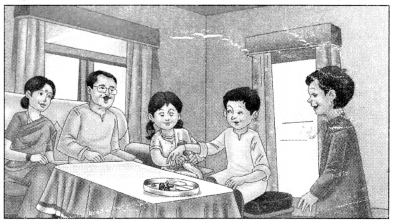
प्रदत्तं चित्रं दृष्ट्वा मञ्जूषायां प्रदत्तशब्दानां सहायतया पञ्च वाक्यानि संस्कृतेन लिखत- (1 x 5 = 5)
CBSE Sample Papers for Class 10 Sanskrit Set 2 with Solutions
मञ्जूषा- अग्रजस्य, अनुजस्य, भगिनी, रक्षाबन्धनम्, रक्षासूत्रम्, मणिबन्धे, मिष्टान्नम्, प्रसन्नौ, पर्वणः बध्राति।
उत्तर
अत्र छात्रेभ्यः सक्षिप्तवाक्यरचना अपेक्षिता वर्तते। केवलं वाक्यशुद्धिः द्रष्टव्या। अस्य प्रश्नस्य प्रमुखम् उद्देश्य वाक्यरचना अस्ति। वाक्यं दीर्घम् अस्ति अथवा लघु इति महत्त्वपूर्णं नास्ति। प्रतिवाक्यम् अर्धः भावस्य कृते अर्धः अङ्कः च व्याकरणदृष्टया शुद्धतानिमित्तं निर्धारितः अस्ति। मञ्जूषायां प्रदत्ताः शब्दाः सहायतार्थ सन्ति। छात्रः तेषां वाक्येषु प्रयोगं कुर्यादेव इति अनिवार्यं नास्ति। छात्रः स्वमेधया अपि वाक्यानि निर्मातुं शक्नोति। मञ्जूषायां प्रदत्तानां शब्दानां विभिक्ति परिवृत्य अपि वाक्यनिर्माणं कर्तुं शक्यते।

अथवा
मञ्जूषाप्रदत्तशब्दानां साहाय्येन निम्नलिखितं विषयम् अधिकृत्य पञ्चभिः संस्कृतवाक्यैः एकम् अनुच्छेद लिखत

‘दीपावलिः
मञ्जूषा- दीपानां पड्क्तिः,जनाः, रात्रौ, पूजयन्ति, प्रतीकम्, मिष्टान्नम्, वितरन्ति, स्फोटयन्ति, दीपमालिकोत्सवः, उल्लासमयम्, अमावस्यायाम्, उत्साहेन, बालकाः अपि।
उत्तर
अयं विकल्पः सर्वेभ्यः अस्ति। छात्राः मञ्जूषायां प्रदत्तानां शब्दानां विभक्ति परिवृत्य अपि वाक्यनिर्माणं कर्तुं शक्नुवन्ति। अतः अङ्काः देयाः। प्रत्येकं वाक्यनिमित्तम् अङ्कमेकम् इति। अस्य मूल्याङ्कनाय अन्ये नियमाः चित्रवर्णनस्य अनुगुणं पालनीयाः।

प्रश्न 14.
अधोलिखितानि वाक्यानि संस्कृतभाषया अनूद्य लिखत-(केवलं वाक्यपञ्चकम्) (1 x 5 = 5)
(i) उद्यान में फूल खिल रहे हैं। (Flowers are blooming in the garden.)
(ii) मेरे पास पाँच फल हैं। (I have five fruits.)
(iii) दिल्ली भारत की राजधानी है। (Delhi is the capital of India.)
(iv) कल हम दोनों गोवा गए थे। (Both of us went to Goa yesterday.)
(v) कृपया तुम मेरे लिए पानी लाओ। (Please bring water for me.)
(vi) शनिवार को मैं उत्सव में जाऊँगा। (I will go to festival on Satuday.)
(vii) अब तुम्हें पढ़ना चाहिए। (You should study now.)
उत्तर
(i) उद्याने पुष्पाणि विकसन्ति।
(ii) मम समीपे पञ्च फलानि सन्ति।
(iii) दिल्ली/देहली भारतस्य राजधानी अस्ति।
(iv) ह्यः आवां गोवानगरम् अगच्छाव/गतवन्तौ।
(v) कृपया त्वं मह्य/मदर्थं जलम् आनय।
(vi) शनिवासरे अहम् उत्सवं गमिष्यामि।
(vii) अधुना त्वं पठेः अथवा अधुना त्वया पठनीयम्/पठितव्यम्।

पठितावबोधनम् (अङ्काः 15)

प्रश्न 15.
अधोलिखितं गद्यांश पठित्वा प्रदत्तप्रश्नानाम् उत्तराणि संस्कृतेन लिखत। (3)
अस्ति देउलाख्यो ग्रामः। तत्र राजसिंहः नाम राजपुत्रः वसति स्म। एकदा केनापि आवश्यककार्येण तस्य भार्या बुद्धिमती पुत्रद्वयोपेता पितुर्गृहं प्रति चलिता। मार्गे गहनकानने सा बुद्धिमती एकं व्याघ्रं ददर्श। सा व्याघ्रमागच्छन्तं दृष्ट्वा धाष्ात् पुत्रौ चपेटया प्रहत्य जगाद-“कथमेकैकशो व्याघ्रभक्षणाय कलहं कुरुथ:? । अयमेकस्तावद्विभज्य भुज्यताम्। पश्चाद् अन्यो द्वितीयः कश्चिल्लक्ष्यते”। इति श्रुत्वा व्याघ्रमारी काचिदियमिति मत्वा व्याघ्रो भयाकुलचित्तो नष्टः।

(अ) एकपदेन उत्तरत। (केवलं प्रश्नद्वयम्) (1/2 × 2 = 1)

(i) क: भयाकुलचित्तो नष्टः?
(ii) सा बुद्धिमती कुत्र एकं व्याघ्रं ददर्श?
(iii) राजसिंहः कः आसीत्?
उत्तर
(i) व्याघ्रः
(ii) मार्गे/गहनकानने
(iii) राजपुत्रः

(आ) पूर्णवाक्येन उत्तरत। (केवल प्रश्नद्वयम्) (1 × 2 = 2)

(i) सा पुत्रौ चपेटया प्रहृत्य किं जगाद?
(ii) बुद्धिमती सा किमर्थं पितृह प्रति चलिता?
(iii) मार्गे सा बुद्धिमती किं ददर्श?
उत्तर
(i) सा पुत्रौ चपेटयाप्रहृत्य जगाद-“कथमेकैकशो व्याघ्रभक्षणाय कलहं कुरुथः? अयमेकस्तावद्विभज्य भुज्यताम्।पश्चाद् अन्यो द्वितीयः कश्चिल्लक्ष्यते।
(ii) बुद्धिमती सा आवश्यककार्येण पुत्रद्वयोपेता पितुर्गृहं प्रति चलिता।
(iii) मार्गे सा बुद्धिमती एकं व्याघ्रं ददर्श।

प्रश्न 16.
अधोलिखितं पद्यांशं पठित्वा प्रदत्तप्रश्नानाम् उत्तराणि संस्कृतेन लिखत (3)
दुर्वहमत्र जीवितं जातं प्रकृतिरेव शरणम्।
शुचि पर्यावरणम्।।
महानगरमध्ये चलदनिशं कालायसचक्रम्।
मनः शोषयत् तनुः पेषयद् भ्रमति सदा वक्रम्।।
दुर्दान्तैर्दशनैरमुना स्यान्नैव जनग्रसनम्। शुचि पर्यावरणम्।।

(अ) एकपदेन उत्तरत। (केवलं प्रश्नद्वयम्) (1/2 × 2 = 1)

(i) अत्र किं दुर्वहं जातम्?
(ii) कदा महानगरे कालायसचक्र चलति?
(iii) पर्यावरणं कीदृशं भवितव्यम्?
उत्तर
(i) जीवितम्
(ii) अनिशम्
(iii) शुचि

(आ) पूर्णवाक्येन उत्तरत। (केवलं प्रश्नद्वयम्) (1 × 2 = 2)

(i) कालायसचक्रं किं कुर्वत् वक्रं भमति?
(ii) केन जनग्रसनं न स्यात्?
(iii) का अस्माकं शरणम् अस्ति?
उत्तर
(i) कालायसचक्रम् अनिशं चलद् व्रकं भ्रमति।
(ii) दुर्दान्तैः दशनैः जनग्रसनं न स्यात्।
(iii) प्रकृतिः एव अस्माकं शरणम् अस्ति।

प्रश्न 17.
अधोलिखितं नाट्यांशं पठित्वा प्रदत्तानां प्रश्नानाम् उत्तराणि संस्कृतेन लिखत।
मयूरः- (वृक्षोपरितः-साट्टहासपूर्वकम्) विरम्, विरम, आत्मश्लाघायाः। किं न जानासि यत्
यदि न स्यान्नरपतिः सम्यनेता ततः प्रजा।
अकर्णधारा जलधौ विप्लवेतेह नौरिव॥ (3)

को न जानाति तव ध्यानावस्थाम्। ‘स्थितप्रज्ञ’ इति व्याजेन वराकान् मीनान् छलेन अधिगृह्य क्रूरतया भक्षयसि। धिक् त्वाम्। तव कारणात् तु सर्वं पक्षिकुलमेवावमानितं जातम्।

वानरः- (सगर्वम्) अतएव कथयामि यत् अहमेव योग्यः वनराजपदाय। शीघ्रमेव मम राज्याभिषेकाय तत्पराः भवन्तु सर्वे वन्यजीवाः।

मयूरः- अरे वानर! तूष्णीं भव। कथं त्वं योग्यः वनराजपदाय? पश्यतु पश्यतु मम शिरसि राजमुकुटमिव शिखां स्थापयता विधात्रा एवाहं पक्षिराजः कृतः अतः वने निवसन्तं मां वनराजरूपेणापि द्रष्टुं सज्जाः भवन्तु अधुना। यतः कोऽप्यन्य: विधातुः निर्णयम् अन्यथा कर्तुं क्षमः?

काकः- (सव्यङ्ग्यम्) अरे अहिभुक्! नृत्यातिरिक्तं का तव विशेषता यत् त्वां वनराजपदाय योग्यं मन्यामहे वयम्।

(अ) एकपदेन उत्तरत। (केवल प्रश्नद्वयम्) (1/2 × 2 = 1)

(i) कः सगर्वं वदति?
(ii) नाट्यांशे कः श्लोकं वदति?
(iii) ‘अरे वानर! तूष्णीं भवा’ इति कः कथयति?
उत्तर
(i) वानरः
(ii) मयूरः
(iii) मयूरः

(आ) पूर्णवाक्येन उत्तरत। (केवल प्रश्नद्वयम्) (1 × 2 = 2)

(i) विधात्रा मयूरः कथं पक्षिराजः कृतः?
(ii) काकः किं वदति?
(iii) वानरः (सगर्व) किं वदति?
उत्तर
(i) शिरसि राजमुकुटमिव शिखां स्थापयता विधात्रा एव मयूरः पक्षिराजः कृतः।
(ii) काकः (सव्यङ्ग्यम्)-“अरे अहिभुक्! नृत्यातिरिक्तं का तव विशेषता यत् त्वां वनराजपदाय योग्य मन्यामहे वयम्।” इति वदति
(iii) वानरः (सगर्वं) “अहमेव योग्यः वनराजपदाय। शीघ्रमेव मम राज्याभिषेकाय तत्पराः भवन्तु सर्वे वन्यजीवाः” इति कथयति।

प्रश्न 18.
मञ्जूषातः समुचितपदानि चित्वा अधोलिखित-श्लोकस्य अन्वयं पूरयत (1/2 x 4 = 2)
त्यक्त्वा धर्मप्रदां वाचं परुषां या योऽभ्युदीरयेत्।
परित्यज्य फलं पक्वं भुङ्क्तेऽपक्वं विमूढधीः॥
अन्वयः- यः
(i) …………. वाचम् त्यक्त्वा परुषाम् वाचम्
(ii) …….(सः) विमूढघी: पक्वम् (फलम्)
(iii) …………. अपक्वम् फलम्
(iv) मञ्जूषा- अभ्युदीरयेत्, भुङ्क्ते, धर्मप्रदाम्, परित्यज्य
उत्तर
(i) धर्मप्रदाम्
(ii) अभ्युदीरयेत्
(iii) परित्यज्य
(iv) भुङ्क्ते

अथवा
मञ्जूषायाः साहाय्येन श्लोकस्यभावार्थे रिक्तस्थानानि पूरयित्वा पुनः लिखत।
काकः कृष्णः पिकः कृष्णः को भेदः पिककाकयोः।
वसन्तसमये प्राप्ते काकः काकः पिक: पिकः।।
भावार्थ:- अस्य भावोऽस्ति यत्
(i) ………..वर्णः कृष्णः वर्तते पिकस्य अपि वर्णः
(ii) ……….. एव अस्ति। अतः पिके काके च कः भेदः अस्ति अर्थात् वर्णदृष्ट्या तयोः कश्चिद् भेदो न दृश्यते। परन्तु यदा
(iii) ……. समयः आगच्छति तदा तयोः स्वरैः ज्ञायते यत् कः
(iv) …….. कश्च पिको वर्तते। मञ्जूषा- वसन्तस्य, काकस्य, काकः, कृष्णः
उत्तर
अस्य भावोऽस्ति यत् काकस्य वर्णः कृष्णः वर्तते पिकस्य अपि वर्णः कृष्णः एव अस्ति। अतः तयोः पिके काके च कः भेदः अस्ति अर्थात् वर्णदृष्ट्या तयोः कच्चिद् भेदो न दृश्यते! परन्तु यदा वसन्तस्य समय: आगच्छति तदा तयोः स्वरैः ज्ञायते यत् कः काकः अस्ति कश्च पिको वर्तते।

प्रश्न 19.
अधोलिखित-कथांशं समुचितक्रमेण लिखत। (1/2 x 8 = 4)
(i) एकः कृषकः आसीत्।
(ii) पुत्रस्य दैन्यावस्थां दृष्ट्वा सुरभिः दुःखिता अभवत्।
(iii) सुरभेः इमाम् अवस्थां दृष्ट्वा सुराधिपः ताम् अपृच्छत्- ‘अयि शुभे! किमेवं रोदिषि’ इति।
(iv) कृषक: तं दुर्बलं वृषभ तोदनेन नुद्यमानः अवर्तत।
(v) तस्य समीपे द्वौ बलीवदौ आस्ताम्।
(vi) क्रुद्धः कृषकः तमुत्थापयितुं बहुवारं यत्नमकरोत्।
(vii) सः वृषभः हलम् ऊढ्वा गन्तुम् अशक्तः क्षेत्रे पपात।
(viii) तयोः बलीवर्दयोः एकः शरीरेण दुर्बलः आसीत्।
उत्तर
(i) एकः कृषकः आसीत्।
(ii) तस्य समीपे द्वौ बलीवौ आस्ताम्।
(iii) तयोः बलीवर्दयोः एकः शरीरेण दुर्बलः आसीत्।
(iv) कृषक: तं दुर्बलं वृषभं तोदनेन नुद्यमानः अवर्तत।
(v) सः वृषभः हलम् ऊढवा गन्तुम् अशक्तः क्षेत्रे पपात।।
(vi) क्रुद्धः कृषक: तमुत्थापयितुं बहुवारं यत्नमकरोत्।
(vii) पुत्रस्य दैन्यावस्थां दृष्ट्वा सुरभिः दुःखिता अभवत्।
(vii) सुरभेः इमाम् अवस्थां दृष्ट्वा सुराधिपः ताम् अपृच्छत्–’अयि शुभे! किमेवं रोदिषि’ इति।

Electromagnetic Induction Class 12 Important Extra Questions Physics Chapter 6

Here we are providing Class 12 Physics Important Extra Questions and Answers Chapter 6 Electromagnetic Induction. Important Questions for Class 12 Physics with Answers are the best resource for students which helps in Class 12 board exams.

Class 12 Physics Chapter 6 Important Extra Questions Electromagnetic Induction

Electromagnetic Induction Important Extra Questions Very Short Answer Type

Question 1.
What is the function of a step-up transformer? (CBSE AI 2011C)
Answer:
The function of a step-up transformer is to step-up the alternating voltage.

Question 2.
State Lenz’s law. (CBSE AI 2012C)
Answer:
It states that the direction of induced emf is such that it opposes the cause of its production.

Question 3.
How can the self-inductance of a given coil having ‘N’ number of turns, area of cross-section of ‘A’ and length T be increased? (CBSE AI 2012C)
Answer:
By inserting a core of high permeability inside the coil.

Question 4.
How does the mutual inductance of a pair of coils change when
(a) the distance between the coils is increased and
(b) the number of turns in the coils is increased? (CBSE AI 2013)
Answer:
(a) decreases
(b) increases.

Question 5.
The motion of the copper plate is damped when it is allowed to oscillate between the two poles of a magnet. What is the cause of this damping? (CBSE AI 2013)
Answer:
Production of eddy current.

Question 6.
Why is the core of a transformer laminated? (CBSE Delhi 2013C)
Answer:
To reduce the effects of eddy currents.

Question 7.
A metallic piece gets hot when surrounded by a coil carrying a high-frequency alternating current. Why? (CBSE Delhi 2014C)
Answer:
Due to the production of eddy current which generates heat.

Question 8.
Name any two applications where eddy currents are used to advantage. (CBSE Delhi 2016C)
Answer:

  1. Electromagnetic damping
  2. Induction furnace.

Question 9.
A long straight current-carrying wire passes normally through the centre of the circular loop. If the current through the wire increases, will there be an induced emf in the loop? Justify. (CBSE Delhi 2017)
Answer:
Yes, as there will be a change in magnetic flux.

Question 10.
Predict the polarity of the capacitor in the situation described below. (CBSE AI 2017)
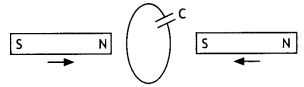
Class 12 Physics Important Questions Chapter 6 Electromagnetic Induction 1
Answer:
The upper plate will be positive with respect to the lower plate in the capacitor.

Question 11.
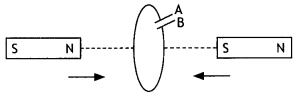
In the figure given, mark the polarity of plates A and B of a capacitor when the magnets are quickly moved towards the coil. (CBSE AI 2017C)
Class 12 Physics Important Questions Chapter 6 Electromagnetic Induction 2
Answer:
Plate A will be positive with respect to plate B in the capacitor.

Question 12.
A long straight current-carrying wire passes normally through the centre of the circular loop. If the current through the wire increases, will there be an induced emf in the loop? Justify. (CBSE Delhi 2017)
Answer:
Yes, as there will be a change in magnetic flux.

Question 13.
An air-cored solenoid has self-inductance 2.8 H. When the core is removed, the self-inductance becomes 2 mH. What is the relative permeability of the core used? (CBSE Delhi 2017C)
Answer:
μr = 2.8 / 2 × 10-3 = 1.4 × 10³

Question 14.
A choke and a bulb are in series to a dc source. The bulb shines brightly. How does its brightness change when an iron core is inserted inside the choke coil?
Answer:
There is no change in the brightness as the inductive reactance is zero for dc.

Question 15.
Why does the acceleration of a magnet falling through a long solenoid decrease?
Answer:
It decreases because of the opposing induced emf produced in the soLenoid due to the rate of change of magnetic flux.

Question 16.
Why is the core of a transformer laminated?
Answer:
It is done to reduce the effect of Eddy Currents.

Question 17.
A vertical metallic pole falls down through the plane of the magnetic meridian. Will any emf be Induced between Its ends?
Answer:
No emf will be induced because the pote neither intercepts the vertical component nor the horizontal component of the earth’s magnetic field.

Question 18.
A magnet Is moved towards a coil and an electric charge is induced in it. If the resistance of the coil is increased, how will the induced charge change?
Answer:
On increasing the resistance of the colt, the magnitude of induced charge decreases.

Question 19.
Can a transformer be used In a dc circuit?
Answer:
No, because there is no change in magnetic flux.

Question 20.
Why does a metallic piece become very hot when it is surrounded by a coil carrying high-frequency alternating current?
Answer:
The high-frequency coil induces eddy currents in the metallic piece. These eddy currents produce heat hence the metalLic piece becomes hot.

Question 21.
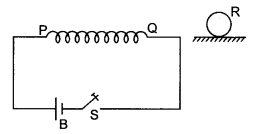
The figure shows a horizontal solenoid PQ connected to a battery and a switch. A copper ring R is placed on a frictionless track, the axis of the ring being along the axis of the solenoid. What would happen to the ring as the switch S is closed.
Class 12 Physics Important Questions Chapter 6 Electromagnetic Induction 3
Answer:
The ring WilL be repelled due to opposing induced emf produced in it.

Question 22.
An air-core solenoid is connected to an ac source and a bulb. If an iron core Is inserted in the solenoid, how does the brightness of the bulb change? Give reasons for your answer.
Answer:
Insertion of an iron core In the solenoid increases its inductance. This in turn increases the value of inductive reactance. This decreases the current and hence the brightness of the bulb.

Question 23.
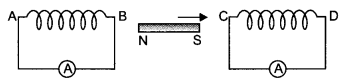
A magnet is moved in the direction indicated by an arrow between two coils AB and CD as shown in the figure. Suggest the direction of current in each coil,
Class 12 Physics Important Questions Chapter 6 Electromagnetic Induction 4
Answer:
In coil AB induced current flows from A to B and in colt CD current flows from C to D.

Question 24.
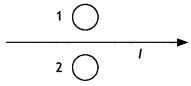
Predict the directions of induced currents in metal rings 1 and 2 lying in the same place where current I in the wire is increasing steadily. (CBSE Delhi 2012)
Class 12 Physics Important Questions Chapter 6 Electromagnetic Induction 5
Answer:
1 -clockwise, 2-anticlockwise.

Question 25.
The electric current flowing in a wire In the direction from B to A is decreasing. Find out the direction of the induced current in the metallic loop kept above the wire as shown. (CBSE AI 2014)
Answer:
Clockwise.

Question 26.
Predict the polarity of plate A of the capacitor, when a magnet is moved towards it, as is shown In the figure. (CBSE AI 2014C)
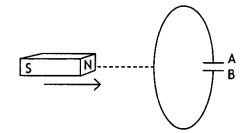
Class 12 Physics Important Questions Chapter 6 Electromagnetic Induction 6
Answer:
Positive.

Question 27.
The figure below shows two positions of a loop PQR in a perpendicular uniform magnetic field. In which position of the coil is there induced emf?
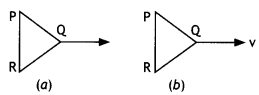
Class 12 Physics Important Questions Chapter 6 Electromagnetic Induction 7
Answer:
In position b.

Question 28.
If the self-inductance of an air-core inductor increases from 0.01 mH to 10 mH on introducing an iron core into it, what is the relative permeability of the core used?
Answer:
We know that µ = \(\frac{L}{L_{0}}=\frac{10}{0.01}\) = 1000

Electromagnetic Induction Important Extra Questions Short Answer Type

Question 1.
An induced current has no direction of its own, comment.
Answer:
Yes, it is perfectly correct to say that an induced current has no fixed direction of its own. The direction of induced current depends upon the change in magnetic flux because in accordance with Lenz’s law the induced current always opposes the change in magnetic flux.

Question 2.
How are eddy currents produced? Mention two applications of eddy currents?
Answer:
Eddy currents are the currents induced in the body of a thick conductor when the magnetic flux linked with the conductor changes. When a thick conductor is moved in a magnetic field, magnetic flux linked with it changes. In situations like these, we can have induced currents that circulate throughout the volume of a material.

Because their flow patterns resemble swirling eddies in a river, therefore they are called eddy currents.

  • Electromagnetic braking, and
  • Induction furnace.

Question 3.
Name and define the unit used for measuring the coefficient of mutual inductance. State the relation of this unit with the units of magnetic flux and electric current.
Answer:
In SI the unit of mutual inductance is henry (H). Now from the expression
ε = – \(\frac{d \phi}{d t}\) = – M \(\frac{d l}{d t}\)
we have M = ε l \(\frac{d l}{d t}\).

Let ε = 1 volt and dl/dt = 1 As-1, then
M = 1 volt/1 As-1 = 1 henry.

The mutual-inductance of a coil is said to be 1 henry if a rate of change of current of 1 ampere per sec in the neighbouring coil induces in at an emf of 1 volt.

Question 4.
What are eddy currents? Write any two applications of eddy currents. (CBSE A! 2011)
Answer:
Eddy currents are the currents induced in the body of a thick conductor when the magnetic flux linked with a bulk piece of conductor changes.

  1. Dead Beat Galvanometer, and
  2. Induction furnace.

Question 5.
(a) Obtain the expression for the magnetic energy stored in a solenoid in terms of the magnetic field B, area A and length l of the solenoid.
(b) How is this magnetic energy per unit volume compared with the electrostatic energy per unit volume stored in a parallel plate capacitor? (CBSE Delhi 2011C)
Answer:
The magnetic field stored in a solenoid is given by the expression U = – \(\frac{1}{2}\)Ll2.

But for a solenoid B = μ0nl
or
l = B / μ0 n

Substituting in the above expression we have
U = \(\frac{1}{2}\) × (μ0n2Al)\(\left(\frac{B}{\mu_{0} n}\right)^{2}\) as L = μ0 n2 A l

U = \(\frac{1}{2}\)\(\frac{B^{2} A l}{\mu_{0}}\)

We know that the energy stored per unit volume in a parallel plate capacitor is
UE = \(\frac{1}{2}\)ε0E2

It is clear that in both cases the energy stored per unit volume is proportional to the square of the field intensity.

Question 6.
State Lenz’s Law.
A metallic rod held horizontally along the east-west direction is allowed to fall under gravity. Will there be an emf induced at its ends? Justify your answer. (CBSE Delhi 2013)
Answer:
Lenz’s law states that the polarity of the induced emf is such that it tends to oppose the cause of its production.

Yes, as it will cut the horizontal component of the earth’s magnetic field.

Question 7.
Starting from the expression for the energy W = 1/2Ll2, stored in a solenoid of self-inductance L to build up the current l, obtain the expression for the magnetic energy in terms of the magnetic field B, area A and length l of the solenoid having n number of turns per unit length. Hence show that the energy density is given by 8z/2m0. (CBSE Delhi 2013C)
(i) The magnetic energy is
U = \(\frac{1}{2}\)LI2 = \(\frac{1}{2}\)L\(\left(\frac{B}{\mu_{0} n}\right)^{2}\) since B = μ0nl

Now L = μ0n2 Al, therefore we have
UB = \(\frac{1}{2}\)(μ0n2 Al)\(\left(\frac{B}{\mu_{0} n}\right)^{2}\) = \(\frac{1}{2 \mu_{0}} B^{2} A l\)

(ii) The magnetic energy per unit volume is
UB = \(\frac{U_{B}}{V}=\frac{U_{B}}{A l}=\frac{B^{2}}{2 \mu_{0}}\)

Question 8.
Define mutual inductance. A pair of adjacent coils has a mutual inductance of 1.5 H. If the current in one coil changes from 0 to 20 A in 0.5 s, what is the change of flux linkage with the other coil? (CBSE Delhi 2016)
Answer:
Mutual inductance is numerically equal to the magnetic flux linked with a coil when the unit current passes through the neighbouring coil.
Given M = 1.5 H, dl = 20 – 0 = 20 A,
dt = 0.5 s, Φ = ?
Φ = – M\(\frac{d l}{d t}\)
or
Φ = – 1.5 × \(\frac{20}{0.5}\) = – 60 Wb

Question 9.
Explain the principle on which the metal detector is used at airports for security reasons.
Answer:
The metal detectors used in airport security checkpoints operate by detecting eddy currents induced in metallic objects. The detector generates an alternating magnetic field. This induces eddy currents in the conduction object carried through the detector. The eddy currents in turn produce an alternating magnetic field. This field induces a current in the detectors receiver coil.

Question 10.
A current is induced in coil C1, due to the motion of current-carrying coil C2.
(i) Write any two ways by which a large deflection can be obtained in the galvanometer G.
(ii) Suggest an alternative device to demonstrate the induced current in place of a galvanometer. (CBSE Delhi 2011)
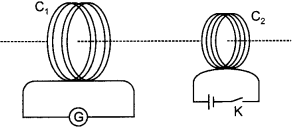
Class 12 Physics Important Questions Chapter 6 Electromagnetic Induction 8
Answer:
(ii) The two ways are
(a) Passing a large current through coil C2 and
(b) Moving coil C2 quickly towards the coil.
(ii) A magnetic compass can be placed at the centre of coil C1. Whenever current will be induced it will show a deflection.

Question 11.
Consider a cube EFGHIJKL of side ‘a’ placed in a magnetic field B acting perpendicular to the face FJKG as shown in the figure. Write magnetic flux through the following faces (a) EFGH (b) EFJI (c) EILH (d) FJKG
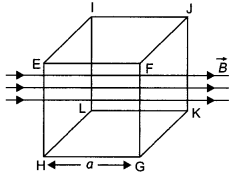
Class 12 Physics Important Questions Chapter 6 Electromagnetic Induction 9
Answer:
The magnetic flux depends upon the angle (q) between the magnetic field and area vector.
(a) Here θ = 90°, therefore magnetic flux Φ = BA cos θ = BA cos 90° = 0
(b) Here θ = 90°, therefore magnetic flux Φ = BA cos θ = BA cos 90° = 0
(c) Here θ = 180°, therefore magnetic flux Φ = BA cos 180° = -BA
(d) Here θ = 0°, therefore magnetic flux Φ = BA cos 0° = BA

Question 12.
A metallic rod of ‘L’ length is rotated with an angular frequency of ‘ω’ with one end hinged at the centre and the other end at the circumference of a circular metallic ring of radius L, about an axis passing through the centre and perpendicular to the plane of the ring. A constant and uniform magnetic field B parallel to the axis is present everywhere. Deduce the expression for the emf between the centre and the metallic ring. (CBSE Delhi 2012, 2013)
Answer:
Let the rod move from OP to OQ through a small sector of angle θ.
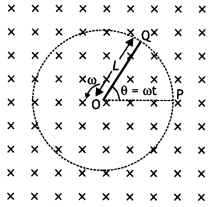
Class 12 Physics Important Questions Chapter 6 Electromagnetic Induction 10
The small area covered by the rod is
dA= πL2 × \(\frac{\theta}{2 \pi}=\frac{1}{2}\)L2θ

where L is the radius of the circle in which the rod rotates. Hence the induced emf is
ε = \(\frac{d \phi}{d t}=\frac{d B A}{d t}=\frac{B d A}{d t}=B \frac{d}{d t}\left[\frac{1}{2} L^{2} \theta\right]\)

ε = – \(\frac{1}{2}\)L2B\(\frac{d \theta}{d t}=\frac{1}{2}\)BωL2

Question 13.
A metallic rod of length l length is rotated with a frequency ω, with one end hinged at the centre and the other end at the circumference of a circular metallic ring of radius R = l, about an axis passing through the centre and perpendicular to the plane of the ring. A constant and uniform magnetic field B parallel to the axis is present everywhere. Deduce the expression for the emf induced in the rod. If r is the resistance of the rod and the metallic ring has negligible resistance, obtain the expression for the power generated. (CBSE AI 2013C)
Answer:
For the first part refer above question.
The power generated is given by
P = \(\frac{\varepsilon^{2}}{r}=\frac{B^{2} \omega^{2} l^{4}}{2 r}\)

Question 14.
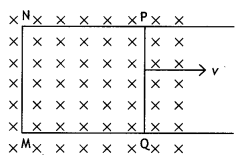
A rectangular loop PQMN with movable ‘ arm PQ of length 10 cm and resistance 4 Ω is placed in a uniform magnetic field of 0.25 T acting perpendicular to the plane of the loop as is shown in the figure. The resistances of the arms MN, NP and MQare negligible.
Calculate the
(i) emf induced in the arm PQand
(ii) current induced in the loop when arm PQ is moved with velocity 20 m s-1. (CBSE Delhi 2014C)
Class 12 Physics Important Questions Chapter 6 Electromagnetic Induction 11
Answer:
Given L = 10 cm = 0.1 m, B = 0.25 T, v = 20 m s-1
(a) ε = BLv = 0.25 × 0.1 × 20 = 0.5 V
(b) l = ε/R = 0.5/4 = 0.125 A

Question 15.
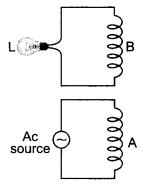
In the given diagram a coil B is connected to a low voltage bulb L and placed parallel to another coil A as shown. Explain the following observations
(i) Bulb lights, and
(ii) Bulb gets dimmer if coil B is moved upwards.
Class 12 Physics Important Questions Chapter 6 Electromagnetic Induction 12
Answer:
(a) When ac is applied across coil A an induced emf is produced in coil B due to mutual induction between the two coils. This makes the lamp light up.
(b) When coil B is moved upwards the mutual induction and hence induced emf in coil B decreases. This makes the lamp dimmer.

Question 16.
A horizontal straight wire of length L extending from east to west is falling with speed v at right angles to the horizontal component of Earth’s magnetic field B.
(a) Write the expression for the instantaneous value of the emf induced in the wire.
Answer:
ε = BLv

(b) What is the direction of the emf?
Answer:
west to east

(c) Which end of the wire is at the higher potential? (CBSEAI2011)
Answer:
East.

Question 17.
Two concentric circular coils one of small radius r1 and the other of large radius r2, such that r1 << r2, are placed co-axially with centres coinciding. Obtain the mutual inductance of the arrangement. (NCERT)
Answer:
Let a current l2 flow through the outer circular coil. The field at the centre of the coil is B2 = \(\frac{\mu_{0} I_{2}}{2 r_{2}}\). Since the other coaxially placed coil has a very small radius, B2 may be considered constant over its cross¬sectional area. Hence,
Φ = πr1²B2 = \(\frac{\mu_{0} \pi r_{1}^{2} l_{2}}{2 r_{2}}\) = M12l2

Thus M12 = \(\frac{\mu_{0} \pi r_{1}^{2}}{2 r_{2}}\)

But M12 = M21, therefore M12 = M21 = \(\frac{\mu_{0} \pi r_{1}^{2}}{2 r_{2}}\)

Note that we calculated M12 from an approximate value of Φ1 assuming the magnetic field B2 to be uniform over the area πr1². However, we can accept this value because r1 << r2.

Question 18.
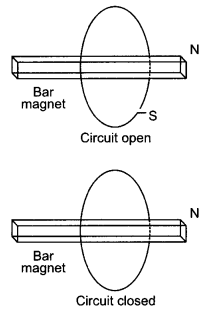
Consider a magnet surrounded by a wire with an on/off switch S (figure). If the switch is thrown from the off position (open circuit) to the on position (closed circuit), will a current flow in the circuit? Explain. (NCERT Exemplar)
Class 12 Physics Important Questions Chapter 6 Electromagnetic Induction 13
Answer:
There is no relative motion between the magnet and the coil. This means that there is no change in magnetic flux, hence no electromotive force is produced and hence no current will flow in the circuit.

Question 19.
A wire in the form of a tightly wound solenoid is connected to a DC source and carries a current. If the coil is stretched so that there are gaps between successive elements of the spiral coil, will the current increase or decrease? Explain. (NCERT Exemplar)
Answer:
The current will increase. As the wires are pulled apart the flux will leak through the gaps. Lenz’s law demands that induced e.m.f. resist this decrease, which can be done by an increase in current.

Question 20.
A solenoid is connected to a battery so that a steady current flows through it. If an iron core is inserted into the solenoid, will the current increase or decrease? Explain. (NCERT Exemplar)
Answer:
The current will decrease. As the iron core is inserted in the solenoid, the magnetic field increases and the flux increases. Lenz’s law implies that induced e.m.f. should resist this increase, which can be achieved by a decrease in current.

Electromagnetic Induction Important Extra Questions Long Answer Type

Question 1.
11 kW of electric power can be transmitted to a distant station at (i) 220 V or (ii) 22,000 V. Which of the two modes of transmission should be preferred and why? Support your answer with possible calculations.
Answer:
1. Consider that 11000 watt of energy has to be transmitted. First at 220 V and then at 22000 V. When the power is transmitted at 220 V then the current flowing through the wires is 11000/220 = 50 A

2. When power is transmitted at 22000 V then the current through the wires is 11000 / 22000 = 0.5 A. If R is the resistance of the line wire then the energy dissipated in the two cases is 2500R joule per sec and 0.25R. joule per sec.

This shows that if energy is transmitted at low voltages there is more loss in energy than when it is transmitted at high voltages. Furthermore, if power is to be transmitted at low voltage then the resistance of the line wire should be low, as such thick wires will be required. To support these thick wires strong poles situated close to each other will be needed. This will increase the cost of transmission. But at high voltages, even thin wires will do.

Question 2.
A coil A is connected to a voltmeter V and the other coil B to an alternating current source D. If a large copper sheet C is placed between the two coils, how does the induced emf in coil A change due to current in coil B. Justify your answer.
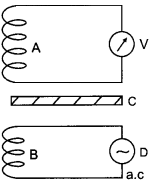
Class 12 Physics Important Questions Chapter 6 Electromagnetic Induction 14
Answer:
In the absence of sheet C, an induced emf is set up in coil due to mutual induction phenomenon when an alternating current is passed through coil B.
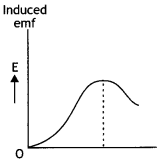
Class 12 Physics Important Questions Chapter 6 Electromagnetic Induction 15
However, when induced copper sheet C is placed, eddy currents are set up in the sheet due to a change in flux.

Thus, now coil A has a positive effect due to coil B and a negative effect due to eddy currents in C. Consequently, the flux of coil A and hence the induced emf in coil A is decreased, i.e. the reading of voltmeter V is reduced.

Question 3.
A bar magnet is dropped so that it falls vertically through coil C. The graph obtained for the voltage produced across the coil versus time is as shown in figure (b).
(i) Explain the shape of the graph and
(ii) why is the negative peak longer than the positive peak?
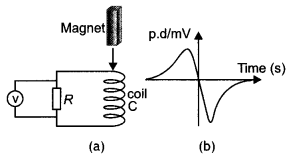
Class 12 Physics Important Questions Chapter 6 Electromagnetic Induction 16
Answer:
(a) As the magnet approaches the coil, an emf is induced in it. As the magnet approaches the coil the magnetic flux linked with the coil increases. As a result the induced emf increases. When the magnet enters the coil, the change in magnetic flux linked with the coil begins to decrease and becomes zero when the magnet is completely inside the coil. This starts decreasing the emf and makes it zero.

When the magnet comes out of the coil the direction of induced emf changes direction and begins to increase in the opposite direction. When the magnet moves far away from the coil the induced emf becomes zero.

As the magnet comes out of the coil with a speed greater than the speed at which it approaches the coil, therefore the induced emf is more in the second case. Hence the longer negative peak.

Question 4.
(a) State Lenz’s law: Using this law indicate the direction of the current in a closed loop when a bar magnet with the North Pole is brought close to it. Explain briefly how the direction of the current predicted wrongly results in the violation of the law of conservation of energy.
(b) A rectangular loop and circular loop are moving out of a uniform magnetic field region with a constant velocity v as shown in the figure. In which loop do you expect the induced emf to be constant during the passage out of the field region? The field is normal to the loops. (CBSE AI 2011C)
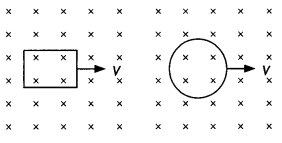
Class 12 Physics Important Questions Chapter 6 Electromagnetic Induction 17
Answer:
(a) Lenz’s law states that the direction of the induced emf is such that it opposes the cause of its production. When the north pole of the magnet is brought near the coil, the upper end of the coil will acquire north polarity so as to oppose the approaching North Pole (by repelling). This means that the direction of current must be anticlockwise as seen from the side of the magnet.

If the current is wrongly predicted as clockwise, then the upper face will acquire south polarity which will attract the North Pole. This means the current is being produced without doing any work. This leads to the violation of the law of conservation of energy.

(b) It is expected that the induced emf will be constant in the rectangular coil. In the case of the rectangular coil, when pulled out of the magnetic field, the rate of change of magnetic flux will be constant because the rate of change of area is constant. This is not so in the case of the circular coil.

Question 5.
The current through two inductors of self-inductance 15 mH and 25 mH is increasing with time at the same rate. Draw graphs showing the variation of the
(a) emf induced with the rate of change of current
(b) energy stored in each inductor with the current flowing through it. Compare the energy stored in the coils, if the power dissipated in the coils is the same. (CBSE AI 2017C)
Answer:
Given L1 = 15 mH, L2 = 25 mH.
(a) The emf induced across an inductor is given by the expression ε = – L\(\frac{d i}{d t}\) since di/dt is the same for both coils therefore induced emf will depend upon the value of inductance. Hence the graphs are as shown
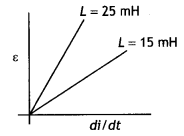
Class 12 Physics Important Questions Chapter 6 Electromagnetic Induction 18
(b) The energy stored in an inductor is given by U = \(\frac{1}{2}\)Ll2
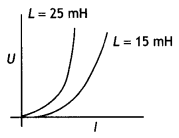
Class 12 Physics Important Questions Chapter 6 Electromagnetic Induction 19
(c) The power dissipated P = l2XL
or
l2 = Pl XL and U = \(\frac{1}{2}\)Ll<sup>1</sup> = \(\frac{1}{2} \frac{L P}{X_{L}}=\frac{1}{2} \frac{P L}{\omega L}=\frac{P}{2 \omega}\)

Since power dissipated is same and co is also same therefore energy stored in the coils will also be the same.

Question 6.
A rectangular frame of wire is placed in a uniform magnetic field directed outwards, normal to the paper. AB is connected to a spring which is stretched to AB and then released at time t = 0. Explain qualitatively how induced e.m.f. in the coil would vary with time. (Neglect damping of oscillations of spring) (CBSE AI 2018C)
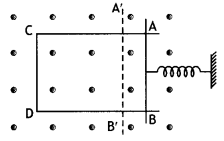
Class 12 Physics Important Questions Chapter 6 Electromagnetic Induction 20
Answer:
As the spring is released AB is pulled out of the field. This increases the area of the loop inside the magnetic field. This increases flux and hence an induced emf is produced. The portion AB does not stop at Ab but moves outwards. Now the spring will push AB inwards. This will decrease the area of the loop thereby decreasing the induced emf. This continues and hence the emf increases and decreases periodically.

Question 7.
Define mutual inductance between a pair of coils. Derive an expression for the mutual inductance of two long coaxial solenoids of the same length wound one over the other. (CBSE AI 2017)
Answer:
The mutual inductance of two coils is numerically equal to the magnetic flux linked with one coil when a unit current flows through the neighbouring coil.

As shown in the figure consider two long co-axial solenoids S1 and S2 with S2 wound over S1.
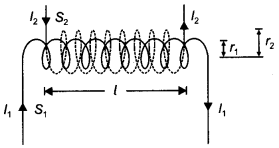
Class 12 Physics Important Questions Chapter 6 Electromagnetic Induction 21
Let l = length of each solenoid r1, r2 = radii of the two solenoids

A = πr1² = area of cross-section of inner solenoid S1
N1, N2 = number of turns in the two solenoids First we pass a time-varying current l2 through S2. The magnet field set up inside S2 due to l2 is
B2 = μo n2 l2

where n2 = N2/l = the number of turns per unit length of S2.

Total magnetic flux linked with the inner solenoid S1 is
Φ1 = B2AN1 = μ0 n2 l2 × AN1

Mutual inductance of coil 1 with respect to coil 2 is
M12 = \(\frac{\phi_{1}}{l_{2}}\) = μ0n2AN1 = \(\frac{\mu_{0} A N_{1} N_{2}}{l}=\frac{\mu_{0} \pi r^{2} N_{1} N_{2}}{l}\)

The mutual inductance of any two coils is always proportional to the product N1 N2 of their number of turns. This is termed the reciprocity theorem.

Question 8.
Define mutual inductance and write its SI unit.
A square loop of side ‘a’ carrying a current l2 is kept at distance x from an infinitely long straight wire carrying a current l1 as shown in the figure. Obtain the expression for the resultant force acting on the loop. (CBSE Delhi 2019)
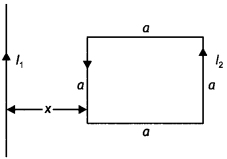
Class 12 Physics Important Questions Chapter 6 Electromagnetic Induction 22
Answer:
(a) Mutual inductance equals the magnetic flux associated with a coil when unit current flows in its neighbouring coil. (b) Force per unit length between two parallel straight conductors
\(\frac{F}{L}=\frac{\mu_{o} I_{1} I_{2}}{2 \pi r}\)

Force on the part of the loop which is parallel to infinite straight wire and at a distance x from it F = \(\frac{\mu_{o} l_{1} l_{2} a}{2 \pi x}\)(away from the infinitely 2KX long wire)

Force on the part of the loop which is at a distance (x + a) from it
F2 = \(\frac{\mu_{0} I_{1} I_{2} a}{2 \pi(x+a)}\) (towards the infinite long wire)

Net force F = F1 – F2
F = \(\frac{\mu_{o} l_{1} l_{2} a^{2}}{2 \pi(x+a)}\) (away from the infinite straight line)

Question 9.
What are the possible causes of energy loss in a transformer? How are these minimised?
Answer:
The possible causes of energy losses in transformers are:
(a) Flux leakage: There is always some flux leakage. It can be reduced by winding the primary and secondary coils one over the other.
(b) Copper: The copper wires used for the windings have some resistance and hence some energy is lost due to heat produced in the wire. It can be minimised by taking thick wire.
(c) Eddy currents: The alternating magnetic flux induces eddy currents in the iron core, which results in loss of electrical energy. To minimise it we use a laminated iron core.
(d) Hysteresis loss: As the magnetisation cycle of the iron core is repeated again and again some loss of energy takes place due to magnetic hysteresis. To minimise it we prefer a soft iron core for which hysteresis loss is less.

Question 10.
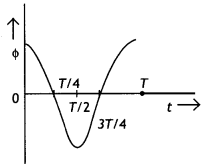
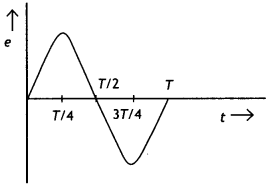
Discuss how Faraday’s law of e.m.f induction is applied in an ac generator for converting mechanical energy into electrical energy. Draw graphs to show the ’phase relationship’ between the instantaneous
(a) magnetic flux (Φ) linked with the coil and
(b) induced emf (ε) in the coil. (CBSE Delhi 2016C)
Answer:
In an ac generator, the change in magnetic flux is brought about by rotating the coil in a magnetic field. According to Faraday’s law, induced emf is set up in the coil on changing the magnetic flux linked with it. Hence mechanical energy, which is supplied to rotate the coil, gets converted into electrical energy.

Let the coil be rotated with a constant angular speed, co, the angle 0 between magnetic field 8, and area vector A of the coil at any instant is θ = ωt

Therefore magnetic flux at any instant is Φ = BA cos ωt

From Faraday’s law, induced emf is
ε = – n\(\frac{d \phi}{d t}\) = -nBA\(\frac{d}{d t}\)cos ωt
ε = nBAa sin ωt

Magnetic flux is given by Φ = BA cos ωt, therefore the graph will be a cosine curve as shown
Class 12 Physics Important Questions Chapter 6 Electromagnetic Induction 23
The induced emf is given by ε = nBA sin ωt, therefore the graph will be a sine curve as shown.
Class 12 Physics Important Questions Chapter 6 Electromagnetic Induction 24
Question 11.
(a) Define self-inductance of a coil. Obtain an expression for the energy stored in a solenoid of self-inductance ‘L’ when the current through it grows from zero to l.
(b) A square loop MNOP of the side 20 cm is placed horizontally in a uniform magnetic field acting vertically downwards as shown in the figure. The loop is pulled with a constant velocity of 20 cm s-1 till it goes out of the field.
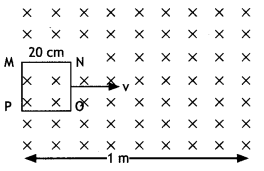
Class 12 Physics Important Questions Chapter 6 Electromagnetic Induction 25
(c) Depict the direction of the induced current in the loop as it goes out of the field. For how long would the current in the loop persist?
(d) Plot a graph showing the variation of magnetic flux and induced emf as a function of time. (CBSE AI 2015)
Answer:
(a) Let i be the current at some instant through a pure inductor. If di / dt is the rate of change of current through the inductor then the voltage between the terminals of the inductor at this instant is
V=L di / dt

Therefore instantaneous power in the inductor is
P = Vab i = Li \(\frac{d i}{d t}\)

The energy dU supplied to the inductor during an infinitesimal time interval dt is
dU = P dt, so dU = Li di

The total amount of energy supplied while the current increases from zero to a final value l is
U = L ∫o1 i di = \(\frac{1}{2}\)L l2

(b) (i) Direction of induced current – clockwise (MNOP), the duration of induced current is 1s.
(ii) The graph is as shown.
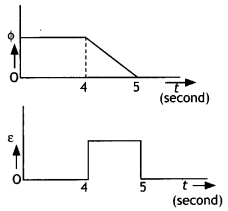
Class 12 Physics Important Questions Chapter 6 Electromagnetic Induction 26
Question 12.
(a) Define mutual inductance and write its SI units.
Answer:
The mutual inductance of two coils is numerically equal to the magnetic flux linked with one coil when a unit current flows through the neighbouring coil. It is measured in henry.

(b) Derive an expression for the mutual inductance of two long co-axial solenoids of the same length wound one over the other.
Answer:
The mutual inductance of two coils is numerically equal to the magnetic flux linked with one coil when a unit current flows through the neighbouring coil.

As shown in the figure consider two long co-axial solenoids S1 and S2 with S2 wound over S1.
Class 12 Physics Important Questions Chapter 6 Electromagnetic Induction 21
Let l = length of each solenoid r1, r2 = radii of the two solenoids

A = πr1² = area of cross-section of inner solenoid S1
N1, N2 = number of turns in the two solenoids First we pass a time-varying current l2 through S2. The magnet field set up inside S2 due to l2 is
B2 = μo n2 l2

where n2 = N2/l = the number of turns per unit length of S2.

Total magnetic flux linked with the inner solenoid S1 is
Φ1 = B2AN1 = μo n2 l2 × AN1

Mutual inductance of coil 1 with respect to coil 2 is
M12 = \(\frac{\phi_{1}}{l_{2}}\) = μ0n2AN1 = \(\frac{\mu_{0} A N_{1} N_{2}}{l}=\frac{\mu_{0} \pi r^{2} N_{1} N_{2}}{l}\)

The mutual inductance of any two coils is always proportional to the product N1 N2 of their number of turns. This is termed the reciprocity theorem.

(c) In an experiment, two coils c1 and c2 are placed close to each other. Find out the expression for the emf induced in the coil c1 due to a change in the current through the coil c2. (CBSE Delhi 2015)
Answer:
Consider the experimental set up as shown.
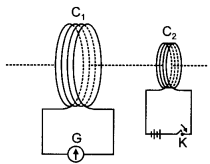
Class 12 Physics Important Questions Chapter 6 Electromagnetic Induction 27
When the key K is pressed in coil C1 a magnetic flux linked with C2 changes.

The magnetic flux linked with coil C2 is given by
f2 = M l1 where M is the mutual inductance between the two coils.

But by Faraday’s flux rule we have
ε2 = – \(\frac{d \phi}{d t}\) therefore we have
ε2 = – \(\frac{d M l_{1}}{d t}\) = – M \(\frac{d l_{1}}{d t}\)

Question 13.
(a) When a bar magnet is pushed towards (or away) from the coil connected to a galvanometer, the pointer in the galvanometer deflects. Identify the phenomenon causing this deflection and write the factors on which the amount and direction of the deflection depend. State the laws describing this phenomenon.
(b) Sketch the change In flux, emf and force when a conducting rod PQ of resistance R and length I moves freely to and fro between A and C with speed v on a rectangular conductor placed in the uniform magnetic field as shown in the figure. (CBSE AI 2016)
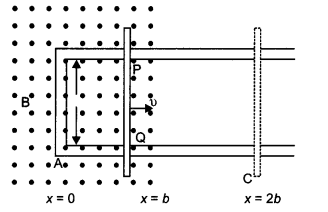
Class 12 Physics Important Questions Chapter 6 Electromagnetic Induction 28
Answer:
(a) Phenomenon: electromagnetic induction

Factors:

  • Strength of the magnetic field of the magnet
  • speed of motion of bar magnet.

Direction depends upon

  • the motion of magnet whether inward or outward
  • the direction of the north/south pole.

Law: The magnitude of the induced emf in a circuit is equal to the time rate of change of magnetic flux through the circuit.

(b) The sketch is as shown below.
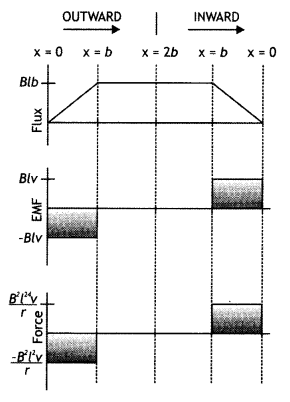
Class 12 Physics Important Questions Chapter 6 Electromagnetic Induction 29
Question 14.
What is induced emf? Write Faraday’s laws of electromagnetic induction. Express it mathematically. A conducting rod of length ‘L’ with one end pivoted is rotated with a uniform angular velocity ‘ω’ in a vertical plane, normal to a uniform magnetic field ‘B’. Deduce an expression for the emf induced in this rod.
Answer:
It is the emf induced when the magnetic flux linked with a coil changes.

Faraday put forward the following laws called Faraday’s laws of electromagnetic induction.

  • Law 1. Whenever the magnetic flux linked with a coil changes an induced emf is produced.
  • Law 2. The induced emf lasts as long as the change in magnetic flux continues.

The expression for induced emf in rotating rod: Let the rod move from OP to OQ through a small sector of angle θ.
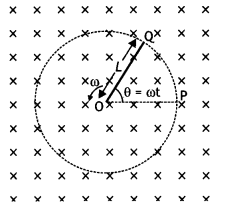
Class 12 Physics Important Questions Chapter 6 Electromagnetic Induction 30
The small area covered by the rod is
dA = πL2 × \(\frac{\theta}{2 \pi}=\frac{1}{2}\)L2θ

where L is the radius of the circle in which the rod rotates. Hence the induced emf is
ε = \(\frac{d \phi}{d t}=\frac{d B A}{d t}=\frac{B d A}{d t}=B \frac{d}{d t}\left[\frac{1}{2} L^{2} \theta\right]\)
Or
ε = \(\frac{1}{2} L^{2} B \frac{d \theta}{d t}=\frac{1}{2}\)BωL2

Question 15.
How is the mutual inductance of a pair of coils affected when:
(a) the separation between the coils is increased?
Answer:
When the separation between the two coils is increased the mutual inductance decreases. It is because the flux linked with the secondary due to a current in the primary decreases.

(b) the number of turns of each coil is increased?
Answer:
When the number of turns of each coil is increased the mutual inductance increases because M12 (= M21) ∝ N1N2,

i.e. mutual inductance is directly proportional to the number of turns. The linkage of flux increases with an increase in the number of turns in the coils.

(c) a thin iron sheet is placed between the two coils, other factors remaining the same? Explain your answer in each case.
Answer:
When a thin iron sheet is placed between the coils the permeability of the medium between the coil increases. As mutual inductance is directly proportional to the permeability, therefore the mutual inductance increases.

Question 16.
A rectangular coil of area A, having a number of turns N, is rotated at f revolutions per second in a uniform magnetic field B, the field being perpendicular to the coil. Prove that the maximum emf induced in the coil is 2π f N B A.
Answer:
Consider an armature of the ac generator having n turns and placed in a uniform magnetic field B.

Suppose at any instant t the normal to the plane of the coil makes an angle 0 with the direction of the magnetic field. If ro is the uniform angular velocity with which, the coil rotates then θ = ωt.

The flux through the loop equals its area A multiplied by B = Bcos θ, the component of magnetic field B perpendicular to the area, hence

Φ = n B A cos Φ = n B A cos ω t …(1)
where is the number of turns in the armature?

By Faraday’s flux rule,
ε = – \(\frac{d \phi}{d t}=-\frac{d}{d t}\) n B A cos ω t
= – n B A \(\frac{d}{d \phi}\)cos ω t = – n B A (- ω sin ω t) ….(2)
Or
ε = n B A ω sin ω t

The induced emf is maximum when sin ωt = maximum = 1, therefore the maximum induced emf is given by
ε0 = n B A ω sin ω t …(3)

Since ω = 2πf, therefore equation (3) becomes ε0 = 2πf nBA

Question 17.
State Lenz’s law. Explain by giving examples that Lenz’s law is a consequence of the law of conservation of energy. (CBSE Delhi 2017C)
Answer:
It states that the direction of induced emf in a coil is such that it opposes the cause of its production. Lenz’s law is a consequence of the law of conservation of energy. To show it, let us consider a bar magnet pushed towards a conducting loop. When N-pole moves towards the loop, the face of the loop facing the North Pole develops north polarity as per Lenz’s law so as to oppose the motion of the magnet.

Again, when N-pole moves away from the loop, the nearby face develops south polarity, thus opposing the motion of the magnet away from the loop. It means that the motion of the magnet is automatically opposed every time. Hence, some work is to be done on the magnet to move it and this mechanical work is transformed into electrical energy. Thus, the conservation law of energy is followed.

Question 18.
Define the term ‘self-inductance’ and write its SI unit.
Obtain the expression for the mutual inductance of two long co-axial solenoids S1 and S2 wound one over the other, each of length L and radii r1 and r2 and n1 and n2 number of turns per unit length when a current I is set up in the outer solenoid S2. (CBSE Delhi 2017)
Answer:
The mutual inductance of two coils is numerically equal to the magnetic flux linked with one coil when a unit current flows through the neighbouring coil.

As shown in the figure consider two long co-axial solenoids S1 and S2 with S2 wound over S1.
Class 12 Physics Important Questions Chapter 6 Electromagnetic Induction 21
Let l = length of each solenoid r1, r2 = radii of the two solenoids

A = πr1² = area of cross-section of inner solenoid S1
N1, N2 = number of turns in the two solenoids First we pass a time-varying current l2 through S2. The magnet field set up inside S2 due to l2 is
B2 = μo n2 l2

where n2 = N2/l = the number of turns per unit length of S2.

Total magnetic flux linked with the inner solenoid S1 is
Φ1 = B2AN1 = μo n2 l2 × AN1

Mutual inductance of coil 1 with respect to coil 2 is
M12 = \(\frac{\phi_{1}}{l_{2}}\) = μon2AN1 = \(\frac{\mu_{0} A N_{1} N_{2}}{l}=\frac{\mu_{0} \pi r^{2} N_{1} N_{2}}{l}\)

The mutual inductance of any two coils is always proportional to the product N1 N2 of their number of turns. This is termed the reciprocity theorem.

Question 19.
Obtain the expression for the magnetic energy stored in an ideal inductor of self-inductance L when a current l passes through it. Hence obtain the expression for the energy density of magnetic field B produced in the inductor. (CBSE Delhi 2016C)
Answer:
Let i be the current at some instant through a pure inductor. If di / dt is the rate of change of current through the inductor then the voltage between the terminals of the inductor at this instant is
V=L di / dt

Therefore instantaneous power in the inductor is
P = Vab i = Li\(\frac{d i}{d t}\)

The energy di supplied to the inductor during an infinitesimal time interval dt is
dU = P dt, so dU = Li di

The total amount of energy supplied while the current increases from zero to a final value l is

U = L ∫01 di = \(\frac{1}{2}\)L l2

This gives the expression for the energy stored in an inductor.

The magnetic energy is
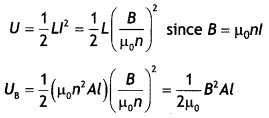
Class 12 Physics Important Questions Chapter 6 Electromagnetic Induction 31
The magnetic energy per unit volume is
UB = \(\frac{U_{B}}{V}=\frac{U_{B}}{A l}=\frac{B^{2}}{2 \mu_{0}}\)

Question 20.
Derive the expression for the self-inductance of a solenoid.
Answer:
Consider a uniformly wound solenoid with N turns and length l. Let the length of the solenoid be large as compared to its radius and let the core of the solenoid have air. Due to this, we can take the interior field uniform. Therefore the magnetic field in the interior of the solenoid is given by

B = μ0 n l = μ0 \(\frac{N}{l}\) l …(1)

where n is the number of turns per unit length. The flux through each turn is given by
Φm = B A = μ0 \(\frac{N A}{l}\) l …(2)

where A Is the area of cross-section of the solenoid. But
L = \(\frac{N \Phi_{\mathrm{m}}}{I}\) …(3)

Therefore from equations (2) and (3) we have
L = \(\frac{N \Phi_{m}}{l}=\frac{\mu_{0} N^{2} A}{l}\) ….(4)

This shows that L depends on the geometric factors and is proportional to the square of the number of turns. Since N N = n l, we can therefore express the above result as
L = µ0\(\frac{(n l)^{2}}{l}\)A = µ0 n2 A l …(5)

Question 21.
(a) State Faraday’s laws of electromagnetic Induction.
Answer:
Faraday’s Laws of electromagnetic induction
First law: Whenever the magnetic flux (inked with a circuit (or coil) changes, an emf is induced in the circuit. The induced emf Lasts so Long as the change in the magnetic flux continues.

Second law:
The magnitude of induced emf in the circuit (or coil) is directly proportional to the rate of change of magnetic flux linked with the circuit.
i.e. e = – \(\frac{d \phi}{d t}\)

(b) Derive an expression for the emf induced across the ends of a straight conductor of length I moving at right angles to a uniform magnetic field B with a uniform speedy.
Answer:
Let a conductor ab of Length l be placed in a magnetic field \(\vec{B}\) shown by (x) directed towards the reader. When the conductor moves with velocity v perpendicular to B, the force on any free electron of this conductor is given
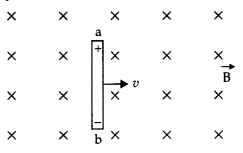
Class 12 Physics Important Questions Chapter 6 Electromagnetic Induction 32
F = e vB sin 90° = evß

When this electron moves across the Length of the conductor, the work done by the electron
W = F × l = evBl

After some time when all the free electrons are shifted towards the end b, the end b becomes negative and end a becomes positively charged.

Hence the net induced emf in the conductor
e = \(\frac{W}{q}=\frac{e v B l}{e}=v B l\)
e = Blv

(c) Obtain the expression for the magnetic energy stored in a solenoid in terms of the magnetic field B, area A and length I of the solenoid through which a current j is passed. (CBSE 2019C)
Answer:
Energy stored in an inductor Considers an inductor of inductance L. Let I will be instantaneous current in the inductor and dl/dt be the rate of growth of current.

Induced emf, E = L\(\frac{dl}{dt}\) (in magnitude)

If the source sends a charge dq in time dt, then
dq = ldt

Small amount of work done by the source
dW = edq = eldt = L\(\frac{dl}{dt}\). ldt
or
dW = Ll dl

Total work was done during the growth of current in an Inductor by the external source
W = ∫dW =L∫01 ldl
= L \(\left[\frac{l^{2}}{2}\right]_{0}=\frac{1}{2}\)Ll2
W = \(\frac{1}{2}\) Ll2 …(1)

This work done is stored in the form of magnetic energy.
In a solenoid,
L = μ0n2Al
And B = μ0nl
∴ l = \(\frac{B}{\mu_{0} n}\)

So Eq. (1) becomes
W = \(\frac{1}{2}\)μ0n2Al\(\left(\frac{B}{\mu_{0} n}\right)^{2}=\frac{B^{2} A l}{2 \mu_{0}}\)

Question 22.
(a) A metallic rod of length ‘l’ and resistance ‘R’ is rotated with a frequency ‘v’ with one end hinged at the centre and the other end at the circumference of a circular metallic ring of radius ‘l’, about an axis passing through the centre and perpendicular to the plane of the ring. A constant and uniform magnetic field ‘B’ parallel to the axis is present everywhere.
(i) Derive the expression for the induced emf and the current in the rod.
(ii) Due to the presence of current in the rod and of the magnetic field, find the expression for the magnitude and direction of the force acting on this rod.
(iii) Hence, obtain an expression for the power required to rotate the rod.
(b) A copper coil l is taken out of a magnetic field with a fixed velocity. Will it be easy to remove it from the same field if its ohmic resistance is increased?
OR
(a) A rectangular coil rotates in a uniform magnetic field. Obtain an expression for induced emf and current at any instant. Also find their peak values. Show the variation of induced emf versus angle of rotation (ωt) on a graph.
(b) An iron bar falling through the hollow region of a thick cylindrical shell made of copper experiences a retarding force. What can you conclude about the nature of the iron bar? Explain. (CBSEAI 2019)
Answer:
(a) (/) Let the rod moves from OP to OQ through a small sector of angle θ.
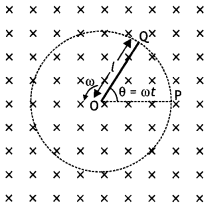
Class 12 Physics Important Questions Chapter 6 Electromagnetic Induction 33
The small area covered by the rod is
dA = πl2 × \(\frac{\theta}{2 \pi}=\frac{1}{2}\)l2θ

where L is the radius of the circle in which the rod rotates. Hence the induced emf is
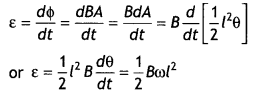
Class 12 Physics Important Questions Chapter 6 Electromagnetic Induction 34

Now induced current is given by
i = \(\frac{\varepsilon}{R}=\frac{B \omega l^{2}}{2 R}\)

(ii) \(\vec{F}=i(\vec{l} \times \vec{B})\)
F = \(\frac{l^{3} \omega B}{2 R}\)

Direction of \(\vec{F}\) is perpendicular to both \(\vec{i}\) and \(\vec{B}\),

(iii) P = i2R
= \(\left(\frac{B l^{2} \omega}{2 R}\right)^{2}\)R = \(\frac{B^{2} l^{4} \omega^{2}}{4 R}\)

(b) Yes, since induced current will reduce, it will be a little easier to remove the coil.
Or
(a) Consider an armature of the ac generator having n turns placed in a uniform magnetic field B.

Suppose at any instant t the normal to the plane of the coil makes an angle θ with the direction of the magnetic field. If ω is the uniform angular velocity with which the coil rotates then θ = ωt.

The flux through the loop is Φ = n BA cos Φ = n BA cos ω t
where n is the number of turns in the armature.

By Faraday’s flux rule,
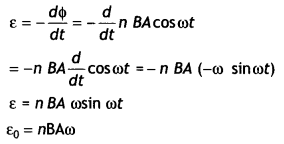
Class 12 Physics Important Questions Chapter 6 Electromagnetic Induction 35
Now,i0 = \(\frac{\varepsilon_{0}}{R}=\frac{n B A \omega}{R}\)

The graph is as shown.
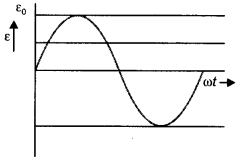
Class 12 Physics Important Questions Chapter 6 Electromagnetic Induction 36
(b) The bar is magnetic in nature. It experiences retardation in accordance with Lenz’s law.

Question 23.
State Lenz’s law. The energy f required to build up a steady current l, in a given coil, varies with l in the manner as shown. Calculate the self-inductance of the coil.
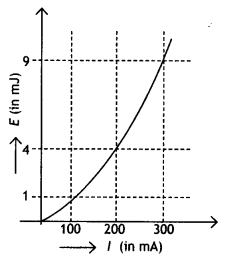
Class 12 Physics Important Questions Chapter 6 Electromagnetic Induction 37
A circular coil of radius r, is placed coaxially with another coil of radius R (R >> r) with the centre of the two coils coinciding with each other. Obtain an expression for the mutual inductance of the two coils.
Answer:
Lenz’s law states that the direction of induced emf is such that it opposes the cause of its production.
The energy stored in an inductor is given by the relation
E = – \(\frac{1}{2}\)Ll2

From the graph for a current of 200 mA the energy is 4 mJ, therefore self-inductance of the coil.
\(\frac{2 E}{l^{2}}\) = L
or
\(\frac{2 \times 4 \times 10^{-3}}{\left(200 \times 10^{-3}\right)^{2}}\) = 0.2 H
or
L = 200 mH

Consider the two coils of radius r and R placed coaxially, as shown in the figure.
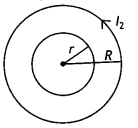
Class 12 Physics Important Questions Chapter 6 Electromagnetic Induction 38
Let n1 and n2 be the number of turns per unit length in them.

If a current l2 is passed through the outer coil, there will a magnetic field
Bo = μo n1 l1 produced in it.

The flux associated with the inner coil will undergo variation as the field B0 grows.
The effective magnetic flux
Φ1 = Bo × Aeff = \(\frac{\mu_{0} l_{2}}{2 R}\) × πr²

Therefore mutual inductance of the coils is
M = \(\frac{\phi_{1}}{l_{2}}=\frac{\mu_{0} \pi r^{2}}{2 R}\)

Question 24.
(a) Describe a simple experiment (or activity) to show that the polarity of emf induced in a coil is always such that it tends to produce a current which opposes the change of magnetic flux that produces it.
(b) The current flowing through an inductor of self-inductance L is continuously increasing. Plot a graph showing the variation of
(i) Magnetic flux versus the current
(ii) induced emf versus dl/dt
(iii) Magnetic potential energy stored versus the current. (CBSE Delhi 2014)
Answer:
(a) Consider a coil C connected to a galvanometer. When the North Pole of a bar magnet is pushed towards the coil, the pointer in the galvanometer deflects, indicating the presence of electric current in the coil. When the magnet is pulled away from the coil, the galvanometer shows deflection in the opposite direction, which indicates a reversal of the current’s direction.

We see that the North Pole of a bar magnet is being pushed towards the closed coil. As the North Pole of the bar magnet moves towards the coil, the magnetic flux through the coil increases. Hence current is induced in the coil in such a direction that it opposes the increase in flux.

This is possible only if the current in the coil is in a counter-clockwise direction with respect to an observer situated on the side of the magnet. Similarly, if the North Pole of the magnet is being withdrawn from the coil, the magnetic flux through the coil will decrease. To counter this decrease in magnetic flux, the induced current in the coil flows in a clockwise direction and the South Pole faces the receding North Pole of the bar magnet. This would result in an attractive force that opposes the motion of the magnet and the corresponding decrease in flux.

(b) The graphs are as shown.
(i) Φ = Ll
Therefore the graph is
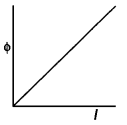
Class 12 Physics Important Questions Chapter 6 Electromagnetic Induction 39
(ii) ε = – L\(\frac{dl}{dt}\)
Therefore the graph is
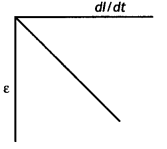
Class 12 Physics Important Questions Chapter 6 Electromagnetic Induction 40
(iii) U = \(\frac{1}{2}\)Ll2
Therefore the graph is
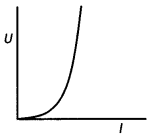
Class 12 Physics Important Questions Chapter 6 Electromagnetic Induction 41
Numerical Problems:

Formulae for solving numerical problems

  • Induced emf ε = –\(\frac{d \phi}{d t}\)
    or
    ε = \(\frac{-\left(\phi_{2}-\phi_{1}\right)}{t_{2}-t_{1}}\)
  • Emf induced in a rod of Length L is ε = Blv.
  • When a conducting rod of length L kept perpendicular to a uniform magnetic field B is rotated about one of its ends with uniform angular velocity, the emf induced between its ends has a magnitude
    \(\frac{1}{2}\)BωL2 = BπvL2.
  • When a current in a coil changes, it induces a back emf in the same coil. The self-induced emf is given by
    ε = – \(\frac{d \phi}{d t}\) = – L \(\frac{d l}{d t}\) inductance of the coil. It is a measure of the inertia of the coil against the change of current through it. Also Φ = L l
  • ε = – M\(\frac{d l}{d t}\) . Also Φ = Ml for mutual induction.
  • \(\frac{V_{s}}{V_{p}}=\frac{N_{s}}{N_{p}}=\frac{l_{p}}{l_{s}}\) = k.
  • Average power η = \(\frac{\varepsilon_{s} l_{s}}{\varepsilon_{p} l_{p}}\)

Question 1.
A square loop of side 10 cm with its sides parallel to X and Y axes is moved with a velocity of 8 cm s-1 in the positive X-direction containing a magnetic field in the positive Z-direction. The field is non-uniform and has a gradient of 10-3 T cm-1 along the negative X-direction (i.e. it increases by 10-3 T cm-1 as one move in the negative X-direction). Calculate the emf induced. (CBSE 2019C)
Answer:
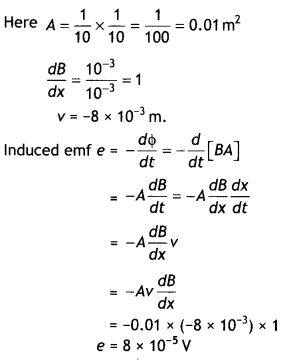
Class 12 Physics Important Questions Chapter 6 Electromagnetic Induction 42
Question 2.
In a ceiling fan, each blade rotates in a circle of radius 0.5 m. If the fan makes 2 rotations per second and the vertical component of the earth’s magnetic field is 8 × 10⁻⁵ T, calculate the emf induced between the inner and outer ends of each blade. (CBSE2019C)
Answer:
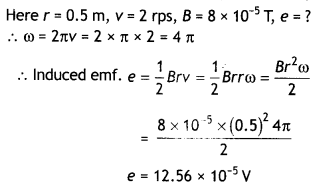
Class 12 Physics Important Questions Chapter 6 Electromagnetic Induction 43
Question 3.
A circular coil of radius 10 cm, 500 turns and resistance 2 Ω are placed with its plane perpendicular to the horizontal component of the earth’s magnetic field. It is rotated about its vertical diameter through 180° in 0.25 s. Estimate the magnitudes of the emf and the current induced in the coil. The horizontal component of the earth’s magnetic field at the place is 3.0 × 10⁻⁵ T. (NCERT)
Answer:
Initial flux through the coil
Φin = BA cos θ = 3.0 × 10⁻⁵ × π × 10-2 × cos 0°
= 3π × 10-7 Wb

Final flux after the rotation
Φf = BA cos θ = 3.0 × 10⁻⁵ × π × 10-2 × cos 180° = – 3π × 10-7 Wb

Therefore estimated value of induced emf is
ε = n\(\frac{d \phi}{d t}\) = 500 × (6π × 10-7)/ 0.25 = 3.8 × 10⁻³ V dt

Hence the current induced is
l = ε/R = 3.8 × 10⁻³ / 2 = 1.9 × 10⁻³ A

Question 4.
Kamla peddles a stationary bicycle. The pedals of the bicycle are attached to a 100 turn coil of area 0.10 m2. The coil rotates at half a revolution per second and is placed in a uniform magnetic field of 0.01 T perpendicular to the axis of rotation of the coil. What is the maximum voltage generated in the coil? (NCERT)
Answer:
Given n = 100, A = 0.10 m2, B = 0.01 T, f = 0.5 rps
Using the expression ε0 = nBAω

we have ε0 = 100 × 0.01 × 0.10 × 2 × 3.14 × 0.5 = 0.314 V

Question 5.
A rectangular wire loop of sides 8 cm and 2 cm with a small cut is moving out of a region of the uniform magnetic field of magnitude 0.3 T directed normal to the loop. What is the emf developed across the cut if the velocity of the loop is 1 cm s-1 in a direction normal to the (a) longer side, (b) shorter side of the loop? For how long does the induced voltage last in each case? (NCERT)
Answer:
Given L = 8 cm = 8 × 10⁻² m, b = 2 cm = 2 × 10⁻² m, 8 = 0.3 T, v = 1 cm s-1 = 0.01 m s-1 ε = ?
(a) Using the expression ε = B L v
ε = 0.3 × 8 × 10-2 × 0.01 = 2.4 × 10⁻⁴ V

This emf will last till the loop comes out of the magnetic field. Since the shorter side is moving out, therefore it will take 2 s to cover 2 cm with a velocity of 1 cm s-1.

(b) Using the expression e = B L v
ε = 0.3 × 2 × 10-2 × 0.01 = 0.6 × 10⁻⁴ V

This emf will last till the loop comes out of the magnetic field. Since the longer side is moving out, therefore it will take 8 s to cover 8 cm with a velocity of 1 cm s-1.

Question 6.
A 1.0 m long metallic rod is rotated with an angular frequency 400 rad s-1 about an axis normal to the rod passing through its one end. The other end of the rod is in contact with a circular metallic ring. A constant and uniform magnetic field of 0.5 T parallel to the axis exists everywhere. Calculate the emf developed between the centre and the ring. (NCERT)
Answer:
Given L = 1.0 m, ω = 400 rad s-1, B = 0.5 T,

ε = ? Using the relation ε = \(\frac{1}{2}\)BωL2

we have
ε = \(\frac{1}{2}\)0.5 × 400 × 12 =100 V

Question 7.
A circular coil of radius 8.0 cm and 20 turns is rotated about its vertical diameter with an angular speed of 50 rad s-1 in a uniform horizontal magnetic field of magnitude 3.0 × 10⁻² T. Obtain the maximum and average emf induced in the coil. If the coil forms a closed loop of resistance 10 Ω, calculate the maximum value of current in the coil. Calculate the average power loss due to Joule heating. Where does this power come from? (NCERT)
Answer:
Given r = 8.0 cm = 8.0 × 10⁻² m, n = 20, ω = 50 rad s-1 B = 3.0 × 10⁻² T, ε0 = ?, εa = ? R= 10 Ω l = ?, P = ?
Using the relation
ε0 = nBAω
= 20 × 3 × 10-2 × 3.14 × (8 × 10-2)2 × 50 = 0.603 V

The average induced emf is given by
εa = 0 over one cycle.

Also l0 = ε0 / R
= 0.603 / l0
= 0.0603 A

Now P = 1 /2 ε0 × l0 = 1 /2 × 0.603 × 0.0603
= 0.018 W

The induced current causes a torque opposing the rotation of the coil. An external agent (rotor) must supply torque to counter this torque in order to keep the coil rotating uniformly. Thus the source of the power dissipated as heat in the coil is the external rotor.

Question 8.
Current in a circuit falls from 5.0 A to 0. 0 A in 0.1 s. If an average emf of 200 V induced, give an estimate of the self-inductance of the circuit (NCERT)
Answer:
Given dl = 5.0 – 0.0 = 5.0 A, dt = 0.1 s, ε = 200 V, L = ?

Using the relation ε = – L \(\frac{dl}{dt}\)
or
L = \(\frac{\varepsilon}{d l / d t}\)

L = \(\frac{200}{5 / 0.1}=\frac{200 \times 0.1}{5}\) = 4 H

Question 9.
A pair of adjacent coils has a mutual inductance of 1.5 H. If the current in one coil changes from 0 to 20 A in 0.5 s, what is the change of flux linkage with the other coil? (NCERT)
Answer:
Given dl = 20- 0.0 = 20 A, dt = 0.5 s, ε = ?,
M = 1.5 H,
Using the relation ε = – \(\frac{d \phi}{d t}\) = -M\(\frac{dl}{dt}\)
or
dΦ = Mdl = 1.5 × 20 = 30 Wb

Question 10.
A jet plane is travelling towards the west at a speed of 1800 km h-1. What is the voltage difference developed between the ends of the wing having a span of 25 m, if the earth’s magnetic field at the location has a magnitude of 5 × 10⁻⁴ T and the dip angle is 30°? (NCERT)
Answer:
Given v= 1800 km h-1, ε = ?, L = 25 m,
B = 5 × 10⁻⁴ T, δ = 30°
Now vertical component of earth’s magnetic field is
BV = B × sin 30°
= 5 × 10-4 × 0.5
= 2.5 × 10⁻⁴T
Now using the expression ε = B L v
ε = 2.5 × 10-4 × 25 × 500 = 3.125 V

Question 11.
1 MW power is to be delivered from a power station to a town 10 km away. One uses a pair of Cu wires of a radius of 0.5 cm for this purpose. Calculate the fraction of ohmic losses to the power transmitted if
(a) power is transmitted at 220 V. Comment on the feasibility of doing this.
(b) a step-up transformer is used to boost the voltage to 11000 V, power transmitted, then a step-down transformer is used to bring the voltage to 220 V. ρcu = 1.7 × 10⁻⁸ SI unit. (NCERT Exemplar)
Answer:
Given P = 1 MW, 2L = 20 km = 2 × 10⁴ m, r = 0.5 cm = 0.5 × 10⁻² m
(a) Resistance of the Cu wire used
R = \(\frac{\rho L}{A}=\frac{1.7 \times 10^{-8} \times 2 \times 10^{4}}{\pi \times\left(0.5 \times 10^{-2}\right)^{2}}\) = 4 Ω

Now current at 220 V is

l = \(\frac{P}{V}=\frac{10^{6}}{220}\) = 0.45 × 10⁴ A

Therefore power loss
= l2R = (0.45 × 10⁴)2 × 4 = 106W

This is a huge loss; therefore this method is not feasible.

(b) Now P = Vl’ or
l’ = \(\frac{P}{V^{\prime}}=\frac{10^{6}}{11000}=\frac{1}{1.1}\) × 102 A

Hence power loss
= l’2R = \(\frac{1}{1.21}\) × 4 × 104 = 3.3 × 10⁴ W

Hence fraction of power loss
\(\frac{3.3 \times 10^{4}}{10^{6}}\) = 3.3%

CBSE Sample Papers for Class 10 Sanskrit Set 1 with Solutions

Students can access the CBSE Sample Papers for Class 10 Sanskrit with Solutions and marking scheme Set 1 will help students in understanding the difficulty level of the exam.

CBSE Sample Papers for Class 10 Sanskrit Set 1 with Solutions

समयः- होरात्रयम्
सम्पूर्णाङ्काः – 80

सामान्यनिर्देशाः

  • कृपया सम्यक्तया परीक्षणं कुर्वन्तु यत् अस्मिन् प्रश्नपत्रे 19 प्रश्नाः सन्ति।
  • उत्तरलेखनात् पूर्व प्रश्नस्य क्रमाङ्कः अवश्यं लेखनीयः।
  • अस्य प्रश्नपत्रस्य पठनाय 15 निमेषाः निर्धारिताः सन्ति। अस्मिन् अवधौ केवलं प्रश्नपत्रं पठनीयम् उत्तरपुस्तिकायां च किमपि न लेखनीयम्।

प्रश्नपत्रस्वरूपम्

‘अ’-भागः (बहुविकल्पात्मकः) 40 अङ्काः
‘आ’-भागः (वर्णनात्मकः) 40 अङ्काः

(i) अस्मिन् प्रश्नपत्रे द्वौ भागौ स्तः।
(ii) ‘अ’- भागः बहुविकल्पात्मकः अस्ति।
(iii) ‘आ’-भागः वर्णनात्मकः अस्ति।
(iv) प्रश्नसङ्ख्या प्रश्नपत्रानुसारम् अवश्यमेव लेखनीया।
(v) सर्वेषां प्रश्नानाम् उत्तराणि संस्कृतेन लेखनीयानि।
(vi) प्रश्नानां निर्देशाः ध्यानेन अवश्यं पठनीयाः।

‘अ’-भागः- बहुविकल्पात्मकाः प्रश्नाः (अङ्काः 40)

अनुप्रयुक्त-व्याकरणम् (अङ्काः 25)

प्रश्न 1.
अधोलिखितवाक्येषु रेखाङ्कितपदस्य सन्धिपदं सन्धिच्छेदपदं वा चिनुत-(केवलं प्रश्नचतुष्टयम्) (1 x 4 = 4)
(i) तन्नाम सर्वोच्चं वर्तते।
(क) तन् + नाम
(ख) तत् + नाम
(ग) तद् + नाम
उत्तर
(ख) तत् + नाम

(ii) वाक् + मयम् तपः।
(क) वाग्मयम्
(ख) वाङ्मयम्
(ग) वाकमयम्
उत्तर
(ख) वाङ्मयम्

(iii) सोऽपि पठितुम् वाञ्छति।
(क) सः + अपि
(ख) सो + अपि
(ग) सो + ऽपि
उत्तर
(क) सः + अपि

(iv) रामकथायां रामस्य यशः + गानम् वर्तते।।
(क) यशोऽगानम्
(ख) यशगानम्
(ग) यशो गानम्
उत्तर
(ग) यशो गानम्

(v) कशचौर : गृहं प्राविशत्।
(क) के + चौरम्
(ख) कम् + चौरः
(ग) कः + चौरः
उत्तर
(ग) कः + चौरः

प्रश्न 2.
अधोलिखितवाक्येषु रेखाङ्कितपदानां समासं विग्रहं वा प्रदत्तविकल्पेभ्यः चिनुत। (केवलं प्रश्नचतुष्टयम्) (1 x 4 = 4)
(i) भवान् सपरिवारम् मम गृहम् आगच्छतु।
(क) परिवार सहितम्
(ख) परिवार सहितम्
(ग) परिवारेण सहितम्
उत्तर
(ग) परिवारेण सहितम्

(ii) कार्य समापयितुं स शक्तिम् अनतिक्रम्य परिश्रमं करोति।
(क) यथाशक्तिः
(ख) यथाशक्ति
(ग) यथाशक्तिम्
उत्तर
(ख) यथाशक्ति

(iii) सुरभेः वचनम श्रुत्वा इन्द्रस्य हृदयमद्रवत्।
(क) सुरभीवचनम्
(ख) सुरभेवचनम्
(ग) सुरभिवचनम्
उत्तर
(ग) सुरभिवचनम्

(iv) सीतोर्मिले भगिन्यौ स्तः।
(क) सीता च उर्मिले
(ख) सीता च उर्मिला च
(ग) सीता उर्मिले च
उत्तर
(ख) सीता च उर्मिला च

(v) राजसिंहः नाम राजपुत्रः अवसत्।
(क) राज्ञे पुत्रः
(ख) राज्ञा पुत्रः
(ग) राज्ञः पुत्र
उत्तर
(ग) राज्ञः पुत्र

प्रश्न 3.
अधोलिखितवाक्येषु रेखाकिन्तपदानां प्रकृति-प्रत्ययौ संयोज्य विभन्य वा उचितम् उत्तरं विकल्पेभ्यः चिनुत। (केवलं प्रश्नचतुष्टयम्) (1 x 4 = 4)
(i) माता सदैव पूजनीय + टाप् अस्ति।
(क) पूजनीयः
(ख) पूजनीयम्
(ग) पूजनीया
उत्तर
(ग) पूजनीया

अथवा

पी.टी. उषा एका धावक + टाप् आसीत्।
(क) धावकः
(ख) धाविका
(ग) धाविकाः
उत्तर
(क) धावकः

(ii) वाक्पटुः धैर्य + मतुप् मंत्री सभायाम् अपि अकातरः।
(क) धैर्यवत्
(ख) धैर्यवान्
(ग) धैर्यवन्तः
उत्तर
(ख) धैर्यवान्

(iii) तदेव महात्मानः समत्वम् इति आहु।
(क) सम + त्व
(ख) समत् + त्व
(ग) सम् + त्वम्
उत्तर
(क) सम + त्व

(iv) विद्वांसः एव अस्मिन् लोके चुक्षष् + मतुप सन्ति।
(क) चक्षुःमन्तः
(ख) चक्षुमान्
(ग) चक्षुष्मन्तः
उत्तर
(ग) चक्षुष्मन्तः

प्रश्न 4.
वाच्यस्य नियमानुगुणम् उचितं विकल्पं चिनुत। (केवलं प्रश्नत्रयम्) (1 x 3 = 3)
(i) रमेशः – किम् अशोकः पाठं … ?
(क) पठसि
(ख) पठति
(ग) पठ्यते
उत्तर
(ख) पठति

(ii) सुधा – आम्! ……………. पाठः पठ्यते।
(क) अशोकेन
(ख) अशोकम्
(ग) अशोकः
उत्तर
(क) अशोकेन

(iii) रमेशः – किम् तेन ………….. नम्यते?
(क) अध्यापकम्
(ख) अध्यापकः
(ग) अध्यापको
उत्तर
(ख) अध्यापकः

(iv) सुधा – आम् ……………. अध्यापकम् नमति।
(क) ते
(ख) सः
(ग) तेन
उत्तर
(ख) सः

प्रश्न 5.
प्रदत्तेभ्यः विकल्पेभ्यः समुचितं कालबोधकशब्द चिनुत- (केवलं प्रश्नचतुष्टयम्) (1 x 4 = 4)
(i) मम भ्राता प्रातः (5.00) …. ………. वादने भ्रमणार्थं गच्छति।
(क) सार्ध-पञ्च
(ख) सपाद-पञ्च
(ग) पञ्च
उत्तर
(ग) पञ्च

(ii) अहम् प्रातः (8.30) ……………………… वादने कार्यालयं गच्छामि।
(क) सार्ध-अष्ट
(ख) सपाद-अष्ट
(ग) अष्ट
उत्तर
(क) सार्ध-अष्ट

(iii) तव भ्राता मध्याह्न (2.00) …………………. वादने विद्यालयात् आगच्छति।
(क) द्वि-सपाद
(ख) द्वि
(ग) त्रि
उत्तर
(ख) द्वि

(iv) मम जनकः (7.45) ……………… वादने गृहम् आगच्छति।
(क) पदोन-सप्त
(ख) सार्ध-अष्ट
(ग) पादोन-अष्ट
उत्तर
(ग) पादोन-अष्ट

(v) मम माता (8.15) …………… वादने पाकशालाम् गच्छति।
(क) पादोन-अष्ट
(ख) सपाद-अष्ट
(ग) सार्ध-अष्ट
उत्तर
(ख) सपाद-अष्ट

प्रश्न 6.
वाक्यानुगुणम् उचिताव्ययपदं चिनुत- (केवलं प्रश्नत्रयम्) (1 x 3 = 3)

(i) किं त्वम् ……………” वाराणसी गमिष्यसि?
(क) हयः
(ख) श्वः
(ग) पुरा
उत्तर
(ख) श्वः

(ii) ……. एव अहम् मातुलस्य गृहं गच्छामि।
(क) यावत्
(ख) यदा-कदा
(ग) तत्र
उत्तर
(ख) यदा-कदा

(iii) ……………..” अहं पाठं पठामि तावत् त्वम् अभ्यासं कुरु
(क) यावत्
(ख) यत्र
(ग) यदा
उत्तर
(क) यावत्

(iv) यत्र मम विद्यालयः “…………..” एव अहम् वसामि।
(क) तत्र
(ख) कुत्र
(ग) अत्र
उत्तर
(क) तत्र

प्रश्न 7.
अधोलिखितवाक्येषु रेखाङ्कितपदम् अशुद्धम् अस्ति। शुद्ध पदं विकल्पेभ्यः चिनुत- (केवलं प्रश्नत्रयम्) (1 x 3 = 3)
(i) गृहे अनेकानि अतिथयः आगच्छन्।
(क) अनेके
(ख) अनेकम्
(ग) अनेकाः
उत्तर
(क) अनेके

(ii) एतत् दृष्ट्वा बालकाः प्रसन्नाः अभवत्
(क) अभवताम्
(ख) अभवन्
(ग) अभवत
उत्तर
(ख) अभवन्

(iii) आवाम् नाटकम् द्रक्ष्यामि।
(क) वयम्
(ख) आवाम्
(ग) अहम्
उत्तर
(ग) अहम्

(iv) सा श्वः मम गृहम् आगच्छत्।।
(क) आगमिष्यामि
(ख) आगमिष्यति
(ग) आगच्छन्
उत्तर
(ख) आगमिष्यति

पठितावबोधनम् (अङ्काः 15)

प्रश्न 8.
रेखाङ्कितपदानि आधृत्य समुचितं प्रश्नवाचकपदं चिनुत। (केवलं प्रश्नपञ्चकम्) (1 x 5 = 5)

(i) कश्चन् धूर्तः शृगालः हसन् आह।
(क) कीदृशी
(ख) कीदृशः
(ग) कीदृशम्
उत्तर
(ख) कीदृशः

(ii) देउलाख्ये ग्रामे राजसिंहः वसति स्म।
(क) के
(ख) कस्मिन्/कुत्र
(ग) कः
उत्तर
(ख) कस्मिन्/कुत्र

(iii) गुणी गुणं वेत्ति।
(क) कः
(ख) को
(ग) का
उत्तर
(क) कः

(iv) कृषिवलः क्रुद्धः अभवत्।
(क) कः
(ख) कीदृशः
(ग) किम्
उत्तर
(क) कः

(v) सः भारवेदनया क्रन्दति स्म।
(क) का
(ख) किम्
(ग) कया
उत्तर
(ग) कया

(vi) पुत्रः पठनाय पाठशाला गच्छति।
(क) किमर्थम्
(ख) कुत्र
(ग) कय
उत्तर
(क) किमर्थम्

प्रश्न 9.
अधोलिखितवाक्येषु रेखाङ्कितपदानां प्रसङ्गानुकुलम् उचितार्थं चिनुत- (केवलं प्रश्नचतुष्टयम्) (1 x 4 = 4)

(i) अवक्रता चित्ते यथा।
(क) कर्णे
(ख) आत्मनि
(ग) मनसि
उत्तर
(ग) मनसि

(ii) इति एतद् विदुषाम् वचः
(क) कथितः
(ख) वचनम्
(ग) कार्यम्
उत्तर
(ख) वचनम्

(iii) व्याघ्रं दृष्ट्वा बुद्धिमती उवाच।
(क) अवलोक्य
(ख) पश्य
(ग) दृष्टताः
उत्तर
(क) अवलोक्य

(iv) कृषिवल: वृषभम् तुदति।
(क) अश्वम्
(ख) गर्दभम्
(ग) वलीवर्दम्
उत्तर
(ग) वलीवर्दम्

(v) आरक्षी चौरं न्यायालयं नीतवान्।
(क) सैनिकः
(ख) रक्षी
(ग) आरक्षक:
उत्तर
(ग) आरक्षक:

प्रश्न 10.
भाषिककार्यसम्बद्धानां प्रश्नानां समुचितम् उत्तरं विकल्पेभ्यः चिनुत-(केवलं प्रश्नषट्कम्) (1 x 6 = 6)
(i) “आलस्यं हि मनुष्याणां शरीस्थो महान् रिपुः” अत्र उद्यमम् पदस्य विपर्ययं किम्?
(क) महान्
(ख) रिपुः
(ग) आलस्यम्
उत्तर
(ग) आलस्यम्

(ii) “प्रविष्टः” इति क्रियापदस्य कर्तृपदं किम्?
(क) चौरः
(ख) गृहाभ्यन्तरः
(ग) तस्मिन्
उत्तर
(क) चौरः

(iii) “अहम् तु पुत्रं शोचामि” अत्र शोचामि क्रियापदस्य कर्तृपदं किम्?
(क) तु
(ख) पुत्रम्
(ग) अहम्
उत्तर
(ग) अहम्

(iv) “वायुमण्डलं भृशं दूषितम् नहि निर्मलजलं’ अत्र वायुमण्डलं पदस्य विशेषणं किम्?
(क) भृशम् दूषितम्
(ख) नहि
(ग) जलम्
उत्तर
(क) भृशम् दूषितम्

(v) अनृतम् पदम् वदसि चेत् काकः दशेत्-अत्र असत्यम् पदाय किम् पदं प्रयुक्तम्?
(क) असत्यम्
(ख) अनृतम्
(ग) नृतम्
उत्तर
(ख) अनृतम्

(vi) “तस्य पुच्छम् धुनोति” अत्र तस्य पदं कस्मै प्रयुक्तम्?
(क) पक्षिणे
(ख) सिंहाय
(ग) वानराय
उत्तर
(ख) सिंहाय

(vii) ‘निर्धनः जनः’ अत्र विशेष्यपदं किम्?
(क) निर्धनः
(ख) निधि
(ग) जनः
उत्तर
(ग) जनः

(viii) भाग्यवशात् इति पदस्य पर्यायपदं किम्?
(क) कार्यात्
(ख) दैवात्
(ग) परिश्रमात्
उत्तर
(ख) दैवात्

‘आ’-भागः – वर्णनात्मकाः प्रश्नाः (अङ्काः 40)

अपठितावबोधनम् (अङ्काः 10)

प्रश्न 11.
अधोलिखितं गद्यांशं पठित्वा प्रदत्तप्रश्नानाम् उत्तराणि संस्कृतेन लिखत।
एकस्मिन् ग्रामे मन्थरको नाम तन्तुवायः अवसत्। तन्तु संयोजनं कुर्वतः तस्य सर्वाणि उपकरणानि नष्टानि। अथ सः नवीनानि उपकरणानि निर्मातुं काष्ठानि प्राप्तुं वनगमच्छत्। तत्र एकम् विशाल वृक्षं दृष्ट्वा यावत् सः तस्योपरि कुठाराघातं कर्तुम् उद्यतोऽभवत् तावदेव तवृक्षवासी यक्षः अवदत्-“भो! अयं पादपः मम आश्रयः, एनं मा कर्तय। अहम् तव मनोकामना पूरयिष्यामि, अभीष्टं वरं प्रार्थय इति” एतत् श्रुत्वा तन्तुवायः स्वपत्नी प्रष्टुम् गृहमागच्छत्।

सा तम् अन्यत् बाहुयगलम् द्वितीयं च शिर याचितुम् प्रेरितवती येन सः पुरतः पृष्ठतः च पटान् निर्मातुं समर्थो भवेत्। ततः मन्थरक: वनं गत्वा यक्षं अन्यद् बाहु द्वितीयं शिरः याचितवान्। यक्ष अपि तस्मै तादृशम् वरम् दत्तवान्। अनन्तरम् यावत् सः चतुर्भुजः द्विशिरः भूत्वा गृहमागतवान् तावत् सर्वे तम् राक्षसमत्वा तस्य वधम् अकुर्वन्।

(अ) एकपदेन उत्तरत। (केवलं प्रश्नद्वयम्) (1 × 2 = 2)

(i) तन्तुवायः कुत्र अवसत्?
(ii) तन्तुवायः काम् प्रष्टुम् गृहम् आगच्छत्?
(iii) सर्वे किम् मत्वा मन्थरकस्य वधम् अकुर्वन्?
उत्तर
(i) एकस्मिन् ग्रामे
(ii) स्वपत्नीम्
(iii) राक्षसम्

(आ) पूर्णवाक्येन उत्तरत। (केवल प्रश्नद्वयम्) (2 × 2 = 4)

(i) मन्थरक: किमर्थम् वनम् अगच्छत्?
(ii) वृक्षवासी यक्षः तन्तुवायम् किम् अवदत्?
(iii) तन्तुवायस्य पत्नी तन्तुवायम् किम् याचितुं प्रेरितवती?
उत्तर
(i) सः नवीनानि उपकरणानि निर्मातुं काष्ठानि प्राप्तुं वनं अगच्छत्।।
(ii) वृक्षवासी यक्षः अवदत् भो अयं पादपः ………… एनं या कर्तय।
(iii) तन्तुवायस्य भार्या अन्यत् ………………… प्रेरितवती।

(इ) अस्य अनुच्छेदस्य कृते उपयुक्तं शीर्षकं संस्कृतेन लिखत। (1)
उत्तर
मूर्खः तन्तुवाय:/मूर्खा भार्या/सहसा क्रियां न विदधीत/लोभस्य परिणामः

(ई) यथानिर्देशम् उत्तरत्-(केवलं प्रश्नत्रयम्) (1 ×3 = 3)

(i) तस्य सर्वाणि उपकरणानि नष्टानि। अत्र विशेष्यपदं किम्?
(क) नष्टानि
(ख) उपकरणानि
(ग) सर्वाणि
उत्तर
(i) उपकरणानि

(ii) सा तम् अन्यत् बाहुयुगलम् … अत्र सा पदम् कस्यै प्रयुक्तम्?
(क) यक्षाय
(ख) तन्तुवायाय
(ग) पत्न्यै
उत्तर
(ग) पत्न्यै

(iii) “यक्षः अपि तस्मै तादृशं वरं दत्तवान्” दत्तवान् क्रियापदस्य कर्तृपदं किम्?
(क) तस्मै
(ख) यक्षः
(ग) वरम्
उत्तर
(ख) यक्षः

(iv) “सः पुरतः पृष्ठतः च पटान् निर्मातुम्” अत्र पटान् इति पदस्य कः अर्थः?
(क) वस्त्राणि
(ख) काष्ठानि
(ग) यन्त्राणि
उत्तर
(क) वस्त्राणि

रचनात्मक कार्यम् (अङ्काः 15)

प्रश्न 12.
पितामहं प्रति लिखिते पत्रे रिक्तस्थानानि पूरयित्वा पत्रं च पुनः उत्तरपुस्तिकायां लिखतु। छात्रावासतः पूरमपूज्याः पितामहमहोदया:! श्रीमत्-चरणकमलेषु सविनयं प्रणामाः भवतां पत्रं गतदिने मया (i) …………….. पत्रं लब्ध्वा पठित्वा च महान् (ii) …………. जातः। अत्र भवत्कृपया अहं सर्वथा कुशली (iii) ………… अस्मि। अध्ययनम् अपि मम (iv) ………….. प्रचलित। अहं प्रथमश्रेण्याम् उत्तीर्णः इति (v) ………… ज्ञात्वा भवता महती प्रसन्नता प्रकटीकृता पत्रे। परं इदं भवच्चरणकमलयोः एव कृपया फलं वर्तते। (vi) …………… शुभाशीर्वचनैश्च अहं पुनरपि परीक्षासु प्रथमश्रेणी (vii) …………. । काले-काले पत्रप्रदानेन (viii) …………….. मार्गदर्शनेने (ix) ……………… दोषाणाम् निरूपणेन च अहं (x) …………….. अनुग्राह्यः इति पुनः प्रणतिपूर्वकं प्रणामाः। (1/2 × 10 = 5)
उत्तर
(i) प्राप्तम्
(ii) प्रमोदो
(iii) सानन्दश्च
(iv) सम्यक्
(v) समाचारम्
(vi) शुभाशीर्वादैः
(vii) प्राप्स्यामि
(viii) भवताम्
(ix) मम
(x) सर्वदा

भवदङ्कपालितः पौत्रः
कखग मञ्जूषा- सर्वदा, शुभाशीर्वादैः, प्राप्स्यामि, मम, प्रमोदो, समाचार प्राप्तम्, भवताम्, सम्यक्, सानन्दश्च

प्रश्न 13.
प्रदत्तं चित्रं दृष्ट्वा मञ्जूषायां प्रदत्तशब्दानां सहायतया पञ्च वाक्यानि संस्कृतेन लिखत- (1 x 5 = 5)
CBSE Sample Papers for Class 10 Sanskrit Set 1 with Solutions 1
मञ्जूषा- छात्राः, क्षेत्रे, वृक्षारोपणम्, वनमहोत्सवः पर्यावरणम्, शिक्षकैः, पादपानाम्, रोपणम्, पादपान्, उत्साहपूर्वकम् अनेके वृक्षाः, विशालम्
उत्तर
(1) अस्मिन् चित्रे वनमहोत्सवस्य दृश्यम् अस्ति।
(2) विद्यालयस्य प्राङ्गणे छात्राः वृक्षारोपणम् कुर्वन्ति
(3) पादपान् रोपयित्वा एका बालिका पर्यावरणगीतं गायति।
(4) सर्वे छात्राः उत्साहपूर्वकं वनमहोत्सवम् आचरन्ति।
(5) क्षेत्रे अनेके हरिताः वृक्षाः सन्ति।

अथवा

मञ्जूषा – प्रदत्तशब्दानां साहाय्येन निम्नलिखितं विषयम् अधिकृत्य पञ्चभिः संस्कृतवाक्यैः एकम् अनुच्छेदं लिखत
मञ्जूषा- प्रतिदिनं, सर्वोत्तम् धनम्, सूर्योदयः, संतुलित आहारः, नियमित व्यायामः, स्वास्थ्य, स्वास्थ्यवर्धक, प्राक् ,प्रश्नपत्रम्
उत्तर
(1) स्वास्थ्यम् स्वस्थजीवनस्य आधारस्तम्भः अस्ति।
(2) स्वास्थ्यस्य रक्षायै स्वास्थ्यसंबंधी नियमान् पालयेयुः।
(3) प्रतिदिनं प्रात: व्यायाम कुर्यात्।
(4) सन्तुलितं भोजनं कुर्यात्।
(5) सर्वेषु धनेषु स्वास्थ्यमेव सर्वोत्तमं धनम् अस्ति।

प्रश्न 14.
अधोलिखितानि वाक्यानि संस्कृतभाषया अनूद्य लिखत-(केवलं वाक्यपञ्चकम्) (1 x 5 = 5)
(i) भारत नदियों का देश है। (India is country of Rivers.)
(ii) अरुणाचल प्रदेश की राजधानी इटानगर है। (Capital of Aurmchal Pradesh is Itanagar.)
(iii) सदाचार मनुष्य का पहला धर्म होना चाहिए। (Virtue should be Man’s first religion.)
(iv) सज्जन व्यक्ति सदैव परोपकार करते हैं। (Gentleman always do charity.)
(v) माता और पिता अपने बच्चों का मार्गदर्शन करते है। (Parents always guide their children.)
(vi) जीवन में एक ही लक्ष्य होना चाहिए। (There should be only one goal in life.)
(vii) पिता के साथ पुत्र जाता है। (Son goes with Father.)
उत्तर
(i) भारतम् नदीनाम् देशः अस्ति।
(ii) अरुणाचलप्रदेशस्य राजधानी इटानगरम् अस्ति।
(iii) सदाचारः मनुष्याणां प्रथम धर्मः भवेत्।
(vi) सज्जनाः सदैव परोपकारं कुर्वन्ति।
(v) पितरौ स्वसन्तते:/शिशूनाम् मार्गदर्शनं कुरुतः ।
(vi) जीवने एकमेव लक्ष्यं भवेत्।
(vii) पित्रेण सह पिता गच्छति।

पठितावबोधनम् (अङ्काः 15)

प्रश्न 15.
अधोलिखितं गद्यांशं पठित्वा प्रदत्तप्रश्नानाम् उत्तराणि संस्कृतेन लिखत। (3)
विचित्रा दैवगतिः। तस्यामेव रात्रौ तस्मिन् गृहे कश्चन् चौरः गृहाभ्यन्तरं प्रविष्टः। तत्र निहितामेकां मञ्जूषाम् आदाय पलायितः। चौरस्य पादध्वनिना प्रबुद्धोऽतिथिः चौरशङ्कया तमन्वधावत् अगृहणाच्च, परं विचित्रमघटत। चौरः एव उच्चैः क्रोशितुमारभत “चौरोऽयं चौरोऽयम्” इति। तस्य तारस्वरेण प्रबुद्धाः ग्रामवासिनः स्वगृहाद् निष्क्रम्य तत्रागच्छन् वराकमतिथिमेव च चौरं मत्वाऽभर्त्सयन्। यद्यपि ग्रामस्य आरक्षी एव चौर आसीत्। तत्क्षणमेव रक्षापुरुषः तम् अतिथिम् चौरोऽयम् इति प्रख्याप्य कारागृहे प्राक्षितपत्।

(अ) एकपदेन उत्तरत। (केवलं प्रश्नद्वयम्) (1/2 × 2 = 1)

(i) दैवगतिः कीदृशी:?
(ii) गृहाभ्यन्तरं कः प्रविष्ट:?
(iii) अतिथिः केन प्रबुद्ध?
उत्तर
(i) विचित्रा
(ii) चौरः
(iii) पादध्वनिना

(आ) पूर्णवाक्येन उत्तरत। (केवल प्रश्नद्वयम्) (1 × 2 = 2)

(i) ग्रामवासिनः किम् अकुर्वन्?
(ii) रक्षापुरुषः किम् अकरोत्?
(iii) चौरः किम् आदाय पलायितः?
उत्तर
(i) गृहवासिनः स्वगृहाद् ………………… मत्वा अभय॑न्।
(i) रक्षापुरुषः अतिथिम् ………………… अक्षिपत्।
(iii) गृहे स्थितामेकाम् ………………. पलायितः।

प्रश्न 16.
अधोलिखितं पद्यांशं पठित्वा प्रदत्तप्रश्नानाम् उत्तराणि संस्कृतेन लिखत (3)
विनिपातो न वः कश्चिद् दृश्यते त्रिदशाधिपः।
अहं तु पुत्रं शोचामि, तेन रोदिमि कौशकि!।।

(अ) एकपदेन उत्तरत। (केवलं प्रश्नद्वयम्) (1/2 × 2 = 1)

(i) कौशिक! पदं कस्मै प्रयुक्तम्?
(ii) त्रिदशाधिपः कः अस्ति?
(iii) वृषभस्य कः न दृश्यते?
उत्तर
(i) इन्द्राय
(ii) इन्द्रः
(iii) विनिपातः

(आ) पूर्णवाक्येन उत्तरत। (केवलं प्रश्नद्वयम्) (1 × 2 = 2)

(i) सुरभिः पुत्रस्य चिन्तां कृत्वा किमर्थम् रोदिति?
(ii) सुरभिः इन्द्रम् किम्-किम् कथयित्वा सम्बोधयति?
(iii) सुरभेः चिन्तायाः कारणम् किम् अस्ति?
उत्तर
(i) सुरभि चिन्तयति ………………… दृश्यते।
(ii) कौशिकः च त्रिदशाधिपः ……………. सम्बोधयति।
(iii) सुरभेः पुत्रस्य कोऽपि सहायकः न अस्ति इति सुरभेः चिन्तायाः कारणम्।

प्रश्न 17.
अधोलिखितं नाट्यांशं पठित्वा प्रदत्तानां प्रश्नानाम् उत्तराणि संस्कृतेन लिखता
काकः रे परभृत! अहं यदि तव संततिं न पालयामि तर्हि कुत्र स्युः पिकाः? अतः अहम् एव करुणापरः पक्षिसम्राट् काकः। (3)

गजः समीपतः एवागच्छन् अरे! सर्वां वार्ता शृण्वन्नेवाहम् अत्रागच्छम्। अहं विशालकायः, बलशाली, पराक्रमी च। सिंहः वा स्यात् अथवा अन्यः कोऽपि। वन्यपशून् तु तुदन्तं जन्तुमहं स्वशुण्डेन पोथयित्वा मारयिष्यामि। किमन्यः कोऽप्यस्ति एतादृशः पराक्रमी। अतः अहम् एव योग्यः वनराजः।

वानरः अरे! अरे! एवं (शीघ्रमेव गजस्यापि पुच्छं विधूय वृक्षोपरि आरोहति)

(अ) एकपदेन उत्तरत। (केवल प्रश्नद्वयम्) (1/2 × 2 = 1)

(i) काकः कम् “रे परिभृत्!” इति कथयति?
(ii) काकः कस्य सन्ततिं पालयति?
(iii) कः विशालकायः बलशाली च?
उत्तर
(i) पिकम्
(ii) पिकस्य
(iii) गजः

(आ) पूर्णवाक्य में उत्तरत। (केवल प्रश्नद्वयम्) (1 × 2 = 2)

(i) गजः आत्मनः विषये किं कथयति?
(ii) काकः आत्मनः विषये किं कथयति?
(iii) गजः कदा वन्यपशून् मारयिष्यति?
उत्तर
(i) अहम् विशालकायः ……………. मारयिष्यामि।
(ii) रे परिभृत! …………… पक्षीसम्राट् काकः।
(iii) वन्य पशून तु तदुन्तं जन्तुम् अहम् …………….. मारयिष्यामि।

प्रश्न 18.
मञ्जूषातः समुचितपदानि चित्वा अधोलिखित-श्लोकस्य अन्वयं पूरयत (1/2 × 4 = 2)
श्लोकः- आलस्यं हि मनुष्याणाम् शरीरस्थो महान् रिपुः।
नास्त्युद्यमसमो बन्धुः कृत्वाः यं नावसीदति।।।

अन्वयः- मनुष्याणाम्
(i) …………………. महान् शत्रुः
(ii) ……………… उद्यमसमः
(iii) …………………. न अस्ति यं
(iv) ……………… (नरः) न अवसीदति। मञ्जूषा- कृत्वा, शरीरस्थः, बन्धुः, आलस्यम्
उत्तर
(i) शरीरस्थः
(ii) आलस्यम्
(iii) बन्धुः
(iv) कुत्वा

अथवा

मञ्जूषायाः साहाय्येन श्लोकस्यभावार्थे रिक्तस्थानानि पूरयित्वा पुनः लिखत।

श्लोकः- यः इच्छत्यात्मनः श्रेयः प्रभूतानि सुखानि च।
न कुर्यादहितं कर्म स परेभ्यः कदापि च।।

भावार्थ:- अस्य श्लोकस्य भावः अस्ति यत् यदि नरः आत्मनः कृते
(i) ………………. बहूनि
(ii) ……….. वाञ्छति सम्मानं च वाञ्छति तर्हि तेन
(iii) ……….. जनेभ्यः
(iv) ……….. कर्म कदापि न कर्तव्यम्।
मञ्जूषा- परेभ्यः, अहितकर, सुखानि, कल्याणं
उत्तर
(i) कल्याणम्
(ii) सुखानि
(iii) परेभ्यः
(iv) अहितकरम्

प्रश्न 19.
अधोलिखित-कथांशं समुचितक्रमेण लिखत। (1/2 x 8 = 4)
(i) एकः कृषकः आसीत्।
(ii) कृषकः तम् दुर्बलम् वृषभ तोदनेन अवर्तत।
(iii) कृषीवलः क्रुद्धः अवभवत्।
(iv) सः जवेन गन्तुम् अशक्तः च आसीत्
(v) तस्य समीपे बलीवौ आस्ताम
(vi) तमुत्थापयितुम् बहुवारं यत्नमकरोत् तथापि सः नोत्थितः।
(vii) सः ऋषभः हलमूढ्वा गन्तुम् अशक्तः क्षेत्रे पपात्।
(viii) तयोः बलीवर्दयोः एकः शरीरेण दुर्बलः आसीत्।
उत्तर
(i) एकः कृषकः आसीत्।
(ii) तस्य समीपे बलीवौ आस्ताम्।
(iii) तयो बलीवर्दयोः एकः शरीरेण दुर्बलः आसीत्।
(iv) सः जवेन गन्तुम् अशक्तः च आसीत्।
(v) कृषकः तम् दुर्बलम् वृषभम् तोदनेन अवर्तत।
(vi) सः ऋषभः हलमूढवा गन्तुम् …….
(vii) कृषीवल क्रुद्धः अभवत्।।
(viii) तमुत्थापयितुम् बहुवारं

CBSE Sample Papers for Class 10 Hindi Course B Set 5 for Practice

Students can access the CBSE Sample Papers for Class 10 Hindi with Solutions and marking scheme Course B Set 5 will help students in understanding the difficulty level of the exam.

CBSE Sample Papers for Class 10 Hindi Course B Set 5 for Practice

निर्धारित समय : 3 घंटे
अधिकतम अंक : 80

सामान्य निर्देश:
(क) इस प्रश्न-पत्र के दो खंड हैं- ‘अ’ और ‘ब’।
(ख) खंड ‘अ’ में कुल 10 वस्तुपरक प्रश्न पूछे गए हैं। सभी प्रश्नों में उपप्रश्न दिए गए हैं। दिए गए निर्देशों का पालन करते हुए प्रश्नों के उत्तर दीजिए।
(ग) खंड ‘ब’ में कुल 7 वर्णनात्मक प्रश्न पूछे गए हैं। प्रश्नों में आंतरिक विकल्प दिए गए हैं। दिए गए निर्देशों का पालन करते हुए प्रश्नों के उत्तर दीजिए।

खंड ‘अ’- वस्तुपरक प्रश्न (अंक 40)

अपठित गद्यांश (अंक 10)

प्रश्न 1.
नीचे दो गद्यांश दिए गए हैं किसी एक गद्यांश को ध्यानपूर्वक पढ़िए और उस पर आधारित प्रश्नों के उत्तर दीजिए। (5 x 1 =5)
सफलता के लिए धैर्य और विश्वास भी परम आवश्यक है, क्योंकि कभी-कभी सफलता या सुपरिणाम में कुछ विलंब भी हो जाता है, लेकिन ऐसी स्थिति में धैर्य एवं आत्मविश्वास का दामन थामे रहना चाहिए। ऐसे अनेक उदाहरण दिए जा सकते हैं जब व्यक्ति के आत्मविश्वास ने उसे कहाँ से कहाँ पहुँचा दिया। स्कॉटलैंड का राजा रॉबर्ट ब्रूस शत्रुओं से परास्त होकर एक गुफा में छुपा हुआ था कि उसने एक मकड़ी को अपने जाले के पतले तार के सहारे ऊपर चढ़ते देखा।

मकड़ी ऊपर चढ़ने का प्रयास करती और बार-बार गिर पड़ती। उसने सात बार प्रयास किया मगर अपना धैर्य, आत्मविश्वास और उत्साह न छोड़ा। परिणाम यह हुआ कि आठवीं बार वह चढ़ने में सफल हो ही गई। रॉबर्ट ब्रूस के सोए आत्मविश्वास को इस छोटी-सी घटना ने झिंझोड़कर रख दिया। आत्मविश्वास से युक्त होकर उसने शत्रु पर हमला किया और सफलता प्राप्त की। राइट बंधु न जाने कितने वर्षों तक वायुयान बनाने में लगे रहे और अंत में उनका आत्मविश्वास रंग लाया और उन्होंने वायुयान बना दिया। मैडम क्यूरी अपने आत्मविश्वास के बल पर ही अनेक वर्षों के बाद, अपने अथक परिश्रम से रेडियम का आविष्कार करने में सफल हुई थीं।

अपने आत्मविश्वास के बल पर ही शिवाजी ने अपने थोड़े से मराठा सैनिकों को लेकर औरंगजेब की विशाल सेना को तितर-बितर कर दिया था। इस संसार में जो भी व्यक्ति हिम्मत हार जाता है, वहीं का वहीं रह जाता है। सफलता उससे कोसों दूर भागती है। एकलव्य का उदाहरण देखिए।

जब गुरु द्रोणाचार्य ने उसे शस्त्र विद्या सिखाने से मना कर दिया तब भी उसने हिम्मत न हारी और गुरु की एक मूर्ति बनाकर उसी के सामने शस्त्र-अभ्यास करना प्रारंभ किया और एक दिन अपनी योग्यता से स्वयं गुरु द्रोण को विस्मित कर दिया। आत्मविश्वास, स्वावलंबन, दृढ़ता आदि गुणों के बल पर ही कोलंबस तथा वास्को-डि-गामा जैसे व्यक्ति नए-नए द्वीप खोज पाए।

(i) जब सफलता या सुपरिणाम में विलंब हो जाए तब मनुष्य को क्या करना चाहिए?
(क) संघर्ष करना चाहिए
(ख) कार्य करने की शक्ति बढ़ा देनी चाहिए
(ग) धैर्य और आत्मविश्वास बनाए रखना चाहिए
(घ) सफलता न मिल पाने के कारणों का पता लगाना चाहिए
उत्तर
(ग) धैर्य और आत्मविश्वास बनाए रखना चाहिए

(ii) रॉबर्ट ब्रूस का आत्मविश्वास पुनर्जीवित कैसे हुआ?
(क) उसके मंत्रियों ने उसकी हिम्मत बढ़ाई
(ख) उसके मित्रों ने उसे फिर से युद्ध के लिए प्रेरित किया
(ग) मकड़ी के संघर्ष ने उसे लड़ने की हिम्मत दी
(घ) उपर्युक्त सभी
उत्तर
(ग) मकड़ी के संघर्ष ने उसे लड़ने की हिम्मत दी

(iii) आत्मविश्वास को बनाए रखने के लिए लेखक ने निम्नलिखित में से कौन-सा उदाहरण नहीं दिया?
(क) रॉबर्ट ब्रूस तथा मकड़ी के जाले पर चढ़ने की घटना
(ख) राइट बंधु तथा वायुयान बनाने की घटना
(ग) मैडम क्यूरी द्वारा रेडियम का आविष्कार
(घ) अल्बर्ट आइन्स्टीन का आविष्कार
उत्तर
(घ) अल्बर्ट आइन्स्टीन का आविष्कार

(iv) शिवाजी ने किसे हराया था?
(क) औरंगजेब को
(ख) अकबर को
(ग) शाहजहाँ को
(घ) बाबर को
उत्तर
(क) औरंगजेब को

(v) गद्यांश का उपयुक्त शीर्षक हो सकता है
(क) संघर्ष और असफलता
(ख) सफलता का मार्ग
(ग) सफलता
(घ) परिक्षम
उत्तर
(क) संघर्ष और असफलता

अथवा

पर्यावरण की समृद्धि और स्वस्थ होने से ही हमारा जीवन भी समृद्ध और सुखी होता है। हमारे पूर्वज प्रकृति की दैवीय शक्ति के रूप में उपासना करते थे, उसे परमेश्वरी भी कहते थे। उन्होंने पर्यावरण का बहुत गहरा चिंतन किया। जो कुछ पर्यावरण के लिए हानिकारक था, उसे आसुरी प्रवृत्ति कहा और जो हितकर था, उसे दैवीय प्रवृत्ति कहा। भारत के पुराने ग्रंथों में वृक्षों और वनों का चित्रण पृथ्वी के रक्षक के रूप में किया गया है।

उनको संतान की तरह पाला जाता था और हरे-भरे पेड़ों को अपने किसी स्वार्थ के लिए काटना पाप कहा जाता था। अनावश्यक रूप से पेड़ों को काटने पर दंड का विधान भी था। मनुष्य समझता है कि समस्त प्राकृतिक संपदा पर केवल उसी का आधिपत्य है। हम जैसा चाहें उसका उपयोग करें। इसी भोगवादी प्रवृत्ति के कारण मानव ने उसका इस हद तक शोषण कर लिया है कि अब उसका अस्तित्व ही संकट में पड़ गया है।

वैज्ञानिक बार-बार चेतावनी दे रहे हैं कि प्रकृति और पर्यावरण की रक्षा करो, अन्यथा मानव जाति नहीं बच पाएगी। इन जीवन-उपयोगी वृक्षों की देवी-देवता की तरह पूजा की जाती है। पर्यावरण की दृष्टि से वृक्ष को परम रक्षक और मित्र बताया गया है। यह हमें अमृत प्रदान करता है, दूषित वायु को स्वयं ग्रहण करके हमें प्राणवायु देता है, मरुस्थल का नियंत्रक होता है, नदियों की बाढ़ को रोकता है और जलवायु को स्वच्छ बनाता है। इसलिए हमें वृक्ष-मित्र होकर जीवन-यापन करना चाहिए।

(i) पर्यावरण से जुड़ा है
(क) पुराने ग्रंथों का संबंध
(ख) मानव-जीवन की समृद्धि
(ग) प्राकृतिक दोहन
(घ) प्रकृति का चित्रण
उत्तर
(ख) मानव-जीवन की समृद्धि

(ii) पर्यावरण प्रदूषण का कारण है कि मनुष्य
(क) प्राकृतिक संरक्षण
(ख) जीवन की सुखमयता
(ग) प्रकृति पर अधिकार
(घ) प्राकृतिक दोहन
उत्तर
(घ) प्राकृतिक दोहन

(iii) आसुरी’ का आशय है
(क) हानिकारक
(ख) राक्षसी
(ग) पर्यावरण के लिए अहितकर
(घ) मानवता की विनाशक
उत्तर
(ख) राक्षसी

(iv) वृक्षों को सच्चा मित्र मानने का कारण क्या है?
(क) दूषित वायु हटाकर प्राणवायु देता है
(ख) कार्बन डाइ-ऑक्साइड छोड़ता है
(ग) मानसिक रोगों से रक्षा करता है।
(घ) इनमें से कोई नहीं
उत्तर
(क) दूषित वायु हटाकर प्राणवायु देता है

(v) गद्यांश का उपयुक्त शीर्षक हो सकता है
(क) पेड़ फलदायक है
(ख) पेड़ हमारे मित्र
(ग) प्राकृतिक संपदा
(घ) मानव का स्वार्थ
उत्तर
(ख) पेड़ हमारे मित्र

प्रश्न 2.
नीचे दो गद्यांश दिए गए हैं किसी एक गद्यांश को ध्यानपूर्वक पढ़िए और उस पर आधारित प्रश्नों के उत्तर दीजिए। (5 x 1 = 5)

खेल से मन-मस्तिष्क का विकास होता है। खेल के मैदान की मित्रता और भाईचारे का जवाब नहीं। खेल-भावना हमें जीत की खुशी और हार के दुख से ऊपर उठाकर समरसता की ओर ले जाती है। यही समरसता व्यक्ति को जीवन में समुन्नत और सफल बनाती है। खेल अनुशासन, संगठन, पारस्परिक सहयोग, साहस, विश्वास, आज्ञाकारिता, सहानुभूति, समरसता आदि गुणों का विकास करके हमें देश का सभ्य तथा सुसंस्कृत नागरिक बनाते हैं।

खेल हमारे अंदर निर्णय लेने की शक्ति का विकास करते हैं। ऐसा कौन-सा गुण है जो हमें खेल से प्राप्त नहीं होता। ‘वाटर लू’ की विजय का रहस्य समझाते हुए एक अंग्रेज़ ने कहा था-“विद्यार्थी जीवन में खेल की भावना से प्रशिक्षित होकर ही ‘एटन’ के मैदान में अंग्रेजों ने नेपोलियन को ‘वाटर लू’ के युद्ध में पराजित किया था।” आज के इस युग

में तो खेलों का महत्व और अधिक बढ़ गया है। आज बहुत बड़ी आवश्यकता इस बात की है कि संसार के विभिन्न देश अपने-अपने मतभेदों को भुलाकर प्रेम और शांति से रहें। खेल इसमें अपनी मुख्य भूमिका निभाता है। समय-समय पर आयोजित एशियाई खेल या यूरोपीय खेल या ओलंपिक खेल-कूद का इस दृष्टि से बहुत महत्व है। सभी देशों के हजारों लोग आपस में मिल बैठते हैं। भाषा, रंग, जाति, धर्म आदि की संकीर्ण मर्यादाएँ यहाँ आकर टूट जाती हैं।

(i) खेल से विकास होता है
(क) शरीर का
(ख) मन और मस्तिष्क का
(ग) शारीरिक अंगों का
(घ) बुद्धि का
उत्तर
(घ) बुद्धि का

(ii) खेलों से निम्नलिखित में से कौन-सा गुण विकसित नहीं होता?
(क) अनुशासन एवं पारस्परिक सहयोग सिखाते हैं।
(ख) आज्ञाकारिता की भावना और आत्मविश्वास पैदा करते हैं।
(ग) परस्पर दुश्मनी और वैमनस्य पैदा करते हैं।
(घ) संगठन की भावना तथा समरसता के गुणों का विकास करते हैं।
उत्तर
(ग) परस्पर दुश्मनी और वैमनस्य पैदा करते हैं।

(iii) अंग्रेज़ों ने वाटर लू के युद्ध में नेपोलियन को कैसे पराजित किया था?
(क) बहुत बड़ी सेना लेकर
(ख) सैनिक शिक्षा से प्रशिक्षित होकर
(ग) विद्यार्थी जीवन में खेल भावना से प्रशिक्षित होकर
(घ) नेपोलियन की कमजोरियों को पहचान कर
उत्तर
(ग) विद्यार्थी जीवन में खेल भावना से प्रशिक्षित होकर

(iv) अंतर्राष्ट्रीय स्तर पर खेल प्रतियोगिताएँ आयोजन होने से क्या लाभ होता है?
(क) भाषा, रंग, जाति, धर्म आदि की संकीर्ण मर्यादाएँ टूट जाती हैं।
(ख) लोग एक-दूसरे के संपर्क में आते हैं और मित्र बन जाते हैं।
(ग) एक-दूसरे के देश को देखने तथा घूमने का अवसर मिलता है।
(घ) भिन्न-भिन्न देशों की संस्कृतियों का पता चलता है।
उत्तर
(क) भाषा, रंग, जाति, धर्म आदि की संकीर्ण मर्यादाएँ टूट जाती हैं।

(v) ‘संगठन’ शब्द में सही उपसर्ग है
(क) स
(ख) सम
(ग) सड्.
(घ) सम्
उत्तर
(घ) सम्

अथवा

मानव जाति को अन्य जीवधारियों से अलग करके महत्व प्रदान करने वाला एकमात्र गुरु है- उसकी विचार-शक्ति। मनुष्य के पास बुद्धि है, विवेक है, तर्कशक्ति है अर्थात उसके पास विचारों की अमूल्य निधि है। अपने सब विचारों की नींव पर ही आज मानव ने अपनी श्रेष्ठता की स्थापना की है और मानव सभ्यता का विशाल महल खड़ा किया है। यही कारण है कि विचारशील मनुष्य के पास जब सद्विचारों का अभाव रहता है तो उसका वह शून्य मानस कुविचारों से ग्रस्त होकर एक प्रकार से शैतान के वशीभूत हो जाता है।

मानव बुद्धि जब सब सद्विचारों से प्रेरित होकर कल्याणकारी योजनाओं में प्रवृत्त रहती है तो उसकी सहृदयता का कोई अंत नहीं होता किंतु जब वहाँ कुविचार अपना घर बना लेते हैं तो उसकी पाशविक प्रवृत्तियाँ उस पर हावी हो उठती हैं। हिंसा और पापाचार का दानवी साम्राज्य इस बात का द्योतक है कि मानव की विचार शक्ति, जो उसे पशु बनाने से रोकती है, उसका साथ देती है।

(i) मानव जाति को महत्व देने में किसका योगदान है?
(क) शारीरिक शक्ति का
(ख) परिश्रम और उत्साह का
(ग) विवेक और विचारों का
(घ) मानव सभ्यता का
उत्तर
(ग) विवेक और विचारों का

(ii) विचारों की निधि में शामिल नहीं है
(क) उत्साह
(ख) विवेक
(ग) तर्क
(घ) बुद्धि
उत्तर
(क) उत्साह

(iii) मानव में पाशविक प्रवृत्तियाँ क्यों जागृत होती हैं?
(क) हिंसा बुद्धि के कारण
(ख) सत्य बोलने के कारण
(ग) कुविचारों के कारण
(घ) स्वार्थ के कारण।
उत्तर
(ग) कुविचारों के कारण

(iv) “उसके पास विचारों की अमूल्य निधि है।” रचना की दृष्टि से यह वाक्य है
(क) संयुक्त
(ख) सरल
(ग) मिश्र
(घ) इच्छावाचक
उत्तर
(ख) सरल

(v) गद्यांश का उपयुक्त शीर्षक हो सकता है
(क) मनुष्य का गुरु
(ख) विवेक शक्ति
(ग) दानवी शक्ति
(घ) पाशविक प्रवृत्ति
उत्तर
(ख) विवेक शक्ति

व्यावहारिक व्याकरण (अंक 16)

प्रश्न 3.
निम्नलिखित पाँच भागों में से किन्हीं चार भागों के उत्तर दीजिए। (4 x 1 =4)

(i) ‘सबसे कम बोलने वाला वह आज चुपचाप बैठा है।’ रेखांकित पदबंध है
(क) संज्ञा पदबंध
(ख) सर्वनाम पदबंध
(ग) क्रिया पदबंध
(घ) विशेषण पदबंध
उत्तर
(ख) सर्वनाम पदबंध

(ii) निम्नलिखित में से कौन-सा रेखांकित पदबंध संज्ञा पदबंध है? ।
(क) वह भागा-भागा दफ्तर गया।
(ख) विदेश से आए अतिथियों में कुछ शाकाहारी हैं।
(ग) बच्चे खेल रहे हैं।
(घ) वह गोरा-चिट्टा लड़का मेरा दोस्त है।
उत्तर
(ख) विदेश से आए अतिथियों में कुछ शाकाहारी हैं।

(iii) कौन-सा रेखांकित पदबंध सर्वनाम पदबंध नहीं है?
(क) काम करने वाले उस लड़के को बुलाओ।
(ख) मुझे उत्तर देने वाले तुम हो कौन!
(ग) मेरे पास नीली कमीज है उसे तुम ले जाओ।
(घ) कबूतर आसमान में उड़ गए।
उत्तर
(घ) कबूतर आसमान में उड़ गए।

(iv) बहुत तेज़ पानी बरसने से बाढ़ आ गई । रेखांकित पदबंध है
(क) संज्ञा पदबंध
(ख) सर्वनाम पदबंध
(ग) क्रियाविशेषण पदबंध
(घ) क्रिया पदबंध
उत्तर
(घ) क्रिया पदबंध

(v) रेखांकित पदबंधों में से कौन-सा पदबंध विशेषण पदबंध नहीं है?
(क) वह अद्भुत और साहसी बालक था।
(ख) मीठे-मीठे सपने देखने वाले वह लोग आलसी हैं।
(ग) नागालैंड में रहने वाली सखी बहुत चतुर है।
(घ) लोहे की मजबूत चाबी लेकर आओ।
उत्तर
(घ) लोहे की मजबूत चाबी लेकर आओ।

प्रश्न 4.
निम्नलिखित पाँच भागों में से किन्हीं चार भागों के उत्तर दीजिए। (4 x 1 =4)

(i) ‘आप द्वार पर बैठे और उनकी प्रतीक्षा करें।’ रचना के आधार पर वाक्य भेद है
(क) इच्छावाचक
(ख) सरल वाक्य
(ग) मिश्रित वाक्य
(घ) संयुक्त वाक्य
उत्तर
(घ) संयुक्त वाक्य

(ii) निम्नलिखित वाक्यों में से मिश्र वाक्य है
(क) खाना खाकर चले जाना।
(ख) खाना खाओ और चले जाओ।
(ग) जब खाना खा लेना तब चले जाना।
(घ) खाना खाते ही चला गया।
उत्तर
(ग) जब खाना खा लेना तब चले जाना।

(iii) ‘शोर मचाने वाले लड़के पकड़े गए।’ रचना के आधार पर वाक्य भेद है
(क) संयुक्त वाक्य
(ख) मिश्रित वाक्य
(ग) सरल वाक्य
(घ) निषेधात्मक वाक्य
उत्तर
(ग) सरल वाक्य

(iv) निम्नलिखित वाक्यों में संयुक्त वाक्य है
(क) परिश्रम करो और सफलता पाओ।
(ख) जितना परिश्रम करोगे उतनी सफलता पाओगे।
(ग) परिश्रम ही सफलता मिलती है।
(घ) परिश्रम ही सफलता की कुंजी है।
उत्तर
(क) परिश्रम करो और सफलता पाओ।

(v) ‘पुलिस की गाड़ी आई और उन्हें पकड़ कर ले गई।’ रचना के आधार पर वाक्य भेद है
(क) संयुक्त वाक्य
(ख) मिश्रित वाक्य
(ग) संदेहात्मक वाक्य
(घ) सरल वाक्य
उत्तर
(क) संयुक्त वाक्य

प्रश्न 5.
निम्नलिखित पाँच भागों में से किन्हीं चार भागों के उत्तर दीजिए। (4 x 1 =4)

(i) ‘खूबी के साथ’ विग्रह का समस्तपद है
(क) बखूब
(ख) बखूबी
(ग) खूबसूरत
(घ) बेखूबी
उत्तर
(ख) बखूबी

(ii) किस समस्तपद में कर्मधारय समास है?
(क) सूचित
(ख) महाराजा
(ग) राजपुत्र
(घ) आत्मविश्वास
उत्तर
(ख) महाराजा

(iii) जिस समास में उत्तरपद प्रधान होने के साथ ही साथ पूर्वपद तथा उत्तरपद में विशेषण-विशेष्य का संबंध भी होता है, उसे कौन-सा समास कहते हैं?
(क) कर्मधारय
(ख) बहुव्रीहि
(ग) तत्पुरुष
(घ) वंद्व
उत्तर
(क) कर्मधारय

(iv) ‘मुख-दर्शन’ में कौन-सा समास है?
(क) कर्मधारय
(ख) बहुव्रीहि
(ग) तत्पुरुष
(घ) द्वंद्व
उत्तर
(ग) तत्पुरुष

(v) द्विगु समास है
(क) पंजाब
(ख) सूक्तिबाण
(ग) लंबोदर
(घ) नीतिनिपुण
उत्तर
(क) पंजाब

प्रश्न 6.
निम्नलिखित चारों भागों के उत्तर दीजिए। (4 x 1 =4)
(i) तुम इतनी देर से ………….. रहे हो। उपयुक्त मुहावरे से वाक्य पूरा कीजिए।
(क) मर जाना
(ख) नौ-दो ग्यारह होना
(ग) गला फाड़ना
(घ) पत्ता साफ होना
उत्तर
(ग) गला फाड़ना

(ii) ‘तूती बोलना’ मुहावरे का अर्थ है
(क) चिल्लाना
(ख) बोलबाला होना
(ग) डराना
(घ) तुतलाना
उत्तर
(ख) बोलबाला होना

(iii) ‘चेहरा मुरझाना’ मुहावरे का अर्थ है
(क) हार जाना
(ख) घबरा जाना
(ग) निराश हो जाना
(घ) दिल टूटना
उत्तर
(ग) निराश हो जाना

(iv) ‘चुपचाप आना’ किस मुहावरे का अर्थ है?
(क) नौ-दो ग्यारह होना
(ख) चंपत हो जाना
(ग) बाट जोहना
(घ) दबे पाँव आना
उत्तर
(घ) दबे पाँव आना

पाठ्यपुस्तक (अंक 14)

प्रश्न 7.
पद्यांश को पढ़कर प्रश्नों के सर्वाधिक उपयुक्त विकल्पों का चयन कीजिए। (4 x 1 = 4)
गिरि का गौरव गाकर झर-झर
मद में नस-नस उत्तेजित कर
मोती की लडियों-से सुंदर
झरते हैं झाग भरे निर्झर!
गिरिवर के उर से उठ-उठ कर
उच्चाकांक्षाओं से तरुवर
हैं झाँक रहे नीरव नभ पर
अनिमेष, अटल कुछ चिंतापर।

(i) किसे ‘गिरि का गौरव गाने वाला’ कहा गया है?
(क) पर्वत पर खिलने वाले फूलों को
(ख) पर्वत पर खड़े वृक्षों को
(ग) पर्वत की ऊँची-ऊँची चोटियों को
(घ) पर्वत से झरने वाले झरनों को
उत्तर
(घ) पर्वत से झरने वाले झरनों को

(ii) झरने किस तरह से झर रहे हैं?
(क) बहुत ऊँचाई से गिर रहे हैं
(ख) मोती की लड़ियों की तरह
(ग) पर्वतों की तरह
(घ) नसों की तरह
उत्तर
(ख) मोती की लड़ियों की तरह

(iii) वृक्ष आकाश की ओर देख रहे हैं
(क) एकटक, प्रसन्न, अटल रहकर
(ख) प्रसन्न, अटल, चिंतित रहकर
(ग) एकटक, अटल, चिंतित रहकर
(घ) चिंतित, उत्साहित, एकटक रहकर
उत्तर
(ग) एकटक, अटल, चिंतित रहकर

(iv) ‘मद में नस-नस उत्तेजित कर’ पंक्ति का भाव है
(क) इनका सौंदर्य तन-मन में उल्लास, उमंग और स्फूर्ति का संचार कर देता है
(ख) इनका सौंदर्य मादक और मस्त है
(ग) इनका सौंदर्य उत्तेजना उत्पन्न करने वाला है
(घ) उपर्युक्त सभी
उत्तर
(घ) उपर्युक्त सभी

प्रश्न 8.
निम्नलिखित गद्यांश को पढ़कर प्रश्नों के सर्वाधिक उपयुक्त विकल्पों का चयन कीजिए। (5 x 1 = 5)
किस्सा क्या हुआ था उसको उसके पद से हटाने के बाद हमने वज़ीर अली को बनारस पहुँचा दिया और तीन लाख रुपया सालाना वजीफ़ा मुकर्रर कर दिया। कुछ महीने बाद गवर्नर जनरल ने उसे कलकत्ता (कोलकाता) तलब किया। वज़ीर अली कंपनी के वकील के पास गया जो बनारस में रहता था और उससे शिकायत की कि गवर्नर जनरल उसे कलकत्ता में क्यूँ तलब करता है। वकील ने शिकायत की परवाह नहीं की और उल्टा उसे ही बुरा-भला सुना दिया। वज़ीर अली के तो दिल में यूँ भी अंग्रेजों के खिलाफ नफरत कूट-कूटकर भरी है उसने खंजर से वकील का काम तमाम कर दिया।

(i) अंग्रेज़ सरकार ने वज़ीर अली के लिए सालाना कितना वजीफ़ा मुकर्रर किया था?
(क) तीन लाख रुपया
(ख) चार लाख रुपया
(ग) ढाई लाख रुपया
(घ) दो-तीन रुपया
उत्तर
(क) तीन लाख रुपया

(ii) वकील कहाँ रहता था?
(क) कलकत्ता
(ख) अवध
(ग) बनारस
(घ) आजमगढ़
उत्तर
(ग) बनारस

(iii) वज़ीर अली ने कंपनी से क्या सवाल किया? ।
(क) उसका वज़ीफा अभी तक क्यों नहीं उसे दिया गया?
(ख) उसे कलकत्ता क्यों तलब किया जाता है?
(ग) गवर्नर आखिरकार उससे और क्या चाहता है?
(घ) उसे बनारस में कैद क्यों रखा गया है?
उत्तर
(ख) उसे कलकत्ता क्यों तलब किया जाता है?

(iv) ‘काम तमाम कर देने’ का अर्थ है
(क) बदला लेना
(ख) गुस्सा करना
(ग) जान से मार देना
(घ) घायल कर देना
उत्तर
(ग) जान से मार देना

(v) वज़ीर अली ने वकील का काम तमाम क्यों कर दिया?
(क) क्योंकि वह वकील से नफरत करता था
(ख) वकील ने उसकी शिकायत नहीं सुनी बल्कि उसे बुरा-भला कहा
(ग) वकील अंग्रेज़ था
(घ) इनमें से कोई नहीं
उत्तर
(ख) वकील ने उसकी शिकायत नहीं सुनी बल्कि उसे बुरा-भला कहा

प्रश्न 9.
निम्नलिखित गद्यांश को पढ़कर प्रश्नों के सर्वाधिक उपयुक्त विकल्पों का चयन कीजिए। (5 x 1 = 5)

दुनिया कैसे वजूद में आई? पहले क्या थी? किस बिंदु से इसकी यात्रा शुरू हुई? इन प्रश्नों के उत्तर विज्ञान अपनी तरह से देता है, धार्मिक ग्रंथ अपनी-अपनी तरह से। संसार की रचना भले ही कैसे हुई हो लेकिन धरती किसी एक की नहीं है। पंछी, मानव, पशु, नदी, पर्वत, समंदर आदि की इसमें बराबर की हिस्सेदारी है। यह और बात है कि इस हिस्सेदारी में मानव जाति ने अपनी बुद्धि से बड़ी-बड़ी दीवारें खड़ी कर दी हैं।

पहले पूरा संसार एक परिवार के समान था अब टुकड़ों में बँटकर एक-दूसरे से दूर हो चुका है। पहले बड़े-बड़े दालानों-आँगनों में सब मिल-जुलकर रहते थे अब छोटे-छोटे डिब्बे जैसे घरों में जीवन सिमटने लगा है। बढ़ती हुई आबादियों ने समंदर को पीछे सरकाना शुरू कर दिया है, पेड़ों को रास्तों से हटाना शुरू कर दिया है, फैलते हुए प्रदूषण ने पंछियों को बस्तियों से भगाना शुरू कर दिया है। बारूदों की विनाशलीलाओं ने वातावरण को सताना शुरू कर दिया। अब गरमी में ज़्यादा गरमी, बेवक्त की बरसातें, ज़लज़ले, सैलाब, तूफ़ान और नित नए रोग, मानव और प्रकृति के इसी असंतुलन के परिणाम हैं। नेचर की सहनशक्ति की एक सीमा होती है।

(i) लेखक किन बातों में नहीं पड़ना चाहता है?
(क) दुनिया विज्ञान ने बनाई
(ख) दुनिया धार्मिक लोगों ने बनाई
(ग) दुनिया कैसे वजूद में आई
(घ) दुनिया की रचना अल्लाह ने की
उत्तर
(ग) दुनिया कैसे वजूद में आई

(ii) इस संसार में किसने बड़ी-बड़ी दीवारें खड़ी कर दीं?
(क) पशुओं ने
(ख) प्रकृति ने
(ग) मानव बुद्धि ने
(घ) इन सभी ने
उत्तर
(ग) मानव बुद्धि ने

(iii) वर्तमान युग में घर की बनावट कैसी हो गई है?
(क) हवादार
(ख) छोटे-छोटे डिब्बों जैसी
(ग) बड़े-बड़े दालान जैसी
(घ) उपर्युक्त सभी
उत्तर
(ख) छोटे-छोटे डिब्बों जैसी

(iv) प्रकृति के असंतुलन के परिणाम क्या हुए?
(क) जलजले आने लगे।
(ख) बेवक्त बरसात होने लगी
(ग) नित नए रोग उत्पन्न होने लगे
(घ) दिए गए सभी विकल्प उचित हैं
उत्तर
(घ) दिए गए सभी विकल्प उचित हैं

(v) समुद्र के सिमटने का कारण है
(क) मनुष्य की बुद्धि
(ख) बढ़ती आबादी
(ग) पानी का कम होना
(घ) इनमें से कोई नहीं
उत्तर
(क) मनुष्य की बुद्धि

सात खंड ‘ब’- वर्णनात्मक प्रश्न (अंक 40)

पाठ्यपुस्तक एवं पूरक पाठ्यपुस्तक (अंक 14)

प्रश्न 10.
निम्नलिखित प्रश्नों में से किन्हीं दो प्रश्नों के उत्तर लगभग 25-30 शब्दों में लिखिए। (2 x 2 = 4)
(क) बड़े भाई को अपने मन की इच्छाएँ क्यों दबानी पड़ती थीं?
(ख) समुद्र ने अपना क्रोध किस रूप में व्यक्त किया?
(ग) ‘मनुष्य मात्र बंधु है’ से आप क्या समझते हैं? स्पष्ट कीजिए।

प्रश्न 11.
‘अब कहाँ दूसरों के दुख से दुखी होने वाले’ पाठ के माध्यम से लेखक ने क्या संदेश दिया है? आज के संदर्भ में यह महत्वपूर्ण क्यों है? 60-70 शब्दों में समझाइए। (1 x 4 =4)

प्रश्न 12.
निम्नलिखित में से किन्हीं दो प्रश्नों के उत्तर 40-50 शब्दों में दीजिए। (2 x 3=6 )

(क) हरिहर काका के मामले में गाँववालों की क्या राय थी और उसके क्या कारण थे?
(ख) स्काउट परेड करते समय लेखक स्वयं को महत्वपूर्ण ‘आदमी’ फौजी जवान क्यों समझने लगता था?
(ग) पूरे घर में इफ़्फ़न को अपनी दादी से ही विशेष स्नेह क्यों था?

लेखन (अंक 26)

प्रश्न 13.
निम्नलिखित में से किसी एक विषय पर दिए गए संकेत-बिंदुओं के आधार पर लगभग 80-100 शब्दों में एक अनुच्छेद लिखिए। (1 x 6 = 6)
(क) स्वास्थ्य एवं खेल
संकेत बिंदु-

  • स्वास्थ्य क्या है?
  • खेल और स्वास्थ्य के महत्व
  • खेलने और पढ़ने का समय
  • उपसंहार।

(ख) समाचार-पत्र और उनके लाभ संकेत बिंदु-

  • समाचार-पत्र की उत्पत्ति
  • समाचार-पत्र के लाभ
  • स्वस्थ पत्रकारिता से समाज निर्माण
  • निष्कर्ष।

(ग) पर्यावरण प्रदूषण संकेत बिंदु-

  • पर्यावरण का अर्थ और स्वरूप
  • पर्यावरण प्रदूषण के कारण
  • पर्यावरण प्रदूषण के प्रकार
  • प्रदूषण की समस्या का समाधान।

प्रश्न 14.
बस में छूटे सामान का पता लगाने के लिए दिल्ली परिवहन निगम के प्रबंधक को पत्र लिखिए।
अथवा
क्षेत्र में फैली गंदगी की ओर ध्यान आकर्षित कराते हुए स्वास्थ्य अधिकारी को पत्र लिखिए।

प्रश्न 15.
सूचना एवं प्रसारण मंत्रालय, भारत सरकार द्वारा ‘स्वच्छ भारत’ हेतु स्लोगन/नारा लिखे जाने हेतु 30 से 40 शब्दों में सूचना तैयार कीजिए।
अथवा
‘प्रतिभा खोज प्रतियोगिता’ आयोजित होने वाली है। इच्छुक विद्यार्थियों को नामांकन कराने हेतु सूचना-पट्ट के लिए लगभग 30-40 शब्दों में एक सूचना तैयार कीजिए।

प्रश्न 16.
“निक्स प्रिंटर’ नाम से 25-50 शब्दों में एक आकर्षक विज्ञापन बनाइए।
अथवा
‘खिलौनों की दुकान’ के लिए एक आकर्षक विज्ञापन बनाइए।

प्रश्न 17.
दिए गए विषय के आधार पर 100-120 शब्दों में लघु कथा लिखिए। (5 x 1 =5)
• मन के हारे हार है मन के जीते जीत।
अथवा
• दुकानदार का बाल-प्रेम।

General Principles and Processes of Isolation of Elements Class 12 Important Extra Questions Chemistry Chapter 6

Here we are providing Class 12 Chemistry Important Extra Questions and Answers Chapter 6 General Principles and Processes of Isolation of Elements. Class 12 Chemistry Important Questions are the best resource for students which helps in Class 12 board exams.

Class 12 Chemistry Chapter 6 Important Extra Questions General Principles and Processes of Isolation of Elements

General Principles and Processes of Isolation of Elements Important Extra Questions Very Short Answer Type

Question 1.
What is the composition of copper matte? (CBSE Delhi 2013)
Answer:
Copper matte contains cuprous sulphide (Cu2S) and iron sulphide (FeS).

Question 2.
Name the method used for refining of
(i) Nickel
(ii) Zirconium (CBSE Sample Paper 2007, 2014)
Answer:
(i) Mond’s process
(ii) Van Arkel method

Question 3.
Write the overall reaction taking place in the process used for the electrolysis of alumina by Hall-Heroult process. (CBSE Sample Paper 2011)
Answer:
2Al2O3 + 3C → 4Al + 3CO2

Question 4.
Write a non-exothermic reaction taking place in the blast furnace during extraction of iron. (CBSE Sample Paper 2011)
Answer:
Class 12 Chemistry Important Questions Chapter 6 General Principles and Processes of Isolation of Elements 1

Question 5.
Name the method of refining of metals such as germanium. (CBSE Delhi 2016)
Answer:
Zone refining.

Question 6.
In the extraction of Al, impure Al2O3 is dissolved in cone. NaOH to form sodium aluminate and leaving impurities behind. What is the name of the process? (CBSE Delhi 2016)
Answer:
Al2O3 + 2NaOH + 3H2O → 2Na [Al(OH)4]
This process is called leaching.

Question 7.
Name the method of refining which is based on the principle of adsorption.
(CBSE AI 2016)
Answer:
Chromatography.

Question 8.
Out of PbS and PbCO3 (ores of lead), which one is concentrated by froth floatation process preferably? (CBSE Delhi 2017)
Answer:
PbS

Question 9.
What is the role of depressants in the froth floatation process? (CBSE Al 2017)
Answer:
The depressants in the froth floatation process selectively prevent one of the sulphide ores from forming the froth with air bubbles.

Question 10.
What is the role of collector and froth stabilizer in froth floatation process?
(CBSE AI 2012)
Answer:

  • Collector enhances non-wettability of the mineral particles.
  • Froth stabilisers stabilise the froth.

Question 11.
Name the method used for refining of copper. (CBSE AI 2013)
Answer:
Electrolytic refining

Question 12.
What is the role of graphite in the electrometallurgy of aluminium? (CBSE Delhi 2012)
Answer:
The graphite rod is useful in the electrometallurgy of aluminium for reduction of alumina to aluminium.
2Al2O3 + 3C → 4Al + 3CO2

Question 13.
Why is it that only sulphide ores are concentrated by ‘froth floatation process’? (CBSE Delhi 2011)
Answer:
This is because the sulphide ore particles are preferentially wetted by oil and the gangue particles by water.

Question 14.
What is the role of collectors in Froth- Floatation process? (CBSE AI 2012, 2017)
Answer:
The collectors such as pine oil, eucalyptus oil and fatty acids enhance the non – wettability of the mineral particles in froth – floatation process.

Question 15.
Name the substance used as depressant in the separation of two sulphide ores in froth floatation method. (CBSE Sample Paper 2019)
Answer:
Sodium cyanide.

Question 16.
Which reducing agent is employed to get copper from the leached low grade copper ore? (CBSE Delhi 2014)
Answer:
Iron scraps.

Question 17.
What is the role of zinc metal in the extraction of silver? (CBSE 2014)
Answer:
Zinc acts as a reducing agent.

General Principles and Processes of Isolation of Elements Important Extra Questions Short Answer Type

Question 1.
Out of C and CO which is a better reducing agent for FeO?
(i) In the lower part of blast furnace (Higher temperature)
(ii) In the upper part of blast furnace (Lower temperature) (CBSE Sample Paper 2011)
Answer:
(i) C is better reducing agent at higher temperature (lower part of blast furnace).
(ii) CO is better reducing agent at lower temperature (higher part of blast furnace).

Question 2.
What is the role of limestone in the extraction of iron from its oxides? (CBSE Al 2016)
Answer:
Limestone decomposes to form lime (CaO) and carbon dioxide (CO2). The lime thus produced acts as a flux and combines with silica (present as impurity in oxides of iron) to produce slag.
Class 12 Chemistry Important Questions Chapter 6 General Principles and Processes of Isolation of Elements 2

Question 3.
How is copper extracted from a low grade ore of it? (CBSE Al 2012)
Answer:
Copper is extracted by hydrometallurgy from low grade ores. It is leached out using acid or bacteria. The solution containing copper ions (Cu2+) is treated with scrap iron or H2 as:
Cu2+(aq) + H2(g) → Cu(s) + 2H+(aq)
In this way, copper is obtained.

Question 4.
(i) Which solution is used for the leaching of silver metal in the presence of air in the metallurgy of silver?
(ii) Out of C and CO, which is a better reducing agent at the lower temperature range in the blast furnace to extract iron from the oxide ore? (CBSE Delhi 2013)
Answer:
(i) Dilute solution (0.5%) of NaCN or KCN in the presence of air.
(ii) CO

Question 5.
(i) Which of the following ores can be concentrated by froth floatation method and why?
Fe2O3, ZnS, Al2O3
(ii) What is the role of silica in the metallurgy of copper? (CBSE Delhi 2013)
Answer:
(i) ZnS, because in sulphide ores, the sulphide ore particles are preferentially wetted by oil and gangue particles by water.
(ii) During roasting, the copper pyrites are converted into a mixture of FeO and Cu2O.
Class 12 Chemistry Important Questions Chapter 6 General Principles and Processes of Isolation of Elements 3
To remove FeO (basic), the roasted ore is mixed with silica and heated. Silica acts as a flux and combines with ferrous oxide present to form fusible slag of iron silicate.
Class 12 Chemistry Important Questions Chapter 6 General Principles and Processes of Isolation of Elements 4
The slag being lighter floats and forms the upper layer and is removed through slag hole. Therefore, silica helps to remove FeO in the metallurgy of copper.

Question 6.
(i) Name the method used for removing gangue from sulphide ores.
(ii) How is wrought iron different from steel? (CBSE Al 2013)
Answer:
(i) Froth floatation method.
(ii) Wrought iron is the pure form of iron and contains carbon and other impurities not more than 0.5%.
Steel contains 0.5 to 1.5% carbon along with small amounts of other elements such as Mn, Cr, Ni, etc. and other impurities.

Question 7.
Outline the principles behind the refining of metals by the following methods: (CBSE Delhi 2014)
(i) Zone refining method
(ii) Chromatographic method
Answer:
(i) Zone refining method. It is based on the principle that the impurities are more soluble in the melt than in the solid state of the metal.
(ii) Chromatographic method. This is based on the principle that different components of a mixture are differently adsorbed on an adsorbent.

Question 8.
Write the principle behind the froth floatation process. What is the role of collectors in this process? (CBSE 2014)
Answer:
The froth floatation process is based on the principle of difference in the wetting properties of the ore and gangue particles with water and oil. The collectors such as pine oil, eucalyptus oil, fatty acids, etc. are used to enhance the non-wettability of the mineral particles.

Question 9.
What is meant by vapour phase refining? Write any one example of the process which illustrates this technique, giving the chemical equations involved.
OR
Write and explain the reactions involved in the extraction of gold. (CBSE Sample Paper 2019)
Answer:
Vapour phase refining: This method is based on the fact that certain metals are converted to their volatile compounds while the impurities are not affected during compound formation. The compound formed decomposes on heating to give pure metal. Thus, the two requirements are:

  • The metal should form a suitable compound with a suitable reagent.
  • The volatile compound should be easily decomposable so that the metal can be easily recovered.

For example, nickel is refined by this technique and the method is known as Mond process. In this method, nickel is heated in a stream of carbon monoxide to form volatile nickel tetracarbonyl, Ni(CO)4, complex.
The carbonyl vapours when subjected to higher temperature (450-470 K) undergo thermal decomposition giving pure nickel.
Class 12 Chemistry Important Questions Chapter 6 General Principles and Processes of Isolation of Elements 5
OR
The extraction of gold involves leaching of metal present in the ore with CN ions. This is an oxidation-reaction because during the leaching process, Au is oxidised to Au+ which then combines with CN ions to form their respective soluble complexes.
Class 12 Chemistry Important Questions Chapter 6 General Principles and Processes of Isolation of Elements 6
The metal is then recovered from these complexes by reduction or displacement method using a more electropositive zinc metal.
2 [Au (CN)2] (aq) + Zn(s) → 2 Au (s) + [Zn (CN)4]2- (aq)
Zinc acts as a reducing agent.
This process is called hydro metallurgy.

General Principles and Processes of Isolation of Elements Important Extra Questions Long Answer Type

Question 1.
(i) Give one example of each the following:
(a) Acidic flux
(b) Basic flux
(ii) What happens when
(a) Cu2O undergoes self reduction in a silica line converter
(b) Haematite oxidises carbon to carbon monoxide? (CBSE Sample Paper 2012)
Answer:
(i) (a) Acidic flux: SiO2
(b) Basic flux: CaO

(ii) (a) Cu2O undergoes self reduction to form blister copper as:
Class 12 Chemistry Important Questions Chapter 6 General Principles and Processes of Isolation of Elements 7
(b) Haematite oxidises carbon to carbon monoxide forming iron.
Fe2O3 + 3C → 3CO + 2Fe

Question 2.
What is a flux? What is the role of flux in the metallurgy of iron and copper? (CBSE Sample Paper 2011)
Answer:
Flux is a substance which combines with gangue which may still be present in the calcined or roasted ore to form an easily fusible material called the slag.
Flux + Gangue → Slag (fusible)
In the metallurgy of copper, most of the ferrous sulphide present as impurity gets oxidised to ferrous oxide which combines with silica (flux) to form fusible slag.
FeO + SiO2 → FeSiO3
The slag being lighter floats and forms the upper layer which is removed from the slag hole from time to time.
In the blast furnace for metallurgy of iron, lime acts as a flux and combines with silica present as impurity to form slag.
Class 12 Chemistry Important Questions Chapter 6 General Principles and Processes of Isolation of Elements 8

Question 3.
Describe the principle involved in each of the following processes.
(i) Mond process for refining of Nickel.
(ii) Column chromatography for purification of rare elements. (CBSE 2012)
Answer:
(i) Mond’s process for refining of nickel. Impure nickel is heated in a stream of carbon monoxide forming volatile complex, tetra carbonylnickel (0).
Class 12 Chemistry Important Questions Chapter 6 General Principles and Processes of Isolation of Elements 9
The volatile complex is decomposed at high temperature to give pure metal
Class 12 Chemistry Important Questions Chapter 6 General Principles and Processes of Isolation of Elements 10

(ii) Column chromatography for purification of rare elements. This technique is based on the differences in the adsorbing capacities of the metal and its impurities. The metal and the impurities are differently adsorbed. Impure metal is put in a liquid or gaseous medium (called moving phase) which is moved through an adsorbent (stationary phase).
Metal and impurities are adsorbed at different levels in column.

Question 4.
Which methods are usually employed for purifying the following metals?
(i) Nickel
(ii) Germanium
Mention the principle behind each one of them. (CBSE 2012)
Answer:
(i) Nickel. By vapour phase refining. This method is based on the principle that certain metals are converted to their volatile compounds while the impurities are not affected during compound formation. The compound formed decomposes on heating to give pure metal.

For example, nickel is refined by this technique and the method is known as Mond process. In this method, nickel is heated in a steam of carbon monoxide to form volatile nickel carbonyl Ni(CO)4.
The carbonyl vapours when subjected to higher temperature (450-470 K) undergo thermal decomposition giving pure nickel.
Class 12 Chemistry Important Questions Chapter 6 General Principles and Processes of Isolation of Elements 11

(ii) Germanium. By Zone refining method. This method is based on the principle that the impurities are more soluble in melt than in the solid state of the metal. Therefore, an impure metal on solidification will deposit pure metal and the impurities will remain behind in the molten part of the metal.

Question 5.
Explain the principle of the method of electrolytic refining of metals. Give one example. (CBSE 2014)
Answer:
In electrolytic refining method, the impure metal is made to act as anode. A strip of the same metal in pure form is used as cathode. Both anode and cathode are placed in a suitable electrolytic bath containing soluble salt of the same metal. On passing the electrical current, metal ions from the electrolyte are deposited at the cathode in the form of pure metal, while equivalent amount of metal dissolves from the anode into the elctrolyte in the form of metal ions. The impurities fall down below the anode as anode mud. The reactions occurring at the electrodes are:
At cathode: Mn+ + ne → M
At anode: M → Mn+ + ne
Copper is refined using electrolytic refining method.

Question 6.
(i) Name the method used for the refining of zirconium. (CBSE 2015)
(ii) What is the role of CO in the extraction of iron?
(iii) Reduction of metal oxide to metal becomes easier if the metal obtained is in liquid state. Why?
Answer:
(i) Van Arkel method
(ii) CO acts as reducing agent. It reduces oxides of iron to iron.
FeO + CO → Fe + CO2
3Fe2O3 + CO → 2Fe3O4 + CO2
Fe3O4 + 4CO → 3Fe + 4CO2
Fe2O3 + CO → 2FeO + CO2

(iii) This is because if the metal is in liquid state, its entropy is higher than when it is in solid state. Therefore, the value of entropy change (ΔS) of the reduction process is more on +ve side when the metal formed is in the liquid state and the metal oxide being reduced is in solid state. As a result, the value of ΔG° becomes more on negative side and hence the reduction becomes easier.

Question 7.
(i) Name the method of refining which is based on the principle of adsorption. (CBSE 2008, 2016)
(ii) What is the role of depressant in froth floatation process?
(iii) What is the role of limestone in the extraction of iron from its oxides?
Answer:
(i) Chromatography

(ii) The depressants are used to prevent certain types of particles from forming the froth with bubbles in froth floatation process. This helps to separate two sulphide ores. For example, in case of an ore containing zinc sulphide (ZnS) and lead sulphide (PbS), sodium cyanide (NaCN) is used as a depressant. It forms a layer of zinc complex Na2[Zn(CN)4] with ZnS on the surface of ZnS and therefore, prevents it from forming the froth. Therefore, it acts as a depressant.
Class 12 Chemistry Important Questions Chapter 6 General Principles and Processes of Isolation of Elements 12
However, NaCN does not prevent PbS from forming the froth and allows it to come with the froth.

(iii) Limestone decomposes to form lime (CaO) and carbon dioxide (CO2). The lime thus produced acts as a flux and combines with the silica (present as impurity in oxides of iron) to produce slag.
Class 12 Chemistry Important Questions Chapter 6 General Principles and Processes of Isolation of Elements 13

Question 8.
(i) Name the method of refining of metals such as germanium. (CBSE Delhi 2016)
(ii) In the extraction of Al, impure Al2O3 is dissolved in cone. NaOH to form sodium aluminate and leaving impurities behind. What is the name of this process?
(ii) What is the role of coke in the extraction of iron from its oxides?
Answer:
(i) Zone refining
(ii) Al2O3 + 2NaOH + 3H2O → 2Na[Al(OH)4]
This process is called leaching.
(iii) The coke serves as a fuel as well as a reducing agent. It burns to produce CO2 and heat which raises the temperature to about 2200 K (in combustion zone).
C + O2 → CO2, ΔH = -393.4 kJ
It also reduces Fe2O3 to iron.
Fe2O3 + 3C → 2Fe + 3CO + Heat

Question 9.
(i) Indicate the principle behind the method used for the refining of zinc.
(ii) What is the role of silica in the extraction of copper?
(iii) Which form of the iron is the purest form of commercial iron? (CBSE Delhi 2015)
Answer:
(i) Zinc is refined by electrolytic refining:
In this method, the impure zinc is made anode, while a plate of pure zinc is made the cathode. These are placed in a suitable electrolytic bath containing suitable salt of the same metal (e.g. zinc sulphate) containing a small amount of dilute sulphuric acid. On passing current, zinc from the solution is deposited at the cathode, while an equivalent amount of zinc from anode goes into the electrolytic solution. Therefore, pure zinc is obtained at cathode.

(ii) During roasting, the copper pyrites are converted into a mixture of FeO and Cu2O.
Class 12 Chemistry Important Questions Chapter 6 General Principles and Processes of Isolation of Elements 14
To remove FeO (basic), the roasted ore is mixed with silica and heated. Silica acts as a flux and combines with ferrous oxide present to form fusible slag of iron silicate.
Class 12 Chemistry Important Questions Chapter 6 General Principles and Processes of Isolation of Elements 15
The slag being lighter floats and forms the upper layer and is removed through slag hole. Therefore, silica helps to remove FeO in the metallurgy of copper.

(iii) Wrought iron is the purest form of commercial iron.

Question 10.
(a) What is the difference between calamine and malachite?
(b) Why is zinc used instead of Cu for recovery of Ag from [Ag(CN)2]?
(c) What is the role of cryolite in metallurgy of Al? (CBSE 2019C)
OR
(a) Give two points of differences between pig iron and cast iron.
(b) Outline the principle of zone refining.
Answer:
(a) Calamine is an ore of Zn while malachite is an ore of copper. Calamine is ZnCO3 while malachite is CuCO3.Cu(OH)2

(b) Zinc is more electropositive than silver and therefore, zinc displaces silver from its solution.
2[Ag(CN)2] + Zn → [Zn(CN)4]2- + 2Ag
On the other hand, copper is less electropositive than silver and therefore, cannot displace silver from its solution. Zn is more reactive than Cu, so reduction will be faster in case of Zn.

(c) Fused alumina is a bad conductor of electricity. Purified alumina is mixed with molten cryolite (Na3AlF6) and is electrolysed in an iron tank lined inside with carbon. The molten cryolite decreases the melting point and increases the electrical conductivity. It acts as a solvent.

OR

(a)

Cast IronPig Iron
1. It is moulded pig iron.1. It is obtained directly from the blast furnace.
2. It is made by melting pig iron with scrap iron and coke using hot air blast.2. It dissolves some sulphur, silicon, phosphorus and manganese as impurities.
3. It contains about 3% carbon.3. It contains about 4% carbon.
4. It is extremely hard and brittle.4. It is more brittle.

(b) Zone refining – It is based on the principle that impurities are more soluble in the melt than the solid state of the metal. Therefore, an impure metal on solidification will deposit crystals of pure metal and the impurities will remain behind in the molten part of the metal.

Question 11.
How will you convert the following:
(i) Impure Nickel to pure Nickel
(ii) Zinc blende to Zinc metal
(iii) [Ag(CN)2] to Ag (CBSE Delhi 2019)
Answer:
(i) Impure nickel is heated in a stream of carbon monoxide forming volatile complex tetracarbonylnickel (0). The volatile complex is decomposed at high tempreature to give pure nickel.
Class 12 Chemistry Important Questions Chapter 6 General Principles and Processes of Isolation of Elements 16
This is called Mond’s process.

(ii) The zinc blende ore is concentrated by froth floatation process and then roasted in the presence of excess air at about 1200 K.
2ZnS + 3O2 → 2ZnO + 2SO2
Zinc oxide formed is reduced to zinc by heating with crushed coke at 1673 K in vertical fire clay retorts.
Class 12 Chemistry Important Questions Chapter 6 General Principles and Processes of Isolation of Elements 17

(iii) [Ag(CN)2] complex is heated with zinc to get silver.
2[Ag(CN)2] + Zn → [Zn(CN)4]2- + 2Ag

Question 12.
(a) Name the method of refining which is
(i) used to obtain semiconductor of high purity,
(ii) used to obtain low boiling metal.
(b) Write chemical reactions taking place in the extraction of copper from Cu2S. (CBSE Delhi 2019)
Answer:
(a) (i) Zone refining
(ii) Distillation

(b) Cu2S is first roasted and converted to oxide
2Cu2S + 3O2 → 2Cu2O + 2SO2
The oxide is then easily reduced to metallic copper with coke.
Cu2O + C → 2Cu + CO

Question 13.
Describe how the following steps can be carried out.
(i) Recovery of Gold from leached gold metal complex.
(ii) Conversion of Zirconium iodide to pure Zirconium.
(iii) Formation of slag in the extraction of copper.
(Write the chemical equations also for the reactions involved)
OR
Explain the use of the following:
(i) NaCN in Froth Floatation Method.
(ii) Carbon monoxide in Mond process.
(iii) Coke in the extraction of Zinc from Zinc Oxide.
Answer:
(i) Leached gold complex is treated with Zinc and gold is recovered by displacement method.
2Au[(CN)2]r(aq) + Zn(s) → 2Au(s) + [Zn(CN)4]2-(aq)

(ii) Zirconium iodide is decomposed on a tungsten filament, electrically heated to 1800 K. Pure Zr metal is deposited on the filament.
ZrI4 → Zr + I2

(iii) Silica is added to the ore and heated. It helps to slag off iron oxide as iron silicate.
FeO + SiO2 → FeSiO3 (slag)

OR

(i) NaCN is used as depressants to separate two sulphide ores (ZnS and PbS) in Froth Floatation Method.
(ii) Carbon monoxide forms a volatile complex of nickel, nickel tetracarbonyl.
(iii) Coke is used as a reducing agent to reduce zinc oxide to zinc.

Question 14.
Write the role of
(i) NaCN in the extraction of gold from its ore.
(ii) Cryolite in the extraction of aluminium from pure alumina.
(iii) CO in the purification of Nickel. (CBSE 2018)
Answer:
(i) Gold is leached out in the form of a complex with dil. solution of NaCN in the presence of air. Here NaCN acts as leaching agent.
(ii) It lowers the melting point of alumina and makes it a good conductor of electricity.
(iii) CO forms a volatile complex with nickel which is further decomposed to give pure Ni metal.

Question 15.
(i) Write the role of ‘CO’ in the purification of nickel.
(ii) What is the role of silica in the extraction of copper?
(iii) What type of metals are generally extracted by electrolytic method? (CBSE Delhi 2019)
Answer:
(i) Carbon monoxide forms a volatile complex, Ni(CO)4, on heating nickel in a stream of CO while the impurities remain unaffected. The compound on further heating decomposes to give pure nickel.
Class 12 Chemistry Important Questions Chapter 6 General Principles and Processes of Isolation of Elements 18
Thus, CO helps to purify nickel.

(ii) During roasting, the copper pyrites are converted into a mixture of Cu2O and FeO.
Class 12 Chemistry Important Questions Chapter 6 General Principles and Processes of Isolation of Elements 19
To remove FeO (basic), the roasted ore is mixed with silica and heated. Silica acts as a flux and combines with FeO to form fusible slag of iron silicate.
FeO + SiO2 → FeSiO3
The slag being lighter floats and forms the upper layer and is removed. Thus, silica helps to remove FeO.

(iii) Very reactive metals such as sodium, potassium, calcium, aluminium, etc. are extracted by electrolytic methods. Certain less reactive metals such as copper are also purified by using electro-refining method.

Question 16.
Write down the reactions taking place in blast furnace related to the metallurgy of iron in the temperature range 500 K to 800 K. What is the role of limestone in the metallurgy of iron?
OR
What happens when
(a) Silver is leached with NaCN in the presence of air?
(b) Copper matte is charged into silica-lined converter and hot air blast is blown?
(c) NaCN is added in an ore containing PbS and ZnS during concentration by froth floatation method? (CBSE Delhi Al 2019)
Answer:
Reactions taking place in blast furnace at 500K to 800K: The oxides of iron are reduced by CO.
FeO + CO → Fe + CO2
3Fe2O3 + CO → 2Fe3O4 + CO2
Fe3O4 + 4CO → 3Fe + 4CO2
Fe2O3 + CO → 2FeO + CO2
Role of Limestone: It acts as a flux which decomposes to calcium oxide.
CaCO3 → CaO + CO2
Limestone
CaO combines with impurity (e.g. Si02) to form slag which is then removed.
CaO + SiO2 → CaSiO3

OR

(a) Silver is leached with dilute solution (0.5%) of NaCN in the presence of atmospheric oxygen. The metal dissolves forming the complex.
4Ag + 8CN + 2H2O + O2 → 4[Ag(CN)2] + 4OH
The metal is extracted from water-soluble complex by zinc metal.
2[Ag(CN)2] + Zn → [Zn(CN)4]2- + 2Ag

(b) The copper matte containing Cu2S and FeS is put in silica-lined convertor and hot air blast is blown to convert remaining FeS to FeO, which is removed as slag with silica.
2FeS + 3O2 → 2FeO + 2SO2
FeO + SiO2 → FeSiO3
Cu2S or CuO gets converted to copper
2Cu2S + 3O2 → 2Cu2O + 2SO2
2Cu2O + Cu2S → 6Cu + SO2

(c) NaCN acts as a depressant in preventing ZnS from forming the froth. If forms a layer of zinc complex Na2[Zn(CN)4] on the surface of ZnS and thereby prevents it from forming the froth.
4NaCN + ZnS → Na2[Zn(CN)4] + Na2S

Long Answer Type Questions (LA-II)

Question 1.
Explain the following:
(i) Although thermodynamically feasible, in practice magnesium metal is not used for the reduction of alumina in the metallurgy of aluminium. Why?
(ii) Why is zinc and not copper used for the recovery of silver from the complex [Ag(CN)2]?
(iii) The extraction of Au by leaching with NaCN involves both oxidation and reduction. Justify giving equations. (CBSE Sample Paper 2011)
(iv) Lime-stone is used in the manufacture of pig iron from haematite. Why?
Answer:
(i) Inspection of Ellingham diagram shows that ∆G vs T curves for Al2O3 and MgO intersect at a point corresponding to very high temperature of the order of 2000 K. This means above this temperature, ∆G for the reaction:
Al2O3 + 3Mg → 2Al + 3Mgo
would become negative and hence reduction will be feasible. However, this temperature is very high so that the process is uneconomical and technologically difficult.

(ii) Zinc is a stronger reducing agent (E° = – 0.76 V) and more electropositive than copper (E° = + 0.34 V). Therefore, zinc is used for recovery of Ag from [Ag(CN2)] complex.

(iii) During leaching process, gold (Au) is first oxidised by O2 of the air to Au+ which then combines with CN ions to form the soluble complex, dicyanoaurate (I).
Class 12 Chemistry Important Questions Chapter 6 General Principles and Processes of Isolation of Elements 20
Gold is then extracted from this complex by displacement method by using a more electropositive zinc metal. In this method, zinc acts as a reducing agent and it reduces Au+ to Au. Zinc itself gets oxidised to Zn2+ ions which combine with CN ions to form soluble complex, sodium tetracyanozincate (II).
Class 12 Chemistry Important Questions Chapter 6 General Principles and Processes of Isolation of Elements 21
Thus, extraction of gold by leaching with NaCN involves both oxidation and reduction.

(iv) Haematite is an ore of iron and contains silica (SiO2) as the main impurity. The purpose of limestone is to remove SiO2 as calcium silicate (CaSiO3) slag.
Class 12 Chemistry Important Questions Chapter 6 General Principles and Processes of Isolation of Elements 22

Question 2.
Name the principal ore of aluminium. Explain the significance of leaching in the extraction of aluminium. (CBSE AI 2013)
Answer:
The principal ore of aluminium is bauxite, Al2O3.2H2O. Leaching process is used to concentrate the ore of aluminium, bauxite, which is contaminated with impurities of silica (SiO2), iron oxide (Fe2O3), titanium oxide (TiO2), etc. Leaching is done by treating the powdered ore with hot cone. (45%) solution of NaOH at about 473-523 K and 35-36 bar pressure.
Al2O3.2H2O(s) + 2NaOH(aq) + H2O(l) → 2Na [Al(OH)4](aq)
The impurities of ferric oxide and silica are insoluble and are removed by filtration.
The solution containing sodium aluminate is neutralised by passing C02 gas and hydrated alumina is precipitated.
2Na [Al(OH)4] (aq) + CO2 (g) → Al2O3. x H2O (s) + 2Na HCO3(s)
Hydrated alumina is heated to 1473 K to get pure alumina.
Class 12 Chemistry Important Questions Chapter 6 General Principles and Processes of Isolation of Elements 23

Question 3.
Describe the principle controlling each of the following processes:
(i) Vapour phase refining of titanium metal.
(ii) Froth floatation method of concentration of sulphide ore.
(iii) Recovery of silver after silver ore was leached with NaCN. (CBSE AI 2011, CBSE Delhi 2011)
Answer:
(i) The principle of vapour phase refining is that certain metals are converted to their volatile compounds while the impurities are not affected during compound formation. The compound formed decomposes on heating to give pure metal. During refining of titanium metal, the titanium metal is heated with l2 to form a volatile compound Til4, which on further heating at higher temperature decomposes to give pure titanium metal.
Class 12 Chemistry Important Questions Chapter 6 General Principles and Processes of Isolation of Elements 24

(ii) This is based upon the different wetting properties of the ore and the gangue particles with oil and water. The mineral particles become wet by oil and the gangue particles by water. When the ore is mixed with water containing small quantities of pine oil and then by agitating the water by blowing air violently, the froth is formed. The froth carries the lighter ore particles to the surface and the heavier impurities sink to the bottom.

(iii) This is a chemical method and is useful for the ores which are soluble in certain suitable solvents but the impurities are not soluble. The impurities left undissolved are removed by filtration. The ore of silver, Ag2S (argentite), reacts with NaCN as
Class 12 Chemistry Important Questions Chapter 6 General Principles and Processes of Isolation of Elements 25

Sodium sulphide thus formed is oxidised to sodium sulphate by blowing air into the solution. This helps the reaction to occur in the forward direction.
4Na2S + 5O2 + 2H2O → 2Na2SO4 + 4NaOH + 2S

The above solution after filtration and removing insoluble impurities is heated with zinc to get silver.
Class 12 Chemistry Important Questions Chapter 6 General Principles and Processes of Isolation of Elements 26

Question 4.
Describe the role of the following:
(i) NaCN in the extraction of silver from a silver ore
(ii) Iodine in the refining of titanium
(iii) Cryolite in the metallurgy of aluminium (CBSE 2010)
Answer:
(i) The role of NaCN in the extraction of silver is to do the leaching of silver ore in the presence of atmospheric air from which silver is obtained later by replacement with zinc as:
Class 12 Chemistry Important Questions Chapter 6 General Principles and Processes of Isolation of Elements 27

(ii) Iodine is used to form a volatile unstable compound of the metal, which is decomposed to get the pure metal. For example, titanium is heated with iodine to 523 K forming unstable titanium iodide which is decomposed to Ti as
Class 12 Chemistry Important Questions Chapter 6 General Principles and Processes of Isolation of Elements 28

(iii) Cryolite is added to bauxite ore before electrolysis because of the following reasons:
(a) It acts as a solvent.
(b) It lowers the melting point of alumina to about 1173 K.
(c) Addition of cryolite to alumina increases the electrical conductivity.

Question 5.
Describe the role of the following:
(i) SiO2 in the extraction of copper from copper matte
(ii) NaCN in froth floatation process
Answer:
(i) The copper matte containing Cu2S and FeS is put in silica lined converter. Some silica is also added and hot air blast is blown to convert remaining FeS to FeO, which is removed as slag with silica.
2FeS + O2 → 2FeO + 2SO2
FeO + Si02 → FeSiO3
Cu2S or CuO gets converted to copper.
2Cu2S + 3O2 → 2Cu2O + 2SO2
2Cu2O + Cu2S → 6Cu + SO2

(ii) NaCN in froth floatation process is used to separate one sulphide ore from another and is known as depressant.
For example, sodium cyanide can be used as a depressant in the separation of zinc sulphide ore (ZnS) and lead sulphide ore (PbS). Sodium cyanide forms a layer of zinc complex, Na2[Zn(CN)4], on the surface of ZnS and therefore, prevents it from forming the froth. Therefore, it acts as a depressant.
Class 12 Chemistry Important Questions Chapter 6 General Principles and Processes of Isolation of Elements 29
However, NaCN does not prevent PbS from forming the froth. Thus, it selectively prevents ZnS from coming to the froth but allows PbS to come with the froth. Thus, the two ores can be separated by the use of a depressant.