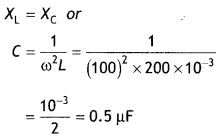
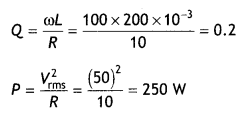
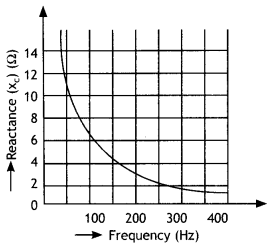
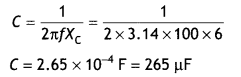
Alternating Current Class 12 Important Extra Questions Physics Chapter 7

Here we are providing Class 12 Physics Important Extra Questions and Answers Chapter 7 Alternating Current. Important Questions for Class 12 Physics with Answers are the best resource for students which helps in Class 12 board exams.

Class 12 Physics Chapter 7 Important Extra Questions Alternating Current

Alternating Current Important Extra Questions Very Short Answer Type

Question 1.
The instantaneous current flowing from an ac source is l = 5 sin 314 t. What is the rms value of current?
Answer:
The rms value of current is \(\frac{5}{\sqrt{2}}\).

Question 2.
The instantaneous emf of an ac source is given by E = 300 sin 314 t. What is the rms value of emf?
Answer:
The rms value of voltage is \(\frac{300}{\sqrt{2}}\)

Question 3.
Give the phase difference between the applied ac voltage and the current in an LCR circuit at resonance.
Answer:
The applied ac voltage and the current in an LCR circuit at resonance are in phase.
Hence phase difference = 0.

Question 4.
What is the phase difference between the voltage across the inductor and the capacitor in an LCR circuit?
Answer:
The phase difference is 180°.

Question 5.
What is the power factor of an LCR series circuit at resonance?
Answer:
The power factor is one.

Question 6.
In India, the domestic power supply is at 220 V, 50 Hz, while in the USA it is 110 V, 50 Hz. Give one advantage and one disadvantage of 220 V supply over 110 V supply.
Answer:
Advantage: less power loses
Disadvantage: more fatal.

Question 7.
Define the term ‘wattles current’. (CBSE Delhi 2011)
Answer:
It is the current at which no power is consumed.

Question 8.
In a series LCR circuit, VL = VC ≠ VR. What is the value of the power factor? (CBSE AI 2015)
Answer:
One.

Question 9.
Define capacitor reactance. Write its SI units. (CBSE Delhi 2015)
Answer:
It is the opposition offered to the flow of current by a capacitor. It is measured in ohm.

Question 10.
Define quality factor in series LCR circuit. What is its SI unit? (CBSE Delhi 2016)
Answer:
The quality factor is defined as the ratio of the voltage developed across the capacitor or inductor to the applied voltage. It does not have any unit.

Question 11.
A choke and a bulb are in series to a dc source. The bulb shines brightly. How does its brightness change when an iron core is inserted inside the choke coil?
Answer:
There is no change in the final brightness as the inductive reactance is zero for dc.

Question 12.
A solenoid with an iron core and a bulb are connected to a dc source. How does the brightness of the bulb change, when the iron core is removed from the solenoid?
Answer:
There Is no change In the finaL brightness as the inductive reactance is zero for dc.

Question 13.
In a serles LCR circult, the voltage across an inductor, capacitor and a resistor are 20 V, 20 V and 40 V, respectively. What Is the phase difference between the applied voltage and the current In the circuit?
Answer:
WhenVL = VC, then the circuit is in series resonance, therefore both current and voltage are in phase.

Question 14.
Why Is there no power consumption In an Ideal inductor connected to an ac source?
Answer:
This is because current and voltage across an ideal inductor are out of phase by 900.
Hence P = VRMS IRMS cos 90° = O

Question 15.
Can a choke be replaced by a capacitor of suitable capacitance?
Answer:
Yes, because even then the power consumed will be zero.

Question 16.
Find the inductance of the Inductor that would have a reactance of 50 ohm when used with an ac source of frequency 25/π kHz.
Answer:
Using XL = 2 πf L or L = \(\frac{X_{L}}{2 \pi f}\), therefore
L = \(\frac{50 \times \pi}{2 \pi \times 25}\) = 1 H

Question 17.
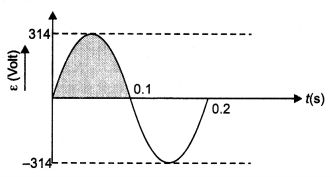
The figure gIven below shows the variation of an alternating emf with time. What Is the average value of the emf for the shaded part of the graph?
Class 12 Physics Important Questions Chapter 7 Alternating Current 1
Answer:
Average or mean value of ac over half cycle or in time T/2 is
Em = 2Eo/π = 0.637 Eo = 0.637 × 314
or Em = 200 V.

Question 18.
What is the power dissipated in an ac circuit in which the voltage and current are given by V = 230 sin(ωt + π/2) and l = 10 sin ωt.
Answer:
Since the phase difference between the voltage and current is π/2, therefore power consumed = Vrms lrms cos π/2 = 0

Question 19.
When a lamp is connected to an alternating voltage supply, it lights with the same brightness as when compared to a 12 V dc battery. What Is the peak value of alternating voltage?
Answer:
The peak value is V = 12 × \(\sqrt{2}\) = 16.97 V

Question 20.
Why is the use of a.c. voltage preferred over d.c. voltage? Give two reasons. (CBSEAI 2014)
Answer:

  1. Can be increased or decreased easily.
  2. Can easiLy be converted into dc.

Question 21.
Can the Instantaneous power output of an ac source ever be negative? Can the average power output be negative?
Answer:
Yes, No.

Alternating Current Important Extra Questions Short Answer Type

Question 1.
State the phase relationship between the current flowing and the voltage applied in an ac circuit for (i) a pure resistor (ii) a pure inductor.
Answer:

  1. Electric current and voltage applied in a pure resistor are in same phase, i.e. Φ = 0°
  2. Applied voltage leads electric current flowing through pure-inductor in an ac circuit by phase angle of π/2.

Question 2.
A light bulb is in turn connected in a series (a) across an LR circuit, (b) across an RC circuit, with an ac source. Explain, giving the necessary mathematical formula, the effect on the brightness of the bulb in case (a) and (b), when the frequency of the ac source is increased. (CBSE 2019C)
Answer:
(a) The current in LR circuit is given by
l = \(\frac{V}{\sqrt{R^{2}+\omega^{2} L^{2}}}\)

When the frequency of ac source ω increases, l decreases, and hence brightness decreases.

(b) The current in RC circuit is given by
l = \(\frac{V}{\sqrt{R^{2}+\frac{1}{\omega^{2} C^{2}}}}\)

When the frequency of ac source ω increases, l increases, and hence brightness increases.

Question 3.
An air-core solenoid is connected to an ac source and a bulb. If an iron core is inserted in the solenoid, how does the brightness of the bulb change? Give reasons for your answer.
Answer:
Insertion of an iron core in the solenoid increases its inductance. This in turn increases the value of inductive reactance. This decreases the current and hence the brightness of the bulb.

Question 4.
A bulb and a capacitor are connected in series to an ac source of variable frequency. How will the brightness of the bulb change on increasing the frequency of the ac source? Give reason.
Answer:
When the frequency of the ac is increased, it will decrease the impedance of the circuit as Z = \(\sqrt{R^{2}+(1 / 2 \pi f C)^{2}}\). As a result, the current and hence the brightness of the bulb will increase.

Question 5.
An ideal inductor is in turn put across 220 V, 50 Hz, and 220 V, 100 Hz supplies. Will the current flowing through it in the two cases be the same or different?
Answer:
The current through the inductor is given by l = \(\frac{V}{X_{L}}=\frac{V}{2 \pi f L}\). The current is inversely proportional to the frequency of applied ac.

Since the frequency is different therefore the current will also be different.

Question 6.
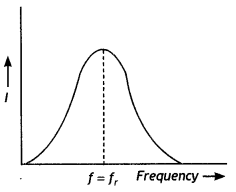
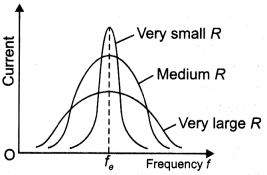
State the condition under which the phenomenon of resonance occurs in a series LCR circuit, Plot a graph showing the variation of current with a frequency of ac source in a series LCR circuit.
Answer:
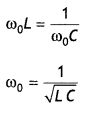
The phenomenon occurs when the inductive reactance becomes equal to the capacitive reactance., i.e. XL – XC
⇒ ω L = \(\frac{1}{ωC}\)
⇒ ω = \(\frac{1}{\sqrt{L C}}\)

The graph is as shown below.
Class 12 Physics Important Questions Chapter 7 Alternating Current 2
Question 7.
Give two advantages and two disadvantages of ac over dc.
Answer:
Advantages of ac:
(a) The generation and transmission of ac are more economical than dc.
(b) The alternating voltage may be easily stepped up or down as per need by using suitable transformers.

Disadvantages of ac:
(a) It is more fatal than dc.
(b) It cannot be used for electrolysis.

Question 8.
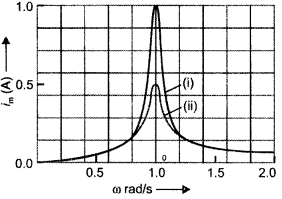
In a series, LCR circuit connected to an ac source of variable frequency and voltage v = vm sin ωt, draw a plot showing the variation of current (l) with angular frequency (ω) for two different values of resistance R1 and R2 (R1 > R2). Write the condition under which the phenomenon of resonance occurs. For which value of the resistance out of the two curves, a sharper resonance is produced? Define the Q-factor of the circuit and give its significance. (CBSE Delhi 2013C)
Answer:
The plot is as shown.
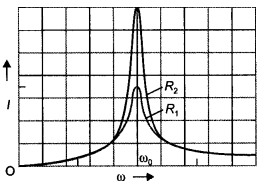
Class 12 Physics Important Questions Chapter 7 Alternating Current 3
Resonance occurs in an LCR circuit when
XL = XC.
The smaller the value of R sharper is the resonance. Therefore the curve will be sharper for R2. It determines the sharpness of the resonance. The larger the value of Qsharper is the resonance.

Question 9.
You are given three circuit elements X, Y, and Z. When the element X is connected across an a.c. source of a given voltage, the current and the voltage are in the same phase. When the element Y is connected in series with X across the source, voltage is ahead of the current in phase by π/2. But the current is ahead of the voltage in phase by π/2 when Z is connected in series with X across the source. Identify the circuit elements X, Y, and Z. When all the three elements are connected in series across the same source, determine the impedance of the circuit. Draw a plot of the current versus the frequency of the applied source and mention the significance of this plot. (CBSE AI 2015)
Answer:
X-Resistor, Y-Inductor, Z-Capacitor For expression of the impedance of LCR circuit see X is a resistor
Y is a capacitor
Z is an inductor

Consider the impedance triangle
Z = \(\sqrt{R^{2}+\left(X_{t}-X_{C}\right)^{2}}\)
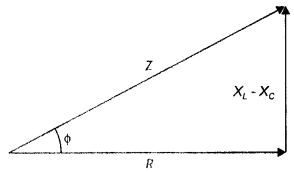
Class 12 Physics Important Questions Chapter 7 Alternating Current 5
The plot is as shown.
Class 12 Physics Important Questions Chapter 7 Alternating Current 4
Significance, at ω = ω0 (resonance frequency) current, is maximum.

Question 10.
Given three elements X, Y, and Z to be connected across an ac source. With the only X connected across the ac source, voltage and current are found to be in the same phase. With only element Y in the circuit, the voltage lags behind the current in phase by π/2, while with the element Z in the circuit, the voltage leads the current in phase by π/2
(a) Identify the elements X, Y, and Z.
Answer:
X is resistor
Y is a capacitor
Z is an inductor

Consider the impedance triangle
Z = \(\sqrt{R^{2}+\left(X_{t}-X_{C}\right)^{2}}\)
Class 12 Physics Important Questions Chapter 7 Alternating Current 5
(b) When all these elements are connected in series across the same source,
(i) determine the power factor,
Answer:
Power factor = cos Φ = R/Z
= \(\frac{R}{\sqrt{R^{2}+\left(X_{L}-X_{c}\right)^{2}}}\)

(ii) find out the condition when the circuit is in resonant state. (CBSE AI 2019)
Answer:
Circuit will be in resonance when XL – XC = 0

Question 11.
A coil with an air core and an electric bulb are connected in series across a 220 V 50 Hz ac source. The bulb glows with some brightness. How will the glow of the bulb be affected by introducing a capacitor in series with the circuit? Justify your answer.
Answer:
The impedance of an LR circuit is given by the expression
Z = \(\sqrt{R^{2}+X_{L}^{2}}\) and

the impedance of a series LCR circuit is given by the expression
Z = \(\sqrt{R^{2}+\left(X_{L}-X_{C}\right)^{2}}\).

Now current flowing through the two circuits is given by V
l = \(\frac{V}{Z}\).

Since Z decreases when a capacitor is connected to an LR circuit therefore there is an increase in current through the circuit. This increases the brightness of the bulb.

Question 12.
In the given circuit, inductor L and resistor R have identical resistance. Two similar electric lamps B1 and B2 are connected as shown. When switch S is closed,
(i) which one of the lamps lights earlier,
(ii) will the lamps be equally bright after some time? Justify your answer.
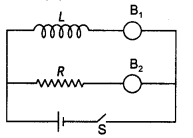
Class 12 Physics Important Questions Chapter 7 Alternating Current 6
Answer:
(i) Lamp B2 connected with the resistor will light up first. This is because the current through the inductor will grow before attaining maximum value.
(ii) When the current through the inductor becomes maximum, after some time, both the lamps will be equally bright.

Question 13.
Figure (a), (b), and (c) show three ac circuits in which equal currents are flowing. If the frequency of emf be increased, how will the current be affected in these circuits? Give the reason for your answer.
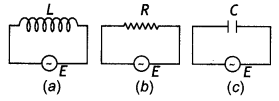
Class 12 Physics Important Questions Chapter 7 Alternating Current 7
Answer:
There will be no change in the current in figure (b) as the resistance of the resistor does not depend upon the frequency of the applied ac.

The reactance of the inductor in figure (a) is given by XL = 2πf L. An increase in frequency increases the value of inductive reactance. This decreases the current through the circuit.

The reactance of the capacitor in figure (c) is given by XC = \(\frac{1}{\omega C}=\frac{1}{2 \pi f C}\). An increase in frequency decreases the value of capacitive reactance. This increases the current through the circuit.

Question 14.
An alternating voltage of frequency f is applied across a series LCR circuit. Let fr be the resonance frequency for the circuit. Will the current in the circuit lag, lead, or remain in phase with the applied voltage when (i) f > fr (ii) f < fr Explain your answer in each case.
Answer:
(i) When f > fr, then the circuit behaves as an inductive circuit. Thus emf leads current. This is because the inductive reactance is given by the expression XL = 2πfL. At high-frequency XL will be more.

(ii) When f < fr> then the circuit behaves as a capacitive circuit. Thus emf lags current. This is because the capacitive reactance is given by the expression XC = \(\frac{1}{2 \pi f C}\). This value is more at low 2πfC frequency.

Question 15.
For a series LCR circuit, connected to a sinusoidal ac voltage source, identify the graph that corresponds to ω > \(\frac{1}{\sqrt{L C}}\). Give reason.
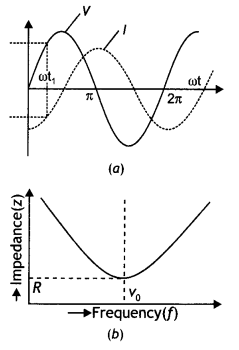
Class 12 Physics Important Questions Chapter 7 Alternating Current 8
Answer:
When ω > \(\frac{1}{\sqrt{L C}}\), the circuit behaves as an inductive circuit. In an inductive circuit, emf leads current. This is depicted in the graph (a).

Question 16.
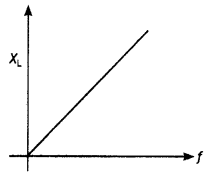
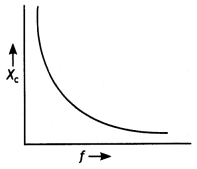
Draw the graphs showing the variations of (a) inductive reactance and (b) capacitive reactance, with the frequency of applied voltage in the ac circuit. How do the values of (a) inductive, and (b) capacitive reactance change, when the frequency of applied voltage is tripled?
Answer:
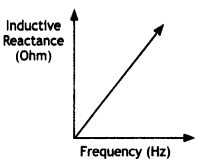
The graphs are as shown below.
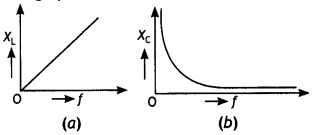
Class 12 Physics Important Questions Chapter 7 Alternating Current 9
(a) The inductive reactance is given by the expression XL = 2πfL. Therefore if the frequency is tripled then the value of XL also gets tripled.
(b) The capacitive reactance is given by the expression XC = \(\frac{1}{2 \pi f C}\). Therefore if the frequency is tripled then the value of XC becomes one-third of its previous value.

Question 17.
Can the voltage drop across the inductor or the capacitor in a series LCR circuit be greater than the applied voltage of the ac source? Justify your answer.
Answer:
Yes, the voltage drop across the inductor or the capacitor in a series LCR circuit be greater than the applied voltage of the ac source. It is because the applied voltage is equal to the algebraic sum (as obtained by the use of a phasor diagram) of VR, VL, and VC, i.e.
V = l\(\sqrt{R^{2}+\left(X_{L}-X_{C}\right)^{2}}\)

whereas VL = l XL and VC = l XC.
Thus, it is self-evident that VL or VC may be greater than V.

Question 18.
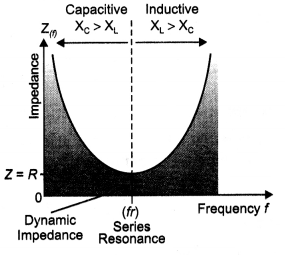
Mention the factors on which the resonant frequency of a series LCR circuit depends. Plot a graph showing the variation of the impedance of a series LCR circuit with the frequency of the applied ac source.
Answer:
In a series LCR circuit, the resonant frequency depends on the value of inductance L and capacitance C present in the circuit.
The graph showing the variation of impedance Z of a series LCR circuit with the frequency f of the applied ac source is shown below.
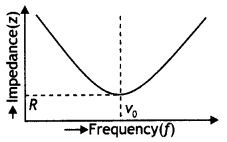
Class 12 Physics Important Questions Chapter 7 Alternating Current 10
Question 19.
A lamp is connected in series with a capacitor. Predict your observations for dc and ac connections. What happens in each case if the capacitance of the capacitor is reduced? (NCERT)
Answer:
When a dc source is connected to a capacitor, the capacitor gets charged and after charging no current flows in the circuit and the lamp will not glow. There will be no change even if C is reduced. With ac source, the capacitor offers capacitive reactance (1/ωC), and the current flows in the circuit. Consequently, the lamp will shine. Reducing C will increase reactance and the lamp will shine less brightly than before.

Question 20.
A light bulb and an open coil inductor are connected to an ac source through a key as shown in the figure.
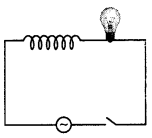
Class 12 Physics Important Questions Chapter 7 Alternating Current 11
The switch is closed and after some time, an iron rod is inserted into the interior of the inductor. The glow of the light bulb (a) increases; (b) decreases (c) is unchanged as the iron rod is inserted. Give your answer with reasons. (NCERT)
Answer:
As the iron rod is inserted, the magnetic field inside the coil magnetizes the iron rod thereby increasing the magnetic field inside it. Hence, the inductance of the coil increases. Consequently, the inductive reactance of the coil increases. As a result, a larger fraction of the applied ac voltage appears across the inductor, leaving less voltage across the bulb. Therefore, the glow of the light bulb decreases.

Question 21.
Draw the effective equivalent circuit of the circuit shown in the figure at very high frequencies and find the effective impedance. (NCERT Exemplar)
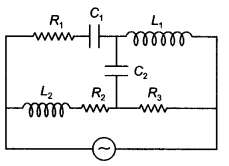
Class 12 Physics Important Questions Chapter 7 Alternating Current 12
Answer:
At high frequency, the capacitive reactance is small while the inductive reactance is large. Therefore the capacitive reactance can be neglected while no current will flow through the inductors. Therefore the equivalent reactance of the circuit is Z = R1 + R3 and hence the circuit becomes
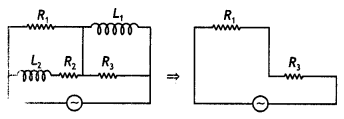
Class 12 Physics Important Questions Chapter 7 Alternating Current 13
Question 22.
Study the circuits (a) and (b) shown in the figure and answer the following questions.
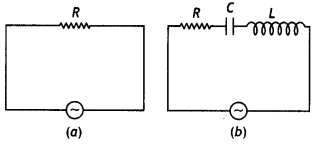
Class 12 Physics Important Questions Chapter 7 Alternating Current 14
(a) Under which conditions would the rms currents in the two circuits be the same?
Answer:
This will happen when the impedance of both the circuits is the same, i.e. R. This is possible when circuit (b) is in resonance.

(b) Can the rms current in circuit (b) be larger than that in (a)? (NCERT Exemplar)
Answer:
No, because in circuit (b)
lrms = \(\frac{V_{\text {rms }}}{Z}=\frac{V_{\text {rms }}}{\sqrt{R^{2}+\left(X_{L}-X_{C}\right)^{2}}}\), Z cannot be less than R.

Question 23.
How does the sign of the phase angle Φ, by which the supply voltage leads the current in an LCR series circuit, change as the supply frequency is gradually increased from very low to very high values? (NCERT Exemplar)
Answer:
The phase angle for an LCR circuit is given by the expression
tan Φ = \(\frac{R}{Z}=\frac{X_{L}-X_{C}}{R}=\frac{2 \pi f L-1 / 2 \pi f C}{R}\)

At low frequencies XL < XC and at high frequencies XL > XC Therefore Φ changes from negative to zero and to positive; zero at the resonant frequency.

Question 24.
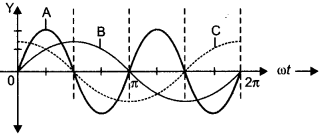
A device ‘X’ is connected to an ac source. The variation of voltage, current, and power in one complete cycle is shown in the figure.
(a) Which curve shows power consumption over a full cycle?
(b) What is the average power consumption over a cycle?
(c) Identify the device ‘X’. (NCERT Exemplar)
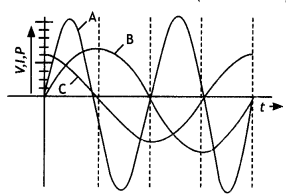
Class 12 Physics Important Questions Chapter 7 Alternating Current 15
Answer:
(a) A
(b) Zero
(c) L or C or LC

Question 25.
Both alternating current and direct current are measured in amperes. But how is the ampere defined for an alternating current? (NCERT Exemplar)
Answer:
An ac current changes direction with the source frequency and the charge flow would average to zero. Thus, the ac ampere must be defined in terms of some property that is independent of the direction of the current. Joule’s heating effect is such property and hence it is used to define misvalue of ac.

Question 26.
A sinusoidal voltage of peak value 10 V is applied to a series LCR circuit In which resistance, capacitance, and inductance have values of 10 0, 1 μF, and 1 H, respectively.
Find (i) the peak voltage across the inductor at resonance
(ii) the quality factor of the circuit. (CBSE Sample Paper 2018-19)
Answer:
Given Vm = 10V, R = 1o Ω, L = 1 H, C = 1 μF,
VL = ?, Q = ?
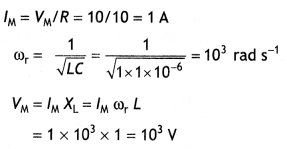
Class 12 Physics Important Questions Chapter 7 Alternating Current 16
Q= ωr L/R = (103 × 1)/10 = 100

Question 27.
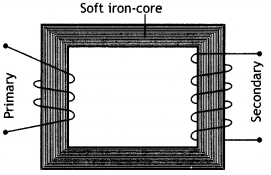
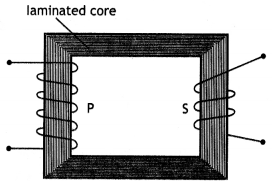
Draw a labeled diagram of a step-down transformer. State its working principle Write one main cause of energy loss in this device and the method used for reducing it.
Answer:
The labeled diagram is as shown.
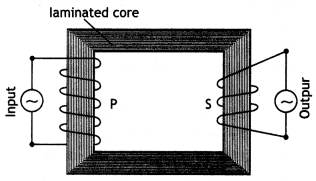
Class 12 Physics Important Questions Chapter 7 Alternating Current 17
It works on the principle of mutual induction i.e., whenever magnetic flux linked with a coil changes an emf is induced in the neighboring coil.

One main cause of loss of energy is heat produced due to the production of eddy currents. This can be reduced by laminating the iron core.

Alternating Current Important Extra Questions Long Answer Type

Question 1.
Prove mathematically that the average power over a complete cycle of alternating current through an Ideal inductor is zero.
Answer:
Let the instantaneous value of voltage and current in the ac circuit containing a pure inductor are
V = Vm sin ωt and
l = lm sin (ωt – π/2) = – lm cos ωt
where π/2 is the phase angle by which voltage Leads currently when ac flows through an inductor. Suppose the voltage and current remain constant for a small-time dt. Therefore, the electrical energy consumed in the small-time dt is
dW = V l dt

The total electrical energy consumed in one time period of ac is given by
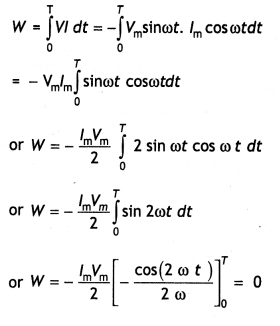
Class 12 Physics Important Questions Chapter 7 Alternating Current 18
Therefore, the total electrical energy consumed in an ac circuit by a pure inductor is W = 0

Now average power is defined as the ratio of the total electrical energy consumed over the entire cycle to the time period of the cycle, therefore
Pav = \(\frac{W}{T}\) = 0

Hence, the average power consumed in an ac circuit by a pure inductor is Pav = 0
Thus a pure inductor does not consume any power when ac flows through it. Whatever energy is used in building up current is returned back during the decay of current.

Question 2.
Draw the phasor diagram of a series LCR connected across an ac source V= Vo sin ωt. Hence, derive the expression for the impedance of the circuit. Obtain the conditions for the phase angle under which the current is
(i) maximum and
(ii) minimum. (CBSE AI 2019)
Answer:
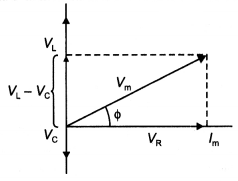
The voltages across the various elements are drawn as shown in the figure below.
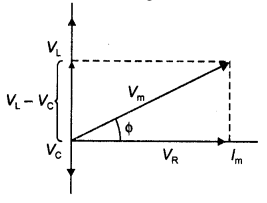
Class 12 Physics Important Questions Chapter 7 Alternating Current 19
From the diagram, we observe that the vector sum of the voltage amplitudes VR, VL, and VC equals a phasor whose length is the maximum applied voltage Vm, where the phasor Vm makes an angle φ with the current phasor lm. Since the voltage phasors, VL and VC are in opposite direction, therefore, a difference phasor (VL – VC) is drawn which is perpendicular to the phasor VR. Adding vectorially we have
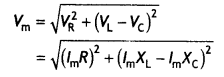
Class 12 Physics Important Questions Chapter 7 Alternating Current 20
Class 12 Physics Important Questions Chapter 7 Alternating Current 21
where XL = ω L and XC = 1 / ω C, therefore, we can express the maximum current as
lm = \(\frac{V_{\mathrm{m}}}{\sqrt{R^{2}+\left(X_{\mathrm{L}}-X_{\mathrm{C}}\right)^{2}}}\)

The impedance Z of the circuit is defined as Z = \(\sqrt{R^{2}+\left(X_{\mathrm{L}}-X_{C}\right)^{2}}\)

For maximum lm, Z should be minimum (Z = R) or XC = XL = 0 and Φ = 0

For (lm)min Φ → 90° (|XC – XL| >> R) Z → ∞

Question 3.
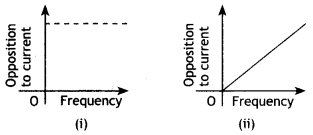
(a) The graphs (i) and (ii) represent the variation of the opposition offered by the circuit element to the flow of alternating current with a frequency of the applied emf. identify the circuit element corresponding to each graph.
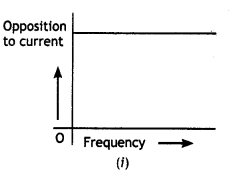
Class 12 Physics Important Questions Chapter 7 Alternating Current 22
Class 12 Physics Important Questions Chapter 7 Alternating Current 23
(b) Write the expression for the impedance offered by the series combinations of the above two elements connected across the ac source. Which will be ahead in phase in this circuit, voltage or current? (CBSE AI 2011C)
Answer:
(a) In figure (i) the opposition to the flow of current does not depend upon frequency, the circuit element is a resistor.

In figure (ii) the opposition increases with frequency, the current element is an inductor.

(b) When the resistor R and the inductance L are connected in series across an ac source, the impedance Z of the circuit is given by
Z = \(\sqrt{R^{2}+X_{L}^{2}}\), where XL is the inductive reactance.

In an L – R circuit, the voltage is ahead of the current.

Question 4.
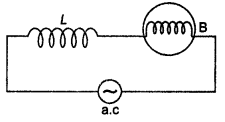
An Inductor L of inductance XL is connected in series with bulb B and an ac source. How would the brightness of the bulb change when
(a) the number of turns In the Inductor Is reduced,
(b) an Iron rod Is Inserted Into the Inductor and
(c) a capacitor of reactance XC = XL
Is Inserted in series In the circuit. Justify your answer In each case. (CBSE Delhi 2015)
Answer:
(a) When the number of turns of the inductor reduced it decreases the inductance of the inductor as (L ∝ n2) where n is the number of turns. This in turn decreases the inductive reactance XL which increases the current in the circuit and hence the brightness of the bulb decreases.
(b) When an iron rod is inserted in the inductor, it increases the inductive reactance, which in turn decreases the current and hence the brightness of the bulb.
(c) When XL = XC, the circuit acts as a resistive circuit, i.e. the impedance becomes minimum and maximum current flows. This makes the bulb glow more brightly.

Question 5.
An inductor L of reactance XL is connected in series with a bulb B to an ac source as shown in the figure below. Briefly explain how the brightness of the bulb changes, when
(a) number of turns of the inductor Is reduced? and
(b) a capacitor of reactance XC = XL is included in series in the same circuit?
Class 12 Physics Important Questions Chapter 7 Alternating Current 24
Answer:
If R is the resistance of the bulb, then the total impedance of the circuit is Z = \(\sqrt{R^{2}+X_{L}^{2}}\) and the corresponding current is l = V l Z.
(a) If the number of turns of the inductor is reduced then its inductance L and consequently there is a decrease in the reactance. This leads to a decrease in the impedance of the circuit. As a result the current flowing through the circuit increases. This increases the brightness of the bulb.

(b) When a capacitor of reactance XC = XL is included in the circuit, then the new impedance becomes Z = \(\sqrt{R^{2}+\left(X_{L}-X_{C}\right)^{2}}\) = R. Thus the impedance has its minimum value. This increases the current through the circuit, which results in an increase in the brightness of the bulb.

Question 6.
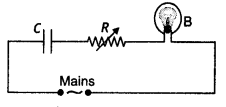
A capacitor, ‘C’ a variable resistor ‘R’, and a bulb ‘B’ are connected in series to the ac mains in the circuit as shown. The bulb glows with some brightness. How will the glow of the bulb change if (a) a dielectric slab is introduced between the plates of the capacitor, keeping resistance R to be the same (b) the resistance R is increased keeping the same capacitance? (CBSE Delhi 2014)
Class 12 Physics Important Questions Chapter 7 Alternating Current 25
Answer:
(a) As the dielectric slab is introduced between the plates of the capacitor, its capacitance will increase. Hence, the potential drop across the capacitor will decrease (V = Q/C). As a result, the potential drop across the bulb will increase (since both are connected in series). So, its brightness will increase.
(b) As the resistance (R) is increased, the potential drop across the resistor will increase. As a result, the potential drop across the bulb will decrease (since both are connected in series). So, its brightness will decrease.

Question 7.
What is meant by impedance? Give its unit. Using a phasors diagram or otherwise derive the expression for the Impedance of an ac circuit containing L, C, and R in series. Find the expression for the resonant frequency.
Answer:
It is the opposition offered by LR or CR or LCR circuit to the flow of ac. It is measured in ohm.

For derivation of Z = \(\sqrt{R^{2}+\left(X_{L}-X_{C}\right)^{2}}\)

The impedance Z of the circuit is defined as
Z = \(\sqrt{R^{2}+\left(X_{L}-X_{c}\right)^{2}}\)

The graph is shown.
Class 12 Physics Important Questions Chapter 7 Alternating Current 46
The current through an LCR circuit is given by the expression lv = \(\frac{E_{v}}{Z}\)

where Z is the impedance. Substituting the value of Z in the above equation we have
lv = \(\frac{E_{v}}{\sqrt{R^{2}+\left(X_{L}-X_{C}\right)^{2}}}\)

Because the impedance depends on the frequency of the source, we see that the current in the LCR circuit will depend upon frequency. The current, therefore, reaches its maximum value when the impedance is minimum. This happens when XL = XC, corresponding to Z = R. The frequency ω at which this occurs is called resonant angular frequency. To find ω0, we use the condition XL = XC, from which we get
Class 12 Physics Important Questions Chapter 7 Alternating Current 26
But ωo = 2 πfo, where fo is called resonance frequency. Therefore, the above equation becomes fo = \(\frac{1}{2 \pi} \frac{1}{\sqrt{L C}}\)

Question 8.
Explain the term ‘inductive reactance’. Show graphically the variation of an inductive reactance with the frequency of the applied alternating voltage.
An ac voltage E = Eo sin ωt is applied across a pure inductor of inductance L. Show mathematically that the current flowing through it lags behind the applied voltage by a phase angle of π/2.
Answer:
It is the opposition offered to the flow of current by a pure inductor.

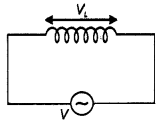
Consider an ac circuit consisting of a pure Inductor connected to the terminaLs of an ac source. Let the Instantaneous value of the ac source be
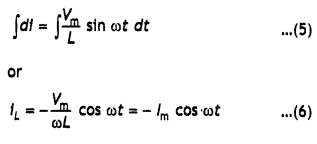
V = Vm sin ωt ….(1)
Class 12 Physics Important Questions Chapter 7 Alternating Current 39
Let VL be the instantaneous voltage drop across the inductor, then Kirchoff’s loop rule when applied to the circuit gives V + VL = 0
or
V – L\(\frac{di}{dt}\) = 0 …(2)

since VL = – L\(\frac{di}{dt}\)
Using equations (1) and (2) we have
Class 12 Physics Important Questions Chapter 7 Alternating Current 40
Integrating the above equation we have
Class 12 Physics Important Questions Chapter 7 Alternating Current 41
where \(\frac{V_{m}}{\omega L}\) = lm , ωL = 2πfL has the dimensions of resistance and is called the inductive reactance of the circuit. Using the trigonometric identity cos ωt = – sin (ωt – π/2) in equation (6) we have
lL =lm sin (ωt – π/2) …(7)
Comparing equation (1) with equation (7) we see that the current lags voltage by π/2 radian or 90°.
Class 12 Physics Important Questions Chapter 7 Alternating Current 42
Question 9.
Explain the term ‘capacitive reactance’. Show graphically the variation of a capacitive reactance with the frequency of the applied alternating voltage.
An ac voltage E=Eo sin cot is applied across a pure capacitor of capacitance C. Show mathematically that the current flowing through it leads the applied voltage by a phase angle of π/2.
Answer:
It is the opposition offered to the flow of current by a pure capacitor.
Consider an ac circuit consisting of a capacitor connected to an ac source. Let the instantaneous value of emf be
V = Vm sin ωt …(1)

Let Vc be the instantaneous voltage drop across the capacitor, then by Kirchoff’s loop rule,
V – VC = 0
V = VC = Vm Sin ωt …(2)

But from the definition of capacitance, VC = Q / C or Q= VCC. Substituting for VC we have
Q = C Vm sin ωt …(3)

Differentiating equation (3) with respect to time we have,
\(\frac{d Q}{d t}=\frac{d}{d t}\)CVm sin ωt = ω C Vm cos ωt …(4)

But dQ/dt = lc, therefore the above equation becomes,
lC = ω C Vm cos ωt = lm cos ωt …(5)
where
lm = \(\frac{v_{m}}{\frac{1}{\omega C}}\)

Here the term \({\frac{1}{\omega C}}\) has the dimensions of resistance and is called the capacitive reactance of the circuit and ωCVm = lm.

Using the trigonometric identity cos ωt = sin (ωt + π/2), equation (5) can be written as
lC = lm sin (ωt + π/2) …..(6)

Comparing this expression with equation (1)

we see that the current is 90° (π/2) out of phase with the voltage across the capacitor. In other words, currently leads emf by 90°.

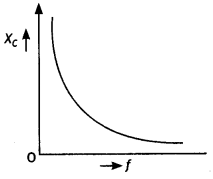
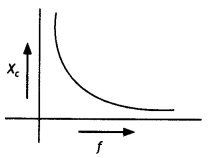
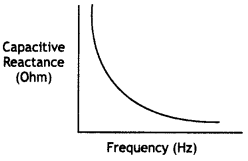
The graph of variation of XC with f is as shown.
Class 12 Physics Important Questions Chapter 7 Alternating Current 44
Question 10.
Derive an expression for the impedance of a series LCR circuit connected to an ac supply of variable frequency. Plot a graph showing a variation of current with the frequency of the applied voltage. Explain briefly how the phenomenon of resonance in the circuit can be used in the tuning mechanism of a radio or a TV set. (CBSE Delhi 2011)
Answer:
The voltages across the various elements are drawn as shown in the figure below.
Class 12 Physics Important Questions Chapter 7 Alternating Current 45
From the diagram, we observe that the vector sum of the voltage amplitudes VR, VL, and VC equals a phasor whose length is the maximum applied voltage Vm, where the phasor Vm makes an angle Φ with the current phasor lm. Since the voltage phasors, VL and VC are in opposite directions, a different phasor (VL – VC) is drawn which is perpendicular to the phasor VR.

Adding vectorially, we have
Vm = \(\sqrt{V_{R}^{2}+\left(V_{L}-V_{c}\right)^{2}}\)
= \(\sqrt{\left(l_{m} R\right)^{2}+\left(l_{m} X_{L}-l_{m} X_{c}\right)^{2}}\) …(1)
or
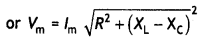
Vm = lm\(\sqrt{R^{2}+\left(X_{L}-X_{c}\right)^{2}}\) …(2)

where XL = ω L and XC = 1/ω C, therefore we can express the maximum current as
lm = \(\frac{V_{m}}{\sqrt{R^{2}+\left(X_{L}-X_{c}\right)^{2}}}\) …(3)

∴ lm = \(\frac{V_{m}}{Z}\)

The impedance Z of the circuit is defined as
Z = \(\sqrt{R^{2}+\left(X_{L}-X_{c}\right)^{2}}\)

The graph is shown.
Class 12 Physics Important Questions Chapter 7 Alternating Current 46
The graph is as shown.
Class 12 Physics Important Questions Chapter 7 Alternating Current 27
The antenna of a radio accepts signals from many broadcasting stations. The signals picked up in the antenna act as a source in the tuning circuit of the radio, so the circuit can be driven at many frequencies. But to hear one particular radio station, we tune the radio. In tuning, we vary the capacitance of a capacitor in the tuning circuit such that the resonant frequency of the circuit becomes nearly equal to the frequency of the radio signal received. When this happens, the amplitude of the current with the frequency of the signal of the particular radio station in the circuit is maximum and that particular radio station is tuned in.

Question 11.
A device ‘X’ is connected to an ac source V = Vo sin ωt. The variation of voltage, current, and power in one cycle is shown in the following graph.
Class 12 Physics Important Questions Chapter 7 Alternating Current 28
(a) Identify the device ‘X’.
Answer:
Capacitor

(b) Which of the curves A, B, and C represent the voltage, current, and power consumed in the circuit? Justify your answer.
Answer:
A: Power, B: Voltage, and C: Current.

(c) How does its impedance vary with the frequency of the ac source? Show graphically.
Answer:
For a capacitor, Impedance is given by XC = 1 /ωC = 1 /2πfC. This is shown graphically as
Class 12 Physics Important Questions Chapter 7 Alternating Current 29
(d) Obtain an expression for the current in the circuit and its phase relation with ac voltage. (CBSE AI 2017)
Answer:
Consider an ac circuit consisting of a capacitor connected to an ac source. Let the instantaneous value of emf be
V = Vo sin ωt …(1)

Let Vc be the instantaneous voltage drop across the capacitor, then by Kirchoff’s loop rule,
V – VC = 0
or
V = VC = Vo sin ωt …(2)

But from the definition of capacitance,
VC = Q / C
or
Q= VC C.

Substituting for Vc we have
Q = CVo sin ωt …(3)

Differentiating equation (3) with respect to time we have,
\(\frac{d Q}{d t}=\frac{d}{d t}\) CVo sin ω t = ω C Vo cos ω t …(4)

But dQ/dt = ic, therefore the above equation becomes,
ic = ω C Vo cos ω t = lo cos ω t …(5)

Here the term 1/ωc has the dimensions of resistance and is called the capacitive reactance of the circuit and ωCVm = lm. Using the trigonometric identity cos ω t = sin (ω t + π/2) equation (5) can be written as
ic = lo sin (ω t + π/2) …(6)

Comparing this expression with equation (1) we see that the current is 90° (π/2 ) out of phase with the voltage across the capacitor. In other words, currently leads emf by 90°.

Question 12.
A device X is connected across an ac source of voltage V = Vo sin ωt. The current through X is given as l = lo sin (ωt + π/2).
(a) Identify the device X and write the expression for Its reactance.
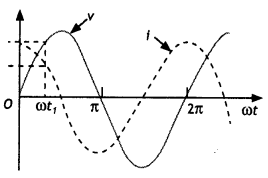
(b) Draw graphs showing the variation of voltage and current with time over one cycle of ac, for X.
(c) How does the reactance of device X vary with the frequency of the ac? Show this variation graphically.
(d) Draw the phasor diagram for the device X. (CBSE AI 2018, Delhi 2018)
Answer:
(a) X: capacitor
Reactance XC = 1 / ωC = 1 / 2πfC

(b) The graphs area as shown.
Class 12 Physics Important Questions Chapter 7 Alternating Current 30
(c) Reactance of the capacitor varies in inverse proportion to the frequency. Therefore, the graph is as shown.
Class 12 Physics Important Questions Chapter 7 Alternating Current 31
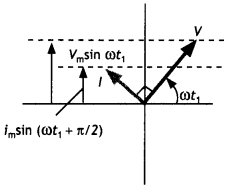
(d) The phasor diagram is as shown.
Class 12 Physics Important Questions Chapter 7 Alternating Current 32
Question 13.
A resistor of 200 Ω and a capacitor of 15.0 μF is connected In series to a 220 V, 50 Hz ac source, (a) Calculate the current in the circuit; (b) Calculate the voltage (rms) across the resistor and the capacitor. Is the algebraic sum of these voltages more than the source voltage? If yes, resolve the paradox. (NCERT, CBSE Delhi 2004)
Answer:
Given R = 200 Ω, C= 15.0 μF = 15.0 × 10⁻⁶ F, V = 220 V, f = 50 Hz
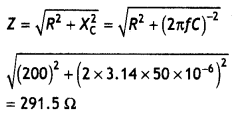
(a) In order to calculate the current, we need the impedance of the
Class 12 Physics Important Questions Chapter 7 Alternating Current 33
Therefore the current in the circuit is
l = \(\frac{V}{Z}=\frac{220}{291.5}\) = 0.7555 A

(b) Since the current is the same throughout the circuit we have
VR = IR = 0.755 × 200 = 151 V
VC = lXC = 0.755 × 212.3 = 160.3 V

The algebraic sum of the two voltages VR and Vc is 311.3 V which is more than the source voltage of 220 V. How to resolve this paradox? As you have learned in the text, the two voltages are not in the same phase. Therefore, they cannot be added like ordinary numbers. The two voltages are out of phase by ninety degrees. Therefore, the total of these voltages must be obtained using the Pythagorean theorem;
V = \(\sqrt{V_{R}^{2}+V_{C}^{2}}\) = 220 V

Thus if the phase difference between two voltages is properly taken into account, the total voltage across the resistor and the capacitor is equal to the voltage of the source.

Question 14.
Explain why the reactance offered by an inductor increases with the increasing frequency of an alternating voltage.
(NCERT Exemplar)
Answer:
An inductor opposes the flow of current through it by developing a back emf according to Lenz’s law. The induced voltage has a polarity so as to maintain the current at its present value. If the current is decreasing, the polarity of the induced emf will be so as to increase the current and vice versa. Since the induced emf is proportional to the rate of change of current, it will provide greater reactance to the flow of current if the rate of change is faster, i.e. if the frequency is higher. The reactance of an Inductor, therefore, is proportional to the frequency, being given by ωL.

Question 15.
(a) Prove that an Ideal capacitor in an ac circuit does not dissipate power.
Answer:
Consider an ac circuit consisting of a capacitor connected to an ac source. Let the instantaneous value of emf be
V = Vm sin ωt …(1)

Let Vc be the instantaneous voltage drop across the capacitor, then by Kirchoff’s loop rule,
V – VC = 0
V = VC = Vm Sin ωt …(2)

But from the definition of capacitance, VC = Q / C or Q= VCC. Substituting for Vc we have
Q = C Vm sin ωt …(3)

Differentiating equation (3) with respect to time we have,
\(\frac{d Q}{d t}=\frac{d}{d t}\)CV<sub>m</sub> sin ωt = ω C Vm cos ωt …(4)

But dQ/dt = lc, therefore the above equation becomes,
lC = ω C Vm cos ωt = lm cos ωt …(5)
where
lm = \(\frac{v_{m}}{\frac{1}{\omega C}}\)

Here the term \({\frac{1}{\omega C}}\) has the dimensions of resistance and is called the capacitive reactance of the circuit and ωCVm = lm.

Using the trigonometric identity cos ωt = sin (ωt + π/2), equation (5) can be written as
lC = lm sin (ωt + π/2) …..(6)

Comparing this expression with equation (1)

we see that the current is 90° (π/2) out of phase with the voltage across the capacitor. In other words, currently leads emf by 90°.

The graph of variation of XC with f is as shown.
Class 12 Physics Important Questions Chapter 7 Alternating Current 44
Power in capacitive circuit P = Ev lv cos Φ. In pure captor 0 = 90° phase difference between voltage and current is π/2.
So power consumed in pure capdtor Pav = Ev lv cos 90° = 0.

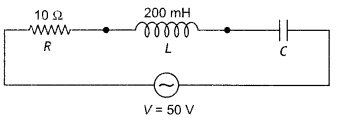
(b) An ideal inductor of 200 mH, capacitor of 400 μF, and a resistor of 10 Ω are connected In series to an ac source of 50 V and variable frequency. Calculate
(i)the angular frequency at which maximum power dissipation occurs in the circuit and the corresponding value of effective current and
(ii) the value of Q factor in the circuit. (CBSE AI 2017C)
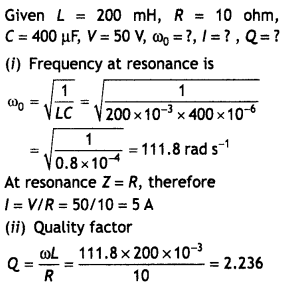
Answer:
Class 12 Physics Important Questions Chapter 7 Alternating Current 34
Question 16.
(a) What is the principle of transformer?
(b) Explain how laminating the core of a transformer helps to reduce eddy current losses in it.
(c) Why the primary and secondary coils of a transformer are preferably wound on the same core?
Or
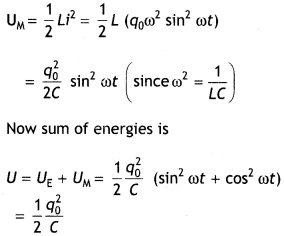
Show that In the free oscillations of an LC circuit, the sum of energies stored in the capacitor and the Inductor Is constant In time. (CBSE Sample Paper 2018-19)
Answer:
(a) It works on the principle of mutual induction.
(b) In order to reduce the eddy current loss, the resistance of the core should be Increased. In a transformer, the core Is made up of thin sheets of steel, each lamination being insulated from others by a thin layer of varnish. As the laminations are thin, they will have relatively high resistance.
(c) This is done to maximize the sharing of magnetic flux and also so that magnetic flux per turn should become the same in both the primary and secondary coils.
Or
Let at any instant t, q be the charge on the capacitor and ‘l’ be the current through the inductor
q (t) = q0 cos ωt
i (t) = – q0 ω sin ωt
Energy stored in the capacitor at time t is
UE = \(\frac{1}{2} \frac{q^{2}}{c}=\frac{1}{2} \frac{q_{0}^{2}}{C}\) cos2 ωt

Energy stored in the inductor at time t is
Class 12 Physics Important Questions Chapter 7 Alternating Current 35
This sum is constant in time as q0 and C, both are time-independent.

Question 17.
Explain why the reactance provided by a capacitor to an alternating current decreases with increasing frequency. (NCERT Exemplar)
Answer:
A capacitor does not allow the flow of direct current through it as the resistance across the gap is infinite. When an alternating voltage is applied across the capacitor plates, the plates are alternately charged and discharged. The current through the capacitor is a result of this changing voltage (or charge). Thus, a capacitor will pass more current through it if the voltage is changing at a faster rate, i.e. if the frequency of the supply is higher. This implies that the reactance offered by a capacitor is less with increasing frequency; it is given by 1 /ωC.

Question 18.
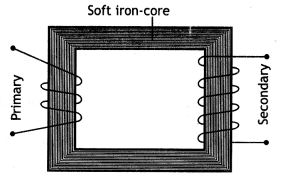
(a) With the help of a labeled diagram, describe briefly the underlying principle and working of a step-up transformer.
(b) Write any two sources of energy loss in a transformer.
(c) A step-up transformer converts a low input voltage into a high output voltage. Does it violate the law of conservation of energy? Explain. (CBSE Delhi 2011)
Answer:
(a) The diagram is as shown.
Class 12 Physics Important Questions Chapter 7 Alternating Current 36
It works on the principle of mutual induction i.e., whenever magnetic flux linked with a coil changes an emf is induced in the neighboring coil. In a step-up transformer, the number of turns in the secondary is more than that in the primary.

The ac source causes an alternating current in the primary, which sets up an alternating flux in the core; this induces an emf in each winding of the secondary, in accordance with Faraday’s law. The induced emf in the secondary gives rise to an alternating current in the secondary, and this delivers energy to the device to which the secondary is connected.

For step up : Ns> > Np
\(\frac{\varepsilon_{s}}{\varepsilon_{p}}=\frac{N_{s}}{N_{p}}\) and \(\frac{\varepsilon_{\mathrm{s}}}{\varepsilon_{\mathrm{p}}}=\frac{l_{\mathrm{p}}}{l_{\mathrm{s}}}\)

(b) Two major sources of energy loss in this device are:

  1. Heat produced due to production of eddy currents.
  2. Copper loss: heat produced in the copper coils

(c) No, a transformer does not change the power. Thus if a voltage increases current gets decreased such that the energy and power remain the same.

Question 19.
(a) Explain with the help of a labeled diagram, principle, and working of a transformer. Deduce the expression for its working formula.
Answer:
For diagram as shown.
Class 12 Physics Important Questions Chapter 7 Alternating Current 56

  • Principle: A transformer works on the basis of mutual induction.
  • Working: In a 100% efficient transformer

εs ls = εp lp where l and lp, are the secondary and primary currents, therefore we have
\(\frac{\varepsilon_{\mathrm{s}}}{\varepsilon_{\mathrm{p}}}=\frac{l_{\mathrm{p}}}{l_{\mathrm{s}}}\) ….(1)

Now a 1oo % efficient transformer
we have
\(\frac{\varepsilon_{\mathrm{s}}}{\varepsilon_{\mathrm{p}}}=\frac{N_{\mathrm{s}}}{N_{\mathrm{p}}} \frac{\frac{d \phi}{d t}}{\frac{d \phi}{d t}}=\frac{N_{\mathrm{s}}}{N_{\mathrm{p}}}\) …(2)

Therefore form (1) and (2) we have
\(\frac{N_{\mathrm{s}}}{N_{\mathrm{p}}}=\frac{l_{\mathrm{p}}}{l_{\mathrm{s}}}\) = k

Efficiency of transformer = \(\frac{V_{s} I_{s}}{V_{p} I_{p}}\).

(b) Name any four causes of energy loss in an actual transformer. (CBSEAI 2013C)
Answer:

  1. Copper loss
  2. Iron loss
  3. Flux loss
  4. Hysteresis loss

Question 20.
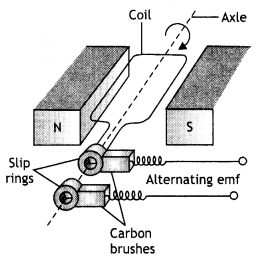
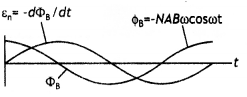
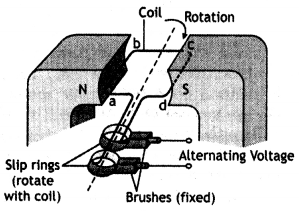
(a) Draw a schematic sketch of an ac generator describing its basic elements. State briefly its working principle. Show a plot of the variation of (i) Magnetic flux and alternating emf versus time generated by a loop of wire rotating in a magnetic field,
Answer:
A schematic sketch is as shown.

Working principle: Electromagnetic induction.
Class 12 Physics Important Questions Chapter 7 Alternating Current 37
The graphs are as shown.
Class 12 Physics Important Questions Chapter 7 Alternating Current 38

(b) Why is a choke coil needed in the use of fluorescent tubes with ac mains? (CBSE Delhi 2014)
Answer:
It is used to regulate current with minimum loss of energy.

Question 21.
(a) Draw a labeled diagram of the AC generator. Derive the expression for the instantaneous value of the emf induced in the coil.
Answer:
It is based on the principle of electromagnetic induction. When a coil is rotated about an axis perpendicular to the direction of the uniform magnetic field, an induced emf is produced across it.

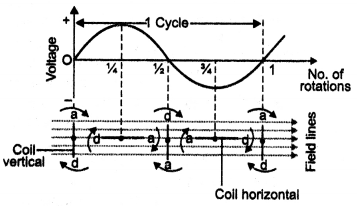
Working: The working of the ac generator can be understood with the help of the various positions of the armature as shown in the figure below.
Class 12 Physics Important Questions Chapter 7 Alternating Current 58
Class 12 Physics Important Questions Chapter 7 Alternating Current 59
Suppose at time t = 0, the plane of the loop is perpendicular to B. As the loop rotates from position t = 0 to position t T/2, the Induced emf changes from zero to maximum value and then becomes zero again as shown in the diagram For angles 0° and 1800 the instantaneous rate of magnetic flux is zero, hence induced emf Is zero.

As the Loop moves from position t = T/2 to position t = T, the emf again changes from zero to the maximum value and then again becomes zero. But this time it reverses Its direction. For angles 90° and 270° maximum magnetic flux are linked with the coil hence the emf is a maximum. Thus the output of the ac generator varies sinusoidally with time. The Induced emf does not depend upon the shape of the Loop but depends only upon the area of the loop.

The emf generated Is given by the expression ε = nBAω Sin ωt, where ω is the speed of rotation of the coil

(b) A circular coil of cross-sectional area 200 cm2 and 20 turns is rotated about the vertical diameter with an angular speed of 50 rad s-1 in a uniform magnetic field of magnitude 3.O × 10-2 T. Calculate the maximum value of the current in the coil. (CBSE Delhi 2017)
Answer:
Given A = 200 cm2, ω = 50 rad s-1, n = 20
S = 3 × 10⁻² T, εo = ?,

Using the relation ε0 = nBAω
= 20 × 3 × 10-2 × 200 × 10-4 × 50 = 0.6 V

Question 22.
Draw a labeled diagram of a step-up transformer. Obtain the ratio of secondary to primary voltage in terms of the number of turns and currents in the two coils.
A power transmission line feeds input power at 2200 V to a step-down transformer with its primary windings having 3000 turns. Find the number of turns in the secondary to get the power output at 220 V. (CBSE Delhi 2017)
Answer:
(a) The diagram is as shown.
Class 12 Physics Important Questions Chapter 7 Alternating Current 36
It works on the principle of mutual induction i.e., whenever magnetic flux linked with a coil changes an emf is induced in the neighboring coil. In a step-up transformer, the number of turns in the secondary is more than that in the primary.

The ac source causes an alternating current in the primary, which sets up an alternating flux in the core; this induces an emf in each winding of the secondary, in accordance with Faraday’s law. The induced emf in the secondary gives rise to an alternating current in the secondary, and this delivers energy to the device to which the secondary is connected.

For step up : Ns > Np
\(\frac{\varepsilon_{s}}{\varepsilon_{p}}=\frac{N_{s}}{N_{p}}\) and \(\frac{\varepsilon_{\mathrm{s}}}{\varepsilon_{\mathrm{p}}}=\frac{l_{\mathrm{p}}}{l_{\mathrm{s}}}\).

Principle – It works on the principle of electromagnetic induction. When the current in one circuit changes, an induced current is set up in the neighboring circuit.

(b) Ns = ?, Np = 3000
Ep = 2200 V, Es = 220 V

Since, Es/Ep = Ns/Np
220/2200 = Ns/3000
Ns = 300

Question 23.
(a) State the principle of working of a transformer.
Answer:
It works on the principle of mutual inductance i.e. whenever the magnetic flux Linked in a coil changes an induced emf Is produced in the neighboring coil.

(b) Define the efficiency of a transformer.
Answer:
It is the ratio of the output power to the input power.

(c) State any two factors that reduce the efficiency of a transformer.
Answer:
Copper Loss, flux Loss

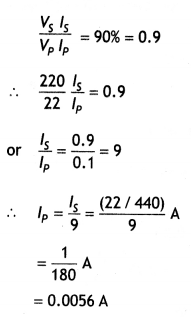
(d) Calculate the current drawn by the primary of a 90% efficient transformer which steps down 220 V to 22 V If the output resistance Is 440 Ω. (CBSFAI 2018 C)
Answer:
Given η = 90%, Vp = 22OV, Vs = 22V, Ro = 440 W
Now ls = Vs/R = 22/440 = 0.05 A

Also η = \(\frac{P_{0}}{P_{1}}=\frac{V_{s} l_{s}}{V_{p} l_{p}}\) , therefore we have

\(\frac{90}{100}=\frac{22 \times 0.05}{220 \times l_{\mathrm{p}}}\)
or
lp = 0.0056 A

Question 24.
Draw an arrangement for winding of primary and secondary coil In a transformer with two coils on a separate limb of the core.
State the underlying principle of a transformer. Deduce the expression for the ratio of secondary voltage to the primary voltage In terms of the ratio of the number of turns of the primary and secondary winding. For an ideal transformer, obtain the ratio of primary and secondary currents In terms of the ratio al the voltages in the secondary and primary voltages. Write any two reasons for the energy losses which occur In actual transformers, (CBSE Dei hi 2016C)
Answer:
Principle: When an alternating voltage is applied to the primary, the resulting current produces an alternating magnetic flux which Links the secondary and Induces an emf in it.

Induced emf, or voltage, in the secondary, with ‘Ns‘ number of turns,
εs = – Ns \(\frac{d \phi}{d t}\)

Back emf In the primary with Np turns,
εp = – Np \(\frac{d \phi}{d t}\)

\(\frac{\varepsilon_{p}}{\varepsilon_{s}}=\frac{N_{p}}{N_{s}}\)

Since εs = Vs and εp = Vp
Therefore we have
\(\frac{V_{p}}{V_{s}}=\frac{N_{p}}{N_{s}}\)

For an ideal transformer,
Input power = output power
Therefore
lpVp = lsVs
Or
\(\frac{V_{p}}{V_{s}}=\frac{l_{s}}{l_{p}}\)

(a) Heat energy Loss.
(b) Humming effect Loss.

Question 25.
A pure inductor is connected across an ac source. Show mathematically that the current in it lags behind the applied emf by a phase angle of π/2. What is its inductive reactance? Draw a graph showing the variation of an inductive reactance with the frequency of the ac source.
Answer:
Consider an ac circuit consisting of a pure Inductor connected to the terminaLs of an ac source. Let the Instantaneous value of the ac source be
V = Vm sin ωt ….(1)
Class 12 Physics Important Questions Chapter 7 Alternating Current 39
Let VL be the instantaneous voltage drop across the inductor, then Kirchoff’s loop rule when applied to the circuit gives V + VL = 0
or
V – L\(\frac{di}{dt}\) = 0 …(2)

since VL = – L\(\frac{di}{dt}\)
Using equations (1) and (2) we have
Class 12 Physics Important Questions Chapter 7 Alternating Current 40
Integrating the above equation we have
Class 12 Physics Important Questions Chapter 7 Alternating Current 41
where \(\frac{V_{m}}{\omega L}\) = lm , ωL = 2πfL has the dimensions of resistance and is called the inductive reactance of the circuit. Using the trigonometric identity cos ωt = – sin (ωt – π/2) in equation (6) we have
lL =lm sin (ωt – π/2) …(7)
Comparing equation (1) with equation (7) we see that the current lags voltage by π/2 radian or 90°.
Class 12 Physics Important Questions Chapter 7 Alternating Current 42

Question 26.
An alternating emf Is applied across a capacitor. Show mathematically that the current leads the emf by a phase angle π/2, What Is its capacitive reactance? Draw a graph showing the variation of a capacitive reactance with the frequency of the ac source.
Class 12 Physics Important Questions Chapter 7 Alternating Current 43
Answer:
Consider an ac circuit consisting of a capacitor connected to an ac source. Let the instantaneous value of emf be
V = Vm sin ωt …(1)

Let Vc be the instantaneous voltage drop across the capacitor, then by Kirchoff’s loop rule,
V – VC = 0
V = VC = Vm Sin ωt …(2)

But from the definition of capacitance, VC = Q / C or Q= VCC. Substituting for VC we have
Q = C Vm sin ωt …(3)

Differentiating equation (3) with respect to time we have,
\(\frac{d Q}{d t}=\frac{d}{d t}\)CVm sin ωt = ω C Vm cos ωt …(4)

But dQ/dt = lC, therefore the above equation becomes,
lC = ω C Vm cos ωt = lm cos ωt …(5)
where
lm = \(\frac{v_{m}}{\frac{1}{\omega C}}\)

Here the term \({\frac{1}{\omega C}}\) has the dimensions of resistance and is called the capacitive reactance of the circuit and ωCVm = lm.

Using the trigonometric identity cos ωt = sin (ωt + π/2), equation (5) can be written as
lC = lm sin (ωt + π/2) …..(6)

Comparing this expression with equation (1)

we see that the current is 90° (π/2) out of phase with the voltage across the capacitor. In other words, currently leads emf by 90°.

The graph of variation of XC with f is as shown.
Class 12 Physics Important Questions Chapter 7 Alternating Current 44
Question 27.
(a) In a series LCR circuit connected across an ac source of variable frequency, obtain the expression for its impedance and draw a plot showing its variation with the frequency of the ac source.
Answer:
The voltages across the various elements are drawn as shown in the figure below.
Class 12 Physics Important Questions Chapter 7 Alternating Current 45
From the diagram, we observe that the vector sum of the voltage amplitudes VR, VL, and VC equals a phasor whose length is the maximum applied voltage Vm, where the phasor Vm makes an angle Φ with the current phasor lm. Since the voltage phasors, VLand VC is in opposite directions, a different phasor (VL – VC) is drawn which is perpendicular to the phasor VR.

Adding vectorially, we have
Vm = \(\sqrt{V_{R}^{2}+\left(V_{L}-V_{c}\right)^{2}}\)
= \(\sqrt{\left(l_{m} R\right)^{2}+\left(l_{m} X_{L}-l_{m} X_{c}\right)^{2}}\) …(1)
or
Vm = lm\(\sqrt{R^{2}+\left(X_{L}-X_{c}\right)^{2}}\) …(2)

where XL = ω L and XC = 1/ω C, therefore we can express the maximum current as
lm = \(\frac{V_{m}}{\sqrt{R^{2}+\left(X_{L}-X_{c}\right)^{2}}}\) …(3)

∴ lm = \(\frac{V_{m}}{Z}\)

The impedance Z of the circuit is defined as
Z = \(\sqrt{R^{2}+\left(X_{L}-X_{c}\right)^{2}}\)

The graph is shown.
Class 12 Physics Important Questions Chapter 7 Alternating Current 46
(b) What is the phase difference between the voltages across the inductor and the capacitor at resonance in the LCR circuit?
Answer:
The phase difference between the voltage across the inductor and the capacitor at resonance is 180°.

(c) When an inductor is connected to a 200V dc voltage, a current of 1A flows through it. When the same inductor is connected to a 200V, 50 Hz ac source, only 0.5A current flows. Explain why? Also, calculate the self-inductance of the inductor. (CBSE Delhi 2019)
Answer:
Inductor will offer an additional impedance to ac due to its self-inductance.

Now R = \(\frac{V_{\text {rms }}}{l_{\text {rms }}}=\frac{200}{1}\) = 200 Ω

The impedance of the inductor
Z = \(\frac{V_{\mathrm{rms}}}{l_{\mathrm{rms}}}=\frac{200}{0.5}\) = 400 Ω

Now Z = \(\sqrt{R^{2}+X_{L}^{2}}\) , therefore
XL2 = Z2 – R2
XL = \(\left(\sqrt{(400)^{2}-(200)^{2}}\right)\) = 346.4 Ω

Hence inductance (L) is
L = \(\frac{X_{L}}{\omega}=\frac{346.4}{2 \times 3.14 \times 50}\) = 6.2 H

Question 28.
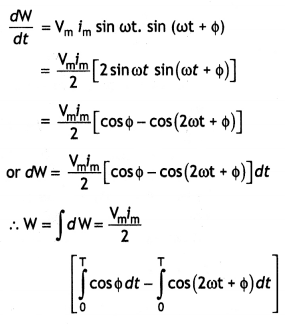
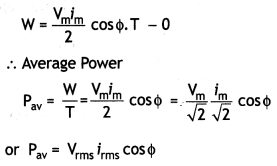
(a) Obtain the expression for the average power dissipated in a series LCR circuit driven by an ac source of voltage V = Vm sin ωt supplying the current i = im sin (ωt + Φ).
Answer:
Average Power dissipated in a series LCR circuit
Given V = Vm sin tot
And l = im sin (ωt + Φ)
Instantaneous Power
P = Vi
Class 12 Physics Important Questions Chapter 7 Alternating Current 47
Class 12 Physics Important Questions Chapter 7 Alternating Current 48

(b) Define the terms:
(i) Wattless current, and
Answer:
Wattles’s current: If the average power consumed due to the flow of current in a circuit is zero, the current is said to be wattless.

(ii) Q – a factor of LCR circuit.
Answer:
Q-factor of an LCR Circuit: Q-factor of the LCR circuit is the ratio of the potential difference across inductance (or capacitance) at resonance to the applied voltage.

Question 29.
Distinguish between the terms reactance and impedance of an ac circuit. Prove that an ideal capacitor connected to an ac source does not dissipate power.

S.No. ReactanceImpedance
1. It is the opposition offered by a pure inductor or a pure capacitor or both to the flow of ac.1. It is the opposition offered by LR or CR or LCR circuit to the flow of ac
2. It depends upon the frequency of ac.2. It depends upon the frequency of ac.
3. It can be inductive or capacitive.3. It can be inductive, capacitive, or resistive.
4. It can be zero.4. It can never be zero.

Consider an ac circuit consisting of a capacitor connected to an ac source. Let the instantaneous value of emf be
V = Vm sin ωt …(1)

Let VC be the instantaneous voltage drop across the capacitor, then by Kirchoff’s loop rule,
V – VC = 0
V = VC = Vm Sin ωt …(2)

But from the definition of capacitance, VC = Q / C or Q= VCC. Substituting for Vc we have
Q = C Vm sin ωt …(3)

Differentiating equation (3) with respect to time we have,
\(\frac{d Q}{d t}=\frac{d}{d t}\)CVm sin ωt = ω C Vm cos ωt …(4)

But dQ/dt = lc, therefore the above equation becomes,
lC = ω C Vm cos ωt = lm cos ωt …(5)
where
lm = \(\frac{v_{m}}{\frac{1}{\omega C}}\)

Here the term \({\frac{1}{\omega C}}\) has the dimensions of resistance and is called the capacitive reactance of the circuit and ωCVm = lm.

Using the trigonometric identity cos ωt = sin (ωt + π/2), equation (5) can be written as
lC = lm sin (ωt + π/2) …..(6)

Comparing this expression with equation (1)

we see that the current is 90° (π/2) out of phase with the voltage across the capacitor. In other words, current leads emf by 90°.

The graph of variation of Xc with f is as shown.
Class 12 Physics Important Questions Chapter 7 Alternating Current 44
Question 30.
Define the term root mean square (rms) value of ac. Derive the relation between rms value and the peak value of ac.
Answer:
It is that value of steady current (dc) which when passed through a resistor in a given time produces the same heat as is produced by the ac. when passed through the same resistor for the same time. It is abbreviated as rms value of current. It is denoted by lrms.

Consider an ac source. Let the instantaneous value of current be represented by the equation
i = lm sin ωt

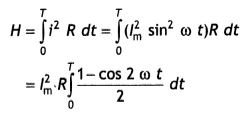
Let this current pass through a resistor of resistance R. Therefore in a small-time dt, the amount of heat produced in the resistor is
dH = i2 R dt

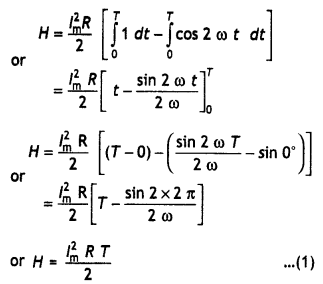
The total amount of heat produced in one complete cycle of ac is given by
Class 12 Physics Important Questions Chapter 7 Alternating Current 49
Class 12 Physics Important Questions Chapter 7 Alternating Current 50

Let lrms be the virtual value of ac, then the amount of heat produced in the same resistor of resistance R, in the same time T is
H = lrms2RT …(2)

Therefore from equations (1) and (2) we have
lrms = \(\frac{l_{m}}{\sqrt{2}}\) = 0.707 lm

Question 31.
(a) Prove that the current flowing through an Ideal Inductor connected across a.c. source lags the voltage In phase by nil.
Answer:
(a) Consider an ac circuit consisting of a pure inductor connected to the terminals of an ac source. Let the instantaneous value of the ac source be
V = Vm sin ω t …(1)

Let VL be the instantaneous voltage drop across the inductor, then Kirchoff’s loop rule when applied to the circuit gives V + VL = 0
or
V – L\(\frac{di}{dt}\) = 0 …(2)

since VL = – L \(\frac{di}{dt}\)

Using equations (1) and (2) we have
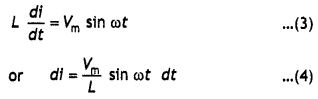
L\(\frac{di}{dt}\) = Vm sin ω t …(3)
or
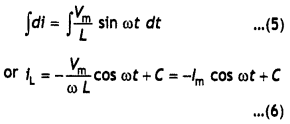
di = \(\frac{V_{m}}{L}\) sin ω t dt …(4)

Integrating the above equation we have
Class 12 Physics Important Questions Chapter 7 Alternating Current 51
C = 0, over a period of cycle

\(\frac{V_{\mathrm{m}}}{\omega L}\) = lm, ωL = 2πfL has the dimensions of resistance and is called the inductive reactance of the circuit. Using the trigonometric identity
cos ω t = – sin (ωt – π/2) in equation (6) we have
lL = lm sin (ωt – π/2) …(7)

Comparing equation (1) with equation (7) clearly shows that the current lags voltage by π/2 radian or 90°.

(b) An inductor of self-inductance 100 mH and a bulb are connected in series with a.c. source of rms voltage 10 V, 50 Hz. It is found that the effective voltage of the circuit leads the current in phase by π/4. Calculate the resistance of the bulb used and average power dissipated in the circuit, if a current of 1 A flows in the circuit. (CBSE Delhi 2017C)
Answer:
(b) V= 10 V, f = 50 Hz, l = 1.0 A, Φ = π/4, R = ?, L = 100mH = 0.1 H
Now Z = V/l = 10/1.0 = 10 ohm

Also Z = \(\sqrt{R^{2}+X_{L}^{2}}\) = 10
Now cos Φ = \(\frac{R}{Z}\)
or
Therefore, R = cos Φ × Z
Or
R = cos π/4 × 10 = 7 ohm

Power dissipated
Pav = lrms Vrms cos Φ = \(\frac{V_{m}^{2}}{Z}\) × cos Φ
0r
Pav = \(\frac{(10)^{2}}{10}\) × 0.707 = 7.07 W

Question 32.
(a) Draw graphs showing the variations of inductive reactance and capacitive reactance with the frequency of the applied ac source.
(b) Draw the phasor diagram for a series RC circuit connected to an ac source.
(c) An alternating voltage of 220 V is applied across a device X, a current of 0.25 A flows, which lag behind the applied voltage In phase by \(\frac{π}{2}\) radian. If the same voltage is applied across another device Y, the same current flows but now it is in phase with the applied voltage.
(i) Name the devices X and Y.
(ii) Calculate the current flowing in the circuit when the same voltage is applied across the series combination of X and Y. (CBSEAI 2018C)
Or
(a) State the principle of working of a transformer.
(b) Define the efficiency of a transformer.
(c) State any two factors that reduce the efficiency of a transformer.
(d) Calculate the current drawn by the primary of a 90% efficient transformer which steps down 220 V to 22 V, if the output resistance is 440 Ω.
Answer:
(a) The two graphs are as shown.
Class 12 Physics Important Questions Chapter 7 Alternating Current 52
Class 12 Physics Important Questions Chapter 7 Alternating Current 53

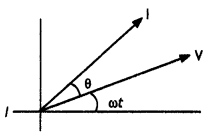
(b) (The current leads the voltage by an angle 0 where 0 < θ < \(\frac{π}{2}\).) The required phasor diagram is as shown.
Here θ = tan-1 \(\frac{1}{ωCR}\)
Class 12 Physics Important Questions Chapter 7 Alternating Current 54

(c) In device X:
Current lags behind the voltage by \(\frac{π}{2}\)
∴ X is an inductor.

In device Y:
Current is in phase with the applied voltage
∴ X is a resistor.

We are given that 0.25 = \(\frac{220}{X_{L}}\)
or
XL = \(\frac{220}{0.25}\) Ω = 880 Ω

Also 0.25 = 0.25 = \(\frac{220}{X_{R}}\)

∴ XR = \(\frac{220}{0.25}\) Ω = 880 Ω

For the series combination of X and Y, Equivalent impedance
= \(\sqrt{X_{L}^{2}+X_{R}^{2}}\) = (880\(\sqrt{2}\) Ω

∴ Current flowing = \(\frac{220}{880 \sqrt{2}}\) A = 0.177 A
Or
(a) A transformer works on the principle of mutual induction. (Alternatively, an emf is induced in the secondary coil when the magnetic flux linked with it changes with time due to changing magnetic flux linked with the primary coil).

(b) The efficiency of a transformer equals the ratio of the output power to the input power.
Efficiency = \(\frac{\text { output power }}{\text { input power }}\)
or
Efficiency = \(\frac{V_{S} I_{S}}{V_{P} I_{p}}\)
(c)

  • Eddy current Losses
  • route heat Losses
  • hysteresis Losses
  • magnetic flux leakage Losses

We have
Class 12 Physics Important Questions Chapter 7 Alternating Current 55

Question 33.
(a) Draw a schematic diagram of a step-up transformer. Explain its working principle. Assuming the transformer to be 100% efficient, obtain the relation for
(i) the current in the secondary in terms of the current in the primary, and
(ii) the number of turns in the primary and secondary windings.
(b) Mention two Important energy losses in actual transformers and state how these can be minimized. (CBSE Delhi 2011C)
Answer:
(a) For diagram as shown.
Class 12 Physics Important Questions Chapter 7 Alternating Current 56

  • Principle: A transformer works on the basis of mutual induction.
  • Working: In a 100% efficient transformer

εs ls = εp lp where l and lp are the secondary and primary currents, therefore we have
\(\frac{\varepsilon_{\mathrm{s}}}{\varepsilon_{\mathrm{p}}}=\frac{l_{\mathrm{p}}}{l_{\mathrm{s}}}\) ….(1)

Now a 1oo % efficient transformer
we have
\(\frac{\varepsilon_{\mathrm{s}}}{\varepsilon_{\mathrm{p}}}=\frac{N_{\mathrm{s}}}{N_{\mathrm{p}}} \frac{\frac{d \phi}{d t}}{\frac{d \phi}{d t}}=\frac{N_{\mathrm{s}}}{N_{\mathrm{p}}}\) …(2)

Therefore form (1) and (2) we have
\(\frac{N_{\mathrm{s}}}{N_{\mathrm{p}}}=\frac{l_{\mathrm{p}}}{l_{\mathrm{s}}}\) = k

Efficiency of transformer = \(\frac{V_{s} I_{s}}{V_{p} I_{p}}\)

(b) The two important energy losses in actual transformers are:

  1. Iron losses in the core of the transformer.
  2. Loss of energy in the primary and secondary due to Joule heating. The iron losses due to eddy currents are minimized by laminating the iron core.

Question 34.
(a) Draw the diagram of a device that is used to decrease high ac voltage into a low ac voltage and state its working principle. Write four sources of energy loss in this device.
Answer:
The labeled diagram is as shown.
Class 12 Physics Important Questions Chapter 7 Alternating Current 57
It works on the principle of mutual induction, i.e. whenever magnetic flux linked with a coil changes, an emf is induced in the neighboring coil.

The possible causes of energy losses in transformers are:

  • Flux leakage
  • Copper loss
  • Eddy currents
  • Hysteresis loss

(b) A small town with a demand of 1200kW of electric power at 220 V is situated 20 km away from an electric plant generating power at 440V. The resistance of the two wirelines carrying power is 0.5 Ω per km. The town gets the power from the line through a 4000 – 220V step-down transformer at a sub-station in the town. Estimate the line power loss in the form of heat. (CBSE Delhi 2019)
Answer:
Total resistance of the line = length × resistance per unit length = 40 km × 0.5 = 20 Ω

Current flowing in the line l = P/V
= 1200 × 103 /4000 = 300 A

Power loss = l2R = (300)2 × 20 = 1800 kW

Question 35.
(a) State the principle of an ac generator and explain its working with the help of a labeled diagram. Obtain the expression for the emf induced in a coil having N turns each of cross-sectional area A, rotating with a constant angular speed ‘co’ in a magnetic field B, directed perpendicular to the axis of rotation.
Answer:
For principle and diagram
Class 12 Physics Important Questions Chapter 7 Alternating Current 58
Class 12 Physics Important Questions Chapter 7 Alternating Current 59
Suppose at time t = 0, the plane of the loop is perpendicular to B. As the loop rotates from position t = 0 to position t T/2, the Induced emf changes from zero to maximum value and then becomes zero again as shown in the diagram For angles 0° and 1800 the instantaneous rate of magnetic flux is zero, hence induced emf Is zero. As the Loop moves from position t = T/2 to position t = T, the emf again changes from zero to the maximum value and then again becomes zero. But this time it reverses Its direction. For angles 90° and 270° maximum magnetic flux are linked with the coil hence the emf is a maximum. Thus the output of the ac generator varies sinusoidally with time. The Induced emf does not depend upon the shape of the Loop but depends only upon the area of the loop.

The emf generated Is given by the expression ε = nBAω Sin ωt, where ω is the speed of rotation of the coiL.

(b) An airplane is flying horizontally from west to east with a velocity of 900 km h-1. Calculate the potential difference developed between the ends of its wings having a span of 20 m. The horizontal component of the Earth’s magnetic field is 5 × 10⁻⁴ T and the angle of dip is 30°. (CBSEAI 2018, Delhi 2018)
Answer:
Potential difference developed between the ends of the wings
ε = BLv

Given Velocity V = 900 km h-1 = 250 m s-1
Wing span (L1) = 20 m

Vertical component of Earth’s magnetic field
Bv = BH tan δ = 5 × 10⁻⁴ (tan 30°) T

∴ Potential difference
= 5 × 10⁻⁴ (tan 30°) × 20 × 250 = 1.44 V

Question 36.
Explain, with the help of a diagram, the principle and working of an ac generator. Write the expression for the emf generated in the coil in terms of its speed of rotation.
Answer:
It is based on the principle of electromagnetic induction. When a coil is rotated about an axis perpendicular to the direction of a uniform magnetic field, an induced emf is produced across it.

Working: The working of the ac generator can be understood with the help of the various positions of the armature as shown in figure below.
Class 12 Physics Important Questions Chapter 7 Alternating Current 58
Class 12 Physics Important Questions Chapter 7 Alternating Current 59
Suppose at time t = 0, the plane of the loop is perpendicular to B. As the loop rotates from position t = 0 to position t T/2, the Induced emf changes from zero to maximum value and then becomes zero again as shown in the diagram For angles 0° and 1800 the instantaneous rate of magnetic flux is zero, hence induced emf Is zero. As the Loop moves from position t = T/2 to position t = T, the emf again changes from zero to a maximum value and then again becomes zero. But this time it reverses Its direction. For angles 90° and 270° maximum magnetic flux are linked with the coil hence the emf is a maximum. Thus the output of the ac generator varies sinusoidally with time. The Induced emf does not depend upon the shape of the Loop but depends only upon the area of the loop.

The emf generated Is given by the expression ε = nBAω Sin ωt, where ω is the speed of rotation of the coiL.

Numerical Problems:
Formulae for solving numerical problems

  • Capacitive reactance XC = \(\frac{1}{\omega C}=\frac{1}{2 \pi f C}\)
  • Inductive reactance XL = ωL = 2πfL
  • When ac flows through an LR circuit then,
    Z = \(\sqrt{R^{2}+X_{L}^{2}}\) and tan Φ = \(\frac{X_{L}}{R}=\frac{\omega L}{R}\)
  • When ac flows through a CR circuit then,
    Z = \(\sqrt{R^{2}+X_{C}^{2}}\) and tan Φ = \(\frac{X_{c}}{R}=\frac{1}{\omega C R}\)
  • For a senes LCR circuit driven by voltage V = Vm sin ωt, the current is given by
    l = lm sin (ωt + Φ) where
    lm = \(\frac{V_{m}}{\sqrt{R^{2}+\left(X_{L}-X_{C}\right)^{2}}}\)
  • The impedance of this circuit is given by
    Z = \(\sqrt{R^{2}+\left(X_{L}-X_{C}\right)^{2}}\)
    \(\frac{V_{s}}{V_{p}}=\frac{N_{s}}{N_{p}}=\frac{I_{p}}{I_{s}}\) = k.

Question 1.
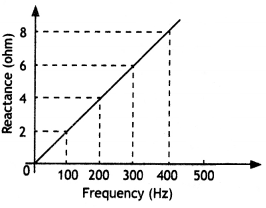
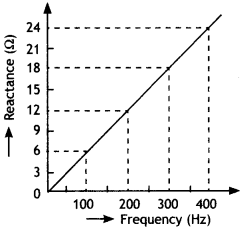
The figure shows how the reactance of an Inductor varies with frequency. (a) Calculate the value of the Inductance of the Inductor using Information given In the graph. (b) If this Inductor is connected In senes to a resistor of 8 ohms, find what would be the impedance at 300 Hz.
Class 12 Physics Important Questions Chapter 7 Alternating Current 60
Answer:
(a) We know that XL = 2πfL or L = \(\frac{X_{L}}{2 \pi f}\).
Now slope of the graph is
\(\frac{X_{L}}{f}=\frac{8-6}{400-300}=\frac{2}{100}\) = 0.02

Therefore L is L = \(\frac{X_{L}}{2 \pi f}=\frac{0.02}{2 \times 3.14}\) = 0.0032 H

(b) NowR = 8 ohm, f = 300 Hz, Z = ?
Now Z = \(\sqrt{R^{2}+X_{L}^{2}}\) . Therefore we have
Z = \(\sqrt{R^{2}+X_{L}^{2}}\) = \(\sqrt{(8)^{2}+(6)^{2}}\) = 10 Ω

Question 2.
A 25.0 μF capacitor, a 0.10-henry Inductor, and a 25.0-ohm resistor are connected in series with an ac source whose emf is E= 310 s. In 314 t (i) what is the frequency of the .mf? (ii) Calculate (a) the reactance of the circuit (b) the Impedance of the circuit and (C) the current in the circuit.
Answer:
Given C = 25.0 μF, L = 0.10 henry, R = 25.0 ohm, Eo = 310V,
Comparing with the equation E = Eo sin ωt,
we have
(i) ω = 314 or f = 50 Hz
Class 12 Physics Important Questions Chapter 7 Alternating Current 61

Question 3.
A sinusoidal voltage V = 200 sin 314 t Is applied to a resistor of 10 ohms. Calculate (i) rms value of current (ii) rms value of voltage and (iii) power dissipated as heat in watt.
Answer:
Vo = 200 V, ω = 314 rads-1 , Vrms = ?, lrms = ?, P = ?
Class 12 Physics Important Questions Chapter 7 Alternating Current 62

Question 4.
Find the inductance of the inductor used in series with a bulb of resistance 10 ohms connected to an ac source of 80 V, 50 Hz. The power factor of the circuit is 0.5. Also, calculate the power dissipation in the circuit.
Answer:
Given R = 10 ohm, V = 80 Hz, f = 50 Hz, cos Φ = 0.5 , L = ?, P = ?
Using the formula
cos Φ = \(\frac{R}{\sqrt{R^{2}+X_{L}^{2}}}\)
or
0.25(R2 + X2) = R2
Or
O.25XL2 = O.75R2
or
XL = 17.32 ohm

Now using XL = 2πfL we have
L = \(\frac{X_{L}}{2 \pi f}=\frac{17.32}{2 \times 3.14 \times 50}\) = 0.055 H

Now Z = \(\sqrt{R^{2}+X_{L}^{2}}\)
= \(\sqrt{(10)^{2}+(17.32)^{2}}\) = 20 Ω

Now Pav = lrms Vrms cos Φ = \(\frac{V_{m}^{2}}{Z}\) × cos Φ
or
Pav = \(\frac{(80)^{2}}{2 \times 20}\) × 0.5 = 160 W

Question 5.
When an alternating voltage of 220 V is applied across a device X, a current of 0.5 A flows through the circuit and Is in phase with the applied voltage. When the same voltage is applied across a device Y, the same current again flows through it, but it leads the voltage by π/2. If element ‘X’ is a pure resistor of 100 ohms,
(a) name the circuit element ‘Y’ and
Answer:
The element Y is a capacitor.

(b) calculate the rms value of current, if rms value of voltage is 141 V.
Answer:
The value of Xc is obtained as below

XC = \(\frac{V}{I}=\frac{220}{0.5}\) = 440 ohm

Therefore impedance of the circuit
Z = \(\sqrt{R^{2}+X_{C}^{2}}=\sqrt{(100)^{2}+(440)^{2}}\) = 451.2 ohm

Therefore rms value of current V 141
l = \(\frac{V_{r m s}}{Z}=\frac{141}{451.2}\) = 0.3125 A

Question 6.
When an alternating voltage of 220 V is applied across a device X, a current of 0. 5 A flows through the circuit and is in phase with the applied voltage. When the same voltage is applied across a device V, the same current again flows through it, but it lags the voltage by π/2.
(a) Name the devices X and Y.
Answer:
The element X is a resistor and Y is an inductor.

(b) Calculate the current flowing through the circuit when the same voltage is applied across the series combination of the two devices X and Y.
Answer:
Now both R and XL are the same and are given by
R = XL = \(\frac{220}{0.5}\) = 440 ohm

Hence impedance of the circuit
Z = \(\sqrt{R^{2}+X_{L}^{2}}\)
= \(\sqrt{(440)^{2}+(440)^{2}}\)
= 622.2 ohm

Therefore current flowing through the circuit is
l = \(\frac{V}{Z}\) = \(\frac{220}{622.2}\) = 0.353 A

Question 7.
A 15.0 μF capacitor Is connected to a 220 V, 50 Hz source. Find the capacitive reactance and the current (rms and peak) In the circuit. If the frequency Is doubled, what happens to the capacitive reactance and the current?
Answer:
Given C= 15.0 μF= 15 × 10-6 F, V= 220 V,
f = 50 HZ, XC = ? lm = ?

The capacitive reactance is
Class 12 Physics Important Questions Chapter 7 Alternating Current 63
Now lrms = \(\frac{V_{r m s}}{X_{c}}=\frac{220}{212}\) = 1.04 A

Peak value of current
lm = \(\sqrt{2}\) × lrms = 1.4.1 × 1.04 = 1.47 A

This current oscillates between + 1.47A and – 1.47 A, and is ahead of the voltage by π/2.

If the frequency is doubled, the capacitive reactance is halved and consequently, the current is doubled.

Question 8.
A sinusoidal voltage of peak value 283 V and frequency 50 Hz is applied to a series LCR circuit in which R = 3 Ω, L = 25.48 mH and C = 796 μF. Find
(a) the impedance of the circuit;
(b) the phase difference between the voltage across the source and the current;
(c) the power dissipated in the circuit; and
(d) the power factor.
Answer:
Given Vm = 283 V, f = 50 Hz, R = 3 Ω
L = 25.48 mH, and C = 796 μF.
(a) To find the impedance of the circuit, we first calculate XL and Xc
XL = 2πfL = 2 × 3.14 × 50 × 25.48 × 10-3 = 8 Ω
XC = \(\frac{1}{2πfC}\)
= \(\frac{1}{2 \times 3.14 \times 50 \times 796 \times 10^{-6}}\) = 4 Ω

Therefore impedance of the circuit is
Z = \(\sqrt{R^{2}+\left(X_{\mathrm{L}}-X_{C}\right)^{2}}\)
= \(\sqrt{3^{2}+(8-4)^{2}}\)
= 5 Ω

(b) Phase difference
Φ = tan-1\(\frac{X_{L}-X_{c}}{R}\) = tan-1 \(\frac{8-4}{3}\) = 53.1°
Since Φ is positive therefore voltage leads current by the above phase.

(c) The power dissipated in the circuit is
P = \(\frac{V_{\mathrm{rms}}^{2}}{Z}=\frac{V_{\mathrm{m}}^{2}}{2 \mathrm{Z}}=\frac{(283)^{2}}{2 \times 5}\) = 8008.9 W
(d) power factor = cos Φ = cos 53.1° = 0.6

Question 9.
A capacitor and a resistor are connected in series with an ac source. If the potential difference across the C, R is 120 V and 90 V respectively, and if rms current of the circuit is 3 A, calculate the (i) impedance and (ii) power factor of the circuit.
Answer:
Given VC = 120 V, VR = 90 V, f = 3 A. and R = 90/3 = 30 ohm ,

Effective voltage in the circuit
V = \(\sqrt{V_{C}^{2}+V_{R}^{2}}=\sqrt{(120)^{2}+(90)^{2}}\)= 150 V .
(i) Therefore impedance of the circuit
Z = \(\frac{V}{l}=\frac{150}{3}\) = 50 Ω.

(ii) Now power factor of the circuit is
cos Φ = \(\frac{R}{Z}=\frac{30}{50}\) = 0.6

Question 10.
An inductor 200 mH, a capacitor C, and a resistor 10 ohm are connected in series with 100 V, 50 Hz ac source. If the current and the voltage are in phase with each other, calculate the capacitance of the capacitor.
Answer:
When current and voltage are in phase then XL = XC
Class 12 Physics Important Questions Chapter 7 Alternating Current 64

Question 11.
An ac voltage of 100V, 50 Hz is connected across a 20-ohm resistor and 2 mH inductors in series.
Calculate (i) impedance of the circuit, and
(ii) rms current in the circuit. (NCERT)
Answer:
Given, V = 100 V, f = 50 Hz, R = 20 ohm, L = 2 mH = 2 × 10⁻³ H, Z = ?, lrms = ?
Using the relation
(a) Z = \(\sqrt{(R)^{2}+\left(X_{L}\right)^{2}}=\sqrt{(R)^{2}+(2 \pi f L)^{2}}\)
Z = \(\sqrt{(20)^{2}+\left(2 \times 3.14 \times 50 \times 2 \times 10^{-3}\right)^{2}}\)
Z = 20 ohm
(b) lrms= V/Z= 100/20 = 5 A

Question 12.
A light bulb is rated at 100 W for a 220 V supply. Find (a) the resistance of the. bulb; (b) the peak voltage of the source; and (c) the rms current through the bulb. (NCERT)
Answer:
(a) We are given P = 100 W and V = 220 V.
The resistance of the bulb is
R = \(\frac{V^{2}}{P}=\frac{(220)^{2}}{100}\) = 484 Ω

(b) The peak voltage of the source is
Vm = \(\sqrt{2}\)V = \(\sqrt{2}\) × 220 = 311V

(c) Since P = I V, therefore l = P/V= 100/220 = 0.45 A

Question 13.
A pure Inductor of 25.0 mH is connected to a source of 220 V. Find the inductive reactance and rms current in the circuit if the frequency of the source is 50 Hz. (NCERT)
Answer:
The inductive reactance,
XL = 2 πf L = 2 × 3.14 × 50 × 25 × 10-3
= 7.85 ohm

The rms current in the circuit is
l = \(\frac{V}{X_{L}}=\frac{220}{7.85}\) = 28 A

Question 14.
A 100 Ω resistor is connected to a 220 V, 50 Hz ac supply.
(a) What is the rms value of current in the circuit?
(b) What is the net power consumed over a full cycle? (NCERT)
Answer :
Given urms = 220 V, f = 50 Hz, lrms = ?, P = ?
(a) lrms = \(\frac{V_{\mathrm{rms}}}{R}=\frac{220}{100}\) = 2.2 A

(b) Power consumed over one cycle of ac P = Vrms × lrms = 220 × 2.2 = 484 W

Question 15.
(a) The peak voltage of an ac supply is 300 V. What is the rms voltage?
(b) The rms value of current in an ac circuit is 10 A. What is the peak current? (NCERT)
Answer:
(a) Vm = 300V, Vrms =?

Using Vrms = \(\frac{V_{\mathrm{m}}}{\sqrt{2}}=\frac{300}{\sqrt{2}}\) = 212.16 V

(b) Using
lm = lrms × V2 = 10 × \(\sqrt{2}\) = 14.14 A

Question 16.
A 44 mH inductor is connected to 220 V, 50 Hz ac supply. Determine the rms value of the current in the circuit. (NCERT)
Answer:
Given L = 44 mH = 44 × 10-3 H, Vrms = 220 V, f = 50Hz,lrms = ?
Using the relation
lrms = \(\frac{V_{\text {rms }}}{x_{L}}=\frac{V_{\text {rms }}}{2 \pi f L}=\frac{220}{2 \times 3.14 \times 50 \times 44 \times 10^{-3}}\)
= 15.9 A

Question 17.
A coil of inductance 0.50 H and resistance 100 Ω is connected to a 240 V, 50 Hz ac supply, (a) What is the maximum current in the coil? (b) What Is the time lag between the voltage maximum and the current maximum? (NCERT)
Answer:
Given L = 0.5 H, R = 100 Ω, Vrms = 240 V,
f= 50 Hz, ω = 2πf= 2 × 3.14 × 50 = 314 s-1 lm = ?
(a) Now
Z = \(\sqrt{R^{2}+X_{L}^{2}}=\sqrt{(100)^{2}+(0.5 \times 314)^{2}}\)
Z = 186.1 Ω

Therefore
l<sub>m</sub> = \(\frac{V_{m}}{Z}=\frac{\sqrt{2} \times V_{\mathrm{rms}}}{Z}=\frac{\sqrt{2} \times 240}{186.1}\)
lm = 1.82 A

(b) Let Φ be the phase angle by which current lags emf, then
tan Φ = \(\frac{X_{L}}{R}=\frac{0.5 \times 314}{100}\) = 1.571
Φ = 57.5° or Φ = 57.5 × π/180 rad

Therefore timw lag
t = \(\frac{\phi T}{2 \pi}=\frac{57.5 \times \pi}{180 \times 2 \pi \times 50}\) = 3.194 × 10⁻³ s

Question 18.
A coil of 0.01-henry Inductance and 1-ohm resistance is connected to 200 volts, 50 Hz ac supply. Find the Impedance of the circuit and time lag between max alternating voltage and current. (NCERT Exemplar)
Answer:
Given L = 0.01 henry, R = 1 ohm,
Vrms = 200V, f = 50Hz, Z = ?, t = ?
We know that
XL = 2πfL = 2 × 3.14 × 50 × 0.01 = 3.14 ohm
Now
Z = \(\sqrt{R^{2}+X_{\mathrm{L}}^{2}}=\sqrt{(3.14)^{2}+(1)^{2}}\) = 3.3 Ω
Also tan Φ = \(\frac{X_{L}}{R}=\frac{3.14}{1}\)= 3.14
Or
Φ = tan-1 (3.14)
Or
Φ = 72° or 72 × π/180 rad
Now time lag Δt is
Δt = \(\frac{\phi}{\omega}=\frac{72 \times \pi}{180 \times 2 \pi \times 50}=\frac{1}{250}\) s

Question 19.
An electrical device draws 2 kW power from AC mains (voltage 223 V (rms) = V50,000 V). The current differs (lags) in phase by Φ (tan Φ = – 3/4) as compared to voltage.
Find (i)R,
(ii) XC – XL
(iii) lm
Another device has twice the values for R, XC, XL. How are the answers affected? (NCERT Exemplar)
Answer:
Given P = 2 kW = 2000 W, Vrms = 223
= \(\sqrt{50,000}\) V, tan Φ = – 3/4, R = ?,XC – XL = ?, lm = ?

(i)Class 12 Physics Important Questions Chapter 7 Alternating Current 65
Solving for R we have
R = 20 ohm

(ii) Also XC – XL = (-3/4) R = – 15 Ω
Hence lrms =\(\frac{V}{Z}=\frac{223}{25}\) = 9 A
(iii) lm = \(\sqrt{2}\) × lrms = 1.414 × 9 = 12.6 A

If R, XC, XL, are all doubled, tan Φ does not change. Therefore as Z is doubled, the current becomes halved.

Question 20.
An alternating voltage given by V = 140 sin 314 t is connected across a pure resistor of 50 Ω. Find
(a) the frequency of the source.
(b) the rms current through the resistor. (CBSEAI 2012)
Answer:
R = 50 Ω, f = ?, lrms = ?, Vm = 140 V
Comparing with V = Vm sin 2πft,
we have
2πft = 314 t
or
f = 50 Hz
lrms = \(\frac{V_{r m s}}{R}=\frac{140}{50 \sqrt{2}}\) = 1.98 A

Question 21.
The figure shows a series LCR circuit with L = 5.0 H, C = 80 μF, R = 40 Ω connected to a variable frequency 240 V source. Calculate
Class 12 Physics Important Questions Chapter 7 Alternating Current 66
(a) The angular frequency of the source drives the circuit at resonance.
(b) The current at the resonating frequency.
(C) The rms potential drops across the capacitor at resonance. (CBSE Delhi 2012)
Answer:
Given L= 5.0 H, C= 80 μF , R = 40 Ω, Vrms = 240 V ωo = ?, lrms = ?, VC = ?
(a)Angutar frequency at resonance
ω0 = \(\sqrt{\frac{1}{L C}}=\sqrt{\frac{1}{5 \times 80 \times 10^{-6}}}\) = 50 s-1

(b)At resonance Z = R = 4O Ω
Now lrms = \(\frac{V_{\mathrm{rms}}}{\mathrm{Z}}=\frac{240}{40}\) = 6 A

(C) VC = lrms × XC = 6 (50 × 80 × 10-6) = 1500 V

Question 22.
The figure shows a series LCR circuit connected to a variable frequency 200 V source with L = 50 mH, C = 80 μF and R = 40 Ω.
Determine
(a) the source frequency which derives the circuit in resonance;
(b) the quality factor (Q) of the circuit. (CBSEAI 2014C)
Class 12 Physics Important Questions Chapter 7 Alternating Current 67
Answer:
(a) Given V = 200 V, L = 50 mH, C = 80 μF, R = 40 Ω
Source frequency at resonance
Class 12 Physics Important Questions Chapter 7 Alternating Current 68

Question 23.
When an alternating voltage of 220 V is applied across a device X, a current of 0.5 A flows through the circuit and is in phase with the applied voltage. When the same voltage is applied across another device Y, the same current again flows through it, but it leads the voltage by π/2 rattan.
(a) Name the devices X and Y.
(b) Calculate the current flowing In the circuit when the same voltage Is applied across the series combination of the two devices X and Y.
Answer:
(a) The two devices are resistor and capacitor, respectively.

(b) Given l = 0.5 A, V = 220 V, XL = ?, R = ? , l = ?
Now XC and R are equal and are given by
XC = R = \(\frac{220}{0.5}\) = 440 Ω

Hence impedance of the circuit
Z = \(\sqrt{R^{2}+X_{C}^{2}}=\sqrt{2(440)^{2}}\) = 622.25 Ω

Therefore current through the combination is
l = \(\frac{V}{Z}=\frac{220}{622.25}\) = 0.354 A

Question 24.
In the following circuit, calculate (a) the capacitance of the capacitor, if the power factor of the circuit is unity, (b) the Q-factor of this circuit. What is the significance of the Q-factor in a.c. circuit? Given the angular frequency of the a.c. source to be 100 s-1. Calculate the average power dissipated in the circuit. (CBSE Delhi 2017C)
Class 12 Physics Important Questions Chapter 7 Alternating Current 69
Answer:
(a) when the power factor is unity the circuit is in resonance, therefore, we have
Class 12 Physics Important Questions Chapter 7 Alternating Current 70
Quality factor determines the sharpness of tuning at resonance. More the Q factor more the sharpness.
Class 12 Physics Important Questions Chapter 7 Alternating Current 71

Question 25.
The figure below shows how the reactance of a capacitor varies with frequency.
Class 12 Physics Important Questions Chapter 7 Alternating Current 72
(a) Use the Information on the graph to calculate the value of capacity of the capacitor.
(b) An inductor of inductance L has the same reactance as the capacitor at 100 Hz. Find the value of L.
(c) Using the same axes, draw a graph of reactance against frequency for the inductor.
(d) If this capacitor and inductor were connected in series to a resistor of 10 Ω, what would be the impedance of the combination at 300 Hz?
Answer:
(a) From the graph we find that for a frequency of 100 Hz the capacitive reactance is 6 ohm, therefore
Class 12 Physics Important Questions Chapter 7 Alternating Current 73
(b) Now given XL = XC at 100 Hz, therefore XL = 6 ohm
Class 12 Physics Important Questions Chapter 7 Alternating Current 74
(c) The XL – f graph is as shown below.
Class 12 Physics Important Questions Chapter 7 Alternating Current 75
(d) For a frequency of 300 Hz, XL = 18 ohm and XC = 2 ohm. If resistance is 10 ohm then the impedance of the combination is
Class 12 Physics Important Questions Chapter 7 Alternating Current 76

Question 26.
The given graphs (i) and (ii) represent the variation of the opposition offered by the circuit element to the flow of alternating current, with the frequency of the applied emf. Identify the circuit element corresponding to each graph.
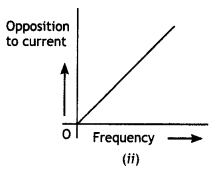
Class 12 Physics Important Questions Chapter 7 Alternating Current 77
A circuit is set up by connecting L= 100 mH, C = 5 μf and R =100 Ω in series. An alternating emf of (150 \(\sqrt{2}\)) volt, (500/π) Hz is applied across this series combination. Calculate the impedance of the circuit. What is the average power dissipated in (a) the resistor, (b) the capacitor, (c) the inductor, and (d) the complete circuit?
Answer:
(a) Resistor and (b) Inductor
Given L = 100 mH = 0.1 H, C = 5μF = 5 × 10⁻⁶F, R=100 Ω,
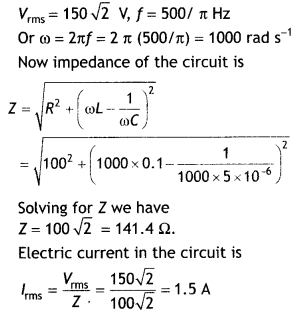
Class 12 Physics Important Questions Chapter 7 Alternating Current 78
Average power dissipated in
(a) the resistor P = l2R = (1.5)2 × 100 = 225 W
(b) power in inductor is zero.
(c) power in capacitor is zero.
(d) the complete circuit is same as that in a resistor.

Question 27.
The output voltage of an ideal transformer, connected to a 240 V ac mains, is 24 V. When this transformer is used to light a bulb with rating 24 V, 24 W, calculate the current in the primary coil of the circuit.
Answer:
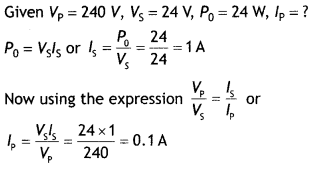
Class 12 Physics Important Questions Chapter 7 Alternating Current 79

Question 28.
An ac generator consists of a coil of 50 turns and an area of 2.5 m2 rotating at an angular speed of 60 rads-1 in a uniform magnetic field B = 0.2 tesla, between the two fixed pole pieces. The resistance of the circuit including that of the coil is 500 ohm (a) Calculate the maximum current drawn from the generator. (b) What is the flux when the current is zero and (c) Would the generator work if the coil were stationary and instead the pole pieces rotated together with the same speed as above? Give a reason for your answer.
Answer:
Given n = 50, A = 2.5 m2, ω = 60 rads-1, B = 0.2 T, R = 500 ohm, l0 = ?
(a) The maximum induced emf produced in the coil is
ε0 = nBAω = 50 × 0.2 × 2.5 × 60 = 1500 V

Therefore maximum current in the circuit is
l0 = \(\frac{\varepsilon_{0}}{R}=\frac{1500}{500}\) = 3 A

(b) The flux in this case is maximum and is given by Φ = nBA = 50 × 0.2 × 2.5 = 25 Wb

(c) Yes, for a generator to work there should be relative motion between the magnet and the coil.

Question 29.
The primary coil of an ideal step-up transformer has 100 turns and the transformation ratio is also 100. The input voltage and the powers are 220 V and 1100 W respectively. Calculate:
(a) number of turns in the secondary
(b) the current In the primary
(C) the voltage across the secondary
(d) the current in the secondary
(e) power in the secondary
Answer:
Here, N = 100, Transformation ratio = 100
Vp = 220 V, Pp = 1100W
(a) Number of turns in the secondary
Ns = Np × Transformation ratio
= 100 × 100 = 10,000

(b) Current in the primary
lp = \(\frac{P_{p}}{V_{p}}=\frac{1100}{220}\) = 5 A

(C) Voltage across the secondary Vs = Vp × transformation ratio
= 220 × 1oo = 22000 V

(d) Current in the secondary
ls = \(\frac{V_{p} l_{p}}{V_{s}}=\frac{220 \times 5}{22000}\) = 0.05 A

(e) Power in the secondary = power in the primary (ideal transformer) = 1100 W

Question 30.
Calculate the current drawn by the primary of a transformer which steps down 200 V to 20 V to operate a device of resistance 20 Q. Assume the efficiency of the transformer to be 80 %.
Answer:
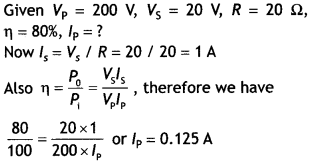
Class 12 Physics Important Questions Chapter 7 Alternating Current 80

Question 31.
The primary of a transformer has 200 turns and the secondary has 1000 turns. If the power output from the transformer at 1000 V is 9 kW, calculate
(a) The primary voltage and
(b) The heat loss in the primary coil if the resistance of the primary is 0.2 Ω and the efficiency of the transformer is 90%.
Answer:
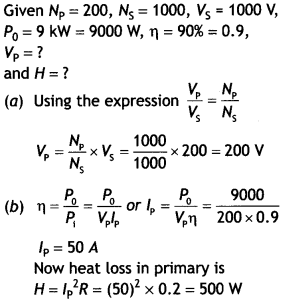
Class 12 Physics Important Questions Chapter 7 Alternating Current 81

Question 32.
A power transmission line feeds input power at 2300 V to a step-down transformer with its primary windings having 4000 turns. What should be the number of turns in the secondary In order to get output power at 230 V? (NCERT)
Answer:
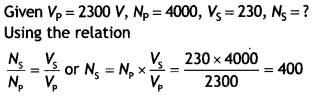
Class 12 Physics Important Questions Chapter 7 Alternating Current 82

Question 33.
A small town with a demand of 800 kW of electric power at 220 V situated 15 km away from an electric plant generating power at 440 V The resistance of the two wirelines carrying power is 0.5 Ω per km. The town gets power from the line through a 4000 – 220 V step-down transformer at a sub-station in the town.
(a) Estimate the line power loss in the form of heat.
(b) How much power must the plant supply, assuming their negligible power loss due to leakage?
(c) Characterise the step-up transformer at the plant. (NCERT)
Answer:
Electric power required P = 800 kW = 800 × 103 W
Voltage required V0 = 220 V

Distance of the power station
d = 15km = 15 × 103m

Resistance per kilometre = 0.5 ohm per km
Total resistance R = 0.5 × 2 × 15 = 15 ohm

Input voltage Vi = 440 V

Primary voltage of transformer εp = 4000 V
Secondary voltage of transformer εs = 220 V
(a) Rms value of current in the two wire line
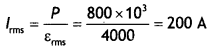
Class 12 Physics Important Questions Chapter 7 Alternating Current 83

Therefore power loss along the line
= l2rmsR = (200)2 × 15 = 600 kW

(b) Assuming negligible loss due to leakage Total power supply = power demand of town + power loss along the line
P = 800 kW + 600 kW = 1400 kW

(c) Voltage drop on the line = 200 × 15 = 3000 V
Hence voltage at the generation station
V= 4000 + 3000 = 7000 V

Therefore the step-up transformer at the plant is 440 V – 7000 V.

Question 34.
A 60 W load is connected to the secondary of a transformer whose primary draws line voltage. If a current of 0.54 A flows in the load, what is the current in the primary coil? Comment on the type of transformer being used. (NCERT Exemplar)
Answer:
Given Ps = 60 W, ls = 0.54 A
We know that P=V I, therefore we have Vs = Ps/ls = 60 /0.54 = 110 V

Therefore the transformer is a step-down transformer, whose transformation ratio is 1/2
Therefore
lp = 1/2 × ls = 1/2 × 0.54 = 0.27 A
CBSE Sample Papers for Class 10 Sanskrit Set 5 for Practice

Students can access the CBSE Sample Papers for Class 10 Sanskrit with Solutions and marking scheme Set 5 will help students in understanding the difficulty level of the exam.

CBSE Sample Papers for Class 10 Sanskrit Set 5 for Practice

समयः- होरात्रयम्
सम्पूर्णाङ्काः – 80

सामान्यनिर्देशाः

  • कृपया सम्यक्तया परीक्षणं कुर्वन्तु यत् अस्मिन् प्रश्नपत्रे 19 प्रश्नाः सन्ति।
  • उत्तरलेखनात् पूर्व प्रश्नस्य क्रमाङ्कः अवश्यं लेखनीयः।
  • अस्य प्रश्नपत्रस्य पठनाय 15 निमेषाः निर्धारिताः सन्ति। अस्मिन् अवधौ केवलं प्रश्नपत्रं पठनीयम् उत्तरपुस्तिकायां च किमपि न लेखनीयम्।

प्रश्नपत्रस्वरूपम्

‘अ’-भागः (बहुविकल्पात्मकः) 40 अङ्काः
‘आ’-भागः (वर्णनात्मकः) 40 अङ्काः

(i) अस्मिन् प्रश्नपत्रे द्वौ भागौ स्तः।
(ii) ‘अ’- भागः बहुविकल्पात्मकः अस्ति।
(iii) ‘आ’-भागः वर्णनात्मकः अस्ति।
(iv) प्रश्नसङ्ख्या प्रश्नपत्रानुसारम् अवश्यमेव लेखनीया।
(v) सर्वेषां प्रश्नानाम् उत्तराणि संस्कृतेन लेखनीयानि।
(vi) प्रश्नानां निर्देशाः ध्यानेन अवश्यं पठनीयाः।

‘अ’-भागः- बहुविकल्पात्मकाः प्रश्नाः (अङ्काः 40)

अनुप्रयुक्त-व्याकरणम् (अङ्काः 25)

प्रश्न 1.
अधोलिखितवाक्येषु रेखाङ्कितपदस्य सन्धिपदं सन्धिच्छेदपदं वा चिनुत-(केवलं प्रश्नचतुष्टयम्) (1 x 4 = 4)
(i) एषः + अस्ति मम विद्यालयः।
(क) एषोस्ति
(ख) एषोऽस्ति
(ग) एषअस्ति
उत्तर
(ख) एषोऽस्ति

(ii) कुरुक्षेत्रं प्रति कृष्णश्चलति
(क) कृष्णो + चलति
(ख) कृष्ण + चलति
(ग) कृष्णः + चलति
उत्तर
(ग) कृष्णः + चलति

(iii) युष्मदर्शनात् कुशलमिव।
(क) युष्मत् + दर्शनात्
(ख) युष्मद् + दर्शनात्
(ग) युष्मत् + दर्शन
उत्तर
(क) युष्मत् + दर्शनात्

(iv) राजहंसः सरस्तीरे विहरति।
(क) सरः + तीरे
(ख) सरस् + तीरे
(ग) सरसा + तीरे
उत्तर
(क) सरः + तीरे

(v) सः चेन्निरर्थकं नीतः।
(क) चेन् + निरर्थकं
(ख) चेत् + निराकम्
(ग) चेत् + निरर्थकम्
उत्तर
(ग) चेत् + निरर्थकम्

प्रश्न 2.
अधोलिखितवाक्येषु रेखाङ्कितपदानां समासं विग्रह वा प्रदत्तविकल्पेभ्यः चिनुत। (केवलं प्रश्नचतुष्टयम्) (1 x 4 = 4)

(i) भयात् आकुलं व्याघ्रं दृष्ट्वा शृगालः हसन् आह।
(क) भयआकुलम्
(ख) भयाकुलम्
(ग) भयेनाकुलं
उत्तर
(ख) भयाकुलम्

(ii) शिशुः चित्रेण सहितम् पुस्तकम् द्रष्टुं वाञ्छति।
(क) सचित्रम्
(ख) सचित्र
(ग) सचित्रेण
उत्तर
(क) सचित्रम्

(iii) सुरभेः इमाम् अवस्थाम् दृष्ट्वा सुराधिपः अपृच्छत्।
(क) सुरात् अधिपः
(ख) सुरे अधिपः
(ग) सुराणाम् अधिपः
उत्तर
(ग) सुराणाम् अधिपः

(iv) शिशिरवसन्तौ पुनः आयातः।
(क) शिशिरस्य वसन्तः
(ख) शिशिरस्य च वसन्तौ च
(ग) शिशिरः च वसन्तः च
उत्तर
(ग) शिशिरः च वसन्तः च

(v) सम्पत्तौ च विपत्तौ च महताम् एकरुपता।
(क) सम्पत्तिविपत्तयोः
(ख) सम्पत्तयोः विपत्तयोः
(ग) सम्पत्तिविपत्तिः
उत्तर
(क) सम्पत्तिविपत्तयोः

प्रश्न 3.
अधोलिखितवाक्येषु रेखाङ्कितपदानां प्रकृति-प्रत्ययौ संयोज्य विभज्य वा उचितम् उत्तरं विकल्पेभ्यः चिनुत। (केवलं प्रश्नचतुष्टयम्)
(i) पृथिव्याः गुरु + त्व सर्वे जानन्ति।
(क) गुरुता
(ख) गुरुत्वम्
(ग) गुरुत्वता
उत्तर
(ख) गुरुत्वम्

(ii) छात्रा: गुरुवन्दनां कुर्वन्ति।
(क) वन्दन + टाप
(ख) वन्दना + टाप्
(ग) वन्दन + आ
उत्तर
(क) वन्दन + टाप

अथवा

छात्राः क्रीडाक्षेत्रे क्रीडन्ति।
(क) छात्रा + आ
(ख) छात्र + टाप
(ग) छात्र + तल्
उत्तर
(ख) छात्र + टाप

(iii) अजयः अत्यन्तं रूपवान् अस्ति।
(क) रूप + शानच्
(ख) रूप + शतृ
(ग) रूप + मतुप्
उत्तर
(ग) रूप + मतुप्

(iv) चरित्र + मतुप् जनाः एव श्रेष्ठतमाः भवन्ति।
(क) चरित्रवन्तः
(ख) चरित्रत्
(ग) चरित्रवन्तौ
उत्तर
(क) चरित्रवन्तः

प्रश्न 4.
वाच्यस्य नियमानुगुणम् उचितं विकल्पं चिनुत। (केवलं प्रश्नत्रयम्) (1 x 3 = 3)

(i) शिक्षक: – किं त्वं संस्कृतं …………….
(क) जानाति
(ख) जानासि
(ग) ज्ञायते
उत्तर
(ख) जानासि

(ii) छात्र:- आम् ……………… संस्कृतं ज्ञायते।
(क) मया
(ख) अहम्
(ग) मत्
उत्तर
(क) मया

(iii) शिक्षक:- किं त्वया ………………. पठ्यते।
(क) महाभारतम्
(ख) महाभारते
(ग) महाभारत
उत्तर
(क) महाभारतम्

(iv) छात्रः-आम्! अहम् महाभारतम् ……………..
(क) पठति
(ख) पठामि
(ग) पठसि
उत्तर
(ख) पठामि

प्रश्न 5.
प्रदत्तेभ्यः विकल्पेभ्यः समुचितं कालबोधकशब्दं चिनुत- (केवलं प्रश्नचतुष्टयम्) (1 x 4 = 4)

(i) श्यामः प्रातः (5.30) ……. …… वादने दिनचर्यायाः आरम्भं करोति।
(क) सपाद-पञ्च
(ख) सार्ध-पञ्च
(ग) षट्
उत्तर
(ख) सार्ध-पञ्च

(ii) सः (6.15) …………………… वादने स्नानम् करोति।
(क) सपाद-षट
(ख) सार्ध-षट
(ग) पादोन-सप्त
उत्तर
(क) सपाद-षट

(iii) पश्चात् सः (6.45) …………………. वादने प्रातराशं करोति।
(क) पादोन-षट
(ख) सार्ध-षट
(ग) पादोन-सप्त
उत्तर
(ग) पादोन-सप्त

(iv) तदनन्तरं (8.00) …… वादने विद्यालयं गच्छति।
(क) अष्टम्
(ख) अष्टा
(ग) अष्ट
उत्तर
(ग) अष्ट

(v) (2.15) … … वादने विद्यालयात् गृहम् आगच्छति।
(क) पादोन-द्वि
(ख) सपाद-द्वि
(ग) द्वि-पादोन
उत्तर
(ख) सपाद-द्वि

प्रश्न 6.
वाक्यानुगुणम् उचिताव्ययपदं चिनुत- (केवलं प्रश्नत्रयम्) (1 x 3 = 3)

(i) समर्थाय दानम् ………….. भवति।
(क) वृथा
(ख) अपि
(ग) यदा
उत्तर
(क) वृथा

(ii) ……………… एक: सिंहः तत्रागच्छत्।।
(क) इदानीम्
(ख) सहसा
(ग) तथा
उत्तर
(ख) सहसा

(iii) कच्छपः …………. चलति।
(क) सदा
(ख) कदा
(ग) मन्दम्
उत्तर
(ग) मन्दम्

(iv) ……………….. इदम् श्रेयस्करम्?
(क) अपि
(ख) किम्
(ग) सहसा
उत्तर
(ख) किम्

प्रश्न 7.
अधोलिखितवाक्येषु रेखाङ्कितपदम् अशुद्धम् अस्ति। शुद्ध पदं विकल्पेभ्यः चिनुत- (केवलं प्रश्नत्रयम्) (1 x 3 = 3)
(i) इयम् मम पुस्तकम् अस्ति।
(क) अयम्
(ख) इदम्
(ग) अस्य
उत्तर
(ख) इदम्

(ii) ते कन्दुकेन क्रीडामः
(क) क्रीडन्ति
(ख) क्रीडथ
(ग) क्रीडताम्
उत्तर
(क) क्रीडन्ति

(iii) ह्यः एव तस्य जन्मदिवसः भविष्यति।
(क) अधुना
(ख) अद्य
(ग) श्वः
उत्तर
(ग) श्वः

(iv) देवालये अहम् देवम् नमति।
(क) यूयम्
(ख) त्वम्
(ग) सः
उत्तर
(ग) सः

पठितावबोधनम् (अङ्काः 15)

प्रश्न 8.
रेखाङ्कितपदानि आधृत्य समुचितं प्रश्नवाचकपदं चिनुत। ( केवलं प्रश्नपञ्चकम् ) (1 x 5 = 5)

(i) त्वम् मानुषात् विभेषि।
(क) कस्मै
(ख) कस्मात्
(ग) कात्
उत्तर
(ख) कस्मात्

(ii) सिंहः जन्तून् दृष्ट्वा पृच्छति।
(क) केन
(ख) कान्
(ग) काम्
उत्तर
(ख) कान्

(iii) अभियुक्तः अतिकृशकायः आसीत्।
(क) कः
(ख) कीदृशः
(ग) किम्
उत्तर
(ख) कीदृशः

(iv) दुर्बले सुते मातुः अभ्यधिका कृपा भवति।
(क) कः
(ख) कस्य
(ग) कस्याः
उत्तर
(ग) कस्याः

(v) क्रोधः नरस्य प्रथमः शत्रुः अस्ति।
(क) कः
(ख) कीदृशः
(ग) किम्
उत्तर
(क) कः

(vi) प्रस्तरतले लतागुल्माः पिष्टाः न भवन्तु।
(क) के
(ख) कुत्र
(ग) कदा
उत्तर
(ख) कुत्र

प्रश्न 9.
अधोलिखितवाक्येषु रेखाङ्कितपदानां प्रसङ्गानुकुलम् उचितार्थं चिनुत- (केवलं प्रश्नचतुष्टयम्) (1 x 4 = 4)

(i) पिकस्य स्वरः कर्णप्रियः भवति।
(क) मधुरम्
(ख) कठोरम्
(ग) उच्चैः
उत्तर
(क) मधुरम्

(ii) तव पुनः गतस्य सा सम्मुखम् ईक्षते।
(क) परोक्षम्
(ख) समन्ततः
(ग) पुरतः
उत्तर
(ग) पुरतः

(iii) किम् त्वम् पुनः श्रुत्वा वदसि।
(क) आगत्य
(ख) श्रव्य
(ग) आकर्ण्य
उत्तर
(ग) आकर्ण्य

(iv) पुत्रस्य दैन्यम् दृष्ट्वा सुरभिः रोदिति।
(क) दीनताम्
(ख) वेदनाम्
(ग) अदैन्यम्
उत्तर
(क) दीनताम्

(v) उद्यमम् कृत्वा नरः कदापि न अवसीदति
(क) प्रसीदति
(ख) रोचयति
(ग) दु:खीयति
उत्तर
(ग) दु:खीयति

प्रश्न 10.
भाषिककार्यसम्बद्धानां प्रश्नानां समुचितम् उत्तरं विकल्पेभ्यः चिनुत-(केवलं प्रश्नषट्कम् ) ङ्के( 1 x 6 = 6)

(i) कर्तुं शक्यो भवेद्येन स विवेकः इतीरितः। अत्र ‘विवेक’ पदस्य क्रियापदम् किम्?
(क) कर्तुं
(ख) शक्यः
(ग) ईरितः
उत्तर
(ग) ईरितः

(ii) “एतेन आरक्षिणा अध्वनि यत् उक्तं तत् वर्णयामि।” अत्र मार्गे पदाय किं पदं प्रयुक्तम्?
(क) उक्तम्
(ख) अध्वनि
(ग) तत्
उत्तर
(ख) अध्वनि

(iii) ‘शीतले जले’ अत्र विशेषणं किम्?
(क) शीतले
(ख) जले
(ग) शीतले जले
उत्तर
(क) शीतले

(iv) “अहम् एव करुणापरः पक्षी सम्राट्।” अत्र ‘अहम्’ पदं कस्मै प्रयुक्तम्?
(क) मयूराय
(ख) काकाय
(ग) पिकाय
उत्तर
(ख) काकाय

(v) ‘अनुव्रजन्ति’ क्रियापदस्य कर्तृपदं किम्?
(क) मृगाः
(ख) मृगैः
(ग) तुरङ्गै
उत्तर
(क) मृगाः

(vi) ‘स: दीनः अस्ति इति जानन् अपि कृषक: तम् पीडयति अत्र ‘सः’ इति कर्तृपदस्य क्रियापदं किम्?
(क) जानन्
(ख) पीडयति
(ग) अस्ति
उत्तर
(ख) पीडयति

(vii) आचारः प्रथमः धर्मः। अत्र ‘आचारः’ इति पदस्य विपर्ययं किम्?
(क) स्वभावः
(ख) सदाचारः
(ग) दुराचारः
उत्तर
(ग) दुराचारः

(viii) हयाः इति पदस्य पयार्यपदं किम्?
(क) अश्वः
(ख) शुनकः
(ग) गर्दभः
उत्तर
(क) अश्वः

‘आ’-भागः – वर्णनात्मकाः प्रश्नाः (अङ्काः 40)

अपठितावबोधनम् (अङ्काः 10)

प्रश्न 11.
अधोलिखितं गद्यांशं पठित्वा प्रदत्तप्रश्नानाम् उत्तराणि संस्कृतेन लिखत। (10)
सर्वेषु कार्येषु पात्र-अपात्रविवेकः आवश्यकः। धेनुः तृणानि स्वीकृत्य मधुरं दुग्धम् प्रयच्छति। दुग्धेन जनानाम् बहु उपकारः भवति। सर्पाय वयं दुग्धम् यच्छामः चेत् तत् दुग्धं विषं भवति। विषेण अनेकेषाम् अपकारः भवति। धनस्य दाने अपि तथैव विवेकः आवश्यक:। सुपात्रेभ्यः यदि वयं धनं यच्छामः ते राष्ट्रस्य समाजस्य च हितं कुर्वन्ति। दुर्जनेभ्यः यदि धनं दीयते, ते जनान् पीडयन्ति। दुर्जनः जनानाम् धनं नीत्वा तद् स्वार्थे, दुष्टकर्मणि पापे वा निवेशयति येन जनानाम् अपकारः भवति। दुष्टः केषाञ्चिदपि मानं न करोति। तस्य कर्मणा पदे-पदे जनाः अपमानं एव सहन्ते। परं सज्जनः तु सदैव राष्ट्रस्य जनस्य च हितं कृत्वा प्रसीदति। सः दु:खं सोवा अपि पुष्पमिव प्रफुल्लितः भवति।

(अ) एकपदेन उत्तरत। (केवलं प्रश्नद्वयम्) (1 x 2 = 2)

(i) केन जनानाम् बहु उपकारः भवति।
(ii) सर्पाय दत्तं दुग्धम् किम् भवति?
(iii) धनस्य दाने किम् आवश्यक:?

(अ) पूर्णवाक्येन उत्तरत। (केवल प्रश्नद्वयम्) (2 x 2 = 4)

(i) सुपात्राः धनम् प्राप्य किम् कुर्वन्ति?
(ii) धेनुः तृणानि स्वीकृत्य अपि कीदृशं दुग्धं प्रयच्छति?
(iii) सज्जनः किम् कृत्वा प्रसीदति?

(इ) अस्य अनुच्छेदस्य कृते उपयुक्तं शीर्षकं संस्कृतेन लिखत। (1)

(ई) यथानिर्देशम् उत्तरत्-(केवलं प्रश्नत्रयम्) (1 x 3 = 3)

(i) ‘अपकारः’ इति पदस्य किम् विपर्ययपदम् अत्र प्रयुक्तम्?
(क) निस्तारः
(ख) विस्तारः
(ग) उपकारः

(ii) ‘ते जनान् पीडयन्ति’। इत्यत्र ते पदम् केभ्यः प्रयुक्तम्।
(क) सज्जनेभ्यः
(ख) दुर्जनेभ्यः
(ग) सर्पेभ्यः

(iii) अस्मिन् अनुच्छेदे ‘कार्येषु’ इति पदस्य विशेषण पदं किम्?
(क) पात्रेषु
(ख) अपात्रेषु
(ग) सर्वेषु

(iv) ‘सहन्ते’ क्रियापदस्य कर्तृपदं किम् अस्ति?
(क) जनाः
(ख) कर्मणा
(ग) अपमानम्

रचनात्मक कार्यम् (अङ्काः 15)

प्रश्न 12.
गृहम् प्रति आगमनाय भगिनीं प्रति लिखिते पत्रे रिक्तस्थानानि पूरयित्वा पत्रं च पुनः उत्तरपुस्तिकायां लिखतु। (2 x 10 = 5)
औरंगावादतः आदरणीये (i) ………….. सादर प्रणतिः (ii) …… सर्वथा कुशली, अहम् अपि भवत्याः कुशलम् (iii) ……… । अग्रे निवेदनीयम् इदम् अस्ति यत् (iv) ……………….. स्वास्थ्यं सम्प्रति शोभनं न वर्तते। अनुजा काम्या अपि (v) ……………. नैव निपुणा। येन-केन प्रकारेण सा (vi) ….. .. निर्माति। गृहस्य अन्यानि (vii) … …. अपि तथैव करणीयानि भवन्ति अतएव तस्याः उपरि (viii) ……………. वर्तते। अतएव मातुः रुग्णतां, काम्यायाः कष्टं विचार्य भवत्या शीघ्रमेव अत्र (ix) … ” अहम् भवतीम् आनेतुम् अष्टमतारिकायां (x) .. .शेषं कुशलम्।
भवत्याः स्नेहाकांक्षी
अनुजः मञ्जूषा- भोजनं, प्राप्स्यामि, बहुकार्यभारः, आगन्तव्यम्, अग्रजे, मातुः, पाक-कार्ये, ईश्वरकृपया, कामये, कार्याणि

प्रश्न 13.
प्रदत्तं चित्रं दृष्ट्वा मञ्जूषायां प्रदत्तशब्दानां सहायतया पञ्च वाक्यानि संस्कृतेन लिखत- (1 x 5 = 5)
CBSE Sample Papers for Class 10 Sanskrit Set 5 for Practice

मञ्जूषा- पुस्तकालयः, केचन, समाचारपत्राणि, कपाटिकायाम् बालिकाः, पुस्तकानि, तूष्णीम्, मंचे, अनुशासनं छात्राः, ज्ञानवर्धकानि, पुस्तकालयाध्यक्षः, रोचकानि

अथवा
मञ्जूषाप्रदत्तशब्दानां साहाय्येन निम्नलिखितं विषयम् अधिकृत्य पञ्चभिः संस्कृतवाक्यैः एकम् अनुच्छेदं लिखत (1 x 5 = 5)

विषयः गङ्गा … मञ्जूषा- हिमालयात्, भगीरथेन, भागीरथी, अलकनन्दया तीर्थस्थानानि, नगराणि, वाराणसी, बंगालसागरे, कुम्भमेलकम्, उद्योगानाम्, प्रयागतीर्थे, अपशिष्टम्, अवकराणि, दूषितम्

प्रश्न 14.
अधोलिखितानि वाक्यानि संस्कृतभाषया अनूद्य लिखत-(केवलं वाक्यपञ्चकम् ) (1 x 5 = 5)
(i) पाप से दु:ख मिलता है। (Sin hurts.)
(ii) शिक्षा से विनम्रता और विनम्रता से योग्यता प्राप्त होती है। (Ability is achieved by politeness and politeness is achieved by education.)
(iii) सत्य बोलो परन्तु अप्रिय सत्य मत बोलो। (Speak truth but do not speak unpleasant truth.)
(iv) मानवता मानव का आभूषण है। (Humanity is ornament of man.)
(v) पर्यावरण की रक्षा हमारा नैतिक कर्तव्य है। (Protection of environment is our moral duty.)
(vi) ईर्ष्या मनुष्य का नाश करती है। (Jealousy destroy man.)
(vii) मैने उसे धन दिया। (I gave him money.)

पठितावबोधनम् (अङ्काः 15)

प्रश्न 15.
अधोलिखितं गद्यांश पठित्वा प्रदत्तप्रश्नानाम् उत्तराणि संस्कृतेन लिखत। (3)
न्यायाधीशेन पुनस्तौ घटनाया: विषये वक्तुमदिष्टौ। आरक्षिणि निजपक्षं प्रस्तुतवति आश्चर्यमघटत् सः शवः प्रावारकमपसार्य न्यायाधीशमभिवाद्य निवेदितवान्-मान्यवर! एतेन आरक्षिणा अध्वनि युदक्तं तद् वर्णयामि। त्वयाऽहं चोरितायाः मञ्जूषायाः

ग्रहणाद् वारितः, अतः निजकृत्यस्य फलं भुझ्व। अस्मिन् चौर्थाभियोगे त्वम् वर्षत्रयस्य कारादण्ड लप्स्यसे इति। न्यायाधीशः
आरक्षिणे कारादण्डमादिश्य तं जनं ससम्मानं मुक्तवान्।

(अ) एकपदेन उत्तरत। (केवलं प्रश्नद्वयम्) (1/2 x 2 = 1)

(i) आरक्षिणि किम् प्रस्तुतवति आश्चर्यमघटत्?
(ii) न्यायाधीशेन कस्याः विषये वक्तुमदिष्टौ?
(iii) न्यायाधीशः आरक्षिणम् किम् आदिष्टवान्?

(आ) पूर्णवाक्येन उत्तरत। (केवल प्रश्नद्वयम्) (1 x 2 = 2)

(i) न्यायालये किम् आश्चर्यम् अघटत्?
(ii) शवः न्यायधीशं कि निवेदितवान्?
(iii) न्यायधीशः किम् निर्णयम् श्रावितवान्?

प्रश्न 16.
अधोलिखितं पद्यांशं पठित्वा प्रदत्तप्रश्नानाम् उत्तराणि संस्कृतेन लिखत (3)
पिता यच्छति पुत्राय बाल्ये विद्याधनं महत्।
पिताऽस्य किं तपस्तेपे इत्युक्तिस्तत्कृतज्ञता।।

(अ) एकपदेन उत्तरत। (केवलं प्रश्नद्वयम्) (1/2 x 2 = 1)

(i) क: विद्याधनं यच्छति?
(ii) पिता विद्याधनं कदा यच्छति?
(iii) विद्याधनं कीदृशम् अस्ति?

(आ) पूर्णवाक्येन उत्तरत। (केवलं प्रश्नद्वयम्) (1 x 2 = 2)

(i) पिता कस्मै विद्याधनं यच्छति?
(ii) धनात् महत्तरं किम् धनम्?
(iii) किम् कथनम् तत् कृतज्ञता?

प्रश्न 17.
अधोलिखितं नाट्यांशं पठित्वा प्रदत्तानां प्रश्नानाम् उत्तराणि संस्कृतेन लिखत। (3)
मयूरः को न जानाति तव ध्यानावस्थाम्। ‘स्थितप्रज्ञ’ इति व्याजेन वराकान् मीनान् छलेन अधिगृहय क्रूरतया अक्षयसि। धिक् त्वाम्। तव कारणात् तु सर्वम् पक्षिकुलमेवावमनितम् जातम्। (सगर्वम्) अतएव कथयामि यत् अहमेव योग्यः वनराज पदाय। शीघ्रमेव मम राज्याभिषेकाय तत्पराः भवन्तु सर्वे वन्यजीवाः।

मयूरः अरे वानर! तूष्णीम् भव। कथं त्वं योग्यः वनराजपदाय? पश्यतु पश्यतु मम शिरसि राजमुकुटमिव शिखां स्थापयता विधात्रा एवाहं पक्षिराजः कृतः अतः वने निवसन्तं माम् वनराजरुपेणापि द्रष्टुं सज्जाः भवन्तु अधुना यतः कथं कोऽप्यन्य:

विधातुः निर्णयम् अन्यथा कर्तुम् क्षमः, मम सौन्दर्यम् अपूर्वम्।

काकः (सव्यङ्ग्यम्) अरे अहिभुक्। नृत्यातिरिक्तं का तव विशेषता यत् त्वाम् वनराजपदाय योग्यं मन्यामहे वयम्।

(अ) एकपदेन उत्तरत। (केवल प्रश्नद्वयम्) (1/2 x 2 = 1)

(i) को न जानाति तव ध्यानावस्थाम् इति कः कथयति?
(ii) कस्य सौन्दर्यम् अपूर्वम् अस्ति?
(iii) कः पक्षीकुलम् अपमानितम् अकरोत्?

(अ) पूर्णवाक्य में उत्तरत। (केवल प्रश्नद्वयम्) (1 x 2 = 2)

(i) काकः किम् कथयित्वा मयूरं भर्त्सयति?
(ii) विधात्रा मयूरः पक्षिराजः किमर्थम् कृतः?
(iii) वानरः किमर्थम् वन्यजीवान् तत्पराः भवितुम कथयति?

प्रश्न 18.
मञ्जूषातः समुचितपदानि चित्वा अधोलिखित-श्लोकस्य अन्वयं पूरयत ( 1/2 x 4 = 2)

श्लोकः- प्रस्तरतले लतातरुगुल्मा नो भवन्तु पिष्टाः।
पाषाणी सभ्यता निसर्गे स्यान्न समाविष्टा।
मानवाय जीवनं कामये नो जीवन्मरणम्।।

अन्वयः- लतातरुगुल्मा प्रस्तर तले न (i) ……….. भवन्तु निसर्गे (ii) …. .. सभ्यता समाविष्टा न स्यात् (अहम्) (iii) ………………..” जीवनं कामये (iv) ………………..’ न। मञ्जूषा- पाषाणी, पिष्टाः, जीवनमरणम्, मानवाय

मञ्जूषायाः साहाय्येन श्लोकस्यभावार्थे रिक्तस्थानानि पूरयित्वा पुनः लिखत।
श्लोकः- विचित्रे खलु संसारे नास्ति किञ्चिन्निरर्थकम्।
अश्वश्चेद् धावने वीरः भारस्य वहने खरः।।

भावार्थ:- भावः अस्ति यत् अस्मिन् (i) …………. संसारे किञ्चिदपि वस्तुः (ii) ………… न अस्ति। यतः यदा (iii) ….. …. कार्यम् भवति तदा (iv) …….. …. प्रयोगः भवति परन्तु यदा वहनस्य कार्य भवति तदा खरः उपयोगी भवति।। मञ्जूषा- धावनस्य, विचित्रे, अश्वस्य, व्यर्थम् ।

प्रश्न 19.
अधोलिखित-कथांशं समुचितक्रमेण लिखत। ( 1/2 x 8 = 4)
(i) सः पुत्रम् द्रष्टुम् पदातिरेव प्राचलत्।
(ii) तस्मिन् गृहे कश्चन् चौरः गृहाभ्यन्तरं प्रविष्टः।
(iii) चौरः एव उच्चैः क्रोशितुम् आरभत।
(iv) कश्चन् निर्धनः जनः वित्तम् उपार्जितवान्।
(v) रात्रिनिवासं कर्तुम् कञ्चिद् गृहस्थमुपागतः।
(vi) एकदा तस्य पुत्रः रुग्णः जातः।
(vii) चौरस्य पदध्वनिना अतिथिः प्रबुद्धः।
(viii) ग्रामवासिनः वराकमतिथिमेव चौरं मत्वाऽभर्त्सयन्।

CBSE Sample Papers for Class 10 Sanskrit Set 4 for Practice

Students can access the CBSE Sample Papers for Class 10 Sanskrit with Solutions and marking scheme Set 4 will help students in understanding the difficulty level of the exam.

CBSE Sample Papers for Class 10 Sanskrit Set 4 for Practice

समयः- होरात्रयम्
सम्पूर्णाङ्काः – 80

सामान्यनिर्देशाः

  • कृपया सम्यक्तया परीक्षणं कुर्वन्तु यत् अस्मिन् प्रश्नपत्रे 19 प्रश्नाः सन्ति।
  • उत्तरलेखनात् पूर्व प्रश्नस्य क्रमाङ्कः अवश्यं लेखनीयः।
  • अस्य प्रश्नपत्रस्य पठनाय 15 निमेषाः निर्धारिताः सन्ति। अस्मिन् अवधौ केवलं प्रश्नपत्रं पठनीयम् उत्तरपुस्तिकायां च किमपि न लेखनीयम्।

प्रश्नपत्रस्वरूपम्

‘अ’-भागः (बहुविकल्पात्मकः) 40 अङ्काः
‘आ’-भागः (वर्णनात्मकः) 40 अङ्काः

(i) अस्मिन् प्रश्नपत्रे द्वौ भागौ स्तः।
(ii) ‘अ’- भागः बहुविकल्पात्मकः अस्ति।
(iii) ‘आ’-भागः वर्णनात्मकः अस्ति।
(iv) प्रश्नसङ्ख्या प्रश्नपत्रानुसारम् अवश्यमेव लेखनीया।
(v) सर्वेषां प्रश्नानाम् उत्तराणि संस्कृतेन लेखनीयानि।
(vi) प्रश्नानां निर्देशाः ध्यानेन अवश्यं पठनीयाः।

‘अ’-भागः- बहुविकल्पात्मकाः प्रश्नाः (अङ्काः 40)

अनुप्रयुक्त-व्याकरणम् (अङ्काः 25)

प्रश्न 1.
अधोलिखितवाक्येषु रेखाङ्कितपदस्य सन्धिपदं सन्धिच्छेदपदं वा चिनुत-(केवलं प्रश्नचतुष्टयम्) (1 x 4 = 4)

(i) उद्यमेन हि सिध्यन्ति कार्याणि न च मनोरथैः।।
(क) मन + रथै
(ख) मनः + रथैः
(ग) मनो + रथैः
उत्तर
(ख) मनः + रथैः

(ii) मम गृहस्य समीपे दिक् + अम्बरस्य देवालयः अस्ति।
(क) दिम्बरस्य
(ख) दिकम्बरस्य
(ग) दिगम्बरस्य
उत्तर
(ग) दिगम्बरस्य

(iii) कीटः + अपि सुमन सङ्गात् शिरसि आरोहति।
(क) कीटोऽपि
(ख) कीटापि
(ग) कीटपि
उत्तर
(क) कीटोऽपि

(iv) वसुन्धरा एवं जगन्माता कथ्यते।
(क) जगद् + माता
(ख) जगति + माता
(ग) जगत् + माता
उत्तर
(ग) जगत् + माता

(v) मूर्खाः + च मूर्खः सुधियः सुधिभिः।
(क) मूखास्च
(ख) मूर्खाश्च
(ग) मूर्खाष्च
उत्तर
(ख) मूर्खाश्च

प्रश्न 2.
अधोलिखितवाक्येषु रेखान्तिपदानां समासं विग्रहं वा प्रदत्तविकल्पेभ्यः चिनुत। (केवलं प्रश्नचतुष्टयम्) (1 x 4 = 4)
(i) काकः क्रोधेन सहितम् प्रविश्य अवदत्।
(क) क्रोधसहम्
(ख) सक्रोधम्
(ग) क्रोधसहित
उत्तर
(ख) सक्रोधम्

(ii) भारतभूमिः वीरजननी अस्ति।
(क) वीरात् जननी
(ख) वीराणां जननी
(ग) वीरे जननी
उत्तर
(ख) वीराणां जननी

(iii) सुखदु:खयोः समभावः भवेत्।
(क) सुखे दुःखे
(ख) सुखस्य च दु:खस्य च
(ग) सुखेषुः दुःखेषु
उत्तर
(ख) सुखस्य च दु:खस्य च

(iv) एतत् स्थानं निर्जनम् अस्ति।
(क) जनात् अभावः
(ख) जनेषु अभावः
(ग) जनानाम् अभाव (तत्)
उत्तर
(ग) जनानाम् अभाव (तत्)

(v) ततः सभां कुशः च लवः च प्रविशताम्।।
(क) कुशलवयोः
(ख) कुशलवौ
(ग) कुशलवे
उत्तर
(ख) कुशलवौ

प्रश्न 3.
अधोलिखितवाक्येषु रेखाङ्कितपदानां प्रकृति-प्रत्ययौ संयोज्य विभज्य वा उचितम् उत्तरं विकल्पेभ्यः चिनुत। (केवलं प्रश्नचतुष्टयम्) (1 x 4 = 4)
(i) न कालस्य बन्धुत्वम् अस्ति।
(क) बन्धु + त्व
(ख) बन्धु + त्वम्
(ग) बन्धु + तल्
उत्तर
(ख) बन्धु + त्वम्

(ii) मम कार्येण माता प्रसन्न + टाप् अस्ति।
(क) प्रसन्ने
(ख) प्रसन्नः
(ग) प्रसन्ना
उत्तर
(ग) प्रसन्ना

(iii) छात्र जीवने परिश्रमस्य महत्त्वं वर्तते।
(क) महत् + ङीप्
(ख) महत् + त्व
(ग) महत् + तल्
उत्तर
(क) महत् + ङीप्

(iv) पठनेन एव नरः गुण + मतुप भवति।
(क) गुणवान्
(ख) गुणवन्तौ
(ग) गुणवन्तः
उत्तर
(क) गुणवान्

अथवा

अध्यापकस्य एषः शिष्यः निष्ठावान् अस्ति
(क) निष्ठा + क्तवतु
(ख) निष्ठा + मतुप्
(ग) निष्ठा + तल्
उत्तर
(ख) निष्ठा + मतुप्

प्रश्न 4.
वाच्यस्य नियमानुगुणम् उचितं विकल्पं चिनुत। (केवलं प्रश्नत्रयम्) (1 x 3 = 3)
(i) मया दुग्धम् ………..
(क) पिबामि
(ख) पीयते
(ग) पिबति
उत्तर
(ख) पीयते

(ii) अहम् …………. गच्छामि।
(क) विद्यालयम्
(ख) विद्यालयात्
(ग) विद्यालयः
उत्तर
(क) विद्यालयम्

(iii) ………………. गीतं गीयते
(क) गीताम्
(ख) गीतया
(ग) गीता
उत्तर
(ख) गीतया

(iv) छात्रैः …………….. पठ्यते
(क) पाठम्
(ख) पाठः
(ग) पाठस्य
उत्तर
(ख) पाठः

प्रश्न 5.
प्रदत्तेभ्यः विकल्पेभ्यः समुचितं कालबोधकशब्दं चिनुत- (केवलं प्रश्नचतुष्टयम्) (1 x 4 = 4)
(i) सूर्याशः प्रातः (7.00) …………….. वादने व्यायाम करोति।
(क) सप्त
(ख) अष्ट
(ग) सपाद-सप्त
उत्तर
(क) सप्त

(ii) सः सायंकाले (5.30) ………… वादने भ्रमणाय गच्छति।
(क) पादोन-पञ्च
(ख) सार्ध-पञ्च
(ग) पञ्च
उत्तर
(ख) सार्ध-पञ्च

(iii) गृहम् आगत्य सः (6.45) …………… वक्षे दूरदर्शनम् पश्यति।
(क) पादोन-सप्त
(ख) पादोन-षट
(ग) पादोन-अष्ट
उत्तर
(क) पादोन-सप्त

(iv) सूर्याशः (8.15) ” ….. वादने भोजनं करोति।
(क) अष्ट
(ख) पादोन-अष्ट
(ग) सपाद-अष्ट
उत्तर
(ग) सपाद-अष्ट

(v) रात्रौ (10.00) ……. वादनम् यावत् पठति।
(क) अष्ट
(ख) नव
(ग) दश
उत्तर
(ग) दश

प्रश्न 6.
वाक्यानुगुणम् उचिताव्ययपदं चिनुत- (केवलं प्रश्नत्रयम् ) (1 x 3 = 3)

(i) कुपितः जनकः ……वदति।
(क) शनैः
(ख) उच्चैः
(ग) यावत्
उत्तर
(ख) उच्चैः

(ii) अम्बा पुत्रम् पृच्छति …….त्वम् कुत्र आसी:?
(क) श्वः
(ख) ह्यः
(ग) अद्य
उत्तर
(ख) ह्यः

(iii) ………… मित्रम् आगमिष्यति तदा आवाम् खेलिष्यावः।
(क) कदा
(ख) सदा
(ग) यदा
उत्तर
(ग) यदा

(iv) यदि अहं कृष्णवर्णः त्वं किं गौराग:।
(क) तदा
(ख) तर्हि
(ग) यावत्
उत्तर
(ख) तर्हि

प्रश्न 7.
अधोलिखितवाक्येषु रेखाङ्कितपदम् अशुद्धम् अस्ति। शुद्धं पदं विकल्पेभ्यः चिनुत- (केवलं प्रश्नत्रयम्) (1 x 3 = 3)

(i) इदानीम् त्वं किं कुर्वन्ति?
(क) करोमि
(ख) कुर्मः
(ग) करोषि
उत्तर
(ग) करोषि

(ii) अयम् कन्या अतीव गुणवती।
(क) इदम्
(ख) इयम्
(ग) इमाम्
उत्तर
(ख) इयम्

(iii) छात्राः ह्यः भ्रमणाय गच्छन्ति।
(क) श्वः
(ख) कदा
(ग) अधुना
उत्तर
(ग) अधुना

(iv) मम मित्रः बुद्धिमान् अस्ति।
(क) मित्रम्
(ख) मित्र
(ग) मित्रे
उत्तर
(क) मित्रम्

पठितावबोधनम् (अङ्काः 15)

प्रश्न 8.
रेखाङ्कितपदानि आधृत्य समुचितं प्रश्नवाचकपदं चिनुत। (केवलं प्रश्नपञ्चकम् ) (1 x 5 = 5)
(i) सुराधिपः ताम् अपृच्छत्।
(क) कः
(ख) कौ
(ग) किम्
उत्तर
(क) कः

(ii) उभौ शवं चत्वरे स्थापितवन्तौ। ___
(क) के
(ख) कुत्र
(ग) कः
उत्तर
(ख) कुत्र

(iii) तत्वार्थम् निर्णयः विवेकेन कर्तुम् शक्यम्।
(क) केन
(ख) कया
(ग) कस्मै
उत्तर
(क) केन

(iv) न्यायाधीशः अतिथिम् ससम्मानं मुक्तवान्।
(क) कः
(ख) कम्
(ग) कथम्
उत्तर
(ग) कथम्

(v) मयूरस्य पिच्छानाम् सौन्दर्यम् अपूर्वम् अस्ति।
(क) काम्
(ख) केषाम्
(ग) कस्याः
उत्तर
(ख) केषाम्

(vi) महानगरेषु वाहनानाम् अनन्ताः पङक्तयः धावन्ति।
(क) कुतः
(ख) केषाम्
(ग) कुत्र/केषु
उत्तर
(ग) कुत्र/केषु

प्रश्न 9.
अधोलिखितवाक्येषु रेखाङ्कितपदानां प्रसङ्गानुकुलम् उचितार्थं चिनुत- (केवलं प्रश्नचतुष्टयम्) (1 x 4 = 4)
(i) बहिः अन्तः जगति तु बहुशुद्धिकरणम्।।
(क) धरायाम्
(ख) संसारे
(ग) शुचि
उत्तर
(ख) संसारे

(ii) सः व्याघ्रः तथा कृत्वा काननं ययौ।
(क) कर्णम्
(ख) कङ्कणम्
(ग) वनम्
उत्तर
(ग) वनम्

(iii) वृषभः पृथिव्याम् अपतत्।
(क) भूमौ
(ख) संसारे
(ग) शरीरे
उत्तर
(क) भूमौ

(iv) मृगाः मृगैः सह व्रजन्ति
(क) भ्रमन्ति
(ख) धावन्ति
(ग) गच्छन्ति
उत्तर
(क) भ्रमन्ति

(v) वानरः वृक्षात् वृक्षं कूर्दति
(क) करः
(ख) मर्कटः
(ग) तुरङ्ग
उत्तर
(ख) मर्कटः

प्रश्न 10.
भाषिककार्यसम्बद्धानां प्रश्नानां समुचितम् उत्तरं विकल्पेभ्यः चिनुत-(केवलं प्रश्नषटकम्) (1 x 6 = 6)
(i) चौरस्य पादध्वनिना अतिथिः प्रबुद्धः। ‘प्रबुद्ध’ इति क्रियापदस्य कर्तृपद किम्?
(क) चौरस्य
(ख) पादध्वनिना
(ग) अतिथि:
उत्तर
(ग) अतिथि:

(ii) ‘सुखानि” अस्य विशेषणम् पदं किम्?
(क) श्रेयः
(ख) अहितम्
(ग) प्रभूतानि
उत्तर
(ग) प्रभूतानि

(iii) ‘प्रविष्टः’ इति क्रियापदस्य कृर्तपदम् किम् अस्ति?
(क) गृहम्
(ख) रात्रौ
(ग) कश्चन
उत्तर
(ग) कश्चन

(iv) न कातरः इति स्थाने किम् पदं प्रयुक्तम्?
(क) अनकातरः
(ख) आकातरः
(ग) अकातरः
उत्तर
(ग) अकातरः

(v) ‘भार्या’ इति पदस्य विशेषणम् किम्?
(क) तस्य
(ख) बुद्धिमती
(ग) बुद्धिमान्
उत्तर
(ख) बुद्धिमती

(vi) ‘अहम् एव योग्यः’ अत्र अहम् पदं कस्मै प्रयुक्तम्?
(क) काकाय
(ख) पिकाय
(ग) गजाय
उत्तर
(ग) गजाय

(vii) ‘नीचैः’ इति पदस्य विपर्ययः पदं किम्?
(क) उच्चैः
(ख) सर्वैः
(ग) तैः
उत्तर
(क) उच्चैः

(viii) ‘सहायकः’ इत्यर्थे किं पदं प्रयुक्तम्?
(क) त्रिदशाधिपः
(ख) विनिपातः
(ग) नायकः
उत्तर
(ख) विनिपातः

‘आ’-भाग:- वर्णनात्मकाः प्रश्नाः (अङ्काः 40)

अपठितावबोधनम् (अङ्काः 10)

प्रश्न 11.
अधोलिखितं गद्यांशं पठित्वा प्रदत्तप्रश्नानाम् उत्तराणि संस्कृतेन लिखत। (10)

एकस्मिन् नगरे द्वे मित्रे वसतः स्म। एकस्य नाम सोमेशः आसीत् अन्यस्य नाम धनेशः आसीत्। सोमेशः विद्याम् इच्छति स्म धनेशः च प्रभूतं धनम्। एकदा मित्रद्वयं विदेशम् अगच्छत्। तत्र सोमेशः परिश्रमेण अध्ययनं कृत्वा विद्यां प्राप्तवान्। धनेशः बहु-धनसङ्ग्रहणं कृतवान् एवं अनेकानि वर्षाणि व्यतीतानि। तौ अचिन्तयताम्-अधुना आवाम् गृह गच्छावः।’ गृहम् प्रति आगमनसमये मार्गे चौराः आगच्छन्। ते धनेशस्य सर्वम् धनम् अहरन्। धनेशः दुःखी अभवत्। सः रिक्तहस्तः गृहम् आगच्छत्। परन्तु सामेशः विद्याधनयुक्तः आसीत्। विद्याधनेन युक्तः सः शीघ्रम् एव अतीव प्रसिद्धः अभवत्। तस्य प्रसिद्धिम् श्रुत्वा राजा विद्यावन्तम् सोमेशम् आहूय तस्य सम्मानम् अकरोत्। सः तस्मै मन्त्रिपदमपि अयच्छत्।
सत्यं एव कथ्यते-‘विद्या एव सर्वत्र पूज्यते’।

(अ) एकपदेन उत्तरत। (केवलं प्रश्नद्वयम् ) (1 x 2 = 2)

(i) सोमेशः काम् इच्छति?
(ii) द्वे मित्रे कुत्र वसतः स्म?
(iii) मार्गे के आगच्छन्?

(आ) पूर्णवाक्येन उत्तरत। (केवल प्रश्नद्वयम्) (2 x 2 = 4)

(i) सोमेशः कथम् विद्यां प्राप्तवान्?
(ii) सत्यं किम् उक्तम्?
(iii) धनेशः दु:खी किमर्थम् आसीत्?

(इ) अस्य अनुच्छेदस्य कृते उपयुक्तं शीर्षकं संस्कृतेन लिखत। (1)

(ई) यथानिर्देशम् उत्तरत्-(केवलं प्रश्नत्रयम्) (1 x 3 = 3)

(i) अचिन्तताम् इति क्रियापदस्य कर्तृपदं किम्?
(क) धनेशः
(ख) तौ
(ग) सोमेशः

(ii) ‘सः तस्मै मंत्रीपदम् अयच्छत्’ अत्र ‘तस्मै’ पदं कस्मै प्रयुक्तम्?
(क) सोमेशाय
(ख) धनेशाय
(ग) नृपाय

(iii) ‘प्रभूतम्’ कस्य पदस्य विशेषणपदम् अस्ति।
(क) विदेशस्य
(ख) परिश्रमस्य
(ग) धनस्य

(iv) शनैः’ पदस्य विपर्ययम् अनुच्छेदात् चित्वा लिखत।
(क) शीघ्रम्
(ख) एकदा
(ग) अतीव

रचनात्मकं कार्यम् (अङ्काः 15)

प्रश्न 12.
भवान् हर्षः/भवतः मित्रं संस्कृतपठने काठिन्यम् अनुभवति। मित्रं प्रति लिखिते पत्रे रिक्तस्थानानि पूरयित्वा पत्रं च पुनः उत्तरपुस्तिकायां लिखतु। ( 1/2 x 10 = 5)
कमलानगरं
दिल्लीतः प्रिय मित्र गोपाल! सस्नेहं (i) …….. अत्र सर्व कुशलम् तत्रापि कुशलं कामये। मित्र! त्वया पत्रे (ii) ……………… यत् त्वम संस्कृतस्य पठने काठिन्यम् अनुभवसि। किन्तु अहं तु किञ्चिदपि काठिन्यम् न अनुभवामि। प्रथमं तु अहं कक्षायाम् दत्तचित्तः भूत्वा सर्वं पाठं शृणोमि यत्र च काचित् (iii) ………… । भवति तत्र आचार्यम् पृष्टवा लिखामि। गृहम् आगत्य पुनः पुनः (iv) …………. वाचनम् करोमि। यत्र अर्थस्य अवबोधने च शङ्का भवति अग्रिमे दिवसे कक्षायां (v) .. … पृच्छामि। अहम् व्याकरणस्य (vi) ……………… अध्ययनम् करोमि। अनेन मम अबबोधनक्षमताया(vii) ……. भवति। मित्र! यदि त्वम् प्रतिदिनं नियमेन पाठानाम् पुनः पुनः (viii) ……….. करिष्यसि तदा त्वम् अपि शीघ्रमेव संस्कृतेन वार्तालापं कर्तुम् समर्थः भविष्यसि। स्वपितृभ्याम् मम प्रणामाः निवेदनीयाः, आशासे (ix) ……. शीघ्रमेव पत्रोत्तरं संस्कृतेन एव लिखित्वा प्रेषयिष्यसि।
तव अभिन्न मित्रं
(x) ………….

मञ्जूषा- वाचनम्, पाठस्य, विकासः, आचार्यम्, नियमितम्, नमोनमः, शङ्का, यत्, हर्षवर्धनः, लिखितम्

प्रश्न 13.
प्रदत्तं चित्रं दृष्ट्वा मज्जूषायां प्रदत्तशब्दानां सहायतया पञ्च वाक्यानि संस्कृतेन लिखत- (1 x 5 = 5)
CBSE Sample Papers for Class 10 Sanskrit Set 4 for Practice
मञ्जूषा- जलमग्नानि, ग्रामाः सैनिकाः, भोजनपुटकानि, वृद्धान्, नौकायाः, पातयन्ति, सहायताम् जलौघपीड़िताः, गृहाणि, विमानात् क्षेत्राणि, लम्बसोपानेन

अथवा
मञ्जूषाप्रदत्तशब्दानां साहाय्येन निम्नलिखितं विषयम् अधिकृत्य पञ्चभिः संस्कृतवाक्यैः एकम् अनुच्छेदं लिखत (1 x 5 = 5)

विषयः भष्टाचारः इति विषयं आधृत्य
मञ्जूषा- भ्रष्टः आचरणः, अपकीर्तिः, धनस्य दुरुपयोगः, नेतारः, अपव्ययः, कृष्णधनं, अधिकारिणः, नागरिकाः,निर्धनाः, उद्योगिनः, जनाः, समाजः, कीटम् इव

प्रश्न 14.
अधोलिखितानि वाक्यानि संस्कृतभाषया अनूद्य लिखत-(केवलं वाक्यपञ्चकम् ) (1 x 5 = 5)
(i) विद्या के बिना जीवन व्यर्थ है। (The life is waste without knowledge.)
(ii) परिश्रमी सदैव सफल होता है। (Hardworking is always successful.)
(iii) हम सब मिल कर राष्ट्रगान करेंगे। (We all will do national anthem together.)
(iv) तुम सबको स्वास्थ्य के नियमों का पालन करना चाहिए। (You all should follow the rules of health.)
(v) तुम दोनों खीर खाओ। (You both eat kheer.)
(vi) किसान खेत की ओर जा रहे है। (Farmers are going towards the field.)
(vi) तुम सब गेंद से खेलते हो। (All of you play by ball.)

प्रश्न 15.
पठितावबोधनम् (अङ्काः 15)
अधोलिखितं गद्यांश पठित्वा प्रदत्तप्रश्नानाम् उत्तराणि संस्कृतेन लिखत। (3)
बहून्यपतानि से सन्तीति सत्यम्। तथाप्यहमेतस्मिन् पुत्रे विशिष्य आत्मवेदनामनुभवामि। यतो हि अयमन्येभ्योः दुर्बलः। सवेष्वषत्येषु जननी तुल्यवत्सला एव। तथापि दुर्बले सुते मातुः अभ्यधिका कृपा सहजैव इति। सुरभिवचनं श्रुत्वा भृशं विस्मितस्याखण्डलस्यापि हृदयमद्रवत्। स च तामेवमसान्त्वयत्-“गच्छ वत्से! सर्वं भद्रं जायते”। अचिरादेव चण्डवातेन मेघरवैश्च सह प्रवर्षः समजायत। पश्यतः एव सर्वत्र जलोपप्लवः सञ्जातः कृषक: हर्षतिरिकेण कर्षणाविमुखः सन् वृषभौ नीत्वा गृहमगात्।

(अ) एकपदेन उत्तरत। (केवलं प्रश्नद्वयम्) (1/2 x 2 = 1)

(i) कुत्र जलोपप्लवः सञ्जातः?
(ii) सुरभिः कस्मिन् आत्मवेदनाम् अनुभवति?
(iii) जननी कीदृशी अस्ति?

(आ) पूर्णवाक्येन उत्तरत। (केवल प्रश्नद्वयम्) (1 x 2 = 2)

(i) इन्द्रः सुरभिम् किम् असान्त्वयत्?
(ii) कृषकः वृषभौ नीत्वा गृहम् किमर्थम् आगतः?
(iii) इन्द्रस्य हृदयं किम् श्रुत्वा अद्रवत्?

प्रश्न 16.
अधोलिखितं पद्यांशं पठित्वा प्रदत्तप्रश्नानाम् उत्तराणि संस्कृतेन लिखत (3)
वाक्पटुधैर्यवान् मंत्री सभायामप्यकातरः।
सः केनापि प्रकारेण परैर्न परिभूयते।।

(अ) एकपदेन उत्तरत। (केवलं प्रश्नद्वयम्) (1/2 x 2 = 1)

(i) कः परैः न परिभूयते?
(ii) अत्र ‘सः’ पदम् कस्मै प्रयुक्तम्?
(iii) मंत्री केन प्रकारेण न परिभूयते?

(आ) पूर्णवाक्येन उत्तरत। (केवलं प्रश्नद्वयम्) (1 x 2 = 2)

(i) मंत्री कीदृशः भवेत्?
(ii) कीदृशः नरः परैः न परिभूयते?
(iii) ‘अकातरः’ पदस्य अभिप्रायः किम्?

प्रश्न 17.
अधोलिखितं नाट्यांशं पठित्वा प्रदत्तानां प्रश्नानाम् उत्तराणि संस्कृतेन लिखत। (3)
सर्वे पक्षिण:- (उच्चैः) आम्! आम्! कश्चिद् खगः एव वनराजः भविष्यति इति। (परं कश्चिदपि खगः आत्मानं विना नान्यं कमपि अस्मै पदाय योग्यं चिन्तयन्ति तर्हि कथं निर्णयः भवेत् तदा तैः सर्वैः गहननिद्रायां निश्चिन्तं स्वपन्तम् उलूकं वीक्ष्य विचारितम् यदेषः आत्मश्लाघहीनः पदनिर्लिप्तः उलूको एवास्माकं राजा भविष्यति। परस्परमादिशन्ति च तदानीयन्तां नृपाभिषेक सम्बन्धिनः सम्भाराः इति। सर्वे पक्षिणः सज्जायै गन्तुमिच्छन्ति तर्हि अनायास एव(अट्टाहासपूर्णेन-स्वरेण)-सर्वथा अयुक्तमेतत्। यन्मयूर-हंस-कोकिल-चक्रवाक-शुक-सारसादिषु पक्षिप्रधानेषु विद्यमानेषु दिवान्धस्यास्य करालवक्त्र स्याभिषेकार्थम् सर्वे सज्जाः। पूर्णम् दिनम् यावत्
निद्रायमाणः एषः कथमस्मान् रक्षिष्यति।

(अ) एकपदेन उत्तरत। (केवलं प्रश्नद्वयम्) ( 1/2 x 2 = 1)

(i) क: गहननिद्रायां स्वपिति?
(ii) क: साट्टाहसेन अवदत्?
(iii) सर्वे पक्षिणः कम् नृपस्य पदाय चीतवन्त:?

(आ) पूर्णवाक्य में उत्तरत। (केवल प्रश्नद्वयम् ) (1 x 2 = 2)

(i) सर्वे पक्षिण: उच्चैः किम् अवदन्?
(ii) काकः अट्टाहासपूर्णेन किम् अवदत्?
(iii) सर्वेः खगैः किम् विचारितम्?

प्रश्न 18.
मञ्जूषातः समुचितपदानि चित्वा अधोलिखित-श्लोकस्य अन्वयं पूरयत ( 1/2 x 4 = 2)

श्लोकः- विचित्रे खलु संसारे नास्ति किञ्चिन्निरर्थकम्।
अश्वश्चेद् धावने वीरः भारस्य वहने खरः।।
अन्वयः- विचित्रे
(i) खलु किञ्चित्
(ii) नास्ति। अश्वः चेत्
(iii) … वीरः (तर्हि) भारस्यं वहने
(iv) ……. (वीरः) अस्ति। काक:

मञ्जूषा- निरर्थकम्, खरः, धावने, संसारे
अथवा
मञ्जूषायाः साहाय्येन श्लोकस्यभावार्थे रिक्तस्थानानि पूरयित्वा पुनः लिखत। (1/2 x 4 = 2)
श्लोकः- काकः कृष्णः पिकः कृष्णः को भेदः पिक-काकयोः।
वसन्तसमये प्राप्ते काकः काकः पिकः पिकः।।
भावार्थ:- अस्य भावोऽस्ति यत्
(i) …………. वर्णः कृष्णः वर्तते पिकस्य अपि वर्णः
(ii) ………… एव अस्ति। अतः तयो पिके काके च कः भेद अस्ति। वर्णदृष्टया काक-पिकयोः कश्चिद् भेदः न दृश्यते परन्तु यदा
(iii) ……….. समयः आगच्छति तदा तयोः स्वरैः ज्ञायते यत् कः
(iv) … अस्ति कश्च पिको वर्तते।
मञ्जूषा- काकस्य, वसन्तस्य, काकः कृष्णः

प्रश्न 19.
अधोलिखित-कथांशं समुचितक्रमेण लिखत। ( 1/2 x 8 =4)
(i) कथम् एकैकशः व्याघ्रभक्षणाय कलहं कुरुथः।
(ii) कश्चित् धूर्तः शृगालः हसन् अवदत्।
(iii) त्वम् मानुषादपि विभेषि।
(iv) तस्य भार्या बुद्धिमती पुत्रयोपेता पितृगृहं प्रति चलिता।
(v) भवान् कुतः भयात् पलायितः।
(vi) व्याघ्रः भयाकुलचित्तो नष्टः।
(vii) बुद्धिमती व्याघ्रजाद भयात् पुनरपि मुक्ताऽभवत्।
(viii) तौ एव विभज्य भुज्यताम्।

The p-Block Elements Class 12 Important Extra Questions Chemistry Chapter 7

Here we are providing Class 12 Chemistry Important Extra Questions and Answers Chapter 7 The p-Block Elements.  Class 12 Chemistry Important Questions are the best resource for students which helps in Class 12 board exams.

Class 12 Chemistry Chapter 7 Important Extra Questions The p-Block Elements

The p-Block Elements Important Extra Questions Very Short Answer Type

Question 1.
Which one of PCl4+ and PCl4 is not likely to exist and why? (CBSE Delhi 2012)
Answer:
PCl4 is not likely to exist because lone pair of PCl3 can be donated to Cl+ and not to Cl.

Question 2.
Of PH3 and H2S which is more acidic and why? (CBSE Delhi 2012)
Answer:
H2S is more acidic because of weak S-H bond. PH3 behaves as a Lewis base because of the presence of lone pair of electrons on P.

Question 3.
Which is a stronger reducing agent, SbH3 or BiH3 and why? (CBSE Al 2012)
Answer:
BiH3 is a stronger reducing agent than SbH3. This is because BiH3 is less stable than SbH3 because of larger size of Bi than Sb.

Question 4.
What is the covalency of nitrogen in N2O5? (CBSE Delhi 2013)
Answer:
Four.

Question 5.
Name two poisonous gases which can be prepared from chlorine gas. (CBSE AI 2013)
Answer:

  1. Phosgene (COCl2)
  2. Mustard gas (ClCH2CH2SCH2CH2Cl)

Question 6.
What is the basicity of H3PO3 and why? (CBSE AI 2013)
Answer:
H3PO3 contains two P-OH bonds and therefore can give 2H+ ions. Its basicity is two.
Class 12 Chemistry Important Questions Chapter 7 The p-Block Elements 1

Question 7.
Why does ammonia act as a Lewis base? (CBSE 2014)
Answer:
Nitrogen atom in NH3 has one lone pair of electrons which is available for donation. Therefore,it acts as a Lewis base.

Question 8.
What is the oxidation number of phosphorus in H3PO2 molecule? (CBSE Delhi 2010)
Answer:
+1

Question 9.
Out of white phosphorus and red phosphorus, which one is more reactive and why? (CBSE 2015)
Answer:
White phosphorus is more reactive because of angular strain in the P4 molecules where the angles are only 60°.

Question 10.
What is the basicity of H3PO4? (CBSE Delhi 2015)
Answer:
Basicity of H3PO4 is three because it has three ionisable hydrogen atoms.
Class 12 Chemistry Important Questions Chapter 7 The p-Block Elements 2

Question 11.
On heating Pb(NO3)2 a brown gas is evolved which undergoes dimerisation on cooling. Identify the gas. (CBSE 2016)
Answer:
NO2.
Class 12 Chemistry Important Questions Chapter 7 The p-Block Elements 3
2NO2 → N2O4

Question 12.
Solid PCl5 is ionic in nature. Give reason. (CBSE AI 2016)
Answer:
PCl5 is ionic in the solid state because it exists as [PCl4]+ [PCl6] in which the cation is tetrahedral and anion is octahedral.

Question 13.
Write the structural difference between white P and red P. (CBSE Delhi 2014)
Answer:
White P consists of P4 units in which four P atoms lie at the corners of a regular tetrahedron with ∠PPP = 60°. Red P also consists of P4 tetrahedra units but it has polymeric structure consisting of P4 tetrahedra linked together by covalent bonds.

Question 14.
What is the basicity of H3PO2 acid and why? (CBSE AI 2012)
Answer:
H3PO2 has the structure:
Class 12 Chemistry Important Questions Chapter 7 The p-Block Elements 4
It has only one ionisable hydrogen and therefore, its basicity is one.

Question 15.
Name the promoter used In Haber’s process. (CBSE Sample Paper 2017-18)
Answer:
Molybdenum.

Question 16.
NF3 is an exothermic compound whereas NCl3 is not. Explain. (CBSE AI 2011, 2012)
Answer:
NF3 is an exothermic compound while NCl3 is not because:

  • The bond dissociation enthalpy of F2 is lower than that of Cl2.
  • Size of F is small as compared to Cl and therefore F forms stronger bonds with nitrogen releasing large amount of energy.

Therefore, overall energy is released during the formation of NF3 and energy is absorbed during the formation of NCl3.

Question 17.
N-N single bond is weaker than P-P single bond. (CBSE Delhi 2014)
Answer:
N-N single bond is weaker than P-P single bond because of high interelectronic repulsions of non-bonding electrons due to small bond length.

Question 18.
What happens when orthophosphorous acid is heated? (CBSE Sample Paper 2017-18)
Answer:
Phosphoric acid and phosphine are formed.
Class 12 Chemistry Important Questions Chapter 7 The p-Block Elements 5

Question 19.
Write the order of thermal stability of the hydrides of group 16 elements. (CBSE Delhi 2017)
Answer:
The thermal stability of the hydrides of group 16 elements decreases from H2O to H2Te as:
H2O > H2S > H2Se > H2Te

Question 20.
The two O – O bond lengths in ozone molecule are equal. Why? (CBSE AI 2013, CBSE Delhi 2014)
Answer:
Ozone is a resonance hybrid of two structures and therefore, the two O-O bond lengths are equal.
Class 12 Chemistry Important Questions Chapter 7 The p-Block Elements 6

Question 21.
SF6 is not easily hydrolysed. (CBSE Delhi 2005)
OR
SF6 is kinetically inert substance. Explain. (CBSE Al 2011, CBSE Delhi 2011)
Answer:
SF6 is chemically inert and therefore, does not get hydrolysed. Its inert nature is due to the presence of stearically protected sulphur atom which does not allow thermodynamically favourable hydrolysis reaction.

Question 22.
Which of the following compounds has a lone pair of electrons at the central atom? (CBSE Sample Paper 2011)
H2S2O8, H2S2O7, H2SO3, H2SO4.
Answer:
H2SO3

Question 23.
Ozone is thermodynamically unstable. Explain. (CBSE Sample Paper 2011)
Answer:
Ozone is thermodynamically unstable with respect to oxygen because it results in liberation of heat (∆H is -ve) and increase in entropy (∆S is +ve). These two factors reinforce each other resulting negative ∆G (∆G = ∆H – T∆S) for its conversion to oxygen.
Class 12 Chemistry Important Questions Chapter 7 The p-Block Elements 7

Question 24.
Which neutral molecule would be isoelectronic with ClO? Is that molecule a Lewis base? (CBSE Delhi 2008)
Answer:
ClO is isoelectronic with ClF. Yes, it is a Lewis base.

Question 25.
Which compound of xenon has distorted octahedral shape? (CBSE Sample Paper 2012)
Answer:
XeF6 has distorted octahedral shape.

Question 26.
Iodide ions can be oxidised by oxygen in acidic medium. Give chemical equation to support this. (CBSE Sample Paper 2011)
Answer:
Iodide can be oxidised by oxygen in acidic medium:
4I(aq) + O2(g) + 4H+(oq) > 2l2(s) + 2H2O(l).

Question 27.
What happens when XeF6 undergoes complete hydrolysis? (CBSE Sample Paper 2017-18)
Answer:
XeO3 is formed.
XeF6 + 3H2O → XeO3 + 6HF

Question 28.
Which xenon compound is isostructural with lCl4? (CBSE Sample Paper 2011)
Answer:
XeF4

Question 29.
Why conductivity of silicon increases on doping with phosphorus? (CBSE Delhi 2019)
Answer:
When silicon is doped with phosphorus, an extra electron is introduced after forming four covalent bonds. This extra electron gets delocalised and serves to conduct electricity. Hence, conductivity increases.

The p-Block Elements Important Extra Questions Short Answer Type

Question 1.
What inspired N. Bartlett for carrying out reaction between Xe and PtF6? (CBSE Delhi 2013)
Answer:
In 1962, N. Bartlett noticed that platinum hexafluoride PtF6, is a powerful oxidising agent which combines with molecular oxygen to form ionic compound, dioxygenyl hexafluoroplatinate (V), O2+ [PtF6].
O2(S) + PtF6(g) → O2+ [PtF6]
This indicates that PtF6 has oxidised O2 to O2+. Now, oxygen and xenon have some similarities:

  • The first ionisation energy of xenon gas (1170 kJ mol-1) is fairly close to that of oxygen (1177 kJ mol-1).
  • The molecular diameter of oxygen and atomic radius of xenon are similar (4Å). These prompted Bartlett to carry out the reaction between Xe and PtF6.

Question 2.
Calculate the number of lone pairs on central atom in the following molecule and predict the geometry. (CBSE Sample Paper 2019)
Answer:
XeF4 has square planar structure. It involves sp3d2 hybridisation of Xenon in which two positions are occupied by lone pairs.
Class 12 Chemistry Important Questions Chapter 7 The p-Block Elements 8
Structure of XeF4 (Square planar)

Question 3.
How are interhalogen compounds formed? What general compositions can be assigned to them? (CBSE AI 2013)
Answer:
The compounds containing two or more halogen atoms are called interhalogen compounds. They may be assigned general composition as XX’n, where X is halogen of larger size and X’ is of smaller size and X’ is more electronegative than X, e.g. ClF, ICl3, BrF5, IF7, etc.

Question 4.
Though nitrogen exhibits +5 oxidation state, it does not form pentahalides. Give reason. (CBSE 2013, CBSE Delhi 2015)
Answer:
Nitrogen belongs to second period (n = 2) and has only s and p-orbitals. It does not have d-orbitals in its valence shell and therefore, it cannot extend its octet. That is why nitrogen does not form pentahalides.

Question 5.
Why does NO2 dimerise? Explain. (CBSE 2014, CBSE Delhi 2014)
Answer:
NO2 contains odd number of valence electrons. It behaves as a typical molecule. In the liquid and solid state, it dimerises to form stable N2O4 molecule, with even number of electrons. Therefore, NO2 is paramagnetic, while N2O4 is diamagnetic in which two unpaired electrons get paired.

Question 6.
Draw the structure of O3 molecule. (CBSE Delhi 2010)
Answer:
Ozone has angular structure as:
Class 12 Chemistry Important Questions Chapter 7 The p-Block Elements 9
It is resonance hybrid of the following structures:
Class 12 Chemistry Important Questions Chapter 7 The p-Block Elements 10

Question 7.
Complete the following equations: (CBSE 2014)
(i) Ag + PCl5
(ii) CaF2 + H2SO4
Answer:
(i) 2Ag + PCl5 → 2AgCl + PCl3
(ii) CaF2 + H2SO4 → CaSO4 + 2HF

Question 8.
Write balanced chemical equations for the following processes:
(i) XeF2 undergoes hydrolysis.
(ii) MnO2 is heated with cone. HCl.
OR
Arrange the following in order of property indicated for each set:
(i) H2O, H2S, H2Se, H2Te – increasing acidic character
(ii) HF, HCl, HBr, HI – decreasing bond enthalpy (CBSE Delhi 2019)
Answer:
(i) 2XeF2 + 2H2O → 2Xe + 4HF + O2
(ii) MnO2 + 4HCl → MnCl2 + 2H2O + Cl2
OR
(i) H2O < H2S < H2Se < H2Te
(ii) HF > HCI > HBr > HI

Question 9.
Explain the following giving an appropriate reason in each case.
(i) O2 and F2 both stabilise higher oxidation states of metals but O2 exceeds F2 in doing so.
(ii) Structures of xenon fluorides cannot be explained by Valence Bond approach. (CBSE 2012)
Answer:
(i) This is because fluorine can show only -1 oxidation state, whereas oxygen can show -2 oxdiation state as well as positive oxidation states such as +2, +4 and +6.

(ii) Structures of xenon fluorides cannot be explained by Valence Bond approach because xenon is a noble gas and its octet is complete. Therefore, according to Valence Bond theory, xenon should not combine with fluorine to form fluorides due to its stable outermost shell configuration.

Question 10.
Draw the structures of the following molecules:
(i) XeOF4
(ii) H3PO3 (CBSE 2013)
Answer:
(i)
Class 12 Chemistry Important Questions Chapter 7 The p-Block Elements 11
Structure of XeOF4

(ii)
Class 12 Chemistry Important Questions Chapter 7 The p-Block Elements 12
Structure of H3PO3

Question 11.
How are interhalogen compounds formed? What general compositions can be assigned to them? (CBSE 2013)
Answer:
The compounds containing two or more halogen atoms are called interhalogen compounds. They may be assigned general composition as XX’n, where X is halogen of larger size and X’ is of smaller size and X’ is more electronegative than X,
e.g. ClF, ICl3, BrF5, IF7, etc.

Question 12.
Draw the structures of the following molecules: (CBSE 2013)
(i) N2O5
(ii) XeF2
Answer:
(i)
Class 12 Chemistry Important Questions Chapter 7 The p-Block Elements 13

(ii)
Class 12 Chemistry Important Questions Chapter 7 The p-Block Elements 14
Structure of XeF2 (Linear)

Question 13.
What happens when
(i) PCl5 is heated?
(ii) H3PO3 is heated?
Write the reactions involved. (CBSE Delhi 2013)
Answer:
(i) On heating, PCl5 sublimes and decomposes on strong heating:
Class 12 Chemistry Important Questions Chapter 7 The p-Block Elements 15

(ii) On heating, H3PO3 decomposes into phosphoric acid and phosphine.
4H3PO3 → 3H3PO4 + PH3

Question 14.
Complete the following chemical equations:
(i) Ca3P2 + H2O →
(ii) Cu + H2SO4(conc.) →
OR
Arrange the following in the order of property indicated against each set:
(i) HF, HCl, HBr, HI – increasing bond dissociation enthalpy.
(ii) H2O, H2S, H2Se, H2Te – increasing acidic character. (CBSE Delhi 2014)
Answer:
(i) Ca3P2 + 6H2O → 3Ca(OH)2 + 2PH3
(ii) Cu + 2H2SO24;(conc.) → CuSO4
+ SO2 + 2H2O
OR
(i) HI < HBr < HCl < HF
(ii) H2O < H2S < H2Se < H2Te

Question 15.
Complete the following equations:
(i) P4 + H2O →
(ii) XeF4 + O2F2 → (CBSE 2014)
Answer:
(i) P4 + H2O → no reaction
(ii) XeF4 + O2F2 → XeF6 + O6

Question 16.
Draw the structures of the following:
(i) XeF2
(ii) BrF3
Answer:
(i)
Class 12 Chemistry Important Questions Chapter 7 The p-Block Elements 16
Structure of XeF2 (Linear)

(ii)
Class 12 Chemistry Important Questions Chapter 7 The p-Block Elements 17
Structure of BrF3 (T Shape)

Question 17.
(a) Draw the structure of XeF4.
(b) What happens when CaF2 reacts with cone. H2SO4? Write balanced chemical equation. (CBSE 2019C)
Answer:
(a)
Class 12 Chemistry Important Questions Chapter 7 The p-Block Elements 18

(b) HF is formed.
CaF2 + H2SO4 → 2HF + CaSO4

Question 18.
(a) Draw the structure of H2S2O7.
(b) What happens when carbon reacts with cone. H2SO4? Write balanced chemical equation. (CBSE 2019C)
Answer:
(a)
Class 12 Chemistry Important Questions Chapter 7 The p-Block Elements 19

(b) Carbon dioxide is formed.
C + 2H2SO4(conc.) → CO2 + 2 SO2 + 2H2O

Question 19.
Draw the structures of the following molecules: (CBSE 2014)
(i) XeO2
(ii) H2SO4
Answer:
(i)
Class 12 Chemistry Important Questions Chapter 7 The p-Block Elements 20

(ii)
Class 12 Chemistry Important Questions Chapter 7 The p-Block Elements 21

Question 20.
Write the structure of the following: (HPO3)3 (CBSE 2016)
Answer:
(HPO3)3
Class 12 Chemistry Important Questions Chapter 7 The p-Block Elements 22

Question 21.
Why is N2 less reactive at room temperature? (CBSE Al 2015, H.P.S.B. 2015, 2016, Meghalaya S.B. 2017)
Answer:
In molecular nitrogen, there is a triple bond between two nitrogen atoms (NsN) and it is non-polar in character. Due to the presence of a triple bond, it has very high bond dissociation energy (941.4 kJ mol-1) and therefore, it does not react with other elements under normal conditions and is very unreactive. However, it may react at higher temperatures.

Question 22.
Phosphine has lower boiling point than ammonia. Give reason. (CBSE Al 2008,
CBSE Delhi 2013)
Answer:
Ammonia exists as associated molecule due to its tendency to form hydrogen bonding. Therefore, it has high boiling point. Unlike NH3, phosphine (PH3) molecules are not associated through hydrogen bonding in liquid state.
This is because of low electronegativity of P than N. As a result, the boiling point of PH3 is lower than that of NH3.

Question 23.
Draw structures of the following:
(a) XeF4
(b) S2O82- (CBSE AI 2019)
Answer:
(a)
Class 12 Chemistry Important Questions Chapter 7 The p-Block Elements 23

(b)
Class 12 Chemistry Important Questions Chapter 7 The p-Block Elements 24

Question 24.
(i) Draw the structure of phosphinic acid (H3PO2).
(ii) Write a chemical reaction for its use as reducing agent. (CBSE Sample Paper 2011)
Answer:
(i) Phosphinic acid, H3PO2.
Class 12 Chemistry Important Questions Chapter 7 The p-Block Elements 25

(ii) H3PO2 reduces Ag+ ion to Ag which shows its reducing nature.
H3PO2 + 4AgNO3 + 2H2O → 4Ag + 4HNO3 + H3PO4

Question 25.
Among the hydrides of Group 15 elements, which have the
(a) lowest boiling point?
(b) maximum basic character?
(c) highest bond angle?
(d) maximum reducing character? (CBSE AI 2018)
Answer:
(a) PH3
(b) NH3
(c) NH3
(d) BiH3

Question 26.
The bond angles (O-N-O) are not of the same value in NO2 and NO2+. Give reason. (CBSE Delhi 2012)
Answer:
In NO2 there is one electron on N. Therefore, in NO2+, there is no electron on N atom and there is a lone pair of electrons on N atom in NO2.
Class 12 Chemistry Important Questions Chapter 7 The p-Block Elements 26

Question 27.
H2PO2 is a stronger reducing agent than H3PO3. Give reason. (CBSEAI 2014, 2016)
Answer:
The reducing character of the acid is due to H atoms bonded directly to P atom. In H3PO2, there are two P-H bonds whereas in H3PO3, there is one P-H bond. Therefore, H3PO2 is a stronger reducing agent than H2PO3.
Class 12 Chemistry Important Questions Chapter 7 The p-Block Elements 27

Question 28.
Bi(V) is a stronger oxidising agent than Sb(V). Give reason. (CBSE Delhi 2014)
Answer:
On moving down the group, the stability of +5 oxidation state decreases while the stability of +3 oxidation state increases due to inert pair effect. Therefore, +5 oxidation state of Bi is less stable than +5 oxidation state of Sb. Thus, Bi(V) is a stronger oxidising agent than Sb(V).

Question 29.
Dioxygen is a gas while sulphur is a solid at room temperature. Why?
(CBSE AI 2013, 2018)
Answer:
Oxygen exists as a stable diatomic molecule and is, therefore, a gas. On the other hand, sulphur exists in solid state as S8 molecules and have puckered ring structure. The main reason for this different behaviour is that oxygen atom has strong tendency to form multiple bonds with itself and forms strong O=O bonds rather than O-O bonds.

On the other hand, sulphur-sulphur double bonds (S=S) are not very strong. As a result, catenated -O-O-O- chains are less stable as compared to O=O molecule while catenated -S-S-S- chains are more stable as compared to S = S molecule.
Therefore, oxygen exists as a diatomic gas and sulphur exists as S8 solid.

Question 30.
Draw structures of the following:
(a) H2S2O7
(b) HClO3 (CBSE Al 2019)
Answer:
(a) H2S2O7
Class 12 Chemistry Important Questions Chapter 7 The p-Block Elements 28

(b) HClO3
Class 12 Chemistry Important Questions Chapter 7 The p-Block Elements 29

Question 31.
Complete and balance the following equations:
(a) C + H2SO4 (cone.) →
(b) XeF2 + PF5
OR
Write balanced chemical equations involved in the following reactions:
(a) Fluorine gas reacts with water.
(b) Phosphine gas is absorbed in copper sulphate solution. (CBSE AI 2019)
Answer:
(a)
Class 12 Chemistry Important Questions Chapter 7 The p-Block Elements 30

(b)
Class 12 Chemistry Important Questions Chapter 7 The p-Block Elements 31

OR

(a) 2F2 + 2H2O → 4HF + O2

(b)
Class 12 Chemistry Important Questions Chapter 7 The p-Block Elements 32

Question 32.
Sulphuric acid has low volatility. Give chemical reactions in support of this. (CBSE Sample Paper 2011)
Answer:
Sulphuric acid has low volatility and decomposes the salts of volatile acids forming its own salts:
2MX + H2SO4 → 2HX + M2SO4
(M = metal, X = F, Cl, NO3)
e.g.,NaCl + H2SO4 → NaHSO4 + HCl
KNO3 + H2SO4 → KHSO4 + HNO3.

Question 33.
Electron gain enthalpies of halogens are largely negative. Why? (CBSE AI 2017)
Answer:
The halogens have the smallest size in their respective periods and therefore, high effective nuclear charge. Moreover, they have only one electron less than the stable noble gas configuration (ns2np6).

Therefore, they have strong tendency to accept one electron to acquire noble gas electronic configurations and hence have largely negative electron gain enthalpies.

Question 34.
Why does R3P = 0 exist but R3N = 0 does not (R = alkyl group). (CBSE AI 2014)
Answer:
R3N = 0 does not exist because nitrogen cannot have covalency more than four. Moreover, R3P = 0 exists because phosphorus can extend its covalency more than 4 as well as it can form dπ-pπ bond whereas nitrogen cannot form dπ-pπ bond.

Question 35.
Write any two oxoacids of sulphur and draw their structures. (CBSE Al 2019)
Answer:
(i) Sulphuric acid
Class 12 Chemistry Important Questions Chapter 7 The p-Block Elements 33

(ii) Peroxodisulphuric acid
Class 12 Chemistry Important Questions Chapter 7 The p-Block Elements 34

Question 36.
Complete and balance the following equations:
(a) NH3 (excess) + Cl2
(b) XeF6 + 2H2O →
OR
Write balanced chemical equations involved in the following reactions:
(a) XeF4 reacts with SbF5.
(b) Ag is heated with PCl5. (CBSE AI 2019)
Answer:
(a)
8NH3 + 3Cl2 → 6NH4Cl + N2
excess
(b) XeF6 + 2H2O → XeO2F2 + 4HF

OR

(a) XeF4 + SbF5 → [XeF3]+[SbF6]
(b) 2Ag + PCl5 → 2AgCl + PCl3

Question 37.
Complete and balance the following equations:
(a) S + H2SO4 (cone.) →
(b) PCl3 + H2O →
Write balanced chemical equations involved in the following reactions:
(a) Chlorine gas reacts with cold and dilute NaOH
(b) Calcium phosphide Is dissolved in water. (CBSE AI 2019)
Answer:
(a) S + 2H2SO4(conc.) → 3SO2 + 2H2O
(b) PCl3 +3H2O → H3PO3 + 3HCl
OR
(a) Cl2 + ZNaOH → NaCl + NaOCl + H2O
(b) Ca3P2 + 6H2O → 3Ca(OH)2 + 2PH3

Question 38.
Bond enthalpy of fluorine Is lower than that of chlorine. Why? (CBSE AI 2018)
Answer:
Fluorine atoms are smalL and internuclear distance between two F atoms In F2 molecule is also small (1 .43Å). As a result, electron-electron repulsions among the lone pairs on two fluorine atoms in F2 molecule are large. These Llarge electron-electron repulsions weaken the F-F bond. However, the electron-electron repulsions among lone pairs in Cl2 molecule are less because of Larger Cl atoms and larger Cl-Cl distance (1.99Å). Therefore, the bond enthalpy of fluorine is lower than that of chlorine.

The p-Block Elements Important Extra Questions Long Answer Type

Question 1.
Give reasons for the following:
(a) Dioxygen is a gas but sulphur a solid.
(b) NO (g) released by jet aeroplanes is slowly depleting the ozone layer.
(c) Interhalogens are more reactive than pure halogens. (CBSE Al 2019)
Answer:
(a) Due to small size and high electronegativity, oxygen atom forms pπ-pπ double bond, O = O. The intermolecular forces in oxygen are weak van der Waal’s forces and therefore, oxygen exists as a gas. On the other hand, sulphur does not form stable pπ-pπ bonds and does not exist as S2. It is linked by single bonds and forms polyatomic complex molecules having eight atoms per moledule (S8) and has puckered ring structure. Therefore, S atoms are strongly held together and it exists as a solid.

(b) Nitrogen oxide (NO) gas emitted from the exhaust of jet aeroplanes readily combines with ozone to form nitrogen dioxide and diatomic oxygen.
NO + O3 → NO2 + O2
Since jet aeroplanes fly in the stratosphere, near ozone layer, these are responsible for the depletion of ozone layer.

(c) This is because covalent bond between dissimilar atoms in interhalogens (X- Y) is polar and weaker than between similar atoms (X-X and Y-Y). This is due to the fact that the overlapping of orbitals of dissimilar atoms is less effective than the overlapping between similar atoms.

Question 2.
Give reasons for the following:
(i) Where R is an alkyl group, R3P = 0 exists but R3N = 0 does not.
(ii) PbCl4 is more covalent than PbCl2.
(iii) At room temperature, N2 is much less reactive. (CBSE AI 2013)
Answer:
(i) R3N = 0 does not exist because nitrogen cannot have covalency more than four. But R3P = 0 exists because phosphorus can extend its covalency more than 4 as well as it can form dπ-pπ bonds whereas nitrogen cannot form dπ-pπ bond.

(ii) Pb4+ has smaller size than Pb2+. As a result, it can polarise the Cl ion to greater extent than Pb2+. Consequently, PbCl4 is more covalent than PbCl2.

(iii) In molecular nitrogen, there is a triple bond between two nitrogen atoms (N = N) and it is non-polar in character. Due to the presence of a triple bond, it has very high bond dissociation energy (941.4 kJ mol-1) and therefore, it does not react with other elements under normal conditions and is very unreactive. However, it may react at higher temperatures.

Question 3.
Give reasons for the following:
(i) Oxygen is gas but sulphur is a solid,
(ii) O3 acts as a powerful oxidising agent.
(iii) BiH3 is the strongest reducing agent amongst all the hydrides of Group 15 elements. (CBSE Al 2013)
Answer:
(i) Oxygen exists as a stable diatomic molecule and is, therefore, a gas.
On the other hand, sulphur exists in solid state as S8 molecules and have puckered ring structure. The main reason for this different behaviour is that oxygen atom has good tendency to form multiple bonds with itself and forms strong o = o bonds than o – o bonds. On the other hand, sulphur- sulphur double bonds (S = S) are not very strong. As a result, catenated -O-O-O- chains are less stable as compared to O = O molecule while catenated -S-S-S- chains are more stable as compared to S = S molecule. Therefore, oxygen exists as a diatomic gas and sulphur exists as S8 solid.

(ii) Ozone acts as a powerful oxidising agent because it has higher energy content and decomposes readily to give atomic oxygen as:
O3 → O2 + O
Therefore, ozone can oxidise a number of non-metals and other compounds. For example,
PbS (s) + 4O3 (8) → PbSO4 (s) + 4O2 (g)
2I (aq) + H2O(l) + O3(g) → 2OH (aq) + I32(s) + O2(g)

(iii) The stability of group 15 hydrides decreases from NH3 to BiH3. Therefore, BiH3 is most unstable hydride among group 15 hydrides because of lowest M-H bond strength. As a result, BiH3 is the strongest reducing agent.

Question 4.
Give reasons for the following:
(i) Though nitrogen exhibits +5 oxidation state, it does not form pentahalide.
(ii) Electron gain enthalphy with negative sign of fluorine is less than that of chlorine.
(iii) The two oxygen-oxygen bonds lengths in ozone molecule are identical. (CBSE Al 2013)
Answer:
(i) Nitrogen does not have vacant d-orbitals in its valence shell. Therefore, it cannot extend its valency beyond 3. Thus, it cannot form pentahalides.

(ii) The less negative electron gain enthalpy of fluorine as compared to chlorine is due to very small size (72 pm) of fluorine atom. As result, there are strong inter- electronic repulsions in the relatively small 2p sub-shell of fluorine and therefore, the incoming electron does not feel much attraction. Thus, its electron gain enthalpy is small.

(iii) Ozone is resonance hybrid of two structures and therefore, the two oxygen-oxygen bonds are identical.
Class 12 Chemistry Important Questions Chapter 7 The p-Block Elements 35

Question 5.
How would you account for the following:
(i) H2S is more acidic than H2O.
(ii) The N-O bond in NO2 is shorter than the N-O in NO3.
(iii) Both O2 and F2 stabilise higher oxidation states but the ability of oxygen to stabilise the higher oxidation states exceeds that of fluorine. (CBSE 2011)
Answer:
(i) Since size of S is more than that of O, the distance between central atom and hydrogen atoms is more in H2S than in H2O. Therefore, bond dissociation enthalpy of H2S is less and bond cleavage is more easy than in H2O. Therefore, H2S is more acidic than H2O.

(ii) In the resonance structures of NO2, two bonds are sharing a double bond, while in NO3, three bonds are sharing a double bond.
Class 12 Chemistry Important Questions Chapter 7 The p-Block Elements 36
As a result, the bond in NO2 will be shorter than in NO3.

(iii) The larger tendency of oxygen to stabilise the higher oxidation state is because of the tendency of oxygen to form multiple bonds with metal.

Question 6.
How would you account for the following:
(i) NF3 is an exothermic compound but NCl3 is not.
(ii) The acidic strength of compounds increases in the order:
PH3 < H2S < HCl
(iii) SF6 is kinetically inert. (CBSE 2011)
Answer:
(i) NF3 is an exothermic compound while NCl3 is an endothermic compound because
(a) The bond dissociation enthalpy of F2 is lower as compared to Cl2.
(b) Size of F is small as compared to Cl and therefore, F forms stronger bond with N releasing large amount of energy.
Therefore, overall energy is released during the formation of NF3 and energy is absorbed during the formation of NCl3.

(ii) The bond dissociation enthalpy decreases in the order:
P-H > S-H > Cl-H
Therefore, acidic character follows the order:
PH3 < H2S < HCl

(iii) SF6 is kinetically inert because sulphur is sterically protected by six F atoms and it is a coordinatively saturated compound. Therefore, it does not undergo thermodynamically favourable hydrolysis reaction.

Question 7.
(a) Draw the structures of the following molecules:
(i) XeOF4
(ii) H2SO4
(b) Write the structural difference between white phosphorus and red phosphorus. (CBSE Delhi 2014)
Answer:
(a) (i) XeOF4
Class 12 Chemistry Important Questions Chapter 7 The p-Block Elements 37

(ii) H2SO4
Class 12 Chemistry Important Questions Chapter 7 The p-Block Elements 38

(b) White phosphorus consists of P4 units in which four P atoms lie at the corners of a regular tetrahedron with ΔPPP = 60°.
Answer:
Red phosphorus also consists of P4 tetrahedra units, but it has polymeric structure consisting of P4 tetrahedra linked together by covalent bond.

Question 8.
Account for the following:
(i) Bi(V) is a stronger oxidising agent than Sb(V).
(ii) N-N single bond is weaker than P-P single bond.
(iii) Noble gases have very low boiling points. (CBSE Delhi 2014)
Answer:
(i) On moving down the group, the stability of +5 oxidation state decreases while the stability of +3 oxidation state increases due to inert pair effect. Therefore, +5 oxidation state of Bi is less stable than +5 oxidation state of Sb. Thus, Bi(V) is a stronger oxidising agent than Sb(V).

(ii) N-N single bond is weaker than single P-P bond because of high interelectronic repulsions of non-bonding electrons due to small bond length.

(iii) Noble gases are monoatomic gases and are held together by weak vander Waals forces. Therefore, these are liquified at very low temperatures. Hence they have low boiling points.

Question 9.
Give reasons for the following: (CBSE 2014)
(i) (CH3)3 P = 0 exists but (CH3)3 N = 0 does not.
(ii) Oxygen has less electron gain enthalpy with negative sign than sulphur.
(iii) H3PO2 is a stronger reducing agent than H3PO3.
Answer:
(i) (CH3)3 N = 0 does not exist because
nitrogen cannot have covalency more than four. Moreover, (CH3)3 P = 0 exists because phosphorus can extend its covalency more than 4 as well as it can form dπ – pπ bonds whereas nitrogen cannot form dπ – pπ bonds.

(ii) This is due to small size of oxygen atom so that its electron cloud is distributed over a small region of space and therefore, it repels the incoming electron. Hence the electron gain enthalpy of oxygen is less negative than sulphur.

(iii) In H3PO3, there are two P-H bonds whereas in H3PO3, there is one P-H bond. Therefore, H3PO3 is stronger reducing agent than H3PO3.
Class 12 Chemistry Important Questions Chapter 7 The p-Block Elements 39

Question 10.
Assign reason for the following:
(i) H3PO2 is a stronger reducing agent than H3PO4.
(ii) Sulphur shows more tendency for catenation than oxygen.
(iii) Reducing character increases from HF to HI. (CBSE 2016)
Answer:
(i) The reducing character of the acid is due to H atoms bonded directly to P atom. In H3PO2, there are two P-H bonds whereas in H3PO3, there is one P-H bond. Therefore, H3PO2 is a stronger reducing agent than H3PO3.
Class 12 Chemistry Important Questions Chapter 7 The p-Block Elements 40

(ii) Sulphur shows more tendency for catenation than oxygen because of stronger S-S bonds than O-O bonds.

(iii) Due to decrease in bond enthalpy down the group, the thermal stability decreases from HF to HI.
As a result of decrease in stability from HF to HI, the reducing character increases down the group as:
HF < HCl < HBr < HI

Question 11.
What happens when
(i) (NH4)2Cr2O7 is heated?
(ii) PCl5 is heated?
(iii) H3PO3 is heated? Write the equations involved. (CBSE AI 2015, CBSE Delhi 2008, 2013, 2017)
Answer:
(i) On heating (NH4)2Cr2O7, nitrogen gas is evolved.
Class 12 Chemistry Important Questions Chapter 7 The p-Block Elements 41

(ii) On heating, PCl5 first sublimes and then decomposes on strong heating:
Class 12 Chemistry Important Questions Chapter 7 The p-Block Elements 42

(iii) On heating, H3PO3 disproportionates to give orthophosphoric acid and phosphine.
Class 12 Chemistry Important Questions Chapter 7 The p-Block Elements 43

Question 12.
(a) Suggest a quantitative method for estimation of the gas which protects us from U.V. rays of the sun.
(b) Nitrogen oxides emitted from the exhaust system of supersonic jet aeroplanes slowly deplete the concentration of ozone layer in upper atmosphere. Comment. (CBSE Sample Paper 2011)
Answer:
(a) The gas which protects us from U.V. rays of the sun is ozone. It reacts with I ions to give iodine as:
O3 + 2I + H2O → O2 + l2 + 2OH
l2 liberated is titrated against sodium thiosulphate solution and amount of O3 can be estimated.

(b) The release of nitrogen oxides (NOx) into stratosphere by the exhaust system of supersonic jet aeroplanes deplete the concentration of O2 because NO reacts with O3 to give O2.
NO (g) + O2 (g) → NO2 (S) + O2 (s)
Therefore, NO is slowly depleting the concentration of ozone.

Question 13.
Give reasons for the following:
(a) Acidic character decreases from N2O3 to Bi2O3.
(b) All the P-Cl bonds in PCl5 are not equivalent.
(c) HF is a weaker acid than HCl in an aqueous solution. (CBSE Al 2019)
Answer:
(a) On moving down the group, metallic character increases. Therefore acidic character of oxides decreases from nitrogen to bismuth.

(b) PCl5 has trigonalbipyramidal geometry.
Class 12 Chemistry Important Questions Chapter 7 The p-Block Elements 44
In this geometry, axial bonds are larger than equatorial bonds because of large repulsions at axial positions. Therefore, all P-Cl bonds in PCl5 are not equivalent.

(c) The H-F bond has high bond dissociation enthalpy than H-Cl bond. Therefore, H-F bond is stronger and can be dissociated into H+ and F ions with difficulty. Hence, it is weaker acid than HCl.

Question 14.
Give reasons for the following:
(a) O-O single bond is weaker than S-S single bond.
(b) Tendency to show -3 oxidation state decreases from Nitrogen (N) to Bismuth (Bi).
(c) Cl2 acts as a bleaching agent. (CBSE AI 2019)
Answer:
(a) O-O single bond is weaker than S-S single bond because oxygen has smaller size and has high inter-electronic repulsion.

(b) Tendency to show -3 oxidation state decreases because metallic character and size increase down the group.

(c) Cl2 acts as a bleaching agent in the presence of moisture
Cl2 + H2O → 2HCl + [O]
Coloured matter + [O] → Colourless matter
The nascent oxygen is responsible for the bleaching action of Cl2.

Question 15.
(a) Draw the structures of the following molecules:
(i) XeOF4
(ii) H2SO4
(b) Write the structural difference between white phosphorus and red phosphorus. (CBSE Delhi 2014)
Answer:
(a) (i) XeOF4
Class 12 Chemistry Important Questions Chapter 7 The p-Block Elements 45

(ii) H2SO4
Class 12 Chemistry Important Questions Chapter 7 The p-Block Elements 46

(b) White phosphorus consists of P4 units in which four P atoms lie at the corners of a regular tetrahedron with ΔPPP = 60°.
Red phosphorus also consists of P4 tetrahedra units, but it has polymeric structure consisting of P4 tetrahedra linked together by covalent bond.

Question 16.
Account for the following:
(i) PCl5 is more covalent than PCl3.
(ii) Iron on reaction with HCl forms FeCl2 and not FeCl3.
(iii) The two O-O bond lengths in the ozone molecule are equal. (CBSE Delhi 2014)
Answer:
(i) In PCl5, the oxidation state of P is +5 while in PCl3, it is +3. As a result of higher oxidation state of the central atom, PCl5 has larger polarising power and can polarise the chloride ion (Cl) to a greater extent than in the corresponding PCl3. Since larger the polarisation, larger is the covalent character; PCl5 is more covalent than PCl3.

(ii) Iron reacts with HCl to form ferrous chloride with the evolution of hydrogen gas.
Fe + 2HCl → FeCl2 + H2

(iii) The two O-O bond lengths in ozone molecule are equal and are intermediate between single and double bonds. This is because of resonance between two structures (a) and (b) and actual molecule is resonance hybrid of these two structures:
Class 12 Chemistry Important Questions Chapter 7 The p-Block Elements 47

Question 17.
Account for the following:
(a) Moist SO2 decolourises KMnO4 solution.
(b) In general, interhalogen compounds are more reactive than halogens (except fluorine).
(c) Ozone acts as a powerful oxidising agent. (CBSE Sample Paper 2019)
Answer:
Moist sulphur dioxide behaves as a reducing agent. It reduces MnO4 to Mn2+.
5 SO2 + 2MnO4 + 2H2O → 5 SO42- + 4H+ + 2Mn2+

(b) X-X’ bond in inter halogens is weaker than X-X bond in halogens except F-F bond. This is due to the fact that the overlapping of orbitals of two dissimilar atoms is less effective than the overlapping of orbitals of similar atoms.

(c) Due to the ease with which it liberates atoms of nascent oxygen, Ozone acts as a powerful oxidising agent.
O3 → O2 + O

Question 18.
(a) What happens when
(i) chlorine gas is passed through a hot concentrated solution of NaOH?
(ii) sulphur dioxide gas is passed through an aqueous solution of Fe(lll) salt?
Answer:
(a) (i) Sodium chlorate and sodium chloride are formed.
Class 12 Chemistry Important Questions Chapter 7 The p-Block Elements 48

(ii) Fe (III) salt is reduced to Fe (II) salt.
2Fe3+ + SO2 + 2H2O → 2Fe2+ + SO42- + 4H+

(b) Answer the following:
(i) What is the basicity of H3PO3 and why?
(ii) Why does fluorine not play the role of a central atom in interhalogen compounds?
(iii) Why do noble gases have very low boiling points? (CBSE Delhi 2011)
Answer:
(i) H3PO3 is dibasic and has basicity of
two because it has two P-OH bonds which are ionisable. The third H atom is linked to P and is non-ionisable.
Class 12 Chemistry Important Questions Chapter 7 The p-Block Elements 49
H3PO3 ⇌ HPO32- + 2H+

(ii) Fluorine does not play the role of a central atom in interhalogen compounds because it is highly electronegative. Moreover, it has only one electron less than the octet and does not have vacant d-orbitals in its valence shell. Therefore, it can form only one bond with other halogen atoms and cannot act as central atom in interhalogen compounds.

(iii) Noble gases have very low boiling points because only weak van der Waals’ forces are present between the atoms of the noble gases in the liquid state.

Question 19.
(a) Give reasons for the following:
(i) Bond enthalpy of F2 is lower than that of Cl2.
(ii) PH3 has lower boiling point than NH3.
Answer:
(a) (i) Due to small size of F atom, there are strong repulsions between the non-bonding electrons of F atoms in the small sized F2 molecule. Therefore, bond enthalpy of F2 is lower than relatively larger Cl2 molecule in which repulsions between non-bonding electrons are less.

(ii) Ammonia exists as associated molecules due to its tendency to form hydrogen bonding. Therefore, it has high boiling point. Unlike NH3, phosphine (PH3) molecules are not associated through hydrogen bonding in liquid state. This is because of low electronegativity of P than N. As a result, the boiling point of PH3 is lower than that of NH3.

(b) Draw the structures of the following molecules:
(i) BrF3
(ii) (HPO3)3
(iii) XeF4
Answer:
(i)
Class 12 Chemistry Important Questions Chapter 7 The p-Block Elements 50
BrF3 (T shape)

(ii)
Class 12 Chemistry Important Questions Chapter 7 The p-Block Elements 51
(HPO3)3

(iii)
Class 12 Chemistry Important Questions Chapter 7 The p-Block Elements 52
XeF4

OR

(a) Account for the following:
(i) Helium is used in diving apparatus.
(ii) Fluorine does not exhibit positive oxidation state.
(iii) Oxygen shows catenation behaviour less than sulphur.
Answer:
(a) (i) Helium alongwith oxygen (helium- oxygen mixture) is used by deep sea divers in preference to nitrogen-oxygen mixture because of its low solubility in blood.

(ii) Fluorine is the most electronegative element and therefore, it shows an oxidation state of -1 only. It does not show any positive oxidation state.

(iii) Sulphur has strong tendency for catenation, i.e. forming bonds with itself in comparison to oxygen. This is because of stronger S-S single bond than O-O single bond.

(b) Draw the structures of the following molecules.
(i) XeF2
(ii) H2S2O8 (CBSE Delhi 2013)
Answer:
(i)
Class 12 Chemistry Important Questions Chapter 7 The p-Block Elements 53
XeF2 (Linear)

(ii)
Class 12 Chemistry Important Questions Chapter 7 The p-Block Elements 54

Question 20.
(a) Give reasons for the following:
(i) Sulphur in vapour state shows paramagnetic behaviour.
(ii) N-N bond is weaker than P-P bond.
(iii) Ozone is thermodynamically less stable than oxygen.
Answer:
(a) (i) In the vapour state, sulphur exists as S2 molecules. S2 molecule has two unpaired electrons in anti-bonding molecular orbitals (πx and πy) and hence shows paramagnetism.

(ii) The N-N bond is weaker than P-P bond because of high interelectronic repulsions of non-bonding electrons due to small N-N bond length (109 pm).

(iii) Ozone is thermodynamically unstable with respect to oxygen because it results in liberation of heat (ΔH is negative) and increase in entropy (ΔS positive). These two factors make large negative ΔG for its conversion to oxygen.

(b) Write the name of gas released when Cu is added to
(i) dilute HNO3 and
(ii) conc. HNO3
Answer:
(i) With dilute HNO3; NO (nitric oxide)
3Cu + 8HNO3(dil) → 3Cu(NO3)2 + 2NO + 4H2O

(ii) With cone. HNO3: NO2 (nitrogen dioxide)
Cu + 4HNO3(conc) → Cu(NO3)2 + 2NO2 + 2H2O

OR

(a) (i) Write the disproportionation reaction of H3PO3.
(ii) Draw the structure of XeF4.
Answer:
(i) 4H3PO3 → 3H3PO4 + PH3

(ii)
Class 12 Chemistry Important Questions Chapter 7 The p-Block Elements 55

(b) Account for the following:
(i) Although fluorine has less negative electron gain enthalpy, yet F2 is strong oxidising agent.
(ii) Acidic character decreases from N2O3 to Bi2O3 in group 15.
Answer:
(i) Fluorine is the strongest oxidising agent, although it has less negative electron gain enthalpy. This is because of its smaller size, large bond dissociation enthalpy of F2 and high exothermic hydration enthalpy of small F ion.

(ii) On moving down the group, the metallic character increases. Therefore, the acidic character of oxides decreases down the group from N2O3 to Bi2O3

(c) Write a chemical reaction to test sulphur dioxide gas. Write chemical equation involved. (CBSE Delhi 2019)
Answer:
SO2 decolourises pink violet colour of acidified potassium permanganate solution.
2KMnO4 + 5SO2 + 2H2O → K2SO4 + 2MnSO4 + 2H2SO4

Question 21.
(a) Complete the following chemical reaction equations:
(i) P4 + SO2Cl4
(ii) XeF6 + H4O →
Answer:
(i) P4 + 10SO2Cl2 → 4PCl5 + 10SO2

(ii) XeF6 + H2O → XeOF4 + 2HF

(b) Predict the shape and the asked angle (90° or more or less) in each of the following cases:
(i) SO32- and the angle O – S – O
(ii) ClF3 and the angle F – Cl – F
(iii) XeF2 and the angle F – Xe – F
Answer:
(i) SO32-
Class 12 Chemistry Important Questions Chapter 7 The p-Block Elements 56
The O-S-O angle is more than 90°.

(ii) ClF3
Class 12 Chemistry Important Questions Chapter 7 The p-Block Elements 57
The F-Cl-F bond angle is equal to 90°.

(iii)
XeF2
Class 12 Chemistry Important Questions Chapter 7 The p-Block Elements 58
F-Xe-F bond angle is equal to 180° (greater than 90°).

OR

(a) Complete the following chemical equations:
(i) NaOH + Cl2
(hot and cone.)
(ii) XeF4 + O2F2
Answer:
(i) 6NaOH + 3Cl2 → 5NaCl + NaClO3 + 3H2O
(Hot and conc.)

(ii) XeF4 + O2F2 → XeF6 + O2

(b) Draw the structures of the following molecules:
(i) H3PO2
(ii) H2S2O7 (CBSE 2012)
Answer:
(i) H3PO2
Class 12 Chemistry Important Questions Chapter 7 The p-Block Elements 59

(ii) H2S2O7
Class 12 Chemistry Important Questions Chapter 7 The p-Block Elements 60

Question 22.
(a) Draw the molecular structures of following compounds:
(i) XeF6
(ii) H2S2O8
Answer:
(i)
Class 12 Chemistry Important Questions Chapter 7 The p-Block Elements 61

(ii)
Class 12 Chemistry Important Questions Chapter 7 The p-Block Elements 62

(b) Explain the following observations:
(i) The molecules NH3 and NF3 have dipole moments which are of opposite directions.
(ii) All the bonds in PCl5 molecule are not equivalent.
(iii) Sulphur in vapour state exhibits paramagnetism.
Answer:
(i) Both NH3 and NF3 have pyramidal shape with one lone pair on N atom.
Class 12 Chemistry Important Questions Chapter 7 The p-Block Elements 63
The lone pair on N is in opposite direction to the N-F bond moments and therefore, it has very low dipole moment (about 0.234 D). But ammonia has high dipole moment because its lone pair is in the same direction as the N-H bond moments.

(ii) PCl5 has trigonal bipyramidal structure in which there are three P-Cl equatorial bonds and two P-Cl axial bonds. The two axial bonds are being repelled by three bond pairs at 90° while the three equatorial bonds are being repelled by two bond pairs at 90°. Therefore, axial bonds are repelled more by bond pairs than equatorial bonds and hence are larger (219 pm).

(iii) In vapour state, sulphur partly exists as S2 molecule and S2 molecule like O2 has two unpaired electrons in anti-bonding π* molecular orbitals. Therefore, it is paramagnetic.

OR

(a) Complete the following chemical equations:
(i) XeF4 + SbF5
(ii) Cl2 + F2 (excess ) →
Answer:
(i) XeF4 + SbF5 → XeF4.SbF5 → [XeF3]+ [SbF6]

(ii)
Class 12 Chemistry Important Questions Chapter 7 The p-Block Elements 64

(b) Explain each of the following:
(i) Nitrogen is much less reactive than phosphorus.
(ii) The stability of +5 oxidation state decreases down group 15.
(iii) The bond angles (O – N – O) are not of the same value in NO2 and NO2+. (CBSE Delhi 2012)
Answer:
(i) In molecular nitrogen, there is a triple bond between two nitrogen atoms (N = N) and it is non-polar in character.
Due to the presence of a triple bond, it has very high bond dissociation energy (941.4 kJ mol-1) and therefore, it does not react with other elements under normal conditions and is very unreactive. However, it may react at higher temperatures.

(ii) The stablity of +5 oxidation state decreases down the group because of inert pair effect. Therefore, the +5 oxidation state of Bi is less stable than that of Sb.

(iii) In NO2, there is one electron on N while in NO2+ there is no electron and in NO2+, there is a lone pair of electrons on N as shown below:
Class 12 Chemistry Important Questions Chapter 7 The p-Block Elements 65
NO2+ molecule is linear and has bond angle of 180°. The repulsion by single electron is less as compared to repulsion by a lone pair of electrons. Therefore, bond pairs in NO2 are forces more closer than in NO2.

Question 23.
(a) Draw the structure of the following molecule: H3PO2
Answer:
(a)
Class 12 Chemistry Important Questions Chapter 7 The p-Block Elements 66

(b) Explain the following observations:
(i) Nitrogen is much less reactive than phosphorus.
(ii) Despite having greater polarity, hydrogen fluoride boils at a lower temperature than water.
(iii) Sulphur has greater tendency for catenation than oxygen in the same group.
Answer:
(i) In molecular nitrogen, there is a triple bond between two nitrogen atoms (N = N) and it is nonpolar in character.
Due to the presence of a triple bond, it has very high bond dissociation energy (941.4 kJ mol-1) and therefore, it does not react with other elements under normal conditions and is very unreactive. However, it may react at higher temperatures.

(ii) Though electronegativity of F is more than O, yet water forms more extensive hydrogen bonding than HF. In H2O, each oxygen is tetrahedrally surrounded by two covalent bonds and two hydrogen bonds, (-O….H). In HF there is only one hydrogen bond (-F….H).

(iii) Sulphur has strong tendency for catenation, i.e. forming bonds with itself in comparison to oxygen. This is because of stronger S-S single bond than O-O single bond.

OR

(a) Draw the structures of the following molecules:
(i) N2O5
(ii) HClO4
Answer:

(a)
(i)
Class 12 Chemistry Important Questions Chapter 7 The p-Block Elements 68

(ii)
Class 12 Chemistry Important Questions Chapter 7 The p-Block Elements 69

(b) Explain the following observations:
(i) H2S is more acidic than H2O.
(ii) Fluorine does not exhibit any positive oxidation state.
(iii) Helium forms no real chemical compound. (CBSE 2012)
Answer:
(i) The size of S is more than that of O. Therefore, the distance between S and H, i.e. S-H bond length, is more than O-H bond length. As a result, the bond dissociation enthalpy of S-H will be less and it will be easier to break the bond in H2S than O-H bond in water. Therefore, H2S will be more acidic than H2O.

(ii) Fluorine is the most electronegative element and therefore, it shows oxidation state of – 1 only. It does not show any positive oxidation state.

(iii) Helium does not form compounds because it has very high ionisation enthalpy and smallest size. Its electron gain enthalpy is also almost zero.

Question 24.
Write balanced equations for the following reactions:
(a) P4 + NaOH + H2O → CBSE Delhi 2009)
(b) As4 + Cl2(excess) →
(c) P4O10 + H2O →
(d) Ca3P2 + H2O → (CBSE Delhi 2008, 2014)
(e) POCl3 + H2O →
(f) HgCl2 + PH3 → (CBSE AI 2010)
(g) Ag + PCl5 → (CBSE AI 2014)
Answer:
(a) P4 + 3NaOH + 3H2O → PH3 + 3NaH2PO2
(b) As4 + 10Cl4(excess) → 4AsCl5
(c) P4O10 + 6H4O → 4H3PO4
(d) Ca3P2 + 6H2O → 2PH3 + 3 Ca(OH)2
(e) POCl3 + 3H2O → H3PO4 + 3HCl
(f) 3HgCl2 + 2PH3 → Hg3P2 + 6HCl
(g) 2Ag + PCl5 → 2 AgCl + PCl3

Question 25.
Complete the following reactions
(i) NaOH + Cl2
hot and conc.
(ii) NH3 + Cl2 (excess) → (CBSE Delhi 2017)
(iii) NaNO2 + HCl →
(iv) F2(g) + H2O(l) → (CBSE Delhi 2008)
(v) K2CO3 + HCl →
(vi) Cl2 + H2O → (CBSE Delhi 2017)
(vii) F2 + 2Cl → (CBSE Delhi 2017)
Answer:
(i) 6NaOH + 3Cl2 → 5NaCl + NaClO3 + 3H2O
hot and conc.
(ii) NH3 + 3Cl2 (excess) → NCl3 + 3HCl
(iii) 2NaNO2 + 2HCl → 2NaCl + H2O + NO2 + NO
(iv) 2F2(g) + 2H2O(l) → 4H+(aq) + 4F (aq) + O2(g)
(v) K2CO3 + 2HCl → 2KCl + CO2 + H2O
(vi) 2Cl2 + 2H2O → 4HCl + O2
(vii) F2 + 2Cl → 2F + Cl2

Question 26.
Complete the following reactions:
(i) XeF4 + SbF5 → (CBSE Delhi 2012)
(ii)
Class 12 Chemistry Important Questions Chapter 7 The p-Block Elements 70
(CBSE Delhi 2012, CBSE Al 2012, 2014)
(iii) XeF2 + H2O →
(iv) XeF4 + H2O →
(v) XeF6 + H2O → (CBSE Delhi 2012)
(vi) XeF6 + 2H2O → (CfiSE Delhi 2017)
(vii) XeF6 + 3H2O → (CBSE Delhi 2017)
Answer:
(i) XeF4 + SbF5 → [XeF3]+ [SbF6]
(ii)
Class 12 Chemistry Important Questions Chapter 7 The p-Block Elements 71
(iii) XeF2 + H2O → 2Xe + 4HF + O2
(iv) XeF4 + H2O → 4Xe + 2XeO3 + 24HF + 3O2
(v) XeF6 + H2O → XeOF4 + 2HF
(vi) XeF6 + 2H2O → XeO2F2 + 4HF
(vii) XeF6 + 3H2O → XeO3 + 6HF

Question 27.
(a) Account for the following:
(i) Ozone is thermodynamically unstable.
(ii) Solid PCl5 is ionic in nature.
(iii) Fluorine forms only one oxoacid HOF.
Answer:
(a) (i) Ozone is thermodynamically unstable with respect to oxygen because it results in liberation of heat (ΔH is -ve) and increase in entropy ΔS is +ve). These two factors reinforce each other resulting in negative ΔG (ΔG = ΔH – TΔS) for its conversion to oxygen.

(ii) PCl5 has trigonal bipyramidal structure and is not very stable. It splits up into more stable tetrahedral and octahedral structures which are stable as
PCl5 ⇌ [PCl4]+ [PCl6]
Therefore, it exists as ionic.

(iii) Due to small size and high electronegativity, fluorine cannot act as central atom in higher oxoacids.

(b) Draw the structure of
(i) BrF5
(ii) XeF4
Answer:
(i)
Class 12 Chemistry Important Questions Chapter 7 The p-Block Elements 72
Square Pyramidal

(ii)
Class 12 Chemistry Important Questions Chapter 7 The p-Block Elements 73

OR

(i) Compare the oxidising action of F2 and Cl2 by considering parameters such as bond dissociation enthalpy, electron gain enthalpy and hydration enthalpy.
Answer:
F2 is stronger oxidising agent than Cl2. This can be explained on the basis of bond dissociation enthalpy, electron gain enthalpy and hydration enthalpy.
The process of oxidising behaviour may be expressed as:
Class 12 Chemistry Important Questions Chapter 7 The p-Block Elements 74
The overall tendency for the change (i.e. oxidising behaviour) depends upon the net effect of three steps. As energy is required to dissociate or convert molecular halogen into atomic halogen, the enthalpy change for this step is positive. On the other hand, energy is released in steps (II) and (III), therefore, enthalpy change for these steps is negative.

Now although fluorine has less negative electron gain enthalpy, yet it is stronger oxidising agent because of low enthalpy of dissociation and very high enthalpy of hydration. In other words, large amount of energy released in step (III) and lesser amount of energy required in step (I) overweigh the smaller energy released in step (II) for fluorine. As a result, the AH overall is more negative for F2 than for Cl2. Hence, F2 is stronger oxidising agent than Cl2.

(ii) Write the conditions to maximise the yield of H2SO4 by contact process.
Answer:
Conditions for maximum yield of H2SO4 by Contact Process:
(a) Low temperature (optimum temperature 720 K)
(b) High pressure (optimum pressure 2 bar)
(c) Presence of catalyst (V2O5 catalyst).

(iii) Arrange the following in the increasing order of property mentioned:
(a) H3PO3, H3PO4, H3PO2 (Reducing character)
(b) NH3, PH3, ASH3, SbH3, BiH3 (Base strength) (CBSE 2016)
Answer:
(a) H3PO2 > H3PO3 > H3PO4
(b) NH3 > PH3 > ASH3 > SbH3 > BiH3

Question 28.
(a) Account for the following:
(i) Acidic character increases from HF to HI.
(ii) There is large difference between the melting and boiling points of oxygen and sulphur.
(iii) Nitrogen does not form pentahalide.
Answer:
(a) (i) In gaseous state, hydrogen halides are covalent. But in aqueous solution, they ionise and behave as acids. The acidic strength of these acids decreases in the order:
HI > HBr > HCl > HF
Thus, HF is the weakest acid and HI is the strongest acid among these hydrogen halides.

The above order of acidic strength is reverse of that expected on the basis of electronegativity. Fluorine is the most electronegative halogen, therefore, the electronegativity difference will be maximum in HF and should decrease gradually as we move towards iodine through chlorine and bromine.

Thus, HF should be most ionic in nature and consequently it should be strongest acid. Although many factors contribute towards the relative acidic strengths, the major factor is the bond dissociation energy. The bond dissociation energy decreases from HF to HI so that HF has maximum bond dissociation energy and HI has the lowest value.

Since H-I bond is weakest, it can be dissociated into H+ and I ions readily while HF can be dissociated with maximum difficulty. Thus, HI is the strongest acid while HF is the weakest acid among the hydrogen halides.

(ii) Oxygen molecule is held by weak van der Waals forces because of the small size and high electronegativity of oxygen. On the other hand, sulphur molecules do not exist as S2 but form polyatomic molecules having eight atoms per molecule (S8) linked by single bonds. Therefore, S atoms are strongly held together by intermolecular forces and its melting point is higher than that of oxygen. Hence, there is large difference in melting and boiling points of oxygen and sulphur.

(iii) In molecular nitrogen, there is a triple bond between two nitrogen atoms (N ≡ N) and it is non-polar in character. Due to the presence of a triple bond, it has very high bond dissociation enthalpy (941.4 kJ mol-1) and therefore, it does not react with other elements under normal conditions and is very unreactive. However, it may react at higher temperatures.

(b) Draw the structures of the following:
(i) CIF3
(ii) XeF4
Answer:
(i)
Class 12 Chemistry Important Questions Chapter 7 The p-Block Elements 75
T – Shaped molecule

(ii)
Class 12 Chemistry Important Questions Chapter 7 The p-Block Elements 76
Square planar molecule

OR

(i) Which allotrope of phosphorus is more reactive and why?
Answer:
White phosphorus is most reactive of all the allotropes because it is unstable due to angular strain on P4 molecule with bond angle of 60°.

(ii) How are the supersonic jet aeroplanes responsible for the depletion of ozone layers?
Answer:
Nitrogen oxide emitted from exhausts of supersonic jet aeroplanes readily combines with ozone to form nitrogen dioxide and diatomic oxygen. Since supersonic jets fly in the stratosphere near ozone layer, they are responsible for the depletion of ozone layer.

(iii) F2 has lower bond dissociation enthalpy than Cl2. Why?
Answer:
Because of small size of fluorineatoms, there are strong electron-electron repulsions between the lone pairs of electrons on F atoms. Hence, bond dissociation enthalpy of F2 is lower than that of Cl2.

(iv) Which noble gas is used in filling balloons for meteorological observations?
Answer:
Helium is used for filling balloons for meteorological observations because it is non-inflammable.

(v) Complete the equation: (CBSE 2015)
XeF2 + PF5
Answer:
XeF2 + PF5 → [XeF]+ [PF6]

Question 29.
(a) Account for the following:
(i) Interhalogens are more reactive than pure halogens.
(ii) N2 is less reactive at room temperature.
(iii) Reducing character increases from NH3 to BiH3.
Answer:
(i) Interhalogen compounds are more reactive than component halogens.
This is because covalent bond between dissimilar atoms in interhalogen compounds is polar and weaker than between similar atoms in halogens (except F-F). This is due to the fact that the overlapping of orbitals of dissimilar atoms is less effective than the overlapping of orbitals of similar atoms.

(ii) In molecular nitrogen, there is a triple bond between two nitrogen atoms (N ≡ N) and it is non-polar in character. Due to the presence of a triple bond, it has very high bond dissociation energy (941.4 kJ mol-1) and therefore, it does not react with other elements under normal conditions and is very unreactive. However, it may react at higher temperatures.

(iii) The reducing character of hydrides of group 15 depends upon the stability of the hydride. On going down the group, the size of the central atom increases and therefore, its tendency to form stable covalent bond with small hydrogen atom decreases.

The greater unstability of a hydride, the greater is its reducing character. Since the stability of the group 15 hydrides decreases from NH3 to BiH3, hence reducing character increases.

(b) Draw the structures of the following:
(i) H4P2O7 (Pyrophosphoric acid)
(ii) XeF4
Answer:
(i)
Class 12 Chemistry Important Questions Chapter 7 The p-Block Elements 77

(ii)
Class 12 Chemistry Important Questions Chapter 7 The p-Block Elements 78

OR

(a) Which poisonous gas is evolved when white phosphorus is heated with conc. NaOH solution? Write the chemical equation involved.
Answer:
Phosphine, PH3
P4 + 3NaOH + 3H2O → 3NaH2PO3 + PH3

(b) Which noble gas has the lowest boiling point?
Answer:
Helium

(c) Fluorine is a stronger oxidising agent than chlorine. Why?
Answer:
Fluorine has lower bond dissociation enthalpy of F-F bond than Cl-Cl bond of Cl2 and high enthalpy of hydration because of smaller size of F ion. As a result it has greater tendency to accept electron in solution and is stronger oxidising agent than chlorine.

(d) What happens when H3PO3 is heated?
Answer:
Class 12 Chemistry Important Questions Chapter 7 The p-Block Elements 79

(e) Complete the equation:
PbS + O3 → (CBSE 2015)
Answer:
PbS + 4O3 → PbSO4 + 4O2

Question 30.
(a) Account for the following observations:
(i) SF4 is easily hydrolysed whereas SF6 is not easily hydrolysed.
(ii) Chlorine water is a powerful bleaching agent.
(iii) Bi(V) is a stronger oxidising agent than Sb(V).
Answer:
(a) (f) S atom in SF4 is not sterically protected as it is surrounded by only four F atoms, so attack of water molecules can take place easily. In contrast, S atom in SF6 is protected by six F atoms. Thus attack by water molecules cannot take place easily.

(ii) Chlorine water produces nascent oxygen (causes oxidation) which is responsible for bleaching action.
Cl2 + H2O → 2HCl + O

(iii) Due to inert pair effect Bi(V) can accept a pair of electrons to form more stable Bi (III) (+3 oxidation state of Bi is more stable than its +5 oxidation state).

(b) What happens when
(i) White phosphorus is heated with concentrated NaOH solution in an inert atmosphere of CO2.
(ii) XeF6 undergoes partial hydrolysis.
(Give the chemical equations involved).
Answer:
(i) Phosphorus undergoes disproportionation reaction to form phosphine gas.
P4 + 3NaOH + 3H2O → PH3 + 3NaH2PO2

(ii) On partial hydrolysis, XeF6 gives oxyfluoride XeOF4 and HF.
XeF6 + H2O → XeOF4 + 2HF

OR

(a) What inspired N.Bartlett for carrying out reaction between Xe and PtF6?
Answer:
N. Bartlett first prepared a red compound O2+PtF6. He then realised that the first ionisation enthalpy of molecular oxygen was almost identical with Xenon. So he carried out reaction between Xe and PtF6.

(b) Arrange the following in the order of property indicated against each set:
(i) F2, I2, Br2, Cl2 (increasing bond dissociation enthalpy)
(ii) NH3, ASH3, SbH3, BiH3, PH3 (decreasing base strength)
Answer:
(i) I2 < F2 < Br2 < Cl2
(ii) NH3 > PH3 > ASH3 > SbH3 > BiH3

(c) Complete the following equations:
(i) Cl2 + NaOH (cold and dilute) →
(ii) Fe3+ + SO2 + H2O →
(CBSE Sample Paper 2018)
Answer:
(i) 2NaOH + Cl2 → NaCl + NaOCl + H2O
(ii) 2Fe3+ + SO2 + 2H2O → 2Fe2+ + SO42- + 4H+

Question 31.
(a) Give reasons:
(i) H3PO3 undergoes disproportionation reaction but H3PO4 does not.
(ii) When Cl2 reacts with excess of F2, ClF3 is formed and not FCl3.
(iii) Dioxygen is a gas while Sulphur is a solid at room temperature.
Answer:
(i) In +3 oxidation state phosphorus tends to disproportionate to higher and lower oxidation states / Oxidation state of P in H3PO3 is +3 so it undergoes disproportionation but in H3PO4 it is +5 which is the highest oxidation state.

(ii) F cannot show positive oxidation state as it has highest electronegativity/ Because Fluorine cannot expand its covalency / As Fluorine is a small sized atom, it cannot pack three large sized Cl atoms around it.

(iii) Oxygen has multiple bonding due to pπ-pπ bonding whereas sulphur shows catenation. Oxygen is diatomic therefore held by weak intermolecular force while sulphur is polyatomic and held by strong intermolecular forces.

(b) Draw the structures of the following:
(i) XeF4
(ii) HClO3
Answer:
(i)
Class 12 Chemistry Important Questions Chapter 7 The p-Block Elements 80

(ii)
Class 12 Chemistry Important Questions Chapter 7 The p-Block Elements 81

OR

(a) When concentrated sulphuric acid was added to an unknown salt present in a test tube a brown gas (A) was evolved. This gas Intensified when copper turnings were added to this test tube. On cooling, the gas (A) changed into a colourless solid (B).
(i) Identify (A) and (B).
(ii) Write the structures of (A) and (B).
(iii) Why does gas (A) change to solid on cooling?
Answer:
(i) A = NO2, B = N2O4
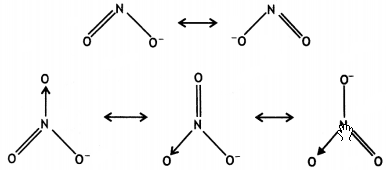
(ii)
Class 12 Chemistry Important Questions Chapter 7 The p-Block Elements 82
(iii) NO2 contains an odd electron. So it dimerises to give N2O4.

(b) Arrange the following In the decreasing order of their reducing character:
HF, HCl, HBr, HI
Answer:
HI > HBr > HCl > HF

Complete the following reaction:
XeF4 + SbF5 →, (CBSE 2018)
Answer:
(C) XeF4 + SbF5 → [XeF3] [SbF6]

Question 32.
(i) What happens when
(a) chlorine gas reacts with cold and dilute solution of NaOH?
(b) XeF2 undergoes hydrolysis?
Answer:
(a) 2NaOH + Cl2 → NaCl + NaOCl + H2O
(cold and dilute)
(b) 2XeF2(s) + 2H2O (l) → 2Xe (g) + 4HF(aq) + O2(S)

(ii) Assign suitable reasons for the following:
(a) SF6 Is inert towards hydrolysis.
(b) H3PO3 is diprotic.
(C) Out of noble gases only Xenon is known to form established chemical compounds.
Answer:
(a) Sulphur is sterically protected by six F atoms, hence does not allow the water molecules to attack.

(b) It contains only two ionisable H-atoms which are present as -OH groups, thus behaves as dibasic acid.

(c) Xe has least ionisation energy among the noble gases and hence it forms chemical compounds particularly with O2 and F2.

OR

(i) Considering the parameters such as bond dissociation enthalpy, electron gain enthalpy and hydration enthalpy, compare the oxidising power of F2 and Cl2.
Answer:
F2 is stronger oxidising agent than Cl2. This can be explained on the basis of bond dissociation enthalpy, electron gain enthalpy and hydration enthalpy.
The process of oxidising behaviour may be expressed as:
Class 12 Chemistry Important Questions Chapter 7 The p-Block Elements 83
The overall tendency for the change (i.e. oxidising behaviour) depends upon the net effect of three steps. As energy is required to dissociate or convert molecular halogen into atomic halogen, the enthalpy change for this step is positive. On the other hand, energy is released in steps (II) and (III), therefore, enthalpy change for these steps is negative.

Now although fluorine has less negative electron gain enthalpy, yet it is stronger oxidising agent because of low enthalpy of dissociation and very high enthalpy of hydration. In other words, large amount of energy released in step (III) and lesser amount of energy required in step (I) overweigh the smaller energy released in step (II) for fluorine. As a result, the AH overall is more negative for F2 than for Cl2.
Hence, F2 is stronger oxidising agent than Cl2.

(ii) Complete the following reactions :
(a) Cu + HNO3(dilute) →
(b) Fe3+ + SO2 + H2O →
(c) XeF4 + O2F2 → (CBSE 2018)
Answer:
(a) 3Cu + 8 HNO3 (dilute) → 3Cu(NO3)2 + 2NO + 4H3O
(b) 2Fe3+ + SO3 + 2H3O → 2 Fe2+ + SO42- + 4H+
(c) XeF4 + O2F2 → XeF6 + O2

Question 33.
A crystalline solid ‘A’ burns in air to form a gas ‘B’ which turns lime water milky. The gas is also produced as a by-product during roasting of sulphide ore. This gas decolourises acidified KMnO4 (aq.) solution and reduces Fe3+ to Fe2+. Identify ‘A’ and ‘B’ and write the reactions involved. (CBSE 2019C)
Answer:
A = S8 / Sulphur
S8 + 8 O2 → 8SO2 / S + O2 → SO2
B = SO2
Class 12 Chemistry Important Questions Chapter 7 The p-Block Elements 84
Decolourises KMnO4
2KMnO4 + 5 SO2 + 2H4O → 2H2SO4 + 2MnSO4 + K2SO4 / 2MnO4 + 5SO2 + 2H2O → 4H+ + 2Mn2+ + 5SO42-
Reduces Fe3+ to Fe2+
2Fe3+ + SO2 + 2 H2O → 2 Fe2+ + SO42- + 4H+

OR

Answer the following:
(a) Arrange the following hydrides of Group 16 elements in the decreasing order of their acidic strength:
H2O, H2S, H2Se, H2Te
Answer:
H2Te > H2Se > H2S > H2O

(b) Which one of PCl4+ and PCl4 is not likely to exist and why?
Answer:
PCl4- is not likely to exist because lone pair on P in PCl3 can be donated to Cl+ and not to Cl. Phosphorus has 10e which cannot be accommodated in sp3 orbitals.

(c) Which aliotrope of sulphur is thermally stable at room temperature?
Answer:
Rhombic sulphur is thermally stable at room temperature. Its melting point is 385.8 K. All other varieties of sulphur change into this form on standing. It has low thermal and electrical conductivity.

(d) Write the formula of a compound of phosphorus which is obtained when cone. HNO3 oxidises P4.
Answer:
HNO3 oxidises phosphorus to phosphoric acid. H3PO4 is formed
P4 + 2OHNO3 → 4H3PO4 + 2ONO2 + 4H2O

(e) Why does PCl3 fume in moisture?
Answer:
PCl3 fumes in moist air and reacts with water violently to form phosphorus acid. It hydrolyses in the presence of moisture to give fumes of HCl.
PCl3 + 3H2O → H3PO3 + 3HCl

CBSE Sample Papers for Class 10 Sanskrit Set 3 with Solutions

Students can access the CBSE Sample Papers for Class 10 Sanskrit with Solutions and marking scheme Set 3 will help students in understanding the difficulty level of the exam.

CBSE Sample Papers for Class 10 Sanskrit Set 3 with Solutions

समयः- होरात्रयम्
सम्पूर्णाङ्काः – 80

सामान्यनिर्देशाः

  • कृपया सम्यक्तया परीक्षणं कुर्वन्तु यत् अस्मिन् प्रश्नपत्रे 19 प्रश्नाः सन्ति।
  • उत्तरलेखनात् पूर्व प्रश्नस्य क्रमाङ्कः अवश्यं लेखनीयः।
  • अस्य प्रश्नपत्रस्य पठनाय 15 निमेषाः निर्धारिताः सन्ति। अस्मिन् अवधौ केवलं प्रश्नपत्रं पठनीयम् उत्तरपुस्तिकायां च किमपि न लेखनीयम्।

प्रश्नपत्रस्वरूपम्

‘अ’-भागः (बहुविकल्पात्मकः) 40 अङ्काः
‘आ’-भागः (वर्णनात्मकः) 40 अङ्काः

(i) अस्मिन् प्रश्नपत्रे द्वौ भागौ स्तः।
(ii) ‘अ’- भागः बहुविकल्पात्मकः अस्ति।
(iii) ‘आ’-भागः वर्णनात्मकः अस्ति।
(iv) प्रश्नसङ्ख्या प्रश्नपत्रानुसारम् अवश्यमेव लेखनीया।
(v) सर्वेषां प्रश्नानाम् उत्तराणि संस्कृतेन लेखनीयानि।
(vi) प्रश्नानां निर्देशाः ध्यानेन अवश्यं पठनीयाः।

‘अ’-भागः- बहुविकल्पात्मकाः प्रश्नाः (अङ्काः 40)

अनुप्रयुक्त-व्याकरणम् (अङ्काः 25)

प्रश्न 1.
अधोलिखितवाक्येषु रेखाङ्कितपदस्य सन्धिपदं सन्धिच्छेदपदं वा चिनुत-(केवलं प्रश्नचतुष्टयम्) (1 x 4 = 4)
(i) रामः + अत्र भोजनं करोति।
(क) रामश्त्र
(ख) रामोत्रं
(ग) रामोऽत्र
उत्तर
(ग) रामोऽत्र

(ii) एतस्मादेव पाठात् त्वं पठ।
(क) एतत् + अस्मादेव
(ख) एतस्मात् + एव
(ग) एतत् + अस्मादेव
उत्तर
(ख) एतस्मात् + एव

(iii) सम्यक् + नेता एव समाजस्य उद्धारकः भवति।
(क) सम्यवनेता
(ख) सम्यङ्नेता
(ग) सम्यक्नेता
उत्तर
ख) सम्यङ्नेता

(iv) हे ईवश्र! सत् + सतिं यच्छ।
(क) सन्मतिं
(ख) सच्मतिं
(ग) सत्मतिं
उत्तर
(क) सन्मतिं

(v) अहम् नमस्तुभ्यम्
(क) नमस् + तुभ्यम्
(ख) नमः + तुभ्यम्
(ग) नमस्तु + भ्यम्
उत्तर
(ख) नमः + तुभ्यम्

प्रश्न 2.
अधोलिखितवाक्येषु रेखाङ्कितपदानां समासं विग्रहं वा प्रदत्तविकल्पेभ्यः चिनुत। (केवलं प्रश्नचतुष्टयम्) (1 x 4 = 4)
(i) मातापितरौ सदैव वन्दनीयौ।
(क) मातरौ पितरौ च
(ख) माता च पितृ च
(ग) माता च पिता च
उत्तर
(ग) माता च पिता च

(ii) रामः कानने अनुमृगम् धावति।
(क) मृगम् अनतिक्रम्य
(ख) मृगस्य पश्चात्
(ग) मृगस्य योग्यम्
उत्तर
(ख) मृगस्य पश्चात्

(iii) साधुवृत्तिम् समाचरेत्।
(क) साधुम् वृत्तिम्
(ख) साधोः वृत्तिम्
(ग) साधौ वृत्तिम्
उत्तर
(ख) साधोः वृत्तिम्

(iv) समयम् अनतिक्रम्य कार्यम् कुरु।
(क) यथासमयः
(ख) यथासमयम्
(ग) समयंयथा
उत्तर
(ख) यथासमयम्

(v) सिंहः सक्रोधम् अवदत्।
(क) क्रोधम् सहितम्
(ख) क्रोधात् सहितम्
(ग) क्रोधेन सहितम्
उत्तर
(ग) क्रोधेन सहितम्

प्रश्न 3.
अधोलिखितवाक्येषु रेखातिपदानां प्रकृति-प्रत्ययौ संयोज्य विभज्य वा उचितम् उत्तरं विकल्पेभ्यः चिनुत। (केवलं प्रश्नचतुष्टयम्) (1 x 4 = 4)
(i) यत्रास्ते सा धूर्ता तत्र गम्यताम्।
(क) धूर्त + आ
(ख) धूर्त + ङीप्
(ग) धूर्त + टाप्
उत्तर
(ग) धूर्त + टाप्

(ii) कस्मिन् जने ईश्वर + स्व भवति?
(क) ईश्वतत्वं
(ख) ईश्वरत्वम्
(ग) ईश्वरतन्तः
उत्तर
(ख) ईश्वरत्वम्

अथवा

कालिदासस्य कवित्वम् श्लाघनीयं वर्तते।
(क) कवि + त्व
(ख) कवी + त्व
(ग) कवि + तल्
उत्तर
(क) कवि + त्व

(iii) धैर्यवन्तः जनाः एव सफलतां लभन्ते।
(क) धैर्य + क्तवतु
(ख) धैर्य + शानच्
(ग) धैर्य + मतुप्
उत्तर
(ग) धैर्य + मतुप्

(iv) विद्वांसः एव लोकेऽस्मिन् चक्षुष् + मतुप प्रकीर्तिताः।
(क) चक्षुमन्तौ
(ख) चक्षुष्मन्तः
(ग) चक्षुमान्
उत्तर
(ख) चक्षुष्मन्तः

प्रश्न 4.
वाच्यस्य नियमानुगुणम् उचितं विकल्पं चिनुत। (केवलं प्रश्नत्रयम्) (1 x 3 = 3)
(i) सुरभिः – किं त्वं अद्य समाचार पत्रे समाचारान्
(क) पठति
(ख) पठसि
(ग) पठामि
उत्तर
(ख) पठसि

(ii) सुगन्धा- आम् मया अद्य …….पठयन्ते।
(क) समाचारम्
(ख) समाचारान्
(ग) समाचाराः
उत्तर
(ग) समाचाराः

(iii) सुरभि:- ………………. अपि प्रतिदिनं समाचारं पठामि।
(क) त्वम्
(ख) सः
(ग) अहम्
उत्तर
(ग) अहम्

(iv) सुगन्धा – ……………….. तु दूरदर्शने अपि दृश्यते।
(क) त्वम्
(ख) मया
(ग) अहम्
उत्तर
(ख) मया

प्रश्न 5.
प्रदत्तेभ्यः विकल्पेभ्यः समुचितं कालबोधकशब्दं चिनुत- (केवलं प्रश्नचतुष्टयम्) (1 x 4 = 4)

(i) अहम् सायंकाले 4:30 ………………. वादने खेलामि।
(क) सार्ध-चतुर्
(ख) सपाद-चतुर्
(ग) चतुर्-सार्ध
उत्तर
(क) सार्ध-चतुर्

(ii) 6:00 ……………………. वादने क्रीडाक्षेत्रात् गृहं आगच्छामि।
(क) नव
(ख) षड्
(ग) सार्ध
उत्तर
(ख) षड्

(iii) 8:15 …………………… वादने भोजनं करोमि।
(क) सार्ध-अष्ट
(ख) सपाद-अष्ट
(ग) सार्ध-सप्त
उत्तर
(ख) सपाद-अष्ट

(iv) 9:00 ……………………… वादनं पर्यन्तम् पठामि।
(क) नव
(ख) अष्ट
(ग) सपाद-नव|
उत्तर
(क) नव

(v) 10:45 …… …… वादने शयनं करोमि।
(क) सपाद-दश
(ख) पादोन-एकादश
(ग) पादोन-दश
उत्तर
(ख) पादोन-एकादश

प्रश्न 6.
वाक्यानुगुणम् उचिताव्ययपदं चिनुत- (केवलं प्रश्नत्रयम्) (1 x 3 = 3)

(i) मनुष्यः अनिच्छन् …………….. पापं करोति।
(क) सहसा
(ख) अपि
(ग) वृथा
उत्तर
(ख) अपि

(i) प्रायः बालशिशुः ….. चलति।
(क) विना
(ख) उच्चैः
(ग) शनैः
उत्तर
(ग) शनैः

(iii) मेघाः आकाशे ………….. गर्जन्ति।
(क) उच्चैः
(ख) शनैः
(ग) नीचैः
उत्तर
(क) उच्चैः

(v) ………………. क्रियाम् न विदधीत
(क) अधुना
(ख) विना
(ग) सहसा
उत्तर
(ग) सहसा

प्रश्न 7.
अधोलिखितवाक्येषु रेखाङ्कितपदम् अशुद्धम् अस्ति। शुद्धं पदं विकल्पेभ्यः चिनुत- (केवलं प्रश्नत्रयम्) (1 x 3 = 3)

(i) भवान् कुत्र गच्छसि?
(क) गच्छति
(ख) गच्छन्ति
(ग) गच्छामि
उत्तर
(क) गच्छति

(ii) त्वं मम मित्रम् अस्ति
(क) सन्ति
(ख) असि
(ग) आसीत्
उत्तर
(ख) असि

(iii) वृक्षे फलाः सन्ति।
(क) फले
(ख) फलानि
(ग) फलम्
उत्तर
(ख) फलानि

(iv) ता: बालिका गीतं गायन्ति।
(क) बालकाः
(ख) बालिकाम्
(ग) बालिकाः
उत्तर
(ग) बालिकाः

पठितावबोधनम् (अङ्काः 15)

प्रश्न 8.
रेखाङ्कितपदानि आधृत्य समुचितं प्रश्नवाचकपदं चिनुत। (केवलं प्रश्नपञ्चकम् ) (1 x 5 = 5)
(i) मयूरस्य नृत्यं प्रकृतेः आराधना।
(क) कस्य
(ख) कस्याः
(ग) कस्याम्
उत्तर
(ख) कस्याः

(ii) सः ऋषभः हलमूढ्वागन्तं अशक्तः क्षेत्रे पपात।
(क) कुत्र
(ख) कदा
(ग) किमर्थम
उत्तर
(क) कुत्र

(iii) शकटीयानम् कज्जलमलिनं घूमं मुञ्चति।
(क) कीदृशः
(ख) कम्
(ग) किम्
उत्तर
(ग) किम्

(iv) इति उक्त्वा आरक्षी उच्चैः अहसत्।
(क) कैः
(ख) कथम्
(ग) किमर्थम्
उत्तर
(ख) कथम्

(v) सः भारवेदनया क्रन्दति स्म।
(क) केन
(ख) कया
(ग) कस्मै
उत्तर
(ख) कया

(vi) मृगाः मृगैः सह अनुव्रजन्ति।
(क) काः
(ख) कौ
(ग) के
उत्तर
(ग) के

प्रश्न 9.
अधोलिखितवाक्येषु रेखाङ्कितपदानां प्रसङ्गानुकुलम् उचितार्थं चिनुत- (केवलं प्रश्नचतुष्टयम्) (1 x 4 = 4)
(i) क्रुद्धः सिंहः उच्चैः अगर्जत्।
(क) कुपितः
(ख) हसितः
(ग) भीत:
उत्तर
(क) कुपितः

(ii) अहम् अनृतम् न वदामि।
(क) नृतम्
(ख) सत्यम्
(ग) असत्यम्
उत्तर
(ग) असत्यम्

(iii) विद्यालये सर्वतः छात्रैव छात्राः सन्ति।
(क) समन्ततः
(ख) परितः
(ग) उभयतः
उत्तर
(क) समन्ततः

(iv) सैनिकाः देशस्य शत्रून् मारयन्ति।
(क) हितैषिणम्
(ख) अरीन्
(ग) उरगान्
उत्तर
(ख) अरीन्

(v) पुरा भोजनामकः नृपः आसीत्।
(क) अधुना
(ख) प्राचीनकाले
(ग) एकदा
उत्तर
(ख) प्राचीनकाले

प्रश्न 10.
भाषिककार्यसम्बद्धानां प्रश्नानां समुचितम् उत्तरं विकल्पेभ्यः चिनुत-(केवलं प्रश्नषट्कम्) (1 x 6 = 6)
(i) गच्छन्तम् पदस्य विपर्ययपदं किम्?
(क) गच्छताम्
(ख) आगच्छन्तम्
(ग) आगच्छ
उत्तर
(ख) आगच्छन्तम्

(ii) “प्रथमः धर्मः’ इति अनयोः पदयोः विशेष्यपदं किम्?
(क) प्रथमः
(ख) धर्मः
(ग) धर्म:प्रथमः
उत्तर
(ख) धर्मः

(iii) सः बसयानम् ‘विहाय’ पदातिरेव प्राचलत्। अत्र विहाय पदाय किम् पदम् प्रयुक्तम्?
(क) विनियोग
(ख) गत्वा
(ग) परित्यज्य
उत्तर
(ग) परित्यज्य

(iv) “पिताऽस्य किं तपस्तेपे इत्युक्तिस्तत्कृतज्ञता” अत्र अस्य पदं कस्मै प्रयुक्तम्?
(क) पित्रे
(ख) पुत्राय
(ग) शिष्याय
उत्तर
(ख) पुत्राय

(v) न्यायधीशः तम् शवं न्यायालये आनेतुम् आदिष्टवान्। अत्र ‘अदिष्टवान्‘ क्रिया पदस्य कर्तृपदम किम्?
(क) तम्
(ख) शवम्
(ग) न्यायधीशः
उत्तर
(ग) न्यायधीशः

(vi) पक्षिणः हर्षमिश्रितं कलरवं कुर्वन्ति’ अत्र क्रियापदं किम्?
(क) कलरवं
(ख) कुर्वन्ति
(ग) पक्षिणः
उत्तर
(ख) कुर्वन्ति

(vii) कृषक: इति कर्तृपदस्य क्रियापदम् किम् अस्ति?
(क) तम्
(ख) बहुधा
(ग) पीडयति
उत्तर
(ग) पीडयति

(viii) भयङ्करा व्याघ्रमारी तत्र अस्ति। अत्र विशेषणपदं किम्?
(क) व्याघ्रमारी
(ख) भयङ्करा
(ग) तत्र
उत्तर
(ख) भयङ्करा

‘आ’-भाग:- वर्णनात्मकाः प्रश्नाः (अङ्काः 40)

अपठितावबोधनम् (अङ्काः 10)

प्रश्न 11.
अधोलिखितं गद्यांशं पठित्वा प्रदत्तप्रश्नानाम् उत्तराणि संस्कृतेन लिखत। (10)
वर्तमानकाले मानवः समस्यावर्ते पतितोऽस्ति। एकत्र देहस्य अनेके रोगाः, अन्यत्र मनसः चिन्ताः। कार्यवैफल्येन नैराश्यम् भवति। जीवनशैल्याः परिवर्तन विना मार्गान्तरं नास्ति। व्यायामाभावात् शरीरस्य स्थौल्यं वर्धते तारुण्यावस्थायाम् च मुधमेहः जायते।

एतदेव व्याधिः उच्यते। आधिव्याधिभ्यां पीडितो मानवः निद्रां न लभते। मानवः अतृप्त्या सदा खिद्यते। अतः यथाशक्ति शारीरिक श्रमः कर्त्तव्यः। यत्र पद्भ्यां गन्तु शक्यते तत्र वाहनेन न गन्तव्यम। अलं श्रमचिन्त्या।

इदं शरीरं पोषितमपि पालितमपि च शोभते। स्वस्थशरीरेणैव मानवः सोत्साहं गृहस्थजीवनस्य सर्वविधानां समस्यानाम् समाधाने कुशलः भवति। सः आध्यात्मिकज्ञानमपि लभते। उक्तञ्च ‘शरीरमाद्यं खलु धर्मसाधनम्’।

(अ) एकपदेन उत्तरत। (केवलं प्रश्नद्वयम्) (1 × 2 = 2)

(i) कस्य अभावात् शरीरस्य स्थौल्यं वर्धते?
(ii) मानवः कया सदा खिद्यते?
(ii) वर्तमानकाले कः समस्यावर्ते पतितोऽस्ति?
उत्तर
(i) व्यायामस्य
(ii) अतृप्त्या
(iii) मानवः

(आ) पूर्णवाक्येन उत्तरत। (केवल प्रश्नद्वयम्) (1 × 2 = 2)

(i) कार्यवैफल्येन किं भवति?
(ii) स्वस्थशरीरेणैव मानवः कासां समाधाने कुशलः भवति?
(iii) मानवैः यथाशक्ति कः कर्तव्यः?
उत्तर
(i) कार्यवैफल्येन नैराश्यं भवति।
(ii) स्वस्थ शरीरेणैव मानवः सोत्साहं गृहस्थजीवनस्य सर्वविधानां समस्यानां समाधाने कुशलः भवति।
(iii) मानवैः यथाशक्ति शारीरिक श्रमः कर्त्तव्यः।

(इ) अस्य अनुच्छेदस्य कृते उपयुक्तं शीर्षकं संस्कृतेन लिखत। (1 × 2 = 2)
उत्तर
जीवनशैली

(ई) यथानिर्देशम् उत्तरत्-(केवलं प्रश्नत्रयम्) (2 × 2 = 4)

(i) ‘खिद्यते’ इत्यस्याः क्रियायाः कर्तृपदं किम्?
(क) सन्तोषः
(ख) मानवः
(ग) मधुमेहः
उत्तर
(ख) मानवः

(ii) ‘पीडितः मानव’ अनयोः पदयोः विशेषणं किम्?

(क) पीडितः
(ख) मानवः
(ग) नरः
उत्तर
(क) पीडितः

(iii) देहस्य’ इत्यस्य पदस्य कः पर्यायः अत्र आगतः?

(क) मानवस्य
(ख) दुःखस्य
(ग) शरीरस्य
उत्तर
(ग) शरीरस्य

(iv) अनुच्छेदे ‘अन्तिमम्’ पदस्य क : विपर्ययः आगतः? 

(क) अलम्
(ख) आद्यम्
(ग) इदम्
उत्तर
(ख) आद्यम्

रचनात्मकं कार्यम् (अङ्काः 15)

प्रश्न 12.
पितरं प्रति लिखिते पत्र रिक्तस्थानानि पूरयित्वा पत्रं च पुनः उत्तरपुस्तिकायां लिखतु। ( 1/2 x 10 = 5)
(i) ……….
दिनाङ्कः ………..
पूज्याः (ii) ………..
सादरं प्रणामाः। अत्र कुशलं तत्रास्तु। इदं विज्ञाय भवान् अतिप्रसन्नः भविष्यति यद् गतदिवसे अन्तर्विद्यालयीयभाषणप्रतिस्पर्धायां मया (iii) …………….. स्थानं लब्धम्। क्रीडादिवसे (iv) ……….. अहमेव प्रथमः आसम्। अस्मिन् वर्षे वार्षिकोत्सवे अहं नाट्याभिनयं (v) ………….”। अयं वार्षिकोत्सवः आगामि-सोमवासरे (vi) ……………………”। विद्यालस्य पक्षतः ह्य एव (vii) ………. प्रेषितम्। अहमपि (viii) … सूचयामि, भवान् अवश्यम् आगच्छतु। मम (ix) …………….. भविष्यति। भवतः आज्ञाकारी पुत्रः, (x) …………..

मञ्जूषा – निमन्त्रणपत्रम्, धावनप्रतियोगितायाम्, पीयूषः, उत्साहवर्धनम्, भवन्तम्, प्रयागराजतः, प्रथमम्, करिष्यामि, पितृमहोदयाः, आयोजयिष्यते।
उत्तर
(i) प्रयागराजतः
(ii) पितृमहोदयाः
(iii) प्रथमम्
(iv) धावनप्रतियोगितायाम्
(v) करिष्यामि
(vi) आयोजयिष्यते
(vii) निमन्त्रणपत्रम्
(viii) भवन्तम्
(ix) उत्साहवर्धनम्
(x) पीयूषः

प्रश्न 13.
प्रदत्तं चित्रं दृष्ट्वा मञ्जूषायां प्रदत्तशब्दानां सहायतया पञ्च वाक्यानि संस्कृतेन लिखत- (1 x 5 = 5)
CBSE Sample Papers for Class 10 Sanskrit Set 3 with Solutions 1
मञ्जूषा- पति, पत्नी, बालिका, वृक्षा, बहवः, जनाः, परस्परं, वार्तालापं, कुर्वन्ति, लिखति, पत्राणि, वृद्धजनाः, अपि, सन्ति, स्त्रियः पुरुषाः।
उत्तर
(i) इदम् एकं विमानस्थानकस्य चित्रम् अस्ति।
(ii) चित्रे बहवः वृक्षाः सन्ति। वृक्षे पत्राणि अपि सन्ति।
(iii) तत्र पति पत्नी अन्ये जनाः च परस्परं वार्तालापं कुर्वन्ति।
(iv) बालिकाः वृद्धजनाः च सन्ति।
(v) स्त्रियः पत्राणि लिखन्ति।

अथवा

मञ्जूषाप्रदत्तशब्दानां साहाय्येन निम्नलिखितं विषयम् अधिकृत्य पञ्चभिः संस्कृतवाक्यैः एकम् अनुच्छेद लिखत (1 x 5 = 5)

‘पुस्तकमेलकम्’

मञ्जूषा- चित्राणि, पुस्तकानि, मित्राणि, लोकार्पणम्, अभवत्, अतीवप्रसन्ना, ध्वनिमुद्रिकाः, संगणकम्, अन्तःप्रवेशः,
विविधं साहित्यम्, विभिन्नानि, प्रकोष्ठानि, संस्कृत-पुस्तकानि, जनाः, पश्यन्ति।
उत्तर
(i) पुस्तकमेलकं विस्तृते क्षेत्रे आयोजितम् अस्ति।
(ii) तत्र पुस्तकमेलकस्य अन्तः प्रवेशः अतीवप्रसनदायकम् अस्ति।
(iii) पुस्तकमेलके अनेकानि चित्राणि, पुस्तकानि, संगणकं च आसन्।
(iv) तत्र अनेकानि संस्कृत-पुस्तकानि च आसन्।
(v) तत्र विविधं साहित्यम् आसीत् येषां लोकार्पणं भवति स्म।

प्रश्न 14.
अधोलिखितानि वाक्यानि संस्कृतभाषया अनूद्य लिखत-(केवलं वाक्यपञ्चकम् ) (1 x 5 = 5)

(i) लता नाचती है। (Lata dances)
(ii) तुम सब गेंद से खेलते हो। (All of you play by ball)
(iii) कल मोहन बाजार जायेगा। (Mohan will go to the market tomorrow)
(iv) कल रमेश कहाँ था? (Where was Ramesh yesterday?)
(v) रमा सीता के साथ पढ़े! (Rama study with Sita)
(vi) वृक्ष से पत्ते गिरते हैं। (Leaves fall down from the three)
(vii) क्या मैं पढूँ? (May I read?)
उत्तर
(i) लता नृत्यति।
(ii) यूयं कन्दुकेन क्रीडथ।
(iii) श्वः मोहनः आपणं गमिष्यति।
(iv) ह्यः रमेशः कुत्र आसीत्?
(v) रमा सीतया सह पठतु/पठेत्।
(vi) वृक्षात् पत्राणि पतन्ति।
(vii) किम् अहं पठानि?

पठितावबोधनम् (अङ्काः 15)

प्रश्न 15.
अधोलिखितं गद्यांश पठित्वा प्रदत्तप्रश्नानाम् उत्तराणि संस्कृतेन लिखत।। (3)
इति श्रुत्वा व्याघ्रमारी काचिदियमिति मत्वा व्याघ्रो भयाकुलचित्तो नष्टः। भयाकुलं व्याघ्रं दृष्ट्वा कश्चित् धूर्तः शृगालः हसन्नाह- “भवान् कुतः भयात् पलायितः? । व्याघ्रः- गच्छ, गच्छ जम्बुक! त्वमपि किञ्चिद् गूढप्रदेशम्। यतो व्याघ्रमारीति या शास्त्रे श्रूयते तयाहं हन्तुमारब्धा परं गृहीतकरजीवितो नष्टः शीघ्रं तदग्रतः। शृगालः- व्याघ्रः त्वया महत्कौतुहलम् आवेदितं यन्मानुषादपि बिभेषि? व्याघ्रः- प्रत्यक्षमेव मया सात्मपुत्रावेकैशो मामत्तुं कलहायमानौ चपेटया प्रहरन्ती दृष्टा।

(अ) एकपदेन उत्तरत। (केवलं प्रश्नद्वयम्) (1/2 × 2 = 1)

(i) शृगालस्य अपरं नाम किम् । ‘शृगालः’ इति शब्दाय किम् अन्यः शब्दः प्रयुक्तः?
(ii) कीदृशः व्याघ्रः नष्ट:?
(iii) शृगालः किम् कुर्वन् अवदत्?
उत्तर
(i) जम्बुकः
(i) भयाकुलचित्तः
(iii) हसन्

(आ) पूर्णवाक्येन उत्तरत। (केवल प्रश्नद्वयम्) (1 × 2 = 2)

(i) व्याघ्रः भयाकुलचित्तः किमर्थम् अधावत्?
(ii) व्याघ्रः जम्बुकम् प्रति किम् कथयति?
(iii) प्रत्यक्षमेव सिंहेन किम् दृष्टा?
उत्तर
(i) इयं काचित् व्याघ्रमारी इति मत्वा व्याघ्रः भयाकुलचित्तः अधावत्।
(ii) गच्छ गच्छ जम्बुक! त्वमपि किञ्चित् गूढप्रदेशम् इति व्याघ्रः जम्बुकं प्रति अकथयत्।
(iii) प्रत्यक्षमेव व्याघ्रण सात्मपुत्रावेकैकशो तम् अत्तुं कलहायमानौ चपेटया प्रहरन्ती दृष्टा।

प्रश्न 16.
अधोलिखितं पद्यांशं पठित्वा प्रदत्तप्रश्नानाम् उत्तराणि संस्कृतेन लिखत
निमित्तमुद्दिश्य हि यः प्रकुप्यति,
ध्रुवं स तस्यापगमे प्रसीदति।
अकारणद्वेषि मनस्तु यस्य वै,
कथं जनस्तं परितोषयिष्यति।।

(अ) एकपदेन उत्तरत। (केवलं प्रश्नद्वयम्) (1/2 × 2 = 1)

(i) अत्र किम् अकारणं द्वेषि उक्तम्?
(ii) किम् उद्दिश्य यः प्रकुप्यति?
(iii) कस्य अपगमे मनुष्यः प्रसीदति?
उत्तर
(i) मनः
(ii) निमित्तम्
(iii) निमित्तस्य/तस्य

(आ) पूर्णवाक्येन उत्तरत। (केवलं प्रश्नद्वयम्) (1 × 2 = 2)

(i) मनुष्यः कदा ध्रुवं प्रसीदति?
(ii) कं जनः कथमपि न परितोषयिष्यति?
(iii) निमात्तापगमे जनः किं करोति?
उत्तर
(i) मनुष्यः निमित्तस्य अपगमे ध्रुवं प्रसीदति।
(ii) कारणद्वेषि मनस्तु कथमपि जन: न परितोषयिष्यति।
(iii) निमित्तापगमे जनः प्रसीदति

प्रश्न 17.
अधोलिखितं नाट्यांशं पठित्वा प्रदत्तानां प्रश्नानाम् उत्तराणि संस्कृतेन लिखत। (3)
व्याघ्र चित्रकौ:- अरे किं वनराजपदाय सुपात्रं चीयते?
एतदर्थं तु आवामेव योग्यौ। यस्य कस्यापि चयनं कुर्वन्तु सर्वसम्मत्या।

सिंहः- तूष्णीं भव भोः। युवामपि मत्सदृशौ भक्षको न तु रक्षको। एवे वन्यजीवाः भक्षकं रक्षकपदयोग्यं न मन्यते अत एव विचारविमर्शः प्रचलित।

बाक : – सर्वथा सम्यगुक्तम् सिंहमहोदयेन। वस्तुतः एव सिंहेन बहुकालपर्यन्तं शासनं कृतम् परमधुना तु कोऽपि पक्षी एव राजेति निश्चंतव्यम् अत्र तु संशीतिलेशस्यापि अवकाशः एव नास्ति।
उत्तर

(अ) एकपदेन उत्तरत। (केवल प्रश्नद्वयम्) (1/2 x 2 = 1)

(i) कस्मै पदाय सुपात्रं चीयते?
(ii) आवाम् एव योग्यौ इति को वदत:?
(iii) “युवाम् अपि मत्सदृशौ भक्षको।” अत्र युवाम् पदं काभ्याम् प्रयुक्तम्?
उत्तर
(i) वनराज
(i) व्याघ्रचित्रको
(iii) व्याघ्रचित्रकाभ्याम्

(आ) पूर्णवाक्य में उत्तरत। (केवल प्रश्नद्वयम्) (1 x 2 = 2)

(i) सिंहः किम् कथयति?
(ii) बकः सिंह किम् अकथयत्?
(iii) व्याघ्रचित्रकौ वनराजपदाय किम् अकथयताम्?
उत्तर
(i) सिंहः कथयति-तूष्णीं भव भोः! युवामपि मत्सदृशौ भक्षकौ न तु रक्षको।
(ii) बक: सिंह कथयति-सवर्था सम्यगुक्तं सिंह महोदयेन। बहुकालपर्यन्तं सिंहेन शासनं कृतम् अधुना तु कोऽपि पक्षी एव राजा भवेत्।
(iii) व्याघ्रचित्रकौ अकथयताम्-अरे किं वनराजपदाय सुपात्रं चीयते? एतदर्थं तु आवामेव योग्यौ।

प्रश्न 18.
मञ्जूषातः समुचितपदानि चित्वा अधोलिखित-श्लोकस्य अन्वयं पूरयत (1/2 x 4 = 2)
1. श्लोक- उदीरितोऽर्थः पशुनापि गृह्यते,
हयाश्च नागाश्च वहन्ति बोधिताः।
अनुक्तमप्यूहति पण्डितो जनः,
परेङ्गितज्ञानफला हि बुद्धयः।।

अन्वय- (i) ……. …… अपि उदीरितः अर्थः …. … गृह्यते, बोधिताः हयाः च (ii) …………. “च (भारम्) वहन्ति। (iii) …….. जनः अनुक्तम् अपि ऊहति। (iv)…………… परेङ्गितज्ञानफलाः हि (भवन्ति)।

अथवा

II . श्लोक- क्रोधो हि शत्रुः प्रथमो नराणां,
देहस्थितो देहविनाशनाय।।
यथास्थितः काष्ठगतो हि वह्निः,
स एव वह्निर्दहते शरीरम्।।

अन्वय- क्रोधः हि (i) ……………. देहविनाशाय देहस्थितः (ii) ……………. शत्रुः (अस्ति)। यथा (iii) ………… स्थितः हि वहिन (भवति) सः वह्निः काष्ठम् एव दहते तथा (iv) …. …… शरीरम् दहते। मञ्जूषा- प्रथमः, नागाः, बुद्धयः, क्रोधः, पशुना, पण्डितः, नराणां, काष्ठगतः

उत्तर

I. (i) पशुना
(ii) नागाः
(iii) पण्डितः
(iv) बुद्धयः

II. (i) नराणां
(ii) प्रथमः
(iii) काष्ठगतः
(iv) क्रोधः

अथवा

मञ्जूषायाः साहाय्येन श्लोकस्यभावार्थे रिक्तस्थानानि पूरयित्वा पुनः लिखत। श्लोक- वाक्पटुधैर्यवान् मंत्री सभायामप्यकातरः।
स केनापि प्रकारेण परैर्न परिभूयते।। भावार्थ- य मन्त्री
(i) ……………. सम्भाषणे चतुरः, धैर्ययुक्तः,
(ii) …………. च भवति, सः मन्त्री
(iii) …………………. कथमपि
(iv)…………………. न शक्यते। मञ्जूषा- तिरस्कर्तुम्, निर्भीकः, सभायाम्, विरोधिभिः
उत्तर
(i) सभायाम्
(ii) निर्भीकः
(iii) विरोधिभिः
(iv) तिरस्कर्तुम्

प्रश्न 19.
अधोलिखित-कथांशं समुचितक्रमेण लिखत।। ( 1/2 x 8 =4)
(i) तत्र निहितामेकां मञ्जूषाम् आदाय पलायितः।
(ii) चौरः एव उच्चैः क्रोशितुमाराभत “चौरोऽयं चौरोऽयम्” इति।
(iii) चौरस्य पादध्वनिना प्रबुद्धोऽतिथि: चौरशङ्कया तमन्वधावत् अगृह्णाच्च, परं विचित्रमघटत।
(iv) तस्योमेव रात्रौ कश्चन चौर: गृहाभ्यन्तरं प्रविष्टः।
(v) विचित्रा दैवगतिः
(vi) तस्य तारस्वरेण प्रबुद्धः ग्रामवासिनः स्वगृहाद् निष्क्रम्य तत्रागच्छन् वराकमतिथिमेव च चौरं मत्वाऽभर्त्सयन्।
(vii) यद्यपि ग्रामस्य आरक्षी एव चौर आसीत्।
(vii) तत्क्षणमेव रक्षापुरुषः तम् अतिथिं चौरोऽयम् इति प्रख्याप्य कारागृहे प्राक्षिपत्।
उत्तर
(i) विचित्रा दैवगतिः।
(ii) तस्यामेव रात्रौ
(iii) तत्र निहितामेकां
(iv) चौरस्य पादध्वनिना …..
(v) चौरः एव उच्चैः ………….
(vi) तस्य तारस्वरेण
(vii) यद्यपि ग्रामस्य आरक्षी …
(viii) तत्क्षणमेव रक्षापुरुषः