CBSE Sample Papers for Class 10 Hindi Course B Set 4 for Practice

Students can access the CBSE Sample Papers for Class 10 Hindi with Solutions and marking scheme Course B Set 4 will help students in understanding the difficulty level of the exam.

CBSE Sample Papers for Class 10 Hindi Course B Set 4 for Practice

निर्धारित समय : 3 घंटे
अधिकतम अंक : 80

सामान्य निर्देश:
(क) इस प्रश्न-पत्र के दो खंड हैं- ‘अ’ और ‘ब’।
(ख) खंड ‘अ’ में कुल 10 वस्तुपरक प्रश्न पूछे गए हैं। सभी प्रश्नों में उपप्रश्न दिए गए हैं। दिए गए निर्देशों का पालन करते हुए प्रश्नों के उत्तर दीजिए।
(ग) खंड ‘ब’ में कुल 7 वर्णनात्मक प्रश्न पूछे गए हैं। प्रश्नों में आंतरिक विकल्प दिए गए हैं। दिए गए निर्देशों का पालन करते हुए प्रश्नों के उत्तर दीजिए।

खंड ‘अ’- वस्तुपरक प्रश्न (अंक 40)

अपठित गद्यांश (अंक 10)

प्रश्न 1.
नीचे दो गद्यांश दिए गए हैं किसी एक गद्यांश को ध्यानपूर्वक पढ़िए और उस पर आधारित प्रश्नों के उत्तर दीजिए। (5 x 1 = 5)
स्त्री और पुरुष समाज की गाड़ी के दो पहिए हैं। एक के बिना दूसरे का जीवन अधूरा है, क्योंकि समाज-रूपी गाड़ी को सुचारु रूप से चलाने के लिए दोनों ही पहियों का स्वस्थ तथा सुदृढ़ होना आवश्यक है। यदि इनमें से एक भी पहिया दुर्बल या दोषपूर्ण हुआ, तो समाज रूपी गाड़ी के विकास का क्रम रुक जाएगा। नारी यदि गृहस्थ जीवन की पतवार है, तो पुरुष उसका खेवैया। गृहस्थी की सुख-शांति, आनंद तथा उत्थान इन दोनों पर ही आधारित हैं।

इन्हीं कारणों से भारतीय संस्कृति में नारी को गृहलक्ष्मी, गृहदेवी, अर्धांगिनी आदि कहा गया है। मनु ने मनुस्मृति में कहा है- ‘यत्र नार्यस्तु पूज्यते, रमन्ते तत्र देवता।’ पुरातन युग में नारी को श्रद्धा तथा विश्वास का रूप समझा जाता था। वह किसी भी क्षेत्र में पुरुष से पीछे नहीं थी। यहाँ तक कि यज्ञ की सफलता के लिए स्त्री और पुरुष दोनों का उसमें समान रूप से भाग लेना आवश्यक माना जाता था। कुछ स्त्रियाँ तो रणभूमि में जाकर भी अपने पतियों की सहायता किया करती थीं।

पृथ्वी की-सी क्षमता, सूर्य-जैसा तेज, समुद्र की-सी गंभीरता, चंद्रमा की-सी शीतलता आदि गुणों के कारण नारी घर में तथा घर के बाहर भी सम्मान की अधिकारिणी थी। शकुंतला, सीता, अनुसूया, दमयंती, सावित्री, गार्गी आदि इसके ज्वलंत उदाहरण हैं।

(i) समाज रूपी गाड़ी के पहिए कौन हैं?
(क) समाज के लोग
(ख) स्त्री और पुरुष
(ग) समाज के पुरुष
(घ) समाज की सारी स्त्रियाँ
उत्तर
(ख) स्त्री और पुरुष

(ii) भारतीय संस्कृति में नारी को निम्नलिखित में से क्या नहीं कहा गया है?
(क) गृहलक्ष्मी
(ख) अर्धांगिनी
(ग) सहदेवी
(घ) गृहदेवी
उत्तर
(ग) सहदेवी

(iii) ‘यत्र नार्यस्तु पूज्यते, रमन्ते तत्र देवता’ कथन का अर्थ है
(क) जहाँ नारियों की पूजा होती है, वहाँ देवता निवास करते हैं।
(ख) जहाँ देवता निवास करते हैं, वहाँ नारियों की पूजा होती है।
(ग) जहाँ नारियाँ पूजा करती हैं, वहाँ देवता निवास करते हैं।
(घ) जहाँ देवता निवास करते हैं, वहाँ नारी पूजा करती है।
उत्तर
(क) जहाँ नारियों की पूजा होती है, वहाँ देवता निवास करते हैं।

(iv) निम्नलिखित में से कौन-सा गुण है, जो नारी के सम्मान के योग्य नहीं है?
(क) समुद्र जैसी गंभीरता
(ख) चंद्रमा की-सी शीतलता
(ग) पृथ्वी की-सी क्षमता
(घ) गगन जैसी गंभीरता
उत्तर
(घ) गगन जैसी गंभीरता

(v) पुरातन युग में नारी को क्या समझा जाता था?
(क) गृहस्थी का खेवैया
(ख) श्रद्धा तथा विश्वास का रूप
(ग) पुरुष का प्रतियोगी
(घ) सभी विकल्प उचित
उत्तर
(ख) श्रद्धा तथा विश्वास का रूप

अथवा

वाणी प्राणी की पहचान है। जिस प्रकार कौवा और कोयल की पहचान उसकी वाणी से हो जाती है, उसी प्रकार किसी व्यक्ति के आचार-व्यवहार तथा स्वभाव की परख उसकी वाणी द्वारा हो जाती है। मीठी वाणी दूसरों को अधीन करने में अपनी महत्वपूर्ण भूमिका निभाती है, या यूँ कहें यह एक प्रकार से औषधि का काम करती है। जब हम मीठी वाणी का श्रवण करते हैं तब हमारा हृदय प्रसन्न हो जाता है।

सज्जन सदा मधुर वाणी का ही प्रयोग करते हैं, जबकि दुर्जनों की वाणी कटु और कर्कश होती है। मीठी वाणी शत्रु को भी मित्र बना सकती है, निराश व्यक्तियों में आशा-उत्साह का संचार कर सकती है। कटु वाणी हृदय में काँटे की तरह चुभती है। इससे अपने भी पराए हो जाते हैं।

इतना ही नहीं, कटु वाणी लड़ाई-झगड़ा यहाँ तक कि बड़े-बड़े युद्धों का कारण भी बन जाती है। द्रौपदी के कटु वचन महाभारत का कारण बने। ऐसा माना जाता है जिस व्यक्ति ने अपनी वाणी को वश में कर लिया, उसने मानव संसार पर विजय प्राप्त कर ली अर्थात सब कुछ पा लिया। इसलिए जीवन में सदैव मीठी वाणी बोलनी चाहिए।

(i) प्राणी की पहचान किससे होती है?
(क) कपड़ों से
(ख) व्यवहार से
(ग) वाणी से
(घ) चाल से
उत्तर
(ग) वाणी से

(ii) दुर्जनों की वाणी होती है
(क) मीठी
(ख) कर्कश
(ग) मंत्रमुग्ध करने वाली ङ्के
(घ) कर्णप्रिय
उत्तर
(ख) कर्कश

(iii) महाभारत का कारण था, द्रौपदी के
(क) मधुर वचन
(ख) प्रेम भरे बोल
(ग) कटु वचन
(घ) ममता भरे बोल
उत्तर
(ग) कटु वचन

(iv) मीठी वाणी निराश व्यक्तियों के मन में किसका संचार करती है? ”
(क) जागरूकता का
(ख) आशा तथा उत्साह का
(ग) अपनेपन का
(घ) प्रेम का
उत्तर
(ख) आशा तथा उत्साह का

(v) कैसा व्यक्ति सारे संसार पर विजय प्राप्त कर सकता है?
(क) जिसका व्यवहार विनम्र हो
(ख) परिश्रमी
(ग) जिसकी वाणी में मधुरता हो
(घ) जिसकी वाणी में अहंकार का भाव हो
उत्तर
(ग) जिसकी वाणी में मधुरता हो

प्रश्न 2.
नीचे दो गद्यांश दिए गए हैं किसी एक गद्यांश को ध्यानपूर्वक पढ़िए और उस पर आधारित प्रश्नों के उत्तर दीजिए। (5 x 1 =5)

मनुष्य अपने भविष्य के बारे में चिंतित है। सभ्यता की अग्रगति के साथ ही चिंताजनक अवस्था उत्पन्न होती जा रही है। इस व्यावसायिक युग में उत्पादन की होड़ लगी है। कुछ देश विकसित कहे जाते हैं, कुछ विकासोन्मुख। विकसित देश वे हैं जहाँ अत्याधुनिक तकनीक का पूर्ण उपयोग हो रहा है। ऐसे देश नाना प्रकार की सामग्री का उत्पादन करते हैं और उस सामग्री की खपत के लिए बाज़ार ढूँढते रहते हैं।

अत्यधिक उत्पादन क्षमता के कारण ही यह देश विकसित और अमीर हैं। यह सभी जानते हैं कि आधुनिक विज्ञान और तकनीक ने मनुष्य को बहुत कुछ दिया है। उनकी कृपा से संसार के मनुष्य एक-दूसरे के निकट आ गए हैं, अनेक पुराने संस्कार जो गलतफ़हमी पैदा करते थे, समाप्त होते जा रहे हैं। मनुष्य को निरोग, दीर्घ जीवी और सुसंस्कृत बनाने में अनगिनत साधन बढ़े हैं, फिर भी मनुष्य चिंतित है।

जो अंधाधुंध प्रकृति के मूल्यवान भंडारों की लूट मचाकर आराम और संपन्न्ता प्राप्त कर रहे हैं, वे बहुत परेशान नहीं हैं। वे यथास्थिति भी बनाए रखना चाहते हैं और यदि संभव हो तो अपनी व्यक्तिगत, परिवारगत और जातिगत संपन्नता अधिक-से-अधिक बढ़ा लेने के लिए परिश्रम भी कर रहे हैं। ऐसे सुखी लोग ‘मनुष्य का भविष्य’ जैसी बातों के कारण परेशान नहीं हैं, पर जो लोग अधिक संवेदनशील हैं और मनुष्य जाति को महानाश की ओर बढ़ते देखकर विचलित हो उठते हैं, वे ही परेशान हैं।

(i) विकसित और अमीर देश वे हैं जिनकी
(क) उत्पादन क्षमता कम है
(ख) उत्पादन क्षमता अधिक है
(ग) बाज़ार उपलब्ध नहीं हैं
(घ) संपन्नता अधिक है
उत्तर
(ख) उत्पादन क्षमता अधिक है

(ii) संसार के मनुष्य एक-दूसरे के निकट आ रहे हैं, कैसे?
(क) विकास के कारण
(ख) बाज़ार में माल की खपत के कारण
(ग) आधुनिक विज्ञान और तकनीक के कारण
(घ) अपना सम्मान बढ़ाने के कारण
उत्तर
(ग) आधुनिक विज्ञान और तकनीक के कारण

(iii) मनुष्य चिंतित है
(क) निरोग तथा दीर्घजीवी होने के कारण
(ख) अंधाधुंध प्रकृति के मूल्यवान भंडारों की लूट के कारण
(ग) एक-दूसरे के निकट आने के कारण
(घ) गलतफ़हमी के कारण
उत्तर
(ग) एक-दूसरे के निकट आने के कारण

(iv) भविष्य को लेकर विचलित और परेशान हैं
(क) भोगवादी लोग
(ख) संवेदनशील लोग
(ग) आधुनिक प्रवृत्ति के लोग
(घ) इनमें से कोई नहीं
उत्तर
(ख) संवेदनशील लोग

(v) उपर्युक्त गद्यांश का उचित शीर्षक होगा
(क) गलतफ़हमी
(ख) व्यावसायिक युग
(ग) आधुनिकता की देन
(घ) संस्कार
उत्तर
(ख) व्यावसायिक युग

अथवा

मानव जीवन में आत्मसम्मान का अत्यधिक महत्व है। आत्मसम्मान में अपने व्यक्तित्व को अधिक सशक्त एवं प्रतिष्ठित बनाने की भावना निहित होती है। इससे शक्ति, साहस, उत्साह आदि गुणों का जन्म होता है जो जीवन की उन्नति का मार्ग प्रशस्त करते हैं। आत्मसम्मान की भावना से पूर्ण व्यक्ति संघर्षों की परवाह नहीं करता है और हर विषम परिस्थिति से टक्कर लेता है। ऐसे व्यक्ति जीवन में पराजय का मुँह नहीं देखते तथा निरंतर यश की प्राप्ति करते हैं।

आत्मसम्मानी व्यक्ति धर्म, सत्य, न्याय और नीति के पथ का अनुगमन करता है। उसके हृदय में स्वार्थ, लोभ और अहंकार का भाव नहीं होता, निश्चल होने के कारण वह आसुरी प्रवृत्तियों से सर्वथा मुक्त होता है। उसमें ईश्वर के प्रति सच्ची भक्ति एवं विश्वास होता है जिससे उसकी आध्यात्मिक शक्ति का विकास होता है। जीवन को सरल और मधुर बनाने के लिए आत्मसम्मान रसायन-तुल्य है। आत्मसम्मान ही ऐसी निर्मल धारा है जोकि हमारी कलुषित भावना को धो देती है। ऐसी पवित्र धारा में स्नान करके हम अपने वर्तमान और भविष्य को उज्ज्वल बना लेते हैं। देश को हम पर अभिमान होता है।

हमारी आत्मा में सुख और शांति बनी रहती है। हमारे साथी हमें विश्वास की दृष्टि से देखते हैं। समाज में हमें सम्मान प्राप्त होता है। इसी के बल पर हम अपनी संस्कृति और सभ्यता की रक्षा कर सकते हैं। इसी के कारण सफलता हमारे कदमों को चूमती रहती है। अतः प्रत्येक व्यक्ति को अपने आत्मसम्मान की रक्षा करनी चाहिए।

(i) आत्मसम्मान से किन गुणों का जन्म होता है?
(क) उत्सर्ग, प्रेम, विश्वास
(ख) शक्ति, साहस, उत्साह
(ग) सहजता, आत्मीयता, निर्भीकता
(घ) उपर्युक्त कोई नहीं
उत्तर
(ग) सहजता, आत्मीयता, निर्भीकता

(ii) आत्मसम्मानी किस पथ के अनुगामी होते हैं?
(क) धर्म, सत्य, न्याय और नीति के पथ के
(ख) उन्नति के पथ के
(ग) लोकप्रियता के पथ के
(घ) विषम परिस्थितियों के पथ के
उत्तर
(क) धर्म, सत्य, न्याय और नीति के पथ के

(iii) निश्चल होने से स्वाभिमानी व्यक्ति को क्या लाभ होता है?
(क) ईश्वर में भक्ति और विश्वास
(ख) आसुरी वृत्तियों से मुक्ति
(ग) आध्यात्मिक शक्ति का विकास
(घ) उपर्युक्त सभी
उत्तर
(घ) उपर्युक्त सभी

(iv) आत्मसम्मान की भावना से पूर्ण व्यक्ति किसकी परवाह नहीं करता?
(क) परिस्थितियों की
(ख) कठिनाइयों की
(ग) संघर्षों की
(घ) पराजय की
उत्तर
(ग) संघर्षों की

(v) गद्यांश का उपयुक्त शीर्षक हो सकता है
(क) आत्मा का विश्वास
(ख) आत्मसमान का महत्व
(ग) मानव का लक्ष्य
(घ) स्वाभिमान
उत्तर
(ग) मानव का लक्ष्य

व्यावहारिक व्याकरण (अंक 16)

प्रश्न 3.
निम्नलिखित पाँच भागों में से किन्हीं चार भागों के उत्तर दीजिए। (4 x 1 =4)
(i) धोखेबाज राहुल को पुलिस ने पकड़ लिया है। रेखांकित पदबंध का भेद है
(क) संज्ञा पदबंध
(ख) सर्वनाम पदबंध
(ग) क्रिया पदबंध
(घ) विशेषण पदबंध
उत्तर
(ग) क्रिया पदबंध

(ii) निम्नलिखित में से कौन-सा रेखांकित पदबंध संज्ञा पदबंध है?
(क) लाठी लेकर चलने वाले उन वृद्ध व्यक्ति को बुलाओ।
(ख) वह भागा-भागा घर पहुंचा।
(ग) मेरे सभी मित्रों में मुझे रोहन प्रिय है।
(घ) राम बहुत तेज़ दौड़ता है।
उत्तर
(क) लाठी लेकर चलने वाले उन वृद्ध व्यक्ति को बुलाओ।

(iii) कौन-सा रेखांकित पदबंध क्रिया पदबंध नहीं है?
(क) उन्हें लाल बाज़ार से ले जाया गया।
(ख) उसने अपना काम कर लिया होगा।
(ग) नाव पानी में डूबती चली गई।
(घ) बच्चा दिन-भर रोता रहा।
उत्तर
(घ) बच्चा दिन-भर रोता रहा।

(iv) ‘मोहन घर से लौटकर कहने लगा कि उसका मन नहीं लग रहा है।’ इस वाक्य में रेखांकित पदबंध है
(क) संज्ञा पदबंध
(ख) सर्वनाम पदबंध
(ग) क्रियाविशेषण पदबंध
(घ) विशेषण पदबंध
उत्तर
(ग) क्रियाविशेषण पदबंध

(v) रेखांकित पदबंधों में से कौन-सा पदबंध संज्ञा पदबंध है?
(क) आकाश में उड़ने वाली पतंग मेरी है।
(ख) अंगूर बेचने वाले उस दुकानदार को बुलाओ।
(ग) कृष्ण की भक्त मीरा एकतारा बजाती थी।
(घ) कबूतर का रंग नीला होता है।
उत्तर
(ग) कृष्ण की भक्त मीरा एकतारा बजाती थी।

प्रश्न 4.
निम्नलिखित पाँच भागों में से किन्हीं चार भागों के उत्तर दीजिए। (4 x 1 =4)
(i) ‘सूर्य निकला और प्रकाश हो गया।’ रचना के आधार पर वाक्य का भेद है
(क) इच्छावाचक
(ख) सरल वाक्य
(ग) मिश्रित वाक्य
(घ) संयुक्त वाक्य
उत्तर
(घ) संयुक्त वाक्य

(ii) ‘तेज़ वर्षा हुई। नदी में बाढ़ आ गई।’ इन वाक्यों से बना मिश्रित वाक्य है
(क) नदी में बाढ़ आ गई क्योंकि तेज़ वर्षा हुई।
(ख) तेज़ वर्षा के कारण नदी में बाढ़ आ गई।
(ग) तेज़ वर्षा हुई और नदी में बाढ़ आ गई।
(घ) जब तेज़ वर्षा हुई तब नदी में बाढ़ आ गई।
उत्तर
(घ) जब तेज़ वर्षा हुई तब नदी में बाढ़ आ गई।

(iii) दिए गए वाक्यों में संयुक्त वाक्य है
(क) ज्योंही जनवरी का महीना आया ठंड बढ़ने लगी।
(ख) जनवरी का महीना आते ही ठंड बढ़ने लगी।
(ग) जैसे ही जनवरी का महीना आया वैसे ही ठंड बढ़ने लगी।
(घ) जनवरी का महीना आया और ठंड बढ़ने लगी।
उत्तर
(घ) जनवरी का महीना आया और ठंड बढ़ने लगी।

(iv) ‘सुरेश सुबह उठा। उसने चाय पी।’ इन वाक्यों से बना संयुक्त वाक्य है
(क) सुरेश ने सुबह उठकर चाय पी।
(ख) जब सुरेश सुबह उठा तब उसने चाय पी।
(ग) सुरेश सुबह उठा और उसने चाय पी।
(घ) सुरेश ने सुबह उठते ही चाय पी।
उत्तर
(ग) सुरेश सुबह उठा और उसने चाय पी।

(v) दिए गए वाक्य में सरल वाक्य है
(क) आप द्वार पर बैठकर उसकी प्रतीक्षा करें।
(ख) आप द्वार पर बैठे और उसकी प्रतीक्षा करें।
(ग) जब आप द्वार पर बैठे तब उसकी प्रतीक्षा करें।
(घ) आप द्वार पर बैठें और उसके आने की प्रतीक्षा करें।
उत्तर

प्रश्न 5.
निम्नलिखित पाँच भागों में से किन्हीं चार भागों के उत्तर दीजिए। (4 x 1 =4)
(i) ‘सत्याग्रह’ में प्रयुक्त समास है
(क) तत्पुरुष
(ख) कर्मधारय
(ग) अव्ययीभाव
(घ) द्वंद्व
उत्तर
(क) तत्पुरुष

(ii) ‘भवरूपी सागर’ का समस्तपद है
(क) संसार जैसा सागर
(ख) भाव ही सागर
(ग) भवसागर
(घ) भाव का सागर
उत्तर
(ग) भवसागर

(iii) ‘मालगाड़ी’ समस्तपद का विग्रह है
(क) माल और गाड़ी
(ख) माल के लिए गाड़ी
(ग) माल की गाड़ी
(घ) गाड़ी पर रखा हुआ माल
उत्तर
(ख) माल के लिए गाड़ी

(iv) ‘दाल और चावल’ में समास है
(क) द्वंद्व समास
(ख) द्विगु समास
(ग) अव्ययीभाव समास
(घ) तत्पुरुष समास
उत्तर
(क) द्वंद्व समास

(v) बहुव्रीहि समास के विग्रह का उदाहरण है
(क) डाक के लिए गाड़ी
(ख) श्वेत है जो कमल
(ग) पीला है जिसका अंबर अर्थात श्री कृष्ण
(घ) ईश्वर से विमुख
उत्तर
(ग) पीला है जिसका अंबर अर्थात श्री कृष्ण

प्रश्न 6.
‘निम्नलिखित चारों भागों के उत्तर दीजिए। (4 x 1 = 4)
(i) अपने शत्रु की दुर्दशा देखकर उसका ………” हो गया। उपयुक्त मुहावरे से वाक्य पूरा करें।
(क) घी के दिए जलाना
(ख) कलेजा ठंडा होना
(ग) बाजे बजवाना
(घ) रंग खेलना
उत्तर
(ख) कलेजा ठंडा होना

(ii) ‘पत्थर की लकीर’ मुहावरे का अर्थ है
(क) उँगली उठाना
(ख) दृढ़ विचार
(ग) निरादर करना
(घ) बाल की खाल निकालना
उत्तर
(ख) दृढ़ विचार

(iii) आज सब्जियों के दाम .. हैं। उपयुक्त मुहावरे से रिक्त स्थान पूर्ण करें।
(क) ज़मीन पर
(ख) ऊँचे आसमान पर
(ग) सातवें आसमान पर
(घ) नभ में
उत्तर
(ग) सातवें आसमान पर

(iv) इस नेता को .. . खूब आता है।
(क) काँटा होना
(ख) गाल बजाना
(ग) दिल जलाना
(घ) सभी गलत हैं
उत्तर
(ख) गाल बजाना

पाठ्यपुस्तक (अंक 14)

प्रश्न 7.
निम्नलिखित पद्यांश को पढ़कर प्रश्नों के सर्वाधिक उपयुक्त विकल्पों का चयन कीजिए। (4x 1 =4)

हरि आप हरो जन री भीर।
द्रोपदी री लाज राखी,
आप बढ़ायो चीर।
भगत कारण रूप नरहरि,
धरयो आप सरीर।
बूढ़तो गजराज राख्यो,
काटी कुञ्जर पीर।
दासी मीराँ लाल गिरधर,
हरो म्हारी भीर।।

(i) मीरा अपने प्रभु से प्रार्थना कर रही हैं
(क) मुझे अपनी चाकरी में रख लीजिए।
(ख) शत्रु का नाश कर दीजिए
(ग) कष्ट दूर कर दीजिए
(घ) चीर बढ़ा दीजिए
उत्तर
(ग) कष्ट दूर कर दीजिए

(ii) पद के अनुसार हरि ने किस-किस के कष्टों को दूर किया?
(क) द्रौपदी, नरहरि, मगरमच्छ, मथुरावासी
(ख) नरहरि, द्रौपदी, द्वारका वासियों, गजराज
(ग) कुंजर, द्रौपदी, प्रहलाद, गजराज ।
(घ) द्रौपदी, बृजवासी, प्रह्लाद, गजराज
उत्तर
(ग) कुंजर, द्रौपदी, प्रहलाद, गजराज ।

(iii) द्रौपदी की लाज रखने के लिए प्रभु ने क्या चमत्कार दिखाया?
(क) चीर हरण को रोका
(ख) चीर बढ़ाया
(ग) मगरमच्छ भेजे
(घ) नरहरि का रूप धारण किया
उत्तर
(ख) चीर बढ़ाया

(iv) कृष्ण ने नरहरि का रूप धारण क्यों किया?
(क) प्रह्लाद की रक्षा के लिए
(ख) हिरण्यकश्यप की रक्षा के लिए
(ग) द्रौपदी की रक्षा के लिए
(घ) मीरा की रक्षा के लिए
उत्तर
(क) प्रह्लाद की रक्षा के लिए

प्रश्न 8.
निम्नलिखित गद्यांश को पढ़कर प्रश्नों के सर्वाधिक उपयुक्त विकल्पों का चयन कीजिए। (5 x 1 = 5)

ग्वालियर में हमारा एक मकान था। उस मकान के दालान में दो रोशनदान थे। उसमें कबूतर के एक जोड़े ने अपना घोंसला बना रखा था। एक बार बिल्ली ने उचककर दो में से एक अंडा तोड़ दिया। मेरी माँ ने ये सब देखा तो उसे दुख हुआ।

उसने स्टूल पर चढ़कर दूसरे अंडे को बचाने की कोशिश की। लेकिन इस कोशिश में दूसरा अंडा उसी के हाथ से गिरकर टूट गया। कबूतर परेशानी में इधर-उधर फड़फड़ा रहे थे। उनकी आँखों में दुख देखकर मेरी माँ की आँखों में आँसू आ गए। इस गुनाह को खुदा से मुआफ कराने के लिए उसने पूरे रोज़ा रखा। दिन भर कुछ खाया-पिया नहीं। सिर्फ रोती रही और बार-बार नमाज़ पढ़-पढ़कर खुदा से इस गलती को मुआफ़ करने की दुआ माँगती रही।

(i) बरामदे में कितने रोशनदान थे?
(क) दो
(ख) एक
(ग) चार
(घ) तीन
उत्तर
(क) दो

(ii) रोशनदान में किसने अपना घोंसला बना रखा था?
(क) चिड़ियों ने
(ख) कबूतरों ने
(ग) गौरैया ने
(घ) इनमें से कोई नहीं
उत्तर
(ख) कबूतरों ने

(iii) पहला अंडा किसने तोड़ा था?
(क) लेखक की माँ ने
(ख) लेखक ने
(ग) बिल्ली ने
(घ) स्वयं कबूतरों ने
उत्तर
(ग) बिल्ली ने

(iv) कबूतरों का जोड़ा परेशान होकर इधर-उधर क्यों फड़फड़ाने लगा?
(क) उनको अपना घोंसला नहीं मिल रहा था।
(ख) वे भूख से परेशान थे।
(ग) उनके दोनों अंडे टूट गए थे।
(घ) लेखक की माँ उन्हें भगा रही थी।
उत्तर
(ग) उनके दोनों अंडे टूट गए थे।

(v) लेखक की माँ ने कैसे प्रायश्चित किया?
(क) पूरे दिन रोज़ा रखा
(ख) खुदा से अपनी गलती की माफ़ी माँगी
(ग) पूरे दिन रोती रहीं
(घ) उपर्युक्त सभी
उत्तर
(घ) उपर्युक्त सभी

प्रश्न 9.
निम्नलिखित गद्यांश को पढ़कर प्रश्नों के सर्वाधिक उपयुक्त विकल्पों का चयन कीजिए। (5 x 1 = 5)

मेरे भाई साहब मुझसे पाँच साल बड़े, लेकिन केवल तीन दरजे आगे। उन्होंने भी उसी उम्र में पढ़ना शुरू किया था, जब मैंने शुरू किया था, लेकिन तालीम जैसे महत्व के मामले में वह जल्दबाजी से काम लेना पसंद न करते थे। इस भवन की बुनियाद बहुत मजबूत डालना चाहते थे, जिस पर आलीशान महल बन सके। एक साल का काम दो साल में करते थे। कभी-कभी तीन साल भी लग जाते थे। बुनियाद ही पुख्ता न हो, तो मकान कैसे पायेदार बने। मैं छोटा था, वे बड़े थे। मेरी उम्र नौ साल की थी, वह चौदह साल के थे। उन्हें मेरी तम्बीह और निगरानी का पूरा और जन्मसिद्ध अधिकार था और मेरी शालीनता इसी में थी कि उनके हुक्म को कानून सम ।

(i) लेखक और उनके भाई में कितने साल का अंतर था?
(क) पाँच साल का
(ख) तीन साल का
(ग) चार साल का
(घ) दो साल का
उत्तर
(क) पाँच साल का

(ii) लेखक के भाई तालीम के महत्व के बारे में क्या पसंद नहीं करते थे?
(क) जल्दबाजी
(ख) दिखावा
(ग) रटंत विद्या
(घ) उपरोक्त सभी
उत्तर
(क) जल्दबाजी

(iii) लेखक की देखभाल और निगरानी का पूरा जिम्मा बड़े भाई साहब पर क्यों था?
(क) क्योंकि वह उससे बड़े थे।
(ख) मेरे माता-पिता ने बोल रखा था।
(ग) वह घमंडी थे इसलिए छोटों को कुछ समझते नहीं थे।
(घ) इनमें से कोई नहीं
उत्तर
(क) क्योंकि वह उससे बड़े थे।

(iv) लेखक के बड़े भाई एक साल का काम कितने साल तक करना पसंद करते थे?
(क) दो से तीन साल तक
(ख) तीन से चार साल तक
(ग) डेढ़ साल तक
(घ) उपर्युक्त सभी
उत्तर
(क) दो से तीन साल तक

(v) बुनियाद का अर्थ है
(क) दीवार
(ख) नींव
(ग) पुख्ता
(घ) मजबूत
उत्तर
(ख) नींव

खंड ‘ब’- वर्णनात्मक प्रश्न (अंक 40)

पाठ्यपुस्तक एवं पूरक पाठ्यपुस्तक (अंक 14)

प्रश्न 10.
निम्नलिखित प्रश्नों में से किन्हीं दो प्रश्नों के उत्तर लगभग 25-30 शब्दों में लिखिए। (2 x 2 = 4)
(क) निकोबार के लोग तताँरा को क्यों पसंद करते थे?
(ख) लेखक को बड़े भाई साहब पर दया क्यों आती थी?
(ग) ‘मेखलाकार’ शब्द का क्या अर्थ है? कवि ने इस शब्द का प्रयोग यहाँ क्यों किया है?

प्रश्न 11.
मनुष्यता’ कविता में कवि ने सबको एक साथ होकर चलने की प्रेरणा क्यों दी है, इससे समाज को क्या लाभ हो सकता है? 60-70 शब्दों में स्पष्ट कीजिए। (1 x 4 = 4)

प्रश्न 12.
निम्नलिखित में से किन्हीं दो प्रश्नों के उत्तर 40-50 शब्दों में दीजिए। (2 x 3 = 6)
(क) इ.फफन ने पंचम की दुकान से केले क्यों खरीदे?
(ख) हरिहर काका को महंत और अपने भाई एक ही श्रेणी के क्यों लगने लगे?
(ग) ‘सपनों के से दिन’ पाठ के आधार पर लिखिए कि अभिभावकों को बच्चों की पढ़ाई में रुचि क्यों नहीं थी? पढ़ाई को व्यर्थ समझने के पीछे उनके क्या तर्क थे?

लेखन (अंक 26)

प्रश्न 13.
निम्नलिखित में से किसी एक विषय पर दिए गए संकेत-बिंदुओं के आधार पर लगभग 80-100 शब्दों में एक अनुच्छेद लिखिए। (1 x 6 = 6)
(क) विद्यार्थी और अनुशासन
संकेत बिंदु-

  • अनुशासन का अर्थ तथा स्वरूप
  • अनुशासन और प्रकृति
  • अनुशासनहीनता
  • समाधान।

(ख) विज्ञान : लाभ और हानियाँ
संकेत बिंदु-

  • विज्ञान क्या है?
  • विज्ञान के लाभ
  • विज्ञान की हानियाँ
  • निष्कर्ष।

(ग) साहित्य और समाज संकेत बिंदु-

  • साहित्य क्या है?
  • समाज का साहित्य पर प्रभाव
  • साहित्य का महत्व
  • साहित्य और समाज का संबंध
  • निष्कर्ष।

प्रश्न 14.
दिल्ली में बढ़ते डेंगू और चिकनगुनिया पर चिंता व्यक्त करते हुए स्वास्थ्य मंत्री को पत्र लिखिए।
अथवा
विद्यालय में खेल-कूद की सामग्री मँगवाने हेतु प्रधानाचार्य को प्रार्थना पत्र लिखिए।

प्रश्न 15.
एक निश्चित समय पर साइकिल रिक्शों के आवागमन पर प्रतिबंध लगाते हुए यातायात पुलिस की तरफ से 30-40 शब्दों में सूचना जारी कीजिए।
अथवा
विद्यालय में आयोजित होने वाला वार्षिक पुस्तक मेला को सुचारू रूप से संपन्न करने के लिए सभी अध्यापक एवं अध्यापिकाओं की बैठक होने वाली है इस संबंध में प्रधानाचार्य की ओर से अध्यापकों एवं अध्यापिकाओं के लिए 30-40 शब्दों में सूचना लिखिए।

प्रश्न 16.
‘डायमंड साइकिल’ की विशेषताएँ बताते हुए 25 से 50 शब्दों में आकर्षक विज्ञापन बनाइए।
अथवा
‘भृगराज टूथपेस्ट’ की विशेषताएँ बताते हुए 25 से 50 शब्दों में विज्ञापन बनाइए।

प्रश्न 17.
दिए गए विषय पर 100-120 शब्दों में लघु कथा लिखिए।
• केकड़ों का स्वभाव
अथवा
• संगत से गुण होत है, संगत से गुण जात

CBSE Sample Papers for Class 10 Hindi Course B Set 3 with Solutions

Students can access the CBSE Sample Papers for Class 10 Hindi with Solutions and marking scheme Course B Set 3 will help students in understanding the difficulty level of the exam.

CBSE Sample Papers for Class 10 Hindi Course B Set 3 with Solutions

निर्धारित समय : 3 घंटे
अधिकतम अंक : 80

सामान्य निर्देश:
(क) इस प्रश्न-पत्र के दो खंड हैं- ‘अ’ और ‘ब’।
(ख) खंड ‘अ’ में कुल 10 वस्तुपरक प्रश्न पूछे गए हैं। सभी प्रश्नों में उपप्रश्न दिए गए हैं। दिए गए निर्देशों का पालन करते हुए प्रश्नों के उत्तर दीजिए।
(ग) खंड ‘ब’ में कुल 7 वर्णनात्मक प्रश्न पूछे गए हैं। प्रश्नों में आंतरिक विकल्प दिए गए हैं। दिए गए निर्देशों का पालन करते हुए प्रश्नों के उत्तर दीजिए।

खंड ‘अ’- वस्तुपरक प्रश्न (अंक 40)

अपठित गद्यांश (अंक 10)

प्रश्न 1.
नीचे दो गद्यांश दिए गए हैं किसी एक गद्यांश को ध्यानपूर्वक पढ़िए और उस पर आधारित प्रश्नों के उत्तर दीजिए। (5 x 1 =5)

राह पर खड़ा है, सदा से ढूंठ नहीं है। दिन थे जब वह हरा-भरा था और उस जनसंकुल चौराहे पर अपनी छतनार डालियों से बटोहियों की थकान अनजाने दूर करता था। पर मैंने उसे सदा ठूठ ही देखा है।

पत्रहीन, शाखाहीन निरवलंब, जैसे पृथ्वी रूपी आकाश से सहसा निकलकर अधर में ही टॅग गया हो। रात में वह काले भूत-सा लगता है, दिन में उसकी छाया इतनी गहरी नहीं हो पाती, जितना काला उसका जिस्म है और अगर चितेरे को छायाचित्र बनाना हो तो शायद उसका-सा ‘अभिप्राय’ और न मिलेगा। प्रचंड धूप में भी उसका सूखा शरीर उतनी ही गहरी छाया ज़मीन पर डालता जैसे रात की उजियारी चाँदनी में। जब से होश सँभाला है, जब से आँख खोली है, देखने का अभ्यास किया है, तब से बराबर मुझे उसका निस्पंद, नीरस, अर्थहीन शरीर ही दिख पड़ा है।

पर पिछली पीढ़ी के जानकार कहते हैं कि एक जमाना था जब पीपल और बरगद भी उसके सामने शरमाते थे और उसके पत्तों से, उसकी टहनियों और डालों से टकराती हवा की सरसराहट दूर तक सुनाई पड़ती थी। पर आज वह नीरव है, उस चौराहे का जवाब जिस पर उत्तर-दक्षिण, पूरब-पश्चिम चारों ओर की राहें मिलती हैं और जिनके सहारे जीवन अविरल बहता है। जिसने कभी जल को जीवन की संज्ञा दी, उसने निश्चय जाना होगा कि प्राणवान जीवन भी जल की ही भाँति विकल, अविरल बहता है।

सो प्राणवान जीवन, मानव संस्कृति का उल्लास उपहार लिए उन चारों राहों की संधि पर मिलता थाजिसके एक कोण में उस प्रवाह से मिल एकांत शुष्क आज वह लूंठ खड़ा है। उसके अभाग्यों परंपरा में संभवतः एक ही सुखद अपवाद है- उसके अंदर का स्नेहरस सूख जाने से संख्या का लोप हो जाना। संज्ञा लुप्त हो जाने से कष्ट की अनुभूति कम हो जाती है।

(i) जनसंकुल का क्या आशय है?
(क) जनसंपर्क
(ख) भीड़भरा
(ग) जनसमूह
(घ) जनजीवन
उत्तर
(ख) भीड़भरा

(ii) आम की छतनार डालियों के कारण क्या होता था?
(क) यात्रियों को ठंडक मिलती थी
(ख) यात्रियों को विश्राम मिलता था
(ग) यात्रियों की थकान मिटती थी
(घ) यात्रियों को हवा मिलती थी
उत्तर
(ग) यात्रियों की थकान मिटती थी

(iii) शाखाहीन, रसहीन, शुष्क वृक्ष को क्या कहा जाता है?
(क) नीरस वृक्ष
(ख) जड़ वृक्ष
(ग) ह्ठ वृक्ष
(घ) हीन वृक्ष
उत्तर
(ग) ह्ठ वृक्ष

(iv) आम के वृक्ष के सामने पीपल और बरगद के शरमाने का क्या कारण था?
(क) उसका अधिक हरा-भरा और सघन होना
(ख) हवा की आवाज़ सुनाई देना
(ग) अधिक फल-फूल लगना
(घ) अधिक ऊँचा होना
उत्तर
(क) उसका अधिक हरा-भरा और सघन होना

(v) अधिक ऊँचा होना आम के अभागेपन में संभवतः एक ही सुखद अपवाद था
(क) उसका नीरस हो जाना
(ख) संज्ञा लुप्त हो जाना
(ग) सूखकर दूंठ हो जाना
(घ) अनुभूति कम हो जाना
उत्तर
(ख) संज्ञा लुप्त हो जाना

अथवा

आपको किसी महत्वपूर्ण परीक्षा की तैयारी में क्या कठिनाई हो रही है? क्या ऐसा करने में समय की कमी महसूस हो रही है? अगर आपका जवाब ‘हाँ’ है तो आपको समय-प्रबंधन सीखने की ज़रूरत है। समय प्रबंधन किसी भी परीक्षा की तैयारी का सबसे महत्वपूर्ण पहलू है।

बहुत से परीक्षार्थी ऐसे हैं, जो परीक्षाओं की तैयारी देर से और बेहतरीन ढंग से शुरू करते हैं, जिससे उन्हें समयाभाव सबसे बड़े शत्रु की तरह दिखने लगता है। बिना समय-प्रबंधन के उस अनुपात में फायदा नहीं हो पाता, जिस अनुपात में आप मेहनत करते हैं। वास्तव में समय की गति को या उसके स्वभाव को मैनेज नहीं किया जा सकता, क्योंकि न तो इसे धीमा किया जा सकता है और न ही रोका जा सकता है।

आप स्वयं को मैनेज करते हुए सिर्फ इसका सही उपयोग कर सकते हैं। वास्तविकता यही है। सबसे पहले आप यह निर्धारित करें कि आपका वर्तमान समय कैसे व्यतीत हो रहा है। आप पिछले एक सप्ताह के अपने कार्यकलाप को एक पेपर पर लिखकर देखिए कि आपने टाइम-टेबल का कितना और कैसा अनुसरण किया है। पूरे सप्ताह में कितने घंटे सेल्फ-स्टडी की है और आपका निर्धारित सिलेबस का कितना हिस्सा नहीं हो पाया है।

एक बार पूरा विश्लेषण करने के बाद आप स्वयं को समय के हिसाब से बदलना शुरू कर सकते हैं। समय बचाने के लिए किसी विशेषज्ञ की टिप्स काम आ सकती है परंतु सबसे अधिक प्रभाव आपके निश्चय, समर्पण और समय नियोजन का रहेगा। समय-प्रबंधन आपके आत्मविश्वास को बढ़ाएगा और यह सफलता की दिशा में निर्णायक होगा।

(i) समय-प्रबंधन सीखने की ज़रूरत कब है?
(क) जब अच्छा व्यवसाय चुनना हो
(ख) जब कुछ करने के लिए समय कम पड़े
(ग) जब अवसर खो देने की संभावना हो
(घ) जब कोई परीक्षा देनी हो
उत्तर
(घ) जब कोई परीक्षा देनी हो

(ii) समय के बारे में सच है कि उसे
(क) लौटाया जा सकता है
(ख) मैनेज नहीं किया जा सकता है
(ग) रोका जा सकता है ।
(घ) धीमा किया जा सकता है
उत्तर
(ख) मैनेज नहीं किया जा सकता है

(iii) समय का अभाव उन्हें शत्रु जैसा लगता है, जो
(क) परीक्षाओं की तैयारी बेहतरीन ढंग से करते हैं
(ख) परीक्षाओं की तैयारी करनी ही नहीं चाहते
(ग) परीक्षाओं को महत्वपूर्ण नहीं मानते
(घ) परीक्षाओं की तैयारी गंभीरता से करते हैं
उत्तर
(क) परीक्षाओं की तैयारी बेहतरीन ढंग से करते हैं

(iv) समय-प्रबंधन से बढ़ सकता/सकती है
(क) आत्मविश्वास
(ख) स्वाभिमान
(ग) दृढ़ निश्चय
(घ) विशेषज्ञता
उत्तर
(क) आत्मविश्वास

(v) ‘सेल्फ-स्टडी’ शब्द है
(क) तद्भव
(ख) आगत
(ग) देशज
(घ) तत्सम
उत्तर
(ख) आगत

प्रश्न 2.
नीचे दो गद्यांश दिए गए हैं किसी एक गद्यांश को ध्यानपूर्वक पढ़िए और उस पर आधारित प्रश्नों के उत्तर दीजिए। (5 x 1 = 5)
मेरे मकान के आगे चौराहे पर ढाबे के आगे फुटपाथ पर खाना खाने वाले लोग बैठते हैं- रिक्शेवाले, मज़दूर, फेरीवाले, कबाड़ीवाले…। आना-जाना लगा ही रहता है। लोग कहते हैं- “आपको बुरा नहीं लगता? लोग सड़क पर गंदा फैला रहे हैं और आप इन्हें बर्दाशत कर रहे हैं? इनके कारण पूरे मोहल्ले की आबोहवा खराब हो रही है।” मैं उनकी बातों को हल्के में ही लेता हूँ।

मुझे पता है कि यहाँ जो लोग जुटते हैं वे गरीब लोग होते हैं। अपने काम-धाम के बीच रोटी खाने चले आते हैं और खाकर चले जाते हैं। ये आमतौर पर बिहार से आए गरीब ईमानदार लोग हैं जो हमारे इस परिसर के स्थायी सदस्य हो गए हैं। ये उन अशिष्ट अमीरों से भिन्न हैं, जो साधारण-सी बात पर भी हंगामा खड़ा कर देते हैं। लोगों के पास पैसा तो आ गया, पर धनी होने का शऊर नहीं आया।

‘अधजल गगरी छलकत जाए’ की तर्ज पर इनमें दिखावे की भावना उबाल खाती है। असल में यह ढाबा हमें भी अपने माहौल से जोड़ता है। मैं लेखक हूँ तो क्या हुआ? गाँव के एक सामान्य घर से आया हुआ व्यक्ति हूँ। बचपन में गाँव-घरों की गरीबी देखी है और भोगी भी है। खेतों की मिट्टी में रमा हूँ, वह मुझमें रमी है। आज भी उस मिट्टी को झाङझूडकर भले ही शहरी बनने की कोशिश करता हूँ, बन नहीं पाता। वह मिट्टी बाहर से चाहे न दिखाई दे, अपनी महक और रसमयता से वह मेरे भीतर बसी हुई है।

इसीलिए मुझे मिट्टी से जुड़े ये तमाम लोग भाते हैं। इस दुनिया में कहा-सुनी होती है, हाथापाई भी हो जाती है लेकिन कोई किसी के प्रति गाँठ नहीं बाँधता। दूसरे-तीसरे ही दिन परस्पर हँसते-बतियाते और एक-दूसरे के दुख-दर्द में शामिल होते दिखाई पड़ते हैं। ये सभी कभी-न-कभी एक-दूसरे से लड़ चुके हैं, लेकिन कभी इसकी प्रतीत नहीं होती कि ये लड़ चुके हैं। कल के गुस्से को अगले दिन धूल की तरह झाड़कर फेंक देते हैं।

(i) इस दुनिया में कहा-सुनी होती है- ‘इस दुनिया’- का संकेत है
(क) शहर से गाँव आ बसे मजदूरों की दुनिया
(ख) गाँव से शहर आ बसे गरीब
(ग) लेखक को उकसाने वाला पड़ोस
(घ) अमीर किंतु अशिष्ट लोग
उत्तर
(ख) गाँव से शहर आ बसे गरीब

(ii) लोग लेखक से पूछते हैं कि क्या आपको बुरा नहीं लगता कि
(क) वे लेखक से रुष्ट रहते हैं
(ख) वे लोग आस-पास गंदगी बिखेर देते हैं
(ग) उन्हें गरीबों से मेल-जोल पसंद नहीं
(घ) वे गंदे लोग हैं
उत्तर
(ख) वे लोग आस-पास गंदगी बिखेर देते हैं

(iii) लेखक लोगों की शिकायतों को हल्के में लेता है, क्योंकि
(क) वह किसी बात को गंभीरता से नहीं लेता
(ख) शिकायत करना लोगों की आदत होती है
(ग) लेखक उन्हें जानता-पहचानता है
(घ) जुटने वाले लोग गरीब और ईमानदार हैं
उत्तर
(घ) जुटने वाले लोग गरीब और ईमानदार हैं

(iv) साधारण बात पर भी हंगामा कौन खड़ा कर देते हैं?
(क) अशिष्ट रेहड़ी-पटरी वाले
(ख) लेखक के परिचित लोग
(ग) गाँव से आए गरीब मजदूर
(घ) अमीर किंतु असभ्य लोग
उत्तर
(घ) अमीर किंतु असभ्य लोग

(v) ‘गाँठ बाँधना’ का अर्थ है
(क) गाँठ लगाना
(ख) संभालकर रखना
(ग) मन में रखना
(घ) क्रोध करना
उत्तर
(ग) मन में रखना

अथवा

अधिकतर लोगों की यही शिकायत होती है कि उन्हें पनपने के लिए सटीक माहौल व संसाधन नहीं मिल पाए, नहीं तो आज वे काफी आगे होते और आज भी ऐसे कई लोग हैं, जो संसाधन और स्थितियों के अनुकूल होने के इंतज़ार में खुद को रोके हुए हैं। ऐसे लोगों के लिए ही किसी विद्वान ने कहा है- इंतज़ार मत कीजिए, समय एकदम अनुकूल कभी नहीं होता। जितने संसाधन आपके पास मौजूद हैं, उन्हीं से शुरुआत कीजिए और आगे सब बेहतर होता जाएगा।

जिनके इरादे दृढ़ होते हैं, वे सीमित संसाधनों में भी सर्वश्रेष्ठ प्रदर्शन कर पाते हैं। नारायणमूर्ति ने महज दस हजार रुपये में अपने छह दोस्तों के साथ इन्फोसिस की शुरुआत की और आज इन्फोसिस आईटी के क्षेत्र की एक बड़ी कंपनी है। करौली टैक्स, पहले अपने दाएँ हाथ से निशानेबाजी करते थे, मगर उनका वह हाथ एक विस्फोट में चला गया। फिर उन्होंने अपने बाएँ हाथ से शुरुआत की और 1948 व 1950 में ओलंपिक स्वर्ण पदक अपने नाम किया।

लिओनार्दो द विंची, रवींद्रनाथ टैगोर, थॉमस अल्वा एडिसन, टेलीफोन के आविष्कारक ग्राहम बेल, वॉल्ट डिज्नी- ये सब अपनी शुरुआती उम्र में डिस्लेक्सिया से पीड़ित रह चुके हैं, जिसमें पढ़ने में काफी कठिनाइयों का सामना करना पड़ता है, फिर भी ये सभी अपने-अपने क्षेत्र के शीर्ष पर पहुँचे। अगर ये लोग भी इसी तरह माहौल और संसाधनों की शिकायत और इंतज़ार करते, तो क्या कभी उस मुकाम पर पहुँच पाते, जहाँ वे मौजूद हैं?

अगर हमने अपना लक्ष्य तय कर लिया है, तो हमें उस तक पहुँचने की शुरुआत अपने सीमित संसाधनों से ही कर देनी चाहिए। किसी इंतज़ार में नहीं रहना चाहिए। ऐसे में इंतज़ार करना यह दर्शाता है कि हम अपने लक्ष्य को पाने के लिए पूरी तरह प्रतिबद्ध नहीं हैं। इसलिए हमें अपनी इच्छाशक्ति को मजबूत कर जुट जाना होगा। इंतज़ार करेंगे, तो करते रह जाएँगे।

(i) ‘समय एकदम अनुकूल कभी नहीं होता’ यहाँ ‘एकदम’ का अर्थ है
(क) पूर्णतः
(ख) अचानक
(ग) तुरंत
(घ) तत्काल
उत्तर
(क) पूर्णतः

(ii) ‘हमें अपनी इच्छाशक्ति को मजबूत कर जुट जाना होगा।’ उपर्युक्त वाक्य से बना संयुक्त वाक्य होगा
(क) हमें इच्छाशक्ति को मजबूत करना है, इसलिए जुट जाना होगा।
(ख) यदि हमें अपनी इच्छाशक्ति को मजबूत करना है तो जुट जाना होगा।
(ग) हमें अपनी इच्छाशक्ति को मजबूत करना होगा और जुट जाना होगा।
(घ) हमें जुट जाना होगा और फिर इच्छाशक्ति को मजबूत करना होगा।
उत्तर
(ख) यदि हमें अपनी इच्छाशक्ति को मजबूत करना है तो जुट जाना होगा।

(iii) ‘ऐसे लोगों के लिए ही किसी विद्वान ने कहा है’- रेखांकित अंश का संकेत है
(क) प्रतिकूल स्थितियों को अनुकूल बनाते लोग
(ख) दृढ़ इरादों वाले लोग
(ग) अनुकूल परिस्थितियों में बढ़े लोग
(घ) अनुकूल परिस्थितियों की प्रतीक्षा कर रहे लोग
उत्तर
(घ) अनुकूल परिस्थितियों की प्रतीक्षा कर रहे लोग

(iv) नारायण मूर्ति, ग्राहम बेल आदि के उदाहरण क्यों दिए गए हैं?
(क) डिस्लेक्सिया से ग्रस्त होने का कारण
(ख) सीमित संसाधन होने के कारण
(ग) सफल अमीन होने के कारण
(घ) प्रतिकूल परिस्थितियों में भी सफलता पाने के कारण
उत्तर
(घ) प्रतिकूल परिस्थितियों में भी सफलता पाने के कारण

(v) ‘स्वर्ण’ का तद्भव शब्द है
(क) सूर्प
(ख) सोना
(ग) सुनहरा
(घ) सितारा
उत्तर
(ख) सोना

व्यावहारिक व्याकरण (अंक 16)

प्रश्न 3.
निम्नलिखित पाँच भागों में से किन्हीं चार भागों के उत्तर दीजिए। (4 x 1 =4)
(i) इनाम में प्राप्त पैसे उसने जुए में गवाँ दिए। रेखांकित पदबंध का भेद है
(क) संज्ञा पदबंध
(ख) क्रिया पदबंध
(ग) सर्वनाम पदबंध
(घ) क्रियाविशेषण पदबंध
उत्तर
(ग) सर्वनाम पदबंध

(ii) निम्नलिखित में से कौन-सा रेखांकित पदबंध क्रियाविशेषण पदबंध है?
(क) रीमा हंस रही है
(ख) आप क्यों इतना अधिक बोलते हैं?
(ग) अब तुम्हें चले जाना चाहिए।
(घ) दरवाजे पर कोई दस्तक दे रहा है।
उत्तर
(ख) आप क्यों इतना अधिक बोलते हैं?

(iii) दिए गए विकल्पों में से क्रिया पदबंध कौन-सा है?
(क) गाना गाने वाली उस लड़की को बुलाओ।
(ख) रीता ज़ोर-ज़ोर से बोलकर पढ़ती है।
(ग) सड़क पर मोटर कार चल रही है।
(घ) वह हमेशा कोई कोई शरारत करता है
उत्तर
(क) गाना गाने वाली उस लड़की को बुलाओ।

(iv) मित्र मंडली के साथ मोहन घर पर बैठा है। रेखांकित पदबंध का भेद है
(क) संज्ञा पदबंध
(ख) सर्वनाम पदबंध
(ग) क्रिया पदबंध
(घ) विशेषण पदबंध
उत्तर
(क) संज्ञा पदबंध

(v) दीन-दुखियों पर करुणा दिखाने वाले आप महान हैं। रेखांकित पदबंध का भेद है
(क) संज्ञा पदबंध
(ख) सर्वनाम पदबंध
(ग) क्रिया पदबंध
(घ) क्रियाविशेषण पदबंध
उत्तर
(ख) सर्वनाम पदबंध

प्रश्न 4.
निम्नलिखित पाँच भागों में से किन्हीं चार भागों के उत्तर दीजिए। (4 x 1 = 4)

(i) ‘मयंक सुंदर है, वह हँसमुख भी है’, इस वाक्य का सरल वाक्य में रूपांतरण होगा
(क) मयंक सुंदर है तथा हँसमुख भी है।
(ख) मयंक सुंदर है लेकिन हँसमुख है।
(ग) मयंक सुंदर और हँसमुख है
(घ) मयंक सुंदर भी है और हँसमुख भी।
उत्तर
(ग) मयंक सुंदर और हँसमुख है

(ii) निम्न वाक्यों में से संयुक्त वाक्य कौन-सा है?
(क) मेरा छोटा-सा जो गाँव है, उसके चारों ओर जंगल है।
(ख) मेरे छोटे-से गाँव के चारों ओर जंगल है।
(ग) मेरा गाँव छोटा-सा है और उसके चारों ओर जंगल है।
(घ) गाँव छोटा-सा है और चारों ओर जंगल है।
उत्तर
(ग) मेरा गाँव छोटा-सा है और उसके चारों ओर जंगल है।

(iii) ‘उसने कुछ नहीं खाना खाया और सो गया।’ रचना के आधार पर वाक्य भेद है
(क) सरल वाक्य
(ख) मिश्रित वाक्य
(ग) संयुक्त वाक्य
(घ) इनमें कोई नहीं
उत्तर
(ग) संयुक्त वाक्य

(iv) निम्नलिखित वाक्यों में मिश्रित वाक्य है–
(क) जैसे ही वे घर से बाहर निकले, वैसे ही ज़ोर से धमाका हुआ।
(ख) वे लोग घर से बाहर निकले और ज़ोर से धमाका हुआ।
(ग) धमाका होते ही घर से बाहर निकले।
(घ) उनके घर से निकलते ही ज़ोर से धमाका हुआ।
उत्तर
(क) जैसे ही वे घर से बाहर निकले, वैसे ही ज़ोर से धमाका हुआ।

(v) ‘वह कौन-सा व्यक्ति है, जिसने जवाहर लाल नेहरू का नाम न सुना हो।’ निम्नलिखित वाक्य है
(क) सरल वाक्य
(ख) संयुक्त वाक्य
(ग) मिश्र वाक्य
(घ) इनमें से कोई नहीं
उत्तर
(ग) मिश्र वाक्य

प्रश्न 5.
निम्नलिखित पाँच भागों में से किन्हीं चार भागों के उत्तर दीजिए। (4 x 1=4)

(i) निम्नलिखित में से किस समस्तपद में अव्ययीभाव समास है?
(क) वनवास
(ख) आपबीती
(ग) आजन्म
(घ) काली-मिर्च
उत्तर
(ग) आजन्म

(ii) द्वंद्व समास का उदाहरण है
(क) बेलगाम
(ख) अपयश
(ग) भला-बुरा
(घ) शोकातुर
उत्तर
(ग) भला-बुरा

(iii) ‘नवयुवक’ समस्तपद का विग्रह है
(क) नौ है जो युवक
(ख) नया है जो युवक
(ग) नई है जो युवक
(घ) युवक है जो
उत्तर
(ख) नया है जो युवक

(iv) निम्नलिखित में से किस समस्तपद में कर्मधारय समास है–
(क) नवग्रह
(ख) घनश्याम
(ग) पाठशाला
(घ) पूर्वोत्तर
उत्तर
(ख) घनश्याम

(v) ‘यथाविधि’ किस समास का उदाहरण है?
(क) कर्मधारय समास
(ख) द्विगु समास
(ग) अव्ययीभाव समास
(घ) तत्पुरुष समास
उत्तर
(ग) अव्ययीभाव समास

प्रश्न 6.
निम्नलिखित चारों भागों के उत्तर दीजिए। (4 x 1 = 4)

(i) माली के हाथों में डंडा देखकर राजू के ………..” गए। उपयुक्त मुहावरे से वाक्य पूरा करें।
(क) प्राण सूखना
(ख) आग-बबूला
(ग) मर मिटना
(घ) भाग जाना
उत्तर
(क) प्राण सूखना

(ii) ‘दाँतों तले ऊँगली दबाना’ मुहावरे का अर्थ है___
(क) डर जाना
(ख) शर्मिंदा होना
(ग) हैरान होना
(घ) कष्ट अनुभव करना
उत्तर
(ग) हैरान होना

(iii) दूसरों पर .. के बदले अपना काम जल्दी पूरा करो। वाक्य में उपयुक्त मुहावरे से रिक्त स्थान पूर्ण करें।
(क) सिर चढ़ना
(ख) गले लगना
(ग) उँगली उठाना
(घ) कलंक लगाना
उत्तर
(ग) उँगली उठाना

(iv) ‘अक्ल पर पत्थर पड़ना’ मुहावरे का सही अर्थ है
(क) मूर्ख होना
(ख) बुद्धि भ्रष्ट होना
(ग) बुद्धि होना
(घ) प्रतिभावान होना
उत्तर
(ख) बुद्धि भ्रष्ट होना

पाठ्यपुस्तक (अंक 14)

प्रश्न 7.
निम्नलिखित पद्यांश को पढ़कर प्रश्नों के सर्वाधिक उपयुक्त विकल्पों का चयन कीजिए। (4 x 1 = 4)
कर चले हम फ़िदा जानो-तन साथियो
अब तुम्हारे हवाले वतन साथियो
साँस थमती गई, नब्ज जमती गई
फिर भी बढ़ते कदम को न रुकने दिया
कट गए सर हमारे तो कुछ गम नहीं
सर हिमालय का हमने न झुकने दिया
मरते-मरते रहा बाँकपन साथियो
अब तुम्हारे हवाले वतन साथियो

(i) उपर्युक्त पंक्तियों के माध्यम से कवि ने क्या प्रेरणा दी है?
(क) देश पर मर मिटने की
(ख) गद्दारी की
(ग) अपने धर्म की सेवा की
(घ) ईश्वर पर विश्वास की
उत्तर
(क) देश पर मर मिटने की

(ii) सैनिक देश को किसके हवाले छोड़कर जा रहे हैं?
(क) बच्चों के हवाले
(ख) बड़े-बुजुर्गों के हवाले
(ग) सैन्य कमांडरों के हवाले
(घ) देशवासियों के हवाले
उत्तर
(घ) देशवासियों के हवाले

(iii) ‘सर हिमालय का’ से कवि का क्या अभिप्राय है?
(क) देश की आन, बान और शान
(ख) हिमालय की चोटी
(ग) उपर्युक्त दोनों
(घ) इनमें से कोई नहीं
उत्तर
(क) देश की आन, बान और शान

(iv) देश के सैनिकों ने मरते दम तक क्या किया?
(क) पहाड़ों को तोड़ा
(ख) रास्ते बनाए
(ग) देश के प्रति वफ़ादारी निभाई
(घ) देश से गद्दारी की
उत्तर
(ग) देश के प्रति वफ़ादारी निभाई

प्रश्न 8.
निम्नलिखित गद्यांश को पढ़कर प्रश्नों के सर्वाधिक उपयुक्त विकल्पों का चयन कीजिए। (5 x 1 = 5)

किसी तरह रात बीती। दोनों के हृदय व्यथित थे। किसी तरह आँचरहित एक ठंडा और ऊबाऊ दिन गुज़रने लगा। शाम की प्रतीक्षा थी। तताँरा के लिए मानो पूरे जीवन की अकेली प्रतीक्षा थी। उसके गंभीर और शांत जीवन में ऐसा पहली बार हुआ था। वह अचंभित था, साथ ही रोमंचित भी। दिन ढलने के काफी पहले वह लपाती की उस समुद्री चट्टान पर पहुँच गया। वामीरो की प्रतीक्षा में एक-एक पल पहाड़ की तरह भारी था।

उसके भीतर एक आशंका भी दौड़ रही थी। अगर वामीरो न आई तो? वह कुछ निर्णय नहीं कर पा रहा था। सिर्फ प्रतीक्षारत था। बस आस की एक किरण थी जो समुद्र की देह पर डूबती किरणों की तरह कभी भी डूब सकती थी। वह बार-बार लपाती के रास्ते पर नज़रें दौड़ाता। सहसा नारियल के झुरमुटों में उसे एक आकृति कुछ साफ़ हुई… कुछ और… कुछ और। उसकी खुशी का ठिकाना न रहा। सचमुच वह वामीरो थी। लगा जैसे वह घबराहट में थी।

वह अपने को छुपाते हुए बढ़ रही थी। बीच-बीच में इधर-उधर दृष्टि दौड़ना नहीं भूलती। फिर तेज़ कदमों से चलती हुई तताँरा के सामने आकर ठिठक गई। दोनों शब्दहीन थे। कुछ था जो दोनों के भीतर बह रहा था। एकटक निहारते हुए वे जाने कब तक खड़े रहे। सूरज समुद्र की लहरों में कहीं खो गया था।

(i) तताँरा के जीवन में पहली बार क्या घटित हो गया था?
(क) उसका मन अशांत हो गया था
(ख) वह अचंभित-सा हो गया था
(ग) वह रोमांचित था
(घ) उपर्युक्त सभी विकल्प
उत्तर
(घ) उपर्युक्त सभी विकल्प

(ii) तताँरा किसकी प्रतीक्षा कर रहा था?
(क) गाँव वालों की
(ख) वामीरो की
(ग) वामीरो की माँ की
(घ) किसी की भी नहीं
उत्तर
(ख) वामीरो की

(iii) तताँरा कब समुद्र के किनारे पहुँच गया?
(क) शाम को
(ख) दिन ढलने से पहले
(ग) दोपहर को
(घ) दिन ढलने के बाद
उत्तर
(ख) दिन ढलने से पहले

(iv) ‘खुशी का ठिकाना न रहना’ मुहावरे का अर्थ है___
(क) पागल हो जाना
(ख) दीवाना हो जाना
(ग) भागने लगना
(घ) बेहद खुश होना
उत्तर
(घ) बेहद खुश होना

(v) तताँरा को वामीरो की आकृति कहाँ नज़र आई?
(क) पेड़ के पीछे
(ख) चट्टान के पीछे
(ग) नारियल के झुरमुट के पीछे
(घ) पहाड़ी के पीछे
उत्तर
(ग) नारियल के झुरमुट के पीछे

प्रश्न 9.
निम्नलिखित गद्यांश को पढ़कर प्रश्नों के सर्वाधिक उपयुक्त विकल्पों का चयन कीजिए। (5 x 1 = 5)

पहले पूरा संसार एक परिवार के समान था, अब टुकड़ों में बँटकर एक-दूसरे से दूर हो चुका है। पहले बड़े-बड़े दालानों-आँगनों में सब मिल-जुलकर रहते थे अब छोटे-छोटे डिब्बे जैसे घरों में जीवन सिमटने लगा है। बढ़ती हुई आबादियों ने समंदर को पीछे सरकाना शुरू कर दिया है, पेड़ों को रास्तों से हटाना शुरू कर दिया है, फैलते हुए प्रदूषण ने पंछियों को बस्तियों से भगाना शुरू कर दिया है। बारूदों की विनाशलीलायों ने वातावरण को सताना शुरू कर दिया।

अब गरमी में ज़्यादा गरमी, बेवक़्त की बरसातें, ज़लज़ले, सैलाब, तूफान और नित नए रोग, मानव और प्रकृति के इसी असंतुलन के प्रमाण हैं। नेचर की सहनशक्ति की एक सीमा होती है। नेचर के गुस्से का एक नमूना कुछ साल पहले बंबई (मुबई) में देखने को मिला था और यह नमूना इतना डरावना था कि बंबई निवासी डरकर अपने-अपने पूजा-स्थल में अपने खुदाओं से प्रार्थना करने लगे थे।

(i) पहले पूरा संसार किसके समान था?
(क) एक महल के समान
(ख) एक परिवार के समान
(ग) एक मजबूत दीवार के समान
(घ) उपर्युक्त सभी
उत्तर
(ख) एक परिवार के समान

(ii) बढ़ती हुई आबादी ने क्या करना शुरू कर दिया?
(क) समंदर को पीछे सरकाना
(ख) पक्षियों को बस्तियों से भगाना
(ग) पेड़ों को काटना
(घ) उपर्युक्त सभी
उत्तर
(घ) उपर्युक्त सभी

(iii) नेचर ने अपना नमूना किस शहर में दिखाया?
(क) ग्वालियर में
(ख) इंदौर में
(ग) मुंबई में
(घ) इनमें से सभी जगह
उत्तर
(ग) मुंबई में

(iv) प्रकृति के असंतुलन के क्या परिणाम दिख रहे हैं?
(क) बेवक्त की बरसाते हो रही हैं
(ख) नित नए रोग बढ़ रहे हैं
(ग) उपर्युक्त दोनों
(घ) कोई भी नहीं
उत्तर
(ग) उपर्युक्त दोनों

(v) आज घर डिब्बे जैसे क्यों बन रहे हैं?
(क) मनुष्य के लालच में कारण
(ख) बढ़ती आबादी के कारण
(ग) प्रकृति के गुस्से के कारण
(घ) इनमें से सभी
उत्तर
(ख) बढ़ती आबादी के कारण

(ख) खंड ‘ब’- वर्णनात्मक प्रश्न (अंक 40)

पाठ्यपुस्तक एवं पूरक पाठ्यपुस्तक (अंक 14)

प्रश्न 10.
निम्नलिखित प्रश्नों में से किन्हीं दो प्रश्नों के उत्तर लगभग 25-30 शब्दों में लिखिए। (2 x 2 = 4)
(क) दीपक दिखाई देने पर अँधियारा कैसे मिट जाता है? साखी के संदर्भ में स्पष्ट कीजिए।
(ख) पहले पद में मीरा ने हरि से अपनी पीड़ा हरने की विनती किस प्रकार की है?
(ग) सवार ने क्यों कहा कि वज़ीर अली की गिरफ्तारी बहुत मुश्किल है? ।
उत्तर
(क) साखी में कबीर ने दीपक की तुलना उस ज्ञान से की है, जिसके कारण हमारे अंदर का अहंकार मिट जाता है। कबीर का कहना है कि जब तक हमारे अंदर अहंकार व्याप्त है तब तक हम परमात्मा को नहीं पा सकते हैं। लेकिन जैसे ही ज्ञान का प्रकाश जगता है, वैसे ही हमारे अंदर से अहंकार रूपी अंधकार समाप्त हो जाता है।

(ख) पहले पद में मीरा ने हरि को याद दिलाया है कि कैसे उन्होंने अपने कई भक्तों की मदद की थी। उन्होंने द्रौपदी, प्रह्लाद और ऐरावत के उदाहरण देते हुए हरि से विनती की है कि वे उसके दुख को भी दूर करें।

(ग) सवार स्वयं वज़ीर अली था और अब तक उसे कोई पहचान नहीं पाया था। साथ ही, वह एक जाँबाज़ और बहादुर था। इसलिए उसने कहा कि वज़ीर अली की गिरफ्तारी बहुत मुश्किल है।

प्रश्न 11.
कवि ने दधीचि, कर्ण आदि महान व्यक्तियों का उदाहरण देकर मनुष्यता के लिए क्या संदेश दिया है? 60-70 शब्दों में बताइए। (1 x 4 = 4)
उत्तर
कवि ने दधीचि, कर्ण आदि महान व्यक्तियों के उदाहरण देकर ‘मनुष्यता’ के लिए यह संदेश दिया है कि परोपकार
के लिए अपना सर्वस्व, यानी अपने प्राण तक को न्योछावर करने के लिए तैयार रहना चाहिए। यहाँ तक कि परहित के लिए अपने शरीर तक का दान करने को तैयार रहना चाहिए। दधीचि ने मानवता की रक्षा के लिए अपनी अस्थियाँ तथा कर्ण ने खाल तक दान कर दी। हमारा शरीर तो नश्वर है उसका मोह रखना व्यर्थ है। परोपकार करना ही सच्ची __ मनुष्यता है। हमें यही करना चाहिए।

प्रश्न 12.
निम्नलिखित प्रश्नों में से किन्हीं दो प्रश्नों के उत्तर लगभग 40-50 शब्दों में लिखिए। (2 x 3 = 6)
(क) महंत जी ने हरिहर काका किस प्रकार आवभगत की?
(ख) इफ्फ़न की दादी की मौत का समाचार सुनकर टोपी पर क्या प्रभाव पड़ा? टोपी ने इफ्फ़न को क्या कहकर सांत्वना दी?
(ग) ‘सपनों के-से दिन’ पाठ के आधार पर लिखिए कि अभिभावकों को बच्चों की पढ़ाई में रुचि क्यों नहीं थी? पढ़ाई को व्यर्थ समझने के पीछे उनके क्या तर्क थे?
उत्तर
(क) हरिहर काका को रात में ठाकुरबारी में ऐसे मिष्ठान्न और व्यंजन मिले जो उन्होंने अपनी पूरी जिंदगी में कभी नहीं खाए थे। पुजारी जी ने उन्हें अपने हाथों से खाना परोसा था। घी टपकते मालपुए, रस बुनिया, लड्डू, छेने की तरकारी, दही और खीर। महंत जी पास में ही बैठे धर्म-चर्चा से उनके मन में अपार शांति का भाव भर रहे थे। हरिहर काका को ठाकुरबारी में एक ही रात में इतना अपार सुख मिला जो उन्होंने अपने पूरे जीवन में नहीं पाया था।

(ख) इफ्फन की दादी की मौत का समाचार सुनकर टोपी का बालमन शोक से भर उठा। इफ्फन तो उसी समय घर चला गया और टोपी जिमनेज़ियम में जाकर एक कोने में बैठकर रोने लगा। शाम को वह इफ्फ़न के घर गया, तो एक दादी के न रहने से उसे सारा घर खाली-खाली-सा लगा। इफ्फ़न की दादी के प्रति उसके मन में बहुत प्रेम था, बदले में ऐसा ही प्रेम उसे उनसे भी प्राप्त हुआ था, किंतु कभी ऐसी ममता उसे अपनी दादी से नहीं मिली थी। इस कारण उसने इफ्फ़न को यह कहकर सांत्वना दी कि ‘तोरी दादी की जगह अगर हमरी दादी मर गई होती, त ठीक भया होता’ अर्थात उसकी यानी इफ्फ़न की दादी की जगह उसकी दादी मर गई होती, तो ठीक होता।

(ग) गरीब घरों के लड़कों को पढ़ने में रुचि नहीं थी क्योंकि उनके लिए स्कूल में कोई आकर्षण नहीं था। स्कूल उनके लिए भय का स्थान था। वे बस्ता तालाब में फेंक आते और फिर कभी स्कूल नहीं जाते। ऐसे बच्चों के अभिभावकों की रुचि भी पढ़ाई में बिलकुल नहीं होती थी। वे उन्हें पंडित घनश्याम दास से हिसाब-किताब की प्राचीन लिपि ‘लंडे’ पढ़वाकर दुकान का खाता लिखवाना ज्यादा पसंद करते थे। यहाँ तक कि आढ़तिए और परचूनिए माँ-बाप भी पढ़ाई के बदले मुनीमी सिखवाते थे। ऐसे अभिभावकों का यह तर्क था कि बच्चों
को पढ़-लिखकर तहसीलदारी तो करनी नहीं है, इन्हें बनना तो मुनीम ही है।

लेखन (अंक 26)

प्रश्न 13.
निम्नलिखित में से किसी एक विषय पर दिए गए संकेत-बिंदुओं के आधार पर लगभग 80-100 शब्दों में एक अनुच्छेद लिखिए। (1 x 6 = 6)
(क) विज्ञापन के लाभ और हानियाँ
संकेत-बिंदु-

  • विज्ञापन का अर्थ एवं उद्देश्य
  • विज्ञापन की शुरुआत
  • विज्ञापन के प्रभाव
  • लाभ
  • निष्कर्ष।

(ख) सत्संगति
संकेत-बिंदु-

  • सत्संगति का अर्थ तथा श्रेष्ठता
  • कुसंगति के प्रभाव तथा निष्कर्ष।

(ग) कंप्यूटर आज की आवश्यकता
संकेत-बिंदु-

  • कंप्यूटर विज्ञान का चमत्कार
  • कंप्यूटर की विशेषताएँ
  • उपयोग एवं लाभ
  • निष्कर्ष।

उत्तर
(क) विज्ञापन के लाभ तथा हानियाँ
व्यावसायिक तौर पर देखा जाए तो सामान्य से सामान्य वस्तु भी विज्ञापन के द्वारा आम आदमी के अंत:करण में इस तरह उतर जाती है कि वह उसे बार-बार खरीदने लगता है जबकि उससे अधिक ऊँचे स्तर की वस्तु विज्ञापन के अभाव में अलोकप्रिय होने के कारण बहुत कम बिकती है। वि + ज्ञापन = विज्ञापन अर्थात विशेष रूप से किसी चीज की व्याख्या करना या बढ़ा-चढ़ाकर उस वस्तु का अतिशयोक्तिपूर्ण वर्णन करना ही विज्ञापन है।

विज्ञापन की सहायता से उत्पाद की बिक्री बढ़ाकर लाभ कमाना ही इसका मुख्य उद्देश्य होता है। विज्ञापन की शुरुआत कब से हुई, इस संबंध में कुछ कहा नहीं जा सकता। माना जाता है कि सम्राट अशोक ने बौद्ध धर्म के प्रचार के लिए बड़ी-बड़ी शिलाओं पर बौद्ध धर्म की शिक्षाओं को लिखवाया। समय और काल के अनुसार पुस्तकें, पत्रिकाएँ एवं समाचारपत्र विज्ञापनों के लिए प्रयोग किए गए।

आज की दुनिया में रेडियो, दूरदर्शन तथा कंप्यूटर विज्ञापन के सशक्त माध्यम हैं, जिनमें आम आदमी भी वैवाहिक विज्ञापन या गुमशुदा के विज्ञापन देकर या नौकरी के विज्ञापन पढ़कर बहुत लाभ कमा सकते हैं। विज्ञापन भी एक कला है, जिसमें असल की बजाय नकल को ज्यादा बेचा जाता है, यह हमारे निर्णय को किसी-न-किसी रूप में अवश्य प्रभावित करता है, इसलिए हमें बुद्धिमत्तापूर्वक तथा सावधानी से निर्णय करना चाहिए क्योंकि हर चमकने वाली चीज़ सोना नहीं होती।

(ख) सत्संगति
सत्संगति अर्थात सच्चे पुरुषों की संगति में रहना व उठना-बैठना। संगति का प्रभाव मानव जीवन पर प्रत्यक्ष रूप से पड़ता है। मनुष्य की पहचान उसकी संगति से ही होती है। अच्छी संगति से मनुष्य के जीवन में विनम्रता, दया, सहानुभूति, करुणा, नेकी, सच्चाई तथा ईमानदारी जैसे सद्गुणों का समावेश होता है। कहा भी गया है”बिन सत्संग विवेक न होई।” सत्संग की यह श्रेष्ठता है कि यह पवित्र गंगा जल का रूप ले लेता है।

दुर्जनों की संगति में रहने वाले रत्नाकर डाकू को संत देवर्षि नारद की संगति ने महर्षि बाल्मीकि बना दिया, जिन्होंने रामायण जैसे पवित्र ग्रंथ की रचना की। सत्संगति से मानव जीवन में सद्गुण आते हैं, वहीं बुरी संगत से विभिन्न प्रकार विकारों का समावेश होता है जो मनुष्य को असहनशील, अभद्र तथा अविवेकी बनाकर असत्य की राह पर ले जाते हैं, मानव ‘सत्य’ से भटककर असत्य का साथ देता है;

जैसे-संत अजमिल ने एक वैश्या के संसर्ग में आकर असत्य का रास्ता अपनाया तथा माता कैकयी भी मंथरा की कुसंगति से अपना सम्मान खो बैठीं। अत: मानव जीवन को उत्तम बनाने के लिए श्रेष्ठ पुरुषों की सत्संगति आवश्यक है ताकि मनुष्य समाज में सच्चा आदर तथा सम्मान प्राप्त कर सके, जीवन का सच्चा अर्थ समझ सके तथा जीवन को सफल बना सके।

(ग) कंप्यूटर : आज की आवश्यकता
विज्ञान ने अनेक चमत्कारी चीजें दी हैं, कंप्यूटर उनमें से एक है। आज प्रत्येक क्षेत्र में कंप्यूटर का प्रयोग अनिवार्य है, इसलिए 21वीं सदी को कंप्यूटर की सदी कहते हैं। कंप्यूटर का आविष्कार 20वीं सदी के उत्तरार्ध में हुआ। आज का कंप्यूटर पिछली सदी के कंप्यूटर से एकदम भिन्न है। आज का कंप्यूटर लाखों-करोड़ों गणनाएँ पलक झपकते ही एक बार क्लिक करने पर बिना कोई गलती किए कर देता है।

बार-बार करने पर यह थकता नहीं तथा न ही इसके परिणामों में कोई परिवर्तन आता है, यह कभी धोखा नहीं देता। कार्यालयों के प्रत्येक विभाग में कंप्यूटर अनिवार्य है। आज बिजली बिल, टेलीफोन बिल, पानी का बिल, गृहकर, रेलवे टिकट, बस टिकट आदि के विभाग कंप्यूटराइज्ड (कंप्यूटरीकृत) प्रतियाँ तैयार करते हैं। इसी तरह दुकान तथा होटलों में भी इसका प्रयोग होता है। इसी तरह बच्चे कंप्यूटर गेम’ खेल कर मनोरंजन करते हैं।

कंप्यूटर की संख्या तथा उपयोग बढ़ने से फाइलों की संख्या घट रही है। कहीं-कहीं पर “बिना कागज वाले कार्य” (पेपर लैस वर्क) हो रहे हैं। इस तरह फाइलों की खरीद तथा रख-रखाव से छुटकारा मिल रहा है। कंप्यूटर सूचनाओं का आदान-प्रदान कर हजारों किलोमीटर दूर बैठे लोगों को परस्पर जोड़ रहा है। अतः कंप्यूटर का उपयोग हमें सफलता की नई ऊँचाइयों पर ले जाता है। इसके उपयोग के समय अन्य नियमों के साथ स्वास्थ्य संबंधी निर्देशों का पालन अनिवार्य है।

प्रश्न 14.
विद्यालय के प्रधानाचार्य को पत्र लिखिए कि पुस्तकालय में हिंदी पत्रिकाओं का समुचित प्रबंध किया जाए।
अथवा
समाचार-पत्र के संपादक को पत्र लिखिए जिसमें दिल्ली में बढ़ती हुई अपराधवृत्ति की ओर अधिकारियों का ध्यान आकृष्ट करवाया गया हो।
उत्तर
परीक्षा भवन
अ०ब०स०
विद्यालय नई दिल्ली। प्रधानाचार्य जी जैन भारती स्कूल नई दिल्ली। विषयः पुस्तकालय में हिंदी पत्र-पत्रिकाओं की समुचित व्यवस्था हेतु पत्र। मान्यवर मैं कक्षा दसवीं का छात्र हूँ और पुस्तकालय में हिंदी पत्र-पत्रिकाएँ न होने के कारण आपको पत्र लिख रहा हूँ। श्रीमान, हमारे विद्यालय के पुस्तकालय में हिंदी पत्रिकाओं का अभाव है। अंग्रेज़ी की लगभग 8 से 10 पत्रिकाएँ आती हैं जबकि हिंदी की केवल एक पत्रिका आती है। हम इसे स्वीकार करते हैं कि आज-कल हर जगह अंग्रेजी का ही बोलबाला है, परंतु इस कारण हम अपनी मातृभाषा को नज़रअंदाज़ नहीं कर सकते। बहुत से बच्चे हिंदी की पत्र-पत्रिकाएँ पढ़कर भाषा पर अपना अधिकार सुदृढ़ करना चाहते हैं। भाषा के द्वारा ही हमारे शब्द-ज्ञान में वृद्धि होती है और अपने शब्द-ज्ञान को बढ़ाने का पत्र-पत्रिकाओं से अच्छा माध्यम कोई हो नहीं सकता। आपसे विनम्र प्रार्थना है कि बाल भारती, सरिता, नंदन, चंपक, इंडिया टुडे आदि पत्रिकाओं को मँगवाकर हमारे पुस्तकालय की शोभा बढ़ाएँ तथा बच्चों को समुचित विकास का अवसर प्रदान करें।
धन्यवाद। भवदीय
क०ख०ग० 17
अप्रैल, 20xx

अथवा

परीक्षा भवन
अ०ब०स विद्यालय
नई दिल्ली।
संपादक महोदय
नवभारत टाइम्स बहादुरशाह जफ़र मार्ग नई दिल्ली विषयः दिल्ली में बढ़ती अपराधवृत्ति की ओर ध्यान दिलाने हेतु पत्र। मान्यवर मैं पंजाबी बाग क्षेत्र का निवासी हूँ और आपके प्रतिष्ठित समाचार-पत्र के माध्यम से सरकारी अधिकारियों का ध्यान दिल्ली में बढ़ती हुई अपराधिक प्रवृत्ति की ओर आकृष्ट करवाना चाहता हूँ। आशा है आप इसे अवश्य प्रकाशित करेंगे। बड़े दुख का विषय है कि भारत की राजधानी दिल्ली में आजकल गुंडागर्दी तथा अपराधवृत्ति का बोलबाला है।

देश की इस ऐतिहासिक राजधानी में असामाजिक तत्वों का भय तथा आतंक का वातावरण बना हुआ है। दिन-दहाड़े चेन खींचना, पर्स छीनना आम बात हो गई है। बसों में, बाजारों में, कॉलेजों में छेड़खानी की वारदातें बढ़ती जा रही हैं। दफ्तरों में काम करने वाली महिलाएं अपने सहकर्मियों के अश्लील कटाक्षों से परेशान हैं।

अपहरण, बलात्कार तथा चोरी के समाचार सुनकर दिल दहल जाता है। आश्चर्य की बात यह है कि इन पर कार्यवाही नहीं होती, ना-ही हमारी पुलिस इतनी मुस्तैद है। इन सभी के कारण आम आदमी भय और असुरक्षा की भावना से जीवन काट रहा है। हमारे देश की छवि को भी ये घृणित कार्य धूमिल करते हैं।

आपसे अनुरोध है कि इस पत्र को अपने अखबार में छापें ताकि संबंधित अधिकारी इसे पढ़कर जागरूक हों और इस पर उचित कार्यवाही करें। धन्यवाद। भवदीय क.ख.ग. एवं अन्य क्षेत्रवासी
08 अगस्त, 20xx .

प्रश्न 15.
विद्या भारती पब्लिक स्कूल, कुरुक्षेत्र की ओर से दसवीं तथा बारहवीं कक्षा की बोर्ड परीक्षा की विशेष तैयारी हेतु छात्राओं के लिए रविवार की सुबह 9:00 से 11:00 बजे तक कक्षाओं की निःशुल्क व्यवस्था की 30-40 शब्दों में सूचना लिखिए।
अथवा
विद्यालय में हो रही कविता-प्रतियोगिता में आमंत्रण हेतु 30-40 शब्दों में सूचना लिखिए।
उत्तर
विद्या भारती पब्लिक स्कूल, कुरुक्षेत्र
रविवार की सुबह विशेष कक्षाओं की व्यवस्था
सूचना

दिनांक : 21 मार्च, 20xx
आप सभी छात्राओं को सूचित किया जाता है कि कक्षा दसवीं तथा बारहवीं की बोर्ड परीक्षा की विशेष तैयारी के लिए विद्यालय की ओर से हर रविवार की सुबह 9:00 बजे से 11:00 बजे तक विशेष कक्षाओं की व्यवस्था की गई है। इसके लिए आने-जाने की व्यवस्था आप स्वयं करेंगी। अधिक-से-अधिक छात्राएँ इस अवसर का लाभ उठाकर परीक्षा में सफलता प्राप्त करें।
विजय चावला
प्रधानाचार्य

अथवा

सर्वोदय विद्यालय पंजाबी बाग, नई दिल्ली
विद्यालय में हो रही कविता प्रतियोगिता में आमंत्रण हेतु।
सूचना

दिनांक : 7
फरवरी, 20xx
समस्त विद्यालयों को सूचित किया जाता है कि सर्वोदय विद्यालय, पंजाबी बाग में कविता प्रतियोगिता का आयोजन किया जा रहा है। एक विद्यालय से केवल एक ही प्रतियोगी का नामांकन स्वीकार किया जाएगा। इच्छुक विद्यालय अपना नामांकन भेज सकते हैं। कविता वाचन का समय- 2 से 2:30 बजे कविता का विषय- हास्य या व्यंग्य
दिनांक- 15 फरवरी, 20xx
बलबीर सिंह
प्रधानाचार्य

प्रश्न 16.
पुराने घरेलू फर्नीचर बेचने के लिए 25 से 50 शब्दों में आकर्षक विज्ञापन बनाइए।
अथवा
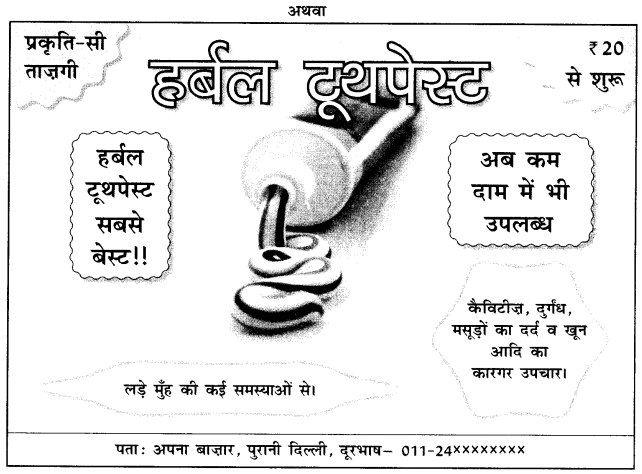
‘हर्बल टूथ पेस्ट’ की विशेषताएँ बताते हुए 25 से 50 शब्दों में विज्ञापन बनाइए।
उत्तर
CBSE Sample Papers for Class 10 Hindi Course B Set 3 with Solutions 1
CBSE Sample Papers for Class 10 Hindi Course B Set 3 with Solutions 2

प्रश्न 17.
दिए गए विषय के आधार पर 100-120 शब्दों में लघुकथा लिखिए।
• बिना सोचे-समझे किसी पर विश्वास नहीं करना चाहिए।
अथवा
• संगत का असर।
उत्तर
एक बार एक शिकारी जंगल में शिकार करने के लिए गया। बहुत प्रयास करने के बाद उसने जाल में एक बाज़ पकड़ लिया। शिकारी जब उसे लेकर जाने लगा तब रास्ते में उसने उससे कहा, “तुम मुझे लेकर क्यों जा रहे हो?” वह बोला, “मैं तुम्हें मारकर खाने के लिए ले जा रहा हूँ।” उसने सोचा कि अब तो मेरी मृत्यु निश्चित है।

वह कुछ देर यूँ ही शांत रहा और फिर कुछ सोचकर बोला, “देखो, मुझे जितना जीवन जीना था, मैंने जी लिया और अब मेरा मरना निश्चित है, लेकिन मरने से पहले मेरी एक आखिरी इच्छा है।” “बताओ अपनी इच्छा?” शिकारी ने उत्सुकता से पूछा। बाज ने बताना शुरू किया- “मरने से पहले मैं तुम्हें दो सीख देना चाहता हूँ, इसे तुम ध्यान से सुनना और सदा याद रखना। पहली सीख तो यह है कि किसी की बातों का बिना प्रमाण, बिना सोचे-समझे विश्वास मत करना और दूसरी ये कि यदि तुम्हारे साथ कुछ बुरा हो या तुम्हारे हाथ से कुछ छूट जाए तो उसके लिए कभी दुखी मत होना।”

शिकारी ने बाज़ की बात सुनी और अपने रास्ते आगे बढ़ने लगा। कुछ समय बाद बाज ने शिकारी से कहा- “शिकारी, एक बात बताओ… अगर मैं तुम्हें कुछ ऐसा दे दूं, जिससे तुम रातों-रात अमीर बन जाओ तो क्या तुम मुझे आज़ाद कर दोगे?” शिकारी फ़ौरन रुका और बोला, “क्या है वो चीज़, जल्दी बताओ?” बाज़ बोला, “दरअसल, बहुत पहले मुझे राजमहल के करीब एक हीरा मिला था, जिसे उठाकर मैंने एक गुप्त स्थान पर रख दिया था।

अगर आज मैं मर जाऊँगा तो वह हीरा ऐसे ही बेकार चला जाएगा, इसलिए मैंने सोचा कि अगर तुम उसके बदले मुझे छोड़ दो तो मेरी जान भी बच जाएगी और तुम्हारी गरीबी भी हमेशा के लिए मिट जाएगी।” यह सुनते ही शिकारी ने बिना कुछ सोचे-समझे बाज को आज़ाद कर दिया और वह हीरा लाने को कहा।

बाज़ तुरंत उड़कर पेड़ की एक ऊँची साख पर जा बैठा और बोला, “कुछ देर पहले ही मैंने तुम्हें एक सीख दी थी कि किसी की भी बातों का तुरंत विश्वास मत करना, लेकिन तुमने उस सीख का पालन नहीं किया… दरअसल, मेरे पास कोई हीरा नहीं है और अब मैं आज़ाद हूँ। यह सुनते ही शिकारी मायूस हो पछताने लगा… तभी बाज़ फिर बोला, “तुम मेरी दूसरी सीख भूल गए कि अगर तुम्हारे साथ कुछ बुरा हो तो उसके लिए कभी पछतावा मत करना।”

अथवा

एक दिन एक शहर के एक नामी सेठ को पता चलता है कि उसका बेटा गलत संगत में पड़ गया है और उसका उठना-बैठना गलत लोगों के साथ हो गया है। सेठ के लाख समझाने और मना करने के बाद भी उसका बेटा उन्हीं लोगों के साथ उठता-बैठता था और कहता था कि किसी के साथ उठने-बैठने से कोई बिगड़ नहीं जाता है। एक दिन सेठ को ऐसे ही बैठे-बैठे अपने बेटे को सुधारने की एक युक्ति सूझी… वह बाज़ार गया और वहाँ से कुछ सेब खरीदकर ले आया। इन सब सेबों के साथ वह एक सड़ा हुआ सेब भी लेकर आया… सेठ ने उन सेबों को दो बराबर हिस्सों में बाँटकर दो अलग-अलग थैलों में डाल दिया।

फिर उसने अपने बेटे को बुलाकर कहा कि इन दोनों थैलों को अलग-अलग जगह रख दो। बेटे को कुछ समझ नहीं आया। तभी सेठ ने अलग से लाया हुआ सड़ा हुआ सेब निकाला और एक थैले में डालते हुए कहा कि यह सेब थोड़ा-सा सड़ा हुआ है, लेकिन बाकी के सेब तो सही हैं… इस थैले में इसको डाल देता हूँ। अगले ही दिन सेठ ने अपने बेटे से सेब के दोनों थैले लाने को कहा… बेटा सेब का एक थैला तो आराम से लेकर आ गया, लेकिन जब दूसरा थैला लाने गया तो उसे बदबू आने लगी… उ

सने देखा कि सड़े सेब वाले थैले के बाकी सेब भी सड़ने शुरू हो गए थे। सेठ ने कहा, “जिस तरह एक सड़ा हुआ सेब बाकी सेबों को भी सड़ा देता है, उसी तरह बुरी संगत अच्छे बच्चों को बिगाड़ देती है।” अब उस लड़के को सारी बात समझ में आ गई और उसी दिन से उसने बुरे लोगों के साथ उठना/बैठना बंद कर दिया।

Surface Chemistry Class 12 Important Extra Questions Chemistry Chapter 5

Here we are providing Class 12 Chemistry Important Extra Questions and Answers Chapter 5 Surface. Class 12 Chemistry Important Questions are the best resource for students which helps in Class 12 board exams.

Class 12 Chemistry Chapter 5 Important Extra Questions Surface Chemistry

Surface Chemistry Important Extra Questions Very Short Answer Type

Question 1.
Give an example of a shape selective catalyst. (CBSE Delhi 2010, 2011)
Answer:
Zeolite catalyst known as ZSM-5.

Question 2.
Why are medicines more effective in colloidal state? (CBSE Delhi 2019)
Answer:
Medicines are most effective in colloidal state because colloids have large surface area and hence the medicines can be easily adsorbed and assimilated.

Question 3.
What is difference between an emulsion and a gel? (CBSE Delhi 2019)
Answer:
Emulsions are colloidal solutions in which both the dispersed phase and the dispersion medium are liquids. Gel is a colloidal system in which a liquid is dispersed in a solid.

Question 4.
Define ‘peptization’. (CBSE2012)
Answer:
The process of converting a freshly prepared precipitate into colloidal form by addition of a suitable electrolyte is called peptization.

Question 5.
What is meant by ‘shape-selective catalysis? (CBSE 2012)
Answer:
The catalytic reaction which depends upon the pore structure of the catalyst and the size of the reactant and product molecules is called shape selective catalysis.

Question 6.
What happens when a freshly precipitated
Fe(OH)3 is shaken with little amount of dilute solution of FeCl3? (CBSE 2013)
Answer:
A reddish brown colloidal solution of Fe(OH)3 is obtained. This process is called peptization.

Question 7.
What is especially observed when a beam of light is passed through a colloidal solution? (CBSE 2013)
Answer:
Tyndall effect

Question 8.
Give one example each of sol and gel. (CBSE Delhi 2014)
Answer:
Sol: As2S3 sol.
Gel: Cheese.

Question 9.
Give one example each of ‘oil in water’ and ‘water in oil’ emulsion. (CBSE 2014)
Answer:
Oil in water emulsion:
Milk Water in oil emulsion: Butter

Question 10.
Write a method by which lyophobic colloids can be coagulated. (CBSE 2015)
Answer:
By electrophoresis lyophobic colloids can be coagulated. Other methods are by mixing two oppositely charged sols or by boiling or by addition of electrolyte.

Question 11.
Write the main reason for the stability of colloidal sols. (CBSE Delhi 2016)
Answer:
The stability of colloidal sols is because of the presence of electrical charge on the particles which prevents the particles to come close together.

Question 12.
What are lyophobic colloids? Give one example for them. (CBSE Delhi 2011)
Answer:
The colloidal solutions in which the particles of the dispersed phase have no affinity for the dispersion medium are called lyophobic colloids. For example, metal sulphides like As2S3.

Question 13.
Write one similarity between physisorption and chemisorption. (CBSE Delhi 2017, CBSE AI 2017)
Answer:
Both are surface phenomena and increase with increase in surface area.

Question 14.
Why are lyophilic colloidal sols more stable than lyophobic colloidal sols? (CBSE Delhi 2015)
Answer:
The lyophilic colloidal sols are more stable because they are highly hydrated in solution.

Question 15.
What is the difference between a sol and a gel? (CBSE Delhi 2017)
Answer:
In a sol, dispersion medium is liquid and dispersed phase is solid. On the other hand, in a gel, dispersion medium is solid and dispersed phase is liquid.

Question 16.
What type of colloid is formed when a liquid is dispersed in a solid? Give an example. (CBSE AI 2017)
Answer:
Gel
For example: Cheese

Question 17.
Which of the following is most effective electrolyte in the coagulation of Fe2O3.x H2O/Fe3+ sol?
KCl, AlCl3, MgCl2, K4[Fe(CN)6] (CBSE Sample Paper 2011)
Answer:
Since Fe(OH)3 sol is positively charged, the anion having highest charge will be most effective, i.e. [Fe(CN)6]4.

Question 18.
Why is colloidal gold used for intramuscular injection? (CBSE Sample Paper 2011)
Answer:
Colloidal gold is more effective because of larger surface area and therefore, is easily assimilated with blood which is colloidal.

Question 19.
What is colloidion? (CBSE Sample Paper 2011)
Answer:
4% solution of nitrocellulose in a mixture of alcohol and ether.

Question 20.
Leather gets hardened after tanning. Why? (CBSE Delhi 2015)
Answer:
Animal hide is colloidal in nature and has positively charged particles. When it is soaked in tannin which has negatively charged colloidal particles, it results in mutual coagulation. This results in the hardening of leather.

Question 21.
It is necessary to remove CO when ammonia is prepared by Haber’s process. Explain. (CBSE Delhi 2015)
Answer:
Carbon monoxide acts as a poison for the catalyst in Haber’s process and therefore, it will lower the activity of the catalyst. Thus, CO must be removed when ammonia is obtained by Haber’s process.

Question 22.
Addition of alum purifies water. Why? (CBSE AI 2015)
Answer:
Alum coagulates the impurities present in water by neutralising the charge.

Question 23.
Out of sulphur sol and proteins, which one forms multimolecular colloids? (CBSE Delhi 2016)
Answer:
Proteins are macromolecules which cannot form multimolecular colloids while sulphur sol has smaller S8 molecules which can coagulate to form multimolecular colloids.

Question 24.
Write the chemical method by which Fe(OH)3 sol is prepared from FeCl3. (CBSE AI 2017)
Answer:

Class 12 Chemistry Important Questions Chapter 5 Surface Chemistry 1

Question 25.
Out of MgCl2 and AlCl3 which one is more effective in causing coagulation of negatively charged sol and why? (CBSE Delhi 2016)
Answer:
According to Hardy-Schulze rule, for negatively charged sol, greater the valency of the positive ion of the electrolyte added, greater is its coagulating power. Thus, AlCl3 (Al3+ ions) is more effective in causing coagulation of negatively charged sol than MgCl2 (Mg2+ ions).

Question 26.
Give one example each of lyophobic sol and lyophilic sol. (CBSE Delhi 2014)
Answer:
Lyophobic : As2S3, Lyophilic : Gelatin

Question 27.
Out of BaCl2 and KCl which one is more effective in causing coagulation of negatively charged colloidal sol. Give reason. (CBSE Delhi 2015)
Answer:
BaCl2 because greater the valency of the coagulating ion (positive ion), greater is its tendency to coagulate.

Question 28.
What are the dispersed phase and . dispersion medium in milk? (CBSE AI 2014)
Answer:
Liquid (dispersed phase), Liquid (dispersion medium)

Question 29.
What type of colloid is formed when a solid is dispersed in liquid? Give an example. (CBSE AI 2017)
Answer:
Sol, paints

Question 30.
CO (g) and H2(g) react to give different products in the presence of different catalysts. Which ability of the catalyst is shown by these reactions? (CBSE AI 2018)
Answer:
Selectivity of a catalyst. It is the ability of a catalyst to selectively form a particular product.

Surface Chemistry Important Extra Questions Short Answer Type

Question 1.
Describe a conspicuous change observed when
(i) a solution of NaCl is added to a sol of hydrated ferric oxide.
(ii) a beam of light is passed through a solution of NaCl and then through a sol. (C.B.S.E. Delhi 2012)
Answer:
1. Hydrated ferric oxide is positively charged. When an electrolyte such as NaCl is added, the excess Cl ions neutralise positive charge and cause coagulation of the sol.

2. When a beam of light is passed through a colloidal solution, the path of the light becomes visible when viewed from the direction at right angle to that of incident beam. This phenomenon is called Tyndall effect. This is because of scattering of light by colloidal particles. The particles first absorb the incident light and then a part of it gets scattered by them and therefore the part becomes visible when seen at right angle to the direction of incident beam.

Question 2.
Name the two groups into which phenomenon of catalysis can be divided. Give an example of each group with the chemical equation involved. (CBSE Delhi 2012)
Answer:
Catalysis can be divided into two groups
(i) Homogeneous catalysis
(ii) Heterogeneous catalysis

(i) Homogenous catalysis: When the catalyst is present in the same phase as the reactants and products, it is called homogeneous catalysis. For example,

Class 12 Chemistry Important Questions Chapter 5 Surface Chemistry 2
SO2(g) is oxidised to SO3(g) in the presence of gaseous nitric oxide as catalyst.

(ii) Heterogeneous catalysis: When the catalyst is in different phase than the
reactants, it is called heterogeneous catalysis. For example,

Class 12 Chemistry Important Questions Chapter 5 Surface Chemistry 3

Question 3.
Write the dispersed phase and dispersion medium of the following colloidal systems: (CBSE Delhi 2013)
(i) Smoke
(ii) Milk
Answer:
Colloidal system: Dispersed phase/Dispersion medium
(i) Smoke: Solid/Gas
(ii) Milk: Liquid/Liquid

Question 4.
What are lyophilic and lyophobic colloids? Which of these sols can be easily coagulated on the addition of small amounts of electrolytes? (CBSE Delhi 2013)
Answer:
The colloidal solutions in which the particles of the dispersed phase have great affinity for the dispersion medium are called lyophilic sols. For example, glue, gelatin, starch, proteins, etc.

The colloidal solutions in which there is no affinity between the particles of the dispersed phase and the dispersion medium are called lyophobic sols. For example, solutions of . metals like Ag, Au, Al(OH)3, Fe(OH)3, etc.

Lyophobic sols can be easily coagulated on the addition of small amounts of electrolytes.

Question 5.
What is the difference between oil/water (O/W) type and water/oil (W/O) type emulsions? Give an example of each type. (CBSE Delhi 2013)
Answer:
1. Oil-in-water emulsion (o/w). In this case, oil acts as the dispersed phase (small amount) and water as the dispersion medium (excess), e.g. milk is an emulsion of soluble fats in water and here casein acts as an emulsifier. Vanishing cream is another example of this class. Such emulsions are called aqueous emulsions.

2. Water-in-oil emulsion (w/o). In this case, water acts as the dispersed phase while the oil behaves as the dispersion medium, e.g. butter, cod liver oil, cold cream, etc. Such types of emulsions are called oily emulsions.

Question 6.
Peptizing agent is added to convert precipitate into colloidal solution. Explain. (CBSE Sample Paper 2011)
Answer:
Peptization is a process of converting a freshly prepared precipitate into colloidal form by the addition of an electrolyte called peptizing agent. The suitable ions from the peptizing agent (electrolyte) are adsorbed by the particles of the precipitate giving it positive or negative charge. The charged particles repel one another and break up the precipitate into smaller particles of the size of the colloid. Therefore, it results into the formation of colloid.

For example, on treating a precipitate of iron (III) oxide with a small amount of FeCl3 solution gives a reddish brown coloured colloidal solution.

Class 12 Chemistry Important Questions Chapter 5 Surface Chemistry 4

Question 7.
Cottrell’s smoke precipitator is fitted at the mouth of chimney used in factories. Give reasons. (CBSE Sample Paper 2011)
Answer:
Smoke coming out of chimney of a factory is a colloidal solution of solid carbon particles which are charged in nature.

The mouth of the chimneys used in factories is fitted with Cottrell smoke precipitator. In this method, the smoke is allowed to pass through a chamber having a series of plates charged to very high potential (20,000 to 70,000 V).

Charged particles of smoke get attracted by charged plates, get precipitated and the gases coming out of chimney become free of charged carbon and dust particles.

Question 8.
Differentiate between peptization and coagulation.
(CBSE Sample Paper 2011, CBSE AI 2017)
Answer:
Peptization is the process of converting a freshly prepared precipitate into collodial form by the the addition of a suitable electrolyte. The electrolytes used for the purpose are called peptizing agents. On the other hand, coagulation is the phenomenon of precipitation of a collodial solution by the addition of excess of an electrolyte.

Question 9.
Explain:
(i) Sky appears blue in colour.
(ii) A freshly formed precipitate of ferric hydroxide can be converted to a colloidal sol by shaking it with a small quantity of ferric chloride. (CBSE Sample Paper 2011)
Answer:
1. Dust particles along with water suspended in air scatter blue light which reaches our eyes and therefore, sky looks blue to us.

2. When we add FeCl3 to a freshly formed precipitate of Fe(OH)3, peptization occurs. The Fe3+ ions are adsorbed on the surface of the precipitate which ‘ ultimately breaks down into smaller particles of colloidal size.

Question 10.
What happens when
(i) a freshly prepared precipitate of Fe(OH)3 is shaken with a small amount of FeCl3 solution?
(ii) persistent dialysis of a colloidal solution is carried out?
(iii) an emulsion is centrifuged? (CBSE 2018)
Answer:
(i) Peptization occurs / Colloidal solution of Fe(OH)3 is formed.
(ii) Coagulation occurs
(iii) Demulsification or breaks into constituent liquids

Surface Chemistry Important Extra Questions Long Answer Type

Question 1.
Classify colloids where the dispersion medium is water. State their characteristics and write one example of each of these classes.
OR
Explain what is observed when
(i) an electric current is passed through a sol.
(ii) a beam of light is passed through a sol.
(iii) an electrolyte (say NaCl) is added to ferric hydroxide sol. (CBSE 2011)
Answer:
These colloids are of two types:
(i) Hydrophilic
(ii) Hydrophobic

Characteristics: In lyophilic colloids, there is affinity between dispersed phase and the dispersion medium while in the lyophobic colloids, there is no affinity rather hatred between the phases.

The main points of distinction between lyophilic and lyophobic sols are summarized below:

Lyophilic colloids (Hydrophilic)Lyophobic collodis (Hydrophobic)
1. These are easily formed by direct mixing.1. These are formed only by special methods.
2. These are reversible in nature.2. These are irreversible in nature.
3. The particles of colloids are true molecules and are big in size.3. The particles are aggregates of many molecules.
4. The particles are not easily visible even under ultramicroscope.4. The particles are easily detected under ultramicroscope.
5. These are very stable.5. These are unstable and require traces of stabilizers.
6. The addition of small amount of electrolytes causes precipitation (called coagulation) of colloidal solution.6. The addition of small amount of electrolytes has less effect. Larger quantities of electrolytes are required to cause coagulation.
7. The particles do not carry any charge. The particles may migrate in any direction or even not under the influence of an electric field.7. The particles move in a specific direction i.e., either towards anode or cathode depending upon their charge.
8. The particles of colloids are heavily hydrated due to the attraction for the solvent.8. The particles of colloids are not appreciably hydrated due to the hatred for the solvent.
9. The viscosity and surface tension of the sols are much higher than that of the dispersion medium.9. The viscosity and surface tension are nearly the same as that of the dispersion medium.
10. They do not show Tyndall effect.10. They show Tyndall effect.

Example: Hydrophilic: Starch,
Hydrophobic : Metal sulphide

OR

(i) On passing electric current through colloidal solution, the colloidal particles move towards the oppositely charged electrodes, where they lose their charge and get coagulated. This is electrophoresis process.

(ii) When a beam of light is passed through a colloidal solution, the path of the light becomes visible when viewed from the direction at right angle to that of incident beam. This phenomenon is called Tyndall effect. This is because of scattering of tight by colloidal particles. The particles first absorb the incident light and then a part of it gets scattered by them and therefore the part becomes visible when seen at right angle to the direction of incident beam.

(iii) Hydrated ferric oxide is positively charged. When an electrolyte such as NaCl is added, the excess Cl ions neutralise positive charge and cause coagulation of the sol.

Question 2.
Explain how the phenomenon of adsorption finds application in each of the following processes:
(i) Production of vacuum
(ii) Heterogeneous catalysis
(iii) Froth floatation process (CBSE Delhi 2011)
Answer:
(i) Production of vacuum: The adsorption of air in liquid air helps to create a high vacuum in a vessel. This process is used in high vacuum instruments such as Dewar flask for storage of liquid air or liquid hydrogen. The remaining traces of air can be adsorbed by charcoal from the vessel evacuated by a vacuum pump to give a very high vacuum.

(ii) Heterogeneous catalysis: The phenomenon of adsorption is useful in the heterogeneous catalysis. Adsorption of reactants on the solid surface of catalysts increases the rate of reaction. The metals such as Fe, Ni, Pt, Pd, etc. are used in the manufacturing processes. Manufacture of ammonia using iron as catalyst (Haber process), manufacture of sulphuric acid by Contact process and use of finely divided nickel in the hydrogenation of oils are excellent examples of heterogeneous catalysis. Its use is based upon the phenomenon of adsorption.

(iii) In froth floatation process: A low grade sulphide ore is concentrated by separating it from silica and other earthly matter by adsorption using pine oil and frothing agent.

Question 3.
What is meant by coagulation of a colloidal solution? Describe briefly any three methods by which coagulation of lyophobic sols can be carried out. (CBSE 2012)
Answer:
The phenomenon of precipitation of a colloidal sol by the addition of excess of an electrolyte is called coagulation of colloidal sol. Coagulation of lyophobic sols can be carried out by the following methods:

1. By addition of an electrolyte: When an electrolyte is added to the sol, colloidal particles take up ions carrying opposite charge from the electrolyte and get neutralised resulting in coagulation.

2. By mutual precipitation: When two oppositely charged sols are mixed in equimolar proportions, they mutually neutralise their charge and both get coagulated.

3. By electrophoresis: When electrophoresis is carried out for a long time, the particles of dispersed phase move towards oppositely charged electrodes, lose their charge and get coagulated.

Question 4.
Explain the following terms giving a suitable example for each:
(i) Aerosol
(ii) Emulsion
(iii) Micelle (CBSE 2012)
Answer:
(i) Aerosol: It is a colloidal dispersion of a liquid in a gas. For example, fog, mist, cloud.

(ii) Emulsion. Emulsions are the colloidal solutions of two immiscible liquids in which the liquid acts as the dispersed phase as well as the dispersion medium. Types of emulsion. These are of two types:

(a) Oil-in-water emulsion. In this case, oil acts as the dispersed phase (small amount) and water as the dispersion medium (excess), e.g. milk is an emulsion of soluble fats in water and here casein acts as an emulsifier. Vanishing cream is another example of this class. Such emulsions are called aqueous emulsions.

(b) Water-in-oil emulsion. In this case, water acts as the dispersed phase while the oil behaves as the dispersion medium, e.g. butter, cod liver oil, cold cream, etc. Such types of emulsions are called oily emulsions.

(iii) Micelle: The particles of colloidal size formed due to aggregation of several ions or molecules with lyophobic as well as lyophilic particles are called micelles. The common micelles system is soap. The micelles behave as normal electrolytes at low concentrations but as colloids at higher concentrations.

Question 5.
Write three distinct features of chemisorption which are not found in physisorption. (CBSE 2012)
Answer:
Characteristics of Chemisorption:

  1. The forces between the adsorbate molecules and the adsorbent are strong chemical forces similar to chemical bonds. But no chemical bonds exist in physisorption.
  2. Chemisorption is irreversible in nature but physisorption is reversible.
  3. Chemisorption forms mono – molecular layers, but in physisorption multimolecular layers are present.

Question 6.
What are the characteristics of the following colloids? Give one example of each.
(i) Multimolecular colloids
(ii) Lyophobic sols
(iii) Emulsions (CBSE 2013)
Answer:
(i) The colloidal solutions in which atoms or smaller molecules of substances (having diameter less than 1 nm) aggregate together to form particles of colloidal dimensions. The particles thus formed are called multimolecular colloids. For example, sols of gold atoms and sulphur (S8) molecules.

(ii) The colloidal solutions in which there in no affinity (or love rather they have hatred) between the particles of the dispersed phase and the dispersion medium are called lyophobic sols.
For example, metal sulphides like As2S3.

(iii) The colloidal solutions in which both the dispersed phase and the dispersion medium are liquids are called emulsions. For example, milk.

Question 7.
Write the dispersed phase and dispersion medium of the following colloidal systems:
(i) Smoke
(ii) Milk
OR
What are lyophilic and lyophobic colloids? Which of these sols can be easily coagulated on the addition of small amounts of electrolytes? (CBSE Delhi 2013)
Answer:

Colloidol SystemDispersed phaseDispersed medium
(i) SmokeSolidGas
(ii) MilkLiquidLiquid

OR
The colloidal solutions in which the particles of the dispersed phase have great affinity for the dispersion medium are called lyophilic sols. For example, glue, gelatin, starch, proteins, etc.

The colloidal solutions in which there is no affinity between the particles of the dispersed phase and the dispersion medium are called lyophobic sols. For example, ‘ solutions of metals like Ag, Au, Al(OH)3, Fe(OH)3, etc.
Lyophobic sols can be easily coagulated on the addition of small amounts of electrolytes.

Question 8.
What are emulsions? What are their different types? Give one example of each type. (CBSE 2014)
Answer:
Emulsions are the colloidal solutions of two immiscible liquids in which the liquid acts as the dispersed phase as well as the dispersion medium.

Types of emulsions. These are of two types:
1. Oil-in-water emulsion. In this case, oil acts as the dispersed phase (small amount) and water as the dispersion medium (excess), e.g. milk is an emulsion of soluble fats in water and here casein acts as an emulsifier. Vanishing cream is another example of this class. Such emulsions are called aqueous emulsions.

(ii) Water-in-oil emulsion. In this case, water acts as the dispersed phase while the oil behaves as the dispersion medium, e.g. butter, cod liver oil, cold cream, etc. Such types of emulsions are called oily emulsions.

Question 9.
(i) In reference to Freundlich adsorption isotherm, write the expression for adsorption of gases on solids in the form of an equation.
(ii) Write an important characteristic of lyophilic sols.
(iff) Based on type of particles of dispersed phase, give one example each of associated colloid and multimolecular colloid. (CBSE Delhi 2014)
Answer:
(i) \(\frac{x}{m}\) = kp1/n
where \(\frac{x}{m}\) is extent of adsorption, x is the mass of adsorbate, m is the mass of adsorbent, p is pressure at a particular temperature, k is a constant and n takes any whole number value.

(ii) in lyophilic sols, the particles of dispersed phase have a great affinity for the dispersion medium and are reversible in nature.

(iii) Associated colloids: Soap (e.g. sodium stearate).
Multimolecular colloids: Sol of gold (atoms).

Question 10.
Give reasons for the following observations:
(i) Leather gets hardened after tanning.
(ii) Lyophilic sol is more stable than lyophobic sol.
(iii) It is necessary to remove CO when ammonia is prepared by Haber’s process. (CBSE Delhi 2015)
Answer:
(i) Animal hide is colloidal in nature and has positively charged particles. When it is soaked in tannin which has negatively charged colloidal particles, it results in mutual coagulation. This results in the hardening of leather.

(ii) Lyophilic sol is more stable than lyophobic sol because it is highly hydrated or solvated in solution.

(iii) Carbon monoxide acts as a poison for the catalyst in Haber’s process and therefore, it will lower the activity of the catalyst.
Thus, CO must be removed when ammonia is obtained by Haber’s process.

Question 11.
Give reasons for the following observations:
(i) Physisorption decreases with increase in temperature.
(ii) Addition of alum purifies the water.
(iii) Brownian movement provides stability to the colloidal solution. (CBSE 2015)
Answer:
(i) In physisorption, the attractive forces between adsorbent and adsorbate molecules are weak vander Waals forces. When temperature is increased, the kinetic energy of the molecules of the gas increases and they can easily leave the surface of adsorbent.
Therefore, physisorption decreases with increase in temperature.

(ii) Alum coagulates the impurities present in water by neutralising the charge.

(iii) The Brownian movement is due to the unbalanced bombardment of the particles by the molecules of the dispersion medium. This results in zigzag motion. Because of brownian movement, the particles do not settle down and hence is responsible for the stability of the sols.

Question 12.
Define the following terms:
(i) O/W Emulsion
(ii) Zeta potential
(iii) Multimolecular colloids (CBSE 2016)
Answer:
(i) O/W Emulsion: It is the emulsion in which oil is the dispersed phase and water is the dispersion medium. For example, milk is an emulsion of soluble fats in water.

(ii) Zeta potential: The potential difference between the fixed layer and the diffused layer of opposite charges is called Zeta potential.

(iii) Multimolecular colloids: When a dissolution, atoms or smaller molecules of substances (having diameter less than 1 nm) aggregate together to form particles of colloidal dimension, the particles thus formed are called multimolecular colloids.

Question 13.
(i) Differentiate between adsorption and absorption.
(ii) Out of MgCl2 and AlCl2, which one is more effective in causing coagulation of negatively charged sol and why?
(iii) Out of sulphur sol and proteins, which one forms multimolecular colloids? (CBSE Delhi 2016)
Answer:
(i)

AbsorptionAdsorption
1. It is the phenomenon in which the particles of gas or liquid get uniformly distributed throughout the body of the solid.1. It is the phenomenon of higher concentration of particles of gas or liquid on the surface than in the bulk of the solid.
2. The concentration is the same throughout the material. Therefore, it is a bulk phenomenon.2. The concentration on the surface of the adsorbent is different from that in the bulk.  Therefore, it is a surface phenomenon.
3. Absorption occurs at uniform rate.3. Adsorption is rapid in the beginning and its rate slowly decreases.

(ii) According to Hardy-Schulze rule, for negatively charged sol, greater the valency of the positive ion of the electrolyte added, greater is its coagulating power. Thus AlCl3 (Al3+ ion) is more effective in causing coagulation of negatively charged sol than MgCl2 (Mg2+ ions).

(iii) Proteins are macromolecules which cannot form multimolecular colloids while sulphur sol has smaller S8 molecules which can coagulate to form multimolecular colloids.

Question 14.
What is meant by coagulation of a colloidal solution? Describe briefly any three methods by which coagulation of lyophobic sols can be carried out.
(CBSE Delhi 2013)
Answer:
The phenomenon of precipitation of a colloidal sol by the addition of excess of an electrolyte is called coagulation of colloidal sol.
Coagulation of lyophobic sols can be carried out by the following methods:
(i) By addition of an electrolyte: When an electrolyte is added to the sol, colloidal particles take up ions carrying opposite charge from the electrolyte and get neutralised resulting in coagulation.

(ii) By mutual precipitation: When two oppositely charged sols are mixed in equimolar proportions, they mutually neutralise their charge and both get coagulated.

(iii) By electrophoresis: When electrophoresis is carried out for a long time, the particles of dispersed phase move towards oppositely charged electrodes, lose their charge and get coagulated.

Question 15.
(i) What is the role of activated charcoal in gas mask?
(ii) A colloidal sol is prepared by the given method in figure. What is the charge on hydrated ferric oxide colloidal particles formed in the test tube? How is the sol represented?
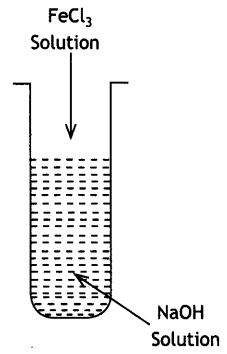
Class 12 Chemistry Important Questions Chapter 5 Surface Chemistry 5
(iii) How does chemisorption vary with temperature? (CBSE Delhi 2019) Answer:
(i) Activated charcoalin gas mask adsorbs the poisonous or toxic gases from air. Therefore, these masks help to purify the air for breathing.

(ii) Negatively charged sol
Representation: Fe2O3. xH2O/OH

(iii) In chemisorption, adsorption initially increases with rise in temperature and then decreases.

Question 16.
Define the following terms with an example in each case:
(i) Macromolecular sol
(ii) Peptization
(iii) Emulsion (CBSE Al 2013)
Answer:
(i) Macromolecular sol: In this type, the particles of the dispersed phase are sufficiently big in size (macro) to be of colloidal dimensions. In this case, a large number of small molecules are joined together through their primary valencies to form giant molecules. These molecules are called macromolecules and each macromolecule may consist of hundreds or thousands of simple molecules. The solutions of such molecules are called macromolecular solutions. For example, colloidal solution of starch, cellulose, etc.

(ii) Peptization: The process of converting a freshly prepared precipitate into colloidal form by addition of a suitable electrolyte is called peptization. The electrolytes used for the purpose are called peptizing agents.

(iii) Emulsions: They are the colloidal solutions of two immiscible liquids in which the liquid acts as the dispersed phase as well as the dispersion medium. Normally, these are obtained by mixing an oil with water. Since the two do not mix well, the emulsion is generally unstable and is stabilised by adding a suitable reagent called emulsifier or emulsifying agent. The substances that are commonly employed for the purpose are gum, soap, glass powder, etc.

Question 17.
Define the following with a suitable example of each:
(a) Coagulation
(b) Multimolecular colloid
(c) Gel
Answer:
(a) Coagulation. The phenomenon of precipitation of a colloidal solution by the addition of excess of an . electrolyte is called coagulation. For
example, Fe(OH)3 colloidal solution is coagulated by adding HCl.

(b) Multimolecular colloid. When on dilution, atoms or smaller molecules of substances (having diameter less than 1 nm) aggregate together to form particles of colloidal dimensions, then the particles thus formed are called multimolecular colloids, for example, sols of gold atoms.

(c) Gel. A gel is a colloidal system in which a liquid is dispersed in a solid. For example, jellies, cheese.

OR

(a) Out of starch and ferric hydroxide sol, which one can easily be coagulated and why?
(b) What is observed when an emulsion is centrifuged?
(c) What is the role of promoters and poisons in catalysis? (CBSE Al 2019)
Answer:
(a) Ferric hydroxide sol is easier to coagulate because it is a lyophobic sol.
(b) De-emulsification occurs.
(c) Promoters increase the efficiency of catalyst whereas poisons inhibit the efficiency of catalyst.

Question 18.
Give reason for the following observations:
(i) When silver nitrate solution is added to potassium iodide solution, a negatively charged colloidal solution is formed.
(ii) Finely divided substance is more effective as an adsorbent.
(iii) Lyophilic colloids are also called reversible sols.
Answer:
(i) The precipitated silver iodide adsorbs iodide ions from the dispersion medium resulting in the negatively charged colloidal solution.
(ii) Due to large surface area
(iii) If the dispersion medium is separated from the dispersed phase, the sol can be reconstituted by simply remixing with the dispersion medium. That is why these sols are also called reversible sols.

Question 19.
Answer the following questions:
(a) Which of the following electrolytes is most effective for the coagulation of Agl/Ag+ sol?
MgCl2, K2SO4, K4[Fe(CN)6]
(b) What happens when a freshly precipitated Fe(OH)3 is shaken with a little amount of dilute solution of FeCl3?
(c) Out of sulphur sol and proteins, which one forms macromolecular colloids? (CBSE Sample Paper 2019)
Answer:
(a) K4[Fe(CN)6]
Hardy Schulze rule: The coagulation tendency of different electrolytes is different. It depends upon the valency of the active ion called flocculatins ion, which is the ion-carrying charge opposite to the charge on the colloidal particles. According to Hardy Schulze rule, greater the valency of the active ion or flocculating ion, greater will be its coagulating power. For example, to coagulate negative sol of AS2S3, the coagulating power of different cations has been found to decrease in the order as:
Al3+ > Mg2+ > Na+
Similarly, to coagulate a positive sol such as Fe(OH)3, the coagulating power of different anions has been found to decrease in the order:
[Fe(CN)6]4 > PO43- > SO42- > Cl

(b) Due to the phenomenon of peptization, a reddish brown positively charged sol of ferric hydroxide is obtained when a freshly precipitated Fe(OH)3 is shaken with a little amount of dilute solution of FeCl3. It involves the adsorption of suitable ions from the electrolyte by . the particles of the precipitate. The charged particles repel one another and form a colloidal sol. Ferric ions from ferric chloride are adsorbed by Fe(OH)3, precipitate and get converted into colloidal sol.
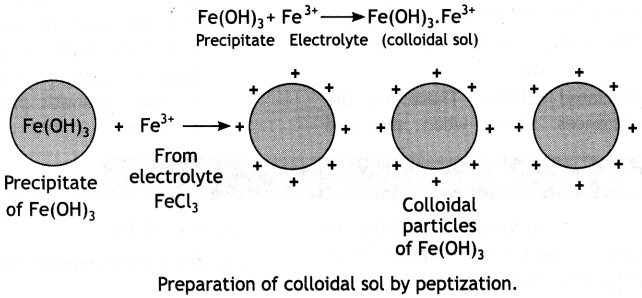
Class 12 Chemistry Important Questions Chapter 5 Surface Chemistry 6

(c) Proteins are macromolecules which cannot form multi-molecular colloids while sulphur sol has smaller S8 molecules which can coagulate to form multi-molecular colloids.

Question 20.
Answer the following:
(a) Why is ester hydrolysis slow in the beginning and then becomes faster after some time?
(b) In a solution of methylene blue, animal charcoal is added, the solution is then well shaken. What will be observed and why?
(c) Give an example of oil in water emulsion.
Answer:
(a) This is because of the process of autocatalysis. Ester on hydrolysis gives an acid which starts acting as a catalyst after sometime and therefore, the reaction becomes fast.

(b) Adsorption of a dye by charcoal. When animal charcoal is shaken with a solution of an organic dye such as methylene blue it is observed that the solution turns colourless. The discharge of the colour is due to the fact that the coloured component (generally an organic dye) gets adsorbed on the surface of animal charcoal. Therefore, animal charcoal is used for decolourising a number of organic substances in the form of their solutions.
(c) Milk, vanishing cream.

OR

Define the following:
(a) Associated colloids
(b) Electrophoresis
(c) Zeta potential (CBSE 2019C)
Answer:
(a) Associated colloids: These are the substances which when dissolved
in a medium behave as normal electrolytes at low concentration but behave as colloidal particles at higher concentration due to the formation of aggregated particles. The aggregate particles thus formed are called micelles. For example, in aqueous solution, soap (sodium stearate) ionises as:

Class 12 Chemistry Important Questions Chapter 5 Surface Chemistry 7
In concentrated solution, these ions get associated to form an aggregate of colloidal size.

(b) The phenomenon of movement of colloidal particles under an applied electric field is called electrophoresis. If the particles accumulate near the negative electrode, the charge on the particles is positive. On the other hand, if the sol particles accumulate near the positive electrode, the charge on the particles is negative.

(c) The combination of two layers of opposite charges around the colloidal particle is called Helmholtz electrical double layer. The first layer of ions is firmly held and is termed fixed layer while the second layer is mobile which is termed diffused layer. The charges of opposite signs on the fixed and diffused parts of the double layer result in a difference in potential between these layers. The potential difference between the fixed layer and the diffused layer of opposite charges is called the electrokinetic potential or zeta potential.

Question 21.
Write the differences between physisorption and chemisorption With respect to the following:
(i) Specificity
(ii) Temperature dependence
(iii) Reversibility and
(iv) Enthalpy change (CBSE Delhi 2013)
Answer:

PropertyPhysisorptionChemisorption
(i) Specificity:not specifichighly specific
(ii) Temperature dependence:Occurs at low temperature and decreases with increasing temperatureOccurs at high temperature and increases with increasing temperature
(iii) Reversibility:Reversible in natureIrreversible in nature
(iv) Enthalpy change:Low enthalpy of adsorption (20 – 40 kJ mol-1)High enthalpy of adsorption (80 – 240 kJ mol-1)

Question 22.
Describe some features of catalysis by zeolites.
Answer:
Zeolites are microporous aluminosilicates of the general formula Mx/n [(AlO2)x (SiO2)y] mH2O. These are most important oxide catalysts. These are used in petrochemical industries for cracking of hydrocarbons and isomerisation. The reactions in zeolites depend upon the size of the cavities (cages) or pores (apertures) present in them.

The most remarkable feature of zeolite catalysis is the shape selectivity. Therefore, the selectivity of catalyst depends on the pores structure. It has been observed that the pore size in zeolites generally varies between 260 pm and 740 pm. Depending upon the size of the reactants and products compared to the size of the cages or pores of zeolite, reactions proceed in specific manner.

A zeolite catalyst called ZSM-5 converts alcohols to gasoline, by first dehydrating the alcohol by loss of water.

Question 23.
What do you understand by adsorption isotherm? Discuss briefly Freundlich adsorption isotherm.
Answer:
Adsorption isotherm. A graph between amount of adsorption and gas pressure keeping temperature constant is called an adsorption isotherm.

Freundlich adsorption isotherm. The behaviour of adsorption with pressure can be expressed by adsorption isotherm as shown in figure.
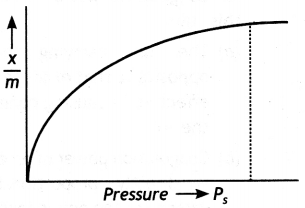
Class 12 Chemistry Important Questions Chapter 5 Surface Chemistry 8
The inspection of the graph reveals the following facts:
(i) At low pressure, the graph is almost straight line which indicates that x/m is directly proportional to the pressure. This may be expressed as:
\(\frac{x}{m}\) ∝ P or \(\frac{x}{m}\) = kP ……. (i)
where k is constant.

(ii) At high pressure. The graph becomes almost constant which means that x/m becomes independent of pressure. This may be expressed as:
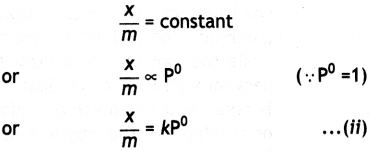
Class 12 Chemistry Important Questions Chapter 5 Surface Chemistry 9

(iii) Thus, in the intermediate range of pressure, x/m will depend upon the power of pressure which lies between 0 and 1, i.e. fractional power of pressure. This may be expressed as:
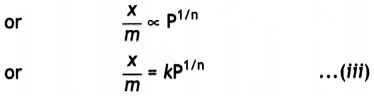
Class 12 Chemistry Important Questions Chapter 5 Surface Chemistry 10
where n can take any value between 1 and a larger integer depending upon the pressure. The above relationship is also called Freundlich’s adsorption isotherm.

Question 24.
Explain the following in connection with colloids:
(i) Hardy-Schulze rule
(ii) Dialysis.
Answer:
(i) Hardy-Schulze rule: This rule states that greater the valency of the active ion or flocculating ion, greater will be its coagulating power. According to this rule:

(a) The ions carrying the charge opposite to that of sol particles are effective in causing coagulation of the sol.

(b) Coagulation power of an electrolyte is directly proportional to the valency of the active ions.
For example, for negative As2S3 sol, the coagulating power of cations decreases as Al3+ > Mg2+ > K+
Similarly, for positively charged sol such as Fe (OH)3, the coagulating power decreases as
[Fe(CN)3]4- > PO43- > SO42- > Cr

(ii) Dialysis. The method used to separate the impurities from the colloidal solution is called dialysis. Its principle is based upon the fact that colloidal particles cannot pass through a parchment or cellophane membrane while the ions of the electrolyte can pass through it. The colloidal solution is taken in a bag made of cellophane or parchment. The bag is suspended in fresh water. The impurities slowly diffuse out of the bag leaving behind pure colloidal solution. Dialysis can be used for removing HCl from the ferric hydroxide sol. The method is shown in figure.
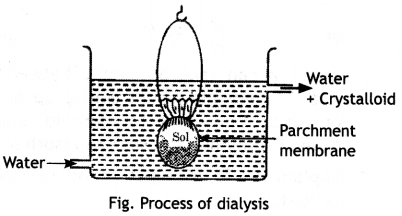
Class 12 Chemistry Important Questions Chapter 5 Surface Chemistry 11

The ordinary process of dialysis is slow. To increase the process of purification, the dialysis is carried out by applying electric field. This process is called electrodialysis.

Question 25.
Explain the following terms:
(i) Electrodialysis
(ii) Tyndall effect.
Answer:
(i) Electrodialysis. It is the process of separating the impurities from the colloidal solution by applying electric field. It is based on the fact that colloidal particles cannot pass through a parchment or cellophane membrane while the ions of the electrolyte can pass through it. The colloidal solution is taken in a bag made of cellophane or parchment and is suspended in a fresh water and electric current is applied. The impurities slowly diffuse out of the bag leaving behind pure colloidal solution.
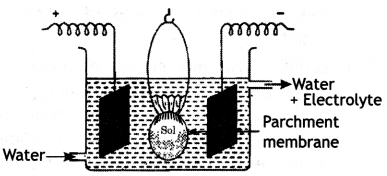
Class 12 Chemistry Important Questions Chapter 5 Surface Chemistry 12

(ii) Tyndall effect. When a strong beam of light is passed through a true solution placed in a beaker, in a dark room, the path of the light does not become visible. However, if the light is passed through a sol, placed in the same room, the path of the light becomes visible when viewed from a direction at right angle to that of the incident beam.
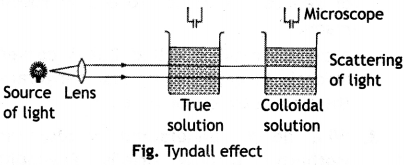
Class 12 Chemistry Important Questions Chapter 5 Surface Chemistry 13
This phenomenon was studied for the first time by Tyndall and therefore it is called Tyndall effect. The cause to Tyndall effect is the scattering of light by colloidal particles, i.e. these particles first absorb the incident light and then a part of it gets scattered by them. Since the intensity of the scattered light is at right angle to the plane of the incident light, the path becomes visible only when seen in that direction. The particles in true solution are too small in size to cause any scattering, i.e. the Tyndall effect is not noticed in true solutions.

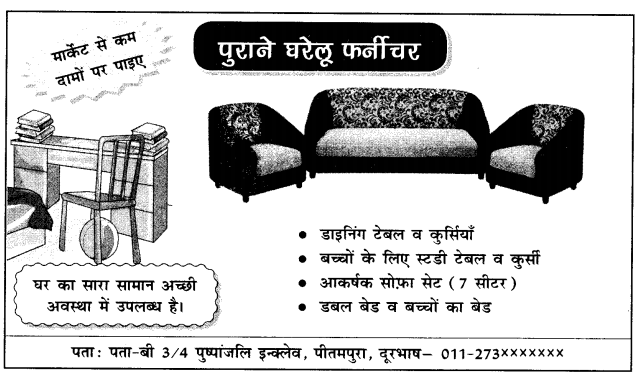
Magnetism and Matter Class 12 Important Extra Questions Physics Chapter 5

Here we are providing Class 12 Physics Important Extra Questions and Answers Chapter 5 Magnetism and Matter. Important Questions for Class 12 Physics with Answers are the best resource for students which helps in Class 12 board exams.

Class 12 Physics Chapter 5 Important Extra Questions Magnetism and Matter

Magnetism and Matter Important Extra Questions Very Short Answer Type

Question 1.
A small magnetic needle pivoted at the center is free to rotate In a magnetic meridian. At what place will the needle
be vertical?
Answer:
At the potes

Question 2.
What is the angle of dip at a place where the horizontal and vertical components of the earth’s magnetic field are equal?
Answer:
450

Question 3.
How does the intensity of a paramagnetic sample vary with temperature?
Answer:
it decreases with the increase in temperature.

Question 4.
What should be the orientation of a magnetic dipole in a uniform magnetic field so that its potential energy is maximum?
Answer:
It should be anti-parallel to the applied magnetic field.

Question 5.
What is the value of angle of dip at a place on the surface of the earth where the ratio of the vertical component to the horizontal component of the earth’s magnetic field is 1/\(\sqrt{3}\)?
Answer:
Using the expression tan δ = \(\frac{B_{V}}{B_{H}}=\frac{1}{\sqrt{3}}\)
Therefore, δ = 30°

Question 6.
Where on the surface of the earth is the angle of dip 90°? (CBSE Al 2011)
Answer:
Poles.

Question 7.
Where on the surface of the earth is the angle dip zero? (CBSE Al 2011)
Answer:
Magnetic equator

Question 8.
What are permanent magnets? Give one example. (CBSE Delhi 2013)
Answer:
It is an arrangement that has a permanent dipole moment, e.g. bar magnet.

Question 9.
At a place, the horizontal component of the earth’s magnetic field is B, and the angle of dip is 60°. What is the value of the horizontal component of the earth’s magnetic field at the equator? (CBSE Delhi 2017)
Answer:
Zero.

Question 10.
Is the steady electric current the only source of the magnetic field? Justify your answer. (CBSE Delhi 2013C)
Answer:
No, the magnetic field is also produced by alternating current.

Question 11.
Write one important property of a paramagnetic material. (CBSEAI2019)
OR
Do the diamagnetic substances have a resultant magnetic moment in an atom in the absence of an external magnetic field?
Answer:
It moves from the weaker to the stronger regions of the magnetic field.
OR
No

Question 12.
Steel is preferred for making permanent magnets, whereas soft iron is preferred for making electromagnets. Give one reason.
Answer:

  1. The Retentivity of steel is more than that of soft iron.
  2. Soft iron has a smaller value of coercivity than steel.

Question 13.
Define angle of inclination at a given place due to the earth’s magnetic field. (CBSE 2019C)
Answer:
The angle of inclination is the angle at which the earth’s magnetic field at a given place makes with the horizontal line in the magnetic meridian.

Question 14.
Relative permeability of a material p = 0.5. Identify the nature of the magnetic material and write its relation to magnetic susceptibility. (CBSE Delhi 2014C)
Answer:
Paramagnetic.
Susceptibility is small and greater than one.

Magnetism and Matter Important Extra Questions Short Answer Type

Question 1.
(a) Define the term magnetic susceptibility and write its relation in terms of relative magnetic permeability.
Answer:
It refers to the ease with which a substance can be magnetized. It is defined as the ratio of the intensity of magnetization to the magnetizing field. The required relation is µr = 1 + χm

(b) Two magnetic materials A and B have relative magnetic permeabilities of 0. 96 and 500. Identify the magnetic materials A and B. (CBSE Al, Delhi 2018C)
Answer:
A: Paramagnetic,
B: Ferromagnetic

Question 2.
A magnetic needle free to rotate in a vertical position orients itself with its axis vertical at a certain place on the earth. What are the values of
(a) the angle of dip and
(b) the horizontal component of the earth’s magnetic field at this place? Where will this place be on the earth?
Answer:
The angle of dip is 90° and the horizontal component of the earth’s magnetic field is zero. This place is the magnetic pole of the earth.

Question 3.
Out of the two magnetic materials ‘A’ has relative permeability slightly greater than unity while ‘B’ has less than unity. Identify the nature of the materials ‘A’ and ‘B’. Will their susceptibilities be positive or negative? (CBSE Delhi 2014)
Answer:

  • ‘A’ is paramagnetic and ‘B’ is diamagnetic.
  • ‘A’ will have positive susceptibility while
  • ‘B’ will have negative susceptibility.

Question 4.
A magnetic needle free to rotate in a vertical plane parallel to the magnetic meridian has its northern tip down at 60° with the horizontal. The horizontal component of the earth’s magnetic field at the place is known to be 0.4 G. Determine the magnitude of the earth’s magnetic field at the place. (CBSE Delhi 2011)
Answer:
Given δ = 30°, BH = 0.4 G, B = ?
Using the expression
BH = Bcos δ we have
B = \(\frac{B_{H}}{\cos \delta}=\frac{0.4}{\cos 30^{\circ}}=\frac{0.4}{\sqrt{3} / 2}=\frac{0.8}{\sqrt{3}}\) G

Question 5.
The susceptibility of a magnetic material is -0.085. Identify the type of magnetic material. A specimen of this material is kept in a non-uniform magnetic field. Draw the modified field pattern.
Answer:
The material is a diamagnetic material as diamagnetic materials have negative susceptibility. The modified field pattern is as shown below.
Class 12 Physics Important Questions Chapter 5 Magnetism and Matter 1

Question 6.
A uniform magnetic field gets modified as shown below when two specimens X and Y are placed in it.
Class 12 Physics Important Questions Chapter 5 Magnetism and Matter 2
(a) Identify the two specimens X and Y.
Answer:
X is a diamagnetic substance and Y is a paramagnetic substance.

(b) State the reason for the behavior of the field lines in X and Y.
Answer:
This is because the permeability of a diamagnetic substance is less than one and that of a paramagnetic substance is greater than one.

Question 7.
Three identical specimens of magnetic materials nickel, antimony, and aluminum are kept in a non-uniform magnetic field. Draw the modification in the field lines in each case. Justify your answer.
Answer:
Nickel is ferromagnetic, antimony is diamagnetic and aluminium is paramagnetic. Therefore, they will show the behavior as shown in the following figures.
Class 12 Physics Important Questions Chapter 5 Magnetism and Matter 3

Question 8.
Define neutral point. Draw lines of force when two identical magnets are placed at a finite distance apart with their N-poles facing each other. Locate the neutral points.
Answer:
It is a point near a magnet where the magnetic field of the earth is completely balanced by the magnetic field of the magnet. The figure is as shown below.
Class 12 Physics Important Questions Chapter 5 Magnetism and Matter 4
The cross indicates the neutral point.

Question 9.
The susceptibility of a magnetic material is -2.6 x 10⁻⁵. Identify the type of magnetic material and state its two properties. (CBSE Delhi 2012)
Answer:
Diamagnetic:

  1. Very small and negative susceptibility
  2. Permeability is less than one.

Magnetism and Matter Important Extra Questions Long Answer Type

Question 1.
Write the expression for the magnetic dipole moment for a closed current loop. Give its SI unit. Derive an expression for the torque experienced by a magnetic dipole in a uniform magnetic field.
Answer:
The required expression is m = nIA.
It is measured in A m².

Consider a uniform magnetic field of strength B. Let a magnetic dipole be suspended in it such that its axis makes an angle 6 with the field as shown in the figure below. If ‘m’ is the strength of each pole, the two poles experience two equal and opposite force ‘B’ each. These forces constitute a couple that tends to rotate the dipole. Suppose the couple exerts a torque of magnitude τ.
Class 12 Physics Important Questions Chapter 5 Magnetism and Matter 5
Then

τ = either force × arm of the couple
= mB × AN = mB × 2 L sin θ
or
Since m × 2L is the magnetic dipole moment of the magnet.
Therefore τ = MB sin θ in vector form

we have \(\vec{τ}\) = \(\vec{M}\) × \(\vec{B}\)

Question 2.
(a) State Gauss’s law for magnetism. Explain Its significance.
Answer:
(a) Gauss’s Law for magnetism states that “The total flux of the magnetic field, through any closed surface, is aLways
zero, i.e. ∮\(\vec{B}\).\(\vec{dL}\) = 0

This law implies that magnetic monopoles do not exist” or magnetic field lines form closed loops.

(b) Write the four Important properties of the magnetic field lines due to a bar magnet. (CBSE Delhi 2019)
Answer:
Four properties of magnetic field lines are as follows:

  1. Magnetic field lines always form continuous closed loops.
  2. The tangent to the magnetic field line at a given point represents the direction of the net magnetic field at that point.
  3. The larger the number of field lines crossing per unit area, the stronger is the magnitude of the magnetic field.
  4. Magnetic field lines do not intersect.

Question 3.
A short bar magnet placed with its axis at 30° with an external field of 800 G experiences a torque of 0.016 Nm.
(a) What is the magnetic moment of the magnet?
Answer:
(a) From equation τ = mB sin θ,
For θ = 30°, sin θ = 0.5

Thus, 0.016 = m × 800 × 10-4 × 0.5 or m = 160 × 2/800 = 0.40 Am²

(b) What is the work done in moving it from its most stable to a most unstable position?
Answer:
From equation U= -mB cos θ, the most stable position is for θ = 0° and the most unstable position is for θ = 180°.

Work done is given by
W = Um (θ = 180°) – Um for (θ = 0°)
= 2 mB = 2 × 0.40 × 800 × 10-4
= 0.064 J

(c) The bar magnet is replaced by a solenoid of cross-sectional area 2 × 10⁻⁴ m² and 1000 turns but of the same magnetic moment. Determine the current flowing through the solenoid. (NCERT Delhi 2005C)
Answer:
From part (i), m = 0.40 Am² Using equation m = NIA.
0.40 = 1000 × l × 2 × 10⁻⁴
l = 2 A

Question 4.
(a) What happens if a bar magnet is cut into two pieces: (i) transverse to its length and (ii) along its length?
Answer:
(a) In either case one gets two magnets each with a north pole and a south pole.

(b) A magnetized needle in a uniform magnetic field experiences a torque but no net force. An iron nail near a bar magnet, however, experiences a force of attraction in addition to torque. Why?
Answer:
The needle experiences no net force because the field is uniform.

The iron nail experiences a non¬uniform field due to the bar magnet. There is an induced magnetic moment in the nail; therefore, it experiences both force and torque.

The net force is attractive because the induced south pole (say) in the nail is closer to the north pole of the magnet than the induced north pole.

Question 5.
Name the elements of the earth’s magnetic field at a place. Explain their meaning.
Answer:
The elements required to completely specify the earth’s magnetic field are called magnetic elements. These elements are:
(a) Declination (θ)
(b) Dip or inclination (δ)
(c) Horizontal component of the earth’s magnetic field (BH).
Class 12 Physics Important Questions Chapter 5 Magnetism and Matter 6

(a) Declination (θ): Declination at a place is defined as the acute angle between the magnetic meridian and the geographic meridian.
In the figure above ∠BAB’ = θ is called the angle of declination. There are several periodic variations in the value of declination for a given location.

(b) Dip (δ): Dip at a place is defined as the angle between the direction of the total intensity of the earth’s magnetic field and a horizontal line in the magnetic meridian at that place. It is denoted by 8.

Suppose a freely suspended magnet aligns itself along the direction AB as shown in the figure, then this gives the direction of the earth’s total magnetic field at that place. Then the angle ∠BAO = δ is called the angle of dip or simply dip at that point.

(c) Horizontal component of the earth’s magnetic field (BH): It is the component of the total intensity of the earth’s magnetic field along a horizontal line in the magnetic meridian. It is denoted by BH or H.

Question 6.
Name the three types of magnetic materials which behave differently when placed in a non-uniform magnetic field. Give two properties for each of them.
Answer:
The three types of magnetic materials are
(a) Diamagnetic
(b) Paramagnetic and
(c) Ferromagnetic

DiamagneticParamagneticFerromagnetic
These are the substances that are feebly repelled by a magnet, e.g., Bi, Zn, Cu, Ag, Au, diamond, C, NaCI, H20, Hg, N2, H2, etc. Exhibited by solids, liquids, and gases.These are the substances that are feebly attracted by a magnet, e.g., AL, Na, Pt, Mn, CuCL2, O2, etc. Exhibited by solids, liquids, and gases.These are the substances that are strongly attracted by a magnet, e.g., Fe, Ni, Co, Fe304, etc. Exhibited by solids only, that too crystalline.
When a diamagnetic substance is placed in a magnetizing field, the Lines of force prefer not to pass through the substance.When a paramagnetic substance is placed in a magnetizing field, the Lines of force prefer to pass through the substance.When a ferromagnetic substance is placed in a magnetizing field, the Lines of force prefer to pass through the substance.

Question 7.
The susceptibility of a magnetic material is 0-9853. Identify the type of magnetic material. Draw the modification of the field pattern on keeping a piece of this material in a uniform magnetic field. (CBSEAI, Delhi 2018)
Answer:
We know that the susceptibility of a paramagnetic substance is positive but small. Hence, the given magnetic material is paramagnetic in nature.

When a specimen of a paramagnetic substance is placed in a magnetizing field, the magnetic field lines prefer to pass through the specimen rather than through air. Thus, magnetic induction 6 inside the sample is more than the magnetic induction B0 outside the sample.
Class 12 Physics Important Questions Chapter 5 Magnetism and Matter 7

Question 8.
(a) Draw the magnetic field lines due to a circular loop of area \(\vec{A}\) carrying current l. Show that it acts as a bar magnet of magnetic moment \(\vec{m}\) = I \(\vec{A}\).
Answer:
(a) The magnetic field lines are as shown.
Class 12 Physics Important Questions Chapter 5 Magnetism and Matter 8
Magnetic field due to circular loop on its axis at far off points B = \(\frac{\mu_{0}}{4 \pi} \frac{2 l A}{x^{3}}\)

Magnetic field due to a bar magnet at its axial point is B = \(\frac{\mu_{0}}{4 \pi} \frac{2 m}{x^{3}}\)
Comparing the above two we have m = IA

(b) Derive the expression for the magnetic field due to a solenoid of length ‘21’, radius ‘a’ having ‘n’ number of turns per unit length and carrying a steady current T at a point on the axial line, distant ‘r’ from the center of the solenoid. How does this expression compare with the axial magnetic field due to a bar magnet of the magnetic moment ‘m’? (CBSEAI 2015)
Answer:
(b) By the-Biot-Savarts law, the magnetic field at point P on the axis of the solenoid due to a small element of length dx at a distance ‘x’ from the center of the solenoid is
Class 12 Physics Important Questions Chapter 5 Magnetism and Matter 9

dB = \(\frac{\mu_{0} n d x / a^{2}}{2\left[(r-x)^{2}+a^{2}\right]^{3 / 2}}\)

Hence total magnetic field is given by
B = ∫dB = \(\frac{\mu_{0} / a^{2} n^{+L}}{2} \int_{-L}^{d x} \frac{d x}{\left[(r-x)^{2}+a^{2}\right]^{3 / 2}}\)

For r >> a (R >> L)
We have
B = ∫dB = \(\frac{\mu_{0} / a^{2} n^{+L}}{2 r^{3}} \int_{-L}^{+L} d x=\frac{\mu_{0} \ln }{2} \frac{2 L a^{2}}{r^{3}}\)

Magnetic moment of a solenoid
m = (n × 2L) I (πa²)

Therefore,
B = \(\frac{\mu_{0}}{4 \pi} \frac{2 m}{r^{3}}\) as that of a bar magnet.

Numerical Problems :

  • Torque on a magnetic dipole τ = MB sin θ
  • Potential energy of a magnetic dipole U = – MB cos θ
  • \(B_{H}^{2}+B_{v}^{2}=B^{2}\)
  • tan θ = \(\frac{B_{V}}{B_{H}}\)
  • H = B cos δ
  • V = B sin δ

Question 1.
A bar magnet of the magnetic moment 6 J T1 is aligned at 60° with a uniform external magnetic field of 0 – 44 T. Calculate
(a) the work is done in turning the magnet to align its magnetic moment (i) normal to the magnetic field and (ii) opposite to the magnetic field and
Answer:
Class 12 Physics Important Questions Chapter 5 Magnetism and Matter 10

(b) the torque on the magnet in the final orientation in case (ii). (CBSEAI, Delhi 2018)
Answer:
τ = M × B sin θ2
= 6 × 0.44 × sin 180° = 0

Question 2.
A short bar magnet placed with its axis at 30° with a uniform external magnetic field of 0.25 T experiences a torque of magnitude equal to 4.5 x 10⁻² J. What is the magnitude of the magnetic moment of the magnet?
Answer:
Given θ = 30°, B = 0.25 T, τ = 4.5 × 10⁻² J,M = ?
Using the expression τ = MB sin θ we have
M = \(\frac{\tau}{B \sin \theta}=\frac{4.5 \times 10^{-2}}{0.25 \times \sin 30^{\circ}}\) = 0.36 J T-1

Chemical Kinetics Class 12 Important Extra Questions Chemistry Chapter 4

Here we are providing Class 12 Chemistry Important Extra Questions and Answers Chapter 4 Chemical Kinetics. Class 12 Chemistry Important Questions are the best resource for students which helps in Class 12 board exams.

Class 12 Chemistry Chapter 4 Important Extra Questions Chemical Kinetics

Chemical Kinetics Important Extra Questions Very Short Answer Type

Question 1.
Define rate of a reaction. (CBSE Delhi 2010)
Answer:
The rate of a reaction is the change of concentration in any one of the reactants or products per unit time.

Question 2.
Define order of a reaction. (CBSE Delhi 2010, CBSE 2011)
Answer:
The sum of the powers of the concentration terms of the reactants in the rate law expression is called the order of that chemical reaction. For example, if rate law expression is
rate = K[A]p[B]q[C]r
Order of reaction = p + q + r

Question 3.
For a chemical reaction R → P, the variation in the concentration (R) vs. time (t) plot is given as
Class 12 Chemistry Important Questions Chapter 4 Chemical Kinetics 1
(i) Predict the order of the reaction.
(ii) What is the slope of the curve? (CBSE 2014)
Answer:
(i) Zero order reaction
(ii) Slope = – k

Question 4.
Define ‘activation energy’ of a reaction. (CBSE Delhi 2011)
Answer:
Activation energy is the minimum energy that the reactants must possess for the conversion into the products during their collisions.
It is equal to difference between the threshold energy needed for the reaction and the average kinetic energy of the molecules.

Question 5.
Identify the order of a reaction if the units of its rate constant are:
(i) L-1 mol s-1
(ii) L mol-1 s-1 (CBSE All India 2011)
Answer:
(i) Zero order
(ii) Second order

Question 6.
For a reaction: A + B → P, the rate law is given by, r = k [A]1/2 [B]2 .
What is the order of reaction? (CBSE All India 2013)
Answer:
Order = \(\frac{1}{2}\) + 2 = 2\(\frac{1}{2}\) or 2.5.

Question 7.
In the Arrhenius equation, what does the factor e-E0/RT correspond to?
(CBSE Sample Paper 2017-18)
Answer:
e-E0/RT corresponds to the fraction of molecules having kinetic energy greater than Ea.

Chemical Kinetics Important Extra Questions Short Answer Type

Question 1.
For a reaction,
C2H4(g) + H2(g) → C2H6(g),
rate = 5.5 × 10⁻¹⁴ [C2H4].
(a) Write the unit of rate constant.
(b) Calculate its half-life (t1/2). (CBSE 2019)
Answer:
(a) Hydrogenation of ethene is an example of first order reaction so the unit of rate constant is s-1 or time-1.

(b) t1/2 = \(\frac{0.693}{k}=\frac{0.693}{5.5 \times 10^{-14}}\)
= 1.26 × 10¹³s
(or any other unit of time)

Question 2.
For a reaction
Class 12 Chemistry Important Questions Chapter 4 Chemical Kinetics 2
The proposed mechanism is as given below:
(1) H2O2 + I → H2O + IO (slow)
(2) H2O2 + IO → H2O + I + O2 (fast)
(i) Write rate law for the reaction.
(ii) Write the overall order of reaction.
(iii) Out of steps (1) and (2), which one is rate-determining step? (CBSE Delhi 2019)
Answer:
(i) Rate = k[H2O2][I]
(ii) 2
(iii) Step 1 is rate determining.

Question 3.
A reaction is of first order in reactant A and of second order in reactant B. How is the rate of this reaction affected when
(i) the concentration of B alone is increased to three times?
(ii) the concentrations of A as well as B are doubled? (CBSE Delhi 2010)
Answer:
The rate law may be expressed as:
Rate = k[A] [B]2
(i) Rate becomes nine times
(ii) Rate becomes eight times.

Question 4.
What do you understand by the rate law and rate constant of a reaction? Identify the order of reaction if the units of its rate constant are:
(i) L-1 mol s-1
(ii) L mol-1 s-1 (CBSE 2011)
Answer:
Rate law is the representation of rate of reaction in terms of concentration of the reactants.
Rate constant is the rate of reaction when the concentration of reactants is unity. Order of reaction from rate constants
(i) Zero order
(ii) Second order

Question 5.
A reaction is of second order with respect to a reactant. How is the rate of reaction affected if the concentration of the reactant is reduced to half? What is the unit of rate constant for such a reaction? (CBSE 2011)
Answer:
For a second order reaction,
rate = K[A]2
If the concentration of A is reduced to half, rate will become 1 /4 of the original value.
Units of k.
Class 12 Chemistry Important Questions Chapter 4 Chemical Kinetics 3

Question 6.
Distinguish between rate expression and rate constant of a reaction. (CBSE 2011)
Answer:
Rate expression is a mathematical expression which denotes the rate of a reaction in terms of molar concentration of reactants.

Rate constant is the rate of the reaction when the concentration of reactants is unity. It is proportionality constant in the rate law and is independent of initial concentrations of the reactants.

Question 7.
What do you understand by the ‘order of reaction’? Identify the reaction order from each of the following units of reaction rate constant:
(i) L-1 mol s-1
(ii) L mol-1 s-1 (CBSE Delhi 2012)
Answer:
The sum of the powers of the concentrations of reactants in the rate law expression is called order of a reaction. For example, if rate law expression for a reaction is:
rate = K[A]a[B]a[C]c
then order = a + b + c
(i) Zero order
(ii) Second order

Question 8.
(i) For a reaction A + B → P, the rate law is given by,
r = k[A]1/2 [B]2
What is the order of this reaction?
(ii) A first order reaction is found to have a rate constant k = 5.5 × 10⁻¹⁴ s-1. Find the half life of the reaction. (CBSE 2013)
Answer:
(i) Order of reaction 1
= \(\frac{1}{2}\) + 2 = 2.5

(ii) t1/2 = \(\frac{0.693}{k}=\frac{0.693}{5.5 \times 10^{-14}}\)
= 1.26 × 10¹³s

Question 9.
Write two differences between ‘order of reaction’ and ‘molecularity of reaction. (CBSE Delhi 2014)
Answer:

OrderMolecularity
1. Order is the sum of the powers of the concentration terms in the rate law expression.1. Molecularity is the number of reacting species undergoing simultaneous collisions in the elementary or simple reaction.
2. Order of a reaction is determined experimentally and need not be a whole number, i.e. it can have fractional values also.2. Molecularity is a theoretical concept and has whole number values only, i.e. 1, 2, 3, etc.

Question 10.
The rate constant for a reaction of zero order in A is 0.0030 mol L-1s-1. How long will it take for the initial concentration of A to fall from 0.10 M to 0.075 M? (CBSE 2010)
Answer:
For a zero order reaction,
k = 0.0030 mol L-1s-1
[A]0 = 0.10 M, [A] = 0.075M
Class 12 Chemistry Important Questions Chapter 4 Chemical Kinetics 4
Answer:

Question 11.
The rate of a reaction depends upon the temperature and is quantitatively expressed as k = \(A e^{-E_{a} / R T}\)
(i) If a graph Is plotted between log k and 1/T, write the expression for the slope of the reaction.
(ii) If at under different conditions, Ea1 and Ea2 are the activation energy of two reactions. If Ea1 = 40 J / mol and Ea2 = 80 J / mol which of the two has a larger value of the rate constant? (CBSE Sample Paper 2019)
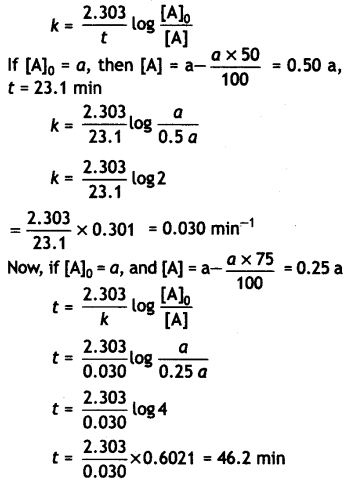
Answer:
(ii) Arrhenius proposed a quantitative relationship between rate constant
and temperature as k = \(A e^{-E_{a} / R T}\) Taking logarithm,
In k = In A – \(\frac{E_{a}}{R} \times \frac{1}{T}\)
Converting to common logarithm (In X = 2.303 log X), we get
2.303 log k = 2.303 log A – \(\frac{\mathrm{E}_{\mathrm{a}}}{\mathrm{RT}}\).
Dividing each side by 2.303, we get
log k = log A – \(\frac{E_{a}}{2.303 R T}\)
So, it is clear that increasing the temperature or decreasing the activation energy will result in an increase in the rate of reaction.

(i) Slope = – \(\frac{\mathrm{E}_{\mathrm{a}}}{2.303 \mathrm{R}}\)
Class 12 Chemistry Important Questions Chapter 4 Chemical Kinetics 5
Plot of log k versus 1/T to calculate activation energy.

(ii) k1 > k2

Question 12.
The rate constant for a first order reaction is 60 s-1. How much time will it take to reduce the concentration of the reactant to 1/10th of its initial value?
Answer:
For a first order reaction,
Class 12 Chemistry Important Questions Chapter 4 Chemical Kinetics 6

Question 13.
Rate constant ‘k’ of a reaction varies with temperature ‘T’ according to the equation:
log k = log A – \(\frac{E_{a}}{2.303 R}\left(\frac{1}{T}\right)\)
where Ea is the activation energy. When a graph is plotted for log k vs. \(\frac{1}{T}\), a straight line with a slope of – 4250 K is obtained. Calculate ‘Ea’ for the reaction (R = 8.314 JK-1mol-1). (CBSE Delhi 2013)
Answer:
Slope = –\(\frac{E_{a}}{2.303 R}\) = -4250K
Ea = – 2.303 × R × Slope
= – 2.303 × 8.314 JK-1 mol-1 × (-4250 K)
= 81375.3 J mol-1 or 81.375 kJ mol-1.

Question 14.
For the reaction
C12H22O11 + H2O → C6H12O6 + C6H12O6
write:
(i) Rate of reaction expression,
(ii) Rate law equation,
(iii) Molecularity,
(iv) Order of reaction (CBSE Sample paper 2011)
Answer:
(i)
Class 12 Chemistry Important Questions Chapter 4 Chemical Kinetics 7
(ii) Rate law equation:
Rate = k[C12H22O11]
(iii) Molecularity = 2
(iv) Order = 1

Question 15.
Consider the decomposition of hydrogen peroxide in alkaline medium which is catalysed by iodide ions.
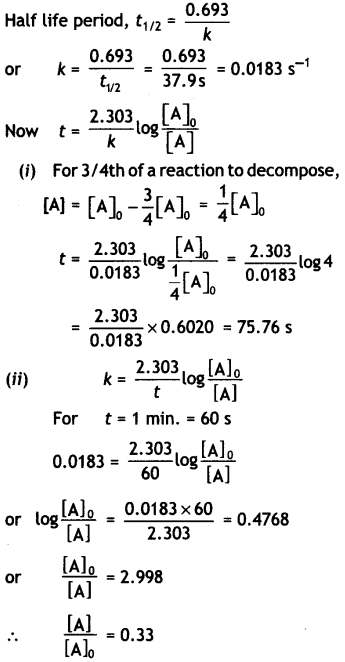
Class 12 Chemistry Important Questions Chapter 4 Chemical Kinetics 8
This reaction takes place in two steps as given below:
Step -1 H2O2 + I → H2O + IO (slow)
Step – II H2O2 + IO → H2O + I (fast)
(i) Write the rate law expression and determine the order of reaction w.r.t. H2O2.
(ii) What is the molecularity of each individual step? (C8SE Sample paper 2011)
Answer:
(i) Rate = k[H2O2] [I]
Order w.r.t. H2O2 = 1
(ii) Molecularity: Step I = 2, Step II = 2

Question 16.
For a reaction: A + B → P, the rate law is given as: Rate = k[A][B]2
(i) How is the rate of reaction affected when the concentration of B is doubled?
(ii) What is the order of reaction if A is present in large excess? (CBSE All India 2015)
Answer:
(i) Rate becomes four times
(ii) Order = 2

Question 17.
What is the effect of adding a catalyst on
(i) Activation energy (Ea) and
(ii) Gibbs free energy (∆G) of a reaction? (CBSE All India 2017)
Answer:
(i) Activation energy decreases
(ii) No effect on ∆G because Gibbs free energies of products and reactants remain the same in the presence of catalyst.

Question 18.
For a reaction:
Class 12 Chemistry Important Questions Chapter 4 Chemical Kinetics 9
Rate = k
(i) Write the order and molecularity of this reaction.
(ii) Write the unit of k. (CBSE Sample paper 2018)
Answer:
Class 12 Chemistry Important Questions Chapter 4 Chemical Kinetics 10
Rate = k
(i) Order of reaction: Zero order Molecularity = 2 (bi molecular)
(ii) Unit of k = mol L-1 s-1 or atm s-1

Question 19.
Explain the following terms: (CBSE 2014)
(i) Rate constant (k).
(ii) Half life period of a reaction (t1/2).
Answer:
(i) Rate constant is the rate of the reaction
when the molar concentration of each of the reactants is unity. For example, for a reaction,
A + B → AB
Rate of reaction is
Rate = k[A][B]
where k is the rate constant. When
[A] = 1 and [B] = 1
Rate of reaction = k × 1 × 1 = k
It is also catted specific reaction rate and is independent of the initial concentration of the reactants.
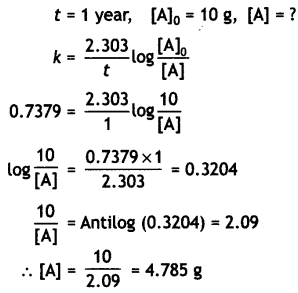
(ii) Half life period of a reaction is the time during which the concentration of a reactant Is reduced to half of its initial concentration. In other words, it is the time during which half of the reaction Is completed. It is denoted as t1/2.
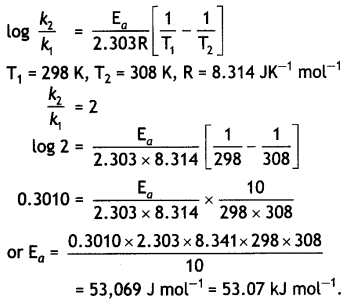
Chemical Kinetics Important Extra Questions Long Answer Type

Question 1.
Show that time required for 99% completion is twice the time required for the completion of 90% reaction. (CBSE Delhi 2013)
Answer:
For the first order reaction,
t = \(\frac{2.303}{k} \log \frac{[\mathrm{A}]_{0}}{[\mathrm{~A}]}\)
Let initial concentration, [A0] = a
For 99% completion of reaction, [A]
Class 12 Chemistry Important Questions Chapter 4 Chemical Kinetics 11
For 90% completion of reaction,
Class 12 Chemistry Important Questions Chapter 4 Chemical Kinetics 12
Dividing equation (i) by (ii)
\(\frac{t_{(99 \%)}}{t_{(90 \%)}}\) = 2
or t(99%) = 2 × t(90%)

Question 2.
The decomposition of NH3 on platinum surface is zero order reaction. If rate constant (k) Is 4 × 10⁻³ M s-1, how long will it take to reduce the initial concentration of NH3 from 0.1 M to 0.064 M? (CBSE Delhi 2019)
Answer:
k = 4 × 10⁻³M s-1, [A]0 = 0.1 M, [A] = 0.064 M
Class 12 Chemistry Important Questions Chapter 4 Chemical Kinetics 13

Question 3.
The thermal decomposition of HCO2H is a first order reaction with a rate constant of 2.4 × 10⁻³ s-1 at a certain temperature. Calculate how long will it take for three fourth of initial quantity of HCO2H to decompose. (log 4 = 0.6021) (CBSE 2011)
Answer:
We know that
t = \(\frac{2.303}{k} \log \frac{[A]_{0}}{[A]}\)
If initial conc. of A is a, then
[A] = a – \(\frac{3}{4}\)a = \(\frac{1}{4}\)a
k = 2.4 × 10⁻³ s-1
Class 12 Chemistry Important Questions Chapter 4 Chemical Kinetics 14
= \(\frac{2.303}{2.4 \times 10^{-3}}\) × 0.6021 = 578 s

Question 4.
For the reaction:
2N0(g) + Cl2(g) → 2NOCl(g)
the following data were collected. All the measurements were taken at 263 K:

Experiment No.Intial [NO] (M)Intial [Cl2] (M)Intial rate of Cl2 (M/min)
10.150.150.60
20.150.301.20
30.300.152.40
40.250.25?

(i) Write the expression for rate law.
(ii) Calculate the value of rate constant and specify its units.
(iii) What is the initial rate of disappearance of Cl2 In exp. 4? (CBSE 2012)
Answer:
(i) Rate = k[NO]2[Cl2]
(ii) According to experiment 1,
[NO] = 0.15 M; [Cl2] = 0.15 M
Rate = 0.6 M/min.
Rate = k[NO]2[Cl2]
0.6 M/min = k(0.15M)2 (0.15 M)
k = 177.8 M-2 min-1
or
= 177.8 mol-2 L2 min-1
Therefore, units of k are M-2 min-1 or mol-2 L2 min-1.

(iii) In experiment 4, [NO] = 0.25 M; [Cl2] = 0.25 M and k = 177.8 M-2 min-1
Rate = k[NO]2 [Cl2]
= 177.8 M-2 min-1 × (0.25 M)2 × 0.25 M
= 2.78 M min-1.

Question 5.
The following data were obtained during the first order thermal decomposition of
SO2Cl2 at a constant volume:
SO2Cl2(g) → SO2(g) + Cl2(g)

ExperimentTime/s-1Total Pressure/atm
100.4
11000.7

Calculate the rate constant.
(Given: log 4 = 0.6021, log 2 = 0.3010) (CBSE Delhi 2014)
Answer:
SO2Cl2 → SO2 + Cl2
At t = 0 s     0.4 atm            0            0
At t = 100 s (0.4 – x) atm   x atm   x atm
Pt = 0.4 – x + x + x = 0.4 + x
0.7 = 0.4 + x      or    x = 0.3
k = \(\frac{2.303}{t}\) log \(\frac{p_{0}}{2 p_{0}-p_{t}}\)
t = 100 s
∴ k = \(\frac{2.303}{100}\) log \(\frac{0.4}{2 \times 0.4-0.7}\)
= \(\frac{2.303}{100}\) log \(\frac{0.4}{0.1}\)
∴ k = \(\frac{2.303}{100}\) × 0.6021 = 1.38 × 10⁻² s-1

Question 6.
The rate constant for the first order decomposition of H2O2 is given by the following equation:
log k = 14.2 – \(\frac{1.0 \times 10^{4} \mathrm{~K}}{\mathrm{~T}}\)
Calculate Ea for this reaction and rate constant k if Its half-life period be 200 minutes. (Given: R = 8.314 JK-1 mol-1) (CBSE Delhi 2016)
Answer:
According to Arrhenius equation,
log k = log A – \(\frac{E_{a}}{2.303 \mathrm{RT}}\) …….. (i)
The given equation is
log k = 14.2 – \(\frac{1.0 \times 10^{4} \mathrm{~K}}{\mathrm{~T}}\) ………. (ii)
Comparing eq. (1) and (ii)
\(\frac{E_{a}}{2.303 \mathrm{RT}}\) = 1.0 × 10⁴
∴ Ea = 1.0 × 104 × 2.303 × 8.314
= 19.147 × 10⁴ J mol-1
Now t1/2 = \(\frac{0.693}{k}\)
or k = \(\frac{0.693}{t_{1 / 2}}\)
= \(\frac{0.693}{200 \mathrm{~min}}\) = 3.465 × 10⁻³ min -1

Question 7.
The rate of a reaction increases four times when the temperature changes from 300 K to 320 K. Calculate the activation energy of the reaction assuming that it does not change with temperature (R = 8.3 14 JK-1 mol-1). (CBSE All India 2010)
Answer:
T1 = 300 K, T2 = 320 K, R = 8.314 JK-1 mol-1
Class 12 Chemistry Important Questions Chapter 4 Chemical Kinetics 15
Class 12 Chemistry Important Questions Chapter 4 Chemical Kinetics 16

Question 8.
Sucrose decomposes in acid solution into glucose and fructose according to the first order rate law, with t1/2 = 3.00 hours. What fraction of sample of sucrose remains after 8 hours? (CBSE Sample Paper 2011)
Answer:
k = \(\frac{0.693}{t_{1 / 2}}\) = \(\frac{0.693}{3.0}\) = 0.231 hr-1
Let initial cone, of sucrose = 1 M
Cone, after 8 hr. = (1 – x) where x is the amount of sucrose decomposed
Class 12 Chemistry Important Questions Chapter 4 Chemical Kinetics 17
Conc. of sucrose left after 8 hr = 1 – 0.842
= 0.158 M

Question 9.
The rate of a reaction becomes four times when the temperature changes from 293 K to 313 K. Calculate the energy of activation (Ea) of the reaction assuming that it does not change with temperature.
[R = 8.314 J K-1 mol-1, log 4 = 0.6021] (CBSE All India 2013)
Answer:
Class 12 Chemistry Important Questions Chapter 4 Chemical Kinetics 18
Class 12 Chemistry Important Questions Chapter 4 Chemical Kinetics 19

Question 10.
The following data were obtained during the first order thermal decomposition of SO2Cl2 at constant volume.
SO2Cl2(g) → SO2(g) + Cl2(g)

ExperimentTimes/sTotal Pressure/atm
100.5
21000.6

Calculate the rate of reaction when total pressure is 0.65 atm. (CBSE Sample Paper 2011)
Answer:
For the decomposition of SO2Cl2
SO2Cl2(g) → SO2(g) + Cl2(g)
At t = 0          p0 atm              0        0
At time, t      (p0 – x) atm       x        x
pt = p0 – x + x + x = p0 + x
or x = pt – p0
Now at time t, p(SOCl2) = p0 – x
= P0 – (Pt – P0) = 2 p0 – pt
∴ k = \(\frac{2.303}{t}\) log \(\frac{p_{0}}{2 p_{0}-p_{t}}\)
when t = 100 s
k = \(\frac{2.303}{100}\) log \(\frac{0.5}{2 \times 0.5-0.6}\)
= \(\frac{2.303}{100}\) log 1.25 = 2.2316 × 10⁻³ s-1
When pt = 0.65 atm, i.e. p0 + p = 0.65 atm
p = 0.65 – p0 = 0.65 – 0.50 = 0.15 atm
∴ Pressure of SO2Cl2 at time t = 0.50 – 0.15
= 0.35 atm
Rate = 2.2316 ×10-3 × 0.35
= 7.8 × 10⁻⁵ atm s-1

Question 11.
A first order reaction takes 20 minutes for 25% decomposition. Calculate the time when 75% of the reaction will be completed. {CBSE All India 2017)
Answer:
For the first order reaction:
Class 12 Chemistry Important Questions Chapter 4 Chemical Kinetics 20

Question 12.
A first order reaction takes 23.1 minutes for 50% completion. Calculate the time required for 75% completion of this reaction. (log 2 = 0.301, log3 0.4771, log4 = 0.6021) (CBSE All India 2015)
Answer:
For the first order reaction:
Class 12 Chemistry Important Questions Chapter 4 Chemical Kinetics 21

Question 13.
The decomposition of phosphine, PH3, proceeds according to the following equation:
4PH3(g) → P4(g) + 6H2(g)
It is found that the reaction follows the following rate equation:
Rate = k[PH3].
The half-life of PH3 is 37.9 sat 120 C.
(i) How much time is required for 3/4th of PH3 to decompose?
(ii) What fraction of the original sample of PH3 remains behind after 1 minute? (C8SE All India 2010)
Answer:
Class 12 Chemistry Important Questions Chapter 4 Chemical Kinetics 22

Question 14.
Sucrose decomposes in acid solution into glucose and fructose according to the first order rate law with t1/2 = 3 hrs. Calculate the fraction of sucrose which remains after 8 hrs. (CBSE Sample Paper 2011)
Answer:
Class 12 Chemistry Important Questions Chapter 4 Chemical Kinetics 23

Question 15.
Starting from 10 g of a radioactive element, 0.25 g was left after 5 years. Calculate
(i) Rate constant for the decay of the radioactive element.
Answer:
Class 12 Chemistry Important Questions Chapter 4 Chemical Kinetics 24

(ii) The amount left after one year.
Answer:
Amount left after 1 year
Class 12 Chemistry Important Questions Chapter 4 Chemical Kinetics 25

(iii) The time required for half of the element to decay.
Answer:
Time for decay of half of the element
t1/2 = \(\frac{0.693}{k}=\frac{0.693}{0.7379}\) = 0.9392 year

(iv) Average life of the element. (CBSE All India 2011)
Answer:
t = \(\frac{1}{k}=\frac{1}{0.7379}\) = 1.3552 year

Question 16.
In general, It is observed that the rate of a chemical reaction becomes double with every 1o°. rise in temperature. If this generalization holds for a reaction In the temperature range 298 to 308 K, what would be the value of activation energy for this reaction? (R = 8.3 14 JK-1 mol-1) (CBSE Delhi 2000)
Answer:
Arrhenius equation is:
Class 12 Chemistry Important Questions Chapter 4 Chemical Kinetics 26

Question 17.
A first order reaction is 50% completed in 40 minutes at 300 K and in 20 minutes at 320 K. Calculate the activation energy of the reaction.
(Given: log 2 = 0.3010, log 4 = 0.6021, R = 8.3 14 Jk-1 mol-1) (CBSE All India 2018)
Answer:
Let us first calculate k1 and k1 at temperatures 300 K and 320 K. We know that
Class 12 Chemistry Important Questions Chapter 4 Chemical Kinetics 27
Class 12 Chemistry Important Questions Chapter 4 Chemical Kinetics 28

Question 18.
The rate constant of a first order reaction increases from 2 × 10⁻² to 6 × 10⁻² when the temperature changes from 300 K to 320 K. Calculate the energy of activation. (Given: log 2 = 0.3010, log 3 = 0.4771, log 4 = 0.6021) (CBSE 2019 C)
Answer:
Class 12 Chemistry Important Questions Chapter 4 Chemical Kinetics 29

Question 19.
For the reaction A + B → products, the following initial rates were obtained at various given initial concentrations:

[A] mol / L[B] mol / LIntial rate M/S
1. 0.10.10.05
2. 0.20.10.10
3. 0.10.20.05

Determine the half-life period.
OR
A first order reaction is 50% complete In 50 minutes at 300 K and the same reaction is again 50% complete In 25 minutes at 350 K. Calculate activation energy of the reaction. (CBSE Sample Paper 2019)
Answer:
Rate = k [A]x [B]y
0.05 = k [0.1]x [0.1]y …… (i)
0.10 = k [0.2]x [0.1]y ……. (ii)
0.05 = k [0.1]x [0.2]y …….. (iii)
Dividing equation (ii) by (i)
\(\frac{0.10}{0.05}\) = (2)x
x = 1
Dividing equation (iii) by (i)
\(\frac{0.05}{0.05}\) = (2)y
y = 0
Rate = k [A]1 [B]0
Class 12 Chemistry Important Questions Chapter 4 Chemical Kinetics 30

Question 20.
For a certain chemical reaction variation in concentration [A] vs. time (s) plot as shown in given figure:
Class 12 Chemistry Important Questions Chapter 4 Chemical Kinetics 31
(i) Predict the order of the given reaction?
(ii) What does the slope of the line and intercept indicate?
(iii) What is the unit of rate constant k? (CBSE Sample paper 2018-19)
Answer:
(i) Zero order reaction
(ii) Slope represents k; Intercept represents [R]0
(iii) mol L-1 s-1

Question 21.
The following data were obtained during the first order thermal decomposition of N2O5(g) at a constant volume:
2N2O5(g) → 2N2O4(g) + O2(g)

S.NOTime (sec.)Total pressure (atm)
1.00.5
2.1000.512

Calculate the rate constant.
OR
Two reactions of the same order have equal pre-exponential factors but their activation energies differ by 24.9 kJ mol-1. Calculate the ratio between the rate constants of these reactions at 27°C. (Gas constant R 8.314 J K-1 mol-1) (CBSE 2018)
Answer:
2N2O5(g) → 2N2O4(g) + O2(g)
At t = 0       0.5 atm       0 atm      0 atm
At time t   0.5-2x atm   2x atm    x atm
Pt = PN2O5 + PN2O5 + PO2
= (0.5 – 2x) + 2x + x = 0.5 + x
x = pt – 0.5
PN2O5 = 0.5 – 2x
= 0.5 – 2(pt – 0.5)
= 1.5 – 2pt
At t = 100s; pt = 0.512 atm
PN2O5 = 1.5 – 2 × 0.512 = 0.47 atm
Class 12 Chemistry Important Questions Chapter 4 Chemical Kinetics 32
OR
The Arrhenius equation: k = Ae-Ea/RT
Taking log on both sides:
log k = log A – \(\frac{E_{a}}{2.303 R T}\)
For reaction (i) log k1 = log A – \(\frac{E_{o}(1)}{2.303 R T}\)
For reaction (ii) log k2 = logA – \(\frac{E_{o}(2)}{2.303 R T}\)
Subtracting (i) from (ii)
Class 12 Chemistry Important Questions Chapter 4 Chemical Kinetics 33

Question 22.
(a) Define order of reaction. How does order of a reaction differ from molecularity for a complex reaction?
Answer:
(a) Order of reaction is the sum of the power to which the concentration terms are raised in the rate law equation. Order of a reaction is applicable for the complex reaction but molecularity has no meaning for the complex reaction. 0.693

(b) A first order reaction is 50% complete in 25 minutes. Calculate the time for 80% completion of the reaction.
Answer:
Class 12 Chemistry Important Questions Chapter 4 Chemical Kinetics 34

(a) The decomposition of a hydrocarbon has value of rate constant as 2.5 × 10⁴ s-1 at 27 °C. At what temperature would rate constant be 7.5 × 10⁴ s-1 if energy of activation is 19.147 × 10³ J mol-1?
Answer:
Class 12 Chemistry Important Questions Chapter 4 Chemical Kinetics 35
0.1431 T2 = T2 – 300
0.1431 T2 – T2 = 300
0.8569T2 = – 300
T2 = \(\frac{300}{0.8569}\) = 350 k

(b) Write a condition under which a bimolecular reaction is kinetically first order. Give an example of such a reaction.
(Given: log 2 = 0.3010, log 3 = 0.4771, log 5 = 0.6990) (CBSE AI 2019)
Answer:
A bimolecular reaction is kinetically of first order when one of the reactant is in excess. For example, hydrolysis of methyl acetate.
CH3COOCH3 + H2O (excess) → CH3COOH + CH3OH

Question 23.
Nitrogen pentoxide decomposes according to equation:
2N2O5 (g) →4NO2(g) + O2(g)
The first order reaction was allowed to proceed at 40° C and the data below were collected:

[N2O5] (M)Time (min)
0.4000.00
0.28920.0
0.20940.0
0.15160.0
0.10980.0

(i) Calculate the rate constant. Include units with your answer.
Answer:
Since it is a first order reaction,
k = \(\frac{2.303}{t}\) log \(\frac{[\mathrm{A}]_{0}}{[\mathrm{~A}]}\)
k can be calculated as:
at t = 20 min
Class 12 Chemistry Important Questions Chapter 4 Chemical Kinetics 36
Class 12 Chemistry Important Questions Chapter 4 Chemical Kinetics 37
The average value of rate constant,
k = 0.01624 min-1 or = 1.624 × 10⁻² min-1

(ii) What will be the concentration of N2O5 after 100 minutes?
Answer:
Concentration of [N2O5] at t = 100 min
Class 12 Chemistry Important Questions Chapter 4 Chemical Kinetics 38

(iii) Calculate the initial rate of reaction. (CBSE 2011)
Answer:
Initial rate of reaction,
rate = k[N2O5]
= 0.01624 × 0.40
= 6.496 × 10⁻³

Question 24.
(i) Explain the following terms:
(a) Rate of a reaction
Answer:
The rate of reaction is the change of concentration in any one of the reactants or products per unit time. For a reaction, A → B rate may be expressed as
= \(\frac{-d[A]}{d t}\) or \(\frac{d[B]}{d t}\)

(b) Activation energy of a reaction
Answer:
Activation energy is the minimum energy which the reacting molecules should acquire so that they react to give the products. It is also defined as the energy required to form the products.

(ii) The decomposition of phosphine, PH3, proceeds according to the following equation:
4PH3(g) → P4 (g) + 6H2(g)
It Is found that the reaction follows the following rate equation:
Rate = k[PH3]
The half life of PH3 is 37.9 s at 120°C.
(a) How much time is required for 3/4th of PH3 to decompose?
Answer:
Class 12 Chemistry Important Questions Chapter 4 Chemical Kinetics 39

(b) What fraction of the original sample of PH3 remains behind after 1 minute? (CBSE 2010)
Answer:
Class 12 Chemistry Important Questions Chapter 4 Chemical Kinetics 40

Question 25.
Explain the following terms:
(a) Order of a reaction
Answer:
The sum of the powers of the concentration of reactants in the rate law expression is called the order of the reaction.
For example, if rate law expression for a reaction is:
Rate = k[A]a[B]b[C]c
then order of reaction is
order = a + b + c

(b) Molecularity of a reaction
Answer:
Molecularity is the number of molecules taking part in a reaction. For example, for the reaction:
aA + bB → Product
Molecularity is a + b

(ii) The rate of a reaction Increases four times when the temperature changes from 300 K to 320 K. Calculate the energy of activation of the reaction, assuming that it does not change with temperature (R = 8.314 JK-1 mol-1). (CBSE 2010)
Answer:
T1 = 300 k, T2 = 320 k,
R = 8.314 Jk-1 mol-1
Class 12 Chemistry Important Questions Chapter 4 Chemical Kinetics 41

Question 26.
(i) A reaction is second order in A and first order in B.
(a) Write the differential rate equation.
(b) How is the rate affected on Increasing the concentration of A three times?
(C) How is the rate affected when the concentrations of both A and B are doubled?
Answer:
(a) Rate = k[A]2[B]
(b) 9 times
(C) 8 times

(ii) A first order reaction takes 40 minutes for 30% decomposition. Calculate t1/2 for this reaction. (Given log 1.428 = 0.1548)
Answer:
Let initial conc. = a
Conc. after 40 min
Class 12 Chemistry Important Questions Chapter 4 Chemical Kinetics 42

OR

(i) For a first order reaction, show that time required for 99% completion is twice the time required for the completion of 90% of reaction.
Answer:
For a first order reaction,
t = \(\frac{2.303}{k}\) log \(\frac{[\mathrm{A}]_{0}}{[\mathrm{~A}]}\)
Let intial concentration, [A]0 = a
For 99% completion of reaction,
Class 12 Chemistry Important Questions Chapter 4 Chemical Kinetics 43
Dividing equation (i) by (ii)
\(\frac{t_{(99 \%)}}{t_{(90 \%)}}\) = 2 or t(99%) = 2 × t(90%)

(ii) Rate constant ‘k’ of a reaction varies with temperature ‘T’ according to the equation:
log k = log A – \(\frac{E_{a}}{2.303 R}\left(\frac{1}{T}\right)\)
where Ea is the activation energy. When a graph is plotted for log k vs. \(\frac{1}{\mathrm{~T}}\), a straight line with a slope
of – 4250 K is obtained. Calculate ‘Ea’ for the reaction (R = 8.3 14 JK-1 mol-1). (CBSE Delhi 2013)
Answer:
Slope = – \(\frac{E_{a}}{2.303 R}\) = – 4250 k
∴ Ea = 2.303 × 8.314 Jk-1 mol-1 × 4250 k
= 81.375 kJ mol-1

Question 27.
(i) What is rate of reaction? Write two factors that affect the rate of reaction.
Answer:
Rate of reaction is defined as the change in concentration of reactants or products per unit time. Factors that affect rate of a reaction
(a) Concentration of reactant
(b) Temperature

(ii) The rate constant of a first order reaction increases from 4 × 10⁻² to 8 × 10⁻² when the temperature changes from 27 °C to 37°C. Calculate the energy of activation (Ea).
(log 2 = 0.301, log 3 = 0.4771, log 4 = 0.6021)
Answer:
log \(\frac{k_{2}}{k_{1}}=\frac{E_{a}}{2.303 R}\left[\frac{T_{2}-T_{1}}{T_{1} T_{2}}\right]\)
k1 = 4 × 10⁻²,
k2 = 8 × 10⁻²,
T1 = 273 + 27 = 300 K
T2 = 273 + 37 = 310 K,
R = 8.314 JK-1 mol-1
Class 12 Chemistry Important Questions Chapter 4 Chemical Kinetics 44
= 53598 J mol-1
= 53.598 KJ mol-1

OR

(i) For a reaction A + B → P, the rate is given by.
Rate = k [A] [B]2
(a) How is the rate of reaction affected if the concentration of B is doubled?
(b) What is the overall order of reaction if A is present in large excess?
Answer:
Rate = K[A][B]2
(a) becomes four times
(b) Second order

(ii) A first order reaction takes 23.1 minutes for 50% completion. Calculate the time required for 75% completion of this reaction.
(log 2 = 0.301, log 3 = 0.4771, log 4 = 0.6021) (CBSE 2015)
Answer:
For a first order reaction,
Class 12 Chemistry Important Questions Chapter 4 Chemical Kinetics 45
Class 12 Chemistry Important Questions Chapter 4 Chemical Kinetics 46
Class 12 Chemistry Important Questions Chapter 4 Chemical Kinetics 47