लौहतुला Summary Notes Class 9 Sanskrit Chapter 8

By going through these CBSE Class 9 Sanskrit Notes Chapter 8 लौहतुला Summary, Notes, word meanings, translation in Hindi, students can recall all the concepts quickly.

Class 9 Sanskrit Chapter 8 लौहतुला Summary Notes

लौहतुला Summary

प्रस्तुत पाठ ‘पञ्चतन्त्रम्’ नामक ग्रंथ के ‘मित्र भेद’ नामक तंत्र से लिया गया है। इसके रचयिता विष्णुशर्मा हैं। इस कथा में लोभ के दुष्परिणाम को दिखाया गया है। कथासार इस प्रकार है किसी स्थान पर जीर्णधन नामक व्यापारी रहता था। वह धन कमाने के उद्देश्य से दूसरे देशों को जाया करता था। एक बार उसने अपने पूर्वजों के द्वारा कमाई हुई लोहे की तराजू को एक सेठ के यहाँ धरोहर रख दिया। वह विदेश से आकर उस सेठ से अपनी धरोहर वापस माँगने लगा तो उस सेठ ने कहा कि उसे तो चूहों ने खा लिया।
लौहतुला Summary Notes Class 9 Sanskrit Chapter 8
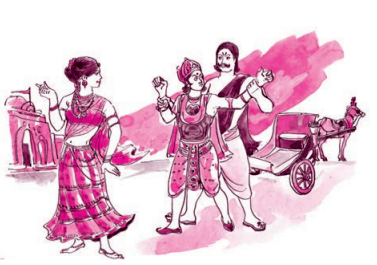
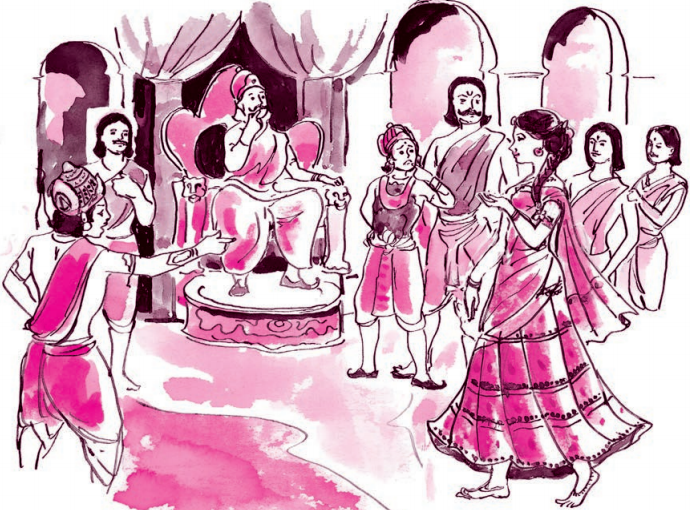
यह सुनकर जीर्णधन सेठ को पाठ पढ़ाने की एक युक्ति सोची। वह नहाने का बहाना करके उस सेठ के पुत्र को अपने साथ ले गया और उसको एक गुफा में छिपाकर वापस लौट आया। सेठ ने उससे अपने पुत्र के विषय में पूछा तो उसने कहा कि बच्चे को बाज उठा ले गया। यह सुनकर उसने जीर्णधन को बुरा-भला कहा तथा उससे झगड़ते हुए न्यायालय पहुँच गया। न्यायाधिकारी ने विवाद की सच्चाई जानकर सेठ को लोहे की वह तराजू लौटाने का आदेश दिया। अपने तराजू को पाकर जीर्णधन ने सेठ के बच को वापस कर दिया।

लौहतुला Word Meanings Translation in Hindi

1. आसीत् कस्मिंश्चिद् अधिष्ठाने जीर्णधनो नाम वणिक्पुत्रः। स च विभवक्षयात् देशान्तर गन्तुमिच्छन् व्यचिन्तयत्

यत्र देशेऽथवा स्थाने भोगा भुक्ताः स्ववीर्यतः।
तस्मिन् विभवहीनो यो वसेत् स पुरुषाधमः॥

तस्य च गृहे लौहघटिता पूर्वपुरुषोपार्जिता तुला आसीत्। तां च कस्यचित् श्रेष्ठिनो गृहे निक्षेपभूतां कृत्वा देशान्तरं प्रस्थितः। ततः सुचिरं कालं देशान्तरं यथेच्छया भ्रान्त्वा पुनः स्वपुरम् आगत्य तं श्रेष्ठिनम् अवदत्-“भोः श्रेष्ठिन्! दीयतां मे सा निक्षेपतुला।” सोऽवदत्- “भोः! नास्ति सा, त्वदीया तुला मूषकैः भक्षिता” इति। जीर्णधनः अवदत्-“भोः श्रेष्ठिन्! नास्ति दोषस्ते, यदि मूषकै भक्षिता। ईदृशः एव अयं संसारः। न किञ्चिदत्र शाश्वतमस्ति। परमहं नद्यां स्नानार्थं गमिष्यामि। तत् त्वम् आत्मीयं एनं शिशुं धनदेवनामानं मया सह स्नानोपकरणहस्तं प्रेषय” इति।

शब्दार्था: –
आसीत् – था
अधिष्ठाने – स्थान पर
कस्मिंश्चिद् – किसी
विभव – धन
अक्षयात् – कमी से
देशान्तरं – दूसरे देश
स्ववीर्यतः – अपने पराक्रम से
अधमः – नीच
विभवहीनः – धनेश्वर्य से हीन
भुक्ताः – भोगे जाते हैं
प्रेषय – भेजो
शाश्वत – स्थिर
ततः – उसके बाद
पूर्वपुरुषः – पूर्वजों के द्वारा
उपार्जितः – खरीदी गई
श्रेष्ठिनः – सेठ के
निक्षेपभूता – धरोहर के रूप में
प्रस्थितः – चल दिया
भक्षिता – खा ली गई
वणिक्पुत्रः – बनिए का पुत्र
लौहघटिता – लोहे से बनी हुई
भ्रान्त्वा – घूमकर
स्वपुरम् – अपने देश में
मूषकैः – चूहों के द्वारा।

अर्थ- किसी स्थान पर जीर्णधन नामक एक बनिए का पुत्र था। धन की कमी के कारण विदेश जाने की इच्छा से उसने सोचा जिस देश अथवा स्थान पर अपने पराक्रम से भोग भोगे जाते हैं वहाँ धन-ऐश्वर्य से हीन रहने वाला मनुष्य नीच पुरुष होता है। उसके घर पर उसके पूर्वजों द्वारा खरीदी गई लोहे से बनी हुई एक तराजू थी।

उसे किसी सेठ के घर धरोहर के रूप में रखकर वह दूसरे देश को चला गया। तब लंबे समय तक इच्छानुसार दूसरे देश में घूमकर वापस अपने देश आकर उसने सेठ से कहा- “हे सेठ! धरोहर के रूप मे रखी मेरी वह तराजू दे दो।” उसने कहा- “अरे! वह तो नहीं है, तुम्हारी तराजू को चूहे खा गए।” जीर्णधन ने कहा- “हे सेठ! यदि उसको चूहे खा गए तो इसमें तुम्हारा दोष नहीं है। यह संसार ही ऐसा है। यहाँ कुछ भी स्थायी नहीं है। किंतु मैं नदी पर स्नान के लिए जा रहा हूँ। खैर, तुम धनदेव नामक अपने इस पुत्र को स्नान की वस्तुएँ हाथ में लेकर मेरे साथ भेज दो।”

पर्यायपदानि
पदानि – पर्यायपदानि
यथेच्छया – इच्छानुसारम्
अधमः – नीचः
स्ववीर्यतः – स्वपराक्रमेण
पूर्वपुरुषः – पूर्वजः
त्वदीया – तव
अधिष्ठाने – विदेशम्
देशान्तरम् – विदेशम्
उवाच – अवदत्
पुनः – भूयः

विलोमपदानि
पदानि – विलोमपदानि
शाश्वतम् – अशाश्वतम्
आसीत् – अस्ति
स्वपुरम् – देशान्तरम्
अधमः – उत्तमः

विशेषण-विशेष्य-चयनम्
विशेषणम् – विशेष्यः
कस्मिश्चित् – अधिष्ठाने
सुचिरम् – कालम्
पूर्व पुरुषोपार्जिता – लौहघटिता
सा – निक्षेपतुला

अव्ययानां वाक्येषु प्रयोगः
पदानि वाक्येषु प्रयोगः
च (और) – रामः लक्ष्मणः गच्छतः।
यत्र (जहाँ) – यत्र धूमः तत्र अग्निः
ततः – ततः छात्रः अवदत्।
इति – जलं ददाति इति जलदः।
यदि – यदि परिश्रमं करिष्यसि सफलं भविष्यसि।
अत्र – अत्र एक: विद्यालयः अस्ति।

2. स श्रेष्ठी स्वपुत्रम् अवदत्-“वत्स! पितृव्योऽयं तव, स्नानार्थं यास्यति, तद् अनेन साकं गच्छ” इति। अथासौ श्रेष्ठिपुत्रः धनदेवः स्नानोपकरणमादाय प्रहृष्टमनाः तेन अभ्यागतेन सह प्रस्थितः। तथानुष्ठिते स वणिक् स्नात्वा तं शिशुं गिरिगुहायां प्रक्षिप्य, तद्वारं बृहत् शिलया आच्छाद्य सत्त्वरं गृहमागतः।

सः श्रेष्ठी पृष्टवान्-“भोः! अभ्यागत! कथ्यतां कुत्र मे शिशुः यः त्वया सह नदीं गतः”? इति। स अवदत्-“तव पुत्रः नदीतटात् श्येनेन हृतः” इति। श्रेष्ठी अवदत्- “मिथ्यावादिन्! किं क्वचित् श्येनो बालं हर्तुं शक्नोति? तत् समर्पय मे सुतम् अन्यथा राजकुले निवेदयिष्यामि।” इति। सोऽकथयत्-“भोः सत्यवादिन्! यथा श्येनो बालं न नयति, तथा मूषका अपि लौहघटितां तुला न भक्षयन्ति। तदर्पय मे तुलाम्, यदि दारकेण प्रयोजनम्।” इति।

शब्दार्था:
अवदत् – बोला
पितृव्यः – चाचा
यास्यति – जाएगा
सार्धम् – साथ
श्रेष्ठिपुत्रः – बनिए का पुत्र
प्रहृष्टमना: – प्रसन्न मान वाला
अभ्यागतेन – अतिथि
प्रस्थितः – अतिथि
स्नात्वा – नहा करके
गिरिगुहायां – पर्वत की गुफा में
प्रक्षिप्य – रखकर, बृहत्
शिलया – विशाल शिला से
आच्छाद्य – ढककर
सत्वरं – जल्दी
पृष्टः – पूछा
श्येन – बाज
क्वचित् – कोई
हृतः – ले जाया गया
मिथ्यावादिन् – झूठ बोलने वाले
सत्यवादिन् – सत्य बोलने वाले
समर्पय – लौटा दो, अन्यथा, नहीं तो।।

अर्थ-
उस सेठ ने अपने पुत्र से कहा-“पुत्र! ये तुम्हारे चाचा हैं, स्नान के लिए जा रहे हैं, तुम इनके साथ जाओ।” इस तरह वह बनिए का पुत्र धनदेव स्नान की वस्तुएँ लेकर प्रसन्न मन से उस अतिथि के साथ चला गया। तब वहाँ पुहँचकर और स्नान करके उस शिशु को पर्वत की गुफा में रखकर उसने गुफा के द्वार को एक बड़े पत्थर से ढक कर जल्दी से घर आ गया।
और उस सेठ ने पूछा- हे अतिथि! बताओ कहाँ है मेरा पुत्र, तुम्हारे साथ नदी पर गया था।

वह बोला- “तुम्हारे बेटे को नदी के किनारे से बाज उठाकर ले गया है”। सेठ ने कहा- “हे झूठे! क्या कहीं बाज बालक को ले जा सकता है? तो मेरा पुत्र लौटा दो अन्यथा मैं राजकुल में शिकायत करूँगा।” उसने कहा- “हे सत्य बोलने वाले! जैसे बाज बालक को नहीं ले जा सकता, वैसे ही चूहे भी लोहे की बनी हुई तराजू नहीं खाते हैं। यदि पुत्र को पाना चाहते हो तो मेरी तराजू लौटा दो।”

पर्यायपदानि
पदानि – पर्यायपदानि
अवदत् – उवाच
यास्यति – गमिष्यति
प्रक्षिप्य – स्थित्वा
सत्वरं – शीध्र
प्रह्ष्टमनाः – प्रसन्न:मना
पृष्टः – अपृच्छत्
साकम् – सार्धम्
सतः – पत्रः

निम्नपदानां – विलोमपदानि मेलयत
पदानि – विलोमपदानि
गतः – आगतः
सुतः – सुता:

विशेषण-विशेष्य-चयनम्
विशेषणम् – विशेष्यः
श्रेष्ठी – सः
लौहघटिताम् – तुलाम्
प्रहृष्टमनाः असौ – श्रेष्ठिपुत्रः

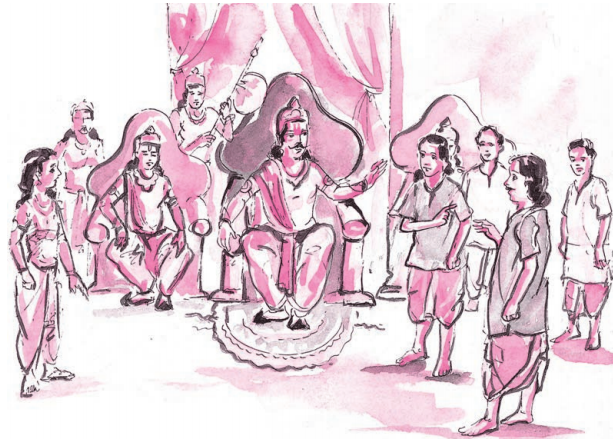
3. एवं विवदमानौ तौ द्वावपि राजकुलं गतौ। तत्र श्रेष्ठी तारस्वरेण अवदत्- “भोः! वञ्चितोऽहम्! वञ्चितोऽहम्! अब्रह्मण्यम्! अनेन चौरेण मम शिशुः अपहृतः” इति। अथ धर्माधिकारिणः तम् अवदन्- “भोः! समर्म्यतां श्रेष्ठिसुतः”। सोऽवदत्- “किं करोमि? पश्यतो मे नदीतटात् श्येनेन शिशुः अपहृतः”। इति। तच्छ्रुत्वा ते अवदन्-भोः! भवता सत्यं नाभिहितम्-किं श्येनः शिशुं हर्तुं समर्थो भवति? सोऽवदत्-भोः भोः! श्रूयतां मद्वचः

तुलां लौहसहस्रस्य यत्र खादन्ति मूषकाः।
राजन्तत्र हरेच्छ्येनो बालकं, नात्र संशयः॥

ते अपृच्छन्- “कथमेतत्”।
ततः स श्रेष्ठी सभ्यानामग्रे आदितः सर्वं वृत्तान्तं न्यदयत्। ततः न्यायाधिकारिणः विहस्य तौ द्वावपि सम्बोध्य तुला-शिशुप्रदानेन तोषितवन्तः।

शब्दार्थाः
विवदमानौ – झगड़ा करते हुए
द्वावपि – दोनों भी
गतौ – दोनों चले गए
तारस्वरेण – ज़ोर से
अवदन् – बोला,
वञ्चितोऽहम् – घोर अन्याय, अनुचित
अपहृतः – चुरा लिया गया
धर्माधिकारिणः – न्यायाधिकारी
पश्यतः – मेरे देखते हुए
श्रुत्वा – सुनकर
अभिहितम् – कहा गया
हरेत् – ले जा सकता है
संशयः – संदेह
सभ्यानाम् – सभासदों के
अग्रे – सामने
आदितः – शुरू से ही
वृतान्तम् – घटना
विहस्य – हँसकर
संबोध्य – समझा – बुझाकर,
तोषितवन्त: – दोनों संतुष्ट किए गए

अर्थ –
इस प्रकार झगड़ते हुए वे दोनों राजकुल में चले गए। वहाँ सेठ ने जोर से कहा- “अरे! अनुचित हो गया! अनुचित! मेरे पुत्र को इस चोर ने चुरा लिया।” इसके बाद न्यायकर्ताओं ने उससे कहा- “अरे! सेठ का पुत्र लौटा दो।” उसने कहा- “मैं क्या करूँ? मेरे देखते-देखते बाज बालक को नदी के तट (किनारे) से ले गया।” यह सुनकर सब बोले- अरे! आपने सच नहीं कहा- क्या बाज बालक को ले जा सकता है? उसने कहा- अरे, अरे! मेरी बात सुनिए हे राजन्! जहाँ लोहे से बनी तराजू को चूहे खा जाते हैं, वहाँ बाज बालक को उठाकर ले जा सकता है, इसमें संदेह नहीं। उन्होंने कहा-“यह कैसे हो सकता है।” इसके बाद उस सेठ ने सभासदों के सामाने शुरू से ही सारी घटना कह दी। तब हँसकर उन्होंने दोनों को समझा बुझाकर तराजू तथा बालक का आदान-प्रदान करके उन दोनों को प्रसन्न किया।

विशेषण-विशेष्य चयनम्
विशेषणम् – विशेष्यः
विवदमानौ – तौ
सर्व – वृत्तान्तं

पदानि – पर्यायपदानि
विवदमानौ – कहलं कुर्वन्तौ
निवेदयामास – निवेदनमकरोत्
संबोध्य – बोधयित्वा
आदितः – प्रारम्भतः
संशयः – संदेहः

NCERT Solutions for Class 8 Sanskrit Chapter 3 डिजीभारतम्

We have given detailed NCERT Solutions for Class 8 Sanskrit Ruchira Chapter 3 डिजीभारतम् Questions and Answers come in handy for quickly completing your homework.

NCERT Solutions for Class 8 Sanskrit Ruchira Chapter 3 डिजीभारतम्

Class 8 Sanskrit Chapter 3 डिजीभारतम् Textbook Questions and Answers

1. अधोलिखितानां प्रश्नानाम् उत्तराणि एकपदेन लिखत –
(निम्नलिखित प्रश्नों के उत्तर एक पद में लिखिए)

(क) कुत्र ‘डिजिटल इण्डिया’ इत्यस्य चर्चा भवति?
उत्तराणि:
सम्पूर्णविश्वे

(ख) केन सह मानवस्य आवश्यकता परिवर्तते?
उत्तराणि:
कालपरिवर्तनेन

(ग) आपणे वस्तूनां क्रयसमये केषाम् अनिवार्यता न भविष्यति?
उत्तराणि:
रूप्यकाणाम्

(घ) कस्मिन् उद्योगे वृक्षाः उपयुज्यन्ते?
उत्तराणि:
कर्गदोद्योगे

(ङ) अद्य सर्वाणि कार्याणि केन साधितानि भवन्ति?
उत्तराणि:
संगणकयन्त्रेण

2. अधोलिखितान् प्रश्नान् पूर्णवाक्येन उत्तरत
(निम्नलिखित प्रश्नों के उत्तर पूर्णवाक्य में लिखिए)

(क) प्राचीनकाले विद्या कथं गृह्यते स्म?
उत्तराणि:
(क) प्राचीनकाले विद्या मुखेन गृह्यते स्म।

(ख) वृक्षाणां कर्तनं कथं न्यूनतां यास्यति?
उत्तराणि:
वृक्षाणां कर्तनं संगणकस्य प्रयोगेण न्यूनतां यास्यति।

(ग) चिकित्सालये कस्य आवश्यकता अद्य नानुभूयते?
उत्तराणि:
चिकित्सालये रूप्यकाणाम् आवश्यकता अद्य नानुभूयते।

(घ) वयम् कस्यां दिशि अग्रेसरामः?
उत्तराणि:
वयम् ‘डिजीभारतम्’ इति दिशि अग्रेसरामः।

(ङ) वस्त्रपुटके केषाम् आवश्यकता न भविष्यति?
उत्तराणि:
वस्त्रपुटके रूप्यकाणाम् आवश्यकता न भविष्यति।

3. रेखांकितपदान्यधिकृत्य प्रश्ननिर्माणं कुरुत
(रेखांकित पदों के लिए प्रश्न निर्माण कीजिए)

(क) भोजपत्रोपरि लेखनम् आरब्धम्।
उत्तराणि:
भोजपत्रोपरि किं आरब्धम्?

(ख) लेखनार्थम् कर्गदस्य आवश्यकतायाः अनुभूतिः न भविष्यति।
उत्तराणि:
लेखनार्थम् कस्य आवश्यकतायाः अनुभूतिः न भविष्यति?

(ग) विश्रामगृहेषु कक्षं सुनिश्चितं भवेत्।
उत्तराणि:
कुत्र कक्षं सुनिश्चितं भवेत्?

(घ) सर्वाणि पत्राणि चलदूरभाषयन्त्रे सुरक्षितानि भवन्ति।
उत्तराणि:
सर्वाणि पत्राणि कस्मिन् सुरक्षितानि भवन्ति?

(ङ) वयम् उपचारार्थम् चिकित्सालयं गच्छामः।
उत्तराणि:
वयम् किमर्थम् चिकित्सालयं गच्छामः?

4. उदाहरणमनुसृत्य विशेषण विशेष्यमेलनं कुरुत
(उदाहरण के अनुसार विशेषण और विशेष्य को मिलाइए)

यथा- विशेषण – विशेष्य
संपूर्णे – भारते
(क) मौखिकम् – (1) ज्ञानम्
(ख) मनोगताः – (2) उपकारः
(ग) टङ्किता – (3) काले
(घ) महान् – (4) विनिमयः –
(ङ) मुद्राविहीनः – (5) कार्याणि
उत्तरम्-
संपूर्णे – भारते
(क) मौखिकम् – (1) ज्ञानम्
(ख) मनोगताः – (2) कार्याणि
(ग) टङ्किता – (3) काले
(घ) महान् – (4) उपकारः
(ङ) मुद्राविहीनः – (5) विनिमयः

5. अधोलिखितपदयोः सन्धिं कृत्वा लिखत
(निम्नलिखित पदों के लिए संधि करके लिखिए)

पदस्य + अस्य
उत्तराणि:
पदस्य + अस्य = पदस्यास्य।

तालपत्र + उपरि
उत्तराणि:
तालपत्र + उपरि = तालपत्रोपरि।

च + अतिष्ठत
उत्तराणि:
च + अतिष्ठत = चातिष्ठत्।

कर्गद + उद्योगे
उत्तराणि:
कर्गद + उद्योगे = कर्गदोद्योगे।

क्रय + अर्थम्
उत्तराणि:
क्रय + अर्थम् = क्रयार्थम्।

इति + अनयोः
उत्तराणि:
इति + अनयोः = इत्यनयोः।

उपचार + अर्थम्
उत्तराणि:
उपचार + अर्थम् = उपचारार्थम्।

6. उदाहरणमनुसृत्य अधोलिखितेन पदेन लघु वाक्य निर्माणं कुरुत –
(उदाहरण के अनुसार निम्नलिखित पदों से लघु वाक्यों का निर्माण कीजिए)

यथा- जिज्ञासा – मम मनसि वैज्ञानिकानां विषये जिज्ञासा अस्ति।

(क) आवश्यकता – …………………
उत्तराणि:
(क) आवश्यकता-अद्यत्वे लेखनार्थं कर्गदस्य आवश्यकता नास्ति।

(ख) सामग्री – …………………
उत्तराणि:
सामग्री-लेखनसामग्री वृक्षाणां वल्कलेन निर्मीयते।

(ग) पर्यावरण सुरक्षा – …………………
उत्तराणि:
पर्यावरण सुरक्षा-पर्यावरण सुरक्षा अस्माभिः कर्त्तव्या।

(घ) विश्रामगृहम् – …………………
उत्तराणि:
(घ) विश्रामगृहम्-नगरे विश्रामगृहम् अस्ति।

7. उदाहरणानुसारम् कोष्ठकप्रदत्तेषु पदेषु चतुर्थी प्रयुज्य रिक्तस्थानपूर्तिं कुरुत –
(कोष्ठक से शब्द छाँटकर चतुर्थ विभक्ति से रिक्तस्थान पूर्ति कीजिए)

यथा- भिक्षुकाय धनं ददातु। (भिक्षुक)

(क) ……… पुस्तकं देहि। (छात्र)
उत्तराणि:
छात्राय पुस्तकं देहि।

(ख) अहम् …………….. वस्त्राणि ददामि। (निर्धन)
उत्तराणि:
अहम् निर्धनाय वस्त्राणि ददामि।

(ग) ……….. पठनं रोचते। (लता)
उत्तराणि:
लतायै पठनं रोचते।

(घ) रमेशः ……… अलम्। (सुरेश)
उत्तराणि:
रमेशः सुरेशाय अलम्।

(ङ) ………….. नमः। (अध्यापक)
उत्तराणि:
अध्यापकाय नमः।

Class 8 Sanskrit Chapter 3 डिजीभारतम् Additional Important Questions and Answers

अधोलिखितं गद्यांशं पठित्वा प्रश्नानाम् उत्तराणि निर्देशानुसारं लिखत –

(क) अद्य सम्पूर्णविश्वे “डिजिटलइण्डिया” इत्यस्य चर्चा श्रूयते। अस्य पदस्य कः भावः इति मनसि
जिज्ञासा उत्पद्यते। कालपरिवर्तनेन सह मानवस्य आवश्यकताऽपि परिवर्तते। प्राचीनकाले ज्ञानस्य आदान-प्रदानं मौखिकम् आसीत्, विद्या च श्रुतिपरम्परया गृह्यते स्म। अनन्तरं तालपत्रोपरि भोजपत्रोपरि च लेखनकार्यम् आरब्धम्।

I. एकपदेन उत्तरत –

(i) मनसि का उत्पद्यते?
उत्तराणि:
जिज्ञासा।

(ii) लेखनकार्यं कुत्र आरब्धम्?
उत्तराणि:
पत्रोपरि।

II. पूर्णवाक्येन उत्तरत

(i) प्राचीनकाले विद्या कथं गृह्यते स्म?
उत्तराणि:
प्राचीनकाले विद्या श्रुतिपरम्परया गृह्यते स्म।

(ii) प्राचीनकाले मौखिकं किम् आसीत्?
उत्तराणि:
प्राचीनकाले ज्ञानस्य आदान-प्रदानं मौखिकम् आसीत्।

III. निर्देशानुसारम् उत्तरत

(i) ‘मनसि’ इत्यत्र का विभक्तिः ?
(क) तृतीया
(ख) षष्ठी
(ग) सप्तमी
(घ) चतुर्थी।
उत्तराणि:
(ग) सप्तमी

(ii) ‘श्रूयते’ इत्यस्य बहुवचनान्तरूपं लिखत।
(क) श्रूयध्वे
(ख) श्रूयन्ति
(ग) श्रूयन्ते
(घ) श्रूयाम हे।
उत्तराणि:
(ग) श्रूयन्ते

(iii) ‘आवश्यकताऽपि’ इत्यत्र कः सन्धिः?
(क) दीर्घ
(ख) गुण
(ग) यण
(घ) वृद्धि।
उत्तराणि:
(क) दीर्घ

(iv) ‘आरब्धम्’ इत्यत्र कः प्रत्ययः?
(क) धम्
(ख) ब्धम्
(ग) क्त
(घ) त।
उत्तराणि:
(ग) क्त।

रिक्तस्थानस्य पूर्ति कृत्वा भावं स्पष्टीकुरुत – 

(i) कालस्य ………….. सह मानवस्य आवश्यकताऽपि …………
उत्तराणि:
कालस्य परिवर्त्तनेन सह मानवस्य आवश्यकताऽपि परिवर्त्तते।

(ii) प्राचीनकाले ………. आदान-प्रदानं च ……… आसीत्।
उत्तराणि:
प्राचीनकाले ज्ञानस्य आदान-प्रदानं च मौखिकम् आसीत्।

शुद्धकथनं (✓) चिह्नेन, अशुद्धकथनं चिह्नन अङ्कय(क) ज्ञानस्य आदान-प्रदानं मौखिकम् आसीत्।

(i) ज्ञानस्य आदान-प्रदानं वाण्या भवति स्म।
(ii) ज्ञानस्य आदान-प्रदानं लेखनेन भवति स्म।
उत्तराणि:
(i) ज्ञानस्य आदान-प्रदानं वाण्या भवति स्म। (✓)
(ii) ज्ञानस्य आदान-प्रदानं लेखनेन भवति स्म। (✗)

विपरीतार्थ शब्दान् लिखत ।

शब्दाः विलोमः
प्राचीनकाले ……………….
आसीत् ……………….
आवश्यकता ……………….
सुरक्षिता ……………….
उपयोगेन ……………….
न्यूनता ……………….
उत्तराणि:
शब्दाः – विलोमः
प्राचीनकाले – आधुनिककाले
आसीत् – अस्ति
आवश्यकता – अनावश्यकता
सुरक्षिता – असुरक्षिता
उपयोगेन – अनुपयोगेन
न्यूनता – अधिकता

अधोलिखितानां शब्दानां समक्षं दतैरथैः सह मेलनं कुरुत –

शब्दाः – अर्थाः
पदस्य – दातुम्
अनन्तरम् – ज्ञानम्
बहु – तीव्रम्
प्रदातुम् – शब्दस्य
द्रुतम् – पश्चात्
अन्वेषणम् – अनेकम्
उत्तराणि:
शब्दाः – अर्थाः
पदस्य – शब्दस्य
अनन्तरम् – पश्चात्
बहु – अनेकम्
प्रदातुम् – दातुम्
द्रुतम् – तीव्रम्
अन्वेषणम् – ज्ञानम्

अधोलिखितंगद्यांशं पठित्वा प्रश्नानाम् उत्तराणि निर्देशानुसारं लिखत –

कालपरिवर्तनेन सह मानवस्य आवश्यकताऽपि परिवर्तते। प्राचीनकाले ज्ञानस्य आदान-प्रदानं मौखिकम् आसीत्, विद्या च श्रुतिपरम्परया गृह्यते स्म्। अनन्तरः तालपत्रोपरि भोजपत्रोपरि च लेखनकार्यम् आरब्धम्। परिवर्तिनि काले कर्गदस्य लेखन्याः च आविष्कारेण सर्वेषामेव मनोगतानां भावानां कर्गदोपरि लेखनं प्रारब्धम्।

I. एकपदेन उत्तरत –

(क) प्राचीनकाले ज्ञानस्य आदान-प्रदान कीदृशमासीत्।
(i) लिखितम्
(ii) मौखिकम्
(iii) दर्शनेन
(iv) श्रवणेन।
उत्तराणि:
(ii) मौखिकम्

(ख) लेखनकार्यं प्राचीनकाले कथम् आरब्धम्?
(i) भूर्जपत्रोपरि
(ii) पाषाणोपरि
(iii) कर्गदोपरि .
(iv) वस्त्रोपरि।
उत्तराणि:
(i) भूर्जपत्रोपरि

II. ‘लेखन्याः’ इत्यत्र का विभक्तिः?
(i) षष्ठी
(ii) तृतीया
(iii) चतुर्थी
(iv) द्वितीया।
उत्तराणि:
(i) षष्ठी

III. ‘कालपरिवर्त्तनेन …… परिवर्त्तते’- इत्यत्र क्रियापदं किम्?
(i) सह
(ii) मानवस्य
(iii) परिवर्तते
(iv) आवश्यकता।
उत्तराणि:
(iv) आवश्यकता।

IV. ‘ज्ञानस्य’ इत्यस्य विपरीतार्थकशब्दं लिखत
(i) दु:खस्य
(ii) अज्ञानस्य
(iii) स्नेहस्य
(iv) शास्त्रस्य।
उत्तराणि:
(ii) अज्ञानस्य

V. ‘भूर्जपत्रम्’ इत्यत्र कः समासः?
(i) कर्मधारय
(ii) बहुव्रीहि
(iii) तत्पुरुष
(iv) अव्ययीभाव।
उत्तराणि:
(iii) तत्पुरुष

VI. ‘सर्वेषाम्’ इत्यस्य एकवचनान्तरूपं लिखत
(i) सर्वे,
(ii) सर्वस्य,
(iii) सर्वेण,
(iv) सर्वेः।
उत्तराणि:
(ii) सर्वस्य,

VII. ‘मानवस्य’ इत्यस्य पर्यायशब्दं लिखत
(i) दानवस्य
(ii) मनुष्यस्य
(iii) देवस्य
(iv) मुनेः।
उत्तराणि:
(ii) मनुष्यस्य

Plant Growth and Development Class 11 Important Extra Questions Biology Chapter 15

Here we are providing Class 11 Biology Important Extra Questions and Answers Chapter 15 Plant Growth and Development. Important Questions for Class 11 Biology are the best resource for students which helps in Class 11 board exams.

Class 11 Biology Chapter 15 Important Extra Questions Plant Growth and Development

Plant Growth and Development Important Extra Questions Very Short Answer Type

Question 1.
In which phase of the growth curve the growth is maximum?
Answer:
Exponential phase

Question 2.
Write the full form of IAA?
Answer:
Indole acetic acid

Question 3.
Which plant hormone controls the process of apical dominance?
Answer:
Auxin

Question 4.
Which hormone acts as a “stress hormone”?
Answer:
Abscisic acid (ABA)

Question 5.
Name the only gaseous natural plant growth regulator.
Answer:
Ethylene.

Question 6.
What are photo plastic seeds?
Answer:
Photo plastic seeds require light for germination.

Question 7.
What is the exponential period of growth?
Answer:
It is the second phase of maximum growth.

Question 8.
What is vernalization?
Answer:
Vernalization is a promoter of flowering by previous cold treatment.

Question 9.
What is senescence?
Answer:
It is the period between reproductive maturity and the death of a plant.

Question 10.
What will happen if short-day plants are exposed in day lengths in excess of their certain critical photoperiod?
Answer:
These will remain only vegetative.

Question 11.
Name the three stages of cellular growth
Answer:

  1. Cell division
  2. Cell enlargement
  3. Cell maturation

Question 12.
Name the plant hormones concerned with the following:
(i) Elongation of cell
Answer:
Auxins

(ii) Shedding of leaves
Answer:
Abscisic acid

(iii) Breaking of seed dormancy
Answer:
Gibberellins

Question 13.
List four growth regulators of plants
Answer:

  1. Auxins
  2. Gibberellins
  3. Cytokinins
  4. Abscisic acid

Question 14.
Mention two functions of auxins
Answer:

  1. Promote cell elongation
  2. Bring about rooting on stem cutting

Question 15.
Does far-red light help in growth?
Answer:
Far-red light brings about flowering in short-day plants.

Question 16.
Name the chemical which carries stimulus for flowering from leaves.
Answer:
Florigen

Question 17.
Where is auxin synthesized in the plants
Answer:
Meristems, enlarging tissues and young leaves.

Question 18.
Which hormone can be used to prevent abscission?
Answer:
Auxin (growth hormone)

Question 19.
Define photoperiodism.
Answer:
The response of plants in terms of flowering to the relative length of day and night is called photoperiodism.

Question 20.
Define development.
Answer:
When the cells change their shapes and take up specialized functions, it is called development.

Plant Growth and Development Important Extra Questions Short Answer Type

Question 1.
Draw a diagram to show the sigmoid growth curve and write the names of the three phases in it.
Answer:
The rate of growth whether measured as length, area, volume or weight is not uniform. Under ideal conditions when the rate of growth is plotted against time, an S-shaped curve called the sigmoid curve.

  1. Lag-phase: Growth is slow in the initial stage.
  2. Exponential period: It is the second period of maximum growth.
  3. Stationary phase: When the nutrients become limiting growth slows down.
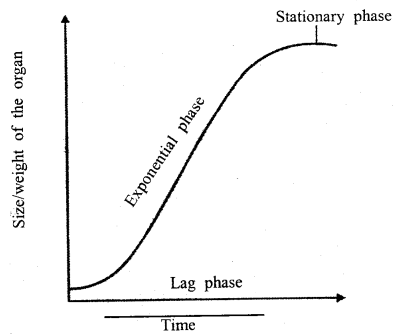
Plant Growth and Development Class 11 Important Extra Questions Biology 1
S-shaped or sigmoid population growth curve characteristic of many species when introduced into a variable new environment.

Question 2.
What is vernalization? Give its importance in flowering plants.
Answer:
The term vernalizations are the promotor of flowering by previous cold treatment. In flowering plants, plants that require cold treatment usually behave as biennials. They germinate and grow vegetatively in the first season and produce flowers in the second season. It is now definitely known that by various grafting experiments the growing point is the site that receives the cold stimulus. It is responsible for the productions of a hormone-like substance called remain.

The effect of vernalization can be removed if plants are again treated with high temperatures.

Question 3.
Explain the biological meaning of growth. In what essential ways does plant growth differ from animal growth?
Answer:
Growth is the sum total of various processes that combine to cause an irreversible increase in mass, weight, or volume. The growth is invariably accompanied by differentiation, which is explained by quantitative changes in terms of the structure and functions of the cell. Plant growth differs from animal growth in its unlimited and undefined pattern of growth.

Question 4.
Explain how the method of science operated in the discovery of auxins?
Answer:
The discovery of auxin was the result of an investigation by Darwin (1880) while studying the bending of the coleoptile of phalaris sp (grass) towards the light. He established that the tip of coleoptiles was able to perceive the light stimulus.

The light stimulus was transmitted to the sub-apical region where differential growth caused bending. A hypothesis was formulated that there is a transmitter. Boysen-Jensen (1913) demonstrated experimentally. In (1928) it was finally proved the existence of a chemical transmitter and called the substance Auxin.

Question 5.
Discuss the role of growth regulators in agriculture.
Answer:
Growth regulators play important role in agriculture:

  1. Dorminy of seed is broken within a few time
  2. The miniature of the plait body is improved.
  3. Time of germination becomes less.
  4. Some plant growth regulators are IBA, IAA
  5. Initiation and promotion of cell division are very useful in tissue culture by growth regulators.

Question 6.
Explain Bolting.
Answer:
Just prior to the reproductive phase in ‘rosette’ plants like cabbage, the internodes elongate enormously causing a marked increase in stem height. This is called Bolting. In natural conditions, bolting requires either long days or cold nights.

Question 7.
Write the functions of Auxin (IAA).
Answer:

  1. Auxin promotes elongation and growth of stems and roots and the enlargement of fruits by stimulating cell walls to stretch in more than one direction.
  2. Auxin promotes cell division in vascular cambium.
  3. Auxin promotes root initiation.
  4. It causes the development of callus in tissue cultures.
  5. Auxin is also involved in apical dominance and abscission.

Question 8.
What part of the plant perceives the light response?
Answer:
It has been demonstrated that a plant from which all leaves have been removed fails to flower even under the inductive light regime. This has been confirmed from experiments with Xanthium, a short-day plant. Even if one eight of a leaf was exposed to short days, flowering occurred. Even a single leaf exposed to a short day was able to induce flowering when it was grafted onto a plant kept under non-inductive conditions.

Question 9.
Distinguish between phototropism and photoperiodism.
Answer:

PhototropismPhotoperiodism
(i) Phototropism is tropic movement in response to light.(i) Photoperiodism is a physiological response to the changes in relative lengths of day and night.
(ii) It is caused by the differential growth in the elongation zone.(ii) It is caused by the replacement of vegetative bud into reproductive bud

Question 10.
Distinguish between Long day plants and Short-day plants.
Answer:

Long day plantsShort day plants
(i) These plants begin flowering when the day length exceeds a critical length(i) These plants begin flowering when the day length is shorter than a critical length.
(ii) Light period is critical for flowering, i.e., they require darkness below the critical period. hence called short-night plants.(ii) Long continuous and uninterrupted dark period is critical for flowering, i.e., they require darkness above a critical Level hence called long-night plants.
(iii) Supply of gibberellins does not induce flowering under non-inductive photoperiods(iii) Supply of gibberellins induces flowering under non-inductive photoperiods.

Question 11.
What do you understand by photoperiodism and vernalization? Describe their significance.
Answer:
Some plants require the exposure of light for a longer period and some requirements for a shorter period than the critical period for flowering.

The plants requiring a longer exposure to light in than critical period are called long-day plants, whereas those requiring light for a shorter period are called short-day plants and the remaining come under the class or neutral or intermediate day plants.

The ability of the plant to detect and respond to the length of the daily period of light or more precisely, the relative length of day and night to which the plant is exposed, is called photoperiodism.

Significance: Photoperiodism plays a decisive role in the flowering process.

Vernalization: The method of inducing early flowering by pretreatment of seeds with a certain low temperature is known as vernalization.

The effect of temperature on the growth of plants, especially for flowering. The plants from the temperate regions require a period of low temperature before flowering takes place.

Significance: Significance of temperature between 1 – 10° C to certain varieties of wheat, rice, millets, and cotton accelerates the growth of seedlings and results in early flowering.

Question 12.
Write an essay on growth regulators in plants.
Answer:
The analysis or growth curves provide evidence of physiological control on growth. Plants produce some specific chemical substances, which are capable of moving from one organ to the other so as to produce their effect on growth. These substances which are active in very small amounts are called plant hormones. They are organic compounds and are capable of influencing physiological activities leading to promotion, inhibition, and modification of growth.

The growth regulatory substances are grouped under five major classes, namely auxins, gibberellins, cytokinins, ethylene, and abscisic acid. The other related growth regulators are jasmonic acid, salicylic acid, and brassinosteroids. Some vitamins also regulate the growth of plants.

Organic substances, other than nutrients, which in low concentration regulate growth, development, and differentiation, are termed, growth regulators. These may either promote or inhibit growth. The growth regulators synthesized are not produced naturally within the plants.

Growth hormones or phytohormones are organic substances, which are synthesized in one part of the plant and transported to another part where these affect a specific physiological process to regulate growth. Growth hormones play a very important role in the growth and development of animals.

Question 13.
How will you measure the rate of growth? Describe an instrument used to measure the increase in height of an angiosperm plant.
Answer:
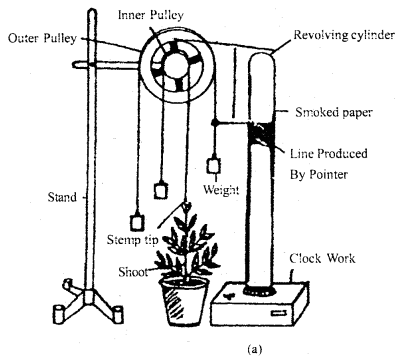
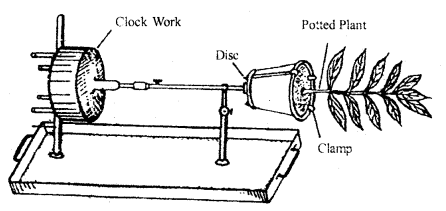
The growth in length can easily be measured with the help of an ordinary measuring scale at an interval of time. For precise measurement, the equipment named auxanometer or autograph can be used. An auxanometer is used to measure the rate of growth of a plant in terms of shoot length.

A thread is tied to the growing tip of a potted plant and at the other end, weight is tied after passing the thread over a pulley. The needle attached in the center of the pulley will show the deflection, which can be read on the graduated arc to find out the increase in length of the plant.
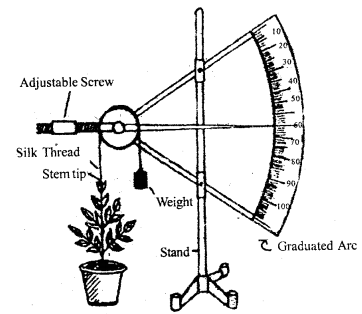
Plant Growth and Development Class 11 Important Extra Questions Biology 2
Measurement of growth by Arc-Aux. nanometer

The growth can also be measured by an increase in weight, both fresh and dry volume of the plant. The increase in the number of cells especially in algae, yeast, and bacteria also gives an idea about the rate of growth.

The measurement of the area of the volume of an organ of the plant will also provide information about the rate of growth.

Question 14.
“Growth is an important phenomenon of living.” Justify this statement with reasons.
Answer:
Growth is one of the most important phenomena of all living organisms. Growth in plants occurs by cell division and cell enlargement, invariably followed by cell differentiation. It is the result of coordination of biophysical increase in size, weight, and volume of an organism or its part. In plants, it is associated with both anabolic and catabolic activities, involve an increase in size.

Thus, growth is a quantitative phenomenon and can be measured in relation to time. Growth in living organisms is intrinsic and differs from extrinsic growth in non-living objects. Plants also show movement due to growth. Hence growth is an important phenomenon in living organisms.

Question 15.
What are the important characteristics of growth? Describe in brief.
Answer:
Growth in plants occurs by cell division and cell differentiation. The cell division generally occurs in apical regions of shoot and root. The meristematic cells present at shoot and root apices are responsible for growth in plants. These cells are also present in vascular bundles of roots and stems of dicot plants. They help in increasing the thickness of stem and root due to secondary growth.

The rate of plant growth is slow in the initial stages and increases rapidly later op. The growth slows down due to the limitation of nutrients. The rate of growth is also called the efficiency index.

Question 16.
What are the different phases of growth? Explain with the help of well-labeled diagrams.
Answer:
Growth in plants is localized in the meristematic region only, i.e., apical, lateral and even, intercalary regions. The growth in length is due to the enlargement and elongation of cells at the apical regions and in thickness due to the activity of lateral and intercalary meristems.

The period of growth is generally divided into three phases, namely, formative, elongation, and maturation.

The formative phase: This phase has constantly dividing cells and restricted to the apical meristem both at the root and shoot tips. The cells of this region are rich in protoplasm with a large nucleus and thin cellulose wall.
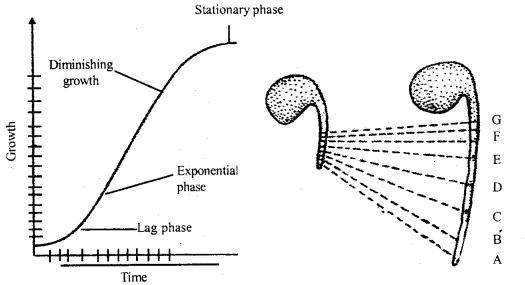
Plant Growth and Development Class 11 Important Extra Questions Biology 3
Growth regions in a root by parallel line (Different phases of growth)

The phase of elongation: It lies just behind the formative phase and is aimed at the enlargement of cells.

The phase of maturation: Is further behind and here the cells start maturing to obtain a permanent size. These phases are also known as regions. The time interval from the formative phase to the maturation phase is called the grand period of growth.

Plant Growth and Development Important Extra Questions Long Answer Type

Question 1.
What do you understand by senescence? What are the various types of senescence observed in plants? Can growth regulators restart senescence?
Answer:
1. Senescence: Senescence may be defined as the period between reproductive maturity and death of a plant or a plant part. Senescence is accompanied by a reduction in functional capacity and an increase in cellular breakdown and metabolic failures. This process ultimately leads to the complete loss of organisms or plant parts.

2. Types of senescence: In plants, it is of four types:
1. Whole plant senescence: It occurs in plants in which the whole plant dies after seed production e.g., wheat, gram, etc. These plants are annuals and die after seed production. This phenomenon also occurs in some monocarpic plants, which live for several years but flower once. For example, certain bamboos and sago palms.

2. Sequential senescence: In some perennial plants, the tips of the main shoot and branches remain in the meristematic stage. They continue to produce new buds and leaves. The older leaves and lateral organs senescence and die. This type of senescence is called sequential senescence. Example: Mango and Eucalyptus.
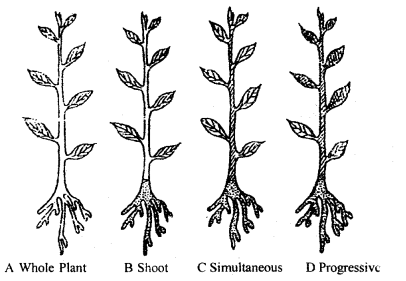
Plant Growth and Development Class 11 Important Extra Questions Biology 4
Types of plant senescence

3. Shoot senescence: In certain perennial plants, the aerial shoot dies each year after flowering and fruiting. But the underground modified stem and roots survive under unfavorable conditions. These parts give rise to new shoots again next year under favorable conditions. Example: Banana and gladiolus.

4. Simultaneous or synchronous senescence: This occurs in temperate deciduous trees which shed their leaves annually in autumn. Example: Maple and elm.

5. Reduction of senescence: Cytokinins, the growth regulators retard senescence. They prevent the breakdown of proteins and other biomolecules. Instead, they stimulate the rate of synthesis of proteins and their mobilization. Auxins also retard senescence.

Question 2.
Mention any two causes of seed dormancy. Give its significance.
Answer:
Many seeds fail to germinate even when they are provided with favorable conditions. This phase when the seed remains in action is called seed dormancy. This natural barrier for development is gradually overcome with time. Sometimes this dormancy is due to the conditions in the seed itself then it is known as innate dormancy.

It may be due to the following reasons:

  1. Impermeability of seed coat: In some plants, the embryo is undifferentiated and unorganized when the seed is shed. It takes time to attain full development before it germinates.
  2. Due to immature embryo: In some plants, the embryo is un-differentiated and unorganized when the seed is shed. It takes time to attain full development before it germinates.

Significance of seed dormancy:

  1. It enables the seed to be disseminated in time and space.
  2. It helps them to germinate when environmental conditions are more favorable.

Advantages of reproduction by seed:

  1. The plant is independent of water for sexual reproduction and therefore, better adapted for a land environment.
  2. The seed protects the embryo.
  3. The seed contains food for the embryo (either or cotyledons or in the endosperm).
  4. The seed is usually adapted for dispersal.
  5. The seed can remain dormant and survive adverse conditions.
  6. The seed is physiologically sensitive to favorable conditions and sometimes must undergo a period of after-ripening so that it will not germinate immediately.
  7. The seed is a product of sexual reproduction and, therefore, has the attendant advantages of genetic variation.

Question 3.
What is the difference between:
(a) Nastic and tropic movements.
Answer:
Difference between Nastic and tropic movements:

Tronic MovementsNastic Movements
(1) These are paratonic directional movements of curvature.(1) These are paratonic non-directional movements of curvature.
(2) These are growth movements caused due to differential growth only.(2) These are either growth or turgor movements, caused due to differential growth or changes in turgor.
(3) These occur in radically symmetrical organs like root and stem.(3) These occur in either symmetric organs or those having bilateral symmetry.

(b) Phototropism and geotropism.
Answer:
Difference between Phototropism and geotropism:

PhototropismGeotropism
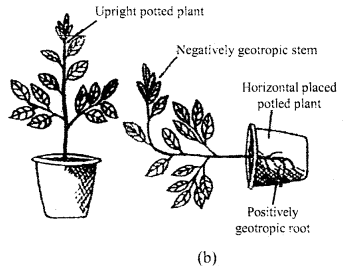
(1) It is the directional movement of curvature caused by light.(1) It is the unidirectional movement of curvature caused by gravitational pull.
(2) The response depends upon the direction of light.(2) Different organs show different types of geotropic responses. The stem shows a negative geotropic response.
(3) The stimulus is perceived by the apical meristem, perception is done by yellowish pigment like carotenoids.(3) The stimulus of gravitational pull is perceived by the root cap in the root and apex of the stem.
(4) It occurs due to differential growth of the organs in the elongation zone.(4) The geotropic response is caused due to unequal distribution of auxin on two sides of the horizontally growing axis.

Question 4.
What do you understand by the spontaneous and induced movements in plants? Illustrate your answer with suitable diagrams.
Answer:
Spontaneous movements: Plastids in cells may show movements in response to light, the stem of a plant grows upwards against the force of gravity or bends towards light. Spontaneous movement may be at protoplasm or organ or even at the whole plant level. The protoplasmic movements, accomplished by naked protoplasm in unicellular plants, are generally divided into ciliary, amoeboid, cyclosis, and gliding. Spontaneous movement is self-controlled.
Plant Growth and Development Class 11 Important Extra Questions Biology 5
Plant Growth and Development Class 11 Important Extra Questions Biology 6
Induced movement: The induced (paratonic) movement is the movement of a complete cell or organelle and is influenced by external stimuli. This is also called tactic (taxes or taxis) movement and is common among lower plants. The movement may be due to chemical substances, such as sucrose and malic acid, present in archegonium of ferns and moss, which attract spermatozoids; and mobile bacteria are attached by peptone.
Plant Growth and Development Class 11 Important Extra Questions Biology 7
Different types of movement.

Question 5.
Describe the various steps involved in seed germination?
Answer:
Awakening of inactive embryos present inside the seed into a seedling, capable of independent existence, is termed germination.

Two conditions affect the germination of seed:
(a) External conditions: External conditions necessary for germi¬nation are water, oxygen, temperature, and light.
(b) Internal conditions: Sometimes the seeds fail to germinate even if various external conditions are favorable.

Germination is also controlled by certain internal factors which are discussed as:

  1. Maturity of the embryo: In certain, plants, the embryo is immature in fully developed seeds.
  2. After ripening: In certain, plants, even if the embryo is mature but they do not possess the necessary growth hormones. These germinate only when necessary growth hormones are synthesized.
  3. Dormancy period: Certain seeds remain dormant after their shedding.
  4. Viability period: The period for which the embryo in seed remains living is termed as viability period. The seeds germinate only within the viability period.
  5. Reserve food material: The availability of sufficient reserve food material is essential for germination.
  6. Enzymes and growth hormones: Digestive and respiratory enzymes play an essential role in germination. In the absence of activation of certain enzymes, seeds will not germinate. Hormones like auxins, gibberellins, and cytokinins also play important role in germination.

Seed germination includes all the physical and physiological changes that occur in the seed.
(a) Absorption of water: The water enters the seed mainly through the micropyle and imbibed by the reserve food and cell wall material, resulting in swelling of the seed. It causes the rupture of seed coats, allowing the radical to grow into the primary root. Aerobic respiration is essential for seed germination as it makes available the energy needed for the growth of the embryo.

(b) Mobilization of reserve food materials: The food is stored in the endosperm, or in cotyledons. The various enzymes convent this food into soluble substances, which serve as a respiratory substrate, and the energy released during aerobic respiration is used in various metabolic and physiological changes dining embryo growth. The digested food passed towards the embryo through cotyledon.

(c) Development of embryo into seedling: The embryonic cells become metabolically very active. The radicle starts growing and is first to emerge out through ruptured seed coats. It develops into a root that grows downwards into the soil. The root developing from the radicle is termed as the primary root.

After the development of the primary root from the radicle, either the epicotyl or the hypocotyl starts elongation, forming dicotyledonous seeds.
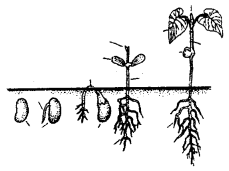
Plant Growth and Development Class 11 Important Extra Questions Biology 8
Different stages of germination of seed.

Respiration in Plants Class 11 Important Extra Questions Biology Chapter 14

Here we are providing Class 11 Biology Important Extra Questions and Answers Chapter 14 Respiration in Plants. Important Questions for Class 11 Biology are the best resource for students which helps in Class 11 board exams.

Class 11 Biology Chapter 14 Important Extra Questions Respiration in Plants

Respiration in Plants Important Extra Questions Very Short Answer Type

Question 1.
Whether respiration is a catabolic or anabolic process?
Answer:
Catabolic (destructive)

Question 2.
Name the cell organelle where cellular respiration takes place.
Answer:
Mitochondria

Question 3.
Give the chemical equation for aerobic respiration.
Answer:
C6H12O6 + 6O2 → 6H2O + 6CO2 + 686 kcal.

Question 4.
Name the substance that is oxidized during respiration.
Answer:
Glucose

Question 5.
What is fermentation?
Answer:
Respiration by microorganisms without the utilization of oxygen is called fermentation.

Question 6.
What is the main source of energy?
Answer:
Carbohydrates, lipids, and proteins.

Question 7.
In what form the energy released by oxidation is stored in the body?
Answer:
In the high-energy bonds of ATP molecules.

Question 8.
Name two respiratory, mediums for living beings.
Answer:
Air and water.

Question 9.
What is cell respiration?
Answer:
Enzymatic oxidation of food in body cells is known as cell respiration.

Question 10.
What holds the energy in the body?
Answer:
Molecules of food hold energy in their chemical bonds.

Question 11.
Name some industrial products of fermentation.
Answer:
Wine, Alcohol, Vinegar, Bread, etc.

Question 12.
Define anaerobic respiration.
Answer:
Respiration carried out in the absence of oxygen is called anaerobic respiration.

Question 13.
Define RQ is words
Answer:
RQ is the ratio between the amount of CO2 evolved to the amount of oxygen used.

Question 14.
How is oxygen distributed in the plant body?
Answer:
By diffusion from a cell of the cell.

Question 15.
Name the parts of the plant body that allow the exchange of gases.
Answer:
Lenticels, stomata, and general body surface.

Question 16.
How many ATP molecules are produced in aerobic respira¬tion?
Answer:
36

Question 17.
When a molecule like that of C6H12O6 is oxidized completely, what are its end products?
Answer:
CO2 and water,

Question 18.
Name two Anti-transpirants.
Answer:
Abscisic acid, Phenyl mercuric acetate.

Question 19.
What metal element is involved in the movement of stomata?
Answer:
Potassium

Question 20.
Why is respiration necessary for the plant?
Answer:
Respiration is necessary as it releases the energy which is used for daily activities.

Question 21.
Why is less energy released during anaerobic respiration?
Answer:
During anaerobic respiration, food is incompletely oxidized and so less energy is released.

Question 22.
What is fermentation?
Answer:
Anaerobic respiration by some microbes is called fermentation.

Respiration in Plants Important Extra Questions Short Answer Type

Question 1.
What is respiration?
Answer:
A process of physiochemical change by which environmental oxygen is taken in to oxidize the stored food or release CO2, water, and energy. The energy released is used for doing various life activities, whereas CO2 being is used by the plants for their growth and development.

Question 2.
Define aerobic respiration.
Answer:
The process of release of energy through intake of molecular oxygen and release of CO2 is known as Aerobic respiration.

Question 3.
Define the process of fermentation showing chemical equation.
Answer:
In this process, the carbohydrate is incompletely oxidized into some carbonic compounds such as ethyl alcohol, acetic acid, lactic acid, and CO2. This process of oxygen being carried out in microbes is known as fermentation.
C6H12O6 → 2 C2H5OH + Energy (247 kJ).

Question 4.
On what factor the respiratory quotient depends?
Answer:
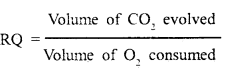
The ratio of the volume of CO2 evolved to the volume of O2 consumed in respiration is called the respiratory quotient
Respiration in Plants Class 11 Important Extra Questions Biology 1

RQ (the respiratory quotient) depends upon the type of respiratory substrate used during respiration. This is different for different substrates.

Question 5.
What is a citric acid cycle?
Answer:
This is also known as the Tricarboxylic acid cycle. When acetyl CO- A enters into a reaction to form citric acid and how pyruvate is broken down during metabolism is highlighted by the concept of cycles. This series of reactions is known as the citric acid cycle.

Question 6.
What will be the value of RQ when organic acids are used as respiratory substrate?
Respiration in Plants Class 11 Important Extra Questions Biology 2
Answer:
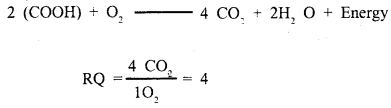
Organic acids contain more oxygen than carbohydrates; therefore the RQ is more than one. Less amount of oxygen is required for their oxidation.

Question 7.
How many types of respiration occur in plants?
Answer:
Depending upon the availability of oxygen, respiration is of two types.

  1. Aerobic respiration
  2. Anaerobic respiration.

Aerobic respiration: Complete oxidation of organic substances in presence of oxygen takes place.
Anaerobic respiration: This type of respiration takes place in the complete absence of oxygen.

Question 8.
Describe the process of glycolysis and where it occurs.
Answer:
Glycolysis is the first stage of breakdown of glucose and common in all organisms. In anaerobic organisms, it is only the process of respiration. In this process, glucose undergoes partial oxidation. This process occurs in the cytoplasm of the cell.

Question 9.
What is the role of the citric acid cycle?
Answer:

  1. Carbon skeletons are obtained for the growth and maintenance of the cell during this cycle.
  2. Many intermediate compounds are formed which are used in the synthesis of biomolecules like amino acids, fats, etc.
  3. ATP molecules having high energy are generated during this pathway.

Question 10.
What is a compensation point?
Answer:
At a low concentration of CO2 and non-limiting light intensity, the photosynthetic rate of a given plant will be equal to the total amount of respiration. The atmospheric concentration of CO2 at which photosynthesis just compensates for respiration is referred to as the CO2 compensation point.

Question 11.
Write the significance of the citric acid cycle.
Answer:
During this pathway, carbon skeletons are obtained for use in the growth and maintenance of the cell. Many intermediate compounds are formed, which are used in the synthesis of other biomolecules like amino acids, nucleotides, chlorophyll cytochromes, and fats.

Question 12.
Why does anaerobic respiration produce less energy than aerobic respiration?
Answer:
Because it does not involve the use of molecular oxygen. Food is not completely oxidized to CO2 and waste. So a lot of energy is still retained with the food. Less energy is produced on anaerobic respiration. It yields only about 5% of the energy available in glucose. Then it is a wasteful process or respiration. In anaerobic respiration, yeast metabolizes glucose to ethanol and CO2 without any use of molecular oxygen.

Question 13.
What is oxidative phosphorylation?
Answer:
Glucose is completely oxidized by the end of the citric acid cycle but the energy is not released unless NADH and FADH are oxidized. Oxygen acts as the final hydrogen acceptor. The whole process by which oxygen effectively allows the formation of ATP molecule by phosphorylation of ADP is called oxidative phosphorylation.

Question 14.
Fill in the blanks with suitable words.
Answer:
(a) Pyruvic acid oxidized into CO3 and H2O before entering the citric acid cycle.
(b) The RQ is more than one if the respiratory substrate is oxalic acid.
(c) Glycolysis takes place in crystal.
(d) The acetyl —COA is accepted by Coenzyme A (a sulfur-containing compound).

Question 15.
Explain the effects of temperature on the rate of respiration.
Answer:
Respiration is reduced at very high (above 50°c) and very low (near freezing temp.) temperatures. This is because enzymes can work best between 30°c – 40°c and get inactivated at very high and very’ low tempera¬tures.

Question 16.
How does the exchange of respiratory gases occur in plants?
Answer:
The gaseous exchange takes place through

  1. General body surface
  2. Lenticels.
  3. Stomata present in leaves and young stems. Oxygen becomes transported from cell to cell by diffusion.

Question 17.
Explain RQ significance.
Answer:
RQ value for carbohydrates is 1. It is less than one if proteins are being burnt and more than one if fats are being burnt. So RQ values are important in identifying the kind of substrate used in respiration.

Question 18.
Describe in detail the aerobic oxidation of pyruvic acid.
Answer:
Pyruvic acid generated in the crystal is transported to mitochondria and initiates the second phase of respiration. Before pyruvic acid enters the Kreb’s cycle, one of its three carbon atoms is oxidized to carbon dioxide in the reaction called oxidative decarboxylation.

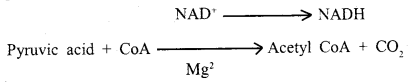
Pyruvate is first decarboxylated and then oxidized by the enzyme pyruvate dehydrogenase. The combination of the remaining two-carbon acetate unit is readily accepted by a sulfur-containing compound coenzyme A to form acetyl COA. During the process, NAD is reduced to NADH. This process is represented as.
Respiration in Plants Class 11 Important Extra Questions Biology 3
During this process, two molecules of NADH are produced, and thus, it results in a net gain of 6ATP molecules.

(2 NADH + 3 = 6 ATP). 2 molecules of pyruvic acid produced during glycolysis,

Question 19.
Describe the net gain of ATP during respiration.
Answer:
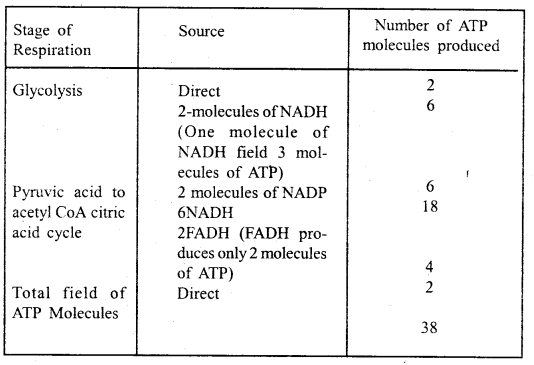
There is a gain of 36 ATP molecules during aerobic respiration of one molecule of glucose. The detail is given in the table.

In most eukaryotic cells, 2 molecules of ATP are required for transporting the NADH produced in glycolysis into mitochondrial for further oxidation. Hence, the net gain of ATP is 36 molecules.

Table ATP molecules produced during respiration.
Respiration in Plants Class 11 Important Extra Questions Biology 4

Question 20.
Define the following:
(a) Respiration
Answer:
Respiration: It is defined as the phenomenon of the release of energy by oxidation of various organic molecules, for cellular use is known as respiration.

(b) Respiratory substrate
Answer:
Respiratory substrate: The compounds that are oxidized during the process of respiration are called respiratory substrates.

(c) Respiratory quotient
Answer:
Respiratory quotient: During respiration oxygen is used and CO2 is released. The ratio of the volume of CO2 evolved to the volume of O2 consumed in respiration is called respiratory quotient (RQ).

(d) Anaerobic respiration
Answer:
Anaerobic respiration: The type of respiration, in which the carbohydrate is incompletely oxidized into some carbonic compounds in absence of oxygen, is called Anaerobic respiration.

(e) Aerobic respiration
Answer:
Aerobic respiration: It is that process of respiration which leads to complete oxidation of organic compound in the presence of oxygen.

This type of respiration is common in higher organisms.

(f) Fermentation.
Answer:
Fermentation: In anaerobic respiration yeasts metabolize glucose to ethanol and CO2 without any use of molecular oxygen. This process is called fermentation in yeasts.

Question 21.
Describe the pentose phosphate pathway.
Answer:
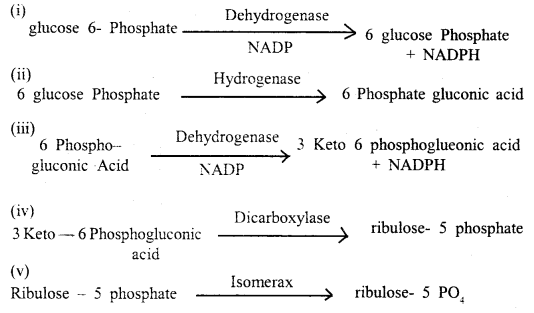
Sometimes oxidation of glucose takes place by another pathway, which is called the pentose phosphate pathway (PPP). In the pentose pathway, glucose-6 phosphate (6C) produced during the early stages of glycolysis or the photosynthates produced during photosynthesis are oxidized to give rise to 6-phosphogluconate. This reaction takes place in the enzyme glucose 6phosphale dehydrogenase and generates NAD PH.

The 6-phosphoglucose molecules are further oxidized by the enzyme 6-phosphogluconate dehydrogenase. As a result of this, one molecule of each ribose-5 phosphate, carbon dioxide, and NADPH is produced, which in turn undergoes many changes to produce glycolytic intermediate. These reactions take place in the cytoplasm.
(From glycolysis)
Respiration in Plants Class 11 Important Extra Questions Biology 5

Question 22.
Calculate the efficiency of respiration in the living system.
Answer:
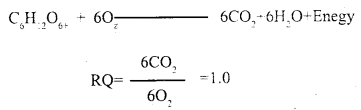
During aerobic respiration, O2 is consumed and CO2 is released. The ratio of the volume of CO2 evolved to the volume of O2 consumed in respiration is called respiratory quotient (RQ) or respiratory ratio.
Respiration in Plants Class 11 Important Extra Questions Biology 1
The RQ (respiratory quotient) depends upon the respiratory substrate. When a carbohydrate is used as a substrate.

C6H12O6 – 2C2H5OH + 2CO + Energy (247 K.J) on complete oxidation. RQ will be
Respiration in Plants Class 11 Important Extra Questions Biology 6
The total energy yield from 38 ATP molecules comes to 1298 kJ. The energy released by one molecule of glucose on complete oxidation is 2870 kJ. Thus, the efficiency is 45%. Much of the energy generated during respiration is released in the form of heat.

Respiration in Plants Important Extra Questions Long Answer Type

Question 1.
Illustrate the mechanism of the electron transport system.
Answer:
The glucose molecule is completely oxidized by the end of the citric acid cycle. But the energy is not released unless NADH and FADH are oxidized through the electron transport system. Here oxidation means the removal of electrons from it.

The metabolic pathway through which the electron passes from one carrier to another is called the electron transport system (ETS) and it is operative in the inner mitochondrial membrane. Electrons from NADH produced in the mitochondrial matrix are oxidized by an NADH dehydrogenase (Complex I) and electrons are then transferred to ubiquinone.

The ubiquinone located within the inner membrane also receives reducing equivalents via FADH, which is generated during the oxidation of succinate, through the activity of the enzyme, succinate dehydrogenase (complex II). The reduced ubiquinone is then oxidized with the transfer of electrons to the cytochrome complex (Complex III).

Cytochrome is a small protein attached to the outer surface of the inner membrane and acts as a mobile carrier for the transfer of electrons between complex III and complex IV.

(Complex IV) is cytochrome.

When the electrons pass from one carrier to another via complex 1 to IV in the electron transfer chain, they are coupled to ATP synthase (Complex V) for the production of ATP from ADP and inorganic phosphate. Oxidation of one molecule of NADH gives rise to 3 molecules of ATP, while that of one molecule of FADH, produces 2 molecules of ATP.

The electrons are earned by the cytochromes and recombine with their protons before the final stage when the hydrogen atom is accepted by oxygen to form water. Oxygen acts as the final hydrogen acceptor. The whole process by which oxygen allows the production of ATP by phosphorylation of ADP is called oxidative phosphorylation.

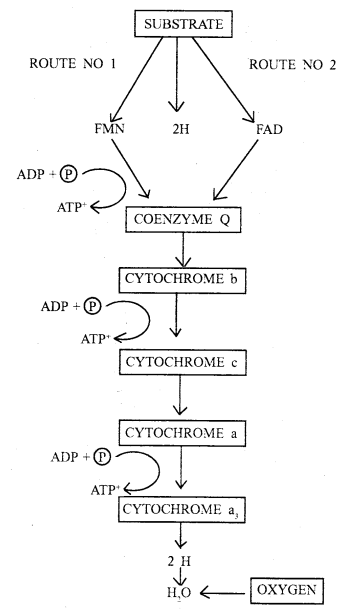
Note: There are two routes by which hydrogen from the substrate molecule passes. In route 1.3 ATP molecules are formed for every pair of hydrogen atoms. In route 2, only 2ATP molecules are formed from one pair of hydrogen atoms.

Oxygen acts as the final hydrogen acceptor and forms water.
NAD = nicotinamide adenine dinucleotide.
MN = flavin mononucleotide,
FAD = flavin adenine dinucleotide.

ETC produces 32 ATP molecules per glucose molecule and is the major source of cell energy.
Respiration in Plants Class 11 Important Extra Questions Biology 7
Electron Transport Chain.

Question 2.
Describe the process and role of the citric acid cycle in living organisms.
Answer:
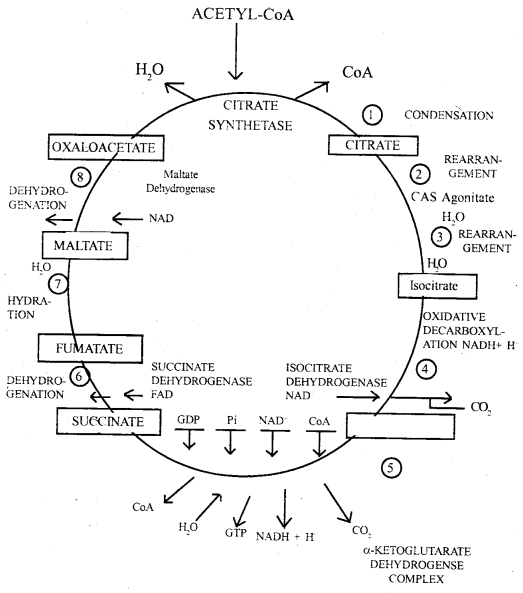
In the process of respiration, the carbohydrates are converted into pyruvic acid through a series of enzymatic reactions. These reactions are known as glycolysis and take place in the cytosol. The pyruvic acid thus formed enters in mitochondria where O2 and necessary enzymes are available; the pyruvic acid is finally converted into CO2 and H2O. This reaction series is known as Krebs Cycle or Citric acid cycle or Tricarboxylic acid (TCA) cycle.

During this cycle, 3 molecules of NAD and one molecule of FAD (Flavin Adenine Dinucleotide) are reduced to produce NADH and FADH respectively. NADH and FADH, so produced during the citric acid cycle are linked with the electron transport system and produce ATP by oxidative phosphorylation, The summary equation for this phase of respiration may therefore be written as follows:
Respiration in Plants Class 11 Important Extra Questions Biology 8
Respiration in Plants Class 11 Important Extra Questions Biology 9
Kreb’s cycle. It follows glycolytic reactions shown in and pyruvate oxidation.

It involves two processes

  1. removal of hydrogen and
  2. the breaking off of carbon dioxide units one by one.

प्रत्यभिज्ञानम् Summary Notes Class 9 Sanskrit Chapter 7

By going through these CBSE Class 9 Sanskrit Notes Chapter 7 प्रत्यभिज्ञानम् Summary, Notes, word meanings, translation in Hindi, students can recall all the concepts quickly.

Class 9 Sanskrit Chapter 7 प्रत्यभिज्ञानम् Summary Notes

प्रत्यभिज्ञानम् Summary

यह पाठ भास द्वारा रचित ‘पञ्चरात्रम्’ नामक नाटक से लिया गया है। पांडव अपने वनवास के अंतिम वर्ष अज्ञातवास में रह रहे थे। वे महाराज विराट के राज्य में नाम तथा वेश बदलकर रह रहे थे।

प्रत्यभिज्ञानम् Summary Notes Class 9 Sanskrit Chapter 7.2

इस दौरान कौरवों ने राजा विराट की गायों का अपहरण कर लिया था। महाराज विराट के पुत्र उत्तर तथा बृहन्नला के वेश में अर्जुन कौरवों से युद्ध करने के लिए गए। कौरवों की तरफ से अभिमन्यु (अर्जुन-पुत्र) युद्ध कर रहा था। इस युद्ध में कौरवों की हार हुई। भीम अभिमन्यु को पकड़कर राजा विराट के दरबार में पेश करते हैं। अभिमन्यु अपना नाम लेकर बुलाए जाने पर अपमानित अनुभव करता है।
प्रत्यभिज्ञानम् Summary Notes Class 9 Sanskrit Chapter 7.1

वह अपने पिता अर्जुन को नहीं पहचान पाता तथा उनसे उग्र होकर बात करता है। तभी विराट-पुत्र उत्तर दरबार में पहुँच जाता है। वह पांडवों का भेद खोल देता है और उनकी बहादुरी के विषय में सबको बताता है। अभिमन्यु अपने पिता को पहचानकर प्रसन्न हो जाता है।

प्रत्यभिज्ञानम् Word Meanings Translation in Hindi

1. भटः – जयतु महाराजः।
राजा – अपूर्व इव ते हर्षों ब्रूहि
केनासि विस्मितः?
भटः – अश्रद्धेयं प्रियं प्राप्त
सौभद्रो ग्रहणं गतः॥
राजा – कथमिदानीं गृहीतः?
भटः – रथमासाद्य निश्शहू
बाहुभ्यामवतारितः।
राजा- केन?
भटः – यः किल एव नरेन्द्रेण विनियुक्तो महानसे (अभिमन्युमुद्दिश्य ) इत इतः कुमारः।
अभिमन्युः – भोः को नु खल्वेषः? येन भुजैकनियन्त्रितो बलाधिकेनापि न पीड़ितः अस्मि।

अर्थ – भट – महाराज की जय हो।
राजा – तुम्हारी प्रसन्नता अद्भुत-सी लग रही है, बताओ किस कारण इतने प्रसन्न हो?
भट – अविश्वसनीय प्रिय प्राप्त हो गया है, अभिमन्यु पकड़ लिया गया।
राजा – अब वह किस प्रकार पकड़ लिया गया है?
भट – रथ पर पहुँचकर निश्शङ्क भाव से हाथों द्वारा उतार लिया गया है। राजा
राजा – कैसे?
भट – निश्चय से जो यह महाराज के द्वारा रसोई में नियुक्त किया गया है (अभिमन्यु को संकेत करके)
कुमार! इधर से इधर से (आओ)।
अभिमन्युः – अरे! यह कौन?, जिसने एक हाथ से पकड़कर अधिक बलशाली होकर भी मुझे पीड़ित नहीं किया।

अव्ययानां वाक्येषु प्रयोगः
पदानि – वाक्येषु प्रयोगः
इव (समान) – सः सिहः इव अवदत्।
इतः (यहाँ से) – इतः बहिः मा गच्छ।
नून (निश्चित) – नूनम् सः मातरम् सेवते।
खलु (निश्चित) – खलु सः भालांकारः एव अस्ति।
न (नहीं) – अहम् न क्रीडामि।
कथम् (कैसे) – अभिमन्युः कथम् गृहीतः।
अपि (भी) – अहम् अपि क्रीडामि।

विशेषण-विशेष्य-चयनम्
विशेषणम् – विशेष्यः
विशेष्यः – प्रियं
महत् – कौतूहलम्
को – एषः

2. बृहन्नला – इत इत: कुमारः।
अभिमन्युः – अये! अयमपरः कः विभात्युमावेषमिवाश्रितो हरः।
बृहन्नला – आर्य, अभिभाषणकौतूहलं मे महत्। वाचालयत्वेनमार्यः।
बल्लभः – (अपवार्य) बाढम् (प्रकाशम्) अभिमन्यो।
अभिमन्युः – अभिमन्युर्नाम?
बल्लभः – रुष्यत्येष मया त्वमेवैनमभिभाषय।
बृहन्नला – अभिमन्यो!
अभिमन्युः – कथं कथम्। अभिमन्यु माहम्। भोः!
किमत्र विराटनगरे क्षत्रियवंशोद्भूताः नीचैः अपि नामभिः
अभिभाष्यन्ते अथवा अहं शत्रुवशं गतः। अतएव तिरस्क्रियते।

शब्दार्थाः –
हरः – महादेव
अपरः – दसरा
अपवार्य – हरा करके
बाढम – अच्छा
विभाति – सशोभित होना
अभिभाषय – बात करने को प्रेरित करो
मे – मुझे
महत – बहुत ज्यादा
अथवा – या
प्रकाशम् – प्रकट में
रुष्यति – चिढ़ता होता है
अभिभाष्यन्ते – पुकारे जाते है।

अर्थ-बृहन्नला – कुमार, इधर चलें।
अभिमन्यु – अरे! यह दूसरा कौन है, ऐसा लग रहा है जैसे महादेव ने उमा का वेष ग्रहण किया हो।
बृहन्नला – आर्य! मुझे इससे बात करने की बहुत उत्सुकता हो रही है। आप इसे बोलने के लिए प्रेरित करें।
बल्लभः – (एक ओर को) अच्छा (प्रकट रूप से) अभिमन्यु।
अभिमन्यु – अभिमन्यु?
बल्लभः – यह मुझसे चिढ़ता है, तुम्ही इसे बात करने के लिए प्रेरित करो।
बृहन्नला – अभिमन्यु!
अभिमन्यु – क्यों, मेरा नाम अभिमन्यु है! अरे! क्या यहाँ विराट नगर में क्षत्रिय कुमारों को नीच लोग भी नाम । लेकर पुकारते हैं, अथवा मैं शत्रओं के अधीन हो गया, इसलिए अपमानित किया जा रहा है मुझे।

अव्ययानां वाक्येषु प्रयोगः –
पदानि – वाक्येषु प्रयोगः
कथं (कैसे) – भवान् कथं आगच्छति।
अत्र (यहाँ) – अत्र एकं कूपम् अस्ति।
नीचैः (नीचे) – जलम् नीचैः पतति।
अपि (भी) – अहम् अपि आपणम् गामिष्यामि।

विलोमपदानि –
पदानि – विलोमपदानि
नीचैः – उच्चैः
आर्यः – अनार्यः
मया – त्वया
अत्र – तत्र
रुष्यति – प्रसीदति
गतः – आगतः
इतः – ततः
अहम्: – त्वम्
प्रकाशम् – मनसि
शत्रुवशम् – मित्रवशम्

पर्यायपदानि –
पदानि – पर्यायपदानि
रुष्यति – क्रुध्यति
नीचैः – अधः
प्रकाशम् – प्रकटम्
कौतूहलम् – उत्सुकता
गतः – अगच्छत्
इतः – अस्मात् स्थानात्
तिरस्क्रियते – उपेक्ष्यते

विशेषण – विशेष्य – चयनम् –
विशेषणम् – विशेष्यः
महत् – कौतूहलं
उमावेषमिवाश्रितः – हरः
अपरः – कः

3. बृहन्नला – अभिमन्यो! सुखमास्ते ते जननी?
अभिमन्युः – कथं कथम्? जननी नाम? किं भवान् मे पिता अथवा पितृव्यः? कथं मां पितृवदाक्रम्य स्त्रीगतां कथां पृच्छति?
बृहन्नला – अभिमन्यो! अपि कुशली देवकीपुत्रः केशवः?
अभिमन्युः – कथं कथम्? तत्रभवन्तमपि नाम्ना। अथ किम् अथ किम्? (बृहन्नलावल्लभौ परस्परमव लोकयतः)
अभिमन्युः – कथमिदानीं सावज्ञमिव मां हस्यते?
बृहन्नला – न खलु किञ्चित्। पार्थं पितरमुद्दिश्य मातुलं च जनार्दनम्।
तरुणस्य कृतास्त्रस्य युक्तो युद्धपराजयः॥
अभिमन्युः – अलं स्वच्छन्दप्रलापेन। अस्माकं कुले आत्मस्तवं कर्तुमनुचितम्। रणभूमौ हतेषु शरान् पश्य, मदृते अन्यत् नाम न भविष्यति।
बृहन्नला – एवं वाक्यशौण्डीर्यम्। किमर्थं तेन पदातिना गृहीतः?
अभिमन्युः – अशस्त्रं मामभिगतः। पितरम् अर्जुनं स्मरन् अहं कथं हन्याम्। अशस्त्रेषु मादृशाः न प्रहरन्ति। अतः
अशस्त्रोऽयं मां वञ्चयित्वा गृहीतवान्। राजा – त्वर्यतां त्वर्यतामभिमन्युः।

शब्दार्थाः –
पितृव्यः – चाचा
उभौ – दोनों
परस्परम् – आपस में
मातुलं – मामा।
जनार्दनम् – श्रीकृष्ण को
पार्थं – अर्जुन को
पदाति: – पैदल चलने वाला
कृतास्त्रस्य – धनुर्विद्या में निपुण से
आत्मस्तवम् – आत्मप्रशंसा
उद्दिश्य – याद करके
महते – मेरे सिवाय
वाक्यशौण्डीर्यम् – वाणी की वीरता
तरुणस्य – युवक के।

अर्थ – बृहन्नला – अभिमन्यु! तुम्हारी माता सकुशल है?
अभिमन्यु – क्या, क्या? माता? क्या आप मेरे पिता या चाचा हैं? आप क्यों मुझ पर पिता के समान अधिकार दिखाकर माता के सम्बन्ध में प्रश्न कर रहे हैं?
बृहन्नला – अभिमन्यु! देवकीपुत्र केशव सकुशल हैं?
अभिमन्यु – क्या आदरणीय कृष्ण को भी नाम से……? और क्या, और क्या! (कुशल हैं) (बृहन्नला और बल्लभ एक-दूसरे की ओर देखते हैं)
अभिमन्यु – ये मेरे ऊपर अज्ञानी की तरह क्यों हँस रहे हैं?
बृहन्नला – क्या कुछ ऐसा ही नहीं है? पिता पार्थ तथा मामा श्री कृष्ण वाला युवक युद्ध में निपुण होकर भी युद्ध में परास्त हो जाता है।
अभिमन्युः – स्वच्छन्द प्रलाप करना बन्द करो। हमारे कुल में आत्मप्रशंसा करना अनुचित है। युद्ध क्षेत्र में मेरे बाणों से अतिरिक्त दूसरा नाम नहीं होगा।
बृहन्नला – अरे वाणी की ऐसी वीरता! फिर उन्होंने तुम्हें पैदल ही क्यों पकड़ लिया?
अभिमन्युः – वे अशास्त्र (शस्त्रहीन) होकर मेरे सामने आए। पिता अर्जुन को याद करके मैं उन्हें कैसे मारता? मुझ जैसे लोग शस्त्रहीन पर प्रहार नहीं करते। अतः इस शस्त्रहीन ने मुझे धोखा देकर पकड़ लिया।
राजा – अभिमन्यु को शीघ्र बुला लाओ।

पर्यायपदानि –
पदानि – पर्यायपदानि
इदानीम् – अधुना
आस्ते – अस्ति
मे – मम
उद्दिश्य – स्मृत्वा
आत्मस्तवम् – आत्मप्रशंसा
आस्ते – अस्ति
सावज्ञाम् – अवज्ञा सहितम्
तरुणस्य – युवकस्य
पदातिः – पादाभ्याम् अतति

विलोमपदानि –
पदानि – विलोमपदानि
सुखम् – दुखम्
पिता – माता
मातुलः – मातुलानी
जनकः – जननी
पितृव्यः पितृव्या
पराजयः – जयः

अव्ययानां – वाक्येषु – प्रयोगः –
पदानि – वाक्येषु प्रयोगः
एवं (ऐसा) – त्वम् एवं किमर्थम् वदसि?
किमर्थं (इसलिए) – क्यों-त्वम् किमर्थम् हससि?
अतः (इसलिए) सः उच्चैः अवदत् अतः सः दण्डितः अभवत्
अन्यत् (दूसरा) – सः कदापि अध्ययनात् अन्यत् कार्यं न करोति।
अथ (अथ) – अथ श्री महाभारत कथा।
कथम् (कैसे) – अधुना त्वम् कथम् गृहीतः।

विशेषण – विशेष्य – चयनम् –
विशेषणम् – विशेष्यः
एषं – महाराज
उत्सिक्तः – क्षत्रियकुमारः
गृहीतः – अयम्

4. बृहन्नला – इत इतः कुमारः। एष महाराजः। उपसर्पतु कुमारः।
अभिमन्युः – आः। कस्य महाराजः?
राजा – एोहि पुत्र! कथं न मामभिवादयसि? (आत्मगतम्) अहो! उत्सिक्तः खल्वयं क्षत्रियकुमारः।
अहमस्य दर्पप्रशमनं करोमि। (प्रकाशम्) अथ केनायं गृहीतः?
भीमसेनः – महाराज! मया।
अभिमन्युः – अशस्त्रेणेत्यभिधीयताम्।
भीमसेनः – शान्तं पापम्। धनुस्तु दुर्बलैः एव गृह्यते। मम तु भुजौ एव प्रहरणम्।
अभिमन्युः – मा तावद् भोः! किं भवान् मध्यमः तातः यः तस्य सदृशं वचः वदति।
भीमसेनः – पुत्र! कोऽयं मध्यमो नाम?
अभिमन्युः – योक्त्रयित्वा जरासन्धं कण्ठश्लिष्टेन बाहुना।
असह्यं कर्मतत्कृत्वा नीतःकृष्णोऽतदर्हताम्॥
राजा – न ते क्षेपेण रुष्यामि, रुष्यता भवता रमे।
किमुक्त्वा नापराद्धोऽहं, कथं तिष्ठति यात्विति॥
अभिमन्युः – यद्यहमनुग्राह्यः
पादयोः समुदाचारः क्रियतां निग्रहोचितः।
बाहुभ्यामाहृतं भीमः बाहुभ्यामेव नेष्यति॥
(ततः प्रविशत्युत्तरः)

शब्दार्थाः –
उपसर्पतु – समीप जाएँ
एह्येहि – आओ, आओ
आत्मगतम् – मन में
उत्सिक्तः – घमण्डी
दर्पप्रशमनं – घमंडी का नाश
इत्यभिधीयताम् – ऐसा कहिए
रमे – मैं आनन्दित होता हूँ।
अपराद्धः – अपराधी
अनुग्राहय – कृपा करने योग्य
यातु – चला जाए, जाओ
भुजौ – दोनो भुजाएँ
योक्त्रयित्वा – बाँधकर
असह्यम् – असाध्य
अतदर्हताम् – असमर्थता
क्षेपेण – निन्दापूर्ण वचनों से
समुदाचारः – सभ्य आचरण
निग्रहोचितः – उचित दण्ड
प्रविशति – अंदर आता है
सदृशं – समान
नेष्यति – ले जाएगा।

अर्थ – बृहन्नला – कुमार इधर आएँ। यह महाराज हैं। आप समीप जाएँ।
अभिमन्यु – आह! किसके महाराज?
राजा – आओ, आओ पुत्र। तुम मुझे प्रणाम क्यों नहीं करते (मन में) अरे! यह क्षत्रिय कुमार बहुत घमण्डी है।
मैं इसका घमण्ड शान्त करता हूँ। (प्रकट रूप से) तो इसे किसने पकड़ा?
भीमसेनः – महाराज! मैंने।
अभिमन्यु – शस्त्रहीन होकर पकड़ा- ऐसा कहिए।
भीमसेन – शान्त हो जाइए। धनुष तो दुर्बलों के द्वारा उठाया जाता है। मेरी तो भुजाएँ ही शस्त्र हैं।
अभिमन्यु – अरे नहीं! क्या आप हमारे मध्यम तात हैं, जो उनके समान वचन बोल रहे हैं।
भीमसेन – पुत्र! यह मध्यम तात कौन हैं?
अभिमन्यु – सुनिए-जिसने अपनी भुजाओं से जरासन्ध का कण्ठावरोध करके कृष्ण के लिए जो असाध्य कार्य था, उसको साध्य बना दिया था।
राजा – तुम्हारे निन्दापूर्ण वचनों से मैं चिढ़ता नहीं हूँ। तुम्हारे चिढ़ने से मुझे आनन्द प्राप्त होता है। तुम यहाँ क्यों खड़े हो, जाओ यहाँ से – यदि मैं ऐसा कहूँ तो क्या मैं अपराधी नहीं होऊँगा?
अभिमन्यु – यदि आप मुझ पर कृपा करना चाहते हो तो- मेरे पैर बाँधकर मुझे उचित दण्ड दीजिए। मैं हाथों से पकड़कर लाया गया हूँ। मेरे मध्यम तात भीम मुझे हाथों से ही छुड़वाकर ले जाएँगे। (तब उत्तर का प्रवेश)

पर्यायपदानि –
पदानि – पर्यायपदानि
एहि – आगच्छ
उपसर्पतु – समीपं , गच्छतु
उत्सिक्तः – गर्वोद्धतः, अहङ्कारी
दर्पप्रशमनं – गर्वस्य शमनम्
गृहीतः – ग्रहणे कृतः
प्रहरणम् – शस्त्रम्
निगृहोचितम् – बन्धनोचित
योक्त्रयित्वा – बद्र्ध्वा
क्षेपेण – निन्दावचनेन
रमे – प्रीतो भवामि
यातु – गच्छतु
समुदाचारः – शिष्टाचारः
अनुग्राह्य – अनुग्रहस्य योग्यतम्
त्वरितम् – शीघ्र

अव्ययानां चयनम् –
पदानि – वाक्येषु प्रयोगः
इतः (यहाँ से) – हे पुत्र! त्वम् इतः मा गच्छ।
कथं (कैसे) – त्वं कथम् ईदृशम् कार्यं करोषि।
न (नहीं) – सः असत्यम् न वदाति। अथ
(इसके बाद) – अथ शब्दानुशासनम्।
एव (ही) – ईश्वरः सर्वत्र एव अस्ति।
तु (तो) – त्वम् तु अतीव बुद्धिमान् असि।
मा (मत) – कोलाहलं मा कुरु।
सदृशं (के समान) – मोहनः श्रीकृष्णस्य सदृशं वर्तते।
ततः (उसके बाद) – त्वं प्रथमं पठ ततः क्रीड।

विशेषण-विशेष्य-चयनम् –
विशेषणम् – विशेष्यः
एषः – महाराजः
शान्तं – पापम्
उत्सिक्तः – क्षत्रियकुमारः

विलोमपदानि –
यातु – तिष्ठतु
आत्मगतम् – प्रकाशम्
दुर्बलैः – सबलैः
त्वरितम् – शनैः

5. उत्तरः तात! अभिवादये!
उत्तरः राजा आयुष्मान् भव पुत्र। पूजिताः कृतकर्माणो योधपुरुषाः।
उत्तरः पूज्यतमस्य क्रियतां पूजा।
राजा – पुत्र! कस्मै?
उत्तरः – इहात्रभवते धनञ्जयाय।
राजा – कथं धनञ्जयायेति? .
उत्तरः – अथ किम्
श्मशानाद्धनुरादाय तूणीराक्षयसायके।
नृपा भीष्मादयो भग्ना वयं च परिरक्षिताः॥
राजा – एवमेतत्।
उत्तरः – व्यपनयतु भवाञ्छङ्काम्। अयमेव अस्ति धनुर्धरः धनञ्जयः।
बृहन्नला – यद्यहं अर्जुनः तर्हि अयं भीमसेनः अयं च राजा युधिष्ठिरः।
अभिमन्युः – इहात्रभवन्तो मे पितरः। तेन खलु …
न रुष्यन्ति मया क्षिप्ता हसन्तश्च क्षिपन्ति माम्।
दिष्ट्या गोग्रहणं स्वन्तं पितरो येन दर्शिताः॥
(इति क्रमेण सर्वान् प्रणमति, सर्वे च तम् आलिङ्गन्ति।)

शब्दार्था:
धनञ्जयः – अर्जुन
तूणीर – तरकश
व्यपनयतुः – दूर करे
क्षिप्ताः – आक्षेप किए जाने पर
भग्नाः – परास्त किए गए
दिष्ट्या – भाग्य से
गोग्रहणम् – गायों का अपहरण
स्वन्तं – सुखान्त
आलिड्गन्ति – आलिंगन करते हैं।

अर्थ- उत्तर – भगवन्! मैं प्रणाम करता हूँ।
राजा – दीर्घायु हो पुत्र! क्या युद्ध में वीरता दिखाने वाले वीरों का सत्कार कर दिया गया है?
उत्तर – अब सबसे अधिक पूज्य की पूजा कीजिए।
राजा – किसकी पूजा पुत्र?
उत्तर – यहीं मौजूद अर्जुन की।
राजा – क्या अर्जुन यहाँ आए हैं?
उत्तर – और क्या? पूज्य अर्जुन ने श्मशान से अपना धनुष तथा अक्षय तरकश लेकर भीष्म आदि राजाओं को परास्त कर दिया तथा हम लोगों की रक्षा की।
राजा – ऐसी बात है?
उत्तर आप अपना सन्देह दूर करें। धनुर्विद्या में प्रवीण अर्जुन यही हैं।
बृहन्नला – यदि मैं अर्जुन हूँ तो यह भीमसेन है और यह राजा युधिष्ठिर हैं।

अभिमन्यु – ये मेरे पूज्य पितागण हैं, इसीलिए……
मेरे निन्दापूर्ण वचनों से ये क्रुद्ध नहीं होते और हँसते हुए मुझे चिढ़ाते हैं। गौ-अपहरण की यह घटना सौभाग्य से सुखान्त हुई। इसी के कारण मुझे अपने सभी पिताओं के दर्शन हो गए।
(ऐसा कहकर क्रम से सबको प्रणाम करता है और सब उसका आलिंगन करते हैं)

अव्ययानां वाक्येषु प्रयोगाः –
पदानि – वाक्येषु प्रयोगः
(इसके बाद) – अथ श्री रामायण कथा।
अत्र (यहाँ) – अत्र एकम् उद्यानम् अस्ति।
च (और) – मातुलं च जनार्दनम् अत्र आगच्छतः।
एवम् (ऐसा) – एवं मा वद। यदि
(अगर) – यदि त्वम् आगमिष्यसि।
तर्हि (तो) – तर्हि अहम् गमिष्यामि।
न (नहीं) – अधुना सः न आगमिष्यति।
इति (ऐसा) – पयः ददाति इति पयोदः।

विशेषण-विशेष्य चयनम् –
विशेषणम् – विशेष्यः
धनुर्धरः – धनञ्जयः
राजा – युधिष्ठिरः
अयं – भीमसेनः