Recombinant DNA Technology

Learninsta presents the core concepts of Microbiology with high-quality research papers and topical review articles.

Recombinant DNA Technology

One of the practical applications of microbial genetics and the technology arising from it is the recombinant DNA technology. The deliberate modification of an organism’s genetic information by directly changing its nucleic acid genome is called genetic engineering and is accomplished by a collection of methods known as recombinant DNA technology.

Recombinant DNA technology opens up totally new areas of research and applied biology. Thus, it is an essential part of biotechnology, which is now experiencing a stage of exceptionally rapid growth and development. In general sense, recombination is the process in which one or more nucleic acids molecules are rearranged or combined to produce a new nucleotide sequence.

Usually genetic material from two parents is combined to produce a recombinant chromosome with a new, different genotype. Recombination results in a new arrangement of genes or parts of genes and normally is accompanied by a phenotypic change.

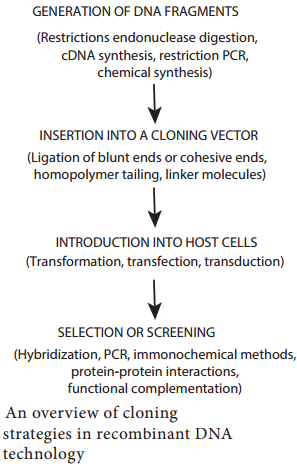
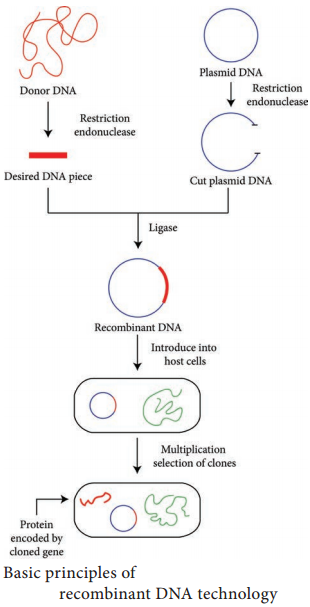
There are many diverse and complex techniques involved in gene manipulation. However, the basic principles of recombinant DNA technology are reasonably simple, and broadly involve the following stages (Figure 12.22).
Recombinant DNA Technology img 1

  1. Isolation of DNA from the source (Donor)
  2. Generation of DNA fragments and selection of the desired piece of DNA
  3. Insertion of the selected DNA into a cloning vector (Example: a plasmid) to create a recombinant DNA or chimeric DNA.
  4. Introduction of the recombinant vectors into host cells (Example: bacteria)
  5. Multiplication and selection of clones containing the recombinant molecules
  6. Expression of the gene to produce the desired product.

Cloning in the molecular biology sense (as opposed to cloning whole organisms) is the making of many copies of a segment of DNA, such as a gene. Cloning makes it possible to generate large amounts of pure DNA, such as genes, which can then be manipulated in various ways, including mapping, sequencing, mutating and transforming cells. An overview of cloning strategies in recombinant DNA technology is shown in Figure 12.23.
Recombinant DNA Technology img 2

Transfer of Genetic Material

Learninsta presents the core concepts of Microbiology with high-quality research papers and topical review articles.

Transfer of Genetic Material

Normally, genes and the characteristics they code for are passed down from parent to progeny. This is called vertical gene transfer. Bacteria and some lower eukaryotes are unique in that they can pass DNA from one cell of the same generation to another.

The exchange of genes between two cells of the same generation is referred to as horizontal gene transfer. Mechanisms like transformation, transduction and conjugation takes place naturally and may bring about genetic variation and genetic recombination.

These gene transfer mechanisms are also employed in genetic engineering to introduce desired gene into the cells. Introducing a foreign gene or recombinant DNA into the cells is one of the techniques used in genetic engineering. The success of cloning depends on the efficiency of gene transfer process.

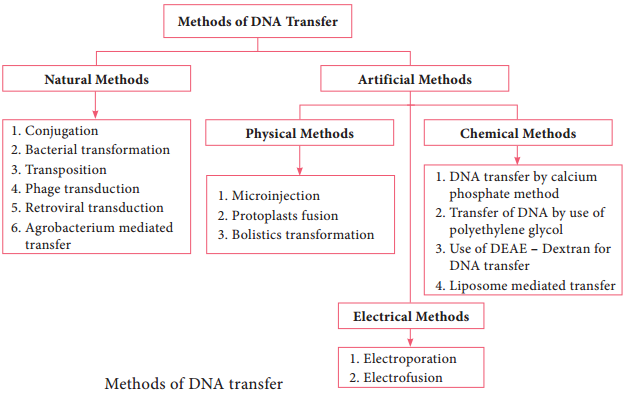
The most commonly employed gene transfer methods are transformation, conjugation, transduction, electroporation, lipofection and direct transfer of DNA. The choice of the method depends on the type of host cell (bacteria, fungi, plant, animal). Figure 12.15 shows methods of DNA transfer.
Transfer of Genetic Material img 1

Note: The term Transfection is used for the transfer of DNA into eukaryotic cells by various physical or chemical means.

Transformation

Transformation is genetic alteration of a cell resulting from the direct uptake, incorporation and expression of exogenous genetic material (exogenous DNA) from its surroundings. Transformation occurs naturally in some species of bacteria, but it can also take place by artificial means in other cells. For transformation to happen, bacteria must be in a state of competence.

Competence refers to the state of being able to take up exogenous DNA from the environment. There are two forms of competence: natural and artificial. Transformation works best with DNA from closely-related species. The naturally-competent bacteria carry sets of genes that provide the protein machinery to bring DNA across the cell membrane(s).

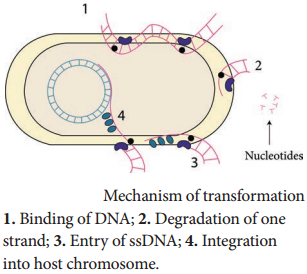
There are some differences in the mechanisms of DNA uptake by gram positive and gram negative cells. However, they share some common features that involve related proteins. The DNA first binds to the surface of the competent cells on a DNA receptor, and passes through the cytoplasmic membrane via DNA
translocase.

Only single stranded DNA may pass through, one strand is therefore degraded by nucleases in the process, and the translocated single-stranded DNA may then be integrated into the bacterial chromosomes. Figure 12.16 shows mechanism of transformation.
Transfer of Genetic Material img 2

Artificial competence can be induced in laboratory by procedures that involve making the cell passively permeable to DNA. Typically, the cells are incubated in a solution containing divalent cations; most commonly, calcium chloride solution under cold condition, which is then exposed to a pulse of heat shock.

Electroporation is another method of promoting competence. Using this method, the cells are briefly shocked with an electric field of 10-20 kV / cm which is thought to create holes in the cell membrane through which the plasmid DNA may enter. After the electric shock, the holes are rapidly closed by the cell’s membrane-repair mechanisms.

Conjugation

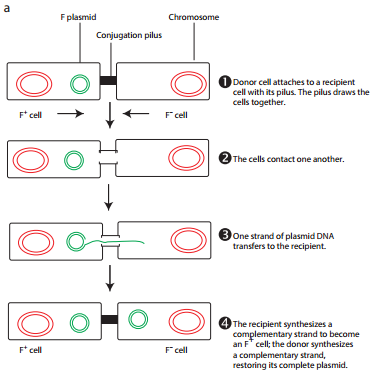
The initial evidence for bacterial conjugation, came from an experiment performed by Joshua Lederberg and Edward L Tatum in 1946. Later in 1950, Bernard Davis gave evidence that physical contact of the cells was necessary for conjugation. During conjugation, two live bacteria (a donor and a recipient) come together, join by cytoplasmic bridges (e.g. pilus) and transfer single stranded DNA (from donor to recipient).

Inside the recipient cell, the new DNA may integrate with the chromosome (rather rare) or may remain free (as is the case with plasmids). Conjugation can occur among the cells from different genera of bacteria, while transformation takes place among the cells of a bacterial genus.

A plasmid called the fertility or F factor plays a major role in conjugation. The F factor is about 100 kilobases long and bears genes responsible for cell attachment and plasmid transfer between specific bacterial strains during conjugation. F factor is made up of:-

  • tra region (tra operon / transfer genes): genes coding the F pilus and DNA transfer,
  • Insertion sequence: genes assisting plasmid integration into host cell chromosome.

Thus, the F factor is an episome – a genetic material that can exist outside the bacterial chromosome or be integrated into it.

During F+ × F mating or conjugation (Figure 12.17 a) the F factor replicates by the rolling circle mechanism and a copy moves to the recipient. The channel for DNA transfer could be either the hollow F pilus or a special conjugation bridge formed upon contact. The entering strand is copied to produce double – stranded DNA.
Transfer of Genetic Material img 3

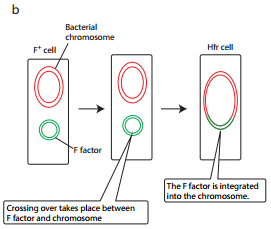
F factor can integrate into the bacterial chromosome at several different locations by recombination between homologous insertion sequences present on both the plasmid and host chromosomes. The integration of F factor into bacterial chromosome results in formation of HFR (High Frequency Recombination) cell.

When integrated, the Fplasmid’s tra operon is still functional; the plasmid can direct the synthesis of pili, carry out rolling circle replication, and transfer genetic material to an F- recipient cell.

An HFR cell is so called because it exhibits a very high efficiency of chromosomal gene transfer in comparison with F+ cells. In F+ cells the independent F factor rarely transfer chromosomal genes hence the recombination frequency is low. Figure 12.17 b shows formation of HFR cell.
Transfer of Genetic Material img 4

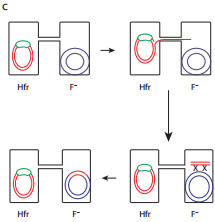
When an HFR cell is mated with F cell the F recipient does not become F+ unless the whole chromosome is transferred as explained in Figure 12.17 c. The connection usually breaks before this process is finished. Thus, complete F factor usually is not transferred, and the recipient remains F.
Transfer of Genetic Material img 5

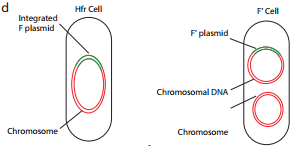
Because the F plasmid is an episome, it can leave (deintegrate) the bacterial chromosome. Sometimes during this process, the plasmid makes an error in excision and picks up a portion of the chromosomal material to form an F′ plasmid. Figure 12.17 d shows formation of F′.
Transfer of Genetic Material img 6

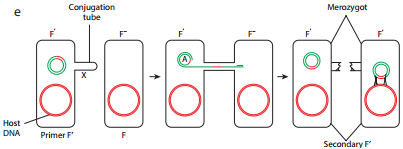
During F′XF conjugation (Figure 12.17 e) the recipient becomes F′ and is a partially diploid since it has two set of the genes carried by the plasmid.
Transfer of Genetic Material img 7

The natural phenomenon of conjugation is now exploited for gene transfer and Recombinant DNA technology. In general, the plasmids lack conjugative functions and therefore, they are not as such capable of transferring DNA to the recipient cells. However, some plasmids with conjugative properties can be prepared and used.

Transduction

Transduction is the transfer of bacterial genes from one bacteria to other by viruses. Example: Bacteriophage (Bacterial viruses). To understand the role of bacteriophage in gene transfer, the lifecycle of bacteriophage is described below briefly.

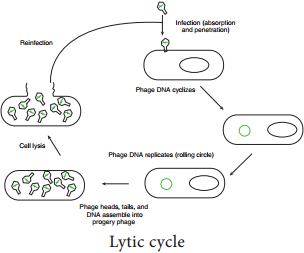
After infecting the host cell, a bacteriophage (phage for short) often takes control and forces the host to make many copies of the virus. Eventually the host bacterium bursts or lyses and releases new phages. This reproductive cycle is called a lytic cycle because it ends in lysis of the host.

The lytic cycle (Figure 12.18) has four phases.

  1. Attachment – Virus particle attaches to a specific receptor site on the bacterial surface.
  2. Penetration – the genetic material, which is often double stranded DNA, then enters the cell.
  3. Biosynthesis – After adsorption and penetration, the virus chromosome forces the bacterium to make viral componentsviral nucleic acids and proteins.
  4. Assembly – Phages are assembled from the virus components. Phage nucleic acid is packed within the virus’s protein coat.
  5. Release – mature viruses are released by cell lysis.
    Transfer of Genetic Material img 8

Bacterial viruses that reproduce using a lytic cycle often are called virulent bacteriophages (e.g. T phages) because they destroy the host cell. The genome of many DNA phages such as the lambda phage, after adsorption and penetration do not take control of its host and does not destroy the host.

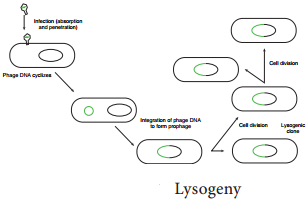
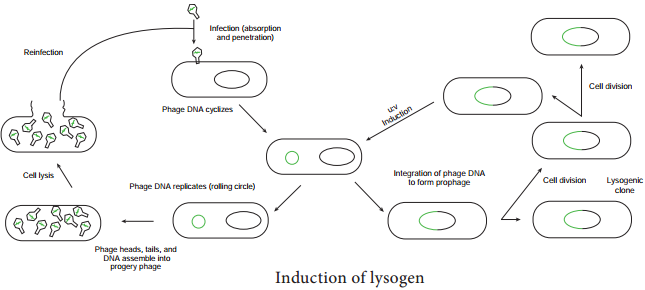
Instead the viral genome remains within the host cell and is reproduced along with the bacterial chromosome. The infected bacteria may multiply for long periods while appearing perfectly normal. Each of these infected bacteria can produce phages and lyses under appropriate environmental conditions. This relationship between phage and its host is called lysogeny (Figure 12.19).
Transfer of Genetic Material img 9

Bacteria that can produce phage particles under some conditions are said to be lysogens or lysogenic bacteria. Phages which are able to establish lysogeny are called temperate phages. The latent form of virus genome that remains within the host without destroying the host is called the prophage.

The prophage usually is integrated into the bacterial genome. Sometimes phage reproduction is triggered in a lysogenized culture by exposure to UV radiation or other factors. The lysosomes are then destroyed and new phages released – This phenomenon is called induction (Figure 12.20)
Transfer of Genetic Material img 10

Sometimes, bacterial genes are incorporated into a phage capsid because of errors made during the virus life cycle. The virus containing these genes then infects them into another bacterium, resulting in the transfer of genes from one bacterium to the other. Transduction may be the most common mechanism for gene exchange and recombination in bacteria.

There are two very different kinds of transduction.

  1. Generalized transduction
  2. Specialized transduction

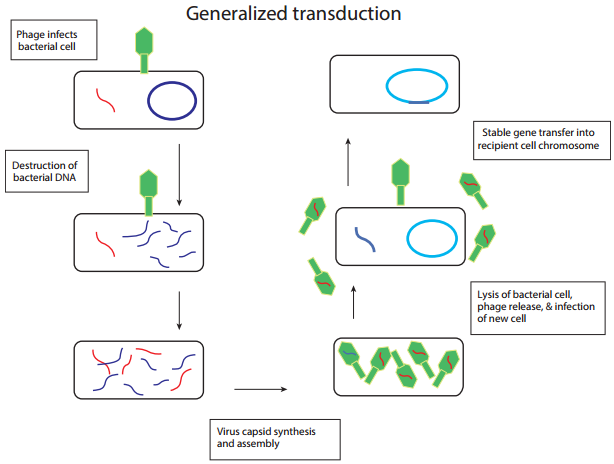
Generalized transduction (Figure 12.21 a) occurs during the lytic cycle of virulent and temperate phages. During the assembly stage, when the viral chromosomes are packaged into protein capsids, random fragments of the partially degraded bacterial chromosome also may be packaged by mistake. The resulting virus particles often injects the DNA into another bacterial cell but does not initiate a lytic cycle.

Thus in generalized transduction any part of the bacterial chromosome can be transferred. Once the DNA has been injected it may integrate into the recipient cell’s chromosome to preserve the transferred genes. About 70 to 90% of the transferred DNA is not integrated but is often able to survive and express itself. However, if the transferred DNA is degraded gene transfer is unsuccessful.
Transfer of Genetic Material img 11

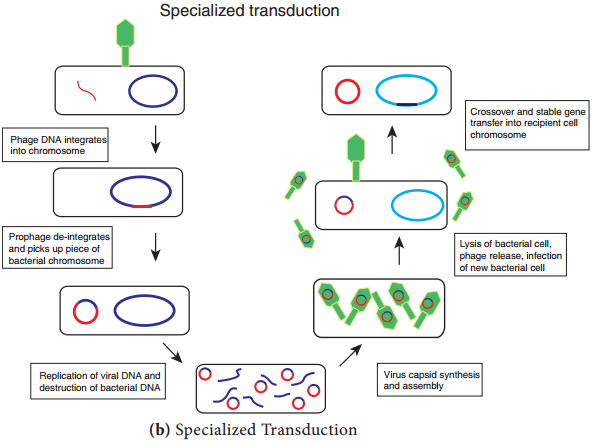
Specialized Transduction (Figure 12.21 b) is also called restricted transduction in which only specific portions of the bacterial genome is carried by the phage. When a prophage is induced to leave the host chromosome, exicision is sometimes carried out improperly.

The resulting phage genome contains portions of the bacterial chromosome next to the integration site. When this phage infects another bacterium, it transfers the bacterial genes from the donor bacterium along with phage DNA. Here only the bacterial genes that are close to the site of prophage are transferred. So, this transduction is called specialized.
Transfer of Genetic Material img 12

Law of Motion Class 11 Notes Physics Chapter 5

By going through these CBSE Class 11 Physics Notes Chapter 5 Law of Motion, students can recall all the concepts quickly.

Law of Motion Notes Class 11 Physics Chapter 5

→ Inertia is proportional to the mass of the body.

→ The force causes acceleration.

→ In the absence of force, a body moves along a straight-line path.

→ If the net external force on a body is zero, its acceleration is zero. Acceleration can be non-zero only if there is a net external force on the body.

→ If a body moves along a curved path, then it is certainly acted upon by a force.

→ C.G.S. and S.I. absolute units of force are dyne and newton (N) respectively and 1 N = 105 dynes.

→ C.G.S. and S.I. gravitational units of force are gm wt. and kg wt. (i.e. kilogram weight) respectively and 1 kg wt = kgf.

→ 1 gm wt = 1 gmf, 1 kg f = 103 gm f.

→ 1 kg f = 9.8 N.

→ 1 gm f = 1 gm wt = 980 dyne.

→ Impulse = change in momentum.

→ Four types of forces exist in nature, they are gravitational force (Fg), electromagnetic force (Fem), weak force (Fw), and nuclear force (Fn).

→ Fg: Fem: Fw: Fn:: 1: 1025: 1036: 1038.

→ Rocket works on the principle of conservation of linear momentum.

→ Rocket ejects gases backward and as a result, acquires a forward momentum.

→ If Δm is the mass of the gas ejected backward in time At with speed u, then the force acting on the rocket will be:
F = u \(\frac{\Delta m}{\Delta t}\)

→ When a force acting on a particle is always perpendicular to its velocity, then the path followed by the particle is a circle.

→ In a uniform circular motion, the magnitude of velocity always remains constant and only its direction changes continuously.

→ If a body moves with a vertical acceleration a, then its apparent weight is given by:
R = m (g – a)

→ The weight of a body measured by the spring balance in a lift is equal to the apparent weight.

→ The apparent weight of a body falling freely is zero because for it, a = g. It is the case of weightlessness.

→ If the lift falls with a < g, the apparent weight of the body decreases.

→ If the lift accelerates upwards, the apparent weight of the body increases.

→ The true weight of the body = mg.

→ If the lift rises or falls with constant speed, then apparent weight = true weight

→ If the person climbs up along the rope with acceleration ‘a’, then tension in the rope will be T = m (g + a).

→ If the person climbs down along the rope with acceleration ‘a’, then tension in the rope will be T = m (g – a).

→ If the person climbs up or down the rope with uniform velocity, then tension in the string, T = mg.

→ If a body starting from rest moves along a smooth inclined plane of length l, height h and having an angle of inclination 0, then:
1. Its acceleration down the plane is g sin θ.

2. Its velocity at the bottom of the inclined plane will be
\(\sqrt{2 \mathrm{gh}}=\sqrt{2 \mathrm{~g} l \sin \theta}\)

3. Time taken to reach the bottom will be:
t = \(\sqrt{\frac{2 l}{g \sin \theta}}=\left(\frac{2 l^{2}}{g h}\right)^{\frac{1}{2}}\)

= \(\left(\frac{2 \mathrm{~h}}{\mathrm{~g} \sin \theta}\right)^{\frac{1}{2}}=\frac{1}{\sin \theta}\left(\frac{2 \mathrm{~h}}{\mathrm{~g}}\right)^{\frac{1}{2}}\)

4. If the angle of inclination is changed keeping the length constant, then:
\(\frac{\mathrm{t}_{1}}{\mathrm{t}_{2}}=\left(\frac{\sin \theta_{2}}{\sin \theta_{1}}\right)^{\frac{1}{2}}\)

5. If the angle of inclination is changed keeping the height constant, then
\(\frac{\mathrm{t}_{1}}{\mathrm{t}_{2}}=\frac{\sin \theta_{2}}{\sin \theta_{1}}\)

→ A system or a body is said to be in equilibrium when the net force acting on it is zero.

→ If the vector sum of a number of forces acting on a body is zero, then it is said to be in equilibrium.

→ Friction acts opposite to the direction of motion of the body and parallel to the surfaces in contact.

→ Friction depends on the nature of surfaces in contact.

→ Friction is more when the surfaces in contact are rough.

→ Friction is a necessary evil it causes the dissipation of energy. But we need.

→ Friction is of different types such as static friction, kinetic (sliding or rolling) friction, dry friction, wet friction.

→ Static friction is a variable force.

→ The maximum value of static friction is called limiting friction.

→ Static friction is equal and opposite to the force applied to the body.

→ When the applied force is equal to the limiting friction, the body begins to slide.

→ The kinetic friction is less than the limiting friction.

→ The friction on a rolling body is called rolling friction.

→ The rolling friction is less than sliding friction.

→ Friction is a self-adjusting force.

→ The limiting friction is directly proportional to the normal reaction i. e. F ∝ R.

→ The net reactive force acting perpendicular to the surface is called normal reaction (R) and is equal to the force with which the two bodies are pressed against each other.

→ The ratio of limiting friction (F) to the normal reaction (R) is called the coefficient of limiting friction (μl) i.e. μl = F/R.

→ The limiting friction is independent of the shape or area of surfaces in contact if R = constant.

→ μl is a dimensionless constant. It depends on the nature of the surfaces in contact. It is independent of the normal reaction.

→ No work is done against static friction.

→ The kinetic friction opposes the motion of the body.

→ Static friction is the frictional force that comes into play when a body tends to move on the surface of another body.

→ Static friction is due to the interlocking of microscopic projections on the surface of the body.

→ The change from static to kinetic friction is by a stick and slip process. The slip is a break away from the static condition.

→ Sticking is caused by the second interlocking.

→ Kinetic friction is a constant force.

→ It is independent of the applied force.

→ The coefficient of kinetic friction is equal to the ratio of kinetic friction (Fk) to the normal reaction (R) i.e. μk = Fk/R.

→ Fk is independent of the area of contact between two bodies.

→ Work is done against kinetic friction.

→ Coefficient of rolling friction (μr) = \(\frac{\mathrm{F}_{\mathrm{r}}}{\mathrm{R}}=\frac{\text { rolling friction }}{\text { normal reaction }}\)

→ μr < μk < μs.

→ The friction between two solid surfaces is called dry friction.

→ The friction between a solid surface and a liquid surface is called wet friction.

→ The dry friction causes squeaking of the surfaces trying to move over each other.

→ The dry friction can also cause pleasant sound e.g. the bow under-going stick and slip motion on the string of violin causes pleasant sound.

→ Friction can be decreased by converting dry friction to wet friction.

→ Friction may increase if the surfaces are highly polished. This happens due to cold welding together of the polished surfaces.

→ The angle between the normal reaction and the resultant force of friction and the normal reaction is called the angle of friction (θ).

→ µ = tan θ i.e. coefficient of friction = tan θ.

→ The angle of the inclined plane at which the body placed on it just begins to slide down is called the angle of repose (α) or angle of sliding.

→ µ = tan α.

→ Also α = θ.

→ When a body rotates, all its particles describe circular paths about a line called the axis of rotation.

→ The centers of circles described by the different particles of the rotating body lie on the axis of rotation.

→ The Axis of rotation is perpendicular to the plane of rotation.

→ For uniform circular motion, we have

  1. ac = v2/r = rω2
  2. v = rω
  3. a ∝ r

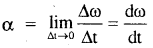
where α = angular acceleration.

→ When a body rotates with uniform velocity, its different particles have centripetal acceleration directly proportional to the radius i.e. ac ∝ r.

→ There can be no circular motion without centripetal force.

→ Centripetal force can be a mechanical, electrical, or magnetic force.

→ In a uniform circular motion, the magnitude of momentum, velocity, and kinetic energy remains constant.

→ Centrifugal force is the pseudo force that is equal and opposite to the centripetal force. It is directed away from the center along the radius.

→ The centrifugal force appears to act on the agency which exerts the centripetal force.

→ The centrifugal force cannot balance the centripetal force because they act on different bodies.

→ The railway tracks and roads are banked for safe turning. The banking angle θ for safe turning is tan θ = \(\frac{\mathbf{v}^{2}}{r g}\) . Also tan θ = \(\frac{\mathrm{h}}{\mathrm{d}}\)
where d = width of road
h = height of the outer edge of the road above the inner edge

→ Maximum speed of the car without overturning when it moves on a circular banked road of radius r is
umax = \(\sqrt{\frac{\mathrm{grd}}{\mathrm{h}}}\)
when d = \(\frac{1}{2}\) of the distance between two wheels of the car.

→ When a particle of mass m, tied to a string of length is rotated in a horizontal plane with a speed ‘y’, the tension is given by
T = \(\frac{m v^{2}}{r}\)

→ When the string breaks, the particle moves away from the center but tangentially.

→ K.E. of a body rotating in a vertical plane is different at different points.

→ The angle through which the outer edge of the road track is raised above the inner edge is called the angle of banking of roads/ tracks.

→ For safe going of the vehicle round the circular level road, the required condition is:
μ ≤ \(\frac{\mathrm{v}^{2}}{\mathrm{rg}}\)

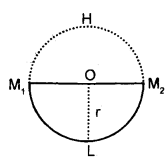
→ A simple pendulum oscillates in a vertical plane. It will oscillate only if its motion is in the lower semi-circle.

→ For oscillation, the velocity at the lowest point L must be such that the velocity reduces to zero at points M1 and M2.
Law of Motion Class 11 Notes Physics 1
Thus, \(\frac{1}{2}\)mve2 = mgr
or
ve = \(\sqrt{2 \mathrm{gr}}\)
i.e ve ≤ \(\sqrt{2 \mathrm{gr}}\)

→ If ve > \(\sqrt{2 \mathrm{gr}}\) it will not then oscillate in the lower semi-circle.

→ Minimum velocity that a body should have at the lowest point (L) and highest point (H) of a vertical circle for looping it are
v1 = \(\sqrt{5 \mathrm{gr}}\) and v2 = \(\sqrt{\mathrm{gr}}\)
where v1 and v2 are velocities at L and H points respectively. Maximum speed with which a vehicle can take a safe turn on a level road is v = \(\sqrt{\mu \mathrm{gr}}\).

→ Maximum speed of the vehicle with which it can take a safe turn on a banked road is given by
v = \(\sqrt{rgθ}\)

→ Sufficient force of friction is there between the tyres of the vehicle and the banked road, then the maximum speed of the vehicle for taking a safe turn is given by

vmax = \(\left(rg\frac{\mu_{\mathrm{s}}+\tan \theta}{1-\mu_{\mathrm{s}} \tan \theta}\right)^{\frac{1}{2}}\)

→ The first law is also called the law of inertia according to which the state of rest or uniform motion of a body remains the same unless acted upon by an external force.

→ The action and reaction always occur in pairs.

→ The position of an event or particle is measured by using a system of coordinates called a frame of reference.

→ There are two types of frame of reference

  1. inertial and
  2. non-inertial (or accelerated frame of reference).

→ A frame of reference with uniform motion with respect to another inertial frame of reference is also the inertial frame of reference in which the body is situated and obey’s Newton’s law of motion.

→ Inertia: A body at rest or in uniform motion continues in its state unless acted upon by an external force.

→ Force: Force is the action that changes or tends to change the state of rest or uniform motion of a rigid body along a straight line.

→ Rigid body: A body whose various particles move through the same distance parallel to each other under the action of external force i.e. there is no relative motion amongst the various particles of the body under the action of an external force is called a rigid body.

→ Linear momentum (p).: The quantity of motion possessed by a body is called its momentum Mathematically the linear momentum of the body is equal to the product of its mass and velocity i.e.
p = mv

→ Retardation: The quantity of hindrance in the motion of a body is called retardation and the force which retards the body is called retarding force.

→ Newton’s first law of motion: A body continues in its state of rest or uniform motion along a straight line in the absence of external force.

This is called Newton’s first law of motion.
\(\overrightarrow{\mathrm{F}}\) ∞ \(\frac{\mathrm{d}(\overrightarrow{\mathrm{p}})}{\mathrm{dt}}\)
or
\(\overrightarrow{\mathrm{F}}\) = k m\(\overrightarrow{\mathrm{a}}\)

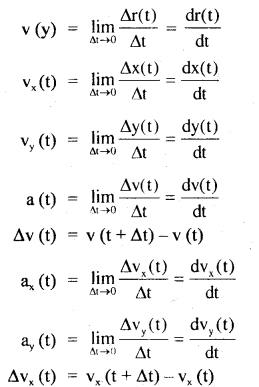
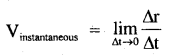
In non-relativistic dynamics \(\frac{\Delta \overrightarrow{\mathrm{v}}}{\Delta \mathrm{t}}=\overrightarrow{\mathrm{a}}\), the acceleration of the body or particle.

When force F, mass m and acceleration arc measured in Newton, kilogram and meter per second respectively. i.e. in S.L units. so that
\(\overrightarrow{\mathrm{F}}\) = m \(\overrightarrow{\mathrm{a}}\)

Its scalar from is F = ma

→ Newton (N): It is the SI unit of measurement of force. One newton is that force that causes an acceleration of 1 ms 2 in a rigid body of mass 1 kg.
∴ 1 N = 1 kg × 1 ms-2

→ Impulse: The impact of force is called impulse. Mathematically impulse = F × Δt = force × time. So impulse = m(Δv).

→ The inertia of rest: The property of a body to be unable to change its state of rest itself is called the inertia of rest,

→ The inertia of motion: The property of a body by virtue of which it cannot change by itself its state of uniform motion is called inertia of motion.

→ The inertia of direction: The property of a body by virtue of which it cannot change its own direction of motion is called the direction of inertia.

→ Newton’s third law of motion: States that “To every action, there is an equal and opposite reaction.”
FBA = – FAB
where FAB = force exerted on body 8 by body A, and FBA = force exerted on body A by body B.

→ Law of conservation of linear momentum: The linear momentum of an isolated system of bodies or particles is always conserved, that is it remains constant.

→ Static equilibrium: A body is said to be in static equilibrium if the vector sum of all the forces acting on it is zero. This is a necessary and sufficient condition for a point object only.

→ Lubricants: The substances which are applied to the surfaces to reduce friction are called lubricants.

Important Formulae:
→ Linear momentum of a body of mass m and moving with a velocity v is: p = mv

→ Change in momentum, Δp = m Δ v

→ If two objects of masses M and m have same momentum, then
\(\frac{M}{m}=\frac{v}{V}\)

→ F = ma

→ Resultant of two forces F, and F2 acting simultaneously at angle θ is given by F = F1 + F2
The magnitude of F is given by parallelogram law of vectors
F = \(\sqrt{F_{1}^{2}+F_{2}^{2}+2 F_{1} F_{2} \cos \theta}\)

→ The orthogonal components of F and a are:
F = Fxi + Fyj + Fzk
and a = axi + ayj + azk

→ Inertial mass, m1 = \(\frac{\mathrm{F}}{\mathrm{a}}\)

→ Gravitational mass, mg = \(\frac{\mathrm{F}}{\mathrm{g}}\)

→ Impulse I = FΔt = mΔv

→ Newton’s third law of motion:
F12 = – F21
or
m1a1 = – m2a2

→ Equilibrium of body under three concurrent forces:
F1 + F2 + F3 = 0
Or
F3 = – (F1 +F2)

→ Simple pulley: a = acceleration of masses m1 and m2
= \(\left(\frac{m_{2}-m_{1}}{m_{1}+m_{2}}\right)\)
If m2 > m1

Tension in the string connecting the two masses and passing over the pulley is given by
T = \(\left(\frac{2 m_{1} m_{2}}{m_{1}+m_{2}}\right)\)g

→ Solving problems using Free Body Diagram Technique:

  1. Draw a simple neat diagram of the system as per the given problem.
  2. Isolate the object of interest. This is now called a free body.
  3. Consider all the external forces acting on the free body and mark them by arrows touching the free body with their line of action clearly represented.
  4. Now apply Newton’s second law of motion.
  5. In a non-inertial frame consider the pseudo forces like real forces acting on the object in addition to other external forces. The direction of such a force will be opposite to the direction of acceleration of the frame of reference.

MCQ Questions for Class 10 Sanskrit Chapter 7 सौहार्दं प्रकृतेः शोभा with Answers

Check the below NCERT MCQ Questions for Class 10 Sanskrit Chapter 7 सौहार्दं प्रकृतेः शोभा with Answers Pdf free download. MCQ Questions for Class 10 Sanskrit with Answers were prepared based on the latest exam pattern. We have provided सौहार्दं प्रकृतेः शोभा Class 10 Sanskrit MCQs Questions with Answers to help students understand the concept very well.

Students can also read NCERT Solutions for Class 10 Sanskrit Chapter 7 Questions and Answers at LearnInsta. Here all questions are solved with a detailed explanation, It will help to score more marks in your examinations.

निम्नवाक्येषु रेखांकितपदानां आधृत्य विकल्पेभ्यः उचितं पदं चित्वा प्रश्ननिर्माणं कुरुत-

Question 1.
मयूरः विधात्रा एव पक्षिराजः कृतः।
(i) कस्य
(ii) केन
(iii) किम्
(iv) कः

Answer

Answer: (ii) केन


Question 2.
मयूरस्य नृत्यं तु प्रकृतेः आराधना।
(i) कस्य
(ii) कस्याः
(iii) कः
(iv) कथम्

Answer

Answer: (ii) कस्याः


Question 3.
व्याघ्रचित्रको नदीजलं पातुम् आगतौ।
(i) कः
(ii) कौ
(iIi) कस्योः
(iv) कयोः

Answer

Answer: (ii) कौ


Question 4.
मयूरस्य पिच्छानाम् सौन्दर्य अपूर्वम् अस्ति।
(i) कीदृशम्
(ii) केषाम्
(iii) कीदृशः
(iv) किम्

Answer

Answer: (ii) केषाम्


Question 5.
सिंहमोदयेन सम्यक् उक्तम्।
(i) कथम्
(ii) केन
(iii) किम्
(iv) काम्

Answer

Answer: (ii) केन


Question 6.
अधुना तु कोऽपि पक्षी एव रोजति निश्चेतव्यम्।
(i) कदा
(ii) कुत्र
(iii) का
(iv) किमर्थम्

Answer

Answer: (i) कदा


Question 7.
व्याघ्रचित्रकौ भक्षको न तु रक्षको।
(i) कौ
(ii) कीदृशौ
(iii) कयौः
(iv) कस्योः

Answer

Answer: (i) कौ


Question 8.
बकस्य कारणात् तु सर्वं पक्षिकुलम् अवमानितं जातम्।
(i) कीदृशः
(ii) कीदृशम्
(iii) किम्
(iv) कम्

Answer

Answer: (ii) कीदृशम्


Question 9.
काकस्य सत्यप्रियता तु जानानां कृते उदाहरणस्वरूपा अस्ति।
(i) काम्
(ii) केषाम्
(iii) कथम्
(iv) किम्

Answer

Answer: (ii) केषाम्


Question 10.
काकः कर्कशध्वनिना वातावरणम् आकुलीकरोति।
(i) का
(ii) केन
(iii) केभ्यः
(iv) कथम्

Answer

Answer: (ii) केन


Question 11.
काकः मेध्यामध्यम् सर्वं भक्षयति।
(i) कीदृशम्
(ii) कम्
(iii) किम्
(iv) कथम्

Answer

Answer: (iii) किम्


Question 12.
राजा तु रक्षकः भवति।
(i) का
(ii) कः
(iii) काः
(iv) किम्

Answer

Answer: (ii) कः


Question 13.
पिककाकयोः भेदः वसन्तसमये प्राप्ते।
(i) के
(ii) कयोः
(iii) कदा
(iv) कथम्

Answer

Answer: (iii) कदा


Question 14.
सिंहः सर्वजन्तून् दृष्ट्वा पृच्छति।
(i) किम्
(ii) कान्
(iii) कम्
(iv) कः

Answer

Answer: (ii) कान्


Question 15.
परस्परं विवादतः प्राणिनां हानिः जायते।
(i) काम्
(ii) केषाम्
(iii) किम्
(iv) कथम्

Answer

Answer: (ii) केषाम्


Question 16.
नदीमध्ये एकः बकः आसीत्।
(i) कुत्र
(ii) के
(iii) कदा
(iv) कयोः

Answer

Answer: (i) कुत्र


आधोलिखितस्य नाट्यांशं पठित्वा एतदाधारित प्रश्नानाम् उत्तराणि निर्देशानुसारं लिखत

(क) (वनस्य दृश्यम् समीपे एवैका नदी अपि वहति।) एकः सिंहः सुखेन विश्राम्यते तदैव एकः वानरः आगत्य तस्य पुच्छ धुनोति। क्रुद्धः सिंहः तं प्रहर्तुमिच्छति परं वानरस्तु कूर्दित्वा वृक्षमारूढः। तदैव अन्यस्मात् वृक्षात् अपरः वानरः सिंहस्य कर्णमाकृष्य पुनः वृक्षोपरि आरोहति। एवमेव वानराः वारं वारं सिंह तुदन्ति। क्रुद्धः सिंहः इतस्ततः धावति, गर्जति परं किमपि कर्तुमसमर्थः एव तिष्ठति। वानराः हसन्ति वृक्षोपरि च विविधाः पक्षिणः अपि सिंहस्य एतादृशीं दशां दृष्ट्वा हर्षमिश्रितं कलरवं कुर्वन्ति। निद्राभङ्गदुःखेन वनराजः सन्नपि तुच्छजीवैः आत्मनः एतादृश्या दुरवस्थया श्रान्तः सर्वजन्तून् दृष्ट्वा पृच्छति

Question 1.
कस्य समीपे एका नदी वहति?

Answer

Answer: वनस्य


Question 2.
एकः सिंहः कथम् विश्राम्यते?

Answer

Answer: सुखेन


Question 3.
वानराः वारं वारं कम् तुदन्ति?

Answer

Answer: सिंहम्


Question 4.
क्रुद्धः सिंहः किम् करोति?

Answer

Answer: क्रुद्धः सिंहः इतस्ततः धावति, गर्जति परं किमपि कर्तुम् समर्थः एव न तिष्ठति।


Question 5.
पक्षिणः अपि सिंहस्य दशां दृष्ट्वा किं कुर्वन्ति?

Answer

Answer: पक्षिणः अपि सिंहस्य एतादृशीं दशां दृष्ट्वा हर्षमिश्रितं कलरवं कुर्वन्ति।


Question 6.
‘तुदन्ति’ इति क्रियापदस्य कर्तृपदं किम्?

Answer

Answer: वानराः


Question 7.
‘पक्षिणः’ इति कर्तृपदस्य क्रियापदं किम्?

Answer

Answer: कुर्वन्ति


Question 8.
‘क्रुद्धः सिंहः’ अनयोः पदयोः विशेष्यपदं किम्?

Answer

Answer: सिंहः


Question 9.
‘तस्य पुच्छ धुनोति’ अत्र ‘तस्य’ पदं कस्मै प्रयुक्तम्?

Answer

Answer: सिंहाय


(ख) सिंहः-(क्रोधेन गर्जन्) भोः! अहं वनराजः किं भयं न जायते? किमर्थं मामेवं तुदन्ति सर्वे मिलित्वा?
एकः वानरः- यतः त्वं वनराजः भवितुं तु सर्वथाऽयोग्यः। राजा तु रक्षकः भवति परं त्वं तु भक्षकः। अपि च स्वरक्षायामपि समर्थः नासि तर्हि कथमस्मान् रक्षिष्यसि?
अन्यः वानरः-किं न श्रुता त्वया पञ्चतन्त्रोक्तिः

Question 1.
कः कथयति अहं वनराजः अस्मि?

Answer

Answer: सिंहः


Question 2.
सिंहः कथम् अवदत्?

Answer

Answer: क्रोधेन


Question 3.
राजा तु कीदृशः भवति?

Answer

Answer: रक्षकः


Question 4.
वानरः सिंहम् किं कथयति?

Answer

Answer: वानरः सिंहम् कथयति त्वं तु वनराजः भवितुम् तु सर्वथाऽयोग्यः। राजा तु रक्षक : भवति परं भवान् भक्षकः।


Question 5.
सिंहः क्रोधेन गर्जन् किं वदति?

Answer

Answer: सिंहः क्रोधेन गर्जन् वदति यत्-भोः! अहं वनराजः किं भयं न जायते? किमर्थं मामेवं तुदन्ति सर्वे मिलित्वा?


Question 6.
‘पीडयन्ति’ इति अर्थे कि पदं प्रयुक्तम्?

Answer

Answer: तुदन्ति


Question 7.
‘भक्षकः’ इति विपर्ययपदं कि प्रयुक्तम्?

Answer

Answer: रक्षकः


Question 8.
‘त्वया’ इति कर्तृपदस्य क्रियापदम् किम्?

Answer

Answer: श्रुता


Question 9.
‘त्वं वनराजः भवितुं तु सर्वथाऽयोग्यः’ अत्र ‘त्वं’ पदं कस्मै प्रयुक्तम्?

Answer

Answer: सिंहाय


(ग) काकः – आम् सत्यं कथितं त्वया-वस्तुतः वनराजः भवितुं तु अहमेव योग्यः।
पिकः – (उपहसन्) कथं त्वं योग्यः वनराजः भवितुं, यत्र तत्र का-का इति कर्कशध्वनिना वातावरणमाकुलीकरोषि। न रूपं न ध्वनिरस्ति। कृष्णवर्णं, मेध्यामेध्यभक्षकं त्वां कथं वनराजं मन्यामहे वयम्?
काकः – अरे! अरे! किं जल्पसि? यदि अहं कृष्णवर्णः तर्हि त्वं किं गौराङ्गः? अपि च विस्मर्यते किं यत् मम सत्यप्रियता तु जनानां कृते उदाहरणस्वरूपा-‘अनृतं वदसि चेत् काकः दशेत्’-इति प्रकारेण। अस्माकं परिश्रमः ऐक्यं च विश्वप्रथितम् अपि च काकचेष्ट: विद्यार्थी एव आदर्शच्छात्रः मन्यते। पिक:-अलम् अलम् अतिविकत्थनेन। किं विस्मर्यते यत्

Question 1.
अनृतं वदसि चेत् कः दशेत्?

Answer

Answer: काकः


Question 2.
क: वातावरणम् आकुली करोति?

Answer

Answer: काकः


Question 3.
कस्य सत्यप्रियता तु जनानां कृते उदाहरणस्वरूपा?

Answer

Answer: काकस्य


Question 4.
काकः स्वविषये किं कथयति?

Answer

Answer: काकः स्वविषये कथयति यत् अस्माकम् परिश्रमं ऐक्यं च विश्वप्रथितम् अपि च काकचेष्टः विद्यार्थी एव आदर्शच्छात्रः मन्यते।


Question 5.
केषाम् किं विश्वप्रथितम्?

Answer

Answer: काकानाम् परिश्रमः ऐक्यं च विश्वप्रथितम्।


Question 6.
अस्मिन् नाट्यांशे विपर्ययपदं किम् अस्ति?

Answer

Answer: मेध्यामेध्यम्


Question 7.
“मम सत्यप्रियता …………………. अस्मिन् वाक्ये ‘मम’ पदं कस्मै प्रयुक्तम्?

Answer

Answer: काकाय


Question 8.
‘असत्यम्’ इति पदस्य अर्थे किं पदं प्रयुक्तम्?

Answer

Answer: अनृतम्


Question 9.
‘कथितम्’ इति क्रियापदस्य कर्तृपदं किम्?

Answer

Answer: त्वया


(घ) काकः- रे परभृत्! अहं यदि तव संततिं न पालयामि तर्हि कुत्र स्युः पिकाः? अतः अहम् एव करुणापरः पक्षिसम्राट् काकः।
गजः-समीपतः एवागच्छन् अरे! अरे! सर्वां सम्भाषणं शृण्वन्नेवाहम् अत्रागच्छम्। अहं विशालकायः, बलशाली, पराक्रमी च। सिंहः वा स्यात् अथवा अन्यः कोऽपि। वन्यपशून् तु तुदन्तं जन्तुमहं स्वशुण्डेन पोथयित्वा मारयिष्यामि। किमन्यः कोऽप्यस्ति एतादृशः पराक्रमी। अतः अहमेव योग्यः वनराजपदाय।
वानरः-अरे! अरे! एवं वा (शीघ्रमेव गजस्यापि पुच्छं विधूय वृक्षोपरि आरोहति।)

Question 1.
काकः कस्य सन्ततिं पालयति?

Answer

Answer: पिकस्य


Question 2.
करुणापरः पक्षिसम्राट् कः?

Answer

Answer: काकः


Question 3.
कः वनराजपदाय योग्यः?

Answer

Answer: गजः


Question 4.
गजः आत्मनः विषये किं कथयति?

Answer

Answer: गजः आत्मनः विषये कथयति यत् अहम् विशालकायः, बलशाली, पराक्रमी च। मया सदृशः कोऽपि पराक्रमी नास्ति।


Question 5.
काकः स्वविषये पिकं किं वदति?

Answer

Answer: काकः स्वविषये पिंक वदति-रे परभृत्! अहं यदि तव संततिं न पालयामि तर्हि कुत्र स्युः पिकाः? अतः अहम् एव करुणापरः पक्षिसम्राट् काकः।


Question 6.
‘सर्वाम् वार्ताम्’ अत्र विशेष्यपदं किं प्रयुक्तम्?

Answer

Answer: वार्ताम्


Question 7.
‘अहमेव योग्यः’ अत्र ‘अहम्’ पदं कस्मै प्रयुक्तम्?

Answer

Answer: गजाय


Question 8.
‘पालयामि’ इति क्रियापदस्य कर्तृपदं किम्?

Answer

Answer: अहम्


Question 9.
‘वानरः’ इति कर्तृपदस्य क्रियापदम् किम्?

Answer

Answer: आरोहति


(ङ) (गजः तं वृक्षमेव स्वशुण्डेन आलोडयितुमिच्छति परं वानरस्तु कुर्दित्वा अन्यं वृक्षमारोहति। एवं गजं वृक्षात् वृक्षं प्रति धावन्तं दृष्ट्वा सिंहः अपि हसति वदति च।)
सिंह-भोः गज! मामप्येवमेवातुदन् एते वानराः।
वानरः-एतस्मादेव तु कथयामि यदहमेव योग्यः वनराजपदाय येन विशालकायं पराक्रमिणं, भयंकरं चापि सिंह गजं वा पराजेतुं समर्था अस्माकं जातिः। अतः वन्यजन्तूनां रक्षायै वयमेव क्षमाः।
(एतत्सर्वं श्रुत्वा नदीमध्यस्थितः एकः बकः)
बकः-अरे! अरे! मां विहाय कथमन्यः कोऽपि राजा भवितुमर्हति अहं तु शीतले जले बहुकालपर्यन्तम् अविचलः ध्यानमग्नः स्थितप्रज्ञ इव स्थित्वा सर्वेषां रक्षायाः उपायान् चिन्तयिष्यामि, योजना निर्मीय च स्वसभायां विविधपदमलंकुर्वाणैः जन्तुभिश्च मिलित्वा रक्षोपायान् क्रियान्वितान् कारयिष्यामि अतः अहमेव वनराजपदप्राप्तये योग्यः।
मयूरः- (वृक्षोपरितः-साट्टहासपूर्वकम्) विरम विरम आत्मश्लाघायाः। किं न जानासि यत्

Question 1.
गजः वृक्षम् केन आलोडयितुमिच्छति?

Answer

Answer: स्वशुण्डेन


Question 2.
वानरः किम् कृत्वः वृक्षामारोहति?

Answer

Answer: कूर्दित्वा


Question 3.
कः शीतले जले तिष्ठति?

Answer

Answer: बकः


Question 4.
बकः कुत्र स्थित्वा सर्वेषां रक्षायाः उपायान् चिन्तयिष्यति?

Answer

Answer: बकः शीतले जले बहुकालपर्यन्तम् अविचलः ध्यानमग्नः स्थितप्रज्ञः इव स्थित्वा सर्वेषां रक्षायाः उपायान् चिन्तयिष्याति।


Question 5.
सिंहः कथं हसति वदति च?

Answer

Answer: गजं वृक्षात् वृक्षं प्रति धावन्तं दृष्ट्वा सिंहः अपि हसति वदति च।


Question 6.
‘स्थिता प्रज्ञा यस्य सः’ अस्य पदस्य समस्तपदं किम्?

Answer

Answer: स्थितप्रज्ञः


Question 7.
‘आकर्ण्य’ इति पदस्य पर्यायपदं किम्?

Answer

Answer: श्रुत्वा


Question 8.
‘शीतले जले’ अत्र विशेषणपदं किम्?

Answer

Answer: शीतले


Question 9.
‘अयोग्यः’ पदस्य विपर्ययपदं किम्?

Answer

Answer: योग्यः


(च) को न जानाति तव ध्यानावस्थाम्। ‘स्थितप्रज्ञ’ इति व्याजेन वराकान् मीनान् छलेन अधिगृह्य क्रूरतया भक्षयसि। धिक् त्वाम्। तव कारणात् तु सर्वं पक्षिकुलमेवावमानितं जातम्।
वानरः – (सगर्वम्) अतएव कथयामि यत् अहमेव योग्यः वनराजपदाय। शीघ्रमेव मम राज्याभिषेकाय तत्पराः भवन्तु सर्वे वन्यजीवाः।
मयूरः – अरे वानर! तूष्णीं भव। कथं त्वं योग्यः वनराजपदाय? पश्यतु पश्यतु मम शिरसि राजमुकुटमिव शिखां स्थापयता विधात्रा एवाह पक्षिराजः कृतः अतः वने निवसन्तं माम् वनराजरूपेणापि द्रष्टुं सज्जा: भवन्तु अधुना यतः कथं कोऽप्यन्यः विधातुः निर्णयम् अन्यथाकर्तुं क्षमः।
काकः – (सव्यङ्ग्यम् ) अरे अहिभुक्। नृत्यातिरिक्तं का तव विशेषता यत् त्वां वनराजपदाय योग्यं मन्यामहे वयम्।
मयूरः – यतः मम नृत्यं तु प्रकृतेः आराधना। पश्य! पश्य! मम पिच्छानामपूर्वं सौंदर्यम् (पिच्छानुद्घाट्य नृत्यमुद्रायां स्थितः सन्) न कोऽपि त्रैलोक्ये मत्सदृशः सुन्दरः। वन्यजन्तूनामुपरि आक्रमणं कर्तारं तु अहं स्वसौन्दर्येण नृत्येन च आकर्षितं कृत्वा वनात् बहिष्करिष्यामि। अतः अहमेव योग्यः वनराजपदाय।

Question 1.
‘को न जानाति तव ध्यानावस्थाम्।’ इति कः कथयति?

Answer

Answer: मयूरः


Question 2.
केषाम् सौन्दर्यम् अपूर्वम् अस्ति?

Answer

Answer: पिच्छानाम्


Question 3.
वानरः कस्मै आत्मानं योग्यः वदति?

Answer

Answer: वनराजपदाय


Question 4.
विधात्रा मयूरः पक्षिराजः किमर्थम् कृतः?

Answer

Answer: मयूरस्य शिरसि राजमुकुटमिव शिखां स्थापयता विधात्रा एव मयूरम् पक्षिराजः कृतः।


Question 5.
काकः मयूर सव्यङ्ग्यं किं वदति?

Answer

Answer: काकः मयूरं सव्यङ्ग्यं वदति-अरे अहिभुक्। नृत्यातिरिक्तं का तव विशेषता यत् त्वां वनराजपदाय योग्यं मन्यामहे वयम्।


Question 6.
“अहिं भुङक्ते यः सः” इति पदस्य समस्तपदं किं प्रयुक्तम्?

Answer

Answer: अहिभुक्


Question 7.
‘वराकान्’ इति विशेषणपदस्य विशेष्यपदं किम्?

Answer

Answer: मीनान्


Question 8.
‘धिक् त्वाम्’ अत्र ‘त्वाम्’ पदं कस्मै प्रयुक्तम्?

Answer

Answer: बकाय


Question 9.
‘बहिष्करिष्यामि’ इति क्रियापदस्य कर्तृपदं किम्?

Answer

Answer: अहम्


(छ) (एतस्मिन्नेव काले व्याघ्रचित्रको अपि नदीजलं पातुमागतौ एतं विवादं शृणुतः वदतः च) व्याघ्रचित्रकौ -अरे किं वनराजपदाय सुपात्रं चीयते?
एतदर्शं तु आवामेव योग्यौ। यस्य कस्यापि चयनं कुर्वन्तु सर्वसम्मत्या।
सिंह – तूष्णीं भव भोः। युवामपि मत्सदृशौ भक्षकौ न तु रक्षको। एते वन्यजीवाः भक्षकं रक्षकपदयोग्यं न मन्यन्ते अतएव विचारविमर्शः प्रचलित।
बकः -सर्वथा सम्यगुक्तम् सिंहमहोदयेन। वस्तुतः एव सिंहेन बहुकालपर्यन्तं शासनं कृतम् परमधुना तु कोऽपि पक्षी एव राजेति निश्चेतव्यम् अत्र तु संशीतिलेशस्यापि अवकाशः एव नास्ति।

Question 1.
नदीजलं पातुम् को आगतौ?

Answer

Answer: व्याघ्रचित्रकौ


Question 2.
‘आवामेव योग्यौ’ इति कौ वदतः?

Answer

Answer: व्याघ्रचित्रको


Question 3.
केन बहुकालपर्यन्तं शासनं कृतम्?

Answer

Answer: सिंहेन


Question 4.
सिंहः किम् कथयति?

Answer

Answer: सिंहः व्याघ्रचित्रको कथयति यत् युवामापि मत्सदृशौ भक्षकौ न तु रक्षकौ। एते वन्यजीवाः भक्षकं रक्षकपदयोग्यं न मन्यन्ते अतएव विचारविमर्शः प्रचलति।


Question 5.
बकानुसारेण किं निश्चेतव्यम्?

Answer

Answer: सर्वथा सम्यगुक्तम् सिंहमहोदयेन। वस्तुतः एव सिंहेन बहुकालपर्यन्तं शासनं कृतम् परमधुना तु कोऽपि पक्षी एव राजेति बकानुसारेण निश्चेतव्यम् अत्र।।


Question 6.
‘भक्षकौ’ इति पदस्य विपर्ययपदं किम्?

Answer

Answer: रक्षकौ


Question 7.
रक्षकौ’ इति पदस्य कर्तपदं किम्?

Answer

Answer: युवाम्


Question 8.
सम्प्रति’ इति पदस्य पर्यायपदं किम्?

Answer

Answer: अधुना


Question 9.
‘नद्याः जलम्’ इत्यस्य पदस्य समस्तपदं किम्?

Answer

Answer: नदीजलम्


(ज) सर्वे पक्षिणः- (उच्चैः) आम् आम्-कश्चित् खगः एव वनराजः भविष्यति इति।
(परं कश्चिदपि खगः आत्मानं विना नान्यं कमपि अस्मै पदाय योग्यं चिन्तयन्ति तर्हि कथं निर्णयः भवेत् तदा तैः सर्वैः गहननिद्रायां निश्चिन्तं स्वपन्तम् उलूकं वीक्ष्य विचारितम् यदेषः आत्मश्लाघाहीनः पदनिर्लिप्तः उलूको एवास्माकं राजा भविष्यति। परस्परमादिशन्ति च तदानीयन्तां नृपाभिषेकसम्बन्धिनः सम्भाराः इति।) सर्वे पक्षिणः सज्जायै गन्तुमिच्छन्ति तर्हि अनायास एव ….

काकः-(अट्टहासपूर्णेन-स्वेरण)-सर्वथा अयुक्तमेतत् यन्मयूर-हंस-कोकिल-चक्रवाक-शुक-सारसादिषु पक्षिप्रधानेषु विद्यमानेषु दिवान्धस्यास्य करालवक्त्रस्याभिषेकार्थं सर्वे सज्जाः। पूर्ण दिनं यावत् निद्रायमाणः
एषः कथमस्मान् रक्षिष्यति। वस्तुतस्तु।

Question 1.
सर्वे पक्षिणः कस्य सज्जायै गन्तुमिच्छन्ति?

Answer

Answer: उलूकम्


Question 2.
गहननिद्रायां कः स्वपिति?

Answer

Answer: उलूकः


Question 3.
आत्मश्लाघाहीनः को वर्तते?

Answer

Answer: उलूकः


Question 4.
सर्वे पक्षिण: उच्चैः किं कथयन्ति?

Answer

Answer: काकः अट्टहासपूर्णेन स्वरेण वदति-सर्वे पक्षिणः उच्चैः कथयन्ति यत् आम् आम् कश्चित् खगः एव वनराजः भविष्यति इति।


Question 5.
काकः अट्टहासपूर्णेन स्वरेण किं वदति?

Answer

Answer: काकः अट्टहासपूर्णेन स्वेरण वदति-सर्वथा अयुक्तमेतत् यन्मयूर-हंस-कोकिल-चक्रवाक-शुक-सारसादिषु पक्षिप्रधानेषु विद्यमानेषु दिवान्धस्यास्य करालवक्त्रस्याभिषेकार्थं सर्वे सज्जाः। पूर्ण दिनं यावत् निद्रायमाणः एषः कथमस्मान् रक्षिष्यति।


Question 6.
‘पशवः’ इति पदस्य विपर्ययपदं किम् अस्ति?

Answer

Answer: पक्षिणः


Question 7.
‘सर्वे पक्षिणः’ अत्र विशेष्य पदं किम् प्रयुक्तम्?

Answer

Answer: पक्षिणः


Question 8.
‘रक्षिष्यति’ इति क्रियापदस्य कर्तृपदं किम्?

Answer

Answer: एषः


Question 9.
‘नीचैः’ इति पदस्य विपर्ययः पदम् किम् प्रयुक्तम्?

Answer

Answer: उच्चैः


(झ) (सस्नेहम्) भोः भोः प्राणिनः। यूयम् सर्वे एव मे सन्ततिः। कथं मिथः कलहं कुर्वन्ति। वस्तुतः सर्वे
वन्यजीविनः अन्योन्याश्रिताः। सदैव स्मरत
ददाति प्रतिगृह्णाति, गुह्यमाख्यति पृच्छति।
भुङ्क्ते भोजयते चैव षड्-विधं प्रीतिलक्षणम्॥
(सर्वे प्राणिनः समवेतस्वरेण)
मातः। कथयति तु भवती सर्वथा सम्यक् परं वयं भवतीं न जानीमः। भवत्याः परिचयः कः? प्रकृतिमाता-अहं प्रकृति युष्माकं सर्वेषां जननी? यूयं सर्वे एव मे प्रियाः। सर्वेषामेव मत्कृते महत्वं विद्यते यथासमयम् न तावत् कलहेन समयं वृथा यापयन्तु अपितु मिलित्वा एव मोदध्वं जीवनं च रसमयं कुरुध्वम्। तद्यथा कथितम्

Question 1.
सर्वेषाम् प्राणिनाम् माता का?

Answer

Answer: प्रकृतिमाता


Question 2.
सर्वे प्राणिनः परस्परम् किं कुर्वन्ति?

Answer

Answer: कलहम्


Question 3.
प्रीतिलक्षणम् कतिविधम् अस्ति?

Answer

Answer: षड्विधम्


Question 4.
प्रकृतिमाता किं कथयति?

Answer

Answer: प्रकृतिमाता कथयति सर्वेषामेव महत्वं विद्यते यथासमयम् न तावत् कलहेन समयं वृथा यापयन्तु अपितु मिलित्वा एव मोदध्वं जीवनं च रसमयं कुरुध्वम्।


Question 5.
सर्वे जीवाः किं कुर्वन्तु?

Answer

Answer: सर्वे जीवाः यथासमयम् न तावत् कलहेन समयं वृथा यापयन्तु अपितु मिलित्वा एव मोदध्वं जीवनं च रसमयं कुरुध्वम्।


Question 6.
‘स्नेहेन सहितम्’ इत्यर्थे कि समस्तपदं प्रयुक्तम्?

Answer

Answer: सस्नेहम्


Question 7.
‘माता’ इति पदस्य पर्यायपदं किं प्रयुक्तम्?

Answer

Answer: जननी


Question 8.
‘युष्माकम् सर्वेषां जननी’ अत्र ‘जननी’ पदं कस्यै आगतम्?

Answer

Answer: प्रकृतिमात्रे


Question 9.
गद्यांशे ‘भवतः’ इति पदस्य स्त्रीलिंगे किमस्ति?

Answer

Answer: भवत्याः


अधोलिखितस्य श्लोकं पठित्वा एतदाधारित प्रश्नानाम् उत्तराणि निर्देशानुसारं लिखत

(क) यो न रक्षति वित्रस्तान् पीड्यमानान्परैः सदा।
जन्तून् पार्थिवरूपेण स कृतान्तो न संशयः।।

Question 1.
कीदृशान् जनान् राजा न रक्षति?

Answer

Answer: वित्रस्तान्


Question 2.
जन्तव कीदृशैः जनैः पीडयन्ति?

Answer

Answer: अपरैः


Question 3.
नृपः कान् रक्षेत्?

Answer

Answer: जन्तून्


Question 4.
कः कृतान्तः (यमराजः) भवति?

Answer

Answer: यः (राजा) पार्थिवरूपेण सदा अपरैः वित्रस्तान् पीड्यमानान् जन्तून् न रक्षति सः कृतान्तः भवति।


Question 5.
नृपः कान् रक्षेत्?

Answer

Answer: नृपः सदा परैः पीड्यमानान् वित्रस्तान् जन्तून् रक्षेत्।


Question 6.
‘यमराजः’ इत्यर्थे कि पदं प्रयुक्तम्?

Answer

Answer: कृतान्तः


Question 7.
‘रक्षति’ इति क्रियापदस्य कर्तृपदं किम्?

Answer

Answer: यः


Question 8.
‘वित्रस्तान् जन्तून्’ अत्र विशेष्यपदं किम्?

Answer

Answer: जन्तून्


Question 9.
अत्र श्लोके अव्ययपदं किम् प्रयुक्तम्?

Answer

Answer: सदा


(ख) काकः कृष्णः पिकः कृष्णः को भेदः पिककाकयोः।
वसन्तसमये प्राप्ते काकः काकः पिकः पिकः॥

Question 1.
काकस्य वर्णः कीदृशः भवति?

Answer

Answer: कृष्णः


Question 2.
पिकस्य वर्णः कीदृशः भवति?

Answer

Answer: कृष्णः


Question 3.
कयोः वर्णः कृष्णः भवति?

Answer

Answer: पिककाकयोः


Question 4.
पिककाकयोः भेदः कदा प्राप्यते?

Answer

Answer: पिककाकयोः भेदः वसन्त समये प्राप्यते।


Question 5.
काकः कदा काकः भवति?

Answer

Answer: वसन्त समये प्राप्ते काकः काकः भवति।


Question 6.
पिकः च काकः च तयोः’ अस्य पदस्य समस्तपदं किम्?

Answer

Answer: पिककाकयोः


Question 7.
श्लोके ‘आगमने’ इति पदस्य पर्यायपदं किं प्रयुक्तम्?

Answer

Answer: प्राप्ते


Question 8.
अत्र ‘श्वेतः’ इति पदस्य विपर्ययपदं किम् आगतम्?

Answer

Answer: कृष्णः


Question 9.
अस्मिन् श्लोके क्रियापदं किम् प्रयुक्तम्?

Answer

Answer: ्राप्ते


(ग) यदि न स्यान्नरपतिः सम्यनेता ततः प्रजा।
अकर्णधारा जलधौ विप्लवेतेह नौरिव॥

Question 1.
नेता कीदृशः भवेत्?

Answer

Answer: सम्यक्


Question 2.
प्रजा कीदृशे जलधौ निमज्जति।

Answer

Answer: अकर्णधारा


Question 3.
का जलधौ विप्लवति?

Answer

Answer: नौः


Question 4.
प्रजाः कुत्र कीदृशम् इव निमज्जति?

Answer

Answer: यदि नरपतिः सम्यङ्नेता न भवति तदा प्रजा को यावत् जलयुक्ते जलधौ विप्लवन्ती नौका इव संसार सागरे निमज्जति।


Question 5.
प्रजायाः नरपतिः कः भवेत्?

Answer

Answer: प्रजायाः नरपतिः सम्यक् नेता भवेत्।।


Question 6.
‘राजा’ इति अर्थे किं पदं प्रयुक्तम्?

Answer

Answer: नरपतिः


Question 7.
‘प्रजा’ इति पदस्य विपर्ययपदं किं प्रयुक्तम्?

Answer

Answer: नरपतिः


Question 8.
‘सागरे’ इति पदस्य पर्यायपदं किम्?

Answer

Answer: जलधौ


Question 9.
‘नौः इव’ इति पदस्य कृते किं पदम् प्रयुक्तम्?

Answer

Answer: नौरिव


(घ) स्वभावरौद्रमत्युग्रं क्रूरमप्रियवादिनम्।
उलूकं नृपतिं कृत्वा का नु सिद्धिर्भविष्यति।

Question 1.
अति रौद्रः कस्य स्वभावः आसीत्।

Answer

Answer: उलूकस्य


Question 2.
अति क्रूरः कः अस्ति?

Answer

Answer: उलूकः


Question 3.
अप्रियवादिनं कं कथ्यते?

Answer

Answer: उलूकम्


Question 4.
काकः उलूकस्य विषये किं कथयति?

Answer

Answer: काकः उलूकस्य विषये कथयति यत् इमं भयङ्कर-स्वभावम् अतीव क्रोधिनम् निर्दयम् अपियवादिनम् उलूकं नृपं कृत्वा भवतां सर्वेषाम् कः लाभः भविष्यति अर्थात् कश्चिदपि न।


Question 5.
उलूकस्य स्वभावः कीदृशः भवति?

Answer

Answer: उलूकस्य स्वभावः रौद्रम् अति उग्रं च भवति।।


Question 6.
‘प्रियवादिनम्’ इति पदस्य विपर्ययपदं किम्?

Answer

Answer: अप्रियवादिनम्


Question 7.
‘सफलता’ इत्यर्थे किं पदं प्रयुक्तम्?

Answer

Answer: सिद्धिः


Question 8.
‘अति उग्रम् उलूकम्’ अनयोः पदयोः विशेषणपदं किम्?

Answer

Answer: अति उग्रम्


Question 9.
‘राजानम्’ इति पदस्य पयार्यपदं किम्?

Answer

Answer: नृपतिम्


(ङ) ददाति प्रतिगृह्णाति, गुह्यमाख्याति पृच्छति।
भुङ्क्ते योजयते चैव षड्-विधं प्रीतिलक्षणम्॥

Question 1.
प्रीतिलक्षणम् कति विधम्?

Answer

Answer: षड्विधम्


Question 2.
षड्विधं किम् अस्ति?

Answer

Answer: तृतीयः


Question 3.
‘गुह्यमाख्याति’ कतमः गुणः अस्ति?

Answer

Answer: प्रीतिलक्षणम्


Question 4.
प्रीतिलक्षणम् कति सन्ति? नामानि लिखत।

Answer

Answer: प्रीतिलक्षणम् षड्विधं सन्ति-(1) ददाति, (2) प्रतिगृह्णाति, (3) गुह्यमाख्याति (4) पृच्छति (5) भुङ्क्ते (6) योजयते


Question 5.
कस्याः षड्विधं लक्षणं भवति?

Answer

Answer: प्रीतेः षड्विधं लक्षणं भवति।


Question 6.
‘प्रतिगृह्णाति’ इति पदस्य विपर्ययपदं पद्यांशे किमस्ति?

Answer

Answer: ददाति


Question 7.
‘खादति’ इत्यर्थे पद्यांशे किं पदम् प्रयुक्तम्?

Answer

Answer: भुङ्क्ते


Question 8.
‘प्रीते: लक्षणम्’ इत्यस्य पदस्य कृते किं समस्तपदं प्रयुक्ते?

Answer

Answer: प्रीतिलक्षणम्


Question 9.
‘गुह्यमाख्यति’ इति क्रियापदस्य कर्तृपदं किम्?

Answer

Answer: मित्रम्


(च) प्रजासुखे सुखं राज्ञः, प्रजानां च हिते हितम्।
नात्मप्रियं हितं राज्ञः, प्रजानां तु प्रियं हितम्॥

Question 1.
राज्ञः सुखं कस्मिन् भवति?

Answer

Answer: प्रजासुखे


Question 2.
प्रजानां हिते न हितं भवति?

Answer

Answer: राज्ञः


Question 3.
राज्ञः हितं किं नास्ति?

Answer

Answer: आत्मप्रियम्


Question 4.
राज्ञः किं प्रियम् किं च प्रियं न भवति?

Answer

Answer: राज्ञः आत्महितं प्रियं न भवति, प्रजानां तु हितम् तस्य प्रियम् भवति।


Question 5.
केषां हिते राज्ञः हितं भवति?

Answer

Answer: प्रजानां हिते राज्ञः हितं भवति।


Question 6.
‘प्रियम् हितम्’ अत्र विशेषणपदं किम्?

Answer

Answer: प्रियम्


Question 7.
‘प्रजानाम् सुखे’ इत्यस्य पदस्य कृते समस्तपदं किम्?

Answer

Answer: प्रजासुखे


Question 8.
‘अहितम्’ इति पदस्य विपर्ययपदं किम्?

Answer

Answer: हितम्


Question 9.
‘नृपस्य’ इति पदस्य पर्यायपदं किम्?

Answer

Answer: राज्ञः


(छ) अगाधजलसञ्चारी न गर्वं याति रोहितः।
अङ्गुष्ठोदकमात्रेण शफरी फुफुरायते॥

Question 1.
कः मत्स्यः गर्वं न करोति?

Answer

Answer: रोहितः


Question 2.
कः मत्स्यः फुर्फ़रायते?

Answer

Answer: शफरी


Question 3.
अगाधजलं सञ्चारी कः अस्ति?

Answer

Answer: रोहितः


Question 4.
शफरी कीदृशे जले फुफुरायते?

Answer

Answer: शफरी मत्स्यः अङ्गुष्ठमात्रे जले फुफुरायते।


Question 5.
रोहितः मत्स्यः कुत्र गर्वं न करोति?

Answer

Answer: रोहितः मत्स्यः अगाध जले सञ्चारी अपि गर्वं न करोति।


Question 6.
‘रोहितः’ इति कर्तृपदस्य क्रियापदं किम्?

Answer

Answer: याति


Question 7.
‘अगुष्ठः उदकः’ अत्र विशेषणपदं किम्?

Answer

Answer: अगुष्ठः


Question 8.
‘फुफुरायते’ इति क्रियापदस्य कर्तृपदं किम्?

Answer

Answer: शफरी


Question 9.
‘आयाति’ इति पदस्य विपर्ययपदं किम्?

Answer

Answer: याति


(ज) प्राणिनां जायते हानिः परस्परविवादतः।
अन्योन्यसहयोगेन लाभस्तेषां प्रजायते॥

Question 1.
परस्परविवादतः किम् भवति?

Answer

Answer: हानिः


Question 2.
केषाम् हानिः भवति?

Answer

Answer: प्राणिनाम्


Question 3.
परस्पर विवादतः प्राणिनां का जायते?

Answer

Answer: हानिः


Question 4.
प्राणिनां लाभः कदा भवति?

Answer

Answer: अन्योन्य सहयोगेन प्राणिनां लाभः जायते।


Question 5.
अन्योन्य सहयोगेन कः प्रजायते?

Answer

Answer: अन्योन्य सहयोगेन लाभः प्रजायते।


Question 6.
‘जायते’ इति क्रियापदस्य कर्तृपदं किम्?

Answer

Answer: हानिः


Question 7.
‘लाभः’ इति कर्तृपदस्य क्रियापदं किम्?

Answer

Answer: प्रजायते


Question 8.
‘हानिः’ इति पदस्य विपर्ययपदं किम्?

Answer

Answer: लाभः


Question 9.
‘अन्योन्यः’ इति पदस्य पर्यायपदं किम् प्रयुक्तम्?

Answer

Answer: परस्पर


वाक्येषु रेखाङ्कितपदानां स्थाने प्रश्नवाचकं पदं प्रयुज्य प्रश्ननिर्माणं कुरुत

(क) परस्परविवादतः प्राणिनां हानिः जायते।
(ख) मयूरस्य पिच्छानाम् सौन्दर्य अपूर्वं अस्ति।
(ग) त्रैलोक्ये मयूरस्य सदृशः कोऽपि नास्ति।
(घ) व्याघ्रचित्रको योग्यौ स्तः।
(ङ) बकः वन्यजन्तूनां प्रति रक्षोपायान् चिन्तयति।
(च) सिंहः वनानराभ्याम् स्वरक्षायाम् असमर्थः आसीत्।
(छ) गजः वन्यपशून् तुदन्तं शुण्डेन पोथयित्वा मारयति।
(ज) सर्वे प्रकृतिमातरं प्रणमन्ति।
(झ) बकः मीनान् छलेन अधिगृत्य भक्षयति।
(ञ) बकः वराकान् मीनान् भक्षयति।
(ट) मयूरस्य नृत्यं प्रकृतेः आराधना।
(ठ) वानरः आत्मनं वनराजपदाय योग्यः मन्यते।
(ड) सर्वेप्राणिनां जननी प्रकृतिमाता अस्ति।
(ढ) पिककाकयोः कोऽपिभेदः न भवति।
(ण) काकानाम् ऐक्यं परिश्रमः च विश्वप्रथितम् अस्ति।
(त) वनस्य समीपे एका नदी वहति।
(थ) एकः वानरः वृक्षोपरि आरोहति।
(द) क्रुद्धः सिंहः इतस्ततः धावति गर्जति च।
(ध) विविधाः पक्षिणः कलरवं कुर्वन्ति।
(न) गजः विशालकायः बलशाली पराक्रमी अस्ति।
(प) बकः शीतले जले बहुकालपर्यन्तम् तिष्ठति।

Answer

Answer:
(क) केषाम्
(ख) केषाम्
(ग) कुत्र
(घ) को
(ङ) केषाम्
(च) काभ्याम्
(छ) कान्
(ज) काम्
(झ) केन
(ञ) कीदृशान्
(ट) कस्याः
(ठ) कस्मै/किमर्थम्
(ड) का
(ढ) कयोः
(ण) केषाम्
(त) कस्य
(थ) कुत्र
(द) कीदृशः
(ध) कीदृशाः कति
(न) कः
(प) कीदृशे


अधोलिखिते श्लोकेस्यान्वये मञ्जूषायाः सहायतयां रिक्तस्थानानि पूरयत

(क) यो न रक्षति वित्रस्तान् पीड्यमानान्परैः सदा।
जन्तून् पार्थिवरूपेण स कृतान्तो न संशयः॥

अन्वयः- यः (i) ………….. वित्रस्तान् परैः (ii) ……………. पीड्यमानान् (iii) ……………. न रक्षति स (iv) …………. न संशयः।
मञ्जूषा- कृतान्तो, पार्थिवरूपेण, सदा, जन्तून्

Answer

Answer:
(i) पार्थिवरूपेण
(ii) सदा
(iii) जन्तून्
(iv) कृतान्तो


(ख) काकः कृष्णः पिकः कृष्णः को भेदः पिककाकयोः।
वसन्तसमये प्राप्ते काकः काकः पिकः पिकः॥

अन्वयः- काकः कृष्ण (i) …………… कृष्णः को (ii) ……………. पिककाकयोः (iii) ………………. प्राप्ते काकः (iv) …………… पिकः पिकः।।
मञ्जूषा- वसन्तसमये, काकः, पिकः, भेदः

Answer

Answer:
(i) पिकः
(ii) भेदः
(iii) वसन्तसमये
(iv) काकः


(ग) यदि न स्यान्नरपतिः सम्यनेता ततः प्रजा।
अकर्णधारा जलधौ विप्लवेतेह नौरिव॥

अन्वयः- यदि सम्यङ्नेता (i) …………….. न स्यात् ततः (ii) …………….. अकर्णधारा (iii) …………….. नौरिव इव (iv) ………………।
मञ्जूषा- विप्लवेत्, नरपतिः, जलधौ, प्रजा

Answer

Answer:
(i) नरपतिः
(ii) प्रजा
(iIi) जलधौ
(iv) विप्लवेत्


(घ) स्वभावरौद्रमत्युग्रं क्रूरमप्रियवादिनम्।
उलूकं नृपतिं कृत्वा का नु सिद्धिर्भविष्यति॥

अन्वयः- स्वभाव रौद्रम् (i) …………….. क्रूरम् (ii) ………….. उलूकं (iii) ……………… कृत्वा का नु (iv) ……………… भविष्यति।।
मञ्जूषा- प्रियवादिनम्, भविष्यति, अतिउग्रं, नृपतिं

Answer

Answer:
(i) अतिउग्रं
(ii) प्रियवादिनम्
(iii) नृपतिं
(iv) भविष्यति


(ङ) ददाति प्रतिगृह्णाति, गुह्यमाख्याति पृच्छति।
भुङ्क्ते योजयते चैव षड्-विधं प्रीतिलक्षणम्॥

अन्वयः- ददाति (i) …………….. गुह्यम् आख्याति (ii) …………… भुङ्क्ते (iii) ………….. च एव (iv) …………………. प्रीतिलक्षणम्॥
मञ्जूषा- योजयते, पृच्छति, षड्विधं, प्रतिगृह्णाति

Answer

Answer:
(i) प्रतिगृह्णाति
(ii) पृच्छति
(iii) योजयते
(iv) षड्विधं


(च) प्रजासुखे सुखं राज्ञः, प्रजानां च हिते हितम्।
नात्मप्रियं हितं राज्ञः, प्रजानां तु प्रियं हितम्॥

अन्वयः-राज्ञः (i) ………….. सुखं च (ii) ……………. हिते हितम् न आत्मप्रियं (iii) ……………. हितं प्रजानां तु (iv) …………. प्रियम्।।
मञ्जूषा- प्रजानां, प्रजासुखे, राज्ञः, हितम्

Answer

Answer:
(i) प्रजासुखे
(ii) प्रजानां
(iii) राज्ञः
(iv) हितम्


(छ) अगाधजलसञ्चारी न गर्वं याति रोहितः।
अगुष्ठोदकमात्रेण शफरी फुफरायते॥

अन्वयः-अगाध जलसञ्चारी (i) …………… न गर्वं (ii) ………….. (iii) …………….. अगुष्ठ (iv) …………. फुफरायते।।।
मञ्जूषा- उदकमात्रेण, याति, रोहितः, शफरी

Answer

Answer:
(i) रोहितः
(ii) याति
(iii) शफरी
(iv) उदकमात्रेण


(ज) प्राणिनां जायते हानिः परस्परविवादतः।
अन्योन्यसहयोगेन लाभस्तेषां प्रजायते॥

अन्वयः-परस्पर विवादतः (i) …………….. हानिः (ii) ……………. अन्योन्य (iii) ……………. तेषां (iv) ……………. प्रजायते॥
मञ्जूषा- लाभः, प्राणिनां, सहयोगेन, जायते

Answer

Answer:
(i) प्राणिनां
(ii) जायते
(iii) सहयोगेन
(iv) लाभ:


भावार्थलेखनम् समुचितपदेन रिक्तस्थानानि पूरयत, येन कथनानां भावार्थः स्पष्ट भवेत

(क) यो न रक्षति वित्रस्तान् पीड्यमानान्परैः सदा।
जन्तून् पार्थिवरूपेण स कृतान्तो न संशयः॥

भावार्थ:- अस्य भावोऽस्ति यत् यः राजा (i) ……………. दु:खी: त्रस्तान् (ii) …………… च पीड्यमानान् जीवान् स्व (iii) ………………. न रक्षति सः तु निस्संदेहं साक्षात् (iv) ………………. एव भवति।
मञ्जूषा- यमराजः, नृपरूपेण, जीवान्, पराक्रमात्

Answer

Answer:
(i) नृपरूपेण
(ii) जीवान्
(iii) पराक्रमात्
(iv) यमराजः


(ख) काकः कृष्णः पिकः कृष्णः कोः भेदः पिककाकयोः।
वसन्तसमये प्राप्ते काकः काकः पिकः पिकः॥

भावार्थ:- अस्य भावोऽस्ति यत् (i) ………………. वर्णः कृष्णः वर्तते पिकस्य अपि वर्ण: (ii) …………….. एव अस्ति। अतः तयोः पिके काके च कः भेदः अस्ति। अर्थात् वर्ण दृष्ट्या तयोः कश्चिद् भेदा न दृश्यते। परन्तु यदा (iii) …………… समयः आगच्छति तदा तयोः स्वरै ज्ञायते यत् कः (iv) ………… अस्तुि कश्च पिकोवर्तते।
मञ्जूषा- वसन्तस्य, काकस्य, काकः, कृष्णः

Answer

Answer:
(i) काकस्य
(ii) कृष्णः
(iii) वसन्तस्य
(iv) काकः


(ग) यदि न स्यान्नरपतिः सम्यङ्नेता ततः प्रजा।
अकर्णधारा जलधौ विप्लवेतेह नौरिव॥

भावार्थ:- अस्य भावोऽस्ति यत् यदि प्रजायाः उत्तमः (i) …………….. नृपः न भवेत् तदा तस्य प्रजा को (ii) …………….. जलयुक्ते (ii) ……………… विप्लवन्ती नौका इव (iv) ……………. निमज्जति।
मञ्जूषा- संसारसागरे, नेता, यावत्, सागरे

Answer

Answer:
(i) नेता
(ii) यावत्
(iii) सागरे
(iv) संसारसागरे


(घ) स्वभावरौद्रमत्युग्रं क्रूरमप्रियवादिनम्।
उलूकं नृपतिं कृत्वा का नु सिद्धिर्भविष्यति॥

भावार्थ:- अस्य भावोदास्ति यत् काकः उलूकविषये सर्वान् (i) ……………. वदति यत् इमम् भयङ्कर, स्वभावम्, अतीव (ii) ……………. निर्दयम् अप्रियवादिनम् च (ii) ………….. नृपं कृत्वा भवतां सर्वेषाम् कः (iv) …………… भविष्यति? अर्थात् कश्चिदपि न।
मञ्जूषा- खगान्, लाभः, क्रोधिनम्, उलूकं

Answer

Answer:
(i) खगान्
(ii) क्रोधिनम्
(iii) उलूकं
(iv) लाभः


(ङ) ददाति प्रतिगृह्णाति, गुह्यमाख्याति पृच्छति।
भुङ्क्ते योजयते चैव षड्विधं प्रीतिलक्षणम्॥

भावार्थ:-अर्थात् मित्रं सदैव स्वमित्रं सुखं (i) …………… तस्माच्च (ii) …………… गृह्णाति, गुप्तवार्ताः उक्त्वा (iii) ……………. प्रश्नान् पृच्छति, खादति तेन सह आत्मानं योजयति इति षट्विधं (iv) …………. लक्षणं भवति।
मञ्जूषा- प्रीते, सुखम्, यच्छति, ज्ञानार्थम्

Answer

Answer:
(i) यच्छति
(ii) सुखम्
(iii) ज्ञानार्थम्
(iv) प्रीते


(च) प्रजासुखे सुखं राज्ञः, प्रजानां च हिते हितम्।
नात्मप्रियं हितं राज्ञः, प्रजानां तु प्रियं हितम्॥

भावार्थ:- अर्थात् श्रेष्ठः राजा (i) ………….. सुखे एव स्व सुखं प्रजानाञ्च (ii) ……………. एव स्वहितं मन्यते। तहय हितन्तु कदापि (iii) ……………. प्रियं न भवति (iv) ……………. तु हितमेव तस्मै प्रियं भवति।
मञ्जूषा- प्रजानाम्, आत्मनः, प्रजानाम, हिते

Answer

Answer:
(i) प्रजानाम्
(ii) हिते
(iii) आत्मनः
(iv) प्रजानाम्


(छ) अगाधजलसञ्चारी न गर्वं याति रोहितः।
अङ्गुष्ठोदकमात्रेण शफरी फुफुरायते॥

भावार्थ:- अस्य भावोऽस्ति यत् ये जनाः धैर्यशालिनः (i) ……………. भवन्ति ते अगाधजले सञ्चरन्तं (ii) ………………. मत्स्यम् इव शान्ताः भवन्ति। परं अशान्ताः जनाः (iii) ………………. प्रकृतेः भवन्ति ते सदैव अल्पामपि सफलतां प्राप्य शफरी मत्स्यमिव अल्पमात्रैव (iv) ……………. भवन्ति।
मञ्जूषा- चञ्चल, शान्तिप्रियाः, अहंकारिणः, रोहित

Answer

Answer:
(i) शान्तिप्रियाः
(ii) रोहितं
(iii) चञ्चल
(iv) अहंकारिणः


(ज) प्राणिनां जायते हानिः परस्परविवादतः।
अन्योन्यसहयोगेन लाभस्तेषां प्रजायते॥

भावार्थ:-यदा जीवाः प्राणिनोवा परस्परं (i) ……………… कुर्वन्ति तदा तेषां (ii) ……………. एवं भवति परं यदा तेषां (iii) ……………….. सहयोगो भवति तदैव तेषां (iv) ………………. भवति।
मञ्जूषा- लाभः, विवादं, हानिः, परस्परं

Answer

Answer:
(i) विवादं
(ii) हानिः
(iii) परस्परं
(iv) लाभः


अधोलिखितवाक्यानि घटनाक्रमानुसारं पुनर्लिखत

I. (क) वनस्य समीपे एका नदी वहति।
(ख) अपर: वानरः सिंहस्य कर्णमाकृष्यति।
(ग) सिंहः क्रुद्धः भवति।
(घ) एवमेव वानराः वारं वारं सिंहम् तुदन्ति।
(ङ) एक सिंह सुखेन विश्राम करोति।
(च) सः तम् प्रहर्तुमिच्छति।
(छ) एकः वानरः तस्य पुच्छं धुनोति।
(ज) वानरः कूर्दित्वा वृक्षमारोहति।

Answer

Answer:
(क) वनस्य समीपे एका नदी वहति।
(ख) एक सिंह सुखेन विश्राम करोति।
(ग) एकः वानरः तस्य तुच्छं धुनोति।
(घ) सिंहः कुद्धः भवति।
(ङ) सः तम् प्रहर्तुमिच्छति।
(च) वानरः कुर्दित्वा वृक्षमारोहति।
(छ) अपरः वानरः सिंहस्य कर्णमाकृष्यति।
(ज) एवमेव वानरा: वारं वारं सिंहम् तुदन्ति।


II. (क) सिंहः क्रोधेन गर्जति अहम् वनराजः अस्म्।ि
(ख) बकः कथयति अहम् अविचलः ध्यानमग्नः अस्तः अहम् योग्यः।
(ग) वानरः कथयति राजा तु रक्षकः भवति परं भवान् तू भक्षकः।
(घ) सिंहस्य दुर्वस्थाम् दृष्ट्वा सर्वे जीवाः हसन्ति।
(ङ) मयूरः कथयति मम पिच्छानामपूर्वं सौन्दर्यम् अतः अहमेव योग्यः।
(च) पिकः कथयति अहम् मधुभाषिणी अतः अहमेव योग्यः।
(छ) ततः काकं प्रवेशं कृत्वा कथयति अहमेव योग्यः।
(ज) गजः कथयति अहं विशालकायः बलशाली पराक्रमी अतः अहम् योग्यः अस्मि।

Answer

Answer:
(क) सिंहस्य दुर्वस्थाम् दृष्ट्वा सर्वे जीवाः हसन्ति।
(ख) सिंहः क्रोधेन गर्जति अहम् वनराजः अस्म्।ि
(ग) वानरः कथयति राजा तु रक्षकः भवति परं भवान् तू भक्षकः।
(घ) ततः काकं प्रवेशं कृत्वा कथयति अहमेव योग्यः।
(ङ) पिकः कथयति अहम् मधुभाषिणी अतः अहमेव योग्यः।
(च) गजः कथयति अहं विशालकायः बलशाली पराक्रमी अतः अहम् योग्यः अस्मि।
(छ) बकः कथयति अहम् अविचल: ध्यानमग्नः अतः अहम् योग्यः।
(ज) मयूरः कथयति मम पिच्छानामपूर्वं सौन्दर्यम् अत: अहमेव योग्यः।


III. (क) एकः सिंहः सुप्यति स्म।
(ख) ततः प्रकृति माता प्रविशति।
(ग) वानराः तम् तुदन्ति स्म।
(घ) पशुराजा न भवितव्यम् अपितु कोऽपित पक्षी एव राजेति निश्तेतव्यम्।
(ङ) सर्वे प्राणिनः स्व-स्वगुणस्य चर्चा कुर्वन्ति।
(च) सर्वेषाम् प्राणिनामेव यथासमयम् महत्त्वं विद्यते।
(छ) सर्वे प्राणिनः परस्परं विवादं कुर्वन्ति योग्यं च कथयन्ति।
(ज) मिलित्वा एव मोदध्वं जीवनं रसमयं कुरुध्यम्।

Answer

Answer:
(क) एकः सिंहः सुप्यति स्म।
(ख) वानराः तम् तुदन्ति स्म।
(ग) सर्वे प्राणिनः स्व-स्वगुणस्य चर्चा कुर्वन्ति।
(घ) सर्वे प्राणिनः परस्परं विवादं कुर्वन्ति योग्यं च कथयन्ति।
(ङ) पशुराजा न भवितव्यम् अपितु कोऽपि पक्षी एव राजेति निश्तेतव्यम्।
(च) ततः प्रकृतिमाता प्रविशति।
(छ) सर्वेषाम् प्राणिनामेव यथासमयम् महत्त्वं विद्यते।
(ज) मिलित्वा एव मोदध्वं जीवनं रसमयं कुरुध्यम्।


अधोलिखितपदानां तेषाम् पर्यायपदैः च मेलनं कुरुत
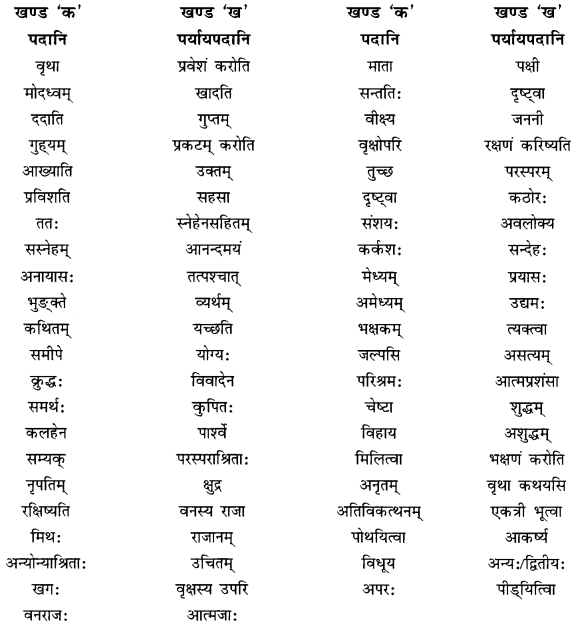
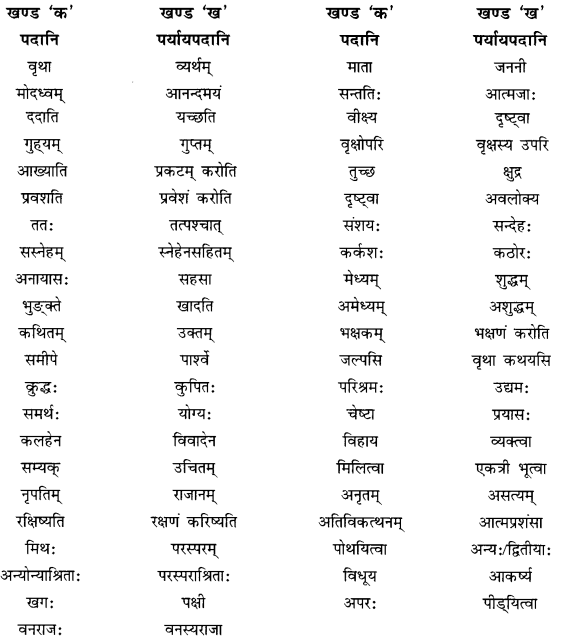
MCQ Questions for Class 10 Sanskrit Chapter 7 सौहार्दं प्रकृतेः शोभा with Answers 1

Answer

Answer:
MCQ Questions for Class 10 Sanskrit Chapter 7 सौहार्दं प्रकृतेः शोभा with Answers 2


विशेषण-विशेष्यपदानि योजयत

विशेषणपदानि – विशेष्यपदानि
(क) पराक्रमिणं – (i) मीनान्
(ख) शीतले – (ii) पक्षीकुलं
(ग) वराकान् – (iii) पुरुषः
(घ) सर्वं – (iv) जनपदे
(ङ) श्रेष्ठतमः – (v) सिंहः
(च) अस्मिन् – (vi) जले

Answer

Answer:
(क) पराक्रमिणं – (v) सिंहः
(ख) शीतले – (vi) जले
(ग) वराकान् – (i) मीनान्
(घ) सर्वं – (ii) पक्षीकुलं
(ङ) श्रेष्ठतमः – (iii) पुरुषः
(च) अस्मिन् – (iv) जनपदे


संस्कृतेन वाक्यप्रयोगं कुरुत
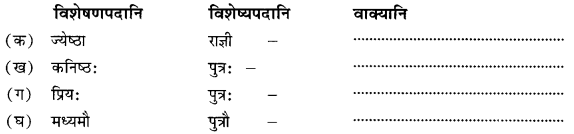
MCQ Questions for Class 10 Sanskrit Chapter 7 सौहार्दं प्रकृतेः शोभा with Answers 3

Answer

Answer:
(क) कौशल्या दशरथस्य ज्येष्ठा राज्ञी आसीत्।
(ख) शत्रुघ्नः कनिष्ठः पुत्रः आसीत्।
(ग) रामः दशरथस्य प्रियः पुत्रः आसीत्।
(घ) भरत-लक्ष्मणौ च मध्यमौ पुत्रौ आस्ताम्।


अधोलिखितपदानां तेषाम् विपर्ययपदानि सह मेलनं कुरुत
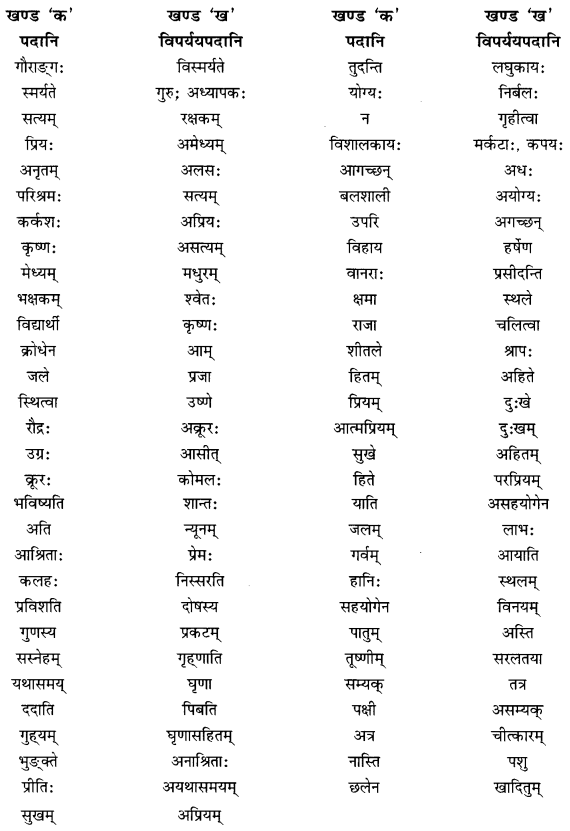
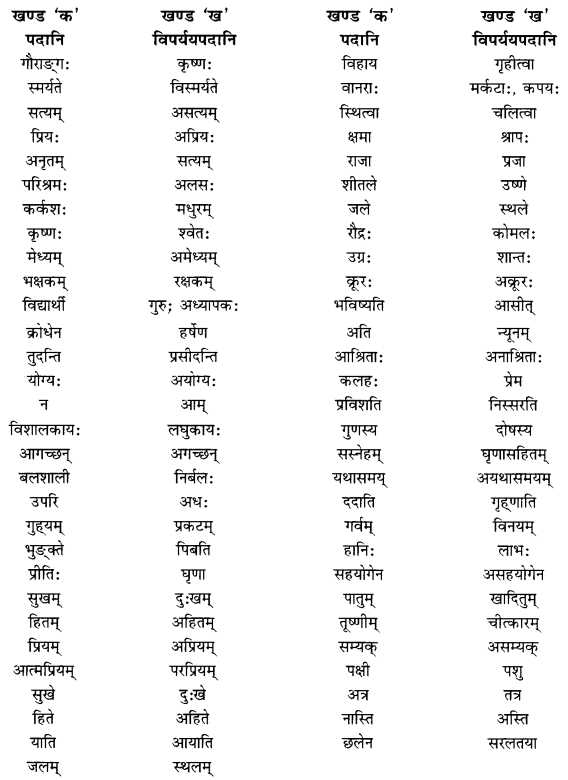
MCQ Questions for Class 10 Sanskrit Chapter 7 सौहार्दं प्रकृतेः शोभा with Answers 4

Answer

Answer:
MCQ Questions for Class 10 Sanskrit Chapter 7 सौहार्दं प्रकृतेः शोभा with Answers 5


We hope the given NCERT MCQ Questions for Class 10 Sanskrit Chapter 7 सौहार्दं प्रकृतेः शोभा with Answers Pdf free download will help you. If you have any queries regarding CBSE Class 10 Sanskrit सौहार्दं प्रकृतेः शोभा MCQs Multiple Choice Questions with Answers, drop a comment below and we will get back to you soon.

Motion in a Plane Class 11 Notes Physics Chapter 4

By going through these CBSE Class 11 Physics Notes Chapter 4 Motion in a Plane, students can recall all the concepts quickly.

Motion in a Plane Notes Class 11 Physics Chapter 4

→ All physical quantities having direction are not vectors.

→ The following quantities are neither scalars nor vectors: Relative density, density, frequency, stress, strain, pressure, viscosity, modulus of elasticity, Poisson’s ratio, specific heat, latent leat, a moment of Inertia, loudness, spring constant, Boltzman constant, Stefan’s constant, Gas constant, Gravitational constant, Plank’s constant, Rydberg’s constant etc.

→ A vector can have only two rectangular components in a plane and only three rectangular components in space.

→ Vectors cannot be added or subtracted or divided algebraically.

→ Division of two vectors is not allowed.

→ A vector can have any number of components (even infinite in number but a minimum of two components).

→ Two vectors can be added graphically by using head to tail method or by using the parallelogram or triangle law method.

→ A vector multiplied by a real number gives another vector having a magnitude equal to real number times the magnitude of the given vector and having direction same or opposite depending upon whether the number is positive or negative.

→ Multiplication of a vector by -1 reverses its direction.

→ If A + B = C or A + B + C = 0, then A, B and C are in one place.

→ Vector addition obeys commutative law
i.e. A + B = B + A

→ Vector addition obeys associative law
i.e. (A + B) + C = A + (B + C)

→ Subtraction of B from A is defined as the sum of
– B + A i.e. A – B = A + (-B)

→ The angle between two equal vectors is zero.

→ The angle between -ve vectors is 180°.

→ Unit vector  = \(\frac{\mathbf{A}}{|\mathbf{A}|}\) .

→ The magnitude of  = 1.

→ The direction of A is the same as that of the given vector along which it acts.

→ The resultant of two vectors of unequal magnitudes can never be a null vector.

→ î, ĵ, k̂ are the unit vectors acting mutually perpendicular to each other along X, Y and Z axes respectively and are called orthogonal unit vectors.

→ î.î = ĵ.ĵ = k̂.k̂ = 1

→ î.ĵ = ĵ.k̂ = k̂.î = 0

→ î × î = ĵ × ĵ = k̂ × k̂-= 0

→ î × ĵ = k̂, ĵ × k̂ = î, k̂ × î = ĵ

→ A × A = 0 , Also A – A = 0
But A × A ≠ A – A as A × A ⊥ A and A – A is collinear with A.

→ The cross product:

  1. Is not commutative (i.e. don’t obey commutative law):
    i. e. A × B ≠ B × A
    = B × A (anticommutative law)
  2. obeys distributive law i.e.
    A × (B + C) = A × B + A × C

→ Vectors lying in the same plane are called co-planer vectors.

→ Vectors are added according to triangle law, parallelogram law, and polygram law of vector addition.

→ The maximum resultant of two vectors A and B is
|Rmax| = |A| + |B|

→ The minimum resultant of two vectors A and B is
|Rmax| = |A| – |B|

→ The minimum number of vectors lying in the same plane whose results can be zero is 3.

→ The minimum number of vectors that are not co-planar and their results can be zero is 4.

→ A minimum number of collinear vectors whose resultant can be zero is 2.

→ A vector in component form is A = Axî + Ayĵ +Az

→ Magnitude of A is = \(\sqrt{A_{x}^{2}+A_{y}^{2}+A_{z}^{2}}\).

→ A projectile is any object thrown with some initial velocity and then it moves under the effect of gravity alone.

→ The trajectory is the path followed by the projectile during its flight.

→ Its trajectory is always parabolic in nature.

→ Two-dimensional motion: The motion of an object in a plane is a two-dimensional motion such as the motion of an arrow shot at some angle and then moving under gravity.

→ Three-dimensional motion: The motion of an object in space is called a three-dimensional motion, for example, the motion of a free gas molecule.

→ Scalar quantities: The quantities which do not need direction for their description are called scalar quantities. Only the magnitude of the quantity is needed to express them correctly. Such quantities are distance, mass, density, energy, temperature etc.

→ Vector quantities: The quantities which need both magnitude and direction for their correct description are called vector quantities. They also obey the law of the addition of vectors. For example displacement, velocity, acceleration, force, momentum etc. are vector quantities.

→ Triangle law of vector addition: If the two vectors are represented by the two adjacent sides of a triangle taken in order, their resultant is given in magnitude and direction by the third side of the triangle taken in the opposite order.

→ Parallelogram law of vector addition: If two vectors acting simultaneously at a point are represented by the two adjacent sides of a parallelogram, then their resultant is completely given in magnitude and direction by the diagonal of the parallelogram passing through that point.

→ Unit vector: A unit vector is a vector in the direction of a given vector whose magnitude is unity. It is represented by a cap or a hat over letter e.g. n̂, î, ĵ, k̂, x̂, ŷ, ẑ etc. The unit vectors in the cartesian coordinate system along the three axes are generally written as î, ĵ and k̂ such that |î| = |ĵ| = |k̂| = 1.

→ Uniform velocity: The uniform or constant velocity is the one in which the moving object undergoes equal displacements in equal intervals of time.

→ Speed: The magnitude of velocity is known as speed. It is the distance travelled divided by the time taken.

→ Uniform acceleration: When the velocity of an object changes by equal amounts in equal intervals of time, the object is said to be having uniform acceleration.

→ Projectile: Projectile is a particle or an object projected with some initial velocity and then left to move under gravity alone.

→ The uniform circular motion: The motion of an object in a circular path with constant speed and constant acceleration (magnitude) is called a uniform circular motion.

→ Equal vectors: Two vectors are said to be equal if they have the same magnitude and act in the same direction.

→ Negative vector: A vector having the same magnitude as the given vector but acting in exactly the opposite direction is called a negative vector.

→ Co-initial vectors: Vectors starting from the same initial point are called co-initial vectors.

→ Zero vector or Null vector: The vector whose magnitude is zero but the direction is uncertain (or arbitrary) is called a zero or null vector. It is represented by 0.

→ Collinear vectors: Two vectors acting along the same or parallel lines in the same or opposite directions are called collinear vectors.

→ Fixed vector: A vector whose tail point or initial point is fixed is called a fixed vector.

→ Free vector: A vector whose initial point or tail is not fixed is called a free vector.

→ Polygon law of addition of vectors: It states that if a number of vectors are represented by the sides of a polygon taken in the same order, then their resultant is given completely by the closing side of the polygon taken in the opposite order.

→ Rectangular components of a vector in a plane: The resolution of a vector into two mutually perpendicular components in a plane is called rectangular resolution and each component is called a rectangular component.

→ Rectangular components in a plane: The components of a vector along three mutually perpendicular axes are called the rectangular component of a vector in space.

→ Scalar product of vectors: If the multiplication of two vectors yields a scalar quantity, the multiplication is called a scalar or dot product. This is because of the fact that multiplication is denoted by a dot (.) between the multiplying vectors e.g. A.B = AB cos θ, where θ is the angle between the two vectors.

→ Cross or vector product: When the multiplication of two vectors is shown by a cross (×) between them, it is called a cross product. The resultant is also a vector quantity e.g. A × B = C. This multiplication is, therefore, also known as the vector product.

Important Formulae:
→ Uniform circular motion: Time period T second, frequency
v = \(\frac{1}{T}\)
Angular velocity ω = \(\frac{θ}{T}\),
ω = \(\frac{2 \pi}{\mathrm{T}}\) = 2πv,
v = \(\frac{1}{T}\),
θ = \(\frac{l}{r}\)
or
l = rθ.

→ Angular acceleration: α = \(\frac{\omega_{2}-\omega_{1}}{t_{2}-t_{1}}=\frac{d \omega}{d t}\)
average acceleration, aav = \(\frac{v_{2}-v_{1}}{t_{2}-t_{1}}\)
Average angular acceleration,
Motion in a Plane Class 11 Notes Physics 1
→ Time for maximum height: t = \(\frac{\mathrm{u} \sin \theta}{\mathrm{g}}\)

→ Angle of projection of maximum horizontal range:
θ = \(\frac{π}{4}\) or 45°.

→ Angles for same range θ, (\(\frac{π}{2}\) – θ)

→ General position – velocity – acceleration relations:
Δr (t) = r(t + Δt) – r(t)
v(t) = \(\frac{\Delta \mathrm{x}(\mathrm{t})}{\Delta \mathrm{t}}\);

vx(t) = \(\frac{\Delta \mathrm{x}(\mathrm{t})}{\Delta \mathrm{t}}\),

vy(t) = \(\frac{\Delta \mathrm{y}(\mathrm{t})}{\Delta \mathrm{t}}\)

Δx(t) = x(t + Δt) – x(t)
Δy(t) = y(t + Δt) – y(t)
Motion in a Plane Class 11 Notes Physics 2
→ Since: A.A = A2, so

  • î.î =1,
  • ĵ.ĵ =1,
  • k̂.k̂ =1

As î, ĵ and k̂ are mutually perpendicular so
î.ĵ = ĵ.k̂ =0,
k̂.î = 0

→ A.(B + C) = A.B. +A.C

→ Vector product:
A × B = C = |A| |B|sin θ n̂
In cartesian coordinates,
A × B = (Axî + Ayĵ + Azk̂) × (Bxî + Byĵ + Bzk̂)
= (AyBz – AzBy) î + (AzBx – AxBz)ĵ + (AxBy – AyBx)k̂
= \(\left|\begin{array}{ccc}
\hat{\mathrm{i}} & \hat{\mathbf{j}} & \hat{\mathbf{k}} \\
\mathrm{A}_{\mathrm{x}} & \mathrm{A}_{\mathrm{y}} & \mathrm{A} \\
\mathrm{B}_{\mathrm{x}} & \mathrm{B}_{\mathrm{y}} & \mathrm{B}
\end{array}\right|\)

→ A × B ≠ B × A
= -B × A

→ |A × B|2 + |A . B|2 = 2|\(\overrightarrow{\mathrm{A}}\)|2|\(\overrightarrow{\mathrm{B}}\)|2

→ Direction cosines:
cos α = \(\frac{A_{x}}{A}\) = l,
cos β = \(\frac{A_{y}}{A}\) = m, and
cos γ = \(\frac{A_{z}}{A}\) = n

→ l2 + m2 + n2 = 1

→ Velocity: v = vxi + vyj

→ Speed: v = |v| = (vx2 + vy2)1/2 .

→ Distance travelled in time t:
x(t)î + y(t)ĵ = x(0)î + y(0)ĵ + (vxî + vyĵ)t

→ x (t) = x (0) + vxt

→ y (t) = y (0) + vyt

→ Average velocity:
Vaverage = \(\frac{\left|r\left(t^{\prime}\right)-r(t)\right|}{t^{\prime}-t}=\frac{r_{12}}{\left(t_{2}-t_{1}\right)}=\frac{\Delta r}{\Delta t}\)

→ Instantaneous velocity:
Motion in a Plane Class 11 Notes Physics 3

→ Scalar product of A and B is
A . B = AB cos θ, where θ = angle between A and B.

→ Scalar (or Dot) product always gives a scalar quantity.

→ When A. B = 0 then A and B are perpendicular to each other.

→ A . B in component form is
A.B = AxBx + AyBy + AzBz.

→ Cross product of A and B is
A × B = (AB sin θ) n̂ = C
where n̂ = unit vector ⊥ to the plane containing A and B i.e. n̂ acts along C.

→ If we move anticlockwise, n is vertically upward i.e. +ve.

→ If we move clockwise, n vertically downward i.e. -ve.

→ Maximum height attained by the projectile fired at an angle 0 with the horizontal with velocity u is
H = \(\frac{\mathbf{u}^{2} \sin ^{2} \theta}{2 \mathrm{~g}}\)

→ Time of flight = T = \(\frac{2 u \sin \theta}{g}\)

→ Time of maximum height attained = Time of ascent = Time of descent = \(\frac{u \sin \theta}{g}\)

→ Horizontal range of the projectile is R = \(\frac{\mathrm{u}^{2} \sin 2 \theta}{\mathrm{g}}\)

→The range of projectile is maximum if θ = 45°.

→ Rmax = \(\frac{\mathrm{u}^{2}}{\mathrm{~g}}\)

→ When the range is maximum, the maximum height attained by the projectile (Hm) is
Hm = \(\frac{u^{2}}{4 g}=\frac{R_{\max }}{4}\)

→ For Rmax , Tmax = \(\frac{\mathrm{u}}{\sqrt{2} \mathrm{~g}}\)

→ When θ = 90, Hmax = \(\frac{u^{2}}{2 g}\) and is twice the maximum height attained by the projectile when range is maximum.

→ For θ = 90°, Time of flight is Maximum = \(\frac{2 \mathrm{u}}{\mathrm{g}}\)

→ Horizontal range is same for two angles of projections i.e. θ and 90 – θ with the horizontal.

→ If an object is moving in a plane with constant acceleration a, then a = \(\sqrt{\mathrm{a}_{\mathrm{x}}^{2}+\mathrm{a}_{\mathrm{y}}^{2}}\)

→ If r0 be the position vector of a particle moving in a plane at time t = 0, then at any other time t, its position vector will be
r = ro + vot + \(\frac{1}{2}\) at2
where v0 = its velocity at t = 0.

→ Its velocity at time t will be v = vo + at.

→ When the object moves in a circular path at constant speed, then its motion is called uniform circular motion. The angle described by the rotating particle is called angular displacement.

→ Angular displacement, Δθ = \(\frac{\Delta l}{\mathrm{r}}\) .

→ Angular velocity, ω = \(\frac{\Delta \theta}{\Delta \mathrm{t}}\)

Instantaneous angular velocity, ω = \(\frac{\mathrm{d} \theta}{\mathrm{dt}}\)

ω = \(\frac{2 \pi}{\mathrm{T}}\) = 2πv (∵ v = \(\frac{1}{T}\))

Angular velocity (ω) of a rigid body rotating about a given axis is constant, so v is different for different particles of the body.

Angular acceleration α = \(\frac{\mathrm{d} \omega}{\mathrm{dt}}=\frac{\mathrm{d}^{2} \theta}{\mathrm{dt}^{2}}\)

Tangential acceleration is a1 = α × r and at is directed along the tangent to the circular path.

→ Centripetal acceleration (ac) is given by ac = \(\vec{\omega}\) × v and it is directed towards the centre of the circular path. Thus acceleration of the particle is
a = at + ac
then at ⊥ ac
∴ |a| = \(\sqrt{a_{1}^{2}+a_{c}^{2}}\)

→ Also \(\vec{\omega}\) ⊥v as to and a are parallel to Δθ. i.e. they are directed along the axis of rotation
Hence ac = ω v sin 90
ac = ω v = ω . rω = rω2
= \(\frac{v^{2}}{r}\)

→ Centripetal force, Fc = mac = \(\frac{m v^{2}}{r}\) = mrω2.

→ Fc is always directed towards the centre of the circular path.

→ The Axis of rotation is perpendicular to the plane of rotation.

→ There can be no circular motion without centripetal force. Centripetal force can be a mechanical, electrical or magnetic force in nature.

→ Fc is always ⊥ to the velocity of the particle.

→ θ, ω, α are called axial vectors or pseudo vectors.

→ Tangential acceleration is equal to the product of angular acceleration and the radius of the circular path i.e. at = rα.