Formation of Mutants

Learninsta presents the core concepts of Microbiology with high-quality research papers and topical review articles.

Formation of Mutants

The term mutant refers to an organism in which either the base sequence of DNA or the phenotype has been changed. A mutant is an organism whose genotype differs from that found in nature. The process of formation of mutant organism is called mutagenesis.

In nature and in the laboratory, mutations sometimes arise spontaneously without any help from the experimenter. This is called spontaneous mutagenesis. The two mechanisms that are most important for spontaneous mutagenesis are

  1. Errors occurring during replication and
  2. Spontaneous alteration of bases.

Mutations can also be induced experimentally by application of mutagens. Mutagens are agents that cause mutations.

Mutagens and their Mode of Action

Physical Mutagens

UV radiation:

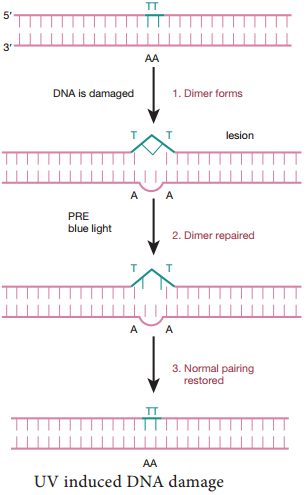
UV light causes mutations because the purine and pyrimidine bases in DNA absorb light strongly in the ultraviolet range (254 to 260 nm). At this wavelength, UV light induces point mutations primarily by causing photochemical changes in the DNA.

One of the effects of UV radiation on DNA is the formation of abnormal chemical bonds between adjacent pyrimidine molecules in the same strand, or between pyrimidines on the opposite strands, of the double helix.

This bonding is induced mostly between adjacent thymines, forming what are called thymine dimers (Figure 12.10), usually designated TT. This unusual pairing produces a bulge in the DNA strand and disrupts the normal pairing of T’s (thymines) with corresponding A’s(adenines) on the opposite strand. If UV induced genetic damage is not repaired, mutations or cell death may result.
Formation of Mutants img 1

Chemical Mutagens

Chemical mutagens include both naturally occurring chemicals and synthetic substances. These mutagens can be grouped into different classes on the basis of their mechanism of action. They are

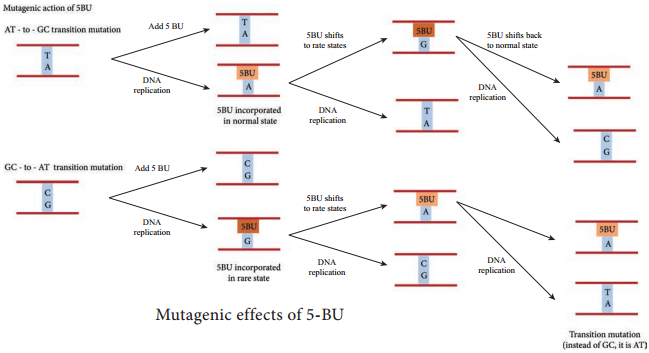
(i) Base analogs are bases that are similar to the bases normally found in DNA.
E.g. 5 – bromouracil (5-BU). TA to CG (Figure 12.11).
Formation of Mutants img 2

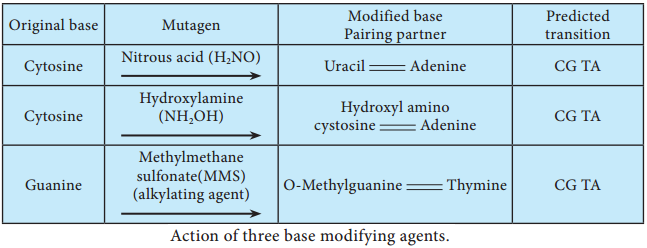
(ii) Base Modifying Agents are chemical that act as mutagens by modifying the chemical structure and properties of bases. The three types of mutagens that work in this way are

  • A deaminating agent e.g: Nitrous acid removes amino groups (- NH2) from the bases guanine, cytosine, and adenine.
  • Hydroxylamine (NH2 OH) is a hydroxylating mutagen that react specifically with cytosine, modifying it by adding a hydroxyl group (OH) so that it can pair solely with adenine instead of with guanine.
  • Alkylating agents like methymethane sulfonate (MMS) introduces alkyl groups onto the bases at a number of location.

(iii) Intercalating agents

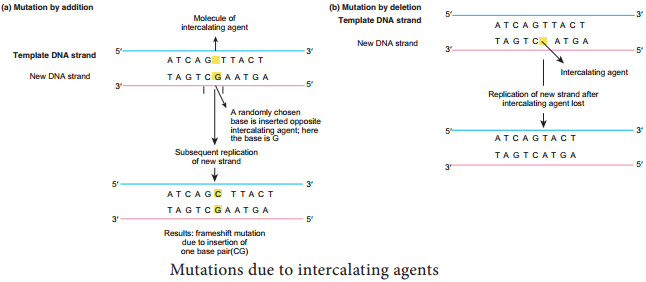
Acridine, proflavin, ethidium bromide are a few examples of intercalating agents. These insert (intercalate) themselves between adjacent bases in one or both strands of the DNA double helix. Intercalating agents can cause either additions or deletions.
Formation of Mutants img 3
Formation of Mutants img 4

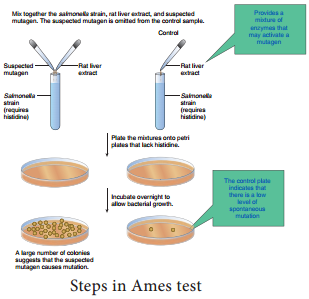
The Ames Test: A Screen for Potential Carcinogens

Everyday we are exposed to a wide variety of chemicals in our environment, such as drugs, cosmetics, food additives, pesticides, and industrial compounds. Many of these chemicals can have mutagenic effects, including genetic diseases and cancer. Some banned chemical warfare agents (e.g. mustard gas) also are mutagens.

A number of chemicals (subclass of mutagens) induce mutations that result in tumorous or cancerous growth. These chemical agents are called chemical carcinogens. Directly testing the chemicals for their ability to cause tumors in animals is time consuming and expensive. However, the fact that most chemical carcinogens are mutagens led Bruce Ames to develop a simple, inexpensive, indirect assay for mutagens.

In general Ames test is an indicator of whether the chemical is a mutagen. The Ames test assays the ability of chemicals to revert mutant strains of the bacterium Salmonella typhimurium to wild type. The mutant strain of S.typhimurium is auxotrophic to histidine (histidine), that is it requires histidine for its growth and
cannot grow in the absence of histidine. The mutant strain is grown in a histidine deficient medium containing the chemical to be tested.

A control plate is also set up which does not contain the chemical. After incubation the control plates may have few colonies resulting from spontaneous reversion of the his – strain. Compared to the control plates if there are increased number of colonies on test plate, it indicates that the chemical has reverted the mutant strain back to wild type. This chemical is likely to be a carcinogen. Figure 12.14 shows steps in Ames test.
Formation of Mutants img 5

Types of Mutation

Learninsta presents the core concepts of Microbiology with high-quality research papers and topical review articles.

Types of Mutation

The base sequence of DNA determines the amino acid sequence of a protein. The chemical and physical properties of each protein are determined by its amino acid sequence, so a single amino acid change is capable of altering the activity of, or even completely inactivating, a protein.

Genotype refers to the genetic composition of an organism. Phenotype is an observable property of organism. The functional form of a gene is called Wildtype because presumably this is the form found in nature.

Mutation is the process by which the sequence of base pairs in a DNA molecule is altered.The alteration can be a single base pair substitution, insertion or deletion. Mutations can be divided into two general categories:

1. Base – pair substitution

Base – pair substitution mutation involves a change in the DNA such that one base pair is replaced by another.

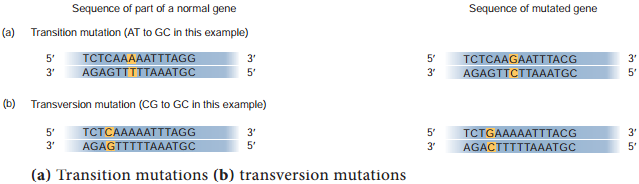
  • A mutation from one purine – pyrimidine base pair to the other purine – pyrimidine base pair is a transition mutation (Figure 12.7 a). E.g. AT to GC, CG to TA.
  • A mutation from a purine pyrimdine base pair to a pyrimidine – purine base pair is a transversion mutation (Figure 12.7 b). E.g. AT to TA, CG to GC.
    Types of Mutation img 1

2. Base pair insertion or deletions

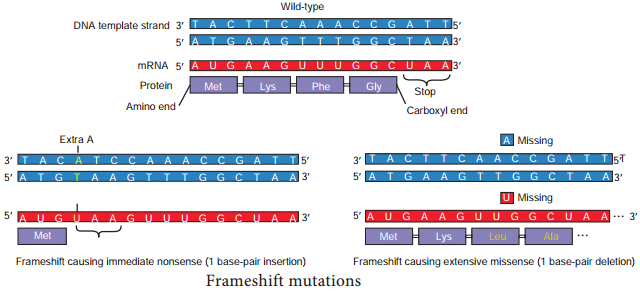
Involves the addition or deletion of one base pair. If one or more base pairs are added to or deleted from a protein coding gene, the reading frame of an mRNA can change downstream of the mutation. An addition or deletion of one base pair, for example, shifts the mRNA’s downstream reading frame by one base, so that incorrect amino acids are added to the polypeptide chain after the mutation site.

This type of mutation, called a frame shift mutation (Figure 12.8) usually results in a nonfunctional protein.

Frame shift mutations:

  • May generate new stop codons, resulting in a shortened protein.
  • May result in a read through of the normal stop codon, resulting in longer than normal proteins
  • Or may result in a complete alteration of the amino acid sequence of a protein.
    Types of Mutation img 2

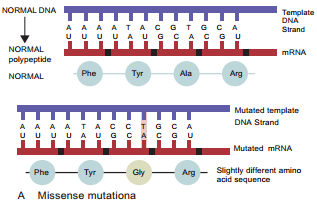
Point mutations are single base changes, that do not affect the reading frame, that is, the mutation only makes a single change in a single codon, and everything else is undisturbed. Mutations can also be defined according to their effects on amino acid sequences in proteins. They are:-

1. A missense mutation (Figure 12.9 a) is a gene mutation in which a base – pair change in the DNA changes a codon in an mRNA so that a different amino acid is inserted into the polypeptide.
Types of Mutation img 3

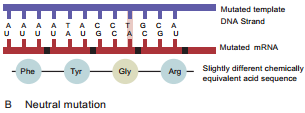
2. A neutral mutation (Figure 12.9 b) is a subset of missense mutations in which the new codon codes for a different amino acid that is chemically equivalent to the original and therefore does not affect the proteins function. Consequently, the phenotype does not change.
Types of Mutation img 4

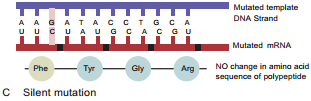
3. A silent mutation (Figure 12.9 c) is also a subset of missense mutations that occurs when a base – pair change in a gene alters a codon in the mRNA such that the same amino acid is inserted in the protein. In this case, the protein obviously has a wild type function.
Types of Mutation img 5

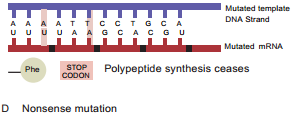
4. A nonsense mutation (Figure 12.9 d) is a gene mutation in which a base – pair change in the DNA, changes a codon in an mRNA to a stop (nonsense) codon (UAG, UAA or UGA). Nonsense mutation cause premature chain termination so instead of complete polypeptides, shorter than normal polypeptide fragments (often nonfunctional) are formed.
Types of Mutation img 6

Forward mutations change the genotype from wild type to mutant and reverse mutations (or reversions or back mutations) change the genotype from mutant to wild type or to partially wild type. An organism which has reverted is a Revertant. The effects of mutation may be diminished or abolished by a suppress or mutation.

Suppressor mutation is a mutation at a different site from that of the original mutation. A suppressor mutation masks or compensates for the effects of the initial mutation, but it does not reverse the original mutation.

Microbial Genetic Code and its Features

Learninsta presents the core concepts of Microbiology with high-quality research papers and topical review articles.

Microbial Genetic Code and its Features

A tRNA molecule “reads” the base sequence of mRNA. The language read by the tRNA molecules is called the genetic code, which is a set of relations between sequences of three adjacent bases on an mRNA molecule and particular amino acids. (A RNA base sequence (a set of 3 bases) corresponding to a particular amino acid is called a codon).

The genetic code is the set of all codons. Only four bases in DNA serve to specify 20 amino acids in proteins, so some combination of bases is needed for each amino acid. Before the genetic code was elucidated, it was reasoned that if all codons were assumed to have the same number of bases, then each codon would have to contain at least three bases.

Codons consisting of pairs of bases would be insufficient because four bases can form only 42 = 16 pairs, and there are 20 amino acid. Triplets of bases would suffice because, these can form 43 = 64 triplets. In fact, the genetic code is a triplet code, and all 64 possible codons carry information of some sort.

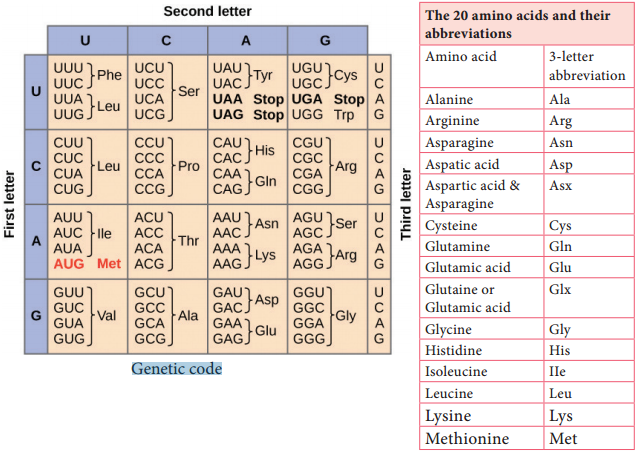
Several different codons designate the same amino acid. Furthermore, in translating mRNA molecules the codons do not overlap but are used sequentially. The same genetic code is used by almost all biological systems and hence is said to be universal (exceptions are mitochondria and a few unusual microorganisms). The codons are by convention written with the 5′ end at the left. The complete code is shown in Table 12.1.
Microbial Genetic code and its Features

Features of the Code:

Sixtyone codons correspond to amino acids. Four codons are signals. These are the three stop codons – UAA, UAG, UGA – and the one start codons, AUG.

The start codons (initiation codon) also specifies the amino acid methionine. In rare cases, certain other codon (E.g. GUG) initiate translation. No normal tRNA molecule has an anticodon (a sequence of three bases on tRNA that can base – pair with a codon sequence in the mRNA) complementary to any of the stop codons UAG, UAA or UGA, which is why these codons are stop signals.

The code is highly redundant i.e. more than one codons code for an amino acid. Only tryptophan and methionine are specified by one codon. The synonymous codons usually differ only in third base (except for serine, leucine and arginine).

Motion in a Straight Line Class 11 Notes Physics Chapter 3

By going through these CBSE Class 11 Physics Notes Chapter 3 Motion in a Straight Line, students can recall all the concepts quickly.

Motion in a Straight Line Notes Class 11 Physics Chapter 3

→ Mechanics is divided into three main branches: Statics, Kinematics and Dynamics.

→ Distance is a scalar quantity.

→ Displacement is a vector quantity.

→ An object is said to be in motion if it changes its position w.r.t. its surroundings as time passes.

→ An object is said to be at rest or it does not change its position w.r.t. its surroundings as time passes.

→ Both rest and motion are relative terms.

→ Distance travelled by a moving body can never be zero or negative i.e. it is always positive.

→ Displacement can be positive, negative or zero.

→ The magnitude of displacement = distance only if a body moves in a straight line without a change in direction.

→ The magnitude of the displacement of a body is the minimum possible distance, so distance ≥ displacement.

→ Speed is a scalar quantity.

→ Velocity is a vector quantity.

→ When a body moves with variable speed, then the average speed of the body is calculated as:
Average speed = \(\frac{\text { Total distance travelled by the body }}{\text { Total time taken }}\)

→ When a body moves with variable velocity, then the average velocity of the body is calculated as:
Average velocity = \(\frac{\text { Total displacement }}{\text { Total time taken }}\)

→ Distance travelled by an object in a given time interval is equal to the area under the velocity-time graph.

→ The direction of velocity and acceleration may not necessarily be the same.

→ The velocity and acceleration of a body may not be zero simultaneously. When the body is in equilibrium, its acceleration is zero.

→ In one, two and three dimensional motions, the object changes its position w.r.t. one, two and three coordinate axes respectively.

→ At a particular instant of time, any point may be chosen as a reference or zero points.

→ The events taking place before the zero time are assigned negative number and events after zero are assigned +ve number.

→ A suitable unit of time say, second, minute or hour may be chosen. In fact, zero points of time and unit of time are chosen according to one’s convenience.

→ The position is also measured with respect to a chosen zero position or origin on the path line.

→ Positions to the right of origin are represented by a positive number and a unit.

→ The position to the left of the origin is represented by a negative number and the unit.

→ For motion in the vertical direction, we can use ‘up’ or ‘down’ instead of ‘right’ and ‘left’.

→ The position is always stated with respect to time,

→ x (t) shows that x is a function of time t.

→ The shift in position x (t’) – x (t) is called the displacement.

→ The rate of change, of displacement, is called velocity.

→ The motion in which an object covers equal distances in equal intervals of time is called uniform motion.

→ Uniform motion may be represented by a straight line parallel to the time axis in a velocity-time graph.

→ It is also represented by a straight line inclined at some angle. The magnitude of velocity is speed.

→ The velocity of a body w.r.t. another body is called its relative velocity.

→ The x-t graph is a straight line parallel to the time axis for a stationary object.

→ Uniformly accelerated motion is a non-uniform motion.

→ When the velocity of the body decreases with time it is said to be decelerated or retarded.

→ When a particle returns to the starting point, its average velocity is zero but the average speed is not zero.

→ For one dimensional motion, the angle between acceleration and velocity is either zero or 180°. It may also change with time.

→ For two dimensional motion, the angle between acceleration and velocity is other than 0° or 180°. It may also change with time.

→ If the angle between a and v is 90°, the path of motion is a circle.

→ If the angle between a and v is other than 0° or 180°, the path of the particle is a curve.

→ For motion with constant acceleration, the graph between x and t is a parabola.

→ For uniform motion, the average velocity is equal to the instantaneous velocity.

→ Statics: It deals with the law of composition of forces and with the conditions of equilibrium of solid, liquid and gaseous states of the objects.

→ Kinematics: It is the branch of mechanics that deals with the study of the motion of objects without knowing the cause of their motion.

→ Dynamics: It is the branch of mechanics that deals with the study of the motion of objects by taking into account the cause of their motion.

→ Point object: It is defined as an object having its dimensions much smaller as compared to the distance covered by it.

→ Acceleration: It is defined as the change in velocity with time i. e.

→ Speed: Theatre of covering distance with time is called speed i.e.
speed = \(\frac{\text { Distance }}{\text { Time }}\)

→ Average speed: It is the ratio of total path length traversed and the corresponding time interval.

→ Velocity: The rate of change of displacement is called velocity.

→ Average velocity: When an object travels with different velocities, its rate of motion is measured by its average velocity.
Average velocity = \(\frac{x_{2}-x_{1}}{t_{2}-t_{1}}=\frac{\Delta x}{\Delta t}\)

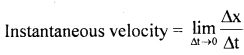
→ Instantaneous velocity: The velocity of the object at any particular instant of time is known as instantaneous velocity.
Motion in a Straight Line Class 11 Notes Physics 1
→ Vinst = \(\frac{\mathrm{dx}}{\mathrm{dt}}\)

→ Uniform velocity: A motion in which the velocity of the moving object is constant is called uniform and the velocity is called the uniform velocity. In uniform motion, the object covers equal distances in equal intervals of time along a straight line.

→ Relative velocity: The rate of change in the relative position of an object with respect to the other object is known as the relative velocity of that object.

→ Acceleration: The time rate of change of velocity is known as acceleration.

→ Average acceleration: It is defined as the change in velocity divided by the time interval.
aav = \(\frac{\text { Final velocity – Initial velocity }}{\text { Change in time }}=\frac{v_{2}-v_{1}}{t_{2}-t_{1}}=\frac{\Delta v}{\Delta t}\)

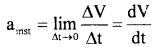
→ Instantaneous acceleration: The acceleration of an object at any instant of time is called instantaneous acceleration. It is also the limiting value of average acceleration.
Motion in a Straight Line Class 11 Notes Physics 2
→ Retardation: The negative acceleration due to which the body slows down is known as deacceleration or retardation.

→ Non-uniform motion: An object is said to have non-uniform motion when its velocity changes with time even though it has a constant acceleration.

Important Formulae:
→ Displacement in time from t to t’ = x(t’) – x (t)

→ Average velocity, vav = \(\frac{\mathrm{x}\left(\mathrm{t}^{\prime}\right)-\mathrm{x}(\mathrm{t})}{\mathrm{t}-\mathrm{t}}=\frac{\Delta \mathrm{x}}{\Delta \mathrm{t}}\)

→ The relative velocity of a body A w.r.t. another body B when they are moving along two parallel straight paths in the same direction is VAB = VA – VB and if they are movinig in opposite direction, then VAB = VA – (-VB) = VA + VB.

Average Speed Vav = \(\frac{\mathrm{S}_{1}+\mathrm{S}_{2}}{\left(\frac{\mathrm{S}_{1}}{\mathrm{v}_{1}}+\frac{\mathrm{S}_{2}}{\mathrm{v}_{2}}\right)}\)
Where S1 is the distance travelled with velocity v1 and S2 is the distant travelled with velocity v2.

→ If S1 = S2, then vav = \(\frac{2 v_{i} v_{2}}{v_{1}+v_{2}}=\frac{2}{\frac{1}{v_{1}}+\frac{1}{v_{2}}}\)

→ Average speed of a body when it travels with speeds v1, v2, v3…..vn in time intervals t1, t2, t3,… tn, respectively is given by
Vav = \(\frac{v_{1} t_{1}+v_{2} t_{2}+v_{3} t_{3}+\ldots .+v_{n} t_{n}}{t_{1}+t_{2}+t_{3}+\ldots+t_{n}}=\frac{\sum_{i=1}^{n} v_{i} t_{i}}{\sum_{i=1}^{n} t_{i}}\)

→ Distance travelled by a body moving with uniform velocity is S = ut.

→ Velocity of an object after a time t in uniformly accelerated motion is, v = u + at.

→ Distance covered by an object after a time t in accelerated motion is, S = ut + \(\frac{1}{2}\)at2.

→ Velocity of an object after covering a distance S in uniformly accelerated motion is, v2 – u2 = 2aS.

→ Distance covered in nth second by a uniformly accelerated object
Snth = u + \(\frac{a}{2}\)(2n – 1)

→ Total time a flight = Time of Ascent + Time of descent.

→ Time of Ascent = Time of descent.

Units and Measurement Class 11 Notes Physics Chapter 2

By going through these CBSE Class 11 Physics Notes Chapter 2 Units and Measurement, students can recall all the concepts quickly.

Units and Measurement Notes Class 11 Physics Chapter 2

→ Physical Quantity = numerical value × unit = nu

→ Numerical value (n) ∝ \(\frac{1}{\text { size of unit(u) }}\)

→ Physical quantities which are independent of each other are called fundamental quantities.

→ Units of fundamental quantities are called fundamental units.

→ There are four systems of units namely FPS, CGS, MKS, and S.I. system.

→ 1 a. m.u.= 1.66 × 10⁻²⁷kg.

→ The product of n and u is called the magnitude of the physical quantity.

→ Force, thrust, and weight have the same SI unit, i.e. Newton.

→ Pressure, stress, and coefficient of elasticity have the same SI unit, i.e. Pascal.

→ The standard unit must not change with time and space. That is why the atomic standards for length and time have been defined.

→ The dimensions of many physical quantities especially those of heat, electricity, thermodynamics, and magnetism in terms of mass, length, and time alone become irrational, so SI is adopted which uses 7 basic units and two supplementary units.

→ The first conference on weights and measures was held in 1889.

→ Sevres near Paris is the headquarter of the International Bureau of Weights and Measures.

→ SI system was first adopted in the 11th general Conference of Weights and Measures in 1960.

→ S.I. system is also known as the rationalized M.K.S. system.

→ The various units of the S.I. system are rational in nature.

→ The various units of the S.I. system are coherent in nature.

→ It is wrong to say that the dimensions of force are [MLT-2]. On the other hand, we should say that the dimensional formula for force is [MLT-2].

→ The dimensional formula for the dimensionless physical quantity is written as [M°L°T°].

→ The dimensions of a physical quantity don’t depend on the system of units.

→ The dimensional formula is very helpful in writing the unit of a physical quantity in terms of the basic units.

→ The pure numbers are dimensionless.

→ Physical quantities defined as the ratio of two similar quantities are dimensionless.

→ The physical relations involving logarithm, exponential, trigonometric ratios, numerical factors, etc. cannot be derived by the method of dimensional analysis.

→ Physical relations involving addition or subtraction sign cannot be derived by the method of dimensional analysis.

→ If units or dimensions of two physical quantities are the same, these need not represent the same physical characteristics.

→ Torque and work have the same dimensions but have different physical characteristics.

→ Measurement is most accurate if its observed value is very close to the true value.

→ Significant figures are the number of digits up to which we are sure about their accuracy.

→ Significant figures don’t change if we measure a physical quantity in different units.

→ Significant figures retained after the mathematical operation (like addition, subtraction, multiplication, or division) should be equal to the minimum significant figures involved in any physical quantity in the given operation.

→ Error = Actual value: Observed value.

→ Absolute error: Δxi = \(\overline{\mathrm{x}}\) – xi

→ The absolute error in each measurement is equal to the least count of the measuring instrument.

→ Mean absolute error
Δx = \(\frac{1}{x} \sum_{i=1}^{n}\)(Δx1)

→ When we add or subtract two measured quantities, the absolute error in the final result is equal to the sum of the absolute errors in the measured quantities.

→ When multiply or divide two measured quantities, the relative error in the final result is equal to the sum of the relative errors in the measured quantities.

→ For greater accuracy, the quantity with higher power should have the least error.

→ Smaller is the least count higher is the accuracy of measurement.

→ The relative error is a dimensionless quantity.

→ The unit and dimensions of the error are the same as that of the quantity itself.

→ The larger the number of significant digits after the decimal point in measurement, the higher is the accuracy of measurement.

→ Physical quantities: Physical quantities may be defined as the quantities in terms of which physical laws can be expressed and which can be measured directly or indirectly.

→ Subjective methods: The methods of measurement which depend on our senses are called subjective methods.

→ Objective methods: The methods of measurement which make use of scientific instruments are called objective methods.

→ Fundamental quantities: The quantities which are independent of each other and which are not generally defined in terms of other physical quantities are known as fundamental or basic quantities.

→ Derived quantities: The quantities whose defining operations are based on the fundamental physical quantities are called derived quantities.

→ Unit: A unit is defined as the reference standard of measurement.

→ If a number is without a decimal point and ends in one or more zeros, then all the zeros at the end of the number may not be significant.

→ To make the number, of Significant digits clear, it is suggested that the number may be written in exponential form.

→ For example, 20300 may be expressed as 203.00 × 10², to suggest that all the zeros at the end of 20300 are significant.

→ Fundamental or basic units: The basic units are those which can neither be derived from one another nor can be resolved into further units! For example units of length, mass and time, etc. These are 7 in number.

→ Derived units: The units of all those physical quantities which can be expressed in terms of fundamental units are called derived units. For example, units of velocity, force, and energy, etc.

→ Size of a physical quantity: The size of a physical quantity is determined by a unit and the number of times that unit is to be repeated to represent the complete quantity.
Size of a physical quantity = nu;
n = number of times the chosen unit is contained in the physical quantity,
u = size of the unit.

→ System of units: Complete set of units both for fundamental and derived quantities is known as a system of units.

→ S.I. Units: Systeme international of units, in short, is called S.I. units.
It has seven fundamental units namely

  1. unit of length is meter (m),
  2. kilogram (kg) unit of mass,
  3. second (s) unit of time,
  4. ampere (A) unit of current,
  5. Kelvin (K) unit of temperature,
  6. Candela (cd) unit of light intensity and
  7. mol (mole) for a unit of amount of substance.

→ There are two supplementary units for measuring: (a) plane angle and solid angle. These are radian (rad) and steradian (sr) respectively.

→ θ(rad) = \(\frac{\text { arc }}{\text { radius }}=\frac{l}{r}\)

→ Ω(sr) = \(\frac{\text { surface area }}{(\text { radius })^{2}}=\frac{\Delta \mathrm{A}}{\mathrm{r}^{2}}\)

→ Length: It is defined as a measure of separation between two points in space.

→ Mass: It is the amount of substance contained in the body. Inertial mass: It is the mass of the body which is a measure of inertia F
∴ m = \(\frac{F}{a}\)

→ Gravitational mass: It is the mass of the body that determines the gravitational pull due to the earth acting on the body.
∴ m = \(\frac{W}{g}\)

→ Fermi (F): It is a unit of extremely small distances:
1 F = 10-15 m.

→ Angstrom (A): It is the unit of length at the atomic level:
1 A = 10-10 m ,

→ Astronomical unit (AU): It is the unit of length at a large scale:
1 A.U. = 1.496 × 10¹¹ m= 1.5 × 10¹¹ m.

→ Light year- It is defined as the distance traveled by light in one year
1 L.Y. = 9.46 × 10¹⁵ m.

→ Meter (m): Metre is the unit of length and is defined as the space occupied by 1,650,763.73 wavelengths of orange-red light emitted by krypton: 86 kept “at the triple point of nitrogen (radiation emitted due to transition between the levels 2P10 and 5d5).

→ Kilogram (kg): Kilogram is the unit of measurement of mass. It is the mass of international prototype platinum-iridium cylinders kept in the International Bureau of Weights and Measures at Sevres, France.

→ Second(s): It is the unit of time. A second is the duration of time corresponding to 9,192,631,770 vibrations corresponding to the transition between two hyperfine levels of cesium-133 atom in the ground state.

→ Ampere(A): An ampere of current is defined as the constant current, which when flowing through two straight parallel conductors of infinite length and negligible area of cross-section placed lm apart in air produces a force of 2 × 10⁻⁷ Nm-1.

→ Parsec: This unit is used to measure very large distances i.e., the distance between stars or galaxies.
1 Parsec = 3.08 × 10¹⁶m

→ Atomic mass unit (AMU): It is the unit of mass at the atomic and subatomic levels.
1 amu = \(\frac{\left(\text { mass of }_{6} C^{12} \text { atom }\right)}{12}\)

→ Dimensions: The dimensions of a physical quantity are the powers to which the fundamental units of length, mass and time have to be raised to obtain its units, e.g., dimensions of force [MLT-2] are 1 in mass 1 in length and -2 in time.

→ Dimensional formula: Dimensional formula of a physical quantity is defined as the expression that indicates which of the fundamental units of mass, length, and time appear into the derived unit of that physical quantity and with what powers.

→ Dimensional equation: The equation obtained by equating the physical quantity to its dimensional formula is called the dimensional equation of that physical quantity.

→ Dimensional variables: The variable quantities which have dimensions are called dimensional variables! For example, velocity, force, momentum, etc.

→ Dimensionless variables: These are variable physical quantities that do not have dimensions. For example, relative density, specific heat, strain, etc.

→ Dimensional constants: Those constants which have dimensions are called dimensional constants. For example, gravitational constant, Planck’s constant.

→ Dimensionless constants: Those constants which do not have, dimensions are dimensionless constants. For example, all trigonometric functions, natural numbers 1, 2, 3…. π, e.

→ Significant figure: The significant figures are a measure of the accuracy of a particular measurement of a physical quantity. Significant figures in measurement are those digits in a physical quantity that are known reliably plus the one-digit which is uncertain.

→ Error: It is the difference between a true and measured value of a physical quantity.

→ Discrepancy: The difference between the two measured values of a physical quantity is known as a discrepancy.

→ Constant error: It is an error in measurements. It arises due to some constant causes such as faulty calibration on the instrument. This error remains constant in all observations.

→ Systematic error: This error is also a measurement error. The error is one that always produces an error of the same sign. This error may be due to imperfect technique, due to alteration of the quantity being measured, or due to carelessness and mistakes on the part of the observer.

→ Instrumental error: This is a constant type of error. These are errors of an apparatus and that of the measuring instruments used e.g., zero error in vernier calipers or screw gauge.

→ Error due to least count: This also is another type of constant error. The error due to the limitations imposed by the least counts of the measuring instruments comes under this heading.

→ Observational or Personal Error: This is a subheading of systematic error. This error is due to the experimental arrangement or due to the habits of the observer.

→ Error due to physical conditions: These errors are due to the experimental arrangement or due to the habits of the observer. These are also systematic errors.

→ Error due to unavoidable situations: These errors are due to the imperfectness of the apparatus or of non-availability of ideal conditions.

→ Random errors: The errors due to unknown causes are random errors.

→ Gross error: These types of errors are because of the carelessness of the observer.
These errors may be due to

  • negligence towards sources of error due to overlooking of sources of error by the observer;
  • the observer, without caring for least count, takes wrong observations;
  • wrong recording of the observation.

→ Absolute error: The magnitude of the difference between the true value and the measured value is called absolute error.

→ A relative error: It is defined as the ratio of the mean absolute error to the true value.

→ Percentage error: The relative error expressed in percentage is percentage error.

→ Standard error: The error which takes into account all the factors affecting the accuracy of the result is known as the standard error.

→ Standard deviation: The root means the square value of deviations (the deviation of different sets of observations from the arithmetic mean) is known as standard deviation.
Standard deviation σ = \(\sqrt{\frac{\left(\mathrm{x}_{1}-\overline{\mathrm{x}}\right)^{2}+\left(\mathrm{x}_{2}-\overline{\mathrm{x}}\right)^{2}+\left(\mathrm{x}_{\mathrm{n}}-\overline{\mathrm{x}}\right)^{2}}{\mathrm{n}}}=\sqrt{\frac{\mathrm{S}}{\mathrm{n}}}\)

→ Probable error: The error calculated by using the principle of probability are probable errors. According to Bessels formula

→ Probable error e = ± 0.6745\(\sqrt{\frac{S}{n(n-1)}}\)

→ Standard error = \(\sqrt{\frac{\mathrm{S}}{n(n-1)}}\)

Important Formulae:
→ t = Size of oleic acid molecule = thickness of film of oleic acid
= \(\frac{\text { Volume of film }}{\text { Area of film }}\)

→ Inertial mass determination:
\(\frac{m_{1 i}}{m_{2 i}}=\frac{T_{1}^{2}}{T_{2}^{2}}\) where T1 and T2 are of the time of oscillation of inertia balance with inertial masses.

→ Gravitational mass determination:
\(\frac{\mathrm{w}_{1}}{\mathrm{w}_{2}}=\frac{\mathrm{m}_{\mathrm{g}_{1}}}{\mathrm{~m}_{\mathrm{g}_{2}}}\)
where mg1 and mg2 are gravitational masses.

→ Height by triangulation method:

  1. The height of an accessible object, h = x tanθ, where θ = angle of elevation of the object at the point of observation at a distance x from it.
  2. The height of the inaccessible object is:
    h = \(\frac{x}{\cot \theta_{2}-\cot \theta_{1}}\)
    where θ1 and θ2 are the angles made at two points of observation at distance x from each other.

→ Distance of stars (parallax method):
S = \(\frac{\mathrm{b}}{\theta}\), θ = Φ1, + Φ2, where Φ1, and Φ2, are the angles subtended by star on observer on Earth with an interval of 6 months.
θ = angle of parallax.
b = basis = distance between two points on the surface of earth.

→ n2 = n1 \(\left[\frac{\mathrm{m}_{1}}{\mathrm{~m}_{2}}\right]^{a}\left[\frac{\mathrm{L}_{1}}{\mathrm{~L}_{2}}\right]^{b}\left[\frac{\mathrm{T}_{1}}{\mathrm{~T}_{2}}\right]^{\mathrm{c}}\)

→ Distance by reflection method (Radar) is given by
d = \(\frac{c \times t}{2}\) where
c = velocity of light in vacuum
t = time in which it is covered twice.

→ d = \(\frac{\mathrm{ut}}{2}\) for Sonar, where u = velocity of sound waves.

→ Diameter of moon is D = Sθ, where θ is the angle made by the diameter of moon at the observer, S = distance of observer from the moon, D = diameter of moon or an astronomical object.

→ Radius of atom is r = \(\left(\frac{M}{2 \pi N \rho}\right)^{1 / 3}\)
Where N = Avogadro’s number
M = molecular weight of the substance
ρ = density of substance.

→ Relative error = \(\frac{\Delta \mathrm{x}}{\mathrm{x}}\)

→ % error = \(\frac{\Delta \mathrm{x}}{\mathrm{x}}\) × 100

→ Error in sum or difference form, ± Δz = ± Δp ± Δq

→ Maximum error in product or quotient form, \(\frac{\Delta z}{z}=\frac{\Delta p}{p}+\frac{\Delta q}{q}\)

→ % Error in power form,\(\frac{\Delta \mathrm{z}}{\mathrm{z}}\) × 100 = n\(\frac{\Delta \mathrm{p}}{\mathrm{p}}\) × 100