CBSE Sample Papers for Class 12 Informatics Practices Paper 4

CBSE Sample Papers for Class 12 Informatics Practices Paper 4 are part of CBSE Sample Papers for Class 12 Informatics Practices. Here we have given CBSE Sample Papers for Class 12 Informatics Practices Paper 4.

CBSE Sample Papers for Class 12 Informatics Practices Paper 4

BoardCBSE
ClassXII
SubjectInformatics Practices
Sample Paper SetPaper 4
CategoryCBSE Sample Papers

Students who are going to appear for CBSE Class 12 Examinations are advised to practice the CBSE sample papers given here which is designed as per the latest Syllabus and marking scheme, as prescribed by the CBSE, is given here. Paper 4 of Solved CBSE Sample Paper for Class 12 Informatics Practices is given below with free PDF download solutions.

Time : 3 hrs
Maximum Marks : 70

General Instructions

  • All questions are compulsory.
  • Answer the’questions after carefully reading the text.

QUESTIONS

Question 1.
(a) There is a numbered address (four parts separated by periods) that identifies a Website uniquely. What is it?
(b) Name any of the two encodings used for Indian computing language.
(c) Two students in the same room have connected their laptop using bluetooth for working on a seminar presentation. Out of the following, what kind of network they have formed? LAN, MAN, PAN, WAN.
(d) Ketan has set-up a network of computers. Now, he wants to prevent unwanted networking connections according to some filtering/blocking rules. Suggest him the solution.
(e) Write the name of the following:
(i) It is a protocol/technology used to exchange files on Internet.
(ii) It provides a set of rules to transfer files, videos, images etc., over the World Wide Web.
(f) What do you understand by network security? Name any two common threats to it.
(g) Differentiate between star topology and bus topology of network.

Question 2.
(a) What would you write in Exit button’s Action Performed method, if you want to end the execution of your Java GUI application?
(b) In the code fragment given below, what happens when choice equals to 5?

int n = 0, m = 0 ;
int choice = Integer.parselnt (args[0]) ;
if (choice == 1)
{
n = 11 ;
m = 10 ;
}
else if (choice == 2)
{
n = 20 ;
m = 220 ;
}
j OptionPane.showMessageDialog(this,"n=" + n +, "m=" + m) ;

(c) Write a Java method that takes three digits integer as parameter and returns its middle digit.

(d) Predict the output of the following HTML code :

<UL>
<LI> A few new Students: </LI>
<UL type="Square">
<LI> Sohan </LI>
<LI> Mohan </LI>
<LI> Rohan </LI>
</UL>
</UL>

(e) (i) Rewrite the following code using switch case statement :

if (value==l)
j TextFieldl.setText( "Computer Books" ) ;
else if(value==2)
j TextFieldl.setText( "English Books" ) ;
else if(value==3)
j TextFieldl.setText ( "GS Books" ) ;
else
j TextFieldl.setText ( "Wrong Choice" ) ;

(ii) Write HTML tag to do the following:
I. Insert the picture in the Web page.
II. Insert the empty line in the Web page.

Question 3.
(a) Identify the output of the following code:

SELECT LCASE ("COMPUTER SCIENCE") ;

(b) Which keyword eliminates the redundant data from a query result?
(c) Consider the table :
CBSE Sample Papers for Class 12 Informatics Practices Paper 4 1

Identify error(s) in the following SQL statement. Rewrite the correct SQL statement.

SELECT Empid AS Total_emp, AVG(Total_Salary) AMOUNT FROM SALARY;

(d) Write SQL queries for the following:
(i) Add a NOT NULL constraint in table EMP1 in which a column Designation is declared as NULL.
(ii) Drop the table EMP1.

(e) Given below is the 'TRAIN' table :
CBSE Sample Papers for Class 12 Informatics Practices Paper 4 2
(i) SET AUTOCOMMIT = 1 ;
INSERT INTO TRAIN VALUES ('T03', 'Goa') ;
ROLLBACK ;
SELECT * FROM TRAIN ;

(ii) SET AUTOCOMMIT = 0 ;
INSERT INTO TRAIN VALUES ( 'T03' .'Goa’) ;
COMMIT;
INSERT INTO TRAIN VALUES ( 'T04’ '. 'RAJASTHAN’) ;
ROLLBACK ;
SELECT * FROM TRAIN ;

Is both query output is same if yes, state the reason?

Question 4.
(a) In a SWITCH statement, what is the purpose of ‘default’ section?
(b) (i) Find the output of the following Java code snippet :

String word = "Highrise" ;
String wordl c = word.toLowerCase ( ) ;
for ( int i = 0 ; i<wordlc.length ( ) ; i +=4)
{
String extstr=wordlc.substring (i, i+2) ;
j TextAreal.append!extstr+''\n") ;
}

(ii) Write the value that will be stored in variable num after execution of following code and also define working:

int num=0 ;
for ( int j=9 ; j>=6 ; j- -)
{
if (j%3==0)
num=num+j ;
else
num = num - j ;
}

(c) (i) The following code has some error(s). Rewrite the correct code underlining all the corrections made :

int i ;
i=10 ;
do;
i=i-4;
System.out.displayin ( i ) ;
Iwhile i>=4 ;

(ii) Write a Java code to find out whether a year is a leap year or not.
(d) Ravi is a programmer at Arora Book Store. He created the following GUI in NetBeans. Help him in writing code for the following :
CBSE Sample Papers for Class 12 Informatics Practices Paper 4 5

(i) Write the code for [Calculate Price] button. Total price should be displayed in jTextField5 on clicking the CommandButton1.
(ii) To clear all the text field on clicking of [Reset] button.
(iii) To terminate the application on the click of [Exit] button.
[Assume suitable names for the various controls on the Form].

Question 5.
(a) Mr. Khanna wants to remove all the rows from STOCK table to release the storage space, but he does not want to remove the structure of the table. What MYSQL statement should be used?
(b) Consider the following two tables :
CBSE Sample Papers for Class 12 Informatics Practices Paper 4 6

Give output of the following query :

SELECT CLASSES.Class_Name, SUBJECTS.Sub_Name
FROM CLASSES. SUBJECTS
WHERE CLASSES.S_No = SUBJECTS.S_No ;

(c) (i) What are the properties of transactions maintained by database system?
(ii) Write the output of the following SQL queries :

I. SELECT SUBSTRC EASYCALCULATION', 5,11) AS String ;
II. SELECT CHAR(77, 121, 83, 81, 76) AS V;

(d) Table “LAB” is shown below. Write commands in SQL for (i) and (ii) and output for (iii) and (iv).
CBSE Sample Papers for Class 12 Informatics Practices Paper 4 7
(i) Display the SurName, Fname and City of LAB students residing in New Delhi city.
(ii) Display the LAB Sid, City and Pincode of students in descending order of Pincode.

(iii) SELECT SurName FROM LAB WHERE Fee>=20000 ;
(iv) SELECT SUM(Fee) FROM LAB WHERE Gender = 'F' ;

Question 6.
(a) (i) Write SQL query to create a table ‘BANK’ with following structure :
CBSE Sample Papers for Class 12 Informatics Practices Paper 4 11
(ii) Consider the tables TEACHER and SUBJECT given below :
CBSE Sample Papers for Class 12 Informatics Practices Paper 4 12

I. Which column is used to relate both tables?
II. Is it possible to have a primary key and foreign key both in one table? Justify your answer with the help of tables given above.

(b) With reference to the above given tables (in Q6 (a)(ii)), write commands In SQL for (j) and. (ii) and output for (iii) below :

(i) To display Teacher ID, Naine of lèachei Subject Name, Contact Number of Teachers whose qualification is MCA.
(ii) lb display Teacher ID, Teacher Name, Subject ID, Subjects of all teachers with subject name starting with ‘S’. . .

(iii) SELECT T.TID,T.TName, T.TCity, S.SID,S.SName
FROM TEACHER T, SUBJECT S
WHERE T.TID = S.TID AND S.Fee BETWEEN 500 AND 875 ;

Question 7.
(a) How does E-Business improve customer satisfaction?
(b) Write down advantages of E-Govemance over society
(c) Ram works for the customer support executive. He wishes to create controls on a form for the following functions. Choose appropriate controls from TextBox, Label, RadioButton, CheckBox, ListBox, ComboBox, CommandButton and write in third column.
CBSE Sample Papers for Class 12 Informatics Practices Paper 4 14

ANSWERS

Answer 1.
(a) IP address
(b) Two encodings used for Indian computing language are as follows:
(i) UNICODE (Universal Code)
(ii) ISCII (Indian Standard Code for Information Interchange).
(c) PAN
(d) The suggested solution for him to given problem is Firewall.
(e) (i) FTP (File Transfer Protocol) (ii) HTTP (HyperText Transfer Protocol)
(f) Network security refers to the provisions and policies adopted by the administrators to protect data during data transmission and to guarantee that these transmissions are authentic.
Two common threats to network security are as follows: (i) Trojan Horses (ii) Worms
(g) Differences between star topology and bus topology are as follows :
CBSE Sample Papers for Class 12 Informatics Practices Paper 4 16

Answer 2.

(a) System.exit (0) ;

(b) The message dialog will show the value as n = 0, m = 0.

(c) private int retMid (int num)
{
int a = num%100 ;
int b = a/10 ;
return b ;
}

(d) Output

  • A few new Students :
  • Sohan « Mohan
  • Rohan
(e) (i) switch (value)
{
case 1: j TextFieldl.setText ( "Computer Books" ) ;
break;
case 2: j TextFieldl.setText ( "English Books" ) ;
break;
case 3: j TextFieldl.setText ( "GS Books") ;
break;
default: j TextFieldl.setText ( "Wrong Choice" ) ;
}
(ii) I. <IMG> tag II. <BR> tag

Answer 3.
CBSE Sample Papers for Class 12 Informatics Practices Paper 4 3
(b) DISTINCT keyword eliminates the redundant data from a query result.
(c) The correct code is :

SELECT COUNT (Empid) AS Total_emp, AVG (Total_Salary) AS AMOUNT FROM SALARY :
(d) (i) ALTER TABLE EMP1 MODIFY Designation CHAR!2) NOT NULL ;
(ii) DROP TABLE EMP1 ;
CBSE Sample Papers for Class 12 Informatics Practices Paper 4 4

Yes, both queries output is same because in (ii) query AUTOCOMMIT is 0. When AUTOCOMMIT is OFF, all transaction control commands will be affect and when AUTOCOMMIT mode is 1 it commits and terminates the current transaction.

Answer 4.
(a) In a SWITCH statement, the default section will be executed when no match is found with switch expression to case constant value.
(b)

(i) hi
ri
(ii) Working :
iteration 1 : j=9. 9>=6 True
if (9%3==0) True
num=0+9=9
iteration 2 : j=8, 8>=6 True
if(8%3==0) False
num=9-8=1
iteration 3 : j=7, 7>=6 True
if(7%3==0) False
num=1 - 7=-6
iteration 4: j=6, 6>=6 True
if(6%3==0) True
num= -6+6=0
iteration 5: j=5, 5>=6 False

Output
0 will be stored in num.

(c) (i) The correct code is

int i ;
i=10 ;
d0
i=i -4;
System.out.println ( i ) :
}while (i>=4) ;

(ii) if (year%4==0)
System.out.println(year+"is a leap year") ;
else
System.out.println(year+"is not a leap year") ;

(d) For 1st button, we have to specify the following code :

(i) private void jButtonlActionPerformed(java.awt.event.ActionEvent evt)
{
float price, total ;
int rioc ;
price = Float.parseFloat (j TextField3.getText ( ) ) ;
noc = Integer.parselnt (j TextField4.getText ( ) ) ;
total = price * noc ;
j TextField5.setText (Float.toString(total) ) ;

(ii) For 2nd button, we have to specify the following code :

private void jButton2ActionPerformed(java.awt.event.ActionEvent evt)
{
j TextField1.setText(” ") ;
j TextField2.setText(" ") ;
j TextField3.setText(" ") ;
j TextField4.setText(" ") ;
j TextField5.setText(" ") ;
}

(iii) For 3rd button, we have to specify the following code :

private void jButton3ActionPerformed(java.awt.event.ActionEvent evt)
{
System.exit (0) ;
}

Answer 5.
(a) The command to delete all rows from the STOCK table without deleting the structure of the table will be as follows :

DELETE FROM STOCK ;
CBSE Sample Papers for Class 12 Informatics Practices Paper 4 8

(c) (i) Properties of transactions maintained by database system are as follows :

I. Atomicity This property ensures that either all operations of the transactions are performed in completion or none of the operations are performed and reflected in database.

II. Consistency It ensures that the database before and after the transaction is in a consistent state.

III. Isolation It ensures that each transaction executing takes place in isolation.

IV. Durability It ensures that the changes made in the database remains in it, after the successful completion of a transaction.

CBSE Sample Papers for Class 12 Informatics Practices Paper 4 9

(d)

(i) SELECT SurName, Fname, City FROM LAB WHERE City ='New Delhi' ; 
(ii) SELECT,Sid, City, Pincode FROM LAB ORDER BY Pincode DESC ;
CBSE Sample Papers for Class 12 Informatics Practices Paper 4 10

Answer 6.
(a)

(i) CREATE TABLE BANK
(
BankID VARCHAR(5) PRIMARY KEY,
BankName CHAR(10) NOT NULL. Location CHAR (10),
No_of_Branch INTEGER
) ;

(ii) I. TID
II. Yes, it is possible to have primary key and foreign key column in one table. Primary key column is used to uniquely identify each record of the table while foreign key column is used to maintain referential integrity.

As in the given table ‘SUBJECT’, SID column is a primary key while TID may act as a foreign key.

(b) (i) SELECT T.TID, T.TName, S.SName, T.TContact_No 
FROM TEACHER T, SUBJECT S
WHERE T.TID = S.TID AND T.TQualification = 'MCA' ;

(ii) SELECT T.TID, T.TName, S.SID, S.SName
FROM TEACHER T,SUBJECT S
WHERE T.TID = S.TID AND S.SName LIKE 'S%' ;
CBSE Sample Papers for Class 12 Informatics Practices Paper 4 13

Answer 7.
(a) E-Business improves customer satisfaction by using are as follows :

  1. Customers can receive highly customisable services.
  2. Even remote area customers are reached in E-Business.

(b) The advantages of E-Governance over society are as follows :

  1. A lot of productivity time of government servants and general public is saved.
  2. Transparency has increased and therefore cheating cases have been reduced.
  3. E-Governance programs have resulted in increased public participation.
  4. People have also benefited from it in the form of reduced cost and availability of the services.

CBSE Sample Papers for Class 12 Informatics Practices Paper 4 15

We hope the CBSE Sample Papers for Class 12 Informatics Practices Paper 4 help you. If you have any query regarding CBSE Sample Papers for Class 12 Informatics Practices Paper 4, drop a comment below and we will get back to you at the earliest.

CBSE Sample Papers for Class 12 Informatics Practices Paper 3

CBSE Sample Papers for Class 12 Informatics Practices Paper 3 are part of CBSE Sample Papers for Class 12 Informatics Practices. Here we have given CBSE Sample Papers for Class 12 Informatics Practices Paper 3.

CBSE Sample Papers for Class 12 Informatics Practices Paper 3

BoardCBSE
ClassXII
SubjectInformatics Practices
Sample Paper SetPaper 3
CategoryCBSE Sample Papers

Students who are going to appear for CBSE Class 12 Examinations are advised to practice the CBSE sample papers given here which is designed as per the latest Syllabus and marking scheme, as prescribed by the CBSE, is given here. Paper 3 of Solved CBSE Sample Paper for Class 12 Informatics Practices is given below with free PDF download solutions.

Time : 3 hrs
Maximum Marks : 70

General Instructions

  • All questions are compulsory.
  • Answer the questions after carefully reading the text.

QUESTIONS

Question 1.
(a) Name any two transmission medium for networking.
(b) How would you extract Manufacturer_Id and Card_No from a MAC address?
(c) What is the geological scope of LAN, MAN, and WAN?
(d) In how many ways can you type Indian scripts on a computer?
(e) Identify the type of topology from the following:
(i) In it, each node is connected with the help of a single coaxial cable.
(ii) In it, each node is connected with the help of independent cable and central switching (communication controller) node.
(f) Which of the following are open standards and which are proprietary standards?
(i) OGG
(ii) WMA
(iii) DOC
(iv) JPEG
(g) Repeaters are used over long network lines. Explain.

Question 2.
(a) Samarth created a program. He wants that variables used in the class can only be accessed by class’s subclass and not by unrelated classes. Help him by providing the solution.
(b) Write the output in jTextFieldl if stucode is 70.

switch(stucode)
{ 
case 30 :
Mark = 80;
break ; 
case 50 :
Mark = 40 ;
break ;
default :
Mark = 10 ;
}
j TextFieldl.set Text ("'+Mark) ;

(c) (i) Identify the error(s) in the following HTML code. Also, write the correct code.

<BODY color="yellow" text="white">

(ii) Consider the following XML document. Check this for well-formedness.

<name>Sahil</name>
<name>Dishu</name>

(d) What will be the content of the jTextAreal after executing the following code (assuming that the j TextAreal had no content before executing this code)?

for (int i=1;i<=4; i++)
{
j TextAreal.setText ( j TextAreal.getText ()+" "
+Integer. toString (i  + i )) ;
}

(e) (i) Rewrite the following code using SWITCH statement :

if (test = = 1)
System.out.println("Hello") ;
else if(test==2)
System.out.println("Hi i") ; 
else if(test= =3)
System.out.print1n("Good") ; 
else 
System.out.println("No Match Found") ;

(ii) Write a method in Java that takes two numbers as input from two text fields and display which is greater in another text field.

Question 3.
(a) A table named OFFICE has 6 rows and 10 columns and another table named STAFF has 3 rows and 5 columns. How many rows and columns will be there if we obtain the Cartesian product of these two tables?
(b) Give one difference between CEIL ( ) and FLOOR ( ) functions.
(c) Explain the use of UNIQUE constraint. How is it different from primary key constraint?
(d) Consider the table ‘COMPANY’.
CBSE Sample Papers for Class 12 Informatics Practices Paper 3 1
(e) (i) Aryan a student of class XII created a table ANNUAL. Grade is one of the column of this table. To find the details of students whose grades have not been entered, he wrote the following MySQL query, which did not give the desired result

SELECT * FROM ANNUAL WHERE GRADE = "NULL"

Help Aryan to run the query by removing the errors from the query and write the correct query.
(ii) Given below is the ‘STUDENT table:
CBSE Sample Papers for Class 12 Informatics Practices Paper 3 2

SET AUTOCOMMI T = 0 ;
INSERT INTO STUDENT VALUES (104,'Yash') ;
COMMIT:
INSERT INTO STUDENT VALUES (106,'Muskan') ;
SAVEPOINT A :
UPDATE STUDENT SET Name = 'Sahil' WHERE SId=102 ;
SAVEPOINT B ;
What will be the output of the following SQL query now?
SELECT * FROM STUDENT ;

Question 4.
(a) Sahil created a program using switch case. He used the data type double for selection variable. Is it correct to define selection variable as double? Give reason.
(b) (i) Consider the following code and given output:

String s1 = new String ("Aryan") ;
String s2 = new String ("Aryan") ; 
if (s1.equals (s2)) .
System.out.println ("si is equal to s2"); 
if (s1 == s2)
System.out.println ("s1 is equal to s2");

(ii) Find out tbe error (s) in the following code fragment:

interface Student 
{
public void method ( ) ;
}
public class extends Student
{
public void method ( ) :
}

(c) (i) “The variable/expression in the switch statement should either evaluate to an integer value or string value”. State Thie or False.
(ii) Write statement to increase the value assigned to variable K by 2 and then to display the value.
(iii) What will be displayed in jTextAreal after the execution of the following loop? Also, write that how many times this loop will be execute?

for (int K=4; K<=20; K+=4) 
j TextAreal . setText (j TextAreal.getText ( )+" "
+ Integer . to String (2 * K)) ;

(d) Ronit Roy is a programmer at LINC Enterprises. He created the following GUI in NetBeans. Help him to write code for the following:
(i) To display series of odd or even numbers (depending on starting number- j TextField 1 is even or odd) in the j TextArea 1 on click of command button [Display The Series].
e.g. If the start number is 5 and last number is 11.
CBSE Sample Papers for Class 12 Informatics Practices Paper 3 5

Then, TextArea content will be 5 7 9 11. If the start number is 2 and last number is 10. Then, Text Area content will be 2 46 8 10.
(ii) To clear both the text fields and text area, on clicking [Reset] button.
(iii) To terminate the application on the click of [Stop] button.

Question 5.
(a) By using which clause, you can specify a condition to specify the values that you want to view in a particular range?
(b) Table FURNITURE has 7 rows and 10 columns. What is the cardinality and degree of this table?
(c) Explain the following functions and give output of each of the statement.

(i) SELECT INSTR('Computer', ’ P') ; 
(ii) SELECT RIGHT( 'Computer'. 3) ;

(iii) How is left join different from a natural join?

(d) Table “BOOK” is shown below. Write commands in SQL for (i) and (ii) and output for (iii) and (iv)
CBSE Sample Papers for Class 12 Informatics Practices Paper 3 6

(i) Display the Book name, price and page of ‘BOOK table whose author name is Priyanka.
(ii) Display the Book_id and Author_Name of Book whose price above 150.

(iii) SELECT C0UNT(*), Price FROM BOOK WHERE Price = 350 ;
(iv) SELECT SUM(Price) FROM BOOK WHERE Page<200 ;

Question 6.
(a) (i) Create table CUSTOMER as per following Table structure :
CBSE Sample Papers for Class 12 Informatics Practices Paper 3 10
(ii) Consider the following tables PRODUCT and CLIENT :
CBSE Sample Papers for Class 12 Informatics Practices Paper 3 11

I. Which column is used to relate the two tables?
II. Is it possible to have a primary key and a foreign key both in one table? Justify your answer with the help of tables given above.

(b) With reference given to the above tables in Q 6 (a) (ii), write SQL commands for the statements (i) and (ii) and give output for SQL query (iii).
(i) To display the details of products whose Price is in range of 50 to 100 (both values included).
(ii) To display the ClientName, City from table CLIENT and ProductName, Price from table PRODUCT with their corresponding matching P_ID.

(iii) SELECT Manufacturer, MAX(Price), MIN (Price), C0UNT ( * )
FROM PRODUCT GROUP BY Manufacturer ;

Question 7.
(a) How is E-Commerce beneficial to businessmen? Write one point.
(b) What issues are still to be worked out for E-Governance to meet all its objectives?
(c) Ridhi is creating a form for registration of annual function. Help her to choose most appropriate controls out of ListBox, ComboBox, TextField, TextArea, RadioButton, CheckBox and CommandButton for the following entries :
CBSE Sample Papers for Class 12 Informatics Practices Paper 3 13

ANSWERS

Answer 1.
(a) Two transmission medium for networking are as follows :
(i) Co-axial cable
(ii) Radiowave

(b) The first three bytes of a MAC address represent Manufacturer Jd and the last three bytes of a MAC address represent Card_No.

(c) LAN is confined to relatively small areas such as a building or a group of buildings.
WAN spans a large area, possibly several continents. MAN is between LAN and WAN,
i.e. spanning a small city or town.

(d) Indian scripts can be entered in two different ways which are as follows:
(i) Using phonetic text entry
(ii) Using keymap based text entry

(e) (i) Bus topology (ii) Star topology

(f) Open Standards (i) OGG and (iv) JPEG
Proprietary Standards (ii) WMA and (iii) DOC

(g) When the transmitted data has to travel over a long distance, the signals start degrading after a certain distance. If the signals degrade too much, the data will be lost and it will fail to reach the destination. Therefore, repeaters are used. Repeater is a device that is used to replicate and amplify a signal over long distance transmission.

Answer 2.
(a) He should declare those variables.as protected in the superclass. Since, by declaring the variables as protected they can only be accessed by the subclasses of that class.

(b) j TextFieldl will contain 10.

(c) (i) color is not an attribute of <BODY> tag. To specify background color of the Web page, we use bgcolor attribute of the <BODY> tag. Correct code is:

<BODY bgcolor = "yellow" text = "white">

(ii) Given XML document is not well-formed, because it has a number of root elements. Whereas an XML document must have only one root element.
(d) j TextArea1 will contain 2 4 6 8
(e)

(i) switch(test)
{
case 1:
System.out.println("Hello") ; 
break ;
case 2 :
System.out.println("Hii");
break ; 
case 3 :
System.out.println("Good"); 
break ; 
default :
System.out.println ("No Match Found") ;
}


(ii) public void findGreater ()
{ 
int a = Integer . parselnt ( jTextField1 . get Text () ) ; 
int b = Integer . parselnt ( jTextField2 . getText () ) ; 
if (a > b)
j TextField3 . setText ("a is greater") ; 
else
jTextField3 . setText ("b is greater") ;
}

Answer 3.
(a) Number of rows = 6 × 3 = 18 and number of columns = 10 + 5 = 15
If we obtain Cartesian product of these two tables, we would get 18 rows and 15 columns.
(b) CEIL ( ) function returns the smallest integer value that is not less than passed numeric expression, while FLOOR ( ) function returns the largest integer value that is not greater than passed numeric expression, e.g.
CBSE Sample Papers for Class 12 Informatics Practices Paper 3 3
(c) The UNIQUE constraint on a column ensures that all values in a column are distinct, i.e. no two tuples/rows can have same value in that particular column. A column having UNIQUE constraint can have NULL (until explicitly mentioned as NOT NULL), whereas column having a PRIMARY KEY constraint, implicitly means that the field is required to be UNIQUE and NOT NULL

(d) SELECT DISTINCT C_City. SUM (Price) FROM COMPANY GROUP BY C_City ;

(e) (i) The correct query is :

SELECT * FROM ANNUAL WHERE GRADE IS NULL ;

CBSE Sample Papers for Class 12 Informatics Practices Paper 3 4

Answer 4.
(a) No, he cannot use double datatype as selection variable in switch as it is not good for exact comparisons. Generally, int, short, byte, or char are only used as selection variable in switch.

(b) (i) Here, only first, System.out.println will work because equals method compares the content of string object, where = = operator compares reference of string object. So output will be: s1 is equal to s2.
(ii) I. A class cannot extend an interface. It should only implement.
II. Definition of method should be given in class or it should be declared as abstract.

(c) (i) True

(ii) int K ;
K = K + 2 ;
System.out.println(K) ;

(iii) Output
j TextAreal will display = 8 16 24 32 40
Loop will be 5 times execute.

(d) (i) We have to double click at the Display The Series button (jButton 1) and type the following code:

int start = Integer . parselnt ( jTextFieldl.getText( ) ); 
int last = Integer.parselnt ( jTextField2.getText( ) ); 
for( int i=start; i<=last; i=i+2)
{
jTextAreal.append(" " + i):
}

(ii) We have to double click at the Reset button (jButton2) and type the following code :

jTextFieldl.setText (" ") ; 
jTextField2.setText(" ") ; 
jTextAreal.setText(" ") ;

(iii) We have to double click at the Stop button (jButton3) and type the following code :
System. exit (0) ;

Answer 5.
(a) BETWEEN clause.
(b) Cardinality = number of rows = 7
Degree = number of columns = 10

(c) (i) lNSTR (str,substr) function is used to return position of first occurrence of substr in str.

SELECT INSTR ('Computer'. 'p') ;

CBSE Sample Papers for Class 12 Informatics Practices Paper 3 7

(ii) RIGHT (str, len) function returns the specified Ten’ number of characters from the right of the string ‘str’.

SELECT RIGHT ('Computer' ,3) ;

CBSE Sample Papers for Class 12 Informatics Practices Paper 3 8

(iii) Left join is a form of join where all the rows(even non-matching ones) from the first table are returned in the result.
Whereas in natural join, the result consists of only the matched rows.

(d)

(i) SELECT BName, Price, Page FROM BOOK
WHERE Author_Name = 'Priyanka' :
(ii) SELECT B00K_id, Author_Name FROM BOOK WHERE Price >150 ;

CBSE Sample Papers for Class 12 Informatics Practices Paper 3 9

Answer 6.
(a)

(i) CREATE TABLE CUSTOMER
(
CId INTEGER PRIMARY KEY,
CName VARCHARC30) NOT NULL,
CAddress VARCHAR (20),
Pincode INTEGER,
Contact_No VARCHAR(10)
) ;
(i) I. P_ID

II. Yes, it is possible to have primary key and foreign key columns in one table.
Primary key column is used to uniquely identify each record of the table while foreign key column is used to maintain referential integrity.

As in the given table CLIENT, C_lD column is a primary key while P_lD may act as a foreign key.

(b) (i) SELECT * FROM PRODUCT WHERE Price BETWEEN 50 AND 100 ;
(ii) SELECT CLIENT. ClientName, CLIENT.City, PRODUCT. ProductName, 
PRODUCT.Price FROM CLIENT, PRODUCT 
WHERE CLIENT.P_ID = PRODUCT.P_ID ;
CBSE Sample Papers for Class 12 Informatics Practices Paper 3 12

Answer 7.
(a) E-Commerce advantage is acquisition of new customers and increased sales.

(b) The following issues need to be worked out in order to make E-Governance meet all its objectives:

  1. All the services of Government offices should be made available through online portals.
  2. Awareness programs should be conducted to make people aware about the availability of the services available online.
  3. Efforts should be made to remove E-literacy.
  4. The available technology in terms of hardware, software and broadband services should be made within reach of all the people.

CBSE Sample Papers for Class 12 Informatics Practices Paper 3 14

We hope the CBSE Sample Papers for Class 12 Informatics Practices Paper 3 help you. If you have any query regarding CBSE Sample Papers for Class 12 Informatics Practices Paper 3, drop a comment below and we will get back to you at the earliest.

CBSE Sample Papers for Class 10 Social Science Paper 7

CBSE Sample Papers for Class 10 Social Science Paper 7 are part of CBSE Sample Papers for Class 10 Social Science. Here we have given CBSE Sample Papers for Class 10 Social Science Paper 7.

CBSE Sample Papers for Class 10 Social Science Paper 7

BoardCBSE
ClassX
SubjectSocial Science
Sample Paper SetPaper 7
CategoryCBSE Sample Papers

Students who are going to appear for CBSE Class 10 Examinations are advised to practice the CBSE sample papers given here which is designed as per the latest Syllabus and marking scheme as prescribed by the CBSE is given here. Paper 7 of Solved CBSE Sample Paper for Class 10 Social Science is given below with free PDF download solutions.

Time: 3 Hours
Maximum Marks: 80

General Instructions

  1. The question paper has 27 questions in all. All questions are compulsory.
  2. Marks are indicated against each question.
  3. Questions from serial number 1 to 7 are very short answer questions. Each question carries 1 mark.
  4. Questions from serial number 8 to 18 are 3 marks questions. Answer of these questions should not exceed 80 words each.
  5. Questions from serial number 19 to 25 are 5 marks questions. Answer of these questions should not exceed 100 words each.
  6. Question number 26 and 27 are map questions of 2 marks from History and 3 marks from Geography. After completion, attach the maps inside the answer book.

QUESTIONS

Question 1.
What was ‘Hosay’?
OR
Who devised Spinning jenny? When?
OR
What do you mean by Chartism and the 10-hour movement?

Question 2.
What were the Biliotheque Bleue’?
OR
Name the earliest Marathi novel? Who wrote it?

Question 3.
Identify any two major alliances which contested in the 2004 Parliamentary Elections of India?

Question 4.
Name the local names of the alluvial soils found in the piedmont plains?

Question 5.
What are renewable resources? Give example.

Question 6.
Define GDP.

Question 7.
What are the functions of money?

Question 8.
Write short note on Rinderpest.
OR
Explain the role of the ‘gomasthas’ and ‘jobbers’ in the history of cotton textile industry of India.
OR
Narrate the information you could draw from the writings of Henry Mayhew on crime in London by the end of 19th century and state the steps taken by the government to check crime.

Question 9.
Why the Roman Catholic Church decide to maintain an Index of Prohibited Books from 1558?
OR
‘Stories in prose were not new to India’. Support your answer with three examples.

Question 10.
How do you differentiate federalism from a Unitary form of government?

Question 11.
“Every social difference does not lead to social division”. Explain with suitable example.

Question 12.
“The leaders of the Sinhala community sought to secure dominance over government by virtue of their majority”. Comment.

Question 13.
Why are dams referred to as multi-purpose river valley projects? Briefly explain these giving two examples of multi-purpose projects.

Question 14.
What is plantation farming? State two characteristics of plantation farming. Also mention two examples of plantation crops.

Question 15.
“Consumers are exploited in the marketplace in various ways”. Discuss with example.

Question 16.
Classify the countries according to the World Bank criterion.

Question 17.
Write a short note on Consumers International.

Question 18.
Define what is trade barrier? Why Indian government put various barriers in foreign trade and investments before 1991?

Question 19.
What marked the beginning of the Civil Disobedience Movement? How was this movement different from the Non-Cooperation Movement?

Question 20.
“The Habsburg Empire that ruled over Austria-Hungary, for example, was a patchwork of many different regions and peoples”. Justify.
OR
Describe any four steps taken by the French for the development of the Mekong Delta Region’.

Question 21.
“Ours is still a male dominated, Patriarchal society. Women face disadvantage, discrimination and oppression in various ways.” Discuss.

Question 22.
Suggest a few broad guidelines that should be kept in mind while devising ways and means for political reforms in India.

Question 23.
What are Golden Quadrilateral Super Highways? What is their major objective? Explain Golden Quadrilateral Super Highways.

Question 24.
When and where the first successful textile mill was established? Explain the three reasons that led to the location of cotton textile industry in Gujarat and Maharashtra initially.

Question 25.
Study the data given in the table and answer the questions that follow :

SectorOrganisedUnorganisedTotal (in million)
Primary2 242
Secondary95463
Tertiary177693
Total28  
Total in Percentage  100%
  1. Which is the most important sector that provides most jobs to the people?
  2. What is the number of persons engaged in the unorganised sector?
  3. Why is this unorganised sector more important? Give one reason.
  4. Which is the most important organised sector? Give one reason.

Question 26.
Two features A and B are marked on the given political outline map of India:

Identify these features with the help of the following information and write their correct names on the lines marked in the map :

A. The place where Gandhji led the cotton mill workers’ agitation.
B. The place where INC Session took place in 1927

OR

Locate and label on the same map given:

  1. Champaran-indigo planters’ agitation in 1916.
  2. Calcutta-INC Session September 1920.

Question 27.
On the given same political outline map of India locate and label/identify the type of soil the following with appropriate symbols:

  1. Identify the type of soil in the shaded area on map.
  2. Largest producer of ragi among Indian states,
  3. Hirakud Dam

ANSWERS

Answer 1.
In Trinidad the annual Muharram procession was transformed into a riotous carnival called ‘Hosay’ (for Imam Hussain) in which workers of all races and religions joined.
OR
Spinning Jenny was devised by James Hargreaves in 1764.
OR
Two political movements of London in the 19th Century were called Chartism (a movement demanding the vote for all adult males) and the 10-hour movement (limiting hours of work in factories).

Answer 2.
In France, were present the ‘Biliotheque Bleue’, which were low-priced small books printed on poor quality paper, and bound in cheap blue covers.
OR
The earliest novel in Marathi was Baba Padmanji’s Yamuna Paryatan (1857).

Answer 3.
Two major alliances in 2004 parliamentary elections- the National Democratic Alliance, the United Progressive Alliance and the Left Front.

Answer 4.
Duars, Chos and Terai.

Answer 5.
Groundwater is an example of renewable resources. These resources are replenished by nature as in the case of crops and plants.

Answer 6.
The value of final goods and services produced in each sector during a particular year provides the total production of the sector for that year. And the sum of production in the three sectors gives what is called the Gross Domestic Product (GDP) of a country. It is the value of all final goods and services produced within a country during a particular year. GDP shows how big the economy is.

Answer 7.

  1. Money acts as a medium of exchange in goods and services and in payment of debts.
  2. Money is used as a measure of value.
  3. It is a Standard of Demand Payments.
  4. It acts as store of value.

Answer 8.
(i) A devastating cattle disease, Rinderpest arrived in Africa in the late 1880s. It was carried by infected cattle imported from British Asia to feed the Italian soldiers invading Eritrea in East Africa.

(ii) Entering Africa in the east, rinderpest moved west Tike forest fire’, reaching Africa’s Atlantic coast in 1892. It reached the Cape (Africa’s southernmost tip) five years later. Along the way rinderpest killed 90 per cent of the cattle.

(iii) The loss of cattle destroyed African livelihoods. Planters, mine owners and colonial governments now successfully monopolised what scarce cattle resources remained, to strengthen their power and to force Africans into the labour market. Control over the scarce resource of cattle enabled European colonisers to conquer and subdue Africa.

OR

The ‘gomasthas’: The East India Company tried to eliminate the existing traders and brokers connected with the cloth trade, and establish a more direct control over the weaver. It appointed a paid servant called the gomastha to supervise weavers, collect supplies, and examine the quality of cloth.

Jobber:

(i) Getting jobs was always difficult, even when mills multiplied and the demand for workers increased. The numbers seeking work were always more than the jobs available. Entry into the mills was also restricted. Industrialists usually employed a jobber to get new recruits.

(ii) Very often the jobber was an old and trusted worker. He got people from his village, ensured them jobs, helped them settle in the city and provided them money in times of crisis. The jobber therefore became a person with some authority and power. He began demanding money and gifts for his favour and controlling the lives of workers.

OR
In the mid-nineteenth century, Henry Mayhew wrote about London labour, and compiled long lists of those who made a living from crime.

(i) He listed many of them as ‘criminals’ who were in fact poor people who lived by stealing lead from roofs, food from shops, lumps of coal, and clothes drying on hedges.

(ii) There were others who were more skilled at their trade, expert at their jobs. There were cheats and tricksters, pickpockets and petty thieves crowding the streets of London.

Steps taken:

(i) In an attempt to discipline the population, the authorities imposed high penalties for crime.

(ii) Offered work to those who were considered the ‘deserving poor’.

Answer 9.
(i) Print and popular religious literature stimulated many distinctive individual interpretations of faith even among little-educated working people.

(ii) In the sixteenth century, Menocchio, a miller in Italy, began to read books that were available in his locality. He reinterpreted the message of the Bible and formulated a view of God and Creation that enraged the Roman Catholic Church and began its inquisition to repress heretical ideas. Menocchio was hauled up twice and ultimately executed.

(iii) The Roman Church, troubled by such effects of popular readings and questionings of faith, imposed severe controls over publishers and booksellers and began to maintain an Index of Prohibited Books from 1558.

OR

(i) Banabhatta’s Kadambari, written in Sanskrit in the seventh century, is an early example.

(ii) The Panchatantra.

(iii) There was also a long tradition of prose tales of adventure and heroism in Persian and Urdu, known as ‘dastan’.

Answer 10.
Federalism:

  1. Is a system of government in which power is divided between the central authority and various constituent units of the country. Federation may have government for the entire nation and government at the levels of provinces or states.
  2. Both these levels of the government enjoy their power independent of the others. Powers of each level is specified in the Constitution.

A unitary government:

  1. Has one level of government or the sub-units are subordinate to the central government.
  2. The central government can pass orders to the provincial or the local government.

Answer 11.

  1. Every social difference does not lead to social division. Social differences divide similar people from one another, but they also unite very different people.
  2. People belonging to different social groups share differences and similarities cutting across the boundaries of their groups

Example: Carlos and Smith were similar in one way (both were African-American) and thus different from Norman who was white. But they were also all similar in other ways – they were all athletes who stood against racial discrimination.

Answer 12.

  1. The democratically elected government adopted a series of Majoritarian measures to establish Sinhala supremacy.
  2. In 1956, an Act was passed to recognize Sinhala as the only official language, thus disregarding Tamil.
  3. The governments followed preferential policies that favoured Sinhala applicants for university positions and government jobs.
  4. A new constitution stipulated that the state shall protect and foster Buddhism.
  5. All these government measures, coming one after the other, gradually increased the feeling of alienation among the Sri Lankan Tamils.

Answer 13.
Large dams are referred to as multipurpose river valley projects where the many uses of the impounded water are integrated with one another as:

Irrigation, electricity generation, water supply for domestic and industrial uses, flood control, recreation, inland navigation and fish breeding.

(a) In Sutlej-Beas river basin, the Bhakra-Nangal project water is being used both for hydel power production and irrigation.
(b) Similarly, Hirakund project in the Mahanadi basin integrates conservation of water with flood control.

Answer 14.
Plantation farming: In this type of farming, a single crop is grown on a large area.

Characteristics:

  1. The plantation has an interface of agriculture and industry
  2. Use large tracts of land and capital intensive inputs with manual labour.

Examples of plantation crops: Tea, coffee, rubber, sugarcane, banana etc.

Answer 15.
Sometimes traders indulge in unfair trade practices such as when shopkeepers weigh less than what they should or when traders add charges that were not mentioned before, or when adulterated/defective goods are sold.

Answer 16.
(i) In World Development Reports, brought out by the World Bank, this criterion is used in classifying countries.

(ii) Countries with per capita income of US$ 12616 per annum and above in 2012, are called rich countries and those with per capita income of US$ 1035 or less are called low-income countries.

(iii) India comes in the category of low middle income countries because its per capita income in 2012 was just US$ 1530 per annum. The rich countries, excluding countries of Middle East and certain other small countries are generally called developed countries.

Answer 17.
(i) In 1985 United Nations adopted the UN Guidelines for Consumer Protection. This was a tool for nations to adopt measures to protect consumers and for consumer advocacy groups to press their governments to do so.

(ii) At the international level, this has become the foundation for consumer movement.

(iii) Today, Consumers International has become an umbrella body to over 220 member organisations from over 115 countries.

Answer 18.
(i) Tax on imports is an example of trade barrier. It is called a barrier because some restriction has been set up.

(ii) Governments can use trade barriers to increase or decrease (regulate) foreign trade and to decide what kinds of goods and how much of each, should come into the country.

(iii) The Indian government, after Independence, had put barriers to foreign trade and foreign investment. This was considered necessary to protect the producers within from foreign competition.

(iv) Industries were just coming up in the 1950s and 1960s, and competition from imports at that stage would not have allowed these industries to come of only essential items such as machinery, fertilizers, petroleum etc.

Answer 19.
(i) On 6 April Gandhi reached Dandi, and ceremonially violated the law, by picking up a handful of salt. This marked the beginning of the Civil Disobedience Movement.

(ii) People were now asked not only to refuse cooperation with the British, as they had done in 1921-22, but also to break colonial laws. Thousands in different parts of the country broke the salt law, manufactured salt and demonstrated in front of government salt factories.

(iii) As the movement spread, foreign cloth was boycotted, and liquor shops were picketed. Peasants refused to pay revenue and chaukidari taxes, village officials resigned, and in many places forest people violated forest laws – going into Reserved Forests to collect wood and graze cattle.

Answer 20.
(i) It included the Alpine regions – the Tyrol, Austria and the Sudetenland – as well as Bohemia, where the aristocracy was predominantly German-speaking. It also included the Italian-speaking provinces of Lombardy and Venetia.

(ii) In Hungary, half of the population spoke Magyar while the other half spoke a variety of dialects. In Galicia, the aristocracy spoke Polish.

(iii) Besides these three dominant groups, there also lived within the boundaries of the empire, a mass of subject peasant peoples – Bohemians and Slovaks to the north, Slovenes in Camiola, Croats to the south, and Roumans to the east in Transylvania.

(iv) Such differences did not easily promote a sense of political unity. The only tie binding these diverse groups together was a common allegiance to the emperor.

OR

(i) The French began by building canals and draining lands in the Mekong delta to increase cultivation.

(ii) The vast system of irrigation works – canals and earthworks – built mainly with forced labour, increased rice production and allowed the export of rice to the international market.

(iii) Vietnam exported two-thirds of its rice production and by 1931 had become the third largest exporter of rice in the world.

(iv) This was followed by infrastructure projects to help transport goods for trade, move military garrisons and control the entire region. Construction of a trans-Indo-China rail network that would link the northern and southern parts of Vietnam and China was begun.

Answer 21.
(i) The literacy rate among women is only 54 per cent compared with 76 per cent among men. Similarly, a smaller proportion of girl students go for higher studies. But the girls drop out because parents prefer to spend their resources for their boys’ education rather than spending equally on their sons and daughters.

(ii) The proportion of women among the highly paid and valued jobs is still very small. On an average an Indian woman works one hour more than an average man every day. Yet much of her work is not paid and therefore often not valued.

(iii) The Equal Wages Act provides that equal wages should be paid to equal work. However in almost all areas of work, from sports and cinema, to factories and fields, women are paid less than men, even when both do exactly the same work.

(iv) In many parts of India, parents prefer to have sons and find ways to have the girl child aborted before she is bom. Such sex-selective abortion led to a decline in child sex ratio (number of girl children per thousand boys) in the country to merely 927. This ratio has fallen below 850 or even 800 in some places.

(v) There are reports of various kinds of harassment, exploitation and violence against women. They are not even safe even within their own home from beating, harassment and other forms of domestic violence.

Answer 22.
(i) Reforms through Legal Ways: Law has an important role to play in political reform. Carefully devised changes in law can help to discourage wrong political practices and encourage good ones. Example: A change in rules for LBW decisions helped to reduce negative batting tactics. But no one would ever think that the quality of cricket could be improved mainly through changes in the mles.

(ii) Any legal change must carefully look at what results it will have on politics. Sometimes the results may be counter-productive. Example: Many states have banned people who have more than two children from contesting panchayat elections. This has resulted in denial of democratic opportunity to many poor and women, which was not intended. Another example is RTI.

(iii) Reform through ‘Political Practices’: Democratic reforms are to be brought about principally through political practice. The most important concern should be to increase and improve the quality of political participation by ordinary citizens.

(iv) Reform measures that rely on democratic movements, citizens’ organisations and the media are likely to succeed in reforming political system. The main focus of political reforms should be on ways to strengthen democratic practices.

Answer 23.
(i) The government has launched a major road development project linking Delhi-Kolkata- Chennai-Mumbai and Delhi by six-lane Super Highways.

(ii) The North-South corridors linking Srinagar (Jammu & Kashmir) and Kanyakumari (Tamil Nadu), and East-West Corridor connecting Silcher (Assam) and Porbander (Gujarat) are part of this project.

(iii) The major objective of these Super Highways is to reduce the time and distance between the mega cities of India.

(iv) The National Highway Authority of India (NHAI) implements and maintains these super highways.

Answer 24.
Successful location: Mumbai, 1854

Factors responsible for location of cotton textile industry in Gujarat and Maharashtra:

(i) Availability of raw cotton: This region predominantly located in the black soil. Therefore, good quality of cotton was easily available.

(ii) Well developed transportation network: This region was well connected with efficient network of roads and railways. It got the benefit of port facilities also.

(iii) Market: There was a huge demand for cotton goods in and around this region. Therefore, this industry concentrated in and around Gujarat and Maharashtra.

Answer 25.
(i) Primary-Agricultural Sector

(ii) 370 million

(iii) Agricultural Sector is most important unorganised sector because the unorganised sector mostly comprises of landless agricultural labourers, small and marginal farmers. Nearly 80 per cent of rural households in India are in small and marginal farmer category. These farmers need to be supported through adequate facility for timely delivery of seeds, agricultural inputs, credit, storage facilities and marketing outlets. Employment is more production is less.

(iv) Tertiary Sector: Employment is less and production is less. Also it produces ‘services’ rather than ‘goods’.

Answer 26.

CBSE Sample Papers for Class 10 Social Science Paper 7 1

Answer 27.

CBSE Sample Papers for Class 10 Social Science Paper 7 2

We hope the CBSE Sample Papers for Class 10 Social Science Paper 7 help you. If you have any query regarding CBSE Sample Papers for Class 10 Social Science Paper 7, drop a comment below and we will get back to you at the earliest.

NCERT Solutions for Class 9 Maths Chapter 8 Linear Equations in Two Variables Ex 8.2

NCERT Solutions for Class 9 Maths Chapter 8 Linear Equations in Two Variables Ex 8.2 are part of NCERT Solutions for Class 9 Maths. Here we have given NCERT Solutions for Class 9 Maths Chapter 8 Linear Equations in Two Variables Ex 8.2.

BoardCBSE
TextbookNCERT
ClassClass 9
SubjectMaths
ChapterChapter 8
Chapter NameLinear Equations in Two Variables
ExerciseEx 8.2
Number of Questions Solved4
CategoryNCERT Solutions

NCERT Solutions for Class 9 Maths Chapter 8 Linear Equations in Two Variables Ex 8.2

Question 1.
Which one of the following options is true and why? y = 3x + 5 has
(i) a unique solution
(ii) only two solutions
(iii) infinitely many solutions
Solution:
(iii) A linear equation in two variables has infinitely many solutions.

Question 2.
Write four solutions for each of the following equations
(i) 2x + y = 7
(ii) πx + y = 9
(iii) x = 4y
Solution:
(i) 2x + y = 7
By inspection, x = 2 and y = 3 is a solution because for x = 2, y = 3,
2x + y = 2 x 2 + 3 = 4 + 3 = 7
Now, let us choose x = 0 with this value of x, the given equation reduces to y = 7.
So, x = 0, y = 7 is also a solution of 2x + y = 7. Similarly, taking y = 0,
the given equation reduces to 2x = 7 which has the unique solution x = \(\frac { 7 }{ 2 }\) .
So, x = \(\frac { 7 }{ 2 }\) , y = 0 is a solution of 2x + y = 7.
Finally, let us take x = 1
The given equation now reduces to 2 + y = 7 hose solution is given by y = 5.
Therefore, (1, 5) is also a solution of the given equation.
So, four of the infinitely many solutions of the given equation are (2, 3), (0, 7), ( \(\frac { 7 }{ 2 }\) , 0) and (1,5).

(ii) πx + y = 9
NCERT Solutions for Class 9 Maths Chapter 8 Linear Equations in Two Variables Ex 8.2 img 1
Now, let us choose x = 0 with this value of x,
the given equation reduces to y = 9 which has a unique solution y = 9.
So, x = 0, y = 9 is also a solution of πx + y = 9
Similarly, taking y = 0, the given equation reduces to x = \(\frac { 9 }{ \pi }\) So, x = \(\frac { 9 }{ \pi }\) ,y = 0 is a solution of πx + y = 9as well.
Finally, let us take x = 7 the given equation now reduces to \(\frac { 22 }{ 7 }\) . 7 + y = 9
whose solution is given by y = -13.
Therefore; (7,-13) is also a solution of the given equation.
So, four of the infinitely many solutions of the given equation are
NCERT Solutions for Class 9 Maths Chapter 8 Linear Equations in Two Variables Ex 8.2 img 2
(iii) x = 4y ⇒ x – 4y = 0
By inspection, x = 0, y = 0 is a solution because for x = y = 0, 0 – 4 x 0 = 0 – 0 = 0, it satisfies.
Now, let us choose x = 4 with this value of x,
the given equation reduces to y = 1 which has a unique solution y = 1.
So, x = 4, y = 1 is also a solution , of x – 4y = 0. Similarly, taking y = \(\frac { 1 }{ 2 }\) , the given equation reduces to x = 2.
So , x = 2, y = \(\frac { 1 }{ 2 }\) is a solution x – 4y = 0 as well.
Finally, let us take x = 1, the given equation now reduces to 1 – 4y = 0
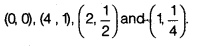
whose solution is given by y = \(\frac { 1 }{ 4 }\). Therefore, (1,1/4) is also a solution of the given equation. So, four
of the infinitely many solutions of the given equation are
NCERT Solutions for Class 9 Maths Chapter 8 Linear Equations in Two Variables Ex 8.2 img 3

Question 3.
Check which of the following are solution of the equation x – 2y = 4 and which are not?
(i) (0, 2)
(ii) (2,0)
(iii) (4,0)
(iv) (√2,4√2)
(v) (1,1)
Solution:
(i) Take x – 2y and put x = 0, y = 2,
we get 0 – 2 x 2 = 0 – 4 = -4 ≠ 4
Hence, (0, 2) is not a solution of x – 2y = 4.

(ii)
Take x – 2y and put x = 2, y = 0,
we get 2 – 2 x 0 = 2 – 0 = 2 ≠ 4
Hence, (2, 0) is not a solution of x – 2y = 4.

(iii)
Take x – 2y and put x = 4, y = 0;
we get 4 – 2 x 0 = 4 – 0 = 4
Hence, (4, 0) is a solution of x – 2y = 4.

(iv)
Take x – 2y and put x = √2, y = 4√2, we get
√2 – 2 x 4√2 = √2 – 8√2 =-7√2 ≠ 4
Hence, (√2,4√2) is not a solution of x – 2y = 4

(v)
Take x – 2y and put x = 1, y = 1,
we get 1 – 2 x 1 = 1 – 2 = -1 ≠ 4
Hence, (1,1) is not a solution of x – 2y = 4.

Question 4.
Find the value of k, if x = 2, y = 1 is a solution of the equation 2x + 3 y = k.
Solution:
Take 2x + 3y = k
Put x = 2, y = 1 then we get, 2 x 2 + 3 x 1 = k
⇒ 4 + 3 = k
⇒ k = 7
We hope the NCERT Solutions for Class 9 Maths Chapter 8 Linear Equations in Two Variables Ex 8.2 help you. If you have any query regarding NCERT Solutions for Class 9 Maths Chapter 8 Linear Equations in Two Variables Ex 8.2, drop a comment below and we will get back to you at the earliest.

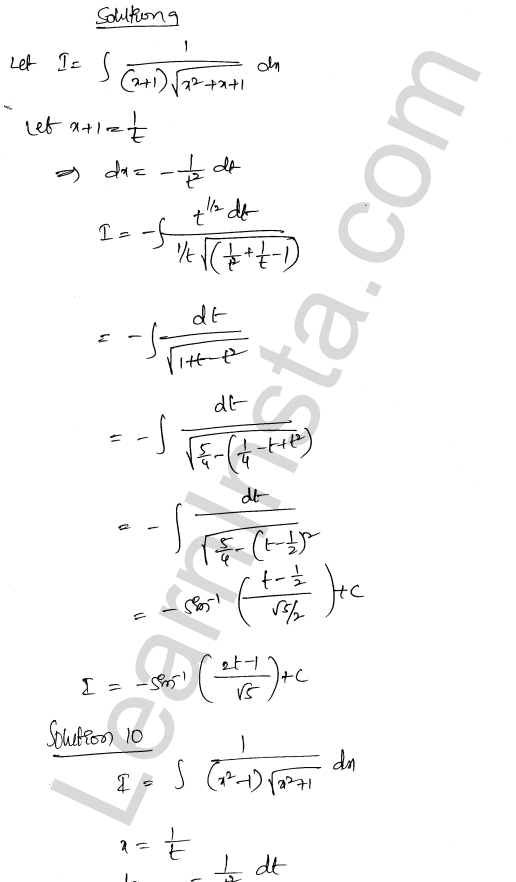
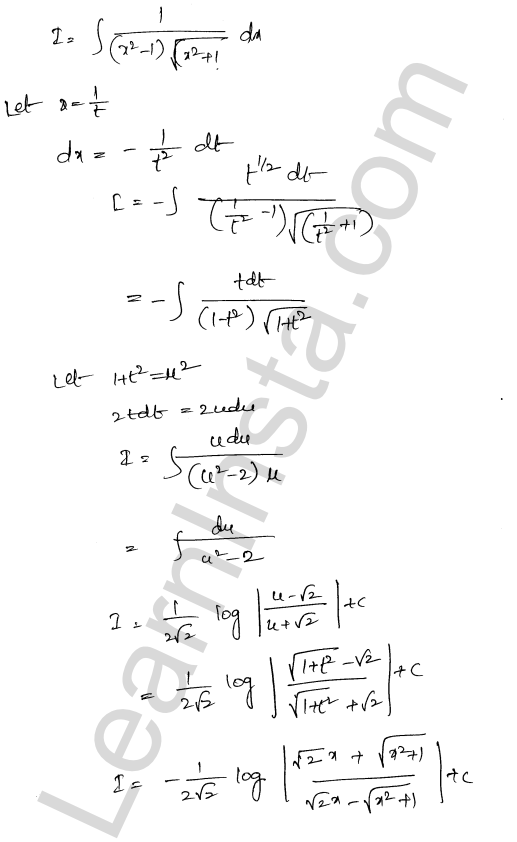
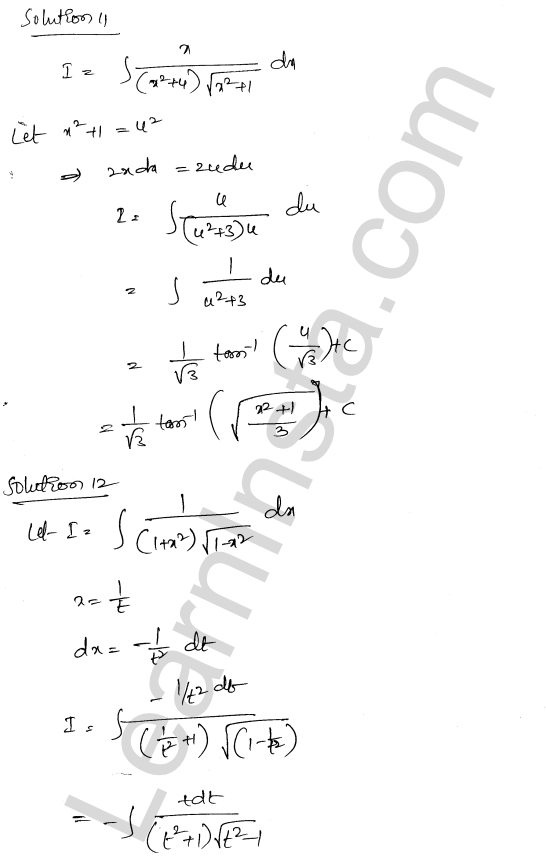
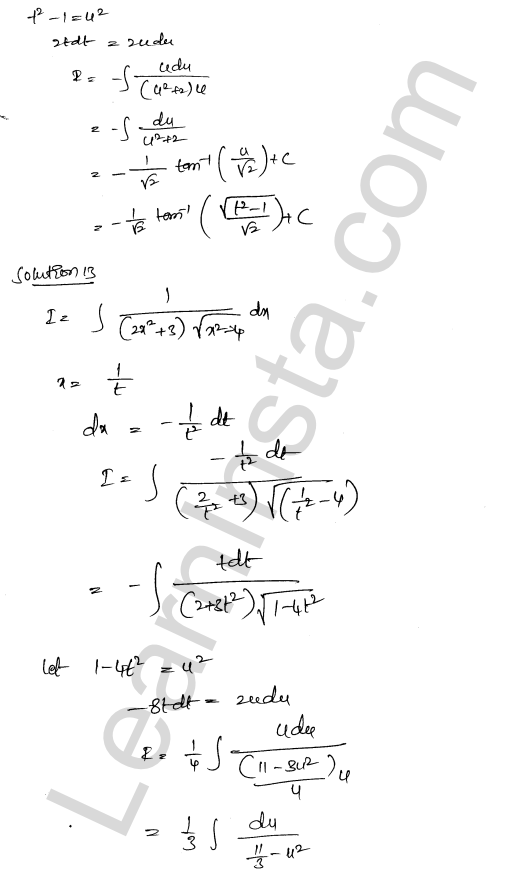
RD Sharma Class 12 Solutions Chapter 19 Indefinite Integrals Ex 19.32

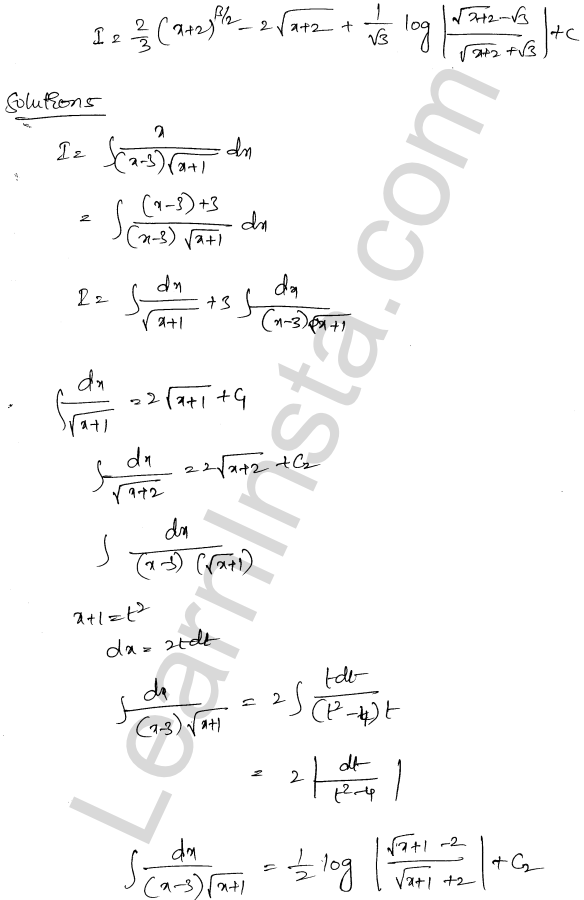
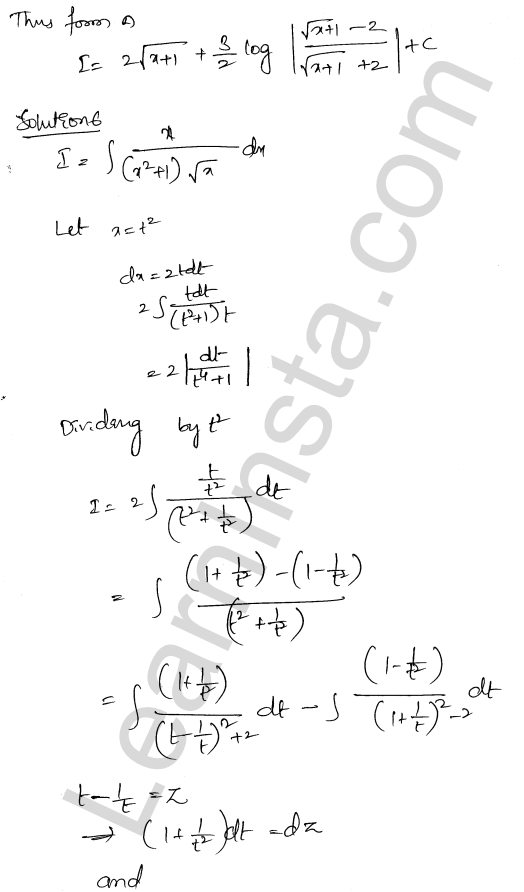
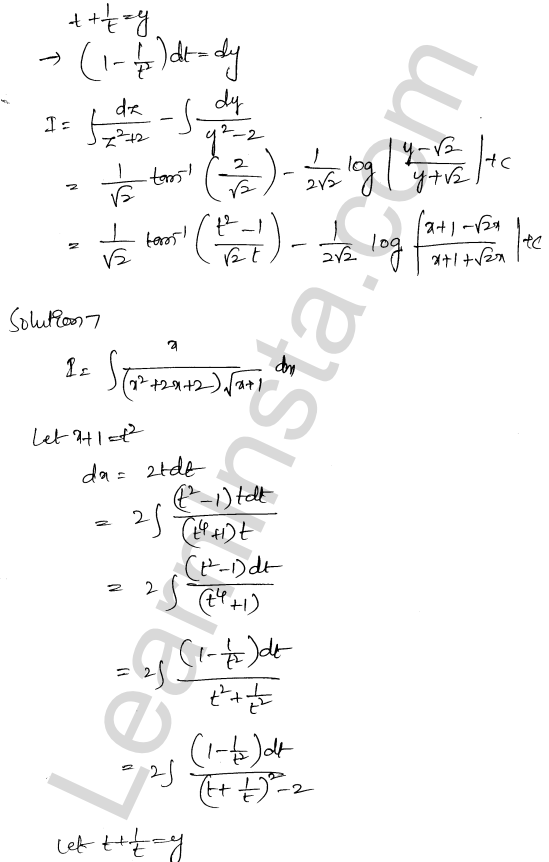
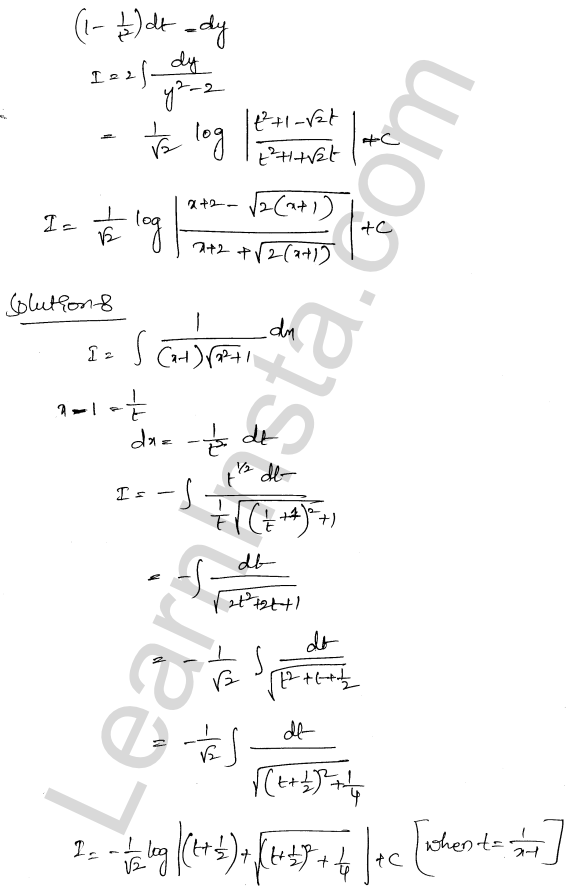
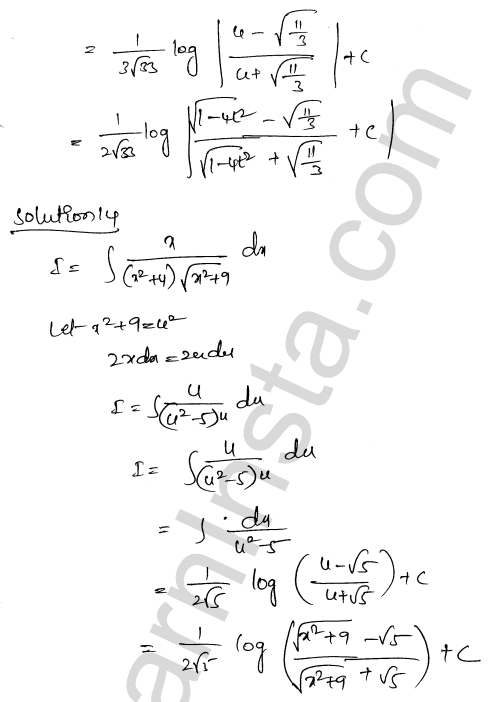
RD Sharma Class 12 Solutions Chapter 19 Indefinite Integrals Ex 19.32

These Solutions are part of RD Sharma Class 12 Solutions. Here we have given RD Sharma Class 12 Solutions Chapter 19 Indefinite Integrals Ex 19.32.

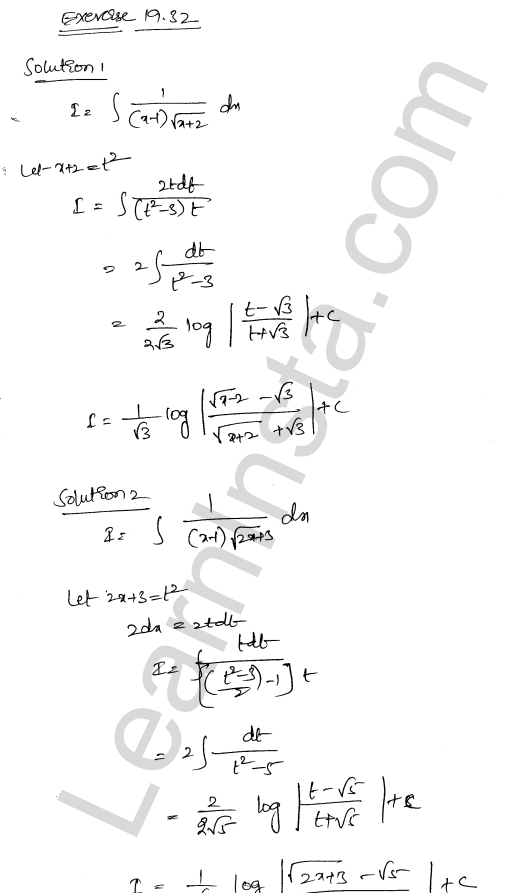
RD Sharma Class 12 Solutions Chapter 19 Indefinite Integrals Ex 19.32 1.1
RD Sharma Class 12 Solutions Chapter 19 Indefinite Integrals Ex 19.32 1.2
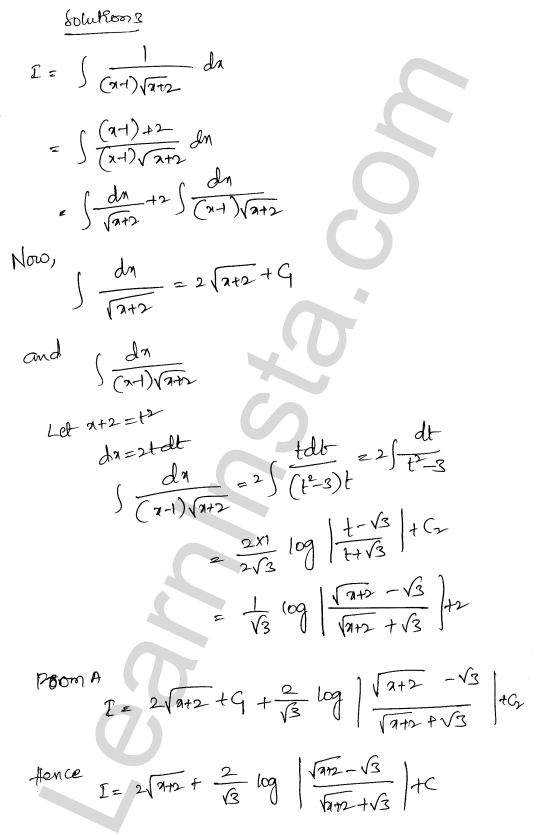
RD Sharma Class 12 Solutions Chapter 19 Indefinite Integrals Ex 19.32 1.3
RD Sharma Class 12 Solutions Chapter 19 Indefinite Integrals Ex 19.32 1.4
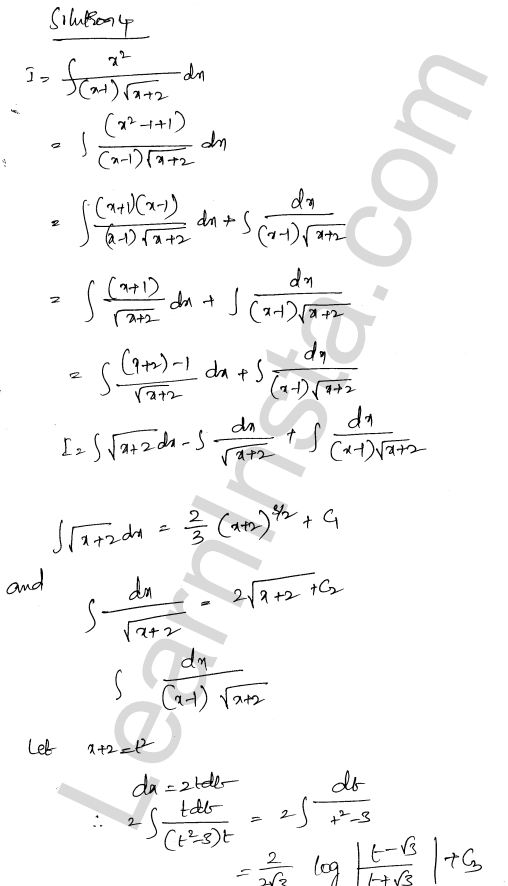
RD Sharma Class 12 Solutions Chapter 19 Indefinite Integrals Ex 19.32 1.5
RD Sharma Class 12 Solutions Chapter 19 Indefinite Integrals Ex 19.32 1.6
RD Sharma Class 12 Solutions Chapter 19 Indefinite Integrals Ex 19.32 1.7
RD Sharma Class 12 Solutions Chapter 19 Indefinite Integrals Ex 19.32 1.8
RD Sharma Class 12 Solutions Chapter 19 Indefinite Integrals Ex 19.32 1.9
RD Sharma Class 12 Solutions Chapter 19 Indefinite Integrals Ex 19.32 1.10
RD Sharma Class 12 Solutions Chapter 19 Indefinite Integrals Ex 19.32 1.11
RD Sharma Class 12 Solutions Chapter 19 Indefinite Integrals Ex 19.32 1.12

We hope the RD Sharma Class 12 Solutions Chapter 19 Indefinite Integrals Ex 19.32, help you. If you have any query regarding RD Sharma Class 12 Solutions Chapter 19 Indefinite Integrals Ex 19.32, drop a comment below and we will get back to you at the earliest.