NCERT Solutions for Class 6 Maths Chapter 5 Understanding Elementary Shapes Ex 5.2

NCERT Solutions for Class 6 Maths Chapter 5 Understanding Elementary Shapes Ex 5.2 are part of NCERT Solutions for Class 6 Maths. Here we have given NCERT Solutions for Class 6 Maths Chapter 5 Understanding Elementary Shapes Ex 5.2.

BoardCBSE
TextbookNCERT
ClassClass 6
SubjectMaths
ChapterChapter 5
Chapter NameUnderstanding Elementary Shapes
Exercise Ex 5.2
Number of Questions Solved7
CategoryNCERT Solutions

NCERT Solutions for Class 6 Maths Chapter 5 Understanding Elementary Shapes Ex 5.2

Question 1.
What fraction of a clockwise revolution does the hour hand of a clock turn through, when it goes from
(a) 3 to 9
(b) 4 to 7
(c) 7 to 10
(d) 12 to 9
(e) 1 to 10
(f) 6 to 3?
Solution :
(a) \(\frac { 1 }{ 2 }\) of a revolution
(b) \(\frac { 1 }{ 4 }\) of a revolution
(c) \(\frac { 1 }{ 4 }\) of a revolution
(d) \(\frac { 3 }{ 4 }\) of a revolution
(e) \(\frac { 3 }{ 4 }\) of a revolution
(f) \(\frac { 3 }{ 4 }\) of a revolution.

Question 2.
Where will the hand of a clock stop, if it
(a) starts at 12 and makes 1/2 of a revolution, clockwise?
(b) starts at 2 and makes 1/2 of a revolution, clockwise?
(c) starts at 5 and makes 1/4 of a revolution, clockwise?
(d) starts at 5 and makes 3/4 of a revolution, clockwise?
Solution :
(a) at 6
(b) at 8
(c) at 8
(d) at 2.

Question 3.
Which direction will you face if you start facing
(a) east and make 1/2 of a revolution clockwise?
(b) east and make 1/2 of a revolution clockwise?
(c) west and make 3/4 of a. revolution anti-clockwise?
(d) south and make one full revolution? (Should we specify clockwise or anti-clockwise for this last question? Why not?)
Solution :
(a) West
(b) West
(c) North
(d) South.
To answer (d), it is immaterial whether we turn clockwise or anti-clockwise because one full revolution will bring us back to the original position.

Question 4.
What part of a revolution have you turned through if you stand to face
(a) east and turn clockwise to face north?
(b) south and turn clockwise to face east?
(c) west and turn clockwise to face east?
Solution :
(a) \(\frac { 3 }{ 4 }\) of a revolution.
(b) \(\frac { 3 }{ 4 }\) of a revolution.
(c) \(\frac { 1 }{ 2 }\) of a revolution.

Question 5.
Find the number of right angles turned through by the hour hand of a clock when it goes from
(a) 3 to 6
(b) 2 to 8
(c) 5 to 11
(d) 10 to 1
(e) 12 to 9
(f) 12 to 9
Solution :
(a) 1 right angle
(b) 2 right angles
(c) 2 right angles
(d) 1 right angle
(e) 3 right angles
(f) 2 right angle

Question 6.
Now many right angles do you make if you start facing
(a) south and turn clockwise to the west?
(b) north and turn anti-clockwise to the east?
(c) west and turn to west?
(d) south and turn to the north?
Solution :
(a) 1 right angle
(b) 3 right angles
(c) 4 right angles
(d) 2 right angles
(clockwise or anticlockwise).

Question 7.
Where will the hour’s hand of a clock stop if it starts
(a) from 6 and turns through 1 right angle?
(b) from 8 and turns through 2 right angles?
(c) from 10 and turns through 3 right angles?
(d) from 7and turns through 2 straight angles?
Solution :
(a) 9
(b) 2
(c) 7
(d) 7.
(We should consider only clockwise direction here).


We hope the NCERT Solutions for Class 6 Maths Chapter 5 Understanding Elementary Shapes Ex 5.2 help you. If you have any query regarding NCERT Solutions for Class 6 Maths Chapter 5 Understanding Elementary Shapes Ex 5.2, drop a comment below and we will get back to you at the earliest.

NCERT Solutions for Class 6 Maths Chapter 3 Playing With Numbers Ex 3.2

NCERT Solutions for Class 6 Maths Chapter 3 Playing With Numbers Ex 3.2 are part of NCERT Solutions for Class 6 Maths. Here we have given NCERT Solutions for Class 6 Maths Chapter 3 Playing With Numbers Ex 3.2.

BoardCBSE
TextbookNCERT
ClassClass 6
SubjectMaths
ChapterChapter 3
Chapter NamePlaying With Numbers
Exercise Ex 3.2
Number of Questions Solved12
CategoryNCERT Solutions

NCERT Solutions for Class 6 Maths Chapter 3 Playing With Numbers Ex 3.2

Question 1.
What is the sum of any two :
(a) Odd numbers
(b) Even numbers.
Solution :
(a) The sum of any two odd numbers is an even number.
(b) The sum of any two even numbers is an even number.

Question 2.
State whether the following statements are True or False :

  1. The sum of three odd numbers is even.
  2. The sum of two odd numbers and one even number is even.
  3. The product of three odd numbers is odd.
  4. If an even number is divided by 2, the quotient is always odd.
  5. All prime numbers are odd.
  6. Prime numbers do not have any factors.
  7. Sum of two prime numbers is always even.
  8. 2 is the only even prime number.
  9. All even numbers are composite numbers.
  10. The product of two even numbers is always even.

Solution :

  1. This statement is false.
  2. This statement is true.
  3. This statement is true.
  4. This statement is false.
  5. This statement is false.
  6. This statement is false.
  7. This statement is false.
  8. This statement is true.
  9. This statement is false.
  10. This statement is true.

Question 3.
The numbers 13 and 31 are prime numbers. Both these numbers have the same digits 1 and 3. Find such pairs of prime numbers up to 100.
Solution :
All other such pairs of prime numbers up to 100 are as follows :
17 and 71; 37 and 73; 79 and 97.

Question 4.
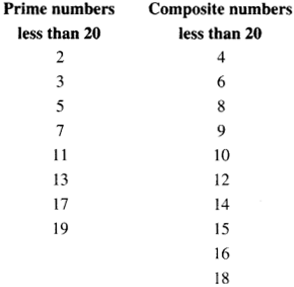
Write down separately the prime and composite numbers less than 20.
Solution :
NCERT Solutions for Class 6 Maths Chapter 3 Playing With Numbers 1
Question 5.
What is the greatest prime number between 1 and 10?
Solution :
The greatest prime number between 1 and 10 is 7.

Question 6.
Express the following as the sum of two odd primes :
(a) 44
(b) 36
(c) 24
(d) 18.
Solution :
(a) 44 = 3+41
(b) 36 = 5 + 31
(c) 24 = 5+19
(d) 18 = 5+13.

Question 7.
Give three pairs of prime numbers whose difference is 2.
[Remark: Two prime numbers whose difference is 2 are called twin primes],
Solution :
The three pairs of prime numbers, whose difference is 2, are as follows :
3, 5 ; 5, 7 ; 11, 13.

Question 8.
Which of the following numbers are prime?
(a) 23
(b) 51
(c) 37
(d) 26.
Solution :
(a) 23,
(c) 37 are prime numbers.

Question 9.
Write seven consecutive composite numbers less than 100 so that there is no prime number between them.
Solution :
90, 91, 92, 93, 94, 95, 96.

Question 10.
Express each of the following numbers as the sum of three odd primes :
(a) 21
(b) 31
(c) 53
(d) 61.
Solution :
(a) 21 = 3 + 5 + 13
(b) 31 = 3 + 5 + 23
(c) 53 = 13+ 17 + 23
(d) 61 =7;+ 13+41.

Question 11.
Write five pairs of prime numbers below 20 whose sum is divisible by 5. (Hint: 3 + 7 – 10).
Solution :
2, 3 ; 2, 13 ; 3, 17 ; 7, 13 ; 11, 19.

Question 12.
Fill in the blanks in the following :

  1. A number which has only two factors is called a
  2. A number which has more than two factors is called a
  3. 1 is neither nor
  4. The smallest prime number is
  5. The smallest composite number is
  6. The smallest even number is

Solution :

  1. A number which has only two factors is called a prime number.
  2. A number which has more than two factors is called a composite number.
  3. 1 is neither prime number nor composite number.
  4. The smallest prime number is 2.
  5. The smallest composite number is 4.
  6. The smallest even number is 2.


We hope the NCERT Solutions for Class 6 Maths Chapter 3 Playing With Numbers Ex 3.2 help you. If you have any query regarding NCERT Solutions for Class 6 Maths Chapter 3 Playing With Numbers Ex 3.2, drop a comment below and we will get back to you at the earliest.

NCERT Solutions for Class 8 Maths Chapter 16 Playing with Numbers Ex 16.2

NCERT Solutions for Class 8 Maths Chapter 16 Playing with Numbers Ex 16.2 are part of NCERT Solutions for Class 8 Maths. Here we have given NCERT Solutions for Class 8 Maths Chapter 16 Playing with Numbers Ex 16.2.

BoardCBSE
TextbookNCERT
ClassClass 8
SubjectMaths
ChapterChapter 16
Chapter NamePlaying with Numbers
ExerciseEx 16.2
Number of Questions Solved4
CategoryNCERT Solutions

NCERT Solutions for Class 8 Maths Chapter 16 Playing with Numbers Ex 16.2

Question 1.
If 21y5 is a multiple of 9, where y is a digit, what is the value of y?
Solution.
Since 21y5 is a multiple of 9, its sum of digits 2 + 1+ y + 5 = 8+ y isa multiple of 9; so 8 + y is one of these numbers: 0, 9, 18, 27, 36, 45,… .
But since y is a digit, it can only be possible that 8 + y = 9. Therefore, y = 1.

Question 2.
If 31z5 is a multiple of 9, where z is a digit, what is the value of z?
You will find that there are two answers to the last problem. Why is this so?
Solution.
Since 31z5 is a multiple of 9, its sum of digits 3 + 1 + z + 5 = 9 + z isa multiple of 9; so 9 + z is one of these numbers: 0, 9, 18, 27, 36, 45, … .
But since z is a digit, it can only be possible that 9 + z = 9 or 18. Therefore, z = 0 or 9.

Question 3.
If 24x is a multiple of 3, where x is a digit, what is the value of x?
(Since 24x is a multiple of 3, its sum of digits 6 + x is a multiple of 3; so 6 + x is one of these numbers: 0, 3, 6, 9, 12, 15, 18, … .
But since xis a digit, it can only be that 6 + x = 6 or 9 or 12 or 15. Therefore, x = 0 or 3 or 6 or 9. Thus, x can have any of four different values.)
Solution.
The solution is given with question.

Question 4.
If 31z5 is a multiple of 3, where z is a digit, what might be the values of z?
Solution.
Since 31z5 is a multiple of 3, its sum of digits 3 + 1 + z + 5 = 9 + z is a multiple of 3; so 9 + z is one of these numbers: 0, 3, 6, 9, 12, 15, 18, … .
But since z is a digit, it can only be possible that 9 + z = 9 or 12 or 15 or 18. Therefore, z = 0 or 3 or 6 or 9.

We hope the NCERT Solutions for Class 8 Maths Chapter 16 Playing with Numbers Ex 16.2 help you. If you have any query regarding NCERT Solutions for Class 8 Maths Chapter 16 Playing with Numbers Ex 16.2, drop a comment below and we will get back to you at the earliest.

NCERT Solutions for Class 8 Maths Chapter 15 Introduction to Graphs Ex 15.3

NCERT Solutions for Class 8 Maths Chapter 15 Introduction to Graphs Ex 15.3 are part of NCERT Solutions for Class 8 Maths. Here we have given NCERT Solutions for Class 8 Maths Chapter 15 Introduction to Graphs Ex 15.3.

BoardCBSE
TextbookNCERT
ClassClass 8
SubjectMaths
ChapterChapter 15
Chapter NameIntroduction to Graphs
ExerciseEx 15.3
Number of Questions Solved2
CategoryNCERT Solutions

NCERT Solutions for Class 8 Maths Chapter 15 Introduction to Graphs Ex 15.3

Question 1.
Draw the graphs for the following tables of values, with suitable scales on the axes.
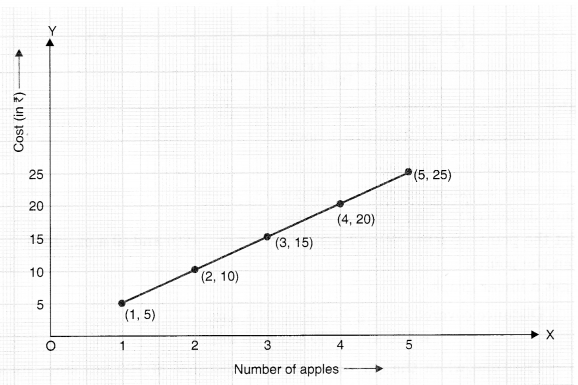
(a) Cost of apples
NCERT Solutions for Class 8 Maths Chapter 14 Factorisation Ex 15.3 1
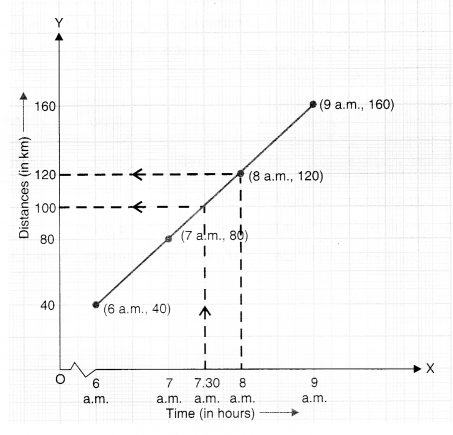
(b) Distance travelled by a car
NCERT Solutions for Class 8 Maths Chapter 14 Factorisation Ex 15.3 2
(i) How much distance the car cover during the period 7.30 a.m. to 8 a.m.?
(ii) What was the time when the car had covered a distance of 100 km since it starts?

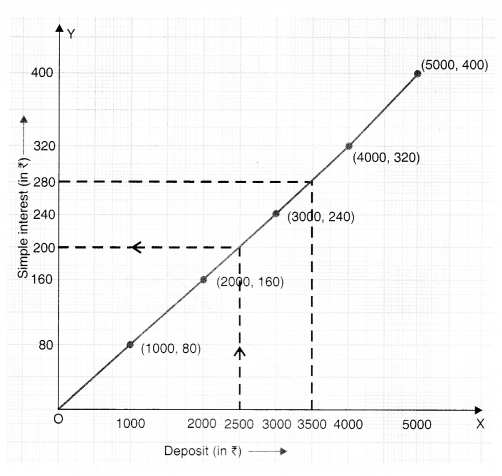
(c) Interest on deposits for a year.
NCERT Solutions for Class 8 Maths Chapter 14 Factorisation Ex 15.3 3
(i) Does the graph pass through the origin?
(ii) Use the graph to find the interest on? 2500 for a year.
(iii) To get an interest of ? 280 per year, how much money should be deposited?
Solution.
(a)
NCERT Solutions for Class 8 Maths Chapter 14 Factorisation Ex 15.3 4
Scale:
On horizontal axis:         2 units = 1 apple
On vertical axis:              1 unit = ₹ 5
Mark number of apples on the horizontal axis.
Mark cost (in ?) on the vertical axis.
Plot the points: (1, 5), (2, 10), (3, 15), (4, 20) and (5, 25)
Join the points.
We get a linear graph.

(b)
NCERT Solutions for Class 8 Maths Chapter 14 Factorisation Ex 15.3 5
Scale:
On horizontal axis:      2 units = 1 hour
On vertical axis:           2 units = 40 km
Mark time (in hours) on the horizontal axis.
Mark distances (in km) on the vertical axis.
Plot the points (6 a.m., 40), (7 a.m., 80) (8 a.m., 120) and (9 a.m., 160).
Join the points.
We get a linear graph.
(i) Distance covered during 7.30 a.m. to 8 a.m.
= 120 km – 100 km = 20 km
(ii) The time when the car had covered a distance of 100 km since its start was 7.30 a.m.

(c)
NCERT Solutions for Class 8 Maths Chapter 14 Factorisation Ex 15.3 6Scale:
On horizontal axis:       2 units = ₹ 1000
On vertical axis:            2 units = ₹ 80
Mark deposit (in ₹ on the horizontal axis.
Mark simple interest (in ₹) on the vertical axis.
Plot the points (1000, 80), (2000, 160), (3000, 240) (4000, 320) and (5000, 400).
Join the points.
We get a linear graph.
(i) Yes! The graph passes through the origin.
(ii) Interest on ₹ 2500 for a year = ₹ 200
(iii) To get an interest of ₹ 280 per year, ₹ 3500 should be deposited.

Question 2.
Draw a graph for the following:
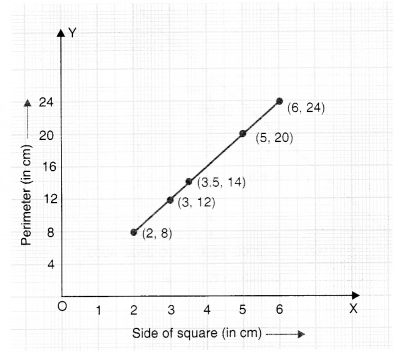
(i)
NCERT Solutions for Class 8 Maths Chapter 14 Factorisation Ex 15.3 7
Is it a linear graph?
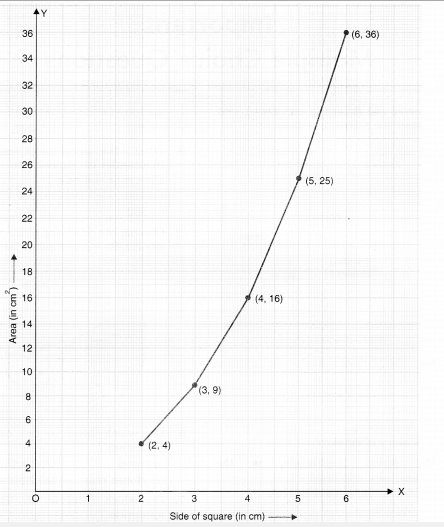
(ii)
NCERT Solutions for Class 8 Maths Chapter 14 Factorisation Ex 15.3 8
Is it a linear graph?
Solution.
(i)
NCERT Solutions for Class 8 Maths Chapter 14 Factorisation Ex 15.3 9
Scale:
On horizontal axis:     1 unit = 1 cm
On vertical axis:          1 unit = 4 cm
Mark side of the square (in cm) on the horizontal axis.
Mark perimeter (in cm) on the vertical axis.
Plot the points (2, 8), (3, 12), (3.5. 14) (5, 20) and (6, 24).
Join the points.
Yes ; it is a linear graph.

(ii)
NCERT Solutions for Class 8 Maths Chapter 14 Factorisation Ex 15.3 10
• Scale:
On horizontal axis: 2 units = 2 cm
On vertical axis: 1 unit = 2 cm
Mark side of the square (in cm) on the horizontal axis.
Mark area (in cm ) on the vertical axis.
Plot the points (2, 4) (3, 9), (4, 16), (5, 25) and (6, 36).
Join the points.
The graph we get is not linear.

We hope the NCERT Solutions for Class 8 Maths Chapter 15 Introduction to Graphs Ex 15.3 help you. If you have any query regarding NCERT Solutions for Class 8 Maths Chapter 15 Introduction to Graphs Ex 15.3, drop a comment below and we will get back to you at the earliest.
NCERT Solutions for Class 8 Maths Chapter 15 Introduction to Graphs Ex 15.2

NCERT Solutions for Class 8 Maths Chapter 15 Introduction to Graphs Ex 15.2 are part of NCERT Solutions for Class 8 Maths. Here we have given NCERT Solutions for Class 8 Maths Chapter 15 Introduction to Graphs Ex 15.2.

BoardCBSE
TextbookNCERT
ClassClass 8
SubjectMaths
ChapterChapter 15
Chapter NameIntroduction to Graphs
ExerciseEx 15.2
Number of Questions Solved4
CategoryNCERT Solutions

NCERT Solutions for Class 8 Maths Chapter 15 Introduction to Graphs Ex 15.2

Question 1.
Plot the following points on a graph sheet. Verify if they lie on a line.
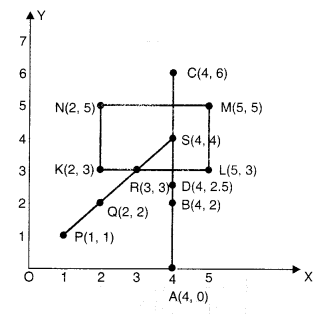
(a) A(4, 0), B(4, 2), C(4, 6), D(4, 2.5)
(b) P(l, 1), Q(2, 2), R(3, 3), S(4, 4)
(c) K(2, 3), L(5, 3), M(5, 5), N(2, 5)
Solution.
NCERT Solutions for Class 8 Maths Chapter 14 Factorisation Ex 15.2 1
(a) The points lie on a line.
(b) The points lie on a line.
(c) The points do not lie on a line.

Question 2.
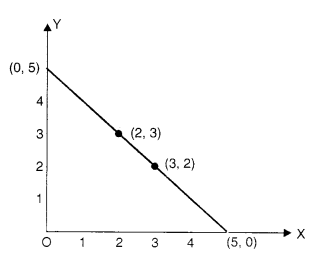
Draw the line passing through (2, 3) and (3, 2). Find the coordinates of the points at which this line meets the x-axis and y-axis.
Solution.
The coordinates of the points at which this line meets the x-axis and y-axis are (5, 0) and (0, 5) respectively. See the graph given above.
NCERT Solutions for Class 8 Maths Chapter 14 Factorisation Ex 15.2 2

Question 3.
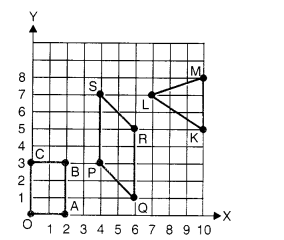
Write the coordinates of the vertices of each of these adjoining figures.
NCERT Solutions for Class 8 Maths Chapter 14 Factorisation Ex 15.2 3
Solution.
O → (0, 0)
A → (2,0)
B → (2, 3)
C → (0,3)

P → (4, 3)
Q → (6, 1)
R → (6, 5)
S → (4, 7)

K → (10, 5)
L → (7, 7)
M → (10, 8)

Question 4.
State whether True or False. Correct that is false.
(i) A point whose x-coordinate is zero and y-coordinate is non-zero will lie on the y-axis.
(ii) A point whose y-coordinate is zero ‘ and x-coordinate is 5 will lie on y-axis.
(iii) The coordinates of the origin are (0, 0).
Solution.
(i) True
(ii) False; A point whose y-coordinate is zero and x-coordinate is 5 will lie on x-axis.
(iii) True


We hope the NCERT Solutions for Class 8 Maths Chapter 15 Introduction to Graphs Ex 15.2 help you. If you have any query regarding NCERT Solutions for Class 8 Maths Chapter 15 Introduction to Graphs Ex 15.2, drop a comment below and we will get back to you at the earliest.