RS Aggarwal Class 8 Solutions Chapter 7 Factorisation Ex 7D

RS Aggarwal Class 8 Solutions Chapter 7 Factorisation Ex 7D

These Solutions are part of RS Aggarwal Solutions Class 8. Here we have given RS Aggarwal Solutions Class 8 Chapter 7 Factorisation Ex 7D.

Other Exercises

Question 1.
Solution:
x2 + 5x + 6
= x2 + 2x + 3x + 6
{6 = 2 x 3, 5 = 2 + 3}
= x (x + 2) + 3 (x + 2)
= (x + 2) (x + 3) Ans.

Question 2.
Solution:
y2 + 10y + 24
= y2 + 6y + 4y + 24
{24 = 6 x 4, 10 = 6 + 4}
= y (y + 6) + 4 (y + 6)
= (y + 6) (y + 4)

Question 3.
Solution:
z2 + 12x + 27
{27 = 9 x 3, 12 = 9 + 3}
= z2 + 9z + 3z + 27
= z (z + 9) + 3 (z + 9)
= (z + 9) (z + 3)

Question 4.
Solution:
p2 + 6p + 8
= p2 + 4p + 2p + 8
{ 8 = 4 x 2, 6 = 4 + 2}
= p (p + 4) + 2 (p + 4)
= (p + 4) (p + 2)

Question 5.
Solution:
x2 + 15x + 56
= x2 + 8x + 7x + 56
{56 = 8 x 7, 15 = 8 x 7}
= x(x + 8) + 7(x + 8)
= (x + 8) (x + 7) Ans.

Question 6.
Solution:
y2 + 19y + 60
= y2 + 15y + 4y + 60
{60 = 15 x 4, 19 = 15 + 4}
= y (y + 15) + 4 (y + 15)
= (y + 15) (y + 4)

Question 7.
Solution:
x2 + 13x + 40
= x2 + 5x + 8x + 40
{40 = 5 x 8, 13 = 5 + 8}
= x(x + 5) + 8(x + 5)
= (x + 5) (x + 8) Ans.

Question 8.
Solution:
q2 – 10q + 21
= q2 – 7q – 3q + 21
{21 = ( – 7)x( – 3), – 10 = – 7 – 3}
= q {q – 7) – 3 (q – 7)
= (q – 7)(q – 3)

Question 9.
Solution:
p+ 6p – 16
= p2 + 8p – 2p – 16
{ – 16 = 8x( – 2),6 = 8 – 2}
= p (p + 8) – 2 (p + 8)
= (p + 8) (p – 2)

Question 10.
Solution:
x2 – 10x + 24
= x2 – 6x – 4x + 24
{24 = ( – 6) x ( – 4), – 10 = – 6 – 4 }
= x(x – 6) – 4(x – 6)
= (x – 6) (x – 4) Ans.

Question 11.
Solution:
x2 – 23x + 42
= x2 – 2x – 21x + 42
{42 = ( – 2) x ( – 21), – 23 = – 2 – 21}
= x(x – 2) – 21(x – 2)
= (x – 2) (x – 21) Ans.

Question 12.
Solution:
x2 – 17x + 16
= x2 – x – 16x + 16
{ 16 = ( – 1) x ( – 16), 17 = – 1 – 16}
= x (x – 1) – 16(x – 1)
= (x – 1) (x – 16) Ans.

Question 13.
Solution:
y2 – 21y + 90
= y2 – 15y – 6y + 90
{90 = ( – 15)x ( – 6), – 21 = – 15 – 6}
= y(y – 15) – 6 (y – 15)
= (y – 15) (y – 6)

Question 14.
Solution:
x2 – 22x + 117
= x2 – 13x – 9x + 117
{117 = ( – 13) x ( – 9), – 22 = – 13 – 9}
= x(x – 13) – 9(x – 13)
= (x – 9) (x – 13) Ans.

Question 15.
Solution:
x2 – 9x + 20
= x2 – 5x – 4x + 20
{ 20 = ( – 5) x ( – 4), – 9 = – 5 – 4}
= x(x – 5) – 4(x – 5)
= (x – 5) (x – 4) Ans.

Question 16.
Solution:
x2 + x – 132
= x2 + 12x – 11x – 132
{ – 132 = 12 x ( – 11), 1 = 12 – 11}
= x(x + 12) – 11(x + 12)
= (x + 12) (x – 11) Ans.

Question 17.
Solution:
x2 + 5x – 104
= x2 + 13x – 8x – 104
{ – 104 = 13 x ( – 8), 5 = 13 – 8}
= x(x + 13) – 8(x + 13)
= (x + 13) (x – 8) Ans.

Question 18.
Solution:
y2 + 7y – 144
= y2 + 16y – 9y – 144
{144 = – 16 x 9, 7 = 16 – 9}
= y(y +16) – 9(y + 16)
= (y + 16) (y – 9) Ans.

Question 19.
Solution:
z2 + 19z – 150
= z2 + 25z – 6z – 150
{ – 150 = 25 x ( – 6), 19 = 25 – 6}
= z(z + 25) – 6(z + 25)
= (z + 25) (z – 6) Ans.

Question 20.
Solution:
y2 + y – 72
= y2 + 9y – 8y – 72
{ – 72 = 9x( – 8), 1 = 9 – 8}
= y(y + 9) – 8(y + 9)
= (y + 9) (y – 8) Ans

Question 21.
Solution:
a2 + 6a – 91
= a2 + 13a – 7a – 91
{ – 91 = 13x( – 7), 6 = 13 – 7}
= a (a + 13) – 7 (a + 13)
= (a + 13) (a – 7)

Question 22.
Solution:
p2 – 4p – 11
= p2 – 11p + 7p – 77
{ – 77 = – 11 x 7, – 4 = – 11 + 7}
= p(p – 11) + 7 (p – 11)
= (p – 11)(p + 7)

Question 23.
Solution:
x2 – 7x – 30
= x2 – 10x + 3x – 30
{ – 30 = – 10 x 3, – 7 = – 10 + 3}
= x(x – 10) + 3(x – 10)
= (x – 10) (x + 3) Ans.

Question 24.
Solution:
x2 – 14 x + 3 x – 42
{ – 11 = – 14 + 3], – 42 = – 14 x 3}
= x (x – 14) + 3 (x – 14)
= (x – 14) (x + 3) Ans.

Question 25.
Solution:
x2 – 5x – 24
= x2 – 8x + 3x – 24
{ – 24 = – 8 x 3, – 5 = – 8 + 3}
= x(x – 8) + 3(x – 8)
= (x – 8) (x + 3) Ans.

Question 26.
Solution:
y2 – 6y – 135
= y2 – 15y + 9y – 135
{ – 135 = – 15 x 9, – 6 = – 15 + 9}
= y (y – 15) + 9 (y – 15)
= (y – 15) (y + 9)

Question 27.
Solution:
z2 – 12z – 45
= z2 – 15z + 3z – 45
= z (z – 15) + 3 (z – 15)
{ – 45 = – 15 x 3, – 12 = – 15 + 3}
= (z – 15)(z + 3)

Question 28.
Solution:
x2 – 4x – 12
= x2 – 6x + 2x – 12
{ – 12 = – 6 x 2, – 4 = – 6 + 2}
= x (x – 6) + 2 (x – 6)
= (x – 6) (x + 2)

Question 29.
Solution:
3x2 + 10x + 8
= 3x2 + 6x + 4x + 8
{ 3 x 8 = 24, 24 = 6 x 4,10 = 6 + 4}
= 3x(x + 2) + 4(x + 2)
= (x + 2) (3x + 4) Ans.

Question 30.
Solution:
3y2 + 14y + 8
= 3y2 + 12y + 2y + 8
{3 x 8 = 24, 24 = 12 x 2, 14 = 12 + 2}
= 3y (y + 4) + 2 (y + 4)
= (y + 4) (3y + 2)

Question 31.
Solution:
3z2 – 10z + 8
= 3z2 – 6z – 4z + 8
{ 3 x 8 = 24, 24 = ( – 6)x( – 4), – 10 = – 6 – 4}
= 3z (z – 2) – 4 (z – 2)
= (z – 2) (3z – 4)

Question 32.
Solution:
2x2 + x – 45
= 2x2 + 10x – 9x – 45
{2 x ( – 45) = – 90,- 90 = (10)x( – 9), 1 = 10 – 9}
= 2x (x – 5) + 9 (x – 5)
= (x – 5) (2x + 9)

Question 33.
Solution:
6p2 + 11p – 10
= 6x2 + 15x – 4x – 10
{6x ( – 10) = 60, – 60 = 15 x ( – 4),11 = 15 – 4}
= 3x (2x + 5) – 2 (2x + 5)
= (3x – 2) (2x + 5) Ans.

Question 34.
Solution:
2x2 – 20x + 3x – 30
{2 x ( – 30) = – 60, – 17 = – 20 + 3, – 60 = – 20 x 3}
= 2x (x – 10) + 3 (x – 10)
= (x – 10) (2x + 3) Ans.

Question 35.
Solution:
7y2 -19y – 6
= 7y2 – 21 y + 2y – 6
{7 x ( – 6) = – 42, – 42 = – 21 x 2, – 19 = – 21 + 2}
= 7y(y – 3) + 2 (y – 3)
= (y – 3) (7y + 2)

Question 36.
Solution:
28 – 31x – 5x2
= 28 – 35x + 4x – 5x2
{28 x ( – 5)= – 140, -140 = – 35 x 4, – 31 = – 35 + 4}
= 7 (4 – 5x) + x (4 – 5x)
= (4 – 5x) (7 + x)

Question 37.
Solution:
3 + 23z – 8z2
= 3 + 24z – z – 8z2
{3 x ( – 8) = – 24, – 24 = 24 x ( – 1), 23 = 24 – 1}
= 3 (1 + 8z) – z (1 + 8z)
= (1 + 8z) (3 – z)

Question 38.
Solution:
6x2 – 5x – 6
= 6x2 – 9x + 4x – 6
{ 6 x ( – 6) = – 36,- 36 = – 9 x 4, – 5 = – 9 + 4}
= 3x (2x – 3) + 2 (2x – 3)
= (2x – 3) (3x + 2)

Question 39.
Solution:
3m2 + 24m + 36
= 3 {m2 + 8m + 12}
= 3 {m2 + 6m + 2m + 12)
{12 = 6 x 2, 8 = 6 + 2}
= 3 {m (m + 6) + 2 (m + 6)}
= 3 (m + 6) (m + 2)

Question 40.
Solution:
4n2 – 8n + 3
= 4n2 – 6n – 2n + 3
{4 x 3 = 12, 12 = ( – 6)x( – 2), – 8 = – 6 – 2}
= 2n (2n – 3) – 1 (2n- 3)
= (2n – 3) (2n – 1)

Question 41.
Solution:
6x2 – 17x – 3
= 6x2 – 18x + x – 3
{6 x ( – 3)= – 18, – 18 = – 18 x 1, – 17 = – 18 + 1}
= 6x (x – 3) + 1 (x – 3)
= (x – 3) (6x + 1)

Question 42.
Solution:
7x2 – 19x – 6
7x2 – 19x – 6
= 7x2 – 21x + 2x – 6
{7 x ( – 6) = – 42, – 42 = – 21 x 2, – 19 = – 21 + 2}
= 7x (x – 3) + 2 (x – 3)
= (x – 3) (7x + 2)

Hope given RS Aggarwal Solutions Class 8 Chapter 7 Factorisation Ex 7D are helpful to complete your math homework.

If you have any doubts, please comment below. Learn Insta try to provide online math tutoring for you.
RS Aggarwal Class 8 Solutions Chapter 7 Factorisation Ex 7C

RS Aggarwal Class 8 Solutions Chapter 7 Factorisation Ex 7C

These Solutions are part of RS Aggarwal Solutions Class 8. Here we have given RS Aggarwal Solutions Class 8 Chapter 7 Factorisation Ex 7C.

Other Exercises

Question 1.
Solution:
x2 + 8x + 16
= (x)2 + 2 × x × 4 + (4)2
= (x + 4)2

Question 2.
Solution:
x2 + 14x + 49
= (x)2 + 2 × x × 7 + (7)2
= (x + 7)2 Ans.

Question 3.
Solution:
1 + 2x + x2
= (1)2 + 2 × 1 × x + (x)2
= (1 + x)2 Ans.

Question 4.
Solution:
9 + 6z + z2
= (3)2 + 2 x 3 x z + (z)2
= (3 + z)2 Ans.

Question 5.
Solution:
x2 + 6ax + 9a2
= (x)2 + 2 × x × 3a + (3a)2
= (x + 3a)2 Ans.

Question 6.
Solution:
4y2 + 20y + 25
= (2y)2 + 2 x 2y x 5 + (5)2
= (2y2 + 5)2
{ ∵ a2 + 2ab + b2 = (a + b)2}

Question 7.
Solution:
36a2 + 36a + 9
= 9 [4a2 + 4a + 1]
= 9 [(2a)2 + 2 x 2a x 1 + (1)2]
= 9 [2a + 1]2

Question 8.
Solution:
9m2 + 24m + 16
= (3m)2 + 2 x 3m x 4 + (4)2
= (3m + 4)2
{ ∵ a2 + 2ab + b2 = (a + b)2}

Question 9.
Solution:
z2 + z + \(\\ \frac { 1 }{ 4 } \)
= (z)2 + 2 x z x \(\\ \frac { 1 }{ 2 } \) + \({ \left( \frac { 1 }{ 2 } \right) }^{ 2 }\)
= \({ \left( z+\frac { 1 }{ 2 } \right) }^{ 2 }\)

Question 10.
Solution:
49a2 + 84ab + 36b2
= (7a)2 + 2 x 7a x 6b + (6b)2
{ ∵ a2 + 2ab + b2 = (a + b)2}
= (7a + 6b)2

Question 11.
Solution:
p2 – 10p + 25
= (p)2 – 2 x p x 5 + (5)2
= (p – 5)2
{ ∵ a2 – 2ab + b2 = (a – b)2}

Question 12.
Solution:
121a2 – 88ab + 16b2
= (11a)2 – 2 x 11a x 4b + 4(b)2
= (11a – 4b)2

Question 13.
Solution:
1 – 6x + 9x2
= (1)2 – 2 x 1 x 3x + (3x)2
= (1 – 3x)2
{ ∵ a2 – 2ab + b2 = (a – b)2}

Question 14.
Solution:
9y2 – 12y + 4
= (3y)2 – 2 x 3y x 2 + (2)2
{ ∵ a2 – 2ab + b2 = (a – b)2}
= (3y – 2)2

Question 15.
Solution:
16x2 – 24x + 9
= (4x)2 – 2 x 4x x 3 + (3)2
= (4x – 3)2 Ans.

Question 16.
Solution:
m2 – 4mn + 4n2
= (m)2 -2 x m x 2n + (2n)2
= (m – 2n)2 Ans.

Question 17.
Solution:
a2b2 – 6abc + 9c2
= (ab)2 – 2 x ab x 3c + (3c)2
= (ab – 3c)2 Ans.

Question 18.
Solution:
m4 + 2m2n2 + n4
= (m2)2 + 2m2n2 + (n2)2
= (m2 + n2)2
{ ∵ a2 + 2ab + b2 = (a + b)2}

Question 19.
Solution:
(l + m)2 – 4lm
= l2 + m2 + 2lm – 4lm
= l2 + m2 – 2lm
= l2 – 2lm + m2
= (l – m)2
{ ∵ a2 – 2ab + b2 = (a – b)}


Hope given RS Aggarwal Solutions Class 8 Chapter 7 Factorisation Ex 7C are helpful to complete your math homework.

If you have any doubts, please comment below. Learn Insta try to provide online math tutoring for you.
RS Aggarwal Class 8 Solutions Chapter 7 Factorisation Ex 7B

RS Aggarwal Class 8 Solutions Chapter 7 Factorisation Ex 7B

These Solutions are part of RS Aggarwal Solutions Class 8. Here we have given RS Aggarwal Solutions Class 8 Chapter 7 Factorisation Ex 7B.

Other Exercises

Question 1.
Solution:
x2 – 36
= (x)2 – (6)2 { ∵ a2 – b2 = (a + b) (a – b)}
= (x + 6) (x – 6) Ans.

Question 2.
Solution:
4a2 – 9
= (2a)2 – (3)2
= (2a + 3) (2a – 3)
{ ∵ a2 – b2 = (a + b) (a – b)}

You can also Download NCERT Solutions for Class 8 English to help you to revise complete Syllabus and score more marks in your examinations.

Question 3.
Solution:
81 – 49x2
= (9)2 – (7x)2
= (9 + 7x) (9 – 7x) { ∵ a2 – b2 = (a + b) (a – b)}

Question 4.
Solution:
= (2x)2 – (3y)2
= (2x + 3y)(2x-3y)
{∵ a2 – b2 = (a + b) (a – b)}

Question 5.
Solution:
Using a2 – b2
= (a + b) (a – b)
= 16a2 – 225b2
= (4a)2 – (15b)2
= (4a + 15b) (4b – 5b)

Question 6.
Solution:
Using a2 – b2
= (a + b) (a – b)
= (3ab)2 – (5)2
= (3ab + 5) (3ab – 5)

Question 7.
Solution:
Using a2 – b2 = (a + b) (a – b)
16a2 – 144 = (4a)2 = (12)2
= (4a + 12) (4a – 12)
= 4 (a + 3) x 4 (a – 3)
= 16 (a + 3) (a – 3)

Question 8.
Solution:
63a2 – 112b2
= 7 (9a2 – 16b2)
= 7 [(3a)2 – (4b)2
= 7 (3a + 4b) (3a – 4b)

Question 9.
Solution:
20a2 – 45b2
= 5 {4a2 – 9b2}
= 5{(2a)2 – (3b)2)
= 5(2a + 3b) (2a – 3b) Ans.

Question 10.
Solution:
12x2 – 27
= 3(4x2 – 9)
= 3{(2x)2 – (3)2}
= 3(2x + 3) (2x – 3) Ans.

Question 11.
Solution:
x3 – 64x
= x(x2 – 64)
= x{(x)2 – (8)2}
= x(x + 8) (x – 8) Ans.

Question 12.
Solution:
16x5 – 144x3
= 16x3 [x2 – 9]
= 16x3 [(x)2 – (3)2]
= 16x3 (x + 3) (x – 3)

Question 13.
Solution:
3x5 – 48x3
= 3x3 {x2 – 16}
= 3x3{(x)2 – (4)2}
= 3x3 (x + 4) (x – 4) Ans.

Question 14.
Solution:
16p3 – 4p
= 4p [4p2 – 1]
= 4p ((2p)2 – (1)2]
= 4p(2p + 1)(2p – 1)

Question 15.
Solution:
63a2b2 – 7
= 7(9a2b2 – 1)
= 7{(3ab)2 – (1)2)
= 7(3ab + 1) (3ab – 1) Ans.

Question 16.
Solution:
1 – (b – c)2
= (1)2 – (b – c)2
= (1 + b + c) (1 – b + c) Ans.
{ ∵ a2 – b2 = (a + b) (a – b)}

Question 17.
Solution:
(2a + 3b)2 – 16c2
= (2a + 3b)2 – (4c)2
=(2a + 3b + 4c)(2a + 3b – 4c)Ans.
{ ∵ a2 – b2 = (a + b)(a – b)}

Question 18.
Solution:
(l + m)2 – (l – m)2
= (l + m + l – m)(l + m – l + m)
{ ∵ a2 – b2 = (a + b)(a – b)}
= 2l x 2m = 4lm

Question 19.
Solution:
(2x + 5y)2 – (1)2
=(2x + 5y + 1)(2x + 5y – 1)
{ ∵ a2 – b2 = (a + b)(a – b)}

Question 20.
Solution:
36c2 – (5a + b)2
= (6c)2 – (5a + b)2
{ ∵ a2 – b2 = (a + b)(a – b)}
= (6c + 5a + b)(6c – 5a – b)

Question 21.
Solution:
(3x – 4y)2 – 25z2
= (3x – 4y)2 – (5z)2
= (3x – 4y + 5z) (3x – 4y – 5z) Ans.

Question 22.
Solution:
x2 – y2 – 2y – 1
= x2 – (y2 + 2y + 1)
= (x)2 – (y + 1)2
= (x + y + 1)(x – y – 1)Ans.

Question 23.
Solution:
25 – a2 – b2 – 2ab
= 25 – (a2 + b2 + 2ab)
= (5)2 – (a + b)2
= (5 + a + b)(5 – a – b)Ans.

Question 24.
Solution:
25a2 – 4b2 + 28bc – 49c2
= 25a2 – [4b2 – 28bc + 49c2]
{ ∵ a2 – 2ab + b2 = (a – b)2}
= (5a)2 – [(2b)2 – 2 x 2b x 7c + (7c)2]
= (5a)2 – (2b – 7c)2
{ ∵ (a2 – b2 = (a + b)(a – b)}
= (5a + 2b – 7c) (5a – 2b + 7c)

Question 25.
Solution:
9a2 – b2 + 4b – 4
= 9a2 – (b2 – 4b + 4)
= (3a)2 – [(b)2 – 2 x b x 2 + (2)2]
= (3a)2 – (b – 2)2
{ ∵ a2 – 2ab + b2 = (a – b)2}
= (3a + b – 2)(3a – b + 2)
{ ∵ a2 – b2 = (a + b)(a – b)}

Question 26.
Solution:
(10)2 – (x – 5)2
= (10)2 – (x – 5)2
= (10 + x – 5)(10 – x + 5)
= (5 + x) (15 – x) Ans.

Question 27.
Solution:
{(405)2 – (395)2}
= (405)2 – (395)2
= (405 + 395) (405 – 395)
{ ∵ a2 – b2(a + b) (a – b)}
= 800 x 10 = 8000

Question 28.
Solution:
(7.8)2 – (2.2)2
= (7.8 + 2.2) (7.8 – 2.2)
= 10.0 x 5.6
= 56 Ans.

Hope given RS Aggarwal Solutions Class 8 Chapter 7 Factorisation Ex 7B are helpful to complete your math homework.

If you have any doubts, please comment below. Learn Insta try to provide online math tutoring for you.
NCERT Exemplar Solutions for Class 9 Science Chapter 13 Why Do we Fall Ill

NCERT Exemplar Solutions for Class 9 Science Chapter 13 Why Do we Fall Ill

These Solutions are part of NCERT Exemplar Solutions for Class 9 Science . Here we have given NCERT Exemplar Solutions for Class 9 Science Chapter 13 Why Do we Fall Ill

Question 1.
Give two examples for each of the following :

  1. Acute diseases
  2. Chronic diseases
  3. Infectious diseases
  4. Non-infectious diseases.

Answer:

  1. Acute Diseases. Typhoid, Malaria, Influenza.
  2. Chronic Diseases. TB (tuberculosis), Elephantiasis.
  3. Infectious Diseases. Typhoid, Chicken Pox.
  4. Non-infectious Diseases. Diabetes, Goitre.

More Resources

Question 2.
Name two diseases caused by protozoans. What are their causal organisms ?
Answer:

  1. Sleeping Sickness, caused by Trypanosoma gambiense.
  2. Kala-azar, caused by Leishmania donovani.

Question 3.
Which bacterium causes peptic ulcers ? Who discovered the pathogen for the first time ?
Answer:
Bacterium Causing Peptic Ulcers. Helicobacter pylori Discovery. Warren (1984). Marshall and Warren (1985).

Question 4.
What is antibiotic ? Give two examples. (CCE 2012)
Answer:
Antibiotic. It is a biochemical produced by a microbe which kills or blocks growth of other microbes (e.g. bacteria) by blocking their life processes without harming human cells, e.g., Penicillin, Streptomycin.

Question 5.
Fill in the blocks :

  1. Pneumonia is an example of ……………… disease.
  2. Many skin diseases are caused by ………….. .
  3. Antibiotics commonly block biochemical pathways important for the growth of …………….. .
  4. Living organisms carrying the infecting agents from one person to another are called ……………. .

Answer:

  1. Communicable (infectious)
  2. fungi
  3. bacteria
  4. vectors.

Question 6.
Name the target organs of the following diseases :

  1. Hepatitis targets …………… .
  2. Fit or unconsciousness targets ……………… .
  3. Pneumonia targets ……………. .
  4. Fungal disease targets ……………. .

Answer:

  1. Liver
  2. Brain
  3. Lungs
  4. Skin.

Question 7.
(a) Who discovered Vaccine” for the first time.
(b) Name two diseases which can be prevented by using vaccines.
Answer:
(a) Edward Jenner
(b) Pertussis, diphtheria, tuberculosis, polio.

Question 8.
Fill in the blanks :

  1. ……………… disease continues for many days and causes ………………….. on body.
  2.  …………….. disease continues for a few days and causes no long term effect on body.
  3. …………….. is defined as physical, mental and social well being and comfort.
  4. Common cold is ……………… disease.
  5. Many skin diseases are caused by …………………. .

Answer:

  1. Chronic, long-term effect
  2. Acute
  3. Health
  4. Infectious (communicable)
  5. Fungi.

Question 9.
Classify the following diseases as infectious and non-infectious:

  1. AIDS
  2. Tuberculosis
  3. Cholera
  4. High blood pressure
  5. Heart disease
  6. Pneumonia
  7. Cancer.

Answer:

  1. AIDS—infectious,
  2. Tuberculosis—infectious,
  3. Cholera—infectious,
  4. High Blood Pressure—non-infectious.
  5. Heart Disease—non-infectious.
  6. Pneumonia—infectious,
  7. Cancer—non-infectious.

Question 10.
Name any two groups of microorganisms from which antibiotics could be extracted.
Answer:
Bacteria, Fungi.

Question 11.
Name any three diseases transmitted through vectors.
Malaria (vector Anopheles), Dengue (vector Aedes), Kala-azar (vector Sandfly).

Question 12.
Explain giving reasons :

  1. Balanced diet is necessary for maintaining healthy body.
  2. Health of an organism depends upon the surrounding environmental conditions.
  3. Our surrounding area should be free of stagnant water. (CCE 2012)
  4. Social harmony and good economic conditions are necessary for good health.

Answer:

  1. Balanced diet provides all the nutrients for metabolic activities of the organism.
  2. Environment contributes the immediate, second level and third level of causes.
  3. Stagnant water becomes the breeding site for mosquitoes.
  4. Good health is not only being disease free but also physical, mental and social well being.

Question 13.
What is disease ? How many types of diseases have you studied ? Give examples. (CCE 2011)
Answer:
Disease. It is a condition of derangement or disturbed functioning of the body or its part.
Types of Diseases :

  1. On the Basis of Duration. Acute and chronic.
  2. On the Basis of Period of Occurrence. Congenital and acquired.
  3. On the Basis of Causal Agent. Infectious and non-infectious.

Infectious or communicable diseases can be contagious or non-contagious. Non-infectious disease may be deficiency disease, metabolic disease, degenerative disease, allergy, cancer and injury.
Examples. Influenza, tuberculosis, pneumonia (infectious), cancer (non-infectious).

Question 14.
What do you mean by disease symptoms ? Explain giving two examples.
Answer:
Symptoms: They are manifestations or evidences of the presence of diseases. Symptoms are in the form of structural and functional changes in the body or body parts. They indicate that there is something wrong in the body,
e.g., wound with pus, cough, cold, loose motions, pain in abdomen, headache, fever. Symptoms do not give any exact cause of the disease. For instance, headache is due to some dozen different diseases. There may be problem of eye sight, blood pressure, examination and other stress, meningitis, etc.

Question 15.
Why is immune system essential for our health ?
Answer:
Immune system is body defence system against various types of pathogens. It has many components—phagocytic cells, natural killer cells, T-lymphocytes and B-lymphocytes. B-lymphocytes produce antibodies against pathogens and their toxins. Immune system keeps the body healthy by killing infecting microbes.

Question 16.
What precautions would you take to justify “prevention is better than cure”. (CCE 2011, 2012)
Answer:
Prevention is always better than cure as a disease always causes some damage to the body, loss of working days, besides expenditure on medication. The important precautions for preventing diseases are

  1. Hygienic environment
  2. Personal hygiene
  3. Proper nutrition
  4. Clean food
  5. Clean water
  6. Regular exercise and
  7. Relaxation: Every body should also be aware of diseases and their spread. A regular medical check up is also reQuired.
  8. Immunisation programme should be followed.

Question 17.
Why do some children fall ill more frequently than others living in the same locality ?
Answer:
Children fall ill more frequendy due to

  1. Poor personal hygiene
  2. Poor domestic hygiene
  3. Playing over floor
  4. Eating with unclean hands.
  5. Lack of proper nutrition and balanced diet. All these make the immune system weak.

Question 18.
Why are antibiotics not effective for viral diseases ? (CCE 2011, 2012)
Answer:
Antibiotics are effective against bacteria and some other non-viral pathogens as they block some of their biosynthetic pathways without affecting human beings. However, viruses do not have their own metabolic machinery. There are very few biochemical processes that can block viral multiplication. Antibiotics are not effective against them. They can be over-powered only by specific anti-viral drugs.

Question 19.
Becoming exposed to or infected with a microbe does not necessarily mean developing noticeable disease. Explain.
Answer:
An infectious microbe is able to cause a disease only if the immune system of the person is unable to put proper defence against it. Many persons have strong immune system or have acquired immunity against the pathogen or the pathogen attack is less than the infective dose. In such cases, despite exposure to infective microbe, the person will not catch the disease.

Question 20.
Give any four factors necessary for a healthy person. (CCE 2012)
Answer:

  1. Environment,
    1. A clean physical environment with the help of public health services,
    2. A congenial social environment.
  2. Personal Hygiene. Personal cleanliness prevents catching up of infectious diseases.
  3. Nourishment. A proper balanced diet keeps the immune system strong.
  4. Vaccination. Timely vaccination against major diseases protects oneself from catching those diseases.
  5. Avoiding overcrowded areas
  6. Regular exercise and relaxation.

Question 21.
Why is AIDS considered to be a “syndrome” and not a disease ? (CCE 2012)
Answer:
Syndrome is a group of symptoms, signs, physical and physiological disturbances that are due to a common cause. AIDS is also a complex of diseases and symptoms which develop due to failure of the body to fight off even minor infections. HIV that causes AIDS damages immune system of the patient by destroying T4 lymphocytes. As a result, even small cold leads to development of pneumonia, a minor gut infection leads to severe diarrhoea and blood loss, while skin rashes develop into ulcers.

Hope given NCERT Exemplar Solutions for Class 9 Science Chapter 13 Why Do we Fall Ill are helpful to complete your science homework.

If you have any doubts, please comment below. Learn Insta try to provide online science tutoring for you.

RD Sharma Class 9 Solutions Chapter 14 Quadrilaterals VSAQS

RD Sharma Class 9 Solutions Chapter 14 Quadrilaterals VSAQS

These Solutions are part of RD Sharma Class 9 Solutions. Here we have given RD Sharma Class 9 Solutions Chapter 14 Quadrilaterals VSAQS

Other Exercises

Question 1.
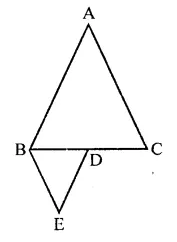
If ABC and BDE are two equilateral triangles such that D is the mid-ponit of BC, then find ar(∆ABC) : ar(∆BDE).
Solution:
ABC and BDE are two equilateral triangles and D is the mid-point of BC
RD Sharma Class 9 Solutions Chapter 14 Quadrilaterals VSAQS Q1.1
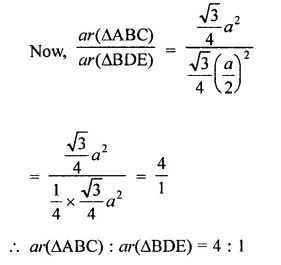
Let each side of AABC = a
Then BD = \(\frac { a }{ 2 }\)
∴ Each side of triangle BDE will be \(\frac { a }{ 2 }\)
RD Sharma Class 9 Solutions Chapter 14 Quadrilaterals VSAQS Q1.2

Question 2.
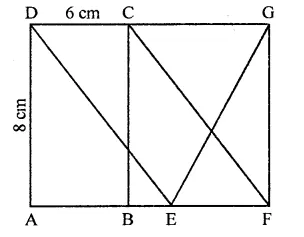
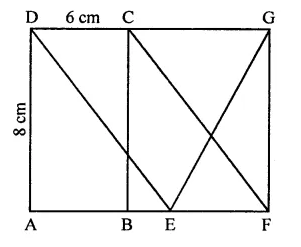
In the figure, ABCD is a rectangle in which CD = 6 cm, AD = 8 cm. Find the area of parallelogram CDEF.
RD Sharma Class 9 Solutions Chapter 14 Quadrilaterals VSAQS Q2.1
Solution:
In rectangle ABCD,
CD = 6 cm, AD = 8 cm
∴ Area of rectangle ABCD = CD x AD
= 6 x 8 = 48 cm2
∵ DC || AB and AB is produced to F and DC is produced to G
∴ DG || AF
∵ Rectangle ABCD and ||gm CDEF are on the same base CD and between the same parallels
∴ ar(||gm CDEF) = ar(rect. ABCD)
= 48 cm2

Question 3.
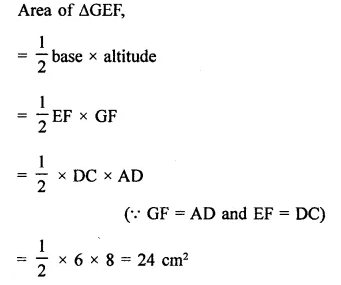
In the figure of Q. No. 2, find the area of ∆GEF.
RD Sharma Class 9 Solutions Chapter 14 Quadrilaterals VSAQS Q3.1
Solution:
RD Sharma Class 9 Solutions Chapter 14 Quadrilaterals VSAQS Q3.2

Question 4.
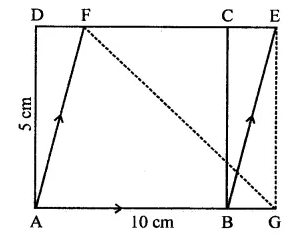
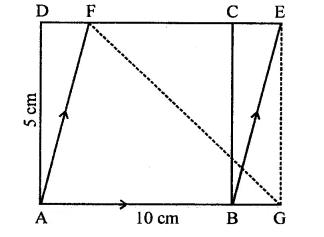
In the figure, ABCD is a rectangle with sides AB = 10 cm and AD = 5 cm. Find the area of ∆EFG.
RD Sharma Class 9 Solutions Chapter 14 Quadrilaterals VSAQS Q4.1
Solution:
ABCD is a rectangle in which
AB = 10 cm, AD = 5 cm
RD Sharma Class 9 Solutions Chapter 14 Quadrilaterals VSAQS Q4.2
∵ ABCD is a rectangle
∴DC || AB,
DC is produced to E and AB is produced to G
∴DE || AG
∵ Rectangle ABCD and ||gm ABEF are on the same base AB and between the same parallels
∴ ar(rect. ABCD) = ar(||gm ABEF)
= AB x AD = 10 x 5 = 50 cm2
Now ||gm ABEF and AEFG are on the same
base EF and between the same parallels
∴ area ∆EFG = \(\frac { 1 }{ 2 }\) ar(||gm ABEF)
= \(\frac { 1 }{ 2 }\) x 50 = 25 cm2

Question 5.
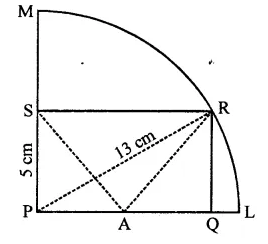
PQRS is a rectangle inscribed in a quadrant of a circle of radius 13 cm. A is any point on PQ. If PS = 5 cm, then find or(∆RAS).
Solution:
In quadrant PLRM, rectangle PQRS is in scribed
RD Sharma Class 9 Solutions Chapter 14 Quadrilaterals VSAQS Q5.1
Radius of the circle = 13 cm
A is any point on PQ
AR and AS are joined, PS = 5 cm
In right ∆PRS,
PR2 = PS2 + SR2
⇒ (132 = (5)2+ SR2
⇒ 169 = 25 + SR2
⇒ SR2 = 169 – 25 = 144 = (12)2
∴ SR = 12 cm
Area of rect. PQRS = PS x SR = 5x 12 = 60 cm2
∵ Rectangle PQRS and ARAS are on the same
base SR and between the same parallels
∴ Area ARAS = \(\frac { 1 }{ 2 }\) area rect. PQRS 1
= \(\frac { 1 }{ 2 }\) x 60 = 30 cm2

Question 6.
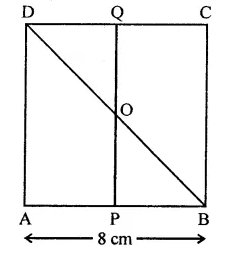
In square ABCD, P and Q are mid-point of AB and CD respectively. If AB = 8 cm and PQ and BD intersect at O, then find area of ∆OPB.
Solution:
In sq. ABCD, P and Q are the mid points of sides AB and CD respectively PQ and BD are joined which intersect each other at O
Side of square AB = 8 cm
RD Sharma Class 9 Solutions Chapter 14 Quadrilaterals VSAQS Q6.1
∴ Area of square ABCD = (side)2
∵ Diagonal BD bisects the square into two triangle equal in area
∴ Area ∆ABD = \(\frac { 1 }{ 2 }\) x area of square ABCD
= \(\frac { 1 }{ 2 }\) x 64 = 32 cm2
∵ P is mid point of AB of AABD, and PQ || AD
∴ O is the mid point of BD
∴ OP = \(\frac { 1 }{ 2 }\)AD = \(\frac { 1 }{ 2 }\) x 8 = 4 cm
and PB = \(\frac { 1 }{ 2 }\) AB = \(\frac { 1 }{ 2 }\) x 8 = 4 cm
∴ Area ∆OPB = \(\frac { 1 }{ 2 }\)PB x OP
= \(\frac { 1 }{ 2 }\) x4x4 = 8 cm2

Question 7.
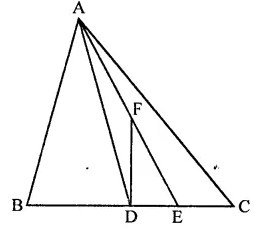
ABC is a triangle in which D is the mid-point of BC. E and F are mid-points of DC and AE respectively. If area of ∆ABC is 16 cm2, find the area of ∆DEF.
Solution:
In ∆ABC, D is mid point of BC. E and F are the mid points of DC and AE respectively area of ∆ABC = 16 cm2
FD is joined
RD Sharma Class 9 Solutions Chapter 14 Quadrilaterals VSAQS Q7.1
∵ D is mid point of BC
∴ AD is the median and median divides the triangle into two triangles equal in area
area ∆ADC = \(\frac { 1 }{ 2 }\) ar(∆ABC)
= \(\frac { 1 }{ 2 }\) x 16 = 8 cm2
Similarly, E is mid point of DC
∴ area (∆ADE) = \(\frac { 1 }{ 2 }\) ar(∆ADC)
= \(\frac { 1 }{ 2 }\) x 8 = 4 cm2
∵ F is mid point of AE of ∆ADE
∴ ar(∆DEF) = \(\frac { 1 }{ 2 }\)area (∆ADE)
= \(\frac { 1 }{ 2 }\) x 4 = 2 cm2

Question 8.
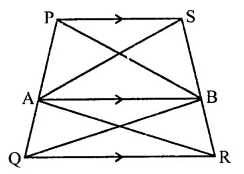
PQRS is a trapezium having PS and QR as parallel sides. A is any point on PQ and B is a point on SR such that AB || QR. If area of ∆PBQ is 17 cm2, find the area of ∆ASR.
Solution:
In trapezium PQRS,
PS || QR
A and B are points on sides PQ and SR
Such that AB || QR
area of ∆PBQ = 17 cm2
RD Sharma Class 9 Solutions Chapter 14 Quadrilaterals VSAQS Q8.1
∆ABQ and ∆ABR are on the same base AB and between the same parallels
∴ ar(∆ABQ) = ar(∆ABR) …(i)
Similarly, ∆ABP and ∆ABS are on the same base and between the same parallels
∴ ar(ABP) = ar(∆ABS) …(ii)
Adding (i) and (ii)
ar( ∆ABQ) + ar( ∆ABP)
= ar(∆ABR) + ar(∆ABS)
⇒ ar(∆PBQ) = ar(∆ASR)
Put ar(PBQ) = 17 cm2
∴ ar(∆ASR) = 17 cm2

Question 9.
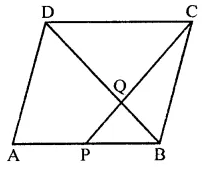
ABCD is a parallelogram. P is the mid-point of AB. BD and CP intersect at Q such that CQ : QP = 3 : 1. If ar(∆PBQ) = 10 cm2, find the area of parallelogram ABCD.
Solution:
In ||gm ABCD, P is mid point on AB,
PC and BD intersect each other at Q
RD Sharma Class 9 Solutions Chapter 14 Quadrilaterals VSAQS Q9.1
CQ : QP = 3 : 1
ar(∆PBQ) = 10 cm2
In ||gm ABCD,
BD is its diagonal
∴ ar(∆ABD) = ar(∆BCD) = \(\frac { 1 }{ 2 }\) ar ||gm ABCD
∴ ar(||gm ABCD) = 2ar(∆ABD) …(i)
In ∆PBC CQ : QP = 3 : 1
∵ ∆PBQ and ∆CQB have same vertice B
∴ 3 x area ∆PBQ = ar(∆CBQ)
⇒ area(∆CBQ) = 3 x 10 = 30 cm2
∴ ar(∆PBC) = 30 + 10 = 40 cm2
Now ∆ABD and ∆PBC are between the
same parallel but base PB = \(\frac { 1 }{ 2 }\) AB
∴ ar(∆ABD) = 2ar(∆PBC)
= 2 x 40 = 80 cm2
But ar(||gm ABCD) = 2ar(∆ABD)
= 2 x 80 = 160 cm2

Question 10.
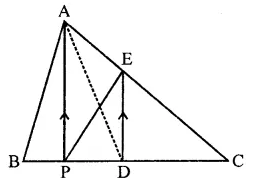
P is any point on base BC of ∆ABC and D is the mid-point of BC. DE is drawn parallel to PA to meet AC at E. If ar(∆ABC) = 12 cm2, then find area of ∆EPC.
Solution:
P is any point on base of ∆ABC
D is mid point of BC
DE || PA drawn which meet AC at E
ar(∆ABC) = 12 cm2
AD and PE are joined
RD Sharma Class 9 Solutions Chapter 14 Quadrilaterals VSAQS Q10.1
∵ D is mid point of BC
∴ AD is median
∴ ar(∆ABD) = ar(∆ACD)
= \(\frac { 1 }{ 2 }\) (∆ABC) = \(\frac { 1 }{ 2 }\) x 12 = 6 cm2 …(i)
∵ ∆PED and ∆ADE are on the same base DE and between the same parallels
∴ ar(∆PED) = ar(∆ADE)
Adding ar(∆DCE) to both sides,
ar(∆PED) + ar(∆DCE) = ar(∆ADE) + ar(∆DCE)
ar(∆EPC) = ar(∆ACD)
⇒ ar(∆EPC) = ar(∆ABD) = 6 cm2 [From (i)]
∴ ar(∆EPC) = 6 cm2

Hope given RD Sharma Class 9 Solutions Chapter 14 Quadrilaterals VSAQS are helpful to complete your math homework.

If you have any doubts, please comment below. Learn Insta try to provide online math tutoring for you.