RS Aggarwal Class 8 Solutions Chapter 9 Percentage Ex 9B

RS Aggarwal Class 8 Solutions Chapter 9 Percentage Ex 9B

These Solutions are part of RS Aggarwal Solutions Class 8. Here we have given RS Aggarwal Solutions Class 8 Chapter 9 Percentage Ex 9B.

Other Exercises

Tick the correct answer in each of the following:

Question 1.
Solution:
\(\\ \frac { 3 }{ 5 } \)
= \(\\ \frac { 3X20 }{ 5X20 } \)
= \(\\ \frac { 60 }{ 100 } \)
= 60% (d)

Question 2.
Solution:
0.8%
= \(\\ \frac { 0.8 }{ 100 } \)
= \(\\ \frac { 8 }{ 10X100 } \)
= \(\\ \frac { 8 }{ 1000 } \)
= 0.008 (b)

Question 3.
Solution:
6 : 5
= \(\\ \frac { 6 }{ 5 } \)
= \(\\ \frac { 6X20 }{ 5X20 } \)
= \(\\ \frac { 120 }{ 100 } \)
= 120% (c)

Question 4.
Solution:
5% of a number is 9
Number = \(\\ \frac { 9X100 }{ 5 } \)
= 180 (d)

Question 5.
Solution:
Let x% of 90 = 120
=> \(\\ \frac { x }{ 100 } \) x 120 = 90
=> x% = \(\\ \frac { 120X100 }{ 90 } \)
= \(133\frac { 1 }{ 3 } %\) (c)

Question 6.
Solution:
Let x% 10 kg = 250 g
\(\\ \frac { x }{ 100 } \) x 10 kg
= \(\\ \frac { 250 }{ 1000 } \) kg
x = \(\\ \frac { 250X100 }{ 1000X10 } \)
= \(\\ \frac { 25 }{ 10 } \)%
= 2.5% (d)

Question 7.
Solution:
40% of x = 240
=> x = \(\\ \frac { 240 }{ 40 } \) x 100
= 600 (b)

Question 8.
Solution:
?% of 400 = 60
=> x% of 400 = 60
\(\\ \frac { x }{ 100 } \) x 400 = 60
x = \(\\ \frac { 60X100 }{ 400 } \)
= 15 (c)

Question 9.
Solution:
(180% of ?)÷2 = 504
\(\left( \frac { 180 }{ 100 } \times x \right) \div 2\) = 504
\(\frac { 180 }{ 100 } x\) = 504 x 2
\(x=\frac { 504\times 2\times 100 }{ 180 }\)
= 560 (d)

Question 10.
Solution:
20% of Rs. 800
= \(\\ \frac { 20 }{ 100 } \) x 800
= Rs 160 (a)

Question 11.
Solution:
Nitin gets = 98 marks
and it is 56% of total marks
Total-marks = \(\\ \frac { 98X100 }{ 56 } \)
= 175 (c)

Question 12.
Solution:
Let a number be = 1000
Then increase = 10%
Increased number = \(\\ \frac { 100X110 }{ 100 } \) = 110
Now decrease = 1%
Decreased number = \(\\ \frac { 110X90 }{ 100 } \) = 99
Difference = 100 – 99 = 1
% decrease = 1% (b)

Question 13.
Solution:
4 hours 30 min = \(4\frac { 1 }{ 2 } %\)
= \(\\ \frac { 9 }{ 2 } \) hours
% of a day = \(\\ \frac { 9 }{ 2 } \) x \(\\ \frac { 100 }{ 24 } \)%
= \(\\ \frac { 75 }{ 4 } \)%
= \(18\frac { 3 }{ 4 } %\) (a)

Question 14.
Solution:
Let total number of examinees = 100
Passed = 65
Failed = 100 – 65 = 35
Now 35% of total examinees = 420
Total examinees = \(\\ \frac { 420X100 }{ 35 } \)
= 1200 (c)

Question 15.
Solution:
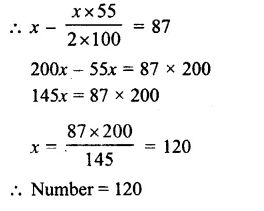
Let number = x
Then x = \(\\ \frac { xX20 }{ 100 } \) = 40
=> 100x – 200x = 4000
80x = 4000
=> x = \(\\ \frac { 4000 }{ 80 } \) = 50
Number = 50 (a)

Question 16.
Solution:
Rate of decrease = \(27\frac { 1 }{ 2 } %\)
Let number = x
RS Aggarwal Class 8 Solutions Chapter 9 Percentage Ex 9B 16.1

Question 17.
Solution:
Let x% of 20 = 0.05
\(\\ \frac { x }{ 100 } \) x 20 = 0.05
x = \(\\ \frac { 0.05X100 }{ 20 } \)
= 0.25% (c)

Question 18.
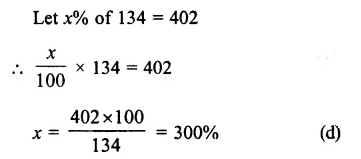
Solution:
\(\\ \frac { 1 }{ 3 } \) = 1206 = 402
RS Aggarwal Class 8 Solutions Chapter 9 Percentage Ex 9B 18.1

Question 19.
Solution:
x% of y is y% = \(\\ \frac { xy }{ 100 } \)
\(\\ \frac { y }{ 100 } \) × x
= y% of x (a)

Question 20.
Solution:
Let x% of \(\\ \frac { 2 }{ 7 } \) = \(\\ \frac { 1 }{ 35 } \)
=>\(\\ \frac { x }{ 100 } \) x \(\\ \frac { 2 }{ 7 } \) = \(\\ \frac { 1 }{ 35 } \)
x = \(\\ \frac { 1X100X7 }{ 35X2 } \)
= 10% (b)

Hope given RS Aggarwal Solutions Class 8 Chapter 9 Percentage Ex 9B are helpful to complete your math homework.

If you have any doubts, please comment below. Learn Insta try to provide online math tutoring for you.
RS Aggarwal Class 8 Solutions Chapter 9 Percentage Ex 9A

RS Aggarwal Class 8 Solutions Chapter 9 Percentage Ex 9A

These Solutions are part of RS Aggarwal Solutions Class 8. Here we have given RS Aggarwal Solutions Class 8 Chapter 9 Percentage Ex 9A.

Other Exercises

Question 1.
Solution:
(i) 48% = \(\\ \frac { 48 }{ 100 } \) = \(\\ \frac { 12 }{ 25 } \)
(ii) 220% = \(\\ \frac { 220 }{ 100 } \) = \(\\ \frac { 11 }{ 5 } \)
(iii) 2.5% = \(\\ \frac { 2.5 }{ 100 } \) = \(\\ \frac { 25 }{ 10X100 } \) = \(\\ \frac { 1 }{ 40 } \)

Question 2.
Solution:
(i) 6% = \(\\ \frac { 6 }{ 100 } \) = 0.06
(ii) 72% = \(\\ \frac { 72 }{ 100 } \) = 0.72
(iii) 125% = \(\\ \frac { 125 }{ 100 } \) = 1.25

Question 3.
Solution:
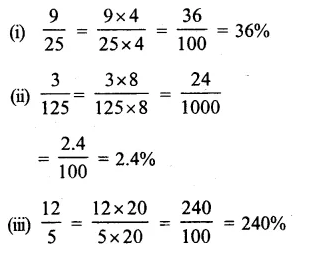
RS Aggarwal Class 8 Solutions Chapter 9 Percentage Ex 9A 3.1

You can also Download NCERT Solutions for Class 8 Maths to help you to revise complete Syllabus and score more marks in your examinations.

Question 4.
Solution:
Ratio is 4:5 or \(\\ \frac { 4 }{ 5 } \)
\(\\ \frac { 4 }{ 5 } \)
= \(\\ \frac { 4X20 }{ 5X20 } \)
= \(\\ \frac { 80 }{ 100 } \)
= 80%

Question 5.
Solution:
125% = \(\\ \frac { 125 }{ 100 } \)
= \(\\ \frac { 5 }{ 4 } \) (dividing by 25)
Ratio = 5:4

Question 6.
Solution:
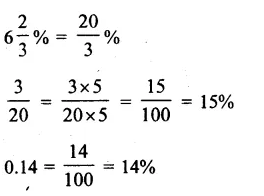
RS Aggarwal Class 8 Solutions Chapter 9 Percentage Ex 9A 6.1
We see that 15% or \(\\ \frac { 3 }{ 20 } \) is the largest

Question 7.
Solution:
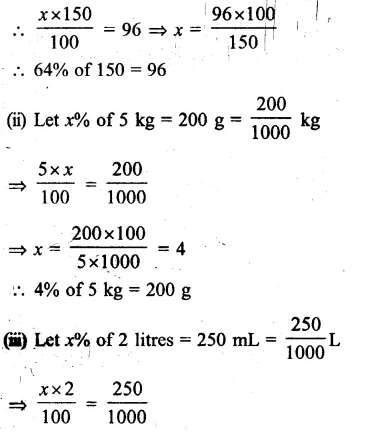
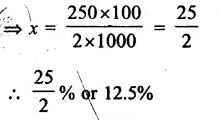
(i) Let x% of 150
= 96
RS Aggarwal Class 8 Solutions Chapter 9 Percentage Ex 9A 7.1
RS Aggarwal Class 8 Solutions Chapter 9 Percentage Ex 9A 7.2

Question 8.
Solution:
\(6\frac { 2 }{ 3 } %\) of Rs 3600
= Rs \(\\ \frac { 9 }{ 2 } \) x \(\\ \frac { 3600 }{ 100 } \)
= Rs 162

Question 9.
Solution:
16% of a number = 72
Number = \(\\ \frac { 72 }{ 16 }\)%
= \(\\ \frac { 72X100 }{ 16 } \)
= 450

Question 10.
Solution:
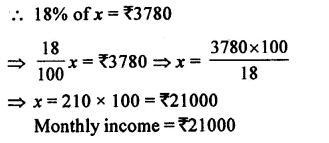
Let monthly income = Rs x
Savings = 18%
RS Aggarwal Class 8 Solutions Chapter 9 Percentage Ex 9A 10.1

Question 11.
Solution:
Let total games = x
Then game which a team wins = 73
and it is 35% of total games
35% of x = 7
=> x = \(\\ \frac { 7X100 }{ 35 } \) = 20
Number of total games = 20

Question 12.
Solution:
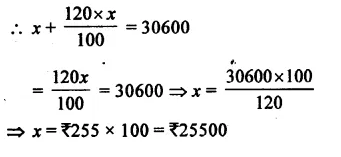
Let salary = Rs x
Increment = 20%
Total salary = x + 20% of x
RS Aggarwal Class 8 Solutions Chapter 9 Percentage Ex 9A 12.1

Question 13.
Solution:
No. of days, Sonal attended = 204 days
and her attendance = 85% of total days
85% of total days = 204
Total number of days = \(\\ \frac { 204X100 }{ 85 } \)
= 240 days

Question 14.
Solution:
Let B’s income = Rs. 100
Then A’s income = 20% less than B’s
= 100 – 20 = Rs. 80
Difference = 100 – 80 = 20
B’s more income that A’s = \(\\ \frac { 20 }{ 80 } \) x 100
= 25%

Question 15.
Solution:
Increase in price of petrol = 10%
Let first price = Rs. 100 p.l.
Increased price = 100 + 10 = Rs. 110
Now reduction in consumption = 110 – 100= 10
Percentage reduced consumption
= \(\\ \frac { 10X100 }{ 110 } \)
= \(\\ \frac { 100 }{ 11 } \)
= \(9\frac { 1 }{ 11 } %\)

Question 16.
Solution:
Present population of a town = 54000
Rate of increase = 8% annually
Population a year ago = \(\\ \frac { 54000X100 }{ 100+8 } \)
= \(\\ \frac { 54000X100 }{ 108 } \)
= 50000

Question 17.
Solution:
Depreciation in the value of machine = 20%
Present value = Rs. 160000
Then value of machine one year ago
= \(\\ \frac { 160000X100 }{ 100-20 } \)
= \(\\ \frac { 160000X100 }{ 80 } \)
= Rs 200000

Question 18.
Solution:
In an alloy,
Copper = 40%
Nickel = 32%
Zinc = 100 – (40% + 32%)
= 100 – 72 = 28%
Then mass of zinc in one kg of alloy
= 1 kg X 28%
= \(\\ \frac { 1000X28 }{ 100 } \) g
= 280 gm

Question 19.
Solution:
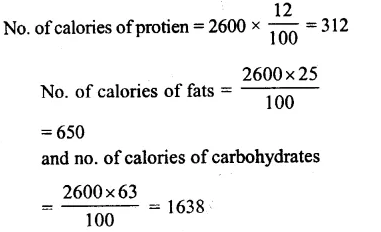
In balance diet,
Protein = 12%
Fats = 25%
Carbohydrates = 63%
Total number of dories = 2600
RS Aggarwal Class 8 Solutions Chapter 9 Percentage Ex 9A 19.1

Question 20.
Solution:
In gunpowder,
Nitre = 75%
Sulphur = 10%
(i) Amount of gunpowder if nitre is 9 kg
= \(\\ \frac { 100 }{ 75 } \) x 9
= 12 kg
(ii) Amount of gunpowder if sulphur is 2.5kg 100
= \(\\ \frac { 100 }{ 10 } \) x 2.5
= 25 kg

Question 21.
Solution:
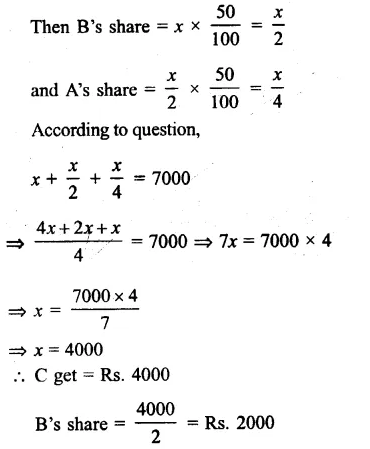
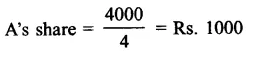
Let C get = Rs. x
RS Aggarwal Class 8 Solutions Chapter 9 Percentage Ex 9A 21.1
RS Aggarwal Class 8 Solutions Chapter 9 Percentage Ex 9A 21.2

Question 22.
Solution:
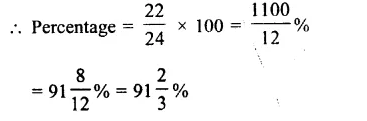
24-carat gold is 100% pure
22 parts out of 24 part in 22-carat gold
RS Aggarwal Class 8 Solutions Chapter 9 Percentage Ex 9A 22.1

Question 23.
Solution:
Let present salary = Rs. 100
Increase = 25%
Increased salary = Rs. 100 + 25
= Rs. 125
To receive the original salary, amount to be decreased = Rs. 125 – 100 = Rs. 25
∴ % decrease = \(\\ \frac { 25X100 }{ 125 } \) = 20%


Hope given RS Aggarwal Solutions Class 8 Chapter 9 Percentage Ex 9A are helpful to complete your math homework.

If you have any doubts, please comment below. Learn Insta try to provide online math tutoring for you.
RS Aggarwal Class 8 Solutions Chapter 8 Linear Equations Ex 8C

RS Aggarwal Class 8 Solutions Chapter 8 Linear Equations Ex 8C

These Solutions are part of RS Aggarwal Solutions Class 8. Here we have given RS Aggarwal Solutions Class 8 Chapter 8 Linear Equations Ex 8C.

Other Exercises

Objective Questions :
Tick the correct answer in each of the following:

Question 1.
Solution:
2x – 3 = x + 2
=> 2x – x
= 2 + 3
= 5 (c)

Question 2.
Solution:
5x + \(\\ \frac { 7 }{ 2 } \) = \(\\ \frac { 3 }{ 2 } \) x – 14
=> 5x – \(\\ \frac { 3 }{ 2 } \) x = – 14 – \(\\ \frac { 7 }{ 2 } \)
RS Aggarwal Class 8 Solutions Chapter 8 Linear Equations Ex 8C 2.1

Question 3.
Solution:
z = \(\\ \frac { 4 }{ 5 } \)(z + 10)
=> 5z = 4z + 40
=> 5z – 4z = 40
=> z = 40 (a)

Question 4.
Solution:
3m = 5m – \(\\ \frac { 8 }{ 5 } \)
=> 3m – 5m = \(\\ \frac { -8 }{ 5 } \)
=> – 2m = \(\\ \frac { -8 }{ 5 } \)
=> m = \(\\ \frac { -8 }{ -5×2 } \) = \(\\ \frac { 4 }{ 5 } \) (c)

Question 5.
Solution:
5t – 3 = 3t, – 5
=> 5t – 3t = – 5 + 3
=> 2t = – 2
=> t = \(\\ \frac { -2 }{ 2 } \) = – 1 (b)

Question 6.
Solution:
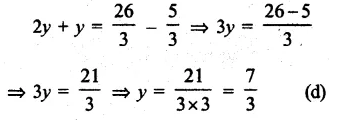
2y + \(\\ \frac { 5 }{ 3 } \) = \(\\ \frac { 26 }{ 3 } \) – y
RS Aggarwal Class 8 Solutions Chapter 8 Linear Equations Ex 8C 6.1

Question 7.
Solution:
\(\\ \frac { 6x+1 }{ 3 } \) +1 = \(\\ \frac { x-3 }{ 6 } \)
\(\\ \frac { 12x+2+6=x-3 }{ 6 } \)
12x – x = – 3 – 2 – 6
11x – 11
=> x = \(\\ \frac { -11 }{ 11 } \) = – 1 (b)

Question 8.
Solution:
\(\\ \frac { n }{ 2 } \) – \(\\ \frac { 3n }{ 4 } \) + \(\\ \frac { 5n }{ 6 } \) = 21
\(\\ \frac { 6n-9n+10n= 252 }{ 12 } \)
LCM of 2, 4, 6 = 12
16n – 9n = 252
=> 7n = 252
=> n = \(\\ \frac { 252 }{ 7 } \) = 36 (c)

Question 9.
Solution:
\(\\ \frac { x+1 }{ 2x+3 } \) = \(\\ \frac { 3 }{ 8 } \)
=> 8 (x + 1) = 3 (2x + 3)
(By cross multiplication)
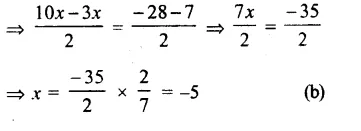
x + 8x + 9 = 8x – 6x = 9 – 8
=> 2x = 1
=> x = \(\\ \frac { 1 }{ 2 } \)
x = \(\\ \frac { 1 }{ 2 } \) (d)

Question 10.
Solution:
\(\\ \frac { 4x+8 }{ 5x+8 } \) = \(\\ \frac { 5 }{ 6 } \)
6(4x + 8) = 5(5x + 8)
(By cross multiplication)
24x + 48 = 25x + 40
=> 24x – 25x = 40 – 48
=> – x = – 8
=> x = 8 (c)

Question 11.
Solution:
\(\\ \frac { n }{ n+15 } \) = \(\\ \frac { 4 }{ 9 } \)
9n = 4n + 60
(By cross multiplication)
9n – 4n = 60
=> 5n = 60
=> n = \(\\ \frac { 60 }{ 5 } \) = 12
n = 12 (d)

Question 12.
Solution:
3(t – 3) = 5 (2t + 1)
3t – 9 = 10t + 5
=> 3t – 10t = 5 + 9
=> – 7t = 14
=> t = \(\\ \frac { 14 }{ -7 } \) = – 2
t = – 2 (a)

Question 13.
Solution:
Let number = x
Then \(\\ \frac { 4 }{ 5 } \)x = \(\\ \frac { 3 }{ 4 } \)x + 4
=> \(\\ \frac { 16x=15x+80 }{ 20 } \)
16x – 15x = 80
=> x = 80
:. Number = 80 (c)

Question 14.
Solution:
Ages of A : B = 5 : 7
Let A’s age = 5x
Then B’s age = 7x
After 4 years
A’s age = 5x + 4
and B’s age = 7x + 4
\(\\ \frac { 5x+4 }{ 7x+5 } \) = \(\\ \frac { 3 }{ 4 } \)
=> 3(7x + 4) = 4(5x + 4)
21x + 12 = 20x + 16
=>21x – 20x = 16 – 12
x = 4
B’s age = 7x
= 7 x 4
= 28 years (b)

Question 15.
Solution:
Perimeter of an isosceles triangle = 16 cm
and base = 6 cm
Let each equal side = x cm
x + x + 6 = 16
=> 2x = 16 – 6 = 10
=> x = \(\\ \frac { 10 }{ 2 } \) = 5
Each equal side = 5 cm (b)

Question 16.
Solution:
Let first number = x
Then second number = x + 1
and third number = x+ 2
x + x + 1 + x + 2 = 51
=> 3x + 3 = 51
=> 3x = 51 – 3 = 48
=> x = \(\\ \frac { 48 }{ 3 } \) = 16
Middle number = x + 1 = 16 + 1 = 17 (b)

Question 17.
Solution:
Let first number = x
Then second number = x + 15
x + x + 15 = 95
=> 2x = 95 – 15 = 80
=> x= \(\\ \frac { 80 }{ 2 } \) = 40
=> Smaller number = 40

Question 18.
Solution:
Ratio in boys and girls in a class = 7:5
Let no. of boys = 7x
Then no. of girls = 5x
7x – 5x = 8
=> 2x = 8
x = \(\\ \frac { 8 }{ 2 } \) = 4
Total strength = 7x + 5x = 12x
= 12 x 4
= 48 (c)

Hope given RS Aggarwal Solutions Class 8 Chapter 8 Linear Equations Ex 8C are helpful to complete your math homework.

If you have any doubts, please comment below. Learn Insta try to provide online math tutoring for you.
RS Aggarwal Class 8 Solutions Chapter 8 Linear Equations Ex 8B

RS Aggarwal Class 8 Solutions Chapter 8 Linear Equations Ex 8B

These Solutions are part of RS Aggarwal Solutions Class 8. Here we have given RS Aggarwal Solutions Class 8 Chapter 8 Linear Equations Ex 8B.

Other Exercises

Question 1.
Solution:
The numbers be 8x and 3x (∵ Ratio is 8 : 3)
Sum = 143
According to the condition
8x + 3x = 143
=> 11x = 143
=> x = \(\\ \frac { 143 }{ 11 } \) = 13
First number = 8x = 8 x 13 = 104
and second number = 3x = 3 x 13 = 39 Ans.

Question 2.
Solution:
Let the number = x
According to the condition,
x – \(\frac { 2 }{ 3 } x\) = 20
=> \(\\ \frac { 3x-2x }{ 3 } \) = 20
=> \(\\ \frac { x }{ 3 } \) = 20
=> x = 20 x 3 = 60
Hence original number = 60 Ans.

You can also Download NCERT Solutions for Class 8 Maths to help you to revise complete Syllabus and score more marks in your examinations.

Question 3.
Solution:
Let the number = x
According to the condition
\(\frac { 4 }{ 5 } x-\frac { 2 }{ 3 } x\) = 10
=> \(\\ \frac { 12x-10x }{ 15 } \) = 10
=> \(\\ \frac { 2x }{ 15 } \) = 10
=> 2x = 10 x 15
x = \(\\ \frac { 10 x 15 }{ 2 } \) = 75
Hence number = 75 Ans.

Question 4.
Solution:
Let first part = x
then second part = 24 – x (∵ Sum = 24)
According to the condition,
7x + 5 (24 – x) = 146
=> 7x + 120 – 5x = 146
=> 2x = 146 – 120 = 26
=> x = \(\\ \frac { 26 }{ 2 } \) = 13
First part = 13
and second part = 24 – 13 = 11 Ans.

Question 5.
Solution:
Let number = x
According to the condition
\(\frac { x }{ 5 } +5=\frac { x }{ 4 } -5\)
=> \(\\ \frac { x }{ 5 } \) – \(\\ \frac { x }{ 4 } \)= – 5 – 5
=> \(\\ \frac { 4x-5x }{ 20 } \) = – 10
=> \(\\ \frac { -x }{ 20 } \) = – 10 = \(\\ \frac { x }{ 20 } \) = 10
=> x = 10 × 20 = 200
Hence number = 200 Ans.

Question 6.
Solution:
Ratio between three numbers = 4:5:6
Let the largest number = 6x
smallest number = 4x
and third number = 5x
According to the condition,
6x + 4x = 5x + 55
=> 10x = 5x + 55
=> 10x – 5x = 55
=> 5x = 55
=> x = \(\\ \frac { 55 }{ 5 } \) = 11
Numbers will be 4x = 4 × 11 = 44,
5x = 5 × 31 = 55 and 6x = 6 × 11 = 66
Hence numbers are 44, 55, 66 Ans.

Question 7.
Solution:
Let the number = x
According to the condition,
4x + 10 = 5x – 5
=> 4x – 5x = – 5 – 10
=> – x = – 15
x = 15
Hence number = 15 Ans.

Question 8.
Solution:
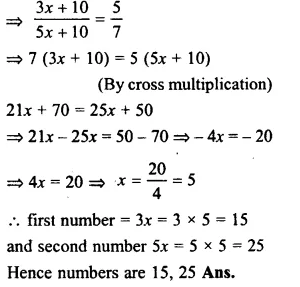
Ratio between two numbers 3: 5
Let first number = 3x
and second number = 5x
Now according to the condition.
3x + 10 : 5x + 10 = 5 : 7
RS Aggarwal Class 8 Solutions Chapter 8 Linear Equations Ex 8B 8.1

Question 9.
Solution:
Let first odd number = 2x + 1
second number 2x + 3
and third number = 2 + 5
According to the condition.
2x + 1 + 2x + 3 + 2x + 5 = 147
=> 6x + 9 = 147
=> 6x = 147 – 9 = 138
=> x = \(\\ \frac { 138 }{ 6 } \) = 23
Hence first odd number 2x + 1
= 23 x 2 + 1 = 46 + 1 = 47
Second number 47 + 2 = 49
and third number = 49 + 2 = 51 Ans.

Question 10.
Solution:
Let first even number = 2x
second number = 2x + 2
and third number = 2x + 4
According to the condition,
2x + 2x + 2 + 2x + 4 = 234
=> 6x + 6 = 234
=> 6x = 234 – 6
=> 6x = 228
=> x = \(\\ \frac { 228 }{ 6 } \) = 38
First even number = 2x = 38 x 2 = 76
second number = 76 + 2 = 78
and third number 78 + 2 = 80 Ans.

Question 11.
Solution:
The sum of two digits = 12
Let the ones digit of the number = x
then tens digit = 12 – x
and number = x + 10 (12 – x)
= x + 120 – 10x = 120 – 9x
Reversing the digits,
ones digit of new number = 12 – x
and tens digit = x
the number = 12 – x + 10x = 12 + 9x
According to the condition,
12 + 9x = 120 – 9x + 54
=> 9x + 9x
=> 120 + 54 – 12
=> 174 – 12
=> 18x = 162
=> x = \(\\ \frac { 162 }{ 18 } \) = 9
Original number = 120 – 9x
= 120 – 9 x 9
= 120 – 81
= 39
Hence number 39 Ans.
Check :Original number= 39
Sum of digits = 3 + 9 = 12
Now reversing its digit the new number
will be = 93
and 93 – 39 = 54 which is given.

Question 12.
Solution:
Let units digit of the number = x
then tens digit = 3x
and number = x + 10
3x = x + 30x = 31x
on reversing the digits.
units digit = 3x
and tens digit = x
then number 3x + 10x = 13x
According to the condition,
31x – 36 = 13x
=> 31x – 13x = 36
=> 18 x 36
=> x = \(\\ \frac { 36 }{ 18 } \) = 2
The original number = 31x = 31 x 2 = 62
Hence number = 62 Ans.
Check : Number = 62
tens digit = 2 x 3 = 6
On reversing the digit, the new number will be = 26
62 – 26 = 36 which is given.

Question 13.
Solution:
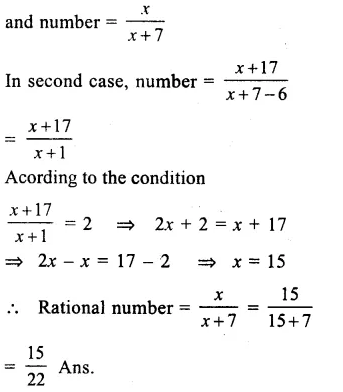
Let numerator of a rational number = x
Then its denominator = x + 7
RS Aggarwal Class 8 Solutions Chapter 8 Linear Equations Ex 8B 13.1

Question 14.
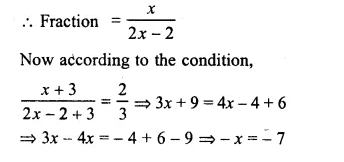
Solution:
Let numerator of a fraction = x
The denominator = 2x – 2
RS Aggarwal Class 8 Solutions Chapter 8 Linear Equations Ex 8B 14.1

Question 15.
Solution:
Let breadth of the rectangle = x cm
then length = x + 7
Area = l × b = (x + 7) × x
In second case,
Length of the new rectangle = x + 7 – 4
= x + 3 cm
and breadth = x + 3
Area = (x + 3)(x + 3)
According to the condition,
(x + 3)(x + 3) = x(x + 7)
x2 + 3x + 3x + 9 = x2 + 7x
=> x2 + 6x – 7x – x2 = – 9
=> x = – 9
=> x = 9
Length of the original rectangle
= > x + 7 = 9 + 7 = 16 cm
and breadth = x = 9 cm. Ans.

Question 16.
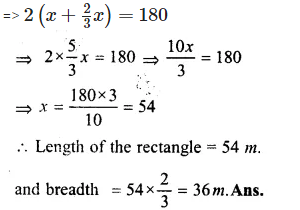
Solution:
Let length of rectangle = x m
then width = \(\frac { 2 }{ 3 } x\)m
Perimeter = 2 (l + b) m
=> \(2\left( x+\frac { 2 }{ 3 } x \right) =180\)
RS Aggarwal Class 8 Solutions Chapter 8 Linear Equations Ex 8B 16.1

Question 17.
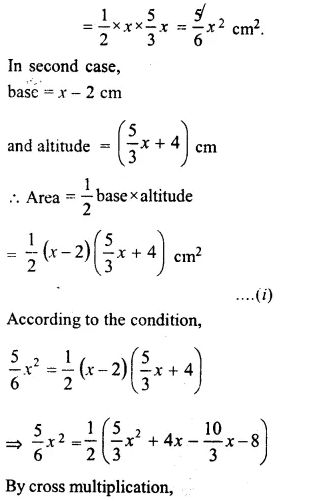
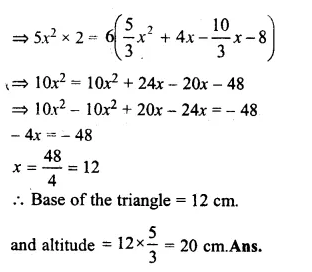
Solution:
Let the length of the base of the triangle = x cm
then altitude = \(\frac { 5 }{ 3 } x\)cm
Area = \(\\ \frac { 1 }{ 2 } \) base x altitude
RS Aggarwal Class 8 Solutions Chapter 8 Linear Equations Ex 8B 17.1
RS Aggarwal Class 8 Solutions Chapter 8 Linear Equations Ex 8B 17.2

Question 18.
Solution:
Let ∠A, ∠B and ∠C are the three angles of a triangle and
Let ∠A + ∠B = ∠C
But ∠A + ∠B + ∠C = 180°
∠C + ∠C = 180°
=> 2∠C = 180°
∠C = 90°
and ∠A + ∠B = 90°
Let ∠A = 4x and ∠B = 5x
4x + 5x = 90°
=> 9x = 90°
x = \(\frac { { 90 }^{ o } }{ 9 } \) = 10°
∠A = 4x = 4 x 10° = 40°
and ∠B = 5x = 5 x 10° = 50°
and ∠C = 90° Ans.

Question 19.
Solution:
Time taken downstream = 9 hour
and time taken upstream = 10 hour
Speed of stream = 1 km/h
Let the speed of a steamer in still water
= x km/h.
Distance downstream = 9(x + 1) km.
and upstream = 10 (x – 1) km.
According to the condition,
10(x – 1) = 9(x + 1)
l0x – 10 = 9x + 9
=> 10x – 9x = 9 + 10
=> x = 19
Hence speed of steamer in still water = 19 km/h
and distance = 9(x + 1)
= 9(19 + 1)
= 9 x 20km
= 180km. Ans.

Question 20.
Solution:
The distance between two stations = 300 km
Let the speed of first motorcyclists = x km/h
and speed of second motorcyclists = (x + 7)km/h
Distance covered by the first = 2x km
and distance covered by the second = 2 (x + 7) km
= 2x + 14 km
Distance uncovered by them = 300 – (2x + 2x + 14)kms.
According to the condition,
300 – (4x + 4) = 34
=> 300 – 4x – 14 = 34
=> 300 – 14 – 34 = 4x
=> 4x = 300 – 48
=> 4x = 252
=> x = \(\\ \frac { 252 }{ 4 } \) = 63
Speed of the first motorcyclists = 63km/h
and speed of second = 63 + 7 = 70 km/h
Check. Distance covered by both of them
= 2 x 63 + 2 x 70 = 126 + 140 = 266
Total distance = 300 km.
Distance between them = 300 – 266 = 34 km.
which is given.

Question 21.
Solution:
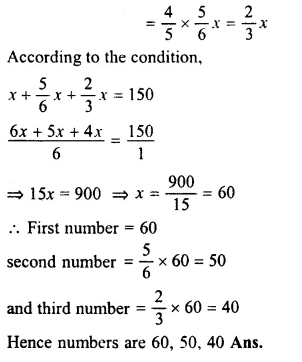
Sum of three numbers = 150
Let first number = x
then second number = \(\frac { 5 }{ 6 } x\)
and third number = \(\\ \frac { 4 }{ 5 } \) of second
RS Aggarwal Class 8 Solutions Chapter 8 Linear Equations Ex 8B 21.1

Question 22.
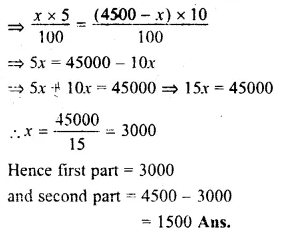
Solution:
Sum of two pans = 4500
Let first part = x
then second part = 4500 – x
According to the condition,
5% of x = 10% of (4500 – x)
RS Aggarwal Class 8 Solutions Chapter 8 Linear Equations Ex 8B 22.1

Question 23.
Solution:
Let age of Rakhi = x years
then her mother’s age = 4x
After 5 years,
Rakhi’s age = x + 5
and her mother’s age = 4x + 5
According to the conditions,
4x + 5 = 3 (x + 5)
=> 4x + 5 = 3x + 15
=> 4x – 3x = 15 – 5
=> x = 10
Rakhi ‘s present age = 10 years
and her mother’s age = 4 x 10
= 40 years Ans.

Question 24.
Solution:
Let age of Monu = x year
His father’s age = x + 29
and his grandfather’s age = x + 29 + 26
= x + 55
and sum of their ages = 135 years
Now,
x + x + 29 + x + 55 = 135
=> 3x + 84 = 135
=> 3x = 135 – 84 = 51
=> x = \(\\ \frac { 51 }{ 3 } \) = 17 years
Monu’s age = 17 years
His father age = 17 + 29 = 46 years
and his grandfather’s age = 46 + 26 = 72 years

Question 25.
Solution:
Let age of grandson = x year
Then his age = 10x
But 10x = x + 54
=> 10x – x = 54
=> 9x = 54
=> x = \(\\ \frac { 54 }{ 9 } \) = 6
Grand’s son age = 6 years
and his age = 6 x 10 = 60 years

Question 26.
Solution:
Let age of elder cousin = x years
and age of younger = (x – 10) years.
15 years ago,
age of older, cousin = x – 15 years
and age of younger = x – 10 – 15
= (x – 25) years.
According to the condition,
x – 15 = 2(x – 25)
=> x – 15 = 2x – 50
=> 2x – x = 50 – 15
=> x = 35
Age of elder cousin = 35 years
and age of younger = 35 – 10
= 25 years Ans.

Question 27.
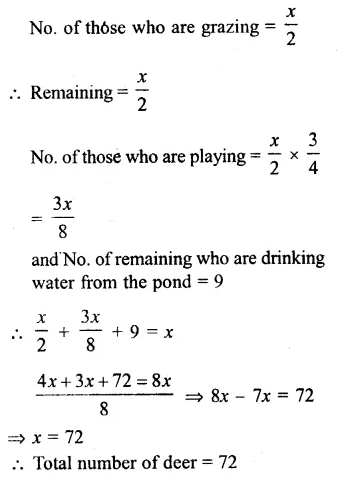
Solution:
Let number of deer = x
RS Aggarwal Class 8 Solutions Chapter 8 Linear Equations Ex 8B 27.1

Hope given RS Aggarwal Solutions Class 8 Chapter 8 Linear Equations Ex 8B are helpful to complete your math homework.

If you have any doubts, please comment below. Learn Insta try to provide online math tutoring for you.

NCERT Exemplar Solutions for Class 9 Science Chapter 14 Natural Resources

NCERT Exemplar Solutions for Class 9 Science Chapter 14 Natural Resources

These Solutions are part of NCERT Exemplar Solutions for Class 9 Science . Here we have given NCERT Exemplar Solutions for Class 9 Science Chapter 14 Natural Resources

Question 1.
Rivers from land, add minerals to sea water. Discuss how.
Answer:
Rivers are formed from springs, melting snow and rain water flowing over land as run off. While, passing through and over the rocks, the flowing water picks up minerals. These dissolved minerals are taken by rivers to sea and make them available to marine organisms.

More Resources

Question 2.
How can we prevent loss of top soil ?
Answer:
Control of Soil Erosion: Soil erosion can be prevented by providing plant cover to soil. Roots of plants hold the soil firmly around them. They increase water percolation during rains and decrease runoff. Vegetation cover also reduces direct pounding of soil by rain drops. The various methods to control soil erosion are as follows :

  1. Vegetation Cover: Soil should not be left uncovered. Tree plantation should be undertaken where vegetation cover is poor or absent.
  2. Controlled Grazing: Grazing should be limited to certain seasons and for limited number of animals.
  3. Slope is divided into a number of flat fields for slowing down the flow of water.
  4. Contour Bunding: Small bunds are raised on the edges of fields to prevent loss of top soil through wind or water.
  5. Conservation Tillage: Instead of conventional tillage, reduced or no tillage can be practised. It prevents erosion.
  6. Wind Breaks: Wind erosion is reduced if rows of trees and shrubs are planted at right angles to the prevailing direction of wind.

Question 3.
How is the life of organisms living in water affected when water gets polluted ? (CCE 2012)
Answer:
Water gets polluted from domestic wastes, fertilizers, pesticides (from fields) and industrial wastes.

  1. Fertilizers and domestic wastes cause eutrophication or excessive growth and increased organic loading. This, reduces oxygen available to aquatic animals,
  2. Domestic waste carries pathogens of a number of diseases. Some of them can cause diseases in aquatic animals as well,
  3. Pesticides and industrial wastes carry toxins that directly harm the aquatic organisms.

Question 4.
During summer, if you go near the lake, you feel relief from heat. Why ?
Answer:
During day time, air over the land becomes heated up, rises upward and creates an area of low pressure. Lake water is not heated up so quickly. Evaporation of water from its surface also cools it up. Therefore, air over the surface of lake is cooler. It moves towards the land where low pressure exists. Therefore, during day dme a cool breeze flows from lake to the land nearby.

Question 5.
In coastal area, wind current moves from sea towards the land during day but during night it moves from land to the sea. Discuss the reason.
Answer:
Air Movement in Coastal Areas: In coastal areas, there is a regular flow of cooler air from sea towards the land during the daytime. It is because during the daytime land gets heated faster than water. Reradiation from land heats the air above it. The hot air rises and creates an area of low pressure. Sea water is not heated so rapidly. Air above sea remains comparatively cool. It has a higher pressure as compared to air over land. Therefore, cooler air present over sea moves towards land where low pressure exists.

Question 6.
Following are a few organisms :
(a) Lichens
(b) Mosses
(c) Mango tree
(d) Cactus.
Which among the above can grow on stones and also help in formation of soil ? Write the mode of their action for making soil.
Answer:
Lichens and Mosses.
Weathering by Living Organisms:
Living Organisms are cause biological weathering. Lichens growing on rock surface are able to extract minerals from the same. This produces small crevices where a thin layer of soil builds up. Mosses grow over these crevices. They cause deepening of crevices and building up of more soil in them. Deeper crevices form cracks.
The cracks become bigger when the roots of short lived herbs pass into them. With the passage of time roots of bigger plants pass into cracks. Cracks widen and cause slow fragmentation and later pulverisation of rocks.

Question 7.
Soil formation is done by both abiotic and biotic factors. List the name of these factors by classifying them as abiotic and biotic.
(CCE 2012)
Answer:
Abiotic Factors : Sun, water, wind.
Biotic Factors : Lichens, mosses, herbs, shrubs and trees.

Question 8.
All the living organisms are basically made up of C, N, S, P, H and O. How do they enter the living forms ? Discuss.
Answer:
Most of them first enter plants and become components of organic materials during the process of photosynthesis. They enter plants from air (CO2), water and ions (from soil). From plants the chemicals pass on to other organisms.

Question 9.
Why does the percentage of gases like oxygen, nitrogen and carbon dioxide remain almost the same in the atmosphere ?
Answer:
Through biogeochemical cycling where there is repeated circulation of biogenetic nutrients between abiotic and biotic components of the environment.

Question 10.
Why has moon very cold and very high temperature variations, e.g., from -190°C to 110°C even though it is at the same distance from the sun as the earth is ? (CCE 2012)
Answer:
Moon does not possess atomosphere. Atmosphere being a bad conductor acts as a temperature buffer on earth. This is not so on the moon. Therefore, moon gets heated up as the sun rays fall on its surface. It cools down drastically when there is no sunlight.

Question 11.
Why do people love to fly kites near the sea shore ? (CCE2012)
Answer:

  1. There is a regular unidirectional wind from sea to land.
  2. It helps in flying the kite high.
  3. The wind is cooler and provides comfort even in bright sun.

Question 12.
Wliy does Mathura refinery pose problems to the Taj Mahal ? (CCE 2014)
Answer:
Mathura refinery emits hydrocarbons and sulphur oxides. Hydrocarbons induce the formation of ozone which is highly oxidising. Sulphur dioxide produces acid rain which has a corroding effect on marble. Therefore, Mathura refinery does pose problems to Taj Mahal.

Question 13.
Why do not lichens occur in Delhi/Mumbai whereas they commonly grow in Manali/Ooty or Darjeeling ? (CCE 2011, 2012)
Answer:
Lichens are sensitive to sulphur dioxide which occurs in sufficient quantity in the atmosphere of Delhi due to large number of
vehicles, homes and factories using fossil fuels. Moreover, Delhi occurs in semi-arid area where, atmospheric moisture is low. In Manali and Darjeeling, the atmosphere is humid and sulphur dioxide pollution is comparatively low.

Question 14.
Wliy does water need conservation even though large oceans surround the land masses ? (CCE 2012)
Answer:
Marine water is unfit for consumption by humans, industries or land plants and animals. Therefore, terrestrial biota and human beings have to depend upon fresh water resources available on land (only about 0.5% of the total). The same has to be conserved.

Question 15.
There is a mass mortality of fish in a pond. What may be the reasons ?
Answer:

  1. Passage of pesticide rich water from crop fields. ,
  2. Pouring of industrial waste. .
  3. Pouring of hot water from an industry or thermal power plant.
  4. Release of waste rich in heavy metal and mercury.
  5. Blockage of fish gills by some suspended pollutant.
  6. Excessive eutrophication.

Question 16.
Lichens are called pioneer colonisers of bare rock. How can they help in formation of soil ?
Answer:
Ans. Lichens release small quantity of acids which corrode the surface of rocks creating small pores and releasing minerals. With the passage of time the porous surface changes into thin layer of soil.

Question 17.
“Soil is formed by water”. If you agree with this statement, then give reasons.
Answer:
Yes,  “action of water in weathering” (wetting and drying, frost action, abrasion).

  1. Wetting and Drying. Certain rock components can pick up and lose moisture. They undergo swelling and contraction resulting in fragmentation of rocks.
  2. Frost Action. Water seeping in cracks would swell up and exert a great pressure if it freezes due to low temperature. The rock would undergo fragmentation.
  3. Running water carrying rock fragments would break and grind rocks occurring in the pathway. Rain and hail also cause rock breaking.

Question 18.
Fertile soil has lots of hurpus. Why ? (CCE 2012)
Answer:
Fertile soils possess lots of humus because

  1. Humus is required for binding soil particles into crumbs. Crumb formation is needed for both hydration and aeration of soil,
  2. Humus makes the soil porous for easy passage of roots,
  3. It is source of minerals.
  4. Humus contains chemicals that promote growth of plants.

Question 19.
Why step farming is common in hills ?
Answer:
Step farming or terracing is carried out in the hills because it slows down the speed of rain water currents, checks soil erosion and increases water absorption by soil.

Question 20.
Why are root nodules useful for the plants ? (CCE 2012)
Answer:
Root nodules mostly occur in legume plants. These nodules contain nitrogen fixing bacteria named Rhizabium. The bacteria pick up nitrogen from soil atmosphere and convert it into organic compounds. The same pass into plant so that legumes become rich in proteins and other nitrogen compounds.

Question 21.
How do fossil fuels cause air pollution ? (CCE 2012)
Answer:
Fossil fuels (coal, petroleum) are burnt to obtain energy.
Combustion produces

  1. Suspended particles
  2. Sulphur oxides
  3. Nitrogen oxides
  4. Carbon monoxide
  5. Vapours of hydrocarbons.

All these are air pollutants. Hydrocarbons are a source of cancer. They also damage internal organs. Alongwith nitrogen oxides, they produce ozone and smog. Sulphur and nitrogen oxides give rise to acid rain. They are also irritants and damage eyes and nasal tract.

Question 22.
What are the causes of water pollution ? Discuss how you can contribute in reducing water pollution ?
Answer:
Causes of Water Pollution:

  1. 21% of all infectious diseases and 66% of all deaths of children below 5 years are caused by contamination of drinking and bathing water by pathogens present in sewage, e.g., cholera, typhoid, diarrhoea, dysentery, jaundice, etc.
  2. Toxic Chemicals: Industrial effluents pass down a number of toxic chemicals, g., mercury by paper industry (minamata disease), cadmium (itai-itai disease), lead (plumbism), nitrate (met-haemoglobinaemia).

Reduction in Water Pollution :

  1. Sewage: The authorities can be prevailed upon not to pass untreated sewage into water bodies.
  2. Garbage: Domestic waste or garbage should not be thrown on the banks of water body.
  3. Industrial Effluents. Asking the industrial houses not to pass the untreated effluents into water body.
  4. Washing Clothes: Washing clothes should be discouraged on the banks of water bodies as detergents are a source of eutrophication.
  5. Vegetation: Plant trees, shrubs and herbs on the banks. This checks soil erosion and siltation of water bodies. It also reduces run off from fields.

Question 23.
A motor car, with its glass totally closed, is parked directly under the sun. The inside temperature of the car rises very high. Explain why? (CCE 2012)
Answer:
Glass is transparent to sunlight, allowing it to pass into the interior of the car. It heats up the interior. But heat waves do not escape from the car due to glass being opaque to the same. As a result, the interior of the car placed in the sun will become very hot. It is similar to glass house effect.

Question 24.
Justify “Dust is a pollutant.” (CCE 2012)
Answer:

  1. Dust consists of suspended particles. The latter pass into nasal tract and cause a lot of discomfort including allergic asthma, bronchitis, cough and cold,
  2. Dust reduces light intensity,
  3. Its particles are eye irritants,
  4. Dust settles over plant foliage and reduces photosynthetic activity,
  5. Dust particles block stomata reducing gaseous exchange,
  6. Dust particles can pick up toxic metals and chemicals being emitted by industries.

Question 25.
Explain the role of the sun in the formation of soil.
Answer:

Paedogenesis: It is the process of formation of soil from rocky crust of earth. Paedogenesis occurs in two stages, weathering and humification.

  1. Weathering
    It is the process of breaking down of rock present on the surface of earth into fine particles. Weathering is caused by three types of processes — physical, chemical and biological. Physical weathering is pulverisation of rocky matter caused by physical phenomena like atmospheric changes (heating, cooling, wetting-drying, frost action) and mechanical forces (abrasion by rain and hail, rolling stones carried by water, wave action, sand blast by wind). Chemical weathering is pulverisation of rocks by chemical action in wet weather like hydration, oxidation, reduction, carbonation and solubilisation. Biological weathering is the breaking down of rocks by the action of living organisms.
    Sun: It heats up the rocks during the day. Heating causes the rocks to expand. During night, the rocks cool and contract. Different parts of a rock expand and contract at different rates resulting in its cracking and breaking up into smaller pieces or fragments.
  2. Humification
    It is the addition of partially decomposed organic matter or humus to the weathered rock particles to form soil. Humus binds the finely ground rock particles into aggregates called crumbs. Crumb formation is needed for both hydration and aeration of soil.

Question 26.
Carbon dioxide is necessary for plants. Why do we consider it as a pollutant ? (CCE 2014)
Answer:
Besides being essential for photosynthesis, carbon dioxide is a green house gas. Upto 350 ppm, it is both a good raw material as well as essential for keeping the earth warm. However, when its concentration rises (as presently it is 400 ppm), it becomes pollutant because it results in global warming. The latter is quite dangerous because it will melt polar ice, raise the water level of oceans and submerge several coastal areas and islands.

Hope given NCERT Exemplar Solutions for Class 9 Science Chapter 14 Natural Resources are helpful to complete your science homework.

If you have any doubts, please comment below. Learn Insta try to provide online science tutoring for you.