RD Sharma Class 9 Solutions Chapter 14 Quadrilaterals MCQS

RD Sharma Class 9 Solutions Chapter 14 Quadrilaterals MCQS

These Solutions are part of RD Sharma Class 9 Solutions. Here we have given RD Sharma Class 9 Solutions Chapter 14 Quadrilaterals MCQS

Other Exercises

Mark the correct alternative in each of the following:
Question 1.
Two parallelograms are on the same base and between the same parallels. The ratio of their areas is
(a) 1 : 2
(b) 2 : 1
(c) 1 : 1
(d) 3 : 1
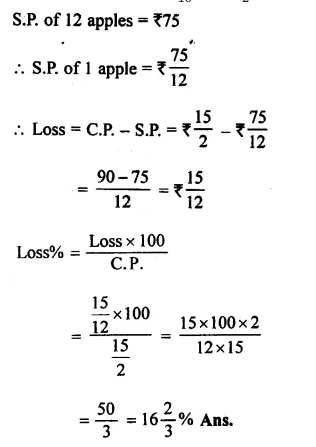
Solution:
Two parallelograms which are on the same base and between the same parallels are equal in area
∴ Ratio in their areas =1 : 1 (c)

Question 2.
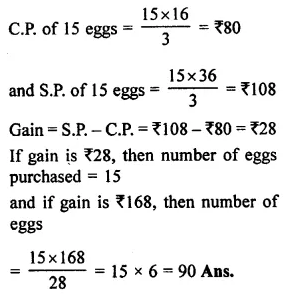
A triangle and a parallelogram are on the same base and between the same parallels. The ratio of the areas of triangle and parallelogram is
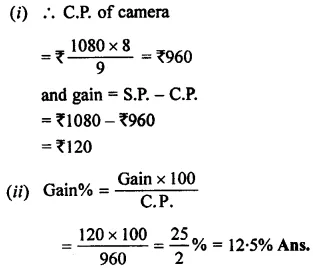
(a) 1 : 1
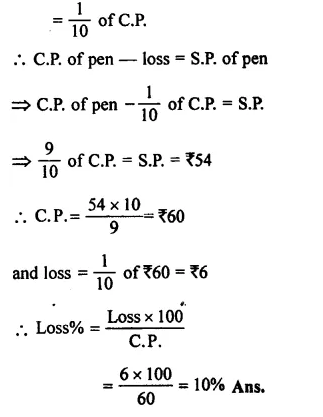
(b) 1 : 2
(c) 2 : 1
(d) 1 : 3
Solution:
A triangle and a parallelogram which are on the same base and between the same parallels, then area of triangle is half the area of the parallelogram
∴ Their ratio =1:2 (c)

Question 3.
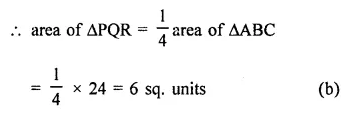
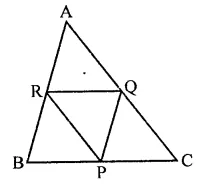
Let ABC be a triangle of area 24 sq. units and PQR be the triangle formed by the mid-points of sides of ∆ABC. Then the area of ∆PQR is
(a) 12 sq. units
(b) 6 sq. units
(c) 4 sq. units
(d) 3 sq. units
Solution:
Area of ∆ABC = 24 sq. units
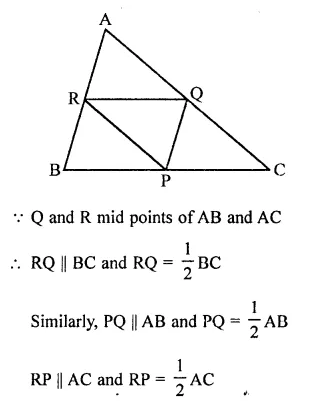
RD Sharma Class 9 Solutions Chapter 14 Quadrilaterals MCQS Q4.1
RD Sharma Class 9 Solutions Chapter 14 Quadrilaterals MCQS Q4.2

Question 4.
The median of a triangle divides it into two
(a) congruent triangle
(b) isosceles triangles
(c) right triangles
(d) triangles of equal areas
Solution:
The median of a triangle divides it into two triangles equal in area (d)

Question 5.
In a ∆ABC, D, E, F are the mid-points of sides BC, CA and AB respectively. If
ar(∆ABC) = 16 cm2, then ar(trapezium FBCE) =
(a) 4 cm²
(b) 8 cm²
(c) 12 cm²
(d) 10 cm²
Solution:
In ∆ABC, D, E and F are the mid points of sides BC, CA and AB respectively
ar(∆ABC) = 16 cm²
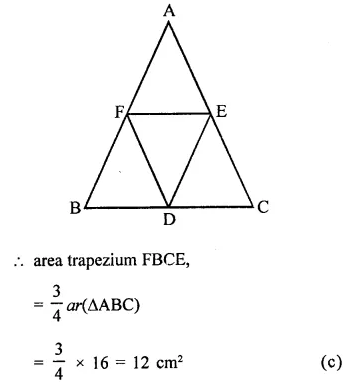
RD Sharma Class 9 Solutions Chapter 14 Quadrilaterals MCQS Q5.1

Question 6.
ABCD is a parallelogram. P is any point on CD. If ar(∆DPA) = 15 cm² and ar(∆APC) = 20 cm², then ar(∆APB) =
(a) 15 cm²
(b) 20 cm²
(c) 35 cm²
(d) 30 cm²
Solution:
In ||gm ABCD, P is any point on CD
AP, AC and PB are joined
ar(∆DPA) =15 cm²
ar(∆APC) = 20 cm²
Adding, ar(∆ADC) = 15 + 20 = 35 cm²
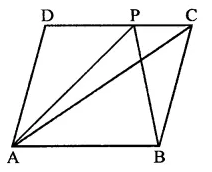
RD Sharma Class 9 Solutions Chapter 14 Quadrilaterals MCQS Q6.1
∵ AC divides it into two triangles equal in area
∴ ar(∆ACB) = ar(∆ADC) = 35 cm²
∵ ∆APB and ∆ACB are on the same base
AB and between the same parallels
∴ ar(∆APB) = ar(∆ACB) = 35 cm²(c)

Question 7.
The area of the figure formed by joining the mid-points of the adjacent sides of a rhombus with diagonals 16 cm and 12 cm is
(a) 28 cm²
(b) 48 cm²
(c) 96 cm²
(d) 24 cm²
Solution:
In rhombus ABCD,
P, Q, R and S are the mid points of sides AB, BC, CD and DA respectively and are joined in order to get a quad. PQRS
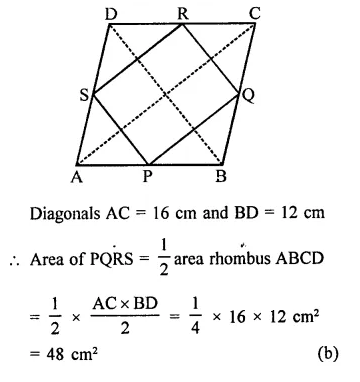
RD Sharma Class 9 Solutions Chapter 14 Quadrilaterals MCQS Q7.1

Question 8.
A, B, C, D are mid points of sides of parallelogram PQRS. If ar(PQRS) = 36 cm²,then ar(ABCD) =
(a) 24 cm²
(b) 18 cm²
(c) 30 cm²
(d) 36 cm²
Solution:
A, B, C and D are the mid points of a ||gm PQRS
Area of PQRS = 36 cm²
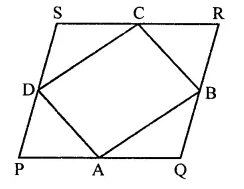
RD Sharma Class 9 Solutions Chapter 14 Quadrilaterals MCQS Q8.1
The area of ||gm formed by joining AB, BC, CD and DA
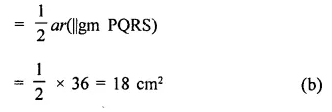
RD Sharma Class 9 Solutions Chapter 14 Quadrilaterals MCQS Q8.2

Question 9.
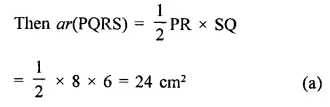
The figure obtained by joining the mid-points of the adjacent sides of a rectangle of sides 8 cm and 6 cm is
(a) a rhombus of area 24 cm²
(b) a rectangle of area 24 cm²
(c) a square of area 26 cm²
(d) a trapezium of area 14 cm²
Solution:
Let P, Q, R, S be the mid points of sides of a rectangle ABCD. Whose sides 8 cm and 6 cm
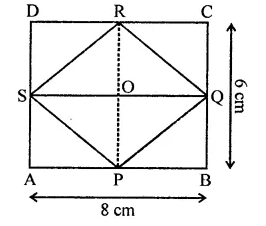
RD Sharma Class 9 Solutions Chapter 14 Quadrilaterals MCQS Q9.1
Their PQRS is a rhombus
RD Sharma Class 9 Solutions Chapter 14 Quadrilaterals MCQS Q9.2

Question 10.
If AD is median of ∆ABC and P is a point on AC such that ar(∆ADP) : ar(∆ABD) = 2:3, then ar(∆PDC) : ar(∆ABC) is
(a) 1 : 5
(b) 1 : 5
(c) 1 : 6
(d) 3 : 5
Solution:
AD is the median of ∆ABC,
P is a point on AC such that
ar(∆ADP) : ar(∆ABD) = 2:3
Let area of ∆ADP = 2×2
Then area of ∆ABD = 3×2
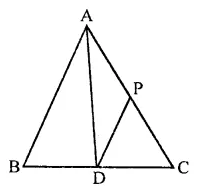
RD Sharma Class 9 Solutions Chapter 14 Quadrilaterals MCQS Q10.1
But area of AABD = \(\frac { 1 }{ 2 }\) area AABC
∴ Area ∆ABC = 2 x area of ∆ABD
= 2 x 3x² = 6x²
and area of ∆PDC = area ∆ADC – (ar∆ADP) = area ∆ABD – ar ∆ADP
= 3x² – 2x² = x²
∴ Ratio = x² : 6x²
= 1 : 6 (c)

Question 11.
Medians of AABC, intersect at G. If ar(∆ABC) = 27 cm2, then ar(∆BGC) =
(a) 6 cm2
(b) 9 cm2
(c) 12 cm2
(d) 18 cm2
Solution:
In ∆ABC, AD, BE and CF are the medians which intersect each other at G
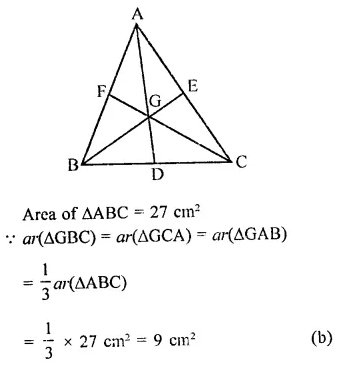
RD Sharma Class 9 Solutions Chapter 14 Quadrilaterals MCQS Q11.1

Question 12.
In a ∆ABC if D and E are mid-points of BC and AD respectively such that ar(∆AEC) = 4 cm², then ar(∆BEC) =
(a) 4 cm²
(b) 6 cm²
(c) 8 cm²
(d) 12 cm²
Solution:
In ∆ABC, D and E are the mid points of BC and AD
Join BE and CE ar(∆AEC) = 4 cm²
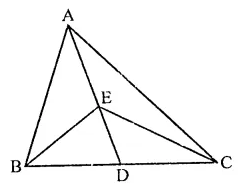
RD Sharma Class 9 Solutions Chapter 14 Quadrilaterals MCQS Q12.1
In ∆ABC,
∵ AD is the median of BC
∴ ar(∆ABD) = ar(∆ACD)
Similarly in ∆EBC,
ED is the median
∴ ar(∆EBD) = ar(∆ECD)
and in ∆ADC, CE is the median
∴ ar(∆FDC) = ar(∆AEC)
= 4 cm
∴ar∆EBC = 2 x ar(∆EDC)
= 2 x 4 = 8 cm (c)

Question 13.
In the figure, ABCD is a parallelogram. If AB = 12 cm, AE = 7.5 cm, CF = 15 cm, then AD =
(a) 3 cm
(b) 6 cm
(c) 8 cm
(d) 10.5 cm
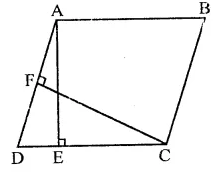
RD Sharma Class 9 Solutions Chapter 14 Quadrilaterals MCQS Q13.1
Solution:
In ||gm ABCD, AB = 12 cm AE = 7.5 cm
∴ Area of ||gm ABCD = base x height = AB x AE = 12 x 7.5 cm² = 90 cm²
Now area ||gm ABCD = 90 cm²
and altitude CF = 15 cm
∴ Base AD = \(\frac { Area }{ Altitude }\) = \(\frac { 90 }{ 15 }\) = 6 cm (b)

Question 14.
In the figure, PQRS is a parallelogram. If X and Y are mid-points of PQ and SR respectively and diagonal SQ is joined. The ratio ar(||gm XQRY) : ar(∆QSR) =
(a) 1 : 4
(b) 2 : 1
(c) 1 : 2
(d) 1 : 1
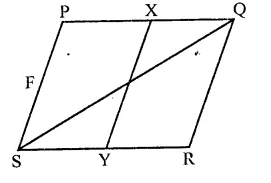
RD Sharma Class 9 Solutions Chapter 14 Quadrilaterals MCQS Q14.1
Solution:
In ||gm PQRS, X and Y are the mid points of PQ and SR respectively XY and SQ are joined.
∵ XY bisects PQ and SR
∴ PXYS and XQRY are also ||gms and ar(∆PXYS) = nr(∆XQRY)
∵ ||gm PQRS and AQSR are on the same base and between the same parallel lines
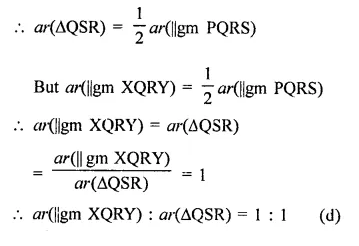
RD Sharma Class 9 Solutions Chapter 14 Quadrilaterals MCQS Q14.2

Question 15.
Diagonal AC and BD of trapezium ABCD, in which AB || DC, intersect each other at O. The triangle which is equal in area of ∆AOD is
(a) ∆AOB
(b) ∆BOC
(c) ∆DOC
(d) ∆ADC
Solution:
In trapezium ABCD, diagonals AC and BD intersect each other at O. AB || DC
∆ABC and ∆ABD are on the same base and between the same parallels
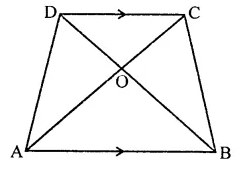
RD Sharma Class 9 Solutions Chapter 14 Quadrilaterals MCQS Q15.1
∴ ar(∆ABC) = or(∆ABD)
Subtracting ar(∆AOB)
ar(∆ABC) – ar(∆AOB) = ar(∆ADB) – ar(∆AOB)
⇒ ar(∆BOC) = ar(∆AOD)
ar(∆AOD) = ar(∆BOC) (c)

Question 16.
ABCD is a trapezium in which AB || DC. If ar(∆ABD) = 24 cm² and AB = 8 cm, then height of ∆ABC is
(a) 3 cm
(b) 4 cm
(c) 6 cm
(d) 8 cm
Solution:
In trapezium ABCD, AB || DC
AC and BD are joined
ar(∆ABD) = 24 cm2
AB = 8 cm,
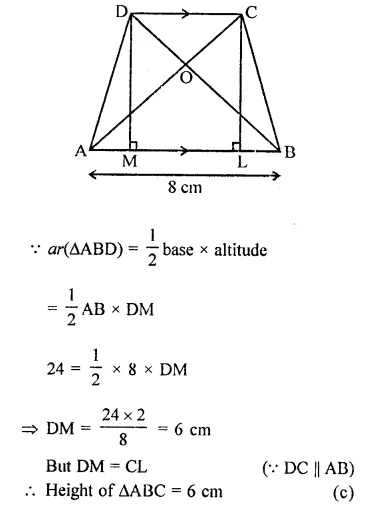
RD Sharma Class 9 Solutions Chapter 14 Quadrilaterals MCQS Q16.1

Question 17.
ABCD is a trapezium with parallel sides AB = a and DC = b. If E and F are mid-points of non-parallel sides AD and BC respectively, then the ratio of areas of quadrilaterals ABFE and EFCD is
(a) a : b
(b) (a + 3b) : (3a + b)
(c) (3a + b) : (a + 3b)
(d) (2a + b) : (3a + b)
Solution:
In quadrilateral ABCD, E and F are the mid points of AD and BC
AB = a, CD = b
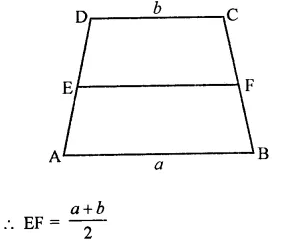
RD Sharma Class 9 Solutions Chapter 14 Quadrilaterals MCQS Q17.1
Let h be the height of trapezium ABCD then height of each quadrilateral
ABFE = altitude of quadrilateral EFCD = \(\frac { h }{ 2 }\)
Now area of trap. ABFE = \(\frac { 1 }{ 2 }\) (sum of parallel sides) x altitude
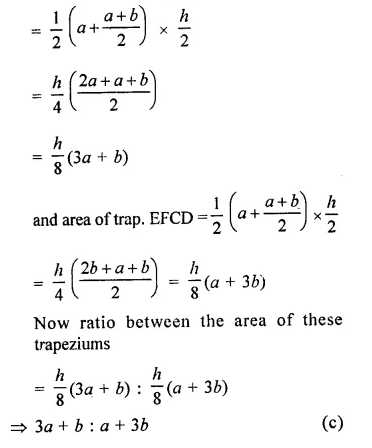
RD Sharma Class 9 Solutions Chapter 14 Quadrilaterals MCQS Q17.2

Question 18.
ABCD is a rectangle with O as any point in its interior. If or(∆AOD) = 3 cm2 and ar(∆BOC) = 6 cm2, then area of rectangle ABCD is
(a) 9 cm2
(b) 12 cm2
(c) 15 cm2
(d) 18 cm2
Solution:
In rectangle ABCD, O is any point
ar(∆AOD) = 3 cm2
and ar(∆BOC) = 6 cm2
Join OA, OB, OC and OD
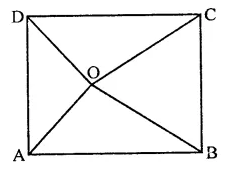
RD Sharma Class 9 Solutions Chapter 14 Quadrilaterals MCQS Q18.1
We know that if O is any point in ABCD Then ar(AOB) + ar(COD) = ar(AOB) + ar(BOC)
= 3 + 6 = 9 cm
∴ ar(rect. ABCD) = 2 x 9 = 18 cm (d)

Question 19.
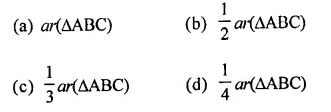
The mid-points of the sides of a triangle ABC along with any of the vertices as the fourth point make a parallelogram of area equal to
RD Sharma Class 9 Solutions Chapter 14 Quadrilaterals MCQS Q19.1
Solution:
RD Sharma Class 9 Solutions Chapter 14 Quadrilaterals MCQS Q19.2
P,Q and R the mid points of the sides of a ∆ABC then area of any parallelogram formed by the mid points and one vertex of the given triangle has area = \(\frac { 1 }{ 2 }\) area ∆ABC (b)

Question 20.
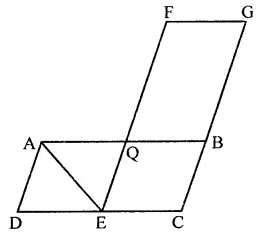
In the figure, ABCD and FECG are parallelograms equal in area. If ar(∆AQE) = 12 cm2, then ar(||gm FGBQ) =
(a) 12 cm2
(b) 20 cm2
(c) 24 cm2
(d) 36 cm2
RD Sharma Class 9 Solutions Chapter 14 Quadrilaterals MCQS Q20.1
Solution:
In the figure, ABCD and EFCG are parallelograms equal in area and ar(∆AQE) = 12 cm2
In ||gm AQED, AE is the diagonal
∴ ar(∆AQE) = \(\frac { 1 }{ 2 }\) ar(||gm AQED)
⇒ 12 cm2 = \(\frac { 1 }{ 2 }\) ar(||gm AQED)
∴ ar(||gm AQED) = 24 cm2
∵ ar ||gm ABCD = ar ||gm FECG
⇒ ar(||gm ∆QED) + ar(|| gm QBCE)
= ar(||gm QBCE) + ar(||gm FGBQ)
⇒ ar(||gm ∆QED) = ar(||gm FGBQ)
= 24 cm2 (c)

Hope given RD Sharma Class 9 Solutions Chapter 14 Quadrilaterals MCQS are helpful to complete your math homework.

If you have any doubts, please comment below. Learn Insta try to provide online math tutoring for you.
Value Based Questions in Science for Class 9 Chapter 8 Motion

Value Based Questions in Science for Class 9 Chapter 8 Motion

These Solutions are part of Value Based Questions in Science for Class 9. Here we have given Value Based Questions in Science for Class 9 Class 9 Chapter 8 Motion

VALUE BASED QUESTIONS

Question 1.
Ram hired a three wheeler from bus stand to his house. The driver A’ of three wheeler followed the shortest path and reached the destination in half an hour. He charged Rs. 50 from Ram. On the same day, Ram’s sister also came to her house after attending a function in other city. She also hired a three wheeler. The driver ‘B’ of the three wheeler took an hour to reach her house and charged Rs. 150 from her.

  1. Is the displacement of both the three wheelers from bus stand to Ram’s house same or different ?
  2. What values are shown by driver A ?

Answer:

  1. Displacement of both the three wheelers is same.
  2. Driver A is honest. He is concerned for others.

More Resources

Question 2.
Two boys A and B were driving cars on a road. There was a sign board on the side of road reading “speed limit” : 50 km/h. Boy A applied brakes and started driving at 45 km/h. On the other hand boy B did not bother about the speed limit. He continued to drive his car at 70 km/h. A police man stopped the car of boy B and fined him If Rs. 500.00. What values are shown by boy A ?
Answer:
boy A is good observer and being a good citizen, he follows the traffic rules.

Hope given Value Based Questions in Science for Class 9 Chapter 8 Motion are helpful to complete your science homework.

If you have any doubts, please comment below. Learn Insta try to provide online science tutoring for you.
HOTS Questions for Class 9 Science Chapter 8 Motion

HOTS Questions for Class 9 Science Chapter 8 Motion

These Solutions are part of HOTS Questions for Class 9 Science. Here we have given HOTS Questions for Class 9 Science Chapter 8 Motion

Question 1.
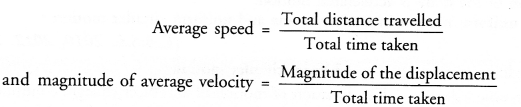
Under what condition, the average speed is equal to the magnitude of the average velocity. Justify your answer.
(CBSE 2010, 2012)
Answer:
HOTS Questions for Class 9 Science Chapter 8 Motion image - 1
Now, the average speed = magnitude of average velocity if the total distance travelled by an object in a given time interval is equal to the magnitude of the displacement of the object in the same time interval. This is possible, when an object moves in one direction along a straight line. Thus, average speed is equal to the magnitude of the average velocity if an object moves in one direction along a straight line.

More Resources

Question 2.
A body can have zero average velocity but not zero average speed. Explain. (CBSE 2013)

Or

Give an example of a motion in which average velocity is zero, but the average speed is not zero. (CBSE 2015)
Answer:
HOTS Questions for Class 9 Science Chapter 8 Motion 2
Since, the total distance travelled by a moving body increases with the time, so average speed of a moving body can not be zero.
HOTS Questions for Class 9 Science Chapter 8 Motion image - 2
Since total displacement of a moving body can be zero, so the average velocity of a moving body can be zero.
Example. When an athlete completes one round in a circular track in the given time interval, then his total displacement is zero but total distance travelled is equal to the length of the circular track. Hence, his average velocity is zero but his average speed is not zero.

Question 3.
An object P is moving with a constant velocity for 5 minutes. Another object Q is moving with changing velocity for 5 minutes. Out of these two objects, which one has acceleration. Explain. (CBSE 2012)
Change in velocity
Answer:
HOTS Questions for Class 9 Science Chapter 8 Motion image - 4
Since, the velocity of object P is not changing or change in velocity of the object is zero, therefore, object P has no acceleration. On the other hand, there is change in velocity of the object Q, so it has acceleration.

Question 4.
Can an object be accelerated if it is moving with constant speed ? Justify your answer with an example.

Or

Can a body have constant speed and still be accelerating ? Give an example. (CBSE 2010)

Or

Explain how is it possible for an object to move with a constant speed but with uniform acceleration.
(CBSE 2012)
Answer:
An object moving with constant speed can be accelerated if its direction of motion changes. For example, an object moving with a constant speed in a circular path has an acceleration because its direction of motion changes continuously.

Question 5.
Two trains A and B start moving at the same time. The distances travelled by them in given intervals of time are given below. State which train has uniform motion and which train has non-uniform motion.

TimeDistance travelled by train A (in km)Distance travelled by train B (in km)
6.00 pm00
6.15 pm1015
6.30 pm2024
6.45 pm3032
7.00 pm4038
7.15 pm5042
7.30 pm6047

Answer:
Since train A travels equal distances in equal intervals of time (i.e. in every 15 minutes), so the motion of train A is uniform motion. On the other hand, train B travels unequal distances in equal intervals of time (i.e. in every 15 minutes), so the motion of train B is non-uniform motion.

Hope given HOTS Questions for Class 9 Science Chapter 8 Motion are helpful to complete your science homework.

If you have any doubts, please comment below. Learn Insta try to provide online science tutoring for you.
NCERT Solutions for Class 9 Science Chapter 8 Motion

NCERT Solutions for Class 9 Science Chapter 8 Motion

These Solutions are part of NCERT Solutions for Class 9 Science. Here we have given NCERT Solutions for Class 9 Science Chapter 8 Motion. LearnInsta.com provides you the Free PDF download of NCERT Solutions for Class 9 Science (Biology) Chapter 8 – Motion solved by Expert Teachers as per NCERT (CBSE) Book guidelines. All Chapter 8 – Motion Exercise Questions with Solutions to help you to revise complete Syllabus and Score More marks.

More Resources

NCERT TEXT BOOK QUESTIONS

IN TEXT QUESTIONS

Question 1.
An object has moved through a distance. Can it have zero displacement ? If yes, support your answer with an example. (CBSE 2015)
Answer:
Yes, The displacement of the object can be zero. Let a boy completes one round of a circular track in 5 minutes. The distance travelled by the boy = circumference of the circular track. However, displacement of the boy is zero because his initial and final positions are same.

Question 2.
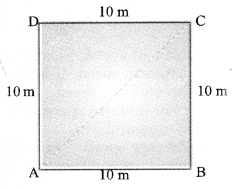
A farmer moves along the boundary of a square field of side 10 m in 40 s.
What will be the magnitude of displacement of the farmer at the end of 2 minutes 20 seconds ? (CBSE 2010, 2015)
NCERT Solutions for Class 9 Science Chapter 8 Motion image - 1
Answer:
ABCD is a square field of side 10 m.
The farmer moves along the boundary of the field from the corner A via the corners B, C and D.
After every 40 s, the farmer is again at the corner A, so his displacement after every 40 s is zero.
At the end of 2 minutes 20 seconds = (2 x 60 + 20) = 140 s, the farmer will be at the corner C.
NCERT Solutions for Class 9 Science Chapter 8 Motion image - 2

Question 3.
Distinguish between speed and velocity. (CBSE 2010, 2012, 2013, 2015)
Answer:

Speed

Velocity

1. Distance travelled by an object per unit time is known as its speed.The distance travelled by an object in a particular direction (i.e. displacement) per unit time is known as its velocity.
2. Average speed of a moving object cannot be zero.Average velocity of a moving object can be zero.
3. tells how fast an object moves.Velocity tells how fast an object moves and in which direction it moves.
4. Speed is a scalar quantity.Velocity is a vector quantity.
5. Speed of an object is always positive.Velocity of an object can be positive or negative.

Question 4.
Under what conditions) is the magnitude of the average velocity of an object equal to its average speed ? (CBSE 2012, 2013)
Answer:
When an object moves in one direction along a straight line.

Question 5.
What does the odometer of an automobile measure ? (CBSE 2010, 2011, 2014, 2015)
Answer:
Odometer of an automobile measures distance travelled by the automobile.

Question 6.
What does the path of an object look like when it is in uniform motion ? (CBSE 2012)
Answer:
Straight path.

Question 7.
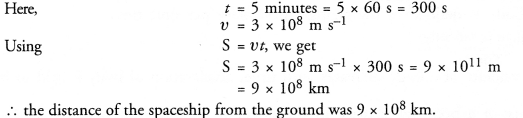
During an experiment, a signal from a spaceship reached the ground station in five minutes. What was the distance of the spaceship from the ground station ? The signal travels at the speed of light, that is, 3 x 10⁸ m s-1
Answer:
NCERT Solutions for Class 9 Science Chapter 8 Motion image - 3

Question 8.
When will you say a body is in

  1. uniform acceleration ?
  2. non-uniform acceleration (CBSE 2012, 2013)

Answer:

  1. A body has uniform acceleration if its velocity changes by an equal amount in equal intervals of time. .
  2. A body has non-uniform acceleration if its velocity changes by unequal amount in equal intervals of time.

Question 9.
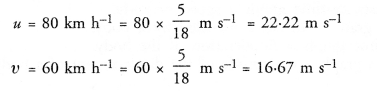
A bus decreases its speed from 80 kmh-1 to 60 kmh-1 in 5 s. Find the acceleration of the bus.
(CBSE 2010, 2011, 2012, 2015)
Answer:
Here,
NCERT Solutions for Class 9 Science Chapter 8 Motion image - 4
NCERT Solutions for Class 9 Science Chapter 8 Motion image - 5

Question 10.
A train starting from a railway station and moving with a uniform acceleration attains a speed of 40 km h-1 n 10 minutes. Find its acceleration.
Answer:
NCERT Solutions for Class 9 Science Chapter 8 Motion image - 6

Question 11.
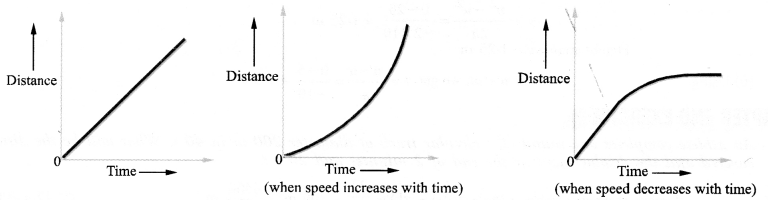
What is the nature of the distance-time graphs for uniform and non-uniform motion of an object ?
(CBSE 2012)
Answer:

  1. For uniform motion, distance-time graph is a straight line having constant gradient or slope as shown in figure.
  2. For non-uniform motion, distance-time graph is a curve having increasing gradient or slope or decreasing gradient as shown in figures.
    NCERT Solutions for Class 9 Science Chapter 8 Motion image - 7

Question 12.
What can you say about the motion of an object whose distance-time graph is a straight line parallel to
the time axis ? (CBSE 2010, 2012)
Answer:
When distance-time graph is a straight line parallel to the time axis, it means, the distance of the object is not changing with time. Thus, the object is stationary.

Question 13.
What can you say about the motion of an object if its speed-time graph is a straight line parallel to the time-axis ?
Answer:
In this case, speed of the object is constant. That is, the object travels equal distances in equal intervals of time along a straight line. Hence, motion of the object is uniform motion.

Question 14.
What is the quantity which is measured by the area occupied below the velocity-time graph ?
(CBSE 2010, 2012)
Answer:
Magnitude of the displacement of a body is measured by the area under the velocify-time graph.

Question 15.
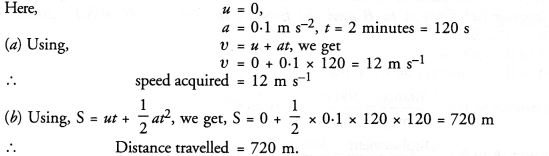
A bus starting from rest moves with a uniform acceleration of 0.1 m s-2 for 2 minutes. Find
(a) the speed acquired,
(b) the distance travelled. (CBSE 2012)
Answer:
NCERT Solutions for Class 9 Science Chapter 8 Motion image - 8

Question 16.
A train is travelling at a speed of 90 km h-1. Brakes are applied so as to produce a uniform acceleration of – 0.5 m s-2 . Find how far the train will go before it is brought to rest ?
Answer:
NCERT Solutions for Class 9 Science Chapter 8 Motion image - 9

Question 17.
A trolley, while going down an inclined plane has an acceleration of 2 cm s-2. What will be its velocity 3 s after the start ?
Answer:
Here, u = 0,v = ?, a = 2 cm s-2, t = 3 s
Using, v = u + at, we get
v = 0 + 2 x 3 = 6 cm s-2.

Question 18.
A racing car has a uniform acceleration of 4 m s-2. What distance will it cover in 10 s after start ?
Answer:
NCERT Solutions for Class 9 Science Chapter 8 Motion image - 10

Question 19.
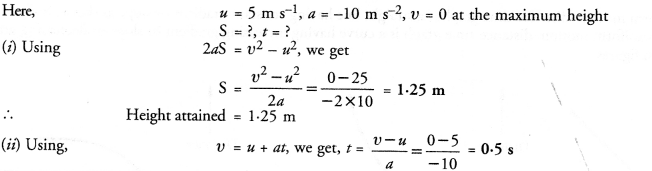
A stone is thrown in a vertically upward direction with a velocity of 5 m s-1 If the acceleration of the stone during its motion is 10 m s-2 in the downward direction, what will be the height attained by the stone and how much time will it take to reach there ?
Answer:
NCERT Solutions for Class 9 Science Chapter 8 Motion image - 11

NCERT CHAPTER END EXERCISE

Question 1.
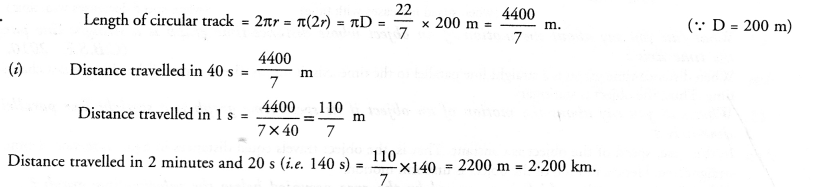
An athlete completes one round of a circular track of diameter 200 m in 40 s. What will be the distance covered and the displacement at the end of 2 minutes and 20 s ?
Answer:
NCERT Solutions for Class 9 Science Chapter 8 Motion image - 12
(ii) After every 40 s, athlete reaches his starting point, so after 40 s, his displacement is zero. It means, the athlete completes the circular track 3 times in 120 s and in the next 20 s, he is just opposite to his starting point. Therefore, the magnitude of the displacement of the athlete at the end of the 140 s (or 2 minutes 20 s) = Diameter of the circular track = 200 m.

Question 2.
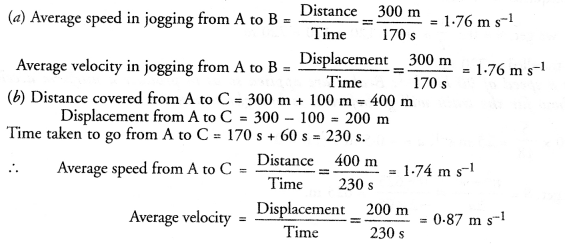
Joseph jogs from one end A to the other end B of a straight 300 m road in 2 minutes 50 seconds and then turns around and jogs 100 m back to point C in another 1 minute. What are Joseph’s average speeds and velocities in jogging
(a) from A to B and
(b) from A to C ? (CBSE 2010, Term I)
Answer:
Distance from A to B – 300 m
Displacement from A to B = 300 m
Time taken to go from A to B =2 minutes 50 s = 170 s
T Solutions for Class 9 Science Chapter 8 Motion image - 13

Question 3.
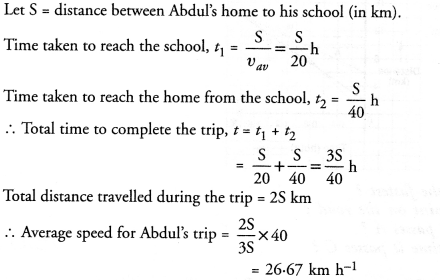
Abdul, while driving to school, computes the average speed for his trip to be 20 km h-1. On his return trip along the same route, there is less traffic and the average speed is 40 km h-1. What is the average speed for Abdul’s trip ? (CBSE 2011)
Answer:
NCERT Solutions for Class 9 Science Chapter 8 Motion image - 14

Question 4.
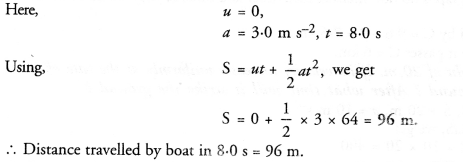
A motor boat starting from rest on a lake accelerates in a straight line at a constant rate of 3.0 m s-2 for 8.0 s. How far does the boat travel during this time ? (CBSE 2011, 2013)
Answer:
NCERT Solutions for Class 9 Science Chapter 8 Motion image - 15

Question 5.
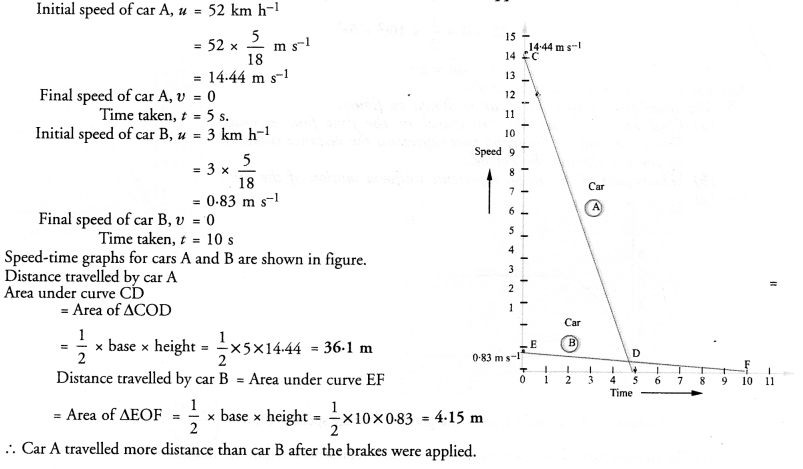
A driver of a car travelling at 52 km h-1 applies the brakes and accelerates uniformly in the opposite direction. The car stops in 5 s. Another driver going at 3 km h-1 in another car applies his breaks slowly and stops in 10 s. On the same graph paper plot the speed versus time graphs for the two cars. Which of the two cars travelled farther after the brakes were applied ?
Answer:
NCERT Solutions for Class 9 Science Chapter 8 Motion image - 16

Question 6.
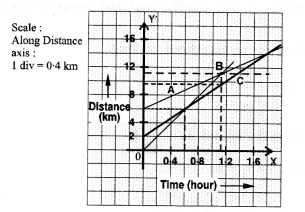
Figure shows the distance-time graph of three objects A, B and C. Study the graph and answer the following questions :
NCERT Solutions for Class 9 Science Chapter 8 Motion image - 17
(a) Which of the three is travelling the fastest ?
(b) Are all three ever at the same point on the road ?
(c) How far has C travelled when B passes A ?
(d) How far has B travelled by the time it passes C ?
Answer:
(a) Speed = Slope of distance-time graph.
Since slope of distance-time graph for object B is the greatest, so object B is travelling the fastest.
(b) All the three objects will be at the same point on the road if all the three distance-time graphs intersect each other at a time. Since, all the three distance-time graphs do not intersect each other at a time, so they are never at the same point on the road.
(c) When B passes A, distance travelled by C = 9.6 – 2 = 7.6 km.
(d) Distance travelled by B by the time it passes C = 6 km.

Question 7.
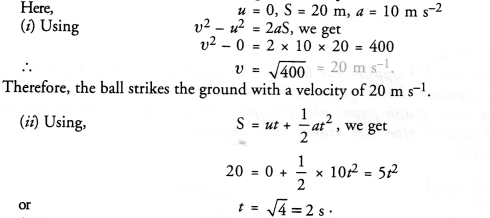
A ball is gently dropped from a height of 20 m. If its velocity increases uniformly at the rate of 10 m s-2, with what velocity will it strike the ground ? After what time will it strike the ground ?
Answer:
NCERT Solutions for Class 9 Science Chapter 8 Motion image - 18

Question 8.
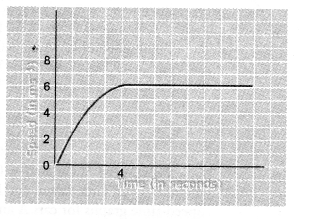
The speed time graph for a car as shown in figure
NCERT Solutions for Class 9 Science Chapter 8 Motion image - 19
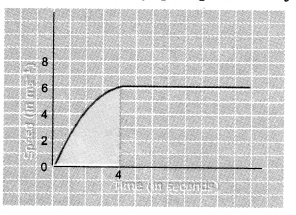
(a) Find how far does the car travel in the firdt four seconds.
Shade the area on the graph that represents the distance travelled by the car during the period.
(b) Which part of the graph represents uniform motion of the car?
Answer:
(a)
NCERT Solutions for Class 9 Science Chapter 8 Motion image - 20
NCERT Solutions for Class 9 Science Chapter 8 Motion image - 21
(b) The straight part of the curve parallel to time axis represents the uniform motion of the car.

Question 9.
State which of the following situations are possible and give an example for each of these :
(a) an object with a constant acceleration but zero velocity.
(b) an object moving with an acceleration but with uniform speed.
(c) an object moving in a certain direction with an acceleration in the perpendicular direction.
(CBSE 2012)
Answer:
(a) When an object is thrown vertically upward, its velocity at the highest point is zero but it has constant acceleration = 9.8 m s-2
(b) Uniform circular motion.
(c) An object moving in a circular path with uniform speed, its acceleration is always perpendicular to the direction of the motion of the object.

Question 10.
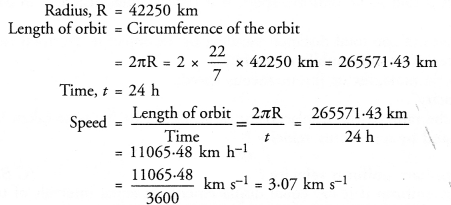
An artificial satellite is moving in a circular orbit of radius 42250 km. Calculate its speed if it takes 24 . hours to revolve around the earth. (CBSE 2011)
Answer:
NCERT Solutions for Class 9 Science Chapter 8 Motion image - 22

NCERT Solutions for Class 9 Science Chapter 8 Motion

Hope given NCERT Solutions for Class 9 Science Chapter 8 are helpful to complete your science homework.

If you have any doubts, please comment below. Learn Insta try to provide online science tutoring for you.
RS Aggarwal Class 8 Solutions Chapter 10 Profit and Loss Ex 10A

RS Aggarwal Class 8 Solutions Chapter 10 Profit and Loss Ex 10A

These Solutions are part of RS Aggarwal Solutions Class 8. Here we have given RS Aggarwal Solutions Class 8 Chapter 10 Profit and Loss Ex 10A.
Other Exercises

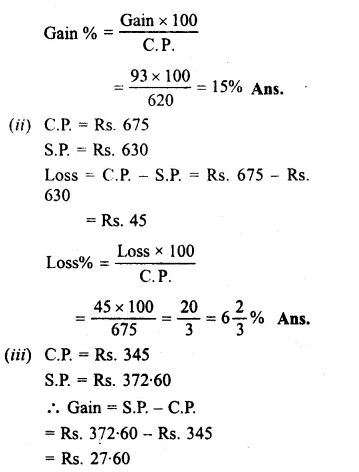
Question 1.
Solution:
(i) C.P. = Rs. 620
S.P. = Rs. 713
Gain = S.P. – C.P. = Rs. 713 – Rs. 620
= Rs. 93
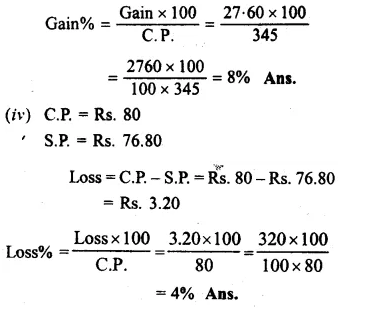
RS Aggarwal Class 8 Solutions Chapter 10 Profit and Loss Ex 10A 1.1
RS Aggarwal Class 8 Solutions Chapter 10 Profit and Loss Ex 10A 1.2

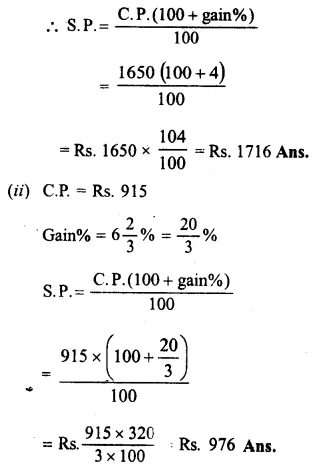
Question 2.
Solution:
(i) C.P. = Rs. 1650
Gain% = 4%
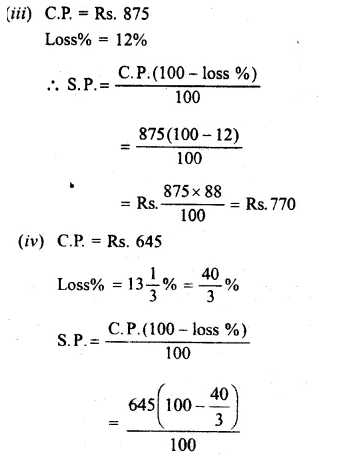
RS Aggarwal Class 8 Solutions Chapter 10 Profit and Loss Ex 10A 2.1
RS Aggarwal Class 8 Solutions Chapter 10 Profit and Loss Ex 10A 2.2
RS Aggarwal Class 8 Solutions Chapter 10 Profit and Loss Ex 10A 2.3

You can also Download NCERT Solutions for Class 8 Maths to help you to revise complete Syllabus and score more marks in your examinations.

Question 3.
Solution:
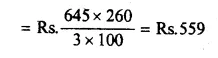
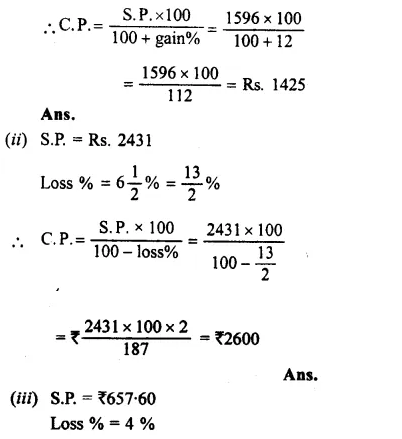
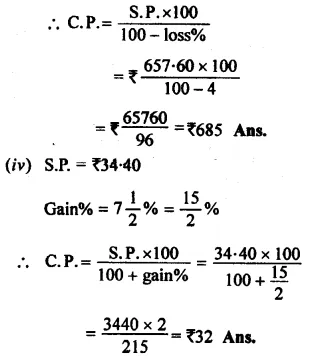
(i)S.P.= Rs 1596
Gain % = 12%
RS Aggarwal Class 8 Solutions Chapter 10 Profit and Loss Ex 10A 3.1
RS Aggarwal Class 8 Solutions Chapter 10 Profit and Loss Ex 10A 3.2

Question 4.
Solution:
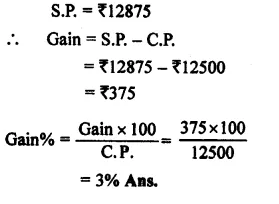
C.P. of iron safe = Rs 12160
Paid for its transportation = Rs 340
Total cost = Rs 12160 + Rs 340
= Rs 12500
RS Aggarwal Class 8 Solutions Chapter 10 Profit and Loss Ex 10A 4.1

Question 5.
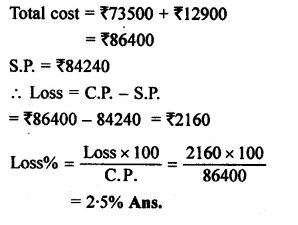
Solution:
C.P. of car = Rs 73500
Overhead charges = Rs 10300 + 2600
= Rs 12900
RS Aggarwal Class 8 Solutions Chapter 10 Profit and Loss Ex 10A 5.1

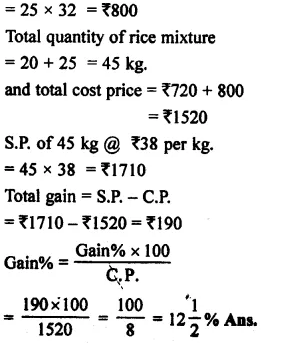
Question 6.
Solution:
C.P. of 20 kg @ Rs 36 per kg.
= 20 x 36 = Rs 720
C.P. of 25 kg @ Rs32 per kg.
RS Aggarwal Class 8 Solutions Chapter 10 Profit and Loss Ex 10A 6.1

Question 7.
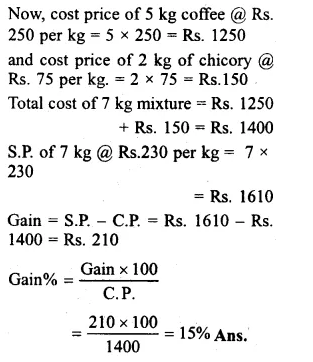
Solution:
Ratio of the mixture = 5 : 2
Let 5 kg of coffee is mixed with 2 kg of chicory
RS Aggarwal Class 8 Solutions Chapter 10 Profit and Loss Ex 10A 7.1

Question 8.
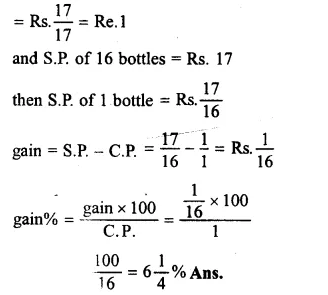
Solution:
Let CR of 17 water bottles = Rs. 17
Then C.P. of one bottle
RS Aggarwal Class 8 Solutions Chapter 10 Profit and Loss Ex 10A 8.1

Question 9.
Solution:
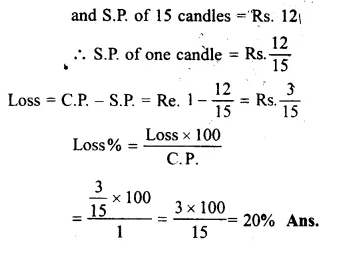
Let C.P. of 12 candIes =Rs. 12
C.P of 1 candle = Re. 1
RS Aggarwal Class 8 Solutions Chapter 10 Profit and Loss Ex 10A 9.1

Question 10.
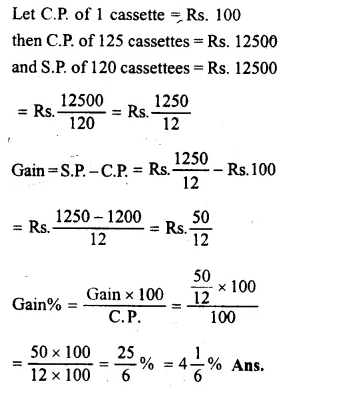
Solution:
S.P. of 125 cassettes – gain = C.P. of 125 cassettes
=> S.P. of 125 cassettes – S.P. of 5 cassettes = C.P. of 125 cassettes
=> S.P. of 120 cassettes = C.P. of 125 cassettes
RS Aggarwal Class 8 Solutions Chapter 10 Profit and Loss Ex 10A 10.1

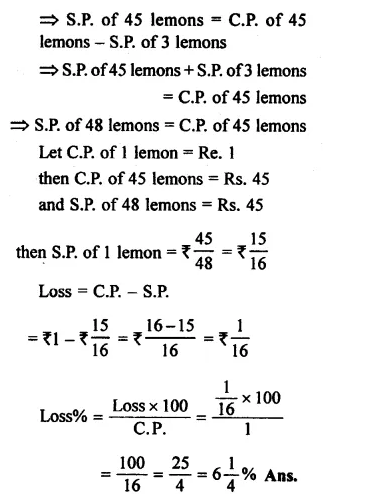
Question 11.
Solution:
S.P. of 45 lemons = C.P. of 45 lemons – loss
RS Aggarwal Class 8 Solutions Chapter 10 Profit and Loss Ex 10A 11.1

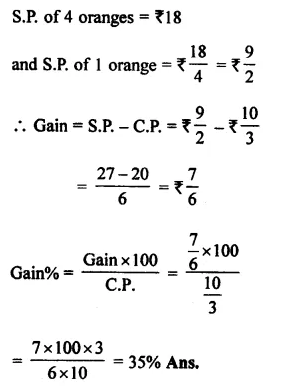
Question 12.
Solution:
CP. of 6 oranges = Rs 20
and C.P of 1 orange = Rs \(\\ \frac { 20 }{ 6 } \) = Rs \(\\ \frac { 10 }{ 3 } \)
RS Aggarwal Class 8 Solutions Chapter 10 Profit and Loss Ex 10A 12.1

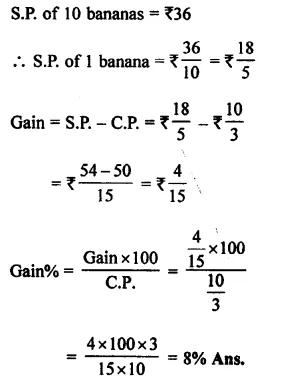
Question 13.
Solution:
C.P. of 12 bananas = Rs 40
and C.P of 1 banana = Rs \(\\ \frac { 40 }{ 12 } \) = Rs \(\\ \frac { 10 }{ 3 } \)
RS Aggarwal Class 8 Solutions Chapter 10 Profit and Loss Ex 10A 13.1

Question 14.
Solution:
C.P. of 10 apples = Rs 75
and C.P of 1 apple = Rs \(\\ \frac { 75 }{ 10 } \) = Rs \(\\ \frac { 15 }{ 2 } \)
RS Aggarwal Class 8 Solutions Chapter 10 Profit and Loss Ex 10A 14.1

Question 15.
Solution:
Let eggs purchased were = 3 x 16 = 48
RS Aggarwal Class 8 Solutions Chapter 10 Profit and Loss Ex 10A 15.1

Question 16.
Solution:
S.P. of camera = Rs 1080
C.P. of camera + gain = S.P. of camera
=> C.P. of camera + \(\\ \frac { 1 }{ 8 } \) of C.P. = S.P. of camera
= \(\\ \frac { 9 }{ 8 } \) x C.P. of camera = S.P. of camera = Rs 1080
RS Aggarwal Class 8 Solutions Chapter 10 Profit and Loss Ex 10A 16.1

Question 17.
Solution:
S.P. of a pen = Rs 54
Loss = \(\\ \frac { 1 }{ 10 } \) of her outlay
RS Aggarwal Class 8 Solutions Chapter 10 Profit and Loss Ex 10A 17.1

Question 18.
Solution:
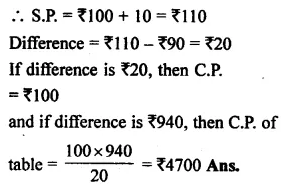
Let C.P. of table = Rs 100
In first case, loss = 10%
S.P. = Rs 100 – 10 = Rs 90
and in second case, gain = 10%
RS Aggarwal Class 8 Solutions Chapter 10 Profit and Loss Ex 10A 18.1

Question 19.
Solution:
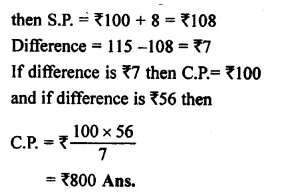
Let C.P. of chair = Rs 100
In first case, gain = 15%
then S.P. = Rs 100 + 15 = Rs 115
and in second case, gain = 8%
RS Aggarwal Class 8 Solutions Chapter 10 Profit and Loss Ex 10A 19.1

Question 20.
Solution:
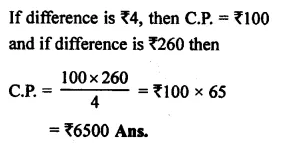
Let the C.P. of cycle = Rs 100
In first case, gain = 10%
then S.P. = Rs 100 + 10 = Rs 110
In second case, gain = 14%
Difference between their S.P.s = Rs 114 – Rs 110 = Rs 4
RS Aggarwal Class 8 Solutions Chapter 10 Profit and Loss Ex 10A 20.1

Question 21.
Solution:
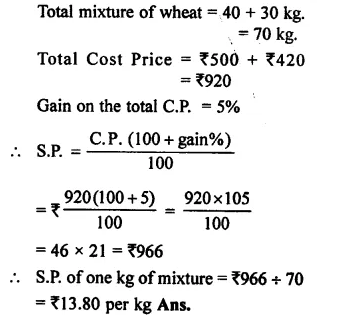
Cost price of 40 kg @ Rs 12.50 per kg.
= 40 x 12.50 = Rs 500
and cost price of 30 kg @ of Rs 14 per kg
= 30 x 14 = Rs 420
RS Aggarwal Class 8 Solutions Chapter 10 Profit and Loss Ex 10A 21.1

Question 22.
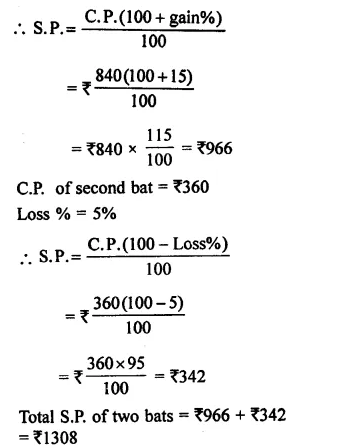
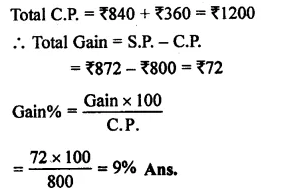
Solution:
C.P. of first bat = Rs 840
Gain% = 15%
RS Aggarwal Class 8 Solutions Chapter 10 Profit and Loss Ex 10A 22.1
RS Aggarwal Class 8 Solutions Chapter 10 Profit and Loss Ex 10A 22.2

Question 23.
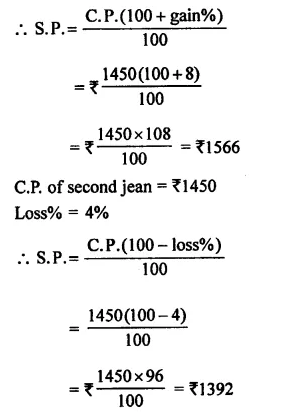
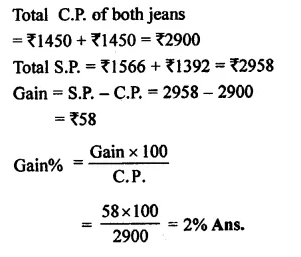
Solution:
C.P. of first jean = Rs 1450
Gain% = 8%
RS Aggarwal Class 8 Solutions Chapter 10 Profit and Loss Ex 10A 23.1
RS Aggarwal Class 8 Solutions Chapter 10 Profit and Loss Ex 10A 23.2

Question 24.
Solution:
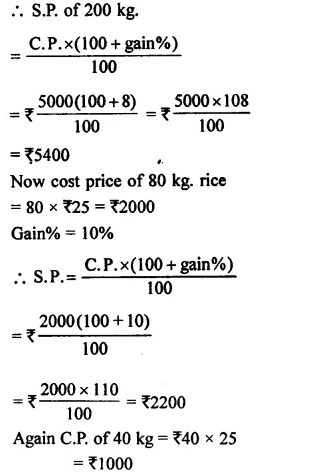
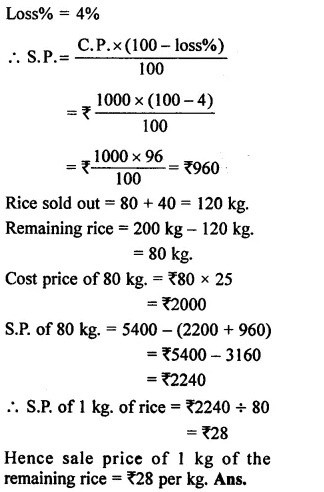
Total quantity of rice = 200 kg.
C.P. of 200 kg @ Rs 25 per kg.
= Rs 200 x 25 = Rs 5000
Gain% on total = 8%
RS Aggarwal Class 8 Solutions Chapter 10 Profit and Loss Ex 10A 24.1
RS Aggarwal Class 8 Solutions Chapter 10 Profit and Loss Ex 10A 24.2

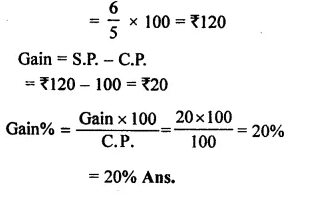
Question 25.
Solution:
Let C.P. = Rs 100
then S.P. = \(\\ \frac { 6 }{ 5 } \) of Rs 100
RS Aggarwal Class 8 Solutions Chapter 10 Profit and Loss Ex 10A 25.1

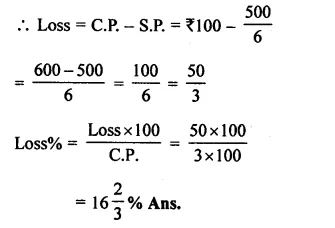
Question 26.
Solution:
Let C.P. of flower vase = Rs 100
then S.P. \(\\ \frac { 5 }{ 6 } \) of C.P. = \(\\ \frac { 5 }{ 6 } \) of Rs 100
= Rs \(\\ \frac { 500 }{ 6 } \)
RS Aggarwal Class 8 Solutions Chapter 10 Profit and Loss Ex 10A 26.1

Question 27.
Solution:
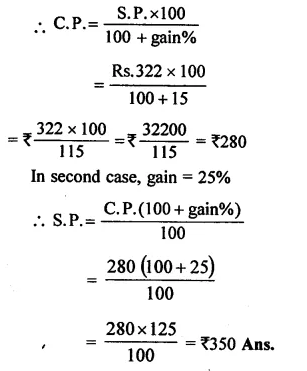
S.P. of a bouquet = Rs 322
Gain = 15%
RS Aggarwal Class 8 Solutions Chapter 10 Profit and Loss Ex 10A 27.1

Question 28.
Solution:
In first case,
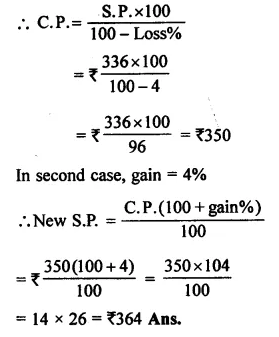
S.P. of an umbrella = Rs 336
Loss% = 4%
RS Aggarwal Class 8 Solutions Chapter 10 Profit and Loss Ex 10A 28.1

Question 29.
Solution:
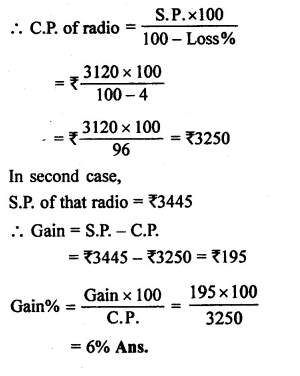
S.P. of Radio = Rs 3120
Loss% = 4%
RS Aggarwal Class 8 Solutions Chapter 10 Profit and Loss Ex 10A 29.1

Question 30.
Solution:
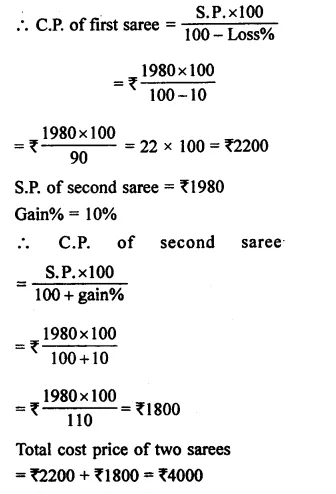
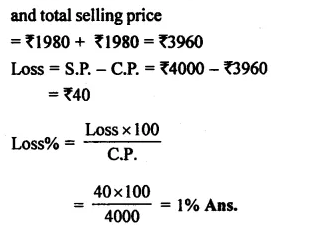
S.P. Of first sarees = Rs 1980
Loss% = 10%
RS Aggarwal Class 8 Solutions Chapter 10 Profit and Loss Ex 10A 30.1
RS Aggarwal Class 8 Solutions Chapter 10 Profit and Loss Ex 10A 30.2

Question 31.
Solution:
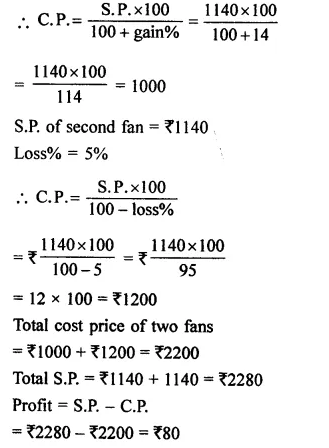
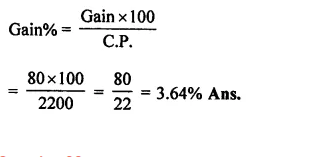
S.P. of first fan = Rs 1140
Gain% = 14%
RS Aggarwal Class 8 Solutions Chapter 10 Profit and Loss Ex 10A 31.1
RS Aggarwal Class 8 Solutions Chapter 10 Profit and Loss Ex 10A 31.2

Question 32.
Solution:
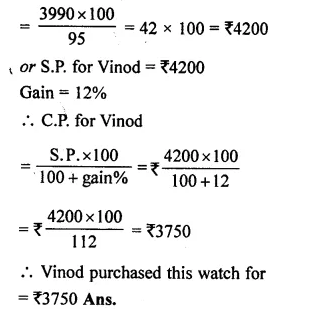
C.P. for Manoj = Rs 3990
or S.P. for Arun = Rs 3990
loss% = 5%
C.P for Arun
\(=\frac { S.P\times 100 }{ 100-losspercent} =\frac { 3990\times 100 }{ 100-5 } \)
RS Aggarwal Class 8 Solutions Chapter 10 Profit and Loss Ex 10A 32.1

Question 33.
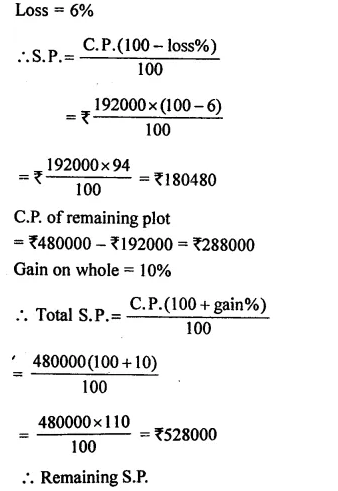
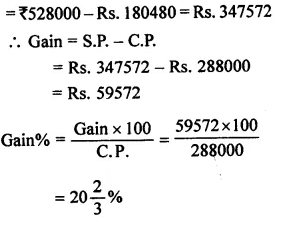
Solution:
C.P. of plot of land = Rs 480000
C.P. of \(\\ \frac { 2 }{ 5 } \)th part = Rs 480000 x \(\\ \frac { 2 }{ 5 } \)
= Rs 192000
RS Aggarwal Class 8 Solutions Chapter 10 Profit and Loss Ex 10A 33.1
RS Aggarwal Class 8 Solutions Chapter 10 Profit and Loss Ex 10A 33.2

Question 34.
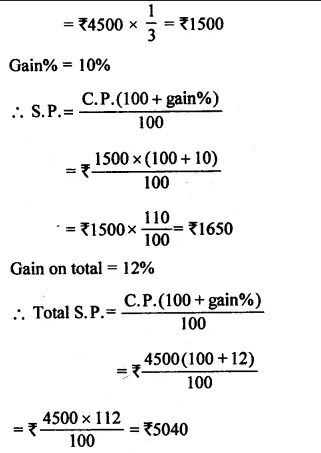
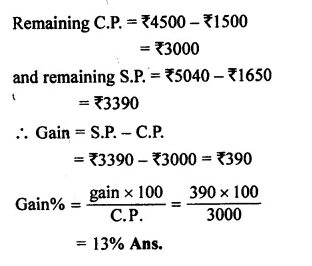
Solution:
C.P. of sugar = Rs 4500
C.P. of \(\\ \frac { 1 }{ 3 } \) of sugar
RS Aggarwal Class 8 Solutions Chapter 10 Profit and Loss Ex 10A 34.1
RS Aggarwal Class 8 Solutions Chapter 10 Profit and Loss Ex 10A 34.2


Hope given RS Aggarwal Solutions Class 8 Chapter 10 Profit and Loss Ex 10A are helpful to complete your math homework.

If you have any doubts, please comment below. Learn Insta try to provide online math tutoring for you.